Sometimes I wonder how many women in the church have the gift of teaching, but will never use it, or even entertain the possibility of possessing it. When roughly 90 percent of evangelical pastors and 80 percent of evangelical seminarians are men, it can be hard for gifted women to find role models in the church. With such a void, do some women even consider the thought?
As a college student, I was confused about the direction of my call and the place of my gifts. At my church, women mostly occupied administrative positions. Even in my college parachurch organization, we rarely had a woman speak. Given the scarcity of female role models, I wasn’t sure where to turn.
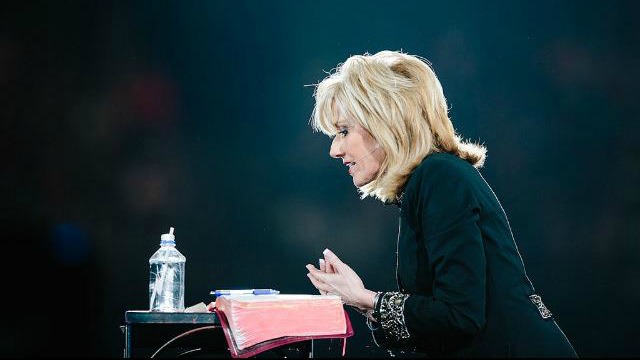
However my life was forever changed when, in my early 20s, I attended the annual Passion conference, a popular worship and teaching gathering founded by pastor Louie Giglio. Beth Moore took the stage, and though I was only vaguely familiar with her at the time, I won't ever forget that moment. When she opened up her Bible, she taught the Word like I had never heard a woman teach it before. She spoke with power, competency, conviction, and most of all, anointing. I would never be the same again.
Moore’s example opened up a new realm of possibilities for me and many other evangelical women. Seeing her teach launched my own journey to earn my Master of Divinity and my PhD, all to equip myself for writing and speaking about the Christian life. As a part of my doctoral research, I interviewed evangelical women in seminary and discovered their experiences were much like mine.
“Everyone I’ve ever admired occupationally has been a man, except for Beth Moore,” one student told me. “Beth Moore was my, ‘Wow, look at her, she’s a woman doing the kinds of things that I would like to do.’”
I interviewed dozens of women who reported similar experiences. Moore wasn’t the only role model to inspire them, but many of them pinpointed similar epiphanies—the first time they saw a woman teach the Bible or attend seminary—that inspired their call.
The women I interviewed were enrolled in seminaries that do not support the ordination of women, so most did not aspire to be pastors. Instead, they felt a call to “teach the Word” in some capacity. In contrast with pastoring or preaching, teaching is more widely accepted in conservative circles, but the women still needed a blueprint. For many of them, it wasn’t until they saw another women using her gifts that they recognized their own.
More broadly, research on the influence of role models is consistent with the women I interviewed. Studies have shown that role models—particularly “in-group” role models—can benefit the performance of medical students, encourage women toward business leadership, and improve the retention of women in math and science fields. Role models are especially effective when they demonstrate competency. That is to say, it’s not enough to stick a “token woman” in a leadership position—she must be good at what she does, which explains in part why Beth Moore proves so compelling to many of us.
As I read these earlier studies and conducted my own research, I began to see my story in a whole new light. If the research is correct, my experience is not an outlier. Instead, it fits a pattern: Women use their gifts when they see other women use their gifts. And that made me wonder: How many women had been similarly impacted by the Passion conferences? How many women had been similarly impacted by Beth Moore? How many women are now in ministry, or in seminary, because of experiences like mine?
This realization underscores the importance of exposing evangelical audiences, and women in particular, to female teachers, a truth made all the more clear when, last weekend, I returned to the Passion conference. More than ten years after I first attended Passion, I sat in a sea of 20,000 college students in Atlanta, feeling more than a little nostalgic. This time there was no Beth Moore, or other female speaker, which made me a bit sad. How many women, in the prime of discerning their futures, might have had their own epiphanies?
Later this month, however, Passion will host two more conferences—in Atlanta and Houston—where Christine Caine will be a featured speaker. I can imagine Caine, one of the most gifted Bible teachers I know, offering the same sort of impact through her example. How many women will, for the first time, entertain the possibility that they too can be teachers of the Word? How many women will be inspired to identify and cultivate their own gifts?
1 Corinthians 12 tells us that every gift is given for the good of the church. This teaching confronts both the individual believer, and the larger community, with the responsibility of stewardship. If everything we have is God’s, to be used for the glory of God, then the gifts of women are not a neutral asset. They were given to the church for a purpose, and God expects us to steward them.
Research tells us that female role models are a powerful and effective way to honor this call to stewardship. I hope more church leaders and conference planners will take that into consideration. Speaking from experience, it could change lives.