Donald Trump may not have gotten Ted Cruz’s endorsement last night. But today he picked up the endorsement of Focus on the Family founder James Dobson.
“I am endorsing Donald J. Trump not only because of my apprehensions about Hillary Clinton and the damage she would inflict on this great country,” stated Dobson, who now leads the Family Talk radio program. “I am also supporting Mr. Trump because I believe he is the most capable candidate to lead the United States of America in this complicated hour.”
The Clinton qualifier reflects the mixed feelings many evangelicals have on this year’s presidential picks.
Despite previously stating he couldn’t support the Republican candidate, Dobson remarked last month that he believed Trump had recently made a genuine commitment to faith and was now a “baby Christian.”
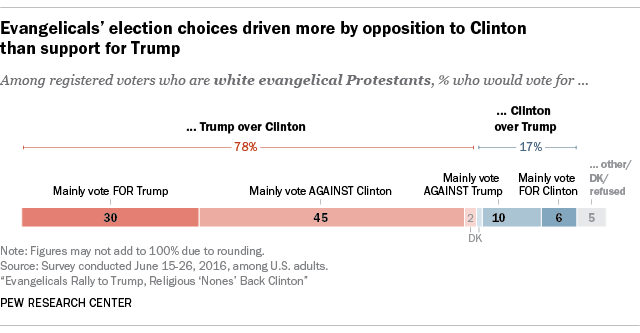
More than 3 in 4 white evangelicals like Dobson are voting Trump this November, according to the Pew Research Center. However, it’s mostly a vote against Clinton, not in support of Trump himself:

Overall, about a third (36%) of evangelicals are voting for a candidate they like, while more than half (55%) are voting against the candidate they like the least.
That’s exactly what most evangelical leaders (very few of whom supported either Trump or Clinton when the election began) advise.
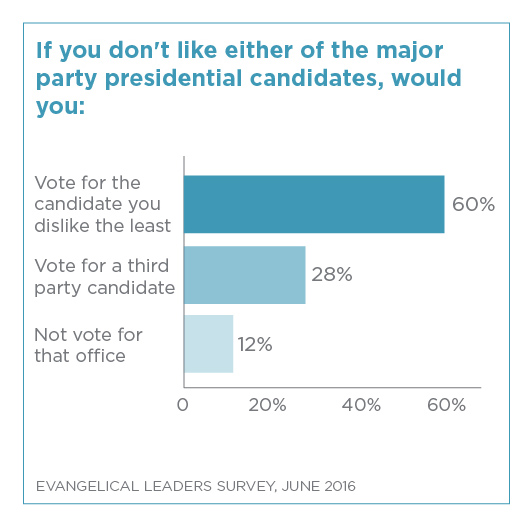
When faced with two disagreeable candidates, 60 percent of the National Association of Evangelicals (NAE) board members polled last month said that Christians should vote for the candidate they dislike the least, while 28 percent said to vote for a third-party candidate and 12 percent said to not vote for that particular office.
 NAE
NAE
“In their comments, some evangelical leaders suggested that voting for a third party candidate or abstaining for that office was futile or a vote for the winning ticket,” noted the NAE on the “lesser of two evils” choice. “A minority, however, think these positions are worth considering.”
“How can I preach civic responsibility if I do not vote?” Randall Bach, president of Open Bible Churches, told the NAE. “But how can I vote for a candidate that I cannot support, even using a ‘lesser of evils’ logic?”
In World magazine’s last poll of evangelical influencers—conducted in May, after Cruz left the field open to Trump—the 77 respondents appeared to be split down the middle. Half said they would still never vote Trump (51%), but the other half said they could be persuaded if he promised to appoint a pro-life Supreme Court justice or chose a vice president they liked.
Almost all of those who wouldn’t vote for Trump said they would choose a third-party candidate. Forty-six percent of respondents said they’d pick one on principle, even if that person had no chance of winning. Another 29 percent said they’d choose a third-party candidate only if he or she had a real shot at winning.
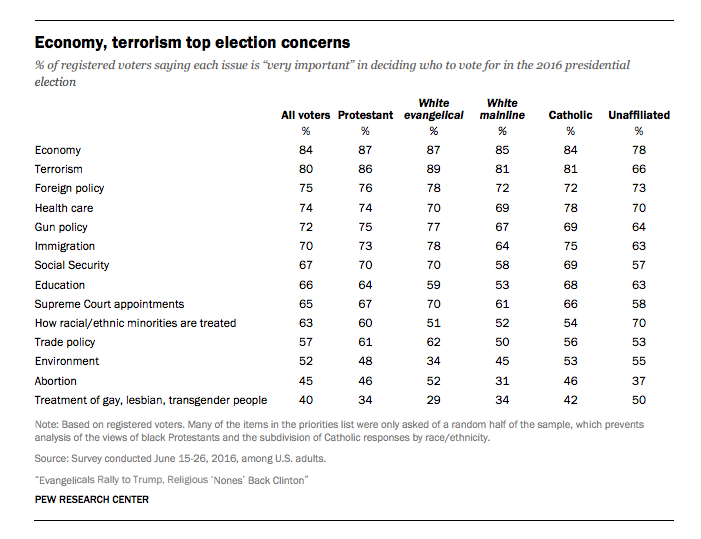
The top three issues the World panel said they were considering when selecting a candidate were abortion, religious freedom, and Supreme Court nominations. None overlap with the top considerations of white evangelical voters in the pews: terrorism, the economy, and foreign policy/immigration.
Today, Pew offered an interactive flowchart of how GOP voters arrived at Trump, as well as further analysis of its data.
During the Republican primaries, two-thirds of regular churchgoers did not support Trump:
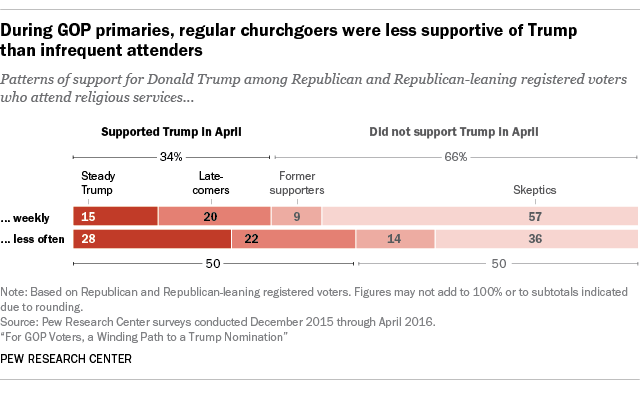
Among Republican voters, white evangelicals were actually among Trump’s greatest skeptics. Only 22 percent were steady Trump supporters during the primaries:

But today, regular churchgoers are just as supportive of Trump as those who rarely attend church:
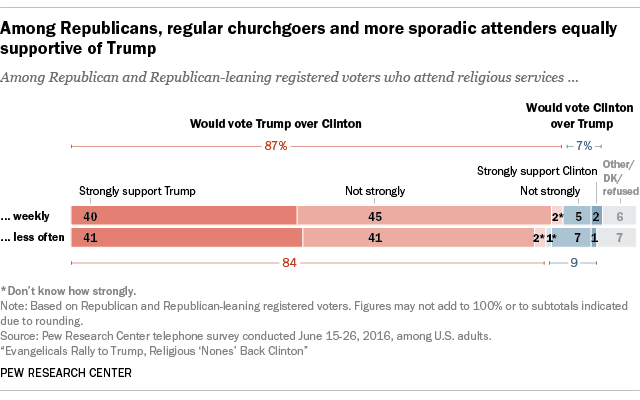
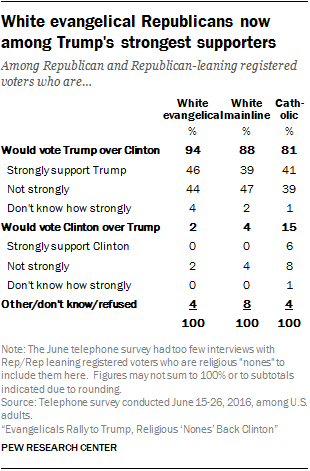
And white evangelicals plan to overwhelmingly vote for Trump, though only 46 percent say they “strongly support” him:

However, among GOP evangelical voters who did not pick Trump in the primaries, a large enthusiasm gap remains. While 93 percent of those who supported other candidates will vote for Trump over Clinton, only 27 percent strongly support Trump: