In this series: Casting Vision if You Aren't Visionary
What takes prioritythe vision or the people? Most of us agree that we shouldnt simply tell churchgoers who arent aligned with the vision to find another church. Casting vision is complicated for any leader; it can feel impossible for leaders who arent visionary.
But theres hope for even the least visionary leaders when it comes to casting vision. A church is at least partly defined by those God has placed within it. Pastors are called to discern the vision God already has for their congregation, based on the people he has brought together. The articles below will help you identify and share Gods vision with your congregationeven if you feel less-than-qualified to do so.


Effective leaders possess the knack for seeing opportunities in circumstances. They see a clear picture of what the future can and ought to be. This is called “vision.” The book of Nehemiah offers some powerful principles about how vision begins and then how it grows.
Vision begins with a need.
Nehemiah was a Jewish man in a high-profile government position in Persia. In 445 BC, he got a firsthand report about the Jewish remnant that had returned from captivity to the Promised Land. His questions surfaced some disturbing news. The Jewish remnant faced a shameful, unsafe situation: Jerusalem's walls were in shambles. Nehemiah wept because the need stirred his soul.
Visionary leaders see needs—and it moves them. These needs may even make them weep or pound the table: lost people, injustice, biblical illiteracy, families in financial trouble, or some other type of need.
Vision grows in prayer.
Nehemiah was so moved by this need that he began to pray. Nehemiah's prayer in 1:5-11 shows him beginning with a confession of Israel's sin. He recognized the need to deal with the past before moving on. Nehemiah also reflected seriously on God's promises, which gave guidance to his vision. By the end of Nehemiah's prayer, he asked God for success.
A detail at the end of Nehemiah's prayer sheds light on his request. Nehemiah was the king's cupbearer—a key cabinet position in the Persian government. What Nehemiah prayed, then, was that God would turn his circumstances into opportunities.
Vision is born when a leader is so moved by a need that they ask God to turn circumstances into opportunities.
Vision is born when a leader is so moved by a need that they ask God to turn circumstances into opportunities. God responds by giving these leaders, as he did Nehemiah, a picture to pursue—a vision of how God can use them to meet that need.
Vision mobilizes the church.
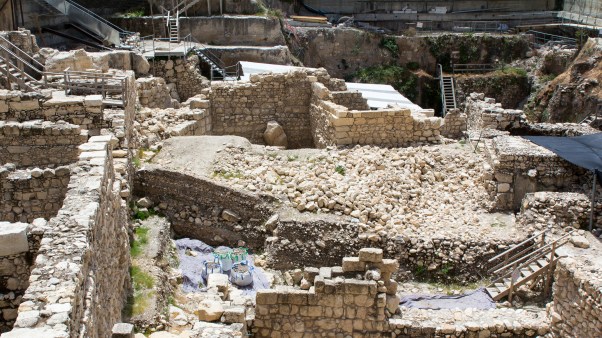
At first glance, Nehemiah 3 (it recounts who rebuilt which parts of the wall) looks like boring reading. We might dismiss it as something akin to reading the annual report of a corporation or church. But further reflection reveals that it testifies to the power of vision. The chapter simply moves section by section around the wall in a counter-clockwise direction, starting and ending at the Sheep Gate on the northern tip of Jerusalem. The city wall, from overhead, would resemble the shape of a spoon—rounded toward the top, narrow at the bottom. The circumference was two miles.
The chapter points out that the Jewish people rebuilt the wall section by section. They tackled forty sections and worked simultaneously. Their vision motivated and mobilized them to complete a great task.
A couple of phrases echo throughout Nehemiah 3: “opposite his house” and “in front of his house.” Each group of people took a section in their neighborhood. It was something they could do, something in their area that had meaning to them.
Think about children on vacation: Left to themselves, they may soon turn their energy on each other. But give them a vision—a fort to build or a room to decorate—and they can accomplish something significant. Likewise, when leaders have a clear picture of what the future can be, they can harness the collective energy of God's people to accomplish formidable tasks.
Churches rarely flounder because of lack of willing workers. They flounder because of the lack of vision. Vision has the power to motivate people, whatever “wall” God is calling them to build.
Steven D. Mathewson was pastor of Dry Creek Bible Church in Belgrade, Montana until 2006.