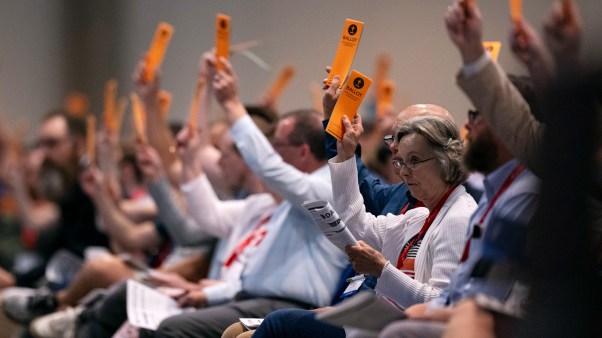
A growing number of black Christians believe it is their destiny to play a major role in world evangelization. And in Atlanta recently, 1,700 visionaries gathered for Destiny ’87, a conference that provided education and inspiration, as well as interaction, between mission-minded blacks and executives of predominantly white mission agencies.
On the opening night of the conference, Campus Crusade for Christ president Bill Bright told the audience, “You, who represent one of the most strategic segments of the world society, can do more than has ever been done in the history of the African race to help reach the entire world for Christ.”
Crawford Loritts, director of Campus Crusade’s Here’s Life, Black America ministry and coleader of Destiny ’87, also stressed the unique role of African-Americans in world missions. “Many white Americans are no longer welcome in certain areas [of the world],” he said. People in the Third World readily identify with black Americans, Loritts said, “because of our background of oppression.… Most of the world is not like white, middle-class America.”
Untold Story
Part of the purpose of Destiny ’87 was to introduce conferees to the little-known history of black missionary activity overseas. In the early days of the modern missionary movement, for example, some white mission societies sent black missionaries to Africa because whites were unable to adapt to tropical climates.
By and large, however, enthusiasm among blacks for world missions has been minimal. Among the reasons, Loritts says, is that the “parachurch [mission] agency is a culturally strange animal to black folks.” This makes it difficult for Christians working in parachurch groups to raise funds in the black community. Loritts also cited past policies of missions organizations, which he said were not overtly racist, but reflected “benign neglect” of African-Americans. For example, many schools that prepare missionaries have not actively recruited black students.
Perhaps the biggest reason for a lack of missions activity among blacks is their preoccupation with their own problems. Loritts called for blacks to abandon their “theology of survival.… Racism will be with us till Jesus returns. But when you focus on your own struggle for such a long time, it gets to be disproportionate to the purposes of God.”
Those who attended Destiny ’87 heard messages from some of the nation’s top black preachers and attended workshops led by missionaries from around the world. Organizers of the Atlanta meeting view it not merely as a conference, but as part of a movement. Black leaders predict a major migration of African-Americans to the mission field, though it remains to be seen through which channels.
Destiny ’87 coleader Elward Ellis, director of Black Campus Ministry for InterVarsity Christian Fellowship, predicts the Destiny movement will give the mission agencies of the major black denominations “a shot in the arm.” He said he would also like to see more African-American Christians in traditionally white mission agencies. “Everybody could benefit from some cross-pollination,” he said.
Black-And-White Issue
In pursuit of this cross-pollination, Loritts has challenged white and black Christians alike. Meeting in Atlanta with white missionary executives, he suggested that “corporate pragmatism [has] affected us more than we care to realize.” He urged creative thinking to develop ways more blacks could enter white missions structures.
And to blacks, he said, “We have been quick to be prophetic and to denounce without at least coming alongside and saying, ‘Let’s partner together.’ ”
Wade Coggins, executive director of the Evangelical Foreign Missions Association, said white missions organizations are in the process of “getting acquainted and building relationships” with black missions agencies and black Christians. He said the challenge for traditional missions is to find ways to “make it easier for black Christians to fit in.… This is something that has not had serious consideration till now. It’s probably the next thing on the agenda.”
By Randy Frame, in Atlanta.