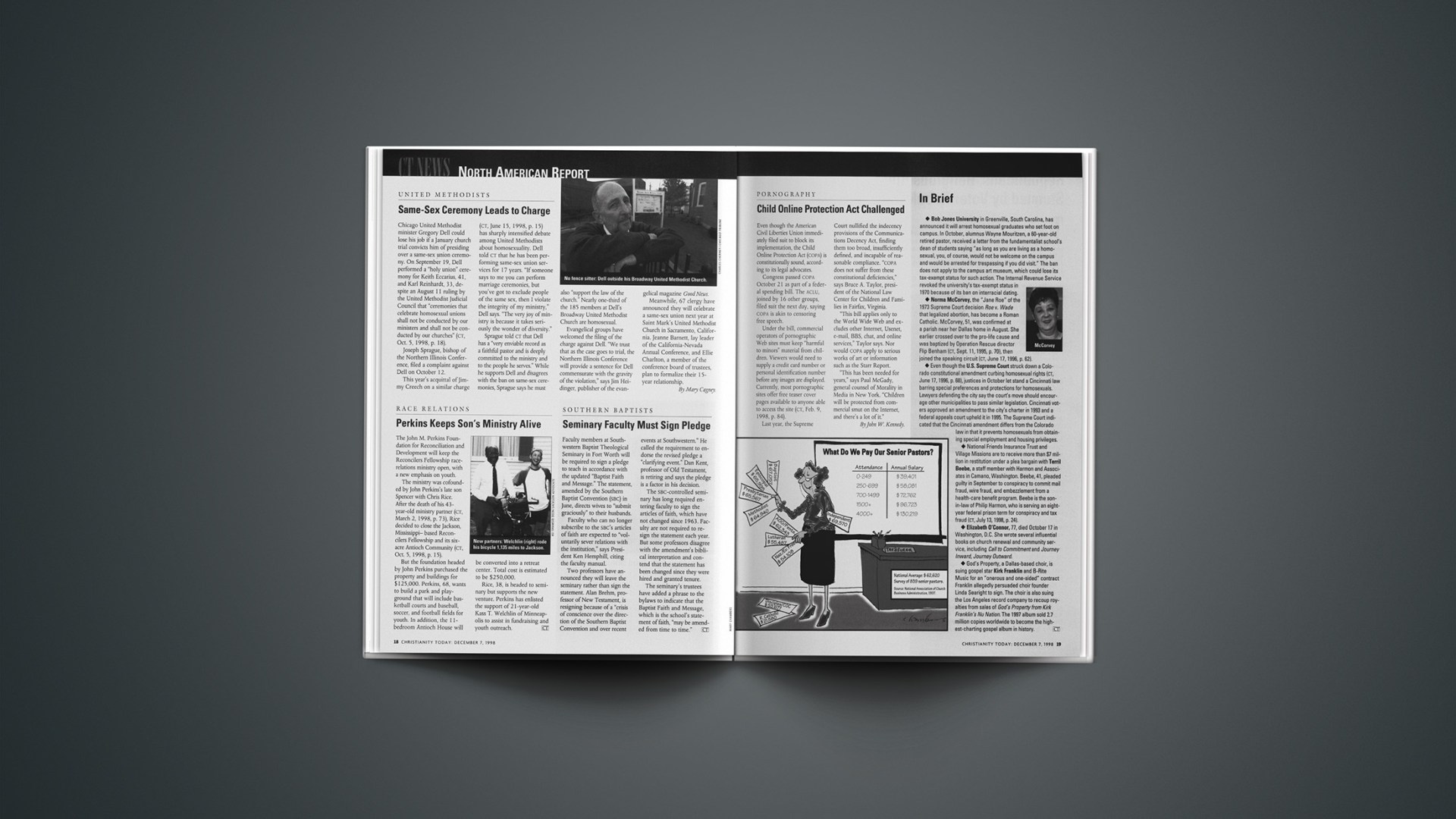
Child Online Protection Act Challenged

Child Online Protection Act Challenged

Even though the American Civil Liberties Union immediately filed suit to block its implementation, the Child Online Protection Act (COPA) is constitutionally sound, according to its legal advocates.

Congress passed COPA October 21 as part of a federal spending bill. The aclu, joined by 16 other groups, filed suit the next day, saying COPA is akin to censoring free speech.

Under the bill, commercial operators of pornographic Web sites must keep “harmful to minors” material from children. Viewers would need to supply a credit card number or personal identification number before any images are displayed. Currently, most pornographic sites offer free teaser cover pages available to anyone able to access the site (CT, Feb. 9, 1998, p. 84).

Last year, the Supreme Court nullified the indecency provisions of the Communications Decency Act, finding them too broad, insufficiently defined, and incapable of reasonable compliance. “COPA does not suffer from these constitutional deficiencies,” says Bruce A. Taylor, president of the National Law Center for Children and Families in Fairfax, Virginia.

“This bill applies only to the World Wide Web and excludes other Internet, Usenet, e-mail, BBS, chat, and online services,” Taylor says. Nor would COPA apply to serious works of art or information such as the Starr Report.

“This has been needed for years,” says Paul McGady, general counsel of Morality in Media in New York. “Children will be protected from commercial smut on the Internet, and there’s a lot of it.”

Copyright © 1998 Christianity Today. Click for reprint information.

Also in this issue

Special Christmas Meditation: Reflections/Art Gallery: Walking Bewildered in the Light and other classic & contemporary excerpts.

Our Latest

The Bulletin

Attitudes Toward Israel, Kash Patel’s Lawsuit, and John Mark Comer’s Fame

Clarissa Moll, Russell Moore

Americans’ growing frustrations with Israel, Kash Patel sues The Atlantic for $250 million, and the popularity of John Mark Comer.

News

How a Kidnapping Changed a Theologian’s Mind

Interview by Emmanuel Nwachukwu

An interview with Sunday Bobai Agang about the lessons he learned from his abduction last month.

On America’s 250th, Remember Liberty Denied

Thomas S. Kidd

Three history books on the US slave trade.

News

What Christian Athletes Can’t Do

An NBA player’s fall resurrects an old anxiety: When does talking about faith become “detrimental conduct”?

News

Facing Arrest, Cuban Christian Influencers Continue Call for Freedom

Hannah Herrera

Young people are using social media to spread the gospel and denounce the Communist regime.

Public Theology Project

Against the Casinofication of the Church

The Atlantic’s McKay Coppins told me about problems that feel eerily similar to what I see in the church.

Wire Story

The Religion Gender Gap Among the Young Is Disappearing

Bob Smietana - Religion News Service

Women still dominate church pews, but studies find that devotion among Gen Z women has cooled to levels on par with Gen Z men.

Just War Theory Is Supposed to Be Frustrating

The venerable theological tradition makes war slower, riskier, costlier, and less efficient—and that’s the point.

addApple PodcastsDown ArrowDown ArrowDown Arrowarrow_left_altLeft ArrowLeft ArrowRight ArrowRight ArrowRight Arrowarrow_up_altUp ArrowUp ArrowAvailable at Amazoncaret-downCloseCloseellipseEmailEmailExpandExpandExternalExternalFacebookfacebook-squarefolderGiftGiftGooglegoogleGoogle KeephamburgerInstagraminstagram-squareLinkLinklinkedin-squareListenListenListenChristianity TodayCT Creative Studio Logologo_orgMegaphoneMenuMenupausePinterestPlayPlayPocketPodcastprintremoveRSSRSSSaveSavesaveSearchSearchsearchSpotifyStitcherTelegramTable of ContentsTable of Contentstwitter-squareWhatsAppXYouTubeYouTube