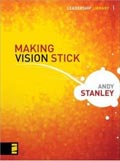
There are two very different approaches to church leadership today. One is practical, focused on measurable outcomes, and concrete. Call it “left-brained.” The other is intuitive, focused on process, and organic. Call it “right-brained.” From these two mindsets have emerged two effective, respected church leaders with two new books. Andy Stanley is founding pastor of North Point, a megachurch near Atlanta. Tim Keel is founding pastor of Jacob’s Well, an emerging church in Kansas City.
Even their book titles reveal their divergent views of leadership. Stanley’s title, Making Vision Stick, communicates the pragmatic, how-to nature of his book. Keel, in contrast, declares, “This book is not a manual.” Instead, Intuitive Leadership is all about story. Keel shares large portions of his own story, moving us from his childhood, through college, seminary, and into pastoral ministry.
|
|
Keel then takes the reader through a sweeping story of world history to explain how we arrived at Postmodernity. Not until page 228 does he give any practical application regarding these cultural shifts. And even this is not in the form of concrete action steps, but rather nine changes in “posture” important for ministry in this new world.
While the right-brained Intuitive Leadership is all about story, the left-brained Making Vision Stick is all about steps. Stanley’s book is so short, so practical, it doesn’t even need a table of contents. From “State the vision simply” to “Live the vision personally,” he gives handy instructions with examples from North Point.
The differences between Keel and Stanley go beyond style, however. They have very different views of the leader’s role. For Stanley, the leader is central to a church’s vision, responsible for creating it, communicating it, and maintaining it. “When a leader blames the follower for not following, the leader has ceased to lead,” he writes.
Keel, by contrast, presents a decentralized approach in which direction is discovered from within the community. In this setting, the leader’s primary role is that of environmentalist, not program director; one of asking questions, not giving answers. “Such a move requires that you trust the people with whom you dialogue enough to listen to what they have to say.”
While Stanley clearly believes in the importance of a central visionary leader, he does not advocate North Point’s vision as normative for everyone. He shares his own church’s story but never suggests that vision is best for another church. Both Keel and Stanley understand the importance of context.
Keel emphasizes contextualized leadership. Stanley ideas of contextualization are more subtle, but both clearly understand that their churches’ unique callings should not be generalized.
Both authors also understand systems and what can sabotage their effectiveness. Stanley writes, “It’s tough to make vision stick. Time has a way of eroding the adhesive.” Keel agrees, “Organizations, as they mature, often lose sight of the original spirit that animated them.”
 |
Intuitive Leadership: Embracing a Paradigm of Narrative, Metaphor, and Chaos by Tim Keel Baker, 2007 |
As for the criticism of the emergent movement being anti-structure, Keel plainly states, “Structure is not a bad thing. Structures support or inhibit life.” But he adds that settling for mere programs “relieves the people from stretching and doing the hard work of building relationships.”
Both books are worth reading, but they have very different objectives. Keel wants to change how leaders think. He seeks to convince readers of the need for a massive shift in how leadership looks. Stanley keeps the goal simple: to make vision stick.
Taken together, the two books with their divergent perspectives, provide a full and complementary picture of effective leadership today. That’s some real brain power.
Copyright © 2008 by the author or Christianity Today/Leadership Journal.Click here for reprint information on Leadership Journal.