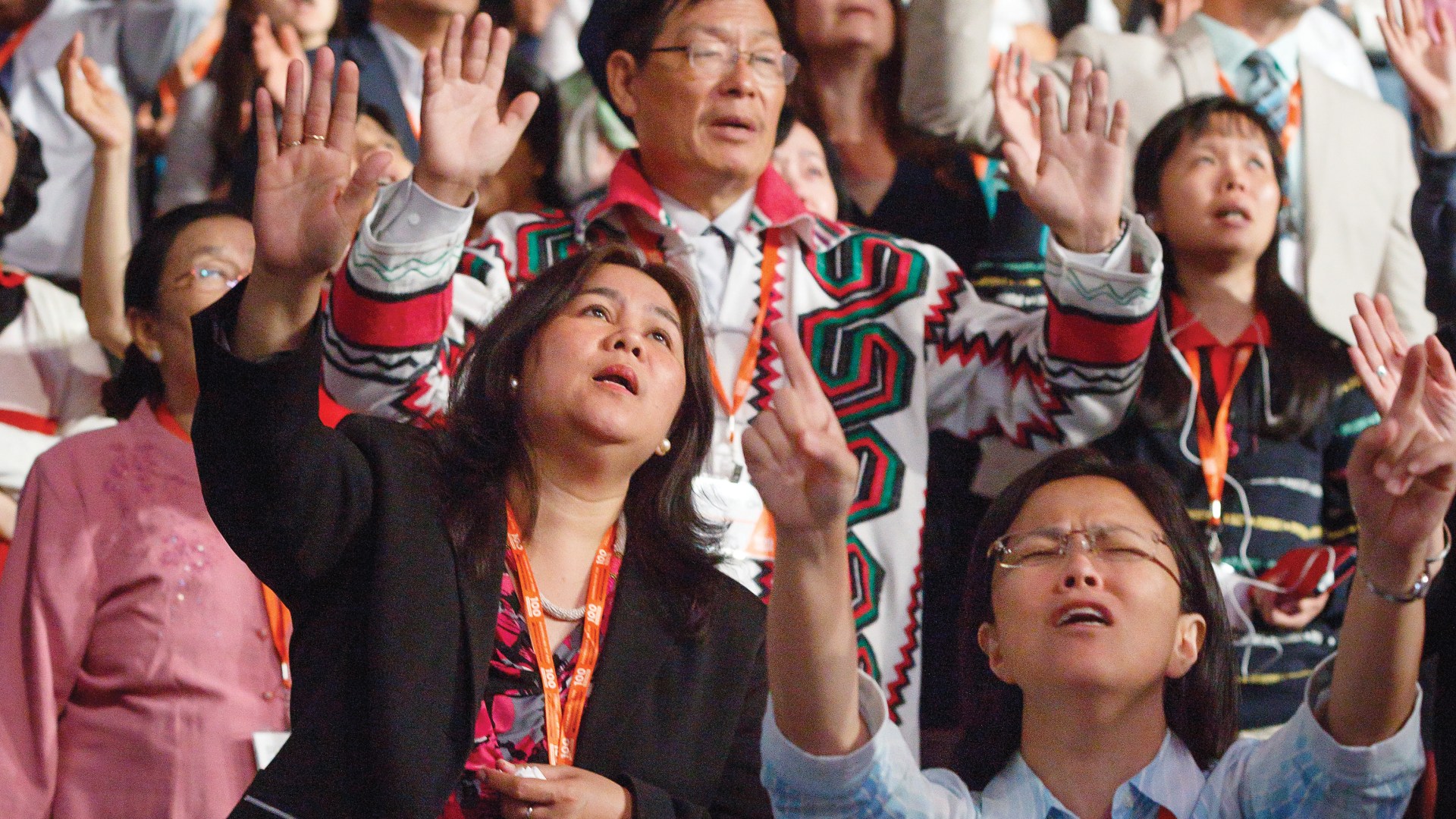
The Assemblies of God, one of America’s largest and fastest-growing denominations, celebrated its 100th birthday this year. Almost all of its growth has come from ethnic minorities, who compose more than 41 percent of its 3.1 million American adherents.
But on many national survey reports of religious Americans, those nearly 1.3 million evangelicals are invisible because they are not white.
Major survey organizations such as Pew Research Center, Gallup, and Public Religion Research Institute often split non-Catholic Christians into the historical categories of black Protestants, mainline Protestants, and white evangelicals.
“It’s not uninteresting or incorrect to look at evangelicals as a whole,” said Greg Smith, Pew’s director of U.S. religion surveys. After all, he notes, two-thirds of “black Protestants” identify as evangelicals. “It’s a pragmatic decision. If you don’t separate out black and white evangelicals, you will miss the link between race, religion, and politics. On many important social and political issues, these are just very different groups.”
The “black Protestants” category actually includes Christians of any ethnicity who attend historically black denominations. Such churches traditionally had radically different social missions than those in majority-white groups, and congregants typically engaged politics differently than their evangelical and mainline counterparts. Pew reported that in the 2012 presidential election, 95 percent of black Protestants voted for Obama, compared with 20 percent of white evangelicals.
When classifying religious groups, surveys focus on adherence to a set of beliefs, a set of behaviors, or group membership (depending on the topic), according to Corwin Smidt, research fellow with the Henry Institute at Calvin College.
Because a respondent’s race is often strongly linked to political and social behavior, it’s usually an important category for researchers. Since evangelicalism is still largely white in the United States, only very large surveys have enough respondents from each race for accurate analysis.
However, treating race as a dividing demographic among Christians fosters misunderstanding, said Smidt. His recent research found that faith affiliation carries more weight than race or education level. He found that evangelicals from different demographic backgrounds—including race, education, and theological mindset—still share similar beliefs and religious behaviors. For instance, they go to church and pray at about the same frequency.
Ethnic minorities are flocking to evangelical churches in growing numbers, said Michael Emerson, sociology professor at Rice University. In the past five years, the Assemblies’ non-white membership climbed by nearly 20 percent, while white membership grew by only about 2 percent. In the 15.8 million–member Southern Baptist Convention, “non-Anglo” churches now account for 20 percent of its nearly 50,500 congregations.
“The default image that most people have in their heads is of politically conservative white evangelicals,” said Brian Steensland of Indiana University’s Center for the Study of Religion and American Culture. “That’s never been fully accurate, but it’s increasingly becoming less accurate.”
Steensland has helped nuance the ways surveys measure evangelicals. But most of the time, researchers can’t divide their sample into more accurate groups because they become too small for statistical analysis. In addition, researchers like to compare results across time, and that means using the same categories.
But as the evangelical world diversifies, the importance of measuring it accurately becomes more acute, says Emerson.
“Measurement, though it seems dull, is of utmost importance because it shapes how we think about reality,” he said. “It shapes the categories that we think matter, and then we start looking at those categories and thinking they are real.”