The same day in 1963 that John F. Kennedy died violently in Dallas, the Christian writer C. S. Lewis died quietly at his home in Oxford. The following year, CT published an appreciation of Lewis’s life and work.
The death of Clive Staples Lewis on November 22 removed from the world one of its most lucid, winsome, and powerful writers on Christianity. We have reason to thank God that such a man was raised up in our time. …
Certain themes run all through Lewis’s books, whether expository or fictional. One is that every living being is destined for everlasting life and that every moment of life is a preparation for that condition. … But perhaps the most persistent theme in Lewis is that of man’s longing for Joy. He calls this longing “the inconsolable secret” that inhabits the soul of every man, a desire that no natural happiness can ever satisfy. It is lifelong pointer toward heaven, a nostalgia to cross empty spaces and be joined to the true reality from which we now feel cut off. …
He was a Christian of no uncertain stamp. He managed the difficult feat of successfully integrating his scholarship and his religion. If we add to these things the gifts of a lively imagination, a vigorous and witty mind, and a brilliance of language, we can discover why his books have sold widely and why his readers are steadily on the increase.
Perhaps inspired by Lewis, CT published a slate of articles on Christians and art in 1964, encouraging readers to pick up Shakespeare and the poet Heinrich Heine and to wrestle with the work of Vladimir Nabokov and Tennessee Williams. A reporter noted that Billy Graham “laced his messages with heavy doses” of writers Ernest Hemingway, John Steinbeck, and Eugene O’Neill. And CT asked evangelical painter Grant Reynard to write “Christians and Art: A Painter’s View.”
Christians should be encouraged to go to art museums to study great pictures on biblical themes. … This process of attaining a measure of good taste in the Christian use of art will take time, but God will assuredly be pleased at any use of our leisure devoted to bringing inspiration, dignity, and reverence to the worship of our Saviour Jesus Christ through a better quality of art. …
Christians will do well to spend more time in raising their level of art appreciation. Art, whether that of the great masters or the humbler efforts of lesser talents, belongs to those things God has given us to enjoy. And in its truest integrity it exists for the glory of God. We need architecture that fittingly houses places of worship, music that worthily praises God the Father and brings men closer to God the Son, pictures on the walls of our homes that, while not necessarily religious, are examples of good art. We need Christian artists of dedicated talent who will extend their horizons in humility and devotion to the true praise of the Giver of talent, who is best honored by the faithful use of his good gifts.
Evangelicals looked for other ways to engage culture as well. CT reported that InterVarsity Christian Fellowship, Campus Crusade for Christ, and other evangelical campus ministers were sending young believers to spring break hot spots.
These groups are using what might be called guerrilla tactics to penetrate alien, and often hostile, territory. This year at Fort Lauderdale, radio antennas on cars were stacked high with beer cans; at Daytona Beach, sweatshirts bore such slogans as “Help Stamp Out Virginity.” On Balboa Island, on the West Coast, Campus Crusade hung out its sign at headquarters, while across the street someone hung out another sign bearing the legend, “Booze is the Answer.”
But the unorthodox methods have proved themselves, according to their proponents. …
At Newport Beach–Balboa Island, Campus Crusade teams of two strolled up and down the beaches with their questionnaires for a “religious opinion survey.” More than 1,000 forms were completed, and more than 400 young people accepted Christ as Saviour, according to Josh McDowell, a crusade director.
“No, we don’t convince everyone we talk to,” said McDowell, “but we give everyone a chance to hear the message.” Members talked to some 1,300 vacationers on the beaches, on the streets, and at twist parties.
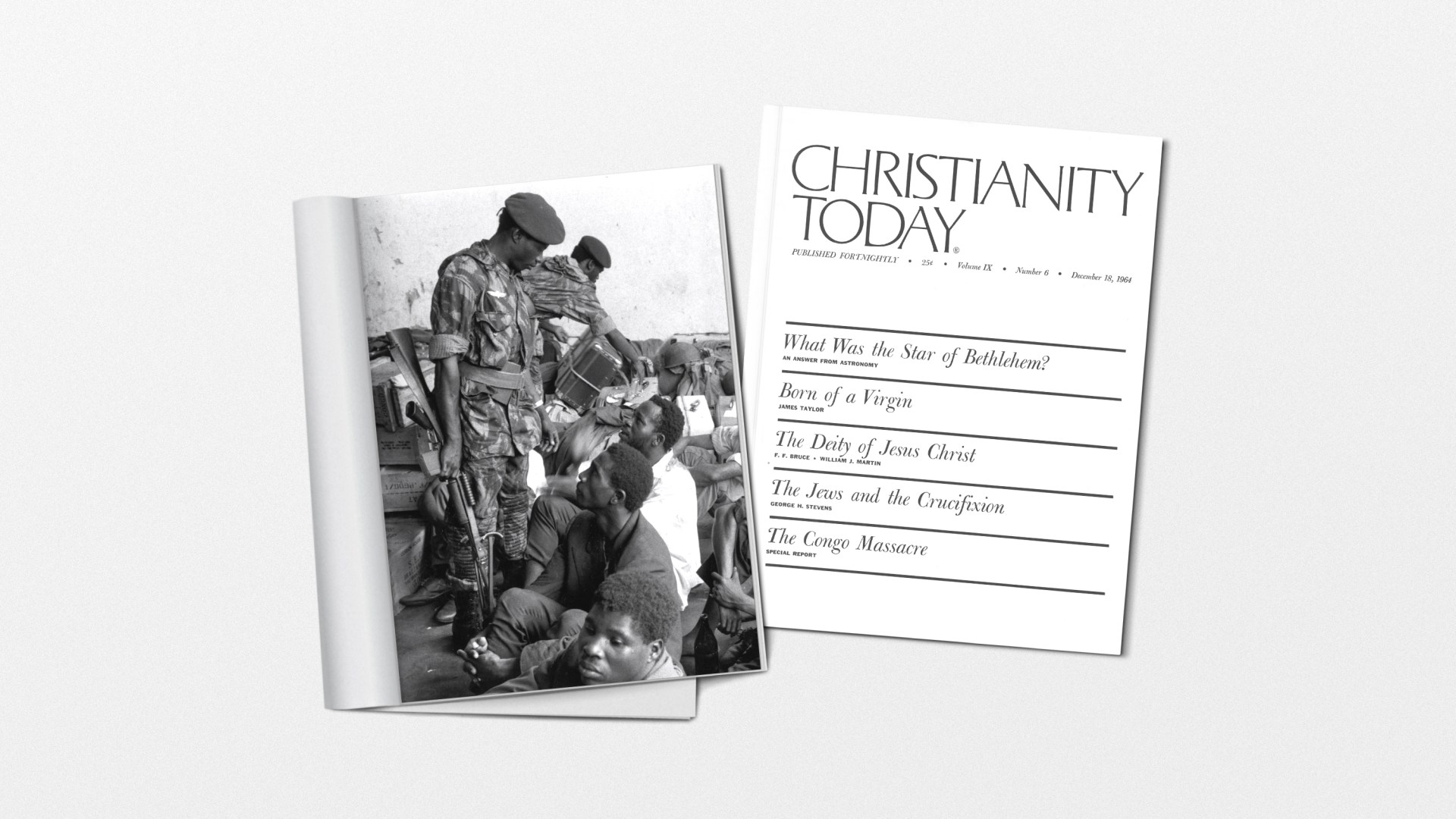
CT published a special issue on Christianity in post-colonial Africa, looking at local churches and missions in the northern, western, central, eastern, and southern regions. A Canadian missionary to Canada explained the need for a “Reassessment in Africa.”
Before 1950 there were only four independent states in Africa: Ethiopia, Egypt, Liberia, and South Africa. By the end of 1964 there will be thirty-five. One-third of the U. N. General Assembly’s seats are filled today with Africans once represented by half a dozen European powers. … Africa is so vast (the United States, Europe, and India could be tucked into it with much room to spare) that inland villages continue traditional patterns of living while coastal areas are rocked by the impact of rapid change. The evolution of civilization in Europe, molded by trial and error over half a millennium, has been telescoped into a few decades in Africa. …
Some seed planted by the gospel husbandmen withered, some was bad, some took root and flourished. The depth of the roots is being tested in 1964 by the scorching heat of persecution and the violent winds of change. The majority of people remain outside the Church. … On the other hand, every leader in Africa has at some time had contact with a mission school. Dispensaries and hospitals carry on a Christian witness across the continent. Churches are well filled.
Before the year was over, violence broke out in what was then called the Republic of the Congo. CT reported that the Communist-backed rebels targeted Christians, killing Protestant and Catholic ministers.
In a show of savagery that shocked the intelligent world, bearded Congolese rebels last month turned back the clock and reverted to a barbarian age. …
The youngest American victim was Miss Phyllis Rine, 25, a teacher from Cincinnati who signed up for service in Congo in 1960, the year the country assumed independence amidst considerable turmoil. Miss Rine was then a student at Cincinnati Bible Seminary. After graduation she taught at church and public schools in the Cincinnati area. She told the mission board that “during this time I came to know and love the Negro people. I’ve been challenged by the great need for workers in the Congo.”
She went to Congo in 1962 under the African Christian Mission, a small independent board of autonomous Churches of Christ. An associate recalls that a few days before the rebels arrived Miss Rine “was all enthused about her plan to ride her bicycle into the Stanleyville suburbs and teach and preach on the street corners.”
Miss Rine was killed by machine-gun fire in a square in Stanleyville, near the monument that stands in memory of the late Patrice Lumumba, the leftist who was Congo’s first premier.
Back in the United States, President Lyndon Johnson, sworn in after Kennedy’s assassination, passed a landmark civil rights bill. CT published a roundup of commentary for and against the legislation and an editorial reflecting on Christians’ moral responsibility at this pivotal moment.
The period ahead may well be domestically the most crucial in our history since the Civil War. Complex problems of compliance and enforcement will not quickly be solved. Long-established traditions will not easily be changed. In their response to the new law, our people face a searching test of civic maturity and responsibility. If some of the provisions of the civil rights act prove incapable of enforcement, superfluous, or unconstitutional, these flaws are bound to be revealed and, it is to be hoped, corrected by democratic processes. In the meantime great restraint in demonstrations and avoidance of inflammatory actions are essential.
But what, it may be asked, can Christians do in the present situation? The answer to that question must be given with humility. Surely now is the time to speak words of healing, repentance, love, and forgiveness according to the Word of God. …
In a new and critical situation when the stability of our democracy is being tested, let Christians be what they really are—new men and women in Christ. Let them obey the God-ordained authority of their government, while manifesting love for their neighbors. And let them also proclaim the Gospel. Short of this there can be no real fulfillment of Christian responsibility.
Republicans nominated conservative Barry Goldwater to run against Johnson in the November election.
The 55-year-old Goldwater, despite a decisive first-ballot victory at the party convention in San Francisco, is one of the most controversial presidential nominees in American history.
The conservative political views of the one-time Episcopal altar boy set him at odds with many American religious leaders whose social philosophy promotes a centralization of government, which Goldwater opposes.
On the other hand, rank-and-file fundamentalists might line up behind Goldwater in appreciable numbers. … Although not a particularly regular church-goer, Senator Goldwater still is an Episcopal communicant in good standing. He has said that next to his mother the two people to whom he owed the most were [Episcopal priest William] Scarlett and Bishop Walter Mitchell. Ironically, both Scarlett and Mitchell, now retired, take sharp issue with Goldwater’s political views.
CT noted that no Protestant newspaper or magazine endorsed Goldwater and that most editors preferred Johnson—although they couldn’t muster much enthusiasm for the choice.
[A] Christianity Today poll embraced the entire memberships of the Associated Church Press (173 publications) and the Evangelical Press Association (161 publications). Nearly all Protestant periodicals in the United States belong to one or the other of these organizations. …
Of those who responded (180 U. S. editors), 98 indicated a personal preference for Johnson and 60 for Goldwater, while 22 expressed no preference. … The questionnaire did not ask responders to identify themselves and asked for no comments. A number of editors, however, replied in terms of a “sterile choice,” “the lesser of two evils,” and so forth.
That the decision was difficult for some editors was reflected in such ambivalent statements as … “I personally do not favor Goldwater but plan to vote for him.”
“When it comes to the Democrats, I’m not happy about the party, and when it comes to the Republicans I’m not happy about the man,” wrote another editor. He had circled President Johnson’s name.
Goldwater won majorities in his home state of Arizona and five Southern states where Johnson’s support for civil rights was wildly unpopular. The Democratic candidate won everywhere else, taking 486 of the 538 electoral college votes. CT called it a “thumping victory.” The magazine also reported that evangelicals hoping to influence Johnson’s administration should look to “59-year-old Dr. Clyde W. Taylor,” who was “the closest thing to an evangelical lobby in Washington.”
Taylor’s dedication and multi-faceted Christian service have earned him the respect of many as God’s handyman in Washington. His coming in 1944 gave [the National Association of Evangelicals] the distinction of being the first Protestant interdenominational organization to open an office in the capital city. Since then the operation has performed a myriad of services for U. S. evangelicals ranging from visa aid to tax counsel and chaplain placement.
Taylor seldom fraternizes with Washington’s elite, but he holds the confidence of a host of knowledgeable contacts in echelons where most decisions are made. … He seizes every opportunity to brief the rank and file on the status of evangelical advance. In the heat of delivery he is sometimes given to overstatement, but those who know him best say it is almost inevitable in one who is such a vivid thinker. His latest thoughts are on NAE’s future: “We plan to re-examine our whole purpose and policy to see how we can have a more dynamic testimony in society.”