This piece was adapted from the Mosaic newsletter. Subscribe here.
Many years later, facing the machines, I remember that distant afternoon when I picked up the novel One Hundred Years of Solitude. From the fantastic mind of Colombian writer Gabriel García Márquez, it offers a cautionary tale for our time.
The enchanted city of Macondo, known for its alchemy, has created a candy that causes insomnia. At first, citizens are dismayed by their lack of rest. But eventually they realize that this pill allows them the capacity for endless work, and soon “no one worried any more about the useless habit of sleeping.”
Although the insomnia doesn’t produce tired bodies, it does produce tired minds, and the people have severe memory loss. They forget the names of household objects; they lose their ability to recognize faces and remember their pasts. In their quest for infinite achievement, the Macondians realize they’ve lost a major prerequisite for thriving—their ability to dream. (Without deep, dream-state sleep, according to some research studies, memories aren’t properly processed.)
The people also find sleeplessness strips them of their imaginations, essentially turning them into machines. Now their sole purpose is to work, producing more for the sake of more.
Here’s the cautionary tale: I think we’ve eaten the candy. We’ve stopped sleeping. We’ve lost our memory.
Today, as in the magical world of Márquez, our relentless focus on more abundance, more progress, and more efficiency at any cost leads us to a dehumanizing amnesia that forgets faces and ignores history.

Our conversion into machines might appear to be godly stewardship of our resources. But our devotion is really to another kingdom. Jesus proclaims in Matthew 6:24, “Ye cannot serve God and mammon” (KJV), an entity identified by scholars as money, wealth, or avarice. In his book The Life We’re Looking For, Christian thinker Andy Crouch describes Mammon as a force that wants to “separate power from relationship, abundance from dependence, and being from personhood.” We proclaim Mammon’s gospel of greed, admiring the naive influencers and billionaire feudal lords who offer it their loyalty.
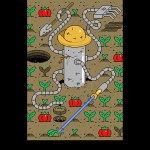
These days, Mammon has a new guise in the form of artificial intelligence. Amazon, UPS, and Target are laying off tens of thousands of employees—at least in part because they’re seeking to automate more and more of their operations to make products and deliver packages faster. The billionaire Peter Thiel, a professing Christian, has toured the world warning people about a coming Antichrist who will arise to impede technological progress. In his thinking, growth alone is godly, and there’s no room for restraint.
Meanwhile, Christian organizations and preachers promote the use of AI-directed spiritual formation as a strategy for church growth. Some groups market AI that can help you read the Bible or pray. Recently an AI artist reached No. 1 on the Christian music charts. Is our worship an act that we can outsource for efficiency?
How we labor testifies to the type of God we believe in. In Kahlil Gibran’s The Prophet, villagers ask the prophet to teach them about the virtue of work. He responds, “Work is love made visible”—not simply a means of production, as “machinist” theory would have you believe, but a spiritual discipline that reflects the character of God.
Mechanization makes this “visible love” irrelevant. Love is for humans. Machines are for efficiency, profit, and progress. They are not relational. They are tools used as a means to achieve a calculated end. The human end is different—to know God and love others.


When we become machines, we lose the memory of a heavenly love that operates outside our cost-benefit analysis. Jesus became flesh, was born of a virgin, and died an agonizing death on the cross. This was hardly productive by our mechanistic reckoning.
Indeed, Jesus disrupts efficiency in many of his interactions. Casting demons into swine disrupted a business for a pig herder but liberated a neighbor. The wealthy young ruler is surprisingly told to forsake his “productive” life and give his riches to the poor. Despite Judas’s complaint that the anointing oil could have been sold to feed the poor, Jesus blesses the improvisation of his devoted follower. Philosopher Jacques Ellul would call these human acts of apparently wasteful benevolence “an introduction of the useless” into the world of efficiency. But machines have no positive vision other than utility. The language they speak is profit.
Woe to the church that loses its ability to dream of another kind of world, the church programmed to consider only growth and effectiveness. And blessed be the church that, unimpressed by Mammon’s magnetic force, corrects the greed of Acts 6 and practices the radical solidarity of Acts 4. In these churches, pastors and influencers might not conjure so much content or curriculum—but they will remember what it means to move at the speed of humanity, which allows for error and rest.
Some predict the AI revolution will lead to fewer work hours or a significant depletion of the workforce altogether. But in the 19th century, as industrialism boomed, not many would have expected that they would exchange their agrarian pace not for more leisure but for more dangerous, dehumanizing hours in factories. The ramifications of technology aren’t as predictable as the machines we make. We’ve already forgotten that too.
The theologian Walter Brueggemann wrote that dreaming is deep spiritual work, “rooted in energizing memories and summoned by radical hopes.” When we dream, our minds take the raw materials of experience or history and imagine something new.
Enslaved people dreamed as a revolutionary act against being made machines. So did abolitionists. They called on the stories of Scripture and what God had already done to ground an eschatological hope that defied their current circumstances. The dreaming of Martin Luther King Jr. energized a movement that Mammon had codified into discriminatory laws. In every case, imagination allowed for defiant joy. The marginalized could sleep in the peace of knowing a new tomorrow was possible.
recommended
In the Old Testament, once Joseph receives his dream, neither distractions nor detractors can keep him from the pursuit of the prophetic imagination God has deposited within him. Climbing in social status, he still has the discipline to deny himself what belongs to others. Imprisoned, he finds time to serve. Possessing great power, he doesn’t return evil for evil. Dreams are borrowed visions from God given to us to bless others.
Not all dreams are so noble. Outside the church, contemporary sorcerers strive toward a singularity where the useless habit of sleep no longer holds us back and in which suffering and death will be no more. We battle the principalities of a modern Docetism that attempts to liberate the mind (and soul) from the body. Thiel has funded multiple startups practicing eugenics in the form of gene manipulation. It seems that when billionaires aren’t attempting to liberate themselves from flesh and blood, they’re developing technology that strives to create a superior race.
But we’ve seen this before. Satan sold us the same goods in the garden. The plot unravels on humanity when we attempt to strip God of his authority. Creating a world of convenience in our own image, we actually produce suffering and exploitation.
I am mindful that machinery has created better conditions for much of humanity—transportation, medical services, the technology that allows me to type this very article. But moderation still matters. Abundance theories lead us to believe contentment is naive and regulation is archaic. It is the insatiable appetite of man that leads us to a greed where “desire outstrips need,” as pastor and historian Malcolm Foley candidly puts it. Rather than trusting God with the increase as we slumber, we stay up late with a scarcity mindset, telling ourselves that without more we will have nothing and will be nothing.


God’s grace and love are without limit, but our earthly resources and human capacity are not. “Rest is the glad contemplation of work well done,” said thinker Andy Crouch in a recent talk. And rest is not only for the cultivator but also for the land (Lev. 25). Isaiah 5:8 offers a warning to those who “add house to house and join field to field till no space is left and you live alone in the land.” The machine’s program is a colonizing spirit—when there is undeveloped land and vacant time, there is only opportunity for occupation.
Jesus, by contrast, lived an unpredictable life that allowed for improvisation, rest, and disruption. He had time for the outcast and the afflicted. He had time for intentional leisure with his disciples.
The command to rest is closely related to Jesus’ warning: We can’t serve two masters. We must reject the false gods and toss the ideological spoils lest we become like Achan, hiding trinkets that will lead to our destruction.
Dreaming in our age of machines will alleviate the insomnia mixed up by the crafty sorcerers of our day—the tech tycoons, AI evangelists, and work-worshiping Christians. They promise a paradise. They blaze a trail toward more and more and more. But ultimately, all we’ll have is the unsatisfying taste of production on our tongues, muted memories, and a trail of faceless humans in our wake.
Sho Baraka is editorial director of Big Tent for Christianity Today.