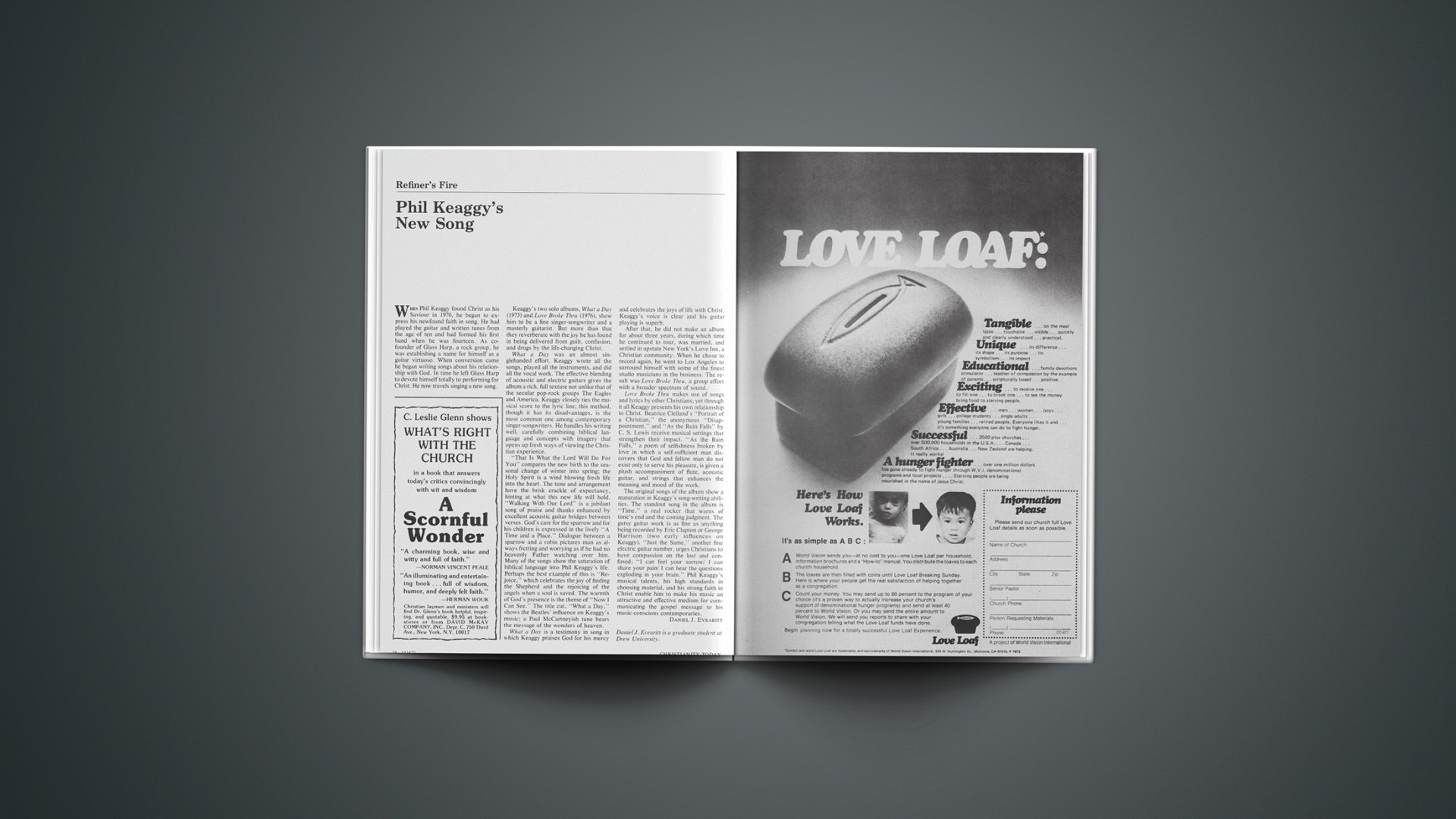

When Phil Keaggy found Christ as his Saviour in 1970, he began to express his newfound faith in song. He had played the guitar and written tunes from the age of ten and had formed his first band when he was fourteen. As cofounder of Glass Harp, a rock group, he was establishing a name for himself as a guitar virtuoso. When conversion came he began writing songs about his relationship with God. In time he left Glass Harp to devote himself totally to performing for Christ. He now travels singing a new song.
Keaggy’s two solo albums, What a Day (1973) and Love Broke Thru (1976), show him to be a fine singer-songwriter and a masterly guitarist. But more than that they reverberate with the joy he has found in being delivered from guilt, confusion, and drugs by the life-changing Christ.
What a Day was an almost singlehanded effort. Keaggy wrote all the songs, played all the instruments, and did all the vocal work. The effective blending of acoustic and electric guitars gives the album a rich, full texture not unlike that of the secular pop-rock groups The Eagles and America. Keaggy closely ties the musical score to the lyric line; this method, though it has its disadvantages, is the most common one among contemporary singer-songwriters. He handles his writing well, carefully combining biblical language and concepts with imagery that opens up fresh ways of viewing the Christian experience.
“That Is What the Lord Will Do For You” compares the new birth to the seasonal change of winter into spring; the Holy Spirit is a wind blowing fresh life into the heart. The tune and arrangement have the brisk crackle of expectancy, hinting at what this new life will hold. “Walking With Our Lord” is a jubilant song of praise and thanks enhanced by excellent acoustic guitar bridges between verses. God’s care for the sparrow and for his children is expressed in the lively “A Time and a Place.” Dialogue between a sparrow and a robin pictures man as always fretting and worrying as if he had no heavenly Father watching over him. Many of the songs show the saturation of biblical language into Phil Keaggy’s life. Perhaps the best example of this is “Rejoice,” which celebrates the joy of finding the Shepherd and the rejoicing of the angels when a soul is saved. The warmth of God’s presence is the theme of “Now I Can See.” The title cut, “What a Day,” shows the Beatles’ influence on Keaggy’s music; a Paul McCartneyish tune bears the message of the wonders of heaven.
What a Day is a testimony in song in which Keaggy praises God for his mercy and celebrates the joys of life with Christ. Keaggy’s voice is clear and his guitar playing is superb.
After that, he did not make an album for about three years, during which time he continued to tour, was married, and settled in upstate New York’s Love Inn, a Christian community. When he chose to record again, he went to Los Angeles to surround himself with some of the finest studio musicians in the business. The result was Love Broke Thru, a group effort with a broader spectrum of sound.
Love Broke Thru makes use of songs and lyrics by other Christians; yet through it all Keaggy presents his own relationship to Christ. Beatrice Clelland’s “Portrait of a Christian,” the anonymous “Disappointment,” and “As the Ruin Falls” by C. S. Lewis receive musical settings that strengthen their impact. “As the Ruin Falls,” a poem of selfishness broken by love in which a self-sufficient man discovers that God and fellow man do not exist only to serve his pleasure, is given a plush accompaniment of flute, acoustic guitar, and strings that enhances the meaning and mood of the work.
The original songs of the album show a maturation in Keaggy’s song-writing abilities. The standout song in the album is “Time,” a real rocker that warns of time’s end and the coming judgment. The gutsy guitar work is as fine as anything being recorded by Eric Clapton or George Harrison (two early influences on Keaggy). “Just the Same.” another fine electric guitar number, urges Christians to have compassion on the lost and confused; “I can feel your sorrow/ I can share your pain/ I can hear the questions exploding in your brain.” Phil Keaggy’s musical talents, his high standards in choosing material, and his strong faith in Christ enable him to make his music an attractive and effective medium for communicating the gospel message to his music-conscious contemporaries.
Daniel J. Evearitt is a graduate student at Drew University.