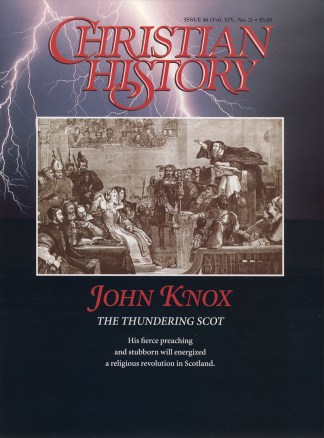
Worship in post-1560 Scotland was radically simplified. About a half-hour before Sunday worship, a bell rang warning the town of the beginning of worship (why people needed to be warned will be seen in a minute).
With a second bell, the reader’s service began: the lay leader read the Scriptures and some prayers and led the congregation in singing metrical psalms—biblical psalms set to contemporary tunes. This part of the service lasted an hour and closed with the ringing of a third bell. The minister then entered the pulpit. A psalm was sung between prayers and then came the sermon, followed by more prayers, the Creed, and the benediction.
This was the first of two Sunday services. The second service was usually held in the afternoon and was largely devoted to teaching from a catechism—that of Calvin or Heidelberg or a catechism for children. Eventually, the service became known simply as “The Catechisms” and was required to be held in every church.
The Scottish reformers laid great emphasis upon faithful attendance at both of these Sunday services. At Aberdeen, for example, the town council insisted that all city officials, their families, and their servants attend worship. Beginning in 1598, fines were imposed on those who missed services, husbands being responsible for their wives, and masters for their servants.
Other towns used other methods to honor the day. At Glasgow, a piper was threatened with excommunication if he played between sunrise and sunset on Sunday. At St. Andrews, five men were imprisoned for three hours for missing the sermon.
Another problem was members’ rushing out of church before the benediction. At some churches, therefore, a fine was imposed for leaving early; at others, guards were simply posted at the doors. Today, such measures seem harsh. But to the reformers, the work was an all-or-nothing proposition. Nothing less than the reform of every Scot was their goal.
Copyright © 1995 by the author or Christianity Today/Christian History magazine. Click here for reprint information on Christian History.