History

The Real Father Brown

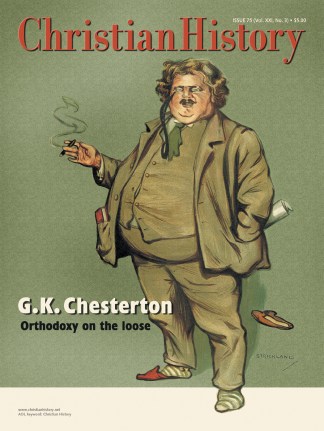
When a writer invents a character for the purposes of fiction, especially of light or fanciful fiction, he fits him out with all sorts of features meant to be effective in that setting and against that background. He may have taken, and probably has taken, a hint from a human being. But he will not hesitate to alter the human being, especially in externals, because he is not thinking of a portrait but of a picture.

In Father Brown, it was the chief feature to be featureless. The point of him was to appear pointless; and one might say that his conspicuous quality was not being conspicuous.

His commonplace exterior was meant to contrast with his unsuspected vigilance and intelligence; and that being so, of course I made his appearance shabby and shapeless, his. face round and expressionless, his manners clumsy, and so on.

At the same time, I did take some of his inner intellectual qualities from my friend, Father John O’Connor of Bedford, who has not, as a matter of fact, any of these external qualities. He is not shabby, but rather neat; he is not clumsy, but very delicate and dexterous; he not only is but looks amusing and amused. He is a sensitive and quick-witted Irishman, with the profound irony and some of the potential irritability of his race.

My Father Brown was deliberately described as a Suffolk dumpling from East Anglia. That, and the rest of his description, was a deliberate disguise for the purpose of detective fiction. But for all that, there is a very real sense in which Father O’Connor was the intellectual inspiration of these stories; and of much more important things as well.

—From The Autobiography of G.K. Chesterton

Copyright © 2002 by the author or Christianity Today/Christian History magazine. Click here for reprint information on Christian History.

Our Latest

Review

‘The Faithful’ Celebrates the Women of the Bible

The first episode—and a set visit in Italy—introduced a me to a thoughtful new drama about multidimensional women in Scripture.

Gospel Matriarch Lucie Campbell Looked To God

Daylan Woodall

Her songs spoke to life’s uncertainties and God’s presence—and taught me how to hope.

The Just Life with Benjamin Watson

Johnny Joey Jones: What Do We Owe the Men and Women We Send to War?

Trauma, Responsibility, and the Honor of Being Needed

News

From ‘O for a Thousand Tongues’ to ‘The Blessing’

The first Wesleyan hymnal in 30 years seeks to reflect the movement’s history and present.

Public Theology Project

Why John Perkins Stood (Almost) Alone

The civil rights leader treated love of God and love for others as inseparable.

The Russell Moore Show

Doug McKelvey on Rites of Passage and the Sacredness of Ordinary Life

Every Moment Holy author Douglas McKelvey on writing prayers for the moments both sacred and mundane.

From a Galaxy Far, Far Away to Carol Stream, Illinois

CT tracked cultural changes while going through several of its own.

What Loving South Africa Taught Me About Patriotism

Christina Stanton

Attachment to another country didn’t diminish my affection for America. It showed me God’s love for all peoples.

Apple PodcastsDown ArrowDown ArrowDown Arrowarrow_left_altLeft ArrowLeft ArrowRight ArrowRight ArrowRight Arrowarrow_up_altUp ArrowUp ArrowAvailable at Amazoncaret-downCloseCloseEmailEmailExpandExpandExternalExternalFacebookfacebook-squareGiftGiftGooglegoogleGoogle KeephamburgerInstagraminstagram-squareLinkLinklinkedin-squareListenListenListenChristianity TodayCT Creative Studio Logologo_orgMegaphoneMenuMenupausePinterestPlayPlayPocketPodcastprintRSSRSSSaveSaveSaveSearchSearchsearchSpotifyStitcherTelegramTable of ContentsTable of Contentstwitter-squareWhatsAppXYouTubeYouTube