Books

A Political Scientist Contemplates God

Charles Murray is ready to take religion seriously. He thinks we should too.

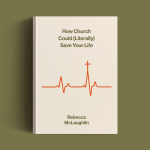
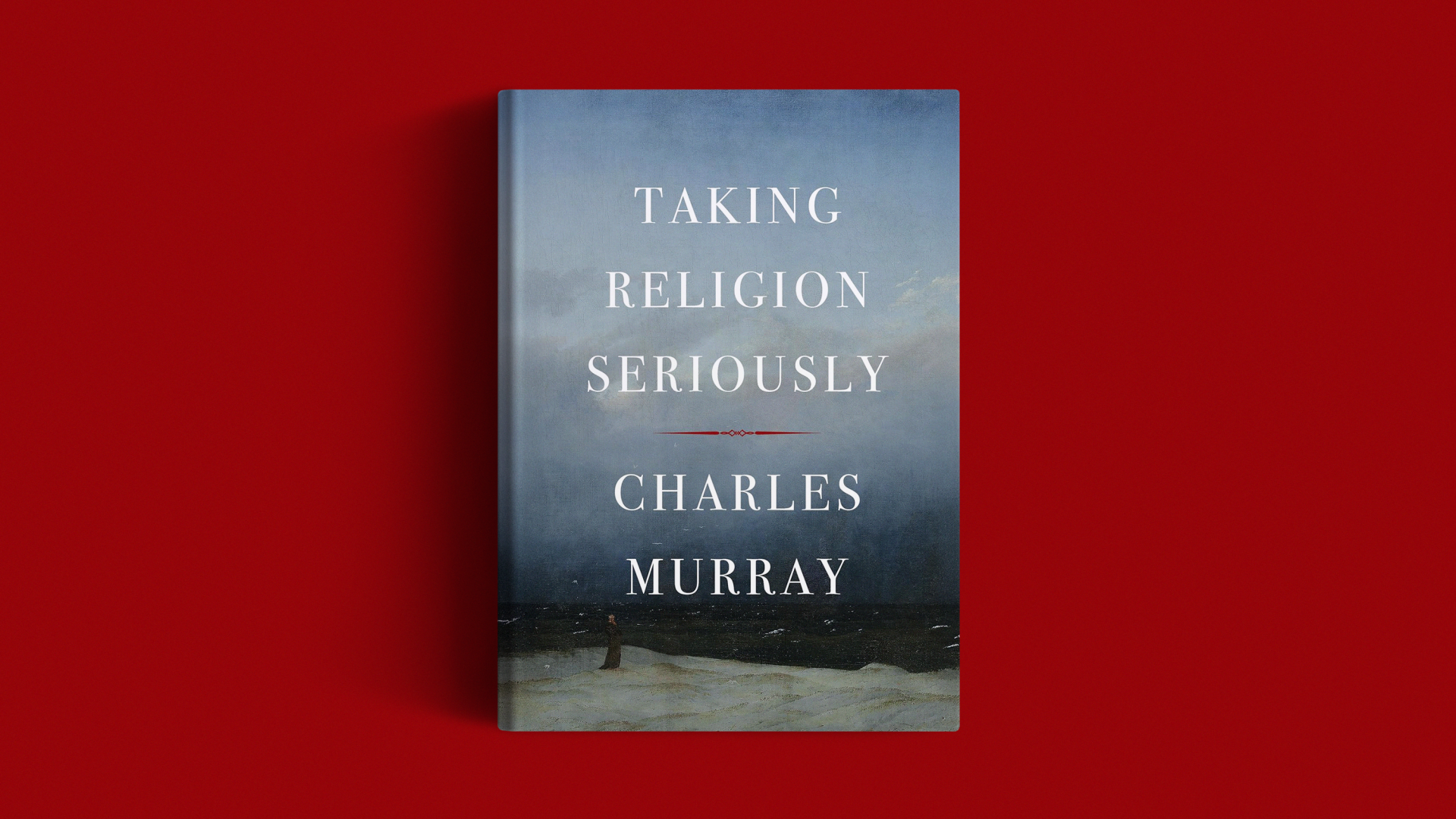
The book cover on a red background.
Christianity Today November 18, 2025
Illustration by Christianity Today / Source Images: Getty, Encounter Books

What does the search for faith look like through the eyes of an agnostic? Christians can sometimes make assumptions from the outside about what that process looks like, but a new book by libertarian political scientist Charles Murray offers personal insight. His book, Taking Religion Seriously, is a part of a trend of public intellectuals such as former New Atheist Ayaan Hirsi Ali and journalist Molly Worthen, embracing personal faith.

Although Murray’s work has publicly recognized the importance of religion to society, he previously identified as agnostic. His latest contribution is a departure both in its personal dimension (the only book remotely similar is his little advice volume The Curmudgeon’s Guide to Getting Ahead) and in its length, readable over a weekend at 158 pages.

He documents his arrival at faith, which was sparked by his wife Catherine’s interest in religion and grew to a personal intellectual pilgrimage. Murray draws on the apologetic and testimony genres, although he frustrates the expectations of both. His goal is to convince the reader that asking questions about faith, rather than advancing a specific set of conclusions, is a crucial task in life. The book challenges the assumption that we can separate the public good of religion from personal faith. If religious practice is necessary for a thriving society, then it’s necessary for a thriving soul as well.

Though Murray explores classic arguments for the existence of God, such as the unmoved mover and fine-tuning, he approaches them with a refreshing intellectual humility. For example, he considers C. S. Lewis’s moral argument for God’s existence in Mere Christianity, an argument which contends that the consistency of moral teaching across cultures provides evidence for an eternal moral source.

This argument was crucial for Murray in the jump between belief in the existence of God and belief in an active God who requires something of each person. Perhaps, he admits, he was already predisposed to accept this argument since he had been moving toward this perspective. Nonetheless, he has come to see God as the best explanation for the phenomenon of universal moral knowledge. The moral argument has persuaded generations of seekers and Christians, and the glimpse into Murray’s own thought process is valuable. The future reading lists he provides in each chapter on their own are worth the price of the book.

Murray examines several areas that are controversial even to some very pious Christians, such as terminal lucidity, where someone close to death experiences remarkable clarity. Referencing documented examples, he argues this challenges a strictly materialist vision of consciousness:

One of the tribes to which I belong is the tribe of smart people. For me to accept the evidence regarding terminal lucidity and near-death experiences (and to publish!) will lower other members’ opinions of me, including the opinions of many people whom I admire and whose good opinion I value. I don’t want to be thought credulous and foolish and get kicked out of the tribe.

But he continues to poke at this impulse: “If you find yourself reluctant to give up strict materialism for similar reasons, try to get over it.” The topic is simply too important to gloss over. Humility paradoxically makes many of his arguments more persuasive because he honestly grapples with whether nonmaterialism is defensible.

Murray’s personal journey sheds light on questions he raised in previous books. In Coming Apart, Murray chronicles the way in which the US is divided between two social classes—the wealthy elite, who have strong family formation, church attendance, and community health, and the disillusioned poor, who have weakening community, church, and family ties. Data consistently shows that religious participation is necessary to thriving communities, so the trend of lower participation among the poor is especially concerning. His proposed solution at that point was what he called a “civic Great Awakening,” by which he meant a nonreligious awakening of civic engagement.

Murray’s story implicitly rejects the narrative of self-proclaimed cultural Christians, such as Tom Holland or Jordan Peterson, to whom Christianity carries a certain poetic truth that drives civilization whether or not it is literally true. If we have a high view of truth, can we tolerate a noble lie on a societal level? Won’t that approach erode truth in other aspects of life? The societal quest for meaning must have as its source the individual’s search for truth and ultimately, faith. The trend of young people, particularly young men, attending church at higher rates than older generations, could be a large scale move toward faith. Are we at the cusp of a major societal shift? 

That solution seemed inadequate when I first encountered the book, and I recall challenging Murray on it when I met him while I was a student at Grove City College. How can you have an awakening without the source of that awakening, the quickening of hearts toward God? I suspect that solution is now less convincing to Murray.

Whether this book can be read as a testimony is a complex question. Murray does indeed have the classic “before, change, after” formula of a testimony. As a strict materialist, he had rejected things of faith simply because people told him that was the only intellectually honest position.

Then, “as a series of nudges spread over many years,” he questioned his own presuppositions and eventually acknowledged the existence of God, the historical accuracy of the Christian Scripture, and the moral claims of Jesus. Afterward, he documented the changes in his life, including, most notably, his accepting the forgiveness of sins, saying, “God’s grace has become real to me.” Even invoking the word sin, he acknowledges, is a significant departure.

Still, the experiential aspect of faith is an enigma to Murray. He ends the book with a striking analogy that could be right at home in a Lewis volume:

I have yet to experience the joys of faith. When I’m around Catherine and others who have, I sometimes feel like a little boy whose nose is pressed against the window, watching a party he can’t attend. I’m not done trying to join the party. Perhaps the door will open eventually.

Intentionally or not, the picture draws to mind two famous passages of Scripture. First, “Let the little children come to me, and do not hinder them, for the kingdom of heaven belongs to such as these” (Matt. 19:14). Here Jesus strongly affirms the simple faith of a child, one who may be gazing longingly into that brightly lit room but asks earnest questions. Given Murray’s tenure and status as a think tank leader, this metaphor is somewhat surprising and beautiful.

Earlier in the Gospel, Jesus says, “Ask and it will be given to you; seek and you will find; knock and the door will be opened to you. For everyone who asks receives; the one who seeks finds; and to the one who knocks, the door will be opened” (Matt. 7:7–8). This is a powerful promise to those who are genuinely seeking answers to life’s most vital spiritual questions.

In Confessions, Augustine discusses his conversion at two or three different moments. Centuries of readers have asked, “Which one is the real conversion?” Given the persistence of faith, the answer must be that both are genuine and that the true pattern of a Christian’s life is a continual movement toward the divine.

I would somewhat temper Murray’s feeling of being outside the room of faith. While he claims to have had no emotional experience, he has experienced remarkable changes. Before discovering faith, he considered suicide at the end of life as the best option. Now he is “untroubled by the prospect of death.” Is not that change itself an experience?

Murray has found a type of faith, if not a road to Damascus. And while he is no orthodox Christian by the end of his book, the process of weighing the evidence and searching for truth has led him in a new direction. That open approach to questioning is representative of the Quaker meetings where he and Catherine have attended for decades. His approach is similar to the entrepreneurial “build in public” model that lets the readers into an ongoing process.

Søren Kierkegaard addresses those who are stuck in the purely objective search for truth in Concluding Unscientific Postscript. He sends up the philosopher who “just two weeks before his death … is looking forward to a new publication” to see if it might prove or disprove his beliefs. Murray in several ways typifies Kierkegaard’s objective philosopher who is paralyzed by the need to rationally prove every point and subpoint.

The leap of faith is Kierkegaard’s answer to this paralysis—an acceptance of that which we do not fully understand. He views this not as a rejection of reason but as a proper ordering of reason within the infinite paradox of faith. In the tradition of Augustine, Anselm of Canterbury states, “Credo ut intelligam” (“I believe in order to understand”). The leap (or more properly translated “spring”) of faith enlightens the rest of life.

In a refreshing way, Murray’s addition to the conversation connects the theoretical discussion around the importance of religion in society, which he was already a part of, with the personal journey of faith. Perhaps this book will inspire more people to knock at the door of that brightly lit room of faith.

Noah C. Gould is the alumni and student programs manager at the Acton Institute and a contributor at Young Voices. 

Ideas

6-7 in the Bible

A scriptural nod to Gen Alpha’s favorite not-so-inside joke.‌

The numbers 6 and 7 with a Bible.
Christianity Today November 18, 2025
Illustration by Elizabeth Kaye / Source Images: Unsplash, Wikimedia Commons


What’s the best chapter in the Bible? Six-sevennnnn. If you’ve spent even 6 or 7 seconds around kids or teens lately, you probably saw that one coming. News outlets from The New York Times to The Indian Express have covered the global phenomenon that delights children, puzzles grownups, and leaves school teachers 67 percent sure they should retire early.

One of my CT colleagues from Raleigh, North Carolina, told me her 16-year-old daughter and her friend dressed up as the numbers 6 and 7 on Halloween (“cheapest costume ever!”).

A coworker from Miami said his children stirred up a Spanish-language 6-7 wave that swept through the kids’ club on their recent cruise (“seis-siete!”).

And a church in Charlotte, North Carolina, created an entire outreach event around the infamous numbers. Jonathan White is a pastor and director of children’s programming at Mecklenburg Community Church. When he determined that the 6-7 trend wasn’t harmful and wasn’t going away, he wrote it into the church’s November family night.

A high school kid donning a 6-7 shirt showed up onstage every time the numbers were mentioned—which happened a lot, as the focus of the evening was Psalm 28:6–7. Hundreds of kids went wild. “Every single time it happened, we had about 30 seconds of ramp-down time for the kids,” Jonathan said. “And we were glad we did, because by the end they were anticipating it. They were looking for it. It was fun because they were so engaged.”

As the mom of a 9-year-old, I’ve been asked to calculate 134 divided by 2, among other tactics I’ve walked right into. I won’t attempt to explain the meaning behind the trend, but I can point young 6-7 enthusiasts to a few places where their favorite numbers appear in Scripture.

There’s only one chapter 67 within the Bible’s 66 books, and it’s a psalm. Psalm 67 begins,

May God be gracious to us and bless us
                  and make his face shine on us—
so that your ways may be known on earth,
                  your salvation among all nations.
May the peoples praise you, God;
                  may all the peoples praise you.

There are 42 instances of chapter 6 verse 7 in the Bible. Here’s a sampling of passages that could make good memory verses for children:

  • “I will take you as my own people, and I will be your God. Then you will know that I am the Lord your God, who brought you out from under the yoke of the Egyptians” (Ex. 6:7).
  • “Calling the Twelve to him, he began to send them out two by two and gave them authority over impure spirits” (Mark 6:7).
  • “Because anyone who has died has been set free from sin” (Rom. 6:7).
  • “For we brought nothing into the world, and we can take nothing out of it” (1 Tim. 6:7).

An older child or teen who’s looking for a more challenging passage to memorize could take a stab at Proverbs 6:16–19, which contains a subtle nod to those ubiquitous numbers:

There are six things the Lord hates,
                  seven that are detestable to him:
                                    haughty eyes,
                                    a lying tongue,
                                    hands that shed innocent blood,
                                    a heart that devises wicked schemes,
                                    feet that are quick to rush into evil,
                                    a false witness who pours out lies
                                    and a person who stirs up conflict in the
community.

Beyond memorizing Bible verses with a convenient 6 or 7 in them, we can also note the symbolic meaning of numbers in the Bible. The individual numbers 6 and 7 each hold meaning in Scripture. Six often carries negative connotations, representing incompletion and even evil (as in the mark of the Beast in Rev. 13:18).

The number 7, on the other hand, represents completion and perfection. It appears throughout Scripture, beginning in Genesis when the Lord rested on the seventh day after creating the earth. Tim Mackie at the BibleProject discusses the importance of the number: “Seven represents both a whole completed creation and a journey to that completeness.”

But the number 7 is perhaps most prominent in the book of Revelation, where it appears more than 50 times (including the 7 churches, 7 spirits, 7 golden lampstands, 7 stars, and more).

We won’t fully understand the significance of these numbers until Jesus returns (and as the 6-7 trend stretches into yet another month, some of us may be praying more fervently for the beginning of the end). Until then, we can ride the 6-7 wave and maybe even use it to soak up some biblical truth.

These commandments that I give you today are to be on your hearts. Impress them on your children. Talk about them when you sit at home and when you walk along the road, when you lie down and when you get up.

That’s from Deuteronomy chapter 6, verses—wait for it—six-sevennnnn.

Kristy Etheridge is a features editor at Christianity Today.

Culture

How He Leaves

After his final tour, independent musician John Mark McMillan is backing out of the algorithm rat race but still chasing transcendence.

Side profile of John Mark McMillan playing guitar on stage in a red jacket and black cap.

John Mark McMillan

Christianity Today November 17, 2025
Courtesy of John Mark McMillan

John Mark McMillan regularly hears from fans asking when he’ll play in their cities. 

“Someone will message me and say, ‘I love your music! How come you never come to Chicago?’ or whatever town they’re in,” said McMillan. “And I message back, ‘I was in Chicago last week.’” 

McMillan, a Christian musician widely known for the song “How He Loves,” has been making a living as an artist since the mid-2000s, touring and releasing music independently. Over the past couple of years, he’s noticed that it’s become harder to reach and connect with his audience, and making a modest living as an artist—at least, the kind of artist he wants to be—seems almost impossible.

McMillan’s latest release, Cosmic Supreme, has been his most successful to date in terms of streaming. It’s a reflective album with a vast emotional scope. McMillan’s warm, low baritone register gently draws in listeners on “All My Life” before catapulting them into the throes of a bombastic, ecstatic chorus. The song manages to be both raw and anthemic without morphing into a glossy, saccharine hype refrain.

Cosmic Supreme is inspirational without wandering into sentimentality, and the language of faith feels fresh in McMillan’s voice rather than worn-out and overused. Despite the album’s numerical success, McMillan looked at the escalating cost of touring, his meager streaming income, and the demanding social media landscape and decided it was time for a change. 

In September, he announced that he is retiring from his full-time music career. “This will be my last tour,” he wrote on Instagram. “Money has never been my primary motivation, but the financial burden of living in a world where music has little or no monetary value has made it hard to find a sustainable model.”

In his post, McMillan shared that he wants to write books, support up-and-coming artists, and focus on local projects. 

Over his career, the 45-year-old singer-songwriter has seen significant shifts in the Christian music world—the dominance of contemporary worship music has evolved from the guitar-driven rock of the 2000s to the arena-rock anthems of groups like Elevation Worship, and the number of people involved in the production of most popular worship music has shrunk to a small, interconnected cohort

Based in North Carolina, McMillan has always been somewhat of an outsider in the contemporary-worship-music industry. His song “How He Loves” was controversial—the lyrics “heaven meets earth like a sloppy, wet kiss” sparked debates about poetic language in worship music, and McMillan eventually granted fellow artist David Crowder permission to change the lyrics to produce his own cover of the song. After Crowder’s revision of the lyrics to “heaven meets earth like an unforeseen kiss,” the song’s popularity grew. 

McMillan’s 2020 album, Peopled With Dreams, was all about “re-enchantment.” He has described Cosmic Supreme as a “charismatic worship album,” emphasizing mystery, wonder, and personal encounter. He foresees a future in which he continues to make music but doesn’t rely on it for his livelihood. 

McMillan says he’s working on a book about reenchantment and developing a series of graphic novels. He’s thought about starting a podcast. He also wants to start a local singing club with two rules: “You have to sing, and it’s phoneless.” 

McMillan talked with CT about closing the book on his full-time music career and about his persistent belief that music has the power to connect us to the divine.

You announced your decision to step away from touring and full-time music. Was there a last straw or moment that made you decide it was time for a change? 

It was a combination of a lot of factors, but the final nail in the coffin was having to advertise through algorithmic content. It’s so hard to reach people. There are so many artists on the road, and the cost of touring is rising. It’s become so much more work for less money. 

At 45, I have a handful of options if I want to make it work: I can go back to grinding it out in a van or fire some of the guys in my band and play acoustic all of the time. Or I need to sort of dig into the worship industrial complex. I say that in an endearing way—I have so many good friends in that world. I would have to make what I do a little more conventional. 

I love touring so much. I would tour for free. If it was just rehearsing and traveling and setting up and playing the shows, I’d be happy to do that a month out of the year. But I don’t get to do as much of the other things I love when I’m beating my head against the wall with the algorithms to try to sell tickets for shows when the margins are so small. 

When you’re doing this and trying to make content, you wake up every day and think, If I can’t think of something to post, am I going to lose money? I feel like I have to think of something snarky or funny to say so that people stop scrolling and listen, and all of a sudden you realize that you’re dumping 80 percent of your creativity into marketing. 

While touring this summer, I would have these sleepless nights, waking up thinking, Why isn’t this tour stop selling? It feels like you have to trick the algorithm into showing people that you’re going to be there. 

After those sleepless nights, I thought, What if I didn’t do this anymore? It was the first time in 20 years I actually considered not doing it. I have never considered it before because it’s what I loved, my identity was tied up in it. Now I think it’s okay to reimagine my place in the world. 

And if I wake up in a year or two and think, This was dumb, I can always come back to it. 

Some Christian artists have been able to supplement their touring income by performing at churches. You’ve mentioned that pivoting to worship music doesn’t interest you, but is there space for artists like you to tour churches? Has the church tour circuit changed over the course of your career? 

Churches are great because they don’t usually have a profit motive and sometimes they have bigger budgets. Usually their goal is just to get people in the doors. If they break even, they’re excited. 

I love playing churches where I have a relationship, but when I don’t have one, things can get a little awkward. The pastor wants to come out and talk in the middle of your set, and you want to be respectful, but it’s also like, “I don’t know you, and I don’t know what you’re going to say.” 

And oddly enough, we get more participation in non-church venues. When we play clubs, people are more engaged. People are more respectful and reserved in churches. Between songs at the club, the audience will talk, and I encourage my band guys to talk to each other and other people in the audience. In churches, it can just feel awkward. You don’t always feel that energy.

The other thing is that, these days, churches really want big worship songs, or they want you to come in and do Sunday mornings. And now every city has a megachurch that has something as good as a concert five times a weekend. 

What parts of touring and performing still make you want to make it work? Are there things that you’ll miss that make you second-guess stepping away? 

There’s nothing like the way it feels to play music for people. And I don’t mean that it feels good when an audience applauds my work; I mean the connection you feel to other human beings is so great. 

I could get really weird about this—maybe you’ll have to Christianize it a little for me—but you know how some cultures have these shaman figures? They aren’t in charge, but they are a conduit. They’re just there to help you connect with God. Performing is like being that conduit. The best nights, I totally disappear in it, and I hope the audience doesn’t even know I’m there. They’re just connected to this higher thing, to the Holy Spirit. 

It’s easy to forget how that feels in a world where we’re all just stuck in our headphones all the time. It feels like church and sporting events are the only places you can feel that any more. For me, seeing people and hearing them sing, it’s that feeling.

I wish I had a more righteous answer. But I think in those moments we are accomplishing something good. Those moments are why I’m here. I like to say that I don’t do anything that keeps you alive, but I want to remind you why being alive is a thing worth doing to begin with.

Culture
Review

Review: ‘House of David’ Season 2

The swordfights and staring lovers start to feel like padding. Then, all at once, the show speeds up.‌

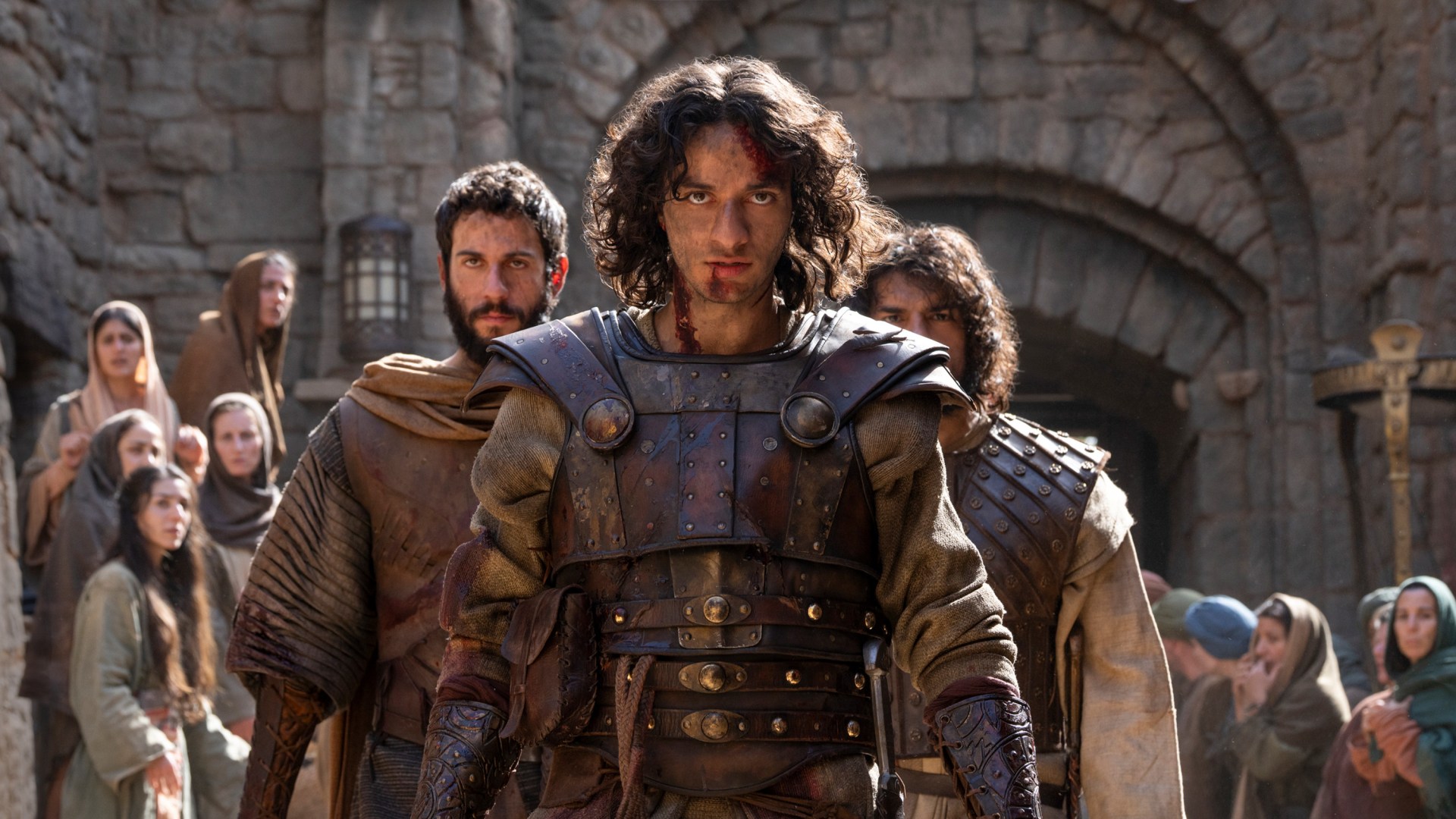
Michael Iskander in House of David Season 2.

Michael Iskander in House of David Season 2.

Christianity Today November 17, 2025
Jonathan Prime / Prime / Copyright: © Amazon Content Services LLC

David grows up, and the series grows with him, in House of David season 2. (Note: This review contains spoilers.)

When we last saw David (Michael Iskander), he had just slain the giant Goliath (Martyn Ford) and was standing on a plain between two armies about to clash. David had no military experience. He was wearing no uniform.

But in season 2—after surviving the big battle that dominates the first episode—he is trained in the art of war by prince Jonathan (Ethan Kai) and put in charge of other soldiers.

He also takes bolder positions in his dealings with King Saul (Ali Suliman) and Adriel (Stewart Scudamore), a leader in the tribe of Judah. Saul tries to get David to marry the princess he doesn’t love, Mirab (Yali Topol Margalith), instead of the princess he does, Mychal (Indy Lewis). Meanwhile, Adriel knows David was secretly anointed to replace Saul and tries to blackmail David with this knowledge. Showing a newfound maturity, David ultimately stands up to both men.

The series ramps up the action bigtime, from the opening battle to a series of raids—Edomites against Israelites, Israelites against Philistines—and dramatic sword fights. A lot of it is fairly exciting. But it also begins to feel like padding. So do the constant scenes of David and Mychal staring into each other’s eyes. The first season of this series covered just three chapters from the Bible (1 Sam. 15–17), and the second season seems to take forever to get through just one (chapter 18).

And then, suddenly, things accelerate. In the season finale, Saul attacks David, and David runs away. Jonathan, newly married with a pregnant wife, worries for his son’s future and makes David promise not to harm the child (2 Sam. 21:7). Saul pursues David as far as the tabernacle and his Edomite henchman Doeg (Ashraf Barhom) murders all the priests. And just like that, this one episode covers four entire Bible chapters (1 Sam. 19–22).

Along the way, characters get interesting in a way they weren’t before, most notably Mychal, newly married to David. She learns that David kept his anointing secret from her and suddenly feels betrayed. This presumably sets the stage for her to “despise” David in the future as the biblical Mychal did (2 Sam. 6:16).

And Eshbaal (Sam Otto), whose attempt to take the throne from Saul comes out of nowhere at the end of season 1, is revealed to be working for the Edomites, which adds a whole new layer of complication to what used to be a simple Israelite-versus-Philistine story.

It’s striking, given how fantasy infused the first season was, to see such a grounded season 2. The giants appear briefly in the aftermath of Goliath’s defeat. But apart from that, this season is all about human relationships and political conspiracies. The Philistines even make a point of switching tactics, from an alliance with the giants to better swords! (Characters talk about the dawn of “the age of iron,” though most historians date the beginning of the Iron Age to a couple centuries earlier.)

Yes, the prophet Samuel (Stephen Lang) gets into a few people’s heads, and we experience their tormented states of mind from the inside. And the witch of Endor pops up to make an eerie prediction or two. But that’s about as fantastical as this season gets.

Stretching the story at times forces the writers to add plot elements that appear to contradict the biblical narrative. Saul meets Samuel repeatedly and even arrests him at one point, but the Bible seems pretty clear that they didn’t speak again during Samuel’s lifetime. It’s also not obvious why Samuel would let himself be captured, given how easily he escapes afterward and given the power he flexes over Saul and his men in other scenes—especially in the finale, which makes spectacular use of 1 Sam. 19:18–24, the only passage in the Bible in which Saul even came close to confronting Samuel again.

There are other nits one could pick. Samuel seems to serve as high priest on the Day of Atonement, but he would have been a mere Levite at best (1 Chron. 6:31–38). It’s hinted that Bathsheba is the daughter of a blacksmith from the dark, disreputable city of Endor. That’s not impossible, but the biblical Bathsheba appears to have been the daughter of one of David’s top soldiers and the granddaughter of Ahithophel, an adviser of David’s who turned against him during Absalom’s rebellion (2 Sam. 11:3; 15:12; 23:34).

The series also remains pretty coy around the marriage customs of that period. Saul, furious with his wife Ahinoam (Ayelet Zurer) for undermining his authority, begins sleeping with a servant named Kazia (Inbar Saban). When Abner (Oded Fehr) objects, Saul says kings are allowed to have concubines, and Abner says no, not Israelite kings. But polygamy was a constant throughout Israelite history, going back to Israel himself (i.e., Jacob), and it was an option for any man who could afford it, such as Samuel’s father, Elkanah (1 Sam. 1:2). Saul’s friends may have expressed concern over how he was treating his family, but not for that reason.

Also, it’s curious that the series invents a fictitious concubine for Saul when the Bible not only mentions Saul’s “wives,” plural (2 Sam. 12:8), but also tells us about a concubine named Rizpah who bore him two sons (3:7; 21:8–10).

Where does the series go from here?

The pace. As noted, the season 2 finale covered as many chapters from the Bible as the previous 15 episodes combined. Can season 3 keep up? Series creator Jon Erwin has said the third season will end with David becoming king, maybe even taking Jerusalem. That would mean getting through another 14 chapters (1 Sam. 23–31; 2 Sam. 1–5) in just 8 episodes. Can the series accelerate that much, that quickly?

The fate of Ahinoam. Saul banished his wife from the palace at the end of episode 6. I assume we’ll see more of her, but in what context? The Bible says nothing definite about her besides her name (1 Sam. 14:50), but there is a theory that she might be identical to a wife of David’s named Ahinoam who bore his firstborn son (1 Sam. 27:3; 2 Sam. 3:2). I don’t expect this series to go that route—marriage to her own son-in-law? ew!—but there would be a basis for it if it did.

The fate of Saul’s daughters. Eshbaal says he has a plan for unity with the tribe of Judah that involves his sisters. The biblical Merab (Mirab) was married off to Adriel (Stuart Scudamore) —and they had five sons who were executed under David (1 Sam. 18:19; 2 Sam. 21:1–14). Saul gave Mychal to a man named Paltiel (1 Sam. 25:44). Eshbaal eventually returned her to David (2 Sam. 3:14–16). 

David’s relationship with the Philistines. There is friction between the Philistine kings this season, and Achish (Alexander Uloom) seems to recognize that God is with David. I assume the series is laying the groundwork for David and his men to find sanctuary with the Philistines while hiding from Saul (1 Sam. 27:1–28:2; 29:1–11).

It bears mentioning that the series skips the part of the story where the biblical David tricked Achish into thinking he was insane (21:10–14). How will it depict David’s relationship with Achish in season 3? Will David continue to testify truthfully to his faith? Or will he do what the biblical David did and pretend to raid the Israelites on Achish’s behalf while actually slaughtering entire pagan villages (27:8–12)?

And what’s up with the Edomites? It turns out the Edomites were behind Eshbaal’s brief attempt to take the throne in season 1, and their scheme is still unfolding when season 2 ends. The Bible says nothing about them during Saul’s reign, except that they were one of the many nations he fought (14:47) and Doeg was one of them, so it’s anyone’s guess where this plot thread is going.

We’ll have to wait a little longer for season 3 than we did for season 2. The first two seasons were produced back-to-back and came out mere months apart, but Erwin is currently busy editing Young Washington, a movie about George Washington due next summer. Even so, given the series’ popularity, I assume there won’t be too much delay.   

Peter T. Chattaway is a film critic with a special interest in Bible movies.

News

Republicans and Democrats Clash on Epstein File Release

The newest documents remind Christians to support sexual abuse victims.

Illustration by Rick Szuecs / Source images: Midjourney / Firefly

Christianity Today November 14, 2025


On Wednesday, Democrats released emails from the late Jeffrey Epstein that seem to indicate President Donald Trump may have been aware that Epstein sexually abused trafficked women and girls. Republicans followed suit hours later with their own release of approximately 23,000 pages of documents. Some critics have called the Republican release a flooding of the zone, an attempt to draw attention away from the emails. Others have pointed to the massive document release as fulfillment of the administration’s promise to be transparent and cooperative in the investigation.

Russell Moore, Mike Cosper, and Nicole Martin on The Bulletin discuss these new documents and a Christian response to sexual abuse. Here are edited excerpts from the conversation (Episode 225).


What did the documents released by Democrats and Republicans say?

Mike Cosper: Democrats released emails that show Jeffrey Epstein talking about Donald Trump. In the emails, he seems to be well aware of how Trump is implicated by the things that Epstein was doing. Epstein talks about Trump being at his house with one of Epstein’s victims. The name is redacted. 

It’s important for us to say that these are allegations. However, Trump said that once he knew Epstein was a criminal, he distanced himself. That doesn’t necessarily seem to be true, based on what Epstein is saying in the emails that the Democrats released.

As for the documents released by Republicans, you have to wonder how many were read in advance of their release, because some of them are between Steve Bannon and Epstein and implicate Trump in very ugly ways.


What was your response to the document release?

Russell Moore: I am angry for a number of reasons. First, even without these emails, which are damning, the White House is pressuring members of Congress. Meetings in the Situation Room, stopping members of Congress from using parliamentary maneuvers, delaying the swearing in of a new Congress member who would offer the deciding vote on this, keeping the House out of session for seven weeks—all of that to keep these emails from being released.

Second, Ghislaine Maxwell, who is a fundamental part of these documents, has been moved to a minimum-security “Club Fed” and is reportedly seeking commutation of her sentence. Meanwhile, the Epstein emails allege that he was with President Trump in 2019 in London with Prince Andrew, who has since been stripped of all of his titles and privileges. That may or may not be true, but that must be answered. 

This is operating exactly the way that I have seen church sexual abuse work: protecting predators over and over again. They hope that the normies just get tired of it and say, “What are you going to do?” That’s the key, and usually that ultimately works.

Cosper: The Justice Department interviewed Ghislaine Maxwell a few months ago, and that interview got her moved to this minimum-security prison. This is a woman who is convicted of sex trafficking, taking young girls and farming them out to rich and powerful men through Epstein. Why was she moved? Because she did this interview where she told the Justice Department that she had no reason to suspect that Trump was aware of any of this. In these emails we see that is not true. 

As far as I’m concerned, lock her up: send her back. That’s the just thing to do, not simply because she lied but because she trafficked girls. That is a horrific crime that all Americans should want to see punished to the fullest extent of the law. 


Often, sexual abuse stories center around men who are the perpetrators. Here a woman is also complicit. What does that mean to you?

Nicole Martin: I’m not at all surprised. There is typically a woman involved in sexual abuse and trafficking situations. Often a woman benefits from the system—acting as the trusted person who helps to cover up molestation or speaking out as the first denier about what happened to you. This revelation should ignite anger and frustration.

When I hear this as a woman, it is also very triggering. This is where you have to guard your heart and mind to ensure that you know what you need to do as a result of the news. It’s very emotional, and sometimes when you get emotionally involved, you shut down because it’s too much. You can also get so deeply involved in a story like this that you feel like it’s personal. You have to lean on the Holy Spirit for wisdom, discernment, and direction here.

Many of us can’t help but think of the women we know. One in three women have been sexually abused or assaulted. We also must contend with the statistics on sex trafficking and the impact on young women who have to hear over and over about these issues. They put themselves in these stories, or they see their sisters there. 


The documents revealed that Jeffrey Epstein seemed willing to throw President Trump under the bus for political or financial advantage. What might be the implications of that for the president?

Cosper: The bits that we’ve seen so far indicate why the president and his administration are working so hard to keep these documents from going public. Are we really surprised that a sex trafficker is not a loyal friend? Because that’s what Epstein was. Epstein was a sex trafficker; Ghislaine Maxwell is a sex trafficker who allegedly sexually abused some of these girls. The extent of depravity here is hard to grasp. 

Representative Nancy Mace is one of the Republicans who have broken with Trump over this issue. Mace is controversial figure, but she’s also shared publicly that she is a survivor of sexual assault. You can understand why a woman in her position is saying, “I’m not going there. I’m not doing this.” The willingness of Republicans to break with President Trump may be because he is a lame duck, but many of those who are breaking with Trump over this are women. That matters as well.

Moore: The blackmail language being used in those emails shouldn’t surprise us either. President Trump’s secretary of commerce, Howard Lutnick, talked months ago about how this worked with Epstein. The trafficking allowed Epstein to have something on powerful people. There was a whole network and web of very powerful people across every part of the spectrum. 

I talked to a researcher the other day about a similar situation happening in a church context where a group of powerful predators were protecting one another within the ecclesial network because they all knew where the bodies were buried—You can’t say anything about me, or I’m going to talk about you—that kind of depraved thinking, in the way Epstein’s talking in these files.

Martin: If we think this is an issue out there, we are sorely mistaken about what’s happening in our churches—I would dare say, even in some families. We have to pay attention, because this is happening. It’s not just young women; it’s young men. We saw years ago with the Eddie Long story that a power dynamic creates spaces for vulnerable people who either want to be in ministry or just want to be close to the pastor. They can be so easily taken advantage of, and networks of power create systems that protect predators.

This is not just a political problem; this is a church problem. There’s a reason for signs in airport bathrooms “If you see something, say something.” There’s a reason for hotlines and signs that help you discern whether or not someone is being trafficked. We cannot afford to be complicit. 

Paying attention means I refuse to close my eyes when it feels painful. It means I will be interceding for this. It is not a hard thing to pray for victims of sexual abuse, sex trafficking, sexual assault. It is not a hard thing to pray that God would bring predators, wherever they sit, at any point of government, to account and bring justice. We have a biblical mandate to pray for justice.

Moore: We can easily think, Oh, that’s just news. There are likely people around you, whoever you are, who are in danger and who are being preyed upon. One of the things they’re looking for is Can I trust you? If I tell you this, are you going to care? Are you going to help me? Are you going to blame me? 

When they see you respond to something that may seem very distant with “That’s just the news right now. What difference does it make?,” you’re not just responding to the news. You’re responding to the person, and that has implications that are eternal.

News

Kenyan Clergy Oppose Bill Aimed at Regulating Churches

Pastors say the proposed law could harm religious freedoms.

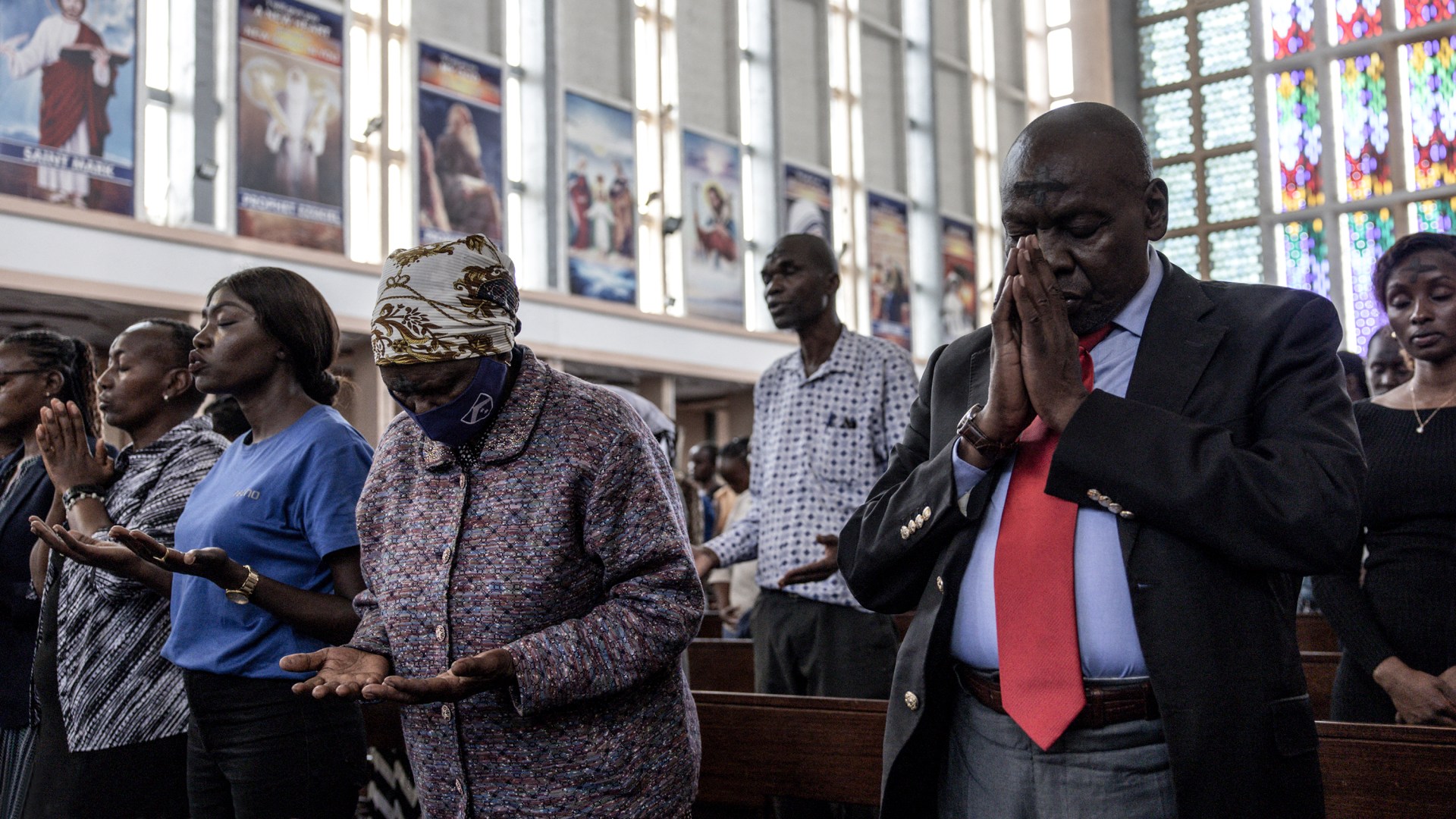
People praying in church.
Christianity Today November 14, 2025
Simon Maina / Getty

When Matthew Okeyo heard in 2023 that a religious sect leader had led hundreds of followers to starve to death in Kenya’s Shakahola Forest, he felt “shocked but not surprised.” Okeyo, who pastors African Inland Church Milimani in Nairobi, Kenya, said unchecked heretical groups have tricked and enslaved many Kenyans. Introducing regulations seemed like a good idea.

But now he and other church leaders oppose a bill the Kenyan government introduced last year to curb religious extremism, and they say it unnecessarily tightens regulations on legitimate religious institutions, including churches.

“I don’t have a problem with regulation,” Okeyo said. “My problem is how it is being done.”

If passed, the Religious Organizations Bill would establish a government commission to oversee churches and to develop a code of conduct. It would also require churches to register with the government, mandate fines and jail time for acts such as promoting politics from the pulpit, and limit proselytizing.

Christian and Muslim leaders have demanded the legislation’s “total withdrawal,” according to the Kenya Broadcasting Corporation, calling it “unconstitutional,” “oppressive,” and “open to abuse.” National Catholic and Protestant groups have also announced their opposition to the bill.

At an October 29 press briefing, Hudson Ndeda—national chairman for the Church and Clergy Association of Kenya—urged President William Ruto to suspend the legislative process for the bill.

“The Constitution is clear that state and religion shall be separate,” Ndeda stated. “We wonder why the government is keen on regulating religious institutions.”

Lawmakers proposed the bill in response to the Shakahola Forest Massacre, where at least 400 people, many of them children, died.

Police eventually arrested the sect’s leader, Paul Mackenzie, and ten others in connection with the deaths and charged Mackenzie with manslaughter, murder, and terrorism.

In May 2023, Ruto appointed a presidential task force to explore regulations preventing religious abuse. The taskforce then informed the drafting of the Religious Organizations Bill.

The Kenyan Senate presented the bill in September 2024, and Ruto’s cabinet approved the draft this July, opening a public participation period through October 22 so concerned citizens could comment. The bill is now headed to its first reading in Parliament. To become law, the draft must undergo three readings in Parliament with opportunity for revision. If it passes, the legislation will then go to Ruto for signing.

In 2025, police have exhumed at least 32 more bodies near Shakahola, raising fears the cult might still be operating, and raided a different sect’s compound, where they found two bodies and rescued 57 people from the cult leader’s control.

Proponents of the bill say its provisions are “critical” to prevent further deaths. In a speech to the UN Human Rights Council, Harrison Mumia—a representative of Humanists International and Atheists in Kenya Society—cited the Shakahola tragedy and urged the Kenyan government to “revisit the Religious Organizations Bill” to regulate religious organizations.

Pentecostal leaders are concerned the bill’s unclear wording could criminalize healing, deliverance practices, and tithe collection. Deliverance Church International, a Pentecostal church with locations across Kenya, argued in a recent letter to Parliament that the new bill will not stop Kenyans from joining dangerous cults.

“Wasn’t Shakahola a consequence of failure to implement existing laws rather than a vacuum in the law?” the letter asked.

David Njiiri, pastor of Kenya Assemblies of God in Nairobi, fears proposed fines in the bill could be abused and says they “need to be reasonable lest it be used by the enemy of the church to press charges against the clergy.”

Penalties for violations—including actions that “promote religious intolerance” or “indoctrinate any person with a religious doctrine”—can include fines up to 10 million shillings ($77,500 USD), imprisonment up to five years, or both.

Njiiri said the draft law “requires thorough scrutiny so as not to end up persecuting preachers rather than solving the intended problems.”

When Parliament presented the bill last year, the Evangelical Alliance of Kenya (EAK), an umbrella organization with a membership of over 700 denominations and churches, acknowledged abuses by heretical groups but argued the bill didn’t address the failures of public officials to properly handle the Shakahola tragedy. The EAK warned the current bill “unjustly limits” freedoms guaranteed under Kenya’s Bill of Rights.

Some also fear the proposed law’s restrictions on youth evangelism will hinder outreach and discipleship, especially among students in schools and universities. The draft bill requires a person to get parental consent before attempting to convert children or offering them religious teachings.

The East Africa Centre for Law and Justice (EACLJ) stated that vague wording in the statute could be subject to interpretation. Section 34 of the bill forbids the use of “misrepresentation, force, undue influence or coercion” in attempts to convert someone to a religion. The section also prohibits “indoctrinat[ing] any person with a religious doctrine.”

These restrictions could leave Christian evangelism vulnerable to lawsuits and limit outreach to children and youth, the EACLJ said.

In a memorandum obtained by CT, the Fellowship of Christian Unions in Nairobi, a parachurch organization that oversees Christian clubs and fellowships for students, asked lawmakers to clarify ambiguous portions of the legislation and revise it to “introduce safeguards that balance parental guidance with a child’s evolving capacity to choose their faith.”

The bill would also require churches and parachurch organizations to register with the government, submit financial reports, pay taxes on any income not spent on charity, and ensure leaders hold certificates or degrees from recognized theological institutions.

Okeyo said the government should withdraw the bill while it holds talks with religious bodies about how they can regulate their own members. He believes the government should work alongside Christian umbrella organizations, rather than impose all regulations itself, to regulate churches.

Okeyo worries the current legislation will create an environment where Christians can’t share the gospel and make disciples, because “if you want to share the gospel with someone, they may ask you to produce your license.”

“Many genuine local churches will lose their mandate to evangelize and disciple others,” Okeyo said.

History

Evangelicals Confront a Revolutionary Age

A Catholic on the campaign trail and the “possibly catastrophic character of what is happening under our eyes” caused deep concern in 1960.

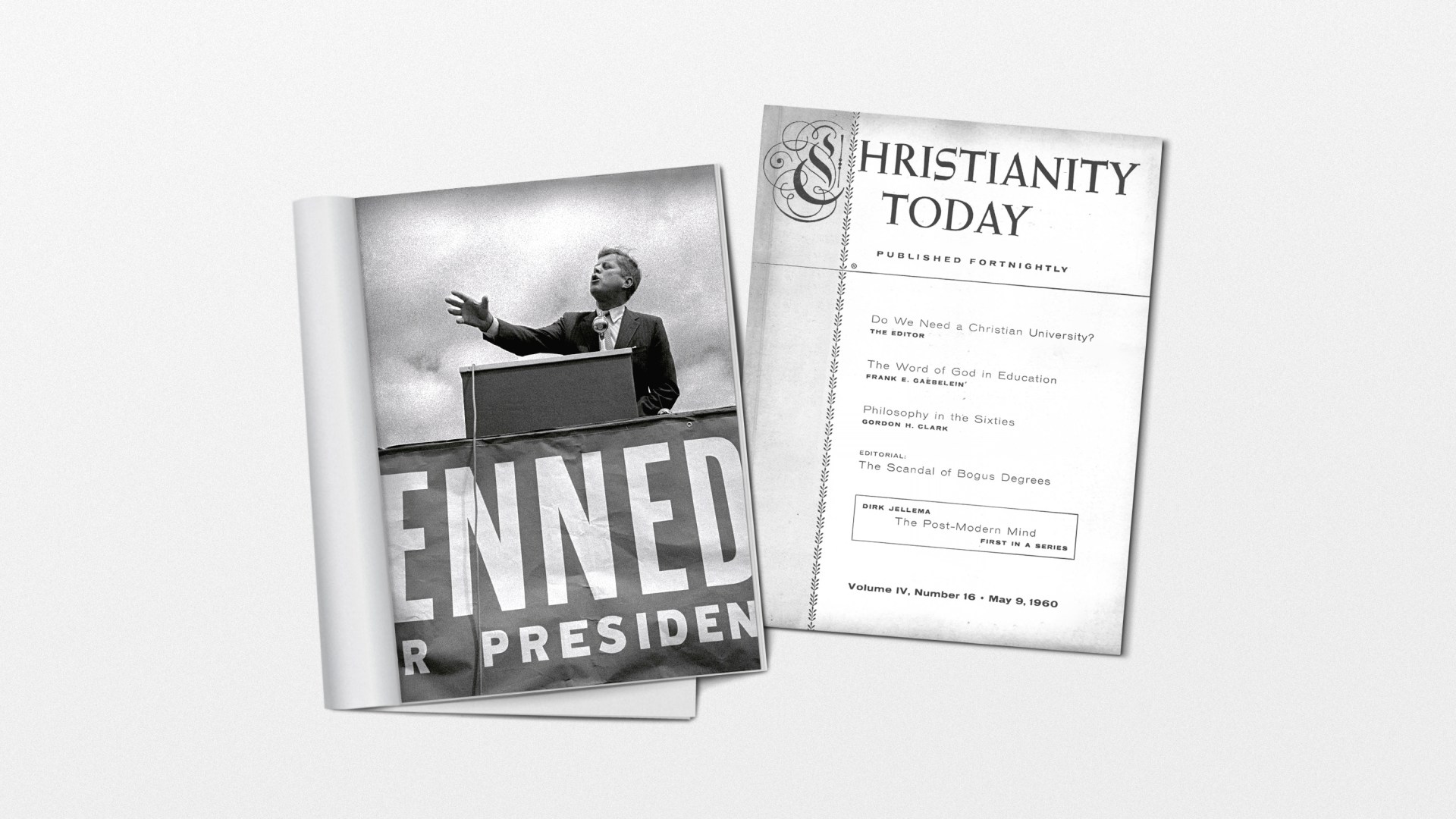
An image of JFK and a 1960 cover of CT Magazine.
Christianity Today November 14, 2025
Illustration by Christianity Today / Source Images: Getty

The 1960s brought tumultuous cultural change in America. For evangelicals, the decade began with concerns about what would happen if the American people elected a Roman Catholic president.

In a close-fought campaign for the White House, Democratic candidate John F. Kennedy sought to dismiss fears that he would take orders from the pope and end the separation of church and state. CT reported on the “religion issue“ when it first emerged in the West Virginia primary.

Kennedy began to speak freely of the religious issue even while discrediting its importance.  … He scolded the press so severely that not a single editor of the 400 present took up his offer to answer questions.

“The great bulk of West Virginians paid very little attention to my religion—until they read repeatedly in the nation’s press that this was the decisive issue in West Virginia,” Kennedy said. “I do not think that religion is the decisive issue in any state.”

“I do not speak for the Catholic church on issues of public policy,” he added, “and no one in that church speaks for me.” …

Questioned privately of how he would define his primary allegiance, Kennedy initially described it to a Christianity Today reporter in terms of the “public interest,” then indicated that it would be better expressed as a “composite” which includes “conscience.”

Did he feel that only a bigot would cite religious grounds for opposing a presidential candidate? No, but he said he found it hard to understand what intellectual anxiety there would be when one has answered in the negative (as Kennedy has) the all-important question: Would you be responsive to ecclesiastical pressures or obligations that might influence you in conducting the affairs of office in the national interest?

CT editors argued that concerns about Catholicism could not be so easily dismissed.

The past history and present practice of the Roman church illustrates its acceptance of the policy of persecution and oppression. The Protestants do not base their opposition merely on the massacre of St. Bartholomew’s Eve nor on the Pope’s efforts to raise a rebellion against Queen Elizabeth. There are current events in Colombia, Spain, Italy, and Quebec. Where the Romanists are strong enough, they persecute; where less strong, they oppress and harass; where they are in the minority, they seek special privileges, government favor, and more power. …

Opposition to political Romanism is not unreasoning, because a Catholic in the presidency would be torn between two loyalties as no Protestant has ever been. A candidate may announce, and even sincerely believe, that he is immune to Vatican pressure; but can we be sure that he will not succumb in the confessional booth to threats of purgatory and promises of merit from the organization which he believes to hold the keys of heaven?

The Vatican does all in its power to control the governments of nations, and in the past and present it has often succeeded. The Pope favored Mussolini’s conquest of Ethiopia. He made a concordat with Hitler, a concordat that still is in force in Germany as a last remnant of an evil rule. The United States a century ago had unpleasant experiences with the Vatican and had to break off diplomatic relations—relations that should never have been established in the first place and should never be resumed. We know that Romanists do not accept the separation of the Church and State; we know that they oppose a government’s treating all churches alike; we know that they constantly seek tax money for their own uses.

Evangelicals were not, of course, opposed to religion in public life. In fact, editors argued that the way religion was being downplayed was the most troubling part of the political developments of 1960.

The real significance … is found not in a growing emergence of a Catholic bloc or party, nor even in a shift of the American political mood into the post-Protestant era, or into an era of pluralistic religious balances. The deeper fact is the widening public judgment that all religion is irrelevant to political attitudes and acts. The American mentality rapidly is losing any distinction of true versus false religion.

CT noted with approval how Eisenhower attended a presidential prayer breakfast in March—and mourned the end of an era.

When President Eisenhower strode from the gold-trimmed grand ballroom of Washington’s Mayflower Hotel … it marked a significant exit.

Eisenhower had just witnessed his third and last “Presidential Prayer Breakfast” as chief executive. As he left, more than 500 government officials and other dignitaries stood, their eyes fixed upon the man under whom the prayer breakfast had come to represent a red-letter day on the evangelical calendar.

The election was not the only political issue that year. The Civil Rights Movement drew increased attention with nonviolent protests of race-based segregation. CT editors surveyed white Christian leaders in the South for their response to the new, disruptive tactics. 

Sharply critical of the “sit-ins” was Dr. William R. Cannon, president of Candler School of Theology, part of Methodist-operated Emory University in Atlanta, who called the methods “the worst possible.” … Dr. Robert W. Burns, pastor of the Peachtree Christian Church in Atlanta, who calls himself a “moderate” in the racial issue, also challenged the propriety of protest methods.

“These are not good means,” Burns said. “I’m very sorry to see them used.”

Dr. W. A. Criswell, pastor of the 12,000-member First Baptist Church of Dallas, largest in the Southern Baptist Convention, said he thought the question of property rights was involved.

“If a building is privately owned and run,” he observed, “I have assumed that one can do with it as he pleases.” … 

Applause for the demonstrators’ manners came from the Rev. A. T. Mollegen, professor of New Testament language and literature at the Protestant Episcopal Seminary, Alexandria, Virginia. 

“The dignity, restraint, discipline, and lack of vindictiveness of the Negro students’ demonstrations have been impressive,” said Mollegen. … “There is still great hope for America in our cold war with communism when our consciences respond to such efforts.”

Global Communism continued to be a major concern. CT invited J. Edgar Hoover, director of the FBI, to write a series on the threat and explain how “churchgoers may effectively confront the Red menace.”

If communism is to be defeated, the task must rest largely upon the theologians and the ministers of the Gospel. Communism is a false secular religion with pseudo-theological explanations of the great verities of life, such as the creation, life on earth, and the world to come. Communism is an all-encompassing system with explanations—though wrong ones—for this great universe of God. The Party offers answers—though perverted ones—for the hopes, joys, and fears of mankind.

In the final analysis, the Communist world view must be met and defeated by the Christian world view. The Christian view of God as the Creator, Sustainer, and Lord of the universe is majestically superior to the ersatz approach of dialectical materialism concocted by Marx and Lenin. The task of our clergy today is to translate this Holy Truth into the daily lives of our men and women. 

This truly is their responsibility as Christian clergymen.

Strong, responsible, and faithful Christians, wearing the full armor of God, are the best weapons of attack against communism and the other problems of our day. “Seek ye first the kingdom of God, and his righteousness.” In this way you will be playing a vital role also in helping defend our cherished way of life.

A Dutch theologian also wrote about the dangers of resurgent antisemitism in Europe. Could the horrors of the Holocaust happen again?

One remembers what was done in the name of culture to fellow human beings. One remembers the easy shamelessness with which people could converse about the anti-Jewish program at the time it was being carried out. Hitler had said in his Mein Kampf that he could spot the Jews behind all the darkness in the world, and then he declared that he would rid Germany once and for all of its Jewish problem. … 

I recall seeing Jews driven out of my parish in Amsterdam and out of all parts of the country, packed together as animal herds, and carted off toward Germany to vanish forever from our sight. We saw suffering that we had not imagined before. …

To those who have thought deeply about anti-Semitism, the recent outbreaks are no minor matter. We insist that the present anti-Semitic demonstrations are worse than what happened in Hitler’s day, not in effect, but in tendency and implication.

One CT writer was anxious about the “Strange New Faiths” and subcultures growing in America, including the advent of young people called “beatniks.” But another article argued that the lost, bearded young men of the 1960s were not so different from some of Jesus’ first disciples

Across the bar of an American tavern leaned a young man still in his late teens. His hair flopped loosely over his ears in a disorderly tangled mop, and his rumpled sport shirt and soiled slacks hung carelessly on his frame as he toyed with a glass of beer and gazed vacantly into the mirror before him. One foot kept time with the monotonous rhythm of the juke box that was blaring out the latest popular hit. He was one of those whom Time magazine defined as “oddballs who celebrate booze, dope, sex, and despair, and who go by the name of ‘beatniks.’”

These self-conscious victims of fear and futility may be found anywhere among the younger set today. … Although the consciousness that the world is too much for us may be more acute today than ever before, it is by no means new. Jesus encountered this same attitude. 

Innovative efforts to reach disillusioned youth could spark controversy. CT examined one fight over contemporary music: “Jazz in the Churches: Witness or Weakness?

Liturgical jazz got its biggest boost yet when NBC’s “World Wide 60” series relayed to a Saturday night television audience a performance by the nine-piece “Contemporary Jazz Ensemble” of North Texas State College.

The Texas “combo” is currently blazing the liturgical jazz trail in a tour of U.ؘ S. churches and colleges. … Edgar E. Summerlin, 31-year-old music teacher who formerly played with nationally-known dance bands, says he wrote the jazz setting in memory of a nine-month-old daughter whose death a year ago drew him and his wife into the First Methodist Church of Denton, Texas. He was advised by Dr. Roger Ortmayer, professor of Christianity and the arts at Perkins School of Theology.


Would Wesley’s heart be warmed anew to hear the syncopated accompaniment to his service, or would it leave him cold?

“I think he would have liked it,” says the Rev. Charles Boyles, young Methodist minister who has been travelling with the ensemble. “Wesley moved out among the people, something that perhaps Methodists aren’t doing enough of today.”

Theological education seemed to be growing distant from real people and real concerns in 1960. A Southern Baptist seminary professor sounded the alarm in an address that CT published.

What is to be done for men who can discourse with facility on “encounter,” “myth,” “confrontation,” “kerygma,” “koinonia,” and “agape,” but who fail to bring the joy and strength of the Gospel of redemption into the lives of their parishioners? Or, for that matter, how adequate is the theological training of the man who can pronounce irrefutable absolutes on verbal inspiration, the pretribulation rapture of the elect, or God’s revelation in twentieth century Zionism, but who is totally devoid of the compassion of the Saviour, and totally blind to the personal and social sufferings and struggles of multitudes of creatures bearing the image of God?

Kennedy won the popular vote in the election in November by just 0.17 percent. Narrow victories in Illinois and Texas gave him a majority of the Electoral College, but many suspected the count had not been entirely honest in key precincts within those two states. Looking ahead, CT warned that evangelicals needed to prepare for dark times.

What matters most is whether, in the light of the world-shaking and possibly catastrophic character of what is happening under our eyes, evangelicals are ready to confront this revolutionary age with deeper commitment to our Christian calling and a sense of urgency that is geared to the crises of the hour.

News

Hindu Nationalists Attack Missionaries in Northern India

One victim describes the mob descending on their bus, a rare occurrence in Muslim-majority Jammu and Kashmir.

A screenshot from video footage of the bus attack.

A screenshot from video footage of the bus attack.

Christianity Today November 14, 2025
YouTube Screenshot

A 34-year-old missionary, along with 13 prayer partners and short-term missionaries, was praying with a Christian family in a village in the disputed northern state of Jammu and Kashmir on October 23 when eight police officers interrupted the fellowship.

The cops informed the group, who were from Tamil Nadu in South India, that local Palal villagers had complained about the gathering and were preparing to attack them. The cops instructed them to leave immediately and offered protection to get them out of the village safely. While initially scared, the missionary was relieved that the police had offered to help them. The missionary asked CT not to name him and his organization as he could be arrested for his work.

The group followed behind the police vehicle in their white minibus. But only 500 meters into the ride, about 40 young men armed with iron rods and sticks blocked the one-lane dirt road. They pulled the minibus doors open to beat and kick the passengers, smashed its windshield and windows, and shouted slurs.

The mob of Hindu nationalists accused the group of forcibly converting local Hindu residents to Christianity.

Of the eight police officers who had driven ahead of them, only one tried to help the victims, the missionary recalled, while the rest stood and watched. At the time, he wondered if police had conspired with the mob to enable the attack.

The beating left at least four members of the mission team, including one woman, injured. After the attack, the head of local police department, Mohita Sharma, arrived and helped the victims reach their lodgings safely. She advised the local family that hosted the missionaries to register a formal complaint against the attackers.

The next day, the police department suspended the eight officers for negligence of duty. Authorities also arrested the two lead attackers, Ravindra Singh Thela and Rohit Sharma, but soon released them on bail.

Thela is a leader of the right-wing Bharatiya Janata Party (BJP) and is known for engaging in extremist cow vigilantism, a form of mob violence to protect cows, which are considered sacred in Hinduism. He currently has several criminal cases open against him, including attacking a journalist covering protests in Jammu and Kashmir earlier this year.

Ivan Albert Pereira, Catholic bishop of the Jammu–Srinagar diocese, appreciated the support the head police officer had extended. “Such incidents have not happened in Jammu and Kashmir, and the action of [Ms.] Sharma will serve as a warning to both officials and perpetrators of communal incidents in [the] future,” he told Crux.

After their release, the attackers filed a complaint against the missionary group and the local families that had invited them, accusing them of luring residents into embracing Christianity with food and money. The missionary CT spoke to said that police detained three families and kept them in custody for a day, but the judge concluded they lacked proof of religious conversion and acquitted them the next day.

This missionary has been working in Jammu and Kashmir for the past ten years. He and the other short-term workers visited Palal because a local family had invited them over for prayer and lunch. He has been visiting the village almost monthly for the past five years at the invitation of the two Christian families in the village. But contrary to accusations, he said he’s never preached the gospel in that village.

Besides meeting with isolated Christian families, the missionary also pastors a small church of 40 congregants about 80 kilometers away from Palal. After completing his theology training in Tamil Nadu, he felt led to be part of an indigenous mission to spread the gospel in the northern belt of India.

Christians compose a mere 0.28 percent of Jammu and Kashmir’s population, while Muslims make up 68 percent of the population and Hindus 28 percent, according to India’s latest census taken in 2011. Christians have faced increased persecution in recent years.

In September, a group of Hindu nationalists protested a Christian worship meeting in the state’s Samba district, alleging that the Christians were using the event as a tool to convert Hindus. In 2018, a mob of 1,000 Hindu extremists burned down a church building, holding the church responsible for the death of a congregant whom they presumed had been forcefully converted to Christianity.

Evangelism has become more difficult in the state, especially after the BJP-led central government took greater control of Jammu and Kashmir in 2019, the missionary noted. “The village leaders in the area have become very hostile,” he said, noting the increase in Hindu nationalism. “They threaten to ban local families who engage in Christian activities.”

Mehbooba Mufti, the former chief minister of Jammu and Kashmir, met with a delegation from the Christian community on November 1 and condemned the attack. “I urge the authorities, especially [the Jammu and Kashmir Police], to take immediate action as Christmas is approaching, before fear becomes the new normal,” she said on X.

The attack has not deterred the missionary, who believes persecution is inevitable.

“We are here because we came for God,” he said. “We believe that he is leading us. Persecution is normal; it was normal in the Bible as well. God was strengthening us and continues to do so.”

News

Christians from 45 Countries Call for Zion Church Pastor’s Release

UPDATE:Chinese authorities officially arrested 18 leaders, who could face 3 years in jail.

Senior Pastor Mingri “Ezra” Jin preaching at Beijing Zion Church on September 3, 2018

Senior Pastor Mingri “Ezra” Jin preaching at Beijing Zion Church on September 3, 2018

Christianity Today Updated November 19, 2025
Image courtesy of Zion Church

Key Updates

November 19, 2025

On Tuesday, Chinese authorities formally arrested 18 leaders of Zion Church, including pastor Jin “Ezra” Mingri, and charged them with the crime of “illegally using information networks,” China Aid founder Bob Fu told Reuters. The leaders, detained last month, could face up to 3 years in prison.

“By turning pastors into political prisoners, the CCP is not only persecuting these individuals and their families—it is sending a warning to every independent church in China: submit to Party control or face destruction,” Fu said in a statement. “We call on the Chinese government to immediately release all 18 Zion Church leaders, drop the false charges, and stop treating peaceful believers as enemies of the state.”

November 14, 2025

More than 500 church leaders and members in 45 countries with close ties to China signed an online prayer petition in solidarity with the arrested leaders of China’s Zion Church, including senior pastor Jin “Ezra” Mingri.

The countries represented—including Argentina, Brazil, South Africa, and India—are part of the Belt and Road Initiative (BRI), China’s strategy to invest in infrastructure around the world, or BRICS, a bloc of emerging economies that includes China. This the first time Christians around the world have jointly spoken out for the persecuted church in China based on their countries’ relationships, said Bill Drexel, a Hudson Institute fellow and son-in-law of Jin.

The prayer, written and circulated by Jin’s family, urges China’s leaders to “recognize that religious freedom strengthens rather than threatens nations,” to immediately release Jin and the other church leaders, and to create “a future where Christians in China can worship freely, serve their communities openly, and live out their faith without fear.”

“We pray for all believers in China who face mounting pressure, restrictions, and persecutions for following You,” a portion of the prayer reads. “May they know they are not forgotten, and that Christians around the world stand with them in spirit and in prayer, and that the world is bearing witness to their treatment.”

On Wednesday, the US Senate passed a bipartisan resolution condemning the Chinese Communist Party for the detentions and calling for the church leaders’ release. Earlier in the week, Chinese authorities released 4 Zion Church leaders on bail. At least 18 remain in detention centers in Beihai, China. They are likely to face formal sentencing next week.

Most of the arrested leaders have access to lawyers, and Jin is “doing okay physically, spiritually, and mentally,” according to Zion’s interim lead pastor, Sean Long. On October 19, Jin released a letter from prison calling on the church to have courage. “Don’t worry about me,” he wrote. “I find great comfort in being able to endure this little suffering for the gospel.”

Drexel noted that the public solidarity prayer aims to show the Chinese government that the global church—not only the American church—is concerned about the treatment of fellow believers. Many of the countries China hopes to lead through BRI and BRICS initiatives “have much larger (and faster-growing) proportions of their populations that identify as evangelical, especially in the Global South,” Drexel said. He added that church leaders in these countries plan to continue to push this issue in different ways.

One signatory of the prayer petition, Daniel Bianchi of Argentina, first met Jin at a Lausanne meeting in 2017 and invited him to speak at a summit held by his organization, which advocates for the persecuted church, in Argentina the following year. But police shut down Zion Church in September 2018 and barred Jin from leaving the country.

When Bianchi heard that police had arrested Jin and other church leaders last month, he immediately put out a call to prayer on a WhatsApp group of Latin American church leaders.

Bianchi, who is also the Lausanne Movement’s regional director for Latin America, noted that although some Christians in his region are aware of ongoing persecution in China, it remains a peripheral issue as they focus on things closer to home. At the grassroots level, he sees Latin American believers sharing news about the Zion Church arrests and praying for the Chinese church. But he has yet to see any top leaders or evangelical bodies speak out about it.

Argentinian church members should use their freedoms to raise awareness of the challenges their Chinese brothers and sisters are facing and advocate for them, Bianchi said. In his view, the solidarity prayer he signed in support of Zion Church is important because the concept of koinonia (the body of believers) mentioned in Philippians means Christians everywhere should fellowship in suffering.

“It’s not just that there’s one church that is happy and prosperous and another church going through adversity and suffering,” Bianchi said. “We have a common voice, heart, and concern.”

Zion Church continues to meet each Sunday, with sermons broadcast over Zoom and in-person gatherings of between 5 and 50 believers in homes or restaurants. Unity has been challenging to maintain, Long noted, because the church is spread out over 40 cities in China and some pastors, like him, live overseas.

Under the intense pressure of the recent arrests, he has seen conflicts among church members arise due to miscommunication, differing opinions on how to respond to the persecution, and a complicated eruption of emotions, including anger, anxiety, and fear.

“We have to digest [the crackdown] together as a team, as a faith community, and not leave any space for the Devil’s temptation,” Long said. “How we maintain unity is key to winning this spiritual battle.”

The church also runs a counseling center that has been helping the wives and children of imprisoned pastors deal with mental health challenges like depression and trauma.

While some members have left the congregation out of fear of associating with a church in the government’s cross hairs, Long said new people are joining services and getting baptized.

“They are willing to join Zion Church amid the persecution,” Long said. “They are disciples who are ready to pay the price, the cost of discipleship. It’s encouraging for us ministers.”

Long is grateful to see the global church come alongside Zion in prayer and support. On Tuesday, religious freedom groups held a 24-hour International Day of Prayer for Zion Church. Meanwhile, Long believes the public solidarity prayer by Jin’s family encourages more people to pray for his church and strategically marshals support from countries that have a tangible impact on China’s international standing. “If we can mobilize more pastors from BRI and BRICS region, I think their voices will be heard not just by God but the leaders of China,” he said.

David Ro, executive director of Arise Asia, said some pastors were hesitant to sign the online prayer petition out of fear that it could impact their ability to travel or do ministry in China.

But Ro, who lives in Bangkok, finds their views shortsighted. “If you were arrested, wouldn’t you want people to stand up for you?”

Ro worked closely with Jin on Mission China 2030, an effort Jin cofounded in 2013 to encourage Chinese Christians to engage in cross-cultural missions. He noted that Jin had prepared for an inevitable crackdown on his church by building a wide network within the global evangelical community. Doing so helped news of his arrest travel far and wide.

In China, house churches are wrestling over how to respond to the government crackdown, Ro said. They want to speak out against Jin and other Zion Church leaders’ arrests—as Jin did for some of them when they faced persecution—but at the same time, they know the Chinese government will target them if they do.

As persecution increases in China, more house church members and leaders are looking to move overseas to worship freely and provide their children with a Christian education, Ro observed. Such international moves may also be an opportunity to spread the gospel where they settle. Ro pointed to Acts 8, where persecution against the church in Jerusalem led to Christians being scattered throughout Judea and Samaria.

“God is using persecution to expand the Mission China 2030 movement that Ezra helped start,” Ro said.

Culture
Review

A New Jesus Horror Movie Wallows In Affliction

“The Carpenter’s Son,” starring Nicolas Cage, is disconnected from biblical hope.

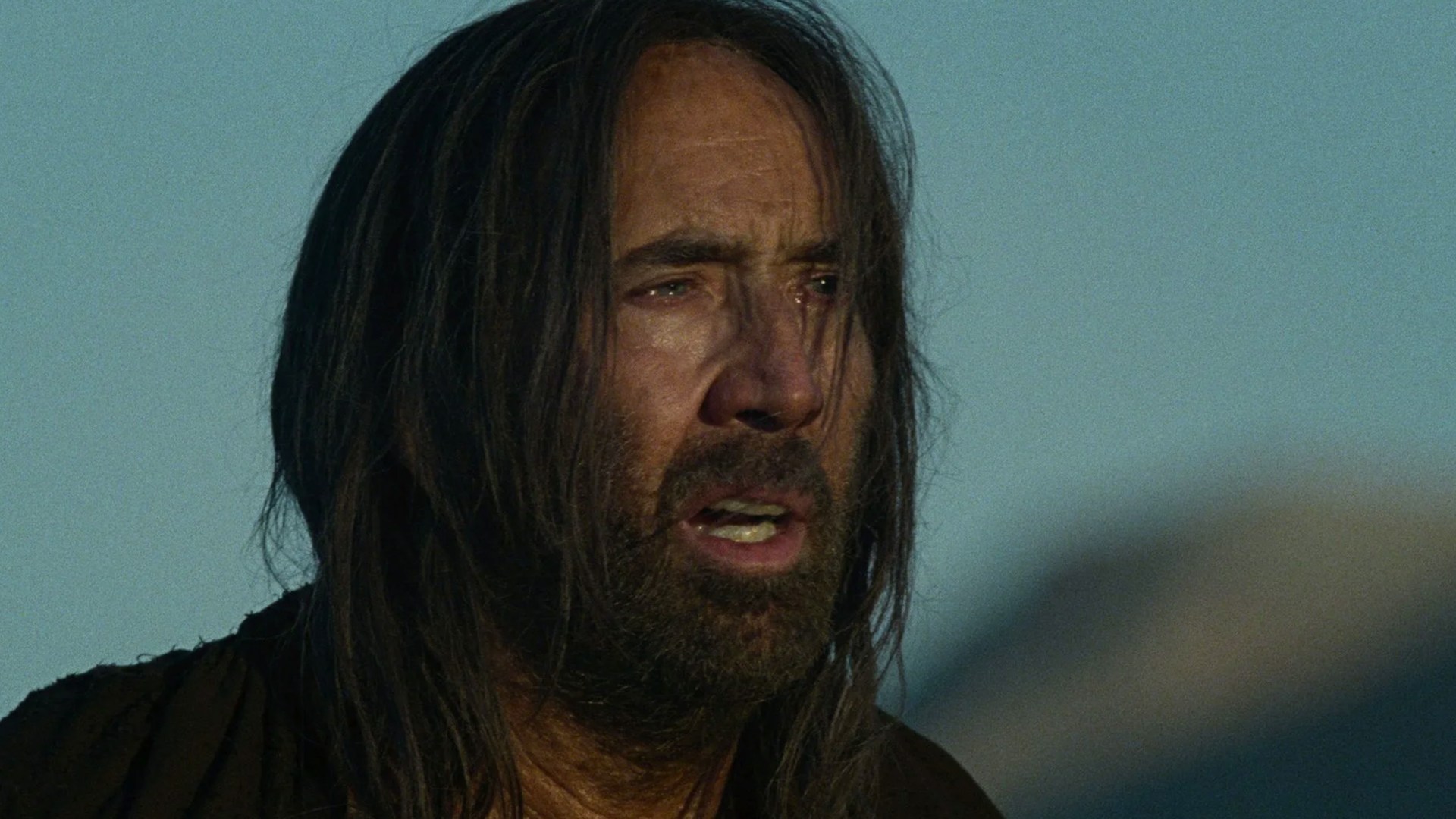
Nicholas Cage in The Carpenter's Son.

Nicholas Cage in The Carpenter's Son.

Christianity Today November 14, 2025
Photo courtesy of Magnolia Pictures.

Amid a proliferation of “family-friendly” Bible movies and TV shows, it’s striking to come across a film like R-rated The Carpenter’s Son. Its premise: What if Jesus had been tempted as a teenager, and his parents—especially his father—couldn’t deal with it?

Though described as a biblical horror movie, The Carpenter’s Son takes its cue from an ancient source that isn’t in any of our Bibles. An opening title card announces that the film is based on the Infancy Gospel of Thomas, an apocryphal text from the mid to late second century.

The gospel in question portrays Jesus as a young, undisciplined child who flexes his powers a little too freely and is reprimanded by Joseph. Films have borrowed from this gospel before. The Young Messiah, The Book of Clarence, and the 1999 miniseries Jesus all adapted one of its more winsome passages, in which Jesus brings some birds to life.

But The Carpenter’s Son might be the first film to offer a straightforward depiction of some of the text’s darker moments, such as when Jesus strikes another child dead supernaturally.

The movie could have gone full-blown heretical, portraying Jesus as a monster of sorts. But The Carpenter’s Son, while certainly not biblically orthodox, doesn’t go that far. Its treatment of Jesus is far more ambiguous, and through Joseph, it focuses on what it means to keep faith in dire circumstances.

The film follows Joseph (Nicolas Cage), Mary (FKA Twigs), and Jesus (A Quiet Place’s Noah Jupe) as they move to a new town in Roman Egypt, still on the run at least 15 years after Jesus was born. It’s not clear who they’re hiding from exactly, but Joseph says in a voice-over that “calamity” follows them and they have been “driven from every home.”

Joseph boards up the windows and scatters sand outside the door to protect their new home from neighbors and evil spirits. Jesus is haunted by nightmares of his death and resurrection that leave him screaming in the middle of the night. When he joins a class taught by a local rabbi, a mysterious girl with scratches on her face (Isla Johnston) draws him away and tempts him to commit forbidden acts, such as almost touching a sleeping leper.

The girl’s identity is revealed somewhat gradually, but it’s not hard to figure out who she is, and the trailer gives it away, so there’s no point in hiding the ball. She’s Satan, or a manifestation of him. The film’s inclusion of her is one of its more significant departures from the Infancy Gospel—and one of the key ways it pulls the story in a more biblical direction.

In the Infancy Gospel, it is Jesus himself who terrifies everyone, and Satan is never even mentioned. But in the film, it is Satan who attacks the neighbors and draws unwanted attention to Jesus, and it is Satan who tries to drive a wedge between Jesus and Joseph, partly by baiting Jesus with the fact that Joseph isn’t his real father. Whatever you make of the way this all plays out, it at least makes more sense biblically to pin all this disruption on the satanic figure, who calls herself “the Adversary.”

And if you are willing to engage with parts of the movie’s premise, it’s interesting to consider how some of the real adult Jesus’ bolder actions might have begun as small acts of rebellion against the culture he grew up in. In the film, child Jesus refuses to touch the aforementioned leper at first because the leper is “unclean.” That’s what his earthly father and his rabbi have drilled into him. But of course, Jesus has come not to abolish the law but to fulfill it, as Matthew records him saying chapters before he cleanses a leper who kneels before him (5:17; 8:3). That healing is God’s will, not the will of the Adversary.  

The Carpenter’s Son focuses on Joseph’s doubts and the ways they play out in his efforts to be a father to Jesus. Mary was visited by an angel, and she carried the Son of God in her womb for nine months. But Joseph got all his divine messages through dreams, and he had to trust that those dreams were real, clinging to memories of them years after the fact.

The key concept the film takes from the Infancy Gospel isn’t the miracles but the tense relationship between Joseph and Jesus. Joseph is a father, and an adoptive one at that, committed to raising this child in the Jewish faith (memorizing Scripture, saying prayers) while also correcting him when he seems out of line.

In the Infancy Gospel, Joseph grabs Jesus by the ear. In the film, he gets similarly punitive—and like many parents, he gets so exasperated that he says and does things he’ll probably regret.

Writer-director Lotfy Nathan got his start making documentaries, and he brings an unflinching realism to aspects of the story that most Jesus movies avoid, from the umbilical cord that Joseph cuts after Jesus is born to the stained loincloth of a man who has been chained to the ground next to a hill where people are crucified.

Nathan also comes up with genuinely horrific images, like a snake that emerges from people’s mouths or a dark portal to hell ringed by squirming, ill-defined masses of flesh. Some moments play like nods to 1973’s The Exorcist, from ominous close-ups on an idol that Joseph is working on to a possessed person’s bulging throat.

The biblical and horror genres aren’t as far apart as one might think. The most famous (and successful) fusion of the two is arguably The Passion of the Christ, which is haunted by Satan from beginning to end. But the point of films like that (and The Exorcist)is to highlight the reality of evil so we appreciate the necessity and reality of goodness.

There are hints of that in The Carpenter’s Son, but the film is bleak overall. It begins on the night of Jesus’ birth, with labor pains and the terror of fleeing Herod’s soldiers. It wallows in anger and affliction before ending with death and violence and a sense that things still aren’t resolved.

In the film, Joseph does see a light in the sky when Jesus is born, and it becomes one of the memories he clings to when all turns dark. But in the Bible, the point of the star creating that light was to summon worshipers to see the Son of God. The Joseph of this film never gets that extra confirmation, and he never gets to see Jesus sitting with the teachers in the temple at the age of 12.

The biblical Joseph had more to sustain his faith; the Joseph of this film gets no hint of Jesus’ wisdom or holiness. Instead, all he has is an increasingly powerful and rebellious teenager he doesn’t understand.

And that, more or less, is what the audience is left with too. I’m all in favor of projects that compel us to see the Bible with fresh eyes (think of The Chosen), as well as films that explore how Jesus grew into his own self-awareness. (This film would make an interesting triple bill with The Young Messiah and Last Days in the Desert.)

But in the end we need to feel that the story connects to the biblical Jesus somehow, that it portrays him as the Messiah we know and love. And The Carpenter’s Son doesn’t do that. It begins by telling us that the apocryphal gospels “describe events missing in the timeline of the New Testament.” But at times it feels as if the film is taking place in a different dimension entirely.

Peter T. Chattaway is a film critic with a special interest in Bible movies.

Apple PodcastsDown ArrowDown ArrowDown Arrowarrow_left_altLeft ArrowLeft ArrowRight ArrowRight ArrowRight Arrowarrow_up_altUp ArrowUp ArrowAvailable at Amazoncaret-downCloseCloseEmailEmailExpandExpandExternalExternalFacebookfacebook-squareGiftGiftGooglegoogleGoogle KeephamburgerInstagraminstagram-squareLinkLinklinkedin-squareListenListenListenChristianity TodayCT Creative Studio Logologo_orgMegaphoneMenuMenupausePinterestPlayPlayPocketPodcastRSSRSSSaveSaveSaveSearchSearchsearchSpotifyStitcherTelegramTable of ContentsTable of Contentstwitter-squareWhatsAppXYouTubeYouTube