Ideas
Excerpt

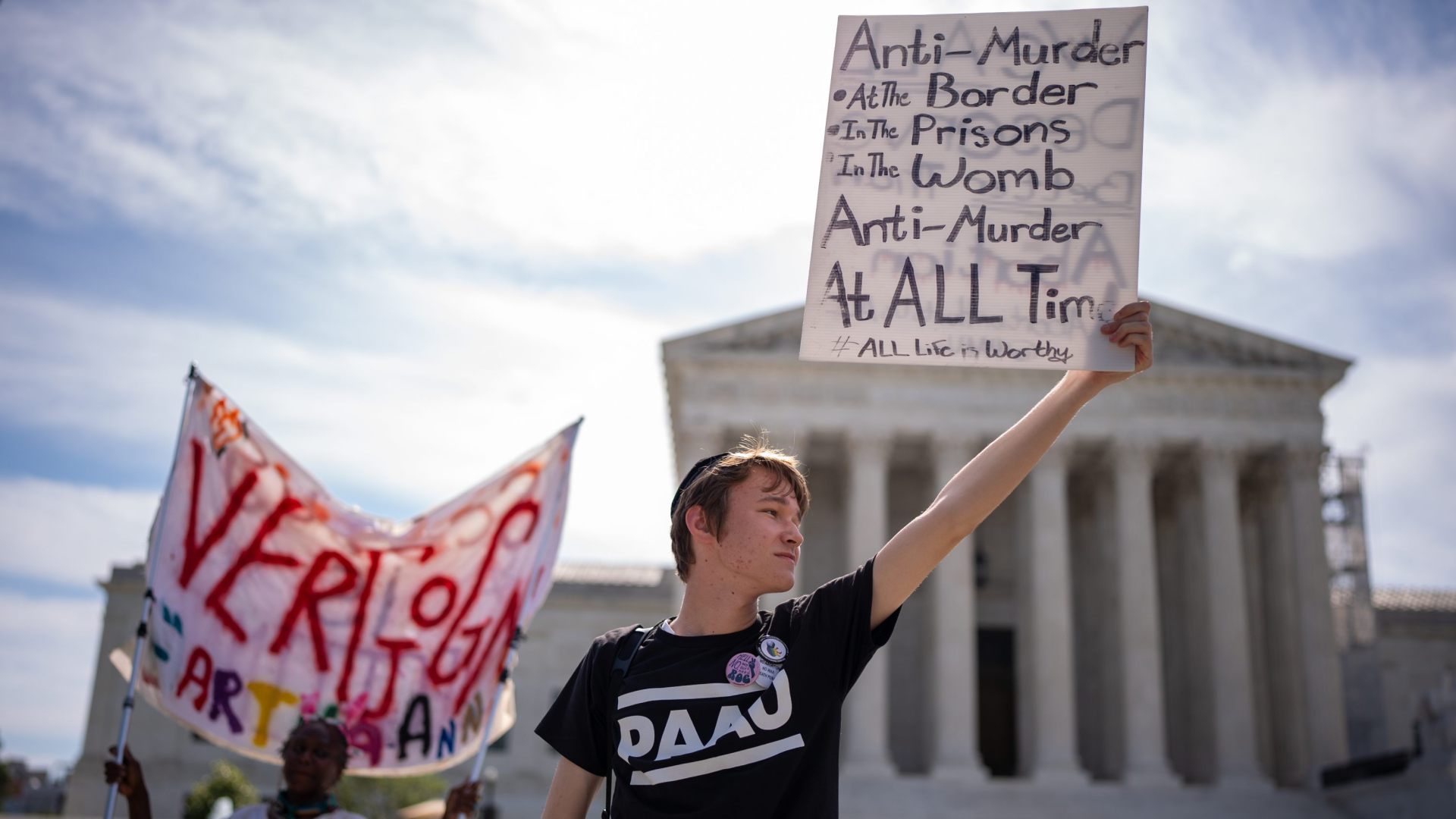
Pro-Life’s Future: More Than Just Abortion

Clarissa Moll and Jonathan Liedl discuss a new pro-life mission and identity for a violent world.

Pro-life sign held before court
Christianity Today September 23, 2025
Andrew Harnik / Getty Images

In a culture that devalues life, Christians offer a winsome witness to human dignity. Here are edited and tightened excerpts of a conversation between Clarissa Moll and Jonathan Liedl, senior editor at National Catholic Register, on CT’s The Bulletin podcast.

Clarissa Moll: 63 percent of Americans today say abortion should be legal in most cases. There was a time in conversations about the right to life when we could say, We all believe in human dignity. It seems we have lost something fundamental in our culture that, presuppositionally, we used to bring to those conversations.

Jonathan Liedl: You’re right. The common ground is fading away. Things are absolutist right now, with sorting quickly and definitively into partisan categories. 

How others perceive the pro-life movement should change. Much of the antagonistic rhetoric has been that the pro-life movement just prohibits something or is only pro-birth. Because of this, relationships are important. In an increasingly polarized world, it’s harder for friendships between those with different views to exist. But witnessing with your life that you care about all life—serving, loving and sacrificing for the poor, for the homeless, for the stranger in our country in need—that makes a difference. Scripture says they will know we are Christian by our love. If people aren’t seeing that love inform all the ways we interact and support the vulnerable, the witness can ring hollow. 

The pro-life effort involves many different people—different Christians, people of other faiths, even people of non-faiths. Work between Catholics and evangelical Christians has been significant. Honestly, oftentimes in the pro-life movement our greatest allies are feminists or atheists or even secular people who aren’t coming from the so-called Christian right. Often these people are able to speak with proponents of abortion or supporters of abortion rights and say, I come from this similar starting point that you did. Here’s why I have come to believe this as well

Debate is fantastic. But if people don’t see their story represented in something, it’s easy to dismiss it. Since the Dobbs decision, the pro-life cause has lost every state initiative. There’s an immense amount of work to do. Women play an obvious leading role in the pro-life movement, but we also have diverse allies: people from the medical community, people with a scientific background. 

For us, it’s part of our faith, our conviction that every human life is created in the image and likeness of God and therefore has inviolable and infinite dignity. But this is also natural law. You don’t necessarily have to be a believer to be convinced of the truths of these things. Some of those voices continue to be important to work with and to lift up when we’re trying to persuade others. 

The goal is not just to prohibit abortion but to make it so no woman feels she has to choose between the life of her child and her own economic security or personal safety. When people are not engaged with Scripture, there are other ways to be persuasive and continue to advance gospel values. Thankfully, that’s what we’re supposed to do: Live the gospel. Perhaps we need an invitation to return to that and embrace it.

Moll: When Catholics talk about pro-life issues, they often refer to a concept called “the seamless garment.” Could this idea be a starting place for a pro-life conversation with a culture asking questions about human dignity and worth beyond abortion, such as in the recent aftermath of Charlie Kirk’s death? 

Liedl: The original seamless garment was what Christ wore leading up to Calvary and his crucifixion. The soldiers did not tear it in two, to fulfill the prophecy. Cardinal Bernardin, Archbishop of Chicago in the ’80s and ’90s, applied this image from Scripture to how we protect life and society. The seamless garment is a consistent ethic of life. For example, let’s say that you’re ardently pro-life, but when it comes to how you think about immigration policy, you’re not thinking about the dignity of the people involved. You can flip it around, of course, the other way. You can have great compassion for an immigrant, and you realize that they have inviolable dignity and certain rights and responsibilities that flow from that, but you’re not concerned about the unborn. 

Some people think “seamless garment” has muddied the water, but that’s not how moral theologian and bioethicist Charlie Camosy and others like him understand that. For example, justice for unborn children and care for their mothers and families—they go together. The goal is to say no to something, which is the unjust taking of unborn life, but also to say yes to supporting women and children, whether through public policy or a parish launching some kind of diaper drive or supporting women materially. 

The seamless garment shows connections. People are looking for deeper truths about the source of their worth and value. Many see neither major political party right now presenting a compelling and consistent vision of that. The seamless garment, a consistent ethic of life, can show you’re not willing to compromise this deeper truth of human dignity and the value of human life simply to pursue one other thing.

That faithfulness creates a compelling witness. To be pro-life isn’t just about passing laws or prohibiting abortion. It’s a worldview to be reflected not just in our public policies but in how we live in community. If we do that, others might be attracted to us. 

Moll: The Christian pro-life movement in the US has, for many years, looked for large gains in legislation and in the halls of power. Now, where we don’t have Scripture as a common language in our culture, we may have to go back, like the women in the early years of the pro-life movement, and be grateful and thrilled to achieve small gains on behalf of the vulnerable. Maybe it’s around a conversation about the death of Charlie Kirk or about a school shooting, trying to introduce some of these broader pro-life beliefs.

Liedl: Exactly. That’s ultimately what Christ calls us to, to be faithful even in the little things. Because those who do well with the little things, bigger things might be asked of them.

Headshot of Stef Reid
Testimony

Was It Really God’s Perfect Plan to Amputate My Foot?

A tragic accident jump-started my relationship with God. It also made me question his goodness.

Christianity Today September 23, 2025
Photography by Betty Zapata for Christianity Today

I woke up to a face full of sunshine. Time was ticking on my last day at my friend Irene’s family cottage on the lake. I needed everyone up so we could make the most of the morning and squeeze in one last round of tubing before my parents picked me up. 

Eight of us piled into the boat as the lake sparkled in the morning sun. I silently declared this to be the best weekend of my 15 years of life. My tubing enthusiasm won me the first turn, and after a long effort of flying across the water behind the speedboat, I got tired, hit a wave, and fell off. I treaded water as I waited for the boat to circle back and pick me up, like it always did.

But this time, something was wrong. The boat was coming toward me way too fast. I later learned that there had been a miscommunication—the driver had no idea I was in the water.

In the moment, I was surprised by my lack of panic. I assessed my options and decided my best shot at survival was to surface dive, going far enough below to miss the propellers. It was a good plan. But I forgot to factor in the life jacket. The thing that was meant to keep me safe, with zips and clips that I couldn’t escape, meant I couldn’t get under.

I knew how lucky I was to resurface. I also knew something was very wrong. Water was swimming inside my body in places where it shouldn’t be. I tried to see my injuries after my friends pulled me out of the water, to know what I was dealing with, but every time I tried to look, a pair of hands firmly held my shoulders back against the deck.

My friends tried their best to protect me, telling me that everything was fine and that I was going to be okay, not realizing that the truth was written all over their faces: We were hours away from a hospital, and I didn’t have hours.

I’ve loved sports for as long as I can remember. I grew up doing everything from swimming to playing basketball, volleyball, and tennis. Then when I was 13, I was introduced to rugby. From that moment on, my life’s dream was to be an international rugby superstar. I caught the eye of some of the national coaches, and it looked like this ridiculous dream actually had a shot at coming true.

I had big dreams and plans, and I didn’t want anything to get in the way. Including God.

My family was a little bit Christian, and most of what I knew about God came from attending a Christian school. But my biggest concern about religion as a teenager was that God might suggest a path I didn’t want to take. I figured it was better not to ask God for his opinion than to ask and not take it.

So I decided to put my faith on hold until I was maybe in my 30s, maybe with a family and more time to invest in the small matter of life and death and what it all means. I wanted to enjoy the young, fun, adventurous part of life. God could have the boring leftovers.It just never occurred to me that I might not live to see my 30s. Until that day at the lake.

As our boat charged into the dock, the adults sprinted from the cottage. I was loaded into a van using a deck chair repurposed as a stretcher. The plan was to meet the ambulance halfway on the highway and swap cargo at the side of the road.

At the local clinic in Port Perry, Ontario, where my parents met me, I asked my mum, “Am I going to die?”

“No, sweetie, of course not. You’re going to be just fine.” My head was locked in a precautionary neck brace, so I couldn’t see her face. But it had taken her a long time to get that second sentence out, and I wasn’t sure whether she believed what she said.

When I was finally on my way to the hospital, I just wanted to sleep. The paramedics kept talking to me and insisting I answer. I asked if they would be so kind as to let me have a quick nap. They said no—because I might not wake back up. My eyes shot open immediately. I very much wanted to live.

Unfortunately, it didn’t feel like I had a lot of say in the matter. So I prayed. It was desperate, honest, and short. “God, I’m really scared. Please save my life.”

God answered that prayer. I woke up to the news that the surgery had been a wild success: There was no spinal damage, no internal organ damage, and no signs of infection or flesh-eating disease.

Then my mum walked into the recovery room. Her face did not look like someone who thought this was a wild success. There was nothing that could have prepared me for what she said next: “Stefanie, my darling, I’m so sorry. The surgeon did everything he could but was unable to save your right foot. He had to amputate it.”

I thought, How am I supposed to play rugby if I can’t run? And there was a greater question: What kind of loving God saves my life only to take away the thing I love most?

Yes, I wanted to live. But not like this.

Technically, God did exactly what I asked him to do in the ambulance: He saved my life. Personally, I thought it was obvious that I wanted that life to still include a full contingent of limbs. But prayer was new to me, and so was God. I wondered whether in addition to being omnipotent, omniscient, and omnipresent, God was also very literal. Perhaps I should have been more specific and spelled it out for him. 

I spent a lot of time in the hospital wondering just what kind of God this was. I had no doubt that God was real. I knew he had saved my life, because I had felt his presence in the water. A slightly different orientation of my body and it could have been my head in those propellers. Just a few centimeters deeper across my torso, and I could have been cut clear in half. A different blood vessel a few millimeters away, and I could have bled out in seconds.

If God could save my life by arranging for all of that, why couldn’t he have also saved my foot? More disturbingly, could he have saved it but chose not to?

But as I lay devastated in my hospital bed, I didn’t long for theological explanations. I wanted to talk to God. I told God how angry I was with him, how sad, and how scared. It occurred to me that he might be sad too. He didn’t say very much, but just as I had in the water, I felt his presence beside me. 

For the first few years, I prayed for a miracle. I prayed that my foot would grow back. After all, I was talking to a God who helped a 90-year-old woman get pregnant (Gen. 21:2), kept a man alive in a giant fish (Jonah 1:17), and made the sun stand still (Josh. 10:12–13). A new foot was minor compared to that. Starfish grow new limbs all the time.

Spoiler alert: My foot hasn’t grown back. But I did get my miracle. What I thought would be the worst thing imaginable—the nuclear option making me question whether I still wanted to live—has transformed into a source of joy and possibility. And that’s because of what it taught me about God and myself.

After the accident, I let sports go and picked a new dream. I wanted to be a surgeon, just like the one who had put me back together. I went to Queen’s University to study biochemistry on a full academic scholarship. I got involved with student ministries like Athletes in Action and met wonderful, interesting, funny Christians who showed me how to share God’s love.

I studied hard, not knowing that I was about to circle back to my original dream. I received my first running blade and started training with the varsity track-and-field team. By the time I graduated, I had a world ranking high enough to qualify for the World Para Athletics Championships. In 2006 at graduation, I had to make a decision: Do I pursue medicine? Or do I follow this crazy dream of becoming a professional athlete with one foot?

I’d gone from living a life I didn’t want to having two great options. I chose athletics, not knowing whether it was the “right” choice—only knowing that it would challenge my faith in ways that were both uncomfortable and good for me.

As an athlete, I wrestled with questions like “Is it okay for a Christian to want to win?” “If God already knows the outcome of the next race, is there any point in me training?” and “If God loves me, then why am I losing so much?” I wanted neat and tidy answers from God. And while I did get some clarity, it was his humor, his love, his patience, and his steadfastness that jumped out at me as we talked. Who he was led me to deeper faith.

In my 18-year career, I had some wonderful moments of success. I became a long jump world champion, set five world records, and won multiple Paralympic medals across four Paralympic Games. You might now be thinking, See! It was all part of God’s perfect plan!

But I’m not so sure. Maybe “Is this God’s perfect plan?” is the wrong question. The accident, the letting go and picking back up of dreams, the big wins and the heavy losses, all of it has taught me that God’s perfect plan is less about the what and more about the who.

Jesus said in Matthew 28:20, “Surely I am with you always, to the very end of the age.” God has not promised to underwrite my life or gold-plate all my dreams. His big plan, his big promise for my life, is that he will always be with me.

Even if I don’t know why bad things happen, I trust God enough to give him the benefit of the doubt and know that one day, it will all make sense.

Stef Reid retired from sports in 2022 and now works as a keynote speaker, broadcaster, and high-performance coach. Find her on Instagram and LinkedIn.

News

Fear and Hope for Christians Amid Nepal’s Gen Z Protests

Young protesters upset over corruption have exacted political change, yet churches face an uncertain future.

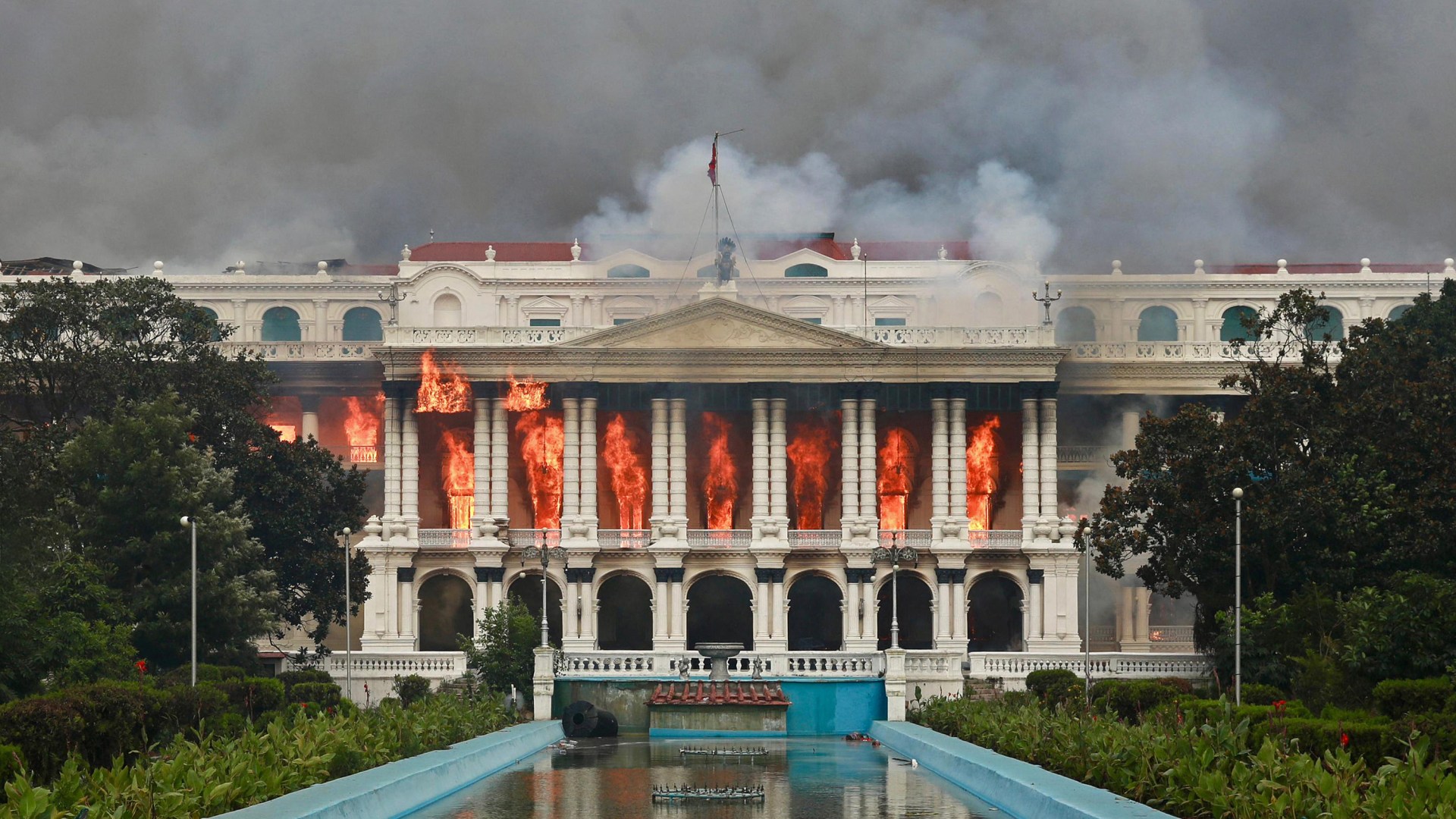
Nepali protesters set fire to the main administrative building of the Nepal government on September 9, 2025.

Nepali protesters set fire to the main administrative building of the Nepal government on September 9, 2025.

Christianity Today September 22, 2025
Prabin Ranabhat / Contributor / Getty

On September 7, the eve of Nepal’s historic Gen Z protest, Nepali Christian scholar Karuna Sharma was waiting to catch a flight from the capital of Kathmandu to Dubai when she ran into an influential person. Their conversation turned to the next morning’s planned demonstration against the banning of social media platforms, and the person confidently dismissed its potential impact.

“There would be 1,000-2,000 youth, and then it would die down,” she remembered him predicting.

Instead, protest quickly escalated into the most violent political upheaval in Nepal’s recent history, leaving 74 people dead. Flames engulfed the parliament building. Prime Minister K.P. Sharma Oli resigned. The president swore in former Chief Justice Sushila Karki as Nepal’s interim prime minister, a favorite among protest leaders.

“The government did not really take the Gen Z protest seriously,” Sharma said. “They thought if they scared the crowds away, the protest would fizzle out, and therefore, we witnessed shooting on the very first day. Nobody had imagined that the protest could turn the way it did.”

For Nepal’s Christians, one of the fastest-growing Christian populations in the world, the upheaval brought both fear to the vulnerable religion minority as well as cautious hope for the new government. Most churches avoided direct political involvement, but individual Christians found ways to contribute to the movement.

Phur Jangbu, pastor of Boudha Dunamis Church in Kathmandu, told Christian Daily International, “We usually pray generally for the nation, but now it’s time to pray specifically for good governance. If the country doesn’t survive, how can we?”

For months, young Nepalis organized on Discord (a platform popularized by gamers) and online forums, venting frustrations over corruption, unemployment, and inequality.  Vijay V.K., a 24-year-old Christian in Kathmandu, participated in one such group supporting the Gen Z initiative.

“The motive of the protest was not to harm anybody,” V.K. explained. “The youth were frustrated by the political leadership and wanted to demonstrate before the parliament house and other protest areas.”

The government’s September 4 decision to ban 26 social media platforms—including Facebook, Instagram, WhatsApp, YouTube, and X—only intensified tensions and “got fused with the peace protest,” V.K. said.

So on the morning of September 8, thousands of young demonstrators gathered in Kathmandu chanting against corruption and calling for justice. By noon, security forces fired live rounds into the crowds, killing at least 19 people that first day. By evening, protests had spread to dozens of other towns, including Pokhara, Nepalgunj, and Biratnagar.

Over the next 48 hours, Nepal’s political landscape unraveled with stunning speed. Protesters set fire to parliament, stormed the Supreme Court, and burned the prime minister’s residence. Crowds overran police stations and broken open prisons, releasing more than 13,000 inmates into the streets.

Though media reports attributed the arson to Gen Z protesters, V.K. maintains that his generation was committed to peaceful protest. “There were some self-interested people with political agendas who led it toward violence,” he said.

By September 12—just four days after the protests began—Oli had resigned and Karki was leading the country.

“This is not an elected government, and the next six months will be very challenging,” said Tanka Subedi, human rights activist and senior pastor of Family of God Church in Kathmandu. “But we are hopeful. The people asked for Karki because of her integrity. We pray that she can guide the nation to elections and preserve democracy.”

The United National Nepali Church Council (UNNCC) urged believers to avoid provocative social media activity. “Refrain from making unnecessary posts or negative comments on Facebook, TikTok, or other social media that may spread misunderstanding and fuel communal tension,” it said in a statement. Instead, they called Christians to be “engaged in prayer for peace, reconciliation, and the healing of the nation.”

Some Christians who supported the movement sought to be a light among the protesters. V.K. said he used a VPN to access the banned social media and called for peace. “I was posting messages to Gen Zers to stay calm and not use any violent means,” he said.

A Christian teenager said that most protesters were non-Christians and that Christian youth mainly helped by sharing information with news outlets and providing first aid to protesters. CT agreed not to use her name for security reasons.

Though the protesters did not target any churches during the violence, young men threatened one congregation in western Nepal, according to Christian Solidarity International. When the pastor sought the police for help, officers redirected him to contact the army, which was unreachable.

Subedi personally contacted several churches to check on Christian Gen Z members. “We thank God that we have not heard of any Christian being killed or injured during the violence,” he said.

These moments of crisis also opened doors for unexpected acts of Christian hospitality. Gary Hoag and Emma Pervaiz of the Christian financial accountability organization Global Trust Partners had just finished leading a training in Pokhara when the protests broke out. They found themselves stranded at the airport as airlines canceled flights and debris and fire blocked the streets.

A local Christian family, the Maharjans, came to pick them up on motorbikes, navigating through burning intersections and stone-piled roads. “People even hurled bottles toward us,” Maharjan wrote. “We reached home safely while the army took control of the city.”

The family hosted the visitors for two nights as authorities imposed a curfew.

The protests highlighted the deep frustrations of a generation long ignored by Nepal’s ruling elite. Youth unemployment stood at 20.8 percent in 2024. Tens of thousands leave the country annually to work in the Gulf states, often in dangerous conditions. As many as 15,000 Nepalis have enlisted as contract soldiers in Russia’s war in Ukraine.

Meanwhile, politicians’ children flaunted luxury lifestyles online. Protesters adopted the phrase “nepo kids” to capture the gap between elites and ordinary youth. One protest sign read: “Politicians’ children bring Gucci bags; our children return in coffins.”

Nepal’s Christians share this frustration while carrying distinct vulnerabilities. According to Operation World, 2.9 percent of the population identifies as Christian—about 866,000 people. However, the 2021 official census recorded only 512,313 Christians. Analysts suggest that underreporting and the prevalence of house churches may explain the disparity. For Christians, the contested data highlights both remarkable growth and ongoing fragility, as numbers are often politicized in religious freedom debates.

In 1961, fewer than 500 Christians existed throughout the entire country. Today, Christians worship in every district. House churches multiplied during the Nepal’s civil war from 1996-2006 as well as after the monarchy’s abolition in 2008, when new freedoms allowed unprecedented expansion. Still, Christians faced harassment, sporadic arrests, and accusations of foreign influence.

Legal challenges continue troubling the community. Nepal’s 2017 anti-conversion law criminalizes attempts to “hurt religious sentiment”—language broad enough to penalize evangelism. A local pastor described the systematic pressure on foreign missionaries following Oli’s 2018 visit to India: “Deportations started, including Muslims and Christians. They introduced systems to monitor foreigners’ activities. Many believe these were copied from laws in Uttar Pradesh, India.”

On September 4, authorities arrested, fined, and deported American missionary Daniel Stephen Kearney for proselytizing.

According to the pastor, whom CT agreed not to name due to security concerns, rumors circulating during the protests suggested that demonstrators would burn Pashupatinath Temple—one of Hinduism’s most sacred sites—and blame Christians. The attack never materialized, but it demonstrated how easily the minority community could become a scapegoat.

Alongside these pressures, Christians have made progress. More than 30 Christian organizations and thousands of congregations have registered as public religious trusts, according to Prakash Karki (no relation to Sushila Karki), a Christian lawyer who is leading the effort. “This is the greatest way God has opened for us,” he said. “It allows us to operate freely, pay taxes, and gain legal rights.”

For many Nepalis, Sushila Karki’s appointment carried a sense of possibility. Father Silas Bogati, apostolic administrator of the Vicariate of Nepal, said his community trusted her integrity, recalling her past defense of wrongly accused Catholic clergy.

Others remained more guarded. Rev. Dilli Ram Paudel, head of the Nepal Christian Society, welcomed Karki’s leadership but noted that the caretaker government and parliament’s dissolution did not follow constitutional provisions. “Many political parties are opposing this move,” he said, urging prayers for peace and lawful resolution.

Subedi added that Christians’ long-term safety depends on Nepal preserving democracy. “Gen Z leaders made it clear they do not want Nepal declared a Hindu nation,” he said. “They support democracy, republic, and religious freedom. But Hindu influence is everywhere in government sectors, so Christians remain vulnerable.”

Bogati urged Christians to respond not with political agitation but with service. He pointed to healthcare and education as areas where the church could make a difference, particularly in remote regions where government support is limited. For him, such contributions embody both compassion and gospel witness.

Paudel framed the crisis in spiritual terms. “We hold on to hope and trust God for heavenly intervention and a speedy recovery,” he wrote in a prayer letter sent to CT. “Pray for open doors of resources, wise partnerships, and divine guidance for rebuilding our nation.”

Christians, like the rest of the nation, now face an uncertain road ahead. Young believers like V.K. and the unnamed teenager show both anxiety and resilience. “Within five to ten years, we’ll hopefully be able to live a good life here,” the teenager said.

News

Charlie Kirk’s Five-Hour Memorial Combined Gospel and Politics 

Erika Kirk forgave her husband’s killer, Christian stars like Chris Tomlin led worship, and MAGA influencers and pastors talked about Jesus and conservatism.

Erika Kirk speaks during the memorial service for her husband, political activist Charlie Kirk at State Farm Stadium on September 21, 2025 in Glendale, Arizona.

Erika Kirk speaks during the memorial service for her husband, political activist Charlie Kirk at State Farm Stadium on September 21, 2025 in Glendale, Arizona.

Christianity Today September 22, 2025
Photo by Joe Raedle / Getty Images

Before a loud, full stadium in Glendale, Arizona, at the memorial service of Christian and conservative activist Charlie Kirk, Erika Kirk tearfully forgave the assassin who shot her husband on September 10.

“I forgive him because it was what Christ did and is what Charlie would do,” she said. “The answer to hate is not hate. The answer we know from the gospel is love and always love. Love for our enemies and love for those who persecute us.”

Erika Kirk said her husband had sought to “revive the American family” and “save the lost boys of the West, the young men who feel like they have no direction. … He wanted to save young men, just like the one who took his life.” She will become the CEO of Turning Point USA (TPUSA) in her husband’s stead.

President Donald Trump spoke after Erika Kirk, saying that Charlie Kirk “did not hate his opponents. He wanted the best for them.”

“That’s where I disagreed with Charlie. I hate my opponent and I don’t want the best for them,” he said. “Now Erika can talk to me and the whole group and maybe they can convince me that that’s not right, but I can’t stand my opponent.” 

Local police estimated the crowd at about 100,000, including in two overflow areas. That made it one of the largest memorial services in US history. Millions more watched on livestreams. Pyrotechnics went off repeatedly, including when Trump and Erika Kirk came out to speak. The event lasted almost five hours

The memorial for Kirk included both gospel proclamation and promotion of TPUSA, a grassroots network that engaged young conservatives and helped secure Trump’s 2024 victory. The logo for TPUSA flashed on the stage backdrop throughout the event.

The event invitation instructed everyone to wear their “Sunday best” red, white, and blue, and the memorial took place in Arizona at 11 a.m. Sunday morning when many churches were having services.

Music threaded through the service, with bagpipers playing “Amazing Grace,” Christian music stars Kari Jobe Carnes and Cody Carnes leading their hit worship song “The Blessing,” and Lee Greenwood singing “God Bless the USA.” Chris Tomlin led worship along with stars Phil Wickham and Brandon Lake, performing “Holy Forever” and “How Great Is Our God.”

Family remembrances included a recording of Kirk’s daughter singing “Jesus Loves Me.”

Here’s a quick look at four of the speeches, one from a pastor, one from a Turning Point leader, one from a well-known podcaster, and one from a key Trump advisor:  

– Charlie Kirk’s pastor Rob McCoy, a longtime Calvary Chapel pastor from California, offered a gospel message, saying “There are none righteous, not even one.” He told of Christ coming to die on the cross: “The Lord loves you, he wants to save you…. Charlie looked at politics as an on-ramp to Jesus. He knew if he could get all of you rowing in the streams of liberty you’d come to its source, and that’s the Lord.”

McCoy led an altar call, asking those who wanted to put their faith in Jesus to stand. He pointed to a QR code on the screen for new believers to share their information so organizers could help “get you into a Bible-believing church.” Then came the singing of the National Anthem and chants of “USA.”

– Tyler Bowyer, chief operating officer of Turning Point Action, gestured to the crowd as he said, “[Kirk] always said to me, ‘If we could figure out how to bring the Holy Spirit into a Trump rally’ — I think you’ve done it.” 

– MAGA podcaster Benny Johnson in his speech asked, “Who feels the Holy Spirit in the house tonight? Who can feel that revival happening right now?… Raise your hand if Charlie Kirk centered you a little closer to Christ. Did Charlie help you achieve your American dream a little bit more?” 

Johnson compared Kirk to the first Christian martyr, Stephen, saying Stephen’s martyrdom helped spread Christianity. Referring to Romans 13, he said, “May we pray that our rulers here, rightfully instituted and given power by our God, wield the sword for the terror of evil men in our nation, in Charlie’s memory.”

– White House deputy chief of staff Stephen Miller spoke of taking action against evildoers: “They cannot conceive of the army that they have arisen in all of us, because we stand for what is good, what is virtuous, what is noble.” He criticized those “trying to foment hatred against us” and said, “You have nothing, you are nothing.”

Members of Trump’s cabinet including Secretary of State Marco Rubio and Defense Secretary Pete Hegseth also spoke, as did White House chief of staff Susie Wiles. She credited Trump’s victory last year to Kirk’s mobilization of young people. Rubio described Kirk’s work as showing college students that the US was “the greatest country in the world and that Marxism was bad.” Rubio spoke of the gospel in his brief remarks and said Kirk showed that the country was “worth passing on to the next generation.” 

Trump, the concluding speaker, called the event “like an old-time revival” and promoted his policy aims while eulogizing Kirk: “One of the last things [Kirk] said to me was, ‘Please sir, save Chicago. And we’re going to do that. We’re going to save Chicago from horrible crime. … We had a country that was dead one year ago, and now we have the hottest country anywhere in the world, and Charlie helped us make it that.”

Ideas

The Dangerous Distortion of Fear

When we let fear be our ruler, it twists our perceptions, narrows our vision, and turns us away from the love of God and neighbor.

A fuzzy distorted image of glasses on a red background.
Christianity Today September 22, 2025
Illustration by Elizabeth Kaye / Source Images: Unsplash

Franklin Delano Roosevelt delivered perhaps his most famous line—“The only thing we have to fear is fear itself”—at his first inauguration in 1933. That speech stands as one of the most significant in American political history, but I confess that this best-known claim has always baffled me. 

In 1933, the United States was in the middle of the Great Depression. Unemployment was at 25 percent, and the economy had contracted by almost one-third. Poor land management and droughts had created the Dust Bowl in the Great Plains. Striking workers engaged in violent conflicts with employers, and Adolf Hitler became chancellor of Germany just one month before Roosevelt’s speech. There were many real things to fear in 1933.

Contemporary research into the psychology of fear, however, shows that Roosevelt was onto something. Fear itself can transform how we perceive the world, turning even benign surroundings into a landscape of threats. Neuroscientists have shown that when we perceive threats, our amygdala—the brain’s fear-processing center—leaps into action before the more rational parts of the brain can catch up, leading to a cascade of far-reaching changes to how we see and engage with the world. 

Fear increases our sensitivity to perceived threats, for example, making us more likely to interpret ambiguous facial expressions negatively. It can impair our memory and visual perception of the world.

Fear can generalize too, attaching to objects beyond its original source. In one infamous early 20th-century experiment, researchers conditioned a child to fear a white rat by clanging an iron bar whenever the child touched the animal. Eventually, the child became upset at the mere sight of the rat—and with no further conditioning, that fear spread to a random assortment of other furry objects: a rabbit, a dog, a furry coat, and even a Santa Claus mask. A fear of animals troubled the child for the rest of his life.

We often try to cope with fear by seeking out more information, but ironically this practice can intensify feelings of anxiety. In a study of media exposure in the wake of the 2013 Boston Marathon bombings, people who consumed high amounts of news about the attack experienced more acute stress than those actually at the bombings. Doomscrolling, apparently, is a real thing. 

Unsurprisingly, fear can radically reshape how we see others, making us more tribal and distrustful. Numerous studies have indicated that individuals who are induced into fear exhibit a pronounced empathy gap and a reduced willingness to help people whom they perceive to be different from themselves. 

In one striking experiment, white participants answered questions about their willingness to help homeless people. Those who first looked at anxiety-inducing images (e.g., pictures of wild animals, spiders, or people being attacked) became significantly less willing to help Black homeless people than white ones. In comparison, white participants in a control group who were exposed to neutral images were about equally willing to help homeless people regardless of race. 

Interestingly, this outgroup bias is particularly activated by fear of illness. In another study, Canadian students induced to think about sickness and germs were much less likely to support the immigration of Nigerian immigrants than they were Scottish immigrants. Similar biases have been documented against people who are disabled, obese, or elderly.

And so just as Roosevelt understood, fear itself can be a dangerous and distorting force. Fear twists our perceptions, narrows our vision, and turns us inward in self-protection. It induces a kind of calculated madness—a frantic need to seize control, to take matters into our own hands. In our desperation, we gird our loins and harden our hearts to neutralize the threats. From the vantage of fear, doing what it takes to claw our way to safety is not just permissible but responsible.

It is telling that the very first effect of Adam and Eve’s disobedience in Eden was fear: “[Adam] answered, ‘I heard you in the garden, and I was afraid because I was naked; so I hid’” (Gen. 3:10).

So the first fruit of the Fall was fear, a result of the broken relationship between God and humanity. The Reformer Martin Luther described sin as the soul turned in on itself homo incurvatus in se. Fear deepens that curvature, leading us to hide from God, distrust our neighbors, and retreat into our tribes. Fear is not merely a powerful emotion but also a description of the human condition, a sign of our brokenness. To be human is to be vulnerable and afraid.

If fear is a central problem of human existence, it should come as no surprise that the Bible talks about it so much. It is often said that the most frequent command in the Bible is “Do not be afraid.” It is surely a mistake, however, to treat this as just another of the commands in the Bible that we find impossible to reliably fulfill on this side of eternity. Rather, it is equally a word of comfort. The Bible never says there is nothing to fear. What it offers instead is something far stranger: the reassurance that we will never pass through our fear alone.

Near the end of the first century, a Christian community in crisis received a letter that would eventually be called 1 John. Like many congregations in our day, this church was unraveling. Believers had split over theological disagreements—perhaps about who Jesus truly was or what it meant to live a righteous life. Some members had left altogether, and those who remained were likely disoriented, uncertain, and afraid.

The letter is dire and apocalyptic in tone. Twice, John says it is the “last hour” (2:18), and he frequently talks about the Antichrist or the Devil (2:14, 18, 22; 3:8, 10; 4:3; 5:18–19). It reads like John’s last desperate instructions to a church in a world that is spinning apart. 

It’s striking, then, that he doesn’t spend much time on arguments or abstract theology. Instead he writes about love. Again and again, he insists that love is the defining mark of the Christian life—not certainty, not self-protection, not doctrinal purity, but love. And in this context of real uncertainty and anxiety, he offers this: “There is no fear in love, but perfect love casts out fear” (4:18, ESV).

We often hear that verse as a kind of spiritual benchmark, as if once we’ve matured enough in our faith, fear will evaporate. But John does not describe a state we must achieve. Rather, he describes what the love of God does: It casts out fear not by removing threats but by reorienting our hearts away from any illusion of self-sufficiency and toward the trust that we are held by someone greater than anything we may face.

This love does not deny the danger, nor does it guarantee that we will escape suffering. Instead, it assures us that we are not abandoned. Fear isolates and contracts the soul in grasping desperation; love draws near and invites it to open. In drawing near, the love of God displaces fear—not because the world is safe but because we are not left alone in the midst of it.

Julian of Norwich, the medieval English mystic, described this mystery with rare clarity: “If there be any such lover of God on earth who is continually kept from falling, I do not know of it. … But this was revealed: that in falling and in rising we are always inestimably protected in one love.” The promise of the gospel is not that we will never fall, or never fear, or never fail. It is that, even when we do, we remain in God’s love. That love does not wait on the other side of our fear. God meets us within it.

There are, to be sure, many real things to fear in the world (and many more imagined ones). That was true in 1933, and it is true now. Worse than these dangers, though, is what fear can do to us.

Fear distorts. It narrows our vision, hardens our hearts, and tempts us to grasp for control, to protect ourselves at the expense of others. When we give in to fear—when we let it name the world for us, dictate our loyalties, and justify our actions—it doesn’t just corrode our politics or poison our relationships. It deforms our souls. And so perhaps Roosevelt was more correct than he knew: The real thing to fear, in the end, is not some specific danger or threat but the way we let fear pull us away from the love of God and neighbor.

“When you pass through the waters, I will be with you,” God says through the prophet Isaiah (43:2). The waters may yet rise, but we won’t be left to the flood. Our task as Christians is not to deny our fear but to refuse to let it rule us—to be the kind of people who choose self-sacrificial love over self-protection, trust over control, and the presence of God over illusions of security.

Edward Song is the Herbert Hoover Endowed Chair of Faith and Public Life at George Fox University in Newberg, Oregon.

Books
Review

Evidence of Objective Morality Is Hidden in Plain Sight

A new book finds this evidence in rational arguments. And in something those arguments can’t capture.

The book cover on a green background.
Christianity Today September 22, 2025
Illustration by Christianity Today / Source Images: Getty, Oxford University Press

David Foster Wallace’s famous commencement address “This Is Water” begins with a story about fish:

There are these two young fish swimming along, and they happen to meet an older fish swimming the other way, who nods at them and says, “Morning, boys, how’s the water?” And the two young fish swim on for a bit, and then eventually one of them looks over at the other and goes, “What the hell is water?”

Sometimes the things right in front of us are the hardest to see. Like gravity or the cultural belief systems we inhabit, there are, as Wallace put it, “obvious, ubiquitous, important realities” all around us—“hidden in plain sight.” The more fundamental they are to our daily experience, the easier they are to overlook.

Philosophers David Baggett and Jerry L. Walls want us to notice one of those overlooked realities: morality. Notice the horror we feel toward sexual violence. Or our admiration for self-sacrifice. Or our indignation when the powerful trample the weak. Or our relief when justice is done.

In their book The Good, the Right, and the Real: Is Value a Fact?, Baggett and Walls want us to ask, What exactly is this moral water we swim in?

Over 40 years ago, philosopher Robert Adams compared moral arguments for God’s existence to an abandoned farm. What was once a popular family of arguments producing a ripe harvest fell on hard times. But since then, renovation has been underway, and a string of philosophers have brought the farm back to life.

Baggett and Walls are two leading figures in this contemporary rebuilding project, and their series of four books analyzing moral arguments for God has been a service to Christian apologists and curious skeptics alike.

Their project began with Good God (2011), a defense of God as the foundation of morality. Next came God and Cosmos (2016), a critique of secular attempts to ground morality in alternative sources of authority. Then, the authors followed up with The Moral Argument (2019), a history of moral arguments across Western thought.

The Good, the Right, and the Real represents the final installment in this series. Though chronologically it comes last, logically it goes first. The earlier books assume objective morality—that some things are right or wrong, good or evil, regardless of human opinion. This one defends the existence of objective morality.

Moral realism is the philosophical term for the view that objective morality exists. The authors’ definition has four distinct features. First, moral judgments are “truth-apt” (meaning that statements like “Murder is wrong” are capable of being true or false). Second, some moral judgments are true (murder is wrong). Third, the truth of these judgments does not depend on human attitudes (murder is wrong even if people think it’s not). And fourth, at least some clear moral truths are known.

Without this foundation, moral arguments for God’s existence can’t get off the ground. But how do we know whether moral realism is true? We can’t run lab tests on justice. Nor can we dissect the human brain and find “goodness” inside. We need a different set of tools.

Secular philosophers Terence Cuneo, Russ Shafer-Landau, and John Bengson have approached the question by identifying moral “data” in need of explanation and suggesting we let the best theory win. For example, one’s moral theory should be able to explain why there is both widespread agreement about some moral issues and widespread disagreement about others. It should be able to explain why moral judgments are thought to motivate or direct our actions. And it should be able to explain why moral demands apply regardless of what we think or feel.

Baggett and Walls agree with these criteria. They argue that moral realism, unlike its competitors, makes the best sense of what we actually experience. But as they remind us, “Moral theory is hard … and no single volume will clear everything up.” Though progress is possible, don’t expect knockout blows.

This intellectual humility is consonant with their previous books. They don’t overpromise. They don’t feign certainty. Their conclusions are modest, and their tone is winsome. They respect other thinkers and take their arguments seriously. It’s clear their goal is not to win but to woo.

Baggett and Walls spend much of The Good, the Right, and the Real considering and critiquing the main alternatives to moral realism: error theory, expressivism, constructivism, and sensibility theory.

Error theory is the view that our moral language tries to describe real facts, but there just aren’t any. So, for example, when we say, “Murder is wrong,” we’re wrong, not because murder is right but because murder is … nothing. It’s neutral. Though we speak as if good and evil exist, we are mistaken; morality is a noble lie.

The philosophical price for holding this view is steep. “It assumes,” Baggett and Walls point out,

that our moral experience—the visceral aversion we have thinking about the Holocaust, our phenomenological antipathy to cruelty, our abhorrence of mindless barbarism or rapacious greed, the deep satisfactions of morality we are capable of feeling, our ravenous hunger to see justice done—is systematically misleading.

In other words, it denies that the water exists at all.

Expressivism, like error theory, contends that there are no true moral claims. But instead of saying all moral claims are false, it says there aren’t any genuine moral claims to begin with. That’s because, on this view, moral claims aren’t describing reality; they’re merely expressing emotions or prescriptions. For example, “Murder is wrong” is akin to saying, “Boo, murder,” or telling people, “Don’t murder.”

While this theory captures something true—emotions and prescriptions do play a role in our moral experience—it leaves too much unexplained. If morality is reduced to “I don’t like that,” or “Don’t do that,” then why should people comply? The authority—the “oomph,” as philosopher Richard Joyce puts it—is absent. Worse, expressivism seems unable to explain our moral outrage at atrocities. If the Holocaust is only emotionally disturbing but not morally wrong in any objective sense, something vital has been lost.

Constructivism is a middle course between moral realism and expressivism. It holds that morality exists but isn’t discovered. Instead, it’s created—by individuals, societies, idealized rational agents, or hypothetical social contracts. The basic idea is that something is moral simply by virtue of people or groups endorsing it.

Every version of constructivism is flawed, even if, as Baggett and Walls argue, some are more flawed than others. If individual moral views determine what’s right, then disagreement entails incoherence. One person might think the Holocaust was right while another might think it was wrong—but they can’t both be correct. The belief that societies determine what’s right hardly fares any better. Morality can’t vary with the shifting winds of cultural consensus, or else we could conclude that slavery was right when most supported it but wrong when most opposed it.

Constructivist theories that replace real people with “ideal observers” or social contracts try to improve upon these weaknesses. They ask, for example, what fully informed people would approve, morally, if you stripped away all their biases. Ultimately, however, they fail to secure binding moral authority. Why obey the dictates of nonexistent entities?

Sensibility theory—at least the version that’s in conflict with moral realism—suggests that our feelings themselves constitute morality. Our emotional response to witnessing a child bullying another to tears—the anger toward the bully and the sympathy for the victim—makes it true that the bullying is morally wrong.

Unfortunately, if morality is reduced to feelings, then morality is arbitrary. Should our emotional reaction to (say) rape change, then rape could be judged morally right.

Other sensibility theorists take a different approach, suggesting that feelings point to reality rather than constitute it. On this view, Baggett and Walls explain, “Emotions may be and plausibly are simply signaling capacities for apprehending moral truths.” Our feelings of revulsion toward injustice help alert us to the wrongness of it; they aren’t what make unjust actions wrong. This view complements moral realism, in that both theories credit our emotions with helping us recognize moral truths.

This brings us to one of the book’s surprising twists.

In the final chapter, Baggett and Walls conclude their rigorous philosophical treatment with a turn from philosophy. After exposing the weaknesses of the alternatives to moral realism and offering a smattering of arguments in support, they take off their philosopher hats and emphasize the experiential nature of morality, both in literature and in the real world.

“Moral goodness, like beauty, carries with it something ineliminably experiential,” they write, “and recognition of this fact makes it all the more appropriate that any argument for robust moral realism should include elements that go beyond the purely logical and abstract.”

In Flannery O’Connor’s short story “Good Country People,” for example, a young woman is content in her moral skepticism until a conniving Bible salesman betrays her in a moment of vulnerability. Though she doesn’t believe in right and wrong, she accuses him: “You’re a Christian! … You’re a fine Christian! You’re just like them all—say one thing and do another. You’re a perfect Christian, you’re …” The man replies, “I hope you don’t think that I believe in that crap! I may sell Bibles but I know which end is up and I wasn’t born yesterday and I know where I’m going!”

The woman’s abstract theory about the nature of morality was safe until it collided with reality.

Something more powerful than philosophical argumentation is on display here. You can’t argue someone into seeing the Grand Canyon’s beauty. But you can point and say, “Look.”

Perhaps morality is like that. Encounters with both betrayal and loyalty, selfishness and self-sacrifice, greed and generosity—these are the experiences that shape our moral views. Philosophy simply refines them.

This means that weighing the validity of moral realism is never merely an academic exercise. It’s one of the most urgent and consequential tasks we can undertake.

If moral realism is false, then our deepest moral convictions—about justice and kindness, oppression and cruelty—are just preferences. How we treat others is negotiable. The Holocaust isn’t evil, and the abolition of slavery isn’t progress. All this leaves victims of abuse, persecution, and exploitation not only with the pain of their suffering but also with the silence of a universe incapable of calling it wrong.

But if moral realism is true—if there really is a moral structure to the universe independent of human opinion—then the picture changes completely. Our longing for justice is not naive. Charity and love are truly good, and cruelty and deceit are truly bad. Each human being has inestimable worth.

In this way, The Good, the Right, and the Real is not only a philosophical argument but also a gentle plea for moral attention. A plea, in other words, to listen to the inner voice telling us that some things are genuinely noble and some genuinely evil—to consider that this voice might not be a delusion or an evolutionary leftover but an insight into the nature of reality. This book is an invitation to notice the water.

Noah M. Peterson is a philosophy of religion graduate student at the University of Birmingham and the editor of a think tank based in Washington, DC.

News

Pro-Life Pregnancy Center to Get Day in Court

New Jersey nonprofit accused of deception wants to appeal at the federal level.

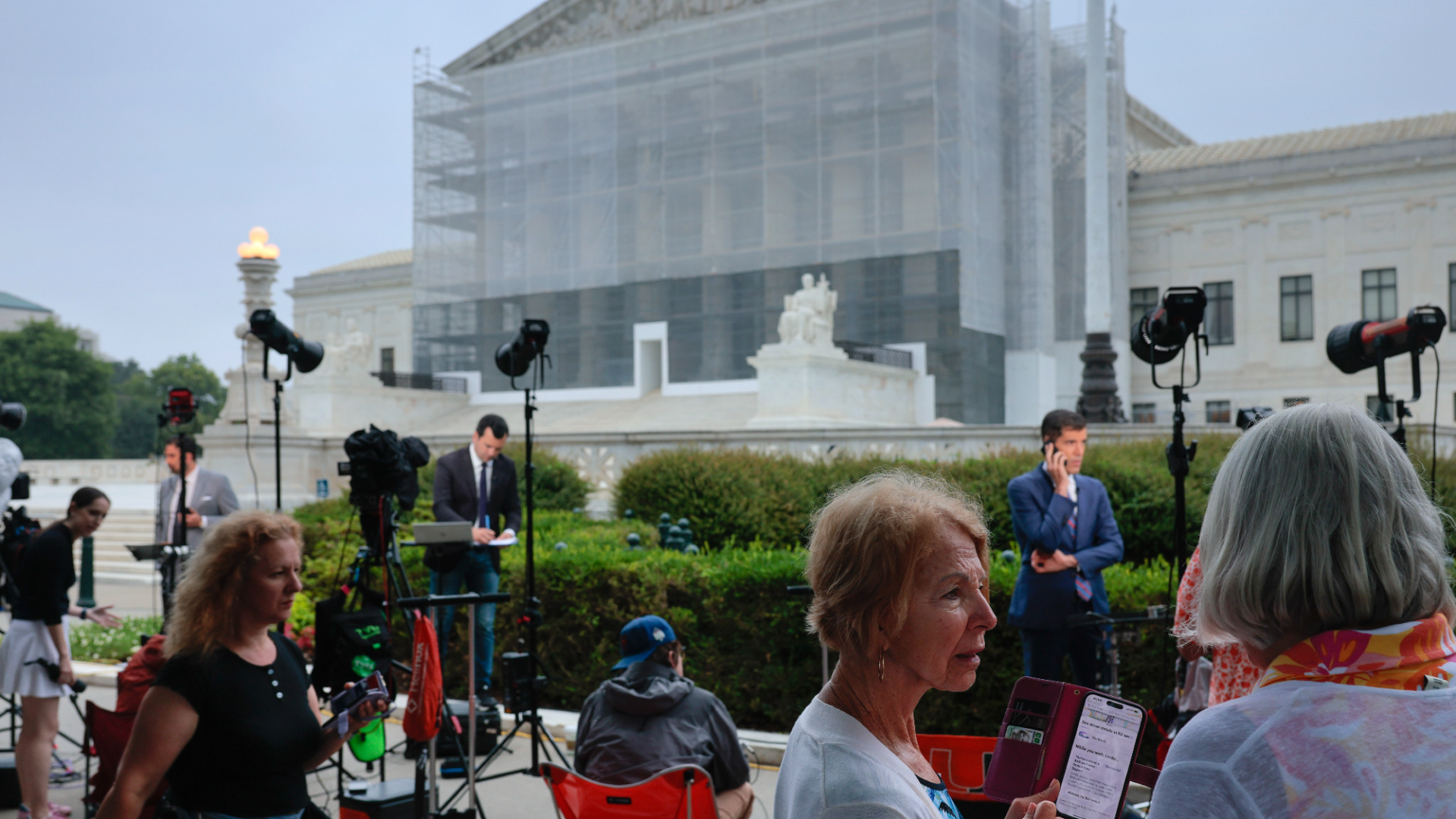
Supreme Court pregnancy center case NJ
Christianity Today September 22, 2025
Chip Somodevilla/Getty Images

First Choice Women’s Resource Centers will have the ear of the United States Supreme Court this fall as the Christian nonprofit pushes back against what it believes is a clear attack on First Amendment freedoms.

The Supreme Court added First Choice Women’s Resource Centers, Inc. v. Platkin to the schedule for the upcoming term, which starts in October. A specific date hasn’t been chosen yet.

New Jersey Attorney General Matthew Platkin has accused the organization of deceptive advertising that misleads women. In December 2022, he issued a consumer alert, warning residents that crisis pregnancy centers do not offer “comprehensive reproductive health care,” specifically abortions.

The following year, Platkin launched an investigation into First Choice, a pro-life organization with five locations in New Jersey that provides counseling and support to encourage pregnant women to have their babies. The organization does not say that it’s pro-life on the front page of its website, but does identify itself as an “abortion clinic alternative.”

“We believe each person has a right to get accurate information from a resource that will not profit from the choices and pregnancy decisions they make,” the site says. “First Choice Women’s Resource Centers is an abortion clinic alternative that does not perform or refer for termination services.”

According to Platkin, this qualifies as “deceptive and fraudulent commercial practices” and “deceptive and misleading statements or omissions by charitable organizations,” violating New Jersey law.

First Choice Executive Director Aimee Huber told CT that the demands of the subpoena are overwhelming to contemplate.

“We’re a small nonprofit, so the time that it would take for me to compile up to ten years of documentation would be completely burdensome and overwhelming,” Huber said. “Most importantly, it would take us away from our mission of serving women.”

Pro-life lawyers say it’s also an illegal violation of the rights protected by the US Constitution. Attorneys general from 19 states and the Trump administration agree. More than a dozen organizations, including Christian Legal Society, the Becket Fund for Religious Liberty, the Institute for Free Speech, Americans United for Life, Save the Storks, and Heartbeat International, have submitted friend-of-the-court briefs defending First Choice.

“The Attorney General of New Jersey was asking for private communications between workers, volunteers, clients, donors,” Adam Mathews, who represents Heartbeat International, told CT. “All that type of information … has constitutionally been protected at the highest court.”

Being forced to release donor information can have “an incredibly chilling effect on any type of communication,” according to Mathews. 

There are recent examples of activists using that information to try to get people fired—sometimes successfully. Mathews gave the example of JavaScript inventor and Mozilla cofounder Brendan Eich, who gave money to support a ban on same-sex marriage in California and was forced to resign.

Lincoln Wilson, senior counsel at Alliance Defending Freedom, the firm representing First Choice, feels optimistic that the Supreme Court will see the merit of their case. Precedent is on the crisis pregnancy center’s side, he said, pointing to NAACP v. Alabama ex rel. Patterson

In that 1958 case, the state of Alabama was trying to subpoena the NAACP’s membership list. The Supreme Court ruled that the request constituted harassment and infringed on the freedom of association rights guaranteed in the First Amendment. It was a unanimous decision. 

Before the court can consider the subpoena, however, it will have to decide if the case should be a federal case at all. A lower court ruled that the case couldn’t be appealed at the federal level until after it was fought out in state courts. That decision was upheld by the Third Circuit.

Lawyers for First Choice argue that this denies the nonprofit the opportunity to defend itself until after the potential harm has occurred. Experts say the Supreme Court will focus first on the question of when federal judges can intervene. 

Defenders of the crisis pregnancy clinic say this is what the federal courts are for. 

“Federal courts have been explicitly designated by Congress to hear federal civil rights claims,” the American Legislative Exchange Council argued in one legal brief submitted to the Supreme Court. “By denying a federal forum, the lower courts undermine the division of state and federal authority that is central to the American system of government.”

Pro-life advocates say their major concern, however, is less the legal question about the appropriate court for the lawsuit and more the fear of local governments going after Christian nonprofits. They hope the Supreme Court will decide for First Choice, clearing the way for the crisis pregnancy center to appeal the real question.

“There are so many components … that are strikingly chilling for the public and for pregnancy centers across the country,” said Americans United for Life spokeswoman Sarah Zagorski.

She believes First Choice was attacked because it was a Christian organization.

“That’s something that’s very shocking for the public and something the public should know,” she said. “It threatens long-established protections … for religious entities.” 

Huber hopes the courts will protect First Choice from harassment. But she wants a Supreme Court victory to help protect other religious nonprofits and bolster First Amendment protections.

“I believe it could be precedent-setting,” Huber said, “and protect all different sorts of nonprofits from government overreach and from bullying and harassment when the government does not share their viewpoint.” 

For now, she is just thankful that the Supreme Court is willing to listen.

“While it does weigh heavy, I am hopeful and strengthened by what God could achieve through it.” 

Pastors

Sent to Your Street

Mission isn’t just across the ocean. It’s across the street. God places his people in neighborhoods and cities so the nations might know him.

CT Pastors September 19, 2025
SolStock / Getty

Everyone is on the move. There is a restlessness—a vast migration—taking place worldwide. In our neighborhoods, communities, and cities, the nations have arrived at our doorstep. We each have the opportunity to embrace intercultural relationships and to understand, respect, and benefit from the richness of cultures interacting. This is more than a global issue. It’s a local invitation. Pastors have a calling to engage the mission fields right outside their doors. 

Pastor Tim Keller once said that a kingdom vision will make you “open to being sent out into your neighborhood to reach and serve in new ways..” This is a new kind of being sent. Rather than uprooting our families and leaving jobs and support networks, being sent today may simply mean being available—willingly stepping into culturally diverse relationships. 

People everywhere are looking for their place in the world. The importance of place is evident from the beginning of time. It’s woven into history: Mankind began in a garden (Gen. 2:8, 15), and for followers of Christ, our journey culminates in a holy city, New Jerusalem (Rev. 21:2). Jesus’ ministry was rooted in specific geographic locations—Bethlehem, Nazareth, and ultimately Jerusalem.   

In a similar way, God has placed each of us and our churches in specific places. He calls us to be more than merely residents. As a part of God’s redemptive plan, we have a responsibility to love our neighbors and engage our communities where we live, where we work, and wherever we go in our daily routines. 

So how should churches and ministries respond to this opportunity? 

To begin, we as pastors and leaders must rekindle the flame for mission. 

I am one of the pastors at Perimeter Church, which has been ministering in the Greater Atlanta area for 48 years. Since our founding, Perimeter has sought to be a missional church, reaching our community, our city, and beyond. When we moved into our current facility in 1996, our surrounding community was approximately 90 percent white. Over the past 30 years, that same area has shifted to a 50-50 split between white residents and people of color. This change has brought new opportunities for intercultural friendships, and in turn, it has started to shift the relational culture of the church.

In response to this changing demographic, church leadership became proactive. We evaluated our staffing, programming, and engagement with our community. We increased diversity in leadership positions and developed partnerships with local nonprofits. Our people are building relationships and sharing the gospel in word and deed where they live, work, and go. Although we still have room to grow, we are increasingly reflecting our community and are seeing signs of progress.

Has your community experienced any demographic shifts? A simple way to assess this is to walk through your neighborhood, visiting local restaurants and stores, and intentionally spend time in public spaces. You may be surprised by how diverse your neighborhood is becoming. 

How should pastors and ministry leaders build intercultural relationships?

Our people take their cues from us. The Father sent the Son, and the Son has sent his followers into relationships and mission (John 17:18; Matt. 10:5–8). That is just as true for us as for our congregants. As they are sent, so too are we. And as we build relational connections with pastors, community leaders, and neighbors in our communities, we model the richness of these relationships. 

I have benefited from friendships with pastors who labor in different cultural contexts. Over the years, these pastors have become a “band of brothers” for me. We’ve supported each other through many challenges, and through these friendships, we have seen our lives and ministries flourish. I have experienced a couple challenging seasons of deep depression and anxiety, and the Lord has used these brothers as part of restoring me.

I recognize that many are reluctant to step outside their comfort zones and build relationships with people from other cultures. But you don’t have to travel overseas with a passport to be faithful. Sometimes the most courageous step is reaching across the street. It can start with having a conversation with a neighbor or inviting someone different into your home.

Let me share a little of my family’s story. We live in Duluth, Georgia, a town 15 minutes from our church. We’ve been in the same home for 23 years. Early on, when we first settled in, God began stirring in us a desire to reach out to our neighbors and engage with our community. Through those small steps toward missional faithfulness, we began experiencing intercultural friendships. 

The second part of the Great Commandment is to “love your neighbor as yourself” (Mark 12:31). Building new relationships with neighbors was our response. We wanted to love people and share the gospel with them in both word and deed (Luke 10:9). Over the years, we have seen God bear fruit out of this desire, and the friendships we’ve gained have enriched our lives. A turning point came when we began serving in the public schools our children attended. We formed friendships with parents from many cultures and began doing life with them. As we stepped into leadership at those schools, our relationships expanded even more.

I’ve also had the privilege of joining a diverse pastors’ group in the city. We’ve built strong bonds, pray for one another, and spur each another on to love and good deeds in our shared community (Heb. 10:24). 

I share these as simple examples of how easily we can begin to engage our communities as the local mission fields they are. I am not suggesting you do exactly what we have done; however, I do encourage you to pray about your community and ask God for meaningful ways to engage with your neighborhood. At Perimeter we have a phrase: “Think big, start small, and go deep.” It’s good to have big dreams, but lasting change always starts with personal relationships. 

Here are three foundational principles and some simple first steps I’ve found helpful for building intercultural relationships. 

Be intentional 

Our natural instinct is to build relationships with people who are like us. But cultivating friendships across cultures requires intentionality. It means understanding that shifting demographics are not a threat but an opportunity to be faithful to God’s call to mission. Although there’s a low barrier to entry, we still need courage to take the first step. 

Begin by praying for an intercultural friendship and a cross-cultural friendship where you live. I am confident God will answer that prayer. 

Be a listener and a learner  

As we engage in these new relationships, it will become apparent we have much to learn. And that’s okay. It’s part of the process.

James 1:19 encourages us to “be quick to listen, slow to speak.” Ask questions. Listen well. As you do, watch your friendship deepen through understanding.

Be perseverant  

Don’t give up. Stay with it. Adopt the mindset of a missionary—don’t walk away after one awkward conversation or failed attempt. Keep trying new and different ways to build genuine relationships where the gospel can take root.

A few simple first steps 

This kind of intentional mission doesn’t have to be complicated. It begins with small, everyday acts of faithfulness. Here are some first steps you can take:

  • Research your church’s surrounding demographics. This will help you better understand the context God has placed you in.
  • Invite another leader from a different background to have lunch and begin building a friendship. 
  • Encourage church members to host neighbors in their homes—whether through a holiday gathering, a simple conversation over coffee, or regular walks through the neighborhood to engage those who live on their streets.

Mission begins with getting to know the people the Lord places around us. All it takes is a mustard seed of faithfulness and a willingness to be intentional in ordinary places. 

Finally, remember where we are all headed. We’re on our way to the new heavens and new earth. There, believers from every nation, tribe, people, and language will gather together in eternal relationship (Rev. 7:9). Our distinctives will remain, but something beautiful will happen: All will be redeemed. Every cultural barrier that divides us will be entirely gone. God’s unique design for each of us will be on display for all to enjoy.

Until that day, we bear witness to our future hope by living it out now. May his kingdom come and his will be done, on earth as it is in heaven.

Ideas

The National Guard Won’t Fix Our Crime Problem

Lasting solutions come when we draw near to victims and seek God’s help in prayer.

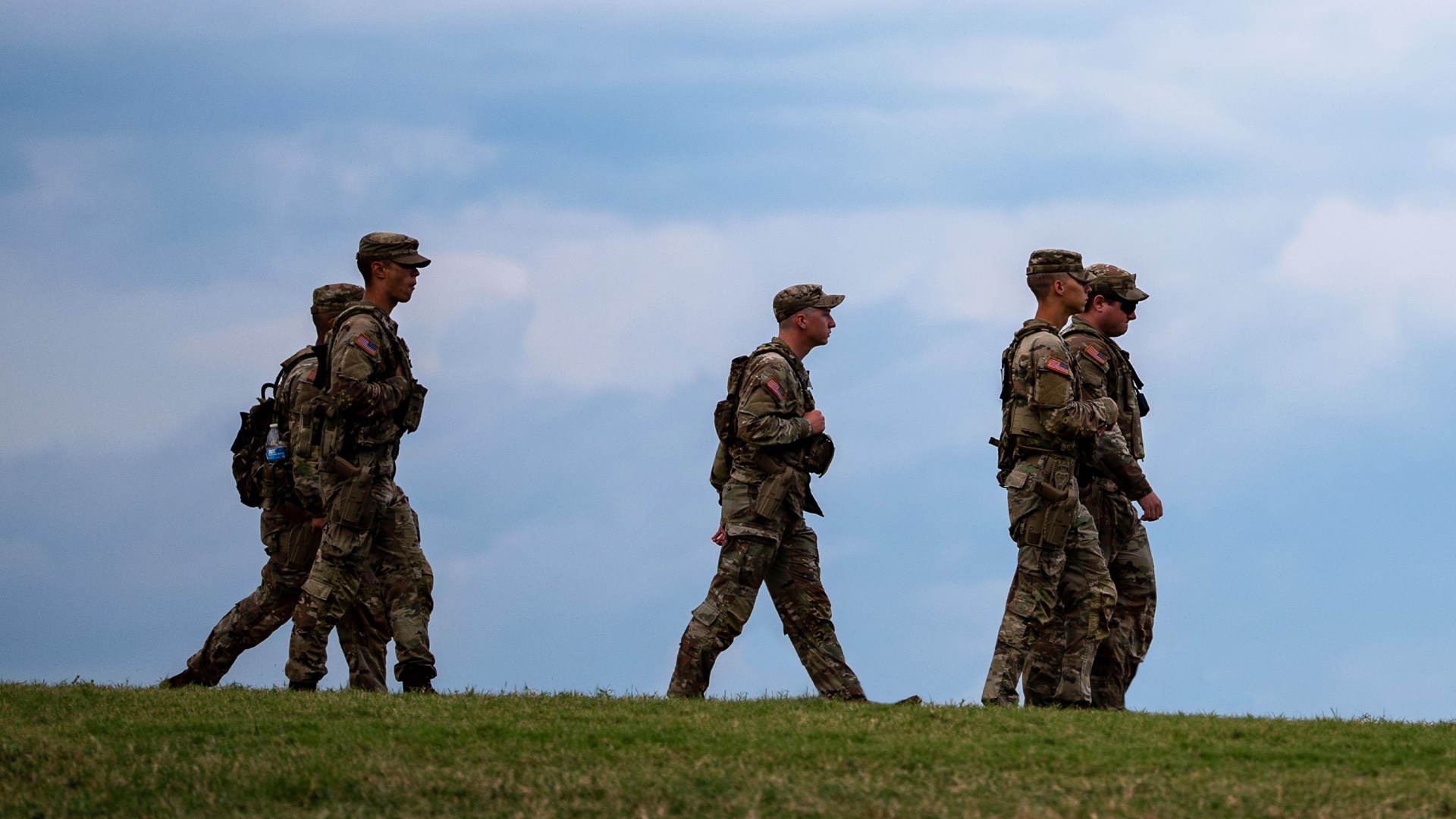
Members of the National Guard patrol the National Mall on September 04, 2025.

Members of the National Guard patrol the National Mall on September 04, 2025.

Christianity Today September 19, 2025
Kent Nishimura / Stringer / Getty

When I was out-of-state visiting a friend last year, I received a startling text from my wife informing me a drive-by shooting had occurred on our street in Chicago. I immediately called her, and with a trembling voice, she described how she hit the floor of our apartment when gunshots rattled outside. She said it even felt like something had hit our wall. Police eventually arrived, and sure enough, they discovered a bullet had struck our building, entering the apartment of a neighbor across the courtyard.

In the aftermath of the shooting, my wife and I felt constantly unsettled. Any loud bang would cause us to freeze. As much as I was disturbed by what had happened, I was also haunted by what didn’t. Every few hours I searched online to see if I could find coverage of the incident, but nothing showed up. I reached out to a reporter, who explained that the news outlet doesn’t typically cover shootings unless someone’s physically harmed. I even downloaded a police database and isolated our block but found no record of the shooting.

Unfortunately, what we experienced was only the beginning of a cascade of violence. Last year, on a city block where I boarded a public train for my commute to law school, there were five shootings, three of them fatal. Earlier this year, five gunshots awoke my wife and me shortly after midnight. We soon learned that a man had been shot and killed outside the apartment building next to ours. He was 28 years old—the same age as me.

This time, I felt less worried for my own safety. I had learned that these types of shootings were rarely indiscriminate. They almost always targeted specific individuals, usually related to long-standing gang feuds. Although the murder outside my door reminded me that the risk of a stray bullet was non-zero, I knew no one was out to target me. I would stay alert, but I felt I would be fine.

This recognition, however, almost made things worse. I had come to see that the victims of violence are typically the most invisible of my neighbors. They exist in the periphery and are almost always Black or brown young men. Their suffering often felt unseen. If you didn’t hear the gunshots yourself or personally know the victim, you wouldn’t know someone’s life had been taken. There were no public memorials. No family members on the news lamenting the loss of the victim. Neighbors simply slipped away, never to be seen again, and the rest of us went on with our lives, unperturbed.

I thought, This is not as it was meant to be. Surely Jesus, who wept for the death of his friend Lazarus, is weeping at the murders of people made in his image. But am I? Is my church?

In the past few years, much has been made about violence in cities like mine. President Donald Trump has described Chicago as a “hellhole,” threatening to send in the National Guard despite the objection of our elected officials. After local officials pushed back, Trump signed an order this week to deploy the National Guard—already active in Washington, DC—to Memphis over the objection of the city’s mayor. He also continued to threaten a deployment to Chicago, saying the city was probably next and others, such as New Orleans and St. Louis, might follow.

I understand why many people might be open to such measures. Violence destroys communities, and it’s appropriate to yearn for safety and peace. But in our political moment, I believe we should emphatically reject sending in the National Guard or any other militarized law enforcement as the solution to everyday civilian violence. I am hopeful that we can produce lasting change in our cities without embracing a rather extreme policy with lasting ramifications on how we interact with law enforcement and live in our communities.

I’m hopeful because I’ve seen dramatic reductions of horrifying violence with my own eyes. I had the privilege of working with International Justice Mission (IJM) in the Dominican Republic, where IJM’s program focused on stopping one specific form of violence: the commercial sexual exploitation of children. Over eight years of work, the organization witnessed a 78 percent reduction in the prevalence of commercial sexual exploitation of children, a finding external evaluators confirmed.

That experience taught me that violence begins to decline when we take seriously Scripture’s commands to care for the vulnerable. In the Dominican Republic and throughout much of the world, survivors of sex trafficking are stigmatized, overlooked, and viewed as deserving the trauma they endure. But things started to shift in the Caribbean nation when IJM communicated that victims bear the image of God and that society ought to care for them as such. IJM, of course, didn’t do this alone; it worked alongside hundreds of local churches that joined regularly for prayer and exerted significant efforts to support our program.  

Similarly, I’m convinced that in the US the problem of violence will not end until we proclaim the worth and dignity of every life. I know right now some might be thinking, But the typical victim may also have been a perpetrator. Isn’t that person among the “wicked” whom the Lord opposes (Ps. 146:9)? or How can we say that person is vulnerable?

Often, when we make objections like this, we fail to realize that we do not scrutinize victims of other violence in the same way. For example, American Christians have had significant empathy for victims of sex trafficking, like those I worked with in the Dominican Republic. At times, this empathy stems from a simplistic—and largely false—narrative of an innocent girl who is abducted and violated. But this is rarely the story in real life.

The average sex-trafficking victim is highly vulnerable, has experienced multiple severe traumas, may be criminally active, and often has substance-abuse struggles. In short, these victims are imperfect and sometimes perpetrators of violence themselves, not unlike many victims of urban violence. But imperfect as they might be, they need advocates who reflect a God “rich in mercy” (Eph. 2:4) and who proclaim their status as image bearers.

In the Dominican Republic, my former colleagues often heard people start their sentences with words like esas niñas, or “those girls.” Then many would go on to list disparaging adjectives— addicted to drugs, nasty, violent, difficult. These characterizations are not far from the narrative of American violence we see on the news or social media.

Militarized responses motivated by a “hellhole” characterization will only lead to a country where victims are treated more like monsters and less like people with worth and dignity. It is human nature, as God warns against, to turn away from our own flesh and blood (Isa. 58:7). The racial history of the United States—from white flight to the suburbs to restrictive racial housing covenants—has forced us away from one another. However, the tendency to put others at arm’s length is not exclusive to Americans. I also saw it in the Dominican Republic, where most individuals, Christians included, condemned and avoided victims of sex trafficking.

Violence there started to topple only as humble, committed advocates drew near to the victims. Investigations took time—officials patiently and meticulously started to build strong legal cases before making arrests. They sought to understand each situation before acting. Many of these local officials were eager to improve. They were open to our program evaluating the quality of their work and giving them feedback, an attitude which showed an admirable level of humility. Over eight years of work, displays of force were rarely, if ever, required to produce a dramatic reduction in child sex trafficking.

As child sex trafficking initially was in the Dominican Republic, violence in the US is sustained by a crisis of proximity. Sociologist Andrew Papachristos, who has extensively studied violence in Chicago, has found it is rarely random. Rather, it’s contained in small networks of people, where the line between victim and perpetrator is blurred. The same holds true in other areas around the country. In a study of violence in Boston, for example, researchers found that 85 percent of all gunshot injuries occurred within a single social network.

Those far from such problems are the most likely to call places like Chicago or Memphis “hellholes,” while the victims themselves suffer endlessly. But these patterns and feelings, to be clear, are not new. Martin Luther King Jr. wrote about them in his reflections on living in Chicago in 1966, noting that American society was “willing to let the frustrations born of racism’s violence become internalized and consume its victims” in our cities. “America’s horror was only expressed,” he wrote, “when the aggression turned outward.” In other words, urban violence exists in part due to deliberate actions—both in the past and present—that oppress some while isolating them from the rest of society.

We’re unlikely to stomp out violence in our cities until we follow the example of Jesus, who did not consider himself better than us but rather took the very nature of a servant, becoming like us, living among us, and working for our restoration (Phil. 2:3–7). There are many organizations scattered in our cities that are involved in this Christlike work. In my own city, organizations like the Lawndale Christian Legal Center, Breakthrough, and One Northside are leading this charge.

But this work doesn’t just need programs. It requires God’s people to earnestly seek him in prayer. Scripture tells us that “our struggle is not against flesh and blood, but against the rulers, against the authorities, against the powers of this dark world and against the spiritual forces of evil in the heavenly realms” (Eph. 6:12). As one commentary on the Book of Revelation notes, “Spiritual evil … always eventually reverts to physical violence,” and “as evil seeks to assert itself against the kingship of the Lamb, it generates civil strife.”

When I worked for IJM, we began our workday with 30 minutes of corporate stillness, which gave us time to seek God individually. Then, every day, we would spend 30 minutes in corporate prayer, petitioning God for justice, much like the persistent widow in the Gospel of Luke. We prayed daily for help for victims, for righteous leaders, for stamina for ourselves, for the love of Christ to abound in our lives, for joy. We lamented and cried. My colleagues sang, and they sang loud, belting out praises to God and asking him to work on earth.

Since I’ve been back in my own country, I have wrestled with whether it’s easier for American evangelicals to pray for violence abroad than to pray for our own cities. To be honest, the question haunts me. I can say that in my own church in Chicago, I have rarely heard a prayer for God to intervene in the violence of our community. And many of us within the congregation have experienced that violence to some degree.

Even as my heart is heavy pondering these issues, I rarely turn to God in prayer. My mind goes to strategies and words, neglecting the truth that God sits on the throne, ready to answer his people. Perhaps all of us should start in prayer. And then, from there, let’s take Scripture seriously in its commitment to the marginalized and move closer to those bearing the brunt of violence in our cities.

Grant Everly is an attorney based in Chicago. He has worked at the intersection of violence and trauma in areas such as migration, human trafficking, and criminal justice in the United States and throughout Latin America. 

Ideas

How Then Shall America Pray?

The White House’s new prayer initiative reveals much about our national character.

US President Donald Trump bows his head in prayer during a cabinet meeting at the White House in Washington, DC, on February 26, 2025. Also pictured, L-R, Secretary of State Marco Rubio, Secretary of Defense Pete Hegseth and House and Urban Development Secretary Scott Turner.

US President Donald Trump bows his head in prayer during a cabinet meeting at the White House in Washington, DC, on February 26, 2025.

Christianity Today September 19, 2025
Jim Watson / Getty

In an address at the Museum of the Bible in Washington, DC, on September 8, President Donald Trump launched another in a fairly long line of religious projects, the America Prays initiative.

Next year, “we will celebrate 250 years since that Declaration was signed,” Trump said in his address. “As part of the grand commemoration … we’ve invited America’s great faith communities to pray for our nation, for our people, and for peace in the world.”

Initiatives like this aren’t unusual in the US—you don’t have to search long to find examples of presidents, religious leaders, or celebrities making similar pronouncements, encouraging Americans to join them in praying for the nation and its people. But this proclamation is different for several reasons.

For starters, Trump’s America Prays initiative starts with a clear and simple ask: “that 1 million Americans would dedicate one hour a week to praying for our country and our people.”

For Christians and people of faith more broadly, this isn’t a hard goal to argue with. We’re already commanded to pray—humbly, lovingly and unceasingly. According to recent research, 44 percent of American adults already pray daily. That’s over 100 million, and it’s not a leap to ask that 10 percent of those would weekly devote time (if they aren’t already) to focus their prayers toward the health of the US.

But Trump’s call to action takes this a step further, encouraging folks to find 10 people to meet with each week to join in this effort, and, in what might be one of the most ecclesiastical expressions of this administration’s call to “defend our American values of faith,” the White House website now lists a handful of resources to help aid your prayer life, including an explainer of the ACTS model, weekly prayer challenges, and affiliate mentions of Hallow and Pray.com.

It’s a striking move to be sure. Since the nation’s inception, prayer has been a fixed institution, both procedurally within the government and as a righteous rallying cry to unify hearts and minds toward the common good. But the America Prays initiative is something a bit more pointed, more thoroughgoing in its aims to further catechize an American public that is purportedly increasingly religious.

In addition to the ACTS model, exhortations to partake in intercessory prayers for leaders, and recommendations for prayer apps, there is a long-form document offered as a resource called Prayer and Proclamations Throughout American History. The prayers and proclamations resource contains 17 prayers, sermons, and proclamations from historically notable American figures, including leaders like George Washington, Abraham Lincoln, Martin Luther King Jr., Billy Graham, and George W. Bush, among others.

The prayers and pronouncements are ordered chronologically, beginning with an invocation made in 1607 for the settlers who would later establish Jamestown Colony, and ending in 2001, with a prayer for the victims of 9/11.

The earliest prayers and sermons included—the very first being from 1607—focus on thankfulness for God’s provision, petitions for protection, and hopes for strength as early settlers labored under the vision of manifest destiny as a divine opportunity to bring Christianity to the new world. While these sentiments—thankfulness, protection, conquest—are throughlines in many of the pieces, you can see the tenor change a bit as the sermons move from the 17th century to the present day.

Due to (or despite) their historical contexts, past prayers and sermons offer us much in the way of guidance, spiritual formation, and visibility into both the hopes and anxieties of people from history. This is a rich collection as well as a testament to the oratory and writing skills of people that have seen the United States through some of its most significant and most formative moments.

But this document serves another purpose—to demonstrate a picture of what values the current administration seems to hope will characterize the United States.

Yet, it is incomplete. There are a number of biblically grounded, thoughtfully considered prayers and remarks here, but many aren’t included in full. One prayer like this is written by Abiel Leonard, crafted for Washington’s army during the Revolutionary War. The excerpt is short:

O my God, in obedience to the call of thy providence, I have engaged myself, and plighted my faith, to jeopardy my life in the high places of the field in the defense of my dear country and the liberties of it acknowledging thy people to be my people, their interest my interest, and their God to be my God. … And I desire now to make solemn dedication of myself to thee in it through Jesus Christ presenting myself to thy Divine Majesty to be disposed of by thee to thy glory and the good of America.

… Teach, I pray thee, my hands to war, and my fingers to fight in the defense of America, and the rights and liberties of it! Impress upon my mind a true sense of my duty, and the obligation I am under to my country! …

… Hear me, O my God, and accept of those my petitions through Jesus Christ, to whom with thee, O Father, and the Holy Spirit, one God, be glory, honor and praise, forever and ever. AMEN.

While this excerpt alludes to Psalm 144:1, “Praise be to the Lord my Rock, who trains my hands for war, my fingers for battle,” Leonard’s prayer ends on a rather different note, one not included in the prayers and proclamations document:

And grant, O Lord, that the inhabitants of Great-Britain may arise and vindicate their liberties; and a glorious reunion take place between them and thy people in this land, founded upon the principles of liberty and righteousness.

While other prayers in the document evoke warfare to fully rid the world of evil, a missing portion of Leonard’s prayer sees the ideal outcome of conflict as reconciliatory, a “glorious reunion.”

Leonard’s whole prayer is redemptive, not the somewhat imprecatory missive it appears to be in the White House’s excerpt. It’s a truly Christian look at what it is to see the enemy, even an enemy nation, as a potential brother.

Number nine is John Quincy Adams’s Independence Day Address, 1837. This speech is a very long one, and the prayers and proclamations resource lifts passages focusing largely on Adams’s belief that the US was a uniquely valuable conduit through which God’s will could be reified on earth: “that it laid the cornerstone of human government upon the first precepts of Christianity,” portraying the inhabitants “as a civilized, religious, and Christian people.” 

But the full Newburyport oration looks deeper. Adams insists that while civil government is a crucial guardian of social order, spiritual principles and human rights supersede it:

By the affirmation that the principal natural rights of mankind are unalienable, it placed them beyond the reach of organized human power; and by affirming that governments are instituted to secure them, and may and ought to be abolished if they become destructive of those ends, they made all government subordinate to the moral supremacy of the People.

While the White House excerpt is largely a recognition of government as a means of executing God’s will, the fuller oration reminds us that the government is answerable to the spiritual ordering of things and the will of the people—not to the prerogatives of the state.

The final entry documents George Bush’s remarks on the National Day of Prayer and Remembrance, delivered just two days after 9/11. The document includes Bush’s admonition to “answer these attacks and rid the world of evil,” but it does not include Bush’s praise: “We have seen our national character in eloquent acts of sacrifice.” It also doesn’t reflect his harkening back to one of his predecessors: “Today, we feel what Franklin Roosevelt called the warm courage of national unity. This is a unity of every faith, and every background.”

Bush goes on:

In this trial, we have been reminded … that our fellow Americans are generous and kind, resourceful and brave.  We see our national character in rescuers working past exhaustion … in thousands of citizens who have asked to work and serve in any way possible.

Even Bush recognized that our national character is not in our power or in how quickly we are able to deliver retribution, but in the sacrificial love we exhibit in the service of helping those in need, even at great risk to ourselves.

But a prayer by Martin Luther King Jr. may be the most powerful in elucidating the true character of a Christian nation, and what prayers proceeding from this character could embody.

King’s prayer includes both a confession to God that we have not loved our neighbor enough, have not gone the extra mile, that our history is “an eternal revolt against [God],” as well as a plea for forgiveness.

King also prays:

We realize that we stand surrounded with the mountains of love and we deliberately dwell in the valley of hate. We stand amid the forces of truth and deliberately lie; We are forever offered the high road and yet we choose to travel the low road. For these sins O God forgive. Break the spell of that which blinds our minds.

This is a convicting message—illuminating the ways that we, individually and collectively, are prone to walk directly into wrongdoing, often despite being surrounded by opportunities to make the right choice instead. What’s omitted here, though, is King’s clear and compelling call to action: “Help us to work with renewed vigor for a warless world, for a better distribution of wealth, and for a brotherhood that transcends race or color.”

While the America Prays initiative website speaks to the importance of national character, its decision-making reveals a character that the current powers seem to hope the US would embody. An idealized future of the United States for this administration is not one where peace is achieved through reconciliation and Christlike humility, but rather where “peace” is realized through the perpetuation of the United States as an unstoppable and unassailable picture of military might. Not just a nation, but an empire with unlimited firepower, able to, according to Trump, “wipe [countries] off the face of the earth.”

Many of the figures included in the document—most especially the clergy quoted—see war and bloodshed not as intrinsic to our character, but as something to be avoided at all costs, as failings that Christians should be ardently at work to see dissolved.

How, then, should Christians pray? Despite its omissions, the Prayer and Proclamations Throughout American History is a helpful guide, exhorting people of faith to give thanks to God for his provision, to recognize their transgressions against him and against their fellow man, to intercede on behalf of their neighbors, their communities, and their government officials for God’s guidance, and to see the person of Jesus Christ shared.

But the omissions lend additional color to how we petition God: We ask him to burden us with our failures to our neighbors, to make us deeply empathetic, to move us to faithful action, and above all else, to make us instruments of peace—characterized not by strength or might, but by humble reconciliation with those we share this nation with.

Ashley Ekmay is insights analyst at Christianity Today.

Apple PodcastsDown ArrowDown ArrowDown Arrowarrow_left_altLeft ArrowLeft ArrowRight ArrowRight ArrowRight Arrowarrow_up_altUp ArrowUp ArrowAvailable at Amazoncaret-downCloseCloseEmailEmailExpandExpandExternalExternalFacebookfacebook-squareGiftGiftGooglegoogleGoogle KeephamburgerInstagraminstagram-squareLinkLinklinkedin-squareListenListenListenChristianity TodayCT Creative Studio Logologo_orgMegaphoneMenuMenupausePinterestPlayPlayPocketPodcastRSSRSSSaveSaveSaveSearchSearchsearchSpotifyStitcherTelegramTable of ContentsTable of Contentstwitter-squareWhatsAppXYouTubeYouTube