Pastors

Gen Z Is More Than Just Anxious

What the church gets wrong—and what it can get right—about forming a generation shaped by screens and longing for purpose.

CT Pastors September 8, 2025
Klaus Vedfelt / Getty

I’ve been convicted about my attitude. As a Gen X pastor, I’ve often bought into and even advanced generational stereotypes. Although not that far removed from being a millennial myself, I would roll my eyes at the tremendous amount of ink spilled by leadership publications insisting millennials were the future of the church.

Maybe it’s just the chip on my shoulder for my generation being overlooked on just about everything (Try searching for a book titled “Reaching Gen X”, and you’ll come up dry. Try “Reaching millennials” and you’ll get a whole shelf’s worth). 

Now the publishing spotlight has turned to Gen Z and what it will take to reach this segment of society born between 1997–2012. 

However, I’m no longer rolling my eyes. 

Part of it is personal. I have two children who are in Gen Z, and I want to father and lead them well. I suppose it could also be because my heart is softer toward a generation that has been categorically defined as anxious. As a pastor, however, I’m thinking about the road ahead regarding the future of the pastorate and the church in America: What kind of church will outlive me? I want Jesus’ church to flourish and be healthy long beyond my years. For that to be the case, I must begin leading and shepherding in a way that doesn’t fuel cynical stereotypes about Gen Z but instead fuels the faith of this next generation. 

It’s time to help Gen Z move beyond the label of the “anxious generation.” It’s time we started helping them to live with godly ambition. 

When we picture Gen Z, it’s easy to see the caricature: kids spewing a strange language (“skibidi” anyone?), addicted to TikTok foolishness, aspiring to be the next YouTube stars, all while plunging from one panic attack to the next. 

What will bring form and function to this chaotic generational lot? As I have pastored those in Gen Z over the last 25 years, several distinctive realities stand out to me with some pastoral opportunities to fuel them forward in gospel pursuits. 

Digital natives need embodied adventure

If anything is true of Gen Z, it’s their intuitive mastery and understanding of the digital realm. Before reaching the age when I could spell computer, my children already knew how to utilize and program the digital technologies we handed them. They’ve never known a moment absent of the internet, streaming content, and social media platforms. Much of the content produced for them across the interweb is vapid and shallow “hot takes” of performative and curated lives. Life has become a mediated experience of watching others live. 

Take, for instance, the streaming feeds on Twitch or Discord. For hours, students will watch someone else playing a video game or unboxing a toy or set of cards. Living through the avatar of whoever it is in the gaming chair on the other side of the screen is no substitute for an embodied life. But take a digital native out into the wilds of nature, and something shifts. It breaks through the veneer and shallows of a pixel-formed existence. 

The church today can and should offer embodied experiences of what I’ll call “Christian adventure” to bring Gen Z’s heads up from the glowing blue-light of a smartphone. During the summer, my church, Woodside Bible Church, gives hundreds of students an experience-based practicum serving the Detroit metro area. By partnering with local parachurch ministries throughout the city, they roll up their sleeves and meet real needs, serving and engaging with people and projects beyond their lives’ normal scope. The directive activity of faith at work brings flesh and bones to the opportunities, needs, and real-life examples of the work of God in local communities. 

I try to do the same with my own children. It’s been a goal of mine to take them out into the wilds by visiting national parks (beyond the visitor centers), backpacking, and experiencing the natural world in its unmediated form. We’ve faced hunger, hard hikes, storms, and wildlife and have received the incredible scenic rewards of a long hike up a tall mountain. These experiences have taught them lessons: Keep persevering. Don’t take the shortcut. Plan ahead. You can do hard things.

It’s the kind of formation Jesus modeled—teaching his disciples in a raging storm, among the tumult of a bustling city, or on a grassy meadow with a hangry multitude larger than the local Applebee’s could feed. A life of godly ambition isn’t cultivated in comfort. It’s carved out in the wilds. 

When the church leverages these kinds of environmental experiences, Gen Z has a chance to see beyond Instagram to a larger world and more ambitious life.

Mental health awareness needs narrative placement

One of the most encouraging shifts in this generation is their ability to overcome the stigmas and stereotypes of mental health prior generations advanced. Gone are the days where we sweep aside anxiety, depression, and the need for sound professional care under a calloused axiom of sufferers just “not believing God.” The growing number of mental health care professionals and sound resources promoted within the church supports the theology of the church being “many members, yet one body.” Pastors do not have to (and should not) handle all the counseling and care needs of the body. 

Yet, one of the critiques is this mental health-awareness movement has simply created more selfish, self-focused people who are evolving at light speed into the greatest “me-monsters” the world has ever known. While I reject the stereotype as a whole, I do see a potential for a kind of paralyzation that could keep many from godly ambitions for the Kingdom and the gospel. The thick life of godly ambition, however, can encourage and build care for mental health as well as prime young adults forward in active and ambitious activities. 

What we need isn’t less mental health awareness but better placement within the story of God.

That’s where pastors can distinctly help. We can develop formational avenues to help Gen Z understand the greater narrative of God, the world he created, and the place it is headed. Our default practice has been to build programs and experiences that draw a crowd and entertain. But the church must be in the business of theological, moral, and spiritual formation above entertainment. Gen Z does not benefit when the church merely entertains them.

If we want resilient, empowered, active members of the church and community, then we must offer formation. Teach them the Bible. Rehearse Scripture’s story. Give them doctrinal categories. Challenge their character. Stretch their imagination with a God-sized vision. My experience has been that Gen Z will rise to the challenge, enjoy it, and grow if we feed them the deep things of God. 

Spiritual hunger needs godly trajectories

If you are suspicious of the claims that Gen Z is experiencing a great awakening of spirituality, then you need to kill those doubts. It is happening. Across the country, university campuses report spiritual awakenings, revival, and increased fervor and desire among their student bodies. These movements are occurring beyond the environs of Christian colleges, extending into secular and liberal universities as well. Thousands of students are embracing the gospel of Jesus and expressing a vibrant faith right now. There is much to be encouraged about spiritually among this generation. 

Our faith, not our suspicion, should be stirred.

Pastors and Christian leaders should reject the cynicism that can often occur when we hear of a movement of the Holy Spirit among younger generations. Every generation can fall prey to a skepticism of youthful exuberance and devotion. It’s tempting to wait and see what lasts. But maybe the greater question isn’t whether this generation’s faith is legitimate or not. Maybe the better question is “Will they be encouraged by older generations in their faith? Will we help fan the flame of this gospel spark, encourage them with godly wisdom, and support them as they grow into ministry leadership?”

Nothing will kill the advancement of the gospel among this generation more quickly than our cynicism, pride, and reluctance rather than our hearty endorsement and resourcing of Gen Z for future ministry. 

The church doesn’t need more gatekeepers; it needs more shepherds.

We can pray for this next generation. Mentor them patiently. Call them into God-sized pursuits of service. Show them how God’s heart beats for the lost, the broken, the suffering. And cheer them on as they follow Jesus in his Kingdom agenda.

If we do, we just might see godly ambition and gospel flourishing take root in the anxious generation.

Jeremy Writebol serves as lead campus pastor at Woodside Bible Church in Plymouth, Michigan, and is executive director of Gospel-Centered Discipleship. He has authored several books including Pastor, Jesus Is Enough and Make It Your Ambition: 7 Godly Pursuits for the Next Generation.

Ideas

Don’t Pay Attention. Give It.

Attention isn’t a resource to maximize for productivity. It’s a gift that helps us love God and neighbor.

Christianity Today September 8, 2025
Illustration by Mallory Rentsch Tlapek / Source Images: Getty

In a digitally oversaturated society like ours, distraction is a daily sparring partner. What begins as a quick check of the weather to decide what to wear on a morning run turns into 20 minutes of scrolling political takes or cat videos. Most of us don’t wake up thinking, I’d like to spend two hours watching Seinfeld reruns today, but here we are.

Our devices and internet algorithms are remarkably effective at capturing our attention and redirecting it from whatever we intend. Yet for all the well-earned anxiety about our attention crisis, a troubling tendency in our discourse is to conflate the predicament with concerns about productivity.

We can, and should, care about productivity and attention’s role in it. But when output and efficiency become our primary concern, it distorts the nature of attention. Attention becomes only a means to an end, problematically viewed as merely a “resource.” And the root of this problem is glimpsed in the most basic way we talk about attention: We pay it.

When we pay for something, we expect something beneficial or useful in return. When we pay, we’re the consumer—and we want to know that what we’re paying for is worth the cost. But attention isn’t something we pay. It’s something we should give.

Our language about attention as a transaction reflects the modern economization of everything, including how we think of ourselves. The modern person, according to philosopher John Stuart Mill, is the homo economicus, the “economic man.” Each of us is a “rational” consumer seeking to “obtain the greatest amount of necessaries, conveniences, and luxuries, with the smallest quantity of labour and physical self-denial with which they can be obtained.”

Within such a framework, it’s easy to see how attention can be perceived as another resource to maximize for our benefit. But the subtle shift in language—from “pay” to “give”—should, if reflected in what we do, transform how we inhabit our world. When we give attention, we do not angle to use another for our own ends. Instead, as Christians, we seek to obey Jesus through our attention and renounce our selfish impulses to dominate. We’re instructed, after all, that the only way to find our lives is to lose them (Matt. 10:39).

Novelist and philosopher Iris Murdoch, though not a Christian, wrote that attention involves not only what it directs us toward but also what it directs us away from. Attention gets us out of the way, thereby allowing us to receive whatever the object of our attention gives—what she calls an “unselfing.” Because attention directs us away from ourselves, the natural result is “a decrease in egoism through an increased sense of the reality of, primarily of course other people, but also other things.”

Murdoch’s views on attention are shaped by the French philosopher and mystic Simone Weil. What Murdoch called “unselfing” Weil called “decreation,” writing that “the destruction of oneself” through attention to another is “to deny oneself.” In fact, for Weil, who was influenced by Christianity, attention is scarcely distinguishable from prayer.

Attention is something we give, not pay, because it is primarily a way we are present to another, as Murdoch and Weil saw. And that way of being present, especially as Christians, is antithetical to our selfish ends. The real work of attention is getting ourselves out of the way.

In an apt analogy, the theologian Rowan Williams compares prayer to birdwatching. It is waiting for God with “attention and expectancy, an attitude of mind sufficiently free of the preoccupations of the ego to turn itself with openness to what God in Christ is giving.” This is not just true of what we perceive as “quiet time” or any fleeting moment of talking to God. Rather, real attention can be given to anything—to borrow Weil’s example, even geometry!—and can become a kind of prayer as it opens us to experience God.

Such an orientation to the world is intelligible only within the Christian doctrine of creation. The things in our world are worthy of attention, and potentially an encounter with God, only because everything in the world was created good by God.

Imagine discovering, as one lucky picker did, that a recently purchased yard-sale sketch was an original of Renaissance master Albrecht Dürer. Setting the unexpected financial value aside, you would likely consider it worthier of attention only in virtue of who drew it. Since God created the world, we have good reason to believe even the most mundane and uninteresting objects are worthy of the gift of our attention.

Thus in The Supper of the Lamb, Robert Farrar Capon famously encourages his readers to look at an onion for an hour. One onion, one hour. Then, he adds:  

Man’s real work is to look at the things of the world and to love them for what they are. That is, after all, what God does, and man was not made in God’s image for nothing. … If an hour can be spent on one onion, think how much regarding it took on the part of that old Russian who looked at onions and church spires long enough to come up with St. Basil’s Cathedral.

Capon and the old Russian are not looking at onions and church spires as a transaction. In their freely given attention, they open themselves up to the world and God. I’ve not taken up the habit of staring at onions, but I did start sketching as a spiritual discipline. It forces me to look—really look—at the way a tree bark connects to the trunk, and for that moment, I am “unselfed”: I am thinking only of the tree.

We give attention, as Capon says, as image bearers. For Christians, this has a specific meaning: Jesus Christ is the image of God his Father (Col. 1:15), and we are conformed to the image of the Son (Rom. 8:29; 2 Cor. 3:18). To give attention does not merely put us in better moral standing or help us amass trophies of productivity. With the help of God’s Spirit, attention rightly given helps us see the world and its people as Jesus did—with compassion (Mark 6:34; Luke 7:13).

To shape new habits of attention, then, we need new ways of thinking and talking about attention. Attention is a gift to be given: a gift of time and of our very selves, allowing our worlds to revolve around something that isn’t us, if only for a moment.

The next time you’re in conversation with a friend, don’t think about what’s for dinner or what new episode is out that evening. Gift your full attention, not expecting anything in return. Ask questions. Be curious. Inhabit their story alongside them. Whatever one thinks about the benefits or dangers of empathy, the desire to lose ourselves and compassionately abide with another is a fundamentally Christian impulse. It is, in fact, what God’s Spirit does for us.

At my church, we partner with Lexington Rescue Mission, an organization that aims to meet the urgent and long-term needs of the most vulnerable in our city. They feed people, help break cycles of addiction, and work tirelessly to move people from the streets into stable housing. There are many critical, tangible needs that must be met, and the people of our church (among many others) sacrifice money and time to help meet them.

In the midst of the overwhelming and urgent needs, the Mission reminds its volunteers that one of the most crucial and profound acts they can do is give attention to those they serve. One volunteer from our church regularly goes to the Mission to be a mentor, but he says that this mostly involves listening. Giving time and money can show you care about a person—but nothing says you care more than the gift of attention.

We can, and should, continue to recognize that attention is useful. It can help me become a better reader of the Bible or a better dad. But true attention isn’t about my productivity. It’s my way of being present to something or someone created by God. It’s something I give to live out my calling to love God and neighbor.

That’s not something we can buy. So let’s not try to pay for it.

Derek King is the scholar in residence at Lewis House, a Christian study center on the University of Kentucky campus.

Ideas

Faith-Based Education Is Having a Moment

Contributor

I’m excited to see churches—particularly Black congregations—step boldly into teaching.

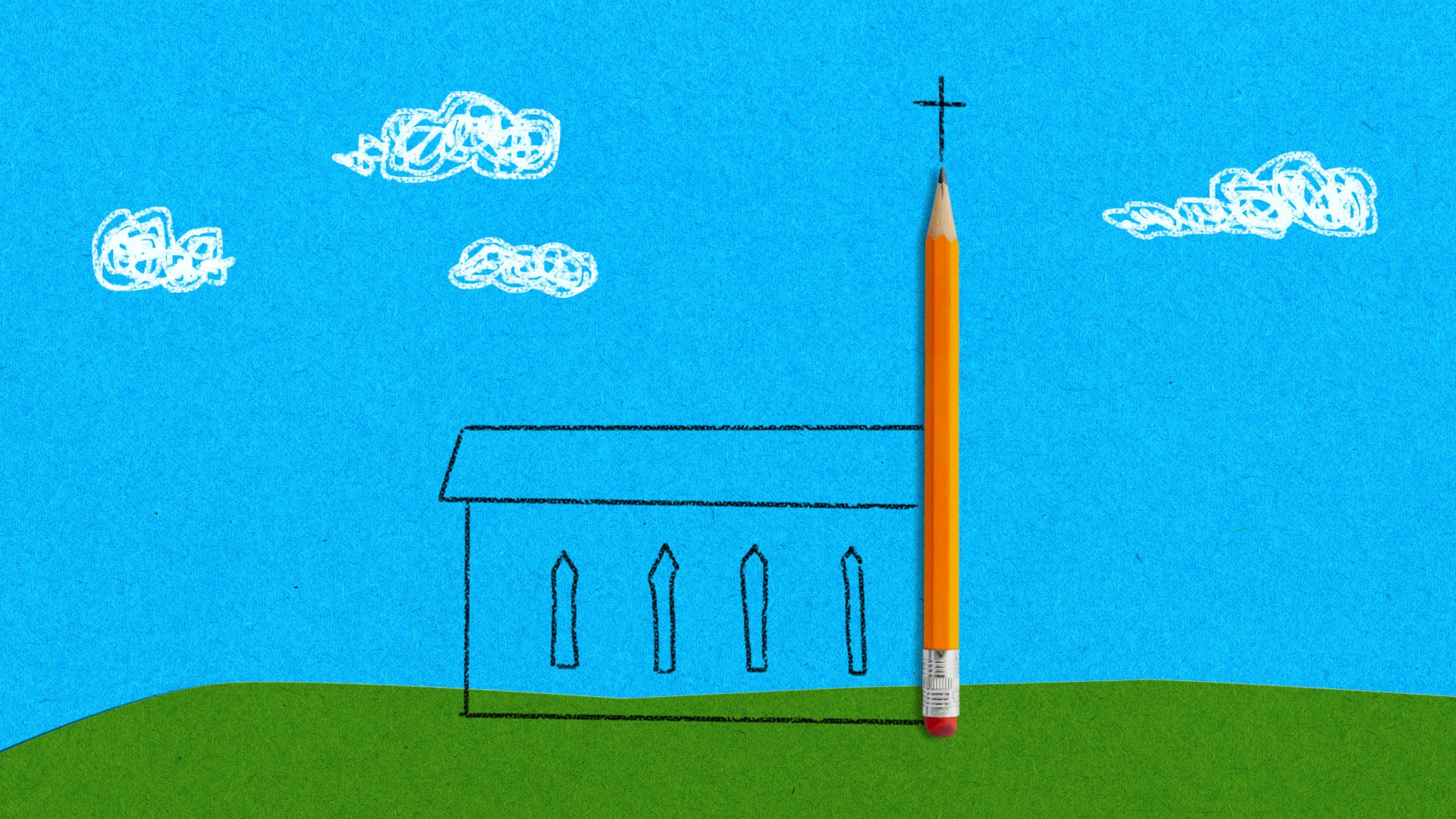
A sketch of a church with a pencil.
Christianity Today September 8, 2025
Illustration by Elizabeth Kaye / Source Images: Getty, Unsplash

As children, families, and educators settle into the rhythm of another school year, I’m noticing the “back-to-school” season looks a bit different than it did when I was kid or even during the decade I spent advocating around education policy.

Homeschooling has seemingly become the fastest-growing educational model in America, with more than 2 million additional homeschooled students in the US compared to 2012. The trend has been partly fueled by Black families, who showed the most dramatic increase in homeschooling during the COVID-19 pandemic. Since the pandemic, thousands of microschools have also emerged nationwide, boosting their number to nearly 125,000. About a quarter of these small schools offer some type of faith-based education, and the vast majority are serving families at—or below—the average income for their areas.

In my own life, a friend who pastors a predominantly Black church recently opened a school to accommodate a surge of families who have joined his congregation in Florida. And with a new federal policy establishing the nation’s first-ever school-choice tax credit, many congregations are likely contemplating similar plans. 

How we educate our children—and who gets the power to shape their minds—is a hot-button topic that often creates fissures along ideological lines. But the fact that churches—particularly Black churches—are once again innovating in this area is good news worth celebrating. Personally, I’ve spent so much of my life pushing for much-needed reforms in my own city of Chicago and the country at large. However, I’m favoring these changes not just for that reason. In the Bible and much of Christian history, education has always been essential for formation. 

We see this across the Old Testament, from the Lord’s instructions to parents to impress his commandments upon their children (Deut. 6:1–6) to the patterns of the Levites scattered among the tribes as teachers (Deut. 33:10; 2 Chron. 17:7–9; Neh. 8:7–8) to the emphasis on study in the synagogue system that emerged from the Babylonian exile. In the Gospels, Christ embraces the title of teacher, and in the Epistles, Paul says church leaders must be “able to teach” (1 Tim. 3:2; Titus 1:9).

But the Bible celebrates more than just religious education. In Moses’ account of the construction of the tabernacle, Bezalel and Oholiab have “wisdom” because of their mastery of metallurgy and craftsmanship (Ex. 31:3). The biblical writers assume knowledge of agriculture, astronomy, poetry, and commerce. In Psalm 19, David says, “The heavens declare the glory of God” (v. 1), and his theological insight about the Creator rests upon careful observation of the natural order. The fear of the Lord is indeed the beginning of wisdom (Prov. 1:7), and wisdom then leads us to pursue knowledge of the entire creation.

To carry on the best of biblical and church tradition around education, Christians need not be reactive or defensive. I believe our approach to education should transcend—and stand apart from—battles over curricula and teaching methods. Instead of having constant partisan bickering, local churches need a vision of education that forms disciples capable of navigating complexity, engaging differences, and transforming culture. Christian alternatives to secular schools are good. So is seeking the best way to teach children to read and the best books for them to encounter and debate. But more than that, we need to recover a view of schooling, particularly Christian education, as a sacred vocation.

No matter the institutional context or pedagogical model, education (for better or worse) is always tied to a kind of formation. We cannot spend time training the minds of children without simultaneously shaping their souls. Most readers know this is why so many Christian parents are particularly wary of secular schools and some even go as far as actively opposing all public education. To be clear, I’m not a fan of that approach. Public school remains the most practical option for many families, and there are lots of teachers, students, and administrators in non-Christian schools performing good works and radiating the love of Christ to those around them.

But each municipality, school, and student is different and requires a tailored approach, which in many cases can make faith-based education the right response. When those moments come up, local churches and believers should, in my view, unashamedly create spaces for students to learn despite sneers on the topic from the wider culture. 

It’s been particularly exciting for me to see some Black churches getting more involved in this area and reclaiming a legacy that almost feels lost. After the abolition of slavery, a schoolhouse movement sprang up among formerly enslaved people across the American South. The movement owed a great debt to the Black church, which operated behind the scenes as an invisible institution as its adherents were in chains. When their bondage ended, thousands of emancipated people rose up like an “exceeding great army” and began “clothing themselves with intelligence,” a government inspector wrote at the time.

What the inspector witnessed was not just an educational movement; it was faith in action. Formerly enslaved people understood intuitively what their oppressors had tried to suppress: Literacy and learning were inseparable from liberation. The Black church didn’t just support these schools; it birthed, funded, and staffed them. Churches became classrooms, pastors became teachers, and offering plates funded textbooks alongside ministry.

Some would categorize initiatives like this as mere charity work, but they’re not. Forming citizens of God’s kingdom requires developing their full capacity as humans created in his image. And that call is not unique to the Black church. The Sunday school movement, for example, emerged from the same theological impulse. What began as an effort to educate poor children who were working long hours in factories became a revolutionary force for literacy and biblical discipleship. The church got involved not because it had a lot of resources but because it had theological clarity about human dignity and the role education plays in affirming it.

These days, we face not just academic underperformance and ideological battles over private and public schooling but also a crisis of discipleship in our churches. Our children navigate a digital ecosystem designed to fragment attention and monetize anxiety. They inherit a world where trust in meaning-making institutions is eroding, leaving them to construct identity from the debris of social media algorithms and a consumerist culture.

In the face of these challenges, local churches should not retreat from educational endeavors. If we do, we would be cheating families and communities out of an educational approach that integrates the fullness of human identity—an approach that sees each child as fearfully and wonderfully made, destined for both earthly purpose and eternal significance.

The growth of faith-based microschools, homeschooling, and new church-affiliated schools are seeds for a needed renewal. The pastor opening a school for families in his congregation is not just providing an educational option; they (along with many microschools) are creating an ecosystem where faith, learning, and community reinforce each other. And despite how they’re portrayed, many who choose to homeschool are not retreating from public life but rather reclaiming the family’s central role in training the minds and hearts of their little ones.

Our children are already being formed. The only question is whether the church will reclaim its role in that formation, bringing the fullness of our theological tradition to bear on the educational challenges of our time. History suggests we’ve done this before. Faith demands we do it again.

Chris Butler is a pastor in Chicago and the director of Christian civic formation at the Center for Christianity & Public Life. He is also the co-author of  Compassion & Conviction: The And Campaign’s Guide to Faithful Civic Engagement.

Ideas

The National Guard Debate Needs a Dose of Honesty

Contributor

Criticizing federal overreach while remaining silent about local failures does not serve the cause of justice.

Members of the National Guard patrol the National Mall on September 1, 2025.

Members of the National Guard patrol the National Mall on September 1, 2025.

Christianity Today September 5, 2025
Mehmet Eser / Contributor / Getty

On a recent Sunday evening, my wife and I decided to take our kids out for a walk in our neighborhood on the South Side of Chicago. As we rounded the corner, returning to our street, one of my kids asked, “Daddy, are those guys fighting?”

A group of young men had gathered on the corner of our block, their body language tense, voices rising. My 3-year-old son tightened his grip on my hand while my 14-year-old daughter’s demeanor became worried. Thankfully, the situation dissipated quickly, and we saw the young men run off before we reached the corner.

Inside the walls of our home that evening, my family discussed whether President Donald Trump’s intention to deploy National Guard troops to Chicago would make it safer for us to take an evening stroll in our community. Compared to those conversations and the thoughts inside my own head, the response from Chicago’s political establishment has not been as open or curious. Progressive voices across the city joined a familiar chorus of outrage, treating Trump’s announcement as merely an assault on local sovereignty while discounting that it’s also a response to genuine public safety failures. However, the always-easy path of reflexive opposition has not been helpful.

Let me set out at the beginning that this isn’t a partisan take. Before I went into pastoral ministry, I spent the better part of two decades working in Democratic politics and progressive advocacy. I organized the Chicago Peace Campaign, mobilizing local churches to engage communities plagued by violence, and worked on an initiative that called for an end to the “war on drugs,” which has taken an enormous toll on the Black community.

I’m not carrying water for Trump or looking for reasons to defend federal overreach. I’m aware there are serious legal questions about using troops to police American streets. Trump himself seemed to acknowledge the limits of his authority on Wednesday, saying state officials would have to ask him to send the National Guard to Chicago. I also understand that Trump’s rhetoric about Chicago—his description of the city as a “hellhole”—echoes the same dehumanizing language he used for African nations during his first term.

But at the same time, I recognize something Chicago’s political class refuses to acknowledge: The status quo is failing our families and communities.

When my children do not feel safe to ride their bikes in our neighborhood, when they come running home from the park because something they saw troubled them, when parents across the South and West sides of the city alter their children’s activities based on safety concerns, firebrand speeches from local leaders about improved crime statistics ring hollow. It’s true that Chicago’s violent crime rate has declined this year. But these marginal gains follow upticks in recent years as well as decades of devastating violence, and simply stating the progress doesn’t address the daily anxieties many families encounter in their own neighborhoods.

The uncomfortable truth is that the people legally empowered and morally responsible for protecting Chicago’s communities have not fulfilled their obligation, creating a vacuum that Trump now seeks to fill—and perhaps even exploit for other policy ends.

When lives are at stake, we cannot afford to travel the low road of partisan loyalty to either party. As the set-apart people of God, let’s be clear, truthful and nuanced—pursuing the peace and prosperity of our respective cities and towns (Jer. 29:7). The type of peace I want for Chicago encompasses far more than crime reduction, but it certainly cannot ignore basic security that enables communities to thrive.

We need neighborhoods where children can play without fear, families can walk to the store without calculating risks, and residents have economic opportunities to pursue meaningful lives. Deploying federal troops cannot build the social trust, economic development, and community cohesion a sustainable safety needs. But if those in charge plan and manage it correctly, deployment could be a meaningful first step—one state and local leaders should consider welcoming.

More federal help would go even further. The president could deploy federal law enforcement agencies—including the FBI and the DEA—to bolster investigations into the activities and people contributing to violence and disrupting quality of life in Chicago and other high-crime cities. As Chicago mayor Brandon Johnson has rightly suggested, Trump could reinvest in the Bureau of Alcohol, Tobacco, Firearms, and Explosives to help get illegal guns off the streets. Furthermore, he could direct resources to programs intended to revitalize low-income neighborhoods and provide support for families who anchor those communities.

Justice-conscious Christians should hold all levels of government accountable for urban peace while advocating for comprehensive approaches to crime. This might mean welcoming federal partnership when it can contribute to immediate safety improvements (as DC’s mayor Muriel Bowser did this week) while also pushing for solutions that address root causes of violence. In that area, both the left and the right have constructive ideas worth considering.

The federal heavy-handedness we see on this issue is a direct result of local complacency. Trump’s motives are questionable and may focus more on calculated political positioning than on genuine concern for urban violence. However, we Christian leaders cannot limit our criticism to federal overreach while remaining silent about local government failures that directly harm the communities we serve. These selective denunciations serve partisan politics, but they do not serve the cause of justice.

The prophetic tradition, particularly in the Black church, calls us to speak truth to power at every level and not be cowed by progressive leaders, some of whom seem more concerned with political posturing and deflecting from the issues than with solving the concerns of families in vulnerable neighborhoods. Our children need leaders at every level who will prioritize their welfare over partisan politics. They should not have to wait indefinitely for basic safety.

Chris Butler is a pastor in Chicago and the director of Christian civic formation at the Center for Christianity & Public Life. He is also the co-author of  Compassion & Conviction: The And Campaign’s Guide to Faithful Civic Engagement.

Pastors

High Time for an Honest Conversation about THC

Legal cannabis may be here to stay, but the Christian conversation is just getting started.

CT Pastors September 5, 2025

It’s high time we have an honest conversation about THC, or tetrahydrocannabinol—the main psychoactive compound in cannabis, also known as marijuana or weed. For years, people consumed cannabis almost exclusively by smoking the plant. Inhaling marijuana, whether by smoking or vaping, remains the dominant mode of using THC by a significant margin (nearly 80 percent of users). But the ability to dose THC this way is very difficult. Variables like the packed density of the burn, the depth of an inhale, and the amount of THC in any given hit make it nearly impossible to measure. The result is an imprecise method of intake, with inconsistent, often unpredictable effects.

Although inhalation remains the main method of consumption, it’s no longer the only one. THC is now available in a variety of “dosed” allotments and consumables: gummies, oils, topicals, beverages, and so on. A month ago, while staying overnight at a hotel, I reached into the mini-fridge to grab a late-night drink. I thought I had grabbed sparkling water, but my eyes caught the THC lettering on the can right before I popped the top. You can now drink, cook with, apply, and eat THC products. 

A survey from Christian Standard Media says pastors overwhelmingly disapprove of marijuana use. Roughly 78 percent agree that “it is morally wrong to get high smoking marijuana.” But Christian leaders must understand that popular use of THC has changed. This doesn’t mean old principles no longer apply, but the questions people are asking, and the considerations around consumption, have evolved dramatically. 

Let me put my cards on the table upfront:

  • I believe THC can serve as a legitimate alternative to opioids used for managing pain, especially in palliative and end-of-life care.
  • I am not in favor of THC being legalized or sold for recreational use in any capacity.
  • I believe the faithful Christian should avoid recreational consumption of THC and should give prayerful consideration before using THC if a physician prescribes it.

Historically, most Christian arguments against the consumption of marijuana have been shaped by three factors: It was illegal, inhalation was the only way to consume it, and a customer could not regulate the dosage of THC.

No longer illegal

For years, pastors could counsel against the use of THC on the simple grounds that it was against the law. But that’s no longer the case for a large portion of the country. Many Christian leaders can no longer say, “It is illegal,” because, well, it isn’t anymore.

Still, not everything that is permissible is beneficial. In a different time, in a different context, dealing with a different issue, the apostle Paul wrote to the Corinthians, “All things are lawful for me, but not all things are helpful. All things are lawful for me, but I will not be dominated by anything” (1 Cor. 6:12, ESV). Paul captures the wisdom we need, discerning not just what is permissible but what is good and beneficial and worth giving ourselves to. Christian morality is not bound by what a given society deems legal or illegal. There are many things a society will declare legal that are either immoral, unhelpful, or both.

Take cannabis, for example. While its recreational use may be legal in portions of our country, the data says long-term usage of cannabis products has detrimental impacts on the brain and cardiovascular systems. It negatively impacts cognitive functions (specifically memory) and lowers sperm count significantly in men. The worst effects of cannabis correlate with smoke inhalation or vaping, where the pulmonary impacts can be disastrous.  

It may be hard to “take captive every thought to make it obedient to Christ” (2 Cor. 10:5) when you can’t even remember where you parked your car.

Controlled” dosing

Advocates for THC argue that “controlled” dosing solves the problems caused by recreational use. In the age of cannabis consumables, customers receive assurances that they can self-select how much THC they consume. But there’s a problem: Dosage listings are overwhelmingly inaccurate. One study in the Journal of the American Medical Association found that only 17 percent of tested products had accurately labeled dosage. It turns out it’s more difficult than you might guess to pack just the right number of milligrams into a gummy bear.

The simple fact is that many people interested in consuming THC really want its intoxicating effect. There are no proven health benefits to microdosing with THC, and though the Bible may not directly prohibit the consumption of marijuana, it does prohibit “drunkenness” (i.e. intoxication). Consider Paul’s exhortation in Ephesians 5:18, which says,  “Do not get drunk wine, which leads to debauchery. Instead, be filled with the Spirit.”

Controlled dosing of THC, at present, is highly unreliable, and the data has not demonstrated any evidence that consuming cannabis in nonintoxicating doses provides any unique, tangible benefits.

Puff, puff, pasta

It used to be that if you wanted to mix a little marijuana into your Italian-themed dinner night, you’d need to pack a rolling paper and light up; but now you can just drizzle your pasta with some THC-infused olive oil and skip the smoke.

There are thousands of THC-infused consumables on the market now. Why does this matter? Because the stigma surrounding the deleterious effects of smoking has remained. Due to increasing social and cultural pressure, a large amount of health data, and compelling ad campaigns, people associate smoking with recklessness and danger. Public resistance to THC consumption rode the coattails of this stigma.

But that stigma doesn’t touch a gummy. Or a drink. Or a salad dressing. With a whole catalog of consumables available now that don’t require smoking, pastors must prepare to speak to and shepherd those who recreationally indulge in or routinely use THC in formats that no longer seem dangerous. Despite what our culture says, it’s not just what we smoke that matters. Paul writes in 1 Corinthians 10:31, “So whether you eat or drink or whatever you do, do it all to the glory of God.” Whether THC is smoked, eaten, or drunk, is irrelevant. The method matters less than the motive. The deeper question is, “Why are people consuming this at all?”

But what about caffeine, sugar, and…

While I believe dosed and prescribed THC (from a medical professional) could potentially replace opioid-based pain medication, I am not in favor of its legalization or sale for recreational purposes and do not believe Christians should indulge in it recreationally. At the same time, I want to acknowledge common objections to my position and deal with a couple of them in a “lightning-round” format. Have fun with the brevity of it—or don’t. Your choice.

Objection: But what about caffeine or sugar? Can’t their overconsumption also produce negative effects on the body?

Response: Yes. We should monitor and carefully consider overconsumption and overreliance on any substance (especially those with psychoactive properties) Gluttony is the close cousin of intoxication. Gluttons consume more than one ought of something. Drunkards consume too much of what intoxicates. Both gluttony and intoxication are sinful and lead to malformation. 

Objection: The Bible doesn’t forbid the consumption of marijuana and it grows from the ground. It’s natural.

Response: The Bible doesn’t forbid the consumption of heroin, and it’s distilled from the dried latex of the poppy. Just because something grows from the ground doesn’t make it wise to consume. The Bible doesn’t prohibit making a poison sumac milkshake, but it would be a foolish thing to do.

Get into the weeds

Christians can land in different places here. But our positions should be rooted in reflection, not naïveté. We should not allow our antiquated conceptions of cannabis to shape the way we teach, counsel, and care around the consumption and use of THC in the daily life of our communities and congregations. There is space to disagree on an issue like Christian freedom and cannabis use, but it is crucial that even if we don’t get onboard with weed, we get into the weeds on the thorny topics facing ordinary Christians under our shepherding care.

Kyle Worley is the lead pastor at Mosaic Church in Texas, a cohost of the Knowing Faith podcast, and the author of Home with God and Formed for Fellowship.

Church Life

How a Missionary Family in Lebanon Produced an American Hero

Bill Eddy’s Arabic acumen served US interests and forged Middle East ties.

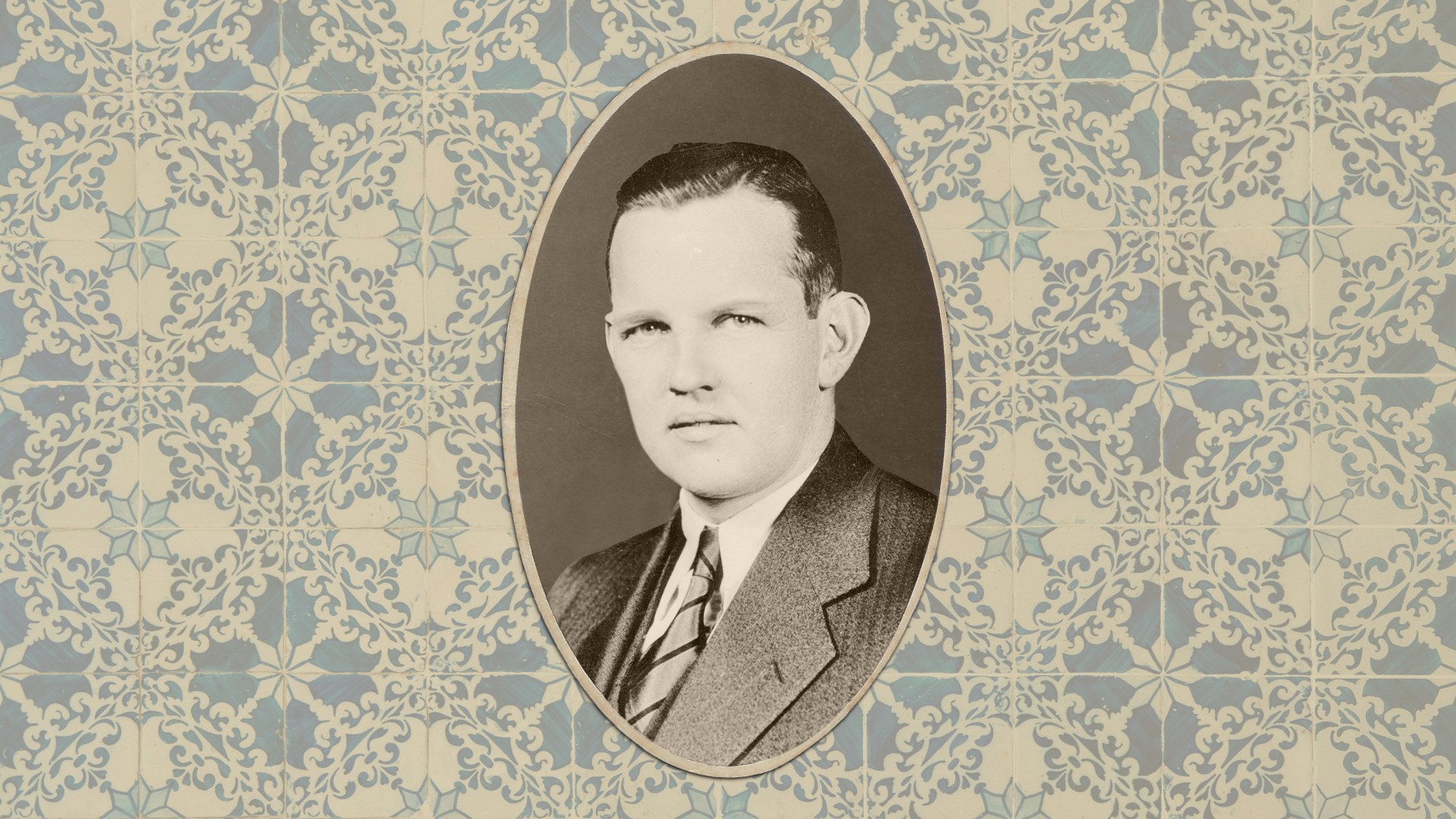
William Alfred Eddy

William Alfred Eddy

Christianity Today September 5, 2025
Illustration by Christianity Today / Source Images: Getty, Unsplash

This is part two of the Eddy family’s story. To read about the Eddy missionaries in Sidon, click here.

William Alfred Eddy was an American hero. Nicknamed “Bill,” he received the Navy Cross, two Silver Stars, and two Purple Hearts for his service in World War I. During World War II, he quit his job as a college president to reenlist and helped plan the Allied invasion of North Africa. Later, as a diplomat, he advanced Franklin Roosevelt’s agenda by forging the US alliance with Saudi Arabia.

“Eddy (hereafter ‘Bill’) managed to pack four or five lives into a single lifetime,” wrote Princeton University’s alumni magazine about its former doctoral graduate. One of those lives began as a missionary kid to an American family in the Levant.

Part one of this series chronicled the Eddys’ multigenerational service in Lebanon, particularly its southern city of Sidon. Active in evangelism, education, and medical work, some of the Eddys died on the field and are buried in local evangelical cemeteries.

So was Bill. But while his gravestone inscription marks the rank of colonel in the US Marine Corps, it doesn’t include the number of years he “served the Lord” like his family members’ gravestones.  The modern Eddy biographer, Muhammad Abu Zaid, didn’t criticize either approach. He called Bill the American “Lawrence of Arabia” and sympathized with his family’s earlier religious commitments.

In Forgotten Pages from the Ancient History of Sidon, published in Arabic by the Baptists of Lebanon, the president of the Sunni Muslim Sharia Law Court in Sidon described the religious and social development of Protestant ministry through building churches, schools, and clinics. Bill, he contrasted, pursued his country’s political objectives in the Arab world.

But today, evangelicals number only one percent of the Lebanese population. And polls indicate America’s poor reputation in the Middle East. Secular or spiritual, how does Abu Zaid evaluate the Eddys’ presence in his homeland?

“I felt sorry for them,” he told CT. “They didn’t succeed.”

The story continues from part one, with William Alfred, age 10, watching his father William King die suddenly on a preaching tour. After this traumatic experience, Bill moved to America and eventually enrolled in a Presbyterian university. Two years later, he transferred to Princeton and graduated in 1917. When the US entered World War I, he enlisted, fought in the tide-turning battle of Belleau Wood, and suffered a leg injury that made him limp for the rest of his life. After receiving his PhD in 1922, he joined the American University in Cairo, and one year later, he became chair of the English department.

Bill remained devout in his Christian faith—he even memorized large parts of the Quran while resisting Muslim efforts to convert him to Islam. In his memoirs, he wrote that he viewed his life as a secular extension of his family’s missionary service. After further academic work at Dartmouth and Hobart College in upstate New York, his military career continued in the US Office of Strategic Services, the forerunner of the CIA.

But there, he acted in ways he found antithetical to his faith.

Bill’s early espionage helped the Allies turn the tide against the Nazis in North Africa. To destabilize their local authority, he devised a plan to hire French operatives to assassinate local German and Italian agents, shielding the US from public responsibility. And in the Spanish Sahara, he allowed communist rebels to believe that America would facilitate the post-war overthrow of the fascist government on the mainland in Europe—knowing full well the US would not honor this promise. He later compared his deception to Peter denying Jesus.

“We deserve to go to hell when we die,” Bill later wrote.

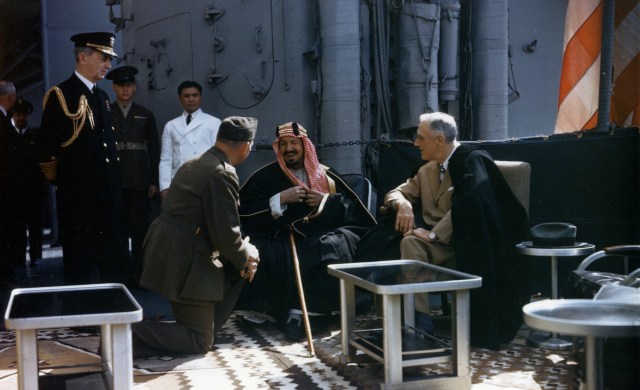
Bill serving as translator between King Abdul-Aziz Al Saud and President Franklin Roosevelt.U.S. Army Signal Corps / Wikimedia Commons
Bill (kneeling) serving as translator between King Abdul-Aziz Al Saud and President Franklin Roosevelt.

Toward the end of the war, Bill served as head of the US diplomatic mission in Saudi Arabia, where he met King Abdul-Aziz Al Saud. Given Bill’s background in Arabic and knowledge of Islam, the two developed a rapport. On Valentine’s Day, 1945, aboard a naval cruiser in the Suez Canal, Bill served as translator between the king and President Franklin Roosevelt, where the two world leaders bonded over their shared disabilities.  The meeting cemented the US-Saudi alliance and displaced Great Britain as the major power in the oil-rich Gulf.

Throughout his career, Bill frequently deployed the cultural acumen and linguistic skills he had first gained as a missionary kid on behalf of American power. He believed US interests aligned well with the Arab world and supported a pipeline from Saudi Arabia to Lebanon that exported oil to Europe. Such infrastructure, he maintained, benefitted every party.

But his analysis did not always square with that of the local populations. In the Gulf, he designed a plan to manipulate opinion in favor of a joint US-Saudi oil venture by feigning Arab authorship of letters to leading politicians. In Lebanon, he strengthened pro-American policies of the Christian president Camille Chamoun that eventually contributed to civil conflict in Beirut.

On the other hand, many Arabs would appreciate Bill’s other diplomatic efforts, even if they ultimately failed. In 1948, US President Harry Truman became the first world leader to recognize the State of Israel. In advance of this decision, Bill resigned from his position and quietly left the State Department as one of Truman’s advisors. He was “embarrassed,” his grandnephew Nick Eddy told CT, having assured Saudi leaders they would be consulted on the matter. Bill later wrote publicly that American support for Zionism would damage its relations with the Arab world.

Toward the end of his life, he settled permanently in Beirut, consulted for oil companies, and even visited Pope Pius XII at the Vatican. Bill died in 1962 at age 66. President John F. Kennedy recognized his “devoted and selfless consecration to the service of mankind.”

Abu Zaid told CT that his respect for Bill and his father, William King, doesn’t hinge on policy. William King served his Lord, as Abu Zaid, a Muslim sheikh, serves Allah. William Alfred served his country, as Abu Zaid, a Muslim judge, serves Lebanon. Both Eddys, he said, were true to their different callings.

Other Middle East analysis is critical. Scholars such as Sayyid Qutb in Egypt, Ali Shariati in Iran, and Abul A’la al-Maududi in Pakistan interpreted both missionary service and diplomatic overtures as meddling within a weakened Islamic world. And Edward Said, a Palestinian Anglican, described them as motivated by Western cultural superiority and in support of its colonialist project.

But many ordinary people appreciate the Eddy missions heritage. The National Evangelical Institute for Girls and Boys, the school they founded in Sidon, has an 1,800-student body. Two-thirds of students are Muslim, including from many of the leading families of the city. Each graduation begins with a message and prayer by a leader in Lebanon’s Presbyterian synod. And last year, the class of 2024 renovated the graves of its missionary founders, whose portraits are hung proudly in the school entryway.

This cemetery sparked Abu Zaid’s book when David Robinson (then the Muslim-Christian relations specialist for World Vision) asked the sheikh’s help to visit the final resting place of his uncle Bill. The scent of lemon blossoms wafted in the springtime air. Who are these Americans buried in my city? the devout judge wondered. His research led him to a remarkable conclusion: Muslims embraced the Eddy family, as they embraced Lebanon.

Turned away by many Arab Christians, William King, the missionary, chose to be buried in Sunni-majority Sidon. Dedicated to an American agenda, William Alfred, the diplomat, desired the same. The sheikh said he believes everyone should be able to preach and serve from their faith, since he claims the freedom to do so for Islam. Muslims may debate the impact of foreign service, but for him, the local mandate is clear.

“I will not advise the missionary,” Abu Zaid said. “But I will do what my religion tells me to do—welcome all and be hospitable.”

Ideas

Eight Divine Names in One Glorious Passage

Hebrew terms for God appear across the Old Testament. The prophet Isaiah brings them all together.

A sparkling gold name tag
Christianity Today September 5, 2025
Illustration by Christianity Today / Source Images: Getty

If you were a child of Christian parents in the 1980s or 1990s, there is a decent chance that at some point you memorized the Hebrew names for God. Like Jehovah Jireh, which means “the Lord will provide” (Gen. 22:14). Or Jehovah Rapha: “The Lord heals” (Ex. 15:26). Or Jehovah Nissi: “The Lord is my banner” (17:15).

There are eight such names altogether. (Besides the examples from Genesis and Exodus, they appear in Leviticus 20:8, Judges 6:24, Psalm 23:1, Jeremiah 23:6, and Ezekiel 48:35.) Learning these names—and in my case singing songs about them (with gradually accelerating Jewish melodies)—was just something we all did. Ever since, I have been unable to read the passages where Scripture introduces them without thinking of the names themselves, the songs they inspired, and the stories that gave them meaning. Clearly they made quite an impression; I have even written book chapters on all eight of them.

Until recently, though, I had never noticed that there is one passage in Scripture where the eight come together. And it is not just any passage, but arguably the most Cross-centered, Christ-shaped, emotionally resonant, and theologically significant text in the entire Old Testament—namely Isaiah 52–53.

This wonderful passage has two parts. The first half summons Zion to wake up, get dressed, shake off the dust, and celebrate the news that her salvation has come (52:1–12). The second half is a breathtaking poem on how this salvation has come about: through the unexpected, substitutionary, desolate, yet God-ordained suffering of his righteous, sin-bearing servant (52:13–53:12).

Readers familiar with both the Hebrew names for God and the song of the servant may have already noticed some connections between them. Take Isaiah 53:5, for instance: “The punishment that brought us peace was on him, and by his wounds we are healed” (emphasis added throughout). This verse portrays the servant as both Jehovah Shalom (“the Lord is peace”) and Jehovah Rapha (“the Lord who heals you”). “We all, like sheep, have gone astray,” Isaiah continues in the next verses, evoking Jehovah Rohi (“the Lord is my shepherd”) and showing that our shepherd has become a lamb, led to the slaughter to carry our iniquities.

Two of the parallels are more obvious in Hebrew than in English. “After he has suffered, he will see [raah] the light of life and be satisfied” (53:11), Isaiah concludes, using the same root as Jehovah Jireh, which, beyond “the Lord will provide,” might be translated as “the Lord will see to it.” Just as God saw to Abraham’s need for a substitute as he prepared to sacrifice Isaac, Christ has seen to our need for a substitute who can satisfy the wages of our sin.

More startling are the allusions to Jehovah Nissi (“the Lord is my banner”), when Isaiah declares that “he will be raised and lifted up [nasa]” (52:13) and “he has carried [nasa] our sorrows” (53:4, ESV). Jesus lifts our sins by being lifted up on the cross, which makes him our banner, our lifted one: a standard raised high in the battle, promising shelter from our enemies.

The connections run beyond the servant song, however. They begin at the start of chapter 52. Isaiah grounds his call to wake up and get dressed in beautiful clothes in the promise that Jerusalem will once again be a holy city, free from anything unclean or impure (vv. 1, 11). His other invitation, to hear and celebrate the saving message being carried over the mountains by messengers with beautiful feet, springs from the fact that the Lord is returning to Zion to live among his people (vv. 7–12). In other words, Isaiah is saying, Awake, awake, because Jehovah M’Kaddesh (“the Lord is your holiness”)! Break forth into singing, because Jehovah Shammah (“the Lord is there”)!

Finally, as the passage reaches its triumphant conclusion, we discover that God is Jehovah Tsidkenu (“the Lord is our righteousness”). Isaiah 53:11 underscores the effect of the servant’s healing, shepherding, providing, and peacemaking work: “By his knowledge shall the righteous one, my servant, make many to be accounted righteous, and he shall bear their iniquities” (ESV). It would be hard to find a clearer summary of what it means for God to be our righteousness. It is not just that Christ is righteous in himself, although that is gloriously true as well. It is that he makes us to be accounted righteous with him and through him, justifying the ungodly as he bears our sins and “[makes] intercession for the transgressors” (v. 12).

Considering these parallels plunges us into deep waters. If they hold up—and I think they do, although it is ultimately for each reader to judge—they suggest yet another reason to marvel at the message of Isaiah 52–53. The Suffering Servant, the Lord Jesus Christ, has put the providing, healing, lifting, sanctifying, peacemaking, shepherding, justifying, and indwelling of Israel’s God on perfect display through his death on the cross. Awake, awake, and break forth into singing!

Andrew Wilson is teaching pastor at King’s Church London and author of Remaking the World: How 1776 Created the Post-Christian West.

News

Saudi Arabian Prison Frees Kenyan After ‘Blood Money’ Payout

A Christian mother relied on the Muslim practice of “diyat” to bring her son home alive.

A prison wall with barbed wire
Christianity Today September 5, 2025
Abdulkadir Arslan / Getty

Kenyan mother Dorothy Kweyu prayed 14 years for her son’s release from a Saudi Arabian prison. Her son, Stephen “Stevo” Munyakho, spent more than a decade on death row for killing Yemeni coworker Abdul Halim Mujahid Makrad Saleh in a dispute over money in 2011. According to Munyakho, Saleh attacked him with a knife, stabbing him twice before Munyakho grabbed the knife and stabbed Saleh in the chest.

Munyakho claimed self-defense, and at first Saudi courts, which run on sharia law, handed him a five-year jail sentence for manslaughter. Then Saleh’s family appealed, citing the “right to retaliate” for the loss of Saleh and demanding the death penalty. The courts responded by changing the conviction to murder—a sentence punishable by beheading.

“I kept telling God, ‘God, save my child, and spare me the pain and the ignominy of receiving my beheaded child,’” Kweyu told local media. Sometimes during her weekly phone calls to Munyakho in prison, he would say, “Mummy, today we saw darkness,” meaning one of the death row prisoners had been executed. He said the government executed more than 100 fellow inmates during his first year on death row.

Kenya’s foreign affairs secretary said all legal appeals for Munyakho had been exhausted. Saudi authorities set the execution date. Then the victim’s family agreed to consider a provision under sharia law: The court could commute Munyakho’s sentence if his family paid them diyat, or “blood money,” to compensate for Saleh’s death.

Saleh’s family initially asked for more than 350 million Kenyan shillings (nearly $3 million USD).

Kweyu told Citizen TV Kenya last year that Saleh’s family increased their demands 10 times and exceeded what Islamic law allows: “If this was a proper Quranic sentence, Stevo should be back now. The Quran requires a hundred camels, and by my calculation we only needed 11 million Kenyan shillings [$85,000 USD] to give the Yemenis.”

Blood-money payments are alien to many Kenyans, four out of five of whom identify as Christian. Islamic law in countries such as Saudi Arabia categorizes manslaughter and murder as quesas crimes, offenses for which victims have the right to retaliation equal to the harm done—such as a life for a life. Courts can pardon these crimes if a victim’s family accepts blood money as an alternative to legal penalties.

Though intended by the Quran as a form of mercy, blood money can complicate justice. Some Arab journalists have suggested exorbitant blood-money demands in Saudi Arabia—driven by greed and revenge—abuse the system and unfairly send families of death row inmates into poverty.

While Saudi Arabia’s judicial system calls for fair trials and punishments—at least on paper—judges apply their own interpretations of sharia law. In many cases, judges can set penalties at their discretion. The US State Department warned this leads to discrimination against noncitizens and non-Muslims as well as leading to inconsistent or extreme penalties, including the death penalty for nonviolent offenses such as sorcery and adultery. Appeals courts usually affirm the judgments of lower courts, making blood-money agreements inmates’ last chance for pardon.

Kenyan courts don’t accept blood money as a solution, but Muslim communities in northeastern Kenya do. According to Ishmael Kulu, an ethnic Somali living in Nairobi, Kenya, paying blood money began as a Somali cultural practice before Islam came to the nation.

“It was a dispute-resolution mechanism that was used in order to avoid revenge when a death occurred,” Kulu said. In Somali culture, when a person accused a kinsman of murder, the whole clan had to pay for the crime. Traditional elders from the affected clans would agree on a payment based on the age, marital status, and gender of the victim.

In rural, Muslim-majority areas of Kenya, people still use the blood-money system, though Kulu said that in towns “people prefer the judicial court processes.” Since clans make the payments, Kulu explained small clans feel the system favors big clans, which can easily raise any amount demanded.

Sasha, a Somali Christian convert from northern Kenya (whose real name CT agreed to withhold due to threats to her safety from her Muslim community), agreed: “Without the backing of a strong family or clan, you will suffer.”

She told CT her community handles most murder and injury cases outside the Kenyan courts. Although the blood-money system works in remote places without courts, Sasha said it is prone to manipulation and places the amount demanded for a dead woman at half that of a dead man: “The Islamic system is not just to women.”

In a 2005 incident, two clans clashed in Kenya’s northern Mandera County, resulting in 50 deaths. Clans agreed to pay 1 million Kenyan shillings (about $7,700 USD) or 100 camels valued at 10,000 Kenyan shillings ($80 USD) each in compensation for the death of a man. They agreed to pay half that for a woman or child.

Dorothy Kweyu appealed to the Kenyan government to negotiate for a delayed execution and lower blood-money payment. The victim’s family settled for 129 million Kenyan shillings ($1 million USD), but Kweyu could only fundraise 15 percent of the total (about $150,000 USD). In March, the government and the charity Muslim World League paid the amount in full on behalf of Munyakho, who converted to Islam while in prison.

Kweyu said she rolled around on the floor of her Nairobi home in joy and disbelief—her son was coming home alive. She credited her Christian faith and Presbyterian community at St. Andrew’s Church with getting her through her son’s ordeal: “All this time, God kept me going. I was surrounded by very prayerful people.”

Saudi authorities released Munyakho on July 22. He returned to Kenya on July 29, landing in Nairobi around 1 a.m. Family members, friends, and government officials greeted him, some with tears and dancing. But Kweyu said there’s one thing the blood-money payment didn’t resolve.

“I genuinely wanted to go see [Saleh’s wife] and seek her forgiveness,” she said. “Even though I was not physically involved in what happened, Stevo is still my child. So I wanted to go seek forgiveness on his behalf.”

Culture

Why Fans Trust Forrest Frank

The enormously popular Christian artist says he experienced miraculous healing. His parasocial friends say “amen.”

Forrest Frank
Christianity Today September 5, 2025
Jeremychanphotography / Contributor / Getty

Last week, worship artist Cory Asbury (who wrote the popular song “Reckless Love”) posted a video to social media featuring some original music. He performed from a bed. The song was about God’s faithfulness during recovery from a vasectomy.

That sounds like something out of a weird-Christian-internet joke book, and it only makes sense in the context of a months-long, very online story about another Christian musician, Forrest Frank.

On July 19, Frank—whose song “Your Way’s Better” hit the Billboard Hot 100 earlier this year and who has become one of today’s most popular Christian artists—shared on social media that he had fractured his back while skateboarding.

“Dads, this is your sign to get off the stick,” Frank wrote in the caption of a post that included a video of himself in a hospital bed and a recording of the accident, captured by a home security camera. According to Frank, he had fractured his L3 and L4 vertebrae.

Two weeks later, Frank posted a video telling his millions of followers that he had woken up, forgotten to put on his back brace, and realized he wasn’t in pain: “Did we just witness a miracle happen or do i have the fastest bones OF ALL TIME”?

As if to preempt accusations of fraud, he posted a screenshot of what appears to be medical documentation of his diagnosis and a video of the x-ray that showed the initial fractures. “I have complete healing in my back,” he said.

On August 7, Frank gave his first post-injury performance to an enthusiastic crowd at the Iowa State Fair, becoming the first artist ever to sell out the venue.

The 30-year-old had embraced the accident even before his recovery. He recorded a tongue-in-cheek song, “God’s Got My Back,” days after the injury. He collaborated with a relatively unknown band, The Figs, to turn their parody of his music into a bona fide hit, “Lemonade” (and subsequently invited them to perform it with him live). Frank also teamed up with fellow Christian artist David Crowder (who coincidentally had just broken his leg) on a song about “standing on the rock” (pun definitely intended). 

Notably, there’s been very little public questioning of Frank’s integrity in the wake of his miraculous-healing claim. Maybe that’s because, at the time of his injury, he was arguably the most famous Christian musician of our moment. Fans know he wasn’t in need of a publicity stunt to promote his already-popular songs.

Shifting beliefs about the supernatural, especially among younger Christians, may also have something to do with the level of support. Contemporary Christian music (CCM) has always been an ecumenical endeavor, with artists and audiences including both cessationists and continuationists. Influential institutions like Calvary Chapel Costa Mesa (the California church that was a hub of activity during the Jesus People movement in the 1970s) explicitly avoided taking a side in the ongoing debate, allowing participation by artists and audiences with a range of beliefs about speaking in tongues, miracles, and prophecy.

But over the past 30 years, charismatic ideas have become more mainstream among Christian music’s core audience through the influence of megachurches like Hillsong and Bethel, whose leaders affirm the possibility of miraculous healings and visible manifestations of the work of the Holy Spirit. In the US, charismatic Christianity is growing more quickly than any other segment of the church, and recent studies suggest that Gen Z is more open to the possibility of the supernatural than preceding generations. More broadly, belief in miracles seems to have increased modestly in the US since the 1990s.

So maybe the celebratory online response to Frank’s miraculous recuperation suggests his fans see no reason to be suspicious or doubtful of miracles themselves, even ones they hear about online.

But I think the main takeaway from this injury saga is about Forrest Frank himself—about the power of parasocial relationships in the Christian-influencer sphere and about how Christian influencers are reforming the Christian entertainment landscape. Frank is a musician, but as many artists of his generation have found, success in today’s entertainment industry requires good music and good content. And a story of miraculous healing, of course, makes really compelling content.

CCM has long made room for drama and spectacle: Think of the theatrics of artists like Carman, the Dove Awards, and spinning drum sets. Altar calls and invitations to pray to receive Christ—often framed as public spiritual healings—have been fixtures of Christian concerts for decades.

But this is different; fans are “participating” in the miraculous via smartphone screen. The outpouring of enthusiasm around Frank’s story has become a kind of modern pilgrimage as followers flock to the digital location of a reported miracle. Millions of people have liked, shared, and commented, bringing themselves virtually closer to what they perceive as a holy site. Other artists and content creators have chimed in, riding the wave of attention and seeking proximity to the online action.

The state of the music industry right now is such that artists must self-promote on social media. And Christian musicians who fervently believe that they have good news to share know they will reach more people by generating views through viral content. It’s the same reality Billy Graham contended with as he sought to capitalize on developments in radio and television broadcasting.

Graham, like many evangelical media figures after him, decided that the potential pitfalls of mass media didn’t outweigh the potential value of figuring out its formats and learning to reach the people listening and watching.

For his part, Frank has become a master of online content. For years he has been able to attract attention on social media with trendy videos and musical hooks that seem written with short-form video in mind; fans use his songs to soundtrack their own posts.

That followers believe Frank’s claims of healing is evidence of the strong parasocial bond he has been able to forge with them online. They trust him. For some singers, a claim of miraculous healing could easily become a “jump the shark” moment for fans, causing loss of credibility. Followers, even the most devoted ones, are aware that anyone can post deceptive or staged content online. But Frank’s fans believe him and are eager to affirm his testimony.

Meanwhile, Frank increasingly seems to see his platform as an evangelistic one, referring to his followers as his “flock.” Over the past year, he’s progressively opened up about his personal faith in interviews, seemingly eager to share the gospel and his own story of transformation.

Frank is also adept at creating content that has a winsome air of authenticity. The collaborations that resulted from his injury seemed to take shape organically and spontaneously, giving fans the impression they were collectively watching the unfolding of something totally unscripted. Millions of followers watched the progression from The Figs’ initial musical send-up of Frank’s style to the eventual single and IRL performance. All of it was entertaining and feel-good.

Through a combination of catchy, uplifting music and an online presence that registers as authentic and unfiltered, Frank has managed to create a “halo” for himself. He talks about his artistic endeavors as a ministry; he tells fans that he makes decisions based on God’s direction.

This spiritual earnestness may very well be genuine. It also provides a defense from criticism, questions, and even satire. It’s a line of defense against naysayers, critics, and perceived haters.

In the aftermath of Frank’s injury, the artist posted videos in which he speaks vulnerably (and sometimes tearfully) about the experience and even calls out artists like Cory Asbury for creating related content that seemed to be mocking rather than offering good-natured support. Asbury then publicly apologized for his vasectomy parody. The two artists are now creating a collaborative single.

We are all—fans and skeptics alike—watching an artist try to navigate the line between public celebration of God’s work in his life and opportunistic self-marketing. This has always been the rub for Christian figures who say they have experienced the miraculous: They want to testify to God’s goodness and observable work in their lives, but the mere act of sharing it can invite accusations of fraud or grift.

He probably can’t walk that line perfectly, but Frank seems confident that “God’s got [his] back.”

Kelsey Kramer McGinnis is the worship correspondent for Christianity Today. Her book The Myth of Good Christian Parenting: How False Promises Betrayed a Generation of Evangelical Families, cowritten with Melissa Burt, will be released this October.

Inkwell

Have a Bit of Faith in the Media

New York Times journalist Nicholas Kristof discusses hope amid tragedy, the pursuit of justice, and advice for young writers.

Inkwell September 5, 2025
Photography from Wikimedia Commons. Edit by Inkwell.

In the work of storytelling, we never know the power our words might have to shape the world. 

One morning in 1997, back when Bill and Melinda Gates were the dawning hope of a supposedly bright era of billionaire philanthropy, the couple was in bed reading The New York Times. They had been looking for ways to donate part of their considerable fortune, and on that day’s front page was a story titled “For Third World, Water Is Still A Deadly Drink,” about the millions of people suffering and dying around the world due to unsanitary water and diarrhea. 

The story jolted the couple into action, helping shape the direction of the Gates Foundation, which has now donated millions of dollars to the cause of water sanitation.

The byline on that story belonged to Nicholas Kristof, a Pulitzer Prize–winning foreign correspondent and a then-rising star at The Times. The issue of unclean water was only one of many humanitarian crises that Kristof has since covered in his far-flung, decades-long career.

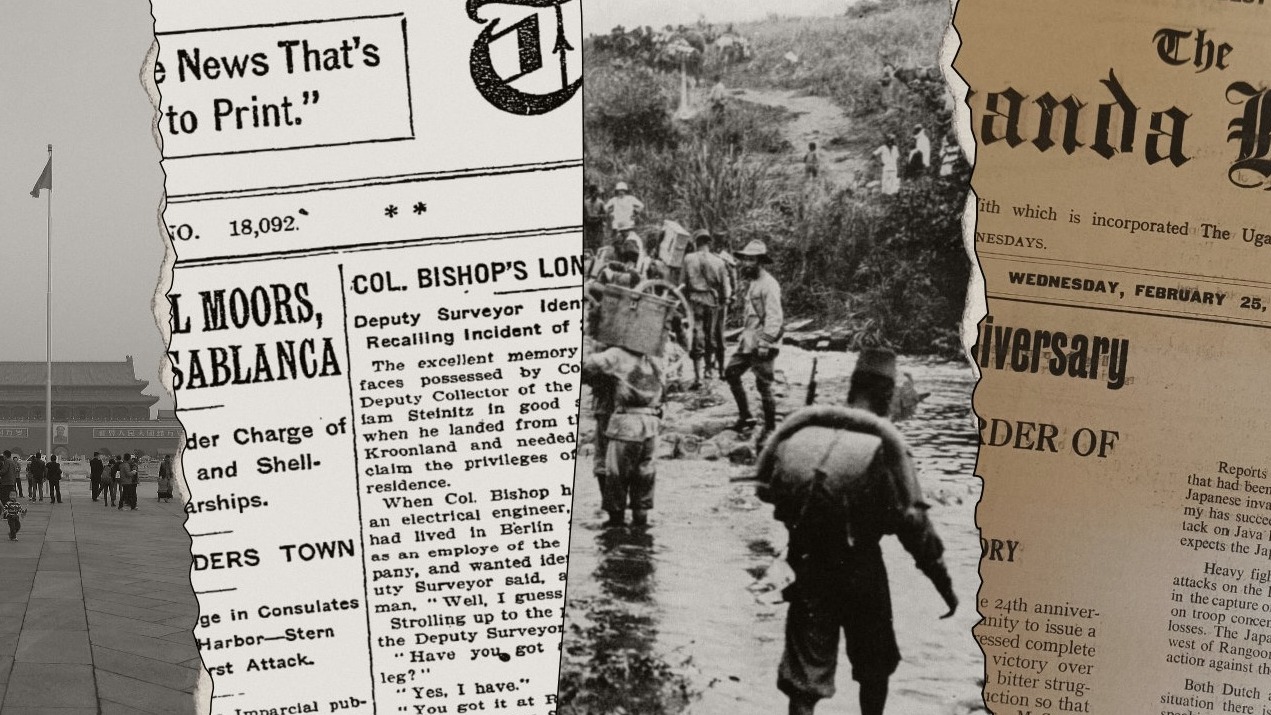
He was there in 1989 when the tanks rolled into Tiananmen Square, eventually co-winning a Pulitzer with his wife, also a Times journalist, for their coverage of the massacre. He was on the ground when Sudan descended into genocide and when Congo was riven by civil war. He has covered malaria in Cambodia, famine in Yemen, and the plight of dying mothers in Cameroon. In total, Kristof, who grew up in rural Oregon, has reported from more than 100 countries.

He has many accolades—two Pulitzers, a Harvard degree, and a Rhodes scholarship. But what I admire most about Kristof is not only his courage in traveling to some of the world’s most perilous places but also his unwavering faith in the power of writing to bend the arc of the moral universe toward justice.

A case in point: His investigation into the dark corners of Pornhub, in which videos of child rape and other forms of sexual assault were rampant, prompted widespread outcry and led to major changes in the site.

“Inconsistently, imperfectly, we can manage to drive change,” Kristof told me. “It doesn’t work as well as we would like. It’s often frustrating. But can one have an impact? Absolutely. And I think there are, in fact, few professions where one can have so much impact.”

In a phone call with Inkwell, Kristof discussed his pursuit of justice, how he maintains hope despite witnessing many tragedies, and his advice for young writers. The interview has been edited for length and clarity.

How did you carve out a beat focused on humanitarian causes and the pursuit of justice?

I went into journalism because I wanted to find some kind of larger purpose. But in the first few years, I floundered a little bit. When I first joined The New York Times, I was covering business, exchange rates, and oil prices. It was hard to find moral purpose there. But in 1989, I covered the Tiananmen Square massacre, and when you see a modern army use weapons of war against peaceful pro-democracy protesters, that really changes you. That pushed me much more toward covering human rights issues for the rest of my career. It also led me to cover some gender issues, including violence.

Then in the 2000s, I would come back from covering these overseas humanitarian crises to find that my home community in rural Oregon was going through its own humanitarian crisis. And so I began to write more about issues like addiction and the struggles of the working class. My generation entered journalism after Watergate. So we saw it as a genuine public service.

It’s been really inspiring to read these stories of yours and to see the impact they have. Sometimes, when you’re starting out as a journalist, it can feel like you’re writing into a void and there’s not really a tangible change that happens.

Well, it tends to be unpredictable. The story that had more impact than any other was one I wrote about global health at the beginning of 1997. I never imagined it would have any particular impact, and then it just happened that Bill and Melinda Gates were looking for a cause to invest their philanthropy in, and that New York Times article caught their eye. That was just a complete fluke and totally unpredictable.

I think there’s a misperception that if we write about topics that are on the agenda, the ones people are already talking about, that’s where we have impact. But I think we have the greatest impact where we play the gatekeeper role, shining our spotlight on issues that are not getting attention, thereby propelling them onto the agenda—whether that’s kids dying of diarrhea or Pornhub or human trafficking.

What does faith mean to you today and throughout your journalism career?

My dad was a Catholic and my mom was a Presbyterian, bridging their own divide. When I was a kid, I was dragged to both Mass and the Presbyterian service, and that felt like an overdose to me. So I’m much more skeptical in my own world of faith now.

But I’ve also tended to think that in journalism we under cover religion. Evangelical Christianity is a huge driver of politics, of social behaviors, and of family dynamics in America. And somewhere in journalism, we’ve been more intellectually curious about the faith of people in Afghanistan than the faith of people in Missouri. There are many times when I tear my hair out at evangelical behaviors, but I think there’s also been plenty of completely misdirected scorn from my secular liberal world to the evangelical world in a way that’s misplaced and inappropriate.

Would you say it’s important that there are Christians in newsrooms?

It is true that newsrooms are often disproportionately liberal, especially in social ways. There is a certain antagonism toward people of faith and especially evangelicals, which is one of the last kinds of discrimination acceptable in liberal circles. But I’m a deep believer that news outlets do a better job when they have more diverse journalists.

In the 1960s, news organizations floundered at covering Black neighborhoods because they didn’t have many Black reporters. My encouragement to Christians who are interested in journalism is that you may face challenges, but we need you. You may have a narrative advantage because you can cover faith communities in ways that many of your colleagues will not be able to.

You’ve reported on some horrific things, like genocide, human trafficking, and sexual exploitation. How do you write about these dark things while also maintaining hope in God and faith in the dignity of human beings?

So my memoir was titled . It seemed a little bit of a contradiction that I’ve had this long career chasing terrible things and emerged talking about hope. Part of it is that, side by side with the worst of humanity, you invariably find the very best.

I remember I was once in eastern Congo, which had the most lethal conflict since World War II, in an area where warlords had been attacking and all the Western groups had fled. The only aid worker left was a Polish nun, and she was single-handedly running an orphanage, an emergency feeding center, and keeping the warlord at bay. I was just awed by her courage. I felt like I wanted to sign up and be a Polish nun.

During the Rwandan genocide, the only American who stayed in the capital was this Seventh-day Adventist who was ordered out by his church, but he refused to leave. Every day, he risked his life trying to get people through checkpoints. He could have been killed repeatedly, but somehow he survived. He was a hero to those who knew of it, including the many Rwandans he’d saved.

What advice do you have for our Inkwell readers who are young writers trying to hone their craft?

Read writing that you admire, and read it carefully. Read it with this view: How did that person manage to drag me through this story? How did they do that lede? Where do they put their quotes? How did they manage to write such a good piece? And then write a lot.

Christopher Kuo is a writer based in New York City. His work has been published in The New York TimesThe Los Angeles TimesDuke Magazine, and elsewhere. 

Apple PodcastsDown ArrowDown ArrowDown Arrowarrow_left_altLeft ArrowLeft ArrowRight ArrowRight ArrowRight Arrowarrow_up_altUp ArrowUp ArrowAvailable at Amazoncaret-downCloseCloseEmailEmailExpandExpandExternalExternalFacebookfacebook-squareGiftGiftGooglegoogleGoogle KeephamburgerInstagraminstagram-squareLinkLinklinkedin-squareListenListenListenChristianity TodayCT Creative Studio Logologo_orgMegaphoneMenuMenupausePinterestPlayPlayPocketPodcastRSSRSSSaveSaveSaveSearchSearchsearchSpotifyStitcherTelegramTable of ContentsTable of Contentstwitter-squareWhatsAppXYouTubeYouTube