News

Afghan Christian Arrested Outside German Church

Mayor of Hamburg says religious communities cannot stand in the way of deportations.

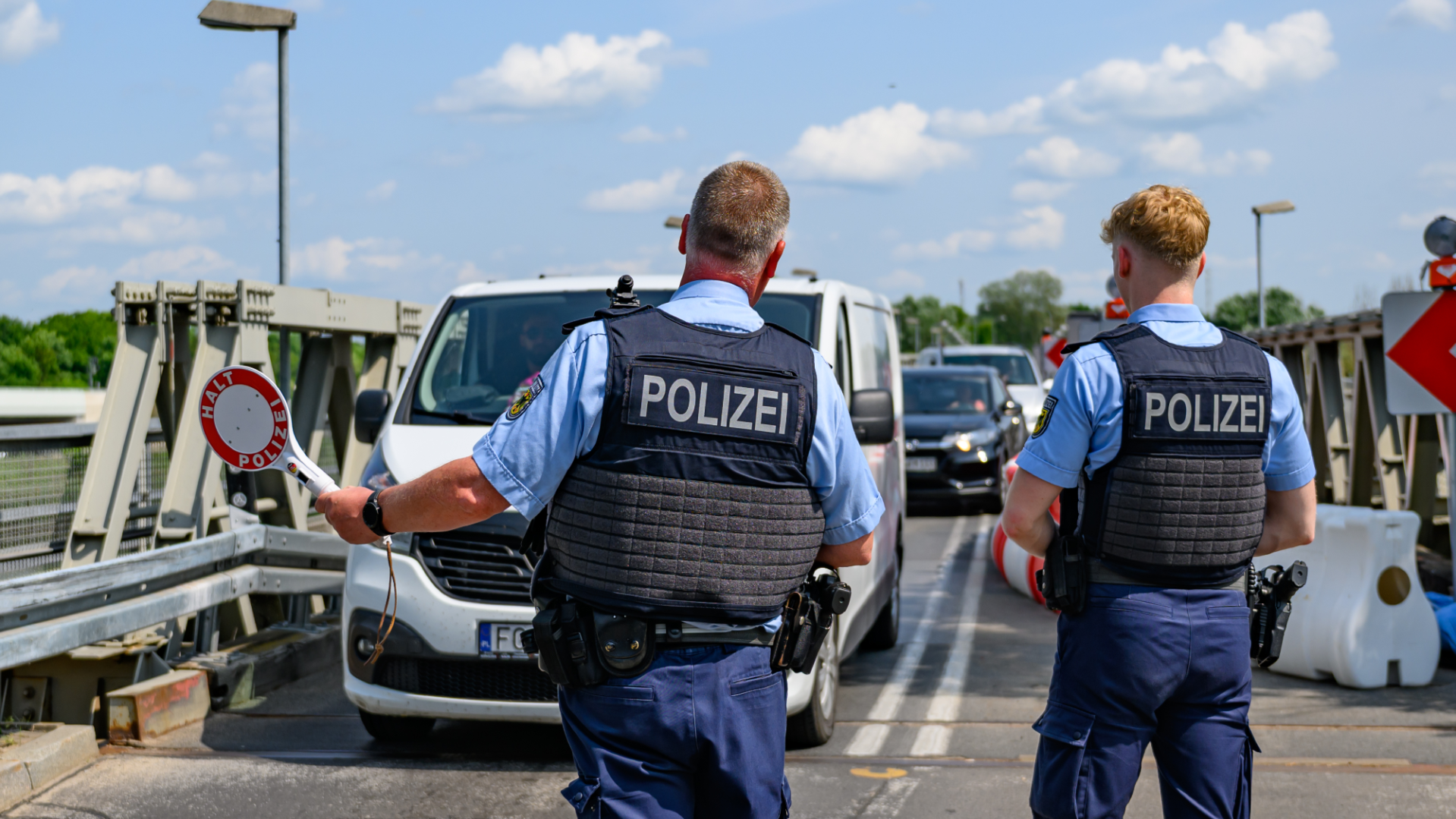
German police check cars for immigrants at the border
Christianity Today July 29, 2025
John MacDougall/AFP via Getty Images

Along the quiet, tree-lined streets and avenues of Berlin’s middle-class Steglitz district, police in plain clothes were staking out a church on Monday.

Their target: an Afghan man living in the basement of Trinity Evangelical Lutheran Church. 

The man didn’t know it, though, and “dared to go a few steps outside of the church on the sidewalk,” pastor Gottfried Martens told CT. The man was immediately arrested.

According to Martens, the man is a Christian convert who will face “immediate danger to life and limb” if he is deported back to Afghanistan. 

The congregation, which is part of the Selbständige Evangelisch-Lutherische Kirche (Independent Evangelical-Lutheran Church), a small denomination connected to Missouri Synod Lutherans in the United States, has welcomed hundreds of Farsi- and Dari-speaking refugees since 2011. According to Martens, many of them have become Christians, and the church is “committed to protecting converted Christians from deportation to their deaths.”

In recent days, that has become a contentious position in Germany.

For more than four decades, churches like Trinity have offered temporary sanctuary and shelter to refugees. Church asylum—Kirchenasyl—has no firm legal basis, but authorities have respected that limit on state power nonetheless. People in Germany commonly see the practice as an expression of long-held Christian and humanitarian values.

But as debates over immigration and asylum roil the country, the practice has become contentious again. Some political leaders are calling for police to go into churches and make arrests. 

On July 15, Hamburg’s mayor, Peter Tschentscher, a center-left Social Democrat, joined a chorus of voices calling the practice into question. In a sharply worded letter, originally reported by the Berliner Zeitung, to his Berlin counterpart, Kai Wegner, a center-right Christian Democrat, Tschentscher accused the Berlin city government of “systematic abuse of church asylum.” The mayor of Hamburg demanded four Afghan refugees currently under church asylum in Germany’s capital be arrested and sent to Hamburg and then to Sweden, where they first entered Europe. 

After processing in Sweden, the men could be deported to Afghanistan. The man staying at Trinity was one of the four named in the letter. 

Tschentscher claims that Hamburg is responsible for the men whose right to remain has already been reviewed and that it is “unacceptable” for churches to get in the way of legitimate government action. Numerous outlets reported the Hamburg Office for Migration had a search warrant in hand and had planned to enter the Berlin church but decided not to.

The number of deportations is on the rise across Germany. And Chancellor Friedrich Merz’s coalition government, which came into office in May, has promised to deport even more people. 

Meanwhile, the number of church asylees has increased significantly, especially in 2024. The Federal Office for Migration and Refugees (BAMF) reports 2,386 people sought asylum in churches last year, up from just 335 in 2020. A spokesperson for the German Protestant church said regional churches have reported a fourfold increase in requests. Government records already show 617 new cases in the first quarter of 2025.

Almost all these asylum seekers are “Dublin cases,” which means the migrants entered Germany from other countries and, according to EU law, are required to go through their asylum procedures in those countries.

Across Europe, some people have advocated stricter enforcement of this requirement, pressuring authorities across the continent to extradite people to their points of entry. 

At the same time, more leaders have argued for sharp limits on the number of refugees. The head of BAMF, Hans-Eckhard Sommer, even questioned whether asylum should be “an individual fundamental right,” as it is currently described in the German Constitution.

At Trinity in Berlin, Martens said the asylees are not a threat but a blessing. 

“We are grateful from the bottom of our hearts for the wonderful people whom Christ himself has led into our church and whom we may serve with our very limited means,” he told CT in 2020. “They will enrich our community and church in the future.” 

He has been continually frustrated—and flabbergasted—at how often the government denies asylum to Christians. Authorities frequently conclude that persecution is not a real threat, despite pressure and threats from family, friends, and the state in their countries of origin. Instead, courts often decide that converts are not really converts but are just trying to find an easy way to stay in Germany, despite church leaders’ testimony to the contrary. 

Martens has personally attested the veracity of the faith of many asylum seekers, only to see the government disregard what he has to say.

“Politicians repeatedly focus their deportation efforts on converted Christian refugees,” he said.

For now, however, Martens has the support of some important politicians in Berlin. Mayor Kai Wegner rejected the mayor of Hamburg’s demands, taking issue with the tone of his counterpart’s letter and standing up for the sanctity of church sanctuaries.

Trinity has some support from Christian leaders as well. Berlin’s Protestant bishop Christian Stäblein has defended the practice of church asylum in general, calling it “a service to society, which is thereby reminded of its foundation of mercy.”

And Martens’s bishop, Hans-Jörg Voigt, stands firmly behind him. 

“The basic question is simple: Can we force baptized people converted to the Christian faith to return to a country ruled by an Islamist?” Voigt said. “Anyone who answers this question with ‘yes’ must of course find a way before his conscience to deal with the fact that these Christians, who have fallen away from Islam in Afghanistan, are expecting death with a probability bordering on certainty.”

Voigt is convinced of the seriousness of the asylees’ conversions. The Berlin church requires a rigorous three-month theology course and an exam before baptism. A third of the asylum seekers who take it do not pass. 

For now, Martens is doing everything he can to protect the baptized men living in Trinity’s basement. With police officers stationed around his parish ready to grab them, he said the storm is far from over. 

“We are still in the middle of a tornado,” he said. 

News

Venezuelan Churches Divided Over March for Jesus Rescheduling

The shift of the event from October to August, ordered by Nicolás Maduro, sparked concern in Christian circles.

An October calendar ripped in half to show an August calendar.
Christianity Today July 29, 2025
Illustration by Elizabeth Kaye / Source Images: Getty

It was never about politics. 

Aristóteles López just wanted Venezuela’s evangelicals to have a public presence. And for years, he provided the space for that. 

From 2004 to 2020, López organized his country’s Marcha para Jesus, obtaining permits and booking speakers for the event, which drew thousands of Christians from across Venezuela to the streets of Caracas each October. 

Ever since Hugo Chavéz came to power in 1999, his supporters and opponents frequently protested, at times violently. Evangelical leaders didn’t seem to be interested in politics at the time; they just wanted an opportunity to publicly pray for a country increasingly divided between socialism and capitalism. 

In April 2004, López, then a youth leader in his local church, met with pastors and ministry leaders at a five-star hotel in Caracas. On the agenda: bringing together the numerous rallies evangelicals were organizing across the country into a single March for Jesus. 

López spent the next several months making phone calls, giving sermons, and organizing meetings with church leaders around the country. On October 12 of that year, his work paid off.

“When the authorities saw that we managed to gather more than 30,000 people on the streets of Caracas in 2012, they wondered who was behind the March for Jesus,” said López. “They accused us of having soldiers and opponents involved, but that was never the case. The march was always characterized by being politically neutral.”

More than 20 years later, evangelicals are still marching. But this year, President Nicolás Maduro—who has been in power since Chávez’s death in 2013—may be attending. At the country’s inaugural National Pastor’s Day in January, while holding hands in unity with the new march organizer, pastor Hugo Díaz, the president announced that he had moved the event to August 2.    

Meanwhile, López will be watching the event from Florida. In 2017, he fled the country after learning that Maduro’s people had plotted to assassinate him. 

A display of unity

At the beginning, Venezuela’s Marcha para Jesus was an expression of unity among Christians. Participants included descendents of Lutherans and Anglicans who arrived in Venezuela in the 1700s, converts of 20th-century American missionaries, and Pentecostals, whose numbers began to skyrocket in the second half of the 20th century. The march even attracted Catholics. 

“I remember one time a nun joined us, marching in her vestments and her rosary and holding a lit candle,” said López. 

By the time López organized his first event, other countries had been holding marches for Jesus for over 15 years; YWAM (Youth With A Mission) organized the inaugural event in London in 1987. 

For years, Venezuela’s march continued to grow, peaking in 2012 when 30,000 filled Libertador Avenue in Caracas. In 2013, Chavez died and Maduro became president, a transition that initially had little effect on the event, which continued to draw thousands of people each October. 

In 2017, López was in Brazil as part of the organizing group of the March for Jesus in Rio de Janeiro when he learned of a plan by the Chavista colectivos—militias that supported Chávez and joined Maduro’s government, harassing everyone they identify as opposition—to attack him and pass it off as an attempted robbery. “Some people have called me a coward for leaving Venezuela like that. But I had to save my wife and children, because as a pastor I know that my first ministry is my family.” 

López continued to organize the march from Miami for several years. But in 2020, he stepped down, and Díaz, the ministry’s accountant and the pastor of the Casa de Vida church in Caracas, took over. 

In his years leading the organization, Díaz has publicly supported the Maduro government, including attending events promoting the Mi Iglesia Bien Equipada program, where the government gives out sound equipment, chairs, or construction material to churches. (As CT reported, political analysts and evangelical leaders perceived this as a government effort to win votes among the country’s growing evangelical population). 

Although it is difficult to gauge how much evangelical support Maduro currently enjoys, these overtures divided the church. On one side are the pastors who accept government aid without showing remorse; on the other, those who avoid receiving this aid or attending religious events organized by the government so they can avoid losing independence.

Díaz’s support of Maduro has seemingly helped the evangelical community cultivate the president’s favor. At the same January meeting where Maduro announced the new date for the march, he also declared it a Patrimonio Inmaterial y Espiritual de la Nación (Intangible Cultural and Spiritual Heritage).

The Consejo Evangélico de Venezuela (CEV, Evangelical Council of Venezuela), though, rebuked Díaz’s decision to invite Maduro to the inaugural National Pastor’s Day and present him with a Bible.   

“We believe in the separation between church and state but also in the civic responsibility of Christians. We do not believe in impositions or initiatives that may be perceived as an attempt to control or manipulate the faith, or serve the promotion of individuals,” said Jose Piñeros, the CEV’s executive director. 

Piñeros recently conducted an extensive interview with Hugo Díaz, where he allowed Díaz to justify the growing government support of Nicolás Maduro for the March for Jesus. 

“We Christians did not lose the date of October 12 when the march moved to the first Saturday of August,” Díaz stated in the interview. “We have gained an additional date, because on October 12 we will declare a national day of fasting and prayer.” 

More than a date change

Maduro’s decision to change the March for Jesus date from October 12 to the first Saturday of August means that evangelicals will no longer be marching on a day when spiritualists celebrate their goddess María Lionza, one of the central figures of the occult arts in the South American country. For years, the Venezuelan Federation of Spiritism, a group of 7,000 members, has organized an annual conference for witches, shamans, and fortune tellers.

Pastor Georges Doumat, who heads the Christian church Apostolic and Prophetic Ministry of the Most High God on Isla Margarita, knows the power of this federation. This touristy locale in the Caribbean, full of luxury hotels, was chosen to host the first national meeting of the Venezuelan Federation of Spiritism last March.  

Aware of the spiritual struggle the country experiences around October 12, Doumat published an opinion column where he explains why it was a mistake to agree to move the March for Jesus to the first Saturday in August.

“The date chosen by ‘March for Jesus’ in Venezuela was well-intentioned. It was like a double act: We filled the streets and avenues of the cities with our prayers, praises, and slogans of faith, and at the same time we faced the satanic movement of groups that invoked their deities that same day,” wrote Pastor Doumat. 

López agrees with Doumat and hopes that this October 12 the evangelicals will go out to march for Jesus as they have been doing nationally since 2004. 

“Hugo says that we did not lose October 12 but that we gained another date on August 2,” said López, obviously upset. “No, no, no. You gave it up on October 12. You left it on a silver platter to these people, to those witches. They are allowing themselves to be manipulated by politicians and dividing rather than uniting the Christian people.”

Hernán Restrepo is a Colombian journalist who lives in Bogotá. Since 2021, he has managed the social media accounts of Christianity Today in Spanish.

News

Billy Graham Evangelistic Association Preps for More European Court Battles

Defense fund will support Christians suing over freedom of speech and freedom of religion.

Franklin Graham preaches in Germany
Christianity Today July 29, 2025
Ying Tang/NurPhoto via Getty Images

The Billy Graham Evangelistic Association (BGEA) is calling it the “war chest.”

The evangelistic association headed by Franklin Graham has a legal fund, started with the damages it won in lawsuits against seven venues in the United Kingdom that canceled BGEA events in 2020. That fund has now grown to $1.25 million, partly due to an influx of cash from Samaritan’s Purse, the humanitarian organization also run by Franklin Graham. The money will help conservative Christians in Europe going to court in freedom-of-speech and freedom-of-religion cases. 

“Considering what is happening in wider Europe,” BGEA general counsel Justin Arnot told CT, “it seemed appropriate to make this assistance available to Christians across the continent.”

Without a war chest and a smart legal strategy, Arnot said Christians are in danger of losing the right to share the gospel in Europe. The BGEA and other conservative groups are afraid that widespread cultural opposition, especially on issues of sexuality and ethics—and new regulation on speech deemed hateful, harmful, or misleading—will erode people’s ability to condemn sin and preach Scripture. 

To date, Christians have won a remarkable series of legal victories in Europe. Graham triumphed in his lawsuits. Activists upset by his past comments on LGBTQ people (“the enemy”) and Islam (“an evil and very wicked religion”) successfully pressured stadiums, conference halls, and theaters to cancel BGEA events, despite signed contracts. The seaside city of Blackpool, England, pulled ads from city buses, citing community complaints and “heightened tension.” Then in 2021, British courts said that was religious discrimination and not allowed under the UK Human Rights Act or the European Convention on Human Rights.

Minister Olaf Latzel triumphed in Germany in 2022, when a court ruled that his comments about homosexuality and LGBTQ people in a church marriage seminar were “strange” and “more than alienating” but not hate speech. He was acquitted on all charges.

A conservative politician and a church leader won in Finland the same year, when a court ruled that the things they said about homosexuality were “offensive, but not hate speech.” The judges found that parliamentarian Päivi Räsänen and Juhana Pohjola, a bishop with the Evangelical Lutheran Mission Diocese of Finland, were not trying to incite hatred but attempting to explain their views of Scripture. According to the court, that is allowed under Finnish and European law, even if people feel denigrated by the particular biblical interpretation. 

Prosecutors appealed, and the case went to trial again in 2023. Räsänen and Pohjola won a second time. Now the case is with Finland’s Supreme Court. 

Yet many conservatives in Europe and the US are concerned about what they see as weakening support for freedom of speech and freedom of religion. In a speech in Munich in February, for example, US vice president JD Vance warned about Europe’s “backslide away from conscience rights” and “retreat … from some of its most fundamental values.”

On the other side of the political spectrum, LGBTQ- and abortion-rights advocates are also sounding the alarm about loss of freedom. But they blame conservative Christian groups, including the BGEA and Alliance Defending Freedom (ADF) International.

Neil Datta, executive director of the European Parliamentary Forum for Sexual and Reproductive Rights, said Christian groups have pushed for and funded debates about abortion access and LGBTQ rights in an attempt to roll back human rights and win power for far-right political parties.

“The scale of financial resources, international coordination, and political integration … is unprecedented,” Datta wrote. “Pushback against decades of progress in gender equality and sexual and reproductive health and rights is at the centre of the far-right’s strategy for gaining power across Europe.” Datta pointed to countries like Poland, Hungary, Slovakia, and Italy, where rollbacks on abortion access and LGBTQ rights have prompted concern from members of the EU parliament.

Datta points to the Vision Network as a critical hub in the coordination of this conservative agenda. The group, co-led by ADF International’s director of strategic relations Sophia Kuby, connects a wide variety of groups and helps them develop legislative and legal strategies around sexuality, abortion, marriage, or access to contraception.

One of those strategies, according to Datta, is to set up “designed provocations to generate a reaction which can then be adjudicated in the courts.”

Datta pointed to debates over UK laws that create buffer zones around abortion clinics in response to Christians’ protests in the form of silent prayer and candlelit vigils. Datta said the zones are necessary to curtail coercion in the guise of religious ritual. ADF International, however, claims prayer is being criminalized and freedom of religion is under threat. The organization is fighting a series of cases related to buffer-zone breaches.

Political scientist Andrea Hatcher, whose research focuses on evangelicals in the UK, said the Christian right doesn’t have the numbers to support a political movement in Europe. Electoral victories, in most places, would be impossible. Court battles, however, can be one way of broadening support. 

“Framing their efforts … as ‘free speech’ is a strategic appeal to a wider, secular audience,” Hatcher said. And each lawsuit leads to more connections with more sympathizers and “well-funded global Christian nationalists.”

The Christian groups taking their cases to court dispute many of these characterizations, of course, and reject the conspiratorial framing. But they do acknowledge they’ve had more victories in court than at the ballot box. And the fight for freedom of speech has been more successful, in recent years, than the fight for the issues that conservative Christians speak about.

“Our work on things like abortion was more and more difficult within institutions that are deeply biased and influenced by the ideological control of our opponents,” said Grégor Puppinck, head of the European Centre for Law and Justice, a Christian conservative think tank. “We must fight to try and help Christians to express themselves … within societies that are increasingly hostile to our values.”

Felix Boellmann, head of ADF’s European advocacy efforts, said the emphasis on litigation is also a response to changing legislation. He pointed to the Digital Services Act, which the EU passed in 2022. Supporters say the law, which regulates online platforms, is critical for tackling “disinformation” and “hate speech.” But the implementation has set the stage for widespread censorship, Boellmann said. 

The result, he said, “will be a tightly controlled internet where the free exchange of ideas is stifled.”

That’s not just bad for conservatives, according to Boellman. It’s bad for all of Europe. “Without open debate you cannot have a free democratic society,” he said.

The BGEA’s defense fund, with its $1.25 million “war chest,” may have a far-reaching impact on European law and politics. The BGEA, however, says the real goal is just making sure that Christians have no restrictions sharing the gospel.

“We know that true hope can only be found in Jesus Christ,” Graham said when the fund was first announced in 2024, “so we need to support one another in getting the good news of Jesus Christ out, whatever it takes.”

Church Life

Pastors Aren’t Politicians

I only talk politics when it helps me attend to deeper concerns among those I serve.

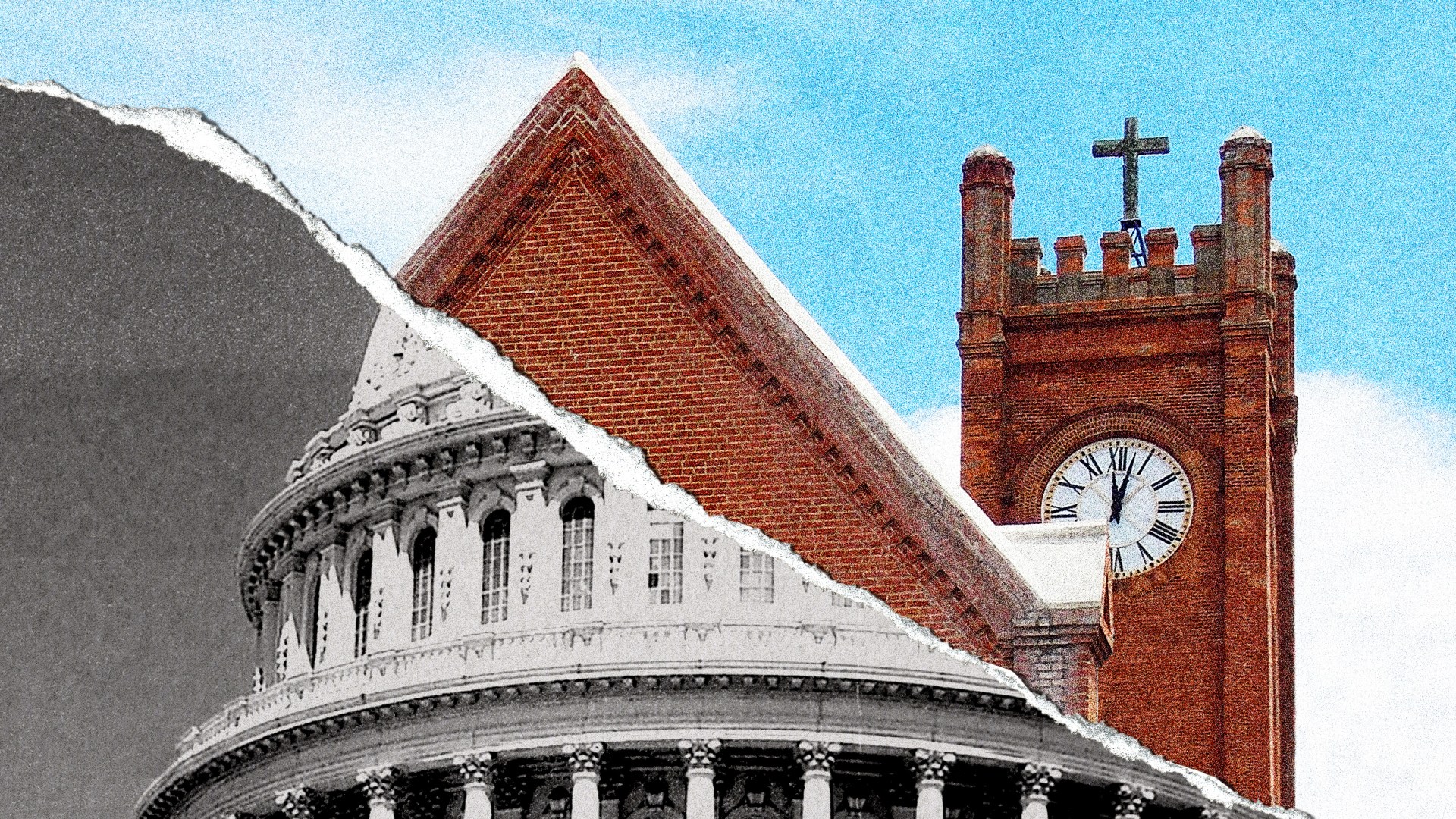
A black and white image of the Capitol building torn away to show a brightly colored photo of a church building.
Christianity Today July 28, 2025
Illustration by Elizabeth Kaye / Source Images: Wikimedia Commons

People want to talk to me about politics. 

These conversations often come out of nowhere—or at least feel like they do. I’m a pastor at a church in the downtown neighborhood of a midsize city, and there are reliably people living on the sidewalk on my way to work. Some are asleep, others peddling, still others in line for a meal. My collar marks me as a member of the clergy, so when they approach me, it’s usually for prayer or practical help.

That’s what I was expecting when a man called me over last fall, soon after Donald Trump had been reelected. “It’s really good versus evil,” he told me, a smile on his face, “and after years of God’s punishment under Joe Biden, we finally have a godly president again.” 

I was surprised but went with it. “Do you think this will make your life better?” I asked. 

“Yeah!” he said. “Trump’s all about freedom and standing up for Christians. We’ll stop being persecuted.”

That wasn’t the only unexpected plunge into political talk I took in that season. In many conversations, more well-to-do folks expressed to me their dread and anxiety over a new Trump administration. They saw his reelection as an existential threat, and perhaps they guessed that as a Canadian living in Texas, I’d be likely to agree. 

They’re right that there’s a lot happening with this administration that worries me. And I certainly don’t deny the real-life import of tariffs, religious liberty law, border enforcement, or any other policy concern.

But I’ve also come to see that when a conversation turns so suddenly and unexpectedly to politics, it’s often about some underlying fear, something far removed from the people and policies in Washington. We project our griefs and frustrations onto political figures and events as a way to talk about our worries without really talking about them. 

In a later conversation with the man near my church, he told me someone had stolen from his encampment. He had so little to begin with and now had even less, and he particularly felt the injustice of it because, he told me, he’d never stolen anything. He felt sad, angry, almost persecuted.

And in those middle-class conversations, if I listen long enough, we’ll sometimes make it beyond politics to something else, like teenage or adult children who have left the church, or a frustration with ugly comments overheard from a neighbor, or ways their churches have changed or declined. 

There are more pressing matters below the surface, but it can feel as if politics is the only conversation we’re allowed to have. Politics is everywhere all the time, and watching the news, reading the news, scrolling through the news—all of it—is a constant drip of anxiety, uncertainty, dread. How do we get past this permissible but miserable conversation to our real troubles?

I’ve decided to put my head in the sand. I’m choosing to be willfully ignorant. When someone talks to me about politics, I don’t have much to contribute, and this tends to move the conversation along to where it ought to go anyway. My hope (and, so far, my experience) is that is averting my sight from the spectacle of political life can open my ears to the hidden concerns of my friends and neighbors.

I recognize I have the luxury to do this. I am a normie. I don’t have a career in politics. I am not working on legislation. As a Canadian, I can’t even vote in federal US elections. My job is not on the line as the president makes sweeping policy changes. I am not afraid for myself or my family. I lead a little life. 

Yet honestly, what good would my attention do? Given the complexity of American life and government, given the sheer vastness of this country, very few people have the ability or resources to make a big difference. For me to hang on every word of the president and his team and his rivals is futile, a waste of mental energy. The possibility that some new legislation or executive order could drastically change my life or the lives of my parishioners is real, but my focused attention has no power to attenuate misfortune that might befall us.

I am not a fundamentalist about this. I still live in the world. I notice headlines. I hear—roughly—what’s going on. 

But I have responsibilities in the real world, in my home and my church. I have a wife and children who need me. We’ve planted a garden. I cook meals and clean up and put my children to bed. I have books to read. I meet with my friends and parishioners to drink coffee and talk. I have lost nothing but anxiety by letting go of the constant pull of political life. It’s no longer dragging me along.

What’s more, my vocation as a priest is not to tell people what I think about politics. They don’t care. It doesn’t help them. What do I know anyway?

Pastors are sometimes advised to “preach with the Bible in one hand and the newspaper in the other,” a quote (probably spuriously) attributed to the theologian Karl Barth. I think this is bad advice. For most Christians in America most of the time, what’s happening in Washington, DC, is not terribly relevant to the daily challenges of living in faith, hope, and love. For most of us, far from the halls of power, politics is but a specter that haunts real life. 

But the Bible is real life. The local church is real life. The people with whom I speak and visit and pray, they are real life. 

That tangible connection determines when I do have to pay attention to politics: when it begins to harm people under my care. And then my role is to help them as best I can. Sure, this involves telling the truth. But more often it involves listening, praying, and helping in practical ways.

Since I stopped paying attention to politics, people still want to talk to me about it. But the conversations go differently now. As Justin Vernon croons in Bon Iver’s new album SABLE, fABLE, “I see things behind things behind things.” I am learning how fears of mortality, worries about the future, and grief over loss can present themselves as political outrage or enthusiasm.

I know that I risk being wrong about everything. But who doesn’t? I ask myself whether this approach is pastoral wisdom or dangerous acquiescence. But I can tell you that it’s bearing good fruit. I have work to do here in this city with the people I know and care about. This is what should be taking my attention, energy, and time.

When the Russian author and dissident Aleksandr Solzhenitsyn was being carted from one gulag to another, he would catch snatches of freedom. In a train station once, he heard people complaining about their jobs, their neighbors, their petty concerns, and all the while swaths of the population were dying or trying not to die in prison. 

He could see there was no way to convey to the free how good their lives were. He didn’t want to cajole or criticize them for not attending to the grave misfortune around them. Nor did he want them to focus less on what was immediately in front of them. Rather, he wished they would be even more intensely focused on life itself and the relationships that sustain it.

“What about the main thing in life, all its riddles?” he asked. And his answer: 

Do not pursue what is illusory—property and position: all that is gained at the expense of your nerves decade after decade, and is confiscated in one fell night. Live with a steady superiority over life—don’t be afraid of misfortune, and do not yearn after happiness; it is, after all, all the same: the bitter doesn’t last forever, and the sweet never fills the cup to overflowing. 

Whatever happens in this presidential term or any term to come, I will still have a family to care for and a church to serve. Even these things are ephemeral. But they are the responsibilities God has given to me. I’m putting on blinders about everything else so I can better see the people in front of me.

Cole Hartin is an Anglican priest serving in Tyler, Texas, and a fellow at the Center for Pastor Theologians.

Theology

To Know Christ, Use Your Sense of Smell

Mary pouring nard on Jesus’ feet isn’t only about extravagant worship.

A person smelling perfume on feet
Christianity Today July 28, 2025
Illustration by Mallory Rentsch Tlapek

Even half asleep at night, I knew when we had reached my grandparents’ house in a rural village in Pyeongtaek, South Korea. I didn’t need to see the gate or hear their voices. The smell of the house, ripe with the memories of summers spent with my grandparents, already told me.

The wardrobe in their bedroom, just past the kitchen and always a little dark, exhaled the scent of warm wood and old drawers, marked by a serene hush. Outside, the wind blew the smell of rice fields—damp, grassy, and faintly sour in the summer heat—through the windows and into the warm, clay-packed floors.

Similar to how I immediately associate these scents with my grandparents’ home, one passage in the Bible illustrates how scent is central to knowing Christ. In John 12, Mary bends low, breaks open a jar, and pours. She does not call Jesus “Lord” or “Rabbi,” and she offers no explanation for her actions. The apostle John simply writes this line: “And the house was filled with the fragrance of the perfume” (v. 3).

Christians today may read this line without recognizing its importance. But when John says that the fragrance filled the house, the detail ought to linger in our imaginations.

Why does this moment feel so vivid, so emotionally charged, even 2,000 years later? John is making a claim: Jesus has just been recognized for who he is, and that recognition has transformed the space. The scent signifies Jesus’ divine presence in a way that is physical, olfactory, and unmistakable.

Here, the scent testifies to who Christ is, like the incense-filled tabernacle that illustrated God’s presence in the Old Testament. To know Christ—to encounter him and be utterly transformed by his presence—does not merely involve intellectual assent. It involves allowing every sphere of our lives to be permeated by Christ and living in a way that spreads “the aroma of the knowledge of him everywhere” (2 Cor. 2:14).

Unlike other moments in Jesus’ ministry, this scene unfolds without divine voices or miraculous signs. No one trembles, no cloud descends, no dove appears. There is no sound from heaven, no confession from Peter, no healing to report.

There is, instead, the smell of an overwhelmingly rich fragrance.

In this passage, knowing Jesus comes not by way of word but by way of smell. Fragrance, rather than doctrinal revelation, becomes the medium of recognition.

Nard was not the kind of scent that floated lightly in the air, like lavender or citrus. It was heavier: A mix of sweet earth, warm wood, and the sharpness of spice, reminiscent of ginger or galangal.

The Roman writer Pliny the Elder described nard as sweet and musty, like damp wood after rain. Dioscorides, a Greek physician, said the best kind of nard has a smell that clings to you, stays in your skin, and lingers long after the jar is empty.

But not all nard was this lovely. Some types, especially the ones that grew in the wet lowlands near the Ganges River, had a sour, almost rotten smell, Dioscorides observed. Traders knew to avoid batches mixed with weeds, which smelled like goats.

The best kind, the one Mary likely used, came from high mountain slopes, where the plant grew slow and strong, its roots soaking in sun and thin air.

John saying that “the house was filled” (eplērōthē in Greek) with the smell of nard echoes the language the Septuagint uses to describe the times God’s glory filled the tabernacle and temple (Ex. 40:34; 1 Kings 8:10–11). The scent filling the house may echo the glory that fills God’s house at its consecration, American theologian Craig Keener suggests.

While John does not explicitly draw on these Old Testament temple narratives, the shared vocabulary in these passages highlights how a space can be wholly permeated by something that illustrates divine presence.

Jewish historian Josephus vividly captures a similar scene at Solomon’s temple dedication, describing incense saturating the air and signaling God’s presence:

Burning an immense quantity of incense … the very air [itself everywhere] round about was so full of these odours, that it met … persons at a great distance; and was an indication of God’s presence: and … of his habitation with them in this newly built and consecrated place, for they did not grow weary either of singing hymns, or of dancing, until they came to the temple.

In John 12, scent quietly affirms an indisputable truth: Something sacred now fills this space.

So when John writes that Lazarus’s house was filled with fragrance, he may be doing more than describing its atmosphere. Here, we witness how Christ can be recognized—and glorified—through scent. The smell of nard would not just linger in the air but impress itself on those present, becoming part of how they remembered this seminal moment—and Jesus.

Not everyone receives the fragrance the same way. One person speaks up, not to name the scent but to question its worth. Judas responds not to the act itself but to the excess of the aroma. He turns to cost. He detects waste.

Judas objects: “Why wasn’t this perfume sold and the money given to the poor? It was worth a year’s wages” (John 12:5). The gospel clarifies that Judas spoke not out of care but out of greed (v. 6). His inability to perceive the meaning of Mary’s act reveals the blindness that often accompanies a utilitarian view of gestures of recognition.

In the cultural imagination of the first century, Mary marks Jesus with a fragrance that signifies both burial and honor. Her act resonates with John’s narrative: Death awaits Jesus, and the scent already affirms his worth.

As Susan Ashbrook Harvey, a professor of history and religion at Brown University, writes in Scenting Salvation, “To smell that odor was to gain the knowledge it contained.” In the ancient Mediterranean world, scent was more than sensation. Fragrance could reveal something of a person’s very nature.

Early Christians came to see smell not just as atmosphere but as a way of knowing, Harvey writes. To encounter a fragrance was, in some cases, to encounter presence. And that presence reveals something about oneself in return. 

Today, we tend to trust what we can explain: what is clear, logical, and stated. We seek doctrine we can categorize and truths we can name. But the living Christ is not a concept to master. He is a person to know and to follow.

The Book of John does not tell us what Mary knew about Jesus, only what she did in his presence. Perhaps that is the point this passage wants to highlight: We say we know who Jesus is, but if that knowing never bears fruit in us—no change, no humility, no costly love—was it truly knowledge at all?

Like the early church, we can harness our sense of smell as a way of knowing Christ intimately. That does not mean that we break open a bottle of our most expensive perfume at church or concoct a special Lord’s Day fragrance for the sanctuary. Rather, we deepen our knowledge of Christ through becoming people who exude his aroma (2 Cor. 2:15). 

Those who love Jesus do not always need to use words. His presence lingers in them, a fragrance that emerges not through ritual smoke but through lives thoroughly shaped by the enduring imprint of knowing Jesus.

Such an aroma is not loud, but it is unmistakable. It smells of mercy, not moral superiority; of humility, not self-righteousness; of love that acts, not merely a voice that speaks. In a world wary of religious pretense, the aroma of Christ is not an argument but a witness, quiet evidence that grace has passed this way.

Faithful witness may not always come in sermons or syllogisms. Sometimes, it comes through a life that quietly bears the fragrance of having known Jesus—like the scent that filled a house and said what no one else could. Like the aroma of Christ: quiet and persistent, a grace that speaks before language and stays after everything else fades.

We get whiffs of the aroma of Christ when we “hold our convictions with confidence and compassion while avoiding the trap of treating every disagreement like a battle to win” in conversations with other believers online, writes Chris Butler from the Center for Christianity & Public Life for CT. Or when we stop asking, “What can I get out of this faith?” and begin to wonder, “What story have I been invited into?” The gospel, after all, is centered on God in Jesus Christ, not on ourselves and what we can gain from God, theologian Andrew Torrance writes for CT.

The aroma of Christ is not something we manufacture. It rises when we forget to be impressive, when we stop trying to win at faith and simply return, again and again, to the Person whom the story is about.

Even now, the smell of my grandparents’ house in South Korea returns to me with startling clarity. The comforting scent of warm wood, sunlit rice fields, and clay floors gently told me what no words ever did: You are safe. You are home.

In some small and sacred way, that is what the fragrance of Christ does still, in John 12 and in these ordinary days. It tells us that he is with us always, to the very end of the age (Matt 28:20).

Bohye Kim teaches biblical studies as an adjunct professor at Paul Quinn College and is a researcher at the H. Milton Haggard Center for New Testament Textual Studies. 

News

As Drugs Slam Nigeria, Christians Push Back

How one ex-addict created a haven.

A man smokes marijuana in Lagos, Nigeria.

A man smokes marijuana in Nigeria.

Christianity Today July 28, 2025
Pius Utomi Ekpei / Getty

Behind a dense bush near Biraidu Community Secondary School in Abocho, Nigeria, students smoked marijuana. One was Samson Ocholi. He was 19.

Ocholi grew up in a devout Christian home, learning Bible stories in Sunday school and serving in The Boys’ Brigade. High school changed everything. At 14, he fell in with friends who introduced him to cigarettes, then marijuana. “Then other things started creeping in,” Ocholi said. “Alcohol, tramadol, codeine, and Rohypnol. Each drug was opening a gate to another.”

Ocholi’s case is not unusual. A National Drug Law Enforcement Agency (NDLEA) survey revealed that 14 million Nigerians—from 15 to 64 years old—abuse drugs. According to a 2024 study, almost 14 percent of high school students in Lagos State have experimented with drugs, and half of those are current users. Governor Babajide Sanwo-Olu called the situation a “malignant cancer” and said, “It is disheartening to witness the spread of drug abuse among our youth, with its grip extending even to our innocent children.”

Nigeria’s NDLEA Act enforces “laws against the cultivation, processing, sale, trafficking and use of hard drugs.” Individuals convicted of using and trafficking these drugs face a sentence of anywhere from seven years to life in prison. But the NDLEA faces an uphill task, given the plentiful supply of drugs.

In 2023 the United Nations Office on Drugs and Crimes reported seizing 57 tons of cocaine on the way to West Africa from 2019 to 2022. The report named West African countries—Benin, Côte d’Ivoire, Ghana, Guinea, Guinea-Bissau, Nigeria, and Senegal—and Central Africa as emerging cocaine-trafficking hubs, with global cocaine production increasing by 35 percent from 2021 to 2022.

One drug common among young people is cheap, synthetic marijuana termed Colorado, locally called colos and sold in nightclubs, on street corners, and at pharmacies. Dealers face little interference from law enforcement.

A 2018 investigation exposed a syndicate fueling Nigeria with codeine, another drug commonly used—at the time, 3 million bottles were consumed daily in the north alone. The investigation showed corrupt pharmacists and distributors illegally selling codeine cough syrup—an addictive opioid—in open markets, bypassing regulations. The health ministry then banned the production and import of codeine-containing cough syrup.

In February 2025, theBBC Africa Eye’s documentary revealed that Aveo Pharmaceuticals, an Indian company, was illegally exporting unlicensed opioids like tapentadol to Nigeria, Ghana, and Côte d’Ivoire. The undercover investigation captured an Aveo director admitting the drug was harmful but saying business was his priority. India’s Food and Drug Administration has since raided the company’s Mumbai warehouse and seized its stock. 

“Everybody has a part to play in fighting most of these nefarious individuals that exploit vulnerable young ones,” said Kenneth Anetor, cofounder of A New Thing Worldwide. For ten years, Anetor’s antidrug nonprofit based in Abuja, Nigeria’s capital, has advocated improved government policies. He also counsels high school students against drug abuse. He acknowledges the societal damage of drug abuse, including the breakdown of families and marriages, but sees drug abuse as a public health challenge, not a moral issue.

For Samson Ocholi it is both. Ocholi entered a university in 2005 while using drugs: “I was no longer serious with my life. I tried several times to quit, but all of that was not working. I was losing my mind.”

A single summer night in 2016 altered Ocholi’s life. A drug dealer’s harsh words frustrated him. “He called me a fool, and that struck me,” Ocholi recalled. That night he cried out: “Oh my God, please, I think I’m tired, because this is not really satisfying. The more I want it, the more I get disgraced.”

Now 42-year-old Ocholi seeks to bring the gospel to those abusing drugs in Nigeria. Through Right Mind Homes, launched in 2021, he is building a community in Abuja for those seeking a drug-free life. His ministry is “for people willing to change,” he told CT. “They are tired, just as I was tired. I was looking for something to rescue me. I was looking for God to rescue me. That’s the kind of people I want to work with.”

At Right Mind Homes, currently housing six men aged 23 to 45, Ocholi seeks to transform their lives by anchoring them in biblical principles. Their days begin with morning devotions, fostering spiritual growth. Badminton, chess, Scrabble, and other activities promote mental and physical well-being.

Ocholi pours his heart into the Bible-based initiative, but it’s no easy road. Convincing a sceptical public is also tough—many see addiction as just a brain disease. But Ocholi believes it’s deeper, like idolatry—worshiping something destructive: “It hurts you and your family, but you don’t care.”

Books
Review

Who Is the Real Hero of ‘Paradise Lost?’

Alan Jacobs clarifies centuries of debate over John Milton’s epic retelling of the Fall.

Images from scenes in Paradise Lost.
Christianity Today July 25, 2025
Illustration by Elizabeth Kaye / Source Images: WikiMedia Commons

Christian life is rooted in a story with a specific plot. It begins with God’s creation of the world, builds with humanity’s fall from grace, climaxes in God’s redemption of the world through Christ, and resolves with the establishment of God’s eternal kingdom.

The stickiest of these plot points is the fall from grace: Why would a good God allow sin to enter the world? Why wouldn’t a powerful God stop Adam and Eve from eating of the Tree of Knowledge of Good and Evil? Why would an omniscient God create the tree in the first place? These are all variations on a question most people have asked at some point: If God is good, then why is there such evil in the world?

The English poet John Milton grappled with this question in his famous epic, Paradise Lost, first published in 1667. And Alan Jacobs grapples with the meaning and legacy of Milton’s landmark poem in his latest book, Paradise Lost: A Biography.

Jacobs, now based at Baylor University after teaching for decades at Wheaton College, is among the most important Christian scholars at work today. He has written extensively on C. S. Lewis and the poet W. H. Auden, and his essays on issues as varied as technology, theology, and the art of reading provide a consistent model of academically informed but broadly accessible prose. Those traits are on impressive display as Jacobs guides readers through Milton’s masterwork.

For many contemporary readers, diving into a complex work like Paradise Lost can seem like a forbidding prospect. Even a few lines in, both the language and the form itself can feel intimidating. In fact, the very idea of reading a 17th-century poem seems daunting. Thankfully, faithful Christian scholars like Jacobs can help us close the gap between old writings and our modern world.

In his 2020 book Breaking Bread with the Dead, Jacobs argues there is great value in reading books from outside our own era. It is inevitable, he contends, that people become prisoners of their moment, nearly incapable of imagining alternative ways of thinking and acting. One solution to this problem is exposing ourselves to writers and thinkers whose older customs, rituals, and cultural assumptions gave them different perspectives on the questions we share in common.

Jacobs’s “biography” of Paradise Lost puts that philosophy into practice. It might seem strange to write about a book or poem in the same manner as one would chronicle an individual human life. But if we conceive of books like Paradise Lost as works of art that outlive their authors, then it makes sense to think of them as having lives of their own.

In the first two chapters, Jacobs briefly describes the life and times of Milton and provides an overview of his most famous poem. The final four chapters tell the story of the poem’s reception, covering everything from initial reactions to its influence on contemporary fiction, films, and even video games. The result is an accessible and insightful guide that ultimately tells us as much about how the world has changed over the last 400 years as it does about the 400-year-old poem itself.

In his own time and in the years soon after his death, Milton was known mainly as a political radical, but within a century he was rivaling—and by some measures eclipsing—Shakespeare as England’s bard. Jacobs notes that Milton was memorialized in Westminster Abbey alongside two other English literary greats, Geoffrey Chaucer and Edmund Spenser, “three years before Shakespeare was thus acknowledged.” This drastic change in reputation, from troublemaker to versifier, can be ascribed almost entirely to Paradise Lost, Milton’s epic rendition of Satan’s revolt and its aftershocks in the Garden of Eden, where he successfully tempted our first parents to rebel against God as well.

Jacobs helps readers understand why it’s important that Milton chose to retell the story of Genesis 3 as an epic: “Any epic poem tells only a part, if the crucial part, of a larger story.” The Greek poet Homer, for instance, doesn’t tell the entire story of the Trojan War in the Iliad but only the final year of the decade-long saga. His audience would know the rest of the story and enjoy the deep dive into the nuances of one of its greatest chapters. Likewise, when you pick up Paradise Lost and read of humanity’s fall from grace, you’re reading an important part of a larger story—a detailed exploration of the characters and events that unleashed sin into the world and forever changed our relationship with our Creator.

Another central feature of the epic genre is that it typically focuses on a hero. Readers who know anything about Milton’s retelling of the Fall may also recall the judgment of the poet William Blake, who infamously argued that Milton was “of the Devil’s party without knowing it.” Following Blake, many poets and scholars have interpreted Satan as the hero of Paradise Lost. This view is now commonplace.

But if Satan is the hero of the Fall, the whole Christian story must be rewritten. By emphasizing Milton’s choice of epic as a genre and thus insisting that the poem be read in light of the larger Christian narrative, Jacobs challenges this prevailing view and restores the poem’s theological and devotional significance for 21st-century readers.

One way Jacobs arrives at a more compelling interpretation of Paradise Lost is by weaving the story of Milton’s transformation from political radical to poetic sage throughout his biography. Milton achieved the reputation of political firebrand by defending the 1649 execution of Charles I, who aroused the ire of England’s Parliament by asserting a divine right to rule. Milton became an apologist for regicide because of his passionate commitment to the principle of liberty, whether artistic, personal, political, or religious.

Milton’s central preoccupation, Jacobs tells us, was the legitimacy of the ruler. He believed the king who infringes on the God-given liberty of his subjects is an illegitimate king. Unfortunately for Milton, the English monarchy was eventually restored, little more than a decade after Charles was put to death. As a result, Milton lived the rest of his life as a political outcast, even imprisoned for a time.

When we read Paradise Lost—and especially the central conflict between God and Satan—in light of Milton’s life, interpreting Satan as the hero can make sense on the surface. One might say that Milton, a vocal opponent of authoritarian overreach, rejected the legitimacy of Charles I much as Satan rejected God’s right to rule. We might even identify with Satan when we consider the problem of evil raised above: If God could have prevented sin from entering the world, does he really deserve to sit on the throne of heaven with earth as his footstool?

Guiding us through centuries of interpretation, Jacobs helps us read Paradise Lost as Milton clearly intended. As one chapter in a longer story, humanity’s fall from grace is not evidence of God’s illegitimacy as king. Rather, it is a powerful justification of God’s love for his creation. It sets the stage for the next chapter: God’s redemption of the world through Christ. Make no mistake, Jacobs insists, the hero of the Christian narrative is Christ, the Son and the incarnation of the rightful king.

This central argument gets lost in many later interpretations of the poem, like those that mistake Satan as its hero—or others that picture Adam or Eve as the true protagonists. Some, like the literary critic William Empson, even bestow this status on Milton himself. (As Jacobs sums up this line of thought: Milton is “less wicked than the religion he professes,” but he “strives, with astonishing intelligence and artistic power, to make that religion seem less wicked than it is.”) Jacobs does an excellent job explaining these multifaceted, often contradictory readings of Paradise Lost while keeping the poem’s central argument in view.

I commend Paradise Lost to readers, along with Jacobs’s biography of this great work of poetic theology. While I’m at it, I encourage Christians to read Jacobs’s other books—in particular, his unofficial trilogy on reading, thinking, and learning, comprised of Breaking Bread with the Dead and two earlier volumes: The Pleasures of Reading in an Age of Distraction and How to Think. Together, they demonstrate how deep commitments to Christian Scripture and tradition can help us wrestle with voices from the past, as well as the voices that dominate our own contentious age.

Matthew Mullins is associate professor of English at Oklahoma Baptist University. He is the author of Enjoying the Bible: Literary Approaches to Loving the Scriptures.

News

Israeli Strike on Gaza Church Leaves Three Dead

“Everyone I talk to in Gaza from the Christian community asked me to find a way for them to get out.”

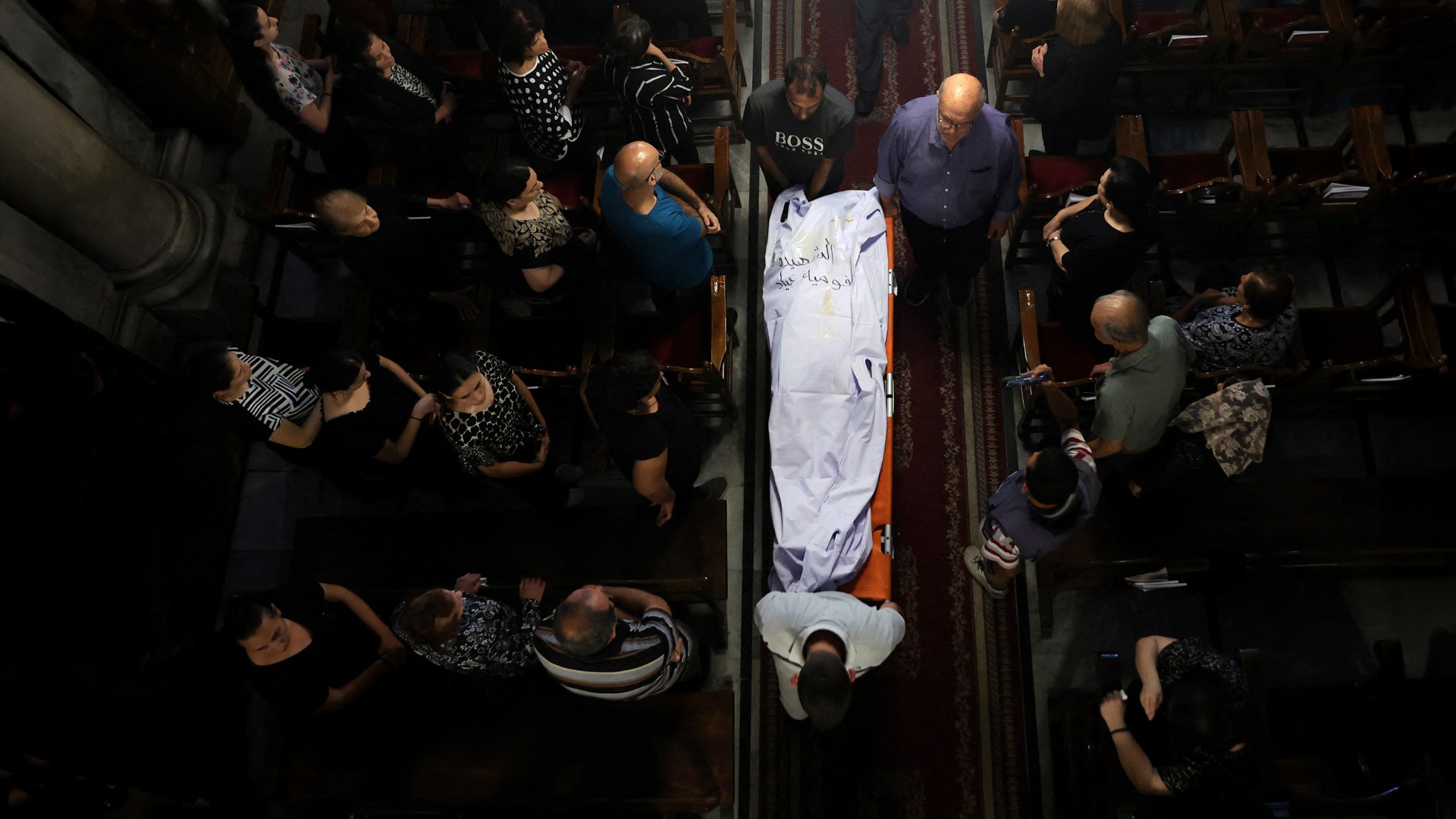
Christian Palestinian mourners attend the funeral ceremony of victims killed in an Israeli strike that hit the Holy Family Church in Gaza.

Christian Palestinian mourners attend the funeral ceremony of victims killed in an Israeli strike that hit the Holy Family Church in Gaza.

Christianity Today July 25, 2025
Omar Al-Qattaa / Getty

Hundreds of people were sheltering in the Gaza Strip’s only Catholic church last week when an Israeli strike on the complex killed 3 people and injured 12. Among the injured was the parish priest. 

The Holy Family Catholic Church in Gaza City is one of three operational churches in the coastal enclave and currently shelters about 600 people. More than 21 months of war have crippled the region and led to mass starvation, according to aid groups, as Israel continues its operation to dismantle Hamas’s grip on Gaza. 

Two patriarchs from Jerusalem, representing both Catholic and Greek Orthodox churches, made a rare visit to Gaza on Friday to express a “shared pastoral solicitude of the Churches of the Holy Land.” They are also organizing convoys of hundreds of tons of food and medical supplies, which have not yet been delivered to the compound. 

Fabrid Jubran, a spokesman for the Latin Patriarchate of Jerusalem, told Christianity Today that one of the injured from the church attack is in critical condition but that the church’s priest is doing fine. Among those who died were a man in a wheelchair and an elderly woman who was a retired teacher, according to Khalil Sayegh, a Palestinian Christian and political analyst who lived in Gaza until 2009.

The attack brings the number of war-related deaths among Christians in Gaza to at least 33, Sayegh said. The Christian population has roughly halved since the beginning of the war, dropping to between 600 and 700 people. “Everyone is scared,” he said. 

Israel claims the incident at the church was a mistake. A government-issued statement said, “Israel deeply regrets that a stray ammunition hit Gaza’s Holy Family Church. Every innocent life lost is a tragedy. We share the grief of the families and the faithful.” 

US president Donald Trump has pushed for a 60-day cease-fire between Israel and Hamas. On Monday, White House Press Secretary Karoline Leavitt said Trump was “caught off guard” by the strike on the Gaza church and “wants the killing to end, to negotiate a ceasefire in this region, and he wants to see all of the hostages released from Gaza.” 

The attack on the church came as US ambassador to Israel Mike Huckabee, an evangelical Christian and longtime supporter of Israel, was in the country addressing his concerns about the government’s treatment of Christians. In a string of rare rebukes, Huckabee sent an angry letter to the Israeli government last week about its refusal to grant entry visas to American evangelical organizations, including the Baptist Convention of Israel, Christian Missionary Alliance, and Assemblies of God, and threatened to reciprocate by refusing visas to Israeli citizens. On Tuesday, he announced on X that the issue had been resolved after meeting with Prime Minister Benjamin Netanyahu and Israel’s interior minister. 

Huckabee also visited the West Bank city of Taybeh, where extremist Israeli settlers allegedly set fire to an archeological site next to an ancient church. He called the arson attack “an act of terror” that should result in “harsh consequences.” The ambassador also demanded an investigation into the death of a Palestinian American man whom extremist settlers allegedly beat to death earlier this month. Huckabee’s criticisms are atypical, as he supports Israeli settlements in the West Bank. 

Times of Israel correspondent Lazar Berman believes the recent events in the West Bank and Gaza jeopardize Israel’s long-standing ties with evangelical Christians and could have been prevented. 

“Netanyahu and his government are afraid to assert their authority, allowing extremists and those who have no understanding of the importance of Israel’s ties with Christians to set the agenda and inflict strategic damage on the Jewish state,” he wrote in an op-ed.

Meanwhile, the Gaza church strike was the fourth or fifth time the church complex has been hit, according to Sayegh, who stays in close contact with Christian friends and family in Gaza. His father died while taking refuge in the Holy Family Catholic Church in December 2023. He had a heart attack and was unable to seek medical attention because of Israeli tanks surrounding the church complex.  

That same month, a mother and daughter bled to death after getting caught in sniper fire at the church. Israel denied intentionally targeting the women or the church but acknowledged exchanging fire with Hamas operatives in the area. 

This week, Israeli troops launched a ground operation into an area in central Gaza they’ve previously avoided, calling for another round of civilian evacuations. Israel hopes to force Hamas into negotiations that will secure the release of the remaining 50 hostages, 20 of whom are believed to be alive. 

Cease-fire talks have hit roadblocks due in part to Hamas’s demands that Israel withdraw from most of Gaza and hand over aid distribution to the United Nations and the Palestinian Red Crescent. Israel and the US claim Hamas steals aid to help fund its war aims. 

The Gaza Humanitarian Foundation (GHF), which took over Gaza’s aid program in late May, says it has distributed 90 million meals in less than two months, but Sayegh said the Christians he’s in touch with don’t visit the aid hubs because they are too dangerous. Hamas-controlled Gaza authorities claim hundreds of people have died trying to get food from the four GHF sites. Although the Israeli military admits to opening fire on people who come too close to the troops, it counters that those numbers are inflated. 

“From my understanding, [the Christians] use the food that is stored at the church, or they buy from the market with very expensive prices,” Sayegh said. His sister lives in Gaza and struggles to find food for her two-year-old son. 

Amid criticism of the Israeli-backed GHF, Huckabee posted on X that the UN deserves some blame for the growing starvation in Gaza as it has “massive amounts [of food] sitting on pallets rotting.” 

Since last week’s strike, Christians sheltering in the church have felt that they have nowhere safe to flee. Due to the lack of food and the fear of increased attacks, Gaza’s Christian community could face another exodus.

“It’s a very harsh situation,” Sayegh said, “and one where literally everyone I talk to in Gaza from the Christian community asked me to find a way for them to get out.”

News

With Fewer Places to Go, Afghans Find Refuge in Brazil

Christian ministries partner with the government and the UN to lead the country’s resettlement efforts.

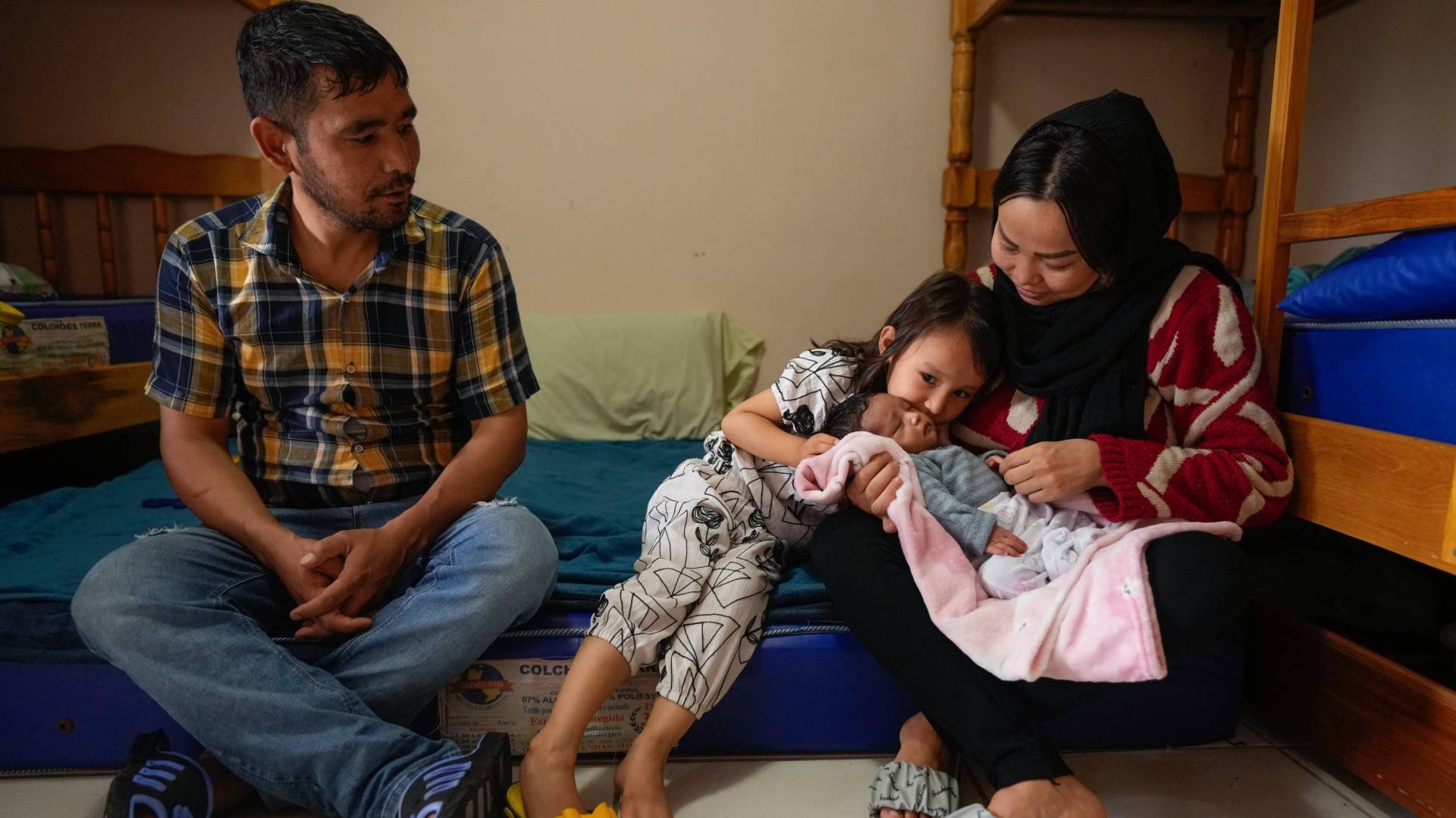
A father, mother, daughter, and baby sitting on bunk beds in a shelter in Praia Grande, Brazil.

Afghan refugee family stays in a shelter in Praia Grande, Brazil.

Christianity Today July 25, 2025
Andre Penner / AP

Within days of the US military withdrawal from Afghanistan, the Taliban showed up at Sahar’s door.

A university student and new mom, she worked for an American ministry in the city of Herat. (CT is not using her full name for the security of her family and the ministry.)  In August 2021, Taliban officials accused the 22-year-old of “corrupting women” and “straying from the Islamic faith.” They threatened to send her to prison.

Sahar knew she had to leave. She didn’t have a passport yet for her three-month-old son, and her husband— like Sahar, a convert to Christianity—had taken his mother to Pakistan for cancer treatment.

Sahar decided to cross the border illegally.

Later that month, she fled with her son and father-in-law. At the border town of Spin Boldak, they met thousands of fellow Afghans trying to escape in suffocating heat, women in their heavy, Taliban-sanctioned burqas. Sahar held her son tight as she tried to pass through the narrow border gate and crushing crowds. They ended up paying a local to drive them into Pakistan and take them the 600 miles to Islamabad.

The family reunited, but within months, Sahar’s mother-in-law died. They stayed for nearly two years, trying to rebuild their lives in a country that did not recognize them as refugees.

“We were always worried that we might be expelled at any moment,” said Sahar. “We didn’t know how we would survive if we had to return to Afghanistan.”

While Sahar prayed for safety, Christians thousands of miles away in Brazil were following the situation in Afghanistan and praying for a way to help.

A little over two years after fleeing the Taliban, Sahar’s family arrived in Curitiba, a city of 1.7 million in southern Brazil, where ministry volunteers met them at the airport. Sahar and her husband had considered the United States or Germany but went further south instead.

“We didn’t want to be judged because of our country’s past,” Sahar said. “Here in Brazil, people don’t care about that.”

During their first six months, the nonprofit Missão Mais provided everything: food, clothing, medicine, and assistance with legal documentation. The family lived at the ministry’s camp, which included 16 houses, all occupied by other Afghan families. And from the month they arrived, they had citizenship in their new country.

Since the Taliban takeover in August 2021, several Brazilian ministries stepped up to help Afghans, drawing from the generosity and welcome of local churches. With the US shutting down its refugee programs and the United Nations restricting resources for resettlement, these church-based networks serve as an even more crucial lifeline for refugees.

By the UN’s count, over half a million Afghans need resettlement this year, and the number of available spaces for refugees from all countries has dropped from 195,069 in 2024 to 31,281 in 2025.

Missão Mais is one of three organizations in Brazil currently authorized to vet Afghan refugees and help resettle new arrivals. 

Another is Panahgah, which is named after the Dari word for “refuge” and began coordinating refugee sponsors among local churches in November 2021. Since then, the organization has worked with Christians in over 35 Brazilian cities to provide housing, food, legal assistance, and integration support for nearly 1,000 Afghan refugees.

Government officials have praised Panahgah’s community-sponsorship model for its success. Civil society organizations facilitate humanitarian visas and integration but do not receive government funding.

“It’s the community itself that takes responsibility for supporting and walking alongside the refugee families,” said Sindy Nobre, Panahgah’s legal adviser.

In addition to connecting refugees with church networks, the ministries offer Portuguese classes, migration guidance, and workshops about everyday life in Brazil, from the banking system to public health care.

Vila Minha Pátria, a nonprofit established by the Brazilian Baptist Convention’s National Mission Board in April 2022, serves as a primary reception center for arrivals as they prepare to relocate to other cities, where they will receive a year of support. The Vila initially received 54 refugees, but demand quickly grew as airport staff and others referred families who didn’t have a place to go.

“Today, in addition to Afghans, we’ve welcomed refugees from nine other nationalities,” said Jennifer Soares, who coordinates the Vila with the backing of church leaders who visit, donate, and host families.

Last year, though, Brazil suspended the humanitarian visas that allowed Afghan families like Sahar’s to arrive, and it reformulated the process so that Afghan refugees must go through approved organizations, rather than the embassies, to resettle in Brazil.

While the Vila has room for more, families remain trapped in Afghanistan with no safe way out. Relatives of resettled families often reach out to share their situations and ask for help.

“We receive daily messages from people hiding in their homes, afraid of being found by radical groups,” Soares said.

When Sahar moved to Brazil in 2023, the Christian ministry where she and her husband worked—which moved operations from Afghanistan to Pakistan—arranged her family’s travel documents. “All we had to do was an interview,” Sahar said.

Once her family reached Brazil, Missão Mais supported them through the process of obtaining ID cards and tax registration numbers with the Federal Police, granting them citizenship within a month of arriving. Their current ID cards are still provisional, but this month—a year and half later—they expect to receive permanent documentation.

After the US stopped accepting refugees under the Trump administration in January, many who had arrived in Brazil with hopes to move to America are instead crossing the border to French Guiana—a French territory in South America—in hopes of getting status in the European Union.

The drop in US foreign-aid funding has also forced the UN Refugee Agency to scale back operations in Brazil, suspending approximately 40 percent of planned programs, UN staff told CT.

While the agency continues to provide some assistance—relying on a mix of funding from other governments and private partnerships—it now prioritizes lifesaving activities and preventive measures to avoid a budget deficit should US support not resume.

Refugees arriving in Brazil receive less material aid and financial support, and fewer workers are around to help them settle quickly.

While churchgoers may care about refugees, many don’t know how to help them obtain legal documentation, housing, or jobs, according to Karen Ramos with the grassroots network Como Nascido Entre Nós (“As If They Were Born Among Us”).

There’s also a gap in theological understanding. “Without a solid biblical foundation,” she warns, the church’s commitment to welcoming and supporting refugees in meaningful and sustained ways can be fragile.” Beyond these limitations, there are cultural and social hurdles—including prejudice and resistance within some local communities. 

After Sahar’s family stayed six months in Curitiba, Missão Mais connected them with a partner church in Ribeirão das Neves, Minas Gerais. The church provided housing, food, and a monthly stipend of 2,000 reais for one year (about $362). During that time, Sahar’s husband found work as a janitor washing buses. Later, he applied for a new role as a traffic controller and now works every other night.

Their son, now four, attends school in the afternoons while Sahar takes driving lessons. Once she has her license, she hopes to study sociology at a university.

Church members invite them to birthday parties and weddings, visit their home, and share meals. “We’ve introduced them to Afghan food—and they really liked it,” she said.We were welcomed and embraced. Today, we hardly even remember we’re foreigners—we feel like we were born here.”

Pastors

Let Your Church Feast on Scripture this Fall

For pastors used to more topical preaching, research confirms what you’re sensing—people crave biblical depth, and fall gives you the consistency to deliver it.
CT Pastors July 24, 2025
Alernon77 / Getty

Turns out, people want to hear what the Bible has to say.

I’ll admit I grew up in a church and denomination that emphasized the Bible—maybe too much. 

I’ll explain.

We loved the Bible. We sang songs about it. We memorized it. We treated it like the fourth member of the Trinity. In fact, one failure of the denomination in which I was raised was that we loved the Bible so much, we sometimes overlooked the God who breathed it. Written words over living Word, every time.

Still, I’m grateful for a heritage that gave me an appreciation for the Scriptures. Because my generation was so marinated in the text, when I entered pastoral ministry, teaching the Bible exegetically wasn’t the pressing need. What we needed was spiritual wisdom—to learn and discern how to apply the ancient Scriptures to our modern lives. So pastors like me threw ourselves into “practical teaching.” Preachers I loved and learned from said things like, Practical teaching that moves people to action is one of the primary things God uses to grow our faith. 

My teaching was still steeped in Scripture and theology, but I’ve done my best to be immensely practical, even when fellow staff members and congregants did not realize why a sermon on glorification might matter to their Monday morning. These sermons weren’t unbiblical sermons—they just started with life questions like finances, marriage, dating, healing, and the like, rather than a lectio continua approach to Romans. 

But here’s the issue: Our emphasis on practicality may have been an overcorrection. I fear many pastors in my generation have driven the church into the ditch on the other side of the road. We’ve focused so intently on practical relevance that too few Christians can tell you who Melchizedek was, why the Mosaic covenant mattered, or what a mustard seed represents. They don’t know the overarching story of the Bible, the historical and narrative natures of different genres of text, or how the Levitical sacrificial system helps us make sense of why Jesus came and what he accomplished.

As Russell Moore chronicles in Losing Our Religion, too many believers know neither the story of the Bible nor the stories in the Bible. This leaves spiritual formation at the mercy of online hate, political tyrants, and amorphous spiritualism.

Recently, a church member told her friend that she was thinking of leaving our church. The reason? Not enough Bible. This puzzled me. We offer small group Bible studies and run classes on how to read the Scriptures. But attendance to these is modest. 

Turns out, she did want more Bible, but she wasn’t looking for another commitment. She wanted deeper Bible teaching at the time and place she had already carved out: the weekend worship service. 

She is not alone. My preacher friends and I hear this request constantly—hunger for studying the Bible for itself, even though our churches might already provide that in midweek classes. 

Here’s a solution to consider: fall is the perfect time to integrate that study into Sunday. 

The season of stability

Between Labor Day and Thanksgiving, people travel less and are more settled. Summer scatters us; it’s filled with weddings, beach trips, family reunions, and weekend getaways. December gets swallowed up by holiday chaos. But fall? Fall is the season of routine. Kids are back on school schedule. Adults are back to full workweeks. Youth sports and community events follow a predictable weekly rhythm. Most families are home more weekends than not. 

That’s not just good for church attendance—it’s good for continuity in preaching. Long texts like Genesis take a while to work through. Meaty texts like Romans refuse to be rushed. Even if you break long texts into two series, there are few other stretches in the calendar year when you may get a relatively stable congregation for 8 or 12 weeks. This matters when having an active memory of what was preached last weekend informs understanding for this week. Memory builds on memory, insight on insight. And let’s be honest—fewer people catch up on our sermon podcast or YouTube feed than we might hope.

The “second new year”

Many people treat fall as a second new year. It is a time for reimagining our rhythms of life, which is particularly true for families readjusting to school rhythms and extracurricular commitments. Spiritually, they’re quietly wondering: How do I reconnect with God after the summer drift? Where did my sense of purpose go?

Textual preaching answers that hunger with groundedness. It says, Let’s walk together through something solid. It invites people into a rhythm of attentiveness. A well-structured series through Scripture doesn’t just teach content—it shapes lives. It offers people a chance to build (or rebuild) a spiritual habit. When church becomes a place where the Bible is opened, explored, and applied week by week, it anchors the larger reset people are craving.

The surprising appetite

Younger Christians in particular are craving more Bible teaching. This is the opposite of the problem we faced when I began ministry nearly three decades ago. David Kinnaman’s research confirms that younger generations are craving deeper biblical engagement. Barna’s recent studies show that in-depth Scripture teaching ranks among the top reasons for choosing and attending a church regularly. At the same time, young people don’t feel confident in their own knowledge of the Bible. This is where the fall series becomes more than a strategy; it’s a pastoral response.

In years past, during the waning days of Christendom, many of us labored to make the church and the Bible “relevant” and “engaging.” Now our task is to reveal how God’s story makes life meaningful. People want the Word—they just don’t always know how to access it. 

Preaching textually also models how to read Scripture well. It teaches not only what the Bible says, but how to live inside its story. Each fall we have an opportunity to demystify difficult passages and contextualize familiar ones. It builds biblical literacy without making people feel shamed or overwhelmed.

The gift of discomfort

Long teaching series also allow pastors to model humility before the Word. They make us step outside our wheelhouse. Rather than choosing topics that feel “on brand” or comfortable, preaching from the text means sometimes wrestling with difficult doctrines, complicated histories, or challenging commands. This, too, forms our people. It shows the congregation that Scripture is not a tool we wield—it’s a voice we sit under.

Don’t misunderstand; I do believe topical preaching has its place. All preaching should be relevant and practical—even engaging to some degree. But the Spirit seems to be prompting Christians to desire more textual focus. And the fall—more stable than summer’s travels, winter’s frenzy, and spring’s sprint—offers the best season to feed that desire. 

In a world of soundbites and infinite scrolling, preaching that lingers with the text is a countercultural witness. In a season when people form new patterns, it’s a time to root them in something eternal. And in a church that often struggles to hold attention, it’s a moment to recover the possibility of awe.

So this fall, open the Book. Stay with it. Let it speak at its own pace and in its own voice. Trust that in the Word, preached faithfully and patiently, God will meet his people.

After all, it turns out they’re hungrier than we thought.

Sean Palmer is the teaching pastor at Ecclesia Houston, a writer, a speaking coach, and the author of Speaking by the Numbers.

Apple PodcastsDown ArrowDown ArrowDown Arrowarrow_left_altLeft ArrowLeft ArrowRight ArrowRight ArrowRight Arrowarrow_up_altUp ArrowUp ArrowAvailable at Amazoncaret-downCloseCloseEmailEmailExpandExpandExternalExternalFacebookfacebook-squareGiftGiftGooglegoogleGoogle KeephamburgerInstagraminstagram-squareLinkLinklinkedin-squareListenListenListenChristianity TodayCT Creative Studio Logologo_orgMegaphoneMenuMenupausePinterestPlayPlayPocketPodcastRSSRSSSaveSaveSaveSearchSearchsearchSpotifyStitcherTelegramTable of ContentsTable of Contentstwitter-squareWhatsAppXYouTubeYouTube