The NCC Elite: A Breakdown of Beliefs

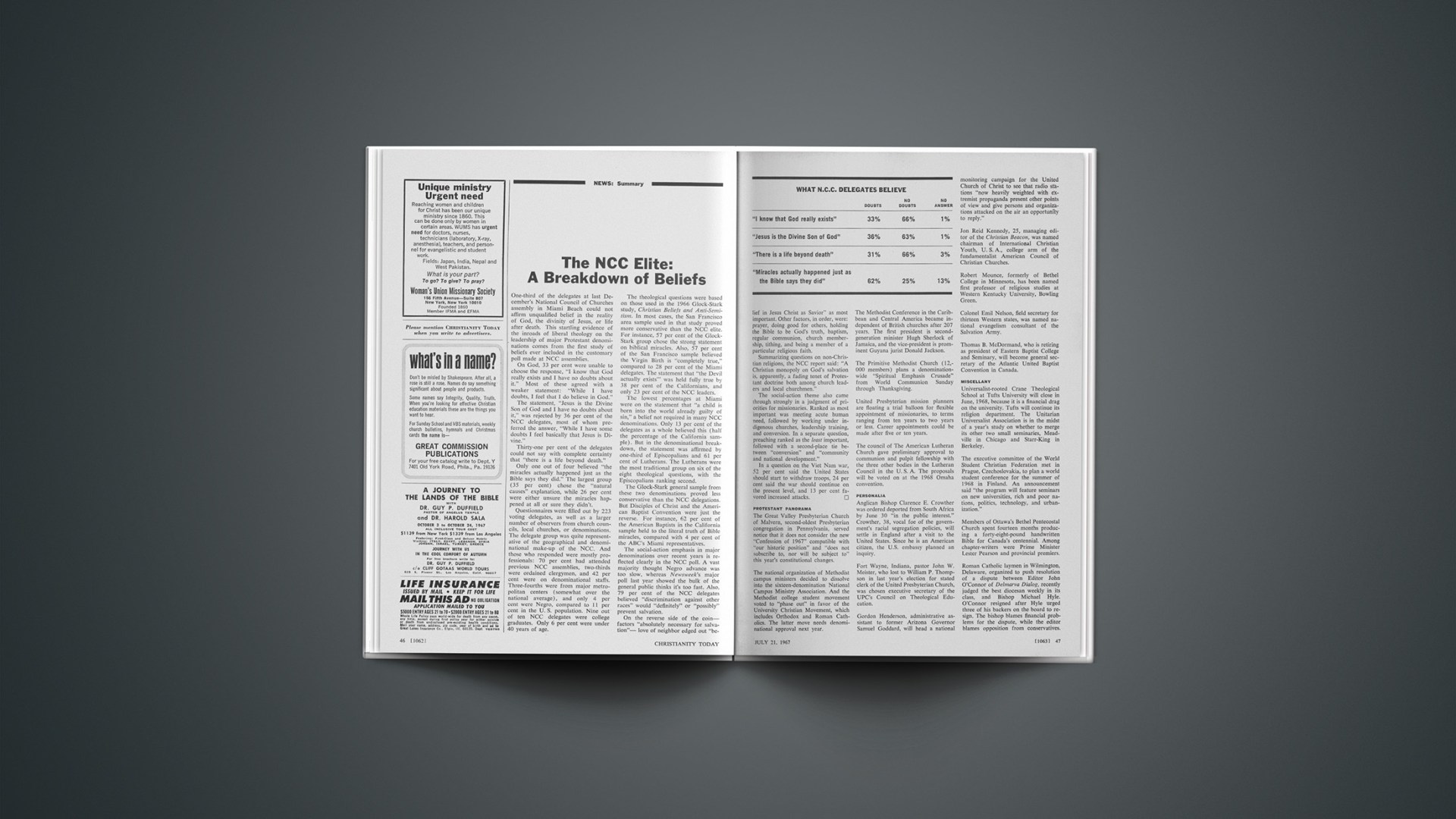
One-third of the delegates at last December’s National Council of Churches assembly in Miami Beach could not affirm unqualified belief in the reality of God, the divinity of Jesus, or life after death. This startling evidence of the inroads of liberal theology on the leadership of major Protestant denominations comes from the first study of beliefs ever included in the customary poll made at NCC assemblies.

On God, 33 per cent were unable to choose the response, “I know that God really exists and I have no doubts about it.” Most of these agreed with a weaker statement: “While I have doubts, I feel that I do believe in God.”

The statement, “Jesus is the Divine Son of God and I have no doubts about it,” was rejected by 36 per cent of the NCC delegates, most of whom preferred the answer, “While I have some doubts I feel basically that Jesus is Divine.”

Thirty-one per cent of the delegates could not say with complete certainty that “there is a life beyond death.”

Only one out of four believed “the miracles actually happened just as the Bible says they did.” The largest group (35 per cent) chose the “natural causes” explanation, while 26 per cent were either unsure the miracles happened at all or sure they didn’t.

Questionnaires were filled out by 223 voting delegates, as well as a larger number of observers from church councils, local churches, or denominations. The delegate group was quite representative of the geographical and denominational make-up of the NCC. And those who responded were mostly professionals: 70 per cent had attended previous NCC assemblies, two-thirds were ordained clergymen, and 42 per cent were on denominational staffs. Three-fourths were from major metropolitan centers (somewhat over the national average), and only 4 per cent were Negro, compared to 11 per cent in the U. S. population. Nine out of ten NCC delegates were college graduates. Only 6 per cent were under 40 years of age.

The theological questions were based on those used in the 1966 Glock-Stark study, Christian Beliefs and Anti-Semitism. In most cases, the San Francisco area sample used in that study proved more conservative than the NCC elite. For instance, 57 per cent of the Glock-Stark group chose the strong statement on biblical miracles. Also, 57 per cent of the San Francisco sample believed the Virgin Birth is “completely true,” compared to 28 per cent of the Miami delegates. The statement that “the Devil actually exists” ’ was held fully true by 38 per cent of the Californians, and only 23 per cent of the NCC leaders.

The lowest percentages at Miami were on the statement that “a child is born into the world already guilty of sin,” a belief not required in many NCC denominations. Only 13 per cent of the delegates as a whole believed this (half the percentage of the California sample). But in the denominational breakdown, the statement was affirmed by one-third of Episcopalians and 61 per cent of Lutherans. The Lutherans were the most traditional group on six of the eight theological questions, with the Episcopalians ranking second.

The Glock-Stark general sample from these two denominations proved less conservative than the NCC delegations. But Disciples of Christ and the American Baptist Convention were just the reverse. For instance, 62 per cent of the American Baptists in the California sample held to the literal truth of Bible miracles, compared with 4 per cent of the ABC’s Miami representatives.

The social-action emphasis in major denominations over recent years is reflected clearly in the NCC poll. A vast majority thought Negro advance was too slow, whereas Newsweek’s major poll last year showed the bulk of the general public thinks it’s too fast. Also, 79 per cent of the NCC delegates believed “discrimination against other races” would “definitely” or “possibly” prevent salvation.

On the reverse side of the coin—factors “absolutely necessary for salvation”—love of neighbor edged out “belief in Jesus Christ as Savior” as most important. Other factors, in order, were: prayer, doing good for others, holding the Bible to be God’s truth, baptism, regular communion, church membership, tithing, and being a member of a particular religious faith.

Summarizing questions on non-Christian religions, the NCC report said: “A Christian monopoly on God’s salvation is, apparently, a fading tenet of Protestant doctrine both among church leaders and local churchmen.”

The social-action theme also came through strongly in a judgment of priorities for missionaries. Ranked as most important was meeting acute human need, followed by working under indigenous churches, leadership training, and conversion. In a separate question, preaching ranked as the least important, followed with a second-place tie between “conversion” and “community and national development.”

In a question on the Viet Nam war, 52 per cent said the United States should start to withdraw troops, 24 per cent said the war should continue on the present level, and 13 per cent favored increased attacks.

Protestant Panorama

The Great Valley Presbyterian Church of Malvern, second-oldest Presbyterian congregation in Pennsylvania, served notice that it does not consider the new “Confession of 1967” compatible with “our historic position” and “does not subscribe to, nor will be subject to” this year’s constitutional changes.

The national organization of Methodist campus ministers decided to dissolve into the sixteen-denomination National Campus Ministry Association. And the Methodist college student movement voted to “phase out” in favor of the University Christian Movement, which includes Orthodox and Roman Catholics. The latter move needs denominational approval next year.

The Methodist Conference in the Caribbean and Central America became independent of British churches after 207 years. The first president is second-generation minister Hugh Sherlock of Jamaica, and the vice-president is prominent Guyana jurist Donald Jackson.

The Primitive Methodist Church (12,000 members) plans a denomination-wide “Spiritual Emphasis Crusade” from World Communion Sunday through Thanksgiving.

United Presbyterian mission planners are floating a trial balloon for flexible appointment of missionaries, to terms ranging from ten years to two years or less. Career appointments could be made after five or ten years.

The council of The American Lutheran Church gave preliminary approval to communion and pulpit fellowship with the three other bodies in the Lutheran Council in the U. S. A. The proposals will be voted on at the 1968 Omaha convention.

Personalia

Anglican Bishop Clarence E. Crowther was ordered deported from South Africa by June 30 “in the public interest.” Crowther, 38, vocal foe of the government’s racial segregation policies, will settle in England after a visit to the United States. Since he is an American citizen, the U.S. embassy planned an inquiry.

Fort Wayne, Indiana, pastor John W. Meister, who lost to William P. Thompson in last year’s election for stated clerk of the United Presbyterian Church, was chosen executive secretary of the UPC’s Council on Theological Education.

Gordon Henderson, administrative assistant to former Arizona Governor Samuel Goddard, will head a national monitoring campaign for the United Church of Christ to see that radio stations “now heavily weighted with extremist propaganda present other points of view and give persons and organizations attacked on the air an opportunity to reply.”

Jon Reid Kennedy, 25, managing editor of the Christian Beacon, was named chairman of International Christian Youth, U. S. A., college arm of the fundamentalist American Council of Christian Churches.

Robert Mounce, formerly of Bethel College in Minnesota, has been named first professor of religious studies at Western Kentucky University, Bowling Green.

Colonel Emil Nelson, field secretary for thirteen Western states, was named national evangelism consultant of the Salvation Army.

Thomas B. McDormand, who is retiring as president of Eastern Baptist College and Seminary, will become general secretary of the Atlantic United Baptist Convention in Canada.

Miscellany

Universalist-rooted Crane Theological School at Tufts University will close in June, 1968, because it is a financial drag on the university. Tufts will continue its religion department. The Unitarian Universalist Association is in the midst of a year’s study on whether to merge its other two small seminaries, Meadville in Chicago and Starr-King in Berkeley.

The executive committee of the World Student Christian Federation met in Prague, Czechoslovakia, to plan a world student conference for the summer of 1968 in Finland. An announcement said “the program will feature seminars on new universities, rich and poor nations, politics, technology, and urbanization.”

Members of Ottawa’s Bethel Pentecostal Church spent fourteen months producing a forty-eight-pound handwritten Bible for Canada’s centennial. Among chapter-writers were Prime Minister Lester Pearson and provincial premiers.

Roman Catholic laymen in Wilmington, Delaware, organized to push resolution of a dispute between Editor John O’Connor of Delmarva Dialog, recently judged the best diocesan weekly in its class, and Bishop Michael Hyle. O’Connor resigned after Hyle urged three of his backers on the board to resign. The bishop blames financial problems for the dispute, while the editor blames opposition from conservatives.
Graham TV Saturates Britain

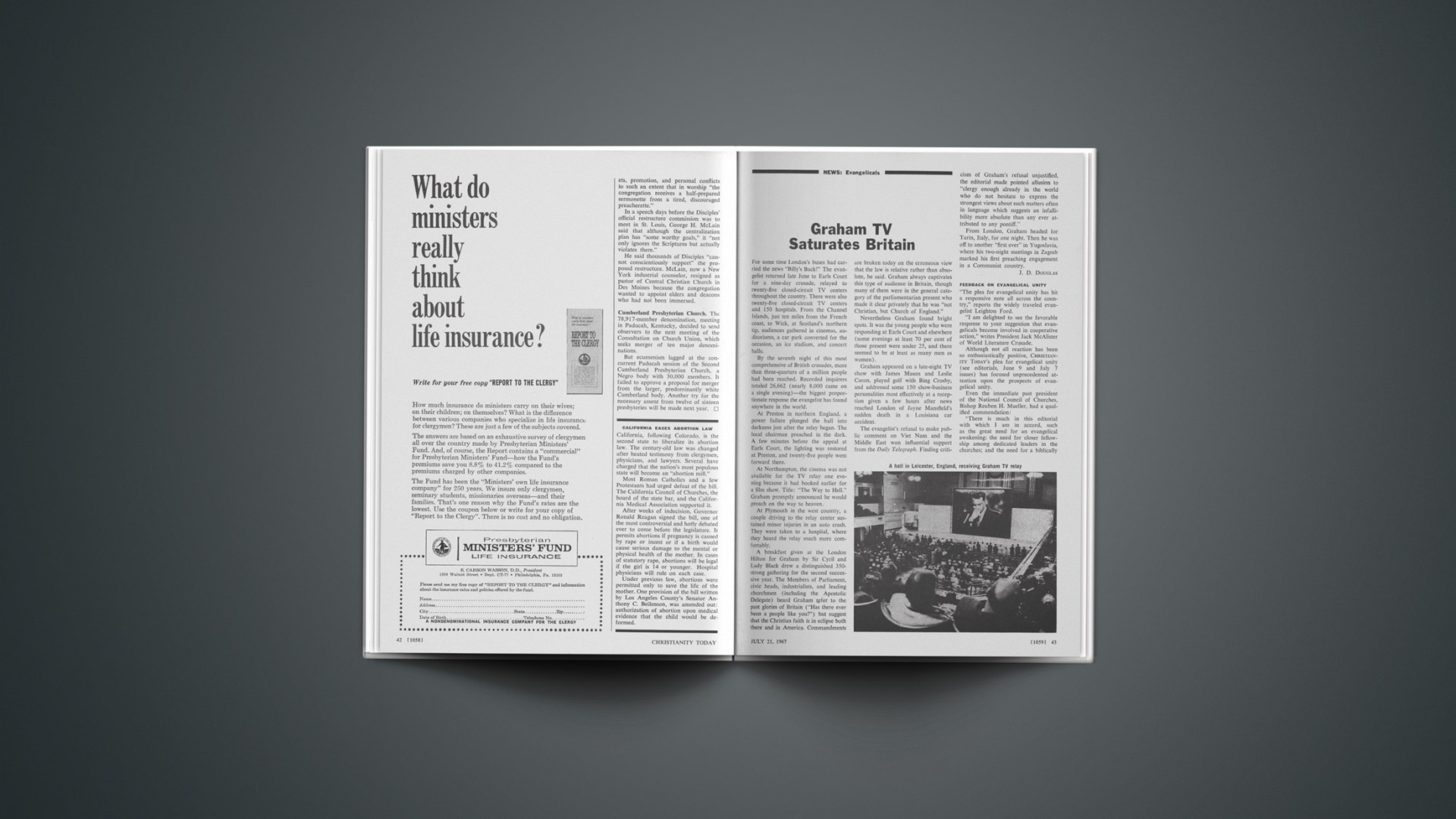
For some time London’s buses had carried the news “Billy’s Back!” The evangelist returned late June to Earls Court for a nine-day crusade, relayed to twenty-five closed-circuit TV centers throughout the country. There were also twenty-five closed-circuit TV centers and 150 hospitals. From the Channel Islands, just ten miles from the French coast, to Wick, at Scotland’s northern tip, audiences gathered in cinemas, auditoriums, a car park converted for the occasion, an ice stadium, and concert halls.

By the seventh night of this most comprehensive of British crusades, more than three-quarters of a million people had been reached. Recorded inquirers totaled 26,662 (nearly 8,000 came on a single evening)—the biggest proportionate response the evangelist has found anywhere in the world.

At Preston in northern England, a power failure plunged the hall into darkness just after the relay began. The local chairman preached in the dark. A few minutes before the appeal at Earls Court, the lighting was restored at Preston, and twenty-five people went forward there.

At Northampton, the cinema was not available for the TV relay one evening because it had booked earlier for a film show. Title: “The Way to Hell.” Graham promptly announced he would preach on the way to heaven.

At Plymouth in the west country, a couple driving to the relay center sustained minor injuries in an auto crash. They were taken to a hospital, where they heard the relay much more comfortably.

A breakfast given at the London Hilton for Graham by Sir Cyril and Lady Black drew a distinguished 350-strong gathering for the second successive year. The Members of Parliament, civic heads, industrialists, and leading churchmen (including the Apostolic Delegate) heard Graham refer to the past glories of Britain (“Has there ever been a people like you?”) but suggest that the Christian faith is in eclipse both there and in America. Commandments are broken today on the erroneous view that the law is relative rather than absolute, he said. Graham always captivates this type of audience in Britain, though many of them were in the general category of the parliamentarian present who made it clear privately that he was “not Christian, but Church of England.”

Nevertheless Graham found bright spots. It was the young people who were responding at Earls Court and elsewhere (some evenings at least 70 per cent of those present were under 25, and there seemed to be at least as many men as women).

Graham appeared on a late-night TV show with James Mason and Leslie Caron, played golf with Bing Crosby, and addressed some 150 show-business personalities most effectively at a reception given a few hours after news reached London of Jayne Mansfield’s sudden death in a Louisiana car accident.

The evangelist’s refusal to make public comment on Viet Nam and the Middle East won influential support from the Daily Telegraph. Finding criticism of Graham’s refusal unjustified, the editorial made pointed allusion to “clergy enough already in the world who do not hesitate to express the strongest views about such matters often in language which suggests an infallibility more absolute than any ever attributed to any pontiff.”

From London, Graham headed for Turin, Italy, for one night. Then he was off to another “first ever” in Yugoslavia, where his two-night meetings in Zagreb marked his first preaching engagement in a Communist country.

J. D. DOUGLAS

Feedback On Evangelical Unity

“The plea for evangelical unity has hit a responsive note all across the country,” reports the widely traveled evangelist Leighton Ford.

“I am delighted to see the favorable response to your suggestion that evangelicals become involved in cooperative action,” writes President Jack McAlister of World Literature Crusade.

Although not all reaction has been so enthusiastically positive, CHRISTIANITY TODAY’S plea for evangelical unity (see editorials, June 9 and July 7 issues) has focused unprecedented attention upon the prospects of evangelical unity.

Even the immediate past president of the National Council of Churches, Bishop Reuben H. Mueller, had a qualified commendation:

“There is much in this editorial with which I am in accord, such as the great need for an evangelical awakening; the need for closer fellowship among dedicated leaders in the churches; and the need for a biblically oriented message and program. In all these, and more, I can agree. But I cannot escape the constantly recurring emphasis on separating ‘evangelicals’ from those who are in the conciliar movement and in the ecumenical developments in Christianity around the world.”

Mueller, a bishop of the Evangelical United Brethren Church, regards himself as an evangelical. He says he has tried to carry the biblical thrust into his ecumenical activities and to uphold evangelical emphases.

General Secretary Morgan Derham of the Evangelical Alliance in London said: “A great deal of what you are asking for in the American scene already exists in the British scene, in the form of the Evangelical Alliance. That is to say, if we were to do a diagram of the British scene, comparable with that which you have done for America, although the figures and proportions of the different groups would be very unlike, the EA would, in fact, comprehend members in all the groups, including the major denominations. In fact, the greater part of the strength of the EA lies in the Anglican and Baptist denominations. This doesn’t mean that we have anything like all evangelicals in membership with us, or affiliated to us, but it does mean that we are, at the moment, spanning the total area of evangelical life from the extreme independent and Pentecostal churches through to the mainline denominational ones.”

Affiliates of the World Evangelical Fellowship, according to International Secretary Dennis E. Clark, welcome denominations, single congregations, organizations, and individuals into “a very meaningful fellowship.” Clark says that in the Evangelical Fellowship of India—an affiliate of WEF—“it is irrelevant to raise the question of other affiliation such as to the World Council of Churches, because the sweetness of love and fellowship in Christ predominates. An Episcopalian chairs a prayer meeting with a Pentecostal speaker. A Presbyterian gives leadership to a literature program in which [Plymouth] Christian Brethren are active participants.”

Clark contends that “a number of U. S. evangelicals tend to equate the Christian world issues with those of their own country. Others of us are working towards an evangelical internationalism, in the mainstream of biblical Christianity. This calls for mutual respect and love in the body of Christ by all members for all other members. It will particularly call for humility and servanthood among the more affluent and dominant Christian centers, and a readiness to listen to the voice of God through Asian, African, and South American evangelicals.”

From one of the main separatist elements in American Protestantism also came an endorsement of sorts, with reservations. Said Reuel Lemmons, editor of the weekly Firm Foundation, which is highly influential among the more than two million persons belonging to the Churches of Christ: “Few men, if any, share any more fully my agreement with you that the times desperately demand that we somehow get together.”

“Possibly it can be done,” Lemmons wrote in a moving editorial. “At least the time is ripe for a try, and the wind is in our favor.”

He added, however, that “we will have more unity only when we believe the same thing at more points.” In keeping with Churches of Christ thinking he declared that “we need to completely remove party lines so that there would be no party lines to cross.”

Lemmons concluded, “Possibly, we can get together. But it will be when each of us is willing to give up any error he may possess to walk in the light of the more noble truth his neighbor may possess, or that the Bible most surely teaches.”

Editor Russell Hitt of Eternity reported that the plea for evangelical unity provoked a thorough discussion in a staff meeting that may result in an editorial. He declared he is sympathetic with the idea of evangelical cooperation but asserted, “I think you are stumped, and so am I, when it comes to implementing pan-evangelical unity.… Does this mean we try to absorb the oil of the American Council of Christian Churches with the water of the National Association of Evangelicals?”

CHRISTIANITY TODAY’S proposal got its biggest airing so far at the Southern Baptist Convention in Miami Beach (see editorial, July 7 issue, and news, June 23). The Southern Baptist Executive Committee is now committed to bringing back a recommendation on cooperation with other evangelicals.

Tongues A Status Symbol?

The appeal of the Pentecostal movement is not limited to “the discontented, the deprived, or the deviant,” according to a report based on a three-year study at the University of Minnesota.

“We’ve found a wide range of types, so it’s presumptuous to call them all oddballs,” said Luther P. Gerlach, associate professor of anthropology, who headed the study. “Our own judgment is that most of them are understandingly stable individuals.”

Gerlach cited several explanations for the popularity of the Pentecostal movement:

“An effective system of recruitment, usually through friends or relatives.”

“A simple master plan for the world, found in the Bible, which gives its members a high degree of confidence.”

A flexible organization “with no master bishop or national headquarters issuing directives.”

Opposition—an essential ingredient of a rising social movement.

An experience—speaking in tongues—that produces “a fervent commitment to the cause.”

“We don’t see speaking in tongues as the important characteristic of the movement,” Gerlach said. “It’s just one of many. The significant feature of it is its function as a status symbol, a mark of identification.”

From Union To Union

At about the time of the Civil War, a young Congregationalist took leave of his studies at Union Theological Seminary, New York, to spend the summer abroad. The ship carrying him across the Atlantic survived a collision with an iceberg, and Payson Hammond never returned to the seminary. He became perhaps the first evangelist to children in Britain and inspired the founding by Josiah Spiers of the far-flung Children’s Special Service Mission and Scripture Union.

The union, which now boasts more than 1,500,000 members from Iceland to New Guinea, commemorates its centennial this year. Its main thrust today is encouragement of Bible study, and it publishes graded helps in about 150 languages for adults as well as children.

At a week-long conference at Lausanne, Switzerland, in May, sixty union leaders were challenged by one of their own trustees, Arthur F. Glasser, to be “truly relevant” in communicating the Gospel. Glasser’s studies apparently helped to heighten a desire among the leaders to attain what Calvin called “the secret of exegesis”—making the centuries between biblical truth and the present fade away until the Word comes alive with the same power it had when originally spoken.

Union leaders say their daily devotional guides strive to involve Christians in the Word for themselves, rather than just to provide soothing commentary. That is a worthy goal they don’t always achieve. They take about ten verses a day and supply an average of 250 words of expository material. This week’s “Daily Notes,” covering First Samuel 7–10, observe on Monday that “just as the people were about their daily business in the fields when the ark appeared in their midst, so should we be ready for God to come to us in our work.” Wednesday’s thought is more challenging: “For the Christian there is no such thing as a coincidence. It is God Who makes things coincide.

Race and Riots Engage United Church

United Church of Christ. Arriving in Cincinnati in the wake of a four-day riot, 2,000 delegates and alternates attending the Sixth General Synod of the United Church of Christ found the race issue dominating nearly every action, whether it was electing a top church official or criticizing the hotel in which the convention was held.

The mood was set on the first day (June 22) of the eight-day session by the Rev. Harold L. Hunt, a civil-rights spokesman and pastor of Carmel Presbyterian Church in the predominantly Negro community of Avondale in Cincinnati.

“You will not have law and order until there is justice,” the fiery young minister told the enraptured delegates. Hunt said the week’s violence should be called a rebellion rather than a riot because “a riot is a disorganized situation in which activity goes astray and people fight each other. These people were rebelling against a system that is insensitive to their needs.” (The Ohio National Guard had been called in to quell the racial disturbance, during which $1 million in property was destroyed and more than 250 persons were arrested.)

Believing that justice, like charity, begins at home, the newly formed Ministers for Racial and Social Justice—an inter-racial organization of ministers serving predominantly Negro congregations in the UCC—launched an effective campaign to elect the Rev. Joseph H. Evans, a Negro minister from Chicago’s South Side, as national secretary. The secretary is the second-ranking elected, salaried officer of the two-million-member denomination. The Rev. Robert F. R. Peters, assistant to church President Ben Mohr Herbster since 1962, was the nominating committee candidate.

“We’re in a hell of a bind,” one minister told a reporter before the balloting. “Bob Peters is one of the most capable men in the church but he’s caught in the middle. If we refuse to elect a Negro secretary, all of our pronouncements on racial justice are going to sound awfully hollow.” Evans won, 402 to 292.

MRSJ, which, in contrast to the denomination’s Committee for Racial Justice Now, has no official standing in the church, scored again with a scathing denunciation of the hiring and promotion practices of Cincinnati’s two Hilton hotels—the Netherland, where the convention was held, and the Terrace Hilton, where many other delegates were staying. The ministers charged that only “the totally insensitive” could fail to see that the two hotels were discriminating against Negroes in employment.

In one of the quickest pieces of public relations in hotel history, two Hilton executives flew to Cincinnati to apologize to the delegates.

Vice-president James J. Roche promised that within two days the corporation’s personnel manager would come to Cincinnati to hire more Negroes and to review the personnel records of both hotels with the aim of selecting Negroes presently employed for better jobs. Roche’s public apology won a round of applause from the delegates and headed off a resolution that was to have been introduced on the floor attacking the hotel’s hiring policy.

Truman B. Douglass, executive vice-president of the UCC Board for Homeland Ministries, offered to place the resources of the new Inter-Religious Foundation for Community Organization (see June 9 issue, page 37) behind a church movement in Cincinnati to help Negroes express themselves to the white community. He said he hoped that a broad-based agency such as the Greater Cincinnati Council of Churches would accept the challenge. The offer was ill-timed. During the convention, the Rev. Richard Isler, executive secretary of the local Council of Churches, announced his resignation. The day before, papers had reported that his wife was suing him for divorce.

The highly explosive issue of black power was defused by a parliamentary technicality. The report by a group from the Committee for Racial Justice Now said:

“Power is not evil. It can be used for good or ill. Black is neither good nor bad, but ‘black’ is often used to connote evil. Applied to race, ‘black’ has no moral implications. ‘Black Power’ is really Negro solidarity. The term ‘Black Power’ implies neither violence nor non-violence, neither good nor evil.”

A delegate rushed to a floor microphone to protest. “Why should this synod go on record as defining black power?” he asked. “Stokely Carmichael and his followers, both black and white, already have done that.” Sensing that the issue was divisive, the genial moderator, Dr. Hollis F. Price, told the delegates to “hold on, now” while he had a quick conference with the parliamentarian. Price, president of LeMoyne College in Memphis, later told the delegates that the black-power statement was out of order because it had not been properly cleared through channels as a pronouncement.

“ ‘Black power’ are the two most discussed words in the English language today,” Charles E. Cobb, executive director of the racial-justice committee, said in an interview. “I wanted the delegates to take a look at it—not a position.” He added with a grin. “And they did take a look.”

One of the synod’s most controversial statements, that on Viet Nam, almost slipped by the tired delegates on the last night. At an open forum earlier, the issue had been hotly debated. But when the statement came on the floor for official action, it passed without a word of debate. Surprised and shocked, President Herbster walked to the stage microphone to ask whether the delegates realized what they had done. Apparently they hadn’t, because they voted to reconsider and brought the issue back on the floor—thereby triggering a floor fight that lasted until nearly midnight.

The big battle centered on this statement in the six-page document: “We urge the cessation of United States air, naval, and artillery bombardment of North Viet Nam and the more resolute pursuit of political development, economic justice, and social reconstruction in South Viet Nam.”

An amendment was introduced to delete the reference to halting the bombing and substitute a “most serious reappraisal” of the bombing policy.

The Rev. David Colwell, gruff-voiced minister of the First Congregational Church in Washington, D. C., and national chairman of the Consultation on Church Union (COCU), protested the amendment and the philosophy of those who argued that the delegates had no expertise in military matters and should not try to dictate strategy.

“Those who say this is not the proper role of the church misunderstand the dynamics of power,” he said. “This is a proper concern of the church. We need to register ourselves on this.” His brother, Robert Colwell, a Denver high-school principal, told the weary delegates that he personally favored the stronger, original statement but would support the amendment “in a spirit of reconciliation.” It was approved.

COCU Chairman Colwell fared better with his report on Christian unity. The synod directed its COCU delegates to “further the search for a United Church.”

The delegates were warned by the Rev. Nathanael Guptill, minister of the UCC Connecticut Conference, that a deepening split between “swingers” and “squares” threatens the future of the UCC. He said the middle of the road is really where the action is.

“If the United Church of Christ is to stay in one piece some swingers and squares must sit near enough the center so that they can hear what is being said on the other side of the aisle,” he said.

In other action, the delegates accepted an updating of the Lord’s Prayer,1The modern version, included in a new order of worship recommended to local churches: “Our Father in heaven, Your name be honored. Your kingdom come and Your will be done on earth as it is in heaven. Give us today the food we need; and forgive us our sins as we forgive those who have wronged us. Keep us clear of temptation, and save us from evil. For the kingdom and power and the glory are yours forever. Amen.” adopted a $10.6 million budget for 1968, recognized the right of an individual to object to serving in a particular war on the grounds of conscience, supported a bill now before Congress that would include clergymen in the nation’s social security system, and authorized a $250,000 fund-raising campaign to aid Arab refugees.

JAMES L. ADAMS

Christian Reformed Church. For the first time, the 272,000-member denomination defined its position on affiliation with the World Council of Churches. The extensive, spirited debate was occasioned by a request from the Gereformeerde Kerken of the Netherlands for advice and counsel. The 800,000-member Dutch church had earlier gone on record as seeing “no decisive impediment” to WCC membership.

Last month’s CRC synod in Grand Rapids rejected the idea that it is not permissible for “a Reformed Church” to join the WCC. Instead, the synod declared “with regret that it is not permissible” to join “because of the present inadequate basis, the maintaining and functioning of that basis, the socio-political activities and declarations, and the implications of membership in the Council.” But the church decided to send two observers to next year’s WCC assembly. A month after that, the church will meet officially with the Reformed Ecumenical Synod.

An invitation from the National Association of Evangelicals to resume affiliation was referred to the inter-church relations committee.

The 136 delegates from the United States and Canada met for the first time on the new Knollcrest campus of Calvin College and Seminary, and authorized $8.5 million for more college buildings.

In a surprise decision, the synod reversed a 1966 call for a study of theistic evolution. Since there was no actual case requiring judgment, delegates left the matter to those competent to make such a study.

What many considered the biggest item on the agenda turned out to be too big for the ten-day session. The committee on doctrine wrestled with an issue summarized by synod President William Haverkamp as “the doctrine of the love of God and the extent of the atonement—whether universal or for a limited number.” Majority and minority reports went to the floor late in the second week. After a full day of heady, solid theological debate, all was not light under the 1,000 soft spotlights of the new Fine Arts Center.

In an unprecedented action, the delegates decided to reconvene August 29 to resolve the issue. Church journals have been requested to refrain from discussion during the interim.

JAMES DAANE

Church of the Brethren. America’s largest pacifist denomination urged the U. S. government to stop bombing North Viet Nam, suspend troop movements to Viet Nam, reconvene the Geneva conference, and get the Saigon government to negotiate with the National Liberation Front.

The Brethren lamented that the United States “has risked so much in its attempt to win a military victory while risking so little in attempting to exricate itself from a long, hard war.” I. W. Moomaw, retired director of Agricultural Missions, Inc., said in a convention speech that the United States has intervened in what was a revolt of common people against feudal, irresponsible government, and that the United States-backed regime is unpopular with a vast majority of the population. On the other hand, he criticized Ho Chi Minh for “trying to push all Viet Nam over to Communism.”

The denomination also approved a policy statement on church-state relations. It supported “disobedience to the state” when it cuts across religious convictions but said this “drastic step” should come only after prayer, careful thought, and consultation with others.

The 190,000-member church, which last year voted against joining the Consultation on Church Union, is exploring union possibilities with the American Baptist Convention, the Churches of God (Harrisburg), and the Evangelical Covenant Church. The convention voted to eliminate the traditional office of elder because of broader-based lay participation in church work.

Baptist General Conference. A record number of delegates assembled in Duluth, Minnesota, faced directly the federal-aid issue tabled at two previous meetings, and voted nearly two-to-one against aid.

Permission for federal grants had been sought by the denomination’s Bethel College of St. Paul, Minnesota, and the conference Board of Education. Despite the loss of millions in federal aid, the Baptists determined to relocate Bethel by 1971 as planned, with an initial expense of $11 million.

The 95,000-member conference also voted to make a detailed study of merger possibilities with the smaller North American Baptist General Conference. Delegates voted against joining the North American Baptist Fellowship of the Baptist World Alliance “at this time,” but they decided to cooperate in a Fellowship-backed project, the inter-Baptist Crusade of the Americas evangelism drive scheduled for 1969.

Evangelical Free Church of America. Delegates voted unanimously against federal or state grants to church-related institutions “at this time.” On a nearunanimous vote, they also rejected government research grants. The matter of loans was referred to a study committee.

EFCA membership is over 50,000 for the first time, and in the past year the denomination added a new congregation every fourteen days. Arnold T. Olson, elected to a sixth three-year term as president, said those who oppose new Bible translations are selfish. “As a church we today must accept some responsibility for the prevailing opinion that the Bible’s message is no longer relevant and that Christianity is out of step with our day.”

Professor Robert Culver of the denomination’s Trinity Evangelical Divinity School pointed out two barriers in using a common Bible with Roman Catholics: the Catholic use of fourteen documents that Protestants do not consider inspired Scripture, and Catholic insistence on notes to accompany the text.

American Baptist Association. President Vernon E. Lierly, Little Rock pastor, proposed these platform planks to representatives of the ABA’s 725,000 members meeting in Mobile, Alabama:

National security: “Seek righteousness.” Human rights: “Every man has the right to hear the Gospel.” Foreign aid: “Missions.” Space: Congregations should have “a good space program” to fill up their “unused space.” Farm program: “If we sow in tears we will reap in joy.” Labor: “The cry of the world is, ‘We need more jobs.’ The cry of the Master is, ‘We need more laborers.’ ” Cooperation: “Today we need the help of all to carry the Gospel. Let us work together.…”

Conservative Baptist Association. Hit by schism to the right two decades after it left the American Baptist Convention, the CBA noted that some “question our present theological and ideological position.” So it reaffirmed the fundamentalist doctrinal stand in its constitution and repeated its opposition to the National and World Councils of Churches. The convention, meeting in Phoenix, Arizona, also came out against gambling in any form, including state lotteries. Lester Thompson of Prescott, Arizona, was elected to one year as president.

Kirchentag: Left To The Left

Every other year German Protestants conduct a gigantic “Church Day” congress that draws thousands of lay people from all over Europe. There are dozens of lectures about all kinds of complex theological and ecclesiastical questions. Although the conclave is sometimes called a Christian fair, it generally assumes a high intellectual tone. It is easily the biggest regularly scheduled Protestant event in the world.

The 1967 meeting, or Kirchentag in German, was held last month in Hanover. And in spite of a boycott by the conservative confessional “No Other Gospel” movement (see March 31 issue, p. 43); an increase in attendance was recorded. There were evidences that a number of young people turned up to protest against the protest. Half the participants were under thirty-five.

The Hanover theme was “Peace Is Under Us.” Each morning thousands thronged into four huge halls to listen to long speeches about the search for peace in “Bible and congregation,” in “politics,” in “relations of Jews and Christians” and in “restructuring the church.”

Some had expected that the boycott would result in totally new interests. But as before, the biggest crowds went to the theological working group in a hall far too small, though it had 7,000 seats. Also, there was significant interest in the working group on politics. Yet at five in the afternoon, after five hours of heavy speeches, more than 5,500 were on hand for Bible study hours with Helmut Thielicke. Every afternon the doors had to be closed and hundreds sent away.

The boycott by the confessional movement seemed to be more effective among pastors and theologians, who refused to share a platform with modern theologians who reject biblical truth. The result was that theologically speaking the 1967 Kirchentag was a rather left-wing affair. Professor Ernst Käsemann refused to discuss the fact of the “empty tomb” of Christ as being necessary for faith. And Professor Hans-Georg Geyer warned against “definitions and truths” about the resurrection through which the Christian isn’t able to experience the resurrection in his personal daily life.

During afternoon discussion periods, it was evident that the modern theologians didn’t have the sympathy of the majority of the listeners. Geyer was attacked because of his abstract approach, and Käsemann was asked repeatedly to say clearly whether the tomb of Christ was empty. He kept refusing to answer.

Given the modern theological orientation of the Kirchentag, the 700 journalists covering the event wondered why people show up in such great numbers. Do they really come for the long-winded speeches? Do they really understand them (some theologians were honest enough to say that the lay people really didn’t)? Or do they come from their empty churches to be once again among the Christian crowd, to feel that the church isn’t dead?

The most conservative of the Kirchentag speakers was perhaps Thielicke, known to many in North America through his writings. He attacked both modern theologians (for not saying enough) and orthodox Christians (for saying more than they will be able to answer for in the final judgment). Unfortunately, Thielicke seemed to exert little influence in discussion groups.

At a huge closing meeting, with some 75,000 present, World Council of Churches General Secretary Eugene Carson Blake said, “You cannot hear the Word without your brethren.” His speech, a call for ecumenical togetherness, was an unwitting criticism of the Kirchentag leadership, which presented no balance of conservative views.

The big word at the meeting was “solidarity,” and even Thielicke took up the theme. He told Christian young people to be a beatnik for the beatniks, about 100 of whom were dragged into the hall to hear Thielicke. One told Thielicke, “We would like it better if anyone would become a Christian to us beatniks. When you talk to us, hold on to what you are, and don’t try to be one of us.”

JAN J. VAN CAPELLEVEEN

General Association of Regular Baptist Churches. Meeting in Seattle, 910 delegates issued a “call for victory over Communism in Viet Nam and throughout the world as it seeks global enslavement either by overt action or by subtle infiltration.” They also opposed aid to Communists in any form, including President Johnson’s bid for more trade with Eastern Europe. The fundamentalist group, which has 155,000 members, also protested “the use of tax money to promote religious interests of any kind,” such as religious instruction in public schools.

Church of God (Anderson, Indiana). The 143,000-member denomination acted to merge the National Association of the Church of God, a small Negro missionary board, into its main missionary board. The Negro group began after World War I and existed informally without full-time staff. Support was raised at an annual camp meeting. The denomination’s central board also has appointed Negroes. The Negro group’s four missionaries were among twenty-six missionaries commissioned for home and foreign service at the convention.

National Association of Congregational Christian Churches. In advance of this year’s meeting in Racine, Wisconsin, public relations chairman John Nickelsen promised to avoid the flood of press releases sent to reporters from most church conventions. The reason: “There is no legitimate way a team of skilled publicity people can convey the spirit of Congregationalism.”

Nickelsen describes the group of 110,000 that stayed outside the United Church of Christ merger as representing “a wide spectrum of theological and Christological persuasions.… Congregationalists are not bound to one another in terms of dogmas, doctrines, creeds, or confessions.” The unifying element is “a passionate love of freedom.”

In his address to the meeting, retiring Moderator Howard J. Conn of Minneapolis warned that “a clergy zealous for power insists on directing Christendom toward a more centralized organization” and is “seeking to dominate society by imposing their answers through the claim of supernatural authority.”

North American Christian Convention. This conservative meeting of Disciples of Christ drew 11,000 persons to Tampa, Florida. President L. Palmer Young of South Louisville Christian Church said, “Everyone seems to have a vision these days. The ecumenical church sets forth a vision. New Testament Christians have another vision. Society has a vision. The people of God have a different vision. Communism has a vision. Democracy has a different vision. Our vision may be heavenly, earthly, or selfish.”

Young also complained about ministers who are preoccupied with budgets, promotion, and personal conflicts to such an extent that in worship “the congregation receives a half-prepared sermonette from a tired, discouraged preacherette.”

In a speech days before the Disciples’ official restructure commission was to meet in St. Louis, George H. McLain said that although the centralization plan has “some worthy goals,” it “not only ignores the Scriptures but actually violates them.”

He said thousands of Disciples “cannot conscientiously support” the proposed restructure. McLain, now a New York industrial counselor, resigned as pastor of Central Christian Church in Des Moines because the congregation wanted to appoint elders and deacons who had not been immersed.

Cumberland Presbyterian Church. The 78,917-member denomination, meeting in Paducah, Kentucky, decided to send observers to the next meeting of the Consultation on Church Union, which seeks merger of ten major denominations.

But ecumenism lagged at the concurrent Paducah session of the Second Cumberland Presbyterian Church, a Negro body with 30,000 members. It failed to approve a proposal for merger from the larger, predominantly white Cumberland body. Another try for the necessary assent from twelve of sixteen presbyteries will be made next year.

California Eases Abortion Law

California, following Colorado, is the second state to liberalize its abortion law. The century-old law was changed after heated testimony from clergymen, physicians, and lawyers. Several have charged that the nation’s most populous state will become an “abortion mill.”

Most Roman Catholics and a few Protestants had urged defeat of the bill. The California Council of Churches, the board of the state bar, and the California Medical Association supported it.

After weeks of indecision, Governor Ronald Reagan signed the bill, one of the most controversial and hotly debated ever to come before the legislature. It permits abortions if pregnancy is caused by rape or incest or if a birth would cause serious damage to the mental or physical health of the mother. In cases of statutory rape, abortions will be legal if the girl is 14 or younger. Hospital physicians will rule on each case.

Under previous law, abortions were permitted only to save the life of the mother. One provision of the bill written by Los Angeles County’s Senator Anthony C. Beilenson, was amended out: authorization of abortion upon medical evidence that the child would be deformed.

Jerusalem: A Third Temple?

The following report was prepared forCHRISTIANITY TODAYby Dr. Dwight L. Baker, chairman of the Baptist Convention in Israel, in Jerusalem:

Stories making the rounds after the Arab-Jewish war in 1948, at the time of the establishment of the State of Israel, sought to explain why Jerusalem emerged a city divided between Jews and Arabs. I talked with Israeli soldiers, including a young Palmach (commando) officer, at the time and they insisted that Israel forces had captured the Old City but were ordered personally by Ben Gurion, the first premier, to retreat to the Jewish sector and leave the old town to the Arabs.

Why? The young commando leader insisted that Ben Gurion did not want to face the theological controversy that might flare up over rebuilding the Temple and restoring Temple sacrifices. Furthermore, Mt. Moriah, on which the Temple was located, is the second holiest site in Islam. According to traditions of certain Muslim sects, it is the spot where Muhammad will someday return to earth as their mahdi (“messiah”). Mt. Moriah is also sacred to the Muslims because it was there that Abraham agreed to sacrifice, according to the Muslims, not Isaac, but Ishmael, through whom the Arabs trace their lineage to Abraham.

The Temple area has been in the hands of the Muslims since the Muslim Conquest in the seventh century. In various periods of history the Jews have been permitted to pray at the Western Wall, the only remaining portion of the Temple, more commonly known as the Wailing Wall. For centuries they prayed there for the restoration of Jerusalem and the Temple. Nineteen years ago, when the city was divided, access to the wall was closed to them once more.

Then on June 7, two days after fighting broke out in Jerusalem, the Old City fell into Israel hands and with it, the Temple area and its famous Kotel Ma’aravi, the Western Wall.

That Ben Gurion handed the Old City back to the Arabs in 1948 as a theological bomb too hot to handle is happy fiction. Actually, the bedraggled Israelis were spread too thin to hold it, and other fronts were more urgent.

After the establishment of the state, rumors continued to crop up. Some reportedly believed that orthodox Jews were tunneling under the walls of the city to reach the Temple area. They pointed to what they saw as Jordanian concern over the possibility. Had not the Jordanians sealed up all entrances to the quarries under the Old City from which King Solomon had taken the white limestone for the Temple? But Jordanian officials announced they had sealed the openings to prevent sabotage.

Will the Jews rebuild the Temple? If they do, the initiative won’t come from their religious members. According to halacha (religious law), Jews may approach the Western Wall only by way of the Dung Gate (northern entrance) or the Jaffa Gate (western entrance). They are not permitted to cross the Temple Mount. In an extraordinary meeting on June 9, the Chief Rabbinate Council reminded religious Jews of this prohibition and warned that it would remain in force until the Temple has been rebuilt with the coming of the Messiah. (Another problem is that the Muslim Dome of the Rock would have to be razed for the Temple.)

When do the Orthodox now believe the Messiah will come? The average observant or religious Jew is not obsessed with messianic anticipations, but for the ultra-Orthodox it is another matter. All over the country they are tense with excitement following Israel’s victories.

A Jerusalem Post reporter wrote that some messianic speculators have worked it out that the Messiah will be the stepson of Amran Blau, former leader of the Neturei Karta extremist sect in the Mea Sherim quarter of Jerusalem. The stepson—Uriel Ben David, a convert whose mother recently married Blau, over storms of protest from the faithful because she is a proselyte from Catholicism—was picked as the likely candidate to be the messiah because his surname recalls the name “Messiah Son of David.” They also point out that on her conversion his mother took the name of Ruth, the number-one convert of biblical history, through whom King David descended.

Other speculators believed that the Messiah would come Wednesday, June 14, which was the Feast of Shavuot (Feast of Weeks), just one week after the city fell to the Israelis. Shavuot is also celebrated as the Festival of the Giving of the Torah and as the traditional birthday and death anniversary of King David, and the Book of Ruth is read in all synagogues on that day.

Since the Messiah did not come this past Shavuot, calculators now believe he will come on Shavuot in seven years and will rebuild the Temple.

Thus it appears that if the Temple is rebuilt, the non-religious will have to do it, and they are obviously not interested. But one clear point has emerged on which both religious and non-religious Jew agree: The Old City with its historic Wailing Wall is to remain in Israel’s hands.

On the Feast of Shavuot, for the first time since the Dispersion, a stream of Israelis moved under the flag of Israel through the streets of King David’s city to the relic of the Second Temple.1Or third temple. “Zerubbabel’s Temple,” which succeeded Solomon’s original, was damaged by attackers but never destroyed. In the rebuilding, Herod replaced old materials gradually. Many consider the reconstructed building as the third temple. It was destroyed in A. D. 70. Starting at 4 A.M., 200,000 pilgrims made their way by foot over a freshly asphalted road. They began at Mt. Zion and passed through the Dung Gate to the Wall to pray and recite the Psalms of the Ascent (Psalms 120–134).

Every section of the population was represented. Members of the kibbutizim (collective farms) and soldiers wearing tallitot (prayer shawls) rubbed shoulders with Neturei Karta (ultra-Orthodox). Young mothers pushing their babies in carriages walked beside old men who had to be helped to the Wall, there to pray before the end of their days.

Mere hours before the Ascent began, Israel bulldozers swept out slum dwellings that reached to within feet of the Wall, opening a huge square to accommodate the pilgrims.

The stream moved smoothly in one direction and, after leaving the Wall, flowed through Jaffa Gate into the New City.

City officials announced that the route is to remain open permanently, but it may be a long time before it accommodates so many rejoicing pilgrams at once. It is a good guess, however, that it will be even longer before the route is closed again—if ever.

This interpretative appraisal of the Arab-Jewish conflict was written by the Rev. James L. Kelso, a former moderator of the United Presbyterian Church, who has known the Arabs of Palestine for the past forty-one years through his participation in eleven archaeological expeditions there:

How did Israel respect church property in the fighting a few weeks ago? They shot up the Episcopal cathedral just as they had done in 1948. They smashed down the Episcopal school for boys so their tanks could get through to Arab Jerusalem. The Israelis wrecked and looted the YMCA, upon which the Arab refugees had bestowed so much loving handcraft. They wrecked the big Lutheran hospital, even though this hospital was used by the United Nations. The hospital had just added a new children’s center and a new research department. The Lutheran center for cripples also suffered. At Ramallah, a Christian city near Jerusalem, the Episcopal girls’ school was shot up, and some of the girls were killed.

So significant was this third Jewish war against the Arabs that one of the finest missionaries of the Near East called it “perhaps the most serious setback that Christendom has had since the fall of Constantinople in 1453.”

The Balfour Declaration has been the major cause of the three wars whereby the Jews have stolen so much of Palestine from the Arabs who have owned it for centuries. Zionists insisted on amending the Balfour Declaration to make it read all of Palestine, though it specifically states “nothing shall be done which may prejudice the civil and religious rights of existing non-Jewish communities.” This was Jewish crime number one.

Ever since Israel made a military conquest almost twenty years ago, she has refused to have anything to do with the refugees upon whose land she now lives. To her, Arabs are simply dogs. In the Orient, a dog is a thing to get rid of; if he does live, it will be because someone else cares for him.

Here is one glimpse at the refugee problem. I was in Palestine in the bitterly cold winter of 1949–50, when the Arab refugees around Bethlehem were forced to live in old army tents even though the snow was at one time three feet deep. The only way Arab mothers could keep their babies warm was to wrap them in reed mats. Even Mary and Christ received better treatment at Bethlehem than the Arab refugees did that winter. New cemeteries beside the refugee camps soon filled with Arab babies and the aged.

A missionary who has worked constantly with Arab refugees through the long years since Israel became a state in 1948 speaks of them as “human sacrifices to political ruthlessness.” It is the most accurate statement I know. Sometimes it was actual human sacrifice, as when 250 Arab men, women, and children were massacred at Deir Yassin. I know that massacre well, for one boy who was fortunate enough to escape that massacre later worked for me on my excavations.

There is a deep horror about all this history in the fact that great numbers of Christians in United States applaud Israel’s crimes against Arab Christians and Arab Muslims. How can a Christian applaud the murder of a brother Christian by Zionist Jews? The Arab church is as truly the body of Christ as the American church.

An equal or even greater horror is that so many Christians applaud crimes against the Arab Muslim. Our greatest crime is that we never evangelized these Muslims or these Jews. After what the Arabs of the Near East have been through since World War I at the hands of Christians, how can we ever expect them to listen to the Gospel of Jesus, the Christ?

Whither Jerusalem?

From a wide range of ecclesiastical leadership has come a growing demand for the internationalization of Jerusalem. The strongest statement came from the Vatican. At a consistory for the nomination of new cardinals, Pope Paul VI included a plea for the Holy City “with its own status internationally guaranteed.” Religious News Service reported the Vatican representative at the United Nations had circulated a note to all delegations promoting such a plan.

A Soviet commentator, V. Ardatovsky, called the papal proposal “very interesting” and urged discussion.

A subsequent report from Rome indicated that Israel would accept internationalization of the Holy Places but not of the entire city of Jerusalem.

In New York, the Standing Conference of Orthodox Bishops in the Americas voiced the conviction “that the shrines of all faiths in the Holy Land be given an internationally guaranteed status, irrespective of the results of present efforts for a political settlement.”

In London, the internationalization of a large area of land, including Jerusalem and perhaps Bethlehem, was urged by Anglican Archbishop Frederick Donald Coggan of York, when he addressed the House of Lords.

From Cairo, Patriarch Kyrillos VI, head of the Egyptian Coptic Orthodox Church, sent a request for an emergency meeting of the World Council of Churches’ policy-making Central Committee for a discussion of Jerusalem. Patriarch Kyrillos, strongly opposed to Israeli annexation of the Old City, sent a Coptic delegation to Geneva to confer with WCC officials about the possibility of convening the Central Committee.

Meanwhile, a Reform rabbi chided Christians for “silence” on Israel. Rabbi Balfour Brickner of New York added that in some cases what support they did give “was for the wrong reasons—anti-Communism—Red baiting.”

Celibacy Reaffirmed

Pope Paul issued a long-expected reaffirmation of required celibacy for Roman Catholic priests on June 24. The opening section of doctrinal discussion quotes the Bible 107 times. The second section, on history, notes that in the Eastern churches (including those that recognize the pope) celibacy is not required. However, men cannot marry after ordination and married priests cannot be elected bishops, the encyclical points out.

Three days after the celibacy encyclical, another papal decree implemented a decision of Vatican II by providing an order of deacons who need not intend to become priests or be unmarried. The practice of future priests serving as deacons will continue.

Deacons will be able to officiate at marriages, funerals, and burials; distribute communion; read the Bible; preach; and give administrative help. Such functions are generally encouraged for areas without an ordained priest, such as missionary frontiers.

After Ecumenics, A Storm

Queen Elizabeth attended an ecumenical service July 1 at Parliament Hill, Ottawa, in honor of Canada’s one-hundredth birthday. Eight clergymen of the Christian and Jewish faiths participated. Prime Minister Lester B. Pearson, the only participating layman, read a Scripture passage.

Methodist—E.U.B. Merger Wins

Merger of The Methodist Church and The Evangelical United Brethren Church into America’s biggest Protestant denomination was decreed a “statistical certainty” June 26. The United Methodist Church will be constituted in Dallas next spring.

Approval by the necessary two-thirds aggregate vote of regional conferences was never in doubt among the Methodists, where approval ran at 87 per cent. But voting in the much smaller EUB was fairly close. The vote by the Ohio Sandusky Conference last month put the total approval vote at 70 per cent—enough for success even if the one remaining conference this month votes 100 per cent against. Methodists said the new constitution abolishes their Negro jurisdiction—a feat denominational meetings have not accomplished.

A thunderstorm caused a power blackout at a Sunday service at Ottawa’s Christ Church Cathedral attended by the Queen and Prince Philip. Special music composed for the occasion could not be played, and the choir and congregation had to sing without accompaniment for most of the service. Canada’s Anglican primate, H. H. Clark, said at the start of the service that the incident was a good reminder that humans are mortal. The Queen saw no need for apologies when church officials tried to explain the embarrassing situation. She said that such mishaps are often the most memorable things about a royal visit.

California Seminary Merger?

The boards of Berkeley Baptist Divinity School and younger, more conservative California Baptist Theological Seminary last month accepted a recommendation that they merge boards and administration, and set up a ten-member study committee to work over the summer.

The initial proposal came from a special conference of West Coast American Baptist Convention leaders, who voted 53 to 1 for merger and rejected a study unit’s proposals for more informal cooperation or for sale of the BBDS campus outright. The latter, however, is still a possibility.

Merger-promoting ABC theological education chief Lynn Leavenworth emerged from the BBDS board meeting with an offer of $50,000 from headquarters if the seminary accepted the “cooperative approach.” Another $50,000 from West Coast sources was also lined up for embroiled BBDS, where enrollment has been cut in half over the past decade and is now Cal’s size. Liberal theological trends caused dissension and lack of support, culminating in the removal this year of President Robert J. Arnott.

Cal’s garrulous President C. Adrian Heaton looked for all the world like president-elect of the merged seminary as he spoke to BBDS alums at the ABC’s national meeting in Pittsburgh. But Heaton had said creedless BBDS must affirm “the historical evangelical position” before union. Cal teachers and board members annually sign a conservative doctrinal statement.

Last month, a BBDS board resolution amended to be more conservative “committed” the administration and faculty to “the truth of God as revealed in the person of Jesus Christ, to the acceptance of the authority of the Holy Scriptures, and to the record of God’s leading his Church, coupled with an open-mindedness to the best insights of biblical and theological studies.” The statement may prove too conservative for some BBDS professors.

Baptists: Aid Pangs

After two national conferences, twenty-four regional seminars, and two years of discussion involving 7,000 people, Southern Baptists still don’t know what to do about federal aid to their colleges. Despite traditional opposition to government support, many Baptists believe the schools face disaster without a financial transfusion.

Aid was the major problem facing a four-day conference of the Baptist Education Study Task (BEST) in Nashville last month. Some 300 college experts attended by invitation.

Besides recognizing financial ills, most participants seemed to agree that college boards of trustees must decide on aid and other issues, without policy-setting from the floors of state and national conventions.

Discussion groups even eliminated from a paper three specific alternatives on federal aid: (1) complete rejection, (2) acceptance under some conditions for help in science and other secular subjects, and (3) acceptance of any aid as long as no effort is made to control the college.

Baptist Press said group reports gave no clue to the opinion on aid of those attending, though one speaker estimated three-fourths favored acceptance.

In one program, retired Texas editor E. S. James said flatly that aid is unfair, unscriptural, unconstitutional, unnecessary, and unsafe. Among aid supporters was another Texan, President Abner McCall of Baylor. In the middle was C. Emanuel Carlson of the Baptist Joint Committee on Public Affairs. Carlson said churches should pay the full bill if the college’s purpose is to train church workers and leaders. But public support is appropriate, he said, if the college is designed as “a service station in the world for the meeting of human and social needs.”

Third-Class Testimony

Breaking the humdrum of congressional postal hearings, Christian Herald last month brandished a going-out-of-business editorial it theatens to print if Johnson administration rate increases go through.

“After eighty-nine years of continuous publication, you as loyal members of the Chistian Herald family must know with what heartbreak we make this sad announcement,” it began. After the histrionics, however, Herald’s complaint was little different from that of other religious journals. The monthly magazine, the biggest Protestant independent, with 400,000 circulation, just spent $175,000 to convert to ZIP code and computerize its subscriptions, which also adds $65,000 to annual costs.

On top of this, proposed postal increases would add $113,000 a year to expenses—“more than the whole editorial budget for a year—including all staff, art, and manuscript costs.”

According to Herald testimony, the proposal would mean that the increase over the three years in second-class rates for non-profit groups would be 50 per cent greater than the increase for large commercial publications. The third-class bulk rate—crucial for promo-motion, gaining new subscribers, fund-raising, and charity work—would be hiked 52 per cent in one year for non-profit magazines but only 31 per cent for commercial outfits.

Speaking for the 185 journals in Associated Church Press, Editor Henry McCorkle of the Episcopalian said the increases would kill some journals, lower the circulations of others, and force most to seek larger subsidies and curtail service and quality.

Also speaking against increases were Monsignor Terrence P. McMahon for the 142 newspapers and 355 magazines in the Catholic Press Association, Russell T. Hitt for the 165 publications in the Evangelical Press Association, and Edward H. Grusd for Jewish journals.

Fairness In The Air

The Federal Communications Commission’s “fairness doctrine” survived its first court test last month. The doctrine was challenged by radio station WGCB in Red Lion, Pennsylvania, which carries right-wing religious programs.

At issue was an attack by Billy James Hargis of “Christian Crusade” on Fred J. Cook, a reporter for the former New York World-Telegram and Sun.

The FCC requires that when a program makes a “personal attack” on a person or organization, the station owner must provide the victim a copy of the script along with “a specific offer of his station’s facilities for an adequate response.…”

WGCB contended that this requirement was unconstitutional and that broadcasters should give free time for reply only if sponsorship for the time is unavailable and the victim is proven financially unable to purchase the time.

In the ruling, the District of Columbia circuit of the U. S. Court of Appeals said the fairness doctrine does not define what programs and formats stations must use, or which controversial subjects are to be dealt with, and therefore does not limit free speech.

The fairness doctrine will be one of several matters at issue in the September 11 FCC hearing in Media, Pennsylvania, concerning license renewal for station WXUR. The station is owned by Faith Theological Seminary and closely identified with Dr. Carl McIntire. McIntire contends that the FCC will use the fairness doctrine to “stop the raising of funds by religious leaders” over the radio.

Book Briefs: July 21, 1967

Was The Pope To Blame?

Three Popes and the Jews, by Pinchas E. Lapide (Hawthorne, 1967, 384 pp., $6.95), is reviewed by Jakob Jocz, professor of systematic theology, Wycliffe College, Toronto, Ontario.

This work pursues a double purpose: it traces the origin of anti-Semitism to Christian teaching regarding the Jewish people, and it analyzes the attitude of three popes of our own century. But it differs from similar efforts by Jewish writers in that it tries to balance the good and the evil.

Of the three popes—Pius XI, Pius XII, and John XXIII—it is Pius XII who is the center of attention. This is understandable for two reasons: Pius XII was the pope during whose reign the Jewish people suffered its greatest tragedy; he is also the pope who is the central figure in Hochhuth’s play The Deputy.

Lapide’s presentation of the facts is not only scrupulously objective and carefully documented but also placed against the political stresses and strains at the time of the German occupation of Europe. The picture that emerges is quite different from that conveyed by Hochhuth’s play. Pius XII appears as a man of great humanity and dedication who exerted all his powers to alleviate human suffering. In view of the harsh criticism leveled against the pope as a result of Hochhuth’s play, it is of special significance that his actions should be vindicated by an Israeli writer of exceptional standing. P. E. Lapide is a Canadian-born journalist who has seen diplomatic service on behalf of the Israeli government, serves on the staff of the American Institute of Biblical Studies in Jerusalem, and is the founder of the first American kibbutz.

The author in no way minimizes the guilt of the church that has created an execrable image of the Jew in the minds of millions, thus preparing the ground for Hitler’s holocaust. But despite all the accumulated prejudice, the three popes acquit themselves as men of exceptional humanity in the midst of a world engulfed by racial hatred.

Lapide deals with the crucial question: Did Pius XII do all he possibly could do to save Jewish lives? Although the author is not prepared to say that the pope was without prejudice (there is an occasional hint that the fault was with the Curia and not with the pope), he freely admits that under the circumstances, he did his utmost. The pope’s concern for the persecuted Jews extended far and wide. His influence stretched to every land under German occupation and beyond. The result was that an estimated 850,000 Jewish lives were saved.

The central issue in Hochhuth’s play is the pope’s silence; he refrained from any public condemnation of the Nazi inhumanities while millions were being put to death. But Lapide is able to prove that the pope’s reticence resulted neither from personal fear nor from political expediency. He quotes evidence to show that any public pronouncement would have only resulted in a greater loss of Jewish lives. But the pope’s quiet, persistent work of rescue was effective.

Lapide presents us with a wealth of detail that brings nothing but credit to the Roman Catholic Church. The least honorable role was played by Polish Catholicism; but even here there were laudable exceptions, such as the Archbishop of Lwów, Andreas Szeptycki. The author’s indictment of the International Red Cross, the Swiss government, Great Britain, and the United States appears in stark contrast to the true human concern shown by the Roman Catholic Church. These facts must be humbling to humanists and those who hitch their hope to secularized society.

The short chapter on John XXIII is an outstanding and touching testimony by a Jewish writer to the saintly character of a remarkable man.

A few blemishes should be mentioned. Lapide’s excursions into New Testament history are too biased to be taken seriously. His theological analysis of anti-Semitism oversimplifies the facts of human depravity. That Pablo Christiani debated with “Mamonides” is obviously an error both in spelling and fact. That Isaiah 53 is in the past tense “without a single future implication” is contradicted by the text (cf. vv. 10 ff.). That the name of Mary’s sister was Mary makes no sense. That Israel discovered the One God contradicts the tenets of Judaism. That Paul’s name is the Roman form for Saul is unwarranted. But these are only minor faults in view of the importance of the book as a whole. Lapide has presented us with an outstanding piece of research in recent history that confronts us with the perennial question: What does it mean to be human?

Under The Hammer And Sickle

Iron Curtain Christians: The Church in Communist Countries, by Kurt Hutten, translated by Walter G. Tillmanns (Augsburg, 1967, 495 pp., $10), is reviewed by Blahoslav S. Hruby, managing editor, “Religion in Communist Dominated Areas,” New York, New York.

This is a timely and well-balanced documentary volume about the churches in Communist countries (Albania, Bulgaria, Communist China, Czechoslovakia, East Germany, Hungary, Poland, Romania, Soviet Union, and Yugoslavia) by a German Lutheran pastor and experienced religious journalist, Dr. Kurt Hutten. This moving history of the trials of the churches and thorough analysis of their struggle against the onslaught of various Communist systems (except in Cuba, Mongolia, North Korea, and North Viet Nam) is particularly welcome because there is now in the United States a considerable lack of concern for the suffering Christian brethren in Communist nations.

Many superficial observers believe that the conditions of churches in Communist lands have improved considerably with the practice of “coexistence” and “dialogue between Christians and Marxists.” Their wishful thinking was not affected even by the recent revelations of Stalin’s daughter, Svetlana Alliluyeva. In their naive optimism they fail to see the ambiguity of the situation. Dr. Hutten, who for twenty years has been following closely the policies and attitudes of Communist governments toward various churches, gives both sides of the picture in an objective and critical appraisal.

Hutten presents a touching and impressive account of many modern heroes in the struggle between Communist totalitarianism and Christianity, such as Beran, Dibelius, Ordass, Mindszenty, and Wyszynski, as well as of many Christian martyrs of Communist persecution and genocide who paid the supreme price before the firing squads or in prisons and concentration camps rather than betray their faith in Christ. He also gives account of those who denied Christ and allegiance to their churches. And yet this is not propaganda of some highly emotional anti-Communist crusade.

The author questions the actions and attitudes of such advocates of a close cooperation with Communists as Josef Hromádka of Czechoslovakia and Albert Bereczky of Hungary. He also offers examples of division in Christian ranks caused by religious intolerance in the past and exploited by Communists in the present situation. The brutal assimilation of Uniates by the Orthodox Church following Communist policy in Ruthenia, Ukraine, and Romania is one of the most depressing events in the church life of Communist nations.

The longest chapter, that on East Germany, is particularly significant at a time when the problem of Germany has become more and more urgent for all who are seriously concerned about world peace and the future of Europe. The vitality of the Protestant church in East Germany and its courageous struggle to maintain organic unity with the sister church in West Germany against all the harassments and intimidations of Walter Ulbricht’s government should, perhaps, serve as a warning to Christians in this country who from their safe places are eager to offer the German Christians their cheap advice on how to solve their problems—i.e., to bow to Communist demands.

Unfortunately, this invaluable book has no footnotes to identify its excellent sources and quotations. The translator did a good job but made numerous mistakes in transcribing foreign names and words. His use of words like “Czechia” instead of Bohemia or “Pravo-Slavian” instead of Orthodox is out of place. Far too many proper names, personal and topographic, are misspelled, incorrect, and confused to the extent that this book loses considerable value for a serious scholar.

But despite these shortcomings, this excellent background material on the vital subject of religion under Communism should find a place in the libraries of all people who are sensitive to the challenge of Communism and concerned about their brothers behind the Iron Curtain.

Church Rules That Enslave

A Modern Priest Looks at His Outdated Church, by Father James Kavanaugh (Trident, 1967, 199 pp. $4.95), is reviewed by Stuart P. Garver, Director, Christ’s Mission, and editor, “Christian Heritage,” Hackensack, New Jersey.

The burden the Roman Catholic confessional puts upon the parish priest is rarely appreciated by either the Catholic or the non-Catholic. The confession of sins—often as gruesome as they are grievous—is heard in strictest confidence, and it has always taken a traumatic personal experience to induce any man to divulge the agony of soul he suffers as a pastor to his people. Further, if he rebels against the abuses fostered by a sincere but rigid application of canon law to the personal tragedies unveiled within the confessional, he must of necessity be critical of the entire Catholic system. Thus, as every responsible author must know, not only will he be severely censored but he will probably be automatically suspended from exercising his priestly powers (a divinis). Father Kavanaugh, therefore, deserves a great deal of credit for having the courage to expose the outdated practices of his church.

What was Father Kavanaugh’s traumatic experience and what is his primary criticism of his church? I believe his experience was the discovery that what he calls legalism was unable to save him or his people. In this discovery his spiritual experience is incomplete. It is too negative. He accuses the legalism of the church of robbing him of his manhood, of warping his intellectual and spiritual life. He fails, however, to describe how faith leads to a richer and more satisfying life. He does not speak of the transforming grace of God in Christ Jesus, which is the power of God unto salvation. (Compare St. Paul’s: “I am what I am by the grace of God.”)

His primary criticism of his church concerns its uncompromising enforcement of outdated ecclesiastical rules that are irrelevant to modern man and powerless to help him attain fullness of life. “Legalism,” he declares, “has drained our theology, enslaved our people, and made hostile our non-Catholic friends.” Again, “Legalism allows Catholics to feel holy when they are only docile, Christian when they are only scrupulous observers of rules.” Again, “Catholic theology has become a scholar’s game. It is a code of rules accumulated in the petty wars of religious bitterness … a tale of tired truths, which only serve to rob man of personal responsibility and reduce him to the listlessness of a frightened slave.”

The book reflects in dramatic terms how Roman Catholic ecumenical renewal falls far short of the goals set forth by Protestant reformers 450 years ago. Then the rediscovery of the power of God, made available to every man by faith alone, cut through endless ecclesiastical red tape and laid bare the inexhaustible riches of God’s saving grace in Christ Jesus. Unless in today’s renewal men are brought to the same unfailing source of God’s redeeming power, many others will rebel with Father Kavanaugh against the sterile legalism of a dead faith.

Reading for Perspective

CHRISTIANITY TODAY’S REVIEW EDITORS CALL ATTENTION TO THESE NEW TITLES:

The Church of the Lutheran Reformation: A Historical Survey of Lutheranism, by Conrad Bergendoff (Concordia, $9). The history of a world-wide communion that for centuries has emphasized Scripture, the Gospel, and the sacraments and by so doing brought Christ to men of all nations.

The Indomitable Baptists, by O. K. Armstrong and Marjorie M. Armstrong (Doubleday, $5.95). The stormy but glorious history of Baptists in America is vividly related by a former congressman from Missouri and his wife.

Setting Men Free, by Bruce Larson (Zondervan, $2.95). In a personal, biblical, and inspiring way, Larson describes the art of living as a Christian and the gifts God gives to believers for “The Great Adventure.”

Reconciling History And Eternity

The Meaning of the Old Testament, by Daniel Lys (Abingdon, 1967, 192 pp., $3.75), is reviewed by Charles Lee Feinberg, dean and professor of Old Testament, Talbot Theological Seminary, La Mirada, California.

Dr. Daniel Lys, professor at the Reformed Protestant Seminary in Montpellier, France, has undertaken the gigantic task of trying to disclose the meaning of the Old Testament in less than 200 pages. He accomplishes much because of his well-defined objective—to search for a valid hermeneutic of the Old Testament. He confesses difficulty at the outset because of the number of sacred writers, but he maintains the necessity of canonical unity. Lys insists that the exegete recognize the claims of the Old Testament writers in order to comprehend what they intended to say, whether he agrees with the message or not.

In my opinion, the most penetrating insights of the book are in chapter 3, where Lys treats the concepts of the priority of history (a negation of any concept of a revelation of eternity in time, or the denial of all divine revelation in human history) and the priority of eternity (in which all Old Testament elements are related to eternity). He is searching for an interpretative method that conciliates history and eternity and feels that typology does this best. His warning against subjectivism, definition of the duty of the exegete, discussion of the number of meanings in any text, disagreement with all natural theology, and proposal of elements in a viable appropriation of any text to life today are all valid and welcome. He leaves no doubt about the essential originality of the Old Testament. In treating the dynamics of revelation, he takes the accepted Calvinistic position.

Certain weaknesses appear—in his treatment of the canon, his acceptance of evolution “as a correct scientific thesis,” his assertion that Mark misunderstood Jesus’ parabolic teaching, his espousal of the exploded eponymic view, and his strictures on fundamentalism, which run into generalizations.

Throughout the work incisive logic is apparent. Witness the comment: “We are not merely to use the culture in order to express the message; we are to express the message in order to permeate the culture.…” Precisely so, and the admonition was never more needed. All in all, this author has given us a worthwhile contribution on a perennially interesting subject.

The Last And The First

The Last Adam: A Study in Pauline Anthropology, by Robin Scroggs (Fortress, 1966, 139 pp., $4.25), is reviewed by James P. Martin, professor of biblical interpretation, Union Theological Seminary in Virginia, Richmond.

This study of Adamic Christology in Paul discusses a motif that is of prime importance for the theology of the Apostle. It opens up the cosmic and collective aspects of Pauline theology, which have more and more come to the front in the exegesis of the Pauline letters.

Three chapters are devoted to the background of Old Testament thought, to Apocrypha and Pseudepigrapha, and to Adam in rabbinic literature. The last two chapters elaborate Paul’s own theology of the New and Old Creation and the First and the Last Adam. In his introduction, Scroggs debates with the history-of-religions method of interpreting the Pauline theology of Adam. This argument is technical and for the experts. He discusses the theory that Gnostic speculations on an original man were the ultimate background for Paul’s thought, and also the theory that Paul’s Christology of the Last Adam is really a Son of Man Christology. He feels that the crucial question remains, not one of origins, but one of how Paul uses these motifs in their new environment. Thus Scroggs wishes to investigate the Pauline texts themselves in order to determine the function the material on Adam serves within its present context.

Too often Adam is interpreted traditionally in negative terms solely as the author of sin and misery. An important contribution of this book is its balancing argument that Adam is to be thought of also as an honored and exalted first man who reflects man’s created state as intended by God. Both aspects of Adamic theology are investigated throughout the Old Testament, the Apocrypha and Pseudepigrapha, and rabbinic literature. “Of all the rabbinic reflections upon Adam, by far the most popular appear to have been those which spoke of his nature before the fall.” The rabbinic motifs on this theme include Adam as king, the wisdom of Adam, Adam’s relation to the angels, the glory of Adam, and the body of Adam.

These materials provide the background for the major purpose of the book, argued in the final two chapters. Here Scroggs endeavors to show that “Paul’s Christology of the Last Adam is primarily directed toward illuminating and assuring the Christian’s hope of an eschatological humanity.” His arguments with Bultmann’s anthropological interpretation are helpful, and he maintains a more cosmic perspective than Bultmann. Against Bultmann, Scroggs affirms that Christology cannot be dissolved into anthropology; that, rather, anthropology is derived from Christology. Paul thinks of man substantially as well as decisionally. The extra nos of the Christ event is not simply the reconciliation of the Cross; it is also the life of the resurrection through the Spirit. “Basic to Paul’s kerygma is the affirmation that Christ has brought to man, and therefore to the cosmos, the renewed existence Jews hoped for in the world to come: man is a new creation.” Paul does not use the term “new creation” as a metaphor.

Paul says much more about the Last Adam than about the first. “Christ is the true revelation of God precisely because he is the true man. The reverse is equally true.” Paul transfers the Jewish descriptions of Adam’s excellence before the fall to Christ. Nowhere in the epistles does Paul describe Adam as the perfect man before his sin. Christ is the perfect man, the true image of God, and our salvation may therefore be described as our being transformed into the image of Christ. This means that salvation looks for a new humanity, not as a religious ideal, but as eschatological humanity created by God through Christ and the Spirit. This eschatological humanity is realized ultimately through resurrection. Since, however, Paul believes that the day of the Kingdom has dawned with the resurrection of Christ, eschatological humanity is also a present phenomenon.

While it would be possible to criticize certain details of Scroggs’s argument, in my opinion his theological contribution is considerable and deserves careful study, especially by conservative Christians, who too often individualize Paul and interpret Adam too negatively, and make the first Adam the control for Paul’s understanding of Christ and salvation rather than the other way around. The materials of this book provide a solid biblical basis for modern talk about “humanization,” too much of which is vaporous, idealistic, and not, as it should and must be, truly Christocentric. Scroggs shows that Paul was Christocentric at this point.

Quite A Line-Up!

A Survey of Christian Ethics, by Edward LeRoy Long, Jr. (Oxford, 1967, 342 pp., $6.50), is reviewed by Jesse DeBoer, professor of philosophy, University of Kentucky, Lexington.

What Professor Long sets out to do primarily, he does very well. The book is a survey, and one who comes to it as such will find it extremely useful. It would serve as a principal reference for one who wants to begin study of Christian moral reflection. It contains very good summaries of the moral reflections of a great number of writers in the Christian tradition. I name just a few: Augustine, Benedict, Aquinas, Luther, Calvin, William Law, Richard Baxter, Troeltsch, Tillich, R. and H. R. Niebuhr, John XXIII, Joseph Fletcher, Paul Lehmann, Paul Ramsey. Attention is given to many interesting people about whom one doesn’t usually hear much of anything. Spokesmen for Mennonites and Brethren are noticed and quoted. The Iona Community in Britain, the Taizé Community in France, the Shakers—these and others are sympathetically presented. We ought to be grateful for Professor Long’s immense service in presenting such a wealth of material.

He has sought to arrange the material according to broad projects and motifs. His Part II surveys formulations of norms (goals and rules) by Christian moral thinkers: this part is directed toward theory. It is subdivided into three motifs: the deliberative or reflective (appeal to reason), the prescriptive (stress on commands or rules), and the relational or contextual. Part III surveys how Christian moral thinkers have worked on application (“implementation”) of goals or standards. Here again there are three motifs: the institutional, the operational (use of power), and the intentional (a drive for special devotion or dedication). This organization allows the author to systematize the material. Although he does make comparisons, he does not argue for his own judgments or conclusions. He offers a handy theoretical frame. He does not claim it is the best: I would think it a mistake to suppose that there is one best theoretical framework, just as there is no single reason for instituting and maintaining government.

A few critical notes. Michael Novak, in a sentence printed on the dust jacket, applies the phrase “genuinely exciting” to this book. I did not find it so. It is enormously informative, full of material fit to be a starting-place for study and reflection in Christian moral thought. However, the conclusion, or the goal toward which the book works, is comparatively weak. The book ends with opposition to a policy of exclusiveness among different types of Christian moral thinking and with a plea in favor of polarity or complementarity. This ending is unimpressive because, I judge, the author does not do much Christian moral thinking on his own. This lack is perhaps due to a deficient grasp of basic issues. On these he is often obscure. There are feeble sentences, such as, “Christian ethics has something to do with the Bible,” and “Christian ethics has something to do with allegiance to God.” When he opens with a comment on what moral philosophy is like, he quotes from Harold H. Titus’s Ethics for Today! As for Aristotle’s conception of the goal of man, Long gives us only the name, i.e., “happiness”; he skips the much more important matter of how Aristotle worked out that to which he gave this name. One result of this is obscurity on what the use of reason amounts to, and this is serious. Part of a sentence on Aristotle reads, “Aristotle understood moral decision in terms of a wider knowledge of what man is and how he acts.” Wider than what? One more item: Long claims that Toulmin’s work in ethics shows “an interest in the problem of scrutinizing ethical statements as assertions of fact or feeling.” The alternatives offered are incomplete and misleading.

These samples betray what I consider a weakness in spotting issues, a drift toward inexact and undiscriminating writing and thinking. The weakness is philosophical.

Practicing The Presence

God Meets Us Where We Are: An Interpretation of Brother Lawrence, by Harold Wiley Freer (Abingdon, 1967, 207 pp., $4), is reviewed by Armin Gesswein, director, Revival Prayer Fellowship, Pasadena, California.

In this very practical volume the author shows the application of the 250-year-old secret of Brother Lawrence, the monastery cook, to a variety of up-to-date situations. This great secret was Brother Lawrence’s “practice of the presence of God,” not just in the church or in other so-called sacred times and places, but in his daily round of duty—cooking or whatever else he was called on to do. Indeed, Freer says, Lawrence was “more united to God in his ordinary occupations than when he left them for devotion in retirement.”

The author dwells on, expands, and almost kaleidoscopically turns over Brother Lawrence’s secret. He shows how we, like Lawrence, can turn our office, shop, kitchen, or school room into a continual “devotional,” how our work can become sacramental and holy through the abiding presence of Christ and his Spirit. In “Part One: The Man and His Message,” he shows what Brother Lawrence meant by “practicing the presence of God”; in “Part Two: Twelve Practices Opening the Heart of God’s Grace,” he enlarges on the ways in which we come to know God’s presence; and in “Part Three: A Call to a Maturing Faith,” he shows how Brother Lawrence’s secret matures faith through prayer.

All thirty chapters are almost equally practical and helpful. At the close Brother Lawrence’s famous letters and conversations are given in full. The book was developed through study groups and should be most helpful there, as well as in private reading.

Southern Comfort?

At Ease in Zion: Social History of Southern Baptists, 1865–1900, by Rufus B. Spain (Vanderbilt University, 1967, 247 pp., $6.95), is reviewed by Samuel Southard, director of research, Presbyterian Board of Church Extension, Atlanta, Georgia.

Between 1865 and 1900, Southern Baptists were relatively unconcerned about the problems of society. This is one conclusion of this review of Baptist statements in denominational state papers and proceedings by Professor Rufus B. Spain of Baylor University.

The emphasis of the Southern Baptists was on preaching the Gospel for individual salvation, and in a predominantly rural South, this seemed sufficient. But gradually, by their actions if not by their preaching, Baptists admitted that social service was a legitimate goal of Christianity. The denomination did begin to show some interest in temperance reform, anti-gambling crusades, campaigns to eliminate political corruption and promote public morality, care of orphans and the aged, and other projects of social significance.

In comparison with other denominations, Southern Baptists appeared reactionary. Professor Spain concludes that they defended the status quo. Their attitudes were those of other white Southerners. Only on matters involving personal conduct or narrower religious principles did they diverge from the prevailing Southern society. In their conformity to Southern custom, they insisted on being both in and of the world. This charge is amply demonstrated in the book’s treatment of racial segregation in church and society. Southern Baptists remained at “ease in Zion” by upholding segregation and the superiority of the white man.

Vanderbilt University is to be congratulated for encouraging the printing of this scholarly monograph, which originally appeared as a Vanderbilt doctoral thesis. The bibliography and index are valuable. For those who do not wish to read the body of the book, in which the dreary conformity of Baptists is recounted from their weekly state papers, there is a short preface in which the problems of Southern religion are related to the larger concerns of American Protestantism and social change.

I hope that in the future Professor Spain or someone else will give more attention to the biographies and sermons of Southern Baptist leaders. These would probably reveal the reasons for their conformity to the Southern way of life and add a personal and theological element lacking in the present study.

Book Briefs

Living Psalms and Proverbs with the Major Prophets, paraphrased by Kenneth N. Taylor (Tyndale House, 1967, 745 pp., $4.95). For those who like their Old Testament literature terse and unadorned, this paraphrased version may have appeal. But lovers of the poetic artistry of the Psalms will be disappointed. For example, Psalm 19:1, 2 is translated: “The heavens are telling the glory of God; they are a marvelous display of His craftsmanship. Day and Night they keep on telling about God.”

Sexual Happiness in Marriage, by Herbert J. Miles (Zondervan, 1967, 158 pp., $3.95). Miles offers a Christian interpretation of sex in marriage. With sensitivity and candor he describes the intimate techniques that contribute to a harmonious relationship between husband and wife. Recommended for those planning to marry and perhaps for many already married.

The Mennonite Church in America, by J. C. Wenger (Herald, 1966, 384 pp., $7.95). A top Mennonite scholar-bishop considers the growth of his church from its planting in America in 1638 to the present, discusses its theology, and lays out guidelines for its future.

The Battle for Rhodesia, by Douglas Reed (Devin-Adair, 1967, 150 pp., $3.95). Reed presents the case against international action to topple Ian Smith in Rhodesia.

Daniel: A Detailed Explanation of the Book, by Geoffrey R. King (Eerdmans, 1967, 248 pp., $3.95). Conservatively oriented, conversational lectures by a British Bible teacher who accepts the historical veracity of Daniel.

Prayers to Pray Without Really Trying, by Jeanette Struchen (Lippincott, 1967, 62 pp., $1.95). How to succeed in the King’s business without really trying.

Unfolding Destiny

The chief obstacle to peace in the Middle East has been the Arab nations’ unwillingness to acknowledge Israel’s right to exist as a nation. Students of the present situation all speak of this difficulty. When Israel is mentioned, Arab leaders become so emotional that they cannot face the facts objectively. Despite their stunning military defeat, Arab leaders still call for the eventual annihilation of Israel.

Many Christian leaders also say that Israel is no longer a nation of destiny; that because of her rejection of Christ and the emergence of the Church, all of God’s promises once made to Israel now apply to the Church. I believe that this view ignores many clear statements of Scripture and encourages a misunderstanding of what is taking place in our own time.

The Apostle Paul says clearly that there is a spiritual Israel, the Church, and a physical Israel, the Jews. He says, “For not all who are descended from Israel belong to Israel, and not all are children of Abraham because they are his descendants; but ‘Through Isaac shall your descendants be named.’ This means that it is not the children of the flesh who are the children of God, but the children of the promise are reckoned as descendants” (Rom. 9:6b–8, RSV).

In the eleventh chapter of Romans Paul goes on to make clear God’s calling to the Church and his immutable promises to Israel. He says, “Lest you be wise in your own conceits, I want you to understand this mystery, brethren: a hardening has come upon part of Israel, until the full number of the Gentiles come in.… As regards the gospel they are enemies of God, for your sake; but as regards election they are beloved for the sake of their forefathers. For the gifts and the call of God are irrevocable” (11:25, 28, 29).

That there is a deep mystery in God’s dealings with and plans for Israel is obvious to all students of the Bible. Many wild interpretations have come out of the study of the subject. But there has also come rich blessing to those who will let the Scriptures speak for themselves.

In both the Old Testament and the New there are prophecies that speak definitely of Israel as a nation. Many have been fulfilled, and their literal fulfillment strengthens our faith. Other prophecies have yet to be fulfilled.

Our Lord, giving a panorama of the last days (the duration of which is not specifically stated), says in speaking of the Jews, “They will fall by the edge of the sword, and be led captive among all nations; and Jerusalem will be trodden down by the Gentiles, until the times of the Gentiles are fulfilled” (Luke 21:24).

That for the first time in more than 2,000 years Jerusalem is now completely in the hands of the Jews gives a student of the Bible a thrill and a renewed faith in the accuracy and validity of the Bible.

The Jews as a “separate” people demonstrate a mystery and a hope. Their continuance as a people in the midst of all other nations is itself a miracle. The cohesiveness of these Jews is demonstrated by the fact that at least ninety-six countries are represented in Israel today—from the ends of the earth, but Jews all.

I have visited Palestine twice, the last time four years ago, and have been amazed to note the resourcefulness, unity of purpose, and hard work by which Israel has truly made the desert to “blossom as the rose” (Isa. 35:1). These people did not return to Palestine primarily because of religious convictions. It is rather a strong nationalism that has drawn them together. But a small minority in their midst pore over the Old Testament Scriptures and see God’s hand working in their behalf.

The entire world has been impressed with the Israeli fighting forces. Military experts have used such terms as “unbelievable,” “fantastic,” and “overwhelming” in speaking of their brilliant tactics and efficiency in the recent war. We ask. Did this just happen?

Pictures show the pinpoint accuracy of the raids on Arab air fields. In many cases planes on the ground were destroyed one by one (over 400 in all) without great damage to the landing strips.

Just as the Egyptian army was beginning a retreat through the Mitla pass in Sinai, a perfectly placed bomb destroyed a large Egyptian tank in the pass, completely blocking retreat. Hundreds of Egyptian tanks and trucks were either destroyed or stranded. A veteran of Rommel’s retreat at El Alamein said that this spectacle of destroyed or immobilized heavy equipment beggared anything he had ever seen.

The same element of overwhelming military victory is found in every area of the six-day war. We ask again. Did it just happen? One cannot help thinking that in all of this God was working out his own purposes, far above and beyond the capabilities of men or nations!

Christians must remember that in events like this we see only a tiny segment of history. Not only does God move in mysterious ways; with him a day is as a thousand years and a thousand years as a day. For this reason unwarranted dogmatism can lead to foolish conclusions.

At the same time, the events in the Middle East certainly fit—at least in some measure—into the picture revealed in the Scriptures. If we say, as the Arabs do, that Israel has no right to exist, we may prove blind to her peculiar destiny under the providence of God.

Isaiah’s and Ezekiel’s prophecies regarding Egypt seem singularly applicable at this time. Nasser’s dire threats against Israel still ring in our ears: “Israel must be destroyed”; “We will swallow you up”; “You invaders will be driven into the sea”; and “The Gulf of Aqaba is permanently closed to Israeli shipping.” But we read in Isaiah 19, “In that day the Egyptians will be like women, and tremble with fear before the hand which the Lord of hosts shakes over them. And the land of Judah will become a terror to the Egyptians; everyone to whom it is mentioned will fear because of the purpose which the Lord of hosts has purposed against them” (vv. 16, 17).

Neither this prophecy nor the events of recent weeks carry the final story. That too rests in God’s hands. The Arab nations continue their unrealistic attitude toward themselves and toward Israel. Russia has sided with the Arabs, and it would seem that at some time in the future a showdown will come.

Arab refugees will continue to be a problem. Israel will probably offer to make a settlement, but the Arab nations may want to continue the plight of the refugees for its propaganda value before the world. The Old City of Jerusalem will prove a sore point. Israel will not return that area to Jordan, though she may ultimately agree to some kind of “open city.”

Writing in Life magazine, Theodore H. White says: “This country is still suspended between a nightmare and a dream.… Legends have been born.… Prophecy has come true. A flag of Zion floats over Jerusalem for the first time since the Romans leveled the holy city 1,900 years ago.”

It is a thrilling thing to see a segment of prophecy being fulfilled!

L. NELSON BELL

Ideas

The Debilitating Revole

The current moral upheaval demands a return to biblical ethics and a rejection of the new morality

Many free-wheeling moderns call it “the name of the game.” Episcopal chaplain Earl Brill of American University claims it is dead. Billy Graham says decaying civilizations become obsessed with it. Sociologist Lee Rainwater reports that the middle class enjoys it more than the lower class. Brandeis University’s Catholic chaplain Joseph Walsh believes the attitude college students and adolescents have toward it is becoming the prime worry of the public. Hugh Hefner asserts that our society has too long and too rigorously suppressed it. What are they all talking about? The same thing nearly everyone else is candidly discussing these days: sex.

The Western world is now undergoing a sexual revolution perhaps more debilitating than any other moral upheaval in recent centuries. Along with the accelerated passion to examine, explain, and experience all aspects of man’s total environment, people today are operating on the premise, suggests psychiatrist Rollo May, that everyone has the duty to live the full, free, uninhibited life. As self-centered people carry this attitude into the realm of sexual behavior, established moral standards are being overtly challenged; unrestrained, exploitive, and lascivious patterns of behavior are becoming commonplace. Sexual sins have continually been a part of man’s life, but the mounting incidence of promiscuity, premarital intercourse, prostitution, adultery, illegitimate births, homosexuality, prurient nudity in public, pornography, and various sexual aberrations at all levels of society today causes even long-time liberals to blanch. The West cannot afford to forget the lesson of history that a civilization that turns from the commandments of Almighty God and lavishly devotes itself to carnal pleasures cannot long endure.

The growing desire to bend and break rules of sexual conduct and yet maintain respectability is illustrated by the phenomenal success of the slick and sophisticated Playboy enterprises. Hugh Hefner’s ability to gross 2.4 million fast bucks in 1966 by catering to America’s hedonistic appetite is not difficult to understand. Less understandable is that leading theologians have frequently lent their prestige to Playboy in journalistic contributions. Last month’s Playboy panel on “Religion and the New Morality” brought together nine apostles of the new morality, including Lutheran Martin Marty, United Church of Christ’s Howard Moody, Baptist Harvey Cox, and Presbyterian Robert Wood Lynn, to record their collective observations on today’s sexual revolution. The panel’s advocacy of the new morality, abandonment of the inviolability of the Ten Commandments, and permissive attitude toward dangerous, biblically condemned sexual practices further reveals the sickness in our society and in Christendom.

These theologians rightly point out the impersonalization of sex in the current rage of promiscuity and perversion, and call for responsibility and respect in sexual relationships. But they hold that responsible love may at times transgress biblical commandments against fornication, adultery, and homosexuality. For example, Martin Marty, associate editor of the Christian Century, hypothesized that the seduction of a certain older unmarried churchwoman might be a good thing “because perhaps then she would stop being so judgmental … and start being somebody.” Later, in a burst of enlightenment, he crudely admitted, “I’m not sure that compatible plumbing is the best basis on which to build a relationship.”

Greenwich Village pastor Howard Moody assessed current sexual mores this way: “A girl used to feel guilty because she went to bed with a guy. Now she’s often guilty if she doesn’t.” He declared, “In my religious persuasion there are no beliefs in absolutes about premarital sex. The individual’s conduct is left to his own judgment in the context of the situation.”

Panel participants viewed adultery as legitimate in certain circumstances. Harvard Divinity School’s Harvey Cox considered it acceptable in a situation in which one of the spouses was institutionalized or incapacitated, providing “some kind of understanding” with the spouse was worked out. Martin Marty believed it permissible in what might be called the “Tea and Sympathy” context (in Robert Anderson’s play, the wife of a headmaster in a boy’s school has an affair with a boy falsely accused of homosexuality to convince him of his virility).

The panel said that homosexuality between consenting adults in private should be allowed. Union Seminary’s Robert Wood Lynn stated, “Frankly, I don’t think we really know whether homosexuality is a psychological condition or just another kind of normality, and any dogmatism here is decidedly premature. We should listen far more seriously to homosexuals than we have before.”

Although these new-morality proponents assert their loving concern for people, their moralistic theories in reality work against the welfare and happiness of those they desire to help. By saying that divine commandments on sexual behavior are not absolute, they encourage disobedience of God. By leading people to rationalize sinful acts on the pretext of an undefined “love,” they contribute to the deepening of degradation in society.

The Christian ethic is based on love—God’s love. Such love is not inimical to the Ten Commandments but rather motivates man to fulfill the law. God has given his law, not to keep man in bondage, but to reveal his standard of righteousness, which alone can bring true freedom and personal fulfillment. The law of God is not the sterile legalism of a divine despot but the gift of a loving and righteous Father. As Stuart Barton Babbage has written, God’s law is (1) a means of preservation that sets a bound to the lawlessness of sinful man, (2) a summons to repentance that convicts men of sin, and (3) a guide to confirm and instruct the Christian as he pursues the will of God in daily living. While sinful man cannot in his own power keep the law, he can by faith enter into newness of life in Jesus Christ, who lived in perfect obedience to God’s commandments.

Because sex is such a strong force in man’s life, God has provided explicit admonitions on sexual behavior. Paul declares, “The body is not for fornication, but for the Lord …” (1 Cor. 6:13b). The Bible views sex as sacred and joyful; it advises a man “to take a wife for himself in holiness and honor” (1 Thess. 4:4, RSV). Jesus warned against adultery not only in deed but also in thought: “You have heard that it was said, ‘You shall not commit adultery.’ But I say to you that everyone who looks at a woman lustfully has already committed adultery with her in his heart” (Matt. 5:27, 28).

Marriage was ordained by God to bring unity between a man and a woman and make possible the procreation of children and the proper setting for their upbringing. The mysterious unity between partners in a consummated marriage wherein the two have “become one flesh” is an exclusive relationship of such great depth that it serves as the best illustration of the unity between Christ and his church. The Bible tolerates no contextual circumstances that ever justify violation of the marriage vow.

Biblical teachings on sex are unambiguous. We read: “Flee fornication” (1 Cor. 6:18a); “You shalt not commit adultery” (Ex. 20:14); “It is better to marry than to be aflame with passion” (1 Cor. 7:9b); “The husband should give to his wife her conjugal rights, and likewise the wife to her husband.… Do not refuse one another except perhaps by agreement for a season” (1 Cor. 7:3, 5a). Homosexual behavior is not viewed in Scripture as normal or condonable but is said to deserve God’s judgment: those in Sodom and Gomorrah who “acted immorally and indulged in unnatural lust serve as an example by undergoing a punishment of eternal fire” (Jude 7).

If man in the twentieth century continues his revolt against God’s law in the realm of sex and other areas of life, he not only will create his own hell on earth but also will face the terrible judgment of a righteous God. The moments of ecstacy experienced in an illicit affair are greatly outweighed by the hours of remorse that come from disobeying God and exploiting another person. Modern science may have lessened the fears of “conception, infection, and detection” for many people, but all men still are obliged to live in accordance with God’s absolute law of sexual relations only within marriage. The subterfuge of the new morality that relativizes God’s laws leads not to responsible love for another person but to human disruption and divine judgment. Paul Ramsey has rightly said, “No social morality was founded, or ever will be founded, upon a situational ethic.” Christians must repudiate the new morality.

Let men involved in today’s debilitating sexual revolution turn from sins of the flesh and spirit and by faith in Jesus Christ live in obedience to God’s law. The living Christ stands ready not to condemn sinners but to receive them in love, as he did the woman taken in adultery, and to tell them: “Go and sin no more.”

Dodd And Powell In Perspective

Congressional censure of Senator Thomas Dodd (D.-Conn.) and expulsion of Congressman Adam Clayton Powell (D.-New York) shroud the Washington political scene with uncomfortable implications. Dodd prophesies that re-election from Connecticut will wipe his slate clean, even as Powell’s Harlem electorate has returned him to office. But, regrettably, even in a democracy rightness does not always coincide with the majority vote. And indications are strong that both men invited the adverse judgment of their peers.

Both legislators argue that they did only what political colleagues have done, the essential difference being public exposure. Yet that would hardly provide a basis for exoneration. If other legislators merit the same censure or expulsion, let Dodd or Powell present their facts—or maintain silence.

Both Senate and House owe the American public a prompt and precise exposition of standards of conduct by which men in public life may be expected to preserve their trust. The Dodd case raises large issues of right and wrong in the complex situations that now often confront men in government and business.

“Conflict of interest” is a vexing problem, and it can compromise clergymen no less than officeholders. Hardly a week goes by when leading ministers are not approached to lend their names and indirect influence to some business development, insurance program, or Holy Land tour, with promised personal rewards.

A lot of people are now talking about the need of a congressional code, but nobody seems to be suggesting what that code should be. Meanwhile the temptation prevails to decide issues pragmatically rather than on principle.

All persons in public positions carry a heavy burden of responsibility for proper use of influence and funds, and their lives are subject to open scrutiny. What the politicians are doing, churchmen in public life may well do for themselves. In an age when influence-peddling on credit cards seems to have become part of a way of life, any small donation toward ethical consensus may prove helpful.

The Institute for Advanced Christian Studies is born

A significant evangelical breakthrough in the academic realm has been achieved with the incorporation of the Institute for Advanced Christian Studies and the provision of a preliminary grant by Lilly Endowment, Inc., that will permit a modest beginning no later than October, 1968. The Lilly Endowment grant will total nearly $100,000 over a three-year span.

Members of the institute board are Dr. John W. Snyder, dean of the Junior Division, Indiana University, president; Dr. Carl F. H. Henry, editor of CHRISTIANITY TODAY, vice-president; Dr. Gordon Van Wylen, head of the School of Engineering, University of Michigan, secretary-treasurer; Dr. Martin J. Buerger, distinguished professor and former head of the School of Advanced Studies, Massachusetts Institute of Technology; and Dr. Orville S. Walters, director of health services, University of Illinois.

Although the institute is incorporated in Indiana, no commitment has been made regarding location. An action committee has emphasized that the institute should be near a prestigious university because of the excellent research facilities and opportunity for academic dialogue such a university would offer. Six target cities have been approved as acceptable locations, should properties be offered for a research center and headquarters. An application for tax-exemption privileges is being processed, and early approval is expected.

The Lilly Endowment grant, which will subsidize scholars engaged in research and writing, was provided to launch a new program idea holding promise of an exciting dimension of Christian academic engagement. The ultimate aim is to gather a constellation of Christian scholars for intensive research and writing at a time when the university world is far adrift from the Christian moorings it once had and when many church-related institutions have diluted their distinctives. It is hoped that other foundations and interested individuals will supplement the institute’s resources, both for the acquisition of properties and the expansion of research funds. The Lilly Endowment grant is an initial investment in persons while founders of the institute seek a permanent location and headquarters. Some scholars have voiced the hope that a suburban estate within easy reach of a major academic complex might become available, particularly since many such properties have become tax burdens.

To their credit, hundreds of readers of CHRISTIANITY TODAY have already given $830—mostly in one-dollar gifts—to encourage establishment of the institute. This money, deposited in a special account in the American Security and Trust Company of Washington, D. C., has been made available to the institute and may still be supplemented. The prayer interest of this initial circle of friends is one of the outstanding assets of the new venture.

Dr. Charles Hatfield, head of the mathematics department at the University of Missouri (Rolla), is devoting the summer months to contacts with representatives of various foundations in behalf of the IACS. In the months ahead the institute board will project a preliminary program, devise criteria for participating scholars, and name a selection committee.

James L. Baldwin, who had an active role in the beginnings of International Christian Leadership, has said that American higher education by the most generous estimate now turns out a leadership only 10 per cent Christian in orientation and commitment. He asks, Are more than 90 per cent of the future leaders in American life to be non-Christians or anti-Christians? If so, in another generation the public climate of America may become as irreligious as that of the Soviet Union.

Today the overwhelming majority of students are being trained in secular universities and colleges. Some observers warn that the fate of the Christian Church in the remainder of the twentieth century is now being decided on the secular university campuses, and the omens are not good. Ministerial candidates are declining; churches are closing; and the interest of university students in vital religious commitment is on the wane.

A variety of ideas have been put forward for an evangelical confrontation of this trend—among them proposals for a Christian university, a national university combining the facilities of existing evangelical colleges, a Christian college adjacent to a secular university campus, and a Christian research institute. At a meeting of scholars at Indiana University a year ago, the Institute for Advanced Christian Studies was singled out as both necessary and feasible. It will be a symbol of what is desperately needed to help reverse the rising tide of secularism and atheism in Western culture. Another pressing need is the preparation of a master bibliography of competent evangelical literature in all fields of modern learning. Preliminary work on this is already being done by a group of Christian scholars in Australia. The Christian Research Institute has also proposed formation of a master list of all research and writing projects under way by evangelical scholars at their various points of teaching and study. An effective long-range program must include the goal of visibility for Christian philosophy and theology throughout the academic world, and not all ends can be expected from any one means. The Institute for Advanced Christian Studies can play a critically important role in giving prominence to evangelical perspectives in the modern world.

Summer Of Racial Discontent

Recent eruptions of violence in Negro sections of Boston, Atlanta, Buffalo, and Cincinnati have made us shockingly aware that the expected long, hot summer of racial disturbances is upon us. With the steaming month of August ahead, all citizens, Negro and white alike, must work unrelentingly to build good will in urban communities so that other racial fires of Watts intensity will not ignite in any of a dozen tinderbox cities across the nation. Stop-gap measures such as city-wide public-relations programs, youth employment and job-training opportunities, and well-publicized police readiness to control street riots have already demonstrated their value and should be expanded.

But no lasting solution of the problem can be achieved unless whites and Negroes genuinely accept each other in mutual trust and respect and work together for justice and righteousness. Economic, political, and educational injustices must be challenged; housing and job opportunities must be made available without racial bias; every citizen must carry his share of the burden to provide for his family and contribute to the betterment of his community. The majority of perceptive people of both races are committed to these goals, and steady progress is being made to achieve them.

Continuing violence in the ghettos jeopardizes inter-racial progress and good will. These incidents are largely the work of a small segment of the Negro community—youthful gangs and volatile groups of underprivileged slum-dwellers aroused by the hate-filled demagoguery of irresponsible leaders bent on inflaming passion and creating disruption. Unfortunately, such leaders have become heroic idols eagerly followed by many younger Negroes. Columnists Rowland Evans and Robert Novak write: “Even Washington officials are coming to realize that moderate Negro national leaders now are out of touch with the slum Negro. If any real authority is wielded there, it is by gang leaders.” Men of reason inside and outside the Negro community are finding it extremely difficult to work reciprocally with these leaders.

Racial unrest is the most serious internal problem America has faced since the Civil War. It must be solved if the nation is to prosper. Certainly public programs of educational, economic, and political advancement must continue in the Negro community. But also the Church of Jesus Christ must assume a major role in the struggle if racial peace is to be realized. It alone can provide the ultimate means of achieving real harmony between whites and Negroes—including the young radicals. The claims of Jesus Christ must be presented in the midst of the strife-torn areas. Since Negro ministers and laymen are the primary agents for reaching the Negro community, white Christians must encourage and support Negro Christians devoted to this task. The evangelistic ministry of dedicated men like Tom Skinner is a hopeful sign and deserves the fullest support. The entire Negro community must be helped to understand that white Christians deeply care for them in their total situation because in God’s sight there is but one race: the human race. The serious rift between Negro and white people can be healed—but only as Christians by acts and words of love share the good news that awaits all men in Jesus Christ.

Shadows Of Armageddon

With the Johnson-Kosygin summit over, the Soviet spokesman moved along to Cuba, the United States carried on against Viet Nam, and the United Nations extended its stalemate over the Middle East. The two world leaders clarified their differences to political constituencies and indicated face-to-face where they intend to stand firm. But nobody thought the world had nudged a solid square inch nearer a millennium. One wit commented that the U. N. debate had at least rescued television from monotony. But that salvation was also short-lived. The networks displayed an expert awareness of vital news values; but when the U. N. debate deteriorated to comedy, they switched to their own performers.

Most modern political leaders—whether in Moscow, Washington, or Zion—seem to think that the world’s problems can be solved without supernatural help. Since they do not look for that help, it is hardly surprising that little is forthcoming. To Christian observers, the cresting confusion in international affairs makes it increasingly obvious that the world needs a summit conference with the transcendent God. True, nobody is proposing a locale. But the Book of Revelation reminds us that long ago God scheduled one in Armageddon.

Promoting An Errant Bible

Recently we were reading “Prexy’s Prose,” issued by California Baptist Theological Seminary to its supporting evangelical constituency. We were interested in its commendation of the “high view of Scripture” espoused by one of the faculty members in a recent Watchman-Examiner article declaring that “the Bible is suffused throughout with the quality of revelation.”

But the essay itself, we discovered, asserts also what the constituency wasn’t told, that “all questions of [the Bible’s] inerrancy … are without substantial meaning and should be discarded.”

Evangelicals are aware that not all conservatives agree on the inerrancy of Scripture. But they need also to learn that some seminary promotional literature now considers the explicit rejection of inerrancy as praiseworthy evidence of a high view of the Bible.

Eutychus and His Kin: July 21, 1967

Dear Slogan-Lovers:

One of the most sophisticated weapons in our present world war of words is the ubiquitous slogan-button. It comes from the same arsenal of conventional verbal armaments as the bumper sticker, campaign banner, and mimeographed leaflet. But in the service of causes boosted by young radicals, the button is a panic. Consider how the “rads” are using their little lapel-hangers to promote sexual freedom and peace and to express their attitudes toward life.

Champions of the cause of free sex have given birth to these button-slogans: Revive Fertility Rites,” “Candy Is Dandy But Sex Won’t Rot Your Teeth,” Save Water, Shower with a Friend,” and “Chaste Makes Waste.” They also issue warnings: “Apple Pie Makes You Sterile,” “Pornographic Material Can Make You Pregnant,” and “Love Thy Neighbor But Don’t Get Caught.” There are others on this topic, but your blushing penman will let you read those for yourself on somebody’s lapel.

In the cause of unilateral peace the mods have come up with “We Shall Over-kill,” “Support Peace—Or I’ll Kill You,” and “Escalate Minds Not War.” They show little love for the present administration: “Lyndon Johnson Will Go DOWN in History” and “Dean Rusk Uses Polyunsaturated Napalm.”

When it comes to expressing their views on life, they say by button: “I Want to Be What I Was When I Wanted To Be What I Now Am,” or “Neuroses Are Red, Melancholy Is Blue, I’m Schizophrenic, What Are You?,” or “End Poverty, Give Me $10.” They further advise: “Reality Is Good Sometimes for Kicks But Don’t Let It Get You Down,” and “Even Paranoids Have Real Enemies.”

If we evangelicals were to hop on the button-wagon, we might sport such slogans as “Why Be a COCU-nut?”, “Malcolm Boyd Is a Thespian,” “The Christian Century Is Really an Octogenarian,” and “The New Theology Is Hoary Heresy for Hairbrains.” But I doubt if they would be as effective as those good ole “gospel bombs” or Joseph Bayly’s amazing “gospel blimp.”

The button-craze shows no signs of letting up. But if it ever does, the reason may be the proliferation of yet another specimen. It says, “You’re Reading My Button.”

Your buttoned-down buddy,

EUTYCHUS III

Nearing The End

Your editorial, “War Sweeps the Bible Lands” (June 23), was not only thought-provoking but also thoroughly relevant, prophetic, and inspirational to Bible-believers.

You concluded it so impressively with two sentences which gave a hopeful impetus to the Christian’s heart: “The prophetic clock of God is ticking while history moves inexorably toward the final climax. And as that clock ticks, the Christian believer lifts his head high, for he knows that a glorious redemption draws near.”

V. E. ROMAN

First Covenant Church

Los Angeles, Calif.

The editorial is not as concerned with the war as with a flagrant, though brief, denunciation of the United Nations and a hastily assembled comment on the “closing days of the age.” It seems to me that the editorial staff of this magazine should not openly ridicule an organization without providing equal space for its more noteworthy accomplishments in the same area.

DAVE HOLMER

Seattle, Wash.

During the persecution of the Jews by the Nazis in Germany I took a stand as a Christian teacher on the side of the Jews. This led to my internment together with my family. At that time I could not imagine that one day I would have to take a stand on the side of the victims of the nation which should know what suffering means.…

It is gruesome to think that an opportunity to create a new state could not find inspiration from the thought to serve all human beings. For that is the only real justification for the existence of a state. The injustice has inflicted deep wounds, fanned into flame an undiminishing hatred, and alienated the Arab world from the West. This is the cause of the present catastrophe.

What is more, there has been disinterestedness in correcting the injustice.… As a Christian teacher, I am ashamed that ecclesiastical policy which has advanced claims of conscience has remained silent about the plight of the Arabs as it has about the victims in the Soviet empire, China, Tibet, and currently in South Viet Nam.… What is desperately needed immediately is the mobilization of all those who have retained some sense of responsibility and still possess a measure of human dignity.

A. VÖÖBUS

Lutheran School of Theology

Chicago, Ill.

A Modern Witness

Richard Groves’s excellent article, “The Message in Modern Pop Music” (June 23), clearly reveals to all evangelicals one of the most dynamic avenues for reaching youth.…

I’m convinced that a few clever ten-to-thirty-second announcements in the body of a contemporary music show could be a vital witness to youth. This is where the mod listeners are—most of them are not listening to a “churchy” half-hour block early Sunday morning. WORC

JOE KARAS

Worcester, Mass.

Nothing New

It would be well for those who think that Southern Baptists are just now awakening to individual (or corporate) concern for social needs and action because of speeches made in Miami Beach (“The Gospel in a Social Context,” News, June 23) to remember two things:

1. The 1967–68 theme of convention-wide activities spoken to by those speeches is “The Church Fulfilling Its Mission … Through Ministry,” the fourth of five annual themes that began with “Through Proclamation,” “Through Witnesses,” and “Through Education,” and concludes (in ’68–69) with “Through Missions and Evangelism.”

The convention and pre-sessions theme “Mandate to Minister” was keyed to this one facet of the five phases of church mission as we uphold and practice it.

2. As long ago as 1925, Southern Baptists were encouraged individually to seek to make the good news and the resultant change of life affect the society where they lived. In 1947, a major statement on improving personal and corporate attitudes in human relations and on working with other races (particularly Negro) in removing prejudice and securing just and equal rights and privileges was adopted. Time after time since, convention speakers have encouraged this individual involvement. It is our only way within our concept of New Testament church polity to express from the national level our concern that individuals and churches on the local level implement the social implications of the Gospel. This is not a new spirit of social action, only an accented one that many have been quietly fulfilling for years.

PAUL A. MAXEY

Blue Ridge Baptist

Independence, Mo.

Let Us Pray?

Congratulations on the excellent editorial, “Prayer in the Schools” (June 23). This is one of the clearest interpretations of the issue which I have seen in print. It should help to clear the air.

R. EUGENE CROW

Director

Division of Church and

Community Witness

Southern California Baptist Convention

Los Angeles, Calif.

Your statement that the individual citizen continues to be as free to pray or read his Bible in the public school as he always has been is not consistent with the facts. Before 1963 he was free to pause at the beginning of the school day with other students and teachers to read the Bible and pray. Is he now as free as ever to do that? The Supreme Court outlawed the “practices” per se as is clearly stated four times in its decisions.

You state that no amendment is needed to enable citizens to pray voluntarily in the schools because the Supreme Court did not outlaw personal prayer. This implies that personal prayer was the issue, which is completely misleading. Anyone who assumes that the court could outlaw personal prayer is being naïve in the extreme.…

Senator Dirksen has resorted to the only means available for restoring part of the freedom that has been enjoyed during the 175 years in which you so eloquently state the First Amendment demonstrated its value. There is a strange contradiction with those who use the past to argue for the retention of the status quo. The sole objective of SJR-1 is to restore what the status quo had been until an atheist and the Supreme Court got into the act.

FLOYD ROBERTSON

Asst. to the General Director

National Association of Evangelicals

Washington, D. C.

Your clear and logical presentation issues a timely reminder of the necessity of a clear separation of any “church” and state—for the sake of both.

Warning of the subtle (and not-so-subtle) dangers of employing the state as “a vehicle for religious indoctrination,” and offering a positive alternative for “counteracting the growing secularism in modern society,” has forcefully reminded us that the Kingdom of God does not need the help of Caesar (indeed, can do better without it.)

RAYMOND R. NEAL

La Mesa, Calif.

What is needed now is less emphasis on the limitations the court has set and more emphasis on individual prayer which the court would allow. One of my senators, Birch Bayh, has introduced a resolution similar to the one you suggest in your closing paragraph.

JAMES V. PANOCH

Executive Secretary

Religious Instruction Association, Inc.

Fort Wayne, Ind.

Required Reading

Thank you for printing the essay, “Faulting the Bible Critics” (June 9), by C. S. Lewis. This is something I have been waiting to hear for many years. Our teen-age children have read and enjoyed Lewis’s books. You may be sure this article will be required reading for them. And it should be, I think, for every student in our Christian colleges and seminaries.

MRS. C. L. HOYT

Hartville, Ohio

If the lord of the Bultmannites (Rudolf Bultmann himself) was incompetent to criticize the personality of Christ revealed in the literature of the New Testament, what about these papier-mâché images who simply repeat his incompetence?

ALVIN E. HOUSER

Director-Evangelist

National Association of Free Christians

(Christian Churches)

Center, Tex.

In my humble opinion he has missed one “elephant” while looking for his “fern seeds”.…

Any scribe of that day could not have picked up his quill and penned the detailed happenings of those few critical years so pregnant with miraculous events. Only to those whom the Holy Spirit so moved to write those things were they revealed and recalled in such minute detail.

C. K. SCOLES

First Nazarene Church

Pueblo, Colo.

I especially appreciate the segment of C. S. Lewis’s book concerning form criticisms.

I want you to know that “Lutherans Alert” is currently seeking to uphold the doctrine of biblical inerrancy within The American Lutheran Church.…

KENT E. SPAULDING

Editor

Lutherans Alert Magazine

Tacoma, Wash.

About That ‘New Breed’ …

The June 9 article by Eutychus III brought reference to Father Malcolm Boyd (a priest of the Episcopal Church) and to a service (?) in the Washington National Cathedral, which topped a four-day “happening” at St. Stephen and the Incarnation Church in Washington, D. C.

As an Episcopal priest, I might say that we are not happy with this sort of “goings on” any more than you are. The “new breed,” undoubtedly, have been whelped by promiscuous parents.

DWIGHT A. FILKINS

St. Bartholomew’s Church

St. Petersburg, Fla.

Speak For Yourself

I have just read your editorial, “Who Speaks for the Church?” (June 9). You have raised some excellent points.

The Church cannot be identified with any one politico-socio-economic philosophy. Such an identification would rob it of freedom to analyze all sides of a moral question.…

There is, however, one thing that disturbs me about your editorial. You argue for the expression of the individual Christian.… The trouble with this argument is that it is used to shut off the discussion of moral issues in the church.…

If a local church discusses a moral issue and votes to take a stand on that issue, it can exercise far more influence in a community than the scattered voices of individuals.

GEORGE E. MORRIS

Ontario, Calif.

Of Couch And Counsel

It is difficult to communicate the deep blessing received from these pastoral testimonies regarding the infinitely complex area of Christian counseling (“What I’ve Learned in Counseling,” June 9). More than anything else, I was touched by your case selection—for these represent intimate and intricate, yet common problems—and the warm spirit of humility and honesty in which the individual pastors wrote. As a Christian physician who, too, has had to deal with these and similar situations, I can attest to the fact that there is no such thing as an easy solution to most of the personal tragedies brought to us for help. And to approach them in anything other than a humble, self-searching attitude is to do the patient ofttimes irreparable harm, and ultimately to drive him further from the comforting arms of Jesus.

GEORGE R. SIMMS, M.D.

San Bernardino, Calif.

Getting Together

Your editorial, “Somehow, Let’s Get Together!” (June 9), touched on the keenest issue of concern in our evangelical cause.…

The National Holiness Association has stood astride of the various movements in that we have refused to openly oppose the NCC or the ACCC. We have those individuals and groups in the NHA that belong to the NCC. Our position has been that of uniting to give the Wesleyan message of scriptural holiness a hearing. We do, however, officially belong as a group to the NAE and have consistently furnished much of its leadership.…

I believe the NHA constituency are in one accord with the thesis of the editorial.

PAUL L. KINDSCHI

President

National Holiness Association

Marion, Ind.

I am an evangelical who has long since been disturbed at the misunderstandings evangelical leaders have fostered toward the ecumenical movement.… However, I guess the thought never occurred to men of evangelical leadership that we belong where the action is.… If evangelical leaders like you were really interested in doing what needs to be done, you would get into the National Council of Churches before sundown today. Just suppose the 29 million non-aligned evangelicals along with the two-million NAE people joined the council and started getting offices and positions. There could be a great difference felt.

RICHARD M. MORRIS

Bowmansdale-Mount Pleasant

Churches of God

Dillsburg, Pa.

You have most certainly struck the basic issue when you state, “Their common ground is belief in biblical authority and individual spiritual regeneration.” On this basis we have mobilized the active cooperation of 356 different evangelical denominations and missionary societies. After a number of years of this kind of cooperative action, we are deeply convinced that there is enough agreement on basic major issues to make cooperative effort a practical goal.…

It appears to be a definite tragedy that millions of evangelicals in the NCC have no voice. Worse yet—they have no rallying point for effective united action.

JACK MCALISTER

President

World Literature Crusade

North Hollywood, Calif.

I agree that we have some basic doctrines in common, but the things which we believe, which cause us to have numerous denominations, are dictated by the way we are led by the Holy Spirit to understand the Scriptures. The only way to combine all the various groups, then, would be to adopt some lukewarm and non-committal doctrines or creed—such as that proposed by COCU. No thank you.

HENRY M. KLEEMAN JR.

Huntsville, Ala.

Our strategy must be positive, with emphasis upon love of our brethren across denominational lines, with appeal to our need for fellowship, and with the motivation of what we will be able to accomplish together for the Lord rather than what we can oppose together.

ROBERT E. BAXTER

First United Presbyterian Church

Olathe, Kan.

Your editorial is timely and you are right. If leadership can be found it could happen—and soon.

BOB W. BROWN

Trinity Baptist Church

Lexington, Ky.

I wonder if we are really all as bad off as one might think if he considers only how our “common ground is criss-crossed by many fences”.…

True, Reformed Christians have always expressed a longing for visible unity. But they have always had the grace to know that that unity must be grounded on a common adherence to doctrine and a general practice of righteousness. Given that, what more is there?…

The real unity was thoroughly understood by the sixteenth-century divines as well as by the apostles. It was a unity under the headship of the Risen and Ascended and Living Lord Jesus Christ, made operative in this world by his grace alone.…

What is left of the sufficiency of the grace of Christ to those who say we must no longer hold to our denominational allegiances? that Christ is not fully manifest when we keep these differences alive? that we need a central head, a single voice, a national journal?

May I be bold and suggest that we can get together only in the power of preaching this stalwart old evangelical doctrine: Salvation by grace alone.

Maybe we are already more together than you know. Wasn’t there something about Elijah and 7,000 others he didn’t know?

T. ROBERT INGRAM

St. Thomas Episcopal Church

Houston, Tex.

Paul pleads for a unity of the Spirit, not for a unity of the body. On the latter point he simply says, “There is one body.”

W. WILEY RICHARDS

First Baptist Church

Lantana, Fla.

Our love of Christ, the fundamental primacy of God’s infallible word, plus the urgency of the hour to emphasize person-to-person evangelism draws us together, notwithstanding our denominational loyalties and affiliations. The great need is to educate evangelicals to a higher level of facing up to the enemy—sin. The call must cut across denominational lines, not to destroy that which is good, but to encourage to action, reinforce zeal to witness, and consolidate wherever possible the impact of the evangelical witness. At the annual meeting of the American Baptist Convention at Pittsburgh, a vote taken indicated that over 70 per cent of those voting were in favor of evangelical thrust as far as Baptists are concerned. The preponderance of laymen are conservative, but too often leaderless. Many denominational staff members do not seem to be representative in the slightest of hard core followers in the pews.

PAUL E. ALMQUIST

Chairman, Board of Trustees

Eastern Baptist Theological Seminary

Philadelphia, Pa.

Your editorial is long overdue. Now, what can we do? Under your leadership and with the support of the best evangelical men, lay and clerical, in all groups and of all points of view, can there not be a great Evangelical Congress called to “let us get together”?

BEN E. SHELDON

Sixth Presbyterian

Washington, D. C.

Investment in Christian Missions: Waste or Witness?

Whenever an overseas mission field excludes or expels Western missionaries, the haunting question arises: “Is the investment in Christian missions a waste or a witness?” The missionary crisis in China precipitated by the Communist takeover in the 1940s shook the confidence of many American Christians in the “success” of overseas missions. Since 1950, a number of other mission fields—India, Burma, and Sudan, to name only three—have either placed restrictions on Western missionaries or excluded them altogether. Many American churchmen question continuing investment in overseas missions. Are their misgivings justified? Or is there cause for optimism? What should be the guidelines as mission-minded persons chart a course for the final decades of our century?

The good accomplished through past missionary endeavors cannot be erased by present adversity.

Hardship and persecution bring benefits. They weed out the tares, purify the faithful, force the Church to reorganize and to develop creative new ways to fulfill its task. Baptists in Burma, for instance, have had to make adjustments required by a socialist state. The Church is no longer permitted to operate Christian schools and hospitals. However, Christian teachers are continuing to teach with a Christian orientation to life, even though all schools except theological seminaries are now controlled by the government. Christian nurses have formed Nurses’ Christian Fellowships. In several state hospitals they have formed choirs and are giving their witness through music along with their compassionate ministries of healing. The total work of the Church in Burma is now ably carried on by trained national Christian leaders. In evangelism and in training for church-related ministries, growth is continuing. Hardship—yes; witness—yes; wasted investment—no!

Although in many lands adversity clouds the mission picture and even jeopardizes the future, it cannot undo past accomplishments. Many souls have been brought into the Kingdom, and many more have been given the opportunity to embrace the Gospel even though they have not responded. In nearly all lands where adversity has overtaken Christians, there is a remnant church.

Present hardship has also brought out in thousands of nationals unexpected gifts and resources that previously lay either unrecognized or uncultivated. These personal resources are demonstrated not only in strengthened faith, perseverance, and steadfastness in the face of opposition but also in loving and devoted service to others.

A missionary official in the Democratic Republic of Congo wrote recently:

Our Congolese Christians are not unaware of their responsibilities as their brothers’ keepers.… As a result of a visit from a missionary doctor from North-east Congo who told of the terrible conditions which still exist there, the women of the Kinshasa [Leopoldville] churches gathered from their meager possessions several boxes and bundles of clothing, cooking utensils, and other household items to be sent to their “sisters” of another tribe.

Another missionary official in the same field said that when the Congolese Christian women learned that a missionary was caring for twenty-six orphans, they organized a schedule to take turns cleaning, washing, ironing, and preparing food. They also took several infants into their own homes. “Why should a woman from another land have to care for our children?” they asked. These orphans are all from “foreign” tribes; under Congolese tribal customs, they would never have been “our” children, “our” responsibility.

Christian missionaries have often been pioneers in ministries that have given men hope, tools for self-improvement, and a faith to release them from fear and superstition. These benefits are indestructible.

We need to look for some of the possible by-products of change that may present new opportunities for Christian mission.

Rapid and radical social changes are taking place throughout the world, many in part a judgement upon American Christians for failing to do more when we had an opportunity. These changes necessitate some shifts in missionary strategy and methods. Although no one has a clear view of just what strategy would be adequate for our revolutionary times, Christians must shun the temptation to remain immobile. They should energetically look for emerging opportunities.

The loss of some of the overseas mission-related institutions relieves the indigenous church of some prohibitively expensive inheritances. During the early development of overseas missionary work, there was necessarily a heavy investment in schools and hospitals. These institutions have been invaluable in the development of the indigenous church, and many of them are still exceedingly valuable. However, some became financial burdens and also a source of contention for control. Today national governments are sensitive to any foreign control of the basic instruments of national development—whether by Western missionary agencies or by national Christian groups, which often are considered “foreign” within the nation. When Communists gain control of a government, they immediately confiscate or eliminate private and religious schools and hospitals. Generally, other forms of government eliminate them more slowly by providing public counterparts and by regulating the standards for operation of all such institutions.

Although some institutions would be richly helped by far more money and workers than they are now receiving, because of government pressure and financial difficulty the government takeover of some mission institutions may well be a blessing in disguise!

The breaking up of deeply entrenched ideas and cultures may also provide opportunity for a new openness to the Gospel. Whether this breakup is produced by force, as under Communism, or through social development, the fact of change opens up possibilities for the missionary.

At present the church in China is severely limited, if not openly persecuted. Possibly it will be wiped out either by persecution or by slow attrition. But let us, without ignoring present church difficulties, take a long-range view of China—look at her, say, 100 years from now, when today’s agonies may provide new opportunities.

For the first time in modern history, China has been unified as a nation. She has better communications and transportation than ever before. Twenty years ago in China the literacy rate was considered to be about 20 per cent; today we have reason to think that it is about 80 per cent. Think what a new door of opportunity this may someday open for the distribution of Scriptures and other Christian literature. The process of attainment has been ruthless and cruel. But China’s radical break with past customs and traditions may eliminate some of the obstacles that have stood in the way of response to the Gospel. Perhaps Communism’s insistence upon literacy may in the long run be the seed both of its own destruction and of new opportunity for Christianity.

The question we need to ask ourselves is, “Will we be prepared to help in the evangelization of China when another opportunity comes?” I know of no denomination preparing people either for future service in China or for scholarly research in advance of the day of new opportunity.

METEOR

Flaring error, rising, horrifying,

Scorching spectacle of hurt

In sky of days and nights.

Is my agony to swift

Along with it down all the empty

Futile spaces of eternity?

Superstitious fear.

Primitive man is unaware

That speed and incandescence

Denote, not power and permanence,

But demolishment by friction

Against enveloping Love.

HELEN S. CLARKSON

We must move forward aggressively through Christian missions with God’s message to a desperately needy but largely unmindful humanity.

As Christians, we have a responsibility to continue in mission despite difficulties and regardless of results. If, after more than 150 years of the modern missionary movement, we had to report no churches established, no converts to Christianity, we should still be responsible for carrying out the Great Commission as well as we could. Happily, we have more than 900,000,000 persons throughout the world who bear the name Christian.

For reasons that are difficult to accept, American Christians seem reluctant to move forward forcefully into the new age in Christian mission. Financial resources for overseas missionary work are generally inadequate for the opportunities available. Although there is great interest in the Peace Corps, some denominations are having difficulty recruiting enough well-trained young people for missionary work. Over one million births a week occur throughout the world. It is highly doubtful whether all the Christian forces together are winning anywhere near that many persons to Christ each week.

Each generation of Christians must face its own problems in Christian mission. But each generation needs to be reminded that God constantly calls his people to areas of human need. Christians in our day need to find better methods and deeper theological roots. They must concentrate more upon the meaning of Christian commitment and less upon statistics. Above all, believers in our day need to recover a vital sensitivity to the Great Commission itself and to move forward boldly with a Gospel that has lost none of its relevance for human need.

Assessing Jehovah’s Witnesses

Fifty years ago next month, Joseph Franklin Rutherford became the second president of the Watchtower Society, succeeding Charles Taze Russell. It was during Rutherford’s presidency that the group assumed the name “Jehovah’s Witnesses.”

Jehovah’s Witnesses claim to be following Scripture alone in their teachings and practices, and they accuse all others of following human traditions instead of the Bible. Their glib way of quoting Scripture when they come to the door gives many people the impression that they know the Bible very well.

Do they? Are they faithful to Scripture in their teachings? Let us ask them ten questions, get answers from their own writings, and compare these answers with Scripture.

1. Do Jehovah’s Witnesses use the Bible properly? They claim to take the Bible and the Bible alone as the standard by which to judge religious truth. Let God Be True, the most widely circulated and perhaps best known of their doctrinal books, states clearly that “we shall let God be found true by turning our readers to his imperishable written Word” (1952 ed., p. 18). On another page the authors say, “In this book, our appeal is to the Bible for truth” (p. 9).

That the Witnesses use the Bible and continually appeal to it must be granted. In their publications and in their oral witnessing they constantly quote Scripture. Yet instead of listening to Scripture, they impose upon it their own bizarre theological notions.

a. Their New World Translation is not an objective rendering of the Bible into modern English but a biased translation into which many of the peculiar teachings of the Watchtower Society have been smuggled. An illustration is their well-known mistranslation of John 1:1, in which the clear testimony of this verse to the deity of Christ is nullified: “In [the] beginning the Word was, and the Word was with God, and the Word was a god.”

b. Their method of using Scripture is to find passages that seem to support their views, and ignore those that do not. An example is their attempt to disprove the doctrine of the Trinity in Let God Be True (pp. 102–107). They adduce four passages that trinitarians formerly used as “prooftexts” for the Trinity, two of which would no longer be appealed to by any trinitarian (1 Tim. 3:16 and 1 John 5:7). However, they ignore such crucial passages as the Great Commission (Matt. 28:19) and the Apostolic Benediction (2 Cor. 13:14).

c. They insist that their adherents can understand the Bible only as interpreted by their own leaders. The Watchtower Society, it is claimed, is “the instrument or channel being used by Jehovah to teach his people on earth” (Qualified to be Ministers, p. 318). Jehovah’s Witnesses must therefore accept without question the interpretations of Scripture given in the various Watchtower publications. All Christian groups outside the fold are said to be walking in darkness, no matter how diligently they may be studying the Bible. Can this possibly be said to be listening to God’s Word?

2. Do Jehovah’s Witnesses affirm the Trinity? No, they claim that the doctrine of the Trinity originated with Satan (Let God Be True, p. 101). Jesus Christ is said to have been created by Jehovah, and the Holy Spirit is not a divine Person but “the invisible, active force of Almighty God which moves his servants to do his will” (ibid., p. 108). Their New World Translation never capitalizes the word “spirit” when it refers to the Holy Spirit, and always designates the Holy Spirit as “it” or “which” rather than “he” or “who.” The Witnesses are strict Unitarians: they believe Jehovah exists as a solitary Person.

The Scriptural teaching of the doctrine of the Trinity, however, is clear in specific passages like those previously mentioned (Matt. 28:19; 2 Cor. 13:14) as well as in the teaching of the New Testament as a whole. That the Holy Spirit is a Person and not just an impersonal force is evident from a passage like Ephesians 4:30, “Grieve not the holy Spirit of God, whereby ye are sealed unto the day of redemption.”

3. Do Jehovah’s Witnesses affirm the deity of Christ? They deny it. Jesus Christ, they teach, was neither equal to Jehovah nor co-eternal with Jehovah but was the Father’s first creature. Although he is called the Logos or Word of the Father, this title merely implies that Christ was Jehovah’s spokesman. He is superior to all other creatures, therefore, but never equal to the Father. Indeed before coming to earth the Son was really an angel. He was known in heaven not as Jesus Christ but as Michael; when we read in Jude 9 about Michael the archangel, we are to understand this is a reference to Jesus Christ in his prehuman state (New Heavens and a New Earth, pp. 28–30). In line with their translation of John 1:1 (“and the Word was a god”), Jehovah’s Witnesses grant that the Son was some kind of god. But they emphatically deny his full deity.

It goes without saying, therefore, that they deny the incarnation. What is their view of the birth of Jesus from Mary? God took the “life,” “personality,” or “life pattern” of the Son and transferred it from heaven to the womb of Mary, of whom Jesus was born as a human creature (From Paradise Lost to Paradise Regained, p. 127). Since the Son of God before his birth from Mary was not equal to the Father but only a created angel, Jesus’ birth was clearly not the incarnation of God. While he lived upon earth, Jesus was only a man, nothing more (What Has Religion Done for Mankind?, p. 231). Actually, then, the birth of Jesus meant that Christ ceased existing as an angel (“he laid aside completely his spirit existence,” The Truth Shall Make You Free, p. 246) and began to exist as a man. We may well ask, What continuity is there between the Son’s existence as Michael, the created angel, and his existence as the man Jesus? Were these two not completely different beings?

The Witness view of Christ is a modern revival of the ancient Arian heresy, with certain variations. The fourth-century Arians taught that the Son was a creature who had been called into existence by the Father, and who could therefore in no way be considered equal to the Father. This view was challenged by Athanasius, and many of his arguments against the Arians are applicable to Witness teaching today. The Church decisively rejected the Arian view of Christ at the Council of Nicaea (325), which affirmed that Christ was and is “of one substance with the Father” and anathematized those who asserted that the Son of God had been created. By once more assuming the Arian position on the person of Christ. Jehovah’s Witnesses have separated themselves from historic Christianity. What Athanasius said about the Arians holds true for the Witnesses today: Although they use scriptural language and frequently quote Scripture, their doctrine is thoroughly unscriptural (Discourses Against the Arians, I, 8).

4. Do Jehovah’s Witnesses teach the bodily resurrection of Jesus Christ? All Christians agree that the resurrection of Christ is the keystone of Christianity. As Paul says, “If Christ be not raised, your faith is vain; ye are yet in your sins” (1 Cor. 15:17).

Therefore we must inquire into Watchtower teaching on this matter. Jehovah, it is said, raised Christ from the dead “not as a human Son but as a mighty immortal spirit” (Let God Be True, p. 40). The physical, bodily resurrection of Christ is therefore denied; God raised Christ as a spirit, and the body of Christ was disposed of in some way that is not wholly made clear. The reasoning behind this is as follows: To atone for Adam’s sin, Christ had to sacrifice his human body; this means that he had to renounce it permanently and could not get it back again; and therefore God raised him as a spirit Son (What Has Religion Done for Mankind?, p. 259).

As we reflect on this teaching, we again ask ourselves: What continuity is there in Witness doctrine between the Christ who was raised as a spirit and the Jesus who died on the cross (or on the “torture stake,” as Jehovah’s Witnesses prefer to say)? None. For though Christ was a man while he lived on earth, he is no longer in any sense human after his resurrection but is only a spirit or angel (it is even said that after the resurrection the Son resumed the name Michael). The Witnesses, therefore, cannot really speak of the exaltation of Christ, since the one who is exalted is not the same being as the one who was previously humiliated. Indeed, what Jehovah’s Witnesses really teach is the annihilation of Jesus Christ. When he died, Jesus as a human being was simply blotted out of existence.

The three states of Christ’s existence in Watchtower theology really amount to this: angel—man—angel, with no real continuity between the three. How utterly different this is from the Christology of Scripture! In the Book of Revelation the glorified Christ is heard to say, “… I am the first and the last: I am he that liveth, and was dead; and, behold, I am alive for evermore …” (1:17, 18). According to Witness teaching, however, he who laid down his life at Calvary was not the one who had been the Father’s agent in creation, and is not the one who now rules over the heavenly Kingdom. Really the Witnesses have three Christs, none of whom is equal to Jehovah, and none of whom is the Christ of the Scriptures.

TREASURES OF DARKNESS*: AFTER CATASTROPHE

*Isaiah 45:3

And darkness, darkness, darkness for my heart.

Night-dark, starless, Blindfold-dark. Or blind.

I move in catacombs that stretch and wind,

Unendingly, through utter gloom … I start

Slow steps along a caverned street, where part

Unknown, unmarked, the alleys I must find

And darkness, darkness, darkness.

Yet my mind

Laughs through layered shadows, for I hold a Chart

Braille-legible to finger touch of faith

And One has promised treasures of the dark.

His wealth is vast. When every shadowy wraith

Of this my Stygian hour is gone, what mark,

What treasure found in darkness shall I hold?

My awed and grateful hands shall clasp His gold.

ELVA McALLASTER

5. Do Jehovah’s Witnesses teach the visible return of Christ? No, for a visible return would, of course, be impossible for a being that has only an angelic existence. In fact, Jehovah’s Witnesses say that the return of Christ has already occurred, in 1914. No one saw the return, since it was invisible.

Let us look at this a bit more closely. By a fantastic method of computation, involving an assortment of figures derived with great ingenuity from Luke, Daniel, Revelation, and Ezekiel, the Watchtower leaders have arrived at 1914 as the year when the Kingdom of God was established (Russell had taught earlier that the year was 1874; apparently new light has been received since his day). Jehovah’s Witnesses identify this establishment of the Kingdom of God with the “return” of Jesus Christ, which therefore also occurred in 1914. But this return was not physical or visible, for Christ since his resurrection has had no physical body. In fact, this was not really a return at all, since Christ did not come back to earth at that time but simply began to rule over his Kingdom from heaven. It is granted that between Christ’s ascension and 1914 he was already sitting at God’s right hand (This Means Everlasting Life, p. 220). At the time the Kingdom of God was founded, however, Christ was elevated to the active kingship at God’s right hand (You May Survive Armageddon, p. 100). So the “return” or “second presence” (the Witnesses prefer the latter term) of Christ simply means that Christ exchanged an “ordinary” seat at the Father’s right hand for a throne.

What a far cry this is from the teaching of Scripture on the return of Christ. The Bible says, “Behold, he cometh with the clouds, and every eye shall see him” (Rev. 1:7). But the “return” of Christ that the Witnesses claim, was seen by no one. It was not even a return, strictly speaking, but only the assumption of a throne in heaven!

6. Why do Jehovah’s Witnesses oppose blood transfusions? Occasionally the papers tell about irate Witness fathers standing in doorways with shotguns to prevent doctors from giving blood transfusions to people within. Why do they do this? Because of their absurd literalism in interpreting certain scriptural passages that forbid the eating of blood, such as Leviticus 17:14, “… I said unto the children of Israel, Ye shall eat the blood of no manner of flesh.…” On the basis of texts of this sort Jehovah’s Witnesses assert that blood transfusion is a “feeding upon blood” and is therefore unscriptural (Make Sure of All Things, p. 47).

However, the blood prohibited in the Levitical laws was not human but animal, and what was forbidden was the eating of this blood with the mouth, since God had appointed the blood of animals as a means of making atonement. Scriptural prohibitions against the eating of blood have nothing to do with the infusing of blood into the veins for medicinal purposes. What a pity that people should have to lose their lives because of such a perversion of Scripture teaching.

7. Why do Jehovah’s Witnesses oppose saluting the flag? They believe that all governments are parts of the devil’s visible organization, and, in their opinion, to salute the flag is to ascribe salvation to the nation for which the flag stands, and is therefore an act of idolatry (Let God Be True, pp. 242, 243). Witnesses compare their unwillingness to salute the flag with the refusal of Daniel’s three friends to bow before Nebuchadnezzar’s image. Their refusal to vote in national elections, to hold political office, or to serve in the armed forces is an extension of this view of the demonic nature of all human governments.

Romans 13:1 and similar passages make it clear, however, that governmental powers have been ordained by God and are therefore entitled to our respect, honor, and obedience—unless they command what is clearly contrary to God’s Word. To suggest that saluting a flag “is ascribing salvation” to the nation represented by the flag is so far-fetched that it hardly requires refutation.

8. Do Jehovah’s Witnesses have a biblical view of the Church? The attitude of the Watchtower Society toward the Christian Church is almost unbelievably bigoted. According to their claims, Jehovah’s Witnesses alone are God’s true people; all others are followers of the devil. The “great whore” of Revelation 17 is organized religion, Christian as well as heathen (What Has Religion Done for Mankind?, p. 328). The visible part of the devil’s organization includes not only all the governments of the world but also all its religious systems, particularly apostate Christendom: that is, all of Christendom except for the Watchtower Society and its members (ibid., p. 307). The clergy are said to be the direct visible link between mankind and the invisible demons (The Kingdom Is at Hand, p. 186).

Needless to say, claims like these flatly contradict scriptural teaching about the universality of the Church. Does not Paul speak of the body of Christ with many members? Is it not, in fact, blasphemous to ascribe to Satan the work that God’s Holy Spirit has accomplished in the hearts of his people across the centuries and throughout the world?

There is another respect in which Witness ecclesiology is unscriptural: the division of members into two classes. There is the “anointed class” or 144,000, and, on the other hand, there are the “other sheep” or “great crowd.” The 144,000, who are the spiritually elite, play a leading role in directing Watchtower activities and are destined to spend eternity in heaven without bodies. The “other sheep” will never get to heaven but will be raised with physical bodies and will, if they pass the various millennial tests, spend eternity on the Paradise of the new earth. The people of God are thus split into two diverse groups with two distinct destinies; how opposed this is to the scriptural teaching of the unity of the Church!

9. Do Jehovah’s Witnesses teach the annihilation of the wicked? Their teaching on the future lot of the impenitent is complicated. They deny the existence of hell and teach that “eternal punishment” means reduction to non-existence (Let God Be True, p. 97), but they believe there are various ways in which persons can enter the “state” of annihilation. Certain persons will never be raised from the dead but will remain in the non-existence into which death has plunged them: those who died at the time of the flood, those who will die in the Battle of Armageddon, and others. Individuals raised from the dead during the millennium who do not obey God’s Kingdom will be annihilated before the end of the millennium. Satan, the demons, and those of earth’s millennial inhabitants whom he succeeds in leading astray will be annihilated by fire from heaven. And the possibility always remains that some who are left on the new earth after Satan’s destruction may still have to be annihilated.

The denial of eternal punishment has an understandable appeal to people. But does the Bible teach the annihilation of the wicked? The Book of Revelation, in picturing the final torment of the wicked, tells us that the smoke of their torment goes up for ever and ever (14:11). Certainly this does not describe annihilation!

10. Do Jehovah’s Witnesses teach salvation by grace? Here again we must distinguish between the two classes. Members of the “anointed class” (the 144,000) are selected on the basis of their having met the requirements for membership—that is, for their worthiness. The anointed ones must continue to serve God, faithfully demonstrating their dedication until death (Let God Be True, p. 301). This dedication involves, particularly, faithfulness in witnessing and distributing literature.

The “other sheep” must also dedicate themselves to do God’s will and remain faithful to this dedication. Members of this group are taught that if they stay close to the Watchtower organization, listen attentively to its indoctrination, and go out regularly to distribute literature and make calls, they may be saved at Armageddon (William Schnell, Thirty Years a Watchtower Slave, p. 104). When a Christian asked a Jehovah’s Witness point-blank, “What must I do to be saved?,” he received the reply, “Go out two by two and preach the Gospel.”

Salvation in Witness teaching is not by grace but by works. A man is not saved because Jesus Christ has merited salvation for him; he is saved because of his worthiness, because he remains faithful to Jehovah throughout life and even during the millennium (since after his resurrection he must still continue to pass tests of obedience).

What a denial this is of the central truth of the Reformation: justification by faith! What a perversion of the teaching of Scripture: “By grace are ye saved through faith; and that not of yourself: it is the gift of God” (Eph. 2:8); “Not by works of righteousness which we have done, but according to his mercy he saved us …” (Tit. 3:5).

On all ten of these questions, then, the teachings of Jehovah’s Witnesses are contrary to Scripture. Superficially these people may be impressive with their knowledge of Scripture. But their doctrines are actually a terrible perversion of Scripture. We should not be afraid to meet them on their own ground and to challenge their interpretations of the Scriptures they so glibly quote.

Apple PodcastsDown ArrowDown ArrowDown Arrowarrow_left_altLeft ArrowLeft ArrowRight ArrowRight ArrowRight Arrowarrow_up_altUp ArrowUp ArrowAvailable at Amazoncaret-downCloseCloseEmailEmailExpandExpandExternalExternalFacebookfacebook-squareGiftGiftGooglegoogleGoogle KeephamburgerInstagraminstagram-squareLinkLinklinkedin-squareListenListenListenChristianity TodayCT Creative Studio Logologo_orgMegaphoneMenuMenupausePinterestPlayPlayPocketPodcastRSSRSSSaveSaveSaveSearchSearchsearchSpotifyStitcherTelegramTable of ContentsTable of Contentstwitter-squareWhatsAppXYouTubeYouTube