The Negro Spiritual Interprets Jesus

All deep things are Song,” wrote Thomas Carlyle in Heroes and Hero-Worship. “It seems somehow the very central essence of us, Song; as if all the rest were but wrappages and hulls.” “See deep enough,” he continued, “and you see musically.”

The “deep things” prod us to sing. So we understand the singing of Paul and Silas in a dank, dark jail at Philippi; so we understand Jesus’ singing a portion of the Hallel with his disciples in their meeting that night before the Day of the Cross. So we also understand the praise-filled chant of the psalmist, “He put a new song in my mouth, a song of praise to our God” (Ps. 40:3a, RSV): this was after he had been drawn “up from the desolate pit, out of the miry bog” (v. 2), and his steps made secure. All men suffer. All men sing. Song shows the soul as “blue” or blessed. Our singing is our faith—or our sense of fate.

Realizing this, we sense the character of the Negro spiritual. These songs witness to faith in God. They show a creative adjustment to a life that could have soured the soul. They speak from a dignified depth of spirit that refused to believe life was without a managing God. These songs are “profiles in courage.”

Need we remind ourselves of how they arose? The spirituals arose in hearts made bold by God to sing against a background of continuing crisis. They are songs in the night: the night of slavery for a disinherited people snatched from their homeland, transported in irons across a wide ocean, and thrust into a hard life in a new world. Behind them was their native land, their cherished traditions. Before them was the cruel treatment of men who regarded them not as men but as flesh-and-blood machines. As weary decades dragged by, the slaves were forced to struggle for an essential human dignity and the will to live. The process was hard, but in time an optimism developed; dark moods and mystic primitivism gave way to the enlightening and heart-lifting Gospel. New insights captured their thinking and challenged their lives.

The influence of the Bible upon the spirituals is traceable in line after line. The story of the Hebrews held deep implications for these singers. The picture of God they saw there granted the Negro slaves the consolation they needed to be patient under stress. No one can understand the spirituals if he is not sensitive to the source of their exciting strains. Biblical faith influenced the mood of expectancy that underlies “Go Down, Moses.” And biblical faith stands behind the sense of discovery and identification that makes the songs about Jesus so personal to the soul.

Done made my vow to the Lord,

And I never will turn back,

I will go, I shall go,

To see what the end will be.

My strength, Good Lord, is almost gone,

I will go, I shall go,

To see what the end will be.

But you have told me to press on,

I will go, I shall go,

To see what the end will be.

Historian Arnold J. Toynbee has traced the creative response of the Negro to those conditions of servitude and suffering. He wrote,

The Negro has adapted himself to his new social environment by rediscovering in Christianity certain original meanings and values which Western Christendom has long ignored. Opening a simple and impressionable mind to the Gospels, he has discovered that Jesus was a prophet who came into the world not to confirm the mighty in their seats but to exalt the humble and the meek.

Toynbee has further disturbed us with this suggestion:

It is possible that the Negro slave immigrants who have found Christianity in America may perform the greater miracle of raising the dead to life.… They may perhaps be capable of kindling the cold grey ashes of Christianity which have been transmitted to them by us until, in their hearts, the divine fire glows again. It is thus perhaps, if at all, that Christianity may conceivably become the living faith of a dying civilization for the second time [Arnold J. Toynbee, A Study of History, abridgment of volumes I–VI by D. C. Somervell (Oxford, 1947), p. 129].

The core of the Negro spiritual is that the soul can know and trust his God, that good will come, that right will win—because God will handle our lives. Hebrew history influenced this faith. And the life of Jesus spoke with mystic closeness to the need of the soul in trouble. His arrest, trial, and crucifixion-faith spoke with decisiveness to their intent to hope and wait. They could steady themselves in all distress by watching Jesus:

Dey crucified my Lord,

An’ he never said a mumblin’ word.

An’ he never said a mumblin’ word.

An’ he never said a mumblin’ word.

Not a word—not a word—not a word.

In fact, the Christian virtues were all seen in connection with his life. Religious experience was viewed as a real relationship with God and Jesus, not as some ethical venture. Closeness to God and Jesus depended upon certain responses of the heart, to be sure; but the point was closeness to God and Jesus, not merely correctness of life. The importance of this for personal steadiness cannot be overemphasized. This whole matter is fundamental to a vital Christian experience.

The creators of the spirituals were deeply concerned about the inner life of the soul. They sensed, quite rightly, that the real quality for courageous living comes from the depths of the heart. They sought an inner possession by which conditions and contacts, however dastardly, could be managed—as Jesus had managed them. These singers did not want to hate, because Jesus had a ready love against the misdeeds of the unloving.

Down on me, down on me,

Looks like everybody in the whole round world is down on me.

Talk about me as much as you please,

I’ll talk about you when I get on my knees.

Looks like everybody in the whole round world is down on me.

These singers understood that to “love your enemies” was a real essential for walking humbly with God.

But there were times when love did not flow freely from the heart. There were times when the heart’s attitudes provoked alarm and dismay, when there was passion and the strong impulse to deal with life on purely personal terms. Conscious that this whole inward affair needed a proper handling, penitent as he faced the inner demands of the walk with God, one creator voiced the longing of so many, many others when he sang:

It’s me, it’s me, it’s me, O Lord,

Standin’ in the need of prayer.

It’s me, it’s me, it’s me, O Lord,

An’ I’m standin’ in the need of prayer.

Tain’t my mother or my father

But it’s me, O Lord,

Standin’ in the need of prayer.

Tain’t my mother or my father

But it’s me, O Lord,

Standin’ in the need of prayer.

Always and increasingly, these were men in quest of God and his guidance. The desire was deep within them to “be like Jesus.” Spiritual experience with him—and like his experience—was a primary concern.

In how many settings did they think of Jesus in connection with themselves? In as many ways as they had seen in the New Testament and in the demands of their own days. Consider some of their thinking about him.

1. Jesus could give them character aid. That is the hope behind the prayer,

Lord, I want to be a Christian

In-a-my heart,

In-a-my heart.

Lord, I want to be a Christian

In-a-my heart.

2. Jesus grants guidance and companionship in life.

Oh, my good Lord, show me the way.

Enter the chariot, travel along.

3. Jesus hears prayer with the interest of a concerned friend.

Steal away,

Steal away,

Steal away to Jesus.

The readiness of Jesus to help is highlighted in “Steal Away.” Even nature is his tool to summon the singers into his presence—“He calls me by the thunder,” one line puts it. Another song is full of trust in his help, saying,

Just a little talk wid Jesus makes it right.

The friendship of Jesus with the soul took into account his own understanding of life under torrents of abuse, as this song tells:

Oh, nobody knows de trouble I see,

Nobody knows but Jesus.

Oh, nobody knows de trouble I see, Lord,

Glory, hallelujah.

The insistence, then, was rightly upon closeness with Jesus. He was a concerned helper, a companion, a brother, although he was also Lord. He was alive, near, ready, listening. These singers knew that their lives were-being lived under his scrutiny and concerned supervision. They believed this and they sang this.

4. Since such a relationship was essential, hypocrisy was discouraged and honesty stressed.

My Lord’s a-writin’ all de time.

Oh, he sees all you do,

He hears all you say,

My Lord’s a-writin’ all de time.

5. Jesus was considered personal supervisor of the Christian’s death. So, then, not even death was to be feared; it was to be entered in courageous trust.

You needn’t mind my dying,

You needn’t mind my dying,

You needn’t mind my dying.

Jesus goin’ to make up my dying bed.

The Negro spirituals, rightly understood, are songs of aspiration and longing. There is the longing for heaven. There is the longing for freedom and fulfillment of life. There is the longing for friends separated by the selling process or by death. There is the longing for fair life and for the end of a cruel night of dispossession. And sometimes there is the open longing for death as the most immediate release from it all.

But woven throughout these songs is the deep longing for the felt love of Jesus for the soul. These singers were greatly influenced by such a faith. They sought value in themselves and a means by which that value could be strengthened despite their lot. They sought to discover a quality about themselves that would endure. They sought diligently for a material out of which they could fashion a structure for faith. And all this they found. For these men found Jesus. In a faith directed by biblical truth, they found an experience with Jesus and with God. It was the central issue of their total selves, and they gained a strategic mental and spiritual advantage for life. These men were not only aware of life but also seriously aware of God, who created and controls it.
The Message in Modern Pop Music

Are Christians Alert to a New Avenue of Witness?

Suddenly rock ’n’ roll is not just an obnoxious noise coming out of too many transistor radios; it is a sound wedded to our way of life. Madison Avenue sells soda pop with it. Jackie Kennedy dances to it. Time does a cover story on it. And the Beatles make millions from it. It’s with us, and it’s going to stay.

If it is true that you can learn more about a nation from its songs than from its laws, then pop music, especially the newly emerged “message music,” is the pulse of the coming America.

Message music is not a style of music, like rhythm and blues or swing. It is a song in any style that speaks directly or indirectly to a basic problem of mankind. Not all rock ’n’ roll songs are message songs. Most of them are about the traditional topics of popular songwriters: love desired, love fought for, love gained, and love lost. But there are songs that are far more serious. They speak of fear, anxiety, war, loneliness, hope, and the difficulties and contradictions of life in the twentieth century. These are the message songs. They started with the folk-music revival of the late 1950s and early 1960s, and they are a measure of American life.

One of the outstanding features of folk music was its honesty in dealing with the problems and frustrations of man. The words stung:

But I’ve learned to accept it,

Accept it with pride;

For you don’t count the dead

When God’s on your side.

“If I Had a Hammer” became a byword in the civil-rights marches and demonstrations. The folk artists decried public apathy:

How many times can a man turn his head

And pretend that he just doesn’t see?

After a while the folk-music surge subsided, but it left in its wake a group of writers and performers who had seen that pop music can be more than entertainment, that music does not have to be written to be played in the background, that significant ideas can be presented through the medium. Effects began to be seen in adult pop music. But the greatest effects were felt in the teen-age market, where rock ’n’ roll had been wedded to folk music to produce folk-rock, an ideal medium for the “message.” Thus “Eve of Destruction” became the number-two song on the Billboard Hot 100, with over one million sales:

The eastern world it is explodin’,

Violence flarin’, bullets loadin’.

You’re old enough to kill but not for votin’.

You don’t believe in war but what’s that gun you’re totin’?

And even the Jordan River has bodies floatin’.

Other message songs that were about war were “Broomstick Cowboy” and “Good News Week.” “Well Respected Man” spoofed the hypocrisy and monotony of the adult generation. “Sounds of Silence” spoke of anonymity:

In the wavy light, I saw

Ten thousand people, maybe more,

People talking without speaking,

People hearing without listening,

People writing songs that voices never shared.

In January, Billboard listed message songs among its Hot 100. “Dead End Street” had been on the list four weeks, “Communication Breakdown” was in its seventh week. Current fan magazines are running the lyrics of possible future hits: “Who Am I?,” “A Hazy Shade of Winter,” “Behind the Door” (“To bare and die, the years go by / To wed in spring, the funeral tier / And still they go a-mating.”), “Going Nowhere” (“This world will not be happy / Until they see everybody going nowhere”).

Frustrations, longings, inherited problems too difficult to master—these provide the subject matter for many of the current message songs. Songwriters like Barry Mann and Cynthia Weill, Sonny Bono, and Pete Simon and Art Garfunkel are speaking to the sensitive areas of modern man’s existence: They lay bare hypocrisy, hidden fears, the doubts and inadequacies of our generation; they reveal the difficulties of living when the “times they are a-changin’.”

Many adults wonder how teen-agers are related to the music they listen to and sometimes argue that the “messages” are not really an adequate expression of the feelings and beliefs of young people. There does seem to be, however, some correspondence between the “messages,” a minority of popular songs, and the actions of a minority of the teen-age population. For example, during the time when many college students were participating in civil-rights marches, “If I Had a Hammer” and “Blowin’ in the Wind” were high on the record charts. While students demonstrated against the Viet Nam war, their transistors blared “Eve of Destruction,” “Broomstick Cowboy,” and “Good News Week.”

At the same time it must be remembered that the value of a work of art, or of a prophet, is not to be determined by the degree to which it represents the consensus. Amos did not represent the feelings and beliefs of his time, but his insights were nonetheless true. In fact, it is this feature that should cause us to ask, “What is being said to our young people?” “Who are the people who plant seeds in the minds of our teen-agers?” This question alone should cause us to listen to the “caterwauling” that forms such an important part of the young person’s milieu.

What value and possibilities does “message music” have? First, much of the message music of the past five years has forced the modern youth to look critically at himself and his world. It has stripped him of the veneer of self-righteousness. This is the negative witness that can lead to real concern and honest self-evaluation. Second, message music has, to a lesser extent, served in a positive way. For example, “Kicks,” by Barry Mann and Cynthia Weill, received an award from Synanon for criticizing the use of dope among teen-agers. Third, message music opens a new avenue of witness for the evangelical church. Great care should be taken in making use of this, of course, but making music that is both commercial and thought-provoking from the Christian point of view is possible. If it is done, the message should not be so obvious as to be offensive, nor so veiled that it is not communicated.

All this must sound strange to those of us dedicated to a pulpit ministry. Yet the Gospel must be communicated. If it is hidden, it is hidden to those who are lost (2 Cor. 4:3). If seeds can be planted on a “Top 40” show, then so be it. Unorthodox? Certainly. So were a prophet wearing a yoke and a child named Loammi.

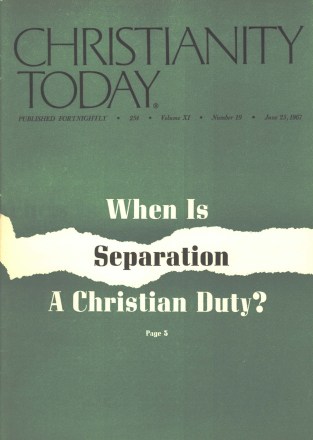
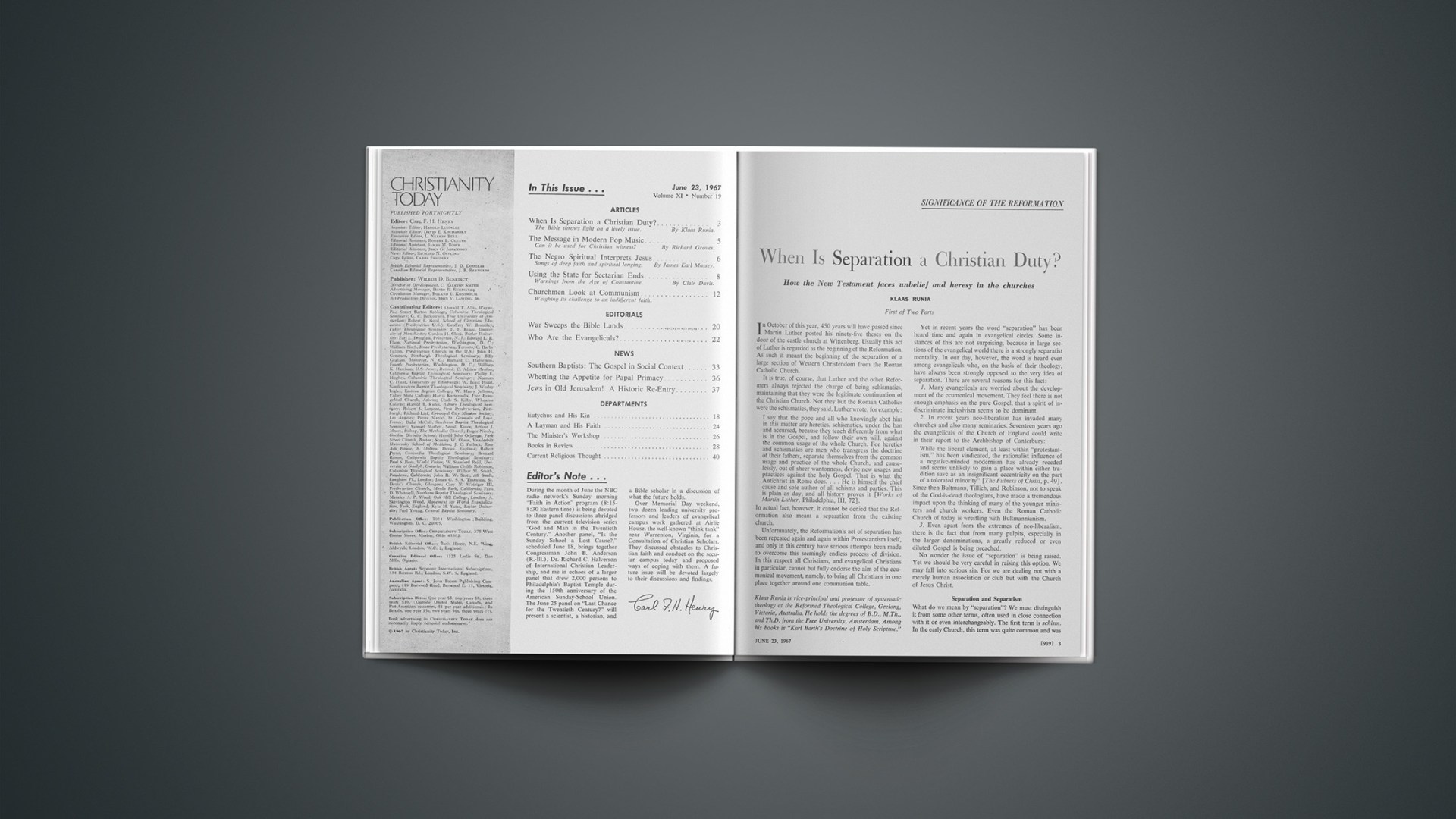
When Is Separation a Christian Duty?

How the New Testament faces unbelief and heresy in the churches

First of Two Parts

In October of this year, 450 years will have passed since Martin Luther posted his ninety-five theses on the door of the castle church at Wittenberg. Usually this act of Luther is regarded as the beginning of the Reformation. As such it meant the beginning of the separation of a large section of Western Christendom from the Roman Catholic Church.

It is true, of course, that Luther and the other Reformers always rejected the charge of being schismatics, maintaining that they were the legitimate continuation of the Christian Church. Not they but the Roman Catholics were the schismatics, they said. Luther wrote, for example:

I say that the pope and all who knowingly abet him in this matter are heretics, schismatics, under the ban and accursed, because they teach differently from what is in the Gospel, and follow their own will, against the common usage of the whole Church. For heretics and schismatics are men who transgress the doctrine of their fathers, separate themselves from the common usage and practice of the whole Church, and causelessly, out of sheer wantonness, devise new usages and practices against the holy Gospel. That is what the Antichrist in Rome does.… He is himself the chief cause and sole author of all schisms and parties. This is plain as day, and all history proves it [Works of Martin Luther, Philadelphia, III, 72].

In actual fact, however, it cannot be denied that the Reformation also meant a separation from the existing church.

Unfortunately, the Reformation’s act of separation has been repeated again and again within Protestantism itself, and only in this century have serious attempts been made to overcome this seemingly endless process of division. In this respect all Christians, and evangelical Christians in particular, cannot but fully endorse the aim of the ecumenical movement, namely, to bring all Christians in one place together around one communion table.

Yet in recent years the word “separation” has been heard time and again in evangelical circles. Some instances of this are not surprising, because in large sections of the evangelical world there is a strongly separatist mentality. In our day, however, the word is heard even among evangelicals who, on the basis of their theology, have always been strongly opposed to the very idea of separation. There are several reasons for this fact:

1. Many evangelicals are worried about the development of the ecumenical movement. They feel there is not enough emphasis on the pure Gospel, that a spirit of indiscriminate inclusivism seems to be dominant.

2. In recent years neo-liberalism has invaded many churches and also many seminaries. Seventeen years ago the evangelicals of the Church of England could write in their report to the Archbishop of Canterbury:

While the liberal element, at least within “protestantism,” has been vindicated, the rationalist influence of a negative-minded modernism has already receded and seems unlikely to gain a place within either tradition save as an insignificant eccentricity on the part of a tolerated minority” [The Fulness of Christ, p. 49].

Since then Bultmann, Tillich, and Robinson, not to speak of the God-is-dead theologians, have made a tremendous impact upon the thinking of many of the younger ministers and church workers. Even the Roman Catholic Church of today is wrestling with Bultmannianism.

3. Even apart from the extremes of neo-liberalism, there is the fact that from many pulpits, especially in the larger denominations, a greatly reduced or even diluted Gospel is being preached.

No wonder the issue of “separation” is being raised. Yet we should be very careful in raising this option. We may fall into serious sin. For we are dealing not with a merely human association or club but with the Church of Jesus Christ.

Separation And Separatism

What do we mean by “separation”? We must distinguish it from some other terms, often used in close connection with it or even interchangeably. The first term is schism. In the early Church, this term was quite common and was often used in close relation to the word “heresy.” In fact, at first the two were almost identical, as we see in First Corinthians 11:18, 19, where “divisions” (schismata) and “factions” (haireseis) are almost used as synonyms. Gradually, however, the ancient Church distinguished the two, using heresy to mean false doctrine and schism an orthodox sect. In other words, schism in its original meaning always refers to a division in the church that is due to causeless differences and contentions among its members. The separating party leaves a church that is itself still faithful to the Gospel.

Separation denotes a different situation. Here a group separates itself from the main body because that body has become unfaithful to the Word of God. It is unfortunate that often any separation is simply termed a “schism.” To mention an example, the breach between the churches of the East and West in 1054 and the following centuries was clearly a schism. There were no real doctrinal differences (apart from the “filioque” question). The Reformation of the sixteenth century was not a schism (at least not from the point of view of the Reformers) but rather a separation. The same can be said of several secessions in the nineteenth century, as, for example, in 1834 and 1886 in the Netherlands. Often, in the case of separation, those who leave the church are forced out by the parent body.

Separation must also be distinguished from separatism. This term denotes the ecclesiology and practical attitude of those who leave their church prompted by a wrong spirit. Separatists make no attempt to reform the church from within, nor do they have any understanding of or concern for the visible unity of the church; instead, they are motivated by some form of ecclesiological perfectionism that compels them to abandon the existing church and establish a new one. I have no appreciation whatever for any form of separatism, even if I share its concern for the purity of the church.

A Biblical Answer

But what of separation? Is it ever permitted? Are there any objective norms?

Naturally we must concentrate on the New Testament. Yet we cannot completely bypass the Old Testament. Those who condemn all separation often appeal to the Old Testament on two points. First, they point to the attitude of the prophets, who, in spite of the terrible corruption of the church of their days, never separated from it in order to establish a new people of God with a separate cult. In my opinion, however, this argument is completely untenable, for it loses sight of the peculiar situation of Israel as the theocratic nation of God. The application of the national-church (Volkskirche) idea to the New Testament church by the Reformers of the sixteenth century and by many defenders of the established-church concept in our own day not only is without any scriptural warrant, but also has led to an externalization of the church.

A second argument against separation is at times derived from the Old Testament concept of the remnant. As the Old Testament church was preserved in the faithful remnant, it is said, so true believers have a duty to preserve the church today by staying in it. However plausible this argument may seem at first glance, it is based on a complete misunderstanding of the Old Testament concept. A. Lelièvre rightly states:

After the resurrection, the culmination of the history of salvation precludes the principle of the remnant. In this respect the Acts is especially clear and significant in its allusion to ever-increasing numbers.… There can no longer be this movement of reduction in the case of the new covenant, for it is a movement which is entirely characteristic of the Old Testament: it is a pattern inherent in the process by which the coming of Christ is prepared. The Christian Church is not the remnant, but rather the new humanity of the future springing from the remnant which Jesus Christ embodied in his own person [von Allmen, Vocabulary of the Bible, p. 356].

It is evident that every application of the concept to the New Testament church, and in particular to the true believers in a corrupted church, reveals a historical misunderstanding.

The New Testament condemns all unnecessary schism (1 Cor. 1:10 ff.; 11:18, 19; Gal. 2:12). All such schisms are “works of the flesh” (Gal. 5:20). Throughout the whole New Testament there is a tremendous emphasis on the unity of the church.

Yet there are also other aspects that may not be ignored. First, there is the fact that gradually the New Testament church separates itself from the Jewish church. It is a rather slow process; but it is inevitable, because Israel as a nation refuses to accept Jesus as the Messiah. In fact, because of its opposition to Christ it actually becomes the “synagogue of satan” (Rev. 2:9), while the New Testament church is seen as the true “Israel of God” (Gal. 6:16).

Secondly, there is the teaching of Second Corinthians 6:14–17. This passage has often been used by separatists as a direct commandment of the Lord to separate from a church that has become unfaithful, but this application is not warranted. Paul is not speaking of the church but of the world. Hodge, in his commentary, rightly notes that the “Hoi apistoi are the heathen.” Yet he also points out that the principle has a wider application. “The principle applies to all the enemies of God and children of darkness.” How it has to be applied in the case of an unfaithful church must be decided by the teaching of the whole New Testament. A straightforward appeal to verse seventeen (“Therefore, come out from them and be separate from them”) in defense of separatism is an oversimplification of the issue.

Of much more importance for our subject is a third aspect of New Testament teaching, the clear commandment that heresy is not to be tolerated in the church. Throughout the New Testament, heresy is condemned in the strongest terms and believers are told to separate themselves from heretics. This separation, however, is accomplished not by the believers’ withdrawal from the church, but by the expulsion of the heretic (Gal. 1:8, 9; 2 Tim. 3:5; Tit. 3:10, 11; 1 John 4:1 ff.; 2 John 7–11; Rev. 2:14).

This, I believe, is the sum of the direct teaching of the New Testament on our subject. The results are rather meagre; but this is not surprising, for the New Testament does not know our situation! Although W. Elert is right when he says of the false teachers in Paul’s days: “From the apostle’s warning we must conclude that the false apostles had established themselves in the congregation,” he is equally right when he adds that Paul disposed of them, making his decision “on the basis of his apostolic authority” (Eucharist and Church Fellowship in the First Four Centuries, pp. 48, 49). Only after the days of the New Testament did heresy gain a foothold in the church.

Does this mean that we have no biblical norm for our present-day problems? Definitely not! The New Testament remains normative also for our subject. It does not deal directly with our questions, but indirectly it gives the final answer by what it says about the true nature of the church and its unity. We should never make the mistake of isolating the problem of “separation.” It is an aspect of a much wider question. [To be Continued]

Editor’s Note from June 23, 1967

During the month of June the NBC radio network’s Sunday morning “Faith in Action” program (8:15–8:30 Eastern time) is being devoted to three panel discussions abridged from the current television series “God and Man in the Twentieth Century.” Another panel, “Is the Sunday School a Lost Cause?,” scheduled June 18, brings together Congressman John B. Anderson (R.-Ill.), Dr. Richard C. Halverson of International Christian Leadership, and me in echoes of a larger panel that drew 2,000 persons to Philadelphia’s Baptist Temple during the 150th anniversary of the American Sunday-School Union. The June 25 panel on “Last Chance for the Twentieth Century?” will present a scientist, a historian, and a Bible scholar in a discussion of what the future holds.

Over Memorial Day weekend, two dozen leading university professors and leaders of evangelical campus work gathered at Airlie House, the well-known “think tank” near Warrenton, Virginia, for a Consultation of Christian Scholars. They discussed obstacles to Christian faith and conduct on the secular campus today and proposed ways of coping with them. A future issue will be devoted largely to their discussions and findings.

A Look at America’s Religion

The American Academy of Arts and Sciences devoted the Winter 1966 issue of its journal Daedalus to a symposium on “Religion in America.” Thirteen contributors, chosen from a fairly broad spectrum of our American religious scene, attempt to assess the status of both institutional and “spiritual” Christianity and Judaism, with a view to a possible projection of the nation’s religious future.

Giant problems stalk the terrain these authors seek to cover. These problems touch the center of our national scene: the relation of the Church to society, the inter-relationships among major religious institutions themselves, and the tendency of the Church to “establish” itself, whether legally or sociologically. Although the writers address themselves to many issues, they seem most concerned with the emergence of what may be called a “folk religion” and with the several elements that may combine to produce this. The tension between the sacralism of such a culture-religion and the New Worldliness appears in many guises and elicits a variety of responses.

A pivotal question is whether American culture is to continue to be shaped without reference to God. If so, then what will occupy the role theism left vacant? What symbols will replace the concepts of divine sovereignty, providence, redemption, and judgment? Some suggest that the figure of Jesus (often regarded as a paradigm for the Church, or for social service) will afford an integrating center, so that “God talk” will yield to a bold new symbolism in theological language, a symbolism deriving its content from secular and sociological sources.

It is suggested that the existential mood, which tends to be psychologically oriented, is giving ground to a new mood related to current social crises—race, economics, law enforcement, sexual morality, and the like. If this is correct, what shape may theological formulation be expected to take? There is no lack of contenders. Some, disillusioned with institutional forms of Christianity, will follow Bonhoeffer in his insistence upon some such category as “worldly Christianity.” Others will propose a sharpening of the now-blurred categories of classical theological liberalism, so as to afford a framework for a new formulation in which the frank involvement of theology with cultural surroundings will be accepted as given.

Looming large in the discussions is the alleged irrelevance of the churches to modern life, particularly in its urban form. The classic explanation is that traditional supernaturalism is alien to the thought-modes of modern man and that irrelevance thus lies in a failure to shed the trappings of historical Christian theological language. But one author ventures to quote the view, expressed recently by a critic of the God-is-dead movement, that ‘much of the churches’ social irrelevance stems from their tendency to dilute the categories of Scripture in a mindless accommodation to society.” To this the evangelical can assent heartily.

Major problems of approach concern the panelists. Most of them reject the view that the task of the churches should be understood chiefly in terms of the preservation of stable institutions. The choice seems to be between the activist minority, bent on revolutionary change, and the melioristic majority, more grateful to the past than the activists. No one seems willing or able to propose a final answer at this point.

The recurring question is, however, to what extent the Christian Church should try to adapt its theology to the kaleidoscopic movements in the current social scene. Those favoring a thorough accommodation seem to opt for the more promising path of conformity. Those contending for the validity of the essential core of Christian confessional truth face the staggering problem of teaching the thoughtful part of our world to understand the language in which this truth is expressed. Few, it seems, are willing to undertake this bold task.

A generation ago, a symposium of this sort would scarcely have included such a chapter as “Is There a Third Force in Christendom?” By a religious “third force” the author means an agency that is either indicative of or (possibly) causal to a significant shift in religious alignments. On the whole, this chapter is balanced in its treatment of the movements that stand between the avant-garde of the radical theology and the melioristic standard-bearers of the religion of the major denominations. What is new here is the stress upon the pluralistic quality of the “Third Force,” especially the inclusion within it of the younger and restless elements in the Roman Catholic Church.

The chapter contains its provincialisms. It mentions Wheaton (Illinois) College as “one of the very few accredited fundamentalist colleges” and makes no mention of accredited theological seminaries of evangelical commitment. Its author identifies—too easily, we think—the evangelical movement in America with the 1964 candidacy of Barry Goldwater, and speaks from a very limited inductive base when he writes that “the new evangelicals are the spiritual hard-core of the radical right.” It is the experience of this writer that his colleagues were far from being of one mind in October/November of 1964; and further, that thoughtful evangelicals today are far more charitable in their treatment of President Lyndon B. Johnson than many of those who in 1964 evangelistically endorsed his platform as embodying the Christian ideal.

Again, it appears naive to write, as the author of this chapter does, that the priority given by evangelicals to foreign missionary endeavor “unquestionably results from their alienation from their own culture.” One wonders whether this writer has any acquaintance with the biographies of such missionary leaders as J. Hudson Taylor, Charles Cowman, or C. T. Studd—to name a few.

The attempt to sever the motivation of the evangelical missionary societies (especially the “faith missions”) from that of the nineteenth-century missionary endeavors is related to a more general tendency—that of portraying the evangelical cause today as unrelated to the major evangelical trends within the established denominations prior to the period of the dominance of theological liberalism.

What is the probable future shape of religion in America? None of the authors ventures a definitive reply. Some see it shaped, in some part at least, by a rising pietism, derived from impulses parallel to those prevailing in evangelical Christianity, if indeed not in some measure determined by them. Some see activistic participation (perhaps identification) as the wave of the theological future. Yet others see the emergence of a sort of social-establishment Christendom.

Only one author seems to regard as a live option the possibility that the Holy Spirit may operate instrumentally to bring new light—and with it, new forms—to the spiritual life of the nation. It seems clear that, should this occur, the Spirit’s moving will come upon many who at the moment show little acquaintance with him.

The New Nuns

American nuns are beginning to kick the habit. The evidence is unmistakable.

Last year the number of nuns decreased by 4,750—the first major decline in years. But more important than the nuns who quit are the nuns who stay and fight the system.

“Sweeping changes in the rules and practices of religious orders are on the way,” predicts Sister Aloysius Schalden-brand, a college philosophy instructor, with heady optimism. “Old restrictive rules are tumbling as the store of energy within the convents bursts its bounds, and nothing will stop that process now.”

Though she sounds more like a suffragette than a sister, her attitude reflects the spirit of a growing group coming to be known as the “new nuns.” Having vowed to be poor, chaste, and obedient, they are suddenly aware of a responsibility to themselves to be revolutionary as well.

“There has been a dramatic change in the involvement of the American sisters,” says Sister M. Audrey Kopp of Marylhurst College. “They want to be relevant.”

Predictably, the reaction of the hierarchy is mixed.

“Sisters are, or are rapidly becoming, the best educated, the most prophetic, the most dedicated and farthest out in front in their desire to implement the new mind of the church,” says Auxiliary Bishop Joseph M. Breitenbeck, vicar of Detroit’s 6,000 nuns. “Not to utilize fully this great resource of the church would be tragic.”

But to others in the church (probably the majority), the real tragedy is the new nun herself.

One mother superior who has had to deal with this new spirit in a convent says that the new nun represents an extremely small minority who are not so interested in relevance as in simple rebellion. “They want all the benefits of being a nun, without any of the restrictions.”

Whether for rebellion or renewal, however, the new nun is restless, and the focus of her attack is the complete control of her life by the convent.

There are now in this country 176,000 nuns scattered through 480 orders. Whatever her rank, each nun is regimented in her life—from dress to vocation—by a rigid chain of command that leads ultimately to Rome.

In the eyes of the church, a nun accepts her vows so she may more perfectly serve God. Any differences she may have with the system are to be resolved through simple obedience. The growing view in the convent, however, is that the system often produces suffocation and should be reshaped.

The search for a new role for religious orders dates from Vatican II and the church’s increased emphasis on social action. The council called for convents to be “modified according to conditions of time and place and outdated customs done away with,” and instructed each order to conduct a self-study.

The new nuns hope to translate this spirit into action. The convent, they say, should promote social involvement, not restrict it. Where there is a conflict, it must be the system, not the sisters, that change.

Catholic Growth Lag?

The official annual directory published last month shows record totals for U. S. Roman Catholics in membership (46,864,910, including children) and clergy (59,892) for calendar year 1966. But there were signs of a possible decline on the horizon.

The number of converts (117,478) was the lowest since 1953, and candidates for the priesthood dropped 6 per cent. While high school and college enrollment rose, the elementary school total dropped 122,108, to 4,369,845. There were 84,096 fewer infant baptisms in 1966 than in 1965.

The convert figures, watched by Catholic traditionalists, have dropped since Vatican II. But over the past decade, Catholic growth has amounted to an impressive 35 per cent, compared to a 15 per cent increase in Protestantism.

While the fight has not been without its minor victories, the new nuns still face the frustration expressed by Sister Claire Sawyer: “We are intelligent people, well trained in our professions, but too often we are treated like children.”

What nuns have on their minds is as important to the church as to the convent. Without the nuns, Pope Pius XII used to say, the work of the church is “almost inconceivable.”

If anything, he was understating the case. Nuns form the backbone of the labor force of almost every important church activity. More to the point, they do it inexpensively.

Nowhere is their presence more vital than in education. More than 100,000 nuns now work in Catholic education. The dollar replacement value of that contribution has been estimated at $200 million yearly.

With the increasing problems Catholic education is facing—a decrease this year of nearly 100,000 elementary and high-school students, for example, combined with fears of reduced federal aid to private-school children—a revolt among nuns could be devastating.

But while the power held by religious orders is great, the church’s hierarchy appears convinced that it is much more than they will ever use. As a result their demands often are treated as trifles.

Only reluctantly, for example, did church fathers invite a few women to attend the Vatican Council—and then only as voteless observers. In the convent, when nuns are able to enter into discussions on procedures, most often the talk is limited to secondary questions of dress or work conditions.

To many church conservatives, religious orders need to stay the same more than they need to change. If there is currently a revolt spreading among the nuns, the fault, they say, is more with the nuns who spread dissatisfaction than with the system itself. And they attribute the decline in the number of nuns to increased competition from other opportunities open to young people for social service, among them the foreign and domestic Peace Corps.

But to church reformers with their preoccupation for renewal, the question goes deeper.

“Open your eyes and count,” warns Rev. Blase Bonpane, vocational director for Maryknoll College. “They are quitting because they think they can be more Christian somewhere else. Does blindness have to be part of our life?”

The Protestant Nuns

The nun in Protestantism is rare. Only four major U. S. denominations have them, and the total number is probably under 2,000.

Known usually as “deaconesses,” they generally have no specific dress and few restricting vows beyond obedience. Often they are free to marry. Few live in convents.

The Methodist Church lists the largest group, with 390 now active. The Lutheran Church in America ranks second with 200. LCA nuns wear a uniform and are sworn to celibacy, unlike the 100 nuns of the third-ranked Lutheran Church-Missouri Synod.

The Protestant Episcopal Church has both deaconesses and nuns. The church’s forty-five deaconesses have no vows or uniform and are free to marry (though none ever have). The church also has an undisclosed number of nuns connected with fifteen independent orders. Like those in the Roman Catholic Church, Episcopal nuns live a convent life under vows of poverty, chastity, and obedience.

Women in Protestant religious orders work primarily in education and social service. Although all four denominations report recruitment campaigns, membership in orders has tended to remain constant.

Miscellany

The U.S. House of Representatives passed and sent to the Senate a bill to maintain federal aid for elementary and secondary schools. A controversial amendment to turn over control of funds to states (May 26 issue, page 44) was defeated, but a number of related compromises were incorporated. Several states forbid church school aid.

As a follow-up to the World Congress on Evangelism, one of the largest groups of French-speaking evangelicals ever assembled met in Lausanne, Switzerland, to discuss the theology and methodology of evangelism. Leaders were Scripture Union’s Maurice Ray and Jean-Paul Benoit, former evangelism director of the French Reformed Church.

The newsletter of the National Council of Catholic Men suggests that churches be required to pay taxes on unrelated business income. It recommends study of the issue by courts or Congress.

Militant Hindus are urging India to make conversion of Hindus to other faiths a criminal offense, as it is in neighboring Nepal.

The 124,000 Baptists in the western Congo are asking their government for legal recognition as a body independent of overseas control. Detroit Negro pastor Louis Johnson had complained to American Baptist missions officials about U. S. control and related policies.

The Lutheran World Federation plans to expand Radio Voice of the Gospel, its Ethiopia-based station, possibly to Angola, Mozambique, and Latin America.

Pope Paul ratified the four representatives U. S. bishops chose to go to this fall’s Synod of Bishops in Rome. They are Lawrence Cardinal Shehan of Baltimore, Archbishops John Dearden of Detroit and John Krol of Philadelphia, and Bishop John Wright of Pittsburgh.

The Evangelical Press Association gave its “Periodical of the Year” award to This Day, the Lutheran Church-Missouri Synod monthly, and presented fifty-five other prizes.

The American Foundation of Religion and Psychiatry is moving offices from New York to Chicago and will increase efforts to train clergymen in counseling.

In annual missions-giving marathons, The Peoples Church of Toronto raised $325,000, and Boston’s Park Street Church more than $300,000.

Georgia Presbyterians were told that the church’s well-heeled Thornwell Orphanage in Clinton, South Carolina, cannot be racially integrated because this would cause community discord, staff resignations, reduced contributions, and church conflicts.

In reaction to open-housing demonstrations in Louisville, Kentucky’s Transylvania Presbytery urged cities in its area to adopt open-housing ordinances, citing national pronouncements from the Presbyterian Church in the U. S.

Governor Buford Ellington signed on May 18 a bill that repeals Tennessee’s law against teaching evolutionary theories on the origin of man. Only Arkansas and Mississippi retain anti-evolution statutes.

For the first time, a Roman Catholic unit has been elected a participating organization in a National Council of Churches agency. The Maryknoll Missionary Society will have a seat on the board of the NCC education department.

The Centennial School District in Bucks County, Pennsylvania, decided not to appeal to the state Supreme Court a ruling against distribution of Gideons Bibles to pupils. The books can be used if they have a “reasonable relationship” to curriculum. A district near Pittsburgh plans to distribute New Testaments under the rationale that they are great world literature.

Personalia

A decision by the administration of Waynesburg College not to renew the contract of Religious Life Director Dennis C. Benson was backed by a faculty vote of 34 to 21.

The Rev. Rodger Harrison, an American Baptist Convention missionary to Sweden, will become the chaplain to English-speaking Protestants in Moscow, on behalf of the National Council of Churches.

Bishop Ruben Josefson has been chosen Lutheran Archbishop of Uppsala and primate of the Church of Sweden’s seven million members.

Paul Fromer, editor of Inter-Varsity Christian Fellowship’s His magazine, was elected president of the Evangelical Press Association.

Evangelist Billy Graham joined War on Poverty chief Sargent Shriver for a weekend visit of poverty programs in Graham’s home region of western North Carolina.

The new president of Union Theological Seminary (Presbyterian) in Richmond, Virginia, is the Rev. Dr. Fred R. Stair, Jr., 49, pastor of Atlanta’s Central Presbyterian Church, who was assistant to the UTS president from 1948 to 1953.

Joseph Wightman was installed as the president of Erskine College, Due West, South Carolina, in ceremonies that included an address by Secretary of State Dean Rusk.

Dallas Cowboys football coach Tom Landry, named 1966 National Football Coach of the Year, told a meeting of the Fellowship of Christian Athletes that “ultimate satisfaction rests in religious belief.”

Accepting a Catholic Press Association award for the “most distinguished contribution to Catholic journalism,” the Rev. John Reedy, editor of the national weekly Ave Maria, said that “the most important development in the U. S. Catholic press in the last ten years was the founding of the National Catholic Reporter,” an independent weekly.

The Rev. Martin Duffy, white pastor of the predominantly Negro Mountain Vernon Heights Congregational Church (United Church of Christ), Mount Vernon, New York, has resisted an attempt by a group of members to have him dismissed for his work in civil-rights causes. The congregation voted 50 to 40 to retain him.

Richard L. Riseling has been named director of international affairs of the American Baptists’ Division of Christian Social Concern.

Orley S. Herron, dean of students at Westmont College, Santa Barbara, California, will become an associate professor of education at the University of Mississippi.

Middle East Crisis: A Biblical Backdrop

Gamal Abdel Nasser flexed his military muscle last month, and suddenly the world tottered on the edge of a major armed conflict. Americans were preoccupied in Viet Nam, the British in Hong Kong, where Communist-inspired rioting persisted. But the Middle East situation worsened so rapidly that the eyes of the world shifted anxiously to the lands of the Bible. There were no immediate religious issues in the crisis, but overtones of conflicting faiths and ideologies were quickly apparent.

Nasser, the Muslim president of the United Arab Republic (Egypt), touched off the global concern—perhaps at the provocation of Israel. He demanded withdrawal of a 3,400-man United Nations surveillance force from the Gaza Strip and the Sinai Peninsula, where Israel and Egypt meet. United Nations Secretary General U Thant, a Buddhist, quickly acceded, and the border-watchers were evacuated.

Then Nasser announced a blockade against Israeli shipping at the Strait of Tiran. To the Israelis, who have been forbidden by Egypt to use the Suez Canal, it seemed a deliberate act of aggression. The Gulf of Aqaba had been closed to Israel from 1948 until after the Suez war in 1957. Part of the price for withdrawal of Israeli forces from Egypt’s Sinai Peninsula was the opening of the water access to the port of Elath at the southern tip of Israel. Israel used it to receive oil supplies from Iran and to send important cash exports.

The immediate ecclesiastical effect of the crisis was the threat that North American and British Christian missionaries would have to leave their posts in the Middle East. That seemed to be a virtual certainty if major hostilities developed. Archaeological research (see story below) could also be seriously affected.

Meanwhile, Jewish leaders in the United States brought pressure on President Johnson to assert himself on behalf of Israel. Irving Fain, head of social-action programs for the Union of American Hebrew Congregations, called on the chief executive “not simply to reaffirm a general interest in Israel’s security—but to make the kind of statement which cannot be misinterpreted—i.e., a statement of intention to keep the Straits of Tiran open for international shipping; a stern warning to the effect that armed incursion by Arab aggressors will not be tolerated; and a systematic effort to persuade Great Britain, France, and the Soviet Union to join in this quest for peace.”

General Secretary R. H. Edwin Espy of the National Council of Churches sent a telegram to U Thant saying “We … consider the U.N. presence in the Middle East as essential to the prevention of a disastrous conflict.” Another telegram, sent to Arthur Goldberg, U.S. ambassador to the U.N., asserted that the “failure to secure the U.N. peacekeeping function in the Middle East now will be a severe setback to peace.”

Britain and France delayed action on the Middle East crisis. But the Soviet Union, which has been supplying arms to Egypt, quickly lined up behind Nasser and blamed Israel for “aggravating the atmosphere of military psychosis” in the Middle East.

Nasser also got expected support from the University of Al-Azhar in Cairo, a famous seat of Muslim learning dating back to about A.D. 968. The rector of the university, Sheik Hassan Maamoun, called the situation a “decisive battle in the history of religion and Arabism.” He issued a statement appealing to the world’s Muslims to support Nasser in the face of the “Zionist menace” and to “strike hard at the aggressor.”

Elath, the Aqaba port of the Israelis, is at or near the site of the Ezion-Geber of Numbers 32:35, where it is recorded that the Hebrews encamped while traveling from Kadesh-barnea to Moab. In First Kings 9:26, King Solomon is remembered as having built a fleet of ships at Ezion-geber. The site was excavated in the thirties by archeologists Nelson Glueck and Fritz Frank. Large-scale copper refinery installations were found.

Digging Solomon’S Wall

The eventful spring archaeological dig in Gezer, Israel, this year may well have rediscovered the third city wall and gate built by King Solomon. Positive proof may come within weeks. Gezer, twenty miles west of Jerusalem, was one of the half-dozen most important cities in old Palestine, and one of the largest. It was conquered by Joshua and the Israelites. As a Philistine center, it rose against King David. Solomon got it as a dowry when he married Pharaoh’s daughter.

The rediscovery tale began in 1958, when the well-known soldier-archaeologist Yigael Yadin uncovered the gate Solomon built at Hazor, and concluded that the ancient mound at Gezer would reveal another gate of Solomon if the excavator’s pick were sunk in the correct spot.

How did he know? Yadin, Israel’s first chief of staff, and now a professor at Hebrew University in Jerusalem, found the gate not by picking through the twenty-seven acres at the site, but by reading two books: the Bible and a sixty-year-old archaeological work by Britain’s R. A. Stewart Macalister. Macalister had set out to turn over every foot of soil at Gezer, but time and money ran out before the job was completed. His three-volume chronicle of the effort, though it leaves much to be desired by current standards of scientific accuracy, inspired future archaeologists to re-excavate the area.

Macalister had discovered a casemate (double) wall and a four-entry gate, which he sketched and labeled “Maccabean Castle.” Yadin compared the sketch with Hazor and the wall found in the 1930s at Megiddo and theorized that they had been planned by the same ancient royal architect. And First Kings 9:15 affirmed the theory—it reports that walls were built at Jerusalem, Hazor, Megiddo, and Gezer.

The theory was tested in April by an expedition from Hebrew Union College under Harvard—trained archaeologist William G. Dever. They uncovered the “Maccabean Castle,” and it appears to be the Solomonic wall and gate Yadin had predicted.

A group of theological students from the American Institute for Holy Land Studies, working as volunteers with Dever, shared the general excitement as the entrance to the gate slowly came into view. The next day, the students were off to Megiddo, then Hazor, and one enthused, “We are probably the first in 3,000 years to view all three of Solomon’s gates which stood before his fortified cities.”

Positive proof on Gezer must await further work this summer, when archaeologists will seek undisturbed, datable pottery. From June 26 to August 4, the expedition will be joined by more than 100 students from the United States and Israel. Those following the prescribed course will get four hours’ credit for the summer of work. Besides digging, they will hear lectures from six scholars on the summer staff.

The Gezer work began in 1964 under Harvard’s G. Ernest Wright, assisted by Dever and another of his students, H. Darrell Lance. Dr. Nelson Glueck, who heads Hebrew Union College in Cincinnati and its branch school of archaeology in Jerusalem, commissioned the work. Wright was succeeded by James F. Ross of Drew University, then Yale’s Marvin Pope, with Dever as field director. Lance, now with Colgate Rochester Divinity School, joins the group this summer as associate director.

Glueck said excavations will continue for the next six to eight seasons, to “salvage everything possible done by Macalister, published or unpublished.” The group also hopes to “excavate large areas of the untouched portion of the mound in order to fill in the gaps that exist in the history of the site.”

Macalister published so little evidence that most scholars had thought the mound was deserted during the tenth and ninth centuries B.C. Yadin’s hunch and the 1967 discovery that the structures do exist erases much of the doubt and opens the way for establishing positively that the area was occupied in Israelite times. The work of coming seasons promises to fill other historical gaps and add to the growing store of knowledge about the life and times of this land in the days of the Bible.

DWIGHT L. BAKER

India’S Muslim President

It took the United States 171 years to elect a Roman Catholic president. Last month, India chose a member of its Muslim minority as president (ceremonial head of state) just twenty years after the tumultuous religious partition with Muslim Pakistan.

Zakir Husain, 70, noted scholar and vice-president since 1962, defeated Hindu jurist Subba Rao both in the national Parliament and in the state assemblies. The Muslims—one-tenth of India’s 500 million population—apparently voted for Husain regardless of party. Though predominantly Hindu, India is officially a secular state under its 1947 constitution.

The third president of India is a great admirer of Gandhi and said after his election, “We have to talk less, quarrel less, work hard and ever harder, and hold together.”

T. E. KOSHY

Greece’S New Primate

The military junta that controls Greece has ousted highly conservative Archbishop Chrysostomos and replaced him with Archimandrite Jerome Kotsonis, a theologian who has worked with the World Council of Churches and supports closer ties with the Vatican. The new primate was elected by the Synod of Bishops, whose nine members had earlier been replaced by the junta. Russian Orthodox Patriarch Alexei later opposed the church changeover.

Internally, the move represents the success of the junta in bringing the church under its control—something that both the old government and Greece’s King Constantine had favored but were unable to achieve.

Internationally, the new archbishop raises hopes among ecumenically minded church leaders for more friendly relations between Orthodoxy and Catholicism.

Preaching at his enthronement in Athens, Archbishop Kotsonis pointed to the need for Christians to put the basic principles of Christianity into effect regardless of doctrinal differences. “All of this can be attained,” he said, “only with the close cooperation of all the Christian Churches.”

At 62, he is exceptionally young to hold the church’s highest office. He is also the first non-bishop elected to that rank since 1920. He has been a chaplain to the royal family since 1949 and is a member of the central committee of the World Council of Churches and a professor of canon law at the University of Thessalonica.

Spain: Strings Attached

Protestants in Spain hardly know whether to feel happy or hurt about the final text of the religious-freedom law voted by a Cortes (parliament) committee last month. Final approval is scheduled at the July Cortes plenary session. “Private and public profession of any religion” is permitted, but only for those who accept a long string of regulations.

On the eve of the Cortes action, Protestant representatives held their yearly meeting in Valencia, and their verdict on the law was unanimous: Unacceptable, because the state will interfere with the affairs of the church. They decided not to accept the rules, even if it means loss of the new freedom the law promises.

Under the law, the 35,000 Protestants will be recognized on the same level as secular organizations. They must provide annual membership lists and financial reports to the government. The government must accredit new pastors and will tell seminaries how many new students they can accept. Church schools may be started only if congregations have the required number of children. No churches can accept foreign aid.

The new law says religious freedom is “based on the Catholic teaching and must be put in agreement in every case with the fact that Spain is a confessional state.” The Cortes discussion stressed that the Vatican had approved the law, and Protestants were mentioned only in a derogatory way. As Adolfo (named after Hitler) Munoz Alonso said, “This law will inaugurate a new political situation, and I must express my fears that a second step of the sects will be to ask for other liberties under the pretext of still being discriminated against.”

The law does not give Protestant ministers the exemption from military service granted Catholic priests. And Protestants will be required to attend the military Mass which accompanies the ceremony of loyalty to Spain.

Since non-Catholic worship, whether private or public, must be in places approved by authorities, Protestants fear the law could prevent even their private devotions at home. Also, most Protestant converts are won through home visitation and the law clearly forbids this.

Episcopal Bishop Ramon Sienes regrets that non-Catholic churches are considered “mere associations of private right,” and Jewish leader Don Samuel Toledano says, “We are considered to be second-class citizens of Spain.”

Come Down, Kingey

A version of the four Gospels in the “Scouse” dialect of Liverpool, England, will appear shortly. The cover will picture Christ on the cross, wearing a flat cap, open shirt, and dungarees, against a Liverpool background. The crucifixion scene reads:

“ ‘Come down, Kingey,’ dey yelled, ‘You’ve done some big talkin’. If yer de Son of God, get yourself out of this mess—den we’ll believe yer.’ ”

Liverpool’s Bishop Stuart Blanch says “it is a fine piece of work. In parts, it gets to the root of the real meaning of the Gospel, which may have been obscured in normal orthodox translation.”

The writer is the Rev. R. H. L. Williams, whose church is by the Liverpool docks. He was converted in 1949 under the ministry of noted evangelical Leith Samuel.

The Fatima ‘Obstacle’

Before he left for Fatima, Portugal, last month, Pope Paul admitted that “Marian dogma still constitutes one of the greatest obstacles to unity in one faith with the Catholic Church.” Even so, he said in an encyclical the same week that “all those who believe in the Gospel” are “obliged” to venerate the Virgin Mary, and that the church is entering a new “Marian era.”

The fiftieth anniversary of the reported visions of Mary at Fatima and the Pope’s interest in Mary are of great ecumenical significance (see “Fatima’s Fiftieth,” News, March 31 issue).

In his sermon during a low mass at the shrine attended by one million pilgrims, the Pope said “we have come to the feet of the Queen of Peace to ask her for the gift, which only God can give, of peace.” He meant not just a military ceasefire, it developed, but peace in the Roman church itself. The Pope issued a strong appeal against liberal theology:

“What terrible damage could be provoked by arbitrary interpretations, not authorized by the teaching of the church, disrupting its traditional and constitutional structure, replacing the theology of the true and great fathers of the church with new and peculiar ideologies, interpretation intent upon stripping the norms of faith of that which modern thought—often lacking rational judgment—doesn’t understand and doesn’t like.”

The sermon also remembered “all Christians, non-Catholics but brothers in baptism” and asked Mary for a “united church.” Earlier, the Pope had used mostly Bible texts in speaking about Mary to a group of Portuguese Protestants.

Besides multitudes of diseased persons visiting the shrine, the onlookers included famed Soviet poet Yevgeny Yevtushenko, who was visiting his Portuguese publisher. He said “it was a very impressive experience” and that he plans to write a poem about it.

The Pope’s five-hour Portugal visit included a nine-minute chat with dictator Antonio Salazar. The New York Times said the Pope has rarely been mentioned in Portugal’s government-controlled press since he visited India after it absorbed the Portuguese colony of Goa. But the papal audience was long enough to bring a protest from Algeria, which harbors several anti-Salazar rebel groups.

Besides Portugal and India, the Pope has visited the Holy Land and the United Nations in New York since his election in 1963.

The Fatima visit was seen on all three U. S. TV networks, in Canada, and in fifteen West European nations through Eurovision, which assigned two dozen cameras to the operation.

Presbyterian Assembly Ratifies Confessional Shift

Everything was coming up roses in Portland, Oregon, last month, a week before the annual Rose Parade, especially for leaders of the United Presbyterian Church in the U. S. A. And if commissioners to its 179th General Assembly believed the roses had thorns, they raised surprisingly little protest.

The assembly adopted without alteration the controversial “Confession of 1967” and all but one report of the avant-garde Standing Committee on Church and Society chaired by Stanford’s Robert McAfee Brown. A report on “War and World Order” was approved after deletion of a provocative but non-essential section.

By accepting the “Confession of 1967,” the assembly gave final approval to the first major change in the denomination’s confessional standards in three centuries. The action to include the new confession along with eight other doctrinal statements1The Nicene Creed, the Apostles’ Creed, the Scots Confession, the Heidelberg Catechism, the Second Helvetic Confession, the Westminster Confession of Faith, the Shorter Catechism, and the Declaration of Barmen. carried with it a far less publicized amendment of the ordination vows for ministers, elders, and deacons.

Candidates will no longer receive the doctrinal statements of the church—even the new one—as “embodying that system of doctrine taught in the Holy Scriptures.” They will promise only to be “zealous and faithful in studying the Scriptures, the Book of Confessions, and the Book of Order” (italics added). The presbyteries of the denomination had already accepted the alterations, 165 to 19.

Earlier, on recommendation of the steering-committee majority, the assembly had rejected a protest from four presbyteries that deletion of the Larger Catechism from the confessional standards of the church was unconstitutional. After an estimated four-to-one approval of the new confession, commissioners also rejected an amendment to delete the phrase “even at risk to national security” from a section urging peace among nations. The alteration had been proposed by the presbytery of Washington, D. C., which found the phrase “unnecessarily provocative.”

The practical thrust of the new confession is to engage the church in social concerns. And the church and society committee lost no time in claiming the assembly’s action as an endorsement of its efforts. Claiming that “the ‘Confession of 1967’ thrusts upon us a type of divine pressure,” committee chairman Brown added his own pressure on behalf of the committee’s resolutions, proposing that the commissioners adopt them without change. For the most part they did.

A crucial “Declaration of Conscience” on Viet Nam said the United States, “as the stronger nation,” has a moral obligation to take the initiative “leading finally to the negotiating table.” The first step: “an alternate to the bombing of North Viet Nam.” The statement also urged “renewed attempts to get all parties concerned to seek arbitration of the war through the United Nations” and “exploration of other alternatives, such as a purely defensive war behind the fortified Demilitarized Zone in South Viet Nam, with the subsequent pacification of the South Vietnamese countryside.” The assembly asked that its declaration be read from all pulpits on June 11. (Earlier, Princeton Seminary’s President Emeritus John A. Mackay had said the U.S. should never have gotten involved in Southeast Asia and that “we must withdraw.”)

Reminders from the floor that such proposals have already been tried by the United States provoked no comment from the committee. Nor did the suggestion that cessation of the bombing under present conditions may be as immoral as continuing it. A defeated motion would have qualified the recommendation for a halt to bombing by adding, “provided North Viet Nam gives evidence of its willingness to negotiate by cessation of hostilities.”

Adopted in a late-evening session were resolutions endorsing United Nations power “adequate to make, interpret, and enforce world law”; avoidance of anti-ballistic missile systems in the United States and the Soviet Union; increased aid to underdeveloped nations; economic protest against racism in southern Africa; Project Equality “as a responsible and effective ecumenical program to use the contracting and purchasing powers of churches in support of equal opportunity employers”; full diplomatic recognition of and a U. N. seat for Mao’s China; new emphasis on racial equality in housing, employment, and education; and a “rigorous evaluation” of the military draft, deferment for clergymen, and conscientious objection.

In other resolutions the General Assembly approved:

• Basic principles of a new plan for church education to replace many aspects of the Faith and Life Curriculum and methods. Union Theological Seminary Professor C. Ellis Nelson said many assumptions used in planning that curriculum “were not true.”

• A report on the marriage of divorced persons that stresses concern for the persons involved and removes the restriction requiring a one-year waiting period before remarriage.

• A special committee to study the feasibility of union congregations with members of other churches in the Consultation on Church Union.

• A policy statement defining the new evangelism, plus a conservative statement from the floor citing the Church’s obligation “to declare and explain what it means to know Jesus Christ as Lord and Saviour.”

Money Up, Members Down

United Presbyterians apparently are better at raising money than at winning converts, judging from statistics reported to the 1967 General Assembly (story above). A one-year drop of more than 10,000 was the first loss in total membership in recent history. Also down: number of churches, church school pupils, infant and adult baptisms, and ministerial candidates.

But total giving was $330 million, up $13 million from the previous year, and per-capita giving was $99.96, an increase of $4.21. The denomination’s much-publicized Fifty Million Fund, the biggest Presbyterian fund drive ever undertaken, substantially exceeded its goal.

“I have no easy explanation,” said Stated Clerk William P. Thompson. “We must face the harsh fact that our stewardship of the Good News has been faulty.” There was no discussion.

The assembly of 800 commissioners elected as moderator the Rev. Eugene Smathers, pastor of tiny Calvary Presbyterian Church in the Appalachian town of Big Lick, Tennessee. Smathers defeated Dr. William H. Hudnut, Jr., well-known national chairman of the Fifty Million Fund.

Before the assembly, with approval of the “Confession of 1967” almost assured, many delegates and visitors were asking, “Where does the United Presbyterian Church go from here?” Today the answer is clear. The church is moving toward increasing involvement in all social issues and a radical restructuring of its mission to “act” rather than “preach” the Gospel. Brown told a pre-assembly evangelism conference, “Politics is the vehicle through which the will of God is done in the world today.” Most commissioners were inclined to agree.

The A.B.C.S Of Evangelism

The American Baptist Convention’s General Council last month voted 23 to 15 to make a “study in depth” of the denomination’s evangelism program, even though the council has no authority over the ABC’s autonomous Home Mission Society and its controversial evangelism secretary, Jitsuo Morikawa.

As often happens, this General Council action was more important than anything that took place later in the week at the full ABC meeting in Pittsburgh. A middle-of-the-road resolution on evangelism, rewritten to the right after complaints from Ohio, got swift passage. Later, Oregon’s J. Lester Harnish failed by only six votes to get the three-fourths needed to reopen the evangelism debate. He sought an amendment endorsing the inter-Baptist Crusade of the Americas and urging American Baptists “at all levels” to cooperate. The General Council decision against the crusade is lamented by those interested in closer ties with other Baptists rather than with non-Baptist groups, and by those interested in traditional evangelism.

New ABC President L. Doward McBain, a flamboyant Phoenix pastor active in the National Council of Churches, said he wished the Harnish move had succeeded so that he could take it, rather than apologies, to the Southern Baptist Convention.

The crusade decision was a skirmish in the continuing war between ABC evangelicals and the headquarters emphasis on social action as evangelism. The most dramatic complaint among many in recent months was a petition from two-fifths of the ABC pastors in New Jersey.

In the General Council discussion, a series of state secretaries agreed generally with Pennsylvania veteran Wilbur Bloom: “We are headed for trouble. We must make some adjustments, regardless of how difficult it may be.”

In defense, home-missions chief William Rhoades, a layman who admits to no theological expertise, attacked the “divisive statements” from New Jersey and said it was “unfair to attribute emphases” to the national offices, because the planning involves state and local leaders. He said Morikawa’s program is “highly successful” and “offers a wide variety of options.” The Home Mission Society spokesman on the General Council, Mrs. Howard G. Colwell2Her son David, a United Church of Christ minister, is chairman of the Consultation on Church Union. of Loveland, Colorado, said she is as sure Morikawa is “a prophetic voice” now as when she introduced him as a new staff member while she was ABC president.

Morikawa believes, as he told the Pittsburgh Rotary Club, that “vast secular structures” should be part of the Great Commission “so that institutionally, men may respond to the Lordship of Jesus Christ.” Thus, much of his evangelism program involves social action—in New York City, Philadelphia, and Valley Forge (home of the ABC headquarters, known as the “holy doughnut”)—and “converting” the local church for secular mission.

In a panel discussion, President-elect McBain said that “in evangelism, we are confronting the individual with the claims of Christ. It begins with the individual. I would be delighted to discuss the Viet Nam war—it should stop today—but we must confront man with his need before God. If we leave him there, then we have left him in his impoverishment—moral as well as sociological.”

Layman Carl Tiller, in his last address as ABC president, said the denomination should “recapture a concern for souls” to reverse “our shameful twenty-year trend of fewer first decisions for Christ.” He noted that the ABC is the only one of the major Protestant groups in the United States to lose members since 1950.

Tiller and McBain see the ABC as a bridge between other Baptist denominations and the large U. S. denominations that are discussing merger.

The ABC is in no mood to review last year’s decision against joining the Consultation on Church Union. But delegates approved a general statement on Christian unity from the ABC’s new ecumenical executive, COCU-leaning Robert G. Torbet, that leaves the door open.

The ABC delegates rejected soft-toned statements from the resolutions committee, and urged the U. S. government to provide “contraceptive information and medically approved devices” to public and private agencies worldwide, to promote “effective population control.” They favored legal abortions in cases of rape, incest, mental incompetence, and danger to the mother’s health.

A carefully worded measure on “black power” cited the “legitimate need for disadvantaged groups” to organize as blocs to achieve “needed changes in society.” Curiously, ABC pacifists helped turn down by a slim margin an amendment that endorsed only nonviolent uses of power.

On Viet Nam, the doves managed to delete two statements commending President Johnson. Another successful amendment, from President Tiller’s son Robert, called for “mutual de-escalation” by the United States and North Viet Nam. A hard-to-oppose hawkish motion backed U. S. servicemen.

Moving With Cloud And Fire

How much should a 78,200-member denomination spend on higher education? For the Christian and Missionary Alliance, the question loomed large last month. Many have been wary of inroads upon the 85 per cent budgetary allotment for work overseas (currently about $5 million annually). They converged on Hartford, Connecticut, for the seventieth General Council ready for a full-dress debate.

The battle never came. Thanks to the work of a twelve-man study commission, a broad new education policy was adopted in a breeze. The commission’s fourteen recommendations were adopted virtually intact. The four CMA colleges’ primary responsibility—to train people for full-time Christian ministries—was reaffirmed, and a secondary responsibility was assigned: “to provide, as facilities and funds will allow, liberal arts training with a strong biblical emphasis.” A graduate school of theology and missions was authorized, and ground was laid for minimal educational standards for those commissioned by the CMA. The question of government subsidy for colleges was left open.

Credit for the policy formulation belongs largely to a soft-spoken 41-year-old Canadian who headed the study commission, Dr. Donald J. Trouten, academic dean of St. Paul (Minnesota) Bible College of the CMA. In drafting the commission’s sixty-six page report, Trouton drew liberally from his own 500-page unpublished Ph.D. dissertation for New York University, in which he traced seventy-five years of CMA educational changes. As if to reward him for the work, a delegate nominated Trouten for the post of general secretary of the CMA. Trouten withdrew his name after the Rev. William F. Smalley, who planned to retire, acceded to another three-year term.3In another election, Toccoa Falls Bible College President Julian A. Bandy was chosen CMA vice-president over the incumbent, Pittsburgh pastor K. C. Fraser, by a vote of 469 to 425.

The most interesting CMA educational innovation now under way is the bid of Canadian Bible College, Regina, to become an affiliated theological college of the University of Saskatchewan. Under a coordinated curriculum the student would get a B.A. from the university and the equivalent of a seminary education. It would take him six years, assuming he had had the Canadian thirteenth grade.

Officials of the Regina school feel their plan pursues the path laid down by an early Alliance educator, George P. Pardington, who observed back in 1912: “It cannot be shown from the Scriptures that the highest mental discipline and the deepest spiritual culture are to be divorced.” Pardington said God was challenging the Alliance to produce a race of intellectual and spiritual leaders. “The pillar of cloud and fire … is moving in that direction.”

Death Of A Newsweekly

The Sunday Times, interdenominational newsweekly that six months ago became the successor to the 108-year-old Sunday School Times, closed up shop abruptly last month.

The reason, according to a statement in its final issue, dated May 27: “The income … was not sufficient to continue publication beyond this date.”

As the Times’s board prepared to meet to decide its fate, Tyndale House, a publisher in Wheaton, Illinois, announced it expected to purchase the paper and merge it with the Christian Times, a smaller weekly Sunday School take-home it has been publishing since January.

The death of the Sunday Times represents the failure of the first attempt to establish a Protestant newsweekly in more than two decades.

Tyndale House said it would continue to publish the Sunday Times’s lesson material as long as there is a demand, but the paper’s tabloid news format will be absorbed into the eight-page, 8½by-11-inch format of the Christian Times.

Bible Boom

The American Bible Society’s final figures for 1966 show a remarkable 50 per cent jump in U. S. distribution, to a total of 39 million Bibles, Testaments, and Scripture portions.

In the overseas reports, a 42 per cent increase was shown in the combined totals for India, Indonesia, Viet Nam, and Taiwan. The biggest increase was in Ghana, 319 per cent, because the government placed the biggest order in Bible Society history—520,250 Bibles for use in public schools.

The report showed the ABS spent $6.8 million in 1966.

Mobilizing The Poor

A major first step toward national coordination of church-backed social action was taken last month when ten interfaith groups created a non-profit foundation to develop and implement programs for mobilizing the nation’s poor.

The foundation, the Inter-Religious Foundation for Community Organization,4Charter members: American Baptist Home Missions Society, American Jewish Committee, Board of Missions and General Board of Christian Social Concerns of The Methodist Church, Catholic Committee for Community Organization, Executive Council of the Episcopal Church, Board of Homeland Ministries of the United Church of Christ, National Catholic Conference for Interracial Justice, Board of National Missions of the United Presbyterian Church U. S. A., and Foundation for Voluntary Service. was launched, according to its president, Rabbi Marc H. Tanenbaum, to “provide the poor with the help they need to develop control over their own destinies.”

With two staffers and contributions of nearly $100,000 for the coming year, the foundation is confronting two problems: undue duplication and proliferation of projects among its members, and inadequacy and ineffectiveness of federally sponsored development programs.

The foundation will survey programs currently being conducted by its members and coordinate them under a system of priorities.

It will solicit money from private sources and then channel it to individual members working on projects.

Formation of the foundation points to the growing emphasis religious activists place on direct action aimed at specific problems.

IFCA’s goals closely parallel those of the highly controversial organizer Saul Alinsky, who himself heads a foundation that previously was used by some groups now in IFCA to organize projects at the local level. Alinsky’s most recent activities involved work with a coalition of religious and civil-rights groups against the Kodak Company over jobs for Negroes in Rochester, New York. But the differences between Alinsky and IFCA are as striking as the similarities.

Alinsky’s Industrial Areas Foundation works under contract and becomes directly involved in organizing activities. IFCA, however, will only certify and fund projects that its members then carry out. Also, IFCA hopes to evolve a broad strategy for social action under which a wide range of religious organizations can be associated. Its leaders also hope it will be able to appeal for funds to a wider audience.

The response to the foundation has been encouraging. At least four more organizations are considering joining. Even before its formation, the foundation received requests for projects whose cost totals more than $750,000.

Book Briefs: June 9, 1967

Invitation To Catholic Learning

New Catholic Encyclopedia (McGraw-Hill, 1967, 15 vols., $550), is reviewed by Carl F. H. Henry, editor, Christianity Today.

This treasure-trove of Catholic theology, tradition and biography—the first revision of the Catholic Encyclopedia in more than half a century—is an invitation to the world of Roman Catholic learning. Its 15,000 pages reflect in numerous essays—notably that on Luther—the changing mood of the Roman church. Some essays by Protestant and Jewish scholars are included.

Evangelical scholars will find here a vast amount of useful information, much of it within a more constructive view of the Bible than that of many contemporary Protestant critics. Essays on Jesus Christ, for example, are preferable to much of the. Christological material emanating from many Protestant seminaries.

Traditional Catholic emphases dominate the encyclopedia in the midst of its modernity. The numerous essays on Jesus fill sixty-one pages, and the Holy Spirit gets only six while the Virgin Mary gets fifty-two, including an exposition of “Our Lady’s Coredemption.” The truth that Christ alone redeemed the human race is rejected, and recent popes are cited as increasingly supportive of coredemption. Efforts to support this notion by Scripture (Gen. 3:15; Luke 1:38; 2:35; John 19:27) are likely to impress most evangelicals as barren.

There is a “new look” at Luther. Gone are those descriptions in the earlier edition that disparaged the Reformer as “psychopathic” and spoke of “sinister moods” and “exhaustless abuse and scurrility.” The evaluation now ends: “In Luther were clearly reflected the two central themes of the Reformation: the renovation of the fundamental message of the gospel and the establishment of a more practical and personal means of presenting it.”

The essay on the basic truths of Protestantism is remarkably objective and accurate, although a companion essay on contemporary Protestant theology wholly overlooks conservative evangelicals. In another essay M. B. Schepers depicts Protestant theology today as post-liberal and predominantly dialectical and existential in orientation. The essay lags somewhat behind the last decade; its assimilation of Cullmann into the dialectical camp is an oversimplification; and nowhere is there a reflection of the scholarly international and interdenominational support for evangelical perspectives. Except for past voices like Machen and Warfield, evangelical scholars are overlooked and their works largely unmentioned in bibliographies, while non-evangelical Protestants are presented. There are passing references to United Evangelical Action, the Christian Beacon, and the Christian Century (characterized as a Disciples’ publication that “seeks to implement the ideal of Alexander Campbell for a return to the Gospels without the encumbrance of confessional creeds”) while CHRISTIANITY TODAY—with a paid circulation exceeding 150,000—is unmentioned.

Two articles on “Fundamentalism” and “Fundamentalism, Biblical” needlessly overlap and do not really give a comprehensive overview of the present conflict between liberal and biblical Protestantism. Generous space is given, however, to the Pentecostal churches. Wesley, Whitefield, Moody, and Billy Graham are referred to in an essay on “Revivalism,” defined as a religious approach “appealing principally to the emotions” and little interested in social consequences. Graham’s crusades are said to be “highly organized along the lines of modern salesmanship.”

Aside from this failure to reflect their tradition in the contemporary theological milieu, evangelicals will find in these volumes much of significant historical interest. An important reference work by every criterion, this encyclopedia reflects Roman Catholic positions from the ancient fathers through Vatican II. Whether in the article by Avery Dulles on “The Theology of Revelation,” or in those by J. J. Hennesey and R. F. Trisco on Vatican Councils I and II, the reader will find much of religious value.

The essay on “Thomism” somewhat obscures the church’s official adoption of Aquinas’s teaching. For not only did the papacy declare him “the most brilliant light of the church” but Clement VIII said his work was inerrant and Benedict XIII called it “the surest rule of Christian doctrine.” Leo XIII said the fathers at Trent desired that Scripture and Summa stand together at the altar, and while this did not come about, the encyclopedia essay on “Thomas Aquinas” concedes that “for all practical purposes it might as well have.” Leo and his successors enthusiastically encouraged Thomism as offering “the soundest means of combatting modern errors and solving modern problems.” Aquinas was canonized as much for his doctrine as for his life, and the Code of Canon Law as late as 1918 prescribed that Roman Catholic priests should receive their philosophical and theological instruction “according to the method, doctrine, and principles of the Angelic Doctor.”

The volumes reflect something of the confused state of contemporary Catholic theology. Vatican I indicated that the natural knowledge of God’s existence includes also some knowledge of divine essence—at least valid judgments about God’s personal nature (R. J. Busch-miller, VI, 562b). One wonders whether the encyclopedia reflects a noticeable skepticism about Thomism in some Catholic circles. The revitalization of Thomism (by Mercier, Sertillanges, Maritain, and Gilson) is viewed as one of the main directions of twentieth-century Christian thought. B. M. Bonansea insists that the five-fold Thomistic proof for God’s existence is “still valid” (VI, 551b). But while Vatican I held to knowledge of what God is, Aquinas subscribed to the Neoplatonic view that man by reason alone can know that God is, but not what he is. And J. R. Gillis writes: “One can form true judgments about God and by a kind of circumlocution compose a concept that is literally true. And yet one does not know what God is …” (VI, 542c).

Evangelical readers will note how many long-range issues still need to be debated with Catholicism. The encyclopedia declares that “the title deed of the papacy as an institution in its claim to universality in the spiritual sphere of government is found in two crucial passages of the New Testament”—Matthew 16:18, 19 and John 21:17. The problem here is one not of weighty reliance on the Bible to erect a super-scriptural authority but rather of a highly dubious use of the texts.

The Mass is said to be “at the very heart of Christianity” and is depicted as the re-enacted sacrifice of Christ, and the whole scheme of purgatory and prayers for the dead is defended, although it is granted that the doctrine of purgatory is not “explicitly” stated in the Bible. Under “Protestantism,” Zwingli is curiously represented as a sacramentarian—an error avoided in the essay on Zwingli—and his influence is held to have worked against frequent observance of Communion.

The essays on “Vatican” disappointingly skirt the Reformation issue of the priesthood of all believers. Under “Priest and Priesthood” there is some reflection of recent interest in “a fuller concept of priesthood” than that affirmed by the Council of Trent, but there is no recognition that the laity are ideally in the priestly service of Christ. And under “Protestantism” it is questionably asserted that in Protestantism the idea “that all the people are priests came to mean … that anyone can preside over the worship of the community.”

While Tradition is as important as Scripture for establishing the norm of Catholic faith, evangelicals will be pleased with aspects of the essay on “Bible (Inspiration),” where the inerrancy of Scripture is affirmed. “The Catholic receives the Scriptures from the infallible teaching authority of the Church, but he believes them to be the word of God through the Holy Spirit who gives him the gift of faith. The Catholic doctrine of inspiration and inerrancy presupposes that God has given His revelation once and for all to chosen individuals and has so illumined their intellects that they may communicate it to others with infallible truth.” But inerrancy is then denied in matters of science and history.

The Johannine authorship of the Fourth Gospel is defended, with A.D. 90 as the probable date of writing. But Petrine authorship of Second Peter is disputed, and the book is dated at the end of the first century or early in the second.

Concessions to criticism are apparent in the ascription of the Genesis creation narrative to the “priestly writers”; Genesis is assertedly Mosaic in spirit rather than authorship. Building on the encyclical Humani Generis (1950), which permitted Roman Catholics to defend evolution as a scientific hypothesis, the essay on “Organic Evolution” views the Genesis teaching on science as “pious ideas” to be distinguished from theological truths.

“Human Evolution” grants the biological evolution of man and asserts that it “still continues in the human species.” What is affirmed is “at least some measure of psychic and moral discontinuity” with the lower animals. The article on “Creationism” notes that “if man evolved from lower forms … one would also expect a development of theology bordering on … original sin and Adam’s … integrity and immortality.”

“Evolutionary insights are more and more applied to theology.… The view is beginning to emerge … that revelation says less about evolution than evolution says about the theology of creation.” Such a mood would surely be good news to Marxists—although dialectical materialism is elsewhere criticized for gratuitous assumptions about man.

Reading for Perspective

CHRISTIANITY TODAY’S REVIEW EDITORS CALL ATTENTION TO THESE NEW TITLES

Know Why You Believe, by Paul E. Little (Scripture Press, $1.25, paperback). The Inter-Varsity Director of Evangelism compellingly presents Christian evidences that will help believers give reasons for the hope within them.

Evangelicals at the Brink of Crisis, by Carl F. H. Henry (Word, $1.75). A hard-hitting overview, in the aftermath of the World Congress on Evangelism, of pressing concerns in theology, evangelism, social action, and ecumenism.

The New Immorality, by David A. Redding (Revell, $3.50). A lively, informed consideration of biblical morality viewed against the backdrop of situation ethics and the varied moral decisions that confront men today.

The Priority Of Revolution

Containment and Change, by Carl Oglesby and Richard Shaull (Macmillan, 1967, 248 pp., $5.95), is reviewed by Edmund A. Opitz, staff member, The Foundation for Economic Education, coordinator, The Remnant, Irvington-on-Hudson, New York.

The sponsor of this book is an organization called the University Christian Movement, under whose auspices a meeting was held at Union Theological Seminary in New York at which Oglesby and Shaull voiced their opinions about revolution and the cold war. Each man has now expanded the remarks he made on that occasion. Oglesby’s have grown into a long and tendentious critique of American history and recent foreign policy, that includes a solicitous account of Soviet Russia’s benevolent actions on the world scene and her peaceful intent today. The business sector of society, Oglesby explains, is the real cause of America’s warlike career and accounts for our involvement in Viet Nam; the elimination of this sector in Russian society explains why Russian foreign policy is geared to defense, why Russia has never been the aggressor. If students of American history and world affairs hold contrary opinions, it is because they are victimized by pocket-book and power motivations; the power structure—church, school, business, military, government—keeps the truth from the people!

Oglesby is the recent president of Students for a Democratic Society (SDS), the most obtrusive of the campus New Left groups. He is now at Antioch College as “Resident Activist Scholar.” Surely the idea for this academic post and title was taken from some satire by Aldous Huxley! The campus radical has long been a fixture at many colleges; but now that revolutionary thought and action has achieved a consensus in academic circles so powerful and so widespread as to constitute a kind of status quo, it adds a dash of 1984 flavor to learn that some college has endowed a Chair of Revolution!

Shaull is professor of ecumenics at Princeton Theological Seminary. He has spent twenty years with student groups in Latin America, “in close contact with a revolutionary situation there … working for reform within the established order.” We are given to understand that Shaull feels himself outrun by events, “in the unenviable position of being caught somewhere between two worlds.” The result, he adds, is that “I am now obliged to give priority to revolution.” It is from this vantage point (!) that he proposes to shed some light on the nature of the revolution that is stirring up the world and agitating so many of our campuses. His explanation runs something like this: The processes of secularization have finally succeeded in eliminating the dimension of transcendence, and the traditional metaphysical world views reveal their irrelevance. With the departure of the old absolutes, the future is open and man is free to determine his own destiny: “Nation and community provide the context for human fulfillment.” The revolutionary surge moves toward the secular City of Man.

Shaull, a man of the Word, is somewhat hamstrung by the need to bring specious theological sanctions and interpretations to bear upon the revolution. Oglesby, a man of words, labors under no such handicap. His is a simplistic Marxian interpretation of history. His analytic tools are suspect, in the first place; his account is loaded with many unsupported assertions; his documentation is dubious. And he makes use of a curious ploy to “prove” his points. Here’s one example: The obliteration bombing of Hamburg, Dresden, and Hiroshima is cited as proof that America is “history’s most violent nation.” In reality, Communists, liberals, and the intelligentsia generally favored World War II and worked feverishly to get a reluctant America involved in the fighting. Once we were in, these same people nagged the Allies into fighting a ferocious war, over the protest of many Americans, and prolonged the war by demanding unconditional surrender. The left applauded the conduct of the war, except when its ferocity slackened. And now comes an intellectual heir of these Communist and liberal propagandists to charge the rest of us with the sins committed under the sponsorship of his leftist like-numbers of twenty-five years ago!

Similarly with the imbroglio in Viet Nam. The Viet Nam affair is a mixed-up mess, all right; but it is exactly the kind of foreign entanglement that we can expect to be precipitated at regular intervals by the insane foreign policy adopted a quarter of a century ago. The left loves everything about that foreign policy except its consequences; or, more precisely, they dislike its consequences in Southeast Asia, but they want to retain the policy and point the muzzle at Rhodesia and South Africa.

We know what the road to war looks like, and we know that the first steps along that road may seem innocent enough. If churchmen are to speak a healing word to the nations, they must learn to recognize those first steps for what they are. They won’t learn that in this book. But they will learn here something of what they are up against.

Are They Fundamentalists?

Fundamentalism and the Missouri Synod, by Milton L. Rudnick (Concordia, 1966, 152 pp., $5.95), is reviewed by Robert Preus, professor of systematic theology, Concordia Seminary, St. Louis, Missouri.

It is a pretty well established fact today that the term “fundamentalist” is pejorative. It is often used to describe a wooden, insensitive, obscurantist way of reading the sacred Scriptures, a reading that ignores history and the human side of Scripture. But sometimes anyone who believes and teaches the divine origin, authority, and inerrancy of Scripture is labeled a fundamentalist, and thus a cruel caricature results. The Reformation and post-Reformation doctrine of Scripture is branded fundamentalism by such theologians as Emil Brunner and Regin Prenter.

Not unexpectedly, therefore, a church body like the Lutheran Church-Missouri Synod that has sought to remain faithful to the sola scriptura of the Reformation is often portrayed as fundamentalist, as having come under the “baleful” influence of the fundamentalist movement.

Dr. Milton Rudnick believed there was some truth in this charge and decided to investigate. After a thorough study of the beginnings and development of both the fundamentalist movement and the Missouri Synod, he arrived at a negative conclusion. Fundamentalism and the Missouri Synod had no influence on each other. Their dissimilarities were many and serious, and their similarities grew out of their common Reformation heritage.

In the first half of the study, Rudnick wisely tries to get at just what fundamentalism is and who the fundamentalists were. He shows that many conservative scholars like Machen, Allis, Van Til, and Robert Dick Wilson were not fundamentalists at all, even though they spoke out during much of the fundamentalist-modernist controversy; they were, like their precursors, orthodox Calvinists. The author also makes it clear that millennialism was an important and exclusivistic tenet of the fundamentalists. Although he dwells on the negative attitude of many fundamentalists and their bitter invective against modernism and liberalism, on the whole he is quite sympathetic to their theology and concerns.

Turning next to the Lutheran Church—Missouri Synod and its historical development, Rudnick shows that it would have been impossible for this church body to be influenced theologically by the fundamentalists. For the most part it was a German-speaking church, oriented toward the theological situation in Germany and reacting against the liberalism there, to a great extent unacquainted with and even uninterested in American theological trends. In its theology it closely followed Luther, the Luther confessions, and the sixteenth-and seventeenth-century Lutheran theologians.

There is no evidence that the Missouri Synod theologians used fundamentalist sources; at least they almost never quoted from them. Their doctrine of Scripture agrees precisely with that of the old Lutheran dogmaticians. They were indeed aware of what many fundamentalists (at this point Rudnick calls Machen a fundamentalist) were writing against liberalism; but they were at the same time wary of the movement and frankly critical on many issues, e.g. unionism, the Reformed orientation, premillennialism, and even the preoccupation with anti-evolution legislation (a dangerous mingling of church and state). The Missouri Synod sat out the fundamentalist-modernist battle not only because it was untouched by liberalism but also because of its strong Lutheran confessionalism. Fundamentalism was not strict enough for the Missourians, who insisted on agreement on every article of faith before they could make common cause with other Christians.

I might make a couple of mild strictures. First, the statement that “a key characteristic of [Lutheran] Orthodoxy was its high estimate of human reason in preparing for and receiving God’s revelation” (p. 71), is too strong. Lutheran orthodoxy had the most negative estimate of the powers of reason of all the confessional groupings of the Reformation era (Calvinism, Romanism, Socinianism) and was aware of this. Second, the implication that Walter A. Maier held back in some of his radio preaching lest he lose financial support from many fundamentalists is, I believe, not quite fair. After all, regulations ruling all radio preaching precluded the possibility of certain direct polemics, polemics that Maier did not refrain from when he was off the air.

Ordinarily there seems to be little value in a book that proves a negative thesis (like showing that there is no relationship between the Southern Baptists and the Russian Nikonites); but this one is welcome, for it dispels a myth that was growing in popularity. It also opens up other questions that might well be investigated. Were other Lutherans in this country influenced by fundamentalism? Did neo-orthodoxy effectively defeat liberalism after the fundamentalists had failed to do so (as the author suggests, p. 64)? Offhand, I would answer the first question yes and the second no; but a thorough study of such pertinent questions might be very helpful.

The Minister And Espionage

Code Name Sebastian, by James L. Johnson (Lippincott, 1967, 270 pp., $4.50), is reviewed by Clifford Edwards, associate professor of English, Fort Hays Kansas State College, Hays, Kansas.

In Code Name Sebastian, Johnson has accomplished the remarkable feat of bringing together somewhat successfully a suspenseful tale of international espionage with its inevitable subterfuge, danger, and violence; the story of the terrible ordeal of eight survivors of an airplane crash as they desperately cling to life on the cruel and pitiless Negev desert; and the story of a spiritually exhausted minister suffering from theological fatigue and the flabby muscles of an untried faith, who seeks spiritual renewal and a sense of commitment.

The center of consciousness is Sebastian, a sensitive, reflective minister unexpectedly thrust into the thankless role of leadership by an Israeli secret agent. With the exception of the protagonist, whose doubts, fears, anxieties, and frustrations are understandable and real, the characterization is weak, chiefly because each character is a foil made to represent various personality traits and attitudes—such as the skeptical empirical intellect or the Nietzschean man of powerful will—in conflict with Sebastian’s orthodox Christian conversations. Furthermore, the plot unfortunately often borders on contrivance and cannot avoid certain spy-story clichés.

The novel has much to recommend it, however. The desert wilderness with its echoes of Israel’s spiritual history and the crucial need for living water provide an apt metaphorical background for Sebastian’s trial of faith, as he staggers under the cross of unrequited personal sacrifices and compassion, and as he refuses to surrender to despair and to the voice of the Tempter. Most importantly, the ordeal enlarges his awareness of the need to share humanity’s suffering in order to minister to its needs. Although the novel has certain unexpected reversals, there are no sensational miracles, no last-minute conversions or serious concessions to sentimentalism.

Despite the well-timed criticism of the Church’s failure to penetrate the world with Christian compassion, the conclusion is disturbingly ambivalent: Sebastian’s new sense of spiritual commitment and involvement appears to owe as much to the rhetoric of Bonhoeffer’s indictment of cloistered Christianity as it does to a revitalizing encounter with the Holy Spirit in the Negev experience. Still, the novel effectively challenges the kind of piety that delicately segregates itself from the ugly reality of a godless world, and it does this in the framework of a unique and suspenseful narrative.

The New Party Line

The Converted Church: From Escape to Engagement, by Paul L. Stagg (Judson, 1967, 160 pp., $2.75, paperback), is reviewed by Harold Lindsell, associate editor,CHRISTIANITY TODAY.

From the well of modernity this author has drawn a small cup of water that he pours on the fires of the “old evangelism,” hoping to extinguish it and then ignite his own “new evangelism.” He is administrative associate of the Division of Evangelism, American Baptist Home Mission Societies, and his leader, Jitsuo Morikawa, has written the preface.

As one would expect, the book follows the Morikawa party line. It is incipiently universalistic, and the author emphasizes social action as constitutive of the Gospel. The work is a curious medley of elements put together in such a way that the unsuspecting reader might think Stagg was presenting a case for orthodoxy. For example, he says that “the gospel (evangel) is God’s good news to men, his deed in his Word, Jesus Christ, by whom salvation was wrought for the world.” But then when he tells about working to desegregate housing, he says: “I told these people simply that the phony wall dividing the races had been broken down.… For me, I said quite plainly, this is the gospel, good news to all who are excluded, news that they are accepted.”

Stagg comes down hard against pietism as he approvingly tells of a churchgoer who said he could not understand or appreciate statements “such as ‘the Bible as the infallibly inspired word of God,’ ‘the blood of the Lamb,’ and so forth.…” The same churchgoer said that when “the discussion was about Christian responsibility in such areas as industry, public school, health, or leisure [it] had great meaning.…” This Stagg cordially accepts.

He also applauds Franklin H. Littell’s statement in From Church State to Pluralism that Dwight L. Moody’s kind of revivalism, which avoided “all references to social issues, was a betrayal of the great tradition of revivalism and mass evangelism.” Students of church history will question Littell’s observation. Few, however, will be able to question the fact that Stagg’s “new evangelism” bears no resemblance to the “great tradition of revivalism and mass evangelism”—but for wholly different reasons.

Stagg discerns the presence of God “in the Freedom Movement for racial justice; in the antipoverty crusade of the nation; in the Peace Corps working among underdeveloped nations; in the new openness between men of all sorts, Christian and Jew, white and black, outsider and insider.” This is not the ‘Word of God as it is attested to in the Bible,” according to Stagg. It is “the Word of God … spoken through the world.”

He has an insight that enables him to see how in specific historical events the “Word of God” is proclaimed—not verbalized, but acted out. He mentions the march to Selma, for example, and says that “the march over the Pettus Bridge … has some resemblance to the Exodus.… The word of God was proclaimed in a new way, in a way which made decision inescapable.” All this is but a continuation of the battle over proclamation versus service, with service elevated to the status of proclamation and the Gospel itself depreciated.

This volume is to provide the undergirding for the evangelistic outreach of the American Baptist Convention in the days ahead. I for one will watch with fascinated interest to see the results. If his guidelines work, it will be the first time; what he suggests has been tried unsuccessfully before. If the guidelines do not work—and I predict they won’t—then perhaps the current “new evangelism” will have run its course. Then the Church will be left to pick up the pieces and undo the damage.

Book Briefs

“The Cambridge Bible Commentary on the New English Bible”: The Letter of Paul to the Galatians, by William Neil; The Letter of Paul to the Romans, by Ernest Best; and The Letters of Peter and Jude, by A. R. C. Leaney (Cambridge; 1967; 96, 184, and 144 pp.; $3.50 each; also paper, $1.65 each). Three stimulating additions to an excellent commentary series.

Shot to Hell, by Keith Bill (Revell, 1966, 93 pp., $2.50). The story of a Christian mission to dope addicts in London. Published in London under the title The Needle, the Pill, and the Saviour. Maybe the title writer is on the stuff.

Söderblom: Ecumenical Pioneer, by Charles J. Curtis (Augsburg, 1967, 149 pp., $4.50). A Lutheran pastor writes a sympathetic biography of the Swedish archbishop who helped lay the foundations of the World Council of Churches.

Forgive Them, by J. E. Church (Moody, 1967, 126 pp., $2.95). The gripping story of an African preacher who suffered martyrdom in 1964.

Current Philosophical Essays, compiled and edited by Frederick C. Dommeyer (Charles C. Thomas, 1966, 262 pp., $8.75). Students and associates honor Professor Curt John Ducasse with essays that tackle such problems as the commitments and function of philosophy, mind-body relation, verifiability, God and evil, and free will, the creativity of God and order.

The New Apocalypse: The Radical Christian Vision of William Blake, by Thomas J. J. Altizer (Michigan State University, 1967, 226 pp., $8.50). The foremost death-of-God theologian attempts to show how Blake’s “radical and prophetic reaction to a non-redemptive God of power and judgment” led him to a vision of the omnipresence of Jesus’ passion.

Paperbacks

Biblical Studies Today: A Guide to Current Issues and Trends, by Edgar Krentz (Concordia, 1966, 80 pp., $1.75). A layman’s guide that identifies current trends in biblical studies: source and form criticism, the new quest for the historical Jesus, hermeneutical problems.

The Orthodox Pastor, by John Shahov-skoy (St. Vladimir’s Seminary, 1966, 117 pp., $2.50). A treatise on the role and responsibilities of the Eastern Orthodox pastor that could be read with profit by Western Protestant ministers.

The Testing of God’s Son, by Birger Gerhardsson (C. W. K. Gleerup [Lund, Sweden], 1966, 83 pp., 12 Sw. Cr.). A study of Matthew 4:1–11 (the temptation narrative) that claims it is highly stylized early Christian midrash.

The Other Comforter: Practical Studies on the Holy Spirit, by Theodore H. Epp (Back to the Bible, 1966, 264 pp., $1.95). The director of the “Back to the Bible” broadcast offers helpful, scriptural teaching on the Holy Spirit.

Faith and the Physical World: A Comprehensive View, by David L. Dye (Eerdmans, 1966, 214 pp., $2.95). Seeks to show how a Christian world view may be developed and applied to the physical universe as well as to theological considerations. A helpful annotated reading list is included.

Ideas

“Somehow, Let’s Get Together!”

A plea to all evangelicals.

This is a rallying cry for evangelicals everywhere. It is addressed to millions of evangelicals in mainstream Protestantism who chafe under the debilitating restraints of conciliar ecumenism and are frustrated by its lack of biblical challenge, and to additional millions who witness as best they can from the fragmented fringes of independency.

To all these we plead, “Somehow, let’s get together!”

There are signs of a fresh longing, particularly among younger evangelicals, for dramatic new dimensions of fellowship across denominational lines. Increasingly the need becomes evident for a greater framework of cooperation as evangelicals seek to witness to the world of the sovereignty of Christ. The fullest possible impact of evangelical Christianity upon the world in the remaining portion of the twentieth century can come only through coordinated effort.

This is not to say that evangelicals now lack a conscious identity. There is no more recognizable bloc in all of Protestantism, despite their mass-media invisibility. Their common ground is belief in biblical authority and in individual spiritual regeneration as being of the very essence of Christianity. They are people of the Book, alive to God’s good news.

But this common ground is crisscrossed by many fences. Evangelicals differ not only on secondary doctrines but also on ecclesiology, the role of the Church in society, politics, and cultural mores. No honest observer would minimize the extent to which they are divided.

Yet are not Bible-believing Christians called to rise above these differences in the interest of winning lost men and women to Christ? And if the Scriptures exhort believers to Christian unity, can these differences really be thought insurmountable? If evangelicals keep the Bible in the forefront of their preaching, what are they to do with its emphasis on unity and its requirement of all-encompassing evangelical loyalty to Jesus Christ?

I therefore … beseech you that ye walk worthy of the vocation wherewith ye are called, with all lowliness and meekness, with longsuffering, forbearing one another in love; endeavoring to keep the unity of the Spirit in the bond of peace. There is one body, and one Spirit, even as ye are called in one hope of your calling; one Lord, one faith, one baptism, one God and Father of all, who is above all, and through all, and in you all [Eph. 4:1–6].

Paul’s classic passage on Christian unity loses no inspiration or authority because conciliar ecumenists appeal to it ad infinitum to promote mergers and remergers in the absence of renewal. Independent evangelicals intensely fear an inclusive church, and for this reason their preachers often ignore the theme of unity; yet this passage remains as much God’s Word as John 3:16—and no Christian dare neglect it.

Evangelicals tend to emphasize the spiritual unity they already have, not organizational and structural prospects for the future. They prize a unity, moreover, that has its focus not merely on subjective considerations but on the objective realities of the Christian faith. Yet they are increasingly impelled to ask whether, in an age of diminishing denominational loyalties, they may not also need some more visible framework through which to confront the world with the Gospel.

A minority of evangelicals have already grouped under a structural umbrella; 2.5 million belong to the National Association of Evangelicals. There is a question, however, whether NAE, if its present structure is not altered, will be able to attract the large number of evangelicals in mainstream denominations.

The current posture of NAE notwithstanding, there is growing evidence of the uneasiness of evangelicals over their fragmentation, both in North America and abroad. A leading Southern Baptist clergyman, Dr. Jess Moody, has publicly urged a cooperative evangelical thrust for world evangelism, “not an organic union but a mutual pooling of our collective forces.” Moody made the plea in an address prepared for delivery before the Southern Baptist Pastors Conference May 29. He said:

All over the world there are large evangelical fellowships made up of brethren who have nothing to do with liberal Christianity or the present ecumenical movement. They are fagots just waiting for a match to set them afire.

If the Holy Spirit burns the New Testament mandate upon the hearts of evangelicals, they may be led to seek a corporate manifestation of biblical faith. Such a new manifestation should include not only evangelicals related to NAE and independent groups outside its ranks, from the so-called left wing of the Reformation (such as Southern Baptists), but also those from conservative denominations deriving from a Reformation tradition (Missouri Synod Lutherans) and, perhaps most importantly, those from the great Negro churches and other ecumenically aligned mainstream denominations (Presbyterian, Episcopal, Methodist, and so on).

It is appalling to think that millions of American evangelicals who believe alike on the essentials of Christianity have never linked themselves together for any venture of faith other than Billy Graham crusades. These crusades alone, however, have shown the hunger of evangelicals to work together as well as their ability to do so, when proper leadership is available. Yet countless persons of “like precious faith” continue to go it alone. Is it really the will of God for his children who share the same faith to go on competing with one another for the same converts?

If under the aegis of the ecumenical movement and its conflicting ideologies so many churchmen can claim a unity, ought not evangelicals, bound together not only by God’s grace but also by likemindedness on the supreme authority of Scripture and doctrinal basics, to claim a much more wholesome and realistic unity?

The reasons for evangelical cooperation are increasing as the rationale for isolation declines. Although evangelicals will continue to disagree, certainly there are a few major objectives on which they can cooperate. The problem is to arrive at a consensus on these.

Ecumenical leaders often suggest that it is more important to avoid organizational overlapping and competition and the image of division than to stand for certain fundamentals. This approach repels many evangelicals. But if evangelicals really have a common faith to protect, they should be able to project it in common. More and more evangelical leaders are voicing the hope of working together on points of agreement, however limited. Some ask whether, in reaction to unity for the sake of unity, evangelicals, by indifference to wider cooperation, may not actually be promoting a disunity for the sake of disunity.

The evangelical penchant for individualism being what it is, rapprochement will be neither easy nor fast. It will meet stiff opposition. It will probably be painful. But the cost will hardly be as high as the cost of evangelical fragmentation.

No one will deny that the ecumenical spirit is in the air. The pressures to identify are mounting. CHRISTIANITY TODAY fears that unless evangelicals form a more solid front, the ecumenical movement will begin to fragment them further. Geneva is waving the olive branch at what it terms the “conservative evangelicals.” It is not enough to ask where and how the conciliar movement really responds to evangelical priorities. Many churches within ecumenically aligned denominations, and many more individuals within these churches, are not comfortable in the conciliar environment. They may be expected to cooperate fully on a broad evangelical base if the opportunity comes.

The answer may well lie in a church-by-church identification in addition to, if not in place of, present conciliar ties. This would have the advantage of more direct involvement at grass roots. Part of the failure of the present ecumenical movement is the great distance between the man in the pew and the officialdom that is responsible for all the programs. The gap is so vast that laymen are largely indifferent.

Also, church-by-church membership would obviate direct competition with the conciliar movement. Some objectives might even be shared, but in many areas evangelical distinctives would conflict with conciliar aims.

Whatever a broader cooperative evangelicalism does, it should provide valuable, objective, tangible services to local congregations and individual church members. It should put something in the parishioners’ hands—not just posters and bulletin covers to advertise the movement but material that is immediately useful, desirable, and indeed indispensable.

One possibility might be a mass-circulation weekly evangelical newsmagazine to keep constituents abreast of developments; another, a weekly newsmagazine of sophisticated evangelistic orientation, aimed at non-Christians. Other possibilities: an evangelical book program, insurance and pension plans for independents, financial pools for new building construction, and so on.

The way to begin might be to take an exhaustive poll of American evangelicals. To what extent would they favor greater cooperation, and on what grounds? What are their anxieties about cooperation? What services would they like to have? In what ways would they be willing to participate? Perhaps those polled, if they favored evangelical rapprochement, would suggest churchmen who could sit down under an interdenominational umbrella and work out the most likely grounds for cooperation.

The problem in establishing an agency for broad evangelical cooperation is probably not so much finding the right creedal and functional base as attracting the necessary leadership. Where are the selfless, talented evangelicals who would be willing to sell themselves in order to sell this idea and develop strong grass-root motivation? It is probably at this point that the prospect of greater evangelical unity is most vulnerable.

Those chosen to lead the evangelicals must not only be dedicated and able men who arouse public confidence; they must also be idea men. Wider evangelical cooperation depends on a succession of good new ideas, ideas that will catch the imagination of the man in the pew. Anything less will be subject to dismissal as a reactionary movement.

Evangelicals have a lot going for them. Theirs is more than a church; it is Christianity with a cause. Evangelicals have a wide area of agreement on doctrinal essentials. They are the most active and aggressive of all Protestants. They have the highest per-capita giving. They turn out the most ministers and missionaries. They are the most faithful in prayer, in Bible study, and in witnessing to their faith.

Why ought not they also to be able to point to a tangible fellowship? Is it not time for evangelicals to stand up and be counted together for things that matter most, for a commitment to fulfill more perfectly Christ’s will “that they may be one, even as we are one”?

We urge laymen and clergy alike to speak up in their churches and to pray that God will see fit to call out initiators. We invite evangelical leaders to begin immediate discussion of the merits and methods of establishing wide cooperation. We hope that many evangelical editors will react to this editorial in their own pages. We trust that officials of all Christian organizations and mission boards will communicate with their constituencies and draw out opinions. And we solicit comment and criticism in the hope that responsible discussion will lead to action.

Some activist churchmen presume to equate left-wing political movements with God’s action in history

The steady stream of pontifical pronouncements on political, social, and economic matters from church officialdom gives the typical American the impression that the Christian Church assumes a position immediately adjacent to that of the left-wing Americans for Democratic Action. Liberal churchmen dedicated to the transformation of men through the restructuring of social institutions have effectively projected this image by numerous public demonstrations, frequent testimony at governmental hearings, and extensive use of the mass media.

But do these men really speak for the Church? A growing number of Christians do not think so. Recognizing the right of clergymen to hold and express personally their own political convictions, many church members nonetheless resent the audacious presumption of ecclesiastical activists who unhesitatingly equate their left-wing social and political movements with the action of God in history. They further criticize these spokesmen, who often are limited in socio-economic understanding, for their adamant refusal to consider seriously the idea that conservative positions may reflect equally well, if not better, the biblical perspective on complex issues of the world today.

The zeal with which liberal churchmen pursue social action—giving it a higher priority in their ministries than winning men to Christ through gospel preaching—may be traced to the current liberal theological tendency to regard contemporary evangelism as essentially political in nature. To achieve their objective of helping men to be “truly human,” they have committed themselves to massive action programs to reshape society. The policies that have emerged in such programs resemble those of socialist-tinged revolutionaries: castigation of the free-enterprise system, opposition to America’s anti-Communist policy in Viet Nam, support of disruptive civil-rights protesters, endorsement of libertarian sexual practices, and efforts to equalize men economically regardless of personal productivity. Church members have a valid basis for objecting to the fact that their religious leaders promote these views as if they represented a Christian consensus or were grounded in the truth of revelation.

The Church should not suppose that any human politico-socio-economic philosophy or program in itself embodies the Christian position. The complexity of issues in contemporary life supports the idea that differing viewpoints on these matters should be freely expressed within the Christian community. But none should be sanctioned, either by official action or by carefully planned propaganda techniques, as representative of the entire church, especially when the hierarchical spokesmen make no conscientious attempt to ascertain the mind of the laity.

The World Council of Churches has been criticized frequently and justly for usurping the authority to promote certain political, social, and economic policies in the name of the Church. WCC spokesmen usually answer that these policy statements speak to and not for the Church. The study booklet for the Fourth WCC Assembly in Uppsala admits, however, that the WCC Commission of the Church on International Affairs has consciously functioned as an instrument of political propaganda. The booklet states:

In the United Nations, in other diplomatic conferences, and in councils of governments, the Commission seeks to make known and win acceptance for views predominantly held within the World Council of Churches, relating to such matters as the cessation of nuclear weapons testing, disarmament, race relations, religious liberty, national independence, development and refugee needs, as well as currently critical issues such as Vietnam and Rhodesia.

Needless to say, the WCC has invariably endorsed left-wing policies.

Since the liberal stance of clerical activists is becoming popularly accepted as that of the whole Church, church members who oppose this political posture must let their Christian voices be heard. The pulpit should not become a political sounding board nor the congregational meeting a public political forum. But individual Christians involved in public affairs, particularly those in policy-making jobs, must speak out boldly, relating their views to Christian conscience. The world must be made to realize that the Christian community as such is vitally concerned that God’s will be done in public matters.

A graphic example of an individual Christian’s expressing a socio-economic opinion contrary to that of his denominational leaders was seen in the speech delivered by Clifford Anderson, a United Church of Christ layman from Glen Ridge, New Jersey, at the recent Kodak-FIGHT showdown in Flemington, New Jersey. After a complete personal investigation of the racial-economic issues in the controversy, Anderson dissented vigorously to the anti-Kodak position presented by United Church of Christ executive Howard E. Spragg. In his informed presentation supporting Kodak, he disspelled the notion that the church hierarchy spoke for the entire denomination. And, in our opinion, his view was far more Christian and sound.

The Church must always concentrate on proclaiming the good news of personal salvation in Christ. But through its individual members it must also bring the truth of Christ to bear in the social, economic, and political realms. Millions of Christians occupy strategic positions in government, business, labor, education, the professions, the arts, and other important fields where Christian social concerns need to be expressed. Let these people as well as the clergy utter their Christian convictions and thereby help to improve our nation and world. The eager ecclesiastical advocates of a single left-wing politico-socio-economic line must not be allowed, through the default of a silent laity, exclusive claim to the Church’s prestige to promote their social doctrines. Often their views must be opposed as decidedly anti-Christian. All Christians must assume their responsibility to support by voice and action those causes that are in keeping with the Gospel.

How is the voice of the Church heard? Surely it is not restricted to the declarations of a particular coterie of clerical activists. Rather, every Christian as a believer-priest has the obligation to make himself heard. Let him do so, enlightened by biblical teaching, armed with the facts, humble in attitude, and courageous in conviction. The man of faith who by word and deed discharges his Christian responsibilities in all realms of life will be used by Jesus Christ as he speaks his word of love and judgment to the world.

Mariolatry: No Bar To Unity?

Renewed emphasis on devotion to the Virgin Mary by Pope Paul VI as he commemorated the fiftieth anniversary of the reported visions at Fatima shows that the “infallible” leader of the Roman Catholic Church has no intention of abandoning this unbiblical doctrine in order to promote unity within Christendom. Obviously disturbed by the Pandora’s box of liberal teaching opened by Vatican II, the Pope sternly warned against “replacing the theology of the true and great fathers of the Church with new and peculiar ideologies.” He urged the faithful to renew their personal consecration to the “immaculate heart of Mary,” “demonstrating toward the Virgin Mother of God a more ardent piety and a more steadfast trust.” Rightly decrying other false teachings, he ironically went far beyond Vatican II in reaffirming the Marian heresy.

The Pope’s enthusiastic endorsement of Marian dogma, traditionally offensive to Protestants, seems no longer to be a barrier to Protestant-Catholic dialogue and cooperation. Five days later representatives of the World Council of Churches and a group of Roman Catholic leaders meeting at Ariccia, Italy, issued a communique recommending “that the WCC and the Catholic Church pursue a policy of more dynamic collaboration.” The study group, whose joint chairmen were WCC General Secretary Eugene Carson Blake and Bishop Jan Willebrands, secretary of the Vatican Secretariat for Promoting Christian Unity, gave special attention to “the particular obligation of cooperation in the field of service activities, economic justice and development, international affairs and peace.”

In the steadily growing rapprochement of the WCC and the Roman Catholic Church, the two gigantic international religious bodies are forging chains of cooperation primarily on the notion that the efforts of men will bring in the Kingdom of God. The WCC stresses human political action rather than proclamation of the Gospel, and the Roman Catholic Church relies upon manmade traditions and institutions rather than the New Testament principle of the Bible alone. Although their emphases are different, both rest on the fallible wisdom of man rather than the infallible wisdom and revealed truth of God. In view of the Pope’s recent reaffirmation of devotion to Mary and the WCC’s stepped-up program of politico-socio-economic action, Bible-believing Christians have good reason to be concerned about this “dynamic collaboration” that could all too easily lead to one great world church of man.

Post Mortem: Confession Of ’67

For 238 years the United Presbyterian Church has been guided and governed by the Westminster Confession of Faith and Catechism. Recently, after several turbulent years of debate, the General Assembly in anticlimactic fashion ratified the “Book of Confessions.” The Westminster Confession has now lost its unique and normative postion as guardian of the church’s theology.

The inclusion of the “Confession of 1967” in the “Book of Confessions” and the change of the subscription formula will benefit those clergymen who solemnly vowed adherence to the Westminster standards despite significant mental reservation. In these days of “confusion theology” many churchmen find it easy to swallow a mixture of conflicting viewpoints without getting indigestion.

We predict that the adoption of the new confession will sap the church’s spiritual vitality in the future. But we sincerely pray this prediction will prove wrong.

Apple PodcastsDown ArrowDown ArrowDown Arrowarrow_left_altLeft ArrowLeft ArrowRight ArrowRight ArrowRight Arrowarrow_up_altUp ArrowUp ArrowAvailable at Amazoncaret-downCloseCloseEmailEmailExpandExpandExternalExternalFacebookfacebook-squareGiftGiftGooglegoogleGoogle KeephamburgerInstagraminstagram-squareLinkLinklinkedin-squareListenListenListenChristianity TodayCT Creative Studio Logologo_orgMegaphoneMenuMenupausePinterestPlayPlayPocketPodcastRSSRSSSaveSaveSaveSearchSearchsearchSpotifyStitcherTelegramTable of ContentsTable of Contentstwitter-squareWhatsAppXYouTubeYouTube