Darwinism and Contemporary Thought

Does contemporary scientific thought in the physical and biological sciences tend to substantiate the Darwinian postulates? Or do the discoveries of the last one hundred years actually weaken the case for organic evolution and the spontaneous origins of life? Several factors call for a severe modification of the Darwinian system and compel a return to creationism as an increasingly valid scientific stance.

Principles Necessary To Validate Darwinism

In scientific circles it is well known that, in a closed system, entropy tends to increase with the passage of time. This is merely another way of saying that a clock (or the universe) tends to run down and that entropy is a measure of the amount of unavailable energy in the system, a measure of how far the clock has run down. In a wider but equally valid sense, entropy is a measure of the order (or disorder) of the molecules in a system, for, as a system runs down, it becomes more chaotic or disordered. This, too, is only to say that complicated molecules (highly organized ones) have an innate tendency to break down to simpler, more stable, less energetic ones.

In some cases it looks as if this general law of thermodynamics is not respected, as when, for example, finely ordered crystals separate out of an apparently unordered liquid phase. It appears here as if order has arisen spontaneously out of chaos. This apparent spontaneous increase of order would run counter to the universal laws of thermodynamics, if it were true. But actually it is not. A true spontaneous increase in order (= decrease in entropy) out of previous chaos has not really occurred. What has happened is that previously hidden order in the molecules in solution has manifested itself in crystallization.

The formulation of these thermodynamic laws is the result of scientific observation over the past hundred years on earth and in the whole known cosmos. They are universal; this is the way things go, universally. But these things do not happen only in physics and physical chemistry; they happen in us, too. Each one of us has arisen from an incredibly small sperm and a somewhat larger ovum. Although early investigators thought they saw a tiny homunculus in the sperm, out of which a real man grew, in reality the sperm and the ovum appear to be much less “ordered,” less “energetic,” than we adults are. The sperm and ovum have no legs, arms, brain, liver, kidney. Thus it looks as if our personal development from what might be considered relatively “simple” sperms and ova, to our complex adult form, with eyes, nose, head, legs, and so on, would represent a “spontaneous” increase in order (= decrease in entropy) as we become differentiated. And indeed, in one way it is, in that we do organize billions of molecules at the expense of metabolic energy, which were before unorganized to this extent, into one human body.

But in reality all this increase in order is “secondary,” since it is master-minded by an incredible “primary order” previously hidden, but nonetheless very much present, on the genes and chromosomes in the sperm and ovum. In the grown adult we see manifest or “expanded” what was previously hidden in a few microns of gene material. In the adult a “decompression” or order, previously highly compressed on the gene, has taken place. Thus, this adult order in us has not “arisen” just spontaneously; it was already there, but in compressed form, in the fertilized ovum right from the start.

If order did arise, even in the growing adult, really “spontaneously,” then scientists would get worried about the validity of the laws of thermodynamics, which have always been observed to hold universally until now. We know now that, in accordance with these laws, even such apparent “vagaries” as the color of eyes and the type of temperament are not really vagaries; they are firmly fixed chemically and are ordered right in the germ cells.

Darwin, when he formulated his theories of the origin of life one hundred years ago, had no knowledge of either the laws of thermodynamics (they were just being worked out by Clausius, Clapeyron, and Kelvin at that time), or the laws of heredity (Mendel’s laws were unknown to him, though published in Darwin’s lifetime). Darwin in his day could therefore assume with impunity that order did arise spontaneously from chaos, that life did arise spontaneously. Today, in the light of scientific discovery, we can no longer do this.

Two Premises Of Modern Biology

Modern biology starts from rather opposite premises to those mentioned above. From the Communists in the East to Dr. George Gaylord Simpson, Sir Julian Huxley, and Dr. Harlow Shapley in the West, most biologists believe in one of two explanations of the origin of life.

1. The first hypothesis is that this earth was once devoid of life and that the elements in some primeval ocean over the course of millions of years began to organize themselves, to “wind themselves up” spontaneously, to become more energy-laden, to become simple amino acids, polypeptides, simple proteins, nucleotides, and finally living protoplasm. They believe that this happened without interference from without (i.e. the system was “closed”). In their eyes (and here the Communist scientists are one with our leading scientists in the West), there is absolutely no question of any supernatural agency’s having any part in this development. Once a living cell had arisen spontaneously, it divided and began competing with its own progeny for food, habitat, and so on. This competition in the struggle for existence allowed the “best” to survive and killed off, at the same time, organisms less adapted to their surroundings. Thus, according to this almost universally accepted scheme of thought, once life was present on the earth, the process of natural selection took care of “spontaneous” evolution to higher and better forms of life. Sir Gavin de Beer, my former zoology professor at Oxford (now at London), says that natural selection is simply a mechanism for achieving a high degree of improbability (Endeavour XVII [1958], No. 66). Thus man was, in this view, produced by spontaneous processes followed by natural selection, and thus will superman be produced inevitably in the course of time. One will not find a single university in the Communist world, or, for that matter, in Europe, that does not base its fundamental biology on these premises; and with the exception of certain denominational colleges and universities, this is true also in the United States. In the biological and natural sciences, it is practically impossible to obtain a Ph.D. anywhere in the world (with the exceptions noted) without subscribing to this scheme.

2. The second hypothesis assumes that the first germ of life did not originate on earth but extraterrestrially. It may have been brought here by a meteor or other accident. Once, however, it was here, natural selection took over and spontaneously produced man out of it. I cannot go into this postulate here, because it merely pushes back the problem of origins into outer space.

“Scientific” Dogmatism

Sir Julian Huxley, Dr. Harlow Shapley, Dr. George Gaylord Simpson, and their colleagues are all unanimous in maintaining that the concept of God has been elbowed out of scientific reckoning by these schemes of thought. Huxley (London) maintains, for example, that “Gods are peripheral phenomena produced by Evolution” (The Observer, July 17, 1960, p. 17). Again: “After Darwin it was no longer necessary to deduce the existence of divine purpose for the facts of biological adaptation” (Rationalist Annual, 1946, p. 87). Science (April 1, 1960) reported that in a lecture before the American Association for the Advancement of Science on “The World into Which Darwin Led Us,” Simpson (Harvard) stated that modern development in the biological sciences had made the religious superstitions (Christianity was obviously meant) so rampant in North America intellectually untenable. Everything we see had come about spontaneously, produced by the laws of the universe we know about.

Shapley (Harvard) is equally dogmatic on these matters: “There is no need for explaining the origin of life in terms of miraculous or the supernatural. Life occurs automatically wherever the conditions are right. It will not only emerge but persist and evolve” (Science News Letter, July 3, 1965, p. 10). One can only ask Dr. Shapley whether he can name even one instance where life has been observed occurring automatically, or even one instance where, having so emerged, it has been observed to persist and evolve to higher forms. A scientist should report on observed facts and not on his speculations as though they were observed facts. No scientist is taken in by this sort of speculation; but the public is knowingly deceived by it, not being in a position to distinguish scientific observations.

If what these famous men say is true, then creationists and believers in God are behind the times and are obscurantists. They must be third-rate intellectually and should not advertise their ignorance by protesting. I am convinced, however, that it is not the creationists who are obscurantists but the Darwinists themselves, who indeed seem not to base their statements and speculations on known scientific laws. My conviction is based on the following reasons.

If life originated on earth—neglecting for the moment the second scheme mentioned above (extraterrestrial origin of life) as not solving any problems—then the earth was at one time a “closed” system with respect to life (supernatural interference being by definition excluded). Experimental science has shown, pretty clearly, however, that, in such a closed system, higher order energetically and otherwise does not arise spontaneously out of molecules in random distribution (i.e., order does not arise spontaneously out of chaos). Billions (literally) of experiments, conscious or unconscious, have been carried out in the past one hundred years and unanimously support this observation about the arising of higher, more complicated and energetic molecules from simpler ones, such as would have been necessary to support the postulated first simple forms of life. Every can of sardines, for example, offers a favorable closed system for spontaneous generation of life. Proteins, carbohydrates, fats, water, salts, oxygen are all present and in proportions favorable to life—the sardines were once alive! Closed and left to themselves, billions of cans of sardines have shown the laws of thermodynamics to be perfectly obeyed—the sardine molecules, slowly but surely, decompose to simpler, more stable, and less energetic forms. Life has never in one single instance arisen. Pasteur proved this.

But how could one get life into such a can of sardines? Apart from injecting a germ of life into it (i.e., opening the closed system and inoculating the sardines with living bacteria, or eating them ourselves, so that dead sardine molecules get metabolized into our living ones), there is another possibility. Theoretically, it would seem possible soon to get a good team of biochemists to work on them, to combine the various nucleotides and so forth with one another as has been done with certain dead virus molecules, and to produce thereby a higher molecule type capable of bearing life—that is, instead of opening the system to “life” we open it to intelligent technique. This has not been done yet in the case of sardines, of course, but might be possible.

But what would be proved by this feat? Simply that something we call human intelligence, combined with advanced biochemical technique, is capable of “reacting” with dead matter, so as to reorder it and raise it to a state capable of bearing life processes. One could shake the constituent sardine molecules up in a test tube for an indefinite period of time (i.e., act without intelligent technique) if one wished to prove that order does not spontaneously arise out of chaos—and on theoretical grounds we may rest assured that it will not within statistically defined limits. But “open” matter and molecules to suitable “biochemical intelligence” (whatever that may be defined as being) and we know immediately what the answer may be: reduced entropy, higher order arising out of chaos, more energetic molecules, maybe even life from the dead.

Now Christians maintain just this, that Intelligence (which they call God) did “react,” according to laws now becoming known, with dead matter (molecules), and life from the dead resulted. The “system” was opened to intelligence. This upsets no thermodynamic apple cart. The system is “open” (to “outside” influence) here, whereas the Darwinist assumption that order in a system closed to “outside” influence resulted spontaneously, does conflict with known laws of nature. Which side is being obscurantist here?

A Few Objections

The Darwinist endeavors to escape this difficulty by postulating that there were conditions in nature at original biogenesis that we have not been able to reproduce in our laboratories yet. If one could repeat, they say, in the laboratory these conditions of yesteryear, then life would again “arise spontaneously.” Dr. Shapley, for example, states what amounts to just that. Is this possible?

Life today consists of exactly the same material elements as at biogenesis. The hydrogen, oxygen, sulphur, phosphorus, carbon atoms, and so on, must be exactly the same today as they were at the beginning, for if their physical or chemical properties had changed in the passage of time, then life could not have remained the same or been continuous. That is, the properties of carbon always must have been the properties of carbon today. One cannot even change oxygen for sulphur in the body or even carbon for silicon without endangering life. Even the exchange of deuterium (heavy hydrogen) for hydrogen has far-reaching consequences in some cases. So the physical and chemical properties of the elements making up the physical basis of life now must have been constant from the beginning. This means also that the conditions necessary for chemical reactions between the same elements and leading to life, must be the same now as at biogenesis. The conclusion we must obviously draw, then, is that life, if it is going to arise today, must do so under the same chemical and physical conditions as at biogenesis yesteryear. The life-bearing elements and their reaction properties are still the same.

The consequences of this for biogenesis are twofold:

1. The same laws of thermodynamics had to be followed at biogenesis as are followed now. These laws can easily be summed up in assuming that spontaneous order never occurs out of chaos in a closed system—that would collide with the laws of thermodynamics (which must be the same today as then) we know! This is a basic law governing the behavior of all elements as we know them.

2. Today we have already discovered at least some experimental conditions necessary for synthesis of life that the Darwinists say they are still looking for! For we have found that only if a “technical intelligence” (however we like to define this), be it in the form of a God or man, gets to work on synthesis (“forming”) of molecules can we expect a higher order capable of bearing life to arise out of chaos! That is, life results only if we “open” a dead previously “closed” system either to technical intelligence or to previously living matter. If that is true today, it must also have been true at biogenesis, for the properties and laws of matter must have remained unchanged since biogenesis. We conclude, then, that life can appear in a closed system only when we open it to outside influence.

The True Position Of Darwinists

This reduces the position of the Darwinists and Neo-Darwinists to the following: they are maintaining that dead matter and dead molecules are capable in themselves, under conditions now unknown, of behaving creatively, i.e., in the reverse sense to what is demanded by the known laws of thermodynamics. One may put it differently: they maintain that dead matter and molecules are capable of producing results we can only ascribe to “technical intelligence” or life. In our scientific and other experience, only “intelligence” or life orders. Now, in the eyes of the Darwinists, “dead nature” has itself become creative; dead nature has ordered simple molecules to more complex ones capable of bearing life. Dead nature, according to this scheme, has assumed the properties of “intelligence,” of life itself—which brings the problem of teleology among the Darwinists into a penetrating light. This reduces the Darwinist to ascribing creative properties to dead matter; that is, dead matter is quite simply a kind of creative god to them. But the laws of thermodynamics demand just that “dead nature” be not creative but subject to destruction. This is the true impasse between creationism and Darwinism.

Father Teilhard de Chardin, S. J., whose Darwinistic writings have swept Europe in the last decade, has recognized this impasse such as few Darwinists do and ascribes boldly to all matter the spark of Life. Primitive molecules, according to Teilhard, have an innate urge to psychic pressure build-ups, ending irresistibly in man or superman as the noosphere develops. But he postulates all this without a single reference to the laws of thermodynamics, which govern the behavior of all matter as we know it today.

Surely, since ordering of chaos obviously has occurred to produce life, it is more scientific to maintain that, in view of our thermodynamic experience, an outside “intelligence”—at present maybe unknown to us—has done this ordering originally. And where, in our experience, does intelligence ever reside, if not in a person, even though it may be here a Superperson?

Conclusion

It seems that in biological circles and in everyday life a catastrophic lapse of logic passes as sound currency and is constantly used against the creationist position. It is commonplace reasoning today to assume that, because the biochemists are reputedly on the way towards synthesizing life in the laboratory, therefore God is explained away. The achievement of synthetic life is being awaited with gloating as the final nail in God’s coffin. But is this reputable logic?

Every year I publish scientific articles on my synthetical experiments in leprosy and tuberculosis chemotherapy and report exact methods of synthesis and biological testing of the products. Assume now that a colleague reads my articles, finds the results interesting, and decides to repeat the work himself. After a year or so he finds all my methods exact (I hope!) and the biological activities of the synthetic products correct. He, in turn, reports his results in the scientific literature and in the conclusion summarizes that he has repeated my experiments and confirmed my results. Therefore, he announces that the Wilder Smith postulate is in reality a myth! That is, I do not exist, because he has repeated my work! How could one conceive such lack of logic?

But, when one thinks it over, this is the precise position of the Neo-Darwinists and their colleagues today. Man is on the way to rethinking God’s thoughts after him, repeating his “experiments,” maybe repeating his work in the synthesis in the laboratory of molecules capable of bearing life. Man has “read” God’s “publications” thoroughly in the study of the cosmos and nature and is now verifying and repeating to some small degree his creative thoughts. We are coming up with secondary “publications” on results he has already achieved. And the conclusion is drawn that therefore God does not exist and is a myth! The one who did the pioneering work is infinitely greater than the one who copies. The infinitely greater nature of this pioneer is illustrated by the supreme concentration of information on that masterpiece, the genetic material: the total properties of the human and other races for all generations down to today were present in the genes of the first pair. But perhaps the really supreme thought is that the Intelligence behind all this invites us to know and love him by making himself understandable to us in God incarnate.
Editor’s Note from May 26, 1967

Our colleague for the past three years, Dr. Harold Lindsell, has accepted appointment as professor of Bible at Wheaton College. Here at his alma mater an attractive teaching-and-writing arrangement will enable him, among other things, to complete several long—postponed books. His new duties begin in September, and we extend sincere congratulations to him and his family.

In recent weeks CHRISTIANITY TODAY’S paid circulation bounded to new heights, at one point touching 159,397. We are hopeful of further gains as the remaining free list is phased out during the months ahead, and we appreciate the confidence of our many readers. Our switchover to computerized circulation regrettably involved an exasperating interruption of some subscriptions; but these difficulties are being quickly overcome, and readers will find their patience amply rewarded. Advertising linage is up also; the first four months of 1967 showed a gain of 10.6 per cent over the same period a year ago.

The TV panel series “God and Man in the 20th Century” is currently being featured by WBEN-4, Buffalo (Sundays, 11:30 A.M.); WFIL-6, Philadelphia (Sundays, 8:30 A.M.); WHTN-13, Huntington, W. Va. (Tuesdays, 7:30 A.M.); CSPR, Springfield, Ill. (Thursdays, 6:30 P.M.); and WYAH-27, Portsmouth, Va. (Fridays, 9 P.M.) It has already been shown by WVUE-12, New Orleans, and will soon be featured in many other cities.

Hereafter Known as Keele 1967

William temple once pointed out that a commandment-keeping Christian is less likely to find himself in doublecolumn headlines than he who utters ecstatic gibberish in a public place.

Similarly, a sick bishop who reproduces aging German radicalism with just the right amount of charming diffidence is a much better journalistic bet than 1,000 Christians met in conference to discuss the pre-eminence of Jesus Christ.

The sparse coverage accorded by the secular press to last month’s National Evangelical Anglican Congress at Keele University, England, reflects the ways and values of the world. None of my Anglican brethren, whom I joined for the occasion, is likely to draw the wrong conclusions of Thielicke’s young pastor (adapted here at no extra charge): “Take thine ease, my dear soul, by thy truth thou hast produced a laudable volume of non-news, and mayest regard thyself as justified.… We thank God we are not rat-catchers or ear-ticklers like those pundits yonder after whom half of Fleet Street is running. Our lack of news value testifies to our orthodoxy.”

Yet Keele 1967 will loom large in the annals of Anglican evangelicalism, which had never attempted anything like it in size or scope. Superbly organized, with the strongest team fielded as speakers and the Archbishop of Canterbury himself opening the proceedings, it might have failed dismally. It didn’t. Opportunities were given and taken for evangelicals to commit themselves on issues both vital and contemporary.

One result was that the 10,000-word congress Statement dealt with areas where the evangelical voice has all too seldom been heard in modern Britain. Thus part of the section on “The Church and the World” reads: Christians should be involved with people at every social level. The Church should be a caring community welcoming in Christ’s name addicts, criminals, the hungry, the homeless and all in need. More important than any specific proposal is our concern to recover a vision of the Church involved prayerfully and sacrificially in all the problems raised by an affluent, leisured but bewildered society.” (How has this heresy grown up in England since F. D. Maurice’s time, that a proper social concern must necessarily be at odds with the biblical and reformed position?)

The document showed a near unanimity on topics where tension was anticipated. Effectively exploded was the myth of a substantial minority for whom secession from the Church of England was both probable and imminent. Delegates proved Erasmian almost to a man: the call was for reform from within.

The current state of Anglican-Methodist unity proposals was coolly appraised. While looking forward to an eventual merger, the Statement emphasizes that it “should be with substantially the whole Methodist Church.” Anything that needlessly divides Methodism for the sake of union would be opposed.

This once more focuses attention on the three-pronged assault likely to be launched when the final report is produced by the Anglican-Methodist negotiating bodies. Besides Anglican and Methodist evangelicals, the “higher” echelons of the Church of England (even apart from the Anglo-Romans who were always against the report) are beginning to make felt more clearly in the Church Times their criticisms of a proposed union—which (I suspect) they had hoped would be scuppered without their having to show their hand.

But to return to the Keele Statement, it was interesting to note that the Church of South India pattern maintains its appeal among Anglican evangelicals as a fitting basis for church union. The congress called for the Church of England to enter into full communion with the CSI (with which no province is yet in communion), even although Philip Hughes pointed out that with the passing of time the CSI’s internal problems have increased rather than diminished.

Turning to the Church of Rome, the Statement presents surely the most irenic attitude ever officially recorded by Anglican evangelicals: “many fundamental Christian doctrines in common … rejoice also at signs of biblical reformation … [no reunion at present, but] welcome the new possibilities of dialogue … [and] recent appointment of a team of evangelical theologians to confer with Roman theologians.” This might not produce a Protestant night of the long knives, but from the extreme right will come dark mutterings of the they-shall-smart-for-this variety.

Among other notable features, the Statement called for an end to indiscriminate baptism and for a recognition of the Lord’s Supper as the central service of the Church of England. It urged the establishment of a royal commission on abortion, and the need for greater cooperation among evangelical missionary societies.

The Church Times, largest Anglican weekly, was predictably peevish about certain aspects of Keele: bishops made “merely an optional administrative convenience” … the ministry regarded as little different from the laity … the prospect of general intercommunion as an immediate possibility. Yet even in this quarter there was generous praise: “It is good, in view of so much modern radical faithlessness within the Church itself, to have a categorical re-affirmation of allegiance to the historic faith of the Church based on the Bible and expressed in the Creeds.”

Twenty-two years ago there was published Towards the Conversion of England—the report of a commission on evangelism set up by the Archbishops of Canterbury and York. Widely acclaimed at first, it was soon inexplicably forgotten (the names of some of those associated with the report, including the present Bishop of Southwark, make surprising reading today).

We hope this will not be the fate of the Keele 1967 Statement, scheduled for publication this month. If evangelicals have really seen the folly of trying “to be the light of the world from a rather remote lighthouse” (Norman Anderson’s phrase), and feel convinced of the value and relevance of this Statement in speaking to the condition of the times, then we can expect that steps will be taken, not only to bring and keep it before the eyes of the Church, but to relate it to and implement it in every parish in England. As this goes on, the shedding of party and denominational labels may be no bad thing.

“What did you think of Keele?” I asked a participant who still believes in straight answers. His reading, not always sound, apparently takes in Emerson, for his reply included an expression of hope that the impact of the congress might not be drowned out for others by the thunder of what we were. Only he put it much better than that.

Anglican Evangelicals Issue Dramatic Credo

It is doubtful whether any gathering in the history of Anglican evangelicalism compares in size or scope with last month’s National Evangelical Anglican Congress at Keele University, England.

The congress began with an address by the Archbishop of Canterbury, Michael Ramsey, and closed with issuance of a remarkable 10,000-word “statement” from the 1,000 delegates on theology, evangelism, ecumenism, and social affairs.

Previously, committee chairman John R. W. Stott had said the Keele assembly was “due to the remarkable development of evangelical life in the Church of England since the Second World War. During the last twenty years, evangelical Anglicans have grown in numbers, scholarship, cohesion, and confidence. This is a matter for thanksgiving to God. It is not to be viewed as the expansion of a sinister ‘party’ fired with fanatical ‘party spirit.’ On the contrary, it is the welcome increase within our national church of those who believe and love the biblical gospel, and who long to see the whole Church renewed in faith and life through submission to God’s Word and Spirit.”

In the same tone, Ramsey, not always seen as an ally by evangelicals, said, “I greet you all in the love and service of Christ, the Lord of all of us.” He then gave a thoroughly biblical exposition on the centrality of the Cross.

Congress delegates had received an advance copy of a symposium volume edited by J. I. Packer, warden of Latimer House, Oxford. In the packed program (fourteen full sessions in rather less than three days), each of the nine contributors had half an hour to form groundwork for the congress statement that was to come.

Packer presented the first case, denying with Stott that evangelicals are a divisive camp. But he said that in an age of secular mind and secular society, “there are things that need to be said … that will not be said unless we evangelicals say them.” He then sketched a history of the modem philosophical tradition which makes it hard to believe in the living God. “We proclaim a grace greater than we find in the doctrine of the individualists,” Packer said.

There was a fine spirit evident throughout the congress, not least when session chairmen were splendidly ruthless in diverting red herrings and dismissing minor points. It is no contradiction of this to add that cheerfulness kept breaking through, as in the pawky wit of Philip Hughes (who else would dare to correct Stott’s Latin in public?).

Observers were present not only from Anglican societies of other traditions, but also from the Congregationalists, Methodists, Salvationists, and Roman Catholics.

Interests of the Orthodox of Thyateira were well-served by their Metropolitan, and there was something at least parenthetically reassuring about the presence of the BBC’s Head of Religious Programmes.

A warm invitation to the closing day’s service of Holy Communion went to “all delegates and observers who are baptized communicant members of a Christian church, and who can come to the table with repentance, faith, and love.”

In this spirit, ecumenism and such specific ecumenical problems as open communion loomed large in the congress statement. Perhaps most significant was a friendly word for Rome, but the document also endorsed Anglican-Methodist union, on terms as favorable to Methodism as possible (see Current Religious Thought, page 54). Of particular interest within evangelicalism was the third of the statement’s six sections, on “The Church and the World,” which dealt with a variety of social issues (see following story).

Of more significance within the Church of England will be the assertions about the Church’s message and mission. The evangelicals reaffirmed belief “in the historic faith of the Church, in an age when it has come under attack from both outside and inside the Church,” and then proceeded to spell it out in seventeen topical paragraphs.

Turning next to evangelism, the statement calls it the work of all Christians, not just specialists, and hails “the great evangelistic campaigns of our day.” It says Anglicans should share their wealth and manpower with churches in newer nations and in turn benefit from their “spiritual vigour.” The evangelicals also confess failure in reaching the “industrial inner city and new housing areas” and urge appointment of full-time evangelists.

The statement welcomes sympathic dialogue with non-Christians but rejects “as misleading the statement that Christ is already present in other faiths. We cannot regard those true insights which non-Christian religions contain as constituting a way of salvation.”

Sampler On Social Issues

Besides discussing doctrine, denominational affairs, and ecumenical strategy, the statement issued last month by the National Evangelical Anglican Congress (story above) dealt with a host of issues facing Christians in society. Excerpts follow:

Separation—“Misunderstanding of the biblical summons to ‘separation from the world’ has sometimes diverted Evangelicals from grasping, or even giving thought to, the nature of the world and the contemporary situation. We call on all Evangelicals to study and be involved in the contemporary world.…”

Social Action—“We must work not only for the redemption of individuals, but also for the reformation of society.… As a member of this world the Christian is called to support the State in all rightful activity and to challenge it in the areas where its responsibilities are not being fulfilled. [Social concern] may be expressed in four ways: by individual Christian action in daily life; by Christians playing a full part with others in secular activities; by the work of voluntary Christian societies; and by the work of the Church corporately.”

“We welcome the existence of the Welfare State. We regard it as an acceptance by the State of its responsibility under God.”

Automation—“Both Church and State ought to recognize the peculiar human problems which arise from the movement and closure of industries, often due to technological development, particularly in towns dependent on one particular industry. An expansion in retraining facilities is urgently needed. Management faces severe temptations to be callous and to treat men as dispensible pieces of machinery, and Trade Unions face increasing temptation to hold industry to ransom.”

War—“It is the urgent duty of Christians to pursue all means to maintain, or where necessary to restore, peace with justice and freedom. We nevertheless recognize that it is a government’s first duty to uphold law and justice, and that even war may be justified in the resistance of aggression or the restraint of such manifest evils as genocide.”

Race—“We … condemn racial discrimination in all countries and are especially concerned at the appearance of it in our own country in the spheres of employment and accommodation.… Christians who are themselves prejudiced must look to Christ to set them free.”

Sex—“We assert that marriage is the divinely ordained state in which complete sexual fulfillment is to be sought. Pre-marital and extra-marital intercourse are therefore contrary to this principle and are responsible for much unhappiness.”

Divorce—“We accept one fundamental standard, but we believe that we may rightly take our part in framing a civil law of divorce which will best combine such concessions to human frailty and sin as the circumstances of society may require, with maintenance of the greatest possible stability in marriage.”

Abortion—“We urge that questions such as alleged rape, the possibility that the embryo might be malformed, and social considerations, should not be regarded as grounds for abortion unless the mother’s health is in danger.”

Situation ethics—“We confess that legalistic attitudes have in the past obscured our witness to Christian liberty and we see ‘situation ethics’ as warning us against doctrinaire and insensitive attitudes to people’s needs. Nevertheless there is a form of ‘situation ethics’ which is in effect altogether lawless since it disregards God’s moral law in scripture and fails to realize the inability of love as a motive to set standards for itself and achieve them.”

Personalia

Southern Rhodesia expelled United Church of Christ missionary B. Neill Richards, 31, a professor at Epworth Theological Seminary in Salisbury. No reason was given.

Robert J. McCracken, 63, native of Scotland who succeeded Harry Emerson Fosdick as pastor of New York City’s prestigious Riverside Church, will retire because of a heart ailment.

Harold Martin, education minister from Blytheville, Arkansas, is believed to be the first Southern Baptist to become a full-time professional with the National Council of Churches. He will be promotion assistant for the NCC’s overseas communications agency, RAVEMCCO.

Presbyterians United for Biblical Confession plans to continue as an organization, with evangelistic emphasis as its next project. Retired pastor E. G. Montag was replaced as executive secretary by the Rev. Bruce Thielemann of First Presbyterian Church, McKeesport, Pennsylvania.

Winston H. Taylor, Washington, D. C., director of Methodist Information, was chosen president of the Religious Public Relations Council, replacing W. C. Fields of the Southern Baptist Convention, who had just won the presidency of Associated Church Press.

The Rev. Wilson O. Weldon, a Greensboro, North Carolina, pastor, is the new editor of The Upper Room, Methodist devotional guide of vast circulation.

The Australian Council of Churches elected as president A. Bramwell Cook, a territorial commander in the Salvation Army and formerly a medical missionary to India.

Famous gospel singer Mahalia Jackson, 55, won a divorce from her saxophone-playing husband of three years. It was her first marriage, his second.

Wake Forest College (Southern Baptist) got a $1 million library endowment from Mrs. Nancy Reynolds Verney, an heiress to the Camel cigarette fortune.

Mrs. Dorothy Sheridan, 30, of Barnstable, Massachusetts, a Christian Scientist who refused medical treatment for her five-year-old daughter’s respiratory illness, will be tried in Superior Court for manslaughter because the girl died.

Norman L. Trott retires this fall as president of Wesley Theological Seminary (Methodist), Washington, D. C. His successor is the Rev. John L. Knight of First Methodist Church, Syracuse, New York.

John M. Costello, California hospital chaplain, will teach practical theology part-time at Concordia Theological Seminary, Springfield, Illinois, and advise institutional chaplains for the Illinois Council of Churches.

J. C. Thornton, philosophy teacher at Australia’s Canterbury University, resigned from the Anglican ministry because he doubts the existence of a supernatural God.

Surveying Surveys

Fifty-seven per cent of those polled think religion is “losing” its influence on American life, four times the percentage a decade ago (Gallup Poll).

Contributions for religious purposes made up 48 per cent of America’s 13.5 billion in philanthropic giving last year (American Association of FundRaising Counsel)

Twice as many Jews find bad feeling against Roman Catholics in 1965after Vatican II’s decree on Jews—than in 1952 (Gallup Poll, for Catholic Digest).

More than 30,000 Americans have converted to Judaism since 1954 (Ascher Penn, in the second volume of his Yid-dish-language Judaism in America).

A “rather high percentage” of seminary students are in some form of psychotherapy, perhaps because of the demands of the ministry, or their knowledge about psychiatric services (the Rev. Robert Carrigan in the Journal of Religion and Health).

Nearly three-fourths of 12,000 women respondents are often “offended by explicit sex scenes or overly frank dialogue” in movies, leading McCall’s magazine to say that moviemakers, guided “only by box-office results, may be missing the true response of the American public to their work.” The least-liked movie of 1966 was Who’s Afraid of Virginia Woolf?

Miscellany

Eastern Orthodox scholars are planning to produce an “American Orthodox Bible,” a revision of the Revised Standard Version, starting with New Testament. The Old Testament is more troublesome because of Orthodoxy’s dependence on the Septuagint, an ancient Greek translation; the RSV is based on Hebrew manuscripts.

Patriarch Athenagoras of Istanbul warned in an encyclical that intercommunion and confession between the Orthodox Church and other churches “does not as yet exist.”

The 1967 Greek Orthodox Yearbook reaffirms that “use of contraceptive devices for the prevention of children is forbidden and condemned unreservedly.”

Ten denominations and two foundations are joining in a National Council of Churches three-year pilot campaign to recruit promising college students for church careers.

The council of the Episcopal Diocese of California says its appeal for an end to criminal laws against homosexual acts between consenting adults does not imply “approval of such behavior.”

Governor John Love signed a bill making Colorado the first state to liberalize its abortion laws (see April 28 issue, page 43).

A radio station in Orillia, Ontario, that favors liberalized liquor laws cut off Baptist and United Church pastors as they were about to comment on the issue on their regular Sunday broadcasts.

A survey in Australia shows a missionary force of 4,416, an increase of 1,656 over 1959. Roman Catholics showed the greatest advance.

University College (Roman Catholic) and Trinity College (Anglican) of Dublin, Ireland, plan to merge under a single administration.

Baptists and other free churchmen in Finland are hoping for a change in the law that permits only Lutherans to teach religion in public schools.

South Africa has denied reports it plans to cut off immigration from predominantly Roman Catholic nations in Europe. Such a move has been urged by right-wing Dutch Reformed churchmen who fear immigrants are “diluting Afrikaanerdom.”

Rabbi George B. Lieberman of Rockville Centre, New York, sent a Passover message to Soviet Jews over the Voice of America noting “unbroken and unbreakable spiritual ties that link us together in prayer and in hope.” It was the first direct message from an American religious leader to the Soviet Union via VOA.

A thousand seminarians, “uncomfortable about accepting deferments not available to others,” have asked that “conscientious objector” eligibility be broadened, with the endorsement of chief executives from Union, Jewish, San Francisco, Chicago and Harvard seminaries. In another protest, World Council of Churches leader Eugene C. Blake said U.S. Viet Nam policy creates great “danger to human survival.”

Deaths

EDWARD JOHN CARNELL, 47, philosopher of religion and first president at Fuller Theological Seminary; noted evangelical scholar; in Berkeley, California, of an apparent heart attack on the eve of a speech to the Roman Catholic-sponsored National Workshop for Church Unity (see editorial, page 30).

J. THEODORE MUELLER, 82, professor at Concordia Seminary, St. Louis, from 1920 to 1964; in St. Louis, a year after a severe stroke (see editorial, page 30).

WILLIAM A. IRWIN, 82, former Old Testament professor at the University of Toronto, University of Chicago, and Southern Methodist University, and member of the Revised Standard Version committee; in Wheaton, Maryland.

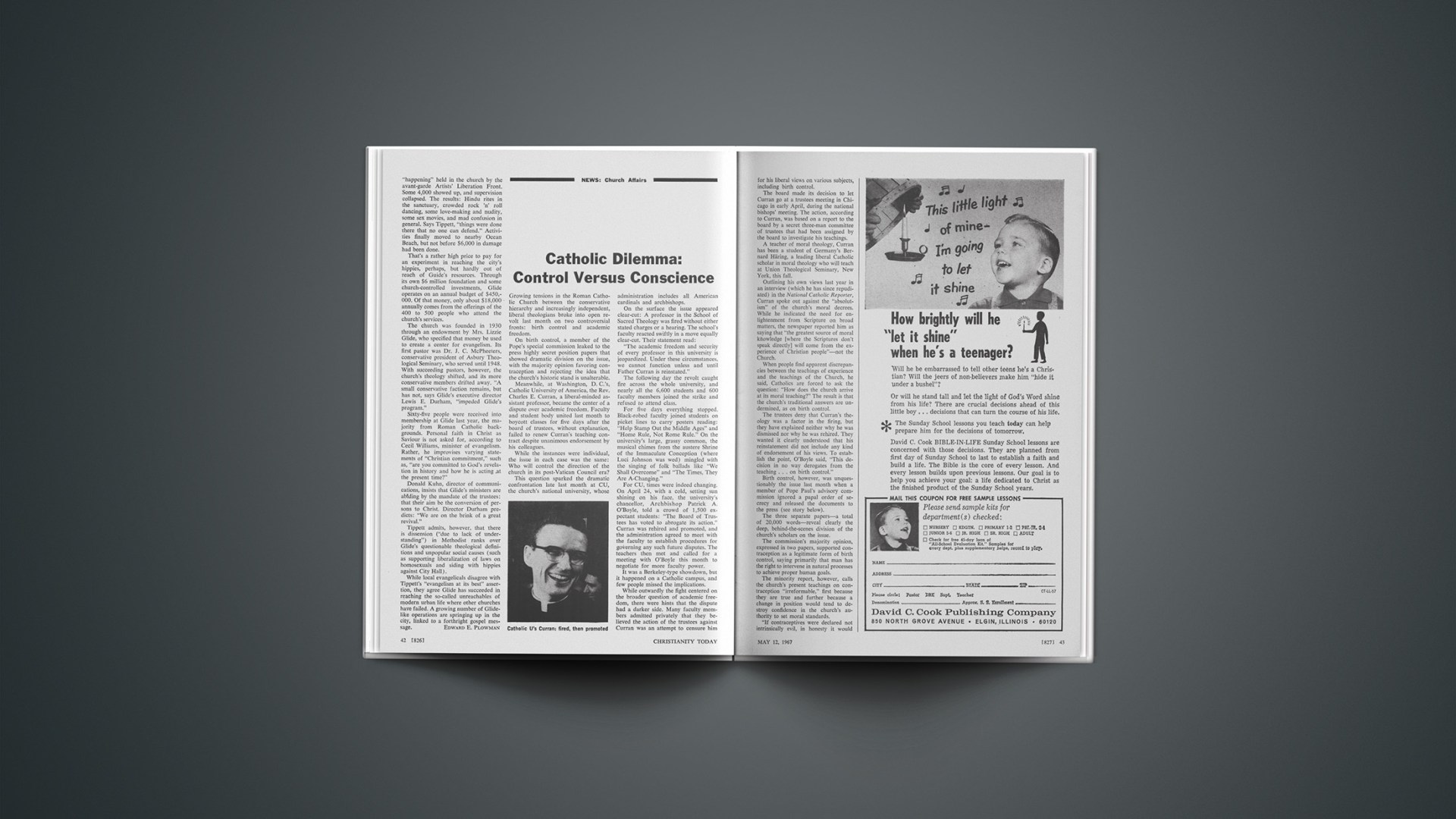
Catholic Dilemma: Control versus Conscience

Growing tensions in the Roman Catholic Church between the conservative hierarchy and increasingly independent, liberal theologians broke into open revolt last month on two controversial fronts: birth control and academic freedom.

On birth control, a member of the Pope’s special commission leaked to the press highly secret position papers that showed dramatic division on the issue, with the majority opinion favoring contraception and rejecting the idea that the church’s historic stand is unalterable.

Meanwhile, at Washington, D. C.’s, Catholic University of America, the Rev. Charles E. Curran, a liberal-minded assistant professor, became the center of a dispute over academic freedom. Faculty and student body united last month to boycott classes for five days after the board of trustees, without explanation, failed to renew Curran’s teaching contract despite unanimous endorsement by his colleagues.

While the instances were individual, the issue in each case was the same: Who will control the direction of the church in its post-Vatican Council era?

This question sparked the dramatic confrontation late last month at CU, the church’s national university, whose administration includes all American cardinals and archbishops.

On the surface the issue appeared clear-cut: A professor in the School of Sacred Theology was fired without either stated charges or a hearing. The school’s faculty reacted swiftly in a move equally clear-cut. Their statement read:

“The academic freedom and security of every professor in this university is jeopardized. Under these circumstances, we cannot function unless and until Father Curran is reinstated.”

The following day the revolt caught fire across the whole university, and nearly all the 6,600 students and 600 faculty members joined the strike and refused to attend class.

For five days everything stopped. Black-robed faculty joined students on picket lines to carry posters reading: “Help Stamp Out the Middle Ages” and “Home Rule, Not Rome Rule.” On the university’s large, grassy common, the musical chimes from the austere Shrine of the Immaculate Conception (where Luci Johnson was wed) mingled with the singing of folk ballads like “We Shall Overcome” and “The Times, They Are A-Changing.”

For CU, times were indeed changing. On April 24, with a cold, setting sun shining on his face, the university’s chancellor, Archbishop Patrick A. O’Boyle, told a crowd of 1,500 expectant students: “The Board of Trustees has voted to abrogate its action.” Curran was rehired and promoted, and the administration agreed to meet with the faculty to establish procedures for governing any such future disputes. The teachers then met and called for a meeting with O’Boyle this month to negotiate for more faculty power.

It was a Berkeley-type showdown, but it happened on a Catholic campus, and few people missed the implications.

While outwardly the fight centered on the broader question of academic freedom, there were hints that the dispute had a darker side. Many faculty members admitted privately that they believed the action of the trustees against Curran was an attempt to censure him for his liberal views on various subjects, including birth control.

The board made its decision to let Curran go at a trustees meeting in Chicago in early April, during the national bishops’ meeting. The action, according to Curran, was based on a report to the board by a secret three-man committee of trustees that had been assigned by the board to investigate his teachings.

A teacher of moral theology, Curran has been a student of Germany’s Bernard Häring, a leading liberal Catholic scholar in moral theology who will teach at Union Theological Seminary, New York, this fall.

Outlining his own views last year in an interview (which he has since repudiated) in the National Catholic Reporter, Curran spoke out against the “absolutism” of the church’s moral decrees. While he indicated the need for enlightenment from Scripture on broad matters, the newspaper reported him as saying that “the greatest source of moral knowledge [where the Scriptures don’t speak directly] will come from the experience of Christian people”—not the Church.

When people find apparent discrepancies between the teachings of experience and the teachings of the Church, he said, Catholics are forced to ask the question: “How does the church arrive at its moral teaching?” The result is that the church’s traditional answers are undermined, as on birth control.

The trustees deny that Curran’s theology was a factor in the firing, but they have explained neither why he was dismissed nor why he was rehired. They wanted it clearly understood that his reinstatement did not include any kind of endorsement of his views. To establish the point, O’Boyle said, “This decision in no way derogates from the teaching … on birth control.”

Birth control, however, was unquestionably the issue last month when a member of Pope Paul’s advisory commission ignored a papal order of secrecy and released the documents to the press (see story below).

The three separate papers—a total of 20,000 words—reveal clearly the deep, behind-the-scenes division of the church’s scholars on the issue.

The commission’s majority opinion, expressed in two papers, supported contraception as a legitimate form of birth control, saying primarily that man has the right to intervene in natural processes to achieve proper human goals.

The minority report, however, calls the church’s present teachings on contraception “irreformable,” first because they are true and further because a change in position would tend to destroy confidence in the church’s authority to set moral standards.

“If contraceptives were declared not intrinsically evil, in honesty it would have to be acknowledged that the Holy Spirit … assisted Protestant churches, and that for half a century Pius XI, Pius XII and a great part of the Catholic hierarchy did not protest against a very serious error, one most pernicious to souls.”

But there is more at issue than doctrine, according to the minority. A softened stand on birth control, it said, would lead ultimately to increased sexual abuses.

The majority met head-on the charge that the integrity of the church’s teachings was in danger over the issue.

“In point of fact,” the majority stated, “we know that there have been errors in the teachings of the magisterium and of tradition.” The difficulty with the traditional view, according to the majority, is that it elevates natural law so that it becomes the voice of God.

Man has the right, the opinion asserts, to alter natural law through contraception (specific forms were not mentioned) because “sexuality is not ordered only to procreation.… In some cases intercourse can be required as a manifestation of self-giving love.… This is neither egocentricity nor hedonism.…”

In a second paper, the majority attempts to construct a view of marriage into which contraception could be fitted. While rejecting abortion and sterilization, it calls for educating couples to the responsibility of parenthood.

The paper ends with a plea for more research and suggests that the normal procedure of secrecy be suspended and the commission’s opinions be made public. When the commission’s documents were made public, it was without official approval.

The commission turned its papers over to the Pope last June, but there was no word when—or if—a papal statement will appear.

Coup In Catholic Reporting

Release of the full texts of a secret report from the Pope’s birth-control commission is a historic “scoop” for religious journalism. The decision of a member of the commission to leak the text, and the decision of the National Catholic Reporter to publish it, both indicate dramatic changes in the authority system of the Roman Catholic Church.

An NCR editorial defended publication on two grounds: (1) It isn’t a newspaper’s job to enforce security regulations within such bodies as the commission, and (2) a newspaper should “publish news of service to readers.”

As to the argument that public release of the documents will produce “undue and illegitimate pressure” on the Pope, NCR asserts that “while an informed public opinion is almost by definition a form of pressure, it is not undue or illegitimate.”

Sex And Mental Health

Premarital sex relations growing out of the so-called new morality have significantly increased the number of young people in mental hospitals. This was reported last month by Dr. Francis Braceland, former president of the American Psychiatric Association and currently the editor of the American Journal of Psychiatry.

Braceland told the National Methodist Convocation on Medicine and Theology in Rochester, Minnesota, that “a more lenient attitude on campus about premarital sex experience has imposed stresses on some college women severe enough to cause emotional breakdown.”

NCR had hoped to discuss the ethics and handling of the release at a more leisurely pace, consulting various advisers within the church. But word came April 20 that Le Monde in Paris was on the verge of publication, so Editor Robert G. Hoyt rushed NCR’s recently received translation into print.

Why did the commission source give the documents to NCR? Hoyt says he doesn’t know but speculates that the source “decided the Pope was simply wrong to suspend judgment this long.”

Hoyt said he agonized over the possibility that publication would harden papal opposition to change but decided that “to look to possible consequences to that extent was improper.” NCR’s general position on birth control, he said, is that “change is required by theological developments, and the facts of the situation.”

Vatican press officer Monsignor Fausto Vallainc said the release is a “very serious” breach of secrecy vows. “Such indiscretions do not make examination of the problem especially serene,” he said. “They apply pressure that only stirs up agitation in public opinion.”

Hoyt said a week after publication that no American bishop had complained to NCR. Even those bishops who were privately displeased must have put NCR on their required reading list—if it wasn’t there already. The daily press service of the U. S. Catholic Conference didn’t carry a story on the birth-control documents.

Elusive Facts

America, national Jesuit weekly, has complained about a Playboy article by Episcopal Bishop James A. Pike in which he contends that the big Roman Catholic order realizes a yearly income of $250 million from stock holdings without paying taxes. (See April 14 issue, page 46.)

“To any Jesuit who knows the universal needs of the order in its schools, colleges, universities and missions, this allegation is so wildly irresponsible as to be almost funny,” America said, “Statements of this kind, however, have a persistent way of being repeated, once they get into print. And this is not funny.”

Pike conceded that the Playboy article contains mistakes because certain reports apparently were not checked. “I am afraid the errors can blur the main analysis of what I was trying to say,” he declared.

Pike had asserted that Jesuits own the controlling stock in the Bank of America, Phillips Petroleum Company, Creole Petroleum Company, and the DiGiorgio Fruit Company. A spokesman for the Bank of America said, “The statements by Bishop Pike in Playboy magazine are completely untrue and without even a small basis in fact.”

Still unreported is the actual extent of Jesuit stock holdings. Neither America nor the Bank of America shed any light on that question.

Methodist Omnibus

Speaking “only for itself,” the Methodist Board of Christian Social Concerns kept its mimeograph strangely warmed last month, passing resolutions favoring:

Withdrawal of U. S. troops from Viet Nam, Martin Luther King’s anti-war drive, an end to the military draft, conscientious objection on non-religious grounds, repeal of laws against interracial marriage, economic and other reprisals against South Africa, majority rule in Southern Rhodesia, prevention of a U. S. anti-ballistic missile system, a guaranteed annual income for U. S. families (sort of), inclusion of farm workers under NLRB, more federal aid to schools, a seat in Congress for the District of Columbia, et cetera …

Top Clergy Clash On Viet Nam

The two best-known Presbyterian ministers in Washington, D. C., collided on the issue of Viet Nam last month. After their debate in a presbytery meeting, the hawks beat a dove resolution 86 to 27.

The showdown came on a resolution by the Rev. George M. Docherty, of historic New York Avenue Presbyterian Church, calling for a stop to the bombing and the bilateral withdrawal of troops. Docherty charged the Viet Nam war will smell “in the nostrils of history for the next 100 years.”

The Rev. Edward L. R. Elson—minister of the National Presbyterian Church, Army Reserve chaplain, and President Eisenhower’s former pastor—attacked the resolution as ill-timed and harmful. In a sermon the following Sunday, he said ministers who picket and protest do so from limited data and an arrogance of conscience.

Pointing out that he has a son-in-law in the Army and a son about to enter military age, Elson said:

“I do not want my sons commanded by officers whose targets are limited by a resolution, or whose weapons are restricted by an irresponsible resolution adopted by a church body.…”

On the same Sunday, Docherty, successor to Peter Marshall, argued that the Church in its role as prophet is to speak loud and clear on political issues.

In an interview in his book-lined study, Docherty said he had been a pacifist from 1935 to 1943 while living in Scotland. After an agonizing struggle with his own conscience he found pacifism an impossibility in wartime. “I flagellate myself that I didn’t join the paratroopers the first day,” he admits. But Docherty believes America can’t win in Viet Nam and is there under false pretenses.

JAMES L. ADAMS

Nagaland Closed To Missionaries

External Affairs minister M. C. Chagla announced a few weeks ago that the government of India will not admit any more foreign missionaries to Nagaland, because of widespread political unrest there.

Chagla also said that Naga rebels have been seeking military aid from Red China. Nagaland, situated in the northeast corner of India and wedged between China and Burma, is vitally important for India’s security.

The Naga tribesmen, onetime headhunters, were converted to Christianity through American Baptist missionary work that began in 1897. Before a 1964 ceasefire, they had waged guerrilla warfare against the Indian government for ten years.

By and large the Christian Naga tribesmen are literate, and they have a political following even among the small minority of animists in Nagaland’s one million population.

The government of India has always been suspicious of foreign missionaries because of their alleged political influence upon the Nagas in their rebellion against India. India has also ordered the four foreign missionaries now in Nagaland not to evangelize.

Angami Zapu Phizo, a Baptist who leads the Naga Liberation Movement, arrived in the United States in mid-April to seek support for the independence of his state.

T. E. KOSHY

150 Years On Course

One of the oldest Christian organizations in the United States, and one that has veered little from its original purpose, is the American Sunday-School Union. It was founded in Philadelphia 150 years ago this week to promote establishment of new Sunday schools, and it is still doing so.

The ASSU currently employs 150 missionaries in thirty-nine states, ministering to some 100,000 children. The Sunday school is still a key facet of the operation, but activities have also branched out into vacation Bible schools, Bible conferences, nursing programs, and projects to deal with school dropouts. Some 7,000 conversions are reported annually.

The ASSU has been under occasional pressure to broaden its outlook by moving away from the confines of the Sunday School approach, which undoubtedly was more relevant in the rural—oriented, mass—media—less nineteenth century. But ASSU leaders have thus far resisted efforts to replace “Sunday School” in the title with a more contemporary phrase.

A group of Philadelphia citizens founded the organization in a schoolroom at Fourth and Vine Streets on May 13, 1817. Francis Scott Key, author of “The Star-Spangled Banner,” helped to get it off the ground. Within ten years it had become the foremost publisher of children’s literature. In its first century, more than 100,000 Sunday schools were established.

The Invisible Evangelical

To Negro novelist Ralph Ellison, the Negro in American society is the “invisible man.” To the Negro in the conservative religious context, he is the “invisible evangelical.”

To help give that image some substance, a small group of Negro evangelicals four years ago formed the National Negro Evangelical Association. At its annual meeting in Philadelphia last month, broad outlines of its purpose could be seen taking form.

The NNEA seeks a dual role: First, to demonstrate to the larger (read white) body of evangelicals that there is an active, conservative Negro movement that wants first-class fellowship with white brethren, and second, to provide a rallying point within the Negro community for evangelistic outreach.

Attempts to achieve this double thrust can be seen in the NNEA’s membership in the overwhelmingly white National Association of Evangelicals while at the same time it organizes independent evangelistic efforts in a number of inner-city ghettoes, including Watts.

While seeking stronger ties with white evangelicals, Negro conservatives find it difficult to feel like a “true brother in the Lord” with whites. In his president’s report, Howard O. Jones, an associate evangelist with the Billy Graham team, observed: “White evangelicals must explain … how they can reconcile their love for Christ and loyalty to the Bible with race prejudice and bigotry.”

But the NNEA can be as critical of Negroes as of whites. Jones, in the same report, charged that most Negro churches “are absolutely blind to the need for a soul-winning ministry on a local and worldwide basis.”

The tone of such statements has caused some whites to charge that the NNEA stands for Negro separatism. Negroes aren’t flocking to join, either: membership stands at only 400.

The NNEA counters that it is no more “separatist” than predominantly white organizations (about one-third of its members are white). On the question of size, spokesmen point to NNEA’s youth and the fact that membership has doubled in the last two years. Next year’s budget is up, too—nearly 20 per cent, to $15,000.

WILLIAM D. FREELAND

Converse Ideas On Conversion

Delegate response to the featured theme of Christian conversion at the United States Conference for the World Council of Churches was characterized as one of “paralysis” by conference chairman Charles C. Parlin, a WCC president. After being exposed to divergent views by speakers at the Buck Hill Falls, Pennsylvania, meetings last month, participants showed little enthusiasm for probing conversion in depth or hammering out any kind of consensus. The conference offered little hope that the WCC is ready to formulate a conception of conversion acceptable either to non-WCC evangelicals or to the differing traditions found within its own ranks. The topic is to be discussed further at the Fourth Assembly of the WCC next year in Uppsala, Sweden.

The dominant view of conversion at Buck Hill Falls was less concerned with the believer’s eternal relationship to God than with his involvement in church mission to achieve international economic justice today. In the opening address, D. T. Niles, executive secretary of the East Asia Christian Conference, stressed that conversion means “to be converted to the Lord and his mission and to the Lord in his mission.” Referring to Christ’s high-priestly prayer, Niles claimed that Jesus “did not say simply that this world must believe in him, but that the world must believe that the Father sent the Son. The object of belief is the mission of Christ.”

In reply to a question from the floor about the condition of men who do not believe in Christ, Niles stated, “I am not prepared to say and Scripture will not allow me to say I am sure at the end everybody will be saved. I will not say and Scripture will not allow me to say I am sure that at the end somebody will be damned. All that Scripture makes me say is that damnation is a real possibility for anyone.”

The diverse understandings of conversion were shown most vividly by a three-man panel whose views roughly paralleled those of the ecumenical leadership, the Orthodox churches, and Reformation theology.

The Rev. William A. Norgren, executive director of the National Council of Churches’ Department of Faith and Order, asserted that “our new understandings of social questions seem to call for a theology of conversion which will be adequate to the present day.” He claimed that conversion experiences today lead people away from social action because Christian groups which stress the “conversion phenomenon” tend to be socially and politically conservative. He said it is impossible to draw a direct line from modern concepts of conversion to the Bible.

Father William Schneirla of the Syrian Antiochian Church advanced Orthodoxy’s sacramental conception of conversion. He averred that the good news must be proclaimed to all men so that those who believe “may be baptized into the Christian fellowship which is the Body of Christ, the Kingdom of God on earth, the Orthodox Church.” Said Schneirla, “By the supernatural effects of the visible, material washing with water and anointing with myron, all sins are forgiven and a new creature emerges from the fount.” Before an Orthodox churchman could agree to embrace new meanings of conversion, he said, it would be necessary to reconsider the tradition and dynamics of the church, and the advantages of such an undertaking have not yet been demonstrated.

The conference turned to a sympathetic member of a non-WCC denomination for the Lutheran perspective on conversion. Concordia Seminary’s Professor Richard Caemmerer of the Lutheran Church-Missouri Synod based his view of conversion on the Augsburg Confession of 1530. “The question emerges,” he concluded, “whether the Word of God affirming his love to the world in giving his Son into death and raising him again to life is essential for conversion. I speak only for myself but my faith says yes.… This is not a tenet to be debated, a theological position to be maintained against other theologians, but this is light to shine in life … an affirmation to speak with joy and with meekness.”

The political discussions were the liveliest. In one program, Dr. Eugene L. Smith called the Church to witness to the Lordship of Christ in international affairs, and India’s M. M. Thomas chastised the U. S. for its lagging foreign aid.

The conference as a whole proved to be a predictable, lackluster affair. If anything, it showed that the WCC leadership continues to be dedicated to converting the mission of the Church from proclaiming the historic Gospel that reconciles men eternally to God, to changing the world through socio-economic means.

ROBERT L. CLEATH

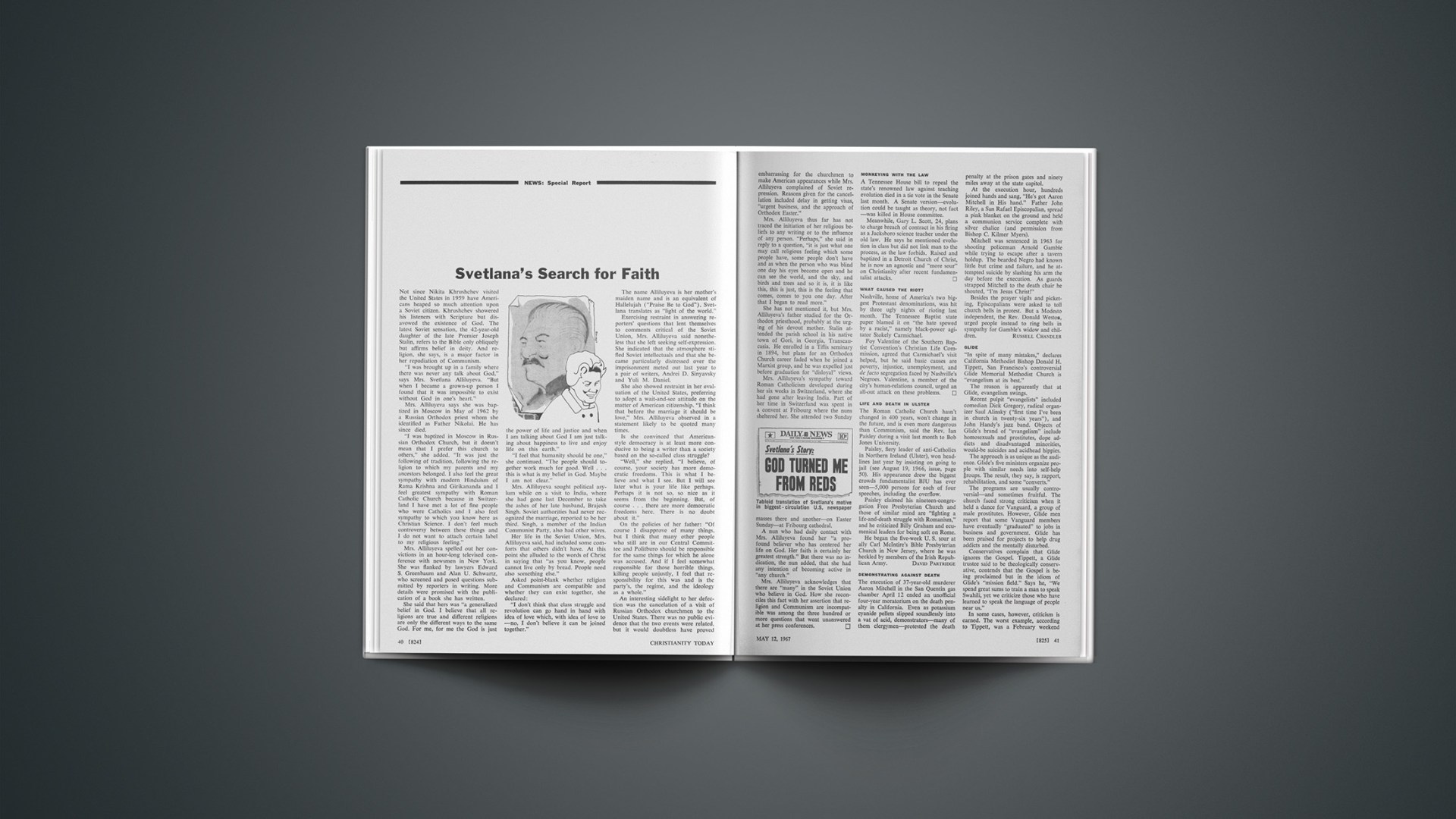
Svetlana’s Search for Faith

Not since Nikita Khrushchev visited the United States in 1959 have Americans heaped so much attention upon a Soviet citizen. Khrushchev showered his listeners with Scripture but disavowed the existence of God. The latest Soviet sensation, the 42-year-old daughter of the late Premier Joseph Stalin, refers to the Bible only obliquely but affirms belief in deity. And religion, she says, is a major factor in her repudiation of Communism.

“I was brought up in a family where there was never any talk about God,” says Mrs. Svetlana Alliluyeva. “But when I became a grown-up person I found that it was impossible to exist without God in one’s heart.”

Mrs. Alliluyeva says she was baptized in Moscow in May of 1962 by a Russian Orthodox priest whom she identified as Father Nikolai. He has since died.

“I was baptized in Moscow in Russian Orthodox Church, but it doesn’t mean that I prefer this church to others,” she added. “It was just the following of tradition, following the religion to which my parents and my ancestors belonged. I also feel the great sympathy with modern Hinduism of Rama Krishna and Girikananda and I feel greatest sympathy with Roman Catholic Church because in Switzerland I have met a lot of fine people who were Catholics and I also feel sympathy to which you know here as Christian Science. I don’t feel much controversy between these things and I do not want to attach certain label to my religious feeling.”

Mrs. Alliluyeva spelled out her convictions in an hour-long televised conference with newsmen in New York. She was flanked by lawyers Edward S. Greenbaum and Alan U. Schwartz, who screened and posed questions submitted by reporters in writing. More details were promised with the publication of a book she has written.

She said that hers was “a generalized belief in God. I believe that all religions are true and different religions are only the different ways to the same God. For me, for me the God is just the power of life and justice and when I am talking about God I am just talking about happiness to live and enjoy life on this earth.”

“I feel that humanity should be one,” she continued. “The people should together work much for good. Well … this is what is my belief in God. Maybe I am not clear.”

Mrs. Alliluyeva sought political asylum while on a visit to India, where she had gone last December to take the ashes of her late husband, Brajesh Singh. Soviet authorities had never recognized the marriage, reported to be her third. Singh, a member of the Indian Communist Party, also had other wives.

Her life in the Soviet Union, Mrs. Alliluyeva said, had included some comforts that others didn’t have. At this point she alluded to the words of Christ in saying that “as you know, people cannot live only by bread. People need also something else.”

Asked point-blank whether religion and Communism are compatible and whether they can exist together, she declared:

“I don’t think that class struggle and revolution can go hand in hand with idea of love which, with idea of love to—no, I don’t believe it can be joined together.”

The name Alliluyeva is her mother’s maiden name and is an equivalent of Hallelujah (“Praise Be to God”). Svetlana translates as “light of the world.”

Exercising restraint in answering reporters’ questions that lent themselves to comments critical of the Soviet Union, Mrs. Alliluyeva said nonetheless that she left seeking self-expression. She indicated that the atmosphere stifled Soviet intellectuals and that she became particularly distressed over the imprisonment meted out last year to a pair of writers, Andrei D. Sinyavsky and Yuli M. Daniel.

She also showed restraint in her evaluation of the United States, preferring to adopt a wait-and-see attitude on the matter of American citizenship. “I think that before the marriage it should be love,” Mrs. Alliluyeva observed in a statement likely to be quoted many times.

Is she convinced that American-style democracy is at least more conducive to being a writer than a society based on the so-called class struggle?

“Well,” she replied, “I believe, of course, your society has more democratic freedoms. This is what I believe and what I see. But I will see later what is your life like perhaps. Perhaps it is not so, so nice as it seems from the beginning. But, of course … there are more democratic freedoms here. There is no doubt about it.”

On the policies of her father: “Of course I disapprove of many things, but I think that many other people who still are in our Central Committee and Politburo should be responsible for the same things for which he alone was accused. And if I feel somewhat responsible for those horrible things, killing people unjustly, I feel that responsibility for this was and is the party’s, the regime, and the ideology as a whole.”

An interesting sidelight to her defection was the cancelation of a visit of Russian Orthodox churchmen to the United States. There was no public evidence that the two events were related, but it would doubtless have proved embarrassing for the churchmen to make American appearances while Mrs. Alliluyeva complained of Soviet repression. Reasons given for the cancellation included delay in getting visas, “urgent business, and the approach of Orthodox Easter.”

Mrs. Alliluyeva thus far has not traced the initiation of her religious beliefs to any writing or to the influence of any person. “Perhaps,” she said in reply to a question, “it is just what one may call religious feeling which some people have, some people don’t have and as when the person who was blind one day his eyes become open and he can see the world, and the sky, and birds and trees and so it is, it is like this, this is just, this is the feeling that comes, comes to you one day. After that I began to read more.”

She has not mentioned it, but Mrs. Alliluyeva’s father studied for the Orthodox priesthood, probably at the urging of his devout mother. Stalin attended the parish school in his native town of Gori, in Georgia, Transcaucasia. He enrolled in a Tiflis seminary in 1894, but plans for an Orthodox Church career faded when he joined a Marxist group, and he was expelled just before graduation for “disloyal” views.

Mrs. Alliluyeva’s sympathy toward Roman Catholicism developed during her six weeks in Switzerland, where she had gone after leaving India. Part of her time in Switzerland was spent in a convent at Fribourg where the nuns sheltered her. She attended two Sunday masses there and another—on Easter Sunday—at Fribourg cathedral.

A nun who had daily contact with Mrs. Alliluyeva found her “a profound believer who has centered her life on God. Her faith is certainly her greatest strength.” But there was no indication, the nun added, that she had any intention of becoming active in “any church.”

Mrs. Alliluyeva acknowledges that there are “many” in the Soviet Union who believe in God. How she reconciles this fact with her assertion that religion and Communism are incompatible was among the three hundred or more questions that went unanswered at her press conferences.

Monkeying With The Law

A Tennessee House bill to repeal the state’s renowned law against teaching evolution died in a tie vote in the Senate last month. A Senate version—evolution could be taught as theory, not fact—was killed in House committee.

Meanwhile, Gary L. Scott, 24, plans to charge breach of contract in his firing as a Jacksboro science teacher under the old law. He says he mentioned evolution in class but did not link man to the process, as the law forbids. Raised and baptized in a Detroit Church of Christ, he is now an agnostic and “more sour” on Christianity after recent fundamentalist attacks.

What Caused The Riot?

Nashville, home of America’s two biggest Protestant denominations, was hit by three ugly nights of rioting last month. The Tennessee Baptist state paper blamed it on “the hate spewed by a racist,” namely black-power agitator Stokely Carmichael.

Foy Valentine of the Southern Baptist Convention’s Christian Life Commission, agreed that Carmichael’s visit helped, but he said basic causes are poverty, injustice, unemployment, and de facto segregation faced by Nashville’s Negroes. Valentine, a member of the city’s human-relations council, urged an all-out attack on these problems.

Life And Death In Ulster

The Roman Catholic Church hasn’t changed in 400 years, won’t change in the future, and is even more dangerous than Communism, said the Rev. Ian Paisley during a visit last month to Bob Jones University.

Paisley, fiery leader of anti-Catholics in Northern Ireland (Ulster), won headlines last year by insisting on going to jail (see August 19, 1966, issue, page 50). His appearance drew the biggest crowds fundamentalist BJU has ever seen—5,000 persons for each of four speeches, including the overflow.

Paisley claimed his nineteen-congregation Free Presbyterian Church and those of similar mind are “fighting a life-and-death struggle with Romanism,” and he criticized Billy Graham and ecumenical leaders for being soft on Rome.

He began the five-week U. S. tour at ally Carl McIntire’s Bible Presbyterian Church in New Jersey, where he was heckled by members of the Irish Republican Army.

DAVID PARTRIDGE

Demonstrating Against Death

The execution of 37-year-old murderer Aaron Mitchell in the San Quentin gas chamber April 12 ended an unofficial four-year moratorium on the death penalty in California. Even as potassium cyanide pellets slipped soundlessly into a vat of acid, demonstrators—many of them clergymen—protested the death penalty at the prison gates and ninety miles away at the state capitol.

At the execution hour, hundreds joined hands and sang, “He’s got Aaron Mitchell in His hand.” Father John Riley, a San Rafael Episcopalian, spread a pink blanket on the ground and held a communion service complete with silver chalice (and permission from Bishop C. Kilmer Myers).

Mitchell was sentenced in 1963 for shooting policeman Arnold Gamble while trying to escape after a tavern holdup. The bearded Negro had known little but crime and failure, and he attempted suicide by slashing his arm the day before the execution. As guards strapped Mitchell to the death chair he shouted, “I’m Jesus Christ!”

Besides the prayer vigils and picketing, Episcopalians were asked to toll church bells in protest. But a Modesto independent, the Rev. Donald Weston, urged people instead to ring bells in sympathy for Gamble’s widow and children.

RUSSELL CHANDLER

Glide

“In spite of many mistakes,” declares California Methodist Bishop Donald H. Tippett, San Francisco’s controversial Glide Memorial Methodist Church is “evangelism at its best.”

The reason is apparently that at Glide, evangelism swings.

Recent pulpit “evangelists” included comedian Dick Gregory, radical organizer Saul Alinsky (“first time I’ve been in church in twenty-six years”), and John Handy’s jazz band. Objects of Glide’s brand of “evangelism” include homosexuals and prostitutes, dope addicts and disadvantaged minorities, would-be suicides and acidhead hippies.

The approach is as unique as the audience. Glide’s five ministers organize people with similar needs into self-help groups. The result, they say, is rapport, rehabilitation, and some “converts.”

The programs are usually controversial—and sometimes fruitful. The church faced strong criticism when it held a dance for Vanguard, a group of male prostitutes. However, Glide men report that some Vanguard members have eventually “graduated” to jobs in business and government. Glide has been praised for projects to help drug addicts and the mentally disturbed.

Conservatives complain that Glide ignores the Gospel. Tippett, a Glide trustee said to be theologically conservative, contends that the Gospel is being proclaimed but in the idiom of Glide’s “mission field.” Says he, “We spend great sums to train a man to speak Swahili, yet we criticize those who have learned to speak the language of people near us.”

In some cases, however, criticism is earned. The worst example, according to Tippett, was a February weekend “happening” held in the church by the avant-garde Artists’ Liberation Front. Some 4,000 showed up, and supervision collapsed. The results: Hindu rites in the sanctuary, crowded rock ’n’ roll dancing, some love-making and nudity, some sex movies, and mad confusion in general. Says Tippett, “things were done there that no one can defend.” Activities finally moved to nearby Ocean Beach, but not before $6,000 in damage had been done.

That’s a rather high price to pay for an experiment in reaching the city’s hippies, perhaps, but hardly out of reach of Guide’s resources. Through its own $6 million foundation and some church-controlled investments, Glide operates on an annual budget of $450,000. Of that money, only about $18,000 annually comes from the offerings of the 400 to 500 people who attend the church’s services.

The church was founded in 1930 through an endowment by Mrs. Lizzie Glide, who specified that money be used to create a center for evangelism. Its first pastor was Dr. J. C. McPheeters, conservative president of Asbury Theological Seminary, who served until 1948. With succeeding pastors, however, the church’s theology shifted, and its more conservative members drifted away. “A small conservative faction remains, but has not, says Glide’s executive director Lewis E. Durham, “impeded Glide’s program.”

Sixty-five people were received into membership at Glide last year, the majority from Roman Catholic backgrounds. Personal faith in Christ as Saviour is not asked for, according to Cecil Williams, minister of evangelism. Rather, he improvises varying statements of “Christian commitment,” such as, “are you committed to God’s revelation in history and how he is acting at the present time?”

Donald Kuhn, director of communications, insists that Glide’s ministers are abiding by the mandate of the trustees: that their aim be the conversion of persons to Christ. Director Durham predicts: “We are on the brink of a great revival.”

Tippett admits, however, that there is dissension (“due to lack of understanding”) in Methodist ranks over Glide’s questionable theological definitions and unpopular social causes (such as supporting liberalization of laws on homosexuals and siding with hippies against City Hall).

While local evangelicals disagree with Tippett’s “evangelism at its best” assertion, they agree Glide has succeeded in reaching the so-called unreachables of modern urban life where other churches have failed. A growing number of Glidelike operations are springing up in the city, linked to a forthright gospel message.

EDWARD E. PLOWMAN

Book Briefs: May 12, 1967

New Sampler For C. S. Lewis Fans

Christian Reflections, by C. S. Lewis, edited by Walter Hooper (Eerdmans, 1967, 176 pp., $3.95) is reviewed by Robert L. Cleath, editorial assistant,CHRISTIANITY TODAY.

The late C. S. Lewis was considered by thousands of his readers to be not only a writer of great intellectual power and imaginative style but also a dearly loved friend. As an essayist, novelist, literary critic, and lay apologist for the Christian faith, he communicates in an especially personal way with those who share his deep devotion to Jesus Christ and appreciate his disdain for pomposity and fuzzy thinking. For many agnostics struggling to find meaning in life and for Christians stifled by the oppressive atmosphere of man-made piety, his writings are a breath of fresh air. They demonstrate that a thoroughgoing biblical supernaturalist can more than hold his own in the free-swinging world of ideas and can also be a connoisseur of cultural values. Lewis died in 1963, but his incisive thought and irrepressible spirit are still very much alive in Christian Reflections, a new collection of his essays ably edited by Walter Hooper.

Hooper has brought together fourteen of Lewis’s papers—some written for periodicals, others unpublished lectures delivered to societies in and around Oxford and Cambridge—that span the last twenty years of his life. His Christian insights are focused on such topics as literature, culture, ethics, “the poison of subjectivism,” church music, the Psalms, the language of religion, petitionary prayer, and biblical criticism. In each essay we find, as Clyde Kilby discovered in his study of Lewis’s works, “a mind sharp as a scalpel and intent as a surgeon upon the separation of the diseased from the healthy.”

Lewis’s reflections on literature show the quality of his thought in this volume. Although he was both a committed Christian and a world-renowned literary scholar, he had little to say about “Christian literature,” considering it possible only in the same sense that there might be Christian cookery. Yet he held that there was a Christian approach to literature that was based on imitation of life. An author, he claims, “should never conceive of himself as bringing into existence beauty or wisdom which did not exist before, but simply and solely as trying to embody in terms of his own heart some reflection of eternal Beauty and Wisdom.” Thus Lewis put no premium on originality as such, nor did he look upon literature as a self-existent thing to be valued for its own sake. Rather, his concern was that an author should respond to his vision in his own way and thereby be the servant of truth.

These fourteen pithy essays embody many of Lewis’s most important concepts and attitudes. For example, he argues that there is no such thing as a new morality, since all ethical codes are derived from the moral law common to all men. Facing the question whether life is futile, he argues for the indispensability of logic in understanding the way real things exist. In another paper he demolishes the myth of the inevitable progress of man. When he considers the manner in which modern biblical critics have attempted to reconstruct the history of the text of Scripture, he shows how inimical their theories are to a valid understanding of the nature and structure of literature.

These are but a few of the vital ideas Lewis develops as he subjects a host of significant topics to vigorous analysis from his informed Christian perspective. The ponderous topics under discussion, however, should not lead anyone to shy away from the volume. Although Lewis is relentless in his logic, his conversational style spiced liberally with examples, metaphors, and wit makes the book a delight to read.

Lewis fans will surely greet this book with enthusiasm. And people who have not yet made his acquaintance will find Hooper’s sampler of essays an excellent introduction to the thought and personality of this engaging Christian writer. To the list of forty-odd books that have come from the pen of C. S. Lewis, Christian Reflections is indeed a worthy addition.

Reading for Perspective

CHRISTIANITY TODAY’S REVIEW EDITORS CALL ATTENTION TO THESE NEW TITLES:

One Race, One Gospel, One Task, Volumes I and II edited by Carl F. H. Henry and W. Stanley Mooneyham (World Wide, set $9.95). Major addresses and reports from the World Congress on Evangelism communicate the spiritual vitality and urgent message of the meetings.

Biblical Ethics: A Survey, by T. B. Maston (World, $6). A survey of the development of ethics in the Scriptures, shows their climax in the life of Jesus and the writings of Paul and John, and argues for their contemporary authority.

Service in Christ, edited by James I. McCord and T. H. L. Parker (Eerdmans, $6.95). Essays presented to Karl Barth on his eightieth birthday by a host of scholars on the Church as a servant to Christ and mankind.

The Presbyterianism That Was And Is

A Layman’s Guide to Presbyterian Beliefs, by Addison H. Leitch (Zondervan, 1967, 158 pp., $1.95), is reviewed by David A. Redding, writer in residence, Tarkio College, Tarkio, Missouri.

On the wall behind Addison H. Leitch’s desk hangs Winslow Homer’s classic seascape of two mariners taking their sextant reading in a stormswept twilight far out at sea. For twenty-five years across that desk have come the soundings Dr. Leitch himself has taken on the matters of life and death. Thousands from one end of the country to the other, either from hearing or from reading him, could “Take It from Here” to get their bearings.

Now we have his latest book, A Layman’s Guide to Presbyterian Beliefs. Living as close to him as I do, I can say quite frankly that I would not be writing this review if I did not approve the book as required reading for anyone who wishes to enjoy even a remote acquaintance with the Presbyterians.

Even if you are a Methodist or Roman Catholic, how are you going to indulge your prejudice against predestination until you are introduced to the subject? I believe that some radicals who will turn to this book to find out what Presbyterianism was may be stirred into accepting what it still is.

The chapter headings recall the stays by which reformed faith has been supported since Calvin incorporated it from Paul and Augustine. The volume begins by uncovering an almost forgotten main stay, “The Sovereignty of God,” and doesn’t rest till it reaches “Social Action.” And who could be better qualified to speak about “The Faith Once and For All Delivered” than a former Presbyterian seminary president and professor who did his Ph.D. thesis on The Relevancy of John Calvin to Modern Protestantism?

Here is no heavy tome but a paperback as hard to put down as others on the newsstand. Civil rights, we find, are just catching up to “The Holy Scriptures” instead of the Scriptures to them. And Leitch writes fearlessly on this moot subject: “One of the strangest facts about Calvinism and its descent through the reformed tradition is that where it is most Calvinistic, that is, where it is truest to its emphasis on the absolute sovereignty of God, there it most surely releases the free energies of man.” Neither our emphasis on social action nor our superiority in science embarrasses the Word of God. Leitch quotes Kepler: “The Bible is not written to describe how the heavens go but how to go to heaven.”

It is fun to read a book written by a “comprehensive man” instead of a bookworm. This author is a happy combination of athlete and poet, as likely to quote Milton as to call a football play to sneak his points past our guard. He brings Stan Musial up to bat to explain predestination. God knows Stan had free choice. Then how could we anticipate his batting average year after year with such accuracy? Leitch does not parade erudition. He not only speaks our language but also has the uncommon courtesy to make himself clear.

Our author is not unaware of how irrelevant the Church has so often been; but rather than joining the literary mob as they alternately wring their hands and throw stones, he tries to do something about the problem. The materialist never tires of telling us that all we are hearing when we hear a violin is “the scraping of the hair of a horse over the stomach of a sheep”; but Leitch believes that it can make music, and so he makes many old definitions sing again with pertinence. Here is how he brings a sacrament up into the twentieth century:

A young man going into the military was offered a blank check or any other gift by his father. The father wanted so much to go with the son and support him in any way he could. The father had a habit of twirling a pocket knife on the end of his watch chain and interestingly enough, the boy asked for that knife. Wherever he went after that he carried his father’s knife, and in time of fear, or loneliness, or temptation he could take out the knife and manipulate it as his father habitually did; and all the good things of his family would come flooding in to support him [pp. 114, 115].

My impression as I read the book was not that it was about dated beliefs on their way out; rather, it is about beliefs that are coming back—and with a blessing, not with a vengeance. “God is dead” grabs today’s headlines, but after the “God stuffers” who have temporarily turned theology into taxidermy have had their day, the large words that Addison H. Leitch has restated so well will continue to stand out, urging men to “Stay On and Be Stayed.”

A Call For Revolution

Man in Community, edited by Egbert de Vries (Association, 1966, 382 pp., $5.75), is reviewed by C. Gregg Singer, chairman, Department of History, Catawba College, Salisbury, North Carolina.

The last volume in the series of four prepared for the Geneva Conference on Church and Society of the World Council of Churches is the most pointed and dangerous of them all. It brings together and enlarges upon the basic presuppositions set forth in the first three and draws some other conclusions. What emerges in these pages is truly frightening for both the evangelical Christian and the patriotic American. It reveals with startling clarity the basic cleavage between the liberalism of the World Council and evangelical orthodoxy. The theological liberalism of the four volumes in this series is here presented as the rationale for radical social, economic, and political action that the World Council is reflecting to its constituent members as the basis for a social revolution in their countries.

The opening chapter sets the stage. Its basic assumption is that philosophy has the right to develop new norms to deal with new social and economic situations. The days are gone when social rules and structures were to be regarded as having come to man by divine revelation. Modernity makes freedom possible, but the same modernity has also done away with the sacred (sacral) approaches to social, economic, and political issues. Theology has nothing to say to philosophy or to social and economic thought.

The next chapter frankly abandons the biblical ethic in favor of a situational approach. This approach is used to scrutinize marriage and the family. According to this, the Bible does not set forth a special doctrine of the family; it simply accepts the natural order in the family relationship. The book admits that modern sociology and other secular disciplines hold that the traditional concept of the family is not flexible enough to meet modem needs and should therefore give way to other forms of social organization. The author of this chapter then raises the question: What form of the family does God want? His answer is that God wants that form of the family which best equips people to meet the demands of modern society and which most helps them become persons.

The last section of this book deals with the general idea of advancing toward a secularized society. Because the Church as it exists today hinders the formation of wholesome personalities, it must aid in the creation of a secularized society. This secularization brings with it a state of human relations free from domination by any religion or ideology. The Church is to be used for the destruction of Western culture and the elimination of the last vestiges of a Christian society.

Obviously, this volume contains a lot of doubletalk. There can be little doubt that it is a basic repudiation of evangelical doctrine and presents a thinly disguised call for social and economic revolutions of a kind quite contrary to the biblical message.

How A Preacher Is Tempted

A Preacher’s Temptations, by James H. Blackmore (Edwards and Broughton, 1966, 120 pp., $4) and The Anatomy of the Ministry, by Gene E. Moffatt (Pendulum, 1966, 287 pp., $2.95), are reviewed by Richard P. Buchman, minister, The Cadman Memorial Church (Congregational), Brooklyn, New York.

The preacher can be forgiven his joy on those all too rare occasions when a young man tells him he has decided to become a minister. But he must bear part of the burden of guilt if that same young man, some years later, gives it up as a bad job and storms out of the pulpit disillusioned, bitter, and perhaps ruined. Here are two helpful books, written by men who have served in the pastorate and have uncovered just about all the things that can happen to the Lord’s faithful servants—and then some.

James H. Blackmore, director of public relations at Southeastern Baptist Theological Seminary, lists forty temptations common to the clergy and does so with grace, humor, and commendable brevity. It seems downright unfair that the devil has at least forty ways to seduce us; but Blackmore takes the enemy seriously, and his words hit home. For instance, his discussion of the temptation “to think it all depends on us” is timely in this day when many a minister foresees the death of the Christian Church in a generation unless he does this or that right now. This, Blackmore points out, was Elijah’s sin at Horeb when he seriously underestimated the size of the Remnant. The author’s illustrations, scriptural and otherwise, are profuse and nearly always to the point. The book should be read before, during and after seminary, so long as the reader remembers that the Lord is able to pick up his fallen servants and make good use of them.

The Anatomy of the Ministry is a comprehensive attempt to deal with such questions as “just how and why a man becomes a minister, just what he is supposed to do, how well he should do it, and how well he does do it.” Drawing on the personal experiences of ministers and a wealth of statistics, Moffatt discusses the call, theological training, the demands of different pastorates, the problems common to all pastorates, financial realities, the role of the minister’s wife, and the ever-present temptations. In a chapter entitled “How the Mighty Are Fallen,” the author describes in frank and earthy terms the minister’s constant difficulties with that Old Debbil, Woman—his own and others. I knew we ministers were normal, but according to Moffatt, we’re unbelievable! Altogether his volume is a remarkable, fact-filled survey of the world’s grandest profession written by a man who knows it well and still loves it.

Japan’S New Religions

The Rush Hour of the Gods: A Study of New Religious Movements in Japan, by H. Neill McFarland (Macmillan, 1967, 267 pp., $5.95), is reviewed by Gordon K. Chapman, veteran missionary, Tokyo, Japan.

The professor of history of religions at Perkins School of Theology has provided students of post-war religious developments in Japan with a perspicacious treatment of the so-called new religions. Although several treatises on this subject have already been published in English, this book is the first major effort by a competent scholar to interpret the new movements as a significant socio-religious phenomenon. And, though it is not within his avowed purpose, the author also suggests some of the reasons why these new indigenous cults, rather than Christian churches, have experienced rapid growth in the post-war religious vacuum.

McFarland is chiefly concerned with tracing the historical and cultural roots of these indigenous new religions and evaluating their actual or potential function in meeting the needs of frustrated souls in a technological society that is rapidly becoming urbanized. Although the Japanese have a reputation for religious indifference, evidence the author presents suggests that, at least in those affiliated with the five principal religions, the incidence of interest and active participation is rather high.

This is not to say that these new faiths are fully adequate for the needs of the present situation. They are too deeply rooted in the traditional folk religion of shamanism and ancestor worship and are irresponsibly eclectic and superficial in their approach to human needs. Often they provide a channel for religious escapism.

We must fully recognize, however, that these mushrooming cults are a challenge to the Christian forces to reexamine their method of carrying out the mission of the Church in Japan. In accordance with the peculiar genius of the Japanese people, the new religions have doctrinal teaching that is empirical and pragmatic rather than metaphysical or abstruse and is adapted to the intelligence of the average man. They present certain concrete goals that contribute to the physical, aesthetic, economic, and social well-being of their adherents. And they offer people an opportunity to be identified with a powerful and successful community that provides both the procedures of group dynamics and the processes of group therapy. Believers are encouraged to practice some form of self-expression and to engage in purposeful activity involving sacrifice, such as manual labor, acts of mercy and personal witness, and giving to costly building enterprises. Under charismatic leadership, laymen are urged to labor for the ideal of an earthly paradise of happiness and peace.

This excellent book is highly recommended to all who have on their hearts the evangelization of Japan.

Who Counsels The Counselor?

Person and Counselor: Responsive Counseling in the Christian Context, by Paul E. Johnson (Abingdon, 1967, 208 pp., $4.50), is reviewed by Gordon Stanley, visiting lecturer in psychology, Indiana University, Bloomington, Indiana.

Pastoral counseling is a practical discipline that has emerged from the continuing dialogue between psychology and theology. This book, the author says, “is concerned with the dedication and preparation of the pastoral counselor.”

In his theoretical interpretation of counseling, Johnson speaks of the “psycho-theological ground of community,” a notion based on Buber’s I-thou theology of relationship. Johnson draws a close analogy between Christ’s role as mediator between sinful man and God, and the pastoral counselor’s role as a mediator between anxious man and other men. Naturally, this is a dangerous analogy, and Johnson rightly asks: “How can the pastoral counselor be this great?” This is a predicament that makes the pastor himself need a counselor: “For their sakes as well as his own, no counselor can afford to give counsel to others without accepting it for himself.” Do we have here, then, an infinite regress, with need for a counselor to counsel the counselors who need counseling, and so on?

The central thesis of the book is this: “Persons are not complete alone but seek fulfillment in relation to other persons. The counselor offers himself in a person-to-person relationship of accepting and sustaining responses. Across the bridge of this encounter, they seek to understand and communicate what they see and learn in searching together. The goal of this counseling is a continuing growth in all the relationships of the person’s life.”

This thesis is well illustrated in carefully selected case histories.

Although much of the language is cumbersome, the book provides worthwhile reading for those interested in exploring pastoral counseling. Readers should be forewarned, however, that this book only scratches the surface of a very complex field. It will disappoint the reader who wants a sound discussion of the relation between biblical theology and the psychology of counseling.

The Seminary Of Tomorrow

Education for Ministry, by Charles R. Feilding with the assistance of others (American Association of Theological Schools, 1966, 258 pp., $3.75), is reviewed by David W. Kerr, dean and professor of Old Testament interpretation, Gordon Divinity School, Wenham, Massachusetts.

Tomorrow’s seminary, if it hopes to provide adequate training for its students, will be larger than almost all the present Canadian theological schools and many American ones. Only size, assuming a proper faculty-student ratio, will provide the kind of staff needed to guarantee a good professional education. The school will, of course, be located in or near a large urban center, since most of the world’s population with its problems is in the cities. It will be interdenominational in both its faculty and its student body, if it is even to approach the ideal in this ecumenically minded age. It will also be related to a university, so that the students will rub shoulders with men of other disciplines. All this and much more Charles Feilding tells clearly and with strong supporting reasoning in Education for Ministry.

For seminary faculties, administrators, and trustees, the book should be required reading. If some of the adjustments in program Feilding calls for are threatening, they are probably so only for those who recognize the strong element of truth in what is said and the consequent demand for action. The sheer force of economics makes the small school with its large overhead and limited facilities a non-profit corporation, even in academic and spiritual dividends.

If seminarians are to reach people where they are, they must aim primarily at urban and suburban ministries. But the suburban church receives only scant and somewhat skeptical treatment from Feilding. In fact, one of my few criticisms of this much needed volume is its apparent low view of the local church. In a well-developed summary of the history, purpose, and form of the parish, Feilding describes the present form of the local church as something of a deviation or deterioration. Admittedly, the present church, conditioned by its past history, has inadequacies and faults and a shortness of vision. Yet can we not apply here Feilding’s argument that the doctor does not inveigh against the ills of his patients but rather tries to heal them?

Feilding criticizes the local church as typically a one-man show that survives as a Christian fellowship as long as the illusion of a classless society can be maintained. Clinging to it, he says, are a false aura of respectability, false ideas of the spiritual, a false biblicism, and a pietism that keeps it from being an effective social corrective. In many cases it neither wants nor needs professionally trained ministers.

My reply is not that these charges have no basis in fact, though they may have become exaggerated through repetition. It is rather that unless pastors minister—and seminaries help their students to minister—to the up-and-outers as well as the down-and-outers, unless they speak the word of reconciliation to the suburbs and towns as well as to the inner city, the gospel imperative will not be fulfilled. Besides, the work of the diversified ministries, now in the early stages of development, must not be cut off from its chief means of visible support, the local church.

The best part of the book deals with field work. Every seminary administrator should study this material, with its prefatory chapter on supervision. Too often work has been confused with field work and field work with field education. On the list of jobs open to and apparently engaged in by some seminarians, it is surprising to find in second place the sale of liquor. The point is made, nevertheless, that some types of “secular” employment may have as much educational value for the student as church employment, particularly if the church work is unsupervised.

I recommend this book to all who believe that theological seminaries are a vital part of the total ministry of the Church of Jesus Christ. Its thesis—that the seminaries should convert our present system of theological education into genuinely professional education—merits consideration.

The Sudan Story

Last Days on the Nile, by Malcolm Forsberg (Lippincott, 1966, 216 pp., $3.95), is reviewed by Francis Rue Steele, home secretary, North Africa Mission, Upper Darby, Pennsylvania.

Sometimes what appears for the moment to be defeat turns out in the long run as victory. So it may be with the church of Southern Sudan.

Work began here late, as compared with other parts of Africa. It was carried out under great difficulties by a few brave missionaries. Now the missionaries have been expelled, and the national Christians must carry on alone.

The church of the Southern Sudan is not large. It has had little experience in leadership, and administrative facilities as well as educational programs are new and largely untried. Moreover, the climate and terrain makes fellowship and cooperation between small, widely scattered groups most difficult to maintain. But a start has been made, and future prospects are as bright as the faith of these brave people in the promises of God.

That is the story Forsberg tells. Beginning with the history of Egypt and the early Christian Church of post-apostolic days, he traces the rise and fall of Sudan’s political star under Egyptian, Turkish, British, and native leadership. His sharp delineation of linguistic, cultural, and especially religious distinctives between north and south help to explain long-standing rivalries and animosities that have never been resolved.

The northern section has always dominated the southern. And, being more strongly Muslim, it has resisted the preaching of the Gospel more vigorously. Therefore, most of the Christians are in the more backward south, and the northern Muslim administrators have chosen to believe that the influence of Christian missions has held back their plans to absorb and control the southern population. Hence they took the logical course; oust the disturbing factor—foreign missionaries. But it is not that simple. The people of the south have much closer ties with their cultural relatives in Kenya, Uganda, and Ethiopia, and, Christian or not, they resist absorption into the Arabized Muslim north.

Among the suffering southerners are hundreds of our brothers and sisters in the Lord who merit our prayers in their time of need. This book will help us to understand better and pray more earnestly for a church passing through tribulation.

Book Briefs

History of Christian Worship, by Richard M. Spielmann (Seabury, 1966, 182 pp., $4.95). An advocate of liturgical renewal traces patterns of worship in church history, claims the preaching service is useless today, and recommends more eucharistic worship.

They Beheld His Glory: Stories of the Men and Women Who Knew Jesus, by Alice Parmelee (Harper & Row, 1967, 275 pp., $4.95). Well-written word portraits of people who met Jesus Christ during his earthly ministry.

Documents of Dialogue, by Hiley Ward (Prentice-Hall, 1966, 525 pp., $8.95). An extensive collection of recent documents from Catholic, Protestant, and Orthodox sources that shows the possibilities and practices of greater interfaith cooperation.

The Revelation of St. John the Divine, by G. B. Caird (Harper & Row, 1966, 316 pp., $6.50). Views the events described by John’s imagery not as the final crisis of man’s history heralding the great Day of God but as the disclosure to prospective martyrs of the sufferings of the Church and its purpose in God’s eternal purpose.

The Death of Man: A Critique of Christian Atheism, by J. V. Langmead Casserley (Morehouse-Barlow, 1967, 159 pp., $4.50). Admitting the absurd element in “Christian” atheism, Casserley nonetheless sees it as a valid social protest (with roots in positivism and existentialism) that may precipitate a more robust theism.

Paperbacks

The Bible and Sex Ethics Today, by C. G. Scorer (Inter-Varsity, 1966, 124 pp., $1.50). Scorer shows how biblical teachings on sex are consistent, realistic, and applicable for man today.

Adult Education Procedures: A Handbook of Tested Patterns for Effective Participation, by Paul Bergevin et al. (Seabury, 1966, 245 pp., $2.45). This practical handbook tells how to spark greater participation within adult groups.

The Gospel of Mark and The Gospel of Matthew, by Charles R. Erdman (Westminster, 1966, 213 and 253 pp., $1.25 each). Expositions first published in 1920.

Christian Social Teachings, compiled and edited by George W. Forell (Doubleday, 1966, 491 pp., $1.95). A well-seasoned pot-pourri of three millennia of writings on the relation of the Christian community to the surrounding world. Includes readings from the Bible, the Church Fathers, medieval thinkers, Reformation leaders, nineteenth-century theologians, and modern writers.

Men Made New: An Exposition of Romans 5–8, by John R. W. Stott (Inter-Varsity, 1966, 108 pp., $1.25). Stott stresses the results of justification: peace with God, union with Christ, freedom from the law, life in the Spirit.

Ideas

Where Are the Seminaries Going?

Many ministerial students suffer from a non-faith syndrome

Theological education is harried in an age of doctrinal instability and social change. Uncertainty and tension grip the classroom, and many seminarians are inevitably bewildered by it all. Their opinions are molded by the attitudes of their institutions. Yet many seminaries communicate no answers. Some repudiate the absolute authority of Scripture and openly denigrate the value of theological systems. Many of the seminaries find it hard to challenge students and increasingly fail to win them for productive ministries within the Church.

Informed observers are struck by the failure of the seminaries to attract the best minds. Dean Peck of Andover Newton is rightly alarmed by what he terms the “brain drain” among university students. The brightest collegians are not drawn to the ministry, he notes. They are attracted to the professions that offer superior financial inducements; or, if they are idealistic, the Peace Corps draws them like a magnet. The churches, often mute or mouthing current trivia, do not impress these students. Nor do they normally confront them with the challenge of the ministry or articulate the nature of the divine call.

God does not always choose the smartest men to do Christian work, but church history shows that the greatest leaders have been endued with high intellectual gifts. Today the seminaries tend to recruit more second- and third-rate minds than ever before. And still they cannot enlist enough men to keep pace with the expanding population.

All too often those who are attracted to the ministry suffer from a marked uncertainty about their “call” to service, and many a seminarian goes into his first year of study uncommitted. He attends the institution on an exploratory basis to discover whether he really wants to be a clergyman. Many of those who are uncertain drop out before the year is over and are lost to the Church as full-time workers. Sometimes they are disillusioned when seminary faculty members fail to manifest a firm commitment, a sense of call, and unflagging zeal for Christ.

As if this were not enough, seminary fledglings often suffer from a non-faith syndrome. They do not know what they believe or whether they believe at all. The first year of study becomes a quest for faith. Though acutely aware that something is lacking, they are not sure what it is or what they are seeking. If they find no answers in this quest, they return to secular pursuits. Some seminaries serve their students a theological smörgasbord, offering many choices but failing to set forth an integrated world-and-life view. When institutions teach their students everything without being sure of anything, the students many times withdraw, disillusioned and unsatisfied, convinced that the ministry is not for them. They have no faith, and they have found no message.

The commitment and idealism of the hardiest specimens is tested by financial problems and by the jockeying for places of influence and prestige. Both seminarians and graduates suffer from an inferiority complex. They are aware that others who spend the same number of years in study—physicians and dentists, for example—have a distinct edge over them, with doctor’s degrees and the accompanying status; and they are seemingly immune to the biblical truth that the work of the Church does not stand or fall on the degrees conferred on the clergy. They want to be called “Doctor,” thinking that this will give them more visibility and a better image at a time when the role of the clergy in American life is diminishing.

Moreover, the salary situation strikes many as desperately unfair. In an inflationary society where plumbers and electricians fare much better than clergymen, the pay check becomes a major factor in parish placement. The old saying that the minister “does not work in order to be paid but is paid in order that he may work” is no longer true. Struggling to raise and educate his children, to buy a car, and to clothe his family, the minister is inordinately tempted to scramble the dollar sign and the Cross. For the Cross to triumph over the dollar sign is a much greater victory than most lay people imagine, especially those who pray for their minister: “Lord, you keep him humble; we’ll keep him poor.” Because smaller parishes pay smaller salaries, many a minister is tempted to keep his trunks packed, anxiously awaiting a call to a larger church and a bigger stipend.

Perhaps seminarians suffer their most acute confusion as a result of developments within the seminaries themselves. They listen to professors propagate divergent views, realizing vaguely that to embrace one is to exclude the other. They read about the end of the institutional church and wonder why they should spend time preparing to serve an institution that is said to be already passé. They sense that the secularization of Christianity means the end of Christianity and a dead-end street for the clergy. Called upon to influence the power structures and to alter the social milieu, they suffer from feelings of guilt as they try to fit this pattern into the traditional role of the clergy as soul-winners. Under these circumstances, no one can blame the seminarians if they forsake the ministry, misunderstand its primary purposes, or land on the psychiatrist’s couch with schizoid symptoms. Who wouldn’t?

With seminaries in tension, students in confusion, and the Church in the doldrums, is there no hope, no way out? This we must not suppose. The Church, the clergy, and the seminarians have endured darker days. They have gone through long and difficult periods of doubt and unbelief. The sovereign God of the Bible has quickened and renewed his people from age to age, and he can do it again.

There must be a return to biblical supernaturalism. There must be a recovery of the Gospel, the unadorned Gospel of a gracious God meeting man’s need—by the death of his Son and by the realities of a divine fellowship in the Holy Spirit. There must be a reordering of the ethical and moral life according to the sanctions of the Word. And there must be a new and reverent scholarship based upon a hearty allegiance to Scripture, an allegiance that crowds out doubt and releases the light of Scripture to shine through the gloom of an anxious and disoriented age.

Seminarians, seminaries, and the Church must recapture the vision of what God intends his Church and his ministers to be. And then they must become that, quickly and conscientiously, before it is too late.

A Fight Church Officials May Regret

Denominational officials are rendering a great disservice to the cause of Christ and the betterment of the Negro’s status in American life by supporting the Saul Alinsky FIGHT organization in its calculated controversy with the Eastman Kodak Company.

The disruptive behavior and irrational demands of FIGHT representatives at Kodak’s annual stockholders’ meeting April 25 clearly show not only that this militant organization is undeserving of support by the Christian Church but also that its bellicose tactics may cause antagonism that could undo recent gains in race relations. Conversely, Kodak’s record of social responsibility and continuing efforts to aid Negroes mark it as an enterprise making a significant contribution to society at large. If FIGHT’s declared “war on Kodak,” which its militant leaders claim may include a “candlelight service” in Rochester, leads to violence and bloodshed, church leaders backing FIGHT will be accessories to the fact.

At the outset of the stockholders’ meeting, FIGHT’s spokesman, United Church of Christ minister Franklin Florence, contemptuously delivered an ultimatum to Kodak officials: “We will give you until two o’clock to honor the [December 20] agreement,” a statement calling for FIGHT’s exclusive control of recruitment and counseling of 600 Negroes that Kodak would be obliged to train and hire within eighteen months. Then Florence and twenty-five followers stalked angrily from the hall to join Alinsky and 700 demonstrators assembled outside. Ninety minutes later they returned to hear the expected reply—that Kodak could not honor an agreement that was unauthorized, illegal, and immoral. This set off a stream of such epithets as “white hypocrites,” “you big liar,” “white arrogance.” Abusive remarks were especially directed at Kodak chairman W. S. Vaughn (who also serves as board chairman of Colgate Rochester Divinity School): “You can’t talk straight because you’re lying”; “He goes to church, too.” The militants then again strode out without making the slightest attempt at rationally resolving the dispute with the conciliatory officials of Kodak.

Vaughn’s report on his company’s programs to hire and train Negro employees received hearty applause from the one thousand stockholders present. He referred to Kodak’s non-discriminatory hiring policy, which extends to 100,000 people in 115 countries. Kodak’s commitment to this policy led it to become in 1962 one of the first companies to enlist voluntarily in President Kennedy’s equal-opportunity employment program, Plans for Progress. Since 1964, Kodak has initiated five special programs to help undereducated and unskilled Negroes qualify for jobs by providing vocational and remedial training. In 1966 some 600 Negroes, who made up 11.4 per cent of all new Kodak employees, were hired at the Rochester plant. During the present year Kodak has joined with other community organizations to create a new non-profit corporation, Rochester Jobs, Inc., which guarantees 1,500 jobs for hard-core unemployed Negroes. Kodak in recent months sought the help of FIGHT and ten other local organizations in filling 228 openings.

In reply to FIGHT’s claim of a contract with Kodak, Vaughn said that the December 20 statement, signed by assistant vice-president John Mulder, did not constitute a valid contract because Mulder had no authority to commit Kodak to any hiring agreement. Furthermore, he said, the agreement itself rested on the illegal and immoral principle of racial discrimination in employment practices.

In its zeal to aid the Negro, the Church must exercise care that it does not promote organizations that sow disruption and seek political power while professing to help the less fortunate. On the basis of its tactics against Kodak, FIGHT (Freedom, Integrity, God, Honor—Today) appears to be such a group. We believe churches that now back the militant Alinsky forces will one day regret their precipitous action. FIGHT’s national civil-rights strategy conference, which Alinsky and Florence are planning for July 24 in Rochester, will provide further evidence of the group’s true character.

A half-century ago Walter Rauschenbusch of Colgate Rochester helped launch the social-gospel movement. He stressed the need for both personal conversion and Christian involvement in socio-economic affairs. Today’s theological descendants of Rauschenbusch—who have disregarded his emphasis on conversion but retain his social-gospel teachings—now ironically are vigorous opponents of Kodak’s W. S. Vaughn, current chairman of the board of Colgate Rochester. Perhaps it is a case of a seminary sowing the wind and reaping the whirlwind.

The Loss Of Two Leaders

The past fortnight brought death to two leading contributors to evangelical Christian thought, Edward John Carnell and J. Theodore Mueller, the former at 47 and the latter at 82.

A stalwart in the Lutheran Church-Missouri Synod, Dr. Mueller began a distinguished teaching career at Concordia Seminary, St. Louis, in 1920 and served on its faculty for some forty-five years. He was a contributing editor of CHRISTIANITY TODAY from its beginnings. In February, 1966, a severe stroke paralyzed his body and left its mark upon mind and speech; death came as a merciful deliverance. His role as contributing editor is to be filled by a colleague, Dr. Robert Preus, Concordia’s systematic theologian.

Dr. Carnell was one of evangelical Protestantism’s most gifted younger minds. Although he served for a time as president of Fuller Theological Seminary, his greatest service to the Christian community lay in perceptive writing. One of the few scholars with two earned doctorates, he was abreast both of the history of thought and of recent modern theology. His books have long been a bulwark of evangelical Christian faith. Not only did he unmask weaknesses of liberal and neo-orthodox views, but he also effectively displayed the power and relevance of evangelical orthodoxy. He acknowledged Reinhold Niebuhr’s brilliant insights but reduced his views to theoretical subjectivism because Niebuhr’s denial of the sinlessness of Christ and of the inerrancy of Scripture undermined religious authority.

Among Dr. Carnell’s numerous contributions to CHRISTIANITY TODAY was an essay replying to the cliché that liberalism mirrors love while fundamentalism is loveless. Although he unsparingly denounced the loveless temperament in some fundamentalist circles, he wholly repudiated the notion that a mature expression of Christian love requires a kindly reception of liberal presuppositions, and stressed that modernism’s deletion of the evangel was actually a supreme act of lovelessness.

Carnell was one of a panel of theologians who appeared at the University of Chicago in public dialogue with Karl Barth. At the time of his death, he was preparing to speak on “Conservative Protestantism” to an interfaith workshop hosted by the Roman Catholic diocese of Oakland, California. He had never fully recovered from a breakdown during administrative burdens at Fuller Seminary but had remained one of evangelical Protestantism’s ablest apologists.

In a climate unsure of a fully authoritative Bible, Carnell recently wrote: “With the mounting confusion within evangelicalism about the nature of biblical authority, I feel an increasing burden to stand up and be counted.” “In my heart,” he affirmed, “I am unconditionally committed to the inerrancy of the Bible.”

Dr. Mueller and Dr. Carnell shared Emil Brunner’s conviction that “the fate of the Bible” is in the long run “the fate of Christianity.” But they worked out this conviction with greater compulsion than the dialectical theology, which has fallen on hard times. By them, the self-revealing God and his verbal revelation are correlated rather than contrasted—and this correlation enjoys the support both of Christ and of the Bible.

Silence Or A Shrunken Evangel?

Can Christians ever rightly refuse to preach the Gospel? Suppose the Gospel can be preached only at a price that precludes its proclamation to all men as universal good news or that denies the universal dignity of all men as those for whom Christ died?

Officials of the Southern Baptist Convention faced this dilemma last month, and, with their ardor for soul-winning, their decision must have been an agonizing one. Baptists in South Africa had asked for a team of 100 evangelists to visit this fall. But the South African government required that the Americans make no mention of race relations. The restrictions would have meant a compression and distortation of the implications of the Christian Gospel. A final irritant was that the preachers could not even be greeted officially at the airport because their group would include Negroes as well as whites.

Explaining the cancelation by the SBC Home Mission Board, evangelism director C. E. Autrey said, “It is not enough to preach Jesus as Saviour; we must preach him as Lord and Saviour.… I refuse to substitute social actions for the Gospel of redemption, but neither would I stop short of teaching new converts their obligations and relations as Christians. We must practice our Gospel as well as preach it.”

This stand is courageous and correct.

A Heart Longing To Be Free

Svetlana Alliluyeva has burst upon the United States after a diplomatic pause in Switzerland, and another phase of her dramatic modern odyssey is behind her. By her own confession, the move was prompted by revolt against the lack of self-expression she felt in contemporary Russia and by her own personal awareness of the existence of God. She believes that religion is incompatible with the Communist philosophy.

Svetlana’s decision dramatizes the unquenchable spiritual longing of the human heart. To exalt man by excluding God, as the Communist philosophy has done, is actually to make man less than he should be. Man is not only body. He is also soul and spirit. And because he is body, soul, and spirit, in each man the longing to find himself and the longing to find the Creator are related. “Our hearts are restless,” said Augustine, “until they rest in Thee.”

Stalin’s daughter has taken a great step toward freedom. Hopefully it is also a step toward the Father of our Lord Jesus Christ. It is ironic that in a day when Americans appear less interested in God than ever before and some deny his existence, striking evidence of a renewed spiritual longing in atheistic Russia arises to confound us.

Danger Ahead

“Danger ahead” signs on the highways … “Danger” on bottles that contain poison … “Beware of the Propellers” at some airfields … “Thin Ice” on ponds and rivers in the winter … “Cross at Intersections” … “Beware of the Dog” … “Speed Limit …”—all of us live with warnings on every hand. We take them as a matter of course, and if we stop to think we are thankful for them. We know they are meant for our good.

Strange to say, however, many of us resent any word of warning about our spiritual welfare. The possibility of danger in regard to our eternal destiny is only too often hidden by a conspiracy of silence. Now that the reality of the devil and of hell are ridiculed, even by many who teach and preach, it has become passé to speak of sin and judgment and the world to come.

Men in many secular fields recognize their responsibility to warn of particular dangers. State and federal laws require that there be clear and adequate warnings against certain hazards. But many ministers of the Gospel are silent about the Bible’s warning of “the wrath to come”—a subject about which Jesus, John the Baptist, Matthew, Luke, and John speak clearly.

John, in the Revelation, describes a day when the wrath of the spurned Christ will be poured out: “Then the kings of the earth and the great men and the generals and the rich and the strong, and every one, slave and free, hid in the caves and among the rocks of the mountains, calling to the mountains and rocks, ‘Fall on us and hide us from the face of him who is seated on the throne, and from the wrath of the Lamb; for the great day of their wrath has come, and who can stand before it?’ ” (6:15–17, RSV).

Why is there silence on this subject about which God so clearly warns us in the Bible?

Why do men ignore the whole matter of a coming judgment, mentioned more than 1,000 times in Scripture?

Why do many of those who should proclaim the truth of wrath, judgment, and future punishment remain mute, or soothe with platitudes that please even as they damn?

The reason is not hard to find. They preach a deformed doctrine of God, a doctrine in which his love and mercy are stressed while his holiness, justice, and judgment are slighted.

Certainly the Bible comforts us with the truth that “God is love”; yet it also warns us that “our God is a consuming fire.” The Bible that tells us that Christ is a foundation stone, a sure footing, the only foundation, also warns that “every one who falls on that stone will be broken to pieces; but when it falls on any one it will crush him” (Luke 20:18).

By and large churchgoers hear messages of comfort and hope based on wishful thinking. The nature of sin, an offense against a holy God, is denied or disregarded. The Cross is spoken of solely in terms of love without the element of propitiation. Only the physical agony of Christ on the cross is stressed; his role as sin-bearer and his vicarious death are overlooked.

I do not see how God can fail to judge those who preach or teach a gospel that is not the Gospel. The love, death, and resurrection of Jesus Christ must be preached against the backdrop of the holiness and judgment of God, who offered his Son as a substitute and as the One to whom we may turn for salvation.

No nation has ever existed under more favorable circumstances than America. None has had greater privileges and opportunities. Yet like Israel of old, we have turned every man to his own way. And where there is no repentance, God’s judgment is there.

Where are those who should stand in the highways and byways to warn this sinning nation? We are being warned about man’s offenses against man, his inhumanity to his fellows—and we need this warning. But how few speak also of our offenses against a holy God! How few preach of things beyond the grave. How many stand up to preach about “justice” but fail to mention “self-control and future judgment” (Acts 24:25). How appallingly evident it is that the Church today is more concerned with man’s temporary material welfare than with the welfare of his eternal soul.

The Apostle Paul, preaching to the intellectuals in Athens, told them of God as Creator and Sustainer of life and of man’s vain attempts to worship him by man-made contrivances. Then he said, “The times of ignorance God overlooked, but now he commands all men everywhere to repent, because he has fixed a day on which he will judge the world in righteousness by a man whom he has appointed, and of this he has given assurance to all men by raising him from the dead” (Acts 17:30, 31).

Why so few sermons on “repentance”? Or on that coming “day”? Or on the certainty of coming judgment?

The only explanation is that many no longer admit or believe in the true nature of sin, so deadly in its effect that only the atoning sacrifice of the Son of God can save its victims. And because the biblical teaching about sin is rejected, the biblical teaching about judgment and redemption is rejected also.

The good news is what God has done at Calvary and continues to do for man. But salvation is not offered on man’s terms. It is offered on God’s terms, and it involves sin and judgment, love and redemption. No part is complete without the others. Too often a truncated gospel is preached that either denies or ignores the “day” about which our Lord warned, a day of finality and judgment toward which all are headed but from which all may escape by way of the Cross of Christ.

God’s infinite patience is seen by many today as indifference rather than forbearance, blindness rather than loving hope. The Apostle Peter tells us that God does not wish that “any should perish, but that all should reach repentance. But the day of the Lord will come like a thief, and then the heavens will pass away with a loud noise, and the elements will be dissolved with fire, and the earth and the works that are upon it will be burned up” (2 Pet. 3:9, 10).

Figurative language? Don’t rest on a false hope! And why rest at all on anything less than Jesus and his atoning, forgiving, cleansing work?

But, you say, this introduces the element of fear, and fear is incompatible with our thoughts of a God of love. For the unrepentant sinner there is danger, and he should fear. The future is incredibly dark for the unbeliever. It is the part of honesty and love to warn where danger exists.

Paul says, “Therefore, knowing the fear of the Lord, we persuade men” (2 Cor. 5:11a). And to Timothy he said, “Never lose your sense of urgency, in season or out of season” (2 Tim. 4:2a, Phillips).

There is danger ahead for the unbeliever. And there is perfect safety for all who believe.

Eutychus and His Kin: May 12, 1967

Dear Demonstrative And Non-Demonstrative Peace-Lovers:

In my dedicated efforts to cover the religious offbeat, I recently found myself immersed in a sea of Vietnik demonstrators at the United Nations awaiting arousement from the ecclesiastical Dr. Martin Luther King and his secular side-kick, Stokely Carmichael. Talk about the huddled masses yearning to breathe free—I was packed so tightly in the surging confines of the barricade-breaking crowd that all I could do was gasp and roll with the tide. The tempest-tossed, slovenly dressed enthusiasts with long, matted hair almost made one wonder if the wretched refuse of our teeming shores had not all been brought to the door of the U.N. in the City of Miss Liberty for this great show of moral conviction.

After a morning spent admiring one another’s weird appearance, dancing to a beat played on old oil drums (napalm?), burning old draft cards and Old Glory (and maybe having a jolt or two of Old Grand Dad), the peace-marchers paraded from Central Park to U.N. Plaza. The watchful eye of New York’s Finest insured their right to demonstrate (a privilege not afforded in Hanoi). Daffodils in their lapels and slogan buttons on their bosoms, they carried erect the posters proclaiming their message. A poetic spirit inscribed: “I Don’t Give a Damn for Uncle Sam, I’m Not Goin’ to Viet Nam.” Another sign asserted the truism: “Children Are Not Born to Burn.” A more friendly persuader advised, “If All Else Fails, Try Love.” Apart from a few threatening jeers and ungentlemanly shoves, I witnessed only the tedium of non-violence during the long and noisy trek.

Craning my neck to behold the Rev. Dr. King at the U.N., I was foiled by the throngs surrounding him. His sonorous voice blaring from loudspeakers, however, reminded me that he was close by. His appeal for an emotional fusion of the peace and civil-rights movements revealed his desire to remain in the top post of protest leadership. And his arguments against U. S. policy in Viet Nam showed either a myopic vision of the true nature of Communist aggression or a yen to be a disruptive force in American society. The rally was an ocean of emotion but conveyed precious little realistic and genuinely humane common sense.

Despite the pressure of warm bodies and the appeals of hot heads, I somehow survived the whole happening. But I imagine the real Martin Luther must be spinning in his grave to see how his namesake is protesting in 1967.

Pacifically, EUTYCHUS III

Canada Does Exist!

Thank goodness an American magazine has really recognized the existence of Canada! Your March 31 issue was excellent.

E. ARTHUR P. ROWE

Anglican Church

Mortlach, Saskatchewan

The issue was marked by penetrating depth, scholarly insight, and evangelistic concern. However, one statement appearing in the editorial, “A Church Between the Centuries,” was grossly misleading. In speaking of the 1925 merger which formed The United Church it was stated that “Methodists regrouped, forming the Free Methodists.” The Free Methodist Church of Canada had its inception in 1874.… It may well be that the 1925 United Church merger caused some “old-fashioned Methodists” to join the Free Methodist Church, but the latter group was not an outgrowth of that merger.

ELTON O. SMITH, JR.

Canasawacta Valley Free Methodist

Norwich, N. Y.

An excellent survey of the Church in Canada.

WILLIAM S. SAILER

Associate Editor

Religious & Theological Abstracts

Myerstown, Pa.

I hasten to include my congratulations with many others on the Canadian Centennial issue. As usual, Mutchmor struck a strong, evangelistic note; Ian Rennie’s story was revealing, and Leslie Hunt’s missionary review excellent, as was E. Margaret Clarkson’s assessment of Margaret Avison’s poetry. Leighton Ford’s exceptional campaign in Calgary has enhanced his write-up on the Centennial crisis, and, altogether, Canada and Canadians are grateful that such a well-known magazine should honor us by so much space.

HERBERT P. WOOD

Toronto, Ont.

On the whole, it was a splendid issue.

Unfortunately, Dr. J. R. Mutchmor in his article for a moment slipped into his famous habit of putting his foot in his mouth. I refer to his statement that “Canadian churches will move further away from all forms of hierarchy.… The historic episcopate will become largely a thing of the past. Prelacy will be heavily discounted.” In those three sentences, he mixed up two ideas in such a way as to hide the truth.

The historical episcopate is not on the way out.… Churches whose form of order is the historical episcopate have risen from representing 59.8 per cent of the population in 1941 to 61.2 per cent in 1961.… But he was accurate in saying that “prelacy will be heavily discounted.” For this we should say “Thanks be to God!” A bishop is not a ruler as he has been over much of the past 1,000 years of Christian history. A bishop is the servant of the church.…

A. J. PELL

Toronto, Ont.

Let’S Have A Consultation

Hurrah for my friend Carl Glasow in “Dangers of a Giant Church” (April 14). We do need a consultation against church union. Clear thinking and simple statement!

MARVIN S. KINCHELOE

Superintendent

Tazewell District Methodist Church

Tazewell, Va.

He has presented incisive arguments as to why organizational merger cannot replace love for God as an agent for Christian unity.

KENNETH C. HARPER

Upland, Ind.

I endorse every word of the article. The only criticism: it’s not strong enough! More power to you. Keep up showing the warning signals. Let us continue in harmony and fellowship, not monolithic regimentation or super-business bureaucracy.

R. B. GRIBBON

Easton, Md.

His article is literally an answer to prayer! How anyone can ignore the lesson of history in the weakness of leaders in their lust for power is incomprehensible—unless he wants to ignore it.

HELEN W. JENKINS

Baltimore, Md.

May I express dismay over the article.… It would be certain folly to minimize the “dangers of a giant church,” and even greater madness to abandon all critical judgment with regard to such a grandiose and awe-inspiring scheme as that proposed by COCU. Further, I should grant that, under certain circumstances, a “consultation against church union” might be called for. However, I find aspects of Pastor Glasow’s argument to be appallingly un-scriptural.

J. H. PAIN

Dept, of Religion

Drew University

Madison, N. J.

The article is conspicuously lacking in facts, biblical-theological reflection, and valid inferences. I was particularly scandalized by his emphasis on “creative competition in Protestantism.” Petty competition causes more confusion, “ecclesiastical rigidity,” superficial evangelism, and lack of integrity in church membership than any single problem of which I am aware.

ARDEN L. SNYDER

Director of Christian Education

Calvary Presbyterian

South Pasadena, Calif.

Fatima Revisited

Your comments on Luther’s views of the Virgin Mary (“Fatima’s Fiftieth,” News, Mar. 31) are grossly misleading, if not manifestly false. Though as a monk and priest, he prayed to her and other saints and also accepted her immaculate conception, he repudiated this later in life when he came to believe that a man is justified solely because of Christ, her son. He specifically condemned praying to her as idolatry. While Lutherans hold that as the Mother of God, she is praise worthy, they in no way teach that she is in any way the source of our Saviour’s deity. Mary’s remaining a virgin all of her life was for Luther at most a pious opinion and never a doctrine, divinely revealed, demanding faith and acceptance.

DAVID P. SCAER

Asst. Prof. of Systematic Theology

Concordia Theological Seminary

Springfield, Ill.

It is true that as a monk Luther prayed to Mary. But he did not continue to pray to Mary all his life.… Luther later regretted his prayers to Mary said as a monk. He wrote, “The truth is that the most pious monk is the worst rogue, because he denies Christ, the Mediator and High Priest, and makes a judge of Him.… I prayed especially to the Virgin, who mercifully appeased her Son through her motherly heart. Ah, if the article of justification had not fallen, brotherhood, pilgrimages, Masses, the invocation of saints, and such things would never have found any place in the church” (W-T 4, No. 4422). But this was Luther the monk. After he had been enlightened by his study of Holy Scripture Luther rejected prayers to Mary and all saints.

NORMAN V. ABBOTT

Hope Lutheran

Maryville, Mo.

Baptism And The Bible

Mr. Scaer and Mr. Ward in “The Conflict Over Baptism” (April 14) have taken the typical stand on baptism. Why shouldn’t they, since church tradition and ecclesiastical authority had dictated to them what they must believe. This too was my approach on the issue of baptism until I studied the Scriptures.…

I simply want to be a Christian only and therefore have as my authority the Scriptures. If anyone can prove from the Scriptures (Latin, Greek, Russian, German, English, etc.) that the design of baptism is not for the remission of sin, that the subjects are not believers, and that the form is not a burial, I will teach it. But may I honestly say that the scholarly, theological articles by Mr. Scaer and Mr. Ward have not presented the issue in keeping with the Scriptures.

JAMES F. LANDRUM

The Church at Bryant

Scottsbluff, Neb.

I eagerly began reading what would surely be a treatment of the subject of baptism worthy of CHRISTIANITY TODAY. Ho-hum … Just another denominational tract. (A long one, but just a tract.) Permit me to suggest the obvious:

1. Typical of most treatments of the subject of baptism, the clear Scriptures concerning the ordinance are carefully omitted. In their place we have philosophy.…

2. Of course the isolated act of immersing one under water does not insure salvation, but this fact does not erase the fact that the Scriptures clearly require baptism for salvation.

3. Labeling a doctrine “Campbellite” does not mean that it, therefore, cannot be biblical. (I suspect that if Peter came preaching today he would be so labeled.)

ROGER CHAMBERS

West Side Church of Christ

Hamilton, Ohio

Dr. Ward clearly states the Baptist position when he says, “… baptism is the sign of Christian beginning. It would be emptied of its meaning if it did not stand at the threshold of the journey with Christ.”

However, most Baptist congregations require a person coming into its membership from a non-immersionist communion to be immersed, even though he may have been a confessing Christian for years. Do we not thus destroy the meaning of baptism, which according to Dr. Ward cannot be separated from its form, by removing it from the threshold of the Christian journey? If we are baptized into the body of Christ (1 Cor. 12:13), then we say to a seasoned Christian when we immerse him, “You have never really been in that body until now.” Do we not end up in the same boat with the J. R. Graves Landmarkers and say that only Baptist churches are true churches?

ROBERT H. DEPP

Upper Seneca Baptist

Germantown, Md.

It is unfortunate that David Scaer based his defense of infant baptism on what is probably the worst possible argument in favor of the Church’s traditional practice. The whole concept of “infant faith” is unconvincing, speculative to the extreme, and, in fact, introduces a peculiarly Anabaptist apologetic.… Let us drop the feeble and unnecessary argument from “infant faith.” It confuses at the same time as it seriously undercuts the doctrine of grace.

LEIGH D. JORDAHL

Lutheran Theological Seminary

Gettysburg, Pa.

It would be interesting to know Mr. Ward’s view of one who holds that anything which is admittedly “an act of Christian obedience and confession of Christ” is therefore essential to the appropriation of God’s grace which offers salvation to the obedient.…

It would seem to be a basic Christian tenet held by all believers that one who deliberately and continuously refuses to obey a known command of God, or treats it as a non-essential, or causes others to do so, cannot expect to obtain salvation.

NAN H. VICKERY

Montgomery, Ala.

If Baptists do not practice “sacramental (or saving)” baptism, how can Ward insist that it is “the sign of Christian beginning” and “the way … public declaration of belief …” is made? Can one be a Christian without having a beginning or without having made public declaration of belief? Baptists teach that baptism does not save but practice as though it did, exactly as the “Campbellites” do. Actions speak louder than words.

E. FRANKLIN GAIGE

Elder

First Christian

Plesant Hill, Calif.

When Mr. Scaer suggests that “believers’ baptism of infants” is adequate justification for infant baptism, he comes up with a very tidy solution for what must be a knotty problem—but it’s a solution that is hardly justifiable from the New Testament.

COY D. ROPER

Tahlequah Church of Christ

Tahlequah, Okla.

Good Briefings

I was ever so pleased to see the item on “Keeping Tabs on Red Religion” (News, Mar. 31). In my public and private encounters abroad with the emissaries of both Moscow and Peking, I’d have been lost without my briefings from the pages of Religion in Communist Dominated Areas. And back home my understanding of current events gains light and perspective from it.

If the NCC drops it, the loss will be great. I should hope they’d work hard on reducing its deficit and increasing its circulation.

L. HUMPHREY WALZ

Minister of Public Relations

Synod of New York

United Presbyterian Church in the U. S. A.

New York, N. Y.

The A.C.C.C.: Earnest Contenders

In your editorial “Evangelicals and Ecumenical Crisis” (Mar. 31) you write: “Neither the American Council of Christian Churches nor the National Association of Evangelicals as a movement has rallied to the evangelistic priorities of the Church.” Perhaps you should be reminded that it is not the purpose of the ACCC to evangelize.… The purpose of the ACCC is to “earnestly contend for the faith which was once delivered unto the saints” so that the awful tide of apostasy may be held back so that lost men can be reached according to New Testament principles.

GARRISON E. RICE

Secretary, ACCC of Ohio

Bible Baptist

Bedford, Ohio

Apple PodcastsDown ArrowDown ArrowDown Arrowarrow_left_altLeft ArrowLeft ArrowRight ArrowRight ArrowRight Arrowarrow_up_altUp ArrowUp ArrowAvailable at Amazoncaret-downCloseCloseEmailEmailExpandExpandExternalExternalFacebookfacebook-squareGiftGiftGooglegoogleGoogle KeephamburgerInstagraminstagram-squareLinkLinklinkedin-squareListenListenListenChristianity TodayCT Creative Studio Logologo_orgMegaphoneMenuMenupausePinterestPlayPlayPocketPodcastRSSRSSSaveSaveSaveSearchSearchsearchSpotifyStitcherTelegramTable of ContentsTable of Contentstwitter-squareWhatsAppXYouTubeYouTube