Editor’s Note from February 17, 1967

In the darkened window of an Amsterdam antique shop one evening, I saw a lively bronze-colored cherub hanging in mid-air and blowing a trumpet. It struck my fancy, and next day I purchased the happy creature, hoping it could dangle somewhere in our Virginia home.

It arrived just before Christmas—when the American post offices were delivering more than one billion pieces of mail a day—and my treasured plaster cherub had a broken arm. Even my best repair work left traces of the fissure.

Yet the cherub still keeps sounding the trumpet, and its countenance beams. I like to think that it first learned to play the trumpet on Easter morning, and that the joy of Christ’s resurrection strikes so deep a hope that not even a broken arm can silence the song of triumph.

When my own limbs are brittler and my heart is heavy, I trust that—like my cherub with a broken arm—I will remember there’s a trumpet to be sounded. Maybe somebody will come along in the darkness and say: “That’s the note of joy I’ve been waiting to hear. I want it—cherub and all.”
For the Sake of Art

There are people, I hear, whose job it is to monitor television programs and who therefore have to watch everything on one station from the beginning of the week to the end. Perhaps they have to watch another station another week. I can’t imagine what that kind of life must be. As one who watches television about two hours a week, I would place watching television steadily under the same heading as proofreading a telephone book.

Another interesting assignment is to read some college newspapers. If you want to know where young people really are and what they are thinking, and if you want to try to foresee the future of this lovely land that we are constantly turning over to these young people, read college newspapers for a sense of horror.

Recently the newspaper of one Mid-western college was very happy to give front-page center to something that had happened at another college. What College A was saying was that College B had put on a play called The Chairs that was scheduled for three performances but was called off by the administration after the first. The whole affair was especially newsworthy because at least one group of college administrators reacted violently to what they thought was filth on the stage, and were not afraid to say so, and were not afraid to endure the wrath of the drama department, the student body, and all those members of the popular press who enjoy so much anything off-color that happens on a college campus.

Apparently the scene that stopped the show was a girl going through all the actions necessary to suggest that she was participating in sexual intercourse. The drama department refused to eliminate this part of the play, and the girl was quite taken aback, according to the newspaper account, that there were still “squares” around who did not appreciate (a) realism and (b) dramatics. Another college in the same area has been carrying on a tussel about whether they can or should produce Who’s Afraid of Virginia Woolf? The arguments in favor of such dramas again reduce themselves to the questions of realism and what constitutes drama.

It might be worth our time to reconsider this whole argument about realism. We must admit that almost anything that is portrayed must be somewhere, among some people, realistic. But whether we need to know or have set before us on the stage or described in novels what realism in these matters may mean to some kinds of people is a nice question.

I like to think of it this way. The rose bush in front of our house is just as real as the garbage can at the back. I think it is a sound instinct that the garbage ought to be kept at the back of the house, with a lid on it. I don’t think doing this is narrow-minded, naïve, old-hat, provincial, or square. It is a piece of progress that to my mind makes our century more pleasant and certainly more healthful than previous ones. The streets of our cities were once almost like cesspools, and that was real enough. Now we have learned to clean up the streets, and that is real, too. What I am trying to say is that to argue realism is not quite enough. Something else is at stake here.

In the movie and the play Who’s Afraid of Virginia Woolf? we have plenty of realism. The older couple in the play have made a very sad mess out of their lives, and in the course of the play they pull in the younger couple. With plenty of liquor and lots of foul language and one woman who acts like a fishwife and another who can’t keep from falling apart in tears, we get a strong dose of realism—at least what is real in some marriages and some families. Depending upon where we sit ourselves, we are more or less horrified by being allowed to look into something like this.

Perhaps the play has a moral: Don’t drink so much and do your best not to get your marriage into a mess like that. There is, of course, a touching and very dramatic problem in the case of the older couple, and there is a kind of hope at the end that they have found each other and are about to reach out and touch now as persons dealing with their problem. All I can say is three cheers for that.

Whether looking in on a couple as they wash their dirty linen is the kind of catharsis Aristotle had in mind when he talked about the power of great drama is another question. In any case, great literature is not only a reflection of life but also a creator of life. With the inundation of sex that surrounds college students today, they don’t need more of what “Virginia Woolf” gives them. It is not unrealistic to look in on this kind of marriage; but when we hope for better things for college students, wouldn’t it be wise to hold something better before them?

Another problem bothers me. What about the girl who had to act out the part in The Chairs? What about the girl who at the age of twenty plays the part of Martha in “Virginia Woolf”? To play their parts well they had to identify strongly with the characters. If I understand “method” acting (and maybe that is just good acting), you can’t really act a part unless you live it. Shall we use a college girl as a channel for the sort of thing that has to flow through her in a living way in order for her to play this part? What does such a part do to her?

This leaves the question of dramatic performance. Can we justify anything so long as it is artfully done or done for the sake of art? I pull back from this argument, too. Let your mind run to some of the physical things people have to do in the normal course of a day. We rightly do these behind closed doors. They are absolutely real, but doing them, even doing them well, on the stage would certainly be no argument for their presentation.

I was pleased to see that one of Genet’s plays was stopped in the name of decency. Apparently it was a Peeping Tom approach to homosexuality. Doing such a play well is, it seems, not quite enough. I have often wondered why a college drama department can present on the stage viewpoints and language that would get a man fired if he used them in the classroom. We are all so afraid of being thought unsophisticated that we run for cover at the least scorn of one who is so sure that we must have realism in drama. My observation is that the most sophisticated nations and races by virtue of their sophistication (take the Jews, or the Chinese, or the French, for example) have been most careful to protect their young people from freedoms in sexual matters.

It is amusing but also tragic that in the American culture we are so unsophisticated as to believe that our young people should be allowed everything in the name of freedom. Then we wake up with such naïve surprise because somehow man-woman relationships have gone very sour indeed.

Red Guards: China’s Mini-Mao Revivalists

Michael Browne, a Briton and Christian free-lance journalist, dispatched this report from Hong Kong after a trip last month to Canton, southern provincial capital of Communist China:

“Chairman Mao is the red sun in our hearts; his thoughts shed light all over the world.” Surrounded by a group of several hundred Red Guards in Canton in mid-January, I listened to enthusiastic Chinese young people testify to their faith in Mao Tse-tung.

In a first-hand appraisal of life behind the Bamboo Curtain, I was staggered by the intensity of the present cultural revolution and the dynamic forces being generated by the unbounded faith of China’s revolutionary youth.

This high tide of revolutionary fervor is focused in a person. Perhaps no other figure in history has enjoyed, in his own lifetime, the devotion and admiration of so vast a multitude as has Chairman Mao. At this time over 700 million people pay lip service, at least, to the man they call “our great leader, teacher, supreme commander, and helmsman.” Slogans praising Mao and the “correct” Communist Party of China appear everywhere.

This is the climate that has spawned the now world-famous Red Guards. Nothing in past or current Western religious writing or thought had prepared me for what I experienced among these young people in China last month.

Far from being repressed, sullen, or gloomy, China’s youth are vitally alive. “We live to serve the people,” a young Red Guard said. An estimated 30 million Red Guards alone, besides other revolutionary youth, carry this gospel according to Mao among the masses.

From all corners of the country these militant teen-agers are on the move with unsurpassed excitement and revolutionary enthusiasm. In the current political power struggle waged as a “cultural revolution,” the Party hierarchy in Peking has succeeded in molding “youth for Mao” into a monolithic unity that seems certain—providing the present Mao-Lin axis remains intact—to prolong the Mao line for at least another generation.

The faith of these young revolutionaries in Chairman Mao is impressive. There is no doubt they adore this Marxist messiah. Here are the first such large-scale results of atheistic materialism ever seen in a living generation, and the results are frightening.

What I saw challenges Christianity to the very hilt.

A significant proportion of China’s 200 million youth are wholly given to learning the sayings and applying the “thoughts” of their national leader. Their Bible is a red-covered book the same size as a pocket Testament, entitled Quotations from Mao Tse-tung. Daily they gather in groups all over the country to read, memorize, and preach from this little red book. They underline passages and mark it in exactly the same way a Christian does his Bible.

While in Red China I had complete liberty to go where I desired and talk to anyone. I wandered freely among the estimated one million Red Guards thronging Canton.

“We will never become hot-house flowers,” a Red Guard representative explained. “We want to be steeled and tempered in the storms of the world by traveling on foot. We want to trace the route of the Long March ourselves. We are prepared to taste the bitterness of the hardships of the revolution ourselves!” This dedication is worked out at grass-roots level in practical ways. They vie with one another to do good things. They cheerfully carry reeking night soil and help wash city streets three times daily.

Thriving on austerity rations supplied at government-sponsored reception centers (unpolished rice, dog and cat meat, and vegetables), contingents of Red Guards make their way to Peking, eager to see Mao. They travel in regional groups of from two to fifty, with an occasional loner, and publicize Mao-thought every step of the way.

These militant mini-Maos are not expected to resume normal studies until September. All middle schools and universities are at present closed. Primary and infant schools are open only half-days, and their curriculum is based exclusively on study of Mao’s “thoughts.” Twelve- to fourteen-year-olds did not know where Australia was and had never heard of New Zealand. They thought England was near America. Asked who created the world, they replied, “The people created the world.”

In question-and-answer sessions spread over several nights, young Red Guards were eager to express themselves on many topics. Samples:

• Why do you need a cultural revolution? “To destroy the four ‘olds’: old culture, customs, habits, and ideas.”

• Why do no girls in China wear dresses or use cosmetics? “We are not interested in pretty clothes; we are revolutionaries. If we wore cosmetics it would mean we were parasites living in leisure. Chairman Mao said we should wear uniforms, like him, and serve the people.”

• Are you allowed to have boy friends and girl friends? “We are pledged to Chairman Mao. He says girls may marry at 25 and boys at 30.”

• Have any of you ever been to church? “No. We are Marxist-Leninists and do not believe in God. There is no God. We are all atheists.”

• Have you ever heard anything about Jesus? “We do not know him. Never heard of him.” (Some knew the name only as having a remote religious connection.)

• Who created the universe? “Chairman Mao and the ‘thoughts’ of Chairman Mao!”

• What religious freedom, if any, do you have? “We have the right to believe, and we have the right to oppose religion. Some old people over 50 still believe, but most of them have changed their ideas.”

• Are there any churches in Canton? “None. They were finally destroyed last summer by the Red Guards who covered them with quotations from Mao Tse-tung.”

To this young generation of committed Communists, Christmas has no meaning. For the first time since the revolution, no churches were open at Christmas in Canton. Similar conditions were reported from other main centers in China, including Peking and Shanghai.

Press releases report all churches were liquidated last August. Religious relics have been removed from all former churches. Many spires and belfries have been torn down. Red Guards use the buildings mostly as assembly halls. The only recognizable church building in Canton today is the Red Star-crowned, twin-spired Roman Catholic Cathedral of the Sacred Heart, boarded, empty, and plastered with Mao slogans.

The paranoiac adulation afforded Mao by the emerging generation can be understood only in religious terms. Mao is god, the Party is the church, and these young Red Guards are the evangelists. Quotations stands as the inspired writing, and the glory of world revolution and world Communism is heaven. Propaganda methods closely resemble the practices of Christian missions—street meetings, cottage services, tract distribution, and testimonies.

The knell that augurs the final great “anti-religion” is already sounding in this Oriental Orwellian state.

Personalia

T. Christie Innes, pastor of Pittsburgh’s Eastminster Presbyterian Church, has been appointed research associate with CHRISTIANITY TODAY to complete research on Calvin begun by the late J. Marcellus Kik, who was at one time associate editor of the magazine. A native Scot, Innes has been active in church affairs and scholarship in Britain, Canada, and the United States.

Arthur M. Climenhaga has resigned as executive director of the National Association of Evangelicals following nomination to an administrative bishopric in his Brethren in Christ Church.

W. Wayne Dehoney, widely traveled immediate past-president of the Southern Baptist Convention, this month moves from Jackson, Tennessee, to the 5,200-member Walnut Street Church in Louisville.

Monsignor Edward T. O’Meara, pastor of St. Louis Cathedral, will replace Bishop Fulton J. Sheen as national director of the Society for the Propagation of the Faith. Sheen, noted for his TV series, now heads the Roman Catholic diocese of Rochester, New York.

Dr. Elmer W. Engstrom, chief executive officer of the Radio Corporation of America and noted evangelical layman, has won the William Proctor Prize of the Scientific Research Society.

The Evangelical Church of Berlin-Brandenburg appointed the Rev. Albrecht Schonherr as “administrator of the bishop’s office” to head ecclesiastical affairs in the Communist sector. His selection enables the church to maintain a tenuous unity across the Berlin Wall.

Alan Redpath, former pastor of Chicago’s Moody Memorial Church, is leaving his pastorate of Charlotte Chapel, Edinburgh, Scotland, for health reasons.

Miscellany

Faith Baptist Church in Nha Trang, Viet Nam, planned to baptize seven converts in the ocean as usual, but high winds and waves made it hazardous. The substitute baptistry was a large, round, inflatable military life raft, commandeered for the purpose by a chaplain.

Methodists in Malaysia and Singapore voted by large majorities to ask the 1968 General Conference of The Methodist Church for autonomy like that already granted in Indonesia and Burma.

The Rev. D. P. McGeachy of Nashville proposed in Presbyterian Survey that a church help its minister buy his own home, rather than making him live in a church-owned parsonage.

Pope Paul told a religious education meeting that sacrifices and extra effort are needed because Catholic schools are “faced, as never before, with the most discouraging obstacles.”

Community leaders in Neshoba County, Mississippi, have appealed for help in rebuilding a Mennonite church in Preston that was dynamited December 23 while its young people were out Christmas caroling. The church, which serves mainly Choctaw Indians, had been demolished by bombings in November, 1964, and February, 1966.

Religion In A Test-Tube

The Society for the Scientific Study of Religion. Sounds like something they would dream up in Moscow, but this fast-growing, doctorate-studded group is pure Americana, and about half its 1,600 members are clergymen.

Whether professional religionists or professional social scientists (religious and otherwise) the members (largely Easterners) believe religious behavior and institutions are as fair game for empirical study as cabbages and kings. The idea is to find out “what are the social mechanisms by which this whole thing works, and the cultural patterns which define it,” explained bearded, congenial Executive Secretary Samuel Z. Klausner, 43, in his Washington, D. C., office. “It has little to do with theology per se.”

The key person in getting the society started in 1948 was Walter H. Clark, professor of the psychology of religion at Andover Newton, who of late is more interested in LSD trips. The society consisted of only a few hundred scholars until 1960, when it founded the quarterly Journal for the Scientific Study of Religion. The journal now has 2,400 subscribers. In 1964, Klausner became the first staff member, and he now handles a $30,000 annual budget. He had taught previously at Columbia University and Union Theological Seminary. The society has had full-day programs in conjunction with the last two conventions of the American Association for the Advancement of Science, and it also holds an annual meeting of its own.

The society is still growing. Among the hundreds of new members admitted during 1966 were such diverse figures as General Secretary R. H. Edwin Espy of the National Council of Churches, retired Bishop James A. Pike of the Episcopal Church, Dean Terrelle Crum of evangelically oriented Barrington (Rhode Island) College, and William H. Davis, executive secretary of the Association for the Protection of Atheists. Since Vatican II, a lot of Roman Catholic priests have been joining.

Klausner works with the society only part-time. The rest of his effort goes into projects with the Bureau of Social Science Research, a private organization that contracts to do research projects. One of Klausner’s recent jobs was an Air Force study of control of behavior under stress among “skydiver” parachutists.

Keeping an eye out for the religious aspects, Klausner developed from this study a thirty-four-page paper on “Worship and the Dangerous Life: A Study of Church Attendance Among Sport Parachutists.” A sample finding: “Individuals go to church when its attitude or doctrine is consonant with theirs. It is almost as if these individuals were theologically aware. This relation seems to hold for every level of experience in skydiving.”

Why are so many more social scientists writing about the external aspects of religion? Klausner thinks the hundreds of books and articles are a natural product of our pluralistic society, which “has led people to see their own religious traditions in the light of other religious traditions, and to step out for an objective look. There is a questioning of culture, and questioning of religious culture is part of it. Not in the sense of doubting, which is a personal value issue.”

Religious scientists tend to make religion sound as if it were no more than what they observe. At the first major international meeting of religious sociologists in 1962, Gerhard Lenski, then of the University of Michigan, warned, “We need to remember that the sociology of religion is only a partial view of religion.”

On an empirical basis, Klausner happens to be religious. He attends his Conservative Jewish synagogue three times a week and objects to the efforts of Reform Judaism to soft-pedal references to resurrection and the coming redeemer.

But he doesn’t believe Bible history happened “in a literal sense.” He likes the “old-fashioned words” because they have “an important history and keep us in touch with the roots.”

When he uses the term “God” in prayer before meals, he says, he thinks not of a person but of the “shared-ness of human production of food” and affirms “the solidarity of the human community and the Jewish community.” Yahweh has become “a metaphoric reference to our common life.”

United Presbyterian and Roman Catholic foreign missions agencies will unite to produce “NEW,” a three-times-a-year record with accompanying printed matter on ecumenical topics. This month’s first issue deals with military de-escalation and Viet Nam.

Latin America Mission plans a “rapid expansion” of its ministry to high school and university students, with Juan M. Isais of Mexico City as acting director.

The Czechoslovakia—based Christian Peace Conference plans to negotiate with the World Council of Churches to organize an interchurch convention on peaceful settlement of the Viet Nam war.

The American Jewish Congress reports that the new year began with thirty-two lawsuits on religious liberty and church-state separation pending in seventeen states. Half of them deal with public aid to religious schools.

A united seminary under discussion for Kinshasa, the Congo, would involve a wide assortment of churches including the Christian and Missionary Alliance, Evangelical Covenant, American Baptist, Mennonite, Methodist, and Presbyterian.

The Des Moines, Iowa, Council of Churches will pioneer with a non-profit corporation to build an urban-renewal housing project for 250 to 300 low- and middle-income families. Cost is estimated at $4 million.

A National Committee for Amish Religious Freedom has been formed to raise funds for a U. S. Supreme Court review of a Kansas conviction of LeRoy Garber, who sent his daughter to a rural, non-accredited Amish school in violation of state law. Chairman is the Rev. William Lindholm, a Lutheran of East Tawas, Michigan.

More than one-third of the undergraduates at the University of Rochester, New York, petitioned the administration for more courses in religion for the spring semester. Three will be added.

Two students at Baylor, the world’s largest Baptist university, are organizing a computerized “Date-Mate” bureau, with help from a sociology teacher. Students pay $2 to file a questionnaire.

They Say

“We have every right to discuss the question of ecclesiastical celibacy and to ask ourselves whether or not this institution, as it exists in the Church in the West, should be reconsidered.… There are some returns to the past which are not infidelities, and the Church herself is today more understanding and more concerned to correct false choices.”—Emile Cardinal Leger, in a pastoral letter to Montreal priests.

Deaths

IVAN LEE HOLT, 81, Methodist bishop who was the first president of the World Methodist Council and also president of the Federal (now National) Council of Churches; in Atlanta.

SAMUEL D. RUSSELL, 50, associate executive secretary of the Southern Baptists’ Kansas convention; in Wichita, when his car collided with a freight train as he was on his way home from work.

THOMAS TIPLADY, 85, British clergyman who wrote 200 hymns and got several into American and Canadian collections but none into the Church of England hymnal; in London.

Draft the Clergy?

Automatic draft exemptions for clergymen are as traditionally American as Groundhog Day. But now comes heavyweight boxing champion Cassius Clay seeking to be excused from military service as a minister of the Black Muslim religion. How do you determine a bona fide clergyman? Where is the line to be drawn?

The questions get even stickier as seminaries suddenly find themselves with a growing number of unlikely applicants who didn’t like the prospect of slogging through Viet-Cong-infested jungles. The Selective Service System reports a record total of 101,069 American males in the draft-exempt IV-D classification for ministers of religion and divinity students.

Last month in Memphis, at the normally placid annual meeting of North American Reformed churchmen, the four-dees came in for candid scrutiny. David G. Colwell, burly pastor of First Congregational United Church of Christ in Washington, D. C., said flatly that he saw no good theological reason for automatic ministerial draft exemptions. Colwell’s fellow churchmen promptly rose to dispute his challenge, but none came up with a satisfying rebuttal. As the debate wore on, Colwell’s point began to sink in, and in the end he won the day. By a vote of fifty-five to fifteen (with ten abstentions from Canadian delegates), the North American Area Council of the World Alliance of Reformed and Presbyterian Churches adopted a proposal urging the government to treat clergy and clergy candidates “similarly to all professional personnel.”

It was a timely move, because the Selective Service Act is now being restudied by a special presidential commission. Spokesmen predict some tightening of deferments when Congress legislates an extension of the act. The law is due for revision by June 30.

No drastic change such as that proposed by the council is likely, but the commission may be a bit more receptive to the four-dee recommendation than to some others set forth by the council. Also approved was a proposal that draft-exemption provisions for conscientious objectors be extended to all whose conscientious objection to war “is sufficiently profound and pervasive as a life philosophy to impel them to risk imprisonment and other civil and social penalties for their views.” Until the U. S. Supreme Court ruled that an atheist could be draft-exempt as a conscientious objector under certain circumstances, the grounds were solely religious belief.

New legislation was also recommended to provide the possibility of objection to particular wars and to specific military actions on “sincere conscientious grounds.” Governments practicing conscription were urged to consider alternatives to military service.

Colwell contends that the only grounds upon which ministers should have draft exemption is conscientious objection to war. He is now an admitted “dove” but doesn’t speak out of a vacuum. He suffered wounds in action as a European theater Army chaplain during World War II and won the Bronze Star and five campaign stars, along with the Purple Heart.

“My intent,” says the 50-year-old Colwell, “is to get the Church out of its privileged position. If the Church is really in the world it should get no special treatment.”

Colwell contends that the Church’s “comfortable berth” is a liability rather than an asset. He speculates that “there may be a lot of anti-Church feeling as a result of this.” The objections from within the Church toward ending the automatic clergy draft exemption he regards as “largely specious.” Opponents of his council proposal had expressed fear that the Church would suffer from a lack of clergymen and that it could be destroyed if the power to draft ministers were ever misused.

Colwell is an up-and-coming national church figure who has entree to important forums to promote his views. He is currently chairman of the Consultation on Church Union, but he has ruled out any discussion of four-dees in that context. He has also been a member of the General Board of the National Council of Churches.

The New Prayer Bill

A proposal for a constitutional amendment guaranteeing the right of public prayer is already before the Ninetieth Congress. The measure, designated “Senate Joint Resolution No. 1,” was introduced by Senate Minority Leader Everett Dirksen and is a substantially revised version of his 1966 proposal, which failed to pass.

The Illinois Republican’s current proposal says merely, “Nothing in this Constitution shall abridge the right of persons lawfully assembled, in any public building which is supported in whole or in part through the expenditure of public funds, to participate in non-denominational prayer.”

The 1966 version said: “Nothing contained in this Constitution shall prohibit the authority administering any school, school system, educational institution or other public building supported in whole or in part through the expenditure of public funds from providing for or permitting the voluntary participation by students or others in prayer. Nothing contained in this article shall authorize any such authority to prescribe the form or content of any prayer.”

Democratic Senator Sam Ervin of North Carolina reintroduced a bill for “judicial review” of the constitutionality of certain measures involving government aid through religious agencies. The bill passed the Senate in 1966 but got hung up in the House.

State support to church-related schools continues to be a major unresolved issue. In New York State, courts are trying to decide the constitutionality of a law requiring public schools to lend textbooks to parochial-school pupils. In Maryland, state subsidy to church-related colleges is the subject of key litigation. Both cases probably will end up in the U. S. Supreme Court.

In Pennsylvania, the big church-state issue is the use of public school buses to transport parochial students. The state supreme court ruled five to two that a law providing for such transportation is constitutional.

Anti-War Show In Washington

Hundreds of clergymen were expected to converge on the nation’s capital this week to demonstrate against U. S. military policy in Viet Nam.

The two-day program was to include a noon-hour silent vigil at the White House on January 31, visits to congressmen, and an evening mass meeting tentatively scheduled for Washington Cathedral. Efforts were being made also to secure appointments with President Johnson and other high government officials.

The American Council of Christian Churches, meanwhile, announced plans to “demonstrate, protest, picket, and follow” the group.

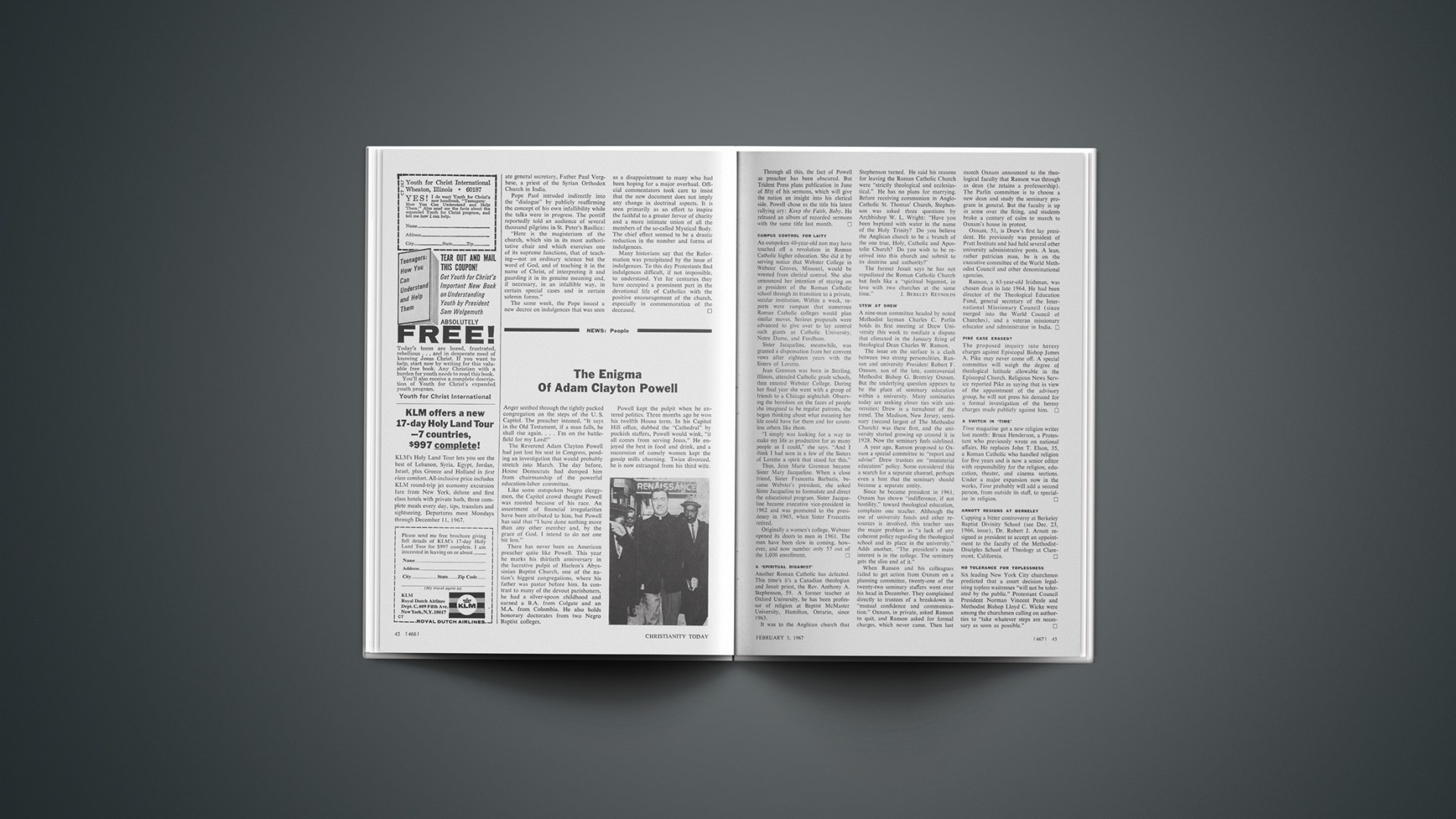
The Enigma of Adam Clayton Powell

Anger seethed through the tightly packed congregation on the steps of the U. S. Capitol. The preacher intoned, “It says in the Old Testament, if a man falls, he shall rise again.… I’m on the battlefield for my Lord!”

The Reverend Adam Clayton Powell had just lost his seat in Congress, pending an investigation that would probably stretch into March. The day before, House Democrats had dumped him from chairmanship of the powerful education-labor committee.

Like some outspoken Negro clergymen, the Capitol crowd thought Powell was roasted because of his race. An assortment of financial irregularities have been attributed to him, but Powell has said that “I have done nothing more than any other member and, by the grace of God, I intend to do not one bit less.”

There has never been an American preacher quite like Powell. This year he marks his thirtieth anniversary in the lucrative pulpit of Harlem’s Abyssinian Baptist Church, one of the nation’s biggest congregations, where his father was pastor before him. In contrast to many of the devout parishoners, he had a silver-spoon childhood and earned a B.A. from Colgate and an M.A. from Columbia. He also holds honorary doctorates from two Negro Baptist colleges.

Powell kept the pulpit when he entered politics. Three months ago he won his twelfth House term. In his Capitol Hill office, dubbed the “Cathedral” by puckish staffers, Powell would wink, “it all comes from serving Jesus.” He enjoyed the best in food and drink, and a succession of comely women kept the gossip mills churning. Twice divorced, he is now estranged from his third wife.

Through all this, the fact of Powell as preacher has been obscured. But Trident Press plans publication in June of fifty of his sermons, which will give the nation an insight into his clerical side. Powell chose as the title his latest rallying cry: Keep the Faith, Baby. He released an album of recorded sermons with the same title last month.

Campus Control For Laity

An outspoken 40-year-old nun may have touched off a revolution in Roman Catholic higher education. She did it by serving notice that Webster College in Webster Groves, Missouri, would be wrested from clerical control. She also announced her intention of staying on as president of the Roman Catholic school through its transition to a private, secular institution. Within a week, reports were rampant that numerous Roman Catholic colleges would plan similar moves. Serious proposals were advanced to give over to lay control such giants as Catholic University, Notre Dame, and Fordham.

Sister Jacqueline, meanwhile, was granted a dispensation from her convent vows after eighteen years with the Sisters of Loretto.

Jean Grennan was born in Sterling, Illinois, attended Catholic grade schools, then entered Webster College. During her final year she went with a group of friends to a Chicago nightclub. Observing the boredom on the faces of people she imagined to be regular patrons, she began thinking about what meaning her life could have for them and for countless others like them.

“I simply was looking for a way to make my life as productive for as many people as I could,” she says. “And I think I had seen in a few of the Sisters of Loretto a spirit that stood for this.”

Thus, Jean Marie Grennan became Sister Mary Jacqueline. When a close friend, Sister Francetta Barbaris, became Webster’s president, she asked Sister Jacqueline to formulate and direct the educational program. Sister Jacqueline became executive vice-president in 1962 and was promoted to the presidency in 1965, when Sister Francetta retired.

Originally a women’s college, Webster opened its doors to men in 1961. The men have been slow in coming, however, and now number only 57 out of the 1,000 enrollment.

A ‘Spiritual Bigamist’

Another Roman Catholic has defected. This time’s it’s a Canadian theologian and Jesuit priest, the Rev. Anthony A. Stephenson, 59. A former teacher at Oxford University, he has been professor of religion at Baptist McMaster University, Hamilton, Ontario, since 1963.

It was to the Anglican church that Stephenson turned. He said his reasons for leaving the Roman Catholic Church were “strictly theological and ecclesiastical.” He has no plans for marrying. Before receiving communion in Anglo-Catholic St. Thomas’ Church, Stephenson was asked three questions by Archbishop W. L. Wright: “Have you been baptized with water in the name of the Holy Trinity? Do you believe the Anglican church to be a branch of the one true, Holy, Catholic and Apostolic Church? Do you wish to be received into this church and submit to its doctrine and authority?”

The former Jesuit says he has not repudiated the Roman Catholic Church but feels like a “spiritual bigamist, in love with two churches at the same time.”

J. BERKLEY REYNOLDS

Stew At Drew

A nine-man committee headed by noted Methodist layman Charles C. Parlin holds its first meeting at Drew University this week to mediate a dispute that climaxed in the January firing of theological Dean Charles W. Ranson.

The issue on the surface is a clash between two strong personalities, Ranson and university President Robert F. Oxnam, son of the late, controversial Methodist Bishop G. Bromley Oxnam. But the underlying question appears to be the place of seminary education within a university. Many seminaries today are seeking closer ties with universities; Drew is a turnabout of the trend. The Madison, New Jersey, seminary (second largest of The Methodist Church) was there first, and the university started growing up around it in 1928. Now the seminary feels sidelined.

A year ago, Ranson proposed to Oxnam a special committee to “report and advise” Drew trustees on “ministerial education” policy. Some considered this a search for a separate channel, perhaps even a hint that the seminary’ should become a separate entity.

Since he became president in 1961, Oxnam has shown “indifference, if not hostility,” toward theological education, complains one teacher. Although the use of university funds and other resources is involved, this teacher sees the major problem as “a lack of any coherent policy regarding the theological school and its place in the university.” Adds another, “The president’s main interest is in the college. The seminary gets the slim end of it.”

When Ranson and his colleagues failed to get action from Oxnam on a planning committee, twenty-one of the twenty-two seminary staffers went over his head in December. They complained directly to trustees of a breakdown in “mutual confidence and communication.” Oxnam, in private, asked Ranson to quit, and Ranson asked for formal charges, which never came. Then last month Oxnam announced to the theological faculty that Ranson was through as dean (he retains a professorship). The Parlin committee is to choose a new dean and study the seminary program in general. But the faculty is up in arms over the firing, and students broke a century of calm to march to Oxnam’s house in protest.

Oxnam, 51, is Drew’s first lay president. He previously was president of Pratt Institute and had held several other university administrative posts. A lean, rather patrician man, he is on the executive committee of the World Methodist Council and other denominational agencies.

Ranson, a 63-year-old Irishman, was chosen dean in late 1964. He had been director of the Theological Education Fund, general secretary of the International Missionary Council (since merged into the World Council of Churches), and a veteran missionary educator and administrator in India.

Pike Case Erased?

The proposed inquiry into heresy charges against Episcopal Bishop James A. Pike may never come off. A special committee will weigh the degree of theological latitude allowable in the Episcopal Church. Religious News Service reported Pike as saying that in view of the appointment of the advisory group, he will not press his demand for a formal investigation of the heresy charges made publicly against him.

A Switch In ‘Time’

Time magazine got a new religion writer last month: Bruce Henderson, a Protestant who previously wrote on national affairs. He replaces John T. Elson, 35, a Roman Catholic who handled religion for five years and is now a senior editor with responsibility for the religion, education, theater, and cinema sections. Under a major expansion now in the works, Time probably will add a second person, from outside its staff, to specialize in religion.

Arnott Resigns At Berkeley

Capping a bitter controversy at Berkeley Baptist Divinity School (see Dec. 23, 1966, issue), Dr. Robert J. Arnott resigned as president to accept an appointment to the faculty of the Methodist-Disciples School of Theology at Claremont, California.

No Tolerance For Toplessness

Six leading New York City churchmen predicted that a court decision legalizing topless waitresses “will not be tolerated by the public.” Protestant Council President Norman Vincent Peale and Methodist Bishop Lloyd C. Wicke were among the churchmen calling on authorties to “take whatever steps are necessary as soon as possible.”

Will Roman Catholics Join the NCC?

Will the Roman Catholic Church (membership: 46 million) join the National Council of Churches (constituent membership: 41.5 million)?

John Coventry Smith, the Presbyterian ecumenist who heads the NCC’s “working group” with Roman Catholicism, thinks the Catholics “will join a National Council in ten or fifteen years.” He stresses the indefinite article, because the NCC will obviously be a much different organization if it includes the Roman millions.

Speculation has been heightened by two significant events late in 1966. First, the amorphous U. S. Catholic hierarchy became the National Conference of Catholic Bishops, with an apparently more authoritative secretariat to administer programs between annual meetings.

William Norgren, an Episcopalian who is executive director of the NCC’s Faith and Order Department, says “autonomy” is one criterion for membership in the NCC. With Roman Catholicism, he observes, “it’s hard to tell if it’s a series of united national churches, or a world church. If the latter, it’s hard to see how they could join the National Council.” Thus structure, not size, could be the chief obstacle, and the Roman Catholic bishops’ reorganization is an important step.

The second significant move came from the other side. In December, the National Council’s General Board added the Roman Catholic Church to the list of non-members recognized as agreeing with the brief doctrinal requirement in the NCC Constitution: “communions which confess Jesus Christ as Divine Lord and Savior.”

The immediate effect of the action, spokesmen said, was to make Jesuit David Bowman a legitimate staff member of the NCC’s Faith and Order Department. Now Roman Catholics can be hired freely and included as participants in programs and agencies.

Observers also saw it as a first step toward Roman Catholic membership. But Monsignor William W. Baum, soft-spoken director of the Roman Catholic Bishops’ Commission for Ecumenical Affairs, cautions that “it should not be interpreted as a step toward membership,” any more than is the similar recognition of the Southern Baptist Convention by the NCC.

The membership issue has come up informally in the first two meetings of the joint NCC-RCC commission, but Baum said, “The consensus of the group is that the question is premature. We should know more about each other.” He said the commission “will look at the possibilities, and this is one possibility.” But as to whether it would ever occur, Baum says, “I just don’t know.”

Baum also said the NCC would be changed significantly if several of its major members unite under the Consultation on Church Union. Norgren said his staff has spent more time on that question than on what would happen if Rome joined.

Unlike the Roman Catholic talks with various Protestant confessional groups—which treat the Holy Spirit, baptism, and other theological issues—the talks with the NCC center on such practical interchurch irritants as mixed marriages and public aid for parochial schools. A third, less-developed topic for study is world peace and justice. The joint commission will hold its next meeting in May or June, probably in New York City. Roman Catholics also participate in the annual Faith and Order Colloquium under NCC auspices.

While any Roman Catholic affiliation is far off (“we can’t exclude anything for the longer-range future,” Norgren says), the NCC might get a significant new member in the next few years, perhaps by 1968. The 2.5-million-member American Lutheran Church, which stayed out under terms of its 1960 merger, is presently studying NCC ties.

Although an NCC-RCC link may sound far-fetched, new ecumenical ground can be broken pretty fast these days. Only a few years ago Roman Catholic churches and city and state councils of churches had nothing to do with each other. But today, the New Mexico state council and at least twenty-one city councils have Roman Catholic members, reports John B. Ketcham of the National Council of Churches. Actually, the figures are probably higher. (“They’re running way ahead of us—we can’t keep up with them,” Ketcham said.)

The NCC has no structural link with local and state councils, but their functions are similar. Ketcham heads an NCC department that advises and surveys the local councils.

Oklahoma City’s council was one of the first to include Roman Catholics. Other major cities to follow were Seattle, Fort Worth, Tulsa, Austin, and Grand Rapids. Kansas City has such a move under discussion.

Priority For Mixed Marriage

At a secluded retreat in the north of Italy, teams of Roman Catholic and Anglican theologians last month held “a serious dialogue … founded on the Gospels and on the ancient common traditions.”

The three-day sessions produced only one announced result: establishment of a special group for the study of the theology of marriage and the problem of mixed marriages. Protestant, Anglican, and Orthodox churchmen have been insisting that the Vatican ease its conditions for mixed marriages beyond the slight modifications issued by Pope Paul VI last year.

A communique issued after the sessions noted that the dialogue had gotten under way as a result of the common declaration of Paul and Arthur Michael Ramsey, Archbishop of Canterbury, after their March, 1966, meeting. That declaration affirmed the desire of the prelates “that all those Christians who belong to these two communions may be animated by the same sentiments of respect, esteem, and fraternal love.…”

Ten Roman Catholic and eleven Anglican theologians participated in the talks at Villa Cagnola, the retreat of the Archbishop of Milan. Their communique said that “after 400 years of separation” the two churches had taken “first steps towards restoring full unity.”

Religious News Service reported that besides thoroughly exploring both the possibility and the advisability of continuing the dialogue, the participants delved into a variety of practical problems and agreed to submit to their hierarchies a number of recommendations aimed at easing tension and building cooperation and understanding.

The joint commission met under the chairmanship of Catholic Bishop Charles Helmsing of Missouri and Anglican Bishop John Moorman of Ripon, England.

The World Council of Churches was represented at the meeting by an associate general secretary, Father Paul Verghese, a priest of the Syrian Orthodox Church in India.

Pope Paul intruded indirectly into the “dialogue” by publicly reaffirming the concept of his own infallibility while the talks were in progress. The pontiff reportedly told an audience of several thousand pilgrims in St. Peter’s Basilica:

“Here is the magisterium of the church, which sits in its most authoritative chair and which exercises one of its supreme functions, that of teaching—not an ordinary science but the word of God, and of teaching it in the name of Christ, of interpreting it and guarding it in its genuine meaning and, if necessary, in an infallible way, in certain special cases and in certain solemn forms.”

The same week, the Pope issued a new decree on indulgences that was seen as a disappointment to many who had been hoping for a major overhaul. Official commentators took care to insist that the new document does not imply any change in doctrinal aspects. It is seen primarily as an effort to inspire the faithful to a greater fervor of charity and a more intimate union of all the members of the so-called Mystical Body. The chief effect seemed to be a drastic reduction in the number and forms of indulgences.

Many historians say that the Reformation was precipitated by the issue of indulgences. To this day Protestants find indulgences difficult, if not impossible, to understand. Yet for centuries they have occupied a prominent part in the devotional life of Catholics with the positive encouragement of the church, especially in commemoration of the deceased.

Book Briefs: February 3, 1967

Reshaping The Urban Church

Urban Church Breakthrough, by Richard E. Moore and Duane L. Day (Harper & Row, 1966, 183 pp., $4.50), and The Grass Roots Church: A Manifesto for Protestant Renewal, by Stephen C. Rose (Holt, Rinehart and Winston, 1966, 174 pp., $4.95), are reviewed by William Edmund Bouslough, chairman, Division of Biblical Studies and Philosophy, Westmont College, Santa Barbara, California.

Our decade has seen a great number of volumes about problems in the contemporary church. They range from bitter criticism through more moderate evaluations to academic discussions. Urban Church Breakthrough and The Grass Roots Church represent the latest approach to the issues. They have many similarities. Each purports to build on the foundation of criticism and evaluation of the recent past and to offer positive steps for the future. Each relates itself to the urban situation, each reviews the facets of modern city life that demand renewal, each suggests a basic theological stance for renewal, each recognizes the necessity for continuing and strengthening the local church, and each moves to suggested structures that the authors believe will bring new meaning to the ministry of the Church.

Moore and Day have four basic points. First, a ministry of reconciliation is necessary. The city prompts loneliness, alienation, and depersonalization, and the Church, under the lordship of Christ, must help the defeated to find dignity, courage, and power. Second, the Incarnation, not just as propositional truth but as “reality and presence,” must guide the Church as it goes about its task. Reality is the key, and a “reality-shaped parish” is the means by which a church will fulfill its mission. Third, the residential congregation needs to be, not supplanted, but supplemented as it moves into urban life. Where is the action in the city? Wherever it is, this is where the Church must be as the Body of Christ. This view will take the Church into the public sector, the leisure segment, and the multiple worlds of work. Finally, the authors hold that the possibility of renewal resides in the cooperation of the denominations.

It is at this point that the second book is most meaningful. Rose proposes a cooperative attack on the city through a restructuring of the churches. Instead of competitive and duplicate ministries by several churches in one neighborhood, there should be a cooperative team approach. Each congregation would then minister in the way it is best able to minister. Each would emphasize the gifts of the Spirit given to it as part of the Body of Christ. Each would specialize in certain tasks assigned through the cooperative ministry.

Rose emphasizes what he calls “chaplaincy, teaching and abandonment” as the three complementary aspects of the ministry of the Church. Only as these three aspects are refined through a cooperative ministry will a community’s church (i.e., the sum total of all the cooperating local congregations) meet the community’s needs.

What shall we say of these books challenging the present-day church? First, each provides fascinating reading. Second, each has value for both pastor and layman. Regardless of our theology, all of us need the challenge of these views on the ministry of the local church. They help to deepen our vision of our task and our commitment to it. Third, a group of pastors in a community may be motivated to build a cooperative ministry and thus project a more vital Christian voice. It is still too early to expect that our denominational headquarters will adopt Rose’s suggestion. Or is it?

Reading for Perspective

CHRISTIANITY TODAY’S REVIEW EDITORS CALL ATTENTION TO THESE NEW TITLES:

Valiant for the Truth: A Treasury of Evangelical Writings, compiled and edited by David Otis Fuller (Lippincott, $5.95). Stirring selections by thirty-three great Christian leaders from the first to the twentieth centuries; excellent biographical sketches by Henry Coray.

Last Days on the Nile, by Malcolm Forsberg (Lippincott, $3.95). The story of the Sudan—crises in its national development, the heroic stand of “Chinese” Gordon at Khartoum, progress made by missionaries until their recent expulsion—by a missionary who spent thirty years there.

Religion: Origins and Ideas, by Robert Brow (Inter-Varsity, $3.50). Religion in man’s life: original monotheism, development and degeneration of priestcraft, revealed Christianity compared with other religions.

The Point Of Contact

Literature and the Christian Life, by Sallie McFague TeSelle (Yale, 1966, 238 pp., $6.50), is reviewed by Calvin D. Linton, dean of arts and sciences, George Washington University, Washington, D. C.

Mrs. TeSelle, a lecturer in Christianity and contemporary culture at Yale Divinity School, has written a skillful book about an extraordinarily difficult subject. Indeed, to appreciate her achievement it is important to understand precisely what her subject is, for in its depth and centrality it distinguishes her purpose from that of a number of other books with somewhat similar titles. Her interest is not in “Christian elements in literature,” or “theological implications in the works of such-and-such a group of writers,” or “literature in the light of Christian ethics.” She writes, “I have not been concerned with aesthetics and religion or art and Christianity, but with literature and the Christian life. I have taken the point of view of the person who is already a Christian, and who is attempting to see how literature in its own integrity might be relevant to his task of implementing his discipleship.”

To accomplish her task, she attempts to describe the experiential core of literature and of the Christian faith, trying to protect “the uniqueness of their individual truth claims,” to the end that the Christian may be more deeply instructed in the complexities and subtleties of human life and that one’s view of literature may be enriched by a better awareness of its true independence and creativity.

Her aim requires, therefore, that she devote a considerable amount of time to analyzing the terms of her title, “Christianity” and “literature,” neither of which, it may safely be said, is entirely free from controversy in contemporary thought. As to literature, she rather naturally (in view of the influence on her thinking at Yale of Cleanth Brooks) leans toward the position of the “New Criticism,” which asserts that a work of art is autonomous, a “thing in itself,” subject only to its own rules, a thing known in itself, not an instrument for knowing other things, unsusceptible of adequate paraphrase.

This insistence on art as a mode of knowing, not merely a pleasing vehicle for communicating truths from some other mode of knowing, shields her from the danger of evaluating literature on grounds other than those generated by its own unique nature. (This is one of the strengths of the New Critical position. One of its weaknesses is that it divorces art from other, possibly illuminating dimensions of knowledge, including historical, biographical, and intellectual backgrounds.)

Her view of Christianity is essentially that of contemporary neo-orthodoxy, with perceptive awareness of the varied positions of Barth, Bonhoeffer, Bultmann, Niebuhr, Robinson, Tillich, and others. Inevitably, the conservatively inclined Christian will find instances of what are, to him, misinterpretations of the faith. For example: “The main Christian assertion about man is that all men are saved in Jesus Christ, not that all men are evil in their hearts. At the most, the latter is an implication from the event of salvation.”

Mrs. TeSelle’s purpose, however, was not to write a book of Christian doctrine or of literary criticism but to “show the central point of contact between these disparate realms.” Her achievement will be much appreciated by readers possessing the specialized vocabulary of modern theology and literary criticism. For the general public it may be rather hard going.

The World’S Biggest Question

Good God! Cry or Credo?, by Hubert Black (Abingdon, 1966, 144 pp., $2.75), is reviewed by Robert Boyd Munger, pastor, University Presbyterian Church, Seattle, Washington.

In his foreword, David H. C. Read says: “This is a book about the biggest question in the world—the presence of evil and suffering, how we understand it, and how we cope with it.” The wisdom of the ages, the agonizing inquiry of sensitive spirits, and the insight and research of modern science have not reduced the size of the question. Nor will this book give all the answers. It will, I believe, fulfill the author’s intention:

The aim of this book is to put the questions and stimulate thought and discussion. I shall challenge some conventional answers which I believe to be muddle-headed at best and blasphemous at worst. I can promise no answer for you, for your own answer must come from your own heart and head.… But by the end I shall have given my own answer—the answer that to me is satisfying, that to me is not only logical but loving (for the two unfortunately are not always identical); that is to me consistent with Christian faith, that coincides with the New Testament picture of our Lord.

The hard-hitting thesis of the book is that God is good and only good, that he wills good for all men at all times, that therefore all suffering is evil and has its source not in God but in the abuse of man’s God-given freedom. No concession is made to a “Christian fatalism” that accepts tragic events as the will of God or to “dreadful half truths” that God sends suffering for good ends. Rather, suffering and death are seen as the natural results of man’s rebellion against the will of God. Although this position poses problems, it is cogently argued to be true both to the revelation of God in Jesus Christ and to man’s authentic freedom. Such a view speaks effectively to the modern mind and will stimulate fresh thought upon a subject that, for many, lies muted in doubts.

The author, Hubert Black, a native of Edinburgh, Scotland, is now minister of Franklin Street Presbyterian Church in Baltimore, Maryland. He writes clearly and convincingly, out of a scholar’s thought and a pastor’s heart.

Is There A Christian Economics?

Christian Economics: Studies in the Christian Message to the Market Place, by John R. Richardson (St. Thomas Press, 1966, 169 pp., $4.95), is reviewed by Irving Howard, assistant editor, “Christian Economics” magazine, New York, New York.

“If there is a ‘Christian’ economics, why not a Buddhist, Islamic, or Judaistic economic theory? And besides, economic theory is an impersonal science which makes no value judgments, Christian or otherwise.” Such arguments are often raised to oppose the very idea of Christian economics.

But economics is not an impersonal science. It can and must use some of the techniques of science, particularly statistical studies; but it is too deeply involved in the subjective aspects of human life to be a true science. Indeed, economics is primarily concerned with the values people attach to goods and services, and these are closely bound up with their religious faith.

One’s economic ideas, moreover, are determined by what one believes about the nature of God and man. Therefore it is reasonable to expect every religion to influence the economic system of the civilization in which that religion is dominant.

Christianity has had its effect upon the economics of Western civilization, and Dr. Richardson has produced a much needed exposition of that effect and of the implications of Christianity for the market place today.

This is not a technical textbook. It should be in demand among ministers and laymen who want a general discussion of the relation between economics and the Christian faith and a clear distinction between collectivism and Christian individualism.

It will also serve churches looking for a study book for a young adult, senior high, or adult class.

Making God A Metaphysical Myth

The Reality of God and Other Essays, by Schubert M. Ogden (Harper & Row, 1966, 237 pp., $6), is reviewed by William Young, assistant professor of philosophy, University of Rhode Island, Kingston.

In this attractively written discussion of fundamental problems of philosophical theology, the author of Christ without Myth attempts a synthesis of Bultmann’s existentialist demythologizing, Toulmin’s linguistic analysis, and Hartshorne’s relativistic theism. The result, as may be expected, comes short of philosophical clarity and theological soundness.

Ogden’s rejection of classical Christian supernaturalism is explicit and peremptory. Dialogue with him from an evangelical position would seem to be futile, since his acceptance of a secular standpoint rules out supernaturalism. The alleged contradictions in classical supernaturalism are little more than moves in a game with words.

Yet since Ogden tries hard to come to terms with contemporary secular philosophy, some philosophical mistakes may profitably be pointed out. He merges the attitude of ordinary perceptual experience with that of theoretical scientific thought, with the result that his attempt to analyze objectivity fails to yield a genuine clarification of the concept. In the chapter “Myth and Truth,” there is ample muddle about the nature and criterion of truth. Consensus appears to be the criterion for adopting a certain view of myth. This appeal to consensus accounts for Ogden’s earlier adherence to the secular outlook, not effectively demarcated from the secularism he professes to reject. Although the nature and criterion of truth are distinguished in principle, they are in fact confused in the statement that “the question of the sense in which myth can be true must be formulated as the question of the criteria.…”

The analysis of “true” as “worthy of being believed” is viciously circular, since to believe something means to accept it as true. The attempt to find truth in myth by employing the notion of a “category mistake” is singularly misconceived. A category mistake is a form of nonsense (e.g., “The number seven is soft”) and does not qualify for being either true or false. In fact, it is not to myth but to the outcome of demythologizing,—namely, a metaphysical proposition—that Ogden actually ascribes truth.

It is strange that a demythologizer like Ogden should censure classical theists for their figurative interpretation of patently anthropomorphic elements in the biblical self-representations of God. On a wider and more natural sense of “myth” than his own, Ogden could be critized for not demythologizing far enough, or, more correctly, for propounding a mythological conception of God. Ogden’s temporal God is nothing but a metaphysical myth, an incongruous combination of relative and absolute factors—in short, an idol.

Is Religion Pathological?

Religious Pathology and Christian Faith, by James E. Loder (Westminster, 1966, 255 pp., $5), is reviewed by Orville S. Walters, director of health services and professor of psychiatry, University of Illinois, Urbana.

How can we assimilate Freud’s insights into Christian thought without committing either theological or psychological reductionism? This volume seeks the way to such an interdisciplinary liaison by examining the psychological substratum for theological assertions. The plan of the book is “to bring the viewpoints of Kierkegaard and Freud into a mutually enlightening relationship” by placing in apposition analyses of the views on each on pathological religiousness, reality consciousness, and the epistemological problem.

The author immediately confronts the crucial question. Since the insights of psychoanalysis were elaborated under clinical conditions, how can they be used in theological thought without the presupposition that Christians have lost their mental health? He as promptly begs the question by declaring simply that no distinction can be drawn between the sick and the healthy. He at once rejects the “myth of disciplinary purity” that would separate psychoanalysis and theology, and the “myth of normalcy.”

The book’s title leads one to expect more than he finds on religious pathology and Christian faith. Freud’s views on religion as pathology are traced in comparison with Kierkegaard’s writing on dread and despair. Loder’s synthesis: anxiety creates problems of objectification, leading to neurotic symbolization and illusion or delusion. He concludes that members of the church do nothing to correct this pathology but only sacralize it.

Consciousness, in its discovery and perusal of reality, passes through the stages of conflict, emergence of an image, resolution of conflict with release of tension, and restoration of the empirical “vital balance.” From both Freudian and Kierkegaardian standpoints, reality consciousness emerges as the operation of subjective, empirical, and interpretative modes, with the mediation of the imagination as the “artificer of consciousness.”

Loder recognizes the defects in Freud’s analogy of religion as pathology, but he apparently accepts the structural model without question. He is sectarian also in his attitude toward nosology. As “the concluding substance of a doctoral dissertation,” the book is unfortunately understandably narrow in scope and has limited practical applicability.

The Varieties Of Existentialism

Studies in Christian Existentialism, by John Macquarrie (Westminster, 1966, 278 pp., $6), is reviewed by Jerry H. Gill, assistant professor of philosophy, Southwestern at Memphis, Memphis, Tennessee.

This is an excellent book for the person who is looking for an introduction to existentialist theology. In addition to being well organized and clearly written, the book has the great merit of being written by a thoughtful “practitioner” of the existentialist approach.

Although all the chapters have appeared in somewhat different form in a variety of journals, they are arranged in a logical and progressive sequence. After briefly defending the existentialist approach to theology in Part One, Macquarrie lays out the philosophical presuppositions of such an approach in terms of Heidegger’s major themes in Part Two. He then moves to an analysis of the existentialist method as presented by Bultmann in Part Three. The insights in Parts Two and Three concerning self-understanding and understanding the biblical message are extremely valuable. After exploring some other contemporary approaches to theology, such as logical empiricism and neo-Catholic thought, in Part Four, Macquarrie concludes with an application of his approach to such doctrines as atonement, immortality, and the Holy Ghost in Part Five.

Existentialist theology is characterized by a lack of concern for the factual dimension of Christianity, with respect to both the Bible and the Christian life. In this Macquarrie is no exception. He maintains that in the New Testament and in religion in general, the question of “facts” and “objective statements” is simply beside the point. While I can agree that factual concerns are not the most important in matters of religion, they are nonetheless of some importance. I am suspicious of any attempt to dichotomize the various dimensions of human existence.

In all fairness it should not go unnoticed that Macquarrie tries to distinguish himself from Bultmann et al. by emphasizing the necessity of a “minimal core” of historical facts about Jesus’ pattern of life. Unfortunately, he never indicates how this minimal core is to be established without the help of the historical dimension of the New Testament, which he has already dismissed as “beside the point.” The minimal core that Macquarrie allows is, after all, too minimal to do the job that he wants to be done, that needs to be done, and that can be done!

Creationism Vs. Evolution

Herkunft und Zukunft des Menschen: Ein Kritischer Uberblick der dem Darwinismus und Christentum zugrunde leigenden naturwissenschaftlichen und geistlichen Prinzipien, by A. E. Wilder-Smith (Brunnen-Verlag, 1966, 160 pp., 18, 60 DM), is reviewed by Edwin Y. Monsma, professor of biology, emeritus, Calvin College, Grand Rapids, Mich.

This book on creation and evolution was written in response to many requests that Dr. Wilder-Smith republish a book he wrote in 1949, Die Problematik der Dezendenzlehre. In view of the many scientific discoveries that have been made during the last fifteen years, he thought it best to write this new book, The Origin and the Destiny of Man. He serves as professor of pharmacology at the Medical Center of the University of Illinois in Chicago.

The author critically considers a wide range of subjects bearing on evolution and creation. After explaining the teachings of Darwinian evolution and the Bible on the origin of living things, he examines various popular attempts to harmonize Darwinism with the first three chapters of Genesis. His general conclusion is that these attempts are not successful. In discussing recent experiments to produce life in the laboratory he does not deny the probability that some day living substance may be produced by the careful experimentation of a highly qualified biochemist, which indicates to him that the first life on earth required a wise creator; it could not have arisen by chance, as the Darwinian theory implies.

He also takes up the question whether life, and, subsequently, plants and animals, could have arisen under God by a process sometimes called “theistic evolution.” This idea, he says, is not consistent with the character of God as it is revealed in the Bible and in Jesus Christ, since evolution in any form implies a struggle for existence in which the strong survive at the expense of the weak and death, destruction, and animosity become a part of the creation process.

In the last chapter, Wilder-Smith points out that Darwinism has no future for the individual but only for the race to which he belongs. According to the Bible, however, there is a future for every person. For the believer this is eternal life in a renewed creation. The appendix contains information on such subjects as: popular attempts at harmonizing Darwinism with chapters 1 to 3 of Genesis; dinosaur and human footprints in the Poluxy River bed in Texas; the constancy of species; and the lowering of entropy in living organisms.

This is a timely book that deserves to be translated into English. It touches upon fundamental principles in the consideration of evolution and creation that continues to be debated.

Book Briefs

The Fellowship of the Holy Spirit, by Georgia Harkness (Abingdon, 1966, 208 pp., $4). The person of the Holy Spirit considered biblically, doctrinally, experimentally. Sound for the most part; constantly provocative.

His Church, by Reuben H. Mueller (Abingdon, 1966, 143 pp., $3). The immediate past-president of the National Council of Churches offers ten messages that call Christians to confidence in Christ’s Church, local and universal. He proclaims the need for a new church that exhibits spiritual unity (not necessarily organic), relies on the Holy Spirit, witnesses to God’s mighty works, and is spiritually productive.

Creating Christian Personality, by A. Don Augsburger (Herald, 1966, 135 pp., $4). A sensible discussion of the attitudes and principles that Christian parents should exhibit as they guide youth to maturity.

Judaism in a Christian World, by Robert Gordis (McGraw-Hill, 1966, 253 pp., $6.50). An erudite rabbi analyzes forces that have molded the Jewish community and charts new directions for Jews in America.

The Regathering of Israel, by Arthur Petrie (American Board of Missions to the Jews, 1966, 78 pp., $2). An abundance of Scripture is cited to show that God will one day bring all Israel back to the promised land.

Regeneration and Sanctification

A Christian speaker recently confused his audience by using the words “regeneration” and “sanctification” as though they were synonymous. Later conversation revealed that he actually did not know the difference between the two.

Although the great majority of Christians are laymen untrained in theological terms, there are certain words expressing vital truths of the Christian faith that should be understood by all Christians.

As a layman writing to other laymen, I would describe the difference between regeneration and sanctification as the difference between birth and growth.

Regeneration means spiritual rebirth, something Jesus spoke of as imperative for those who wish to enter the kingdom of heaven. “You must be born again.” This was the sentence that arrested a pious Jew named Nicodemus, and out of it developed the discussion of personal salvation recorded in John 3:1–21.

Sanctification is a process. It is growth in Christian knowledge and in the Christian graces. It is an advance in experience, understanding, and application of Christianity, not only in our relation to God but also in our relation with fellow men.

Through the once-for-all experience of regeneration, one becomes a Christian. Through sanctification, one develops into a mature Christian. This development never reaches its goal in this life; yet it should continue and become increasingly evident in the life of every Christian until he passes over into eternity.

Just as there are children whose minds and bodies stop developing at an early age, so there are Christians whose spiritual development is slight. Ignorant and immature, they hardly honor the name they bear.

Regeneration is an instantaneous work of the Spirit. Although a Christian may not be able to point to a specific time when he passed from spiritual death to spiritual life, still he knows that there was such a time. He knows that at some time the love and saving power of Christ became a reality to him, and he turned to Christ. At this time he was born again.

Regeneration is Christ’s perfect work in every believer. It is the miracle of spiritual birth. Sanctification, on the other hand, takes place in varying degrees. All Christians are plagued in some measure by the temptations and limitations of the flesh. Unfortunately, few of us who have been born again make full use of the means of growth in grace God has placed at our disposal. As a result, we are weak and immature in faith and practice.

Sanctification involves the matter of the will. Are we willing to surrender completely to the Holy Spirit so that he may perfect his work in us?

It has been said that regeneration is the pardoning of our sins for Christ’s sake while sanctification is the subduing of sins in day-to-day living by the power of the indwelling Christ. Regeneration means entering into a new life, a life in which eternal values and destiny are changed, while sanctification is the growth in appreciation of those values.

The basic question is, of course, whether we have been born again. Have we truly believed in Jesus Christ as the Son of God and accepted him as our Saviour from sin? If so, regardless of how we may feel, we have become children of God and heirs of all the blessings that come to his children, now and for eternity.

Can we ever be lost? No. We have our Lord’s own promise: “I give them eternal life, and they shall never perish, and no one shall snatch them out of my hand. I and the Father are one” (John 10:28–30, RSV).

The hymn-writer captured this comforting truth in these words:

The soul that on Jesus

Hath leaned for repose,

I will not, I will not

Desert to his foes;

That soul, though all hell

Should endeavor to shake,

I’ll never, no never,

No never forsake.

Are we growing as we should? Are we making progress? Can others see in our lives an increase of those qualities that commend the faith we profess?

Here is where honest self-appraisal is needed. We can use certain criteria to help us determine whether there is progress in our lives. Let us ask ourselves these questions:

About God. Do we love him more? Do we enjoy his Word more and more? Are we obedient to his leading? Do worship, praise, and thanksgiving increasingly well up from our souls as we think of him? Does the joy of salvation and a sense of peace fill our hearts? If so, the work of sanctification is going forward, and we can say with the psalmist, “Bless the Lord, O my soul: and all that is within me, bless his holy name.”

About men. In our attitude toward others, is there more and more love, a love that is willing to serve, a love not contingent on who people are or how they react to us? Are we growing more patient with others, less likely to respond to them with sharp actions or words? Are we growing in the grace of kindness, even to those who may have been unkind to us? Are we gentle even when our natural reaction is the opposite? Growth in the Christian graces is something that we can sense and that others inevitably see. If we are developing Christ-likeness in our dealings with others, we may be sure that the gracious work of sanctification is a reality for us.

Sanctification is also characterized by increasing joy in Christ, victory over temptations, faithfulness in the performance of our duties and self-control and temperance in all things.

Does all this mean sinless perfection? Far from it. We become more keenly aware of our sins than ever before and more dependent on our Lord for forgiveness and cleansing.

Just as children have to grow, so Christians must grow. There is no such thing as an immediately mature follower of Christ. Paul wrote to the Philippian Christians, “I am sure that he who began a good work in you will bring it to completion at the day of Jesus Christ” (Phil. 1:6).

The Apostle Peter describes the work of sanctification: “For this very reason make every effort to supplement your faith with virtue, and virtue with knowledge, and knowledge with self-control, and self-control with steadfastness, and steadfastness with godliness, and godliness with brotherly affection, and brotherly affection with love. For if these things are yours and abound, they keep you from being ineffective or unfruitful in the knowledge of our Lord Jesus Christ” (2 Pet. 1:5–7).

Regenerated? Thank God. But let’s not stop there. Let us grow in grace and in the likeness of the One who has redeemed us.

L. NELSON BELL

NCC Opposes Loans to South Africa

New politico-economic pressures stir sharp counter-criticism

The National Council of Churches recently stepped further into the economic arena by pressuring two leading New York banks to discontinue credit to South Africa in protest of apartheid. The NCC urged the Chase Manhattan and First National City banks, in which it maintains large accounts, to oppose renewal of a forty-million-dollar revolving credit to the South African government when the loan comes up for renegotiation by a ten-bank consortium.

The action startled many Christian observers into blunt criticism of the NCC’s deepening entanglement in secular affairs. Apparently, some said, council spokesmen think it moral to boost trade with Communist nations and immoral to extend credit to South Africa. Objectionable as apartheid may be, they said, are commercial banks hereafter to lend funds only to NCC-approved recipients? Does the NCC plan to supervise the moral overtones of the hundreds of thousands of bank loans and to meddle in banking as much as it meddles in politics?

Some laymen indignantly suggested that the NCC may itself misuse, for secular and political goals, financial contributions that church members sacrificially give for spiritual objectives. Increasingly disturbed by the NCC’s political trend, they directed at leaders of the conciliar movement the old adage that “people who live in glass houses shouldn’t throw stones.” Of the NCC’s current $23,583,910 budget, they noted, only an insignificant portion undergirds evangelism, in the historic Christian sense of that term.

Some critics protested that the NCC is rapidly returning to a medieval complex reminiscent of that which the Protestant Reformers opposed in Roman Catholicism. Medieval scholastics disapproved all lending of money at interest and, until the Reformation broke the yoke of ecclesiastical authority, canonistic conscience delayed the modern concept of capital.

Robert Woodburn, twice international vice-president of the Christian Business Men’s Committee and a Washington bank executive, said that the NCC maneuver “again places it far out in left field. Supposedly the Church’s calling is proclamation of the Gospel. Why should the NCC become a pressure group in economic matters that belong strictly to the business world and are properly none of its concern? If the NCC would spend as much energy on New Testament basics as it does on secular affairs, the world—including South Africa—might really become a better place in which to live.”

The NCC telegram to the New York banks was doubly disappointing because of reports circulated by some ecumenical leaders that, with the election of Dr. Arthur S. Flemming as president, the movement would take a larger interest in evangelism in order to overcome an adverse public image and mounting criticism of its economic and political obsession. But despite the increasing unrest in the churches, NCC leaders extend their involvement in secular affairs, and on the local scene clergymen are now pitted against one another as the indignation of laymen continues to rise.

During a special poverty action service in Washington (D. C.) Cathedral, the Episcopal Suffragan Bishop of Washington, the Right Rev. Paul Moore, Jr., bluntly called on President Johnson and the Ninetieth Congress not to cut back antipoverty grants; but a former cathedral canon called on the Church to put “regeneration before Christian social action” and questioned the competence of clergymen in the political and legislative field. The Episcopal minister, the Rev. Richard Williams, served for fifteen years as director of the Department of Social Relations of the Episcopal Diocese of Washington and was more closely linked to poverty and other social causes than any other Episcopal churchman in Washington.

“Clergymen, whether we like to admit it or not,” said Mr. Williams, who since 1963 has been vicar of Holy Cross Episcopal Mission in Bethesda, Maryland, “are, generally speaking, guilty of over-simplification and not competent when it comes to antipoverty legislation or appropriations, urban development, farm subsidies, housing and fair employment practice. Planning and execution can only be carried out by experts, with years of training in their field.”

Williams criticized ministers for volunteering leadership in social and political matters. “Individual clergymen and groups of clergymen,” he said, “are today offering specific solutions and are claiming to be taking leadership in the enactment of these solutions to almost every social, economic, and political problem that exists, on a national, international, and interplanetary basis.” These clergymen are taking the easier course, he said: “It is a great temptation to side-step the difficult and often humbling task of endeavoring to change the hearts and minds of man and in place of this propose programs and schemes as solutions to the ills of men.”

At the hierarchical level, however, the many pleas by clergy and laymen alike for a return to scriptural imperatives still fall on deaf ears. Ecumencial officials seem to ignore the increasing cry that the corporate church has no divine mandate, jurisdiction, or competence in political and economic affairs. Since pontifical pronouncements in such areas undermine public confidence in the Church as the bearer of a sure Word of God, laymen raise new questions about the type of ecumenical structures that faithfulness to the Gospel actually demands.

Salaries For Clergymen

A survey of ministerial salaries shows that of the larger denominations, the United Presbyterian Church provides the highest median pay—$5,669 per year (CHRISTIANITY TODAY, Sept. 30). The lowest, reported by the American Baptist Convention, is $4,618. These figures do not, of course, tell the whole story, for most ministers also are given the use of a house with utilities paid. And the figures, though the latest available, are for 1963. Nevertheless, the salaries are low.

A comparison between the salaries of the American clergy and those of bus drivers in the District of Columbia underscores the problem. The starting wage for bus drivers is $6,600 a year. The median wage is considerably higher.

Clergymen must buy books, educate their children, dress well, and entertain. They spend many years (at least seven after high school) to prepare for their work. Most clergymen are hesitant to discuss their financial plight with official boards and congregations; to do so may mark them as “worldly, money-conscious, and unspiritual.” Church members who pray, “Lord, you keep him humble, we’ll keep him poor,” think the minister demeans his calling if he talks about money.

On behalf of a great calling, and with deep compassion for underpaid clergymen, we would speak a word. The laborer is worthy of his hire. If your minister has faithfully preached the Word of God and given himself without stint in the service of your church, why not respond to his needs and pay him an adequate salary? There’s no better time to start than right now.

Tribute To A Stalwart

Montreat-Anderson College in North Carolina is naming its new library building for our esteemed colleague L. Nelson Bell. We hail this tribute to our roving executive editor, whose high service to the Church of Jesus Christ spans an entire generation. Dr. Bell served in China as a missionary-surgeon for twenty-five years. As his gifted hands performed many thousands of surgical procedures, he ministered to sick bodies as well as to needy souls. He founded the Presbyterian Journal and he was a co-founder of CHRISTIANITY TODAY, which across the years has carried his regular column, “A Layman and His Faith.” Since 1948 Dr. Bell has served the Presbyterian Church, U. S., on its Board of World Missions, has been a frequent delegate to its General Assembly, and has faithfully taught a Bible class in Montreat which is aired over a local radio station.

One of the three daughters of Nelson and Virginia Bell is the wife of Billy Graham and another is a missionary; their only son is a minister of the Gospel.

We cannot avoid some fond reference to a colleague beloved by staff members as congenial, optimistic, and always available for counsel and help. We wait for his unheralded appearances in the office, where his routine provision of doughnuts adds spice to a long afternoon.

To this stalwart soldier of the Cross, this firm defender of the faith and staunch friend of missions, go our hearty congratulations!

Apple PodcastsDown ArrowDown ArrowDown Arrowarrow_left_altLeft ArrowLeft ArrowRight ArrowRight ArrowRight Arrowarrow_up_altUp ArrowUp ArrowAvailable at Amazoncaret-downCloseCloseEmailEmailExpandExpandExternalExternalFacebookfacebook-squareGiftGiftGooglegoogleGoogle KeephamburgerInstagraminstagram-squareLinkLinklinkedin-squareListenListenListenChristianity TodayCT Creative Studio Logologo_orgMegaphoneMenuMenupausePinterestPlayPlayPocketPodcastRSSRSSSaveSaveSaveSearchSearchsearchSpotifyStitcherTelegramTable of ContentsTable of Contentstwitter-squareWhatsAppXYouTubeYouTube