Sidelights On

The World Congress On Evangelism

Complete coverage of the meeting, a tenth-anniversary project ofCHRISTIANITY TODAY,can be found in the three previous issues.

There was an air of youthfulness at the World Congress on Evangelism; the average age of delegates and observers was believed to be appreciably lower than what is usual at ecclesiastical assemblies. It was a hopeful sign for evangelicalism.

Dominating the lobby of Berlin’s Kongresshalle, where the congress was conducted, was an arresting exhibit dramatizing the mushrooming world population. The thirty-foot-high display marked each second with a loud tick and sequential flashings of eleven pictures of babies. The world population was believed to have increased by nearly two million persons during the ten-day session.

An American news wire service widely disseminated the observation of Dr. Clyde W. Taylor that in the United States “for the most part, preaching is passive, unrealistic, and dull.” The comment was contained in his “Windows on the World” report on U. S. conditions. Taylor, general director of the National Association of Evangelicals, said “there is little emphasis on the relationship between the individual and his personal walk with God.”

More than 70 per cent of the people attending the congress were brought to Berlin by Pan American jet charters from Tokyo, Beirut, Chicago, New York, and London. An Indonesian delegate had to leave home nearly three weeks before the opening day to make connections. An Ethiopian traveled for seven days by truck to the nearest airport.

Several persons who came from a cholera area in India to pick up the charter in Beirut were detained at the Lebanese capital because of quarantine regulations. Because of them the charter had to be rescheduled, and one traveler missed it. Pan Am later flew him to Berlin on a regularly scheduled flight at no extra cost. A travel agency got charter riders a package deal with hotel and meals thrown in.

Jan J. van Capelleveen, a Dutch newspaper reporter, won considerable attention with a piquant paper on the communicative arts. He urged more Christian-oriented news reports on grounds that “he who has seen what God has done is better able to grasp what God wants.” He asked churches not to do business behind closed doors, saying “that may seem dangerous, but the church that hides faults and weaknesses is unwilling to take up the cross. Our weaknesses highlight the strength of the Lord.”

Many delegates took time out to visit and tour Communist East Germany. Some even got down to Wittenberg, the city made famous by Martin Luther. One East German woman reportedly asked a delegate whether Martin Luther King was in West Berlin for the congress. The answer was no.

One French delegate was detained all night at the East German border. Other delegates traveling by road and rail were turned back because they had not gotten visas in advance. A Nigerian educator who was slated to bring a major address cabled at the last minute that national tensions prevented his coming.

The regularly scheduled commercial plane carrying evangelist Billy Graham back to the United States from Berlin was forced to make an emergency landing at London because of a malfunctioning landing gear. Graham reportedly uttered a prayer in the aircraft as it circled about dumping fuel. The landing was made without mishap.

Nine national presidents of Christian and Missionary Alliance societies around the world were present at the congress. For its officers and pastors in North America the Alliance conducted a follow-through on the congress in the form of a four-day “Leadership Conference on Evangelism” in Atlanta.

Indians and Pakistanis faced special problems. Apart from the requirement of financial guarantees, they were allowed to bring out amounts ranging from four to nine dollars. A Congo delegate came with fourteen dollars, a Kenyan with seventy cents (“for stamps to write to my family”).

A man who chauffeured Billy Graham about during his evangelistic crusade in Berlin prior to the congress testified to a commitment he had made. Franz Markard, 34, told Graham a few days after the congress opened: “I have opened my heart to Jesus Christ.”

Personalia

Southern Baptist missionary Herbert Caudill, 63, was reported last month as having been given a conditional release from prison in Cuba to seek medical help for failing eyesight.

Former evangelist Charles Templeton declared himself out of the running for the leadership of the Ontario Liberal Party. Templeton, 51, almost won the spot in 1964 and had been regarded as a promising Canadian political figure. He said he declined to run again because of business and family responsibilities.

Dr. Howard Schomer, president since 1959 of Chicago Theological Seminary, will move to New York to become executive director of the National Council of Churches’ Specialized Ministries Department. He is a minister of the United Church of Christ.

Nevile Davidson, 67, minister of Glasgow Cathedral and former moderator of the Church of Scotland General Assembly, will retire next spring.

D. George Vanderlip, 39, New Testament professor, is the youngest dean ever appointed at Northern Baptist Theological Seminary.

C. Umhau Wolf, former professor now a pastor in Toledo, Ohio, will direct the new Lutheran Institute for Religious Studies in Austin, Texas, supported by the LCA, the ALC, and Texas Lutheran College.

Focusing on differences between “what the Church of Jesus Christ is doing and what it ought to be doing,” a committtee of Philadelphia Presbytery recommended that Dr. Evor Roberts resign as pastor of the prestigious Main Line Swarthmore Presbyterian Church because of his civil rights activities and “some statistical trends in the church.”

B. B. Burnett, bishop of Bloemfontein and member of the World Council of Churches Central Committee, has resigned to become secretary of the Christian Council of South Africa.

Yandall C. Woodfin III, professor at Southwestern Baptist Theological Seminary in Texas, will join the faculty of the Baptist Theological Seminary in Rüschlikon, Switzerland, next year.

The Rev. K. L. Stumpf, Hong Kong representative of the Lutheran World Federation, is leading a three-month educational drive against drug addiction.

Miscellany

A Christian news weekly to be known as the Christian Times will make its debut January 1. It will be published by Tyndale House and will carry news and commentary from around the world plus background stories on Christian personalities, homemaker helps, special reports on science and art, and family devotional material. Don Crawford has been named editor.

National Association of Evangelicals will spearhead a year of special evangelism effort from April 1967 to April 1968. It urges all evangelicals “to join us in the major thrust.”

Three students were expelled from the St. Charles Borromeo Seminary in Overbrook, Pennsylvania, for organizing an experimental mass in violation of Roman Catholic church law. Eight others reportedly were disciplined. The experimental mass was said to have used English instead of the Latin required in solemn sections. For the Eucharist, ordinary baker’s rolls and commercial wine were used in place of altar wine and unleavened bread.

Evangelist Lane Adams and singer George Beverly Shea teamed up in a ten-day crusade in Winchester, Ontario. For Shea, it was a return to the place where he was born and where his father was pastor of a Wesleyan Methodist Church. The final service drew 3,400 persons to the local skating arena.

The American Friends Service Committee opened a day-care center for children among the 87,000 refugees in Quang Nai, South Viet Nam.

Kentucky’s attorney general has given the ministers’ association in Harlan permission to conduct an objective high school “Bible Literature” course.

Singapore, with backing from several religious bodies, has banned twenty-six nudity magazines printed in California as “crude … vulgar … morally debasing.”

A new church in Vall de Uxo, Spain, is the fifty-fourth member of the Spanish Baptist Union. Madrid’s Second Baptist Church, which was closed by the government for a decade, has called a new pastor from Barcelona.

Christian Peace Conference leaders met in Sofia, Bulgaria, to plan their third world meeting for Prague, Czechoslovakia, in 1968.

Deaths

JAMES ARCHIBALD JONES, 55, president of Union Theological Seminary in Richmond, Virginia, and holder of a number of key posts in the Presbyterian Church in the U. S.; of a heart attack in Richmond.

THEODORE K. FINCK, 71, who supervised for many years the production of educational material for the Lutheran Church in America; in Germantown, Pennsylvania.

BENSON Y. LANDIS, 69, Moravian layman and veteran National Council of Churches executive who had compiled the authoritative Yearbook of American Churches since 1941; in Scarsdale, New York, of a heart attack.
Roman Catholics in a Changing Mood

A series of major tremors rocked the once-thought-changeless Roman Catholic Church last month. In Rome, Pope Paul VI charged the Jesuits, the intellectual elite of the church, with worldliness. In Washington, American bishops sent the fish industry reeling by declaring a virtual end to meatless Friday rules. And elsewhere in the United States, priests were organizing power blocs to challenge entrenched hierarchies.

The Pope suggested to some 220 representatives of the Society of Jesus that perhaps “some had the illusion that to spread the Gospel of Christ it was necessary to take on the customs of the world, its mentality, its profanity, indulging in the naturalist evaluation of modern morals.” His rebuke was tempered with words of praise for the 36,000-member order, the world’s largest, but the sternness of his criticism and its public disclosure raised many an eyebrow. The Pope talked to the Jesuits in the Sistine Chapel. They were in Rome for their first post-Vatican II congregation.

In the U.S. capital, American bishops also held their first post-Vatican II meeting. One of their early actions was to vote overwhelmingly to approve calling themselves the “National Conference of Catholic Bishops.” The conference also renamed the National Catholic Welfare Conference, which has served as the bishops’ administrative arm since 1922, the “National Catholic Secretariat of the National Conference of Catholic Bishops.” The former NCWC, which under its new title will retain pretty much the same structure, had “welfare” appended to its title in post-World War I times when the word had more the connotation of the “common good” than what was then a secondary meaning, “social work.”

The action of the bishops that won the widest attention, however, was the vote to dispense with the rule of abstinence for American Catholics. Thus it is no longer a sin for members of the U. S. church to eat meat on Fridays and other days of abstinence. They will still be obliged to abstain from meat on Ash Wednesday and on Lenten Fridays, and the bishops voiced the hope that the Catholic community “will ordinarily continue to abstain from meat by free choice as formerly we did in obedience to church law.” The New York Times reported that spokesmen for the nation’s $2-billion-a-year retail fish industry predicted losses ranging from 10 to 25 per cent, but many hoped the losses would only be temporary.

The authority for the bishops’ action was a papal constitution issued last February 17. In accordance with a decree of the Second Vatican Council, the papal constitution left to national episcopal conferences the right to substitute works of penance and charity for the rule of abstinence. Action was first initiated in Italy and Canada.

In other statements approved during their five-day meeting, the bishops took issue with U. S. government policies on birth control, charging that they invade the privacy of those persons least able to protect it. The bishops also came down strongly for racial equality, including open housing, and affirmed support for the American position in Viet Nam. Concerning Viet Nam, however, they stressed that “it is the duty of everyone to search for other alternatives” than war.

In Santa Monica, California, the news was made by a rebel priest who once asked the Pope to depose James Francis Cardinal McIntyre, Archbishop of Los Angeles. Father William H. DuBay, 31, announced formation of the American Federation of Priests and opened a national office to recruit members. He said that it would be a full-fledged labor union and that he had already received membership applications from 100 U. S. priests. DuBay was suspended from priestly duties earlier this year after a run-in with McIntyre on the race issue.

In Chicago, an infinitely more subtle organization of priests has been formed with the estimated support of about half of the local archdiocese’s 3,000 priests. The group, known as the Association of Chicago Priests, has exhibited a surprising measure of political sagacity. It seeks to give priests a more influential voice in hierarchical affairs. The present decision-making process has been described as a leftover of feudal days. It is said to be causing some to stay out of the priesthood, some to quit it, and some who stay in to suffer psychic damage.

“When I was in a tense, unhappy rectory,” one assistant was quoted as saying, “I lived on Pepto Bismol and aspirin. Most guys in that situation don’t leave the priesthood—they don’t have the guts to do something else or to explain their leaving to their families. What they do is keep what they call their ‘fun clothes’ (sport clothes) in the closet and say to themselves, ‘I’ll keep the pastor’s word the days a week I’m on call here’ and the rest of the time these guys are wearing their ‘fun clothes’ at the country club or the race track.”

Washington Post reporter Nicholas von Hoffman said the priests of the new theology and the new church are proclaiming, “Sacraments without direct and personal love are dead or at least inadequate.” The same newspaper reported that “in waggish Washington circles” the priests’ union movement had been tagged the National Association for the Advancement of Collared People.

In Manchester, New Hampshire, priests of the local diocese elected a steering committee to devise plans for the formation of a “free association of priests.” Religious News Service said the committee was named at a meeting held at the suggestion of Bishop Ernest J. Primeau.

The U. S. hierarchical shakeup was itself seen by some as a move toward democratization. A procedure was begun for the election of presidents, and the post was given initially to the Most Rev. John Francis Dearden, Archbishop of Detroit. He was said to have been elected on the third ballot.

Meanwhile in New York, an appeal to Pope Paul for a “new consensus” on birth control was made public. The statement was signed by eighty-five religious and scientific leaders, including a surprisingly wide assortment of Protestants. It was sent to the pontiff on June 2 and acknowledged on June 27 by the Papal Office of the Vatican Secretary of State. Among signers were Union Theological Seminary President John Bennett, Martin Luther King, Reinhold Niebuhr, Robert McAfee Brown, and Franklin Clark Fry; also Stated Clerk Marion de Velder of the Reformed Church in America, President Duke McCall of Southern Baptist Theological Seminary, and theology professor Hendrikus Berkof of Leyden University.

Turkey: Resurgence of Militant Muslims

The dismissal of Ibrahim Elmalí, director of religious affairs, has brought to the fore the resurgence of militant Islam in Turkey. Religion has gotten such emphasis in press and politics that such problems as economics, education, and health rate only second place.

The press and the people divide into two groups. One espouses the interests of Islam and seeks a Koran-governed Islamic state. The other seeks salvation through nationalism, supports the official secularism of the present constitution, and detests the thought of mosque-state ties.

Intellectuals generally fall into the latter camp, and the School of Political Studies in Ankara, which trains most of Turkey’s future administrators, spearheads the movement against the Islamic revival. The religion question is splitting the whole university system, but the youth of Turkey, except for students of the Faculty of Islamic Studies, neither believe in Islam as a challenging religion nor have much interest in pursuing its requirements.

The religionist cause attracts the vast Turkish peasantry, whose votes undoubtedly elected Prime Minister Suleyman Demirel a year ago. Religionists, accused of “dark reaction,” respond with charges of “Communism,” and recently broke up a leftist meeting at the Ankara school.

Religionists among the university community held a big rally in Istanbul earlier this year, with bearded, capped elders from the extreme Muslim segment much in evidence. Those who opposed making Islam the official state ideology were accused of being Communists and threatened. Marchers demanded that the Byzantine Cathedral of St. Sophia be reinstated as a mosque. The liberals, who want to preserve mosque-state separation, claimed the rally was organized by the government, which footed the bill.

At the recent opening of the Islamic Institute of Izmir (Smyrna), Education Minister Orhan Dengiz announced Turkey will import Islamic professors to help train future priests. He didn’t say where they will come from, but the source most likely will be conservative Arab lands like Saudi Arabia, which longs for an Islamic pact—anathema to Turkish liberals.

A liberal legal expert, Vasfi Rashit Sevig, said recently that the republic is gravely threatened and that things are worse now than when the caliphs, spiritual prelates of Islam, ruled. The caliphs were thrown out in 1924 by President Ataturk, founder of modern Turkey.

Elmalí stirred bitter reaction by saying that Turkey’s salvation lies in reintroducing the caliphate. The bearded, bespectacled Elmalí went too far even for Demirel’s religion-oriented Justice Party. Anticipating that dismissal of Elmalí would be a bête noire to religionists, the government is trying its best to portray it as a simple administrative shift.

But the religionists are railing in reaction, and petitions are widely circulating across Turkey to reverse the dismissal. Some petitions warn: “If you abstain from signing, you participate in the blasphemy of the Masons.”

In the meantime, Muslim clubs are mushrooming all over Turkey—nearly 7,000 to date—with a common aim of infusing Turkish national life with Islam and infusing Islam with nationalism. They believe state secularism impedes Islamic propaganda.

Demirel is caught between the two fires. In a recent speech at Tokat (where missionary Henry Martyn is buried), he tried to straddle the fence: “Religious freedom cannot be utilized as an excuse for pressure and exploitation.… To think of Turkey as a theocratic state or entertain this notion is wrong.…”

Liberals, dissatisfied with such fatherly chit-chat, shudder at the thought that the populace probably would approve a constitutional amendment to make Turkey an officially Islamic nation.

Islam’S Zealous Spin-Off

Some 100,000 members of the Ahmadiyya community—often the most powerful competitor Christians face in Islamic lands—are meeting this month at Rabwah, West Pakistan. Their purpose: to make plans for world evangelization, which their new leader has envisioned in a special revelation.

The leader of the movement’s three million adherents, and administrator of the main mosque and government-like offices at Rabwah, is Mirza Nasir Ahmad. He became caliph a year ago upon his father’s death. His grandfather, founder of Ahmadiyyat, claimed to have received auditory revelations that led him into his work—and into trouble with orthodox Muslims. His claim to the gift of prophecy was heresy to the Muslims, who believe Muhammad was the last of the prophets. But his spiritual “reform” movement spread from its origins in late nineteenth-century India to every continent.

The current caliph, who turned 57 last month, has a full grey beard, slightly portly frame, full cheeks, and an infectious smile. He lacks the mystical, sliteyed look characteristic of his two predecessors. A good-natured, dedicated man, he holds an M.A. from Oxford. His rigorous daily schedule includes much prayer, a simple home life, and a spartan diet built around soya beans. Although the Koran permits four wives, he has only one.

Ahmadiyyat will spread to illumine the world, according to a revelation reported by the caliph. It has made one of its best starts on this in Ghana, where most converts come from paganism. But the inroads in Sierra Leone are at the expense of Christianity, while converts in Indonesia and Nigeria usually come from mainstream Islam.

The caliph said his movement is freest to grow in lands that had nominally Protestant colonial governments, since there is more religious tolerance than in Roman Catholic colonies.

If Ahmadiyyat has had any effect on relations between Christianity and Islam, it has widened the gulf between them by spurring Islam to more active proselytism. It teaches that Christ died and was buried in Kashmir. The founder claimed to be the Messiah, and the movement’s polemics and tracts against Christianity are harsh. There are few, if any, Christian converts from Ahmadiyyat, whose zeal is matched by few Christian organizations.

E. R. REYNOLDS, JR.

Arabic Baptists In America

The 200,000 Arabic-speaking people in the eastern United States, tourists, and employees of thirteen Arabic embassies in Washington, D. C., are the target of a $70,000 church being built in Washington by Evangelical Baptist Missions, Inc.

Pastor Esper Ajaj, a native of Syria, says Arabs “are more open to the Gospel here than in their own countries.” Since many are not fluent in English, he said, the Baptists decided to open an Arabic language “embassy for the King of kings.”

During construction, the church is meeting at the home of Sami Hamarneh, a native of Jordan who is curator of the Division of Medical Sciences at the Smithsonian Institution.

Ajaj said, “See this mosque down the street? It is built to the glory of man!” The beautiful Islamic Center twenty blocks away took ten years to build, with money from twenty-three nations, and a spokesman there replied that such dedication “could come from nowhere else but from Allah.” But, he laments, “we have a congregation of 300,000 in this country, yet only about 100 worship here each week.”

O. WILSON OKITE

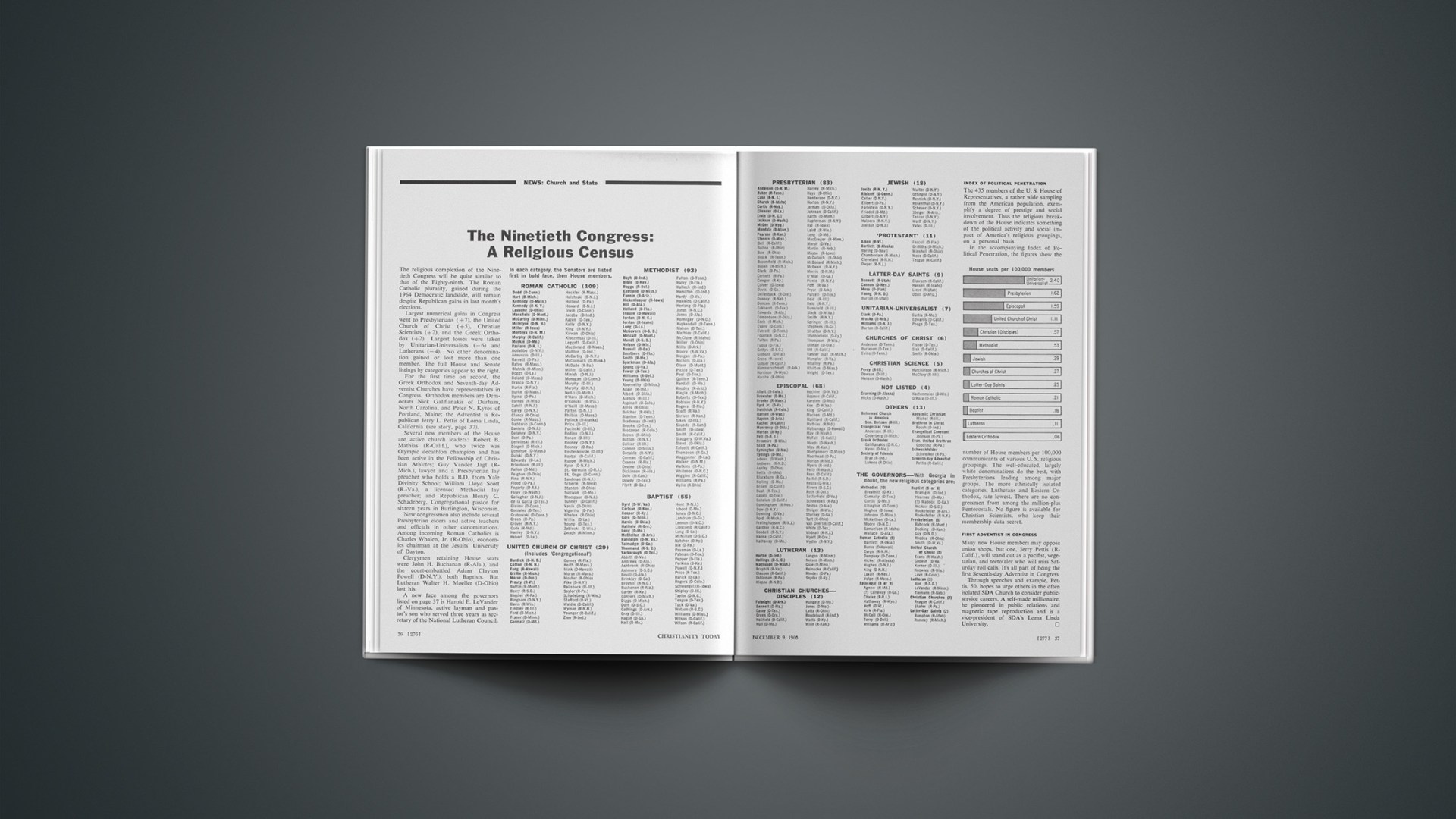
The Ninetieth Congress: A Religious Census

The religious complexion of the Ninetieth Congress will be quite similar to that of the Eighty-ninth. The Roman Catholic plurality, gained during the 1964 Democratic landslide, will remain despite Republican gains in last month’s elections.

Largest numerical gains in Congress went to Presbyterians (+7), the United Church of Christ (+5), Christian Scientists (+2), and the Greek Orthodox (+2). Largest losses were taken by Unitarian-Universalists (-6) and Lutherans (-4). No other denomination gained or lost more than one member. The full House and Senate listings by categories appear to the right.

For the first time on record, the Greek Orthodox and Seventh-day Adventist Churches have representatives in Congress. Orthodox members are Democrats Nick Galifianakis of Durham, North Carolina, and Peter N. Kyros of Portland, Maine; the Adventist is Republican Jerry L. Pettis of Loma Linda, California (see story, page 37).

Several new members of the House are active church leaders: Robert B. Mathias (R-Calif.), who twice was Olympic decathlon champion and has been active in the Fellowship of Christian Athletes; Guy Vander Jagt (R-Mich.), lawyer and a Presbyterian lay preacher who holds a B.D. from Yale Divinity School; William Lloyd Scott (R.-Va.), a licensed Methodist lay preacher; and Republican Henry C. Schadeberg, Congregational pastor for sixteen years in Burlington, Wisconsin.

New congressmen also include several Presbyterian elders and active teachers and officials in other denominations. Among incoming Roman Catholics is Charles Whalen, Jr. (R-Ohio), economics chairman at the Jesuits’ University of Dayton.

Clergymen retaining House seats were John H. Buchanan (R-Ala.), and the court-embattled Adam Clayton Powell (D-N.Y.), both Baptists. But Lutheran Walter H. Moeller (D-Ohio) lost his.

A new face among the governors listed on page 37 is Harold E. LeVander of Minnesota, active layman and pastor’s son who served three years as secretary of the National Lutheran Council.

In each category, the Senators are listed first in bold face, then House members.

Roman Catholic (109)

Dodd (D-Conn.)

Hart (D-Mich.)

Kennedy (D-Mass.)

Kennedy (D-N. Y.)

Lausche (D-Ohio)

Mansfield (D-Mont.)

McCarthy (D-Minn.)

Mclntyre (D-N. H.)

Miller (R-Iowa)

Montoya (D-N. M.)

Murphy (R-Calif.)

Muskie (O-Me.)

Pastore (D-R. I.)

Addabbo (D-N.Y.)

Annunzio (D-III.)

Barrett (D-Pa.)

Bates (R-Mass.)

Blatnik (D-Minn.)

Boggs (D-La.)

Boland (D-Mass.)

Brasco (D-N.Y.)

Burke (R-Fla.)

Burke (D-Mass.)

Byrne (D-Pa.)

Byrnes (R-Wis.)

Cahill (R-N.J.)

Carey (D-N.Y.)

Clancy (R-Ohio)

Conte (R-Mass.)

Daddario (D-Conn.)

Daniels (D-N.J.)

Delaney (D-N.Y.)

Dent (D-Pa.)

Derwinski (R-III.)

Dingell (D-Mich.)

Donohue (D-Mass.)

Dulski (D-N.Y.)

Edwards (D-La.)

Erlenborn (R-III.)

Fallon (D-Md.)

Feighan (D-Ohio)

Fino (R-N.Y.)

Flood (D-Pa.)

Fogarty (D-R.I.)

Foley (D-Wash.)

Gallagher (D-N.J.)

de la Garza (D-Tex.)

Giaimo (D-Conn.)

Gonzalez (D-Tex.)

Grabowski (D-Conn.)

Green (D-Pa.)

Grover (R-N.Y.)

Gude (R-Md.)

Hanley (D-N.Y.)

Hebert (D-La.)

Heckler (R-Mass.)

Helstoski (D-N.J.)

Holland (D-Pa.)

Howard (D-N.J.)

Irwin (D-Conn.)

Jacobs (D-Ind.)

Kazen (D-Tex.)

Kelly (D-N.Y.)

King (R-N.Y.)

Kirwan (D-Ohio)

Kluczynski (D-III.)

Leggett (D-Calif.)

Macdonald (D-Mass.)

Madden (D-Ind.)

McCarthy (D-N.Y.)

McCormack (D-Mass.)

McDade (R-Pa.)

Miller (D-Calif.)

Minish (D-N.J.)

Monagan (D-Conn.)

Murphy (D-III.)

Murphy (D-N.Y.)

Nedzi (D-Mich.)

O’Hara (D-Mich.)

O’Konski (R-Wis.)

O’Neill (D-Mass.)

Patten (D-N.J.)

Philbin (D-Mass.)

Pollock (R-Alaska)

Price (D-III.)

Pucinski (D-III.)

Rodino (D-N.J.)

Ronan (D-III.)

Rooney (D-N.Y.)

Rooney (D-Pa.)

Rostenkowski (D-III.)

Roybal (D-Calif.)

Ruppe (R-Mich.)

Ryan (D-N.Y.)

St. Germain (D-R.I.)

St. Onge (D-Conn.)

Sandman (R-N.J.)

Scherle (R-Iowa)

Stanton (R-Ohio)

Sullivan (D-Mo.)

Thompson (D-N.J.)

Tunney (D-Calif.)

Vanik (D-Ohio)

Vigorito (D-Pa.)

Whalen (R-Ohio)

Willis (D-La.)

Young (D-Tex.)

Zablocki (D-Wis.)

Zwach (R-Minn.)

United Church Of Christ (29)

(Includes ‘Congregational’)

Burdick (D-N. D.)

Cotton (R-N. H.)

Fong (R-Hawaii)

Griffin (R-Mich.)

Morse (D-Ore.)

Prouty (R-Vt.)

Battin (R-Mont.)

Berry (R-S.D.)

Biester (R-Pa.)

Bingham (D-N.Y.)

Davis (R-Wis.)

Findley (R-III.)

Ford (D-Mich.)

Fraser (D-Minn.)

Garmatz (D-Md.)

Gurney (R-Fla.)

Keith (R-Mass.)

Mink (D-Hawaii)

Morse (R-Mass.)

Mosher (R-Ohio)

Pike (D-N.Y.)

Railsback (R-III.)

Saylor (R-Pa.)

Schadeberg (R-Wis.)

Stafford (R-Vt.)

Waldie (D-Calif.)

Wyman (R-N.H.)

Younger (R-Calif.)

Zion (R-Ind.)

Methodist (93)

Bayh (D-Ind.)

Bible (D-Nev.)

Boggs (R-Del.)

Eastland (D-Miss.)

Fannin (R-Ariz.)

Hickenlooper (R-Iowa)

Hill (D-Ala.)

Holland (D-Fla.)

Inouye (D-Hawaii)

Jordan (D-N. C.)

Jordan (R-Idaho)

Long (D-La.)

McGovern (D-S. D.)

Metcalf (D-Mont.)

Mundt (R-S. D.)

Nelson (D-Wis.)

Russell (D-Ga.)

Smathers (D-Fla.)

Smith (R-Me.)

Sparkman (D-Ala.)

Spong (D-Va.)

Tower (R-Tex.)

Williams (R-Del.)

Young (D-Ohio)

Abernethy (D-Miss.)

Adair (R-Ind.)

Albert (D-Okla.)

Arends (R-III.)

Aspinall (D-Colo.)

Ayres (R-Ohio)

Belcher (R-Okla.)

Blanton (D-Tenn.)

Brademas (D-Ind.)

Brooks (D-Tex.)

Brotzman (R-Colo.)

Brown (R-Ohio)

Button (R-N.Y.)

Collier (R-III.)

Colmer (D-Miss.)

Conable (R-N.Y.)

Corman (D-Calif.)

Cramer (R-Fla.)

Devine (R-Ohio)

Dickinson (R-Ala.)

Dole (R-Kan.)

Dowdy (D-Tex.)

Flynt (D-Ga.)

Fulton (D-Tenn.)

Haley (D-Fla.)

Halleck (R-Ind.)

Hamilton (D-Ind.)

Hardy (D-Va.)

Hawkins (D-Calif.)

Herlong (D-Fla.)

Jonas (R-N.C.)

Jones (D-Ala.)

Kornegay (D-N.C.)

Kuykendall (R-Tenn.)

Mahon (D-Tex.)

Mathias (R-Calif.)

McClure (R-Idaho)

Miller (R-Ohio)

Mills (D-Ark.)

Moore (R-W.Va.)

Morgan (D-Pa.)

Nichols (D-Ala.)

Olsen (D-Mont.)

Pickle (D-Tex.)

Pool (D-Tex.)

Quillen (R-Tenn.)

Randall (D-Mo.)

Rhodes (R-Ariz.)

Riegle (R-Mich.)

Roberts (D-Tex.)

Robison (R-N.Y.)

Rogers (D-Fla.)

Scott (R-Va.)

Shriver (R-Kan.)

Sikes (D-Fla.)

Skubitz (R-Kan.)

Smith (D-Iowa)

Smith (R-Calif.)

Staggers (D-W.Va.)

Steed (D-Okla.)

Talcott (R-Calif.)

Thompson (R-Ga.)

Waggonner (D-La.)

Walker (D-N.M.)

Watkins (R-Pa.)

Whitener (D-N.C.)

Wiggins (R-Calif.)

Williams (R-Pa.)

Wylie (R-Ohio)

Baptist (55)

Byrd (D-W. Va.)

Carlson (R-Kan.)

Cooper (R-Ky.)

Gore (D-Tenn.)

Harris (D-Okla.)

Hatfield (R-Ore.)

Long (D-Mo.)

McClellan (D-Ark.)

Randolph (D-W. Va.)

Talmadge (D-Ga.)

Thurmond (R-S. C.)

Yarborough (D-Tex.)

Abbitt (D-Va.)

Andrews (D-Ala.)

Ashbrook (R-Ohio)

Ashmore (D-S.C.)

Bevill (D-Ala.)

Brinkley (D-Ga.)

Broyhill (R-N.C.)

Buchanan (R-Ala.)

Carter (R-Ky.)

Conyers (D-Mich.)

Diggs (D-Mich.)

Dorn (D-S.C.)

Gathings (D-Ark.)

Gray (D-III.)

Hagan (D-Ga.)

Hall (R-Mo.)

Hunt (R-N.J.)

Ichord (D-Mo.)

Jones (D-N.C.)

Landrum (D-Ga.)

Lennon (D-N.C.)

Lipscomb (R-Calif.)

Long (D-La.)

McMillan (D-S.C.)

Natcher (D-Ky.)

Nix (D-Pa.)

Passman (D-La.)

Patman (D-Tex.)

Pepper (D-Fla.)

Perkins (D-Ky.)

Powell (D-N.Y.)

Price (R-Tex.)

Rarick (D-La.)

Rogers (D-Colo.)

Schwengel (R-Iowa)

Shipley (D-III.)

Taylor (D-N.C.)

Teague (D-Tex.)

Tuck (D-Va.)

Watson (R-S.C.)

Williams (D-Miss.)

Wilson (D-Calif.)

Wilson (R-Calif.)

Presbyterian (83)

Anderson (D-N. M.)

Baker (R-Tenn.)

Case (R-N. J.)

Church (D-Idaho)

Curtis (R-Neb.)

Ellender (D-La.)

Ervin (D-N. C.)

Jackson (D-Wash.)

McGee (D-Wyo.)

Mondale (D-Minn.)

Pearson (R-Kan.)

Stennis (D-Miss.)

Bell (R-Calif.)

Bolton (R-Ohio)

Bow (R-Ohio)

Brock (R-Tenn.)

Broomfield (R-Mich.)

Brown (R-Mich.)

Clark (D-Pa.)

Corbett (R-Pa.)

Cowger (R-Ky.)

Culver (D-Iowa)

Davis (D-Ga.)

Dellenback (R-Ore.)

Denney (R-Neb.)

Duncan (R-Tenn.)

Eckhardt (D-Tex.)

Edwards (R-Ala.)

Edmondson (D-Okla.)

Esch (R-Mich.)

Evans (D-Colo.)

Everett (D-Tenn.)

Fountain (D-N.C.)

Fulton (R-Pa.)

Fuqua (D-Fla.)

Gettys (D-S.C.)

Gibbons (D-Fla.)

Gross (R-Iowa)

Gubser (R-Calif.)

Hammerschmidt (R-Ark.)

Harrison (R-Wyo.)

Harsha (R-Ohio)

Harvey (R-Mich.)

Hays (D-Ohio)

Henderson (D-N.C.)

Horton (R-N.Y.)

Jarman (D-Okla.)

Johnson (D-Calif.)

Karth (D-Minn.)

Kupferman (R-N.Y.)

Kyl (R-Iowa)

Laird (R-Wis.)

Long (D-Md.)

MacGregor (R-Minn.)

Marsh (D-Va.)

Martin (R-Neb.)

Mayne (R-Iowa)

McCulloch (R-Ohio)

McDonald (R-Mich.)

McEwen (R-N.Y.)

Morris (D-N.M.)

O’Neal (D-Ga.)

Pirnie (R-N.Y.)

Poff (R-Va.)

Pryor (D-Ark.)

Purcell (D-Tex.)

Reid (R-III.)

Reid (R-N.Y.)

Rumsfeld (R-III.)

Slack (D-W.Va.)

Smith (R-N.Y.)

Springer (R-III.)

Stephens (D-Ga.)

Stratton (D-N.Y.)

Stubblefield (D-Ky.)

Thompson (R-Wis.)

Ullman (D-Ore.)

Utt (R-Calif.)

Vander Jagt (R-Mich.)

Wampler (R-Va.)

Whalley (R-Pa.)

Whitten (D-Miss.)

Wright (D-Tex.)

Episcopal (68)

Allott (R-Colo.)

Brewster (D-Md.)

Brooke (R-Mass.)

Byrd Jr. (D-Va.)

Dominick (R-Colo.)

Hansen (R-Wyo.)

Hayden (D-Ariz.)

Kuchel (R-Calif.)

Monroney (D-Okla.)

Morton (R-Ky.)

Pell (D-R. I.)

Proxmire (D-Wis.)

Scott (R-Pa.)

Symington (D-Mo.)

Tydings (D-Md.)

Adams (D-Wash.)

Andrews (R-N.D.)

Ashley (D-Ohio)

Betts (R-Ohio)

Blackburn (R-Ga.)

Bolling (D-Mo.)

Brown (D-Calif.)

Bush (R-Tex.)

Cabell (D-Tex.)

Cohelan (D-Calif.)

Cunningham (R-Neb.)

Dow (D-N.Y.)

Downing (D-Va.)

Ford (R-Mich.)

Frelinghuysen (R-N.J.)

Gardner (R-N.C.)

Goodell (R-N.Y.)

Hanna (D-Calif.)

Hathaway (D-Me.)

Hechler (D-W.Va.)

Hosmer (R-Calif.)

Karsten (D-Mo.)

Kee (D-W.Va.)

King (D-Calif.)

Machen (D-Md.)

Mailliard (R-Calif.)

Mathias (R-Md.)

Matsunaga (D-Hawaii)

May (R-Wash.)

McFall (D-Calif.)

Meeds (D-Wash.)

Mize (R-Kan.)

Montgomery (D-Miss.)

Moorhead (D-Pa.)

Morton (R-Md.)

Myers (R-Ind.)

Pelly (R-Wash.)

Rees (D-Calif.)

Reifel (R-S.D.)

Reuss (D-Wis.)

Rivers (D-S.C.)

Roth (R-Del.)

Satterfield (D-Va.)

Schneebeli (R-Pa.)

Selden (D-Ala.)

Steiger (R-Wis.)

Stuckey (D-Ga.)

Taft (R-Ohio)

Van Deerlin (D-Calif.)

White (D-Tex.)

Widnall (R-N.J.)

Wyatt (R-Ore.)

Wydler (R-N.Y.)

Lutheran (13)

Hartke (D-Ind.)

Hollings (D-S. C.)

Magnuson (D-Wash.)

Broyhill (R-Va.)

Clausen (R-Calif.)

Eshleman (R-Pa.)

Kleppe (R-N.D.)

Langen (R-Minn.)

Nelsen (R-Minn.)

Quie (R-Minn.)

Reinecke (R-Calif.)

Rhodes (D-Pa.)

Snyder (R-Ky.)

Christian Churches—Disciples (12)

Fulbright (D-Ark.)

Bennett (D-Fla.)

Casey (D-Tex.)

Green (D-Ore.)

Holifield (O-Calif.)

Hull (D-Mo.)

Hungate (D-Mo.)

Jones (D-Mo.)

Latta (R-Ohio)

Roudebush (R-Ind.)

Watts (D-Ky.)

Winn (R-Kan.)

Jewish (18)

Javits (R-N. Y.)

Ribicoff (D-Conn.)

Celler (D-N.Y.)

Eilbert (D-Pa.)

Farbstein (D-N.Y.)

Friedel (D-Md.)

Gilbert (D-N.Y.)

Halpern (R-N.Y.)

Joelson (D-N.J.)

Multer (D-N.Y.)

Ottinger (D-N.Y.)

Resnick (D-N.Y.)

Rosenthal (D-N.Y.)

Scheuer (D-N.Y.)

Steiger (R-Ariz.)

Tenzer (D-N.Y.)

Wolff (D-N.Y.)

Yates (D-III.)

‘Protestant’ (11)

Aiken (R-Vt.)

Bartlett (D-Alaska)

Baring (D-Nev.)

Chamberlain (R-Mich.)

Cleveland (R-N.H.)

Dwyer (R-N.J.)

Fascell (D-Fla.)

Griffiths (D-Mich.)

Minshall (R-Ohio)

Moss (D-Calif.)

Teague (R-Calif.)

Latter-Day Saints (9)

Bennett (R-Utah)

Cannon (D-Nev.)

Moss (D-Utah)

Young (R-N. D.)

Burton (R-Utah)

Clawson (R-Calif.)

Hansen (R-Idaho)

Lloyd (R-Utah)

Udall (D-Ariz.)

Unitarian-Universalist (7)

Clark (D-Pa.)

Hruska (R-Neb.)

Williams (D-N. J.)

Burton (D-Calif.)

Curtis (R-Mo.)

Edwards (D-Calif.)

Poage (D-Tex.)

Churches Of Christ (6)

Anderson (D-Tenn.)

Burleson (D-Tex.)

Evins (D-Tenn.)

Fisher (D-Tex.)

Sisk (D-Calif.)

Smith (R-Okla.)

Christian Science (5)

Percy (R-III.)

Dawson (D-III.)

Hansen (D-Wash.)

Hutchinson (R-Mich.)

McClory (R-III.)

Not Listed (4)

Gruening (D-Alaska)

Hicks (D-Wash.)

Kastenmeier (D-Wis.)

O’Hara (D-III.)

Others (13)

Reformed Church in America

Sen. Dirksen (R-III.)

Evangelical Free

Anderson (R-III.)

Cederberg (R-Mich.)

Greek Orthodox

Galifianakis (D-N.C.)

Kyros (D-Me.)

Society of Friends

Bray (R-Ind.)

Lukens (R-Ohio)

Apostolic Christian

Michel (R-III.)

Brethren in Christ

Roush (D-Ind.)

Evangelical Covenant

Johnson (R-Pa.)

Evan. United Brethren

Goodling (R-Pa.)

Schwenkfelder

Schweiker (R-Pa.)

Seventh-day Adventist

Pettis (R-Calif.)

The Governors—With Georgia In Doubt, The New Religious Categories Are:

Methodist (10)

Breathitt (D-Ky.)

Connally (D-Tex.)

Curtis (D-Me.)

Ellington (D-Tenn.)

Hughes (D-Iowa)

Johnson (D-Miss.)

McKeithen (D-La.)

Moore (D-N.C.)

Samuelson (R-Idaho)

Wallace (D-Ala.)

Roman Catholic (9)

Bartlett (R-Okla.)

Burns (D-Hawaii)

Cargo (R-N.M.)

Dempsey (D-Conn.)

Hickel (R-Alaska)

Hughes (D-N.J.)

King (O-N.H.)

Laxalt (R-Nev.)

Volpe (R-Mass.)

Episcopal (8 or 9)

Agnew (R-Md.)

(?) Callaway (R-Ga.)

Chafee (R-R.I.)

Hathaway (R-Wyo.)

Hoff (D-Vt.)

Kirk (R-Fla.)

McCall (R-Ore.)

Terry (O-Del.)

Williams (R-Ariz.)

Baptist (5 or 6)

Branigin (D-Ind.)

Hearnes (D-Mo.)

(?) Maddox (D-Ga.)

McNair (D-S.C.)

Rockefeller (R-Ark.)

Rockefeller (R-N.Y.)

Presbyterian (5)

Babcock (R-Mont.)

Docking (D-Kan.)

Guy (D-N.D.)

Rhodes (R-Ohio)

Smith (D-W.Va.)

United Church of Christ (5)

Evans (R-Wash.)

Godwin (D-Va.)

Kerner (D-III.)

Knowles (R-Wis.)

Love (R-Colo.)

Lutheran (3)

Boe (R-S.D.)

LeVander (R-Minn.)

Tiemann (R-Neb.)

Christian Churches (2)

Reagan (R-Calif.)

Shafer (R-Pa.)

Latter-Day Saints (2)

Rampton (R-Utah)

Romney (R-Mich.)

Index Of Political Penetration

The 435 members of the U. S. House of Representatives, a rather wide sampling from the American population, exemplify a degree of prestige and social involvement. Thus the religious breakdown of the House indicates something of the political activity and social impact of America’s religious groupings, on a personal basis.

In the accompanying Index of Political Penetration, the figures show the number of House members per 100,000 communicants of various U. S. religious groupings. The well-educated, largely white denominations do the best, with Presbyterians leading among major groups. The more ethnically isolated categories, Lutherans and Eastern Orthodox, rate lowest. There are no congressmen from among the million-plus Pentecostals. No figure is available for Christian Scientists, who keep their membership data secret.

First Adventist In Congress

Many new House members may oppose union shops, but one, Jerry Pettis (R-Calif.), will stand out as a pacifist, vegetarian, and teetotaler who will miss Saturday roll calls. It’s all part of being the first Seventh-day Adventist in Congress.

Through speeches and example, Pettis, 50, hopes to urge others in the often isolated SDA Church to consider public-service careers. A self-made millionaire, he pioneered in public relations and magnetic tape reproduction and is a vice-president of SDA’s Loma Linda University.

A Leash On The Tax Dollar

Public aid to parochial schools and church-related colleges absorbed some hard knocks last month, though the basic church-state issues remain unresolved.

Restrictions on aid to parochial schools were tightened by the U. S. Office of Education in a revised draft of rules that tells local public school officials just how far they may go in giving aid to students in private schools. This kind of aid has provided an extra-legal means of passing federal funds on to parochial schools.

The Supreme Court refused by a 7 to 2 ruling last month to decide whether the State of Maryland’s aid to church colleges is unconstitutional. By so doing, the court let stand a precedent-setting Maryland Court of Appeals decision that such aid does violate the Constitution, even though the funds are used for “secular” purposes, if the college’s “image” is religious.

A week after the Supreme Court’s refusal to hear the Maryland case, Samuel Halperin, Deputy Assistant Secretary (for Legislation) of Health, Education, and Welfare, told graduate fellows at the Washington Journalism Center that, barring an actual decision by the Supreme Court, “we will see a great deal more federal aid to church-related higher education in the years to come.”

Halperin said, too, that the saturation point in aid-to-education legislation has not been reached: “I’ll bet there will be more education legislation passed in the Ninetieth Congress than in any previous Congress except the Eighty-ninth … both in dollars and in programs.”

The new Office of Education rules for parochial school aid set no new policy; they are designed to close administrative loopholes. Among other provisions, the rules require public schools to maintain tighter control over equipment loaned to parochial schools, prohibit sending public school teachers into parochial schools to serve students other than “deprived” students who need remedial teaching, and allow aid to parochial school students only on the basis of the number of students needing therapeutic, remedial, or welfare services, and not on the basis of total enrollment.

No one seems completely satisfied with the new rules—not even Education Commissioner Harold Howe II. Howe said in a press conference that although they provide some clarification, they do not “completely settle” the church-state issues.

“It would be helpful to have some cases adjudicated by the courts,” Howe added.

But so far this session, the Supreme Court has refused to hear the church-state cases brought to it. The court may have another opportunity if the suit filed recently in Philadelphia by Americans United for Separation of Church and State, challenging the use of federal funds for teaching music and art in that city’s parochial schools, goes the appellate route.

The Maryland high court’s ban on public aid to church colleges brought an end to a 175-year tradition of state grants to such institutions. The case in point involved grants of $750,000 each to Roman Catholic St. Joseph’s, at Emmitsburg, and Notre Dame of Maryland, at Baltimore, and $500,000 to Methodist West Maryland, in Westminster.

Hood College of the United Church of Christ was involved in the original suit but was allowed to keep its $500,000 grant because the looseness of its denominational ties and the diversity of its faculty and student body gave it a sufficiently non-religious “image.”

EDWARD H. PITTS

Degree Mill To Orphan Mill

Baptist preacher Harold George Martin, founder and chief officer of Christian Homes, Inc., in Dorion, Quebec, has been denied a further hearing by Canada’s Tax Appeal Board, which claims taxes on $350,402 in receipts between 1946 and 1961.

Martin was ordained by the Union of Regular Baptists in 1942 and holds doctorates from two institutions on the U. S. government’s list of “degree mills.” He claimed to provide care for orphans and needy children and to operate children’s summer camps at minimum expense. But the Board of Revenue argues Martin’s enterprise is not a charitable one and is therefore subject to taxation.

The motto of Christian Homes is, “Where no needy child ever knocks in vain,” but these “needy children” have been charged from $20 to $30 per week at the summer camps. The Revenue Board said that if the children didn’t pay these camp fees, Martin’s lawyer “dunned and harassed those responsible for such payments in an effort to collect what was owing.”

The government charged that more than $200,000—much of it donated by “well-meaning persons who assumed it was being spent directly for the care and maintenance of destitute and needy orphans”—had been used for other purposes. The Martin home, situated on a luxurious 160-acre estate, was furnished with wall-to-wall broadlooms overlaid with rich Oriental rugs. Christian Homes bought several cars, and Martin’s son Wycliffe drove one of them, a sports car, while attending college. The estate was sold two years ago for a reported $525,000.

J. BERKLEY REYNOLDS

Baptists Scan U. S. Aid

As Southern Baptists gathered in annual state conventions last month, the most recurring issue was whether their colleges should accept federal funds. Bound up with this issue in a number of states was the question of how the convention should exercise control over its colleges.

The Kentucky Baptist Convention reversed a five-month-old rule that member schools borrow “from private sources only.” The reversal was accomplished through a motion by Georgetown College President Robert L. Mills to reaffirm a 1949 policy entrusting the operation of the convention’s institutions to their own trustees.

Mills warned that accreditation was endangered when college trustees are deprived of the “freedom to use their best judgment,” and he urged “reaffirmation of faith and confidence” in the trustees and administrators. He pointed out that two Georgetown dormitories have been federally financed with “no government interference” and said he would seek other construction loans under the same conditions.

Moderate positions toward federal loans were taken also by the Louisiana and Arkansas conventions. In Louisiana, the decision to accept government loans will be left to the institutions’ trustees, while grants are ruled unacceptable by the convention. The Arkansas decision was similar, but it added that the colleges should accept no interest terms that are more favorable than those charged against secular non-profit institutions.

Blanket prohibitions on the acceptance of government loans and grants were passed by the conventions in Georgia, Mississippi, New Mexico, Arizona, and Texas. The actions in Georgia, Mississippi, and Texas were accomplished by the defeat of formal proposals to allow the institutions to accept some aid under certain conditions. New Mexico, which has no Baptist institutions eligible for federal aid, passed a resolution against it rather perfunctorily.

The Florida convention handled its federal-aid problem ex post facto by cutting in half its appropriation of $300,000 to Stetson University, Deland, because the school had accepted about $800,000 in federal funds last year for a science building and additions to the law school.

EDWARD H. PITTS

Book Briefs: December 9, 1966

No Final Verdict

The Finality of Christ, edited by Dow Kirkpatrick (Abingdon, 1966, 207 pp., $4.50) is reviewed by David H. Wallace, professor of biblical theology, California Baptist Theological Seminary, Covina.

This volume, subtitled A Symposium on the Doctrine of Christ, bears all the standard virtues and vices of such efforts. The eleven contributors will delight, inform, encourage, baffle, and quite possibly irritate the reader, depending, of course, upon his theological viewpoint. The opening chapter was written by D. T. Niles of Ceylon, who states that the finality of Christ rests upon our access to him as a living person, not a corpus of doctrine. Cogently defended, this is as much a sermon as a theological lecture. Morna Hooker maintains, against Bultmann, that the Son-of-Man sayings in the Gospels represent authentic gospel history and therefore afford a way into Jesus’ own self-consciousness; this line of development was somewhat different from my expectations in view of her book on Jesus and the Servant.

David Jenkins of Oxford University holds that cosmic speech about Jesus Christ in Colossians 1 is justified only if Christ’s resurrection actually happened (pp. 62 f.). Such cosmic language is a description of the way things really are, not merely one’s subjective attitude toward the universe. The next three chapters are written by non-Christians, to provide a perspective ab extra. Buddhism, Sikhism, and Judaism have their say, and of the three the essay by Will Herberg is the best. He honestly confronts the claims by, for, and about Christ and in so doing exhibits an impressive grasp of the elements of Christian doctrine and faith. In view of the protracted debate across the last century about the Greek impact on New Testament thought, I was struck by Herberg’s statement (p. 93) that all such attempts are misdirected: “Christian faith is biblical and Hebraic, or it is nothing at all.” This is a salutary and sobering word.

The high point of the book is J. Robert Nelson’s essay on Christ’s finality in perennial perspective. His writing is marked by beauty of line and clarity of thought. Because of the increase of knowledge today, confession of Christ is progressively more difficult. Nevertheless, it is critically important that the centrality of Christ be affirmed, else the faith itself is lost. He convincingly defends Chalcedon and accuses its critics of asking the wrong questions of these symbols. John Cobb’s essay on the finality of Christ was written from the viewpoint of a disciple of Whitehead, and I found it abstract and difficult to follow. This may well reflect my inadequacy in understanding, not Dr. Cobb’s.

Dr. Carl Michalson, to whom the book is dedicated because of his untimely death in an airplane crash, takes an existentialist analysis of Jesus’ finality. Rather predictably, he empties eschatology of its temporal quality and reference in favor of an existentialist view of life, the world, and history (p. 159). As I read this chapter I was not sure whether I heard Jesus, John and Paul, or Martin Heidegger. The nadir of theological piffle is reached on page 166, where these words appear: “When Jesus said to Nicodemus, ‘Ye must be born again,’ he was not issuing a universal command. He was sensitizing Nicodemus’ preunderstanding.”

Gordon Rupp’s essay on the meaning of the sacrament reflects some of the rattling debate in Britain between high and low churchmen. Readers on both sides of the Atlantic will appreciate his clarification of the problem of anamnesis, for he points out that to “re-present” Christ’s death at the Eucharist does not mean “offer again.” The book closes with a summary statement by the editor in which he asserts that “Christ is crucial for Christianity” (p. 193). But finality about the nature of Christ’s finality still eludes us.

DAVID H. WALLACE

Reading for Perspective

CHRISTIANITY TODAY’S REVIEW EDITORS CALL ATTENTION TO THESE NEW TITLES:

The Church’s Worldwide Mission, edited by Harold Lindsell (Word, $3.95). Papers read at the recent Congress on the Church’s Worldwide Mission, including the important Wheaton Declaration, and an historical overview of the congress. A vital work for everyone interested in missions.

The Christian Persuader, by Leighton Ford (Harper & Row, $3.95). A trenchant analysis of contemporary evangelism—the obstacles to be overcome, the strategies to be carried out, the biblical message to be proclaimed—by a man whose writing reveals his passion for Jesus Christ.

Basic Types of Pastoral Counseling, by Howard J. Clinebell, Jr. (Abingdon, $6). Methods of pastoral counseling that encourage the troubled person to face his problems realistically and act directly to solve them.

An Archaeological Find?

The Biblical World: A Dictionary of Biblical Archaeology, edited by Charles F. Pfeiffer (Baker, 1966, 612 pp., $8.95), is reviewed by Francis I. Andersen, professor of Old Testament literature, The Church Divinity School of the Pacific, Berkeley, California.

Knowledge of archaeological discoveries is so important for biblical studies that all means of spreading this information are to be welcomed. This volume supplements the general Bible dictionaries already available. More than forty contributors have supplied articles. Some of these are recognized authorities, and their contributions are excellent; e.g., G. E. Wright on Beth-Shemesh and Wiseman on the Babylonian Chronicles. But most of these experts have contributed only one or two items, making in all only a small fraction of the entire book. The rest suffers by comparison.

This unevenness in quality shows up in the kind of error that lowers the reader’s confidence in a work that, whatever else, should be accurate. For example, Schaeffer did not decipher the Ugaritic alphabet (p. 71), and Rawlinson was not the discoverer of the Bethistun (sic) inscription (p. 80). Confusion also reigns among the dates, fostered doubtless by the absence of any good discussion of chronology. Three different dates are given for Qarqar (pp. 47, 54, 467). Ashurbanipal has different dates within eleven lines (p. 101). The reader is left without explanation of why Hammurabi has different dates in different places.

The publisher’s blurb says, “There are comprehensive articles on archaeology and the major archaeologists and organizations and their work (e.g. Albright, Kenyon, Glueck, etc.).” If this were true, the book would be useful indeed. But they can nowhere be found. The general article on archaeology is vague about method: the new face of field technique resulting from the introduction of the Wheeler-Kenyon procedures is scarcely recognized. Nor is there any adequate discussion of stratigraphy, typology, pottery chronology, or numismatics. Except for a few lines in the article on Arabia, the entire field of South Arabian archaeology is neglected. The book also lacks an adequate set of maps.

The illustrations are excellent and generous and will appeal to the popular reader. Here the dictionary will find acceptable use. But it falls short of what the conscientious student has a right to expect, especially in the mixed quality of its bibliographies—sometimes ample, often parsimonious or out of date.

Evangelicals have always hailed with delight archaeological discoveries that confirm their high regard for the accuracy of the Bible. Here, although many contributors are conservative, the apologetic note is muted or avoided by having no entries at all on such subjects as Abraham’s camels (or camels, or ass-nomadism) or the Flood (except for brief mention under Gilgamesh) or the date of the Exodus (the entry under Jericho implies a late date) or Daniel. In spite of this silence, however, the general impression is that archaeology floods the Bible with light at every point; so full use of the information in this volume is to be encouraged by every student of the Bible.

FRANCIS I. ANDERSEN

The First Method Actor

The Passover Plot: New Light on the History of Jesus, by Hugh J. Schonfield (Bernard Geis, 1966, 287 pp., $4.95), is reviewed by Henry W. Coray, minister, First Orthodox Presbyterian Church, Sunnyvale, California.

This interesting book, the product of the noted British author and scholar, purports to be “a new interpretation of the life and death of Jesus.” Actually, it is just one more attempt to reconstruct the story of Christ recorded by the four Evangelists. Dr. Schonfield’s thesis is that Jesus, having studied the Jewish prophecies concerning the Messiah, decided to project himself into the role of the “Anointed One,” much as an actor would assume the lead part in a drama. Jesus was justified in carrying out the act, Schonfield contends, for he believed sincerely that his generation needed him as a spiritual leader.

It must be said that the writer, all his erudition notwithstanding, treats history in a smorgasbord style: he picks up what suits his taste and passes by whatever he finds objectionable. For example, he brushes aside the Saviour’s miraculous birth with a flip of the hand: “There was nothing peculiar about the birth of Jesus. He was not God incarnate and no Virgin Mother bore him” (p. 59). (One could wish the good doctor had read Machen’s The Virgin Birth of Christ.) “The Council [Sanhedrin] had neither cause nor any interest to condemn Jesus on religious grounds” (p. 149). What the four Evangelists report is “totally inadequate to prove anything.… We cannot know the truth one way or the other” (pp. 159, 160). “We may dismiss the story in Matthew alone that the chief priests requested Pilate that a guard be set over the tomb” (p. 170). “The man on the road to Emmaus clearly was not Jesus” (p. 178).

Schonfield reserves his napalm bomb for the action at Calvary. There Jesus did not really die! Upon swallowing the drug (which he had previously contrived to accept), “his body sagged. His head rolled on his breast, and to all intents and purposes he was a dead man” (p. 167). He did not expire, however. In the cool of the tomb he regained consciousness and came forth, not from a state of death, but from a state of stupor. This would seem to be a kind of revised version of the “swoon theory” of Paulus. That theory never gained much acceptance in scholarly circles.

In several moving passages the British writer pleads for a re-evaluation of his Subject from a non-prejudiced point of view. If his presentation of Jesus Christ is objective historical writing, so is Alice in Wonderland.

HENRY W. CORAY

Christ Via Hinduism?

The Christian Universe, by Eric Mascall (Morehouse-Barlow, 1966, 174 pp., $4.25), is reviewed by Milton D. Hunnex, professor of philosophy, Willamette University, Salem, Oregon.

Mascall’s The Christian Universe is the sixteenth in a series of distinguished books that reflect a determined effort on his part to buttress the main convictions of historic orthodox Christianity. It continues his defense of supernatural Christianity against those who despair of a contemporary Christianity that is both supernatural and relevant.

Mascall’s thesis is that “the modern absurdists are fully right in maintaining that the world does not make sense of itself” (p. 42). The hero of Sartre’s La Nausée, Antoine Roquentin, is justifiably offended by the chestnut tree that goes on existing “in spite of the fact that there [is] no logical necessity for it” to do so (p. 30). A world without God is necessarily absurd, Mascall argues. “If the world is to be given meaning, that meaning must come from some source outside the world itself” (pp. 42, 43).

Mascall argues that, contrary to a great deal of theological thinking today, supernaturalism is not the disease from which Christianity needs to be delivered; rather, it is the cure that alone can restore the only meaningful picture modern man can make of himself. “It is only by tightening our hold on the supernatural that we can enter into the secular order with any hope of transforming it and without being swamped and drowned by it,” he writes (p. 171).

From this he proceeds to the conviction that all creation is in the process of “Christification.” “God’s ultimate purpose for the human race and for the whole material universe,” he says, “is that they should be taken up into Christ” (p. 109). The Church’s task is as it always has been—“the supernaturalization of the natural” order as well as men’s lives (p. 170). It is, however, a cosmic task. The Incarnation is for the sake of all things, Mascall insists, not just man’s redemption.

Moreover, where the Incarnation does relate to specifically human redemption, it is generously ubiquitous. Dr. Pannikar is quoted approvingly: “The good and bona fide Hindu is saved by Christ and not by Hinduism, but it is through the sacraments of Hinduism … through the Mysterion that comes down to him through Hinduism” (p. 72). It is therefore a mistake, Mascall believes, to think “that certain men and women have been brought into a genuine and intimate relation to Jesus Christ …” (p. 132). He explicitly rejects “all forms of [that view which] restricts the benefits of the Incarnation to one small portion of mankind” (p. 133). Orthodox supernatural beliefs such as the Virgin Birth are retained, but they are placed in a setting of divine purposes that are cosmological.

This is indeed a courageous claim upon God’s promises, one that is only somewhat less courageous than Arnold Toynbee’s or Teilhard de Chardin’s vision of a transfiguration of all things in Christ. But Mascall seems to undercut his own orthodoxy, and the impetus to obey Christ’s great commission is blunted. His persuasive reaffirmation of orthodox supernatural beliefs—including his belief in demonic “principalities and powers”—will reassure evangelical readers, but his speculative philosophical vision will not. New Testament references are generous, but they are overshadowed by the intrusion of philosophical ideas that are not always convincingly scriptural. Mascall believes that his philosophy should provide substantive support rather than parallel illumination. But what is revealed to childlike faith as well as to powerful minds like Mascall’s is confined—safely at least—to scriptural disclosures.

Yet one must concur with Mascall that modern man’s problem is indeed that of trying to go it alone. What contemporary culture cries out for in its emptiness is a truth that can only be completed by the truth of a supernatural Gospel.

MILTON D. HUNNEX

A Battered Buttress

Embattled Wall, by C. Stanley Lowell (Americans United, 1966, 162 pp., $3.95), is reviewed by Harold John Ockenga, minister, Park Street Church, Boston, Massachusetts.

Written out of the author’s devotion to the cause of separation of church and state, Embattled Wall reflects this bias but is full of valuable information. Dr. Lowell is associate director of Protestants and Other Americans United for Separation of Church and State (POAU).

The Roman Catholic position is for full government subsidy of the Catholic educational system. Main spokesman for this is Cardinal Spellman, around whom the controversy broke in the days of Eleanor Roosevelt. Aid for Catholic schools now exists in the areas of child benefits and health and welfare, a program the National Council of Churches espoused in order to ease the tensions between Roman Catholics and Protestants. This plan divided Protestants in their outlook and united Catholics, at the same time raising the threat of clericalism (a church’s political use of religious influence for its own aggrandizement). The Roman Catholic program intends to use the parochial-school support as a wedge to cultural domination. This clericalism is opposed by POAU as its major task.

The chapter on POAU’s executive director, Glenn L. Archer, is informative but unrestrained in its praise. The author’s panegyric almost suggests he has found the perfect man. Dr. Archer’s character, ability, and discipline are certainly praiseworthy, however, and his achievement is large. He became director of POAU when it was just beginning, and did so at great sacrifice. Maintaining his leadership despite calumny and persecution from Roman Catholic leaders, he built POAU into the formidable organization it is today.

The great issues of 1962 are reviewed thoroughly: the election of John F. Kennedy to the Presidency and the part played by POAU; the issue of an ambassador to the Vatican and its defeat; the question of federal aid to parochial schools. POAU played a leading part in getting an open declaration of position from John F. Kennedy on all these questions. Dr. Archer’s correspondence with Senator Kennedy is credited with his open disavowal of the hierarchy’s aims.

The American people owe a debt of gratitude to POAU for unveiling the abuses of giving public property to churches, of operating businesses under tax-exempt religious organizations (the Christian Brothers), and of the sectarian infiltration of public organizations.

Lowell recounts the capitulation of Protestantism—under the leadership of the National Council of Churches and, in particular, of Union Theological Seminary—to the Roman Catholic demands for public monies for parochial schools. Lyndon B. Johnson’s formula was the device that accomplished this great breach in the wall of separation of church and state. The law of 1965 is now in operation, and the Roman Catholic Church is being subsidized by the United States government.

This book is important in a time when the defenses against Roman Catholic clericalism are being removed by the ecumenical movement. In the guise of dialogue and brotherhood, Rome’s practice of seeking public support from tax money for religious-institutions is being overlooked or hushed. Thank God for the presence and activities of POAU and its leaders. Rome is still unchanged and seeks a merger of church and state. Embattled Wall is an adequate warning to Protestants.

HAROLD JOHN OCKENGA

The True Bible

The Christian Church and the Old Testament, by Arnold A. van Ruler, translated by G. W. Bromiley (Eerdmans, 1966, 128 pp., $3.50), is reviewed by Ronald Youngblood, associate professor of Old Testament languages, Bethel Theological Seminary, St. Paul, Minnesota.

First published in Munich in 1955, Die christliche Kirche und das Alte Testament discusses the important question of the relevance of the Old Testament Scriptures for modern Christendom. Although it is now more than ten years old, the book is remarkably contemporary and will not fail to stimulate the sympathetic reader.

The author wastes no time, plunging us immediately into the heart of his subject. After stating the problem in his introductory sentence (“How does the Christian Church evaluate and use the Old Testament?”), Dr. van Ruler, professor of dogmatic theology at the University of Utrecht, quickly outlines ten approaches to the problem. He declares himself provisionally in favor of the approach that stresses “the indispensability of the Old Testament for an understanding of the New in its historical sense”; however, he is clearly aware of the values of the others. Indeed, he eventually discusses typological exegesis at great length, although he cautions against certain tendencies that can lead to unfortunate hermeneutical results.

Pertinently, the author reminds us that we “should not regard the Gospel of Jesus Christ as the only standard of evaluation nor as the only hermeneutical key in interpretation of the Old Testament”; that we “should not seek merely that which sets forth Christ”; that “both exegetically and homiletically we can approach the Old Testament as the witness to revelation by and in God’s history with Israel”; that “the Old Testament itself remains the canonical Word of God, and it constantly confronts us with its own authority”; and bluntly and strikingly (though in a footnote!), that “the Old Testament is the true Bible, and the New Testament its explanatory glossary.”

Perhaps justly, American readers will be tempted to attribute to provincialism or ignorance van Ruler’s failure to mention even one American scholar in his closely reasoned discussion. This omission is especially strange when one recalls that the Old Testament concept of the Kingdom of God, which figures so strongly in van Ruler’s book as a factor uniting the Testaments, was a prominent topic in American theological writing in the early fifties.

Nevertheless, the growing literature in English on the relation between the Testaments has been materially enhanced by G. W. Bromiley’s translation of van Ruler’s work. Like the professor who grades term papers by throwing them one by one up a flight of stairs, many readers may be inclined to judge this book by its brevity. That would be a shame.

RONALD YOUNGBLOOD

Work Among Men Of Leisure

Mission in the American Outdoors, edited by E. W. Mueller and Giles C. Ekola (Concordia, 1966, 165 pp., $4.95), is reviewed by Glenn W. Samuelson, associate professor of sociology, West Chester State College, West Chester, Pennsylvania.

In an age of accelerating technological and social change, when automation is increasing and leisure is expanding, the Church in America is called upon to meet the needs of a dynamic society. Mission in the American Outdoors is an attempt to face up to this challenge. As the Afterword states, “It is a part of the church’s mission to help men live their new leisure in a responsible way. As society moves from a work-oriented culture, the tendency will be for people to make leisure the center of their lives.… [Leisure] is yet to be found in fellowship with God and service to one’s neighbor.”

Specifically, this fourteen-chapter volume brings together information, resources, and ideas on ministry and outdoor recreation that have grown out of the November, 1964, Seminar on Outdoor Recreation, sponsored by the National Lutheran Council Division of American Missions. The purposes are (1) to alert Christian pastors and laymen to the recreational explosion and the new opportunities for Christian ministry it offers and (2) to offer resources to pastors and congregations for their ministry to tourists and vacationers.

Part I presents an overview of national surveys, planning, legislation, and natural and institutional resources for outdoor recreation. Part II provides an approach to the social and theological aspects of leisure time and outdoor recreation.

Pastors will find the chapters on “Outdoor Recreation in Meaningful Life,” “The Christian Family in God’s Creation,” and “The Mission of the Church in Leisure-Recreation” especially helpful for sermonic material. And they, along with youth directors, members of boards of Christian education, and seminary professors, will find the book as a whole a valuable resource in this dynamic world of work and leisure-recreation.

GLENN W. SAMUELSON

On The Periphery Of Missions?

God Planted Five Seeds, by Jean Dye Johnson (Harper & Row, 1966, 213 pp., $4.95), is reviewed by Cal Guy, professor of missions, Southwestern Baptist Theological Seminary, Fort Worth, Texas.

Missionary outreach to the Ayore Indians of Bolivia is described in this autobiographical account. Much of the book tells of the long and dangerous attempts to locate this roving tribe, known to the people of the surrounding country as barbarians. At every previous encounter between Indians and whites, killings had occurred. Mutual fear and hatred had deepened through the years, and it was the task of the missionaries to try to break down these barriers.

After much careful planning, five missionaries made their first contact with the Ayores. Vague reports drifted back to the mission station that the men had been killed. The last few pages of the book provide the final answer.

Later contact was again established, and in time the fearsome and fearful Indians became overwhelmingly friendly. They connected the coming of the kindly whites with an ancient legend about a white ancestor of their tribe. Many developed a deep commitment to Christ.

The book needs to be evaluated from several sides. As a testament of faith and devotion, it stirs deep admiration. The missionaries seem to have accepted life in the uncomfortable circumstances of a near jungle civilization without complaint. They found peace in their hard but meaningful work rather than in creature comforts. Even their loss of the five men is accepted with a remarkable expression of Christian faith, awareness of the love of God, and complete involvement in his purposes. As this kind of an inspirational story, the book rates high. And it sets a good example for those who labor under less demanding conditions with responses that are far inferior.

As literature the book is mediocre. Although some of the ideas and incidents are gripping, the workmanship with words is not.

The third evaluation is the most difficult but also the most needed. To this reviewer it seems unfortunate that most books of missionary biography deal with missions to primitive and isolated people. There are relatively few of these people on earth. They need the Gospel, and there are those whom God leads to share it with them. Yet this sort of work is not the mainstream of Christian endeavor. The multitudes are born, live Christless lives, and go to Christless graves in the huge cities—in Calcutta, in London, in Djakarta, in Singapore, in Manila.

This book and others like it should certainly be read; their spiritual lessons are great. But readers should remember that they deal with the periphery of mission endeavor in a world that will number seven billion by the year 2000.

CAL GUY

Book Briefs

Billy Graham: The Making of a Crusader, by Curtis Mitchell (Chilton Books, 1966, 288 pp., $3.95). A sympathetic and engaging biography of the century’s greatest evangelist that concentrates on his early life and ministry up to his 1949 Los Angeles crusade.

The Church in the Next Decade, by Eugene Carson Blake (Macmillan, 1966, 152 pp., $4.95). A disappointing potpourri reaching back over nearly two decades of speech-making. The book does not live up to its title, drawn from the last essay. At such a time in the career of the author, and in the midst of our world situations, we expected much more.

Must the West Decline?, by David Ormsby-Gore, Lord Harlech (Columbia University, 1966, 65 pp., $3.50). The British ambassador to the United States, 1961–1965, blames nationalism for the breakdown of Western unity and calls for a United States of America and Canada to join with a Western European Community in a sovereign Atlantic Community.

The Biblical Flood and the Ice Epoch, by Donald Wesley Patten (Pacific Meridian Publishing, 1966, 336 pp., $7.50). A geographer argues against evolutionary uniformitarianism and presents a strong case for astral catastrophism as the cause of the universal flood recorded in Scripture.

Evolution and Christian Hope, by Ernst Benz (Doubleday, 1966, 270 pp., $4.95). A theologian reviews Christians’ expectations of man’s future from the early Church Fathers to Teilhard de Chardin and sees evolution as a part of salvation-history.

The Seminary: Protestant and Catholic, by Walter D. Wagoner (Sheed and Ward, 1966, 256 pp., $6). The executive director of the Fund for Theological Education recommends interchanges of faculties and students by Protestant and Catholic seminaries.

The Rise of Evangelical Pietism, by F. Ernest Stoeffler (E. J. Brill, 1965, 257 pp., 32 guilders). Stoeffler approaches Pietism, 1590–1690, in a positive way and shows it to be a dynamic reform movement that applied Reformation principles to Christian living. A good piece of scholarship.

The New Theologian, by Ved Mehta (Harper & Row, 1966, 217 pp., $5.95). A New Yorker journalist recounts his visits with leading contemporary theologians and briskly relates what the new theology is all about.

A Time for Boldness, by Gary M. Jones (Broadman, 1966, 108 pp., $2.50). Challenging messages by a Presbyterian pastor whose vitality is contagious.

First White Women Over the Rockies (Vol. VIII of the “Northwest Historical Series”), by Clifford Merrill Drury (Arthur R. Clark Company, 1966, 332 pp., $11). A notable historian presents letters, diaries, and biographical sketches that recount the heroic journeys of the first six missionary women who crossed the continent in 1836 and 1838 to serve Christ in the Oregon mission.

The Japan Christian Year Book, 1966, edited by Gordon K. Chapman (Christian Literature Society of Japan or Friendship Press, 1966, 522 pp., $4.50). A fact-filled survey of the post-war Christian movement in Japan.

The Church Proclaiming and Witnessing, edited by Erwin L. McDonald (Baker, 1966, 135 pp., $2.50). A bevy of Baptist preachers speak clearly on the mission of the Church.

Reprints

Charles Haddon Spurgeon: A Biography, by W. Y. Fullerton (Moody, 1966, 283 pp., $4.95). Originally published in 1920; the author ranks the British Baptist as one of the eight greatest Christians in history.

Four Views of Christ, by Andrew Jukes, edited by James Shiffer Kiefer (Kregel, 1966, 128 pp., $2.95). Jesus Christ is viewed in the Four Gospels in the forms of the four living creatures of Revelation 4:7—the lion, calf, man, and eagle.

Ideas

What is ‘Pop’ Music Really Saying?

At Christmas everyone gets religious. The beautiful story of Bethlehem captures the imagination, and even our hard-bitten generation thinks nostalgically of church services as well as of Christmas stockings. It tries hard to conjure up some “good will towards men” and hopes to experience an inner glow. But it has a hard time coming to grips with what Christmas is all about, because Christmas nowadays is overlaid with many a myth.

“Myth” is one of the “in” words for Bible critics. Ever since Rudolph Bultmann astonished the theological world with his demand that the New Testament be “demythologized,” those in the theological fashion have been busy finding myth in all sorts of unexpected places. The New Testament has a new look. So has the early Church; for the new generation of scholars it has become the “myth-making community.”

Whatever the suitability of this description for the first Christians, it fits us pretty well. Myth-making is a flourishing industry in any twentieth-century community. It is fashionable in the entertainment industry, where every would-be star tries to build up a legend. It is good publicity; everyone recognizes this and allows for it.

What we do not allow for is our penchant for making myths in other walks of life. We are all in it. A favorite modern myth is summed up in the expression, “the new morality.” For some real thinkers this represents a serious approach to important problems, but it easily becomes an excuse for the easy-going. We draw a contrast between the prudish condemnation passed by a former generation on those whose sin was found out and our own wide tolerance and warm-hearted charity. With this myth firmly in mind, we go on to abandon the moral sanctions that have guarded society.

Or we do it theologically. We read Tillich and speak of “the Ground of our being” instead of God. The fact that no one outside our own circle has any idea of what we mean by this (and even we are not sure) does not interfere with the beautiful myth that we have removed an obstacle from the preaching of the Gospel and that now men will believe when they will not listen to Billy Graham.

Most of the time we go along with the myths. They relieve us of the conscience-pricking morality on which we were brought up. They absolve us from the relentless search after truth. They acquit us of the accusation of being conservative in contending for the faith once delivered to the saints. They enable us to see ourselves as adventurous thinkers, boldly striking out in new lines appropriate to the twentieth century. But just now and then we are caught up in something bigger than the myths, and even this generation for a moment catches a glimpse of something better.

Christmas is apt to be such a time. Of course, even here our penchant for myth-making makes itself felt. We persist in linking Christmas with decorated trees and tinsel, with sentimental carols by candlelight, with office parties and good-will calls on neighbors. We cultivate the myth that Christmas is a time of “peace, good will towards men” and justify anything that makes for “good will,” however spurious.

But the message of Christmas is so deep and so clear that it breaks through our most careful attempts to shield ourselves from it. Even the tinsel points to a desire for joy, and the sentimental carols speak of God’s message through the angels: “To you is born this day in the city of David a Saviour, who is Christ the Lord.”

Perhaps the part of our Christmas-feeling where it is hardest for the message of the Bible to break through is the bit about “good will towards men.” Vague recollections of the King James Version, imbibed in our infancy, incline us to think that this is what the angels sang and it must be right. So we persuade ourselves that we are keeping Christmas if we show rather less than our normal selfishness at this time of year and work up a cheery heartiness to all we meet.

And yet the Babe of Bethlehem confronts us. We cannot escape him. Tolstoi could refer to “the terrible meek,” and there is something of that here. Nothing could be less frightening or inspiring than a little baby. But the Babe of Bethlehem has been the most powerful influence on the world throughout all its subsequent history. The most significant things are not necessarily those that force themselves on the world’s notice. A publicity-hungry world at this time of the year sometimes lifts its disillusioned head and takes note of this.

The Babe was the gift of God to the world. Alongside that gift our gifts seem small and tawdry. And the conclusion strikes home, however unwillingly, that perhaps the significant thing is not any program of our own but God’s program for man.

For Bethlehem leads right on to Calvary. The one is meaningless without the other. Together they speak of life for the world, life that God has given in his Son.

Through the centuries men and women have been receiving that life. They have been coming to see that their own efforts achieve little in the ultimate. And whenever men have trusted the Babe, they have entered into new life.

Beside this reality of history, our myths look poor things. There is no dynamic in them. They amuse us for an hour or a day, but they do not see us through eternity. Christmas points us beyond human values to the divine.

And it is a reminder that if God has given so much, there is an obligation resting on us. The writer to the Hebrews put it this way: “How shall we escape if we neglect so great salvation?” It is a question that has never been answered.

Dr. Blake’S Mistaken Emphasis

The recently concluded World Congress on Evangelism has triggered renewed interest in evangelism in many parts of the Christian Church in past weeks. We were particularly gratified that Eugene Carson Blake dealt with evangelism, which he called “the central activity of the Church,” in his recent address to the 157th annual meeting of the United Church of Christ Board for World Ministries. In answering “conservative critics of the ecumenical movement who charge it with being interested in everything but evangelism—that is, the winning of men to Jesus Christ,” the general secretary-elect of the World Council of Churches said that the movement takes seriously its call to worldwide witness to Jesus Christ. He stressed the Gospel is God’s disclosure of himself in the life, death, and resurrection of Jesus Christ but that unless the Church combats current problems of poverty and affluence, it cannot carry out its mission, “for no really hungry man can listen to any gospel.”

We commend Dr. Blake both for focusing on evangelism and for stating again his well-known concern for people whose day-to-day lives are hard-hit by poverty or whose values are distorted by affluence. Certainly the Christian Church must never relinquish evangelism nor become callous to human need.

We are troubled, however, that Blake at no point clearly affirmed that gospel proclamation must take precedence over economic considerations. Instead, he tended to make the changing of economic structures crucial in the current mission of the Church. “God can use even us to win men to Jesus Christ,” he said, if we “change the economic rules, by which we are accustomed to live, under which the rich are becoming richer and the poor, poorer both within and among the nations.” He warned that “unless American churches hear the voices of those angry young men who spoke at Geneva [Church and Society Conference of the World Council of Churches in July, 1966], there is nothing that conservative evangelicals among us, even including Billy Graham and Carl Henry, can do to make the Gospel heard.”

The Church indeed must always remember the poor as it carries out its task of world evangelization (see Gal. 2:10). But this hardly means that Christians should follow the path marked out by the Geneva spokesmen, who showed a myopic preference for socialistic economic structures, advised Christians to build “a new society on a new revolutionary basis,” and recommended that believers oppose the presence of American forces in Viet Nam. Even if such courses of action were appropriate—and we do not believe they are—it is unwarrantable as well as unbiblical for any world church leader to summon the church to support social and economic proposals in the name of biblical evangelism. Every man must decide for himself how best to remedy economic problems in society and reduce human deprivation. But all Christians, if they are to remain biblical in thought and action, must give priority to proclaiming the Gospel of Christ before, during, and after any war on economic problems. If we delay in confronting men with the claims of the Gospel and fail to press for decisions until economic problems are solved, we not only will fail to reach a dying world with the living word but also will deter development of good and lasting solutions to social and economic problems. Social betterment advances most vigorously in an environment where hearts have been touched by God’s truth.

We were further disenchanted by Blake’s peremptory dismissal of an important method of evangelism. He said he was “terribly worried” when he used the word “evangelism” lest people get a picture of an altar call, a tent meeting, a need to move forward to register a decision. “This was,” he emphasized, “a kind of evangelism.” Yet Blake cannot dismiss the ministries of Billy Graham and other evangelists in our day whose methods he would apparently discard but whom God has chosen to bring multitudes of men to Christ. One might well ask the general secretary-elect how many thousands of men have been brought to Jesus Christ and regenerated by economic pronouncements or policies.

As Dr. Blake assumes his new WCC post, he will have great opportunities to advance or to hinder the cause of world evangelization. We will pray that he will promote evangelism as “the central activity of the Church.” But we urge him to give prime emphasis to proclamation of the Gospel of Jesus Christ instead of to efforts to bring about an economic transformation of society. While the elimination of poverty is extremely important, only the preaching of the Gospel to every man is absolutely essential. The good is often the enemy of the best. The Church should not expend itself primarily for the good of economic improvement when it has been called to witness to what is best for mankind: eternal salvation in Jesus Christ.

The statement on “One Race, One Gospel, One Task” (see November 25 issue, page 24) crystallized the basic thinking of participants in the World Congress on Evangelism. In addition, areas of special conviction and concern were cited. Editor Carl F. H. Henry of CHRISTIANITY TODAY and Editor Sherwood Wirt of Decision expressed these congress interests as follows:

1. We affirm the responsibility of God’s people to penetrate the world for good, as light and salt. Gratefully we point to the historic influence of the Christian faith upon the cultures and societies of men. A flood tide of kindness and compassion has risen from the efforts of believing men and women obedient to the teachings of our Lord. Medical care, prison reform, charitable institutions, improved working conditions, care for the homeless, direct relief, and many other social ministries owe their original impulses to servants of the Church of Jesus Christ. We recognize the need for legislation to curb human evil and to promote equal justice and opportunity in a free society. Christians should be identified with every effort to improve the lot of man, but the institutional church should resist efforts to make it a political agency. We reaffirm the scriptural truth that only the Gospel of redeeming love can bring about a moral regeneration of the human heart. In a day of vastly increased human need, in a century of unprecedented cruelty, we call upon all Christians, not only for an authentic contemporary biblical witness, but for a demonstration of their faith by works of compassionate concern and sacrificial love.

2. Within our sense of obligation and indebtedness to men of every race and nation, we acknowledge areas of particular Christian concern. We pledge our continued prayers for walled-in believing brethren in countries where the Church is no longer wholly free to evangelize, and where totalitarian powers suspend the rights of men upon the prerogative of government. We grieve for our fellow human beings whose countries are yet ravaged by war. We pray that the world powers may be directed to seek righteousness and peace, and that the arm of the aggressor may be shortened in our day. As the atmosphere of our planet thickens with radioactive dust, we look with increased longing to the time when, as the Prophet Isaiah foretold, “of the increase of his government there shall be no end.” We remind the rulers of our age that God has published the criteria by which all men and nations shall be judged.

3. We consider the great cities of our modern world a prime goal of evangelism. The expanding industrial revolution and the staggering explosion of population emphasize to us the cruciality of the city. We do not intend to see biblical Christianity reduced to a rural or suburban cult in the general advance of urbanized society. We ask that any regional followups of this World Congress on Evangelism give major attention to the big cities.

4. Further, we cite the evangelistic potential of the world student population as it struggles to discover the true meaning of existence and a valid ground for life commitment. Only as these students are reached for Christ will the leadership of tomorrow’s world be guided and motivated by the Gospel. We encourage Christian schools to challenge their students to prepare for key positions of influence worthy of godly leadership. We call for intensified evangelism on secular campuses, and we share the hope of a future World Student Congress, to draw together evangelical university leaders, administrators, and teachers as well as students. Mindful that the Reformation was a reassertion of biblical Christianity by university-trained men, we emphasize the need for trained leaders in both older and younger nations of the world. We thank God for the developing rapport between theologians and evangelists to which this World Congress attests. The global struggle for the minds and hearts of men demands both theological depth and evangelistic confrontation.

5. As a direct tool of evangelism we recognize the thrilling potential of the literacy program. Here is an unparalleled opportunity to present half the world with a training program that will not only open man’s eyes to the world about him but also reach his heart with the Sword of the Spirit. Literacy we hold to be a two-edged weapon; without the teaching of Christ, it can leave the new reader wide open to godless ideologies that corrode the mind and spirit. We therefore encourage the method of “each one teach one and win one to Christ.”

6. Living in an age of bursting scientific knowledge, we point to the reality of the living God, who is the God of Creation. We call into service every scientific technique and method now known and yet to be discovered, to make them all captive to the cause of Christ for the promulgation of the Gospel in our day. We pledge ourselves to stronger efforts to use the mass media and modern methods of communication.

While widely disseminated birth-control techniques now present the opportunity of a more fully responsible parenthood amid a burgeoning world population, we believe that the primary problem is not that this globe, orbiting within the purposes of a providential God, is populated by too many people, but that it is populated by too few believers.

7. During these days together we have been awakened anew to our responsibility to Jew and Gentile alike. We firmly believe that to withhold the offer of God’s saving grace through the Gospel from our Hebrew friends would be an act of lovelessness. With gratitude we acknowledge our common heritage of the Old Testament; we look to Abraham as our spiritual father and to Moses as God’s servant and lawgiver. As Christians we confess with stricken conscience the past inhumanity that has been shown to the Jew, and we here proclaim that our approach to the sons of Israel shall be devoid of every offense except the offense of the Cross before which we all stand in judgment. We welcome every prospect of an enlarging and more understanding dialogue with our Jewish friends. We proclaim our loyalty to the God of Abraham, Isaac, and Jacob, who is also the God and Father of our Lord Jesus Christ; and we point to the Messiah who came and is coming as the hope of the world.

8. Finally, we express to Evangelist Billy Graham our gratitude for his vision of a World Congress on Evangelism. To the magazine CHRISTIANITY TODAY, and to the staff of tireless and efficient workers who have planned for and implemented the congress, goes our vast debt of thanks, together with our praise to God.

India’S Desperate Plight

The Christian world can only look with dismay on the unfolding tragedy that increasingly engulfs India. She is faced with mass disorders spurred by Hindu fanatics who oppose the slaughter of cows; with grave agricultural and industrial problems that virtually guarantee bankruptcy and starvation; with population increases that will double her numbers by the year 2000; with tens of thousands of homeless beggars who live in the streets and die like animals; with illiteracy and superstition that seem incredible in the twentieth century.

Christian compassion causes us to respond as best we can to India’s material needs. Material aid, however, offers no permanent solution. America cannot interfere in India’s internal affairs, and our own dwindling food surplus makes continued large-scale exports to India unlikely. Her physical problems are so immense that she will not be salvaged by economic help alone, important as that help is.

India’s plight is due largely to the non-Christian religions that shackle her people. Her best hope is in the Gospel, which brings enlightenment and dispels superstition. Acceptance of the Gospel would open hearts and heads to the use of advanced agricultural methods, lead to the control of population growth, and provide a view of life that would bring order out of chaos and hope in the midst of deepest despair.

Ecumenism And Expo ’67

Plans for Christian witness at Canada’s upcoming Expo ’67 show that Christian organizations are seizing new opportunities to present Jesus Christ as the hope of the world. We are distressed, however, that the editorial voice of the United Church of Canada, one of the eight Protestant, Catholic, and Orthodox churches sponsoring the ecumenical Christian Pavilion, considers the Moody-produced Sermons from Science Pavilion at the exposition as a “rival” work and has cautioned its people “neither to contribute to nor support” it.

Although theologically conservative groups were invited to join the Christian Pavilion, backers of Sermons from Science, on the basis of its success at the Seattle and New York World’s Fairs, felt their project could be housed more efficiently in a separate building. They also wanted to use a direct approach to win men to Christ rather than the indirect “no pat answers” methodology of the ecumenical pavilion.

The true ecumenical spirit will honor all Christians who proclaim the biblical Gospel, even though there may be differences of approach. A Christian project is not a rival unworthy of support merely because it is found in a different organizational tent. We hope that Christian Pavilion leaders will look upon the Sermons from Science project as an ally in the critical task of making Christ known at Expo ’67.

Security Council Censures Israel

Israel joined the family of nations in 1948. Since then she has lived dangerously, surrounded by hostile Arab neighbors. For nearly twenty years former Palestinian Arabs have frequently crossed Israeli borders to engage in acts of terrorism. News media have reported an average of three raids a month during the past two years, and many of the raiders have entered Israeli territory via Jordan. Israel recently struck back by raiding Jordanian Samu with 4,000 troops and adequate air support. This brought a 14–0 vote of censure from from the United Nations Security Council, which, in effect, blasted Israel for its show of force but did nothing to curb Arab raids that led to the Israeli action in the first place.

While the Security Council was right in censuring Israel, it was wrong in failing to speak with equal firmness to the surrounding Arab nations. There is little doubt that continued Arab violations could lead to a war nobody would win and upset completely the balance of power in the Middle East.

We sympathize with the Jews, who possess a homeland for the first time in two thousand years, as well as with the dispossessed Arabs who gave way when the new State of Israel was created. We hope for a lessening of tensions. And above all, we pray for the peace of Jerusalem.

The Minister’s Workshop: Preaching through the Bible

For eighteen years I preached through the Bible. I began at the first verse in Genesis and continued through the last verse in the Revelation. Where I left off in the morning, I picked up in the evening, and thus every Sunday, morning and evening, I followed the message of the Holy Scriptures. God blessed the procedure more than I could ever have hoped.

The response of the people was amazing to me. When I began the series, some of the most discerning church members said I would empty the house of the Lord. Nobody, they said, would continue to come to the services and listen to messages that waded through all those so-called dreary and empty chapters of the Bible. But God had placed it on my heart to begin preaching through the Bible.

The result is a finished story. So many people began coming to God’s house that after a while they could not be packed in, although the auditorium is one of the most spacious in America. We finally had to begin holding two morning services. Now, at both hours the auditorium is filled. Our people began bringing their Bibles, reading their Bibles, studying their Bibles. They began witnessing to others as never before. More and more souls were saved. The spirit of revival and refreshment became the daily order in the house of the Lord. It was the greatest experience of my life.

Often I have seen preachers pace up and down the floors of their studies, trying to figure out what they would preach about the next Sunday. I have also found myself pacing up and down, perplexed over the sermon for the following Sunday. But our problems were different. Theirs was what to preach about, where to find a text, what to say. Mine was how to say all I wanted to about the blessed and Holy Scriptures. I found myself like a diver who brings up pearls from the bottom of the sea. For every gem that I brought to the surface and exposed to the congregation, there were ten thousand more lying on the floor of the ocean. It was a new and a marvelous day for me.

After completing the eighteen years of preaching through the Bible, I turned to some of the themes and subjects that greatly interested me along the way. I prepared a series of messages on the inspiration of the Holy Scriptures and another series on the doctrine of the Holy Spirit. My preaching through the Bible those many years brought these subjects to the forefront of my mind. I now plan to turn back to some of the books of the Bible and for more extensive study. These messages on some of the key books will, I pray, be doubly meaningful to the congregation and me because of the years of background study we have shared together.

In preparation for these sermons, I always remember that I must have a message to deliver. I am not to preach just because it is 11:00 or 7:30. The Word must burn like a fire in my bones. This is something that God will do for a preacher. As I study the Holy Word, the message I want to deliver is born in my soul. It is a part of the miracle of the inspiration of the Holy Scriptures. The Word is living and immediately relates itself to our present day and our present problems.

After selecting the Scripture message I am to present (it may be from a word, a sentence, a paragraph, a chapter, a whole book), I immediately begin gathering from every possible source all the information, discussion, and exposition I can find on the passage. I go through volumes of secular history and literature and every other known avenue of information and illustration. I work alone in my library every morning and write out all this material by hand. By the time I have gathered this extensive material to enrich my sermon, I have so thought about it and digested it that it has become a part of my own soul.

I do not hesitate to take anything from any place at any time that will help make the message clear and powerful. I believe in the old saying, “All originality and no plagiarism makes a dull preacher.” A colorful word, a turn of expression, a thought or an illustration or a sentence—anything that I can find to enrich the sermon, I seize. To me everything is grist for the preacher’s mill.

After I have gathered all this material together, I begin forming an outline of the message, so that I can use the material in introduction, in development, and in consummation. When a man teaches, he seeks to instruct the mind; but when a man preaches, he seeks to move the will. Every time I preach, the message is driving toward some kind of a goal. There is something that God wants these people to do, to believe, to respond to, to work at, to achieve; and every message ought to carry an appeal (and a dynamic one) for the accomplishing of that purpose.

To preach just to be preaching, to preach to be showy, or ostentatious, or brilliant, is a travesty on the name of religion. Preaching is for a holy and heavenly purpose: to win the lost, to edify the saints, and to move a whole community and city and nation Godward. Every time the preacher stands up to preach, he ought to have before him some definite thing he prays the congregation will do. It may be that he wants the people to tithe, or to read the Bible, or to quit their meanness, or to rear their children right, or to love God, or to witness to the lost, or to know what the Lord says about the end of the world and to prepare for that judgment. But whatever the sermon or the message, it ought to be directed toward the achievement of that holy purpose.

Now let me say a word about the method of the delivery of a sermon. Every man must make a choice that fits his own personality, but to me the only way to preach is without notes. By the time I have prepared the sermon, I do not need any notes. I know the message up and down, back and forth, in the middle and at both ends. I could start any place and preach in any direction, toward the front or toward the back. To get up in the pulpit and not know my message would be unthinkable. If it meant that little to me, how could I expect it to mean any more to others?

Notes are a nuisance and stand in the way. It would be unusual if I used notes in talking to you personally. When I talk to you personally, I do it face to face and heart to heart. When I preach to you, it will be no less personal. It will be eye to eye, mind to mind, soul to soul, with the fervent prayer that God will bless the message I seek to deliver. Do you suppose Peter preached his Pentecostal sermon from notes? Do you suppose Paul used notes for his incomparable message to the Ephesian elders at Miletus? I think they spoke out of the burning of their souls. May God grant that we do no less and no other today.—

The Rev. W. A. CRISWELL,

First Baptist Church, Dallas, Texas.

Christmas Implications

Only by recognizing the great doctrines of the Christian faith inherent in the Christmas story can we really celebrate and appreciate the significance of the event. Take these doctrines to heart and Christmas assumes its real meaning. Ignore them and you have merely another holiday.

Standing at the forefront is the Incarnation, the fact that God came into the world in human form, as Emmanuel, “God with us.” Jesus Christ the incarnate God in the subsequent years of his life on earth demonstrated this marvelous truth for all to see.

To the questioning Philip he said, “Have I been with you so long, and yet you do not know me, Philip? He who has seen me has seen the Father.… Do you not believe that I am in the Father and the Father in me? The words that I say to you I do not speak on my own authority; but the Father who dwells in me does his works” (John 14:9, 10, RSV).

The Christmas story not only proclaims the Incarnation; it also tells how God descended from heaven to earth and came into time as we know it. Mary “was found to be with child of the Holy Spirit” (Matt. 1:18b). Luke records that when the angel visited her to tell her that she would bear a son, she asked, “How can this be, since I have no husband? The angel answered, “The Holy Spirit will come upon you, and the power of the Most High will overshadow you; therefore the child to be born of you will be called holy, the Son of God” (Luke 1:34, 35).

The Virgin Birth is a part of the Christmas story, a wonderful part, a beautiful part. How like our God to perform his wonders in a supernatural way! One of the first lessons a Christian should learn is that “with God nothing will be impossible” (Luke 1:37), an affirmation made by the angel with reference to the Virgin Birth.

Not only does the Christmas story tell us of the Incarnation and the Virgin Birth; it also declares the purpose of Christ’s coming. To Joseph the angel said: “You shall call his name Jesus [Saviour], for he will save his people from their sins” (Matt. 1:21); and to the fearful shepherds he said, “Be not afraid; for behold, I bring you good news of a great joy which will come to all the people; for to you is born this day in the city of David a Saviour, who is Christ the Lord” (Luke 2:10, 11).

The Atonement is God’s means for dealing with the guilt and penalty of sin and makes possible the “good news,” the Gospel. Jesus Christ, the Son of God, came into the world for the specific purpose of saving sinners. This good news is relevant for men of all generations. It is utterly relevant for today!

Look around us. Consider America: Four or five million alcoholics and about twenty million family members affected by their plight; more children the victims of broken homes than ever before; more crime and lawlessness than ever in the history of our country; greed, lust, and violence on every hand. Is this a Great Society? It might well be called a sick society. But Christmas is the story of One who came into the world to save sinners—to redeem us back to God. No wonder that the Gospel is called the “Good News”! The wonder is that so few know it, so few speak of it, so few believe it.

The inability of many people to recognize their plight and to acknowledge God’s loving provision for that plight is evidence of the power of Satan, who blinds the minds and hearts of men so that they neither see nor believe. For such persons Christmas is merely a day for celebration and revelry.

For the Christian, however, the celebration of our Lord’s birth is a time to consider anew the fact of Calvary and the atonement for sin Christ wrought out on the cross. The Bethlehem story, the cross, and the empty tomb are bound together by the strongest ties. The sinfulness of man is exceeded by the love of God expressed in the redeeming work of his Son.

Christmas reminds us of the miraculous. God, the God of creation, is above and beyond that which he created. In his intervention in human history, it was inevitable that his supernaturalness should be manifested. It could not have been otherwise. Not only was this birth the birth of his Son in human form; it was also in many other ways a divine intervention in time and space.

Astronomers generally agree that the star that led the wise men from the East and finally stopped over the Bethlehem manger cannot be explained as a natural phenomenon. But for the Magi it was so real that it led them to the manger.

In our sophistication today we discount what cannot be demonstrated by science. The star that appeared in the East was real to those who sensed its significance and followed it; and when they saw it hovering over Bethlehem, it was a source of great joy.

Woven through the Christmas story there are angelic beings. An angel appeared to the shepherds announcing the birth of the Saviour. An angelic host suddenly appeared “praising God and saying, ‘Glory to God in the highest, and on earth peace among men with whom he is pleased!’ ” (Luke 2:13b, 14). An angel appeared to Joseph in a dream and said, “Rise, take the child and his mother, and flee to Egypt, and remain there till I tell you; for Herod is about to search for the child, to destroy him” (Matt. 2:13); and, later, an angel appeared to tell Joseph that Herod was dead and could no longer harm the child.

Gabriel, the angel who appeared to Daniel to instruct him, came now to Zechariah to tell him of the coming birth of his son, John. It was also Gabriel who appeared to Mary with the stupendous news that she was to be the mother of the Son of God.

Of Gabriel, so prominent in the Christmas story, we know only that he is an angel who stands in the presence of God—a supernatural being with a heavenly message of the greatest earthly importance. How little we grasp the reality of angels! In the Christmas story there is an ever-recurring reminder of those unseen beings, some of whom encamp “around those who fear him, and [deliver] them” (Ps. 34:7).

Again and again the Scriptures remind us that the advent of Jesus Christ was a fulfillment of general and specific prophecies. Without the Old Testament we could never understand the New. Without fulfilled prophecy, our expectation of the yet unfulfilled would be dimmer or absent.

Finally, the Christmas story is a constant reminder of the wisdom of God’s timing. Jesus came into the world “in the fulness of time,” when three factors combined to help carry out God’s purpose: relative peace imposed by the law and order of Rome and made effective by her communicating roads; the culture of Greece and the beauty and universality of its language, in which the New Testament was to be written; and the Hebrew nation, to which had been given the revelation of God’s divine laws and prophetic plans.

To celebrate Christmas we must realize who was born, what he came to do, and how the hope of the world rests in receiving him as Saviour and Lord, King of kings, and Lord of lords.

Eutychus and His Kin: December 9, 1966

Dear Christmas Shoppers:

Conservative and modest though I am, I do take a certain amount of godly pride in my liberal distribution of presents to ecclesiastical friends at Christmas time. To avert duplication of gifts, I want you to check what I have in mind for certain mutual friends:

Thomas Altizer—a one-way ticket to Argentina so that he can search for you-know-whom, said to be alive and hiding there. ✓John C. Bennett—a replacement for his dog-eared copy of Fabian Essays in Socialism.Eugene Carson Blake—a hot cup of COCU and a cool head (but not the kind on Geneva ale). ✓Harvey Cox—a sacred hide-away deep in the heart of the rural Bible Belt. ✓Edward Dowey—a Presbyterian confessional box where he can privately read his favorite book of confessions and hear the contrite pleas of PUBC members. ✓Billy Graham—an authorized fire extinguisher to use on global conflagrations. ✓Billy James Hargis—a special red-letter edition of protest songs by Pete Seeger, inscribed: “Folk singers of the world, unite!” ✓Carl Ferdinand Howard Henry—an honest-to-goodness last name to go with his four first names: the unassuming monicker of Mr. Evangelical. ✓Bob Jones, Jr.—accreditation for his most unusual university and leads on qualified Negro professors he might hire. ✓Martin Luther King—a new pair of brogans and a 45 rpm of Nancy Sinatra’s “These Boots Are Made for Walkin’.” ✓Carl McIntire—an engraved scroll making him an honorary member of the World Council of Churches. ✓Chauncie Kilmer Myers—a military manual needed by any successor of Bishop Pike: “How to Shoot from the Lip.” ✓Pope Paul VI—a gift deserved by one who handled Vatican II with such dispatch: a lifetime post as manager of the St. Louis Cardinals. ✓Oral Roberts—a personal eternal flame like the one dedicated to financial backers at his new university. (Hope he doesn’t send me the eternal gas bill.)

My generosity, of course, does not end with this meager list. I have something for you, too: Merry Christmas! Undemythologized.

Yours Yulely,

EUTYCHUS III

Berlin Congress Footnotes

Only God in his perfect understanding will ever know how much good will result from this great World Congress on Evangelism, but I am personally convinced it will be most significant.

KERMIT LONG

General Secretary

The Methodist Church

General Board of Evangelism

Nashville, Tenn.

I would express my sorrow at being unable to be with you in Berlin. Kenneth Wilson [executive editor, Christian Herald] was deeply impressed.

DANIEL A. POLING

Chairman and Editorial Consultant

President of Philanthropies

Christian Herald

New York, N. Y.

We shall long rethink and relive those days: days like “Bible-days”.… Some wished for more “action,” more of a “program” to be projected. As if the molding of all those diversified evangelicals into a new oneness were not action—the deepest divine action!

ARMIN R. GESSWEIN

Pasadena, Calif.

It was a tremendous experience for me, and I feel that it has definitely brought me forward considerably in my work for the IFES among theological students. I was able to make contact with a vast number of theologians as well as many theological students from other countries around the world, and this has given me a much better idea of what is needed than I had before coming to the congress. Thus over and above the purposes for which the congress was called and from which I derived a great deal of personal benefit and inspiration, I also found that there was this unexpected and very valuable secondary benefit for me.

HAROLD O. J. BROWN

Theological Secretary

International Fellowship of Evangelical Students

Lausanne, Switzerland

It was a marvelous conference. It profoundly affected the lives of a thousand people, and its fruits will have an eternal significance. Not only were individuals helped, but entire denominations and organizations were affected. I am grateful not only for what the congress meant to me but also for what it meant to Dr. Laubach and to the cause of literacy-missions.

DAVID E. MASON

Associate Director

Laubach Literacy, Inc.

Syracuse, N. Y.

I was deeply impressed with the unity that existed. I moved a good deal amongst the delegates from India, Malaysia, and other parts of Asia and found them most appreciative, even though, as might be expected, certain parts of the program did not appeal to them as they might have appealed to Westerners.… Personally I could not help wishing that there might have been a little more time given to facing the problems of our African and Asian brethren, but there was so much to be fitted in that this was perhaps inevitable.

ARNOLD J. LEA

Assistant General Director

Overseas Missionary Fellowship

Singapore

I was glad to have the privilege of being there in that significant world fellowship, especially in view of the fact that many of those who were there are identified with the world ministry of The Upper Room. It was good to meet with many persons whom I have known and many who have written for our publication, like Joseph Horak of Yugoslavia and others. Four of the persons we have given citations to were there, Frank Laubach, Billy Graham, Helen Kim, and Harry Denman.

J. MANNING POTTS

Editor

The Upper Room

Nashville, Tenn.

Every detail of congress operation was beautifully handled and magnificently taken care of. Above all, the congress program provided a rich spiritual experience.… I know that we go back into our specific field of Kingdom labor refreshed and renewed, with a determination to do everything in our power, under the blessing of God, to help work toward the evangelization of the world in our generation.

EUGENE R. BERTERMAN

Executive Secretary

This Is the Life

St. Louis, Mo.

We shall continue to pray that the spirit and the inspiration of this great meeting may lead those of us who were present to follow through with the suggestions received to the end that every individual in all the world might be brought face to face with the Lord Jesus Christ.

J. A. PENNINGTON

Secretary

Dept. of Brotherhood and Evangelism

Baptist General Convention of Oklahoma

Oklahoma City, Okla.

Many precious memories linger with me in the afterglow of those days together, but I think the one impression which stands out most in my mind is the spirit of Christian fellowship which we shared. It was a genuine unity issuing from the sense of our common faith and mission.… The Congress on Evangelism demonstrated the basis for a true ecumenical movement.

ROBERT E. COLEMAN

Dept. of Evangelism

Asbury Theological Seminary

Wilmore, Ky.

There is no way to express fully the meaning of the congress not only to me but to every one of the seventeen men from Overseas Crusades who attended. We were blessed beyond measure, and we have asked God to help us carry the full meaning and the full fire of the congress back to the fields to which God has called us.

DICK HILLIS

General Director

Overseas Crusades, Inc.

Palo Alto, Calif.

I have come back with an even deeper and stronger sense of the Church’s primary task as the evangelization of the world, and I hope that this will have a marked impact on an even deeper commitment to evangelism on behalf of our own students.

MAURICE A. P. WOOD

Principal

Oak Hill College

Southgate, England

I returned from the congress with new horizons, and my own spiritual life greatly strengthened. It is my feeling that my own ministry can never be the same as a result of the congress.

J. C. MCPHEETERS

Representative for Development

Asbury Theological Seminary

Wilmore, Ky.

In Berlin, God warmed my heart and challenged my faith. Tears came to my eyes, and through them I saw a kaleidoscopic world in need of the Saviour. I return to my homeland and to Asia fired and imbued with a greater inspiration than Hitler’s youth possessed thirty years ago as they goosestepped to battle. I go in loving obedience to the Great Commission of the Führer of my soul, even the Lord Jesus Christ. Claiming the victory he has already won for me on Calvary’s cross and over the tomb, this Christian soldier marches on—conquering and to conquer.

MAX D. ATIENZA

Vice-President for Asian Evangelism

Far East Broadcasting Co.

Manila, The Philippines

God has done a new work in my heart, and I shall be returning to India with a new sense of responsibility—a new challenge and burden and a renewed dedication to God and the Lord Jesus Christ.

WINNIE BONNER

Hyderabad, India

So many of us who attended must confess that our lives will never be the same again; and we trust that under God our world will not remain the same as a result of the sharing we had together in the presence of God and each other.

JAMES EARL MASSEY

Principal

Jamaica School of Theology

Kingston, Jamaica

Especially am I thankful for the manner in which the idea of scholar evangelism was infused into the congress. We evangelicals have for too long, particularly in Latin America, turned away from scholarship and only offered a “milk” diet to our people. Berlin ’66 is the turning point …

Above all, the corporate sense of urgency in evangelism will urge upon the minds of all who attended to infuse this upon their colleagues around the world and usher in a new era—I pray—in evangelism.

WILBERT FORKER

Editor

Advance

Speightstown, Barbados

Farewell To Eutychus

I am doubly saddened at the retirement of Eutychus II. First, because I’ll miss Dr. Leitch’s “wry eye on life,” which has always made things a little more bearable; and second, because I’m losing the self-satisfaction of identifying an anonymous columnist to my friends. You see, his former students recognized his writing long ago. There are too many unique “Leitch-isms” and, besides, what other theologian ever drew key illustrations from baseball, and assorted other sports, and his barber? So we’re grateful for his term of office and grateful for the man. He fits the definition of an outstanding teacher—we didn’t learn everything from him, but we didn’t have to unlearn what we did learn. May he keep teaching and writing for years to come.

TOM STARK

University Reformed Church

Michigan State University

East Lansing, Mich.

It all adds up! As a former student of Dr. Leitch, I blush with shame to admit that I did not recognize his trenchant comments and witty, incisive style. In retrospect it all seems so clear.

R. DOUGLAS BRACKENRIDGE

Associate Professor of Religion

Trinity University

San Antonio, Texas

The Two Carls

I receive the Christian Beacon and was shocked to read the letter [Dr. Henry] wrote to Dr. Carl McIntire. I shall watch with interest what is written concerning the congress and your attitude toward evangelicals who differ with you.

WILLIAM RANDALL

Orchard View Congregational

Muskegon, Mich.

If only a few more persons like yourself would answer him as forcefully as you did, he would eventually reveal himself even to his devoted followers as a person who is not helping the cause of Christianity.

JOHN D. SCHWARTZ

Niagara Falls, N. Y.

I enclose a copy of a letter I wrote Mr. Kennedy, editor of the Christian Beacon, in regard to criticism of your letter to Dr. McIntire as being full of “acerbity.” I thought you might be interested. They have a bit of “acerbity” on their own doorstep to clean up before they pounce on others.

MARCIUS E. TABER

Delton Methodist

Delton, Mich.

I was very much disappointed in Carl McIntire’s attitude toward the great evangelistic congress.… I was equally disappointed in your letter to McIntire, which he printed in his paper.

MRS. WILLIAM GUSTAFSON

Hillsboro, Kan.

It seems to me that there is only one thing for you to do now in this matter, and that is to write an unconditional letter of apology to Dr. McIntire and the readers of the Christian Beacon, which I am sure Dr. McIntire will publish in full.…

C. D. HATTON

Alliance, Ohio

For the past few days, I have noticed that Dr. McIntire has spent an inordinate amount of time taking apart the recent congress held in Berlin.… This is to commiserate with you as regards the amount of damage this man must have done to the good purpose of the congress.

H. BRAYTON GIFFORD, JR.

Media Presbyterian

Media, Pa.

Progress Report

I would suggest that you run another article concerning your views on the need for an Institute of Advanced Christian Studies. I, for one, missed the original one and only after spotting your notation in the October 14 issue did I know of your idea. I feel sure this may be the case with many other readers of your fine magazine. If they knew about it, they would respond immediately.

MRS. F. I. KOLBE

Seattle, Wash.

May I suggest that you begin a little “box-score” corner to be published in a page corner of each issue, stating the amount received and banked as of press time? This would be greatly appreciated by the many “grass-roots” contributors, and would serve as a stimulus to action by those whose interest has not yet reached the point of commitment.

JOHN CAMERON MCDONALD

Osaka-fu, Japan

Here is our $4 for our family of four.

BILL SULLIVAN

Corpus Christi, Tex.

• Dollar gifts for the proposed Institute of Advanced Christian Studies now total $660. The spring education issue (Feb. 17) will carry further news about a dramatic endorsement of the project. The proposal was made editorially in our May 13, 1966, issue.—ED.

How to Approach the Jew with the Gospel

Like every other man, the Jew needs the Gospel. Christ was first proclaimed to the Jews. Peter began with the Jews. And although Paul was appointed to serve the Gentiles, wherever he went he opened his ministry by preaching to the Jews.

After the apostolic days, when Gentiles took over the task of proclaiming the Gospel “to every creature,” the Jew was usually neglected. The Gospel, if presented to him at all, was thrust down his throat. But in the last two hundred years the need of preaching the Gospel to the Jews has been rediscovered, with marvelous consequences. Hundreds of thousands of Jews have been converted to Christianity. Yet the results would have been far greater, if Christians had known better ways of approaching the Jew.

The Jew is not like the heathen, for whom Christianity is something new, something strange that arouses his curiosity. The Jew knows all about it. He was born and grew up among Christians, and what he has learned about Christians and Christianity has unfortunately led him to keep his distance. Furthermore, he has often been taught that the missionary who tries to convert him is a most despicable creature who has not only sold his own soul for material gain but is also trying to steal other people’s souls. And next to the missionary in Jewish odium stands the convert to Christianity, the so-called Meshumad, an epithet signifying an evil, corrupt, dangerous person.

Now whatever the Jew is, he is peculiar, a person different and set apart. Therefore there must be a particular way to approach him. The classic example of this approach is described in Acts 2, where, in dealing with the Jews, Peter is conciliatory, placating, compassionate, and persuasive. Paul’s approach was similar (see Acts 13). This approach in true Christian love can be very effective, for the power of love is great.

Through the centuries the relation between the Jewish people and Christianity has undergone serious changes. Both Judaism and Christianity have deviated from their fundamentals. Biblical Judaism has been transformed into Rabbinic (Talmudic) Judaism. If Moses were to come to the world now, he would not be able to recognize the Judaism of our times. On the other hand, Christianity since Constantine has to a large extent been secularized and paganized. An ever-widening chasm between the two faiths has been opened—a chasm that has become almost unbridgeable. Christianity inflicted upon the Jews deep wounds and indignities; and Judaism could only retaliate with contempt. In this atmosphere of mutual hate and distrust, a Christian way of approach to the Jew was almost impossible.

But whatever the approach was or should have been a few decades ago, there has to be a new one now, because today there is a “new” Jew. Two momentous events of recent years have radically changed the Jew in behavior, outlook, and aspiration. First there were the Nazi persecutions, which destroyed six million Jews, one-third of the Jewish population of the world. Second there was the establishment of the State of Israel. The Nazi onslaught nearly crushed the Jew. But the emergence of the State of Israel raised him up from the dust, straightened his back, lifted his head so that he could look any man straight in the eye and say, “I am as good as any other man.”

The Jew in exile was plagued by a false sense of superiority that often gave way to an inferiority complex. These conflicting emotions apparently were main causes in alienating him from his Gentile neighbors. But now he is no longer haughty and arrogant, nor is he servile and obsequious. For now the wall of partition between Jew and Gentile has begun to crumble.

BETHLEHEM’S STALL

The creatures there in Bethlehem’s stall

Who looked upon the Christ-Child small

I wonder if they knew at all

That someday his skilled hands would form

An easy yoke; a stable warm

To shelter them from wind and storm;

That o’er his head a dove’s white wing

Would make the heavenly choirs to sing

That God was pleased his Son to bring;

That he would choose an ass’s foal

To ride upon, in kingly role

To claim the Kingdom of the Soul.

The little Lamb of God was he

Who lay there sleeping silently,

The Shepherd of us all to be.

The creatures there within the stall

Looked down upon that Baby small

I wonder if they knew at all!

JILL MORGAN

While the old Jew emphasized Judaism as a mark of Jewishness, the new Jew places the emphasis on nationalism. Most Jews in diaspora still insist that the Jews in the various countries are Jews only by religion; in national allegiance they are, they insist, nationals of the countries where they live. Yet it is plain that religion is not the decisive factor in keeping world Jewry together. Many Jews no longer observe the laws and rites of Judaism. Others are outspoken atheists or agnostics. Yet all are reckoned as Jews. Only the Jew who believes in Christ is excluded from the national entity.

Even in the United States, where the Jews evince much religious activity and where the three main groups (Reform, Orthodox, Conservative) vie with one another in building imposing synagogues and centers, very many Jews are indifferent to their religion. Yet nearly all of them are enthusiastic supporters of the State of Israel first and of other Jewries next.

There is another characteristic of the new Jew that the concerned Christian should know. In Paul’s time, while the Greeks were seeking after wisdom as proof of the veracity of the Gospel, the Jews required a sign (1 Cor. 1:22). For them a “sign” was some supernatural act or evidence that Jesus was the one of whom Moses and the prophets wrote. But the new Jew does not expect miracles. Nor does he have much faith in his Bible. Like the Greek of old, he wants “wisdom”—that is, scientific, logical, incontestable proof that Christ is the one he claimed to be.

This Jewish desire for “wisdom” means that the new Jew has begun to discard many old superstitions held for centuries as truth. Among these has been a fictitious representation of Jesus, with ridiculous, puerile, impossible stories intended to malign and revile the one whom they have called “that man,” “the Gentile God,” and the like. No modern, educated Jew believes that kind of blasphemy any longer. Nor is the new Jew afraid of reading the New Testament, the book that for generations has been taboo to the Jews. This makes the Christian approach easier.

Consider now the two main objections the Christian may encounter when he approaches the Jew. One is religious, the other nationalistic.

Unlike the old Jew, the new Jew lays less stress on religion than on nationalism. Although he does not feel well enough grounded in Judaism to discuss its precepts and dogmas, the average Jew “knows”—that is, has been taught—that Christianity is a “foreign worship” with doctrines diametrically opposed to Jewish doctrines. He has also been taught that the essence of Judaism is the belief in the unity of God—monotheism as opposed to polytheism. He knows that the unity of God is the first Commandment, and the average Jew has learned to recite in the original Hebrew: “Hear, O Israel: The Lord our God is one Lord” (Deut. 6:4). This is the formula (confession of faith) recited by the practicing Jew several times a day and with his last breath of life.

And the new Jew also “knows” that Christians worship “three gods.” The average Jew is not well informed about other Christian doctrines, such as the divinity of the Messiah, the Virgin Birth, and original sin. But he “knows” enough to argue about them. He “knows” that these beliefs are quite contrary to the Jewish faith.

Finally, even if he knows very little of Judaism and cares less about its usages, he deeply resents any Christian attempt to “destroy” it. He may not practice his religion, but deep in his heart there is a tender, nostalgic feeling for the faith of his fathers, thousands of whom sacrificed their lives in defense of that faith.

The main argument to be used in the Christian approach to the Jew is that Christ came not to destroy the Jewish faith but to fulfill it. The Jew must be shown that Christianity is not a “foreign religion”; it is organically related to Judaism. The doctrines that nowadays seem so foreign to Judaism are really an integral part of it, and in ancient times they were commonly believed by the Jews. The Jew today must be shown that the Trinity is not three gods but the one true God who has made himself known to Jews and Gentiles in three Persons. From the very first verse of the Hebrew Bible, and throughout it, the Hebrew word for God, Elohim, denotes a unity in a plurality. The other “Christian” doctrines, too, are not Christian inventions; they come from the Jews and from the Jewish Scriptures.

Christianity does not require the Jew to give up his Jewish heritage; it requires him only to give up his sins. All he has to do is to believe in the Jewish Messiah, as he is depicted in the Jewish Bible and revealed in the New Testament, which is also a Jewish book.

Although the new Jew may be indifferent to matters of religion, he is very sensitive and aggressive in matters of his race and his nation. He would not lay down his life for “his” religion, as his ancestors did, but would do so in defense of his people if necessary.

After centuries of mistreatment in Christendom and of indoctrination by his leaders, the Jew became convinced that Christianity is the prime enemy of his people and that the New Testament is the source of all anti-Semitic persecution and libel. Many Jews have done all in their power to perpetuate these accusations by quoting New Testament passages culled out of context and by citing cases of “Christian” persecution of Jews. Some writers even blame the Nazi atrocities on the teaching of the New Testament.

At this point the Christian approach should be as cautious as that of a surgeon performing a delicate operation. Above all, it must be made in the spirit of love. There must be genuine sympathy with the suffering of the Jewish people and honest regret and contrition that much of this suffering was caused by people calling themselves Christian.

And in addition these points should be made: that hatred and all other evil passions are the consequences of the fall of man—the original sin of all men, Jew as well as Gentile; that hatred, persecution, and murder are as old as Cain and Abel; that individual feuds and domestic quarrels as well as large-scale wars make up most of the history of human beings, and Jews have been no exception; that Jews were persecuted long before the advent of Christianity (and since then they have been persecuted by non-Christians and by anti-Christian people as well as by professing Christians: many anti-Semites have hated the Jews not for “killing Christ” but rather for giving birth to him); that Christ can no more be held responsible for the sins and crimes committed in his name than God can be blamed for the sins men, including Jews, have committed in his name; that although most of the wrongs perpetrated against Jews by so-called Christians were done in the name of God and although some anti-Semites have claimed that God wanted the Jews to be punished for killing Christ, Jesus never asked anybody to punish or persecute the Jew; that Jews have on the whole preferred to live in “Christian” countries, or in countries dominated by Christians; that God must have had a good reason for placing most of his chosen people in Christendom despite the reprehensible hate and persecution; and that, significantly, it was mainly the “Christian” nations that voted for the establishment of the State of Israel, that now support it, and that are likely to come to its defense in time of need.

Whether the Jew today wants a sign or wisdom, his very existence can serve both as a sign (miracle) and as wisdom (incontestable proof that the Bible is true). The survival of the Jewish people is an inexplicable fact, even a miracle. According to human logic, the Jew should have disappeared long ago. Mighty forces have worked for his destruction. But they have failed. There is only one explanation for this—a mightier force, the Almighty himself, determined to preserve the Jews for a certain purpose.

The Bible tells of the Jews’ election and the purpose of this election. It predicts the main course of their history, their stumblings, their frequent falls, their tribulations, and their ultimate rise, which for them will be like life from death (Rom. 11:15).

World War II left the Jewish people downcast, downtrodden, seemingly beyond repair; and yet within a few years they have converted a wasteland into a flourishing commonwealth. They had little manpower to begin with, few skilled workers to do the jobs needed in modern civilization, few mechanics, technicians, agriculturalists, miners, sailors. Their natural resources were meager. They had no trained army, no adequate implements for defense. Yet within a few years the Israelis have become proficient in the arts and crafts and masters in the various branches of science, despite relentless antagonism and obstruction.

Such progress can be explained only by the Word of God, which predicted this rebirth of Israel so that it might be a “light unto the nations.” This prediction, closely connected with that of Israel’s looking upon “him whom they have pierced,” points to their ultimate reconciliation with God.

The Christian approach to the Jew should always be based on the Scriptures. Although the Jew may sometimes be skeptical of their infallibility, yet as a rule he is proud of his biblical heritage and subconsciously reveres it. He should constantly be challenged to “search the Scriptures,” for in them he will find the truth about Christ, his Messiah.

Apple PodcastsDown ArrowDown ArrowDown Arrowarrow_left_altLeft ArrowLeft ArrowRight ArrowRight ArrowRight Arrowarrow_up_altUp ArrowUp ArrowAvailable at Amazoncaret-downCloseCloseEmailEmailExpandExpandExternalExternalFacebookfacebook-squareGiftGiftGooglegoogleGoogle KeephamburgerInstagraminstagram-squareLinkLinklinkedin-squareListenListenListenChristianity TodayCT Creative Studio Logologo_orgMegaphoneMenuMenupausePinterestPlayPlayPocketPodcastRSSRSSSaveSaveSaveSearchSearchsearchSpotifyStitcherTelegramTable of ContentsTable of Contentstwitter-squareWhatsAppXYouTubeYouTube