The Gospel and World Religion

The Christian Church must proclaim its unique message positively to followers of non-Christian religions

Soon to be released on commercial stations for public-service showing is a series of thirteen panel discussions sponsored by the Educational Communication Association on the subject “God and Man in the Twentieth Century.” The series was filmed under a grant from the Lilly Endowment and is also available for rental use by church and educational groups.

Panelists discussing “The Gospel and World Religion” are the general secretary of the Baptist World Alliance, Dr. Josef Nordenhaug, whose roots are in the Southern Baptist Convention (the more than 2,000 Southern Baptist missionaries from North America outnumber those of every other American denomination); Dr. Richard C. Halverson, executive director of International Christian Leadership and vice-president of World Vision (Dr. Halverson’s ministry in the United Presbyterian Church links him to the Division of Foreign Missions of the National Council of Churches, which has some 9,500 missionaries around the world—1,300 Seventh-Day Adventists from North America); and Dr. Clyde W. Taylor, executive secretary of the Evangelical Foreign Missions Association (which with the Interdenominational Foreign Mission Association has more than 13,000 missionaries—the largest contingent of missionary leaders and workers around the world in our time). Moderator of the panel is Dr. Carl F. H. Henry, editor ofCHRISTIANITY TODAY.

Dr. Henry: Gentlemen, religion has always exercised a very influential role in human history, and does so still today. Does the presence of tens of thousands of Christian missionaries around the world mean that Christians must say only bad things about the non-Christian religions?

Dr. Taylor: I think not. Some of these world religions are outstanding in their teachings of ethics—for example, Buddhism, Confucianism, and also some of the other Oriental religions. Also, we can say that Islam is very strong in its teaching of personal discipline of the individual in regard to his religious convictions. And, as far as that goes, some negative things could be said about some forms of Christianity.

Dr. Halverson: I think of a personal experience I had with a friend in Japan, a pastor who was converted to Christ from Buddhism. He has great concern about the fact that missionaries so often alienate Buddhists by being negative toward Buddhism, instead of simply presenting Jesus Christ and his love and his offer of salvation. As a matter of fact, he once said that he really believed that, had Buddha been alive when Christ was upon the earth, he would have been a follower of Christ. He encourages missionaries in Japan not to be negative toward Buddhism but to be positive toward Jesus Christ and his love. I think this is a valid approach.

Dr. Nordenhaug: Then too, Dr. Henry, the world religions outside “the Christian family” are also missionary. In recent days they have intensified their own missionary effort to win converts among other religions, including Christianity. This means that we ought to understand them well and listen to them with sympathy. We are not called upon to give up our basic convictions, I think, but to show respect and understanding of their convictions, and to try to find a ground from which we can make the message of Christ applicable to them as well as to ourselves.

Dr. Henry: So that the problem of competition for adherents and this competitive stance on the part of one religion toward another is not something that Christianity faces alone today; it is a problem that accrues to all the world religions. Now, in a world such as ours, in which there are many forces that work against faith in the supernatural and against belief in eternal law and eternal truth—I think of Communism and scientism and secularism, for example—is there any room for some cooperation among the great theistic faiths? Are there some things they can do together?

Dr. Halverson: Well, you’ll have to forgive me for again resorting to a personal experience. On one occasion when we were in Burma in World Vision pastors’ conferences, General Ne Win, who was then the leader of the Burmese government and a Buddhist, entertained those of us who were on the World Vision faculty for these pastors’ conferences, which had gathered together, I think, over 2,000 Burmese pastors for a five-day meeting. He felt, though he was a Buddhist, that this opportunity with the Christian pastors of Burma represented a common front with the Buddhists against atheistic Communism. And so he was anxious not only to entertain us but to entertain all of the pastors, which he did later on.

Dr. Henry: Would you say that there are limits on the ways in which the non-Christian religions and Christianity can cooperate, or is there a possibility of unlimited cooperation?

Dr. Nordenhaug: There is an area in which there is a certain degree of cooperation, in social concerns, and concern for the welfare of people and the common striving of all the people of the world. But there are limitations. I think I as a Christian would be very hesitant to associate myself too intimately with a religion that would be tied to a certain political point of view, and promote a certain cultural pattern, lest my Christian faith be an adjunct to these political and secular endeavors rather than coming into society with a message that is revealed and that talks to man in all his conditions and circumstances.

Dr. Henry: Yes, and you do have examples certainly of world religions today which are so intimately tied to political nationalism that it is very difficult to draw any line between the two.

Dr. Nordenhaug: Yes, that’s true. There are religions that have adopted political means to fight other religions. We can think of the tension between Buddhists and Muslims in the Far East. We can think of the Soka Gakkai movement in Japan, which is actually a nationalistic, politically tinged movement. So we have to be on the guard against becoming too involved and becoming the satellite, so to speak, of some other purpose.

Dr. Taylor: Yes, in each of these groups there is an infinite variety of points of view, just as in Christianity we have many divisions.

Dr. Halverson: Of course, I wasn’t thinking so much of the cooperative movement when you asked that question as I was of the integrity of what we are as Christians and what they are as Buddhists and as Muslims and so on. Just because of what we are, we represent a common front against atheism, against the enemies of God in that respect, in a very general sense. But I certainly would not think in terms of an official or formal cooperative …

Dr. Henry: Yes, an amalgamation of religions or anything of that sort. After all, religions per se don’t cooperate with one another; but it’s human beings in a quest for justice and for the higher things of life.

Dr. Taylor: Don’t we assume, too, that all these religions are theistic? Of course, most of the primitive religions are; but not all religions are theistic. Some of these world religions are atheistic in the sense that they do not believe in a personal God. And we of course as Christians then would be brought to the position where we would be compelled out of loyalty to Jesus Christ to confront them with Jesus Christ.

Dr. Henry: Are you suggesting that Christianity is a unique religion—and if so, aren’t all the religions of the world unique? Don’t they all have distinctive features? Or are you implying also that the non-Christian religions are hopelessly inadequate and even false when judged from a biblical point of view?

Dr. Halverson: Dr. Henry, to me the answer to that is in the testimony of the great Indian evangelist Sundar Singh who, reared as a Brahmin, was never satisfied somehow with Brahminism in spite of all that his father and family did to encourage him in this area. He was constantly searching in his younger days for reality, and finally he found it in Jesus Christ. Then he traveled all over the world as a great evangelistic influence for Christ. When asked what he found in Christianity that he did not find in any of the Eastern religions, he said, “What I found in Christianity was Christ.” So in this respect Christianity is absolutely unique; it has Christ. Christians do not make pilgrimages to a grave to worship a dead teacher or master; they worship a risen Christ. He is love incarnate, one who himself shed his own blood on the cross of Calvary for the salvation of men. No other religion has this, which certainly makes Christianity absolutely unique in this particular area.

Dr. Henry: He brought life and immortality to light, I think the New Testament says of him.

Dr. Taylor: There is another unique factor in Christianity, and that is, that we have a Book. Now the Word of God, the Bible, is the most translated book in the world. It is now in over 1,250 languages. It is circulated all over the world. It is believed by hundreds of millions of people. We of course share this book with Judaism, as far as the Old Testament is concerned. We consider that the New Testament is the further expounding and fulfillment of the Old Testament. And this book itself is the source of all we know about the living Word, Christ Jesus. The written Word, the Bible, therefore becomes the fount of our main authority as far as the Gospel is concerned.

Dr. Halverson: It seems to me too that just the fact of the Bible—its composition, its growth over a period of 1,500 years, its authorship, more than forty authors, and yet its being a book between two covers that we think of all over the world as one book and have historically, with one theme, with a unity—this to me makes it absolutely unique among books.

Dr. Henry: There is an inspiration of the living God that is involved in the preparation of this literature which has been set apart from all other literature—so the Judeo-Christian movement has historically contended.

Dr. Taylor: No other book, of course, has been so attacked, so analyzed, as this book; and yet it still survives.

Dr. Henry: While the critical views perish.

Dr. Taylor: Right.

Dr. Nordenhaug: The uniqueness of Christianity is of course in Christ and in a book that is centered on Jesus Christ. The message of this Christ in the book, and in the persons who believe on him, is the message of the Gospel. This is the Gospel: that God was in Christ, that God revealed himself in Christ.

Dr. Henry: Develop this just a bit more for us now. I know that the Greek word euaggelion means “good news”, “good tidings.” What are the “good tidings” that Christianity proclaims?

Dr. Nordenhaug: I think quite simply it is that God is a loving, concerned God with every generation and every individual, and that in order to become intelligible and known by us he was incarnate in Jesus Christ. God was in Christ reconciling the world, which needed reconciliation, unto himself. We sometimes do not think this through quite, and we think that God needs reconciliation—as in many world religions you have to appease a god. But this is not Christianity. We need reconciliation, and he has provided for it in Christ. God was in Christ reconciling the world unto himself, not putting on the books the transgressions and sins that we had committed, but gave us a message of reconciliation. So Christianity goes into all areas of the world, to other religions, with the message of Christ, which is essentially a message of reconciliation to God, who is a loving God.

Dr. Henry: Yes, and does not Paul say in First Corinthians 15, when he gives a summary of the Gospel, that Christ died for our sins—the atonement has been made, God is propitiated, our sins are covered. And the good news, as I see it, is that God has provided salvation for all men who will believe in Christ, who will believe that forgiveness of sins is possible, that a new life is possible in Christ, that Christ has died for us and he lives to conform us to the holy image of God. He redeems us from the guilt and the penalty and the power of sin and restores us once more to holiness and to fellowship with God—is not this at the heart of the Gospel?

Dr. Halverson: This suggests also to me another very clear distinction, namely, that in Christianity salvation is a free gift that Christ has purchased and offered to man, to anyone who will believe, whereas in all other religions, irrespective of their labels and details, salvation is a goal achieved by man through his own effort, by his own works.

Dr. Henry: I remember years ago—what you have said carries me back to college days—one of my professors in a course in the history of ethics expressed this same contrast, if I can recall it, by saying that the philosophical moralists and the non-Christian religions all agree in emphasizing that man is to find salvation by the gradual perfection of his old nature, whereas Christianity insists on the crucifixion of the old nature and the birth of a new nature by the Holy Spirit of God. This may be a very abstract and profound way of putting it; but what you said is essentially right, that the non-Christian religions emphasize that man should be good in order to be saved, as it were, whereas Christianity says that your works will never be good enough to save you in the presence of a holy God. Salvation must come as a gift, and God offers it; you should receive salvation as a gift in order to do good works. Isn’t this the essential distinction?

Dr. Taylor: Yes, but one of the interesting things is that, if we are not careful, we even lose this uniqueness from the Gospel. I know when I was running a school down in Latin America, I discovered that many forms of Christianity down there had ceased to emphasize this uniqueness of the Gospel, that salvation is by faith. As Paul said, you are saved by faith and not by works. This is grace. And we found that there the stress was again on formalism and on good works without a real assurance of salvation now—you could only know after you died. And this of course is to lose the genius of the Gospel, because we can have assurance of salvation now and know that we have forgiveness of sins and eternal life. This is the great truth of the Gospel.

Dr. Henry: When we look at the Bible as a unique revelation, as an inspired revelation, we find here a special concept of God, a distinctive view of the good life, and a special view of human destiny—and Christianity in a sense is a schematic whole, isn’t it? It’s a comprehensive view. You can’t just chop off this part of it or that part of it. You must take the whole in terms of a divine revelation. And isn’t it remarkable that this is a coherent revelation that speaks to all the questions that philosophers and the world religions have raised and have left unanswered in many cases—that Christianity gives an adequate reply to them?

Dr. Taylor: Dr. Henry, isn’t it interesting how people will stress one little aspect of this and apparently ignore all the rest and forget that one is dependent upon the total whole.

Dr. Henry: Yes. Let’s zoom in, however, on the really central issue. Does the Bible teach that apart from a saving experience of Jesus Christ all men are lost?

Dr. Nordenhaug: There is no doubt about it. The answer is yes. “All have sinned and fall short of the glory of God.” “You must be born again.” We could quote ad infinitum from the New Testament.

Dr. Halverson: That would be the problem here. You could spend a lot of time quoting verses. But I think immediately of, “There is no other name under heaven given among men, whereby we must be saved.” I think of Christ saying, “No man cometh unto the Father but by me.” This exclusiveness is certainly clear throughout all of the pages of Scripture, and pre-eminently in the person and teaching of Jesus Christ.

Dr. Taylor: May I just say too, Dr. Henry, I think this is largely a philosophical question in high developed cultures, because you go to most peoples of the world and this isn’t even a question. They are quite aware that they are sinners, and they are quite aware that they are lost. It’s only the intellectuals that try to talk themselves out of this. Every primitive culture that I’ve known—and I’ve lived among the savage Indians of the Amazon, for example—and this is one question you never have to argue with them. They acknowledge this immediately.

Dr. Henry: Well, then, I take it that the day of a missionary vocation and a missionary career is not over.

Dr. Taylor: This is for sure.

Dr. Halverson: I think from the missionary standpoint, even if you think of it conventionally, (which I personally don’t, because I’m primarily interested in the involvement of the layman of the Church in the mission of the Church, beginning right where he is to the ends of the earth), but even thinking of it conventionally, I think these are the most exciting days in history for the extension and the expansion of the Gospel of Jesus Christ and his Church, the greatest opportunity.

Dr. Nordenhaug: The spread of the Gospel then is, as we all agree, not in the hands of an elite professional staff of clergy. This is something we are all called to do; regardless of what our vocation may be in life, we are missionaries.

Dr. Halverson: The work of the ministry belongs to the man in the pew, Paul says, it seems to me.

Dr. Nordenhaug: “He has committed unto us the word of reconciliation”; to us, all of us who believe.

Dr. Halverson: The whole Church.

Dr. Taylor: I would say, that the usefulness of and demand for the missionary will depend to a great degree upon how effective the missionaries themselves have been in involving the national church and the lay people of that church in evangelism. And I think the greatest challenge today is—where this has not been done effectively—to see that it is corrected, because this is the only hope of reaching a world with a knowledge of Jesus Christ.

Dr. Henry: The Bible teaches that whoever has a personal experience of Jesus Christ partakes of a more abundant life, not only in the life to come but in this life. Did Jesus promise his disciples greater material blessing and a larger portion of the material things of life?

Dr. Taylor: No, I would say he did not. But on the other hand, it is interesting that wherever Christianity is proclaimed, the economic and social status of the people improves. God does bless obedience, and this may give the impression very often that these people are enjoying greater economic benefits. This is rather a unique aspect of Christianity as well.

Dr. Halverson: Well, I think that’s because, for example, Christianity infuses men—now there are exceptions to this—infuses men with a sense of responsibility, with the dignity of labor. I think of my experiences in Asia. It’s very hard to find in these Eastern religions any concept of the common good, any sense of responsibility to others—except, for example, as poverty is there in order that I might earn virtue by meeting the need of poverty, but no compassion toward that poverty.

Dr. Nordenhaug: Dr. Halverson, you mean to say, then, that the Christian religion will create in a man a concern for others, and take the center of gravity away from him and put it in God’s will for the total world, including his neighbor to the ends of the earth?

Dr. Halverson: I believe that that’s what it does, absolutely.

Dr. Nordenhaug: I believe that too.

Dr. Halverson: And of course this is what missionaries have done historically. They have gone out to reach the lost for Christ and preach the Gospel to them. The lost have had sick bodies, so the missionaries have healed them and built hospitals. They’ve been illiterate, so they have taught them to read and built educational systems. They’ve been hungry, and they have fed them; naked, and they’ve clothed them. This has been spontaneous in the missionary activities of the church.

Dr. Taylor: But it’s not the primary drive, is that right?

Dr. Halverson: No, they go out to preach the Gospel.

Dr. Henry: Well, the diversity of world religions is probably greater—numerically, there are probably more religions today than there ever have been. Do you think that the Apostle Paul, looking over the world of religion as such, would issue the same judgment that he issued in the New Testament on the world of Gentile religion in his day, that the multitudes were strangers to the living God and in need of redemption?

Dr. Halverson: I think he would, of course. I think this is true of humanity in all of history.

Dr. Henry: Gentlemen, that just about brings us to the end of our time, I believe, except for possibly a closing comment from each member of the panel. Perhaps, Dr. Nordenhaug, you would begin by telling us what Jesus Christ can bring that humanity desperately needs in our time.

Dr. Nordenhaug: Dr. Henry, if I may just put it in a personal witness and a personal word: Christ calls me to witness for him. He says, “Come,” and when I come he says, “Go.” He always says Come before he says Go, and he never says Come without saying Go.

Dr. Halverson: I think of a verse in Paul’s letter, “In everything you are enriched by him, in all utterance, and in all knowledge.” Jesus Christ has meant meaning and purpose to me, and I recommend him highly to others because of this.

Dr. Taylor: With the entrance of Christ into my life I shared first of all this joy of salvation. The Scripture tells us that the joy of the Lord shall be our strength. And then this love for lost men: God showed me my personal responsibility to see to it that they had a chance to hear the Gospel.

Dr. Henry: John R. Mott once said that whoever has a religion must either give it up or give it away—give it up if it is a false religion, and share it with others if it is the true religion. Thank you, gentlemen, for sharing your convictions on “The Gospel and World Religion.”
New Light on the Confession of 1967

The revised Confession of 1967 of the United Presbyterian Church in the U. S. A. is an essentially unhomogenized doctrinal statement. The unrevised C67 was homogeneously neo-orthodox. The significant revisions were also homogeneous—homogeneously orthodox. However, no effort was made to extend these orthodox revisions throughout the document. The result is a document that has its original neo-orthodox character still extant, and at certain places quite visible, and yet has also some unmistakably alien, orthodox elements superimposed on its basic structure. Or, to put it another way, the revised C67 has some of the features of its grandparent, the Westminster Confession, and some of the features of its immediate parent, the original C67.

As a result, some orthodox and some neo-orthodox Presbyterians accept the document for quite different reasons. The orthodox may be happy with it in spite of its neo-orthodox elements, while the neo-orthodox rejoice in what has survived the orthodox revision. Some of the orthodox indulge in wishful thinking, viewing the document as if it had become homogeneously orthodox. And some of the neo-orthodox pretend that the changes were minor.

What of the Book of Confessions? It consists, as everyone knows, of eight creedal documents: the Apostles’ Creed, the Nicene Creed, the Scots’ Confession, the Second Helvetic Confession, the Heidelberg Catechism, the Westminster Confession and Shorter Catechism, the Barmen Declaration, and, finally, the revised Confession of 1967. Let us look at these creeds from the standpoint of the three levels of subscription involved in our historical endorsement of creeds: the catholic or universal, the evangelical or Protestant, and the reformed.

1. Apostles’ Creed—catholic.

2. Nicene Creed—catholic.

3. Scots’ Confession—catholic, evangelical, reformed.

4. Heidelberg Catechism—catholic, evangelical, reformed.

5. Second Helvetic Confession—catholic, evangelical, reformed.

6. Westminster Confession and Shorter Catechism—catholic, evangelical, reformed.

7. Barmen Declaration—ambiguously catholic (orthodox or neo-orthodox interpretation possible).

8. Revised Confession of 1967—ambiguously catholic (orthodox and neo-orthodox elements present).

Thus we have in the Book of Confessions four confessions that are merely catholic; that is, they teach the general Christian truths accepted by the Eastern Orthodox, the Roman Catholic, and the Protestant churches, as historically expressed in their creeds. Two of them (Apostles’ and Nicene) teach only and unambiguously catholic truths. The other two deal only with the general catholic truths: one (Barmen) is ambiguously orthodox or neo-orthodox, while the other (C67) is mixedly orthodox and neo-orthodox. Four of the confessions (Scots’, Heidelberg, Second Helvetic, Westminster) deal, in addition, with specifically evangelical doctrines that distinguish Protestant churches from the Eastern and the Roman (the sole authority of Holy Scripture, the doctrine of justification by faith alone). These same four documents are also reformed; they include the doctrines that distinguish the Reformed churches from other Protestant churches. These doctrines are usually designated as the five points of Calvinism: the corruption of the whole human nature (not the total corruption of human nature, but the corruption of total human nature), unconditional election, the specific design of the Atonement, efficacious grace, and the perseverance of believers.

It should also be noted that there are some extraneous elements in the Book of Confessions. For example, the Second Helvetic (Chap. XI) includes a reference to “the ever virgin Mary.” The perpetual virginity of Mary, while it has been held in some churches, cannot be called a universal or catholic doctrine. Again, the revised C67 still contains such expressions as: “The new life takes shape in a community in which men know that God loves and accepts them in spite of what they are” (Part I, Section C, 1). If God does accept men in spite of what they are, he accepts men who are unbelievers. Thus all men, believers and unbelievers, are accepted by God; C67 teaches the divine acceptance of all men. This is not catholic, evangelical, or reformed; it is a grievous heresy. In brief, then, we have in the Book of Confessions some documents that are merely catholic; others that are catholic, evangelical, and reformed; and, scattered throughout some of them, elements that are not catholic, evangelical, or reformed.

The crucial question, then, concerns subscription to the “Book of Confessions.” Would a church officer be required in taking his vows to indicate that he accepts the catholic? or the catholic and the evangelical? or the catholic, evangelical, and reformed? We turn to the text: “(3) Will you perform the duties of ruling elder (or deacon) (or, a minister of the Gospel) in obedience to Jesus Christ, under the authority of the Scriptures, and under the continuing instruction and guidance of the confessions of this Church?” (Minutes of the General Assembly, Part I, 1966, pp. 248,249.) He thus would promise to perform his duties under the “instruction” and “guidance” of the Book of Confessions.

Some hold that these words do not necessarily commit the ordinand to believing that in which he is instructed and by which he is guided. They usually admit that the words call for a high degree of respect and consideration for the instruction and guidance of the Book of Confessions; but this may fall short of an actual adherence.

Since it is difficult for some to understand this mentality, let us attempt to explain it further. Those who take this position usually point out that a person who studies under a professor or receives his guidance in a subject from some book does not necessarily agree with either the instruction or the guidance. He may well be on his own as to what he does actually believe and what instruction he will follow. “Under the instruction and guidance” of anything means merely that a person considers, very respectfully, what these persons, institutions, or documents teach and presumably follows them, unless his own judgment is contrary. It is thus his own judgment that is the instruction and guidance he will actually follow, whether or not it concurs with the instruction and guidance he has received. The language of the vow does not clearly rule out this interpretation.

What appears to be the majority school of thought construes this language of subscription as meaning that the ordinand is to accept (and not merely consider respectfully) what is catholic, evangelical, and reformed in the Book of Confessions. This majority interprets “performing duties” under the “continuing instruction and guidance of” to mean the acceptance of this instruction and guidance on these three levels: catholic, evangelical, and reformed doctrine.

This view was very clearly evident at the 1966 General Assembly when this subscription vow was considered. A proposed amendment read: “These words to be added—‘which are affirmed of setting forth the catholic, evangelical and reformed faith.’ ” One can see that this amendment was intended to remove all ambiguity from the expression “instruction and guidance.” Had it passed, it would have made the subscription indubitably clear. In fact, it would have meant the adoption of what is, essentially, the present way of subscribing to the Westminster Standards. This amendment would have had the ordinand say explicitly that he accepts what is catholic, evangelical, and reformed, not merely in the Westminster Standards, which still continue (minus the Larger Catechism), but in the entire Book of Confessions. In other words, had this amendment passed, the United Presbyterian Church would have been, quantitatively, more catholic, evangelical, and reformed than it now is.

It is not enough to observe that this amendment to the subscription vow was defeated, in spite of a substantial minority vote. More significant is the reason why it was defeated. What was the mind of the General Assembly when it voted against this amendment? Let us recount the circumstances of the debate. As those present at the General Assembly in Boston well know, whenever an amendment to revised C67 was presented, the moderator called upon a member of the revision committee or of the original drafting committee to comment on the amendment. When this particular amendment was proposed, Dr. Edward A. Dowey was asked to comment. Speaking presumably for the two committees, he said he opposed the amendment because it was “unnecessary.” He was not basically against it, he said, but felt that it was already implicitly present in the proposal. It is extremely important to notice that he opposed this amendment, not because he was against it in principle, but because he felt its content had already been stated satisfactorily in the broad context of the Book of Confessions and the subscription provisions.

The Reverend Byron Crazier, of Indiana, Pennsylvania, as the mover of the amendment, was given the privilege of the final speech before voting. In that speech he argued that, since the substance of his amendment was conceded as already implicitly present, why not spell it out and make it explicit? In other words, he, as the main spokesman for the amendment, and Dr. Dowey, as the main spokesman against it, were standing on the same ground, that the substance of the amendment was already implicitly present. Dr. Dowey then opposed the amendment because he felt it was unnecessary, while Mr. Crozier urged it because he thought it advisable and helpful even if not absolutely necessary. That was the essence of the debate on this very, very crucial amendment, which then failed to pass.

What is the status of affairs now as the Book of Confessions goes before the presbyteries for decisive voting? In the opinion of this writer, it can be described only as ambiguous. For on this crucial matter of the subscription vow (far and away the most crucial, because it includes all others in its vast sweep) there is a conflict between language and intention. The language simply does not say that the ordinand believes the “instruction” and will necessarily follow the “guidance.” It would have been very simple to use clear language at this vital point, and it is inexcusable that instead, vague and debatable language was used. If a great church is going to have vows, it certainly ought to make them unambiguously clear. This vow is not clear.

On the other hand, it cannot be said that this language has no cogency at all. It may lack ultimate clarity, but it certainly moves in a particular direction. It may not say enough, but it definitely says something. A person who promises to perform his duties under the instruction and guidance of something certainly cannot be cavalier, disrespectful, or inconsiderate of it.

However, this point remains the most defective item in the entire Book of Confessions and threatens to vitiate the entire document if it is construed with strictest literality.

This leads us to observe the all-important intention of the 1966 General Assembly in recommending this document to the presbyteries. The mind of the assembly, as far as it was expressed by proponents and opponents of this amendment, was that the subscription to catholic, evangelical, and reformed elements in the Book of Confessions was present, implicitly at least, in this third vow. The animus imponendi (that is, the mind or intention of the one imposing) of the entire assembly, insofar as it was expressed on the floor, was that performing one’s duty under the instruction and guidance of the Book of Confessions is tantamount to believing what is catholic, evangelical, and reformed in the Book of Confessions.

This animus imponendi is vital in determining the meaning of any statement. Otherwise, subscribers would be permitted to construe words precisely as they pleased. Subscription would then mean nothing, because each subscriber could make the statement mean anything he wanted it to. As a New England divine once said, “You cannot write a creed which I cannot subscribe.” He meant that he could subscribe to any creed if he were permitted to place his own meaning on the words. But there is a meaning placed upon the words by the body that draws up a creed; there is an animus imponendi. It is a part of the understanding of the very words that future subscribers will endorse. This is vitally important. There can be no doubt that the animus imponendi of the General Assembly in May, 1966, as it was articulated in debate, was that the third subscription vow meant the acceptance of that which is catholic, evangelical, and reformed in the Book of Confessions.

(Incidentally, if this is understood, we can see that anything that is not catholic, evangelical, or reformed in any one or all eight of the documents would not be an item of subscription. Consistency would thus be maintained in subscribing the sometimes conflicting eight creeds.)

As the presbyteries proceed to vote and as the 1967 assembly perhaps faces the question of ratification, the situation confronting us is ambiguous. Because the language of this all-important vow is not precise and clear in binding the ordinand to the catholic, evangelical, and reformed elements in the Book of Confessions, we are unsatisfied with this document—in fact, grievously distressed with it. On the other hand, since the intention or the animus imponendi of the General Assembly made clear what the language left imprecise, we are profoundly grateful to God for the accomplishment of this past year of church-wide debate. If this overture is defeated, we hope it is defeated because of the inadequacy of the language. It it is passed, we shall insist that it was passed carrying the meaning that was given it by the General Assembly that referred it to the presbyteries. We will then say to the world that the United Presbyterian Church in the United States of America is today, in its officially subscribed documents, more catholic, evangelical, and reformed than ever before.

The Dangerous Christ

The Christ who comforts troubled hearts is also the One who disturbs complacent men and exposes hypocrisy

We most often think of the Messiah as the Comforter who comes with healing in his wings, speaking peace to troubled hearts. But Isaiah writes: “So shall he startle many nations” (Isa. 52:15, RSV). Here the Messiah is seen as one who disturbs, startles, and confounds. For some he will be a Deliverer, for others a Disturber. Christ endangers the thought patterns and way of life of those who hear him.

First, Christ is a danger to closed and prejudiced minds. It has been said that there is no pain like the pain of a new idea. We all have our own little thought-world that we do not want disturbed. The closed mind of the first century passed Bethlehem by despite the Prophet Micah’s word that the Messiah was to be born there. The closed mind of Nathaniel answered Philip’s invitation to come and see Jesus with the question, “Can any good thing come out of Nazareth?”—and yet Jesus hallowed Nazareth by spending thirty years of his life there. The closed mind of the Jews who heard Jesus teach at the feast of tabernacles led them to ask, “How is it that this man has learning, when he has never studied?” Yet Jesus has been the inspiration for the founding of more schools and the writing of more books than anyone else. None of our prejudices are safe in the presence of Christ.

In the spring of 1924, Negro troops were stationed in Germany, and there was a great deal of resentment against them. Roland Hayes, the American Negro tenor, was touring Europe and had scheduled a concert in Berlin. When he appeared to sing, the audience hissed and booed. Hayes waited until they were quiet and then sang Schubert’s, “Thou Art My Peace.” The audience listened in hushed silence. After it was over, Roland Hayes said that this was not a personal victory but the victory of a force that sang within him and subdued the hatred of the audience. We too may know that power; it is the power of the dangerous Christ who will have no part with our prejudices.

Second, Christ is a danger to selfish interests. His stand on greed and exploitation is startling indeed. Listen to him: “Whoever would save his life will lose it; and whoever loses his life for my sake, he will save it.” And again, “What does it profit a man, to gain the whole world and forfeit his life?” Was it not dangerous for the rich young ruler to come to Jesus with the question, “Teacher, what good deed must I do, to have eternal life?” For Jesus’ reply was, “Go, sell what you possess and give to the poor … and come, follow me.” The price was too great. The young man loved his possessions too much, and he went away sorrowful. But he went away.

Was it not dangerous for the scribes and the Pharisees to expose themselves to Jesus’ withering blasts about greed that hides beneath the cloak of religion? He said to them, “You devour widows’ houses and for a pretense make long prayers; therefore you shall receive the greater damnation.” Was it not dangerous for two of his disciples and their mother to request the chief seats in the coming Kingdom? Jesus let them know immediately that honors are not passed out in the Kingdom as politicians pass them out here. In reply to their request, Jesus asked, “Are you able to be baptized with my baptism?” And he gave us the guideline for our lives when he said, “Seek first his kingdom and his righteousness, and all these things shall be yours as well.”

Christ still stands as the greatest menace to greed and selfishness. We need desperately to learn that any evil promoted for selfish gain at the expense of human personality must face the condemnation of Christ. Slavery, the liquor traffic, prostitution, war, white supremacy—these stand in danger in the presence of Christ. For all of them, Christ spells ultimate doom.

Third, Christ is dangerous to those who casually and formally profess religion. Whenever he comes in contact with them, he tears the cloak of pride and unreality from their shallow piety. To those who came to worship he said, “Beware of practicing your piety before men in order to be seen by them; for then you will have no reward from your Father who is in heaven.” To be insincere in Christ’s presence is always dangerous. It is perilous to attempt even a mild deception of God. “Whenever you stand praying, forgive, if you have anything against anyone; so that your Father who is in heaven may forgive you your trespasses.” To boast of piety is always dangerous. The Pharisee who came to the temple to worship said, “God, I thank thee that I am not as other men.” He did not receive the Lord.

When we come into the Lord’s presence we should always be searching our hearts to see what he sees. Too many of us have the outward form but inwardly are, as Jesus said to the Pharisees, “full of dead men’s bones.” Christ always sees us for what we really are. He detects our formality and our empty professions and declares that harlots and publicans will enter the Kingdom ahead of mere formal professors of religion.

Fourth, Christ is a danger to evil-doers and those who defy God’s moral order. This danger we recognize more readily than the others. We all can see that Christ imperils evil. Consider Herod. He was terrified when he heard of Jesus’ birth. And his terror was well founded, for the baby in the manger was a threat to everything Herod represented. After Hitler’s fall, William C. Kernan wrote, “It has taken ten years since the rise of Hitler to make us see that men who renounce sound moral principles have only the alternative left of acting like animals in response to the demand of their unbridled passions.” When Hitler came to power, he feared Jesus and realized that he was the greatest threat to all his insane plans. This led to his systematic persecution of Christians as well as Jews. “Those who sought the child’s life are dead”—this can still be said. None can defy God’s moral order with impunity, because “whatever a man sows, that he will also reap.”

Not many of us openly defy God’s moral order. We rather try to reconcile ourselves to an easy-going existence made up of too much evil and too little positive good. We excuse our sin: it is “just human nature” and we are not really responsible. Our mean disposition? Inherited from grandfather. And a really Christ-like life is impossible these days, we tell ourselves.

Yet all the while this dangerous Christ is making us uncomfortable in our complacency. He will not let us rest. He is always saying to us, “I offer you more than an example; I offer you myself. Let me come in. Let me speak the healing word of forgiveness and peace. Let me release my power in your life. Let me be your Saviour and Lord.” And our answer to him will determine whether he is our danger or our deliverer, our ruin or our redemption.

Editor’s Note from December 09, 1966

In the Times of London, a correspondent has said that the Christian Church today has two radically different views of how to change the world. One way advocated is personal regeneration and spiritual and moral influence, represented by Billy Graham; the other, world revolution and the corporate church’s engagement in political affairs, represented by Martin Luther King.

A dramatic moment in the World Congress on Evangelism opened a wide window on the redemptive power of the Gospel. Two Auca Indians from the jungles of eastern Ecuador, where five missionaries were martyred about eleven years ago, told how they had “lived like animals before we believed” and how Christ has transformed them and the Auca village of Tiwaeno.

No sooner had these Indians finished giving their witness for Christ at the Berlin Kongresshalle than a black-skinned African delegate stood up, ran down the aisle, leaped onto the platform, and threw his arms around one of the Aucas in a fervent Christian embrace. Only a century ago the Gospel had reached the interior of Africa; now Auca and African could rejoice together in the redemptive power of Christ over the dark forces of a fallen world.

Free for All

A storm of protest in Britain has followed publication by the Student Christian Movement Press of Sex and Morality (see previous issue, page 34). The furor tended to divert attention from other facts almost as significant as the contents of the booklet.

In 1964 a working party was set up by the British Council of Churches. Its terms of reference: “To prepare a statement of the Christian case for abstinence from sexual intercourse before marriage and faithfulness within marriage, taking full account of responsible criticisms, and to suggest means whereby the Christian position may be effectively presented to the various sections of the community.”

This seemed clear enough. Has the brief been fulfilled? No, admits the working party, whose report challenges the idea that there is a “Christian position” at all. So we encounter the first odd feature. Whether the terms of reference prejudged the issue or not does not concern us; these were given to and accepted by the working party. If they were later seen to be untenable, surely the honest thing would have been to refer back misgivings to the parent body and ask for guidance. This was not done, and so far as the brief is concerned some of the material produced is as irrelevant as a list of the kings of Judah.

A second curious note is the composition of the working party. There were a Taizé monk, a Methodist deaconess, two teachers, a radical Christian journalist, a lady author, a university medical officer, a family-planning-association man, a geneticist, and an Oxford clergyman who lectures in philosophy. A ministerial member of the BCC staff was secretary, a Methodist minister was chairman. The Chancellor of Wells was a consultant member.

There was, not surprisingly, no Roman Catholic representation, and (most surprisingly) no one from the Church of Scotland—numerically the second largest body in the BCC. Moreover, on inspecting the names and re-reading the terms of reference, one must conclude that here was no band of theological heavyweights.

The report was published without prior submission to the parent body. Far from having second thoughts when the storm broke, the publishers are quoted as saying: “We have no intention of withdrawing it, and I doubt if the British Council of Churches can legally compel us to.”

No less momentous was the timing of publication. The press conference took place on a Thursday, the story was embargoed till after midnight on Saturday, and the book was published two days after that. The Sunday papers were thus given first bite at the cherry. The Sunday papers rose to the occasion: hadn’t they, after all, a responsibility to give the salient features to readers who assuredly would not read the whole report for themselves, or couldn’t for at least two days? So the publishers who had given us Honest to God coolly set the stage to provide the greatest possible sensation.

Now to the report. On abstinence outside marriage and faithfulness within, it denies there can be any set rules. Typical of the kind of loaded language used is the following: “Intelligent Christian opinion no longer regards the Bible, or even the New Testament, as a text-book from which one can extract authoritative rulings which automatically decide contemporary problems.” The report says with maddening imprecision that the Christian God “wills for each man and woman the most enduring and complete happiness of which they are capable.”

It does concede that not all rules are valueless. For that we thank it. It is shown that John of Woolwich was echoing Paul’s emphasis on love. It may be legitimate to suggest that Paul said many other things J. of W. has not echoed—First Corinthians 6:9, for a start.

However, it is not to Scripture that the report goes for two “unbreakable rules” of sexual conduct but to Dr. Alex Comfort. He has decreed, and the working party approves, the following: “Thou shalt not exploit other persons’ feelings and wantonly expose them to an experience of rejection”; and “thou shalt not under any circumstances negligently produce an unwanted child.” We have never heard of this latterday lawgiver and wish the working party hadn’t either.

We know about man come of age and times a-changing, but some things such as the heart of man and the nature of God are unchanging. The Christian has no business keeping up with times out of step with God. He looks for biblical warrant rather than to highly tendentious declarations prefaced by “no reasonable man would dispute.…”

The report was due to come last month before the BCC, which can reject it or commend it to member churches. Writing this the week before the BCC meeting, I hope I am not merely clutching at straws in finding hope in the words: “This report … carries only the authority of the working party which produced it.”

Whatever the BCC has done or will do, premature publication of this document has proved damaging. The British Humanist Association holds that its adoption will mean that “Christian sexual morality will no longer be a question of inviolable moral law, but of discussion and, often individual decision. This is a great advance towards the Humanist position.” Similar humanist reaction greeted Honest to God.

If the report is misinterpreted, the working party has only itself to blame. The secretary of the National Marriage Bureau Association declares, “Every mother and father in the country … must have cursed these stupid people for their championing of free sex for all.”

Church of Scotland delegates on the BCC immediately disassociated themselves from the report and announced they would press for its withdrawal. A Roman Catholic priest writing to the Times said the reaction among his people was, “Who wants Unity after this?”

“BISHOPS COME OUT AGAINST FORNICATION,” said a Church of England Newspaper headline—incidentally a devastating commentary on modern-day Anglicanism. It referred to a statement by the Archbishop of York and several colleagues that stressed with refreshing clarity, “Jesus Christ is the moral example and standard for all men at all times.”

It was reported that the Archbishop of Canterbury had no comment to make on the report. I would like to think that he is busily preparing for the BCC meeting the biblical answer with which this heretical document ought to be met. On this point I am sadly skeptical: it is as unlikely as the announcement currently outside a London cinema not normally given to prophecy: “The Ten Commandments. Last two weeks.” We’ll see!

What Bishop Pike Believes

Is Resigned Bishop James A. Pike a heretic? The Episcopal Church is officially studying the problem as a result of last month’s meeting of the House of Bishops (see previous issue, page 53). On the eve of that meeting, Pike stated these views in an interview with Ken Gaydos of KBBI, Los Angeles:

Q: Back in March, United Press International quoted you as saying, “What we need today is fewer beliefs and more believers.” In what are we to believe?

PIKE: First, from the data that suggests a certain measure of order on which science and technology rest—beauty, love, grace, the unexpected breakthroughs in life—I see something here that enables me to affirm that there is a unison in the universe; a consolating, organizing Evolver who is at least personal since we have been evolved, and we have personality, and no stream rises higher than its source. Beyond this, I do not affirm any more by extrapolation all the way out to the skies that he is omni-this, omni-that, and omni-the-other. When we do that, we set up the problem of evil, if he’s omnipresent, omniscient, and omnipotent. I would not deny any of these “omni’s.” It’s just that this is going way, way beyond the data in the modest inference I’d make.

Q. Do you believe in an eternal life?

PIKE: I would say there is not only eternal life, but we are in it now, which will lead me to say, “Let’s get with it, now. Here is where I’m called to decide, serve, love, hopefully be loved, and enjoy one world at a time, to be sure, but as set in the context of eternal life.”

Q: When does this eternal life begin for a person, and for whom?

PIKE: I believe I’m already in a dimension beyond that which you see in the special temporal container I am wearing.

Q: Who else is in eternal life? Would you say everyone?

PIKE: It’s part of the nature of persons, and this gives me a chance at this time to insert this point. Don’t think I’m talking about the supernatural. I don’t really believe in the supernatural. If God is, he is the most natural thing there is. If I go on forever, that’s the way I am as a person, and that’s the way you are; that’s the way we are. It’s not something supernatural. It’s of the nature of the persons.

Q: Of special interest to many of our listeners is the comment you made some time ago when you found it necessary to jettison the Virgin Birth, the Trinity, and the Incarnation. Would you clarify this for us?

PIKE: Yes. The first thing I would like to clarify is that I did not use that particular verb. That was the Look magazine, and it’s the senior editor’s way of interpreting me; but I won’t deny the word, even though it is a little rough. What I really was going to say is that I find the fourth- and fifth-century definitions in terms of philosophical concepts today for the doctrine of the Trinity (three persons in one substance) as using categories that are not very meaningful to us today—as really unnecessary. About all we can affirm of each of the persons can be affirmed of God. God is in Christ reconciling the world to himself; or in him—as St. Paul says in Colossians—does the fullness of God dwell. One doesn’t have to say second person plus the Trinity here. In modern terms substance is rather meaningless. It doesn’t mean much in physics any more, and I don’t know what a spiritual substance would be. If you say three persons, you are almost implying a Committee-God, which I don’t think was ever meant and I certainly don’t think we want to affirm today.

And, as to the Virgin Birth, my difficulty there is not with the concept of miracles (all kinds of amazing things happen all the time). That’s not my hang-up. But looking at the New Testament data itself, there are more points on the side of normal birth than vice versa.

Q: Now, how would this affect your concept of redemption?

PIKE: I don’t think that would affect it at all—in fact, Jesus as being a man born under the law, as St. Paul puts it, with no mention of the Virgin Birth. Now all those texts that identify him as one of us make more relevant and more applicable now in life all that we see in the images of him; whereas, if he were not a free, deciding person, as in St. Luke 2:52—“He grew in wisdom and stature and he grew in favor with God and man”—then it says very little to me as to how I can grow and encounter, rather than shrivel, and encounter the usual life-choice when encounters come up, and so I think it contributes to the redemptive aspect of this victorious servant image of Jesus.

Q: Some people feel that you have departed rather radically from the traditional affirmations of the Episcopal Church, the Thirty-nine Articles, and even some of the creeds. Now, as you approach this thing, do you consider yourself to have departed from the traditional clichés, or doctrinal positions of the Church?

PIKE: No, I do not feel I have, because I don’t think there’s a finality to any of these statements. The Thirty-nine Articles for a long time we felt were only a historic statement of our allergic reaction when we had papists on the one hand and Puritans on the other. Men have not been regarded as binding. The creedal affirmations were developed by the councils of bishops in the early Church. One of the articles itself says that the councils of the Church—being made up of men and not always guided by the Holy Spirit—have erred, can err, and have erred even in the matters pertaining to God. One of the articles which I believe in—the Holy Scriptures—we take seriously, but we are not fundamentalist about it and do not proof-text out of them. I would feel, myself, that in the task of separating the earthen vessels from the treasures (to use St. Paul’s analogy, which was also found in the Dead Sea Scrolls earlier), we might endanger the treasure by the task of examining critically the vessels and perhaps seeking to replace them or reshape them or relabel them.

Q: Would man’s destiny be any different in eternity if Christ had not come? Did Christ do anything to change my destiny in eternity?

PIKE: I will answer in existential terms. This has happened. It is happening that these insights I affirm have come to man and have come to me. Whether otherwise I might have reached them or others would have, I don’t know. There are lots of insights and lots of world religions; and, of course, on other planets there apparently is life somewhere. What they’ve reached in what ways, I don’t know. I do know that through this is how I have reached it.

Q: You would take Christ’s resurrection as a literal thing?

PIKE: Not so. I believe he lived on past death as a real being, not just as a memory. I take the earlier way of stating it that St. Paul has in Corinthians: that there is a physical body and there is a spiritual body, and after death there are other means of communication relationship than this physical frame which dies.…

Q: [If the church removes you as a bishop] what will be your reaction?

PIKE: I will feel sorry that the church has done this to itself, but I have a full-time post. I’m with the Center for the Study of Democratic Institutions. I would be free Sundays to do what I do free for the church, mainly confirm in the various parishes as a worker priest in the purple. I’ll be sorry not to be doing that, but my basic work here at the center—which is looking at all democratic institutions, but specializing on the Church to see what’s happening to it as an institution, and seeking to state truth more clearly—will go on, and I would go on speaking at universities and other places, and probably still in churches. My life would not change very basically, but the Episcopal Church would have changed, because we have had an Anglican heritage of a very peculiar combination which most outsiders don’t understand: the continuity of Catholic form, tradition, and esthetics, along with openness to truth and relevancy with lots of roominess. So we would have become a different kind of church if this judgment went that other way, which I think they would have become, because I wouldn’t be here any more. I’d be very sorry to see it do that.…

Q: How much support do you have for your own self in this, and from whom?

PIKE: Rather widespread support among the laity and clergy, judging from their response when I do around-the-country speaking and from mail and from the writings of other people.… Some preachers have said in their pulpits that if I go, they have to go, because they cannot believe these things that the church might define itself as believing, in the way that they are stated. Certainly, a statistical study, rather a responsible one, has recently shown that only one-third of Episcopalians believe in the Virgin Birth, only one-fifth of them believe in the Second Coming, and so forth right down the line—not that truth ought to be decided by statistics or that this case will be decided that way.

Miscellany

In Aberfan, Wales, a communal funeral for more than 100 children who died when their school was buried under a sliding mass of black slime was conducted by Anglican Bishop Glyn Simon, Roman Catholic Archbishop John Murphy, and the Rev. Stanley Lloyd, a local Congregationalist.

East Germany’s Gerald Götting, State Council vice-president, promised that Martin Luther will not be depicted as “the chief advocate of socialism” during next year’s 450th anniversary of the Reformation, but will be honored in “historical context, free of any taint of reactionary abuse.”

The French Protestant Federation voted to “encourage” continued merger talks among four Lutheran and Reformed bodies that include three-fourths of France’s 600,000 Protestants.

Seven persons were killed and hundreds injured November 7 in New Delhi, capital of India, as a mob led by near-naked Hindu priests rioted to force a national ban on slaughter of cows, which Hindus consider sacred.

The Asian Evangelists Commission last month completed the largest evangelistic crusade ever in Colombo, capital of Ceylon. Total attendance was 36,200, and more than 1,000 inquirers were counseled.

If state parliaments and twenty-five synods approve, the Church of England in Australia will be renamed the Anglican Church of Australia.

The General Council of Britain’s Student Christian Movement is seeking talks with “conservative evangelicals.”

A Montreal court invalidated a clause of a will disinheriting a daughter for marrying outside the Jewish faith, as a violation of Quebec’s religious-freedom law.

The U. S. Agency for International Development will give Church World Service, Protestant relief agency, $1 million worth of surplus property.

Next fall, Pittsburgh Theological Seminary (United Presbyterian) begins a cooperate graduate religion study program with the University of Pittsburgh.

Educational Communication Association honored the film The Bible; a Southern Baptist TV production, “The Inheritance”; and France’s Paul Eberhard, editor of L’Illustre Protestant, largest Protestant journal in Europe.

Indiana’s Valparaiso University (Missouri Synod Lutheran) will open a nursing school in the fall of 1968.

Seven out of ten students in a cross section poll of the University of Wisconsin said the significance of religion in their lives has stayed constant or increased in college. The Wisconsin Alumnus also reports that one-fifth of the students have no religious preference but that most of these had no church membership when they entered the university.

Personalia

President Arthur Flemming of the University of Oregon (see March 18 issue, page 36) will be the only official nominee for president of the National Council of Churches at next month’s assembly, Religious News Service reports.

Mrs. Lorraine Mulberger of Milwaukee, citing Romans 14:13, sold for about $36 million her controlling interest in the Miller Brewing Co. founded by her grandfather. A former Roman Catholic, she now attends an independent Bible church.

Richard B. Martin, 53, a Negro, was elected suffragan bishop of the Episcopal Diocese of Long Island October 31, after an earlier convention ended in a deadlock.

Arthur Dore, press officer of the Greek Orthodox Archdiocese of North and South America, was named director of interchurch relations and communications, replacing the Rev. Leonidas C. Contos.

The Presbyterian U. S. Board of World Missions named J. Hervey Ross its first medical secretary.

In McAllen, Texas, Assemblies of God pastor Henry Collins announced he would give 120 trading stamps to everyone who attended an October service. Afterwards he reported, “It did not go over with a howling success.”

Bob Mitchell has taken the new post of field director for the Young Life Campaign.

Paris W. Reidhead, downtown New York City pastor in the Christian and Missionary Alliance, will become the first international development director for the LeTourneau Foundation.

Spanish Professor Robert deVette was appointed admissions director at Wheaton (Illinois) College.

Methodist Bishop John Wesley Lord of Washington, D. C., has proposed that his church sponsor residences for unwed mothers.

Meliton Hadjis was elected Metropolitan of Chalcedon and thus became first in rank among bishops of the Orthodox Ecumenical Patriarchate’s Holy Synod in Istanbul.

Gunnar Hultgren, primate of the national Lutheran Church of Sweden, will retire next October 1, at age 65.

Carl Gustav Diehl, a Swede, was elected bishop to head South India’s Tamil Evangelical Lutheran Church as of January.

Masahisa Suzuki, Tokyo clergyman, was elected moderator of the United Church of Christ in Japan (Kyodan) at its twenty-fifth anniversary assembly.

They Say

“When I commit a sin, there is nothing casual about how I feel. I am not simply violating a self-created ‘code of honor.’ I know now that I am sinning against One who gave his life for me on the cross.…”—Brooks Robinson, of the world champion Baltimore Orioles, in Christian Athlete.

Deaths

WILLIAM N. FEASTER, 28, United Church of Christ clergyman, and first Protestant chaplain killed during the Viet Nam war; near Saigon, a month after being wounded by “friendly” artillery in a midnight mistake while on patrol with the 196th Light Infantry Brigade. Buried in Arlington National Cemetery.

JAKOV ZHIDKOV, 81, white-bearded chairman of the Soviet Union’s All-Union Council of Evangelical Christians—Baptists, which he led into the World Council of Churches; in Moscow, two weeks after he was replaced as chairman by Ilya Ivanov, pastor of Moscow’s Baptist Church. Touring Baptist leaders from North America and England attended the funeral.

THOMAS J. SAVAGE, 66, foe of South African apartheid; the day after the enthronement of his native-born successor as Anglican bishop of Zululand and Swaziland; in Eshowe, Zululand.

HORACE HULL, 81, Presbyterian layman, owner of one of the largest Ford dealerships in the world, board member of CHRISTIANITY TODAY and other evangelical organizations; in Memphis, of a heart seizure after surgery.

Churches Active in ‘66 Ballot Battles

The name of God was invoked on many sides of the political issues at stake in this month’s congressional and gubernatorial elections, and two pervasive issues—Viet Nam and white backlash—posed the kind of moral questions that invited greater church involvement in politics than is usually evident.

Viet Nam might logically have been the most viable political issue but it was not, because most candidates generally agreed with current policy. Only in Oregon did one of the “glamour” races spotlight that issue. Governor Mark O. Hatfield (an articulate evangelical Christian), in spite of his maintaining a “dove-ish” position on Viet Nam, defeated Representative Robert Duncan, a Democrat “hawk,” to win a vacant Senate seat.

Backlash loomed larger and was vigorously enjoined by many churchmen. An example of this action was Maryland, where Democrat George Mahoney based his gubernatorial campaign entirely on opposition to open housing legislation. Most of the large denominations denounced Mahoney’s platform, by official or quasi-official statements. A half-page advertisement in the Washington Post, headed “A Call to Maryland Voters of Religious Principle!” was cosponsored by Roman Catholic, Presbyterian, and Episcopal interracial councils. It admonished voters: “Your church or synagogue bans bigotry not only on your conscience, but also on your ballot! VOTE for AGNEW.” Spiro T. Agnew was elected in spite of Mahoney’s 3-to-1 Democratic registration advantage.

In Arkansas, where Little Rock had been one of the early civil rights battlefields, backlash also failed to be decisive. The moderate ex-Yankee Republican Winthrop Rockefeller won the governorship over segregationist Democrat James Johnson.

In Georgia, “God-fearing,” Bible-quoting arch-segregationist Lester Maddox had been officially denounced by Roman Catholic Archbishop Paul J. Hallinan. Hallinan said that it was not the policy of his archdiocese to get into politics but “this is not politics, it is morality.” Democrat Maddox ran a close race against Republican Howard H. Callaway, and write-in votes for former Democratic Governor Ellis Arnall threatened to keep either candidate from getting a clear majority and to put the election in the hands of the legislature or the courts.

Backlash didn’t stop Massachusetts Attorney General Edward W. Brooke, a Negro and Republican, from winning a Senate seat against former Governor Endicott Peabody. Brooke, who will be the first Negro in the Senate since 1871, received strong support from Italian and Catholic precincts and was opposed in white, Anglo-Saxon Protestant areas (according to CBS Vote Profile Analysis).

The gubernatorial race in Pennsylvania had some religious overtones. Democratic candidate Milton Shapp (formerly Shapiro), the first Jew to run for the governorship, claimed some grass-roots anti-Semitism. Shapp also antagonized Catholics by urging “stronger” public birth control measures, and provoked some Protestant resistance by his pledge to legalize church bingo. The governorship went to Lieutenant Governor Raymond P. Shafer, son of a Protestant minister.

Voting On Issues

A number of state referenda, initiatives, and constitutional amendments drew church interest:

State lotteries. New York voted 2 to 1 to amend the state constitution to authorize a state lottery to raise education funds, and New Hampshire approved, almost 4 to 1, wider sale of its lottery tickets. A bid by a private company in Nevada to put a lottery initiative on the November ballot was barred by the Nevada Supreme Court and the U. S. Supreme Court refused to hear an appeal.

The New York lottery issue was the most crucial and many Protestant groups went on record against it. The candidate for lieutenant governor on Franklin D. Roosevelt, Jr.’s, Liberal Party ticket, the Rev. Donald S. Harrington, a Unitarian, opposed the lottery bid, which his running mate supported. Harrington said, “I take a very simplistic view on this—I believe you don’t get something for nothing.”

Capital punishment. In Colorado a referendum supported by a number of mainline church groups to abolish the death penalty was defeated.

Sunday blue laws. Washington approved, almost 2 to 1, an initiative to repeal Sunday blue laws. Seventh-day Adventists supported the initiative; other church groups opposed it.

Alcoholic beverages. South Carolina strongly defeated a liberalization of liquor laws which would have allowed sale of liquor by the drink. Massachusetts voted to place the regulation of alcoholic beverages in the hands of the towns rather than the state.

Aid to parochial schools. Nebraska knocked down a constitutional amendment proposal authorizing state bus service for parochial school students. The proposal carried in the cities but was defeated by the rural vote.

Horse racing. New Jersey will have night horse racing with the passage of a referendum, in spite of the protests of the New Jersey Council of Churches.

California: Smut Law Smitten

Californians this month turned down an initiative to toughen anti-obscenity laws by a vote of 3.2 to 2.5 million, after a battle with churchmen on both sides.

The constitutionality of the proposed law, questioned by chief legal counsels of Los Angeles County and San Diego city, was the key issue. Acknowledging that “this may not be a perfect legislative instrument,” the Southwest Regional Board of the National Association of Evangelicals urged voters to use the opportunity “to give a mandate for decency in our society.” Other supporters included Roman Catholic prelates of three major cities, the Southern Baptist Convention of California, and Governor-elect Ronald Reagan.

Against the initiative were the board of the Northern California Council of Churches, James Francis Cardinal McIntyre of Los Angeles, the council of the Episcopal Diocese of California, and the California Library Association.

The proposal, going beyond U. S. Supreme Court rulings, would have: Eliminated the “social importance” test for obscenity; judged a work obscene if it appeals to the “prurient interest” of a “specially suceptible audience” to whom it is distributed; expanded the definition of “knowingly” to include “recklessly failing to exercise reasonable inspection” of literature before distribution; and made conspiracy to violate obscenity laws a felony.

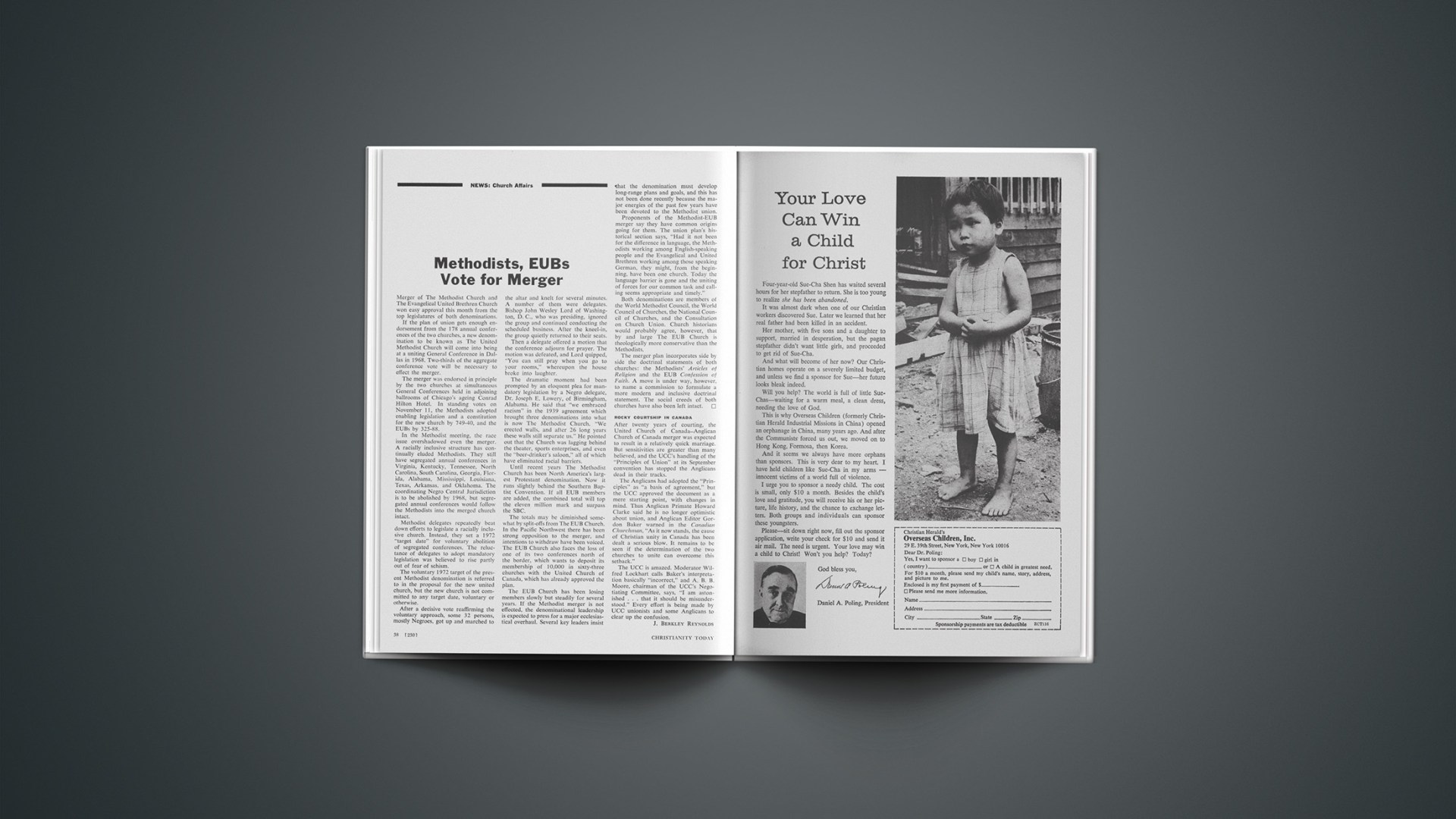
Methodists, EUBs Vote for Merger

Merger of The Methodist Church and The Evangelical United Brethren Church won easy approval this month from the top legislatures of both denominations.

If the plan of union gets enough endorsement from the 178 annual conferences of the two churches, a new denomination to be known as The United Methodist Church will come into being at a uniting General Conference in Dallas in 1968. Two-thirds of the aggregate conference vote will be necessary to effect the merger.

The merger was endorsed in principle by the two churches at simultaneous General Conferences held in adjoining ballrooms of Chicago’s ageing Conrad Hilton Hotel. In standing votes on November 11, the Methodists adopted enabling legislation and a constitution for the new church by 749–40, and the EUBs by 325–88.

In the Methodist meeting, the race issue overshadowed even the merger. A racially inclusive structure has continually eluded Methodists. They still have segregated annual conferences in Virginia, Kentucky, Tennessee, North Carolina, South Carolina, Georgia, Florida, Alabama, Mississippi, Louisiana, Texas, Arkansas, and Oklahoma. The coordinating Negro Central Jurisdiction is to be abolished by 1968, but segregated annual conferences would follow the Methodists into the merged church intact.

Methodist delegates repeatedly beat down efforts to legislate a racially inclusive church. Instead, they set a 1972 “target date” for voluntary abolition of segregated conferences. The reluctance of delegates to adopt mandatory legislation was believed to rise partly out of fear of schism.

The voluntary 1972 target of the present Methodist denomination is referred to in the proposal for the new united church, but the new church is not committed to any target date, voluntary or otherwise.

After a decisive vote reaffirming the voluntary approach, some 32 persons, mostly Negroes, got up and marched to the altar and knelt for several minutes. A number of them were delegates. Bishop John Wesley Lord of Washington, D. C., who was presiding, ignored the group and continued conducting the scheduled business. After the kneel-in, the group quietly returned to their seats.

Then a delegate offered a motion that the conference adjourn for prayer. The motion was defeated, and Lord quipped, “You can still pray when you go to your rooms,” whereupon the house broke into laughter.

The dramatic moment had been prompted by an eloquent plea for mandatory legislation by a Negro delegate, Dr. Joseph E. Lowery, of Birmingham, Alabama. He said that “we embraced racism” in the 1939 agreement which brought three denominations into what is now The Methodist Church. “We erected walls, and after 26 long years these walls still separate us.” He pointed out that the Church was lagging behind the theater, sports enterprises, and even the “beer-drinker’s saloon,” all of which have eliminated racial barriers.

Until recent years The Methodist Church has been North America’s largest Protestant denomination. Now it runs slightly behind the Southern Baptist Convention. If all EUB members are added, the combined total will top the eleven million mark and surpass the SBC.

The totals may be diminished somewhat by split-offs from The EUB Church. In the Pacific Northwest there has been strong opposition to the merger, and intentions to withdraw have been voiced. The EUB Church also faces the loss of one of its two conferences north of the border, which wants to deposit its membership of 10,000 in sixty-three churches with the United Church of Canada, which has already approved the plan.

The EUB Church has been losing members slowly but steadily for several years. If the Methodist merger is not effected, the denominational leadership is expected to press for a major ecclesiastical overhaul. Several key leaders insist that the denomination must develop long-range plans and goals, and this has not been done recently because the major energies of the past few years have been devoted to the Methodist union.

Proponents of the Methodist-EUB merger say they have common origins going for them. The union plan’s historical section says, “Had it not been for the difference in language, the Methodists working among English-speaking people and the Evangelical and United Brethren working among those speaking German, they might, from the beginning, have been one church. Today the language barrier is gone and the uniting of forces for our common task and calling seems appropriate and timely.”

Both denominations are members of the World Methodist Council, the World Council of Churches, the National Council of Churches, and the Consultation on Church Union. Church historians would probably agree, however, that by and large The EUB Church is theologically more conservative than the Methodists.

The merger plan incorporates side by side the doctrinal statements of both churches: the Methodists’ Articles of Religion and the EUB Confession of Faith. A move is under way, however, to name a commission to formulate a more modern and inclusive doctrinal statement. The social creeds of both churches have also been left intact.

Rocky Courtship In Canada

After twenty years of courting, the United Church of Canada—Anglican Church of Canada merger was expected to result in a relatively quick marriage. But sensitivities are greater than many believed, and the UCC’s handling of the “Principles of Union” at its September convention has stopped the Anglicans dead in their tracks.

The Anglicans had adopted the “Principles” as “a basis of agreement,” but the UCC approved the document as a mere starting point, with changes in mind. Thus Anglican Primate Howard Clarke said he is no longer optimistic about union, and Anglican Editor Gordon Baker warned in the Canadian Churchman, “As it now stands, the cause of Christian unity in Canada has been dealt a serious blow. It remains to be seen if the determination of the two churches to unite can overcome this setback.”

The UCC is amazed. Moderator Wilfred Lockhart calls Baker’s interpretation basically “incorrect,” and A. B. B. Moore, chairman of the UCC’s Negotiating Committee, says, “I am astonished … that it should be misunderstood.” Every effort is being made by UCC unionists and some Anglicans to clear up the confusion.

J. BERKLEY REYNOLDS

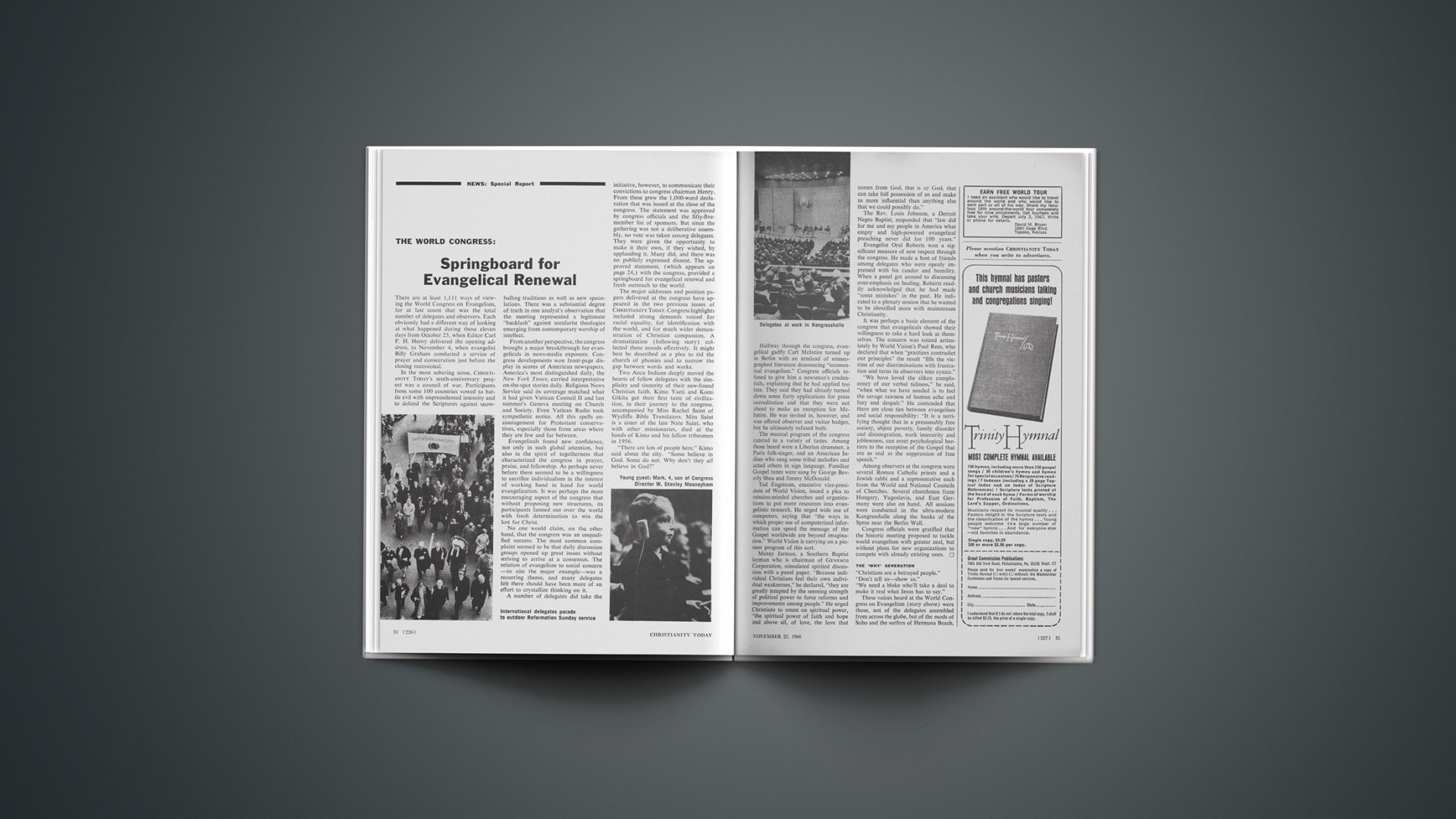
The World Congress: Springboard for Evangelical Renewal

There are at least 1,111 ways of viewing the World Congress on Evangelism, for at last count that was the total number of delegates and observers. Each obviously had a different way of looking at what happened during those eleven days from October 25, when Editor Carl F. H. Henry delivered the opening address, to November 4, when evangelist Billy Graham conducted a service of prayer and consecration just before the closing recessional.

In the most sobering sense, CHRISTIANITY TODAY’S tenth-anniversary project was a council of war. Participants from some 100 countries vowed to battle evil with unprecedented intensity and to defend the Scriptures against snowballing traditions as well as new speculations. There was a substantial degree of truth in one analyst’s observation that the meeting represented a legitimate “backlash” against secularist theologies emerging from contemporary worship of intellect.

From another perspective, the congress brought a major breakthrough for evangelicals in news-media exposure. Congress developments won front-page display in scores of American newspapers. America’s most distinguished daily, the New York Times, carried interpretative on-the-spot stories daily. Religious News Service said its coverage matched what it had given Vatican Council II and last summer’s Geneva meeting on Church and Society. Even Vatican Radio took sympathetic notice. All this spells encouragement for Protestant conservatives, especially those from areas where they are few and far between.

Evangelicals found new confidence, not only in such global attention, but also in the spirit of togetherness that characterized the congress in prayer, praise, and fellowship. As perhaps never before there seemed to be a willingness to sacrifice individualism in the interest of working hand in hand for world evangelization. It was perhaps the most encouraging aspect of the congress that without proposing new structures, its participants fanned out over the world with fresh determination to win the lost for Christ.

No one would claim, on the other hand, that the congress was an unqualified success. The most common complaint seemed to be that daily discussion groups opened up great issues without striving to arrive at a consensus. The relation of evangelism to social concern—to cite the major example—was a recurring theme, and many delegates felt there should have been more of an effort to crystallize thinking on it.

A number of delegates did take the initiative, however, to communicate their convictions to congress chairman Henry. From these grew the 1,000-word declaration that was issued at the close of the congress. The statement was approved by congress officials and the fifty-five-member list of sponsors. But since the gathering was not a deliberative assembly, no vote was taken among delegates. They were given the opportunity to make it their own, if they wished, by applauding it. Many did, and there was no publicly expressed dissent. The approved statement, (which appears on page 24,) with the congress, provided a springboard for evangelical renewal and fresh outreach to the world.

The major addresses and position papers delivered at the congress have appeared in the two previous issues of CHRISTIANITY TODAY. Congress highlights included strong demands voiced for racial equality, for identification with the world, and for much wider demonstration of Christian compassion. A dramatization (following story) collected these moods effectively. It might best be described as a plea to rid the church of phonies and to narrow the gap between words and works.

Two Auca Indians deeply moved the hearts of fellow delegates with the simplicity and sincerity of their new-found Christian faith. Kimo Yaeti and Komi Gikita got their first taste of civilization, in their journey to the congress, accompanied by Miss Rachel Saint of Wycliffe Bible Translators. Miss Saint is a sister of the late Nate Saint, who with other missionaries, died at the hands of Kimo and his fellow tribesmen in 1956.

“There are lots of people here,” Kimo said about the city. “Some believe in God. Some do not. Why don’t they all believe in God?”

Halfway through the congress, evangelical gadfly Carl McIntire turned up in Berlin with an armload of mimeographed literature denouncing “ecumenical evangelism.” Congress officials refused to give him a newsman’s credentials, explaining that he had applied too late. They said they had already turned down some forty applications for press accreditation and that they were not about to make an exception for McIntire. He was invited in, however, and was offered observer and visitor badges, but he ultimately refused both.

The musical program of the congress catered to a variety of tastes. Among those heard were a Liberian drummer, a Paris folk-singer, and an American Indian who sang some tribal melodies and acted others in sign language. Familiar Gospel tunes were sung by George Beverly Shea and Jimmy McDonald.

Ted Engstrom, executive vice-president of World Vision, issued a plea to mission-minded churches and organizations to put more resources into evangelistic research. He urged wide use of computers, saying that “the ways in which proper use of computerized information can speed the message of the Gospel worldwide are beyond imagination.” World Vision is carrying on a pioneer program of this sort.

Maxey Jarman, a Southern Baptist layman who is chairman of GENESCO Corporation, stimulated spirited discussion with a panel paper. “Because individual Christians feel their own individual weaknesses,” he declared, “they are greatly tempted by the seeming strength of political power to force reforms and improvements among people.” He urged Christians to count on spiritual power, “the spiritual power of faith and hope and above all, of love, the love that comes from God, that is of God, that can take full possession of us and make us more influential than anything else that we could possibly do.”

The Rev. Louis Johnson, a Detroit Negro Baptist, responded that “law did for me and my people in America what empty and high-powered evangelical preaching never did for 100 years.”

Evangelist Oral Roberts won a significant measure of new respect through the congress. He made a host of friends among delegates who were openly impressed with his candor and humility. When a panel got around to discussing over-emphasis on healing, Roberts readily acknowledged that he had made “some mistakes” in the past. He indicated to a plenary session that he wanted to be identified more with mainstream Christianity.

It was perhaps a basic element of the congress that evangelicals showed their willingness to take a hard look at themselves. The concern was voiced articulately by World Vision’s Paul Rees, who declared that when “practices contradict our principles” the result “fills the victims of our discriminations with frustration and turns its observers into cynics.”

“We have loved the silken complacency of our verbal tidiness,” he said, “when what we have needed is to feel the savage rawness of human ache and fury and despair.” He contended that there are close ties between evangelism and social responsibility: “It is a terrifying thought that in a presumably free society, abject poverty, family disorder and disintegration, work insecurity and joblessness, can erect psychological barriers to the reception of the Gospel that are as real as the suppression of free speech.”

Among observers at the congress were several Roman Catholic priests and a Jewish rabbi and a representative each from the World and National Councils of Churches. Several churchmen from Hungary, Yugoslavia, and East Germany were also on hand. All sessions were conducted in the ultra-modern Kongresshalle along the banks of the Spree near the Berlin Wall.

Congress officials were gratified that the historic meeting proposed to tackle world evangelism with greater zeal, but without plans for new organizations to compete with already existing ones.

The ‘Why’ Generation

“Christians are a betrayed people.”

“Don’t tell us—show us.”

“We need a bloke who’ll take a deal to make it real what Jesus has to say.”

These voices heard at the World Congress on Evangelism (story above) were those, not of the delegates assembled from across the globe, but of the mods of Soho and the surfers of Hermosa Beach, of youth on the campuses of California and the streets of young Africa.

In an offbeat production, The Why Generation, congress staffers Ed Bailey and Jim Collier and a company of teen-age recruits dramatized unforgettably the shrinking influence of Christianity on today’s young people.

All the words spoken by a miniskirted blonde or a slim-jeaned hipster were culled from hundreds of actual letters and interviews. The epigrammatic commentary was woven together with a brash beatnik “Passion” in free verse about “Jerusalem Slim” and a tragicomic narrative poem about a teen-ager’s visit to a London church.

Some gripes: “Most Christians are sterile, hypocritical cowards.… We just won’t buy that white Anglo-Saxon God anymore.… It’s easier to identify with the Beatles than with God.… Christianity is too fantastic, too miraculous.…”

A melancholy theme song recurred throughout the production, reminding congress delegates of “All the Lonely People.” The concluding line was, “We’re lost, but few men care.”

A girl who has completed four years in a Christian college bemoaned her insecurity: “I should now be a stable, vital Christian,” she said, “but I’m not.… My faith was not my own.… I was acting from external pressures.” Poised and chic, she expressed her longing for reality in cultured tones. “About the worst sin in the book is not to be yourself. And many Christians are afraid to be themselves.”

In one of the final scenes, three ministers discussed their problems in getting through to the current generation. “If we don’t change,” one said, “we may soon find ourselves equipped to evangelize the world of twenty-five years ago.… Yet the very word ‘change’ seems to threaten us evangelicals.…”

“Christians are the ‘salt of the earth,’ ” he said, “but it is still stockpiled.” He bowed his head, and the spotlight dimmed.

“Meanwhile, the world gets hungrier.”

The light went out.

W. DAYTON ROBERTS

Sing A New Song, Tenderly

Jazz continually raises its rhythmic sound in New York City’s worship life these days. An October 23 instance was an ecumenical triple-header: the Lutheran Foundation for Religious Drama presenting a Roman Catholic jazz mass at the Broadway United Church of Christ.

A Pan-Christian Bible?

Boston’s Father Walter Abbott, 43, was scheduled to meet the American Bible Society’s Advisory Council last week in what the New York Times thinks might be “the most important, concrete Christian unity step” since Vatican II closed a year ago.

Abbott, a former associate editor of America, was named November 8 to direct the Vatican’s new drive for a series of common Bible translations, used by all Christians. Pope Paul VI made the move to implement the council’s call for “easy access to Sacred Scripture.” Roman bishops around the world are filling out questionnaires on problems in Bible translation and distribution, and are conferring with local Protestant Bible societies.

The work, Missa Hodierna, was written by schoolteacher-jazz pianist Eddie Bonnemere. He Latinized his fifty-six voice choir, ten-piece band complete with conga drum, and congregation in an engaging hour that ended with a triumphantly syncopated “Go, the Mass is ended: Thanks be to God.”

Bonnemere attributes the mortality rate of regular churchgoers to the lack of participation in services allowed the worshiper. A Roman Catholic, he says most Mass music spurs feelings of “instant strangulation.” His remedy is a “functional service,” combining Latin American rhythms, modern thematic lines, and a touch of Gregorian chant for historical continuity.

The Church was officially represented at this $3-a-seat service by the Rev. John Gensel, who is usually evident at such events and carries on a supportive and counseling ministry with jazz musicians and their families. His chaplaincy to the New York jazz scene is an outgrowth of his weekly jazz vespers at St. Peter’s Lutheran Church (LCA), where he is one of the pastors.

The St. Peter’s services allow the jazzmen to worship regularly in their vernacular, and open communication to them from the more traditional church. Gensel collaborates with trumpeter Joe Newman in O Sing to the Lord a New Song, which puts jazz behind and around spoken words of Scripture.

Gensel thinks jazz worship has “freshness.… It’s like when you are tired and you take a shower.” “The motive makes the difference,” he says; “the motive of love and grace of God makes the difference in the new song.”

But some credit for the difference must also go to Newman and the rhythm section. His group weaves an exotic sound of intense meaning with the words of the Testaments, coupling Psalm 137 with “Willow Weep for Me,”First Corinthians 13 with “Tenderly,” and portions of Solomon’s Song with “Stella by Starlight.” Despite the secular sounds, Newman says the work is “not to entertain, but … to worship.”

JOHN EVENSON

Church Giving: $3.3 Billion

Americans and Canadians gave a record $3.3 billion to their churches last year, says a November 11 report from the National Council of Churches. Per-member contributions rose an impressive $5.71 over 1964, and the average member gave 67 cents more to benevolences (home and foreign missions and overseas relief).

As usual, omissions and qualifications are important. Figures came from only eleven of the NCC’s thirty members, representing two-thirds of its constituency.

Denominations receiving more than $200 from each member were, in order: the Wesleyan Methodist, Evangelical Free, Brethren in Christ, Pilgrim Holiness, Orthodox Presbyterian, and Evangelical Covenant Churches. The highest-ranking large denomination was again the Presbyterian Church, U. S. (Southern), at $118.72.

American Baptists Say ‘No’

The American Baptist Convention’s General Council this month declined to join other Western Hemisphere Baptists in a united evangelistic “Crusade” in 1969. Instead, the ABC will concentrate on separate strategy with ABC-related churches in Latin America and on its new curriculum, also due in 1969.

The ABC thus spurned the first project of the new North American committee of the Baptist World Alliance. ABC President Carl Tiller pointed out that baptisms had dropped from 63,632 in 1955 to 43,759 in 1965, and gave hesitant support to the 1969 effort. But the council followed advice of staffers in the evangelism and program divisions.

Meanwhile, those in the ABC who favor unity with non-Baptists got some ammunition for next year’s Pittsburgh convention when northern California delegates failed to endorse the “Armstrong Amendment” that stressed “Baptist distinctives” in unity talks. And the New York State convention reaffirmed last year’s call for full participation in the Consultation on Church Union. Indiana’s convention, however, opposed COCU.

Greek Crisis Ends

The Greek parliament, ending a year-long crisis, approved nomination of fifteen Orthodox bishops and left the hierarchy to decide on controversial transfers of two bishops to richer dioceses. Though weaker than an earlier reform bill rejected by the hierarchy, the measure pays all Greek bishops a salary equal to that of senior judges, with side income from marriages and other services to be pooled and distributed to poorer clergymen and theology students. Also, bishops appointed in the future must retire at age 80.

Book Briefs: November 25, 1966

Has The Queen Abdicated?

New Directions in Theology Today, Volume I: Introduction, by William Hordern (general editor of the series), and Volume II: History and Hermeneutics, by Carl E. Braaten (Westminster, 1966, 170 and 205 pp., $1.95 each, paperback), are reviewed by Edward John Carnell, professor of ethics and philosophy of religion, Fuller Theological Seminary, Pasadena, California.

Volume I (seven volumes are to make up the series) is saturated with the conviction that it is high time to have edifying dialogue between theologians and the Church, and that the best way to come to the rescue is by disclosing what is new in contemporary theology. So Hordern brings forth a delightful cafeteria of theological alternatives. His sense of fairness leads him to include a chapter entitled “The New Face of Conservatism,” although I wonder whether he really grasps the true substance of conservatism.

In any case, Hordern writes with such an irenic spirit that he addresses both mind and heart, and thus forces serious readers to ask, “Just why is Christianity so fragmented?” and “What can we do to convert this fragmentation into a spiritual, intellectual, and ecclesiastical unity?”

An orthodox Christian, nonetheless, will feel a measure of frustration after reading this book, for no attempt is made to develop a rigorous criterion by which a selection between theological alternatives can be made. The Bible is quoted here and there. In fact, the book ends with a portion of Second Corinthians 4:2. But whether quotations from Scripture contain any more truth on divine authority than quotations from Plato is not resolved. This leads an orthodox Christian into deeper questions, for of what value is theological dialogue unless the agenda includes serious consideration of the right criterion for declaring theological system valid or invalid?

I would speak less than the truth if I were to conceal my feeling that this is a highly stimulating, well-written book. Still, I am sorry that the case for theological dialogue is built in part on the open admission of skepticism that theology is any longer “queen of the sciences.” Certainly we confront new complexities; certainly our file of theological knowledge contains more relative judgments than our fathers in the faith were prone to admit; but the fact remains that a theologian is entrusted with a queenly science. For nothing can fitly rank above the question, “What must I do to be saved?”

Volume II is an awesome piece of scholarship, even though it is written from a somewhat parochial Lutheran perspective and dwells mostly on the theological debate in contemporary Germany. The lion’s share of the discussion is given to Bultmann’s existential theology, while the greatest admiration is heaped on Pannenberg’s theology of universal history.

Two questions arise immediately. First, why are Barth and company brushed off in such a cursory way? Second, why does Bultmann steal the show, despite Braaten’s rejection of his theological position? Braaten (a conservative liberal, if that means anything) devotes a number of closing paragraphs to telling us, in a rather dogmatic way, why he believes that Bultmann has failed miserably in his attempt to perform a marriage ceremony between Christian existentialism and outright naturalism. Bultmann seems to throw out the good with the bad.

Since much of German thinking pays high regard to planned obsolescence (somewhat like the American automobile industry), Braaten may simply be reporting that the revelation theology of Barth has run its course and thus has lost its novelty, while Bultmann, who started out with Barth but later severed company, retains a sparkling novelty. In any case, I am left with the assumption that Bultmann forces Braaten to work for his faith, and this leaves Braaten in debt to Bultmann.

Although Pannenberg is one of the bright young stars in the contemporary theological constellation of Germany, Braaten by no means accepts all of his position. Indeed, he deals with some serious difficulties. Still, Pannenberg seems to command Braaten’s respect by viewing historical Christian events in such a way that they are actually not historical or Christian unless a believer responsibly acknowledges them as part of salvation-history. In this way the objective and the subjective are blended in such a way that the secularization of salvation-history and the envelopment of Christianity by some brand of mysticism are avoided. Moreover, Braaten is convinced that this blending of objective and subjective yields a fresh hermeneutics. Such hermeneutics takes in both the obligation to defend, as well as to know, historical Christian events, and the rules governing biblical exegesis. Pannenberg is forthright in his acceptance of Christ’s resurrection, even as he struggles hard and long to bring the Old and New Testaments into some kind of theological fellowship. These are excellent commitments, although I fail to see anything particularly “new” about them.

Reading for Perspective

CHRISTIANITY TODAY’S REVIEW EDITORS CALL ATTENTION TO THESE NEW TITLES:

The Christian Persuader, by Leighton Ford (Harper & Row, $3.95). A trenchant analysis of contemporary evangelism—the obstacles to be overcome, the strategies to be carried out, the biblical message to be proclaimed—by a man whose writing reveals his passion for Jesus Christ.

History of Evangelism, by Paulus Scharpff (Eerdmans, $5.75). Evangelism in Germany, Great Britain, and America viewed in their historical relationship by a German writer who urges mutual exchange of such knowledge by Christians.

Man: The Dwelling Place of God, by A. W. Tozer (Christian Publications, $3). Terse essays by the late Christian and Missionary Alliance editor that provide insight into the pitfalls and victories of the life of faith.

Braaten summarily dismisses orthodoxy on at least two charges: (a) that it hinders the work of the Spirit by identifying the Word of God with infallibly inspired words in the Bible; and (b) that it imposes the culturally conditioned world view of the Bible on people who happen to live in the twentieth century with its evolutionary and expanding universe. All honor to Braaten for making it clear why he sees no value in holding dialogue with orthodoxy. Ironically, however, his caricature of orthodoxy may convince many conservatives that there is no value in holding dialogue with Braaten.

In any event, this is such a technical work on such far-out theological systems that it is not likely to stimulate dialogue between busy theologians and busy laymen. Whether we like it or not, the fact remains that the average church member wouldn’t grasp the difference between Historie and Geschichte if they sat beside him in the television room for a week.

EDWARD JOHN CARNELL

Through Chaos And Terrorism

Congo Crisis, by Joseph T. Bayly (Zondervan, 1966, 224 pp., $3.95), is reviewed by C. Darby Fulton, retired executive secretary, Board of World Missions of the Presbyterian Church, U. S., Nashville, Tennessee.

This is a vivid story of what happened to a young American missionary couple and their children who arrived in the Congo in the spring of 1964 and were soon caught in the murderous cross fire of the rebellion that centered around the city of Stanleyville. The author, an experienced writer, has produced an animated recording of the harrowing experiences of Charles and Muriel Davis and the beleaguered company of missionaries and Congolese Christians. The reader will find heroes of all ages, both sexes, many nationalities, and the black as well as white skins.

Early in the story there is a brief but excellent summary of the developments leading to Congo independence in 1960 and an explanation of the violent and chaotic years that have followed. Bayly lays the chief blame for Congo’s deterioration on the pressures of world opinion that compelled Belgium to grant independence prematurely. “Belgium’s hand was forced, and the Free World suffered. The Congo itself suffered most.” Included in the record is a remarkably sympathetic interpretation of the tragic career and fate of Patrice Lumumba.

The heart of the book consists of firsthand accounts narrated by missionaries and other eye witnesses who lived through weeks of chaos and terrorism. The whole area around Stanleyville was at the mercy of roving bands of “Simbas,” intent on murder and destruction, guided by caprice, and inflamed by tribal rivalries, political dissension, and international intrigue. The story is one of husbands snatched away from their families, of wives and children hiding in the tropical forest like hunted animals, of narrow escapes from detection and death, of firing squads, of prayer and faith and dependence upon God, and of the final and sudden ordeal of martyrdom for some.

The author feels that the role of the missionary and of the Congolese Christian in this drama has been “magnificent,” characterized by courage and dignity. This should engender added respect for the whole enterprise.

The final chapter is an attempt to evaluate the Church and missions in the Congo. Specifically, it examines the events of the past few years to see what lessons are suggested for missions throughout the world. There are interesting and valuable insights here, not only for the foreign missionary but for all who are concerned about the Gospel’s encounter with the revolutionary forces of this generation. Emphasis is given to the “new partnership” between missionaries and the national church, as distinguished from the “paternalism” of former years. At this point the author does not entirely escape the easy fault of making comparisons at the expense of the past, describing as “new” some attitude or principle that has long been recognized. It is likely, however, that there will be general agreement with his basic summation in the closing paragraphs:

The Church is not a missionary carrying on his program with the help of nationals. Nor is it an organization with national leadership in which a missionary is accepted as helper. In America or the Congo, the Church is—according to the New Testament—a body, and Christ is the Head of the body. The life that surges through the body is not Congolese life, or American life; it is the life of Christ. Each part of the body exists for the Head, and for every other part.

C. DARBY FULTON

Face The Issues!

Dissenter in a Great Society: A Christian View of America in Crisis, by William Stringfellow (Holt, Rinehart and Winston, 1966, 164 pp., $4.95), is reviewed by Charles E. Hummel, president, Barrington College, Barrington, Rhode Island.

What do race riots in Watts and Rochester and demonstrations in Selma and Cicero portend for the American future? With prophetic urgency Stringfellow attacks Americans’ complacency about the social and economic structure that institutionalizes poverty.

Lawyer Stringfellow eloquently argues the case for the poor and oppressed. In the war on poverty, what is the nature of the enemy? A cogent analysis of the interrelations of poverty, property, and people disclose an ideological problem that has divided the country from the start: Should the rights of property or the rights of people constitute the basis of our society? The author shows how institutions of property are prevailing over the rights of human beings. While both rights are important, the tragedy of American society lies in its worship of property. What a man owns has become the yardstick of his worth.

Stringfellow incisively exposes the idolatry of money. “Money is not inherently evil, but it is fallen.” One society mistakenly equates value with money and so judges a man’s moral worth by the amount of money he possesses or controls. If we disavow this idea, to what extent do we not really believe that those without money are inferior? “Where money is an idol, to be poor is a sin.” Christ offers freedom from the idolatry of money.

Everyone in the United States is now involved in the war between the races. “The only issue that remains is how one is involved: obstinately, stupidly, irrationally—or with concern, intelligence or compassion.” But the civil-rights movement is not an end in itself; restoration to Negroes of their rights must pioneer a reconstruction needed by our entire society. For the Christian, integration is not enough, since it is not the moral equivalent of reconciliation in Christ. All men and things are reconciled only in the Body of Christ.

Pessimistic about lack of progress, Stringfellow sees a day of wrath approaching. He believes the “real recalcitrant in the American racial crisis is not the so-called die-hard segregationist or the pathological racist, but respectable, sane, sincere, benevolent, earnest people, church members and devout liberals.”

This book steps on many toes from the right to the left. Each reader must face the basic question: Will he look for excuses to discount its message? Or will he move past the offense to some of his pet positions and panaceas and get at the central disturbing questions? Stringfellow’s perception and passion commend this book for personal study and group discussion.

CHARLES E. HUMMEL

A Modest Commentary

Beacon Bible Commentary, Volume V: The Minor Prophets, by Oscar F. Reed, et al. (Beacon Hill, 1966, 453 pp., $5.95), is reviewed by Bruce K. Waltke, assistant professor of semitic languages and Old Testament exegesis, Dallas Theological Seminary, Dallas, Texas.

A sober evaluation of this commentary is given in the preface: “Beacon Bible Commentary is offered in ten volumes with becoming modesty. It does not supplement others. Neither does it purport to be exhaustive or final.… It is candidly admitted that this is a commentary written from the viewpoint of Wesleyan-Arminian theology. Nevertheless, it is hoped that it will have value to all who seek to know the truth as it is in Jesus.” The Church of the Nazarene is to be commended for offering this helpful, devotional commentary to all serious students of God’s Word.

The defensive aspects of Wesleyan-Arminian theology are not apparent in this volume and therefore will not limit its popularity in evangelical circles. The non-definitive character of that system of interpretation with regard to eschatology, however, will limit its value for those who hold to a dispensational, pre-millennial interpretation of Scripture. Although the contributors are generally vague about their eschatological convictions, their view seems to be that the kingdom of Christ was inaugurated with the death and resurrection of Jesus and will be consummated when Christ returns (see p. 399). Oracles of judgment are usually interpreted as having been fulfilled historically; oracles of blessing are usually interpreted as having been fulfilled in the return from the exile, in the Maccabean era, and in the Church but are sometimes more vaguely interpreted as yet to be fulfilled in the Messianic age.

Generally speaking, the work is non-critical and is based on the King James translation. Problems of literary criticism are dismissed (but see the discussion on the unity of Zechariah); problems of form criticism are not raised; and problems of the Hebrew text are rarely considered. For the most part, the authors comment only on the interpretative problems of the KJV.

As stated in the preface, the work is not exhaustive. On the one hand this approach is welcome, for often the contributors, avoiding pedantry, incisively interpret an obscure passage. On the other hand, the approach proves disconcerting when contributors treat other interpretations superficially or draw conclusions where the reader asks for more argumentation. For example, one contributor cavalierly states that Amos addressed his prophecy to both Israel and Judah, although the text itself does not clearly attest this fact. Again, the identification of the four horns in Zechariah’s vision with the kingdoms of Daniel’s vision is summarily rejected because the horns are said “to have (already) scattered Judah.” It is well known, however, that the perfect tense of the Hebrew verb denotes the aspect of the action more than the time of the action and can refer to the present and future as well as to the past. Although both of the above interpretations may be correct, the point is that the reader would have appreciated a stouter defense.

The contributors have extensively used earlier commentaries written in English and modern English translations but have neglected almost entirely pertinent articles in the learned journals. This neglect severely limits the value of the work. For example, our understanding of the prophetic message, especially Hosea’s, has been greatly enriched by the form-critical analysis of the rib motif in the Old Testament (cf. Herbert B. Huffmon, “The Covenant Lawsuit in the Prophets,” Journal of Biblical Literature, LXXVIII [1959], pp. 285–95). In addition, it is very hazardous to amend the Masoretic text, as the authors occasionally do, without a thorough acquaintance with the history of the texts of the Minor Prophets (cf. D. Barthélemy, Les devanciers d’Aquila: Première publication integrale du texte des fragments du dodécaprophéton, Brill, 1963).

Nevertheless, despite these limitations, this work will have value for all those engaged in the public presentation of God’s Word because of its practical expositions, homiletical suggestions, and pertinent quotations.

BRUCE K. WALTKE

Vatican Ii And Anti-Semitism

The Church and the Jewish People, by Augustin Cardinal Bea, S. J., translated by Philip Loretz, S. J. (Harper & Row, 1966, 172 pp., $4.50), is reviewed by Belden Menkus, editor, author, and management consultant, Bergenfield, New Jersey.

“Christ killer!”

The cry echoes with misery through two millennia of Jewish history. At best, it has been followed by a curse, a kick, or a blow. At worst, it has brought humiliation, torture, or death for Jews.

Far too often, this hatred has hidden behind the cross of Christ.

The Vatican Council, as one of its noblest objectives, sought to bring this distortion of all that is Christian out in the open. Result: A declaration by the council that pleased no one. Some felt it went too far, some that it did not go far enough.

What did happen? What does this statement really signify? Cardinal Bea, a prime mover in the council’s deliberations, was intimately involved with the discussion of anti-Semitism. Here, in an engagingly lucid style, he tells what the council did, analyzes what it said, and suggests how this statement might affect future relations between Christians and Jews.

Evangelicals may find this book a bit confusing. The Cardinal accepts the traditional “deicide” charge at face value—and this colors the rest of the book. Deicide has not been a significant factor in evangelical thought. And, as I have pointed out elsewhere, deicide is a contradiction in concepts. Man cannot kill God; and Jesus Christ was and is God. Even Cardinal Bea recognizes this problem in Catholic thought when he contends that “Jews should not be represented falsely as under a curse and rejected by God.” The duty of the Church, he continues, “is to preach that Christ voluntarily submitted to his death.”

This is a challenging and satisfying book. The Cardinal is an exegete of exceptional insights; I found myself wanting to read more of his writings and to know the man better.

This is a forthright book. Few in Catholic or Protestant circles have faced the Christian implications of anti-Semitism as clearly and directly as Cardinal Bea has here. “The bonds which bind us to the Jewish people are manifold … reaching to the very heart of our spiritual life.” Speaking of Christian and Jewish common contact in the Old Testament, he writes that “difficulties will arise in connection with the interpretation of certain passages … but there is no doubt that we can go the greater part of the way together.”

This is a disappointing book. The Cardinal fails to face past Catholic anti-Semitism and the council’s retreat from its original position on the Jews.

Yet, the book merits thoughtful study. And it demands a comparable confrontation of the problem by evangelicals.

BELDEN MENKUS

Book Briefs

More Hebrew Honey: A Simple and Deep Word Study of the Old Testament, Volume II, by Al Novak (Premier Printing Company, 1966, 144 pp., $4). Old Testament word studies sweet to the mind and heart.

Captured by Mystery: Devotional Readings, by Alvin N. Rogness (Augsburg, 1966, 147 pp., $3.50). Penetrating readings on life, love, gratitude, the church, and death, for daily consumption.

The Changing Church, by Bertrand van Bilsen (Duquesne University, 1966, 440 pp., $7.95). A synthesis of the current Roman Catholic reformation.

Children’s Art and the Christian Reader, by Edgar Boevé (National Union of Christian Schools, 1966, 200 pp., $5.95). A Christian approach to the development of children’s discernment and religious expression in art; well illustrated.

Woman Is the Glory of Man, by E. Daniel and B. Olivier, translated by M. Angeline Bouchard (Newman, 1966, 137 pp., $4.25). The mystery and uniqueness of woman seen from a Roman Catholic perspective.

Where Jesus Walks, by Ruth Youngdahl Nelson (Augsburg, 1966, 144 pp., $3.50). A devotional pilgrimage to places of spiritual enrichment and service.

Aw, Stop Worryin’, by Winston K. Pendleton (Bethany Press, 1966, 80 pp., $2.50). The Christian antidote to anxiety, discussed by the author of 2121 Funny Stories and How to Tell Them. His only worry seems to be our worrying.

Get Up and Go: Devotions for Teens, by Paul Martin (Beacon Hill, 1966, 96 pp., $1.50). Ninety pungent devotionals beamed directly at today’s teenagers.

Apple PodcastsDown ArrowDown ArrowDown Arrowarrow_left_altLeft ArrowLeft ArrowRight ArrowRight ArrowRight Arrowarrow_up_altUp ArrowUp ArrowAvailable at Amazoncaret-downCloseCloseEmailEmailExpandExpandExternalExternalFacebookfacebook-squareGiftGiftGooglegoogleGoogle KeephamburgerInstagraminstagram-squareLinkLinklinkedin-squareListenListenListenChristianity TodayCT Creative Studio Logologo_orgMegaphoneMenuMenupausePinterestPlayPlayPocketPodcastRSSRSSSaveSaveSaveSearchSearchsearchSpotifyStitcherTelegramTable of ContentsTable of Contentstwitter-squareWhatsAppXYouTubeYouTube