Hearing and Doing the Word

How is the bible to function in the Church? This is one of the urgent questions of our time. The way the Bible works within the Church is another matter than the Church’s confession about the Bible. Whether the Bible functions powerfully in the Church is not decided by a traditional acknowledgment by the Church that the Bible is the Word of God. There is a genuine confession of the Word only where there is biblical action in the life of the Church. We are “doers” of the Word if our “hearing” of the Word is genuine (Jas. 1:22).

The Church has sometimes lived by “excerpts” from the Word and missed a living and constant contact with the Bible. People have relied on memories of passages learned long before and have failed to listen to the Word itself, to listen anew each day to the Word. The result was an inner estrangement from the Scriptures.

People have dealt with the Bible like a student preparing for an examination. A student will make a digest of a book once and then before taking the examination will simply refer to his own digest rather than re-read the book. He leaves the book closed and opens his own notes. This is the way people have sometimes dealt with the Bible. But the Bible will not let itself be used in this manner.

The Book and our listening to it are bound together in holy matrimony. The Bible cannot really be for us what it is in fact unless we close our notes and listen to the Bible. The history of the Church’s relation to the Bible discloses some fascinating facts to support this statement. The Bible’s function within the Church is not a thing to be taken for granted. Confessions about the Bible do not always mean that the Bible is the center of the Church’s attention.

The early days of the Church saw the Christians living out of the Bible. We always recall the believers of Berea, who eagerly accepted the Word and daily searched the Scriptures (Acts 17:11). Much later, especially in the twelfth century, all that changed. The Church of the Middle Ages was not at all sure that it was good for individual believers to be in close contact with the Bible.

One reason for the hesitant and nervous attitude of the Church was its fear that personal contact with Scripture was dangerous. Think of the possibilities of arbitrary and heretical interpretations! One could, it was thought, far more safely leave Bible reading to the Church—that is, to the officials—and then let the Bible come to the people as it was filtered through the teaching office.

We find this attitude reflected in a discussion that took place at the Council of Trent. The issue was the translation of the Bible into the language of the people. Spanish Cardinal Pedro Pacheco argued that such translations were a misuse of the Bible. A people’s Bible, he contended, was the mother and origin of heretics. The historian of the council (H. Jedin) tells us that this argument was supported by the fact that 150 doctors of the Sorbonne had pleaded for a prohibition of translations of the Bible into the vulgar languages.

Another cardinal at the council (Madrusso) indignantly fought this point of view. He contended that no one had the right to withhold the Bible from people in their struggle against the enemies of the spirit. (This, by the way, is Calvin’s contention in his comments on Ephesians 6:17.) Although the Council of Trent did not accept the argument against the people’s Bible, it had many supporters. And the fear of the open Bible lingered in the Church for a long time. We can rightfully speak of an anxiety response stimulated by the sight of the power of the Word in the hand of the Reformers.

Much later, changes set in. In the nineteenth century, there was still a good deal of criticism in the Roman church of Protestant Bible translation and distribution societies. But the twentieth century produced a new insight into the significance of the Bible and its function in the church. Catholic writers began to say that although the church was perhaps justified in its attitude during previous eras, what was necessary in the past may be injurious now. They spoke of an estrangement between the Church and the Bible.

In fact, most recently, Catholic writers have spoken of a reactionary viewpoint of the church that was disastrous for the Bible’s rightful place in the Church. The Catholic New Testament scholar Schelke said that Rome sometimes appears to have forgotten that the Bible was, after all, the Word of God. And he added: “God’s Word, we may be sure, will be able to make itself clear to the listener; it will reveal itself clearly.”

We must say that the intense concern among Catholics for the Bible and for translations of the Bible is a reason for rejoicing. That the Catholic Church has changed its response to the Bible is not due to a lessening of the dangers of arbitrary interpretation. These dangers were present in the early days and are alive today. Personal contact with the Bible is always dangerous.

But we may not take it on ourselves to “protect” the Bible from heretical or arbitrary interpretations. What Paul says in Second Timothy 2:9 about the Word of God not being bound has relevance for the function of the Bible in the Church. We are not allowed to limit the entrance into the Bible to the officials of the Church. The Word has gone out to all men, and it calls us to trust its own efficacy.

The Bible itself warns us against arbitrariness, against the possibility of its being misinterpreted to the reader’s own ruin (2 Pet. 3:16). But this is a warning that the whole Church must heed; it comes to individuals, to the theologians, and to the congregation. The possibility of misuse offers no reason for withholding the Bible from anyone.

If Protestants have no problems on this point, they do have to ask whether the Bible actually does function as the whole Bible among them, genuinely function in the entire life of the people, creating faith and love, service and sanctification, and hope.

This is a critical question that hits us all in times when it is easy to undergo a gradual secularization of our fives. The question has nothing to do with intellectualism or with a worship of the letter of Scripture. But it has much to do with the fact that the Bible is indeed useful for instruction, and for refuting error, “for reformation of manners and discipline in right living, so that the man who belongs to God may be efficient and equipped for good work of every kind.” (2 Tim. 3:16, NEB).

Woe be to the Church if the Word of God is thinned down to digests and outlines that keep us from the living words of Christ, words that are spirit and fife. That Church is no longer the listening Church. And if the Church no longer really listens to the Word, how can it truly be the Church of the Living Word?

Peace in Church Tax Case, War in War on Poverty

State and local tax exemptions for church property were left standing by the Supreme Court in one of its first actions after the new term opened this month. The high court refused to hear appeals of Maryland decisions that upheld the constitutionality of the exemptions in that state.

The court set no legal precedent; it merely refused to get involved in the issue for its own undisclosed reasons. However, the practical effect will be to discourage other efforts to challenge church tax exemptions.

Complaints were brought by the Free-Thought Society of America, Mrs. Madalyn Murray O’Hair, former president of the society, who got the high court to overthrow official school prayers, and Mr. and Mrs. Lemoin Cree (Cree is president now). FTSA is publisher of the American Atheist.

O’Hair Cuts

“There is not one shred of historical evidence outside the Bible that attests to even the existence of such a person named Jesus Christ,” said atheist Madalyn Murray O’Hair in a three-hour radio debate with the Rev. John Streater, of San Francisco’s First Baptist Church, last month.

With studied restraint, Streater aimed historically oriented refutations at the wild charges. His opponent’s standard reply: “I simply can’t accept that.”

When a telephone participant entered the talk show on KCBS, reporting a radical transformation of his life after conversion from atheism, Mrs. O’Hair replied, “Nothing but mental gymnastics.”

Mrs. O’Hair showed mild surprise when Streater agreed with her opposition to “government-forced prayer edicts” and tax exemptions for church businesses.

“I don’t think you really mean it,” she retorted. While the cleric shook his head in bewilderment, the announcer switched to a life-insurance commercial.

They contended exemptions are an indirect subsidy to religion and are thus prohibited by the First Amendment to the Constitution (“Congress shall make no law respecting an establishment of religion, or prohibiting the free exercise thereof”). But the Maryland court said that “a major part” of church work is charitable and that sixty other types of charities hold tax exemptions.

A related case, also from Maryland, awaits U. S. Supreme Court action. It seeks to reverse a lower-court ruling that public grants to church-related colleges are unconstitutional, even though the money is used for secular purposes.

In Harrisburg, Pennsylvania, about a dozen church properties, mostly parking lots, were recently returned to the city’s real-estate tax rolls. Under Pennsylvania’s constitution, church property is tax exempt if it is used for worship.

Another tangled church-state issue is the Johnson administration’s war on poverty. Current disputes involve appropriations for the Office of Economic Opportunity and treatment of a church-related project in Mississippi.

Such groups as the Inter-Religious Committee Against Poverty, the National Council of Churches, and the National Catholic Welfare Conference appealed to President Johnson and Congress to increase OEO’s budget during the current fiscal year.

But the House of Representatives passed an appropriation of $1.75 billion for OEO—no increase over the previous year. At one point, the Senate’s OEO bill went as high as $2.4 billion; but this was cut down in committee, and the House version won out.

During debate, Rep. John Buchanan of Alabama, a Baptist minister, failed to get an amendment stating that OEO “shall make no grant to, and shall not contract with, any establishment of religion, church, or other religious body.”

Meanwhile, churchmen less worried about church-state cooperation were waging war on the war-on-poverty office over its suspension of funds for a “Head Start” pre-school training organization, Child Development Group of Mississippi. CDGM, formed with the assistance of the National Council of Churches’ Delta Ministry, was administered through Mary Holmes Junior College (United Presbyterian).

In suspending the funds, OEO charged that about $500,000 was not properly accounted for, that parents were too involved, and that Negro control was emphasized to the point of excluding the white community. The church groups accused OEO of bending to political pressure, particularly from Senator John Stennis of Mississippi.

A United Presbyterian news release quoted experts who said CDGM’s accounting system “does afford a complete and accurate accounting of all funds.…” The Citizens’ Crusade Against Poverty—which is headed by auto-union leader Walter Reuther and includes many churchmen—commissioned a fifteen-member “board of inquiry” to investigate the fund cutoff. The board reported that “allegations of mismanagement were a thin mark for a politically dictated decision” that “represents a yielding to those forces which have stood in historical opposition to progress for the poor and underprivileged of Mississippi.”

When OEO tried to decentralize the program, five denominations that have colleges in Mississippi vowed they would not sign contracts with OEO without clearance from the National Council of Churches’ Division of Christian Life and Mission, hoping thus to make it difficult for OEO to bypass CDGM.

Unperturbed, OEO managed to scatter almost $12 million across Mississippi in just five days early this month. The Washington Post reported that Rust College, a small Negro institution at Holly Springs, was granted $1.2 million before it had even completed an application explaining how the money would be used. An OEO staffer had been dispatched to Holly Springs with orders to draw up preliminary plans and a budget within eighteen hours. The budget amounted to $600 per child more than OEO’s recommended maximum.

President Ernest A. Smith of the Methodist-supported school expressed misgivings as the din of controversy rose. “We’re sorry we got caught by a situation we weren’t aware of,” he lamented. “We weren’t aware of all these political undercurrents.”

Miscellany

Reports from the Java, Sumatra, and Sumbawa islands of Indonesia tell the same story: a surge in Christian converts and revivalism this year. Observers say the nation’s repudiation of Communism and government opposition to animistic paganism have helped.

Pocket Testament league plans to field a Vietnamese evangelist who can travel freely through Communist-held areas to distribute Scriptures.

In line with the Viet Nam build-up, more Methodists are on duty as chaplains with U. S. armed forces (540) than at any time since World War II, and the Army has increased Methodist chaplain requests for 1966–67.

The departure of U. S. troops from France has caused closing of nearly all that nation’s English-language Baptist churches.

In Ceylon, a union proposal involving Anglicans, Presbyterians, Baptists, and the Church of South India failed to pass at the annual Methodist conference.

Methodists in Sydney, Australia, have established the nation’s first treatment center for drug addicts.

A wide-ranging ecumenical magazine sponsored by the United Church of Canada will begin publishing early in 1967. It will be aimed at theologically trained readers ranging from Pentecostals to Unitarians. No editor has been named.

Kentucky’s Western Recorder proposed a master file on Baptist preachers known to be adulterers and homosexuals, to protect unsuspecting congregations.

Presbyterians raised $10 million for a 310-bed hospital in Dallas and another $10 million for a 300-unit apartment house for persons over 62, now under construction in San Francisco.

Financial problems have forced the National Council of Churches’ Broadcasting and Film Commission to close its Hollywood office.

A merger between two Newark, New Jersey, congregations produced the nation’s first predominantly Negro Episcopal cathedral.

Roman Catholics and Protestants joined in a psychological counseling center opened in New York City’s Harlem last month by the American Foundation of Religion and Psychiatry. The center is directed by the Rev. Frederick E. Dennard, a Baptist.

Twelve Protestant monks from the famed Taizé, France, community and five Roman Catholic monks from Canada and the United States will open a “reconciliation” center in Chicago’s West Side Negro ghetto.

Chicago’s Moody Bible Institute plans to build a new twenty-story dormitory and other facilities.

Surveying Surveys

An Ohio State University study of rural towns shows churches have less effect on community decisions than Rotary and Kiwanis Clubs. And the Gallup Poll discovered for Catholic Digest that the number of persons who say religion is “important” in their lives is declining.

Census Bureau samples show that of the 5.3 million new American households since 1960, only half are headed by a married man and wife.

United Nations figures indicate there are 200 million more illiterate persons in the world now than in 1960.

A study by Moderator magazine estimates that 1,000 college students will commit suicide during 1966 and that ninety times that many will attempt it.

San Francisco’s death rate from liver cirrhosis is nearly six times that of the United States as a whole, its health department reports; the disease is the city’s fourth leading cause of death.

After comparing church-growth figures, the daily Australian predicts Roman Catholics will surpass Anglicans as the largest group in that nation’s population within a few years.

Personalia

New York’s Francis Cardinal Spellman, 77, offered to resign under Pope Paul’s new policy of retirement after 75 (Sept. 30 issue, page 14). But the Pope turned him down and apparently does not plan to apply the age limit to cardinals.

Sister Therese Castonguay, new nursing education supervisor for Saskatchewan Province, is reported to be the first nun to hold a Canadian civil service post.

Thousands of London, Ontario, fairgoers stared skyward as the helicopterriding Rev. Jonas Shepherd, a Presbyterian, married via loudspeaker two professional aerialists dangling on a ladder under the ’copter.

While some of the faithful walked out, comedian Dick Gregory told a Sunday congregation at San Francisco’s Glide Memorial Methodist Church that “Watts was legal.” Indicating the pulpit Bible, he predicted, “Kids today are going to test the Bible. It’s not going to stand up.” Glide’s pastor, who worries about “dull” worship, said Gregory was just the beginning.

Carmen Armenti, the new Roman Catholic mayor of Trenton, New Jersey, got permission for back-to-back wedding ceremonies for his marriage this month to a Greek Orthodox communicant.

Stephen Brimigion, General Electric executive, is now treasurer of Methodist home missions work.

The Rev. Beverly A. Asbury, Presbyterian minister at Wooster, Ohio, will become chaplain of Vanderbilt University.

The Rev. Art Wilson of Wichita Baptist Tabernacle was re-elected president of the Baptist Bible Fellowship International, which lists a constituency of 1.5 million.

The Rev. Ephraim Kayumba, a Pentecostal minister and member of the Congo (Kinshasa) parliament, was elected a bishop by his church council.

Finnish author Hannu Salama was sentenced to three months’ imprisonment for “deliberate blasphemy” in his new novel Midsummer Dances, but the sentence was suspended because Finland’s blasphemy law may be abolished. Copies of the book were confiscated.

In Jerusalem’s Imperial Hotel on October 7 at 3 P.M., Bishop Homer A. Tomlinson, 73, head of one branch of the Pentecostalist Church of God, was crowned by his followers as “King of All the Nations of Men.”

Deaths

MARQUIS LAFAYETTE HARRIS, 59, bishop of the Methodists’ Atlantic Coast Area (Central Jurisdiction) and formerly president of Philander Smith College; in Atlanta.

ALFRED ALONZO GILMAN, 88, Episcopal missionary who went to China in 1902, became an editor, educator, and bishop; active in refugee relief during World War II and a prisoner of the Japanese; in Pompton Lakes, New Jersey.

WALDO FARRINGTON CHASE, 104, believed to have been the oldest Episcopal priest in the United States; in Alhambra, California.

HAROLD W. SEEVER, 54, former chairman of the Southern Baptist Convention Executive Committee who resigned as pastor of his large Alabama church this year because of near-total blindness; in Mobile, of an apparent heart attack.

Orthodoxy’s Shaky Citadel

During the summer a bill was introduced in the Turkish parliament to force out of the country the Orthodox Ecumenical Patriarchate in Istanbul and to close the Orthodox theological school on the nearby island of Halki (Heybeli).

Greek newspapers charged that the bill threatened to mark a tragic final chapter in the long harassment of the patriarchate by the Turks. It was submitted for consideration by Resad Ozarda, a deputy said to be independent of the major parties. Ozarda told fellow parliamentarians that the patriarchate stood as “a symbol of Greek imperialism” and a “torch of self-deceit for the re-establishment of the Byzantine Empire.”

The patriarchate was said to have been “a poisonous nest of traitors for 513 years” (i.e. since the fall of Constantinople). “For centuries it was the center of political penetration of the Russian Czars, but now, supported by the United States, it aims to become a state within a state.”

The bill stipulates that within ten days of its acceptance, Ecumenical Patriarch Athenagoras must leave Turkey and the Halki school must close. There is little chance, however, that this will go through.

In a letter to German Bishop Otto Dibelius, who had expressed concern for the Patriarch’s position, the Turkish Ambassador to the Federal German Republic stressed that in Turkey freedom of religious practice has always been guaranteed. “If this is indeed a constitutional principle,” said a British observer just returned from Turkey, “one might wish it were more widely known throughout the ambassador’s homeland.”

Meanwhile, Greek Orthodox communities on the Turkish-owned islands of Imroz and Tenedos (Bozcaada) are being subjected to “unbearable oppressive measures,” according to reports reaching Athens. Harsh strictures, for which the Cyprus dispute is blamed, involve expropriation of lands held by Greek nationals, as well as cultural and religious restrictions.

“Livestock face starvation,” said the reports, “because grazing is prohibited.

Many people have been compelled by the authorities to leave their homes and are being panicked into selling their properties at very low prices. Meanwhile, Greeks are denied employment at the urging of the Turkish authorities.”

“Greek education,” the reports continue, “has become a principal target of the Turkish persecution. All lessons must be taught in the Turkish language. Greek Orthodox schools have been forbidden and Greek children are forced to attend Turkish schools.”

Turkish authorities are accused of hindering Orthodox church services and of destroying ikons and other religious symbols. At Easter, it was said, the Metropolitan of Imroz was forced to go to the cathedral in civilian clothes.

The reports charged also that the Turks had transferred 480 convicts to Imroz and allowed them to wander about the island freely in an attempt to provoke the Greeks into compromising incidents. Many of the inhabitants, seeing no future there for themselves and their children, have left the island and gone to Greece or to Australia.

In Turkish eyes, the Greeks are often still seen in terms of Greece’s ancient dreams of expansion to the east. Persecution of them is in some sense regarded as an extension of the old Holy War against the infidel—and the new Turkish government has shown itself aware of the voting potential of the pious rural areas that have always resented the idea of the laic state. It is to this resurgence of Islam that some foreigners attribute Turkey’s odd neglect of its undoubted tourist potential.

Moreover, many of the Greek minority in Istanbul, with a highly developed commercial instinct, have prospered exceedingly, a fact by no means irrelevant to the recent expulsion of Greeks from the country. This is seen also as a reprisal for the Cyprus situation, where the 18 per cent Turkish minority has undoubtedly suffered cruelly from the regime of an Orthodox archbishop. That Makarios is not everyone’s dream of what a father-in-God should be has been exploited and exaggerated by the Turks. The traveler in Turkey today will be told candidly that Turkey would long since have invaded Cyprus but for American influence—a more potent factor than the presence of U. N. troops in the island republic.

The Turkish foreign minister has denied any intention of expelling the Ecumenical Patriarch, whose position is safeguarded by the Treaty of Lausanne. Nevertheless, the government is chipping away at his position by leaving him with scarcely any local constituency. (The patriarchate has, however, a measure of jurisdiction also over Mount Athos, Rhodes and the other Dodecanese islands, Crete, Western Europe, America and Australia.)

The present patriarch is 80, and it seems likely the Turks will play a waiting game till he dies or (most unlikely) resigns, before taking decisive action. Then they will probably refuse to acquiesce in a successor resident in Istanbul.

Turkish officials disliked intensely the new luster given the patriarch on his historic meeting with Pope Paul VI in Jerusalem, an event that might ultimately make it harder to dislodge Athenagoras. They dislike him also as the last survivor of that Byzantine power that revolted against the Turks last century in southeastern Europe.

It cannot have escaped Turkish notice, on the other hand, that should the patriarchate be removed from its historic base, the Patriarchate of Moscow, with its suspect political affiliations so detested by the Turks, might then aspire to be the international leader of Orthodoxy and become “a third Rome.” Even in an Islamic state, this factor might paradoxically prove decisive.

Ramsey Vs. Canadian Press

A storm of protest greeted the Archbishop of Canterbury, Arthur Michael Ramsey, this month as he returned from a month’s tour of Canada. The furor was over statements about Billy Graham, particularly this one in the Vancouver Sun: “I don’t think Billy Graham is what we really need. We don’t need his type of evangelism.”

After a protest letter in the Times of London from Lord Luke and other Britons, the archbishop replied: “Nor did I use any phrase about Dr. Graham not being ‘needed.’ I am very sorry that an incorrect story transmitted across the Atlantic should have given distress to many people.…”

But Vancouver reporters insisted they told the truth. In fact, the archbishop had said the same thing across the country. He told the Hamilton Spectator, “I don’t think Billy Graham’s kind of evangelism is needed in our time.” The Toronto Globe and Mail reported that Ramsey “didn’t think Mr. Graham’s type of evangelism was what was needed for the present.” A Calgary Herald article said: “Commenting on evangelists such as Billy Graham, Dr. Ramsey said he didn’t think they were ‘what we need for these days.’ ” Thus the leader of the world’s 44 million Anglicans seems to accuse the whole Canadian press of falsification.

Graham’s reply to the reported criticisms: “The archbishop’s statement is an interesting one in view of his ecumenical claims.”

Those claims were prominent in Ramsey’s visit to Canada, on invitation of Canada’s Anglican Primate Howard Clark. If it was just a courtesy call, some commissioners at the biennial meeting of the United Church of Canada thought it ill-timed. While the UCC debated working principles of union with Canadian Anglicans (see Sept. 30 issue, page 15), Ramsey was less than 100 miles away at Niagara Falls but put in no appearance.

Ramsey holds strong opinions on the ordination of women, a major unsolved issue in UCC-Anglican negotiations. The UCC seems committed to ordination of women (it now has sixty-five who have been ordained), and there may be no union unless the Anglicans accept this. In Calgary, Ramsey repeated his opposition to women priests and advised his Canadian brethren “to compare notes with Anglican churches elsewhere in the world.”

A real clash with Anglican apostolic succession will result if the UCC goes ahead with present plans to adopt episcopal government before union. Ramsey has stated Anglicans can unite only on the basis of the “Lambeth quadrilateral”: Holy Scripture, creeds, sacraments, and the historic episcopacy.

On these counts, Anglicanism has more in common with Rome than with the non-liturgical, non-sacerdotal, pro-Reformation United Church. In Canada, Canterbury saw his visit to Pope Paul as the greatest breakthrough yet toward a united Christendom, and he praised Anglican-Roman cooperation in Canada. “I think that in the united church of the future,” Ramsey mused, “the Bishop of Rome might have a place as a presiding bishop among equals.”

Although Canadian Anglicans turned out in large numbers to give a rousing welcome to Ramsey, it is unlikely that Mother Canterbury will have much influence on her daughter’s marriage on the other side of the Atlantic.

J. BERKLEY REYNOLDS

Protestant Panorama

Episcopal Trials. The Episcopal House of Bishops, meeting this week, will again consider heresy action against Bishop James A. Pike. When he resigned the leadership of the Diocese of California, Pike was named “Auxiliary Bishop,” but he revealed October 12 that he had asked to be downgraded to “Retired Bishop” to “disassociate” the diocese from the heresy issue. The two Floridians behind the anti-Pike move claimed support from twenty-eight other bishops.

One locus of Pike opposition is the Anglo-Catholic wing of the denomination, whose American Church Union met in Chicago this month and registered strong opposition to the “principles upon which the work of the Consultation on Church Union has been proceeding.” The ACU, which renamed itself just “Church Union” because of growing Canadian membership, favors work toward “a unity of mind” and then a “reunion” of “Roman Catholics, Anglicans, Protestants and others, based on the faith of the New Testament church.”

Presbyterian Pact. If they unite, the Presbyterian Church in the U. S. (Southern) and the Reformed Church in America would be called the Presbyterian Reformed Church in America. This agreement was reached by the joint committee from the two denominations, meeting earlier this month. The joint group also discussed a first draft of a constitution, which will be refined in Chicago November 7 and 8 and sent to local churches early in 1967. The denominations will meet together at their annual assemblies next June.

Southern Baptist Soundings. A symbolic church exodus is in the works in Fort Worth, Texas. Pastor Frank Minton of the Evans Avenue Church says his all-white congregation is leaving its predominantly Negro neighborhood and merging with a white church seven miles away because of racial prejudice. The result: “a vacuum of witness.”

A different spirit was at work at the first Christian Ethics Workshop at Southern Baptist Theological Seminary. John Claypool of the SBC Christian Life Commission said churches should move beyond such personal problems as smoking and drinking into “larger social issues like race, politics, and economics.” Rather than negative, authoritarian approaches or implying that “moral rules are the enemies of good times,” he said Baptists should explain their reasoning, and picture morality as “liberating.”

Meanwhile, the SBC’s invasion of the Northeast isn’t going as well as planned. At a meeting last month, SBC members from eight states dropped a January, 1968, target date for organizing a regional convention, because there will not be enough members by that date.

United Church Restructure. President Ben Herbster, in Cincinnati to lay groundwork for the United Church of Christ biennial meeting there next June, said restructure will be high on the agenda. “We recognize there are some things we do differently now than we did ten years ago when we merged. The day that the church is operating in is different and demands more flexibility.”

Anglican Burials. Prayers for the dead are now part of the Church of England’s official liturgy. Late last month the House of Laity of the Church Assembly approved the service previously passed by the Houses of Bishops and Clergy.

The new service is similar to one in the 1928 Prayer Book that, though widely used, was not legal because it lacked approval by Parliament. The book’s illegality was spotlighted in June when evangelicals led the Laity in rejecting the book’s confirmation service, which had been approved by the bishops and clergy.

Laymen would have votes in doctrinal legislation for the first time under recommendations of a special Anglican commission that issued a report last month. A General Synod would combine legislative and other powers now divided between the Church Assembly (which includes laymen) and the Convocations of Canterbury and York (composed of bishops and clergy).

Welfare From War To War

Church World Service, born after World War II, continues work within another war during its twentieth anniversary this month. It will provide $300,000 in 1967 to Viet Nam Christian Service, through which it works with Lutheran and Mennonite agencies. VNCS Director Atlee Beechy reports the deepest needs are among the one million refugees.

CWS is also a major contributor to National Christian Council of India relief, which will help feed one million persons this year. The Rev. Donald Rugh, a Virginia Methodist, is en route to India to assist the growing food program.

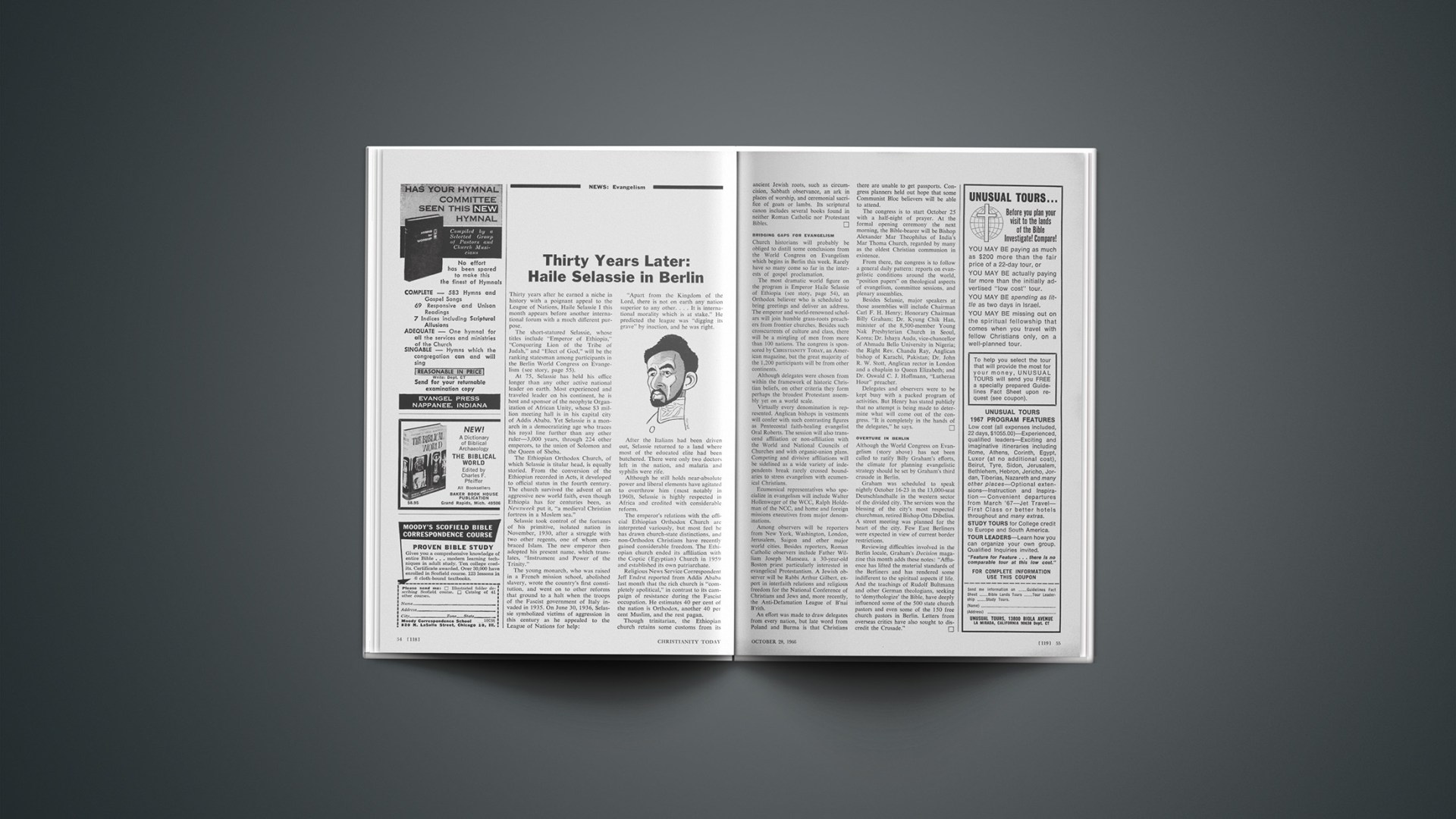
Thirty Years Later: Haile Selassie in Berlin

Thirty years after he earned a niche in history with a poignant appeal to the League of Nations, Haile Selassie I this month appears before another international forum with a much different purpose.

The short-statured Selassie, whose titles include “Emperor of Ethiopia,” “Conquering Lion of the Tribe of Judah,” and “Elect of God,” will be the ranking statesman among participants in the Berlin World Congress on Evangelism (see story, page 55).

At 75, Selassie has held his office longer than any other active national leader on earth. Most experienced and traveled leader on his continent, he is host and sponsor of the neophyte Organization of African Unity, whose $3 million meeting hall is in his capital city of Addis Ababa. Yet Selassie is a monarch in a democratizing age who traces his royal line further than any other ruler—3,000 years, through 224 other emperors, to the union of Solomon and the Queen of Sheba.

The Ethiopian Orthodox Church, of which Selassie is titular head, is equally storied. From the conversion of the Ethiopian recorded in Acts, it developed to official status in the fourth century. The church survived the advent of an aggressive new world faith, even though Ethiopia has for centuries been, as Newsweek put it, “a medieval Christian fortress in a Moslem sea.”

Selassie took control of the fortunes of his primitive, isolated nation in November, 1930, after a struggle with two other regents, one of whom embraced Islam. The new emperor then adopted his present name, which translates, “Instrument and Power of the Trinity.”

The young monarch, who was raised in a French mission school, abolished slavery, wrote the country’s first constitution, and went on to other reforms that ground to a halt when the troops of the Fascist government of Italy invaded in 1935. On June 30, 1936, Selassie symbolized victims of aggression in this century as he appealed to the League of Nations for help:

“Apart from the Kingdom of the Lord, there is not on earth any nation superior to any other.… It is international morality which is at stake.” He predicted the league was “digging its grave” by inaction, and he was right.

After the Italians had been driven out, Selassie returned to a land where most of the educated elite had been butchered. There were only two doctors left in the nation, and malaria and syphilis were rife.

Although he still holds near-absolute power and liberal elements have agitated to overthrow him (most notably in 1960), Selassie is highly respected in Africa and credited with considerable reform.

The emperor’s relations with the official Ethiopian Orthodox Church are interpreted variously, but most feel he has drawn church-state distinctions, and non-Orthodox Christians have recently gained considerable freedom. The Ethiopian church ended its affiliation with the Coptic (Egyptian) Church in 1959 and established its own patriarchate.

Religious News Service Correspondent Jeff Endrst reported from Addis Ababa last month that the rich church is “completely apolitical,” in contrast to its campaign of resistance during the Fascist occupation. He estimates 40 per cent of the nation is Orthodox, another 40 per cent Muslim, and the rest pagan.

Though trinitarian, the Ethiopian church retains some customs from its ancient Jewish roots, such as circumcision, Sabbath observance, an ark in places of worship, and ceremonial sacrifice of goats or lambs. Its scriptural canon includes several books found in neither Roman Catholic nor Protestant Bibles.

Bridging Gaps For Evangelism

Church historians will probably be obliged to distill some conclusions from the World Congress on Evangelism which begins in Berlin this week. Rarely have so many come so far in the interests of gospel proclamation.

The most dramatic world figure on the program is Emperor Haile Selassie of Ethiopia (see story, page 54), an Orthodox believer who is scheduled to bring greetings and deliver an address. The emperor and world-renowned scholars will join humble grass-roots preachers from frontier churches. Besides such crosscurrents of culture and class, there will be a mingling of men from more than 100 nations. The congress is sponsored by CHRISTIANITY TODAY, an American magazine, but the great majority of the 1,200 participants will be from other continents.

Although delegates were chosen from within the framework of historic Christian beliefs, on other criteria they form perhaps the broadest Protestant assembly yet on a world scale.

Virtually every denomination is represented. Anglican bishops in vestments will confer with such contrasting figures as Pentecostal faith-healing evangelist Oral Roberts. The session will also transcend affiliation or non-affiliation with the World and National Councils of Churches and with organic-union plans. Competing and divisive affiliations will be sidelined as a wide variety of independents break rarely crossed boundaries to stress evangelism with ecumenical Christians.

Ecumenical representatives who specialize in evangelism will include Walter Hollenweger of the WCC, Ralph Holdeman of the NCC, and home and foreign missions executives from major denominations.

Among observers will be reporters from New York, Washington, London, Jerusalem, Saigon and other major world cities. Besides reporters, Roman Catholic observers include Father William Joseph Manseau, a 30-year-old Boston priest particularly interested in evangelical Protestantism. A Jewish observer will be Rabbi Arthur Gilbert, expert in interfaith relations and religious freedom for the National Conference of Christians and Jews and, more recently, the Anti-Defamation League of B’nai B’rith.

An effort was made to draw delegates from every nation, but late word from Poland and Burma is that Christians there are unable to get passports. Congress planners held out hope that some Communist Bloc believers will be able to attend.

The congress is to start October 25 with a half-night of prayer. At the formal opening ceremony the next morning, the Bible-bearer will be Bishop Alexander Mar Theophilus of India’s Mar Thoma Church, regarded by many as the oldest Christian communion in existence.

From there, the congress is to follow a general daily pattern: reports on evangelistic conditions around the world, “position papers” on theological aspects of evangelism, committee sessions, and plenary assemblies.

Besides Selassie, major speakers at those assemblies will include Chairman Carl F. H. Henry; Honorary Chairman Billy Graham; Dr. Kyung Chik Han, minister of the 8,500-member Young Nak Presbyterian Church in Seoul, Korea; Dr. Ishaya Audu, vice-chancellor of Ahmadu Bello University in Nigeria; the Right Rev. Chandu Ray, Anglican bishop of Karachi, Pakistan; Dr. John R. W. Stott, Anglican rector in London and a chaplain to Queen Elizabeth; and Dr. Oswald C. J. Hoffmann, “Lutheran Hour” preacher.

Delegates and observers were to be kept busy with a packed program of activities. But Henry has stated publicly that no attempt is being made to determine what will come out of the congress. “It is completely in the hands of the delegates,” he says.

Overture In Berlin

Although the World Congress on Evangelism (story above) has not been called to ratify Billy Graham’s efforts, the climate for planning evangelistic strategy should be set by Graham’s third crusade in Berlin.

Graham was scheduled to speak nightly October 16–23 in the 13,000-seat Deutschlandhalle in the western sector of the divided city. The services won the blessing of the city’s most respected churchman, retired Bishop Otto Dibelius. A street meeting was planned for the heart of the city. Few East Berliners were expected in view of current border restrictions.

Reviewing difficulties involved in the Berlin locale, Graham’s Decision magazine this month adds these notes: “Affluence has lifted the material standards of the Berliners and has rendered some indifferent to the spiritual aspects if life. And the teachings of Rudolf Bultmann and other German theologians, seeking to ‘demythologize’ the Bible, have deeply influenced some of the 500 state church pastors and even some of the 150 free church pastors in Berlin. Letters from overseas critics have also sought to discredit the Crusade.”

Soviet Churches Survive in Historic Heartland

President Johnson made important overtures to the Soviet Union and its Eastern European satellites October 7, but the international thaw is complicated by such factors as Communist treatment of religion. After touring the Ukraine, heartland of Soviet Protestantism, News Editor David E. Kucharsky wired this report October 13:

From a park-like slope in Kiev, a floral portrait of Lenin glares at the Ukrainian Council of Ministers, housed in a nine-story building across the street. “That,” said a Communist guide to touring Americans this month, “is so they will not forget him.”

Frost will soon smite the begonias marking Lenin’s profile. But no one is likely to forget him, least of all the 125,000 Protestants in the Ukraine. On the eve of the fiftieth-anniversary year of the Soviet Revolution, they just manage to hold their own in the discouraging milieu of a political system hostile to religion.

Right now, spirits are buoyant following a rare four-day congress in Moscow this month of the All-Union Council of Evangelical Christians-Baptists (see following story). The meeting provided pastors from throughout the Soviet Union a chance for mutual encouragement and discussion of problems. The All-Union Council is said to embrace only 500,000 of the two million Protestants in the Soviet Union, but it is the only non-Orthodox religious organization with official stature.

Among the fifteen Soviet republics, the All-Union Council is strongest in the Ukraine. But even here its social impact is small. The once-dominant Orthodoxy has been reduced to a remnant. Two generations of Communism have left a largely religionless society.

This decline of religious activity is well known in the West. Not so widely reported is the relatively high tone of personal and social behavior in this secularized culture. Moral conduct is respected—and expected.

In Kiev, the Ukraine’s sprawling capital city with a population of more than one million, women and children walk safely at night through the many parks. Tourists are not subjected to propositions of prostitutes. Newsstands and bookstalls are free of pornography. Drunks are at least out of sight.

All this is in embarrassing contrast to the heyday of Orthodoxy, which was scarred by scandal and exploitation of the masses and little apparent manifestation of fruit of the spirit.

“At its first entrance in Russia,” wrote church historian Philip Schaff, “Christianity penetrated deeper into the life of the people than it did in any other country, without, however, bringing about a corresponding thorough moral transformation.”

Kiev, where the Dnieper River emerges from the forest and moves across rich Ukrainian grain fields, is the cradle of ancient Russian civilization. The Russian monk Nestor, a medieval historian, tells of mass baptisms in the Dnieper as priests read prayers from the palisades. The name of Kiev’s main street still means “to Christianize by baptism.”

Credit for the introduction of Christianity to the area called Kievan Rus in the tenth century goes to Prince Vladimir, whose statue, cross in hand, still graces a Dnieper overlook at Kiev. The rich religious heritage of Kiev is also recalled in picturesque Saint Sophia Cathedral, one of the oldest churches in the world, and the sprawling Kiev Perchersk Monastery, whose catacombs rival Rome’s. Saint Sophia is now a museum for ecclesiastical artifacts; since 1961, the monastery has also been for exhibition purposes only.

At the other end of the architectural scale are the Ukraine’s 1,037 Protestant churches, many of them converted dwellings. Most towns have one, though Kiev and Kharkov have three each. Kiev’s biggest draws about 300 persons—including those who stand at the back or peer through the windows from outside, as they often do because of the press of the crowd. When the congregation is not meeting, the church from the outside looks like just another house, painted in the popular terra cotta color with brown trim woodwork. Inside, the neatly kept sanctuary has a blue and white motif, with curtains at each window. There is no piano, but the church has an old-fashioned, American-made foot-pump organ with fifteen stops. Most of the congregation are old women wearing babushkas. Only a few teen-agers go to worship these days.

Among Protestants throughout the Soviet Union, there is such a demand for Bibles that tourists are besieged with requests. Christian visitors to the Soviet have taken to bringing in several Bibles per suitcase. Some have tried to smuggle in large quantities only to have them confiscated at the border.

Apparently sensing the demand for biblical literature, the Soviet government publishes occasional books about the Bible that come close to reproducing the text, along with discrediting commentary based on higher and form criticism (see Sept. 2 issue, page 56). The latest of these, called The Ancient Judaistic and Christian Myths, is due shortly.

Like Protestant churches everywhere, those in the Soviet Union are experiencing internal problems. Some laymen, apparently dismayed by the failure of pastors to assert themselves, took things in their own hands and ended up in jail. Grass-roots elements feel leaders of the Protestant clergy are not using all the latitude available under the Soviet constitution to push the government for more favorable treatment.

In a long Novosti Press Agency report last month, Vladimir A. Kuroyedov, chairman of the government’s Council on Religion, said dissidents who constitute one-twentieth of the Soviet Baptists have called Soviet religion laws Satanic and demanded repeal to allow unrestricted public preaching. The dissidents spread leaflets, tried to organize street protest marches in several cities, held public prayer meetings, and gave religious education to children (prohibited under current laws).

True to the Slav temperament, they got carried away with their brinkmanship. When they ignored warnings, Kuroyedov notes curtly, “a number of the leaders were prosecuted.”

Soviet Baptists Rap ‘Modernism’

This month’s thirty-ninth national convention of the All-Union Council of Evangelical Christians-Baptists in Moscow drew 705 delegates elected in sixty-three regional conferences across the Soviet Union. Information on the meeting was provided CHRISTIANITY TODAY by the U.S.S.R.’s Novosti Press Agency.

The council reaffirmed its basic beliefs, codified in 1913 by Ivan Kargel. The re-elected secretary-general of the council, Alexander Karev, said Soviet Baptists reject “modernistic” attempts by some Baptists in the West to replace faith in the deity of Jesus Christ by worshipping him merely as a divine man. Karev also noted that U.S.S.R. Baptists do not practice national or racial separation as U.S. Baptists do.

The council adopted a new charter which encompasses as full members the “Evangelical Christians,” “Fiftieth Day Evangelical Christians-Baptists,” and Mennonites, under union plans previously negotiated. Besides members of these groups, speakers included “Apostolic Christians” and members of the “Initiative Groups” or “Sponsors” which split from the council in 1961. The Soviet Baptists looked to the world ecumenical movement for “the rapprochement, not the merger, of churches.”

On closing day, October 8, the council called on all the world’s Christians to pray to the “Prince of Peace” for an end to the Viet Nam war, and added:

“We address the U. S. government as well as the governments of all other countries whose troops are in Viet Nam. In the name of Christian love, cease fire in Viet Nam, withdraw troops from that country, and give the people of Viet Nam the opportunity of deciding their internal affairs by themselves.”

No Hush For Harold Wilson

A generation has grown up in England that knows nothing of A. A. Milne and his sense of the sacred. “Hush, hush, whisper who dares—Christopher Robin is saying his prayers” is apparently no longer an English attitude, as England’s Prime Minister discovered during a church service in Brighton this month. The service in Dorset Gardens Methodist Church had begun sedately enough, and most of the 1,000 persons attending were unaware that among them sat some thirty representatives of the Viet Nam Action Group and the Campaign for Nuclear Disarmament. Present also were Prime Minister Harold Wilson, Foreign Secretary George Brown, and other senior ministers, in town for the Labour Party Conference.

It was Wilson the infiltrators were gunning for, but an unhappily chosen Old Testament lesson goaded one of them into premature action. As Mr. Brown concluded his reading from Micah, about nation not lifting up sword against nation, a young man shouted, “Hypocrite!” He was ejected. His colleagues, one account has it, sneered. The congregation sang “Father, Let Thy Kingdom Come,” and Mr. Wilson went forward to read from the New Testament—another unfortunate passage, under the circumstances, this time from Matthew 7, including the words: “Wherefore by their fruits ye shall know them.”

He did not get far. Interruptions came from all sections of the congregation. “Wilson for ex-Prime Minister!” shouted one girl. A man called: “How dare you use the House of God for your political ambitions, you hypocrite!” Scattered parts of the church took up the chant of “Hypocrite! Hypocrite!”

After several unsuccessful attempts at continuing the reading, Mr. Wilson went back to his seat in a front pew. White-helmeted policemen who had been on duty outside the church entered and removed the demonstrators, who resisted noisily. Host minister Leslie Newman later said, “In the forty years of my ministry, I have never witnessed anything like it, and I cannot imagine that it will reflect any credit on those who took part in it.”

It was reported later that four women and five men would face charges of obstructing the police and unruly behaviour in church.

T. D. LENTON

Looking Back At Geneva

The chairman of the World Council of Churches’ summer Conference on Church and Society (Aug. 19 issue, page 42), is in America for a year of follow-up meetings, between teaching chores at Union Theological Seminary in New York.

At the first such meeting, in the nation’s capital this month, the Rev. M. M. Thomas, who directs South India’s Christian Institute for the Study of Church and Society, said the Church’s major responsibility at present is not evangelism, but framing questions about human personality and existence in an age of social and technological revolution.

“M. M.,” as the slight, witty, middle-aged scholar is called within the ingroup, drew sizable crowds and talked with the quiet ease and eloquence usually reserved for men with a passionate belief that they have made history.

During the mostly-secular discussions, Thomas stated the theological basis for social action as “the common humanity of all men in creation and redemption. If you deny this, you are lost.”

O. WILSON OKITE

Texas Tilt: Nuns In School

Two Benedictine nuns are in the middle of a legal battle in Boerne, Texas (population 2,200), because they wear religious habits as they teach in the public school.

In a crowded courtroom October 7, District Judge Charles Sherril, Jr., took under advisement a petition complaining about the practice. He will set a hearing date after lawyers file briefs, and a long hassle is expected.

The furor erupted when the Rev. George McWilliams of Boerne’s First Baptist Church protested the “silent, yet striking and unmistakable teaching of sectarian religion in the wearing of the religious symbolic garb.” Aided by a Church of Christ minister and two retired Army officers, McWilliams and his two lawyers seek permission to ask the nuns in court if the garb is peculiar to the Roman Catholic Church, if they are wholly religious persons, and if they have taken oaths of obedience to poverty.

San Antonio lawyer Pat Maloney, representing the nuns, says, “We feel the constitutional right of freedom of religion is involved.” He thinks complaints are aimed not at the garb but at the Roman Catholic Church. Through Maloney, the nuns filed a statement arguing that state law forbids schools to ask prospective teachers about their religion.

The town school board had hired the nuns despite opposition, citing a shortage of qualified teachers.

McWilliams said many friendships had cooled in Boerne, although both Catholics and Protestants have “tried to hold down prejudice.”

MARQUITA BOX

Pointers From Hunters Point

Moved by the worst racial riots in San Francisco history, Bay Area churches are pondering as never before their role in the face of increasingly severe urban problems.

The violence was triggered by a sixteen-year-old Sunday school dropout’s death at the hands of a policeman September 27. The boy, Matthew Johnson, was one of several youths who bolted from a stolen car when a patrolman approached the run-down Hunters Point public-housing district. The officer spotted the fleeing teen-ager, ordered him to stop, fired three warning shots over his head, then felled him with another.

Bitterness over the shooting was the first reaction among Negroes, even ministers. They demanded that a civilian review board be established; some angrily insisted that the officer be charged with murder.

Visibly distressed, the patrolman (also named Johnson), father of four, told reporters, “I didn’t want to kill that boy. If only he had stopped when I told him …”

As rage gave way to reason, the local chapter of the National Association of Evangelicals scheduled a meeting this month with Negro pastors. The purpose: “to explore how evangelicals can work together to assist churches on location toward a more effective ministry among the unemployed and uneducated.”

Bi-racial groups of pastors ventured into the strife-torn areas day and night “to offer counsel and plead for peace.”

Baptist Victor Medearis, a leading pastor in the Hunters Point area, offered his perspective: “This was not really a race riot. The rioters were mostly unemployed young adults and frustrated teen-agers. Tensions run high always, and rumbles occur often, usually with invading gangs from the Fillmore (another Negro district). Our church people deplore what has happened, and they are as afraid as anyone else when violence breaks out. We need to do something as churches to get these kids off the streets.”

The monthly meeting of the Economic Opportunity Council, the city’s anti-poverty organization, fell on the second night of rioting. During a heated exchange, EOC’s public-relations officer, Raphael Taliaferro, scored Roman Catholic and Council of Churches representatives on three counts: failure to help lobby for more federal funds for the unemployed, failure to interpret effectively the EOC program to parishioners and thus involve their support, and failure to approve plans for activist projects. This neglect, he declared, was responsible for the outburst.

Major interfaith officials later met and vowed to carry the call for wider church social involvement to their congregations.

In an interview, Taliaferro laid much of the blame for “the social mess” upon Negro churches, especially Baptists (“they represent half of this city’s 80,000 Negroes”). He is himself a member and the music director of the city’s largest Negro church, the 5,000-member Third Baptist Church.

He spoke of the lack of an educated ministry, of storefront fly-by-night operators, of irrelevant and excessively emotional sermons that fail to appeal to intellect or will, of the small number of teen-agers and young adults active in churches, and of failure to use facilities efficiently. (Third Baptist, in the heart of the Fillmore district, has one of the best gymnasium buildings in the city; it stands unused much of the time).

The civic leader outlined a three-point educational program aimed at changing “basic Negro values.” He hoped churches would act soon to:

1. Sponsor remedial and adult education classes (“for example, churches can teach neighborhood residents how to read, write, and speak correct English”);

2. promote cultural development;

3. (“most important”) provide family-life education and counseling services (“the prevailing concept of ‘family’ among Negroes must be drastically changed; the church is in the key position to do this”).

“We are generations late,” commented one Negro clergyman. “We need to move into these areas of need, and now.”

Another minister, white, seemed to summarize the newly aroused concern of many Bay Area Christians when he said, “We all, really, had a hand in that boy’s death and in the violent venting of hostility that followed.”

The product of a broken home, Matthew Johnson lived in Hunters Point sometimes with relatives, sometimes with his father and stepmother. With the latter, members of the Evergreen Baptist Church, he attended Sunday School and services “regularly” until two years ago, according to the Rev. R. Johnson, pastor. At that time he went to Louisiana to live with his mother for one year. On his return he only “rarely” visited church; occasionally he attended mass with Roman Catholic friends. His pastor and Sunday school teacher can recall only that he was “a quiet boy.”

In a gardening job under the city’s anti-poverty program during summer months, he was rated by his supervisor as a “very good and dependable worker” who was “neat in appearance” and “obeyed all orders.”

But when, because of family moves, he was transferred to another high school at the beginning of the fall term, he refused to cooperate. He became a neighborhood drifter with other truants and unemployed older youths. His last day of life was in their company.

It took 1,000 police and 2,000 National Guard troops to quell the violence and destruction of property that erupted in the wake of his death. Ironically, the rioting brought a curfew that forced cancellation of revival services at Evergreen Baptist.

In a shocking footnote this month, Rev. Johnson said in his funeral sermon for the youth that if he were a policeman, he wouldn’t arrest children, but “parents who have not lived up to their responsibilities.” Matthew Johnson’s mother walked out.

EDWARD E. PLOWMAN

Book Briefs: October 28, 1966

Spurring Christians To Action

Help! I’m a Layman, by Kenneth Chafin (Word, 1966, 131 pp., $3.50); How to Give Away Your Faith, by Paul E. Little (Inter-Varsity, 1966, 131 pp., $3.50); and The Christian Persuader, by Leighton Ford (Harper & Row, 1966, 159 pp., $3.95), are reviewed by Robert L. Cleath, editorial assistant,CHRISTIANITY TODAY.

Three new books dedicated to the proposition that all Christians are equally responsible for bringing the truth of Jesus Christ to the world just may have what it takes to spur ministers and laymen to vital evangelistic action. Although they write from different perspectives, Chafin, Little, and Ford all appeal to every believer to come out of his shell and witness effectively for Christ in every area of life. Showing a keen understanding of our time, these men advance a Christ-centered, Bible-based, man-related, and socially sensitive approach to evangelism that could, under God, alter the course of human events.

Kenneth Chafin is that rare seminary professor with the common touch that enables him to communicate effectively with laymen. Calling for “a new layman for a new age,” he stresses that the laity must use enlightened imagination to make Christ known in new ways—outside the church house, before student audiences, through community-service projects, by means of mass media, in witness to special groups, and with inspired use of the arts. Personal evangelism is underscored as the most important type of witness. Chafin wisely rejects the use of set techniques for manipulating people and advises laymen to follow Jesus’ pattern of dealing with people. Such witnessing takes place in the normal course of life, shows respect for personality, and uses flexible methods appropriate to the occasion.

At times Chafin’s book lacks originality, as he re-echoes themes that have been bouncing around American seminaries in recent months—Christianity vs. “folk religion,” the church in the secular city, the “creative tensions” of the Christian life, and the need for a “space age church” (whatever that is). Yet his sound ideas and his strong desire to inspire and equip believers for service to Christ and the world make this book valuable for the many laymen who need help in their Christian life and witness.

Paul Little’s book leaves few doubts of his skill at adapting the Gospel to intellectually oriented persons. His concepts of Christian witnessing, gained from years of experience as director of evangelism for the Inter-Varsity Christian Fellowship, make this the most practical book on personal evangelism written in many years. It provides foundations, methods, and motivation for winning men to Christ.

Little shares Chafin’s disdain for mechanical procedures of witnessing but sets forth seven principles for action derived from Jesus’ conversation with the Samaritan woman. He also dares to suggest how to handle ticklish social situations, such as saying grace before a meal in public, when diversionary tactics (“Shall we scratch our eyebrows?”) are often employed.

His best chapters are those on the basic facts of the Gospel, the most frequently asked questions and how to answer them, and the major needs of life that Jesus Christ satisfies. His consideration of worldliness is valid but somewhat out of place in this context, and might well have been omitted. Little concludes his 130-page volume by stressing the indispensability of faith and inner spiritual reality for effective witness in a pagan world.

As an associate evangelist with Billy Graham and the leader of many crusades in Canada, Leighton Ford discusses evangelism from a broader vantage point than the two previous authors. He implores believers to recover the urgency for evangelism and not be stifled by deadening influences of universalism, mechanical ecclesiasticism, distorted Calvinism, or a cold, eccentric evangelicalism. Evangelism must be a passion before it is a program. It must focus on Jesus Christ and be founded on biblical theology.

Writing in a style characteristic of Graham’s preaching—a lucid outline supported by abundant biblical references and pertinent illustrations—Ford highlights the need for a total strategy for evangelism. This strategy will have as its goal, the penetration of the whole world; as its agents, the whole Church; and as its tactics, every legitimate method. While Christians must not change their message, they must not refuse to change their methods. Ford cites Peter’s sermon on the Day of Pentecost to show the context and content of the evangelistic message. The hallmarks of this sermon should characterize the evangelistic witness of today: it appealed to Scripture, centered in Christ, brought conviction of sin, and called for immediate and definite response. Ford also effectively refutes criticisms of mass evangelism. Finally, he shows how Christian conversion has a profound effect on both the individual life and society.

Ford is persuasive, not only because he writes with confidence and passion, but also because he is an able theologian who shows deep knowledge of the Bible, an awareness of contemporary theology, and an acute grasp of the demands of our day. He is a far cry from obscurantist evangelists of previous generations.

The books of Ford, Little, and Chafin should be read by every Christian at this critical hour when the Church must boldly assume its evangelistic responsibilities or watch the rapid erosion of Christian faith in the world. All three convey the urgent concern and honest realism the Church needs if it is to carry out its supreme task of world evangelization.

ROBERT L. CLEATH

No Water-Tight Compartments

Issues in Science and Religion, by Ian G. Barbour (Prentice-Hall, 1966, 470 pp., $7.95), is reviewed by Gordon H. Clark, professor of philosophy, Butler University, Indianapolis, Indiana.

Ian G. Barbour, with a doctorate in physics from the University of Chicago and a B.D. from Yale, currently chairman of the Department of Religion and professor of physics at Carleton College, addresses himself to relating a specific philosophy of science to a specific type of religion.

Science and religion, he holds, cannot be separated into water-tight compartments because there is a single world of which they are both parts. One world requires an integrated, coherent worldview. God is the God of the physical world also, not merely of inner experience; therefore metaphysics cannot be avoided, although religion should not be tied too closely to the details of a metaphysical system.

Through chapters two to five Dr. Barbour surveys the development of European civilization from the seventeenth to the twentieth century. As might be expected from his academic preparation, he writes a very clear and competent account. Yet I would question his assigning the concept of mass to Galileo; and his liberal theology leads him to the blunder (honestly retracted by Emil Brunner in his later writings) that Luther and Calvin were “somewhat flexible in biblical interpretation. For the locus of authority was not the verbal text itself” (p. 29).

From the survey of science the author comes to the position of critical realism. The aim of science is understanding rather than prediction. He defends the use of models against Duhem and others, though he seems to undermine his argument by warning that models are not to be understood literally as visible, mechanical models. (Surely Lord Kelvin would have been puzzled by this qualification.) Against operationalism he argues that scientists discuss “evidence for and against the validity of a theory, not just for or against its use” (p. 166).

For those of us who incline toward operationalism these arguments are unsatisfactory (“Atoms are as real as tables,” p. 169); and the problem of the relation of religion to realistic science does not arise.

Neither does the author’s precise problem arise for those who do not share his religion. Barbour seems to be a sort of sociological Schleiermacher. Quoting Whitehead with approval—“the dogmas of religion are the attempts to formulate in precise terms the truths disclosed in the religious experience of mankind”—he asserts that “theology … interprets the experience of the worshipping community” (p. 210). “It was through response to events in history, not to theological principles [italics mine], that the community came into being” (p. 215).

To the reviewer this appears as a false disjunction, with the essential half denied. People can react to historical events in divergent ways. Some people rejoice at an event, some bemoan it. Those who individually adopt a particular interpretation may then form a community. The theological (or other) principles come first; the community, those who have these principles in common, comes second.

Part Three discusses indeterminacy, life and mind, evolution and creation, and God and nature. The problems are important, and the author’s discussion is keen, rather more difficult than the earlier section on physics. After all, biology is considerably more complicated than physics.

Two related limitations, however, remain: He is interested in only one view of science and one view of religion, and this produces certain liberal blind spots. Let the author believe, if he wishes, that “the doctrine of creation is not really about temporal beginnings” (p. 368); but surely he cannot properly represent this view as biblical. Similarly, how can a person who reads say “creation out of nothing is not a biblical concept.… At the opening of the Genesis story there is a primeval sea, a background of darkness and chaos” (p. 384)? The author must have been reading Hesiod by mistake.

Declaring that “foreordination is not compatible with the existence of open alternatives [to which proposition the reviewer agrees] … Man is free to reject God’s purposes.… Not all that happens is God’s will [a proposition which the reviewer and the Bible reject] (p. 457), Barbour stresses God’s immanence in natural processes, processes that are open and spontaneous because organismic. Nature is indeterminate; there are levels. “A metaphysics of levels [is] more consonant with ‘critical realism’ ” (p. 455).

On the whole, from a religious point of view, it is hard to see any great difference between this critical realism and the Hegelian immanentism that Barth so vigorously exploded. And one suspects that the undefined terms “organismic” and “levels” hide rather than solve some very old philosophic difficulties.

GORDON H. CLARK

Reading for Perspective

CHRISTIANITY TODAY’S REVIEW EDITORS CALL ATTENTION TO THESE NEW TITLES:

Jesus of Nazareth: Saviour and Lord, edited by Carl F. H. Henry (Eerdmans $5.95). Sixteen evangelical scholars enter the current christological debate to assess the failure of Barthian and Bultmannian perspectives, and to present the case for the historical basis of biblical Christology.

How to Give Away Your Faith, by Paul E. Little (Inter-Varsity, $3.50). A down-to-earth book on witnessing by an Inter-Varsity Christian Fellowship leader who draws from his experience in ministering to college students and presents a biblically sound approach to personal evangelism.

Unger’s Bible Handbook, by Merrill F. Unger (Moody, $4.95). A treasury of biblical data—commentary, historical backgrounds, textual criticism, maps, charts, and outlines—that will aid every student of Scripture.

Three Major Issues

Concilium, Volume 15: War, Poverty, Freedom, edited by Franz Böckle (Paulist, 1966, 163 pp., $4.50), is reviewed by Edmund A. Opitz, staff member of The Foundation for Economic Education, and coordinator, The Remnant, Irvington-on-Hudson, New York.

A substantial publishing effort has followed in the wake of Vatican II. War, Poverty, Freedom is Volume 15 in a series designed to explore the many facets of a resurgent theology in the Age of Renewal. It opens with a brilliant short commentary by John Courtney Murray on the document, “The Declaration on Religious Freedom.” Fr. Murray here returns to some of the issues he treated at greater length in his little book, The Problem of Religious Freedom. Christian freedom is a gift of the Holy Spirit; it is to be asserted over against all earthly powers and also within the Church. The medieval doctrine of a monolithic sacred society has been outgrown and has been replaced by a “rightful secularity of society and State, as against the ancient sacral conceptions” (p. 9).

The parallel essay, which voices the Protestant position on freedom and tolerance, is by Roland Bainton, and is more hortatory than analytical. Professor Bainton believes in state neutrality toward all religious groups, arguing that “constraint of sincere conviction is incompatible with the mind of Christ” (p. 18). His conclusion is quite unexceptional, that “the principle of religious liberty calls for a spirit of moderation, respect and persuasion rather than coercion” (p. 29).

Everyone expects and tolerates a certain unevenness in both treatment and expertise in a symposium, and indeed the third and fourth papers stand in marked contrast to the first two. A Dutch Redemptorist teaching in Brazil writes of the Third World—those peoples who are neither of the West nor of the Russia-China-Cuba axis—putting his stress on Latin America. He calls for revolution in this sector, that is, “the building of a new order” (p. 35), and does not “exclude a priori the legitimate of temporary recourse to illegality and violence” (p. 42).

The yoke to be thrown off is a thing Fr. Snoek mislabels “liberal capitalism”; this is the villain “most to blame for the profound social irregularities of the present time” (p. 44). Fr. Snoek fails to realize that capitalism, in the Adam Smith sense of limited government and the free market, never secured a toehold in South America; cartelization was there from the beginning. A cartel is an arrangement between selected purveyors of commodities and a government that guarantees them a monopoly by excluding or limiting competition. It is akin to the mercantilism of a former day and is the antithesis of liberal capitalism. Today’s collectivist movements represent little more than cartelization carried to a bitter conclusion.

Fr. Snoek rightfully deplores the lot of the masses in Latin America, but when he tries to diagnose the causes of their misery he is mistaken. His remedy, in consequence, would only aggravate the disease. Parenthetically, must we not also in good conscience deplore the fate of the victims of Communist aggression—the millions who barely survive and the millions who have perished? Ecclesiastical concern for these people is muted, to say the least.

The famed French Dominican, Yves Congar, writes of “Poverty in Christian Life,” and the first half of his paper is a fine piece of exposition. But when he comes to the contemporary war on poverty, another Fr. Congar seems to take over. He claims that non-Communist countries are in the grip of an “economic system which, by itself, works for the increasing enrichment of the rich and the increasing impoverishment of the poor” (p. 65). Not so in Russia, for “it is an established fact that communism has set up, on the level of whole populations, a social system almost wholly free from the motives of personal profit and the pursuit of money” (p. 66). A ritual demurrer is inserted, acknowledging “grave denials of liberty and dignity,” but the alleged Communist hostility to religion is discounted. Christianity is a revolutionary thing, and the Communists are wrong in regarding it as merely a prop to an exploitive economic order.

In every system of privilege—the ancient regime, an interventionist economy, modern collectivism—a man’s economic status reflects his place in the power structure: wealth is a function of rule rather than a consequence of pleasing consumers. In a market economy, by contrast, the masses are the customers whose purchases have made many people well to do. It is mass consumption that makes mass production possible; to assert that the rich profit from the poverty of the poor, as does Fr. Congar, is to assert that sellers benefit from consumers who are too poor to buy!

After two papers of passing interest, the final fourth of the book is taken up by three bibliographical surveys of pacifism—in England, in Holland and France, and in Germany. Continental literature on peace and war is not readily accessible to the American reader, and the latter two summaries seem reasonably impartial.

Not so, however, the survey of English writings on pacifism. The author believes that “war is an issue which radically and communally is the test of whether Christianity is truly relevant or not … a matter of whether Christ himself is genuinely significant for this world or not” (p. 115). Thus, this survey appears to be one-sided, and a book like Ramsey’s War and the Christian Conscience, which does grapple seriously with the issues of war and peace but which does not come up with an all-out pacifist answer, is brushed aside with a slighting reference.

EDMUND A. OPITZ

The Need For Firearms Control

The Right to Bear Arms, by Carl Bakal (McGraw-Hill, 1966, 392 pp., $6.95), is reviewed by David O. Moberg, professor of sociology and chairman, Department of Social Sciences, Bethel College, St. Paul, Minnesota.

The daily average of gunfire killings by homicide, suicide, and accidents in the United States is about fifty, and the total each year is over 17,000. Over 750,000 such deaths have occurred since 1900. (By comparison, battlefield casualties in all wars of our nation from 1775 through 1965 totaled only 529,460, and 1,365 Americans died in combat in Viet Nam in 1965.) In addition, untold millions have been wounded.

When brutal slayings were reported in the news on December 2, 1958, the author, a magazine writer with military background, began a file that grew to 10,000 clippings of such items as “Boy, 1½, Shot Accidentally by Babysitter” and “Ex-Mind Patient Slays Four Sons, Husband and Self.” The actual or attempted assassination of seven presidents and frequent spectacular murders have helped to focus popular attention on this problem.

My first impression of this book with its red dust jacket and propagandistic tone was that it should be discounted as sensational yellow journalism. However, although it does plead a cause, it does so with a wholesome realism that shows Mr. Bakal is not an irresponsible single-cause reformer: “No law … is completely effective, but all the evidence, both from this country and abroad, indicates that licensing or registration requirements will reduce homicide, and cut other crimes as well as accidental tragedies and suicide, by making it more difficult for unscrupulous and irresponsible people to get guns” (p. 271). The book is an excellent, though popularized, case study of propaganda, lobbying, and social problems in our democratic society.

The carnage from gunfire has led to attempts to control the problem by law. With rare exceptions, chiefly of bills that were emasculated before passage, the firearms interests have successfully blocked such legislation. Despite the tremendous increase in population, the strengthening of law-enforcement agencies, and the fact that firearms are no longer a major means for obtaining food, “our firearm laws in most areas of the country are scarcely more stringent than they were in the frontier days. No other lobby can claim such a record in its particular sphere of interest” (p. 129).

In most states weapons may be purchased by children, criminals, the mentally ill, people seething with angry passion, the visually handicapped, and others with shocking ease and without adequate registration of the buyer’s identity, the gun’s serial number, and other information that would help law-enforcement officials control abuses of the right to bear arms.

The firearms lobby of conservation clubs, wildlife federations, ammunition and firearms manufacturers, and other organizations is headed by the National Rifle Association (NRA) with 700,000 registered members. Bakal describes in detail the tactics it has used since its founding in 1871. Though subsidized with federal funds and not registered as a lobby, the NRA centers many of its activities around serving as the “guardian and bulwark against the forces of anti-gun sentiment in the United States” and “lobbying against virtually all legislation that would in any way restrict in the slightest the sale and use of firearms” (p. 133).

Analysis of NRA tactics reveals specious logic, hypocrisy, and a sorry case of deceitful and unethical practices. Statements from the FBI and other sources are twisted by quoting out of context. For instance, the NRA makes it appear that criminologist M. E. Wolfgang opposes legal controls on firearms; but in fact he favors very restrictive legislation. Statistics are distorted to present a misleading picture of the relative scope of firearms deaths and other accidents. The lie that Hitler used firearms registration lists to disarm and conquer Europe and other lies are panned off as fact. Switzerland, “the nation of riflemen,” is applauded by the NRA as having “the lowest crime rate in Europe”; but investigation shows that eight European nations have lower rates of homicide, two have the same, and only six have higher rates. (Only four have higher suicide rates, and, aside from France, Switzerland has the highest rate of accidental deaths due to firearms.)

Although 78 per cent of the population favored requiring a police permit for the purchase of a gun, it was impossible to get Senator Dodd’s 1963 bill to control mail-order firearms out of committee. His 1965 bill was greatly distorted in a letter sent by the NRA to all its members. Requests that a new mailing be sent to correct mistakes were unheeded, and distortions were repeated in subsequent publications of the firearms lobby. Letters based on these misinterpretations descended by the tens of thousands upon congressmen, and the bill was quietly buried.

The NRA and other firearms interests have falsely claimed that bills to control firearms are part of a Communist conspiracy to disarm and conquer America, are supported by armed criminals, and violate the citizen’s constitutional right to bear arms. Bakal indicates clearly that none of these charges is justifiable. Article II of the Bill of Rights states, “A well-regulated militia being necessary to the security of a free state, the right of the people to keep and bear arms shall not be infringed.” It is a favorite among firearms fanciers, but they do not quote the first part. The right to bear arms is contingent upon the maintenance of a militia; is granted to “the people,” not individual persons; protects against a central tyranny by allowing for state militia; pertains to “bearing arms” for military or police purposes, not to “carrying weapons”; and in no way prevents the control of firearms by federal powers to regulate commerce, to tax, and to specify what arms are to be used by the militia.

Bakal’s book is not a flawless exposé, but the errors are few and unimportant in regard to his basic message.

In 1966 as in previous years the chances of new federal legislation to control firearms are very slim, although Senator Dodd’s bill as amended by the Juvenile Delinquency Subcommittee still awaits action. Legislative lethargy reflects public apathy. As long as the NRA, weapons dealers, and manufacturers of firearms and ammunition drown out the voices of the law-enforcement officials who speak for realistic controls, the tragedy of lives needlessly taken by firearms will continue.

This book poses significant moral questions. What is the price of a human life? How much of our freedom to bear arms are we willing to give up in order to prevent the death annually of an estimated 10,000 persons whose lives would be saved by adequate firearms controls? Do we care enough to express our concern as good citizens in political channels that will offset the organized pressure of the gun lobby?

DAVID O. MOBERG

Playing It Straight

Courtier to the Crowd: The Story of Ivy Lee and the Development of Public Relations, by Ray Eldon Hiebert (Iowa State University, 1966, 351 pp. $6.95), is reviewed by David E. Kucharsky, news editor,CHRISTIANITY TODAY.

The late Ivy Ledbetter Lee was the father of modern public relations, now a two-billion-dollar-a-year industry. His impact upon the Church may not be accurately gauged until many more years have passed, but of the basic fact of that impact there should be no dispute. The documentation is in this first biography of Lee, written by Dr. Ray Eldon Hiebert, head of the new Washington Journalism Center and chairman of the journalism department at American University.

Lee, the Georgia-born son of a Methodist minister, did not set out to influence the Church as such. The influence he had was mostly a by-product of his role in society as a whole. Before he died at the age of fifty-six, Lee had won the ear of an amazing number of the world’s most famous people, from Carnegie and Rockefeller to Hitler and Mussolini, to every president from Cleveland to Franklin Roosevelt. Basically he tried to persuade such men—with some success—that they should play it straight with the public.

The people of a democracy are able to make sound judgments, Lee would say, but only if they have access to the necessary information. A good press, on the other hand, is obtained not by bribing reporters with passes but by providing them with the information they need to write their stories and perform their jobs.

The most conspicuously religious aspect of Lee’s influence was his making twentieth-century Protestant liberal thought more palatable to the masses. On a broader scale, he made the whole Church more aware of the mass-media potential and the means by which it could be tapped.

Lee was the man most responsible for the fame of Harry Emerson Fosdick. He got the idea of circulating Fosdick’s sermons widely among top American opinion-makers, something that at that time few preachers had thought of doing. Lee wanted Rockefeller to underwrite the sermon distribution; and when to avoid controversy the mogul deferred, Lee did it himself.

Lee also directed publicity of a group that championed the syncretistic Re-Thinking Missions by W. E. Hocking, and Heibert concludes that the effort had much to do with the success of the group. In addition, Lee used his offices to aid the fund-raising for the Cathedral of St. John the Divine in New York and the Riverside Memorial Church, where Fosdick ultimately landed after having to leave the Old First Presbyterian Church during the fundamentalist-modernist controversy.

The extent of Hiebert’s research on Lee is impressive. The material is arranged well and plainly presented. Here and there Hiebert strains a bit to uphold Lee against criticism; but he does ascribe to his subject “a tragic flaw, perhaps,” namely, Lee’s “wholehearted acceptance of the traditional democratic belief in the innate goodness of man and the American virtues of working hard, thinking shrewdly, and rising to the top.”

Lee tried to stretch his great optimism and penchant for conciliation even to the forces of Hitler in the early thirties. Though absolved by the House Un-American Activities Committee, he suffered a smear in putting too much faith in the German people.

Nonetheless, by the time of his death in 1934, Lee had made an indelible impression on society. Indeed, says Heibert, “much of the public relations field has not yet caught up with Ivy Lee,” for “much that parades under the title of public relations today is nineteenth century press agentry in bankers’ clothing.”

In recent decades religious institutions, taking their cue from the rise of public relations in government and business, have come a long way toward better rapport with the secular media. There persists, however, a claim to privacy that is unbecoming the Church. Practitioners of church public relations favor for the most part more candor. Ecclesiastical officialdom is more comfortable making decisions behind doors marked, “Closed to the Press.”

DAVID E. KUCHARSKY

Doors Off Their Hinges

African Diary, by Wayne Dehoney (Broadman, 1966, 157 pp., $3.50), is reviewed by George A. Dunger, professor of missions, North American Baptist Seminary, Sioux Falls, South Dakota.

Mr. Dehoney has done a fine job of writing his African diary. And by doing so he has performed a valuable service for everyone interested in that continent, especially those concerned with the African and with missions.

African Diary covers a large geographical area and gives intimate glimpses of large population centers as well as the hamlets by the wayside, the church, the school, the hospital. Dehoney writes of such places as Nairobi, Kenya; Kampala, Uganda; South Africa; the Congo; Lagos, Nigeria; Accra, Ghana; and Monrovia, Liberia. Occasionally the history of the land and the people, the economy and culture, spring to life and make reading the diary a realistic experience for the reader.

The book is a diary in the real sense. It reveals the things done and seen by the author—and they are exciting enough! It comes alive when, in conversation with the East African pastor or the President of Liberia, the author reveals himself as a Christian who cares, or, elsewhere, when he rather innocently speaks of “jiggers, little worms that lodge themselves under the toenail of barefoot children, laying and hatching out other worms.”

This diary is readable, realistic, informative, and stimulating. Contemporary Africa comes to life with intimacy and warmth of heart—the kind that reflects the love of the Christ who cares. The book makes one want to go to Africa, to be friends and fellow workers with God and the African—for the advancement of the African and for the glory of God.

The author reveals that he has caught one of the most significant facts of Africa when he says, “… the doors in Africa are not only open, they are off their hinges!” Cultural changes, racism, Communism, neo-colonialism, missions, paganism, Islam, poverty, and great intellectual and spiritual hunger—these challenge the Church to enter with the transforming power of the Gospel of Jesus Christ. African Diary is a renewed call to missions in a continent in need.

GEORGE A. DUNGER

Book Briefs

Luther’s Works, Volume 8: Lectures on Genesis Chapters 45–50, translated by Paul D. Pahl (Concordia, 1966, 360 pp., $6). Luther’s faith and scholarship shine brightly in this readable translation, the eighth volume in a series of fifty-five.

Law and Conscience, by Franz Böckle, translated by M. James Donnelly (Sheed & Ward, 1966, 139 pp., $3.75). A comparison of Roman Catholic and Protestant views on law and gospel, natural law, and ethics, by a Catholic professor.

Life in the Spirit: Christian Holiness in Doctrine, Experience, and Life, by Richard S. Taylor (Beacon Hill, 1966, 221 pp., $2.50). A plea for personal holiness based on inward affinity and outward conformity to the will of God.

What’s Best for Your Child—and You, by David Goodman (Association, 1966, 192 pp., $3.95). Practical, warm-hearted wisdom on discipline, adolescence, schooling, morality, family tensions, and other matters of parent-child relationships.

Invitation to the Old Testament, by Jacob M. Myers (Doubleday, 1966, 252 pp., $4.95). A non-technical discussion for the serious Bible student.

Concilium, Volume 16: Is God Dead?, edited by Johannes Metz (Paulist Press, 1966, 181 pp., $4.50). Roman Catholic and Protestant authors tackle the task of justifying faith in the face of contemporary atheism.

A Classified Bibliography of Literature on the Acts of the Apostles, compiled by A. J. Mattill, Jr., and Mary Bedford Mattill (E. J. Brill, 1966, 514 pp., 44 guilders).

Living Creatively, by Edmund G. Kaufman (Faith and Life Press, 1966, 169 pp., $2.95). Essays of a long-time college president who wrote with an eye on students.

The Lively Function of the Gospel, edited by Robert Bertram (Concordia, 1966, 197 pp., $5). Essays in honor of Richard R. Caemmerer on his completion of twenty-five years as professor of practical theology at Concordia Seminary, St. Louis.

The Lord Is My Council: A Businessman’s Personal Experiences with the Bible, by Marion E. Wade, with Glenn D. Kittler (Prentice-Hall, 1966, 178 pp., $3.95). The founder of a multi-million-dollar business tells how biblical principles have guided his life. Dr. Norman Vincent Peale will enjoy this.

Foundations of a New Humanism, 1280–1440, by Georges Duby (World, 1966, 222 pp., $21.50). The story of the art of the fourteenth century as it moved from religious control to secular freedom. With its handsome reproductions of classic art, this volume is itself a thing of beauty.

Paperbacks

Devotions and Prayers of Richard Baxter, compiled and edited by Leonard T. Grant (Baker, 1964, 119 pp., $1). Classic devotions for all adult Christians.

Israel: A History of the Jewish People, by Rufus Learsi (World, 1966, 715 pp., $3.45). A Jewish author writes of the faith, land, and people of Israel from Abraham to the present and claims that the accounts of Jesus’ death “strain ordinary credulity to the breaking point.”

Christ and the New Nations, by Martin Jarrett-Kerr, C.R. (Morehouse-Barlow, 1966, 120 pp., $1.95). A Britisher argues for Christian involvement in “culture-change.”

The Christan Parent Teaches about Sex, by Edsel Schweizer (Augsburg, 1966, 102 pp., $1.95). Good advice on how the Christian parent should approach sex instruction.

Judaism, by Stuart E. Rosenberg (Paulist Press, 1966, 159 pp., $.95). A Rabbi describes the growth of Judaism, its worship, and the religion of the Jewish home. Informative reading for Christian people.

A Bibliography of New Testament Bibliographies, by John Coolidge Hurd, Jr. (Seabury, 1966, 75 pp., $2.50).

Natural Law and Modern Society, edited by John Cogley (World, 1966, 285 pp., $1.75). Robert Hutchins and his intellectual riot squad from the Center for the Study of Democratic Institutions have a go at defining and applying the concept of natural law: that a moral order exists which man can discover through reason.

That I May Know and Teach Me Thy Way (Christian Reformed Publishing House, 1966 and 1965, 137 and 192 pp., $1.50 each). Excellent evangelical material, the first for twelve- and the second for ten-year-olds.

More Than a Man Can Take: A Study of Job, by Wesley C. Baker (Westminster, 1966, 154 pp., $2.25). A breezy treatment of Job as a poetic-drama of the collective experience of many generations of the Jewish community; written in eight days by one whose contemporary theological position entertainingly dulls the cutting edge of Job.

Eutychus and His Kin: October 28, 1966

The evolving debate: men and monkeys

Ibid. And Op. Cit.

I remember writing somewhere a long time ago a little column entitled “Who Wrote Ibid.?” It was about a young man who wished with all his heart that he could lay hold of just one book, a book called Ibid. It seemed to him from the footnotes in his reading that Ibid. was the authority all other writers seemed to rest on. “If I could only get that one book,” he thought, “I wouldn’t need all the rest.”

Some books impress me as being almost Ibid., the supreme source book on almost any subject. Take Troeltsch’s The Social Teaching of the Christian Churches. What a mine of information! When John Whale led me to it, he urged its scholarship on me by saying, “You will feel like a mouse in a cathedral.” And I did. Karl Heim is like that, and so is Brunner and John Oman. Or to turn from theology to sociology, try the footnotes in Myrdal’s The American Dilemma. The vast learning and critical apparatus in one of C. S. Lewis’s literary (as opposed to religious) works, English Literature in the Sixteenth Century, is simply appalling. Bultmann’s New Testament Theology leaves one benumbed. How can these writers know so much, let alone get it organized and written down.

So now there has appeared another Ibid. Its author is Marshall McLuhan, a literature professor at the University of Toronto, and his book to read for information but especially for stimulation of your intellectual juices is The Gutenberg Galaxy. You can’t believe the number of things he takes time to talk about (and throw light on). One reviewer, Ian Sowton, writes in part, “His book opens directly and creatively out into every human activity known to man … politics, economics, philosophy, literature, and post-Newtonian physics.… It offers casual erudition [I like that!].… It’s shot through with illuminations of illuminations [italics mine] of men like Shakespeare, Pope, Swift, Blake, Rimbaud and Joyce.…”

McLuhan will give a Christian many long thoughts. To quote another professor, “Reading easy books is the hardest way to learn anything.”

EUTYCHUS II

Suicidally Ambivalent

In “The Creation of Life, Matter, and Man” (insert, Sept. 16 issue), Dr. Leitch displays many helpful, stimulating insights concerning the evolutionary debate, e.g., his observations on the common unscientific confusion of supposition and proof. However, his presentation advances haltingly under an equally common theological weakness, i.e., the suicidal attempt to make a truce regarding the scientific acceptability of God’s creation from nothing.…

Dr. Leitch’s ambivalent approach is often regarded as gentlemanly, just, and academically respectable. In reality, to grant the validity of any scientific or philosophical court in which the Creator’s existence is immaterial is to deny the Truth by whom all things consist, hence to be evangelistically futile and intellectually suicidal.

WILLIAM H. MCDOWELL

Orlando, Fla.

In the insert by Dr. Leitch a number of correct statements are made about what different groups of people have believed.

I am a Christian and also a teacher of science in college, having specialized in genetics. I accept the creationist viewpoint fully and see no reason for Dr. Leitch’s leaning toward agnosticism.

Dr. Leitch seems to group all scientists together; to use the terms scientist and evolutionist interchangeably. This is a common failing of theologians, but it is ill founded, for there are many scientists who are creationists; in addition, many of these scientists are well recognized. In the Creation Research Society, forty members are listed in American Men of Science, in addition to members in foreign lands who have similar recognition.

The American Scientific Affiliation, consisting of 1,500 members, recently asked in a questionnaire, “All the living forms in the world have been derived from a single form of life. Do you agree?” Twenty answered Yes, 295 answered No, while 137 gave a qualified answer. Bear in mind that all these men are scientists.

How unnecessary it is to modify the teaching of the Bible in order to agree with one group of scientists while another group accepts creation!

There are many details of the creation process which we never will know. But rightly defined, creation and evolution stand as alternatives to each other, if one is true, the other is essentially false. I believe the scientific evidence points toward divine creation. It is unfortunate when one thinks it necessary to “dismiss the findings of the scientists” in order to believe in creation. Dismiss some theories and hypotheses, if necessary, but cling to the findings.

WILLIAM J. TINKLE

Secretary

Creation Research Society

Eaton, Indiana

“The Creation of Matter, Life, and Man” by Dr. Leitch cannot be classified under “Fundamentals of the Faith,” since he tells us to do so would be “to accept an area of discussion that cannot in the very nature of things be discussed.…”

JOE B. PALAFOX

El Cajon, Calif.

I would like to obtain a half-dozen or even a dozen copies to distribute to some of my friends in this country and former colleagues at my mission post in Nigeria, West Africa.… There are some things in the essay with which I cannot agree, but on the whole I found it quite stimulating and challenging.

ROGER W. COON

Lansing, Mich.

Please send me ten extra copies of this essay as I desire to give them to the University Class in our Sunday school.

HAROLD GRIFFITH

Austin, Tex.

I have suggested to the editors of Life magazine that the views of Addison Leitch might form a good background for a Life magazine presentation of the biblical view of the beginning of things …

NORVAL HADLEY

Asst. to the President

World Vision

Monrovia, Calif.

Your recent booklet … might have been valuable were the author informed in the areas he discussed.

I am sorry this booklet was printed because it will not likely help our evangelical Christian cause.…

WAYNE FRIAR

Assoc. Prof. of Biology

The King’s College

Briarcliff Manor, N. Y.

Unfinished Business

Whatever letters you may have received from other persons about the Northwest Nazarene College reference or from or about any other colleges, and whatever quotes you may run in the letters section, we cannot believe that the issue with us has been settled until it is settled properly (“Rebel Spirit Jolts Church Colleges,” News, Sept. 2 issue).

May we repeat that the flat statement that at Northwest Nazarene College such and such happened is to the best of our knowledge completely untrue, and reflects what seems to us to be unprofessional reporting; and we still believe you should correct it editorially, even though it might mean some slight embarrassment to your talented news editor and the forsaking of your faulty news source, the continued use of which could do disservice both to you and to us.

We sincerely believe CHRISTIANITY TODAY to be a champion of scholarly conservatism, and we honestly hate to see a spot on your armor.

PAUL WARDLAW

Associated Student Body President

JOSEPH H. MAYFIELD

Vice President for Campus Life

JOHN E. RILEY

President

Northwest Nazarene College

Nampa, Idaho

The Baffled Laymen

Billy Graham has said that the laity must be mobilized, that this will require a “drastic revolution,” and that it is time for the Church to take the offensive with “unambiguous proclamation” … Laymen are aroused by all such appeals coming now with force from all sides; they are baffled by what it all means, i.e., what is required of them in these our times. As Graham indicated, it is first and foremost up to the Church to come out with a clear statement.…

The problem of cooperation between laymen and clergy appears to be greater than the willingness, or ability, to grapple with it.… Whether it can ever be solved satisfactorily remains to be seen. Or does it imply that the buildup of the entire system within the Church needs “reforming”? Before this fundamental question is answered—and answered scripturally—there remains little meaning to this appeal, no matter how often and how urgently it may be repeated.…

CHARLES GRESSINGER

Niederaichbach, West Germany

Prayer In The Schools

Congratulations to Mr. Panoch for his very fine piece (“Is Prayer in Public Schools An Illegal Maneuver?” Sept. 30 issue). In the face of present secular pressure and customary evangelical indifference, those of us concerned about the trend in public schools can take heart.

CHARLES CLOUGH

Dallas, Tex.

Please drop my name from your mailing list if you intend to go on printing such trash as this.…

CAREY DANIEL

Dallas, Tex.

I was very interested in reading this article, especially since Mr. Panoch has previously informed the Subcommittee on Constitutional Amendments, of which I am chairman, about his views on prayer in public schools.…

I called the article to the attention of the Senate Tuesday, October 4, and secured consent for it to be printed in the Record along with another article by Professor Donald Reich.

BIRCH BAYH

U. S. Senator, Indiana

Washington, D.C.

A Point About The Point

In News (Sept. 30 issue) a footnote incorrectly states that most Seventh-day Adventist ordained ministers draw a salary of $9,375, besides a housing allowance. The correct figure is $93.75 per week. That misplaced decimal point makes quite a bit of difference!

ROGER W. COON

Lansing, Mich.

Don’T Sell It Short

You state (Editorial, Sept. 16 issue): “There is no longer any doubt that missions as they have existed in Asia will be eliminated in the next ten or twenty years.”

This is indeed a sweeping statement. Of course, much depends on what connotation one attaches to the qualifying phrase “as they existed.” What concerns me is the tendency in some quarters to sell the missionary enterprise down the river. Ever since the China debacle in 1950 the prophets of doom have been sounding the death-knell of the missionary enterprise. We have talked so loud and long about “closing doors” that we have come to believe our own story. The problems are many and massive, but all is not lost.

When I was in India in 1945 the missionaries there feared that independence, which ultimately came in 1947, would mark the end of missionary work. Today, almost twenty years later, there are some 5,000 missionaries still carrying on—business as usual. Moreover, Nepal, a traditionally closed country on the northern border of India, opened its doors for the first time in 1954, and today there are 130 missionaries working in ten centers.…

During the 1950’s when the Mau Mau Movement in Kenya was at its height, the missionary picture was dark indeed. Most missionaries assumed that if Jomo Kenyatta ever managed to get out of prison and into parliament he would expel all Westerners from Kenya. Today Kenya has one of the most stable governments in Africa, and President Kenyatta has more than once publicly encouraged the missionaries to remain and help him build a new Kenya.

This time last year Indonesia teetered on the brink of a Communist takeover. The Peace Corps had been expelled and the missionaries were sitting tight, wondering how and when the end would come. Overnight the situation changed. Today the missionaries and church leaders cannot cope with the thousands who are pouring into the churches.

J. HERBERT KANE

Director of Missions

Lancaster School of the Bible

Lancaster, Pa.

Reason In Rhyme

Re Wilma W. Burton’s “Sonnet of the Midget Crosses” (Sept 16 issue):

’Tis good to know that thoughts sublime

Still come to us in words that rhyme.

Print more such poems, with lines that match,

To reach the pedant and the patch.

BRYCE TERHUNE CLEVELAND

Mass. Federated Church

Lanesboro,

On Alcoholism

I have seen your editorial on alcoholism and on the drinking driver in your September 16 edition, and I applaud your recognition of the need to give him special emphasis.

The magnitude of this perplexing problem is clear, but the solutions are evasive. I am hopeful that the study provided for in the new law (Public Law 89–564, Section 204) will be a positive first step toward alleviating the tragedy which results all too often throughout our country.

WALTER F. MONDALE

U. S. Senator, Minn.

Washington, D. C.

The only sure cure for alcoholism is the Gospel of the Lord Jesus Christ. As long as man fools around with a number of alibis on false premises he may endure an uneasy sobriety for a time. But, if he gets down to the roots of the problem, and labels drunkenness as sin, the possibilities are good that he will be forgiven, that he may be cleansed, and that he may be delivered. This is the only lasting foundation.

A. D. HARTMARK

Chaplain

The Door of Hope

Minneapolis, Minn.

I was appalled to see that you have fallen for the theory that alcoholism is a disease. Certainly Holy Writ does not treat it as such.…

PAUL E. BILLS

Assembly of God

Nome, Alaska

Thank you for your editorial.… Enclosed you will find a copy of a resolution recently passed unanimously by our congregation. Copies of the resolution have been sent to every member of both houses of the national Congress.…

JAMES H. SEMPLE

First Baptist Church

Paris, Tex.

Christ And The Campus

Your interesting editorial on Southern Baptist campus evangelism (Sept. 16 issue) … [is] correct in the statement, “The secret of their [Southern Baptist] growth has been evangelism.” Yes, we have lagged in all areas in evangelism the past few years. However, we are prayerfully moving into a new projection. The director of the Student Division and his co-workers have invited the Evangelism Division to work closely with them in this spiritual enterprise. All that we are and have is dedicated, under our Lord’s leadership, to a witnessing movement never before experienced in our state. We dare … prophesy the coming of a great revival. It could begin on the college campus.

C. WADE FREEMAN

Director

Evangelism Division

Baptist General Convention of Texas

Dallas, Tex.

A Crisis For Evangelism?

Never … has there been such a widespread and sustained evangelistic consciousness as we experience today. This new consciousness, largely due to the efforts of Billy Graham and his associates, is almost global in scope. The fact that a World Congress of Evangelism is even possible is a case in point.

I for one hope that the forthcoming World Congress on Evangelism may not only stir up greater zeal for evangelism, not only spell out the “Theology of Evangelism,” but give us an “ethic of evangelism” as well.

GUNTER E. ROCHOW

Toronto, Ont.

The High And The Low

Thanks for your article about underpaid pastors. It’s a shame that the “highest calling” is accompanied by the “lowest pay.”

Too bad LBJ’s minimum-wage law does not benefit the young minister. If it did, my pay would be tripled. The only consolation one receives is that there is only one way left to go—up.

ROBERT L. NEUMAN

Grace Assembly of God

Marion, Ind.

The Unoriginal American Mind

May I thank you for the service of CHRISTIANITY TODAY. Personally I should like to see more articles from British teachers of theology. Also in your editorial committee please take note of this. We non-Americans consider that an undue list of quotations and their sources is a sign of weakness: no statement is a strong statement or a weak statement according to from whose mouth it proceeds. Even a fool speaks wisely sometimes and a wise man speaks foolishly. We desire original thought, fresh and perennial, and not that which may be gleaned here and there from sources that most of us are aware of. The American mind is considered by some of us unoriginal but very “gadgetty.” Nothing original comes from the United States—but tremendous improvement is made upon a thought after it reaches the United States.

Theologically I like CHRISTIANITY TODAY because of its great vice: it halts between two opinions. In other words, it revolves upon the liberal-fundamentalist axis so that we are able to form something of a dialogue of what is going on. I am a fundamentalist but a “kind” one and one who owes much to the opposite school of thought because of the courage with which they tackle some mysteries of theology.

I recognize neither the pope nor the renowned Scofield and his Bible as the norm of theology or truth. The umpire of truth sits upon the joint throne of revelation and conscience in each individual heart.

C. VICTOR BARNARD

Lucknow, India

The Methods of Group Evangelism

An Anglican bishop supports mass evangelism as a legitimate and necessary approach to mankind

To speak on a subject which can never be mastered, and about which one is always trying to learn, is difficult. While those in professions like medicine, engineering, and law are given long training in the theoretical and practical nature of their jobs, ministers of the Christian Church launch upon the most important work in all the world—evangelism—with but a shadow of preparation. And the members of that Church have even less. At best, with little help, a few spend their lives trying to learn how to do this work, while the majority persuade themselves it is the exclusive work of the few. Most never learn. Neither do they bend their spiritual, intellectual, social, and artistic knowledge to the task. Even ministers blunder along as best they can and all too often die amateurs.

No training can do for a minister what experience and a spiritual life can do. But he, and every Christian, can be helped to begin on the right lines some form of evangelism within a group. The present evangelistic poverty of the Church causes many to look back to the rich traditions of the past for inspiration and guidance. But if we do this, we must emerge with the principles, not necessarily the methods, of former days. We must not attempt our service for God and man as if we lived in a pre-television, pre-radio, pre-electronics era.

The future of your nation, and mine, depends on evangelism, and evangelism depends on skilled, trained, and equipped groups within their churches who, strong in Christ and confident of the Good News they proclaim, look on their task without misgivings in a world in which truth has disappeared. Many of the godliest men and women, many of the most effective evangelists, have been outside the stream of the ordained ministry.

I personally acknowledge my deep indebtedness to a laywoman who prayed me into the Kingdom—my mother—and to godly laymen who have encouraged me in the things of God. No Christian is outside our Lord’s last command; all carry this obligation. Much of the future of evangelism depends upon lay men and women. But we must also hope for a skilled clergy, specialized in certain aspects, who not only can offer their experience for group evangelism but also can train others.

Evangelism is the normal work of the Church and exists for the conversion of sinners. But this does not detract from the need for specialists and methods and the need to make special efforts from time to time.

Evangelism is not the conversion of every person. One could say a city was evangelized when everyone in that city had been faced with the challenge of Christ and made aware of his invitation. The old Roman principles of teaching—to win people’s interest, to impart information, and to incite to action—might well be serviceable to our methods and techniques in evangelism. Group evangelism is a special effort to convert people to God. It is a concentration of spiritual effort upon one place for a brief period.

The method by which God has educated our race and guided its moral and spiritual welfare has been special missions. The mission of the prophets, the dispatch of Moses to deliver and restore a race of slaves, the challenge of Elijah, the warnings of Jonah, the voice of John the Baptist, the going out of apostles to conquer the world for Christ—each emphasized a different phase of the prophetic message, but all made the claim of God absolute upon each person.

The first purpose of evangelism is to seek and save those who are lost. We must proclaim, in new tones, the twofold vision of the love of God and the loss of God, of eternal life and eternal separation. We must win from the individual that decision on which his salvation now depends. There is no room for shallow universalism, for some vague belief in heaven and hell. Such a belief is a product, not of love, but of the self-indulgent morality of our times and of the invasion of hedonism into the affluent society of the West.

No such religious trivialities will invoke the blessing of God. Modern prophets have been described as “mild-mannered men standing before a mild-mannered congregation, asking them to be more mild.” “Wherefore,” said St. Paul to the Ephesian elders, “I take you to record this day, that I am pure from the blood of all men. For I have not shunned to declare unto you all the counsel of God” (Acts 20:26, 27).

The faithful will always need to be spiritually stimulated, to “come alive,” as the Psalmist so often prays. The Christian needs times of renewal to save him from the peril of lukewarmness. A special mission provides opportunities for sacrifice, for working for others, for confessing Christ; all these experiences rescue him from spiritual selfishness and nerve the life with that touch of pain and concern without which there is no progress.

There is such movement in the world today that by the time the local church catches up with a situation it no longer exists! There is the movement among youth toward delinquency and crime, in society toward immorality and divorce, in organized religion toward liberalism or ritualism. And the Church should be in movement, too, moving society towards Christ, putting thought above the conflict, putting conversion by Christ above all other plans for improvement.

On the grave of a missionary, it is written:

“When he came, there was no light.

When he died, there was no darkness.”

What is group evangelism? It is evangelism other than personal, one-win-one evangelism. The latter is basic evangelism. Group evangelism is a special effort to convert men and women to God, a concentration of spiritual effort in one place for a brief time.

To the Jews I was a Jew.… To those under the Law I put myself … under the Law.… To the weak I became a weak man.… I have … been all things to all sorts of men … that I might win some to God (1 Cor. 9:20–23, Phillips).

Today there are two types of group, or mass, evangelism: the direct method and the indirect method. The preaching (direct) method includes every variety of group evangelism in which a person meets people face-to-face, whether in a specialized way or in the traditional environment of the Church. In the mediated (indirect) method, the message is communicated through the printed page, radio, TV, film, or other mechanical media.

1. The Direct Method. There is much in the present condition of Western society that closely parallels Old Testament times. And each generation of prophets must find the prophetic approach as chosen men and women who are sent to the task for which they are gifted. Some will have the touch of a Jeremiah, who with yearning love tries to woo people back to God. Others, with the double approach of an Isaiah, will reveal God as unapproachably holy but full of forgiving love. Another will be like John the Baptist; piercing the conscience like steel, he will stress the need to repent because of certain judgment. Someone else, overwhelmed by a personal experience of the love of God, will seek to win men as did Hosea of old. The expression of the message will differ with different temperaments. It is the prophet’s experience of God that is of primary importance. He must make the ways of God essential, and a reality. He must bring religious phraseology into the language of ordinary non-theological men and women. This will mark the difference between that bigger body of men and women who are truly disciples and that infinitely smaller group who have the prophetic voice that can speak to people in terms they understand.

The other great problem in communicating the message, more apparent in the person-to-person method than in any other, is the problem of contact. Yet this is not only our problem but our peculiar obligation. Conversion is God’s work alone; our work is to contact the unconverted. For this we shall need all the consecrated imagination of which we are capable. The environment and the character of the people with whom we want to make contact will largely determine the methods we use. Climate, culture, and economics will also be variables in the formula for success. Many methods would be meaningless or impractical in certain areas. The basic facts of the Gospel—that Christ died for our sins, rose for our justification, lives as our intercessor—have universal appeal.

The person-to-person or direct method will not vary in message. But the methods used to make contact are influenced by climate, culture, and character of the audience. Safeguarded by Scripture—“for the Jews ask for miraculous proofs and the Greeks an intellectual panacea, but all we preach is Christ crucified … Christ, the power of God and the wisdom of God” (1 Cor. 1:22–24, Phillips)—we must vary techniques or methods in order to reach the unsaved.

In the New Testament, open-air evangelism would seem to have been the ready “harvest field.” In some countries the outdoors may still be the natural place for group evangelism. But in the West, this setting seems to have lost all effectiveness and drawing power, unless it occurs in a place where the crowd is readymade. At the time when John Wesley and George Whitefield addressed thousands in the open air, it was a novelty for a gentleman to appear in such a situation; the results, moreover, indicate that these men were spiritually dynamic. Since then, churches that have followed this good example by treating the open-air service as a training ground for would-be preachers and amateurs have been most unwise. Passers-by may have thought they were observing a sample of the church’s normal performance—and reacted accordingly.

Whether the sending of the “Seventy” by our Lord “to every city and place where he himself would come” (Luke 10:1) included house-to-house visitation, we do not know. We do know, however, that the visitation method has been used most successfully in North America in recent years, and also in Britain, although with less success. The method is by no means new, however. Under the Parish System of the Church of England, generations of clergy have documented each home in their parish with information on every family, its work and interests. Pastoral concern was basically the purpose of this house-to-house visitation.

Since 1835, the London City Mission has made a feature of financing full-time lay missionaries. Men specially trained for this work spend their time in allocated areas in working-class districts, going from home to home. A daily journal is kept that records their visits, details of all contacts, and the results of each. A copy of this record is always at headquarters.

The skill commercial firms require of their salesmen should be an example to us whose task is to commend the most valuable treasure this earth affords. Churches in the West have organized men and women into teams of two to visit thousands of homes. Trained to engage in conversation those courteous enough to give them a hearing, these teams make the transition to spiritual things comfortably, if not easily.

Team evangelism can be carried into factories and business houses, to cinemas—wherever there are stationary groups of people to be evangelized, and wherever opportunity permits.

2. The Indirect Method. Let us first consider film evangelism. Apart from the Lutheran church, the great Protestant denominations do relatively little in this important area of visual aids. The work has been left largely to individuals and independent organizations, who have had to bear the burden with little or no support from the churches. With this method perhaps more than any other, the object of the exercise must be kept constantly in view. We so often design an occasion that is supposed to reach the unconverted but that in fact is arranged to suit the Christian. In film evangelism, we are trying to create a situation that reaches the unconverted, a situation where the nonchurch-goer will find it easy to cross over to our ground, or at least to familiar ground. While this method has been fully exploited in sophisticated communities, its usefulness is not exhausted.

There are two types of films to consider. First is the religious film, which if produced for evangelism, should be able to do the whole work—convey the message and produce a verdict. The human “agent” is still required, to provide counseling or any other help for the persons responding to the appeal of the film message. It is increasingly difficult for the obviously religious film to attract an audience of unconverted people unless they are brought by converted friends.

The alternative to the religious film is the selective professional (secular) film. A film with a good story and an obvious moral can “lift” the viewer several stages in his mental attitude toward life; after the film an evangelist can begin immediately at that level to apply the Gospel. The right secular film, in the right setting, can still be an effective incentive to the “outsider” to attend. The evangelist can generally be relied upon to remember that he is a “fisher of men”; he needs imagination and enterprise in the choice of his “bait,” however. All too often we blame the “fish,” when results do not come. To change the metaphor, it is possible for a businessman to be sincere, honest, faithful, and yet bankrupt. We tend to turn all our evangelistic efforts into just another religious service that is geared to the converted, who quite properly want to sing hymns and open and close the meeting with prayer. It could be said of one or another leader that he was “a man in whom men could find no fault, but in whom God could find no fruit.” Our failure to reach the lost is not so much a lack of love as a lack of imagination and of desperation to reach the unchurched at all costs. “I have been all things to all sorts of men,” said Paul, “that by every possible means I might win some to God” (1 Cor. 9:22b, Phillips).

The potential in Newspaper evangelism, especially in areas where no other mass means of communication are available, should challenge all thinking Christians. If a group of Christians sponsored a regular column in a national newspaper, they would reach millions of readers and embark on a spiritual adventure that might well discover new areas of prayer support and release new blessing in the churches or participating groups. The larger the space taken, the better. In England, for example, §2,000 would buy a whole page in a newspaper that has 3.5 million readers.

The Christian Church has exploited meetings, clubs, and organizations of every shape and form. It has turned the pen and the press to brilliant account. It has utilized the Magic Lantern, and to some extent the cinema. In this generation, Christians have the challenge to buy up the opportunities presented by radio and television. We are faced with one of the greatest problems of all time, namely, the “population explosion.” Between 1900 and 1962 the world population doubled; between 1962 and 1980 (i.e., eighteen years) it is expected to double again. Surely this phenomenon has not caught God unawares, and he has allowed it to coincide with the two electronic miracles of broadcasting. How else will we perform the task of causing everyone to hear (and/or see) and believe? I regard the following words of our Lord as the greatest comfort and challenge: “He that heareth my word, and believeth on him that sent me, hath everlasting life …” (John 5:24). How can we expect people to hear unless we use the media to which they listen? According to certain experts in this field of broadcasting, “both place and space” may be running out for any new Christian broadcasting project.

What overseas missionary broadcasting there is, we owe almost entirely to North American Christian enterprise. Undoubtedly St. Paul would have made magnificent use of the microphone and of the television camera, for both vehicles convey the passion and message of the user to both sinner and saint in an all-penetrating medium that knows no barrier.

Radio today is not the radio of the early thirties, for when television came, radio lost its place as the only means of home entertainment. The radio set or loudspeaker is no longer the center piece in the living room. But though radio has vacated the family room, it has taken up new and important positions in the kitchen, the bedroom, the car, the factory, the barber shop, the outdoors, and even the pocket. The transistor radio has revolutionized radio broadcasting and has become woven into the daily fabric of our lives. More radio sets are being sold today than ever before, in both developed and underdeveloped areas of the world. In countries enjoying a high standard of living, there are approximately two radios in each home, with 96 per cent of the population listening to radio some time during the day. Radio has developed a vast audience, the largest congregation ever mustered.

In less affluent areas where few own radio receivers, a unique opportunity exists for Christians to provide these “mechanical missionaries.”

In a certain area of the United States, a Protestairt group sponsored a radio test campaign. For nine weeks it used 110 thirty-second radio “spots” each week over three stations. The objective of the “spots” was to promote the basic truth that “when a man accepts Christ as sin-forgiver and leader, he gets a whole new outlook on life.” Effectiveness of the broadcast was to be measured among men between eighteen and forty years of age. Interviews took place prior to the test, and 43 per cent of those interviewed were unaware of the basic Christian truth the radio messages were to promote. After the trial period of nine weeks, it was found that 32.9 per cent, that is, approximately one out of every three, had some form of recall of the “Gospel Spots.” The progress was from continued unawareness among some listeners, to awareness among others, to understanding, and on to action by a rewarding number.

For best results, radio ministry must be coupled with literature follow-up. But where literature is not possible, radio must “go it alone.” While we may not build mature Christians, at least we shall bring men and women into communion with Him who is the Light and Hope of the world, the source of eternal life.

Television is becoming available in more and more countries. Dr. Billy Graham has said, “Experience has shown that more people will respond to the gospel message on television than to any other means of communication.” Although television has been with us for nearly thirty years, for most Christians it would be a strange new medium in which to work, since there are few Christians experienced in TV to guide or help. It would seem better to use films with a message rather than not have a Christian program on TV at all, or rather than use a preacher who does not “come over” well on a TV screen or who lacks the conversational style essential to this intimate instrument that brings the speaker right into the living room.

There are many books on “know-how,” and in some cities there are training schools, where at least the basic “do’s and don’ts” can be learned and scriptwriters discovered and encouraged. Generally speaking, religion has been badly represented on television and a religious program gets poor ratings.

But the rewards are worth any expense and trouble, in a medium that does more than any other means of communication to shape the social and moral life of the people. Television is the greatest single influence on the minds and lives of people today, far exceeding the power of radio, film, and press. The aim in religious telecasting should be to give the viewer what you want him to have of your faith but packaged as he likes it.

Regrettably, some countries do not allow time to be purchased on television; this fact is a grievous handicap to the cause of Christ. It might be debated whether any revival of true religion has ever come without the use of modern means of communication. Certainly we cannot think of the Great Reformation without the use of the printing press. And the first use given to this invention was the printing of the Bible. When a man had a Bible of his own, he was a modern.

We now live in a mechanized and electronic environment that in large measure exerts a materialistic influence on people. Unless churches realize this fact, and approach communication of the Gospel with new energy and action, the decay of the Church will increase. Television has become the modern market place, where news and views are communicated with terrifying speed and cleverness. Every major denomination should have its own broadcasting house and film studio.

Whatever the method of outreach, evangelism should involve the individual in both aspects of conversion, personal acceptance of Christ and open confession. Right from the beginning the intellect has been involved, and man has had to make a mental assent. “Whom do men say that I am?” (Mark 8:27) was addressed to a group, but the response to the question was individual. Said Peter, “Thou art the Christ.” Much harm is done by those who shirk the stern duty of winning others through conviction and confession. And this failure often robs a person for life of the opportunity of a thorough conversion.

Anyone who is content to say “peace, peace” when there is no peace, and who fails to emphasize the urgency of a decision for Christ now, is but a spiritual “quack.” No one can love more truly or more deeply than our blessed Lord, and it was he who unveiled the terrible consequences of unrepented sin in a final judgment. The refusal to echo his teaching generally springs from some sin or weakness in the evangelist—love of popularity, for example, or failure to realize the extreme holiness of God.

So often we lack the courage to press home conviction and thus miss the first step in a true conversion. This point in evangelistic work is most delicate, and not even our Lord attempts to “force the door” to any man’s soul. But we must, nevertheless, move on from preaching to dealing personally with individuals.

Ideas

The Surging Wave of the Future

Evangelical Christians may now be charting the last global evangelistic thrust before the glorious return of Christ

As this issue of CHRISTIANITY TODAY reaches its many readers, the World Congress on Evangelism is convening in Berlin under the banner, “One Race, One Gospel, One Task.” More than twelve hundred evangelical leaders from over one hundred countries have assembled to grapple with the most pressing need of this and every other age since Jesus Christ commissioned his Church: the evangelization of the world.

Never before has the task of bringing the Gospel of the living Christ to the human race presented such serious obstacles or demanded such urgent action by the Church of Jesus Christ. The number of non-Christians on earth is greater than ever with more than two billion people having not even a nominal connection with the Christian Church. One-third of the world’s population lives under regimes that officially endorse atheistic ideologies. The world intellectual climate is rapidly moving ever further away from the biblical view of God and man. In the West, a new and unprecedented rejection of Christian ideas, attitudes, and conduct is evident in the culture at large. Former bastions of Protestant orthodoxy are succumbing to a deceptive secularism that contradicts the revealed word of Scripture and distorts the meaning of the Gospel.

But most disturbing of all is the undeniable fact that the major segment of Christian people—even many who would label themselves evangelicals—have relinquished their responsibility to take the Gospel to the centers and the ends of the earth. The Church is failing in its evangelistic mission.

Quickened by the Holy Spirit to an awareness of this critical situation, delegates to the World Congress are meeting to pray and to ponder how this trend may be reversed. They have gathered expectantly, seeking wisdom and power from God that the Church may be divinely reawakened, illuminated and energized. They realize that the evangelistic action of the Church in this generation could set the stage for the glorious return of Jesus Christ.

As the World Congress assays the many significant facets of biblical evangelism, it is imperative that every Christian take a hard, honest look at his own life and witness for Christ. Essential as the evangelical leaders now in Berlin are to the work of world evangelism, the mission of the Church ultimately depends on every last person who belongs to the body of Christ. Each Christian must seriously face his personal evangelistic responsibilities. Why are so many of us ineffectual in our Christian witness? Why do our lives lack the dynamic force that attracts men to Christ? Why does our collective influence cause only a ripple in human affairs when is should be the surging wave of the future?

To understand why our persuasive influence on modern man is so woefully weak, we need only to compare ourselves with the magnificent ambassadors for Christ who challenged and changed the first-century pagan world. What qualities characterized their witness so that men were compelled to listen to them? What accounted for their power in confronting all types of men at all levels of their societies with the message of Christ? The Bible clearly indicates the qualities that made them effective Christian witnesses. All great Christian witnesses through the centuries have had these same qualities. So must we if we are to go forward in evangelism.

1. The effective Christian witness is fully persuaded of the truth of the Gospel. The apostles preached Christ boldly because they were convinced that the message was true. The ringing statements of erudite Paul are filled with “I know,” “I am persuaded,” “I am not ashamed,” because he was persuaded that his proclamation rested not in man’s wisdom but in God’s disclosure. The Christian witness of uneducated Peter amazed the Jerusalem elders as he unabashedly asserted, “there is salvation in no one else, for there is no other name under heaven given among men by which we must be saved.” His confidence in the truth of Jesus Christ was complete.

Despite the atmosphere of doubt that permeates our day, we need not lack faith in the veracity of the Gospel. If we lack inner conviction, let us allow the Spirit of God to teach us as we earnestly study the Scriptures. The more deeply we probe into God’s Word, the more fully we are persuaded of its absolute truthfulness.

With minds and hearts persuaded that the Gospel is true, those who speak for Christ need not have an intellectual inferiority complex. Let us forever rid ourselves of the notion that the truth of Christ is some kind of second-class religious hypothesis to be avoided in serious discussions. The centuries have seen the rise and fall of numerous man-made philosophies, but the Gospel still stands unscathed. Let us assert it clearly and unashamedly. Because it is true, the Gospel can withstand the most rigorous analysis and attack. Like the first-century apostles, the Christian witness today must be persuaded of the truthfulness of the Gospel. Only then can he declare it with boldness and power.

2. The effective Christian witness is not conformed to the spirit of his age. When Paul told Christians in Rome that they should not be conformed to this world, he was warning them against being caught up in the anti-Christian spirit of the age. John further cautioned believers not to love the world, “for all that is in the world, the lust of the flesh and the lust of the eyes and the pride of life, is not of the Father, but is of the world.” Men through the centuries who have been effective spokesmen for Christ have resisted the desire to live for sensual gratification, material success, and personal reputation, in order to pledge their full allegiance to Jesus Christ and carry out his work.

Today Christians are being bombarded by appeals to live in conformity with the goals that dominate the lives of unregenerate men. The lures of creature comforts and undisciplined sexual activity are continually thrust before us. The temptation to amass wealth, build great edifices, and possess the latest and best in apparel and appliances strongly entices us. The possibility of achieving eminent position and widespread recognition gnaws away at our proud inner beings. The spirit of our age impinges upon our thought-life, urging us to doubt God’s word, live strictly for the here-and-now, and forget about the consequences.

If we as Christians are to evangelize the world, we must consciously and decisively renounce the temptation to live for these worldly goals. We must single-mindedly set our sights on Jesus Christ and go forth to do his bidding. We must deny ourselves, take up our cross, and devote ourselves unreservedly to the loving task of heralding the Gospel to all men. Only as we are willing to reject the spirit of our age and live in conformity to Christ can we be useful in the Church’s evangelistic mission.

3. The effective Christian witness abides in Christ and submits to his sovereign lordship. Jesus said, “He who abides in me, and I in him, he it is that bears much fruit, for apart from me you can do nothing.” The early Church reaped a great harvest for Christ because these dedicated people knew that the secret of Christian life and service was based on constant communion with the living Lord. They recognized that only by total dependence on Jesus Christ could there be life-giving power in their ministry of the word. They found that as they abided in him, the risen and sovereign Lord of the Church provided the love, wisdom, courage, and direction for the mission he had given them.

The secret of successful evangelism is no different in our day. We must submit ourselves to Christ. We must rest in him and move with him as he provides opportunity for Christian witness. We need not be primarily concerned about methods and strategies of evangelism. Christ, the head of the body, will through the Holy Spirit direct his people and supply what is necessary to accomplish his purpose. He will raise up leaders, give Christians access to men in need, and guide believers in communicating his message. Our principal concern must be that we place our lives completely at his disposal. Christ’s desire is that each of us bear fruit that shall remain. If we abide in him, he will use us in his redemptive mission of calling out a people for his name, a people who will live eternally.

The urgent task of bringing the Gospel to the entire human race rests on every Christian believer. It demands of us dedication to God’s truth, renunciation of a life lived in conformity with the spirit of the age, and utter commitment to Christ’s lordship. Are we willing to go into all the terrestrial world and to invade all aspects of man’s life with the truth of the Gospel?

As the World Congress on Evangelism convenes, we must pray that the Holy Spirit will move mightily in the lives of the delegates. But we at home must ask that God in the same way will speak to our own hearts to prepare us for the mission of world evangelization.

In 1837 Ralph Waldo Emerson delivered the Phi Beta Kappa address at Harvard University, an address Oliver Wendell Holmes later described as “America’s intellectual Declaration of Independence.” Emerson summoned American scholars to independent initiative, for, he said, “we have listened too long to the courtly muses of Europe.” He exhorted his colleagues never to defer to the popular cry: “Let him not quit his belief that a popgun is a popgun, though the ancient and honorable of the earth affirm it to be the crack of doom.” The Church today must make a spiritual declaration of dependence on God. We must refuse to be influenced by the popular but false appeals that come from humanistic centers of philosophy, theology, and culture. We must not quit our belief that the doom of God’s judgment stands before man, even though our pundits regard it as theological piffle. We must boldly proclaim the truth of Christ in the power of the Holy Spirit. The time has come for Christians, individually and corporately, to get on with the work of evangelizing mankind. We must go forward with conviction and courage to present the claims of Christ to every man on earth, always keeping in mind Jesus’ promise, “Lo, I am with you always, to the close of the age.”

The Blessing Of Evangelical Reading

The great influence of the press is undeniable. Even those who have suffered under its exposures or criticisms will not quarrel with Henry Ward Beecher’s remark, “Newspapers are the schoolmasters of the common people. That endless book, the newspaper, is our national glory.”

The press is liable to err, for news-gathering is full of uncertainties. Sometimes the unknown facts are more significant than the known ones. Sometimes the facts get twisted. Yet from the jumbled mass of material it collects, the press must sort out the facts as well as it can and present them honestly and accurately, so that readers can form their own opinions. It must also separate news from editorial judgments. A publication has the right, indeed the duty, to express editorially its own judgments on important issues and to strive to win its readers to its viewpoint. It is obligated both to inform and to attempt to shape opinions. But it is also obligated to distinguish fact from opinion.

Because of its Christian commitment, the evangelical press must reflect the highest candor as well as the best journalistic standards as it faces the responsibility of speaking even the harshest truth in love. Only this kind of a press will offset the formidable criticism of Thomas Jefferson, who wielded a mighty pen himself and who exclaimed in exasperation: “The man who never looks into a newspaper is better informed than he who reads them, inasmuch as he who knows nothing is nearer the truth than he whose mind is filled with falsehoods and errors.” Let it never be said that the Christian public is faced with the unhappy choice of an empty mind or one filled with misinformation.

When the evangelical press fulfills its task responsibly, the Christian public then has the responsibility of reading what is published. Readers need not agree with the opinions expressed. They can write letters of protest as well as approval, and they do. They are also free to begin their own magazine.

Evangelicals forgo many advantages when they fail to read and support evangelical periodicals. Such periodicals bring religious information not available elsewhere. They broaden the minds of those who read by introducing them to a variety of opinions, and sharpen their awareness of current issues. A magazine of general interest to the evangelical public will consist of more than pietistic homilies; it will print essays, news, poetry, and theological studies, and will editorially render judgments that are based upon constant study of contemporary events and movements.

The evangelical Christian needs to keep abreast of current religious thought. The best way to do this is to read a good evangelical magazine that will bring to him many authors, diverse viewpoints, and new insights. For the price one pays for a single book he can obtain a year’s subscription to a good magazine. Evangelicals must keep informed, for the price of ignorance is always high. As Robert Browning said, “Ignorance is not innocence, but sin.”

Where The Action Is

“Where the action is” is a catchy phrase that rapidly made its way through the schools and homes of our land. Before long it showed up in church. The Church must “get with it,” some are saying. “It must be where the action is.”

This is no new thought. We all know that we must seek men where they are, not where we wish they were. Only as the Church seeks sinners where they are sinning can it fulfill its calling.

But the Church must keep its sights on its main business. It is called to bring men to Christ, not to participate in their sins. Oddly enough, some who go “where the action is” feel the relevance of their ministry is enhanced if they take on the characteristics of those they seek to reach—the use of profanity, for example.

Where is the “action” that redeems men? It is at Calvary’s Cross, where Christ’s blood was poured out. To go to the place where the action is, is natural. To go to Calvary, where the real action is, is supernatural. The hearts of men must be transformed through divine regeneration. Then society will be transformed as a result of the spiritual change. No one should want to make the Church an agency working toward a Christless social order; such an order at best is a mirage that offers no living water to a soul dying for want of it.

Of course the Church must go where the action is. But it must take with it the Gospel. Man’s basic need is regeneration.

A New Role For Shirley Temple

A new crusader against pornography in motion pictures has come upon the cinematic scene, and it is none other than Rebecca of Sunnybrook Farm herself. Shirley Temple Black, a socialite member of the San Francisco Film Festival Committee, recently showed her mettle by claiming that a Swedish entry in the festival “merely utilizes pornography for profit.” When Baghdad-by-the-Bay’s connoisseurs of motion-picture artistry presented the film despite her objections, she promptly resigned from the committee in protest. We doff our hats in tribute to the erstwhile moppet of the Good Ship Lollipop for a splendid performance.

Sex is too great a gift of God for us to assume a false libertarian stand and remain mute as mercenary panderers of prurience exploit or pervert sex in printed materials or films. If sex is to be the blessing in the lives of people that God intends it to be, we must join with Shirley Temple Black and others who protest its desecration. The person who follows the biblical teaching of the sanctity of sex within marriage and the rule of modesty in its public manifestations is no prude. He is rather one who most highly values and preserves this great and good gift.

Haven’t we all had enough of the vulgarity practiced by sex merchants who cheapen this gift and make public an intensely private act? No true friend of sex delights in nudie magazines that rub covers with homosexual publications on newsstand counters. Or finds satisfaction in explicit, flaming descriptions of intimate acts in novels. Or desires inclusion of the almost inevitable titillating towel-scene or bed-scene in motion pictures. Or appreciates the contrived use of sex to sell everything from automobiles to after-shave lotion in the daily torrent of advertising. Sex is too precious to be banalized. It is time for all of us to slam the door shut on smut.

This we can do by boycotting businesses that deal in the pornographic. We can call for tighter enforcement of existing laws or work to bring about new ones that draw a clear and just line between liberty and lascivious license. We can devote ourselves to the good, the beautiful, the pure. Psychologist Rollo May suggests that if the revolt against sexual standards continues, an antiseptic asceticism may occur in which people tend to avoid sexual contact. Although we doubt the validity of May’s theory, we recognize the need to oppose pornography throughout society now. If sex assumes its rightful place within the context of love, and love between man and woman grows within the bonds of matrimony, society will be healthier and individuals will have greater opportunity to enjoy one of God’s finest gifts to man.

The Political Spectacle Of 1966

Autumn, harvest, and politics go hand in hand. Amid nature’s color spectacular, candidates for public office are beating the bushes for votes while citizens everywhere watch intently. When the last ballots have been counted (or possibly miscounted or discounted), the American people will be able to sit back and reflect on what the results will mean for them and for future generations.

The Christian citizen must exercise his right to vote if he is to discharge his responsibility before God and his fellow men. But he does so amid grave tensions and swirling streams of contradictory opinions. Many times the thoughtful Christian is faced with a tragic moral choice. Sometimes he must cast his vote for a candidate he thinks to be the lesser of two bad choices. More often than not, he will have to vote for a candidate who entertains some views of which he wholly disapproves.

Yet despite the interplay of good and bad forces, the complexity of the issues, the temptation to avoid the polls, and the desire to wash his hands of a system that shows signs of corruption, egomania, and self-interest, the Christian must still act as salt and light in the world. To do this he must vote.

The contours of the American political scene make this off-year election far from typical for millions of voters. To be sure, voters are witnessing the usual last-weeks increase in the tempo of impassioned appeals, gross oversimplifications, and heated name-calling. But the current political atmosphere is charged with certain other factors that are odious and disturbing.

The outrageous violence of a small minority of Negroes has created an irrational fear among many white voters. This has resulted in the so-called white backlash that aids racist politicians—even those who disgustingly seek to justify bigotry by phony appeals to “my Jesus.” The administration’s timing in instituting certain policies also muddies the political waters. It is hardly a coincidence that the President has recommended increased social security benefits while delaying the almost certain post-election tax hike. Many politicians are finding also that the foot-dragging Eighty-Ninth Congress has given them few accomplishments to boast about or rail against. To win votes, many candidates are finding it expedient in their campaigning to avoid explicit reference to their parties. Coattail-riding is not in vogue in 1966.

National attention will focus on certain key races in November. Brown vs. Reagan in California may shed light on the coming fortunes of the Republican Party in 1968. Douglas vs. Percy in Illinois will show whether a liberal Democratic warhorse of the Senate can be unseated by a personable G.O.P. moderate. Maddox vs. Calloway in Georgia will reveal whether a racial extremist or a moderate segregationist will exert power in the South. Hatfield vs. Duncan in Oregon will test the people’s reaction to American policy in Viet Nam. Rockefeller vs. Johnson in Arkansas offers the interesting possibility of a Republican governor in the traditionally Democratic Ozark state. Brooke vs. Peabody in Massachusetts may result in the election of the first Negro Senator since Reconstruction days. Mahoney vs. Agnew in Maryland will show whether the white backlash will sweep a Democratic open-housing advocate into office over a moderate Republican. These and other tight contests make it an unusual political year.

The responsible voter must carefully consider many issues before he casts his ballot. In a number of contests, American policy in Viet Nam is the foremost issue. In others, the candidates’ stands on racial questions, particularly open housing, are paramount. Many states and communities will call upon voters to make important decisions on lotteries, liquor, and obscene literature. The personal qualifications of office seekers will be decisive in many close elections.

It is simple to pinpoint the issues. But no one can tell Christians how to vote. This is the time of year when those who live in two kingdoms—God’s and Caesar’s—must pay Caesar his due. They must go to the polls. And when they go, they should remember that they must be prepared to give an account of their actions to God and their consciences.

Integrity In Politics

A congressman from Georgia has done what is unimaginable for a politician. Renominated for office and fairly sure of re-election, Charles Weltner has withdrawn from the race for reasons of conscience.

Weltner had taken an oath before a justice of the peace in the Atlanta State House that bound him to support other Democratic candidates for office. When faced with the obligation of helping segregationist candidate Lester Maddox become governor, Weltner had to choose between oath and conscience. Conscience won.

It is a sad commentary on our ethical standards that Weltner’s action should capture the public imagination as it has, since he did only what he should have done. But that kind of decision is a scarce commodity these days.

His fellow Americans might profit from Weltner’s courageous stand. Some clergymen who have betrayed their ordination vows might be stung by his example. And some college and seminary professors who sign doctrinal statements tongue in cheek might begin asking themselves some hard questions.

Steadfast or Wavering

“If you faint in the day of adversity, your strength is small” (Prov. 24:10, RSV).

Adversity is often a God-sent discipline, not to vex but to strengthen Christians. I recall many times when this verse of Scripture came to mind—during threats of bandits in China, the dangers and tensions of civil wars, the attacks of the Japanese army (for eighteen months before its capture our city was under sporadic siege by the Japanese); and during the devastating and recurring epidemics of disease and other problems that often multiplied overwhelmingly.

In such times there would come to my mind this warning from the Word of God: “adversity,” “fainting,” “small strength.” But there also came the assurances of God’s promises: “Lo, I am with you always, to the close of the age” (Matt. 28:20b), or “We know that in everything God works for good with those who love him, who are called according to his purpose” (Rom. 8:28). As these and other promises flooded into my soul, I knew I was not alone.

Fainting in the day of adversity may result from sheer physical weakness. But as a rule it comes from wavering faith, from looking at the problems and not at the Lord of those problems, looking at the waves and not to the Lord of the seas.

Many Christians waver because they forget the object of their faith. There is the temptation to look at problems in the light of human experience and capabilities; and when this happens, the heart grows faint and the knees weak.

Again and again we read this admonition in the Bible: “Wait for [or on] the Lord.” Yet we find it difficult to obey because we feel we must put our hands out to steady the ark. God’s words through Isaiah apply to us today: “In returning and rest you shall be saved; in quietness and in trust shall be your strength” (Isa. 30:15). Or we hear Isaiah saying, “The Lord is the everlasting God, the Creator of the ends of the earth. He does not faint or grow weary, his understanding is unsearchable” (40:28).

We faint when we see evil men and forces prospering. This results from weak faith and from ignorance of God’s commands. In Psalm 37, David, speaking by the Spirit, tells us, “Fret not yourself because of the wicked.” As we read through this psalm we are admonished to “trust in the Lord,” to “take delight in the Lord,” to “commit your way to the Lord,” to “be still before the Lord, and wait patiently for him,” to “refrain from anger, and forsake wrath,” to “depart from evil, and do good,” to “wait for the Lord, and keep to his way.” All these admonitions are designed to bolster our faith, to remind us that God is sovereign.

And remember, God requires of us faithfulness, even when the outlook seems dark or impossible.

Steadfastness is a Christian grace all of us need to cultivate, steadfastness in the things of Christ and his Word. After his sublime affirmation of the resurrection hope, the Apostle Paul concludes with a great “therefore”: “Therefore, my beloved brethren, be steadfast, immovable, always abounding in the work of the Lord, knowing that in the Lord your labor is not in vain” (1 Cor. 15:58).

Paul has the same word of assurance when he writes, “What then shall we say to this? If God is for us, who is [or can be] against us?” (Rom. 8:31).

We should be steadfast, not wavering, because our faith in Christ is combined with a hope the world cannot dim. This hope is an anchor for the soul, firmly fixed in the certainties of eternity.

God has not seen fit to place us in a sinless Eden. We live in a dying world where sin abounds and where sinners are more and more brazen and perverse. Our Lord said such a time would come, and for it he expects faith and endurance. This he will provide for those who seek it.

We all should know that we are in a spiritual battle and that the leader of the enemy forces is Satan. “We are up against the unseen power that controls this dark world, and spiritual agents from the very headquarters of evil” (Eph. 6:12, Phillips).

And because we are engaged in warfare, we must expect battle fatigue (discouragement) and shell shock (wavering faith)—unless we fight the battle on the Lord’s terms, protected by his armor, by the shield of faith and by the sword of the Spirit, the Word of God.

“If you faint in the day of adversity, your strength is small”—this is a warning to us to stay close to the One in whom we believe, who supplies the strength necessary for daily living and for the battle in which we are always engaged.

Steadfastness is one of the fruits of faithfulness, and faithfulness is based on our assurance that God is faithful and that he is willing and able to do all he has promised. Wavering, on the other hand, proceeds from a sense of our own weakness and a failure to look to him who not only is strong but also has promised everything necessary for the battle.

The pessimism that comes when faith wavers in the face of difficulties is dangerous. It produces brooding, fear, and a pathological kind of introspection. It stifles the initiative God would have us exert and breeds an attitude of defeat, a “What’s the use?” philosophy of life.

There is a God-given blessing in adversity, a discipline God uses to help us become properly oriented and adjusted to him. Discipline, rightly accepted, means growth in faith and the Christian graces. Discipline resented results in misery of spirit and loss of blessing.

Wavering comes from a loss of confidence. Many a battle has been lost because the soldiers lost confidence in their leaders. In the battle of life, a Christian should never lose confidence in the One who has called him to be a soldier. To do so is a sin that demands repentance and confession. It is no mere platitude to say that we do not know the future but we do know the God of the future. That is the Christian’s heritage, and it is a blessed one.

The writer of the book of Hebrews admonishes us, “In this confidence let us hold on to the hope that we profess without the slightest hesitation—for he is utterly dependable” (10:23, Phillips). Therefore, when we faint in the day of adversity, when we waver in faith and practice, we are denying the faithfulness and the ability of the Lord who has promised to be with us regardless of what happens.

This tenth chapter of Hebrews ends with solemn words that Phillips translates this way: “Don’t throw away your trust now—it carries with it a rich reward in the world to come. Patient endurance is what you need if, after doing God’s will, you are to receive what is promised.

“For yet a very little while

He that cometh shall come, and shall not tarry.

But my righteous one shall live by faith;

And if he shrink back, my soul hath no pleasure in him.”

“Surely we are not going to be men who cower back and are lost, but men who maintain their faith until the salvation of their souls is complete.”

Need anything more be said?

Apple PodcastsDown ArrowDown ArrowDown Arrowarrow_left_altLeft ArrowLeft ArrowRight ArrowRight ArrowRight Arrowarrow_up_altUp ArrowUp ArrowAvailable at Amazoncaret-downCloseCloseEmailEmailExpandExpandExternalExternalFacebookfacebook-squareGiftGiftGooglegoogleGoogle KeephamburgerInstagraminstagram-squareLinkLinklinkedin-squareListenListenListenChristianity TodayCT Creative Studio Logologo_orgMegaphoneMenuMenupausePinterestPlayPlayPocketPodcastRSSRSSSaveSaveSaveSearchSearchsearchSpotifyStitcherTelegramTable of ContentsTable of Contentstwitter-squareWhatsAppXYouTubeYouTube