Bibliographical Bigotry

As an evangelical protestant—as one who believes in the evangel of Christ’s atoning death and historical resurrection and in the veracious presentation of God’s saving message through a totally reliable Scripture—I am supposed to be a bigot.

Evangelicals are expected to be closed-minded, authoritarian types who obnoxiously endeavor to ram their narrow dogmas down people’s gullets. More specifically, evangelical bigotry is supposed to display itself in a refusal on the part of the orthodox to come into contact with ideas contradictory to their own. The evangelical is expected to react like the (apocryphal) caliph who burned the Alexandrian Library: the books, he said, either disagreed with the Koran, and were therefore heretical, or agreed with the Koran, and were therefore superfluous.

This equating of orthodoxy and bigotry has disturbed me more and more as I have had opportunity to become acquainted in depth with schools and individuals of “conservative” and “liberal” persuasion. My overwhelming impression has been the exact opposite of the stereotype: The evangelicals have been wonderfully broad and liberal (in the original sense of “open to all truth”), and the self-styled “liberals” have been exceedingly illiberal.

An example or two may be useful. A year ago my seminary had a dialogue on the historicity of Christ’s resurrection; we invited a Roman Catholic theologian, an Episcopalian of existentialist-linguistic leanings (Jules Moreau of Seabury-Western), and William Hordern of Garret (author of the mediating Case for a New Reformation Theology) to participate with Dean Kantzer, Carl F. H. Henry, and myself (see “Faith, History, and the Resurrection,” CHRISTIANITY TODAY, Mar. 26, 1965). But in the eight years I spent on the faculties of three institutions that would certainly not call themselves “evangelical,” I cannot remember one occasion when a dialogue took place with a comparable representation of orthodox and liberal participants; indeed I can recall only one dialogue when an evangelical was present at all.

My own seminary has separate courses on Kierkegaard, Barth, Bult-mann, Bonhoeffer and Thielicke, Kant, Nietzsche, Heidegger, and Sartre; we would consider it a disgrace not to bring our students into contact with these thinkers. But I have yet to find the “liberal” seminary that offers courses on Machen, Berkouwer, Carnell, et al.—or that gives its students any realistic contact with their viewpoints.

An acid test of ideological bigotry lies in the field of bibliography; what people put in their libraries and what they read and recommend to be read tells us more about their liberality of mind than almost anything else.

When on the faculty of the University of Chicago Divinity School, I therefore found particularly revealing a comparison of library holdings with Wilbur Smith’s standard, authoritative Preliminary Bibliography for the Study of Biblical Prophecy (1952). The divinity school made a very poor showing in the field of biblical eschatology, owing apparently to the indifference of faculty members to this aspect of scriptural teaching or to the incompatibility between miraculous fulfillment of prophecy and their own theological viewpoints (cf. my paper, “A Normative Approach to the Acquisition Problem in the Theological Seminary Library,” American Theological Library Association Proceedings, XVI [1962], 65–95).

Such a comparison was only suggestive, and it has recently led me on to a close examination of two of the most widely used recommended booklists published by seminaries lacking an orthodox confessional orientation: A Basic Bibliography for Ministers, Selected and Annotated by the Faculty of Union Theological Seminary, New York City (2d ed., 1960), and Theological Bibliographies: Essential Books for a Minister’s Library, published as the September 1963, issue of the Andover Newton Quarterly and prepared by its faculty. I was interested to discover what kind of openness to worthy evangelical publications such lists displayed.

First, I prepared a checklist of evangelical scholars whose contributions to theological learning could not be gainsaid. This list was built up from Carl F. H. Henry’s Contemporary Evangelical Thought, the basic bibliographical guide to twentieth-century scholarship by orthodox Protestants, and consisted of twenty-seven specialists in exegetical theology (men like O.T. Allis, Robert Dick Wilson, Edward Young, G. Ch. Aalders, Theodor Zahn, A. T. Robertson, J. G. Machen, H. E. Dana, J. R. Mantey, R. C. H. Lenski, W. F. Arndt, Merrill Tenney, W. C. Robinson, F. F. Bruce, Leon Morris) and thirty in dogmatics and philosophy of religion (Orr, Warfield, Bavinck, Berkhof, Chafer, Pieper, Walther, J. T. Mueller, Sasse, Van Til, Cailliet, C. S. Lewis, Gordon Clark, Ramm, Packer, Carnell, Berkouwer, and others).

Then I compared this checklist with the Old Testament, New Testament, and systematic theology sections of the Union and Andover Newton recommended bibliographies for pastors. Here are the “liberal” results:

1. The Union Seminary list does not include a single one of the evangelicals either among its fifty-six citations in systematic theology (the only strictly orthodox inclusion is Calvin’s Institutes!) or among its 163 citations in the Old Testament and New Testament areas (the closest are Kenyon, Albright, Cullmann, V. Taylor, Metzger—but Metzger is cited only for his Introduction to the Apocrypha, which receives no asterisk, as compared with Pfeiffer’s Apocrypha, which does—and Davis’s Dictionary of the Bible, but only in the Gehman revision).

2. Andover Newton does cite seven evangelicals. This is little improvement, however, for its list is almost three times the size of Union’s. Among 149 books in systematic theology, only Berkouwer, Cailliet, and Carnell are cited; and among 423 listings in biblical fields, the only “idea” book by an evangelical is Machen’s Origin of Paul’s Religion, and that receives no asterisk.

Now we begin to appreciate Ambrose Bierce’s definition of a bigot: “one who is obstinately and zealously attached to an opinion that you do not entertain.” And why this “liberal” bigotry?

G. K. Chesterton suggested the answer in his classic, Orthodoxy: The religious “liberal,” having no firm anchor in eternity, builds his world-view on the shifting sands of the Zeitgeist; his theology is inherently unstable and he knows it. He therefore resents, vainly tries to ignore, and subjects to ridicule and calumny the orthodox believer, who claims to have an unchanging and certain message.

Defensiveness and illiberality are thus concomitants of theological liberalism, whatever its form. Only the man who trusts fully in Christ and his Word can be truly liberal, for only he has nothing to fear.
Irish Pope-Baiter Lands in Limbo

“A strutting turkey cock on the animal farm of Irish politics” said a BBC documentary about a man labeled quasi-Fascist by Prime Minister Harold Wilson. To many of Northern Ireland’s Protestant majority, however, he is a hero. To himself, he is a man prepared to go to prison for his religion.

The Rev. Ian Paisley got his wish last month when a Belfast court found him and two colleagues guilty of unlawful assembly, imposed a fine of $84 on each, and gave them twenty-four hours in which to enter into a rule of bail to keep the peace and be of good behavior for two years.

The charge arose out of street incidents at the opening of the General Assembly of the Presbyterian Church in Ireland. In court, Paisley had seventy witnesses ready to speak in his defense but at the last moment refused to call a single one. He had fourteen days in which to appeal against the verdict but did not do so. The fines were paid by others; but, declining to give the assurances stipulated, the three ministers opted for a three-month stay in Crumlin Road Jail.

Ian Richard Kyle Paisley, after studying at the Reformed Presbyterian College in Belfast, was ordained by his Baptist-minister father in 1946. He later ministered to a group that had broken from the Presbyterian Church in Ireland. Thus emerged a body known as the Free Presbyterian Church, with Paisley as moderator. Affiliated with Carl McIntire’s International Council of Christian Churches, it has a dozen congregations and fewer than 3,000 members.

In October, 1962, Paisley clashed with Rome police over distribution of Protestant literature, and authorities used that incident to bar him from Italy earlier this year when he flew in to protest the Archbishop of Canterbury’s visit to the Pope.

“It is easy to laugh at Paisley if you live in London or any place where the words ‘Catholic’ and ‘Protestant’ do not arouse instant fierce emotion,” said one commentator.

Paisley has found a wider congregation in the largely inarticulate Belfast districts for whom the focal point of history is King Billy’s victory over the Catholic James at the Boyne in 1690. The annual celebration of that event July 12 is the occasion for mass processions with flags flying, drums beating, and bands playing, when every true Ulsterman wears or sings about “the sash my father wore.”

Walk through the Protestant areas of Northern Ireland’s capital and the evidence is before you in painted slogans: “Kick the Pope,” “No Surrender,” “Up Paisley.” In artistry of no little merit are elaborate portrayals of King Billy on his white horse. As July 12 approaches, houses are spruced up and given “that Protestant look.”

Paisley knows the catchwords and the value of repetition, and has a good pair of lungs given to bellowing “We will open this meeting by singing Ulster’s battle hymn, ‘O God Our Help in Ages Past’.”

He sees sinister plottings in meetings between Ulster’s prime minister and his counterpart in Catholic Ireland, which encompasses the bulk of the island. He considers them another step on the Romish road. Another foe is the ecumenical movement. In his arrest, conviction, and imprisonment, he sees both a governmental conspiracy and “an ecclesiastical plot stemming from the World Council of Churches.”

He alleges discrimination in Ulster against loyalist Protestants and in favor of the minority Roman Catholics. (Many observers see just the opposite.) “The day will come,” he warns, “when I will be in Stormont” (Northern Ireland’s parliament) and “root out the nest of traitors.”

He explained all this in the July 30 edition of his publication The Protestant Telegraph—an issue some distributors refused to handle upon legal advice. Paisley does not hesitate to name names and use adjectives.

An independent survey estimates 200,000 potential Paisleyites. Extensive security precautions are taken whenever he addresses meetings. Police have now restricted the processions that Paisley led through the Catholic district of Belfast, causing inevitable riots, largely by intervention of thugs claiming allegiance to one or the other party.

After two Catholics were murdered in Belfast in June, one of the accused was quoted in the Belfast Telegraph as having said, “I am sorry I ever heard tell of that man Paisley or decided to follow him.”

Although the center of violence, Paisley protests, “I have never threatened anyone in my life—not even the Pope.” Not even his critics would deny that Paisley is laying it straight on the line.

Personalia

The Episcopal Church’s first Negro bishop, John Burgess of Massachusetts, is among those nominated to succeed resigning Bishop James A. Pike of California. Others seen in the running for the September 13 election are Dean John B. Coburn, of the Episcopal Theological School, and Suffragan Bishop G. Richard Millard, Pike’s right-hand man. A conservative dark horse is Stephen F. Bayne, Jr., past executive of worldwide Anglicanism and leader in the Consultation on Church Union.

Bishop Alphaeus H. Zulu is the first black African named to head an Anglican diocese in South Africa. The nation’s strict segregation laws will prohibit him from living in the episcopal residence in all-white Eshowe.

Mrs. Paul Carlson, widow of the Evangelical Covenant missionary slain by Congo rebels in 1964, returned there this month to seek projects for the new medical foundation named for her husband.

As expected, Robert G. Torbet, immediate past president of the American Baptist Convention, will be the first full-time director of the ABC’s Division of Cooperative Christianity. Torbet, who leaves as dean of Central Baptist Theological Seminary in January, is friendly toward the Consultation on Church Union, which he has observed for the ABC.

Vonda Kay Van Dyke, Bible-toting Miss America 1965, married C. Andrew Laird, a physician she met while attending UCLA.

Father John Kuzinskas, the priest who married Luci Baines Johnson and Patrick Nugent August 6 said on ABC-TV that the conversion of the President’s daughter to Roman Catholicism “had nothing whatsoever to do with her relationship with her husband-to-be.”

Many U. S. radio stations this month began banning Beatles records after member John Lennon said his rock ’n’ roll group was “more popular than Jesus” and “Christianity will go. It will vanish and shrink … Jesus was all right, but his disciples were thick and ordinary.”

Dr. Marcus Lawrence Loane, 55, a noted evangelical, became the first native Australian to be elected Anglican Archbishop of Sydney and is a likely candidate for Anglican primate of the nation. Also nominated were Canon Leon Morris, and Stuart Barton Babbage of Columbia Theological Seminary.

The Rev. John Neale has been appointed by the Archbishop of Canterbury to full-time work in clergy recruitment to stem the continuing decline in British ordination candidates.

Julius Pekala of Wroclaw was elected prime bishop of the Polish National Catholic Church, autonomous branch in Poland of the 300,000-member communion that split from Roman Catholicism in 1897.

Jesuit David J. Bowman is the first Roman Catholic priest appointed to the professional staff of the National Council of Churches. The Loyola University professor will become assistant director of the Department of Faith and Order.

John Jeter Hurt, Jr., 57, will be the first professional journalist and first layman to edit the Texas Baptist Standard, most influential of the Southern Baptist state papers. Hurt, who succeeds E. S. James, is a former Associated Press bureau chief who has edited Georgia’s Christian Index for nineteen years.

Two Americans have been appointed to posts with United Bible Societies: Laton E. Holmgren, executive committee chairman; and Charles W. Baas, treasurer.

Benjamin Elson was appointed the first executive director of Wycliffe Bible Translators.

Gary Anderson, student at San Francisco Theological Seminary now on active duty as a National Guard lieutenant, was crowned world rifle champion at the contest in Wiesbaden, Germany.

The Rev. W. A. Moore, a Christian Churches (Disciples) minister in Takoma, Washington, preached as usual July 24, even though it was his ninety-seventh birthday.

At age 73, John Sutherland Bonnell, former minister of Fifth Avenue Presbyterian Church, has agreed to be president of New York Theological (formerly Biblical) Seminary. NYTS, which “reconstituted” its board in June, also announced new graduate programs in pastoral counseling and urban work designed chiefly as continuing education for clergymen.

Miscellany

The atheistic Soviet Union has a new law under which swearing and profanity are punishable by ten to fifteen days in jail or a fine up to 33 rubles ($15), Religious News Service reports.

Following the recent coup in Ghana, representatives of African Challenge are able to distribute the evangelical magazine in government schools for the first time since 1962.

Denmark’s Baptist Union (7,200 members) will run a nation-wide lottery to reduce a $20,000 deficit in foreign missions. A spokesman said Danes do not consider a lottery gambling.

The Peru Methodist Conference withdrew from the National Evangelical Council because membership tied the Methodists’ ecumenical hands.

The National Association of Church Business Administrators voted to establish a permanent headquarters in Minneapolis.

Denver’s Faith Temple, charging that a local TV station broke a contract for church telecasts, is suing for the $210,000 it expects to lose in revenue over the next thirty years.

The Philadelphia Inquirer found it “distasteful” that Milton J. Shapp, who won the Democratic nomination for governor of Pennsylvania, paid seven clergymen a total of $5,000 to solicit votes.

Nevada’s Supreme Court will rule on licensing of self-appointed ministers in the state’s multi-million-dollar marriage business. The case involves the Rev. Robert Truesdell, whose Chapel of the Bells offers weddings for $20 up, complete with flowers, photos, tape recording, and motel limousine.

Deaths

ARTHUR B. LANGLIE, a Presbyterian who decided to run for mayor of Seattle at a businessmen’s prayer meeting and went on to be Washington’s only three-term governor; later president and board chairman of McCall Publishing; of heart disease, just before his 66th birthday.

J.B. MATTHEWS, 72, Methodist scholar forced to resign as an aide to Senator forced to resign as an aide to Senator Joseph McCarthy in 1953 after charging in the American Mercury that “the largest single group supporting the Communist apparatus in the United States is composed of Protestant clergy”; in New York, of Parkinson’s disease.

C. ERNEST DAVIS, 73, former college president and Christan education director in the Church of the Brethren; in Pagosa Springs, Colorado.

ELAURA JAQUETTE, 20, attractive, active Campus Crusade member at the University of Colorado, Boulder, brutally beaten while practicing organ on campus July 9. A month later, police had made no arrests in the case.

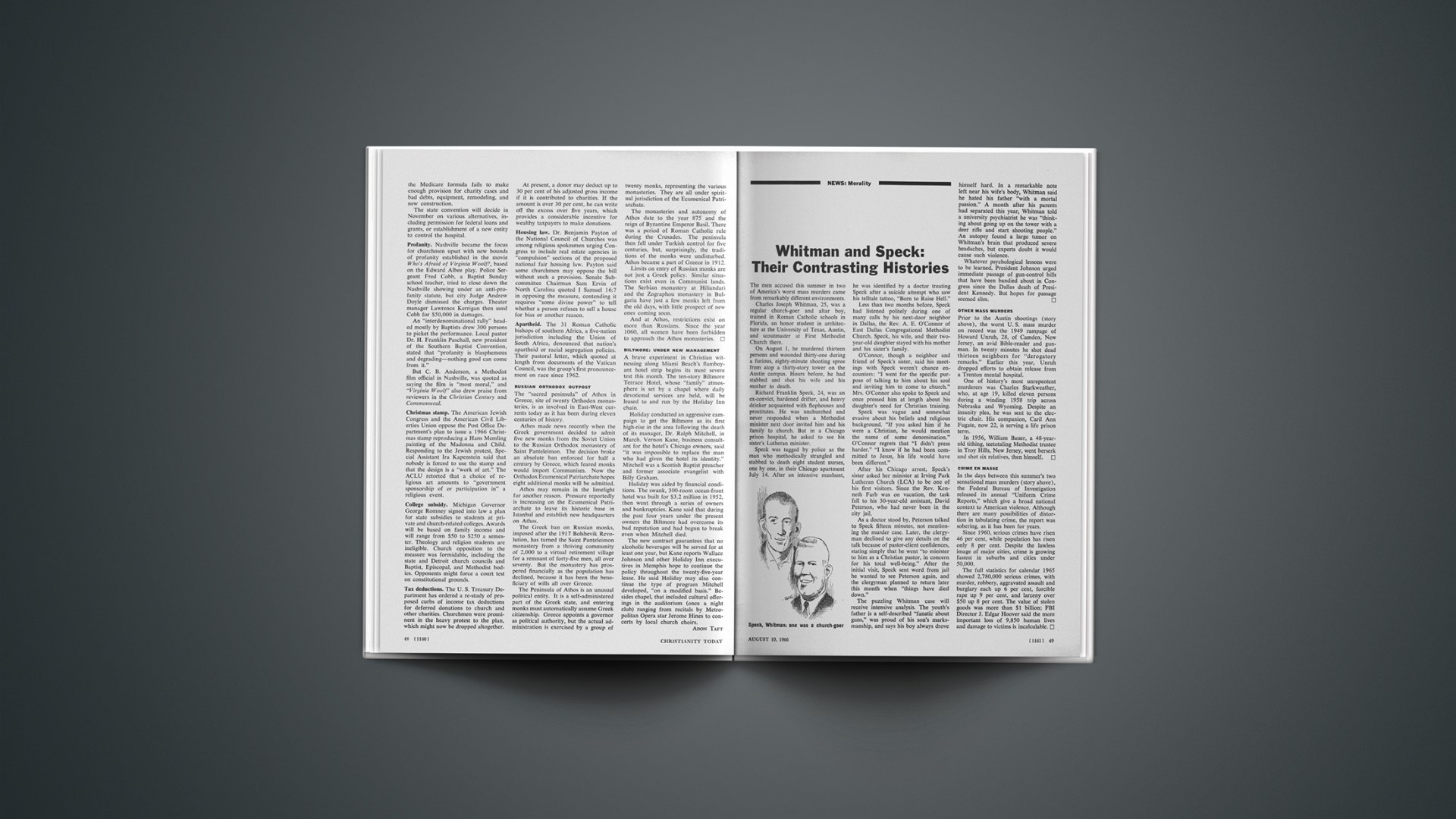
Whitman and Speck: Their Contrasting Histories

The men accused this summer in two of America’s worst mass murders came from remarkably different environments.

Charles Joseph Whitman, 25, was a regular church-goer and altar boy, trained in Roman Catholic schools in Florida, an honor student in architecture at the University of Texas, Austin, and scoutmaster at First Methodist Church there.

On August 1, he murdered thirteen persons and wounded thirty-one during a furious, eighty-minute shooting spree from atop a thirty-story tower on the Austin campus. Hours before, he had stabbed and shot his wife and his mother to death.

Richard Franklin Speck, 24, was an ex-convict, hardened drifter, and heavy drinker acquainted with flophouses and prostitutes. He was unchurched and never responded when a Methodist minister next door invited him and his family to church. But in a Chicago prison hospital, he asked to see his sister’s Lutheran minister.

Speck was tagged by police as the man who methodically strangled and stabbed to death eight student nurses, one by one, in their Chicago apartment July 14. After an intensive manhunt, he was identified by a doctor treating Speck after a suicide attempt who saw his telltale tattoo, “Born to Raise Hell.”

Less than two months before, Speck had listened politely during one of many calls by his next-door neighbor in Dallas, the Rev. A. E. O’Connor of East Dallas Congregational Methodist Church. Speck, his wife, and their two-year-old daughter stayed with his mother and his sister’s family.

O’Connor, though a neighbor and friend of Speck’s sister, said his meetings with Speck weren’t chance encounters: “I went for the specific purpose of talking to him about his soul and inviting him to come to church.” Mrs. O’Connor also spoke to Speck and once pressed him at length about his daughter’s need for Christian training.

Speck was vague and somewhat evasive about his beliefs and religious background. “If you asked him if he were a Christian, he would mention the name of some denomination.” O’Connor regrets that “I didn’t press harder.” “I know if he had been committed to Jesus, his life would have been different.”

After his Chicago arrest, Speck’s sister asked her minister at Irving Park Lutheran Church (LCA) to be one of his first visitors. Since the Rev. Kenneth Farb was on vacation, the task fell to his 30-year-old assistant, David Peterson, who had never been in the city jail.

As a doctor stood by, Peterson talked to Speck fifteen minutes, not mentioning the murder case. Later, the clergyman declined to give any details on the talk because of pastor-client confidences, stating simply that he went “to minister to him as a Christian pastor, in concern for his total well-being.” After the initial visit, Speck sent word from jail he wanted to see Peterson again, and the clergyman planned to return later this month when “things have died down.”

The puzzling Whitman case will receive intensive analysis. The youth’s father is a self-described “fanatic about guns,” was proud of his son’s marksmanship, and says his boy always drove himself hard. In a remarkable note left near his wife’s body, Whitman said he hated his father “with a mortal passion.” A month after his parents had separated this year, Whitman told a university psychiatrist he was “thinking about going up on the tower with a deer rifle and start shooting people.” An autopsy found a large tumor on Whitman’s brain that produced severe headaches, but experts doubt it would cause such violence.

Whatever psychological lessons were to be learned, President Johnson urged immediate passage of gun-control bills that have been bandied about in Congress since the Dallas death of President Kennedy. But hopes for passage seemed slim.

Other Mass Murders

Prior to the Austin shootings (story above), the worst U. S. mass murder on record was the 1949 rampage of Howard Unruh, 28, of Camden, New Jersey, an avid Bible-reader and gunman. In twenty minutes he shot dead thirteen neighbors for “derogatory remarks.” Earlier this year, Unruh dropped efforts to obtain release from a Trenton mental hospital.

One of history’s most unrepentent murderers was Charles Starkweather, who, at age 19, killed eleven persons during a winding 1958 trip across Nebraska and Wyoming. Despite an insanity plea, he was sent to the electric chair. His companion, Caril Ann Fugate, now 22, is serving a life prison term.

In 1956, William Bauer, a 48-year-old tithing, teetotaling Methodist trustee in Troy Hills, New Jersey, went berserk and shot six relatives, then himself.

Crime En Masse

In the days between this summer’s two sensational mass murders (story above), the Federal Bureau of Investigation released its annual “Uniform Crime Reports,” which give a broad national context to American violence. Although there are many possibilities of distortion in tabulating crime, the report was sobering, as it has been for years.

Since 1960, serious crimes have risen 46 per cent, while population has risen only 8 per cent. Despite the lawless image of major cities, crime is growing fastest in suburbs and cities under 50,000.

The full statistics for calendar 1965 showed 2,780,000 serious crimes, with murder, robbery, aggravated assault and burglary each up 6 per cent, forcible rape up 9 per cent, and larceny over $50 up 8 per cent. The value of stolen goods was more than $1 billion; FBI Director J. Edgar Hoover said the more important loss of 9,850 human lives and damage to victims is incalculable.

Church Testimony Opposes New Prayer Amendment

The climate at Senate subcommittee hearings this month on the proposed Dirksen Amendment to allow “voluntary prayer” in public schools was as cool as the overly air-conditioned Caucus Room. One observer said that, in contrast to the 1964 debate on the similar Becker Amendment, participants seemed to be “just going through the motions.”

Subcommittee Chairman Birch Bayh, Democratic Senator from Indiana, and two colleagues listened as a series of church spokesmen opposed the proposal with logical, eloquent, and usually long-winded testimony. These witnesses contended that the business of teaching children spiritual truths belongs to the homes and churches, not the public schools.

Organizations opposing the amendment included the National Council of Churches, Americans United for Separation of Church and State, Baptist Joint Committee on Public Affairs, United Presbyterian Church in the U. S. A., Unitarian Universalist Association, and the National Lutheran Council.

Favoring the amendment were the National Association of Evangelicals, the Greek Orthodox Archdiocese of North and South America, Protestant Ministers for School Prayers and Bible Readings, and Liberty Lobby.

Dr. David R. Hunter, deputy general secretary of the NCC, said representative assemblies of most major Protestant groups have accepted the Supreme Court’s interpretation of the First Amendment and seek no revision.

Dr. C. Emanuel Carlson, executive director of the Baptist Committee, agreed that “the First Amendment is a uniquely effective formulation of the rights necessary for protection of religious liberty and needs no amendment.”

Dr. C. Stanley Lowell, associate director of Americans United, implied that the Supreme Court decisions have not been properly interpreted by many. “No decision … has destroyed or outlawed anyone’s freedom to pray.…”

S. B. Sissel of the United Presbyterians said that if the amendment were to become part of the Constitution, a majority of children or the aggressive religious leadership in a community would determine what kind of prayers all children would “voluntarily” participate in. “Children are not these days noted for their spirit of non-conformity and their capacity to violate the customs and fads of their peers,” Sissel said.

Dr. William R. Moors of the UUA agreed: “Voluntary prayer cannot really be voluntary, since it must be directed by someone.”

Several witnesses said public school prayers are mediocre and meaningless. “Those who direct … would have the impossible task of trying to offend no one and satisfy all. This would dilute every participant’s faith,” Moors said.

The most convincing testimony in favor of Dirksen’s proposal was given by Dr. Leonidas C. Contos of the Greek Orthodox Church: “To declare all religious education, any reference to religious principles, as outside the broad … responsibility of education is to declare … a false boundary, a mythical wall of separation, that divides, and deprives, the growing child,” Contos said.

Senate Ok’S Judicial Review

The Senate passed a new bill for judicial review July 29 and referred it to the House Judiciary Committee. The bill calls for constitutional tests of laws that provided federal aid to religious organizations. Many Protestants contend several recent laws clash with the First Amendment.

The new bill, sponsored by Senators Wayne Morse, Joseph S. Clark, and Ralph Yarborough, incorporated ideas of organizations criticizing a previous judicial-review bill during March hearings.

Contos said that, although his church champions the principle of church-state separation, it could see no violation of this principle in the Dirksen Amendment.

Dirksen, Senate Republican leader and author of the proposed amendment, attended some of the hearings. He rarely questioned witnesses opposing his amendment and spent much of his time bounding across the room on crutches to answer telephone calls.

There were signs that grass-roots opinion disagrees with church spokesmen. Dirksen said of 100,000 letters he had received, only a half-dozen opposed the amendment. Clifford Morehouse, ranking layman in the Episcopal Church, was among those charging testimony by Hunter and others does not represent the ideas of most churchgoers.

The three senators on the committee who questioned witnesses at great length were Bayh, Joseph B. Tydings, Jr., of Maryland, and Roman Hruska, of Nebraska.

Tydings, an Episcopalian, made his position clear in almost unmerciful cross-examination of witnesses favoring the amendment, while Hruska spared few words in publicly supporting Dirksen. Bayh, a Methodist, tried unsuccessfully to be neutral, often letting his line of questioning give him away as opposing the amendment. On one of these occasions, Unitarian Hruska asked that Bayh give “prayerful consideration” to becoming a Dirksen supporter.

Dr. Gary Cohen, representing Protestant Ministers for School Prayers and Bible Reading, had the roughest time of all the witnesses as he appealed to the committee for removal of the “national prohibition on school prayers.”

Tydings grilled Cohen for over two hours after he presented a list of 4,000 signatures of Protestant ministers supporting the amendment and was unable to produce background information or addresses for the ministers. Tydings questioned the validity of the list after checking the Baltimore yellow pages under “ministers” and not finding names on Cohen’s Baltimore list.

Cohen and Carl Thomas McIntire, son of Dr. Carl McIntire, head of the fundamentalist American Council of Christian Churches said the 4,000 ministers had been contacted by mail and asked to sign and return a post card indicating their approval.

After the first day of testimony all the arguments for and against had been presented, but the questioning continued. Though the proposal has support of forty-eight of the one hundred Senators, there was some question whether it would ever get out of the subcommittee and onto the Senate and House floors for the necessary two-thirds vote. Most witnesses seemed to think the subcommittee was where the Dirksen Amendment belonged.

Church-State Panorama:

Divorce. After a two-year study ordered by the Archbishop of Canterbury, top churchmen and lawyers recommend that England allow one basis—“breakdown of marriage”—for divorce. Legal grounds at present are adultery, cruelty, and desertion. The twelve-member committee was headed by Bishop Robert Mortimer of Exeter.

The report drew a strict church-state line: “How the doctrine of Christ concerning marriage should be interpreted and applied within the Christian Church is one question; what the Church ought to say and do about secular laws … is another question altogether.”

In America, a particular case of divorce drew condemnation from seven speakers on the floor of Congress and many churchmen. The target was Supreme Court Justice William O. Douglas, 67, who married a 23-year-old coed a month after he was divorced by his third wife, who is 26.

Birth control. Responding to an Italian newspaper report, the Vatican denied that Pope Paul is on the verge of making his long-anticipated statement on birth control, which will affect population planning by many governments. Religious News Service reported that the Pope has given no clues on his ideas, even to insiders; that the special commission of experts that adjourned in June gave the Pope both majority and minority reports; and that the Pope is expected to announce his decision in September.

A member of the Pope’s study commission, psychiatrist John R. Cavanagh of Washington, D. C., writes in this month’s Marriage magazine that the rhythm method produces “serious psychological harm” for couples.

In London, the Archbishop of Canterbury said his “guess” is that Rome will modify its ban on all birth-conrtol methods except rhythm.

In Pennsylvania, Roman Catholics sought to limit state birth control aid to women living with their husbands. A new compromise policy excludes unwed mothers but includes married women not living with their husbands.

The government of India, meanwhile, plans to provide intra-uterine “loops” for distribution in the 81 of the nation’s 200 Protestant hospitals now cooperating in the contraception program of the Christian Medical Association.

Hospital aid. Trustees of Arkansas Baptist Medical Center in Little Rock want the state Baptist convention either to relinquish control or let the institution take federal aid.

The trustees say income from patients is down $150,000 a year because the Medicare formula fails to make enough provision for charity cases and bad debts, equipment, remodeling, and new construction.

The state convention will decide in November on various alternatives, including permission for federal loans and grants, or establishment of a new entity to control the hospital.

Profanity. Nashville became the focus for churchmen upset with new bounds of profanity established in the movie Who’s Afraid of Virginia Woolf?, based on the Edward Albee play. Police Sergeant Fred Cobb, a Baptist Sunday school teacher, tried to close down the Nashville showing under an anti-profanity statute, but city Judge Andrew Doyle dismissed the charges. Theater manager Lawrence Kerrigan then sued Cobb for $50,000 in damages.

An “interdenominational rally” headed mostly by Baptists drew 300 persons to picket the performance. Local pastor Dr. H. Franklin Paschall, new president of the Southern Baptist Convention, stated that “profanity is blasphemous and degrading—nothing good can come from it.”

But C. B. Anderson, a Methodist film official in Nashville, was quoted as saying the film is “most moral,” and “Virginia Woolf” also drew praise from reviewers in the Christian Century and Commonweal.

Christmas stamp. The American Jewish Congress and the American Civil Liberties Union oppose the Post Office Department’s plan to issue a 1966 Christmas stamp reproducing a Hans Memling painting of the Madonna and Child. Responding to the Jewish protest, Special Assistant Ira Kapenstein said that nobody is forced to use the stamp and that the design is a “work of art.” The ACLU retorted that a choice of religious art amounts to “government sponsorship of or participation in” a religious event.

College subsidy. Michigan Governor George Romney signed into law a plan for state subsidies to students at private and church-related colleges. Awards will be based on family income and will range from $50 to $250 a semester. Theology and religion students are ineligible. Church opposition to the measure was formidable, including the state and Detroit church councils and Baptist, Episcopal, and Methodist bodies. Opponents might force a court test on constitutional grounds.

Tax deductions. The U. S. Treasury Department has ordered a re-study of proposed curbs of income tax deductions for deferred donations to church and other charities. Churchmen were prominent in the heavy protest to the plan, which might now be dropped altogether.

At present, a donor may deduct up to 30 per cent of his adjusted gross income if it is contributed to charities. If the amount is over 30 per cent, he can write off the excess over five years, which provides a considerable incentive for wealthy taxpayers to make donations.

Housing law. Dr. Benjamin Payton of the National Council of Churches was among religious spokesmen urging Congress to include real estate agencies in “compulsion” sections of the proposed national fair housing law. Payton said some churchmen may oppose the bill without such a provision. Senate Subcommittee Chairman Sam Ervin of North Carolina quoted 1 Samuel 16:7 in opposing the measure, contending it requires “some divine power” to tell whether a person refuses to sell a house for bias or another reason.

Apartheid. The 31 Roman Catholic bishops of southern Africa, a five-nation jurisdiction including the Union of South Africa, denounced that nation’s apartheid or racial segregation policies. Their pastoral letter, which quoted at length from documents of the Vatican Council, was the group’s first pronouncement on race since 1962.

Russian Orthodox Outpost

The “sacred peninsula” of Athos in Greece, site of twenty Orthodox monasteries, is as involved in East-West currents today as it has been during eleven centuries of history.

Athos made news recently when the Greek government decided to admit five new monks from the Soviet Union to the Russian Orthodox monastery of Saint Panteleimon. The decision broke an absolute ban enforced for half a century by Greece, which feared monks would import Communism. Now the Orthodox Ecumenical Patriarchate hopes eight additional monks will be admitted.

Athos may remain in the limelight for another reason. Pressure reportedly is increasing on the Ecumenical Patriarchate to leave its historic base in Istanbul and establish new headquarters on Athos.

The Greek ban on Russian monks, imposed after the 1917 Bolshevik Revolution, has turned the Saint Panteleimon monastery from a thriving community of 2,000 to a virtual retirement village for a remnant of forty-five men, all over seventy. But the monastery has prospered financially as the population has declined, because it has been the beneficiary of wills all over Greece.

The Peninsula of Athos is an unusual political entity. It is a self-administered part of the Greek state, and entering monks must automatically assume Greek citizenship. Greece appoints a governor as political authority, but the actual administration is exercised by a group of twenty monks, representing the various monasteries. They are all under spiritual jurisdiction of the Ecumenical Patriarchate.

The monasteries and autonomy of Athos date to the year 875 and the reign of Byzantine Emperor Basil. There was a period of Roman Catholic rule during the Crusades. The peninsula then fell under Turkish control for five centuries, but, surprisingly, the traditions of the monks were undisturbed. Athos became a part of Greece in 1912.

Limits on entry of Russian monks are not just a Greek policy. Similar situations exist even in Communist lands. The Serbian monastery at Hiliandari and the Zographou monastery in Bulgaria have just a few monks left from the old days, with little prospect of new ones coming soon.

And at Athos, restrictions exist on more than Russians. Since the year 1060, all women have been forbidden to approach the Athos monasteries.

Biltmore: Under New Management

A brave experiment in Christian witnessing along Miami Beach’s flamboyant hotel strip begins its most severe test this month. The ten-story Biltmore Terrace Hotel, whose “family” atmosphere is set by a chapel where daily devotional services are held, will be leased to and run by the Holiday Inn chain.

Holiday conducted an aggressive campaign to get the Biltmore as its first high-rise in the area following the death of its manager, Dr. Ralph Mitchell, in March. Vernon Kane, business consultant for the hotel’s Chicago owners, said “it was impossible to replace the man who had given the hotel its identity.” Mitchell was a Scottish Baptist preacher and former associate evangelist with Billy Graham.

Holiday was aided by financial conditions. The swank, 300-room ocean-front hotel was built for $3.2 million in 1952, then went through a series of owners and bankruptcies. Kane said that during the past four years under the present owners the Biltmore had overcome its bad reputation and had begun to break even when Mitchell died.

The new contract guarantees that no alcoholic beverages will be served for at least one year, but Kane reports Wallace Johnson and other Holiday Inn executives in Memphis hope to continue the policy throughout the twenty-five-year lease. He said Holiday may also continue the type of program Mitchell developed, “on a modified basis.” Besides chapel, that included cultural offerings in the auditorium (once a night club) ranging from recitals by Metropolitan Opera star Jerome Hines to concerts by local church choirs.

ADON TAFT

Liberal Generations Clash in Geneva

It was billed as a Conference on Church and Society, but it turned out to be mostly a clash between youth and age over the means of social revolution. Actually, it hardly mattered. Both agreed socialism is the wave of the future; the only basic difference of opinion lay in how the churches should help bring it about.

Youth wanted a tidal wave—violent, crushing, devastating the existing social structures. Their elders were willing to settle for a rising tide that would come no less surely but with less violence.

The conference, held at the Ecumenical Center in Geneva under auspices of the World Council of Churches, was called “because of the need for a new ecumenical examination of Christian social ethics in a world perspective.” Its legacy had come down from Stockholm (1925) and Oxford (1937), the first such conferences called to give ecumenical expression to social concerns. But this heritage was lost on many of those at Geneva. During those earlier conferences they had been, if born at all, mere babes in arms. They had grown up to be young Turks.

Tremors signaling the inevitable conflict were felt in the first days of the two-week meeting. A group of young ecumenical activists were in the vanguard. Perhaps the most articulate spokesman among them was M. Richard Shaull, professor of ecumenics at Princeton Theological Seminary, who asserted that “the Church’s service to the world is that of being the ‘pioneer of every social reform’ without making any claims for Christianity or trying to Christianize the revolution.”

Dissociating himself from those who believe in the “capacity of the established order to renew itself without strong revolutionary pressures upon it” (notably Professors H. D. Wendland of Germany and André Philip of France), Shaull urged a “new strategy of revolution” using “political guerrilla units” similar to those in military strategy.

He said he could not “insist that Christians should have no participation in the use of revolutionary violence” and called for the “constant formation throughout society of small nuclei with revolutionary objectives.”

The conference seemed to have its own revolutionary nucleus: twenty-five specially chosen youth participants (primarily leaders of the national Christian Student movements) plus some of the thirty stewards. Among the more than 400 delegates, they were perhaps the best organized group, surpassing even the Russians. They spoke frequently, sometimes eloquently.

A few times the elder statesmen of Christian socialism with their appeal to “evolutionary change” sounded downright reactionary when contrasted with the young activists who called for “deeds—not words.”

The open clash came on the next-to-last day. The youths, not satisfied with two weeks of talk, wanted to march—right down the hill from the Ecumenical Center to United Nations headquarters. There, amid banners and speech-making, they would present to someone (not identified) something (equally unidentified) to show the conference’s concern for world needs.

The President’S Reaction

President Johnson thinks statements like those on Viet Nam made at the Conference on Church and Society (see above story) “are generally very one-sided,” reports Press Secretary Bill Moyers.

Moyers, an ordained Baptist, said on CBS Radio’s “World of Religion” that “the Geneva Conference would have spoken with a more effective voice if it had been equally critical of both parties in the Vietnamese conflict.” He attributed criticism of the United States not so much to a growing influence of non-Western nations in the World Council of Churches as to “a general hostility to war on the part of clergymen. Unfortunately, in this case, there was a lack of acquaintance with the facts in Southeast Asia.”

Moyers said religious leaders are the “largest organized group” opposing Johnson’s Viet Nam policy but that “the President has had many expressions of support from many churchmen.”

The steering committee, more aware that the conference was to speak to the WCC and the churches, not for them, proposed that the order of the march be reversed—uphill from the U. N. center to the Ecumenical Center. When both proposals were voted down by the assembly (a delegate from India suggested they march through the villages of the world where they could see the need but not be seen, especially by television), the youths got tacit permission from conference officials to organize a voluntary march.

All in all, it was a fascinating two weeks, sometimes frightening for observers who doubted that “status quo” and “sin” were necessarily synonymous.

If the Oxford conference of 1937 charted the course for ecumenical social thinking, Geneva marked a radical shift, for the modern theological phenomenon of “contextual ethics” was the underlying rationale of its papers and findings.

This was spelled out early in the conference by Professor Andre Dumas of the Protestant Faculty of Theology, Paris, who rejected all attempts to pigeonhole God with past times or the notion of “immobile transcendence.” God is, Dumas said, the One who is coming, “the One whose time is not a separate eternity but a time that is approaching.”

The only appeal to biblical authority that one reporter could find after digging through several hundred pages of addresses and reports was this one: “The churches see in biblical teaching the sanctity of monogamous marriage.” This was in a redraft of one section report that in an earlier version spoke only of “traditional doctrines.”

But even that paragraph was unsatisfying for, although it was the only part of the document to mention pre-marital and extra-marital sex relations, it failed to apply the same biblical standard it did to monogamous marriage. Indeed, it acknowledged that “many in secular society argue for the rights of these relationships” and added nothing more than that for youth these “arguments bring serious personal conflict.”

Apart from the worship periods and a few impromptu speeches by delegates from the younger countries, scriptural references were rare enough to make one wonder whether a moratorium on the Bible had been declared.

However, Viet Nam and American involvement there came up frequently enough. The youth participants circulated a statement that the war “is fundamentally a struggle for national independence by the Vietnamese people” and asked for signatures. (Reports put the response at about seventy.) The Christian Peace Conference shipped from Prague releases condemning the bombing of Hanoi and Haiphong. There were enough copies for each newsman to have one.

Another release (Conference General No. 42) was titled “Report of some activities of U. S. citizens acting as individuals during the conference on the matter of Viet Nam.” What they did (seventy-five of them) was cable President Johnson asking him to refrain from reprisals over the prisoner situation, call on North Viet Nam to treat captured personnel according to International Red Cross standards, and write Bishop Reuben Mueller asking him to “mobilize the resources of the National Council of Churches and its constituent denominations” to bring about a reassessment of America’s Viet Nam policy.

The official conference statement on Viet Nam came from a section chaired by John C. Bennett of Union Theological Seminary, which also called for the admission of Red China to the U. N. The statement read: “The massive and growing American military presence in Viet Nam and the long continued bombing of the villages in the South and of targets a few miles from cities in the North cannot be justified.” Efforts to get “cannot be justified” changed to “should be condemned” were defeated on the plea that the wording represented a very delicate compromise.

A Korean delegate suggested that the bombings in Saigon by the Viet Cong should also be included, but no enthusiasm was shown for this proposal. And an amendment that would have added the words: “Also the massive and continued trespassing of Laos and South Viet Nam by North Viet Nam cannot be justified and should be censured by people throughout the world,” received fewer than ten votes.

If the conference failed in its opportunity to speak a meaningful spiritual word to the churches, the reason may in part have been that most of the delegates were laymen unversed in these matters. They were chosen by the WCC Department on Church and Society and their denominations, presumably for their technical competence.

Almost every class and group in the world had a spokesman. If there were any “unvoiced multitudes,” they were industrialists, businessmen, and other assorted “capitalists” who have some say over the means of production. (They were outnumbered among participants by the Russian delegation, seventeen to twelve.) That fact in itself seemed strange, especially since a considerable part of the discussion centered around who should control the means of production.

To its credit, the conference showed great courage in attempting a staggering task. Anthropologist Margaret Mead noted, “We are trying to do everything for everybody—at once.” Not even the officials were willing to claim the meeting an unqualified success. What may have been its greatest success was the very fact that it could bring so many people together from so many professions and places representing virtually every tension in the world—and get them to agree on anything.

But if the conference could be commended for its idealism and forgiven for its lack of spiritual depth, it could hardly be excused for its incredible—but characteristically ecumenical—naïveté when dealing with human nature. It placed an enormous amount of faith in the social scientists to bring the kingdom of God on earth.

Forty years ago at Stockholm when the social gospel was in its heyday, liberal theologians expected to change the world through good men. In Geneva that hope was still alive, but now they seemed to think it would come about through clever men.

A Religious Garbage Dump

A church-owned garbage dump would be for the birds, says Captain Albert Newhall, commander of Glenview (Illinois) Naval Air Station.

The tax-exempt Society of Divine Word, which operates Roman Catholic seminaries in the Chicago area, has tried for two years to get a site near the air base rezoned so it could lease the land to Lakeland Fill, Inc., to operate a profit-making dump.

A zoning board contended the dump might draw sea gulls from Lake Michigan, and last October the Cook County commissioners denied the rezoning plea. Divine Word then took its case to court.

Newhall contends the dump could cost human lives, since one bird can incapacitate a jet aircraft. Hundreds of airplanes a day fly over the land proposed for the dump.

WILL NORTON

Ecumenism At The Top

The International Congregational Council last month recommended to member churches a merger with the world Presbyterian Alliance that would be the first union of major, world-wide confessional bodies.

The decision at Swansea, Wales, was unanimous, despite misgivings from the Swedish and Finnish delegations. Their churches broke from Lutheranism and retain some misgivings about Reformed churches. However, the strategy seems to be not to contest the merger but to decide about joining when the time comes.

Executives of the Presbyterian alliance, which first proposed the merger, gave quick, “hearty” approval to the ICC vote. If member communions agree, a joint agency with a constituency of 125 denominations and 55 million members would organize in 1970, with probable headquarters in Geneva. The plan is called a closer fellowship among denominations, not a uniting of them.

The move toward the Presbyterian body (officially, the Alliance of the Reformed Churches Throughout the World Holding the Presbyterian Order) was spearheaded by General Secretary Ernest Long of the United Church of Canada, a denomination formed by merger of Congregationalists with Presbyterians and Methodists. Also in tune was the large delegation from the United Church of Christ, U. S. A., another merged denomination involving Congregationalists.

Another big step at Swansea was complete revision of the ICC constitution. Altogether, the changes were quite radical and amount to a full reconsideration of what Congregationalism is today. As one delegate said, “It was a case of seeing how far you can move away from your historical foundations and still remain the same thing.”

From now on, the ICC will meet every three years instead of every five, to keep pace with the fast-changing ecclesiastical world. Also, the executive committee was cut down so that members can meet with greater ease and travel at less expense.

The ICC chose as moderator Ashby E. Bladen, first layman in the post since 1908. He is a retired insurance attorney and executive director of the Commission on Development, United Church of Christ.

Disciples: Radical Surgery

The Christian Churches (Disciples of Christ) are undergoing radical structural surgery. Preparations for the operation—which is expected to cause some congregational pains—were completed last month in Cincinnati at a week-long meeting of the International Commission on Brotherhood Restructure.

One result is an unusual amount of advance interest in the denomination’s convention in Dallas September 23–28. After presentation there, plans would go to the grass roots for a year of discussion, with action slated at the 1967 assembly.

“We’re undergoing a radical change,” says the Rev. E. S. Moreland, a Cincinnati pastor and member of the forty-member Executive Council, which, under the new plan, would “serve as the board of directors and exercise trustee responsibilities for the Christian Church.”

Moreland admits “we’ll catch the devil from independent brethren who won’t have anything to do with organization. There will be some congregations who will just ignore the commission’s recommendations—and they have that right.”

The design, five years in the making, would relate all Disciples organizations to one structure, governed by a system of representative assemblies at the regional (state) and international levels.

Under the present system, any time a Disciples organization holds a convention, as many members of as many congregations as are interested may attend. While undoubtedly democratic, the meetings at times become unwieldy.

In a related semantic shift, the denomination would make its title singular instead of plural: “Christian Church (Disciples of Christ).”

The denominational offices point out that congregations would retain such traditional rights as holding and managing their property, calling ministers, and planning their programs.

Of course, the current proposal is just an overture to the main event—decision on full alignment with the Consultation on Church Union, with its plan for a denomination of 24 million members and a centralized regional structure reminiscent of the “Brotherhood” design.

JAMES L. ADAMS

Hands Across The Archipelago

Philippine evangelicals are trying to set up a broad new national fellowship. Initial action came in Manila June 28 during a meeting of representatives of more than a dozen religious groups and Asia Secretary Dennis Clark of World Evangelical Fellowship.

While there is already a national body of evangelical churches known as the Philippine Council of Fundamental Evangelical Churches, most representatives felt it is known more for its stand against the National Council of Churches of the Philippines than for a positive evangelical position. The term “Fundamental” in the PCFEC title, some think, is intended to “scare” those in the NCCP who espouse liberal theological views.

Since membership in the PCFEC is open only to churches and organizations, it was felt that individual church leaders within the NCCP system who share PCFEC theology are being shut out of fellowship.

Representatives of the United Church of Christ in the Philippines, one of the largest member church bodies in the NCCP, expressed satisfaction over the aims of the WEF and asked to be included in future meetings that will be held to set up the new national chapter.

EUSTAQUIO RAMIENTOS, JR.

‘Ecumenical Experiment’ Explodes

The Rev. John Tirrell, the embattled U. S. Episcopalian assisting at Edinburgh’s St. Giles’s Cathedral, historic shrine for Presbyterians, resigned last month. The Church of Scotland had approved promotion of Tirrell to senior assistant—which would have involved participation in sacraments—but had said Tirrell had to get permission from his superiors.

Ironically, the final decision fell to an enthusiastic ecumenist, Bishop James A. Pike of California. Pike, in effect, went along with Scotland’s Episcopal Bishop Kenneth Carey, and said churches are not yet ready for such a move. Carey, widely criticized for opposing Tirrell, explained that an “ecumencial experiment” can be disruptive to wider efforts, such as the present delicate negotiations between the Church of Scotland and Anglicanism.

Reds Renege On Lutherans

East Germany swung its political sickle to cut off plans for the first worldwide Christian convention in a Communist country. The Lutheran World Federation got permission earlier this year to hold its 1969 assembly in Weimar, under the stipulation that it be purely non-political. But last month Hans Seigewasser, secretary for church affairs, announced cancellation because the assembly would not “serve a useful purpose.”

Managing Church Manpower

Can big-business personnel techniques be applied to Protestantism? Despite wide variations in programs and terminology, the National Council of Churches is trying.

Admitting that less is known about church work than most professions, the NCC rallied management experts, computers, and charts and surveyed ministers in fifteen denominations. Late last month, the results appeared in “The Church and Its Manpower Management.” In the 139-page booklet, Ross P. Scherer, who directs the NCC’s ministry studies, says “probably no other major program agency” tries to do so much with so little staff as the Church.

The survey found nearly two-thirds of the churches have memberships under 500, half have a budget under $20,000, and about three-fourths of the clergymen are “solo” performers, without staff except for lay volunteers.

As for pay, Scherer says that probably no institution has “such a sporadic, quixotic, and laissez faire system of patronage.” Salaries generally coordinate with church size and the minister’s education. Median cash income was $5,158, plus $1,848 in housing and other benefits. But the median minister paid $685 from his own pocket for professional auto expenses.

The survey found that ministers consider themselves mainly as preachers and pastors, placing little importance on “administrative and community functions.” Scherer says the “secular city” reorientation will change personnel training and assignment but predicts that “external” activities like service and “worldly dialogue” will supplement, rather than displace, such traditional “internal” functions as proclamation, worship, consultation, education, and fellowship.

The official news agency explained the Reds’ reasons: West German Protestants had backed a “despicable law” claiming the West has jurisdiction over all Germany, and had joined in rallies for refugees from former German territories administered by Poland.

The LWF Executive Committee said political tensions in divided Germany do not involve LWF, a church group representing seventy-two communions in forty nations. It added sadly that the Weimar assembly could have contributed to “an easing of tension.”

What Good Are Parochial Schools?

A three-year study shows Roman Catholic schools have little effect on students’ religious behavior unless parents are devout, and concludes there is no evidence that parochial schools “have been necessary for the survival of American Catholicism.”

The report, published this month as The Education of American Catholics, was financed by Carnegie Corporation and the U.S. Office of Education. More than 2,000 persons were polled concerning church attendance, contributions, and religious knowledge and attitudes.

The authors predict that “critical years” may be ahead as Catholics become better educated and more conconcerned about school quality.

Book Briefs: August 19, 1966

Christians And Foreign Policy

Foreign Policy in Christian Perspective, by John Coleman Bennett (Scribners, 1966, 160 pp., $3.50), is reviewed by Earle E. Cairns, chairman, Department of History and Political Science, Wheaton College, Wheaton, Illinois.

Does the Church have an obligation to influence foreign policy? John C. Bennett, president of Union Theological Seminary in New York, thinks it does. He seeks in this book to indicate what should be the relation between Christian idealism and national interest and power in a world of sovereign nationstates, if there is to be a just and humane American foreign policy.

While Bennett approves the stopping of Hitler and the containment of Stalin in Russia after 1947, he warns Christians against self-righteous individual patriotism or nationalism. Christians should be cautious about involvement in civil disobedience but should support moral restraint in the use of means to support national power. The right to criticize policies and strategies of foreign relations and to communicate with fellow Christians across national boundaries should be upheld in a world that lacks legal or collective systems of international security.

Bennett feels that pacifism in foreign relations is not a viable alternative, because of the need for power against nuclear attack, invasion, or political oppression. Military power is essential but still a problem for many Christians.

The author ably presents biblical principles that Christians should use in thinking about foreign policy (pp. 36–49). Although the sovereign nationstate is the primary force in international relations, Bennett points out that Christians should have concern for the rights of a nation and for a nation’s responsibility to protect its people by the use of national power, which may be used for moral or immoral ends.

Three basic problems for the Christian are the cold war, nuclear power, and international order. Although the West has rightfully resisted Communist expansion in Europe and Asia, Christians should not let their opposition lead to a holy war against a supposedly absolutist system. Polycentrism, rivalry between Moscow and Peking, and signs of humanization and open-endedness of Communism indicate the possible lessening of a unified threat to world order. Bennett advocates the opening of lines of communication between East and West.

In dealing with the problem of nuclear power, the author rejects nuclear pacifism in favor of the maintenance of nuclear power as a deterrent; but this must never be used for a first strike. The Christian should support ways to eliminate nuclear weapons and the destruction of population in war. Bennett would not try to create a supranational world organization but supports the United Nations, whose contributions he ably enumerates (pp. 138–142).

In all of this, members of the Church, an international body, should have relations with fellow Christians across boundaries through missions and conferences. They may sometimes have to oppose national policy, as did some German Christians in World War II. In each country the Church can uphold biblical principles for the conduct of foreign policy and promote a Christian consensus to influence policy.

Bennett is not an idealistic exponent of unilateral nuclear disarmament. He wisely rejects such a policy because of the need for nuclear deterrence in this world of sovereign nation-states—a world becoming more politically fragmented by the Afro-Asian explosion of new nations. He wisely points out that our opposition to Communism is not to Communism per se but to international aggressive totalitarianism per se. While Communism is still aggressive in Asia, in Europe it is less aggressive than it has been.

One can be thankful that conquest of Europe by Russia was not feasible because of America’s post-World War II policies. The possibility of evolution to coexistence because of polycentrism, national Communism (as in Yugoslavia), and humanization must be considered. But whatever develops in the future, the Church faces the problem of the role of the Christian in relation to the foreign policy of his nation. The Christian might well echo Bennett’s desire for a more flexible foreign policy, the use of force with restraint where necessary, and the use of the United Nations when possible.

This reviewer, however, questions whether the Church as the Church should act. Rather Christian ministers might proclaim, as did the Old Testament prophets, biblical principles in relation to national policy. Individual Christians as citizens could then seek to influence their government’s policy by criticism and suggestions. In all of this, due care should be given to the proper separation of church and state, which Bennett seems to ignore.

This book deserves thoughtful reading by evangelicals because of its realism and its sound suggestions for action by Christians in the area of foreign policy. Inspired by biblical principles, Christians acting as informed citizens might well have a good impact on the formation of foreign policy.

EARLE E. CAIRNS

This Side Idolatry

Billy Graham: The Authorized Biography, by John Pollock (McGraw-Hill, 1966, 277 pp. $4.95), is reviewed by David H. C. Read, minister, Madison Avenue Presbyterian Church, New York, New York.

Biography of living personalities is a hazardous art. Admirers are apt to complain that this is not really the man they know. Opponents are ready to pounce, since disliking the book is a new and more acceptable way of attacking the man.

It would have been fatally easy to produce a bad biography of Billy Graham; but, to the relief of his friends and the despair of his critics, John Pollock has done a thorough and masterly job. This is not a rapid piece of journalism, filled with gush and gossip. The author has gone to immense trouble to ascertain the facts, to avoid exaggeration, and to correct widespread misconceptions. Like many other readers, this reviewer was eager to check on the portions of the story where he could say, “I was there,” and he is happy to say that he found accurate reporting and balanced interpretation. The most he could fault was an initial in someone’s name. This is important in a book dealing with numerous highly publicized crusades over many years, where the temptation to idealize, to use hindsight, and to indulge in myth-making must be very strong.

This is not to say that the book is merely factual reporting. The admiration and affection of the author for his subject shines through every chapter. Yet he has on the whole prevented this from clouding his judgment and causing him to play down mistakes and failures or brush off serious criticisms. He keeps his devotion well “this side idolatry.” If he did not, the book would completely betray its subject. For the Billy Graham who emerges from the pages is the one whose remarkable modesty and passionate devotion to his Lord have earned him the respect and affection of an astonishing variety of Christians—and non-Christians too.

In telling the story of the campaigns and crusades over some twenty years, Pollock highlights certain crucial factors: (1) Graham’s remarkable capacity for learning and for growth: in spite of his rise to world celebrity he has retained the humility that knows how to listen; (2) his unyielding loyalty to the churches, in spite of constant temptation to form his own “movement”; (3) his ecumenical spirit, not always relished by his followers, which has led him to cooperate with all who honor his Lord and has kept him from what he calls “negative fundamentalism”; (4) his clear-eyed acceptance of his call to proclaim Christ crucified and risen, and his refusal to be diverted by social or political pressures; and (5) his determination not to become the captive of the organization he has created.

Those who want answers to the most frequent criticisms that are made of the crusades will find much ammunition here, even though certain queries may remain.

In spite of the author’s caution, we sometimes get the impression of being bull-dozed by staggering statistics and inevitably catch a whiff of the “success-story.” But I heartily commend the book, not only to friends and supporters, and not only to the many ill-informed critics, but to all who would enjoy a well-written, accurate, and lively biography of one of the few world-figures of our day.

DAVID H. C. READ

Rewarding

The Bible in Modern Scholarship, edited by J. Philip Hyatt (Abingdon, 1965, 400 pp., $7.50), is reviewed by John H. Skilton, professor of New Testament language and literature, Westminster Theological Seminary, Philadelphia, Pennsylvania.

This volume contains papers read at the 100th meeting of the Society of Biblical Literature and at the American Textual Criticism Seminar, both in 1964. The more than twenty-five contributors come from a considerable variety of backgrounds, geographical and ecclesiastical. Included are Jewish and Roman Catholic scholars.

As a result of the careful planning of the 100th SBL meeting and the assignment of topics to the participants, the work before us is more than a collection of miscellaneous studies, for it achieves a measure of logical development and coherence. Yet it does not justify the expectations its ambitious title might encourage. Some important areas of biblical study receive little if any attention, and others are handled in a far from comprehensive way. The freedom granted to the contributors in developing their topics has helped to produce variety, but it has also made for unevenness of treatment and limitations in coverage. The editor informs us: “Some participants chose to survey research of the past with a statement of the problems as they now appear to stand; others preferred to treat one or two detailed subjects in depth; some attempted to anticipate the course of study in the biblical field in the years lying ahead. Readers will see that the papers do not conform to fixed patterns laid down in advance …” (p. 10).

The careful and discerning student will find more than a little that is useful in this volume, and a number of the contributions will strike him as especially substantial and rewarding. He will seldom, however, find the presentations really moving or exciting.

Too much biblical scholarship in the post-enlightenment period has been uncritical of its philosophical assumptions, lacking in clear perspective and theological aptitude, and entangled in problems of its own making. Regrettably, this work is not wholly free from these defects.

JOHN H. SKILTON

An Uncertain Sound

What About Tongue-Speaking?, by Anthony A. Hoekema (Eerdmans, 1966, 161 pp., $3.50), is reviewed by Harold Lindsell, associate editor,CHRISTIANITY TODAY.

From all over the United States and around the world have come reports of speaking in tongues. Glossolalia has invaded the old-line denominations, and those who wear their collars backward have been as much a part of the phenomenon as those who do not know a store from a surprice. A whole literature has been developed on the subject. This book comes as a welcome addition from one who is sympathetic and who writes well of the historical antecedents of the tongues movement but who is curiously ambivalent in his conclusions.

Dr. Hoekema, professor of systematic theology at Calvin Seminary, has analyzed tongue-speaking historically among the older and new Pentecostals. He shows that the Pentecostals are reappraising their theology of tongue-speaking, and that there are marked differences of opinion among them. Early Pentecostals generally regarded tongue-speaking as a necessary phenomenon indicating that the believer had received the gift of the Holy Spirit (although already converted). With tongue-speaking, they believed, came power for life and service. Tongue-speaking was definitely related to sanctification and was sometimes tied to sinless perfection. Thus it early became obvious that those who had not spoken in tongues were second-class citizens of the Kingdom. As a result, all sought eagerly for the gift—and some seemed to get it in spurious ways.

The author adequately argues that there is no biblical basis for this view. The quality of one’s life, his sanctification, and his power for life and service do not rest upon the ability to speak in tongues. Hoekema shows that some Pentecostals today are turning away from the idea that tongue-speaking is either a necessary phenomenon or one specifically related to the baptism of the Holy Spirit and his fullness.

Up to this point the author does well. But when he considers whether tongue-speaking can and does occur today, he wobbles all over the gridiron. What he concedes on the one hand, he takes back on the other. He cautiously says we cannot rule out tongue-speaking, and he will not suggest that it is impossible for the Holy Spirit to bestow the gift today. But then he turns around and concludes that “it is a moot question whether the gift … is still in the church today.” If he cannot make up his mind about this matter, others have. Although some of the so-called tongue-speaking is phony, there is too much evidence of bona fide occurrences to say that it is still a moot question.

We, and the author, have much to learn from Pentecostals. The first lesson is that the Holy Spirit can and does give this gift, but not to all. He distributes it as he wills. This is his sovereign prerogative.

HAROLD LINDSELL

Arouses Preachers

Ha! Ha! Among the Trumpets, by Martin H. Franzmann (Concordia, 1966, 109 pp., $2.95), is reviewed by Peter Y. De Jong, assistant professor of practical theology, Calvin Theological Seminary, Grand Rapids, Michigan.

A good teacher, someone has said, makes a good preacher. These fifteen sermons seem to bear this out.

Franzmann, by profession a New Testament exegete, within small compass not only provides solid substance for the believer’s meditation but also stirs preachers and prospective preachers to proclaim the grace of God in Christ Jesus without fear or favor.

Each message opens the Word, and in a pointed, practical, personal way. Although the scholarship is unobtrusive, the careful reader will soon discover that Franzmann has learned well his lessons in homiletics, exegesis, and biblical theology. All is skillfully woven into a compelling call to faith in the Church’s living Lord. Not a word is wasted, not a sentence superfluous. But learning and literary craftsmanship are made subservient to the high goal of preaching Christ.

All but two of these sermons were prepared for special days in the Christian and the academic year, yet one basic commitment pervades them all. In contrast to the many preachers of today whose sermons are almost wholly informational and quite impersonal, Franzmann knows the use of the interrogative and imperative moods. Never is the call to repentance and faith and holy service muted.

Since arresting phrases and sentences punctuate every page, a reviewer is sorely tempted to quote at length. Perhaps this one example will whet the reader’s appetite:

The cross marks the spot where the exegete ceases to be proud of his exegetical niceties, is shaken out of his scholarly serenity, and cries out for his life in terms of the first Beatitude. The cross marks the spot where the systematician sees his system as the instrument which focuses his failure; where the practical theologian realizes that there is only one practical thing to do, and that is to repent and abhor himself in dust and ashes; where the historian leaves his long and sanely balanced view of things and goes desperately mad. The cross marks the spot where we all become beggars—and God becomes King. Amen.

PETER Y. DE JONG

The Holy Tryst

Worship in the Reformed Tradition, by Frederick W. Schroeder (United Church Press, 1966, 157 pp., $3.50), is reviewed by James Daane, director, Pastoral Doctorate Program, Fuller Theological Seminary, Pasadena, California.

The author of this book is president emeritus of Eden Theological Seminary in Webster Groves, Missouri, where he taught public worship. He was also pastor of the Tabor Evangelical and Reformed Church in Chicago for twenty-three years. This very readable book, the ripe fruit of his long pulpit and academic career, contains much truth and good sense about the public worship of the Church. Schroeder’s position is essentially biblical, though it suffers at points, in my judgment, from his commitment to the free-church tradition. Most ministers in the United States could greatly profit from the book.

The author rightly recognizes that any church in which the members in any way participate in worship has a liturgy, whether it knows it or not. This is clear from the Greek word for liturgy, leitourgia, meaning “the work of the people.” Schroeder notes that the New Testament uses “worship” and “service” of God with meanings that overlap.

The current renewal of worship in the United States is seen by Schroeder as a reaction to the informality of the early American frontier, with its high degree of emotionalism and subjectivism, and as a product of the closer contacts with the ecumenical movement. Things have already changed so much, he contends, that often one can hardly tell from the liturgy whether he is worshiping in one denomination or another.

Throughout the author’s discussion of worship and its theocentric nature and theological presuppositions, of the Eucharist, and of the sanctuary and altar runs the repeated insistance that worship must be determined by theology and not by tradition or utilitarian considerations. He warns against a thoughtless take-over of traditional liturgical elements whose theological implications may violate the commitment of the church. Theology, he roars in a quiet way, must determine liturgy, not vice versa; for the manner in which we respond to God must be determined by what we as Christians believe about God and what he has done. He fears that many churches, in their eagerness to improve an impoverished liturgy, are unwittingly bringing in through the newly opened liturgical door what they believe to be theological heresy. He feels that many Protestant churches are moving toward what a renewed Roman Catholicism is moving from. And while he recognizes that God does not exist—and therefore cannot be worshiped—apart from human need and God’s fulfillment of it, he also recognizes that the ultimate thrust of worship is objective and that its validity is not measured primarily by whether the service makes the worshiper “feel good.”

The New Testament provides binding liturgical principles but no specific details of form. Therefore, asserts Schroeder, it is as fruitless to go to the New Testament to find the biblical form of liturgy as it is to go to the New Testament to find the one form of biblical ecclesiology. The proper liturgy for any church does not depend on the recapture of New Testament liturgy. Not only does the New Testament contain no liturgy, but any proper liturgy must arise out of, and express the given Christian community.

This book is full of shrewd, knowing observations, pointed comments, and pithy assertions that combine deep theological insight with simplicity of expression. Examples: worship is “recognition of worth”; and the righteousness of God is derived “from God’s dealings with mankind” and is thus far “broader” than that righteousness of Job, who (according to Job 1:1) “turned away from evil.” The author also makes the observation that although liturgy is more than a sermon, the whole of worship suffers when the sermon is bad.

Schroeder has the sensitivity to recognize that worship, like prayer, loses some of its beauty and sacredness when subjected to critical analysis. But he also knows that unreflective worship can be much less beautiful and sacred to both God and man than the worshiping man or church realizes. Since God is first in worship, Schroeder dares to be critical of the Church’s worship. I am glad for his daring.

JAMES DAANE

Quaker Portrait

The People Called Quakers, by D. Elton Trueblood (Harper & Row, 1966, 298 pp., $4.95), is reviewed by Arthur O. Roberts, chairman, Division of Religion, George Fox College, Newberg, Oregon, and editor, “Concern.”

Elton Trueblood is a well-known writer whose volumes on Christian philosophy and commitment, lectures, retreats, and Yokefellow leadership have extended his ministry far beyond the campus of Earlham College, from which he retired in June.

This book consists of essays about the men and ideas coming out of that seventeenth-century movement of Christian renewal known as Quakerism. Trueblood presents Quaker insights into the Christian faith as live options. A critical but sympathetic apologist, he narrates views on Christian experience, worship, the sacramental view of life, shared ministry, pacifism, and the sense of Christian vocation. Biographical sketches delineate these insights, the most winsome concerning John Woolman, whose search for the “wisdom of Christ” in social concern powerfully quickened Christian conscience about slavery.

As expected, the author maintains a high standard of writing through effective generalization and illustrative detail.

He shares the view of contemporary church historians and Quaker scholars that early Friends are best understood within the context of radical Puritanism rather than as an expression of corporate mysticism—in the now discredited Rufus M. Jones interpretation. The evangelical character of early Quakerism has been effectively established by scholars in recent years, but many popular misconceptions remain. This book will rebuke those who seek in Quakerism some kind of “religion-in-general,” and especially humanists and syncretists. Trueblood quotes approvingly Gurney’s definition of Quakerism: “the religion of our Lord and Savior Jesus Christ, without diminution, without addition, and without compromise.”

Trueblood’s oft-repeated views of the universal and specialized ministries are well-stated in an excellent chapter, “Alternative to Clergy and Laity.” Today the Church may rightly listen to the Quaker effort to take seriously the implications of the priesthood of all believers.

Trueblood reflects at some length on pacifism, settling for an inevitable tension between the personal call to Christian peace-making and the realities of a society not yet ready. He accepts neo-orthodoxy’s demolition of the idealistic basis for pacifism. Some Quakers will reject his views because they are convinced non-violence will “work” apart from Christian motivation, others because he seems to restrict the work of the Holy Spirit; but many will echo his sentiments.

Because this book will be a guide for persons casually acquainted with Quakers, I wish Trueblood had treated certain issues more fully. A serious omission is the neglect of contemporary aspects of evangelical renewal among Friends: not a word about the Association of Evangelical Friends, the Evangelical Friends Alliance, or the Quaker Theological Discussion Group. Coverage of missions is inadequate and there is no reflection upon how antithetical concepts of service and missions and other aspects of doctrinal division have muted the Quaker call to discipleship. The author might have related holiness more clearly to the baptism with the Holy Spirit; and he certainly did not do justice to the early Quaker view of the unity of revelation: inward authority of the Spirit, outward authority of the Scriptures.

Despite these weaknesses (and a few unfortunate errors such as omitting Friends Bible College, Haviland, Kansas, from a listing and spelling the first name of his esteemed colleague “Huge Barbour), the book is a valuable contribution to the field. Trueblood is certainly right that Quakerism “cannot be faithful to its vision and to its consequent task unless it is truly evangelical.… Quakers are not likely to recover and maintain vitality unless they are both Christ-centered in religious experience and evangelistic in religious practice” (pp. 267–77).

The same can be said for all other segments of the Church of Christ.

ARTHUR O. ROBERTS

Priority Issues

The God Who Shows Himself, by Carl F. H. Henry (Word, 1966, 138 pp., $3.50), is reviewed by Harold B. Kuhn, professor of philosophy of religion, Asbury Theological Seminary, Wilmore, Kentucky.

In a time when God is often thought to be hidden (if indeed in existence at all!), it is refreshing to read a well-structured presentation of the thesis that the Living God is visibly at work in our common life. The volume takes its title from the opening essay and develops the proposition that “the God of the Bible is the revelation of omnipotent righteousness and of moral supremacy” (p. 11), operating vitally through the structures of individual and societal life.

From this position the author seeks to sketch the implications of Christians’ mandate to be followers of God as his children. Central to the obligations that fall upon the Christian man and woman is the concern for persons rather than for the abstract needs, problems, and frustrations of groups or classes. That persons have basic survival-needs is clear; what is too frequently forgotten is their need for the love that takes the risks always involved in the redemptive task.

Dr. Henry structures his approach to the Christian’s involvement in the problems of contemporary life around the following propositions: (1) The primary task of the Church is the evangelization of a lost world—the proclamation of Good News; (2) the Evangel involves the proclamation of the whole word of Truth, including God’s purpose of securing justice for men through government; (3) the organized church has neither authority nor competence to equate specific parties or programs with the will and purposes of God; and (4) individual Christians ought to be involved, as Christians, in the social and political order. These propositions are integral to the stewardship of life under God.

The volume stresses the manner in which evangelicals have historically evidenced social passion and at the same time observes in a penetrating way the basic weakness of a “non-evangelical agape” and of the substitution by modern ecumenism of sociological and political force for spiritual dynamic. This raises, of course, the crucial question of the real nature and character of the Kingdom, since this is finally determinative for the means to be used for its realization.

The position of the author is that the Kingdom, whatever be its visible form, rests ultimately upon the shaping presence of men and women into whom a new dimension of life has come—who are under the loving sway of One who is sovereign and redemptive love. This position is, of course, challenged by the spirit of our age, and with special force by the major trends in today’s education.

In a final chapter, Dr. Henry seeks to put into focus, in the light of his earlier survey of the purposes of God for and through the Church, contemporary movements toward church unity. His analysis of the problems with which ecumenism must contend is penetrating and should be of great interest to ecumenical leaders if they wish to understand the misgivings evangelicals have as they hear that in interconfessional dealings, the policy of “truth first” must be sacrificed to the quest for a unity based upon action. The book deals grippingly with high-priority issues.

HAROLD B. KUHN

Pioneering On Crete

Ugarit and Minoan Crete: The Bearing of their Texts on the Origins of Western Culture, by Cyrus H. Gordon (W. W. Norton, 1966, 166 pp., $7.50), is reviewed by Burton L. Goddard, director of the library, Gordon Divinity School, Wenham, Massachusetts.

This volume by the distinguished Brandeis University professor is designed to support the assertion “that until sometime after 1500 B.C., Greece, Ugarit, and Israel all belonged to the same cultural sphere, in which the most important linguistic and cultural element, in the varying and composite makeup of all three, was Phoenician” (p. 7). He suggests that guildsmen—traders, priests, warriors, potters—were responsible for the cross-cultural complex of art, religion, and literary approach.

Archaeological evidence suggests that the Minoans went to Crete from the Nile Delta. To Gordon, this is most important, for the Israelites had also lived in the Delta and “thus the forerunners of classical Greek and Hebrew cultures were kindred Delta folk” (p. 30). He argues that the Re cult of Egypt influenced both Hebrews and Minoans. In discussing Cretan syllabary, he selects examples to show that various words are the same as Semitic words. That they are not merely loan words, he says, is demonstrated by the fact that some of them are very common—including not only nouns but pronouns, verbs, and prepositions. His conclusion is that “Ugarit and Minoan Crete belonged to the same Northwest Semitic sphere linguistically, religiously, and culturally” (p. 39).

The bulk of the book is given over to an annotated translation in poetic form of Ugaritic poems, each introduced by a summary of content, with special reference to the points the author wishes to set forth in support of his thesis. Dr. Gordon here renders a distinct service.

Like other writings of the author in recent years, this volume suggests a whole new world of investigation into Greek-Semitic relationships in early times. As further artifacts come to light and literary materials are unearthed, the work in which Gordon has made a good start will provide a much clearer picture. For years, there will doubtless be much debate over the relevance and validity of the specific examples given; but the evidence is impressive and will have to be weighed carefully by historians and biblical scholars.

Gordon’s approach to the Bible, in this volume and elsewhere, is a refreshing contrast to that of extreme criticism. On the other hand, if the reviewer understands him correctly, the author regards the phenomenon of monotheism in a more or less naturalistic light. He seems to understand it as due in part to the influence of the Re cult of Egypt and other purely natural developments whereby the Jews purified some religious elements from surrounding pagan cultures and resisted other concepts and practices, thus evolving a lofty view of God and his relation to men.

In contrast, the Christian Church has ever affirmed that the transcendent God revealed himself to men and that many analogies between the one true religion described in the Bible and religions practiced in Egypt, Assyria, Ras Shamra, and Crete are due to a falling away in large measure from a supernatural religion supernaturally given, leaving some elements of fact and truth. We therefore question some of the writer’s interpretations of data related to the Hebrew Bible; nevertheless, we cannot but admire his pioneering efforts to evaluate the discoveries on the island of Crete.

BURTON L. GODDARD

Book Briefs

Human History and the Word of God: The Christian Meaning of History in Contemporary Thought, by James M. Connolly (Macmillan, 1965, 327 pp., $6.50). A massive analysis of the nature and character of history as reflected in the movement of philosophy to history, in Protestant and Roman Catholic philosophies.

Movies, Censorship, and the Law, by Ira H. Carmen (University of Michigan, 1966, 339 pp., $7.95). A look into the offices of movie censors and a consideration of the guidelines followed in censorship.

The Breaking of the Bread, by Keith Watkins (Bethany Press, 1966, 136 pp., $3.75). A consideration of the Disciples’ understanding and practice of communion in the context of today’s new liturgical interests.

Corot, by Jean Leymarie (World, 1966, 140 pp., $7.50). A biographical and critical study of painter Camille Corot. A lovely little book with many reproductions of his works.

The Revelation of Jesus Christ: A Commentary, by John F. Walvoord (Moody, 1966, 347 pp., $5.95). A good commentary on Revelation by a premillennialist who says no other New Testament book “evokes the same fascination.”

English Reformers, edited by T. H. L. Parker (Westminster, 1966, 360 pp., $6.50). The main themes of the English Reformation as they appear in the writings of nine English Reformers.

God and Man in the Thought of Hamann, by Walter Leibrecht, translated by James H. Stam and Martin H. Bertram (Fortress, 1966, 216 pp., $5). The Hamann who drew the attention of both Hegel and Kierkegaard.

Lux in Lumine: Essays to Honor W. Norman Pittenger, edited by R. A. Norris, Jr. (Seabury, 1966, 186 pp., $4.50).

Best Loved Songs and Hymns, edited by James Morehead and Albert Morehead (World, 1965, 405 pp., $7.50). A delightful book of high quality; a fine gift to give or to receive.

The Anchor Bible, Volume 29: The Gospel According to John, I–XII, translation, introduction, and notes by Raymond E. Brown (Doubleday, 1966, 538 pp., $7). A fine commentary by a Roman Catholic New Testament scholar.

Who Cares, by A. Reuben Gomitzka (Revell, 1966, 160 pp., $3.50). Forty challenging essays written out of the shock of many incidents in which Americans saw people in real trouble and simply “watched them there.”

The Sky Is Red, by Geoffrey T. Bull (Moody, 1966, 254 pp., $3.95). The true story of a missionary who was imprisoned and subjected to Communist brainwashing.

The Great Philosophers, Volume II: The Original Thinkers, by Karl Jaspers, edited by Hannah Arendt, translated by Ralph Manheim (Harcourt, Brace and World, 1966, 447 pp., $8.95). In this second volume Jaspers presents the metaphysicians of West and East.

The Shared Time Strategy, by Anna Fay Friedlander (Concordia, 1966, 87 pp., $3.25). A summons to discuss the value of “shared time.”

The Young Negro in America: 1960–1980, by Samuel D. Proctor (Association, 1966, 160 pp., $3.95). Interesting and disturbing reading about matters that do not evaporate merely because one does not read about them.

The Plight of Man and the Power of God, by D. Martyn Lloyd-Jones (Eerdmans, 1966, 94 pp., $2.50). Theological essays by a renowned preacher and thinker.

God Is Not Dead, by Gordon H. Girod (Baker, 1966, 125 pp., $2.95). A conservative author exposes many of the defects and aberrations of the Church. His understanding of biblical orthodoxy is sometimes more verbal than substantive, and his critique of rival theologies is too rough-hewn to be very enlightening.

Baptism and Christian Unity, by A. Gilmore (Judson, 1966, 108 pp., $3.95). The author, a British Baptist, understands so little about Baptism that he can do anything with it: baptize “believers only,” baptize infants, and rebaptize grown-up baptized infants.

On the Boundary: An Autobiographical Sketch, by Paul Tillich (Scribners, 1966, 104 pp., $3.95). A short book of interest to those interested in Tillich. An edited version (Tillich’s last literary effort) of Part I of his The Interpretation of History (1936).

The God-Evaders, by Clyde Reid (Harper & Row, 1966, 118 pp., $3.50). A good, hard-biting book that would bite even harder if it stayed closer to biblical doctrine and church creed.

Faces of Poverty, by Arthur R. Simon (Concordia, 1966, 133 pp., $3.75). A Lutheran minister shows the faces of poverty as he sees them in his own parish on the Lower East Side of Manhattan. He suggests that maintaining poverty is even more costly than eliminating it.

Paperbacks

Son of Tears, by Henry W. Coray (Eerdmans, 1966, 316 pp., $1.95). Realistic, honest, and historically accurate; a good novel.

The Other Side of the Coin, by Juan M. Isaias (Eerdmans, 1966, 104 pp., $1.45). Reveals the personal tensions between missionaries and Latin American nationals.

A Strategy for the Protestant College, by Lloyd J. Averill (Westminster, 1966, 128 pp., $2.25).

Interpreting the Beatitudes, by Irvin W. Batdorf (Westminster, 1966, 160 pp., $2.25). Not so much an interpretation of the Beatitudes as a discussion of the problem of their interpretation in the light of current New Testament scholarship.

In debating methods for socialist revolution, both sides at WCC conference bury religion.

Christian Mission or Ecumenical Mirage?

World Council interest in “Church and Society” centers not in the Redeemer but in ‘The coming revolution’

C. H. Spurgeon once quoted with approval a suggestion that no phase of evil presented so marvelous a power for destruction as the unconverted minister of a parish with a £ 1,200 organ, a choir of ungodly singers, and an aristocratic congregation. We wonder what the eminent Baptist would have said had he been in the streamlined headquarters building of the World Council of Churches in Geneva for the recent conference on “Church and Society.” The conference, first of its kind since 1937, ostensibly dealt with the role of Christians in the technical and social revolutions of our time.

We have much respect for the importance of Christian unity. But at the same time we have continually criticized false concepts of unity that have no biblical basis. Our ecumenical friends spend a lot of time trying to convince the evangelical that unity matters. What they do not always realize is that the evangelical not only appreciates that fact but appreciates it so much hat he is way ahead earnestly asking two vital questions: Unity on what basis? Unity to what end? These he regards as significant points if he is not to emulate Edward Lear’s impetuous characters who, disregarding bad weather and good friends, went to sea in a sieve.

The planning committee for the conference on “Church and Society” stressed four points: This was an ecumenical study conference on social questions; an essential task was to examine anew the theological and ethical criteria for the Christian social concern; it would study how world economic and social justice is to be achieved; and its report should be in a form to encourage continuing debate and discussion in the churches. More than half of the 400 conference participants were lay people. Eighty countries were represented. Although participants were chosen in consultation with their churches, they were in no sense representing them.

Yet there were exceptions to this, and here we come across a distinctive influence on any WCC occasion since Paris 1962. The Russian Orthodox Church as usual sent along its first eleven, whom we have come to recognize well at ecumenical assemblies. Led by the bearded young Metropolitan Nikodim, they sit together, vote as one man, introduce Viet Nam and other political issues into the discussion at moments opportune or not, and are handled with kid gloves by ecumenical leaders. To them, Russian criticism of the West is utterly valid, but Christian attacks on Communism are a misuse of Christianity. Challenged at one point as to where his view differed from that of the U. S. S. R. government, Nikodim agreed the views were identical. A 4,000-word paper he produced for the conference, “On Living Together in a Pluralistic Society,” mentioned neither God nor the Bible and was a violent anti-American onslaught.

For the Russians, peace is the great preoccupation, in pursuit of which it is necessary to concentrate all energies of Christian believers. Many earnest Christians have been beguiled by the challenge offered in this dangerous half-truth, uttered with all the aggressiveness of the militant pacifist. We might have greater sympathy with them if they did not consistently overlook an old lesson: True peace involves not merely the absence of conflict but the presence of God.

Yet it would be wrong to blame only the Russians for the lack of a strong spiritual dimension at the Geneva conference. Top-heavy with experts of varying sorts who tended to overmuch concern with the more rarefied aspects of economics, sociology, anthropology, and “the liberating power of the new technology,” the assembly developed into a talking-shop only, at times. (On the first Sunday afternoon it adopted a listening role, however, when it adjourned more or less en masse to a local theatre for specially commissioned performances of The Rebels, four-letter words and all.)

The situation was further complicated by a truculent speech from a Nigerian politician giving a sustained boost to Red China. We had Mozambique and Angola, South Africa and Rhodesia, and always Viet Nam. We had the bones of colonialism rattled by young Africans whose fathers suffered cruelly under apartheid, yet whose “I-am-as-good-as-you-are” never seems to be balanced with “you-are-as-good-as-I-am.” There were maddeningly imprecise references to the coming revolution.

After ten days of it, an old bishop from the Balkans stood up, walked slowly to the microphone, and said simply and sadly: “The name of our Lord Jesus Christ has been hardly mentioned.” It was a true word to a conference in which had been selected the tacit view of a transcendental God whose interests in his creation left a lot to be desired, and whose administration had to be supplemented by men specially equipped for the task. A Rumanian priest from Paris tried to put things into proper perspective by reminding those present: “God is not in danger and the Church is not in danger. These are not for us to protect. Their roots are in heaven, not earth; it is on heaven that they are dependent, not on man.” This was received, incredibly, with laughter.

It was difficult throughout to see just where many of the speakers would consider the preaching of Christ to come into all this. When we have helped the under-developed countries to develop, helped right their wrongs, filled their barns, fought their diseases, educated their children—then is it permissible to tell them in whose name it was all done, and to preach to them Christ Jesus and him crucified? Might not the time come when they will remember with a start of surprise, and no little resentment, that here is not just a social gospel but a spiritual Gospel too, that Jesus Christ came not just to feed the hungry but to save guilty sinners? It is not enough to give God a respectful nod in rushing past to do his work; if we tarried with him a little longer he would tell us how best to do it. And isn’t preaching the Gospel also part of the Church’s task in society? When we recall John Calvin, it seems ironic though pertinent to see an ever-widening gulf fixed between Geneva and Jerusalem.

Five years ago CHRISTIANITY TODAY interviewed Dr. Charles Malik of Lebanon, former president of the United Nations General Assembly. Asked how the Christian remnant could recover an apostolic initiative in witnessing to the world, he discounted “mechanical techniques which call for a special conference at six in the morning and another at eleven.” He pointed out that Jesus did not concern himself mainly with how to organize, however important that may be. Mass organization “without the inclusion of the Holy Spirit, with all its grace and freedom and power,” would be useless.

The most important thing, Dr. Malik insisted, was “ardent prayer for the Holy Spirit to come mightily into the hearts of men.” (Such stress on prayer we find noticeably absent in WCC conclaves.) “Economics and politics are certainly realities,” Dr. Malik went on, “but not the primary realities with which the Church has to deal. The Church can examine these things in the light of the Holy Ghost and with the mind of Christ. But primarily the Church ought to be above politics and economics, ought to feel that it can thrive even in hell. If it is going to wait until the economic and social order is perfect before it can tell you and me individually that right here and now we can be saved, no matter which this politico-economic order is, it will never accomplish its proper work. Think of Jesus Christ saying to us: ‘You’ve got first to perfect your government, to perfect your social system, to perfect your economic system, before you take your cross and follow me.’ He would never say that.”

While denying that there was any such antithesis, Archbishop William Temple said clearly: “If we have to choose between making men Christian and making the social order more Christian, we must choose the former.” In an age when people are no longer asking “Is Christianity true?” but rather “What is Christianity,” all of us might profitably remember the biblical injunction to seek first the Kingdom of God. Then, and only then, will we have the vital principle on which depends the Christian’s role in our times.

A Glimpse Into The Abyss

Few crimes have shocked America more profoundly than the murder of the eight student nurses in Chicago. But the nationwide shudder at this senseless slaughter had barely passed when Charles J. Whitman massacred fifteen people in Austin, Texas. And again a society that has become all too accustomed to brutality and violence (see News, p. 49) stands appalled.

Once in a while, as in these cases, man’s deeds give a shattering insight into the truth of that darkly realistic word of the Lord to Jeremiah, “The heart is deceitful above all things, and desperately wicked [RV, “desperately sick”]: who can know it?” Sometimes the lid is lifted, and there is a glimpse into the abyss.

Yet it is not only crimes like these, or the assassination of President Kennedy, or the Nazi snuffing-out of six million Jews, or the murder of millions under the Stalinist regime, or the grim consequences of modern war, that evidence the deadly disease to which the human heart is subject. The callous unconcern for human suffering and lack of neighbor love that mark many a respectable citizen also reveal man’s capacity for evil.

How desperately men everywhere need to learn that for the malady that afflicts the natural heart there is only one sovereign cure—the redeeming work of Christ. Yet the availability of this cure does not absolve society from responsibility. Must guns be indiscriminately accessible without check of the purchaser’s character or sanity? Does the national tendency to violence and lawlessness breed these horrors? Is inflation of essential news coverage of crime into morbid sensationalism either necessary or desirable? And along with questions like these, one is haunted by the poignant thought of what might have been if Lee Harvey Oswald, or the killer of the eight nurses, or Charles J. Whitman, had been given treatment and shown Christian instruction and compassion when they most needed a healing touch.

Are Men’s Brains Now at Stake?

Scientists hope to transfer brain matter and stored information from one person to another

Is the age-old struggle for domination of men’s minds about to enter a terrifying new stage?

This is the oldest struggle in the world, for it has been waged since the beginning of recorded time. The Old Testament places the first encounter in the Garden of Eden, and the New Testament tells of the battle for men’s allegiance between forces of good and evil within and without the Church, involving both intrigue and face-to-face confrontation.

In Athens and Corinth and later in Rome the struggle added philosophical and political aspects, but it was still largely face-to-face.

Then about 1450, with the invention of movable type by Gutenberg in Germany, a battle on a totally different plane and scale was opened up. Far easier printing and much wider ownership of books took the struggle into the home itself. Telling arguments could be preserved permanently.

After this, save for the slow development of propaganda techniques, nothing revolutionary appeared for another 450 years. True, the telegraph quickened news transmission, engraving brightened the pages, and mechanical typesetting and better presses sped printing processes. But the product was almost unchanged. When the movies appeared and three decades later the radio, their fascination for men’s imagination created a new world for exploitation by advertisers and entertainers.

Another twenty-five years later Pandora opened her box again, and TV’s parade of crime, horror, and mediocrity (though there is also much of merit) became another staggering problem. Books, magazines, newspapers, the pulpit, and even TV itself have flayed the misuse of this sometimes great communication medium. Yet mostly it appears that our generation has decided to try to live with TV as it is.

But what of the future? Can it be that modern science has new and worse problems in store for all humanity?

If present scientific portents can be interpreted correctly, men’s brain-stuff itself may be a sought-after prize in the next decade! Note the following progression.

In information theory, scientists have a well-developed body of hypotheses concerning the transmission of information electrically, as in the ordinary telegraph, and electronically, as in radio that uses electronic tubes. We also have a second body of theory to explain how human beings acquire, transmit, and react, to communication content.

Is it too early to anticipate that in the next decade further scientific theorizing will lead to biochemical means for transmission of information genetically from generation to generation and directly from person to person through transference of brain matter?

If this sounds fantastic or beyond belief, don’t be too certain. Look at the following recent reports.

Learning acquired in a scientist’s maze has already been transferred from “educated” flatworms to uneducated flatworms when the heads of the former were fed to the latter.

Hydén, the Swedish neurobiologist, not long ago discovered that RNA, the now-well-known ribonucleic acid, is basically changed within certain creatures during the learning process.

At the University of California, in experiments by scientists Fried and Horowitz, a “memory molecule” was transferred from one flatworm to another by the injection of RNA from the first into the second, so that the second knew what the first had formerly known.

One of the pharmaceutical manufacturers has announced the development of a compound that enables rats to learn five times faster. This drug works by speeding up synthesis of RNA. It is reported that the Food and Drug Administration has been asked to authorize its use in human beings.

And scientist Johns, formerly a brain researcher at the University of Rochester, has found that if the human brain is supplied with more RNA, more information can be stored in it. Such successes will speed other experiments to discover the relationship of RNA to human beings.

Also, at UCLA it has been announced that knowledge stored in the RNA in brain tissue can be transmitted from one species to another by hypodermic needles. Scientists Babich, Jacobson, and Bubash are said to have transferred knowledge from hamsters to rats through the medium of RNA.

Already we know that genetic material carries hereditary information that makes each individual be and look like what he is. This is carried in the DNA-RNA complex.

Science’s search for basic knowledge about human beings will not cease—and should not. It is the technological use to which such knowledge is put that gives concern.

For a long time parts of the human body have been transferred from one person to another. The blind have been made to see. The dying have been given new life through blood transfusions. A few other transplants have been successful or partially so. And mechanical devices are keeping still others alive.

We see no moral implications in ethically conducted transplantation of human matter.

But will the day come when biological technology will transplant “educated” human RNA with the hypodermic needle in order to preserve the knowledge of an Albert Einstein or a John von Neumann? What of experiments in which spiritual attitudes are modified, a task heretofore considered the special province of the Holy Spirit?

Possibly the experiment will be tried … perhaps the jab of that needle may already have been started on its historic path before this is published.

Some things we know …

That life, intelligence, and talents come as gifts from the One who created us all;

That on the day of judgment each man will be held accountable for his actions, and further that the omnipotent God knows all we do, say, and think;

That each man is expected to develop fully all the talents with which God has endowed him;

And, finally, that in all brain transplantation efforts, in the use of brain tissue to transmit human experience by whatever method, moral and theological problems are involved that are too grave for further laboratory experimentation until the issues have been made clear.

Man, born a sinful animal and not able to control his lust to exploit, misuse, and destroy his fellow men, is not yet wise enough to use the incredible powers science is gradually putting into his hands.

Should mankind try to alter human genes or chromosomes under any circumstances, would the creatures produced by such alteration be human robots? We may well ask, What of their souls? Man must not assume an impious and infamous role by trying to play God.

The High Cost Of Non-Evangelism

The budget for Billy Graham’s London Crusade ’66 was $840,000. This was, as Graham remarked, “about what Cassius Clay got for less than three minutes in the ring with Sonny Liston.” By any reckoning this is a lot of money, and to the uninformed critic of mass evangelism it seems a big “take” for Graham. The evangelist usually reiterates that none of the money raised locally goes to any member of the team; all is used to defray the expenses of the local crusade for which Graham and his associates have been invited. Still this cash flow for one month’s crusade for souls looks large—particularly to those who have given none of it, or to those who prefer to see church funds expended for non-evangelistic endeavors.

In London approximately 42,500 inquirers came forward for counseling. If only half of these inquirers made genuine decisions for Christ, the evangelistic cost would have been $40 each.

The United Church of Canada (1,063,951 members), largest Protestant denomination in Canada and one of the most vigorous critics of Graham during the past year, has had a steady decline of members “received on profession of faith” since 1958. In 1964, 34,226 members were received; but this was 7,489 fewer than in 1958. The total congregational expenses for the year 1964 were $52,402,219. If only one-fifth was spent on church growth, the cost of adding one new member was over $300, a figure comparable to that in some other larger churches.

If the main objective of every church and evangelistic crusade is church growth, can such an expenditure be accepted with indifference? Canadian ecclesiastics who deplore the high cost of mass evangelism ought rather to deplore the higher cost of non-evangelism.

Some ardent ecumenists also would do well to reckon with the plain facts when they hail church union as a way of accelerating the missionary program at reduced cost. The first large church union in North America came about in 1925, when Methodists, Presbyterians, and Congregationalists formed the United Church of Canada. At that time the Methodists and Presbyterians had a total of 550 missionaries in the field. Today, after forty years of combined effort, there are only 263 missionaries, even though the membership of the church has nearly doubled.

During this same period, the total number of missionaries sent by North American churches has increased. This increase comes chiefly from the small evangelical churches rather than from the larger union churches. Whatever might be the advantages of church union, expansion of the missionary program, which ought to have priority, does not appear to be one of them.

Ideas

The New Man

New Testament writers ransacked the Greek vocabulary for words to express the thrill of life in Christ

Men in antiquity were quite familiar with the idea that the divine Spirit might come upon a man. Many, perhaps all, of the religions of the world into which Christianity came dealt with the subject. The presence of the Spirit, it was universally held, was shown by an unusual, ecstatic type of behavior. It was when a man acted like a “whirling dervish” that it could be known that the Spirit had come upon him. Even so profound and balanced a thinker as Plato could say that the priestesses at Dodona had conferred no benefits on men while in their right mind but many when out of their mind, i.e., when the divine Spirit had come upon them and transformed them into ecstatics.

Thus it was nothing new when Christians began to speak about men as being indwelt by the Spirit of God. But two things were new. One was that the really significant thing the Spirit brought was a quality of life. Before, the hallmark of the Spirit-filled man had been held to be the unusual, the spectacular, the ecstatic. But Paul tells us that “the fruit of the Spirit is love, joy, peace, longsuffering, gentleness, goodness, faith, meekness, temperance” (Gal. 5: 22 f.). These qualities are not spectacular. They do not immediately impress themselves on the casual observer, as did the frenzied behavior of the priests of Cybele. But they are characteristic of the quality of life that Paul urged men to know.

With this went new thought, namely, that the coming of the Spirit upon a man is to be understood not as an extraordinary experience of a few unusually gifted people but as the normal day-by-day experience of all the people of God. “If any man have not the Spirit of Christ,” wrote Paul, putting the negative, “he is none of his” (Rom. 8:9b), and again, positively, “As many as are led by the Spirit of God, they are the sons of God” (Rom. 8:14). It was a new thought that all men might expect to be the temples of God’s Holy Spirit and that this was not a special gift reserved for the outstandingly spiritual.

It is unfortunate that the Gospel is sometimes preached today as though all that is involved is one moment of decision. True, the moment of decision is significant. The whole of the rest of the life will be changed because of it. But the point is that nothing less than the whole of the rest of the life is involved. Christianity is not simply a matter of making a decision for Christ. It is a matter of following him day by day, of realizing in everyday affairs the consequences of the decision once reached. It is a quality of life and a life of quality; we must not settle for less.

The New Testament preachers did not offer their hearers some slight thing that might readily be compared with what men found in the other religions of the time. They saw Christians as men and women whose lives had been completely transformed. Thus the Christian is not the old man touched up a bit here and there but a new work of creation (2 Cor. 5:17). The old man is dead. He has been crucified with Christ (Rom. 6:6). He has been buried with him (Rom. 6:4). “They that are Christ’s have crucified the flesh …” (Gal. 5:24). Words could scarcely convey more vividly the thought that an old way of life has completely passed away.

And just as the imagery of death is used to indicate the utter finality with which the old way has been repudiated, so the imagery of resurrection is common for the new life. Christians have died to an old way of life, but they have risen to a new one. Those who were once dead in their sins God has now made alive (Col. 2:13). They can be exhorted, “If ye then be risen with Christ, seek those things which are above …” (Col. 3:1). The power of Christ’s resurrection is to be made known to and in them (Phil. 3:9 f.).

Or the terminology of new birth may be used, as in John 3. Life in Christ is so completely new that we were not alive at all before we came to know him. To enter the new life means so radical a change that it is to be born all over again. So Jesus could say, “I am come that they might have life, and that they might have it more abundantly” (John 10:10b). There are frequent references to “life” or “eternal life” which imply that apart from this there is no life.

Or again, the imagery may be taken from slavery. Men in their natural state are slaves to sin (John 8:34). They are “sold under sin” (Rom. 7:14), sold as to a cruel slave-master. But in Christ they are free (Gal. 5:1). Sin no longer holds sway in them (Rom. 6:14).

Or the metaphor may be taken from the homely act of changing one’s clothes. Christians have “put off” the old man and “put on” the new (Eph. 4:22–24). And there are other ways of expressing it. The New Testament writers were thrilled at their new life in Christ, and they ransacked their vocabulary for ways to express their delight.

The new life in Christ is characterized by the exercise of qualities like love, which, as we noted earlier, is the first item in Paul’s list of the fruit of the Spirit. Elsewhere this apostle can write a whole hymn in praise of love (1 Cor. 13). He leaves us in no doubt that love is supremely important, and that it is a necessary quality in any truly Christian life. In a day when self-seeking dominates the lives of so many, we need this emphasis on Christian compassion, on that love which has been called “the annihilation of the self-seeking life.”

Paul tells Timothy that “God hath not given us the spirit of fear; but of power, and of love, and of a sound mind” (2 Tim. 1:7). In a day as haunted by fears and forebodings as the present, this emphasis must not be overlooked. The Christian is not obsessed by a concern for security, but he has a sense of security. He is not afraid of what the world news will bring forth. This does not mean that he has a kind of private line enabling him to know that wars and destructions will not take place. He knows no more about these things than do his pagan neighbors. But he does know that God is over all, and that this supreme God has given him “the spirit … of a sound mind.” He lives his life not in craven fear but in trust in the living God, who redeemed him and who will perfect that which he has begun in him.

So the Christian lives his life on a joyful note. He has his share of troubles, but he has the inner resources to overcome. He is no ostrich, burying his head away from the difficulties of life. He is clear-sighted, for his doctrine of the sinfulness of man preserves him from an unrealistic starry-eyed optimism about the prospects of unaided human wisdom. But just as he does not expect too much from man, so also he is not too dismayed about man. He knows that God is working his purpose out, and he is content. His life has its place in the divine plan, and therefore he rejoices.

The Great Counterfeit

Many years ago i saw one of the world’s greatest magicians perform some amazing feats of legerdemain. If we in the audience had not known we were being deceived, we would all have believed he had supernatural powers. Through his quickness of hand, practiced diverting of the audience’s attention, and use of prepared props and equipment, the magician gave us a good show, both amusing and instructive.

Today, within the bounds of the Church, we are witnessing a Satanic work of deception and substitution that is intended to deceive even the very elect. This giant hoax is the substitution of humanism for Christianity.

The welfare of man is a worthy objective. But when that welfare becomes an end in itself, with no reference to man’s eternal soul, it is high time that Christians take a look.

Humanism’s concern is for material values, but Christianity places spiritual values above all else.

Humanism is concerned with now, with time and all that occurs in the present. Christianity’s eyes are set on eternity, on the city made without hands, eternal in the heavens.

For the humanist, the “gospel” has to do with man’s reconciliation to man; but Christianity’s Gospel puts man’s reconciliation to God through Jesus Christ above all else.

The humanist sees “sin” as primarily man’s maladjustment to man; for the Christian, sin is disobedience to God’s revealed will.

Humanism is concerned about man’s physical, environmental, emotional, and material welfare, but not about his soul. Christianity recognizes that only as man is reconciled to God can he be properly adjusted to the conditions of everyday life, and that by the presence and grace of God situations that otherwise would be unbearable are often means to draw him closer to God.

Humanism is willing to make use of any secular power or means to accomplish its ends. Christianity depends on the presence and power of the Holy Spirit for its effectiveness.

Christians need to recognize the solemn fact that humanism is not an ally in making the world a better place in which to live. It is a deadly enemy for it is a religion without God and without hope in this world or the next.

The danger lies in the confusion of the objectives of humanism and Christianity, a confusion rooted in totally divergent concepts of God and man.

In 1933 a group of humanists convened and prepared a manifesto. This was signed by thirty-four of their leaders, twelve of whom were prominent ministers. The manifesto was as follows:

“First: Religious humanists regard the universe as self-existing and not created.

Second: Humanism believes that man is a part of nature and that he has emerged as the result of a continuous process.

“Third: Holding an organic view of life, humanists find that traditional dualism of mind and body must be rejected.

“Fourth: Humanism recognizes that man’s religious culture and civilization, as clearly depicted by anthropology and history, are the product of a gradual development due to his interaction with his natural environment and with his social heritage.…

“Fifth: Humanism asserts that the nature of the universe depicted by modern science makes unacceptable any supernatural or cosmic guarantees of human values.… Religion must formulate its hopes and plans in the light of the scientific spirit and method.

“Sixth: We are convinced that the time has passed for theism, deism, modernism, and the several varieties of ‘new thought.’

“Seventh: Religion consists of those actions, purposes, and experiences which are humanly significant. Nothing human is alien to the religious. It includes labor, art, science, philosophy, love, friendship, recreation—all that is in its degree expressive of intelligently satisfying human living. The distinction between the sacred and the secular can no longer be maintained.

“Eighth: Religious humanism considers the complete realization of human personality to be the end of man’s life and seeks its development and fulfillment in the here and now. This is the explanation of the humanist’s social passion.

“Ninth: In place of the old attitudes involved in worship and prayer the humanist finds his religious emotions expressed in a heightened sense of personal life and in a cooperative effort to promote social well-being.

“Tenth: It follows that there will be no uniquely religious emotions and attitudes of the kind hitherto associated with belief in the supernatural.

“Eleventh: Man will learn to face the crises of life in terms of his knowledge of their naturalness and probability. Reasonable and manly attitudes will be fostered by education and supported by custom. We assume that humanism will take the path of social and mental hygiene and discourage sentimental and unreal hopes and wishful thinking.

Twelfth: Believing that religion must work increasingly for joy in living, religious humanists aim to foster the creative in man and to encourage achievements that add to the satisfactions of life.

Thirteenth: Religious humanism maintains that all associations and institutions exist for the fulfillment of human life.… Certainly religious institutions, their ritualistic forms, ecclesiastical methods, and communal activities must be reconstituted as rapidly as experience allows, in order to function effectively in the modern world.

Fourteenth: The humanists are firmly convinced that existing acquisitive and profit-motivated society has shown itself inadequate and that radical change in methods, controls, and motives must be instituted. A socialized and cooperative economic order must be established to the end that equitable distribution of the means of life is possible. The goal of humanism is a free and universal society in which people voluntarily and intelligently cooperate for the common good. Humanists demand a shared life in a shared world.

Fifteenth and last: We assert that humanism will: (a) affirm life rather than deny it; (b) seek to elicit the possibilities of life, not flee from it; and (c) endeavor to establish the conditions of a satisfactory life for all, not merely the few. By this positive morale and intention humanism will be guided, and from this perspective and alignment the techniques and efforts of humanism will flow.”

This manifesto is a frank statement of the great counterfeit being perpetrated on today’s world, one for which many within the Church have fallen.

Play down the fact of sin in the human heart; think of man as sufficient in himself; obliterate God and his Christ from their sovereign rights—then you have humanism as a substitute for Christianity, and man’s efforts in the place of redemption through Christ.

Humanism, the supreme counterfeit, is here among us. Recognize it and turn from it as you would turn from the plague. Our hope is in Christ and in nothing else.

Apple PodcastsDown ArrowDown ArrowDown Arrowarrow_left_altLeft ArrowLeft ArrowRight ArrowRight ArrowRight Arrowarrow_up_altUp ArrowUp ArrowAvailable at Amazoncaret-downCloseCloseEmailEmailExpandExpandExternalExternalFacebookfacebook-squareGiftGiftGooglegoogleGoogle KeephamburgerInstagraminstagram-squareLinkLinklinkedin-squareListenListenListenChristianity TodayCT Creative Studio Logologo_orgMegaphoneMenuMenupausePinterestPlayPlayPocketPodcastRSSRSSSaveSaveSaveSearchSearchsearchSpotifyStitcherTelegramTable of ContentsTable of Contentstwitter-squareWhatsAppXYouTubeYouTube