Theology

How Iran Became an Islamic Republic

The political history may be familiar. But the theology of Shiite Islam matters too.

An Iranian protester waves an Iranian flag while participating in a multinational rally at the holy mosque of Jamkara.

An Iranian protester waves an Iranian flag while participating in a multinational rally at the holy mosque of Jamkara.

Christianity Today July 8, 2025
NurPhoto / Contributor / Getty

When asked last month about his goals in attacking Iran, Israeli prime minister Benjamin Netanyahu stated that he sought to stop a nuclear threat. Yet he also expressed hope for a regime change.

“The decision to act,” he said, “is the decision of the Iranian people.”

Although Iranian sentiment is hard to measure, some surveys suggest widespread disillusionment with the country’s rulers. According to the nonprofit Freedom House, Iran ranks No. 20 on its list of the least-free nations in the world. But if Iranians were free to decide, on what basis would they decide what is right?

Shiite Islam offers Iranians a standard it views as just. Iran calls itself an Islamic republic. Many Iranians may appreciate the Western understanding of human rights. But long before Freedom House existed, their sect prized two concepts through which the Shiite people can judge their governments: justice and leadership.

Najam Haider, assistant professor of religion at Columbia University, calls these the core theological beliefs of Shiite Islam. Iran’s constitution purports to enshrine them via the judiciary in wilayat al-faqih, the “guardianship of the jurist.” In plain terms, the religious scholar, an expert in sharia law, is to rule and ensure fidelity to Islam. Iranians can theoretically vote politicians out of office but the chief religious scholar is in charge. He can be removed from his post—but only by fellow religious scholars.

To understand the Iranian government we need to understand Shiite political history. This article is the first in a four-part survey, based on Haider’s Shi’i Islam, Vali Nasr’s The Shia Revival, Mark Bradley’s Iran and Christianity, and interviews with Shiite experts.

Part one is the origin story, describing why Shiites view themselves as cheated out of Muslim leadership. Part two looks at how different branches within the sect responded to this loss. Although Shiite rule is historically rare, part three considers how two premodern dynasties shed light on later developments in Iran. And part four describes two Iranian personalities who played a key role in politicizing the Shiite faith.

The starting point: Politics is never far from Islam, as the Muslim prophet Muhammad also became a head of state. But for centuries, most Shiites waited for divine intervention on their behalf, and did not push to create a government themselves.

Iran is one of only four majority Shiite countries in the world—Iraq, Bahrain, and Azerbaijan are the others—but is unique as the only nation with specifically Shiite governance. The global majority Sunni population may admire Iran for its centrality of religion, its anti-Western posture, or its opposition to Israel. But Sunnis reject the theological basis of wilayat al-faqih.

This article will focus on what Shiites think. An anecdote about the highly revered Shiite hero Ali ibn Abi Talib—also admired by Sunnis—will help us understand a shared conception of justice that was so soon ruptured by politics and war.

In AD 656, Ali, Muhammad’s cousin, became the fourth caliph—successor to the prophet’s political leadership—of the rapidly expanding Muslim empire. And he had clear instructions for his governor in Egypt. Fifteen years earlier, a Muslim general conquered the Coptic Orthodox territory, the breadbasket of the Roman empire. His soldiers took up residence in garrison cities.

“Infuse your heart with mercy, love, and kindness for your subjects … either they are your brothers in religion or equals in creation,” Shiite tradition records Ali saying, “Look after the deprived who need food and shelter.”

Muslim historians say Egyptians welcomed their new rulers. Coptic historians note both liberation from discriminatory Byzantine rule and their varying treatment under Islamic governance. History is written by the winners. But over the centuries that followed, Shiite history, more often than not, came to reflect the perspectives of the Muslims who lost.

Shiites represent only 10–13 percent of Muslims worldwide, tracing their history to the losing side of a civil war that included the assassination of Ali in AD 661 after just five years as leader. After that, Sunnis controlled Islamic governance—through what is known as the caliphate—until its abolition by secular Turkey in 1924.

Iran restored Shiite political power. In 1979, the religious cleric Ayatollah Ruhollah Khomeini became the central figure of an Iranian revolt against the secular and Western-leaning shah. The Iranian Constitution calls this event the Islamic Revolution, though at the time it included strong liberal democratic and communist support. But the result was a kind of theocracy, which Iran then promoted through insurgent movements around the world, including Hamas in Palestine and Hezbollah in Lebanon.

Ali’s attitude about governing Egypt illustrates Shiites’ core theological belief about justice. Leaders are accountable to divinity and are to rule on behalf of the people. These principles are to characterize an institution called the imamate, the governance of a figure Shiites call the imam. In Sunni Islam, imam is a common noun that refers simply to one who leads communal prayer. It can apply also to learned scholars. Shiites invest the term with much deeper meaning.

For them, the imam is the one ideal leader of the entire Muslim community, the just and divinely guided successor to Muhammad. He is not a prophet. But he inherits the same charisma to command the allegiance of the people, and the insight to correctly interpret the Quran. Ali, Shiites believe, was the first imam—designated so by Muhammad.

The victorious Sunnis, however, view Ali as the fourth of four “righteous caliphs,” chosen not by Muhammad but by the consensus of the Muslim community. After these founding fathers of the caliphate, the institution lost its consensual character and devolved into hereditary rule.

Shiites counter by saying that tribal political ambitions prevented Ali from succeeding Muhammad immediately after the prophet’s death in AD 632. The term Shiites means “partisans” or “followers”—those who supported Ali’s claim to office. Shiite opinions vary concerning the first three to occupy the post of caliph, but polemical rhetoric can denounce these first leaders as self-seeking apostates. After Ali’s assassination, Shiites say with much Sunni agreement, that some caliphs ruled as impious autocrats.

Justice in Islam implies treating all individuals fairly according to its law, which the Quran commands Muslims to administer without partiality. Shiites say that the third caliph, however, favored his clan in the appointment of government positions. Ali reversed this policy and denounced discrimination against non-Arab converts. He redistributed wealth to the poor and refused the trappings of political power.

A non-Muslim objection is valid: Shiites have historically assigned second-class dhimmi status to Christians, Jews, and Zoroastrians—the ancient Iranian religion. Open Doors ranks Iran No. 9 on its list of countries where it is hardest to be a Christian, primarily for its treatment of converts from Islam.

But one imam defined the result of just rule as the establishment of self-sufficiency among the people. Iranian citizens of all faiths must judge if their republic qualifies—and if Iran’s vast spending on the military and foreign militias is prompted by self-defense, geopolitical ambition, or enmity against Israel. Is wilayat al-faqih the problem, they may ask, or does the world oppress true Islam?

Yet if Iran’s government falls short in this assessment, what should its Shiite citizens do? The past decades have witnessed large demonstrations against the regime. If protestors wished, they could claim a religious warrant. According to Shiite traditions, Muhammad said, “Whoever takes the right of the oppressed from the oppressor will be with me in paradise as a companion.”

The next article in this series examines how Shiites have responded to against perceived Sunni injustice.

Culture

Have Mercy on Me, a Zynner

The nicotine pouch is popular with Gen Z men like me. That’s a problem for not just our bodies but also our souls.

Several containers of Zyn sitting on top of a photo of a depressed young man.
Christianity Today July 7, 2025
Illustration by Elizabeth Kaye / Source Images: Getty, Unsplash

Some zoomers find their zen through mindfulness apps, wellness retreats, or silent meditation. Others find their Zyn at the gas station for $5.29.

Zyn, a brand of smokeless, spit-free nicotine pouches, has found its way into the bloodstream of my generation. NFL quarterback Baker Mayfield popped one in during a game. Tucker Carlson gushed about them on Theo Von’s podcast. On TikTok, “Zynfluencers” use specific slang like “deckies,” “lip pillows,” and “Zynachinos.” (My friend likes to say “Zynbabwes.”) Whatever you call them, one thing’s clear: Zyn is in.

The data agree. While e-cigarette use among young people has declined, dropping by nearly half a million users between 2023 and 2024, nicotine pouch use has held steady. According to the 2024 National Youth Tobacco Survey, roughly 480,000 young people report current use of nicotine pouches, and among those, nearly 70 percent reach for Zyn.

Who makes up the young Zyn faithful? Simply put: men, whom youth surveys show are more likely to be nicotine pouch users than their female peers. That fits a historic pattern—from the Marlboro Man to the Vape Guy, nicotine products have long leaned male. But I think young male Zyn users are compelled by more than tradition.

How do I know? Because, for a while, I was one of them.

I lost my nicotine virginity in a scene that would give a D.A.R.E. presenter goose bumps. An older student offered me a vape in our high school parking lot, and unfortunately, I just said yes. I still remember the first puff: the sting in my throat, the expectation, the possessing buzz. I was hooked. What started as a curiosity quickly turned into a reflex. Then a habit. Then a problem. By the time I entered college, I was ready to quit.

After a few failed attempts at quitting cold turkey, a friend advised weaning off vape with Zyn, so I tried it out. And they were right—sort of. The urge to hit a Juul soon faded, but the Zyn stayed.

And, honestly, I didn’t mind. I loved Zyn.

Why? A few reasons.

First, the subtlety. There’s no smoke, scent, bulky device, or social stigma. You could slip one in during class, at work, or even while serving at church. Zyn is invisible, is effortless, and causes no unnecessary condemnation.

Second, the efficiency. Unlike cigarettes, you don’t stop to Zyn; you Zyn so you don’t have to stop. The nicotine kicks up dopamine and sharpens focus, providing enough fuel to push through an all nighter, a double shift, or back-to-back deadlines. As one college student put it, “[Zyn] helps me narrow my focus onto what I’m doing in that moment and cut out distractions.” In this framing, Zyn isn’t a vice; it’s a productivity tool.

And lastly, the buzz (of course). Oh, the buzz. Not harsh or overwhelming, but steady and smooth. Zyn didn’t hit like a cigarette or haze my lungs like a vape. It sharpened me, just enough to take the edge off. For a few minutes, I felt more capable. I could do more and think faster and feel better and stress less and sleep less and work longer and push harder and …

Then, suddenly, I realized, I don’t feel anything at all. This tiny, white rectangle was no longer a tool, crutch, shield, or coping mechanism—it was a murderer.

That’s why I had to quit. And I think others should too.

It’s not that nicotine addiction in the church is novel (users included C. S. Lewis and Charles Spurgeon, to name a few) or even that I think nicotine use is necessarily immoral. But I’m particularly concerned about Zyn. Though it may be healthier for the body compared to cigarettes and vapes, it can be far more lethal for the soul.

Why? A few reasons.

First, the subtlety. No smoke, no smell, no pause meant no one noticed my addiction. Not my friends, my classmates, or even my wife. While convenient for my image, that invisibility bred isolation; no one could call out what they couldn’t see. And like the psalmist, “when I kept silent, my bones wasted away” (Ps. 32:3).

Second, the efficiency. Zyn fed the illusion that I was managing life well when I was merely running on fumes. I felt sharp but hollow, busy but numb. I worked longer, slept less, and pushed through when I should’ve stopped. I convinced myself that I was working hard for God, that the output justified the pace. But if God gives sweet rest to the laborer (Ecc. 5:12), why did I feel so restless every time I tried to stop? By the time my Sabbath had devolved into pouch pit stops, I realized the truth: I’d been praying, “Establish the work of my hands” not to the God of Psalm 90 but to the god I kept sealed in a can. I was just a cog in the machine—rising early, staying up late, toiling in vain. I wasn’t flourishing; I was functioning.

And lastly, the buzz (of course). Oh, the buzz. What started as a reward slowly became a replacement. The emotional spectrum of real life faded until joy and sadness became having and craving. Zyn flattened everything: highs, lows, wonder, conviction. But this stoicism didn’t mean my soul was well; it was sedated. And the longer I lived like that, the less I needed to depend on anything outside myself, even God.

With my lips I honored my Lord, and with my lips I hid my master.

It’s not just me. There are many Gen Z men in churches right now quietly dependent on nicotine pouches. Zyn keeps them steady, focused, and emotionally level so subtly that their use of it goes unchallenged. This kind of self-medicated serenity is especially tempting for men, who are already taught to hide weakness and to power through pain. Zyn presents itself as an emotional sponge, soaking up just enough stress or sadness to keep us composed, driven, and in control. For young men chasing achievement and terrified of vulnerability, it makes it easier to “man up,” bury our feelings, and push forward without ever confronting what’s underneath.

But over time, the truth surfaces: Zyn isn’t a sponge; it’s a soul-sucking leech. You stop bringing your needy self to God because the ache that once drove you to him is gone. Your soul no longer pants for living water (Ps. 42:1) because the buzz has numbed its thirst.

We’re trading spiritual dependence for a chemical calm, and we’re left with faith without hunger, worship without depth, and spirituality without surrender. We become what Jesus warned against—not whitewashed tombs but white-pouched ones.

If the church wants to disciple my generation well, it can’t ignore this. For many Gen Z men like me, the biggest obstacle to wholehearted devotion to Jesus isn’t on their phones or at their schools—it’s in their gums.

I’m still in the rehab process, but I’m walking toward freedom. And I hope I’m not alone.

Lord Jesus Christ, Son of God, have mercy on me, a Zynner.

Luke Simon is a content strategist for The Crossing church in Columbia, Missouri, and MDiv student at Covenant Theological Seminary. He has written on Gen Z, technology, masculinity, and the church. You can follow him on X.

Theology

In Defense of Colloquial Theology 

CT Staff

Don’t insult my grandma’s hermeneutics. Her theology may not have come from seminary, but it came from suffering and trust.

A woman praying over a Bible
Christianity Today July 7, 2025
Illustration by Christianity Today / Source Images: Getty

When the world is in chaos, well-meaning people look to console those they love—and there’s no question that the world is in chaos. Our news cycle is swirling with immigrant deportations, polarizing politics, and escalating conflicts in the Middle East. But we might debate those efforts in consolation, the pithy and familiar language Christians tend to use as a means of comfort. 

You’ve probably heard the kind of thing I mean—phrases like these: 

“You yet holding on? Keep on keeping on.” 
“Won’t he do it?” 
“God is good all the time.” 
“He’s a way maker.” 
“He delivered Daniel …” 
“Lord willing and the creek don’t rise.” 

I heard these statements over and over, often from elders with years of faith behind their voices. My grandmother was the daughter of a Church of Christ bishop, and my father became a Christian in the twilight years of my adolescence. As a young man who didn’t truly appreciate the Lord or his people, I didn’t always understand these sayings. Context matters. But even without my full comprehension, they left an impression. They were seeds. Today, I call this language colloquial theology: simple, heartfelt expressions of faith that carry the weight of experience. 

Whether these lines offered comfort or clarity—or, sometimes, just confusion—they stuck with me, and I still hear them regularly from fellow Christians today. Increasingly, though, I also hear colloquial theology coming in for critique. One phrase in particular is continually under fire: “God is still on the throne.” 

The criticism I’m encountering goes something like this: It may be true that God is still on the throne, but that’s not what people need to hear right now. It’s unhelpful, overly simplistic, maybe even tone-deaf in times of crisis. 

I disagree. Strongly. That God is still on the throne is exactly what people need to hear. And sometimes, this truth is all Christians can offer other than our presence, silence, and prayer. 

In a world that feels increasingly unstable—in which violence, suffering, and confusion are the norm—what more grounding truth can we offer than the sovereignty of God? Psalm 47:8 reminds us, “God reigns over the nations; God is seated on his holy throne.” Psalm 103:19 echoes this: “The Lord has established his throne in heaven, and his kingdom rules over all.” 

The prophet Jeremiah repeatedly mentioned “David’s throne.” Why? Because it was a reminder that God’s promises to David and, by extension, all of Israel still stood, even amid exile and sorrow. That throne symbolized covenant, hope, and divine presence. 

In the same way, “God is still on the throne” is a modern Negro spiritual. It’s the cry of faith despite our often-grim conditions. It doesn’t ignore suffering—it acknowledges our pain while affirming the deeper reality of God’s power. The language doesn’t need to be wrapped in academic nuance to wield truth and power. In fact, its simplicity is often its strength. 

To those who scoff at this phrase and others like it as outdated or theologically insufficient, I say this: Don’t insult the hermeneutics of my grandma and other saints who have gone before us. Their theology may not have come from seminary, but it came from suffering and trust. 

And biblical examples of colloquial theology are everywhere. Like the words of the man Jesus had healed in John 9:25: “I was blind but now I see!” (no Greek breakdown necessary). Or the cry of a desperate father in Mark 9:24: “I do believe; help me overcome my unbelief” (raw and honest). Or Joseph’s declaration in Genesis 50:20 (ESV): “You meant evil against me, but God meant it for good” (a theodicy anyone can understand). 

That’s faith. Jesus is pleased by the pithy statement of a desperate mother in Mark 7:24–30. He considers what I imagine to be a colloquial response a statement of faith. It was enough. And Jesus never wasted words. He didn’t need to babble on like the pagans (Matt. 6:7–8). Jesus himself rarely said what people wanted, but what he said was always good. 

The prevalence of social media can deceive us into thinking we must always have a novel or complicated opinion and be able to articulate it with precision. That is a lie. Sometimes, the most faithful or wise thing a person can say is “God is still on the throne.”  

That phrase alone is enough to communicate God’s sovereignty, his presence, his faithfulness. It’s an Ebenezer to future generations, a catechism for the everyday believer. 

Colloquial theology uses simple words to tell deep truths. It’s for those who may not have the vocabulary but certainly have the testimony. If our spiritual stomachs are so sensitive that we now need theological haute cuisine in times of chaos, then maybe the problem isn’t the language—it’s our appetites. Maybe our reason has outrun our trust.  

Not everyone is called to be a philosopher, religious scholar, and charismatic communicator all at once. God accepts the humble faith of a child (Matt. 18:1–4, 10) and warns of the danger of unbridling our tongues (James 3:3–10). He commands us to seek peace and mutual edification among fellow Christians, not attack each other for our faith (Rom. 14:19–22).  

Maybe, even when colloquial theology leaves us frustrated or confused, we should practice the spiritual discipline of keeping our mouths shut. There’s a time and place for theological complexity; we need that too. But don’t tear down the language of people turning to God for comfort amid evil. Let these folks live. Let them declare that God is good and that he’s still on the throne—and rather than deconstructing people’s language, we could sit at the throne with them.

Sho Baraka is editorial director of Big Tent for Christianity Today.

News

The Christian Documentarians Trying to Help Ukraine

As Russia scales up attacks, a team of filmmakers is calling attention to evangelicals being hunted by an empire.”

Christianity Today July 7, 2025
Courtesy of A Faith Under Siege

Colby Barrett was at his home in Telluride, Colorado, last year when a friend called with an invitation. He wanted Barrett to join a convoy delivering aid to Ukraine. 

“Absolutely not,” Barrett told him. “There’s a war there.” 

He was also tied up at home. He was in the process of selling his construction business, the peaches at his organic orchard needed harvesting, and his four kids had packed schedules.

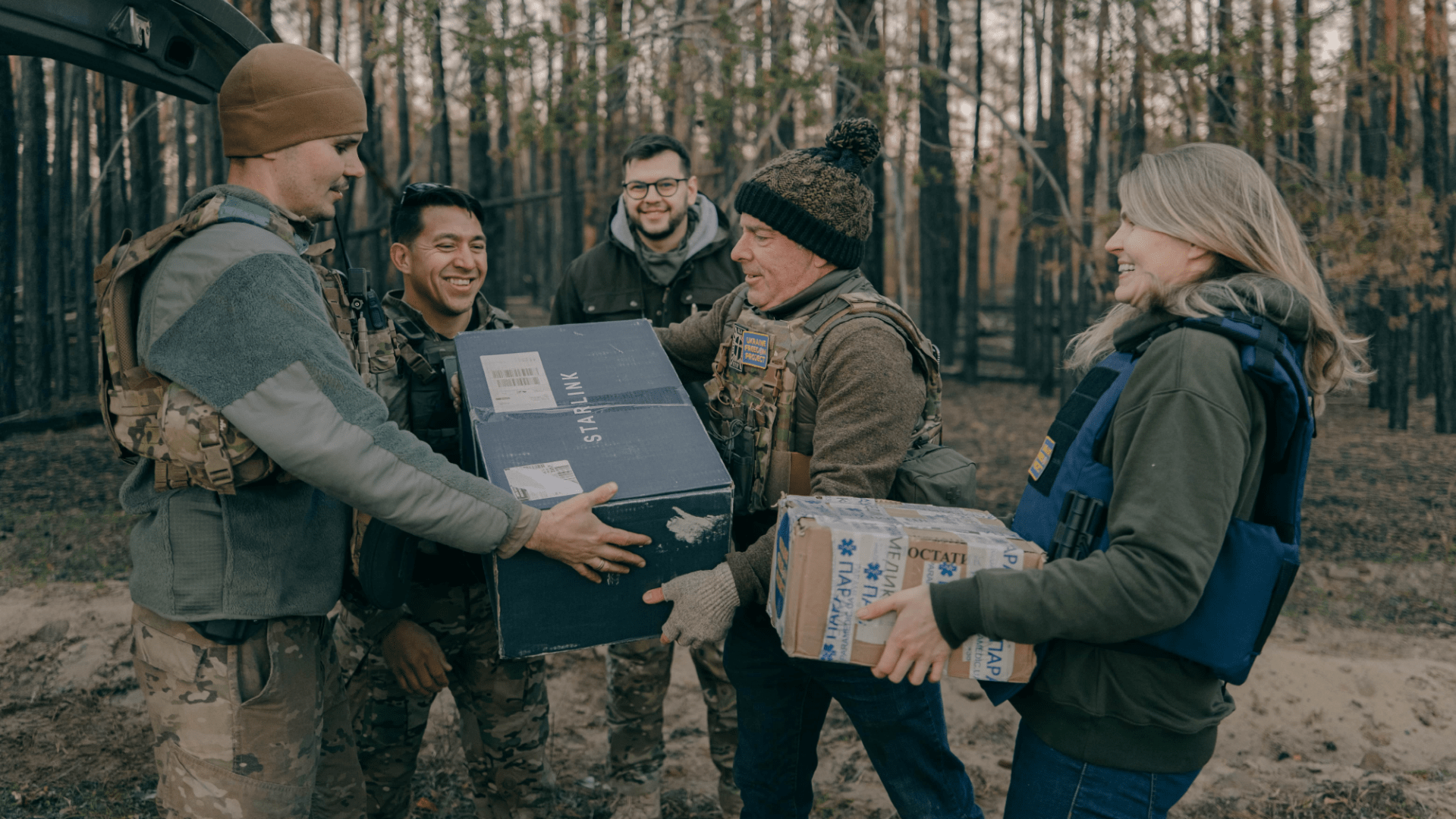
Barrett, an evangelical Christian, didn’t know much about Ukraine other than what he saw on the news. But as he did some research, he saw statistics about Christian fatalities in the war and felt God tug at his heart. He rearranged his schedule. In September, he joined a convoy of ambulances, sprinter vans, and cars full of aid.

Then, after the aid delivery, he joined a documentary film crew as a producer and investor, traveling 1,200 miles across the country to try to tell the stories of Ukrainian Christians persevering through persecution and war. He said he hopes he can show others what he saw. 

“It doesn’t make sense for most evangelicals to come to Ukraine and see this themselves,” Barrett told Christianity Today. “The second best option is to virtually be able to show these stories through the film.” 

The producers of A Faith Under Siege: Russia’s Hidden War on Ukraine’s Christians have also taken their message to lawmakers in Washington, DC. Steven Moore, co-executive producer with Ukrainian journalist Anna Shvetsova, has visited more than 120 congressional offices since 2022. 

“We are trying to get good information to conservatives so they can make good decisions,” said Moore, who is also founder of the nonprofit Ukraine Freedom Project. His team has urged lawmakers to make religious freedom in Russian-occupied territory and the return of abducted children a part of ongoing negotiations.

Negotiations in May and June resulted in a series of prisoner exchanges but yielded little progress on ending the war. Russian president Vladimir Putin has said he is open to another round of peace talks, but at the same time declared “all of Ukraine” is part of Russia. 

The past five months have seen an uptick in deadly Russian air campaigns, particularly in the capital. 

From his top floor apartment in Kyiv, Moore has a front-row seat to Russian assaults. He hears the sirens, the whine of the Iranian Shahed drones, and sometimes the boom of an impact several seconds later. The nights are loud and he often struggles to get a good night’s sleep. 

“The streets are not full until noon because everyone’s been up until 4 a.m. listening to Putin give his regards,” said Moore, an American who moved to Ukraine five days after the full-scale invasion began in 2022. “Every night is a record of drones and missiles Putin sends in.” 

Barrett and Moore, who connected after Barrett decided to travel to Ukraine, have witnessed the war’s impact on civilians. They saw the destruction of homes and businesses and profiled grieving Ukrainians, including three men who lost their wives and children. 

“One of the fathers, Serhiy Haidarzhy, who just lost his wife and daughter, was asked to speak at a funeral for another evangelical dad who lost his wife and three kids,” Barrett said. “Nobody needs to see a baby-shaped coffin.”

They also witnessed the invasion’s impact on churches. 

At least 47 Ukrainian religious leaders have died in the fighting. Investigators have documented some cases where Russian soldiers tortured and killed Christian ministers and priests. The invasion has also damaged or destroyed more than 650 religious sites in Ukraine—including evangelical as well as Greek Catholic, Roman Catholic, and Ukrainian Orthodox churches. 

Barrett said Moscow targets evangelical Christians in particular because of their perceived connections to the West. These churches are hard to control, he added, because their ultimate alliance isn’t to the state. 

“We have just one leader,” Ukrainian Baptist Pavlo Unguryan says in the film. “It’s Jesus Christ.”  

The filmmakers interviewed Mykhailo Brytsyn, pastor of Grace Church in Melitopol, and showed footage of Russian soldiers taking over a Grace Church service in September 2022. 

They also have Baptist pastor Oleh Perkachenko detail his narrow escape after drones targeted a prayer meeting in his yard and returned to the same place two days later, destroying his parked car. A drone struck his van while he was driving his kids, then targeted his house when he returned home. His family escaped with minor injuries. 

Moscow’s attacks on non–Russian Orthodox churches began during its first invasion in 2014. Kremlin forces stormed a Pentecostal church in Sloviansk and killed four members, including two of Pastor Oleksandr Pavenko’s sons, also pastors. In 2023, a third son died from a Russian rocket while he was ministering to troops in eastern Ukraine.

Barrett said his conversations with Christians in Ukraine deeply impacted his faith. The film team interviewed more than 40 people in seven cities. The Ukrainians reminded him of the persecuted church in the New Testament. 

“You’ve got this scrappy group of believers that are being basically hunted by an empire that does not like them at all,” he said. 

The situation remains precarious for Christians. In May, Presbyterian pastor Volodymyr Barishnev told CT he thinks most people in his city will leave if Russia occupies Kherson a second time. He’s not sure what would happen to his church. 

The war is in its fourth year, and some Ukrainians have grown discouraged. Russia launched more than 5,000 drones at Ukraine during the month of June, and reports of 50,000 Russian troops gathering near the northeastern town of Sumy have stoked fears of another incursion.

Moore, however, hasn’t given up hope and plans to return to Washington this month for more meetings with lawmakers, including Lindsey Graham. The South Carolina senator said this week that President Donald Trump is ready for the Senate to vote on a new bill, sponsored by Graham, imposing sanctions on Russia and countries purchasing Moscow’s oil and gas. At the same time, the Trump administration decided last week to pause deliveries of some missile defense systems and weapons to Ukraine. 

Barrett said Christians in Ukraine have drawn encouragement from knowing that their stories are being shared. They tell Barrett they welcome “the army of prayer and the army of support” they hope will come from Christians around the world who watch the film and see what’s happening to Ukrainians. 

News

Texas Flood Washes Away Dozens of Young Girls from Christian Camp

Rescue teams continue their search after the Guadalupe River overtook cabins at Camp Mystic, a nondenominational camp in the Hill Country.

A large building with a single room where the side has fallen off to reveal the inside with trees in the background.

A view of a damaged building at Camp Mystic in Hunt, Texas.

Christianity Today July 6, 2025
Ronaldo Schemidt / AFP via Getty Images

The close-knit camp community in the Texas Hill Country will never be the same.

Early morning on the Fourth of July, record-setting flash floods swept away 27 girls at Camp Mystic in Hunt, Texas, and washed through campgrounds where generations of young Texans have spent their summers along the Guadalupe River.

Christians across the state and the country prayed as rescue teams navigated the flooded roads Friday and Saturday to retrieve hundreds of campers in disaster areas, which had lost power, internet, and road access when water levels rose 26 feet in 45 minutes, per state officials.

By Saturday evening, at least five of the missing girls from Camp Mystic—8- and 9-year-old campers and an 18-year-old counselor—had been reported dead along with the co-owner of the Christian girls camp, Dick Eastland. On Sunday, 10 campers and a counselor remained missing.

The death toll across the area rose to over 100 people, including 28 children, with recovery efforts ongoing. One of the young victims from the camp, Sarah Marsh, is the daughter of a professor at Samford University in Birmingham, according to the school’s president, who asked for prayer for the family.

On Monday, the camp made its first official statement, saying, “Camp Mystic is grieving the loss of 27 campers and counselors following the catastrophic flooding on the Guadalupe river. Our hearts are broken alongside our families that are enduring this unimaginable tragedy. We are praying for them constantly.”

The camp thanked state officials and first responders for their help as the search for the missing girls continues and asked for “continued prayers, respect and privacy for each of our families affected.”

At Camp Mystic, the cabins near the river housing the youngest campers—named Twins and Bubble Inn—took on water from both directions. Eastland rushed to rescue girls in one, and his brother Edward Eastland went to the other, directing the sleeping campers to get on the top bunks as flood levels rose higher and eventually reached the roofs.

Pictures of the aftermath inside show a tangle of wet bunk beds, girly bedding, stuffed animals, and electric fans, with dark mud covering the cabins’ red floors. Dick Eastland was found in a black SUV with three girls he had tried to save, camp staff member Craig Althaus said in The Washington Post. Althaus said he found surviving girls on cabin roofs and in trees.

Local churches called for water, food, and men with chainsaws to help the affected areas. They sent pastors to offer counsel amid anxious waiting and tearful hugs at the reunification sites set up at schools and churches.

“Sadly, today is about search and recovery, and unification of parents with children,” wrote one pastor, Joey Tombrella of First Baptist Church Kerrville. Parents just wanted to see their kids again.

In major cities in Texas, neighborhood Facebook groups and Instagram stories circulated photos of smiling elementary-age girls with their names and parents’ phone numbers—in hopes that they would be found soon and their families could finally hear confirmation of their safety.

According to news reports, most parents had only heard from Mystic by email: “We have sustained catastrophic level floods. If your daughter is not accounted for you have been notified. If you have not been personally contacted then your daughter is accounted for.” Dozens received the devastating phone call.

Camp Mystic had welcomed around 750 girls, 8 through 17, for a month-long term five days before the floods hit on Friday.

The nondenominational camp dates back to 1926 and has been run by the same family since 1939, spanning three generations. Counselors lead devotionals at breakfast and each night in the cabins. The camp holds Catholic Mass and a Vespers service each Sunday as well as a sunrise Communion service once a term, gathering at Chapel Hill, a hilltop site with a wooden cross and rows of stone benches.

“Campers and counselors join together to sing songs, listen to scripture, discover ways to grow spiritually, and learn to apply these lessons to their daily life at camp and back home,” according to a camp brochure, which quoted Psalm 121:1 (KJV): “I will lift up mine eyes unto the hills, from whence cometh my help.”

Sleepaway summer camps, especially Christian camps, have proven a powerful formational tool for youth, but they’ve always depended on trust—parents have to believe that camps have staff and policies in place to keep their kids safe.

Camp Mystic has not made public statements regarding its disaster plan. Texas officials helped evacuate Mystic campers by helicopter, with some having to cross a flooded bridge holding a rope to get to safety, according to the Associated Press.

The 700-acre camp is one of several located in Central Texas, north of San Antonio and west of Austin, a hilly, lush retreat dotted with beloved camp properties. The oldest date back a century and are considered “a touchstone of Texas culture.”

Like at Camp Mystic, lower-lying cabins at Camp La Junta flooded, and some boys had to swim to safety before the camp evacuated everyone to First Presbyterian Church in Kerrville. Nearby, Camp Waldemar accounted for its campers and reunited the girls to their families by Saturday. The “Christian-oriented” Camp Stewart for Boys hadn’t yet begun its July session and experienced minimal damage.

Heart O’ the Hills, just a mile up the river from Mystic, wasn’t hosting campers this week, but the camp lodge reportedly flooded up to the third floor, and its longtime director and co-owner, Jane Ragsdale, died in the flood. Like the others, it has canceled its upcoming session due to damage.

The Laity Lodge in Leakey, Texas, still had power and didn’t suffer damage from the floods, so a camp counselor from the ecumenical Christian retreat center came to Kerrville on his day off to volunteer to help. “Knowing that it could have just as easily happened to us—I’m grateful to be here,” he told The Washington Post.

It’s not the first time the waters of the Guadalupe have threatened campers in the area. In July 1987, hundreds of Christian youth at Pot O’ Gold Ranch left on buses and in vans on the last day of Bible camp to escape the overflowing river. Of the 40 kids on the last bus, 10 died in the flash flood—at the time one of the deadliest natural disasters in the Texas Hill Country.

On the 30th anniversary of the tragedy, CT heard from some of the survivors, who remembered desperately holding on to tree limbs as the water rushed past them and asking questions about why God would let this happen to them.

Christian author and parenting expert Sissy Goff, who spent six summers at Camp Waldemar, shared her advice for parents of campers who survived the flash flood, including listening to their kids talk and giving them the chance to connect with others who shared the experience.

A mother of a 10-year-old first-time Mystic camper whose cabin was on higher ground and who was bused to a reunification center told The New York Times that her daughter sang camp songs on the drive home.

Many of these songs have been sung at Mystic since it began. One traditional song, “Morning Prayer / Camp on the Guadalupe,” calls out to God in prayer, “Father in heaven, bless us we pray. Strengthen and guide us all through the day. Comfort and keep us, Lord, in thy will. Here at Camp Mystic, be with us still.”

This is a breaking news story and will be updated.

Pastors

Staying Motivated in Ministry (When You’re Not)

When ministry becomes mechanical, motivation dries up. But grace revives what guilt and grind never could.

CT Pastors July 3, 2025
PBNJ Productions / Getty Images

One of the most remarkable plants in nature is the ibervillea sonorae. It can exist for seemingly indefinite periods without soil or even water. As Annie Dillard tells the story, one was kept in a display case in the New York Botanical Garden for seven years without soil or water. For seven springs it sent out little anticipatory shoots looking for water. Finding none, it simply dried up again, hoping for better luck next year.

Now that’s what I call being motivated: hanging on, keeping on when it’s not easy.

But motivation can run out, even for the ibervillea sonorae. In the eighth year of no soil and water, the rather sadistic folks at the New York Botanical Garden had a dead plant on their hands.

Most pastors know what it’s like to find themselves past their seventh season, bereft of soil, thirsty, and waiting for the eighth spring. No more motivation; barely enough energy to send out another anticipatory shoot. With most of us, however, it happens seven or eight times each year. Would that we could last like that tough little desert plant.

Ministry’s twin sins

Sometimes it’s simple fatigue that finally takes its toll. Too much work, a lingering illness, or poor diet come singly or in combination, and we find ourselves in desperate need of rest. Simple fatigue, simple treatment, and we snap back like a rubber band.

But there may be a deeper meaning to our loss of motivation. It can stem from a loss of direction in the ministry. Preaching, teaching, training, counseling, and administrating may become intolerably burdensome because we have somehow forgotten why we are doing them. This weariness comes close to the deadly sin of sloth or acedia. Simple fatigue says, “I know I should be doing this, but I just can’t seem to generate the energy.” Acedia says, “Why? What’s the difference?”

“Acedia is all of Friday consumed in getting out the Sunday bulletin,” says Richard John Neuhaus in Freedom for Ministry. “Acedia is three hours dawdled away on Time magazine, which is then guiltily chalked up to ‘study.’ Acedia is evenings without number obliterated by television, evenings neither of entertainment nor of education, but of narcotized defense against time and duty. Above all, acedia is apathy, the refusal to engage the pathos of other lives and of God’s life with them.”

A physician friend once showed me a journal article on the “giving up, given up complex”—a psychological state found in people who lose their reasons for living. They ask, “Why? What’s the difference?” And that question makes even pastors vulnerable to exhaustion and burnout.

Curiously, loss of motivation can produce what appears to be the opposite of sloth or acedia: hyperactivity. But in reality, it is just another dimension of the same loss of direction and sense of “why” that saps us of our ability to do the “what” of ministry. “Hyperactivity and sloth are twin sins,” says Neuhaus. The only real difference is the anxious, frenetic shape hyperactivity takes.

Many pastors are no longer truly activated to do the work of the kingdom. Like children lost in a forest, the more lost they feel, the faster they run. Hyperactivity is to authentic motivation what junk food is to a nourishing diet. It gives the feeling of satisfaction while starving the person to death. In the New Testament it is the “Ephesian Syndrome” described in Revelation 2:17. The first love is gone, and now all that is left is the form and the trappings. People who have forgotten “why” become obsessed with “how.”

Clerical works-righteousness

The twin sins of acedia and hyperactivity can be expanded into triplets with the addition of a third: hubris. Hubris, or pride, was the word the Greeks used to speak of presumption, the folly of trying to be like the gods. This vice, rather than stemming from a loss of direction in the ministry, is the loss par excellence. For the Christian, hubris is anything we do to try to save ourselves. For pastors, it is anything we do to try to save the church: clerical works-righteousness.

Hubris is bad enough by itself, but it also sets us up for acedia and hyperactivity. One of the greatest crises I faced in ministry came concerning my preaching. I noticed a pattern developing in my weeks. Sunday afternoon through Monday morning I would be depressed. Monday afternoon through Wednesday evening I would feel fine. Thursday I would begin to feel irritable. Friday, it built. Saturday I was impossible to live with. Sunday morning I was filled with energy but out of touch with everyone. Worship would peak, and then I’d crash.

Week after week this cycle repeated itself. After a few months, I was vacillating between frenetic activity and paralyzing sloth. It just wasn’t fun being a preacher anymore. That concerned me greatly because I never doubted God called me to preach.

After much prayer and hard thought, it dawned on me: I was trying to preach the greatest sermon ever heard. I wasn’t satisfied to offer God and my people my best. I demanded superstardom.

Of course, superstardom escaped me. My depression each Sunday afternoon grew out of the disparity between what I sought and what I deserved. My sermonizing was clerical works-righteousness. It sapped me of authentic motivation, leaving me alternately asking the “What’s the difference?” of acedia, and proclaiming the “I am driven” of hyperactivity.

With the exception of simple fatigue, all loss of motivation is a form of forgetfulness. It is losing touch with the “why” of ministry, being cut off from the Vine, and then keeping busy enough or noisy enough to not have to face up to the disjointedness of our lives.

First-love revival

It is remembrance that keeps Christians awake; and the supreme act of Christian worship, the Lord’s Supper, draws us into fellowship with Christ by remembering his mercy and love for us. It is a love feast spread out upon a redeemed and quickened memory.

Remembrance keeps Christians awake; and the supreme act of Christian worship, the Lord’s Supper, draws us into fellowship with Christ by remembering his mercy and love.

Motivation to minister, then, is recovered only by a revived first love in response to the resurrected Christ’s command to “Remember the height from which you have fallen!” (Revelation 2:5, emphasis mine).

Sometimes remembrance means quiet reflection. More often, it means a more disciplined life of prayer, study, and rigorous thought. For me, when motivation goes, these three are the last things I want to do. “If only I could get motivated,” I rationalize, “then I could pray, study, and think again.”

It never seems to work that way. The more I need to pray and study, the less I feel like doing it. But do it I must. As the song says, “Them that gots is them that gets.” The choices I make when I don’t feel motivated are the most crucial of my walk. C. S. Lewis touched on this when he had Screwtape advise Wormwood that God will sometimes overwhelm us with his presence early in our experience, but he never allows that to last. His goal is to get us to stand on our own two legs, “to carry out from the will alone duties which have lost all relish.”

A call to remember is a call to get back to basics and back to the people God has given to us. Acedia, hyperactivity, and hubris isolate us from our congregation.

Each week I conduct a “sermon group.” Five or six people meet with me to do two things: critique my last sermon and discuss the text I’ll be preaching on next.

Face-to-face contact with real people struggling with me over the meaning and application of God’s Word motivates me tremendously; it can carry me along when I’m not particularly excited about preaching. Knowing I will be critiqued introduces a kind of salutary terror into my preparation I would not normally have. Besides, it’s good theology. Preaching should always grow out of a context of dialogue within a community. Jesus’ did. Paul’s did. What they had to say was not little gospel pills dropped out of the sky on an anonymous crowd, but vigorous conversation between God and specific people living in concrete situations.

Among the people God would want us to stay close to are our colleagues in ministry. These men and women know, as no one else, the difficulty of sustaining pure motivation. A high priority in my commitments is a covenant prayer group of fellow pastors. When one of us is “down” the others are “up” and can offer encouragement. My brothers and sisters in ministry often serve as agents of remembrance for me, reminding me why I’m here and what I’m to do.

Relaxed motivation

One last thing needs to be said about remembrance. It has to do with the sovereignty of God.

Martin Luther said he took great comfort from knowing that as he sat and enjoyed his mug of Wittenberg beer, the kingdom of God kept marching on. That assurance motivated him to work hard. He could relax and rest, and go back to work with greater energy. More important, when he did work, he knew nothing was wasted because God was sovereign over everything.

That’s how it should be for us. A motivated Christian is a relaxed and grateful Christian: grateful for what God has done in the resurrection of Christ, and relaxed because of his hope in God’s sure conclusion of all history in his Son. Freed from the bondage of the past and anxiety about the future, we can finally get down to the work at hand in the present.

Ben Patterson is a retired pastor, having served as campus pastor at Westmont College for 17 years and as a church planting pastor in Irvine, California for 23 years. . He is also a former contributing editor to Christianity Today and The Wittenburg Door and has authored many books.

Pastors

Cracked but Called

Often, the best pastors aren’t the ones without cracks. They’re the ones whose cracks let the light through.

CT Pastors July 3, 2025
Juliasv / Getty

There’s an old boxing gym in my neighborhood. The windows are grimy, the signage rusted and broken. But through the glass, you can glimpse something profound happening inside. Old trainers with cauliflower ears guide young fighters through their paces. Heavy bags swing. The ring bears scuff marks from countless rounds, countless falls, countless moments when staying down would have been easier than getting back up.

What strikes me isn’t the violence, it’s the reverence. These aren’t thugs throwing wild punches. They’re craftsmen, learning their form in the hardest classroom imaginable. A trainer doesn’t measure a fighter by how many punches he avoids but by how many he takes and keeps going. The scars tell the story. The bruises mark the curriculum.

C.S. Lewis understood this when he wrote from wartime London: 

“Only those who try to resist temptation know how strong it is. After all, you find out the strength of the German army by fighting against it, not by giving in.”

I think about that boxing gym every time I hear the statistics that haunt pastors’ conferences—67% have wrestled with pornography; 59% battle depression; and 40% have faced serious conflict in their churches. We whisper these numbers like confessions, ashamed of the failure they represent. But maybe they mean something else. Maybe they’re evidence that we’ve stepped into the ring.

Formed by the fight

I know pastors who’ve learned their theology in the ring.

Michael has wrestled with sexual addiction for 18 years. He’s not acting out or crossing lines, but he’s fighting a daily battle that most couldn’t imagine. He preaches on purity with an authority that comes from the trenches. When a young man confesses similar struggles, Michael doesn’t offer platitudes. He offers partnership from someone who knows the weight of the gloves.

Then there’s David, whose anger could incinerate relationships if he allowed it. But he’s learned to turn that fire into compassion. His gentleness with difficult parishioners comes not from natural temperament but was forged through daily victories of restraint.

And there’s Rebecca, a pastor’s wife and lay leader, who battles depression while helping her husband lead a church through its own grief. She serves every Sunday with her own sorrow in tow. When she speaks about joy, it’s not from a place of constant sunshine. It’s from the ash heap, where she gained hard-won knowledge that joy is possible in the darkest of places.

What they share is this: They’re all still fighting. Still getting up. Still showing up to the ring day after day, knowing they’ll take hits but showing up anyway and refusing to throw in the towel.

Lewis wasn’t just talking about temptation. He was talking about the whole curriculum of spiritual warfare. You don’t discover the enemy’s strength by avoiding the fight. You learn it by resisting—by staying in the fight long enough to understand what you’re up against.

Pastors who limp

Consider Jacob, who wrestled all night with a divine opponent who could have ended the match instantly. He walked away limping, his hip permanently displaced. But he also emerged blessed, carrying a new name that means “he wrestles with God.” The limp, like his new name, was his badge of honor, proof that he was strong enough to stay in the ring when everything in him wanted to quit.

Our churches need that story. Often, the most mature believers are the ones who limp. They bear the most scars. The pastors who understand grace best are the ones who’ve needed it most desperately, most consistently, most recently.

The same principle applies to pastoral couples. When both husband and wife bear those scars—when both have fought and gotten back up—their partnership in ministry becomes something forged in the fires of mutual dependence on grace. Not polished. Forged.

Reading the wrong scorecard

We’ve confused the boxing ring with a ballroom. We reward pastors for avoiding hits rather than for staying in the fight after taking the hits. We elevate those who have never felt the enemy’s strength and dismiss those who have fought hard and refused to surrender.

Fifty-five percent of pastors who acknowledge wrestling with pornography live in constant fear of being discovered. Not because they’ve surrendered to sin, but because they’ve been wounded in battle, convinced their struggle disqualifies them from ministry rather than qualifies them for deeper effectiveness.

But what if we’ve been reading the scorecard wrong? What if the pastor still fighting temptation after 20 years isn’t a liability but a guide? What if the leader who shepherds others while battling depression isn’t weak but faithful?

When to draw the boundary line

Let me address the elephant in the room: Boundaries matter. There’s a crucial difference between fighting temptation and yielding to it, between struggling with sin and being enslaved by it, between wrestling with weakness and being defeated by it.

A pastor who is tempted by sexual sin but seeks help, sets boundaries, and protects others is fundamentally different from one who crosses ethical lines. The leader walking through inner storms yet still caring for the flock stands apart from one whose mental health compromises his ability to provide pastoral care. The minister channeling anger into righteous passion differs dramatically from one whose rage wounds the sheep.

Clear disqualification markers include:

  • Ongoing, unrepentant sin (sexual misconduct, financial impropriety, substance abuse)
  • Inability to provide essential pastoral care due to mental health crises
  • Compromised judgment that repeatedly harms others
  • Surrender to temptation rather than active resistance

Denominations draw these lines differently. But what remains consistent across traditions is the need to walk in the light, not hide. Honest struggle, not passive defeat.

The question isn’t whether pastors struggle. They all do. The question is whether they’re still in the ring.

Creating corner support

Every fighter needs someone in his corner—someone who sees the bruises, knows when to push and when to comfort, can tend to wounds, and help strategize for the next round. But many pastors fight alone, afraid that admitting to struggle will lead to removal from the ring.

The key to effective corner support lies in understanding the unique roles that different relationships play in a pastor’s life. A spouse is often the closest witness to the battle but cannot be the only one in the corner. The weight is too much for one person to carry.

I meet monthly with a group of five pastors. When one confessed his struggle with pride and growing hunger for a platform, the group didn’t even flinch. Instead of shame, he received strategy from others who’d fought similar battles. “Your awareness makes you safer in leadership, not more dangerous,” someone told him. “You’re still fighting. That’s what matters.”

Let’s call it corner support. A good corner offers three things: First, they maintain strict confidentiality, understanding that vulnerability shared carelessly becomes gossip that destroys. Second, they distinguish between struggle and surrender, recognizing that ongoing battle is different from capitulation. Third, they provide practical accountability without becoming amateur therapy sessions. And when the fight calls for it, they know when to tag in professional help—whether that’s a counselor who understands ministry pressures, spiritual directors who focus on soul care, or medical professionals who recognize that some battles have physiological components. That’s not defeat. That’s wisdom. Different rounds need different gear.

The beauty of Christ in our brokenness

Here’s what we must never forget: We are not fighting alone, and we don’t fight on our own strength. The same Spirit who raised Christ from the dead dwells in us, empowering us for battles we could never win through willpower alone. Jesus—who conquered sin and death—walks with us through every dark valley, every round our strength fails.

When Jesus washed his disciples’ feet, he knew they’d eventually betray, deny, and abandon him within hours. Peter would curse his name. Thomas would doubt his resurrection. Still, he knelt. The Son of God served those who would fail him most spectacularly.

That moment wasn’t just about humility—it was about relationship. Even leaders need someone to tend to the parts that get dirty along the way. To speak gospel truth when shame whispers lies.

This is why isolation kills pastors. We were never meant to wash our own feet. We need others who see the mud and mire to gently clean away what ministry has caked on, who remind us that we belong to the one who calls us beloved (Rom. 9:25 CSB).

Paul understood this when he wrote about “treasure in jars of clay”—ordinary, fragile vessels that chip and crack with use. But the cracks don’t diminish the treasure; they reveal it. When light shines through, people see not our weakness but God’s strength made perfect in that weakness.

The gospel doesn’t dim because the jar is battered. The pastor who is still struggling carries it. The one limping still preaches it. The jar may be worn, but the treasure still remains.

What if we stopped pretending to be made of marble and embraced the reality that we’re jars of clay?

When you’re battling the same temptation for the hundredth time, remember: The crack doesn’t disqualify you; it makes the light visible. You are a jar of clay carrying the treasure of Christ.

When you feel overwhelmed and wonder if you have anything left to give, remember: The treasure isn’t your strength, it’s his. Clay jars don’t generate light; they simply house it.

When criticism cuts deep and you question your calling, remember: Jesus himself was misunderstood, rejected, and criticized by religious leaders who should have recognized him. Your worth isn’t determined by human approval but by divine adoption.

Find someone who can wash your feet in the gospel, someone safe who sees where ministry has left you wounded or dirtied and responds not with disgust, but with grace. Let that person speak truth over the lies that shame whispers. Allow him to remind you whose you are.

Gather with other clay jars—not to compare cracks but to celebrate the light breaking through them. Share your struggles not as confessions of failure but as testimonies to grace.

The same Christ who knelt to serve still kneels beside us in our weakness. The same Spirit who empowered the early church empowers us for today’s battles. The same Father who has called us beloved since before the world’s creation still sings over us when we feel most unworthy.

Your struggles are not the end of your story; they’re the places where God’s story gets told through cracked clay. 

Keep fighting, not because you’re strong enough, but because he is.

Keep serving, not because you’re perfect, but because his perfect love covers a multitude of sins.

The treasure remains. The light still shines. And you—cracked, tired, still fighting—are still his.

Thomas Anderson is the pastor of disciple making at Grace Community Church in Fulton, Maryland.

Theology

The Basics of Muslim History and Law

At the minimum, here’s what Christians should know.

Muslim reading the Quran
Christianity Today July 3, 2025
Illustration by Christianity Today / Source Images: Getty, Pexels

In this series

(Last of a series. For previous episodes, look here, here, and here.)

As religious historian Rodney Stark has shown, religions compete. Early in the seventh century AD, Judaism was making inroads in Arabia, but it had stringent entry requirements. While some Muslims early on were reluctant to accept new converts because they reduced the tax base (Muslims paid a lower rate), Islam increasingly welcomed everyone who simply declared, “There is no God but Allah, and Muhammad is his prophet.”

As is often the case in religions, a small number of commands proliferates into a vast array of injunctions. Islamic scholars have found within the Quran requirements about food (generally similar to those for Jews who keep kosher), rules concerning marriage and divorce, penalties for crimes, and commercial regulations including a ban on riba (usury).

Muslims are also to abstain from a variety of acts seen as harmful, including gambling. Islam bans consumption not only of drugs, seen as distorting thought, but also of alcohol, with no distinction between drinking a glass of wine and getting drunk.

Many rules are precise. For instance, do not eradicate insects by burning them because fire is to be used only on rats, scorpions, crows, kites, and mad dogs. However, some Iranians now push back against injunctions such as not reading the Quran in a house where there is a dog unless the dog is used for hunting, farming, or herding livestock. (A New York Times headline about Iranian law read, “Dog Walking Is a Clear Crime.”)

Some rules emphasize humility: Don’t boast about how you’ve contributed to build a mosque. Don’t set up elaborate grave markers. Don’t wear clothes just designed to attract attention.

Other rules restrict the activities of women. For example, women are supposed to go on hajj, but only with a husband or male relative. Men can practice polygamy in many Muslim traditions, and more than 25 percent of Muslims in six African countries, most notably Nigeria and Burkina Faso, live in polygamous households. (Some Christians in those countries do as well.) In general, more Muslim and Orthodox Jewish men than women attend services, with separate and usually smaller prayer spaces provided for females. Christianity is opposite.

Sociology is downstream from theology. Muslims say Muhammad received the revelation of the Quran from the angel Jibreel (Gabriel) in AD 610 and became a strong defender of the autonomy and uniqueness of Allah. He took on the task of moving his countrymen from polytheism and decadence to monotheism and morality, but they initially opposed him.   

In AD 622, facing persecution in Mecca, Muhammad escaped 275 miles north to Yathrib, an oasis village later renamed Medina, the city of the prophet. (Muslims today follow a lunar calendar that starts with this trip, called the Hijrah.) Jews in Medina antagonized him by rejecting his message, but Muhammad defeated opponents and unified nomadic Arab tribes before his death in 632.

Believing Muslims say we should have faith in the Quran because Allah literally spoke it to the angel Jibreel, who in turn gave it directly to Muhammad over a 23-year period from the time Muhammad was 40 years old. They say that Muhammad told associates what Jibreel had said and that they memorized his words.

Since Muslims portray Muhammad as sinless, they are to ask themselves every day WWMD: “What would Muhammad do?” Believers try to sleep, eat, drink, and even dress as he did. They try to repeat the special prayers he uttered upon going to sleep and waking up, or even upon entering and leaving the bathroom.

Many also say the Quran praises the extension of Islam through military might: “Surely Allah loves those who fight in His cause in solid ranks as if they were one concrete structure” (Sura 61:4). The Quran condemns those who hang back: “What is the matter with you that when you are asked to march forth in the cause of Allah, you cling firmly to your land? Do you prefer the life of this world over the Hereafter? The enjoyment of this worldly life is insignificant compared to that of the Hereafter. If you do not march forth, He will afflict you with a painful torment and replace you with other people” (9:38–39).

Some Muslims use those verses to commend militant expansion of Islam. Christianity has the Crusades on its permanent record; however, many avoid using the word crusade now. Campus Crusade for Christ changed its name to Cru, and the Christian Anti-Communism Crusade is now past tense. Jesus said, “Give back to Caesar what is Caesar’s” (Matt. 22:21), but Muhammad was a theological, political, and military leader rolled into one.

Unlike Christians who eventually separated church and state, Muslims in the modern era have struggled to define the role of each sphere. The Quran teaches, “Let there be no compulsion in religion” (Sura 2:256), yet the role of government is to enforce the law. Islam permits freedom of worship for Jews and Christians, but not the propagation of their creed.

An oft-cited but disputed tradition from Muhammad says those who leave Islam must be killed. Several Muslim countries have anti-blasphemy laws that include capital punishment, although the level of enforcement varies. Still, cultural rejection that can even include honor killing is one reason fewer people publicly disaffiliate from Islam than from Christianity.

While living in Washington, DC, from 1989 to 1991, I joined a PCA church pastored by scholar Palmer Robertson, who provided a Bible reading plan for most readers and one with about triple the amount “for the hearty ones.” In that tradition, I recommend, at the close of this series, a just-published book by John Tolan, Islam: A New History from Muhammad to the Present (Princeton, 2025).

Regarding the early expansion of Islam, Tolan writes, “The Arabic texts that chronicle these conquests portray them as an acting out of God’s will… through the valorous exploits of Muslim armies.” Religion-based autocracy is also a fact of recent years, as Tolan concludes: “It would take many pages to mention all the heads of state, from Morocco to Indonesia, who mobilized Islam to legitimize their power in the face of their subjects or citizens, or who manipulated various currents of Islam to try to find allies.”

But Tolan also highlights peaceful aspects of Islam, starting with his cover portrait of Rabia al-Adawiyya, a mystic poetess and flute player who lived in what is now Iraq and helped to found Sufism. By official affiliation, it’s a small stream compared to Islam’s Tigris and Euphrates (the Sunni and Shiite sects) but one indication of the religion’s complexity.

Theology

What Do Iraq’s Persecuted Yazidis Believe?

Adam, reincarnation, and a holy peacock.

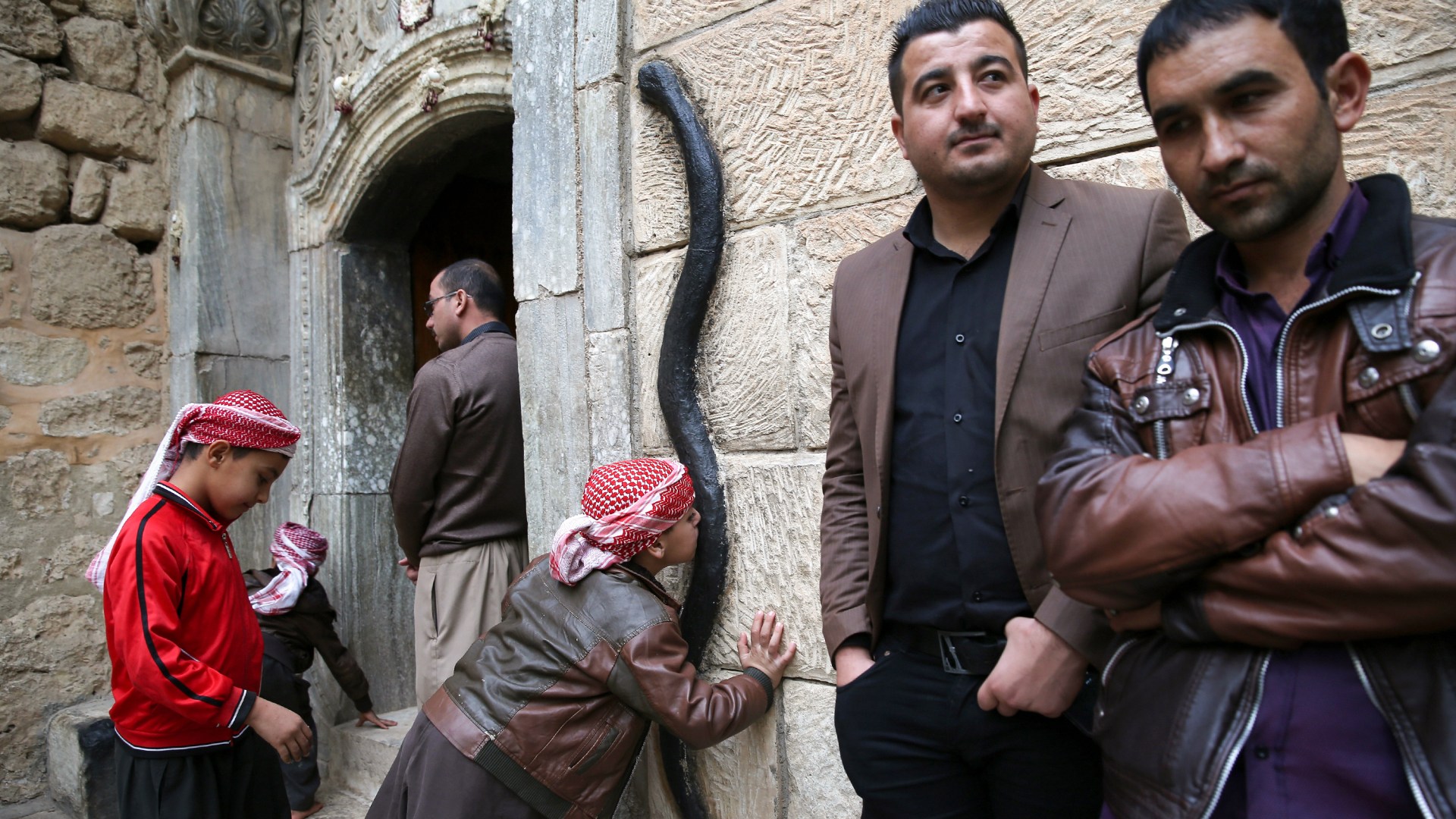
A Yazidi boy kisses a figure of a black snake at the entrance of the Temple of Lalish in Iraq.

A Yazidi boy kisses a figure of a black snake at the entrance of the Temple of Lalish in Iraq.

Christianity Today July 3, 2025
John Moore / Getty

This is part 3 in a series on the Yazidi community. Click here for parts 1 and 2.

Hadi Maao has faced multiple challenges in his 22 years of life. At age five, his mud-brick house fell on him, a result of nearby car bombings. At age 12, he fled to the mountains when ISIS displaced his people. At age 19, he dodged police while seeking asylum in Europe. Today, he lives and works legally in the Netherlands, while missing and worrying about his family still living in camps in northern Iraq.

Yet he maintains hope.

“God is always by my side,” Maao said. “And when I pray, he assures me of his presence.”

The thought sounds very evangelical. Yet Maao is Yazidi, a member of a minority religious community in Iraq that dates back to ancient Mesopotamia.

CT profiled Maao in part 1 of this series. In part 2, we described the challenges of Christian aid groups who help Yazidis in Kurdistan, the northern Iraqi region hosting many camps for the displaced. USAID cuts, also described in part 1, have drastically reduced humanitarian service.

Alongside his faith, Maao credited the prayers of his foreign Christian friends for his continued well-being. Conversion to another religion is forbidden to his people, Maao said. But he believes there is only a “thread of difference” between Yazidis and Christians.

This is far from the case in theology. Maao said that in ethics and conduct, the communities are close and keep good relations. But he made the comparison as the two minority religious groups have faced persecution from the majority Muslims, many of whom charge Yazidis with devil worship. Christians sometimes speak similarly, claiming Yazidis worship Lucifer.

The Bible does not give many details about the origin of Satan’s evil—only that in pride the angel rebelled against God and God cast him out of heaven. But in Islam, the Quran relates that when Allah created Adam, he commanded the angels to bow before the human creation. Believing himself superior, Satan refused.

Maao said that in the Yazidi story, God rewarded this angel (which they believe was a spirit called Melek Tawûs) for his refusal, as he would only worship God. In another version, however, Melek Tawûs’s disobedience was forgiven with his repentance, evidenced by tears that quenched the fires of hell.

Maao stated that Yazidi beliefs are relayed by oral tradition, creating multiple narratives as families pass stories down from father to son. Only select members of the religion possess true knowledge of its esoteric tenets, with no standard creed or confession of faith. Alongside the interview with Maao, this article primarily relies on Christine Allison’s entry in the Oxford Research Encyclopedia of Religion.

In the Yazidi language, Melek Tawûs translates as “Peacock Angel,” one of seven spirits called “Holy Beings” that emanate from God yet are inseparable from God’s essence. In this sense, Yazidis consider their religion monotheistic. The peacock—related or not—was an early Christian symbol of immortality. As the chief spirit, the Peacock Angel enacts God’s will in the world.

Yazidi shrine of Melek Tawûs, the Peacock Angel.Levi Clancy / WikiMedia Commons
Yazidi shrine of Melek Tawûs, the Peacock Angel.

Yazidis live primarily in the towns of Sinjar and Shekhan in Kurdistan, and while estimates vary, they number about 500,000 people worldwide. They believe one of the Holy Beings took the form of Adam, whom God created at Lalish, a village north of Mosul in Iraq that to them represents the center of the universe. Yet Yazidis believe they are separate creations from Adam, spirits different from the rest of humanity.

To the Yazidis, Jesus was also an incarnation of the Holy Beings and raised to life by Melek Tawûs. Another was Hasan al-Basri, an eighth-century Muslim ascetic and leading figure in the development of Sufism—Islam’s mystical tradition. Yazidis trace their modern community to Sheikh Adi ibn Musafir, founder of a 12th-century Sufi order and also a divine incarnation.  

Yazidis believe that when they die, their souls reincarnate as different Yazidis, with each stage ideally achieving greater purification; according to oral tradition, hell does not figure into the equation. This explains why Yazidis thoroughly reject conversions—for if they convert, they can never return to their religion and are left in a type of limbo, no longer able to progress toward God. Marriage outside the community may also ostracize them. A 19th-century Anglican missionary described Yazidis as industrious, clean, and orderly—but with no interest in the gospel.

“The pain [of conversion] would run deep, a sense of loss to span generations,” Maao said.

Throughout Yazidi history, the people group has constantly faced persecution. Kurdish Muslims executed the grandnephew of Sheikh Adi and killed 200 of his followers and set aflame his bones in effigy. An attack in 1415 burned the shrine at Lalish, and a 1566 Ottoman fatwa licensed the murder and enslavement of Yazidis on the charge of devil worship.

British intervention resulted in an 1849 Ottoman edict granting Yazidis legal status. But in 1892, another attack killed Yazidi civilians and resulted in the community head’s forced conversion to Islam. Yazidis fled their homes in Turkey with the Armenian Genocide and fought alongside Christian Armenians in 1918 to help establish the modern state.

Today, about 35,000 Yazidis live in Armenia, making up the nation’s largest ethnic minority. Thousands went to Germany in the 1970s when the country granted them asylum, and sizable populations reside also in Lincoln, Nebraska, and Houston, Texas.

But Yazidi shrines exist only in Iraq. Sheikh Adi is buried in Lalish, where Yazidi faithful make a yearly autumn pilgrimage. Yazidis are each required to make the trek once in their lifetime, if able. The ground inside the shrine is holy, and upon visiting, devotees take dirt to bring to their homes. Inside, Yazidis each express their prayers by tying a string on the drapery, while untying an existing string to symbolize God’s answering of prior requests. Alternate forms of petition include hugging a pillar, throwing a cloth at the wall, or building a tower out of smooth stones.

During the pilgrimage, Yazidis sacrifice a bull, preparing its meat for a community meal. They believe that Holy Beings descend during that time to decide the workings of fate for another year.

Other rituals include ceremonial washing in the Lalish springs and the circumcision of infants. During New Year’s celebrations in April, they color eggs.

Yazidis pray three times a day facing the sun. Maao said the practice is not necessary for ordinary members of the community, as most do not know the proper words and movements. The caste-like division of society includes murids (lay Yazidis), pirs (priests), and sheikhs (the knowledgeable religious class). These words all relate to Sufi degrees of initiation, but Yazidis are born into their categorizations and assigned by family heritage.

Another group is called qewwels, who sing complex Yazidi hymns. Maao’s family is among the faqirs, ascetics who wear sacred black wool cloaks in imitation of Sheikh Adi. His grandfather wore one as a religious practitioner, but neither Maao nor his father do. The role requires an austere lifestyle and devotion to arcane practices, he said, which are not necessary to be a good Yazidi.

Maao summarized Yazidi ethics as helping others without asking about their religion. He learned there are 72 other religions in the world, and Yazidis are number 73. Despite the history of persecution, they must pray for the other faiths before they pray for themselves. Another Yazidi, Hussein Salem, told CT the Yazidi faith is about love and forgiveness.

“We have a clean heart,” Maao said. “We don’t hate anyone.”

News

CRC Helps Pastors Minister Where Assisted Suicide Is Legal

The Reformed denomination “deplores” the legalization of the practice and offers recommendations for caring for the dying.

Two people clasp hands on the lap of a hospital patient with a medical bracelet
Christianity Today July 3, 2025
Bill Oxford / Getty Images

As assisted suicide continues to grow in Canada and expands in the US, a major Reformed body has moved to “deplore” its legalization in the strongest terms and offer the most detailed denominational guidelines to date on practical and pastoral care around the practice.

Last month, at an annual synod marked by difficult disagreements over sexual ethics, delegates from the Christian Reformed Church in North America (CRC) came together to speak out against medically assisted suicide.

“It is very rare that synod speaks this strongly about any issue,” Stephen Terpstra, synod president, said after the unanimous vote.

“We have said that we ‘deplore’ something, and we have spoken in the strongest possible language about the care and the value of human life and about the pastoral ways that we can live with each other even in very difficult circumstances.” 

A task force including members from Canada, which contains nearly a quarter of CRC churches, and the US spent two years developing a report and recommendations about how churches should care for people who are dying or have terminal illnesses or disabilities.

As of 2024, around 650 Christian Reformed pastors and chaplains minister in places where medically assisted suicide is legal.

The task force offered a list of suggestions for pastoral visits to aging and terminally ill parishioners, including examples of helpful Scriptures and hymns. It also discussed how pastors can help parishioners work through their own feelings on assisted suicide and endorsed conscientious objection for health care workers in their congregations.

The report additionally addressed grieving or holding funerals for people who died by assisted suicide, saying, “We believe that all the promises of God are still true,” and “We hold on to the promise that nothing in all creation can separate us from the love of God (Rom. 8:38–39); that God is gracious and compassionate, slow to anger, and plenteous in mercy (Ps. 103:8); and that salvation is by grace alone, through faith, and comes to us as a gift from God (Eph. 2:8–9).”

The nearly 175 delegates approved the report and recommendations unanimously, agreeing assisted suicide “is not congruent with a biblical, Christian understanding of life and death.”

But a subcommittee that reviewed the report before the synod wanted a stronger condemnation. It wrote an additional recommendation that the CRC “deplore” medically assisted suicide.

The church needs to be “prophetic” and “speak to the evil” of medically assisted suicide, said Richard Grift, a Canadian pastor who presented the recommendation at synod.

Action is needed now, he said.

“There is urgency for being clear and prophetic on this issue because of the speed at which society is accepting and expanding the availability of medically assisted suicide,” the recommendation reads.

Grift told Christianity Today after the synod that he was “very pleased” with the vote.

“I hope that the church in Canada speaks clearly to our politicians about putting the brakes on extending access to medically assisted suicide,” he said.

He hopes other denominations make similar statements.

“We need as a church across Canada to send a message that life is valuable, all life. We need to find other ways to help people with their suffering rather than encouraging them to take their lives.”

Medically assisted suicide continues to grow more acceptable and accessible. In May, Delaware joined 10 other states and Washington, DC, in legalizing assisted suicide.

On June 10, days before the CRC synod, senators in New York voted in favor of assisted suicide. The bill needs the governor’s approval to become law.

In Canada, assisted suicide—which the law calls “medical assistance in dying” (MAID)—has been legal in all provinces and territories since 2016. Since then, 60,301 Canadians have died by assisted suicide. In 2023, it accounted for nearly 5 percent of all deaths in the country.

In 2027, Canada is set to legalize assisted suicide for people whose only medical condition is a mental illness. Unlike US state laws, which say a person must have six months or less to live, Canada does not require such a prognosis.

In certain US states, doctors write prescriptions for lethal drugs that patients must take themselves. In Canada, self-administration rarely occurs. In most cases, a doctor or nurse administers the drugs intravenously. Many say this is better described as euthanasia.

Canada’s assisted suicide laws have raised international concern.

In Canada, assisted suicide was originally restricted to adults with what the law calls “grievous and irremediable” illnesses, diseases or disabilities with a “reasonably foreseeable natural death.”

In 2021, the requirement that someone’s death be “reasonably foreseeable” was removed. This made it possible for adults who have disabilities to die by assisted suicide even if they are not dying.

In March, a United Nations committee said it was “extremely concerned” about how Canada’s MAID laws place the lives of people with disabilities at risk. The committee recommended Canada stop allowing MAID for people whose deaths are not “reasonably foreseeable” and not expand eligibility further.

The CRC task force also voiced concerns about how medically assisted suicide impacts people with disabilities.

Medically assisted suicide for people with disabilities “involves an alarming devaluation of people who are every bit as valuable as nondisabled people.” The report calls for churches to make sure their buildings are accessible to people with disabilities and for church members to work to remove barriers people with disabilities face.

“To be pro-life is to be pro-disabled people,” the report says.

The report encourages churches to care both for people who are suffering from terminal illnesses and for their caregivers. It describes the differences between palliative care, which is intended to ease pain for dying people, and medically assisted suicide, which is intended to end life. And it does say Christians should not feel like they must pursue “medically futile interventions.”

The report also emphasizes the need for Christians to lament suffering.

“Lament shows us that God and God’s people can hold space for deep feelings; suffering is not to be repressed or hidden,” the report says. Lament, it notes, can encourage suffering Christians that God hears all their prayers and will not abandon them.

“We can’t be glib about suffering,” said Dr. Stephen Vander Klippe, a family doctor in Ontario who chaired the task force. “Suffering is horrible.”

Lament allows churches and individuals to acknowledge the reality of suffering, he says. When Christians help people who are suffering, they acknowledge that God is present in suffering.

“Jesus himself suffered,” Vander Klippe said in an interview before the report was presented at synod. “He did not sit from his throne and give directions. He himself suffered, and so as he walks with us, we are called to do the same.”

Zachary King, CRC general secretary, said churches should expect that public support for medically assisted suicide will grow.

“This particular genie is not going back in the bottle,” he said in an interview before synod.

He called the report “a wonderful gift to the church” and praised its practical suggestions for how churches and individuals can help people who are suffering.

“If we’re going to talk about life, we need to care about life in all of its diversity and not just … what we might say is the idealized, healthy life,” he said.

Being pro-life includes more than just condemning unbiblical practices, he said.

“The call for Christ’s body to love and care and nurture life is not just a ‘do not.’ It’s also a ‘do,” he explained. “And the ‘do’ piece here is [to] show love and care and support for people in all seasons of life, but especially those in the final season of life.”

Apple PodcastsDown ArrowDown ArrowDown Arrowarrow_left_altLeft ArrowLeft ArrowRight ArrowRight ArrowRight Arrowarrow_up_altUp ArrowUp ArrowAvailable at Amazoncaret-downCloseCloseEmailEmailExpandExpandExternalExternalFacebookfacebook-squareGiftGiftGooglegoogleGoogle KeephamburgerInstagraminstagram-squareLinkLinklinkedin-squareListenListenListenChristianity TodayCT Creative Studio Logologo_orgMegaphoneMenuMenupausePinterestPlayPlayPocketPodcastRSSRSSSaveSaveSaveSearchSearchsearchSpotifyStitcherTelegramTable of ContentsTable of Contentstwitter-squareWhatsAppXYouTubeYouTube