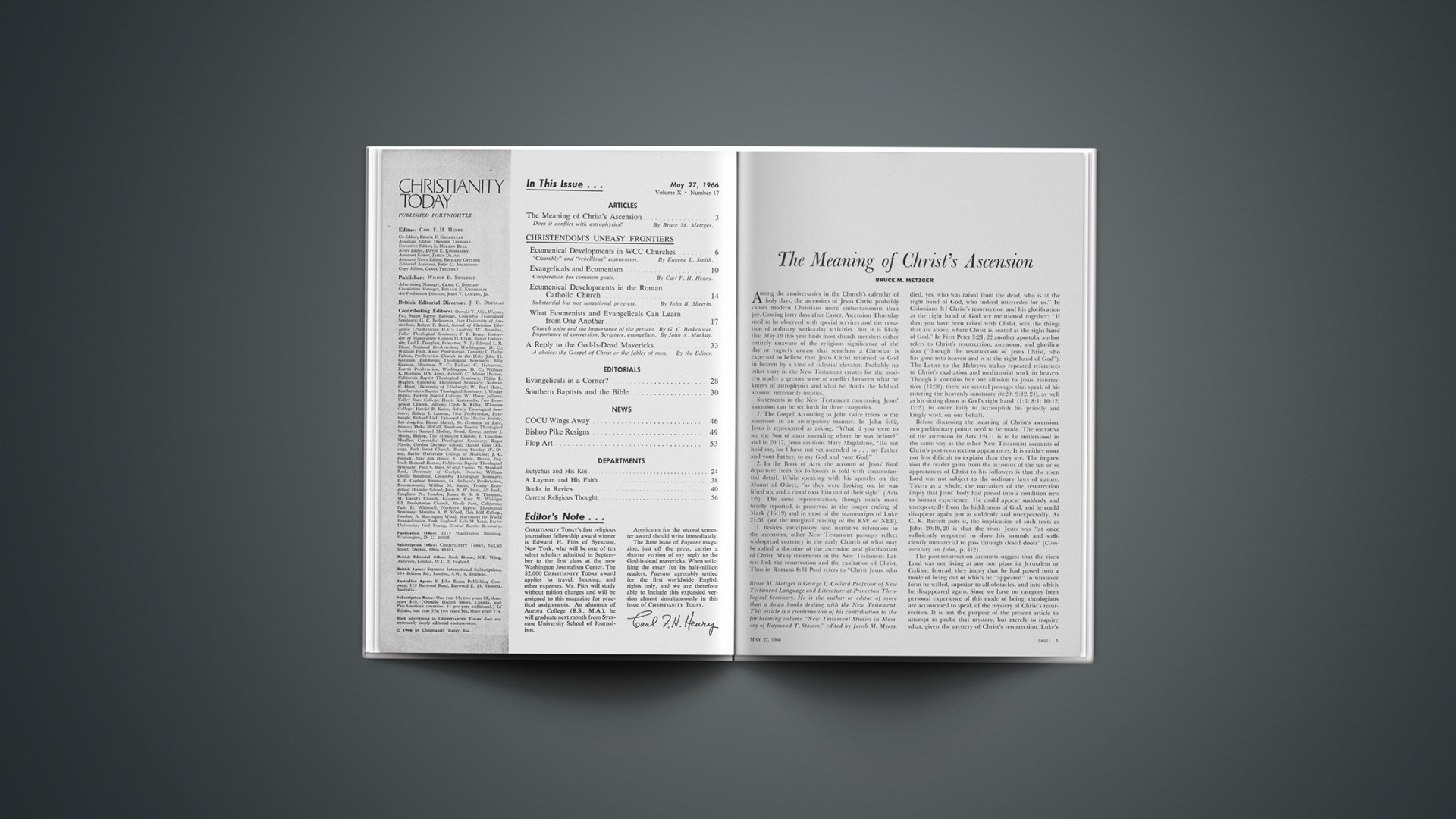
The Meaning of Christ’s Ascension

Among the anniversaries in the Church’s calendar of holy days, the ascension of Jesus Christ probably causes modern Christians more embarrassment than joy. Coming forty days after Easter, Ascension Thursday used to be observed with special services and the cessation of ordinary work-a-day activities, but it is likely that May 19 this year finds most church members either entirely unaware of the religious significance of the day or vaguely uneasy that somehow a Christian is expected to believe that Jesus Christ returned to God in heaven by a kind of celestial elevator. Probably no other story in the New Testament creates for the modern reader a greater sense of conflict between what he knows of astrophysics and what he thinks the biblical account necessarily implies.

Statements in the New Testament concerning Jesus’ ascension can be set forth in three categories.

1. The Gospel According to John twice refers to the ascension in an anticipatory manner. In John 6:62, Jesus is represented as asking, “What if you were to see the Son of man ascending where he was before?” and in 20:17, Jesus cautions Mary Magdalene, “Do not hold me, for I have not yet ascended to … my Father and your Father, to my God and your God.”

2. In the Book of Acts, the account of Jesus’ final departure from his followers is told with circumstantial detail. While speaking with his apostles on the Mount of Olivet, “as they were looking on, he was lifted up, and a cloud took him out of their sight” (Acts 1:9). The same representation, though much more briefly reported, is preserved in the longer ending of Mark (16:19) and in most of the manuscripts of Luke 24:51 (see the marginal reading of the RSV or NEB).

3. Besides anticipatory and narrative references to the ascension, other New Testament passages reflect widespread currency in the early Church of what may be called a doctrine of the ascension and glorification of Christ. Many statements in the New Testament Letters link the resurrection and the exaltation of Christ. Thus in Romans 8:34 Paul refers to “Christ Jesus, who died, yes, who was raised from the dead, who is at the right hand of God, who indeed intercedes for us.” In Colossians 3:1 Christ’s resurrection and his glorification at the right hand of God are mentioned together: “If then you have been raised with Christ, seek the things that are above, where Christ is, seated at the right hand of God.” In First Peter 3:21, 22 another apostolic author refers to Christ’s resurrection, ascension, and glorification (“through the resurrection of Jesus Christ, who has gone into heaven and is at the right hand of God”). The Letter to the Hebrews makes repeated references to Christ’s exaltation and mediatorial work in heaven. Though it contains but one allusion to Jesus’ resurrection (13:20), there are several passages that speak of his entering the heavenly sanctuary (6:20; 9:12,24), as well as his sitting down at God’s right hand (1:3; 8:1; 10:12; 12:2) in order fully to accomplish his priestly and kingly work on our behalf.

Before discussing the meaning of Christ’s ascension, two preliminary points need to be made. The narrative of the ascension in Acts 1:9–11 is to be understood in the same way as the other New Testament accounts of Christ’s post-resurrection appearances. It is neither more nor less difficult to explain than they are. The impression the reader gains from the accounts of the ten or so appearances of Christ to his followers is that the risen Lord was not subject to the ordinary laws of nature. Taken as a whole, the narratives of the resurrection imply that Jesus’ body had passed into a condition new to human experience. He could appear suddenly and unexpectedly from the hiddenness of God, and he could disappear again just as suddenly and unexpectedly. As C. K. Barrett puts it, the implication of such texts as John 20:19, 20 is that the risen Jesus was “at once sufficiently corporeal to show his wounds and sufficiently immaterial to pass through closed doors” (Commentary on John, p. 472).

The post-resurrection accounts suggest that the risen Lord was not living at any one place in Jerusalem or Galilee. Instead, they imply that he had passed into a mode of being out of which he “appeared” in whatever form he willed, superior to all obstacles, and into which he disappeared again. Since we have no category from personal experience of this mode of being, theologians are accustomed to speak of the mystery of Christ’s resurrection. It is not the purpose of the present article to attempt to probe that mystery, but merely to inquire what, given the mystery of Christ’s resurrection, Luke’s account of the ascension in Acts 1:9–11 is intended to teach.

The other preliminary point is that belief in the ascension of Jesus follows necessarily from belief in his resurrection. For, if Jesus rose from the dead not with a natural but with a spiritual body (and this is undoubtedly the teaching of the New Testament), then it was impossible for him to remain on earth permanently. The translation of his body to that sphere of existence to which it properly belonged was both natural and necessary. The problem, however, is what meaning one should attach to the account in Acts 1:9–11.

Let us begin by considering the incarnation. It is perhaps too obvious to mention that one would be on the wrong track if he sought somehow to reckon the number of minutes, or days, or months, or years that it took for the eternal Christ to leave heaven and come to earth. As the incarnation is not to be thought of as the passage from God’s space to ours, so the ascension should not be regarded as a journey from earth to heaven that required a certain number of minutes, days, months, or years to be accomplished. In other words, the ascension, properly understood, has no more to do with astrophysics than does the incarnation. The statement that Jesus “ascended up on high” means, not that he was elevated so many feet above sea level, but that he entered a higher sphere, a spiritual existence. When a school boy says that he has been promoted to a higher class, we would do him an injustice if we took him to mean no more than that he was transferred from a classroom on the ground floor to one upstairs. Similarly, the New Testament writers use ordinary language of physical elevation to suggest a metaphorical or analogical meaning. To speak, as the Bible and the Apostles’ Creed do, of Christ ascending to heaven and of his sitting on the right hand of God, is to employ symbolic language.

The point was made above that the appearance of the risen Christ to his followers on Mount Olivet (Acts 1:6–11) is represented as an episode as real and objective as his other appearances during the approximately six-week period following the crucifixion and resurrection. All of these appearances were intended to convince his followers that he had conquered death and was indeed accredited as God’s messiah. How was he to make certain that they would understand that the period during which he had appeared to them in post-resurrection glory was now coming to an end, and that they should not expect to see him in this way again? He could, of course, have told them that this was now the last time he would appear to them, and that they should not look for him to appear again. Human nature being what it is, however, it is not hard to imagine that, without some dramatic imagery suggesting the close of the transitional period, it is likely that his disciples would have continued to live in suspense, hoping against hope that their Master would appear again. Later, when no subsequent manifestation occurred, such expectation would have been supplanted by all kinds of doubts and perplexities as to what had finally become of their Lord. What is being suggested, therefore, is that though Jesus did not need to ascend in order to return to that sphere which we call heaven, yet in fact according to Acts 1:9 he did rise a certain distance into the sky, until a cloud took him out of their sight. By such a sign he impressed upon his disciples the conviction that this was now the last time he would appear to them, and that henceforth they should not expect another manifestation but understand that the transitional period had ended.

The symbolism Jesus employed was both natural and appropriate. The transcendent realm of the Spirit is frequently referred to by the idea of height. The expression “the Most High” is a surrogate for God in the thinking of many people. At Jesus’ final appearance to his followers he rose from their midst, not because he had to do so in order to go to the Father, but for didactic reasons, in order to make his last act symbolically intelligible.

That the lesson was learned by the early Church seems to be clear from the fact that the records of the first and second centuries indicate that the disciples suddenly ceased to look for any manifestation of the risen Lord other than his second coming. It appears that some event must have taken place which assured them that the period of the resurrection appearances had definitely come to an end.

In addition to conveying the sense that his departure was final, his act of rising conveyed the clear impression that he had gone to his Father and that all power was put into his hands. Very likely those whose minds were first impressed by Jesus’ ascension believed, as we no longer believe, that heaven as a place was above their heads, and that the path of the ascending Jesus was the only way thither. But still today, with our superior knowledge of the cosmic system, we can imagine no other symbolical action that could convey the desired impression. In short, whatever else Jesus’ final withdrawal involved, it is certain that he parted from his followers in such a way that they thereby became certain of his royal power and rule.

One may ask, in conclusion, what is meant by the imagery, used by several New Testament theologians (see, for example, Eph. 1:20; 1 Pet. 3:22; Heb. 1:3), that Christ is seated at the right hand of God on high. What is God’s right hand? This is metaphorical language for the divine omnipotence. Where is it? Everywhere. For Christ to sit, therefore, at the right hand of God does not mean that he is resting; it affirms that he is reigning as king, wielding divine omnipotence.

The doctrine of the ascension is the Christian affirmation of the absolute sovereignty of Jesus Christ over every part of the universe. Though some may imagine that the ascension is the point at which the Christian faith became airborne, losing touch with this world altogether, it has, on the contrary, far-reaching implications of a quite pragmatic nature. That Christ has ascended and now sits at the right hand of God means that he lives and rules with all the authority and power of God himself. Ascension day proclaims that there is no sphere, however secular, in which Christ has no rights—and no sphere in which his followers are absolved from obedience to him. Instead of being a fairy tale from the pre-space age, Christ’s ascension is the guarantee that he has triumphed over principalities and powers, so that at his name “every knee should bow, in heaven and on earth and under the earth, and every tongue confess that Jesus Christ is Lord, to the glory of God the Father.”
Editor’s Note from May 27, 1966

Christianity Today’s first religious journalism fellowship award winner is Edward H. Pitts of Syracuse, New York, who will be one of ten select scholars admitted in September to the first class at the new Washington Journalism Center. The $2,000 CHRISTIANITY TODAY award applies to travel, housing, and other expenses. Mr. Pitts will study without tuition charges and will be assigned to this magazine for practical assignments. An alumnus of Aurora College (B.S., M.A.), he will graduate next month from Syracuse University School of Journalism.

Applicants for the second semester award should write immediately.

The June issue of Pageant magazine, just off the press, carries a shorter version of my reply to the God-is-dead mavericks. When soliciting the essay for its half-million readers, Pageant agreeably settled for the first worldwide English rights only, and we are therefore able to include this expanded version almost simultaneously in this issue of CHRISTIANITY TODAY.

Rome and Revelation

In the april 15 issue of this magazine (p. 42), Professor Leslie R. Keylock gave readers an overview of the International Conference on the Theological Issues of Vatican II, held at the University of Notre Dame on March 20–26. The present article has to do with one aspect of the conference’s concern, revelation.

It should be said at the outset that the differences of opinions (i.e., between conservatives and progressives) expressed in this area were much less pronounced than those that emerged during the discussions of the nature of the Church and the organization of the hierarchical structure. This Protestant observer was at times astonished to hear the statements of responsible Roman Catholic spokesmen about the primacy of the Bible, and to note their tributes to the work of Protestant Bible societies. Certainly the stereotyped idea that the Roman church is determined to “keep the Bible from the people” found little support at Notre Dame.

The interpreters of the Constitution on Divine Revelation accepted as a point of departure the position that divine revelation is a gift from God that man is obligated to accept. This gift (the divine Word) was declared to be a living communication of God himself to man, and in its written form to be the revealing echo of the unitary Living Word, through whom the Father of the Christian Trinity speaks. The centrality of Christ in the Word means, to the drafting fathers, that Jesus Christ sums up in himself everything the Father needs to say, and thus all threads and trends in the Scriptures can be seen to unite in the Son.

Chapter 3 of this constitution affirms that God chose men, infused their powers and faculties with the Holy Spirit, and acted in and through them to convey and affirm the divine will to man. The document insists upon the historical integrity and consequent truth-value of the two Testaments. The Old Testament, it was maintained at the conference, would have been a supremely valuable document even if our Lord had not become incarnate. Stress was laid repeatedly upon the place and role of even the imperfect parts of the Hebrew Scriptures in the divine pedagogy.

The panelists grappled with the question of the proper approach of the reader to the biblical narrative. It was pointed out repeatedly that great theological confusion has resulted from the study of the Bible from the point of view of modern historiography, particularly as this was formulated by the Mommsen-Van Ranke school. With reserve, assent was given to the more contemporary theological “study models,” notably the so-called eschatological model, and to the methodology indicated by the application of the concept of Heilsgeschichte. That is to say, a place was made for a Catholic interpretation of Scripture within other than the classical scholastic perspective. One frequently felt that the spirit of Teilhard de Chardin was present in the discussions.

The fact of revelation was shown—correctly, we believe—to be closely identified with the history of redemption. The entire thrust of Scripture seems to the drafters of this constitution to be evangelical, moving toward the gathering of the People of God. The claim that revelation consists of “both words and deeds” seemed to the interpreters of the document to be adequately met in the concept of the centrality of Jesus Christ in the written Word. In other words, the constitution is incongenial to the severance, common in some contemporary theological circles, of verbal revelation from “the saving acts of God.”

Against this, it was maintained that in reality every deed of our Lord was in itself a word. In him we encounter historical reality: as one panelist noted, “In him we deal with rock-bottom history.” It was pointed out that Roman Catholic scholarship accepts, with reserve, the conclusions of “redaction criticism” where such criticism does not rest upon philosophical presuppositions that negate the principles of the Christian Kerygma.

Admittedly, this leaves open many questions of theological and biblical interpretation. The major one of concern to Protestants is, of course, whether the Sacred Scriptures are or are not regarded to be the sole source of authority. One spokesman for Vatican II who is competent to speak from the inside explained that the statement to the effect that the Church derives her certainty about all that has been revealed “not through Holy Writ alone” was the result of pressure from the conservatives, and yet leaves Catholics free to say that the “whole deposit” is in the Bible. Thus, it seemed to the outsider that the typically Catholic view that authority issues from “the Bible and …” still prevails.

From one of the panel discussions came the significant statement that Vatican II demands, implicitly if not explicitly, that the Roman Catholic Church give the same emphasis to the Word that the “separated brethren” have historically given it. At least one speaker, saluting Protestant efforts toward scholarly linguistic translations, indicated that it will not be many years until a common Bible for all Christendom is a reality.

On the question of the reliability of the Scriptures in matters of historical fact, conclusions were expressed with a measure of reserve. For some reason, the term “infallible” was applied to the written Word with hesitancy; perhaps it was thought that the category of infallibility as applied in another connection was in need of clarification, and that its reassertion in a second area would have been inadvisable at this time. A hint was given that this question would be the subject for subsequent discussion at the highest level.

In the meantime, the emphasis was to be upon presenting the Bible in such a manner as to make eternal truth meaningful to men of the present day. It was indicated that a proposed draft on the sources of revelation was rejected by vote, on the ground that the door ought to be kept open for appropriate adjustments to modern mentalities. Thus was aggiornamento applied to the understanding of the Bible and its relation to contemporary thought.

Leaders of the Notre Dame conference sought to make the sessions into working models for what they hope will be new and more fruitful forms of interfaith theological discussion. Representatives of Protestantism and Judaism were welcomed, both as observers and as participants. With utter frankness, panelists, including several of those who framed the several constitutions during Vatican II, proclaimed the need of the Roman church for biblical revival. One feels that this is one aspect of Vatican II that will not die at the convention level.

It is conceivable that this impetus from the Vatican Council might give rise to a movement of reform within the Roman Catholic Church comparable to that which Christendom, under other circumstances, underwent in the sixteenth century. Dean Samuel H. Miller of Harvard Divinity School predicts she will emerge as “the Church of the Reformation.” Protestants will be well advised to guard their heritage lest it go to others by default.

Race Policies Cut Student Aid

The federal government tried last month to lure four Protestant colleges from their segregationist ways. It moved to cut off National Defense Education Act student loans, which have totaled $1,491,832 at the four schools.

It was the government’s first move on higher education under the Civil Rights Act of 1964, which forbids racial discrimination in federally assisted programs.1Section 601 reads: “No person in the United States shall, on the ground of race, color, or national origin, be excluded from participation in, be denied the benefits of, or be subjected to discrimination under any program or activity receiving federal financial assistance.” The colleges that refused to sign compliance with the act were, in order of size: Bob Jones University, Greenville, South Carolina; Mississippi College, Clinton, Mississippi; Sweet Briar (Virginia) College; and Free Will Baptist Bible College, Nashville, Tennessee. Also challenged was a non-church junior college for men, Marion (Alabama) Institute.

Several other schools also have refused to pledge non-discrimination, but the four initial test cases were believed to be the most intransigent. The four situations vary:

Sweet Briar, a fashionable women’s college, is not church-related. But it belongs to the Council of Protestant Colleges and Universities, and its charter specifies Christian purpose. The founder’s will limits admission to “white girls and young women.” Last year a state judge rejected the college’s request to have the will thrown out. Sweet Briar then signed a compliance form, but the government considers it unacceptable.

Mississippi College, the state’s oldest, is owned and governed by the Mississippi Baptist Convention of the Southern Baptist Convention. College President Richard A. McLemore said, “I’ve been trying to persuade the board of trustees and the convention to remove the restrictions, but this is a slow process.” The state convention will discuss a study report on race policy this November, and the college trustees meet the next month. Change is considered possible.

Free Will Baptist, official school for the denomination of 170,000 members, has no plans to continue federal student loans. President L. C. Johnson said the basic issue is not civil rights but “the government using funds to exercise a degree of control.” Civil rights, he said, “was the basic thing they were using.”

Johnson denied that the school has a segregationist policy, but when asked whether a qualified Negro would be accepted, he said the board of trustees would have to decide that when the time came. There are few, if any, Negro Free Will Baptists, he explained, and no Negro has ever applied for admission.

The most militantly segregationist school is Bob Jones, an independent fundamentalist college (see April 1 issue, page 45). School administrators also have often criticized federal aid and other national policies as socialistic. In last December’s alumni magazine, President Bob Jones, Jr., stated:

“The right kind of graduate wants Bob Jones University to maintain the same high standards which the University taught him to respect and maintain, and it is his wish that Bob Jones University be kept free from entangling alliances of every kind. It is in order to be able to preserve our standards that we refused to sign the Statement of Compliance with the Civil Rights Act and turn over the policies of this institution to the Department of Health, Education and Welfare. Our alumni are going to have to give sacrificially to offset the fact that our students can no longer participate in the so-called National Defense Student Loan Fund which should be rightly known as the ‘Fund for the Socialization of American Colleges and Universities.’ ”

But Jones said the school may challenge the federal decision and seek to continue U. S. loans. As the biggest school challenged by HEW, it stands to lose $135,900 per year in student aid. Also, it would have to return the bulk of the $774,442 previously granted by the U. S. to the revolving NDEA loan fund administered by the university.

Jones was blunt on his racial policies during a Charlotte newspaper interview: “The university does not admit Negroes. This is against the stated policy of the founder [Bob Jones Sr.], and the full board would have to reverse that policy. And I assure you the board has no intention of integrating.… College is the time of romance. That’s why Oriental students at Bob Jones University are not permitted to date white students.”

Of Interchurch Interest

Eugene Carson Blake, new head of the World Council of Churches, said that in theory “any Christian church is eligible for membership,” including the Roman Catholic Church.

The California-Nevada district of Missouri Synod Lutherans will cooperate in campus ministries with the other two major Lutheran denominations. Missouri Synod was rebuffed in a new attempt at reconciliation with the Wisconsin Evangelical Lutheran Synod.

The National Holiness Association, which represents eleven conservative Wesleyan-Arminian denominations, called a study conference for leaders of its constituency later this year to discuss greater cooperation or a structured holiness church federation.

The Baptist Unity Movement, which hopes to pull together various Baptist groups in America, decided at its annual meeting to incorporate, adopt by-laws, and apply for tax-exempt status.

Personalia

Richard C. Raines of Indianapolis was elected president of the Council of Bishops of The Methodist Church. A year from now San Francisco’s Donald H. Tippett assumes the post.

Robert S. Bilheimer, a Rochester Presbyterian minister, will head the new world peace committee and International Affairs Commission of the National Council of Churches. A peace official and agency were ordered by the NCC board in February.

W. C. Fields, public relations secretary of the Southern Baptist Convention, was named president of the Religious Public Relations Council.

Norman R. DePuy, American Baptist pastor in Moorestown, New Jersey, will be the new editor of the denominational magazine Missions, which claims to be the world’s oldest continuous Protestant periodical.

Anne Morrow Graham, daughter of evangelist Billy Graham who will be 18 this month, plans to marry September 2 in Montreat, North Carolina. The groom is Dr. Daniel Milton Lotz, a Chapel Hill, North Carolina, dentist, who was captain of the University of North Carolina basketball team voted the nation’s best in 1959.

Marge Saint, widow of martyred missionary pilot Nate Saint, plans this fall to marry longtime family friend Abe Van Der Puy, president of World Radio Missionary Fellowship, Quito, Ecuador.

Grady C. Cothen, an official in the Southern Baptist General Convention of California, was elected president of Oklahoma Baptist University by its trustees.

Eugene Stowe, superintendent of the Church of the Nazarene in central California, was appointed president of Nazarene Theological Seminary in Kansas City, Missouri.

Billy R. Lord, Southern Baptist chaplain in Viet Nam, was awarded the Silver Star for making a dozen trips under fire to carry wounded soldiers to an evacuation point.

Burton W. Marvin, Methodist layman and former journalism dean at the University of Kansas, is the new associate general secretary for communications of the National Council of Churches.

Hans Rohrbach, head of the mathematics department at the University of Mainz, Germany, and a participant in this fall’s World Congress on Evangelism, was named university president.

Miscellany

Evangelist Billy Graham plans to visit Poland in late September to participate in celebration of the 1,000th anniversary of Christianity in that country. Graham’s trip is in response to an invitation from Polish Baptist churches. Other Polish Protestant churches subsequently indicated they would support the meetings, tentatively scheduled for Warsaw and Cracow.

A nationwide poll by NBC-TV for use on a program testing political attitudes shows 76 per cent of Americans disagree that “prayer and Bible reading should not be allowed in public schools”; 17 per cent agree, and 7 per cent said they agree or disagree in part.

New York State’s divorce law was revised last month for the first time in 179 years. Grounds for divorce now include abandonment, separation, and imprisonment. Previously a marriage could be dissolved legally only on grounds of a narrow definition of adultery. That definition is now expanded to include sodomy and homosexuality.

Deaths

FRED HOSKINS, 60, head of the Congregational Christian Churches who led them into the United Church of Christ merger; of a heart attack at a church staff meeting in Garden City, Long Island.

ERLING OLSEN, 70, New York City investment executive and active evangelical layman and radio speaker; in Rye, New York.

FERENC KISS, director emeritus of the anatomy department at Medical University, Budapest, Hungary, who was president of the Free Churches in Hungary from 1945 to 1960.

The governor of East Pakistan has ordered compulsory religious education for all high schools, presumably in Islam. The status of Christians in the new program is unclear.

A civic association in Britain wants churches to turn over their old and neglected cemeteries to provide more parking lots for the nation’s burgeoning army of automobiles.

The director of the National Institutes of Health, Dr. James Shannon, said doctors should persuade carriers of genetic defects either not to marry or to have no children if they do.

Campus Crusade tried its first “saturation” campaign at Ohio State University last month in “Operation Other Side,” designed to describe Christianity to students who reject the faith without investigating it. During meetings ranging from 125 discussion groups to a campus-wide rally, nearly 500 students indicated first decisions for Christ.

The Latin America Mission concluded a year of evangelistic work with a rally and march of 10,000 in Santo Domingo, Dominican Republic. Churches report 11,500 new professions of faith.

‘National University’ Proposed at NAE

President Hudson T. Armerding of Wheaton (Illinois) College is proposing “a national university composed of cooperating regionally accredited Christian liberal arts colleges.” He unveiled his idea before fellow Christian educators last month in meetings in Denver concurrent with the annual national convention of the National Association of Evangelicals.

The Armerding plan is based on the need for a graduate program “of breadth and depth not now available at any one of the potential participating colleges.” He envisions it as functioning within the framework of presently qualified colleges whose facilities would be combined to implement the program. Said a Wheaton spokesman:

“Leased lines, coaxial cables, and other communications devices could expedite cooperative instruction. Library resources might be shared through the use of new data retrieval systems. Key faculty could, if necessary, commute by air from one campus to another.”

“The integration of the various campuses organizationally could be provided by a board of control responsible for policies affecting the national university as a whole. It would be expected that each campus would still retain its own board policies peculiar to that particular institution.”

Under the leadership of towering General Director Clyde Taylor, nearly 1,000 Denver delegates passed ten major resolutions on current affairs of interest to evangelicals at the main NAE sessions.

On world ecumenism, NAE reaffirmed “its conviction that Christian unity is primarily a spiritual relationship” and recognized “helpful diversity in structural relationship.” It said unity, “given by God and made real in us by the ministry of the Holy Spirit, is manifested in love-inspired fellowship that promotes cooperative effort in our Christian witness without the necessity of ecclesiastical union or uniformity in practice.”

Taylor said evangelicals within major denominations face two problems: “compromising mergers, and serious theological defections.” He said such evangelicals “may be forced out of their denominations.”

The NAE represents forty small denominations and individual congregations with a membership of two million, and through affiliated agencies serves a constituency of eight million. It has set three objectives for next year’s twenty-fifth anniversary: 10,000 new member churches; 10,000 special gifts; and 10,000 attending a special anniversary dinner. The anniversary year might also feature the start of a national radio program and a national evangelism congress.

A resolution on “Christian atheism” said NAE “vehemently condemns the treachery of some clergy and religious leaders to the gospel they are appointed to defend.” In politics, NAE deplored “a new treason” in “the burning of draft cards, subversive movements and seditious utterances, and prevalent disloyalty to the United States of America.”

The first resolution charged the motion picture industry has broken its own “gentlemen’s agreement” or production code and is turning out increasingly licentious material. It urged Congress and the Federal Communications Commission to “form guidelines short of censorship in the interest of insuring ethical propriety” in movies and TV programs.

NAE maintained the “finality of the ethics of the Ten Commandments and of the New Testament” and condemned the “New Morality, or Amorality, both in national and private relations, and the representation thereof on stage, screen, radio, television, and in the press.” It saw “loose prevalent standards of morality everywhere manifest.”

Philip Gilliam, for thirty years a Denver juvenile court judge, said that “the big challenge in America today is making decency popular.… I am shocked at the downhill plunge in morality today. The good guys aren’t winning any more.”

A major resolution on “Law and Order” characterized an “unamerican mood which has invaded our society” as “godless, revolutionary, and disloyal to government.” It pledged itself to “obedience to the injunctions of Scripture to respect the authorities over us and pray for those in high office.”

Another resolution urged “increased effort for world relief,” not only in much-publicized India and Viet Nam but also in the Congo and Rhodesia.

Discrimination was raised during a morning Bible message by Dr. Mariano Di Gangi, pastor of Philadelphia’s Tenth Presbyterian Church. He said he had received possible calls to pulpits but later was turned down because of his Italian name. “They thought I probably push a banana wagon, have garlic on my breath, and am a card-carrying member of the Mafia,” he commented.

Dr. Rufus Jones, general director of the Conservative Baptist Home Mission Society, was elected new NAE president. NAE honored its treasurer, Robert C. Van Kampen, as “Christian Layman of the Year.” He has retired from full-time business to work with several evangelical organizations but remains a director of fourteen corporations and two banks.

The Wheaton Declaration

More cooperation among evangelical missionaries is expected as an immediate effect of the historic Wheaton Declaration. The 5,900-word strategy document, adopted in unanimous votes, section by section, at last month’s Congress on the Church’s Worldwide Mission, seems already to be encouraging merger talks among missionary boards.

More than 900 influential missionaries and national leaders from seventy countries participated in the adoption of the declaration at the eight-day, precedent-setting congress (see April 29 issue, page 43) called by the Interdenominational Foreign Mission Association and the Evangelical Foreign Missions Association. Plenary sessions were held in Pierce Chapel, on the campus of Wheaton (Illinois) College.

The declaration was drafted by a panel of specialists, extensively revised by study committees, and further amended in floor debate at plenary sessions. The final product represents a broad consensus on evangelical missions strategy for the years immediately ahead.

An important addition to the draft document was a stand for racial equality, human freedom, and social justice (see text below). The approved document also added “family disintegration” to a list of problems—racism, war, population explosion, poverty, social revolution, and Communism—to which evangelicals are said to have failed to apply scriptural principles. A key deletion, attributable to protests of Latin American delegates, was the preliminary draft’s acknowledgment that “not a few [Roman Catholics] are already in Christ; may their numbers increase.”

The Wheaton Declaration stresses the need for certainty, commitment, discernment, hope, confidence, confession, evangelism and consensus. Its appeal is to “the Bible, the inspired, the only authoritative, inerrant Word of God.”

Here are excerpts relating to crucial contemporary issues:

On syncretism: “We must first divest our presentation of those cultural accretions which are not pertinent to essential gospel truth.… We must bear our testimony with humility and dignity.”

On proselytism: “The proselytism that includes forced conversion or the use of unethical means (material and/or social) is contrary to the gospel of Christ.”

On “Neo-Romanism”: “We recognize the danger of regarding the Roman Catholic Church as ‘our great sister Church.’ ”

On church growth: “We should devote special attention to those people who are unusually responsive to the gospel and will reinforce those fields with many laborers.… We must pray earnestly that the Holy Spirit will bring the less responsive fields to early harvest. We will not leave them untended.”

On foreign missions: “The proper relationship between churches and missions can only be realized in a cooperative partnership.”

On evangelical unity: “We will encourage evangelical mission mergers when such will eliminate duplication of administration, produce more efficient stewardship of personnel and resources, and strengthen their ministries.… We caution evangelicals to avoid establishing new churches or organizations where existing groups of like precious faith satisfactorily fill the role.”

On evaluating methods: “While the social sciences afford considerable insights for missionary methods, yet these must be subjected to the corrective judgment of Scripture.”

On social concern: “Evangelical social action will include, wherever possible, a verbal witness to Jesus Christ.… We urge all evangelicals to stand openly and firmly for racial equality, human freedom, and all forms of social justice throughout the world.”

On “a hostile world”: “Our supreme loyalty is to Jesus Christ, and all of our racial, cultural, social, and national loyalties are to be in subjection to Him.”

Following adoption of the declaration, delegates recited this vow in unison:

“In the support of this declaration, we, the delegates here assembled in adoration of the Triune God, with full confidence in Holy Scripture, in submission to the Lord Jesus Christ, and looking for His coming again, do covenant together for God’s eternal glory, and in response to the Holy Spirit, with renewed dedication, and in our oneness in Christ as the people of God, to seek, under the leadership of our Head, with full assurance of His power and presence, the mobilization of the Church—its people, its prayers, and resources, for the evangelization of the world in this generation. So help us, God! Amen.”

‘The Linen Stays Dirty’

The crusading editor of the 18-month-old independent National Catholic Reporter, Robert G. Hoyt, landed timely blows last month on the institutional midsection of the church periodical trade. He told 150 editors of Associated Church Press in St. Louis that most of their periodicals are instruments of managed news.

Church leaders, he said, “have not been willing to grasp the lesson the secular press has to teach, that honest reporting and objective criticism of their own policies and programs will serve the Church better than the techniques of public relations.”

Hoyt made examples of usually responsible Roman Catholic diocesan papers in Boston and St. Louis which played down or omitted important local developments last month, presumably because the reports would have reflected adversely on the church. But editors, publishers, reporters, and readers must all assume part of the blame, he added.

Institutional pride, according to Hoyt, “means that we Catholics, or we Methodists, don’t want to wash our dirty linen where the Presbyterians, or the Quakers, or the secular humanists can observe the operation. The result is that the linen stays dirty, because for some reason the kind of stains we’re talking about don’t wash out very well in our private laundries.”

Hoyt repudiated the notion “that if we can just get a copy of our paper into the hands of an indifferent church member, somehow holiness will pour through his fingers into his heart. As a result a great many religious publications depend for their circulation not on their merits, not on the service they offer to readers, but on extra-journalistic methods and procedures which derive their effectiveness from the consent of the powers-that-be in the Church. And when this is the case, the injunction of St. Paul to speak the truth in season and out of season gives way to the non-scriptural but sound platitude that he who pays the piper will call the tune.”

During the three-day ACP convention, the Church’s lack of candor also came under attack in speeches by a local newspaper editor, a state senator, and two journalism professors from Syracuse University. They reflected growing uneasiness over the present role of the church press (see March 4 issue, p. 48). Appropriately enough, it was the ACP’s fiftieth anniversary, the theme being “Gateway to New Insights in Christian Journalism.” “Gateway” was an intentional allusion to the new 630-foot Gateway Arch, which is already to St. Louis what the Eiffel Tower is to Paris.

Another highlight of the ACP convention was the presentation of awards, two of which went to motive, Methodism’s avant-garde monthly for students. One was for “excellence in physical appearance” and the other for “consistency in just good writing.”1motive probably scored the coup of the year in religious journalism with its publication of a satirical, newspaper-style “obituary” on God by Anthony Towne, whose manuscript had been turned down by the New Yorker and the Christian Century, motive rarely pays contributors, and Towne got only acclaim.Christianity and Crisis got the third award for “relevance of content for intended readership.”

The ACP, founded in St. Louis on December 6, 1916, as a fellowship of editors of Protestant periodicals, takes on new dimensions this year with the acceptance of its first Roman Catholic publication (Continuum, a scholarly quarterly) and the establishment of a secretariat in Chicago. The Rev. Alfred P. Klausler, editor of the Missouri Synod Lutheran youth publication Arena, will switch from part-time to full-time executive secretary July 1.

Mass For The Married

On April 17, Father Anthony Girandola celebrated his first public “mass for lepers”—fellow Roman Catholic priests who have been excommunicated for getting married.

The service was held in a St. Petersburg, Florida, public school cafeteria rented for $19. In attendance were 200 persons, including a dozen Protestants and ten newsmen. Girandola hopes to build “Dismas House” in the city as a refuge for what he estimates are America’s 5,000 married Catholic priests.

A Communist In The Vatican

Soviet Foreign Minister Andrei Gromyko last month became the first Communist leader to call on a pope. World peace topped the agenda. Both sides underplayed the historic nature of the forty-five-minute talk, terming it a continuation of a chat during Pope Paul’s visit to the United Nations last October.

After the audience, the perpetually grim Gromyko said both men felt peace must be sought “independently of ideology or convictions.” The Red diplomat also proposed a meeting of all European leaders on national security problems.

Gromyko refused comment on chances for a papal visit to the Soviet Union in the near future. Paul had hoped to make his first visit behind the Iron Curtain for the current celebration of 1,000 years of Christianity in Poland. Months-long negotiations broke down in the complex church-state feud centering on strong-willed Stefan Cardinal Wyszynski.

The Communist and the Pope reportedly discussed Russia’s success in bringing a truce between India and Pakistan, and closer Vatican-Moscow contacts, through either the Soviet ambassador in Rome or an unofficial Vatican delegate in Moscow.

Contacts between Communism and Catholicism have been sparse. In 1922, the new Soviet regime refused Vatican appeals for guarantee of religious freedom and permission to aid starving Russians. In 1945. Josef Stalin reportedly rebuffed a bid from Pope Pius XII, sent through an American emissary, for a Vatican delegate in Moscow. Pope John XXIII renewed efforts toward a thaw in Moscow and in 1963 received Alexei Adzhubei, son-in-law of Soviet Premier Khrushchev and then editor of Izvestia.

The 40-year-old priest was automatically excommunicated under church law a year ago when he married his attractive wife Larraine, 28, before a board of priests in Bridgeport, Connecticut, had acted on his petition for release from celibacy vows. The couple were married by a priest friendly to Girandola. Though he accepts the excommunication as a lawful exercise of church authority, Girandola insists he is a Catholic and “a priest forever.”

The celibacy revolt was the only obvious digression from Catholic practice at the Mass (his wife and four-month-old son Anthony Jr. were in the congregation). Communion was offered to all who attended, but only twenty-three accepted the Eucharist from Girandola’s hand. He conducted the Mass in the new English form, facing the congregation.

Mrs. Girandola, raised in a Protestant fundamentalist home, was an airline stewardess and a nominal Christian who converted to Catholicism and became a nurse. She met the priest while he was a patient at Seton Psychiatric Institute in Baltimore. After their marriage, he worked for a Seventh-day Baptist newspaper in Westerly, Rhode Island, before moving to Florida.

Girandola said the vow of celibacy had been a major problem for him—he had “dated” both as a seminarian and as a priest. The celibacy requirement is currently undergoing great strain (see “The Rebel Priests,” March 18 issue, page 44).

Girandola plans to continue public Masses for persons outside the pale of the Catholic Church. He laughingly said that St. Petersburg is an “auspicious” base of operations because “Peter was the first priest commissioned by Christ, and Peter was married.”

Karl Barth At 80

Two operations and a long hospital stay should be enough to slow down any man. But to the many reporters and well-wishers dropping in on Basel theologian Karl Barth last month on the eve of his eightieth birthday, the genial octogenarian seemed much his former self. He looked thinner. His face was more drawn, his hands more gaunt. He was wearied by a series of filmed interviews for Swiss and German television. But to all who spoke with him, the man who had largely by himself effected a revolution in twentieth-century theology answered with the same old wit, the same good nature, and the same overpowering intellect.

From his second-floor study, lined with the books that he has made his life, Karl Barth looks out through a very wide window on the world. “I would like to see something serious in theology today,” he tells his visitors. “But I do not see it. I complain about a lack of seriousness.”

Barth regards the works of his contemporaries Niebuhr, Tillich, and Brunner as having stature, and reflects with respect on the giants of his youth—Harnack, Hermann, Troeltsch, and Kähler. “But the things I see in Europe and America today are only attempts. What I see is a paperback theology.”

A case in point is the “God is dead” theology, which Barth dismisses as a “bad joke” with a characteristic wave of his hand. He calls its proponents “theological playboys” who have studied “neither the Bible nor the history of theology.” To the author of the multi-volume Church Dogmatics, which students in Germany measure in centimeters as well as in volumes, such men represent a debasement of theology to journalism.

“Men like Ebeling, Käsemann, and Pannenberg are serious,” Barth tells visitors. “But the upcoming theologians in Germany and elsewhere are too specialized. I believe, for instance, that Pannenberg will have to revise a great deal of what he has said as he grows older. What is missing is a great outlook, a great world view, a great conception of the Scriptures.”

Barth’s concern for a great world view has never led to a neglect of people. Many students will testify to Barth’s almost missionary fervor to have them wrestle with the problems with which he wrestled. “You must provide better answers. You, you must do it better,” he would say. Old age has brought its sorrows, however. His illness has terminated his preaching at the Basel jail. But he still pays weekly visits to Fräulein Kirchbaum, his accomplished secretary and life-long friend, now unable to assist him because of illness.

Barth’s mind also carries him into the political arena, where he speaks out forcefully against the American role in Viet Nam. “America should get out of Viet Nam,” he says. “Communism cannot be defeated with guns. It must be defeated with a better example of a better humanity. Freedom can only be victorious by showing itself real freedom. America must clean its own house, including its Negro problem, before it can act as a missionary in the world.”

Does Barth believe that the example he seeks is being provided elsewhere? In Europe, for instance? Not really. But the question is itself irrelevant. “It is America which has assumed world leadership, and America must give the example to the world.”

Last month Barth’s grandson, Peter, son of Markus Barth, participated in a protest march on Viet Nam before the honorary American Consulate in Basel. But this is not Barth’s idea of a better example. He emphasizes that Peter’s decisions are made without consultation with his grandfather.

How does Barth feel about his own work as his eightieth birthday draws closer? Most of all, he is thankful for a long and a productive life. “Now I look back with more or less satisfaction on my work, as old men do,” Barth confides to friends. But he will not comment greatly on the prospects of the “Barthian theology.” Only the future will show the effects of his work, Barth feels.

Whatever the long-range prospects of his theology, there can be little doubt that Barth has made a great impression on his friends and colleagues. On May 8, two days before his birthday, Barth was to attend a concert of Mozart pieces to be given in Basel in his honor. On May 9 he was to be present at an exclusive faculty evening to be attended by delegations from the intellectual communities of Europe.

The birthday itself was to be spent with the family, in accordance with Swiss tradition, in the quiet home on Bruder-holzallee, not far from the restaurant where many attended his widely praised colloquiums. This month a Festschrift will be published in his honor.

JAMES M. BOICE

Southern Presbyterians Join COCU

Nobody thought it had a chance this year.

Participation in the Consultation on Church Union by the Presbyterian Church in the United States was thought to be possible only many years from now, if ever.

But when the Presbyterian General Assembly adjourned less than a week before the beginning of COCU’s scheduled Dallas sessions, the Southern denomination’s highest court had voted to become a full participant.

No presbytery or other official body had asked consideration of COCU this year; such bids had been rejected in other years. So six individual commissioners (delegates) put COCU before the assembly in a resolution. The four ministers signing the resolution were among original members of “A Fellowship of Concern,” an unofficial group within the denomination seeking more social action and broader ecumenical connections. One of the ministers is chairman of a denomination committee studying the church’s structural shape; another is the second-ranking executive Of the Board of Christian Education. The others were young pastors from border synods of Virginia and Missouri.

The two lay signers were the first woman ever to serve as a standing committee chairman and a man from the Central Texas Presbytery, which is asking permission to merge with a local presbytery of the United Presbyterian Church in the U. S. A.

Their resolution was given little chance when it was referred to a standing committee on opening night. A few minutes later, when the result of the moderator election was announced, the proposal was taken more seriously. The Rev. Frank H. Caldwell’s victory over two other nominees for the denomination’s highest office put a different light on all proposals to alter interchurch relations. He got 307 of the 458 votes cast on the first ballot. Long known as an advocate of church union, he was one of the leaders of the unsuccessful attempt at merger with the then Presbyterian Church in the U. S. A. twelve years ago.

Before becoming executive director of the Presbyterian Foundation in Charlotte, North Carolina, two years ago, Caldwell was for twenty-eight years president of Louisville Presbyterian Seminary, jointly owned by the Southern and United Presbyterian churches.

The new moderator told the press he did not see “the live possibility” of union with United Presbyterians in the “near future.” Asked about COCU, he said only that he thought Southern Presbyterians “ought to be close” to the Blake-Pike talks. The “wise course,” said Caldwell, is to emphasize the denomination’s relationship to the Reformed Church in America. A plan of union for these two denominations is now being drawn up by a negotiating committee.

Examples of other Caldwell views: “The ‘death-of-God’ boys are dealing with a real problem but are dealing with it wrongly” and “the spirituality of the Church” is an out-of-date tenet.

The assembly’s Inter-Church Relations Committee entered marathon sessions while the assembly received a variety of other reports. After twenty-one hours of deliberations, it brought in recommendations late on the fifth day. Meanwhile, the special panel on conversations with the Reformed Church got a vote of confidence and authority to continue (with only a few audible nays).

The interchurch committee’s recommendations seemed contradictory: (1) continuing talks with the Reformed Church; (2) setting up a special group to begin talking with United Presbyterians; and (3) joining COCU as a full participant instead of an observer.

Both the Southern Presbyterian General Assembly and the Reformed Church General Synod in earlier years had rejected joining with United Presbyterians and/or the Blake-Pike talks while their own courtship was in progress. Some manifestations of Southern Presbyterian interest in United Presbyterians have threatened support of the talks within the Reformed Church.

Those seeking an end to Reformed talks did not like the committee’s recommendation for continuation, but they saved their energies to work for United Presbyterian and COCU affiliations.

The proposal on United Presbyterians, which included possible union plans, drew heavy fire. Veteran church leaders who were pro-union twelve years ago opposed the recommendation, calling it a danger to ecumenical progress. In a two-to-one vote they got through a substitute calling for an existing agency to continue transactions with United Presbyterians (instead of a special one to discuss union).

COCU was next. A substitute motion was quickly on the floor, suggesting that instead of becoming a full participant, the denomination should increase the number of observers at COCU meetings. The issue was left hanging at the 11 P.M. adjournment.

Commissioners came back the next morning, prepared with speeches and motions. Caldwell was asked to rule the recommendation on COCU out of order on grounds that the denomination’s Book of Church Order authorizes union only with bodies “whose organization is conformed to the doctrine and order of this Church.” The moderator ruled that the proposal was constitutional, and by a voice vote the house sustained his ruling.

A commissioner argued that the authorization being sought was only to “talk,” not to unite. Another claimed the Book of Church Order did not limit mergers to Reformed bodies. Another said the world would not wait “while we mend our fences seriatim.”

The substitute motion calling for observer status only lost on a standing vote. Full participation was then approved on a standing vote with about a two-thirds majority.

After the votes on union, a perennial discussion of membership in the National Council of Churches hit the floor. The assembly, although faced with probably the largest number of overtures ever sent to it against NCC, reaffirmed membership.

Another hard-fought issue was a proposal to establish a Council on Church and Society. Veteran “moderate” leaders successfully removed a provision that would have allowed the new group to speak to the church and society at any time on critical issues. As finally approved, the council will have the power only to propose pronouncements to the assembly. A predecessor body also had this authority. The new unit will have an enlarged staff and will be chosen by boards of the church, rather than the assembly. The assembly rejected a South Carolina presbytery’s request that the Division of Christian Action be censured for providing a conference platform for the Rev. Martin Luther King, Jr., last year at Montreat, North Carolina, where this year’s assembly was also held.

The church’s long-standing refusal to condemn capital punishment also became a thing of the past. Appeals of a Georgia state trooper, an Alabama judge, and an Arkansas lawyer fell on deaf ears; the assembly condemned the death sentence.

The body also endorsed for the first time an entire policy statement of the National Council of Churches. Last December’s NCC board pronouncement critical of U. S. policy in Viet Nam was endorsed, with the assembly adding that this was not its final and only comment on the subject.

The assembly took another unprecedented step in authorizing a “pastoral” committee to inquire into “apparent unrest and disorder” in the Synod of Mississippi. The move was termed an untimely and unnecessary one by signers of a minority report, but a voice vote approved the commendation. A related resolution asked for an agency of the assembly to check into the propriety of Southern Presbyterian ministers’ serving in the new Reformed Theological Seminary in Mississippi, which is not related to any of the church’s judicatories. Such a study was authorized.

The New ‘New Confession’

Amendments to make the so-called “Confession of 1967” more biblical will be recommended to the United Presbyterian General Assembly next week by an official study committee.

In the confession, given preliminary approval by last year’s assembly, the Bible is referred to as “the normative witness” to Christ. If the special fifteen-member committee’s changes are adopted, the confession will call the Bible as the “unique and authoritative” witness to Christ and candidates for ordination will need to subscribe to this view.

A declaration that “the one sufficient revelation of God is Jesus Christ” has been retained. The Scriptures are said to be “the words of men,” but also now “given under the guidance of the Holy Spirit” and “received and obeyed as the word of God written.”

Other amendments seek to make more explicit the Trinity, the divinity of Christ, and the necessity of belief.

A 210-word discussion of sex has been added. It may raise some controversy in that it is noncommittal on the morality of premarital intercourse, homosexuality, and birth control, except to say that “anarchy in sexual relationships is a symptom of man’s alienation from God, his neighbor, and himself.”

The committee has been studying the confession for a year. It considered some 1,100 written suggestions (some running as long as twenty pages) and listened to twenty-two ministers and ruling elders in a special hearing.

Methodists: 200 Twice

One good bicentennial deserves another. So at the close of the 200th anniversary celebration of American Methodism in Baltimore last month, Charles C. Parlin suggested a second one be held in 1984 in the same city. He said the next one should be held jointly with Roman Catholics, who date their American origins to the same city and same decade.

1766 was the start of Methodist preaching in the New World; the church was not founded until 1784. Like most anniversary celebrations, the 1966 program was a potpourri of hoopla, nostalgia mixed with future glances, and such drawing cards as Lyndon B. Johnson, Martin Luther King, Jr., and Lawrence Cardinal Shehan.

The cardinal, a leading ecumenist, said Catholics had been very suspicious of Protestants, feeling for instance that they held “a view of Christ inconsistent with his full divinity.” But today’s emphasis is on common belief. In addition, he said, Catholics are moving closer to a Protestant view of the Bible, while many Protestants have changed their attitude toward Mary.

But intra-Protestant ecumenism is a more pressing issue for Methodists. This November’s special conference will decide on a merger with the Evangelical United Brethren that would make the new denomination America’s largest. It might also have to make an in-or-out decision on the Consultation on Church Union.

In hints and open assertions, others expressed reservations. Bishop F. Gerald Ensley, ecumenical commission chairman, said Methodists need not “uncritically go along with what some so-called ecumenists proclaim to be the true church. The study of the New Testament has not brought to light a universal pattern.” And EUB Bishop Reuben Mueller, president of the National Council of Churches, said ecumenism need not mean “one great over-all super-Church. There is something more important than the uniting of churches of like faiths—and that is unity of the Spirit.”

Moral Rights And Human Rights

Mormons were told about racial tolerance at their semi-annual general conference in Salt Lake City this month, but there is no change in basic racial doctrines, which are both offensive to Negroes and potentially troublesome for Mormon Presidential possibility George Romney, governor of Michigan.

Hugh B. Brown, first counselor to aged Prophet-President David O. McKay, told the Church of Jesus Christ of Latter-day Saints that there is “a real unity in the human race.… All men have a right to equal consideration as human beings regardless of their race.”

As human beings, perhaps, but not as Mormons. Negroes can join but are barred from the Melchizedek Priesthood, lowest rung in the ladder of church life. The church believes this line is drawn by God, who judges men for spiritual valor in an unremembered pre-existence.

A political fuss formed a backdrop for the conference when the John Birch Society scheduled a major dinner during it. Birch buddy Ezra Taft Benson, one of the church’s Twelve Apostles and agriculture secretary under President Eisenhower, was on the program to welcome the organization’s leader, Robert Welch, who said that Mormondom is “a very good recruiting ground.” The Mormon First Presidency put a front-page notice in its daily paper disclaiming any connection with the Birch Society, and Benson didn’t turn up at the dinner.

The conference reported there are now 2,395,932 Mormons, including 18,165 active missionaries.

The Methodists pulled one of the most bizarre and apt publicity gimmicks of the year by having a dozen ministers portray circuit riders. Wearing an assortment of beards, wigs, and colonial costumes, they spent weeks traveling to the Baltimore meeting on horseback and preaching along the way. Upon arrival they were laden with anecdotes. Another stunt was the predictable time capsule, whose contents include a postage stamp honoring Ulysses S. Grant, a President noted for traits other than his Methodism.

Other parts of the past got rougher treatment. In a lecture on art, Roger Ortmayer, former editor of motive, termed the famous Sallman painting “a woman with whiskers called Christ.” Professor J. Edward Moyer said the denomination’s greatest hymn-writer of the past century, Fanny Crosby, had “much emotion, but little theological substance.… We have grown to a more profound understanding of the faith.”

One of the circuit riders reported that “people along the road desperately want gospel preaching and altar calls,” and asserted, “This is our future.” Baltimore Mayor Theodore Roosevelt McKeldin told dramatically of the difference in his home after his father’s conversion during a Methodist revival service. But he later said “less emphasis on personal salvation” is needed.

McKeldin tied his political programs directly to Christianity, and that night President Johnson did similar proof-texting for the Great Society, using in particular the Methodist Social Creed of 1940. Hours before, Columbia University Professor Seymour Melman had issued a scathing attack on the Johnson administration for pouring untold billions of America’s limited resources into war and space programs, while basic human needs were left unmet.

Martin Luther King, Jr., said that when Rip Van Winkle went up to the hills, a sign in the village carried the picture of King George, and that after his long sleep he found a picture of George Washington there. He said the church is similarly in danger of “sleeping through a revolution which will change the face of the world.”

The civil rights leader urged Christians to state repeatedly the essential sin and immorality of racial segregation, to mobilize educational resources to erase the idea that there are superior and inferior races, and to attack poverty vigorously. He said Dives did not go to hell because he was rich, for it is not a sin to be rich, but because “he was a conscientious objector in the war on poverty.”

King admitted that “Negro community standards lag,” but he said that “criminal responses are environmental, not racial,” and that many use “the tragic results of segregation as a justification for continuing it”

He said the emphasis on education rather than legislation to improve civil rights is a “half-truth.” He admits that “We can change hearts only through education and religion. I am a preacher and I’m in the heart-changing business. I preach regeneration, conversion, and the new birth day after day, week after week. “You can’t change hearts by law, but you can restrain the heartless. You can’t make somebody love me, but you can restrain him from lynching me.” He asked Methodists to back Johnson’s new proposal for a national fair-housing law.

Britain: Ecumenical ‘Scrabble’

At the biyearly meeting of the British Council of Churches last month, the Archbishop of Canterbury, its chairman, expressed his simple ecumenical formula: push any doors that are pushable. His BCC colleagues gave the impression of slightly apprehensive pleasure that things are moving along so fast. The Rev. John Weller, acting general secretary, warned of the dangers in freeing “a sort of Gadarene rush of ecumania”; the Bishop of Bristol, Dr. Oliver Tomkins, saw the present ecumenical possibilities as an unfinished game of Scrabble, with incomplete words tapering off in all directions (the metaphor caught the imagination of some delegates, who built further on it).

But it was an English Presbyterian who voiced the cautious surprise in BCC circles that union by 1980 might after all be more than wishful thinking. This Dr. Whitehorn did by applying the words of a Cambridge don of yesteryear about another radical project: “I’ve always been in favour of the admission of women to the university, but I never thought it would come in my time.” The council was asking member churches to make detailed proposals to their own assemblies in 1968 about the 1980 unity goal.

The council meeting generally reflected the hopeful traveling that is being done in Britain. There were the usual frequent and respectful allusions to Vatican Council II: fulsome greetings to the Roman Catholic observers present; and tributes to Dr. Visser ’t Hooft on his retirement from the World Council of Churches. The prevailing euphoria permitted even a somewhat vague official admission of “the need to maintain and strengthen effective dialogue between evangelicals and ecumenicals”—an area in which there has been some BCC feet-dragging in marked contrast to WCC overtures to evangelicals.

The BCC, which has stuck out its neck on South Africa and Rhodesia, agreed on a ten-point resolution on Viet Nam for transmission to the British government. This advocates, among other things, the stopping of military action on both sides, a phased withdrawal of American troops, negotiations in which the Viet Cong participate, and the bringing of Red China into the world community of nations.

After hearing the report of the working party on “World Poverty and British Responsibility” (a splendid piece of work to be published shortly), the council declared that “for as long as a part of the human family lives in misery, no part of the universal Church ought to remain undisturbed, least of all in a country which is increasing in affluence.” On this also the council proposes to make various requests to the government. When this report was mentioned the previous day at a press conference, a BCC official had called it “heresy” to suppose that we ought first to concern ourselves with poverty at home. While most Christians would agree, at least one listener reflected on how rarely we hear the word “heresy” on ecumenical occasions!

Greetings were sent by the council to the Right Rev. C. Kenneth Sansbury, Bishop of Singapore and Malaya, who returns to England in early summer to become the BCC’s general secretary.

J. D. DOUGLAS

The Toils Of Greece

It looks as though Greece’s six-month-old ecclesiastical conflict is being resolved. The government appears ready to accept an illegal maneuver carried out by a majority of the Greek Orthodox hierarchy—the unconstitutional election of fifteen new bishops to fill long-vacant sees, and the transfer of two other prelates to more lucrative positions (see December 17, 1965, issue, page 36).

The decision was challenged in the Supreme State Council by the leader of the minority of churchmen who oppose such unlawful maneuverings. He sought an official public ruling that the elections were invalid. At the last moment, the government postponed the hearing until November 25. Ostensibly this was to allow further time for settlement, but authoritative church sources in Athens see it as another sign that the state is prepared to legalize the church majority’s fail accompli.

The crisis was responsible for a snub to King Constantine and Queen Anne Marie when they went to Mesolonghi for celebrations marking an incident in the Greek war of independence. Local people would not participate in a church service because of the ban on the local metropolitan, one of the unrecognized bishops. At the traditional blessing of the waters at Piraeus, the port of Athens, the king was not present because the celebrant was Metropolitan Chrysostomos, leader of the rebel bishops (later given a suspended sentence for “illegally usurping” authority).

The conflicts have produced suggestions that church and state should be separated in Greece. Protestant leaders would welcome such a move, but they realize that tight links between the two make a change impracticable.

G. Z. CONSTANTINIDIS

Should the Church ‘Meddle’ in Politics?

Of all the institutions of human society, the Christian Church is surely the most amazing. Standing like a rock amid the shifting currents and cultures of the ages, it has occupied a unique place in man’s life for almost 2,000 years. While other institutions have come and gone, political and economic systems waxed and waned, the Church, alone among them all, has endured.

I have no worry that it will not continue to endure. I do worry, however, when leaders of the Church show signs of jeopardizing its power and influence by taking it away from its main mission. To be specific: As an active churchman for more than forty years, I am concerned that many of the Church’s top leaders today—especially in what are called the “mainstream” denominations—are sorely failing its members in two ways: (1) by succumbing to a creeping tendency to downgrade the Bible as the infallible Word of God, and (2) by efforts to shift the Church’s main thrust from the spiritual to the secular. The two, I believe, are related.…

In my own denomination (Presbyterian) recently, a special committee was charged with writing a “brief contemporary statement of faith.” The committee’s draft of a proposed “Confession of 1967” replaced the ancient Westminster Confession’s strong assertion of the Bible’s “infallible truth and divine authority” with a description of the Bible as a “witness” to Christ as the incarnate Word—and a fallible one at that, since its “thought forms reflect view’s which were then current” and therefore require “literary and historical scholarship” as well as future “scientific developments” to separate the true from the false. This attempt to demote the Bible from final authority to a fallible witness has stirred a storm of protest in church circles.…

Another thing I’ve noted during long years on denominational and interdenominational boards and commissions is this: Whenever any official church body relegates the Bible and its teachings to a lesser place in its program, it almost always turns to activity in non-church fields to fill the vacuum. Thus we see church leadership everywhere expending vast time and energy to push the Church into fields far outside its God-ordained jurisdiction.

Evangelism, traditionally interpreted as the means used to bring men and women to Christ and the Church, has been given a completely new definition.… The Church’s new-type evangelists, without any notable competence in either statecraft or economics, are leaping headlong into such fundamentally secular concerns as federal aid to education, civil rights, urban renewal, and the nation’s foreign policy, and plugging for such controversial issues as the admission of Red China to the United Nations, disarmament, higher minimum wages, and forcible union membership.…

No one would seriously deny that the individual Christian must relate his conscience to the problems of the secular society of which he is a part. It is plainly his duty as a citizen to express his Christian convictions in economic, social, and political affairs. Likewise, no one would deny the pulpit’s right to speak out on civil issues where moral and spiritual principles are clearly involved.…

To commit the Church as a corporate body, to controversial positions on which its members differ sharply is to divide the Church into warring camps, stirring dissensions in the one place where spiritual unity should prevail.

When any individual church or church council, largely dominated by clergymen, issues statements on complex economic and political matters, giving the public the impression that it is speaking for the whole membership, the result is justifiable indignation on the part of the laity. “When I joined the church,” writes one layman from Park Ridge, Illinois, “I stated my faith in Jesus Christ as my personal Saviour. I was not asked to subscribe to any special political, economic, or social view. Is that now about to be changed?”—J. HOWARD PEW, in the Reader’s Digest, May, 1966.

Mainstream Theology

The Work of Christ, by G. C. Berkouwer, translated by Cornelius Lambregtse (Eerdmans, 1965, 358 pp., $7.50), is reviewed by Anthony A. Hoekema, professor of systematic theology, Calvin Theological Seminary, Grand Rapids, Michigan.

Reading a Berkouwer book is like attending a symposium in which a number of contemporary theologians heatedly discuss vital aspects of theological thought. Occasionally, to add variety, tape recordings are played of theologians now dead, some ancient, some more recent. The genial chairman gives each speaker a fair chance to be heard, asks penetrating questions of the most argumentative disputants, and sums up the discussion of each topic in such a way as to show what we have learned from each man and what is, in the chairman’s opinion, the soundest and most scriptural solution to the problems raised.

This book is no exception. While reading it, one feels that he has been plunged into the midst of contemporary theological debate. Yet there is constant reference to the great theologians, creeds, and decisions of the past. Dr. Berkouwer has a unique genius for combining the best of the past with the most relevant insights of the present, while sifting both past and present through his own discerning, erudite mind.

Trying to cover “the work of Christ” in one volume is like trying to condense the Encyclopaedia Britannica into one issue of the Reader’s Digest. Berkouwer admits that one can never summarize the many-sided work of Christ in terms of a single theme. But he grapples with the main problems in each area in his usual stimulating and competent manner.

It is, of course, impossible to list all the insights and conclusions reached in this meaty volume. Here are a few highlights: It is mere human speculation to argue, as some do, that the Incarnation would have occurred anyway, even if there had been no fall into sin; the Bible always connects the Incarnation with sin and redemption. The confession of the two states of Christ’s life (humiliation and exaltation)—a confession rejected by many today—is necessary to express the unbreakable tie between faith and history. Practically all theological questions—including those of contemporary thought—are centered around the doctrine of Christ’s triple office. The confession of the virgin birth of Christ is necessary, not primarily to guarantee Christ’s sinlessness, but to safeguard his full deity; Berkouwer agrees with Bavinck that the Virgin Birth was the only way in which he who already existed as a person could also enter into the flesh and still remain the Son of God (p. 119).

The important point to remember about the suffering of Christ is that behind the action of men in crucifying the Lord of Glory we must see the action of God. While admitting that the expression “he descended into hell” was probably not in the original version of the Apostles’ Creed, Berkouwer believes that Calvin and the Heidelberg Catechism were accurate in teaching that Christ suffered the torments of hell in Gethsemane and on the Cross. The resurrection of Jesus Christ was not a projection of the mind or a noetic verification of the Cross but a historical event in which Christ revealed his victory over death. The ascension meant, not separation between Christ and his people, but a new type of presence. Discussing the difference between Calvinists and Lutherans on the ascension and session of Christ, Berkouwer states that the Reformed insisted that Christ is both really present and also absent in the Lord’s Supper (p. 238). In a brief chapter on “Christ and the Future,” the author discusses a theme he develops more fully in his two-volume Wederkomst Van Christus (not yet translated into English): The Church must not be caught in the dilemma of either an exclusive this-worldliness or a complete other-worldliness; it must live in the present with an eye to the future.

The last chapter, the longest in the book, discusses the work of Christ under four aspects: reconciliation, sacrifice, obedience, and victory. Vigorously rejecting views that suggest God’s hatred had to be changed into love by the work of Christ, Berkouwer insists that both God’s love and God’s justice are revealed in the work of reconciliation. He maintains that one may not use a text like “God is love” to prove a priority of God’s love over his other attributes, and that it is unbiblical to eliminate from our thinking the concept of the wrath of God. Sharply critical of the universalistic tendencies found in Barth’s theology, Berkouwer says that to suggest that all men are already reconciled to God and need only be informed of this prior fact is to rob preaching of its urgency.

Berkouwer insists on the importance of the concept of sacrifice in describing the work of Christ, holding that substitution is at the very heart of the Saviour’s mediatorial work. While granting that the distinction between the active and passive obedience of Christ can be used in an erroneous way, he nevertheless pleads for its retention, pointing out the dangers of denying either of these two essential aspects of the work of Christ. In discussing the victory of Christ, Berkouwer sets forth with appreciation Aulén’s exposition of the so-called classical view of reconciliation, stressing Christ’s victory over demonic powers; he warns, however, that an exclusively “classical” view of the Atonement does not take guilt seriously enough.

Throughout the discussion, there is frequent reference to the Bible. One is constantly amazed at Berkouwer’s skillful use of Scripture not only in refuting opponents but also in grounding doctrinal teachings. Indexes of subjects, persons, and Scripture texts add to the usefulness of the volume.

As a solid, relevant, stimulating treatment of the work of Christ, this book measures up to the excellence we have come to expect from the learned and gifted author. Though the meaning is usually clear, one could wish that the translation had been done in more concise, readable, and idiomatic English.

ANTHONY A. HOEKEMA

Luther’S Catholicism

Obedient Rebels: Catholic Substance and Protestant Principle in Luther’s Reformation, by Jaroslav Pelikan (Harper and Row, 1964, 212 pp., $5), is reviewed by James Leo Garrett, professor of Christian theology, Southern Baptist Theological Seminary, Louisville, Kentucky.

Professor Pelikan of Yale has derived his motif for Obedient Rebels—“Catholic substance and Protestant principle”—from Paul Tillich, to whom he acknowledges no little indebtedness. It is somewhat ironical, therefore, in view of the nature of Tillich’s Systematic Theology, to read Pelikan’s own verdict: “It is a basic Protestant principle that theology must be exegetical or it is not theology” (p. 182). Pelikan applies the motif principally in a study of “Catholic substance and Protestant principle” in “Luther’s Reformation.”

Obedient Rebels consists of three major parts. The first is a consideration of Luther’s “ecumenicity in time,” i.e., his understanding of church history, of tradition, of church councils, of liturgy.

Secondly, Pelikan treats in detail an important aspect of Luther’s “ecumenicity in space” that is only vaguely understood by most American Christians, namely, Luther’s relation to Bohemian Christians. The author interprets Luther’s understanding of his own relation to John Hus and his dealings with the Utraquists and, more significantly, with the Unity of Bohemian Brethren. Of particular significance is Pelikan’s presentation of the first English translation of the Consensus of Sandomierz, an agreement made in 1570 by representatives of Calvinism, Lutheranism, and the Unity of Bohemian Brethren in Poland.

The third part of Obedient Rebels deals with the contemporary problems of “Catholic substance and Protestant principle.” Pelikan calls upon American Roman Catholics to broaden their catholicity and commends Protestants for a growing recognition that tradition is “inevitable,” “primordial,” and basically exegetical, if also “relative.” The Missouri Synod theologian concludes by defining the contemporary theological task as “confessional,” conservational, universal, “critical,” and “correlating” in nature.

Two criticisms and three commendations suggest themselves. First, in striving for catholicity (“identity plus universality”) Pelikan has not always succeeded in rightly interpreting those who stand in other confessional heritages. Especially is this true of sixteenth-century Anabaptists, whom, despite his citations of George H. Williams’s works, he confuses with sixteenth-century Spiritualizers and whose ecclesiology he identifies with “a Platonic republic.” Was Dietrich Philips in his The Church of God “Platonic” in his somewhat Augustinian view of the Church? If Anabaptists were so lacking in catholicity, why did Peter Rideman’s Account of Our Religion, Doctrine and Faith follow so closely the structure of the Apostles’ Creed? Secondly, Pelikan seems to exalt liturgy as part of Catholic substance to the neglect of ethics and eschatology as representative of Protestant principle. At least his fellow Lutheran, Walther von Loewenich, hardly agrees: “The Christian Church can look back on a rich liturgical development. But in doing so it must never forget that Jesus’ religion was never centered on the cultus” (Modern Catholicism, p. 187).

On the positive side, Pelikan’s very readable volume serves to clarify the catholicity of Luther the Protestant. It is an important contribution to ecumenical dialogue, especially in making clear the role of theologians. It provides not only a clear beckoning to come out of the sloughs of parochialism and provincialism but also some timely guidance in avoiding the quicksands of present-day “theological fads.”

JAMES LEO GARRETT

What Did It?

The American Revolution: Two Centuries of Interpretation, edited by Edmund S. Morgan (Prentice-Hall, 1965, 184 pp., $4.95), is reviewed by C. Gregg Singer, professor of history, Catawba College. Salisbury, North Carolina.

The rather widely held assumption that each generation rewrites history receives fresh support in Professor Morgan’s survey of the widely different interpretations historians have given to the American Revolution. The secession of the American colonies from the British Empire and the ensuing war have been no less productive of disagreement among professional historians than was the secession movement of 1861–1865, or America’s involvement in the two world wars of the twentieth century. Beginning with the earliest view of the American Revolution as found in David Ramsay’s History of the American Revolution, Morgan traces the development of subsequent interpretations which gave rise to various schools of historical thought.

The author pays particular attention to George Bancroft, who is generally regarded as the first proponent of the “Whig” interpretation of the events of 1776–83. In his History of the United States, Bancroft laid the foundation for the “patriotic” view of the American cause, which regards the Revolution as a struggle for human freedom and popular government against the tyranny of the British monarchy under George III. This view was widely held from about 1850 until the close of the nineteenth century, when a fresh generation of American historians began to take a closer look at Bancroft’s thesis and found it wanting. Morgan includes in his selection the criticisms of Charles Kendall Adams, J. Franklin Jameson, and Daniel J. Borstin, all three of whom subjected Bancroft’s “patriotic” view to a careful scrutiny that left it in jeopardy. Although Morgan includes the revision of the traditional view of the Revolution set forth by J. Franklin Jameson, he fails to include the brilliant insights of Carl Becker in his Heavenly City of the Eighteenth Century Philosophers and the Declaration of Independence. Becker gave added strength to Jameson’s position that there were radical overtones to the American Revolution that had their origins in the Enlightenment, and that gave it a certain kinship to the more violent French Revolution. If Morgan had included portions of Becker, Daniel Borstin’s refutation of this thesis and his insistence on the conservative character of the movement would have taken on more meaning.

A more novel approach to the true meaning of the War for Independence is found in the monumental study of Lawrence Gipson in The British Empire Before the American Revolution, in which the author approaches the events of 1776 in the light of the political situation in Great Britain. Following such previous historians as H. L. Osgood, George L. Beer, and Charles M. Andrews, Gipson goes a long way toward refuting the Bancroft “Whig” interpretation and assumes a very sympathetic attitude toward George III and the problems confronting him after 1763.

Perhaps the best chapter in this collection of essays is the last, in which Morgan calls for a revision of all revisionist approaches and suggests that George Bancroft may well have been closer to the truth than his critics have realized.

This book is in no sense evangelical, but it is an excellent introduction to the problems that confront historians who seek the meaning of history within the historical process rather than in Christian theism.

C. GREGG SINGER

Updated

Introduction to the New Testament, by Werner Georg Kümmel, founded by Paul Feine and Johannes Behm (Abingdon, 1966, 444 pp., $7.50), is reviewed by James M. Boice, graduate student, University of Basel, Basel, Switzerland.

When Werner Georg Kümmel undertook the arduous revision of the standard Paul Feine-Johannes Behm handbook of New Testament introduction for the twelfth edition of 1963, he did so with the intention of bringing the much used German work abreast of present-day scholarship and of incorporating into the volume the sizable and recent contributions of French, British, and American research. As a result, the well-known professor of theology at the University of Marburg has produced a work which is both current and comprehensive, the international significance of which will now be more fully realized through the appearance of A. J. Mattill’s lucid English translation of the latest German edition, the fourteenth.

In this one-volume introduction to New Testament study, Kümmel regards his subject as a purely historical discipline, dealing with questions of authorship, sources, date, place of composition, and the literary and theological character of the writings, and presents as fully as he can a history of scholarly opinion on the major problems of New Testament research. Brief surveys of the origin of the New Testament canon and the history of the transmission of the Greek, Latin, Syriac, and Coptic texts conclude the volume.

By American standards Kümmel, who is already known to English readers through his monographs Promise and Fulfillment (“Studies in Biblical Theology,” 1957) and Man in the New Testament (1962), is far from conservative. He is even less conservative than his forerunners, Feine and Behm, who regarded the pastoral letters as Pauline, the epistles of Jude and James to have been written by brothers of the Lord, and all five of the Johannine books to have been composed by John, the son of Zebedee. But by German standards Kümmel is far from radical. He retains the traditional authorship of the Gospel of Mark together with that of seven of the Pauline epistles (I Thessalonians, Galatians, I and II Corinthians, Romans, Philippians, and Philemon) and proposes no authorship alternatives for the remaining nineteen writings. The authors of these works, according to Kümmel, are unknown and unknowable. On questions of integrity, the former president of the Society of New Testament Scholars generally decides for the original character of the transmitted text (notably in reference to I and 11 Corinthians, Romans, and Colossians), and he is close to Feine and Behm on the Synoptic problem, for which he adopts the strict two-document hypothesis.

The real value of this volume, however, does not lie in its critical stances. It lies, first, in its careful attention to all shades of scholarly opinion, even to those the author regards as “audacious propositions,” and, secondly, in its extensive bibliographical selections. The introduction to the text begins with five pages of works that the author considers most important for general study of the New Testament. Discussion of each book is prefaced by an extensive list of major works and articles on the areas to be considered (Acts, for instance, has nearly eighty entries; John has over one hundred and thirty notations, exclusive of reviews), and a listing of the major commentaries on each of the books of the New Testament is given separately. This bibliographical data, complete through 1963, is now supplemented for the fourteenth edition by nine pages of entries that carry the material through January, 1965, including the earliest of the Anchor Bible commentaries. Forty-four pages of indices further enhance the value and facilitate use of the volume.

JAMES M. BOICE

Better Than Intended

The Early Church, by W. H. C. Frend (Lippincott, 1966, 288 pp., $3.50), is reviewed by Bruce Shelley, professor of church history, Conservative Baptist Theological Seminary, Denver, Colorado.

“History,” Thomas Carlyle once said, “is the essence of innumerable biographies.” While W. H. C. Frend casts a skillful eye at the social currents of history, especially politics, he does not overlook the power of personality. He has, in fact, a gift for tracing a man’s shadow by a few fit phrases. Under Frend’s pen the image of some traditional heroes is slightly ink-stained.

He says, for example, that the years following 306 made Constantine’s character clear, “a lust for power, a strong element of cruelty, a capacity for quick thinking and acting, and a religious sense which allowed him to attribute his success to the intervention of higher powers” (p. 133).

Athanasius in particular takes some lumps. His gifts, says Frend, were those of a politician. “He was wily, brutal and unscrupulous, and he was harsh and unforgiving to his opponents. He could see little beyond the righteousness of his own immediate cause” (p. 157). This expose reminded me of Lord Acton’s apt word that practically all great men are bad men and that hardly any public reputation survives the exposure of private archives.

We may blame Frend for roughing up the hero of the Arian crisis, but his treatment of Tertullian and Clement of Alexandria is almost masterly. He shows how we can detect at that early date (c. 200) the roots of later Catholic-Orthodox differences. “By 200,” he concludes, “two theologies based on different eschatologies, different understandings of the Trinity, and even different ethics were characterizing East and West respectively” (p. 96). We could add “different anthropologies.”

In addition to his knack of biographical summation, Frend reveals special competence in the history of persecution and in archaeology. He treats early Christian persecutions guardedly, as they should be. We simply do not have enough evidence to delineate details of Roman policy from Nero to Marcus Aurelius. Rather than postulate a specific Roman law against the Christian religion, he accepts the collegium (association) theory, that is, that Christians were regarded as members of some illegal Jewish association that was perverting worship of the gods in the provinces (pp. 56, 57). I agree.

Frend’s experience in archaeology enhances the value of the volume. While he deals occasionally with early Christian sites excavated (p. 108), he brings the evidence from the Dead Sea Scrolls to bear upon early Christianity most effectively. The Qumran community and the early Church, Frend argues, show similar ecclesiastical organizations. Both communities were called edah, and the three Christian “pillars of the church” (Gal. 2:9) and twelve apostles have their counterparts in Qumran’s three priests and twelve laymen—“men of special holiness”—who administered the affairs of the covenanters (p. 36). Frend clearly points out the striking relationship of early Christian organization to Jewish groups and the similar apocalyptic beliefs of Christian and Jew.

Only those who have attempted to study the early Church in some depth can appreciate Professor Frend’s contribution. Unfortunately I cannot agree with the editor of this “Knowing Christianity Series” when he offers the volume to thinking laymen as a solid but non-technical presentation of ancient Christianity. It is not easy reading. I have found few “thinking laymen” who would either understand or appreciate The Early Church. It is not an introductory work; it is a well-organized, careful study of early Christianity.

BRUCE SHELLEY

Book Briefs

All Things to All Men, edited by Joseph F. X. Cevetello (Joseph F. Wagner, 1965, 438 pp., $5.95). Help for ministers in difficult fields. Special attention is given to special cases, such as the blind, the deaf, the drug addict, the alcoholic, gambler, and homosexual.

Jesus of Nazareth, by Norman Vincent Peale (Prentice-Hall, 1966, 38 pp., $3.95). The story of Jesus as reflected in the story of a contemporary named Joshua, as told by Norman Vincent Peale. Over-priced.

Time of Testing, by Jon R. Littlejohn (Concordia, 1965, 224 pp., $3.95). A novel about an American Lutheran clergyman in England; somewhat slick, somewhat stereotyped and superficial, but competent, and better-than-average entertainment.

Realism and Naturalism in Nineteenth-Century American Literature, by Donald Pizer (Southern Illinois University, 1966, 176 pp., $4.50). A tight scholarly study, disappointing in its failure to explore the spiritual implications of its subject.

If Ye Continue, by Guy Duty (Bethany Fellowship, 1966, 186 pp., $2.95). A defense of the position that salvation depends on the human fulfillment of certain conditions.

Plain Papers on the Doctrine of the Holy Spirit, by C. I. Scofield (Revell, 1965, 80 pp., $1.50). By the Scofield. Good reading. First published in 1899.

Living with Sex: The Students’ Dilemma, by Richard F. Hettlinger (Seabury, 1966, 185 pp., $4.50). Another good study in a well-harrowed field.

Cities of the New Testament, by E. M. Blaiklock (Revell, 1965, 128 pp., $3.95). A study of where Christianity first went.

S. R. O.: Overpopulation and You, by Marjory L. Bracher (Fortress, 1966, 216 pp., $3.50). A clergyman’s wife took a trip and returned with an ache of heart and a desire to write about what she saw. She saw and wrote perceptively.

The Human Church, by William H. DuBay (Doubleday, 1966, 192 pp., $4.50). The Watts priest who asked the Pope to remove Cardinal McIntyre as archbishop is an angry young man. In this book he reveals his idea of Christianity and the Church. Calling for a secular Christianity, he declares that the greatest contribution of the Hebrews was their elimination of religion and that “Yahweh was the first atheist, the great iconoclast and demythologizer.” DuBay dedicates his book to John XXIII, “a pope who led.”

Saints and Sanctity, by Walter J. Burghardt, S. J. (Prentice-Hall, 1965, 239 pp., $5.50). A study of saints in terms of the meaning of sainthood in the modern secularized world.

The World of David and Solomon, by Eugene H. Maly (Prentice-Hall, 1966, 182 pp., $5.95). An excellent study that lays all recent research under tribute and makes it pay off.

Papyrus Bodmer: Esaïe XLVII, 1–LXVI, 24, edited by Rodolphe Kasser (Bibliotheca Bodmeriana, 1965, 206 pp., Fr. 98.—).

How to Deal with Controversial Issues, by William M. Pinson, Jr. (Broadman, 1966, 128 pp., $1.50). How to face controversy creatively. Worth reading.

The Priest: Celibate or Married, by Pierre Hermand (Helicon, 1965, 144 pp., $3.75). The author argues that Latin rite priests should, as do Eastern rite priests, have the choice to marry or not.

The Social Novel at the End of an Era, by Warren French (Southern Illinois University, 1966, 212 pp., $4.50). An analysis of the social novel, whose day ended with the years 1939–40. Attention is fixed on Faulkner, Steinbeck, and Hemingway.

Letters to Karen: On Keeping Love in Marriage, by Charlie W. Shedd (Abingdon, 1965. 160 pp., $3). A father writes letters to his engaged daughter, warm, intimate, and very human.

The Forgiving Community, by William Klassen (Westminster, 1966, 253 pp., $6). An extensive study of the theology and psychology of biblical forgiveness and the need of the Church to be a forgiving community.

Paperbacks

Shakespeare and Christian Doctrine, by Roland Mushat Frye (Princeton, 1965, 314 pp., $2.95). First published in 1963.

A Private and Public Faith, by William Stringfellow (Eerdmans, 1965, 99 pp., $1.45). With a new foreword. First published in 1962.

Sunday’s Fun Day, Charlie Brown, by Charles M. Schulz (Holt, Rinehart and Winston, 1965, 124 pp., $1). First published in the Sunday papers, comic section.

A Short Life of Kierkegaard, by Walter Lowrie (Princeton, 1965, 271 pp., $2.95). A kind of classic.

Inasmuch: Christian Social Responsibility in Twentieth Century America, by David O. Moberg (Eerdmans, 1965, 216 pp., $2.45). A passionate evangelical plea for Christian social action and involvement. For thoughtful evangelicals, this is must reading.

Pilgrims and Pioneers in the Congregational Christian Traditon, by John Leslie Lobingier (United Church Press, 1965, 191 pp., $2.95). Biographies of fifteen Congregational Christians, written chiefly for the Evangelical and Reformed sectors of the United Church of Christ. Good reading.

Reprints

The Suffering Saviour: Meditations on the Last Days of Christ, by F. W. Krummacher (Moody, 1966. 444 pp., $4.95). Abridged; first published in 1854.

Historical Introductions to the Book of Concord, by F. Bente (Concordia, 1965, 266 pp., $3). First published in 1921.

The Church and the Viet Nam-Bound Soldier

In their debate over Viet Nam, are churchmen ignoring the most crucial concern?

Seldom has the Church been confronted with such wide demands on so many important fronts as it is today: civil rights, hard-core poverty, the growing needs of the inner city, the rise of a new class of highly intelligent, questioning young “unreachables,” the development of a “new theology” to meet the needs of a modern scientific world—and a war in Southeast Asia.

Viet Nam has posed a number of urgent problems. Churchmen have wrestled with the moral implications of our involvement in what some prefer to call a civil war and have debated the ethical questions inherent in all war, the dangers of possible extension of the war, and the threat of a nuclear confrontation between the world’s great powers.

Amid the clamoring social issues in our society and the general debate over the morality of our position in Asia, one segment of our church populace is in danger of being forgotten and neglected at a most critical time. This is the young men between eighteen and twenty-five. The Church must seriously concern itself with the stark realities confronting those who are called to fight in the rice paddies and jungles of Viet Nam.

Most men called into military service drift off one by one, hardly noticed by a prosperous society, leaving few discernible vacancies in the local church programs, and missed only by their families and close friends. Yet the number of those entering military service in one year is more than half a million. And the Church dare not forget the total of more than 3,000,000 now in uniform who, together with their families, compose a sizable minority in our nation.

Some who are drafted have no opinions about the morality of our position in Viet Nam; they go because they must. A growing number, however, come to feel that they are contributing to human welfare by helping to contain a militant Communism. This feeling is often intensified by what they witness in the villages attacked by the Viet Cong, where women and children are among the victims.

Yet regardless of their attitudes, all young church members facing military service are entitled to some specific help. Critical moral decisions, the questioning of religious convictions, the need to find meaning for a life that may end before the twentieth birthday—these are the personal crises that may face them in Viet Nam. The Church sends chaplains to minister in the battle areas. But the chaplains cannot begin to provide all young men with all the spiritual guidance they need in the midst of war.

The Church—more particularly, every parish clergyman—is obligated to speak of the problems involved in military service in Viet Nam. A minister’s doubts about the validity of our country’s position will be of no spiritual help to the young man with a letter from his draft board. The minister dare not let his personal beliefs keep him from his ministry.

These men want to hear about how “Thou shalt not kill” can be reconciled with what they will be asked to do in Viet Nam. They want to know whether it is immoral for a man to shoot at someone who intends to kill him. And if what some within the Church say about our participation in Viet Nam is true, these young men need to know whether they are compromising Christianity by not choosing prison as an alternative to military service.

Men who will face the possibility of death on any day of their stay in Viet-Nam—sudden death, perhaps, from ambush, a land mine, or a grenade thrown by a seemingly innocent child or woman—want also to be able to find meaning for a life that may end very prematurely. They will not have had time to make much of a contribution to society beyond faithful service to their country. They want to know whether the Church regards this service as worthwhile. If the Church fails to tell them that it does, and if all these young men hear is condemnation of America’s role in Viet Nam, they will feel that the Church considers them a failure.

Intertwined with this concern for the meaning of life and for their role as loyal members of the armed forces is a concern for the continuity of life itself in an eternity with a loving God. For these young men, such matters are exceedingly personal. They are very personal also to the family members who watch their loved ones go off to war, not knowing whether they will return. And if they do not return, the Church must have a message of comfort about an eternity where personality survives.

A final concern of these young men in uniform is whether God will be with them in Southeast Asia. They do not want to try to use God as a magic amulet, but they do want to know about him as a vital presence in their own lives. If the Church must speak out on the revealed principles of social justice, it must also retain the message of a personal God who never forsakes those who believe in him.

The Church is rightly concerned about retaining the highly intelligent, socially conscious young generation of the mid-sixties. But to be wholly faithful, it must reach those who will face ultimate reality in a lonely confrontation with God and eternity in battle. These men want to know the God they may face because of the war in Viet Nam.

The average American has shown little concern for those who are fighting this most difficult war. The Church dare never be guilty of this indifference. If it is, those who go off to fight will stand in judgment on it. Churchmen may hold differing opinions on Viet Nam and on war itself. But personal opinions must not affect the spiritual ministry of the Church to those who face hardship and peril in Viet Nam.

New Use For The Bomb?

Last year the Rev. Kenneth Slack resigned after ten years’ service as general secretary of the British Council of Churches to become minister of St. Andrew’s Presbyterian Church, Cheam. Last month his church was host to the biannual meeting of the BCC, and he distributed copies of the congregation’s magazine to his distinguished guests. On the front page began an editorial entitled “The Inconvenience of Moral Issues,” written by the editor in a semi-facetious vein. Near the end, he mentions the problem confronting the church of whether its tennis club should allow Sunday play.

The editorial continues by attributing to the paper’s tennis correspondent “an idle thought about Sundays.” Suppose, it says, “suppose that—well, you know who—were to receive, at 10.55 one morning, a note saying that at 11 on the dot a large bomb would despatch the Lord’s Day Observance Society to their reward.…” Whatever the St. Andrew’s congregation thought about this, it seems incredible that that kind of jibe should have been thought suitable for sharing on an ecumenical occasion.

The Church In Politics

In discussing theological guidelines for the churches’ involvement in international affairs, Bishop James K. Mathews of the Boston Area of The Methodist Church told the United States Committee of the World Council of Churches that “evangelical obedience” requires direct political involvement because (1) religion is the guardian of human values, (2) the doctrine of creation implies the unity of the human race, and (3) the Church’s duty to the world includes criticism of the social order.

But why do these theological premises require the institutional church to be in the vanguard of legislative activity or to commit itself to specific political measures or military tactics, as in Viet Nam? Beyond preaching the Gospel, the Church should make its great contribution to international affairs by intensively studying what social justice is in the light of the scriptural criteria and then haunting the consciences of churchgoers until they cannot live either with lovelessness for neighbor or with social injustice. A church in which a few professionals try to do it all—either through evangelism or through legislation—will surely be deluged by unregeneracy or secularism.

In interpreting international events, moreover, why do the ecumenists so little reflect the views of experienced statesmen and churchmen like Dr. Charles Malik, former President Dwight Eisenhower, or, for that matter, Secretary of State Dean Rusk or Secretary of Defense Robert McNamara? In past years some of us shared the faulty fundamentalist notion that men in public life necessarily become spiritually insensitive. But are men like Rusk and McNamara to be distrusted as Christians? And if such specialists do not possess information that even distinguished churchmen lack in reaching their judgments, ought they not to be turned out of office?

Bishop Mathews contends that those who would have the Church remain silent on controversial issues “forget this is exactly what is imposed upon her under totalitarian regimes, so detested by these same persons.” But where is the Church today directly confronting and challenging totalitarian dictators? While there may indeed be emergency situations in which the Church must confront the inhumanity of tyrannical forces that place themselves above law (as did the Nazis in their slaughter of six million Jews), the possibility of this kind of emergency confrontation hardly justifies the corporate church’s day-by-day political involvement, for which it lacks a biblical mandate, divine authority, and technical competence.

Love That Driver

As a class, clergymen are notoriously poor drivers. On lists that rank different groups of automobile drivers by their safety records, clergymen are far from the top.

One clergyman recently called upon the nation to halt the staggering and shameful loss of human life on our highways. In a radio broadcast from Greenville, South Carolina, Billy Graham devoted an entire sermon to this tragic social problem. He contended that the deepest cause of automobile accidents is moral and spiritual. Drunkenness, carelessness, the desire to show off, and selfishness contribute heavily to death and injury, the evangelist said, and this irresponsible behavior reflects the driver’s underlying attitudes toward Cod and toward his neighbor. Graham urged that we are “our brother’s keeper,” and that “the Bible says that no man lives unto himself and that we are all members one of another.”

Christian people—including clergymen—should surely be responsible drivers, sensitive to the high value of human life. Many lives could be spared, and many people saved from lifelong injury, if every Christian driver in America would love that moving neighbor in the next car—or even show him a measure of common courtesy.

Some Social Consequences Of Evangelism

Programs of social action do not always succeed. Worthy objectives are blunted and the best intentions of high-minded men frustrated. Sometimes the plight of the people worsens despite the most progressive social action. Not infrequently one of the primary causes for worsening conditions lies in false religions that bind men oppressively until they are delivered from their superstitions.

India is a case in point. Starvation hangs over millions of its people, while millions of sacred cows roam the streets of cities and villages and forage in the fields. Religious restrictions forbid killing or eating these animals, who themselves must eat to live. And the Jains, though a small minority of the population, add to the already burdensome problem. Their religion forbids the taking of any life including that of rats, which cause the loss of untold quantities of food human beings could have consumed.

In Muslim Pakistan, the president, fearing the population explosion, has decreed that a man can have only one wife, despite Islamic approval of polygamy. But many Muslims defy the decree.

Religion is inescapably related to economic and social life. Christianity delivers men from bondage, and this freedom is genuinely helpful in the solution of economic and social problems. Evangelism has vast social consequences. The best way to improve world conditions is to bring men to Christ and deliver them from the bondage of false religions.

Ideas

A Proposal for Evangelical Advance

Founding of an Institute of Advanced Christian Studies depends on evangelical response to a strategic opportunity

Looking ahead to a great Christian university on an evangelical transdenominational base, we commend to the vision and prayer of American believers the establishment of an Institute of Advanced Christian Studies. Highly qualified scholars related to the institute might later become the graduate faculty core of the Christian university. But meanwhile they would effectively serve the cause of evangelical scholarship by research and writing that advances Christian truth.

Ideally, the Institute of Advanced Christian Studies would be located within an hour’s access to an outstanding secular university campus. If a modest suburban estate or a suitable urban center were provided, the institute could be established as early as the fall of 1967 or 1968.

Compared with an estimated $25 million needed to establish a liberal arts campus supporting graduate schools of education, theology, philosophy, and creative and communicative arts, the endowment required by the Institute of Advanced Christian Studies would be far less. Even before the supplying of its ultimate endowment need (estimated at $10 million, and eventually mergeable into the larger university project), the institute could be launched on the basis of a modest foundation grant, some evangelical support in matching gifts, and the provision of a serviceable research center.

Quite apart from the possible future emergence of a great university, such an institute has now become an academic imperative for evangelical Christianity.

In the first place, the present intellectual climate in the secular realm has a repressive and retarding effect upon the Christian view of life and the world. State universities are establishing departments of religion, but these reflect the radical pluralism of modern society by emphasizing both the variety of world religions and divergent notions of the Christian faith. Many colleges and universities, in fact, seem to present almost every option except historic Christian supernaturalism; although competent exponents of evangelical faith are sometimes found in other divisions, they seem almost excluded from philosophy and religion. Because the mainstream of faculty conviction on the American campuses now runs strongly against faith in the supernatural (as Professor Michael Novak of Stanford University points out in his recent book (Belief or Unbelief), this situation is all the more deplorable.

In the Protestant religious world, meanwhile, the prevailing ecumenical current is largely unrepresentative of evangelical theology, and this has a conspicuous diluting effect upon evangelical institutions. The pursuit of religious merger above redemptive mission, of modern theories above apostolic theology, is so much the main concern in some church-related colleges and even in some denominational seminaries that many graduates confess they lack a reasoned view of life within biblical perspectives and, in fact, are unsure even about the nature and validity of the Christian revelation.

State universities may be forgiven their pluralism, because as slate institutions they must not support any one religious system. (Their show of bias against historic Protestantism, however, is less excusable.) But who can at all forgive administrators and teachers in institutions specifically established to provide a comprehensive Christian education, when they confuse the best young minds in their denominations about the great truths of the Judeo-Christian revelation or leave them in ignorance of those truths?

But, in the second place, the need for an Institute of Advanced Christian Studies is more than external and environmental; it inheres in the very nature of Christianity. Christianity is a religion of rational, historical revelation, and its message has never been more needed than in the present era of irrational existentialism. The modernism movement in twentieth-century Christianity may be accurately depicted as a deepening revolt against reason and objectivity; in its latest surrender of the supernatural, it struggles against the last vestiges of connection with the faith of the Bible. Now that the assault on the historic Christian revelation is at its height, and even some loud-voiced theologians and bishops are deploring biblical supernaturalism as mythological and outgrown, the evangelical community faces a full challenge to respond. A select, core of the ablest evangelical scholars, working cooperatively and in open sight of those of antithetical views on the secular campus, can lift evangelical thought and literature to new levels of relevance and power, beyond the most commendable efforts of scholars working in isolation.

What would be the nature and function of the proposed Institute of Advanced Christian Studies?

Such a center of evangelical studies would bring together a community of evangelical minds and provide the opportunity for outstanding biblical scholars of demonstrated achievement to complete important writing projects. These scholars, invited on a two-year basis, would be expected to devote at least one full year to research and writing at the institute, and would then spend all or part of the second year as invited guest lecturers or professors on accredited college and university campuses. Facilities of the Institute would necessarily include administrative offices, an expanding library (additional resources would be available at the nearby secular campus), residential quarters for a director, and nearby housing for a dozen or more scholars.

The invited research scholars would be available to one another for regularly scheduled dialogue, as well as for informal discussions. They would also be available, for periodic counseling of evangelical students who were pursuing graduate studies and engaged in research and the writing of theses or dissertations on nearby secular campuses. The research and writing force at the institute could serve, moreover, as a selection board to commend to interested foundations young scholars needing and meriting scholarship aid for the completion of advanced studies. It could also serve as a clearing house for the recruitment of faculty members needed by evangelical colleges and agencies. The research center would itself provide a basis of sustained intellectual liaison with scholars on secular campuses.

Before funds can be solicited, and property secured, such an institute requires a show of evangelical enthusiasm and legal incorporation. If a governing board of seven Christian leaders—later augmented to seventeen or twenty-one, as necessary—would lend their names to the project and commend the effort, we believe that in God’s special providence a multitude of devoted evangelicals would rally in support of such a venture of faith, and that an outstanding foundation would take an interest in launching the project. This governing board should include outstanding evangelical scholars and evangelical leaders in secular affairs.

After the board was organized, its immediate needs, in sequence, might be:

1. Preparation of incorporation papers by a competent legal specialist and application for tax exemption.

2. A commitment of $100,000 a year for three years by a foundation interested in Christian education.

3. Participation in the project by interested Christians who would give cash, securities, property, and select libraries.

4. The gift of a modest suburban estate or the acquisition of a suitable urban center not prohibitively distant from the library and campus of a large university.

5. Designation of a director, announcement of an opening date, and processing of applications of eligible research scholars, particularly those at or near retirement age who were already known for a substantial contribution to the intellectual formulation and defense of the Christian faith.

We believe that dedicated believers can ultimately envision even a Christian university, and that in time funds will be available for such a venture of faith (as evidenced by the recent establishment of Oral Roberts University on a much narrower base). Yet there are obstacles. The growing taxation of wealth increasingly limits philanthropy. While Roman Catholic and many nominally Protestant institutions eagerly accept government subsidy of education, most evangelical institutions are non-participants on principle or participate reluctantly. The suspicion is widespread, moreover, that advanced education is destructive of Christian faith; this suspicion is encouraged by the decline of once-evangelical institutions and by the secular drift in the world of learning. The disposition of established evangelical colleges to view a large university project as competitive must also be weighed (see News, page 00).

Even if these obstacles were surmounted, it would take most of a decade to establish a new liberal arts college as the base of a university and to secure academic accreditation—and those steps would necessarily precede extensive graduate offerings. But an Institute of Advanced Christian Studies would rise above these reservations. It would gather together outstanding scholars of demonstrated evangelical loyalties at their greatest maturity, and it would bring the fruit of their labors directly to some campuses and indirectly to all.

The readership of CHRISTIANITY TODAY represents the best-informed and most articulate segment of evangelical Protestants in the English-speaking world. The response of our readers to this proposal, as individuals and in their churches, will either bring the Institute of Advanced Christian Studies into reality or forfeit what may well be an irrecoverable opportunity for evangelical breakthrough in the late 1960s. Which will it be?

Evangelicals And The Campus

The idea of a Christian university was approved in principle last week by an evangelical educator but disapproved by an evangelical editor.

Eternity magazine tends to view evangelical university education as a retreat that provides spurious security and forfeits an evangelical witness to society. The already “struggling Christian colleges,” comments Eternity, could improve their situation if several of these “hard-pressed institutions” would pool facilities, faculties, and endowments. But preferably, as Eternity sees it, evangelicals should endow Christian centers at leading secular universities.

On the other hand, the new president of Wheaton College, Dr. Hudson T. Armerding, thinks the best evangelical colleges should coordinate facilities into a university program.

Surely Christianity’s stake in education is so great that both evangelical penetration of the secular campus and evangelical integration of higher learning are highly desirable. A vision to match the need of the hour will rise to both challenges.

Spiritual vs. Secular

“What is the difference between spiritual and secular, if any?”

This question recently came to me from a minister to students in one of our state universities. From information from a number of other sources, I have come to realize that the blurring of the distinction between things spiritual and things secular is widespread among activistic ministers, men who seemingly feel that their primary calling is to bring about social change.

No one can exist without engaging in secular activities, and there is nothing inherently evil either in secular pursuits or in many of the material things that are a part of our life on this earth. But if we fail to understand the importance of the spiritual as compared with the secular, we can in that failure lose the meaning and values of Christianity.

The difference between secular and spiritual is the difference between time and eternity, between body and soul, between earth and heaven, between sight and faith. Our Lord brings this difference into clear perspective when he asks, “What is a man profited, if he shall gain the whole world, and lose his own soul?” (Matt. 16:26a).

The Apostle Paul states the difference in words no one should misunderstand: “We look not at the things which are seen, but at the things which are not seen: for the things which are seen are temporal; but the things which are not seen are eternal” (2 Cor. 4:18).

Probably all of us have heard the cliché about the person who is “so heavenly minded that he is of no earthly use,” and there may be some people to whom it applies. But the statements and activities of many today show them to be so earthly minded that they fail to realize that after death there is an eternity to be spent, either in God’s presence or separated from him. God entered human history in the person of his Son not only to proclaim the concept of eternal life for man but also to provide the way whereby the transition from spiritual death to spiritual life could take place.

The welfare of the body is largely a matter of secular and material advantages. The welfare of the soul is a matter of man’s relationship with God through the Lord Jesus Christ

It is only through the Holy Spirit that man comes to a knowledge of and surrender to God. Unless the Spirit draws him, he does not come to God. Unless the Spirit instructs and enlightens him, he remains in ignorance. “The natural man receiveth not the things of the Spirit of God: for they are foolishness unto him: neither can he know them, because they are spiritually discerned’ (1 Cor. 2:14).

The distance between secular and spiritual is so vast that only God could span it. And this he has done. The secular is the realm of the body and its surroundings; the spiritual reaches beyond the horizon of this earth and on into the boundless vista of eternity.

The secular is apprehended by the senses, the spiritual by faith. The secular ends with death; the spiritual enters into its greatest glory after death.

The dominion of the secular is only temporary. The triumph of the spiritual brings an eternal weight of glory.

The primary concern of the secular is material welfare and comforts. The primary concern of the spiritual is redemption and obedience to God’s revealed will. And the Christian’s primary desire is that all men shall hear the message of redemption.

There is constant tension between the secular and the spiritual for they are of two worlds. Christ makes this very plain: “If ye were of the world, the world would love his own: but because ye are not of the world … therefore the world hateth you” (John 15:19).

What a man wears and eats and the condition of his external surroundings are all part of his secular existence. What a man is inside determines his spiritual state, and this needs transformation by the Spirit of God.

The Gospel is the message of God’s offer to transform a person from a secular man into a spiritual one. This means, not that he will no longer be concerned about secular affairs, but that he will regard them in the perspective of eternity.

The aged Apostle John makes the distinction very clear: “Love not the world, neither the things that are in the world. If any man love the world, the love of the Father is not in him. For all that is in the world, the lust of the flesh, and the lust of the eyes, and the pride of life, is not of the Father, but is of the world. And the world passeth away, and the lust thereof: but he that doeth the will of God abideth for ever” (1 John 2:15–17).

The secular is man’s natural condition; the spiritual is his redeemed condition. This means not that all man’s natural condition is evil but that there is a state available to man that is beyond anything this world can offer.

For the secular mind, the Cross of Christ is utter foolishness. For the spiritual mind, it is the power of God unto salvation to all who accept its message.

The Christian must exercise certain secular concerns. He must have love and compassion that issues in help for those in need. Our Lord set an example when he healed the sick and fed the hungry. But the healing and the feeding were not ends in themselves, for Christ taught that man does not live by bread alone and that his highest need is met only when he becomes a new person in Christ.

To ignore human need is to deny some of our Lord’s most clearly taught lessons. But to ignore man’s spiritual need is to deny the reason for his coming into the world.

The Church is in the world to bear a spiritual witness to the eternal verities. If she conforms to worldly standards and values, she loses her influence. She must stand as a spiritual light in a secular setting.

The Apostle Paul voices a truth and a warning as relevant today as it was for the people of Corinth nearly twenty centuries ago: “If our gospel be hid, it is hid to them that are lost: in whom the god of this world hath blinded the minds of them which believe not, lest the light of the glorious gospel of Christ, who is the image of God, should shine unto them” (2 Cor. 4:3, 4).

Secularism, as such, is a grave danger, and never has it been more so than today. Paul speaks of this danger, as seen in those “who changed the truth of God into a lie, and worshiped and served the creature more than the Creator, who is blessed forever” (Rom. 1:25).

Primary concern with the secular not only dims a sensitivity to spiritual values but also shifts the emphasis of the Gospel away from the Cross and to things that perish with the using. On the other hand, the individual Christian and the Church that keep the secular and spiritual in their proper perspective will be “salt” and “light” in the midst of decay and darkness.

Apple PodcastsDown ArrowDown ArrowDown Arrowarrow_left_altLeft ArrowLeft ArrowRight ArrowRight ArrowRight Arrowarrow_up_altUp ArrowUp ArrowAvailable at Amazoncaret-downCloseCloseEmailEmailExpandExpandExternalExternalFacebookfacebook-squareGiftGiftGooglegoogleGoogle KeephamburgerInstagraminstagram-squareLinkLinklinkedin-squareListenListenListenChristianity TodayCT Creative Studio Logologo_orgMegaphoneMenuMenupausePinterestPlayPlayPocketPodcastRSSRSSSaveSaveSaveSearchSearchsearchSpotifyStitcherTelegramTable of ContentsTable of Contentstwitter-squareWhatsAppXYouTubeYouTube