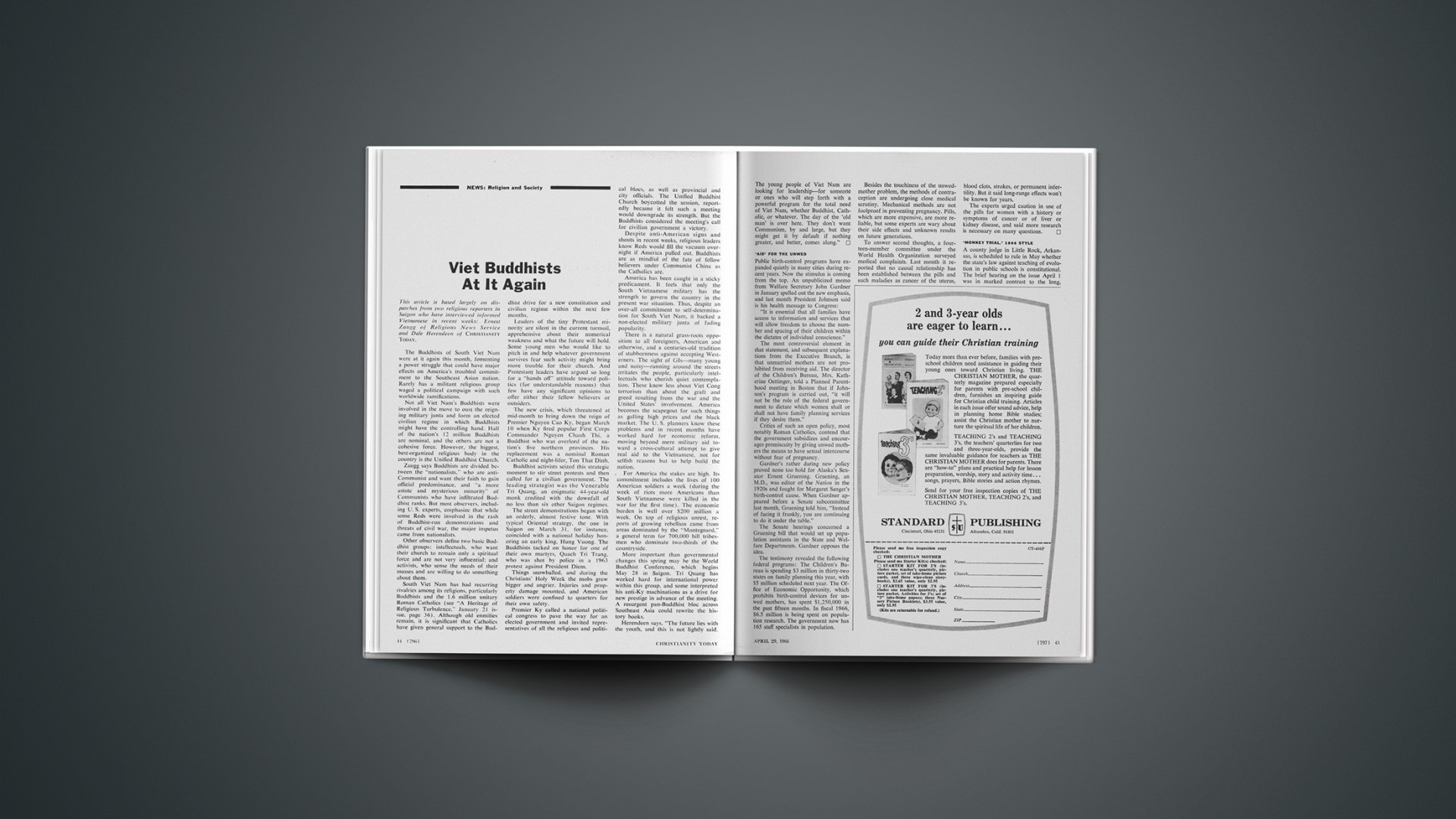
Viet Buddhists at It Again

This article is based largely on dispatches from two religious reporters in Saigon who have interviewed informed Vietnamese in recent weeks: Ernest Zaugg of Religious News Service and Dale Herendeen of Christianity Today.

The Buddhists of South Viet Nam were at it again this month, fomenting a power struggle that could have major effects on America’s troubled commitment to the Southeast Asian nation. Rarely has a militant religious group waged a political campaign with such worldwide ramifications.

Not all Viet Nam’s Buddhists were involved in the move to oust the reigning military junta and form an elected civilian regime in which Buddhists might have the controlling hand. Half of the nation’s 12 million Buddhists are nominal, and the others are not a cohesive force. However, the biggest, best-organized religious body in the country is the Unified Buddhist Church.

Zaugg says Buddhists are divided between the “nationalists,” who are anti-Communist and want their faith to gain official predominance, and “a more astute and mysterious minority” of Communists who have infiltrated Buddhist ranks. But most observers, including U. S. experts, emphasize that while some Reds were involved in the rash of Buddhist-run demonstrations and threats of civil war, the major impetus came from nationalists.

Other observers define two basic Buddhist groups: intellectuals, who want their church to remain only a spiritual force and are not very influential; and activists, who sense the needs of their masses and are willing to do something about them.

South Viet Nam has had recurring rivalries among its religions, particularly Buddhists and the 1.6 million unitary Roman Catholics (see “A Heritage of Religious Turbulence,” January 21 issue, page 36). Although old enmities remain, it is significant that Catholics have given general support to the Buddhist drive for a new constitution and civilian regime within the next few months.

Leaders of the tiny Protestant minority are silent in the current turmoil, apprehensive about their numerical weakness and what the future will hold. Some young men who would like to pitch in and help whatever government survives fear such activity might bring more trouble for their church. And Protestant leaders have argued so long for a “hands off” attitude toward politics (for understandable reasons) that few have any significant opinions to offer either their fellow believers or outsiders.

The new crisis, which threatened at mid-month to bring down the reign of Premier Nguyen Cao Ky, began March 10 when Ky fired popular First Corps Commander Nguyen Chanh Thi, a Buddhist who was overlord of the nation’s five northern provinces. His replacement was a nominal Roman Catholic and night-lifer, Ton That Dinh.

Buddhist activists seized this strategic moment to stir street protests and then called for a civilian government. The leading strategist was the Venerable Tri Quang, an enigmatic 44-year-old monk credited with the downfall of no less than six other Saigon regimes.

The street demonstrations began with an orderly, almost festive tone. With typical Oriental strategy, the one in Saigon on March 31, for instance, coincided with a national holiday honoring an early king, Hung Vuong. The Buddhists tacked on honor for one of their own martyrs, Quach Tri Trang, who was shot by police in a 1963 protest against President Diem.

Things snowballed, and during the Christians’ Holy Week the mobs grew bigger and angrier. Injuries and property damage mounted, and American soldiers were confined to quarters for their own safety.

Premier Ky called a national political congress to pave the way for an elected government and invited representatives of all the religious and political blocs, as well as provincial and city officials. The Unified Buddhist Church boycotted the session, reportedly because it felt such a meeting would downgrade its strength. But the Buddhists considered the meeting’s call for civilian government a victory.

Despite anti-American signs and shouts in recent weeks, religious leaders know Reds would fill the vacuum overnight if America pulled out. Buddhists are as mindful of the fate of fellow believers under Communist China as the Catholics are.

America has been caught in a sticky predicament. It feels that only the South Vietnamese military has the strength to govern the country in the present war situation. Thus, despite an over-all commitment to self-determination for South Viet Nam, it backed a non-elected military junta of fading popularity.

There is a natural grass-roots opposition to all foreigners, American and otherwise, and a centuries-old tradition of stubbornness against accepting Westerners. The sight of GIs—many young and noisy—running around the streets irritates the people, particularly intellectuals who cherish quiet contemplation. These know less about Viet Cong terrorism than about the graft and greed resulting from the war and the United States’ involvement. America becomes the scapegoat for such things as galling high prices and the black market. The U. S. planners know these problems and in recent months have worked hard for economic reform, moving beyond mere military aid toward a cross-cultural attempt to give real aid to the Vietnamese, not for selfish reasons but to help build the nation.

For America the stakes are high. Its commitment includes the lives of 100 American soldiers a week (during the week of riots more Americans than South Vietnamese were killed in the war for the first time). The economic burden is well over $200 million a week. On top of religious unrest, reports of growing rebellion came from areas dominated by the “Montegnard,” a general term for 700,000 hill tribesmen who dominate two-thirds of the countryside.

More important than governmental changes this spring may be the World Buddhist Conference, which begins May 28 in Saigon. Tri Quang has worked hard for international power within this group, and some interpreted his anti-Ky machinations as a drive for new prestige in advance of the meeting. A resurgent pan-Buddhist bloc across Southeast Asia could rewrite the history books.

Herendeen says, “The future lies with the youth, and this is not lightly said. The young people of Viet Nam are looking for leadership—for someone or ones who will step forth with a powerful program for the total need of Viet Nam, whether Buddhist, Catholic, or whatever. The day of the ‘old man’ is over here. They don’t want Communism, by and large, but they might get it by default if nothing greater, and better, comes along.”

‘Aid’ For The Unwed

Public birth-control programs have expanded quietly in many cities during recent years. Now the stimulus is coming from the top. An unpublicized memo from Welfare Secretary John Gardner in January spelled out the new emphasis, and last month President Johnson said is his health message to Congress:

“It is essential that all families have access to information and services that will allow freedom to choose the number and spacing of their children within the dictates of individual conscience.”

The most controversial element in that statement, and subsequent explanations from the Executive Branch, is that unmarried mothers are not prohibited from receiving aid. The director of the Children’s Bureau, Mrs. Katherine Oettinger, told a Planned Parenthood meeting in Boston that if Johnson’s program is carried out, “it will not be the role of the federal government to dictate which women shall or shall not have family planning services if they desire them.”

Critics of such an open policy, most notably Roman Catholics, contend that the government subsidizes and encourages promiscuity by giving unwed mothers the means to have sexual intercourse without fear of pregnancy.

Gardner’s rather daring new policy proved none too bold for Alaska’s Senator Ernest Gruening. Gruening, an M.D., was editor of the Nation in the 1920s and fought for Margaret Sanger’s birth-control cause. When Gardner appeared before a Senate subcommittee last month, Gruening told him, “Instead of facing it frankly, you are continuing to do it under the table.”

The Senate hearings concerned a Gruening bill that would set up population assistants in the State and Welfare Departments. Gardner opposes the idea.

The testimony revealed the following federal programs: The Children’s Bureau is spending $3 million in thirty-two states on family planning this year, with $5 million scheduled next year. The Office of Economic Opportunity, which prohibits birth-control devices for unwed mothers, has spent $1,250,000 in the past fifteen months. In fiscal 1966, $6.5 million is being spent on population researeh. The government now has 165 staff specialists in population.

Besides the touchiness of the unwed-mother problem, the methods of contraception are undergoing close medical scrutiny. Mechanical methods are not foolproof in preventing pregnancy. Pills, which are more expensive, are more reliable, but some experts are wary about their side effects and unknown results on future generations.

To answer second thoughts, a fourteen-member committee under the World Health Organization surveyed medical complaints. Last month it reported that no causal relationship has been established between the pills and such maladies as cancer of the uterus, blood clots, strokes, or permanent infertility. But it said long-range effects won’t be known for years.

The experts urged caution in use of the pills for women with a history or symptoms of cancer or of liver or kidney disease, and said more research is necessary on many questions.

‘Monkey Trial,’ 1966 Style

A county judge in Little Rock, Arkansas, is scheduled to rule in May whether the state’s law against teaching of evolution in public schools is constitutional. The brief hearing on the issue April 1 was in marked contrast to the long, circus-like Scopes “monkey trial” in Tennessee forty-one years ago.

The 1925 defendant was science teacher John Scopes, now 65, who became a geologist for a gas company and lives in Shreveport, Louisiana. This time the evolutionists are on the offensive, challenging the law through the person of Mrs. Susan Epperson, 24, a Presbyterian. She teaches biology in Little Rock’s Central High School, where school integration achieved an anxious first victory in 1957.

Mrs. Epperson is backed by the Arkansas Education Association, which represents the state’s 15,000 teachers; the Arkansas Council of Churches, whose nine denominations have 275,000 members; and Winthrop Rockefeller, who hopes to become Arkansas’s first Republican governor since Reconstruction this November.

Evolution is an issue in New Mexico’s gubernatorial campaign. Republican candidate David Cargo accuses the State Board of Education of “coaching” students in their beliefs because it orders biology texts to have a pasted label stating that “evolution is being taught as theory and not as fact.” A state board official called on Cargo to retract his complaints and explained the disclaimer had been added after “many and widespread objections from church groups.”

Tennessee’s anti-evolution law still is on the books, and after the Scopes trial it was echoed by Mississippi and Arkansas. The law’s partisans in Arkansas include many Protestant fundamentalists, whose most visible organizational voice, the Arkansas Baptist Bible Fellowship, asserts that “the forces of Communism, liberalism, and modernism seek to undermine the historic faith of our fathers by fostering the theory of evolution.”

Mrs. Epperson, who says she believes in both God and evolution, is fighting the law because of the hypocrisy involved, since most science teachers conscientiously break the law.

Another contrast with the Scopes trial is that Judge Murray Reed has ruled out all discussion of evolution and religion. The narrow question of constitutionality is thus the only issue on trial.

Mrs. Epperson told the court it was her duty as a teacher to discuss “various scientific theories, including the Darwinian theory of the origin of species.” But if she does her duty, she becomes a criminal. The law, she said, perpetuates “ignorance, prejudice, and bigotry.”

Whatever Reed’s May ruling, an appeal to a higher court is likely. The National Observer asked Scopes what he thought about the fuss, and he mused, “I don’t think the world changes very rapidly.”
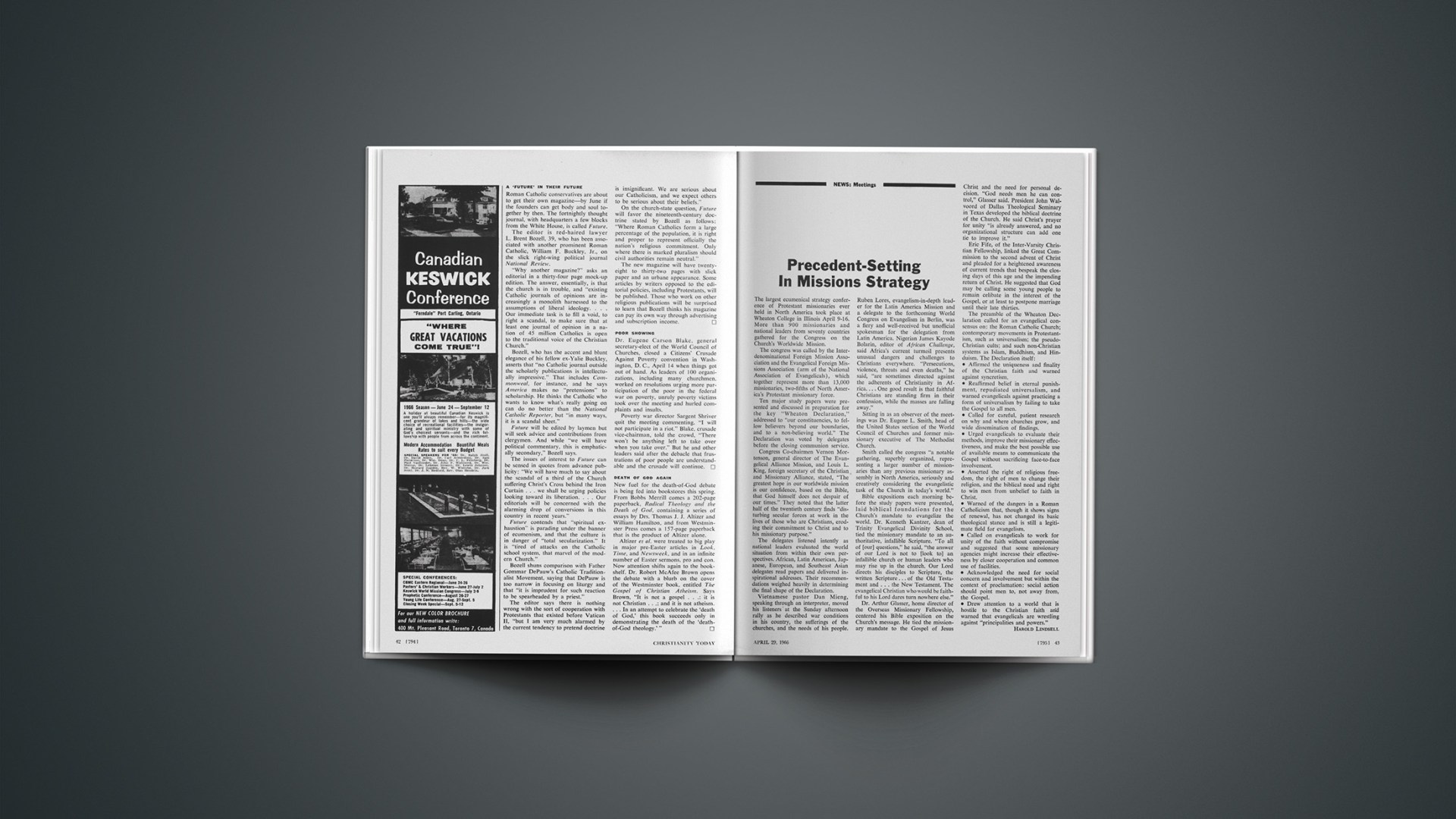
Precedent-Setting in Missions Strategy

The largest ecumenical strategy conference of Protestant missionaries ever held in North America took place at Wheaton College in Illinois April 9–16. More than 900 missionaries and national leaders from seventy countries gathered for the Congress on the Church’s Worldwide Mission.

The congress was called by the Interdenominational Foreign Mission Association and the Evangelical Foreign Missions Association (arm of the National Association of Evangelicals), which together represent more than 13,000 missionaries, two-fifths of North America’s Protestant missionary force.

Ten major study papers were presented and discussed in preparation for the key “Wheaton Declaration,” addressed to “our constituencies, to fellow believers beyond our boundaries, and to a non-believing world.” The Declaration was voted by delegates before the closing communion service.

Congress Co-chairmen Vernon Mortenson, general director of The Evangelical Alliance Mission, and Louis L. King, foreign secretary of the Christian and Missionary Alliance, stated, “The greatest hope in our worldwide mission is our confidence, based on the Bible, that God himself does not despair of our times.” They noted that the latter half of the twentieth century finds “disturbing secular forces at work in the lives of those who are Christians, eroding their commitment to Christ and to his missionary purpose.”

The delegates listened intently as national leaders evaluated the world situation from within their own perspectives. African, Latin American, Japanese, European, and Southeast Asian delegates read papers and delivered inspirational addresses. Their recommendations weighed heavily in determining the final shape of the Declaration.

Vietnamese pastor Dan Mieng, speaking through an interpreter, moved his listeners at the Sunday afternoon rally as he described war conditions in his country, the sufferings of the churches, and the needs of his people.

Ruben Lores, evangelism-in-depth leader for the Latin America Mission and a delegate to the forthcoming World Congress on Evangelism in Berlin, was a fiery and well-received but unofficial spokesman for the delegation from Latin America. Nigerian James Kayode Bolarin, editor of African Challenge, said Africa’s current turmoil presents unusual dangers and challenges to Christians everywhere. “Persecutions, violence, threats and even deaths,” he said, “are sometimes directed against the adherents of Christianity in Africa.… One good result is that faithful Christians are standing firm in their confession, while the masses are falling away.”

Sitting in as an observer of the meetings was Dr. Eugene L. Smith, head of the United States section of the World Council of Churches and former missionary executive of The Methodist Church.

Smith called the congress “a notable gathering, superbly organized, representing a larger number of missionaries than any previous missionary assembly in North America, seriously and creatively considering the evangelistic task of the Church in today’s world.”

Bible expositions each morning before the study papers were presented, laid biblical foundations for the Church’s mandate to evangelize the world. Dr. Kenneth Kantzer, dean of Trinity Evangelical Divinity School, tied the missionary mandate to an authoritative, infallible Scripture. “To all of [our] questions,” he said, “the answer of our Lord is not to [look to] an infallible church or human leaders who may rise up in the church. Our Lord directs his disciples to Scripture, the written Scripture … of the Old Testament and … the New Testament. The evangelical Christian who would be faithful to his Lord dares turn nowhere else.”

Dr. Arthur Glasser, home director of the Overseas Missionary Fellowship, centered his Bible exposition on the Church’s message. He tied the missionary mandate to the Gospel of Jesus Christ and the need for personal decision. “God needs men he can control,” Glasser said. President John Walvoord of Dallas Theological Seminary in Texas developed the biblical doctrine of the Church. He said Christ’s prayer for unity “is already answered, and no organizational structure can add one tie to improve it.”

Eric Fife, of the Inter-Varsity Christian Fellowship, linked the Great Commission to the second advent of Christ and pleaded for a heightened awareness of current trends that bespeak the closing days of this age and the impending return of Christ. He suggested that God may be calling some young people to remain celibate in the interest of the Gospel, or at least to postpone marriage until their late thirties.

The preamble of the Wheaton Declaration called for an evangelical consensus on: the Roman Catholic Church; contemporary movements in Protestantism, such as universalism; the pseudo-Christian cults; and such non-Christian systems as Islam, Buddhism, and Hinduism. The Declaration itself:

• Affirmed the uniqueness and finality of the Christian faith and warned against syncretism.

• Reaffirmed belief in eternal punishment, repudiated universalism, and warned evangelicals against practicing a form of universalism by failing to take the Gospel to all men.

• Called for careful, patient researeh on why and where churches grow, and wide dissemination of findings.

• Urged evangelicals to evaluate their methods, improve their missionary effectiveness, and make the best possible use of available means to communicate the Gospel without sacrificing face-to-face involvement.

• Asserted the right of religious freedom, the right of men to change their religion, and the biblical need and right to win men from unbelief to faith in Christ.

• Warned of the dangers in a Roman Catholicism that, though it shows signs of renewal, has not changed its basic theological stance and is still a legitimate field for evangelism.

• Called on evangelicals to work for unity of the faith without compromise and suggested that some missionary agencies might increase their effectiveness by closer cooperation and common use of facilities.

• Acknowledged the need for social concern and involvement but within the context of proclamation: social action should point men to, not away from, the Gospel.

• Drew attention to a world that is hostile to the Christian faith and warned that evangelicals are wrestling against “principalities and powers.”

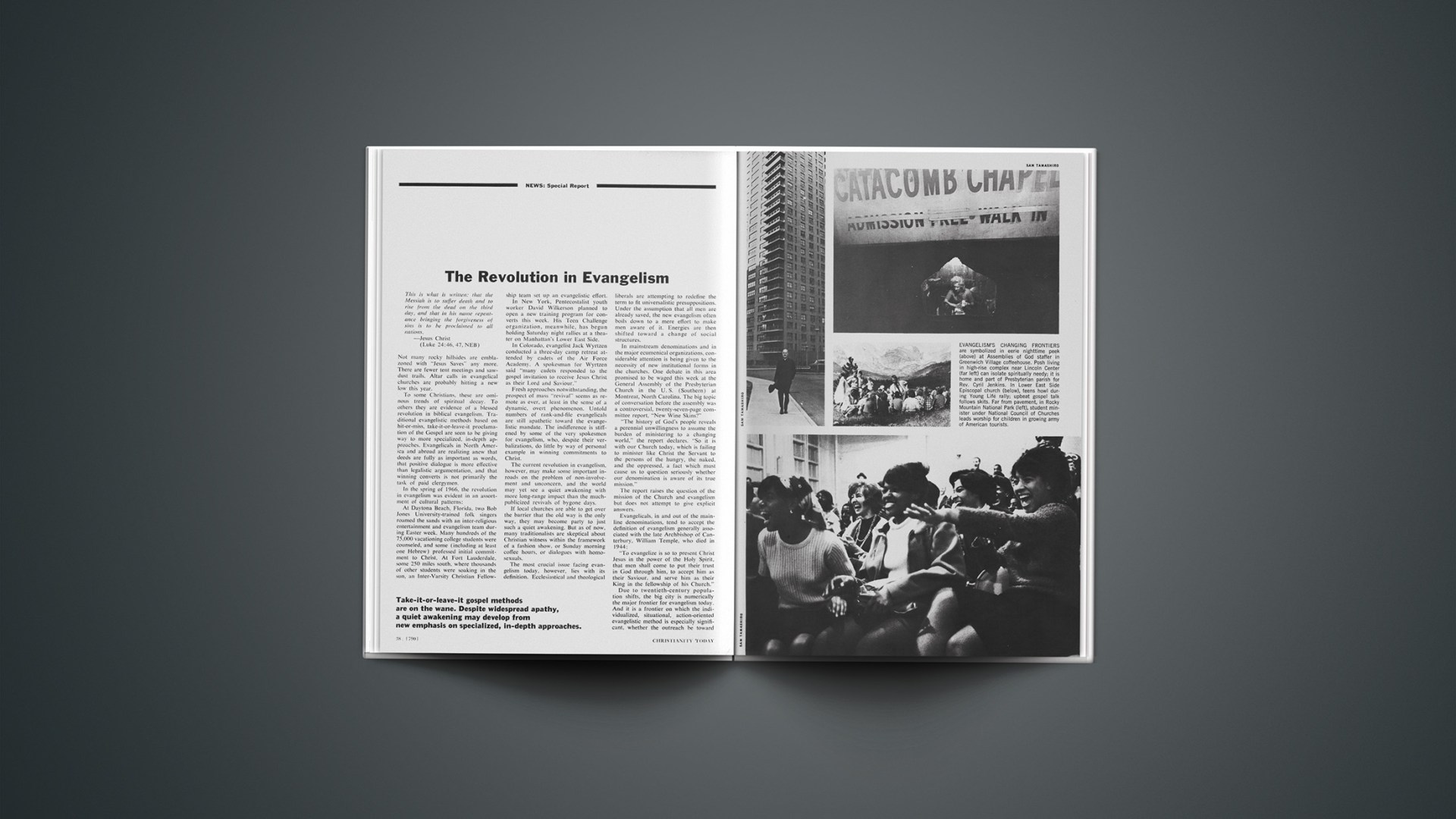
The Revolution in Evangelism

This is what is written: that the Messiah is to suffer death and to rise from the dead on the third day, and that in his name repentance bringing the forgiveness of sins is to be proclaimed to all nations.

—Jesus Christ

(Luke 24:46, 47, NEB)

Not many rocky hillsides are emblazoned with “Jesus Saves” any more. There are fewer tent meetings and sawdust trails. Altar calls in evangelical churches are probably hitting a new low this year.

To some Christians, these are ominous trends of spiritual decay. To others they are evidence of a blessed revolution in biblical evangelism. Traditional evangelistic methods based on hit-or-miss, take-it-or-leave-it proclamation of the Gospel are seen to be giving way to more specialized, in-depth approaches. Evangelicals in North America and abroad are realizing anew that deeds are fully as important as words, that positive dialogue is more effective than legalistic argumentation, and that winning converts is not primarily the task of paid clergymen.

In the spring of 1966, the revolution in evangelism was evident in an assortment of cultural patterns:

At Daytona Beach, Florida, two Bob Jones University-trained folk singers roamed the sands with an inter-religious entertainment and evangelism team during Easter week. Many hundreds of the 75,000 vacationing college students were counseled, and some (including at least one Hebrew) professed initial commitment to Christ. At Fort Lauderdale, some 250 miles south, where thousands of other students were soaking in the sun, an Inter-Varsity Christian Fellowship team set up an evangelistic effort.

In New York, Pentecostalist youth worker David Wilkerson planned to open a new training program for converts this week. His Teen Challenge organization, meanwhile, has begun holding Saturday night rallies at a theater on Manhattan’s Lower East Side.

In Colorado, evangelist Jack Wyrtzen conducted a three-day camp retreat attended by cadets of the Air Force Academy. A spokesman for Wyrtzen said “many cadets responded to the gospel invitation to receive Jesus Christ as their Lord and Saviour.”

Fresh approaches notwithstanding, the prospect of mass “revival” seems as remote as ever, at least in the sense of a dynamic, overt phenomenon. Untold numbers of rank-and-file evangelicals are still apathetic toward the evangelistic mandate. The indifference is stiffened by some of the very spokesmen for evangelism, who, despite their verbalizations, do little by way of personal example in winning commitments to Christ.

The current revolution in evangelism, however, may make some important inroads on the problem of non-involvement and unconcern, and the world may yet see a quiet awakening with more long-range impact than the much-publicized revivals of bygone days.

If local churches are able to get over the barrier that the old way is the only way, they may become party to just such a quiet awakening. But as of now, many traditionalists are skeptical about Christian witness within the framework of a fashion show, or Sunday morning coffee hours, or dialogues with homosexuals.

The most crucial issue facing evangelism today, however, lies with its definition. Ecclesiastical and theological liberals are attempting to redefine the term to fit universalistic presuppositions. Under the assumption that all men are already saved, the new evangelism often boils down to a mere effort to make men aware of it. Energies are then shifted toward a change of social structures.

In mainstream denominations and in the major ecumenical organizations, considerable attention is being given to the necessity of new institutional forms in the churches. One debate in this area promised to be waged this week at the General Assembly of the Presbyterian Church in the U. S. (Southern) at Montreat, North Carolina. The big topic of conversation before the assembly was a controversial, twenty-seven-page committee report, “New Wine Skins?”

“The history of God’s people reveals a perennial unwillingness to assume the burden of ministering to a changing world,” the report declares. “So it is with our Church today, which is failing to minister like Christ the Servant to the persons of the hungry, the naked, and the oppressed, a fact which must cause us to question seriously whether our denomination is aware of its true mission.”

The report raises the question of the mission of the Church and evangelism but does not attempt to give explicit answers.

Evangelicals, in and out of the mainline denominations, tend to accept the definition of evangelism generally associated with the late Archbishop of Canterbury, William Temple, who died in 1944:

“To evangelize is so to present Christ Jesus in the power of the Holy Spirit, that men shall come to put their trust in God through him, to accept him as their Saviour, and serve him as their King in the fellowship of his Church.”

Due to twentieth-century population shifts, the big city is numerically the major frontier for evangelism today. And it is a frontier on which the individualized, situational, action-oriented evangelistic method is especially significant, whether the outreach be toward the poverty-stricken, neglected slum-dweller or toward the affluent sophisticate who seeks seclusion in high-rise apartments.

“Our evangelism is one-to-one, and in depth,” says 25-year-old Bill Milliken, congenial, hard-working director of the Youth Life Crusade’s Lower East Side branch in Manhattan. Among churches cooperating with Young Life and Harlem’s influential Church of the Master and the Church of the Sea and Land, a few blocks from the tenements where Young Life offers housing to homeless youths who are interested in Christianity.

In Philadelphia, the American Sunday School Union, which for 149 years has been working in the now nearly forgotten area of rural evangelism, is expanding a relatively new urban program and hopes to launch similar efforts in other major cities. Work in rural areas, where some 1,500 Sunday schools are currently being maintained, will continue.

Apartment-dwellers are probably the biggest challenge to the evangelistic outreach of the church today. A survey made in the Washington, D. C., area, last year showed that fewer than 5 per cent of apartment-dwellers belong to any church. Many apartment buildings, especially those of the luxury type, are sealed against visitation programs by locks and guards. The Lutheran Church—Missouri Synod tried to meet the challenge by assigning a minister to live in Chicago’s plush Marina City. Says the Rev. Roy Blumhorst, who lives with his wife and three children in a forty-seventh-floor efficiency:

“I agree with locking the salesman out, and locking out the clergyman who would be a door-to-door salesman. If somebody is going to have a brush with Christianity, it should be in the person of a Christian layman who is interested in him, his neighbor or co-worker.”

This principle of Christian witness is the subject of a film produced by the National Association of Evangelicals. Without disparaging institutional church structures, the film points to the great need for every Christian to be a living witness in his own situation.

Such person-to-person confrontation is the object of the non-church International Christian Leadership groups, famous for their prayer breakfasts in which persons well known in government and business are exposed to soft-sell evangelism. These breakfasts, along with ICL-sponsored Bible studies in homes and offices, have spread across all of North America and to major world capitals.

But what will happen to the more traditional forms of evangelism? Many are still valid but are becoming more specialized and intensified. A prime example is the evangelism-in-depth concept developed by Latin America Mission. Large public rallies resemble evangelistic meetings of long ago, but preparation and follow-up on a vast scale have been added.

Even that lowly symbol of evangelicalism, the gospel tract, is getting new treatment. More and more tracts are aimed at particular audiences and situations. An example is that put out every four years by Washington Bible College for Presidential inaugurations, with interesting historical data supplemented by a spiritual message. Last Inaguration Day WBC students distributed 110,000 copies.

The basic way of evangelizing, giving out Scripture portions, is a bigger enterprise than ever and is undergoing some updating of its own. The American Bible Society now distributes Scriptures in assorted translations—some illustrated—with attractive bindings. The society opened a series of 150th-anniversary ceremonies this month with the dedication of a new twelve-story Bible House along Broadway. President Johnson recently was presented with a special commemorative Bible representing the 750 millionth copy of Scripture distributed by the society.

With little doubt, the most crucial frontier in evangelism today is youth work. And here evangelist Billy Graham is becoming increasingly effective. Whether by design or not, Graham’s mass-evangelism techniques are arresting teen-agers far more than any other age group. This month, the evangelist is preparing for what he says will be his best-organized, most intensive crusade yet, a thirty-two-day effort in London beginning June 1.1Decision magazine reports there is a “distinct posibility” that Graham and his team will hold four meetings in Warsaw, Poland, in September of 1967, at the invitation of evangelical churches in that country. Other 1967 meetings are scheduled across Canada and in Puerto Rico, Tokyo, and Kansas City, Missouri. Graham has also been invited to conduct a summer crusade in 1968 in the new Madison Square Garden being built in New York.

Later this year, as a prelude to the World Congress on Evangelism, Graham will be holding a crusade in Berlin. He will also be a featured speaker at the congress, of which he is honorary chairman. The congress, scheduled for October 26-November 4, will climax years of praying and planning for an event to summon the churches to the fulfillment of their spiritual priorities. It is a tenth-anniversary project of CHRISTIANITY TODAY, with the aim of facing the duty and need of evangelism, the obstacles and opportunities, the resources and rewards, and encouraging Christian believers in a mighty offensive for the Gospel in the remaining third of the twentieth century.

Salvation In Saigon

An opening night crowd of more than 6,000 on April 2 witnessed the start of a ten-day preaching crusade in Saigon, South Viet Nam, believed to be the first of its kind. Although the campaign took a back seat to political turmoil (see story, page 44), the contrast with the riots and near-riots could not have gone unnoticed by military rulers who were the brunt of Buddhist agitation. On opening day, evangelists and church leaders met with Chief of State Nguyen Van Thieu at Gio Long Palace. The meeting was cordial and Thieu, a Roman Catholic, expressed the nation’s thanks for the visitors and their purpose.

The all-Asian team was led by the Rev. Gregorio Tingson of the Philippines, chairman of Asian Evangelists Commission, founded in 1964 with the aim of “Asians Winning Asians for Christ.”

Communists were interested, since the word “campaign” in Vietnamese has both military and political connotations. A Red cadre met a local pastor to ask what was going on, and was assured the meetings had no political purpose.

When a 9 P.M. curfew was clamped on the city, meetings were held earlier. This, and limiting of U. S. soldiers to quarters, kept attendance down. Many who went had to make long detours to avoid the widespread street demonstrations; some were accused of being demonstrators, others went home weeping because of lingering tear gas.

At week’s end, some 700 decisions for Christ had been made at Cong Hoa Olympic Stadium, which seats 20,000. Meetings were extended for another week at the large Saigon Protestant Vietnamese Church.

Many poor Christians across the country who had lost everything in last year’s flood or through war devastation gave amazing amounts to back the Saigon crusade. Before it opened, the goal of 700,000 piasters ($10,000) had been far surpassed.

Spiritual forces in the war-torn land were also shored up last month at a retreat in Dalat that drew 400 delegates, nearly every native pastor and missionary in the country. The session did much to create understanding between Vietnamese and foreigners. Many came to Dalat from Red-held areas.

A ‘Future’ In Their Future

Roman Catholic conservatives are about to get their own magazine—by June if the founders can get body and soul together by then. The fortnightly thought journal, with headquarters a few blocks from the White House, is called Future.

The editor is red-haired lawyer L. Brent Bozell, 39, who has been associated with another prominent Roman Catholic, William F. Buckley, Jr., on the slick right-wing political journal National Review.

“Why another magazine?” asks an editorial in a thirty-four page mock-up edition. The answer, essentially, is that the church is in trouble, and “existing Catholic journals of opinions are increasingly a monolith harnessed to the assumptions of liberal ideology.… Our immediate task is to fill a void, to right a scandal, to make sure that at least one journal of opinion in a nation of 45 million Catholics is open to the traditional voice of the Christian Church.”

Bozell, who has the accent and blunt elegance of his fellow ex-Yalie Buckley, asserts that “no Catholic journal outside the scholarly publications is intellectually impressive.” That includes Commonweal, for instance, and he says America makes no “pretensions” to scholarship. He thinks the Catholic who wants to know what’s really going on can do no better than the National Catholic Reporter, but “in many ways, it is a scandal sheet.”

Future will be edited by laymen but will seek advice and contributions from clergymen. And while “we will have political commentary, this is emphatically secondary,” Bozell says.

The issues of interest to Future can be sensed in quotes from advance publicity: “We will have much to say about the scandal of a third of the Church suffering Christ’s Cross behind the Iron Curtain … we shall be urging policies looking toward its liberation.… Our editorials will be concerned with the alarming drop of conversions in this country in recent years.”

Future contends that “spiritual exhaustion” is parading under the banner of ecumenism, and that the culture is in danger of “total secularization.” It is “tired of attacks on the Catholic school system, that marvel of the modern Church.”

Bozell shuns comparison with Father Gommar DePauw’s Catholic Traditionalist Movement, saying that DePauw is too narrow in focusing on liturgy and that “it is imprudent for such reaction to be spearheaded by a priest.”

The editor says there is nothing wrong with the sort of cooperation with Protestants that existed before Vatican II, “but I am very much alarmed by the current tendency to pretend doctrine is insignificant. We are serious about our Catholicism, and we expect others to be serious about their beliefs.”

On the church-state question, Future will favor the nineteenth-century doctrine stated by Bozell as follows: “Where Roman Catholics form a large percentage of the population, it is right and proper to represent officially the nation’s religious commitment. Only where there is marked pluralism should civil authorities remain neutral.”

The new magazine will have twenty-eight to thirty-two pages with slick paper and an urbane appearance. Some articles by writers opposed to the editorial policies, including Protestants, will be published. Those who work on other religious publications will be surprised to learn that Bozell thinks his magazine can pay its own way through advertising and subscription income.

Poor Showing

Dr. Eugene Carson Blake, general secretary-elect of the World Council of Churches, closed a Citizens’ Crusade Against Poverty convention in Washington, D. C., April 14 when things got out of hand. As leaders of 100 organizations, including many churchmen, worked on resolutions urging more participation of the poor in the federal war on poverty, unruly poverty victims took over the meeting and hurled complaints and insults.

Poverty war director Sargent Shriver quit the meeting commenting. “I will not participate in a riot.” Blake, crusade vice-chairman, told the crowd, “There won’t be anything left to take over when you take over.” But he and other leaders said after the debacle that frustrations of poor people are understandable and the crusade will continue.

Death Of God Again

New fuel for the death-of-God debate is being fed into bookstores this spring. From Bobbs Merrill comes a 202-page paperback, Radical Theology and the Death of God, containing a series of essays by Drs. Thomas J. J. Altizer and William Hamilton, and from Westminster Press comes a 157-page paperback that is the product of Altizer alone.

Altizer et al. were treated to big play in major pre-Easter articles in Look, Time, and Newsweek, and in an infinite number of Easter sermons, pro and con. Now attention shifts again to the bookshelf. Dr. Robert McAfee Brown opens the debate with a blurb on the cover of the Westminster book, entitled The Gospel of Christian Atheism. Says Brown, “It is not a gospel …; it is not Christian …; and it is not atheism.… In an attempt to celebrate the ‘death of God,’ this book succeeds only in demonstrating the death of the ‘death-of-God theology.’ ”

Book Briefs: April 29, 1966

Facts And Trends

Religion in America, by Winthrop S. Hudson (Scribners, 1965, 447 pp., $7.95), is reviewed by Robert G. Torbet, dean, Central Baptist Theological Seminary, Kansas City, Kansas, and president, American Baptist Convention.

This is a survey of the development of American religious life. It is the story, not of denominations, but of the unfolding of a religious witness brought to this new land from Europe and nurtured and modified by a people who were building a new nation under God. The organization follows the major segments of our national history: I. The Formative Years, 1607–1789; II. The New Nation, 1789–1860; III. Years of Mid-passage, 1860–1914; IV. Modern America, 1914—.

Four features characterize the author’s approach. First, he regards religion as a part of American life and therefore of the American scene. For this reason there is in his story a generous interlacing of the facts of our social, economic, and political life. Religion is seen in proper perspective, as an important dynamic in the development of the nation. But it is also seen as modified by the several European traditions developed in a new world setting.

Secondly, the author achieves a remarkable balance in selection and interpretation of his facts. He moves with ease from the beginnings of the major denominational groups in American life to the Great Awakening, “when America experienced its ‘national conversion’ and achieved a common pattern of evangelical cooperation in the enormous task of Christianizing a continent and expanding the Christian witness overseas.” He succeeds in describing, without confusion to the reader, the proliferation of the denominations in the early nineteenth century in the midst of a religious ferment that produced utopian communities, Mormonism, Millerism, spiritualism, and humanitarian crusades. When he comes to the period of 1860–1914, he again demonstrates his skill in summarizing a rich and absorbing era in American history. The Civil War is seen as “a watershed between an old and a new America” (p. 207). What followed was a greater heterogeneity in background, an intellectual climate altered by modern science, and new centers of power in national life created by the quickened pace of industrialization. On this broad canvas he deftly outlines the new frontiers along which the churches were working in response to rapid technological and urban change: the institutional church, an emerging Christian social ethic, the social gospel, the “Progressive” movement in American politics, which translated many social concerns of the churches into legislation, and the impetus that the new imperialism following 1898 gave to world missions.

Thirdly, Dr. Hudson does not attempt too much in Part IV, which is an analysis of religious trends in modern America since 1914. Unlike many other books familiar to this reviewer, this work does not lose force and value in an effort to predict the future. Instead, the author carefully delineates the shifting religious configuration in this post-Protestant, pluralistic society. After this he describes the reassessment and recovery of Protestantism after its “religious depression” of 1925–35. The reader will find an able and fair description of fundamentalism, the theological reconstruction since the 1930s, and the manifestations of renewed religious vitality in vocational evangelism, peace concerns, anti-McCarthyism, and leadership for the racial crisis. The maturing of Roman Catholicism is treated with equal fairness. A concluding chapter traces the reversal of the centrifugal force in favor of the centripetal in American religious life as ecumenism becomes a major concern of many Protestants and Roman Catholics alike.

A fourth feature characterizing this work is a reliance upon a wide variety of recent studies in the history of American religion. The documentation provides an excellent bibliographical guide for the serious student who wishes to pursue the subject further.

The author is James B. Colgate Professor of the History of Christianity at Colgate Rochester Divinity School. He has achieved in this book an enviable scholarly insight, literary skill, and impartial interpretation that will enhance his reputation as historian of American religious life.

ROBERT G. TORBET

Pike’S Peregrination

What Is This Treasure, by James A. Pike (Harper and Row, 1966, 90 pp., $3), is reviewed by John Warwick Montgomery, professor and chairman, Division of Church History and History of Christian Thought, Trinity Evangelical Divinity School, Deerfield, Illinois.

Whatever else may be said of Bishop Pike, no one will say he is non-controversial. His prolific writings have placed him in the maelstrom of contemporary social dialogue (The Church, Politics, and Society; Beyond the Law; Teen-Agers and Sex; and so on; the Blake-Pike proposal has made him famous in American ecumenical discussion; and his theological radicalism (“There are several phrases in the Creeds that I cannot affirm as literal prose sentences, but I can certainly sing them”) has involved him in three heresy charges since 1961, all dismissed by his fellow Episcopal bishops. In the February 22 issue of Look magazine, Pike—whose religious peregrination has taken him through Roman Catholicism, agnosticism, neo-orthodoxy, and Anglican neo-liberalism—is described as a bishop “searching for a space-age God.” Then visiting his confrere Bishop John A. T. Robinson in England, Pike told Look that he had “jettisoned the Trinity, the Virgin Birth and the Incarnation,” and said of those who had made the latest heresy charge against him: “If they only knew what I had in my briefcase.” This was the manuscript of What Is This Treasure, and now the eager theological public—properly prepared by the Bishop of Woolwich and the death-of-God school—can examine Pike’s portfolio for themselves. Is it Pike’s peak?

We are told that “What Is This Treasure opens wide the door left ajar by A Time for Christian Candor” and informs us of “what to keep—not what to throw out—to make today’s church more vital.” Both books have as their theme Second Corinthians 4:7a (“we have this treasure in earthen vessels”), and Pike’s aim is to distinguish between the treasure and the vessels. The bishop’s conclusion displays him, not as an original thinker, but as a poor man’s Tillich: only “God, the Ultimate Ground of all being” is the treasure, and all earthly expressions (including Jesus, Scripture, all doctrines and creeds) are but fallible and conditioned vessels. “The answer is more belief, fewer beliefs.” Thus Pike eviscerates the New Testament treasure (for Paul, the Gospel of Christ):

“I am the Way, the Truth, and the Life,” we read in the Fourth Gospel (14:6). While, as we have already seen, the negative conclusion of the sentence (“No one cometh to the Father but by me”) won’t do, the opening clause beautifully reflects the experience of the early Christian community of the role of Jesus in their lives. To sum up, in Him they saw what a man is to be; and since Jesus was Himself fully this, they saw showing through Him the fullness of God as Truth (which in good measure we can see also through Socrates and Buddha as “free and open” men) and, certainly as important, as Love [p. 80].

In this way the Bishop of California stands in judgment upon Scripture, upon its apostolic authorship—and upon “the Shepherd and Bishop” of his soul (1 Pet. 2:25). By arrogating the right of final spiritual judgment to himself, Pike’s pilgrimage has ironically brought him to a caricature of his starting point. His favorite verse ends “that the excellency of the power may be of God, and not of us.” The bishop has, however, by refusing to allow God to reveal himself adequately, elevated himself to the powerful role of arbiter of revelation. The power is now “of Pike.” Now it is he who speaks ex cathedra.

JOHN WARWICK MONTGOMERY

Help For Parents

Understanding Your Teen-Age Boy: A Psychologist Opens His Casebook, by William J. George (Sheed and Ward, 1966, 163 pp., $3.95), is reviewed by Marvin W. Goldberg, director of studies, The Stony Brook School, Stony Brook, Long Island, New York.

This small book is a refreshingly frank attempt to provide parents and teachers with practical instruction in guiding teen-age boys. William J. George, a Roman Catholic psychologist who besides his impressive professional credentials has the qualification of being the father of six children, loses no time in getting to the problems of the young man’s world. “Drinking,” “Driving,” “Car Theft,” “Drop Out,” “Violence,” and “Sex” are some of the titles of the thirty-six short chapters.

Readers will be pleased by Mr. George’s lucidity and reasonableness. The book is written in non-technical language and is remarkably readable. As soon as one opens it, he finds himself immersed in the lives of teen-age boys. Here is Anthony, 16, who wears his hair long and persistently skips school. And Eddie, 15, two years behind in school, who loves his beer and wine. What can be done to help Terry, 13, who has just stolen a car? In the course of the book, the reader meets twenty or more boys along with their parents and friends.

So interesting are these and other stories that one has to be careful to avoid being superficially absorbed with the real-life episodes and overlooking the serious text that accompanies each case study. At times the interchange of case studies and explanations is bewildering. A second reading in which one can largely skip the case studies is helpful.

Many will like the straightforwardness of the chapters on “Homework,” “Religious Doubts,” “Comparison with Others,” and “Under Achievement.” The author’s practicality is at its best in these pages. George goes so far as to promise that parents can help their sons improve their school grades by following his five-step program in the supervision of homework. His advice is excellent and, if followed faithfully, could produce a revolution in some households!

The chapters on “Drinking” and “Smoking” undoubtedly will evoke a negative response from some readers. Here the author, in his earnest attempt to be reasonable, allows himself to be placed in a rather awkward moral position. “As a means of helping your son into adulthood,” he says, “consider offering him his first drink in your kitchen even if you abstain yourself”; and “I’m sorry for the family in which teetotalling parents look upon alcohol as completely black.” Has George seriously taken into account the risks involved here? Surely many experienced parents and teachers have found more effective methods than this in handling the problem of alcohol.

This readable and comprehensive book (an index would have been a great help) is also noteworthy for the warmth of the counselor’s personal interest. His dialogues with boys merit study. George very obviously loves young men and believes that they can, with spiritual strength, rise above their entangling problems. His book can be a great help to every parent and every teacher of boys.

MARVIN W. GOLDBERG

Trend Sampler

A Religious History of America, by Edwin Scott Gaustad (Harper and Row, 1966, 421 pp., $8.95), is reviewed by Carl F. H. Henry, editor, CHRISTIANITY TODAY.

This overview of American history from a religious perspective is more a “sampler” of trends than an interpretation of events in terms of controlling ideals and convictions. It has the merits of direct quotation from many sources and of photographic illustration, but it can hardly be considered a comprehensive study of American life and culture in regard to its religious heritage.

The evangelical ingredient of the book is woefully weak; the author’s interest in liberal and interfaith concerns, and in social matters more than in personal religion, is evident. In a chronology of important dates in America’s religious history, those cited for the last few years are: 1957, formation of

United Church of Christ by merger; 1958, Martin Luther King writes Strides Toward Freedom; 1960, first Roman Catholic president elected, and Blake-Pike plan proposed; 1962, Vatican II opens in Rome; 1963, Pope John issues encyclical Pacem in Terris and Supreme Court rules Bible reading unconstitutional in public schools; 1964, King gets Nobel peace prize; 1965, final session of Vatican II and Paul VI celebrates mass in Yankee Stadium.

The author, a historian at the University of California at Riverside, has produced a work that will be helpful as background reading but many American churchgoers will consider it an inadequate reflection of religious dynamisms.

CARL F. H. HENRY

Book Briefs

Memos for Christian Living, by James L. Sullivan, compiled by Gomer R. Lesch (Broadman, 1966, 125 pp., $1.50). Little essays on Christian matters. The language, clear and succinct, conveys practical wisdom about Christian life.

A Social and Religious History of the Jews: Late Middle Ages and Era of European Expansion, 1200–1650, Volume IX: Under Church and Empire and Volume X: On the Empire’s Periphery, by Salo Wittmayer Baron (Columbia University and Jewish Publication Society, 1965, 350 and 432 pp., $8.50 each). Revised and enlarged.

All Things Common: The Hutterian Way of Life, by Victor Peters (University of Minnesota, 1965, 233 pp., $5.75). A thorough introduction to the Hutterians of Canada and the United States who practice Christian communism and reject dancing, movies, radio, television, and military service.

Dynamic Psychology, by George Cruchon. S. J. (Sheed and Ward, 1965, 278 pp., $5.95). An up-to-date guide to the understanding of modern man: Who is he? What does he want—and why? A substantive analysis of motivations.

The Work of Thomas Cranmer, edited by Gervase E. Duffield (Fortress, 1965, 425 pp., $6.25). A window on England’s first Reformed archbishop. With an introduction by J. I. Packer.

The Old Testament: An Introduction, by Otto Eissfeldt (Harper and Row, 1965, 861 pp., $9.50). Including the Apocrypha and Pseudepigrapha, and also the works of similar type from Qumran.

Get in the Game!, by Bill Glass (Word Books, 1965, 150 pp., $2.95). The viewpoint and life story of a Christian who is the great defensive end of the Cleveland Browns.

Give Joy to My Youth: A Memoir of Dr. Tom Dooley, by Teresa Gallagher (Farrar, Straus, Giroux, 1965, 238 pp., $4.95). A tribute by a co-worker of Tom Dooley. Good reading.

Extraordinary Living for Ordinary Men, by Sam Shoemaker (Zondervan, 1965, 160 pp., $2.95). Excerpts from Shoemaker’s writings.

The Other Dimension: Meditations on the Disciples’ Prayer, by Ralph L. Murray (Broadman, 1966, 96 pp., $2). Fresh, perceptive, and very practical.

The Jewish Caravan: Great Stories of Twenty-five Centuries, edited by Leo W. Schwarz (Holt, Rinehart and Winston, 1965, 831 pp., $8.95). An anthology of Jewish writings. A revised and enlarged edition of the first (1935) edition.

Theological Dictionary, by Karl Rahner and Herbert Vorgrimler, edited by Cornelius Ernst, O.P. (Herder and Herder, 1965, 493 pp. $6.50). A good Roman Catholic dictionary of theology. The definitions are lucid and ample. First published as Kleines Theologisches Wörterbuch.

Challenging Careers in the Church, by Joseph E. McCabe (McGraw-Hill, 1966, 180 pp., $4.50). The author talks to young people about the many vocations—other than the pulpit ministry—within the Church. Too many young people, he feels, discover these vocational possibilities too late to do anything about them.

The United Nations and How It Works (Revised Edition), by David Cushman Coyle (Columbia University, 1965, 256 pp., $6).

Unchanging Mission: Biblical and Contemporary, by Douglas Webster (Fortress, 1965, 75 pp., $1.50). Reading that induces thinking.

Called to Be Free, by Angus MacDonald (Hallberg, 1965, 126 pp., $2.95). Lectures, yes; sermons, no.

The Romance of the Ages: An Exposition of the Song of Solomon, by Paul LaBotz (Kregel, 1965, 291 pp., $3.50). A highly spiritualized exposition that scarcely looks at the “bride.”

The Christian Agnostic, by Leslie D. Weatherhead (Abingdon, 1965, 368 pp., $4.75). A self-styled “angry old man” who has lost more and more fundamentals across the years now, as minister emeritus of London’s City Temple, devotes his thirty-first book (interestingly written) to his patchwork of beliefs.

Mary in Protestant and Catholic Theology, by Thomas A. O’Meara, O. P. (Sheed and Ward, 1966, 376 pp., $7.50). A presentation that includes the thought of Calvin and Luther, and of Barth, Brunner, and Bultmann.

The Quiet Corner: A Devotional Treasury from the Pages of Decision Magazine, edited by Sherwood Eliot Wirt (Revell, 1965, 116 pp., $2.50).

The Cambridge Bible Commentary on the New English Bible: The Gospel According to Mark, commentary by C. F. D. Moule (Cambridge, 1965, 134 pp., $3.50). A very fine little evangelical commentary. In thought, clear; in form, attractive.

The Cambridge Bible Commentary on the New English Bible: Understanding the New Testament, edited by O. Jessie Lace (Cambridge, 1965, 168 pp., $3; also paper, $1.65). A book for pleasure and profit for laymen and clergy.

Scandinavian Churches: The Development and Life of the Churches of Denmark, Finland, Iceland, Norway, and Sweden, edited by Leslie Stannard Hunter (Augsburg, 1965, 197 pp., $4.50). A series of essays by seventeen Scandinavian and British writers.

Dare to Live Now!, by Bruce Larson (Zondervan, 1965, 126 pp., $2.50). Very readable religious essays with a warm devotional strain.

A Dictionary of Biblical Allusions in English Literature, by W. B. Fulghum (Holt, Rinehart and Winston, 1965, 291 pp., $4.95).

Conflicting Images of Man, edited by William Nicholls (Seabury, 1966, 231 pp., $4.95). Eight essays on the nature of man as seen by contemporary theologians. The book shows more what men are thinking than what they are.

Log Cabin to Luther Tower: Concordia Seminary During One Hundred and Twenty-five years Toward a More Excellent Ministry, 1839–1964, by Carl S. Meyer (Concordia, 1965, 322 pp., $7.95).

Modern Christian Art (from “The Twentieth Century Encyclopedia of Catholicism”), by Winefride Wilson (Hawthorn, 1965, 175 pp., $3.50). A survey of the art of turbulent eighteenth and nineteenth centuries, showing how today’s artists are in debt to the traditional Christian artists of earlier centuries.

No Empty Creed, by Michael Bruce (Seabury, 1966, 143 pp., $1.45). The vicar of St. Mark’s, London, says that the notion that traditional Christianity is impossible for an honest, modern man is “balderdash.” Good reading.

Paperbacks

Meet the Twelve, by John H. Baumgaertner (Augsburg, 1966, 130 pp., $1.95). Evangelical sermonettes; studies in half-depth. First published in 1960.

The ‘We Knows’ of the Apostle Paul, by Holmes Rolston (John Knox, 1966, 101 pp., $1.65). Valuable religious essays that make good reading and may start some good sermons.

Presbyterian Authority and Discipline by John Kennedy (John Knox, 1965, 118 pp., $1.50). A cry for the need and exercise of discipline in the Church. The author contends that there is an irrational prejudice against it, though it is a mark of the Church.

God and Mammon: The Christian Mastery of Money, by K. F. W. Prior (Westminster, 1966, 95 pp., $1.25).

Revolt Against Heaven: An Enquiry Into Anti-Supernaturalism, by Kenneth M. Hamilton (Eerdmans, 1965, 193 pp., $2.45). A searching look into the current belief that Christianity ought to detach itself from supernaturalism. A good piece of work.

Forgiveness and Hope: Toward a Theology for Protestant Christian Education, by Rachel Henderlite (John Knox, 1966, 127 pp., $1.45). First published in 1961.

Fractured Questions, by Warren Mild (Judson, 1966, 125 pp., $1.95). Over a chariot-wheel pizza in the Lion’s Den, some of life’s most significant questions are raised.

Taoism: The Parting of the Way (Revised Edition), by Holmes Welch (Beacon Press, 1966, 194 pp., $1.95). First published in 1957.

Rudolf Bultmann, by Ian Henderson (John Knox, 1966, 47 pp., $1). Bultmann analyzed for the layman who cares.

A Select Liturgical Lexicon, by J. G. Davies (John Knox, 1966, 146 pp., $2.45).

After Death: A Sure and Certain Hope?, by J. A. Motyer (Westminster, 1966, 95 pp., $1.25). An evangelical, enlightening discussion.

The Origin of Paul’s Religion, by J. Gresham Machen (Eerdmans, 1966, 829 pp., $1.95). A classic with continuing relevance.

Hominisation: The Evolutionary Origin of Man as a Theological Problem, by Karl Rahner, S. J. (Herder and Herder, 1965, 120 pp., $2.50)

The Church and the Right to Be Heard

What is a “Christian missionary”? A Christian missionary is a person who feels called by God to communicate to others by lip and by life, on some frontier of the world, the good news of the Gospel of Christ. He becomes a “missionary” when he is set apart by the Church, or by an association of fellow Christians, to dedicate his every talent to the task of so presenting Christ to other people that they shall accept him as Saviour and Lord and become members of the Christian Community.…

Not only, however, must the Christian Church be represented in the world by missionaries whom it sends out and supports; it must itself be missionary. In consonance with its nature, in loyalty to its Head, the Church must be so inspired by its worship of God, and so illumined by its insight into God and the world, that it shall be, in every epoch and in every place, the vehicle of God’s redeeming love in Jesus Christ. Neither the true worship of God by a true Community of God, nor a true understanding of God by the whole Christian Community, can become a substitute for the missionary service of God. Called by God to participate in his redemptive activity, the Church must, in lowliness and reverence, and in dependence upon the Holy Spirit, dedicate herself to the fulfillment of her redemptive function.…

It is surely not an unwarranted presupposition that, if the Church is to be “in very deed the Church,” if it is to match the secular faith of Communism, if it is to be truly relevant to the deepest needs of men in this revolutionary time, Christians should be eager to communicate their faith and should win the right to be heard regarding it. This right is won when non-Christians, or merely nominal Christians, are eager to know what Christians have to say because they have learned to respect them for what they are. Nothing, on the other hand, is more tragic for the Church or for Christians than when “outsiders,” concerned but disillusioned people, are heard to remark or imply, “I cannot hear what you say; what you are sounds too loudly in my ear.”—Excerpted by permission from Ecumenics: The Science of the Church Universal, by John A. Mackay, president emeritus of Princeton Theological Seminary, (Prentice-Hall, 1964), pp. 166–68, 179.

Last Journey for a Missionary Theologian

Emil Brunner carried neo-orthodoxy to the Anglo-Saxon world and to Asia

The total sinfulness of the natural man does not consist in the fact that all he thinks and believes is false, but in the fact that he is wholly unable to distinguish between the true and the false in his understanding of himself or of life. Therefore one to whom the truth of Christ has been granted has the task of making this distinction, and in so doing he has to explain the meaning of the Christian message. And this is the task of “missionary theology”.…

So Emil Brunner reflected the world import of his theology in The Christian Doctrine of God (Westminster Press, 1950, p. 102), and these well-turned sentences describe what was the standing concern of the influential Swiss theologian until his death at seventy-seven during Holy Week.

Brunner’s body was laid to rest in Zürich, not far from Winterthur, his birthplace, or from the university where he gained international fame as an exponent of “dialectical theology.” Because this view was pioneered by Karl Barth (anticipated by Sören Kierkegaard), Brunner was once known as Barth’s most famous student. But soon he became an independent voice for the “theology of crisis,” as it came to be called, leaving little doubt that his was no mere disgruntled revision of Barth’s main motifs.

Barth and Brunner shared a common emphasis on divine transcendence and initiative, the centrality of Christ, the sovereignty and holiness of God, the sinfulness of man, and justification by faith. Against the long influence of Hegelian philosophy and in support of certain aspects of Reformation theology, both emphasized the self-revealing God and divine-human confrontation. They dedicated themselves not only to denigrating modernism, but also to switching the concern of Protestant theology from religion in general to the disclosure of God in Christ, and to the restoration of religious interest in the uniqueness of the Christian revelation.

Yet Brunner offered a distinctive option within dialectical dogmatics. He was the author of twenty-five volumes in German, fifteen of them translated into English and some into other languages, and of three volumes in English only. His writings, familiarity with English, and wide travelling helped to popularize his views. Lectures in the Anglo-Saxon world and Asia extended the neo-orthodox impact. He had studied in Berlin and New York (where he was the first exchange student at Union Seminary after World War I) as well as in Zürich. Upon his later return to America, he gave strong support to Reinhold Niebuhr’s assault on the liberal illusion of man’s perfectibility. His Princeton appointment in 1938–39 as guest lecturer in the Charles Hodge chair of systematic theology drew fire from evangelicals who viewed as naïve President John Mackay’s assurances that the Swiss theologian set in bold relief “the great verities of the evangelical faith.”

Brunner’s cleavage with Barth emerged as a prominent feature of his teaching. While both rejected the natural theology of Roman Catholicism and held that there is no revelation without personal response to divine confrontation, Brunner insisted on the reality of general revelation. Barth’s unqualified Nein! dramatized their differences. The theological consequences of Brunner’s emphasis on general revelation were far-reaching. Although a pervasive dialectic required an unstable relation of revelation to science, faith to history, and theology to philosophy, Brunner combined dogmatics and apologetics, and was more eager than Barth to relate theological and social concerns. He deplored Barth’s failure to speak out vigorously against Communism.

Brunner’s acceptance of general revelation, on the one hand, and his qualification of miracle (he rejected the Virgin Birth), on the other, brought about a larger interest in him than in Barth among American liberals. Yet in America, in contrast to Europe, modernism viewed neo-orthodoxy as a stimulus to revision rather than a challenge to surrender, not because “reason” was demonstrably on the side of modernism, but because of the instability of neo-orthodoxy. For the dialectical theology that rejected biblical authority, propositional revelation, and objective truth still claimed to escape subjectivism. To some Brunner seemed too much a biblicist and too dogmatic, to others too experiential, to command a real break with liberalism. Yet in the Midwest some theologians still recall a meeting of Chicago-area divinity professors in the early 1940s—their institutions then still dominated mainly by liberals and humanists—when Brunner boldly threw down the gauntlet: “Modernism leads to nihilism; give me time and I can prove it.” Nobody took up his challenge. But thereafter the number of deserters to “Niebuhr’s bandwagon” and to neo-orthodoxy began to multiply.

Despite the frustrating tension between objectivity and subjectivity in Brunner’s dialectic—swiftly exploited by existentialist rivals—he ventured to systematize his positions in a three-volume systematic theology. In this he sought to speak as a Reformed theologian, although he broke with aspects of Reformation theology as fully as with the Scholastic theology that preceded it. Brunner disavowed any “final theology” and asserted that theology must be continually “reformed.” He completed The Christian Doctrine of God and The Christian Doctrine of Creation and Redemption. But because of the difficulty of eschatology, the final volume of his Dogmatics, The Christian Doctrine of the Church, Faith, and the Consummation, was delayed and originally appeared in segments: first, The Misunderstanding of the Church; then Eternal Hope. The latter volume reflected the tragedy that darkened his later years. The loss of his son in a railway accident, he wrote, made “this theological problem a burning issue of personal life.”

He offered his “outline of eschatology” as an effort “to express … without substantially modifying it, what the apostles proclaimed to their day and generation as the great abiding hope,” and also as “the fruit of the wrestling of a simple believing Christian who, assailed by the sorrowful experience of death, has sought the consolation of the Gospel” (Eternal Hope, Westminster Press, 1954, p. 220).

Few evangelical scholars felt that Brunner wholly achieved the high biblical aim set forth in Eternal Hope, but his announced intention could only command evangelical respect. As he put it, he wished to induce “modern humanity, so bankrupt of hope, to turn to the Gospel and its great promise for the future, which offers the only solution to the hopeless position of the world today.” The words recall an early appearance in Princeton University chapel; he had been uncertain about a theme, he said, until “the Holy Spirit touched me on the shoulder and said: ‘Emil, are you ashamed of the Gospel?’ ” Brunner proceeded to preach on the text, “I am not ashamed of the Gospel of Christ.…”

After two years of teaching in Tokyo, health problems forced Brunner’s premature retirement, and a stroke in 1956 greatly curtailed his creative writing.

It is one of the ironies of American theology that the stilling of great voices that long proclaimed God speaks now coincides with the emergence of the vanguard that loudly proclaims God is dead. Between them stands Bultmann and his subjective, existentialist interpretation, which Barth and Brunner were powerless to forestall.

The lesson to be learned is that the loss of scriptural revelation is, in the long run, the loss of the self-revealing God as well. Brunner thought that emphasis on the self-revealing God could sustain a theology linked to the sacred-historical revelational faith of the Bible despite his rejection of divinely revealed truths. But the tide of recent theology has proved him wrong. In his volume A New Apologetics: An Analysis and Appraisal of the Eristic Theology of Emil Brunner (Kampen, Kok, 1955), P. G. Schrotenboer convincingly argues that the dialectical contention that faith has no propositional truth but only a person for its object, not only precludes believing in the Scriptures as Christ and Paul did but also is “a step in the direction of the abandonment of Christianity” (p. 214). The need therefore remains for a theology with profounder loyalties to the Bible. And to this larger opportunity, Brunner’s “missionary theology” points the way with his own epigrammatic remark, never fully pursued, that “the fate of the Bible is the fate of Christianity.”

Trouble In The Churches

“Are the Churches in Trouble?,” an overview of American Christianity in U. S. News and World Report (April 18 issue), notes that disturbing cracks are beginning to appear in the surface of church unity efforts. Americans are not attending church as before, and congregations are split on attempts to unify churches and to “modernize” faith.

The ambivalent outlook is summarized in the views of (1) a Jewish scholar who declares in the current issue of Judaism that the Christian era has come to an end; (2) a Baptist minister in Georgia who warns that “the twentieth century may parallel the fifth … as another ‘dark age’ of negligible religious impact on civilization”; and (3) some clergymen who believe that the present-day religious unrest may issue in “a new Reformation.”

The feature interview with evangelist Billy Graham carried by U. S. News in its April 25 issue combines the warnings of doom with the remnants of hope in a biblical summons to personal religious renewal. Graham does not lose himself in the abstractions of the intellectuals or the aphorisms of the politicians but strikes directly into the bedrock of the human predicament. Few should be surprised that Doubleday has already printed more than 600,000 copies of his World Aflame.

Lawlessness: A Bad Sign

We seem rapidly to be approaching a time like that spoken of in Judges 17:6, when “every man did that which was right in his own eyes.”

Months ago, New York City suffered a needless subway strike that wrought irreparable damage to the economy and life of that city. The brief imprisonment of labor-union officials was, unfortunately, not accompanied by the imposition of heavy fines, which might have been far more effective.

More recently the Brotherhood of Locomotive Firemen conducted an illegal and costly but brief strike that further evidenced a high degree of union irresponsibility. Stiff fines brought to a quick end this obfuscation of the acknowledged need to end featherbedding operations.

In another incident, Dr. Martin Luther King, Jr., admitted that his seizure of a Chicago apartment house was illegal, and sought to justify this “supra-legal” act in terms of a higher legality unknown to American law. However good his intentions, however bad conditions of the apartment house, however culpable the landlord, Dr. King was ill-advised to take the law into his own hands.

Lawlessness is a sign of our times, a bad sign that needs correction by the exercise of greater personal responsibility and by the impartial administration of existing laws.

The Old Money Morality

Public confidence in business ethics has of late been rudely shaken. The public was first dismayed at the ethics of pharmaceutical companies that marketed insufficiently tested dangerous drugs with improper labeling and misleading advertising. The reach for profits apparently overcame concern for public health.

Hard on this came the shocking news that several automobile companies were recalling approximately two million cars because they had been sold with defective wheels, defective steering apparatus, and sticky accelerators that sometimes failed to release completely when the driver lifted his foot. One company alone recalled a million and a half cars, reaching as far back as its 1964 models—which have been on the road a long time. The industry’s irresponsible desire for profits shows—just as reckless driving shows—a defective concern for human life. Verily, the love of money is still the root of much evil.

A Master Of Preaching

This magazine has been singularly favored in its regular contributors, among whom Andrew W. Blackwood, who died in his eighty-fourth year on March 28, was one of the most distinguished. A master teacher of preaching, Dr. Blackwood enriched the whole Church. In many pulpits throughout the land, his former students at Louisville and Princeton seminaries and at Temple University are practicing what he taught them about the art of preparing responsible, biblical sermons. And through his books he instructed a great multitude of ministers.

At the heart of Dr. Blackwood’s life and teaching was unswerving devotion to the evangelical faith and to the Bible. In an essay in our third issue, he described evangelical preaching as “God’s way of meeting the needs of sinful men through the proclamation of his revealed truth, by one of his chosen messengers,” and then went on to say, “Preaching as the proclamation of God’s revealed truth means that the man in the pulpit makes known to others what he has received from God, mainly through the written Word and there through the guidance of the Holy Spirit, in response to the prayer of faith.” Thus he put in a nutshell a prescription for the greater health of the pulpit.

In his own preaching and in his teaching of homiletics, both in the classroom and through his writings, Dr. Blackwood was faithful to this high concept of preaching. We are grateful for his many contributions to our pages and treasure the memory of his loyal friendship.

Evangelize the World—Now!

“The population explosion, threatened nuclear destruction, emergent nations, racial turmoil, moral and theological revolution—all these cry out for the living Christ.”

One of the great evangelical outbursts of modern times—and one from which the church today may learn much—began in 1886, when the Student Volunteer Movement came into being at Mount Hermon, Massachusetts. Three years before, Robert P. Wilder, a student at Princeton University, had organized a small group of friends who had declared their willingness to become missionaries, and daily Wilder and his sister had prayed for a thousand volunteers for the foreign field.

Their watchword, which originated in an expression used by Wilder’s father, was “The Evangelization of the World in This Generation.” Adopted by the new movement and used as the title of a book by John R. Mott (who along with Robert E. Speer was early associated with Wilder), the words became one of the great slogans in Christian history. They voiced a heroic challenge as thousands of the finest young men and women from leading colleges and universities volunteered for missionary service.

The movement spread rapidly. Before 1920 more than 5,000 young people from American colleges alone had gone out as foreign missionaries through the Student Volunteer Movement. A similar ferment had been working in England, particularly through the Cambridge Intercollegiate Christian Union, out of which years later the Inter-Varsity Fellowship and its American counterpart, the Inter-Varsity Christian Fellowship, came.

The response to the watchword, “The Evangelization of the World in This Generation,” was essentially transdenominational. At the end of the nineteenth and beginning of the twentieth century, the word “ecumenical” had not yet come into the prominence it now enjoys. But the Student Volunteer Movement and much of the service rendered by its products was ecumenical in that Christians of various traditions were united in common loyalty to the Lord Jesus Christ and worked together to make his Gospel known. Theirs was an ecumenism without a compelling urge for merger of churches. Something of its spirit was exemplified by the China Inland Mission, which attracted many student volunteers and in which Anglicans, Presbyterians, Methodists, and others followed their own church traditions while united in a common effort. (Today this practical ecumenism continues in the Overseas Missionary Fellowship—successor to the China Inland Mission—and is also carried out in many countries by evangelical workers representing missions affiliated with the EFMA and the IFMA as well as with the denominations.) But the development of ecumenism as a distinct movement somehow failed to perpetuate the vision of evangelizing the world in a single generation; the torch was somehow dropped, the evangel compromised in some quarters, and evangelism at home and abroad neglected.

By the 1930s, the influence of the Student Volunteer Movement had begun to wane. Perhaps the rise of modernism and, later, the radical displacement and disillusionment brought about by the Second World War contributed to its decline. Today many take it for granted that the heroic challenge of Christian missions no longer appeals to youth and that such agencies as the Peace Corps have superseded the challenge of the global proclamation of Christ. The falsity of this is demonstrated by the great student missionary conferences held at the University of Illinois under the auspices of the Inter-Varsity Christian Fellowship and also by the many young men and young women who are giving themselves to the cause of world evangelism. Yet even here there are dismaying signs. While denominational boards have long faced a shortage of mission candidates, now independent missions are beginning to experience a decrease of prospective workers. And so, at a time of the world’s desperate need for Christ, fewer are willing to give up everything to make him known.

Thus the question arises, “Shall we revive the slogan?” Shall we revive it not just as a form of words but as a valid, realizable, and compelling goal not only for students but for every committed Christian?

Before considering an answer, it would be well to think about what the slogan means. Those who used it so effectively did not expect every human being in their generation to become a Christian. They were not advocating superficial witness, nor did they undervalue long-range work such as educational and medical missions. “ ‘What is meant,’ said Wilder, ‘is simply this: the presenting of the Gospel in such a manner to every soul in this world that the responsibility for what is done with it shall no longer rest upon the Christian church, or any individual Christian, but shall rest on each man’s head for himself’.… By ‘this generation’ the early volunteers meant their own lifetime” (A Cambridge Movement, by J. C. Pollock, p. 133).

If in the 1880s and in the early 1900s it was timely to speak of “The Evangelization of the World in This Generation,” how much more timely it is today. The population explosion, threatened nuclear destruction, emergent nations, racial turmoil, moral and theological revolution—all these cry out for the living Christ. Logically the question about reviving the slogan rests upon two subsidiary questions: (1) Is the slogan still relevant? (2) Is it possible to achieve?

By no means every churchman will answer the first question affirmatively. Advocates of the new morality and “the death of God,” those who are committed to the secular society or who elevate social reform to gospel status instead of insisting upon it as the essential outcome of the Gospel, will consider the renewal of the call to evangelize the world in this generation supremely irrelevant. Nevertheless, the challenge will not down. For Christians who are committed to the historic faith of the Bible, for those who know that trust in Jesus Christ makes all the difference in this world and in the world to come—and there are many all over the earth—the slogan can still be a mighty summons to action. In the scale of Christian values, a need constitutes a call. In Christian obedience the word of the Master is binding. Nothing has happened in this space age to alter in the slightest the command of Jesus Christ to preach the Gospel to the whole world.

But what about the realization of the slogan? Is it not quixotic to think that the globe with its 3.3 billion human beings multiplying at about 2 per cent a year (65 million at present) can be evangelized within this generation? Moreover, the growth of the church during recent decades has been terribly slow. At the turn of the century Christians were estimated at 35 per cent of the world’s population; now, six decades later, the proportion has fallen to about 30 per cent. If the rate of decline continues, by the year 2000, Christians will be 20 per cent of mankind. And yet—the slogan is realizable.

It is realizable because of the kind of age this is and because of the kind of commission Christians have. For the first time in human history, the majority of mankind can now be reached almost instantly, and no part of the earth is more than forty-eight hours in travel time from any other part. Modern means of communication and travel make the evangelization of the world in a single generation more possible now than ever before.

Consider the kind of commission we Christians have. Jesus Christ never promised his followers that the whole world would be converted through their efforts. But he ordered them to take his message to the whole world and to do it in the power of the Spirit. Unless universalism is assumed, it must be granted that some who hear the Gospel will be lost. Our commission is to preach and teach the Gospel but none can be forced into discipleship. Worldwide proclamation, yes, and this through Christ’s worldwide body made up of men of every tribe and nation who are in Jesus Christ through faith—this is the realizable objective. But it is realizable only through a radical rethinking of the whole enterprise of evangelism.

The greatest single factor inhibiting the evangelization of the world is the narrow concept of Christian witness that pervades practically all churches. The basic reason why Christianity is being outdistanced by the population is that most church members consider evangelism the business of professionals rather than the responsibility of every believer. The World Congress on Evangelism can do no less than urge Christians to take, as did John Wesley in his day, the whole world for their parish. What is needed is for the whole Church to begin witnessing—at home, abroad, everywhere.

No greater hindrance to the evangelization of the world in this generation exists than to limit the responsibility for it to men like Billy Graham and others to whom God has given special talents for reaching the multitudes, or to confine witness to Christ’s saving truth to the ordained. The idea that evangelism is chiefly to be done in churches and public meetings is a deadly inhibitor of the worldwide outreach of the Christian message. The Church must use new techniques, ranging from neighbors’ drinking coffee together, through special inner-city witness, electronic communication, and literacy programs, to penetration of the world of art and intellect on the one hand and of industry on the other hand. Not only at home where it is confronted by the indifference of secularism but also abroad where it is faced with the implacable opposition of Islam, the smothering syncretism of Buddhism, or the fierce challenge of Communism, the Church must break away from crippling dependence upon the ordained and the professionals to make the Gospel known.

Shall we revive the slogan? If the answer is a resolute affirmative, it must be an affirmative spoken with deep humility and in honest recognition of the cost. Humanly speaking, it seems impossible for Christians to manifest sufficient unanimity of witnessing power to evangelize the world in a generation. But let it not be forgotten that in the early centuries, to a degree since unparalleled, every Christian was a missionary. The call is not just to the nominal church member but to the minority of regenerate Christians all over the world who, minority though they be, yet comprise a powerful multitude for God. It is they who, energized by the Holy Spirit, must break the chains of custom that have bound so many to silence and join in making Jesus Christ known in this their own time.

Yes, the evangelization of the world in this generation is possible. There may not be another generation. A biblical eschatology holds out the possibility (not the certainty) that this generation may be the last, and destructive forces at large in the world underline the urgency of these days. But whether or not the consummation is at hand, Christ holds us responsible to be his witnesses “to the very ends of the earth.” Let the slogan be revived; let the task be done.

Sufficient for the Task

The church’s primary task is to evangelize the world, to preach Christ at home and abroad. But while the need continues, the present-day counsel of defeatism and gloom is taking its toll.

The population explosion, which has led to a rapid increase in the number of unbelievers, and the lethargy caused by a growing universalism that salves consciences and blunts the sense of urgency in mission are among the factors now having a great effect upon Christians and the Church. Many of us are overwhelmed by the magnitude of the task and the indifference and sophistication of an age in which a growing number feel that God and his Gospel are at best of secondary importance.

We need to take stock, first, of our obligation to preach the Gospel to all nations, and then of the assets at our disposal. Once this is done, pessimism will be replaced by confidence in God’s promises, and lagging attempts will be turned to Spirit-inspired activity.

Christians need to be realistic. They should heed our Lord’s command and be sensitive to the needs of a generation far removed from a knowledge of Christ.

The world might be likened to a person with a dislocated joint. The joint is painful, and its function is lost. Spiritually dislocated from God, the world is confused and frustrated because it knows neither the cause nor the cure of its suffering. Many persons I knew as a missionary in China tried to treat a dislocation with a poultice of pitch; and the world’s attempts to solve its problems without considering God are just as mistaken and futile.

This is where the Church comes into the picture, and she should give herself to the task of healing with unabated zeal. Instead of trying to relieve symptoms, however, she should see the cause and proclaim the God-given cure.

But let us be realistic. Is not the task too great? Are not the obstacles too numerous? Are we not too weak to bring about a change that can be effective against the overwhelming odds?

After Pentecost a handful of men, most of them uneducated and probably unprepossessing, went out to preach, and in a few generations the world was turned upside down for Christ.

What did they have that we do not have? Why was their witness so effective? They were a tiny minority confronted by the hostility of the Jews and the ridicule of the pagan Gentiles. But men were converted, the Church was established, and Christians helped bring about tremendous social changes. Did these uneducated and ordinary men have something we have lost, or perhaps have failed to use?

We have the same assets today. And we will be just as effective as the early disciples if we use them.

These men had an aura about them. They had been with Jesus, and they carried in their hearts and on their faces the sign of redeemed men, men who had had a personal experience with the risen Saviour. They had had the privilege of seeing, talking with, and even touching the One who they knew had been crucified and buried. Through simple faith we can have the same experience. Christ can be as real to us as he was to them, and transform our lives.

We have the same God these men had. He may be dead for those who have never known him, but we know that he lives and that by his grace we too live. We know him personally, and we are aware of his promise to be with us, even to the end of the age.

He is the God of whom the psalmist said, “from everlasting to everlasting thou art God” (Ps. 90:2c, RSV). He is the One of whom Isaiah wrote, “The Lord is the everlasting God, the Creator of the ends of the earth. He does not faint or grow weary, his understanding is unsearchable” (Isa. 40:28). He is the “Father of lights in whom there is no variation or shadow due to change” (Jas. 1:17).

We have the same risen Lord. The resurrection was an ever-recurring theme in the preaching of the disciples. Christ had risen from the dead, and his resurrection was the crowning proof of the validity of the Cross. How much do we stress this fact? Have we permitted the scientific approach of our day to blunt the belief that we have a supernatural religion that naturally has supernatural manifestations? Is our God so small that we look at him through a test tube, or seek answers about him from a computer?

We have the same Gospel, which the Apostle Paul said is “the power of God for salvation to everyone who has faith” (Rom. 1:16). It is the same Gospel that Paul summed up in the wonderfully simple and clear statement, “… that Christ died for our sins in accordance with the scriptures, that he was buried, that he was raised on the third day in accordance with the scriptures” (1 Cor. 15:3, 4). It is the same Gospel that today brings conviction, conversion, and redemption whenever and wherever it is preached—not to all men (nor did it in our Lord’s time) but to all who heed the Spirit’s call.

We have the same Holy Spirit, the One who was the power behind the apostles’ preaching and who is able and willing to make our preaching and teaching effective if only we will place programs, organizations, personalities, and activities in their rightful secondary place. The disciples were commanded to stay in Jerusalem until the Holy Spirit came upon them and they were baptized with his power: this was the equipment necessary for fulfilling the Lord’s command to make disciples of all nations. Our failures today stern largely from our forgetting that it is “not by might, nor by power, but by my Spirit, says the Lord of hosts” (Zech. 4:6).

We have the same Holy Scriptures, which continue to be the Sword of the Spirit wherever used and believed. The difference today is that we have a fuller revelation of divine truth than did the early disciples. They had only the Old Testament, and to this they referred for authority and for what they knew to be divine truth. We have the Old and the New Testaments, in which is revealed the Christ, faith in whom has brought salvation to all who believe.

We have the same privilege and power of prayer—direct communication with the throne of grace, where there is help, guidance, and blessing for all who seek it.

Since we, like those men who went out to shake the world for Jesus Christ, have all these assets, why has the cause of world evangelization lagged? The inevitable conclusion is that we are not making use of what God has provided. Weak in faith, distracted by world conditions, sophisticated to the point of disdaining the simplicity of the first-century approach (sometimes even feeling, perhaps, that we need not heed our Lord’s command to preach the Gospel to all nations because “people are already saved”), we are guilty of disobedience, or of unwillingness to give our all to Christ and go out as he commanded to tell men that Christ has the answer to personal needs as well as those of the entire world.

It can be done. With the assets we have from God, it can be done.

Eutychus and His Kin: April 29, 1966

Bell, Book and incense

The Matter Of Control

I was leafing through some textbooks of philosophy, on the trail of something different on the Renaissance, and in due time I came to Rogers. His History of Philosophy, published in 1932, is still good, though dated.

Rogers is very readable, and the first thing I knew I was reading all sorts of things I hadn’t set out to read. Pretty soon I had touched on the Renaissance, the Reformation, Bacon, Paracelsus, and Alchemy (alchemy is not a philosophy). The understatement of the week is that this particular period in history is a very interesting one, with its breakthrough from the Middle Ages into our own day.

What surprised me was to recognize for the first time (and I can’t think why it took me so long) that, although Bacon has always been looked upon as a kind of scientific thinker at the beginning of the new science, he wasn’t too scientific at that. His biographers seem to agree that his personal life was atrocious, and I suppose the best thing you can say for Bacon is that he was a typical Renaissance man living in Britain instead of Italy. He understood the fast buck, all the angles, and the infighting in high-level politics, and he was not above crossing up some of his friends as well as some of his enemies. It is true that he gave a few guidelines on how to be very careful in scientific pursuits, but the sum of the matter is that, in spite of giving us considerable help along the way, he was still running loose. Science, such as it was, in spite of Bacon’s concern about the “idols,” still had to be brought under control. Paracelsus and his alchemy were just another illustration of the same amazing scientific interest and amazing looseness.

It wouldn’t be a bad idea to rethink the modern age—especially the theology—with a rerun of the Renaissance man and the Renaissance atmosphere. There is plenty of excitement around these days but not much control.

EUTYCHUS II

Keeping Up With The Joneses

It is hardly to be expected that Bob Jones University, with its strong emphasis upon obedience to the Word of God, would get a fair representation from CHRISTIANITY TODAY … upon whose editorial staff is Dr. Nelson Bell, Dr. Graham’s hysterical father-in-law, a man who is never hampered by facts or hindered by logic when he launches his vehement attacks upon those who refuse to burn incense before the shrine of his son-in-law.

However, what is surprising is that a magazine that prides itself upon its scholarship would publish so shallow an editorial as appeared on page 28 of your April 1 issue. It hardly behooves you in this editorial to attack fundamentalism as “an emotional mentality,” since it is very difficult to imagine anything more emotional and less logical than this editorial.

You refer to the President of Bob Jones University as “leading with his chin.” Now, Bob Jones University, in its opposition to Dr. Graham, leads with the Word of God. It is most significant that neither you nor any of the other defenders of Dr. Graham have ever been willing to face up to the Scriptures which we quote—Scriptures which condemn Dr. Graham’s friendship for and support of infidels and unbelievers and the turning of his converts back to false teachers.…

BOB JONES, JR.

President

Bob Jones University

Greenville, S. C.

I read with approval your fine editorial wherein you wrote … “We have no desire to embarrass Bob Jones University; its spokesmen are able to do that for themselves.”

And they most assuredly did embarrass themselves when they conferred a doctorate on … Governor George Wallace of Alabama!… How can such a “hard-shell” unchristian institution call itself Christian, when it supports a demagogue like Governor Wallace, refuses to admit Negroes, and has one of its Jones boys read a “mock prayer against Billy Graham”? The Joneses must have halitosis of the intellect!…

JOHN F. PALM

Port Charlotte, Fla.

The information contained in the article (News, Apr. 1 issue) about Bob Jones University was most revealing, and I believe will be helpful to a great many people.

No doubt you are aware that Bob Jones, Jr., labels anyone who disagrees with him as a “nut.” So, with your editorial, “A Regrettable Spectacle,” I believe I can say “Welcome Aboard”.…

A. WAYNE JOHNSON

Coordinator

MEN of the Church of God

Anderson, Ind.

Some years ago I began research on fundamentalism, which culminated in my highly acclaimed book on The Fundamentalist Movement (Mouton Co., the Hague and Paris, 1963). In my research I came across the repetitive claim of Bob Jones, Sr., that Bob Jones University could be accredited, but there was something in the school’s administrative policy which prevented the school from gaining accreditation. Bob Jones, Sr., made it appear as though the accrediting agencies were trying to control or dictate his school’s policies, which anyone who knows accrediting policies knows is not so. I was suspicious and explored this matter and discovered that Bob Jones University operates its school not much unlike a feudal lord on a socialistic basis.… I must say that most people would be surprised about the totalitarian type of regimentation the faculty and students must endure.

I wrote to Bob Jones, Sr. [who] … suggested that I come to the campus.… On the day I arrived … I was escorted into the business office and told that Bob Jones, Jr., had ordered that I be denied visiting privileges, even though I had a letter from his father to visit the campus. I was given fifteen minutes to leave the campus voluntarily or the police would be called to evict me.…

LOUIS GASPER

Los Angeles, Calif.

As usual, Billy Graham’s supporters ignore the scriptural injunctions in the Word of God to “come out from among them and be ye separate”.… By the use of half-truths and carefully worded insinuations you have sought to create a bad image of one of our nation’s finest Christian institutions of learning.

REV. EDWIN S. ELOE

Calvary Baptist Church

Pontiac, Illinois

You completely obfuscated the issues involved in ecumenical (i.e., conservative-liberal) evangelism as raised by Dr. Bob Jones, Jr. Instead of carefully delineating the matter you committed the age-old fallacy of ad hominem by attacking both Bob Jones, Jr., and his son (honorary degrees, etc., never pointing out that Billy Graham also has an honorary as does Dr. John C. Bennett, president of the Union Theological Seminary, New York) and haymakering the university for its strong discipline, its posture on segregation, and its conservative stand both religiously and politically.

Bob Jones, Jr., simply doesn’t feel a Christian conservative should play religious footsy with: (1) liberals and modernists who not only deny our Lord’s deity, but also invariably continue to render aid and comfort to our Communist enemies and (2) institutions like the National Council of Churches, whose fifty-eight-year history involves modernism, pacifism, Wardism, Marxism, Communism, and the Lord only knows what else.

This doesn’t mean that we are not to pray for or speak to these unbelievers, only that we are not to make common spiritual cause with them, e.g., wishing them Godspeed or having them lead in prayer to their “eternal spirit who might or might not exist”.…

But then, you too must sense a paradox of sorts when on one hand you label the NCC’s position on Communist China “adrift on a Red Sea?” but on the other hand innocuously announce Dr. Graham’s forthcoming appearance and address before the National Council’s General Assembly in Miami, December 1966.…

DAVID A. NOEBEL

Christian Crusade

Tulsa, Okla.

Praise God for men like Dr. Bob Jones, Jr., and the university he represents. This truly is a fundamental university which is a rare thing in this day.…

You will not find a more loyal student body or alumni. Granted you have those students and alumni who have turned against the school, but the number is very small in comparison to those who are behind the school 100 per cent.

JUNE BROWN

Winona Lake, Ind.

I am truly amazed that you and Bob Jones University are bickering. It seems to me that you should have a much closer relationship to that organization than you would have with Dr. Graham. Your ultra-conservative positions seem to square much more with the super-ultra-conservative positions of BJU than they would with the more liberal conservative, Billy Graham.…

Keep up the fine work. Tear each other apart. Don’t you know that this aids the liberals. When you do it we don’t have to. We can save our energies and apply them toward making the Kingdom of God on earth a reality.

ROBERT R. ROBERTS

First Methodist Church

Tulare, Calif.

Adventist Advertising

We are very much surprised to see the Seventh-day Adventist Church radio ad of “The Voice of Prophecy” (Mar. 18 issue).

If you believe in the eternal punishment of the lost, how can you carry their ad?…

ROY DETWEILER

Logan, Ohio

Have the Seventh-day Adventists repudiated the teaching of their founder, Mrs. Ellen G. White?

If not, how do they rate even paid advertising space in CHRISTIANITY TODAY?

R. N. CULBERTSON

North Fort Myers, Fla.

Please set me straight. I always thought of [Seventh-day Adventists] as [teaching] a false gospel. They are law keepers for salvation.

GORDON H. FERRELL

Canal Winchester, Ohio

The Long And Short Of It

Re the article by Abram Miller Long, “Do Presbyterians Need a New Confession?” (Apr. 1 issue): Are the readers of CHRISTIANITY TODAY aware that the new confession teaches that Jesus Christ is God with man (Immanuel), that he is the Word of God incarnate, and that in him true humanity was realized once for all? That a picture of universal sin is set forth in terms of the imagery of Romans 1? That to refuse life from God is to be separated from God in death? That Christ took upon himself the judgment under which all men stand convicted, to bring men to repentance and new life? That God raised Jesus from the dead, vindicating him as Messiah and Lord? That those joined to Christ by faith are set right with God? That all who put their trust in Christ face judgment without fear? That natural revelation is described in terms of Romans 1 and Genesis 1 after the theme of First Corinthians 1? That covenant theology is defined and defended? That in the new birth the Spirit brings God’s forgiveness to men and initiates new life in Christ? That the struggle between sin and the new life in a man is summarized with strong overtones of Romans 7:13–23? That the preaching of the Gospel, in accord with Romans 10:14, 15, is the means by which saving grace is offered to the world? That the Church is equipped by God for its ministry of preaching and teaching by being given the Scriptures so that, in dependence on the Holy Spirit, man may be brought to accept and follow Christ? That God’s word is spoken to the Church today wherever the Scriptures are faithfully preached and attentively read? That Christ is Lord over all of creation in a plain statement with Calvinistic vision? That the Church’s action must match its preaching?… Is it with reason that I remember the answer in Luther’s catechism to the commandment on bearing false witness: “… and put the best construction on everything”?

Mr. Long compounds the unfortunate note of his article by choosing his interpretation of the Genesis account as the basis for his faith—and would [have it] the basis of my faith if he could arrange it. Haven’t we heard often enough the fallacious statement, “If this story is not true history, then the whole foundation of our faith is upset”?…

RICHARD H. BUBE

Stanford, Calif.

Dr. Abram Long’s attempt … to skewer the proposed confession … by charging with selected Bible passages in hand and shouting for a return to verbal realism is not so much to be praised as pitied. His understanding is narrow and exclusivist.… Small wonder, what with the constraints which Dr. Long has placed upon his own thinking, that his differences with the proposed confession are so sharp, and his protests so vociferous—and his contribution to the discussion of the confession so slight.

THEODORE H. SCOTT

Asst. Pastor

First Presbyterian Church

Rahway, N. J.

Exactly! As Dr. Long says so neatly: The proposed Presbyterian Confession of 1967 seeks to “adjust the North Star to suit the compass.” A beautifully apt expression!

Dr. Long could have gone on to say that the framers of that proposed confession, like liberals elsewhere in religion, in education, in politics, and in economics, no longer understand the difference between the North Star and the compass.

STEPHEN B. MILES

American Council on Correct Use of English in Politics

Falls City, Neb.

Correspondence Courses

This is to thank you for your fine editorial in the February 18 issue entitled “How to Make Adult Training Work.” I am in cordial agreement with your statement as to the general neglect in religious circles of the resources available in adult education.

It is with a sense of stewardship, therefore, that I write in response to your editorial. We may have the very kind of adult educational material for which many of your readers are searching.

The Seminary Extension Department represents the off-campus thrust of our six Southern Baptist seminaries. We channel a versatile and vital flow of instruction in Bible and related subjects to adults who desire study in depth for their own spiritual development and for a more vital witness to others.…

We provide courses in biblical, theological, historical, and practical fields of study. These are beamed to meet the needs of pastors lacking in formal seminary training, and laymen and women who want the benefits of study in depth and with discipline. We had 4,336 individual students enrolled last year.

Our work is done through extension centers and by correspondence. If any of your readers are interested, they may address their inquiries to the Seminary Extension Department, Post Office Box 1411, Nashville, Tennessee 37202.

RALPH A HERRING

Director

Seminary Extension

Nashville, Tenn.

Please Comment

Would you be willing to comment … on the item which appeared in the American Baptist Crusader (March, 1966)—“As the Editor Sees It.” It involves a letter received by Dr. Tuller [of the American Baptist Convention] concerning participation in the Consultation on Church Union:

“Anyone who would come into the Consultation as full participants at this point would have to be rather strongly committed to the agreements which we have reached so far.” These were generally defined as including (1) some form of the episcopacy (with recognition of apostolic succession); (2) baptism of both infants and adults by various methods; (3) a minimum common liturgy; and (4) the probability of some form of a creedal statement.

GEORGE WASHBURN

Middleboro, Mass.

• There are many varieties of dialogue. Some of them seek conformity to established prejudices, others simply seek light.—ED.

Dumb Protestants

The article “Is the Catholic Church Going Protestant?” (Mar. 18 issue) has an ulterior motive. I believe the whole Catholic Church would like Protestants to go for this idea so ably written by priest Eugene E. Ryan. He makes it sound like the Catholics don’t like it, but I’m sure they do. So many of the Protestants are so dumb that they will never really see underneath the conniving of the Catholics.…

LEO G. SIMMONS

Ottumwa, Iowa

Let me thank you for the articles in the March 18 issue, and particularly for your editorial, “Evangelicals in the Church of Rome.” It is very loving and discerning.…

BRADFORD YOUNG

Rector

Grace Church

Manchester, N. H.

Congratulations on your section of March 18 dealing with the papacy issues.

“The Protestant View” by Geoffrey W. Bromiley, with its ringing defense and studied statement of the Reformation position, is truly heartening in face of the misleading propaganda of Rome. The time is ripe for plain speaking.…

ARTHUR M. JEFFRIES

Lakeland, Fla.

I gather that you feel more warmly toward the Roman church than you do the NCC. To refer to Romanism in such glowing terms and contend that the changes taking place are “the work of the Holy Spirit” reveal a man who has been either deceived or sadly misinformed.…

CHARLES W. JOHNSTON

First Baptist

Watseka, Ill.

Why Neglect Gospel-Ready Masses?

“We are faced with a rising number of responsive populations. Enough of these exist to absorb all the missionary resources of the Church and still require more.”

The rise of receptive populations is a great new fact in missions. There have always been populations in which many are willing to hear the Gospel and become responsible members of Christ’s Church. But today their number in all the continents has risen so sharply that they have become an outstanding feature of the mission landscape.

Mankind is not one vast, homogeneous mass; it is made up of many societies, classes, castes, and tribes. Each receives or resists the Gospel in its own time and in its own way. If we are to see humanity correctly, we must see it as a great mosaic, each piece of which, though it is in contact with others, has its own color and texture. That many pieces are today responsive is of paramount importance to the Church as it engages in mission.

To be sure, there are still many resistant and rebellious populations with faces set like flint against the Saviour. Generations of missionaries have spent their lives among them, proclaiming the Lord of love, beseeching men to be reconciled to him, and portraying him by loving service in hospitals and schools. Yet though these groups continue to reject Christ, this fact must not hide from our view the rising number of responsive populations. Enough of these exist to absorb all the missionary resources of the Church and still require more.

In Brazil, for example, receptivity is so high that we now find, as full church members, 53,000 Methodists, 167,000 Presbyterians, 235,000 Baptists, 300,000 Lutherans, and 1,689,000 Pentecostals (see William Read’s New Patterns of Church Growth in Brazil, p. 217). Since in 1925 there were in all Brazil only 69,147 Protestant communicants (excluding those in the immigrant Lutheran Church, which did not report), it is clear that the great growth has occurred in the last forty years. And its pace has steadily accelerated. In Chile 10 per cent of the population is now Protestant, and nine-tenths of this growth has occurred in the last twenty years.

As for Africa, Bishop Stephen Neill says, “On the most sober estimate, the Christian is reasonably entitled to think that by the end of the twentieth century Africa south of the Sahara will be in the main a Christian continent” (History of Christian Missions, p. 568). I heartily concur in this judgment, which reflects a receptivity running through at least twenty-four countries.

In Taiwan in 1945 there were fewer than 30,000 Christians. Today there are about 300,000 Protestants and 200,000 Roman Catholics. This is the sign of receptivity—not simply that people welcome a friendly missionary and listen to his message, but that in obedience to the faith they become visible members of Christ’s Church. In war-torn Korea between 1952 and 1962 tremendous growth took place, more than in any previous two decades. The total Korean Protestant community in 1962 numbered 2,687,451, according to the World Christian Handbook.

Leaders of missions might well keep before them a map of the world on which highly responsive areas are shown by one color, those moderately responsive by another, and those that are resistant by a third. Such a map would portray vividly the great new fact of missions.

But the map would have to be kept up to date, because receptivity waxes and wanes. As political, social, and economic revolutions surge forward in country after country and God’s providence operates in history, segments of populations turn responsive; and then, if they are not evangelized, they may harden their hearts against the Gospel. Japan, for example, was amazingly responsive between 1946 and 1953, but after that her receptivity declined.

Much receptivity passes away without commensurate church planting. Most missions are geared to the long, hard pull, and when sudden receptivity appears, they do not change fast enough to reap the harvest. Few missionaries dedicated to great church planting went to Japan immediately after World War II. Some solid missions in Latin America are achieving little church growth, because their resources are committed to activities fitted for 1945, not 1965. In Taiwan, the whole Highlander population (perhaps 220,000) could have been Presbyterian; but in 1956 (ten years after its striking new receptivity became abundantly apparent) there were only six Presbyterian missionary families assigned to this huge receptive population. And so today there are only 80,000 Highlander Presbyterians.

The great new fact of receptivity demands theological understanding. Receptivity does not arise by accident. Men become open to the Gospel, not by any blind interplay of brute forces, but by God’s sovereign will. Over every welcoming of the Gospel, we can write, “In the fullness of time God called this people out.”

This being so, it follows that as the Church leads men to the Promised Land, Gospel-accepters have a higher priority than Gospel-rejecters. Paul always observed this theological principle. At Antioch of Pisidia he said to the resistant Jews, “… Since you thrust it [the Gospel] from you, and judge yourselves unworthy of eternal life, behold, we turn to the Gentiles. For so the Lord has commanded us …” (Acts 13:46, 47, RSV). This principle guided the early Church in its expansion.

It pleases God for the missionary enterprise to determine its main thrusts in light of the growth of the Church. The bold acceptance of church growth as the goal of Christian mission is a theological decision, the bedrock on which correct action in the face of receptivity rests.

Together with an understanding of the theological meaning of receptivity there must go both an acceptance of the Bible as the true, authoritative revelation of God and a living experience of Christ. Certainty and fervency are the ground of church growth. If the responsive peoples of the world are to receive Christ, the messengers of God must let the Holy Spirit have his way in their lives and must believe that God has revealed his will perfectly and finally in the Bible.

The principles of church growth operate through the power of Christ and his Word and can be used effectively only by ardent, Spirit-filled Christians. We evangelize the nations not for self-aggrandizement but in obedience to our Master’s command. Among receptive peoples, growth is a test of the Church’s faithfulness.

Today’s receptivity also demands response on the part of the Church. Correct theological understanding of receptivity must be implemented by action guided by church-growth principles. Among many of these, six can be mentioned.

The first is to increase evangelism everywhere, and especially among growing churches. It is a commonplace in the world of missions that growing churches should be strongly reinforced and static churches lightly assisted. Reinforcement must issue in greatly expanded convert-winning, church-planting evangelism. When God grants his Church a precious growing point, let her make sure that it continues to grow. The first thing is not rich material or educational assistance. That will come later. If growth is great, material assistance can be used profitably; if growth ceases or remains small, much material assistance may prove fatal.

The initial principle of the church’s outreach is to harvest the crop, to put in the sickle. Nothing takes the place of action. In the presence of receptivity, the one thing to do is to bring in the sheaves.

The second principle of church growth is to multiply unpaid leaders among the new converts, training them to go out and communicate Christ to their unsaved relatives, neighbors, and fellow laborers. Any form of clericalism, any limiting of evangelism to paid leaders, works heavily against church growth. In a receptive situation, growth occurs in the church that mobilizes its laymen for continuous propagation of the Good News. Conversely, even in a highly receptive population, a church in which evangelism is an activity chiefly of missionaries or paid nationals does not grow.

There are many plans for training unpaid leaders. A good plan ought to integrate the individual into an organized churchwide effort. Mere organization, however, will accomplish little. The real measure of a good plan is that it mediates a deepened experience of Christ, and gets ordinary Christians gladly bearing witness to what Christ has done for them and persuading their fellows to become disciples of Christ.

The third principle is to take full advantage of insights now available from the sciences concerned with man. In receptive populations in Asia, Africa, and Latin America, we should apply the knowledge of anthropology, sociology, and psychology to the task of reaching all men with the Gospel. An army of scientists are discovering detailed information about the social structures of classes, tribes, and castes everywhere, and the processes by which it pleases Almighty God to change societies are becoming known. Servants of Christ have the privilege of using the now known dynamics of culture-change to mediate Christ to men. Missionaries regard these insights from the social sciences as particularly important in the propagation of the Gospel.

The fourth principle of church growth is to evangelize responsive populations to the utmost. Too often a responsive field is regarded as a dangerous competitor of resistant fields and aided only slightly. Those who follow this fourth principle, however, will, on hearing of a responsive field, determine by scientific survey how responsive it is, and then make up and send in a task force to evangelize the population to its limits. Missionaries should not be sent to “work among” a receptive population. That phrase is a device of Satan! Missionaries should be sent to multiply churches and yet more churches in every receptive population on earth. And those sent should be trained in how to multiply churches in that kind of responsive population.

A weighty consideration is that as receptive peoples become Christian, they will in turn reach presently resistant peoples who may be rejecting centuries of European aggression rather than the Christian faith. One result of pouring resources into Africa south of the Sahara may well be that, once there are millions of Christians there, they will establish missions in the Muslin north and do a much more effective work there than Europeans, handicapped by the inheritance of the Crusades, have been able to do.

The fifth principle is to seek, without lessening emphasis on individual salvation, the joint accession of many persons within one society at one time. Not all members of a given social unit will accept the Saviour; but the more that become his disciples at one time, the better. Normal man is man-in-society. Wherever a man can become a Christian only by renouncing his own people, the Gospel spreads slowly and churches remain weak. Wherever men follow the New Testament pattern and side by side become Christians, there the Gospel spreads rapidly and churches develop muscle. Christian missions should learn all they can about normal group movements to Christ and help persons come to Christ with their families and relatives.

The sixth principle of harvest is to carry on extensive research in church growth. Astonishing discoveries about the growth of churches lie hidden in denominational, regional, and linguistic pockets. The facts about church growth must be laid out for all to see. To discover what churches are growing, to determine principles of their growth, and to apply these principles to non-growing churches—this is a basic requisite for church growth.

The secular world pours millions of dollars into research, considering it essential to progress in today’s changing world. It is high time for the Church to channel 5 per cent of what it spends for missions into research in church growth. Until this is done, missions will not see or develop the full potential for growth at which the finger of God now points.

Once research uncovers methods God is blessing in various communions, the new era of good feeling among the churches should issue in willingness to use these methods. If the Anglicans and Friends are growing in Kenya, other churches in Africa ought to find out and adopt the procedures that have led to this success in bringing men to God through Jesus Christ.

As these six principles and others governing action for growth are learned by the churches and applied to the responsive populations now emerging on every continent, the Church will enter a new era of obedience. She will liberate population after population by introducing them to the abundant life in Christ. She will bring them to advances in health, productivity, and education. And once more she will be shown the truth of the Lord’s saying, “Seek first his kingdom and his righteousness, and all these things shall be yours as well.”

Apple PodcastsDown ArrowDown ArrowDown Arrowarrow_left_altLeft ArrowLeft ArrowRight ArrowRight ArrowRight Arrowarrow_up_altUp ArrowUp ArrowAvailable at Amazoncaret-downCloseCloseEmailEmailExpandExpandExternalExternalFacebookfacebook-squareGiftGiftGooglegoogleGoogle KeephamburgerInstagraminstagram-squareLinkLinklinkedin-squareListenListenListenChristianity TodayCT Creative Studio Logologo_orgMegaphoneMenuMenupausePinterestPlayPlayPocketPodcastRSSRSSSaveSaveSaveSearchSearchsearchSpotifyStitcherTelegramTable of ContentsTable of Contentstwitter-squareWhatsAppXYouTubeYouTube