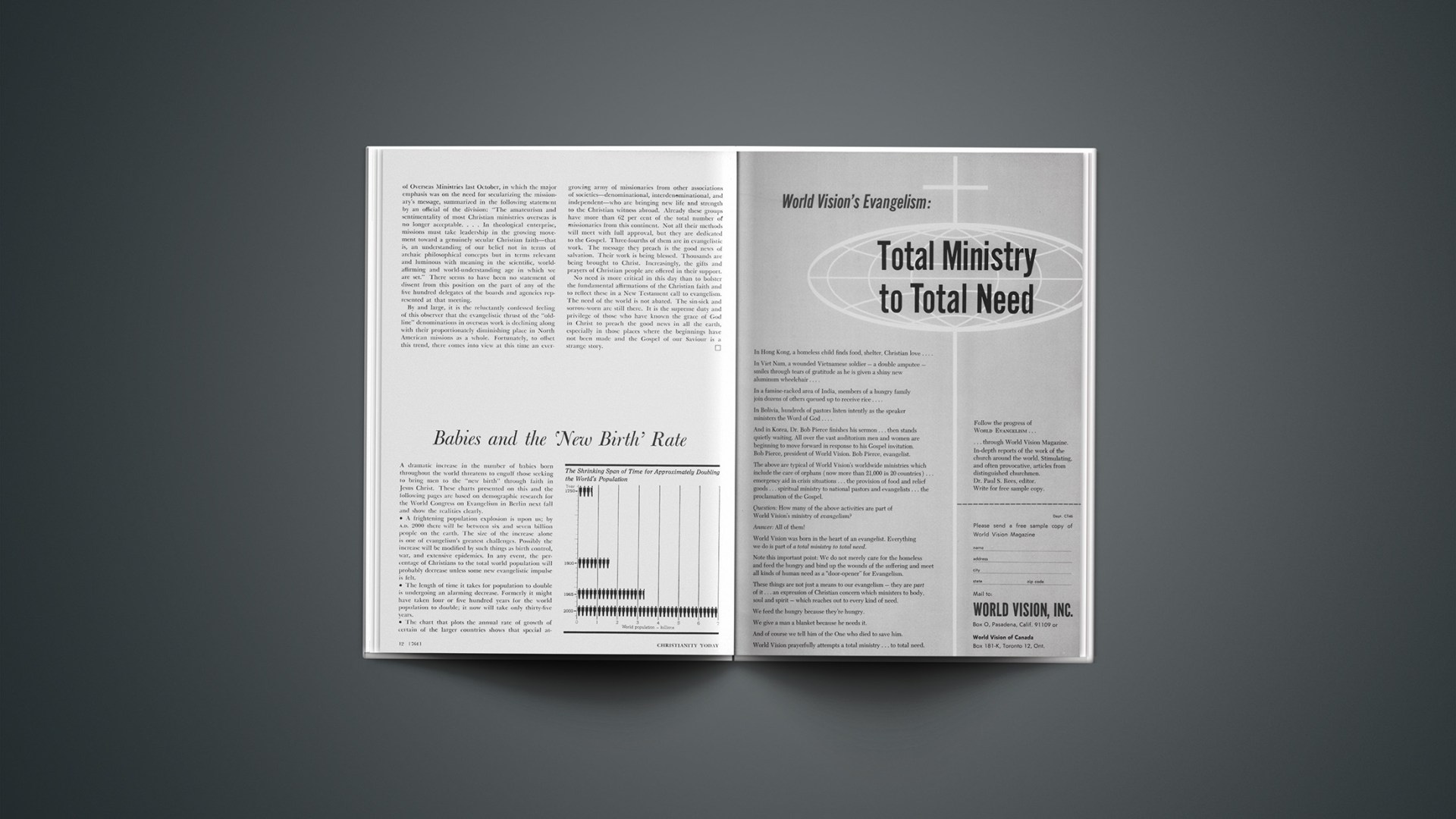
Babies and the ‛New Birth’ Rate

A dramatic increase in the number of babies born throughout the world threatens to engulf those seeking to bring men to the “new birth” through faith in Jesus Christ. These charts presented on this and the following pages are based on demographic research for the World Congress on Evangelism in Berlin next fall and show the realities clearly.

• A frightening population explosion is upon us; by A.D. 2000 there will be between six and seven billion people on the earth. The size of the increase alone is one of evangelism’s greatest challenges. Possibly the increase will be modified by such things as birth control, war, and extensive epidemics. In any event, the percentage of Christians to the total world population will probably decrease unless some new evangelistic impulse is felt.

• The length of time it takes for population to double is undergoing an alarming decrease. Formerly it might have taken four or five hundred years for the world population to double; it now will take only thirty-five years.

• The chart that plots the annual rate of growth of certain of the larger countries shows that special attention must be given to Mexico, Brazil, Turkey, South Africa, Indonesia, and the Congo, for their populations will double in less than thirty-five years. Of the world’s larger nations, only Japan has a rate of growth significantly lower than the average.

• While there is one missionary for slightly more than 70,000 people, the distribution of the total force is very uneven; there are no missionaries in China, for instance, with its more than 700 million people. The slackening of missionary enthusiasm in the sending countries and the scarcity of candidates suggests that the next missionary wave must come from within the younger churches, with nationals reaching their own people with the Gospel.

• The missionary force has increased faster than the populations have, but not fast enough to fulfill the Great Commission. Significantly, North America has become the key sending base, and this situation is likely to continue indefinitely.

• In the last hundred years, the number of non-Christians in the world has more than doubled. Although Protestants in growth have more than kept pace with population, they are still a small minority of the world’s population.

• Christians in the United States face a great evangelistic opportunity, since the country will have approximately 150 million more people by A.D. 2000. However, the rate of growth for 1965 was the lowest since World War II (1.2 per cent); and since the United States is among those nations most inclined toward birth control, the net increase of population by A.D. 2000 may be smaller than the estimate based on recent birth figures.

Data for the charts came from the following sources:

1. Population Reference Bureau, Incorporated, Washington, D.C.

2. Interpretative Statistical Survey of the World Mission of the Christian Church, edited by Joseph I. Parker, New York and London, 1938.

3. The Christian Yearbook, London, 1868.

4. Britannica Book of the Year, 1964.

5. Demographic Yearbook of the United Nations.

6. National Geographic Society.

7. Missionary Research Library and Dr. Herbert Jackson, director.

8. Dr. Kenneth Scott Latourette, Sterling Professor Emeritus of Missions and Oriental History, Yale University.
Evangelism: The Heart of Missions

Proclaiming the Good News is “especially the responsibility of missionary boards and agencies” yet some now reflect “a declining stress on evangelism”

The nineteenth century has been called the “Great Century” of Protestant missions. In 1815 there were only a few hundred Protestant missionaries throughout the world, and many of these belonged to “missionary societies” not directly related to the Church; but by 1914 the number had grown to an amazing 22,000. The great denominations had come to recognize missions as central and had set up agencies to foster the enterprise in the world. Protestant churches had been planted in almost every nation. The Bible had been translated into more than 500 languages. And in North America the Student Volunteer Movement was vigorously challenging youth with chapters on every campus, and with its great conventions in which thousands heard the eloquent appeals of great leaders.

While the proclamation of the Good News is the responsibility of the whole Church and includes student movements, Bible societies, and lay efforts, it is especially the responsibility of missionary boards and agencies set up by the churches for this very purpose. The stance of these agencies is therefore a matter of vital concern. How are they fulfilling their commitment? Has evangelism continued to be the primary driving force in missions? Or are there other accents that tend to abate or obscure it?

Some aspects of the present situation are reassuring;

1. The 42,250 Protestant foreign missionaries throughout the world reported by the Missionary Research Library in its 1960 survey constituted the largest total recorded in any year up to that time, and the number continues to increase.

2. North American Protestants have more than doubled their missionary personnel since 1945, and the present number stands at approximately 28,000. This significant increase must be seen in the light of the drastic depletion of forces resulting from the financial depression of the 1930s and from World War II, so that the gain in part represents the retaking of lost ground. It stands, nevertheless, as a solid evidence of life and growth. Of the present 28,000, some 38 per cent represent boards and agencies associated with the Division of Overseas Ministries of the National Council of Churches; 44 per cent are from societies affiliated with the Evangelical Foreign Missions Association (EFMA), the Interdenominational Foreign Mission Association (IFMA), and the Associated Mission Agencies of the International Council of Christian Churches (AMICC); and 18 per cent belong to societies which are “independent.”

3. An avowal of evangelistic purpose is contained in the official statement of aim of almost every mission board or agency. This can be affirmed on the basis of a private survey made at the end of 1965. A brief questionnaire addressed to twenty-three denominational agencies affiliated with the Division of Overseas Ministries and a like number related to the Evangelical Foreign Missions Association elicited seventeen replies from each group, thirty-four in all. Twenty-eight of these, an equal number from each group, gave an emphatic place to evangelism, though some of these mentioned other corollary aims. Six agencies did not reply specifically to the question.

4. Most of the thirty-four agencies that replied to the questionnaire feel there has been a strengthening of the evangelistic aim in their work during the past twenty years. On this point the seventeen DOM boards voted: “Yes,” twelve; “No,” four; and “No comparative basis,” one. One of these boards explained that it did not have a specific “evangelistic” category but used the term “church development.” While these are not equivalent terms, the church-development group has been counted as evangelistic for the purposes of this analysis. The seventeen EFMA societies voted: “Yes,” fifteen; “No change,” one; and “No comparative basis,” one. The overall ratio of evangelistic missionaries in the total force is reported by the two groups as follows: DOM, 40 per cent; EFMA, 75 per cent.

Significant as these facts and figures are, they cannot be taken as a conclusive sign of the strength of evangelism in the missionary program. There are other questions. What is meant by “evangelistic work”? What is the nature and content of the “Gospel” that is being preached? What are the grounds on which boards and agencies determine that this emphasis has been strengthened in their work? For example, a large DOM-related board that says evangelism has gained a stronger place in its program during the past two decades nevertheless shows in its published reports that the ratio of evangelistic missionaries has declined from 68 per cent of the total in 1945 to 45 per cent in 1965. During the same period, appropriations for evangelistic work, exclusive of salaries, have declined from 15.4 to 8.4 per cent of the total budget. Yet this is a board generally known for a relatively strong emphasis on evangelism.

Several factors awaken concern:

1. Many boards have revised, or are revising, their statements of aims. In general these revisions reflect a declining stress on evangelism as the central business of missions. The evangelistic purpose is not left out, but the inclusion of other coordinate or subordinate aims detracts from the pre-eminence of evangelism.

2. The emergence of “national churches” has confronted the boards with a new dimension in their work. An insistent question today is: “What should be the continuing relation between the missions or sending societies and the indigenous churches that are a result of their work?” Preoccupation with this problem has caused many boards to make far-reaching changes in policy. There is a new emphasis on “church development” or “interchurch aid.” Some boards have come to feel that pioneer evangelism is no longer an appropriate function of foreign mission agencies in such situations, and that their role now is to stimulate the national churches to undertake missionary endeavors of their own, to work aggressively through and with them, and to offer help with men and money. In any given field the “mission” organization is to be dissolved, and missionaries, together with all funds for the work, are to be turned over to the indigenous body and administered by it through its own agencies. New missionaries would be sent only on invitation of, and for assignment by, the national church. The board becomes, in effect, a subsidizing agency.

It is not surprising that this radical change of direction has met with considerable resistance from missionaries and loyal supporters of the work. There is a basic difference in scope and function between a mission and a national church, and a recognition of this is essential to an understanding of the problem. Why have missionaries been reluctant to see the administrative control of missionary funds and personnel pass to the indigenous churches? To suggest that they are loath to relinquish authority, or are committed to a sort of “colonialism,” is to do them an injustice. There is a better explanation. The indigenous church is an organized ecclesiastical body with a wide range of interests and responsibilities of which missions is only one, and sometimes not the principal one. It must be concerned with its own internal organization, its institutions and agencies, its publications, its discipline, the support of its ministry, and a dozen other matters. It is peculiarly subject to the temptation of using available money and men for the development of all phases of its program. It is not a distinctively missionary organization.

A mission, on the other hand, is supremely concerned with evangelization, outreach, and extension. It is not strange that missionaries are zealous to keep this emphasis. For this they have left home and native land. It is this to which they were commissioned by the church and in which they are supported through prayer and sacrificial giving. They are anxious to help the growing fellowship on the field as much as possible, to give it their love and cooperation, to serve it in all ways consistent with their primary obligation; but they will not easily accept interchurch aid as a substitute for missions. Their interest is in winning new believers and establishing new churches, not in subsidizing existing ones.

Further, it is pertinent to ask whether national churches can really be expected to develop a sense of their own missionary responsibility under such a system of subsidization. They tend to be confirmed as “receiving churches,” whereas all churches should be “sending churches.” For missions is primarily a matter, not of church-to-church relations, but of the relation of the church to the unbelieving world.

It is inconceivable that the coming into being of a relatively small body of believers in any country should put an end to the initiative of men and women who have been called of God to preach the Gospel to every creature. There are few countries in which Protestant missionaries are at work today where as many as one-tenth of the people have been won to the Christian faith. Any philosophy of missions that diverts attention from this unfinished task and interprets our continuing role principally in terms of interchurch aid must be seen as a major retreat in missionary strategy and a weakening of evangelism.

3. Any comparison of present missionary strength with that of former years must take into account the increasing category of “short termers.”

The latest annual report (1964) of the Division of Foreign Missions (now the Division of Overseas Ministries) of the National Council of Churches gives an analysis of the new missionaries sent out in 1963 by thirty boards and agencies affiliated with the division. These are classified by vocations and terms of service. The tables show a total of 864 sent during that year, of whom 155, or less than 18 per cent, are placed under the classification “evangelistic and church work.” Further, 244 of the 864, or 28 per cent, are listed “short term.”

There is no intention here to speak disparagingly of short-term workers, many of whom are superior in training, experience, and dedication; but they are not the group with the greatest promise in the field of evangelism. Most of them serve as “specialists” in such fields as Christian education, church organization, social service, agriculture, medicine and health, business and administration, teaching English, or various technical vocations. Since their tenure is seldom longer than five years, and sometimes even shorter than one, few acquire the language proficiency indispensable for evangelism.

Evangelistic work presupposes a depth of rootage in the country, and an understanding of its history, culture, social customs, attitudes, language, and religious inheritance, that can be gained only through prolonged residence. The short-term worker has his special contribution to make, but the growing tendency to attract young people by offering them a brief assignment in some missionary situation is already proving a discouragement to life-commitment and to evangelism.

4. Undoubtedly the chief cause of the waning emphasis on evangelism is the widespread erosion of faith within the Christian fellowship itself. No one who reads the papers can be unaware of the tides of unbelief sweeping through our pulpits and churches.

The missionary enterprise cannot be separated from the faith of the Church. The incentives for Christian missions derive from beliefs about the nature and character of God, the relation between God and man, the destiny of fallen humanity, the sufficiency of Christ as the Redeemer of the world, and the nature of the Gospel. When these premises are undermined, missions and evangelism lose their essential meaning.

In this decline of faith, three forces in particular work against evangelism:

a. Universalism: Despite the clear biblical teaching on the “lostness” of man, a tacit universalism questions the urgency, or even the need, of missions and evangelism. Emphasis on the love of God, to the exclusion of his righteousness and justice, has caused many to trust in a sort of divine indulgence instead of the costly and redemptive work of Christ. Such a view makes the Cross of no effect and actually distorts the love of God by making it seem that he permitted the sacrifice of his Son without sufficient purpose.

b. Syncretism: A newly active syncretism presents itself again as an obstacle to evangelism. The vigor and sincerity of our missionary efforts, indeed of our preaching at home or abroad, rests upon our conviction that God, in his plan for the redemption of the world, sent his Son as the one and only Saviour. The Christian faith recognizes no rivals. It lays claim to an absoluteness that denies the ultimate validity of any other faith. It represents itself as the only hope of man. It presents Christ to the world not as a way of salvation but as the way of salvation. If this position seems narrow, we must accept the criticism. Only let it be acknowledged that the same judgment must apply to the whole doctrine of the New Testament. The missionary enterprise, as developed in the Gospels, the Acts, and the Epistles, rested upon precisely this view of the uniqueness and sufficiency of Christ. As the late Robert E. Speer put it in one of his books, “The early church believed that there was none other name given among men whereby they must be saved. All men everywhere needed Christ and Christ was enough. Neither Greek, nor Roman, nor Semitic religion had any correction to make or any supplement to add to Him.” And a vigorous evangelism can stand on no other ground.

c. Secularization: A secularized Christianity dismisses the Gospel of faith and salvation as having little relevance to life and accepts instead “another gospel,” drawn from platforms of political, social, and intellectual liberalism. The vital spiritual dimension of the encounter between God and man is virtually ignored by a so-called Christianity that can see little beyond man’s physical and social needs as a higher animal. Soteriology gives way to sociology: what God has done yields to what society must do; good news is replaced by good intentions; and evangelism disappears in favor of reform. As Dr. Eugene Carson Blake is quoted as saying, “We are not doing well. Society is becoming more and more secular. People are making up their minds in the light of what they hear from sources other than the pulpit” (Presbyterian Journal, Feb. 16, 1966, p. 4). And he could have added that some pulpits are finding their canonical authority more in secular voices of change and revolution than in Scripture.

Now, evangelicals consider the reaction to social injustices valid; but they hold that social structures cannot be evangelized. Regenerate Christians can influence these structures, and in the task of seeking regenerate individuals the historic denominations are, on the whole, failing badly.

It is not easy to determine just how far missionary agencies have been affected by this moral and theological confusion. One continues to hope and believe that they are the last to surrender to the pressures of unbelief. But they cannot remain forever impregnable. They are a part of the churches they represent and must sooner or later reflect the trends already evident in almost every denomination. It is not reassuring to read the record of the annual meeting of the Division of Overseas Ministries last October, in which the major emphasis was on the need for secularizing the missionary’s message, summarized in the following statement by an official of the division: “The amateurism and sentimentality of most Christian ministries overseas is no longer acceptable.… In theological enterprise, missions must take leadership in the growing movement toward a genuinely secular Christian faith—that is, an understanding of our belief not in terms of archaic philosophical concepts but in terms relevant and luminous with meaning in the scientific, world-affirming and world-understanding age in which we are set.” There seems to have been no statement of dissent from this position on the part of any of the five hundred delegates of the boards and agencies represented at that meeting.

By and large, it is the reluctantly confessed feeling of this observer that the evangelistic thrust of the “old-line” denominations in overseas work is declining along with their proportionately diminishing place in North American missions as a whole. Fortunately, to offset this trend, there comes into view at this time an ever

growing army of missionaries from other associations of societies—denominational, interdenominational, and independent—who are bringing new life and strength to the Christian witness abroad. Already these groups have more than 62 per cent of the total number of missionaries from this continent. Not all their methods will meet with full approval, but they are dedicated to the Gospel. Three-fourths of them are in evangelistic work. The message they preach is the good news of salvation. Their work is being blessed. Thousands are being brought to Christ. Increasingly, the gifts and prayers of Christian people are offered in their support.

No need is more critical in this day than to bolster the fundamental affirmations of the Christian faith and to reflect these in a New Testament call to evangelism. The need of the world is not abated. The sin-sick and sorrow-worn are still there. It is the supreme duty and privilege of those who have known the grace of God in Christ to preach the good news in all the earth, especially in those places where the beginnings have not been made and the Gospel of our Saviour is a strange story.

The Theology of Evangelism

The Church must swiftly recover the evangelistic meaning of the whole range of Christian theology

A theologian may share the platform with an evangelist, but he rarely fills his shoes. Despite the example of the Apostle Paul, theology and evangelism have gone their separate ways—often with harsh words for each other.

This disjunction is not only dangerous; for Christian theology and evangelism it is inadmissible. Christian theology is evangelical; it is gospel theology. Because theology and evangelism are unified in the Gospel, there is little use in trying to isolate a special “theology of evangelism.” Instead we need to recover the evangelistic meaning of the whole range of Christian theology, and at the same time to recognize the “gospel structure” that biblical theology already has.

Theological evangelism has one grand advantage: it forces us to begin with God. So Paul began in his Epistle to the Romans with “the Gospel of God” (1:1). Only when we know the Gospel of God are we ready to hear it in the Church or bear it to the world.

A “church-centered” theology of evangelism peers anxiously from the spires of Christendom at the population explosion of the non-Christian world. Without asking what the Gospel is or what the Church is, it seeks more effective techniques. To be sure, after the gospel calling of the Church has been clearly grasped, fruitful questions may be asked about the witness of the laity, the ministry of mercy, the principles of church growth. But the calling of the Church begins where theology begins—with God, who calls and sends. To seek a “theology” for an enterprise or structure we have already defined is to court illusion. We may find only what we are looking for.

The swing from “church-centered” evangelism to “world-centered” evangelism moves from danger to disaster. Advocates of the new “secular Christianity” condemn a “supernaturalistic” view of revelation. They deny that “the human mind can apprehend a fixed reality transcending experience which provides an unchanging criterion for faith and action” (Gibson Winter, The New Creation as Metropolis, Macmillan, 1963, p. 69). Having disposed of the God Paul preached, they proceed to canonize social science. The new gospel of sacred sociology calls the Church to abandon its dream of the heavenly Jerusalem and seek the realization of the “new mankind” in the earthly city through the use of political power. For such an enterprise, Billy Graham’s efforts are an unwelcome diversion.

Evangelism must have a higher source than the church steeple or the high-rise apartment. But can evangelism actually be God-centered? Are not the issues of evangelism to be found in the slums of metropolis and the pews of suburbia? To be sure, the problems of evangelism are to be found in the world and in the Church; but just as surely their solution is to be found in God. Only as the Gospel of God does the evangel have the power to join together the Church in the fellowship of the Gospel; only as the Gospel of God is it the majestic foolishness that offends the world with the absurd message of the Cross.

Consider, for example, the form of the Church in the world. Is the Church in “shape” for evangelism? This question cannot be limited to the familiar and important problem of involving laymen in the evangelistic work of the Church. The query is much more radical. If, as many would say, the Church exists only in mission, then it must be shaped by its mission. The structures of the world must then determine the “shape” of the Church. If, on the other hand, the Church is called into God’s presence as his people, then fellowship with God as well as service to God must determine its form. The holy nation of God’s choosing cannot be conformed to the world but must be transformed as the body of Christ. In its mission as well as in its worship, the Church is formed by God. For the “shape” of the Church we are driven to the “shape” of the Gospel.

Other issues in evangelism may also be brought to radical solution through the perception of God’s Lordship in the Gospel. The reshaping of the Church is a comparatively recent question for evangelism; much older is the problem of reshaping the world. The social gospel of liberalism has undergone urban renewal but continues to be the “good news” of economic and social reform.

How does the Gospel relate to social action? When an evangelical reports the success of evangelism-in-depth, world churchmen are quick to condemn the “individualism” and “pietism” of such an approach. The promised peace of God’s Kingdom, we are told, is far more comprehensive. It cannot be limited to a few souls snatched from the burning but includes a redeemed humanity, a new heaven and earth. Social structures, not merely individual men, must be redeemed to usher in the shalom (peace) of the Kingdom.

Evangelicals are sometimes vulnerable to the charge of “spiritualizing” the Gospel. Although the literary caricature of the professional evangelist may be cruel, it is recognizable. Evangelism has often ignored the whole man as well as the whole society. Yet the social gospel, new or old, grounds its criticism in a misconception. It misunderstands the promise of the Gospel. To be sure, the shalom of the Kingdom is no airy “pie in the sky.” It is as tangible and physical as Christ’s resurrection body, the beginning of the new creation. In fact, the Gospel of the resurrection determines the peace of Christ’s Kingdom. The prophets who proclaimed shalom as God’s gift were forced to struggle against the false prophets who promised peace without judgment. “No peace to the wicked” became a prophetic slogan (Isa. 48:22; Jer. 6:14; Ezek. 13:10). In the same way, the Gospel warns that the Lord who came is coming again and that the time of the restoration of all things is the time of judgment. The full peace of the Kingdom comes “at the revelation of the Lord Jesus from heaven with the angels of his power in flaming fire, rendering vengeance to them that know not God, and to them that obey not the gospel of our Lord Jesus” (2 Thess. 1:7b, 8, ASV).

Only by taking seriously the eschatology of the Gospel can evangelism wait for Christ’s power and leave judgment to him. The call to evangelize by penetrating the power structures of society is a call to forsake the fellowship of Christ’s suffering. There is no power structure that is not already under his authority; obedience to Christ can never take the sword to bring in his Kingdom.

Again we are humbled before the Gospel of God. To suffer when our Lord has all authority, to die while he rules—this is not man’s conception of the Gospel of power and freedom. But it is God’s wisdom, and we must begin in the fear of the Lord to discern it.

Nothing less than the fear of the Lord can bear the Gospel. We dare not patronize the Gospel in church-centered evangelism nor subvert it in world-centered evangelism. Indeed, before we can consider the questions that drive us to reflect on evangelism, we face a prior claim; for to speak of the Gospel is to start with God (Acts 20:24). It will not do to add a little theology to our thinking about the Church and the world so as to gain a fresh perspective on the familiar problems of a powerless Church and an indifferent world. Theology cannot be packaged for convenience. The Gospel of God shapes evangelism in sovereign majesty. The Word of God, the presence of God, the power of God—these are the categories of theological evangelism. They declare that salvation is of the Lord.

To grasp the high sense in which the Gospel is God’s, we should mark the “angel” in evangel. Angels are fitting messengers to announce God’s good news (Luke 2:10), and when men are called to bear the heavenly message they do so as heralds of God (1 Tim. 2:7). Their proclamation is not man’s response to God’s salvation; it is God’s own Word (1 Thess. 2:4, 13).

God’s gospel Word declares the fulfillment of God’s Word of promise. What God speaks comes to pass. God says, “Let there be light!,” and there is light. God says, “Unto you that fear my name shall the Sun of righteousness arise with healing in his wings” (Mal. 4:2a), and in God’s own season the true Light comes into the world (John 1:9).

Because the Gospel is God’s sovereign word, it is more than an announcement; it is a summons. God’s appointed time has come; his feast is spread. The evangelist bids men to come, “for all things are now ready” (Luke 14:17). To ignore this summons is to invite the wrath of the king and to incur judgment: those who refuse God’s bidding shall not taste of his supper. The Gospel of God is to be obeyed (Rom. 10:16; 2 Thess. 1:8, 9; 1 Pet. 4:17). It bids men turn from their foolish idols to the living God (Acts 14:15). Those who reject it are judged by it (Acts 14:15; 2 Cor. 9:13; Acts 28:23–30; Rom. 2:16; 1 Cor. 4:5).

Gospel preachers entreat and persuade men in God’s name, but they always bear a trumpet. To lose the jubilee blast of proclamation is to lose the Gospel itself. Just as the silver trumpets of the priests once sounded deliverance to the oppressed on Israel’s day of atonement, so does gospel preaching ring with the declaration of “redemption and release” in Christ. The Gospel is not good advice but God’s news. Yet the trumpet of God’s Gospel becomes a prelude to the last trump in the ears of those who refuse God’s grace. When the Gospel is not a “savor of life unto life” it is a “savor of death unto death.” Man cannot trifle with the trumpet of God.

The Gospel is God’s in another sense: the gospel trumpet proclaims God’s own presence. No one has understood the Word of God’s promise until he sees that God has promised too much. Abraham saw that when he laughed at God’s promise of the birth of Isaac. The Old Testament builds an impossible tension between the deepening guilt of God’s people and the soaring salvation of God’s promise. How can the peace of a new covenant in a new heaven and a new earth be given to a covenant-breaking people?

Only God in Person can keep his Word of promise. He must come as Lord, as the royal Shepherd leading his flock through the wilderness in a second exodus. The deserts bloom, the trees of the field rejoice, the eyes of the blind see the coming Lord. Yet if he came only as Lord, his presence would be a devouring fire. He must come as Servant, too, as the Lord’s anointed, bearing the guilt of the people and making perfect the righteousness of the covenant.

To usher in the peace of God’s saving rule, there must come the Prince of Peace, who is Lord and Servant, Son of David and Son of God. The Gospel of God’s kingdom is the Gospel of God’s King.

Because the Gospel announces God’s saving presence, it declares God’s saving power. The Son of God himself holds the keys of the Kingdom. By his miracles he shows his power to deliver the captives of Satan; by his word he calls together his little flock; by his death and resurrection he completes his triumph as the Prince of salvation. The Holy Spirit sent from the throne of his glory is the One in whom he is present in his kingdom, the Church, until he comes again in power.

The Gospel, in short, declares the royal saving will of God. The Christ of the Great Commission holds all power in heaven and earth, including the power of the Holy Spirit to give eternal life to as many as were given him by the Father (John 17:2; Acts 5:31). He is a Prince and a Saviour who gives repentance to Israel and remission of sins. The Gospel both celebrates and realizes his triumph.

The Apostle Paul compared his evangelistic travels to the progress of a captive of war chained to the chariot of a triumphing captain. Thanks be unto God, he cried, who always leads us about, triumphing over us in Christ. Paul the chief of sinners was the trophy of Christ’s saving grace (2 Cor. 2:14). His Epistle to the Romans presents his evangel—the showing forth of God’s salvation in Christ, demanding the decision of faith.

How does this Gospel of God shape evangelism? From the standpoint of human initiative, it offers the death of evangelism. Humanism demands freedom at God’s expense; grasping at equality with God, it refuses the freedom of sonship. Even among Christians the misunderstanding persists. If salvation is by God’s free grace, why should I not sin as I please so that his grace will abound (Rom. 6:1, 2)? If God’s election is supreme, why cannot the reprobate claim they have obeyed his will (Rom. 9:19)? The fallacy of such questions is that they call God’s sovereignty to account before the throne of man’s sovereignty. But if the kingdom is God’s, then only one man is Lord, the God-man who brings all things into subjection to the will of the Father.

Evangelism shaped by the gospel of God prays. Biblical evangelism is praying evangelism, and no prayer is more evangelistic than the Lord’s Prayer. “Hallowed be thy name. Thy kingdom come. Thy will be done, in earth as it is in heaven.” That prayer anticipates the triumph of the Gospel. All things are possible for him who believes. The stone cut without hands, the Kingdom made in heaven, will destroy the idolatrous kingdoms of man and become a great mountain to fill the earth. By prayer the mountain of God’s Kingdom will be cast into the sea of the nations, and the very gates of the abyss cannot prevail against it (Matt. 21:21; 16:18). God is pleased to magnify his saving power through the cry of those whose trust is in him alone. If the Gospel is God’s, then prayer for the power of the Holy Spirit is the great secret of evangelism. True Christian prayer is always overwhelmed by God’s Lordship. Prayer is the real measure of a man’s conviction that salvation is of the Lord. Those who boast a Pauline theology without the unceasing prayer that was its life-breath have put a wax figure in the place of the new man in Christ. Living theology is praying theology; the first fruit of a biblical theology of evangelism is prayer.

When Jesus with supreme compassion saw the great harvest of the kingdom, his words to his disciples were not “Go ye as laborers into the harvest” but “Pray ye therefore the Lord of the harvest, that he will send forth laborers into his harvest” (Matt. 9:38).

EXILE

Yes, it is beautiful country,

The stream in the winding valley, the knowes and the birches,

And beautiful the mountain’s bare shoulder And the calm brows of the hills;

But it is not my country,

And in my heart there is a hollow place always.

And there is no way to go back.

Maybe indeed the miles, but the years never.

Winding are the roads that we choose,

And inexorable is life, driving us like cattle Farther and farther away from what we remember.

But when we shall come at last

To God, who is our Home and our Country,

There will be no more road stretching before us

And no more need to go back.

EVANGELINE PATERSON

Evangelism shaped by the Gospel of God dares. Confronted by the threats of those who had crucified Christ, the apostles prayed for boldness; their prayer echoes through the New Testament. In the boldness of the Holy Spirit, Simon Peter, who had once cringed before a serving maid, stood before the Sanhedrin to declare that he had to obey God rather than man. Significantly, his message was that the crucified Jesus had been exalted by God’s right hand to be Lord and Christ (Acts 2:36; 5:31). His daring showed more than an understanding of the new situation brought about by the Gospel; it revealed the very power of Christ’s glory operating in him by the Spirit. Paul speaks of the power of the Gospel that is mighty to the casting down of the highest imaginations of human pride (2 Cor. 10:4, 5). An evangelist who had been working among the prostitutes surrounding an American army camp in Korea was challenged by a disturbing thought: Why not take the Gospel to the syndicate operating the houses of prostitution? His hand trembled as he knocked on the door of the vice headquarters, but his bold witness bore fruit. One of the exploiters was humbled by the Gospel and turned to Christ.

Evangelism shaped by the Gospel of God preaches. Since the Gospel is God’s, his Word is the two-edged sword that accomplishes its victory. Apart from the immediate working of God’s power, preaching is foolishness. Its authority is offensive to modern man; its simplicity is scorned. We are told not only that the day of mass evangelism is past (an assertion often made before Billy Graham’s ministry) but also that the day of verbal communication is past. Television has brought back the language of pictures, and preaching is an anachronism. But the wisdom of God is mightier than that of man. Until faith becomes sight, man is restored to the image of God by hearing God’s voice. The Gospel of God carries the blessing Christ promised to Thomas, the blessing on those who do not see, yet believe. God continues to call and send preachers; evangelism will always require evangelists—not only the daily witness of every believer but the convicting proclamation of men of God, mighty in the Scriptures and able to do the work of an evangelist.

Evangelism shaped by the Gospel of God cares. God’s Gospel is the Father’s word of mercy. Because it is God’s, it springs from his heart of love. The parable of the Prodigal Son really presents the welcoming Father and requires the true son of the Father to share his welcome of grace. The returning prodigal deserves nothing, but the father in love gives him everything: the garments of sonship, the feast of joy. The elder brother who refuses to enter the feast is shut out from the joy of his father’s house, from the joy of heaven over one sinner who repents. The true Elder Brother knows so well the love of the Father and his joy in recovering the son who was lost and dead, that he not only sits down to feast with penitent sinners but even goes to the far country to seek and to save that which was lost and to bring life to that which was dead. The zeal of evangelism lit by the Gospel of God has the individualism of God’s personal love. The shepherd rejoices to find one lost sheep from a flock of a hundred, the woman to find one lost coin out of ten, the Father to find one lost son from a family of two.

Because evangelism cares, it cannot pass by human misery. Until Christ comes to repay what is spent in his name, the ministry of the Gospel must include the ministry of mercy. The cup of cold water for the thirsty, oil and wine for the wounded, bread for the hungry, clothing for the naked, comfort for the prisoner—such ministries are performed not only in Christ’s name but to Christ himself. They show the genuineness of the Gospel, and they anticipate the final joy of the gospel promise that the conquest of sin will bring victory over suffering and death. Just as Christians who pray “forgive us our debts” are Christians who confess, “we forgive our debtors,” so too Christians who pray “give us this day our daily bread” are those who give their daily bread to those in need. To do men good is not bait for the gospel invitation—soup and a bed for those who respond in a rescue mission; neither is it an awkward auxiliary to the principal work of evangelism, like a thriving hospital that overshadows the missionary center from which it sprang.

Rather, the ministry of mercy is a sign of the Kingdom. The love that it shows is that peculiar love of compassion evoked by the love of God’s grace in Christ. Only such love fulfills God’s law. In it God’s will is done on earth as Christ did it on earth. Further, the relief of suffering points to the gospel promise of a new heaven and earth from which the curse has been removed. The heavenly city sought by the pilgrim church is coming; whenever human need is met in Christ’s name, the approach of the time of the restoration of all things is heralded.

Finally, evangelism as it is shaped by the Gospel of God suffers. Gospel heralds cannot avoid suffering, not only because they provoke the hostility of the powers of darkness but also because they share the griefs of the oppressed. Paul warns that the Kingdom can be entered only through many tribulations (Acts 14:22). He saw the chains of his imprisonment as bonds of the Gospel (Philemon 13) and spoke of the afflictions of the Gospel (2 Tim. 1:8) that he endured as he made up what was lacking in the sufferings of Christ for the sake of his body, the Church.

The riches of the Gospel of grace remain the untapped resource of contemporary evangelism. We have assumed that we know the Gospel and have sought new forms for the Church and new relations with the world. The truth is we know the world all too well and have formed and reformed, organized and reorganized the Church until we have built a high Gothic cathedral of interlacing committees buttressed with boards and vaulted with task groups. What we do not know is the Gospel that is the power of God to salvation. Even our prayers for the Holy Spirit lack the boldness that flows from pleading God’s own promises in the wisdom of the Gospel. New avenues of communication with the world must be opened, new dynamics of fellowship in the Gospel must be discovered; but we will not fail in this if we learn what it means to know him, and the power of his resurrection, and the fellowship of his sufferings.

One Race, One Gospel, One Task

Later this year the World Congress on Evangelism will convene in Berlin with delegates from many races and many lands. This issue of CHRISTIANITY TODAY goes to readers around the world in advance of that momentous meeting, whose theme will be “One Race, One Gospel, One Task.”

One Race. At this moment in history, the world of men is drastically divided—language against language, religion against religion, nation against nation, color against color. In the midst of all these divisions, the Church must sound the clear note that God sees all men as a single race. Racism is wrong precisely because all men must own Adam as their father, even as all believers must recognize that God fashions the new man created in Christ Jesus, the second Adam from above, with utter indifference to race.

Racism attempts to divide humanity into competing groups on the basis of color. Biblically this is indefensible and absurd. Neither the law of God nor the Gospel of Christ recognizes such a distinction; both are color blind. God himself sees only two classes of persons, the saved and the lost; and the point of division is the condition of the heart, not the color of the skin. Evangelism presupposes the solidarity of the human race, the curse that has come upon every man because of sin, and the universal need of redemption through Jesus Christ. All men love, hate, eat, marry, reproduce, and die. And after that the judgment.

One Gospel. Through the Incarnation God has intervened for the salvation of lost men, and to his Church he has committed the proclamation of the one Gospel to the whole human race. This Gospel is God’s good news to men, the message of the Cross. It proclaims that men, who all have sinned and come short of God’s glory, all need the Saviour. At its heart is the truth that God’s only Son lived a life of perfect obedience in the flesh, bore the penalty for man’s sin in his own body on the Cross, and through his atoning death and resurrection freely offers reconciliation with God to the world of sinners. This is God’s only Gospel, and it is definitively communicated by the Bible, the Word of God written.

The adherents of the true Gospel stand forth-rightly for the integrity of the Bible as a uniquely inspired revelation, as against those who taper the Scriptures to the level of “saga” and “myth” and sever faith from an adequate grounding in historical fact. They believe in the “faith once for all delivered” rather than in creeds that distort the New Testament evangel. They call for the proclamation of the whole counsel of God rather than a message cut and compromised to man’s desires. They champion a message that Peter, Paul, and John would instantly recognize as their own, were they to walk today through the hallways of theological seminaries, the sanctuaries of the churches, and the byways of men. Amid the modern recasting and reformulating of the ancient message of the Cross, they crave the declaration of an undiluted Gospel that enhances and promotes the historic creeds of the Church, that is based upon personal devotion and integrity, and that calls error by its rightful name. They yearn for the warm preaching of a doctrine of reconciliation that brings men face to face with the perils of rejecting the claims of the Gospel and with Christ’s warnings that the wicked perish forever. They want the Church as its primary concern, to proclaim from the housetops the Gospel that Christ established. They seek a new responsiveness and commitment to the written Word of God as man’s only infallible rule of faith and practice.

As the World Congress on Evangelism assembles in Berlin, we cannot forget the stirring words presented by the chairman of the German delegation to the International Missionary Council meeting at Tambaram, Madras, India, in 1939, before World War II broke in full fury: “The Church of Christ … is moving forward into this world to proclaim the redeeming message.… The Church has not to bring into force a social program for a renewed social order, or even a Christian state. It cannot redeem the world from all inherent evils, but it serves to spend itself promoting all good works in obedience to its God-given call.”

One Task. Evangelism is the signal task of the Church: everywhere and always we are to preach the one Gospel, whose relevance to the whole human race is assured by our Lord’s Great Commission. In order to discharge its obligation the Church must recover the great evangelistic truths of earlier ages, truths too often diluted and neglected in our generation. Every evangelist must see in the contemporary desire to modernize the Gospel, the shadow of a new universalism that undercuts evangelism as the primary task of the Church by claiming that men are already redeemed and need only to be informed of their redemption; that an immediate decision, normative for the work of evangelism, should not be demanded of them; and that it is not necessary to speak of eternal life and eternal death when men are confronted with the Gospel, since all will ultimately be redeemed.

Sins that bar men from heaven according to the Scriptures have been validated by those who in their efforts to update the Gospel have lost it. At times, they say, such things as lying, cheating, stealing, adultery, and homosexual acts become legitimate expressions of the “law of love,” which assumes anything is right given the proper circumstances, and that objective and enduring moral standards are to be discarded as cultural primitivisms.

Evangelism’s task is to proclaim that the true Gospel is perennially applicable to man’s whole condition and to every aspect of human life, and that it brings under judgment man’s desires and present way of life. The Gospel cuts across that way of life, pronounces God’s awful judgment upon it, and calls all men to live the new life in the world, even though they are not of the world. It does not compromise to make itself heard; it speaks with the voice of judgment. Those who preach this Gospel are deeply concerned for men to accept Christ and heavily burdened for those who reject him.

Undergirded by the profound conviction that men who die in their sins without Christ are lost, the Church must hasten to proclaim the Gospel to them before they perish from the earth. The task must be performed according to the principles laid down in the Scriptures. Let any method, old or new, that can be validated from the Word of God be used to evangelize the world. Let educated and uneducated, rich and poor, young and old, male and female, clergy and laity, join together in obedience to the divine mandate.

Christ’s continuing commission is to evangelize till he comes again. As Leslie Lyall says in his book Urgent Harvest (London, 1962): “In these apocalyptic times, the urgency is greater than ever. The going will be different, the attitudes changed, the policies revised, the methods altered. The cost will be greater and the dangers increased. The swift current of events is sweeping the people along in its turbid stream. But people are still people with their sins and sorrows, their sadness and sickness, their soul hunger and emptiness: men and women for whom Christ died, needing him above everything else.… Multitudes, multitudes, multitudes, living and dying without Christ. Multitudes in the valley of decision. We dare not forebear to deliver. We must not consider the sky. It is a time to sow and also a time to reap.… The fields are white unto harvest, urgent harvest!” The task is ours. And so, inescapably, is the choice.

A Historian’S Testimony

In this world of men, with its aspirations and its struggles and its many philosophies and religions, there appeared one [Jesus Christ] born of woman and in the stream of one of these traditions. To most of such of his contemporaries as knew him he seemed a failure.… His followers … included few whom the nation or the world counted influential.

Yet front that brief life and its apparent frustration has flowed a more powerful force for the triumphal waging of man’s long battle than any other ever known by the human race. Through it millions have had their inner conflicts resolved in progressive victory over their baser impulses. By it millions have been sustained in the greatest tragedies of life and have come through radiant.… It has done more to allay the physical ills of disease and famine than any other impulse known to man. It has emancipated millions from chattel slavery and millions of others from thraldom to vice. It has protected tens of millions from exploitation by their fellows. It has been the most fruitful source of movements to lessen the horrors of war and to put the relations of men and nations on the basis of justice and peace.…

It is of the very core of the Christian’s faith that the God and Father of his Lord, Jesus Christ, will not be defeated. The Christian holds the resurrection of Jesus also to be fact. The life of Jesus, so he confidently maintains, did not end on the cross. Nor was it continued merely through the growing influence of Jesus, amazing though that has been. The Christian is bold to declare that through the resurrection Jesus entered into a fresh stage of life, glorified, endless, and inconceivably rich in love and power. He holds that in the resurrection God was working, bringing out of the evil of man’s rejection of Jesus a good far greater than could have been possible without that defeat.…

The Christian is certain that Jesus is central in human history. His confident faith is that in those who give themselves to God as they see him in Jesus there is working the power of endless life and that from them God will build, to be consummated beyond time, the heavenly city, the ideal community, in which will be realized fully the possibilities of the children of God. This eternal life and this ideal community are, in the last analysis, not the fruit of man’s striving, but the gift of a love which man does not deserve, and are from the quite unmerited grace of God.—Excerpted by permission from A History of the Expansion of Christianity, by Kenneth Scott Latourette (Harper & Row, Publishers, Inc., 1945), VII, 503 ff.

Canterbury Tale, 1966

Anglican primate initiates ‘serious dialogue’ with Pope Paul in historic visit to Vatican

Forty-three Popes and thirty-two Archbishops of Canterbury have held office since the last time an English primate paid an “official” visit to the Vatican. In welcoming Dr. Arthur Michael Ramsey to Rome last month, Paul VI spoke of the bridge being rebuilt between their two churches.

“Your steps,” the pontiff told his visitor, “do not resound in a strange house. They come to a home which you, for every valid reason, can call your own.”

Though a joint declaration following the encounter reflected symbolic rather than practical results, the archbishop evidently was delighted at the inauguration of “serious dialogue founded on the Gospels and on ancient common traditions.” Regarding the validity of Anglican orders, Ramsey said both sides recognized the importance of this subject; however, he said, they agreed not to discuss it in isolation but in the general context of discussions. On the papal decree on mixed marriages last month, the archbishop said he had indicated clearly in Rome that it would not satisfy the consciences of Anglican Christians. He expressed hope that this was not intended as a final settlement.

One of the meetings with the pontiff was in the Sistine Chapel, where popes are elected and where dead popes lie beneath Michelangelo’s “Last Judgment” the night before their burial. Here, said an English Jesuit, “it is easier to grasp that ecumenism means neither bargaining nor power politics, but the death of pride and humble submission to the Gospel.”

Upon returning to England, Ramsey enhanced his reputation as an artful dodger of pointed questions. Asked if he would like to see the pope visit England, he replied that he did not advise the pope on where he should make his visits. Just as neatly he ducked questions on the supremacy of the pope and papal infallibility.

The trip to Rome did not go unprotested. Five British Protestants, members of the International Council of Christian Churches, traveled on the plane with Ramsey. The result was a certain edginess and emphasis on security that did no good for the ecumenical cause. Neither did an incident in which two of the five dissidents, both Ulster Presbyterians, were refused permission to enter Italy, ostensibly because of a 1962 incident in which they were found distributing Bibles there.

“We are Protestant ministers,” said the Rev. Brian Green, a Baptist from

London. “There does not seem to be any liberty here to state our convictions.” He was one of the three allowed to stay. All three were later ejected from an Anglican church in Rome when Ramsey was celebrating communion.

“We did not shout nor did we interrupt the service,” Green said. “But as soon as we took off our coats to reveal our protest waistcoats, detectives pounced.”

The waistcoats carried inscriptions condemning the visit as a betrayal of Protestantism. The men were detained at a police station for 3½ hours.

The two expellees, as they were being led away earlier, had shouted: “Rome is opposed to the Bible. You will have to tear these shirts from us. Do you want us to take off our trousers? Hallelujah, we are being thrown out because we are Protestants. What a blow for the Vatican Council.”

The protesters represented a tiny minority. More typical of evangelical reaction to the archbishop’s visit was the comment of Anglican Canon Thomas C. Livermore: “The whole point of the Reformation was the difference between Catholic dogma and Bible truth, and these differences remain. Nothing more can be done until they are resolved.”

Highlights Of The Encounter

The meeting between the Archbishop of Canterbury and Pope Paul VI was regarded as historic in a special sense. Not since 1397, when Pope Boniface IX received Archbishop Arundel, had an Anglican primate conferred officially with a Roman Catholic pontiff. Dr. Michael Ramsey’s predecessor, Archbishop Geoffrey Fisher, saw Pope John XXIII in 1960, but that visit was regarded as “a courtesy call.” By contrast, Ramsey greeted Pope Paul “in my office as Archbishop of Canterbury and as president of the Lambeth Conference of Bishops.”

In their initial meeting in the Sistine Chapel, Paul and Ramsey embraced in what was described as a “kiss of peace.” Then they read formal statements stressing the desirability and great difficulties of Christian unity. Millions of Europeans watched via television. Later, the two talked privately for sixty-five minutes.

The archbishop and the pontiff met again the following day in a joint prayer service at the Basilica of St. Paul’s-Outside-the-Walls. They issued a joint declaration that was read at the con-conclusion of the service. The declaration indicated plans to establish a mixed commission of Roman Catholics and Anglicans to work for Christian unity.

On his way back to London, Ramsey made a twenty-five-hour stopover in Geneva to confer with officials of the World Council of Churches and other ecumenical organizations headquartered there. He was welcomed at the airport by Dr. W. A. Visser ’t Hooft, retiring general secretary of the WCC.

Prior to his trip, Ramsey issued a qualified endorsement of the efforts of evangelist Billy Graham, who plans a month-long crusade in London in June. In the April issue of his Canterbury Diocesan Notes, the archbishop wrote:

“I should explain that the Church of England and the diocese in the London area had no official share in the invitation to him, and it is well known that there are different views about Dr. Graham’s methods and the nature of his message. But many people from a variety of parishes are likely to be going to the campaign meetings and it is the wish of Dr. Graham that persons who have been influenced by his message shall be commended to the ministry of the church which they attend or of the parish where they live. It is important that the clergy of every tradition should be ready to welcome those who may be referred to them in this way, and should help them to fulfill their new resolves in the service of God and in the fellowship of the church. Whatever we think of the theology and methods of mass evangelism, we must with thankfulness and love help those whose hearts and consciences have been moved. We shall pray that God will bless and use all that is done, both in campaigns and in the constant witness of Christian people, to bring people to the knowledge of Christ.”

The Dirksen Amendment

“Nothing contained in this Constitution shall prohibit the authority administering any school, school system, educational institution or other public building supported in whole or in part through the expenditure of public funds from providing for or permitting the voluntary participation by students or others in prayer. Nothing contained in this article shall authorize any such authority to prescribe the form or content of any prayer.”

These are the words proposed as an amendment to the Constitution by U. S. Senator Everett M. Dirksen. In introducing the legislation last month, Dirksen cited Supreme Court decisions against classroom devotional exercises. “I do not propose to reverse the court,” he said. “I do propose a clarification so that these decisions and their possible implications will not hover over every teacher, principal, and educator.”

Sunday School On Monday

United Presbyterians plan to eliminate the traditional Sunday school by 1968, replacing it with two separate sessions during the week.

The denomination’s Board of Christian Education says its major new program also will introduce philosophical concepts at an earlier age, play down rote memorization, encourage new training for teachers, and stress lifetime study of Christianity to counter teen-age dropouts.

Ecumenism, Baptist Style

How can Baptists, that much-fragmented branch of Christians, get together? Joint evangelism was the method most often mentioned last month at the first meeting of the North American Fellowship of the Baptist World Alliance.

Baptists are very skittish about authority, and this new “fellowship” has no power of its own. But a continent-wide agency under the Baptist World Alliance is a significant advance in Baptist cooperation. And since 85 per cent of the world’s 27 million Baptists live in North America, it represents potential for an important religious force.

The fellowship presently includes six bodies with 12.8 million members. If the four other North American groups in the Baptist World Alliance also join, the constituency will be 21 million.

The organization grew out of the Baptist Jubilee Advance, a 150th anniversary observance that first broke walls of separation between most Baptist groups. Southern Baptists tabled participation in 1964 but signed up last year. The initial meeting in Washington, D. C., was friendly in tone.

A spokesman for one group presently outside the fellowship, Gunnar Hoglund of the Baptist General Conference, said Chicago Baptists of various conventions and races had never cooperated until Billy Graham came to town. Discussions about Red China and other political problems are all very interesting, he said, but “the mission of the Church is theological, and evangelism is primary.” He added that “there is no room for clannishness, especially when we are all in allegiance to Christ,” and that if adults don’t “build bridges” among churches, young people will.

The Rev. J. T. Ford, a Southern Baptist from Alexandria, Virginia, said that just coming together for “fellowship” doesn’t work. “Fellowship improves by participation in action; it is a byproduct of something in which you share.… Evangelism seems to be the thing that brings us together easiest.”

Manifesto In The Making

A major statement of evangelical consensus is being developed this week by some 1,000 influential representatives of the Protestant missionary task force. An initial draft of the document chides evangelicals for often neglecting to cooperate and challenges their failure to develop biblical approaches to the problems of war, racism, poverty, and the population explosion.

Leaders of an unprecedented eight-day Congress on the Church’s Worldwide Mission hope to sharpen the draft document after extended discussion and to win official approval of it from congress delegates. It is tentatively tagged the “Wheaton Declaration,” since the congress is being held at Wheaton (Illinois) College.

The first draft covers twenty-one typewritten pages, single spaced. It seeks to set forth a common evangelical view on crucial contemporary issues that affect implementation of the Great Commission.

The congress is the biggest and most representative meeting of evangelical missionary leaders ever held. It was called jointly by the Interdenominational Foreign Mission Association and the Evangelical Foreign Missions Association. These two groups represent about 100 missionary boards with some 13,000 missionaries. An additional fifty evangelical societies and 125 evangelical schools received invitations.

The proposed declaration asserts that evangelicals have shied away from biblically based social concern for fear it would lead to a social gospel. The draft affirms the Bible as inerrant and calls the evangelistic mandate the supreme task of the Church. It encourages prayer for the blessing of God upon all Roman Catholics as they study the Scriptures.

This drew accord from the executive secretary of the National Baptist Convention of Mexico, the Rev. Roberto Porras Maynes, who suggested that the fellowship back the 1969 “Crusade of the Americas” proposed by Brazilian Baptists. Later, the plan got an impassioned boost from the Rev. Wayne Dehoney, president of the Southern Baptists, who had visited Brazil earlier this year. He reported that in two years, 250,000 Baptists there secured 100,000 professions of faith and started 300 new churches and 3,500 new mission stations, and that they expect a doubled enrollment in their four seminaries.

General Secretary R. Fred Bullen of the Baptist Federation of Canada said his group of three geographical conventions decided in February to join in the hemisphere-wide evangelistic drive if other North Americans did. The fellowship committee then voted to recommend the 1969 project to member denominations.

After the vote, the Rev. Edwin H. Tuller, general secretary of the American Baptist Convention, said that at the risk of being misunderstood, he wanted to explain that the ABC would be cautious about joining such a crusade. Tuller said the Jubilee Advance and other cooperative ventures had stressed evangelism to the near-exclusion of the Church’s other tasks. “We’re not opposed to evangelism,” he said, “but it is a very limited diet. I wonder if we can ever get beyond this one thing.”

First Stop: Watts

The nation’s 20 million Negroes are winning a host of new freedoms, but spiritual oppression still hangs heavy over the ghettos. The National Negro Evangelical Association, born out of the civil rights revolution, aims to battle that oppression from a biblical base.

A Long Island radio preacher challenged the NNEA this way: “President Johnson is trying to give the world what they want. We have what they need.”

In a survey of American Negro need, the invariable first stop is Los Angeles and Watts, scene of bloody riots last August. So NNEA has chosen Watts for its first major project. A counseling center is to be established there with help from the National Association of Evangelicals, with which the NNEA is affiliated. There has also been talk of an evangelistic crusade in Watts this summer, but the idea thus far has failed to attract enough support. The NNEA seeks to promote evangelism among Negroes and to encourage missionary recruitment.

NNEA leaders keep close tab on Watts, inasmuch as their organization has its roots in the Los Angeles area. The NNEA was founded there three years ago, and five of its fifteen directors are from Los Angeles or nearby, including Executive Secretary Jeremiah Rowe, Jamaica-born pastor of an Evangelical United Brethren church.

The NNEA’s scope, however, reaches from coast to coast and even abroad. Fourteen states were represented among the more than eighty influential Negro evangelicals who registered for the third annual convention last month. They met for five cordial days in Cleveland’s Union Avenue Alliance Church, home of the famed Cleveland Colored Quintet. Delegates were told that sixty missionary boards had responded favorably when asked whether they sought Negro candidates. The convention was highlighted by an inspirational missionary rally before an overflow crowd.

The Rev. Howard O. Jones, an associate of Billy Graham, was named president of the NNEA. Jones, author of a new book relating evangelical convictions to the race question, feels many a Negro minister has neglected preaching of the Gospel in favor of civil rights action. He says that as a result the civil rights movement has created a spiritual vacuum.

“We are sympathetic to the civil rights movement,” he says. “But you can’t feed the soul on civil rights manna. Our first mission is redemptive.”

Jones succeeds Marvin Printis, 34, who chaired the NNEA’s first board meeting and has served as president ever since. He was born in Illinois and graduated from Wheaton College and Fuller Theological Seminary. A diligent administrator, Printis is credited with having done much of the spadework in bringing the NNEA into being. He is a bachelor currently living in San Marino, California.

Printis observes that for many years the old saw was that Negroes needed to be educated. Now, he says, it is the white segregationists who need to be educated to the fact of the Negro’s equality.

‘Bad Faith’ By Realtors?

Realtors oppose “fair housing” laws; religious leaders generally favor them as essential for ending racial bias in sale and rental of housing. But both agree that voluntary, educational efforts are needed to break down residential barriers. An effort to have both sides join in a “Statement of Accord” on voluntary approaches has been shattered.

Representatives of the National Council of Churches, National Catholic Welfare Conference, and Synagogue Council of America last month charged “bad faith” by the National Association of Real Estate Boards, the giant of realty, which proposed negotiations six months ago.

The “Accord” proposal was written January 21, but two weeks later the Cleveland Plain Dealer got hold of a confidential letter from NAREB’s chief negotiator, James B. Morris, in which he urged quick NAREB approval of the “Accord” because it “commits” religious leaders to voluntary action and “could be a powerful force in stopping the drive for either federal, state, or local legislation in this field.”

Although some churchmen thought the “Accord” didn’t go far enough, chances for approval looked good until the Morris bombshell. Both sides said some future cooperation is possible.

The National Association of Evangelicals, which joined the other three religious bodies on an “exploratory basis,” was wary of joining in the “Accord” because of its own emphasis on individual conscience.

Room At The Top (For Protestants?)

The federal government, which has long enforced racial equality in firms holding U. S. contracts, is now watching out for religious discrimination. The New York Times last month revealed this new drive in Social Security and the Labor Department, sparked by a complaint last fall from the American Jewish Committee.

The AJC contends that major defense contractors favor Protestants over Jews and Roman Catholics in top executive positions. Also under study are the forty-eight large insurance companies chosen to distribute Medicare funds.

Most companies do not even record the religious affiliations of their employees, so the government is planning polls of employees that will provide such statistics while insuring anonymity.

The quiet government check is based on executive orders against discrimination. Title VII of the 1964 civil rights act also bans religious bias, both by employers and by labor unions; the few complaints involving religion since the law went into force last July have been conciliated privately.

Courtesy at the Council

During a short sojourn in Geneva recently I got the impression that a terrific amount of overtime had been worked at the Ecumenical Centre prior to the World Council of Churches’ Central Committee meeting. I do not know whether it is true that the ecumenical movement is losing momentum; I do know that it seems to be losing its private vocabulary. That someone had become aware of this bedeviling factor was evident in the departmental reports, many of which were splendid literary pieces free of wordy obscurity.

It would be rash to suggest a connection here with the intriguing fact that for the first time some reports mentioned conservative evangelicals. It looked for all the world as if people had suddenly awakened to our existence. The reference to “this largely amorphous but highly active group” (a description later amended) were generally both sympathetic and accurate. There was no repetition of the appalling blunder at the Nottingham Faith and Order Conference in 1964, when conservative evangelicals were graciously invited by the British Council of Churches, graciously came, and then after an auspicious beginning were subjected to a brusque lecture on what a prickly lot they were. We in Britain still await from the BCC such a friendly and understanding statement on conservatives as the WCC’s Eugene L. Smith made three years ago in the Ecumenical Review.

At Geneva the WCC’s Department of Ecumenical Action reported on an informal consultation at Bossey last May on “basic questions of the understanding of the Church as raised in church groups inside and outside the World Council of Churches.” Evangelicals there mentioned frankly the differences and suspicions customarily advanced against the WCC. The differences included “the charismatic and spiritual versus the organizational and institutional aspects of the Church”; questions of Christian involvement in the political and economic life of the world; and standards of personal holiness. It was pointed out, however, that many of these differences exist within the membership of the WCC itself.

Evangelicals’ suspicions involved relations with the Roman Catholic Church, expressed usually in the form: “Is the WCC leading its member churches towards Rome?” Standards for WCC membership were questioned: “Are we not too latitudinarian in accepting so many ‘nominally’ Christian churches into our membership? Do we ever refuse membership to anyone who applies?” The report also admitted that another objection often advanced is: “Are we not watering down the missionary and evangelistic emphasis?” (The WCC is often good on questions but sometimes curiously shaky on answers; in this case no answers were attempted.)

This recital of differences and suspicions sounds like a fair statement of the case. The devastating candor continues with an admission that the conservative evangelicals who had been willing to confer on ecumenical matters were those who already were at least “not totally unsympathetic” to the WCC’s work. But then came a significant sentence in the report: “It was perhaps due to the courtesy of the participants that questions like the nature of biblical authority were not raised in any great detail.” No one, moreover, was churlish enough to utter potentially explosive words like “modernism” or “liberalism.” So much for courtesy …

At some point, however, the courtesy has to stop. The Orthodox had evidently come to this conclusion too, for at other sessions of this Central Committee their representatives were at pains again and again to emphasize Tradition and “the Church” over against the Bible. The Metropolitan of Carthage insisted there was a Church long before parts of the New Testament were written. Archbishop Iakovos of New York questioned Dr. Visser ’t Hooft’s stress earlier on the Holy Scriptures, and meaningfully demanded how they could be understood unless they were interpreted. Archpriest Vitaly Borovoy, who now holds a key post on the WCC staff, declared baldly that “a biblical theology cannot be a basis for our unity, because … we have no common consensus in our understanding and our interpretation of the Holy Scripture.” Disunity here could hardly be the foundation of our calling to unity, said the fifty-year-old Russian. He went on to summon every church “to draw progressively nearer to the One Ancient Church” in whom alone unity could be found.

The only immediate response to this from the Central Committee was Professor Berkhof’s reminder that even in Borovoy’s tradition there had been differences of interpretation right from the beginning. “Uncriticized tradition,” said the Dutch theologian, “can produce a sterile church.”

While this is true, it was not the word we might have hoped to hear against the Orthodox denigration of the place of the Bible. In fact, that hoped-for word never came. As so often happens, a prudent silence followed the Orthodox outbursts—and it is the silences of the WCC that are most eloquent today. Ecclesiastical diplomacy aside, this tacit policy of let’s-not-be-nasty-to-the-Orthodox is difficult to justify. Even at the 1964 Christian Peace Conference in Prague their more outrageous statements were sharply challenged. One might wish that some WCC sessions were as turbulent and to such good purpose.

Nevertheless, one department is convinced that there are “many misunderstandings” of WCC aims and purposes. No one is likely to deny it. While evangelicals are given to sweeping condemnation of that of which they have imperfect knowledge, there are some who understand the issues very well—and to know all is not to forgive all.

Some of our evangelical brethren feel it is right for them to participate in the ecumenical movement. We dare not question their motives in doing so; there are times when a Christian must engage in controversy, preferring to risk being called heretic by uncomprehending friends than hypocrite by his own conscience. For those who do actively support the ecumenical movement we ought to be faithful in prayer, that they may be ready to defend and to speak in season that Word which is able to make “wise unto salvation through faith which is in Christ Jesus.”

Obscenity: Still a Crime

But Supreme Court is confused and divided on definition; ‘intent’ test added in fourteen opinions on three cases

The “free press” protection under the First Amendment to the U. S. Constitution still does not apply to obscenity. The U. S. Supreme Court said this as emphatically last month as it had nine years earlier when it affirmed a five-year prison term for Samuel Roth, veteran New York City pornographer.

The court confronted the constitutional issue head-on and upheld another five-year term, this one for Ralph Ginzburg, publisher of Eros magazine, a smutty newsletter called Liaison, and the widely advertised book The Housewife’s Guide to Selective Promiscuity.

The vote against Ginzburg was 5–4, and the court upheld 6–3 the sentence of Edward Mishkin, New York City book dealer who specialized in lurid paperbacks. But the court also reversed, by a 6–3 vote, a Massachusetts conviction that held Fanny Hill to be obscene. The court thought there might be redeeming historic or literary merit in John Clelands classic story about an English prostitute, written in 1750.

The court was clear and forceful only on the central ruling against absolute freedom of the press. The court is still divided and somewhat confused in defining obscenity. However, its guidelines may help stern the tide of filth on American newsstands and book stalls, if prosecuting attorneys use the weapon it affords and lower state and federal courts give clear-cut interpretations.

Dissenting Justices William O. Douglas and Hugo L. Black believe Congress cannot restrict press freedom, regardless of how disgusting published material may be to the average person. They took this stand on Ginzburg as they had in Roth, but in the intervening years they have won no court converts to their cause.

The other seven justices feel, to varying degrees, that obscenity can be punished, just as they believe libel laws can restrict freedom of the press. Two men usually counted among court conservatives, Justices Potter Stewart and John Marshall Harlan, didn’t think Ginzburg’s publications sufficiently lurid to be proscribed. Stewart would punish only “hard-core pornography,” such as photographs or drawings of lewd and revolting sexual acts. Harlan would allow state courts great latitude, since he believes that under the federal system such guardianship of morals is subject to local jurisdiction under broad federal standards.

Justices Tom C. Clark and Byron M. White apply a stern rule against pornography. Justice William J. Brennan, who wrote the majority opinions as he had in the Roth case, stands in the middle of the road with Chief Justice Earl Warren and Justice Abe Fortas, certain that obscenity can be punished, but giving a definition of it that their six colleagues still believe inadequate.

The vote of Fortas, most recent court appointee, was of particular interest, since his law firm had represented Playboy magazine when its cartoons were under attack. Fortas cast the deciding vote that sent Ginzburg to prison for five years.

From fourteen separate opinions filed in the three cases, one new test for conviction emerges: the intent of the publisher as reflected by advertising and promotion. The court majority adopted a dictum similar to that of the late Judge Learned Hand: A medical text on sexual deviations is acceptable if addressed only to doctors but obscene if directed to citizens generally, with emphasis on lurid subject matter. Hand observed that the interest of such persons was obviously prurient, not scientific.

Brennan rephrased the point: “When an exploitation of interests in titillation by pornography is shown with respect to material lending itself to such exploitation … such evidence may support a determination that the material is obscene even though in other contexts the material would escape such condemnation.”

On Fanny Hill, however, Brennan said “three elements must coalesce,” repeating the tests he had enunciated in the Roth decision: “It must be established that (a) the dominant theme of the material taken as a whole appeals to a prurient interest in sex; (b) the material is patently offensive because it offends contemporary community standards relating to the description of representation of sexual matters; and (c) the material is utterly without redeeming social value.”

White considers the third requirement ridiculous. He complains it would make obscene material immune, “however far beyond customary limits of candor … if it has any literary style, if it contains any historical references or language characteristic of a bygone day.… Well-written, effective obscenity is protected; the poorly-written is vulnerable.” He predicts great difficulty in applying a standard as vague as “social value.”

To SUMMARIZE: Only Warren and Fortas agree with Brennan on the requirement that pornography must be “without redeeming social value.” Clark and White would be stricter. Harlan would leave local courts wider discretion. Stewart would prosecute only “hard core” material. Douglas and Black would allow complete license. This is as close as the justices could come to agreement.

Clark issued a scathing denunciation of Fanny Hill: “Though I am not known as a purist—or a shrinking violet—this book has been too much for me.” He couldn’t see the novel as a work of art and took sharp issue with Douglas on whether obscenity can be proved to incite sex crimes and other misconduct. Clark said the overwhelming majority of law officers, social workers, and clergymen see such danger (see editorial, “The Forgotten Child,” March 18, 1966 issue, page 24) and that in view of these dangers to society, he would outlaw all obscenity, with or without literary merit.

Another point that emerged: a bookseller with a rack full of paperbacks featuring cover pictures of nude girls being whipped or otherwise sexually abused knows what he’s selling, even though he hasn’t read all the books. In jurisprudence this is called scienter—does the defendant have reason to know he is violating the law? The court had little trouble deciding that bookdealer Mishkin knew he was handling pornography. It also decided that material on whipping, masochism, sadism, and other bizarre practices is not only disgusting to normal groups but also designed to arouse prurient desire among special groups of deviates to whom it is directed. Thus its intent renders it obscene.

Intent will become a much more important test for obscenity than it was before. Lurid advertising may risk an obscenity conviction even though the product doesn’t live up to its billing. Significantly, one of the first prosecutions following the rulings came in Richmond, Virginia, where the proprietor of the Lee Art Theater may experience some difficulty contending that in showing the film The Erotic Touch of Hot Skin, he sought an audience interested in cinema art rather than titillation.

While the “redeeming social value” standard may give prosecutors trouble with books like Fanny Hill, it shouldn’t hinder cases against the torrent of cheap paperbacks, which some hack writers grind out at the rate of two a month.

The jailing of Ralph Ginzburg, who was very confident the court would let him off, will sober many of his fellow publishers.

Personalia

Dr. L. Nelson Bell, 71, executive editor of CHRISTIANITY TODAY, was hospitalized March 27 with a fourth coronary attack in eighteen years. Five days later he was listed in satisfactory condition at an Asheville, North Carolina, hospital.

In Fullerton, California, the Rev. Albert C. Cohen and his wife said last month they were yielding to harassment in giving up a two-year-old Negro orphan they had adopted last year. Cohen, a white Protestant college chaplain, cited repeated telephone threats and the hostility of neighbors as the reason for their decision to return the youngster to an adoption agency.

Harold Lovestrand, 40, lay missionary under The Evangelical Alliance Mission, was released from prison in Indonesia after being held seven months without charge (see Oct. 8, 1965, issue, page 59).

Miscellany

The Securities and Exchange Commission charges the Rev. Yancey Anthony and officers of his tiny Collegiate Baptist Church in Fort Walton Beach, Florida, with fraudulently seeking to sell $14.5 million worth of unregistered bonds.

A new tax law for persons over 72 who are not under Social Security provides benefits of $35 per month for individuals, $52.50 for couples. It affects many ministers who retired before 1955, when Social Security was extended to cover clergymen.

Florida’s Stetson University, related to the Southern Baptist Convention, rushed in where some SBC angels have feared to tread by accepting a $501,926 federal grant for a science building. Federal aid is under intensive study within the denomination, which has traditionally opposed it.

Four Chicago area seminaries—McCormick (United Presbyterian), Chicago (United Church of Christ), Garret (Methodist), and Seabury-Western (Episcopal)—will pool faculty and library resources under a Chicago Institute for Advanced Theological Studies. Roman Catholics are pondering participation.

Minnesota’s Supreme Court upheld the legality of the 1963 merger of the Lutheran Free Church into The American Lutheran Church. Dissidents who held that the merger violated the church constitution and led to deviation from literal interpretation of the Bible were prohibited from using the “Lutheran Free Church” title.

The Evangelical Fellowship of Canada met in Toronto last month and adopted its first constitution. Membership is on a personal basis, rather than by denominations. The interchurch group aims to stress evangelism by both ministers and laymen.

Protestant, Roman Catholic, and other relief agencies in India established a Joint Food Development Organization after a three-day meeting (see April 1 issue, page 52). Under it, teams of technicians will work for basic agricultural improvements in soil, irrigation, fertilizer, machinery, and education.

The city government in Nazareth, Israel, fell apart last month. Mayor Abdul Zuabi, third-party councilman backed by Communists, said seven non-Communist councilmen would not cooperate with the seven Reds in handling a $1 million municipal debt (see Dec. 17, 1965, issue, page 35).

Roman Catholic refugees in Uganda report that government troops in Southern Sudan fired on farmers near Okaru Junior Seminary, killing three, and then burned the seminary.

The government of Burma reportedly has asked foreign missionaries who entered the country after 1948 to leave by the end of this year.

Andrew W. Blackwood

Dr. Andrew W. Blackwood, 83, dean of American homileticians, died last month in Lakeland, Florida.

Blackwood, a Presbyterian minister, wrote nearly two dozen books. He was professor of homiletics at Princeton Theological Seminary for two decades and head of the school’s practical department for fifteen of those years. He also taught for a time at Temple University.

A contributing editor of CHRISTIANITY TODAY since its inception in 1956, Blackwood contributed to the magazine’s “Ministers Workshop” feature for two years.

Echoes of Vatican II at Notre Dame

“The greatest theological event in the Western Hemisphere in our times.” Thus the Rev. Theodore M. Hesburgh, C. S. C., president of the University of Notre Dame, acclaimed the International Conference on the Theological Issues of Vatican II, held on the South Bend, Indiana, campus March 20–26.

There leading Catholic theologians who had worked on the constitutions, decrees, and declarations of the recently concluded Second Vatican Council met with 350 foremost Catholic, Protestant, Orthodox, and Jewish theologians to study the meaning of the council’s final statements. Simultaneous translation of major addresses into French and German (by United Nations translators) was provided for European scholars.

The tone of the conference was that of the “open door” Catholicism that emerged triumphant (but not triumphalistic) at the council.

The council’s most important document was Lumen Gentium, the Constitution on the Church, and the conference used nearly two days and several of the best theologians to discuss its eight chapters.

Canon Charles Moeller, recently appointed undersecretary of the Vatican’s Congregation for the Doctrine of the Faith (formerly the Holy Office), said council fathers had refused to identify the institutional Catholic Church with the Mystical Body of Christ. Two words repeatedly described as the most important in the whole document define the Church as a society that “subsists in” rather than “is” the Roman Catholic Church. This subtlety makes possible the full-fledged entry of Catholicism into the mainstream of the ecumenical movement, an entry that was clearly evident at Notre Dame.

Catholic Boom, Protestant Spasm

While Vatican II produces a “theological boom” for Roman Catholics, Protestantism enters a theological slump, in the view of Dr. Albert C. Outler, a Methodist leader at the Notre Dame theological conference.

In the “aftermath of a time of titans,” he said, Protestants have the “death of God hullabaloo,” which is “a noisy spasm of theological colic.” Outler also suggested Protestants have reached the end of sola scriptura as their authority. The Church, he said, has become the matrix of truth as well as redemption.

Marked proof of the tremendous variety within Catholicism today emerged in discussion of the people of God and the hierarchical structures of the Church. The well-known French Dominican Yves Congar stressed the recovery of a more dynamic view of the Church as the elect people of God and gradual elimination of a view with juridical overtones. In contrast, Bishop Carlo Colombo of Italy provoked widespread reaction with his somewhat wooden, traditional exposition of the hierarchical offices of priest, bishop, and pope as relatively independent from the people of God.

Youthful Lutheran George A. Lindbeck, a Yale professor, criticized “irresponsible use of Scripture” in treatment of episcopacy and primacy and of the Virgin Mary. He said there were better Catholic ways of discussing many Vatican Council topics.

Among the most moving and “Protestant” papers were one on the laity by Congar and one on holiness in the Church by Bernard Häring. German Redemptorist who is a visiting professor of theology at Brown University. Vatican II has been called the council of the laity because it clearly emphasized that the laity as the people of God is, above all, the Church. “I am not saying this because I am speaking in the United States,” Congar said. “I am saying it because it is true.”

The open revolt against legalism is a dominant characteristic of the young American Catholic today. Häring said holiness stems from the Holy Spirit, who delivers men from a false legalism and allows a “dangerous” variety of charismatic gifts: a legalistic stress on ascetic self-perfection is less dangerous only because it is “close to the graveyard.” Several theologians protested that it is hard for laymen to appreciate such an emphasis on love, grace, and the Holy Spirit when they are regularly confronted with a whole battery of laws.

The conference frequently echoed the clash between traditional Greek philosophical categories and a revival of biblical categories, as in the debate over static dogmatic absolutes and the relativism of history and sociology, and over the opposition of an ascetic otherworldliness to a “passionate devotion to this world.” Secularization was welcomed as a great opportunity for Christianity rather than a threat. The Syllabus of Errors mentality of Pius IX is clearly a thing of the past.

On revelation, the Abbot of Downside, Christopher Butler, said it is a combination of word and deed. Similarly, Passionist Father Barnabas Ahern said that “the I-and-Thou dialogue of living faith … means more than merely intellectual assent to doctrinal truth.” Insisting on the “truly historical value of the saving realities of Christ’s life, death, and resurrection,” he also said “the history of Jesus, like salvation history in the Old Testament, differs from history in the modern sense of the word.”

He described biblical faith as “the people of God responding to his voice with the self-committal of living faith,” and he proposed “soteriological inerrancy” to avoid defining biblical inerrancy in a merely negative way.

Dr. Paul Minear of Yale made a deep impression by pleading for a concept of divine revelation and inerrancy that stressed more “the life-giving act of God” than the “objectified concept.” Minear’s “Protestant view” of the revelation schema referred to the “intricate complex of problems” centering in what he called the “quadrilateral” of revelation, Scripture, tradition, and the magisterium.

Minear criticized Vatican II for encouraging “an accent on the words rather than the life-giving fellowship with God on the ‘deposit’ of Jesus’ teaching rather than the living presence of the Crucified Lord.” His questions focused on what one listener called the danger of “creedless spirituality.” Minear replied he would reject both the Scylla of non-verbal spirituality and the Charybdis of highly verbal dogmatics, but his suggestion that “faith conveys its own certitude and is not based on a prior certainty” seemed not to eliminate a non-verbal spirituality.

The man responsible for much of the work on Vatican II’s Constitution on the Sacred Liturgy, the Rev. Godfrey Diekmann of the Benedictine Major Seminary, Collegeville, Minnesota, discussed possibilities for joint celebration of the Eucharist with non-Catholic Christians. Although Diekmann maintains that the sacrament is a sign of unity achieved, several other Roman Catholics said that in the New Testament it is also a means of achieving united public declaration of a shared faith. Diekmann replied that central questions of the visibility of the Church and ecclesiastical orders also are crucially involved.

A full house greeted the Rev. John Courtney Murray, S. J., of Woodstock (Maryland) College, as he discussed the Declaration on Religious Freedom. Seeming tired and worn out from his years of work and suffering for this cause, Murray lamented that the church took a step forward that had long ago been taken by the rest of the civilized world. In a press conference, he said the next step will be freedom within the church, especially for priests whose vows of obedience have been abused by the hierarchy.

German Jesuit Karl Rahner, probably the most widely respected Roman theologian, spoke of the impact that “a pluralistic, scientific, technically-oriented society” will make on future Christian theology. Unless the Church wants to become a “historical relic of the sociological past,” Rahner said, it must formulate a theology of atheism, a Christology that embraces all humanity, and an ecclesiology that “aims at union and not at a more and more subtle justification of the separation of the churches.”

The conference concluded with an analysis of the impact of Vatican II on the theologies of various Christian traditions. The Rev. John Meyendorff of St. Vladimir’s Orthodox Theological Seminary gave a speech that bristled with the hurt of nine centuries of separation, but was also able to conclude that “Vatican II has begun a new era.”

The Notre Dame conference brought together the greatest “constellation of theologians” America has ever seen. To confront the modern world, Roman Catholicism unquestionably has let in the fresh air of biblical thought. At the same time it feels the impact of historical relativism. If it does not do so already, Catholicism will soon contain almost as broad a spectrum of theological outlook as Protestantism. The result for the ecumenical movement will clearly be increasing cooperation and perhaps even union.

Conference Sidelights

Anglican Bishop John Robinson dropped in on Notre Dame’s big theological conclave last month. The controversial churchman had no official part on the program but made an unscheduled appearance and brought a brief greeting.

The conference itself got under way with the announcement that Notre Dame plans to establish a new graduate school of theology and a new institute for advanced religious studies.

The conference was held in the university’s newly opened Center for Continuing Education, built with a grant of $1,543,000 from the W. K. Kellogg Foundation. Twenty top religious scholars were awarded honorary doctorates in a special ceremony.

Bishop Robinson Veers

In a panel confrontation with American theologians at Wabash College last month, Anglican Bishop John A. T. Robinson yawed and rolled on several facets of his “new theology.” Robinson indicated he has now abandoned the term “ground of being” as too subject to misunderstanding. He said he believes in supernaturalism after all (although he still proceeded to define this largely in terms of Tillich’s antisupernatural transcendence!).

On the panel with the controversial English bishop, author of the best-selling Honest to God, were Professor J. V. Langmead Casserly of Seabury-Western Theological Seminary; Professor David H. Kelsey of Yale Divinity School; Editor Carl F. H. Henry of CHRISTIANITY TODAY; and Professor Martin E. Marty of Chicago Divinity School, moderator.

“It would be helpful if you would define supernaturalism the way other people do,” Dr. Langmead Casserly counseled Robinson. In another appearance on the Crawfordsville, Indiana, campus, Robinson said he is not committed to Tillich’s ontology: “on the whole I’m veering away from it.”

Henry expressed “great relief” that Robinson now avoids the “ground of being” formulation, and asked whether in abandoning this notion the bishop “now returns to the supernatural, self-revealed God of the Bible, or has some other alternative to offer as the object of Christian worship.”

In a luncheon with Episcopal clergymen, Bishop Robinson said that while he considers the “death of God” phenomenon “a bubble that will soon burst,” he thinks “this is the kind of protest we should listen to.” But he said Altizer’s view is “heretical, and difficult to square with anything I find in the New Testament.”

The bishop was less ambivalent when he turned from theology to interpret ecumenical trends in Britain. Ecumenical conversations are in the last phase before intercommunion between Anglicans and Methodists, he reported.

The method of union is still debatable, Robinson said, and none will be perfect. Enthusiasm has now passed from “top ecumaniacs” to the level of the pew, hastened by the conviction that “if we don’t live together we shall hang separately.”

“There’s going to be a hell of a row from a lot of people if things get held up,” he said.

Robinson stressed the “remarkable change from a generation ago when two sides existed in the Church of England, one looking hopefully toward Roman Catholics and the other toward Protestants.” With the exception of Baptists, he said, there is “a real chance of further merger in Britain in the next generation and a new open front toward the Roman Catholics.”

Asked about Anglican “establishment” in England, he remarked that “establishment is a bastion we should not batter against, but sooner or later it will fall.” Robinson added that he does not want to see “disestablishment for its own sake” and “dreads the Church of England becoming a sect,” but thinks a strategic stance similar to that of the Church of Scotland would not be unwelcome.

The “new development,” Robinson reported, is that “for the first time the real opposition to union is being led by the low church rather than the high church,” with evangelicals in the ecumenical movement and conservatives in the free churches standing together against episcopacy.

“This won’t stop it going through,” he said, and “it won’t seriously split the Church of England, but it may leave divisions in its wake.”

Robinson was highly critical of the reading habits of his fellow British clergymen. “On the whole the clergy of the Church of England do not read, and have not read since they left theological college, and are dying on their feet.” He conceded, however, that “some real dialogue” is going on.

Robinson expressed real doubt that the “new Reformation” will be “born in song or whether we shall be a ‘hymnsinging generation’ at all. We are in a transient culture, and we shouldn’t expect new hymns to last for a century. It will be enough if they last for a few years.”

American theologians generally found Robinson disappointingly ambivalent and evasive of “long term” responses, and his continuing failure to state his criterion of religious truth raised the question whether, as Langmead Casserly put it, “the Bishop had done his homework.”

But Robinson replayed his now routine remarks: “So much of our God-language has become irrelevant to the deep chords of our spirit that we must strive to make these words become resonant again with depth of meaning.”

CARL F. H. HENRY

Editor’s Note from April 15, 1966

In months ahead CHRISTIANITY TODAY will strengthen its editorial reserves by several significant staff additions.

Coming in August as editorial assistant is Dr. Robert L. Cleath, professor of English at California State Polytechnic College in San Luis Obispo. Dr. Cleath holds his Ph.D. in speech from the University of Washington in Seattle. He has also taught at the University of California in Santa Barbara, Westmont College, and Whitworth College. He holds the B.A. degree from Northwestern Schools and the M.A. from the University of Oregon. A lifelong Presbyterian, he was graduated from San Francisco Theological Seminary.

Two distinguished writers will spend most of the month of June with us, serving as editorial associates during part of our staff vacation period.

One is Dr. George S. Bird, chairman of the Graduate Division of the School of Journalism at Syracuse University. Dr. Bird is a specialist in communications theory and has written four books, numerous articles, and a score of monographs. A revised edition of his Modern Article Writing and Editing is soon to appear.

During the same period Dr. Leon Morris, author of several important theological works, will also join us. An Anglican churchman, he is the well-known principal of Ridley College in Melbourne, Australia.

Book Briefs: April 15, 1966

Rome And Freedom

Freedom Today: Theological Meditations, by Hans Küng (Sheed and Ward, 1966, 176 pp., $3.95), is reviewed by James Daane, assistant editor,CHRISTIANITY TODAY.

One would have to do a lot of reading of both liberal and evangelical writings to find, in the present state of theology, as satisfying a book as this of Hans Küng. I dare say that Küng, a Roman Catholic professor of theology at the University of Tübingen, comes closer to clarifying the meaning of Christian freedom than most authors of either liberal or evangelical persuasion. He struggles with the concept of freedom as expressed in the biblical assertion that “for freedom did Christ set us free.”

Küng illustrates true Christian freedom in a delightful essay on Sir Thomas More. He shows that More, in his whole life—and death—demonstrated that a saint who is freed by Christ is, as a saint, free to live and work in the secular world. He then shows that the Church is the community of those who live in freedom, for it is for freedom that the Church has been set free by Christ. But if the Church is the community of the free, then its theology must also be a theology of freedom, and a theology of freedom can only arise from and be carried forward by theologians who are free to develop such a theology.

The chapter entitled “Freedom of Theology” is one of the finest in a very fine book. In it Küng suggests that the churches of the Reformation—Calvinist, Lutheran, and Free—which often assert that only they hold to ecclesia semper reformanda, do in fact often act as if the Reformation of the Church happened once and for all time. They also sometimes insist that the Roman Catholic Church does not change, but this, asserts Küng, is simply contrary to history and to contemporary fact. “Which theology is going in the long run to be representative of the Church?” Küng answers, “Not the one that claims to be specially modern. Nor the one that claims to be specially traditional. But the one that is backed by the Gospel of Jesus Christ itself … that theoiogia, in fact, which speaks of God only insofar as it hears his Word and responds to his Word, orientated to it and measured by it.”

In this chapter Küng says many interesting things. With one eye on some dead-weight conservatives in his own church, and the other on some Protestants who join them and say that the Roman Catholic Church does not change (at least, not for the better) and who take tactical refuge in the contention that any theological movement within the Catholic Church occurs only on the periphery—with his eyes on these two segments, Küng asserts that the current renewal and reform in his church is proof that both are wrong. In this chapter he also suggests that a better word than “infallible”—as it relates to the church and the pope—may be found, one that will express “at once the strictly binding character and the profoundly fragmentary character of the Church’s formulations of the Faith.… There is a vast work to be done here by Catholic and Protestant theology.”

Küng has studied Karl Barth. How much has he been influenced by Barth? Who can tell with any exactitude? In any event, in a significant chapter on “The Freedom of Religions,” in which he makes extended appeal to the Bible, Küng discusses Christian universalism. Here one is reminded both of Barth and, more significantly, of many often ignored elements of biblical teaching. Because of what God has done for the whole world in Christ, the freedom wrought by Christ on behalf of the whole world extends also to the non-Christian religions and their adherents. Küng denies that there is no salvation, and no grace of God, outside the Church. The whole question of the truth and validity of the world’s religions must be raised, he says, not from the perspective of the Church, but from the perspective of what God has done for the world of men—though they may not know it—in Christ.

Küng advocates no cheap universalism; but he recognizes a dimension of the freedom of the work and grace of God in Christ that is not bound by the historical limitations of the reality and ministrations of the Church. The Church, as the community of those set free by Christ for service to the world, does not constitute the boundaries of the freedom of God in Christ for the world. There is a kind of cheap universalism that both Küng and Protestant evangelicals necessarily disclaim; yet it will scarcely be overcome by a disclaimer that derives its force from a reduction of the objective work of God in Christ that makes its efficacy ultimately dependent, in Arminian fashion, on subjective individual response.

This book and its author demonstrate the new wind of freedom that is blowing through Roman Catholicism; the free spirit in which Küng writes keeps him from being either a belligerent or a sniveling apologist for his faith. The book and its author also demonstrate that the Church is a community of free men, called to a free pursuit of a theology of freedom—one in which Roman Catholics and Protestants have some common problems and tasks.

Neither superficial nor moralistic, this is theological writing that is devotional, and yet is theology indeed.

JAMES DAANE

Notoriously Difficult

The Anglican Hymn-Book (Church Society, 1965, 8s. 6d. [words only]), is reviewed by J. M. R. Drummond, music master at Christ’s Hospital, Horsham, Sussex, England.

This book is described in the preface as the first “completely new hymn-book” for use in the Church of England to have appeared for some years. It is, therefore, a special attempt to produce a hymn-book entirely modern in both conception and design. This does not mean that traditional material is excluded—indeed, it forms the foundation of the book. It has, however, enabled the compilers to draw freely from varied sources, and several good hymns are included as a result, notably some attractive folksong melodies and carols and some lesser-known hymns by famous writers like John Newton and Isaac Watts. There are also several new hymns by present-day composers, as well as numerous arrangements of and descants to old ones. Despite some excellent contributions, I found these the least satisfactory aspect of the book, with the ghost of Victorian hymnody all too often lurking in the background.

Many of the new tunes achieve only an appearance of modernity by the inclusion of some ill-chosen discords and angularities in the part-writing, and several of the descants and arrangements resort to archaisms like the flattened seventh (see R. Sinton’s descant to hymn 160), which sounds a bit self-conscious when fitted to traditional tunes.

There is a wide selection of the more familiar hymns. The words of the 663

hymns are generally good, and care has been taken to avoid ecclesiastical fulsomeness: the last verse of “Alleluia, sing to Jesus” has been replaced by a repeat of the first verse, presumably for doctrinal reasons. Evangelical clichés have not been so rigorously excluded, however, and the less inspired efforts of such writers as Frances Ridley Havergal have occasionally crept in.

Some fine Victorian hymns have been included, but attempts to improve some of them harmonically are less welcome. The original version of Dykes’s “Dies Dominica” may appear unadventurous, but its modulations lose much of their directness in Sheldon’s more wordy version. It is also regrettable that we cannot have the authentic version of Gibbons’s wonderful Song 13, and something else instead of “Innsbruck New,” which is an affront to the dignity of “Innsbruck Old”! However, we are given several fine examples of chorale harmonizations by Bach, which should please discriminating choir masters! The only serious omission is in plainsong melodies (where is “Jesu, dulcis memoria”?).

The final section of the book contains a selection of choral amens and numerous indexes, including a list of Scripture references and a particularly valuable metrical index that gives the first line of each tune as well as its name. For those who want to know whether “Old Commons” would fit the same words as “Oswald’s Tree,” this will save a lot of time and trouble.

This book merits serious consideration by all those in search of a new hymn-book, and should amply meet the needs of most congregations. Over and above the traditional material, there is much that will provide new scope for adventurous choirs and not too conservative congregations. Occasionally, the magic word “modern” has subverted contemporary composers and arrangers

into rather self-conscious and fruitless intricacies of harmony and rhythm that will, I fear, render their work too complicated for congregational use. But writing music for church is a notoriously difficult task, and this book certainly contains some new successes in this field as well as a great deal that has already established its right to a place in the Anglican hymn-book.

J. M. R. DRUMMOND

It’S Been A Long, Long Time

Amazing Grace, by Robert Drake (Chilton Books, 1965, 156 pp., $3.95), is reviewed by Roderick Jellema, assistant professor of English, University of Maryland, College Park.

Anyone looking for a really good piece of fiction among the thousands of titles streaming from the presses gets to feel like a boy at a muddy rapids looking for a trout among rushing schools of spawning bullheads. It is too much for the eyes. If the thing he is looking for is surprisingly there, he is almost certain to miss it. Unlike the boy, however, the reader can come back, prompted by the reports of other readers, and still find what he sought.

1965 produced such a book: Robert Drake’s Amazing Grace. Those of us who missed it ought to go back. It is still available. And it is the best piece of fiction to come out of evangelical vision, not just in 1965, but in a long, long time.

Talking about “religious literature” is dangerous; it is like talking about “political literature” or “therapeutic literature.” That noun literature bristles with anger at the encroachment of any adjective that would modify it. To modify, after all, is to alter, to limit. A modified literature is less than literature as surely as the social gospel is less than the Gospel or a Salvationist church is less than the Church.

Drake’s book is not “religious literature” in that popular and limiting sense. Still, it is religiously oriented, religious in spirit and in its concerns. And it is literature. It is not contrived to be in the service of something else. It is written naturally and unself-consciously out of a sensibility that is essentially Christian. In our secular society, with religion pushed off into a separate compartment, such poise is rare.

As a young professor of English (Tennessee) and a committed Christian, Drake knows the problem of harmonizing the literary and the religious for a world which holds them apart. He is careful not to violate either for the sake of the other.

Amazing Grace does not capture its harmony with formula or calculation. The book’s most impressive device is its honest simplicity. With unabashed warmth and nostalgia, Drake recreates the scenes and thoughts of a boy growing up in a close Methodist county in western Tennessee. The structure is casual. The eighteen sections (tales and sketches—not quite short stories and not quite novel-chapters) can be read independently. But they do at the same time fuse into a cumulative and subtle unity that increases the simple force of the book.

Within this simple format, Drake focuses on the boy’s concern with the meanings of things from within his simple, evangelical outlook. Woodville, Tennessee, loses its fundamentalist oddity because Drake can transform it into something downright normal. Unity is achieved by the dramatic repetition, at different stages of the boy’s growth, of words from plain old Methodist hymns. It is achieved more subtly by the tones of the boy’s voice as he tries to live with the words. He sounds a little like Huck Finn and a little like Holden Caulfield because he is a boy-narrator in the same tradition. But his voice is his own. And his situation is unique: he is not in quest of a community or a father, but is sensitively alive to the fact that he has a community and a father—that he has, in fact, in some growing sense, two of each of them.

Everything in the book works by quiet tones, innocent viewpoint, understatement, deceptive simplicity. There are no moments of high-pitched despair or exultation, no outbursts of eloquence, no grand encounters. Drake’s tender sketches and muted tones create their own kind of power.

Amazing Grace is too good to talk about in the abstract. It is finally the boy who must promote the book. Here he is, for example, writing about the steel engravings that illustrate a fierce and loveless Bible story book:

Whoever made the pictures seemed to be real fond of showing angels coming down to straighten people out and make them mind, like the one that was leading Adam and Eve out of the Garden of Eden.… You could tell how he felt about it all by the way he looked.… He just looked like he was gwine where he gwine, as my nurse Louella used to say.

And as for the author of the same book,

Somehow I felt like she wouldn’t ever have suffered anybody to come unto her, unless it had been her duty, and then she would have looked just like that angel with Adam and Eve.

Such tones are an excellent vehicle for Drake’s theme: the spiritual growth of a boy through and beyond his quandary about “those hymns where you had to low-rate yourself and say you were a worm” to a ripened spiritual awareness of the grace of God, “always ready to reach out for you and bring you finally to Himself, not for any reason, but simply because it was His good pleasure.”

This is a rare little book: genuinely human, warm and simple, almost brilliant, unself-consciously Christian.

RODERICK JELLEMA

All In One

Exploring Evangelism, by Mendell Taylor (Beacon Hill, 1964, 620 pp., $5.95), is reviewed by Kenneth L. Chafin, professor of evangelism. Southern Baptist Theological Seminary, Louisville, Kentucky.

Although this book is not a major work in evangelism, it has a number of commendable aspects. First, it is the product of a denomination—the Church of the Nazarene—that believes in evangelism and has created a denominational structure to aid and encourage the churches in the work of evangelism.

Secondly, the book bases its understanding of the nature of evangelism on the biblical revelation concerning the proclamation of the Gospel of Christ and the need for a response of faith.

Thirdly, it brings together an amazing amount of helpful factual material on the history of evangelism. True to his purpose of tracing evangelism through the centuries, the author begins at A.D. 100 and concludes with twentieth-century America. Parts one and six are an introduction to evangelism and theology and to the principles of evangelism. The center four parts are history. Mendell Taylor is a distinguished professor of church history in his denomination, and the historical sections, especially the one on the Reformation, are the best parts of his book. He attempts to arrange the historical periods around evangelistic methods (Finney is treated under “cooperative evangelism,” Moody under “team evangelism,” and Graham under “evangelistic association evangelism”) but understandably seems uncomfortable with this rather wooden method of labeling men and movements.

Fourthly, the author is an evangelical. In a day when some are embarrassed at any discussion of evangelism that does not have a sociological orientation, it is good to be reminded that the Gospel still speaks to the deepest needs of persons.

The book has a number of problems. First, the great amount of material collected from many sources often lacks unity. One gets the impression that the author failed either to evaluate the material or to relate it.

Secondly, Taylor’s preoccupation with finding an unbroken chain of persons or movements that have had the evangelical understanding of evangelism causes him to include some rather questionable movements and to omit others that have been significant in the history of the Church.

Thirdly, very little fresh material is presented. This is an excellent reference and resource book, but the person who has even a small library in this field will find the only advantage of this work to be that it is all in one volume.

Fourthly, the book shows little awareness of the contemporary crisis in evangelism. Taylor did not intend the book to be merely an academic history of evangelism. He gives his objective as: “May the Lord of the harvest make each reader a fruitful reaper in a world where the fields are ripe.” The book would have been strengthened immeasurably had he written with the awareness that the evangelical understanding of evangelism in our day has many obstacles to hurdle, both inside and outside the Church.

In spite of these shortcomings, however, anyone who buys this book will find himself going to it for information again and again.

KENNETH L. CHAFIN

Weighty Book

The Church’s Educational Ministry: A Curriculum Plan, by the Cooperative Curriculum Project, Ray L. Henthorne, chairman (Bethany, 1965, 880 pp., $18.75), is reviewed by Frank E. Gaebelein, co-editor,CHRISTIANITY TODAY.

This massive volume weighing 3½ pounds is a result of years of study on the part of the Cooperative Curriculum Project, an interdenominational effort in which the following groups participated: Advent Christian Church, African Methodist Episcopal Church, American Baptist Convention, Christian Churches (Disciples of Christ), Church of the Brethren, Church of God, Church of the Nazarene, Cumberland Presbyterian Church, The Evangelical United Brethren Church, Mennonite Church, The Methodist Church, Presbyterian Church in Canada, Presbyterian Church in the U. S., The Protestant Episcopal Church, Southern Baptist Convention, United Church of Canada, and the National Council of Churches. The administrative committee was headed by the Rev. Ray L. Henthorne of the Disciples of Christ and contained members from the participating groups. A total of 125 persons were engaged during the four years of the project.

This is clearly a resource book, not an outline of any particular course of study, and it should be so judged. It applies itself to principles and seeks unifying factors in planning programs of Christian education in church schools. What the committee has produced after long study is a tool that should help and interest many Christian educators.

The broad spread of theological conviction represented in the cooperating groups is necessarily reflected in the volume. In certain disputed areas of theology and scholarship, the book is neutral or silent. Some may find it at various points lacking in doctrinal explicitness. On the other hand, its avoidance of dogmatism allows room for the expression of theological distinctives by the particular groups that will use it as a help in developing their own programs of Christian education. Therefore, one should not seek in this volume strong denominational distinctives. It makes little use of technical theological and educational terminology and is thus well within the layman’s comprehension.

As a source for curriculum planners at various levels in the churches, the work represents a worthy effort to present principles of Christian education.

The book is well printed and attractively bound. The price, while very high, probably reflects the restricted circulation of a volume of this kind.

FRANK E. GAEBELEIN

Toward Rationalism?

The Religion of Israel, by Henry Renckens, S. J. (Sheed and Ward, 1966, 370 pp., $6.95), is reviewed by J. Barton Payne, professor of Old Testament, Graduate School of Theology, Wheaton College, Wheaton, Illinois.

The book jacket of The Religion of Israel praises it for “insights of the biblical theologian.” The author himself demurs, because he prefers to emphasize Israel’s institutions and practices (p. 50). But the blurb is the one to believe. In Protestant circles at least, these historical phenomena are normally included within Old Testament theology; and Renckens reiterates his significant belief that Israel’s religion possesses “authenticity” (pp. 49, 305) as “revealed” and “unique” (pp. 10, 24, 53, and so on) and that the Old Testament is “standard or canonical” and represents what God said in the past (pp. vi. 49, 241). Such a stance is what the Catholic scholars De Vaux and Dulles sought a year ago to preserve for Old Testament theology, in opposition to the merely historically descriptive definition of Krister Stendahl, at the 100th meeting of the Society of Biblical Literature (see The Bible in Modern Scholarship, ed. by J. Philip Hyatt, pp. 210–16). The Jesuit Renckens’s Religion of Israel appears to say more about normative revelation than does the liberal Protestant’s biblical theology.

But while Renckens’s study is “aimed at believers” as “an appeal to our faith” (pp. 3, 11), it also demonstrates the negative side of Rome’s modern sacrifices to harmonize profession and practice. Let me explain. Catholicism previously professed two bases of authority, tradition and Scripture, but in practice it tended to disregard the latter. Now we see a change, as lay Bible reading is advocated and Roman professionals are making serious contributions to biblical scholarship; witness this author’s penetrating sections on monotheism and the character of God (pp. 33, 127), the centrality of the covenant (pp. 67–71, 183–86), and the development of “church” within Israel (pp. 39, 223–26, 309–312)—disregarding careless Arabic and Hebrew (pp. 80, 84, 86, 87, 220, 248).

Yet this harmonizing has been achieved through a downgrading of theoretical profession as well as an upgrading of practice. Thus while evangelicals have rejoiced in Rome’s retreat from certain traditions, whether Latin liturgy or Mariolatry, we are given pause by its similar withdrawal from former professions of biblical commitment. John McKenzie. first Catholic scholar to be elected president of the Society of Biblical Literature, has advertised his biblical criticism, opposing “theologians who have tried to tell … others how to do their work” and concluding simply that “intellectual liberty … is limited by the truth as the scholar perceives it” (Myths and Realities, p. 10); this with a nihil obstat! Little wonder that Renckens feels free to disparage “improbable things” in Scripture, such as its view of life after death (pp. 12, 90), and to espouse JE, D, and P as separate strata of religion, each of which has read its own understandings back into Moses (pp. 44–46, 68). One wonders, however, whether, if “scholarly perception” is made the ultimate criterion. Altizer and Van Buren could not rate a nihil obstat too.

Rome’s ecumenical Bible study thus arises from its increasing abandonment of both tradition and Scripture in favor of this third rationalistic alternative, cf. liberal Judaism and Protestantism. But Rome is tardier. Renckens, for example, still combines sections of JE, D, and P into one chapter entitled “Patriarchs.” Evangelicals can therefore maintain commitment to Genesis, believe that the whole is true, and reap positive insights from Renckens’s “revealed” Religion of Israel.

J. BARTON PAYNE

715 Or 728?

The Mysterious Numbers of the Hebrew Kings (New, Revised Edition), by Edwin R. Thiele (Eerdmans, 1965, 232 pp., $6), is reviewed by Gleason L. Archer, professor and chairman, Old Testament division, Trinity Evangelical Divinity School, Deerfield, Illinois.

When this study of the chronology of the Divided Kingdom of Israel was first published in 1951 by this outstanding Seventh-Day Adventist scholar, it was almost immediately recognized to be the most adequate treatment of the subject yet produced. One proof of its wide acceptance is the frequency with which it is referred to by writers of varied persuasion, both liberal and conservative. Another is the fact that a second, revised edition has been published to meet the continuing demand of the public. The revision was so minor, incidentally, that the author himself makes no mention of it in his introduction. He says only, “No evidence has been forthcoming that has given me cause to change my views on any item of major importance.”

It is interesting to note that Dr. Thiele assumes a militantly defensive posture in this “Preface to the Second Edition.” Mentioning that both left-wing liberals and some right-wing conservatives have condemned portions of his work, he explains that they both represent “an a priori bias.” “The common factor in both these categories,” he says, is a prejudgment of the questions at issue. Rather than permitting truth to be determined by the results of objective investigation, precursory judgment is pronounced. Such, however, is not the attitude of true scholarship in its finest form, nor is it in accord with sound principles of religious faith and practice” (pp. xii, xiii). Perhaps this very severe judgment upon all and sundry critics of his work may indicate a hyper-defensiveness, stemming from the fact that his position is basically vulnerable. This reviewer, at any rate, must risk incurring the charge of bias, prejudgment, and lack of scholarship by venturing to raise some questions about some important details in what is otherwise a very fine and solid piece of work.

The most questionable portion of this book has to do with the chronology of King Hezekiah. Thiele holds to 715 as the date when his reign began, even though Second Kings 18:1, 2 affirms that his rule began in the third year of King Hoshea of the Northern Kingdom of Israel. Thiele rightly dates Hoshea’s reign as beginning in 732/1, and this would point to 728 as the beginning of Hezekiah’s reign, a good thirteen years before 715. Again, Second Kings 18:9, 10 states that Shalmaneser of Assyria began his siege of Samaria in the fourth year of Hezekiah, and captured it in his sixth year. Since Samaria fell in 722 (as Thiele himself proves in chapter 7), this means that Hezekiah began in 728. But to this date Thiele objects that Second Kings 18:13 states that Sennacherib invaded Judah in the “fourteenth year” of Hezekiah’s reign; and since the Assyrian invasion is firmly datable in 701, this would point to 715 as the commencement of his rule. Unless we resort to the rather improbable explanation that the “fourteen” refers to the fourteenth year of Hezekiah’s second reign (i.e., the extra fifteen years granted him on the occasion of his near-fatal illness—Second Kings 20:6), we are left with a clear contradiction between this verse and the other passages cited above, which unmistakably point to 728.

Thiele’s solution to this contradiction is to conclude that the Hebrew historian committed an error. “He was a man who was deeply concerned about truth but who did not understand all the truth” (p. 140). In other words, we have here a demonstrable error in the original autograph of Holy Scripture; but if this is so, we are compelled to surrender belief in the inerrancy of Scripture, and are left with all the grave consequences ensuing from a partially erroneous Bible. Fortunately there is a much simpler solution, which the author does not even mention or discuss. That is to say, in the original spelling of the numerals fourteen and twenty-four in Hebrew, a scribal error in copying a single letter (substituting a he for a mem) would cause “twenty-four” to become “fourteen.” If we accept this textual emendation, there is no difficulty in reconciling this statement with the rest of the data in Second Kings. If the twenty-fourth year (according to the emended reading just suggested) is reckoned from 725, the year of the death of his father Ahaz (with whom he was co-regent for three years—cf. Second Chronicles 27:1, 8), the result is 701 B.C., the date of Sennacherib’s invasion.

To support the 715 commencement of Hezekiah’s reign, Thiele has to assume other errors in connection with the reign of Hezekiah’s father, Ahaz. Thus, he rejects the statement of Second Kings 17:1 that Hoshea of Samaria began his rule in the twelfth year of Ahaz (p. 120), since this would involve a twelve-year co-regency with his father Jotham. But actually, if Hoshea’s reign began in 732, and this year was both the twelfth year of Ahaz (2 Kings 17:1) and the twentieth year of Jotham (2 Kings 15:30), the co-regency would amount to only seven or eight years, for Jotham ceased ruling in 736/5, and apparently lived on in retirement until 732. If he began as co-regent with his father, Uzziah, in 751 (as Thiele maintains), then Jotham’s sixteen years (2 Kings 17:1) of rule ran from 751 to 736/5, and Ahaz began as co-regent with Jotham in 743. Since Ahaz reigned for sixteen years, this means that he ended his active career in 728/7, although he lived on for three more years (cf. 2 Kings 18:1), until 725. By this interpretation all the data can be harmonized, and there is no need to assume that any of the statements made in Second Kings are erroneous, apart from the one point (2 Kings 18:13), that seems to require the textual emendation suggested above (and this is not chargeable, of course, to the original manuscript itself).

On the credit side, it should be pointed out that Thiele’s solution of the puzzling data about Pekah is very convincing and in harmony with all the facts recorded: that Pekah had set up a rival dynasty in Gilead back in 752 (for he reigned twenty years [2 Kings 15:27]) and spent his earlier years there (2 Kings 15:25) but did not succeed in overthrowing Menahem (752–742) or his successor Pekahiah, who ruled in Samaria, until 740/39. Hence it is accurate for Second Kings 15:27 to state that Pekah began his rule (i.e., as sole ruler of all Israel) in the fifty-second year of Uzziah, i.e. 739 B.C. It was only natural for Pekah to maintain that he had always been the only legitimate king of Israel, even from 752, once he had established himself as supreme over the whole realm. As for the date of the fall of Samaria, and the claim of King Sargon to have accomplished this feat in the first year of his reign, Thiele shows quite compellingly that the destruction of Samaria must have occurred in 722 B.C., and that Shalmaneser V deserved all the credit for this victory. It may well have been, however (although Dr. Thiele does not mention this possibility), that Sargon was the commanding general under Shalmaneser’s authority at the three-year siege of Samaria, and thus may have felt justified in claiming the glory for the achievement.

One final comment is in order concerning Thiele’s argument that Hezekiah’s Great Passover, to which worshipers came from such northern tribes as Asher, Manasseh, Ephraim, and Issachar (2 Chron. 30:11, 18), could scarcely have been held during the reign of Hoshea (say, in 725), who had sternly forbidden any such pilgrimage from his territories, especially when the returnees from Jerusalem are said to have destroyed the images and altars of the Northern Kingdom on their way home (2 Chron. 31:1). Thiele therefore prefers to date this event 715/4, after the fall of Samaria, when there was no longer any ruler over the Ten Tribes (p. 151). Yet he fails to mention the far greater difficulty of supposing that there were any significant number of North Israelite inhabitants left in the land after their extermination and exile by the Assyrian power in 722. It seems to this reviewer far more likely that the last-minute panic that must have gripped the hearts of the North Israelites as they saw the inexorable vise of Assyria closing in upon them may have rendered them especially open to Hezekiah’s invitation to worship at Jerusalem and to overthrow the idols and false sanctuaries in which they had vainly put their trust. Conditions in Hoshea’s dominions may have been so unsettled and confused that he was not able to maintain perfect control over all that his subjects cared to do along this line. More powerful evidence than this is necessary to demonstrate the fallibility of the scriptural record.

GLEASON L. ARCHER

Book Briefs

The Magnificent Defeat, by Frederick Beuchner (Seabury, 1966, 144 pp., $3.50). Devotional essays, by a man who can both think and write, on Christian surrender, the triumph of love, and the mystery and miracle of grace.

Documents of Lutheran Unity in America, by Richard C. Wolf (Fortress, 1966, 672 pp., $2.50). Documents that show the pursuit of unity among Lutheran churches in America between 1730 and 1965.

The Philosophy of Religion, by Thomas McPherson (Van Nostrand, 1965, 207 pp., $5.95). Essays for the scholar only.

Protestantism in America: A Narrative History (Revised Edition), by Jerald C. Brauer (Westminster, 1965, 320 pp., $3.95).

Glauben unci Verstehen, Vierter Band, by Rudolf Bultmann (Mohr [Allemagne, Germany], 1965, 198 pp., DM 18). Essays in which Bultmann continues to prove his “decision philosophy,” which is that human existence is historical existence, the key of which is “decision.”

Shaw and Christianity, by Anthony S. Abbott (Seabury, 1965, 228 pp., $4.95). Excessive in its admiration for Shaw’s oldhat liberalism, this book unintentionally makes Bultmann a dull late Victorian. Shaw is a sharp one. Excellent grist for the apologists’s mill.

The Lure of the Horizon: Poems of Aspiration and Vision, by Marion Gerard Gosselink (W. A. Wilde. 1965, 119 pp., $4.50). Conventional verse about “aspiration and vision,” somewhat stiff and mannered but mildly pleasant.

Henry VIII and the Lutherans: A Study in Anglo-Lutheran Relations from 1521 to 1547, by Neelak Serawlook Tjernagel (Concordia, 1965, 236 pp., $6.95).

Al-Anon Faces Alcoholism (Al-Anon Family Group Headquarters Inc., 1965, 285 pp., $4.50). A series of essays dealing with the fact that alcoholism is the problem not only of the alcoholic but also of those who live with him.

Religion and Politics in Burma, by Donald Eugene Smith (Princeton University, 1965, 350 pp., $7.50).

Modern Varieties of Judaism, by Joseph L. Blau (Columbia University, 1966, 217 pp., $6). Historical essays on Judaism in the last two centuries.

Paperbacks

Neo-Orthodoxy: An Evangelical Evaluation of Barthianism, by Charles Caldwell Ryrie (Moody, 1966, 64 pp., $.95). A flutterby treatment that quickly comes to the conclusion that “neo-orthodoxy is a theological hoax.” Recommended to all the theological despisers of Barth.

History of Church Music, by David P. Appleby (Moody, 1965, 192 pp., $1.95). Even more than the title suggests.

Two Confessions: The Westminster Confession of Faith and the Proposed Confession of 1967 Compared and Contrasted, by J. Marcellus Kik, Mariano Di Gangi, and J. Clyde Henry (Presbyterian and Reformed, 1966, 56 pp., $.50).

American Quakers Today, edited by Edwin B. Bronner (Friends World Committee, 1966, 111 pp., $1). A presentation of the uniting and divisive elements of the five groups of Friends.

A Hungry World, by Paul Simon (Concordia, 1966, 100 pp., $1). The author, an Illinois state senator, speaks as a Christian about the poor and hungry.

Formative Ideas in American Education: From the Colonial Period to the Present, by V. T. Thayer (Dodd, Mead, 1965, 394 pp., $3.95).

Wildfire: Church Growth in Korea, by Roy E. Shearer (Eerdmans, 1966, 242 pp., $2.95).

Kierkegaard’s Pilgrimage of Man: The Road of Self-Positing and Self-Abdication, by Harvey Albert Smit (Eerdmans, 1965, 193 pp., $3). An extensive analysis of Kierkegaard’s thought that is a worthy addition to the Kierkegaardian literature.

Not By Might: The Story of Whitworth College, 1890–1965, by Alfred O. Gray (Whitworth College, 1965, 279 pp., $3.50).

Contemporary Currents of French Theological Thought, by Georges Crespy (Union Theological Seminary in Virginia, 1965, 36 pp., free). An informative survey of recent French religious literature, and of some of its central concerns.

Crisis for Baptism, edited by Basil S. Moss (Morehouse-Barlow, also SCM Press, 1965, 189 pp., $3). Essays on baptism by men of diverse religious traditions.

Apple PodcastsDown ArrowDown ArrowDown Arrowarrow_left_altLeft ArrowLeft ArrowRight ArrowRight ArrowRight Arrowarrow_up_altUp ArrowUp ArrowAvailable at Amazoncaret-downCloseCloseEmailEmailExpandExpandExternalExternalFacebookfacebook-squareGiftGiftGooglegoogleGoogle KeephamburgerInstagraminstagram-squareLinkLinklinkedin-squareListenListenListenChristianity TodayCT Creative Studio Logologo_orgMegaphoneMenuMenupausePinterestPlayPlayPocketPodcastRSSRSSSaveSaveSaveSearchSearchsearchSpotifyStitcherTelegramTable of ContentsTable of Contentstwitter-squareWhatsAppXYouTubeYouTube