Cover Story

Church History and Theology

The year has been rich in biography.

Another avalanche of literature has descended. May it be that this age will be buried under too much print, or is most of it unread? Certainly, no man can read it all, and this means that a selection must be made of what seems to be (temporarily at least) interesting and significant. Not all the works mentioned below would, of course, go on the choice list of recommended reading. And selection, like method, tends to be arbitrary.

A good place to start is with additions to established series. New Luther volumes (Fortress and Concordia) include the Liturgy and Hymns and Lectures on Genesis. The “Oxford Library of Protestant Thought” has made great strides with volumes on Melanchthon, God and Incarnation in Mid-Nineteenth Century German Theology, Horace Bushnell, and Reformed Theology (all Oxford). (Incidentally, why did the last volume have to have a title so like the great Heppe’s title, and then claim to be breaking new ground?) Notable additions have also been made to the “Pelican Church History” with Stephen Neill’s History of Christian Missions (Eerdmans) and O. Chadwick’s The Reformation, and to the “Advance of Christianity Series,” also published by Eerdmans, G. W. H. Parker has contributed The Morning Star. A series of dogmatic studies that evangelicals should not miss is that of G. C. Berkouwer, the latest addition being The Work of Christ (Eerdmans). Roman Catholicism also has its new series in Concilium: Theology in an Age of Renewal (Paulist Press); the first seven titles list such well-known “progressive” names as Congar, Rahner, Küng, and Baum.

In reprints, the important “Courtenay Library of Reformation Classics” has now published its first two volumes, Tyndale and Cranmer, in an American edition (Fortress). Eerdmans has taken the initiative of republishing the works of the prophetic P. T. Forsyth, who is more contemporary today than in his own time; among the new titles is The Cruciality of the Cross. (By the way, J. H. Rodgers has a new study of The Theology of P. T. Forsyth (Alec R. Allenson and Independent). Also available again are Brunner’s The Mediator (Westminster, paper) and O. Heick’s History of Christian Thought, Volume I (Fortress). From an earlier age comes the readable though solid classic, Thomas Watson’s Body of Divinity (Banner of Truth Trust).

In dogmatics, the year brought some interesting developments. Two voices are heard from Edinburgh, that of T. F. Torrance in the essays Theology in Reconstruction (SCM) and that of J. McIntyre, The Shape of Christology (SCM). A final demolition of that flimsy structure, Honest to God, is ruthlessly accomplished by E. L. Mascall in The Secularisation of Christianity (Darton, Longman and Todd); but was it worth this much effort? Creeds have claimed attention from two writers. J. N. D. Kelly, already an expert in the field, discusses The Athanasian Creed (Harper and Row), while G. W. Forell writes on Understanding the Nicene Creed (Fortress). Both works are very timely in an age of creed-breaking and creed-making. Kierkegaard still commands discussion, and note should be taken both of the thoughtful study by E. J. Carnell, The Burden of Sören Kierkegaard (Eerdmans), and of the final journals, The Last Years (Harper and Row). Roman Catholics continue to make forceful contributions. One might mention especially Luther and Aquinas on Salvation, by S. Pfürtner (Sheed and Ward), Christ in Christian Tradition, by A. Grillmeier (Sheed and Ward), and especially Word and Redemption, Essays in Theology, Volume II, by H. U. von Balthasar (Herder and Herder). The interrelation of faith and reason finds interesting historical treatment in R. A. Norris, God and World in Early Christian Theology (Seabury), and provocative (and typical) Unitarian handling in L. A. Garrard, Athens or Jerusalem? (Allen and Unwin). Also to the fore is the theme of faith and history, which has deep dogmatic implications though it is usually oriented to biblical theology. D. H. Fuller argues persuasively for the historical credibility of the New Testament record in Easter Faith and History (Eerdmans), while Oscar Cullmann in his Heil als Geschichte (soon to be available in English) insists that revelation consists of interpretation as well as deeds, and sharply criticizes Bultmann. Talking of Bultmann is a reminder that someone was bound to undertake a rescue operation for Schleiermacher, and this has been duly done by R. R. Niebuhr, Schleiermacher on Christ and Religion (Scribners), to the expected applause of the subjectivist world (including, one suspects, not a few naïve evangelicals).

Before leaving this field we might note some interesting collections of essays. From the prolific H. Thielicke come The Trouble with the Church and Between Heaven and Earth, both by Harper and Row. Thielicke always stimulates, but will he wear well, and has he really anything to offer on the doctrine of Scripture? The Danish theologian R. Prenter has a group of writings under the heading Word and Spirit (Augsburg), a fine title that immediately prompts us to ask: What word and what spirit? Some odds and ends of Bonhoeffer have been assembled as Rusty Swords (Harper and Row). Bonhoeffer was a man of fine mind and courage, but is there not a danger in attaching significance to everything he penned?

Theological crutches are increasingly available. The most ambitious aid is A Handbook of Christian Theologians, edited by M. Marty (World). Also dealing with persons is Creative Minds in Contemporary Theology, edited by P. E. Hughes (Eerdmans). For those who find the modern jargon and concepts hard, B. Rannn has prepared A Minister’s Handbook of Contemporary Theology (Eerdmans). Like the other works, this is eminently useful, though one may hope it does not create the need for a layman’s handbook! Finally, one can learn all about saints now in the Penguin Dictionary of Saints.

Space does not permit mention of the many substantial volumes in church history. Many of these, of course, are of value chiefly to students and specialists. Of more general interest, perhaps, is The Early Christian Church, by J. G. Davies (Holt, Rinehart and Winston). So, too, is R. H. Bainton’s History of Christianity (Nelson). Missouri Synod Lutherans will appreciate the story of their development in Moving Frontiers, by C. S. Meyer (Concordia), and, since American church and state are intermingled for all the separation, all American Christians should take note of the Oxford History of the American People, by S. E. Morison (Oxford). Whether or not perusal of this volume will lead to the conclusions of C. G. Singer in his Theological Interpretation of American History (Craig) is another matter.

The year has been rich in biography. Luther is again a victim, though handled with new sympathy in the Roman Catholic reassessment by R. M. Todd, Martin Luther (Newman). Lesser-known reforming figures, both important in their own lands, are treated by C. Bergendorff in Olavus Petri (Fortress) and F. G. Heymann in George of Bohemia, King of Heretics (Princeton University). Pope John still attracts attention through his autobiographical Journey of a Soul (McGraw-Hill), and Teilhard de Chardin is on a rising wave that has brought many new studies, among them one by H. de Terra (Harper and Row) and one by C. Cuenot (Helicon). The Wesleys have much the same fascination as Luther, and Charles, lifelong Anglican, is ironically, if not inaccurately, presented by F. C. Gill as Charles Wesley, the First Methodist (Abingdon). John, who is handled in the Nelson series by V. H. H. Green, finds an odd bedfellow in John William Colenso (by H. D. Hinchcliff, Nelson), whose Pentateuchal mathematics and subsequent Natal schism did at least help to give us “the church’s one foundation.” Wesley’s contemporary, Whitefield, is enabled to speak again through his interesting Journal (Banner of Truth Trust). From other centuries we have a civil servant bishop, Thomas Thirlby (by T. F. Shirly, SPCK), who at least survived under four Tudors; a modern martyr, There was a Man … Paul Carlson (by C. P. Anderson, Revell); and the great Pascal, whose authority is perhaps anachronistically invoked for a modern cause in Pascal’s Recovery of Man’s Wholeness (by A. N. Wells, John Knox). Missionary biography has produced a reprint of the autobiographical John G. Paton (Banner of Truth Trust) and a crop of Hudson Taylor studies (James Hudson Taylor, by Dr. and Mrs. Howard Taylor, China Inland Mission and Moody; The Fire Burns On, by F. Houghton, China Inland Mission; and A Passion for the Impossible, by L. T. Lyall, Moody).

Max Warren has an authoritative account of British missions in The Missionary Movement from Britain in Modern History (SCM). On the sociological side, an acute and disturbing study comes from R. I. Rotberg in Christian Missionaries and the Creation of Northern Rhodesia (Princeton University), though the missionary contribution to Zambia (and Kenneth Kaunda) should also be remembered. Perhaps one of the healthiest signs in the missionary sphere is the revived interest in the theology of missions. This is expressed in the essays Church Growth and Christian Mission, edited by D. A. McGavran (Harper and Row); in the German contribution by G. F. Vicedom, The Mission of God (Concordia); and in the historical discussion in S. H. Rooy’s The Theology of Missions in the Puritan Tradition (Eerdmans).

The same note is sounded in preaching and worship. Regarding preaching, the most important work is that of H. Ott, Theology (Dogmatik) and Preaching (Westminster), which is right in principle if not always in detail. Less convincing is Speaking of God, by W. Hordern (Macmillan), who gives interesting answers to the wrong questions. J. T. Cleland deserves notice with his Preaching To Be Understood (Abingdon), though possibly the importance of good plain English is not sufficiently weighed in this business of understanding and “communication.” As for worship, Presbyterians in particular will be interested by D. Macleod’s Presbyterian Worship (John Knox) and Lutherans by F. Kalb’s The Theology of Worship in 17th Century Lutheranism (Concordia). Also to be noted is J. J. von Allmen’s Worship, Its Theology and Practice (Oxford). Those planning to build must not fail to consult Christ and Architecture, by D. J. Bruggink and C. H. Droppers (Eerdmans), which will give both architectural advice and a theological sense of what they are doing.

In conclusion, we must note a few works on human conduct. The essays edited by I. Ramsey, Contemporary Ethics and Contemporary Philosophy (SCM), will probably produce more gloom than light. H. Gollwitzer, of Berlin, has challenging things to say in The Demands of Freedom (Harper and Row). What is a just war? Help on this urgent modern question may be gleaned from J. Tooke’s The Just War in Aquinas and Grotius (SPCK). P. Tournier helps psychology hold its own with Secrets (John Knox) and The Adventure of Living (Harper and Row). But perhaps the new fad is going to be religious sociology, as in D. Moberg’s Inasmuch (Eerdmans) and O. R. Whitley’s Religious Behaviour (Prentice-Hall). Possibly many readers will not be attracted by this. If not, sociology has a more tempting alternative in its scientific study of Ministers’ Wives, by W. Douglas (Harper and Row); the interest will probably be more personal than scientific.
New Opportunities for Christian Advance

An open door for the printed word.

One approach lies in increased use of the printed word, through better church libraries, Christian book centers

The longer I live the more truly I am convinced that events are a commentary upon the Bible, even more than the Bible is a commentary upon events. It seems to me that in my lifetime I have seen many developments that make the words of the Bible come alive. For example, in the dread days just prior to the Second World War, the Book of Revelation came to mean much more to me when I knew something of what went on in concentration camps, in the strategy of terror, and in the consequent development of a secret underground movement. Nero suddenly seemed modern, because modern men were Neronic.

Now we are in a time different from that of the Second World War, yet in some ways equally disturbing. We are in a time that is especially hard for anyone who seeks to be a faithful Christian. Never in my life have I known a time when the attacks on the Gospel were as vicious as they are now. I see about me a far more militant atheism than I have ever known, and I see it pressed with evangelistic fervor. I recognize that some of the most damaging attacks on the validity of the Gospel are coming from those who claim some kind of marginal connection with Christianity. I see a widespread impersonalism that is frankly based on the idea that Christ was wrong in addressing the heavenly Father as “Thou.”

At the same time that I note these vicious onslaughts and hear them almost every day, I also am aware of an exceptional vitality in the Christian cause at certain specific points. I see a marked growth in the concept and practice of the lay ministry. I see a development in the direction of reality of membership, according to which, in a few congregations, it is beginning to be expected that every member should participate seriously in the Christian cause, engaging in witness, in financial sacrifice, in daily ministry, and in study. There are, indeed, a few churches in which a small number undertake to conduct a highly demanding experiment for a limited period of time, with the thought that it may become continuous after a trial period.

Another great thing I see is the acceptance, on the part of some, that the Christian faith cannot be genuine unless it includes both the inner life of devotion and the outer life of service. A good many now realize that inner devotion can be self-centered or even self-indulgent, while mere service can become sterile and superficial. It is good to know that some can see that social protest without a tender and moving spirit is essentially self-contradictory. In short, in the brightest spots in the Christian cause it is truly understood that the roots and fruits of the Christian faith must be held together in one context. Many of the far-out people reject prayer and engage only in what they call “action.” Others so emphasize prayer that they have no energy left for action. The hopeful spots are those in which people see that prayer and action are two sides of the same Christian coin.

When I think of the attacks upon Christianity and the small groups that represent great vitality, I have a better insight than ever before into the great biblical passage of First Corinthians 16:9, “The wide door for effective work has opened to me and there are many adversaries.” What this text says has always been true of the Christian cause, but the events of our bad time make the truth unusually evident.

It is well known that we usually need to see more than one thing in order to tell the truth, because the truth is essentially complex. This is especially the case when we talk about the prospects for the Christian faith. The coming year and years will be dark times and they will be bright times, and they will be both at once.

One of the most important things to say about the Christian movement in the time immediately before us is that Christianity is bound to be a minority movement. It is important that we should know this, because any failure to know our true situation will be bound to lead to weakness. As Lincoln taught us, we are more likely to know what to do if we know where we are and whither we are tending. Nothing makes for weakness more than does optimism or complacency when the conditions do not sustain it.

The superficial judgment of most of our people is to the effect that Christianity is strong in our country. This judgment is based upon the number of church buildings and the number of members on the church rolls. We do not need to have very much experience, however, to know that this strength is nothing like as great as it appears to be. Vast numbers who call themselves Christians are not participants in the ongoing work at all. Most are not regular in prayer or Bible reading, or do not think of themselves as called upon to minister for Christ and their fellow men. It is also important to see that the majority of men in any large city quite evidently think that what goes on in the churches is truly irrelevant to their lives. There is more open ridicule now than there has been for many years. The characteristic faculty members in characteristic universities are openly contemptuous of anyone who takes the Gospel seriously. The general idea is that those who do so are back numbers.

Some have supposed that the protest marches about the war in South Viet Nam were chiefly an evidence of Christian opposition to war. This, however, is a really erroneous judgment. A great many of those who are protesters against the war are openly atheistic, and some are frankly Communists. For example, the leadership of the protest at Berkeley, California, is now known to be admittedly Communist, with no reference to the Christian faith whatever.

If Christians can know that they are in a minority, they will be better prepared to take their right places in the struggles of the coming days. They can be helped by remembering that the most glorious periods of the Christian faith have often been those in which the faith has had a minority status. This is conspicuously true of the Christianity of the New Testament period, which has, in many ways, never been equaled. If we know that we are surrounded by many enemies, we are far more able to understand the words of Second Timothy 2:3, “Take your share of suffering as a good soldier of Jesus Christ.” Our great call is a call not to popularity or to ease but to loyalty in the face of persecution. It is important to know that there can be real persecution, even without physical violence. There are many places, especially in the intellectual life of America, in which it takes real courage to stand up as a loyal follower of Jesus Christ.

I do not mean that Christians should get out and wave banners and draw attention to themselves by letting their beards grow. One makes his Christian witness not by drawing attention to himself or by censorious and self-righteous judgment of others, but by the humble and unostentatious firmness of one who tries to do a decent job in the ordinary world and to put as much as he can of the spirit of Christ in his daily conduct.

As we honestly face our minority status, we shall soon learn that we have to carry on Christian work in new ways, or at least in ways new to us. I believe we shall carry on for a long time the Sunday morning gathering of the Christian forces, and for this I am glad, since it is better than nothing; but my prediction is that other expressions of Christian life and thought will tend to be relatively more important. It may be helpful to try to state what these are.

One is the increased use of the printed word. Churches have long had libraries, but only a minority have had regular book tables presided over by informed persons who make the spread of good books a genuine ministry. I think we shall see in 1966 and in subsequent years a significant growth of this particular form of Christian ministry. The sad truth is that most people do not know how to buy books and very few ever order them. The only practical alternative, therefore, is to put books where people are almost forced to encounter them. They must be made to understand that ownership is important because it permits both marking and lending to others. The really vital congregations will be those in which the characteristic members build up excellent libraries. Only by such an operation will they be able to have answers to those who challenge them about the hope that is in them.

Important as book tables in church buildings may be, they will never be sufficient, because great numbers of those who need the ideas represented in the books will never darken the doors of the church buildings. Therefore, the Christian book service must be taken to the places where the people are. Perhaps these will be airports, perhaps shopping centers. A Christian book center in a busy airport in which people are often forced to spend unexpected hours may become a far more effective way of penetrating the world than is the conventional building on the corner with the pointed windows and the doors locked on weekdays. In any case, the Christianity that is effective in the coming time will be the Christianity that can leant imaginative ways of making its message understood.

An ideal setup, which we are already beginning to see in a few places, is that of combination lounge and bookstore. It is a combination of a Christian Science Reading Room and a commercial bookstore minus any denominational label or intent. Many will respond in a situation in which books can be purchased but need not be. Those who do not wish to buy anything may sit and read, wholly without embarrassment, while for those who want to buy there will be the possibility of frankly commercial transactions.

There will, of course, be a good many Christians who will try to proceed with business as usual, as though there were no cultural storm; but their effectiveness will be less and less. The effectiveness will be shown by those who, on the one hand, are firmly rooted in a living connection with the Living Christ, but who, on the other hand, are not willing to keep this experience to themselves. The novelty, which is important, will lie not in the field of theology but in the field of effective witness. There is enough of this already to make ours a time of greatness.

Editor’s Note from February 04, 1966

Twice a year—in spring and fall—CHRISTIANITY TODAY presents a special religious book number. Supervision of these issues has been the special task of Dr. James Daane, whose related duties include the book forecast, fortnightly assignments of reviews, and other issue-to-issue editorial work. Before Dr. Daane joined us in 1961, he had lectured at Fuller Theological Seminary, in addition to being pastor of the First Christian Reformed Church of Los Angeles. It is not wholly a surprise, therefore, that the seminary has now invited him to return next fall to direct a recently launched pastoral doctorate program.

Dr. Daane’s editorial duties with CHRISTIANITY TODAY will continue into the summer.

An Eerdmans paperback, The Anatomy of Anti-Semitism, reprints some of the essays Dr. Daane has contributed to these pages. Not modesty alone but a hard-and-fast ban on devoting our limited review space to paperbacks recently ruled out more than a bare listing of this book. Thus his own work fell victim to his stringent rule. Many well-wishers—we among them—are pleased that his writing is attracting wider interest. But before Dr. Daane turns west, he plans to travel east. This summer he will fulfill a long-postponed ambition by taking a trip to the Holy Land. Whether from east or west, we hope periodically to carry more penetrating writings of his, and we congratulate him on his new opportunity for service.

Friend, Come up Higher

It is one of the measures of a man that your friends accuse you of name-dropping when you refer to him in some personal way, as if you were “in” enough to have him among your friends. So let it be said of Gene Blake, a friend of mine otherwise known as Eugene Carson Blake. He is the only one in the whole list of my friends who has ever been on the cover of Time magazine, and that’s good enough for me.

It is also the measure of a man that legends begin to grow in his lifetime. In one week I heard that the F.B.I. was investigating Gene Blake because he was being considered for an embassy post, and that the World Council of Churches was deciding whether he was the right man for the post to be vacated by Visser’t Hooft.

I could find these reports believable, because I think the man has enough ability for either post. What puzzles me is how people know all these things. In a day in which sophisticated communications media abound, it is still surprising what we can pick up on the bongo drums.

What is even more striking in the case of Gene Blake is the number of unbelievable stories that are circulating. I remember Jay McCarthy, who worked with me in a summer camp in 1938. We awoke one morning only to discover that it was raining pitchforks and that we were in for a long soaking day with a campful of raucous boys. Jay stood in the doorway of the cabin, looking at the rain and meditating upon the dismal day, and said, “That Roosevelt again.” Good, bad, or indifferent, everything was blamed on Roosevelt. So it is with Blake.

I think Gene Blake is very intelligent and very ingenious, but I can’t imagine how he could have dreamed up all the things people give him credit for or blame him for. You can be having a quiet conversation with a few preachers in Christmas Wreath, Arkansas, about something going on in Uncum Pahgre Presbytery, and they will think either that Gene Blake did it or that he refused to do it or that he should be consulted before anyone else does it.

Arthur Schlesinger’s book, A Thousand Days, has just had a long, encouraging treatment in Time. It was a delight to discover that between the academic treatment Schlesinger gave Jackson in The Age of Jackson and his experience on the inside of the Kennedy administration, he learned that, although there might be some truth in a “conspiracy” view of history, there is probably more in the “confusion” view of history. Reading events after the fact, when nothing else can be clone, is one way of understanding history, and it is not hard to see or make up cause-effect relations. It is easy to believe that when things turned out right, our heroes planned it that way.

Schlesinger discovered that this was not quite so when he was writing history from the inside. It was not that he was too close to his material but that he was close enough to understand that decisions are always made in highly ambiguous situations. I am sure that Gene Blake does some very sustained thinking in planning events in the church and among the churches. But I am also sure that the decisions he makes sometimes have to be made in the midst of great confusion and with faith and courage.

In his autobiography, Lincoln Steffens tells of a conversation he had with his great friend Woodrow Wilson. They were discussing a decision Wilson had to make that was crucial for our country. “But can’t you see,” said Steffens, “this other possibility?” “Of course,” said Wilson, “I can see both sides of the question. But the decision has to be made today.”

Many people in our church fail to see that millions and millions of dollars arc involved in the operation of the church. Many skilled persons arc employed on every level every day, and things simply have to move. The plays have to be called. It is to the credit of Gene Blake that he is able to make decisions that have to be made, that he has the courage to stand by them, and that to a truly remarkable extent he will not go to the level of the carping criticism he has to put up with.

So why all this talk on Eugene Carson Blake in “Current Religious Thought”? Because it is a very current and, I presume, a very religious thought that he is now front man for the top position in the World Council of Churches. I for one think that he has all the right gifts for the job.

There is no question whether Gene Blake is ecumenically minded. This is probably the touchstone of everything he does, and whatever be his long-range plans, this must be in the forefront of his thinking.

His ecumenical spirit allows him to move more easily with the Roman Catholic and Orthodox churches than do most Presbyterians—or indeed, most Protestants. He is one of the few men I can think of who is a Christian statesman and would be acceptable behind the Iron Curtain. Long before the church was ready for it, he was taking leadership in moving behind the Iron Curtain to see whether any conversations could be begun. He can certainly understand that Christians behind the Iron Curtain might well be facing the kinds of questions Christians first met in trying to operate under the pressure of Roman emperor-worship.

Theologically, his views are broad, and this is necessarily truer as his ecumenism increases. In the Blake-Pike proposal he had no uneasiness with the theological opinions of Pike, which have the Episcopal Church very uneasy indeed. He obviously believes in the Blake-Pike proposal for a church that includes Presbyterians, Episcopalians, Methodists, the Church of Christ, and others, and is convinced that it is possible for such a union to be catholic, reformed, and evangelical. (I for one very much doubt it.) “Reformed” in his vocabulary has to do, not with such a position as, for example, that of the Westminster Divines, but rather with a “reformed principle,” which means that the church is constantly reforming its doctrinal position in order to meet the problems, attitudes, and vocabularies of every new day.

What the head of the World Council of Churches needs, Eugene Carson Blake has. And while I am at it, I might just point out that no one in the Presbyterian Church came up with any man to replace him the last time he was elected, and that when he was elected, the General Assembly gave him a unanimous standing ovation. Apparently those who stood up to be counted at that assembly did not include his critics!

Bible Infallibility: Important or Essential?

Protestants who reject biblical infallibility renounce the formal principle of the Reformation, said the retiring president of the Evangelical Theological Society, Dr. Gordon H. Clark. They have no legitimate historical claim, he declared, to the name “evangelical.”

The 63-year-old Clark was to have delivered his presidential address at a banquet highlighting the seventeenth annual ETS convention in Nashville last month. His speech was delayed a day, however, when en route to the dinner he fell on an unlighted stairway and fractured two ribs.

Gathered in the spartan surroundings of Free Will Baptist College (the Society of Biblical Exegesis met the same week at the more affluent Vanderbilt University campus nearby), ETS exhibited characteristic interest in biblical authority. More than 175 members, mostly teachers in seminaries and church colleges, attended, and chose Houghton College President Stephen W. Paine to succeed Clark as president. The society reported 482 members, a gain of 35 in the past year, with associate and student affiliates raising the total to 749.

Clark challenged Protestant scholars who do not accept a fully authoritative Scripture to state their non-biblical criterion of acceptance and rejection of this or that segment of the Bible. “The ideals of scholarship are abandoned, and the ground of faith is disguised,” he said, “unless the criterion is plainly stated.”

In a panel on biblical inerrancy, scholars noted continuing modernist misunderstanding and misrepresentation of the conservative view as a “mechanical” or “dictation” approach. Dr. John Walvoord, president of Dallas Theological Seminary, said belief in inerrancy carries with it belief in the great evangelical doctrines. Dr. Kenneth Kantzer, dean of Trinity Evangelical Divinity School, admitted that belief in inerrant inspiration is not a requirement for salvation, and that Christianity could be true without it. But he said its importance lies in several considerations: it brings men into immediate contact with an objective Word of God objectively recognizable: it allows the average Christian to know doctrinal truth without scholarly research and equipment; it provides assurance in details of doctrine and practice; it provides a test of personal orthodoxy and faithful preaching; it makes possible a consistent and enduring Christianity.

Other members of the panel were Dr. R. Laird Harris of Covenant Theological Seminary, Dr. Robert L. Saucy of Talbot Theological Seminary, and Paine. Saucy-said that empirical data are often called an obstacle to belief in inerrancy, but that modern discoveries have repeatedly substantiated the Scriptures. “At the front of today’s attack on inerrancy,” he asserted, “is the modern actualistic concept of revelation and the subjectivist-existential notion of truth. The contemporary scene is so charged with the irenic mood of ecumenism that the doctrine of inerrancy is seen as a useless addendum to unity in the person of Christ and his proclamation.”

Kantzer said belief in infallibility is a test of obedience to the example and admonition of Christ.

The society’s firm stand on the inerrancy of the original Scriptures has produced spirited debate over the years, but few members have been lost through “neo-evangelical” defection. Instead, membership shows an annual growth. The society publishes a quarterly journal and occasional monographs and books on theological themes.

CARL F. H. HENRY

The Decline Of Theology

When the Evangelical Theological Society was founded in 1949, nobody dreamed Protestant theology in general “would so swiftly deteriorate to its present shameful plight.” Reflecting on the decline, Editor Carl F. H. Henry of CHRISTIANITY TODAY said in an ETS convention symposium, “Never has theology as a science stood in more public disrepute than today, when ecumenical dialogue accords a prominent platform to secular theologians, to linguistic theologians, to existential theologians, to dialectical theologians, and to death-of-God philosophers, while evangelical theology—the theology of historic Protestantism and of multitudes in the churches—is seemingly boycotted as if it were heresy, and the sole surviving heresy at that.”

Personalia

Dr. Arthur Michael Ramsey, Archbishop of Canterbury, told reporter Willmar Thorkelson of the Minneapolis Star that Vatican II has brought Anglicans and Catholics closer together. The chief ecumenical obstacles, he said, are “the claim of the Roman Catholic Church to be in itself in toto the Christian Church in this world,” the doctrines of Mary that are matters of faith, and the dogma of papal infallibility “as currently understood.”

Martin Niemöller, survivor of Nazi persecution, leading German churchman, and one of the co-presidents of the World Council of Churches, assailed the Evangelical Church in Germany (EKID) for too much cooperation with the West German government. Writing in an EKID journal that opposes the government, Niemöller said that since 1950 the EKID had become “a silent servant of the Federal Republic and its chancellor,” reminiscent of the situation when Hitler first came to power in 1933.

Globe-trotting James A. Pike, Episcopal bishop from California, was barred from visiting a bishop in Rhodesia and ordered out of the country. Later, Pike predicted a “bloodless coup” in the rebel country ruled by its white minority. The latest missionary expelled by Rhodesia is an American, the Rev. Donald K. Abbott, assistant leader of the United Church of Christ mission in the country.

Joseph Cardinal Ritter of St. Louis said the Protestant and Orthodox observers at Vatican II did more than “just sit around and listen”—they joined closed sessions of commissions and offered advice, much of which was taken when documents were written.

Indonesia’s President Sukarno, who recently survived a Communist-backed revolution, told a Protestant-Catholic meeting in Djakarta that Jesus Christ was “one of the greatest revolutionaries in mankind’s history” but “did not need weapons to drive home his revolutionary teachings.” If domestic turmoil in his country continues, Sukarno said, not only the government will collapse, but also the religions of its people.

William Berntsen, a music professor and doctoral candidate, is “interim president” of Northwestern College in Minneapolis. The board appointed him in November, but publicity has been withheld.

Dr. T. William Hall will become dean of Syracuse University’s Department of Religion this July, leaving a similar post at Stephens College in Missouri.

The Rev. George W. Peck, native of Australia and former American Baptist missionary in India, was named dean of Andover Newton Theological School.

The Rev. Raymond E. Maxwell, former associate executive secretary in the United States for the World Council of Churches, was appointed executive secretary of the Episcopal Church World Relief and Interchurch Aid agency.

The Rev. Theophilus J. Herter, New Testament professor at the Reformed Episcopal Theological Seminary, was elected assistant bishop of the church’s New York and Philadelphia Synod.

The Rev. George Todd, United Presbyterian Church urban specialist formerly with East Harlem Protestant Parish, will head the denomination’s newly merged overseas and domestic urban mission agency.

Miscellany

Southern provinces in Sudan are starting to resemble the chaotic Congo of last year, reports Crusade, a British magazine of The Evangelical Alliance. The article said that Bishop Gwynne Theological College was burned to the ground, and that at least five persons were murdered when the Church Missionary Society station and hospital at Lui were destroyed by government troops. All hospitals, clinics, and schools in the south are reported closed because of missionary pull-outs. At the same time, some 4,000 refugees from the Congo’s “Simba” rebel army have infiltrated the Sudan and stepped up trouble.

The East Asia Christian Conference, meeting in Ceylon, expressed “deep concern” over continuing tension between India and Pakistan in statements to the leaders of both nations.

A fire that hit downtown Sitka, Alaska, destroyed a historic Russian Orthodox cathedral completed in 1850, when the state was Russian, and a Lutheran church.

University of Chicago archaeologists, digging in an area soon to be covered by waters from the United Arab Republic’s Aswan Dam, came up with a prayer book that contains a prayer attributed to Christ shortly before his crucifixion, and a conversation he purportedly held with Peter and other disciples after the resurrection.

The World Jewish Congress reports there are 13.887,000 Jews in the world, with the largest concentrations in the United States (5,612.000), the Soviet Union (3,000,000), and Israel (2,273.000).

The World Council of Churches reports North American churches have contributed $500,000 to the Theological Education Fund, designed to raise the number of nationals on African seminary staffs from the present 27 per cent to 50 per cent.

Ministers of several denominations have formed the Evangelical Fellowship of (Northern) Ireland, headed by the Rev. Donald Gillies of Belfast. The group is concerned about ecumenism at the expense of traditional doctrines and the need for cooperation among evangelicals.

Oberlin College’s Graduate School of Theology will merge with the Vanderbilt University Divinity School this June and move to Nashville. Both seminaries are accredited and nondenominational. Oberlin decided last summer to phase out its seminary over three years, citing lack of students and claiming that good theological education these days is possible only within a major university.

The American Lutheran Church’s Augsburg Publishing House, which had paid 875,000 in annual property taxes, was ruled exempt as “church property” by a county judge in Minneapolis.

Pacific Christian College in Long Beach, California (177 students), proudly announced “the launching of the newest of the family of Christian seminaries” in a press release that looked toward a four-year Doctor of Ministry (D.Mn.) program. Days later, red-faced college President Kenneth A Stewart reported the seminary wouldn’t open next fall after all, because of unspecified “legal problems.”

An interfaith chapel for the mentally ill, said to be the first, will be built at a state hospital in Warren, Pennsylvania.

There was some religious flak when John Lindsay was inaugurated as New York City’s mayor. Episcopal Bishop Horace W. B. Donegan was chosen for the opening prayer without consulting the Protestant Council of New York, and he was introduced as bishop, rather than Protestant representative, which sparked some criticism. Others who prayed on behalf of the subway-struck mayor were Catholic Auxiliary Bishop Fulton J. Sheen and President Max Schenk of the New York Board of Rabbis.

The Fargo. North Dakota, school board denied Gideons International permission to distribute Bibles to fifth and sixth graders whose parents approved. The board decided this widespread program of the Gideons (see News, August 7, 1965, page 48) was unconstitutional, despite appeals from several Lutheran ministers.

A federal survey reveals that 13 per cent of America’s pupils attend private schools, mostly Roman Catholic, and that these students draw 10.7 per cent of the new school aid for low-income families.

At year’s end, the Gallup Poll asks Americans what man they admire most. Three politicians (Johnson, Eisenhower, Robert Kennedy) head the list of ten, but three churchmen come next: Billy Graham, Pope Paul, and Martin Luther King, Jr. All six were on last year’s list, which included three men who died during the year: Winston Churchill, Adlai Stevenson, and Albert Schweitzer.

Deaths

BRIAN M. DUNNE, 25, a nurse at the Seventh-Day Adventist mission on Malaita in the Southeast Solomon Islands; on December 21, two days after being speared in the back while treating patients.

REV. RALPH ODMAN, 44, general director of the Unevangelized Fields Mission; at Bala-Cynwyd, Pennsylvania, where he had been convalescing after a June operation for removal of a brain tumor.

DR. HENRY SCHUH, 75, last president of the American Lutheran Church and honorary president of the merged denomination that assumed its name; in Columbus, Ohio, of a heart attack.

REV. RICHARD H. JOHNSON, 62, a Negro who was named superintendent of the Methodist Church’s newly integrated Baltimore Northwest District last June; in Baltimore, of a cerebral hemorrhage complicated by pneumonia.

DR. DANIEL C. TROXEL, 82, New Testament professor for twenty-seven years at Lexington Theological Seminary when it was The College of the Bible; in San Diego, California.

Cover Story

Jazz Goes to Fifth Avenue Church

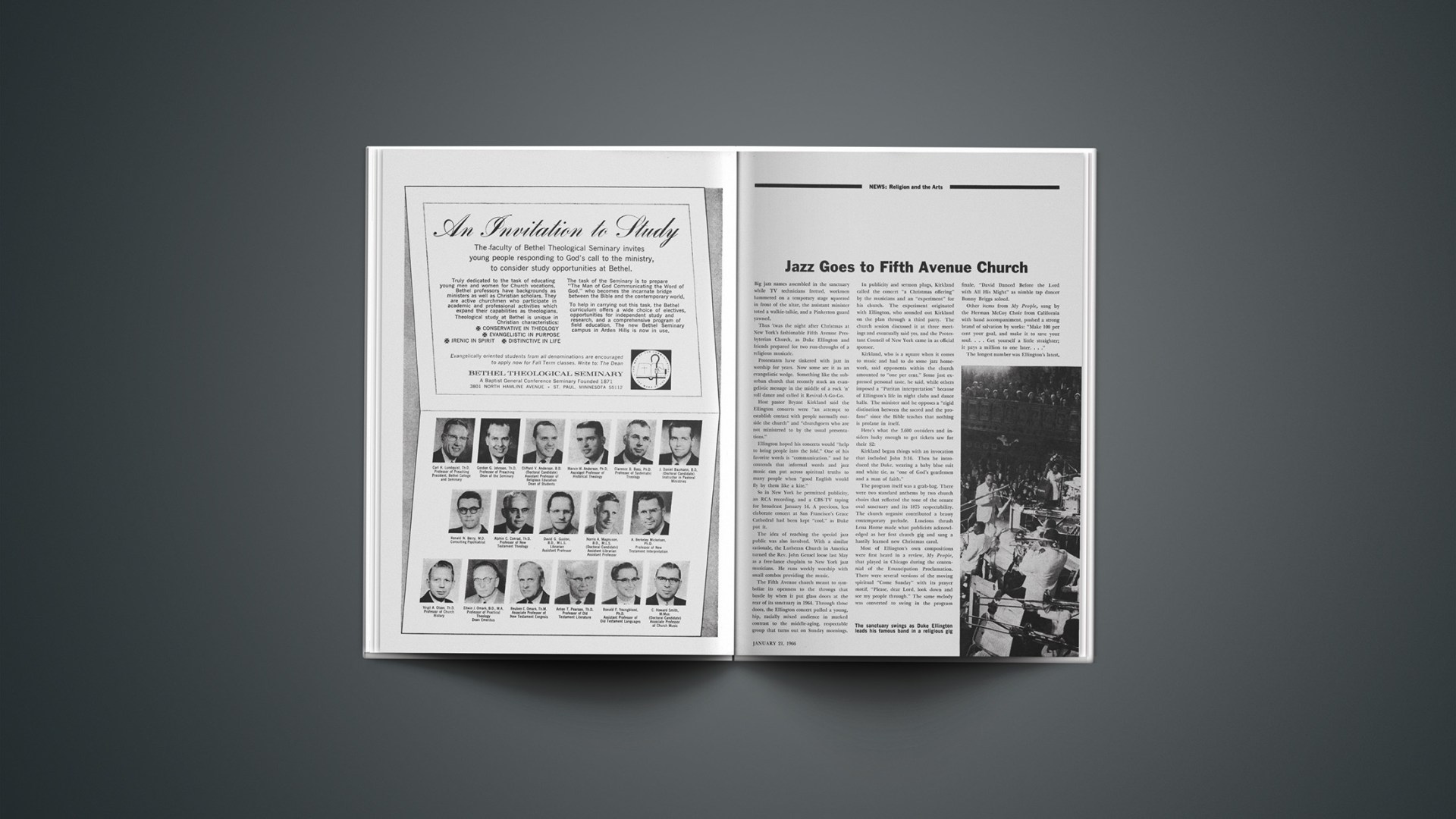
Big jazz names assembled in the sanctuary while TV technicians fretted, workmen hammered on a temporary stage squeezed in front of the altar, the assistant minister toted a walkie-talkie, and a Pinkerton guard yawned.

Thus ‘twas the night after Christmas at New York’s fashionable Fifth Avenue Presbyterian Church, as Duke Ellington and friends prepared for two run-throughs of a religious musicale.

Protestants have tinkered with jazz in worship for years. Now some see it as an evangelistic wedge. Something like the suburban church that recently stuck an evangelistic message in the middle of a rock ’n’ roll dance and called it Revival-A-Go-Go.

Host pastor Bryant Kirkland said the Ellington concerts were “an attempt to establish contact with people normally outside the church” and “churchgoers who are not ministered to by the usual presentations.”

Ellington hoped his concerts would “help to bring people into the fold.” One of his favorite words is “communication,” and he contends that informal words and jazz music can put across spiritual truths to many people when “good English would fly by them like a kite.”

So in New York he permitted publicity, an RCA recording, and a CBS-TV taping for broadcast January 16. A previous, less elaborate concert at San Francisco’s Grace Cathedral had been kept “cool,” as Duke put it.

The idea of reaching the special jazz public was also involved. With a similar rationale, the Lutheran Church in America turned the Rev. John Gensel loose last May as a free-lance chaplain to New York jazz musicians. He runs weekly worship with small combos providing the music.

The Fifth Avenue church meant to symbolize its openness to the throngs that bustle by when it put glass doors at the rear of its sanctuary in 1964. Through those doors, the Ellington concert pulled a young, hip, racially mixed audience in marked contrast to the middle-aging, respectable group that turns out on Sunday mornings.

In publicity and sermon plugs, Kirkland called the concert “a Christmas offering” by the musicians and an “experiment” for his church. The experiment originated with Ellington, who sounded out Kirkland on the plan through a third party. The church session discussed it at three meetings and eventually said yes, and the Protestant Council of New York came in as official sponsor.

Kirkland, who is a square when it comes to music and had to do some jazz homework, said opponents within the church amounted to “one per cent.” Some just expressed personal taste, he said, while others imposed a “Puritan interpretation” because of Ellington’s life in night clubs and dance halls. The minister said he opposes a “rigid distinction between the sacred and the profane” since the Bible teaches that nothing is profane in itself.

Here’s what the 3,600 outsiders and insiders lucky enough to get tickets saw for their $2:

Kirkland began things with an invocation that included John 3:16. Then he introduced the Duke, wearing a baby blue suit and white tie, as “one of God’s gentlemen and a man of faith.”

The program itself was a grab-bag. There were two standard anthems by two church choirs that reflected the tone of the ornate oval sanctuary and its 1875 respectability. The church organist contributed a brassy contemporary prelude. Luscious thrush Lena Horne made what publicists acknowledged as her first church gig and sang a hastily learned new Christmas carol.

Most of Ellington’s own compositions were first heard in a review, My People, that played in Chicago during the centennial of the Emancipation Proclamation. There were several versions of the moving spiritual “Come Sunday” with its prayer motif, “Please, dear Lord, look down and see my people through.” The same melody was converted to swing in the program finale, “David Danced Before the Lord with All His Might” as nimble tap dancer Bunny Briggs soloed.

Other items from My People, sung by the Herman McCoy Choir from California with band accompaniment, pushed a strong brand of salvation by works: “Make 100 per cent your goal, and make it to save your soul.… Get yourself a little straighter; it pays a million to one later.…”

The longest number was Ellington’s latest, a loosely connected series of episodes on the theme “In the Beginning God.” Movie actor Brock Peters (To Kill A Mockingbird, The Pawnbroker) sang the slow introduction, “no heaven, no earth, no nothing,” and the witty, upbeat recitation of other things that weren’t: “no bodyguards, no credit cards … no symphony, no jive, no Gemini 5.”

As the potpourri continued, the choirs chanted the books of the Old Testament (nearly inaudible to concert-goers) while tenor sax man Paul Gonsalves screwed up his face with a hard rock solo in his famous Newport Jazz Festival idiom. After a screech solo by trumpeter “Cat” Anderson, Ellington quipped, “That’s as high as we go.”

The final solo belonged to drummer Louie Bellson, and Ellington and his bass player left the stage (common practice during drum solos in jazz concerts). It takes unusual taste and talent to make a jazz drum solo even remotely fitting for a sanctuary. Despite two bass drums and two floor toms, Bellson’s banging was far from the mark.

In refreshing contrast was a melancholy, yet hopeful piano solo by Ellington, “New World A’Coming.” In program notes he said that this free rhapsody is “the anticipation of a very distant future place on land, at sea or in the sky where there will be no war, no greed, no non-believer and no categorization.…”]

The most concrete result of the concert was the SI.000 it raised for Gensel’s fund to help needy musicians. For the rest, good box office is not necessarily meaningful worship or effective evangelism, and the whole bit was more of a maybe than a yes.

The Faith Of The Duke

Jazz giant Duke Ellington relaxed at a Beverly Hills hotel and took time off from the score for Frank Sinatra’s new film to read a telegram from New York: “Thousands join me to pay tribute to a wonderful person. We are enriched …” The Rev. Dr. Bryant Kirkland told Ellington his Fifth Avenue religious concert (see above) was a “significant and historical spiritual event.”

Ellington’s rich face with the heavily rimmed eyes, his songs, and his band are familiar to the multitude, but highbrows also revere him as one of America’s great folk geniuses. Now 66, he calls his recent foray into religious music “the most important thing I’ve ever done.”

His Washington, D. C., boyhood was filled with sermons and Sunday school, but Ellington has rarely attended services during his career and never joined a church. At 23, with a jazz career beginning to bloom, “I began to read the Bible for myself, to see what there was. I have my own idea, and I think it makes sense.” This idea strays from the orthodox belief on the Trinity, but he is conservative about the Bible itself. “I believe the whole story,” he said. “I am always in a position to have it out with people who say the Bible contradicts itself. I’m not a formal Bible student, but I can correct people on things like that.”

Ellington said he prays regularly and is serious about performing religious music. He declared:

“There is no greater hazard than not to be a true believer. If I didn’t go into it with the right spirit, then those beautiful colored windows in the sanctuary would come crashing down on my head!”

Some of the other performers weren’t believers, Ellington admitted, but “I never got to the point of saying ‘if you don’t believe, we don’t want to have you perform.’ I just let it go along.”

The New York concert has led to bookings of the religious concert in other churches, and Ellington also plans to write more religious music. His next theme will be, “Don’t you dare get down on your knees until you have forgiven everybody.”

There’S No Accounting For Church Statistics

How many members are in the Christian Churches (Disciples)? In last November’s official contributions data there were 1.181,265, but this month’s membership report for the same year lists 1,920,760.

Both figures were for 1964 and were compiled by the National Council of Churches, which dutifully prints what the churches send in. The Disciples’ increasingly modest head-counting on contributions has enabled them to zoom from thirty-seventh to twenty-fourth place in per-capita giving in two years.

In the new figures (to be released in book form as the authoritative Yearbook of American Churches), the Disciples are the twelfith-largest denomination. Using the smaller figure—based on how many people give to national agencies—the Disciples would be passed by American Baptists, Greek Orthodox, and Latter-Day Saints, and would just barely nose out the African Methodist Episcopal Church.

Since the National Baptists Inc., National Baptists, and Churches of Christ reported the same figures this time as last, the meaning and freshness of the data are also questionable. Of the top ten, only the Lutheran Church in America lost members in the year.

On religion in general, the Yearbook reports 123,307,449 members in America (a record 64.4 per cent of the population) with these major groupings:

All represent slight gains. The most startling surge was a doubling in the number of Buddhists, to 109,965, but this was the first time those in Hawaii had been counted.

The American Institute of Public Opinion contributes figures on church attendance, which has declined slowly since 1958. But 1964’s 45 per cent is a far cry from the 16 per cent estimate for 1850.

Life With A Converted Sideman

Pentecostalists usually take a dim view of modern entertainment, but one preacher, the Rev. D. LeRoy Sanders, has been rethinking things since actress Betty Hutton and her jazz star husband joined his church.

Trumpeter Pete Candoli, a nominal Roman Catholic, was famed as an accomplished soloist and sideman with many top West Coast bands, and as Miss Hutton’s fourth husband. Last spring, both Mr. and Mrs. accepted Sanders’s invitation to accept Christ in a Sunday service at North Hollywood’s First Assembly of God Church. Since then, they have told of their conversions at several Los Angeles area churches.

Sanders finds “there is no hard and fast rule” on what a show business convert should do. Some feel they must “make the break,” he said, since “a born-again Christian can’t love the world, and there are many un-Christlike things in show business.”

But he reports Candoli has stayed in the jazz world and survived: “He really testifies among fellow musicians, keeps his life clean, and loves the Lord.”

Viet Nam: A Heritage of Religious Turbulence

Four centuries ago, European priests staked a Vatican claim along the lush green shores of the South China Sea. They overcame occasional hostility and before long were counting converts by hundreds and thousands. Then, as noted religious historian Kenneth Scott Latourette puts it, “Roman Catholic missions became a means for extending European political control over Indo-China.”

In modern times, religious interests have again figured prominently in the land now known as Viet Nam. And 1960 may even see the Vatican playing a decisive role in the effort to bring peace to Southeast Asia.

Pope Paul VI showed new initiative as a peacemaker in year-end pleas addressed to the major powers, especially those now involved militarily in Viet Nam. His public appeals for peace and the consequent effect on world public opinion exerted considerable pressure on East and West to settle the Vietnamese war at the conference table. Vatican diplomats were also reported working behind the scenes to set up negotiations.

(Cardinal Spellman, who is known for globe-girdling missions to American service-men, spent Christmas celebrating masses in Viet Nam and expressing satisfaction over a temporary truce. He told troops, however, that “your service is necessary here.… Our failure to stand firm here would lead to strife on other battlefields.”)

As early as last February, Pope Paul had issued a plea for peace in Viet Nam. He made special cease-fire appeals during the week before Christmas, after the Viet Cong had offered a twelve-hour truce beginning Christmas Eve. As it turned out, U. S. and South Vietnamese units silenced their guns for thirty hours and suspended indefinitely their bombing of North Viet Nam.

Pope Paul also made public requests for a New Year’s truce, but these were unsuccessful. The United States started a peace drive of its own with visits by top-ranking diplomats to major world capitals, including a visit to the Pope by the American ambassador to the United Nations, Arthur Cold berg.

Is it appropriate that religious interests be so closely involved in the Vietnamese political and military situation? Many non-Catholic observers would say no, but the recent history of Viet Nam is interlaced with religious turmoil.

There is no general agreement on key developments in Viet Nam in 1963, and a basic dispute continues over what part religion played in the internal strife of South Viet Nam. The issues are now being widely publicized in book-length interpretations that conflict on what really happened.

The two key figures in the 1963 crisis were Ngo Dinh Diem, lifelong Roman Catholic and Confucian scholar who ruled South Viet Nam for nearly a decade, and Thich Tri Quang, the most prominent and aggressive Buddhist monk in Viet Nam. Which man was the hero and which the villain in Western eyes is a question historians will ponder for years.

Diem was born January 3, 1901, north of the seventeenth parallel, in the same province that produced Ho Chi Minh, the North Vietnamese Communist leader who tried to get Diem to collaborate with him back in 1946. Diem took over the south following the defeat of the French and the Geneva conference in 1954.

He surprised almost everyone by weathering the initial political storms following independence, but his government came under increasing fire for favoritism toward Roman Catholics and persecution of non-Catholics. The fire came mainly from Buddhists, but Protestant missionaries in Viet Nam also complained.

Ironically for Protestants, however, it was under Ngo Dinh Diem that their missionary activity blossomed. The Geneva agreement sealed off North Viet Nam to outside religious influence. But big areas of the south that had been out of bounds to Protestants under the French were thrown open. The Christian and Missionary Alliance. whose work in Viet Nam dates back to 1911. assigned it top priority and built up the missionary task force there to more than 100.

Meanwhile, however, the feeling against Catholics was being intensified. Part of the cause was a big influx of Roman Catholic refugees from the North, which upset the religious balance.

Diem, a product of the mandarin system, had little in his background to equip him to placate critics. He was greatly influenced by a brother and a sister-in-law, the celebrated Madame Nhu. During his younger days Diem toyed with the idea of going into the priesthood. Though he ultimately chose to remain a layman, his life had distinctly monastic overtones, and he never married. His experiences in the United States were colored by a two-year stay at the Maryknoll Seminary in Ossining, New York. He also managed to meet such personages as Cardinal Spellman, Senator John Kennedy, and Senator Mike Mansfield.

One unresolved religious question in Viet Nam (under Diem, as now) is: How many Buddhists are there? The reason the question cannot be answered is that no one can adequately define a Buddhist. South Viet Nam has the problem not only of a pluralistic society but also of one in which individuals share allegiance between two or more major religious faiths. Buddhism is generally considered to be numerically dominant, but the statistics of its followers vary anywhere from 15 per cent to 90 per cent of the population.

Viet Nam Chroniclers

Marguerite Higgins, a key chronicler of the religious and political tensions in Viet Nam, died January 3. Death was attributed to complications of a tropical disease.

Miss Higgins, who was 45, visited Viet Nam a number of times as a correspondent for the New York Herald-Tribune and Newsday. Her dispatches set off a major press controversy with several Saigon-based U.S. correspondents over how the war was going and who was to blame for the problems. She had previously won a Pulitzer Prize for her reports on the Korean War.

One of her targets was David Halberstam, who won a Pulitzer Prize for his work as a New York Times correspondent in Viet Nam. Halberstam, 31, has more recently been assigned lo Warsaw, but was evicted by the Polish government this month.

Roman Catholics are said to number about 1,500,000. There are also about 1,000,000 animists, mostly among mountain tribesmen, who have traditionally been at odds with the rest of the population. In addition, there are undetermined numbers who are Hindus, Muslims, Taoists, and followers of Confucianism. Two relatively novel religious mixtures known as the Cao Dai and the Hoa Hao also claim significant numbers.

Protestants of varying theological persuasions who were familiar with the situation under Diem shared with Buddhists an anxiety over Roman Catholic domination and, to a lesser extent, over persecution. Some Protestant liberals in the United States were among the first to protest by adding their names to paid advertisements that called upon the United States to deal firmly with Diem.

It was the Vatican flag, however, that coincidentally served to bring on Diem’s first big crisis of 1963. In May of that year Ngo Dinh Thuc, Diem’s oldest brother, celebrated, in the city of Hue, his twenty-fifth year as a Roman Catholic bishop. Diem attended the festivities and subsequently issued a statement saying it had been unlawful to raise the Vatican flag outside a building. Several days later Buddha’s birthday was celebrated in Hue, and there was a similar crackdown against the flying of Buddhist flags. Crowds gathered in protest, violence ensued, and eight or nine persons died.

To this day, however, there is considerable argument over whether they were felled by government troops or whether a bomb had been planted, perhaps by the Viet Cong. Marguerite Higgins, who considered the Buddhist monk Thich Tri Quang a clever anti-American political demagogue, charged in Our Vietnam Nightmare that he created the crisis deliberately.

What brought the Vietnamese religious tensions to world attention were the immolations (Madame Nhu called them barbeques) of Buddhist monks that summer. Miss Higgins was cynical about those, too, suggesting that at least some of the monks had been drugged. She cited Thich Tri Quang, who is still alive, as the foremost authority on the immolations. Mainstream Buddhism does not condone suicide or violence as a means to a good end.

For the Buddhists, the crisis command post was in the three-story Xa Loi Pagoda in Saigon, where Thich Tri Quang held forth with a battery of propaganda-dispensing mimeograph machines humming day and night. Tensions kept building up until one night in August government troops raided the Xa Loi and other pagodas.

David Halberstam of the New York Times contends in The Making of a Quagmire that had the government wanted to arrest the Buddhist leaders “it could have been accomplished in a few moments, but these troops were enacting a passion play of revenge and terror.” Miss Higgins disputed this view, insisting there was a minimum of bloodshed.

The pagoda raids represented a turning point in the struggle, setting off a wave of new reaction against Diem from within the administration of President Kennedy. Diem was overthrown on November 1, 1963, and, with his brother, was presumed to be killed. Following those events came the escalation of the war against the Viet Cong and de-emphasis on religious problems.

Orthodoxy Asunder

Russian Orthodoxy in Western Europe has declared itself independent of Greek Orthodox control. In 1931, the western churches transferred allegiance from Moscow to Istanbul to counter confusion following the mass exodus from Russia. But the Russian émigré aura has now dissolved. Another explanation for independence is that the Moscow church is no longer seen as free.

Meanwhile, the second-ranking leader of that church, Leningrad’s Metropolitan Nikodim, hinted that the recent end of old excommunications between the Greek Orthodox and Roman Catholic Churches is not accepted by the Russian church.

Nikodim told the Soviet news agency, “This has been a gesture addressed to the Roman church only from one local Orthodox church, and not the whole of Eastern Orthodoxy. Unity between Eastern and Western churches can be achieved only through profound research and mutual cooperation.” Both the Greek and Russian churches cooperate in the World Council of Churches. Nikodim also took a guarded view of the Vatican Council as not meeting expectations.

Anglican Aggiornamento

The Church of England is setting out on the task of liturgical reform. Although called “Prayer Book Revision,” the plan at the moment is not to revise services but to provide alternatives to them. The Prayer Book (Alternative and Other Services) Measure, passed by the Church Assembly in 1964, provides for the experimental use of these alternatives.

For the first time since 1662, services will be used legally in the Church of England that will be alternative to those in the Book of Common Prayer. No past suggestions for revised services have ever had any legal force.

The services to be revised? The new material comprises, it seems, revised Morning and Evening Prayer, Occasional Prayers, Burial Service, and Churching of Women. The text of a revised Communion service is also to be published.

Reasons for the coming changes are that since 1662 language has changed and the meanings of words are different, and it is considered that the present services are imperfect vehicles of worship today.

The worship forms will be discussed at the February 17–18 Church Assembly, assuming the Queen has approved new parliamentary bills. Many non-Anglicans in many lands who love the prayer-book language will watch with interest.

The Anglican updating extends also to the touchy subject of abortion. A seventy-page church committee report recently approved abortion when the birth of a child would threaten the life or health of the mother. Current law permits abortion only to save a mother’s life. The special committee set up by the Church Assembly’s Board for Social Responsibility thus is more limited in its view than Lord Silkin, whose bill, given a second reading in Lords last month, would make abortion legal for women who became pregnant through rape or criminal act. The report states: “The fact that a child ought not in law or morals to exist affords no justification for depriving it of its right to live.”

The report does not represent official Church of England thinking, but the committee feels that the Church of England should “take its part through some accredited body in the discussion of a legitimate national concern.” It is estimated that about 100,000 illegal abortions are performed in Britain every year.

Norway: Easier To Stay Joined

It seemed a harmless enough resolution to come from the Voluntary Church Assembly, a representative but unofficial body within the Church of Norway (Lutheran). The quadrennial meeting in Oslo had strayed from the agenda into a discussion on church reform “so that the church can better fulfill its task among our people.” Finally it was resolved to appoint a commission to “examine the position of the church in society today.”

That this was really a hot potato became clear afterwards in a press interview held by Bjarne Hareide, director of Oslo’s Institute for Christian Education, who was elected to succeed Bishop Per Juvkam as chairman of this influential gathering.

Hareide cited two points stressed during the discussion: (1) For the national church to be autonomous in internal, spiritual matters—“in questions concerning religion”—it must have an official national supreme assembly of its own, or at least a council with official status. (2) “Much more than before, the church must assign responsibility to the state and to society for external matters and tasks which are their duty.” This involves concerns such as church finance, maintenance of rectories, and settlement of ministers.

The Storting (Parliament) hitherto has refused to give churchmen any degree of autonomy in this land where church membership is reckoned at 96 per cent; Norwegians virtually have to make an official declaration of opting out before they can “unjoin.” It has been estimated that the total seating capacity of the nation’s churches is 300,000—less than 10 per cent of the membership. This, says one wit, is a calculated figure of ecclesiastical actuaries, indicating the low average “church attendance risk.” Actual attendance is about 3 per cent on a normal Sunday.

All nine Norwegian bishops are ex-officio members of the Voluntary Church Assembly, which describes itself as “a forum for exchange of religious opinions and for consideration of topical problems.” It has now asked for consideration of the ordination of “persons without theological training.” The wording might be significant in view of the burning controversy about ordaining women. The assembly heard also a call made for a revision of the Norwegian church’s books of public worship (revision is carried out periodically). Commented a theological professor good-humoredly, “We are unlike the English people, who like archaic language.”

J. D. DOUGLAS

Serving Without Saving

Sixteen U. S. cities have some sort of training center for inner-city ministries. The newest and in some ways most radical is taking shape in New York City.

Cute abbreviations seem to be a must for action groups, and this one is MUST (Metropolitan Urban Service Training). Since MUST’s birth in a $600,000 Methodist gift last fall,1$500,000 from the Board of Missions’ National Division, and $100,000 from the Methodist Women’s Division. Syracuse Bishop W. Ralph Ward is chairman of MUST’s tvventy-three-member board. the four staff members, operating from rented quarters at Biblical Seminary, have been talking to hundreds of people who have ideas about what should be done in cities.

The talking continues, but the Rev. George (Bill) Webber, executive director, has three definite student projects in mind for next fall.

The first, a city intern plan for seminary students, grows out of a joint venture carried on for the past two years by Union Theological Seminary, where Webber teaches part-time, and the experimental East Harlem Protestant Parish, which Webber headed before joining MUST. Forty prospective ministers will take secular jobs, live in tenements, work to help the poor, and reflect on “what the Church will be” in cities.

Webber contends that men come from seminaries “disequipped” to be “worldly men in Christ” and that the reforming impact of the internships will be “sensational.” He hopes to draw not only students in accord with his own liberal theology but also students from conservative seminaries.

In a second plan, twenty college graduates who want to help humanity but have no goals will enter similar internships under the wing of another key New York liberal, the Rev. Howard Moody of Judson Memorial Church, who, like Webber, is a minister in the United Church of Christ.

A third program will place five white seminarians as staff members in Negro churches, and five Negroes in white churches.

These programs will consume only a tenth of MUST’s budget, Webber said, and more will come later. “We don’t have a clue as to the shape of the entire program,” said the gray-haired, 45-year-old innovator. “We will throw ten balls in the air, and see how they bounce. We will try quite a few things. The Church’s traditional pattern has been to put all its money on one horse.”

Webber said his center will differ significantly from the 16-month-old Urban Training Center in Chicago, which has regular courses, a student body, and, in Webber’s words, is “in the difficult, threatening battle with the denominations.” The UTC’s $225,000 annual budget comes from thirteen denominations and foundation grants.

Webber said his project is moving “from saving people to serving the world.” He doesn’t object to the saving of souls, Webber said, but his job is to “help churches face their serving function.”

Webber’s colleagues are two Methodist ministers—Randolph Nugent, 31, and Hooker Davis, 47 (on six-month leave from the Southern New Jersey Conference)—and Mrs. Alfred J. Lurie, a Jewish specialist in community action and school problems.

Negroes As Neighbors

About seventy of the students at Malone College in Canton, Ohio, have signed up to tutor Negroes, paint houses in the local ghetto, and in other ways show their neighbors that they care.

Such direct action by so many is unusual among evangelical colleges, where political conservatism often produces distrust of anything liberals do, even if it is good. Many evangelical colleges are also rural or suburban. But Malone, a Quaker school, resettled in 1957 in Canton, an industrial center loaded with problems typical of a big city.

The major impetus to action was a two-day seminar on “Christians and the Negro Revolution,” held at Malone last month. In this first fruit of a plan for annual seminars on social problems, participants attempted to relate the Christian imperative, “Love thy neighbor as thyself,” to the civil rights struggle.

The main speaker was the Rev. William Pannell, a Negro evangelist from Detroit who is on the staff of Youth for Christ. Speaking on the “love” theme in his first chapel talk, Pannell said, “Don’t ted me you love me ‘in the Lord’ while you’ve got your foot on my neck!” The question, he declared, is not “Who is my neighbor?” but “Whose neighbor am I?”

Those who claim scriptural grounds for their opposition to direct action often misunderstand the Bible, Panned said. Reference to Romans 13:1 and the Christian’s responsibility to obey authority, he contended, sidesteps the real issue: What is the law of the land? Is it federal laws backed by the Constitution, or the words of local policemen?

The civil-disobedience discussion continued at a bud session where two Malone professors played devil’s advocate and argued against ad civil rights activity. They were countered by Panned and the Rev. Vern Miller, a Cleveland Mennonite whose church is integrated. The situation was artificial, but some students needed answers to the questions raised and admitted it was the first time they had contemplated what the Christian’s role in civil rights should be.

In another session, Panned said white men’s fears rest on two false presuppositions: (1) that there are separate, distinct races, a theory dismissed by contemporary anthropologists, and (2) that every Negro man is “panting for a white woman.”

Panned was articulate, honest, and occasionally (and unintentionally) bitter. He had blunt criticism of evangelicalism for “dragging its heels” in fighting prejudice. Although the churches’ “White Only” signs are down, “11 o’clock on Sunday morning is the most segregated hour of the week,” he said, in a phrase made familiar by such diverse spokesmen as Billy Graham and Bishop James Pike.

Panned impressed many students who had never met a well-educated Christian Negro. Others said they wanted to walk out of the sessions. Comments from this camp included: “Why, he was even trying to talk like a white man!” and “Long live Dixie!” Many students were apathetic.

The seminar did not reach all of Malone’s students and did not stir up sensational demonstrations. But it did stimulate thought and prod some to act. And it also illuminated the feelings of the few Negroes on campus.

JUNE E. STEFFENSEN

Book Briefs: January 21, 1966

Americans As Human Beings

The Oxford History of the American People, by Samuel Eliot Morison (Oxford, 1965, 1,122 pp., $12.50), is reviewed by Earl Strikwerda, professor of history, Calvin College, Grand Rapids, Michigan.

Good one-volume histories of the United States become more difficult to produce as our national experience lengthens. In 1904 Professor Elston could quite easily encompass the whole account and include a bit of homily and anecdote along the way. Similarly Wertenbaker, Becker, Bassett, Harlow, and others did the job four or five decades back, and they all did it well.

But events have been heaping up since the thirties. The revolutionary happenings of the Great Depression and the intricate story of our role in World War 11 add many pages to the bulk of our history. Moreover, contemporary historians add sections or chapters that survey the social and cultural aspects of our past.

Nevertheless, induced by his friends as he was. Professor Morison has attempted a one-volume account once more. And he has succeeded beautifully. It will be a courageous writer who will think that he can do it better, Morison kept the weight of the book under four pounds; a heavier book cannot be held comfortably.

The writing is even and intelligible, and the lines of chronology are as clear as can be. Moreover, the author covers or touches on practically everything from the Hudson School to sports, while skillfully keeping his work from being textbookish or encyclopedic. This Oxford history is intended for the intelligent patriot; and one could do few things more worthwhile this winter than reading a few hours a week in this sprightly written explanation of how we behaved and why.

Apparently Professor Morison has not attempted to set up and establish a tight thesis. There seems to be no hard effort to show that some single factor explains Americans. There is no press on Puritanism, nor on the frontier’s feedback into our politics, nor on manifest destiny, nor on our reverence for the Constitution, nor on the dynamics of free enterprise, nor on the Protestant ethic, nor on the immigrant ingredient, nor on the determinism of economics. It is just possible that the author wanted his keynote to be our dedication to experimenting with democracy. But there is no hard sell even on this theme; it is not necessary, because the theme is patent in our political history.

My impression is that Morison has striven mainly to get at the downright humanness of the American people. Throughout we are shown that we rise above ourselves and that we fall, but that in everything we have remained merely human beings—people. Characterizing the account is a constantly emerging candor, with scores of side glances. Added up they do not make the reader swell with false pride, but neither is he stricken with cynicism. As he is faced steadily with the actual, he develops a feeling of identity. We arc a many-faceted people who have worked and argued and fought—fought in revolution, in rebellion, in strikes. We have shot our way out of all of them, and we have shot down four presidents too.

Similarly, our national heroes were human beings who showed different sides. Even Patrick Henry was negative about the Constitution, saying as he did, “My head, and my heart, shall be at liberty to retrieve the loss of liberty, and remove the defects of the system.…” Alexander Hamilton too was critical of the Constitution; he called it a “weak and worthless fabric” that would have to be superseded.

Here and there Morison is a bit preceptive, as when he ventures the suggestion that the days of the witch trials could be likened to the times when Joseph McCarthy was abroad in the land and good men felt constrained to remain silent. And know this, says the historian in another context, that the words, “We hold these truths to be self evident …,” are “more revolutionary than anything written by Robespierre, Marx, or Lenin.…”

The book is therefore about humanity, and the author is humane. In his distress in writing of Lincoln’s assassination, he bursts with “ten thousand curses on the foulest of assassins, John Wilkes Booth.” Elsewhere his disgust peeps through, as when he relates that a prominent industrialist of the early 1930s was willing to have the depression go “right to the bottom,” because the liquidation of the farmer and of labor would lead people to live more moral lives. But everywhere one senses that Morison reads our history constructively and affirmatively. The debunker finds nothing here.

Too, this Harvard man is solicitous for those who have taken a rap. So he wants Woodrow Wilson to be seen in context. Wilson’s virtuousness would not have been so irritating were it not for the isolationism in the Senate and the disillusionment among the public. Similarly, Colonel House is treated with decency; his “realism complemented Wilson’s idealism, and when they parted, the stature of each was diminished.” There is the human touch when the New England historian pays tribute to Senator George W. Norris, “whose career is a standing reproach to those ‘tired liberals’ who give up after defeat.…”

Hoover is handled fairly. F.D.R.’s success in coping with the depression was due in part to the fact that early cautious remedies were demonstrably unsuccessful. The New Deal, says the writer, was as “American as a bale of hay—an opportunist, rule of thumb method of curing deep-seated ills.” The tracing of World War II is excellent but not superior to what Morison previously wrote with Professor Commager in their Growth of the American Republic. In this earlier work the story of the war builds with more suspense, and to me it remains the unexcelled short account.

By way of innovation, and for good reason, this Oxford history includes brief resumes of Canadian history at six or eight turn-outs. This courtesy to a people whose history dovetails our own was long overdue.

It has been hinted that Morison writes the viewpoint of the Eastern seaboard, that in a way he is a Brahmin. So what? The tint or the tincture is pleasing. So long as he is fair to everyone from the Puritans to Douglas MacArthur, the historian has a right to a stance. I liked his reminiscences that begin with the election of 1912; I liked the paternalism with which he suggests that we not be too critical of President Eisenhower; I liked the manner of an older person when he warns that we must halt short of having every American adult on the government payroll.

In the conclusion of the section on the sexual upheaval, Morison expresses his concern for the “pure in heart”; why could not the “filth” have been left in the subconscious where it was, he asks. I was pleased by his willingness to use colloquialisms, as when he speaks of General Ludendorff’s “getting the one-two” in World War II. His neat way of citing dates (e.g., 21 December 1938) is refreshing. And so on.

All in all, here is the story of the actual, written in the manner of the humane without special pleading.

EARL SIRIKWERDA

Not Little Ministers

Pre-Seminary Education: The Lilly Study Report, by Keith R. Bridston and Dwight W. Culver (Augsburg, 1965, 257 pp., $4.75), is reviewed by Addison H. Leitch, assistant to the president and professor of philosophy and religion, Tarkio College, Tarkio, Missouri.

We have come to expect good things from the Lilly Foundation, and again we are not disappointed. Under the direction of the foundation, Bridston, a Lutheran theologian, and Culver, a trained sociologist, have teamed up to give us an interesting study of pre-seminary education marked by scholarship, breadth of understanding, and verve.

The decision to place a sociologist on the team gives a clue to the approach. Concern is frequently expressed that men who become ministers are too often products of a kind of religious “ghetto.” They come from homes marked by Christian commitment where they have been conditioned, and in many ways protected, by a religious atmosphere (89 per cent of seminarians are church members before the age of twenty-one, 83 per cent had Sunday school attendance constantly urged upon them). Over half of them came from church-related colleges where many have served in vacant pulpits and taken courses of study “almost-seminary” in character. They have already participated in youth conferences and area religious conferences, and they move on to denominational seminaries where statistically they tend to continue their studies with other men of like training and background and under professors probably prepared for their tasks in the same milieu. When they enter their pastorates, the “ghetto” of separation from which they have come puts them in a “ghetto” of separation from the people whom they are to guide, and from a highly secularized “world” which they are to reach.

The writers are very sympathetic to the religious cultivation that a man called of God will need. They also recognize, however, that the hurdy-gurdy of today’s world may not listen to a man who very evidently does not know what the score is. On the other hand, must the seminarian sin “in order that grace may abound”? This is not a new dilemma in the training of the “religious.” It is to the credit of Bridston and Culver that they see the problem clearly and meet it fairly. Any criticisms the reader may have of their solutions will in no way minimize the central problem. Somehow the minister (indeed, every Christian!) must be in the world but not of it, a man of the world but not a worldling.

The writers believe that the best time for “secular cultivation” is the period of college preparation. There are excellent discussions on the advantages and disadvantages of a Bible-philosophy major as over against a major in some more “secular” field, and of great value are the recommendations of how religion may be taught with intellectual decency instead of as a case of special pleading. For those looking in passing for good material on the advantages of liberal arts education, the section titled “Secular Cultivation” (pp. 55 ff.) is very rich indeed.

Perhaps a word from the authors themselves will clarify their approach:

For the college and university, the purpose of teaching religion is to provide its students with a full education.

For the pre-seminary student, the reason for studying religion in college is to be fully educated and not to anticipate his theological study on the seminary level.

For the seminary, the purpose of pre-seminary education is to produce educated men—not little ministers [p. 80].

This last phrase, “educated men—not little ministers,” gives the clue to the whole book. The authors see three stages in the pastor’s training—college, seminary, and post-seminary, and although the book is entitled Pre-Seminary Education, the three key sections of the book really cover these three stages. How is this justified? In terms of the “educated man,” the “whole man”; the authors argue that we are dealing, not with three systems or three levels of training—pre-seminary, seminary, and post-seminary—but with a triple-entwined cord. We must think of what happens in pre-seminary days as constantly wrapped in and around what the trained pastor does during and after seminary. Thus the whole training of the whole man for his total task is all of a piece. It is a good thesis well done in sections entitled “Secular Cultivation,” “Professional Training,” and “Vocational Integration.” These sections are followed by Recommendations herewith recommended.

This book should be read by all educators, whether or not their interest is theological. It is packed with information and is rich and varied in some of its always relevant bypaths. Those who like to browse may spend fruitful hours with the research data that take up about the last third of the book. This timely and relevant book is much needed today.

ADDISON H. LEITCH

Whole Person

The Whole Person in a Broken World, by Paul Tournier (Harper and Row, 1964, 180 pp., $3.75), is reviewed by Lars I. Granberg, acting vice-president for academic affairs, Hope College, Holland, Michigan.

Reading a book written by Paul Tournier is like conversing with a wise, compassionate man who walks with God. Dr. Tournier neither glosses over human foolishness and sin nor identifies man exclusively with these. Rather, he perceives the person as he could be.

In this book, written in 1947, he seeks understanding of factors in today’s life that bring fragmentation rather than wholeness to persons. To describe this crisis he treats the history of man as the history of a single life: the childhood of man is antiquity, his adolescence began with the Renaissance. Adolescence is characterized by negativeness, the disparagement of parental values. So also has it been in the centuries since the Renaissance. Rather than moving toward personal integration, the modern world seems to be in the prolonged state of adolescent crisis described by some psychiatrists as the “neurosis of defiance.” Neurosis, which Tournier sees as the typical sickness of our time, is linked to spiritual irresolution. Quoting Stocker’s definition of neurosis—“an inner conflict between a false suggestion and a true intuition”—he argues that man’s current predicament stems from a false suggestion from the modern world and a true intuition of the soul. In particular he suffers from a repression of conscience (i.e., spiritual hunger), which he seeks to assauge by a preoccupation with reason and the scientific method. With his moral struggle thus driven underground, modern man is anxious, confused, fragmented, lacking direction; he suffers a terrible spiritual yearning. Neither his myths of progress nor his Nietzschean power myths have brought utopia.

Healing involves recovery of the sense of personhood. The rift between body and spirit must be mended. The efforts of science must be subordinated to faith, for only God can restore body and spirit to harmonious synthesis. Only the surrender of the whole being to the Lordship of Christ restores true personhood. Spiritual hunger is universal. Man-made messiahs abound. Since these arise from a truncated view of the person, they can only further man’s sense of fragmentation, disillusionment, and terror. Science has proven to be a vain hope. The Church’s hour has come!

But if the Church is to bring healing to a broken world, it must learn to heal its own divisions and establish spiritual unity among believers—not a unity that glosses over real differences with sentimentality but one based on a common awareness of having been gripped by Christ, on humility, and on a compassionate humanity. The Church must also learn to go wherever needy humanity is and speak out what the Gospel means for economic, social, political, and intellectual life. Only men changed under the influence of God’s grace are-likely to change the world, men willing to accept the necessary sacrifices that go along with faith, men who present a picture of true community.

This is Dr. Tournier’s message. Written with the death camps and atomic destruction of World War II still raw in his memory, it was a prophetic book. His themes have preoccupied ecclesiastical and theological conversations for more than a decade, and the discussion in psychology and psychotherapy almost as long. Hence the English-speaking world encountering this book seventeen years after its original appearance may regard it as quaint and cliché-ridden. Several of Tournier’s books were made available in English first, and they represent more developed stages in his thinking. Thus if the inveterate Tournier reader picks up this book in search of new themes, he will be disappointed.

But if he wants once again to stroll companionably and listen to a humble, compassionate man speak with penetration and concern about the plight of his fellow men and the ministry of healing, he will not fail to add this book to his Tournier shelf. For those who have not met Paul Tournier, this is a good place to get acquainted. But they must beware! They will probably get “hooked” on him, too.

LARS I. GRANBERG

By The Grace Of The State?

A Study in Survival: The Church in Russia, 1927–1943, by William C. Fletcher (Macmillan, 1965, 168 pp., $4.95), is reviewed by Ralph L. Lynn, professor of history, Baylor University, Waco, Texas.

Religion as the private and widely varied experience of unguided individuals may survive in any sort of world. But the Church or the denomination as a well-knit group may not be able to survive in a Communist state. The degree to which the Church can prosper in a Communist state is determined by the degree to which it can make itself useful to and needed by the state.

These statements summarize, though inadequately, the arguments advanced by this research assistant at the Research Institute on Communist Strategy and Propaganda, a division of the School of International Relations of the University of Southern California. Professor Fletcher reads and speaks the Russian language, has lived in Russia for extended periods, has talked with Russian people, has examined the available relevant documents, and has presented his findings in reasonable, restrained critical fashion.

To him, the record indicates that the Church openly opposed the Communist government in the years just after 1917. The Church then sought refuge in a nonpolitical stance from about 1920 to 1927. In 1927, the acting patriarch, Sergii, concluded that the Church could survive only if it became a sincere supporter of the Communist government. The Church reaped little profit from this Machiavellian approach until World War II made the Church necessary to the success of the Communist state. During the war years, with 1943 a significant date, the Church reaped a helpful harvest in the form of increased freedom of action and support by the state. But after the war the Communist state no longer needed the Church and was unwilling to continue the wartime coexistence. Therefore, the book closes with the unanswered question: Can the Church survive in a Communist state?

This is a model monograph, with all the standard scholarly paraphernalia. Fletcher has mastered his materials and writing skills. A brief introduction offers definitions and delimitations, orients the reader, and foreshadows the body of the book. There is a spare, succinct summary of the period from 1917 to 1927. The chapter divisions are clearly dictated by the facts. The conclusion offers no surprising deductions and no dogmatic statements. It is convincing without being argumentative.

This reviewer would be happier with a critical bibliography than with a mere listing. He would also have welcomed at least some comment on the effects upon the Church of Russian industrialization, to which the author makes only a tantalizing reference. Other readers would welcome some anecdotal material; there must be wonderful stories behind the bald statement that Sergii often consecrated several bishops in each area so that one could succeed the other as the thrones were made vacant by arrests and imprisonments.

But none of this is necessary for the purposes of this “study in survival.” And the author refers the reader to the imposing annotated bibliography in one of his earlier works, Christianity in the Soviet Union (Los Angeles, 1963). This book and Timasheff’s Religion in Soviet Russia (New York, 1942) will probably furnish answers to the questions most readers will have.

Especially at this time of renewed discussion of church-state relations, many readers will welcome the author’s emphasis upon survival. One suspects that any church or denomination anywhere can prosper only to the degree that its program is in harmony with the host nation’s program. Some will mourn that so many United States religious groups, without the excuse of their Russian brethren, have narrowed the Gospel to refer only to spiritual, other-worldly matters.

RALPH L. LYNN

What’S Wrong?

Search for Reality in Religion, by John Macmurray (Allen and Unwin, 1965, 81 pp., 15s.), is reviewed by Martin H. Cressey, minister, St. Columba’s Presbyterian Church, Coventry, England.

Why should a distinguished philosopher who for most of his life had been detached, both in belief and in practice, from the organized Christian tradition become after retirement from university work a member of the Society of Friends? This most attractive lecture gives the answer and with it a rewarding insight into the mind and spirit of a sensitive thinker. Professor Macmurray aptly describes his lecture as “more like a musical composition, a series of movements, each with its own tone and temper” (p. 4).

He begins by a sincere tribute to the Calvinistic piety of his parental home, vitalized by contact with the Moody and Sankey mission. As a boy he himself spoke at evangelistic meetings, but he soon began to feel that this religious activity was secondhand. So he set out on a search for reality in religion—a search which led him first to criticize dogmatic theology in the light of Scripture and then to shy away from the unchristian spirit of many church members. In 1916, while a soldier in uniform, he preached on reconciliation as the post-war task of Christians; the congregation took it badly, and no one spoke to him after the service. It was then that he resolved never to become a member of any Christian church.

He yet remained, throughout his career as a teacher of philosophy, “in conviction religious and in intention a Christian” (p. 29). He looked and still looks for a reformation of Christianity that will take it back to the active concern of Jesus for true community. Philosophical or religious idealism is, in the biblical sense, vanity. What the world needs is not ideas but true human fellowship, created by Christian love. The future of the Church must be in a unity of faith not defined by doctrine but expressed “in a way of living which cares for one another and for the needs of all men” (p. 71).

It will now be clear why Dr. Macmurray felt drawn to the Society of Friends. A careful reading of the lecture will also lead more orthodox Christians to ask themselves what is amiss with them, that so generous and perceptive a mind has found Christian orthodoxy so unattractive.

MARTIN H. CRESSEY

Book Briefs

111 Days in Stanleyville, by David Reed (Harper and Row, 1965, 279 pp., $4.95). Deep in the dark heart of the Congo, brave and frightened men faced the dread Simbas. Here is the hour-by-hour account of what really happened and the tragic story of how each man faced the terror.

Christian Faith and Practice, by Leonard Hodgson (Eerdmans, 1965, 113 pp., $2.50). Thoughtful reading for thoughtful people. First published in 1950.

J. Hudson Taylor: A Biography, by Dr. and Mrs. Howard Taylor (Moody, 1965, 366 pp., $4.95). An abridged version by Phyllis Thompson of the two-volume original.

The Hour of the Tiger, by Induk Pahk (Harper and Row, 1965, 184 pp., $3.50). The moving story of Induk Pahk’s lively and heart-stirring struggle to make a dream come true—to establish “Berea in Korea,” the first self-help vocational school for boys in Korea’s 4,000 years of history.

American Jewish Year Book, 1965 (The American Jewish Committee and Jewish Publication Society, 1965, 652 pp., $6.50). A comprehensive record of events and trends in the United States and the rest of the world related to all matters of interest in Jewish life.

All the Bandits of China: Adventures of a Missionary in a Land Ravaged by Bandits and War Lords, by Barbara Jurgensen (Augsburg, 1965, 184 pp., $3.95).

Christian Counseling and Occultism, by Kurt E. Koch (Kregel, 1965, 299 pp., $4.95). A book on counseling that concerns itself with the demonic aspects of human experience.

The Holy Spirit at Work in the Church, by Lycurgus M. Starkey, Jr. (Abingdon, 1965, 160 pp., $3). A study of the work of the Holy Spirit in the Church, conducted from within the life of the Church.

Discover Your Destiny, by Dave Breese (Word Books, 1965, 98 pp., $3). An extensive personal testimony to challenge young people.

The Road Sack to God, by O. P. Kretzmann (Concordia, 1965, 125 pp., $2.50). Thirty-one uncommonly good meditations.

The Church in the Community: An Effective Evangelism Program for the Christian Congregation, by Arthur E. Graf (Eerdmans, 1965, 207 pp., $3.95). A clear-cut basic examination of the Church’s missionary task.

The Schweitzer Album: A Portrait in Words and Pictures, by Erica Anderson (Harper and Row, 1965, 176 pp., $17.50). A production of fine craftmanship.

The Horizon Book of Ancient Greece, by William Harlan Hale (Horizon Books, 1965, 415 pp., $18.95). The glory of Ancient Greece: its history, its art, and passages from its great writings. Three hundred and sixty illustrations, many in color. A book of excellence, to treasure and enjoy.

Studies in Church History, Volume I, edited by C. W. Dugmore and Charles Duggan (Nelson, 1964, 257 pp., $8.50). This book contains the main papers and shorter communications read by members of the Ecclesiastical History Society at its first meeting in 1962. Subjects range from Donatism to the origins of liberal Catholicism in the Church of England.

Psychological Studies of Clergymen: Abstracts of Research, by Robert J. Menges and James E. Dittes (Nelson, 1965, 202 pp., $5). Brief descriptions of more than 700 abstracts of psychological studies on clergymen.

Melancthon, by Robert Stupperich, translated by Robert H. Fischer (Westminster, 1965, 175 pp., $3.95). A portrayal of the man and his work by one of the greatest authorities on Melancthon.

Outsider in the Vatican, by Frederick Franck (Macmillan, 1965, 253 pp., $7.50). A dramatic narrative by a Dutch artist who was an uninvited observer of the Vatican Council.

Paperbacks

A Survey of the Old Testament, by W. W. Sloan (Abingdon, 1965, 336 pp., $1.50). A generally evangelical synopsis of the Old Testament. Though the book’s last clause says about the Bible, “It is infallible,” the author concedes that other peoples “made many of the discoveries that the Hebrew people made,” thus confusing (divine) revelation with (human) discovery. First published in 1957.

On the Growing Edge of the Church: New Dimensions in World Missions, by T. Watson Street (John Knox, 1965, 128 pp., $1.95). A sober discussion of the missionary task of the Church and a warning against “our modern infatuation with the practical.” The author is dean of the faculty of Austin Theological Seminary.

The Holy Spirit, by Charles Caldwell Ryrie (Moody, 1965, 126 pp., $1.75). A discussion of the Holy Spirit that is much wider than deep. Includes a discussion of common grace and of the sin against the Holy Spirit, and a history of the doctrine.

The Parables of the Kingdom, by C. H. Dodd (Scribners, 1965, 176 pp., $1.45). Discusses the nature and purpose of the parables and their setting, and traces the place of the parables in Christian teaching. Revised in 1961.

The Living Word: A Theological Study of Preaching and the Church, by Gustaf Wingren (Fortress, 1965, 223 pp., $2.25). A serious discussion for the preacher who wants to keep his sermons and tasks from being trivial. Excellent for the thinking pulpiteer.

Ethics, by Dietrich Bonhoeffer (Macmillan, 1965, 382 pp., $1.45).

From Tradition to Gospel, by Martin Dibelius (Scribners, 1965, 311 pp., $1.65). The work that started on its course a new German school of theology—form criticism. The author coined the term Formgeschichte. A translation of the revised second edition of Die Formgeschichte des Evangeliums.

God and Temple, by R. E. Clements (Fortress, 1965, 163 pp., $3.75). A scholarly discussion of the theological significance of the Jerusalem temple as a witness to God’s presence.

The Making of a Mind: Letters from a Soldier-Priest, 1914–1919, by Pierre Teilhard de Chardin (Harper and Row, 1965, 316 pp., $5). Teilhard’s letters to his cousin Marguerite. For the admirer who wants to know everything about Teilhard de Chardin.

Abandoned to Christ, by L. E. Maxwell (Eerdmans, 1965, 248 pp., $2.25). First published in 1955.

Baal or God: Fantasy vs. Truth, by Herman J. Otten (Leader Publishing, 1965, 351 pp., $.75). On many fronts the author delineates the principal differences between biblical and liberal theology. Although he sometimes oversimplifies and makes too facile evaluations that result in imprecision, he achieves a cool and sturdy defense of the Christian faith and shows by extensive documentation how, and by whom, it is threatened in our time.

The Unity of Philosophical Experience, by Etienne Gilson (Scribners, 1965, 331 pp., $1.65). First published in 1937.

The Twelve Steps: Spiritual Recovery Through the Principles of A. A., by a member of Alcoholics Anonymous (Upper Room, 1965, 48 pp., $.35).

What Christians Believe, by Georgia Harkness (Abingdon, 1965, 72 pp., $.75).

Religion and the Public Schools, by James E. Loder (Association, 1965, 128 pp., $.50). A very concrete discussion of how religion can be handled in the public schools.

Man Cannot Escape!

Despite the trend toward “collective guilt,” man is still personally responsible for his individual actions

Historians looking back on our decade may call us the generation that absolved itself of personal responsibility when collective guilt could be claimed.

The tendency is all too familiar. The assassination of President Kennedy was not, it is said, the work of a demented man: instead it was the inevitable manifestation of America’s public prejudices and private hatreds. The 1964 triple murder in Mississippi, the assault on the Reverend James Reeb in Selma, the deaths of Viola Liuzzo and Jonathan Daniels were not acts of a handful of fanatical racists: they represented American apathy over injustice that began with the arrival of the first slave ship in 1619. The Negro riots of past summers in New York, Rochester, Philadelphia, Chicago, and especially Los Angeles were not the irresponsible outburst of a minority hoodlum element: they were the justified expressions of despair at oppression by a white society that would not listen until a stunning number of adults and children lay wounded in the streets. The murder of a defenseless woman by a vicious assailant is almost lost from view in the general condemnation of the cowardly witnesses who chose not to get involved.

To be sure, these acts of violence and all such crimes against persons and the state do have general underlying causes. The incendiary literature that swept the nation during the Kennedy-Nixon campaign, continued throughout President Kennedy’s three years in office, and still persists today reveals how seriously hatred has poisoned parts of American thinking. And there were surely other places in this country that might have been as dangerous to John F. Kennedy in November, 1963, as Dallas proved to be. For this the hate-mongers are culpable.

But Lee Harvey Oswald alone aimed and fired the rifle that ended President Kennedy’s life. Not the Minute Men nor Dan Smoot nor Fred Schwarz nor Billy James Hargis nor George Lincoln Rockwell nor Robert Shelton nor Cyrus Eaton nor Corliss Lamont nor Gus Hall. Whatever the influence of these spokesmen, right and left, the blame must rest on one man.

So too with the deaths of the civil rights workers. In each case, blind hatred for those who sought to overturn social inequities caused bigots to react like the primitives they are. They struck out and killed, then fled. They are the ones responsible, not the whole of Southern society.

The ghetto conditions of Harlem and Bedford-Stuyvesant, of Chicago’s South Side and Los Angeles’s Watts, are undeniably awful. Man by nature prefers kittens and parakeets to rats and cockroaches. Slum landlords, self-serving politicians, brutal police conspire against community pride. Something must indeed be done. But what? Surely stealing from neighbors is not the answer. Surely bombarding passing automobiles with bricks or shooting at will along the Harbor Freeway is not the answer. The martyrs of Mississippi and Alabama deserved a better monument than the gutted ruins of a supermarket on Avalon Boulevard, destroyed in a frenzy to be free.

Brazen attackers are encouraged by the knowledge that a man’s concern for his own safety will often keep him from interfering in the affairs of someone else, even if that other person has been stabbed before a score of witnesses. And since skillful defense attorneys have cudgeled juries into believing themselves to be as weak as the cowards who stood by, assailants know they stand a chance of getting off lightly.

Enough of this distortion! Man is responsible for his own behavior, even if all the currents around him seem to surge toward a new morality of license and libertinism. The Nazi war criminals convicted last summer in Frankfurt, like those before them at Nuremberg, were held accountable each for himself. No man could say, “Hitler told me to do it.” The four million who died at Auschwitz were put to death by the Third Reich, yes; by the Nazi hierarchy, yes; by the orders of Adolph Hitler or of one of his stooges, yes. But the man on the scene who pulled the switch or pushed the button or fired the trigger—ultimately he must be blamed.

In Germany, such a man is still responsible. Why not in America? Because America has been weakened by a philosophy of economic and social determinism that abandons man’s relation with God and with his fellow men. We think that if a child is born and reared on East 100th Street in Manhattan, he will through no fault of his own be a parasite on society. But if he is born in Westport, Lake Forest, or San Marino, he will be a credit to society. Moreover, our decline into relativism has blurred the absolutes of our ethics and corrupted our mores. We have convinced ourselves that, in New York State, killing an armed policeman is worse than killing a helpless child, and that only that sort of crime can justify the right of the state to electrocute the guilty; and we have burdened ourselves with a stricken conscience because in the past we have settled with those who took the lives of others.

We have been duped into believing that society is all at fault for the thousands of drug addicts who must obtain their daily supply by prostitution, theft, or murder. Our clinics and doctors, some tell us, should dispense the drugs in recommended doses.

For too many sociologists, the pat solution to mankind’s problems is to legalize the forbidden. Gambling, prostitution, abortion, and euthanasia have all been proposed as candidates for legality. The individual is freed from his obligation to the state by the state’s abrogation of its responsibility to sit in judgment. Rather than single out the individual offender, society moves to cover his crime with a blanket woven of alleged social progress and outright moral laxity.

Mankind’s collective guilt is more than a theological presupposition; it is an observable fact. But this must never obscure the greater truth for the individual; I am responsible before God and man for what I do. The alternative to acceptance of one’s own accountability is the situation that followed the fall of man in Eden, when each blamed the other. Is it any wonder that the first child of Adam and Eve asked, “Am I my brother’s keeper?” Refusal to accept personal responsibility can have in our time only the same result it has had throughout human history—separation from God and from his goodness.

The God Nobody Wants

The “modern man” for whose sake contemporary theologians reject historic Christianity and substitute an alternative has no objective “identity.” As Professor Kenneth Hamilton, of the United College faculty in Winnipeg, Manitoba, observes in a new paperback (Revolt Against Heaven, published by Eerdmans), theologians disagree among themselves on what modernity demands—dialectical theology, existentialism, linguistic theology, the “death of God,” or whatever else. Each faddist says that those who advocate rival views are guilty of self-deception.

Lacking is an agreed standard of meaning. The frontier movements seek an antisupernaturalist “theology of meaningfulness” and refer the term “God” to man and the world. They reject not only a God “up there” (precluded by Copernicus) but a God “out there” or independent of the cosmos (precluded by naturalistic philosophy). Instead, God is found “down here” or “in here” in the depths of everyday non-religious experience—a theological turn that earlier Christians would have deplored as a reduction of deity to illusion. No genuine continuity remains between the God of traditional Christianity and this “god of the depths.”

Hamilton exposes the long series of deviant theologians who have sought to make Christianity understandable to the contemporary mind by naturalizing it. And he rightly protests that they beg the question of a criterion of meaning.

For the present generation the dialectical theology has largely determined the background of debate, but concern for a theology of meaningfulness really reaches far into the past. Returning to the kind of rationalism characteristic of the eighteenth-century Enlightenment, the frontier theologians enthrone an earthbound god. But their vaunted immanence of God is no less a matter of faith than his transcendence. Whether in the nineteenth or the twentieth century, moral-pragmatic approaches to religious faith disclose an antisupernaturalistic bias that conceals their metaphysical presupposition of an immanent, earthbound God. To his credit, Bonhoeffer did not think antisupernaturalism gives relevance to Christianity but insisted rather that our beliefs must remain a response to revelation.

In a hurried yet readable survey of contemporary religious thinkers, Hamilton scores many good points against opposing views: “The disadvantage of founding a theology on relevance is that it may suddenly become irrelevant and die.” A theology agreeable to the spirit of the age is unlikely to be the theology of the Bible. Hamilton recognizes the neo-liberal revival of a theology of excessive immanence in a pro-metaphysical mood, and ventures a sturdy critique of its positions. In the emphasis this kind of theology places on direct knowledge of God available from general human nature, and its notion that Jesus is the Son of God not as Jesus but rather in his overcoming human limitations, he finds an unacknowledged debt to Schleiermacher. Moreover, he contends that the thought of the Niebuhrs, Tillich, Ferré, and Daniel Day Williams is largely rooted in this same modernist subsoil.

So far so good. Hamilton skillfully rejects metaphysical theology that is based on excessive divine immanence and that views transcendence simply in terms of a limit (the unconditioned ground of one’s being and meaning). But when he contrasts the biblical and speculative interpretations of transcendence, Hamilton disowns any conceptual scriptural understanding and confines its biblical sense to the non-spatial, non-figurative awareness of divine mystery recognized in worship. He rejects the unconditioned character of God on the ground that God conditions himself in speaking to man. To argue for God’s metaphysical transcendence is said to suspend God’s reality upon human reasoning and a particular cosmological system. He apparently excludes the possibility of rational revelation and of a revealed world-view.

Revelation as a ground of faith is thus introduced with no sure relationship to reason, and a complete disjunction is encouraged between the truth of revelation and the truth of philosophy. But the attempted deduction of the nature of divinity from a study of the world by contemporary theologians actually gives Hamilton no solid basis for disconnecting revelation and reason. His absolute contrast of theology and philosophy perpetuates an error that underlies dialectical-existential theology. What destroys the biblical sense of terms like transcendence and immanence is not their place in a metaphysical system, since they have meaning only in an implicative whole. The only requirement is that the universe of discourse be biblically controlled.

Just because a theology of revelation is received by faith, must right reading of the evidence be denigrated or deplored? Does the Spirit of God use truth as the means of persuasion, or contradiction as the goal of human inquiry? Is the truth of revelation valid whether men respond to it or not, or is its truth established by subjective decision? In much contemporary theology the relation of faith and knowledge is left obscure. It is regrettable that Hamilton follows Barth’s total disjunction of the truth of revelation and philosophical truth, so that faith and philosophy must necessarily espouse different deities.

With good reason Hamilton opposes the natural theology of Aquinas. But he does less than justice to Augustine, understates his differences with Greek philosophy, and misses the force of his “I believe in order to understand.” Kant is said to be an ally of the Augustinian tradition of metaphysical theology because he supports a “mystical” theology. One finds here no awareness of the recovery of the Augustinian principle by the Reformers; instead, we are told only that they rejected rational formulations. While evangelical Protestants found faith not on human reason but on divine revelation, they insist on the rationality of revelation and faith against contemporary irrationalism. A recognition of the importance of this emphasis, and of the consequences that flow from it, is regrettably missing in a paperback that has much to commend its reading.

Problems Of Evolution

News Report, publication of the National Academy of Sciences, in its October, 1965, issue gives the following echoes of a day-long ‘Symposium on Time and Stratigraphic Problems in the Evolution of Man”:

“What we need are more competent fossils. We have plenty of competent anthropologists but not nearly enough specimens.…”—DR. G. L. JEPSON, professor of vertebrate paleontology, Princeton University. In his closing remarks, Professor Jepson warned that uniform rates of evolution cannot be assumed. He has been working with the skeleton of a bat 50 million years old, and he said that if it were restored to life it would be impossible to detect any difference between it and a modern bat.

In contrast to most other mammals, “the direct or fossil evidence for primate and hence for human evolution is relatively scanty and largely incomplete, too frequently consisting of mere fragments or even only teeth.”—DR. WILLIAM L. STRAUS, JR., professor of physical anthropology, Johns Hopkins University.

A challenge was directed toward the recent statement of an astronomer that “there are many worlds in space and we may be sure that a considerable number of them will duplicate the conditions of our earth. On these men will be found.” “If man was so ubiquitous, so easy to produce, why had two great continental laboratories [Australia and South America], worlds indeed, failed to reproduce him? They had failed simply … because the great movements of life are irreversible, the same mutations do not occur, circumstances differ in infinite particulars, opportunities fail to be grasped, and so what once happened is no more.”—DR. LOREN EISELEY, professor of anthropology, University of Pennsylvania.

Selling Cigarettes Overseas

Since January 1 every pack, box, and carton of United States cigarettes has carried a conspicuous label: “Caution, cigarette smoking may be hazardous to your health.” This mild statement is part of a federal law that, curiously enough, forbids the Federal Trade Commission from requiring a similar warning in cigarette advertising.

Now we discover that what may be bad for Americans is good for non-Americans. Uncle Sam is currently spending American tax money to convince the people of Thailand, Japan, England, France, Austria, Denmark, and other countries that they ought to smoke—especially cigarettes made from American tobacco. With a discretion bordering on hypocrisy, the pro-cigarette propaganda does not indicate that it is sponsored and paid for by the United States government. In addition, European movie-goers will view a Warner Brothers twenty-three minute technicolor “soft-sell,” distributed overseas, not knowing it is subsidized by Uncle Sam and the tobacco industry. The theaters will have to show it as a short subject along with Warner’s theatrical features.

Must this double standard continue? Certainly not. Secretary of Agriculture Orville Freeman need only return—this time for good—to the former ban on government-sponsored cigarette promotion abroad. It is time to remove all doubt that what the American government wants abroad is the well-being of the people, and not simply their dollars.

Protestant Confusion

Protestant Christianity is currently beset by a confusing inner turmoil and a search for an authentic identity. Indeed, it may be that the Church is faced with its gravest crisis since the Reformation. The January 3 issue of Newsweek, in dealing with the Church’s struggle, shows how deep the cleavages are and how diverse the suggested remedies.

Part of the Church’s present predicament obviously comes from the rejection by many of the full integrity and authority of the Scriptures—a rejection now bearing its inevitable fruit of dissatisfaction, unbelief, and the desire to remodel what some feel to be irrelevant and outmoded structures.

Some of the loudest voices have shifted the emphasis from a sovereign God to self-sufficient man; from the apostolic Gospel of personal regeneration along with involvement in society, to involvement in society without personal regeneration. Humanism has crept into the Church in the form of a gospel that rejects historic Christianity, necessitating this frantic search for a new and relevant image.

No one should sidestep the issues or avoid involvement in this struggle, and the view that prevails will determine the shape and the ministry of the Church in the years ahead. CHRISTIANITY TODAY is a part of the struggle. We cannot prevent change nor do we wish to do so. But we are wholly convinced that the Bible remains a timeless guidepost in an age of transition and change.

The form of the building being erected may differ markedly from what we have known in days past. But it is our business and mission to see that the foundation of the building is the “one foundation,” the Jesus Christ of the Holy Scriptures.

The Paralysis Of A City

The transit strike in New York City brought about virtual paralysis involving more than eight million people whose right to work and to get to work depended upon the ailing Michael J. Quill and his Transport Workers Union.

New York State’s Condon-Wadlin Act, which prohibits strikes by public employees, did not deter Mr. Ouill; neither did a court injunction. When Quill was taken into custody he told newsmen that the judge “can drop dead in his black robes.… I’ll rot in jail.… I won’t appeal. I don’t give a damn.” What he said is reminiscent of another day when one capitalist said, “The public be damned.” In this case the issue does not involve labor and capital; it involves labor and a municipal utility owned and operated by an agency of the City of New York.

A strike of this nature involving so many people is intolerable. Calling such a strike was senseless. No real stalemate had been reached, nor had any evidence emerged to show it was impossible to reach some kind of compromise. Moreover, the union struck in open defiance of the law, a defiance that bodes ill for the future in destroying respect for the law and encouraging further breaches of it by others.

The fantastic demands made by the union and the bombastic approach to the problem taken by Mr. Quill were the surest guarantees for preventing a prompt and just settlement. Unionism is legitimate, and it is here to stay. But such irresponsible labor-union activities could bring about restrictive legislation that would hurt unions that have acted fairly and responsibly across the years.

A Significant Venture

The American Institute of Holy Land Studies, first planned a decade ago, became a reality in 1959 with the arrival of its first students in Jerusalem, Israel. Since then, this interdenominational educational and research organization has flourished. Under the leadership of Dr. G. Douglas Young, it has outgrown its present facilities and is moving to a new location atop Mount Zion.

The institute has included on its faculty a number of competent Israeli scholars, who, along with evangelical American personnel, have provided post-graduate Hebraic and archaeological studies as background material against which to understand the Bible. It has been highly endorsed by leading Israelis, educators, students, and American Embassy personnel. More and more European and American colleges, universities, and divinity schools are granting transfer credit for studies the institute offers.

The return of the Jews to the land of Palestine and the emergence of the State of Israel make the work of The American Institute of Holy Land Studies highly significant, especially in the light of the prophetic Scriptures. CHRISTIANITY TODAY offers its best wishes for the success of this new venture and commends the institute to its readers.

Ideas

Evangelize: The Order of the Day

The term “evangelist” might cause a shudder in some sophisticated congregations by suggesting a vociferous pulpiteer “preaching up a storm.” Nevertheless, the word means “a publisher of good news.” The dictionary has a definition for the corresponding verb: “make known the gospel to; bring under the influence of gospel truths; convert to Christianity.”

Should this send a shudder through the ranks of believers? Indeed not. It should elicit a robust “amen.” For who in the Church is not, scripturally at least, obligated to be an evangelist? There may be evangelists who are not apostles, bishops, or pastors; but every apostle, bishop, or pastor is supposed to be an evangelist. For twenty centuries the historic scribes—Matthew, Mark, Luke, and John—have been called “Evangelists.” In liturgical language, he who rises to read the Gospels is designated an evangelist. In a true New Testament sense every believer is an evangelist, every churchman a Gospeler. The ecclesia is evangelical; and, as the late G. Campbell Morgan used to say, to call a man “evangelical” who is not evangelistic is an utter contradiction.

The Church has ever been under orders to evangelize. Are the orders less urgent in this time of apocalyptic siftings and transitions? We claim to see in our domestic and international upheavals, in our plunge toward the abyss of unbelief, an inexorable movement toward the great denouement of the human story; it would thus be tragic if we were to soften the thrust of evangelism in this fateful hour.

Choruses of despair sound from all sides. And why not? One need not be a prophet to discern the signs of the times. “We have now made it possible to destroy the human race, to reduce to the time of Cain and Abel man’s position on earth; to scatter to the four winds in a matter of seconds the civilization it has taken centuries to build”—the United States Atomic Energy Commission speaking. “Utter and unrelieved gloom awaits us. It is likely that during this present generation all our large cities in every part of the world will be destroyed”—the voice of the skeptic Bertrand Russell. “The handwriting on the wall of five continents now tells us that the day of judgment is at hand”—the voice of the scientist William Vogt. “Our civilization is doomed”—the voice of the missionary physician and scholar Albert Schweitzer.

But why, as evangelicals, should we be surprised at all this? After all, we have loudly maintained that we believe everything Jesus said. And what did he tell his disciples when they asked, “What shall be the sign of your coming, and of the end of the world?” A question like that today could get you a chilling brushoff in many a church or seminary by many a religious leader! But Jesus did not brush off the question. In fact, two big chapters in Matthew are needed to contain his answer. And that answer, taken seriously, is rather terrifying.

False Christs will abound; they will mislead multitudes. War-talk and wars will increase. Nations will be at one another’s throats. World famine will take a frightful toll. Earthquakes will shake many places. Persecution will fall heavily upon God’s people. Many will be “offended” and lose their faith. Traitors will appear everywhere. Hatred will intensify. Many false prophets will deceive the masses. Wickedness and immorality will increase. Love will grow cold. The abomination of desolation, predicted by Daniel, will desecrate God’s temple. A horrifying terror will sweep the earth, more fearful than has ever been or shall ever be again—so fearful, in fact, that were its time not curtailed, no man would be left living on the earth. More false prophets will emerge, this time with dazzling signs and marvels. Disturbances will jar the solar system. Still, the Gospel as a witness to the approaching Kingdom will be preached. And men will reject the truth, as they did when Noah prophesied.

But Jesus, facing his followers with this eschatological pronouncement, did not offer them a future of nihilism. They were to raise their heads; their redemption lay beyond the world terror. For them the end was the beginning. God’s day would dawn; his righteousness would rule. Meantime, they were to get to work. The Gospel had to be pressed home to men. The disciples needed the dynamic of the living Spirit; only his divine compulsion in them could move them out to their fateful mission to the world.

So with us now, and even more so. For those men stood millennia away from the fulfillment of those apocalyptic sayings; we stand perhaps within the first framework of their fulfillment. The time seems brief; the buds burst on the tree. We are cast, perhaps, somewhere between the beginnings of the apostasy and the terror, between the early fall of faith and the rise of Antichrist.

This is no time to be beguiled by unbelieving scholars who disown God’s Word and dishonor his Son; it is rather a time for men to match the mission of evangelism. In a day of incredible unbelief, those who still believe must fill a vast vacuum. Evangelicals, like Nehemiah’s masons who worked with a trowel in one hand and a sword in the other, have much to do; they must not allow the Sanballatian jeers to jar them from their task. They must endure the charges of “obscurantism,” bear the sneers of the existential nihilists and demythologizers of the Word, withstand the pulpiteers and professors who make war on the side of Antichrist, and carry on like men who under devastating fire still have orders to advance. And when the odds appear insuperable, may they, like Zerubbabel confronted with his task, hear the word from heaven: “Not by might, nor by power, but by my Spirit, says the Lord of hosts.”

Only minds clouded by spiritual and prophetic oblivion can fail to discern the down-thrust of our world toward ruin; yet, as Bishop Fulton J. Sheen has said, in the death of a great civilization the masses are always unaware of their tragedy. So it remains for those not yet blind, nor led by the blind, to gird on the sword of the Lord. Ours must be the deepest social concern—the concern for men’s redemption. Others will labor at the secular level. But none will seek to save the lost except those who are saved. Here must we, even in tormenting loneliness, fill the yawning gap. So many depend on so few! This, in the language of Churchill, could be our finest hour. To us has been given the burden for a dying age. The divine messenger warned Daniel, “Many shall be purified, and made white, and tried; but the wicked shall do wickedly: and none of the wicked shall understand; but the wise shall understand” (Dan. 12:10).

Time moves on swift wings. The eschatological tempo is accelerating. The order of the day comes down from the top to men twice-born: Evangelize! Thin-ranked and hard-hit though we be, the order is not lifted. “You will bear witness for me … away to the ends of the earth” (Acts 1:8b, NEB).

Let evangelicals not only proclaim redemption in the face of impending judgment but also “preach, saying, the Kingdom of heaven is at hand.” Never was evangelism more needed than in this apocalyptic age.

Apple PodcastsDown ArrowDown ArrowDown Arrowarrow_left_altLeft ArrowLeft ArrowRight ArrowRight ArrowRight Arrowarrow_up_altUp ArrowUp ArrowAvailable at Amazoncaret-downCloseCloseEmailEmailExpandExpandExternalExternalFacebookfacebook-squareGiftGiftGooglegoogleGoogle KeephamburgerInstagraminstagram-squareLinkLinklinkedin-squareListenListenListenChristianity TodayCT Creative Studio Logologo_orgMegaphoneMenuMenupausePinterestPlayPlayPocketPodcastRSSRSSSaveSaveSaveSearchSearchsearchSpotifyStitcherTelegramTable of ContentsTable of Contentstwitter-squareWhatsAppXYouTubeYouTube