Caught off Base

The “pick off” is one of the most exciting plays in baseball. But it is humiliating for the player who is victim either of the pitcher’s expert timing or of his own carelessness in straying too far from base.

The Church is in danger of finding herself the victim of a “pick-off” play, that is, of becoming so wrapped up in secondary or extraneous affairs that she is “out,” no longer a part of the game to which her Lord called her.

No one questions the duly of the Church to become “involved”; but she should be very sure of what it is that God has called her to be involved in. Just as a surgeon would prove useless to an ill patient if he spent his time clerking in a haberdashery store, so the Church fails in her primary mission when she becomes involved, as a corporate institution, in social, economic, and political matters, which are outside her jurisdiction and competence.

Recently the pastor of one of America’s great churches preached a sermon from which, with his permission, we quote extensively, because of its clarity and vital importance. He said:

“What is the primary responsibility of the Church? To preach the Gospel of God’s redemption and the renewal of the individual through Jesus Christ, or to reform society? According to the Bible, the Church is basically and inescapably committed to the proclamation of the Gospel. Along with its proclamation of the Gospel message, the Church is, through its redeemed members, obligated to be the salt of the earth.

“For Christians and the Church, the recognition of spiritual and moral sickness is only the beginning and not the end. To be sure, the national and international situation is alarming; but it is not beyond the reach of the Lord of men and nations. It is the glory of the Gospel that Christ came precisely to minister to man’s needs. He didn’t come to save the righteous but sinners. Flagrant sin, social upheavals, political uncertainties, international tensions abound, but these are only symptoms of the disease Christ came to cure.

“And this message is committed to his Church. Today, many leaders in the Church choose to emphasize ‘social engineering,’ but it remains the imperative duty of the Church to preach redemption through Christ, and reconciliation to God. For too long some loud ecclesiastical voices have stressed ‘social problems’ and minimized sin in the human heart. Until this process is reversed, the Church will continue to fail in her primary task.

“Out of this shift in emphasis some strange attitudes to law have emerged. Law, the very basis of an orderly and just society of free men, is openly flouted in the name of ‘social justice.’

“There has been altogether too much disrespect for the laws of the land, both in social protest and in the administration of justice. Lawlessness is no answer to injustice. When citizens tolerate, condone, and foster breaking the laws openly, or by non-violent disobedience, they are only undermining the one social structure that can best serve their own causes. The trouble is that non-violence often leads to violence.

“Personally I deplore the participation of some of my fellow ministers who feel it necessary to break just laws or take to the streets in order to register their social convictions in a democratic society. Christian leaders are ill advised when they take the law into their own hands, for whatever reason, or encourage and support others who do so.

“Today, the American people are inviting a flood of riots and rebellion by the cracks they themselves are putting in the dam of their own laws and constitution, by the disrespect for law and order and for the police which many Americans, including preachers, arc encouraging.

“Then, too, in the administration of justice, we have become altogether too lenient with law-breakers at all levels. All too often the sympathy of the courts and the religious community seems to be on the side of the criminal.… We blame society for creating the criminal—it’s never his fault—and we use all manner of excuses and legal loopholes to keep the wrongdoer from being punished.

“Believe you me, as long as this soft policy towards criminals is maintained, there is little hope of conquering the crime wave. History records that many civilizations have been destroyed from within. Let us heed that warning lest we succumb to the tyranny of criminal anarchy.

“Again, we Christians ought to have the common sense to realize that, with all our respect for minorities and provision for minority opinion, our democratic culture is based on the rule of the majority. We seem to have forgotten that majorities have civil rights as well as minorities.… The rights of minorities must be respected, of course, except where the exercise of those rights infringes upon the rights of others.

“This applies to many areas other than the race issue. We see it on university campuses … in groups of vocal faculty members … in the work of a tiny minority of atheists.… Our common sense should tell us that the techniques of agitation and protest by clamorous minorities need to be heavily discounted.… Protest has its place in a free country, but it can be carried to extremes.…

“Once more, we Christians need the common sense to know that there is nothing wrong with love of country, and that our nation deserves our devotion and support, and that freedom is worth defending against all enemies within and without.

“I am thoroughly convinced that the Christian Church should exert its peculiar power in society as an instrument of God to change the hearts and attitudes of men, and not as a social or economic pressure group or as a legislative body.… The Kingdom of God simply can’t be equated with the welfare state or the civil rights movement.… Just now the Church is in grave peril of an increasing deviation from its divinely assigned task. It is in danger of fanning the flames of futility when it should be earnestly striving to bring individuals to a reconciliation with God, and a saving knowledge of his Son Jesus Christ.

“Let the Church be what God has called it to be—a worshiping community of believers, proclaiming the Gospel of redemption and reconciliation with God, seeking to observe all things its Lord has commanded it. This, and nothing less than this, is what the Church of Jesus Christ is for.”

When we consider these clear statements about the mission and the message of the Church, we can see her danger: caught off base because of her preoccupation with secondary matters, because of her shift from her God-ordained responsibility in the things of the Spirit to a primary concern for social matters. Should her proposed social changes and adjustments be made, men outside of Christ would still be lost—without God and without hope.

The Church must not become the victim of the Devil’s “pick-off” play.
Eutychus and His Kin: January 21, 1966

Open season on God-slayers

Know Your Ropes

Do you know what Harvey Cox says about Rudolph Bultmann in The Secular City: “He fails to reach the man of today because he translates the Bible from mythical language into metaphysical rather than into today’s post-metaphysical lexicon” (page 252). How would you like to get off a sentence like that? It sort of gets you.

It also reminds me of something Bishop J. A. T. Robinson wrote in the Listener for February 21, 1963: “… the besetting sin of the radical is self-righteousness as complacency is of the conformist, and ruthlessness of the revolutionary.” I think that is a pretty fine sentence, and the more I think of it the more correct it seems to be; but it leaves something out, namely, the self-assurance of some of the things Cox says in The Secular City, and a whole lot more of the same self-assurance that I keep finding in the new theology and new morality writers. How do these men know so much? How can they be so sure? Wouldn’t it be awful if they found themselves classified as conformists when Bishop Robinson himself defines the “complacency of the conformist”?

Two days ago I was looking up something in our unabridged dictionary and fell into the usual trap of being caught by illustrations and definitions of all sorts of words that I had had no intention of reading about. I stumbled on a whole page on ships, and to my amazement I discovered that there were 167 parts on a sailing ship. Being an able-bodied seaman apparently demanded a whole lot more than I ever thought it did. It might take years for a young fellow to learn the ropes, and not many people around him would be safe until he had or until somebody else had. If you don’t like sailing ships, look up the word “apple”; it will take you a week just to learn the names of the different kinds of apples, let alone any skill in growing them.

So what do we have today? Barth is wrong for Bultmann. Bultmann doesn’t come up to Bonhoeffer. Robinson from “up there” looks down in judgment on all three of them. And so we get all kinds of complacent news on heaven, hell, society, judgment, sex, and God, just as if everyone knew what he was talking about. “Thou, therefore, which teachest another, teachest thou not thyself?” “The Word of the Lord was precious in those days; there was no open vision.”

EUTYCHUS II

God And Nietzsche

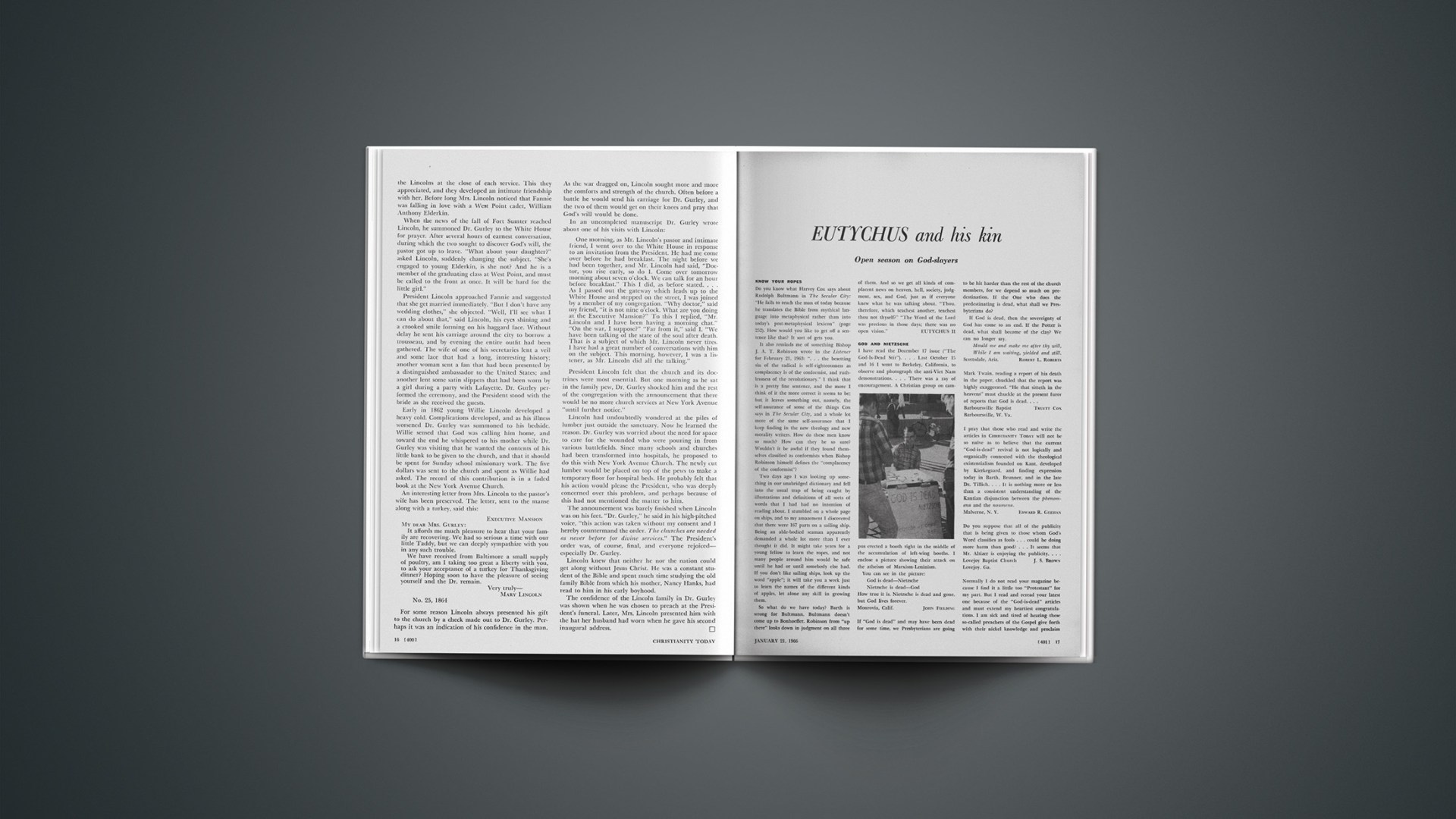
I have read the December 17 issue (“The God-Is-Dead Stir”).… Last October 15 and 16 I went to Berkeley, California, to observe and photograph the anti-Viet Nam demonstrations.… There was a ray of encouragement. A Christian group on campus erected a booth right in the middle of the accumulation of left-wing booths. I enclose a picture showing their attack on the atheism of Marxism-Leninism.

You can see in the picture:

God is dead—Nietzsche

Nietzsche is dead—God

How true it is. Nietzsche is dead and gone, but God lives forever.

JOHN FIELDING

Monrovia, Calif.

If “God is dead” and may have been dead for some time, we Presbyterians are going to be hit harder than the rest of the church members, for we depend so much on predestination. If the One who does the predestinating is dead, what shall we Presbyterians do?

If God is dead, then the sovereignty of God has come to an end. If the Potter is dead, what shall become of the clay? We can no longer say,

Mould me and make me after thy will.

While I am waiting, yielded and still.

ROBERT L. ROBERTS

Scottsdale, Ariz.

Mark Twain, reading a report of his death in the paper, chuckled that the report was highly exaggerated. “He that sitteth in the heavens” must chuckle at the present furor of reports that God is dead.…

TRUETT COX

Barboursville Baptist

Barboursville, W. Va.

I pray that those who read and write the articles in CHRISTIANITY TODAY will not be so naïve as to believe that the current “God-is-dead” revival is not logically and organically connected with the theological existentialism founded on Kant, developed by Kierkegaard, and finding expression today in Barth, Brunner, and in the late Dr. Tillich.… It is nothing more or less than a consistent understanding of the Kantian disjunction between the phenomena and the noumena.

EDWARD R. GEEHAN

Malverne, N. Y.

Do you suppose that all of the publicity that is being given to those whom God’s Word classifies as fools … could be doing more harm than good?… It seems that Mr. Altizer is enjoying the publicity.… Lovejoy Baptist Church

J. S. BROWN

Lovejoy. Ga.

Normally I do not read your magazine because I find it a little too “Protestant” for my part. But I read and reread your latest one because of the “God-is-dead” articles and must extend my heartiest congratulations. I am sick and tired of hearing these so-called preachers of the Gospel give forth with their nickel knowledge and proclaim to the world that they believe this and they believe that and we poor know-nothings must accept it.…

A. W. EVANS

All Souls Episcopal

East McKeesport, Pa.

Will our hymns survive? “Spirit of the dead God, Fall kerplunk on me.…”

DONALD L. ROBERTSON

Westminster Methodist Church

Harrod, Ohio

You have shown wisdom, all of you, in dealing with the latest bid for attention by the “God-is-dead” thinkers as you have—not making a cause célèbre of it, but regarding it as indicative only of the end-product of a “death of faith” which must inevitably follow two generations of “liberal” attack upon the foundations of our faith.…

HAROLD B. KUHN

Cambridge, Mass.

Who is dead? God or the “God-is-dead” advocates?…

FRANK M. WHITCOMB

Silver Bay Baptist

Silver Bay, Minn.

Thank you for the good work you are doing in answering the “God-is-dead” commotion. May I suggest a way in which this may be met in our regular worship?

It has become common to use the Apostles’ Creed in the Sunday morning worship. Now this statement is gloriously objective. It magnifies the mighty acts of God and encourages us to put all our trust in him and what he has done, is doing, and will do for us in Christ.

But there has also developed the custom of introducing this great affirmation with a subjectivizing phrase. The minister usually begins, “Let us confess our faith.…” Now the “death-of-God” philosophers would have no objection to admitting that the creed expresses our subjective faith. Then, of course, they would dismiss the same as theologizing myth. For us it summarizes the revelation which the true God has made of himself.

In the face of their challenge, why not rethink our introduction and use some terminology which will make it unmistakably clear that for us this is not a mere mystical myth? I suggest something like the following: “Using the Apostles’ Creed, let us confess together The Living God in his great and gracious acts for us and for our salvation: I believe in God the Father Almighty, etc.…”

And that leads me to dare mention another matter in connection with the use of the creed. One notes that the creed is used in differing places in the service, and no doubt something may be said for each usage.… One of our attractive ministers in this state uses the creed at the conclusion of the sermon. That is, the minister has proclaimed the Gospel as adequately as he can. Now he asks the congregation to add to his their proclamation as a united or corporate testimony in this comprehensive affirmation of the living God as our almighty Father, our loving Saviour, and our holy Comforter.

WILLIAM C. ROBINSON

Columbia Theological Seminary

Decatur, Ga.

Digging In At Da Nang

Re your article, “Is the Chaplaincy a Quasi-religious Business?” (Dec. 17 issue): I cannot imagine why anyone would wish to disparage the work of military chaplains.… Only this morning I had a letter from a young man with the Marines at Da Nang—not particularly active when in his home church—who wrote, “The chaplain here is really digging in. He has erected a nativity scene in front of his tent and has loudspeakers playing Christmas carols. So much can be said for our chaplains here. They are working earnestly in the civic action programs, providing spiritual guidance for the troops, and pitching in, with sleeves rolled up, wherever help is needed. They are all wonderful men.…”

IAIN C. G. CAMPBELL

First Congregational Church

Weeping Water, Neb.

Making Marriage Stick

Would it be possible to get the article “What Has Gone Wrong with Marriage?” by Chaplain W. Norman MacFarlane in the December 17 issue … in tract form? That is one of the best of its kind that I have read for a long, long time.…

V. A. JENSEN

Kenyon, Minn.

• Permission to reprint can be secured by writing to CHRISTIANITY TODAY.—ED.

This is the best presentation on the subject which I have ever read. Are reprint copies available?… I would like to have copies to use in counseling with students and parents.…

DR. LUCILE BURRALL

Counselor

Pasadena City Schools

Pasadena, Calif.

MacFarlane’s [article] puzzles me. How can marriage be a “union for life” when it can be sundered, especially by evangelicals? Expositors may have declared that “unfaithfulness is the Bible ground for a marriage divorce,” but did Jesus? Was he not referring to espousal divorce? Jewish practice required contracts for both betrothal and marriage, and it also required divorce decrees to break cither of these. Jesus could never violate the marriage union, which is based on physical union and is for life, but he could certainly allow for an espousal divorce since there had been no physical union (and therefore no marriage) except in the case of the offender. Matthew alone gives us this “exception,” and he also is the only one who gives the illustration for this, in chapter one. Also nowhere is remarriage after divorce countenanced. It is forbidden, for death alone dissolves the marriage union.

I have no difficulty in counseling folk from the Bible. The only difficulty I have is with expositors.

O. H. BUBLAT

Christian and Missionary Alliance

San Bernardino, Calif.

As to the wearing qualities of marriage, Mr. MacFarlane’s quoting a divorce lawyer, that “he was absolutely convinced that any two people who had made the wrong marriage could be reasonably happy if they had enough maturity really to try,” shot close to the mark. It was a bull’s-eye for realists.…

PAUL E. SHOOP, SR.

Bloomsburg, Pa.

Equal Time Wanted

I am just a voice and I can’t be heard very far away; but I think someone with a bigger voice like CHRISTIANITY TODAY, Billy Graham, the National Council of Churches, or the National Association of Evangelicals, or maybe all of us together, ought to demand equal time of all the major TV and radio networks. The Pope and his followers had plenty of free time. Church of the Nazarene

DWIGHT KELLAR

Durand, Mich.

Tell It On The Mountains

Speaking only for my own denomination, I would hope that a copy of Cordon Clark’s essay, “Revealed Religion” (Dec. 17 issue), could be distributed to every student in a Southern Baptist seminary.…

RONALD NASH

Associate Professor of Philosophy

Western Kentucky Stale College

Bowling Green, Ky.

Clark’s “Revealed Religion” is superb!

BEN TUININGA

Minneapolis, Minn.

I must say it was worthwhile reading, but nevertheless disappointing. When I first began the article, I had strong hopes that Dr. Clark would produce some new evidence to support his stand on verbal, plenary inspiration. And yet, his only conclusion is that the multitude of biblical references to inspiration must be taken to mean verbal, plenary inspiration. I am forced to disagree.…

CORDON E. PENNER

Annisquam, Mass.

Civil Rights And Southern Wrongs

You attack many sinful things. This you should do. But why when you write concerning such things as civil rights do you try to make it appear that the people of the South are all wrong and we of the North arc always right? Since much of your relationship is in the North, you know better than others the sins we have up here. Why do you not cry out against us? Why do you and the other writers always “slur” the Christians of the South. When will we let the Civil War end?…

I applaud your zeal for truth. But I am dismayed at the way you take to defend it.…

‘THOMAS E. SEXTON

First Church of God

Erie, Pa.

A BAPTIST LIKED IT

Though every copy of CHRISTIANITY TODAY abounds with timely, instructive, and inspiring articles, I am particularly grateful for the December 3 issue.

Relative to the report on “American Baptists: COCU on Ice?” it was refreshing, as an American Baptist pastor, to read it and the splendid articles of John W. Bradbury and Thomas B. McDormand concerning the need for vital witnessing and the danger of modern ecumenism.…

STEWART H. SILVER

First Baptist Church

Seymour, Ind.

Pray For Us, Too

In the editorial, “Let’s Not Write Off the Professors” (Dec. 3 issue), you call your readers to pray “for the campus witness of such agencies as Inter-Varsity Christian Fellowship.” It seems incongruous to be so supportive of traditional denominations in the former article (“The Overriding Ecumenists and the Restless Laity”) and apparently oblivious to the campus ministries of these denominations in the latter. Or do you feel these ministries to be too hopeless for your readers’ prayers?

CHAD BOLIEK

University Pastor

The Westminster Foundation at the University of Idaho

Moscow, Idaho

• No. We gladly recommend prayer for these, too.—ED.

Prayer And Pornography

Perhaps the average citizen like myself is not supposed to analyze or understand the actions of the United States Supreme Court. However, our little ones in kindergarten, our teen-agers, our homes, and our entire society cannot escape the practical results of the court’s decisions, whether these decisions come in the form of an unsigned order or a lengthy opinion with several dissenting views.

The United States Supreme Court by a simple majority decides which cases it will or will not hear on appeal from lower courts. Recently it decided to hear the appeal of Ralph Ginzburg, a twice-convicted peddler of the vilest type of pornography. During the time that the court was diligently studying the salacious garbage in the Ginzburg case, it decided not to hear the appeal of fifteen parents of twenty-one children (including Protestants, Roman Catholics. Jews, and Armenian Apostolics) who thought their kindergarten children should be allowed to say voluntarily, “God is great, God is good, and we thank him for our food,” before they ate their cookies and milk. I he court seemingly set in bold relief the relative evaluation it places on prayer and pornography. The two cases make an interesting study in contrast.

In November, 1963, U.S. District Judge Ralph C. Body found Ginzburg guilty as charged in a twenty-eight-count indictment, fined him $28,000, and sentenced him to five years in prison. The facts in the case were never in dispute. Ginzburg admits that he put in the U. S. mails certain copies of an obscene publication called Eras, a smutty biweekly entitled Liaison, and an erotic autobiography known as The Housewife’s Handbook on Selective Promiscuity.

The District Court’s opinion is explicit. It notes that Eros was a craftily compiled mixture of obscene material; Liaison was perverse, superficial, prurient, and entirely without restraints of any kind; and the Handbook was “a vivid, explicit and detailed account of a woman’s sexual experience … patently offensive on its face, astounding in its depiction of sexual misbehavior.”

One (among many) of the exhibits that shocked Judge Body most deeply was a series of photographs giving “a detailed portrayal of the act of sexual intercourse between a completely nude male (Negro) and female (white), leaving nothing to the imagination.” The Third U. S. Circuit Court unanimously affirmed the sentence by the District Court. For reasons not yet clear, the United States Supreme Court decided to hear the appeal of Ginzburg and has had it under consideration for weeks.

If the Supreme Court had not already been involved in the kindergarten prayer case, its decision not to hear the appeal might have been understandable. But it was the court’s previous decisions that set the stage for the controversy which developed in the school room of Public School 184 in Whitestone, Queens, New York, between the school principal, Elihu Oshinsky, and the parents of the pupils. Federal District Judge Walter Bruchhausen ruled in favor of the parents, permitting the little tots to recite together the childhood verse before they ate.

An overwhelming majority of people would never have imagined that the saying of one of the best-loved and internationally known nursery] rhymes would be prohibited in a free country. It is recognized that these children were in a public school, but the simple prayer was being said voluntarily. No one was compelled, coerced, or even encouraged to say it. No part of the school curriculum was changed or affected by it. Neither was anyone offended or complaining about its being said. It was a clear case of free exercise guaranteed by the First Amendment. But the Second U. S. Circuit Court reversed the decision of the District Court to let the children pray together, and the Supreme Court concurred with tacit approval.

No one with any sense of decency could fail to see the criminal act of Ginzburg, its devastating effect on our society, and the potential it has for crippling if not indeed wrecking thousands of lives not directly involved in the act itself. It takes even less ability to see the innocence and beauty of what the kindergarten children wanted to do. Yet the Supreme Court has said in effect that so long as prayer is suppressed it will remain silent, while giving full attention to those cases where an attempt is made to suppress pornography.

In the prayer case there was a difference of opinion at the functional level and a serious disagreement between the lower courts. In the pornography case there was no question about the law or the facts. Not a single dissenting voice was heard in the lower courts. Yet the court had no time for the prayer case, but the crocodile tears of a twice-convicted criminal demand the attention of the court for weeks on end.

One may well wonder how long the prayer (“God save these United States and this honorable court”) by which each session of the Supreme Court is opened will continue to be answered.

FLOYD ROBERTSON

Office of Public Affairs

National Association of Evangelicals

Washington, D. C.

We Can’T Win Them All

CHRISTIANITY TODAY is the most practical, timely, and vital organ for the dissemination of Christian truth available today. No other periodical is written on such a high intellectual plane and at the same time committed to such an unbiased and yet conservative viewpoint.…

EARL L. POUNDS

Mary Ann Baptist Church

St. Ann, Mo.

I find your magazine very hard to read. In trying to analyze why, I ran across the enclosed article (“Giving Wings to the Page,” Decision, Nov., 1965, issue). I thought you might take some hints from it.

LYDIA M. BEILER

Salisbury, Md.

Thanks For The Help

I especially enjoyed “It Happened at Bethlehem,” by R. E. O. White (Dec. 3 issue). I drew on it heavily, giving appropriate credit, for one article of my pre-Christmas series. At this time my twenty-four-year-old weekly column for newspapers becomes a daily column.

Editor

R. BARCLAY WARREN

Canadian Free Methodist Herald

Kingston, Ont.

Well Done

Howard Snyder’s parable of the baker (Dec. 3 issue) was a literary masterpiece. His relating “neo-baking” to “neo-orthodoxy” was a terrific depiction of the current theological perversion, which wastes time debating instead of believing and imparting the faith that saves and works.…

ELTON O. SMITH. JR.

Canasawacta Valley Free Methodist

Norwich, N. Y.

Yes, Even Darwin!

Dr. Stob’s fine article “A Firm Foundation for Modern Science” (Oct. 22 issue) does an injustice (probably unwittingly) to the life sciences, it seems to me. By failing to mention any of the great biologists who were believers. Dr. Stob may be implying that biology is the science of infidels.

Linnaeus’s passionate pursuit of order in living things was nourished by Christian motives. Religious convictions prompted Louis Pasteur to disprove the theory of spontaneous generation. Louis Agassiz was a deeply religious man. Even Charles Darwin (forgive me!) had some religious convictions before organized Christianity lined up against him. The list could be a long one.

ALAN MARK FLETCHER

Science Editor

J. B. Lippincott Co.

Philadelphia, Pa.

The contention of Stob that the Reformers laid the foundation for modern science, which heathen philosophies can never do, is a contention we have been working to establish in our Bible-science program.…

John Warwick Montgomery in “Cross, Constellation, and Crucible” establishes clearly that the Reformers favored the Copernican theory, were interested in alchemy, which was the chemistry of that day, and truly laid the groundwork for modern science.…

We would like to have permission to quote from the article by Henry Stob in our newsletter.…

WALTER LANG

Executive Secretary

Bible-Science Association

Caldwell, Idaho

Disappointed Disciple

I am acquainted with it [CHRISTIANITY TODAY] and not only do not appreciate it—I find its content worthless!…

EDWIN LEE STILES

Director of Interpretive Materials

Disciples of Christ

The United Christian Missionary Society

Indianapolis, Ind.

It Applies

Without overstatement I find without exception that the page “A Layman and His Faith” is a rich inspiration in application to our family experience as we try to grow spiritually.…

JOHN TREMAINE

Director of Music

Mulberry Street Methodist Church

Macon, Ga.

Swept But Unchanged

The actions of the Roman Catholic Church in the Vatican Council are making sweeping changes in the way the public sees that church. It should not be assumed, however, that the Catholics will emerge with a church that is closer or more faithful to the scriptural foundations of Christianity.…

RONALD J. P. PRIGGEE

Louisville, Ky.

A Reader Reports

When it comes to religious journalism, yours ranks second to none.…

GERALD DENNY

Clinton, Ill.

Lincoln and His Pastor

The president once publically corrected his minister.

Few men have had better relations with their pastors than President Abraham Lincoln had with his, Dr. Phineas D. Gurley. The two men were very close. And yet, during a Sunday morning service, Lincoln slowly rose to his feet and before the entire congregation boldly opposed his pastor with a few carefully chosen remarks.

Dr. Gurley knew Lincoln was right, and the opposition only strengthened their warm friendship. To understand this we must go back to the time when Lincoln first moved to Washington as President. Immediately after the inauguration, the Lincolns began to attend the New York Avenue Presbyterian Church, where Dr. Gurley was the minister. Mary Lincoln chose pew number fourteen, in the sixth row from the front.

Lincoln’s parents were Primitive Baptists, and although Mary Lincoln had been a Presbyterian in her youth, she had joined the Episcopal Church in Spring-field. Perhaps the Lincolns began to attend the New York Avenue Church in Washington because of the great kindness of Dr. James Smith, pastor of the First Presbyterian Church in Springfield, which they had attended before the election. Dr. Smith had preached the funeral sermon for their second son, Eddie, during the absence of the Episcopal rector, the Reverend Charles Dresser. His help and understanding during their days of sorrow had led them to attend his church.

From the very beginning the Gurleys and the Lincolns found strength in one another’s company, and their friendship grew. Lincoln liked his pastor’s preaching and remarked to a friend, “I like Gurley. He don’t preach politics. I get enough of that during the week, and when I go to church I like to hear the Gospel.”

The President especially enjoyed the pastoral prayer and made a habit of standing when Dr. Gurley began. He also attended the prayer meeting during the week. To avoid the excitement his presence would cause if he sat in the sanctuary, he listened carefully from the pastor’s study, with the door slightly ajar so that he would not miss a word.

The ups and downs of the war years deepened Lincoln’s love for the church and his pastor. Dr. Gurley’s daughter, Fannie, made it a point to greet the Lincolns at the close of each service. This they appreciated, and they developed an intimate friendship with her. Before long Mrs. Lincoln noticed that Fannie was falling in love with a West Point cadet, William Anthony Elderkin.

When the news of the fall of Fort Sumter reached Lincoln, he summoned Dr. Gurley to the White House for prayer. After several hours of earnest conversation, during which the two sought to discover God’s will, the pastor got up to leave. “What about your daughter?” asked Lincoln, suddenly changing the subject. “She’s engaged to young Elderkin, is she not? And he is a member of the graduating class at West Point, and must be called to the front at once. It will be hard for the little girl.”

President Lincoln approached Fannie and suggested that she get married immediately. “But I don’t have any wedding clothes,” she objected. “Well, I’ll see what I can do about that,” said Lincoln, his eyes shining and a crooked smile forming on his haggard face. Without delay he sent his carriage around the city to borrow a trousseau, and by evening the entire outfit had been gathered. The wife of one of his secretaries lent a veil and some lace that had a long, interesting history; another woman sent a fan that had been presented by a distinguished ambassador to the United States; and another lent some satin slippers that had been worn by a girl during a party with Lafayette. Dr. Gurley performed the ceremony, and the President stood with the bride as she received the guests.

Early in 1862 young Willie Lincoln developed a heavy cold. Complications developed, and as his illness worsened Dr. Gurley was summoned to his bedside. Willie sensed that God was calling him home, and toward the end he whispered to his mother while Dr. Gurley was visiting that he wanted the contents of his little bank to be given to the church, and that it should be spent for Sunday school missionary work. The five dollars was sent to the church and spent as Willie had asked. The record of this contribution is in a faded book at the New York Avenue Church.

An interesting letter from Mrs. Lincoln to the pastor’s wife has been preserved. The letter, sent to the manse along with a turkey, said this:

EXECUTIVE MANSION

MY DEAR MRS. GURLEY:

It affords me much pleasure to hear that your family are recovering. We had so serious a time with our little Taddy, but we can deeply sympathize with you in any such trouble.

We have received from Baltimore a small supply of poultry, am I taking too great a liberty with you, to ask your acceptance of a turkey for Thanksgiving dinner? Hoping soon to have the pleasure of seeing yourself and the Dr. remain.

Very truly—

MARY LINCOLN

No. 25, 1864

For some reason Lincoln always presented his gift to the church by a check made out to Dr. Gurley. Perhaps it was an indication of his confidence in the man. As the war dragged on, Lincoln sought more and more the comforts and strength of the church. Often before a battle he would send his carriage for Dr. Gurley, and the two of them would get on their knees and pray that God’s will would be done.

In an uncompleted manuscript Dr. Gurley wrote about one of his visits with Lincoln:

One morning, as Mr. Lincoln’s pastor and intimate friend, I went over to the White House in response to an invitation from the President. He had me come over before he had breakfast. The night before we had been together, and Mr. Lincoln had said, “Doctor, you rise early, so do 1. Come over tomorrow morning about seven o’clock. We can talk for an hour before breakfast.” This I did, as before stated.… As I passed out the gateway which leads up to the White House and stepped on the street, I was joined by a member of my congregation. “Why doctor,” said my friend, “it is not nine o’clock. What are you doing at the Executive Mansion?” To this I replied, “Mr. Lincoln and I have been having a morning chat.” “On the war, I suppose?” “Far from it,” said I. “We have been talking of the state of the soul after death. That is a subject of which Mr. Lincoln never tires. I have had a great number of conversations with him on the subject. This morning, however, I was a listener, as Mr. Lincoln did all the talking.”

President Lincoln felt that the church and its doctrines were most essential. But one morning as he sat in the family pew, Dr. Gurley shocked him and the rest of the congregation with the announcement that there would be no more church services at New York Avenue “until further notice.”

Lincoln had undoubtedly wondered at the piles of lumber just outside the sanctuary. Now he learned the reason. Dr. Gurley was worried about the need for space to care for the wounded who were pouring in from various battlefields. Since many schools and churches had been transformed into hospitals, he proposed to do this with New York Avenue Church. The newly cut lumber would be placed on top of the pews to make a temporary floor for hospital beds. He probably felt that his action would please the President, who was deeply concerned over this problem, and perhaps because of this had not mentioned the matter to him.

The announcement was barely finished when Lincoln was on his feet. “Dr. Gurley,” he said in his high-pitched voice, “this action was taken without my consent and I hereby countermand the order. The churches are needed as never before for divine services.” The President’s order was, of course, final, and everyone rejoiced—especially Dr. Gurley.

Lincoln knew that neither he nor the nation could get along without Jesus Christ. He was a constant student of the Bible and spent much time studying the old family Bible from which his mother, Nancy Hanks, had read to him in his early boyhood.

The confidence of the Lincoln family in Dr. Gurley was shown when he was chosen to preach at the President’s funeral. Later, Mrs. Lincoln presented him with the hat her husband had worn when he gave his second inaugural address.

Cover Story

Counseling: How to Cope with Mental Retardation

The cry of “Why?”

Both “saints and sinners” can have mentally retarded children; the problem is to achieve acceptance along with understanding

The saddest of all cries is that of a mother tenderly holding her retarded child and asking, “Why?” A cry of hunger can be satisfied with food, a cry of poverty alleviated with money, a cry of pain soothed with medicine, a cry of loneliness silenced with companionship; but a cry from a parent of a retarded child is a cry of futility for which there is no easy solace.

We who are parents of normal children cannot understand how the parents of a mentally retarded child feel. While we are nagging our children to get higher grades, they are hoping their child will learn to dress himself. While we are concerned about getting our children into college, they are delighted when their child can give a correct answer to two plus two. While we are looking forward to our children’s entrance into business or professional life, they are pleading for their child to be given an unskilled job opportunity.

Daily we thank God for blessing us with normal children and interpret this blessing as an act of God’s love. But how can a parent of a mentally retarded child believe that God is loving?

Recently, the mother of a child who is not only mentally retarded but also deaf and dumb confided to me the heartaches surrounding her beautiful child. Seeking answers, she had gone to her clergyman, who told her, “God had so much love to give you that he blessed you with this child.” I asked her how she reacted to his statement. This was her answer: “I simply said to him, ‘I wish God had distributed this love a little more evenly. Why did I have to have such a big chunk of it?’ ”

Why do some clergymen feel that they must always say something, even though there may be nothing to say? Many times a warm handclasp is more than sufficient and a gentle nod of the head more expressive than many words.

For counseling parents of retardates, a clergyman needs great understanding. And in listening one finds understanding. In the New York Times (Jan. 4, 1959), Dr. Howard S. Rusk cited a transcription of an interview with a twelve-year-old boy, blind since birth, who was having difficulty at school because he was said to be “out of touch with reality.”

But then it isn’t the darkness that I should blame. Because darkness can be either friend or enemy. If wishes could come true, I’d wish I could see. But if I only had one wish, I would not waste it on wishing I could see. I’d wish instead that everybody could understand one another and how a person feels inside.

What the parents of a mentally retarded child need is acceptance along with understanding. Somehow, they must learn to accept their special problem. They might never learn to understand fully why they were given it, but to survive they must learn to accept it. To achieve this requires skill, patience, understanding, prayer, and guidance on the part of the counselor.

Parents of a mentally retarded child often have a feeling of guilt. They think that somewhere in the past, either remembered or unremembered, there was a transgression that God is now punishing them for. They must be ever so gently led to see that God is not vindictive and that the birth of a mentally retarded child is something that could and does happen to both sinner and saint. Before acceptance can be reached, the sense of guilt must be removed.

Recently I buried a severely brain damaged infant. Later the mother wrote me saying: “There were many times that I felt a sense of security in the knowledge of the fact that you did possess a ‘special love’ for all of our children. And now God has seen fit to take her unto himself and make her perfect in mind and body. For this we are grateful even in the sense of loss.”

This mother had learned to accept her problem. Her secret was that she did not allow self-pity to engulf her. Like Job when he said, “Though he slay me, yet will I trust in him,” she held fast her faith in God.

Quite different is the mother who wrote this letter to the editor of the New York Daily News (Jan. 24, 1965):

As the mother of a mentally retarded child, I agree with you, they shouldn’t be allowed entry to this country from abroad. Not only would the country end up paying for their care, they’re potentially dangerous. I could write about my child; the things he’s done and the strength he had in him at the age of four. As adults, the strength and viciousness of the retardeds is even worse. Sorry, but we’ve enough mentally retarded adults in this country without the imported variety.

In more than seven years as resident chaplain in a state institution with over 4,300 mentally retarded patients, I have yet to find a child of four who is potentially dangerous or an adult who is vicious. The retardate is no more dangerous or vicious than the normal person. Yet without proper training and discipline he can become a delinquent, as can also the normal child.

Mental retardation is an enigma. How can we reconcile Genesis 1:31 (“And God saw everything that he had made, and behold, it was very good”) with the tears of a mentally retarded child who has just been called a “dope” by a brighter child of the same Creator? Why should so much intelligence be bestowed upon one and so little on the other?

Various theories have been put forth in an attempt to reconcile the perfection of God with the imperfections of mental retardation. All of them have one thing in common; they are merely rationalizations.

One theory may be called “The Other Side of the Rug.” Look at a beautiful, valuable rug with an intricate pattern. Turn it over and you will notice the roughness of the underside. The rougher the underside, with its ugly knots and scraggly ends, the finer the finished side. Needless to say, proponents of this theory consider the retardate to be the side devoid of beauty and pattern, a bothersome necessity.

Another theory may be called “The Garden.” When compared to a weed, a flower is full of beauty and fragrance. Just as we need sorrow to appreciate joy and darkness to enjoy light, the weed is necessary to show the flower in all its splendor. The mentally retarded child has value as a foil for the normal child.

Still another theory is that of “The Sins of Our Fathers.” This rests on a misunderstanding of Numbers 14:18: “The Lord is slow to anger, and abounding in steadfast love, forgiving iniquity and transgression, but he will by no means clear the guilty, visiting the iniquity of fathers upon children, upon the third and upon the fourth generation.” The “iniquity of fathers” has been thoughtlessly identified by many amateur biblical interpreters as syphilis. I am reminded of four young men from a conservative Bible college who came to visit the institution. Briefing them on mental retardation, I was informed by the four that all mental retardation was caused by this disease.

Would God that mental retardation were so simple it could be explained with one word! The truth of the matter is that syphilis accounts for only a very small percentage of mental retardation. If it were the sole cause, then by successfully attacking this disease we could eliminate retardation. But to date there are some seventy known or suspected diseases or mishaps causing mental retardation. In only one out of five cases can we identify the cause with any certainty.

Traditional Christianity has taught that God is responsible for all creation and that everything he created has a purpose. Even the mentally retarded were brought into existence by the Creator and should not be considered a curse; the all-wise Creator has a purpose for even the “least of these.” The soul of a mentally retarded child is just as precious as that of a normal person; both were made in the image of God, the only difference being the degree of intelligence.

As created beings with souls, we are pilgrims on our way to heaven. The greater the intelligence, the greater the responsibility. The retarded child, because he will never arrive at the age of responsibility, is blessed by being assured a place in heaven.

A purpose God might have for the mentally retarded is that of being our teachers. As a result of my work as chaplain to retardates, I shall forever be indebted to them. They have taught me more than I can ever tell through their childlike simplicity, their cunning candor, their yearning for affection, their unstinting love. Theirs is a world where hypocrisy is banished, a Never-Never Land where honesty reigns, where a smile is their passport to affection and the light in their eyes melts the coldest heart. Perhaps God is reminding us that we must rediscover these attributes that the mentally retarded have never lost.

Each morning upon arriving at my office, I pray that I shall find some small answer to one of the many questions of mental retardation. And each day I am disappointingly met with further questions. But, thank God, the answers are beginning to appear. Today research in mental retardation is like a train emerging from a long dark tunnel. Cretinism is now a page of past history; the RH factor has been curbed; the phenylketonuric (PKU baby) condition is now controllable. The admonition of our Saviour is valid for this area: “Ask and it will be given to you. Search and you will find. Knock and the door will be opened for you. The one who asks will always receive; the one who is searching will always find, and the door is opened to the man who knocks” (Matt. 7:7, 8, Phillips).

However, many parents of mentally retarded children are well acquainted with these verses. Never can it be said that they have not asked, searched, and knocked. They have asked countless doctors what can be done; they have searched for the one specialist who might by some miracle have the right answer; they have knocked on the doors of many medical centers. So much time consumed, so much money spent—only to be told there is absolutely no cure for their children.

More than seven years’ experience as a resident chaplain to retardates gives me the right to express certain opinions. They are as follows:

As we learn more and more about mental retardation, less blame will be given God and more will be placed where it belongs, upon man’s limited knowledge. We now know that some babies are born mentally retarded because the mother contracted German measles during a critical period of pregnancy. Unfortunately, many babies were born retarded before we discovered this fact. Man must plead guilty because of his limited knowledge.

We still remember well the scare that thalidomide gave our nation. This drug should never have been released to the public until exhaustive tests had been made to assure safety. The drug companies released it prematurely. Who is to blame for all the malformed babies caused by this terrible drug? Surely not God.

Perhaps some types of mental retardation can be explained as a result of man’s breaking of natural and physical laws. God must have certain laws and rules if this world is to be carried on in an orderly manner. If I chose to step off a high ladder in defiance of the law of gravity, I could very easily receive a brain injury that would leave me handicapped. Have I the right to blame God for not suspending this law when I was falling?

The mentally retarded are not asking for much. All they want is a chance to grow and develop within their own limitations, a chance to be useful, a chance to love and to be loved, and a chance to know God as we have had a chance to know him. As Helen MacMurchy has said in The Almosts:

Give them a chance. The Golden Rule applies to them. We are to do for them what we would others should do for us. Give them justice and a fair chance. Do not throw them into a world where the scales arc weighted against them. Do not ask them to gather grapes of thorns or figs of thistles. But give them one chance to bring out the best that is in them. This is but a fair request on behalf of human beings who nevertheless are permanent children.

The Art of Public Bible Reading

Reading the Bible should not be dull.

Have you ever noticed that the reading of the Scripture lesson often reaches a low point in listener attention? This happens in Sunday school classes, women’s and men’s meetings, and other gatherings as well as in formal public worship. The Word of God is a sharp two-edged sword capable of penetrating to our spiritual-intellectual-emotional marrow and joints. But ministers and laymen alike often handle it as if it were a putty knife.

No matter how great its inherent force, a passage can become dull and spiritless if read in public casually and without preparation. “Ho, every one that thirst-eth; come ye to the waters …” (Isa. 55:1) can be droned in ho-hum fashion as if the reader had never known spiritual thirst—or the boundless joy of receiving “wine and milk without money and without price.”

There is a widespread assumption that anyone with average education and competence can read Scripture in public with little or no effort. And the next step is to conclude: “I have to spend my time on my lesson, my talk, my devotional, or my sermon.” The result is that many persons read Scripture in public without any previous preparation.

I should like to propose a rather radical idea. No matter what the occasion, the public reading of Scripture is of crucial importance. Therefore it requires careful preparation. The following five suggestions can help one wield the two-edged sword so that it achieves high listener attention and lasting results.

1. Write out the Scripture lesson—on the typewriter or by hand—and read from the manuscript rather than from a printed page. There are good reasons for suggesting this. One is that printers arrange their type so that the margins are straight. Therefore words must often be divided at the ends of the lines, and the reader’s eyes must jump from the right margin all the way back to the left in order to see the whole words. Equally important, the arrangement of material in lines of equal length tends to interrupt the natural flow of meaning. When one is reading from a printed page, it is easy to pause at places that ought to flow on and to skip by other points where the listeners need a brief stop.

Preparing a copy of the Scripture lesson will also foster union between you and the Word. As you copy, you will find meanings leaping toward you that would be overlooked in a casual reading. You will, in a sense, be made a captive of the Word. When that happens, your public reading becomes a pouring out of something that has become part of you. You are merely a channel through which the vital, living Word flows out to others.

2. Read the lesson in its larger context at least once. This will reinforce its grip upon your mind. At the same time, the lesson seen in its whole setting will “come alive” for you. It does not exist in isolation; nerves and arteries and sinews connect it with the whole body of Scripture of which it is a part.

Failure to take account of the larger context is, of course, a prime source of doubtful or even erroneous exposition. Treated as if it were an independent entity, a passage may lend itself to gross distortion. Such distortion is not limited to the sermon or lesson based upon a segment of Scripture. It can take place in the public reading by, for example, emphasis upon some word or phrase that deserves no such emphasis when the larger context is considered.

3. Try to imagine yourself in the situation with which the lesson deals. If action is involved, as it is in most Scripture other than the Psalms and the letters of Paul, try to take part in that action through the lives of the men and women involved. Try to be for a moment a hot and thirsty traveler, fresh from the desert, eagerly looking for a street vendor who will sell a drink of water from his goatskin bag—and in that mood hear the invitation to come without money. Once you have done this, your reading of Isaiah 55:1 will be transformed, and those who listen will catch the note of reality.

Even the accounts of the stirring events in our Lord’s last week on earth, and of what took place at Calvary, can be read in such a distant way that listeners automatically reject the words. But when a speaker begins to tell them about something that he almost seems to have witnessed, they will listen. The reverent use of your imagination will help the narrative portions of Scripture come alive for you and your hearers.

4. With your manuscript prepared so that its physical appearance aids the natural flow of meaning, go back over it and underline and mark for emphasis and shades of meaning. This will make it easier to preserve the very important eye-contact with listeners, while yielding yourself as a channel through which the meaning of the lesson can surge.

In making this suggestion, I am not recommending “theatrical” reading of Scripture. This hollow, phony procedure is the very opposite of what I have been trying to suggest. As someone has well said, “Scripture reading is not a performance but rather communication of the Word.” To the degree that a teacher or preacher or devotional leader becomes concerned with the impression he himself is making upon his listeners, he loses the ability to be a channel for the Word. A Scripture lesson is not a vehicle for showing off the reader’s skill as an actor, or his fine voice, or his power of visualization. To use it this way is to pervert the role of the witness-communicator. But when this ever-present danger is recognized as one subtle way in which the devil appeals to pride, a marked manuscript can help give power to public reading.

5. Finally, I strongly urge that you read your lesson aloud as many times as necessary in order to master it. Many slovenly readings, to say nothing of slips of speech and outright blunders, result from assuming that visual and oral reading are the same. That is far from true; the two forms are really quite different kinds of communication. Word combinations that give the eye no trouble may hopelessly twist the tongue. And in oral reading the voice must do for the listener what punctuation marks and capital letters do for the reader.

By following some of these practices and adapting others to fit your own personality and experience, you may well find that the reading of the Scripture lesson becomes the high point rather than the low point of any period in which you seek to be an intermediary between God and your fellow men.

Arts and Religion: They Need Not Clash

The fine arts as a field of Christian engagement.

A son of the Reformation is quite at home in the Rijksmuseum in Amsterdam. He finds here a milieu to which his sensibilities are immediately congenial. In the paintings of Pieter de Hooch, Hobbema, the van Ruysdaels, van de Velde, and, of course, Rembrandt van Rijn, he finds a vision of the world that he can share with no difficulty at all. The celebration and immortalization of the bucolic, the tranquil, the humble, and the commonplace responds to the call that he hears in his own sold (and indeed, a call that all men must sense) for a vision of life that is immediate, lucid, and uncomplicated by the demands of sacramental transfiguration which the works of, say, del Sarto, Filippo Lippi, or Fra Bartolommeo make. The clean blue-and-white tile floors of Vermeer, the portraits of Van Dyck, Jan Steen, and Frans Hals, and Rembrandt’s wonderful sketches of biblical scenes that look as though he drew them with a twig—here are things that evoke a world that he can understand and love.

But then he travels south into Bavaria and Austria and tumbles into a world of the baroque: a frantic scramble of gilded altars, painted statuary, frescoes, reliquaries, fonts, and baldachinos that he finds dizzying, if not altogether unsettling. He realizes that he has come upon a vision of God and the world that differs radically from his own, yet one that would call itself above all Christian. He can either decide that the whole thing is an unfortunate botch, or pause to ask himself whether or not it is worth looking into.

And then he comes to Florence and Michelangelo. Here, surely, true religion has flown out the window, and Pan and Cybele and Bacchus have surged through the door. Here is a town, a Paradise, with its warm sunlit stucco set in the enchanting hills of Tuscany, cypress and olive trees and vineyards all about—a town that is crowded with painting and sculpture celebrating at once the celestial and the earthy. He eventually makes the disturbing discovery that the glory of the human form shines more brightly here than does the glory of Christ, the Virgin, and the Apostles. And he asks himself: Have we two antithetical worlds here, with no bridge between them? Is there on the one hand a “religious” world, represented by the churches, and on the other a world that is unapologetically pagan? Or is there a unity of vision here that sees no breakdown between the true worship of God and a profound sense of wonder at all the phenomena of life, that is not embarrassed over its joy in the human form?

The question that finally emerges, and with which these notes are concerned, is whether or not it is possible to have a view that has the proper priorities and hierarchies and yet is able to affirm with joy the Creation and say, “Benedicite, omnia opera Domini.”

Only if the answer to this question is yes can the discussion about evangelicalism and the creative arts go on. For if the answer is no, then we would do well to pack in and concentrate on our mission of discursive preaching. For it comes to this: the creation of great art presupposes a view that sees the stuff of this existence to be radically significant; indeed, that sees it (and not Paradise) to be the only matrix from which high art can rise.

To a non-religious person, this of course presents no problem. There is no other existence to which he can refer, and therefore any commentary must spring from and speak to this one. But to a person with a vigorously eschatological view of things—and I think we evangelicals fit in here—whose theology has taught him that the phenomena of this existence are meaningful only in so far as they find an ultimate point of reference in Paradise, such a view is sometimes difficult.

The water is often muddied in that, without ever having examined just why we look askance at the fine arts—or at least the appropriateness of a Christian’s pursuing them—we argue that time is short and we must get on with the job of winning souls; or that painting, sculpture, and drama are mere embellishment to life, and that people with a task of ultimacy laid upon them cannot truckle with this sort of thing; or that the world of the arts is so rancid with beatniks, libertines, homosexuals, and other frightening types that a Christian has no business getting embroiled.

But the philosophical problem is prior to all these. And there is a problem. We must decide whether or not the patent transitoriness of this existence and the heavy urgency of being spokesmen for what we understand to be the Word from God cancel the fine arts as a field for excursion. Put more simply, it is the question that has hundreds of students in evangelical institutions gnashing their teeth: May I—can I—before God, explore passionately my obvious artistic or poetic or dramatic talent, without any immediately utilitarian motives? Or shall I find areas where my talents can be used “for the Lord”?

There is the rub. “For the Lord.” Our understanding of this has been a utilitarian one. To us it means one thing: souls. But how shall we test the work of Dante, Milton, Bach, Rembrandt, Dr. Johnson, G. M. Hopkins, T. S. Eliot, and a thousand others by this? These men were all Christian. Obviously it cannot be done. (One does not think of Dr. Johnson as a soul-winner. Boswell does not have much to say about his witness in the coffeehouses of the city.) So that either we must find warrant for art that is not subject to this test, or these things must retire as candidates for our attention.

This is, let us be candid, a partisan article. I am sure my position is no secret. I do not feel the utilitarian test to be valid. I believe that the radical affirmation of human experience crucial to art is one that can—nay, that must—be made by the Christian. We must have the courage to shape our anguish and our joy into beautiful forms—into poetry, into pictures, into ballet. We must celebrate beauty—all kinds of beauty—on instruments of ten strings, and with a chisel. We must paint the tawdry, the spurious, and the hideous as it is: shall we leave this to Toulouse-Lautrec, Rouault, and Kokoschka? We must try, with all that is in us, to affirm our conviction that form, and not havoc, lies at the bottom of things—and shall we leave this quest to Mondrian, Giacometti, and Larry Rivers?

Of the utilitarian test, I can only say that evangelism is one thing, art another. It is unfair to apply the canons of either to the other. We must have an end of pitting them against each other. They are no more at odds than apples and wool are.

It would be a mistake to suppose, however, that we can begin a concerted effort to produce “evangelical art.” Committees, movements, retreats, and courses have never, in the history of the world, produced art. It can come from one source alone: the soul of the artist. Here is the other side of the question, the personal and non-philosophical side, the side that is not subject to our views pro or con. What of the appearance in our midst of an artist? None of us can make himself an artist. But, anguish of anguish, if one of us, or one of our sons, discovers that he has been assaulted by strange inclinations, and that he must create or die, what shall our religion say to this?

I believe that we can call a loud bravo. I believe this because I believe in three great doctrines: the Creation, the Incarnation, and the Resurrection—three acts whereby God attests to the profound legitimacy of the human, the flesh (I do not use “the flesh,” as St. Paul uses it frequently, to mean a spirit that is anti-God). I do not see it to be our calling to cancel the earthly in the name of the eternal. This is not what the Church has understood its task to be. The Athanasian Creed speaks of the Incarnation as “not [the] conversion of the Godhead into flesh, but [the] taking of the Manhood into God.” It seems to me that there must be a seizing of human experience, with all of its beauty, ambiguity, and tragedy, and a transfiguration of it into forms that speak of the eternal.

And, given that elusive thing called genius, an artist is someone who has been assaulted by these three things: beauty, ambiguity, and tragedy. He cannot fend off this assault any more than he can slough off his own being. And so he is forced to come to terms with it by creation. Michelangelo, Mozart, Tiziano, Gide—what do they all have in common? I believe it is the attempt to exorcise the daemons of human experience; to shape into form the chaos of beauty, ambiguity, and tragedy that they sense. It might have been possible with all of them to have brought about quiescence in purely religious terms, but who will insist that the whole lifelong agony of creation was not God’s way of bringing them to himself?

Beauty, then. What, exactly, is a human being to do when his awareness of beauty becomes unmanageable? We applaud the results when we have the perspective of a few hundred years and can see the sublimity of Michelangelo’s creations. But was the course he took one that would have suited us at the time? How would we have dealt with his intoxication with the nude male form? Would we have tried to huddle him into safer, more obviously utilitarian pursuits? Would we have encouraged his frenzied dedication to his art—this art that has given us the David, an image of a sublimity and perfection and power and sensuousness that can only wrench from us tears of awe and joy. Who has ever said more eloquently than this statue does, “What a piece of work is a man”? And how is it possible, in a dissertation on the glory of the Creator, to say one-half of what this thing says? Then one goes from the Accademia, where the David stands, to the Sagrestia Nuova di San Loranzo, where there are nine marble figures by Michelangelo. Who can gainsay the serenity, the overpowering beauty, of these things? Shall we whittle down a man’s struggle with beauty in the name of religion?

For it is just that: a struggle. Alas for the man for whom the vision of beauty, in whatever form it approaches him (for Michelangelo it was the human body; for Wordsworth it was the Lake District; for Mozart it was music), becomes, no longer a reverie to be indulged at will in sybaritic melancholy, but a searing agony that ravages him daily, hourly, in images too sweet to bear. How shall our religion speak to this sort of thing?

Perhaps here is one difference between the artist and the rest of us. The artist is above all vulnerable. He finds himself wounded with stabbing visions of some aching and elusive joy, some burning fever of desire; and he knows that in order to be true to his own being, he must invite the shafts and ask where in God’s name they come from, while the rest of us must offset and quell these lance-like imaginings with practical considerations in order to make our way in the world and keep our sanity. It would, of course, be havoc if we were all artists; but let us be sure that we have not excluded them from our world.

Secondly, the artist is assaulted with the consciousness of ambiguity. One does not have to look far to find it. What shall we say, for instance, of the dreadful breakdown between aspiration and fulfillment that every human being experiences? or again, of radical limitation imposed on half the human race—blindness, insanity, poverty, injustice, paralysis? or of the awful hiatus between appearance and what we suspect to be reality? or of the jostling coexistence in human life of overpowering sexual desire and moral stricture? All of these things are answerable by theology; but when we have answered them they still make us cry out in anguish, and it is with this anguish that the artist wrestles. He must begin by being haunted, perplexed, astonished, and tormented by life. He must insist on asking the questions, loudly and shrilly, that plague all men, and that most of us try to meet by evasion, platitudes, and neuroses.

Thirdly, the artist senses the tragic nature of life. Shakespeare (in Hamlet), Pope (in the “Essay on Man”), and all artists have sensed the position of man, which is tragic: we are caught—strung—between the animal and the angelic, and we set one against the other to our destruction. Various forms of the hedonistic principle would have us assert the animal to the obliteration of the angelic, and various forms of religious asceticism would have us do the opposite. Both fail of God’s idea for man. We are not angels, but we have their consciousness of the divine and find, alas, our feet in the mud. Animals are free to be wholly animal without guilt; we sometimes want passionately to be wholly animal but are not free to be so. Sometimes (though not often) we want to be angelic, and find that we cannot if we will (cf. St. Paul).

The artist senses as ultimate the tragedy of decay. Fr. Hopkins, a Christian, said it as well as anyone:

no, nothing can be done

To keep at bay

Age and age’s evils, hoar hair,

Ruck and wrinkle, drooping, dying, death’s worst,

winding sheets, tombs and worms and

tumbling to decay;

So be beginning, be beginning to despair …

It bothered Keats too:

The weariness, the fever, and the fret

Here, where men sit and hear each other groan;

Where palsy shakes a few, sad, last gray hairs,

Where youth grows pale, and spectre-thin, and dies;

Where but to think is to be full of sorrow

And leaden-eyed despairs …

One contemplates the marbles of Michelangelo and realizes that here is the highest that we can achieve in immortalizing strength and youth and beauty. The stone is not subject to decay (relatively speaking). And so the stone David outlives the beautiful model, whoever he was; and the figures in the plastered frescoes outlive by centuries their flesh-and-blood originals. And yet, even here there is an ironic twist, for the mere flick of a vandal’s chisel would demolish instantly one of the most sublime things ever—the ceiling of the Sistine Chapel in Rome.

A great scholar and historian of the Reformation, J. H. Merle D’Aubigne, has this comment:

Protestantism has often been reproached as their [the arts’] enemy, and many Protestants willingly accept this reproach.… Let Roman Catholicism pride itself in being more favourable to the arts than Protestantism; be it so; paganism was still more favourable, and Protestantism places its glory elsewhere, There are some religions in which the esthetic tendencies of man hold a more important place than his moral nature. Christianity is distinct from these religions, inasmuch as the moral element is its essence. The Christian sentiment is manifested not by the productions of the fine arts, but by the works of a Christian life … so that if the papacy is above all an esthetical religion … Protestantism is above all a moral religion.… After a man has studied history or visited Italy, he expects nothing beneficial to humanity from this art [History of the Reformation, p. 376].

This is a view widely espoused. It is an unhappy one for an evangelical who finds in himself not only a great love for Florentine painting and sculpture but also a passionate conviction that there is something radically legitimate about the plastic immortalization of human beauty and the effort to shape visibly the chaotic phenomena of life; and who feels that there need be no tension between a vigorous evangelical orthodoxy and an assertion of the significance of the arts.

Cover Story

Does the Bible Conflict with Modern Science?

Prominent scientists state their views.

Is Christianity a friend or foe of science? Has science discredited miracles? This panel enlists three scientists in a discussion of science-and-faith concerns.

In a television studio in Washington, D. C., three distinguished scientists recently discussed aspects of Christianity and science during a half-hour panel program. They were Dr. Martin J. Buerger, world-renowned expert in crystallography and mineralogy and Distinguished Professor at Massachusetts Institute of Technology, where he served formerly as chairman of the faculty and director of the School of Advanced Studies; Dr. Charles Hatfield, chairman of the Department of Mathematics at the University of Missouri, in Rolla; and Dr. William G. Pollard, executive director of the Oak Ridge Institute of Nuclear Studies, who in 1954 was ordained to the Episcopal priesthood. Moderator of the discussion was Editor Carl F. H. Henry ofCHRISTIANITY TODAY.Church groups may rent videotapes of the program from its sponsoring agency, the Educational Communication Association (P.O. Box 114, Indianapolis, Indiana). A program discussion guide is available also at a cost of ten cents.

DR. HENRY: Welcome to our panel. Where do we take hold of this tremendous theme—the Bible and science? With faith and reason, creation and evolution, providence and chance? Is Christianity the friend or foe of modern science? Who wants to propose a beginning?

PROF. HATFIELD: Some churchmen have apparently said that science is the foe of Christianity, but a lot of others feel that it’s not the foe at all and can be a valued friend.

DR. POLLARD: Science and Christianity are complementary to each other. Christianity certainly isn’t the foe of science, because science is completely amoral.

DR. HENRY: I suppose that someone might also ask whether modern science is the friend or foe of man—let alone of God and Christianity—when one thinks of destructive bombs with their capacity to wipe out civilization today, and the automation of machinery that threatens to erase the jobs of so many workers, and the production of devices and techniques promising physical immunity in cases of immorality.

DR. POLLARD: Science is neutral on all these. If you take the bomb, uranium and thorium can be used equally well to preserve human civilization. We’re going to depend increasingly on these things for power. Science is completely neutral as to how we use it. Whether or not we blow ourselves up with it, whether it’s a blessing or a curse—that rests in man, not in science.

PROF. HATFIELD: I think the initial impetus of the scientist here is to understand the universe. These uses, whether peaceful or wartime, come afterwards. But this urge to understand, to see in things an intelligible order, is, I think, very important. I don’t feel as a mathematician that I have any special insight into the spiritual realm, but I do feel that when I look at the world around me—the external world as well as the internal world—that I see order, a lot of order. I’m very impressed with this. This isn’t a matter of proof; I can’t use this to prove the existence of God or anything like this. But I think it is very strong evidence. It was strong for Kant, too; he admitted the strength of this argument. And I see order in so many places in the universe. Christianity seems to me to be the most coherent understanding of the universe in the light of all the facts that I can see.

DR. HENRY: Professor Buerger, what would you say to the question of the faith or unfaith of the modern scientist? Do you think that the scientist today is more religious or more irreligious than his counterpart a generation ago?

PROF. BUERGER: Well, I think if you take the individual scientist, he is just as religious now as he ever was. But I do think that the number of scientists who are religious, who believe in God as their Creator, is rather limited compared with what it was, let us say, one or two centuries back.

PROF. HATFIELD: In the founding of the Royal Society of London (which I think was in 1660), 62 per cent of the charter membership list had religious backgrounds which were directly traceable to the Puritan form of faith. These men were not opposed to science. They relished the opportunity to study science because it was an opportunity to study God’s world, and this was an extra thrill to them. They were not studying some dead, inert globe and the things that pertained to it; they were studying God’s universe.

PROF. BUERGER: I think there are some reasons why the present-day scientist isn’t as religious. One is that he has so many things to study that the Bible and religious thought generally are pushed to the background. When I was a student, it was still possible for a person to become a pure research worker as he became a graduate student. But nowadays the poor graduate student is not only doing research and pursuing work towards his doctor’s degree but is also pursuing super-undergraduate work; that is, more and more knowledge has to be added to this poor man. And I think this is the same in other graduate work.

DR. POLLARD: It’s not confined to scientists; it’s a matter of our whole culture. Take lawyers or accountants or the working man; the same thing has happened in all phases apart from science. The proportion of believers has gone down in our century.

DR. HENRY: Well, in your busy life, Professor Buerger, you have felt all of these pressures. Why aren’t you numbered with those who are on the other side? Dr. Hatfield has indicated that he considers the Christian view the most coherent interpretation of the real world. Why aren’t you among the unbelieving scientists?

PROF. BUERGER: There are a lot of answers to that. One is that I was exposed to the Bible. I think that many scientists today are not exposed to the Bible for the very reason I gave, that they just don’t have time to study it in school. I very fortunately had Christian parents and I attended church, and thus I began to learn something about the Christian faith. Then, of course, I was so attracted by the beautiful coherence of the Christian faith that I followed it through. I just couldn’t keep my eyes off the Bible until I had read it through, and I continue to read it through year by year.

DR. HENRY: There’s a statement by Whitehead in Science and the Modern World.… You recall that great passage in which he says, indirectly, that Christianity is the mother of science.

DR. POLLARD: He makes quite a point that science couldn’t have arisen in a non-biblical culture. And in fact it didn’t; modern science is the product of Western Christian civilization. He has good reasons. What made modern science possible was the extraordinary enjoyment of all of God’s creatures, so that people would study a single flower. Anything that existed was interesting. Other cultures didn’t study particular things, weren’t interested in particular things.

PROF. HATFIELD: He lays heavy emphasis too, as I recall, on the inheritance from medieval culture of the idea that there was a belief—in fact, he calls it an inexpugnable belief—in the order of things, that God was behind this order, and that man had, by means of experiment, to detect that order, to cast an intellectual net and capture the regularities and the lawfulness.

DR. HENRY: When you have the polytheistic view of the Orient, in which you no longer have a single principle of explanation for all the phenomena of life but refer this to that principle, and this to that god, then you have a background in which science is impossible. But when you come to the idea of a sovereign rational mind in terms of which you are to understand the whole of reality, the Christian doctrine of creation and preservation and providence, then a mood has arisen.…

DR. POLLARD: Man is made in the image of God and therefore his mind.… He has the capacity for understanding the natural order which God created.

PROF. BUERGER: I think this matter of order is very important. I represent a science, crystallography, in which there is tremendous order. It appeals to me greatly. And I’ve questioned a number of my scientific colleagues who are also crystallographers and who are also Christians. I find that they are very much attracted to the order of the universe and cannot understand an order of the universe without a sovereign God behind it. An accidental universe which came into existence by chance seems inconceivable to them. So that we crystallographers, many of us, find that the order of the universe is the kind of thing that satisfies—the kind of thing that attracts us to crystallography order.

Faith In Rationality

“There seems but one source for the inexpugnable belief that every detailed occurrence can be correlated with its antecedents in a perfectly definite manner, exemplifying general principles.… It must come from the medieval insistence on the rationality of God.… Every detail was supervised and ordered; the search into nature could only result in the vindication of the faith in rationality.”—ALFRED NORTH WHITEHEAD, Science and the Modern World (New York: The Macmillan Company, 1946, p. 18).

DR. HENRY: Well, if at the beginning of modern science it was widely recognized that Christianity is the mother of science, why is it that today it’s more often regarded as an unwanted mother-in-law, or even as an outlaw, in relation to science? What accounts for this?

DR. POLLARD: Well, I rather think that this is the golden age of science. Science and technology are the great passion of our time, and this is a kind of prison. If you stick with a purely scientific point of view you’re trapped in nature, you can’t get out to any transcendent reality, and you are forced to rely wholly on those aspects of reality which are always and everywhere the same, which are timeless and universal. Singular events can’t have any meaning; you can’t do anything with them scientifically because you can’t repeat them or verify them. So that all of the substance of history and the sense of destiny in life and the purpose, the sense of the transcendent determinance of what happens to us, of grace and of providence and of the working out of divine purposes—all this—you have no way of dealing with it!

DR. HENRY: You’re saying in effect that since the objects of scientific study are by definition those objects which are repeatable, mechanical as it were, therefore there is …

DR. POLLARD: … that they are the same for everybody, everywhere, always.…

DR. HENRY: SO that the great biblical events, the once-for-all events, which are at the heart of biblical theology—what happens to these if you insist …

DR. POLLARD: You’re just helpless with this.

DR. HENRY: This sort of methodology screens them out arbitrarily?

DR. POLLARD: It arbitrarily screens them out.

PROF. HATFIELD: I’d like to turn to a modern-day science for what I think is an excellent illustration of the biblical concept of providence, and that is the science of cybernetics, whose father was the late Norbert Wiener. The word “cybernetics” comes from the Greek word which means governor, and the idea then is of controlling mechanism. The thermostat in our homes, for instance, tells the furnace when to kick on. This is an example of a servile mechanism, as it’s called; it governs, it controls. And the providence of God is a controlling providence. It has man’s best interests at heart. Sometimes we don’t understand things like suffering and affliction; but even this can be put in the order of things because God’s order is the heart of this matter. Even John Calvin had as his imagery for providence, the providence of God, what I think is a very well-chosen illustration. It was that of the pilot who has his eye on the waves and his hand on the wheel. He not only sees, which is what “providence” is from —pro video—but he also controls with his hand on the wheel. I think this is a wonderful picture.

DR. HENRY: Dr. Pollard, you’ve written a book on chance and providence. Why do you think the conception of providence is such a difficult one for the modern mind?

DR. POLLARD: Well, it’s again this trapping in scientific explanations. But if you stick just to science and try to give a scientific explanation of something like Dunkirk, which was a true miracle, really, all you can say is that it was “quite improbable”; it was “possible” but “improbable,” and the accident of the weather combining with other things led to this great rescue. You can’t go beyond chance and accident if you stick to a purely natural explanation.

DR. HENRY: SO that the scientific method per se doesn’t …

DR. POLLARD: It leads you to this barrier of chance and accident; that’s the boundary. And if you’re ever to get beyond that, you have to have supernatural, transcendent determinance of history. But many of the people involved in Dunkirk will tell you now, they know that God was operative in the passion, and the accidents in the way everything fell in place. And that’s the way miracle occurs. Things fall in place in the most “accidental” and improbable ways. Science can tell you what is most likely to happen, and most of the time what’s most likely to happen does happen. But the great creative factors in any history or in a person’s life are the great accidents, the great improbables. And that’s where providence reveals itself.

DR. HENRY: Would you care to spell out a bit the limits of the scientific method? When a scientist rails against the supernatural and against the miraculous, he certainly doesn’t do so on the basis of any …

What Of Providence?

“Among the several key elements of the historic Christian faith which are difficult for the modern mind, there is none so remote from contemporary thought forms as the notion of providence.…”—WILLIAM G. POLLARD, Chance and Providence: God’s Action in a World Governed by Scientific Thought (New York: Charles Scribner’s Sons, 1958, p. 17).

DR. POLLARD: … of any science. Because science by definition is the study of nature. It can’t get beyond three-dimensional space and time, all objects and events in space and time. That’s the domain of science. It has no competence to transcend space and time. So it can’t say whether reality transcendent to space and time exists or doesn’t exist. It has no competence in this.

PROF. BUERGER: The thing. I think, that repels many scientists about the miracles is that they never happened before. But I think this is a rather invalid point of view.

DR. POLLARD: I do, too.

PROF. BUERCER: Because as new scientific discoveries are made, the most improbable things become the realities. One of the things that has struck me because it happened during my lifetime was the discovery of the duality of the particle—that it is both a wave and a particle. It sometimes behaves as if it has mass; on other occasions it behaves as if it has a wave length and a frequency. And if there is anything more improbable than the same thing doing two different things in two different ways, I can’t think of it.

DR. POLLARD: A lot of people today have an image of science based on the science of the nineteenth century, or the early part of this century, when nature seemed shallow and science was rapidly getting at the one great formula, at the secret of things that lay just below the surface. Now we’ve gone deeper and deeper and to lower and lower levels. Every mystery that science clears up opens up ten more questions, and it’s a divergent series. The world seems very strange and weird in modern astronomy and physics, the structure of matter. We’re just led on deeper—more and more mysterious and strange—like your wave and particle. It’s really quite mysterious.

PROF. BUERGER: Well, this is a very interesting point of view, this divergent series. I never thought of it in this way. But you know good research is judged by how many other bits of research …

DR. POLLARD: … how many other questions it opens up.

PROF. BUERGER: HOW many times it reduplicates itself. And this is surely true of modern science. It opens more questions than it answers.

DR. HENRY: When you speak of miracles in this way, you apparently suggest that the scientist has no need to whisper about miracles. Some of the modern theologians are whispering about miracles, even about God. You have the death-of-God school today, as well as the death of miracles and everything else. Now when you say that the scientist has no need, on the basis of anything that science uncovers for him, to whisper about miracles, do you mean the great biblical miracles here, the miracles that are at the heart of the Christian religion?

DR. POLLARD: Surely.

DR. HENRY: The virgin birth of Christ, the bodily resurrection …?

DR. POLLARD: The incarnation, his resurrection, his ascension, the exodus, the exile—there are any number. That’s the heart of biblical theology.

PROF. HATFIELD: Because the miracle does excite wonder and awe by its unusual character, sometimes the real setting of it is lost sight of. I think that the purpose of the miracle in the Bible is an evidence for truth.… In the Old Testament the people were warned against accepting the merely miraculous. They were to examine very closely what the message was that went along with that alleged miracle.

DR. POLLARD: In the New Testament they kept asking Christ, Jesus, for signs and wonders, and he said no sign or wonder was going to be given. The character of the miracle there was deeply revelatory; it was something God was doing, and not just a great sign.

DR. HENRY: Or just a display of power. The miracles were this, a display of vast power. But more than this they were meaningful; they were signs, weren’t they, in the New Testament?

PROF. HATFIELD: The key is the purpose of the miracle, the purpose as understood in the truth which God was trying to communicate to us, whether through a personal dimension or through something in the universe. The key is the purpose, the purpose of God. If we understand the miracle this way, then there is a strong argument for its being understood; it’s put in the proper setting. The setting is not natural science; the setting is the will of God for the miracle, and if we look at it that way, it becomes much more intelligible, I think.

PROF. BUERGER: This is very much like saying that the Bible is hardly a textbook of science so you don’t go there to find your scientific information, although many of the things predicted there have been remarkably fulfilled. Nor is science a textbook of religion; it does not tell of God. The Bible and science are, as we mathematicians say, orthogonal to each other. They have nothing to do with each other necessarily.

PROF. HATFIELD: And it’s the misunderstanding of these purposes, the purpose of science and the purpose of the Bible, I think, that has gotten us into difficulty in the past. Luther was found in an embarrassing posture of criticizing Copernicus when he put forth his view with regard to the center of the universe being the sun rather than the earth. The conflict is not between the Bible and science. The conflict is between what people say the Bible says and what people say science says, and this has to be kept in mind.

DR. POLLARD: There are a lot of misunderstandings there. You know, I think one can’t really fully appreciate the biblical miracles without having a deep sense of the miraculous in one’s own life, a sense that great and wonderful things happen. Take the whole history of life on this earth that we call evolution. It’s a miraculous chain of events, really, to take DNA codes and go from single cells through great improbabilities and many accidents and have this work its way up through a really creative process, leading ultimately to man—which is a real phenomenon. It’s just a miraculous thing. And if you get this sense of the miraculous in all history, then this is the biblical context. When you approach the Bible from this kind of context, it seems natural and it comes alive.

DR. HENRY: And in all this order the fixed purpose of God worked through it. I think for example of a comment by Oswald Spengler in The Decline of the West. He says, you remember, that the most devastating refutation that he knew of Darwin’s premise that all the complex forms of life have emerged by slow, gradual, almost imperceptible change from simpler forms, is the fact that what we actually find in the paleontological record is the aboriginal forms which have survived through the long periods. It is not all a matter of fluidity.

Well, we have nearly come to the end of our time, but I think there is a moment for a closing statement by each member of the panel.

PROF. BUERGER: I think the Bible is a remarkable book, and not just as literature. It’s something worth studying, especially in this space age. So I would recommend to those who haven’t taken it seriously, in the words of the prophets: “Seek him who maketh seven stars in Orion. The Lord is his name.” The Bible tells about this. I think every scientist should know about this.

PROF. HATFIELD: I think the key to the question of the Bible and science is that each must be understood in terms of its own purpose. The Bible tells us that God created the universe, and science helps us to understand something of how this took place. There is no need for a conflict here. The categories of the Bible are the categories of good and evil, mercy, judgment, sin, salvation. The categories of science, on the other hand, are in terms of mass, energy, and the laws that we get from them. These two need not conflict at all.

DR. POLLARD: Well, to me they complement each other. Either without the other is a restricted view of the whole of reality. Science has opened up our understanding of the natural order of the universe. The Bible opens up our understanding of that which transcends the universe.

DR. HENRY: Thank you very much. We have scarcely exhausted our theme, I know, but we have surely suggested areas for further study in this field of the Bible and science. We have said that the Bible is not a textbook on science. If it were, it would have to be revised many times. And we have also said that modern science has not destroyed any of the great truths of the Christian religion. Modern man would not be modern were it not for the changes of science. But he would surely be less than a whole man did he not appropriate the realities of true religion.

Reply To Darwin

“There is no more conclusive refutation of Darwinism than that furnished by paleontology. Simple probability indicates that fossil hoards can only be test samples. Each sample, then, should represent a different stage of evolution, and there ought to be merely ‘transitional’ types, no definition and no species. Instead of this we find perfectly stable and unaltered forms persevering through long ages, forms that have not developed themselves on the fitness principle, but appear suddenly and at once in their definitive shape; that do not thereafter evolve towards better adaptation, but become rarer and finally disappear, while different forms crop up again. What unfolds itself, in ever-increasing richness of form, is the great classes and kinds of living beings which exist aboriginally and exist still, without transition types, in the grouping of to-day.”—OSWALD SPENCLER, The Decline of the West (New York: Knopf, 1934, Vol. II, p. 32).

Editor’s Note from January 21, 1966

Ever since we first asked cartoonist John Lawing to provide a fortnightly drawing for the “Eutychus and His Kin” section of CHRISTIANITY TODAY, we have considered inviting him to become a member of our staff.

At month-end he will come to us as art-production director, a new position that may extend our interest in design and color.

An ordained minister in the Presbyterian Church in the U. S., Mr. Lawing has been on the staff of Presbyterian Survey in Atlanta. He holds the B.A. from Columbia Bible College (1952) and the B.D. from Gordon Divinity School (1956).

To illustrate his imminent move to the Washington area with his wife and three children, Mr. Lawing sent this sketch of his family and possessions in transition:

Its mood is a noteworthy advance over that of a pen portrait he submitted a few years ago on a biographical data form we sent him. There, as “Special Distinctions,” he gave us only a beatnik drawing of himself with the legend: “My genius is unrecognized.”

Critical Bible Study

Was the biblical criticism of the eighteenth century in any sense rooted in the biblical vision of the Reformation? Was it possibly a fruit of Reformation principles that the Reformers themselves did not foresee? Did the Reformation’s investment in the principle of sola Scriptura carry, hidden but alive, a germ that later infected scriptural study in a way the Reformers would have rejected?

At least some scholars of the eighteenth century itself gave a Yes to these questions. One was Johann Salomo Sender (1725–1791). In a book that appeared in 1961 (Die Anfänge der historisch-critisches Theologie), Gottfried Hornig discussed thoroughly the relation between Semler and Luther. Semler, it seems, was critical of Luther but did have great respect for his idea of Scripture. Luther’s sola Scriptura, Sender thought, opened the way to a critical approach to the Scriptures.

Semler saw that Luther directed his attack against scholastic theology by demanding attention and obedience to Scripture itself. Luther proclaimed: Scripture is its own interpreter (Sana Scriptura sui ipsius interpret). That is, Scripture must not be interpreted by standards foreign to its own genius. Luther recalled Peter’s warning against “private interpretation” of Scripture (2 Pet. 1:20), which can also be read as “arbitrary” interpretation.

Neither Peter nor, after him, Luther was concerned with something purely negative in this warning. In fact, the statement that Scripture is not open to arbitrary interpretation is charged with positive intent. It means at least that the text itself must be the object of our study. Further, it means that we must listen to the text with an obedient and ready heart.

For Luther, this kind of listening involved a keen interest in the languages of Scripture. The Bible has come to us through the Greek and Hebrew languages; through them it must be studied. In short, attention was called to the very words of Scripture. This was what Calvin saw too, and perhaps especially, in his argument with the spiritualists who devalued the mere words in the name of independent spiritual insights. Thus, Calvin and Luther paved the way for a serious study of the text of Scripture.

This in turn opened up the possibility of scientific study of Scripture with full use of all the techniques developed later (historical, grammatical, philological). With these technical means, one could scientifically get at the meaning of Scripture. The Reformers resisted the traditional allegorical exegesis and chose to return to the literal sense. In this, Luther learned much from Erasmus, though far from him theologically.

Scientific study of the Bible did not bring the student closer to the Gospel content. The mystery of the Gospel is, we may recall, revealed to children. But scientific study can be pressed into the service of a better understanding of Scripture.

The reaction that the long period of rationalistic biblical criticism has aroused in more recent days has not carried with it a demand to get away from scientific study and back to a more spiritualistic approach to the Bible. The Reformation principle that kept the Reformers close to the text itself has had a great influence.

We must note, in fact, that historical critics of the Bible always appealed to the Reformation principle and practice as their own justification. The results of historical criticism brought scholars a long way from the exegesis of the Reformers. But the critics did appeal to the Reformers for their own critical study of the text itself.

So, in spite of the fact that a rationalistic spirit once controlled the scientific study of the Bible, we are obligated to keep ourselves to the text, and to do so with all the scientific means at our disposal. We must remember that while the Word comes as a voice from beyond nature, it comes through the human prophetic and apostolic witness.

Today we are being enriched by a tremendous concentration on biblical research. The movement has been gradual and steady within Protestantism; within the Roman church the door was suddenly opened by the encyclical Divino Afflante Spiritu in 1943. While Rome still controlled the interpretation of Scripture, the church allowed its scholars from then on to make use of modern techniques in their study of Scripture. This movement itself was part of a deeper appreciation within Rome of the greater significance of Scripture in comparison to tradition.

The development of biblical study goes hand in hand with several very complex and difficult problems. There exist tensions and sometimes anxiety and fear lest the simple secret of Scripture be lost in the maze of technical problems. More, it is sometimes feared that scientific study shaves something away from biblical authority.

In this situation there is always a danger that some people will flee the laborious and complex task of textual study to take a more spiritualistic approach to the Bible. Such a protest, however, would be a basic misreading of the Reformation principle. We must remember that the Reformers’ careful attention to the text was part of a protest against the spiritualists. We must shy away from the arbitrary interpretations of individual insights. In scientific study, the goal must always be the actual intent and meaning of Scripture.

It was in concern for the meaning of the text that Luther produced his commentary on Romans (in 1515!). It was in the same concern that Calvin produced his great library of commentaries. The later, rationalistic biblical criticism was not in error because it concentrated on the text of the Bible. It was the spirit ruling its study that was unbiblical. This is why we must not let ourselves be spurred by reaction against biblical criticism. We must accept as a calling the summons to come to Scripture with all the means at our disposal. For the Word of God has come to us in the words of ancient men.

Our fallible understanding is not going to open the gates to the mystery of the Scripture. The Gospel witnessed to in the Bible is not understood by scientific means. That is why we have to keep praying for an understanding heart. This is what the pious Israelites did, even though they had the Ten Commandments open and clear before them.

There is a stifling idea in some quarters that we are allowed to discover in the Bible only those things we already know. This is a barrier to the discovery of anything surprising or new in the Bible; it closes our eyes to any new perspectives. The mystery of Scripture (the proclamation of salvation) is not enhanced but threatened by this approach.

All this is very relevant to our times. The confession of the authority of Scripture must be subject to the touchstone found in First John 3:18: “Little children, let us not love in word or speech but in deed and in truth” (RSV). Without the deeds and truth of love, our confession of the authority of Scripture is without fruit and without blessing. Are we truly children of the Reformation?

1965: Religion in Review

The Top Story …

Even for those who have minimum truck with Roman Catholicism, the major religious event of 1965 was the culmination of the Second Vatican Council. Accompanying it were widely expressed hopes that the world’s oldest and largest church body had lurched forward.

Catholicism is on the move. But evangelicals are unsure whether that move is toward ultimate truth. Most would agree with Billy Graham that the conciliar bishops went “much further than I expected” in policy-changing. At least one special question remains, however: Did the council, in failing to alter traditional Roman reliance on individual works, perpetuate implicit denial of Christ’s finished work?

If so, the evangelicals are partly to blame. They stayed largely aloof from council proceedings, forfeiting initiative to Protestant liberals, Jews, Muslims, even Communists, all of whom seized numerous public and private opportunities to pressure the council in the direction of non-biblical presuppositions, with some success.

The conciliar years 1962–1965 showed the world that the Roman Catholic Church is not a monolith; indeed, that it tolerates a measure of doctrinal dissent within its clergy ranks. When liberal and other periti (theological experts) got a translation of Pope Paul VI’s encyclical Mysterium Fidei, which affirms that transubstantiation is to be taken literally, they reportedly shrugged “irreverently and publicly.”

Non-Catholics also learned that conservative prelates constitute a minority bloc within the hierarchy, but that their influence far surpasses their numerical strength.

Of the sixteen documents produced by the council in four annual sessions, the most disappointing probably was 1964’s decree on mass communications, which sanctions censorship conditions under which it is doubtful that the Bible itself could have been written. The document’s spirit was aptly illustrated by the fact that all important council sessions were closed to reporters. In modern times, no conference of comparable size can claim that distinction. A similar situation elsewhere would set up a news-media howl heard round the world.

(The loudest noise in Rome was what the Religious Newswriters Association newsletter calls a “very nasty fight” between part of the American press corps and the Rev. Vincent Yzermans, director of the Bureau of Information of the National Catholic Welfare Conference. RNA President Harold Schachern, prize-winning religion editor of the Detroit News and a Roman Catholic, protested “most vehemently” after disclosure by Baptist Press reporter Barry Garrett that wire services were getting preferred treatment on advance texts.)

The council action that may give Protestants the most to celebrate about is one that is already revolutionizing Roman Catholic liturgy. Vernacular language has been introduced in the Mass, but more important perhaps is the trend it reinforces toward new types of architecture and, especially, the interior appearance of churches. Statues, which to Protestants smack of idolatry, are on the way out.

Council documents are now producing volumes of comment, and the reflection can be expected to continue for centuries. Here is a sampling:

Of the catch-all Pastoral Constitution on the Church in the Modern World, Pastor Roger Schütz, prior of the Protestant Community at Taizé, France, says, “It will lead all baptized Christians to take an identical view of the man living in poverty in the Southern Hemisphere and the man living under excessive pressure in the Northern Hemisphere.” It also condemns war, nuclear stockpiling, and the arms race.

Of the Constitution on Divine Revelation, Schütz added that he thought it marked the end of the Counter-Reformation (see also December 17 issue, p. 36).

Of the Decree on Christian Education, Time observed that it is “little more than a cliché-ridden defense of parochial schools.”

Of the Declaration on Religious Liberty, Garrett, the Baptist newsman, said, “Although this new teaching of the Roman Catholic Church represents a reversal of its historic position and offers much hope for religiously oppressed minorities in Catholic-dominated countries, it did not go as far as many had hoped.” The document asserts that “all men are to be immune from coercion” but adds that they are duty-bound to embrace Catholicism as the one true faith when they recognize its claims. Most observers feel the document benefited from the year’s delay imposed during a furor at the end of the council’s third session, though many wonder how much its emphasis on the Catholic “stranglehold on truth” (Life) will do to dissolve the ill-conceived concordats the Vatican has with more than forty nations.

The Declaration on the Attitude of the Church Toward Non-Christian Religions, along with the document on religious liberty, prompted the most discussion. The four-page declaration is credited with an important gesture against anti-Semitism, the assertion that no collective guilt is to be attributed to the Jews for the death of Christ.

Other documents expected to stir continued comments are those on ecumenism (which ecumenical Protestants hope will provide new grounds for Christian unity), on the church, on the pastoral duties of bishops, on missionary activity, and on the apostolate of the laity. The remaining documents limit themselves mostly to internal Catholic matters.

Roman Catholicism faces continued problems basically because (1) it refuses to rescind any of the doctrines that have developed through the centuries, no matter how contradictory, and (2) all matters are subject to approval by the pope. There is some tendency to back off, as seen in Curia changes, annulment of mutual excommunications that led to the Eastern Orthodox schism of 1054, and a Bible vigil attended by Pope Paul VI and 99 non-Catholic council observers. But resistance to fundamental changes regarding birth control, celibate clergy, indulgences, Mariology, mixed marriages, and financial secrecy seems as intense as ever.

How well the church withstands modern pressure will be seen next in the meeting of the synod of bishops, created to consult with the pope. Therein lies new opportunity for evangelicals and other non-Catholics to speak through the opened window.

Other Events …

Although Vatican II won the biggest share of religious headlines during 1965, it was but one of a number of developments which church history is likely to record.

Mass evangelism, especially under Billy Graham, drew many thousands to Christ in crusades, over television and radio, via films, and through mediums such as the World’s Fair.

Theology lost two key liberal thinkers in Schweitzer and Tillich. So-called “radical Christians,” better known for their assertion that God is dead, registered an initial impact heard far and wide. “The new morality” bloc likewise made significant inroads.

The top denominational story of the year was the official introduction of a proposed new confession for United Presbyterians, which prompted widespread controversy.

In missions, Protestant forces by and large held their own. A few doors were opening in Spain.

The ecumenical movement saw no newly-enacted agreements, but, as Religious News Service put it, dialogue was the most oft-heard word in religion in 1965. The visit of Pope Paul VI to New York spurred inter-faith relations.

U. S. “Great Society” programs rammed a big hole in the wall of separation between church and state, but reaction was restrained.… A new brand of pacifism emerged as the Viet Nam war expanded.… Birth control continued as the leading unsettled moral issue of the day.… The civil rights struggle pricked Christian consciences as old injustices persisted and churchmen were attacked and killed because of their involvement. But integration made quiet progress, and several whites were convicted of crimes of violence against Negroes in the Deep South.

As The Year Ended …

Some important developments on the religious scene in December:

More than two dozen faculty members were fired in a dispute with the administration of St. John’s University, a Roman Catholic school in Brooklyn, New York. Dissident teachers demand higher salaries and more academic freedom.… A number of clergymen joined striking grape-pickers in California in support of bargaining rights and more pay.… The U. S. Supreme Court upheld a New York school principal’s ban on voluntary prayers. The high tribunal’s unsigned order had no comment, and experts differed on its interpretation.… The New Jersey Board of Education restored degree-awarding authority to Shelton College, affiliated with the American Council of Christian Churches.… Three decisions by the Methodist Judicial Council were hailed as steps for quicker elimination of denominational segregation.… Dr. Benjamin F. Payton (see Dec. 17 issue, page 38) was named executive director of the National Council of Churches’ Commission on Religion and Race.

Apple PodcastsDown ArrowDown ArrowDown Arrowarrow_left_altLeft ArrowLeft ArrowRight ArrowRight ArrowRight Arrowarrow_up_altUp ArrowUp ArrowAvailable at Amazoncaret-downCloseCloseEmailEmailExpandExpandExternalExternalFacebookfacebook-squareGiftGiftGooglegoogleGoogle KeephamburgerInstagraminstagram-squareLinkLinklinkedin-squareListenListenListenChristianity TodayCT Creative Studio Logologo_orgMegaphoneMenuMenupausePinterestPlayPlayPocketPodcastRSSRSSSaveSaveSaveSearchSearchsearchSpotifyStitcherTelegramTable of ContentsTable of Contentstwitter-squareWhatsAppXYouTubeYouTube