NCC Skirmish over Viet Nam

Eight thousand miles from the scene of battle, ranking American churchmen squabbled last month over the war in Viet Nam. Should U. S. troops get out? A considerable number of the ecumenical elite, members of the General Board of the National Council of Churches meeting in Madison, Wisconsin, obviously thought so. Resistance to U. S. policy grew so apparent at the meeting that one churchman gave fellow board members a scolding:

“The lone here seems to be that anything supporting the Administration is basically unchristian.”

The Administration eventually got a fair measure of support, but cloves outlasted hawks in live hours of debate spread over two sessions. The consensus of the General Board belittled the merits of U. S. military involvement in Viet Nam and suggested more economic aid and new efforts toward a negotiated settlement with the Communists.

The discussion started with a 1,056-word “policy statement” proposed by the NCC s Sixth World Order Study Conference in St. Louis in October. An objective, relatively mild analysis, it generated little heat. It suggested nothing more drastic than temporary suspension of bombing raids on North Viet Nam as a strategic maneuver to encourage negotiations. It called for a parallel effort to induce Hanoi to stop sending troops and arms into South Viet Nam.

What roused the board was the introduction from the floor by noted ecumenist Dr. Eugene Carson Blake of a hurriedly prepared four-page “message” originally intended for “the members of our churches.” The document asserts “we must do more” than study the St. Louis paper. Blake hit sharply at the “unilateral” aspect of U. S. action in Viet Nam, charging that such a policy alienates Asians. He voiced concern that “Christians in the United States are failing thus far to make their specific contribution to the maintenance of peace in the world.” Citing a series of New Testament proof texts, he contended that war in this nuclear age settles little or nothing “and may destroy everything.”

The “message” came under stiff cross lire. Protests crystallized into a concerted move to delete the key section criticizing “unilateral” policy. But Blake held firm. A turnabout of sentiment in his favor came with a change from flat, declarative judgments into “we believe” expressions somewhat less suggestive of the get-out-of-Viet-Nam alternative. With that amendment, J. Irwin Miller, the Indiana industrialist who served a three-year term as NCC president, withdrew his announced opposition to this most controversial section of the message.

But the sharpest clash was yet to come. The St. Louis policy statement and Blake’s “message” were lumped together and carried easily.1By a vote of 93–10, with 6 abstentions. Out of 250 voting members, a record total of 123 were registered for the board meeting. A major question arose, however, over the relative relevance of the two declarations and how they should be distributed. Blake told the board he had been assured his “message” could be distributed separately from the policy statement and, hopefully, more widely. But Dr. Arthur S. Flemming, chief of the St. Louis conference, who sweated for days to get a carefully prepared consensus, insisted that they be kept together.

A related dispute had already developed over whether the documents should be addressed to member denominations of the NCC or directly to the rank and file. Many board members argued that the NCC can address itself only to the member denominations, who alone have the prerogative to determine distribution and use of the materials.

Flemming, president of the University of Oregon and a Cabinet member under Eisenhower, argued calmly but firmly as Blake fumed. At one point Blake whipped off his glasses and stalked toward the head table in the main ballroom of Madison’s Hotel Loraine. Cooler heads prevailed, however, and NCC officials said they would make an initial distribution of the two-part document to member denominations, which could then decide for themselves if and how they should present it to their constituencies. Later, one of the officials charged that Blake in his argument on the floor had misrepresented the advance agreement.

Immediately after its passage, the approved declaration was dispatched to Bangkok, Thailand, where an NCC delegation and a group of Asian churchmen also drafted a statement calling for negotiations in the Viet Nam war.

The hassle over Viet Nam took so long that the board put off until its February meeting a long string of other proposals emanating from the St. Louis conference, including those that deal with Communist China. Cuba, and Rhodesia, and a recommendation that future world order conferences be made joint efforts with Roman Catholic and Jewish groups.

The February meeting may also see some action on a proposal to create a special NCC Commission on Religion and Peace. This would be in line with a suggestion made by the newly formed “Clergy Concerned about Viet Nam” group. Former president Miller suggested publicly that NCC officialdom give serious thought to the matter, but no specific action was introduced.

The National Council initiated what was to be an extensive peace campaign in 1959, but the project faltered for lack of funds.

‘To Married Women Only …’

Contraceptives, mostly intrauterine devices, have been quietly distributed around the world during the last nine months by the National Council of Churches’ overseas relief agency.

Initial public announcement of the birth-control program was made unobtrusively last month at the NCC’s General Board meeting in Madison. Wisconsin. Birth-control information and materials have been supplied to doctors in thirty-one countries, including several predominantly Roman Catholic lands, according to the official report.

A spokesman said the contraceptives have been given “to married women only, as far as I know.” He said the program has relied primarily upon a $25,000 grant from the Pathfinder Foundation.

An Embarrassing Norm

New theologies apparently are making their impact upon policies of the National Council of Churches.

At last month’s meeting of the NCC’s General Board, a committee set forth its interpretation of the organization’s constitution and bylaws relating to membership. Communions confessing “Jesus Christ as Divine Lord and Savior” that seek NCC membership, the committee said, “should normally meet” ten specifications. A board member asked why the word “normally” was included.

Methodist Bishop John Wesley Lord, in presenting the report, said the committee felt that in view of emerging theologies there may well come a time when “even these guiding principles would be embarrassing to us.” Lord singled out Harvey Cox and Pierre Berton as examples of those who are calling for radical new theologies that might require the NCC to demonstrate more “flexibility.” The report, requiring no action, was one of several eyebrow-raisers at the board meeting (see also adjacent stories).

Former Congressman Brooks Hays was named to head a special committee to evaluate the NCC’s controversial Delta Ministry in Mississippi. Much of the criticism of the ministry has been shrugged off as racist-motivated. But an increasing number of progressives in the South, including Pulitzer Prize-winning editor Hodding Carter, have also been critical of the NCC’s approach. One of the Delta officials is an Episcopal priest who went to Communist China in 1957 against the advice of the U. S. State Department and was photographed with Premier Chou En-lai.

One official admitted that 1965 had been a rugged year for the National Council, and dwindling income from individuals, corporations, and foundations seemed to support his conclusion. One board member, in a morning devotional, attacked the implicit omniscience of NCC proceedings and asked whether church leaders as individuals were implementing the Christian principles they championed on the corporate plane. His plea was far removed from the long speeches of NCC officials who reveled in the organization’s achievements.

Five Deaths And Ten Years

A decade after her brother Nate and four fellow missionaries were slain by Auca Indians in Ecuador, Rachel Saint has written an epilogue with details she learned later from tribesmen involved. It will appear in Harper and Row’s new edition of The Dayuma Story, by Ethel Wallis, which has sold 100,000 copies.

The day the missionaries’ plane landed ten years ago this month, the Aucas were angry because a fellow tribesman wanted another wife they didn’t think he should have, and they vented their wrath on the strangers.

As the Aucas moved in, the five tried to tell why they had come by pointing to heaven and earth and repeating the word “father.” Nate Saint, the last to die, knelt and held up his hands to beg for mercy, but was speared by Gikita.

Many tribesmen later became Christians, and Dyuwi, one of the murderers, now plans to go downstream to an even more savage village to witness about his Saviour. Oncaye, a refugee from downstream, will accompany him. Rachel Saint is a delegate to the World Congress on Evangelism in Berlin next fall and plans to bring one or two converted Aucas with her, unless they are needed in the evangelism downstream.

Christmas Under Fire

Army chaplain Fred Hanley surveyed a bloody emergency ward, part of his parish since he came to Viet Nam in November. “Some deal! Christmas and the Prince of Peace and look at the mess we’re in!”

Despite this nightmarish paradox of war, the 200 chaplains in Viet Nam pitched in to plan celebrations. A Saigon service was canceled for fear a large gathering of GI’s would invite Viet Cong terror bombs. The Viet Cong buildup on the outskirts of Saigon has heightened the problem. Missionaries were active in treating victims of one of the worst bombings, a dawn attack on the Metropole barracks on December 4.

In rural areas there is a similar fear of bombs—from U. S. planes. Natives shudder each time an aircraft passes overhead, even though Americans try to avoid friendly areas. On December 3 a mission house, church, pastor’s home, and entire village were bombed out east of Da Nang, on the edge of Communist-held jungles.

Familiar Voice Stilled

Martin R. DeHaan’s raspy voice was a standby on the 600-station network of his “Radio Bible Class.” He taped his February 6 program in Grand Rapids on December 12; the next day, he was dead. The colorful, 74-year-old author, M.D., and gospel preacher had been in poor health since a July automobile accident.
The Tenth Degree

Th.D., Ph.D., S.T.D., Rel.D., D.Th.P., D.Ed., D.R.E., S.M.D., D.C.M. What next?

D.Mn.! This new way for a seminary Student to get the coveted title “doctor” comes from the University of Chicago Divinity School.

The seminaries’ current din about doctorates stems basically from the irksome fact that the minister normally becomes a mere “bachelor” alter three years of graduate toil. At about the same time, his liberal arts colleague becomes “doctor.” Chicago and the (Methodist) School of Theology at Claremont, California, provide the most radical solution: discard the Bachelor of Divinity altogether.

Jesse H. Ziegler, associate director of the American Association of Theological Schools, says Chicago’s plan is “out of line with AATS standards.” He expects “very little support” for the scheme within AATS, which accredits North America’s seminaries.

Proliferating doctorates are “a major source of debate,” Ziegler said, and will be a top topic next June at the biennial meeting in Alexandria, Virginia.

Chicago makes no pretense of being different. A press release last month, elaborating on the program that began in September, said dissertations and foreign-language requirements were dropped because “the faculty feel that adding such requirements simply to make the program resemble some other doctoral programs would be inappropriate.”

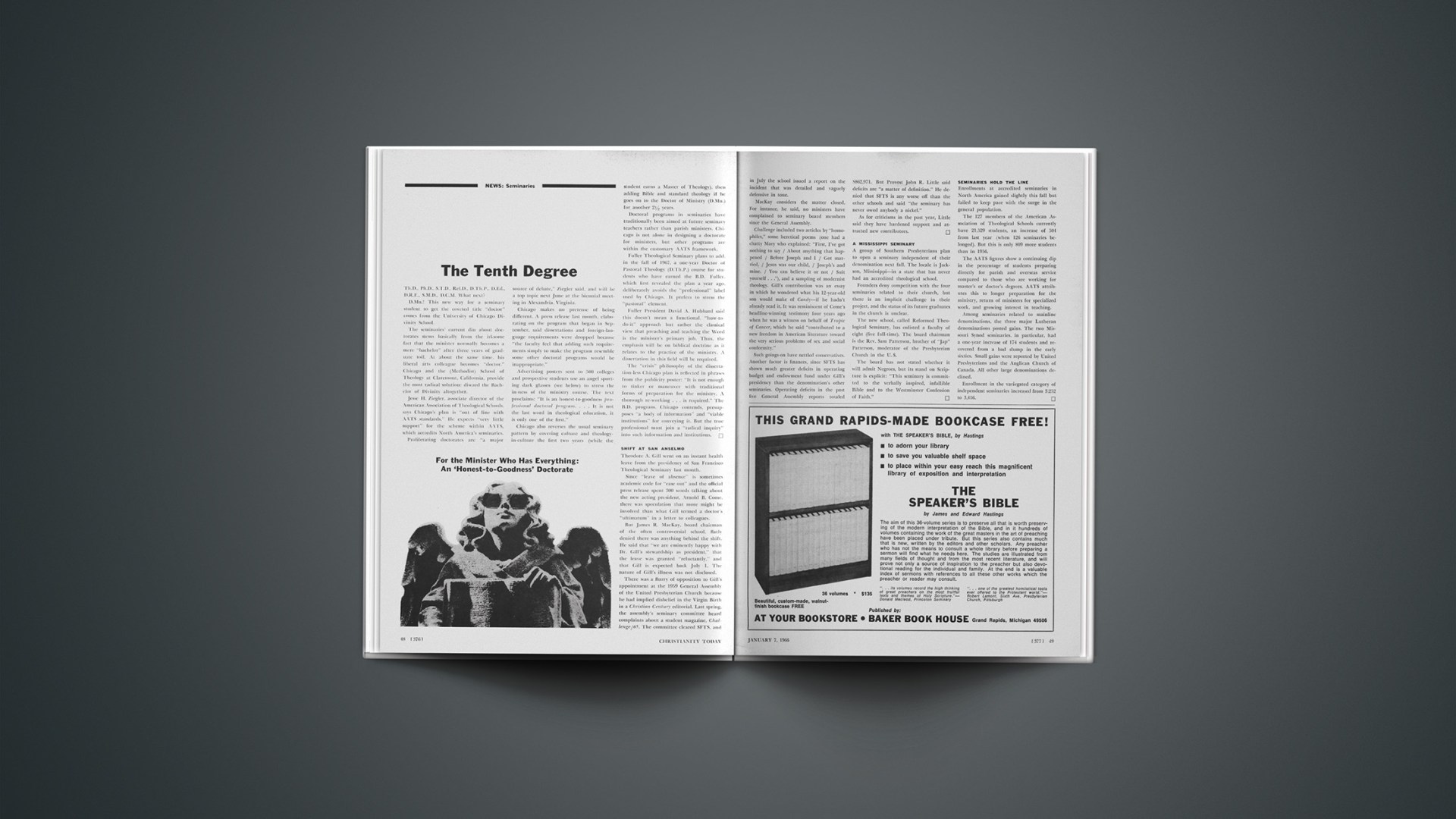
Advertising posters sent to 500 colleges and prospective students use an angel sporting dark glasses (see below) to stress the in-ness of the ministry course. The text proclaims: “It is an honest-to-goodness professional doctoral program.… It is not the last word in theological education, it is only one of the first.”

Chicago also reverses the usual seminary pattern by covering culture and theology-in-culture the first two years (while the student earns a Master of Theology), then adding Bible and standard theology if he goes on to the Doctor of Ministry (D.Mn.) for another 2½ years.

Doctoral programs in seminaries have traditionally been aimed at future seminary teachers rather than parish ministers. Chicago is not alone in designing a doctorate for ministers, but other programs are within the customary AATS framework.

Fuller Theological Seminary plans to add, in the fall of 1967, a one-year Doctor of Pastoral Theology (D.Th.P.) course for students who have earned the B.D. Fuller, which first revealed the plan a year ago, deliberately avoids the “professional” label used by Chicago. It prefers to stress the “pastoral” element.

Fuller President David A. Hubbard said this doesn’t mean a functional, “how-to-do-it” approach but rather the classical view that preaching and teaching the Word is the minister’s primary job. Thus, the emphasis will be on biblical doctrine as it relates to the practice of the ministry. A dissertation in this field will be required.

The “crisis” philosophy of the dissertation-less Chicago plan is reflected in phrases from the publicity poster: “It is not enough to tinker or maneuver with traditional forms of preparation for the ministry. A thorough re-working … is required.” The B.D. program, Chicago contends, presupposes “a body of information” and “viable institutions” for conveying it. But the true professional must join a “radical inquiry” into such information and institutions.

Shift At San Anselmo

Theodore A. Gill went on an instant health leave from the presidency of San Francisco Theological Seminary last month.

Since “leave of absence” is sometimes academic code for “ease out” and the official press release spent 500 words talking about the new acting president, Arnold B. Come, there was speculation that more might be involved than what Gill termed a doctor’s “ultimatum” in a letter to colleagues.

But James R. MacKay, board chairman of the often controversial school, flatly denied there was anything behind the shift. He said that “we are eminently happy with Dr. Gill’s stewardship as president,” that the leave was granted “reluctantly,” and that Gill is expected back July 1. The nature of Gill’s illness was not disclosed.

There was a flurry of opposition to Gill’s appointment at the 1959 General Assembly of the United Presbyterian Church because he had implied disbelief in the Virgin Birth in a Christian Century editorial. Last spring, the assembly’s seminary committee heard complaints about a student magazine, Challenge/65. The committee cleared SFTS, and in July the school issued a report on the incident that was detailed and vaguely defensive in tone.

MacKay considers the matter closed. For instance, he said, no ministers have complained to seminary board members since the General Assembly.

Challenge included two articles by “homophiles,” some heretical poems (one had a chatty Mary who explained: “First, I’ve got nothing to say / About anything that happened / Before Joseph and I / Got married. / Jesus was our child, / Joseph’s and mine. / You can believe it or not / Suit yourself …”), and a sampling of modernist theology. Gill’s contribution was an essay in which he wondered what his 12-year-old son would make of Candy—if he hadn’t already read it. It was reminiscent of Come’s headline-winning testimony four years ago when he was a witness on behalf of Tropic of Cancer, which he said “contributed to a new freedom in American literature toward the very serious problems of sex and social conformity.”

Such goings-on have nettled conservatives. Another factor is finances, since SFTS has shown much greater deficits in operating budget and endowment fund under Gill’s presidency than the denomination’s other seminaries. Operating deficits in the past five General Assembly reports totaled $862,971. But Provost John R. Little said deficits are “a matter of definition.” He denied that SFTS is any worse off than the other schools and said “the seminary has never owed anybody a nickel.”

As for criticisms in the past year, Little said they have hardened support and attracted new contributors.

A Mississippi Seminary

A group of Southern Presbyterians plan to open a seminary independent of their denomination next fall. The locale is Jackson, Mississippi—in a state that has never had an accredited theological school.

Founders deny competition with the four seminaries related to their church, but there is an implicit challenge in their project, and the status of its future graduates in the church is unclear.

The new school, called Reformed Theological Seminary, has enlisted a faculty of eight (five full-time). The board chairman is the Rev. Sam Patterson, brother of “Jap” Patterson, moderator of the Presbyterian Church in the U. S.

The board has not stated whether it will admit Negroes, but its stand on Scripture is explicit: “This seminary is committed to the verbally inspired, infallible Bible and to the Westminster Confession of Faith.”

Seminaries Hold The Line

Enrollments at accredited seminaries in North America gained slightly this fall but failed to keep pace with the surge in the general population.

The 127 members of the American Association of Theological Schools currently have 21,529 students, an increase of 504 from last year (when 126 seminaries belonged). But this is only 809 more students than in 1956.

The AATS figures show a continuing dip in the percentage of students preparing directly for parish and overseas service compared to those who are working for master’s or doctor’s degrees. AATS attributes this to longer preparation for the ministry, return of ministers for specialized work, and growing interest in teaching.

Among seminaries related to mainline denominations, the three major Lutheran denominations posted gains. The two Missouri Synod seminaries, in particular, had a one-year increase of 174 students and recovered from a bad slump in the early sixties. Small gains were reported by United Presbyterians and the Anglican Church of Canada. All other large denominations declined.

Enrollment in the variegated category of independent seminaries increased from 3,252 to 3,416.

Cover Story

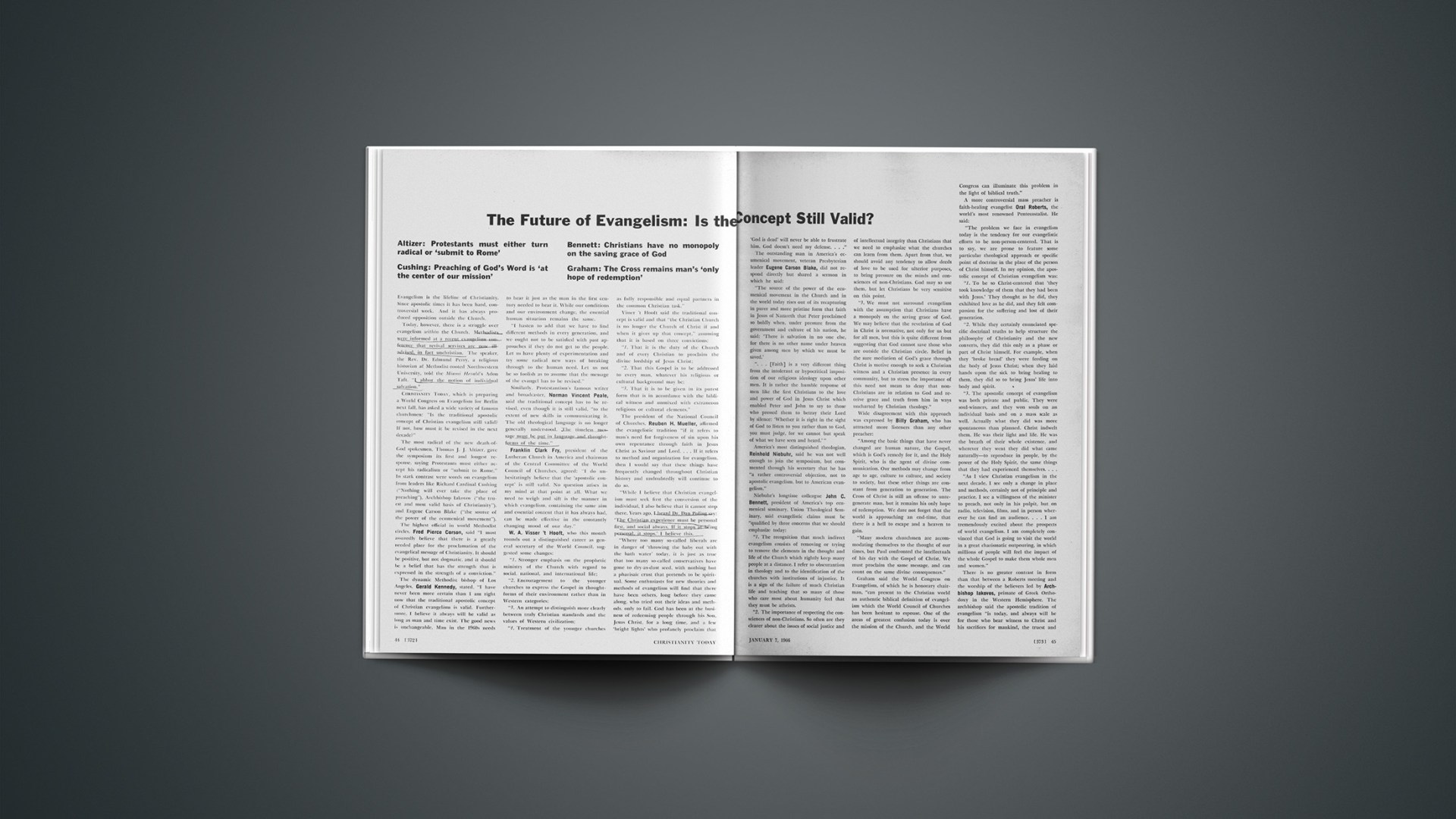
The Future of Evangelism: Is the Concept Still Valid?

Altizer: Protestants must either turn radical or ‘submit to Rome’

Bennett: Christians have no monopoly on the saving grace of God

Cushing: Preaching of God’s Word is ‘at the center of our mission’

Graham: The Cross remains man’s ‘only hope of redemption’

Evangelism is the lifeline of Christianity. Since apostolic times it has been hard, controversial work. And it has always produced opposition outside the Church.

Today, however, there is a struggle over evangelism within the Church. Methodists were informed at a recent evangelism conference that revival services are now ill advised, in fact unchristian. The speaker, the Rev. Dr. Edmund Perry, a religious historian at Methodist-rooted Northwestern University, told the Miami Herald’s Adon Taft, “I abhor the notion of individual salvation.”

CHRISTIANITY TODAY, which is preparing a World Congress on Evangelism for Berlin next fall, has asked a wide variety of famous churchmen: “Is the traditional apostolic concept of Christian evangelism still valid? If not, how must it be revised in the next decade?”

The most radical of the new death-of-God spokesmen. Thomas J. J. Altizer, gave the symposium its first and longest response, saying Protestants must either accept his radicalism or “submit to Rome.” In stark contrast were words on evangelism from leaders like Richard Cardinal Cushing (“Nothing will ever take the place of preaching”), Archbishop Iakovos (“the truest and most valid basis of Christianity”), and Eugene Carson Blake (“the source of the power of the ecumenical movement”).

The highest official in world Methodist circles, Fred Pierce Corson, said “I most assuredly believe that there is a greatly needed place for the proclamation of the evangelical message of Christianity. It should be positive, but not dogmatic, and it should be a belief that has the strength that is expressed in the strength of a conviction.”

The dynamic Methodist bishop of Los Angeles, Gerald Kennedy, stated. “I have never been more certain than I am right now that the traditional apostolic concept of Christian evangelism is valid. Furthermore, I believe it always will be valid as long as man and time exist. The good news is unchangeable. Man in the 1960s needs to hear it just as the man in the first century needed to hear it. While our conditions and our environment change, the essential human situation remains the same.

“I hasten to add that we have to find different methods in every generation, and we ought not to be satisfied with past approaches if they do not get to the people. Let us have plenty of experimentation and try some radical new ways of breaking through to the human need. Let us not be so foolish as to assume that the message of the evangel has to be revised.”

Similarly, Protestantism’s famous writer and broadcaster, Norman Vincent Peale, said the traditional concept has to be revised, even though it is still valid, “to the extent of new skills in communicating it. The old theological language is no longer generally understood. The timeless message must be put in language and thought-forms of the time.”

Franklin Clark Fry, president of the Lutheran Church in America and chairman of the Central Committee of the World Council of Churches, agreed: “I do unhesitatingly believe that the ‘apostolic concept’ is still valid. No question arises in my mind at that point at all. What we need to weigh and sift is the manner in which evangelism, containing the same aim and essential content that it has always had, can be made effective in the constantly changing mood of our day.”

W. A. Visser ’t Hooft, who this month rounds out a distinguished career as general secretary of the World Council, suggested some changes:

“1. Stronger emphasis on the prophetic ministry of the Church with regard to social, national, and international life:

2. Encouragement to the younger churches to express the Gospel in thought-forms of their environment rather than in Western categories:

“3. An attempt to distinguish more clearly between truly Christian standards and the values of Western civilization;

“4. Treatment of the younger churches as fully responsible and equal partners in the common Christian task.”

Visser ’t Hooft said the traditional concept is valid and that “the Christian Church is no longer the Church of Christ if and when it gives up that concept,” assuming that it is based on three convictions:

1. That it is the duty of the Church and of every Christian to proclaim the divine lordship of Jesus Christ;

2. That this Gospel is to be addressed to every man, whatever his religious or cultural background may be:

“3. That it is to be given in its purest form that is in accordance with the biblical witness and unmixed with extraneous religious or cultural elements.”

The president of the National Council of Churches, Reuben H. Mueller, affirmed the evangelistic tradition “if it refers to man’s need for forgiveness of sin upon his own repentance through faith in Jesus Christ as Saviour and Lord.… If it refers to method and organization for evangelism, then I would say that these things have frequently changed throughout Christian history and undoubtedly will continue to do so.

“While I believe that Christian evangelism must seek first the conversion of the individual, I also believe that it cannot stop there. Years ago, I heard Dr. Dan Poling say: ‘The Christian experience must be personal first, and social always. If it stops at being personal, if stops.’ I believe this.

“Where too many so-called liberals are in danger of throwing the baby out with the bath water’ today, it is just as true that too many so-called conservatives have gone to dry-as-dust seed, with nothing but a pharisaic crust that pretends to be spiritual. Some enthusiasts for new theories and methods of evangelism will find that there have been others, long before they came along, who tried out their ideas and methods, only to fail. God has been at the business of redeeming people through his Son, Jesus Christ, for a long time, and a few ‘bright lights’ who profanely proclaim that ‘God is dead’ will never be able to frustrate him. God doesn’t need my defense.…”

The outstanding man in America’s ecumenical movement, veteran Presbyterian leader Eugene Carson Blake, did not respond directly but shared a sermon in which he said:

“The source of the power of the ecumenical movement in the Church and in the world today rises out of its recapturing in purer and more pristine form that faith in Jesus of Nazareth that Peter proclaimed so boldly when, under pressure from the government and culture of his nation, he said: ‘There is salvation in no one else, for there is no other name under heaven given among men by which we must be saved.’

“… [Faith] is a very different thing from the intolerant or hypocritical imposition of our religious ideology upon other men. It is rather the humble response of men like the first Christians to the love and power of God in Jesus Christ which enabled Peter and John to say to those who pressed them to betray their Lord by silence: ‘Whether it is right in the sight of God to listen to you rather than to God, you must judge, for we cannot but speak of what we have seen and heard.’ ”

America’s most distinguished theologian, Reinhold Niebuhr, said he was not well enough to join the symposium, but commented through his secretary that he has “a rather controversial objection, not to apostolic evangelism, but to American evangelism.”

Niebuhr’s longtime colleague John C. Bennett, president of America’s top ecumenical seminary, Union Theological Seminary, said evangelistic claims must be “qualified by three concerns that we should emphasize today:

1. The recognition that much indirect evangelism consists of removing or trying to remove the elements in the thought and life of the Church which rightly keep many people at a distance. I refer to obscurantism in theology and to the identification of the churches with institutions of injustice. It is a sign of the failure of much Christian life and teaching that so many of those who care most about humanity feel that they must be atheists.

“2. The importance of respecting the consciences of non-Christians. So often are they clearer about the issues of social justice and of intellectual integrity than Christians that we need to emphasize what the churches can learn from them. Apart from that, we should avoid any tendency to allow deeds of love to be used for ulterior purposes, to bring pressure on the minds and consciences of non-Christians. God may so use them, but let Christians be very sensitive on this point.

“3. We must not surround evangelism with the assumption that Christians have a monopoly on the saving grace of God. We may believe that the revelation of God in Christ is normative, not only for us but for all men, but this is quite different from suggesting that God cannot save those who are outside the Christian circle. Belief in the sure mediation of God’s grace through Christ is motive enough to seek a Christian witness and a Christian presence in every community, but to stress the importance of this need not mean to deny that non-Christians are in relation to God and receive grace and truth from him in ways uncharted by Christian theology.”

Wide disagreement with this approach was expressed by Billy Graham, who has attracted more listeners than any other preacher:

“Among the basic things that have never changed are human nature, the Gospel, which is God’s remedy for it, and the Holy Spirit, who is the agent of divine communication. Our methods may change from age to age, culture to culture, and society to society, but these other things are constant from generation to generation. The Cross of Christ is still an offense to unregenerate man, but it remains his only hope of redemption. We dare not forget that the world is approaching an end-time, that there is a hell to escape and a heaven to gain.

“Many modern churchmen are accommodating themselves to the thought of our times, but Paul confronted the intellectuals of his day with the Gospel of Christ. We must proclaim the same message, and can count on the same divine consequences.”

Graham said the World Congress on Evangelism, of which he is honorary chairman, “can present to the Christian world an authentic biblical definition of evangelism which the World Council of Churches has been hesitant to espouse. One of the areas of greatest confusion today is over the mission of the Church, and the World Congress can illuminate this problem in the light of biblical truth.”

A more controversial mass preacher is faith-healing evangelist Oral Roberts, the world’s most renowned Pentecostalist. He said:

“The problem we face in evangelism today is the tendency for our evangelistic efforts to be non-person-centered. That is to say, we are prone to feature some particular theological approach or specific point of doctrine in the place of the person of Christ himself. In my opinion, the apostolic concept of Christian evangelism was:

“1. To be so Christ-centered that ‘they took knowledge of them that they had been with Jesus.’ They thought as he did, they exhibited love as he did, and they felt compassion for the suffering and lost of their generation.

“2. While they certainly enunciated specific doctrinal truths to help structure the philosophy of Christianity and the new converts, they did this only as a phase or part of Christ himself. For example, when they ‘broke bread’ they were feeding on the body of Jesus Christ; when they laid hands upon the sick to bring healing to them, they did so to bring Jesus’ life into body and spirit.

“3. The apostolic concept of evangelism was both private and public. They were soul-winners, and they won souls on an individual basis and on a mass scale as well. Actually what they did was more spontaneous than planned. Christ indwelt them. He was their light and life. He was the breath of their whole existence, and wherever they went they did what came naturally—to reproduce in people, by the power of the Holy Spirit, the same things that they had experienced themselves.…

“As I view Christian evangelism in the next decade, I see only a change in place and methods, certainly not of principle and practice. I see a willingness of the minister to preach, not only in his pulpit, but on radio, television, films, and in person wherever he can find an audience.… I am tremendously excited about the prospects of world evangelism. I am completely convinced that God is going to visit the world in a great charismatic outpouring, in which millions of people will feel the impact of the whole Gospel to make them whole men and women.”

There is no greater contrast in form than that between a Roberts meeting and the worship of the believers led by Archbishop lakovos, primate of Greek Orthodoxy in the Western Hemisphere. The archbishop said the apostolic tradition of evangelism “is today, and always will be for those who bear witness to Christ and his sacrifices for mankind, the truest and most valid basis of Christianity. Any qualification of this truism, however, centers on the meaning of the word ‘traditional.’ Even in early Christianity, traditional evangelistic concepts were augmented in the Church of Christ by the traditions of rite and ritual that took on living forms of worship and teaching, as they relate to everyday life.

“With the advent of the ecumenical movement for Christian unity, the churches of Christ have been increasingly seeking, working within a framework of basic evangelism, to bring the living force of the oneness of Christ’s Church to bear upon a multiplicity of problems involving humanitarian, social, and economic concerns. The evangelism of the next decade, and of the decades to come, must take into account these present considerations, so that the Gospel will continue to have essential meaning for all mankind for the betterment of man’s lot, as Christ himself intended in his precepts.”

Thomas J. J. Altizer also talked of the ecumenical trend, but rather than discussing evangelism as such, he said: “If the Protestant today is truly to accept a vocation of world evangelism, he must return to his radical roots.” Altizer then provided a much-sought definition of “radical Christians”:

“First, such Christians rebel against the Christian churches and their traditions, with the conviction that Christendom as a whole has betrayed its original foundations and regressed not simply to a pre-Christian but also to a demoniac and repressive religious form. They believe that Christendom has sealed Jesus in his tomb and resurrected the very evil and darkness that Jesus conquered, by [its] worshiping a transcendent Creator who is an absolutely sovereign and wholly other transcendent Judge.

“Again, they defy the moral law of the churches, identifying it as a satanic law of repression and heteronomous compulsion, and calling instead for a reversal of this law and an antinomian Christian freedom. So likewise they believe that the salvation history proclaimed by orthodox doctrine and liturgy isolates the reality of salvation in a distant and irrecoverable past, thereby foreclosing the possibility of the actual presence of Jesus or the Word in an actual and contemporary present.

“Finally, radical Christians are spiritual or apocalyptic in that they believe only in the Jesus of the third age of the Spirit, a Jesus who is not to be identified with the original historical Jesus, but who rather is known here in a new and more comprehensive and universal form, a form actualizing the eschatological promise of Jesus.

“Believing that Christendom has wholly negated the original Jesus, the radical Christian seeks a way to the new presence and reality of Jesus by returning to Jesus’ original apocalyptic proclamation with the conviction that such a return demands both an assault upon the established churches and a quest for a total or apocalyptic redemption. Here, everything depends upon the meaning of an apocalyptic redemption, for its original meaning was certainly lost in the long course of the history of Christendom, and the radical Christian faces the task not only of discovering that meaning but also of mediating it in a new and ‘spiritual’ form to his own time and situation.…”

Altizer said that after watching the papacy of John and Vatican II, “the honest Protestant must now face the question whether or not he should return to a Catholic Church that so obviously is in process of reforming itself. Moreover, the judgment would seem to be inescapable that the Body of Christ is far more active and real in the life of the Roman church than in the increasingly sterile Protestant denominations.…”

Radical Protestantism is the answer, he contends. If it is refused, then surely we “must submit to Rome! For surely it is Judicrous to imagine that an authentic Protestantism must be more traditional or more ‘orthodox’ than Rome.…”

The most colorful and quotable figure in America’s Roman Catholic hierarchy, Richard Cardinal Cushing, stated:

“Nothing will ever take the place of the preaching of God’s Worth which stands at the center of our Christian mission. How can we forget the Lord’s admonition: ‘Go into the whole world, preach the Gospel to every creature’? Yet we know that each generation must hear the evangelical message in terms that make it meaningful for man in the environment in which he lives. In this sense, the unchanging revelation of God must change its emphasis as the challenges of each age rise and fall.

“For Catholics, the apostolate of the Word has received a massive new impetus from the discussions and the decrees of Vatican Council II. Perhaps most visibly in the revisions of the Sacred Liturgy, which Catholics call the Mass, we see a new honor and prominence given to the Scriptures; with this the new emphasis on the homily, which should elaborate in simple terms the evangelical texts, is of high significance. The new developments in the so-called Bible Vigil, aside from its ecumenical aspects, are for Catholics a return to the sources of faith and the Word delivered to the saints.

“The Council Fathers have made a point of stressing, in their theological declarations, the strong evangelical roots of Catholic teaching, most notably perhaps in the constitution on the Church, which in so many ways is the fundamental document of the council. All of this is bound to have an effect in focusing Catholic attention on the Word of God in a way that will reveal itself in the total apostolate. We will surely see the fruits of all of this in the life of the church in the years ahead.

“Important, however, as will be the evangelical element, Catholics will of course continue to give attention to the immense riches of sacramental life, especially Baptism and the Eucharistic sacrifice. We are led to salvation by all the means given to us by the Lord, and we neglect any of them only at the peril of our soul.”

James R. Mutchmor is the eminent elder statesman of the United Church of Canada, one of the pioneer results of the ecumenical movement. He began by quoting a statement from the 1937 Oxford Conference: “The Church has many duties laid upon her, the chief of which is to proclaim the Word of God, to make disciples for Jesus Christ, and to order her life through the power of the Holy Spirit dwelling in her.” Mutchmor endorsed this as “sound evangelical teaching for today and tomorrow” that is New Testament-based.

“It is difficult, not to say presumptuous, to put God to the test to get support for the validity today of the apostolic concept of evangelism. Two things may be considered as well within the range and right of human inquiry.

“First, we begin with ourselves and our affluent society. And here let us think chiefly of our North American situation. It may be described by five words: production, power, pride, profligacy, and paganism. North America, with about one-twelfth of the world’s population, produces one-half of its goods and services. Our technological society is in high gear. This production gives us power, and as Lord Acton once remarked: ‘All power tends to corrupt and absolute power corrupts absolutely.’ So we are given to pride. It rules our wills. The steps to profligacy and paganism are short and steeply downward. Thus, in spite of our welfare society, our high finance, our amazing scientific achievements, our sins of pride and profligacy are too great a part of our record. We stand in need of God’s help. We are fearful in this thermonuclear day of a handful of atomic dust. We could tragically become the victims of angry men.

“Against this human dilemma the New Testament offers four wonderful words of life and hope. They are: repent, believe, go, and give. It’s hard for modern man to accept the essential need of the ‘turn ye’ to repentance, but there is no other door to God’s redeeming love. It’s the narrow and only door, and everyone who would be a child of God must humble himself and enter by the gate of repentance.

“The other words speak for themselves. The vital one is belief or faith. The just are to live by faith. Faith calls for trust and obedience. In spite of demythologizing and existentialism, faith today is deep and strong. The ‘go’ and ‘give’ are powerful apostolic and evangelistic words. Every last believer is a member of the apostolate. Always those in whose hearts Christ has made his home are disciple-making disciples. So the fellowship of believers grows with Jesus Christ and his cross and his resurrection in the midst. The fellowship grows to heal and bless even unto eternal life.”

Evangelical Jews?

America’s Reform Jews are rethinking their ideas about reaching and converting those outside their religion. This trend, added to the Vatican’s headline-making declaration on Jews, makes 1965 a landmark year in Christian-Jewish relations.

Concern about converts has been growing for years, spurred on by Gentiles who marry Jews and want to join the faith. By one estimate, 98 per cent of the converts come through marriage, their motives ranging from convenience to conviction.

A year ago, Dr. Maurice Eisendrath, president of the Union of American Hebrew Congregations, asked his Committee on Proselytism to bring a proposal on conversions to the UAHC convention, held in San Francisco last month.

The committee decided Jews should say clearly that “we shall seek converts among the unaffiliated, both the unsynagogued and the unchurched.” The report said some persons come to Judaism on their own, but “many more would be added to our congregations if we were more active and out-reaching in making Reform Judaism known and in telling the unchurched as well as the unsynagogued that a warm welcome awaits them, and a secure outlook can be found in their joining the household of Israel.”

Until the rise of Christianity, Judaism was quite evangelical in confronting the pagan religions which surrounded it. But this ended abruptly in A.D. 315 when the Emperor Constantine decreed that Jews who sought converts or persons who switched to Judaism would be executed. Later, militant Islam further drove the Jewish religion into a stance of defensive self-preservation. The Jews’ religious relativism was reinforced by the rabbinical law that only idol-worshipers are a legitimate target for proselytism.

The committee report which called for a change in this historic attitude was bolstered by Eisendrath’s own speech on the subject in San Francisco. “Our failure to launch an aggressive program of conversion reflects, I fear, an unbecoming distrust of the Gentile—an unpleasant, provincial attitude toward our faith, as if it were an exclusive club into which one has to be born.”

Some convention delegates proved more club-conscious than the committee, and the final resolution was watered down. Now the newly named Committee for the Winning of the Unaffiliated from the UAHC, which is dominated by laymen, must coordinate planning with a similar committee from the Central Conference of American Rabbis, the organization of Reform clergymen.

The head of the UAHC group, Boston can manufacturer Solomon Stern, and the CCAR chairman, Baltimore Rabbi Abraham Shusterman, joined a third man to write the report which went to San Francisco. Stern plans to be on hand in New York December 22 when Shusterman’s committee discusses what to propose to the rabbis at their meeting next June.

Whatever form the outreach takes, it won’t be called evangelism, a word distasteful to many Jews. They will use a small-scale, tolerant, educational approach. Some of the more dramatic ideas in the hopper are reading rooms à la Christian Science, films and pamphlets, and mass media advertising.

Jews aren’t interested in converting active members of Christian churches, and some Christians would like their faith to reciprocate. One is the Rev. Dr. Frederick Grant, former president of Seabury-Western Theological Seminary and professor emeritus at Union Theological Seminary. Last month, Episcopalian Grant, in a Sunday morning lecture at the Washington Hebrew Congregation (Reform), gave a resounding “No” to his title question, “Should Christians Seek Jewish Converts?”

Grant said a yes would be necessary if one believed all mankind was destined to hell apart from faith in Jesus Christ, but he doesn’t believe that. He listed several reasons why conversion is not necessary:

First, efforts to convert Jews have proven futile. Second, since the basic principle of Christianity is found in Judaism, why would one want to seek conversions? When a barbarian became a Christian there was a real change of life, Grant said, but when a Jew is converted, he simply adds “some additional matters” to what he already believes. Grant also said conversions are in “bad taste.”

Host Rabbi Norman Gerstenfeld couldn’t agree more: “No Jewish scholar could possibly object to anything Grant said.”

Book Briefs: January 7, 1966

Calvinism And Revolution

Calvinism and the Political Order, edited by George L. Hunt (Westminster, 1965, 216 pp., $4.50), is reviewed by Dirk W. Jellema, professor of history, Calvin College, Grand Rapids, Michigan.

This compact book (essentially 150 pages plus summary and notes) gives an excellent and scholarly introduction to two main themes: the political theory of Calvinism in its heyday (roughly 1550–1700) and the influence this theory had in America. The title is somewhat misleading; this is not a systematic study. In format, it is a series of essays on leading figures whose political ideas illustrate these themes. The essays deal with Calvinism, Calvin, Mornay, Rutherford (from the “classic age” of Calvinism); with John Locke, and the Puritans (strongly influenced by Calvinist motifs); and with Witherspoon, Lincoln, and Wilson (as Americans sympathetic to Calvinist emphases). The essays, originally given as lectures under the Woodrow Wilson Lectureship of the United Presbyterian Church’s National Presbyterian Center, are by experts, and the scholarship is thoroughly competent.

How did Calvinist political theory influence America? In at least two important ways, it becomes clear. First, much of the theoretical justification for our American Revolution is drawn from arguments developed by men like Locke, Mornay, Rutherford, and Calvin himself. Second, Calvinism’s stress on the civic responsibility of the Christian led, through Puritanism, to the American’s strong sense of this duty. Further, as the editor notes in his summary essay, concern with political and social problems does not begin with the modern social gospel but is part of a long tradition. Many other points of interest are touched on, such as the religious background of American ideas of toleration and the continuity between ideas of the “godly commonwealth” (as in Geneva) and later conviction of America’s God-given destiny.

What were the main concerns of the Calvinist political theorists? To begin with, of course, they desired to work out what they considered God’s will to be in this field—more particularly, to strike a balance between order and freedom. What materials did they use? As several of the essays make clear, they drew heavily not only on Scripture but also on medieval political thought and on the Graeco-Roman idea of the “law of nature.” (One is led to suspect that evangelicals interested in building a contemporary political theory might examine these sources, both generally unfamiliar.)

Despite Calvinist concern with order and authority, the defense of revolt against tyranny struck the rising absolute monarchs of the time as radical and seditious (and, indeed, wherever Calvinism spread, revolution followed). Something of the impact of the emphasis on the right (nay, the duty) to revolt against tyranny may perhaps be recaptured by applying the emphasis to contemporary situations. Do the “inferior magistrates” of a country such as, say, Haiti or Paraguay have the God-given duty to revolt against their tyrant? Should evangelicals say so? Even if the State Department objects? The issues debated by Mornay and the others are by no means dead issues.

A lecture series devoted to a broad theme frequently results in a “scatter-gun” approach that gives no sense of continuity. This series avoids this danger more than most. Readable as well as scholarly, compact as well as meaty, interesting and thought-provoking, it deserves recommendation.

DIRK W. JELLEMA

Adventure

The Adventure of Living, by Paul Tournier, translated by Edwin Hudson (Harper and Row, 1965, 250 pp., $5.75), is reviewed by Orville S. Walters, director of health services and lecturer in psychiatry, University of Illinois, Urbana.

This is Paul Tournier’s ninth book. The popularity of his writings cannot be attributed to the new or the profound, for there is little of either. He is referred to as a psychiatrist, and many of his examples are drawn from psychogenic illness; but his expositions are elementary, and no theoretical orientation is identifiable, unless it be the nondirective therapy he professes to employ. At times, his invoking of the unconscious implies a broad acceptance of Freud. Again, his emphasis upon meaning suggests common cause with Viktor Frankl. And his stress upon the whole person is often reminiscent of Daseinsanalyse. But Tournier’s frank acceptance of the Bible as divine revelation and his recurrent references to God’s sovereignty set him outside all contemporary psychology.

The Swiss physician has become noted as the leading spokesman and advocate of “the medicine of the person,” which seeks to make medicine “more humane” and commits the doctor to man-to-man dialogue with his patient. In every age, he believes, the best doctors have understood that man needs help in becoming a person, as well as medicines. His earlier books have elaborated this view. This concern for the individual in a time when the art has been increasingly supplanted by the science of medicine doubtless accounts for some of his popularity. The chatty, discursive character of his writing, which seems to record a process of thought just short of free association, may also attract lay readers. The inclusion of many examples from his medical practice adds interest.

Troubled neither by psychology’s rejection of the general concept of instincts nor by the limited acceptance of another well-known dual-instinct personality theory, Tournier postulates that man possesses an inborn instinct for adventure that is opposed by a second instinct for repose or fixity. This concept, more poetic and inspirational than scientific, provides the framework for the present book.

Since man is made in the image of God, Tournier reasons, the spirit of adventure exists in God himself. The creation of man in his own image was the great adventure for God, resulting in the tragedy of the Fall and continuing in the adventure of salvation. Jesus, too, was an adventurer, flouting the codes of his contemporaries, denouncing the hypocrisy of their morality, accepting the crucifixion. The Bible must be read as a volume of adventure.

The book is divided into chapters and sections, but there are few clear lines of division. Tournier ranges freely in and out of medicine, psychology, psychotherapy, and theology, unbound by precise definition or construction. There are fewer of the pat success stories that occur in his earlier writings, and he gives numerous warnings against oversimplification. References to literature are usually meant to give credit to a contemporary for some approved idea, rather than to lay the foundation for an orderly synthesis of psychology and Christian faith. Critics will find some of his positions inadequately developed, as when he asserts that “man is in a state of perpetual natural neurosis,” or when he seems to accept a situational ethic—“answers … depend upon the circumstances of the time.” Others will consider his reasoning superficial, as when he decided to resume smoking as an antidote to his own Pharisaism.

Tournier’s most valuable contribution in all his writing is his warm-hearted Christian testimony, “If is my own personal experience of God’s power that gives me the certainty that he can transform my patient’s life just as he transformed mine.” This fervid account of Paul Tournier’s zestful adventures with God is sure to inspire many of his leaders to break out of “fixity” and mediocrity to launch a similar spiritual adventure.

ORVILLE S. WALTERS

It’S A Hit

Sensei: The Life Story of Irene Webster-Smith, by Russell T. Hill. (Harper and Row, 1965, 250 pp., $3.95), is reviewed by D. Bruce Lockerbie, chairman, Department of English, The Stony Brook School, Stony Brook, New York.

I first read about the remarkable ministry of Irene Webster-Smith, whom her friends know as “Sensei” or “teacher,” in Richard Gehman’s Let My Heart Be Broken. That book, a cursory glimpse into the work of World Vision, treated Miss Webster-Smith as an important tog in the machinery of Christian social services cooperating with Dr. Bob Pierce’s organization. The treatment given “Sensei” was necessarily sketchy.

Not so in this fuller portrait drawn by Russell T. Hitt. Sensei is the newest volume in Harper and Row’s “Missionary Classics” series, narrated in very human terms. The books in this series are not treatises on the philosophical implications of foreign missions, nor psychological studies of the missionary. The “Missionary Classics” attempt only to answer the layman’s questions: “Why does the missionary go? What does she do?”

In the case of Sensei, the first question requires an explanation of the early life and training of Irene Webster-Smith. Born into an aristocratic Irish home, the young woman had every reason to anticipate a useful life of service at home. Perhaps she would become the wife of a pastor, for she was loved by a young ministerial student whom she had all but agreed to marry. But the need for someone to help in the unenviable labor of rescuing Japanese girls from the life of a geisha compelled this dynamic woman to offer her life to God.

To the second question Russell Hitt devotes most of his book. “Sensei,” like George Mueller before her, operates homes for children by trusting God for his provision. Having begun by trying to reach the young prostitutes, she quickly decided that “it is better to place a fence at the top of the cliff than an ambulance at the bottom.” Her approach, therefore, has been to ransom little girls before they are sold to the merciless tutors who will train them for immorality.

Some of “Sensei’s” stories are not unique: they are the reiterated evidences of God’s grace upon many faithful servants—the provision of food, clothing, or gifts of money at the crisis point. In other respects Irene Webster-Smith’s ministry has been unique. It was she whom General Douglas MacArthur invited to be the first missionary to return to Japan during the occupation; she who turned the Sugamo prison, full of Japanese war criminals, from a place of despair into a place of shining hope by her direct witness to the conquered and condemned Nipponese soldiers.

Sensei, told with all the warmth it deserves, is more than a typically inspiring missionary biography; it is a searching examination of the reader’s own dedication.

D. BRUCE LOCKERBIE

It Is A Bit Awkward

Teen-Agers and Sex: A Guide for Parents, by James A. Pike (Prentice-Hall, 1965, 146 pp., $3.95), is reviewed by Bernard E. Pekelder, college chaplain, Calvin College, Grand Rapids, Michigan.

This book was written not for the teenager but for his parents. The author, who is the Episcopal bishop of California, is convinced that there is no substitute for direct parental involvement in sex education.

In the sexual revolution of our day, youth face two conflicting standards of sexual conduct. The first the author describes as conventional, authoritarian, absolutistic; the other, the “new morality,” as existential and situational.

But Bishop Pike’s concern is not the right or wrong of these conflicting norms of conduct. He tries to detach himself from the role of ethical judge. In fact, he affirms that “though it would appear that as to sex ethics there is a distinct cleavage between absolutists and existentialists, in application there actually is not.” Thus in his role as mentor he feels he must take into account both sets of convictions if he is to give a “sensible plan of instruction and guidance.”

Yet this effort at ethical detachment does not come off very successfully. When the bishop describes his counseling role with a pregnant college girl, his existential slip shows rather noticeably (p. 84). He spends much more effort warning about chuck-holes on the conventional road (and the warnings are appropriate!) than about the rockiness of the existential road. His stance is unmistakable; one wishes he had stated it as clearly as he has in other writings.

This is not to criticize the bishop for lack of candor; indeed, one has come to expect candor from him. But in this book his effort to help people who stand at both ends of the moral spectrum is at best ambiguous, and at worst confusing. Don’t get this book if you expect clear guidance out of the moral confusion of our day; it is not written for this purpose (p. 3).

There are, however, good insights into the psychological and social factors influencing parent and child. Parents are given good advice about their own embarrassment and reluctance in this counseling role. Bishop Pike offers practical suggestions about approaching the child from age five on. Relevant issues are faced: sexual identity, petting, masturbation, premarital coitus, homosexuality, alcohol and sex.

But I was disappointed with this book. It is no better or worse than many other books available to parents who wish some social and psychological insights into proper sex education for their children. Undoubtedly my disappointment is the result of expectations I have when a Christian minister serves notice that he will be a guide in an age of moral confusion. I cannot see this role fulfilled by one who, facing the fork in the road, tries on proceed with one foot on each path. As I watch him do the split, meanwhile hearing him offer to show me the way down either or both paths. I do not only think he looks awkward; I begin to doubt his value as a guide.

BERNARD E. PEKELDER

The Old Modern Problem

God and World in Early Christian Theology, by Richard A. Norris, Jr. (Seabury, 1965, 177 pp., $4.95), is reviewed by Geoffrey W. Bromiley, professor of church history and historical theology, Fuller Theological Seminary, Pasadena, California.

This modest book is a valuable and important attempt to bring some of the pioneers of Christian theology into relation to the philosophical world of their day. It begins with a rapid but lucid and informative presentation of Greek thought from its beginning to Middle Platonism. It then studies in turn Justin Martyr, Irenaeus, Tertullian, and Origen in their varying interactions with Platonism and Gnosticism. A concluding chapter is devoted to an assessment of the achievements of these fathers.

The size of the book naturally precludes any detailed discussion. Only selected aspects of the writers can be dealt with, and even within these bounds the author has to seize on what he takes to be the essentials. This means that the reader not well acquainted with the field has to take a good deal on trust. On the other hand, Dr. Norris proves to be a reliable guide, and he is able to support his statements with apt quotations or references that are easily verified and amplified in the many available English editions of the works of the four writers.

The main importance of the work, however, is topical rather than historical. The questions raised are in every way modern. Was early theology right in making as much use as it sometimes did of philosophical materials and categories? How is a reasoned presentation of the Christian faith to relate to contemporary non-Christian modes of thought? How far may one safely go in making the Gospel relevant to the modern intellectual scene? All the great theologians of the day are in fact wrestling with these questions, though from different angles, and every preacher faces them when he attempts to present the revealed message to modern man.

Norris himself has some important insights to offer as he contemplates the successes, and especially perhaps the failures, of these early writers. In particular, he points out that in this accommodation there is always an element of tension or imbalance. Something has to go, and the danger is that it will be the essential matter of the revealed Gospel. If there is a criticism to be made of the study, it is perhaps that Norris tends to accept too easily the legitimacy of the attempt at fusion, of the transformation of the Gospel itself into a world-picture comparable with those offered by philosophy. Does a linguistic translation really have to be accompanied by this type of material transposition? In the measure that the fathers created a Christian theology in terms of contemporary philosophy, did they not perhaps introduce an inescapable element of falsification that has plagued Christian theology ever since? On the other hand, the mere fact that these deep issues are raised is a testimony to the value of the study, and the historical data Norris provides should give substance to many modern discussions of these problems.

It is a great pity, by the way, that the mixed letters of the jacket (e.g., CHRiSTiaN) give an air of the kindergarten to this serious work, and we trust that they do not give evidence of another of the stupid fads that the search for novelty initiates and that common sense fortunately brings to a just and speedy end.

GEOFFREY W. BROMILEY

The Fire And The Word

World Aflame, by Billy Graham (Doubleday, 1965, 267 pp., $3.95), is reviewed by David Allan Hubbard, president, Fuller Theological Seminary, Pasadena, California.

It would be hard to imagine a better summary of the major themes and central emphases of Mr. Graham’s preaching ministry. The combinations of law and Gospel, of judgment and grace, and of exhortation and invitation that stamp his evangelistic sermons have left their mark on his latest book.

The writing is simple and straightforward. Graham begins with an analysis of the human predicament, strikingly illustrated by the political, social, emotional, and moral chaos of our times. Next he shows how various human attempts to cope with this predicament have plunged twentieth-century man into even darker despair. The great gulf between man’s aspirations and his achievements cannot be bridged by cunning or muscle.

The answer to the rash of fires that has set our world aflame is symbolized by the burning bush—the revelation of God. What we could not discover for ourselves, God has made clear in his Word. The central figure of the written Word is Jesus Christ, the living Word. Three key chapters deal with his uniqueness, the meaning of his cross, and the importance of his resurrection.

Having laid the doctrinal foundation in the saving acts of Christ, Graham proceeds to explain conversion and the new life that flows from it. One of the fruits of the new life is a new social concern, to which the book gives about twenty pages—not as much as some might want to see, but enough to lay the ghost of the false accusations that Graham is interested in personal conversion only and not in the great social issues of the day. The book concludes with several chapters on the Second Coming and the full redemption and awful judgment which that event triggers.

All in all, World Aflame brings to the printed page what we have learned to expect and appreciate in Mr. Graham’s ministry: directness, simplicity, clarity, and conviction. Man’s inner needs are painfully exposed, and the healing grace of Jesus Christ is skillfully applied. One would be hard pressed to think of a better book to give a friend who wanted to know what the Christian message was all about. The compelling preaching that God has used to bring thousands to conversion in the arenas and stadiums of the world will now be heard in the family rooms and dens of our land. The impact, one feels, will be much the same.

DAVID ALLAN HUBBARD

On Saints And Sinners

Man’s Nature and His Communities: Essays on the Dynamics and Enigmas of Man’s Personal and Social Existence, by Reinhold Niebuhr (Scribners, 1965, 125 pp., $5.95), is reviewed by James Daane, assistant editor,CHRISTIANITY TODAY.

I have wondered—in idle moments—whether the Reformed doctrine of common grace was developed to account for the empirical fact that sinners sometimes act more like saints than sinners. But if this were the motive, then existence, as Tillich maintained, would raise the questions to which Christian theology was then only permitted, belatedly, to provide the required answers. Such a theology of common grace would not be an authentic theology of revelation but merely the kind that Niebuhr calls a theology of “realism.”

In this book Niebuhr, who for thirty-two years taught Christian ethics at Union Seminary in New York, takes inventory from the perspective of his years and presents us with a final testament of his theology. As I read his book, I experienced a number of distinct feelings.

The first was that Niebuhr’s theology of man and his communities lacks the dimension of a transcendent revelation. His description of the nature of man is not derived from what the divine Word discloses man to be but from a very shrewd and astute observation of saints and sinners as they go marching along through history.

Niebuhr admits that in his Nature and Destiny of Man he made a “rather unpardonable pedagogical error.” He used the symbol of original sin, he says, after he had “taken pains to deny the historicity of the primitive myth of the fall of Adam in the garden, which Paul associated the doctrine of original sin.” He later discovered that the use of “original sin” as a symbol was a mistake: the modern world cannot be reached by such a symbol because it does not believe in a historic fall of man. Such a misreading of the empirical situation would seem to be an almost fatal flaw in a theology committed to the method of realism.

Secondly, as I read this book I had the feeling that, had it been written by a conservative Reformed theologian, it would be a book about common grace, i.e., a book that attempted to show how and why sinners often act and look like saints. Niebuhr is at pains in this book to show that man, the self-seeking sinner, nevertheless shows some altruism in life, for he learns that seeking the self absolutely is self-defeating. Similarly, nations, always moved by self-interest, do not in fact seek their own good absolutely, without overtures of good to other nations, because also on the national level, as on every other level of human community, absolute self-seeking is self-defeating. Sinful men and sinful communities ordinarily learn this hard truth from life itself, and therefore do not ordinarily seek to absolutize themselves in their exercise of freedom. Hence they take on the appearance of saints. The saints, on the other hand—and just because they deal with absolutes—tend to absolutize their self-interests and fall into idolatry. There is, therefore, according to Niebuhr, no essential difference between saints and sinners; the saints are simultaneously sinners, and sinners are usually somewhat saintly.

Knowing that Niebuhr is not a conservative Reformed theologian, I was surprised to observe that he does conclude his book with a discussion of common grace. But I was not surprised when he contended that the Reformers erred in insisting on an essential difference between common and special (saving) grace, nor was I surprised when he raised common grace to special grace status, thus reducing the greater to the lesser grace. This blurring of the distinction between common and special grace corresponds to his blurring of the distinction between saints and sinners, between regenerate and unregenerate man. When a theology of realism takes its symbols from the Christian revelation and then derives what they symbolize from a reading of empirical man and society, it is indeed likely not only to misread the empirical situation, as Niebuhr admits doing in the case of the modern mind’s reaction to “original sin,” but also to fail to uncover the essential difference between saints and sinners, and between common and special grace. Moreover, such a theology cannot issue a summons to evangelize the world; it can only urge a better intellectual understanding of what the world is—and must remain.

According to Niebuhr, the distinctive essence of man is freedom, but a freedom within limits, limits that all men have defied, some men “absolutely,” as was done in Hitlerian Nazi Germany, but most men more relatively. Hence most men and societies reveal a form of conduct that suggests a combination of saint-sinner, or of sinner-saint.

Theologically speaking, Niebuhr’s theology of realism is a sub-Christian, common-grace theology. It lacks the dimension of transcendent revelation, one which discloses that things are not what they seem to be, whether these things be sinner, saint, or the moral nature of human communities.

Nonetheless, Niebuhr’s analysis of man and his communities and the behavior of both is brilliant and profoundly enlightening. And it is easy to see why his thinking has had such a great influence on American secular and religious thought. In actual life neither men nor their manifold types of community are in fact wholly saint or wholly sinner. That they are not is to be attributed, however, to other theological causes than those to which Niebuhr attributes them. Nonetheless, the ambiguities of individual and communal behavior which Niebuhr brilliantly analyzes are real, and he is helpful in pointing out on the basis of real evidence in actual life that, for example, Communists are not wholly and absolutely evil and incapable of change, and that the people of a free, democratic society are not always absolutely right and on the side of the angels. It is only regrettable that a more conservative theology did not understand and apply its own resources to the achievement of the same social and political understanding. Had this been done, the attention given to a realistic theology that owes its force to Christian sources but never really recognizes this, would have been directed toward its actual source.

JAMES DAANE

How Christian Croups Score

Faith and Prejudice: Intergroup Problems in Protestant Curricula, by Bernhard E. Olson (Yale University, 1963, 451 pp., $7.50), is reviewed by Jakob Joez, professor of systematic theology, Wycliffe College, Toronto, Canada.

This is a sociological approach to theological attitudes in so far as these impinge upon intergroup relations. The material is provided by the textbooks of four religious groups in the United States. The author follows the method of statistical analysis with a carefully worked-out scale of reference. Let it be said at once that this doctoral dissertation for Yale University represents prodigious effort and is a monument to Dr. Olson’s industry.

The main part of this work is an analysis of curricula published by the Beacon Press (Unitarian-Universalist), described as liberal; by the United—Presbyterian Church in the U. S. A., described as neo-orthodox; by the Lutheran Church—Missouri Synod, described as conservative; and by Scripture Press, described as fundamentalist. The rest of the book consists of explanatory appendices, charts, bibliography, and an index.

Those not familiar with statistical analysis will find the scoring in terms of positive and negative percentages somewhat complicated. But the evidence produced and the conclusions arrived at are easily grasped. The thesis carries the disturbing proof how theological prejudices can affect ordinary human relations.

Olson tries to assess his material impartially and goes out of his way to show understanding even to those who appear in the least favorable light. He is fully aware of the complex pattern underlying human attitudes, and he knows that religious ideology is often conditioned by sociological factors. In this respect conservatives and fundamentalists are specially vulnerable, for their minority status dictates an attitude of defensiveness. In addition, their approach to Scripture frequently acts as a restrictive element in intergroup relations. The danger lies in applying attitudes derived from the past to altered conditions in the present.

The most negative scoring falls to the conservative group. Olson gives as a reason the uncritical acceptance of inherited attitudes toward Jews and Roman Catholics. In relation to the Jews the score is at its lowest. Both fundamentalists and conservatives tend to emphasize “the inimical qualities of the Jews in the biblical drama,” with the result that Jewish persons assume a sinister quality quite out of keeping with experience in daily life. The real Jew disappears, and his place is taken by a “theological-exegetical abstraction.” Unless the negative aspect is sufficiently balanced by more positive material, the child carries away the impression that Jews are more wicked than everyone else. This impression is fortified by the age-old myth that the whole Jewish people is guilty of deicide and therefore under a curse.

Olson allows for the difference between the theology of conservatives and that of fundamentalists. The latter still hold to the election of Israel as God’s special people, while the former find no place for the Jews in their theology. It occurs to this reviewer that the conservative attitude may well be determined by Luther’s scurrilous expletives against the Jews.

The most positive scorers are the neo-orthodox. With considerable evidence Olson shows the advantage of a dialectical approach to sociological problems. By insisting upon the Christian’s share in sin, the neo-orthodox make it impossible for the educator to blame others without personal incrimination. This specially applies to the story of the Crucifixion, which forms the crucial test of the curriculum.

To the neo-orthodox, anti-Semitism is a form of atheism, for it is veiled rebellion against the God of the Jews. Behind anti-Semitism is the anti-Semite’s worship of his own race and people. Such an attitude can be achieved only by a complete lack of self-criticism.

Jews have always complained that Western anti-Semitism has its roots in the Christian Church. More recently, Jules Isaac’s pamphlet Has Anti-Semitism Roots in Christianity? (1961), to which Dr. Olson contributed one of the introductory essays, and Isaac’s later work: The Teaching of Contempt: Christian Roots of Anti-Semitism (1964), have raised the issue all over again. Dr. Olson’s study now verifies the rightness of the Jewish complaint. The question arises: Can children be taught the New Testament, in particular the Crucifixion story, without contempt for the Jew? Olson has shown that this is possible and that from a Christian point of view the whole attempt misses its purpose unless it is achieved. To present the Jewish people as especially culpable is a betrayal of the Christian message and a misrepresentation of man’s position before God. Olson maintains that a sub-Christian attitude towards others ultimately results in a sub-Christian church.

One particular chapter in this book will prove of special interest to missionaries among Jews. Theirs is a delicate task that makes them specially vulnerable to misunderstanding. In this area of Christian witness there is a pressing need for new insights and attitudes, and Olson raises some important questions.

The reviewer has greatly benefited from this important study. His criticism concerns only some minor points: repetition is inevitable considering the nature of the material, but a more stringent organization would greatly enhance this work; that humanists are reckoned among Protestants is puzzling to the reader and may even be a surprise to them; “Israel” cannot be an “it” and is certainly not a “she” in spite of modern usage (cf. Ps. 25:22 in Hebrew and English).

It is the reviewer’s hope that educators will take the challenge of this book to heart and realize the responsibility before God and man before they sow in the hearts of children prejudice that will ultimately become hatred. The sad part of the story is that so much of this is done innocently and unconsciously.

A shorter and cheaper edition of this work would make it more accessible to a wider public.

J. JOCZ

Book Briefs

The Two Faces of Apartheid, by Paul Giniewski (Regnery, 1965, 373 pp., $5.95). A French journalist tells both sides of the “apartheid” policy in South Africa.

The Christian View of Life: Meditations on the Meaning of Life in Christ, by Theodore Hoyer (Concordia, 1965, 112 pp., $1.50). Good.

Revell’s Minister’s Annual 1966, by David A. MacLennan (Revell, 1965, 363 pp., $3.95). Fifty-two complete sermons, many of them quite perceptive; fifty-two evening sermon outlines, communion meditations, suggestions for mid-week services—and much else. Contains many ideas that may suggest even more.

The Unreformed Church, by Robert E. McNally, Jr. (Sheed and Ward, 1965, 216 pp., $4.50). A discussion of four problems that confronted the Council of Trent. A good background for understanding present developments in the Roman Catholic Church.

Mastery in the Storm, by George B. Duncan (Christian Literature Crusade, 1965, 149 pp., $2.75). A book of Keswick (Britain) sermonettes.

The Oxford Annotated Bible with the Apocrypha: Revised Standard Version, edited by Herbert G. May and Bruce M. Metzger (Oxford, 1965, 1,928 pp., $10.50). The combined edition contains a special article, “The Number, Order and Names of the Books of the Bible,” by Bruce M. Metzger; a list of differences between the Roman Catholic Douay Version and the Revised Standard Version; an alphabetical index to the books of the Bible and the Apocrypha; and full-color maps, with index, to go with the Apocrypha.

Things Which Become Sound Doctrine, by J. Dwight Pentecost (Revell, 1965, 159 pp., $3.50). Essays on fourteen biblical concepts; popular, generally biblical, and sometimes imprecise, as, for example, in the contention that grace is an “intrinsic quality” of God’s essence which accounts for the fact that God is “spontaneously favorable.”

In the Beginning: Paintings of the Creation by Boys and Girls around the World, by World Council of Christian Education (Nelson, 1965, 32 pp., $3.50). Delightful paintings.

Today and Tomorrow: Devotions for People Who Are Growing with the Years, by Charles W. Behnke (Concordia, 1965, 120 pp., $2.95).

Paperbacks

Christian Marriage Today: A Comparison of Roman Catholic and Protestant Views (Revised Edition), by Mario Colacci (Augsburg, 1965, 204 pp., $1.95). A thorough analysis of the complex problems involved in Protestant-Roman Catholic marriages. First published in 1958.

A New Introduction to Moral Theology, by Herbert Waddams (Seabury, 1965, 240 pp., $2.25). A seasoned and mature attempt to revive and reform moral theology, with a counter-blast against the new morality.

The Ark of the Covenant from Conquest to Kingship, by Marten H. Woudstra (Presbyterian and Reformed, 1965, 152 pp., $3.50). A scholarly evangelical treatment. For serious students.

A Bibliographic History of Dispensationalism, compiled by Arnold D. Ehlert (Baker, 1965, 110 pp., $1.50).

The Strategy of Evangelism: A Primer for Congregational Evangelism Committees, by Charles S. Mueller (Concordia, 1965, 96 pp., $1.25).

A Layman’s Guide to Baptist Beliefs, by Harold L. Fickett, Jr. (Zondervan, 1965, 184 pp., $1.50). A popular writing in which Baptist speaks to Baptist.

Student’s Bible Atlas, by H. H. Rowley (World, 1965, 40 pp., $1.75). Includes maps illustrating the history and expansion of the Church, with introduction, glossary, and index.

A Good Steward, by George A. E. Salstrand (Baker, 1965, 76 pp., $1). A discussion of the Christian stewardship of time and talents, with a shaky attempt to build a case for tithing from the New Testament.

The Cross of Christ—The Throne of God, by F. J. Huegel (Bethany Fellowship, 1965, 143 pp., $1.50). A challenging and inspiring study showing the vast significance and utter centrality of the Cross in the great purposes of God.

Passion and Marriage, by Constance Robinson (SPCK [distributed by Morehouse-Barlow], 1965, 86 pp., $1.50). One rarely sees so distinguished a discussion of sex. It touches sex with a radiance that the modern world knows little of.

New Forms of Ministry, edited by David M. Paton (Edinburgh House Press, 1965, 102 pp., 9s. 6d., also Friendship, $1.50). With special attention given to whether a minister ought also, for the sake of his ministry, to have a secular occupation.

They Welcomed the Child: Sermons for Advent and Christmas, by John Schmidt (Augsburg, 1965, 128 pp., $1.95). Good and stimulating reading, brightly written.

Contemporary Existentialism and Christian Faith, by J. Rodman Williams (Prentice-Hall, 1965, 180 pp., $3.50). A good layout and critique of existentialism from the perspective of the Christian faith. One would have to look far for a more lucid and concise critique of the existentialism of Sartre, Jaspers, Heidegger, Bultmann, and Tillich. Highly recommended.

Living Witnesses: Studies in Personal Evangelism, by Odd Gornitzka (Augsburg, 1965, 87 pp., $1.50). A direct and plain-spoken consideration of how to bear a Christian witness and how to meet the many ways in which people react to such a witness. Worth reading.

Family, State, and Church: God’s Institutions, by Paul Woolley (Baker, 1965, 48 pp., $1). Brief but pithy discussions of the nature and functions of family, church, and state, followed by a discussion of many modern socio-religious problems, among them tax exemptions, Sunday laws, censorship, and aid to private schools. A sane and solid treatment, worthy of wide reading and careful study. Recommended.

Vatican Diary 1964: A Protestant Observes the Third Session of Vatican Council II, by Douglas Horton (United Church Press, 1965, 205 pp., $3).

The Irreversible Decision, 1919–1950, by Robert C. Batchelder (Macmillan, 1965, 306 pp., $2.45). The story of the bomb that changed the world and the problems that came with it.

Learning in Theological Perspective, by Charles R. Stinnette, Jr., edited by C. Ellis Nelson (Association, 1965, 96 pp., $2.50). An examination of the learning process.

The Interpretation of Religion: An Introductory Study of Theological Principles, by John Baillie (Abingdon, 1965, 477 pp., $2.45). First published in 1928.

A Short Baptist Manual of Polity and Practice, by Norman H. Mating and Winthrop S. Hudson (Judson, 1965, 160 pp., $1.75). A briefer edition of Edwin H. Tuller’s A Baptist Manual of Polity and Practice.

The Hiscox Standard Baptist Manual, by Edward T. Hiscox (Judson, 1965, 144 pp., $1.75). Eight chapters of The Hiscox Guide for Baptist Churches, plus the New Hampshire Confession of Faith.

Peace Corps and Christian Mission, by Roger D. Armstrong (Friendship, 1965, 126 pp., $1.75). A discussion of the possibility of exercising a Christian witness within the Peace Corps.

Mission in the New Testament, by Ferdinand Hahn (Alec R. Allenson, 1965, 184 pp., $4.50). A very substantial study of mission, as it relates to, among other things, the Jewish-Gentile question in Jesus, in Paul, and in the early Church.

Church Library Manual, prepared by Charlotte Newton (self-published [892 Prince Avenue, Athens, Georgia), 1965, 22 pp., $.50). Advice and instructions for church librarians.

The Narrow Road

Our lord made it plain that the privilege of entering upon the road to eternal life is as broad as the “whosoever” of God’s offer of salvation, but that the road itself is narrow. Our Lord, speaking of this way, added this solemn observation, “… those who find it are few” (Matt. 7:14, RSV).

All through the Bible the distinction between those who travel the narrow way and those who travel the broad one is made clear. The first Psalm describes this difference. One way is known and blessed by God; the other leads to destruction.

At the heart of the matter is the fact that the Christian is a new creature in Christ. He is a person with a new citizenship. Although he lives in this world, he is not a part of its dying order. His sights are lifted above and beyond the horizon of this life.

When the Christian compromises with the world, he finds himself in trouble on every hand. He cannot walk two roads. When he tries to live like the unregenerate, there is neither joy nor peace in his heart and no witness that can honor his Lord.

But if he tries to escape his obligations in and to the world, if he burns his spiritual draft card, he loses the chance to live for God’s glory. His “light” is hidden, his “salt” unavailable at the place where it is most needed.

Walking the tightrope of a Christian existence in an alien setting is an utter impossibility unless it is done in daily companionship with the One who has redeemed us, the One who has sent his Spirit to be our guide and our strength.

Still fresh in our memories is the huge power failure that involved much of north-eastern United States. For hours cities and towns were paralyzed because there was no electric current. A Christian is as dependent on the presence and power of the Holy Spirit as is modern civilization on electricity. Cut off the current and almost every form of productive activity ceases. The Christian who loses the power of the Holy Spirit in his life gropes about in spiritual weakness. This power of the Holy Spirit is available to all who will turn on the switches marked “faith” and “obedience.”

The narrow walk of the Christian demands self-discipline. By the Scriptures and by bitter experience we know those things that separate us from a close walk with our Lord. We know the compromises with conscience, the trimming of the sails of Christian ethics, and the worldly pleasures that leave a sense of uncleanness on our souls, and in our hearts we feel empty because the joy of salvation, of the living presence of Christ, has been lost as we wandered into the bypath of futility.

Being a Christian involves a kind of pride that is the ultimate in humility—a realization of whose we are and whom we serve. It involves a realization of the price of our redemption and of the One who paid that price. It involves a joyous sense of freedom, of being released from the powers of darkness and brought into the fullness of that One who is the Light of the world.

The Apostle Paul writes: “Now the Lord is the Spirit, and where the Spirit of the Lord is, there is freedom” (2 Cor. 3:17)—not freedom to wander into the broad way whose end is destruction, but freedom from things that formerly allured us by their siren call.

This change in the Christian’s perspective Paul describes in this way: “All of us who are Christians have no veils on our faces, but reflect like mirrors the glory of the Lord. We are transformed in ever-increasing splendor into his own image, and the transformation comes from the Lord who is the Spirit” (2 Cor. 3:18, Phillips).

The road our Lord described as the “narrow Way” is spoken of by Paul as a life lived in the Spirit, a life ruled by Christ instead of by self.

In Second Corinthians 4:1–6 Paul goes into detail about the source of the Christian’s life and the power of his witness, and then in verse 7 he makes this remarkable statement: “This priceless treasure we hold, so to speak, in a common earthenware jar—to show that the splendid power of it belongs to God and not to us.”

Therein lies the secret—the recognition of our own unworthiness and of the power of God whereby he makes it possible for us to live for his glory.

We need not search very deeply into the secrets of our hearts to realize that we often try to steal God’s glory and appropriate it for ourselves. We often wear the label of “Christian” and swagger down the broad road asking people to see how “good” we are.

But the comparison with the earthen vessel goes further. In the Middle and Far East an earthen jar is almost the cheapest thing one may buy. Archaeological diggings often reveal many layers of potsherds. In Sidon, for instance, the visitor may see mound after mound of broken earthenware jars discarded by the Phoenicians.

Paul was speaking to people who knew an “earthenware jar” as an almost worthless object. And he told them that the tremendous treasure of Christ and all he has to offer resides in us who are worthless, that all of the power and glory may be given to the One who has redeemed us.

In another place Paul tells us that our bodies are temples of the Holy Spirit and therefore must not be defiled. This recognition of whose we are and who we are should lead us to walk carefully on the narrow way—the way that the world cannot understand and therefore derides.

It is a hard road, often misunderstood, and walking it involves persecution: “Indeed all who desire to live a godly life in Christ Jesus will be persecuted” (2 Tim. 3:12). But we do not walk alone. Our Lord says, “Rejoice and be glad, for your reward is great in heaven” (Matt. 5:12a).

On this narrow road there are many discouragements and distractions. Many a Christian has lost his effectiveness by succumbing to discouragement, forgetting that he does not travel the road alone and that God has not abdicated his sovereignty. And many a Christian has permitted secondary matters, like billboards along the way, to fritter away his time and energies.

Finally, the importance of the narrow road centers in its ultimate destination. If men would only realize that Christ did not come into the world to create a social utopia but to save sinners, and that in this way alone real social uplift can be accomplished, the whole emphasis of the Church would be changed. Men would sec clearly that the narrow way is the only way that leads to life eternal.

True, there are dangers, and there is evil to the right hand and to the left; but the road is paved with the promises of God. All around us the lights may go out in a world plunging deeper into sin, but on the narrow road is the light of the Creator of all light. That light shines more and more unto the perfect day, the eternal day into which the narrow gate gives entrance.

Cover Story

Where Do We Go from Here?

The war in Viet Nam may well overshadow everything else as news during the coming year. In Washington, rumors race through the halls of government that we shall send more men to Viet Nam than we sent to Korea; that the war may last ten to twenty years; that the cost of the war in 1966 may run to $10 billion. Such a diversion of the resources of the richest and most powerful nation on earth, for the next decade or two, is sad to contemplate.

The thirty-hour holiday truce plea was a hopeful turn. If this Christmas ceasefire effort can actually be extended into a sincere quest for a just solution, bringing a halt not only to human conflict and suffering but also to Communist aggression, the anxieties of 1966 will be greatly lightened. If not, a grim year may be ahead in Viet Nam.

In its bombing in both North and South Viet Nam, America attempts to spare concentrations of people naturally found in centers of industrialization. This may be the most measured destruction in the annals of warfare, but many such people will unavoidably be killed.

The Communist Viet Cong are also selective, in their way. They aim their terrorism with particular force at native officials loyal to Saigon who attempt to establish some order and consensus in that bewildered and undemocratic land. These loyalists have been decapitated, their skin peeled off, their wives’ bodies disemboweled and slung atop fence posts. The tactics of the South Vietnamese are often equally repulsive to Americans, who have no tradition of cruelty. Such Americans do not know that some of the savagery practiced in Viet Nam is based on religion. They simply do not understand the Vietnamese animist living in tribal territory who believes that he bolsters his courage by devouring the organs of an enemy and that mutilation of the enemy’s body sends his soul into eternal wanderings.

As the war spreads and its horrors come home more poignantly, it is natural that many Christians—and non-Christians too—cry out for an end to it all. Christ’s Church is on the side of peace on earth and good will toward men. But it does not take religious commitment to know that the effects of war have vastly worsened since 1945, when atomic power introduced apocalyptic overtones to international conflict. This awareness of horror is shared not only by those who frame and support American policy but also by young draft-dodgers who do not want an unpleasant war to interfere with their comfortable lives and by responsible adults who in good faith believe their government is wrong.

How can the war be ended? One small group that sees all sin on the American side is boosting Red resolve by supporting their party line—raising hopes that we might pull out—and sending aid to the Viet Cong and to the North Vietnamese. Another group desires to bring matters to a fast conclusion by extending our bombing raids to Hanoi and Haiphong, and perhaps even to Red China.

Both these suggested ways of terminating the conflict may be too simplistic in a complex and confusing war that is far different from any we have fought before. The latter group argues that, if a stand had been made against the aggressors in Manchuria, in Ethiopia, and in Hungary, then the currents of history in this century would be remarkably different. None can deny this. It is always easy to assess the evils of the day; it is much more difficult, if not impossible, to assess what might have been if past history had been other than it was. And it is still more difficult to say that the formal preservation of freedom—however much this is to be treasured above totalitarian compulsion—will assure man’s choice of the good and the true.

The decision to bomb North Viet Nam was a watershed in America’s Viet Nam policy. In 1964 our oft-stated policy was that we were advising Asians how to fight their own war. With something considerably less than government candor, the rules of the game gradually but quite drastically changed during 1965. It is now more an American war than a South Vietnamese war. We are now fighting an international enemy to world peace and human freedom in a small country, and doing it almost without any aid from friends. Our presence in Viet Nam is nonetheless in line with our long-held policy to contain world Communism. On this policy we acted in Berlin and in Korea. And it is this consideration, rather than our commitments to the government of South Viet Nam, that accounts for the fact that most Americans endorse our military presence in Viet Nam.

Here, it would seem, lies the crux of our difficulty. We are now following a policy of selective bombing of strategic targets in North Viet Nam. Those who find comfort in the fact that such bombing was urged earlier and rejected find their comfort considerably lessened by the fact that such selective bombing has as yet shown no noticeable effect of bringing Hanoi to the conference table. Rather, it has hardened the will of the North Vietnamese, and Americans are now realizing that it is one thing to bomb an industrial center of a highly industrialized country and another thing to bomb a non-industrialized nation. The North Vietnamese have responded to our bombings with a yet more steely determination, as did the British under much heavier punishment from German planes in 1941. Since the bombings began, infiltration of the South has been greatly stepped up. Three North Vietnamese divisions are said to be in the South now, with three times that many likely to be there during 1966. Even if all infiltration from the North were cut off, the Communists have untouched launching pads in Cambodia and Laos, which no one seems ready to bomb. We have no assurance therefore that a mere increase in bombing will bring the war to an end. Indeed, the fear cannot be discounted that it might bring on a nuclear third world war.

On the other hand, in resisting the aggressor we are becoming increasingly involved in a land war in Asia, the kind of war we have always determined to avoid since in terms of manpower we are hopelessly unable to compete.

Thus we are caught in a predicament. We are restrained by all good sense from unlimited bombing, although we possess enough nuclear weapons to destroy the whole world many times over. We are, on the other hand, against our traditional wisdom and determination, compelled to fight a land war against masses we cannot begin to match.

This predicament should be enough to make every God-fearing man cry, God help us. We seem to have no better alternative at present than to do a little more of what we have been doing. There doubtless must be an increase of both manpower and airpower, enough and no more than is necessary to drive the Viet Cong out of South Viet Nam and Hanoi to the conference table. There are times and places when “too little and too late” is fatal, but we need the wisdom and discernment to recognize that there are also times and places where “too much and too soon” can be equally fatal.

It may well be that there is no wholly good and right way to end the war in Viet Nam. It may be that we shall now be compelled to learn that the consequences of human greed, of lust of glory, and of the will to power can so beset men that there is no way of escape, except that God himself intervene in ways we cannot now even dimly conceive.

God has promised wisdom to those who truly seek it, and a wave of prayer and of spiritual concern on the part of Christian believers could exert an incalculable influence upon the Asian war. The blunt question must be asked whether Christians are praying daily and importunately for the best solution of the Viet Nam problem. Prayer is nothing if not personal. With a humble sense of their own shortcomings, the editors ask every reader of CHRISTIANITY TODAY whether he is really praying for peace and for the guidance of the President and his aides—yes, and for the enemy too. The Vietnamese believers, and the chaplains who labor among the troops, link their hearts with ours in this cry for help. While we are convinced that Communist aggression is not benevolent, and that American resistance is a matter both of national and of international interest, let us be wholly aware that no nation dare play the role of Deity in history. We are sinners on our own account, with a sad record of having repeatedly lost the peace after winning a war.

It may be that the strongest, finest nation on the face of the earth will be taught in a small and weak country in the underbelly of Asia that it is not by might, nor by power, but by God’s Spirit that kings reign and nations prosper.

The Academic Sacred Cow

Many responsible Christians are expressing dismay at the “death of God” fad in certain American theological institutions. They are protesting the brashness of Young Turks who proclaim a so-called Christianity that first would stab to death the God without whom Christianity vanishes.

The time has come to say as loudly as possible, even at the risk of misunderstanding, that the sacred cow popularly known as academic freedom is the source of much of this difficulty. In its name many sins are being committed. Rightly understood and practiced, this freedom is essential. But its perversion can have disastrous results.

Academic freedom does not give professors in theological and church-related institutions the right to undermine and subvert the purposes for which churches and their institutions exist. It does not provide a shelter for heresy. Nor is it an ambush from which trigger-happy theorists can shoot at historic Christianity at pleasure.

No one should be so naïve as to suppose that the present crisis in the theological seminaries is a development that has just come upon us, for it has roots that go back many years. It began with denials of the full authority and inspiration of Scripture. It went on through disbelief in basic Christian doctrines such as the virgin birth, the vicarious atonement, and the physical resurrection of Jesus. It continues today in a neo-universalism based on a distorted doctrine of reconciliation. If all men are saved and need only to be informed of this fact, the most blatant forms of unbelief, even the “death of God” views, need not be opposed. Those who proclaim them are all going to “heaven” anyway—indeed, they may already be there!

If academic license is to prevail, no valid reason can be adduced for denying to the nihilists who would destroy God the same freedom their predecessors had to demolish faith in the virgin birth, the vicarious atonement, and the physical resurrection.

Some years ago the American Association of Theological Schools established guidelines for the practice of academic freedom. Their statement says that “Christian freedom exists within the confession of the Christian faith. Theological schools may acknowledge specific confessional adherence as laid down in the charters and constitutions of the schools. A concept of freedom appropriate to theological schools will respect this confessional loyalty, both in the institutions and their individual members.… So long as the teacher remains within the accepted constitutional and confessional basis of his school he should be free to teach, carry on research, and to publish.…”

This excellent statement was worked out by able, farsighted scholars and churchmen deeply interested in academic freedom. We deplore the nullification of its principles in some Christian institutions.

Since some seminary professors have turned freedom into license, have broken faith by such non-ethical practices, and refuse to remove themselves from these places of sacred trust, one must look to other ways to protect and preserve the inner integrity of the Church of Jesus Christ. The solution is obvious. Church bodies, boards of trustees, seminary administrators, and the laity must fulfill their obligations. Only their concerted action can rectify the situation. The time to act is now. Professors should fulfill their institutional obligations or be dismissed.

No one ought to be denied the right to disbelieve. But let unbelief be propagated outside the Church and her educational institutions.

Law Observance Sunday

Many churches in the nation’s capital recently marked Law Observance Day. Suggested by clergymen, it enlisted enthusiastic support from the police and the District Commissioners. Police Chief John B. Layton, a Baptist deacon, spoke at Calvary Baptist Church in Washington, where Dr. Clarence Cranford is minister. He urged listeners to accept their civic responsibilities, to understand the true meaning of authority, and to obey the law.

“Obedience and respect for the law,” said Layton, “must begin in the home.” He commended the old-fashioned woodshed treatment for disobedience and said that punishment should be “fair, swift, and sure.”

Layton labeled as dangerous the philosophy that “because we don’t agree with a law we don’t have to obey it.” In concluding remarks he said: “The Gospel and the law, working together, offer the best hope for passing on to our children the freedom our forefathers gave to us.” We wholly agree, and would add that the neglect of either is a sure way to erode that freedom.

Salute To Dan Poling

At eighty-one Daniel A. Poling has announced his retirement as editor of the Christian Herald, having given forty years’ service. During these years the magazine reflected the greatness of an editor to whom tribute is due. His life has been filled with good works.

Dr. Poling’s interests have been manifold: clergyman, chaplain, war correspondent, president of the World’s Christian Endeavor Union, author of twenty-six books, president of the Greater New York Federation of Churches, and Prohibition candidate for the Ohio governorship in 1912. Ohio State, Syracuse, Bucknell, Temple, Hope, Albright, and Bates, among others, conferred honorary degrees in recognition of his many accomplishments.

Dr. Poling has known fame, but he has also known tragedy. His son, Clark, was one of four chaplains who drowned in World War If when they gave their life belts to save others. Dr. Poling became chaplain of the inter-faith shrine erected in 1948 in memory of those four brave men.

Forthrightness in his approach to contemporary life has been one of his characteristics. Dr. Poling supports American policy in Viet Nam. “If we pull out and lose there,” he said, “then we’ll lose all of free Asia.” His creed as a Christian is unmistakably clear: “I believe the Gospel is first personal and always social. The place of the Church is not to change society but to change men and women, who will then do the changing of society.”

A man of God and a man among men, wise in the ways of life—this man we salute as he concludes this aspect of a rich and full career that has brought blessing to multitudes.

Ford Stewart, who succeeds him, will wear the mantle of a great journalist. To him we extend our hearty congratulations and our best wishes for a long and distinguished editorship of a highly readable and enjoyable magazine.

Needed: More Mature Stewardship

Few forms of Christian work require longer patience than Christian education. This is an endeavor in which results may not be discernible for many years. In contrast with evangelistic campaigns, the results of which often bring immediate joy not only to the angels in heaven but to God’s children on earth, education is a day-by-day enterprise that continues in rain or shine, on the heights and in the valleys. Although some of its results are soon apparent, these are not necessarily its ultimate fruit.

It requires a considerable degree of spiritual maturity for Christians to support God-centered education. Unfortunately some Christians do not back Christian schools and colleges financially because of their passion for immediacy. For them it is more satisfying to give to enterprises whose results are readily apparent or even spectacular. Such enterprises are indeed essential. But support of Christian education ought not to lag because other kinds of work produce quicker or more exciting results.

A leading criterion of maturity is the ability to postpone immediate satisfactions. Small children cannot wait; when they want something, they want it now. As they grow, they learn that fulfillment of desires must often be deferred. There are whole areas of stewardship—Christian education among them—in which those who give need to learn how to exercise patience. In the support of Christian education, the passion for immediacy must be resolutely put aside in the expectation that God in his own time will bring forth the fruit he has planned.

Ideas

Will 1966 Signal a Breakthrough?

Here are some promising areas for evangelical progress

The year 1966 presents evangelical Christians a fresh opportunity. In this world gripped by anxiety and moral impotence, we who know the God of the Bible can manifest the peace and purity, the power and promise, of a new level of life. If we fail now, we fail Christ and our generation. Here are some areas of promising spiritual advance in the new year:

1. World Congress on Evangelism. This event will bring to Berlin next October leaders who conspicuously carry the burden of biblical evangelism on their hearts and are strategically related to evangelistic planning in the churches. From more than a hundred nations, Christian workers of all races will match vision with vision to claim the modern world for Christ. They hope to appropriate the glory of Christ’s resurrection in a new way, to re-emphasize the apostolic sense of mission, and then to get on with the task of carrying the Gospel to the ends of the earth. They will ask those everywhere who acknowledge Christ as their Saviour and Lord to enlist as an army of missionary volunteers.

2. Christian University. Evangelical thought as well as evangelical action needs bold exposition. This year may see the projection of a Christian university that honors the Living God, the supernatural Jesus, and the Bible. A strategic beginning might be a Christian institute of advanced studies with access to a prestigious secular university. In a day when even prominent church-related colleges seem embarrassed by ties to the historic faith, and when some administrators and trustees defend faith-destroying professors whose salaries are paid by God-fearing Christians, the time is ripe for a bold new advance in evangelical education.

Liberal Protestantism evinces no eschatological hope based on a transcendent Christ who offers redemptive rescue and a holy destiny; nobody therefore should be surprised that such liberalism devotes itself to socio-economic and political concerns in an effort to relieve man’s horizontal anxieties. The evangelical community has an open opportunity to champion a rationally integrated view of life and learning. Younger movements on the periphery of the regular churches already sense these possibilities, as evidenced by the establishment of Oral Roberts University.

One of the most underplayed religious news stories of 1965 was the resignation of a Big Ten department chairman, Professor John Alexander of the University of Wisconsin, to direct the Inter-Varsity Christian Fellowship, in an era when the slant of university learning is against belief in the supernatural. Even sensitive news media that featured stories of prominent businessmen who entered the pulpit ministry missed the dramatic force of Alexander’s transition. But an even greater challenge looms on the horizon of contemporary Christianity, offering evangelicals with resources and vision a singular opportunity to establish a great interdenominational university on an evangelical base.

3. Transdenominational Cooperation. Another opportunity of the new year is a larger type of cooperation among evangelicals of many denominations. Restless over the diversion and proliferation of energies in ceaseless ecumenical dialogues, more and more pastors are exploring the possibility of transdenominational cooperation for evangelical ends. A growing multitude of churchmen, both clerical and lay, are increasingly impatient over the National Council of Churches’ political involvement, theological looseness, and evangelistic indifference. These workers are eager to link hands with one another and with those outside the ecumenical complex who recognize the authority of Scripture, honor the great ecumenical creeds, and promote the common mission of the Church in New Testament dimensions. They credit the National Council with providing certain useful services but cannot excuse its ecclesiastical wandering. They do not want a merely negative, reactionary crusade, nor relationships predominantly outside regular churches. They are reaching for fellowship—not necessarily in structured forms or as an organized movement—that links those who cherish biblical Christianity and explores the possibilities of larger cooperative effort. They may find outlets in city-wide evangelism, urban church renewal, Bible translation, publications, and campus ministry.

4. An Awakening Laity. The spirited interest of laymen in local church affairs is a noteworthy development that may preserve the historic heritage of some of the ailing denominations. While there has been increasing talk in recent years of a new day for the laity, in some cases this has not meant much more than marshalling a church task force for fuller achievement of routine programs. But now there are signs of more spontaneous engagement; impressive numbers of laymen in some of the old-line churches are showing concern for the theological and evangelistic vitality of their denominations. In some sectors there are evidences of lay revival both in evangelistic engagement and in biblical and theological learning. These lay leaders, moreover, are raising searching questions about the lag in church additions, about the increasing engagement of some clergy in political affairs to the neglect of evangelistic effort, about the vast tax-exempt church properties that stand idle throughout much of the week while local businesses demand an efficient return from every square foot of their property, about the failure of some clergy to stand boldly upon their ordination vows and the failure of many seminaries to inculcate the Christian truths in a day when the forces of anti-Christ are gathering momentum. By all means these laymen should exercise as much leverage as possible within the structures of their own denominations to retain an evangelical witness and to promote a return to orthodoxy within and by means of their churches.

5. National Concern. A growing number of devout churchgoers see the future and security of the nation as ultimately tied to spiritual and moral principles, and sense the propriety of the phrase “freedom under God.” The outcome of the last election was sobering for many politically conservative Christians who supported politically conservative politicians out of a lively fear of socialism through expanding federal controls and the welfare implications of projected government programs. But the failure of the candidates to provide any real debate over political philosophy, and even more, the failure of politically conservative spokesmen to show the relation of spiritual principles to the secular issues before the public, has prodded some disappointed participants to deeper consideration of the spiritual and moral context of political theory. The outlook and emphasis of the clergy during the days of the American Revolution, the writings of the Puritans on both sides of the Atlantic, and scriptural teaching on the nature and role of the state and of the Christian’s civic responsibility, are being resurveyed.

Students on evangelical campuses are increasingly attracted to the political arena as a place of desirable vocational service. They sense that the exaggeration of the Church’s role in political affairs by ecclesiastical leaders must not discourage Christians from fulfillment of their proper individual role. Others who enter government service are increasingly distressed because political programs often promise more than they can fulfill. Among some churchgoers there is growing interest in a renewal of the independent sector of American life, in contrast with the government sector, which currently channels 90 per cent of all the funds spent for welfare, yet lacks the resourcefulness and efficiency of the large commercial or private agencies.

6. New Forms of Witness. Christian witness is taking new forms: cell groups, luncheon fellowships, home Bible studies, coffeehouses, and other activities outside the organized church. Some efforts are promoted by clergymen who espouse extreme views at the social frontiers and who, despairing of the Church’s non-revolutionary temper, pronounce doom on organized religion—even as they continue to draw salaries from this source. But most frontier efforts are carried by evangelicals whose evangelistic concern exceeds that of their churches or whose churches lack distinctive evangelism in difficult areas. In some cases, such work is the outgrowth of evangelistically alert churches that encourage and sponsor this penetration. A summer essay in Look Magazine described the exceptional virility of such independent activities as American Bible Society, Campus Crusade, Inter-Varsity Christian Fellowship, Navigators, and Young Life. Interdenominational efforts like International Christian Leadership and Christian Business Men’s Committee International promote a program of spiritual dedication that reaches almost from one end of the land to the other. The Billy Graham crusades were neither originated nor nurtured by the ecumenical movement, fill a spiritual vacuum left by that movement, and trace much of their impact to the wide range of denominational cooperation. Perhaps the time has come to examine the prevalent idea that merger makes for the most effective evangelistic witness. While many leaders devote their energies to restructuring the churches, rescuing the lost remains the Church’s prime task, and every legitimate means of confronting men with the claims of Christ should be welcomed.

Life on the Threshold of Glory. We do not say that in 1966 the last year has dawned upon history. But for multitudes this nonetheless is the last year, and perhaps the last week, even the last day. Moreover, the so-called “apocalyptic umbrella” hangs over modern life wherever nations feel the pressures upon world peace in the context of the nuclear threat. The Christian’s confidence does not depend on sociological prospects but on the spiritual presence of the Saviour: “… my peace I give unto you; not as the world giveth, give I unto you. Let not your heart be troubled, neither let it be afraid” (John 14:27). The thundering nations do not know the Lord of glory, who will yet shake the heavens. The devout believer does, and knows the assuring Word of God in the midst of the modern babel. He knows that at death he will be united with Jesus of Nazareth, and that the one event surer than physical death is our Lord’s return. The fact that Jesus is coming means that all the pseudo-lords are going. So the follower of Christ, whatever his circumstances, stands but a step from the threshold of glory. This privilege our neighbors might well covet, were they to sense its remarkable identity. To mirror it to a world on the threshold of death is our duty and distinction.

The Minister’s Workshop: Preach the Word

During my ministry to my first two churches, I floundered. For ten years I searched for a way to make my sermons meaningful. I used both topical and exegetical preaching, but something was lacking. A very basic question had not been answered: What was my prime responsibility as a preacher?

Then it dawned upon me that I was essentially a communicator of God’s written Word, the Bible. This introduced a complete change in my approach to preaching. I was determined that when I left a church, the members would have a deposit of the Scriptures in their minds and an application of these sacred truths to their living. Somehow I would communicate an extensive and an intensive knowledge of the Bible. And this would have to be done at the 11 o’clock service on Sunday morning, when the most biblical illiterates were present.

So, based upon the American propensity for joining, “The Book of the Week” Club was formed. The membership card indicated that the joiner would attend the midweek service and the morning worship service for a certain span of time.

Next I preyed upon the guilt complex of the average Baptist who prides himself on being a part of “the people of the Book” but has never read it very much, certainly never all the way through.

The herd instinct is basic to our Western culture, so I appealed to the members to join and read the Bible through from Genesis to Revelation—a lifelong ambition of many. “Let’s do it together. Everybody is doing it.”

On the Wednesday night at the beginning of this program, I gave an introductory lecture on Genesis. Each one present received a mimeographed statement giving the key word, key verse, author, date, geography, and an outline summary of the book. The lecture took about forty minutes. On the following Sunday, the morning sermon related the message of Genesis to the Space Age. With the exception of Christmas and Easter, this program was followed—one book each week. It was extensive. It did skim. But there are many values of this bird’s-eye approach, which takes about sixty-five weeks.

Now that this first challenge had been met and the discipline accepted, the congregation and I were ready for the next step, an intensive popular expository treatment of one book of the Bible. After announcing a series on First Corinthians, I took orders for paperback copies of William Barclay’s volume The Letters to the Corinthians and secured several hundred copies from Scotland.

On the starting day of this new series, always preached in the morning services, complimentary copies of First Corinthians (American Bible Society edition) were distributed to all worshipers with the admonition that they were always to have it with them, to read, underline, and memorize it. This series lasted eighteen months. The object was to make the message of a brief passage become alive, understandable, and applicable to contemporary life.

At present, we are completing a two-year series on the Book of Romans, and I am already working on the Gospel of John. In five years, then, we have surveyed the entire Bible and expounded First Corinthians and Romans, all in sermons delivered at the Sunday morning services.

The strengths of such a preaching program are obvious:

1. The Holy Spirit has promised to bless God’s Word—not man’s. Therefore, we must be communicators of the Scriptures in our pulpit ministry.

2. The audience knows that the preacher knows where he is going. Thus there is continuity.

3. In both phases of this program there is audience involvement.

4. After the preacher has moved on, the Word remains and continues to work.

Such a procedure, I have found, demanding as it is of discipline, intensive study, and wide reading, brings meaning, relevance, and authority to the pulpit.—THE REV. J. LESTER HARNISH, senior minister, First Baptist Church, Portland, Oregon; and former president, American Baptist Convention.

Cover Story

Is the United States Right in Bombing North Viet Nam?

A Christian general speaks his mind.

A top U.S. general who signed the Korean truce gives his views on a controversial question

Is the United States right in bombing North Viet Nam? In the following discussion of this current controversy, no mention will be made of the pros and cons of pacifism, since the discussion would be irrelevant if pacifism were the norm. Neither will an opinion be expressed of the propriety of American military intervention in the conflict. Suffice it to say that successive presidents of the United States, both Democratic and Republican, have decided that, for the security of the United States and of the so-called free world, resisting the Communists’ military effort to take over South Viet Nam is necessary. And it is evident that the American public as a whole supports this policy.

Many people think that the purpose of bombing cities is to terrorize the civilians, causing them to surrender. This is not so. Experience shows instead that bombings infuriate the people and increase their will to fight. Neither are bombs intended to overcome ideological Communism; ideas cannot be destroyed militarily.

What then is the purpose of bombing? It is part of the total effort to defeat decisively the military aggression of the Communists in South Viet Nam. Once an aggressor has committed himself to conquering by armed warfare, he has abandoned intentions of negotiating a settlement, at least until his military effort has proved a failure. Under these circumstances, for the other side to seek to negotiate will be futile; indeed, taken as a sign of unwillingness to fight, it will only encourage the aggressor to strive harder for military victory. That the constantly expressed desire of the United States to negotiate is answered with immediate scorn by the Communists is clear evidence of this.

Having accepted the challenge, the United States is faced with the alternatives of defeating the aggressor by military effort or of failing to do so. The latter would entail national humiliation, loss of prestige and influence in the world, and desertion of the South Vietnamese, who have every right to expect our full support and will be lost without it. It is probable that all of Southeast Asia would then fall to Communist military control. The worst effect, however, would very likely be the effect on the American people. This weakening of the moral fiber would bode ill for the future.

Wars are fought by men with weapons that can destroy life and property. Victory comes when one side destroys the other’s weapons and men faster than it loses its own, thus assuring the ultimate total destruction of its enemy’s forces if the conflict is continued. The greater the applied superiority, the quicker and cheaper the victory. A major factor in superiority is numerical strength, both initially and in the replacement of losses. Another is the ability to employ the forces when and where desired. It follows that proper targets for attack include not only the men and weapons in actual combat but also anything necessary to their number, movement, and employment, such as raw materials, factories, power plants, hydroelectric dams, railroads, highways, bridges, harbors, storage facilities, communications, command posts, and government installations. The amount of damage to such targets reduces by that much the physical capability of the related combat forces to fight effectively, and might therefore determine victory or defeat. A government that fails to attack such targets not only reduces its chance of victory but also greatly increases loss of life and suffering among its own men.

Can bombing really be effective in North Viet Nam, an agricultural country with few industries? Some argue that the farmers harvest their crops, travel at night, and either repair the roads and bridges or use ferries or boat bridges. Life goes on, though hindered and inconvenienced, it is said, and hatred of the Americans increases. Such an argument overlooks the fact that the purpose of the bombing is not to destroy the people or their farms or even their cities, but to cause the greatest handicap possible to their ability to maintain an effective fighting army in South Viet Nam. The fewer the significant targets in North Viet Nam, the easier it is to knock them out temporarily or permanently. All destruction causes some reduction of the war effort.

The Korean War affords a good example of this. Bombing of the Communists in North Korea prevented them from maintaining enough of a resupply of munitions to take advantage of their numerical superiority in manpower, and made possible their repulse. Had bombing been permitted in Manchuria, the Chinese would, in the opinion of this writer, have been driven out of Korea and the country unified under democratic procedures.

Unfortunately, many non-military writers and speakers seem to have a serious misconception of the purpose of bombing. Assuming the incorrect purpose, they assess the results accordingly: they decide that the attacks are futile and result only in useless loss of life and property, adding to the horrors of war and making the achievement of peace more difficult. With or without bombing, war is horrible; but an aggressor must either be fought or allowed to wreak his wrath on his victim. If he is fought, there is no substitute for victory. The maximum war effort against him should be undertaken from the beginning in order to make victory certain, and that most quickly and cheaply for all.

Since the immediate bombing of North Vietnamese military targets is a military necessity, the decision to avoid it would have to be based on overriding moral or political considerations. If such reasons exist, it follows logically that it might be better not to continue any military intervention at all, because the chance of success is lessened and the cost in American lives and resources will be greatly increased.

The strictly military targets and industrial and other facilities must be located near the labor market—that is, near population centers, as is evident in cities everywhere. Where the worker lives, there his family is also. Around them are all the stores, utilities, and other services that make up any civilian community. Certainly there is no need to attack these areas; they are not producing munitions or firing weapons. Unfortunately, however, under the conditions that prevail in bombing raids the destructive effect of blast and fire spreads far beyond the actual targets. And the more powerful the bomb, the greater and more widespread will be the damage. No one has been able to find a way to hit the targets without causing serious harm to non-combatants in the general locality. Now the basic reason such persons are endangered is that their government, in precipitating the tear, actually exposes them to its destructive effect. It and they accept this risk. Were one side to refrain from bombing in order to avoid hitting non-combatants, the other might win the war by crowding the women and children in and around the military targets.

The preceding paragraph states that the people accept the risk of being bombed when their country goes to war. Some may challenge this on the grounds that it is the government, not the people, that makes the decision. Yet the mass of the people must share the responsibility for engaging in war and risking the consequences. The chief of state does make the decision, but that decision could have no meaning without the active or passive support of the population. As the international situation grows more dangerous, a reversal of policy tends to appear as a public surrender, a step that reinforces the general public in support of its government. Once war begins, public support increases. Whether or not a government deceives its people about policies and war, the people almost always support it.

The nation, not merely the armed forces, goes to war. As for responsibility, there is no way to separate the population from the ruler. Government is essential, but government implies obedience. It is a historical fact that the people can overthrow their government. It follows that the nation as a whole supports the war its government initiates. Accordingly, all alike share the responsibility and in so doing expose themselves and their children to enemy bombs.

Much of the opposition to bombing North Vietnamese military targets appears to arise from the fear of Communist China’s intervention, as in Korea. If this did occur, it would expose China to bombing and destruction against which it could neither defend itself nor effectively retaliate. Bombing of North Viet Nam is a warning to the Communist Chinese of action that would be very dangerous to them, and therefore is a deterrent rather than an incitement to intervention. The Chinese might intervene in order to prevent an American victory in Viet Nam, as happened in Korea, whether or not North Viet Nam were bombed. When the United States committed itself to seek victory, it accepted this risk; it can hardly back down now.

The whole problem of the war in Viet Nam is complicated by the sincere but erroneous idea that mankind can in some way bring peace to the world. Men who are willing to resort to military aggression and crime to gain their ends are for peace only on their own terms or when under external compulsion. No one has found a way to prevent such men from becoming heads of states. Their victims, having no alternatives but to fight or to surrender, usually fight, if victory seems reasonably probable. This is the age-old course of history.

What men overlook is that there can be no peace until the Prince of Peace comes at the Second Advent. As a revelation of his wrath over human rebellion against himself, God has given men up to those moral evils that cause war and the other troubles of society (Rom. 1:18–32). Apart from God’s intervention there can be no lasting peace. Wars will continue until man’s rebellion runs its full course, terminating in the wars of the great tribulation at the end of this age. Only the second coming of the Lord Jesus Christ, as so often foretold in the Bible, will end the rebellion and bring an age of peace and prosperity (Matt. 24; Isa. 2:1–5).

In the meantime, Christians who do not subscribe to pacifism can only look to God in faith for guidance and wisdom for their government and for themselves, that they may follow a path of integrity and justice, seeking-peace but not afraid to fight if necessary, and withal not hating their enemies.

Eutychus and His Kin: January 7, 1966

A new year (’66)—with the new confession (’67)

Ho And Hum

Well, I have just been reading a few more things about new theology and new morality and the recent death of God, and for some reason a statement came to mind that I read many years ago in a book by Warwick Deeping called Old Pybus. “There is nothing so damning as being just damned clever.” If the devil is half as intelligent as Blake makes him look and Milton describes him to be, he must be having a boring time these days. Such an easy job. It’s not much fun pushing people down when they fall down from their own inner weakness.

One of the slickest plays in football is the draw play. By faking the defense out of position with a threatened pass, you open up a hole for one of the backs to gallop through. The defense out-maneuvers itself. We used to make a lot out of the mousetrap, too, which was a pretty nice way to handle an aggressive tackle; you let him run full speed through your line and then help him along his way while the play runs through the hole he left. The Church has had a hard enough time for a good many centuries trying to beat the devil around the bush; I don’t know what he is going to do if we start running with him instead of against him.

Oh, yes, and a sign of the times: The Beatles were knighted. All I can say is, every man to his taste. But the reason for their being knighted shakes me up a bit. They were knighted because they helped the British balance the trade, which means in simple language that they cleared a few million dollars out of our country and took them over to their country. Let them be knighted, I say; but what kind of a day is it when four men like that can make a balance of trade for Great Britain?

EUTYCHUS II

Chirpings And Mutterings

In his critique of the United Presbyterians’ proposed “Confession of 1967” (Dec. 3 issue). Professor Gerstner shows how it is remarkable for its turgidity and lack of clarity, not to say intellectual dishonesty.…

At the beginning of their onslaught, the humanists ridiculed Christian beliefs as being obscurantist. Today it is becoming clearer and clearer that it is humanism, whether it manifests itself through the “Confession of 1967” or simply by chronic doubting, which is obscurantist.

STEPHEN B. MILES

American Council on Correct Use of

English in Politics

Falls City, Neb.

Professor Gerstner is to be commended on his clear and forthright article.… We need more of this kind of plain talk. The framers of the new confession have sought too much unto the modern familiar spirits that chirp and mutter, and have spoken too little according to the law and the testimony (Isa. 8:19, 20).

J. TUININCA

Philadelphia, Pa.

Thank you for the informative discussion concerning the proposed “Confession of 1967.” The tragedy, however, is that the proposal of this confession, whether the authors so intend or not, constitutes a denial that there is final, ultimate, eternal truth.

To assert that, in order more accurately and clearly to express the truth of Scripture, the language of the Westminster Confession should be modernized (although actually the language is modern and scriptural and such a proposition is wholly unnecessary) is one thing. To relegate the Westminster Confession to a book of confessions and to seek to derive one’s message from “… principles drawn from living theology,” as is stated in the section of the report, “Confessions of the Church: Types and Functions,” by Edward A. Dowey, Jr., is simply to deny ultimate truth.

This is the real tragedy. If this proposed confession is adopted there will be no essential difference between the United Presbyterian Church and the world. It will be one of the saddest days in the history of Christendom.

EDWARD J. YOUNG

Professor of Old Testament

Westminster Theological Seminary

Philadelphia, Pa.

The author of this article urges Presbyterians to resist aggiornamento. What a pity!… A “Protestant” who would hold back this aggiornamento will have to run to catch up with the twentieth century. Wake up! This is the atomic era. The world lies “stripped,” “beaten,” and “half-dead” on the side of the road. Priests and Levites spend their days arguing about the supremacy of some sacrosanct creedal statement.

RICHARD H. PETERSEN

Chaplain

Pfeiffer College

Misenheimer, N. C.

It is pointless to denounce the creed committee for rejection of the Bible’s “historical and scientific statements,” because the Bible is a theological statement and deals with neither history nor science in the finitude of human academic pursuit. It is much more priceless and eternal as the record of the revealed salvation of man, not the revealed record of the salvation of man. As such it is without bondage to traditionalism, creedalism, inspirationalism, or any other rational “ism-idolatry.” If the toes of the body must continually scratch at one another to the depreciation of the will of the Head, let us err not on the side of creedal conglomeration but rather on something stupidly simple, such as the creed of the first disciples: “Jesus is Lord!”

ALAN KIEFFABER

Church of the Brethren

Franklin Grove, Ill.

What an incredible hodge-podge of half-truths, insinuations, and misinformation! One hardly knows where to start in unraveling the errors in this thoroughly bad piece of work.…

DEANE F. LAVENDER

First Presbyterian

Monroe, N.Y.

Westminster On Scripture

The idea of reprinting the original Westminster Confession’s chapter on Scripture in large characters (Dec. 3 issue) was great. May it remain written large in our hearts and churches.…

ROGER NICOLE

Gordon Divinity School

Wenham, Mass.

Big Bang And Steady State

It is quite true, as you imply in the last paragraph of “Demise of the Steady-State Theory” (Dec. 3 issue), that some people accepted the steady-state cosmology because they believed that it removed at last the final vestige of the idea of God from the universe.

But to say that the big bang is “more congenial” to the Christian world view is to make an equally serious error. Science does not have the wherewithal to determine a zero-point in time. Both the big-bang and steady-state universes are infinitely old, as far as any cosmologist can tell. This is not because a creation by God is logically impossible, but because it could never be detected by scientific means. Surely it is physically meaningless to say that “the universe began at a discrete point in time and space.” God cannot be “ruled out” of cosmology. Neither, however, can he be “ruled into” it.

A steady-state universe does not have to be “completely at variance” with a Christian view. God could create a steady-state universe just as easily as a primordial atom for a big bang. “In the beginning” the steady-state world would be just as formless and full of void as anyone might please. God’s sustenance of the world-system would consist in part in the continual creation of new hydrogen. Such an idea may be unusual, but it is hardly unchristian.

As well as beating a dead horse that never should have lived by your talk of Genesis-cosmology “resolutions,” you demonstrate an ignorance of contemporary cosmology and a misunderstanding of the scientific process. Matter, in Hoyle’s cosmology, was not produced “out of energy” (or anything else), although some steady-state cosmologists held that view. There is no “oldest” matter any more than there is a largest integer, in a steady-state world, that is. Hoyle’s new cosmology is equally as “self-contained” and “self-perpetuating” as his former one. And any contention that a steady-state universe must be “doing violence to physical law” is simply not in accord with the nature of the scientific enterprise. If the steady-state universe had been found to be true, then it would not be said that it had done violence to a physical law, but that the laws previously held to be true were, in fact, false. Besides, some steady-state cosmologies do not conflict with any known laws, even though they include continual creation.

ALLEN HARDER

Bloomington, Ind.

• Our effort was not “to rule [God] into cosmology” but to point to the reduction of tension that should result from Hoyle’s abandoning a theory that effectively ruled Him out of it.—ED.

The Second Cause?

John Warwick Montgomery’s article on “Why Churches Decline” (Current Religious Thought. Dec. 3 issue) was very interesting. You gave much space in this issue to the first cause, namely, the presence of liberal theology. Why not work up an issue on the second cause—namely, “social conservatism”—for the decline of Protestant churches.… Or is it fate that we use doctrinal conservatism to defend social conservatism?

HUBERT BROM

Saint Andrew United Presbyterian

Iowa City, Iowa

Protestant Poetry

I’d like to congratulate CHRISTIANITY TODAY on the letter by E. Margaret Clarkson in the November 5 issue, and to second her remarks—with reservations. One reservation, obviously, must be an absence of objectivity on my part, since CHRISTIANITY TODAY has been gracious enough to use some of my own poetry. Beyond that. I would go further than she in not always liking what you do use, I fear. But I, too, would certainly wish to congratulate the magazine for its emphasis on freshness, vitality, and avoidance of the stereotype.

Recently I have gone through piles of religious magazines, in connection with my teaching of creative writing, and I am appalled at the triteness, sentimentality, and banality which dominate the poetry in the Protestant press. Roman Catholic magazines seem to be much more aware of twentieth-century literary currents.…

ELVA MCALLASTER

Greenville College

Greenville, Ill.

Stopping Short

You use part of the last sentence of the excerpt from Olov Hartman’s Holy Masquerade as a title for the piece (Dec. 3 issue), thereby apparently endorsing its sentiment: “Oh, to live in a time with clear colors when the ministers believed.…” Presumably you also endorse the conclusion of that sentence: “… in angels and devils and atheists were burned at the stake just as if they had been martyrs of the faith.” In the terms in which belief is understood by Pastor Svensson’s wife and CHRISTIANITY TODAY, the two parts of that sentence are inseparable.…

RALPH W. JEFFS

Episcopal Chaplain

University of Southern California

Los Angeles, Calif.

• The phrase used as a title was intended to stimulate reader interest. But we do not endorse the unquoted portion of the sentence. We would not advocate burning heretics at the stake.—ED.

Among dozens of publications that come to my desk, CHRISTIANITY TODAY is one of the best by far.…

The summary from Holy Masquerade spoke to my heart.… It gives me, an evangelical, renewed faith in Jesus Christ. May her prayer be mine: “Oh, to live in a time with clear colors when the ministers believed.…”

STANLEY R. LEWIS

Hadley Methodist

Hutchinson. Kan.

Tillich’S Treatment

I must commend you on your objective and kind editorial of November 19 regarding the passing away of Paul Tillich. I only wish now that the leading liberal religious magazine in the nation would be as kind toward evangelicals as you have been toward those individuals of the liberal persuasion.

ROBERT GEORGE WICKENS

Berea, Ohio

The World Of Cheats

Congratulations on your willingness to publish “I Hate Cheating Because …,” by Nancy M. Tischler (Nov. 5 issue). It places in relief an obvious and disturbing factor of American academic life. The lack of proper proctoring of examinations and the allowance of plagiarism in essays nullifies the plea of the Lord’s Prayer, “Lead us not into temptation.” Moreover, professors are as guilty as students when many of them present material in a “bookish” fashion that is dearly not their own. Hence the result is shallowness in scholarship and the encouragement to declining moral standards by the future leadership of our country.

ERNEST V. LIDDLE

Librarian

Undergraduate Library

University of Pennsylvania

Philadelphia, Pa.

They Do Not Undersell

Re “Quiet Revolt in Gospel Music,” news section (Nov. 5 issue): While it seems that there will always be an area in which the denominational publishing house and the independent firm both feel that the other has the greater advantage, it simply is not true that our choral music is priced below that of our competitors, whether they be independent or denominationally owned. Furthermore, the Nazarene Publishing House is not subsidized but rather channels all of its profits directly into the worldwide program of The Church of the Nazarene.…

R. W. STRINGFIELD

Manager

Music Department

Nazarene Publishing House

Kansas City, Mo.

Buildup In Bombay

What a blessing it is to receive … CHRISTIANITY TODAY. You are making a very vital contribution to the building up of our Indian Christian leadership.

Only this week I attended the monthly pastors’ meeting where twenty to thirty pastors met. Oh, you would have been thrilled to have seen them gathering up the magazines. Their faces truly reflected their gratitude for this help.…

ROY BAKER

President

Asian Screen

Bombay, India

A View Of News

I think CHRISTIANITY TODAY’S news coverage is about the best you can find.…

STEPHEN C. ROSE

Renewal

Chicago City Missionary Society Editor

Chicago, Ill.

Lunchtime Companion

Often this publication has been my companion during the few minutes at the noon-hour lunch period, and many times I have found much spiritual comfort and guidance in my quest for truth.…

MRS. GEORGE H. COCKRUM

East St. Louis, Ill.

Why Not?

With everyone so all-fired anxious to get one-man-one-vote for Rhodesia, I wonder why there isn’t an equal amount of agitation to get something like that for, say, Hungary.

JACK IMMELL

Buffalo. Okla.

Anabaptists And Liberty

In re “Our Protestant Heritage” (Oct. 22 issue): The Anabaptists were the pioneers of religious liberty, out of which eventually grew the idea of democratic liberty, and they paid for the privilege with their lifeblood. The Reformers established only state churches, not free churches, and whoever dissented in any Protestant state was a heretic and had to be dealt with.…

SHEM PEACHEY

Quarryville, Pa.

The Bodily Resurrection

May I call to your attention a most interesting article that many have overlooked.… The article is a restudy of First Corinthians 15:50 by J. Jeremias in New Testament Studies (II, 151–59).

Developing an interpretation earlier stated by A. Schlatter, Professor Jeremias … says, “It is wrong to assume that the sentence ‘Flesh and blood cannot inherit the kingdom of God’ is speaking of the resurrection. It speaks rather of the change of the living at the Parousia (Second Coming), and only by analogy is anything to be inferred from it for the Pauline conception of the resurrection”.… “Look at the transfiguration of the Lord on the Mount of Transfiguration, then you will have the answer to the question how we shall imagine the event of the resurrection.”

In 1896 a discussion of Paul’s doctrine of the resurrection and the judgment by E. Teichmann misinterpreted this significant terse as teaching that the body of the resurrection will not be flesh or blood. On this error Teichmann assumed two tremendous mutations in Pauline eschatology, according to which in First Thessalonians he taught the Jewish conception of the rising of believers in their earthly bodies; then in First Corinthians set forth a complete annihilation of all that was connected with the flesh, so that only the spirit remained to receive an entirely new body at the resurrection; and thirdly in Second Corinthians five expected the new body from heaven at the moment of death. The resurrection was thus spiritualized into Hellenism. Indeed, some translations, such as Goodspeed and the Revised Standard, were led to support this misinterpretation of First Corinthians 15:50 by inaccurately rendering Paul’s adjective psychical as physical in First Corinthians 15:44. This also led to radical results in reinterpreting the testimonies of the Gospels and Acts as to the resurrection body of Jesus. The disastrous role of this misinterpretation of First Corinthians 15:50 in New Testament thought has been evident these seventy years since Teichmann.

In opposition to this established “liberal” interpretation, Jeremias shows that flesh and blood refers to living persons, not to dead ones, and points to the Parousia rather than to the resurrection of the dead. Flesh and blood is rightly read in Nestle as singular, and this single conception, as parallels in Matthew 16:17, Galatians 1:16, Ephesians 6:2, and Hebrews 2:14 show, refers to natural man as a frail creature in opposition to the mighty God (cf. also Isa. 31:3). It does not state a distinction between the physical and the spiritual aspects of man. Since both flesh” and “blood” exclude an application of the word-pair to the dead, this phrase refers only to living persons.

On the other hand, the next clause, that “corruption cannot inherit incorruption,” does refer to the dead. The parallelism is not synonymous but synthetic; that is, corruption refers to corpses in decomposition. The verse means that neither the living nor the dead are to take part in the Kingdom of God as they are but that both are to be changed at the Parousia.

In the following verse the Apostle reverses the order of his thought, as he does several times in this chapter, according to the logical figure known as chiasmus. In verse 53 he mentions first the dead, stating that this corruption must put on incorruption; then, returning to the living, the living men of flesh and blood, he says that the mortal must put on immortality. That is, the dead will experience what happened to our Lord at his resurrection, while those who are living at the coming of the Lord in his glory, the men who are still flesh and blood, will experience what happened to him at his transfiguration.

We cannot too highly commend this significant reinterpretation of this much misunderstood verse and bespeak it the careful study of our ministers, that thereby the truth of the actual bodily resurrection of our Lord and the Christian hope of our resurrection may be restored to Christian thinking and proclamation.

WILLIAM CHILDS ROBINSON

Columbia Theological Seminary

Decatur, Ga.

Apple PodcastsDown ArrowDown ArrowDown Arrowarrow_left_altLeft ArrowLeft ArrowRight ArrowRight ArrowRight Arrowarrow_up_altUp ArrowUp ArrowAvailable at Amazoncaret-downCloseCloseEmailEmailExpandExpandExternalExternalFacebookfacebook-squareGiftGiftGooglegoogleGoogle KeephamburgerInstagraminstagram-squareLinkLinklinkedin-squareListenListenListenChristianity TodayCT Creative Studio Logologo_orgMegaphoneMenuMenupausePinterestPlayPlayPocketPodcastRSSRSSSaveSaveSaveSearchSearchsearchSpotifyStitcherTelegramTable of ContentsTable of Contentstwitter-squareWhatsAppXYouTubeYouTube