Cover Story

God Is Not Dead!

Can theologians without God be Christians?

The obituary column is hardly the place where the newspaper reader expects to find the name of God. Yet a group of thinkers whose views have lately been reported by the press are spreading the news that “God is dead.” Now, God can take care of himself without our help. He will survive this attack as he has survived all others. Yet many people are concerned about this death-of-God view, and it would be well to consider its implications.

The denial of God is not at all new. In April, 1822, the French philosopher Auguste Comte presented a paper in which he outlined three stages through which all knowledge has to pass: (1) the theological or fictitious stage; (2) the metaphysical or abstract stage; and (3) the scientific or positive stage. As man moves from the theological level to the scientific stage, he puts away childish and superficial beliefs and comes to a true scientific understanding. Applying this thinking to the history of man’s ideas, Comte even sought to develop a kind of positivistic religion. On April 22, 1851, he predicted, “I am convinced that before the year 1860 I shall be preaching positivism in Notre Dame as the only real and complete religion.” He did not quite make it to the cathedral, but his spiritual descendants are teaching and preaching it in other high places.

Comtian positivism has seeped into the thinking of modern man. Many people now say that belief in God and the Church gradually abates, belief in man and his powers increases, and humanity written large takes the place of Christianity. Many who have such ideas do not understand the source of the attitude toward life to which they subscribe.

Karl Marx was another who sought to deny God. In saying that “religion is the opiate of the people,” he had much in common with Comte. Religion, he said, belongs to the realm of the mythological and the superstitious. It is an evil that stands in the way of change for the better. Thoroughgoing Communism is committed to the destruction of the Christian faith and the spread of atheism.

Sigmund Freud also attacked the idea of God and the Christian faith. In a little book called “The Future of an Illusion,” he wrote that religion is a kind of self-perpetuating group illusion for the maintaining of certain values and certain customs. When freed of religion and the inhibitions it imposes, a man has a better chance to live a normal and wholesome life.

Among others who try to deny God are the atheistic existentialists. There are two kinds of existentialists, one of them atheistic. Among those in this group are Camus, Sartre, and Heidegger. Camus, in “The Myth of Sisyphus,” describes the condition of man caught up in a meaningless struggle with no choice but to keep struggling. Sisyphus, you remember, was doomed to roll the rock laboriously up the hill; just when it gets to the top it rolls down and he has to start all over again. The only solution is to fall in love with his rock. As for Sartre and Heidegger, both brilliant writers, they are both atheistic.

Even the expression “God is dead” is not new; it was first used by Nietzsche, in the nineteenth century. Yet now we are seeing something else. We are seeing the spectacle of men who want to hold on to the word “Christian” but who are proclaiming baldly the death of God.

Thomas Hardy once wrote a poem called “The Funeral of God”:

I saw a slowly stepping train

Lines on the brows, scoop-eyed and bent and hoar,

Following in files across a twilit plain;

A strange and mystic form the foremost bore.

O man-projected figure, of late

Imaged as we, thy knell who shall arrive?

Whence came it we were tempted to create

One whom we can no longer keep alive?

How sweet it was in the years far hied

To start the, wheels of day with trustful prayer!

To lie down liegely at the eventide

And feel a blest assurance He was there.

Hardy considers God to be dead, but he is wistful and sad about it. The modern thinkers about whom we have been hearing proclaim boldly and even gladly that God is dead. They do not mean that God is unreal to people, or that the word “God” has lost its meaning; they mean that God is actually dead. This assertion is coupled with a lack of faith in the Church. One of the leaders of the movement has said, “God is dead, and the Church is his tombstone.”

Now, over against the point of view of these thinkers, let us examine Matthew 16:13–18, which has to do with an incident in the life of Christ. When Jesus came into the coasts of Caesarea Philippi, he asked his disciples, “Whom do men say that I the Son of man am?” They answered, “Some say that thou art John the Baptist: some, Elias; and others, Jeremias, or one of the prophets.” Then Jesus said, “But whom say ye that I am?” In reply Peter said, “Thou art the Christ, the Son of the living God.” And Jesus then said, “Blessed art thou, Simon, Bar-jona: for flesh and blood hath not revealed it unto thee, but my Father which is in heaven. And I say also unto thee, That thou art Peter, and upon this rock I will build my church; and the gates of hell shall not prevail against it.”

Three main ideas from this passage may be set over against the death-of-God thought. First, let us note these words of Christ to Peter: “Flesh and blood hath not revealed it unto thee, but my Father which is in heaven.” Revelation is the basis of our faith. We believe, not what finite man has been able to find out about an infinite God, but what an infinite God in his mercy and love has revealed to us of himself in the “Word” that he has spoken unto us.

The Word of God is the authority to which we turn, the objective criterion standing over us. If our faith were merely a matter of what you believe or what I believe, then the whole matter would be subjective and would have no norm. But it is not. Faith is not something aimed at God as a sort of dimension of our own experience; it is something elicited in us by the Word of God.

Why is the Bible at the center of our churches? Why do we study it in our various church groups? Because in it we find the Word by which we are continually judged, and through which we find life by the Spirit.

Secondly, let us note these words of our Lord. “Upon this rock I will build my church, and the gates of hell shall not prevail against it.” The Church is certainly not above criticism. How could it be when it is made up of people like you and me? Indeed, it is one of the easiest institutions to criticize. But through the years the Church has been able to absorb criticism and learn from it, and to move out in new ways.

At the same time, let us remember something else. The Church has been called into existence by God himself through Jesus Christ. As the Scripture reminds us, “the gates of hell shall not prevail against it.” We say in our ritual, “The Church is of God and will be preserved until the end of time.” The Church has tremendous survival power. It is here to stay.

Thirdly, let us notice the words Peter addressed to Jesus, words which Jesus approved: “Thou art the Christ, the Son of the living God.” They tie Jesus and God together. The “God is dead” people want to get rid of God while retaining Jesus. This is not only religiously wrong but also theologically dishonest. It tries to bypass a problem with an aphorism. It is impossible to hold on to the historical Jesus without God, because “Jesus without Jesus’ heavenly Father is not Jesus.” Peter’s confession is, “Thou art the Christ, the Son of the living God.”

Let us consider their appeal for the historical Jesus. Joachim Jeremias, in his book The Central Message of the New Testament, deals with the word “Abba.” He contends that Jesus, in applying the word to God, introduced something new into the world. Here, he says, we have gone behind the kerygma to the historical Jesus himself. And what do we find? We find the Son in constant and living dependence upon the Father.

Jesus and the living God go together. There is no such thing as a Jesus-gospel. The Gospel is the news of the redemptive working of God in Jesus Christ. As the Apostle Paul puts it, “God was in Christ reconciling the world unto himself.”

Pascal, in his struggle for religious reality, finally came to a point when his life was changed and a new dimension of reality came alive for him. He later wrote a description of his experience that he wore next to his body. In this description were the words: “Fire. God of Abraham, God of Isaac, God of Jacob, not of the philosophers and scholars.…” That experience had become the great focal point of his life.

Above all else is the living God, whose loving heart is seen in his Son Jesus Christ, in whom and through whom there is life eternal.

Is the Chaplaincy a Quasi-Religious Business?

Ministering to a cross section of the nation.

The chaplain’s congregation is a cross section of American life

Many a new military chaplain expecting a special welcome at a gathering of his fellow clergymen faces disappointment. For, although he has found the chaplaincy to be one of the finest ministries available, one that affords wonderful opportunities to reach men for Christ, he soon learns that many civilian pastors do not view it this way. Unfortunately, we chaplains are often viewed as eccentrics who abandon the ministerial brotherhood and denominational duties to roam the world on a kind of quasi-religious business. Some see us as irresponsible and devil-may-care, supported by taxes and church offerings but not doing enough to deserve either. Instead of spending our time jumping out of airplanes, camping out, sailing around the world at government expense, and flying in helicopters, they say, why not settle down to the serious business of parish work!

Chaplains should not blame their civilian brethren for their feelings, however; they simply do not understand. The common attitude was summed up by a district superintendent who said to me the first time I returned for an annual conference, “Paul, I know you’ve wanted to become a chaplain ever since you first started preaching, but for the life of me I can’t figure out why!” Well, for fellow ministers who might like to join the chaplains’ ranks and also for those who view chaplains as a ministerial version of the “beat generation,” some explanation is in order.

Chaplains are not trying to escape administrative responsibilities. They have their paper work, too. They are certainly not gaining autonomy by wriggling out from under denominational boards or bishops. Chaplains are part of the military structure of rank. At least civilian clergy don’t have to salute when they report to the bishop! Nor are chaplains seeking to avoid such pastoral duties as weddings, baptisms, funerals, or hospital calls; nearly every chaplain is called upon to perform all these. Even the responsibility for church growth is not lacking. On Easter Sunday, 1964, for instance, three Methodist chaplains at Fort Sill, Oklahoma, baptized twenty-two and took thirty-seven into the church.

No, one does not become a chaplain to avoid pastoral duties, for wherever he is and whatever unit he serves, he is first, last, and always a pastor. He may make his pastoral calls on a group of soldiers on maneuvers sitting in muddy foxholes, or he may serve communion to three hundred people in a beautiful base chapel. He may visit men in the stockade or brig or in the hospital, or call on proud parents in their home as they prepare to have their baby baptized. He may find himself working on a large post with a dozen or more other chaplains of all denominations, or he may be all alone—perhaps in a helicopter, hopping from radar site to radar site across northern Canada, perhaps at sea on an aircraft carrier. Wherever he is, he will see men, be involved with men and their problems—ill-fitting clothes, pregnant girlfriends, lack of money, homesickness, sunstroke, “hate-the-service-itis,” unfaithful wives, ill-tempered first sergeants, drunkenness, traffic tickets. He will be shown letters beginning: “Dear Tommy, I hate to tell you this, but you see, there is this boy …”; or “Dear Chaplain, My son hasn’t written me for six months …”; or “Dear Sir: I’ve changed my mind and want my Billy back home now.…” He may be asked questions about sociology, psychology, zoology, pathology, mythology, Christology, eschatology, Catholicism, Judaism, Lutheranism, Communism, politics, the theater, art, or sex.

To sum up, the business of chaplains is people. Their congregations are cross sections of life in America. In them are big-league ball players, concert musicians, and peanut vendors, from privates to generals. Among them are saints and sinners, and they all need Christ.

A large percentage of those to whom chaplains minister are in that eighteen-to-twenty-four-year-old group where the Church is losing out. By the time young people reach the end of high school, they are asking a lot of questions. Many, feeling that the Church does not give answers that satisfy them, leave its fellowship, or at least its influence. For an average period of six years they wander, search, and experiment with life. And when they feel that they have found the answers, they settle down. Often they begin to understand the values of the Church and Christian fellowship, and they return. Sometimes they do not. Whatever the outcome, young men are very likely to spend some part of these searching years in the armed services. And there are a multitude of forces in and around the military community that seek to lead them further away from Christ and his Church. If there were no chaplains to help to counteract these influences, far fewer young men would return to the Church than now do.

Chaplains do have an important job, not only in ministering to the physical, mental, social, and spiritual problems of their men, but also in preparing them for their return to civilian life and their home churches. For this reason chaplains feel it vital to work as closely as possible with their fellow clergymen at home. Those in the home church have to understand the problems of a lonely G.I. in order to realize how much a church letter, a Sunday bulletin, or even just a card at Christmas means to him. Congregations must see that, although the man in the service has his chaplain, he still needs the care and concern of the shepherd at home. Churches must not abandon their servicemen. They must show them concern. And when they do so, they find their servicemen coming back to the fellowship of the Church.

Cover Story

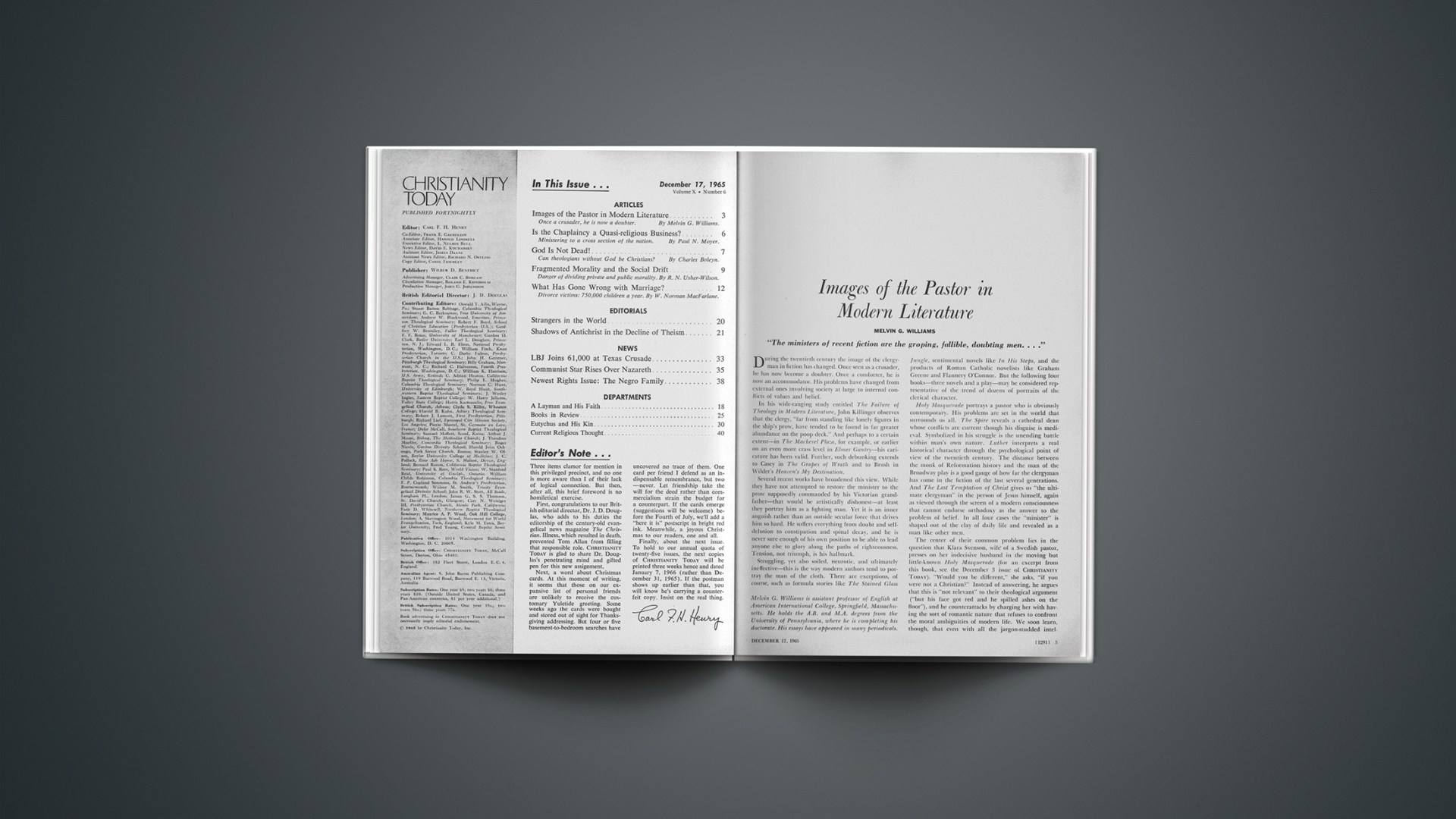
Images of the Pastor in Modern Literature

Once a crusader, he is now a doubter.

“The ministers of recent fiction are the groping, fallible, doubting men …”

During the twentieth century the image of the clergyman in fiction has changed. Once seen as a crusader, he has now become a doubter. Once a comforter, he is now an accommodator. His problems have changed from external ones involving society at large to internal conflicts of values and belief.

In his wide-ranging study entitled The Failure of Theology in Modern Literature, John Killinger observes that the clergy, “far from standing like lonely figures in the ship’s prow, have tended to be found in far greater abundance on the poop deck.” And perhaps to a certain extent—in The Mackerel Plaza, for example, or earlier on an even more crass level in Elmer Gantry—his caricature has been valid. Further, such debunking extends to Casey in The Grapes of Wrath and to Brush in Wilder’s Heaven’s My Destination.

Several recent works have broadened this view. While they have not attempted to restore the minister to the prow supposedly commanded by his Victorian grandfather—that would be artistically dishonest—at least they portray him as a fighting man. Yet it is an inner anguish rather than an outside secular force that drives him so hard. He suffers everything from doubt and self-delusion to constipation and spinal decay, and he is never sure enough of his own position to be able to lead anyone else to glory along the paths of righteousness. Tension, not triumph, is his hallmark.

Struggling, yet also soiled, neurotic, and ultimately ineffective—this is the way modern authors tend to portray the man of the cloth. There are exceptions, of course, such as formula stories like The Stained Glass Jungle, sentimental novels like In His Steps, and the products of Roman Catholic novelists like Graham Greene and Flannery O’Connor. But the following four books—three novels and a play—may be considered representative of the trend of dozens of portraits of the clerical character.

Holy Masquerade portrays a pastor who is obviously contemporary. His problems are set in the world that surrounds us all. The Spire reveals a cathedral dean whose conflicts are current though his disguise is medieval. Symbolized in his struggle is the unending battle within man’s own nature. Luther interprets a real historical character through the psychological point of view of the twentieth century. The distance between the monk of Reformation history and the man of the Broadway play is a good gauge of how far the clergyman has come in the fiction of the last several generations. And The Last Temptation of Christ gives us “the ultimate clergyman” in the person of Jesus himself, again as viewed through the screen of a modern consciousness that cannot endorse orthodoxy as the answer to the problem of belief. In all four cases the “minister” is shaped out of the clay of daily life and revealed as a man like other men.

The center of their common problem lies in the question that Klara Svenson, wife of a Swedish pastor, presses on her indecisive husband in the moving but little-known Holy Masquerade (for an excerpt from this book, see the December 3 issue of CHRISTIANITY TODAY). “Would you be different,” she asks, “if you were not a Christian?” Instead of answering, he argues that this is “not relevant” to their theological argument (“but his face got red and he spilled ashes on the floor”), and he counterattacks by charging her with having the sort of romantic nature that refuses to confront the moral ambiguities of modern life. We soon learn, though, that even with all the jargon-studded intellectual skirmishes he stumbles through, his own brand of Christianity never approaches the power and excitement of the New Testament Church, and that in its failure to be relevant to his own experience it has thrown him into the organizational whirlpool whose end is spiritual and moral annihilation.

Olov Hartman’s indictment here follows a trail that was blazed many years ago and is now well worn. Earlier writers have often portrayed the clergy as “businessmen with apostolic credentials” like Albert, who is more devoted to preparing records for “the Central Statistical Bureau” than to praying with a dying woman afraid to face the prospects of hell. And the guilt of pulpit politics that makes our ministers “veer in the opposite direction” when they “feel heat” has similarly become an all-too-familiar tale.

As we read the jottings of Klara’s Lenten diary, we feel a fresh anguish with one yearning to see the Word made flesh, asking the Church to give her something “to believe in or doubt in”—but at least something definite. But the only answer the compromising Albert can show her is his own hypocrisy as an “ordinary” man having “to live and teach like a spiritually minded person.” He hasn’t even the vigorous honesty of Eccles, the minister in John Updike’s Rabbit Run, who with all of his doubts is still on a valid search and “wants to be told … that he’s not lying to all those people every Sunday.”

Mirrored in the deterioration of the Svensons’ marriage as well as in Klara’s mind is what she calls the schizophrenia of the Church—its holy masquerade. Neither cold nor hot, its nominal sort of Christianity is an odd mixture of sacred trappings over a secular base. And it offers no one any assurance, since “first there must be clarity; otherwise comfort is of no avail.”

In the “theological fog” that obscures Pastor Svenson’s life and spreads to envelop his entire rural parish, Christianity is ineffective because it is hollow. Doubt has replaced faith in the minister’s study and cold form has replaced holy fire in the sanctuary. It is ironic that the only time the church becomes “fired up,” the entire empty structure is reduced to ashes.

Less modern in its setting but more inclusive in the force of its theme is William Golding’s The Spire. None of his five novels has drawn a specific portrait of our times; yet like each one before it, this latest work reveals unavoidable moral implications for its characters. In it Golding turns to a cathedral in medieval England (the town is historically Salisbury) whose dean, an intricately developed character named Jocelin, has seen a vision: he must erect a four-hundred foot spire atop his church as a visible monument to God, “since the children of men require a thing to look at.”

In spite of the uncertain footing below, little by little the spire climbs. Yet not all is being done to the glory of God. On the contrary, the rising tower destroys immeasurably more than it creates. From the very beginning the services of the church are disrupted by dust and dirt and the profanity of the workmen, until finally they are discontinued entirely. In place of worship comes chaos: the disintegration of an old friendship between Jocelin and his confessor, the horrors of violent death, the profaning of the cathedral halls into a house of adultery. “Only the alehouses prospered.”

True, the growing spire seems for a time to be achieving some good. If nothing else, it is a visible signpost whose presence changes the wagon routes men have taken across the hills for generations in their trips to town. Yet it never really penetrates deeply enough to straighten the paths of any of their lives, and at best its benefits are superficial. It is simply “Jocelin’s folly.”

Ever upward, meanwhile, climbs the needle of the spire until finally it reaches its peak. It sways in the winds of the storms and makes the pillars supporting it bend and “sing” with its weight—but it stands. Yet by the end of the novel even Jocelin, by this time physically broken and mentally delirious, expects it to crash down at any moment to destroy the church and all that lies in its shadow. With difficulty he asks, “Fallen?” and the answer comes back quietly, “Not yet.”

It might have seemed better if the spire had fallen, for then at least there would have been the finality of a fruitless vision. Hartman, for example, gives us a church in ruins as poetic justice for its pastor’s failings. But Golding leaves us instead with a monument to destruction—a destruction all the more poignant because we have participated in its development. We have climbed the tower ladders with the hod-carriers and wiped the dust from our eyes and faces. We have doubted with the builders and hoped with Jocelin. But ultimately we have seen our faith dried up. We have seen that the dean himself—even more than his church—was without any real supporting foundation. Observing the human ruin that accompanies his grand vision, we question the divinity of his inspiration and agree ruefully as he confesses, “I injure everyone I touch, particularly those I love.”

Man is depraved; this has been Golding’s recurring thesis ever since Lord of the Flies. But where does such a person turn? The Church has all the evils of men, including in its clergy an inordinately huge measure of pride. (One is reminded, too, that those who fall into savagery in his earliest novel are choirboys.) “Say what you like; he’s proud,” remarks one of the deacons about Jocelin. “And ignorant,” adds another. But “he thinks he is a saint!” This is his predicament and the theme of the novel. The corrosive pride of a man who begins by thinking he is doing God’s work culminates in the ruin of himself and those about him. Early in the book he says, “I am about my Father’s business,” and Golding writes that in the closing moment “the final tremor of his lips … might be interpreted as a cry of God! God! God!” But there is no record in the text that he ever receives any reply of assurance before he dies, a broken spirit.

Still more provocative, and more compelling as a literary work, is John Osborne’s brilliant drama Luther. There is no fable here; the man on the stage is real, his agonizing unmistakable. But the Luther of the play is far removed from the Dr. Luther who influenced more people across Europe than any other modern man except perhaps Karl Marx.

Without apology, history has been distorted. Yet Osborne’s Luther is not an ideal to be worshiped by Protestants, not an abstract to be studied by Catholics, not just a name to be remembered by historians. Instead he is a genius who is never sure of himself, a man tormented and tortured, often wracked with physical pain, more than slightly neurotic, and always bothered by extreme constipation. True, he is courageous and brilliant, but he reveals neither nobility nor grace. Nor certainty.

Acts I and II move from the noisy showmanship of Tetzel’s sale of indulgences (“I can even pardon you for sins you haven’t committed, but which, however, you intend to commit!”) to Luther’s savage ridicule of fake relics (“empty things for empty men”). And there is the strong scene at the Diet of Worms where Luther makes his famous speech: “I cannot and will not recant.… Here I stand; God help me; I can do no more. Amen.”

But the concluding and disquieting focus of the play shifts away from the fiery Luther in his pulpit to the tender and domestic Luther in his home. He is no longer the man who defied kings and popes. The first clash of the Reformation is over and a new Germany has been created. But inside him there is no change; nothing has been resolved. Luther is still uncertain, and in a scene where an old friend asks him, “Were you sure?” he answers, weakly, “No.”

In the final lines he is talking of heaven to his young son and reading the promises of the New Testament. Yet the best he can say—and on this note the curtain falls—is, “Let’s just hope so.…” There is hope, but even for Martin Luther, the great catalyst of reformation, there is no final certainty. Nor was there any for Jocelin, dean of an English cathedral, or for Albert, pastor of a Swedish church.

Listen to the music the orchestra has been playing. “Ein’ feste Burg.…” How false the words sound after seeing the doubts of their actor-author. “God’s truth abideth still.…” Perhaps for the hymnwriter in 1529, but not for the contemporary Luther on a New York stage. “Did we in our own strength confide, our striving would be losing.…” Almost an epitaph for Jocelin. “And He must win the battle.…” Well, maybe in sixteenth-century Germany, but not today.

In three works we have seen torment unresolved and Christianity ineffective. Each clergyman, unable to sink the taproot of his own faith, is unable to meet the needs of others. Svenson destroys a marriage and ignores a congregation. Jocelin defiles a church to build his dreams in discord and distress. And Luther cannot offer even his small child more than an uncertain hope. Supernaturalism is gone, and in its place is an earthbound tragic struggle for God.

It is against such a background that we now see Jesus, the man of Nazareth. Far from the description of the Scriptures and even farther from the pious image that he has sometimes been given, Kazantzakis’s Jesus knows the fires of lust and the chokings of doubt. “I am wrestling,” the youthful carpenter cries out. He is compelled by temptations—to be a man like other men, to withdraw into spiritual isolation, “to settle down to a life of happiness with his beloved Mary Magdalene,” to abandon his struggle with God. There is grandeur in his battle between flesh and spirit, and his representation of the human predicament is vivid and intense. But it is not so easy to say he is sacred or a part of the Godhead.

Such a portrait is, clearly enough, a heresy to the orthodox, who have opposed it as “blasphemous” and “a mass of monstrous distortions.” Yet the Jesus of The Last Temptation of Christ is at least in part the victor where each of the men considered before has been a failure. The reasons are simple and direct: Jesus took the long road all the way to the Cross; the others stopped short. Jesus conquered his doubts; the others yielded to theirs, or were consumed by them, or were blocked by them.

Kazantzakis explains that he wrote this book “because I wanted to offer a supreme model to the man who struggles. I wanted to show him that he must not fear pain, temptation, or death—because all three can be conquered; all three have been conquered.” Yet these very same words help to explain why such a Jesus has not satisfied the struggle of those clergymen whom we have already seen. As the novelist himself points out, this Jesus is “a model who blazes our trail,” not the saving Christ. He cannot offer the promise of abundant life to any who would call themselves Christian, since in his final act he loses his own life. For though he dies on the Cross “because he loves the whole world,” we come to the end of the last page before the Resurrection is reached. We are left viewing a dead man instead of a risen Lord.

“Behold, old things have passed away and all things are become new,” says the New Testament text. And so it is with the fictional ministers of the Church. The old faith in a supernatural and redemptive Saviour is gone, and with it the dogmatic certainty and the old victory. In place of the affirmation of the past, however, is a struggle to find a new validity and a contemporary relevance in the example of the man who said, “I am the way.… Follow me.”

The ministers of recent fiction are the groping, fallible, doubting men of the twentieth century—men in the midst of the modern predicament. Their problems are those of an age of secularism and science that seeks a new Reformation on its own terms. Thus far, however, their search has not been very successful. They continue on as divines in doubt.

Editor’s Note from December 17, 1965

Three items clamor for mention in this privileged precinct, and no one is more aware than I of their lack of logical connection. But then, after all, this brief foreword is no homiletical exercise.

First, congratulations to our British editorial director, Dr. J. D. Douglas, who adds to his duties the editorship of the century-old evangelical news magazine The Christian. Illness, which resulted in death, prevented Tom Allan from filling that responsible role. CHRISTIANITY TODAY is glad to share Dr. Douglas’s penetrating mind and gifted pen for this new assignment.

Next, a word about Christmas cards. At this moment of writing, it seems that those on our expansive list of personal friends are unlikely to receive the customary Yuletide greeting. Some weeks ago the cards were bought and stored out of sight for Thanksgiving addressing. But four or five basement-to-bedroom searches have uncovered no trace of them. One card per friend I defend as an indispensable remembrance, but two—never. Let friendship take the will for the deed rather than commercialism strain the budget for a counterpart. If the cards emerge (suggestions will be welcome) before the Fourth of July, we’ll add a “here it is” postscript in bright red ink. Meanwhile, a joyous Christmas to our readers, one and all.

Finally, about the next issue. To hold to our annual quota of twenty-five issues, the next copies of CHRISTIANITY TODAY will be printed three weeks hence and dated January 7, 1966 (rather than December 31, 1965). If the postman shows up earlier than that, you will know he’s carrying a counterfeit copy. Insist on the real thing.

Why Churches Decline

Some american visitors to Europe return home with sad accounts of gastric disturbances, while others seem to thrive on unfamiliar cuisine. But hardly a single Christian traveler on the Continent or in Great Britain comes home unshaken by the low church attendance in virtually all European countries. My wife and I were saddened by this phenomenon during our year in the great Reformation city of Strasbourg; as we participated in the ancient liturgy and were blessed by the Christocentric messages delivered at the Lutheran Eglise St. Thomas—whose history stretches back to the ninth century—we sometimes found ourselves among only fifty or seventy-five worshipers.

Why this pitiful stale of affairs? Recently a French sociologist has gone to work on the problem, and his far from tautological conclusions warrant careful consideration by the theological community. The sociologist is Professor François-G. Dreyfus of the Faculty of Letters and the Institute of Political Science at the University of Strasbourg, and his analysis of church decline is summarized in an article titled, “Secularization in Alsatian Protestantism Since the Nineteenth Century,” appearing in the latest issue of the Revue d’Histoire el de Philosophie Religieuses (Vol. 45, No. 2).

Dreyfus begins with a careful presentation of the church situation in the Alsace. In spite of general population increases from 1800 to the present, and in spite of the enlargement of Roman Catholic communicant membership, Alsatian Protestantism has shown no appreciable growth: there were 210,000 Protestants in 1820,247,000 in 1871 (when, as a result of the Franco-Prussian War, the Alsace was annexed to Germany), and only 242,000 in 1954.

These statistical phenomena pose a genuine interpretative challenge, and Dreyfus reaches solid ground by analyzing an invaluable survey of Alsatian church life carried out in 1851 by the Lutheran state church. The replies to the questionnaires are still preserved in the National Archives, and they give minute data on the condition of the parishes—data that frequently reveal far more than the pastors or laity of the time could have imagined.

Typical, for example, are the comments of the pastors at Colmar and at Sainte-Marie-aux-Mines: “With some honorable exceptions, the poor class is too demanding, not sufficiently grateful, crude, and for the most part drunk and lazy.” “The working class constitutes the majority of the Protestant parish, and on the whole it lacks industriousness. But, happily, we also have a solid bourgeoisie which is the pillar of the church.”

From such clear and striking comments as these, Dreyfus soundly concludes that one of the major reasons for the decline of Alsatian Protestantism in modern times has been the indifference of the Church to the industrial revolution and to the working classes that arose as part of that great social movement. Just as during the Old Regime the Roman church lost its influence over the great mass of French Catholics by identifying with the rank and privileges of the nobility, so during the urban-industrial revolution of the last century and a half, Protestant Christianity has made the equally tragic mistake of identifying with the status quo. Ignoring “the signs of the times,” it has pharisaically passed by on the other side when vast numbers of people have desperately needed its ministrations.

But important as was this social factor, another consideration had an even greater part in the decline of Alsatian Protestantism. States Dreyfus: “We must underscore the very great role played by Protestant thought itself,” specifically the impact of “rationalism,” “liberalism,” and “latitudinarianism of doctrine”—and “it seems clear that this considerable influence enjoyed by liberalism is not peculiar to Protestant Alsace; one encounters it in most of the Protestant regions of Europe.” Illustrating from questionnaire data and from other primary sources, Dreyfus shows that (in the words of a Pfaffenhoffen pastor), “from the middle of the eighteenth century, the Protestant church seems to have slept; it appears to have forgotten the confessional writings upon which its pastors took their ordination vows.”

By 1860, the majority of the professors on the Protestant Theological Faculty of the University of Strasbourg had become liberals, and (as is the invariable pattern) the decline then began in earnest. Typical of the church situation was Pastor Nied’s beginning-of-term address for the Protestant Seminary in 1868; his subject was “Preparation for the Holy Ministry,” and not once does the name of Jesus appear in it. Dreyfus notes that where German rationalistic theology had the most influence, the Alsatian church suffered most. Today, in the wake of two world wars, there is little unreconstructed liberalism left in the Alsace, and the Protestant Theological Faculty is again confessionally Lutheran; but the damage has been done, and the common man in the Alsace, hostile to religion without knowing why, is the chief victim.

Though Dreyfus’s study of church decline is limited to the Alsace, the wider significance of his investigation can hardly be missed. Observation of the Church in the modern era—whether on the European continent or in England or in the United States—would seem to elevate Dreyfus’s two causal explanations for Alsatian church decline to the level of ecclesiological laws: doctrinal liberalism and social conservatism are two best ways to insure the secularization of the Church.

In our own land, what has been the effect of our middle-class, white-only churches, striving to delay social progress and to ignore the existence of great masses of people? The result has been that social progress has come anyway, spearheaded by those who do not represent evangelical Christendom, and untold numbers in minority groups have been permanently alienated from the historic Gospel. The unregenerate man has an instinctive ability to identify bad trees by their bad fruit.

And what has been the result of the weakening of biblical and doctrinal authority in U. S. churches? Indifference on the part of the unbeliever to the Church’s appeals. It is not for nothing that the most theologically conservative Protestant bodies (e.g., the Southern Baptists and the Missouri Lutherans) have been the most energetic and have had the greatest growth rates—nor that Unitarian seminaries hobble along from year to year heavily endowed but virtually empty. Unregenerate man also knows instinctively that liberal religion is man-made and therefore incapable of rising from puerile good advice to transcendental Good News.

Want to arrest the secularization of the Church? Try an unqualified biblical message, directed to all those for whom the Lord of glory died.

What Scripture Says about Itself

Chapter One of the Westminster Confession

1. ALTHOUGH the light of nature and the works of creation and providence do so far manifest the goodness, wisdom, and power of God, as to leave men inexcusable.1Ps. 19:1–4. The heavens declare the glory of God; and the firmament showeth his handiwork. Day unto day uttereth speech, and night unto night showeth knowledge. There is no speech nor language, where their voice is not heard. Their line is gone out through all the earth, and their words to the end of the world. In them hath he set a tabernacle for the sun. Rom. 1:32. Who knowing the judgment of God, that they which commit such things are worthy of death, not only do the same, but have pleasure in them that do them. Rom. 2:1. Therefore thou art inexcusable. O man, whosoever thou art that judgest: for wherein thou judgest another, thou condemnest thyself; for thou that judgest doest the same things. Rom. 1:19, 20. Because that which may be known of God is manifest in them; for God hath showed it unto them. For the invisible things of him from the creation of the world are clearly seen, being understood by the things that are made, even his eternal power and Godhead; so that they are without excuse. See Rom. 2:14, 15. yet they are not sufficient to give that knowledge of God and of his will which is necessary unto salvation;21 Cor. 1:21. For after that in the wisdom of God the world by wisdom knew not God, it pleased God by the foolishness of preaching to save them that believe. 1 Cor. 2:13, 14. Which things also we speak, not in the words which man’s wisdom teacheth. but which the Holy Ghost teacheth: comparing spiritual things with spiritual. But the natural man receiveth not the things of the Spirit of God: for they are foolishness unto him: neither can he know them, because they are spiritually discerned. therefore it pleased the Lord, at sundry times, and in divers manners, to reveal himself, and to declare that his will unto his Church;3Heb. 1:1, 2. God, who at sundry times and in divers manners spake in time past unto the fathers by the prophets, hath in these last days spoken unto us by his Son. and afterwards, for the better preserving and propagating of the truth, and for the more sure establishment and comfort of the Church against the corruption of the flesh, and the malice of Satan and of the world, to commit the same wholly unto writing:4Luke 1:3, 4. It seemed good to me also, having had perfect understanding of all things from the very first, to write unto thee in order, most excellent Theophilus, that thou mightest know the certainty of those things, wherein thou hast been instructed. Rom. 15:4. For whatsoever things were written aforetime were written for our learning, that we through patience and comfort of the Scriptures might have hope. Matt. 4:4, 7, 10. But he answered and said. It is written, Man shall not live by bread alone, but by every word that proceedeth out of the mouth of God. Jesus said unto him, It is written again, Thou shalt not tempt the Lord thy God. Then saith Jesus unto him, Get thee hence, Satan: for it is written. Thou shalt worship the Lord thy God, and him only shalt thou serve. Isa. 8:20. To the law and to the testimony: if they speak not according to this word, it is because there is no light in them. which maketh the Holy Scripture to be most necessary,52 Tim. 3:15. And that from a child thou hast known the holy Scriptures, which are able to make thee wise unto salvation through faith which is in Christ Jesus. 2 Peter 1:19. We have also a more sure word of prophecy; whereunto ye do well that ye take heed, as unto a light that shineth in a dark place, until the day dawn, and the day-star arise in your hearts. those former ways of God’s revealing his will unto his people being now ceased.6Heb. 1:1, 2. God, who at sundry times and in divers manners-spake in time past unto the fathers by the prophets, hath in these last days spoken unto us by his Son, whom he hath appointed heir of all things, by whom also he made the worlds.

2. Under the name of Holy Scripture, or the Word of God written, are now contained all the books of the Old and New Testaments, which are these:

OF THE OLD TESTAMENT

Genesis

Ecclesiastes

Exodus

The Song of Songs

Leviticus

Isaiah

Numbers

Jeremiah

Deuteronomy

Lamentations

Joshua

Ezekiel

Judges

Daniel

Ruth

Hosea

I Samuel

Joel

II Samuel

Amos

I Kings

Obadiah

II Kings

Jonah

I Chronicles

Micah

II Chronicles

Nahum

Ezra

Habakkuk

Nehemiah

Zephaniah

Esther

Haggai

Job

Zechariah

Psalms

Malachi

Proverbs

OF THE NEW TESTAMENT

The Gospels

According to

Matthew

Mark

Luke

John

The Acts of the

Apostles

Paul’s Epistles:

Romans

I Corinthians

II Corinthians

Galatians

Ephesians

Philippians

Colossians

I Thessalonians

II Thessalonians

I Timothy

II Timothy

Titus

Philemon

The Epistle

to the Hebrews

The Epistle of James

The First and Second

Epistles of Peter

The First, Second,

and Third Epistles

of John

The Epistle of Jude

The Revelation

All which are given by inspiration of God, to be the rule of faith and life.7Epb. 2:20. And are built upon the foundation of the apostles and prophets. Jesus Christ himself being the chief corner stone.Rev. 22:18, 19. For I testify unto every man that heareth the words of the prophecy of this book, If any man shall add unto these things. God shall add unto him the plagues that are written in this book: and if any man shall take away from the words of the book of this prophecy, God shall take away his part out of the book of life, and out of the holy city, and from the things which are written in this book. 2 Tim. 3:16. All Scripture is given by inspiration of God. and is profitable for doctrine, for reproof, for correction, for instruction in righteousness. Matt. 11:27. Neither knoweth any man the Father, save the Son, and he to whomsoever the Son will reveal him.

3. The books commonly called Apocrypha, not being of divine inspiration, are no part of the canon of the Scripture: and therefore are of no authority in the Church of God, nor to be any otherwise approved, or made use of, than other human writings.8Luke 24:27, 44. And beginning at Moses and all the prophets, he expounded unto them in all the Scriptures the things concerning himself. And he said unto them. These are the words which I spake unto you, while I was yet with you, that all things must be fulfilled, which were written in the law of Moses, and in the prophets, and in the psalms, concerning me. Rom. 3:2. Much every way: chiefly, because that unto them were committed the oracles of God. 2 Pet. 1:21. For the prophecy came not in old time by the will of man: but holy men of God spake as they were moved by the Holy Ghost.

4. The authority of the Holy Scripture, for which it ought to be believed and obeyed, dependeth not upon the testimony of any man or church, but wholly upon God (who is truth itself), the author thereof: and therefore it is to be received, because it is the Word of God.92 Tim. 3:16. All Scripture is given by inspiration of God, and is profitable for doctrine, for reproof, for correction, for instruction in righteousness. 1 John 5:9. If we receive the witness of men, the witness of God is greater: for this is the witness of God which he hath testified of his Son. 1 Thess. 2:13. For this cause also thank we God without ceasing, because, when ye received the word of God which ye heard of us, ye received it not as the word of men, but, as it is in truth, the word of God, which effectually worketh also in you that believe.

5. We may be moved and induced by the testimony of the Church to an high and reverent esteem of the Holy Scripture;101 Tim. 3:15. But if I tarry long, that thou mayest know how thou oughtest to behave thyself in the house of God, which is the church of the living God, the pillar and ground of the truth. and the heavenliness of the matter, the efficacy of the doctrine, the majesty of the style, the consent of all the parts, the scope of the whole (which is to give all glory to God), the full discovery it makes of the only way of man’s salvation, the many other incomparable excellencies, and the entire perfection thereof, are arguments whereby it doth abundantly evidence itself to be the Word of God; yet, notwithstanding, our full persuasion and assurance of the infallible truth, and divine authority thereof, is from the inward work of the Holy Spirit, bearing witness by and with the Word in our hearts.111 John 2:20, 27. But ye have an unction from the Holy One, and ye know all things. But the anointing which ye have received of him abideth in you, and ye need not that any man teach you: but as the same anointing teacheth you of all things, and is truth, and is no lie, and even as it hath taught you, ye shall abide in him. John 16:13, 14. Howbeit when he, the Spirit of truth, is come, he will guide you into all truth: for he shall not speak of himself; but whatsoever he shall hear, that shall he speak: and he will show you things to come. He shall glorify me: for he shall receive of mine, and shall show it unto you. 1 Cor. 2:10–12. But God hath revealed them unto us by his Spirit: for the Spirit searcheth all things, yea, the deep things of God. For what man knoweth the things of a man, save the spirit of man which is in him? even so the things of God knoweth no man, but the Spirit of God. Now we have received, not the spirit of the world, but the Spirit which is of God; that we might know the things that are freely given to us of God.

6. The whole counsel of God, concerning all things necessary for his own glory, man’s salvation, faith, and life, is cither expressly set down in Scripture, or by good and necessary consequence may be deduced from Scripture: unto which nothing at any time is to be added, whether by new revelations of the Spirit or traditions of men.122 Tim. 3:15–17. And that from a child thou hast known the holy Scriptures, which are able to make thee wise unto salvation through faith which is in Christ Jesus. All Scripture is given by inspiration of God, and is profitable for doctrine, for reproof, for correction, for instruction in righteousness: that the man of God may be perfect, thoroughly furnished unto all good works. Gal. 1:8. But though we, or an angel from heaven, preach any other gospel unto you than that which we have preached unto you, let him be accursed. 2 Thess. 2:2. That ye be not soon shaken in mind, or be troubled, neither by spirit, nor by word, nor by letter as from us, as that the day of Christ is at hand. Nevertheless we acknowledge the inward illumination of the Spirit of God to be necessary for the saving understanding of such things as are revealed in the Word;13John 6:45. It is written in the prophets, And they shall be all taught of God. Every man therefore that hath heard, and hath learned of the Father, cometh unto me. 1 Cor. 2:9, 10, 12. But as it is written, Eye hath not seen, nor ear heard, neither have entered into the heart of man, the things which God hath prepared for them that love him. But God hath revealed them unto us by his Spirit: for the Spirit searcheth all things, yea, the deep things of God. Now we have received, not the spirit of the world, but the Spirit which is of God; that we might know the things that are freely given to us of God. and there are some circumstances concerning the worship of God and government of the Church, common to human actions and societies, which are to be ordered by the light of nature and Christian prudence, according to the general rules of the Word, which are always to be observed.141 Cor. 11:13, 14. Judge in yourselves: is it comely that a woman pray unto God uncovered? Doth not even nature itself teach you, that, if a man have long hair, it is a shame unto him? 1 Cor. 14:26, 40. How is it then, brethren? when ye come together, every one of you hath a psalm, hath a doctrine, bath a tongue, hath a revelation, hath an interpretation. Let all things be done unto edifying. Let all things be done decently and in order.

7. All things in Scripture are not alike plain in themselves, nor like clear unto all;152 Peter 3:16. As also in all his epistles, speaking in them of these things: in which are some things hard to be understood, which they that are unlearned and unstable wrest, as they do also the other Scriptures, unto their own destruction. yet those things which are necessary to be known, believed, and observed, for salvation, are so clearly propounded and opened in some place of Scripture or other that not only the learned but the unlearned, in a due use of the ordinary means, may attain unto a sufficient understanding of them.16Ps. 119:105, 130. Thy word is a lamp unto my feet, and a light unto my path. The entrance of thy words giveth light; it giveth understanding unto the simple. See Acts 17:11.

8. The Old Testament in Hebrew (which was the native language of the people of God of old), and the New Testament in Greek (which at the time of the writing of it was most generally known to the nations), being immediately inspired by God, and by his singular care and providence kept pure in all ages, are therefore authentical;17Matt. 5:18. For verily I say unto you. Till heaven and earth pass, one jot or one tittle shall in no wise pass from the law, till all be fulfilled.so as in all controversies of religion the Church is finally to appeal unto them.18Isa. 8:20. To the law and to the testimony: if they speak not according to this word, it is because there is no light in them. Acts 15:15. And to this agree the words of the prophets. John 5:46. For had ye believed Moses, ye would have believed me: for he wrote of me. But because these original tongues are not known to all the people of God who have right unto and interest in the Scriptures, and are commanded, in the fear of God, to read and search them,192 Tim. 3:14, 15. But continue thou in the things which thou hast learned and hast been assured of, knowing of whom thou hast learned them; and that from a child thou hast known the holy Scriptures, which are able to make thee wise unto salvation through faith which is in Christ Jesus. Acts 17:11. These were more noble than those in Thessalonica, in that they received the word with all readiness of mind, and searched the Scriptures daily, whether those things were so. therefore they are to be translated into the vulgar language of every nation unto which they come,201 Cor. 14:6, 9, 11, 12, 24, 27, 28. Now, brethren, if I come unto you speaking with tongues, what shall I profit you, except I shall speak to you either by revelation, or by knowledge, or by prophesying, or by doctrine? So likewise ye, except ye utter by the tongue words easy to be understood, bow shall it be known what is spoken? for ye shall speak into the air. Therefore if I know not the meaning of the voice. I shall be unto him that speaketh a barbarian, and he that speaketh shall be a barbarian unto me. Even so ye. forasmuch as ye are zealous of spiritual gifts, seek that ye may excel to the edifying of the church. But if all prophesy, and there come in one that believeth not, or one unlearned, he is convinced of all, he is judged of all. If any man speak in an unknown tongue, let it be by two, or at the most by three, and that by course: and let one interpret. But if there be no interpreter, let him keep silence in the church; and let him speak to himself, and to God. that, the Word of God dwelling plentifully in all, they may worship him in an acceptable manner,21Col. 3:16. Let the word of Christ dwell in you richly in all wisdom; teaching and admonishing one another in psalms and hymns and spiritual songs, singing with grace in your hearts to the Lord. and, through patience and comfort of the Scriptures, may have hope.22Rom. 15:4. For whatsoever things were written aforetime were written for our learning, that we through patience and comfort of the Scriptures might have hope.

9. The infallible rule of interpretation of Scripture is the Scripture itself; and therefore, when there is a question about the true and full sense of any Scripture (which is not manifold, but one), it may be searched and known by other places that speak more clearly.23Acts 15:15. And to this agree the words of the prophets; as it is written. John 5:46. For had ye believed Moses, ye would have believed me: for he wrote of me. See 2 Peter 1:20, 21.

10. The Supreme Judge, by whom all controversies of religion are to be determined, and all decrees of councils, opinions of ancient writers, doctrines of men, and private spirits, are to be examined, and in whose sentence we are to rest, can be no other but the Holy Spirit speaking in the Scripture.24Matt. 22:29, 31. Jesus answered and said unto them. Ye do err. not knowing the Scriptures, nor the power of God. But as touching the resurrection of the dead, have ye not read that which was spoken unto you by God? Acts 28:25. And when they agreed not among themselves, they departed, after that Paul had spoken one word. Well spake the Holy Ghost by Esaias the prophet unto our fathers. Gal. 1:10. For do I now persuade men, or God? or do I seek to please men? for if I yet pleased men. I should not be the servant of Christ. See 1 John 4:1–6.

Cover Story

Presbyterians Rally to the Westminster Confession

What if the nation’s 3,300,000 United Presbyterians were suddenly asked to sign a statement equating the Bible directly with the Word of God?

An overwhelming majority, including many who are theologically inarticulate, would probably subscribe without mental reservation. But the dissident minority includes a literate bloc of clergymen who control denominational headquarters in Philadelphia’s venerable Witherspoon Building. And from that ecclesiastically strategic vantage point the biblical critics are plumping a Barthian yet pragmatically oriented “Confession of 1967.”

Fearing that the new document will supplant the principle of scriptural integrity championed by the time-honored Westminster Confession, evangelicals in United Presbyterian churches throughout the country are discreetly rallying their forces to do battle. The outcome is expected to have wide significance inasmuch as Presbyterian thinkers have traditionally been leaders of evangelical theology in North America (see editorial, page 30).

United Presbyterian conservatives arranged an impressive show of strength at a special two-day conference in Chicago last month. Staged by a new organization known as Presbyterians United for Biblical Confession, the conference sought to coordinate efforts of the thousands of evangelical clergymen seeking to preserve the heritage of the United Presbyterian Church. The group’s key effort to date has been an incisive editorial critique, A Conversation about “The Proposed Confession of 1967,” now widely distributed in two versions.

Another development last month was the unveiling of a blue-ribbon Presbyterian Lay Committee, Inc., dedicated to restoring respect for biblical authority in the official denominational framework. The group, according to President Roger Hull, aims to work with the National Council of United Presbyterian Women and the National Council of United Presbyterian Men in fulfilling five objectives.1“To enlarge the emphasis on the teaching of the Bible as the authoritative Word of God in our seminaries and churches; to emphasize at every opportunity the need for preaching the Gospel of redemption with evangelical zeal, the need for regular Bible study and prayer; to encourage ministers and laymen alike to take their place as individuals in society and, as led by the Holy Spirit, to become involved in the social, economic and political problems of our time and to assert their position as Christian citizens on all such matters; to discourage public pronouncements by the Church as a corporate body on political, social and economic issues; to provide an adequate and reliable source of information for laymen on the issues being proposed for consideration at General Assembly and other judicatories in order to enable laymen to express an informed position.” It has been in the planning stage for many months and is part of a restive lay movement in several mainstream denominations. Its nineteen-member board includes Hull, prominent New York insurance executive, chairman J. Howard Pew of Sun Oil, former Governor Arthur B. Langlie of Washington, and TV personality Bud Collyer. Invitations are out for charter members.

Says Hull, “We are seeking dedicated lay men and women who are concerned about our church and who are willing to become involved at the presbytery, synod and General Assembly level in order to influence the church to exert her efforts to the mission of preaching the Gospel of redemption.”

The bid to involvement is especially important, for some observers feel that indifference and premature surrenders have aided church revisionists. Some evangelicals disappointed over the proposed new confession lament that two or three theological conservatives resigned from the drafting committee.

The pressures to conform often become intense, however, and here and there evangelicals throw in the towel. The latest is Dr. Stuart H. Merriam, a promising preacher whose dispute with New York Presbytery became a cause célèbre in 1962. Citing an assortment of relatively minor improprieties, the presbytery refused to allow him to retain his pulpit at Broadway Presbyterian Church. This fall, the 41-year-old Merriam severed all official ties with the denomination and announced he would return to New Guinea, where he has set up a small, independent missionary effort. Merriam will be accompanied by his bride of two months, the former Caroline Robinson, who served as his secretary at Broadway.

Many theological conservatives among United Presbyterians feel that time and truth are on their side as they stay put and press for their convictions. This was the rationale for the Chicago meeting, where conservatives probed a joint strategy focused on the confession. The main question at Chicago was whether the 4,200-word document was hopelessly heretical or could through amendments be shifted to a more biblical base. The key issue was the new confession’s viewing Scripture, not as the inspired Word of God, but as the mere “normative witness” to the revelation of God in Jesus Christ.

A broader problem faced by United Presbyterian evangelicals is what to do with those clergy and lay leaders who have made confessional vows in the past but do not now subscribe to them. Whatever else it may or may not be, the new confession is widely described as an effort to make honest men out of heretics. In short, it would legitimatize aberrations by relaxing long-held scriptural standards.

Few evangelicals are willing to crusade for a wholesale exodus of heretics, and most prefer an attempt to salvage their denomination over desertion. But short of a mass exodus, United Presbyterians will have to work out an alternative to assigning official sanction to intellectual dishonesty.

The “subscription” questions actually are an issue separate from the debate over confessions. The committee that drafted the proposed new confession also took the initiative in recommending far-reaching changes in the theological test given candidates for ordination and commissioning (see May 7, 1965, issue, page 53).

The fate of the confession and allied proposals is currently in the hands of a specially appointed revision committee, at least five of whose fifteen members are known as theological conservatives. The committee is open to suggestions until January 15 and is expected to present an amended version of the proposed confession to the United Presbyterian General Assembly in Boston in May.

If the confessional package is approved in Boston, it will be submitted to a vote of presbyteries. Then, if two-thirds of the presbyteries voice approval, formal adoption will be possible at the 1967 General Assembly in Portland, Oregon.

Westminster Confession

Caught in the middle of the current theological strife among United Presbyterians is the majestic Westminster Confession of Faith, which dates back to the 1640s and includes what is perhaps the most eloquent rationale for scriptural authority to be found in the annals of Christendom (see next page). The proposed Confession of 1967 does not explicitly unseat a prior claim for the Westminster Confession, for the latter is slated, with six others, to be preserved alongside the new creed. In at least several aspects, however, the new confession obviously supersedes Westminster, which while not considered flawless has nevertheless served as a standard for Presbyterian and Reformed groups everywhere.

The Westminster Confession was the most illustrious of several historic theological documents produced in the strife-torn Britain of the seventeenth century by the group now referred to as “the Westminster Divines.” They were the 151 members of a special advisory commission appointed by Parliament to determine what constituted the true church. Thirty of them were members of Parliament, and the rest were clergy men from England and Scotland. They conferred in Westminster Abbey, holding more than a thousand all-day meetings.

While most of the clergymen on the commission had been ordained by the Church of England, they had become nonconformists when King Charles I attempted to force upon them doctrines they considered alien. The doctrines of this group of nonconformists eventually became those of the Presbyterian communion.

Conversation Sampler

Here are significant excerpts from a revised version of A Conversation about “The Proposed Confession of 1967,” from Presbyterians United for Biblical Confession:

What are the merits of the proposed “Confession”?

It is a serious and needed effort to make the creed of our church speak to the need of our day in the language of our day. It endeavors to state the essence of our faith and practice so that it may be understood by United Presbyterians and by other churches in ecumenical conversations.

In what areas does the proposed “Confession” need to be revised to make it more truly Biblical, evangelical, and consistent with our Reformed faith?

I. The deity of Christ should be affirmed with no less clarity and emphasis than his humanity.

II. The inspiration of the Bible needs to be affirmed and a clearer statement of its authority presented.

III. Reconciliation between God and man needs stronger emphasis and the requirement of repentance and faith needs to be more clearly affirmed.

IV. The section “Reconciliation in Society” needs some revision and also extension to additional areas of social concern.

V. Under the questions for ordination, the subscription required regarding “the Scriptures” and “the confessions” needs to be changed and strengthened.

What is the central theme of the proposed “Confession”?

“God’s reconciling work in Jesus Christ and the mission of reconciliation to which He has called his Church …” (lines 34, 35).

How is God’s part in this work of reconciliation interpreted?

As a “reconciling act” seemingly fully accomplished.

How is man’s part interpreted?

Man is apparently represented as a beneficiary of God’s act of reconciliation regardless of personal response. The “Confession” states: “The risen Christ is the Savior of all men” (line 69), “In him man is victorious over sin and death” (lines 59, 60), “God’s reconciliation of the human race creates one universal family” (lines 298, 299).

But is man not required to repent and believe in order to be effectively reconciled?

So the Scriptures teach, and we feel this truth needs to be stated more clearly and emphatically than is done in the proposed “Confession.”

What about the key passage in 2 Cor. 5:20 to which the Committee refers in its “Introductory Comment and Analysis”?

This passage itself indicates that in the world some are and some are not reconciled. Very strangely, the concluding statement of 2 Cor. 5:20 is omitted: “We beseech you on behalf of Christ, be reconciled to God.”

American Baptists: COCU on Ice?

The Consultation on Church Union, which this year is drawing up a proposal for an American super-church, apparently has little appeal for the most ecumenically minded Baptist group, the American Baptist Convention.

At Valley Forge, Pennsylvania, last month, forty-six voting members of the ABC General Council discussed all sorts of relationships with other Christians, but the Consultation (or Blake-Pike proposal, as commonly labeled) had few champions and suffered two stunning defeats.

The first was the report of the Division on Cooperative Christianity, whose eight members include four former ABC presidents. It recommended on a five-to-three vote that the ABC shun formal COCU talks. Then General Secretary Edwin H. Tuller, ABC’s top administrator, eschewed a disinterested stance and came up with a surprising, hard-hitting statement against COCU involvement.

In February, the General Council will decide whether to follow the division’s and Tuller’s advice or to ask the annual convention to join the COCU negotiations, which now include six mainline denominations. The General Council, as between-conventions legislature for the ABC, has full power to enter into COCU without a convention vote, but this is unlikely.

The division’s study had been requested at the last annual convention by Dr. Robert G. Torbet. He and Dr. W. Hubert Porter have been the ABC’s observer-consultants to COCU for three years.

Southward Ho

If the American Baptist Convention joined the Consultation on Church Union (see story above), this would probably cripple efforts to get the ABC and other Baptist groups together.

The Rev. Howard R. Stewart, chairman of the Baptist Unity Movement, which hopes to merge the American and Southern Baptist Conventions, is thus opposed to COCU. “There is a strong feeling it might be better to put our Baptist house in order first,” the Dover, Delaware, pastor said.

Others in the ABC think they have more in common with non-Baptist groups than with the Southerners. A new chapter in relations between the ABC and the SBC began October 1, when J. C. Herrin set up shop in Chapel Hill, North Carolina, for what some call an ABC “invasion” of the South.

The big, fast-growing SBC has made major inroads in the North in recent years. Herrin’s answer to this is still fuzzy, but he seeks to sign up churches that have already left the SBC and to establish fellowship groups that would become new ABC churches in competition with the entrenched SBC. He also hopes for eventual merger with Negro Baptist churches and perhaps entire denominations, particularly the Progressive Baptist Convention.

There are now thirty-two ABC churches in the South. Their leaders will meet in Atlanta this month with Herrin to map future plans. The main speaker will be ABC’s controversial evangelism director, Dr. Jitsuo Morikawa. This choice of keynoter and Herrin’s appeal for ABC liberalism on the ecumenical issue indicate the shape this challenge to the SBC may take.

On the eve of the Valley Forge meeting, eighty ABC theology professors urged the General Council to approve COCU. But at the meeting, the COCU camp lacked leadership. Torbet, who is now ABC president, believes he must remain neutral on what may be the hottest and most divisive issue before the ABC in years. Neither he nor Porter will say publicly whether he thinks the ABC should enter the Consultation. The three members of the division who disagreed with its recommendation kept anonymous and silent.

The loyal-opposition mantle fell by default to Dr. Robert Middleton of Chicago, whose church is aligned with both the ABC and the United Church of Christ. In February, he will move to amend the report and get the ABC into COCU. The report now going out to ministers and other leaders will mention his plan. Grass-roots support may be mobilized one way or the other in the next three months, but mail to the denominational magazine Crusader currently is reported to be split 50–50 on the issue.

There is widespread feeling in the ABC that Baptists won’t be able to join the church resulting from COCU if it takes the shape that now seems likely. If this is so, the ABC must decide now whether it should become active in setting up someone else’s church.

Another problem: leaders are sure that if the ABC ever joined the super-church, a large number of local congregations would refuse to go along. The ABC has been hit with schism before and has little taste for another.

The division report carefully listed the pros and cons of COCU, but the majority concluded that most “Baptist distinctives” such as baptism of believers only and congregational polity would have to be compromised too deeply.

Though opposing COCU, the division suggested other ecumenical avenues: stronger ties with the National and World Councils of Churches, Baptist groups, and other “free churches.” It said local churches could join the COCU church and keep parallel affiliation with the ABC.

Tuller reported that talks with the pacifist Church of the Brethren would resume at Elgin, Illinois, December 4. There has been “a measure of progress” in getting together with the Seventh Day Baptist General Conference, he said, but no future meetings are presently scheduled with the Christian Churches (Disciples), who are heavily involved in COCU.

Tuller’s statement on COCU questioned whether a universal Protestant church would be as healthy as a variety of churches existing side by side in an ecumenical spirit. He cited Denmark, where the official Lutheran Church claims 97 per cent of the population but only 1½ per cent of the people attend church. Where Protestants are a tiny minority, as in Southeast Asia, Tidier said, organic union is more beneficial.

Proponents say a big, unified church would wield more power in the social-political-economic sphere, Tuller said, but this also has dangers, as evidenced in the history of the Roman Catholic Church.

Another pressing ecumenical issue—cooperation and possible merger of Baptist seminaries with those of other denominations—received no attention at Valley Forge. Torbet said this is a matter between the ABC Board of Education and Publication, which advocates mergers, and the seminary boards. (See article, page 15.) The division report on COCU, however, mentioned the efficiencies of “a unified theological program under the aegis of a united church” as one of COCU’s advantages.

The General Council backed Torbet’s plan for the executive committee to prepare a position paper on the ecumenical issues facing the ABC for presentation at the next national convention. May 11–15 in Kansas City, Missouri.

Evangelism Around The World

Numerous evangelical leaders familiar with the Far East share a growing conviction that scarred and suffering Korea, once the “hermit kingdom,” is the base for the evangelization of Asia. Latest indication of Korea’s Christian potential came in a year-long national evangelistic campaign climaxed last month with a gigantic rally in Seoul. Some 40,000 attended the rally, singing hymns to the accompaniment of U. S. Army and Navy bands and chanting, “Christ Our Way of Life.”

Among special guests on hand for the grand finale were evangelist Leighton Ford and Irv Chambers, both associates of Billy Graham. Dr. Bob Pierce and Dr. Paul Rees of World Vision had taken part in the campaign earlier. United crusades were held in nearly forty key population centers throughout Korea during 1965, which marked the eightieth anniversary of Protestantism in Korea.

Aim of the Korea-wide effort was to confront every citizen with the claims of Christ, and indications are that by the end of the year most Koreans will have had the chance. An estimated one million have attended services, and perhaps as many as 10,000 converts have been counted. Nearly all church groups cooperated.

In Spain, according to European Baptist Press Service, more than 600 persons made professions of faith in three weeks. The evangelistic challenge was proclaimed in forty-six churches and mission stations of the Spanish Baptist Union. Guest preachers, assisting Spanish pastors and missionaries, came from Mexico, Costa Rica, Venezuela, Chile, Argentina, and Colombia.

An “evangelism in depth” campaign continues in the Dominican Republic, with 6,000 conversions already reported. The campaign there began the same week in April that the political uprising started. Both sides in the political struggle are said to be supporting the work. The campaign is scheduled to end with a preaching crusade from January through March.

Rx For The Masses

An awesome spiritual hunger among North Americans is reflected in the unprecedented demand for Billy Graham’s new book, World Aflame. In one week alone, 29,542 copies were shipped from the Doubleday publishing firm to bookstores from coast to coast.

“In our opinion,” said a Doubleday spokesman, “this is a weekly record sale for any book ever.”

In the first eight weeks the book was on the market, it sold 263,430 copies and skyrocketed to the nation’s best seller list.

The book is basically an evangelistic appeal, highly readable and provocative. Its thoroughly biblical content ranges from the origin of sin and the predicament of modern man to the Christian believer’s social responsibility and his perspective for the end time.

I, Zondervan, Take Thee, Harper …

Harper & Row of New York, one of America’s top book publishers, is selling most of its Bible department to Zondervan, the evangelical firm in Grand Rapids. On January 1, Zondervan will assume rights to the King James and Revised Standard Versions, the Harper Study Bible, and Bagster’s New Testament.

Harper salesmen will represent Zondervan to secular buyers, while Zondervan’s staff concentrates on religious bookstores. The sale (price not made public) gives Zondervan a New York foothold and strategic distribution, and complements its effort to upgrade its catalogue.

Harper plans to expand its general religious offerings and will continue to publish the Moffatt Bible translation and the forthcoming New Testament translation by William Barclay. Harper said it left the Bible field, in part, to avoid the complex, specialized production problems it entails.

New Design For Church Education

Bethany Press is publishing an 848-page book for Christian educators to use as a basic reference tool in church curriculum planning. The five-pound tome is entitled The Church’s Educational Ministry: A Curriculum Plan. It retails for $18.95.

Publication of the book culminates a five-year joint undertaking by sixteen denominations through the National Council of Churches’ Division of Christian Education. Eight NCC member denominations cooperated in the endeavor, known as the Cooperative Curriculum Project. However, no Roman Catholic, Orthodox, or Lutheran groups were included. Neither were United Presbyterians.

Shuttlesworth Shake-Up

When Cincinnati’s Revelation Baptist Church voted 284 to 276 to keep the Rev. Fred L. Shuttlesworth as pastor November 4, it seemed he had squeezed out a final victory.

But dissident members carried on their campaign (see News. October 22, page 45). A motion filed in Common Pleas Court five days after the church meeting claimed that unauthorized members voted and that the moderator misapplied terms under which the meeting was held.

Shuttlesworth, civil rights aide to Dr. Martin Luther King, called the vote “a great victory” and stressed “love and forgiveness.” He said the main issue was his firing of a woman Sunday school superintendent who disagreed with him. A later charge was that he bought a new church site without consulting church members. The dissidents’ lawyer, Smith Tyler, Jr., chairman of the local Barry Goldwater campaign last year, calls Shuttlesworth’s claims of a right-wing cabal against him a “smoke screen.”

JAMES L. ADAMS

Matching Gift

Gordon Divinity School is being offered a challenge grant of $175, 000 to erect a new library building on its suburban Boston campus. Following a pattern now used by numerous big donors, the school will be expected to raise an equal amount on its own to be eligible for the grant. A Gordon spokesman said the donor prefers anonymity.

A $25,000,000 Ruckus

Dr. Thomas J. J. Altizer, one of the “God is dead” movement’s outspoken pallbearers, is creating an acid test for academic freedom at Methodist-owned Emory University.

National publicity of Altizer’s startling theology spotted the start of Emory’s $25 million fund-raising drive, biggest ever in the Atlanta area. A display ad in the Atlanta Journal advised: “If this disturbs you like it does me and a few other Emory alumni, write the office of president of Emory and tell them why you, like me, are not donating.…”

The chairman of the fund drive is William R. Bowdoin, a banker and Emory trustee. He fears the effects of Altizer’s views, called the 38-year-old professor “irresponsible,” and rumbled, “I wish he’d leave and leave promptly.”

Emory’s board chairman, Henry L. Bowden, said a teacher at a Christian university who expounds anti-Christian principles “is fouling his own nets.” Nobody would expect to get away with it at a Roman Catholic school, he added.

Among those pressing for dismissal is the retired bishop of Atlanta, Arthur J. Moore, also of the Emory board. He stated, “I do not think there is a place … for a man who denies the basic tenets” of Christianity.

Altizer admitted to the New York Times: “If I were fired I’d have a hell of a time getting a job.” But Altizer has tenure, and university President Sanford S. Atwood supports his right to stay on and say what he wants.

The most acute embarrassment occurred at Emory’s Candler School of Theology, one of the Methodist Church’s twelve official seminaries. Its dean, Dr. William R. Cannon, favors academic freedom but is aware that the principle is “a lot more saleable on the campus than it is off.”

Cannon issued a 1,400-word statement pointing out that Altizer teaches religion in the liberal arts college, not the theology school; is a layman; and is not a Methodist.

As to Altizer’s ideas, Cannon said the “God is dead” slogan has some truth in it if it means many people are indifferent to Him today. But Altizer means much more than that. He claims God’s death is a historical event of our time. He recently told students at a lecture sponsored by Duke University’s Methodist Divinity School that the quest for “total redemption … demands the death of the Christian God, the God who is … the almighty Creator.”

Introduction To American Theology

Britain’s Princess Margaret and her husband, Lord Snowdon, got a lesson in theological problems during their visit to the United States last month. While in Tucson, Arizona, they attended an Episcopal church where the Rev. George Ferguson preached on the current rash of theological opinion asserting that “God is dead.” Ferguson said he had “no doubt of the excellence of God’s health, but I am sure he is irritated with the children he has created.”

Edinburgh: A Jurisdictional Dispute

In the eyes of Samuel Johnson “contradicting a bishop” was an appalling prospect, but even the resourceful doctor would have been speechless before last month’s Scottish controversy wherein bishop contradicted bishop. It all began when the Rev. John Tirrell, a California Episcopalian currently pursuing doctoral studies at New College, Edinburgh, arranged to assist Dr. Harry Whitley, minister of the High Kirk of St. Giles, John Knox’s old pulpit.

In entering this Presbyterian area Tirrell incurred the displeasure of Dr. Kenneth Carey, Episcopal Bishop of Edinburgh, who inhibited him from officiating in any of the diocese’s churches, because the bishop holds that no minister can operate in two denominations simultaneously. But Tirrell’s home bishop, the Right Rev. James Pike, made it clear from his temporary base at Cambridge University that Tirrell was still subject to his jurisdiction and had his approval for the ecumenical gesture.

Protesting that he had not been consulted, Carey demanded an apology from Tirrell and Whitley, and a guarantee that Tirrell’s work at St. Giles would not be “a sacramental ministry.” A further condition imposed was that Tirrell be subject ultimately to Carey’s jurisdiction. This elicited from Pike a “godly admonition” forbidding Tirrell to apologize. Tirrell holds that having been ordained to the priesthood in the Church of God, and to be a faithful dispenser of the Word and sacraments, he could not in conscience accept Carey’s conditions.

The resultant publicity spotlighted a subject on which Scottish churchmen tend to be nervous: relations between the national church (1,270,000 communicants) and its little episcopal sister (55,000). It seems clear that Dr. Carey is applying the rules of his church correctly, but Bishop Pike is not noticeably inhibited by the letter of someone else’s law, and Dr. Whitley (the only Scot of the quartet) has inherited some of Knox’s relish for controversy in a worthy cause.

J. D. DOUGLAS

Dutchmen Differ

The Free University of Amsterdam came under fire from Dutch Reformed churchmen in South Africa last month for granting an honorary doctorate to Dr. Martin Luther King (see November 19, 1965 issue, page 47). At its synod in Capetown, the Dutch Reformed Church of the Cape Province adopted a resolution charging King with Communist sympathies. It said that his “political views could not be regarded as Christian in character.”

Rhodesian Regime Under Fire

“Now therefore we, the Government of Rhodesia, in humble submission to Almighty God, who controls the destiny of nations, conscious that the people of Rhodesia have always shown unswerving loyalty and devotion to Her Majesty the Queen and earnestly praying that we the people of Rhodesia will not be hindered in our determination to continue exercising our undoubted right to demonstrate the same loyalty and devotion in seeking to promote the common good so that the dignity and freedom of all men may be assured, do by this proclamation adopt, enact and give to the people of Rhodesia the Constitution annexed hereto. God save the Queen!”

In these pious terms Prime Minister Ian D. Smith issued a long-threatened unilateral declaration of independence for Rhodesia, and promptly provoked the wrath of churchmen around the world who stood ready to denounce his giving the nation’s 220,000 whites an autonomous upper hand over its 4,000,000 blacks.

“This action of the Rhodesian government is a very serious and mistaken policy which we can only deeply deplore,” said Dr. W. A. Visser ’t Hooft, general secretary of the World Council of Churches. “Tragic” and “totally irresponsible” was the way a Methodist Board of Missions official put it. “We stand with the world in horror,” said United Presbyterian leaders.

Little support was given the Archbishop of Canterbury’s endorsement of force against Rhodesia, but the United Christian Missionary Society (Disciples of Christ) voiced approval of economic sanctions.

In the Rhodesian capital of Salisbury, Smith became the target of criticism from the nation’s leading Anglican clergyman. Bishop Cecil Alderson, citing “laws designed to subvert the spirit of the displaced (1961) constitution,” added that “submission under protest will not be enough.… There is a Christian right and maybe a Christian duty to disobey.”

Viet Nam Circuit Riders

Conflict or not, South Viet Nam’s churchmen have a job to do, one which continually takes them into enemy areas and brushes with the Viet Cong.

The area along “Route 19” is typical. This key road is the only supply link between Quinhon, on the coast, and the central highlands, including the Second Corps headquarters at Pleiku. Some 15,000 refugees have huddled in the foothills along the route.

A native pastor recently tried to visit a sick Christian in a village north of Quinhon and stumbled into a Viet Cong nerve center where a major attack was in the making. He was arrested, and soon United States forces began bombardment. The minister found himself thrown into underground shelters with VC troops. Eventually a rebel vouched for him and he was freed. Under unrelenting crossfire, he dodged his way across paddies, woods, and muck to safety.

The Tin Lanh (“Good News”) Church’s district superintendent in this area must cover Quang Nam province, in which only a few coastal towns are “secure.” Last month he was stopped twice and almost shot while bicycling toward the church at Phuoc Tien, a village tucked up against the jungle mountain range. After hot questioning, in which he admitted getting a lift in a U.S. helicopter, he finally got through to Tam Ky on the coast in time to preach Sunday morning.

Buildings survive as well as men. Reports are that Marines spared a village marked for devastation south of Chu Lai when they saw a tiny church atop a small rise. The VC now control the village, but the church still stands.

Another small church (23 feet wide and 46 feet long) was dedicated October 31 in primitive Khe Sanh, which is in the northern jungle hugging the 17th parallel. Missionaries flying in are used to facing VC gunfire. All roads to town have long since been cut by the VC, but resourceful, dedicated natives, with help from Special Forces men and planes, managed to build and furnish the church. It took a year. A fierce battle raged the week before the dedication, but the church was not attacked. The VC can hit Khe Sanh any time they please. But for now, the believers don’t have to brave the elements and the tigers to worship. One member told a missionary, “From the beginning of creation we tribesmen have never had anything so great. This truly is a place where we meet the Great God of the Skies and he meets us.”

DALE HERENDEEN

Deaths

HENDRIK KRAEMER, 71, noted Dutch Reformed churchman who served from 1947 to 1955 as director of the World Council of Churches’ Ecumenical Institute; in Driebergen, Netherlands.

W. VERNON MIDDLETON, 62, Methodist bishop for western Pennsylvania, of a heart attack; in Pittsburgh.

CARL MICHALSON, 50, professor of systematic theology at Drew University, killed in the crash of a commercial airliner near Cincinnati, where he was to have given an address the next day on “Life and Its Setting: The Meaning and Experience of Existence.”

EVERETT F. SWANSON, 51, Baptist minister who resigned his Chicago church to embark on a worldwide evangelistic tour out of which grew Compassion, Inc., largest orphanage work in Korea; in Chicago.

The Cambodian Twist

Cambodia finally got rid of its last Christian and Missionary Alliance missionaries from North America by refusing to extend residence permits. Subsequently, four leading Cambodian pastors were arrested because it was illegal for them to preach or hold services once their sponsoring mission had dissolved. Missionary News Service reports the Alliance in France hopes to take over administration of the Cambodian churches so they can regain legal status.

Book Briefs: December 3, 1965

Are All Men Lost?

Christ in Modern Athens: The Confrontation of Christianity with Modern Culture and the Non-Christian Religions, by C. J. Bleeker (E. J. Brill [Leiden, Holland], 1965, 152 pp., 12 guilders), is reviewed by William J. Samarin, associate professor of linguistics, Hartford Seminary Foundation, Hartford, Connecticut.

The Millennium, according to this book, will be brought into the world by dialogue. The prophecy comes in the final sentence of the last chapter: “… all true believers will be able to understand and appreciate each other’s values, without having to relinquish the particular faith that is so dear to them.” By “believers” the author does not mean Christians only but all sincerely religious people.

One must not get the impression, however, that this is a tract for the Universalist Church or any other system of its type. The author makes very clear claims for the unique contribution of Christianity to the discovery of truth. He places himself unequivocally in the Christian fold. At times he is disarmingly evangelical: for example, “… there is no hope of sanctification of human life and of the world-order, unless we place our trust in the regenerating power of the Holy Spirit which emanates from God and of which Jesus Christ is the bearer” (p. 146).

How this profession is squared with Bleeker’s other views about non-Christian religions is the most interesting feature of this book. It is very clear that it is Christianity of a very special type that can harmoniously co-exist with them. (a) Christ is distinct because of his power to inspire man; “His essence is a secret which we sense, but can never wholly express in words” (p. 145). (b) As for God, we are reminded again and again that he is transcendental; but he is also “neither personal nor impersonal, but supra-personal” (p. 118), as seen in Hinduism and Christianity, whose views are “of equal value.”

It would be reprehensible, however, to give the impression that Bleeker has unburdened himself of the embarrassing claims of historic Christianity simply to make room for other faiths. Here is a man who has been grappling with the terribly knotty question of the relation between Christianity, to which he would like to remain faithful, and the other religions he has examined as professor of the history and phenomenology of religions (University of Amsterdam). This is an honest attempt to try to answer that question.

Bleeker believes that the answer must be biblically justified (p. xii), but one will find it neither in the life and ministry of Christ nor in the Pauline epistles (pp. 11–16). Rather, it is to be found in Paul’s “sermon” at Athens, for it was here that Paul had to change his missionary strategy; here was the first encounter between the Gospel and autonomous Greek culture (p. 17). For example, by his acknowledgment that “in everything that concerns religion you are uncommonly scrupulous” (Bleeker’s translation), Paul acknowledged the value of their form of religion.

There is something patently odd about this exegesis. Unfortunately, it is never fully used in the development of a thesis. In fact, one of the weaknesses of the book is that it is poorly organized. One learns a great deal about the subject in general, but he is left with too many loose ends. Time and time again Bleeker takes up what seems to be a major point in the argument only to dispatch it in one paragraph. Again and again he tells the reader that a detailed exposition is beyond the scope of his book.

The author makes at least two other curious statements, neither of which inspires confidence in his critical use of source data. One is that “the leap forward from the primitive to the ancient stage of religion came about almost simultaneously in the fourth millennium B.C.…” (p. 137). It seems to me that there is precious little information about prehistoric “primitive religion,” but that the study of contemporary “primitive” societies reveals religious beliefs of great sophistication. The other statement is that General MacArthur resigned his commission after President Truman refused him permission to cross the Yalu River because an electronic computer had ruled that China would declare war on the United States if this step were taken!

Nonetheless, I will not demean this book. In fact, I recommend it for every library. It has something to say to students of comparative religion, Christian apologists, and everyone concerned with the mission of the Church. It can serve as an introduction to the views currently being advocated in some Protestant circles, such as those of Max Warren, John V. Taylor, Kenneth Cragg, and others, in the “Christian Presence Series” (SCM Press). Unfortunately, Bleeker makes few comparisons between his own views and those of other writers, the notable exceptions being Karl Barth and Hendrik Kraemer. The works cited are mostly in German or Dutch (with quotations from the former untranslated).

Christ in Modern Athens reminds us that there are many terrible problems to wrestle with. “Are all men lost?” is one of them. It is a profound question that deserves better answers than it gets from the average missionary. The sympathetic and serious “Paul of the twentieth century” very often discovers that he never really had answers to begin with. When confronted with the competitive alternatives of Islam, Hinduism, and Buddhism, many have “gone to pieces,” as one missionary to India reported to me. Or if they maintain their equilibrium after having honestly tried to understand the non-Christian religions, it is because they have relinquished all judgment to God: “We work in the light we have; God must decide who are His.” When compared with Bleeker’s solution to the problem, this one is no answer at all. He would insist that Christianity makes a unique contribution, one that complements the truth in other religions: i.e., God is love.

WILLIAM J. SAMARIN

Family Renewal

The Church Looks at Family Life, by Evelyn Millis Duvall, David R. Mace, and Paul Popenoe (Broadman, 1964, 167 pp., $3.75), is reviewed by Gerald P. Hubers, pastor, Riverside Christian Reformed Church, Riverside, California.

The twelve chapters of this very helpful and timely book were delivered as lectures at a recent Southern Baptist conference on family life. In a time when the dissolution of the American home is becoming altogether too common, it is very appropriate that the Church take a searching look at its role in confronting this blight on our society.

The lectures were presented by three nationally recognized authorities on family life, and two characteristics are especially striking in the work of all three. The first is the excellent documentation in sociological studies; the authors are not content with hearsay. The second is the concern that Christianity must permeate all our relationships, and especially that most personal and intimate one, marriage. In their concern, the authors do not fear to rest on the authority of the Word of God, which has something to say to our contemporary problems.

The burden of the book is that the Church has a vital duty in the area of family life. Popenoe points out that this has always been a function of the Church but that during the last generation intruders have sought to push the ministry of the Church away from this concern.

The authors are helpful in stimulating one’s thought on the proper role of the Church in family life. The book is not exhaustive, and is not intended to be so; but it is an excellent survey, in readily readable form, that should serve to alert the Church of the problems and point toward solutions.

GERALD P. HUBERS

Job Still Suffers

The Anchor Bible, Volume 15: Job, translation and notes by Marvin H. Pope (Doubleday, 1965, 295 pp., $6), is reviewed by Carl E. DeVries, research associate, The Oriental Institute, University of Chicago, Luxor, United Arab Republic.

This is another volume of the Anchor Bible, a new Bible translation complete with introduction and notes. Widely advertised as “ecumenical,” the Anchor Bible is in effect a sort of conglomerate, for the various volumes are done by scholars of diverse theological positions.

Those who appreciate a philological commentary will enjoy this book. The author’s far-ranging knowledge and thorough acquaintance with the sources make his work an excellent tool for getting at the meaning of the Hebrew text. This reviewer found reading the commentary notes to be a stimulating, almost exciting experience, though he did not always agree with the commentator.

The introduction is the least happy section of Professor Pope’s volume, though it contains useful material, including a bibliography. The author’s views on biblical criticism reflect an essentially liberal position, but he aims at a middle ground on textual problems. The text of Job is admittedly difficult; many scholars are reluctant to come to grips with it. Though Pope concludes that the date of the book is unknown, he leans toward the seventh century, while suggesting that certain parts may be much older.

Pope’s summary of the content of Job and his approach to various related difficulties are based on an artificial interpretation not sustained by the text; as one result, the literary integrity of Job suffers. He has overplayed the theological differences between Job and his comforters; he does not acknowledge that an essential agreement of their views runs through the book. The main difference between Job and his friends was not one of belief but one of judgment of Job’s personal experience: to Job, his testing was an enigma; to his friends, it became a stumbling block.

The translation of Job is generally excellent, though not, of course, above criticism. It is fairly literal, avoiding the often loose paraphrastic turn currently popular. Often the translator’s knowledge of Ugaritic and related materials has enabled him to recognize the correct meaning of a word whose rare use in Hebrew had left it incorrectly understood.

Specialized learning has its limitations for the interpreter; Professor Pope’s familiarity with the mythologies of the Near East, particularly of Ugarit, has led him to see many mythological allusions in the text (though he does reject more extreme mythological references suggested by other commentators). His interpretation of Behemoth and Leviathan is especially unconvincing.

Numerous details invite extensive discussion. One can but summarize by stating that Pope has given us a challenging and helpful work on the age-old questions of Job, though he, like most of his predecessors, does not probe deeply the central theme of suffering and the divine will.

CARL E. DEVRIES

One-Way Dialogue

Belief and Unbelief: A Philosophy of Self-Knowledge, by Michael Novak (Macmillan, 1965, 223 pp., $4.95), is reviewed by Carl F. H. Henry, editor, CHRISTIANITY TODAY.

While this book at times provides interesting reading, it is on the whole an airing of doubts that reaches no secure faith. Novak, assistant professor in humanities at Stanford, concludes that belief and unbelief are “rival conceptualizations of human intentionality,” but that nonbeliever and believer share a spiritual unity at a deeper than conceptual level.

The author pictures the modern intellectual world as largely unbelieving and the world of believers as largely unreflective. The contrast is overdrawn. Yet he is surely on firm ground in noting that the bias of the universities is against faith in the supernatural. He roots the case for faith in “intelligent subjectivity,” a refinement of existential encounter that he distinguishes—in theory at least—from subjectivism. Belief and unbelief offer alternative affirmations of one’s own identity.

The God of redemptive revelation nowhere speaks for himself in this dialogue; it is remarkable that Jesus Christ can be considered as irrelevant to the case for theism as he is in this volume. One is not surprised, therefore, that in this confused search the author seeks to understand God by understanding himself—and fails for that very reason.

CARL F. H. HENRY

Land And Religious Freedom

Public Regulation of the Religious Use of Land, by James E. Curry (The Michie Company, 1964, 429 pp., $12.50), is reviewed by Thomas S. Bunn, lawyer, La Canada, California.

This book will intrigue those who believe there is an effective movement to interfere with Protestant church expansion through municipal regulations called “zone variances.” The author redefines the relative rights of churches and municipalities in this matter. He speaks of the possible abuses of regulatory power and our obligation to be alert to such dangers; but he shows that urbanization requires restraints against the former almost complete freedom of religious groups to build churches and schools where they pleased. He further shows that our courts are generally fair to all religious groups that are themselves fair to others.

Included is an exhaustive case history of the judicial development of the principles on which zone variances are granted or denied. The author makes clear the necessity and absolute fairness of abandoning the old rule in the light of modern traffic patterns, parking problems, and the present “big business” of church construction. In granting or denying permits for the location and use of property for religious purposes, municipalities should, says Curry, give full consideration to the general welfare of the areas affected as well as to freedom of religion and worship. He shows that much of the publicity given decisions adverse to church applications was deceptive in that rulings actually based on proper municipal requirements for variances were misinterpreted as denials of religious rights.

The book is excellently organized and indexed. Its greatest value lies in what lawyers would call its comprehensive “brief” on the title subject; each major judicial decision is appropriately treated. Every person whose duty it is to counsel or decide on matters in this area should have a copy of this book at his elbow.

THOMAS S. BUNN

Contemporary

Contemporary Theatre and the Christian Faith, by Kay M. Baxter (Abingdon, 1965, 112 pp., $2.75), is reviewed by Calvin D. Linton, professor of English literature and dean of arts and sciences, George Washington University, Washington, D. C.

Western literature has had no broadly adequate frame of reference since the disintegration in public belief of that great scheme of divine order usefully called, in the Renaissance, “Christian humanism,” a fusion of Judeo-Christian and Platonic traditions. It is possible to say with some reason that Milton’s are the last major works in English to express a self-consciously complete cosmic orderliness. Surely from the early nineteenth-century Romantics on, modern literature has increasingly reflected the gradual fragmentation of philosophical patterns and the “dissociation of sensibility” of which Eliot speaks. No modern frame of reference has begun to replace the old in scope, in artistic relevance, or in validity—not Freudianism, Jungianism, Communism, Statism, scientism, behaviorism, or whatever the current fad may be. As Stephen Spender has pointed out, no modern writer is “modern” for more than a decade. One may almost go further: if he’s published, he’s obsolete.

It is not surprising, therefore, to find much modern literature reflecting—often unconsciously, usually brokenly, unbelievingly, and sometimes grudgingly—fragments of the old patterns of the Christian world view and its interpretation of man. Sometimes, since it is impossible to create (in the really primary sense) a totally different kind of reality from the one our heritage gives us, originality consists chiefly of inverting the old one—as Joyce does in his later works. A kind of Mass said backwards.

It is possible, therefore, if one views certain modern literary works from far enough away, to see, as one in an airplane sees the dim outlines on the earth of ancient roads or cities, the faint patterns of ancient and abandoned beliefs and creeds. It is dangerous, of course, to assume that every cryptic or obscure passage in modern drama is a hidden foundation stone laid by the Judeo-Christian tradition; but it is foolish to neglect the fairly obvious outlines of old beliefs when they appear, even when they are deliberately obscured and perverted.

Mrs. Baxter, former head of the Religious Drama Society of Great Britain and presently a Fellow at Newnham College, Cambridge, examines in this volume ten dramas by ten modern authors, including. Samuel Beckett, Graham Greene, Albert Camus, John Osborne, Christopher Fry, Tennessee Williams, and others. Her stated purpose is “to see points at which the ‘new’ theatre illuminates problems Christians face in understanding and communicating their faith.”

One of the most useful things she does is to remind our forgetful or careless age of some of the basic themes and types of the Christian belief itself. She quite validly, for example, sees Beckett as showing forth the Suffering Servant role of Messiah in the character of Lucky in Waiting for Godot, and in doing so not only illuminates a particular play but perhaps introduces many readers to this aspect of prophetic literature. On the other hand, she helpfully reminds the reader who is theologically learned but not familiar with contemporary modes in the arts that it is as futile to interpret Christian pockets of meaning in Camus, Anouilh, or Osborne in terms of traditional creeds as it is to interpret Dante or Spenser existentially or in terms of Freud. (And the latter tendency, I think, is more destructive to critical sense in our day than the former.) In the modern drama she treats of, the great quests are for identity and communication. The search may be almost invisible beneath the surface sensationalism of a Williams, for example, or in the chalk-screeching self-psychoanalysis of Osborne’s soliloquies; but to the careful ear the notes of plainsong may be occasionally detected, just as the eye, viewing a heap of rubble, may see a few foundation stones of what once was a cathedral.

Mrs. Baxter’s knowledge, sensitivity, insight, and prose style all combine to make this book greatly useful to anyone interested in contemporary drama.

CALVIN D. LINTON

Theology Before Need

The Church Reclaims the City, by Paul Moore, Jr. (Seabury, 1964, 241 pp., $4.95), is reviewed by Melvin D. Hugen, pastor, Eastern Avenue Christian Reformed Church, Grand Rapids, Michigan.

Truman Douglas has said, “In almost direct proportion to the increasing importance of the city in American culture has been the withdrawal—both physical and spiritual—of the Protestant Church. If Protestantism gives up the city, it virtually gives up America. Yet that is precisely what it has been doing” (quoted on p. 27).

Many books analyze the problems of an urban ministry, but few suggest solutions. Analysis is not absent from this book, but the author goes beyond it to proposals. Paul Moore, a bishop in the Episcopal Church, has written a practical handbook for laymen and clergy. He concentrates on the historic parish church and what it can do in its community, whether downtown, in the inner-city slum, or in a transitional, blighted area. He begins from the thesis that the parish is still a viable institution even though it has many specific weaknesses (pp. 84–91).

The major part of this book is devoted to specific suggestions for the parish church in beginning and expanding an urban ministry. Moore avoids methodism. He gives suggestions, alternatives, and possible answers to specific problems without rigidity.

One strength of this book is that it approaches the evangelistic ministry of the church, not as another program added to the educational work and the worship services, but as an aspect of each part of the total ministry.

Although the emphasis is on how the urban church can minister to its community, Moore clearly sees that the “failure of the Church in the city has been a failure, not of technique, but of theology” (p. 43). The usual approach to a theology of urban work has been an “attempt to discover the seeming needs of the people of the city” and apply “the appropriate theological poultice.” Moore begins his theological basis for urban work with the premise, “man’s needs cannot determine theological principle” (pp. 44, 45).

As one who ministers in a parish in a transitional area, I found his description of the spiritual trauma experienced by the established congregation beginning an urban ministry to have hairline accuracy (pp. 131–34), and his insights and proposals to have immediate value.

MELVIN D. HUGEN

Book Briefs

The World’s Christmas: Stories from Many Lands, by Olive Wyon (Fortress, 1965, 184 pp., $2.95). Christmas stories more for adults than children, and for such recommended.

The True Wilderness, by H. A. Williams (Lippincott, 1965, 168 pp., $2.95). The title could be a symbol of the author’s theology.

Understanding Your Teen-Agers, by Ray F. Koonce (Broadman, 1965, 141 pp., $2.95). A book parents and ministers will read with profit.

Descent into Darkness: The Destruction of the Roman Catholic Church in Russia, 1917–1923, by James J. Zatko (University of Notre Dame, 1965, 232 pp., $6.95).

Bible Key Words, Volume V: Hope, Life and Death, by Rudolf Bultmann and Karl Heinrich Rengstorf (Harper and Row, 1965, 125 pp., $4.50). The concepts “hope” and “life and death” as treated chiefly by R. Bultmann in Kittel’s theological wordbook of the New Testament.

Himalayan Heartbeat, by Ken Anderson (Word Books, 1965, 198 pp., $3.75). The story of a doctor practicing first-century Christianity in twentieth-century dimensions.

Secrets, by Paul Tournier, translated by Joe Embry (John Knox, 1965, 63 pp., $2). Tournier discusses the religious and psychological aspects of the right to have secrets.

Billy Sunday, by D. Bruce Lockerbie (Word Books, 1965, 64 pp., $3.50). The spectacular story of his life, two of his colorful sermons word for word, plus more than 100 photographs of the man and his ministry.

Bed and Board: Plain Talk about Marriage, by Robert Farrar Capon (Simon and Schuster, 1965, 173 pp., $3.95). A bread-and-butter talk about marriage and family living, with just the right combinations of yeast and salt.

Counseling with Teen-Agers, by Robert A. Bless and the staff of First Community Church, Columbus, Ohio (Prentice-Hall, 1965, 144 pp., $2.95). The product of a team of seven ministers who worked together in one church.

The New Testament, Revised Standard Version: Catholic Edition (Nelson, 1965, 250 pp., $3.50). The Protestant Revised Standard Version as edited by Roman Catholics for Roman Catholics. An appendix lists all changes made in text and notes. The list is short.

Christ on Campus: Meditations for College Life, by Donald L. Deffner (Concordia, 1965, 156 pp., $2.75). This book of devotions may drive some college students back to God.

Westminster Study Bible, Revised Standard Version (William Collins, 1965, 1,775 pp., $8.95). The Westminster Study Bible, this time based on the Revised Standard Version; hence all footnotes, the introduction, and other articles have been revised accordingly.

The Prophets for Today: Devotional Meditations, by Thomas Coates (Concordia, 1965,115 pp., $2). A very good book of brief devotionals.

Paperbacks

Christmas: An American Annual of Christmas Literature and Art, edited by Randolph E. Haugan (Augsburg, 1965, 68 pp., $1.50). The thirty-fifth anniversary edition reflects the joy and reverence of Christmas in art, literature, stamps, poetry, and music.

The Comfortable Pew, by Pierre Berton (J. B. Lippincott, 1965, 137 pp., $1.95). A critical tract that is not, says the author, for Roman Catholics, or for hard-core fundamentalist and evangelical churches. The author, a one-time Anglican, now attends no church at all but writes nonetheless about the comfortable pew.

Minimal Religion, by Frederick Nymeyer (Libertarian Press, 1964, 384 pp., $3). The author comes out strongly against Marxistic and socialistic economic interpretations in the name of his own economic interpretation of Christianity: Adam was created ignorant of the complexities of social life and with only a potentiality for true “knowledge, righteousness, and holiness”; the tree of the knowledge of good and evil is the symbol of private property; original sin is theft; the “cause” of sin lies in the limited character of creation, i.e., the amount of material things is limited (“if there were no welfare shortage there would be no motivation to sin”). On such a basis he proceeds to the minimal essence of Christianity and its meaning for socio-economic life.

Parable of the Baker

Long ago in a certain village there lived a man who was a baker. The village was small, and the baker was able to supply all the bread the people needed.

As time went on, the baker became prosperous. He began devoting less and less time to making bread and before long was spending only about half his time at it. Soon a bread shortage developed in the town, but the baker didn’t seem to notice it.

Gradually a change began to take place in the baker’s attitude toward his trade. His bread was almost never eaten in his own home, since there was such an abundance of rich foods from other lands, and the baker began to lose interest in bread as a food. Yet because it was still his business he was very much concerned about bow it was made, for the more efficiently he produced it, the larger his profit would be.

So it was that the baker became more interested in bread-making than in the bread itself. In fact, he began to draw up theories of baking during his spare time. This became almost an obsession, and soon he closed his bakery in order to devote all his time to studying the theory of baking.

Alone in his study, the baker began to shape his new theory of bread. He had discovered, he said, “a new world within the oven.” His new theory of baking attracted much attention within the industry, and soon the baker was making the rounds of bakers’ conferences, wheat growers’ associations, and schools of nutrition. His new theory was exciting; he called it “neo-baking.” Many leading bakers were interested in it, and neo-baking soon caught on throughout the country.

Meanwhile, the people back in the home town were bewildered. They tried to be charitable with the baker, but most of them had to admit that they simply couldn’t understand all this neo-baking stuff. They said things like, “I don’t care what he calls it, but I surely wish he’d start baking again,” and, “When are we ever going to get some of this neo-baked bread?,” and, “I’m hungry!”

But the baker was far away from these needs, lecturing on neo-baking and writing books about how badly the new theory of baking was needed. He said it wasn’t really bread in an objective sense that was required; men needed to discover the truth of the inner reality of the baking principle. The rest of the baker’s life was spent propounding his theory.

In time, a young man back in the home town found an answer to the bread shortage. He discovered that the hunger of the townspeople could be met by a substance made by baking ground-up kernels of wheat. This he called “bread.”

“Jesus said unto them, I am the bread of life: he that cometh to me shall never hunger; and he that believeth on me shall never thirst.”

—HOWARD A. SNYDER, Wilmore, Kentucky.

Apple PodcastsDown ArrowDown ArrowDown Arrowarrow_left_altLeft ArrowLeft ArrowRight ArrowRight ArrowRight Arrowarrow_up_altUp ArrowUp ArrowAvailable at Amazoncaret-downCloseCloseEmailEmailExpandExpandExternalExternalFacebookfacebook-squareGiftGiftGooglegoogleGoogle KeephamburgerInstagraminstagram-squareLinkLinklinkedin-squareListenListenListenChristianity TodayCT Creative Studio Logologo_orgMegaphoneMenuMenupausePinterestPlayPlayPocketPodcastRSSRSSSaveSaveSaveSearchSearchsearchSpotifyStitcherTelegramTable of ContentsTable of Contentstwitter-squareWhatsAppXYouTubeYouTube