Cover Story

Organic Church Union

YES Spiritual unity cannot exist without organic church union

Few expressions have been more widely misunderstood than “organic union.” The phrase has been taken to mean “contrived union” or “union artificially imposed from above.” Yet the dictionary definition of the word “organic” is plain: “of the bodily organs, affecting the structure of an organ, having vital organs.” Nor do we need to rest our case simply upon etymology, for the New Testament itself gives the fullest interpretation of “organic,” in a way that must surely command the obedience and stimulate the action of Christians today. Thus St. Paul, in a famous passage, describes vividly and succinctly his vision of the Church: “Rather, speaking the truth in love, we are to grow up in every way into him who is the head, into Christ, from whom the whole body, joined and knit together by every joint with which it is supplied, when each part is working properly, makes bodily growth and upbuilds itself in love” (Eph. 4:15, 16, RSV).

The analogy of the human body takes us so far: growth is something spontaneous, “from the inside”—it is not to be forced. And again, growth is a slow and steady process into something, into the stature of the full-grown man. But St. Paul’s use of his metaphor overflows its analogical use and needs to be taken with the whole of that great epistle of his. For the unity he describes is that appropriate to a spiritual fellowship: a unity in truth and love. The walls of hostility are broken down in Jesus Christ, the old nature is put away, the old incompatibles (Greek-Jew, male-female, black-white) find themselves reconciled by the Cross, and men are “renewed in the spirit of their minds.”

No antithesis, then, could be more false to the letter and the spirit of the Scriptures than the common modern antithesis between “spiritual unity” and “organic union.” There is no scriptural warrant (and this conviction has been an ecumenical spur to many) for the idea that “spiritual unity” implies indifference to external forms. And much of the present quest for “organic union,” which extends over so many continents and churches today, is precisely this: to find the external forms appropriate to the unity of spirit into which the good hand of God has been leading them more and more. This necessarily implies the humdrum (yet often difficult and painful) process of institutional reorganization: but the latter can only be regarded as worthwhile if there is a spiritual imperative underneath. The basic question is: “Is the Church itself a part of the Gospel? And if so, a Church divided, or indifferent to unity? Or a Church visibly witnessing to the power of Christ, which alone makes men ‘to be of one mind in a house’?”

The origin of the modern expression “organic unity” is hard to trace. The earliest use of it we can discover, referring to the union of churches, is in the Declaration of the South India Church (1907), where the uniting churches declare that they “have determined for the glory of God to unite organically into one body.” The phrase was used at the Edinburgh Missionary Conference of 1910, and it is found in an interesting publication of 1912: Messages of the Men and Religion Movement, Volume IV, Christian Unity: Missions (Association Press, New York). In the report of the Commission on Christian Unity, of which William Jennings Bryan was a member, it was stated that unity, at least in the mission field, should lead to “a virtual union of Protestantism and an organic union of our Protestant denominations” and would involve the adoption of “an ecumenical creed in which all the essential truths of Christianity shall be confessed” (p. 59).

One may trace the development of this concept in the ecumenical movement down to the most recent and perhaps the most celebrated expression of it, the so-called New Delhi Statement on Unity, which was issued from the Third Assembly of the World Council of Churches in 1961:

We believe that the unity which is both God’s will and his gift to his Church is being made visible as all in each place who are baptized into Jesus Christ and confess hint as Lord and Saviour are brought by the Holy Spirit into one fully committed fellowship, holding the one apostolic faith, preaching the one Gospel, breaking the one bread, joining in common prayer, and having a corporate life reaching out in witness and service to all and who at the same time are united with the whole Christian fellowship in all places and all ages in such wise that ministry and members are accepted by all, and that all can act and speak together as occasion requires for the tasks to which God calls his people.

One thing immediately strikes us in that statement (to which a remarkably wide range of churchmen, from Orthodox to Salvationists and Friends, subscribed), namely, that it spells out “organic union” very plainly in terms of “all in each place.” A question mark is set, not only against ill-feeling or competition between fellow Christians, but also against any form of institutional separation that is accepted as normal or permanent. For if we truly enjoy that spiritual unity which we claim to have as brothers in God’s household, where is its visible, nay local, manifestation?

At the same time, it is perfectly clear that the New Delhi Statement still leaves open a thousand questions. The way in which “organic union” is to be achieved is still a matter of intense discussion. It could not be otherwise, since the World Council of Churches “cannot and should not be based on any one particular conception of the Church. It does not prejudge the ecclesiological problem” (statement by the WCC Central Committee, Toronto, 1950). For if New Delhi revealed a fairly wide consensus on the marks of unity, the member churches are still far from agreement on the authentic form of that unity or the conditions which must be fulfilled in order to recover it. It would therefore be truer to say that the WCC creates a climate, or an opening, for the growth of organic union, than that it “promotes” such union, especially if the latter be understood in the sense of “administrative unification.” It should be remembered that the New Delhi report explicitly rejects union that would lead to “uniformity in organization, rite or expression,” and this rejection of the idea of “a single centralized administrative authority” was reiterated by the WCC Executive Committee at Odessa in 1964.

What, then, of the concept of “organic union” as it affects church union negotiations now in progress? At present there are more than forty separate negotiations, involving churches in six continents. Most of them cross the lines of denominational family and ecclesiastical polity. They seek to bring together episcopal, methodist, presbyterian, and congregational traditions, and in most cases (as in Nigeria, Ghana, and Ceylon) to create a united church within the framework of a single country. In nearly every scheme of union, it is intended that the united churches shall be in communion with one another and with the denominations from which they sprang—the New Delhi Statement’s reference to “a ministry and members … accepted by all” is taken with great seriousness. “Organic union” therefore implies unification (often gained by slow and painful degrees) in faith, worship, discipline, and organization—and at least an openness to wider union, under the sign of “one holy catholic and apostolic Church” in which Christians of many different traditions profess their belief.

The very number of such prospective unions poses a question: What trill be the relation between all in one place (country or nation) and all in every place? Is not the universality of the Church in danger of being swallowed up by a hundred nationalisms and provincialisms? No one can answer this question (though we may observe that this is the very contrary of the oft-discussed danger of “the one super-Church”). Professor Werner Küppers, an Old Catholic theologian, has indicated one line of approach to an answer, which combines the principle of self-government with that of conciliar consultation. He refers in particular to the way in which the various autocephalous (self-governing) Orthodox churches gather periodically in council to discuss matters of faith and practice. May this be the pattern for the “united churches” of the future? Already in the Report of the Second World Conference on Faith and Order, at Edinburgh in 1937, the need for “some permanent organ of conference and counsel” was noted (p. 253). Since that day, the need has begun to be filled in many different ways. Apart from the establishment of the World Council of Churches itself, there have been the assemblies or synods within denominational families (Frankfurt, Helsinki, Toronto, and so on) and the continuing life of such groups as joint missionary societies, national councils of churches, and associations of evangelicals. The overlapping relationships of all these groups raise many problems of ecclesiology, which have hardly yet received systematic study. How are they to be regarded as partners within the one Body of Christ, rather than as competing claimants for the time and loyalty of their members? One thing seems clear, at least: the fellowship which such groups, whether of a worldwide or interconfessional character, have engendered does not appear to have destroyed within the churches the desire for “organic union,” with full fellowship in Word and Sacrament and full recognition of ministry and members. Rather, it often seems to afford a necessary stage of preparation; for if we do not know one another, how can we love one another?

We have already suggested, as the most powerful motive for seeking “organic union,” that the churches cannot witness to the fullness of Christian truth unless they are trying to give visible and ordered expression to their unity in Christ. But the converse is also true: a genuine, as opposed to a spurious, unity. Those who fullness of truth, that the churches can hope to realize a genuine, as opposed to a spurious, unity. Those who take part in the ecumenical movement have long been accustomed to gibes about the “lowest common denominator” approach—and they ought constantly to assess what truth there may be in such criticisms. But it has been a basic principle of the Faith and Order movement since 1910 that if we have to “give up” parts of Christ’s truth in order to unite with one another, such a unity is not worth seeking. “Organic union” grows around the backbone of truth. It is if “we walk in the light, as he is in the light” that we “have fellowship one with another” (1 John 1:7). We can also say (though this should hardly be news in the year 1965!) that it is only as we engage in honest and open conversation with one another that we discover how partial has often been our own apprehension of the truth as it is in Christ. There are facets of our own traditions, previously hidden from our eyes by a kind of provincial myopia, that the exigencies of studying “organic union” bring to light. And when we delve into these traditions of ours, again and again we together strike the bedrock of the Tradition of the whole Church, which is Jesus Christ himself, “handed over” to the death of the Cross, “handed down” in the paradosis of Christian history and experience.

To sum up:

1. “Organic union,” by dictionary definition and by scriptural doctrine, refers to the healthy state of Christ’s body, in which human diversities are at once included and reconciled. To use the phrase as a synonym for “institutional amalgamation” argues a poverty-stricken theology, and also fails to take account of the living experience of united, or uniting, churches across the world.

2. “Organic union” has never been promoted by the World Council of Churches or its agencies, in the sense that a single method of unification, based upon a single doctrine of the Church, has been recommended as a panacea. As we have seen, the responsibility for action rests squarely with the churches themselves, in their various national and denominational situations. But such a declaration as the New Delhi Statement presses upon all churches (not excluding the Orthodox or the Roman Catholics) the question: “How does your church today measure up to the stature of Christ’s Body, as it is described, for example, in Ephesians 4?” (The same question evidently applies to all councils, federations, or other associations of Christians, which may by some be regarded as satisfactory alternatives to “organic union.” They do not escape the questioning of the New Testament.)

3. “Organic union” cannot afford to be indifferent either to the claims of truth or to the claims of holiness. For it is the Body of Christ that we are discussing, and in that Body alone unity, truth, and holiness cohere and give life to the members. Church history plainly indicates that indifference to either of the two latter aspects of the Body can only lead to a unity which, sooner or later, falls apart. This is why ecumenical work is at once so costly and so worthwhile.
Cover Story

Does Spiritual Unity Demand a Single World Church?

Pos and cons of organic union

In companion essays on the following pages, two well-informed churchmen present the pros and cons of organic church union. While there are no definitive statements drawn up either by those committed to church union or by those opposed to it, the essays by Patrick Rodger, executive secretary of the Faith and Order Department of the World Council of Churches, and C. Darby Fulton, executive secretary emeritus of the Board of World Missions of the Presbyterian Church in the U. S., open up the issue for further study.

The Rev. Mr. Rodger’s presentation rests on the following propositions: (1) The idea of spiritual unity cannot imply indifference to external forms. (2) “The most powerful motive for seeking ‘organic union’ [is] that the churches cannot witness to the fullness of Christian truth unless they are trying to give visible and ordered expression to their unity in Christ.” (3) “ ‘Organic union’ … implies unification … in faith, worship, discipline, and organization.”

Mr. Rodger’s viewpoint diverges from that of Dr. Fulton in that he believes that spiritual unity cannot exist without organic union. Alongside Dr. Fulton’s dissatisfaction with certain activities of already existing ecumenical bodies and his fear of a single world church, Mr. Rodger asserts that the most powerful motive for union springs from the need for the Church to witness visibly and with ordered expression. While he does not say explicitly that denominationalism is sinful, the whole thrust of his essay favoring organic union of the churches seems to lead to this conclusion. On the other hand, Dr. Fulton insists that “it is not ‘one church’ that we need, but one faith; not union, but true Christian unity. The fact is more important than the form.”

Dr. Fulton’s statement rests on three propositions: (1) Any scheme of church union not based on an inner unity of belief and conviction is “a snare.… The advocates of one church are approaching the matter from the wrong end. One faith must come first.” (2) Organic union carries with it the threat of monopoly and the misuse of ecclesiastical power; pronouncements by ecumenical organizations like the National Council of Churches in areas where they have no competence or jurisdiction are undesirable, and this problem would be intensified if there were one church. (3) Organic union of the churches has no particular value per se; denominations are not sinful in themselves, despite the argument or implication of some ecumenists that they are inherently wicked.

Dr. Fulton does not set forth the view of those who believe in the Church and the churches, i.e., those who hold to an ecclesiology embracing local church autonomy which regards each such church as a full and complete organism subject to no other human authority and answering to no one other than itself under the Lordship of Jesus Christ. Obviously, those who adhere firmly to congregational ecclesiology cannot accept the concept of organic union of the denominations.

Both writers agree on the need for spiritual unity. One insists that this unity must be visible in one organization; the other believes that true unity can exist without a single, consolidated structure.

Neither writer mentions the great problem posed by the Roman Catholic Church. To it, the ecumenical movement holds out an olive branch. Some would like to see some form of union, as anticipated years ago by Methodist bishop G. Bromley Oxnam in his vision of a day when there would be only two churches, one Protestant and the other Roman Catholic, and finally that time when in union there would be but a single world church. Others have deep reservations, contending that men like John Calvin called the Roman Catholic Church apostate and not a true church. This is the church from which the Reformers either were excommunicated or withdrew in order to establish true churches patterned after the apostolic norm. Up to this point, at least, there is no evidence whatever that the basic differences in theology which occasioned the Reformation have been dealt with by the Roman Catholic Church. In the light of the continuing Vatican Council, it will be interesting to see whether Rome ever changes—whether she will make concessions that will be a satisfactory response to the objections raised so dramatically by the Reformers.

Editor’s Note from November 05, 1965

Periodically members of the Board of CHRISTIANITY TODAY gather for business in New York, Philadelphia, or Washington. But a few days ago they converged for the first time upon Montreat, North Carolina. There they also attended a special dinner arranged by churchmen in recognition of Dr. L. Nelson Bell’s long service to the Church. Southern Presbyterian leaders recalled his many years in China as a medical missionary, his long and valuable service on many church boards, his ministry as a Bible teacher, and his influential role as an evangelical layman. Nor did they overlook his contribution as a writer.

Since Dr. Bell is a founding father of CHRISTIANITY TODAY and has for many years regularly contributed “A Layman and His Faith” and editorials to these pages, we took special pride in this recognition of our perambulating executive editor. One thing we have learned here at Washington headquarters: not even three coronary episodes could slow his determination to get out the Gospel. When not in Washington he is almost as likely to be in Korea as in Carolina on business for the King.

Dr. Bell’s page in CHRISTIANITY TODAY regularly draws appreciative mail. Many readers will be pleased to learn that Eerdmans soon will publish some of his best essays in a volume entitled Convictions to Live By. Nelson Bell has lived by those convictions on both sides of the globe through two generations, and the Montreat tribute echoed the esteem of a remarkable galaxy of appreciative friends.

The Spirit’s Certainty

No one was better than Luther at uttering quotable phrases. Many of his pointed verbal crystals have been swept into the public domain and become familiar to people who know little else of Luther’s theology. But, of course, all great phrase-makers have suffered this. Besides. Luther’s little remarks often contain a good bulk of theology in themselves.

Take, for instance, the famous words: simul peccator et justus, sinner and just at the same time. This phrase became the focal point of any number of theological controversies. Roman Catholics saw it as a betrayal that Luther meant to teach that grace remained wholly external to the Christian. There was a word of forgiveness, a word of pardon, but no grace that entered a sinner to make him a new and better man. The phrase revealed, Luther’s opponents said, that Luther was content to let the sinner remain a total sinner while enjoying the free grace of God.

But there are other phrases that Luther made immortal. I am thinking just now of this: Spiritus Sanctus non est scepticus. He said this in a context that included the remark that no more miserable slate of mind existed than that of uncertainty. Luther told us that we must remember that the Spirit writes no doubts and no mere opinions in our hearts. The Spirit breathes certainty.

In a time of uncertainty like our own, these words need capital letters. The truth of what Luther said is reflected in the Gospel. For if one thing is true of the New Testament, it is that the Spirit is set out in it as the faithful witness of Christ in the world. Anyone with a notion of studying this facet of the New Testament further would do well to look into two books: Der Paraklet, by O. Betz, published in 1963, and Zeuge und Märtyrer: Untersuchungen zur frühchristlichen Zeugnisterminologie, by N. Brose, published in 1961.

But in the event that the reader does not get to these books, he can do even better by comparing Luther’s words to the witness of Scripture itself. Perhaps Karl Barth had Luther in mind when he said that the word No is never a final piece of wisdom, and that he himself came increasingly to realize that the positive and the certain were the decisive things men had to live and die by. (See the foreword to his Kirchliche Dogmatik, IV/3.)

We live in a time when even theology is exploding with new and revolutionary problems. There is a danger that the serious student will be so impressed by all the problems in theology that he will circle all certainties by a ring of questions. When this happens, an inverse Pharisaism sets in. The doubting student says: I thank thee, Lord, that I am not as certain as those naïve people. Let Luther say it again: Spiritus Sanctus non est scepticus. Indeed, the Spirit is not a skeptic.

Well, of course, these words must not be allowed to cover up a simplistic certainty that is achieved by solving problems even before they have really been stated. The Spirit is no wavering doubter. But this does not mean that we know everything or can solve every problem. Paul, hardly a skeptic, did admit that he saw through smoky lenses. And even Luther often warned against false security.

That much must be said. But we have to watch out for people, including ourselves, who enjoy playing games with problems and glorifying uncertainty. Let Luther’s words be a living warning against such vicious sport. When problems pop up like bubbles in boiling water, doubt threatens to win the day from certainty. The impression is sometimes given that anyone having certainty has plucked a cheap triumph out of the air. I recall someone’s saying once that all certainty has something demonic in it.

The Reformation gave us a different outlook. Perhaps Reformed Christians more than anyone else have to be on guard against being know-it-alls. We know only in part, said St. Paul in connection with the riddles and the dark mirror we look through. But remember that he wrote this about not knowing it all in the chapter on love. He points a way through the riddles, a way that transcends the partial knowledge, a way we can walk in with blessing (1 Cor. 14).

Discriminating between evangelical certainty and false security may not be easy. We have to recognize the caricatures that even the friends of certainty make of it. But we want to brush aside caricatures only to get at the genuine article. If we really want to follow the right way into certainty, without falling into cheap security, we are going to have to remember that the Gospel is, after all, not yes and no, but only yes. We are going to have to keep in mind that the Gospel calls us into knowledge and not doubt, to certainty and not skepticism. Forgetting this, a man can stand in our day as an impressive poser of problems, but withal not as a witness.

We are not apostles, needless to say. But the message is here, and we are called to be witnesses. If the Spirit is in fact not a skeptic, then there are human witnesses to the truth. The witness must be faithful. We are not allowed to pass out opinions and guesses as if they were divine revelation. But we must stick to the message that points a way to certainty for doubting and problematic people. There is a right way to say “we know.” It must be said without pride if it is to be said in a way that will serve as a blessing to others and ourselves. But it can be and must be said—always humbly, but said nonetheless. To change Luther’s words just a bit: Christianus non est scepticus—The Christian is not a skeptic. Veni, Creator, Spiritus!

British Evangelicals Map Cooperation

Theologically conservative churchmen in Great Britain displayed their willingness this month to rally round an ecumenical flag. At their first National Assembly of Evangelicals, many indicated a desire to suppress minor differences in favor of a collective approach on key issues. The three-day conference at Westminster, organized by the Evangelical Alliance, saw a number of far-reaching proposals put forward.

“If we are to meet this challenge, we must stand together,” said the Rev. Peter Johnston, vicar of Islington, who presided. “The situation is too desperate to allow for unnecessary overlapping, let alone unseemly rivalry between us.”

Among resolutions put before the conference was one calling on the alliance to set up a group of Anglicans and Free Church representatives “to study radically the various attitudes of evangelicals to the ecumenical movement, denominationalism, and a future possible ‘United Church.’ ”

The resolution was approved, with the proposal that the group report in about a year to a subsequent assembly session. Some Congregationalists complained that this would be too late to help them in their “battle of conscience” about union with the Presbyterians, to which the Congregational Union of England and Wales is committed.

Other resolutions defined “certain fixed points beyond which evangelicals cannot go in pursuit of church unity in Britain.” One of these, for example, rejected “apostolic succession” completely; but in the course of debate there was some rewording, and acceptance of bishops within a “United Church” was finally construed as possible. It was emphasized, however, that the acceptance would not imply that this was the only means of validating the ministry.

Other limits laid down by the conferees held that the Bible must be the final authority on all matters of doctrine and conduct and that there could be no approval of the doctrines of the Roman Catholic mass or of any suggestion that the united church’s ministry was in any distinctive sense sacerdotal.

Religious News Service quoted observers who saw as “unexpected” the evangelicals’ expressed willingness to cooperate fully in a unity movement. The conference brought together Anglicans, Baptists, Congregationalists, and others. Observers from the British Council of Churches and from Australia and Europe also were on hand.

Schism Season

Yes, that was the chancellor of the Episcopal Diocese of Pennsylvania crawling up over a church gate so he could unlock it from inside and let the bishop in.

And those were shouted questions from the pews during worship at Cincinnati’s Revelation Baptist Church, hurled at the Rev. Fred L. Shuttlesworth, key aide to Dr. Martin Luther King, Jr. On October 7, dissident members filed new charges that their pastor used high-handed tactics and committed financial abuses in running the church.

And it was another pastor’s comments against King that vexed the faithful at Harlem’s huge Abyssinian Baptist Church. The Reverend-Representative Adam Clayton Powell, veteran Democrat, threatened to quit his pulpit of twenty-eight years, then offered to reconsider if the parishioners gave him a vote of confidence.

All in all, it was a bad season for intramural ecumenism.

Baptist bloodshed is commonplace, but it isn’t often that the sedate surface of Episcopalianism is rippled with such a furor as that at North Philadelphia’s Christ Episcopal Church. The rector, the Rev. William Vaughn Ischie, Jr., 39, was ordained a Syrian Antiochian Orthodox priest last month. He submitted to the authority of the local Metropolitan and reported that all but twenty-five of his 350 members were “in process of converting to the Syrian Orthodox faith.”

What was Bishop Robert L. DeWitt to do? He charged Ischie with misconduct and insubordination and got a court order to evict him.

Ischie replied, “What he says means no more than if the Grand Lama of Tibet had said it,” and locked up.

DeWitt finally got through the front door and celebrated communion for a congregation of six, while about 200 persons joined Ischie for prayer in the rectory.

The Cincinnati case has been droning on for weeks, and some Sundays the sanctuary has sounded like a courtroom. After original charges by some laymen last month in Common Pleas Court, Shuttlesworth raised counter-charges against the laymen. The latest charges followed a judge-conducted audit report attended by 700 members. Another church meeting, judge and all, was forthcoming.

Personalia

Religious Heritage of America presented its annual leading churchmen awards this month to Dr. Herbert H. Richards of the Cathedral of the Rockies in Boise, Idaho; Wallace E. Johnson of Memphis, president of Holiday Inns of America; and Mrs. Pearl Glenn Herlihy, director of the Martin Luther Foundation of Delaware. Special citations went to Dr. Jarrell McCracken of Word Records, religious film producer Dick Ross, and Religious Editor Harold Schachern of the Detroit News.

W. Maxey Jarman, chairman of Genesco, Inc., was honored this month with the American Churchman of the Year award conferred by lay associates of Southern Baptist Theological Seminary.

New bride Beverly Barnes said right after the wedding, “This one doesn’t count.” Then she and the groom, Lutheran James L. Barkenquast, Protestant chaplain in Moscow, went from the Soviet “wedding palace” to the American ambassador’s house for a religious rerun conducted by an Anglican priest.

Protestant Panorama

The Methodist Church is setting up a special fund to repair and rebuild church properties hit by Hurricane Betsy. A special offering was to be taken in Methodist churches across the nation on October 17.

Merger of eleven seminaries related to the American Baptist Convention with other Protestant seminaries is being promoted by the denomination’s Board of Education and Publication. The board promised “substantial support” to those seminaries that meet its criteria, including seven newly adopted “guiding principles.” A board statement said it would be policy to provide theological education in a broad ecumenical perspective and to prepare graduates for both academic and professional vocations.

Miscellany

Roman Catholic Archbishop George Andrew Beck of Liverpool, England, dropped a verbal bombshell in Rome last month when he announced that the Beatles might perform at the opening of a new cathedral in Liverpool in 1967. “We are planning a festival of art and music in general,” he said, “and this would include a pageant or mime on the theme of Christ the king.”

The U. S. Supreme Court is being asked to rule whether it is constitutional for a state to bar voluntary prayers in public schools. At issue are two prayers uttered by kindergarten pupils in Whitestone, New York: “God is great. God is good, and we thank him for our food”; and “Thank you for the world so sweet, thank you for the food we cat, thank you for the birds that sing, thank you. God, for everything.”

Park Street Church (Congregational) in Boston plans a $1,000,000 expansion project. An eight-story auxiliary building will be erected at the rear of the church, located next to the Boston Common. With its 217-foot Christopher Wren spire, it is considered one of the finest examples of church architecture in the nation.

They Say

“Except for a few fanatical ecumenists, there is no widespread interest in the Blake-Pike plan.”—Dr. Charles C. Parlin, a president of the World Council of Churches and one of the architects of the proposed Methodist-Evangelical United Brethren merger.

Deaths

DR. EVALD B. LAWSON, 61, president of Upsala College and a Lutheran clergyman; in East Orange, New Jersey.

DR. MARY FLOYD CUSHMAN, 95, renowned Congregational missionary physician in Africa; in Laconia, New Hampshire.

DR. ANTON T. BOISEN. 89, pioneer researcher in religion and mental health who is credited with founding the profession of mental hospital chaplains; at Elgin. Illinois.

Appraisal of NCC Missions: A Secular Shape

The National Council of Churches unveiled its new Division of Overseas Ministries in Nashville this month. No business was transacted at this first assembly, but three days of speeches and discussion indicated an emphasis on the shape of the secular world, which strongly influences mission strategy.

The biggest new development was the announcement that NCC will ask its constituency to raise $250,000 for relief of Viet Nam refugees, including a contribution to a similar World Council of Churches program already under way.

The presence of about 500 delegates, many from overseas, representing sixty or more agencies and a constituency of nearly 50 million, showed how fully the division has survived the loss of many participating agencies when the Foreign Missions Conference of North America was incorporated into the National Council fifteen years ago. Its continuing vigor is expressed materially in the expenditure of about $60 million annually.

The new division was formed January 1 of this year by a merger of the NCC relief and welfare department with the foreign missions division. The basic committee and department structure has been retained, with slight revision of terminology.

The assembly theme: “Mission: The Christian’s Calling,” will be echoed in the missions program for all NCC churches during coming months. In his keynote address. Dr. David M. Stowe, executive officer of the division, discussed the “shape” of the calling: first the organizational structure, then the shape of things in the world.

His penetrating analysis interpreted the context in which the mission calling must be fulfilled. As other conference speakers approached the theme from their own angles, a marked degree of similarity emerged, particularly in treatment of world tensions.

Among formative forces, Stowe cited “the maturing … of applied intellectual power”—human intelligence as a creative factor of decisive significance. Other world characteristics, he said, are an insistence on measurable results as a criterion for meaning, the signs of emergence of one cosmopolitan world civilization, nationalism and revolution, and such geographic factors as the almost certain dominance of China in eastern Asia and the increasing polarity between developed and underdeveloped societies.

Internationally known theologian Dr. Arend Theodoor van Leeuwen excited the thought of the entire company with two profound lectures. Delegates murmured reactions like “provocative” and “stimulating.”

The guest from Holland said Communism has deprived Christianity of mission fields, “but we owe to it the immense service of a total and radical criticism of our whole Christian and missionary tradition.”

Then, in one of the few concrete thrusts of the conference, he called for “an independent center for basic, comprehensive research and for preparing long-term policy.” It would have an interdisciplinary team free from existing organizational frameworks. He added:

“The center should have an outspoken lay character. It has radically to break through the separation between theology and exact science. It has to develop a method whereby the familiar theological approach is irresistibly drawn into the orbit of the exact sciences and whereby, on the other hand, the exact sciences are challenged to give fundamental answers which bear an implicit theological character.”

To this point, the job was well-done. No one who had paid half-heed to the scholarly addresses could have avoided some new precipitate of understanding and knowledge. But beyond this, the Nashville meeting ran out of steam. At longer range, the talks seemed truncated, largely limited to statement of the problems.

Fascinating as the analyses were, their relevance was obscure. What, after all, did they have to do with the conference theme, which implied the traditional concepts of “calling” and subsequent evangelism under the Great Commission?

It seemed more like a gathering of diplomats. Or a sales convention, where the salesmen diligently studied their territories, but were not quite sure what the product was they were selling, or whether it was of any value.

For instance, some responses reflected a defensive attitude, and perhaps embarrassment lest intellectual respectability be compromised by association with the simplicities of the Gospel. One speaker warned that “the amateurism and sentimentality of most Christian ministries overseas is no longer acceptable.” There must be technical competence. And, again, “In theological enterprise, missions must take leadership in the growing movement toward a genuinely secular Christian faith—that is, an understanding of our belief not in terms of archaic philosophical concepts, but in terms relevant and luminous in meaning in the scientific, world-affirming and world-understanding age in which we are set.”

The speakers did indicate there was a sense (not too well defined) in which Christianity might bring a theological ingredient to the formula of life, and thus make some distinctive contribution. But that was about all.

There was intellectual stimulation in Nashville, but little inspiration. As one speaker put it, “there were no trumpet calls.” And no rallying of troops either.

The well-planned missionary strategy session had almost everything it needed. Just one essential was lacking—a forthright testimony of souls being made alive in Christ.

Christian Students In Politics

Actions taken at the National Student Christian Federation’s 1965 assembly reflected the growing involvement of students in political affairs.

The 125 voting delegates approved establishment of a “political commission” for the NSCF in Washington and called for a national conference on “the need for and right to dissent from governmental policy, including, for example, the right or duty of individuals to refuse participation in specific types of military operation even when in military service.”

Delegates also voted to send a letter to President Johnson condemning the escalation of war and the bombing of North Viet Nam.

NSCF is a federation of five national denominational campus movements together with the YWCA, the YMCA, and several related student organizations. It is affiliated with the National Council of Churches.

The NSCF political commission will be housed in the NCC’s Washington offices and headed by Rix Threadgill, a graduate student at George Washington University. Among the aims of the commission is the formulation of strategy for student activity.

A proposal was voiced calling for a representative group to travel to Communist China in 1966 as a means of protest against U. S. policy in Asia. Financial sources for such a trip were claimed, but not identified. The proposal never reached the point of a floor vote.

World Series Christians

At least four members of the Minnesota Twins baseball club openly profess Christ as Saviour, according to the Evangelical Beacon. One is pitcher Jim Kaat, who made his World Series debut this month with a 5–1 victory over the Los Angeles Dodgers. The others are relief pitcher A1 Worthington and infielders Jerry Kindall and Bernie Allen.

The Beacon, published in Minneapolis by the Evangelical Free Church of America, said that all four have testified of their faith before church groups.

Evangelism Among Airmen

A dozen Bible study groups were formed at Colorado’s Air Force Academy this fall. They are part of a campaign by the Navigators and astronautics teacher Captain Jerry White to assist the sixty men among the academy’s 2,870 cadets who made decisions for Christ during Billy Graham’s recent Denver crusade.

Each person has been contacted personally, as has been done with the eighty Lowry Air Force Base men who made decisions. There are also weekly Bible studies at Lowry and at Denver’s Christian Servicemen’s Center.

During the crusade, buses brought 200 cadets to one of the Graham meetings, and he spoke on campus. Seventy Christian cadets took crusade-related courses in counseling.

London’S Christian Cabaret

The Salvation Army, ever willing to experiment with new ways of presenting the Gospel, is now operating a Christian nightclub in the center of London.

The main ingredients at the Rink Club are non-stop entertainment with rhythmic Christian groups prominent, a bar selling food and drink (non-alcoholic), and friendly Salvationists mixing freely with the customers. There are no strict rules, and the atmosphere is informal so that the youths feel at ease.

Some older Salvationists have expressed doubts, worrying that this medium tends to prostitute religious feelings. But the young people of London are showing a lively interest, and more than 100 regularly turn out each Saturday night.

Cabaret evangelism has been used in the United States as well, and new church coffeehouses recently appeared in Philadelphia and Washington. At the end of this month, some Britons formerly on a Billy Graham crusade committee plan to open a coffeehouse, the Catacombs, in the city of Manchester.

The Rink Club, managed by Lieutenant David Blackwell, began early this year with a four-week trial, and caught on. The Salvationists involved report patrons willing to discuss religious matters but reluctant to consider committing their lives to Christ. If results warrant it, the Army will make the club an official activity and open other ones.

DAVID M. COOMES

Polls And Piety

England’s Gallup Poll last month came up with a curious report on religion. Some examples:

• Most people consider religion irrelevant to daily life. Yet they think churches achieve much in social welfare and should continue.

• They consider religion old hat. Yet nearly all demand religious instruction for their children.

• The percentage who hear sermons drops yearly. Yet the men who preach are generally respected, thought to be doing good work for good motives with little reward.

• Some 78 per cent see no connection between churchgoing and leading better lives. At the same time, 60 per cent believe one must be dishonest to get ahead, and two-thirds are either apathetic about or in favor of cheating on tax returns.

• Two-thirds of the English believe the influence of religion is decreasing. Two-thirds would like religion to have more influence.

How? Even though 94 per cent identify themselves with a denomination, church involvement lags. Church attendance is now estimated at 10 per cent, and only 12 per cent say they read the Bible regularly.

The poll divided believers into three major camps: Anglicans (67 per cent); Nonconformists (13 per cent); and Roman Catholics (9 per cent). The latter two showed the most kinship in matters of doctrine.

Despite all the downward trends, nearly half of the English claim to say private prayers regularly, and an overwhelming 86 per cent believe in God.

Similarly, a United States survey this summer by the Louis Harris Survey found that an amazing 97 per cent believe in God. Half said they attend church weekly. Twenty-seven per cent considered themselves deeply religious, and 63 per cent somewhat religious.

A less publicized but significant survey earlier this year by the American Association of Advertising Agencies tested general reactions to such amorphous forces as fashion, labor, family life, religion, and—of course—advertising. Of all topics, people said they had the strongest opinions about religion. Next to family affairs, it was the most important topic of conversation. And religion rated low among things considered irksome or needing change. Advertising didn’t fare nearly so well.

After surveying Gallup’s survey, the London Times remarked:

“It is almost as if the Christian churches have done their job too well. Their ethical teaching has become an ingrained part of our culture; most people still accept that they ought to be ‘good,’ despite some new emphases in the concept of what constitutes being good. But now that the social and anthropological function of the churches has fallen away, what else is there in the shop to buy?…”

Firing Squad Faith

Solemn shots barked at 5 A.M. in Saigon’s central market. Five men convicted of murder and rape fell before an October firing squad. Americans considered the timing of the executions bad, fearing it would give Communists a pretext for killing more Americans held hostage.

This chess game was the prominent factor, not the criminals themselves, but Saigon Press noticed that one of them “touched his hands in prayer” as the twenty soldiers readied their carbines.

That fifth man was one-armed, one-eyed Nguyen Thanh Nhan, who was convicted for multiple murder, rape, and robbery in 1960. Soon after entering prison, he became a Christian and spent most of the past five years witnessing in two prisons where he had been held.

Nhan, who freely confessed his guilt, prayed and gave his testimony with a native pastor from Saigon’s International Protestant Church two hours before the dawn execution. The pastor stood by as the shots rang out.

A Philippine Council

Conservative Protestants in the Philippines formed a cooperative council after ten months of planning. The Philippine Council of Fundamental and Evangelical Churches has a constituency of 20,000, but an estimated potential of 240,000.

Reaction of the National Council of Churches of the Philippines (representing about four million persons) varied from subdued approval to veiled apprehension. Typical was Dr. José A. Yap, NCCP’s administrative secretary, who saw no objection as long as the new council’s purpose was to obey the divine mandate to preach the Word, rather than to be a divisive force in the Protestant minority.

But one reason for founding the PCFEC was a lurking fear among independents that the NCCP might declare itself the official voice of Protestantism before the government and become the accrediting body for foreign missionaries.

The conservatives plan their next General Assembly in 1967. Meanwhile, leaders are working to mobilize more dynamic evangelism.

The Rev. Fred Magbuana, a Conservative Baptist minister, is PCFEC president. He foresees a revitalized conservative witness that will produce evangelization on a national scale.

Besides the Conservative Baptists, members include the Christian and Missionary Alliance, International Foursquare Gospel Church, independent local churches, and such evangelistic groups as Inter-Varsity.

EUSTAQUIO RAMIENTOS, JR.

Korean Blacklist

South Korea’s two most respected private universities, one of them Protestant, reopened late last month after a furor about government intervention.

Ever since students toppled the Rhee regime in 1960, demonstrations have been a sensitive matter. August’s violent riots against the treaty to normalize relations with Japan were quelled with a show of military power. Later, the Chung-hee Park government blacklisted twenty-one teachers and hundreds of students at eight universities as “political agitators.”

Only Yonsei and Korea Universities refused to remove the alleged offenders; they wanted to conduct their own investigations.

A Yonsei official explained: “If the accused are guilty of breaking government laws, the government should punish them. But if they are to be expelled for breaking university regulations, then the university must be allowed to fix the blame and determine the penalties. Only so can the academic freedoms of private institutions be preserved.”

Yonsei, founded by Presbyterians in 1915, is now interdenominational and has both undergraduate and graduate seminaries. Nine of its 4,800 students and four of 288 professors were blacklisted. Two of the professors, however, proved to have no connection with Yonsei.

Two weeks after the government closed the schools, the impasse ended. The universities disciplined several students for inciting to violence, and five professors resigned. Satisfied, the government let the schools open September 18.

SAMUEL H. MOFFETT

Cover Story

At the UN: Behind the Pope’s Visit

Pope Paul VI, in an epochal 8,000-mile peace mission, thrust the Roman Catholic Church back into the global mainstream this month. His fourteen-hour visit to New York was the most dramatic intervention in world affairs by a pontiff since Pope Pius IX excoriated liberalism with his Syllabus of Errors more than a century ago.

This time the papal word was largely affirmative and guarded. “Will the world,” he asked the twentieth General Assembly of the United Nations, “ever succeed in changing that selfish and bellicose mentality which, up to now, has woven so much of its history?”

“It is hard to foresee. But it is easy to affirm that it is towards that new history, a peaceful and truly human history, as promised by God to men of good will, that we must resolutely set out. The roads are already well marked out for you, and the first is that of disarmament.”

The slender, sixty-eight-year-old pontiff coined a new rallying cry for peacemakers during his thirty-two-minute speech:

“No more war! War never again!”

The carefully executed events of October 4, which cast a virtual daylong spell over news media, built prestige for both the United Nations and Roman Catholicism. What these events meant for Christendom as a whole will not be clear for a long time.

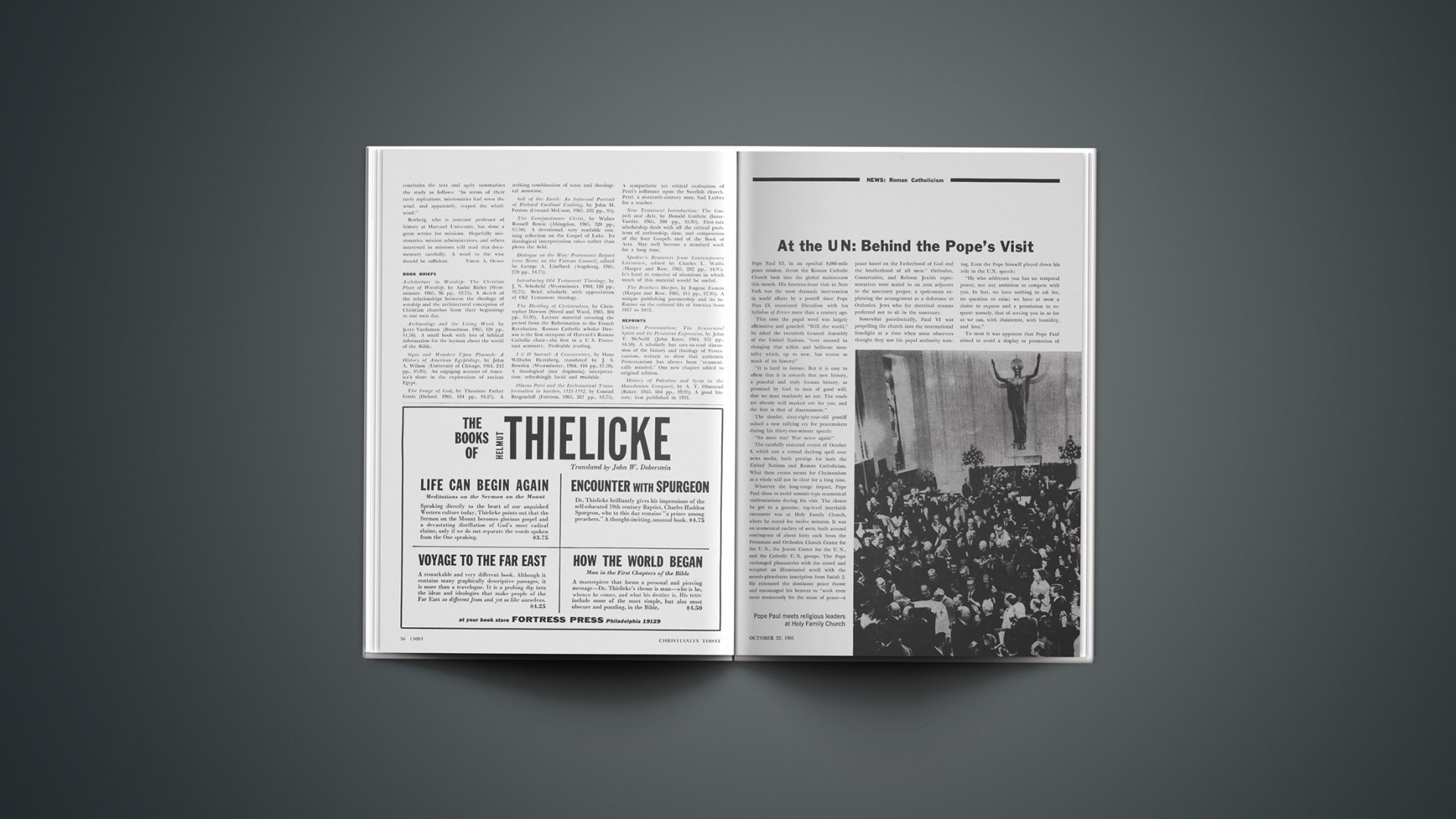
Whatever the long-range impact, Pope Paul chose to avoid summit-type ecumenical confrontations during his visit. The closest he got to a genuine, top-level interfaith encounter was at Holy Family Church, where he stayed for twelve minutes. It was an ecumenical enclave of sorts, built around contingents of about forty each from the Protestant and Orthodox Church Center for the U. N., the Jewish Center for the U. N., and the Catholic U. N. groups. The Pope exchanged pleasantries with the crowd and accepted an illuminated scroll with the swords-plowshares inscription from Isaiah 2. He reiterated the dominant peace theme and encouraged his hearers to “work even more strenuously for the cause of peace—a peace based on the Fatherhood of God and the brotherhood of all men.” Orthodox, Conservative, and Reform Jewish representatives were seated in an area adjacent to the sanctuary proper, a spokesman explaining the arrangement as a deference to Orthodox Jews who for doctrinal reasons preferred not to sit in the sanctuary.

Somewhat paradoxically, Paul VI was propelling the church into the international limelight at a time when some observers thought they saw his papal authority waning. Even the Pope himself played down his role in the U.N. speech:

“He who addresses you has no temporal power, nor any ambition to compete with you. In fact, we have nothing to ask for, no question to raise; we have at most a desire to express and a permission to request: namely, that of serving you in so far as we can, with disinterest, with humility, and love.”

To most it was apparent that Pope Paul aimed to avoid a display or promotion of Roman Catholic distinctives. Except for a reference to the “Queen of Peace” in farewell remarks at Rome’s Fiumicino Airport, Mary was kept out of the picture. One reference was made to the Pope as the “vicar of Christ,” in St. Patrick’s Cathedral, where decades of decorum were broken with shouts, whistles, and applause. There were no special embellishments over his person, no thrones, and no crowns.

On television, Bishop Fulton Sheen aroused hostility with a humorous quip on the papal plane having become airborne: “Our father, who art in heaven.”

The Pope’s U. N. speech was so general that it was received with disappointment in some quarters. He made no electrifying proposals, offered no grand schemes, held out no specific alternative to the war-weary world. Yet many echoed President Johnson’s suggestion that the papal visit may turn out to be “just what the world needs to get us thinking of how to achieve peace.” Others viewed the Johnson observation as an invitation to keep the Pope in the forefront of the political scene.

The only two real surprises in the U. N. speech were the Pope’s request that the world body not encourage “artificial” birth control and his indirect but quite plain plea in behalf of U. N. membership for Communist China.

By contrast, Pope Paul sidestepped any endorsement of several religious liberty measures now before the U. N.

From the religious standpoint, the Pope’s plea for personal conversion was especially significant (see editorial, page 25). Also noteworthy was the somewhat obscure reference, complicated by the use of the papal “we,” to his feeling that the trip was a fulfillment of a divine mandate:

“We appreciate the good fortune of this moment, however brief, which fulfills a desire nourished in our heart for nearly twenty centuries.… We here celebrate the epilogue of a wearying pilgrimage in search of a conversation with the entire world, ever since the command was given to us: Go and bring the glad tidings to all peoples. Now, you here represent all peoples.”

For New Yorkers suffering from a water shortage, a newspaper strike, and, for only the fifteenth year in the last fifty, having to do without a World Series in town, the Pope was a welcome subject to cheer about. The pontiff got a relatively “cool” reception, police having advised people to stay home and the weather having further encouraged indoor TV viewing. A cold snap, the first of autumn, had blown in during the night. Temperatures plummeted down near the freezing mark. A raw wind whipped the city, prompting the Pope to abandon an open-top Lincoln Continental modified with elevated seat. He made his rounds with another Lincoln, this one from the White House fleet with only the special benefit of a glass roof.

At least two bomb threats were reported, but both seemed to be the work of cranks. The only outright hostility evident was the picketing of a Roman Catholic group seeking the ouster of James Francis Cardinal McIntyre because of his conservative stand on racial issues.

Evangelicals, who tend to regard any action of the Pope as a power play or publicity quest, were respectfully silent. One small band of evangelicals, however, seized the opportunity for a quiet evangelistic effort. Outside Yankee Stadium, where Paul VI celebrated a mass for peace before 90,000, young men distributed copies of a tract by Dr. George Wells Arms, “I Believe in the Holy Catholic Church,” asserting that the universal church of the Apostles’ Creed is composed only of those who have received Christ as Saviour.

The Pope’s call on President Johnson at the Waldorf Towers, climaxed with a private discussion lasting forty-six minutes, was reported to be a general discussion of world affairs.

As if to perpetuate the success of the trip, rumors began spreading that the Pope is considering a round-the-world tour, including a more extended U. S. visit, that could take as much as three months out of the coming year.

A Negro Bishop

The Very Reverend Harold R. Perry is the first acknowledged American Negro to be a Roman Catholic bishop.

Perry, 49, a native of Louisiana, was appointed auxiliary bishop of New Orleans on the eve of the Pope’s trip to New York. He said: “I am the first Negro bishop. The others did not consider themselves Negro.” He referred to the Most Reverend James Augustine Healy, a mulatto who was bishop of Portland. Maine, in the late nineteenth century.

The new bishop said there were 164 Negro priests and 800,000 Negro laymen in the United States.

The Pilot Was Presbyterian

Pope Paul’s pilot on the flight from New York to Rome was TWA’s George C. Duvall, 56, a Presbyterian and board member of the Chicago Bible Society.

The men had met earlier this year when Duvall gave the Pope a copy of The 500th Anniversary Pictorial Census of the Gutenberg Bible, which he had helped prepare.

Meanwhile, In Rome …

The Pope’s visit to the United Nations overshadowed an important debate at the Vatican Council about secular affairs. At times it sounded like a group of Protestants arguing about political pronouncements by the National Council of Churches.

At issue was “The Church in the Modern World,” Schema Number 13, which could prove unlucky to a rather smooth-running council. Already the need for textual revision forced a one-week recess in floor action in mid-October.

A bishop writing in America capsulized one major viewpoint on Schema 13 thus:

“If we hold the Church is a divine, supernatural society, then she should stick to preaching the gospel. Moreover, she has no competence beyond this. The text will get the Church criticized for being a busybody.”

One problem is Schema 13’s range. It encompasses five categories of human problems: marriage and the family, the advancement of culture, economic and social life, politics, and the “community of nations.”

Another problem is that it is written for all men, not just Catholics. This has produced a watered-down stand, in the view of Vienna’s Francis Cardinal Koenig: “Because of the desire to address also non-believers, there is danger of some reduction in truth.” Even though the schema is a secular statement, he said, it should include topics the current text has evaded, such as “sin, the truth of the cross, the need for penitence, and hope of resurrection with Christ.”

Similar criticism was made by a key Protestant observer, the World Council of Churches’ Lukas Vischer. He said the schema’s stress on solidarity with the world shows a temptation that Protestants also face: to neglect the Bible’s teachings on God’s judgment of the world.

“The Gospel not only brings reconciliation of the world with God; it brings division between men. The Gospel teaches liberation from sin, but it does not make the struggle with sin less real on that account,” Vischer said.

A statement is definitely forthcoming, since 98 per cent of the 2,222 bishops have voted that a decree based on the present draft be adopted. At first, the schema was scheduled to be issued without debate as an encyclical from the council expressing “the sense of the house,” similar to documents from World Council of Churches assemblies.

Among the many criticisms of the phrasing of the text, one highlighted the problems of catholicity. Josyf Cardinal Slipyi, exiled Ukranian Rite archbishop, said the schema “uses mostly the terminology of the West and reflects too much the western mentality. The world includes Eastern Europe and the East as well as the West.…”

Among other things, the bishops were trying to decide what Schema 13’s approach to atheists should be. A surprising appeal for a hard line came from Father Pedro Arrupe, leader of the Jesuits. With an evangelistic tone, he pointed out that Catholics now constitute 16 per cent of the world’s population, whereas a few years ago they were 18 per cent.

But French Archbishop Francois Marty said: “The faithful are rubbing shoulders with atheists almost continuously in their day-to-day life.… Our texts sound more like a condemnation and open no doors to honest dialogue with atheists.…” In another reflection of liberalizing attitudes, there were kind words for the work of renowned atheist Sigmund Freud. Sergio Mendez Arceo, speaking for ten Mexican bishops, compared Freud’s work to that of Copernicus and said psychoanalysis should have a place in Schema 13.

Another great Schema 13 issue is war and peace. Despite praise of peace by Popes John and Paul, there was great difficulty in applying the idea to specifics. Two touchy sections are on conscientious objectors and foreign policy.

One Roman quipped that if the Vatican should explicitly support conscientious objection, the Italian army would disappear overnight. Certainly this civil liberty, generally accepted in America, is anathema to Latin countries where it is not tolerated.

A persistent “peace lobby,” a small group of active laymen, not only wants to keep this statement in the final version but hopes for a condemnation of the policy of “aequilibrium terroris,” the balance of terror or deterrence, which intrinsically includes total war as a threat and a possible effect. In effect, this would condemn the military policy of the United States and the Western alliance in general.

The thrust of the schema on laymen, another floor topic, is reflected in Schema 13. It was revealed that the draft of Schema 13 was submitted to five laymen for their opinion, under strict pledges of secrecy, and that they all endorsed it. Also, the announcement of a third World Congress of Laymen for October of 1967 (previous ones were held in 1951 and 1957) implied that laymen would have a special part in applying the results of Vatican II.

Another little-noticed but significant action was presentation of the schema on the pastoral office of bishops. It not only affirms the principle of collegiality but also calls for reorganization and internationalization of the Curia and Vatican diplomatic corps, both traditionally composed of Italians. Initial approval was lopsided.

Birth Control Bombshell

A remarkable declaration against current Catholic birth control dogma added new urgency to the Vatican debate on marriage doctrines in Schema 13.

The report from thirty-seven top American Catholic scholars, pigeonholed for half a year, says traditional church arguments against contraception are “unconvincing.” A majority of the group declared “contraception is not intrinsically immoral.”

The conventional teachings do not take into account “the findings of physiology, psychology, sociology and demography,” the statement said, “nor do they reveal a sufficient grasp of the complexity and the inherent value of sexuality in human life.” The majority asserted that special family problems “may demand the continuance of sexual communion even if a new pregnancy cannot be responsibly undertaken.”

The minority disagreed but said the evidence against the present stand requires that the issue be kept open for continued study. This seemed a practical approach, with fast-moving scientific developments in anti-ovulant pills and other contraceptive devices to consider.

The special papal commission that just recently received the report has found it impossible to agree on how to advise the Pope. Persistent rumors say the Pope will soon issue his long-awaited birth control decree; Britain’s John Cardinal Heehan expects it before year’s end.

Pope Paul admitted his perplexity in a recent news interview: “We cannot remain silent. But to speak out is a real problem. The Church has not ever over the centuries had to face anything like these problems.”

Although Paul has said he will handle this issue himself, some bishops want to cite contraception in Schema 13. The discussion of marriage in the schema draft has a conservative flavor that upsets liberals like Montreal’s Paul-Emile Cardinal Leger. He said its emphasis on procreation and education of children as basic marriage aims neglects the fact that, above all, marriage is “an intimate community of life and love.”

In related questions, the council discussed whether remarriage should be permitted if a spouse indulges in adultery, if an innocent spouse is abandoned, or if a spouse becomes permanently insane.

The ‘Deicide’ Dilemma

“Deicide” is the key word in controversy about Vatican II’s revised draft on Jewish responsibility in the Crucifixion.

Dr. Abraham Heschel of the Jewish Theological Seminary charged that “not to condemn the demonic canard of deicide … would mean condoning Auschwitz, defiance of the God of Abraham, and an act of paying homage to Satan.”

The vacillating council is criticized if it uses the word and criticized if it doesn’t. Last year’s draft mentioned “deicide” and explicitly rejected the term that has played so large a role in the history of anti-Semitism. But an earlier version, like the newest one, omitted the idea.

Some delegates contend deletion of “deicide” implies denial of Christ’s divinity. Others say inclusion would imply a collective guilt that has no biblical basis.

But the new schema pleased both Catholic liberals and Jewish observers by specifically condemning anti-Semitism for the first time. The draft says no Jew, then or now, is responsible for Christ’s death except those directly active in prosecuting him. Most delegates contend that even these men weren’t guilty of deicide, since they did not know Christ was God.

The document not only discusses Catholic attitudes toward Judaism but states that the church “rejects nothing that is true and holy” in any of the major world religions.

It buries the historic hatchet with Islam, which is cited for its monotheism, reverence for Jesus, honor for Mary, and emphasis on moral life and divine judgment. Buddhism and Hinduism rate less enthusiasm, but Catholics are urged to seek fellowship with all peoples.

Book Briefs: October 22, 1965

Jerusalem In Five Pages

Cities of the New Testament, by E. M. Blaiklock (Pickering and Inglis, 1965, 128 pp., 15s.), is reviewed by David F. Wright, lecturer in ecclesiastical history, New College, University of Edinburgh, Scotland.

Professor E. M. Blaiklock holds the chair of classics at the University of Auckland, New Zealand, and for this reason we are not surprised that when he turns to the New Testament his forte lies in the elucidation of its historical and cultural background. In his latest work twenty-three cities are covered from this standpoint, sixteen in the order of Paul’s journeyings from Antioch to Rome and six as the addressees of the John of Revelation. The two groups are separated by Alexandria, which, though acknowledged to have “only a precarious place in this list of cities” (albeit the author believes Apollos to have been converted there), curiously receives the longest treatment of all.

Details of historical origins, prehistorical legends, local pagan cults, local trade and industry, archaeological discoveries—such is the staple diet that Professor Blaiklock offers, though he is often ready to serve up some of the quainter fruits in his vast storehouse of classical learning. He is always on the lookout for independent corroboration of the New Testament narratives and owes a considerable indebtedness to the pioneer work of Sir William Ramsay. There is a great deal here to illuminate the Acts and the Epistles for the Bible student, and to set them firmly amid the living flesh and blood of the first-century world.

Yet this reviewer admits to some disappointment both in the basic outlines of the work and in some of the details. Space does not seem to have been allotted on the basis of importance; hence the breathless compression of the five pages on Jerusalem. We perhaps discern the author’s classical bias in the omission of cities (towns?) from the Gospels, such as Capernaum, Tiberias, Samaria, and even Gerasa, whose remains constitute probably one of the best-preserved examples of a Roman provincial town and which has at least as good a claim to inclusion as Alexandria. We certainly detect the classicist in the enthusiastic chapter on “Athens, Intellectual Capital of the World”—which, of course, it had long since ceased to be by the first century of our era. A map or two would have been of immense help in following the geographical information.

It is doubtful whether in the light of Van Unnik’s Tarsus or Jerusalem: The City of Paul’s Youth we will ever again be able to speak with confidence, if at all, of Tarsus as the scene of Paul’s early years. Was Tarsus (p. 21) or Damascus (p. 15) the locus of Paul’s first preaching? Is there really any evidence for Troas as the place of Paul’s final arrest? What is anyone but an expert to make of the tantalizing mention of the “Nazareth Decree” (pp. 41, 86)? The Codex Bezae is described as “Beza’s version,” and the chapter on Corinth could have been much enriched with archaeological data concerning the quite possible site of the synagogue (Acts 18:4), the bema (the tribunal of 18:12 ff.), and the meat-market (1 Cor. 10:25, RSV). The calculation of the size of the Christian community at Rome (pp. 86, 87) goes astray by not allowing for the influx that must have followed Constantine’s conversion; scholars like Harnack, Lietzmann, and Baus judge Gibbon’s estimate if anything too high for A.D. 250! The author’s statements concerning the legal status of Christianity in the Empire are wide of the mark; it was never “officially proscribed” (p. 104—cf. pp. 100, 101) till the third century. All in all, we are sure that the professor could have done much better.

DAVID F. WRIGHT

Justification And Justification

The Wesleyan Bible Commentary, Volume V: Romans through Philemon, by Wilber T. Dayton, Charles W. Carter, and others (Eerdmans, 1965, 675 pp., $8.95), is reviewed by Donald W. Burdick, professor of New Testament, Conservative Baptist Theological Seminary, Denver, Colorado.

Here is a commentary whose distinctiveness justifies its existence. Written by Wesleyans and for Wesleyans, it is meant to provide an exposition of the biblical text in the tradition of John Wesley and Adam Clarke, but based on recent scholarship and couched in contemporary terms. The theological slant of the volume, however, is not so extreme as to make it impractical for students of Calvinistic persuasion. While the treatment is non-technical, the text in cludes helpful discussions of first-century customs and historical backgrounds, as well as an enlightening use of the Greek text, always explained in terms understandable to one who reads only English. A thorough analytical outline and an introduction, sometimes rather brief, precede each epistle.

Several of the seven authors insist that justification is more than forensic. Both Wilber Dayton, on Romans and Galatians, and Charles Carter, on First Corinthians, assert that in justification, righteousness is not only imputed but imparted. Exception must be taken to George Turner’s comment on Philippians 2:5–11 that Christ “divested himself of many divine prerogatives that he had as God” including “omnipresence, omniscience, and omnipotence” (p. 464). While the desire to be non-polemical is commendable, some may wish for a stronger presentation of Wesleyan theology, especially in comments on such passages as Romans 8:28–30. Others may find the rather extensive use of previous commentaries to be a weakness. On the whole, however, and in view of their stated purpose, the authors have succeeded in producing a commentary profitable for both pastors and lay people.

DONALD W. BURDICK

The Content Is Good

The Master Plan of Evangelism, by Robert E. Coleman (Revell, 1961. 126 pp., $2.95), is reviewed by Harold Lindsell, associate editor, CHRISTIANITY TODAY.

Jesus, the Master, had a plan for evangelizing men. Coleman has analyzed the plan and found eight guiding principles which are neatly outlined for the reader: (1) Selection—men were his method; (2) Association—he stayed with them: (3) Consecration—he required obedience; (4) lmpartation—he gave himself away; (5) Demonstration—he showed them how to live; (6) Delegation—he assigned them work; (7) Supervision—he kept check on them: and (8) Reproduction—he expected them to reproduce.

The bibliographic material contained in the footnotes is impressive. The author breathes out a spirit of passion and concern for the lost. He has put his principles to the test in his own evangelistic outreach. The dust jacket contains high commendations from splendid sources.

No one will take exception to the points the author has made. Many will take exception to the way he writes. The book reads like a first draft, as shown by the following samples taken at random: “This principle of establishing a beachhead in a new place of labor by getting with a potentially key follow-up leader is not to be minimized”; “the patience with which Jesus brought this out to His disciples reflects upon His consideration for their ability to learn”; “He found the distraught father with the sick child having a fit before the helpless disciples”; “that is why His demands upon discipline were accepted without argument”; “Christ gave a special gift … for the purpose of perfecting the saints to do the service they have each to perform”; “He concentrated Himself upon those who were to be the beginning of this leadership.” The publisher cannot escape his responsibility, either. He should employ a first-rate copy editor.

Strangely, this is a good book badly written.

HAROLD LINDSELL

The Beginning Is Where?

Pascal’s Recovery of Man’s Wholeness, by Albert N. Wells (John Knox, 1965, 174 pp., $4.25), is reviewed by George Ensworth, lecturer in pastoral theology, Westminster Theological Seminary, Chestnut Hill. Pennsylvania.

Albert N. Wells, minister of the Laurinburg, North Carolina, Presbyterian Church, received his Th.D. from Princeton Seminary, where he studied Pascal extensively under Emile Cailliet. In this little volume he attempts to show that Pascal’s concept of order in life can bring “wholeness” to the “splitness” of today’s life and thought. For one who has never read the religious writings of this seventeenth-century Christian mathematician and scientist, this book will be a good introduction. Wells has written a lucid biography of Pascal showing his development as a Christian philosopher climaxing in his Pensée 792. In this Pensée Pascal describes life as being of three orders: the physical, the intellectual, and the spiritual. Although Pascal saw certain truth on each level, there is discontinuity in the ascending order from physical to spiritual. One cannot reason from a lower to a higher order. According to Wells, Pascal leans heavily on Augustine to show that meaning and continuity in the orders come only when one starts “with man himself.…” “Faith in God was for Augustine the existential beginning …” (p. 42). It seems to this reviewer that to consider beginning with “faith in God” as “starting with man” is a reflection of Wells’s own thinking rather than Pascal’s or Augustine’s. Would they not consider faith in God as beginning with God?

Wells shows how important philosophers since Pascal have failed to realize “wholeness” because they have tried to reason from a lower to a higher order. This is a helpful section for anyone concerned about the relation of science and religion, but the impression is given that the problem of modern man is an intellectual discontinuity rather than a spiritual discontinuity caused by man’s guilt before a holy God.

If one can overlook the heavy existential emphasis, there is a refreshing attempt in the early chapters to make God supreme. “The fear of the Lord is the beginning of wisdom …” (Prov. 9:10). But the concluding chapters in which the author attempts to show Pascal’s relevance to today are very disappointing. Wells lets his own view of the world and life show too much. Although trying to keep faith in God supreme, he seems to fall into the error of making experience the final authority. In the last analysis he sees a Christianity that must be subjected to the corrective influence of modern science and thought, the very thing Pascal wished to avoid! For this reviewer the author has failed to make existentialism intellectually more acceptable.

GEORGE ENSWORTH

An Injustice To Christianity?

Athens or Jerusalem?, by L. A. Garrard (Allen and Unwin, 1965, 185 pp., 21s.), is reviewed by Martin H. Cressey, minister, St. Columba’s Presbyterian Church, Coventry, England.

The author, a distinguished Unitarian who formerly was principal of Manchester College, Oxford, and now is professor of philosophy and religion at Emerson College, Boston, here sets out his convictions about liberalism past and present. Many early Church Fathers, medieval scholars, and Enlightenment philosophers tried to produce a synthesis of biblical thought with Hellenic, Platonic, Aristotelian, or Stoic thought. Conservative and liberal readers alike will appreciate Dr. Garrard’s useful survey of these attempts, even if they do not accept all his summary comments (e.g., the Lutheran group of churches “has been largely characterized by emotional pietism”).

The real debate about this book will center on its first two and last chapters. In the first two, Dr. Garrard argues that, while there is in the sixty-six books of the Bible a unity of theme that makes them a unique collection, there is also a variation in theology that takes back into Scripture the kind of comprehensive diversity which he wishes to see in the Christian community today. He quotes with approval E. F. Scott’s statement that “the effort to harmonize the New Testament teaching does an injustice to Christianity itself, which is identified with one given form of belief, while it embraces many.” In particular he argues that there are in the New Testament teaching about Jesus “two fundamentally different main lines. One … is in the main adoptionist. Jesus became divine, or perhaps only the Lord’s anointed, at some specific point in his career.… The other view is concerned with the Incarnation of a pre-existent Divine being.… It is not really possible to accept both views at once.… It is very doubtful whether either is particularly helpful to us today.”

If all this is true, then the Church ought indeed to tolerate diversity and becomes sectarian if it does not do so. If all this is true, Dr. Garrard is right in his strictures upon the World Council of Churches for adopting a trinitarian formula. To accept his view would not, be it said, lead to pure relativism. The liberal does not necessarily hold that all religions have an equal contribution to the truth about God. “There is nothing in the liberal faith that precludes him from believing that Christianity is the best of existing religions or committing himself in personal loyalty to Jesus as his master.” Nor does liberalism in religion necessarily imply a blurring of all sharp distinctions. Dr. Garrard has no use for a tolerance which is “a huddling together for warmth in the face of the chill blasts of growing popular indifference to all forms of organized Christianity.” The last chapter of the book is indeed a helpful restatement of what liberalism means over against certain hostile distortions of its intention.

The basic question remains whether the liberal commitment of personal loyalty to Jesus is or is not an appropriate response to the teaching of Scripture. Those who disagree with Dr. Garrard, and they will be many, must be ready to search the Scriptures with him.

MARTIN H. CRESSEY

Mission Failures

Christian Missionaries and the Creation of Northern Rhodesia, 1880–1924, by Robert I. Rotberg (Princeton University, 1965, 240 pp., $6.50), is reviewed by Virgil A. Olson, professor of history and missions, Bethel Theological Seminary, St. Paul, Minnesota.

The recent cry in Africa has been, as James Scherer entitled his book, Missionary, Co Home! Bewildering questions are raised when the modern mission situation is surveyed: Why do nationals who have been trained in mission schools turn against the Church and the missionaries? Are these revolutionary forces in African nationalism that oppose missionaries the result of Communistic agitation?

Rotberg partially answers these disturbing modern queries by presenting a documentary probe into the formative history of missionary action in Northern Rhodesia. Culling his material from correspondence of missionaries, diaries, interviews, and field studies, he further documents the findings of the famous sociologist and missionary leader Maurice Leenhardt, who came up with many of the same conclusions two decades ago.

The book does not overlook the heroic dedication of men and women, nor is their zeal for winning Africans to Christ minimized. And this is the story that we have usually heard. Why, then, the apparent failure? Why are missionaries often looked upon as foes rather than friends of Africans?

This interestingly written report is the record of equating Christianity with Western civilization and imposing this form upon tribal communities; of a blind disregard of cultural mores, in which national Christians were forced to live under the most stringent Puritan ethic; of imperialistically minded servants of God who kept nationals in a state of servility; of racial discrimination; of limited confidence in national leadership, and the like. The author concludes the text and aptly summarizes the study as follows: “In terms of their early aspirations, missionaries had sown the wind, and apparently, reaped the whirlwind.”

Rotberg, who is assistant professor of history at Harvard University, has done a great service for missions. Hopefully missionaries, mission administrators, and others interested in missions will read this documentary carefully. A word to the wise should he sufficient.

VIRGIL. A. OLSON

Book Briefs

Architecture in Worship: The Christian Place of Worship, by André Biéler (Westminster, 1965, 96 pp., $3.75). A sketch of the relationships between the theology of worship and the architectural conception of Christian churches from their beginnings to our own day.

Archaeology and the Living Word, by Jerry Vardaman (Broadman. 1965, 128 pp., $ 1.50). A small book with lots of biblical information for the layman about the world of the Bible.

Signs and Wonders Upon Pharaoh: A History of American Egyptology, by John A. Wilson (University of Chicago, 1964, 243 pp., $5.95). An engaging account of America’s share in the exploration of ancient Egypt.

The Image of God, by Theodore Parker Ferris (Oxford, 1965, 184 pp., $4.25). A striking combination of sense and theological nonsense.

Salt of the Earth: An Informal Portrait of Richard Cardinal Cushing, by John H. Fenton (Coward-McCann, 1965, 242 pp., $5).

The Compassionate Christ, by Walter Russell Bowie (Abingdon, 1965, 320 pp., $5.50). A devotional, very readable running reflection on the Gospel of Luke. Its theological interpretation rakes rather than plows the field.

Dialogue on the Way: Protestants Report from Rome on the Vatican Council, edited by George A. Lindbeck (Augsburg. 1965, 270 pp., $4.75).

Introducing Old Testament Theology, by J. N. Schofield (Westminster, 1964, 126 pp., $2.75). Brief, scholarly, with appreciation of Old Testament theology.

The Dividing of Christendom, by Christopher Dawson (Sliced and Ward, 1965, 304 pp., $5.95). Lecture material covering the period from the Reformation to the French Revolution. Roman Catholic scholar Dawson is the first occupant of Harvard’s Roman Catholic chair—the first in a U. S. Protestant seminary. Profitable reading.

I & II Samuel: A Commentary, by Hans Wilhelm Hertzberg, translated by J. S. Bowden (Westminster, 1964, 416 pp., $7.50). A theological (not dogmatic) interpretation; refreshingly lucid and readable.

Olavus Petri and the Ecclesiastical Transformation in Sweden, 1521–1552, by Conrad Bergendoff (Fortress, 1965, 267 pp., $3.75). A sympathetic yet critical evaluation of Petri’s influence upon the Swedish church. Petri, a sixteenth-century man, had Luther for a teacher.

New Testament Introduction: The Gospels and Acts, by Donald Guthrie (Inter-Varsity. 1965, 380 pp., $5.95). First-rate scholarship deals with all the critical problems of authorship, date, and composition of the four Gospels and of the Book of Acts. May well become a standard work for a long time.

Speaker’s Resources from Contemporary Literalure, edited by Charles L. Wallis (Harper and Row, 1965, 282 pp., $4.95). It’s hard to conceive of situations in which much of this material would be useful.

The Brothers Harper, by Eugene Exman (Harper and Row, 1965, 415 pp„ $7.95). A unique publishing partnership and its inffuence on the cultural life of America from 1817 to 1853.

Reprints

Unitive Protestantism: The Ecumenical Spirit and Its Persistent Expression, by John T. McNeill (John Knox, 1964, 352 pp., 84.50). A scholarly but easy-to-read discussion of the history and theology of Protestantism, written to show that authentic Protestantism has always been “ecumenically minded.” One new chapter added to original edition.

History of Palestine and Syria to the Macedonian Conquest, by A. T. Olmstead (Baker, 1965, 664 pp., §9.95). A good history; first published in 1931.

Eutychus and His Kin: October 22, 1965

Protest against pornography branded as “admirable” and “puerile”

Smile The Clouds Away

About the poorest advice anyone has ever given me—and, by the same token, the poorest advice I have ever given anybody else—is, “Don’t worry.” The way my mind works, the effort to quit worrying is just another one of my worries.

Two solutions have presented themselves recently, and the first one seems to work pretty well. I try worrying on purpose. I pick out a really good worry and try to concentrate on it; and, since my powers of concentration aren’t too good, the very act of trying to worry drives the worry out of my mind. There are no guarantees that this will work for you.

Last week I tried a different scheme. I tried to sort out my worries and classify them under some general headings. The results were awful. You have no idea how many worries you have until you really get around to The Large View. People want me to work out some answers on Viet Nam, Red China, and Formosa, the new revolution in Russia, the Islamic invasion of Africa, the population explosion, the starving people of India, the new morality, the election of 1966, the poverty program, the race issue, the new confession, and the like—after, of course, giving a little thought in passing to geriatrics and vitamin deficiencies. So our dog has an infection in the middle of her back and we have water grass growing in one corner of our lawn.

In the midst of this I have a word for our preachers who want to be up and at ’em so their congregations will know that they are aware of the relevance of the Gospel. All they do to me is preach to my anxieties. Maybe we could use an official word on the “Balm in Gilead.” Maybe they could tell me, in the midst of all my worries, the one thing needful.

EUTYCHUS II

Four-Letter Words

In his article “The Church Faces the Problem of Pornography” (Sept. 24 issue), Hillyer H. Straton … reminds us that “four-letter words” are objectionable, not because they always refer to what is indecent or unmentionable, but because no gentleman uses them in public. The four-letter word is not more obscene than the phrase “sexual intercourse.” Either is obscene if in its context it lures the reader of a story or the viewer of a picture into a sinful act. There are many unrefined folk who interlard their conversation with these words, with no evil intent or interest in their meaning, just as many of Shakespeare’s lower-caste characters call whatever they dislike “whoreson”.…

WILBUR L. CASWELL

Patterson, Calif.

Dr. Straton has done an admirable job of analysis, and he goes on to offer a prescription for the sick patient.…

I believe every pastor can do something about this threat by personally approaching the owners of drugstores and other public places that have newsstands in his immediate community, urging them to discontinue objectionable magazines, cheap novels, and so on.… One thing I point out: You have to keep going back and back. The owners will quickly tell you that while they are busy here and there, the agents for this filthy trash will come in and consign their dirty and profitable wares.

LOUIE D. NEWTON

Druid Hills Baptist

Atlanta, Ga.

His contention that the Church should merely maintain support for the past, and claim identification with the opinions of other disciplines, is incredibly puerile.…

K. L. PEARSON

Tucson, Ariz.

Water, Tears, And The New Birth

Re “The New Birth” by Billy Graham (Sept. 10 issue): This is a well-written, impassioned appeal to the inner consciences of many people who are greatly confused over their spiritual well-being.…

Jesus explained to Nicodemus that he must be born of the water and of the Spirit in order to enter the Kingdom of Heaven (the Church) (John 3:3–5).…

The physical birth is achieved after continuance through the various stages with which all of us are familiar. The undebatable harmony of the Scriptures relative to the new birth proves that it is also accomplished in progressive stages: hearing, faith (Rom. 10:17); repentance (Luke 13:3); confession (Rom. 10:9, 10; Acts 8:37) being the essential stages prior to the last stage or actual birth—baptism (Mark 16:16; Acts 2:38).…

BERRY W. WYMAN

Vista, Calif.

He docs his usual exceptionally fine job except for one thing …: When he mentions how to receive Christ he leaves out baptism, which is the scriptural symbol of the new birth.…

GEORGE WASSON

South Walnut Street Christian Church Bloomington, Ind.

It is a most valuable essay and sums up with admirable clarity those great fundamental truths connected with our salvation which are so deeply cherished by all evangelicals.…

On page 15 Dr. Graham sets out the wording of the prayer which he has used so often in his counseling work. The prayer begins, “O God, I acknowledge that I have sinned against Thee. I am sorry for my sins.…”

I must admit that there is no scriptural justification for suggesting that sorrow for sin is an essential precondition of salvation. It is obviously desirable, but it is not essential.…

Repentance is certainly a condition of salvation; but repentance is an act of the will which enables the sinner to turn back to God and to receive by faith the unconditional gift of salvation by grace. Penitence, on the other hand, is a Christian virtue inculcated by the Holy Spirit in the heart of the believer as part of the process of sanctification.…

Jesus said. “Him that cometh unto Me I will in no wise cast out.” He has never yet rejected any man on the grounds that he is too bad a sinner, or that he is not sorry enough, or even that his theology is unsound. The only condition is that he should come.

I would therefore venture to suggest that Dr. Graham’s prayer could with advantage be altered to read, “O God, I acknowledge that I have sinned against Thee, and I am willing to turn from my sins.…” That is all that is necessary. Our blessed Lord has promised to do all the rest, and he will do it.

PETER W. WILSON

Reigate, Surrey, England

It was a wonderful testimony in itself to find the essay “The New Birth” … right next to the editorial “What Is the Church For?” …

One gave the answer to the other.…

MRS. CHARLES ERIKSON

Red Bank, N. J.

We are a small church working in a small university town, and this essay seems good to be put in the hands of our college students.

If it is available, will you please forward me 100 copies?

KENNETH E. WISE

Grace Baptist Church

Moscow, Idaho

I must tell you how greatly I enjoyed and appreciate the plan of these quarterly bonus inserts in CHRISTIANITY TODAY. The one by Billy Graham was particularly helpful. I think there is no living man that is doing quite the work that he is doing in presenting the saving fundamentals for the masses.…

I would like a dozen copies to send to different individuals.…

L. E. FROOM

Washington, D. C.

• Regrettably, no reprints of “The New Birth” are available. The material was excerpted from Evangelist Billy Graham’s new book, World Aflame.—ED.

College Critique

In the next to the last paragraph in the first column (News, p. 45, Sept. 24 issue) there is stated a relationship between Upland and Messiah Colleges and the Church of the Brethren. No formal relationship has ever existed between these two colleges and the Church of the Brethren.…

CLARENCE H. ROSENBERGER

Dir. of Church Relations

Juniata College

Huntingdon, Pa.

• Our mistake. Messiah and the late Upland should have been identified with the Brethren in Christ.—ED.

The greatest error is the omission of Texas Christian University from the list of church-related colleges.…

MONTE L. GRAVENSTEIN

First Christian Church

Fredonia, Kan.

• TCU is indeed one of the biggest. Our sourcebook credits it with 6,201 full-time students.—ED.

More Than The Weather

Re the letter of Melvin Roy (Sept. 10 issue): This rather sharp criticism lacks cogency. Quite evidently the broad context in Galatians demonstrates Paul’s independence from merely human authorization. Yet at the same time we cannot evade the apparent force of the verb “to visit” (ἱστορῆσαι) in 1:18. Peter and Paul did not spend that fifteen days talking about the weather. The verb itself most probably suggests a consultation designed to improve Paul’s acquaintance with the life and ministry of the historical Jesus whom Peter knew firsthand. W. D. Davies, in The Setting of the Sermon on the Mount (Cambridge University Press, 1964, pp., 453–55), cites convincing parallels in both Rabbinic texts and Greek papyri to support this exegesis. Galatians 1:18 is only one of a series of witnesses in the New Testament to the historical continuity existing between the kerygma of Jesus before the Resurrection and the message of Paul after it. No doubt the brevity of my argument in Proposition Four led to Mr. Roy’s query. My “theology” is an exegetical one, as Paul’s is a historical one.

CLARK H. PINNOCK

Asst. Prof, of New Testament

New Orleans Baptist Theological Seminary

New Orleans, La

Sound and Fury: The ‘New Year’ in Television

Whump-poing! As phony as the charge of the Ajax white knight, but with an aim just as sure, the onslaught of the new television season slams America in the pit of the stomach. Men of science (see them marching in white coats) have given TV power … power … power to blast you out of the kitchen and drop you in a programmed channel.

There you will sit for hours, avoiding twenty million other Americans by watching the same programs. Saturation is about complete. More than 90 per cent of American households have television sets, and the average set runs for five or six hours every day. Never were so many joined in one cult at one time; never did the common act of so many mean so little. Americans do not really work together, live together, or pray together; they only escape together.

The tube is still one-way. TV scans live audiences in the thousands at its sports spectaculars, but it cannot zoom in on the loners and Adams families in the millions who sit and watch at home. But the viewers are never forgotten. Audience-measurement experts count the hands that twist the dials. From the samplings of National Arbitron (or Trendex or Nielsen ratings) they will tell the sponsors how many people are learning that hexomonia is stronger than dirt. They do it with formulas—sure to impress the makers of hexomonia. Artists may avoid formulas, but industrialists love them; commercial television is an industry. Critical praise won’t save a single show doomed by this month’s Nielsen rating.

It takes a formula to beat a formula. To determine what millions will watch, find out what they are watching and give them more. The medium is still too costly for gambling on fresh approaches: will Jesse James stake everything on the cards to top the gambler in the back room? You bet your boots he will, and so will “Paul Bryan” running for his life on another channel the same night. The producer won’t gamble with a hero who won’t gamble!

The only thing safer than applying the formula is copying the way another show with a high rating has already applied the formula. No one is supposed to miss the family resemblance between the Cartwrights of Bonanza (NBC) and the Barkleys of The Big Valley (ABC). The Man from U.N.C.L.E. (NBC) began as a copy of movie spy James Bond and has ushered into the Bondage a new version of Amos Burke—Secret Agent (ABC); a female counterpart, Honey West (ABC); and an integrated spy team in I Spy (NBC). The Wild, Wild West (CBS) puts the secret agent to work for Ulysses S. Grant, but with a railroad carload of preatomic gimmicks. Since the original Bond series was a slap-happy caricature of the sexy spy story and The Man from U.N.C.L.E. spoofs Bond, the next step was predictable. Get Smart! (NBC) spoofs the spy-spoofs and at last the TV audience is laughing. Smart, of course, is the spy. His shoe-telephone rings in a symphony concert; he stumbles out to a closet to answer it, locks himself in, shoots out the lock to escape, and emerges at last from the unequal struggle with Mr. Big, the midget-sized villain, to utter a memorable closing line. As the crook blows himself and his ship to pieces with a charge of Inthermo aimed at the Statue of Liberty, Smart sighs, “If only he could have turned his evil genius into … niceness!”

A few doses of such parody could be amusing; McHale’s Navy has managed to stay funny for almost half the time it has been on the air. Yet the spectacle of TV running in circles after its tail grows tedious, even when the dizzy hound is in color.

The new shows offer little hope of a change in pace or formula. “Turn on the ACTION,” as the ads demand, and you have tuned in on Formula One: E = SV2 (Escape equals sex times the square of violence). The action shows may be spiced with sex, but violence carries the wallop. The scene is indifferent: war, the West, espionage, the underworld—any battleground will do, except, of course, one that would involve the viewers too directly: Viet Nam and race riots must be avoided.

Why all the violence? Is the mass audience masochistic? Do coddled Americans want to be punched in the stomach or nailed in a barrel?

The answer seems to be simpler. It’s almost impossible to stop watching a fight, particularly if you are identified with one of the combatants. I know. I had expected a headache when I accepted a week of watching for this article. What I got was a stomach-ache as I took classic clobberings with Robert Horton of Shenandoah, Lee Majors of The Big Valley, Ivan Dixon of I Spy, and half the cast of Laredo. The worst was the vicious cruelty suggested in a beating administered to Roy Thinnes of The Long. Hot Summer by the old residents of Frenchmen’s Bend, allegedly in Faulkner country.

But while you are being kicked in the stomach you can’t stop looking. You will therefore stay in the channel and hear about the underarm deodorant that pays for this illusion of mayhem.

And next week? The millions come back for more, because life seems to gain in meaning when you watch a man fight for it.

Of course not all the action shows use the formula the same way. Combat, a veteran series, avoids gimmicks and works for human drama. Somewhere near the opposite end of the scale is Amos Burke, where violence is flippant and meaningless and sex is thrown into the limit of the NAB code and the ABC network censorship. Laredo, one of the new shows, has a built-in bantering tone; two of the principals kid their hapless hero-comrade and the script. But the banter was curdled in sudden, incongruous slaughter at the end of the first show when the bogus Indian “Lazyfoot” was hit with a knife in the back. The bored scriptwriter seemed to have forgotten that the formula still uses human life—and death.

Enough violence? Then turn on the FUN. Formula Two states that entertainment equals stars (E = S). Stars may be stacked in ranks, as in variety shows, or given individual settings as in Jackie Gleason’s wry pantomimes.

Variety shows like Hullabaloo present a surrealistic version of old vaudeville. Stars in outlandish costumes writhe with the mike: “Ah gah choo, babe!” Sudden seizures of expression crack the face mask above the rocking pelvis. Again, a strange detachment. Is this a satire? Are the performers mocking the act?

The viewer who wants reassurance will flip to a different sort of fun—the situation comedy. Please Don’t Eat the Daisies, based on Jean Kerr’s book, brings some fresh ideas and an English sheep dog to the domestic comedy pattern. Gidgel is the normal teen-ager implausibly billed as a “surf bunny,” but the second program had the interesting thesis that lascivious dances are innocent for the high school crowd but spell trouble for grown-ups. Mona McClushey is a slight vehicle for the talents of Juliet Prowse. She plays a movie actress married to an Air Force sergeant who wants to be the head of his house.

My Mother, the Car is a formula derived from crossing Bewitched with Mr. Ed, the talking horse. Mother is reincarnated as a 1928 Porter. The show is as silly as the idea. It is not, however, the silliest new series. That award goes to Lost in Space. This program loads a rocket ship with a fantastic payload: the space family Robinson, an evil scientist, a robot, and all the blinking lights and whirring noises in the studio. The rocket goes into “hyperdrive” and escapes the galaxy. Very good. TV follows it. Very bad.

Such is the “New Year” of TV: blossoming with color, full of sound and fury, signifying nothing. It includes technical triumphs, skilled performances, talented people, but it does not look at life—it looks away. The “Big” new programs do not answer the big questions; they scarcely dare ask them. The old morality play of the good guys and the bad guys is still a formula for Westerns, but it is losing to the Loner with blood on his hands, the Fugitive fleeing unjust retribution, and Shenandoah, man of lost identity, seeking what he fears to find.

The religious figure appears only as the fanatic seeking vengeance of Jesse James, or the confused preacher whose pacifism is a hazard on the frontier. The most meaningful questions of the new season, overplayed though they are, may be found in Run for Your Life. A man whose months are numbered sees life differently. The threat of death is “a hand erasing all life’s equations and writing new ones.”

To the Christian Church the greatest threat of television is not its incitement to violence or lust but its banality. Christians are watching when they ought to be praying. A recent study of TV audience attitudes showed that most people feel guilty about the time they waste. The editor asks. “Why these Calvinistic hesitations about televiewing, in contrast with the self-satisfaction associated with reading?”1Gary A. Steiner, The People Look at Television (New York: Knopf, 1963, p. 59).

Tell him, somebody.

Now for our concluding commercial: Don’t miss A Charlie Brown Christmas, Thursday, December 9. 7:30–8:00 P.M. EST, on CBS.

Apple PodcastsDown ArrowDown ArrowDown Arrowarrow_left_altLeft ArrowLeft ArrowRight ArrowRight ArrowRight Arrowarrow_up_altUp ArrowUp ArrowAvailable at Amazoncaret-downCloseCloseEmailEmailExpandExpandExternalExternalFacebookfacebook-squareGiftGiftGooglegoogleGoogle KeephamburgerInstagraminstagram-squareLinkLinklinkedin-squareListenListenListenChristianity TodayCT Creative Studio Logologo_orgMegaphoneMenuMenupausePinterestPlayPlayPocketPodcastRSSRSSSaveSaveSaveSearchSearchsearchSpotifyStitcherTelegramTable of ContentsTable of Contentstwitter-squareWhatsAppXYouTubeYouTube