Eutychus and His Kin: May 21, 1965

GOD AND MAMMON

If you are looking for a good point of reference for the solutions of about 70 per cent of your ethical problems, you might call to mind, “You cannot serve God and Mammon.” Most people think they are discussing the issue when they are really trying to discover some rationalization by which they can make the best of two worlds. They can see very clearly what they ought to do, and they see with equal clarity what it will cost. It’s the cost in the decision that is the real trouble.

This covers all sorts of things, such as how you will spend the Sabbath Day, where you will engage in sharp practices in business, how long it will take you to get even with somebody else, and what to do with your money.

The all-American “success motif” gets into all kinds of things. There was a wife who almost refused to go along with her husband to a foreign mission field because she couldn’t stand to part with her electric toaster. There was a girl who wanted to be a missionary but whose good Christian mother talked her out of it by saying, “Why don’t you work for a few years and get a little money ahead, and then you will have something to fall back on.” And another mother advised her daughter, “Get your three-year teaching certificate; and then, if anything goes wrong, you will have something to fall back on.” In the last analysis, what we “fall back on” is our real god, no matter what else we say.

Someone has suggested that our easiest forgetting is forgetting that we inhabit a planet. Right now we are hurtling through space in at least seven different directions (according to Einstein), and it is interesting to suggest that while we are riding on such a bolt in the blue our security rests on a three-year teaching certificate.

One time I followed a yellow bus full of nuns. In large print on the side of the bus it said, “Sisters of Divine Providence,” and in small print on the back it said, “Emergency Exit.” Take another look at your “emergency exit,” and see whether you are serving God or Mammon.

SEX AND A SINGULAR CHURCH

I read in your news section (Apr. 23 issue) of a church called Judson (New York) and a pastor called Moody (Howard—I hope no relation to D. L.) that claim to be American Baptist and [of] the heathen ritual (nude dancing) performed in their building. I would hope this was a mistake in reporting, but likely it is not.

We as American Baptist pastors realize that because of our democratic procedures anyone or anything from soup to nuts can parade under our name. I’m sure I speak for the vast majority of American Baptist pastors who try to be honorable servants of our Lord in apologizing to the Christian world for the behavior of one who uses our name.

Adoniram Judson, for whom Judson Church was very likely named, suffered much humiliation in a Burmese prison, but I’m sure it would be nothing compared to the humiliation he would suffer if he could know of the behavior of his namesake church in New York. I feel the least such a church could do would be to drop the name of such an honorable man. May I suggest a new name—The Church of “St.” Ashtoreth. First Baptist Church

Williston, N. D.

How far do we go in our obsession with relevancy? New York is probably no more sex-obsessed than was ancient Corinth; yet a bachelor Christian minister by the name of Paul did not instruct or give license to the church to duplicate the sex practices of Corinth. In fact, he sought to lead them in just the opposite direction.

If being relevant means adopting non-Christian standards of conduct, then I would rather be “irrelevant.” If the biblical ethic in sex conduct is unacceptable to our age, then it is nothing unusual, for it has always been so.

Incidentally, Judson Memorial Church is also a member of the United Church of Christ.

First Baptist Church

Dover, Del.

THE VICTORIA INSTITUTE

Dr. J. D. Douglas has drawn the attention of your readers to the foundation and activities of this institute in your journal (Current Religious Thought, Apr. 9 issue). Perhaps … your readers may be perplexed as to where details of the institute’s prizes (of which only one was mentioned) and membership may be obtained. All enquiries should be addressed to the Secretary, 12, Burcote Road, London, S.W.18., England.

The Victoria Institute

London, England

Editor

FLOOD TIDE

I want to commend you on your editorial. “Facing the Tide of Obscenity” (Apr. 9 issue). There can be no question … that our society is simply being overwhelmed by a flood of pornography in paperback books, magazines, and motion pictures. The long-range impact of this upon our civilization is going to be serious unless measures are taken to bring it under control.

I am sure that most Protestants concerned with this field would share your fear of boards of censorship, for censorship is a double-edged sword that a free society cannot tolerate. However, the Supreme Court—if the courts would but follow a strict interpretation of its dictum—has laid down an intelligent and reasonable standard for judging obscenity that is denied the protection of the free press.… We must go deeper than repression, of course, and educate people to the need for maintaining our historic Judaeo-Christian standards of sex behavior.…

Your editorial convinces me that you see this problem in proper perspective. We need very urgently to get this message before the American public.

Washington, D. C.

I was impressed with your demand for “a creative literature that dips into the restless revolt of our times,” but I am afraid that most of the modern work which fits that description has been frowned upon by the Church as “immoral.” If the modern world believes anything is “outdated,” it is not the “morality” of former days but the moralist’s ill-conceived attitude toward that morality.…

Amherst, Mass.

Thank you for your editorial. “A Time for Moral Indignation” (Mar. 12 issue). We thought this was great.

We suggest a practical program to follow up on this editorial. We have found it effective for five people to meet together weekly, each writing a letter to a magazine or newspaper. They should read the letter to the group, so that the best possible letter goes for publication. They should undertake only a six-week campaign so that their work does not look endless. We feel this type of approach is necessary, since the Supreme Court has enunciated that all obscenity questions rest on the expression of community standards. A silent community means there are no standards in that community.…

Secretary

Operation Yorkville

New York, N. Y.

THE MARCH

I appreciate each issue of CHRISTIANITY TODAY as we receive it. In the issue of April 9 is an article on the news pages entitled “The March to Montgomery.” May we have permission to reprint it in the pages of the Church Advocate?

Editor

The Church Advocate

Harrisburg, Pa.

You have been very unfair toward us and write as though you felt we were all a very evil people.…

Atlanta, Ga.

There has always been love and respect among the different races in our state. The colored do have the right to vote. They also have some of the finest schools and colleges here. They have every opportunity a white child has.…

Huntsville, Ala.

Assuming you are a Christian, do you not know anything about the Bible, the separation of people, races …?

Girard, La

Most of the letters (April 23 issue) are self-righteous concerning the racial problems and troubles in the South.

We ministers and church members in the South have failed to follow the commandments of our Lord: “And thou shalt love the Lord thy God with all thy heart.… Thou shalt love thy neighbor as thyself …” (Mark 12:30, 31).

God help us to repent and to be followers of Christ!

Hackleburg, Ala.

I strenuously object to the analogy set forth in the first three paragraphs of the news article “Selma: Parable of the Old South” (Mar. 12 issue). The first sentence tells me that Mr. Taft is naïve and uninformed, or is a Southerner himself and is writing in defense of the system of segregation.…

I do not mean to speak harshly or in generalities, but if I would generalize on the same level of Mr. Taft, I would rather compare Selma’s attitude (and the rest of those who uphold the system of segregation) to “A Boy’s Smothering Love for His Dog.” I say this for two specific reasons: (1) As long as a boy can play with his dog, as a dog, on the level of a dog, all is well. As long as the dog does not assert himself to rise to the level of the boy all is well. The dog may live a life “smothered in love,” happy, without a care. As long as he stays in the place of a dog, he will never have any trouble. (2) Let the dog try to ascend to the place of the boy, however, and the dog is in trouble. The boy may try to reason a little while. He may try to control the dog with love first; then a little force. He may try to make allowances for some things. But in the end the attitude is hardly one that “sets about to reestablish, with God’s help, the bonds of love on a more mature and satisfying basis that recognizes her child as a person in his own right.” Rather, that dog is sub-human. If he thinks he has a right to the same place in society that the little boy has … that dog must die.

Cedar Avenue Church of God

Sharon, Pa.

REVERENDS, RIGHT, VERY, ETC.

If you’re mad at that man of Divinity

Who is taking pot-shots at the Trinity

Likewise, if the Bishop of W.

Continues to worry and trouble you,

Here’s some thought-provoking news:

Free will enables you to choose!

You don’t have to get with it,

You can simply dismyth it!

There’s no rule that says you have to go along,

Rt. Reverends or not, they could be Wg.!

San Antonio, Tex.
Cover Story

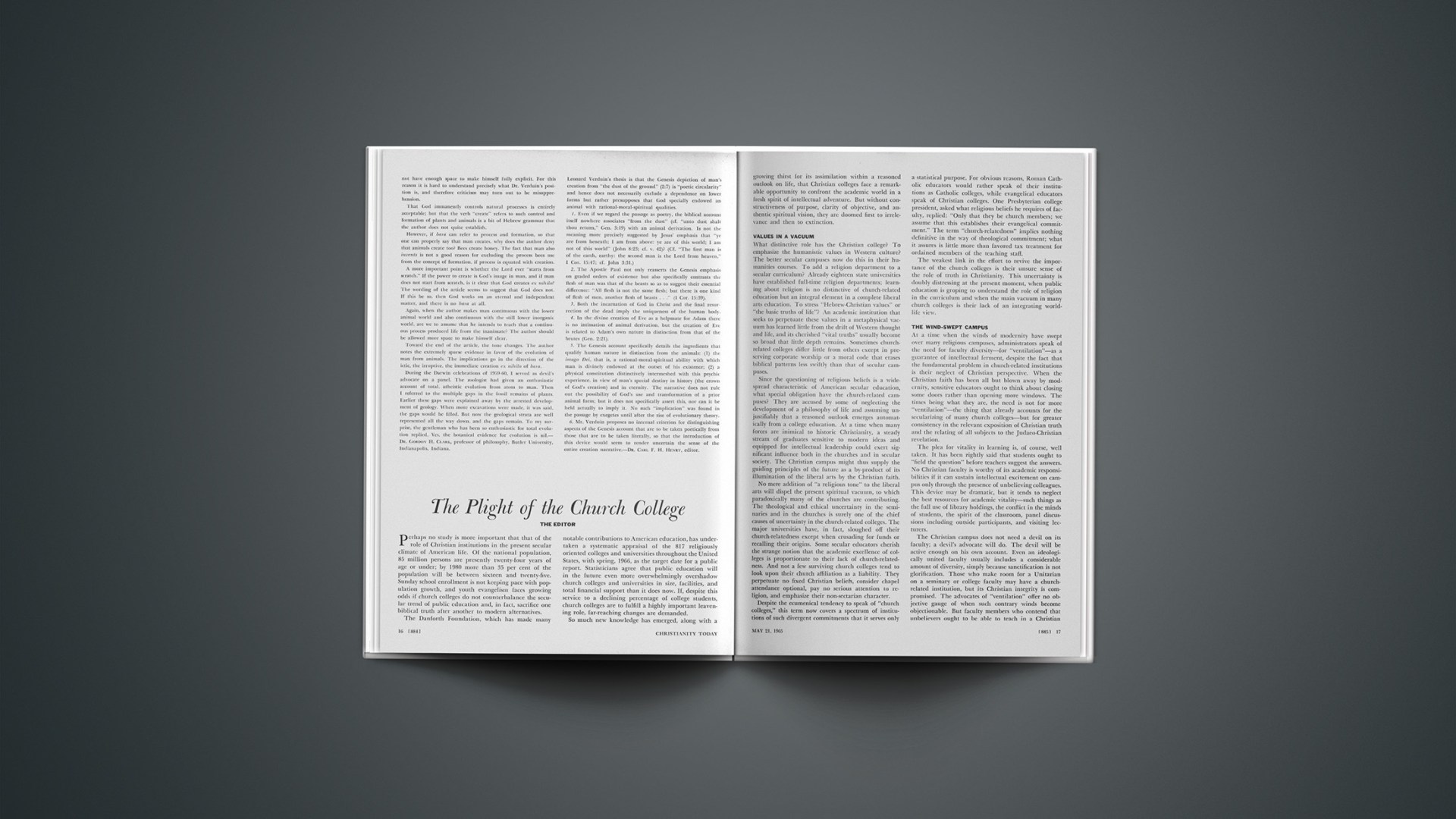
The Plight of the Church College

Perhaps no study is more important that that of the role of Christian institutions in the present secular climate of American life. Of the national population, 85 million persons are presently twenty-four years of age or under; by 1980 more than 35 per cent of the population will be between sixteen and twenty-five. Sunday school enrollment is not keeping pace with population growth, and youth evangelism faces growing odds if church colleges do not counterbalance the secular trend of public education and, in fact, sacrifice one biblical truth after another to modern alternatives. The Danforth Foundation, which has made many notable contributions to American education, has undertaken a systematic appraisal of the 817 religiously oriented colleges and universities throughout the United States, with spring, 1966, as the target date for a public report. Statisticians agree that public education will in the future even more overwhelmingly overshadow church colleges and universities in size, facilities, and total financial support than it does now. If, despite this service to a declining percentage of college students, church colleges are to fulfill a highly important leavening role, far-reaching changes are demanded.

So much new knowledge has emerged, along with a growing thirst for its assimilation within a reasoned outlook on life, that Christian colleges face a remarkable opportunity to confront the academic world in a fresh spirit of intellectual adventure. But without constructiveness of purpose, clarity of objective, and authentic spiritual vision, they are doomed first to irrelevance and then to extinction.

Values In A Vacuum

What distinctive role has the Christian college? To emphasize the humanistic values in Western culture? The better secular campuses now do this in their humanities courses. To add a religion department to a secular curriculum? Already eighteen state universities have established full-time religion departments; learning about religion is no distinctive of church-related education but an integral element in a complete liberal arts education. To stress “Hebrew-Christian values” or “the basic truths of life”? An academic institution that seeks to perpetuate these values in a metaphysical vacuum has learned little from the drift of Western thought and life, and its cherished “vital truths” usually become so broad that little depth remains. Sometimes church-related colleges differ little from others except in preserving corporate worship or a moral code that erases biblical patterns less swiftly than that of secular campuses.

Since the questioning of religious beliefs is a widespread characteristic of American secular education, what special obligation have the church-related campuses? They are accused by some of neglecting the development of a philosophy of life and assuming unjustifiably that a reasoned outlook emerges automatically from a college education. At a time when many forces are inimical to historic Christianity, a steady stream of graduates sensitive to modern ideas and equipped for intellectual leadership could exert significant influence both in the churches and in secular society. The Christian campus might thus supply the guiding principles of the future as a by-product of its illumination of the liberal arts by the Christian faith.

No mere addition of “a religious tone” to the liberal arts will dispel the present spiritual vacuum, to which paradoxically many of the churches are contributing. The theological and ethical uncertainty in the seminaries and in the churches is surely one of the chief causes of uncertainty in the church-related colleges. The major universities have, in fact, sloughed off their church-relatedness except when crusading for funds or recalling their origins. Some secular educators cherish the strange notion that the academic excellence of colleges is proportionate to their lack of church-relatedness. And not a few surviving church colleges tend to look upon their church affiliation as a liability. They perpetuate no fixed Christian beliefs, consider chapel attendance optional, pay no serious attention to religion, and emphasize their non-sectarian character.

Despite the ecumenical tendency to speak of “church colleges,” this term now covers a spectrum of institutions of such divergent commitments that it serves only a statistical purpose. For obvious reasons, Roman Catholic educators would rather speak of their institutions as Catholic colleges, while evangelical educators speak of Christian colleges. One Presbyterian college president, asked what religious beliefs he requires of faculty, replied: “Only that they be church members; we assume that this establishes their evangelical commitment.” The term “church-relatedness” implies nothing definitive in the way of theological commitment; what it assures is little more than favored tax treatment for ordained members of the teaching staff.

The weakest link in the effort to revive the importance of the church colleges is their unsure sense of the role of truth in Christianity. This uncertainty is doubly distressing at the present moment, when public education is groping to understand the role of religion in the curriculum and when the main vacuum in many church colleges is their lack of an integrating world-life view.

The Wind-Swept Campus

At a time when the winds of modernity have swept over many religious campuses, administrators speak of the need for faculty diversity—for “ventilation”—as a guarantee of intellectual ferment, despite the fact that the fundamental problem in church-related institutions is their neglect of Christian perspective. When the Christian faith has been all but blown away by modernity, sensitive educators ought to think about closing some doors rather than opening more windows. The times being what they are, the need is not for more “ventilation”—the thing that already accounts for the secularizing of many church colleges—but for greater consistency in the relevant exposition of Christian truth and the relating of all subjects to the Judaeo-Christian revelation.

The plea for vitality in learning is, of course, well taken. It has been rightly said that students ought to “field the question” before teachers suggest the answers. No Christian faculty is worthy of its academic responsibilities if it can sustain intellectual excitement on campus only through the presence of unbelieving colleagues. This device may be dramatic, but it tends to neglect the best resources for academic vitality—such things as the full use of library holdings, the conflict in the minds of students, the spirit of the classroom, panel discussions including outside participants, and visiting lecturers.

The Christian campus does not need a devil on its faculty; a devil’s advocate will do. The devil will be active enough on his own account. Even an ideologically united faculty usually includes a considerable amount of diversity, simply because sanctification is not glorification. Those who make room for a Unitarian on a seminary or college faculty may have a church-related institution, but its Christian integrity is compromised. The advocates of “ventilation” offer no objective gauge of when such contrary winds become objectionable. But faculty members who contend that unbelievers ought to be able to teach in a Christian college classroom should apply to a secular institution, since the main distinction between a church college of diverse religious outlooks and a secular college is usually the latter’s academic superiority.

Behind the advocacy of “ventilation” is not so much a desire for intellectual excitement, which can be achieved in other ways, as a surrender of the traditional view of the Christian college as a propagatory institution or medium of indoctrination. The campus cannot be the church, requiring an affirmation of the historic faith from its students. Its role cannot be defined as pastoral and protective. Nor is the classroom the place to press for conversion. Its main traffic is in ideas; intellectual content is its commodity. But liberal arts education presumably is interested in the whole truth. Just as physicians are bound by the Hippocratic Oath to preserve life, so teachers ought to consider themselves academically responsible to purvey truth in its entirety. And a company of scholars who agree about a corpus of spiritual truth that they are willing to expose to the same searching scrutiny they give other ideologies has every academic right, and in fact an obligation, to pass this truth on.

Non-evangelicals who disbelieve biblical truths will hesitate to inculcate these truths, but it should be clear that it is the truths and not the indoctrination that they oppose. Whoever thinks that only evangelical or fundamentalist campuses practice indoctrination is due for some higher education. Every campus, and, in fact, almost every teacher, does this; the difference between liberal and conservative teachers and colleges in this regard is not whether but what. If conservative colleges are characterized as defenders of the faith, the plain fact is that the liberal college not only has lost the historic faith and is confused about what to substitute but also serves an intellectual smorgasbord, with ardent promotion of one specialty or another by the various classroom chefs.

A Difference Of Degree

The notion that academic freedom is inconsistent with the presentation of a body of truth to which a college faculty subscribes is unconvincing. The difference in this matter among the religiously oriented campuses is one of degree, not of kind. Few if any church-related colleges will tolerate an atheist as a professor, and probably none would tolerate a known Communist. All religious institutions have specific faculty requirements. If academic freedom is thwarted by an intellectual requirement, then all church-related campuses are in the same predicament. What is really objectionable about evangelical institutions from the liberal standpoint is the requirement of faculty adherence to articles of the historic faith that the non-evangelical has surrendered, and that are a barrier to faculty eligibility unless religious symbols are rationalized to mean what they once did not mean. Every educational institution gathers a company of scholars subscribing to its purposes, and no institution grants its faculty members freedom to destroy those purposes. If an institution allows academic license to erode its objectives in the classroom, the dissident faculty will in time preside over the death of these objectives.

Let no one consider this a brief for run-of-the-mill fundamentalist education. It is the academic shortcomings of these institutions that lend artificial credence to liberal contentions. Their ingrown faculties, their worship of Ph.D.’s more than good teachers, their contentment with graduates who have not really won the faith for themselves but “parrot” it, their elevation of the campus code to an authority paralleling that of divine articles of faith, their inclusion in required faculty statements details on which even evangelicals disagree widely, their failure to produce a comprehensive literature articulating the Christian faith in the context of contemporary thought, their smug withdrawal from the secular academic scene—all these elements and more call for a new day in conservative education.

But non-evangelicals are in no position to gloat over this list of shortcomings, since some of their own campuses reflect certain of these tendencies also. And the so-called “liberal” campus that boasts about its academic freedom often has bolted the doors against firsthand reflection of evangelical convictions, and, even more often, presents them second-hand in the spirit of effigy-burning. As a matter of fact, some “liberal” liberal arts colleges wholly bypass evangelical faculty prospects. Nor are theological seminaries an exception; at one period or another campuses of the stature of the University of Chicago Divinity School have displayed this same exclusive temper. As many graduates complain of the academic illiberality of liberal institutions as protest the closed-mindedness of conservative campuses. One would be hard put to it to draw up a list of evangelical professors teaching philosophy in non-evangelical church colleges. The libraries of non-evangelical institutions are often woefully lacking in evangelical reading resources, and course requirements and reserve reading shelves frequently bypass conservative literature entirely.

The liberal complaint that conservative institutions necessarily transgress academic freedom by their doctrinal requirements really springs from a quite different motivation—in a word, from skepticism about basic evangelical tenets. Often, in fact, this skepticism runs much deeper; there is doubt of the reality of any divinely revealed truths whatever, or of the existence of a fixed body of truth of any kind. This attitude implies not so much a concern for freedom, of which Christ is the font, as an uncertainty that Christ is the font of truth and that the Christian campus can know absolute truth about the spiritual world.

Precisely this mood has led the church colleges to their present predicament, in which the relation between religion and truth is highly ambiguous. In fact, religion and intellect are sometimes viewed antithetically. This is all the more apparent when liberal educators, troubled about the decline of Christian conviction on church-related campuses, speak of their institutions as stronger academically than religiously. The contrast of truth and religion is one that neither Augustine nor Aquinas, Luther nor Calvin, would have tolerated. But the liberal tradition from Kant through Ritschl, Schleiermacher, and Kierkegaard refuses to acknowledge the competency of reason in the metaphysical realm. Evangelical scholars insist that this competency has been impaired by sin; but this is quite different from the emphasis that man cannot have objective knowledge of ultimate reality on any basis whatever, divine creation and redemption included.

The Underlying Denial

What underlies the liberal outlook pervading many denominational colleges today is the arbitrary denial of the ontological significance of reason—that is, of the biblical fact that the Logos is structurally constitutive of all reality. That a rational God is Creator of all things, that in Jesus Christ the Divine Logos has become incarnate, that the rational nature of man and the laws of logic belong to the imago Dei—all this has been surrendered to the waves of modernity. The instrumental philosophy of John Dewey, the anti-metaphysical theology of influential European modernist, dialectical, or existential scholars, have squandered all this—and more. What more? The historic Christian assurance that divine revelation has communicated trustworthy knowledge of God and his purposes. In a word, the whole biblical and traditional confidence in divinely revealed truths is gone.

This situational fact, much more than genuine theological renewal, explains the success of ecumenism in our time. And its implications for the church-related colleges are plain. If evangelical confidence in revealed truths is misplaced, if no genuine metaphysical knowledge is possible, if there is, in fact, no body of fixed truth, and if religion thrives in the absence of any universally valid truth-content, then it is perfectly clear why many insist that Christian colleges need “ventilation,” why the “ideal” Christian campus will not defend a “faith which was once for all delivered,” and why the insistence on creedal subscription conflicts with academic freedom. Surely no scholar wants to be chained to what he considers error.

Much of this kind of thinking motivates the emphasis that students best acquire a unified view of life from the encouragement of professorial example. This emphasis is popular among liberals who are disillusioned about the ability of a structure of courses (particularly “the religion department”) to achieve the integration of learning. Surely no one will doubt the importance of professorial example, particularly in the matter of a unified view of life. The teacher should teach by example outside the classroom what he teaches by precept in the classroom. But it should be crystal clear that, at this level, we are speaking of something considerably less than an integrated Christian world-life view, something, shall we say, answering to the Communist Weltanschauung.

The evangelical, the modernist, and the humanist have strikingly different convictions about what delivers man from inner personality discord and unifies his personality and outlook on life. And it is the evangelical today who insists on the role of reason in religious experience. The others insist, no doubt, that the purpose of education is not simply to amass a great quantity of facts but “to make the students’ eyes shine.” But all the “posies, punch, and platitudes” cannot conceal the fact that most church college campuses are evasive at the point that needs most clearly to be articulated—namely, whether the Christian religion is true. That Christianity is the highest religion, that it is unique, that it is redemptive—all this may be asserted. But no college campus that professes to be Christian can evade an academic duty to deal with the truth-claim of historic Christianity in relation to the truth of philosophy, science, and history. Is the truth of the Christian religion universally valid? If a church-related campus cannot give a reasoned affirmative answer to that question, it deserves to go out of business. In fact, it really has gone out of business so far as its religious claim is concerned.

Comments on Mr. Verduin’s Essay

1. All evangelicals believe that man is a created being, but we have varied ideas on unrevealed details of how God created.

2. Consider the phrase “God breathed into his nostrils the breath of life.” If God is Spirit and no man has seen him, then he has no body, hence no lungs; so God did not literally breathe out a puff of air. Therefore the meaning of the phrase is “God made man alive.” Because the breathing made man “a living soul,” we need to know what biblical use is made of this phrase. In Genesis 1:24 the animals are called “living creatures,” which Hebrew scholars say is the same word used of man, “living soul.” So God, who first made living creatures, later by his breath makes man the same kind of living creature.

3. But man is not just a living creature, possessing only a physiological nature common to animals. He is also made in the image of God (which, to author Verduin, means that man reminds one of God because man creates). A Yale biologist, Edmund Sinnott, has emphasized that man’s unique feature is his creative imagination. But are not man’s consciousness of God and man’s awareness of “oughts” and “ought nots” also attributes of His image? James M. Murk of the anthropology department of Wheaton College holds that “three things are unique to man: (1) All his behavior is learned; (2) he has a complex symbolizing capacity enabling multiple abstractions (creative imagination?) and extrinsic symbolic representation; (3) he has a moral sense.”

4. The “dust” of which man was made is the “dust” to which he returns. It is composed of proteins, carbohydrates, fats, and other chemical compounds that eventually after death become such elements as carbon, hydrogen, oxygen, and nitrogen, or simple combinations of them. Hence “dust” is earthy material, and man is “earthy,” as well as spiritual. We do not know in what combinations the chemicals existed in the dust when God started to make man.

5. Fossils of man are scarce and fragmentary but reveal that creatures which in most respects are similar to modern man in anatomy yet differed from him in minor details of size, skull capacity, brow ridges, and chin. Upright posture and a distinctive kind of teeth are the criteria for anatomical man. Even the Australopithecines (the South Africa man-apes) had pelvic bones that reveal bipedal locomotion of some kind. Washburn believes they could run but not walk for long distances. But all monkeys and apes are quadrupeds. No fossil specimens, considered by evolutionists to be men, are connected by a series of intermediates to four-footed beasts. The supposed ancestors of men are way back in the early Pliocene, about ten million years earlier than the earliest man-like organisms.

6. Man, as evolutionists identify him, first appears in the early Pleistocene or very late Pliocene (about 2,000,000 years ago), recent strata, not in the Cretaceous (as Verduin writes)—a difference of 70,000,000 years. The three-toed horse of the White River Badlands is considered Oligocene, and the saber-toothed tiger is Pleistocene.—DR. RUSSELL L. MIXTER, professor of zoology, Wheaton College, Wheaton, Illinois.

In general this article shows some very good insights into certain historical problems in the relation of Christianity and science, into the theological concepts about creation, and into some of the pertinent problems about exegesis. Its basic thesis that the “dust” or “earth” out of which man was made could be organic dust rather than inorganic mud was proposed in the nineteenth century and is not particularly new. But the mentality that demands that all creation is instantaneous and that all notions of process in creation are concessions to evolution must be periodically challenged, lest it lead to a hardened orthodoxy that can be creative neither in its exegesis nor its relation to science.

The main strength of the paper is its attempt to preserve an open dialogue among evangelicals about creation and science and exegesis and theology, so that we do not prematurely settle on a position that might be indefensible in coming decades. For this reason the emphasis on creation as being both instantaneous and progressive, and on God’s activity as both transcendental and immanent, is to be well taken. The attempt to bring some creative imagination into the exegesis of Genesis 2 is also worthy.

Nevertheless, I find myself in fundamental disagreement with the paper. The unstated thesis seems to be that after all Genesis 1 and particularly 2 is a bit of science before science, of anthropology before scientific anthropology. In the nineteenth century Christian geologists found the geological column in Genesis 1. Thus we had geology before geology. But that thesis has been rather thoroughly exploded. Verduin’s paper seems to me to be a subtle reassertion of this now discredited thesis.

My thesis is twofold: (1) We must bring into focus all the biblical passages that refer to creation to develop a totally biblical doctrine of creation and not restrict our vision to Genesis 1 and 2. This has been ably stated by Claus Westerman in Der Schöpfungsbericht vom Anfang der Bibel. This applies to man as well as to the cosmos. And (2) we must learn to radically rethink creation as a Hebrew would think it and not as we in the twentieth century would think it. Siegfried Herrmann’s article, “Die Naturlehre des Schöpfungsberichtes(Theologische Literaturzeitung, June, 1961) is such an attempt, as is Martin Giersch’s Es Werde: Entwicklungslehre und Schöpfungsbericht. There is also Barth’s massive attempt to recover the really biblical doctrine of creation (though unfortunately corrupted with too much allegorical exegesis) in Church Dogmatics, III/1. I am sorry to limit my references to German and Swiss sources, but I think these men are out-thinking us at this point. Verduin does not interact with this kind of material; but I think a truly biblical and truly theological notion of creation is going to come from these circles, and not from the surreptitious notion in American orthodox and fundamentalist circles that Genesis 1 is only revelation or inspired if it in some way anticipates modern science.—DR. BERNARD RAMM, professor of systematic theology and Christian apologetics, California Baptist Theological Seminary, Covina, California.

When a short article discusses a broad subject, the author does not have enough space to make himself fully explicit. For this reason it is hard to understand precisely what Dr. Verduin’s position is, and therefore criticism may turn out to be misapprehension.

That God immanently controls natural processes is entirely acceptable; but that the verb “create” refers to such control and formation of plants and animals is a bit of Hebrew grammar that the author docs not quite establish.

However, if bara can refer to process and formation, so that one can properly say that man creates, why does the author deny that animals create too? Bees create honey. The fact that man also invents is not a good reason for excluding the process bees use from the concept of formation, if process is equated with creation.

A more important point is whether the Lord ever “starts from scratch.” If the power to create is God’s image in man, and if man does not start from scratch, is it clear that God creates ex nihilo? The wording of the article seems to suggest that God does not. If this be so, then God works on an eternal and independent matter, and there is no bara at all.

Again, when the author makes man continuous with the lower animal world and also continuous with the still lower inorganic world, are we to assume that he intends to teach that a continuous process produced life from the inanimate? The author should be allowed more space to make himself clear.

Toward the end of the article, the tone changes. The author notes the extremely sparse evidence in favor of the evolution of man from animals. The implications go in the direction of the ictic, the irruptive, the immediate creation ex nihilo of bara.

During the Darwin celebrations of 1959–60, I served as devil’s advocate on a panel. The zoologist had given an enthusiastic account of total, atheistic evolution from atom to man. Then I referred to the multiple gaps in the fossil remains of plants. Earlier these gaps were explained away by the arrested development of geology. When more excavations were made, it was said, the gaps would be filled. But now the geological strata are well represented all the way down, and the gaps remain. To my surprise, the gentleman who has been so enthusiastic for total evolution replied, Yes, the botanical evidence for evolution is nil.—DR. GORDON H. CLARK, professor of philosophy, Butler University, Indianapolis, Indiana.

Leonard Verduin’s thesis is that the Genesis depiction of man’s creation from “the dust of the ground” (2:7) is “poetic circularity” and hence does not necessarily exclude a dependence on lower forms but rather presupposes that God specially endowed an animal with rational-moral-spiritual qualities.

1. Even if we regard the passage as poetry, the biblical account itself nowhere associates “from the dust” (cf. “unto dust shalt thou return,” Gen. 3:19) with an animal derivation. Is not the meaning more precisely suggested by Jesus’ emphasis that “ye are from beneath; I am from above: ye are of this world; I am not of this world” (John 8:23; cf. v. 42)? (Cf. “The first man is of the earth, earthy: the second man is the Lord from heaven,” 1 Cor. 15:47; cf. John 3:31.)

2. The Apostle Paul not only reasserts the Genesis emphasis on graded orders of existence but also specifically contrasts the flesh of man was that of the beasts so as to suggest their essential difference: “All flesh is not the same flesh; but there is one kind of flesh of men, another flesh of beasts …” (1 Cor. 15:39).

3. Both the incarnation of God in Christ and the final resurrection of the dead imply the uniqueness of the human body.

4. In the divine creation of Eve as a helpmate for Adam there is no intimation of animal derivation, but the creation of Eve is related to Adam’s own nature in distinction from that of the brutes (Gen. 2:21).

5. The Genesis account specifically details the ingredients that qualify human nature in distinction from the animals: (1) the imago Dei, that is, a rational-moral-spiritual ability with which man is divinely endowed at the outset of his existence; (2) a physical constitution distinctively intermeshed with this psychic experience, in view of man’s special destiny in history (the crown of God’s creation) and in eternity. The narrative does not rule out the possibility of God’s use and transformation of a prior animal form; but it does not specifically assert this, nor can it be held actually to imply it. No such “implication” was found in the passage by exegetes until after the rise of evolutionary theory.

6. Mr. Verduin proposes no internal criterion for distinguishing aspects of the Genesis account that are to be taken poetically from those that are to be taken literally, so that the introduction of this device would seem to render uncertain the sense of the entire creation narrative.—DR. CARL F. H. HENRY, editor.

Cover Story

Man, a Created Being: What of an Animal Ancestry?

For more than a century the Christian world has debated the question of the origin of man against the backgrounds of the biblical view of creation and the Darwinian theory of evolution.

The antiquity of the earth and of man-like forms of life is no longer in dispute, although the question of the relation or non-relation of Adam to these forms remains a lively subject of controversy.

The following essay docs not necessarily reflect the view of the editors of CHRISTIANITY TODAY. But it is an able presentation of the viewpoint that “hints” of man’s supposed animal ancestry are found in Genesis. Those who find this line of argument unconvincing—and there will doubtless be many—will find the essay valuable for the constructive context in which it elaborates the themes of miracle and process.

Leonard Verduin is a Christian Reformed minister, now retired and living in Grand Rapids. He holds the A.B. degree from Calvin College, the Th.B. from Calvin Seminary, and the A.M. from the University of Michigan. He is the author of “The Reformers and Their Stepchildren.”

CHRISTIANITY TODAY supplements the essay by questions and comments from four evangelical leaders, one a scientist, one a philosopher, and two theologians.—ED.

Question: ‘What art thou?’

Answer: ‘A created being, both moral and mortal.’”

So begins an ancient Waldensian catechism, written in the Provencal language long before the Reformation.

Not all catechisms begin at this point. The Heidelberg Catechism, for example, begins with, “What is your only comfort?” And the Westminster Confession has as its first question: “What is the chief end of man?” There are many other points from which one could launch out as he seeks to make a systematic statement of Christian truth.

But the Waldensian catechism has in its favor that it begins where the Bible begins, with the story of the genesis, the becoming, the creation of the heavens and the earth, with all creatures upon the earth, with man as the crown and capstone of it all.

But what is it to “create”?

When we were children, we were taught that to create is “to make something out of nothing.” This is good and correct—as far as it goes. The Epistle to the Hebrews speaks of creation in this sense when it asserts (11:3) that “the worlds were framed by the word of God, so that things which are seen were not made of things which do appear.” It is with a reference to creation in this sense that the Bible opens: “In the beginning God created the heaven and the earth.”

Creation in this sense may be defined as that act whereby God imparts existence to the stuff of which the universe is made. Theologians have spoken of creation in this sense as creatio ex nihilo (creation out of nothing). They have also referred to it as “immediate creation” or as “primary creation.”

But the very use of these adjectives indicates that one can speak of creation in more senses than one, that not all that can rightly be called creating is covered by the formula “to make something out of nothing.”

The Bible also calls it creating when God exercises his creative power upon already existing materials and uses them as the raw materials for further creative performance. The creation of man according to the Bible was an act performed upon already existing stuff, called “the dust of the ground.” Man’s creation therefore was not ex nihilo.

Nor was the creation of man unique in this particular; for it was “out of the ground” that the Lord God “made … to grow every tree” (Gen. 2:9), and “out of the ground” that the Lord God “formed every beast of the field, and every fowl of the air” (Gen. 2:19). This was “mediate” creation, or “secondary” creation. We shall therefore have to label the old definition “to make something out of nothing” as inadequate, or not sufficiently sophisticated.

It will serve us no good purpose to hesitate or hang back at this point. Too often and too long have men imagined that the cause of Christianity is served by restricting the concept of creation to creatio ex nihilo.

Creatio ex nihilo is thinkable only to the man who really believes that God is a transcendent being, able to take his position over and above and beyond all created forms of existence. But to believe in the transcendence of God is not enough; biblical orthodoxy quite as certainly requires a belief in the immanence of God. The orthodox position is that God is at one and the same time immanent and transcendent. The God of the Bible works from without and from within.

A theology in which the idea of transcendence is predominant is deism, and a theology built on the idea of immanence is pantheism. Authentic Christianity, the Christianity of the Bible, does not choose between the two but accepts the one as unreservedly as the other. The resulting position is called theism. It alone promotes genuinely Christian habits of thought.

Although this comes as a surprise to those who have been conditioned by a more or less deistic tradition, the Bible is not afraid of the idea of immanence. The Apostle Paul says without the slightest hesitation that it is “in God” that men, all men, “live, and move, and have [their] being” (Acts 17:28). Nor is the Genesis account at all hesitant to introduce the idea of God working “from within.” What else can be the intent of the inspired report of the creative words, “Let the earth bring forth grass, the herb yielding seed …” (Gen. 1:11)? Or, of “Let the waters bring forth abundantly the moving creature that hath life, and … great whales … which the waters brought forth abundantly” (Gen. 1:20, 21)? Or, “Let the earth bring forth … cattle, and creeping thing, and beast of the earth” (Gen. 1:24)?

It would seem that the creative act of God seen from the vantage point of his transcendence has the dimension of the sudden, the catastrophic, the cataclysmic, the irruptive (this word, which we shall have occasion to use again and which is to be carefully distinguished from “eruptive,” is derived from two Latin words, meaning “in” and “burst” or “break,” so that the meaning is in-breaking or in-bursting, the non-processional, the ictic (this word, which was once in common use and which we shall be using freely, is from a Greek stem meaning “stroke” or “blow,” so that “ictic” stands for that which comes like a hammer-blow, sudden and unannounced).

It would seem, moreover, that the creative act of God seen from the vantage point of his immanence has the dimension of the drawn-out, the processive, the gradual, the progressive, the time-consuming.

It would seem, finally, that the creative act seen in the light of God’s transcendence is immediate creation, whereas the creative act seen in the light of God’s immanence is mediate creation.

A glance at the Genesis account shows very clearly that the inspired writer had no desire whatsoever to keep the idea of process and of progress out of the narrative. He manifestly did not think that the idea of process was foreign to the creationism he was promoting. Far from it. He deliberately introduced the idea of the drawn-out. Nothing seems to have been farther from his intention than the idea of a Mighty Creator bringing all creaturedom into existence by a snap of the fingers as it were. The very idea of six consecutive units of creative activity, following the one upon the other as days and nights follow each other in orderly procession, puts us squarely in the climate of the processive, the gradual, the non-ictic. Moreover, such language as the following suggests the idea of process rather than the idea of irruption: “Let the earth bring forth.… Let the waters bring forth.” If the figure is permissible, the writer of Genesis thought of the creating hand not simply as a hand that snaps a finger and, lo, there it is, but quite as much as a hand that molds and makes, with the prodigal disregard for the passing of time that marks the hand of him who fashions a work of art.

When in the nineteenth century the theory of evolution was being popularized, Christianity, especially Christianity in the New World, was suffering from overemphasis upon the irruptive. In fact, the orthodoxy of those times doted on the non-processive. Men got very close to saying, indeed did say, that the Christian religion begins at the point where the processive ends and the irruptive begins. Essentially deistic in its emphases, the orthodoxy of those times imagined that only ictic materials could be used in the building of the house of God. It had an eye for God’s acts from without and correspondingly little eye for his acts from within.

In its zest for the irruptive, this orthodoxy looked upon the Bible as the Great Irruption, a something that had fallen, as it were, from heaven, with little reference to the historic process. Little did men realize that in so stressing the irruptive they were getting dangerously close to the theology of the pagan Ephesians, who also had an object, the image of Diana, which, so it was held, had hurtled upon them out of heaven. This orthodoxy was hardly prepared to allow that the Bible is the product of history. This orthodoxy pictured salvation as simply a series of divine interventions, as wholly the result of a series of invasions of supernatural power. It was relatively blind to the fact that the work of God is also in the pattern of “first the blade, then the ear, after that the full corn in the ear” (Mark 4:28). Christian nurture was minimized as a device useful in the making of the children of God—it was too processive for that. In fact, it may be said that in such orthodoxy, history and the historical process are rather much of a farce. The Son of God did not use history; he came to terminate it. His whole enterprise was supernatural in the most literal sense, above nature. So this brand of orthodoxy held.

It has been said that every heresy that raises its head to plague the Church of Christ reflects one of the Church’s unpaid bills. When the Church commits the sin that someone has called “the sin of emphasis,” there is bound to be in the making a reaction to it—which will then pose a new heresy. There is a world of truth in this. The deistic emphasis of which we have spoken was bound to call forth protest, angry protest. In this way it became the mother of a new heresy.

The German poet Goethe, sometimes called “the first modern man,” led such a reaction, rebelling with all his strength of soul—which was considerable—against the essentially deistic theology of his day. Hear him in one of his tirades against it:

War wär’ ein Gott der nur von aussen stiesse?

Das All im Kreis am Finger laufen liesse?

Ihm ziemt’s die Welt von inneren zu bewegen

Natur in sich, sich in Natur zu hegen!

(What kind of God is this that only pokes at things;

And lets the universe spin round His finger?

His business is to run the world from the inside

Make nature in himself, himself in nature to abide.)

This is sheer pantheism, of course; but it is an understandable protest against a theology that had become hopelessly entangled in a deistic life-and-world view. Goethe left no room for the irruptive act of God, no room for the miracle, no place for the supernatural—without which Christianity cannot exist; but Goethe’s heresy reflected an unpaid bill of the Christian orthodoxy he had inherited.

Among the theologians in the New World it was Horace Bushnell who led the fight against a Christianity that had invested its all in the irruptive. His book entitled Christian Nurture, a book that shook the theological world in its day, was a plea for Christianity in the signature of process, so much so that his opponents accused him of advocating “vegetable Christians.” Before Bushnell had run his course, he had no real place left for any irruptive act of God, no room for miracle, for anything supernatural. Bushnell had the Almighty as firmly locked up in the creatural order as Goethe had wanted him to be. Bushnell in this way became the father of the modernism that is now, happily, on the defensive.

Alert theologians of Bushnell’s day realized full well that a revolution was taking place. Led by such men as Bennet Tyler they accused Bushnell of scrapping authentic Christianity—which, as they were convinced, is a religion of the irruptive, or, as they preferred to put it, of the ictic. Under the influence of the new theology of process, regeneration, hitherto looked upon as the result of an invasion of supernatural power, now became the mere precipitate of the educative process; the Bible, hitherto held to be the result of an ictic act of God, now came to be thought of as wholly factorable out of the historic process; the very person of Christ, hitherto treated as the master invasion into history, came to be looked upon as the precipitate of the historic situation; conversion, formerly dealt with as an irruptive thing, now came to be identified with the phenomena attending adolescence. In the Bushnellian system the very idea of the Second Coming, hitherto celebrated as the final irruption, was reduced to the dimension of the process. And so on.

Against this modernism for which Bushnell had prepared the way, there was a reaction known as fundamentalism. Since it was itself a reaction, it was from the start in danger of over-correcting the evil it rose to rebuke, of flying again into the arms of pure icticism. That it did not wholly escape this danger is now quite clear. The fundamentalism of which we speak was natively happy in the presence of the ictic and natively ill at ease in the presence of the processive. It sought once again to attain to orthodoxy by playing in one and only one register—that of the supernatural, the non-processive. Typical of it was the large place it assigned to the idea of the Second Coming, looked upon as in no sense the fruition of the historic process but as something brought about simply and solely by the interrupting voice of God.

Need it be pointed out that any theology that lays a one-sided emphasis on the ictic will be inclined to restrict the concept of creation to immediate creation and will tend to think that process and creation are mutually exclusive?

Is it at all surprising that in the tradition of modernism the idea of evolution, as worked out in the late nineteenth and early twentieth century, came in as a flood? It fit perfectly into modernism’s master formula, that of process. And need we be surprised that fundamentalism was unable to find a grain of truth in evolutionism? Fundamentalism’s theology in the signature of irruption precluded that.

Needless to say, there was no dialogue between the two camps. They were too mutually exclusive for that. Fundamentalists talked about the modernists but not with them. And conversely, modernists talked about the fundamentalists (the “fundies”) but not with them. The two groups were too disparate for fruitful dialogue. (There are hopeful signs that in this matter things are better than they were.)

We have noted that God was creating mediately when he made man and did so with recourse to already existing stuff. The Bible says that this stuff was “dust”—for we read: “The Lord God formed man of the dust of the ground,” and there is added, “and breathed into his nostrils the breath of life; and man became a living soul” (Gen. 2:7).

But what was this “dust”?

It is hardly in keeping with the lofty tenor of the Genesis account to conjure up the picture of Deity stooping down to scoop up a shovelful of pulverized earth, adding the necessary liquid to bind it together, then kneading it into shape, with groins and ridges, eye sockets, and a protuberance with nostrils in it into which the Almighty then blew a puff of air, so concluding the experiment. This is out of keeping with the primitive dignity of the Genesis story.

How did the word “dust” get into the story? We submit that it was by way of a Hebrew fondness for circular representation. One finds among the Hebrew poets of the Bible an often recurring fondness for beginning at a point and then returning to it after a circuit has been made. In Amos we read, for instance, that God calls the waters of the sea, pours them out on the earth, whence they flow back to the sea from which they had come, so completing the circular voyage. We read of the sun rising in the east, riding as a chariot across the heavens, setting in the west, and then, while men are asleep, hastening to the place from which it rose, so scribing a perfect circle. We even read among these Hebrew poets, mindful as they were of the circularity of things, that a tiredness sets in “too great to utter.”

Can it be that it was this beautiful device of the circle that led the not prosaic writer of Genesis to say that God took of the dust of the earth as he went about to create man? This poetic soul had contemplated the solemn fact that man’s last chapter is written in the dust—did he perhaps, to satisfy his love of the circular, take the poetic license to say that man’s first chapter is likewise written in the dust? Did not he, or a colleague of his, introduce God as saying, “Dust thou art, and unto dust shalt thou return” (Gen. 3:19b)?

We spoke of poetic license, of liberties taken. The Hebrew poets are known to have taken such liberties in the interest of the idiom of the circular. We read in Psalm 139 of man being “curiously wrought in the lowest parts of the earth” as the author contemplates the development of the human fetus—which, he says, takes place in the netherworld! What is this? A biblical counterpart, perhaps, of the tale that babies come from cabbage patches, or that the stork brings them? No; the passage is too full of the primitive beauty that marks this psalm, too lofty, to allow of such old-wivery! This is patently another case of license, of liberty-taking in the interest of circular representation. The writer of this psalm had observed that man’s exit from this earthly scene is played on the stage of the netherworld; well then, let the first chapter be played there also! And so was born the strange expression, “curiously wrought in the lowest parts of the earth.”

It follows that if the “dust” of Genesis found its way into the text because of the Hebrew poets’ love of the circular, then we who are of a more prosaic temper have a perfect right to a less poetic delineation of the “dust” that Almighty God took to hand as he went about to create man.

Man, the writer of Genesis informs us, was made in the image of God, in his likeness. This means that if one takes a good look at man he will see there something that reminds of his Maker. If we now take a good look at man, we will see that man also “creates.” In this respect he is far above the lower animals, who do not create. The difference results from the fact that man has a cultural accumulation, so that each new generation enters into the labors of those that have gone before. No human being ever starts “from scratch”; he always starts where his predecessors have left off. Beavers make their dams precisely as their ancestors made them in the days of Neanderthal man—this is because they are beavers; but no human beings make anything the way their earliest ancestors made them—this is because they are human beings. Man, when he “creates,” always takes to hand the most likely raw materials. For example, the men who invented the first automobiles began with a carriage. Their creative genius made them capable of raising the carriage to a new level. Man does something like this every time he “creates.”

If this is implied in “after his likeness”—as we are convinced it is—then the Lord God also does not start “from scratch” but utilizes the already existing, takes the most likely raw materials, touches this with his creative finger, thereby raising it to a new level of existence.

This would imply that the “dust” that constituted the raw materials in man’s coming into being was not on the chemical nor even on the vegetable level. This rather was the raw material, the end result of God’s immediately preceding creative act. Which is to say that he started on the sixth “day” with the givens of the fifth.

In the light of all this, Genesis 2:7 becomes newly interesting. We read, “And the Lord God formed man of the dust of the ground, and breathed into his nostrils the breath of life; and man became a living soul.” The writer of this passage seems to be reporting on a series of creative acts, of which the “forming” was one and the “in-breathing” was a subsequent one. It seems that he is trying to say that there was a creature, called “man,” who was not as yet “in-breathed” and therefore not as yet a “living soul.” It is to be noted that this passage does not say that as the result of the “forming,” the creature known now as Homo sapiens came into existence; it says that he became such and as the result of the “in-breathing.” This would make man the outcome of a series of creative strokes, would make him something superimposed upon God’s earlier creative act (s).

Just what the expression “a living soul” may mean is still open to theological discussion; but it is plain that the expression means more than “an animated being,” for the writer wishes to convey the idea that a new phenomenon was in evidence. The world was already full of animals, that is, of animated beings, and it was witnessing for the first time the “living soul” that was the immediate outcome of the “in-breathing.”

By this formula man is genuinely continuous with the lower animal world and with the still lower that preceded the animal world; he is genuinely continuous with the whole organic order and with the inorganic. By this formula he is also genuinely discontinuous, different, unique—the result of the creative touch of the Almighty, in whose image he was made.

The writer of Genesis seems to say that the creative stroke that eventuated in man was God’s last creative act performed upon this earth; on the ensuing “day” God rested. This would seem to imply that in this dispensation at least there will be no mode of creatural existence above that of Homo sapiens, who is the final product of this series of creative acts of God.

But the Hebrew concept of resting, of the Sabbath, that is, is not the concept (as so often with us) of entering into a state of reduced animation. Because of man’s fall, our toil against “the thorns and the thistles” makes us come home from the day’s labor quite fagged out, and we fall limp into an easy chair, to “rest.” This is a feature that man’s toil has picked up; it was not in the original plan. Hence it is not a feature of the labors of the Almighty. The very idea of a fagged-out God verges on the blasphemous.

And yet he rested. But this resting was only a matter of pausing to contemplate and rejoice in the things attained to. Such was the intention of the original Sabbath; such will be the quality of the Sabbath that remains for the people of God; such is the Sabbath of the Almighty.

But God does not, if we may so speak, permit that muscle with which he once performed his mighty acts of creation to atrophy. He performs with it still. The Belgic Confession of Faith is no doubt on the right track when it speaks of the regeneration of each individual Christian as an act “like unto the act of creation.” There is something of the ictic, of the miracle, of the supernatural, in it. Surely the insertion of the Son of God into the process of history is ictic in character, unpredictable, not to be factored out of that process. Certainly the “word” that brought forth Jesus Christ from the grave is very much like the “word” by which the heavens and the earth were called forth, like it in this, that it has the quality of the ictic in it. The return of Christ is likewise a great irruption, the last and the greatest of the supernatural doings of Almighty God.

It is the conviction that “the arm of the Lord is not shortened” that lends to authentic Christianity its indomitable optimism and confidence that even when (perhaps we should say “precisely when”) the historic process bodes only evil, the voice of God will speak again and will speak peace.

The theistic position will perhaps continue to look to us like playing in two registers, now on the upper keyboard, in which God works in and through the historic process, and anon on the lower keyboard, in which God works irruptively. We may be sure that one cannot be a theist by being a pantheist on the even days of the month and a deist on the odd days. Probably our problem of keeping the one from canceling out the other is a problem that will remain with us.

In all events the Bible at times seems to go out of its way to indicate that we are not to let the supernatural quarrel with the natural. It sketches the ictic and the processional on one and the same canvas at times. For instance, in the passage of the Israelites dry-shod through the Red Sea, an event intended to have the dimension of the miracle, we read of the dry sirocco blowing from the Arabian desert the whole night through prior to the miraculous passage. What is this if not a conscious attempt to keep us from putting all our eggs in one basket? And when Jesus feeds the five thousand, plainly meant as a miracle, he begins with a few loaves and a few fishes. What is this but an attempt to show us that the orderly process and the ictic proceed from one and the same God?

As we have already intimated, men committed to a theology in which all was process were at once enthralled by the theory of evolution. They immediately began to dig feverishly into the earth in the fond expectation of coming up with the evidence that man ascended from a pre-human level, by infinitesimally small gradations. In the flush of their early enthusiasm, they knew before they had found it what the looked-for fossils would be like. In the case of Dubois, whose Java ape-man is still pictured in beginners’ biology books, the creature was described and even named, in the doctor’s study at Leiden, before he sailed for Java to locate it. There is something pathetic about the weight immediately hung upon a few fragments, found far removed from one another and over a long period of time. To this day there is no consensus as to which of the three fragments go together, if any.

It is not debatable that the earth has been very uncooperative in furnishing fossil evidence that there ever was a creature too human to be classified as an animal and too animal to be classified as human. For all the fossil record teaches, man has always been man.

If man actually came up, over an almost limitless stretch of time (people who think only in terms of process are proverbially prodigal with millions of years), then relics of his semi-animal mode of existence should be available in quantity. It is usually assumed that man put in his appearance in Cretaceous times; this would make the Urmensch contemporary with the three-toed horse and the saber-toothed tiger. It is a fact, annoying enough for the man who thinks only in terms of process, that well-preserved skeletal remains of these contemporaries are abundant (the writer of this essay once assembled an almost complete skeleton of a three-toed horse, virtually protruding from the clay of the White River Badlands), so that anyone willing to pay the price can have his exemplar; yet the skeletal remains of early man are, to put it mildly, hard to come by. Nothing perhaps points up the scarcity of remains that should not be scarce more eloquently than the devotedness, bordering on the religious, with which just now they are digging and scrutinizing a few fragments from the Olduvai Gorge in this year of our Lord. Man has a way of being evidently human whenever he has occurred. The Neanderthal race was human—with unanimous assent. So also Cro-magnon man. Even the Olduvai race (if a tooth witnesses to a race) is being labeled tentatively Homo habilis, man with habitude, native ability.

Men went into the earth to prove process. They have proved much of process, much of continuity; but the records of their diggings prove just as plainly that there has been plenty of discontinuity. In fact, the evidence of “gaps” is as eloquent as that of continuity. First-class scientists are saying that the hiatus is at least as apparent as the link.

For all the field work tells us, man popped onto the scene all of a sudden—precisely as Genesis has it: “And the Lord God formed man of dust of the ground, and breathed into his nostrils the breath of life; and man became a living soul.”

Cover Story

Conservatives and Liberals Do Not Need Each Other

The title of this article seems to suggest an approach that is both heartless and offensive, if not sub-Christian. But I am speaking solely and exclusively about the fact that conservatives and liberals in no way draw essential nourishment from each other when attempting to develop a systematic relation between human existence and ultimate reality. This deliberately restricted frame of reference must be understood and appreciated; otherwise I shall give the impression of being a plain fool. I want to make as plain as the English language can put it that I would be among the first to contend that conservatives and liberals must work hand in hand whenever means can be devised to improve the general good of mankind. We might think, for example, of the promotion of social justice, the stabilization of political and economic forces in the nation, the improvement of public education, the cultivation of friendly ties between neighbors, and the offer of help to victims of a disaster.

Certainly it is a cause for no small sorrow that Protestantism is divided into such ideologically competitive camps as conservatives and liberals. What joy would result, if all who professed to be followers of Jesus Christ were to arrive at the unity of the faith.

Existing divisions in theology do not excuse acts of personal hatred, for the responsibility to love all human beings is repeatedly set forth with such solemnity in Scripture that an unloving Christian is a manifest contradiction in terms. Christians are confronted with a universal duty to love at the very moment they surrender their lives to him who died a sacrificial death on the cross. Consequently, the law of love may not be taken lightly, as if we have the privilege of deciding whether to be loving or unloving, depending upon how a particular person happens to affect us. Christians are commanded to love all men, everywhere. And if we ever have occasion to doubt this, we need only remind ourselves that Jesus Christ defended the law that we must love even our enemies.

Taking their eyes off their own inconsistencies, however, liberals now and then seem to derive a measure of consolation from the charge that conservatives are not true to the ideal of Christian love. This can be illustrated by the energy expended to see that the Reformers themselves are openly criticized. The crux of this criticism, whether valid or not, is that the Reformers labored so hard to develop a systematic interpretation of Scripture that they not only credited their interpretation with a finality it did not deserve but went on to vilify those who understood Scripture in a somewhat different way.

The Reformers’ Fallacy

Actually, the only charge against the Reformers that is relevant is that they tended to be somewhat inconsistent when they went about the task of translating their philosophical and theological presuppositions into useful daily guides. After rigorously defending the divine quality of Scripture, they occasionally entertained the fallacy that love for a dissenter carried with it approval of the dissenter’s error. Fallacies of this sort continue to tincture the testimony of the conservative.

Still, this in no way places the conservative in need of the liberal. It is a plain and observable fact that consistent, contemporary conservatives readily admit that they have no more than a partial grasp of God’s whole counsel as revealed in Scripture. Moreover, this admission tends to make them more charitable toward those who, after no small dedication of mind and spirit, view the system of Scripture in a somewhat different light. Not all conservatives are charitable, of course, but neither are all liberals. Whenever the right conditions for it prevail, hatred rears its ugly head in every race under the sun: red, yellow, black, or white.

It should be pointed out, however, that the limited perspective which accompanies finitude is at best only a secondary reason why love toward all human beings is a basic imperative. The primary reason is the ethical teaching of the Christian system itself; and the conservative finds no justifiable ground for turning from this system. Jesus Christ loved God and neighbor with the whole of his person, and it is the sacred responsibility of all who profess the name of Jesus Christ to do likewise. Moreover, the Apostle Paul set forth a definitive list of love’s attributes in the thirteenth chapter of First Corinthians. His language is so lucid that there is no need for supplementary standards. Some parts of Paul’s epistles are difficult to understand, of course. Even the Apostle Peter acknowledged this. But it is quite enough if both the nature and the necessity of love are revealed through language that is easily understood.

True love for a person implies an act of unconditional acceptance. All human beings are made in the image of God, and the solemnity of this fact is in no way invalidated by the tendency of some people to think evil thoughts and perform evil deeds. Even those who put our Lord to death on the cross were made in the image of God, and Jesus Christ set a perfect example for all Christians when he manifested love for his slayers.

Status By Negation

Unless this biblically revealed distinction between a person and his conduct is seriously accepted, misguided zealots—conservative or liberal—may end up clothing themselves with the garments of a new Phariseeism. In other words, they will presume that they are righteous because they are not like others. This is no innocent error. Its substance may justly be called status by negation, and negative status, the most highly developed claim of a Pharisee, owes nothing to the redemptive work of Jesus Christ. If personal righteousness can be acquired by the trivial fact of not being like others, any reference to the Gospel, however pious and eloquent, is little more than idle talk.

With this description of the ethical primacy of love before us, let us now turn to a brief discussion of the rational primacy of truth. This will help us put a cap on the topic under consideration.

As a convenient transition, let us reflect on an ideological error that some naive conservatives commit in handling Christian truth. They bow their heads and solemnly assert that the quality of religious infallibility is confined to Scripture, only to turn right around and piously presume that their particular interpretation of Scripture is also infallible. Such an error seriously disturbs the liberal mind, and rightly so. As a direct fruit of this error, these conservatives complacently imagine that they enjoy a monopoly on Christian truth and that nothing whatever would be gained by entering into exploratory conversations with others who are also sincerely attempting to understand the meaning of Scripture as the revealed Word of God.

Since this kind of an error traces to inconsistency, however, it is a warning that conservatives should be more faithful to their own presuppositions, and not a sign that conservatives need liberals.

The Irrelevant Present

This leads to another matter. Since conservatives are dedicated to the conviction that the Bible contains a divinely revealed system of truth, they tend to become so absorbed with yesterday’s world that they pay little attention to issues peculiar to the world of today—so the liberal charges, anyway. Or to put it another way, the changing features of life are seemingly thought irrelevant. The present is neglected because the past is absolutized, and this supposedly spells the end of Christianity.

From all of this, it would seem to follow that conservatives need liberals, for liberals presumably will not rest until they have made a conscientious effort to see that the claims of the Christian faith are stated in such a way that they are relevant to the peculiar needs of modern man.

But this inference carries no force, because it is meaningless to speak about the claims of the Christian faith unless we are first of all persuaded that these claims are objectively true. This is why the conservative dogmatically insists that love and truth must be simultaneously respected. Christian truth accounts for the Church’s time-tested conviction that God inspired holy men to declare the plan of salvation on divine authority. This conviction not only embodies the precise, systematic teaching of Scripture itself but also gratifies a basic need that the soul senses the moment it entertains judgments about the nature of God and God’s relation to the human race. Unless our religious convictions grow out of a divinely revealed system of truth, we shall have no means by which to be certain that anything is holy, not even love itself. This is probably the crucial reason why a conservative refuses to surrender his conviction that Scripture contains the only infallible rule of faith and practice. If God fails to disclose the manner in which he plans to deal with his creation, human beings have no more of a rational basis for faith and hope than does a tree.

In other words, nothing possesses ultimate authority and importance unless it can be validated by divinely revealed truth. The reason for this ought to be rather obvious. Suppose we have great wealth and enjoy perfect health; suppose we exercise awesome talents and wield immense powers; still, unless we are able to rest in a divinely validated answer to the question, “What must I do to be saved?,” everything about us is hollow and empty.

Thus it is fallacious to say that conservatives and liberals need each other, for liberals simply do not believe that a divinely validated plan of salvation has been entrusted to the Church. Liberals are so dedicated to the vision of making the Christian religion relevant to the supposed needs of modern man that they consider it a handicap to be checked by the rights of language in Scripture. Conservatives may now and then overlook new means and methods by which to confront modern man, and for this oversight they deserve criticism. But the fact remains, despite this just ground for criticism, that conservatives are sincerely trying to make peace with the revealed will of God.

Liberals doubtless mean well, but they invariably nullify the divinity of the Gospel by the manner in which they subordinate the data of Scripture to data drawn from contemporary science and philosophy. This may strike some readers as a rather prejudiced and heartless judgment, but actually it is nothing more than a plain statement of fact. It is true that liberals sometimes claim to experience an encounter with God through the reading of Scripture, but this should never be confused with a whole-soul submission to the rights of language in Scripture.

If the Church has been entrusted with a plan of salvation that is true on divine authority, then the relevance of Christianity is automatically established by the fact that it is true. To try to impose any other standard of relevance is manifestly wrong. What God says is final; even the slightest mishandling of Scripture is altogether out of order.

Love’S Highest Act

Liberals heavily emphasize love, and they often translate their convictions into praiseworthy acts of love. But they are less concerned to show how the highest act of love correlates with the highest statement of truth. If it is true that Jesus Christ died on the cross to save sinners, have we any right to say that we love sinners if we fail to confront them with this truth? And where can we find a divinely validated account of this truth apart from Scripture? In sum, we can express no higher love to lost humanity than to preach the Gospel in the precise form in which God has been pleased to reveal it.

The intimate tie between love and truth can easily be illustrated. Let us suppose that some miners are sealed underground because of a huge landslide. Although communication with the trapped men is established, it seems inevitable that they will die of suffocation. But suppose an engineer in town is aware of a cave through which the trapped miners can crawl to escape their apparent doom. Unless the engineer shares this information clearly and accurately, he has no right to say that he loves the helpless miners.

No doubt someone will challenge our concept of highest love by citing John 15:13, “Greater love has no man than this, that a man lay down his life for his friends.” The challenge can be met if we agree that Jesus is speaking of the greatest expression of love between friends. Certainly the last and highest proof of love for a friend is the act of substitutionary death. But a state of true friendship does not exist between a Christian and lost sinners when a Christian deliberately withholds the good news of the Gospel. This follows from the fact that personal reconciliation with God is more important than earthly security. Earthly security is temporal, while reconciliation with God is eternal.

Change: Sign Of Progress?

It might seem that liberals, in their zeal to make Christianity relevant to modern man, would derive some sort of stabilizing element from the conservative position. It is rather well known that liberalism tends to identify Christianity with the latest viewpoint, a procedure doomed to continue forever. But in fairness to the liberal position, it should be pointed out that dedicated liberals consider changing conditions of truth as worthy of praise, not scorn. Change, according to liberal standards, is a healthy sign that the human race is making progress. This is why the liberal becomes suspicious whenever he is confronted with the claim that material truth can be developed to the point where it is the same for all generations.

Hence the inference simply cannot be avoided that conservatives and liberals do not need each other. Since liberals look with disdain on fixed material truth, they also look with disdain on conservative presuppositions. When something is not needed, it is altogether futile to argue that it is needed. This is such a crucial part of the thesis under discussion that it merits restatement in another paragraph.

A consistent conservative, as we have pointed out above, believes that Scripture contains an account of a plan of salvation that is true on divine authority. Now, unless a liberal forthrightly and emphatically repudiates this particular view of Scripture, there simply would be no such person as a liberal in the first place. Therefore, since the very uniqueness of liberalism comes into existence with the repudiation of all claims to fixed and final truth as indispensable elements in the Christian faith, how can it be claimed that liberals need conservatives?

The only thing liberals really need is the steady flow of evidences that comes from daily thought and experience. Certainly conservatives do not believe that such evidences are sufficient to answer man’s questions about the nature of God and of God’s will for the human race. But the convictions of conservatives, when treated by liberal standards, bear no essential relation to the particular issues that concern modern man; and thus they may be dismissed as irrelevant.

When all is said and done, therefore, it is just about as meaningful to say that palm trees and icebergs need each other as it is to say that conservatives and liberals need each other. Certainly some element of mutual need exists, but the need is not essential.

Cover Story

Conservatives and Liberals Need Each Other

Do conservatives and liberals need each other? If so, in what way, and for which objectives? Two Protestant theologians candidly discuss this issue pro and con. Have conservatives and liberals drawn closer to each other? Do conservatives champion truth at the expense of love? Do liberals champion love at the expense of truth? Read these essays for a spirited theological debate over fundamental concerns.—ED.

Regardless of how much we consider ourselves indebted to the Reformers, there is a tone in their speaking that shocks us. I am not referring primarily to the coarseness of their language, although it may be admitted that a good many of Luther’s descriptions of his opponents are not only colorful but also inexcusably rude, and in their more outspoken versions quite unprintable. But even when we turn to a more gentlemanly polemicist, John Calvin, who usually employed only above-belt metaphors and spoke about opponents who variously railed, barked, spit, and vomited against the truth—even here sincere compassion for the opponent as a sinner was mingled with utter contempt of his theological position. Yet Calvin was not self-righteously insensitive to his own errors and sins. Rather, what to us may look like insensitivity and vindictiveness was instead a devout believer’s holy hatred of the untrue. Convinced as he was that a crime was measured by the status of the person against whom it was committed, Calvin viewed heresy as utterly despicable. No words were too harsh in describing him who had blasphemed God Almighty.

This conviction was not peculiar to Calvin but was shared by most men of that generation. Therefore, it is not surprising that Menno Simons—to mention one more Reformer—who was known to be a kindly man, could nevertheless view his theological opponents as followers of the Antichrist. And he was convinced that he was led to this perspective not by hate but by the Christian love for truth. Like the rest of the Reformers, Menno Simons never thought that there could be such a thing as an honest difference of conviction about the content of faith. With the other Reformers, he fervently believed that no one with genuine good will and sufficient learning could interpret the Scriptures in radical divergence from him. Thus he had the hope, upheld at least in principle, that, by the grace of God and the zealous efforts of men, it might be possible to convert the opponents, if only they would listen.

This hope was never fulfilled. The Reformation remained divided, a tragic fact that underscores the distinct limits of the Reformers’ success. If they are looked at one by one, their faith appears lofty indeed: a fearless and unqualified commitment to the living centrality of the Scriptures as the infallible revelation of God. But when they are viewed as a group, even a favorably prejudiced onlooker must admit that their faith was not equaled by their love. Or, to put it another way, the very intensity of their faith seemed to be in direct proportion to the zeal that inspired the ensuing unbrotherly quarrel. The age that had begun with the clarion call “Scripture alone” seemed to end in strife.

In so far as we view ourselves as children of the Reformation, we by necessity accept the diversity of our heritage, its liabilities as well as its assets. Now, the intent of this discussion is not to deplore the past; rather, it is to suggest that in the unresolved tensions of the Reformation there may be several fruitful suggestions for the continuing dialogue among Christians ranging from conservative to liberal and including both Protestants and Catholics. To say this is not to imply that there are immediate solutions for problems at least four hundred years old. Rather, it is to plead that we dare not view the status quo as insolvable. To do so blinds us to the extent to which conservative and liberal Christians may benefit from one another, and in this process even grow in grace.

The Disappearance Of Hate

In the first place, it should be noted that today conservatives and liberals stand much closer together than they will often admit. At this point a brief contrast with the attitudes of the Reformers is enlightening. Although conservatives do at times show concern about the extent to which their more liberal opponents are still Christian, as a rule they do not use sulphuric language to consign them unqualifiedly to the eternal flames. And although some liberals feel that their more conservative opponents have not always throught consistently enough, and therefore may be said to lack a certain measure of depth, it is generally neither said nor implied that the conservative position can be accepted only by those of weak intellect. This mutual respect does not extend merely to the level of practicing social amenities and avoiding crude name-calling. It runs very deep and rests on the assumption, never held by the Reformers, that there is such a thing as an honest doctrinal disagreement among Christian gentlemen. And while one side may indeed hope to be “more” right and “more” devout, it is unwilling to regard its relative superiority as sufficient for unqualified condemnation of the opponent. The most important fact to be considered here is that such an attitude does not rest on a cooling-off of faith, lack of interest in dogmatic formulation, or weakening love of truth but is the direct result of the disappearance of hate in the propagation of Christian truth. Nor is such a refusal to regard hate as a legitimate means for speaking the truth to be viewed merely as a resolve of the intellect. It may very well have its roots in the experience of coexistence that has taught that they who disagree on one dogmatic formulation may fervently agree on another, and that in the midst of this agreement and disagreement a genuine Christian love may blossom. By the standards of the Reformation, it is bluntly unthinkable that, to use but one example, there can be a working compatibility among theological conservatives (or neo-orthodox, or liberals) who disagree on such crucial doctrines as predestination, sanctification, the Church, baptism, and the Lord’s Supper. Yet such a compatibility exists. From experiencing it, all of us have cast off the more intolerant perspective of the Reformation and rejoice in having cast it off.

Secondly, it should be noted that in the disagreements still existing among the heirs of the Reformation, there may be seen not only the danger of chaos, as the Reformers feared, but also an occasion for mutual edification, based on the practical insight that the errors of the opponents are more readily perceived than our own. If now the “opponent” may be recognized as not only an outsider but an insider as well, then his so-called error may induce us, not to reject him, but to accept him all the more because he is in need of our constructive and brotherly criticism. There always seem to be some timid souls who in the face of theological disagreement come up with the sincere yet actually destructive counsel of despair; that is, they plead that not even a relatively best theological position can be discerned before the judgment day. And the admission of the relativity of a given doctrinal formulation leads to the destructive assertion of the relativity of all truth. But this is not the only option. Often the willingness to question and reformulate one’s comprehension of a specific dogma leads to a deeper and hence more useful understanding of it. And although such a creative dialogue is always more easily described than conducted, the quest for it still appears better than the return to a sixteenth-century mentality—with the consequences of preferring one segment of the Reformation to another and treating one’s opponents as either stupid or infidel, something which our age is no longer prepared to do. We ought not to be blamed for refusing to be orthodox at the price of proclaiming our brother a heretic!

Currency And Correctness

The truth, then, is that the conservative needs the liberal as much as the liberal needs the conservative, although in a quite different way. Without implying any un-American political convictions, one might say that the liberal’s religious development often appears to proceed in analogous lines to the Kremlin’s political actions. The truly “correct” theology is always the current one. All preceding versions are viewed as inadequate formulations of that truth which now is seen clearly. As the political fortunes of the Kremlin well indicate, what today is “modern” may tomorrow be outdated; a new leader may order the rewriting of the history of the party and thereby bring about a rearrangement of what is viewed as the “party” against the “anti-party” line. Protestant liberalism is, of course, less monolithic than the Kremlin; yet it is just as rapid in its repeated changes of the “really” adequate way of theologizing. The conservative cannot understand how the liberal can proclaim his newly formulated outlook to be the most adequate, since the past record indicates the inevitable: before the proclaimer has retired from his teaching post, his views will first be divided up into early, middle, and late positions, then finally considered as altogether outdated and in need of being replaced by the “new” and significant “breakthrough.”

At the same time, the conservative needs the presence of the liberal to remind him that not all change indicates purposelessness and instability. To the liberal it often appears that the conservative fails to see that change is an intrinsic aspect of life, and that what is really important is not to record the occurrence of the change and to identify the latest phase as the best but to observe the context in which the change has taken place. If this is done, then it may be possible to witness to the conservative that the task of Christian theology is not to build new systems (or to retain the old) for their own sake but to employ them as means for communicating the Gospel. As secular culture changes, as its needs vary from generation to generation, as its very language changes, so also must the speaking of the theologian be forever “incarnate” in the world in which he lives. Thus the liberal is not seeking to be creative for the sake of novelty; rather, he tries to speak to a new situation in a fresh and more adequate way. The conservative, in the perspective of the liberal, often enough appears to be an antiquarian who hugs the past and then scolds the world for passing him by.

Now, the point of this contrast (admittedly oversimplified) between conservatives and liberals has been, first, to underscore their mutual and continuous need for encounter, and, second, to point out that in the theological climate of the twentieth century, in which both sides have abandoned the Reformation’s stance of hate-filled rejection of views other than one’s own, at least an implicit rapprochement has already occurred. To a significant degree the encounter already takes place. To say this is not to deny that the Reformers were well informed about the views of opponents (although, admittedly, not all the opponents knew one another equally well). Yet because the opponents were treated as either stupid or infidel, their theological insights were never taken very seriously. Today, by contrast, with the general acceptance of the possibility of differences of interpretation, the wall of hate and suspicion has been broken down. Those who once were enemies now stand face to face with one another as respected members of the same household of Christ.

The adequacy of the present situation can be judged if the following factors are taken into account. First, there is a very great need to recognize that the prayer of Christ “that they may be one even as we are one” (John 17:22) expresses, not an ideal, but the holy will of Christ for all Christians. And while the prayer does not explicitly mention organizational unity of all Christians, it does suggest unity so profound that in it there are no divisions at all, no distance between two believers. Instead, according to the prayer of Christ, it is his will “that the love with which thou hast loved me may be in them, and I in them” (John 17:26). Thus while a merely organizational unity would not by itself bring about the profound oneness that Christ has prayed for us to have, we must remember that if Christ seeks unity without any inward boundary lines, then all organizational structures that divide us must be overcome. Therefore a divided Christendom, when compared to the standard of John 17, cannot be said to be in accord with the divine will. Our situation may of course be recognized as an improvement upon the self-righteousness and hatred of the age of Reformation; yet since the Gospel is not an ideal but a command, our present situation cannot be viewed complacently.

This, then, is the direct result of our having been blessed with the inability to speak the truth in hate: we are now able to see the need to repent for the dreadful sin of division that afflicts us all. Freed from the delusion that we are obviously right and our opponent completely wrong, we can now seek the forgiveness and healing that Christ can give. In so far as the desire for such a quest has been explicitly nurtured by ecumenism, we can thank God for this movement that has been a means of grace in opening our eyes to the sinfulness of our divided existence, and has remarkably succeeded in arousing within us the longing for a fuller life as one body of believers in the full unity of Christ.

At the same time, it is only realistic to continue the confession by admitting that we have not yet accepted and experienced enough grace to be able to know the answers to our doctrinal and organizational problems. We have discovered the need for a dialogue—and yet we know that the dialogue has not proceeded far enough to erase the ancient lines of division. Therefore, having noted some basic aspects of the mutuality possible even in our divided existence, we must be humble enough to admit that the future course for reaching complete unity is a matter of certain hope rather than of present knowledge. Seen in this way, our situation suggests that, on the one hand, we must sincerely acknowledge the wisdom of the Christian conservative who warns against union merely for union’s sake, and insists that doctrinal differences cannot be brushed aside as unimportant. On the other hand, we must also respect the zeal of the Christian liberal who, unsatisfied with the status quo, challenges us to forsake the complacency of enjoying present achievements, and points to the holy will of Jesus Christ that cannot be forever deferred, if we desire to claim his Name as ours. Such observations may indicate the predicament of our age. By the grace of God we no longer speak the truth in hate; and yet it is our own sin that we are incapable of speaking the truth in unfragmented love and hence do not know what the fullness of truth is.

A Homiletical Checkup

Some years ago, during the annual convention of the American Medical Association, a small group of doctors were listening to a lecture on a highly specialized facet of their task as “heart men.” The lecturer asked how many of them had had a heart examination in the previous twelve months. If Time’s reporter can be relied on, not a man was able to lift his hand!

Preacher-man, go thou and learn what this meaneth!

Try starting with this: Am I authentic? Am I holding to an authentic concept of preaching? Am I in the grip of a conviction that the sermon is not an essay but an event? It is God in action, through his Word, by me, in the context of that continuing community of faith which is his Church. The message of the sermon is first an evangel and then an ethic. Both are forever linked with the person of Christ. As I afterward vivisect my sermon, I should be able to say what Alexander Whyte said of his Saturday walks with Marcus Dods: “Whatever we started off with in our conversations, we soon made across country, somehow, to Jesus of Nazareth, to his death, and his resurrection, and his indwelling.”

The sermon that misses here simply misses. It is inauthentic. It is “phony.”

Or try this: Am I specific? Granted that I emphasize the biblical centralities: God, the Incarnation, the Atonement, the Resurrection, grace, repentance, holiness, the Church, prayer, missions, the last things. What now searches me is the query: In what particular ways are my people to be helped by this sermon? Or—as a variant—how can this sermon show one or more of the concrete forms assumed by man’s rock-bottom sin of pride? Although the original setting was private, Nathan’s approach to David, with its unavoidable “Thou art the man,” must be approximated in the sermon unless the whole affair is to be frittered away in nebulousness. Am I content, for example, to go “cliché-ing” on “the importance of prayer” without addressing myself to the specifics that are in the wondering minds of the listeners: How do we learn to love prayer? How can we live on intimate terms with our Lord?

The sermon-dish is not the only one on the congregational table; but because it is an important one, it had better be something more than a platter of platitudes.

Or, try this: Am I catholic? Let the “c” remain small—this has nothing to do with the Vatican. A quick glance at my Thorndike “Desk Dictionary” yields, as definition “3” under “catholic,” “of the whole Christian church.” Our own definition in the present case is even broader: “of the whole of Christian truth.”

For example, when did I last preach a sermon on the biblical doctrine of “providence,” or “common grace,” as some prefer to designate it? To be sure, the Redeemer-redeemed relation is what finally the Bible is all about. But the Creator-creature relation is not therefore unimportant or less meaningful. Indeed, so magnificently careless of our historically conditioned pedanticisms is Holy Scripture that on occasion it has no hesitancy in employing the father-son figure as descriptive of the human community. When St. Paul talked to the Athenians about “God’s offspring,” it was not of the community of Christians that he was speaking but of the community of men.

Instead of ridiculing the “Fatherhood of God” and the “brotherhood of man,” preachers are needed who will explain it, giving it its wide meaning under the doctrine of creation and its narrower meaning under the doctrine of salvation.

If God’s house on a Sunday morning is not a classroom in sociology, neither is it a hermetically sealed cloister for other-worldly saints. It is an armory where the soldiers of Christ are helped by the preacher to accouter themselves for all holy warfare in all realms of their living and at all levels of their experience. “The suspicion,” warns J. S. Stewart, “that the Church of Christ lacks zeal for social righteousness can be terribly damaging.” That suspicion is abroad—ironically enough where the churches are most orthodox.

It would help to wither the suspicion if a lot of ministers would inject into their preaching a biblical catholicity of topic and treatment.

Is my preaching on center—not “dead center” but dynamic center? Is it authentic?

Is my preaching structured so as to turn generalities into particulars? Is it specific?

Is my preaching making full use of what God has revealed in Christ through Scripture, so that “the whole counsel of God” is declared? Is it catholic?

Who is for checking up on himself?

Review of Current Religious Thought: May 7, 1965

The nature and degree of the Church’s involvement in the social order has never been a simple problem. The stepped-up rapidity of social change in this decade has served to give the question an increasingly urgent character. There are times in which, in the urgency of the situation, segments of the Church act without a great deal of self-consciousness, and certainly without taking adequate time for self-examination or self-criticism.

Those who believe in the basic integrity of the Judaeo-Christian tradition must recognize that unless the Church is to disown the tradition of the Hebrew prophets, she must incorporate into her total ministry something of the prophetic—something of the socially responsible—in regard to the world about her. Admittedly the relation between the Old Testament prophet and the Chosen Nation is not wholly the same as that between the Church and the world in general. If it were, then the concept of “Chosen People” would be meaningless.

Basic to the prophetic message is the element of responsibility. This inheres in the very nature of an ethical religion. But a perennial problem faces the Christian Church: To what extent must she stand outside the world as the fellowship of those who “are not of the world,” and to what extent must she allow herself to be immersed in the world’s life to serve as “salt of the earth”?

In answer to this question, some are appealing to history in general, and to the life of our Lord in particular, to see whether some direct guidelines may be found there. Some interpret the fourth century of the Christian era as being one in which the decadent powers of imperial Rome threw up their hands and left the Church to bear primary responsibility for the social order. Others of different orientation have liked to view our Lord as a political (and perhaps proletarian) rebel, whose major role was to challenge the existing socio-political order; his followers maintained this stance, these people say, until the movement was captured and domesticated by Constantine, whose minions transformed it into “a theological system of esoteric redemption” and thus destroyed the dynamic of its Founder.

G. K. Chesterton, in his book The Everlasting Man, develops the former view. He concludes that the Church proved inadequate in the face of her new responsibility and that as a defense she retreated into herself and became content with what is called the “monastic protest” against the world. The latter view has, of course, been characteristic of the left wing of the “historical Jesus” movement.

The dialectic implied by the expression “in the world but not of the world” haunts all the major segments of the Christian Church. Massive forces for social change, some of which seek social justice for the disinherited of the earth, present a challenge that no Christian can ignore. And it may be fateful for the Christian Church that she tends to permit herself to be polarized around one of two hardened centers, thus causing each position to seem exclusive of the other.

To put the matter baldly, there are those who, while professing full loyalty to the teachings of their Lord, assume a stance that not only smacks of social irresponsibility but also at times allies itself with the forces having a vested interest in maintaining social injustice. The sensitive evangelical cannot close his eyes to the fact that while all elements of the Christian Church have been timid when they ought to have been courageous—and we select the question of race and color as a test sample here—yet the area of our land in which men of color continue to be most conspicuously disadvantaged is also an area which is traditionally “Bible-believing” and in which a general adherence to evangelical Christianity is the order. This is, to say the least, embarrassing and humbling!

It must likewise be acknowledged that those who theoretically ignore or repudiate great sections of the historic creeds of the Church do nevertheless manifest a moral sensitivity and a willingness to “stand up and be counted” for social righteousness, even at great personal cost. Evangelicals simply cannot shrug this fact aside. It may be true, of course, that such crises as that of voter registration in the deep South do afford a visibility feature that makes social action appealing. But this cannot be legitimately used by those of theological orthodoxy to excuse any lack of social sensitivity on their own part.

This writer is aware that some evangelicals will shrug off the involvement of those of more liberal persuasion by an appeal to some such theory as that of Harold D. Las-well, expressed in his Power and Personality. Laswell develops what may be called a “power view of politics” that tries to explain social and political involvement as resulting from an immature and frustrated personality rather than genuine ethical and social ideals. This simply will not do! It does not and cannot explain, for example, the dynamics of such persons as Dr. Martin Luther King.

Certainly we welcome any movement that seeks to assert the view, classically expressed by Aristotle, that ethics and politics are inseparable. The severance of these two elements, making ethics to be purely functional and instrumental, is the feature that makes Communism so brutal and so insidious. Christianity rightly understood stands squarely athwart the path of Marxism at this point.

The burning question for evangelicals is, How can the prophetic message (and at the core of this lies the insistence that the heart of God is concerned for justice among his creatures) be made effective at the level of the individual Christian in the life of the world? It avails nothing to throw verbal stones at the Russian Orthodox Church for her inability to be prophetic. It is tragically possible for evangelical Protestantism in America, not faced by any governmental constraint, to retreat into a purely “priestly” form of ministry. To fall into this trap, she need only limit her emphasis to a narrowly confined advocacy of purely personal pietism. She can succumb to the pressures of her environment and feel exceedingly righteous in doing this, especially if she does so while avoiding the doctrinal errors of other segments of the Church.

Has the Church any directive from her Lord at this point? Both evangelicals and liberals might well “try this one on for size”: “These ought ye to have done, and not to leave the other undone.” And until those of evangelical persuasion correct the imbalance between private and public piety, they act in poor grace as they excuse their contemporary monastic withdrawal, their pious resignation from the human race, by an appeal to the defective theological basis of those whose social consciences seem more sensitive than their own.

The New Presbyterian Confession

The United Presbyterian Church in the U.S.A. moves toward a historic milestone of monumental dimensions. Just one month prior to its forthcoming 177th General Assembly in Columbus, Ohio, the church’s headquarters made public a proposed new statement of faith, officially known as “The Confession of 1967.” If ultimately adopted, it will represent this church’s first major change in confessional standards in 300 years.

The statement is part of a three-section proposal to be studied by commissioners to the General Assembly. Incorporated in the proposal are the adoption of a Book of Confessions, of which the new document would be part; adoption of a Book of Order, including the church’s form of government, book of discipline, and directory for worship; and the revising of questions to be asked prior to the ordination of ministers and other church leaders, in keeping with the new confessional standards.

The name of the statement is derived from the fact that it cannot be adopted before 1967. A drafting committee has been at work for six years. If its product is favorably received by the Columbus assembly, it will be referred to a study committee, which would be expected to encourage consideration of the entire proposal throughout the church during the ensuing year. This committee also would be able to recommend to the 1966 assembly that the confession be sent to the church’s 189 presbyteries for their approval. A favorable vote by two-thirds of the presbyteries and by a third General Assembly is required for final adoption.

Church leaders hope that theological debate will stop short of controversy, but this is by no means assured. For while ours is generally a non-theological age, the name “Westminster” is highly revered among Presbyterians, and adoption of the new proposal means that the Westminster Confession and the Larger and Shorter Catechisms will cease to be the denomination’s only official confessional standards. Besides the 1967 confession, the proposed Book of Confessions includes: the Nicene Creed, the Apostles’ Creed, the Scots Confession (1560), the Heidelberg Catechism (1563), the Second Helvetic Confession (1566), the Barmen (German) Declaration of 1934, and the seventeenth-century Westminster Confession and Shorter Catechism. The Larger Catechism is to be omitted because of bulk, lack of usage, and “excessively legalistic” tendencies.

The preface of the new confession names as its theme “reconciliation in Christ,” and says that it is “not a ‘system of doctrine,’ nor does it include all the traditional topics of theology.” As examples of the latter, “the Trinity and Person of Christ are not redefined but are recognized as forming the basis and determining the structure of the Christian faith.” Not all Presbyterians are agreed on crucial points of these two doctrines, but their differences will not be settled by the new confession. Jesus Christ is said to be “God with man,” no mention being made of his virgin birth. In contrast to the Westminster Confession, nothing is said of the fall of man or of sin in its relation to God’s law. Terms like conversion, regeneration, and justification by faith are not found, nor is a doctrine of biblical inspiration set forth. Among the statements on the Bible are these:

The one sufficient revelation of God is Jesus Christ, the Word of God incarnate, to whom the Holy Spirit bears witness in many ways. The church has received the Old and New Testaments as the normative witness to this revelation and has recognized them as Holy Scriptures.…

The Bible is to be interpreted in the light of its witness to God’s work of reconciliation in Christ. The words of the Scriptures are the words of men, conditioned by the language, thought-forms, and literary fashions of the places and times at which they were written. They reflect views of life, history, and the cosmos which were then current, and the understanding of them requires literary and historical scholarship. The variety of such views found in the Bible shows that God has communicated with men in diverse cultural conditions. This gives the church confidence that he will continue to speak to men in a changing world and in every form of human culture.

The United Presbyterian Church is now engaged in merger discussions with six other communions (Consultation on Church Union, see News, Apr. 23 issue), a development originally proposed by her stated clerk, Dr. Eugene Carson Blake. In the new confession, Presbyterian polity is only sketched in the broadest of terms, with the reminder that “every church order must be open to such reformation as may be required to make it a more effective instrument of the mission of reconciliation.”

Also bearing witness to its birth in an ecumenical era is the confession’s omission of specifically Presbyterian doctrine, apart from polity. Predestination and election go unmentioned, as Calvin’s heirs appear to lay down their polemics in the ancient Calvinist-Arminian debate.

But if the confession seems uncertain as to Presbyterian theological distinctives, it confidently sets forth, in a fashion which Europeans may term American activism, certain socio-political doctrines unknown to the confessions of former centuries. “To be reconciled to God,” says the 1967 confession, “is to be sent into the world as his reconciling community.” It sees three areas of society in particularly urgent need today:

(1) Race. “God’s reconciliation of the human race creates one universal family and breaks down every form of discrimination based on alleged racial or ethnic difference. The church as the community of reconciliation is called to bring all men to accept one another as persons and to share life on every level, in work and play, in courtship, marriage, and family, in church and state. Congregations, individuals, or groups of Christians who exclude, dominate, or patronize their fellowmen, however subtly, resist the Spirit of God and repudiate the faith which they profess.”

(2) War. “The church is called … to commend to the nation as practical politics the search for cooperation and peace. This requires the establishment of fresh relations across every line of conflict and the risk of national security to reduce areas of strife and broaden international understanding. When the church allows some one national sovereignty or some one ‘way of life’ to be identified with the cause of God it denies Christ the Lord and betrays its calling.”

(3) Poverty. “The reconciliation of man through Jesus Christ makes it plain that enslaving poverty in a world of abundance is an intolerable violation of God’s good creation.… The church cannot condone poverty, whether it is the product of unjust social structures, exploitation of the defenseless, lack of national resources, absence of technological understanding, or rapid expansion of populations.… It encourages those forces in human society that raise men’s hopes for better conditions and provide them with opportunity for a decent living. A church that is indifferent to poverty, or denies responsibility in economic affairs, or is open to one social class only, or expects gratitude for its beneficence makes a mockery of reconciliation and can offer no acceptable worship to God.”

The drafting committee, in line with the proposed confession, also recommends revision of two questions asked of candidates for ordination and commissioning. A present question is: “Do you sincerely receive and adopt the Confession of Faith and the Catechisms of this Church, as containing the system of doctrine taught in the Holy Scripture?”—a reference to the Westminster standards alone. The new proposal recognizes the broadened confessional base of the Book of Confessions: “Will you perform the duties of a minister of the gospel in obedience to Christ, under the authority of the Scriptures, and the guidance of the confessions of this Church?”

The second question at issue now reads: “Do you believe the Scriptures of the Old and New Testaments to be the Word of God, the only infallible rule of faith and practice?” The proposed revision reflects neo-orthodox theology: “Do you accept the Scriptures of the Old and New Testaments to be the normative witness to Jesus Christ in the Church catholic, and by his Spirit God’s word to you?”

The committee explained that the new confession’s section on the Bible “is an intended revision of the Westminster doctrine, which rested primarily on a view of inspiration and equated the Biblical canon directly with the Word of God.” “By contrast,” the committee continued, “the preeminent and primary meaning of the word of God in the Confession of 1967 is the Word of God incarnate. The function of the Bible is to be the instrument of the revelation of the Word in the living church. It is not a witness among others but the witness without parallel, the norm of all other witness. At the same time questions of antiquated cosmology, diverse cultural influences, and the like, may be dealt with by careful scholarship uninhibited by the doctrine of inerrancy which placed the older Reformed theology at odds with advances in historical and scientific studies.”

Protestant Panorama

Southern Baptists report that more than 70 per cent of their junior and senior colleges have indicated compliance with the Civil Rights Act of 1964, a stipulation for receiving federal loans. Colleges must sign an agreement barring racial discrimination to be eligible for financial assistance from Washington.

Disciples of Christ missionaries in Venezuela plan to continue for another two years a cooperative experiment with the Pentecostal Venezuelan Union. With help from the American Disciples, the union hopes to construct at least twenty church buildings and a school for 500 students.

Anglican and Methodist officials in the West Indies are scheduled to meet late this month to seek a basis for unity talks. The meeting will be held in Kingston, Jamaica.

Miscellany

An increasing number of Americans, especially Protestants, feel that religion as a whole is losing its influence, according to Gallup surveys. “The view that religion’s impact on American society is weakening is much more a Protestant than a Catholic viewpoint,” says pollster George Gallup. “In fact, a considerably greater proportion of Catholics think religion is increasing its influence (46 per cent) than hold that religion is losing ground (28 per cent).”

Some 11,000 Rexall druggists across America this month begin a national youth program to be built around the theme, “Let’s Change the Headlines from Juvenile Delinquency to Juvenile Decency.” The program will feature an essay contest in which teen-agers are to express their views on their responsibilities in American life.

Intruders set fire to a Baptist church in Montreal, causing damage estimated at $3,000. On a wall they left a misspelled message in French, “Vous L’Aves Voulus” (“You asked for it”). Hymnbooks were found strewn in neighboring backyards. The incident coincided with the first anniversary of the church, a converted synagogue in a thickly populated area.

Personalia

Samuel J. Patterson, 64-year-old layman from San Antonio, was elected moderator of the General Assembly of the Presbyterian Church in the U. S.

Dr. Gerhard Ebeling was appointed professor of systematic theology at the University of Tübingen, Germany.

The Rev. Harry H. Meiners, Jr., was named first stated clerk of the newly merged Reformed Presbyterian Church, Evangelical Synod.

The Rev. Peter Nieuwkoop was chosen director of Christian Witness to Jews, Inc., succeeding the Rev. Vernel Shannon, who resigned last October.

Dr. L. Nelson Bell, executive editor of CHRISTIANITY TODAY and author of the column, “A Layman and His Faith,” threw out the first ball last month as the Asheville (North Carolina) Tourists opened their season with an 8–3 win over the Charlotte Hornets of the Southern League. Before his retirement ten years ago, Dr. Bell practiced surgery in Asheville. In the aftermath of a remarkable recovery from surgery and a third coronary attack, he continues his heavy schedule of speaking, writing, and committee duties.

Religious Communications: A Blow at Secrecy in the Churches

Ever since the murder when Cain pleaded ignorant of his brother’s whereabouts, man has been trying to suppress information that he regards as unfavorable. Even in the modern-day church, which has a communications revolution at its disposal, little progress has been made toward achieving the biblical norm of a candid record of history. If King David had been anything like leading twentieth-century figures, he might have persuaded his biographer to omit the episode with Bathsheba. If the writer of Acts had been as wary of truth as are some of today’s prominent churchmen, he would likely have chosen not to reflect the divisions that arose between Peter and Paul and those between Paul and Barnabas.

In Bossey, Switzerland, earlier this year, a group of forty communications specialists met at the Ecumenical Institute for five days to thrash out the problems of information. Out of the consultation came a recommendation and a statement that may be something of a landmark in the church communications process. The statement calls upon the World Council of Churches to produce a document on communications at its next assembly. More important, however, it asks churches to “conduct their activities openly so that the world may know not only the ultimate decisions and declarations of policy but how those decisions were reached.”

But observers who find such a disavowal of ecclesiastical secrecy impressive must also take into account the fact that not even these communications specialists seemed to be altogether sold on the idea. No public announcement was made as to which of the participants endorsed the statement. Some apparently refused to sign it. The hope, therefore, that the churches will ever implement such a principle seems remote. That some did sign, however, and that the consultation was sponsored by the Office of Communication of the United Church of Christ and the Department of Information of the World Council of Churches, is significant.

The statement asserts that “more than any other institution the Christian Church has the duty to reveal its aims and activities truthfully, clearly, and promptly to its own members and the public.”

“Churches must be willing to open their group and plenary discussions to representatives of the mass media. Closed sessions should be reserved only for matters of personnel and administration.”

One participant contributed a timely warning of his own: “Churches and their agencies must not retreat behind the protection of official communiques.”

Said another: “Interpretation and full explanation of different positions held in meetings are a more effective means of preventing distortion of the news than secrecy and the use of mysterious communiques.”

Although the Bossey consultation was geared to mainstream denominations, its concerns also reflect situations in the more independent bodies. Religious secrecy today is not confined to any theological or ecclesiological stratum. Some observers feel that continual suppression of information by churches and religious leaders dilutes the religious impact as a whole.

Addressing himself to another but perhaps related concern was Dr. Truman B. Douglass, executive vice-president of the Board for Homeland Ministries of the United Church of Christ. He asserted that the churches have been surrendering their historic role as molders of public opinion.

Studies show, Douglass said, that Americans derive more than 80 per cent of their new ideas from mass communications media and that “sermons were not even mentioned as a source of ideas.”

Prelude To Ecumenics

Controversy is sometimes the ingredient of material success. And if it is a favorable indicator, the Christian Pavilion planned for the Montreal World’s Fair in 1967 should do pretty well. The ecumenical project has already become the butt of considerable criticism.

The Canadian Churchman, Anglican national newspaper, noted recently the way the projected cost of the building has gone up. Estimates started at $1 million and $2 million. The most recent, published in the Expo Journal, was $7 million.

“Anyone like to try for ten?” asked an editorial in the Churchman.

A United Church of Canada presbytery has also had some harsh criticism for the pavilion, which involves Roman Catholics, Orthodox, Anglicans, and Protestants. But the Rt. Rev. Ernest Marshall Howse, moderator of the United Church of Canada, has defended the $2,000,000 figure.

Said Howse: “Considering the astronomical millions that Canadian church people will spend on cigarettes and alcoholic liquors, on pleasure boats and ski resorts, on cosmetics and even on funerals, an average of less than ten cents per citizen for a unified Christian witness at Canada’s centenary exposition need not be too mordantly criticized.”

Davey And Goliath

“All right,” says a father to his son, “What’ve you done you shouldn’t have done?”

“I lost a ski,” the boy confesses after some hedging.

“All those good works were to soften me up so I’d forgive you,” says the father sternly. “Carrying and shoveling and washing can’t buy forgiveness.”

“No sir.”

“But I forgive you.”

“Huh?” says the boy, astonished.

“Do you know why?… Think.”

“Is it—is it like you said God forgives us because he loves us?”

Father nods, then says, “And not because you what?”

“Not because I try to buy it,” says the boy. “I’m a dope,” he adds happily to himself.

So runs an excerpt of a weekly television program called “Davey and Goliath,” an attempt by the Lutheran Church in America to tell children what God is like through the experiences of a boy (Davey) and his dog (Goliath). The idea was born about seven years ago when Richard Sutcliffe, now associate director of the denomination’s Commission on Press, Radio and Television, asked himself how he would tell a child about God if he had only one month to do it in. Together with Nancy Moore, a writer with an ear for dialogue, Arthur Clokey, a Hollywood cartoon “animator,” and others, he came up with Davey and Goliath.

Clokey built seven-inch-high models with movable limbs and a variety of facial expressions, and his crew took “moving” pictures of them by positioning them on a tiny stage, shooting two frames, moving the models a fraction of an inch, shooting two more frames, and so on.

Improvising as he went along, Clokey achieved ingenious effects; he once used the pond in his back yard to stage a storm scene. A hard day’s work produced about forty-two seconds of film. A single fifteen-minute episode, from idea to finished product, took about three months to make and cost $15,000.

The indications are that the money has been well spent. Currently on about 100 television stations, the program has proved an appeal to children. Some time ago, “Davey and Goliath” calendars were offered on several stations. The 10,000 that had been printed were quickly gone. In 1961 “Davey and Goliath” was a United States entry in the Venice film festival.

Sutcliffe says he wanted the appeal to be broad enough to make Davey welcome in non-religious and even anti-religious homes. (Despite its success, however, he frankly doubts whether “Davey” is effectively reaching this audience.) Making talk about God sound interesting to children accustomed to more mundane TV entertainment was a formidable task; nor was it found easy to steer between the extremes of sectarianism and theological blandness. It was decided, for example, not to mention the name of Christ on the program. However, says Sutcliffe, “we dealt with the God we saw in Christ.”

The reports are that children not only like the show but want to talk about its implications afterwards. A Sunday school teacher once had to abandon her carefully prepared lesson plan because her children wanted to talk about Davey and what he was learning about God.

One television executive has called the series “the only religious films for young people that come anywhere near their objective.”

GEORGE WILLIAMS

The Doorway Of Literacy

Dr. Frank C. Laubach is urging formation of “companies of compassion” to push forward the fight against illiteracy. Laubach, noted literacy expert who originated the “each one teach one” reading program, told a banquet audience in New York last month that groups of 100 people are needed to take up the task. He projected an “army of 10,000” dedicated to teaching and raising spiritual values in the world.

Having reached his eightieth birthday last September, Laubach has been honored at several events across the country. Last month’s banquet was sponsored by the Laymen’s Movement for a Christian World and Laubach Literacy, Inc.

In his address, Laubach underscored the pressures of the population explosion in areas where “the hungry, writhing masses” are also desperate for education.

“We have a wide-open door in the underprivileged countries where the government cannot enter,” he said. “These governments are desperately eager for help because they do not have teachers or books or money or know-how.”

He pointed out that the Soviet Union has “lifted one-half of its people out of illiteracy” in the past twenty years. Urging that Americans become teachers wherever they happen to be abroad, Laubach noted that this is the practice of the Communists in many places.

Americans should not be so afraid of being “subverted” by Communist propaganda, he declared, but should do some “subverting” for the Christian faith and a better way of life wherever they are.

Results achieved in the thirty years he has been teaching adults in 103 countries were reviewed by Laubach. Everywhere, even in Muslim countries, he said, he has found the “wide-open door.”

As one example of what can be achieved, Laubach quoted from the new book, Literacy, the Essential Skill, by four teachers who reported changes that have taken place in human response and community action in scores of Egyptian villages as the people learned to read and write.

“There is a new light in their eyes, and the idea of progress is in the air,” Laubach quoted from the book.

Apple PodcastsDown ArrowDown ArrowDown Arrowarrow_left_altLeft ArrowLeft ArrowRight ArrowRight ArrowRight Arrowarrow_up_altUp ArrowUp ArrowAvailable at Amazoncaret-downCloseCloseEmailEmailExpandExpandExternalExternalFacebookfacebook-squareGiftGiftGooglegoogleGoogle KeephamburgerInstagraminstagram-squareLinkLinklinkedin-squareListenListenListenChristianity TodayCT Creative Studio Logologo_orgMegaphoneMenuMenupausePinterestPlayPlayPocketPodcastRSSRSSSaveSaveSaveSearchSearchsearchSpotifyStitcherTelegramTable of ContentsTable of Contentstwitter-squareWhatsAppXYouTubeYouTube