The Eternal Verities: How May God Be Known?

This world presents pressing problems, but you can never solve those problems aright unless you first face the question of your relation to God. That is the all-important thing, and the distresses of the present time only serve to press it still more insistently upon our attention.

But if it is important for us to face the question of our relation to God, how can God be known to us? How can we discover whether there is a God at all, and then, if there is, what sort of being he is?

I have something rather simple to say about that. It is something that seems to me to be rather obvious, and yet it is something that is quite generally ignored. It is simply this—that if we are really to know anything about God it will probably be because God has chosen to tell it to us.

Many persons seem to go on a very different assumption. They seem to think that if they are to know anything about God they must discover God for themselves.

That assumption seems to me to be extremely unlikely. Just supposing for the sake of the argument that there is a being of such a kind as that he may with any propriety be called “God,” it does seem antecedently very improbable that weak and limited creatures of a day, such as we are, should discover him by our own efforts without any will on his part to make himself known to us. At least, I think we can say that a god who could be discovered in that way would hardly be worth discovering. A mere passive subject of human investigation is certainly not a living God who can satisfy the longing of our souls. A divine being that could be discovered by my efforts, apart from his gracious will to reveal himself to me and to others, would be either a mere name for a certain aspect of man’s own nature, a God that we could find within us, or else at best a mere passive thing that would be subject to investigation like the substances that are analyzed in a laboratory.

I think we ought to stick to that principle rather firmly. I think we ought to be rather sure that we cannot know God unless God has been pleased to reveal himself to us.

How, then, has God revealed himself to us?

In the first place, he has revealed himself by the universe that he has made. How did the world come into being? It is here. That cannot be denied. But how did it come to be?

I think the universe itself provides the answer to that question. The answer is itself a mystery, but it is a mystery in which we can rest. The world came into being because God made it. It is the work of an infinite and all-wise and all-powerful God.

That answer presses itself upon different people in different ways. It has been defended by philosophers and theologians by way of detailed reasoning. That reasoning has been divided logically into what are called the “theistic proofs”—indications in the world itself that point to the existence of a personal God, creator and ruler of the world.

The revelation of God through nature has the stamp of approval put upon it by the Bible. The Bible clearly teaches that nature reveals the glory of God. In the first chapter of the Epistle to the Romans the Apostle Paul says that “the invisible things of him from the creation of the world are clearly seen, being understood by the things that are made, even his eternal power and Godhead.” Here the Bible approves the arguments of those who in systematic fashion argue from the existence of the world to the existence of a divine Maker of the world. But the Bible also approves those more unreasoned flashes of knowledge in which suddenly we see God’s workmanship in the beauty and the majesty of his world. “The heavens declare the glory of God; and the firmament sheweth his handywork,” says the Psalmist.

All that is true. The revelation of God through nature is a very precious thing. But then a serious question arises. If God has revealed himself through the things that he has made, why do so very few men listen to the revelation? The plain fact is that very few men arrive by a contemplation of nature at a true belief in a personal God. Even those scientists whose religious views are sometimes being incautiously welcomed by Christian people are often found upon closer examination to believe only in a God who is identical with a spiritual purpose supposed to inhere in the world process itself and are found not to believe at all in a living and holy God, are found not to believe at all in the true God who created the heavens and the earth.

Why is that so? If God has revealed himself so plainly through the world that he has made, why do men not see? Well, when men do not see something, there are two possible explanations of fact. One is that there is nothing there to see. The other is that the men who do not see are blind.

It is this latter explanation which the Bible gives of the failure of men to know God through the things that he has made. The Bible puts it very plainly in that same passage already quoted from the first chapter of Romans. “Their foolish heart,” says Paul, “was darkened.” Hence they did not see. The fault did not lie in nature. Men were “without excuse,” Paul says, when they did not see what nature had to show. Their minds were blinded by sin. That is a hard saying, but like many other hard sayings it is true.—J. G. M.
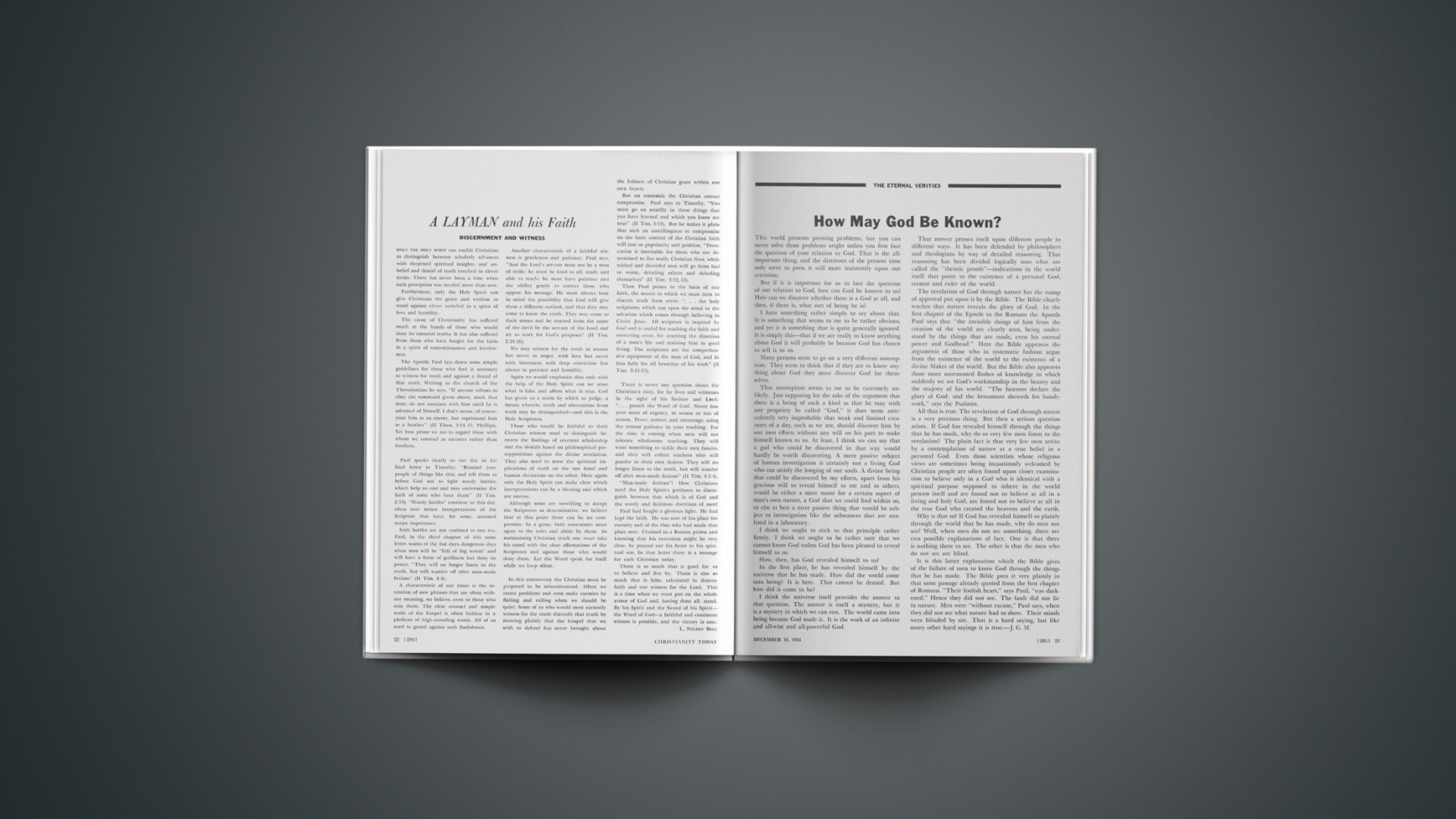
Discernment and Witness

Only the holy spirit can enable Christians to distinguish between scholarly advances with deepened spiritual insights, and unbelief and denial of truth couched in clever terms. There has never been a time when such perception was needed more than now.

Furthermore, only the Holy Spirit can give Christians the grace and wisdom to stand against clever unbelief in a spirit of love and humility.

The cause of Christianity has suffered much at the hands of those who would deny its essential truths. It has also suffered from those who have fought for the faith in a spirit of contentiousness and lovelessness.

The Apostle Paul lays down some simple guidelines for those who find it necessary to witness for truth and against a denial of that truth. Writing to the church of the Thessalonians he says, “If anyone refuses to obey the command given above, mark that man; do not associate with him until he is ashamed of himself. I don’t mean, of course, treat him as an enemy, but reprimand him as a brother” (2 Thess. 3:14, 15, Phillips). Yet how prone we are to regard those with whom we contend as enemies rather than brothers.

Paul speaks clearly to our day in his final letter to Timothy: “Remind your people of things like this, and tell them as before God not to fight wordy battles, which help no one and may undermine the faith of some who hear them” (2 Tim. 2:14). “Wordy battles” continue to this day, often over minor interpretations of the Scripture that have, for some, assumed major importance.

Such battles are not confined to one era. Paul, in the third chapter of this same letter, warns of the last days, dangerous days when men will be “full of big words” and will have a form of godliness but deny its power. “They will no longer listen to the truth, but will wander off after man-made fictions” (2 Tim. 4:4).

A characteristic of our times is the invention of new phrases that are often without meaning, we believe, even to those who coin them. The clear counsel and simple truth of the Gospel is often hidden in a plethora of high-sounding words. All of us need to guard against such foolishness.

Another characteristic of a faithful witness is gentleness and patience. Paul says, “And the Lord’s servant must not be a man of strife: he must be kind to all, ready and able to teach: he must have patience and the ability gently to correct those who oppose his message. He must always bear in mind the possibility that God will give them a different outlook, and that they may come to know the truth. They may come to their senses and be rescued from the snare of the devil by the servant of the Lord and set to work for God’s purposes” (2 Tim. 2:24–26).

We may witness for the truth in sorrow but never in anger, with love but never with bitterness, with deep conviction but always in patience and humility.

Again we would emphasize that only with the help of the Holy Spirit can we sense what is false and affirm what is true. God has given us a norm by which to judge, a means whereby truth and aberrations from truth may be distinguished—and this is the Holy Scriptures.

Those who would be faithful to their Christian witness need to distinguish between the findings of reverent scholarship and the denials based on philosophical presuppositions against the divine revelation. They also need to sense the spiritual implications of truth on the one hand and human deviations on the other. Here again only the Holy Spirit can make clear which interpretations can be a blessing and which are untrue.

Although some are unwilling to accept the Scriptures as determinative, we believe that at this point there can be no compromise. In a game, both contestants must agree to the rules and abide by them. In maintaining Christian truth one must take his stand with the clear affirmations of the Scriptures and against those who would deny them. Let the Word speak for itself while we keep silent.

In this controversy the Christian must be prepared to be misunderstood. Often we create problems and even make enemies by flailing and railing when we should be quiet. Some of us who would most earnestly witness for the truth discredit that truth by showing plainly that the Gospel that we wish to defend has never brought about the fullness of Christian grace within our own hearts.

But on essentials the Christian cannot compromise. Paul says to Timothy, “You must go on steadily in those things that you have learned and which you know are true” (2 Tim. 3:14). But he makes it plain that such an unwillingness to compromise on the basic content of the Christian faith will cost us popularity and position. “Persecution is inevitable for those who are determined to live really Christian lives, while wicked and deceitful men will go from bad to worse, deluding others and deluding themselves” (2 Tim. 3:12, 13).

Then Paul points to the basis of our faith, the source to which we must turn to discern truth from error: “… the holy scriptures, which can open the mind to the salvation which comes through believing in Christ Jesus. All scripture is inspired by God and is useful for teaching the faith and correcting error, for resetting the direction of a man’s life and training him in good living. The scriptures are the comprehensive equipment of the man of God, and fit him fully for all branches of his work” (2 Tim. 3:15–17).

There is never any question about the Christian’s duty, for he lives and witnesses in the sight of his Saviour and Lord: “… preach the Word of God. Never lose your sense of urgency, in season or out of season. Prove, correct, and encourage, using the utmost patience in your teaching. For the time is coming when men will not tolerate wholesome teaching. They will want something to tickle their own fancies, and they will collect teachers who will pander to their own desires. They will no longer listen to the truth, but will wander off after man-made fictions” (2 Tim. 4:2–4).

“Man-made fictions”! How Christians need the Holy Spirit’s guidance to distinguish between that which is of God and the wordy and fictitious doctrines of men!

Paul had fought a glorious fight. He had kept the faith. He was sure of his place for eternity and of the One who had made that place sure. Chained in a Roman prison and knowing that his execution might be very close, he poured out his heart to his spiritual son. In that letter there is a message for each Christian today.

There is so much that is good for us to believe and live by. There is also so much that is false, calculated to destroy faith and our witness for the Lord. This is a time when we must put on the whole armor of God and, having done all, stand. By his Spirit and the Sword of his Spirit—the Word of God—a faithful and consistent witness is possible, and the victory is sure.

About This Issue: December 18, 1964

God’s witness to the Redeemer—in prophetic history, in the star of Bethlehem, in the miracle of the manger, and in the words and works of Jesus of Nazareth—provides the theme of CHRISTIANITY TODAY’S Christmas issue. The case for the deity of Jesus Christ is effectively presented by two prominent British laymen.

The bearing of developments in Congo-Leopoldville upon the missionary cause is assessed editorially and also in an interpretative news report.

Cover Story

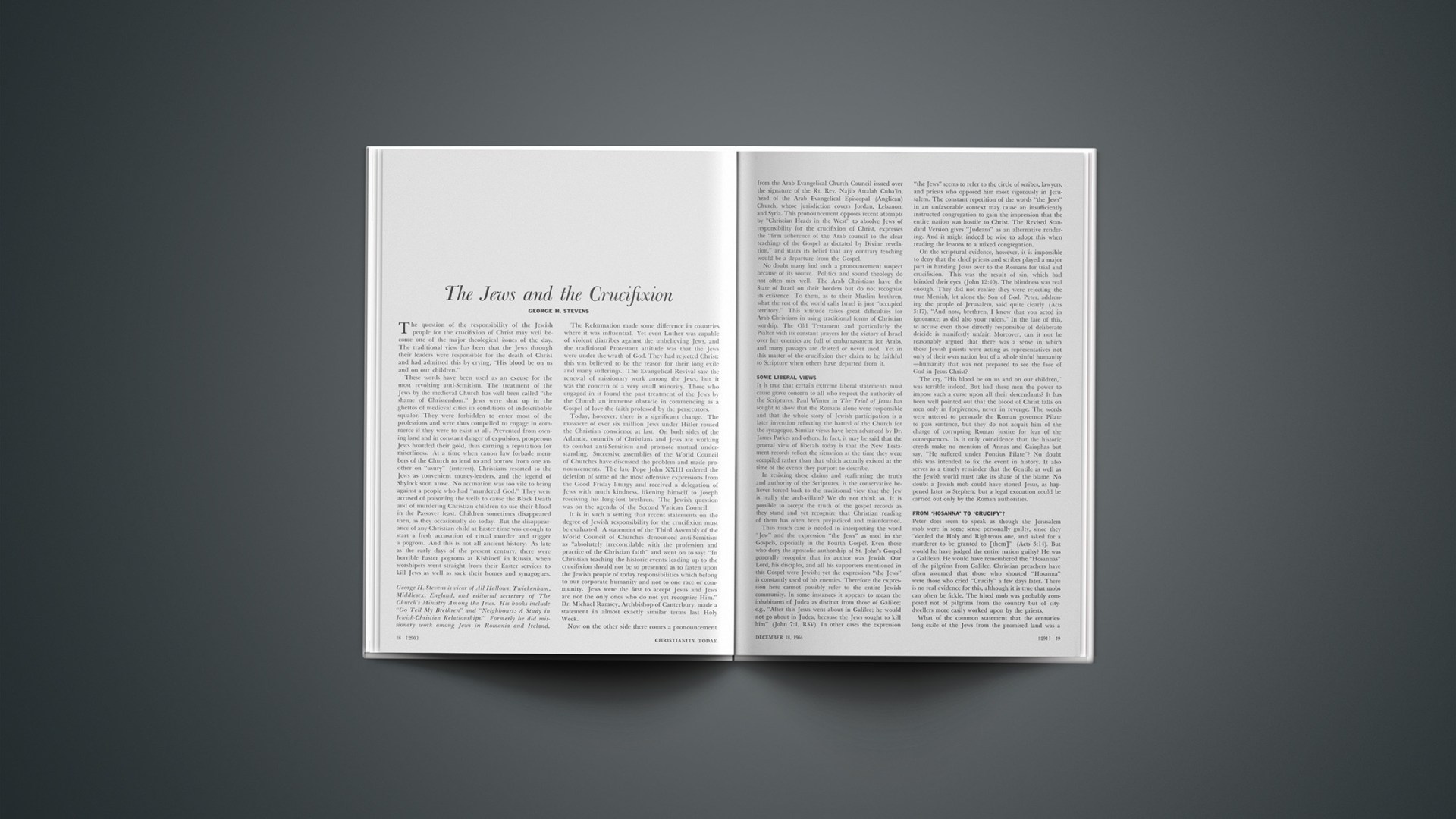
The Jews and the Crucifixion

The question of the responsibility of the Jewish people for the crucifixion of Christ may well become one of the major theological issues of the day. The traditional view has been that the Jews through their leaders were responsible for the death of Christ and had admitted this by crying, “His blood be on us and on our children.”

These words have been used as an excuse for the most revolting anti-Semitism. The treatment of the Jews by the medieval Church has well been called “the shame of Christendom.” Jews were shut up in the ghettos of medieval cities in conditions of indescribable squalor. They were forbidden to enter most of the professions and were thus compelled to engage in commerce if they were to exist at all. Prevented from owning land and in constant danger of expulsion, prosperous Jews hoarded their gold, thus earning a reputation for miserliness. At a time when canon law forbade members of the Church to lend to and borrow from one another on “usury” (interest), Christians resorted to the Jews as convenient money-lenders, and the legend of Shylock soon arose. No accusation was too vile to bring against a people who had “murdered God.” They were accused of poisoning the wells to cause the Black Death and of murdering Christian children to use their blood in the Passover feast. Children sometimes disappeared then, as they occasionally do today. But the disappearance of any Christian child at Easter time was enough to start a fresh accusation of ritual murder and trigger a pogrom. And this is not all ancient history. As late as the early days of the present century, there were horrible Easter pogroms at Kishineff in Russia, when worshipers went straight from their Easter services to kill Jews as well as sack their homes and synagogues.

The Reformation made some difference in countries where it was influential. Yet even Luther was capable of violent diatribes against the unbelieving Jews, and the traditional Protestant attitude was that the Jews were under the wrath of God. They had rejected Christ: this was believed to be the reason for their long exile and many sufferings. The Evangelical Revival saw the renewal of missionary work among the Jews, but it was the concern of a very small minority. Those who engaged in it found the past treatment of the Jews by the Church an immense obstacle in commending as a Gospel of love the faith professed by the persecutors.

Today, however, there is a significant change. The massacre of over six million Jews under Hitler roused the Christian conscience at last. On both sides of the Atlantic, councils of Christians and Jews are working to combat anti-Semitism and promote mutual understanding. Successive assemblies of the World Council of Churches have discussed the problem and made pronouncements. The late Pope John XXIII ordered the deletion of some of the most offensive expressions from the Good Friday liturgy and received a delegation of Jews with much kindness, likening himself to Joseph receiving his long-lost brethren. The Jewish question was on the agenda of the Second Vatican Council.

It is in such a setting that recent statements on the degree of Jewish responsibility for the crucifixion must be evaluated. A statement of the Third Assembly of the World Council of Churches denounced anti-Semitism as “absolutely irreconcilable with the profession and practice of the Christian faith” and went on to say: “In Christian teaching the historic events leading up to the crucifixion should not be so presented as to fasten upon the Jewish people of today responsibilities which belong to our corporate humanity and not to one race or community. Jews were the first to accept Jesus and Jews are not the only ones who do not yet recognize Him.” Dr. Michael Ramsey, Archbishop of Canterbury, made a statement in almost exactly similar terms last Holy Week.

Now on the other side there comes a pronouncement from the Arab Evangelical Church Council issued over the signature of the Rt. Rev. Najib Attalah Cuba’in, head of the Arab Evangelical Episcopal (Anglican) Church, whose jurisdiction covers Jordan, Lebanon, and Syria. This pronouncement opposes recent attempts by “Christian Heads in the West” to absolve Jews of responsibility for the crucifixion of Christ, expresses the “firm adherence of the Arab council to the clear teachings of the Gospel as dictated by Divine revelation,” and states its belief that any contrary teaching would be a departure from the Gospel.

No doubt many find such a pronouncement suspect because of its source. Politics and sound theology do not often mix well. The Arab Christians have the State of Israel on their borders but do not recognize its existence. To them, as to their Muslim brethren, what the rest of the world calls Israel is just “occupied territory.” This attitude raises great difficulties for Arab Christians in using traditional forms of Christian worship. The Old Testament and particularly the Psalter with its constant prayers for the victory of Israel over her enemies are full of embarrassment for Arabs, and many passages are deleted or never used. Yet in this matter of the crucifixion they claim to be faithful to Scripture when others have departed from it.

Some Liberal Views

It is true that certain extreme liberal statements must cause grave concern to all who respect the authority of the Scriptures. Paul Winter in The Trial of Jesus has sought to show that the Romans alone were responsible and that the whole story of Jewish participation is a later invention reflecting the hatred of the Church for the synagogue. Similar views have been advanced by Dr. James Parkes and others. In fact, it may be said that the general view of liberals today is that the New Testament records reflect the situation at the time they were compiled rather than that which actually existed at the time of the events they purport to describe.

In resisting these claims and reaffirming the truth and authority of the Scriptures, is the conservative believer forced back to the traditional view that the Jew is really the arch-villain? We do not think so. It is possible to accept the truth of the gospel records as they stand and yet recognize that Christian reading of them has often been prejudiced and misinformed.

Thus much care is needed in interpreting the word “Jew” and the expression “the Jews” as used in the Gospels, especially in the Fourth Gospel. Even those who deny the apostolic authorship of St. John’s Gospel generally recognize that its author was Jewish. Our Lord, his disciples, and all his supporters mentioned in this Gospel were Jewish; yet the expression “the Jews” is constantly used of his enemies. Therefore the expression here cannot possibly refer to the entire Jewish community. In some instances it appears to mean the inhabitants of Judea as distinct from those of Galilee; e.g., “After this Jesus went about in Galilee; he would not go about in Judea, because the Jews sought to kill him” (John 7:1, RSV). In other cases the expression “the Jews” seems to refer to the circle of scribes, lawyers, and priests who opposed him most vigorously in Jerusalem. The constant repetition of the words “the Jews” in an unfavorable context may cause an insufficiently instructed congregation to gain the impression that the entire nation was hostile to Christ. The Revised Standard Version gives “Judeans” as an alternative rendering. And it might indeed be wise to adopt this when reading the lessons to a mixed congregation.

On the scriptural evidence, however, it is impossible to deny that the chief priests and scribes played a major part in handing Jesus over to the Romans for trial and crucifixion. This was the result of sin, which had blinded their eyes (John 12:40). The blindness was real enough. They did not realize they were rejecting the true Messiah, let alone the Son of God. Peter, addressing the people of Jerusalem, said quite clearly (Acts 3:17), “And now, brethren, I know that you acted in ignorance, as did also your rulers.” In the face of this, to accuse even those directly responsible of deliberate deicide is manifestly unfair. Moreover, can it not be reasonably argued that there was a sense in which these Jewish priests were acting as representatives not only of their own nation but of a whole sinful humanity—humanity that was not prepared to see the face of God in Jesus Christ?

The cry, “His blood be on us and on our children,” was terrible indeed. But had these men the power to impose such a curse upon all their descendants? It has been well pointed out that the blood of Christ falls on men only in forgiveness, never in revenge. The words were uttered to persuade the Roman governor Pilate to pass sentence, but they do not acquit him of the charge of corrupting Roman justice for fear of the consequences. Is it only coincidence that the historic creeds make no mention of Annas and Caiaphas but say, “He suffered under Pontius Pilate”? No doubt this was intended to fix the event in history. It also serves as a timely reminder that the Gentile as well as the Jewish world must take its share of the blame. No doubt a Jewish mob could have stoned Jesus, as happened later to Stephen; but a legal execution could be carried out only by the Roman authorities.

From ‘Hosanna’ To ‘Crucify’?

Peter does seem to speak as though the Jerusalem mob were in some sense personally guilty, since they “denied the Holy and Righteous one, and asked for a murderer to be granted to [them]” (Acts 3:14). But would he have judged the entire nation guilty? He was a Galilean. He would have remembered the “Hosannas” of the pilgrims from Galilee. Christian preachers have often assumed that those who shouted “Hosanna” were those who cried “Crucify” a few days later. There is no real evidence for this, although it is true that mobs can often be fickle. The hired mob was probably composed not of pilgrims from the country but of city-dwellers more easily worked upon by the priests.

What of the common statement that the centuries-long exile of the Jews from the promised land was a direct punishment for the crucifixion of Christ? The one passage that seems to support this is Luke 19:41–44, where Christ wept over the city of Jerusalem and foretold its destruction because its people “did not know the time of [their] visitation.” There is indeed a judgment in history, and the wrath of God has a real meaning if regarded as the spontaneous reaction of Absolute Holiness against evil. But analogies based on human anger, so seldom free from all sinful elements, are dangerous in the extreme.

There are indeed Old Testament passages that make habitation of the land conditional upon faithfulness to God’s law (e.g., Deut. 4:23–31), and in view of such Scriptures some Jewish thinkers regard the exile as a punishment for Israel’s unfaithfulness, though not of course for her failure to recognize Jesus as the Messiah. Yet the belief that the Jews’ rejection of Christ caused their disappearance as a settled community, though not as a separate people, has an almost irresistible fascination for the Christian mind. It is easy to say that the Old Israel failed to grasp its moment of opportunity and therefore a new Israel, the Church, was brought into existence to replace it. But to prove this from the New Testament is difficult. Apart from the much discussed phrase “the Israel of God” in Galatians 6:16, no passage speaks definitely of the Church as the New Israel. There are indeed passages (such as the description in Revelation 21 of the founding of the new Jerusalem upon the twelve apostles of the Lamb rather than upon the twelve sons of Jacob) that may be used to support such an idea. And Gentile Christians are told, as were the Israelites of old, that they are the people of God, called out from the world. But is not the thought in such passages as Ephesians 2:11–22 that Gentile believers have been brought into Israel rather than that they are forming a new Israel? It is clear from Paul’s words in Romans 11:1, and indeed throughout chapters 9–11 of the great epistle, that God has not cast away his people in any final sense. In the end, Jews and Gentiles are to come together in the fulfillment of the wonderful purpose of God (Rom. 11:26, 33).

The one thing that the Gentile believer dare not do is to imagine himself in any sense superior to the Jew who fails to see Christ as Messiah. His own knowledge of Christ is all of grace. Left to himself, he would have fared no better than the scribe or Pharisee, since the spiritual pride that was their undoing is still the most subtle temptation of the Christian. His attitude to his Jewish brother must always be one of gratitude for all Israel has given him, of penitence for the terrible treatment that has needlessly added to the inescapable and true offense of the Gospel, and of loving compassion as in spite of all he seeks to commend to Israel Jesus of Nazareth, the true Messiah who by right belongs to her.

Brief Notes on Some of the Texts Used by Arians

John 1:1. Much is made by Arian amateur grammarians of the omission of the definite article with “God” in the phrase “And the Word was God.” Such an omission is common with nouns in a predicative construction. To have used it would have equated the Word and the Word only with God, whereas without it the force is “And the Word was Himself God.” The article is omitted, too, on occasion in other constructions; in fact, there are four instances of it in this very chapter (verses 6, 12, 13, 18), and in John 13:3, “God” is written once without and once with the article. To translate in any one of these cases “a god” would be totally indefensible (see R. Kuehner—B. Gerth. Ausführliche Grammatik der griechischen Sprache, Vol. I, pp., 591 f., and E. Schwyzer, Griechische Grammatik, Vol. II, pp. 24 ff.).

Strange literalistic interpretations, too, have been put on the word “beginning” in this verse, and to read as if it said “In the beginning the Word began,” whereas what is affirmed is that in the beginning he was already existing. The reference is to something within the divine, not the human, order of things, and to apply the analogy of temporal succession and progression to the presence of God (“And the Word was with God”) is utterly unwarranted. Equally narrow interpretations have been put on the word “Beginning” in such passages as Revelation 3:14: “the beginning of the creation of God.” The context, however, demands an agent as a parallel to “witness,” so the sense must be “Beginner” or “the first cause,” as is the case in Revelation 21:6 where “Beginning” is applied to God himself (compare the Greek translation of Genesis 49:3, and Colossians 1:18, and Revelation 22:13). To understand what John means by “Word” (Logos) read Revelation 19:13–16 in conjunction with First Timothy 6:14–16.

John 14:28. “My Father is greater than I.” This can refer only to the self-imposed limitations of the Son in his incarnation. He has already claimed equality with God (John 5:18), and oneness with him (John 10:30); but he was not only true God, he was now also true man. In fact, rightly understood this is a claim of the highest import, for only things of the same order of magnitude can be compared. No mere man or angelic being could ever say, “God is greater than I,” for created and uncreated are of different orders.

Mark 13:32 (Matthew 26:36 RV). “Concerning that day and hour no one knows, not even the angels in heaven, not even the Son, but the Father.” This is in complete harmony with his consistent claim that he came to do the Father’s will. He came to reveal the redemptive purpose of God but certainly not his whole mind (see John 17:8). There is again nothing here to contradict the many passages where his deity is positively and clearly stated; on the contrary it is in itself a very extraordinary claim, when we consider the ascending order: men, angels, Son, Father. He places himself above the category of angels (the highest created beings) and classes himself with the Father (see Hebrews 1:13).

1 Corinthians 11:3. “And the Head of Christ is God.” Paul cannot imply by this inferiority, no more than in the case of the wife to the husband, which would be a contradiction of Galatians 3:28.

1 Corinthians 15:28. “And when all things are subjected to him, then the Son also himself will be subjected to him who put all things under him, that God may be all in all.” Paul is speaking of the relation of the Son to the Father (verse 24) which was ever one of subjection (see John 5:30). But subjection does not imply subordination in the sense of inequality (see First Corinthians 14:32, “The spirits of the prophets are subject to the prophets”). The reference in verse 28 may well refer to organizational matters that do not come within the purview of revealed knowledge.

John 17:21. This verse is quoted in an attempt to weaken the force of John 10:30, “I and the Father are one,” about the meaning of which his audience were in no doubt whatever (see verse 33). In 17:21, however, the second “one” is not the best manuscripts (see RV), thus simply, “that they also may be in us.”

Philippians 2:5–9. A fair rendering of this passage might be: “Cultivate this attitude of mind among you, which was in Christ Jesus, who being already in the form of God, did not treat it as a prize to be equal with God, but divested himself, taking the form of a servant.” No one would dispute that when Paul says, Christ was in the “form” of a servant, he means that he was a servant in the truest and fullest meaning of the word. There is no ground for taking the phrase “in the ‘form’ of God” to mean less. Now from the nadir of his humiliation God has re-invested him with the insignia of his ineffable and divine glory, “and has given him the name that is—without exception—above every name.”

Mark 10:18 (“And Jesus said to him. Why callest thou me good; but one is good, God”). “Good” in the phrase “Good Master” meant in the suppliant’s language (Aramaic) “benevolent,” not “morally good”; hence there is no question of Christ denying that he was sinless (see H. L. Strack, P. Billerbeck, Kommentar zum Neuen Testament aus Talmud und Midrasch, Vol. I, pp. 808 f., and Vol. II, pp. 24 f.). Moreover “The Good”—Psalm 145:9 was probably cited—was one of the many Judaic titles for God (op. cit., Vol. I., p. 809). The point of our Lord’s remark is that a word with such hallowed association should not be used in a merely conventional manner. He is not stating that God alone is sinless, but that he is the personification of benevolence. To deduce from this an unexpressed contrary: “I am not sinless” or “I am not God,” would be sheer sophistry. Besides, in all interpretation, situation and context, immediate and remote, must be taken into account. Now when Christ comes to disclose (verse 21) the full limit of benevolence (the end of selfish possessing), he demands a response that hitherto had been the prerogative of God alone: “And come, follow Me.” No prophet had ever presumed to say this. Even the great Samuel unshakable in his integrity (1 Sam. 12:3) did not suggest personal discipleship but said: “Turn not aside from following Jehovah” (verse 20). And invariably in the Old Testament “following” in a religious sense has as its object God (Num. 14:24 and passim). The implication is surely undeniable.

Mark 15:34 (Matthew 27:46). This prayer on the Cross (“My God, my God, why hast thou forsaken me?”) has been seized upon as a possible refutation of Christ’s claims to deity. We cannot, of course, know all that these words meant for him at that terrible moment, but there are several possible interpretations. First, he was still in communion with his Father, in spite of the past tense of the verb. Second, the meaning of these words to an attentive Jew would be that he was claiming all the Twenty-second Psalm for himself, for it was a common practice to name books and Psalms by their opening words, e.g., Psalm 113 was called the “Hallel,” from the Hebrew word with which it begins. An approximate analogy might be a dying Christian saying only: “Just as I am without one plea”; but his friends would know that the hymn as a whole was in his mind. The third possibility is that he was quoting it with the immediate context in mind, namely, forsaken with regard to present help. The fact that he did not use the Hebrew wording of the original but that of his mother-tongue serves only to bring out the poignant depth of his feeling of desolation.

The main argument of those who deny the deity of Christ seems to rest on a misconception of the full meaning of “Son.” The fallacy consists of arguing from the analogy of human experience, that “son” implies a pre-existing father in time. The truth is, however, that “son” is used widely in both the Old and New Testaments divorced from the idea of “generation” or “priority,” to denote relationship only. For instance in Hebrew, age is expressed by “the son of x years,” and in the New Testament in such expressions as “the sons of disobedience.” It was, in fact, one of the commonest ways of expressing identity. Again the phrase “only-begotten” refers to the uniqueness of Christ’s relationship to the Father. The word is even applied to God himself in John 1:18, where the reading in the most ancient and textually best manuscripts is “God only-begotten” (in Hebrews 11:17 of Isaac, one of several sons, where the stress is on relationship).

New Testament References to the Deity of Christ

No clearer expression of the fact of the Trinity could be desired than that given by the risen Christ in the baptismal formula in Matthew 28:19, with its inescapable implication of the co-equality and hence co-eternity of the three persons of the Godhead. “Go, therefore, and make disciples of all nations, baptizing them into the name of the Father and of the Son and of the Holy Spirit.” Notice that our Lord said “name,” not “names.” There subsist three co-eternal persons, but the divine essence or substance is one. The model for this formula is probably to be found in the benediction given by the Lord to Moses in Numbers 6:24, “Jehovah bless thee and keep thee, Jehovah cause his face to shine upon thee and be gracious to thee, Jehovah lift up his face upon thee and give thee peace.” And God adds: “That they may put my name upon the people of Israel and I will bless you.” Although there are three blessings there is only one Blesser; thus it is “name,” not “names.”

At the end of Paul’s second letter to the Corinthians he pronounces a benediction in which the three persons of the Trinity are named as partners with co-equal power to bless: “The grace of the Lord Jesus Christ, and the love of God, and the communion of the Holy Spirit, be with you all. Amen.” The use of all of Christ’s titles is significant: he is not merely Jesus Christ, he is the Lord Jesus Christ (2 Cor. 13:14).

Paul again in First Corinthians 12 gives us a passage in which the “trinitarian” pattern is obvious: “Now there are diversities of gifts of grace, but the same Spirit. And there are varieties of services, but the same Lord. And there are diversities of activities but the same God, who is effecting all things in all” (verses 4–6). The mention of the same Spirit, the same Lord, the same God, demands the use of the word “trinity,” or another word meaning the same thing.

In Paul’s letter to the Ephesians, within a brief compass he refers to the Trinity no fewer than four times. The first mention describes the trinitarian nature of our approach to God: “For through him [Christ] we both [Jew and Gentile] have access by one Spirit to the Father.” The word for “access” is that used of bringing a subject into the presence of his king, or as we would say, “to have audience of” (Eph. 2:18).

The second reference describes the collaboration of the “Trinity” in our edification (Eph. 2:22): “In whom [Jesus Christ, the chief cornerstone, verse 20] you are builded together for a habitation of God through the Spirit.” Again the same pattern: In whom—Christ; to whom—God; through whom—the Spirit.

The third passage is Ephesians 3:14–17, “For this cause I bow my knees to the Father, of whom the whole ‘repatriation’ in heaven and on earth is named. That he would grant unto you according to the riches of his grace, that ye may be strengthened with power through his Spirit in the inner man, that Christ may come and take up his abode in your hearts by faith.” Thus for enjoyment of abiding fellowship we have the cooperation of the Father, the Holy Spirit, and Christ.

Again Paul refers to the work of the Trinity in maintaining unification in his Church (Eph. 4:4–6). “One body, and one Spirit, even as you were called in one hope of your calling; one Lord, one faith, one baptism, one God and Father of all, who is above all and through all and in all.” Here we have unity in tri-unity.

In the first chapter of Colossians we have a number of significant statements concerning the person of Christ. In verse 15 we read: “who [the Son] is the image of the invisible God.” “Image” by the common process of extension came to denote not only representation but manifestation. Thus in Second Corinthians 4:4 we find it used in this latter sense: “that the light of the gospel of the glory of Christ, who is the image of God, should not dawn upon them.” But Christ is also: “the first-born of every creature.” The word first-born had long since ceased to be used exclusively in its literal sense, just as prime (from Latin primus—first) with us. The Prime Minister is not the first minister we have had; he is the most pre-eminent. A man in the “prime” of life has long since left the first part of his life behind. Similarly, first-born came to denote not priority in time but pre-eminence in rank. For instance in Psalm 89:27, “I have put him [given him] as first-born, higher than the kings of the earth.” In a given situation even a whole company may rank as first-borns, as in Hebrews 12:23, “and church of the first-born ones, who are enrolled in heaven.” But Paul leaves us in no doubt as to what he means by the word; for he proceeds: “for [because, for this reason] by him were all things created”; and the word Paul uses for “all” means without any exception whatever. Had Christ himself been a created being, Paul would have had to use the Greek word meaning “other things” or the word meaning “remainder, rest.” But then Paul would not have called him first-born but “first-created,” a term never applied to Christ. And verse 17 clinches the whole matter: “And he is before all things,” not “he was.” The force of this statement is equal to that of the “I am” of John 8:58.

Paul on occasions exploits language to its maximal limit to find terms in which to describe the absolute exaltation of Christ. To the believers in Rome he writes: “From whom [the Jewish nation] as concerning the flesh is Christ, who is over all, God blessed for ever” (Rom. 9:5). When speaking to the Corinthian converts about the Cross as the focal point of their salvation, he goes on to say: “To us there is one God: the Father, of whom are all things, and we unto him, and one Lord, Jesus Christ, through whom are all things, and we through him” (1 Cor. 8:6). To the Ephesians, he asserts: “[He is set] far above all hierarchy, and authority, and power, and dominion, and every name that is named, not only in this world, but also in that which is to come” (Eph. 1:21). To the Colossian Christians he says: “In him dwells all the fulness of the deity bodily” (Col. 2:9). Even in his short letter to Titus he must mention it: “Expecting the blessed hope and glorious appearing of our great God and the Saviour Jesus Christ” (Titus 2:13).

In the most unlikely places in the New Testament we find the deity of Christ taken for granted. James, his brother, begins his letter with the words: “James, a servant of God, and of the Lord Jesus Christ.” James must have heard our Lord often say, “No servant can serve two masters” (Luke 16:13). But the very title, too, that he gives to Christ, shows that he is placing him equal with God. And if emphasis was needed he provides it in chapter 2:1, “My brethren, hold not the faith of our Lord Jesus Christ, the Lord of Glory, with respect of persons.” For a Jew, glory was an attribute of God alone.

In First John 5:6–9 (as everyone knows, verse 7 is absent from all good manuscripts) there appears again the trinitarian pattern: the witness of the Spirit with the witness of God witnessing concerning his Son. Before John finishes his letter he leaves us in no doubt concerning the person of the Son (verse 20): “And we know that the Son of God is come and has given us understanding that we know him that is true, and we are in him that is true, in his Son Jesus Christ, this is the true God and eternal life.”

It was evident for the writers in the New Testament, as it should be for us, that Christ could not save if he were not fully divine. The all-sufficiency of his sacrifice depends on his absolute authority. Had he been a created being, he would have been in some sense under compulsion, a victim. It is his possession of absolute free will that removes the stigma of injustice from the Cross. And only of one who had himself absolute immortality could it be said that “he became obedient unto death.”

Among the disciples was one who refused to believe in the resurrection of Christ without tangible proof. For him the witness of others was not sufficient in a matter of such momentous consequence. He demanded nothing less than positive proof within the domain of his own senses. When our Lord appeared to him, He did not rebuke him for his skepticism; rather He readily provided the kind of proof asked for. His confession, in words expressing the ultimate in Christian faith, could not have been a consequence of seeing someone risen from the dead, for he must surely have seen the risen Lazarus. There is no mistaking their intent: “Thomas answered and said to him, ‘My Lord and My God.’ ” And our Lord did not restrain him nor rebuke him; he received this as his rightful designation (John 20:24–29).

The claims of Christ to deity, embedded in the highest ethical teaching known to man, are expressed in irreducible matter-of-fact language. Either he was a fraud, or he was God. There is no middle position.

Paul provides a simple test for the sincerity of our faith. To be able to confess Jesus as Lord, Paul says, we need the power of the Holy Spirit (1 Cor. 12:3). Ask the one who places Christ any lower than the highest, if he will submit to this test. What is your own response, for this is a condition of salvation?

“Because, if you confess with your lips that Jesus is Lord, and believe in your heart that God raised him from the dead, you will be saved” (Rom. 10:9).

Works or Actions Peculiar to Jehovah

Both Jehovah and Christ are said to have the power to give life. Hannah in her “Magnificat” says: “Jehovah is the one who causes to die and the one who makes alive” (1 Sam. 2:6). Eleven times in Psalm 119 alone Jehovah is credited with the power to make alive. In John 5:21 Christ claims to have this power in equal measure with the Father: “For as the Father raises the dead and gives them life, so also the Son gives life to whom He will.” In First Corinthians 15:45, Paul quotes Genesis 2:7, “The first man Adam became a living being,” and adds, “the last Adam a life-giving spirit.” And, perhaps the best-known and most often quoted passage of all, the words of Jesus to Martha: “I am the resurrection and the life; he who believes in me, though he die, yet shall he live” (John 11:25).

Creator And The Act Of Creation

The Bible opens with the statement: “In the beginning God created the heavens and the earth,” that is, all things.

In Isaiah 40:28, “Jehovah is the eternal God, the creator of the ends of the earth.” Jeremiah calls him “The former [or creator] of all things” (Jer. 10:16). Paul speaks of Christ in similar terms. “For by [or in] him were all things created in the heavens, and upon the earth, things visible and things invisible, whether thrones or dominions or principalities or powers, all things have been created through him and for him” (Col. 1:16), and John 1:2, “He [the Logos] was in the beginning with God; all things were made through him, and without him was not anything made that was made.”

The Person of Christ in Old Testament Prophecy

Some of the prophecies about Christ make it clear that he is more than man. Isaiah 9:6, “For to us a child is born, to us a son is given, and the princedom will be upon his shoulders, and his name will be called Wonderful, Counsellor, mighty God, Everlasting Father, Prince of Peace.” No plainer words could be used to express his deity. Again, although often designated as the son of David, this implied more than an earthly descendant of David. The Lord makes this plain by quoting the words of David in Psalm 110:1, “The Lord said to my Lord, Sit at my right hand until I put thy enemies as thy footstool” (Matt. 22:43, 44). That an angelic Being is not meant is shown by Hebrews 1:13, “But to what angel has he ever said: ‘Sit at my right hand, till I make thy enemies thy footstool.’ ” Peter also quotes this passage in his sermon on the day of Pentecost to prove the Lordship and Messiahship of Jesus (Acts 2:34, 35).

Titles of Jehovah

One of the most remarkable things in our Lord’s ministry is the quiet assurance with which he unhesitatingly applies to himself titles from the Old Testament which are there indisputably used of Jehovah. Moreover, the New Testament writers ascribe such titles to Christ.

‘First And Last’

A significant title assumed by the Lord Jesus in the book of Revelation is “First and Last” (chapter 1:17; 2:8; 22:13). In 22:16 the speaker says of himself: “I Jesus have sent my angel to testify unto you of these things,” having already said in verse 13, “I am Alpha and Omega, the first and the last.” Also in chapter 2:8, there is no doubt about the person to whom the words refer: “These things saith the first and last, who died and came to life.” Now this designation “First and last” occurs three times in Isaiah (41:4; 44:6; 48:12) where on each occasion Jehovah is the speaker.

The ‘I Am’

Jehovah, the incorrect but well-established rendering of the Hebrew consonants YHWH, was regarded by the Jews as too sacred to be pronounced and was replaced by a variety of substitutes, such as “Lord” (Adonai), or “The Name.” We can no longer say with certainty how it was pronounced, but from Exodus 3:14 we know that it was derived from the verb “to be”: “God said to Moses, ‘I am who I am’; and he said: Say to the people of Israel ‘I am’ has sent you.” Now on more than one occasion our Lord refers to himself by using “I am” in a way that points unmistakably to this Old Testament title of Jehovah. In a controversy with the Jews he declared: “Before Abraham was, I am” (John 8:58). Had he been merely a pre-existent Being, then he would have had to say “Before Abraham was, I was.” That the amazing implication of his claim did not escape the Jews is clearly shown by the extreme violence of their reaction in attempting to stone him to death for alleged blasphemy. Another occasion on which he used it was at the time of his arrest. To his question to his approaching captors, “Whom seek ye?,” they answered, “Jesus of Nazareth,” to which he replied, “I am.” The effect that this brief utterance had on them was dramatic: “They went backward and fell to the ground” (John 18:5, 6). The mere literal sense of these words could hardly have produced this extraordinary effect. Then again at the crucial stage of his trial, Jesus, being interrogated by the high priest as to his messianic claims, replied, “I am: and you shall see the Son of man sitting at the right hand of power and coming with the clouds of heaven” (Mark 14:62). The savage vehemence that this called forth in the high priest and the company can be explained only if it was understood by them to be a claim to personal deity, a blasphemy in their eyes of such magnitude as to be expiated only by death.

Author Of Eternal Words

The Old Testament constantly claims to be an authoritative and immutable communication from God. In Isaiah 40:8 we are told: “The grass withers and the flower fades, but the word of our God stands for ever.” To this view of the Old Testament as a divine revelation our Lord unquestionably subscribes. For instance, his words in Matthew 5:18, “For truly I say unto you, until heaven and earth pass away, one jot or one tittle shall not pass away from the Law, until all things are fulfilled.” For his own words he makes a substantially similar claim: “Heaven and earth will pass away, but my words shall not pass away” (Matt. 24:35).

Light

The coming Messiah is designated in two familiar prophecies as “Light” (Isa. 9:2, compare Matt. 4:16; and Isa. 49:6, compare Luke 2:32). Five times in the first chapter of John (verses 4, 5, 7, 8, 9) this description is used. His uniqueness is stressed in verse 9: “The true light.” Our Lord himself said: “I am the light of the world” (John 8:12). Now light is a well-known title of Jehovah in the Old Testament; for instance, Psalm 27:1, “The Lord is my Light and my salvation,” or even more specifically in Isaiah in a context of messianic prophecies: “Jehovah will be to you an everlasting light” (Isa. 60:19 and 20). Again, following on the messianic prophecy of Isaiah 59:20 we have in 60:1 “light” designating the Messiah, equated with the glory of Jehovah. “Arise, shine [that is, Zion], for your light has come, and the glory of the Lord has dawned upon you.” It is instructive to see how John in his introduction to his first epistle uses the very same epithet of God that he had already used in the opening verses of his Gospel of the incarnate Son, who is there the “light that the darkness found invincible” while in First John 1:5, “God is light and in him is no darkness at all.”

Rock

There are two words commonly used in Hebrew for “rock,” as well as the word “stone.” One is used for instance in Psalm 18:2, “Jehovah is my rock,” the other in Psalm 95:1, “O come let us sing to Jehovah, let us make a joyful noise to the rock of our salvation.” Paul in First Corinthians 10:4 interprets the “rock” of Exodus 17:6 as referring to Christ. “Stone” is used as a title of God in Genesis 49:24, and in the messianic passage in Isaiah 28:16, “Behold I am laying in Zion for a foundation a stone, a tested stone.” Peter in his first letter (1 Pet. 2:6–8) understands this passage to be speaking of Christ as the foundation stone of the “spiritual house,” the Church. Although the word here is not the one used in Matthew 16:18 (“and upon this rock I will build my church”), the similarity of function is so obvious that Peter must also have had these words in mind. This seems all the more certain from his application two verses later of “rock,” a description of Jehovah taken from Isaiah 8:14, to Christ. On linguistic grounds there could be no objection to seeing in Matthew 16:18 another instance of our Lord’s taking to himself a common Old Testament title of Jehovah.

Bridegroom

The figure of a bridegroom is one that is frequently used either implicitly or explicitly of Jehovah in the Old Testament. In Hosea 2:16, for instance, Jehovah says, “You will call me ‘my husband.’ ” Again in Isaiah 62:5, “As a bridegroom rejoicing over the bride, your God will rejoice over you.” Our Lord early in his ministry and often subsequently depicts himself as a bridegroom. In a reply to the Pharisees, he says concerning himself: “Can the sons of the wedding chamber fast while the bridegroom is with them?” (Mark 2:19). Again in the parable of the “Foolish Virgins” he is the bridegroom (Matt. 25:1–13). In that great final beatific vision (Rev. 21:2) the Church is depicted “as a bride adorned for her husband.”

Shepherd

In Psalm 23:1 we read, “Jehovah is my shepherd,” and in Ezekiel 34:15, “I myself will be the shepherd of my sheep.” In John 10:11, our Lord uses this title of himself, “I am the good shepherd, the good shepherd lays down his life for the sheep.” Peter calls him “the Shepherd and Guardian of your souls” (1 Pet. 2:25) and again “the chief Shepherd” (1 Pet. 5:4). The writer of the epistle to the Hebrews speaks of him as “the great shepherd” (Heb. 13:20). That the title is unique is clear from John 10:16, “So there shall be one flock, one shepherd.”

Forgiver Of Sins

In the Old Testament, God alone has the right and power to forgive sins: Jeremiah 31:34, “For I [Jehovah] will forgive their wickedness, and their sin will I remember no more.” Or again Psalm 130:4, “For with Thee is forgiveness that Thou shouldest be feared.” In the New Testament we find our Lord claiming this right for himself. In Luke 5:21 we read of the Pharisees protesting that only God could forgive sins. This was to them, as it would be to us, self-evident. To this Christ replied by substantiating his authority to forgive, by healing the paralytic. In Acts 5:31 Peter proclaims Christ as the One whom “God has exalted at His right hand as Prince and Saviour, to give repentance to Israel and forgiveness of sins.” In Colossians 2:13 Paul speaks of God “having forgiven us all our transgressions,” while in chapter 3:13, it is, “the Lord [or Christ] has forgiven you.” If the right reading here is Lord, it must stand for Christ, as is clear from such a reference as “Christ Jesus the Lord” in chapter 2:6.

Redeemer

The act of redemption is peculiar to God in the Old Testament. Two Hebrew words are in use, and both occur in Hosea 13:14, “From the power of Sheol, I will ransom them, from death I will redeem them.” Again in Psalm 130:7, “For with Jehovah is grace and abundance of ransom and he will ransom Israel from all his iniquities.” A direct parallel to this is found in Titus 2:13 with the difference that now Christ is identified with God (see verse 10): “Our great God and Saviour Jesus Christ, who gave himself for us, that he might ransom us from all iniquity.” A different Greek verb for redemption is found in Galatians 3:13, “Christ has purchased us from the curse of the law.” Again in Revelation 5:9, “For Thou [the Lamb] wast slain, and didst purchase unto God with thy blood, men of every tribe, and tongue, and people, and nation.”

Saviour, Or Author Of Salvation

In the Old Testament Jehovah is frequently described as Saviour or as the author of salvation: Isaiah 43:3, “For I am Jehovah, thy God, the holy One of Israel, thy Saviour”: or Ezekiel 34:22, “And I [the Lord Jehovah, verse 20] will save my flock and it will no longer be for booty and I will judge between sheep and sheep, and I will establish over them one shepherd.” The resemblance to John 10:17, 16, is striking: “I [Jesus] lay down my life for the sheep” and “there shall be one flock, one shepherd.” In Isaiah 45:22 a world-wide salvation is promised: “Turn to me and let yourselves be saved, all the ends of the earth,” and a little later (verse 23): “To me every knee shall bow and every tongue shall swear,” words taken up by Paul in Philippians 2:10, “At the name of Jesus every knee shall bow,” and (verse 11) “every tongue confess that Jesus Christ is Lord.” It would be impossible to quote all the passages in the New Testament that refer to the Lord Jesus as Saviour or the author of salvation. He was given the name Jesus expressly: “for he will save his people from their sins” (Matt. 1:21); in Hebrews 5:9, “He became unto all those who obey him the author of eternal salvation.” In harmony with all this is the significant parallel between “our God and Saviour Jesus Christ” and “our Lord and Saviour Jesus Christ” by Peter (2 Pet. 1:1, 11).

Co-Partner Of Divine Glory

In Isaiah 42:8 we read: “I am Jehovah and I shall not give my glory to another,” and the phrase is repeated again in Isaiah 48:11. Now in that sacredest of all his prayers recorded in John 17, our Lord speaks of the reciprocal nature of his shared glory with the Father and says: “Father, the hour is come, glorify the Son, that the Son may glorify thee” (verse 1). And again a little later: “And now glorify me, Father, with thine own self, with the glory which I had with thee before the world was” (verse 5). Paul sums all this up in an arresting phrase. When he confronts the abjection of His humiliation with the sublimity of His exaltation, the title he uses contains two superlatives. “For had they [the leaders] known it, they would not have crucified the Lord of Glory” (1 Cor. 2:8).

Judge

One of the earliest titles of Jehovah is that of universal judge. Abraham standing before him says: “Shall not the judge of all the earth execute justice?” (Gen. 18:25). And in Joel 3:12 Jehovah says: “I will sit to judge all the nations round about.” Now from Matthew 25:31–46 we learn that Christ will occupy the throne of glory—and there can be none more eminent than this—and preside at the last judgment. Here it is not so much the assumption of a title as the exercising of an office. In Romans 2:3 Paul speaks of the judgment of God, but in Second Timothy 4:1 it is, “Jesus Christ who shall judge the quick and the dead.” It is not surprising, therefore, to find that Second Corinthians 5:10 speaks of the judgment seat of Christ.

Cover Story

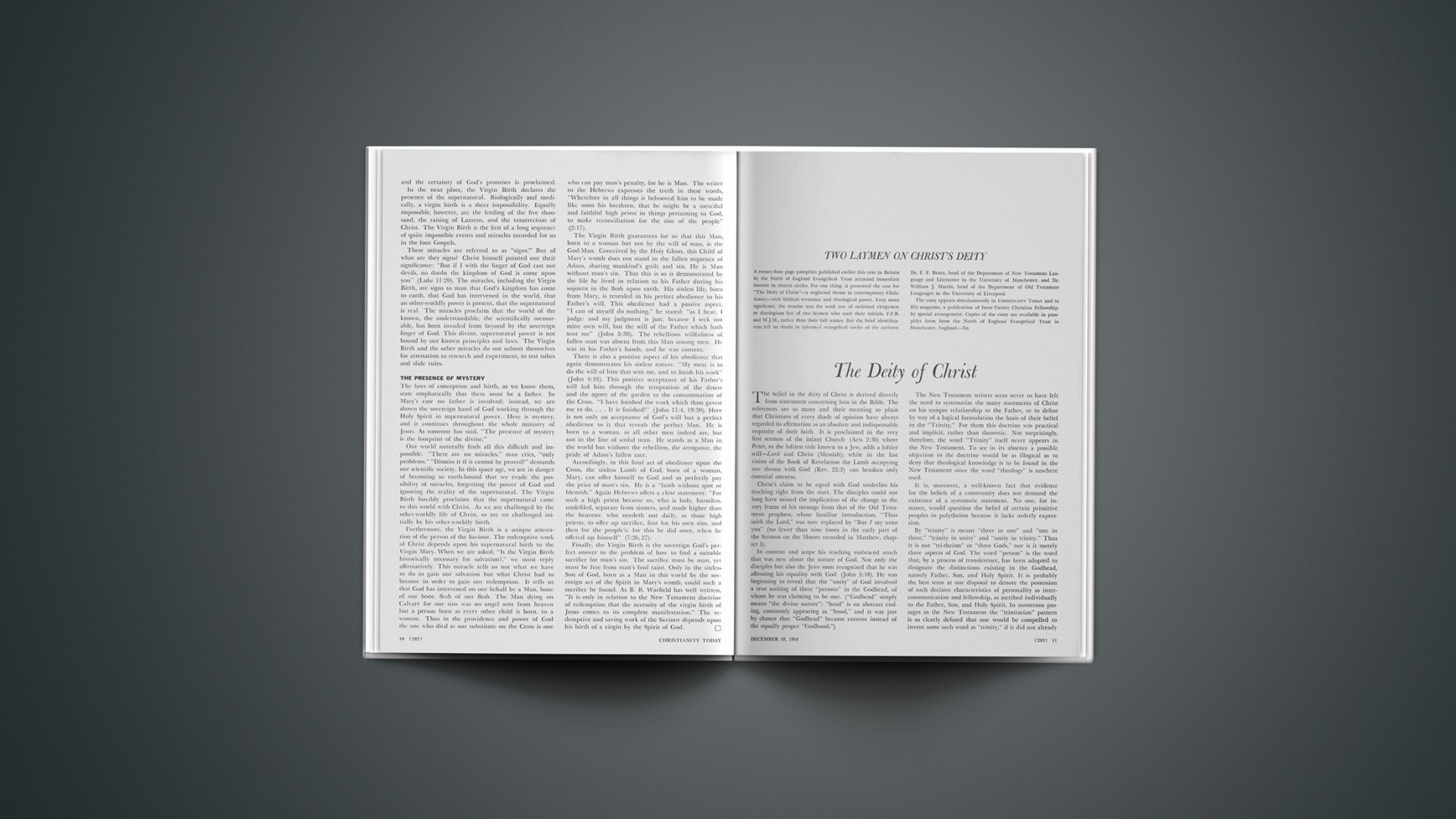
The Deity of Christ

The belief in the deity of Christ is derived directly from statements concerning him in the Bible. The references are so many and their meaning so plain that Christians of every shade of opinion have always regarded its affirmation as an absolute and indispensable requisite of their faith. It is proclaimed in the very first sermon of the infant Church (Acts 2:36) where Peter, to the loftiest title known to a Jew, adds a loftier still—Lord and Christ (Messiah); while in the last vision of the Book of Revelation the Lamb occupying one throne with God (Rev. 22:3) can betoken only essential oneness.

Christ’s claim to be equal with God underlies his teaching right from the start. The disciples could not long have missed the implication of the change in the very frame of his message from that of the Old Testament prophets, whose familiar introduction, “Thus saith the Lord,” was now replaced by “But I say unto you” (no fewer than nine times in the early part of the Sermon on the Mount recorded in Matthew, chapter 5).

In content and scope his teaching embraced much that was new about the nature of God. Not only the disciples but also the Jews soon recognized that he was affirming his equality with God (John 5:18). He was beginning to reveal that the “unity” of God involved a true uniting of three “persons” in the Godhead, of whom he was claiming to be one. (“Godhead” simply means “the divine nature”; “head” is an abstract ending, commonly appearing as “hood,” and it was just by chance that “Godhead” became current instead of the equally proper “Godhood.”)

The New Testament writers seem never to have felt the need to systematize the many statements of Christ on his unique relationship to the Father, or to define by way of a logical formulation the basis of their belief in the “Trinity.” For them this doctrine was practical and implicit, rather than theoretic. Not surprisingly, therefore, the word “Trinity” itself never appears in the New Testament. To see in its absence a possible objection to the doctrine would be as illogical as to deny that theological knowledge is to be found in the New Testament since the word “theology” is nowhere used.

It is, moreover, a well-known fact that evidence for the beliefs of a community does not demand the existence of a systematic statement. No one, for instance, would question the belief of certain primitive peoples in polytheism because it lacks orderly expression.

By “trinity” is meant “three in one” and “one in three,” “trinity in unity” and “unity in trinity.” Thus it is not “tri-theism” or “three Gods,” nor is it merely three aspects of God. The word “person” is the word that, by a process of transference, has been adopted to designate the distinctions existing in the Godhead, namely Father, Son, and Holy Spirit. It is probably the best term at our disposal to denote the possession of such decisive characteristics of personality as intercommunication and fellowship, as ascribed individually to the Father, Son, and Holy Spirit. In numerous passages in the New Testament the “trinitarian” pattern is so clearly defined that one would be compelled to invent some such word as “trinity,” if it did not already exist, to describe the implications of the statements.

It was not until the Gospel had been preached for some three hundred years in New Testament terms that anyone took on himself to assail the belief of Christians in the deity of Christ. The person who did it was Arius. The novel form of his attack shows that Christians had hitherto accepted it without question. His arguments, as formulated by him, were clearly intended as an objection to the prevalent view, not as a correction of a heresy. If the state of affairs had been otherwise, that is, if Christians generally had denied the deity of Christ, then his opposition would have been meaningless. As promotion to a bishopric had been denied him, he has left himself wide open to the suspicion of having been motivated by a desire for personal revenge. He was evidently a man who knew how to exploit secular political influence to the full, and the story of his machinations makes sordid reading. As a consequence of strong political support, a controversy arose out of all proportion to the merits of his arguments. His views were finally shown to be at complete variance with Scripture and were pronounced heretical. Nevertheless, from time to time they have been revived, either deliberately or in ignorance, often peddled from door to door by text-mongers, unaware that the very passages which they have learned to quote so glibly were first used over sixteen hundred years ago by a frustrated “cleric.”

Within the brief compass of this booklet it will not be possible to quote all the passages referring to the deity of Christ and to consider all the ways in which this truth is indicated in Scripture. The reader should, however, find no difficulty in adding to the references given here. In the passages quoted, the original text has been kept constantly under review, and on occasion wording not to be found in any standard translation has been introduced, where it was felt that the meaning of the original could be made more apparent. In the section that immediately follows, the evidence is all the stronger for being of an incidental nature.

Apple PodcastsDown ArrowDown ArrowDown Arrowarrow_left_altLeft ArrowLeft ArrowRight ArrowRight ArrowRight Arrowarrow_up_altUp ArrowUp ArrowAvailable at Amazoncaret-downCloseCloseEmailEmailExpandExpandExternalExternalFacebookfacebook-squareGiftGiftGooglegoogleGoogle KeephamburgerInstagraminstagram-squareLinkLinklinkedin-squareListenListenListenChristianity TodayCT Creative Studio Logologo_orgMegaphoneMenuMenupausePinterestPlayPlayPocketPodcastRSSRSSSaveSaveSaveSearchSearchsearchSpotifyStitcherTelegramTable of ContentsTable of Contentstwitter-squareWhatsAppXYouTubeYouTube