Review of Current Religious Thought: November 22, 1963

There are some subjects before which the mind recoils and the imagination rebels, and which place inordinate, unwelcome demands upon our compassion. Generally we are on our guard, and to the intruder who by a trick passes our defenses and spells things out to us we accord scant thanks. Such an intruder is Rolf Hochhuth, whose play The Representative has been causing a great furor in Western Europe (see CHRISTIANITY TODAY, October 25, News, and November 8, Book Reviews). Incidentally, we might regard it as a curiously telling judgment upon all of us that the dramatist is listened to where the straight historian has to a large extent been brushed aside.

As all the world now knows, the Nazis deliberately murdered a vast number of Jews (perhaps the equivalent of the present population of Massachusetts), and from a quarter where we might have expected speech, there was only silence. François Mauriac put it thus: “We have not yet had the consolation of hearing Simon Peter’s successor clearly and sharply condemning, without a trace of circumlocution, the crucifixion of these countless ‘brothers of Christ.’ ” Is Pius XII to be condemned for not lifting his voice against this awful massacre? The Representative addresses itself to this problem. Hochhuth does not accuse the Vatican of anti-Semitism and does not say that the pope could actually have saved the Jews. In fact, he gives examples of Pius’s concern for the victims of Nazi anti-Semitism. Even the possible results of intervention are made secondary to the intolerable thought that Christ’s vicar, confronted by absolute evil, prevaricates, negotiates, and maintains the Concordat with Hitler, who was never denounced.

Nor, despite an allegation now familiar to us from other occasions, is Hochhuth trying to evade some of the German national guilt by placing blame on other shoulders. On the contrary, the play is unsparing in its revelation of what its author’s fellow countrymen did. Yet Hochhuth does not hold the German people accountable for the crimes of their rulers. Other people knew. A group of Polish Roman Catholic laymen, in a statement issued during the summer of 1942, in part said: “The world is watching this crime, which is more horrifying than anything history has known—and is maintaining silence.… Neither Britain nor the United States has raised its voice.… The Jews are dying surrounded on all sides by only hand-washing Pilates.”

To return to the play: much of it has to do with Father Riccardo, a young Jesuit priest, who is outraged by the pope’s failure to speak out. In one single interchange with his father, a Vatican official, Riccardo expresses the gist of the whole thing. “How you simplify …,” says Count Fontana; “can you believe the Pope can see without pain the hunger and suffering of a single person? His heart is with the victims.” The priest replies: “And his voice? Where is his voice?”

In an actual letter to Bishop Preysing of Berlin, Pius said that he had “exercised restraint” in condemning Nazism in order “to avoid greater evils.” But could anything have been worse than the relentless manhunt? Roman Catholic apologists make much of Nazi reprisals in Holland when some bishops there protested, but this is not the whole story.

In Denmark, on October 1, 1943 (the Jewish New Year), the occupying Germans swooped down to capture 8,000 Jews marked for extermination. The Teutonic thoroughness with which the operation was planned came to little, for after a tip-off from a German official, all but 300 Jews escaped through speedy and secret transportation to friendly Sweden. The whole thrilling story can be read in Harold Flender’s Rescue in Denmark. In Finland, Bulgaria, the Ukraine, and (to a lesser extent) Rumania, Hitler’s “Final Solution” for the Jews was resisted—and the Vatican’s expectation of dire revenge was not fulfilled. In Hitler’s Greater Germany were 35 million Roman Catholics. If Pius had threatened such an interdict as Innocent III centuries ago had clapped on France and England for much less reason, how can we say that millions of Jewish lives would not have been saved? The tragedy of Pius XII is that he should have thought in terms of a political decision. One fallible man with God might have fared better than an infallible one choosing to hide behind raison d’état.

Father Riccardo in the play, realizing that he is impotent to do anything to rescue the victims, identifies himself with them, pins on his soutane the Star of David, and becomes part of a great company of Italian Jews (there were ultimately nearly 20,000 of them) doomed to the gas chamber. “I have been hoping,” he says poignantly, “that, once for all, the S.S. and the Vatican would meet in bloody collision. But now the most terrible thing is happening that could possibly happen: they do not even disturb each other.… They live together in the Eternal City—because the Pope does not forbid the hangmen of Auschwitz to load up their victims, here under his windows.” The play ends in Auschwitz with a discussion between Father Riccardo and the camp doctor. The latter (based on real life, as are many other of the characters) is a renegade priest. He throws at Riccardo the charge that in the Spanish Inquisition the Roman church led the way in showing how human beings could be burned. And Father Riccardo confesses his involvement in the total guilt of humanity, just as Dostoevsky so often did, and just as all who read or see The Representative cannot escape doing.

The British Roman Catholic weekly, The Tablet, expresses in a petulant article the hope that those who blame Pius will look ahead and do something to ensure that “the Pope in the future, if confronted with some monstrous and inhuman tyranny, will know that he has the world behind him if he exerts his moral authority to the full.” This unguarded utterance will not stand close scrutiny, even though with Vatican Council II in progress we know very well what is implied.

Hochhuth’s play presents Pope Pius XII as obsessed by the menace of Russian Communism, against which he thought Hitler an effective bulwark, and as seeing it his chief duty to keep his international organization (investments and all) intact. Whatever we think of this, the fact that the Roman Catholic Church came through the war remarkably unscathed is no legitimate subject for boasting—indeed, one wonders if it is not the ultimate condemnation. Gerstein, the Christian S.S. man who in the play never seems quite convincing, is based on a historical figure who said in a letter to his father: “At some moment or other, you will have to stand up for the age you live in, and for what is taking place during it. We would no longer be able to understand each other, nor have anything more of importance to say to each other, if I could not say to you: Do not underestimate this responsibility, nor this obligation to account.” Whether we be pope, pastor, or layman, there is something in that plea for all of us to ponder.
About This Issue: November 22, 1963

Our issue for Universal Bible Sunday (December 8) features statements on Scripture by seven well-known Christians. Related articles include Professor Cailliet’s account of the place of the Bible in his conversion and Dr. Metzger’s assessment of the King James, the Revised Standard, and the Phillips Versions, and the New English Bible. An editorial points to the power of the Bible as an educating force for all people.

Interpreting past events in a Christian light comes under the scrutiny of Dr. McGill.… A controversial drama by Rolf Hochhuth focuses attention on the late Pope Pius XII (see Current Religious Thought, page 50).

Circulation this issue 211,009 copies.

News Worth Noting: November 22, 1963

Operation Yorkville

A three-day fast by a Jesuit priest prompted Mayor Robert F. Wagner of New York to pledge a new war against the sale of pornographic material to children. Father Morton Hill, 46, said Wagner had failed to redeem pledges made last summer for a curtailment on obscenity. Hill is associated with “Operation Yorkville,” an interreligious group started in 1962 to battle pornography. His hunger strike was supported by a partial fast undertaken by a Jewish rabbi.

Protestant Panorama

Inter-Lutheran Consultation reported “encouraging progress” following a two-day meeting in Chicago. The group is seeking a formula to establish a new cooperative agency for 8,500,000 Lutherans in the United States.

Methodist General Conference will be asked next spring to pass legislation requiring all Methodist pastoral charges to have a “secretary of Christian vocations.” The move is designed to step up recruitment for church-related careers.

United Church of Canada broke “an understanding, if not a gentlemen’s agreement” in establishing a congregation at Rocky Mountain House, Alberta, the Presbyterian Record, official organ of the Presbyterian Church of Canada, charged in an editorial. Editor DeCourcy H. Rayner said the new congregation competes with a Presbyterian work established there forty years ago.

United Church of Christ will approve no new applications for financial aid to segregated churches after next July 1. The denomination’s Board for Homeland Ministries, in making the restriction, also asked churches and conferences to work only with contractors who agree to comply with fair employment practices.

Conservative Congregational Christian Conference ratified the establishment of an international fraternal union. The new organization, to be known as the International Evangelical Congregational Union, is designed to foster closer liaison with Congregational churches overseas.

Miscellany

Trustees of Baylor University, largest of the Southern Baptist schools, voted to admit qualified Negro students for the first time.

A lottery to obtain funds for schools and camps will be conducted by the Norwegian Lutheran Mission next year. Prizes include six automobiles, a piano, and a boat.

Ernst Seliger, 59-year-old Jehovah’s Witness, was released from a Brandenburg jail last month after spending thirteen years in Communist detention.

A draft of a new penal code for West Germany provides for making more rigid present laws on blasphemy. Religious leaders are sharply divided on the question of retaining blasphemy laws. Some civil authorities have been reluctant to prosecute blasphemy and abuse of religion.

The Washington Post published extensive quotations from a purportedly Communist document that calls for exploitation of the papal encyclical “Peace on Earth.” The newspaper refused to disclose how it obtained the ten-page document.

A resolution, first in the 26-year history of the Christian Business Men’s Committee International, called upon citizens and lawmakers to “make it possible for our children and our children’s children to receive as part of their normal education the many evidences of the existence and reality of God, and that His Word, the Bible, be read and cherished as part of our great American heritage.”

Deaths

DR. SAMUEL M. SHOEMAKER, 69, noted Episcopal churchman and author; in Baltimore (see opposite page).

DR. W. R. CULLOM, 96, founder of the School of Religion at Wake Forest College; in Wake Forest, North Carolina.

DR. JAMES F. RAND, 47, librarian of Dallas Theological Seminary; in Dallas.

A riotous crowd stormed the theater in Olten, Switzerland, to protest a production of The Representative, the controversial drama by Rolf Hochhuth. Windows were smashed and fights broke out. Police arrested thirty-six persons.

The Supreme Court ordered a speedy trial of a case wherein three children could be taken from their parents, who, for religious reasons, refuse to permit them to be vaccinated. The case stems from infractions of the compulsory school attendance law.

Religious bias is barred in a declaration against all forms of racial discrimination adopted by the U. N. General Assembly’s Social Committee. The vote was 89 to 0, with seventeen abstentions. The United States along with several western European nations and British Commonwealth members abstained. Mrs. Jane Warner Dick, U. S. delegate, said her government was sympathetic with the purpose and principles of the declaration, but objected to detailed directions.

Personalia

Jackie Robinson, retired baseball figure, named president of United Church Men.

Dr. Charles C. Cowsert named secretary of stewardship of the Presbyterian Church in the U. S.

Dr. Ewing T. Wayland named editorial director of Christian Advocate, professional journal for Methodist pastors, and Together, Methodist family magazine. He succeeds Leland D. Case, who will become an editorial consultant.

The Rev. Richard R. Gilbert named executive director of the United Presbyterian Division of Radio and Television.

Baptist layman Brooks Hays named national chairman of Brotherhood Week, February 16–23.

They Say

“As far as the execution of his public duties goes, it is largely irrelevant whether the Presidency is filled by a divorced man.”—The Commonweal. Roman Catholic lay weekly.

“Pornography was everywhere, and everybody was there but the Church.”—Evangelist Billy Graham, after a stroll on Times Square.

The Vatican View of Authority

Vatican Council II, midway in its second session, stood committed to the principle of decentralization in the exercise of supreme authority over the church.

It now comes to grips with the somewhat more practical question how that authority, once decentralized, is to be exercised effectively in the legislative, judicial, and executive areas of church government.

The council’s acceptance of the principle of decentralization was indicated in its vote on four questions in connection with Chapter 2 of the schema De Ecclesia, a chapter dealing with the hierarchy. Protracted discussion of the chapter had yielded so many interventions by bishops, numbering 1,320 on a single point, that that council’s Theological Commission found itself unable to determine the tenor of the bishops’ thinking. The four council moderators appointed by Pope Paul had devised the four questions to help the commission determine the consensus or “mind” of the council.

The four questions, put to a vote of the council, produced one-sided majorities. The results were then turned over to the Theological Commission, which presumably will reformulate the chapter on the hierarchy to reflect the opinions evident from the vote. These are the four points:

1. That episcopal consecration constitutes the peak of the Sacrament of Orders. The significance is that the chapter would state in effect that there is no order higher than that of bishop. The Pope is the Bishop of Rome.

2. That every bishop legitimately consecrated in communion with other bishops and the Roman Pontiff, as their head and principle of unity, is a member of the episcopal body. The word “college,” more frequently used than “body,” denotes an association of individuals for a common purpose (in this case the government of the church) and forming a corporation.

3. That, in its task of evangelizing, sanctifying, and feeding, the body or college of bishops succeeds the college of apostles, and that, in union with its head, the Roman Pontiff, and never without this head (whose primatial rights over all pastors and faithful remain intact), this body enjoys full and supreme power over the universal church.

The effect of this, if approved, would be to state that the bishops, acting collegiately (as a body), share with the Pope full and supreme power over the universal church, but do not possess that power independently of the Pope. The Pontiff, on the contrary, would retain his full and supreme power over all pastors and the faithful, even without the agreement of the bishops.

4. That the full and supreme power over the universal church belongs to the bishops (acting as a college) and the Pope together by divine right.

If this is approved, it will state in effect that no human being, including the Pope, can take away the stated power from the college of bishops and the Pontiff.

Theoretically, the Pope could act independently in a way contrary to the opinions of the college of bishops, but it is in this connection that the comment of a French theologian that “the Pope is also guided by common sense” becomes particularly significant.

A fifth guideline was approved by a vote of approximately three to one. If the Theological Commission adheres to this directive, Chapter 2 of De Ecclesia will call for a vote on “the opportuneness of restoring the diaconate as a distinct and permanent rank of the sacred ministry, according to the needs of the Church in different localities.” The directive makes no mention of celibacy as a rule for the proposed diaconate—previously the subject of much discussion.

While not directly related to the four points dealing with the college of bishops, this fifth directive becomes specifically significant when considered in relation to those points. The permanent diaconate was proposed originally to provide relief for the shortage of priests in some areas, notably the mission fields, and for the overburdening of priests in some large parishes.

Interventions by various bishops indicated a fear that restoration of the permanent diaconate might in some manner harm the priesthood, especially if the diaconate were not placed under the rule of celibacy. The vote of the council suggests that this fear—which in some cases might reflect opposition to any decentralization—carried relatively little weight with most of the church fathers.

Even when due consideration is given to the fact that no one is committed to anything, that each bishop may have had specific reasons for voting as he did on the directives and may decide to vote differently if those reasons are removed, and that the formal amendments have yet to be submitted, the five directives are nonetheless an indication of the “mind” of the council as it discussed the third schema, dealing with “Bishops and the Government of Dioceses.”

From the outset there was clamor for “radical revision,” but after the first day of debate the council voted 1,610 to 477 to accept the schema as a basis for discussion. The schema was obviously prepared before the council’s votes on the five guidelines placed it on record as approving the principle of decentralization. There was some confusion. One theologian stated in a press conference that there were two “understandings” among the bishops—one that the question of collegiality of bishops had been settled, the other that nothing had been settled.

The adjustment of the prevailing “mind” of bishops at the Vatican Council, to meet the needs of the present throughout the world; the council’s determination to establish, if necessary, an entirely new formulary for “revealed truth” while retaining the doctrinal status quo; and the infinite diversity of motivations that may influence different men toward the same decisions are noteworthy elements to be observed in any ecumenical council.

In the present instance there is interwoven with these elements another which, never entirely absent, tends from time to time to dominate the conciliar scene—the willingness to undergo renewal in order to smooth the pathway to reunion. Council members who are willing to follow this pathway are classified frequently as “liberals,” a term which Catholic theologians deplore. They are, more correctly, conservative in theology, holding fast to the “fundamentals” of their faith, but liberal in their formulation of these fundamentals and in the application of them to changed and changing conditions.

Significant in this connection are these words of Father Hans Küng, now a recognized leader of the younger theologians who are urging renewal within the church:

“What a council could do today, what would have a real meaning in the present situation, is to provide a basic framework of law within which the bishops of the various countries, language-areas or continents could, under the general direction and supervision of the Petrine office, carry out concrete reforms.”

This is precisely what the council did with respect to the schema on the sacred liturgy, work on which has been finished for all practical purposes. A few amendments remain to be voted on, but they will not alter the general tenor of the schema, which might be promulgated by Pope Pius VI before the end of the present session.

Dr. Küng further suggested that: “The episcopate (working within a legislative framework), with the help of a committee of experts, could solve the concrete difficulties facing the various countries and continents in their very different stages of advance in the liturgical revival: the vernacular (the most important current question); the arrangement of Scripture reading; concelebration; Communion under both kinds on special occasions; reduction, by combination, of the number of saints’ days; the ‘high’ and ‘low’ forms of Mass; vestments, gestures, music, singing. And they could work out a basic form of the Mass which would, again, in various matters (chants, readings, prayers) leave some freedom on occasion to the individual priest. The rite thus worked out would then be submitted to the Pope for approval.”

In almost every instance this is precisely what the council has done throughout the schema on the sacred liturgy. From the use of the vernacular to a reminder that composers of liturgical music should cultivate the ideals of sacred music and a note of preference for beauty rather than mere costliness in art, vestments, and general church furnishings, the language of the schema is permissive rather than compulsive. Wherever possible the effectuation of the improvements is left to the competent episcopal conference, always under the control of competent ecclesiastical authority.

It is too early to hazard a prediction as to whether action on the schema, “Bishops and the Government of Dioceses,” will provide another victory for the progressive forces in the council. The schema is practical in nature, whereas discussion of bishops, their authority, and their collegiality has previously been confined to the theological level. Current discussion revolves around the question: “Possessing this authority as a college in conjunction with the Pope, what do the bishops propose to do about some of the things that need doing?”

Obviously, decentralization would have little value if it resulted merely in the shifting of the center of power from Rome to some other world capital, a transfer of influence from the Roman Curia to some bishops’ conference of a country, a language-area, or a continent. Dr. Küng himself directed attention to this danger and stressed the importance of continuing the work of decentralization by each bishop’s “delegating as much power downwards as he can.”

One point that some observers would appear to have overlooked is that, in point of fact, decentralization may prove to be something of a two-edged weapon. Where a specific conference of bishops in the past had, at the most, to convince the Roman Curia of the wisdom of a proposed course, it must now persuade the “mind” of the college of bishops to its way of thinking.

Other actions by the council that drew some attention last month were the bishops’ decisions to put the Roman Catholic Church on record as willing to accept a fixed date for Easter and a new universal calendar. By nearly unanimous votes the council fathers said they do not oppose a new perpetual calendar providing other Christian churches accept it and providing it retains a seven-day week, including Sunday. The council would leave implementation to civil authorities.

A Visa Problem

South African authorities withheld an entrance visa from Dr. Carl F. H. Henry, editor of CHRISTIANITY TODAY, and Mrs. Henry, who are on a two-month tour of Africa before visiting the Holy Land and Europe. Visas have been withheld from journalists in recent months because of sensitivity to criticism of apartheid.

Henry applied to the South African chancellery in New York in late August for visas. They referred the applications to Pretoria, and indicated that favorable action could be expected promptly. For nearly two months he made periodic long-distance telephone calls, and finally he sent a messenger to New York just before flying to Europe. He was encouraged to apply to the embassy in Lisbon, Portugal, to which word of approval would be relayed. Henry said he got the same runaround in Lisbon, where he visited the embassy three times in a two-week period. The staff was courteous, but no authority to issue the visas came from Pretoria despite an additional appeal.

Miracle In Monrovia?

The Liberian capital city of Monrovia was steeped in debate after a Prophet-church minister claimed to have raised a 28-year-old woman from death. The alleged miracle was widely discussed among the city’s 60,000 inhabitants after the two daily newspapers, The Daily Listener and Liberian Age, gave the story front-page play. It also came up at a press conference with President William V. S. Tubman, Methodist churchman, who said: “When I first lead it in the newspapers I knew it was nonsense. Personally I never believed it.”

But doubts shared by most Christian leaders in Liberia in no way fazed the thousands of members of the thirty to forty Prophet-churches scattered throughout Liberia. An import from Nigeria, these congregations are led by so-called prophets who claim predictive powers and power to heal the sick, and preach the Gospel of Christ in peculiar association with both Judaic and primitive African elements. They dramatize one aspect of the problem faced by Christian missionaries in Liberia, where the early Americo-Liberians made little effort to convert the tribal people, whose religion has become a conglomerate of Christianity, Islam, and animism. In the Prophet-churches Christ’s Gospel holds a central role, and the preaching has a heavy undertone of the imminence of destruction except for fasting and prayer. But the prophets, who wear flowing white gowns with a red sash, claim special revelations, their church members speak in strange tongues and practice fasting, and the women in the congregations practice natural childbirth because of a disbelief in doctors and medicines and an emphasis on divine healing. Since the Prophet-churches are rooted in Nigeria, they claim to carry a more indigenous form of Christianity than foreign missionaries do.

Samuel M. Shoemaker

The evangelical community suffered loss last month (Oct. 31) with the death of Dr. Samuel M. Shoemaker in Baltimore. He had been suffering from a heart condition and emphysema. He is survived by his wife and two daughters. Memorial services were held in the two churches he had served as rector: Calvary Episcopal in New York City (1925–1952) and Calvary Episcopal in Pittsburgh, from which he had retired at the end of 1961 to his family home in Stevenson, Maryland—suburb of Baltimore.

Shoemaker had been a contributing editor of CHRISTIANITY TODAY since its inception in 1956.

His distinctions were many: in 1955 he was named by Newsweek one of the ten greatest preachers in the United States; his weekly sermons were printed and mailed throughout this country and twelve foreign ones; for three years he was speaker for the nationally broadcast “Episcopal Hour”; he wrote some twenty-five books; and he was a vigorous champion of the cause of evangelism. English evangelist Bryan Green has said:

“He has done more than any other living minister to help forward the work of evangelism within the Protestant Episcopal Church of America.”

Financing The Churches

Total contributions in forty-two principal Protestant denominations showed little change from 1961 to 1962, according to a National Council of Churches compilation. The per-member amount of $68.76 for all causes in 1962 represented a decrease from the previous year of 0.35 per cent.

The figures were released this month in the forty-third annual publication of Statistics of Church Finances by NCC’s Department of Stewardship and Benevolence.

The Rev. T. K. Thompson, executive director of the department, attributed percentage decreases in per-member giving to an increase in total membership without a corresponding increase in dollars contributed. He said a large part of this was due to denominational mergers and a consequent change in reporting procedures.

Total figure for the forty-two bodies amounted to a record $2,799,670,577. Per-member giving for congregational expenses was $57.18, an increase of 2.03 per cent. For all benevolences, the per-member figure was $12.45, a decrease of 3.9 per cent.

The latter includes a per-member gift for foreign missions of $2.18 for 1962, which represented a loss of 1.4 per cent from the previous year.

Per-member contributions for 1962:

Freedom on a Hinge

A “wait-and-see” attitude prevailed at three Protestant meetings held last month to discuss the future status of minority religious groups in predominantly Roman Catholic Spain.

While signs supporting hopes for greater freedom were noted, said Religious News Service, reports from Protestant gatherings in Madrid, Alicante, and Tarrasa indicated minority denominations are withholding optimism pending action on a proposed law to ease restrictions.

A law proposed by Foreign Minister Fernando Maria Castiella y Maiz calls for a definition of the status of minority religious groups and at the same time asks safeguards against proselytizing.

Adoption of any form of “legal status for the non-Catholic denominations” in Spain, Señor Castiella has said, will hinge on “the express agreement of the Holy See.”

Though a draft document on religious freedom has been prepared for the Second Vatican Council, it is doubtful that the bishops will get to it during the current session.

At the Protestant meetings in Spain, according to spokesmen for a “Committee of Defense” for minority denominations, major concern centered on the distinction between the concepts of proselytism and “evangelization.”

While there was general agreement that effort should be made to reach an agreement on proselytism with Catholic bishops, it was hoped that Protestants could print and distribute devotional works in their own denominations.

It was noted that several Protestant churches have been allowed to reopen this year and a primary school operated by the Plymouth Brethren at Cartagena opened this fall.

At the same time, reports were received from Algeciras that local authorities had ordered the closing of a Bible school which was training Protestant leaders.

The Protestant minority in Spain is made up mainly of Baptists, Brethren, and Methodists. They total an estimated 20,000 in a population of 30,000,000. Their ranks are reported to be showing modest growth despite a long history of adverse government attitudes toward them.

A Welcome Message

Protestant missionaries in Vietnam are hopeful of a free hand under the new regime. Largest missionary force in the country is the Christian and Missionary Alliance with more than 100 missionaries. Alliance headquarters in New York reported receiving a cable following the coup saying that all missionaries were safe.

Conservative Baptist Dismay

Dr. Vincent Brushwyler, whose name had become synonymous with the Conservative Baptist Foreign Mission Society, submitted his resignation last month as its general director. He has held the post since it was established nineteen years ago.

Brushwyler’s action came after the administrative committee of the society’s board of trustees had sought to implement a reorganization of the society that changed Brushwyler’s position to home director. Three departments have been created: home, financial, and foreign, each (including two sections of the foreign department) reporting directly to the board’s administrative committee. Envisaged is greater efficiency and more control in the hands of the board.

Available soundings indicate a marked degree of dismay among Conservative Baptists over these developments. Many do not believe a four-headed organization will work. And more oppose the loss of Brushwyler’s considerable abilities. Last month’s CBFMS eastern regional meeting called on the board to reconsider, citing the views of some that the board exceeded its constitutional authority in “putting into effect provisionally its proposed reorganization.” The meeting also paid tribute to Brushwyler’s leadership, under which the society has enjoyed “remarkable growth.”

A Trio of Transplants

Dedication ceremonies were held on the new campuses of four Protestant seminaries this fall. The services climaxed campus relocation programs for three of the schools: Louisville Presbyterian Theological Seminary in Louisville, Kentucky, Bethany Theological Seminary, and Northern Baptist Theological Seminary. Bethany, belonging to the Church of the Brethren, and Northern, which is American Baptist, are next-door neighbors on the plains of Illinois at Oakbrook, just west of Chicago.

Waterloo Lutheran Seminary in Waterloo, Ontario, also has a completely new facility. A $515,000 structure replaces an old building that was torn down.

The new Louisville seminary campus embraces nine buildings erected at a total cost of $4,500,000. They are situated on a thirty-acre plot overlooking Cherokee Park in Louisville. The seminary is operated jointly by the Presbyterian Church in the U. S. (Southern), and the United Presbyterian Church in the U. S. A. Two dedication services, including a service of thanksgiving, were held in October.

The Church of the Brethren dedicated its $3,000,000 Oakbrook campus on November 11. Designed for an enrollment of 250, Bethany Theological Seminary now has a complex of eleven buildings. To help pay the costs, the 1,070 Church of the Brethren congregations across the nation conducted special offerings on Sunday, November 10. Bethany is the denomination’s only theological seminary. It was founded in 1905 and until last summer was located on an acre and a half on Chicago’s Near West Side.

Northern Baptist Theological Seminary also had been located in Chicago before its move to Oakbrook. Five buildings have already been completed on the new campus, and more are to come. Present value is nearly $2,000,000. An anonymous challenge gift of $300,000 launched a development campaign which netted nearly $900,000. A three-day campus dedication ceremony was held at the end of September.

The seminary at Waterloo dates back to 1911. Out of it grew Waterloo Lutheran University, which started as a secondary school in 1914. The seminary now claims to be the major center in Canada for the training of Lutheran pastors. It has facilities for a maximum of seventy-five theological students. The dedication was held October 20.

All of the new seminary campuses are of contemporary design. Waterloo, however, has an inside courtyard with classical proportions and includes a garden and walk reminiscent of Old World monastery gardens.

Louisville Presbyterian and Bethany are fully accredited by the American Association of Theological Schools. Northern Baptist and Waterloo are understood to be applying for such accreditation.

Coffee Break

Along Melrose Avenue in Knoxville, Tennessee, stands an old mansion which has been the focal point of a major Presbyterian controversy. Situated across the street from the University of Tennessee campus, the building houses the Presbyterian Center, designed to provide a spiritual outreach for students. For thirteen years it was operated jointly by synods of the two major Presbyterian denominations. Citing “unresolved differences,” a special commission empowered by the Appalachia Synod of the Presbyterian Church in the U. S. announced last month that it was withdrawing its 60-per-cent share of the support.

The center first came under fire when a Knoxville newspaper, the Journal, charged that the center was linked with the Highlander Educational and Research Center, reputedly a left-wing organization. After prolonged unfavorable publicity regarding the center the Appalachia Synod named a sixteen-member special study commission with the power to take appropriate action. The United Presbyterian Synod of Mid-South, which provided 40 per cent of the center’s operating funds, issued an unqualified endorsement of the project and its leader, the Rev. Ewell J. Reagin.

The commission’s investigation, meanwhile, took four months. The official announcement of withdrawal from the project gave no specific reasons for the action. It did specify that the action did not imply that “the director of the center has been or is disloyal to our country.”

The commission’s unanimous vote to withdraw was understood to be based on theological issues and a lack of a positive witness at the center. The members felt that the center’s approach to spiritual matters in both administration and program was not the one best calculated to honor God, bear witness for the Church, or inspire faith in the integrity and authority of the Scriptures. Many people in Knoxville thought that a coffee house run by the center was pervaded by a beatnik air with little or no positive evangelical message. When questioned by the commission as to his theological convictions, Reagin said his long ties with Presbyterianism constituted a sufficient answer (he was first ordained as a Cumberland Presbyterian clergyman, later as a United Presbyterian).

Informed of the decision by the commission of the Appalachia Synod, a spokesman for the Synod of Mid-South expressed regret and charged that the commission had “fixed new confessional demands upon this work that have not existed before.”

The center apparently will continue operations with all of its support coming from United Presbyterians. It has not yet been determined whether the Appalachia Synod will establish another center of its own for Tennessee students.

Ivy League Assignment

Evangelist Billy Graham spent two days on the campus of Princeton University and the adjacent Princeton Theological Seminary this month. He spoke several times at meetings attended by faculty members as well as students.

Graham has a number of speaking engagements during the winter, but no major crusades until next spring. He has said he will spend most of his time in the United States during the next year or two. In London, however, a group of seventy distinguished laymen led by Lord Luke met at lunch this month and passed unanimously a resolution urging Graham to hold a crusade there in 1965.

Compromise For Colleges

The fate of a $1,195,000,000 college aid bill that would provide federal grants and loans to church-related schools as well as to public institutions was in the hands of the U. S. Senate this month.

The Senate had already passed a college aid bill providing for judicial review of the constitutionality of aid to church-related colleges. A Senate-House conference threw out the provision, and the House immediately passed the compromise bill. It was then turned over to the Senate. No amendments can be made on the floor.

Bibles For Campuses

The American Bible Society is launching a new “campus ministry” to increase Scripture distribution among students. Dr. Arthur P. Whitney, a Methodist clergymen, is national secretary of the project.

Prosperity, Power, And Peril

Here is the text of President Kennedy’s 1963 Thanksgiving Proclamation:

Over three centuries ago, our forefathers in Virginia and Massachusetts, far from home in a lonely wilderness, set aside a time of thanksgiving. On the appointed day, they gave reverent thanks for their safety, for the health of their children, for the fertility of their fields, for the love which bound them together and for the faith which united them with their God.

So too when the colonies achieved their independence, our first President in the first year of his first Administration proclaimed November 26, 1789, as “a day of public thanksgiving and prayer to be observed by acknowledging with grateful hearts the many signal favors of Almighty God” and called upon the people of the new republic to “beseech Him to pardon our national and other transgressions … to promote the knowledge and practice of true religion and virtue … and generally to grant unto all mankind such a degree of temporal prosperity as He alone knows to be best.”

And so too, in the midst of America’s tragic civil war, President Lincoln proclaimed the last Thursday of November 1863 as a day to renew our gratitude for America’s “fruitful fields,” for our “national strength and vigor,” and for all our “singular deliverances and blessings.”

Much time has passed since the first colonists came to rocky shores and dark forests of an unknown continent, much time since President Washington led a young people in the experience of nationhood, much time since President Lincoln saw the American nation through the ordeal of fraternal war—and in these years our population, our plenty and our power have all grown apace. Today we are a nation of nearly two hundred million souls, stretching from coast to coast, on into the Pacific and north toward the Arctic, a nation enjoying the fruits of an ever-expanding agriculture and industry and achieving standards of living unknown in previous history. We give our humble thanks for this.

Yet, as our power has grown, so has our peril. Today we give our thanks, most of all, for the ideals of honor and faith we inherit from our forefathers—for the decency of purpose, steadfastness of resolve and strength of will, for the courage and the humility, which they possessed and which we must seek every day to emulate.

As we express our gratitude, we must never forget that the highest appreciation is not to utter words but to live by them.

Let us therefore proclaim our gratitude to Providence for manifold blessings—let us be humbly thankful for inherited ideals—and let us resolve to share those blessings and those ideals with our fellow human beings throughout the world.

Now, therefore, I, John F. Kennedy, President of the United States of America in consonance with the joint resolution of the Congress approved December 26, 1941, 55 Stat. 862 (5 U.S.C. 87b), designating the fourth Thursday of November in each year as Thanksgiving Day, do hereby proclaim Thursday, November 28, 1963, as a day of national thanksgiving.

On that day let us gather in sanctuaries dedicated to worship and in homes blessed by family affection to express our gratitude for the glorious gifts of God; and let us earnestly and humbly pray that He will continue to guide and sustain us in the great unfinished tasks of achieving peace, justice, and understanding among all men and nations and of ending misery and suffering wherever they exist.

Ideas

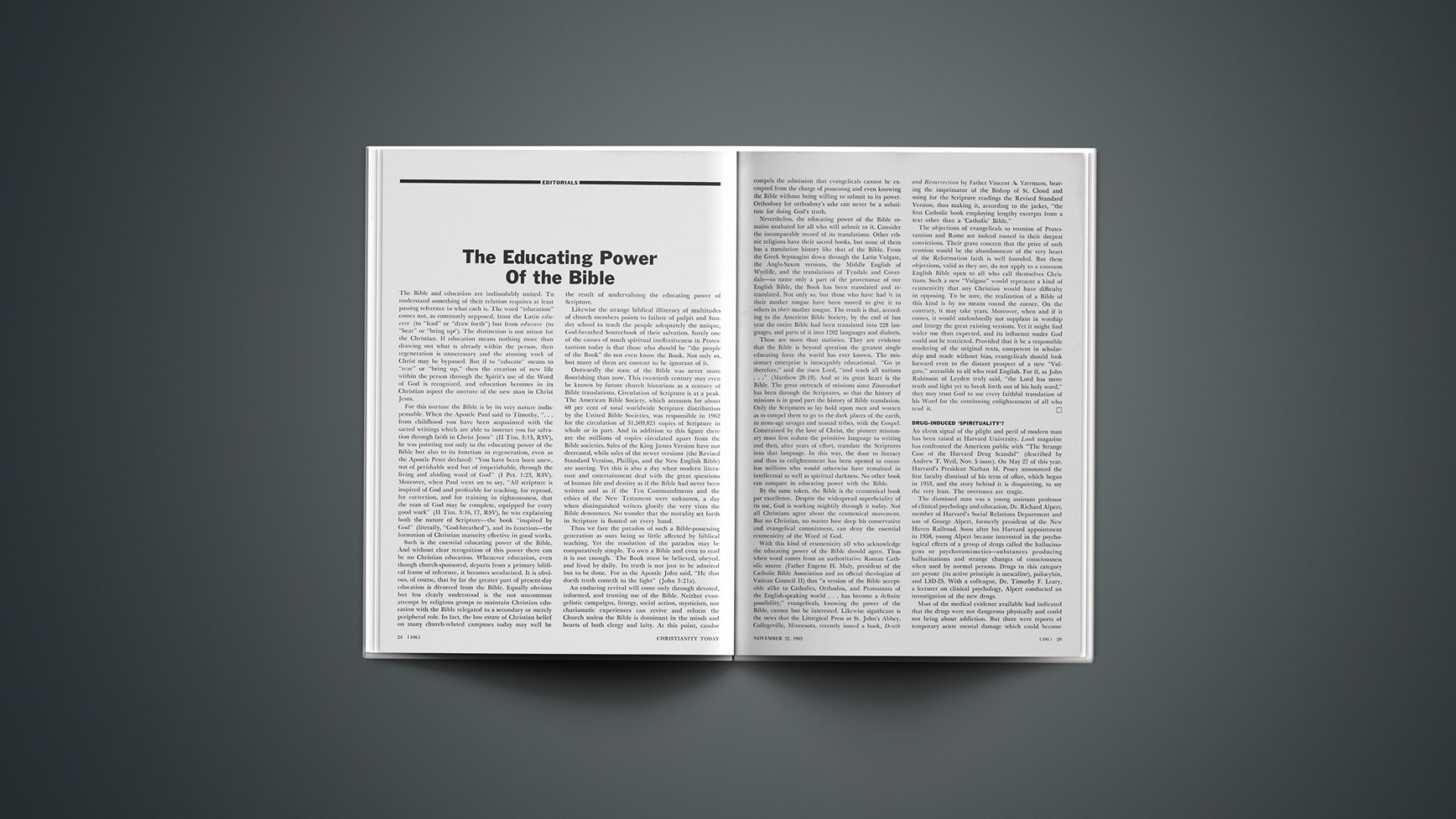
The Educating Power of the Bible

The Bible and education are indissolubly united. To understand something of their relation requires at least passing reference to what each is. The word “education” comes not, as commonly supposed, from the Latin educere (to “lead” or “draw forth”) but from educare (to “bear” or “bring up”). The distinction is not minor for the Christian. If education means nothing more than drawing out what is already within the person, then regeneration is unnecessary and the atoning work of Christ may be bypassed. But if to “educate” means to “rear” or “bring up,” then the creation of new life within the person through the Spirit’s use of the Word of God is recognized, and education becomes in its Christian aspect the nurture of the new man in Christ Jesus.

For this nurture the Bible is by its very nature indispensable. When the Apostle Paul said to Timothy, “… from childhood you have been acquainted with the sacred writings which are able to instruct you for salvation through faith in Christ Jesus” (2 Tim. 3:15, RSV), he was pointing not only to the educating power of the Bible but also to its function in regeneration, even as the Apostle Peter declared: “You have been born anew, not of perishable seed but of imperishable, through the living and abiding word of God” (1 Pet. 1:23, RSV). Moreover, when Paul went on to say, “All scripture is inspired of God and profitable for teaching, for reproof, for correction, and for training in righteousness, that the man of God may be complete, equipped for every good work” (2 Tim. 3:16, 17, RSV), he was explaining both the nature of Scripture—the book “inspired by God” (literally, “God-breathed”), and its function—the formation of Christian maturity effective in good works.

Such is the essential educating power of the Bible. And without clear recognition of this power there can be no Christian education. Whenever education, even though church-sponsored, departs from a primary biblical frame of reference, it becomes secularized. It is obvious, of course, that by far the greater part of present-day education is divorced from the Bible. Equally obvious but less clearly understood is the not uncommon attempt by religious groups to maintain Christian education with the Bible relegated to a secondary or merely peripheral role. In fact, the low estate of Christian belief on many church-related campuses today may well be the result of undervaluing the educating power of Scripture.

Likewise the strange biblical illiteracy of multitudes of church members points to failure of pulpit and Sunday school to teach the people adequately the unique, God-breathed Sourcebook of their salvation. Surely one of the causes of much spiritual ineffectiveness in Protestantism today is that those who should be “the people of the Book” do not even know the Book. Not only so, but many of them are content to be ignorant of it.

Outwardly the state of the Bible was never more flourishing than now. This twentieth century may even be known by future church historians as a century of Bible translations. Circulation of Scripture is at a peak. The American Bible Society, which accounts for about 60 per cent of total worldwide Scripture distribution by the United Bible Societies, was responsible in 1962 for the circulation of 31,509,821 copies of Scripture in whole or in part. And in addition to this figure there are the millions of copies circulated apart from the Bible societies. Sales of the King James Version have not decreased, while sales of the newer versions (the Revised Standard Version, Phillips, and the New English Bible) are soaring. Yet this is also a day when modern literature and entertainment deal with the great questions of human life and destiny as if the Bible had never been written and as if the Ten Commandments and the ethics of the New Testament were unknown, a day when distinguished writers glorify the very vices the Bible denounces. No wonder that the morality set forth in Scripture is flouted on every hand.

Thus we face the paradox of such a Bible-possessing generation as ours being so little affected by biblical teaching. Yet the resolution of the paradox may be comparatively simple. To own a Bible and even to read it is not enough. The Book must be believed, obeyed, and lived by daily. Its truth is not just to be admired but to be done. For as the Apostle John said, “He that doeth truth cometh to the light” (John 3:21a).

An enduring revival will come only through devoted, informed, and trusting use of the Bible. Neither evangelistic campaigns, liturgy, social action, mysticism, nor charismatic experiences can revive and reform the Church unless the Bible is dominant in the minds and hearts of both clergy and laity. At this point, candor compels the admission that evangelicals cannot be exempted from the charge of possessing and even knowing the Bible without being willing to submit to its power. Orthodoxy for orthodoxy’s sake can never be a substitute for doing God’s truth.

Nevertheless, the educating power of the Bible remains unabated for all who will submit to it. Consider the incomparable record of its translations. Other ethnic religions have their sacred books, but none of them has a translation history like that of the Bible. From the Greek Septuagint down through the Latin Vulgate, the Anglo-Saxon versions, the Middle English of Wycliffe, and the translations of Tyndale and Coverdale—to name only a part of the provenance of our English Bible, the Book has been translated and retranslated. Not only so, but those who have had it in their mother tongue have been moved to give it to others in their mother tongue. The result is that, according to the American Bible Society, by the end of last year the entire Bible had been translated into 228 languages, and parts of it into 1202 languages and dialects.

These are more than statistics. They are evidence that the Bible is beyond question the greatest single educating force the world has ever known. The missionary enterprise is inescapably educational. “Go ye therefore,” said the risen Lord, “and teach all nations …” (Matthew 28:19). And at its great heart is the Bible. The great outreach of missions since Zinzendorf has been through the Scriptures, so that the history of missions is in good part the history of Bible translation. Only the Scriptures so lay hold upon men and women as to compel them to go to the dark places of the earth, to stone-age savages and nomad tribes, with the Gospel. Constrained by the love of Christ, the pioneer missionary must first reduce the primitive language to writing and then, after years of effort, translate the Scriptures into that language. In this way, the door to literacy and thus to enlightenment has been opened to countless millions who would otherwise have remained in intellectual as well as spiritual darkness. No other book can compare in educating power with the Bible.

By the same token, the Bible is the ecumenical book par excellence. Despite the widespread superficiality of its use, God is working mightily through it today. Not all Christians agree about the ecumenical movement. But no Christian, no matter how deep his conservative and evangelical commitment, can deny the essential ecumenicity of the Word of God.

With this kind of ecumenicity all who acknowledge the educating power of the Bible should agree. Thus when word comes from an authoritative Roman Catholic source (Father Eugene H. Maly, president of the Catholic Bible Association and an official theologian of Vatican Council II) that “a version of the Bible acceptable alike to Catholics, Orthodox, and Protestants of the English-speaking world … has become a definite possibility,” evangelicals, knowing the power of the Bible, cannot but be interested. Likewise significant is the news that the Liturgical Press at St. John’s Abbey, Collegeville, Minnesota, recently issued a book, Death and Resurrection by Father Vincent A. Yzermans, bearing the imprimatur of the Bishop of St. Cloud and using for the Scripture readings the Revised Standard Version, thus making it, according to the jacket, “the first Catholic book employing lengthy excerpts from a text other than a ‘Catholic’ Bible.”

The objections of evangelicals to reunion of Protestantism and Rome are indeed rooted in their deepest convictions. Their grave concern that the price of such reunion would be the abandonment of the very heart of the Reformation faith is well founded. But these objections, valid as they are, do not apply to a common English Bible open to all who call themselves Christians. Such a new “Vulgate” would represent a kind of ecumenicity that any Christian would have difficulty in opposing. To be sure, the realization of a Bible of this kind is by no means round the corner. On the contrary, it may take years. Moreover, when and if it comes, it would undoubtedly not supplant in worship and liturgy the great existing versions. Yet it might find wider use than expected, and its influence under God could not be restricted. Provided that it be a responsible rendering of the original texts, competent in scholarship and made without bias, evangelicals should look forward even to the distant prospect of a new “Vulgate,” accessible to all who read English. For if, as John Robinson of Leyden truly said, “the Lord has more truth and light yet to break forth out of his holy word,” they may trust God to use every faithful translation of his Word for the continuing enlightenment of all who read it.

Drug-Induced ‘Spirituality’?

An alarm signal of the plight and peril of modern man has been raised at Harvard University. Look magazine has confronted the American public with “The Strange Case of the Harvard Drug Scandal” (described by Andrew T. Weil, Nov. 5 issue). On May 27 of this year, Harvard’s President Nathan M. Pusey announced the first faculty dismissal of his term of office, which began in 1953, and the story behind it is disquieting, to say the very least. The overtones are tragic.

The dismissed man was a young assistant professor of clinical psychology and education, Dr. Richard Alpert, member of Harvard’s Social Relations Department and son of George Alpert, formerly president of the New Haven Railroad. Soon after his Harvard appointment in 1958, young Alpert became interested in the psychological effects of a group of drugs called the hallucinogens or psychotomimetics—substances producing hallucinations and strange changes of consciousness when used by normal persons. Drugs in this category are peyote (its active principle is mescaline), psilocybin, and LSD-25. With a colleague, Dr. Timothy F. Leary, a lecturer on clinical psychology, Alpert conducted an investigation of the new drugs.

Most of the medical evidence available had indicated that the drugs were not dangerous physically and could not bring about addiction. But there were reports of temporary acute mental damage which could become permanent. A student volunteer had nearly been killed by walking into traffic under the conviction that “he was God and nothing could touch him.” Drug effects were described as: “heightened perceptions, increased awareness of one’s surroundings, tremendous insights into one’s own mind, accelerated thought processes, intense religious feelings, even extrasensory phenomena and mystic rapture.” There were bizarre hallucinations and delusions.

Both Alpert and Leary became convinced that the mystic insight that could be gained from psilocybin would be the solution to Western man’s emotional problems. Life, they claimed, must be seen as a game, and ability to do this comes from visionary experience, which is most simply induced by hallucinogenic drugs. The drugs thus become the fulfillment of man’s search for happiness. Both men believed that government had no right to deny people the liberty to explore their own consciousness. Denial of the drugs, they felt, would be denial of “internal freedom” and a step toward totalitarianism. They chafed under a restriction the university came to impose: no undergraduates would be allowed to take part in experiments. There were stories of students and others making use of hallucinogens for seductions, both heterosexual and homosexual. Marijuana and mescaline could be bought in sandwich shops.

An “experiment in multifamilial living” was conducted. A large house was purchased, and in it was constructed a “meditation room” furnished only by mattresses and cushions on the floor. There was just enough light to illuminate a Buddha statue in one corner.

Harvard finally discharged both Alpert and Leary, who planned to carry on research in Mexico but were expelled by the Mexican government. They said they would look for another country.

But in this country more will be heard from their “cult of chemical mystics.” Philosopher Aldous Huxley participated in the experiments and sees in the new drugs some hope for mankind. He describes their educative powers as “a course of chemically triggered conversion experiences or ecstacies.” He believes “all of us are ‘infinite in faculties and like gods in apprehension.’ ”

In surveying the religious undertones of the movement, one senses an irony of history: two professors of the school originally founded for the training of Puritan ministers seek the solution to man’s emotional problems through drugs, and Buddha replaces Christ in the meditation room. Members of a fallen race are of course driven to seek solutions. But history testifies that tragedy is compounded when Christ is sidestepped and the Cross overlooked. The ego becomes the cruel substitute deity, fed by the hope of infinitely expanding human faculties, worshiped at a futile altar of human contrivance, cherished as a protector from divine light that would reveal a dark design to exclude the one true and holy God.

Huxley’s conception of man is reminiscent of the serpent’s snare—“Ye shall be as gods, knowing good and evil.” The proposed man-made solution by means of drugs recalls to us the words of our Lord about the unclean spirit returning to a man with seven other wicked spirits: “and the last state of that man is worse than the first” (Luke 11:25). Indeed, any usurpation of Christ’s throne room of the heart is demonic and idolatrous.

In terms of sound nourishment, the emptiest place in the universe is the heart of modern man. By God’s grace this is matched by another emptiness—that of the garden tomb. Here God speaks in ultimate terms of ultimate fulfillment and of ultimate satisfaction.

‘American Women’—The Federal Report

It will not raise as many eyebrows as the Kinsey studies, but American Women, a federal commission’s eighty-six-page report made public last month, presents a lot of telling statistics.

The scope of the report, result of a twenty-two-month study, is considerably narrower than the title implies. It is not concerned with women’s personal habits. The authors, members of the President’s Commission on the Status of Women, were told to confine themselves to women’s legal rights, employment practices that affect women, and “new and expanded services that may be required for women as wives, mothers, and workers, including education, counseling, training, home services, and arrangements for care of children during the working day.”

Within this area of concern is posed at least one question of considerable moral import: Why must nearly three million American mothers with children under six work outside the home even though there is a husband present and, in a good many cases, the husband’s income adequately meets family needs? A 1958 survey indicated no fewer than 400,000 children under twelve whose mothers worked full time and for whose supervision no arrangements whatsoever had been made.

The problem of the working mother is a puzzle in our society. Why in the prosperous United States should there be any appreciable percentage of mothers employed outside the home? Yet in nearly half a million families with children under six years, the report says, the mother frequently provides the sole support.

The report does not distinguish between mothers whose financial circumstances make outside work necessary and those employed for such reasons as personal and cultural fulfillment. Almost everyone familiar with suburban living knows mothers who work because they are otherwise bored, because a stenographer’s duties are easier and more interesting than a homemaker’s, because they want an escape from the tensions of the modern home, or because they want the more luxurious standard of living that comes with the added income. One could not ordinarily justify the need, for instance, of an extra paycheck in a family where the husband makes $7,500 a year.

But why distinguish between working mothers? Has not our culture outgrown the notion that a woman’s place is in the home?

We raise the point because it sounds some distinctly moral overtones. Perhaps the most serious aspect is a seeming tendency to regard child-rearing as a mechanical chore to be dispensed with as soon as possible in favor of more “creative” pursuits. The average American woman now has her last child at the early age of twenty-eight, according to the Population Reference Bureau. Moreover, an increasing number of mothers are seeking outside employment as soon as their children reach school age. The implication is that neither the home nor the child needs the attention we once thought it did.

We feel that the trend reflects poorly on the Church and is bad for the country. It underestimates the value of a wholesome home life. Children even through high school require time with their parents without the distractions of a harried mother who has a doubled evening work load because she has been away all day. The best in foods, clothes, and music lessons is no substitute for the parent himself.

The working mother places subtle strains on family life. Car pools, coffee breaks, overtime work, office parties, and bowling leagues figure in many cases of divorce involving unfaithfulness. Overworked wives have little time for their husbands. The sense of independency that comes with a separate pay check is also bad.

Working mothers are a national problem, for unhappy homes breed juvenile delinquency and reduce the efficiency of the working husbands. Futhermore, needlessly employed mothers aggravate the unemployment problem in occupying jobs that would otherwise go to males who need them.

Considering all these factors which go unmentioned in the report, the reader may be justifiably troubled by the commission’s implicit approval of baby-sitting operations financed indiscriminately by the government. The commission’s twenty-four major recommendations may well represent a needed treatment of symptoms. But it remains for the Church to battle with new vigor the causes, which certainly have moral implications. It remains for parents to realize again that there is no more creative challenge than rearing children in the fear of the Lord and in a happy home. The trend to transfer responsibility from the family to the school and to society is dangerous.

A Compassionate Bill

Both the President and Congress deserve commendation for the enactment of legislation authorizing a $329 million program of research in the field of mental retardation and mental health. The bill, the first of its kind our nation has had, includes matching grants for research and the education of teachers of handicapped children along with similar grants for community mental health centers. At a time when Congress faces critically important civil-rights and tax legislation, it is encouraging to see that this humanitarian measure has been passed. The personal concern of Mr. Kennedy and his family for the mentally retarded is well known. Like millions of their fellow citizens (the national rate of retardation is three out of every hundred children) they know at first hand the problem of retardation. For only those who have a retarded child, or a retarded sister (as in the President’s case) or brother, can understand what this handicap really means.

The signing of this bill has let a shaft of light into many thousands of homes. Much can be done about mental retardation. Children who would otherwise live secluded and aimless lives may be helped to become useful and contributing citizens. Others may be given more adequate care. Moreover, medical research holds out hope of the prevention of most cases.

What our government has done should be a spur to evangelical action in this neglected field. The Church has yet much to learn about the loving acceptance and the effective spiritual training of retarded children. Heartening signs in some evangelical quarters—provision of institutional care, setting up of special Sunday school classes, training of ministerial counselors—point the way to greater awareness of the problem and more extensive efforts to ameliorate it. Now that the plight of millions of handicapped children has been so helpfully recognized by the President and Congress, surely the Church should not lag further in accepting its responsibility of active concern for Christ’s little ones.

Civil-Rights Legislation

All social orders since the dawn of history have been confronted with the problem of balancing individual freedom and group resriction. These two realities are present in every order, and the characteristic of the order is determined by the kind of balance maintained. A measure of freedom is found even in the most intolerable totalitarian orders. On the other hand, when the highest possible degree of individual liberty is sought, there comes discovery that anarchy can be one of the crudest tyrannies of all.

Not every society is or has been concerned about individual freedom. But in the United States freedom has been a rallying cry since the nation’s founding. Moreover, the American concern for freedom has been linked to respect for law and acknowledgment of its necessity in a sinful society.

This nation now faces one of the severest challenges to its balance between freedom and law encountered since its birth. The challenge is a result of interpreting the founding documents of freedom and liberty as applicable only to part of the people. The Declaration of Independence was obviously not applied to Negro slaves in 1776. The same thing was true a few years later of the Constitution. And even today, full application of these documents becomes a possibility not primarily because of white crusaders but because of clamant cries of the descendants of those slaves for equal rights under the law.

Now, almost 200 years after the founding documents of our nation were written, civil-rights legislation proposed in Congress is a necessity not only to secure domestic tranquility but also to guarantee basic liberties to all citizens. This legislation admittedly tips the balance to some extent away from the degree of freedom held by the majority race in this country. But the necessity of such legislation becomes a judgment upon the white American, whose failures to grant elemental freedoms to a minority race have required it.

There have been and still are, in North as well as South, many failures in this area of our national life. And if one must point the finger, he must begin by pointing to himself. The churches have failed. The local communities have failed. Labor has failed. Management has failed. The states have failed. The federal government now steps into the vacuum that should not have existed, to do what it never should have been called upon to do.

But let us be under no illusions. Passing a civil-rights bill, essential as it has become, will not solve once and for all the racial problem in America. It is, however, an important step. The road ahead is long, and legislation regarding civil rights must be supplemented by the constraining love of Christ manifest in attitudes and personal conduct toward those of other races.

Revolution In South Vietnam

Many strands wove the story of tangled intrigue and bitter resentment that brought the downfall of the Diem regime in South Vietnam. Archbishop Ngo Dinh Thuc said prior to the coup that among the Vietnamese Buddhists there was considerable jealousy of the Roman Catholics. He could well be right. His brother, the late Diem, and his sister, Mrs. Ngo Dinh Nhu, have been known as devout Catholics. So has Mrs. Nhu’s husband, Diem’s right-hand man. The circumstances that breed jealousy were present. The government of South Vietnam was a family government dominated by Roman Catholics in a country where about 80 per cent of the population is non-Catholic.

One would expect that a family government belonging to a religious minority would wisely afford equal treatment to every religious group. But in spite of constant promptings by United States Ambassador Lodge, the government until the end refused to do so. Though Protestants were ignored, both Roman Catholics and Buddhists were aided by the government; but the Roman Catholics received preferential treatment. Buddhists, for example, had to have permits to hold meetings; Roman Catholics did not. Under such circumstances, jealousy was a natural product.

Yet jealousy alone would not seem to explain the government’s overthrow in Saigon. It would hardly explain the Buddhists who burned themselves to death, nor the thousands who were imprisoned. Even the destruction of the Nhu possessions suggests something more than jealousy.

On returning from Saigon, C. Stanley Lowell, associate director of Protestants and Other Americans United, declared that Buddhists felt like second-class citizens in a land where they are the vast majority. He also said that Buddhists resented being ruled by a family because it violated their belief in freedom.

For centuries the East slumbered in unfreedom. But those days ended when Christianity was brought to the East by both Protestants and Roman Catholics. Once the Christian truths of human freedom and dignity and the right to self-determination began to arouse the slumbering Eastern soul, the time of social and political revolution had begun. So great has been the power of freedom in the East that when those who profess Christ seek to suppress it, it will be lifted aloft by the hands of non-Christians. The leaven of freedom was working far more powerfully and widely than Diem knew. Ultimately it destroyed his own government.

Special Announcement

The Bible is the book of Christian faith and experience. Great movements have found their inspiration in a single verse of Scripture. Individuals have claimed particular promises of the Bible and have found in them great spiritual and practical help. “The just shall live by faith” marked the turning point in Martin Luther’s life, and the truth it contains became the foundation of the Reformation.

Christians today, no less than yesterday and just as surely tomorrow, gain comfort, hope, guidance, and spiritual power from Bible passages made alive for them by the Spirit of God. Beginning with an early issue in 1964, CHRISTIANITY TODAY will feature a special paragraph, entitled “God’s Sword Thrusts.” These paragraphs will provide our readers an opportunity to share with the more than 200,000 persons who receive this magazine a verse or passage that has been of unusual help in their Christian experience. Contributions, which must be original and unpublished, must be not less than 100 words nor more than 150 words in length. Ministers, for example, might write about “A Text I Can’t Forget”; laymen might write on “Food for My Soul,” “Help in Time of Need,” or something similar. But whatever text or passage is chosen, we want your own experience of the value and blessing of the Bible in your personal faith and daily life. Just as participants in the symposium in this issue speak of their personal use of the Bible, so contributors to “God’s Sword Thrusts” will speak definitely of what certain verses and passages have meant to them.

For every contribution used CHRISTIANITY TODAY will send the writer an honorarium of five dollars. Names of writers will be printed. Contributions should be addressed to Feature Editor, Christianity Today, 1014 Washington Building, Washington, D. C. 20005.

We are indebted to the Rev. Theodore E. Bubeck of Valley Forge, Pennsylvania, for the initial suggestion that led to this announcement.

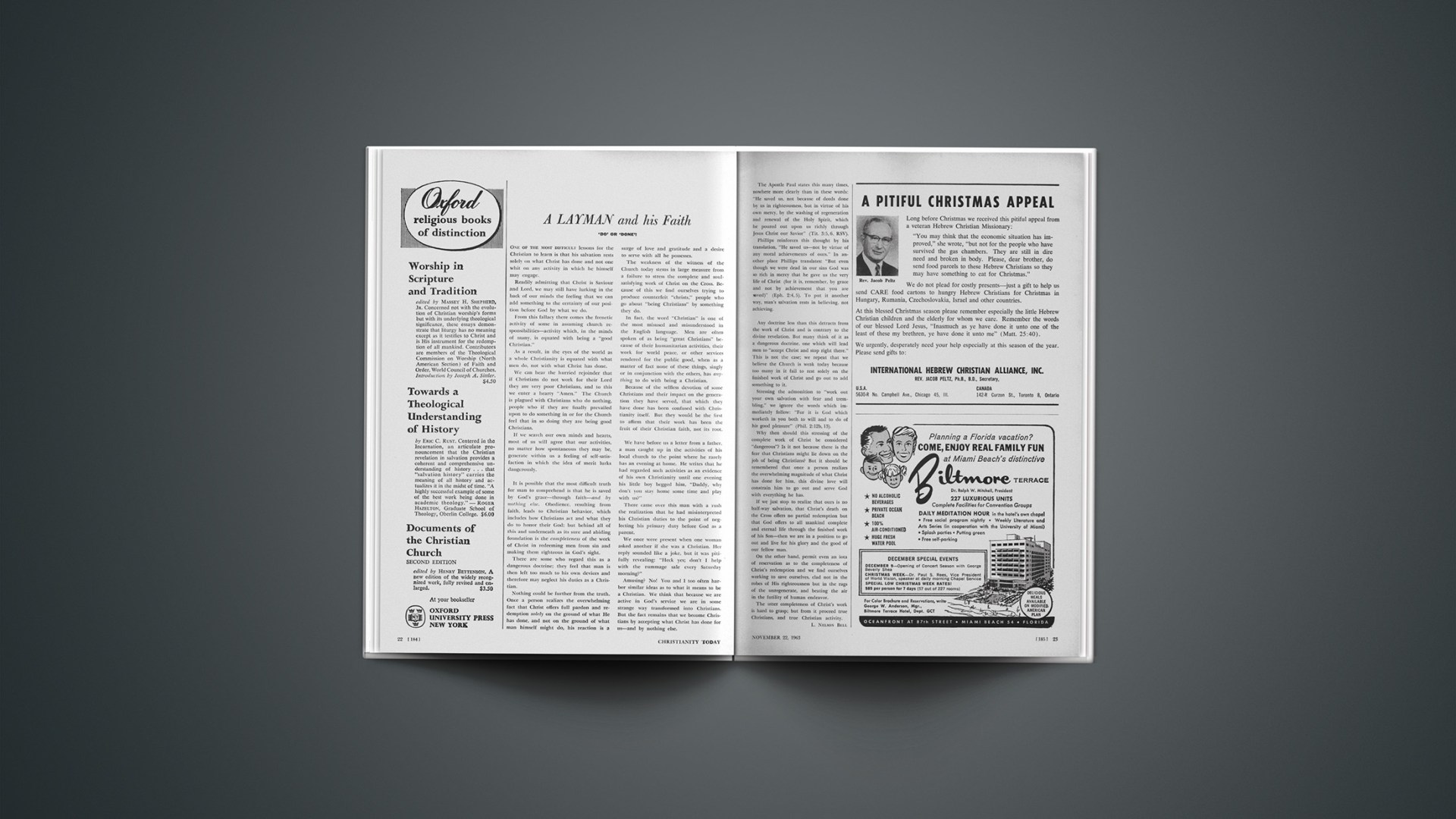
‘Do’ or ‘Done’!

One of the most difficult lessons for the Christian to learn is that his salvation rests solely on what Christ has done and not one whit on any activity in which he himself may engage.

Readily admitting that Christ is Saviour and Lord, we may still have lurking in the back of our minds the feeling that we can add something to the certainty of our position before God by what we do.

From this fallacy there comes the frenetic activity of some in assuming church responsibilities—activity which, in the minds of many, is equated with being a “good Christian.”

As a result, in the eyes of the world as a whole Christianity is equated with what men do, not with what Christ has done.

We can hear the hurried rejoinder that if Christians do not work for their Lord they are very poor Christians, and to this we enter a hearty “Amen.” The Church is plagued with Christians who do nothing, people who if they are finally prevailed upon to do something in or for the Church feel that in so doing they are being good Christians.

If we search our own minds and hearts, most of us will agree that our activities, no matter how spontaneous they may be, generate within us a feeling of self-satisfaction in which the idea of merit lurks dangerously.

It is possible that the most difficult truth for man to comprehend is that he is saved by God’s grace—through faith—and by nothing else. Obedience, resulting from faith, leads to Christian behavior, which includes how Christians act and what they do to honor their God; but behind all of this and underneath as its sure and abiding foundation is the completeness of the work of Christ in redeeming men from sin and making them righteous in God’s sight.

There are some who regard this as a dangerous doctrine; they feel that man is then left too much to his own devices and therefore may neglect his duties as a Christian.

Nothing could be further from the truth. Once a person realizes the overwhelming fact that Christ offers full pardon and redemption solely on the ground of what He has done, and not on the ground of what man himself might do, his reaction is a surge of love and gratitude and a desire to serve with all he possesses.

The weakness of the witness of the Church today stems in large measure from a failure to stress the complete and soul-satisfying work of Christ on the Cross. Because of this we find ourselves trying to produce counterfeit “christs,” people who go about “being Christians” by something they do.

In fact, the word “Christian” is one of the most misused and misunderstood in the English language. Men are often spoken of as being “great Christians” because of their humanitarian activities, their work for world peace, or other services rendered for the public good, when as a matter of fact none of these things, singly or in conjunction with the others, has anything to do with being a Christian.

Because of the selfless devotion of some Christians and their impact on the generation they have served, that which they have done has been confused with Christianity itself. But they would be the first to affirm that their work has been the fruit of their Christian faith, not its root.

We have before us a letter from a father, a man caught up in the activities of his local church to the point where he rarely has an evening at home. He writes that he had regarded such activities as an evidence of his own Christianity until one evening his little boy begged him, “Daddy, why don’t you stay home some time and play with us?”

There came over this man with a rush the realization that he had misinterpreted his Christian duties to the point of neglecting his primary duty before God as a parent.

We once were present when one woman asked another if she was a Christian. Her reply sounded like a joke, but it was pitifully revealing: “Heck yes; don’t I help with the rummage sale every Saturday morning?”

Amusing? No! You and I too often harbor similar ideas as to what it means to be a Christian. We think that because we are active in God’s service we are in some strange way transformed into Christians. But the fact remains that we become Christians by accepting what Christ has done for us—and by nothing else.

The Apostle Paul states this many times, nowhere more clearly than in these words: “He saved us, not because of deeds done by us in righteousness, but in virtue of his own mercy, by the washing of regeneration and renewal of the Holy Spirit, which he poured out upon us richly through Jesus Christ our Savior” (Tit. 3:5, 6, RSV).

Phillips reinforces this thought by his translation, “He saved us—not by virtue of any moral achievements of ours.” In another place Phillips translates: “But even though we were dead in our sins God was so rich in mercy that he gave us the very life of Christ (for it is, remember, by grace and not by achievement that you are saved)” (Eph. 2:4, 5). To put it another way, man’s salvation rests in believing, not achieving.

Any doctrine less than this detracts from the work of Christ and is contrary to the divine revelation. But many think of it as a dangerous doctrine, one which will lead men to “accept Christ and stop right there.” This is not the case; we repeat that we believe the Church is weak today because too many in it fail to rest solely on the finished work of Christ and go out to add something to it.

Stressing the admonition to “work out your own salvation with fear and trembling,” we ignore the words which immediately follow: “For it is God which worketh in you both to will and to do of his good pleasure” (Phil. 2:12b, 13).

Why then should this stressing of the complete work of Christ be considered “dangerous”? Is it not because there is the fear that Christians might lie down on the job of being Christians? But it should be remembered that once a person realizes the overwhelming magnitude of what Christ has done for him, this divine love will constrain him to go out and serve God with everything he has.

If we just stop to realize that ours is no half-way salvation, that Christ’s death on the Cross offers no partial redemption but that God offers to all mankind complete and eternal life through the finished work of his Son—then we are in a position to go out and live for his glory and the good of our fellow man.

On the other hand, permit even an iota of reservation as to the completeness of Christ’s redemption and we find ourselves working to save ourselves, clad not in the robes of His righteousness but in the rags of the unregenerate, and beating the air in the futility of human endeavor.

The utter completeness of Christ’s work is hard to grasp; but from it proceed true Christians, and true Christian activity.

Eutychus and His Kin: November 22, 1963

ARE YOU LISTENIN’?

On Euclid Avenue there is a diner called the Beef Snak Coffee Shoppe (très intime). I was in there late one night last week chomping away on a beef snak with onions, and nit-picking among my streams of consciousness, when happily my eye fell on a spare copy of The Metal Workers News. Late at night in East Cleveland, it seemed worthwhile to catch up on the metal workers’ game, and I really was impressed with the number of things I didn’t know a thing about. There were even pictures of men who have “made good” in terms of the standards upheld by The Metal Workers News.

I was reminded again that in Pike County, Kentucky, there is a newspaper called The Pike County News with the sub-heading, “The only newspaper in the world devoted to the best interests of Pike County.” Rumor has it that the newspaper in Bath, England, is called The Bath Observer, and I am glad to report this. Up at Ravenna, Ohio, they used to have a sign outside town that said: “The Home of the World’s Highest Flag Pole.” A good friend of mine knows of one town that advertises itself as “The Home of Jim Greengrass”; but this same friend said that he asked a youngster one time, “Isn’t this the home of Dizzy Dean?,” and this youngster said, “Who’s Dizzy Dean?” Mutatis mutandis. “The world is so full of a number of things, I’m sure we should all be as happy as kings”; and if God is even half as much interested in his creation as I am, he must have, among other possibilities, a very interesting life.

The word is around that it is time “for the Church to listen to the world,” and this I would be very happy to do if I could find out what the world is saying. “The common people heard Him gladly,” and this was one of the wonderful things about him: but it seems to me that the world is to listen to him and not the other way around. I don’t think the world has anything to tell us except that some are confused and many are lost.

EUTYCHUS II

RACIAL INTERMARRIAGE

The editorial on racial intermarriage (Oct. 11 issue) rightly asserts that “the Christian Church seems to be offering little guidance in the matter” and that “no argument can safely be drawn one way or the other.” The responsibility of the Church, however, seems to lie in this area of guidance rather than argument. The need is for positive leadership in guidance rather than negative argumentation. The dangers and pressures of the interracial marriage must be pointed out, but a greater need exists in the Church’s willingness to accept and love those whom society or ethnic groups frown upon. It is within these situations that the Church must rise to the occasion to welcome and accept those whose marital choice has left them without a racial home.…

P. DOUGLAS KINDSCHI

Chicago, Ill.

Your editorial sounded like something from the Afrikaans leadership in South Africa.

LAWRENCE VAN HEERDEN

First Baptist

Williamson, N. Y.

Though I consider myself an agnostic and do not profess a belief in any Christian faith, I wish to say that I consider that article the best exposition on the subject that I have seen or can imagine being written.

A. W. BLAIR

Peoria, Ill.

Your contention that “neighbor love is a matter of justice, of giving another his due, of fulfilling the law …” runs tragically counter to the statement of Jesus, “Thou shalt love they neighbor as thyself.” Jesus’ idea of neighborly love was specifically illustrated in the story of the good Samaritan, and this amplification of neighborly love leaves no room for “legalistic love” or race-conscious pride. The same concept of love is in no way legalized or diluted by Paul’s First Corinthians arguments for the excellence of love in all human relations.

Fortunately for the presentation of Christ and his Gospel there are Christians whose love for their Negro brethren goes beyond the legal requirements of this “neighbor love” on which you have reported. I wonder if such Christians are sinning by doing more than your legal type of love requires?

CHARLES R. ATWATER

Sterling, Kan.

Most opposition to interracial marriage is voiced in such terms that it incites people believing in equal justice to advocate interracial marriage. This opposition assumes that the white race is so superior that interracial marriage degrades (or “mongrelizes”) it. They forget that “hybridization” can also produce strains superior to either parental strain.

MARCIUS E. TABER

Pentwater, Mich.

It is extremely heartbreaking to realize that we of Negro blood constitute such a problem when the subject of intermarriage is discussed. If God had made us less human and less innately able to achieve than you of the white race, we would rest content with our inferior constitution and not wonder for a moment why the subject of intermarriage with us creates such a controversy.

I agree with your article generally, but I think it betrays drastic weaknesses in an hour when the Church of our Lord Jesus should make unequivocal statements about the race problem for the sake of its own testimony to the world.… God has stated his will absolutely by stating that he created man in His own image (this includes the Negro) and made a female answering to him for marriage. In addition, nowhere in the Bible does God complicate the matter on the basis of race alone. (God forbade the intermarriage between the Jew and the Gentile to maintain the purity of the Mosaic religion.) …

The editor suggests that it may be “an act of gross lovelessness to thrust a [mulatto] child involuntarily into a scornful society.” I take issue with this argument against a racially diverse marriage for these reasons: (1) practically all children born to Negro mates are thrust out involuntarily upon a scornful society. Would the editor for that reason suggest that Negroes should not marry one another and have children? (2) Jewish children are thrust out involuntarily upon a Jew-hating society. Would the editor suggest for that reason that Jews should not marry one another and have children?

ROLAND C. WROTEN

Pine Street Baptist Church

Scranton, Pa.

Paul in saying “all one in Christ,” was speaking of grace, not race.

ESTELLE MURRAY

Leadon, Pa.

You cited the Book of Revelation and Acts 17:26 with regard to tribes, tongues, and nations. Does exegesis actually yield the concept of “race” on which American society has been leaning for the last several centuries? I think not.

In another place you say, “It is not Christianity’s mission to provide a panacea for a pagan world that seeks solution of its problems while it persists in rejecting Christ.” Perhaps they have rejected the message of grace because we have not been gracious. Perhaps the early Church had such a profound influence on the pagan world round about because of willingness to care for babies who had been left to die by unloving pagan parents. Perhaps we have gotten into the habit of retreating from the earthy problems of life.

JAMES B. WHITE

Philadelphia, Pa.

So few of those who favor integration give proper consideration to the near certainty that removal of barriers between Negro and white will result in a good deal of intermarriage. The so-called race problem is essentially a matter of cultural differences. There are genuine cultural differences between middle-class American culture and the culture of Negro Americans. Some characteristics of American Negro culture are due to their confinement to the lower socioeconomic levels, and in this respect their attitudes and behaviors are similar to those of lower-class whites. (In this connection it is well to remember that middle-class whites often discriminate against lower-class whites.) …

If, then, we manage to break the bonds of the Negroes, they will become culturally like middle-class whites, and we may expect people who are culturally similar to marry one another regardless of the minor physical hereditary differences.… There is no question but that racial intermarriage in a society which frowns upon it may have regrettable consequences for both parents and children. We must ask ourselves, however, whether we are prepared to deny the Negro his legitimate rights simply because of the … suffering of a transition period.

ROBERT B. TAYLOR

Manhattan. Kan.

The While Man’s Creed: I believe in God the White Father Almighty, maker of heaven and earth, and in Jesus Christ his only Son our Lord, who came into the world as the Saviour of the white man. I believe the white man to be the custodian of the world’s wealth and wisdom, chief governing official in all areas where humans gather, inspiration and strength of all peoples everywhere. I believe members of all other races and colors should render homage to the white man, thanking him each day for favors given, and to have no other desire than to serve him. I believe in the holy, universal white church, the communion of white saints, and the life everlasting in a white heaven. And now abideth Little Rock, Old Miss, and Birmingham, these three, but the greatest of these is Birmingham.

JOHN ROSSEL

The Federated Church of Harvey Congregational and Presbyterian

Harvey, Ill.

BAPTIST PRESS AND BILLY GRAHAM

Re “The Crowded Coliseum” (News, Sept. 27 issue) and the statement that the press service of his own denomination, the Southern Baptist Convention, “practically ignores” Billy Graham:

Far from it! Baptist Press reports the numerous occasions when he speaks to some meeting or is connected with some event in the Southern Baptist Convention. Since his worldwide activities otherwise are amply covered by Associated Press, we do not try to duplicate their stories. The twenty-eight Southern Baptist state papers (circulation 1.6 million) gladly give generous space to his far-flung crusades.

W. C. FIELDS

Public Relations Secretary

Southern Baptist Convention

Nashville, Tenn.

GREAT EXPECTATIONS

It appears to me that the present administration is fast turning this country into a welfare state, whereby they seem to be leading the people into a belief that the government will do everything for them, and that there is no further need [for] God and the kind of Christianity Jesus taught; therefore, I expect that CHRISTIANITY TODAY will soon be out of business.… Keep up the high standard you now have, and may God bless you all even after the Kennedy Klan and the Supreme Court have put you all out of business.

HERBERT JENNINGS

Shreveport, La.

THE WITNESS WAS WITNESSED

Mr. Farrell in his article “Outburst of Tongues: The New Penetration” (Sept. 13 issue), states that I claim “to have witnessed to foreigners in their own languages, unknown to [me] (such as Polish and Coptic Egyptian).” If my own account of speaking in tongues unknown to me were unsupported by witnesses, I would expect skepticism. Fortunately, the Egyptian who identified my tongue immediately shared what she had witnessed with three well-known Christian leaders, none of whom spoke in tongues.…

In spite of this and other corroboration, I think we would be making a great mistake to pin the validity of tongues on our being able in each instance to identify the particular language spoken. Never after Pentecost do the Scriptures identify the languages employed by the persons speaking in tongues. Paul says (1 Cor. 14:2), “For he that speaketh in an unknown tongue speaketh not unto men but unto God; for no man understandeth him. Howbeit in the Spirit he speaketh mysteries.” When Paul prayed in tongues which he did “more than ye all”—he said his understanding was “unfruitful.” Once God had established that tongues are definite languages as he did at Pentecost, he apparently did not go on repeating the demonstrations. In our day people do occasionally speak under the inspiration of the Holy Spirit languages unknown to them but known to the listener. Though this is not the rule it happens often enough to confirm the fact that tongues really are articulate speech and not gibberish as some of our brethren have supposed.

I appreciate the frequent evidences in CHRISTIANITY TODAY that you have not closed your mind on this subject, and that you are making a genuine effort to distinguish between the tares and the wheat that thrive so closely together in this charismatic renewal.

HARALD BKEDESEN

First Reformed

Mount Vernon, N. Y.

60-YEAR PERSPECTIVE

As one of your new subscribers I am moved to express my great delight in the article by Paul Rees on the subject of the texture of preaching (Sept. 13 issue). In all my ministry of more than sixty years I have never read anything of more practical value to the would-be preacher. How I wish that I had been told what Mr. Rees tells me, sixty years ago! And how I envy the young men of today in their opportunity to accept and act upon such as this!

There are many voices these days speaking out in more than mere pessimism, in a sort of terror, about the absence of great preaching. A careful study of the threads that make up the texture of effective preaching would change those materially.

HENRY FRANCIS SMITH

Kennebunkport, Me.

The Perennial Book

The Bible has a fascinating history. Before the advent of the printing press it was a scarce commodity. Laboriously copied by hand in the monasteries, only a few copies were available here and there. These copies were so prized that they were often fastened into position with chains to prevent their being stolen. Once the printing press had been invented, the story changed. Now the Bible could be made available in quantities by mass production.

The printing press did not solve all the problems connected with the publication of the Word of God, however. When printing came into use, the Latin Vulgate was the chief source of religious truth. Yet hardly anyone could read Latin. And even for those who could read it the Vulgate was a problem. It contained thousands of errors, not the least of which was one that changed the thinking of Martin Luther. The Vulgate translated Jesus’ words in Matthew 4:17, “Do penance.” The KJV and the RSV translate them, “Repent, for the kingdom of heaven is at hand.” It was from the printed Greek text of Erasmus that “Luther had learned that the original simply meant ‘be penitent.’ The literal sense was ‘change your mind.…’ This was what Luther himself called a ‘glowing’ discovery. In this crucial instance a sacrament of the church did not rest on the institution of Scripture” (Roland Bainton, Here I Stand, New York, 1950, p. 88). Men like Luther quickly discerned that if the Bible were to be brought to the people, it would have to be translated into the language of the reader, despite the intense and continuous opposition of the church.

Luther made the Bible available in the German vernacular. This was a laborious task in which he encountered innumerable problems. He wrote a letter to a friend saying: “I am all right on the birds of the night—owl, raven, horned owl, tawny owl, screech owl—and the birds of prey—vulture, kite, hawk, and sparrow hawk. I can handle the stag, roebuck, and chamois, but what in the Devil am I to do with the taragelaphus, pygargus, oryx, and camelopard (names for animals in the Vulgate)?” (ibid., pp. 327, 328).

The Bible, kept from the masses for so long but now available in more than a thousand tongues, has been, and is, a controversial book. Indeed, no book has been more widely examined and attacked. No other book has had so many books written about it. And no book has remained more solidly in the affections of men with no signs of the law of diminishing returns setting in. The enemies of the Bible have sought to eliminate it from the counsels of men and nations. They have done all they can to relegate it to the scrap heap of forgotten literature and to cause men to despise it. But the critics of the Bible die, and their works crumble to dust. The Word of God abides forever. Like the hammers of a blacksmith that beat upon the anvil without destroying it, so the critics who beat upon the Word of God disappear. Their hammers are cast away, and the anvil remains to test the hammers of men of generations yet unborn. These too will follow the example of their predecessors. Their hammers also will be broken. But the Word of God will go on forever.

In America the Bible is an open book, available to everyone. But to many Americans it is a closed book, either because they leave it unread or because they read it without applying its teaching to themselves. No greater tragedy can befall a man or a nation than that of paying homage to a book left unread and of giving lip service to a way of life not followed. By this attitude men pass judgment upon the Book; some day they will discover that the Book has passed judgment upon them.

Timely Though Ancient

One of the chief reasons why men disregard the Bible is the notion that a book as ancient as this one cannot speak to the needs of today. Men somehow think that in an age of scientific achievement, when knowledge has increased more in fifty years than in any preceding centuries, this ancient book is anachronistic. But the Bible is perennially relevant. It had a message for the first century. It has a message for the twentieth century. And it will have a message for the fortieth century, if the world lasts that long.

The main thrust of the Bible is alien to the general orientation of our day. It proclaims absolutes at a time when relativism is the prevailing philosophy in the Western world and when ultimate truth is regarded by many as ineffable. The philosophy of relativism is not new. It has been current coin among thinkers of the East for at least as long as the philosophy of absolutes has been current in the West.

This tradition of absolutes is at the heart of the Hebrew-Christian religion. If it were to disappear, there would be no hope for mankind. Certainly relativism cannot do more than assure us that nothing is permanent and eternal, that all things are subject to flux. The religion of today may be untrue tomorrow. The ethics of today may be completely reversed tomorrow. Social mores then become time-structured and subject to the changing ideas of men. The homosexuality of today may be the norm of tomorrow, the monogamy of today may yield to the polygamy of tomorrow, and the lie of today may be true tomorrow.

But once man has committed himself to the absolutes of the Hebrew-Christian tradition, the picture changes. Absolutes remain fixed principles by which man guides his course. They are true yesterday, today, and forever. They are not subject to the vicissitudes of circumstance nor superseded by the latest fancies of science and sociologists. Absolutes give man something on which he can depend and by which he can steer a straight course.

It is in the Bible that God has spoken, and he has not stuttered in his speech. His revelation need not be rewritten by every generation nor his thoughts revised and altered by the questing minds of men. His principles are enduring, but they need to be applied reasonably and intelligently to the problems we face in a world where scientific advance has outpaced spiritual perception.

Need For Modern Prophets

The great lack of our day is the failure of the Church and Christians to make known the relevancy of the Bible to current movements and problems. There is a “Thus saith the Lord” for a world which faces apocalyptic catastrophe. We need prophets neither of doom nor of gloom. Rather do we need men who know what God has said and who will speak with complete abandonment as prophets of God to the nations.

Perhaps the most vexing problem in our culture today involves the American Negro. This problem finds its best and happiest solution for all when the principles of the Bible are accepted and applied by men of good will. Everywhere men are saying that the color of one’s skin is immaterial. Everywhere the consciences of men are declaring that segregation is wrong, that it is wrong to refuse a man a seat in a train, or to deny him entrance to a restaurant, or to keep him from voting, because his skin is black. But the significant fact is that this view derives from the Bible. Therein we discover that God is no respecter of persons, that there is neither Jew nor Gentile, male nor female, bond nor free, but that all are one in Jesus Christ. This is no new truth. It is as old as the revelation of God. And we must be reminded of an additional fact—if this truth were to be considered relative instead of absolute, then the day might come when segregation could be justified. But under God’s absolutes in Scripture we may confidently affirm that prejudice based on the color of a man’s skin is wrong.

The Bible is also relevant to politics and passes judgment upon men who fall short of the moral principles that must undergird sound political life. Does God have a word for a culture? Does God have something to say to those in government? Indeed he does. As men and nations sow, so shall they reap. There are eternal moral principles that will, when broken, be paid for by the generation that has broken them or by generations as yet unborn. The history of mankind is filled with examples of men who have defied the laws of God. Always and inevitably the price of sin has had to be paid. In the ruins of the city of Pompeii, which was buried beneath the ashes spewed forth from Mount Vesuvius, there are places that defy description. They are kept locked, and the guides will permit no woman to enter and look. The obscenity and depravity equal that of Sodom and Gomorrah. Surely the cataclysm that overtook this city was a fitting climax to its sin.

The Bible also speaks to labor and capital, to unions and big business. It outlines the principles that are to undergird their relations. It forbids not only the actions of a corrupt labor leader, but also the collusion of price-fixing electrical giants. It not only prohibits featherbedding by labor; it also prohibits the employer from oppressing his employees. It declares that the laborer is worthy of his hire and should be paid a fair wage. But it also asserts that the laborer should give a fair day’s work for a fair day’s wage. There are no problems between labor and capital that cannot be settled fairly when men of good will apply the principles of Scripture to their business lives.

One must admit that the biblical principles are rarely applied to the problems mentioned, because men do not wish to be bound by them. Selfishness, pride, and the hundred other sins to which men are addicted keep them from following the second law of love, “Thou shalt love thy neighbor as thyself.” This law of neighbor-love works when it is applied; it does not generally operate because men do not choose to obey it. Although sometimes men are not aware of the compelling principles of the Word of God, most often it is not ignorance but indisposition. Men feel that the idealism of these principles is impractical for use in everyday life and would endanger their success, and they deliberately spurn the commandments of God. In the long run, however, racists, immoral politicians, corrupt labor leaders, and unethical businessmen will reap as they have sown.

The Bible perennially speaks to men. To every age it speaks racially, politically, socially. It speaks to men in business, in school, and in the home. Its principles are as enduring and valid today as they were when first they were given by God as a part of his divine revelation.

Harold Lindsell, vice-president and professor of missions at Fuller Theological Seminary, holds the degree of Ph.D. from New York University. This essay is condensed from an address he gave at the 1963 convention of the Christian Booksellers Association in Washington.

Apple PodcastsDown ArrowDown ArrowDown Arrowarrow_left_altLeft ArrowLeft ArrowRight ArrowRight ArrowRight Arrowarrow_up_altUp ArrowUp ArrowAvailable at Amazoncaret-downCloseCloseEmailEmailExpandExpandExternalExternalFacebookfacebook-squareGiftGiftGooglegoogleGoogle KeephamburgerInstagraminstagram-squareLinkLinklinkedin-squareListenListenListenChristianity TodayCT Creative Studio Logologo_orgMegaphoneMenuMenupausePinterestPlayPlayPocketPodcastRSSRSSSaveSaveSaveSearchSearchsearchSpotifyStitcherTelegramTable of ContentsTable of Contentstwitter-squareWhatsAppXYouTubeYouTube