A Prostituted Motif

Christian militancy paid off the last week in September when a “gospel” night club on Times Square buckled under the pressure of nearly three months of nightly picketing by some Harlem churchgoers.

The club, the “Sweet Chariot,” was the first devoted solely to commercializing gospel music. Its waitress “angels” came complete with wired halos, toy wings—and mesh tights. Other items from its lexicon: doorman—“Deacon,” headwaitress—“Archangel,” drink list—“Soul Stirrers,” gin—“Deacon’s Punch,” white table wine—“Satan’s Temptation.” Other finishing touches: choir gowns for performers, rest rooms labeled “Brothers” and “Sisters,” and a stage covered by a tent-meeting canvas.

Head charioteer Joe Scandore removed these gospel gimmicks during a Labor Day break. “I wasn’t aware they would offend anyone,” he explained. But the music-and-liquor brew alone was enough to propel the picketers until he agreed never again to program a religious song.

Show business has long believed the Gospel can be good news, financially, but some of the recent injections of Christian words and music into the secular world have been in remarkably bad taste.

At Atlantic City’s Club Harlem this past summer, those tired of treading the Boardwalk could enjoy—on the same bill—the Welcome Travelers Gospel Singers and an undraped group called the Modern Harlem Girls. Reported Variety, “With chests nearly exposed … [they] bring a bit of Vegas into old Harlem as they parade in beautiful, but abbreviated, costumes.”

Night-club owners aren’t the only prospectors in the gospel gold mine. Any Christian can get such inspiration in the comfort of his own home at the flick of a TV knob, since these acts are becoming a staple for variety and folk music shows. Variety reports 100 hours of gospel quartet singing a week on American TV; a survey by the swinging Blackwood Brothers shows use of religious music (of all types) up 70 per cent in a decade. Gospel records are big business.

But the next protest won’t be at Columbia or RCA; it will probably be in Greenwich Village. In the eighth week of its “Eighth Wonder,” the following scene unfolded:

In the usual bistro dimness, an orangey spotlight focused on a cramped platform, separated from the bar by two rows of tiny tables. A gum-chewing house drummer frowned through his “shades” and worked into a bump-and-grind beat, using all the resources of his four tom-toms. The singers in front of him flashed smiles and the incongruous words throbbed:

“Amazing grace, how sweet the sound that saved a wretch like me.…”

Equally chained to rocking rhythm but somehow avoiding the twist motions that match it so well, the “Calvin White Singers” confronted “Wonder” tipplers with some original numbers as well as well-known spirituals and sacred pop tunes like “Somebody Bigger Than You and I.”

One of their more flamboyant things—a closer for the act—was based on the motif, “They won’t believe, not now.” After they had built up enough steam the singers marched around the club, pointing their fingers at the patrons, and decided that nobody believed. The unbelievers were laughing.

Most gospel performers are Negroes and most started out in churches—often for profit—before they were herded to greener pastures. In a crowded dressing room after their “unbelievers” bit, the Calvin White group turned out to fit this pattern. These two women and three men are regular churchgoers. Some of their ministers are behind the experiment, and church friends have come to the Wonder to see them.

As White analyzed his audience, “People who’ve never heard it before think it’s a show. The others get something out of it. For those who aren’t familiar with it, the beat fascinates them and keeps them there.… The whites are trying to find out what it’s all about.”

Many performers rationalize their commercial forays as evangelism in statements to the press: doesn’t the Church teach that the words of the Gospel should be taken everywhere?

Standing virtually alone is Mahalia Jackson, generally considered the top gospel singer, who lays the night-club trend at the feet of “greedy, blasphemous church folk who are getting rich the wrong way. [The Gospel is] not here to entertain people, it’s here to save people.” However, she saw nothing wrong with performing at the Newport Jazz Festival.

“Chariot” owner Scandore said that “we were doing fantastically well” before the picketing. Now he’s been forced to shelve plans to expand to other major cities. The spread of gospel clubs will also be discouraged by the Progressive National Baptists, whose September convention in Detroit vowed that any more clubs will be met with a New York-style protest.

“Thank God we don’t live in a theocracy,” Scandore grumbled.

The Wonder’s manager is Reena Schavone, 27, blonde, and pretty. “We’re doing very well,” she shouted (over the shouting onstage), and she expected a steady gospel market in the future. As yet untouched by picketing, she could afford to be casual about the religious aspect:

“These songs are really Tin Pan Alley. They don’t have any church origin. I don’t see anything wrong with it: the music brings in the people and the average man really enjoys it.”

Clergy support for performers comes from those agreed that the music is basically commercial. Club apologists detest high-priced concerts and “battles of song” booked regularly into local churches as well as major amphitheaters. And they don’t think the swinging, gymnastic gospel groups are very religious, in church or out.

In Negro churches there is a growing feeling that old-style gospel music might better be left to die a natural death in show business. The realists, however, know it will be strong for a long time to come. Dr. Henry A. Hildebrand, a Methodist and anti-club spokesman for Atlantic City churches, said, “The gospel song still has religious content for a vast number of people with limited education and cultural development, not able to appreciate the great anthems. It’s nearer to their way of life.”

The chatty informality of the pop gospel is a natural, though unsophisticated, result of emphasis on a personal God. White gospel artists, also reflecting this approach and using pop music techniques, sold over 100,000 records last year. A Presbyterian minister who called this sort of material “maudlin” and “sentimental,” the Rev. Eugene Callender of New York, put it on a higher plane than the night-club gospel, but because of the performers’ choice of places to sing, not musical qualities.

It would seem a lot simpler just to leave the Christians to sing Christian songs, but show business is out for money. It sees gospel as just another type of folk music, which is popular. And there is nothing but the words to distinguish gospel from rock ‘n’ roll, whose strong, square beat continues to charm juveniles of all ages.

On the other hand, club owner Scandore can’t understand the Christians: “The ministers are a hundred years too late if they want to keep it in the churches,” he maintains. True, Christian touches have long been in the performer’s bag of tricks, especially the musician’s. In the case of instrumental music—and gospel’s influence on jazz is daily becoming more marked—few people are irked.

But when singers give little evidence of believing their own words, the result can be distasteful. If they are humorous, mocking, or otherwise lacking in taste, indignation soars.

Scandore had another complaint: “What bugs me most is that the public doesn’t understand the issue. If they really knew what this was about they’d cross the picket lines. They think it’s about discrimination or something.”

To the picketers, however, civil rights was a large part of it. Many protesters were also heavily involved in anti-bias groups. The two Baptist leaders, Dr. C. S. Stamps and Dr. Thomas Kilgore, Jr., are involved in the rights movement. Kilgore, New York head of the Southern Christian Leadership Conference, said, “They’re stupid fools to pick out just one group for this treatment—it’s sheer discrimination. They’re laughing at the Negro, and Negro performers are pulled right in.”

To Atlantic City’s Hildebrand, “The gospel songs and spirituals have come to us out of the travail and suffering of a people who employed them as an escape from the despair of slavery. It is most unfortunate that those who use the songs don’t understand the background and history giving rise to them. They weren’t amusing or cute when they originated.”

Lutherans On The March

The style of John Philip Sousa is infecting Lutheran music, says the Rev. Charles R. Anders. “The bugbear used to be chronic ‘dragitis,’ ” he told a symposium on worship in Denver; “now it is ‘speedomania.’ ” Anders, an associate director of the Commission on Worship of the Lutheran Church in America, cited a ‘critical need” to restudy musical settings in the Lutheran Service Book and Hymnal.

The Top Five

Popular demand for the old favorites in sacred songs shows no sign of tapering off, according to a survey of religious recordings made by CHRISTIANITY TODAY. These tunes, the study showed, appear most often on currently available discs:

“In the Garden”

“The Lord’s Prayer”

“What a Friend We Have in Jesus”

“How Great Thou Art”

“Just a Closer Walk with Thee”

Sacred artists with the most albums:

George Beverly Shea

Ralph Carmichael

Mahalia Jackson

Mormon Tabernacle Choir

Blackwood Brothers

Latest innovation: an album of hymns sung by the San Quentin Prison choir.

Review of Current Religious Thought: October 25, 1963

When this review appears, I shall be in Rome at the second session of the Vatican Council, the Lord willing. With what expectations may one reasonably anticipate the coming council meetings? What will come from the commission, appointed by Pope John, with Cardinals Ottaviani and Bea as co-chairmen, that was charged with giving advice on the question of “the sources of revelation”? What will come of the tensions, so obviously present in 1962, between the progressive and conservative elements? What will be the influence of the new theology of men like Hans Küng, Karl Rahner, Yves Congar, Henri de Lubac, and others, most of whom will be present at the council in one function or another? Decisions will be made that will affect the course of the Roman Catholic Church for the rest of the century.

Past months have witnessed devotion of a great deal of ink to all of these questions. I would like here to make some observations on the Roman Catholic prognosis made by Joseph Ratzinger—a student of Karl Rahner—in a book devoted to the first session of the council.

We can summarize his judgment by saying that, according to Ratzinger, the really significant decision was made at the first session. He does not mean that many concrete decrees or decisions were made, other than one on liturgy. He means that the first session set the ship of Peter on course; it determined the direction for all that is yet to come. A very crucial turning point was reached one day in November, 1962, when a commission report on the sources of revelation was defeated by a vote of 1386 to 813. The chairman of the commission was the conservative Ottaviani. The mind of the council went against his report because it was scholastic in character, was irrelevant to pastoral work, failed to come to grips with modern problems, and had no meaning for the ecumenical dialogue. But the heart of the objection lay in the fact that the report was traditionalistically oriented to the notion of two separate sources of revelation, tradition and Scripture, and failed to make Scripture the unique source of revelation.

Ratzinger sets this decision within the larger context of the church’s posture as viewed by John XXIII when he declared that the church must appear on the world’s scene not merely as judge and critic, but as the dispenser of the medicine of mercy to the sick and troubled of the world. The vote in November, according to Ratzinger, was the council’s ratification of the words of John spoken at the opening. With this vote, a definite period of the church had ended, the period of negative criticism. The finished episode was, Ratzinger admits, necessary in its time: Pius IX and Pius X faced the crescendo of modernism, and this could only be confronted head-on and negatively. But now the church has assumed a more positive posture. The last symptom of the old era was the encyclical Humani Generis.

What Ratzinger says is confirmed by what I heard a highly placed Catholic say in Rome, that the “era of Humani Generis lies in tile irretrievable past.” The period following 1910 was, according to Ratzinger, one in which Rome was deathly afraid of modern tendencies and suffered anti-modernism neurosis. Now, however, the church can stand with a dynamic posture in the world: not negative, but positive; not against things, but for things. It can proceed with dialogue with the separated brothers, and reach out toward the needs of the world and the divisions of the Church. Thus, he concludes, while there are few tangible results stemming from the first session, a certain grace has become manifest, a conversion that is surprising and that provides solid reason for optimism. The real turning point has been crossed.

I had occasion to hear the thoughts of Ratzinger expressed on that emotion-packed day in November which he calls the decisive day, and I had a strong sense that he was right. The first session of the council cannot be undone, and there is no reason to suppose that the new pope intends to try to change the direction taken there. There may well, however, be resistance from the side of those who are restless about the new course Rome is taking and who discern in this a serious threat for the very foundations of the church. These men especially fear the newer biblical research carried on at, among other places, Rome’s Pontifical Biblical Institute.

With this we touch on problems that are haunting Protestantism as well as Rome. In Catholicism they are bound up with the infallible teaching authority of the pope, of course, but this does not mean that the same problems cannot exist in another context. We may think of the questions raised by Bultmann, of the problems centering on the methods of “form criticism,” of the literary and historical criticism of the Bible, of the question of evolution and creation, and others—questions which are also occupying the concern of Roman theologians and which, for them, are complicated by the fact that they are considered under the shadow of several “infallibly” uttered dogmas.

At any rate, the coming session of the Second Vatican Council is likely to be of immense significance for Rome. There are, to be sure, those who feel that nothing can really change in Rome in view of the pretensions of infallibility and the so-called infallible expressions of the past. These people usually feel, therefore, that the apparent shifts in Rome are hardly worth noting. I am of the opinion that this negative position is too simple. The new streams of influence and thought in Rome call for our extremely close attention—for the sake of our concern for Rome, but also because the problems facing Rome are problems which our churches are far from having solved, and are very much a part of the relation between the Christian faith and the modern world.

Book Briefs: October 25, 1963

Absolute Demands From A Neutral Voice

Religion and the Schools: The Great Controversy, by Paul Blanshard (Beacon Press, 1963, 263 pp., $4.95), is reviewed by James Daane, editorial associate, CHRISTIANITY TODAY.

Paul Blanshard writes again in a field that he knows well. This time he tells the story of the recent Supreme Court decisions on prayer and Bible reading in the public schools. He is a good writer, and an informative one. But even those who agree with the recent decisions may find his support of the court less than convincing, for he argues with a passion more characteristic of a trial lawyer pleading a case than of an objective, scientific student of constitutional law.

Blanshard seems not too sure of himself when he confronts the argument that the framers of the First Amendment intended only to prevent government from establishing a preferred church, not to exclude all religion from government. He admits that the former was their primary intent. But he feels that exclusion of all religion from government and public institutions lies within the framers’ secondary intentions, and argues weakly that in any event the burden of proof lies with those who deny it. Why this is so, he does not show. Nor does he trouble himself about the elemental principle that the law allows what it does not prohibit. He simply and blandly asserts that “the Court is not altogether bound by the intentions of the authors of constitutional words when these words are very broad and when new circumstances may demand new principles of application.”

Here the principles of the Constitution are downgraded to mere “constitutional words.” And what, forsooth, are “new principles of application”? The Supreme Court is indeed obliged to apply the constitutional principles to ever-changing circumstances of our national life. But is the court free to make decisions based on principles other than those contained in the Constitution, and thereby add new principles to the Constitution? If the court’s recent decisions are to be regarded as constitutional, they must have a firmer basis in the First Amendment than Blanshard here suggests.

The author favors elimination of all religion from the government and from public institutions; yet in his absolutism he at this point wholly ignores the fact that it is impossible for either the government or the public school system to be absolutely neutral in religious matters. Since absolute neutrality is impossible, there is no perfect solution to what Blanshard, in absolutistic language, calls “eternal issues.” The most we can hope for is a practical, working compromise. If life is not to be compartmentalized into secular and religious, education cannot avoid becoming wholly secularistic unless it at least reckons with the religious factor. Every attempt at complete neutrality will be in fact a concession to secularism. For this problem Blanshard seems to have little or no sensitivity, and he completely ignores it in his book. While he has a relativistic view of the Constitution, he is blindly absolutistic about the most crucial problem of all. It is his absolutism which accounts for the naïve judgment that if people would only remember that “secular” means a school “not under church control,” and “secularist” means a person “who rejects every form of religious faith and worship.” then probably “three-fourths of the angry exchanges in religion-and-school controversy could be eliminated.…” His argument here calls for a definition of “secularism,” and evidence that education devoid of religion is not secularistic.

The fact is that Blanshard—lawyer and one-time public official—is himself far from religiously neutral in his legal analysis of the constitutionality of religion in public Schools. He is pleading his case neither as an objective journalist nor as a lawyer when he injects his personal religious views into his argument. Blanshard speaks of “a stiff-necked Puritan God who had the sexual philosophy later incarnated in Anthony Comstock”; he asserts also that the Bible presents the child with “incorrect history and outdated savagery in morals” and “pictures the God of the Old Testament as a God living at a level far below that of the Geneva Convention.”

One of the most serious aspects of the religion-in-the-school controversy, says Blanshard, “is the controversy over the actual truth or falsehood of the contents of the Bible.” Even the reading of the New Testament ought not to be allowed in the schools because “it abounds in disparaging comments about Jewish religious leaders.” Unitarian Blanshard believes that the murder of a man for such reasons as the Jewish leaders had does not warrant “disparaging comments.” Moreover, the New Testament, says Blanshard, “includes the entire range of sectarian Christian history from the magical features surrounding the birth of Jesus through the miracles of Jesus to the crucifixion, the resurrection and the ascension.” He further contends that the “most fundamental issue in the whole controversy” lies in the fact that the function of the public schools is to foster critical thinking. “If,” he urges, “the analysis [of the Bible] results in judgments hostile to orthodox beliefs, the result may be utterly unacceptable to a large part of the population.”

Apart from the fact that he does not want our public schools to exercise the rights of critical thinking in this area, and apart from his personal judgment that Christianity could not stand up under it, it is well to observe that he is now arguing against teaching Christianity in the public schools, and not about mere Bible reading and prayer. The latter has not through long years led to the dire situation he envisions. Nor has it led, we may add, to establishment of religion, prohibition of which all admit was at least the “primary” reason for the First Amendment; reading and prayers have merely indicated that our government and our public schools are on the side of Christianity as against any other religion. At this point Blanshard is not speaking of an actual Great Controversy, but is engaging in special pleading for the absolute elimination of all religion from public institutions and from government, and for an absolutist neutrality in which the government and schools of America will so relate themselves negatively to Christianity that they will be able to relate themselves equally to atheism and Christianity, Buddhism and Ethical Culturism. Such a positive relationship is inherently impossible, for it is as empty as the negation on which it rests. Even the government and the public school, each in its own fashion, are caught in the necessity of being for or against Christianity. In either case the “fashion” will be a kind of practical religious compromise. In neither case can it be absolute. Failure to recognize this is the greatest weakness in Blanshard’s position.

The recent decisions of the Supreme Court permit a better defense. Blanshard’s special pleading, his absolutism, and his impassioned injection of personal views on religion—on Christianity in particular—do much to incite those fears and criticisms of the court’s decisions which he himself so much decries. Fortunately the religious views of the majority of Protestants and Other Americans United for Separation of Church and State (for which Blanshard was formerly general counsel) are on another level. They are also less absolutistic. The critics of the Supreme Court and of POAU may well feel that having Blanshard as a friend, POAU does not need a foe.

JAMES DAANE.

Mirror Of Modern Thought

Encyclopaedia Britannica (Revised 1963 edition) (Encyclopaedia Britannica Inc., 24 vols., $398), is reviewed by Carl F. H. Henry, editor, CHRISTIANITY TODAY.

Whoever spends an evening with Encyclopaedia Britannica knows well that he virtually holds the classrooms of a liberal arts college in his hands. By any estimate the modern encyclopedia is a colossal catalogue of knowledge. Faced with the stupendous task of keeping pace with the swift gait of current scientific discovery and with the long sweep of passing centuries, no such literary effort can hope ever to produce an unrevisable work of unadulterated wisdom. But Encyclopaedia Britannica’s reputation as supreme among competitors was hard won and has long been held, and the 1963 revision of this 195-year-old reference set reflects a determination to maintain that distinction.

A colossal literary production, EB’s twenty-four volumes (averaging more than 1,000 pages each) would provide sixty-six years of reading at a page-a-day rate. The 9,000 contributing specialists are reputedly the equivalent of fifteen U. S. state universities. Staff editors do a minimum of writing and rewriting (now and then one finds that vexing initial X indicative of an anonymous contributor). Only about one-fourth of the content is not subject to change.

For three decades EB has practiced continuous editorial revision and annual publication rather than periodic new editions. In the last three years more than half the words in the entire set have been changed. The 1963 revisions involved ten million words (the equivalent of one hundred substantial books). For comprehensiveness and contemporaneity the revision claims a place in the minister’s library alongside the notable ninth edition of 1875–1889 and the eleventh and fourteenth editions of this century.

The very surface of EB reveals several characteristics of the world of modern learning. Ever-new scientific revisions are already calling for attention. If it is untrue that much learning has made us mad, it is patently true that this vast body of facts lacks comprehensive integration. EB inevitably reflects the breakdown of the unity of modern thought. The greatness of the ninth edition was in part a reflection of the light whereby Christianity illumines the range of human learning. Its editor, W. Robertson Smith, contributed almost fifty important articles on religious subjects. And there were evangelical giants like A. M. Fairbairn, Robert Flint, T. M. Lindsay, and William M. Ramsay to share the burden of religious scholarship along with mediating and liberal contributors.

Many of these early essays on biblical themes retained their relevance throughout the long night of liberalism, and even through the drab dawn of neoorthodoxy, the more so because intervening editions of EB conformed the exposition of central Christian concerns to the prevailing theological winds. But already in 1889 W. Robertson Smith had found it necessary to emphasize that no editor can possess the knowledge enabling him to control all subjects treated in an encyclopedia. And in his herculean task as editor-in-chief, Pulitzer prizeman Harry S. Ashmore faced a difficult problem in aligning a team of specialists to write in biblical-theological areas from firsthand knowledge. Very few evangelicals who have made their mark are, in fact, listed among the contributors, although Jaroslav Pelikan’s essays introduce a finer sense of historical objectivity into the treatment of several theological themes which, in recent editions of EB, had been colored and distorted by the nineteenth-century bias of speculative idealism. Where evangelical contributors are found, their assignments are mainly historical (as with Geoffrey W. Bromiley, Bruce M. Metzger, Donald J. Wiseman). It is probably accurate, moreover, to say that EB covers philosophy more thoroughly than theology. Contributors on biblical themes, furthermore, include such names from the past as R. H. Charles, G. R. Driver, A. E. Garvie, Adolf Harnack, and Baron F. von Hügel—their biases frequently shading essays.

To pick flaws in a monumental work of this caliber always poses the risk of understating its great and abiding values. One can assess its worth best by imagining one’s predicament if no such comprehensive reference set existed. But our task is to assess its adequacy especially from an evangelical Christian point of view, and its serviceability to the conservative clergy and thinking evangelicals generally.

If the modern secular man were to be confronted with the Christian claim for orientation of the whole of life to biblical priorities, the great themes of creation, incarnation, atonement, and resurrection would carry decisive significance in an encyclopedic work. Unless the Logos clearly appears as the divine agent in creation, revelation, redemption, sanctification, and judgment, the Christian arch-principle is presented only in a truncated manner.

In these respects EB 1963 both reflects and promotes the current uncertainty about historic Christian beliefs.

E. O. James contributes an essay on “Creation, Myths of” under which “Hebrew creation stories” are subsumed with special note of Babylonian affinities; far more space and credence are given the evolutionist expositions of “Cosmogony” (study of “evolutionary behavior of the universe and the origin of its various characteristic features”) and “Cosmology.” The age of the universe is put at 5,000,000,000 years (“if the universe was not created 5,000,000,000 years ago it was certainly very extensively reorganized at that time”). Most scientists now accept “an expanding universe” and not the “steady state cosmology” of Bondi, Gold, and Hoyle. Under “Adam and Eve,” James L. McKenzie writes that “the controversy between theologians and natural scientists … was the result of a tacit misunderstanding that the story was intended to convey historical and scientific information concerning human origins. Exegetes no longer understand the story in these terms.” These expositions of the biblical creation narrative not only adversely color the present theological situation, but also offer little effective roadblock to naturalistic views of origins.

Sewell Wright’s essay on “Organic Evolution” exhibits a great variety of theories, all ignoring the possibility of a supernaturalistic factor. Although evolutionary scientists have failed to come up with a theory that is universally accepted and that covers all the facts, they still ascribe a major role to natural selection and trial and error.

The theme of “Incarnation” is treated not under its own heading but under other headings (“Christianity,” “Hinduism,” and others). The virgin birth of Jesus Christ is presupposed in the essay on “Mary,” which now does fuller justice to Protestant reverence for the Virgin than did a previous essay. It is difficult to say where one would find a definitive statement of Christ’s death for sinners, although a few pointed yet guarded sentences occur in the brief essay on “Atonement,” which refers the reader for fuller treatment to the article on “Jesus Christ.” The revision of the latter essay is one of the bright gains of EB 1963; it both reflects a sounder historical instinct and advances beyond the idealistic bias in assessing the nature and work of Christ. Yet its contributor, Jaroslav Pelikan, comments that “Protestant theology in the middle of the 20th century was still searching for a doctrine of the Atonement to match its newly won insights into the doctrine of the person of Christ” (by which J. J. PN. means its replacement of “static categories of person, essence and nature” by an emphasis upon “actions and events”). No special essay appears on resurrection (the resurrection of Christ and of mankind are subsumed under other topics), but there is a brief essay on the near-eastern herb “Resurrection Plant.”

Under “Religion,” the section on the higher religions by George Galloway has been revised through three decades of exciting dialogue. It objectionably depicts all religions as emerging from primitive religion by a process of selection and development. There is no discussion of special revelation, and Buddhism and Christianity are treated alike as redemptive religions. A similar prejudice rules the essay on “Inspiration,” which A. E. Garvie thinks virtually synonymous with a state of religious exaltation or enthusiasm: the Bible’s inspiration is said to differ only in degree and not in kind from that of other sacred literature. The essayist finds objectionable any theory which involves correctness of theology and ethics in inspiration. The article does not reflect the debate since Barth over the inspiredness versus the inspiringness of Scripture. Garvie’s essay on “Miracle” is better. Yet even here the fact of miracle is supported by the evolutionary development of life, the connection between miracle-mode and miracle-fact is minimized, and the sign-character of biblical miracles is stressed at the expense of their seal-character.

The key essay on “Christianity,” however, represents one of the fine gains of EB 1963 over recent editions. The new essay by Pelikan is a welcome and long overdue replacement of the previous article, which showed the marks of Unitarian reconstruction and nineteenth-century liberal idealism in expounding the Christian religion. I he essay characterizes Christianity with full regard for the biblical data as a way of belief, a way of worship, and a way of life. Its slant is ecumenically open. Pelikan’s essay on “Protestant Reformation,” significantly, includes this comment; “Initially the Protestant Reformers maintained the hope that they could accomplish reformation of the doctrine and life of the church from within, but this proved impossible (again depending upon one’s position) either because of the intransigency of the church or because of the extremism of the Protestant movements or because of the political and cultural situation.” It is noteworthy to find an evangelical Lutheran scholar making the intransigency of the Roman church in Luther’s time a matter of one’s religious perspective. There are good survey articles on Calvin (by E. A. Dowey) and Luther (by James MacKinnon), although the former gets about one-third the space allotted Luther.

Stephen C. Neill’s essay on the “Ecumenical Movement” is well balanced and sound in its overall historical perspective. Its two sentences on “evangelical ecumenism” do not mention either the World Evangelical Fellowship or the International Council of Christian Churches, nor is any indication given of the vast missionary task force that remains unaligned with WCC. Although both this essay and that on the World Council of Churches stress that WCC is not a church, neither essay reflects the growing debate over whether it has genuine churchly attributes. Curiously, there is an essay on the Evangelical Alliance of Great Britain, but none on the National Association of Evangelicals (U. S.), which has a service constituency of ten million Protestants.

The modernist-fundamentalist clash is reflected only in terms of a generation ago. In his essay on “Modernism,” H. D. A. Major applies the term to all religious liberalism although some recent writers attempt to distinguish and contrast the terms. The article on “Fundamentalism” is by W. E. Garrison, who was professor of church history at the University of Chicago during its liberal-humanist era, and more recently professor of philosophy and religion at the University of Houston. The treatment is objective, but it finally dissolves fundamentalism into neoorthodoxy in the major denominations. (The term “liberal evangelical” is somewhat obscure, and the name of the American Baptist theologian should be corrected to A. H. Strong.) The content lags a half generation behind the neo-evangelical development, including the emergence of NAE, Fuller Theological Seminary, the Bible-college movement, and other phenomena. The context in which fundamentalism is characterized in the discussion of “Other Churches and Movements” under the essay “Christianity” is somewhat less than fair. Joseph Haroutunian’s essay on “Neo-Orthodoxy” is useful, particularly in its detailing of modernist emphases retained by neoorthodoxy, but it seems hardly appropriate to name Karl Barth (who deplored modernism as heresy) as one of its spokesmen, the more so when it is asserted that according to neoorthodox theologians (true as it may be of most) “Jesus was not born of a virgin.…” There are informative biographical essays on influential contemporary theologians including Barth (Hans W. Frei). Emil Brunner (Donald Day Williams). Reinhold Niebuhr (Will Herberg), and Rudolf Bultmann (Reginald Fuller), who has come to larger influence than the essay suggests. Curiously, there is no article on Paul Tillich, although the essay on Shailer Mathews (1863–1941) remains.

The essay on “Theism” (W. R. Matthews) holds that “several converging lines of thought form a cumulative argument which is difficult to resist,” but shifts prime support from demonstrative argument to “moral and religious experience.” Divine attributes like omnipotence and omniscience are treated in Schleiermacher’s mood. The exposition of pantheism and personality lacks a window on the Lotze-Bowne-Brightman personalistic tradition. Since the essay’s perspective is speculative rather than revelational theism, there is no reflection of the renewed neoorthodox emphasis on divine initiative, nor of the current theological debate over the relation of love and righteousness to the core of God’s being. Matthews lists creation as an essential divine attribute.

The exposition of biblical books varies in standpoint and mood according to the critical stance of the contributors. The Pentateuch is approached within the old J,E,P,D documentary hypothesis about which scholars like Cyrus Gordon have raised serious doubts in widening circles. The essay on Genesis (S. A. Cook) rejects Genesis 1–11 as genuine history, yet assigns the chapters “distinct value as human documents” that reflect “the ideas and thoughts of the Hebrews” and “relative moral and spiritual superiority” over Babylonian writings. Genuine “pre-Mosaic history” is arbitrarily ruled out. Under “Flood” (André Parrot) the deluge is catalogued with other legends and the Genesis account considered a fusion of two late traditions whereby the Hebrew writers (J and P) reshaped a Babylonian tradition and added a religious and moral meaning. In another of Cook’s essays, “Moses,” that person is conceded to be the founder of Israel’s nationality and of Israel’s religion, but we are told that details of Israel’s legal and cultural institutions were later “traced back to the great hero.” Elsewhere the character of the “Exodus” (J. C. Rylaarsdam) as a testimony of faith is stressed, based on escape from Egypt somewhere north of the Red Sea. But “this event was far less obtrusive in the ancient near eastern scene … than the biblical account seems to imply”; “a very ordinary occurrence” became for Israel “the event of revelation.” The article on “Prophecy” (W. A. L. Elmslie) brings ethical monotheism into existence through the eighth-century prophets, but leaves open the earlier possibility of monolatry (one God worthy of worship among many) in Moses’ time. The revelational factor in prophecy is highly obscured: “It is true that the Hebrew prophet says, never ‘I saw,’ ‘I know,’ but ‘the Lord shewed me,’ ‘Thus saith Jehovah.’ Explanation is found in the psychological ideas which he shared with his contemporaries.”

The New Testament books are sighted through a variety of critical lenses. The essay “Gospel of John” reflects the mystical idealism of Baron F. von Hügel (1852–1925), who tends to emphasize the pneumatic character of the book at the expense of the historical (the raising of Lazarus becomes allegory). He places its authorship at the end of the first century and attributes both the Gospel and Revelation to John the Presbyter (rather than the evangelist). There is here no reflection of the discovery of the Rylands fragment, or of the bearing of the Essene writings linking key concepts in this Gospel with them rather than with later Greek motifs, or of the recent reaction against late dating to a position which even nominates this Gospel as earliest of the four. Under “John, the Epistles of” James Moffatt assigns Second and Third John and Revelation likewise to John the Presbyter. P. Gardner-Smith rejects the Petrine authorship of Second Peter and dates it in the middle of the second century. Benjamin W. Bacon tells us that James is not from “the Lord’s brother” but, along with Jude, is a pseudonymous production which misnames the apostle as author to assure its authority. Bacon’s treatment of the Thessalonian epistles is much more acceptable, and shows a fuller interest in the actual content of the writings. Moffatt’s exposition of Romans does not adequately expound Paul’s doctrine of justification by faith alone, which comes through somewhat more clearly in M. S. Enslin’s essay on Galatians. For Hebrews, J. V. Bartlet suggests a date of A.D. 61–62 and comments that the letter “shares with Romans the right to be styled ‘the first treatise of Christian theology.’ ” The exposition of Bible content is less speculative than the development of authorship, and in not a few cases this exposition will be illuminating and rewarding even to the Bible scholar.

There are serviceable essays on off-beat religious developments including Adventism, Christian Science, Latter Day Saints, Jehovah’s Witnesses, and Moral Rearmament (which W. H. Clark credits as “the most vital interfaith religious movement of the age”). No essay appears on Black Muslims, who now claim 200,000 members in the United States.

Theoretical atheism is today probably more widespread than the essay on “Atheism” allows (cf. the recent assessment by Ignace Lapp, Atheism in Our Time), though the contributor shows a wholesome awareness of the range of practical atheism in modern life. Just at this point of modern unbelief one may lament the fact that Christian realities do not shine through this momentous encyclopedia in fuller radiance. Just as the saving events of the New Testament were not “done in a corner,” but served notice on all generations to get ready for “that day,” so the claim of Christ, once taken seriously, must inevitably assert itself beyond isolated segments of an encyclopedia. The sounder historical exposition found in the revision of essays on “Jesus Christ” and “Christianity” holds promise that while a general encyclopedia cannot allow unanimous authority to any single theological perspective, it can put a premium on solid historical orientation above contemporary prejudices. The extension of this principle throughout the essays in the religious classification will greatly enhance a reference work which has become almost indispensable to the library of serious scholars.

CARL F. H. HENRY

Love Without The Person

The Finality of Faith, by Nels F. S. Ferré (Harper & Row, 1963, 115 pp., $2.75), is reviewed by Warren C. Young, professor of Christian philosophy, Northern Baptist Theological Seminary, Chicago, Illinois.

This book consists of two sections: “The Finality of Faith” and “Christianity Among the World Religions.” The author, professor of Christian theology at Andover Newton Theological Seminary, begins by dealing with faith in a general fashion and then with Christian faith in the world today. Although the book may appear small, it contains a great deal of significant material.

Dr. Ferré shows, first, the importance of faith in every life. We all walk by faith, for no one is able to claim ultimate knowledge. Within the Christian framework, however, certain movements have not always recognized this fact. Indeed, he sees the desire for too much knowledge as the basic error of fundamentalism, creedalism, Catholicism, and liberalism.

All faith has three basic elements: it is (1) rooted in a heritage, (2) watered by history, anti (3) grown in hope. The author endeavors to show how faith may be distorted when these elements are not in proper balance.

Christian faith today finds itself engaged in a struggle with other faiths. A world tour brought home to Dr. Ferré the living reality of the struggle in which we are engaged.

Two very live options among world religions are challenging Christian faith—Hinduism and Buddhism. Both have become missionary movements, both are attractive, and both are gaining a considerable following. Dr. Ferré is not alone in pointing to the reality of the challenge confronting Christianity today.

This brings us to the heart of the problem and to the purpose of the book. To meet the challenge of these other faiths, Christian missionaries must understand and present the true Christian option.

But, we may ask, has not this been done for centuries? Not according to Dr. Ferré. Instead, what most Christian leaders seem to have been doing is challenging the world with a pseudo-Christianity.

What, then, must be done? To meet the challenge of today, Christianity, first of all, must give up its idolatry—the substitution of Jesus for God (p. 48). From that point on the discussion centers in the area of Christology. What is the true meaning of the Incarnation?

In order to understand Dr. Ferré’s point, one must understand his idea of the Incarnation. The Incarnation is not the personal Word of God (the Second Person of the Trinity) become flesh, but the very nature of God (Agape) entering in all fullness into a very human person, Jesus of Nazareth. Dr. Ferré is a monotheist, but not a Trinitarian in the usual sense of the term. His position, made very clear in The Christian Faith (pp. 99 ff.) and Christ and the Christian, is reemphasized here.

As he relates Christianity to world religions, Dr. Ferré pleads for a Jesus as the Christ who is normative for them all (p. 90). By this he apparently means that as men grasp the Agape truth (understanding the universal love of God), they become Christians. This central truth is denied, he thinks, by the doctrine of an eternal heaven and hell—a teaching not Christian at all, since it is contradictory to the Agape principle, though widely taught in contemporary Christianity.

Jesus, as a man, is subject to all experiences of sin, repentance, and victory (p. 102), but Jesus as the Christ is the symbol of God’s great work in history, for in Jesus is seen the fullness of Agape. The author writes that “Christ is also realized in others preparatorily before and consummatorily after Jesus and is to be realized in all men according to God’s eternal purpose in God’s eternal reaches of time” (p. 109). Today, the Christian missionary may go forth and proclaim a universal gospel; that is, he may feel free to accept the teaching of any religion which does not deny or contradict the universal love of God. Understanding and committing oneself to Agape seems to have completely replaced personal commitment to Christ.

We do not understand the mystery of the Incarnation. Yet, it does seem quite clear that Professor Ferré’s Christology falls far short of the “Vere Deus, vere homo” teaching of the Church. For most Christians Jesus, the Christ, is more than the symbol of Agape in history; he is the living God who entered into history to redeem it from its sin and corruption. We could wish for Professor Ferré more of the faith about which he writes.

WARREN C. YOUNG

A Good One

The Epistle to the Romans, by John R. Richardson and Knox Chamblin (Baker, 1963, 166 pp., $2.95), is reviewed by Robert Strong, minister, Trinity Presbyterian Church, Montgomery, Alabama.

No wonder Romans continues to attract the expositor, for it is the most important book in the Bible. Here in the series entitled “Proclaiming the New Testament” (Ralph G. Turnbull, general editor) is a study of Romans that is especially useful for the Bible-class teacher and the layman. One of the authors is among the ablest and most distinguished pastors of the Southern Presbyterian church, and the other a promising young scholar and candidate for an Oxford doctorate.

Each chapter of the epistle is treated in terms of the historical setting, the expository meaning, the doctrinal value, the practical aim, the homiletical form. The material in the last of these divisions constitutes the notable feature of the work.

The authors are crystal clear in their insistence that the death of Christ was a propitiatory sacrifice and that God declares believing sinners righteous on the basis of the imputed merit of Christ, a merit compounded of his perfect obedience in life and of his submissive obedience in an atoning death. The doctrine of unconditional election is set forth without reservation or equivocation when the discussion reaches Romans 8 and 9. Romans 11 is interpreted as predicting an eventual large-scale conversion of the Jews, but the clause “so all Israel shall be saved” is held to mean not all the Jewish people as a race, but all the Jews and Gentiles who come to repentance and faith.

The book is heartily recommended and should find wide use.

ROBERT STRONG

No Huckster Of Cheap Grace

He Speaks the Word of God: A Study of the Sermons of Norman Vincent Peale, by Allan R. Broadhurst (Prentice-Hall, 1963, 106 pp., $4.50), is reviewed by Richard C. Halverson, minister, Fourth Presbyterian Church, Washington, D. C.

This very readable book is an excellent refresher in homiletics. The preacher will find many usable ideas, some perhaps never gotten in seminary, which come from the broad experience of Dr. Peale, whose passion to communicate with modern secular man is thoroughly realized. For the man who aspires to preach without notes but has never quite dared, Dr. Peale’s counsel will be encouraging and helpful: “… the minister should speak extemporaneously whenever possible. He should carefully prepare a pattern or sequence of ideas and leave the exact expression of those ideas to the inspiration of the moment.” “Dr. Peale ‘picturizes’ the outline of his sermon rather than ‘memorizes’ it.”

Critics of Dr. Peale, who base their criticism largely on his best seller, The Power of Positive Thinking, will here discover that there is a great deal more depth to his ministry than is ordinarily assumed. His concern for relevance may at times cause over-emphasis on psychological rather than spiritual dynamics; this Dr. Peale himself acknowledges. Despite this, however, his ministry does confront the deep, basic issues of sin and redemption. Contrary to general opinion, he is not willing to pander “cheap grace.” This brief volume will help build a sharp edge of concern for pulpit and pastoral realism and relevance.

The author devotes one chapter to balanced evaluation of Dr. Peale’s ministry: by his critics and by his friends. The biographical material, though brief, is illuminating and inspiring. The critique of Dr. Peale’s sermons is based upon interesting criteria which may well serve the preacher-reader with some penetrating insights into his own preaching.

In this day of explosive social issues the reader will here find some direction which may save him from many of the tempting digressions which so often draw the modern preacher away from the basic concerns of the Gospel.

RICHARD C. HALVERSON

Book Briefs

Meet the American Jew, edited by Belden Menkus (Broadman, 1963, 164 pp., $3.75). Informative writings about the American Jew: his religion and religious divisions, his background, his outlook on social problems. Written by Jews (eleven), about Jews, for Christian readers. The editor is a Baptist.

Faith and Order Findings, edited by Paul S. Minear (Augsburg, 1963, 228 pp., $4.50). Book includes the four reports (Christ and the Church. Tradition and Traditions, Worship, and Institutionalism) presented to the Fourth World Conference on Faith and Order (Montreal, 1963)—the results of ten years of study. Should be of special interest to those concerned with the movements of theological thought within the World Council of Churches.

Mama Was a Missionary, by Charles Ludwig (Warner. 1963, 192 pp., $2.95). A well-written account of the author’s mother’s colorful life of missionary service in Kenya, Africa. With a jacket that may distract you.

Saint Augustine: The Trinity, translated by Stephen McKenna, Vol. 45 of “The Fathers of the Church, A New Translation” (Catholic University of America Press, 1963, 539 pp., $7.95). Augustine’s fifteen books on the Trinity; about them he wrote, “I began the books on the Trinity as a young man, but published them as an old man.”

Profiles of Church Youth, by Merton P. Strommen (Concordia, 1963, 356 pp., $5.95). A comprehensive Lutheran Youth Research effort which questioned 3,000 youths and discovered that the problems of youth are not necessarily what adults frequently think, nor the ones pastors are attempting to solve. A valuable study for youth leaders.

Moments of Meditation from Matthew Henry, compiled by Fredna Bennett (Zondervan, 1963, 384 pp., $3.95). Gems of devotional reading, one for each day of the year, gleaned from the commentaries of Matthew Henry. Religious meat in digestible form.

These Things I Remember, by Gerhard E. Frost (Augsburg, 1963, 127 pp., $2.95). Recollections of little experiences are used as points of departure for driving home spiritual lessons about the deeper levels of life. Sixty short, sprightly written vignettes of fine devotional character.

Faith for a Time of Storm, by T. Cecil Myers (Abingdon, 1963, 155 pp., $3). Warm evangelical devotional essays resting on some spongy theological foundations—a criticism which will little trouble the author, since he regards Christian experience as a more ultimate authority than the Scriptures.

In the Steps of John Wesley, by Frederick C. Gill (Abingdon, 1963, 240 pp., $5). To fill the gap of a comprehensive account of extant Wesley landmarks and relics, this books deals topographically with Wesley’s journeys. First printed in England in 1962.

The Renewal of the Ministry, by Thomas J. Mullen (Abingdon, 1963, 143 pp., $3). Author questions the traditional distinctive function of the clergy and challenges them to be the catalytic agent that sets the laymen to work. While some will question his remedy, he writes much about a sick ministry that makes good sense. Garnished with good humor and wit.

The Secret of Communion With God, by Matthew Henry (Revell, 1963, 120 pp., $2.50). Three essays.

Secrets From the Caves: A Layman’s Guide to the Dead Sea Scrolls, by Thurman Coss (Abingdon, 1963, 171 pp., $3). Informative material presented by question-and-answer method. The author contends that the scrolls do not threaten the Christian religion. His reason—as the laymen (for whom he writes) had best observe—is not the absence of threatening material in the scrolls, but the contention that the Christian religion has no more basis in the scrolls than it has in the Old Testament. What the scrolls do not do, author Coss does.

24 Hours to Live, by Minton Johnston (Abingdon, 1963, 112 pp., $2.25). Light, fast-moving devotional messages, earlier presented on radio.

Growing With Your Children, by Ray F. Koonce (Broadman. 1963, 134 pp., $2.95). The author writes helpfully about children-parent relationships as he came to recognize them in the problems of college students with whom he counseled. The average parent could read this book with profit for the entire family.

Christmas in Bethlehem and Holy Week at Mount Athos, by Christopher Rand (Oxford University Press, 1963, 168 pp., $4). A readable and informative account of Christmas observances in Bethlehem by the several Christian communities, and of the Greek Orthodox Church’s colorful holy-week observance in northern Greece.

The New Testament: A New Translation in Plain English, by Charles Kingsley Williams (Eerdmans, 1963, 572 pp., $3.95). Said to be the simplest translation of the New Testament ever made. Uses few words not contained in the 1,500 common English words used in basic speech.

A Philosophy of God, by Thomas Gornall, S. J. (Sheed and Ward, 1963, 181 pp., $3.95). Written primarily, though not exclusively, for Roman Catholic seminarians. Jacket suggests that the author has an eye for Barth and Tillich, yet they are only mentioned—once, together, in one paragraph, in the Introduction.

The Biblical Doctrine of Virginity, by Lucien Legrand (Sheed and Ward, 1963. 167 pp., $3.50). For those interested in a theology of virginity as conceived and developed by one Roman Catholic father. Protestants may find this an interesting combination of ideas, and the book itself profitable, for there is a biblical teaching about virginity.

Schools of the Lutheran Church—Missouri Synod, by August C. Stellhorn (Concordia, 1963, 507 pp., $6.75). The history of Christian schools in Missouri Synod Lutheranism. Of importance to Lutherans and to all who have or are interested in Christian day schools.

Secular Religions in France, 1815–1870, by D. G. Charlton (Oxford, 1963, 250 pp., $5.60). A survey of the revolt against the Bible and the Church, and the upsurge of social, scientific, metaphysical, and occult systems of faith—spawned by such figures as Darwin and Comte in nineteenth-century France. Throws light on the religious background and situation in America.

The Church as the Body of Christ, Vol. I, edited by Robert S. Pelton (University of Notre Dame, 1963, 145 pp., $2.95). Five lectures, three by Roman Catholics and two by Protestants, given at a colloquium at the University of Notre Dame. The three Roman Catholics discuss the Church as the “Body of Christ” as it appears in Scripture, patristic thought, and contemporary Roman Catholic thought. Franklin Little discusses the same subject from the perspective of the free churches, and K. E. Skydsgaard, a Lutheran, from the evangelical view.

News Worth Noting: October 25, 1963

The Army’S Choice

Just after Victoria had celebrated her semi-jubilee as queen, the Methodist William Booth stood in a slum area of London and resolved to bring the Gospel to the irreligious multitudes of Darkest England. Last month, ninety-eight years later, leaders of the world’s five million Salvationists converged on Britain to elect their eighth general. In a Sunbury mansion, twenty miles up the Thames from London, they chose Frederick L. Coutts, 64, a Scot who for the past six years has served in Eastern Australia. Officer of the Royal Flying Corps in World War I, Coutts later became principal of the Salvation Army Training College in London, and is one of the movement’s intellectuals. Though the Army’s insurance society alone has funds totaling some $65 million, the new general’s annual salary is a mere $2,800. While his election was under discussion, a lorry knocked flat on its back a statue erected to William Booth in London’s East End.

Protestant Panorama

Evangelist Billy Graham and former Prime Minister John Diefenbaker of Canada will be among principal speakers at the 150th anniversary celebration of North American Baptists in Atlantic City next May. The three-day event will follow simultaneous sessions of the American Baptist and Southern Baptist Conventions.

A joint agency to coordinate higher education overseas was established at the first combined conference held by the Evangelical Foreign Missions Association and the Interdenominational Foreign Mission Association. The two groups, which together represent a task force of some 14,000 missionaries, also agreed at their meeting in Winona Lake, Indiana, to publish a quarterly world missions journal.

The Baptist World Alliance says it has acquired, in cooperation with the District of Columbia Baptist Convention, more than $1,000,000 worth of real estate along Sixteenth Street in Washington. The property may be used to erect a BWA headquarters building or sold so that another site can be purchased for office space.

A $3,000,000 fund drive is under way in behalf of the proposed Friends World College following successful completion of an experimental program last summer at Brookville, New York. Establishment of the undergraduate college is being sponsored by a group of New York Quakers organized as the Friends World College Committee.

Miscellany

Five Roman Catholic prelates, including Archbishop Josef Beran of Prague, were freed by the Czechoslovak government this month after twelve years of detention.

Church World Service was reported negotiating for the dispatch of relief supplies to hurricane-torn Haiti and Cuba. Government restrictions in the two countries impeded direct aid shipments.

Ten ultra-Orthodox Jewish youths charged with rioting at Christian schools in Jaffa received six-month suspended sentences and fines of $33 to $66 in an Israeli court.

The Board of Education of Hawthorne, New Jersey, is appealing a Superior Court ruling against Bible reading and prayer in the jurisdiction’s six schools.

Personalia

Dr. Ralph C. John named president of Methodist-related Simpson College, Indianola, Iowa.

The Rev. Leonard G. Clough appointed general secretary of the National Student Christian Federation.

Deaths

DR. ARTHUR B. WHITING, 58, dean of the faculty and professor of English Bible at Western Conservative Baptist Theological Seminary; in Tigard, Oregon.

DR. JOSHUA O. WILLIAMS, 53, minister of the 4,500-member Salem Methodist Church in Manhattan; in New York City.

DR. ALBERT C. DIEFFENBACH, 87, retired editor of Unitarian publications; in Mystic, Connecticut.

MRS. RYLLIS GOSLIN LYNIP, 62, author of religious books; in Philadelphia.

Dr. Ralph Stoody, dean of religious publicists, will retire next spring as general secretary of the Methodist Commission on Public Relations and Methodist Information. His successor is Dr. Arthur West.

The Rev. Norman Lewis named president of the King’s Garden, multi-faceted evangelical enterprise in Seattle.

The noted English Christian scholar C. S. Lewis is recuperating from a heart attack at his Oxford, England, home.

The Rev. John DeBrine, 34, noted Baptist youth leader, named director of Youtharama, the Philadelphia evangelistic ministry begun under the late Percy Crawford.

Dr. Joost de Blank, Anglican archbishop of Capetown, South Africa, noted for his opposition to apartheid, is resigning for reasons of health and will return to Britain later this year to become a canon of Westminster.

Bishop Stephen F. Bayne, Jr., first executive officer of the worldwide Anglican communion, is resigning from the post to become director of the Protestant Episcopal Church’s Overseas Department.

Harold A. Smith elected president of Lutheran Brotherhood, fraternal life insurance society.

Dr. John W. Bachman elected chairman of the National Council of Churches’ Broadcasting and Film Commission.

The Rev. J. Kenneth Nielsen resigned as general secretary of Rural Bible Crusade National. He is succeeded by the Rev. Gordon B. Kemble.

Worth Quoting

“A large segment of our society would like to sit around until there are some specific conclusions. But we can’t wait.”—The Rev. W. Carter Merbreier, pastor of the Messiah Lutheran Church, Philadelphia, where educators and clergymen joined city officials in burning salacious magazines seized by police.

“We think that by calling it a ‘Festival of Faith,’ it will be more meaningful to members of all denominations. We want to witness to Christian unity. The Reformation of Luther dealt with only a particular part.”—The Rev. Harold F. Koch, in announcing the re-designation of the Detroit Council of Churches’ annual Reformation Day rally.

About This Issue: October 25, 1963

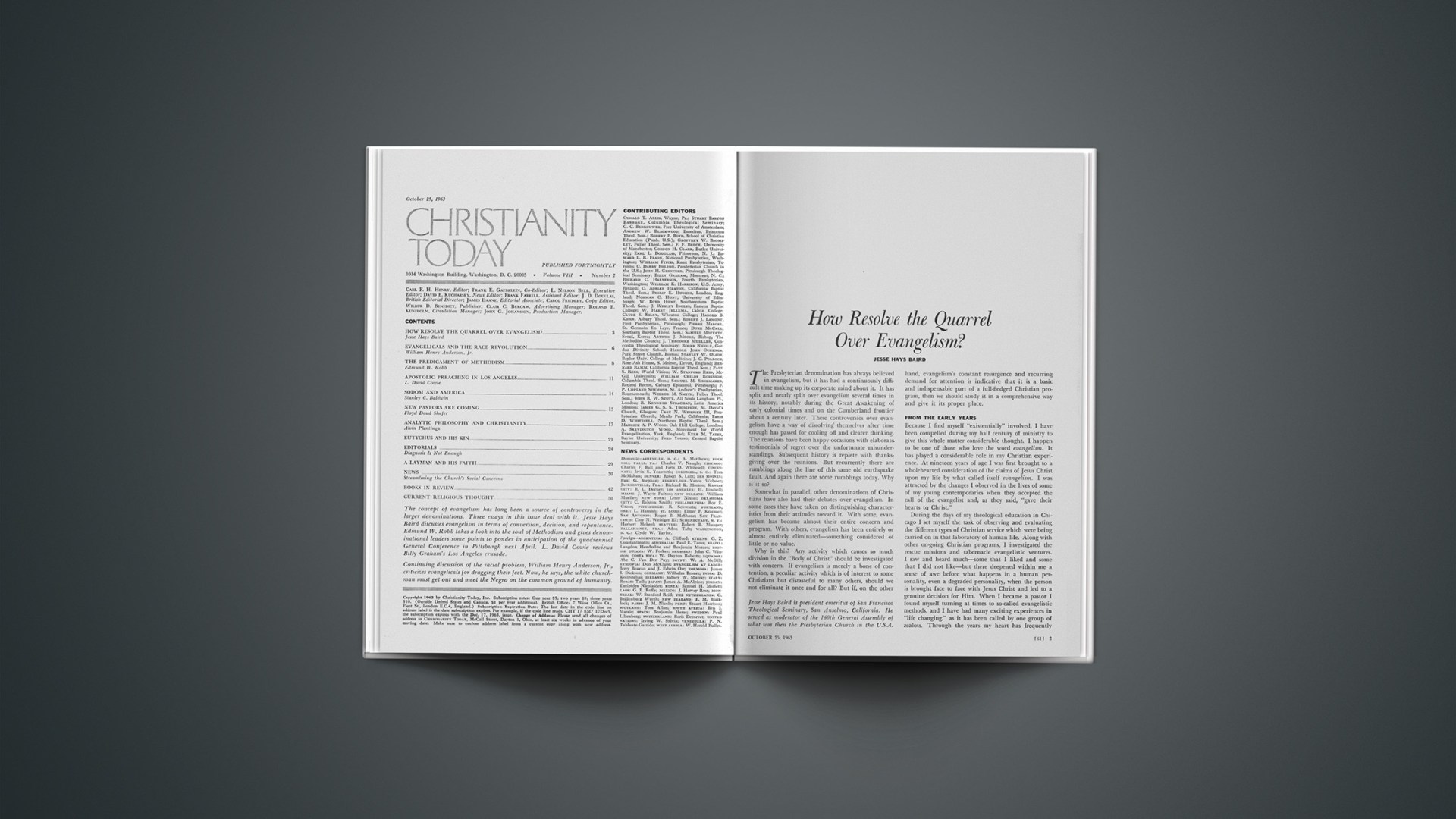
The concept of evangelism has long been a source of controversy in the larger denominations. Three essays in this issue deal with it. Jesse Hays Baird discusses evangelism in terms of conversion, decision, and repentance. Edmund W. Robb takes a look into the soul of Methodism and gives denominational leaders some points to ponder in anticipation of the quadrennial General Conference in Pittsburgh next April. L. David Cowie reviews Billy Graham’s Los Angeles crusade.

Continuing discussion of the racial problem, William Henry Anderson, Jr., criticizes evangelicals for dragging their feet. Now, he says, the white churchman must get out and meet the Negro on the common ground of humanity.

Luther on Broadway

For all its intense acting and moments of high drama, John Osborne’s Luther is more entertainment than a sensitive portrayal of the man who described God as a “bulwark never failing.”

The Reformation themes of salvation by grace and Scripture as sole authority have perhaps never been so clearly preached by the American theater. Yet here all essential resemblance to the Luther of history ends. The play is disappointing, for Osborne sees Luther on a couch rather than in a confessional and has psychoanalyzed him in the modern manner rather than taken the gauge of his true spiritual struggle. Luther appears as an individualist striking against authority in order to be himself, a man for whom salvation is deliverance from an unhappy father-relationship and for whom sin is something like the social indelicacy of “breaking air.”

Osborne’s Luther is not a sinner caught in the moment of God’s wrath; his error is rather that he is angry at God. The peace he finds stems not from justification by faith. It stems rather from his marriage to a former nun, and seems to render more tolerable a religious uncertainty which continues to haunt his soul until the very end.

In the first of the play’s three acts Luther enters the Augustinian order against his father’s wishes and celebrates his first mass. Here he distinguishes and separates himself from his fellow monks by movements more like the spasms of an epileptic than the movements of a soul stirred by guilt and an awe of the sacrament. When his conflict with Rome is over, Luther, on being asked whether he is certain that he was in the right when at the Diet of Worms he stood by Scripture against the Church, quietly and weakly says, “No.” And at the play’s end. Osborne’s Luther is not even sure that life follows death. To his child in arms, he quotes. “A little while and ye shall not see me, and again, a little while and ye shall see me”—and then adds, “Let’s hope so, let’s just hope so.” This is hardly the Luther who touched off the Reformation.

Luther does not get beyond the religious uncertainties of his father; his final cry of hope only echoes his father’s defiance flung into the face of death, to the effect that he had another child “coming up from beneath the counter.”

Osborne conceives of Luther’s salvation in excessively Freudian terms. The earthly rather than the heavenly father seems to be the problem. His father accuses him of fleeing to the monastery to escape life and to forget that his father and mother made him. At one point Luther defines his sin as the lust for the body of a child, and looking back over his life he admits that in a moment of introspection he envisioned a huge rat reaching to consume the man of him. The repeated references to Luther’s intestinal cramps and constipation often occur at the play’s most spiritual moments, leaving the impression that perhaps a good sixteenth-century laxative would have done as much to set men free as salvation by grace. All these problems seem resolved when at the end Luther happily holds his child and kisses his wife Katie good night. But all this does little to explain the religious depths of the man who initiated the Reformation.

If the play distorts the Reformer by too much explaining him in terms of things which lie below the heart, it no less distorts the Roman Catholic Church by making it appear as little more than a big Tetzel.

The play has many dramatic and even tender moments, but it never lingers long with the realities which were Luther and the Reformation. It gets nearest to ecclesiastical-religious realities when Cajetan, the papal legate, attempts to bring Luther in line by the use of all the cunning wisdom of the organization-man. When Luther expresses willingness to recant only if he is shown that he is in error, Cajetan condemns him as arrogant. The church, he says, would be sure of nothing if it had to rely on Scripture alone.

The Luther now on Broadway is in all dimensions too narrowly and superficially drawn.

The Silence Of Pius Xii

Why did Pius XII not make specific protest during World War II when Hitler embarked on the massacre of millions of Jews?

“I must ask you to forgive my son, Holiness,” says Count Fontana to the pope; “he was an eyewitness in Berlin, as the Nazis were loading Jewish children on to lorries.…” “Eyewitness!” exclaims Pius. “Count, a diplomat must see a great deal and—say nothing.” This exchange from Rolf Hochhuth’s play The Representative both summarizes the theme and explains why the 31-year-old German Protestant’s play has aroused such bitter controversy.

In Berlin when it was first shown last February 5,000 people joined in a protest march; in Basel it was responsible for angry crowds, a torchlight procession, a number of arrests, and six interruptions of the performance. Plans for a Dutch showing have been canceled. In Britain the Lord Chamberlain sanctioned it after some alterations had been made, but “requested” that the theater program incorporate a long letter to the Roman Catholic Tablet from the present pope (when he was still Archbishop of Milan), who made this objection with no firsthand knowledge of the play. When the drama was presented in London last month by the Royal Shakespeare Company, the whole of the action was set within the framework of an extermination gas chamber, even when the scene is the papal throne room. The unspoken indictment here is more dreadful than any verbal charge.

The young actor who portrays Adolf Eichmann (he appears only briefly) has received threats of physical violence and was placed under police protection. The Catholic Truth Society weighed in with a pamphlet accusing Hochhuth of an “obsessive dislike” of Pius. Says the editor of the Catholic Herald: “Catholics do not hold that Popes are infallible in matters like this and many eminent people, including some Catholics, believe he (Pius) was wrong. It is possible that a public protest would have forced Hitler to modify the persecution.”

Just prior to the play’s opening in London, the Royal Shakespeare Company released a statement of endorsement from Dr. Albert Schweitzer, the famed medical missionary in Africa. Schweitzer reportedly said the play “is not only an historical judgment but an alarm call to our age which is sinking into inhumanity and unawareness.” Concerning Nazi atrocities, he said, “We are all guilty today for the reason that we were guilty then.… The Catholic Church bears the greatest guilt because as a great international organization she could have taken some action.”

J. D. DOUGLAS

Streamlining the Church’s Social Concerns

“No religion has expressed such high ideals,” says one chronicler1John B. Noss in Man’s Religions (New York: The Macmillan Company). of Christianity. “or been further from achieving them.”

Ever since the spring of 1607, when colonist chaplain Robert Hunt set up a makeshift pulpit along the James River, the preaching of the Christian ethic has been an endless echo across the American continent. Part of the fruit of that preaching is found in the 116 million Americans who are now members of churches. Yet in 1963 America has more crime, more addiction, more immorality, more mental distress, and more grass-roots indifference than ever.

Charged with a generous share of responsibility in combating today’s social evils in behalf of organized U. S. Protestantism is a genial 36-year-old layman and father of four. Roger Burgess. As the optimistic chief of a continuing temperance campaign among the nation’s ten million Methodists, baldish Burgess represents the biggest denominational effort to arrest moral deterioration through education and legislation. He was still exuding confidence despite a denominational furor which suddenly arose over his agency’s new rationale on alcohol problems.

Burgess, short and restless but equipped with a smile that rarely fades, is associate general secretary of the Methodists’ omnibus Board of Christian Social Concerns. His special task is overseeing the board’s Division of Temperance and General Welfare, a job which becomes increasingly difficult as more Methodists ignore the denominational plea for abstinence. As the ranks of Methodist social drinkers swell, particularly in booming suburban churches of the country-club set, anti-abstinence forces within Methodism become more vocal—and perhaps more representative.

Methodist officialdom, according to Burgess, has no intention of backing off its strong stand against alcohol. The church has always held the toughest temperance line of any major U. S. denomination. The Methodist Building in Washington, which houses the temperance agency’s offices, itself dates back to the heydey of the social gospel when prohibition was hailed a supreme Protestant achievement. Since repeal of prohibition thirty years ago, the old-line U. S. denominations have been quietly but steadily disentangling themselves from the temperance cause. Last spring, for instance, the United Presbyterian General Assembly gave tacit approval to social drinking. Even the Methodist effort has not risen very far above a holding operation.

But the pendulum may be about to swing the other way, with a greater awareness of the problems of alcoholism. At any rate, Burgess has given it a significant nudge with the release of a more realistic and less legalistic policy on alcohol which he hopes will be approved by next April’s Methodist General Conference in Pittsburgh.

The proposed policy statement (see opposite page) argues that Methodists have been debating the issue on the wrong grounds. It is indefensible, says Burgess, to argue that Christ never drank fermented wine or that Wesley was a teetotaler. The Methodist stand for abstinence is made to rest instead on “the Christian principle of love for God and neighbor.”

Perhaps the most marked departure from present policy is an admission that many Methodists drink and the adoption of a more accommodating attitude toward such drinkers.

The Methodist information office in Washington issued a news release on the proposed new policy which became the basis of a lengthy news story carried over wires of United Press International. Reaction was immediate and intense. Every time Burgess picked up the phone he expected another bishop’s protest. The common anxiety seemed to be that Methodists were departing from their traditionally strong stand toward alcohol.

Burgess charged that the news-service story distorted the facts. He insisted that the new statement “takes an even stronger stand.”

The biggest fireworks, however, may be yet to come. The Methodist agency on alcohol is seriously considering two more moves which it hopes will strengthen its hand: retirement of the word “temperance” from the vocabulary of Christian social concerns and deletion of a portion of the Methodist discipline which implies that local church board members should abstain.

“Temperance” is being given up because the word is regarded as connoting an adverse image. Future reference will probably be merely to “alcohol problems.” Anticipating the change in vocabulary, drafters of the new policy avoided use of the old term.

The abstinence requirement for local church officials is being eliminated on grounds that it represents an undesirable legalism. Another factor is undoubtedly the knowledge that many churches ignore that part of the discipline.

How many Methodists drink? Burgess says he knows of no comprehensive statistics. But it is a “safe guess,” he adds, that many do.

In an article in the Methodist house organ Concern, Burgess cites a survey dating back to 1955 in which 71 per cent of the cross-section of Methodists sampled said they agreed with the church’s abstinence commitment. They were not specifically asked, however, whether they drank.

Another sampling of Methodists completed in 1958 showed that at least 28.7 per cent of those responding believed the moderate use of alcoholic beverages to be compatible with their Christian faith.

Other more limited studies confirm a rather high rate of drinking among Methodists. Another survey in 1958 by an Iowa sociologist indicated that 49 per cent of the Methodists in that state use alcoholic beverages on occasion. In a 1962 poll in a suburban Philadelphia church, 67 per cent of those responding answered “yes” to the question, “Do you use alcoholic beverages under any circumstances?” A similar question was put last year to members of a large metropolitan area church in Kansas; out of 312 members between 23 and 49 years of age, 85 per cent of the men and 74 per cent of the women answered “yes.”

“But we don’t have to be too blue,” said Burgess. The beige walls of his spacious office are adorned with citations for creative filming. At one end of the room is a display of charts showing the strategy of his battle against alcohol. His hope for the future lies partly with a requested 15 per cent budgetary increase for his division during the next quadrennium.

Prior to the 1960 General Conference Methodists had a Board of Temperance charged with combating alcohol, narcotics, tobacco, and gambling. The board was allocated four full-time staff members. When it was integrated into a larger agency encompassing all Christian social concerns, the temperance division took on nine additional responsibilities ranging from traffic safety to mental health. But its budget provided for only three full-time and one part-time staff members. They spend a large proportion of their time on alcohol problems, and Burgess maintains that the present organization is more effective.

If the appropriations increase is approved next year, Burgess plans to add an additional full-time staff member. He also wants to invest in the production of two new films, one dealing with social drinking and another with drug abuse.

The agency stealing the thunder during the current Methodist quadrennium is the Board of Christian Social Concerns’ Division of Peace and World Order. The division fell heir to a substantial amount of investment funds from the Methodist women’s organization and promptly decided to erect a $3,000,000, twelve-story “Church Center for the United Nations” in Manhattan. It will probably stand as the showcase of denominational enterprise until the Methodist Building in Washington is replaced with a proposed $4,000,000 structure several miles away from its present Capitol Hill location.

As Burgess gazes out his office window at the Supreme Court and Capitol grounds, he holds little expectation of any substantial federal curtailment of liquor traffic. The battle must now be fought, he says, on the state and local fronts. Perhaps the most important arena of all is the local church, where Burgess endeavors to stimulate lay thinking on why The Methodist Church holds to its position of abstinence. Currently there are said to be nearly 30,000 local congregations with an organized “commission on Christian social concerns,” compared with three or four thousand committees on temperance under the old framework.

Like every other denomination, The Methodist Church has had to tangle with the problem of priorities in evangelism and social concerns (see “The Predicament of Methodism,” p. 8). The prevailing philosophy among Methodist leaders is still a remnant of the old social gospel, with its emphases shifting to issues as they happen to capture the attention of mass news media. Because the problem of alcohol holds little promise of being given penetrating analysis by a commercially oriented press, its prospect under such a philosophy remains questionable. The proposed 15 per cent budgetary increase for the Division of Temperance and General Welfare stands in sharp contrast to the 70 per cent increase asked by the Board of Christian Social Concerns for its two other divisions, with matters ranging from race relations and unemployment to space control and agriculture.

Toward Racial Justice

The major Negro civil rights organizations say they will not sponsor a nationwide boycott of Christmas gift purchases. Their coordinating agency, the Council for United Civil Rights Leadership, nevertheless did not reject the idea of the boycott proposed by a group of Negro writers and artists.

Dr. Joseph H. Jackson, president of the National Baptist Convention, U. S. A., Inc., expressed his opposition to the plan. Several weeks earlier, at the annual meeting of his 5,500,000-member convention in Cleveland, Jackson said the Negroes’ salvation in the civil rights struggle may come through “pressure by production” and increased activity rather than by the more dramatic “pressure by protest.” He urged Negroes to build more restaurants and stores and other businesses.

“Here we labor to change the relationship from customer to owner to that of owner to owner,” Jackson told the convention’s 5,000 delegates.

In Dallas, the head of the National Baptist Convention of America, a 3,000,000-member Negro group, declared that while he was committed to achievement of racial justice, he did not believe civil rights was the first concern of the Church. Dr. C. D. Pettaway said that the “first task of the Church is the deepening of the spiritual quality not only of the Negro but everyone in America.”

“Christian brotherhood can’t be legislated,” he said. “It calls for a new birth.”

Methodists On Alcohol

PRESENT POLICY

The Methodist Church reasserts its long-established conviction that the legalization of intoxicants as beverages violate the Christian standards of morality and social concern which this nation claims to accept. Alcoholic indulgence inflicts serious loss to the community in damage to health and efficiency, death through traffic accidents, the creation and intensification of poverty and economic waste. It contributes to the public disorder, crime and moral deviation now threatening the welfare of the nation and the life of the Church. It keeps alive the alcohol industry, with its insidious influence on social life and public affairs.

The Methodist Church is in militant opposition to the liquor traffic also because its product assails the highest centers of personality and its procedures contribute greatly to the sickness and degradation of people, leading to deterioration of character, discord in family life, neglect and suffering of children. The use of alcoholic beverages adds serious and avoidable hindrance to our fellowship with God and creative helpfulness to men. Therefore, the church continues its unceasing battle against intoxicating liquors.

Because the church seeks to lead believing souls into fullness of life in Christ, our appeal is for total abstinence from all uses of intoxicants. Methodists, in refusing alcoholic beverages, should regard this as an essential part of their witness to the faith they profess and as evidence of loyalty to the highest. The practice of total abstinence should also be thought of by Methodists as a matter of stewardship concern for our brothers, for the inevitable influence of personal life imposes a solemn responsibility on each one.

Since successful personal and social reforms stem from convictions that must be based on broad and accurate knowledge, we give hearty endorsement to the program of our Board of Temperance, and its special emphasis on freedom from alcohol:

1) Positive Education for a life free from beverage alcohol. This is the heart of the board’s total effort. It is a broad and comprehensive educational program designed to reach all Methodists. Without it, there can be no consistent and effective action for abstinence.

2) Commitment to Abstinence is a natural and logical outgrowth of commitment to Christ. The Board of Temperance encourages sobriety as an essential manifestation of the Christian faith.

3) Rehabilitation of those who suffer because of beverage alcohol is clearly the obligation of all Christians. The board gives guidance to thousands of pastors and laymen who deal person-to-person with individuals and families seeking their help.

4) Legislation as an effective means to outlaw beverage alcohol is a natural outgrowth of the concern of informed citizens. The board stimulates local, state and national legislation to protect individuals, families and communities from the pressures of the organized traffic in beverage alcohol.

PROPOSED STAND

The Methodist Church reasserts its fundamental concern for the problems of alcohol and the conviction that its members should abstain from all use of alcoholic beverages.

The Christian principle of love for God and neighbor prompts these responses. Christ came that men might have life, and have it more abundantly. The use of beverage alcohol in our highly organized and mechanized society denies the abundant life, creating havoc and misery in the lives of millions. Alcoholism alone, with five million victims has become the nation’s third largest health problem. The use of alcohol causes men to harm their neighbors, both by deed and by example. Feeding a pattern of guilty involvement and callous rationalization, it separates man from God.

Thus Methodists are called by love not only to abstain, but also to seek healing and justice for the neighbor who is victimized. Concern for the alcoholic and for all those in trouble because of beverage alcohol is the clear mandate of the Christian faith.

We recognize that there are Methodists who use alcoholic beverages. We also recognize that sincere Christians may differ on this question. The Methodist Church has always upheld the right of individual conscience. We are all free moral agents, created so by God and responsible to God for our conduct.

The Methodist stand is clear. We urge all members to abstain. Those accepting nomination or appointment for any official leadership in the Church are expected to refrain from all uses of intoxicating beverages. This is not a legalistic requirement, but a matter of conscience and Christian responsibility. It is a challenge to more disciplined life in Christ, a witness based on Christian love and concern.

Abstinence is not enough. We also urge our people to join with those engaged in positive and constructive programs seeking solutions to alcohol problems. These include education in church and school, rehabilitation for alcoholics, strongest attainable legal controls and the stimulation of sound empirical research. Christians who love God and their fellow men can do no less.

Apostasy And Education

William F. Buckley, Jr., first gained national attention about a dozen years ago with his documentary volume, God and Man at Yale. A Roman Catholic, Buckley lay bare the anti-Christian attitudes he found among Yale professors during his student days there. This month Buckley’s right-wing National Review magazine included a 24-page buff-colored insert which pokes behind the ivy curtain with considerably more skill.

The insert is presented as the work of Educational Reviewer, Inc., a New York organization said to be devoted to analyzing educational standards. A survey on politics and religion was conducted among students of twelve U. S. colleges using a questionnaire developed by the Harvard Crimson. Conclusion: “the distinct impression of a firm and expansive student Catholicism, a weakening Protestantism, and a Judaism in decay.”

The survey’s most severe indictment is leveled at Davidson (North Carolina) College, the only Protestant-affiliated school polled (it is operated by the Presbyterian Church in the U. S.). The survey indicates that Davidson students list college religion courses as chief cause for their own reaction against matters of faith. Less than 21 per cent of the student body at Davidson was said to believe in Christ’s resurrection.

The effect of the poll was immediate. One Carolina couple who had taken their son, a high school senior, to Davidson for a visit returned home to find the National Review’s survey in the mailbox. The boy will go to another college.

Some observers who recognize the extent of apostasy on the Protestant campus are nonetheless more restrained. The independent, conservative Presbyterian Journal cautioned: “Don’t write Davidson off your list. We know some Southern Presbyterian schools along side of which Davidson would rank as ultra-conservative.”

In contrast to “weakening Protestantism,” the survey in National Review purports to show strength in Roman Catholic education. Sample conclusions: “American liberal arts colleges, with the sole exception of Roman Catholic colleges, tend to debilitate the religious convictions of their students.… Students raised as Roman Catholics are far more likely to retain their faith while at college than students raised as Protestants or as Jews.… The Roman Catholic Church is winning significant numbers of converts, particularly at schools with large Protestant majorities.”

Catholic educators, meanwhile, apparently were embarking on a major nationwide campaign to show that their schools are in serious financial straits. An article in the October 22 issue of Look points to an impending “crisis” for Catholic schools. On Capitol Hill, Catholic leaders testified before a House education subcommittee that their parochial schools will be forced to close if federal aid is given only to public schools.

Problems In Religious Journalism

Thirteen thousand copies of the official newspaper of the Protestant Episcopal Diocese of Atlanta were scrapped because of an interview in which publisher Ralph McGill of the Atlanta Constitution charged the local Episcopal leadership with “hypocrisy” in its relationships with a private school. A portion of the interview was deleted and a revised edition published.

The Rev. Milton L. Wood, editor of Diocese and assistant to Bishop Randolph Claiborne, Jr., said he did not believe McGill was correctly quoted and that the portion of the interview originally printed was “taken out of context.”

Lovett School, the institution in quesion, has been a source of controversy since its decision earlier this year to refuse admission to Negro applicants.

Inherent in the dispute is the question of whether the school operates under official Episcopal auspices or whether it is independent.

Four members of the paper’s advisory board issued a protest following Wood’s action. McGill was reported as having said that he felt the interview—as originally published—represented an accurate reflection of his views.

Meanwhile, another case of the old printer’s error of publishing the wrong picture had an ecumenical twist this time. Diocese and The Georgia Bulletin, published by the Roman Catholic Archdiocese of Atlanta, are printed in the same plant. By mistake a picture of the Rev. J. M. Gessell used by the Episcopal paper also appeared in the Catholic paper, where he was identified as Msgr. E. H. Behrmann. And the Episcopal minister’s picture got a better play in the Catholic paper—page one.

A Dialogue On Equal Terms

Delegates of ten Eastern Orthodox churches meeting on the island of Rhodes last month agreed to allow the churches individually to decide whether they should send delegates to the second session of the Second Vatican Council. They also endorsed unanimously a proposal that the Orthodox churches seek “a dialogue on equal terms” with the Roman Catholic Church. Conspicuously absent from the conference was any representative of the Orthodox Church in Greece.

Obedience

We usually associate Abraham with faith, and rightly so. He is spoken of as the “father of the faithful,” and three different religions claim him as such.

The Apostle Paul argued justification by faith on the basis of Abraham’s imputed righteousness, the result of his unquestioning belief in God and His promises.

Martin Luther stood immovable on the affirmation, “The just shall live by faith,” and this sublime truth became a corner-stone of the Reformation.

We Christians rejoice in the fact that we are saved by faith, not works; that it is the pure grace of God through faith on our part which makes us whole.

But strange to say we so often overlook the necessity for obedience. Obedience is faith in action. What validity can there be in a profession of faith which is not confirmed by obedience to the will of God? One can but wonder whether many Christians are not living in a state of suspended spiritual animation, truly accepting Christ as Saviour but living without obedience to his revealed will and therefore never having him as the active Lord of life.

Years ago, Saul, king of Israel, disobeyed God, saving some of the spoils of a victory even though he had been commanded to destroy all. His excuse: he had preserved the best of the flocks to be used for a sacrifice to God.

But we read: “And Samuel said [to Saul], Hath the Lord as great delight in burnt offerings and sacifices, as in obeying the voice of the Lord? Behold, to obey is better than sacrifice, and to harken than the fat of rams” (1 Sam. 15:22).

Many a Christian is covering up disobedience under the false front of supposedly Christian activity. We fool ourselves by deliberately disobeying God and engaging in frantic work for the Church or some other Christian cause, thinking our duplicity is unnoticed by God.

The Bible is full of references to obedience, of the importance of man’s recognizing God’s authority and submitting to it. But there is entirely too little said nowadays about obedience as an integral part of the Christian faith. The confession of the lips and belief in the heart must be validated by obedience of the will.

We should obey God because of who he is. He is sovereign, omniscient, omnipotent, and omnipresent. Such attitudes should in themselves elicit obedience. Furthermore, despite the grandeur of his Person as Creator he deals with us, his creatures, with infinite love and patience. How foolish can we be? Certainly at no point more than in the realm of disobedience.

We should obey God because of who we are. Where he is sovereign we are the dependent; where he is omniscient we are ignorant; where he is omnipotent we are powerless; where he is omnipresent we are limited by time, space, and circumstance.

Little wonder that we Christians repeatedly find ourselves in difficult situations! Living in rebellion to God’s perfect will we bypass him and go our own ways—only to meet frustration and defeat. Even animals can be taught obedience to commands or gentle pressures. But we stubbornly take the bit in our own teeth and then complain because of difficulties which are the natural result of our own disobedience.

Obedience has its reward, now and for eternity. Disobedience is deadly, its effect going on forever. We live in an age of disobedience. Delinquency, adult and juvenile, stems from a willful rejection of the laws of God in favor of one’s own way.

Obedience requires knowledge of God’s will, faith in his goodness, and confidence in his promises. The Bible is wonderfully explicit in many areas and in others lays down principles which are to guide our lives. Obedience therefore requires knowledge of and faith in the written Word. The writer recently called the attention of a group of young Christians to the fact that in the Book of the Proverbs alone practically every problem of today’s teen-agers is answered.

Our problem is not so much to know what the will of God for us may be as to be willing to obey that will. God has not left himself without a witness; by clear and direct leading of the Holy Spirit, in Bible study, during prayer, through contacts with others, by combinations of circumstances, God makes his will known. But, knowing his will, what are we doing about it?

We started out with Abraham as an example of faith. From that faith there proceeded an obedience which in turn led to a promise and a covenant, “because thou hast obeyed my voice.” Who can fully imagine the anguish of Abraham’s heart when he was told to offer his son as a sacrifice? But the writer of Hebrews describes his faith in these words: “By faith Abraham, when he was tried, offered up Isaac: and he that had received the promises offered up his only begotten son. Of whom it was said, That in Isaac shall thy seed be called: accounting that God was able to raise him up, even from the dead; from whence also he received him in a figure” (Heb. 11:17–19).

Here faith and obedience are so intermingled no one can say where the one began and the other ended. Abraham’s confidence, his assurance, his faith acted to effect an obedience which God honored, both for Abraham’s good and for His own glory.

We should search our own hearts to find out whether we are holding back something we should be yielding to God in obedience. God is never unreasonable, nor does he ever make a mistake. Despite our acknowledgment of this fact as a concept of God, we only too often deny it in practice.

Obedience is a matter of outward action and of inward discipline. There are many things we should do, or not do, in the realm of personal habits and interpersonal relationships, but obedience also involves something more. Paul writes: “Our battle is to bring down every deceptive fantasy and every imposing defense that men erect against the true knowledge of God. We even fight to capture every thought until it acknowledges the authority of Christ” (2 Cor. 10:4, 5, Phillips).

Authority! Authority demands obedience, and that is where we fail. We confess Christ as Saviour, but we deny his authority to command our obedience to his will.

For Christians this is a matter of deep concern, for peace of heart and mind, along with usefulness in the work of God’s kingdom, is at stake. We cannot prosper in our spiritual lives so long as we are disobedient to God’s revealed will. Nor can he use us for his glory while we live in a state of known rebellion.

Obedience is a matter of sanctification, of growing in our knowledge and performance of God’s will. At times it involves taking a step in the dark; but that matters little, for the One who commands is also the One who will guide and strengthen, and out of obedience there surely comes the outpouring of God’s blessings—blessings reserved for the obedient heart and will.

Ideas

Diagnosis Is Not Enough

Along with the racial crisis, the slippage in private and public morals speaks insistently to our national conscience. Recent issues of Look, reporting on “The Tense Generation” and surveying the relation of “Bigness, the Bomb and the Buck” to moral decline; Life’s exposé of party-crashing; book-length discussions such as Margaret Halsey’s bitterly indignant The Pseudo-Ethic, and Grace and Fred Hechinger’s eye-opening Teen-Age Tyranny—these state the problem.

The facts are familiar. No longer do we just read about what is happening in other places. The problem has come to our own communities. None of us, to be sure, is entitled to view the moral lapses of others, young or old, with any feeling of superiority; Paul’s word, “Let him that thinketh he standeth take heed lest he fall,” is for every Christian. Yet we cannot shut our eyes to what is happening to moral standards in our country. And to continue discussion of the problem is obligatory.

The diagnosis has been made in frightening and authentic detail. For this public service, the mass media and the many others who have spoken out are to be thanked. But diagnosis, although the first step toward remedy, is not enough.

Of common-sense suggestions about what to do—a return to basic integrity, the practice of more self-restraint, no longer following the crowd but going the way of individual conviction—there can be little criticism. Nevertheless Look’s carefully researched article, “Morality U.S.A.,” to turn to a popular coverage of the problem, leads to some questions. These relate not so much to the accuracy of facts presented as to the analysis of their cause. Moreover, the soundness of the conclusion that is reached requires evaluation.

Three institutions in our American life, the article tells us, have a powerful responsibility to influence morality: government, business (including the labor unions), and the Church. Each has failed. This is correct; whether through poor example, lack of courage to voice conviction, or selfish unconcern, these institutions are culpable.

But this assignment of blame is incomplete. A realistic appraisal of the causes of the moral sag must include at least two other institutions—the press (both book and periodical) and the entertainment world.

Let us look at them. Consider first the press, so indispensable to our enlightenment and to our liberty. Here we face one of the thorniest problems of our complex society. Freedom of the press is a very great treasure and also an inescapable responsibility. Censorship has its critical dangers for liberty of expression. Yet a problem remains. To put it bluntly, probably no generation of youth has been subject to more extensive corruption than that which threatens American children today. This statement relates both to the printed page and to popular entertainment.

Relevant at this point is a recent editorial in The Christian Century stating that the ruling of New York State’s highest court (the Court of Appeals) judging Henry Miller’s Tropic of Cancer to be “flagrantly obscene” actually “jeopardizes rather than protects the health of our free society.” Although the revolting character of passages (and they are many) in Miller’s book is admitted, the statement is made that a healthy mind can take it while “the sick mind will find as much appeal [italics ours] to prurient interest in the Bible as in Miller’s sordid descriptions”—an incredible comparison.

The argument, representative of influential liberal opinion, ignores what books like Tropic of Cancer, along with the many salacious paperbacks and magazines sold in drugstores, supermarkets, bus stations, and airports, are doing not just to the sick-minded but also to immature youth. In the continuing battle over censorship, youth are the forgotten people. Let them fend for themselves, as long as we can read and write what we wish—this seems to be the attitude of many adults.

What is the current flood of easily accessible and morally debasing literature doing to school children? That it is one of the causes of the pitiful sexual precocity that characterizes so many American adolescents is undeniable. The author of “Sodom and America” (see p. 14) speaks out in passionate objection against corrupting literature. Certainly the problem of censorship will never be solved in callous unconcern for the mind of youth. The ancient question, “Am I my brother’s keeper?” surely applies to our young people. Along with “the right of people to choose for themselves and to read what they choose” must go responsibility for the moral and mental health of inexperienced youth.

The other institution that, with government, business, and the Church, must share the blame for moral decline is the so-called entertainment world. Here the point needs no great elaboration. It is too constantly before our eyes and ears for us to mistake it. Let us simply say that not the least of the causes of the decline in morality is the ethical irresponsibility apparent in the motion picture and television industries. The exaltation of certain movie and television personalities out of proportion to their worth, their glamorization in mass media and in the Las Vegas kind of setting, the pre-occupation of some producers with violence and even perversion, all have their share in the present confusion regarding standards and values. According to Norman Mailer, “the most important, probably the only dynamic culture in America, the only culture to enlist the imagination and change the character of Americans, was the one we have been given by the movies.” Again there is the sensitive problem of censorship. Yet as a liberal Jewish leader, Rabbi William F. Rosenblum of Temple Israel, New York, recently declared, restrictions must be set up to keep children under eighteen from viewing morally harmful films.

For the evangelically minded reader, the discussion of the Church in the Look article holds great interest. Protestant leaders quoted are well known, although conservative evangelicals apparently were not included in the survey. What the religious authorities say is correct as diagnosis. Take, for example, the statement of Dean Samuel Miller of Harvard Divinity School: “The church simply has lost its cutting edge. It has taken the culture of our time and absorbed it. It’s ghastly that the church is run not to serve the reality of human beings, but to conserve institutions.” Discerning also is the comment of Chaplain William Sloane Coffin, Jr., of Yale University, who approaches more nearly to the heart of the matter: “We churchmen are gifted at changing wine into water—watering down religion.… We’ve never had attendance so high and influence so low, and maybe the two are not unrelated.”

What would an evangelical say about the failure of the Church in the present moral crisis? Surely he would be specific about the watering down of religion of which Mr. Coffin speaks. Thus he would, with humble realization that “we have this treasure in earthen vessels,” call attention to the omission from the discussion of any reference to the great Founder and Head of the Church, Jesus Christ our Lord. He would say that, while of divine origin, the Church is a company of human beings and that human beings through the sin common to us all are in need of redemption and constant renewal. For what the evangelical misses in many of the current discussions of morality is any clear reference to the Gospel of Him who alone is able to change sinful men.

The Church may well have failed because of our human weakness. But the Lord of the Church cannot fail. And if the Church has not provided the moral leadership needed, the answer may in large part be its neglecting to proclaim the saving truth of Jesus Christ in the conviction and power of the Holy Spirit, while majoring on secondary matters.

To the charge that this is oversimplification the evangelical replies that for the Church believingly to proclaim its sovereign Lord and Saviour is the most profound thing it can do. For in Him are combined the prophetic concern for social justice and the passion for the individual soul, both of which are essential if the Church is effectively to reach the people.

When it comes, then, to the moral dilemma of our times, diagnosis is not enough. The remedy must surely include the proclamation of Jesus Christ according to the whole of Scripture. Such proclamation must involve—let the fact be re-emphasized—honest dealing with our hardest social problems in faithful reference to the inspired Word of God, and this not just from the pulpit but in personal, face-to-face living. It must be more explicit about the sinfulness of the sin that so easily besets us all. It must dare to take a stand for the great biblical absolutes, moral as well as theological. And it must be accompanied by love, patience, tolerance, and the courage to take sides and to stand up to the winds of shoddy morality and self-indulgence that are blowing through our secularized society.

“Do we need a new code to solve our crisis of morality?” The question introduces the Look article and is answered at its close. It is a question that many—in education, in the home, and even in the Church—are asking. And the answer is disappointing.

“What the experts are saying,” we are told, “about almost every aspect of American morality today is: In a rapidly changing world we have lost our traditional moral guidelines.… We are groping, painfully and often blindly, for new standards that will enable us to live morally and decently. The experts feel strongly that we cannot turn back to earlier, more rigid behavior patterns.… We must find a new moral code that will fit the needs of the society we live in. We have a large measure of freedom to carve out lives we regard as moral—if we take the risks and pay the price.”

So we are left with nothing more than the moral relativism that is itself a prime cause of the present problem. Because “the experts” dismiss the “earlier, more rigid behavior patterns” and thus slip perhaps into what C. S. Lewis calls the chronological fallacy—that what is old is therefore no longer relevant—the conclusion is reached that “we must find a new moral code.” Not only is this the do-it-yourself principle that is directly opposed to the grace of God which is at the center of Christianity; it also presumes to set aside the Decalogue which is given us by the living God and from which morality itself derives. What really is meant by a new moral code? Would it justify widespread practices that are now in conflict with biblical ethics? Or would “a new code” accommodate itself to the revolt against the standards that our people, despite their failure to live up to them, have always accepted? No one, however well meaning, can set aside God’s laws, which do not change whether men keep them or not.

No, diagnosis of the sag in morality is not enough. Like every other problem that results from human sin, the moral problem cannot be solved merely on human, relativistic grounds. We need to acknowledge not only our failure but also our inability to cope with our failure apart from God’s continuing help. We need not a new moral code but a return to the divine law of Him who never changes. For recovery from the moral slump even to begin, we need to repent in accord with the Lord’s words to Solomon: “If my people, which are called by my name, shall humble themselves, and pray, and seek my face, and turn from their wicked ways; then will I hear from heaven, and will forgive their sin, and will heal their land.”

Gains In Evangelical Education

The steady gains registered by evangelical colleges across the land attest conservative Christianity’s growing stake in the liberal arts field.

Recently Spring Arbor College in Michigan, founded ninety years ago by Free Methodists, expanded from a junior college to a four-year liberal arts program with advance accreditation from the North Central Association. In a “miracle year,” President David L. McKenna announced projection and completion through gifts and private support of a new library and women’s dormitory, and an enrollment increase of 100.

Michigan’s Governor Romney, featured speaker for the inaugural program, noted that Michigan has a relatively small percentage of church-related higher educational institutions (fewer than twenty). Governor Romney expressed firm belief that America’s greatest danger is not subversion from without but submersion from within. He listed as present dangers:

“First of all, the submersion of individuality under the mass of giant corporations, giant educational institutions, and giant government.

“Secondly, the submersion of inherited principles of morality under the overwhelming pressure of conformity to the mores of the crowd.

“And finally, the submersion of idealism under the oppressive weight of pragmatism, of accommodation to the facts of life, or reality, if you prefer.…

“I firmly believe that this moral decay constitutes a greater danger to our country than the atomic bomb, or than the ambitious designs of the communists. If our country perishes it will crumble from within—not from the pressures which fall upon it from without.”

The governor indicated two roles that private Christian colleges can fulfill—to function as centers of education, and to function as “reservoirs of morality in a wasteland of decay.” He noted that church-related colleges have no monopoly on morality, since “the great moral teachings which comprise our Judeo-Christian heritage are available in abundance in our public institutions. But where the public institutions introduce the students to these principles of morality, the church-related institutions go a step further—they encourage the romance.”

Herbert Spencer long ago emphasized the tragedy of possessing knowledge and power without character. He declared that to educate reason without changing desire is to place a high-power gun in the hands of a savage. Free Methodist Bishop Leslie Marston has remarked that, were Spencer alive today, “he would substitute an H-bomb for a gun,” so immeasurably greater in this twentieth century is man’s power to destroy than it was in the nineteenth century.

In greetings to Spring Arbor College, Dr. Marston added some well-worded observations on the plight of contemporary education:

“We must admit that an education is inadequate and even dangerous to society, however great may be the learning and skill it produces, if it fails to achieve a culture of the heart and the development of a character to direct both learning and skill to the welfare of man and to the glory of God. We must have the safeguard of an education that is Christian.…

“But there are those who conceive of Christian education merely as an additive to secular education, missing the fact that to be Christian, education must be Christian to the core and not merely on the periphery. Christian education is not something less than education, with religion added; nor is it education, plus something other than education. Properly speaking, Christian education is the integration of all knowledge, life, and character in terms of those eternal principles of truth without which any education is deficient.”

These are sound principles. One may take heart that the evangelical community is determined to preserve the Christian stake in the liberal arts, and is determined also not to yield the educational enterprise to any narrow pursuit of unrelated facts indifferent to the claims of goodness and wisdom.

Protestant Conscience On Race Issues

There is much self-basting these days over discrimination against minority groups, and it is well so. Never as now has emphasis been needed on the equal dignity of all men before the law.

Some spokesmen, however, are using the occasion not so much to pummel their own consciences as to malign others. The Church in general is blamed for all the evils of this world. Or the South’s racial problems are traced by liberal spokesmen to “arthritic evangelicalism.”

There is no reason to deny evangelicals a full measure of blame in many matters. But when liberal scholars refer to “arthritic” evangelicalism—as if that designation exhausted all available varieties—either these critics have become propagandists or they simply are not informed.

Not all evangelicalism is concerned merely about pious peccadilloes. True as it is that biblical beliefs need to be fully worked out on the subject of race, let us remember that evangelicals sponsored those great missionary movements to Africa and Asia. Let us remember that Finney’s revival crusade was anti-slavery. Let us remember that Billy Graham, long before many others from the South, took a strong stand on the race issue.

Despite all the liberal thunder on the subject of race today, let us remember too that there has been a great deal of “arthritic” liberalism also. In the 1820s, when Unitarianism in the Southland began its shift from biblical theology to social action, it almost died a-borning. For all the social-gospel emphasis (which had weaknesses of its own), the liberal conscience in the South awakened tardily to race issues, faced as it was by the magnitude of local problems. There is no need to single out evangelicals as an exclusive target of criticism, for foot-dragging on vital social issues is to be found in the entire spectrum of church and national life. And the aberrant liberal emphasis on legislative rather than regenerative solutions often tends to exchange one form of social injustice for another.

All of us share the guilt. No single theological emphasis can be credited with the movement for renewal. Serious differences exist as to whether CORE or NAACP or some other secular agency ought to define ecclesiastical strategy, or what reliance ought to be placed on this or that dynamism. But all agree that race prejudice is wicked, that all racial injustices must be overcome, and that an active program for transcending such injustices is necessary.

It is good, moreover, to find evangelicals reflecting the sensitive conscience on racial concerns discoverable in this issue’s essay on “Evangelicals and the Race Revolution.” Its author writes with the white heat of deep conviction. We need not agree—and, in fact, we do not—that Christians who were unenthusiastic about the “March on Washington” have forfeited their right to a voice in working out a solution. We know too many level-headed Christians who have had and will continue to have great influence in working out solutions but who remain convinced that street demonstrations may hasten changes while deferring the basic solution of the race problem.

The Billy Sunday Centennial

November 19, 1963, marks the centennial of the birth at Ames, Iowa, of William Ashley (Billy) Sunday, who through his revivals in the first decades of this century wrote an important chapter in the history of American evangelism. Those who heard him and his song leader, Homer Rodeheaver, in hundreds of revivals throughout the country were estimated at 100 million. His was the day of huge, specially constructed tabernacles in large cities, and under his urgent and vivid preaching multitudes “hit the sawdust trail.”

Before his conversion Billy Sunday had been a big-league baseball player. There were those who criticized his colloquial and sometimes slangy sermons and who called him a sensationalist because of his gymnastics in preaching. But his meetings, which reached a high point in New York in 1917, reflected the mood of the day. Moreover, in his impassioned advocacy of prohibition, he spoke for a good deal of contemporary Protestant idealism. His influence in the United States was widespread, the evangelical churches supported him, and his ministry marked for many thousands the difference between spiritual life and death.

Since Billy Sunday’s revivals, mass evangelism has undergone changes. The larger part of his ministry was in the years between the early 1900s and America’s entry into the First World War to “make the world safe for democracy.” This was a period of optimism, with the idea of progress prominent in religious thought. But more recent decades with the Second World War, the cold war, and the threat of atomic destruction have pressed upon mass evangelism a new seriousness of expression in keeping with an apocalyptic age. Present-day evangelism in its greatly expanded outreach through radio, television, and jet-age travel, has also developed organizationally in respect to public accounting of funds, cooperation with churches, and follow-up of inquirers.

Billy Sunday was a dedicated servant of Christ. God used him to speak to people of his day. His place in evangelism is secure, and there still live many who were won to Christ through him. He is not and will not be forgotten.

The Missing Step

Bishop Fred Pierce Corson, president of the World Methodist Council, recently proposed six “steps” that might lead to union between Protestantism and Roman Catholicism: communication, fellowship, education, communion, purpose, and effort. The proposal was made at the fall commencement of St. Joseph’s College in Philadelphia, at which Dr. Corson became the first Methodist bishop ever to receive an honorary degree from a Roman Catholic institution.

The bishop is a respected Protestant leader and a man of good will. Yet we wish that the steps he proposed had been seven in number, the seventh being doctrine, which, despite its educational implications must stand alone in its own right. For it is with doctrine that all efforts at church union must ultimately wrestle. The differences between Protestantism and Rome go very much deeper than communication, fellowship, education, communion, purpose, and effort. These may lead toward unity, but unity without agreement on the great biblical doctrines of the faith can lead only to compromise of precious conviction. For example, the doctrinal differences involved in the Roman Catholic mass as contrasted with varying Protestant positions regarding the Lord’s Supper represent deepest conviction and go to the heart of the separation between the two groups.

There is no question of Rome’s doctrinal position. In his homily at the opening of the second session of Vatican Council II, Pope Paul VI spoke of “those who believe in Christ but whom we have not the happiness of numbering amongst ourselves in the perfect unity of Christ, which only the Catholic Church can offer them.” He also declared that “this mystic and visible union cannot be attained save in identity of faith.…” Where Roman Catholicism stands doctrinally is clear and unambiguous. But the same firmness of doctrinal conviction is not characteristic of Protestant ecumenical leadership.

The present ecumenical exploration of union may be occupying itself with outward differences while hopefully underestimating the profound depths of doctrine that separate the great groups in Christendom. For if outward differences are sometime, somehow, reconciled, there will yet remain the great gulf of doctrine to be bridged.

But doctrine may not after all be a “step” to union. Instead it may well be the door to any true unity among Christians.

Elizabeth The Conqueror

London has a new possessor, and all America is indebted to the Columbia Broadcasting System for revealing this in a sabbath-evening telecast, “Elizabeth Taylor’s London.” London’s powers of survival heretofore have been enormous: The Londinium survived Boadicea’s sacking in A.D. 61; another layer of burnt ashes was added by a later fire during the Roman occupation; then there was the Great Fire of 1666; and only yesterday there was the devastating, measureless pounding of World War II. And now the great city had to draw itself up once more to face Elizabeth the Conqueror, in whose very presence even weak men were known to become weaker.

Would the woman whose powers had left children fatherless manage to disarm a city by her beauty? Would London’s friendly hospitality prove its downfall? It had to withstand the challenge of the hardened beauty of the face that stares at one continually from innumerable newsstands. The city confronted the flat, hard tones of an almost expressionless voice reading from the incomparable writings of Shakespeare, Wordsworth, Churchill, and from great speeches of Queen Elizabeth I and William Pitt.

This was the tour guide approved for Americans by some network executive, perhaps not entirely insensitive to commercial pressures which have been referred to by retarded souls as “callous.” It was Miss Taylor who was chosen to point to the Houses of Parliament, mother of parliaments, reflecting the grandeur of representative democracy. She showed us Big Ben, symbol of faithfulness through the years. We saw St. Paul’s and other great churches, reminders of moral uprightness. A clergyman graced the screen for a few moments to speak of the Pilgrims, now often dismissed as “Puritans.” The changing of the guard spoke of the courage and fortitude of the British fighting man. A reference to Lincoln’s Inn mirrored the majestic justice of British law. And there was the rugged strength of the Tower of London, the character of the Tower Bridge.

This was Liz Taylor’s London? But then there was also reference to Chelsea’s Bohemian life and a flickering reminder of the Dorchester Hotel, where Miss Taylor meets Mr. Burton. And in a climactic crescendo, Miss Taylor read a passage from Elizabeth Barrett Browning which spoke of the purity of love.

Selling Wheat To Russia

The government’s decision to permit the sale of American wheat to Communist Russia is so complex a moral and political question as to be deceptive.

Economically the decision seems sound enough. It will diminish our almost one-billion-bushel surplus, save the American taxpayer storage costs, and produce gold earnings to lessen our dollar drain. And in any event, Russia now gets our wheat or flour by the simple device of buying it from countries to which we sell it.

Yet both politically and morally the whole matter is highly ambiguous. Khrushchev has promised to bury us with the shovel of economic competition. If the weapons of his warfare are economic, is it wise to alleviate his economic troubles? Is not this like oiling your enemy’s gun?

On the other hand, a refusal to sell excess wheat to a hungry nation would not enhance the stature of the United States. Moreover, the sale is a dramatic spotlight showing all the world a basic weakness in the Communist society. Agriculture is the foundation of any nation’s economy. The sale of bread to a nation that may soon deliver a man to the moon but cannot deliver bread to his fellow men on earth is powerful propaganda. The sale may make the Soviet Union look not only hungry but also naked.

The President has assured Americans that the Russian people will learn where their bread comes from. They should. We also hope that they will learn that millions of Americans still pray, each day, “Give us this day our daily bread”; that many of them prayed over this wheat at springtime sowing and gave thanks to God in Thanksgiving Day prayers at harvest time.

The whole question is tangled in moral and political ambiguities. Should the United States sell, let alone give wheat to enemies that hunger? About a year ago Secretary Dean Rusk justified a “no wheat policy” for Red China, where there is massive hunger and starvation, on the ground that this was no time to lighten the pressures upon an unfriendly regime. Should we now offer free food to Cuba amidst its devastation by hurricane and thereby disprove the Castro propaganda that we hate the Cuban people?

It would seem that any wheat deal with Russia ought to have included as a condition the granting of some degree of freedom to peoples under Russian domination. Had Russia refused, Khrushchev would have shown the world that he would rather have people hungry than free. The mere fact that the sale is economically of mutual advantage is politically deceptive. Such relief as we shall get from too much wheat and too little gold is not equal to the political advantage the Soviets reap by relieving their hungry. The sale to Russia is more likely to be a straw in the wind than an isolated transaction. Trading our wheat for the freedom of others is a worthy consideration.

Eutychus and His Kin: October 25, 1963

WHERE THE SHEEP ARE

There is this friend of mine whose name is Charley, and who is very big in a great big company. This company sells electrical gadgets and electrical household equipment to millions of people, and it is up to my friend Charley to figure out how to advertise these wares on billboards and on radio and TV, not to mention magazines and newspapers.

He told me one day that he had made quite a discovery. He happened to notice that since they sold millions of items they must have been selling to some very ordinary people, and meanwhile he was spending all his time with very extraordinary people. He was beginning to lose his ear, or his touch, or his vocabulary, for the common man. In the morning he had breakfast with his ever-loving wife, a graduate of a very fine university, and we can hope that their table talk reflected some of this education. Then he joined a car pool made up entirely of nothing less than vice-presidents; and then he talked to upper-echelon men and women all morning about advertising; and then he went out to lunch at the club with nothing less than vice-presidents; and then he talked advertising all afternoon with the experts; and then he rode home again at night in the car pool with all the vice-presidents; and then he spent the evening in an exclusive community.

After his “enlightenment” he began riding into the city on a street car, standing up as often as he sat down and making it a point to engage someone in conversation. He took his coffee break at some hole-in-the-wall. He ate his lunch in a wide variety of diners. He began to subscribe to some magazines he had never seen before.

My boy Charley has had what one critic mentioned regarding D. H. Lawrence’s writing: “shattering glimpses of the obvious.” No company is very big, and indeed no company can stay big, that doesn’t discover ways of getting at that mass which serves as its base. Where are the people?

Depending upon where you are on the ecclesiastical ladder (let’s take another look at the fortune cookie) you might make a fresh assessment of the people you are supposed to be reaching. The Gospel is for the whole world, and we are constantly tempted to get clubby. Put the hay where the sheep are.

EUTYCHUS II

THE NEW PENETRATION

“Outburst of Tongues: The New Penetration” by Frank Farrell (Sept. 13 issue) was the clearest, fairest, most comprehensive presentation of the issue of speaking in tongues that I have read. I could sense no bias or prejudice. Such an article has been needed, and I thank you for printing it.

As one who left the ministry of the Assemblies of God many years ago, but remains sympathetic to the good work they are doing, I wondered why Mr. Farrell did not mention the rather large number of former ministers who have left their ranks. It seems to me quite significant in considering the over-all view of the subject of Pentecostalism that this movement has contributed many ministers to many other denominations, and they have found a satisfying ministry in the old-line churches.

Principal reasons for this exodus, I believe, are: first, the rigid, inflexible, unyielding doctrinal position regarding the work of the Holy Spirit which does not allow for any freedom of interpretation or personal convictions, and, second, such an over-emphasis on this one doctrine that a well-balanced ministry of the Word is difficult, if not impossible.

I hope evangelicals can move closer together in mutual respect, and in sharing … ministries, for surely we have something of value to give one another. However, this is difficult so long as Pentecostals hold to their position that the only Spirit-filled ministers are their own. Having had several years’ experience in both camps, I would say that a great deal more tolerance and understanding and respect for a person’s personal beliefs and experiences is given to Pentecostal people by the historic denominational churches than is reciprocated.

My hope and prayer is that the doctrinal dogmatism of Pentecostal denominations, which serves to make all other Christians second-rate citizens in the Kingdom of God, will give way so that we can experience a fellowship of equals in Christ.

PAUL GASTON

Pacific Beach Congregational Church

San Diego, Calif.

REQUEST PERMISSION TO REPRINT CONDENSATION.…

R. C. KLINE

Des Moines Tribune

Des Moines, Iowa

Very impressed with your marshaling of facts.… The article is objective enough so as not to offend any serious Christian, and I think presents the evidence in such a way as to dispel the worst aspects of the problem.

WILLIAM KILMER

Montana State College

Bozeman, Mont.

I refer to Mr. Farrell’s reference: “A journal relates that in the entire state of Montana only one American Lutheran pastor has not received the experience of speaking in tongues.” I don’t know what “journal” it is that printed this fabrication. Presumably it was some organ which devotes itself to promoting the phenomenon.…

The truth is that there are approximately ten out of the 104 pastors in Montana in the American Lutheran Church who have at some time been enabled to speak in tongues. The majority of these are confining it to private devotion, as should be the case according to Scripture, if they are using it at all. As district president, I have tried to keep in close touch with the movement. I have not yet found one individual who came into “speaking in tongues” entirely apart from some previous or preliminary instruction or promotion. I would not thereby rule out the Holy Spirit’s involvement, but it does raise serious questions whether it is a gift or an achievement. Where the user stays strictly by Paul’s advice to confine it to personal devotion it can help to deepen the individual’s spiritual life, unless it is not accompanied by a renewed hanger for the Word. Where it is plugged and promoted, openly or subtly, it is certain to be divisive and arouse trouble within the congregation.

R. A. DAEHLIN

President

Rocky Mountain District

The American Lutheran Church

Great Falls, Mont.

• President Daehlin’s information is welcome. The journal cited is generally believed to have a record of reliability better than this instance would indicate.—ED.

We believe that Jesus Christ instills new life in believers through the avenues of the Word and the Holy Sacraments and that baptismal regeneration is a lively wondrous fact of faith and abundant grace. We believe that super-exuberant manifestations of unintelligible tongues can never become normative for Christian experience and that such are neither necessary for Christian development nor necessarily even Christian.

KARL H. BREVIK

Bethlehem Lutheran Church

Kalispell, Mont.

Editor Frank Farrell’s article, which tried to be an objective review of the “new penetration” in the main-line churches, actually marshaled the most powerful arguments against it.… What we are witnessing is not “an outburst of tongues” but an outburst of spiritual power.… The Scriptures plainly state (1 Cor. 12) that speaking in tongues is a manifestation of the Holy Spirit.…

JAMES W. BROWN

Mulino Community Baptist Church

Mulino, Ore.

One cannot adequately expound the Scriptures relating to salvation until he has obeyed the plain command to repent and believe in Christ. Neither can the Scriptures relating to the baptism of the Holy Spirit be adequately interpreted by commentators who have not entered into the realm of the manifestations of the Holy Spirit described by Paul.…

With regard to the relative cessation of the gifts of tongues, helps, and governments alter the fourth century, it must be remembered that the early Church underwent marked degeneration in its purity and spiritual power during this same period.… Is it not to be expected that with the increasing spread of the Word of God and its original teaching that the original purity and power typical of New Testament Christianity should reemerge, even with the Latter Rain of God outpouring his Spirit according to James 5:7, 8?

JAMES F. LA VALLEY

Pomona, Kan.

Although he took his editorial prerogative of leading the reader to accept his own opinions, his is the first such article I have read which did not assume that its author thoroughly understood this phenomenon without experiencing it, and [scoff] and [deride] the poor mental cases who had found this blessed experience. He reported the facts on both sides, and only then drew his conclusions.…

He makes a distinction between tongues as in Acts 2:4 and “ecstatic utterances” in the Epistle to the Corinthians. Pentecostal doctrine is that all such manifestations are languages. Some of course have been recognized as such, but as for the rest we term these languages also because we believe this is scriptural. A language of course appears gibberish to someone who does not understand that language.

JEAN NAVA

Springfield, Mo.

I would like to say I enjoyed reading this article very much. You see I have the baptism of the Holy Spirit, too. I received it way back in October of 1929. Brother! We were so persecuted in those days we had to have church out in the wide open spaces. But it is real and has been a blessing to my soul these many years.

JOHN BAVA

Davis, W. Va.

Thank you for what I consider to be the most objective article on tongues in a non-Pentecostal magazine. I think you have rightly pointed out the dangers and pitfalls, namely spiritual pride. I also think there is a danger of the movement taking on the proportions of a “spiritual fad”.…

There was no reference to the possible eschatological significance of the revival of tongues, namely the fulfillment of Joel 2:28–32 before the second coming of Christ. Other facts still unknown to us: Is God preparing his Church for persecution and suffering such as the Huguenots and others endured? Is he unifying the true body of believers in the Spirit within the ecumenical church for a last great witness and ingathering?

… I think there is danger in our categorizing the gifts, and saying some are inferior, some are superior. We must be careful not to deny the value of this very vivid New Testament experience in the life of believers. This downgrading attitude is what in my opinion has caused the Pentecostals to react with the unscriptural doctrine that no one is filled with the Spirit that has not spoken in tongues.

EUGENE L. MADEIRA

Allentown, Pa.

I would like to commend (with slight reservation) Frank Farrell for as objective a report as one could expect from a non-Pentecostal. This article was written maturely and fairly. Whatever may be said concerning the immaturity of much of the Pentecostal movement in the past fifty years, there have often been equally immature attacks made on the movement by well-meaning evangelicals. This was a refreshing deviation.

But … the terms “baptism in the Holy Spirit” and “baptism of the Holy Spirit” are used interchangeably in the article. Most Pentecosals differentiate between these two experiences and, in fact, speak of three baptisms: into the body of Christ, in water, and in the Holy Spirit.…

There is doubtless some tongue-talking that is satanic; surely there is also some that is merely psychologically produced. But these do not argue against the possibility that some speaking in tongues is a real work of God.…

I feel it was unfair to categorically refer to the list of past and present evangelical greats as “non-glossolalics.” I would contend that several of these men experienced this work of the Holy Spirit, for some biographical material seems to substantiate this. Because they (and possibly wisely so) did not resound their experience, are we assured they did not have it?

JACK W. HAYFORD

National Youth Representative

International Church of the Foursquare Gospel

Los Angeles, Calif.

This is Christian journalism of the highest order.

The satirical reasoning of Dr. Farrell’s third from the last paragraph brings out in sharp focus both the arrogance and the fallaciousness of the Pentecostals’ claim that only the alleged tongues speakers are Spirit-filled.… In refutation of the “doctrine,” Dr. Farrell cites a number of outstanding servants of God who, as far as anyone knows, have not been tongues speakers: Calvin, Wesley, Moody, Graham, among others.

Now this sort of argument is of course a difficult one for the Pentecostals to answer, and in the past a profound silence has been all they could offer in reply. Lately, however, their strategy has changed: they are now beginning to claim that this or that Christian non-Pentecostal leader has spoken in tongues, among such being perhaps some of those mentioned by Dr. Farrell. They have not hesitated to affirm that Billy Graham has spoken in tongues.

MEYER MARCUS

Staten Island, N. Y.

• To dispel what doubt may exist on the matter, it can be said here that Dr. Graham has not spoken in tongues nor in any way become involved in the tongues movement.—ED.

You have packed into a short compass information which is most enlightening and helpful.… I would like to order fifty copies.… I have a strong interest in the subject of tongues.… I have made some study in this area. For a time I felt that it was of God, but gradually came to feel otherwise.

D. R. LINDBERG

Puget Sound Chapel

Seattle, Wash.

Are reprints available?… If so, what is the cost?

GEORGE R. WARNER

President

World Gospel Mission

Marion, Ind.

• Reprints of the original article (“Outburst of Tongues: The New Penetration”) are available at 15ȼ each. For an order of ten or more the price is 10ȼ each. Write CHRISTIANITY TODAY, Reprint Department, Washington Building, Washington, D. C. 20005—ED.

Frank Farrell’s summary of the new interest in the charismatic revival is commendable. It adds confirmation to my opinion that CHRISTIANITY TODAY gives superior unbiased study and dissemination to the new trends affecting our faith. The new-old phenomenon (speaking in tongues) hitting the mainline churches is, without doubt, one of these important trends.

The Christian Advocate of July 4, 1963, speaks to this trend in our Methodist Church in an article by Fred B. Morris concluding, “… perhaps it is a real sign of hope.”

In my first semester last January at Wesley Theological Seminary (Washington, D. C.) I heard that the student body president (1962–1963, Elmer Frink), elected to this position by his fellow students because of his exemplary spiritual life, testifies to speaking in tongues.

I experienced speaking in tongues as a direct result of faith and prayer. I have always been interested in the increasing number finding this experience edifying, not only in the Methodist Church, but also in the other main-line churches.

CHRISTIANITY TODAY is my favorite, and I am continually made aware that my contemporary seminarians usually keep abreast with your penetrating commentaries on relevant issues in the Christian Church.

ALEXANDER BODA

Washington, D. C.

Serious … is the implicit legalism that often develops among Pentecostal believers. Those who have not received this gift search their consciences in vain to find some reason why they have not been baptized with the Holy Spirit. Legalistic demands are sometimes laid upon seekers after the gift of tongues. What a tragedy, that a gift could ever be determined by human merit!…

As Paul Tillich observes (in his lectures at Union Theological Seminary on the history of doctrine), the early Church drove the charismatic groups out of its fold when confronted with their doctrinal errors. Today the Church stands at a similar crossroads. Will it repeat this earlier mistake? Or will it receive this new outpouring of the Spirit as of God according to the Scriptures, at the same time correcting any errors and excesses by this same rule of faith and practice? The right decision of the Church now may herald a new age of spiritual blessing through an increased reception and exercise of the gifts of the Spirit.

GLENDON E. BRYCE

Calvary Baptist Church

Chicago, Ill.

Here in Oklahoma City are some people who are having similar experiences, and it seems to me there is a tendency on the part of such people to “seek the gifts of God rather than God, whom we see and know in Jesus.”

DON SCHOOLER

District Superintendent

Oklahoma City District South

The Methodist Church

Oklahoma City, Okla.

I was … surprised that he did not seem aware of the parallel between this kind of religious expression and so much of non-representational modern art. Most contemporary art is non-representational, impressionistic, non-literal, and not obviously even symbolic. It is an emotional expression of the experience of the artist in color and often lacks any sense of form. Contemporary artists stress the fact that it is not supposed to mean anything, but merely to cause one to respond meaningfully to it. It is authentic expression, and therefore capable of evoking authentic response.

Personally, I find it often dramatic, exciting, and stirring. I find myself searching for meaning in it, but often able to find none that is obvious enough so that I can have any assurance that I am not reading anything into it myself. I do not find it intellectually stirring, nor do I find in it any adequate guide to my own emotional development and expression.

DONALD SZANTHO HARRINGTON

The Community Church of New York

New York, N. Y.

I have been reading with much interest and profit your excellent survey of the new tongues movement. From the outset it has been my observation that for many there has come real dynamic and joy in the Lord, but always with little or no discernment (one gift of the Spirit is “discerning of spirits”) and very little understanding of the Scriptures.…

Dr. Eugene Nida … was here for our missionary emphasis week this spring and told of his effort to analyze the tongues made on tape recordings. [Dr. Nida] is one of the outstanding linguists of the world today, and he observed that the “language” was not a language since it had no grammar nor parts of speech but seemed to be only a repetition of sounds. A Midwest pastor who was converted among Pentecostalists, educated in their schools, and a pastor for a number of years was telling me the other day that he came to the persuasion that his experience of tongues was wholly a matter of flesh, a sort of “spiritual binge” which he could turn on or off according to his own desire. He then left the movement and has felt that he should not indulge in fleshly activities of this sort. All quite strange!

There is just one minor matter of correction of your article as relates to the brief reference to Wheaton. We have heard the report of “an awakening at Wheaton,” but it has not been discernible to us who live here. A protagonist of tongues came to campus without the knowledge of the administration and held a small meeting. Later we learned that three students had received the “gift.” Two of them came to Chaplain Welsh and me. Both were seniors and have graduated. They believed their gift to be of the Lord and that it should be used only in worship, never in public. The third person never did come to us.

A Pentecostalist pastor in whom I have great confidence telephoned me last spring to say that he felt he had to rebuke the person who had come here briefly and then was spreading abroad the word about “an awakening” because the report was wholly inaccurate. However, the substance of it has appeared here and there in the land, and one writer copies another apparently.

V. R. EDMAN

President

Wheaton College

Wheaton, Ill.

I want to thank you for … this forthright and sane article on a rather touchy subject at this time.

IRA JAY MARTIN, 3RD

Berea College

Berea, Ky.

The contribution on tongues … was magnificent.

JOHN BRATT

Calvin College

Grand Rapids, Mich.

Apple PodcastsDown ArrowDown ArrowDown Arrowarrow_left_altLeft ArrowLeft ArrowRight ArrowRight ArrowRight Arrowarrow_up_altUp ArrowUp ArrowAvailable at Amazoncaret-downCloseCloseEmailEmailExpandExpandExternalExternalFacebookfacebook-squareGiftGiftGooglegoogleGoogle KeephamburgerInstagraminstagram-squareLinkLinklinkedin-squareListenListenListenChristianity TodayCT Creative Studio Logologo_orgMegaphoneMenuMenupausePinterestPlayPlayPocketPodcastRSSRSSSaveSaveSaveSearchSearchsearchSpotifyStitcherTelegramTable of ContentsTable of Contentstwitter-squareWhatsAppXYouTubeYouTube