Review of Current Religious Thought: September 13, 1963

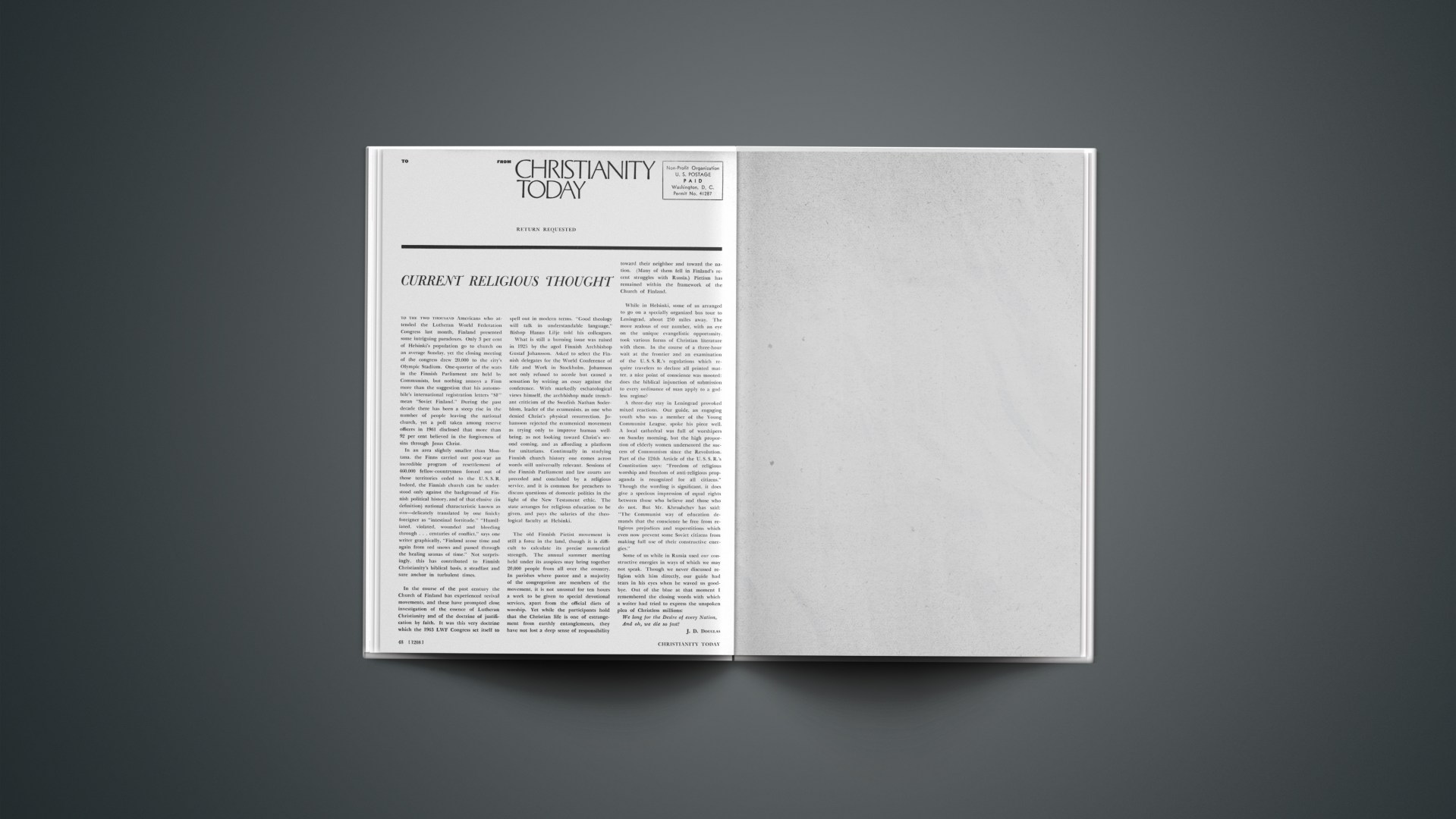
To the two thousand Americans who attended the Lutheran World Federation Congress last month, Finland presented some intriguing paradoxes. Only 3 per cent of Helsinki’s population go to church on an average Sunday, yet the closing meeting of the congress drew 20,000 to the city’s Olympic Stadium. One-quarter of the seats in the Finnish Parliament are held by Communists, but nothing annoys a Finn more than the suggestion that his automobile’s international registration letters “SF” mean “Soviet Finland.” During the past decade there has been a steep rise in the number of people leaving the national church, yet a poll taken among reserve officers in 1961 disclosed that more than 92 per cent believed in the forgiveness of sins through Jesus Christ.

In an area slightly smaller than Montana, the Finns carried out post-war an incredible program of resettlement of 460,000 fellow-countrymen forced out of those territories ceded to the U. S. S. R. Indeed, the Finnish church can be understood only against the background of Finnish political history, and of that elusive (in definition) national characteristic known as sisu—delicately translated by one finicky foreigner as “intestinal fortitude.” “Humiliated violated, wounded and bleeding through … centuries of conflict,” says one writer graphically, “Finland arose time and again from red snows and passed through the healing saunas of time.” Not surprisingly, this has contributed to Finnish Christianity’s biblical basis, a steadfast and sure anchor in turbulent times.

In the course of the past century the Church of Finland has experienced revival movements, and these have prompted close, investigation of the essence of Lutheran Christianity and of the doctrine of justification by faith. It was this very doctrine which the 1963 LWF Congress set itself to spell out in modern terms. “Good theology will talk in understandable language,” Bishop Hanns Lilje told his colleagues.

What is still a burning issue was raised in 1925 by the aged Finnish Archbishop Gustaf Johansson. Asked to select the Finnish delegates for the World Conference of Life and Work in Stockholm, Johansson not only refused to accede but caused a sensation by writing an essay against the conference. With markedly eschatological views himself, the archbishop made trenchant criticism of the Swedish Nathan Soderblom, leader of the ecumenists, as one who denied Christ’s physical resurrection. Johansson rejected the ecumenical movement as trying only to improve human well-being, as not looking toward Christ’s second coming, and as affording a platform for unitarians. Continually in studying Finnish church history one comes across words still universally relevant. Sessions of the Finnish Parliament and law courts are preceded and concluded by a religious service, and it is common for preachers to discuss questions of domestic politics in the light of the New Testament ethic. The state arranges for religious education to be given, and pays the salaries of the theological faculty at Helsinki.

The old Finnish Pietist movement is still a force in the land, though it is difficult to calculate its precise numerical strength. The annual summer meeting held under its auspices may bring together 20,000 people from all over the country. In parishes where pastor and a majority of the congregation are members of the movement, it is not unusual for ten hours a week to be given to special devotional services, apart from the official diets of worship. Yet while the participants hold that the Christian life is one of estrangement from earthly entanglements, they have not lost a deep sense of responsibility toward their neighbor and toward the nation. (Many of them fell in Finland’s recent struggles with Russia.) Pietism has remained within the framework of the Church of Finland.

While in Helsinki, some of us arranged to go on a specially organized bus tour to Leningrad, about 250 miles away. The more zealous of our number, with an eye on the unique evangelistic opportunity, took various forms of Christian literature with them. In the course of a three-hour wait at the frontier and an examination of the U. S. S. R.’s regulations which require travelers to declare all printed matter, a nice point of conscience was mooted: does the biblical injunction of submission to every ordinance of man apply to a godless regime?

A three-day stay in Leningrad provoked mixed reactions. Our guide, an engaging youth who was a member of the Young Communist League, spoke his piece well. A local cathedral was full of worshipers on Sunday morning, but the high proportion of elderly women underscored the success of Communism since the Revolution. Part of the 124th Article of the U. S. S. R.’s Constitution says: “Freedom of religious worship and freedom of anti-religious propaganda is recognized for all citizens.” Though the wording is significant, it does give a specious impression of equal rights between those who believe and those who do not. But Mr. Khrushchev has said: “The Communist way of education demands that the conscience be free from religious prejudices and superstitions which even now prevent some Soviet citizens from making full use of their constructive energies.”

Some of us while in Russia used our constructive energies in ways of which we may not speak. Though we never discussed religion with him directly, our guide had tears in his eyes when he waved us goodbye. Out of the blue at that moment I remembered the closing words with which a writer had tried to express the unspoken plea of Christless millions:

We long for the Desire of every Nation,

And oh, we die so fast!
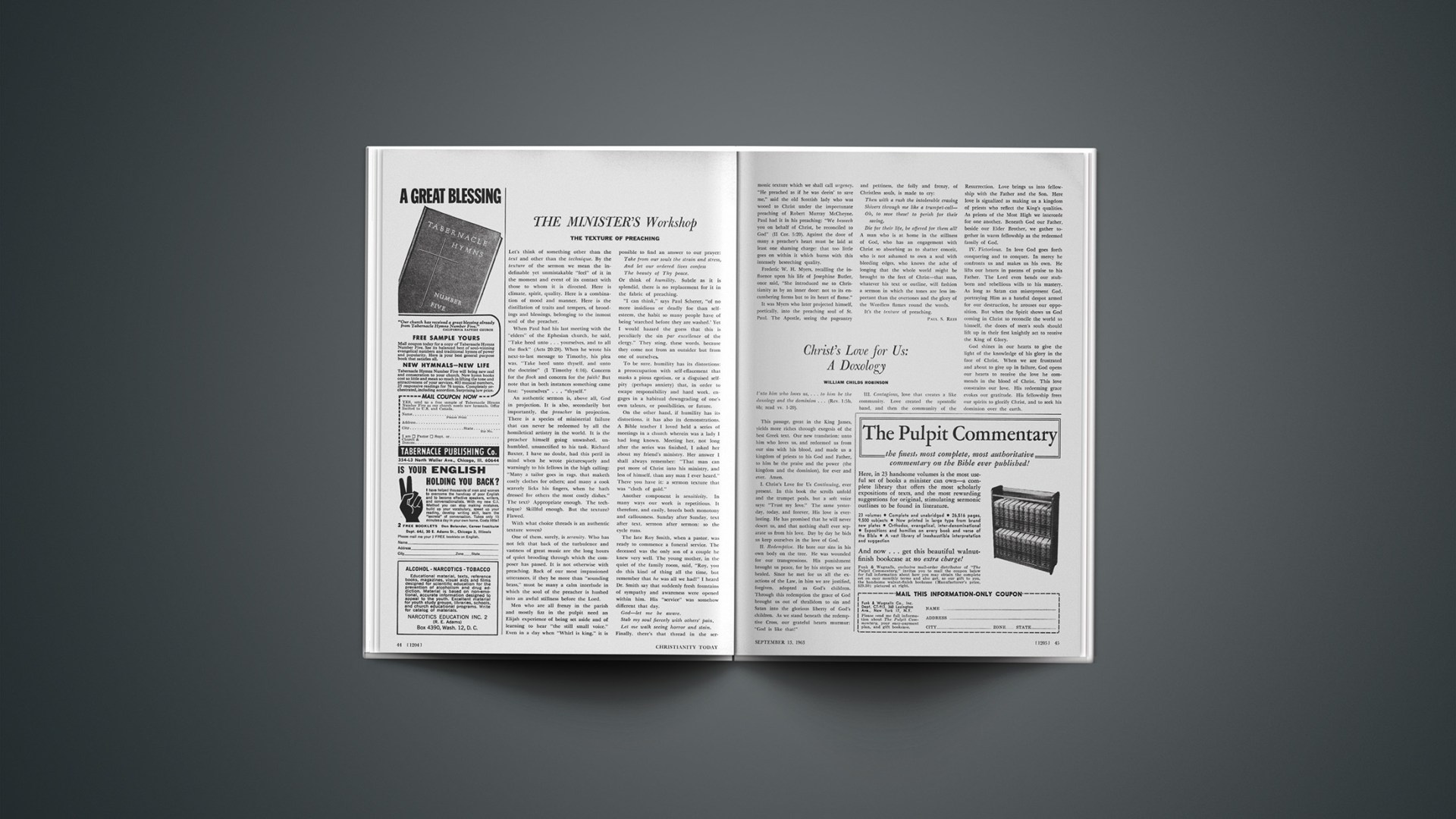
The Texture of Preaching

The Texture Of Preaching

Let’s think of something other than the text and other than the technique. By the texture of the sermon we mean the indefinable yet unmistakable “feel” of it in the moment and event of its contact with those to whom it is directed. Here is climate, spirit, quality. Here is a combination of mood and manner. Here is the distillation of traits and tempers, of broodings and blessings, belonging to the inmost soul of the preacher.

When Paul had his last meeting with the “elders” of the Ephesian church, he said, “Take heed unto … yourselves, and to all the flock” (Acts 20:28). When he wrote his next-to-last message to Timothy, his plea was, “Take heed unto thyself, and unto the doctrine” (1 Timothy 4:16). Concern for the flock and concern for the faith! But note that in both instances something came first: “yourselves” … “thyself.”

An authentic sermon is, above all, God in projection. It is also, secondarily but importantly, the preacher in projection. There is a species of ministerial failure that can never be redeemed by all the homiletical artistry in the world. It is the preacher himself going unwashed, unhumbled, unsanctified to his task. Richard Baxter, I have no doubt, had this peril in mind when he wrote picturesquely and warningly to his fellows in the high calling: “Many a tailor goes in rags, that maketh costly clothes for others; and many a cook scarcely licks his fingers, when he hath dressed for others the most costly dishes.” The text? Appropriate enough. The technique? Skillful enough. But the texture? Flawed.

With what choice threads is an authentic texture woven?

One of them, surely, is serenity. Who has not felt that back of the turbulence and vastness of great music are the long hours of quiet brooding through which the composer has passed. It is not otherwise with preaching. Back of our most impassioned utterances, if they be more than “sounding brass,” must be many a calm interlude in which the soul of the preacher is hushed into an awful stillness before the Lord.

Men who are all frenzy in the parish and mostly fizz in the pulpit need an Elijah experience of being set aside and of learning to hear “the still small voice.” Even in a day when “Whirl is king,” it is possible to find an answer to our prayer:

Take from our souls the strain and stress,

And let our ordered lives confess

The beauty of Thy peace.

Or think of humility. Subtle as it is splendid, there is no replacement for it in the fabric of preaching.

“I can think,” says Paul Scherer, “of no more insidious or deadly foe than self-esteem, the habit so many people have of being ‘starched before they are washed.’ Yet I would hazard the guess that this is peculiarly the sin par excellence of the clergy.” They sting, these words, because they come not from an outsider but from one of ourselves.

To be sure, humility has its distortions: a preoccupation with self-effacement that masks a pious egotism, or a disguised self-pity (perhaps anxiety) that, in order to escape responsibility and hard work, engages in a habitual downgrading of one’s own talents, or possibilities, or future.

On the other hand, if humility has its distortions, it has also its demonstrations. A Bible teacher I loved held a series of meetings in a church wherein was a lady I had long known. Meeting her, not long after the series was finished, I asked her about my friend’s ministry. Her answer I shall always remember: “That man can put more of Christ into his ministry, and less of himself, than any man I ever heard.” There you have it: a sermon texture that was “cloth of gold.”

Another component is sensitivity. In many ways our work is repetitious. It therefore, and easily, breeds both monotony and callousness. Sunday after Sunday, text after text, sermon after sermon: so the cycle runs.

The late Roy Smith, when a pastor, was ready to commence a funeral service. The deceased was the only son of a couple he knew very well. The young mother, in the quiet of the family room, said, “Roy, you do this kind of thing all the time, but remember that he was all we had!” I heard Dr. Smith say that suddenly fresh fountains of sympathy and awareness were opened within him. His “service” was somehow different that day.

God—let me be aware.

Stab my soul fiercely with others’ pain,

Let me walk seeing horror and stain.

Finally, there’s that thread in the sermonic texture which we shall call urgency. “He preached as if he was deein’ to save me,” said the old Scottish lady who was wooed to Christ under the importunate preaching of Robert Murray McCheyne. Paul had it in his preaching: “We beseech you on behalf of Christ, be reconciled to God” (2 Cor. 5:20). Against the door of many a preacher’s heart must be laid at least one shaming charge: that too little goes on within it which bums with this intensely beseeching quality.

Frederic W. H. Myers, recalling the influence upon his life of Josephine Butler, once said, “She introduced me to Christianity as by an inner door: not to its encumbering forms but to its heart of flame.”

It was Myers who later projected himself, poetically, into the preaching soul of St. Paul. The Apostle, seeing the pageantry and pettiness, the folly and frenzy, of Christless souls, is made to cry:

Then with a rush the intolerable craving

Shivers through me like a trumpet-call—

Oh, to save these! to perish for their saving,

Die for their life, be offered for them all!

A man who is at home in the stillness of God, who has an engagement with Christ so absorbing as to shatter conceit, who is not ashamed to own a soul with bleeding edges, who knows the ache of longing that the whole world might be brought to the feet of Christ—that man, whatever his text or outline, will fashion a sermon in which the tones are less important than the overtones and the glory of the Wordless flames round the words.

It’s the texture of preaching.

PAUL S. REES

Unto him who loves us, … to him be the doxology and the dominion … (Rev. 1:5b, 6b; read vv. 1–20).

This passage, great in the King James, yields more riches through exegesis of the best Greek text. Our new translation: unto him who loves us, and redeemed us from our sins with his blood, and made us a kingdom of priests to his God and Father, to him be the praise and the power (the kingdom and the dominion), for ever and ever. Amen.

I. Christ’s Love for Us Continuing, ever present. In this book the scrolls unfold and the trumpet peals, but a soft voice says: “Trust my love.” The same yesterday, today, and forever, His love is everlasting. He has promised that he will never desert us, and that nothing shall ever separate us from his love. Day by day he bids us keep ourselves in the love of God.

II. Redemptive. He bore our sins in his own body on the tree. He was wounded for our transgressions. His punishment brought us peace, for by his stripes we are healed. Since he met for us all the exactions of the Law, in him we are justified, forgiven, adopted as God’s children. Through this redemption the grace of God brought us out of thralldom to sin and Satan into the glorious liberty of God’s children. As we stand beneath the redemptive Cross, our grateful hearts murmur: “God is like that!”

III. Contagious, love that creates a like community. Love created the apostolic band, and then the community of the Resurrection. Love brings us into fellowship with the Father and the Son. Here love is signalized as making us a kingdom of priests who reflect the King’s qualities. As priests of the Most High we intercede for one another. Beneath God our Father, beside our Elder Brother, we gather together in warm fellowship as the redeemed family of God.

IV. Victorious. In love God goes forth conquering and to conquer. In mercy he confronts us and makes us his own. He lifts our hearts in paeans of praise to his Father. The Lord even bends our stubborn and rebellious wills to his mastery. As long as Satan can misrepresent God, portraying Him as a hateful despot armed for our destruction, he arouses our opposition. But when the Spirit shows us God coming in Christ to reconcile the world to himself, the doors of men’s souls should lift up in their first knightly act to receive the King of Glory.

God shines in our hearts to give the light of the knowledge of his glory in the face of Christ. When we are frustrated and about to give up in failure, God opens our hearts to receive the love he commends in the blood of Christ. This love constrains our love. His redeeming grace evokes our gratitude. His fellowship frees our spirits to glorify Christ, and to seek his dominion over the earth.

We preach Christ crucified, unto the Jews a stumblingblock, and unto the Greeks foolishness; but unto them who are called, both Jews and Greeks, Christ the power of God, and the wisdom of God (1 Cor. 1:23, 24; read vv. 18–31).

Paul believed that the main business of Christly men was Gospel preaching. When the firebrand of Tarsus preached Christ there was no time for meddling with current controversies. Whole cities depended on him for the preaching of redemption. For that reason he lived largely in the imperative. Let our own spirits possess a like urgency!

I. The Gospel Proclaimed. The transmission of the Gospel rested in the hands of men of good will. With high passion those men pleaded powerfully for the souls of others and shook civilization to its foundations. When men so awake to their responsibilities as Christians the momentum of Christianity will sweep over the enemies of the Gospel like a tidal wave.

II. The Gospel Antecedent: a divine sacrifice. God called for the sacrifice of Christ on Calvary, so that now we see the devilish nature of sin, and our own guilt before God. We likewise see in the Cross the means by which life is restored. This was done in Christ, who by his own blood dissolved sin and brought man back to his waiting God. But at what a cost and with what a payment!

III. The Gospel Message we preach is a divine testimony. All that God has to say to men he says in his Son, who discloses it all in love, a love greater than the mind of man can comprehend. This love will hold until the graves give up their dead and time shall be no more. There I must realize that I am not my own; I am bought with a price. In the Cross I gain forgiveness of sins; in the Resurrection the guarantee of power to live His life.

IV. The Gospel Objective. When obeyed, the Gospel results in human redemption from sin. Hence we preach Christ crucified. Today Christianity is a completed system of truth, a revelation given once for all. On earth there is no authority to change this Gospel. We conclude that he is wise who simply determines to abide by the law of life thus divinely given. With Paul let this ever be our triumphant testimony: “We preach Christ crucified!”—From Christ Is All (Cincinnati: The Standard Press, 1962).

Did not our heart burn within us, while he talked with us by the way, and while he opened to us the scriptures? (Luke 24:32).

Every Christian ought to be happy in the Lord. Many believers, alas, are not. Even after Easter we talk about “the lost radiance of the Christian church.” Fortunately, as believers in the Crucified and Risen Lord we can recapture such radiance where we lost it, in our assurance of the Living Christ as he appears after the Resurrection. Today as on the first Easter Christian radiance comes through.

I. Fellowship with the Living Christ. Those two hearts began to burn as soon as the pilgrims fell in step with the Lord. So it should be every day with us who believe. In private devotions, at the family altar, and along the dusty way, why not commune with Him? Alas, some of us read nothing daily but a Bible verse in a devotional manual, with a prayer by someone else.

II. Understanding the Scriptures. The two disciples had long known God’s Book, but at last they learned to enjoy what they may have merely endured. Before the burning heart comes the opening of the eyes to behold Christ where formerly one saw something else. So it seems that in the hour of worship the opening of the Book should lead to the burning heart.

III. Enlisting for Christian Service. Radiance comes through “the illumination of obedience.” If those two had kept their discovery a secret, the fire would have died down in their hearts, the glow would have faded from their faces. After beholding the Risen Lord we ought ever to be “abounding” in his work. Hence the Resurrection Chapter leads up to an appeal for giving.

IV. Abiding in Christian Hope. On Easter morning those two felt disconsolate because they had lost their hope. They had begun to look backward and feel sorry for themselves. On the other hand, the Gospel of Easter bids us look up and rejoice. Because of this hope, “never again in the history of the Church has the life of worship revealed such power, such depth, such fruitfulness as in those early times.”

Does anyone here long for such radiance? If so, you may have it now, as well as more and more in days to come, if daily you enter into loving fellowship with the Risen Lord.

Book Briefs: September 13, 1963

The Potential And The Vacuum

Let Europe Hear: The Spiritual Plight of Europe, by Robert P. Evans (Moody, 1963, 528 pp., $5.95), is reviewed by Dwight Wadsworth, European representative of Torchbearers (an international missionary fellowship), Obernhof/Lahn, West Germany.

People seeking insight into the complex religious status of Free Europe and desiring factual information about the true spiritual climate of this most densely populated continent on earth will be grateful to Robert Evans, founder and European director of Greater Europe Mission, for this concentrated result of his many years of first-hand experience and observation. He has constantly woven significant statistics into the fabric of the report, and his mature assessment of the prevailing situation is well supported by extensive quotation of authorities representing a broad range of thought. The results of wide reading and real research are to be found in this work, which has as its principal thesis that the Christian culture and history of Europe may not be accepted as proof of its evangelization. That the Church has been a factor in European life is recognized, but Evans points out, with compelling logic, that North Africa once had a thriving church as well. If one accepts his premise that the inhabitants of any continent have a right to hear the good news of the Gospel in understandable terms, one must concede that the evidence presented is a mighty argument for a new missionary assault against this bastion of superstition, demon worship, diluted theology, and aggressive atheism.

Much that Evans has to say about the sixteen nations of Free Europe will come as a surprise to Americans: the superficiality of much that took place in the Reformation; the number of pagan elements still to be found within the Church; the extent to which Communism may be called the product of the spiritual bankruptcy of “Christian” Europe; the amount of activity by modern sects to capture the minds of Europeans; the inexplicable blindness of missionary leaders to the strategic importance of this continent; and such baffling statistical facts as the comparison of missionary activity in Italy to that in Brazil (Brazil has 10,893 Protestant churches and 948 missionaries, Italy 724 churches and 60 missionaries—yet they are about equal in population).

Some readers, inevitably, will feel that certain phases of the immense subject Evans has chosen should have been treated more fully, but many more people will be pleased at the opportunity this single volume affords to survey the European scene and comprehend many of the factors contributing to its spiritual darkness. The author manifests real ability to condense and illuminate. Although centuries of development among peoples of most diverse characteristics are contemplated, he briefs us competently regarding historical background, pertinent theological influences, philosophical trends, and nationalistic coloring, and does so from the standpoint of a man who appreciates and loves Europeans with a discerning love.

Here is a readable volume that deals with an extremely important matter with such brevity that “he that runneth may read,” but with enough detail that the “runner” may be considerably informed. May the book alert all Christendom to the vast potential and spiritual vacuum that is Europe.

DWIGHT WADSWORTH

Luther And Barth?

Luther’s View of Church History, by John M. Headley (Yale University Press, 1963, 301 pp., $6.75), is reviewed by Paul Woolley, professor of church history, Westminster Theological Seminary, Philadelphia, Pennsylvania.

Church history begins with the records in the Old Testament. Luther and Headley recognize this fact. This book is a study of how Luther interpreted the history of the Church. But the first hundred pages ask what history is and how it is related to the Bible and to the Word of God. Headley contends that for Luther the Word came to man through Scripture, the Church, and the sacraments. There is an important and illuminating section on how Luther interpreted Scripture. Was he Neoorthodox? It is hard to tell from this volume. Time and again one is almost ready to conclude that he anticipated Barth on Scripture by over four centuries—and then Headley reports something that appears to rescue Luther.

Luther’s doctrine of the Church comes through more clearly. It is “the community of believers” (p. 30), for example, based on faith rather than, with Augustine, on election. History as action is God’s work. It derives its authority and veracity “from its agreement with Scripture” (p. 44). Written histories are rational proofs. Sacred history, found in Scripture, stands apart from other histories. But sacred history is not confined to Scripture. It is the history of “the hidden people of faith in all times and places” (p. 54).

When Luther was faced with the extra-scriptural authorities of post-apostolic revelations, oral tradition, and the canon law, he sought to recover the authority of the original tradition and to dissociate Scripture from competing authorities (Vatican Council II please note).

There are some soft spots. Did sola scriptura as a critical principle reject only what was contrary to Scripture? Did the original impulse of the Reformation have “nothing at all to do” with moral corruption?

The major portion of the book is wordy and ill-organized. Luther sees the Church as passing through three epochs: the epoch of the patriarchs, the epoch of Abraham and the law of Moses, and the present epoch of persecution. This last is eschatological. “The end of the world begins immediately after the resurrection of Christ” (p. 144). As against Rome, no additions to the content of the faith are to be made in this period. Here, the ecumenical movement is really faced with a problem. Is it going to hold to this Protestant principle?

If Headley had reached his epilogue sooner, the book would have been better. But it does keep one thinking. Do you follow Augustine or Luther as a historian? What idea of verbal inspiration can be in Headley’s mind to lead to the two statements about Osiander and Bucer on the next-to-the-last page?

Luther “rejected the Aristotelian explanations” for the brightness of “the evangelical light” (p. 234); we may do likewise.

PAUL WOOLLEY

The Getting Out Is The Problem

Our Life in Christ, by J. K. S. Reid (Westminster, 1963, 148 pp., $3.75), is reviewed by James Daane, editorial associate,CHRISTIANITY TODAY.

This book probes for the meaning of the biblical phrase “in Christ”; its chapters, slightly modified, were the 1960 Princeton Seminary Warfield Lectures.

The significance of this phrase, says Reid, professor of Christian dogmatics at the University of Aberdeen, was thrust into the center of theological concern seventy years ago by Adolf Deissmann’s Die neutestamentliche Formel ‘in Christo Jesu.’

Although the idea of being “in Christ” appears in the Gospels, the phrase itself appears only in Acts, First Peter, and the Johannine writings, from whence Paul borrowed it and made it into a technical term.

The singular importance of the term is indicated by the mere fact that no other name can stand after and be governed by the word in. But what does it mean? Reid rejects Deissmann’s spiritual-mystical interpretation forged by his virtual identification of Christ and the Spirit. It does less than justice, Reid says, to the Incarnation.

In Paul’s basic usage the “in Christ” points to an objective truth, contingent on neither the action of the Spirit nor the faith of man, the truth that Christ is the ground and determination of a man’s being as a Christian. The phrase connotes a gracious divine determination, a determination of a man’s being as a Christian and the life that emanates from this determination. This means salvation by grace alone, pre-estination, and the exclusion of Pelagianism and all forms of syncretism.

However, since the “in Christ” has reference to a divine determination grounded in that Incarnation in which Jesus assumed our universal, common human nature and in it died for all men, all men are in Christ.

How do Christians share in Christ? Not by an existentialist response as in Bultmann or Tillich, for existential theology leaves the sinner to his own resources and devices, which are not equal to the demand. Nor by a conditional theology which says, “Christ is yours, if you accept him.” Nor by obedience, for that raises the problem of sin rather than a solution which is redemptive. Nor by imitation, for some forms of imitating Christ would be of the essence of sin, and even in legitimate imitation, “imitation” is far too superficial a concept to describe the life and experience of the Christian. The concept of “participation” best describes how the Christian shares in the life of Christ.

The concept of participation is of course particularly felicitous for an “in Christ” which is grounded in the Incarnation, but it leaves Reid with the difficulty of avoiding a necessary universalism. Why any man is a Christian finds its explanation in the gracious predestination of God. But there is no rational explanation, says Reid, which accounts for those in Christ who do not become Christians, or, as Reid also puts it, for a man’s not being what he is, one who is in the Christ who died for him. There can be on the Christian position no good, rational reason for evil and unbelief. Reid rejects Calvin’s ambiguous use of praedestinatio duplex as an explanation for the persistent unbeliever, as he does the Augustinian-Calvinistic understanding of the sinner as a substantialized, independent center of opposition to God which, says Reid, led to the second error, the substantialization of an omnipotent grace regarded as something separate from God.

The closest Reid comes to “explaining” the possibility of being in Christ and yet lost is his reference to the fact that in sin, man, while remaining man, is something other than an authentic man.

Reid presents a serious and studied attempt to deliver Christianity from a subjectivistic, activistic, individualistic interpretation which infringes on the objective, organic, and gracious character of man’s redemption, a threat which has ever haunted the classical Reformed theological tradition. It would be too much to say that he succeeds, though he does grapple in a stimulating way with the problem. Many evangelicals will challenge his view of Scripture, and some will challenge his theological method, which allows his Christology to put content into his anthropology (particularly since he insists, “Of the Christ who was before the incarnation takes place, it cannot be said that we are in him”) and which, on the other hand, allows his anthropology to throw light on his Christology (we may construe Christ as one who is able to function “as the one in whom man can be said to be”). But all this calls for a closer analysis than can be given here. Here it must suffice to say that man as the imago dei is, according to Reid, one for whom the destiny of being in Christ is possible, and Christ must be Christologically so construed as to be one in whom it is possible for man to exist. Reid constantly skirts the ontological question of Christ as the ground and reality of man’s existence, yet he never deals with it explicitly—and therefore (perhaps) once quotes but never deals with the Pauline assertion that “we are created in Christ Jesus.”

JAMES DAANE

Quick Survey

Theories of Revelation, by H. D. McDonald (Allen & Unwin, 1963, 384 pp., 37s. 6d.), is reviewed by Gordon H. Clark, professor of philosophy, Butler University, Indianapolis, Indiana.

As indicated by the subtitle, An Historical Study 1860–1960, this volume surveys the views of biblical critics on a number of important points.

The first two chapters are philosophic and scientific, describing the unsettling effect of Darwin, Spencer, Clifford, Freud. Tillich, Brunner, and Bultmann on belief in the Bible. The third chapter surveys higher criticism. The author then discusses the significance of Christ’s appeals to the Old Testament, and the critics’ theories of accommodation, kenosis, and “religious” versus “historical” intention. The remaining chapters run over the various views on the Scriptures and the Word, biblical inerrancy, biblical inspiration, biblical authority, and revelation and authority.

The chief defect of the book is no doubt its chief merit: it is a quick survey of a century of criticism. The historical development is competently spread before the reader, and the material is well worth having. Obviously the author is extremely well informed. Some 600 authors are mentioned, but of course only briefly. It might have been better to omit two-thirds of them in order to treat more adequately the more important writers. As it is, one tends to tire of the continuous cataloging.

The author has expressed his own views in another volume. Here it is hard to discern precisely what they are. He is very keen in uncovering the weaknesses and inconsistencies of the destructive critics; he exposes their persistent misrepresentation of the Reformation view of the Bible, and treats the orthodox scholars with reasonable respect. Then, too, it is clear that he demands objectivity in revelation. The subjectivity of Schleiermacher, of Harnack, of Barth is repudiated. Christianity cannot be based on experience; there must be a verbal message from God.

But the author does not clearly state that this verbal message is entirely true. In the Introduction he contrasts the view of revelation as a body of divinely communicated truths with the view that revelation existing ab extra is the wickedest of all follies. The impression left at the end of the book is that there must be some compromise between the extremes of objectivity and subjectivity.

GORDON H. CLARK

Illustrious Triumph

Christ’s Witchdoctor, by Homer E. Dowdy (Harper & Row, 1963, 241 pp., $3.95), is reviewed by R. Kenneth Strachan, general director, Latin America Mission, San Jose, Costa Rica.

It is encouraging to see the number of books on the missionary movement in Latin America gradually building up. Thanks to Homer Dowdy and Harper’s, a new chapter has been added to the story of the work among the lowland Indian tribes. As seen through North American eyes, this account of a witchdoctor’s conversion, resulting in the amazing transformation of the life of the Wai Wai in British Guiana, is another thrilling illustration of Gospel conquest.

Back of that story is another that begins on the plains of Texas in the life and ministry of a radio evangelist and his wife. It was their lives and vision that sent the brothers Hawkins—Neill, Rader, and Bob—to the jungles of the Amazon.

Christ’s Witchdoctor brings home to the reader the wonder and joy of God’s reproductive design in the missionary call. It’s worth reading.

R. KENNETH STRACHAN

Old Doctrine, New Frontiers

The New Evangelicalism, by Ronald H. Nash (Zondervan, 1963, 188 pp., $3.95), is reviewed by James M. Boice, editorial assistant,CHRISTIANITY TODAY.

Ever since the emergence of the new evangelicalism in the 1950s and its subsequent history of expanding impact upon the current religious scene, there has been a need for a scholarly and sympathetic assessment of the evangelical movement as a historical phenomenon and as a revived presentation of orthodox theology. The New Evangelicalism, by Congregationalist minister and teacher Ronald Nash, fills this need and more. It examines the causes leading to the rise of the new evangelicalism; elucidates the doctrines of the movement, finding them squarely in line with Protestant orthodoxy; and sets forth the evangelical frontiers in the areas of biblical inspiration, Christian unity, and philosophical apologetics.

The author has examined the writings of Edward J. Carnell, Carl F. H. Henry, Bernard Ramm, Gordon Clark, Harold John Ockenga, and others and has found them in harmony with early fundamentalist doctrine, before an unwarranted preoccupation with dispensationalism and particular details of eschatology led to a reduction of the Christian Gospel within the fundamentalist movement. The author agrees with Dr. Ockenga that the new evangelicalism is distinct from neoorthodoxy in its complete acceptance of the inspiration and authority of the Bible, from modernism by its embrace of the full orthodox system of doctrine, and from contemporary fundamentalism by its belief that biblical doctrine and ethics must be applied to the social scene as well as to the individual man.

Nash finds the cornerstone of the evangelical position to be its doctrines of inspiration and revelation. He rejects as a misunderstanding the neoorthodox claim that the evangelical doctrines imply dictation or bibliolatry. He rejects the fundamentalist critique that evangelicals are surrendering the truth of verbal inspiration. Instead he finds a belief which identifies written sentences and propositions with special divine revelation, yet denies neither the necessary subjective appropriation of God’s truth nor the significance of certain divine acts as revelation. Such belief, he feels, is not only the historical Christian view but also an indispensable element in a proper biblical theology.

What Nash finds most characteristic of the new evangelicals is not their renewed struggles with old problems but their refreshing eagerness to open new frontiers. Among the areas of advance: an examination of the nature and function of biblical language, development of a valid biblical basis for Christian unity, formation of a metaphysical grounding for Christian doctrine, and creation of an evangelical alliance based upon mutual understanding and cooperation within the orthodox fold. It is a tribute to this book that the author himself advances the causes for which he calls.

His effort to be constructive does not bar the author from a vigorous polemic. He is particularly irate at neoorthodox and fundamentalist spokesmen who berate the evangelical position without taking the trouble to investigate or understand it. He notes with candor the areas in which the evangelicals themselves disagree. And in the final chapter he offers a challenge to the neo-evangelical movement itself—to perpetuate its academic and spiritual insights to its posterity.

Who should read this book? Everyone who would pretend to speak either for or against the evangelical cause! Many of the latter would at least find the issues sharpened, and many, perhaps to their surprise, would find that they are more truly new evangelicals than they would have previously believed.

JAMES M. BOICE

After Fifty-Seven Years

A Grammar of New Testament Greek, Volume III, by James Hope Moulton, Syntax by Nigel Turner (T. & T. Clark, 1963, 418 pp., 60s.), is reviewed by J. Neville Birdsall, lecturer in theology, University of Birmingham, England.

The English-speaking New Testament scholar has waited long for an adequate grammar of New Testament Greek: the work begun by J. H. Moulton in 1906 (third edition 1908) has met with many setbacks through the untoward deaths of Moulton himself and of his successors, W. F. Howard and H. G. Meecham. Now at last the long-awaited third volume, containing the matter which all but the philological specialist most need and desire, namely, syntax, has appeared, having been brought to a successful conclusion by Dr. Nigel Turner.

No one can write a treatise on the structure of a language without revealing his views concerning its nature and origin. The Prolegomena of Moulton was one of the classical documents of that phase of the study of New Testament Greek in which scholars emphasized its identity with the Koine, as revealed in the recently discovered papyri, and the continuity of modern demotic Greek with these phenomena. Similarly in the course of a syntactical exposition Dr. Turner presents his conclusion that this emphasis was one-sided and that New Testament Greek presents certain features explicable only by the influence of the Septuagint and, in other cases, of Aramaic: that is to say, he upholds the concept of a biblical Greek distinct in some measure from other forms of contemporary Greek. It is of interest and importance to have such a discussion. A striking feature of this is the stress laid upon the preponderance of the optative mood in biblical Greek when contrasted with relevant documents, which shows among other things the influence of religious aspiration upon linguistic usage.

Turner naturally deals with syntax in the traditional and logical way, i.e., analysis and treatment of the use of parts of speech comes first, the sentence as a whole last. But a refreshing feature and one evidently designed to help the expositor who is not a professional grammarian is Turner’s inclination to avoid technical terms of Latin derivation for a more natural Germanic structure (e.g., “building up the sentence” instead of “sentence construction”). The work is intended for both the theorist and the man who in the pulpit or schoolroom must apply the findings of scholarship. It is inevitable that one aspect should suffer, however slightly: it seems to the reviewer that because of this latter emphasis, very salutary and necessary as it may be, this has become a somewhat different book from the two preceding volumes whose work it completes.

A longer space would give opportunity to discuss many points of detail, but it is good to have to conclude not with the minutiae with which grammarians must concern themselves, sometimes to the despair of others, but with the expression of praise and thanks for a work which scholars and preachers will find stimulating and illuminating in the task of opening up the lively oracles of God.

J. NEVILLE BIRDSALL

Book Briefs

Principles and Practices of Pastoral Care, by Russell L. Dicks (Prentice-Hall, 1963, 143 pp., $2.95). A world of good sense and advice, with an occasional breakthrough of bad theology.

The Way of the Cross, by J. Ralph Grant (Baker, 1963, 173 pp., $2.95). Popular, readable short sermons on redemption by the way of the Cross.

Sons of the Prophets, edited by Hugh T. Kerr (Princeton University, 1963, 227 pp., $5). Biographies of a selection of significant people associated with Princeton Theological Seminary over the years, whose lives throw light on the history of the seminary. Included are C. Hodge, W. Lowrie. J. L. Hromadka. Excluded, strangely, are B. Warfield and John Mackay, both of whom did more to shape Princeton than did some of those included.

Josiah Royce’s Seminar, 1913–1911, edited by Grover Smith (Rutgers University, 1963, 209 pp., $7.50). Of interest to students of Royce.

The Marriage Climate, by Ernest Ligon and Leona Smith (Bethany Press, 1963, 240 pp., $4.75). A skillfully presented discussion of the dynamics that make or break a happy marriage and home. With Christian motifs, humorous text, and line drawings. As down to earth as mama’s sudden bad mood, or papa’s wrath over burnt potatoes.

Did the Early Church Baptize Infants?, by Kurt Aland (Westminster, 1963, 120 pp., $3.50). German university professor argues against the case for infant baptism on the basis of biblical sources and the early church fathers. He contends that infant baptism was not practiced before the third century.

Global Odyssey, by Howard A. Johnson (Harper & Row, 1963, 448 pp., $5.95). Canon of the Cathedral Church of St. John the Divine of New York tells of visiting the Anglican communion in eighty countries. The well-told story is studded with perceptive insights and evaluations. Good reading.

Pen-ultimates, by Martin E. Marty and Dean Peerman (Holt, Rinehart and Winston, 1963, 110 pp., $2.95). A collection of essays which jibe at the contradictions between Christian claim and Christian practice. The pen-ultimate essays running weekly in The Christian Century are frequently ironical and witty, sometimes only clever, often perceptive, at times almost sacrilegious, and cometime, we trust, will add hurt to humor, so that the contradictions become more tragic than ironic.

The Conservative Affirmation, by Willmoore Kendall (Regnery, 1963, 272 pp., $5.95). A definitive statement of the differences between political conservatism and liberalism; the roots of conservatism are traced to the Founders’ views expressed in the Federalist Papers, the roots of liberalism to the European egalitarian revolt of the last century.

The Books and the Parchments, by F. F. Bruce (Revell, 1963, 287 pp., $4). A substantial, excellent study of all the matters of language, canonicity, versions, apocryphal books, and much more that played roles in the process by which we got our Bible. If as the Preface to the first edition declares, this book was written for “non-specialists,” then Kant wrote for the kindergarten.

The Need To Be Loved, by Theodor Reik (Farrar, Straus, 1963, 276 pp., $4.95). One of Freud’s early students muses hither and yon on the many facets of sexual love, and by sexegetical techniques presents some “way out” biblical interpretations.

Isaac Backus: Pioneer of Religious Liberty, by T. B. Maston (American Baptist Historical Society [1100 S. Goodman, Rochester 20, N.Y.], 1962, 150 pp., $3.25). Abridgement of a doctoral dissertion written for Yale University on the life and work of an eighteenth-century Baptist preacher, with special emphasis on his contribution to liberty of conscience and the political ethic of church-state separation. In a style often prosaic.

Christ for the World, compiled and edited by G. Allen West, Jr. (Broadman, 1963, 146 pp., $2.95). Fourteen challenging mission sermons by as many Baptists.

Creeds of the Churches, edited by John H. Leith (Aldine, 1963, 589 pp., $7.50). A selected group of the major creeds from the Bible to the present. Each creed is introduced and its place indicated in the movement of theological development.

The Apostle Paul: Christ’s Supreme Trophy, by Roland Q. Leavell (Baker, 1963, 128 pp., $2.95). Short, compact, well-drawn presentation of the life of Paul. For individual reading or group study.

The New Testament in the Language of Today, by William Beck (Concordia, 1963, 459 pp., $4.75). A translation so clear and readable that the naive-sounding jacket claim; “What before may have been dark and puzzling—even cumbersome and archaic—is now joyously, immediately clear,” is almost wholly justified.

The Book of Revelation, by Merrill C. Tenney (Baker, 1963, 116 pp., $2.75). A brief, practical, evangelical exposition.

The Existentialist Theology of Paul Tillich, by Bernard Martin (Bookman Associates, 1963, 221 pp., $5). A Jewish rabbi gives a competent philosophic critique of Tillich’s philosophical theology.

Living Obediently, by J. Allen Blair (Loizeaux Brothers, 1963, 190 pp., $2.75). A heart-warming, practical, evangelical interpretation of the Book of Jonah that sometimes make points that the Book itself does not.

The Cross and the Switchblade, by David Wilkerson (Geis, 1963, 217 pp., $4.95). A revealing narrative of a country preacher gone “big city”—his grappling with teen-age delinquents and through the power of the Spirit guiding them into Christian life. Useful for workers with teen-agers.

Paperbacks

The Limits of Nuclear War, by Paul Ramsay (Council on Religion and International Affairs [170 E. 64th St., New York 21], 1963, 56 pp., $.50). Whether the reader agrees or disagrees, he will be enlightened and provoked to think about the great political and moral questions which flow from the rise of modern nuclear weapons.

A Manual of Simple Burial, edited by Ernest Morgan (Celo Press [Burnsville, N.C.], 1962, 64 pp., $1). Information about such subjects as memorial societies and bequeathal of bodies to medical schools and eyes to banks. The bereaved are warned against elaborate, expensive funerals which overemphasize the body, and clergymen against throwing away spiritual opportunities by use of religious language.

Agenda for Anglicans, by Dewi Morgan (Morehouse-Barlow, 1963, 167 pp., $1.75). An Anglican looks at the Anglican community (a family of forty million), telling what he sees and how he evaluates it.

The Wild Goats of Ein Gedi, by Herbert Weiner (Doubleday. 1963, 312 pp., $1.95). The author digs into the spiritual landscape of modern Israel and records a number of religious interviews and encounters with the people of the land.

To Hunger No More, by I. W. Moomaw (Friendship, 1963, 163 pp., $1.95). A Church of the Brethren agricultural missionary tells what is being done to meet a physical need that causes 10,000 people to die by starvation every day.

Man Reaches Out to God, by Herbert C. Jackson (Judson, 1963, 126 pp., $1.75). Within the commitment that the purpose of Christian missions is to convert people to Christianity, a onetime missionary, now a professor, urges that the Church must study the non-Christian religions of the world, especially in view of their current resurgence.

The Bible in the Local Church, by E. H. Robertson (Association, 1963, 107 pp., $1.25). An analytical study of the place the Bible actually plays in the life of local congregations.

The Soul Winner, by Charles Haddon Spurgeon (Eerdmans, 1963, 319 pp., $1.75). An explication of how to win souls so that we “might by all means save some.” Brief foreward by Helmut Thielicke.

Concerning the Ministry, by John Oman (John Knox, 1963, 248 pp., $2.50). Sagacious advice, with a homespun quality, from a theologian of stature to those who minister in the Church. First published in 1936.

Reprints

The Christian Opportunity, by Denis De Rougemont (Holt, Rinehart and Winston, 1963, 185 pp., $4.50). Perceptive, incisive observations about many things in essays delightful and sophisticated. First published in 1944.

Wrestlers With God, by Clarence E. Macartney (Baker, 1963, 207 pp., $2.95). Devotional readings on the prayers of David, Abraham. Elisha, Lot, and others. First printed in 1930.

The Letters to the Seven Churches, by William M. Ramsay (Baker, 1963, 446 pp., $4.95). An authority on the life of Paul and the early Church indicates the place of the seven letters in the Book of Revelation. First published in 1904.

The March of Eleven Men, by Frank S. Mead (Revell, 1963, 236 pp., $2.95). With swift stroke and colorful style the author conveys the pageantry of Christianity’s march through the centuries. First printed in 1932.

News Worth Noting: September 13, 1963

Pirates And Presbyterians

A devout band of twenty-nine Cuban Presbyterians who escaped to the Bahamas fell victim to a kidnapping assault by Castro’s gunboats last month. Nineteen of the refugees were seized and returned to Cuba by armed troops who landed on the British island of Anguilla Key. Others hid behind rocks or buried themselves in the sand. The refugees said their group included no revolutionaries, “only humble God-fearing people.” Said one: “Our only arms were Bibles.”

Convention Circuit

Delegates to the thirty-seventh biennial convention of the Wisconsin Evangelical Lutheran Synod voted 138 to 28 to withdraw from the 91-year-old Lutheran Synodical Conference, oldest association of conservative Lutherans in America. The action was described as a protest against the largest member of the conference, the Lutheran Church—Missouri Synod, which was charged with doctrinal deviations.

The Mennonite Church’s biennial General Conference adopted a new “Confession of Faith,” marking the denomination’s first revision of beliefs in more than forty years. Also approved was a “Brief Statement of Mennonite Doctrine” for liturgical use.

The National Association of Free Will Baptists assailed the Supreme Court ban on public school devotions in a resolution adopted unanimously by some 2,000 delegates.

Appointment of a committee to conduct ecumenical conversations was approved by delegates to the 151st annual Seventh Day Baptist General Conference. The action was in response to an invitation from the American Baptist Convention to engage in conversations exploring the possibility of interdenominational cooperation and merger.

Miscellany

The Greek Orthodox Church is renting space in the New York World’s Fair pavilion being erected by the Protestant Council of the City of New York. In deference to Orthodox participation, the pavilion, previously named “The Protestant Center,” will now be known as “The Protestant and Orthodox Center.”

The World Council of Churches is appealing for $500,000 for relief work in quake-stricken Skopje. A development of 100 prefabricated homes is planned. Church World Service has already dispatched tons of drugs and clothing.

Foreign missionaries are forbidden to proselytize under a sweeping new legal code promulgated by King Mahendra of Nepal, where Hinduism is the state religion.

National Presbyterian Church in Washington was sold last month for $2,575,000. It will be torn down to make room for a new office building. A new church will be constructed along Massachusetts Avenue by the local congregation. An adjoining Presbyterian Center will be established by the United Presbyterian General Assembly.

Retired ministers are entitled to reduce their taxable income by the rental value of homes they occupy, provided that the dwellings in effect constitute compensation for past services, according to a ruling by the Internal Revenue Service.

New bishops were consecrated by the Serbian Eastern Orthodox Diocese in the United States and Canada despite charges that a reorganization was Communist-inspired. Bishop Dionisije of Libertyville, Illinois, has refused to recognize his suspension by the church’s council of bishops last May in Belgrade, Yugoslavia. He said the action was “under the pressure of Tito’s Communist regime of Yugoslavia.”

The Brazilian government is considering a suggestion that it issue a series of stamps honoring Yemanja, voodoo water goddess, at the end of the year.

Personalia

Dr. Robert D. Rasmussen appointed director of the Commission on the Ministry of the American Baptist Convention.

Dr. C. James Krafft, Dallas pediatrician, elected president of the Christian Medical Society.

The Rev. Tom Allan named editorial director of The Christian, an evangelical British weekly. He will continue also as minister of St. George’s Tron Church in Glasgow.

The Rev. Rex Burdick elected president of the Seventh Day Baptist General Conference.

The Rev. Arthur Blazall, 72-year-old Anglican clergyman, will stand trial in South Africa on charges of violating the Suppression of Communism Act.

The Greek government refused to allow re-entry to the country of the Rev. Argos Zodhiates, for seventeen years the pastor of Katerini Evangelical Church, the nation’s largest Protestant congregation. Zodhiates is a Greek from Cyprus and a British subject.

Worth Quoting

“The test ban could, in the future, be as important for humanity as the birth of Christ.”—General David M. Shoup, commandant of the Marine Corps.

“I am convinced that we are spiritual beings and only in a very secondary sense physical. Also, I think with our limited capacities we know practically nothing. But the future is resplendent with light.”—Dr. Earl Douglass, noted Bible commentator, on his seventy-fifth birthday.

“We need a time frequently when we think about something besides a dollar or a nickel or another cigarette.”—Former President Eisenhower, in urging a prayer room for the Eisenhower Center at Abilene, Kansas.

DEATHS

DR. JESSE M. BADER, 77, general secretary of the World Convention of Churches of Christ (Disciples); in New York City.

DR. EDWARD D. KOHLSTEDT, 88, retired Methodist Church official and former president of the Home Missions Council of North America; in Menlo Park, California.

GUISEPPE MOSCHETTI, 55, one of the world’s leading church organists, a former Roman Catholic priest most recently director of music at St. John’s Lutheran Church, Allentown, Pennsylvania; in Allentown.

THE REV. W. REGINALD WHEELER, 74, former secretary of the Presbyterian Board of Foreign Missions; in New York City.

DR. EARLE W. GATES, 54, past president of the International Society of Christian Endeavor; in Buffalo, New York.

Churchmen on the March

CHRISTIANITY TODAY assigned four of us to cover the massive civil rights demonstration in Washington on August 28. Our job was to analyze the religious element of the march. An abundant sprinkling of piety was promised, and organized religion seemed eager to assume a major role in the day’s activities. But did the religious element have a genuine spiritual under-girding, or was it a mere form of godliness with the power thereof implicitly denied?

We met at the office at 8 A.M., although one of us had sacrificed sleep to observe the arrival at the Washington Monument grounds two hours earlier of American Nazis headed by George Lincoln Rockwell. The Nazis immediately drew a cordon of police and the attendant international publicity. They had been refused an official permit for the grounds and were forbidden to make speeches. Rockwell seized the opportunity to complain via radio and television that his rights had been denied him. His impatient deputy later tried to make a speech and was carted off to jail.

Following our office meeting we fanned out over the downtown Washington area. One headed for a breakfast meeting of 200 denominational leaders at the Statler Hilton, another for the New Bible Way Church where 200 Washington ministers held an interdenominational service.

On Capitol Hill, various Congressmen were receiving the ten leaders of the march, a group which included three clergymen: Dr. Eugene Carson Blake, stated clerk of the United Presbyterian Church in the U. S. A. and vice-chairman of the National Council of Churches’ Commission on Religion and Race; Dr. Martin Luther King, Jr., Baptist minister and founder-president of the Southern Christian Leadership Conference; and Rabbi Joachim Prinz, president of the American Jewish Congress. Catholics were represented on the presidium by a layman, sociologist Mathew Ahmann, executive director of the National Catholic Conference for Interracial Justice.

By mid-morning crowds were pouring into the monument grounds, but not as quickly as police had expected. Some feared the turnout might be disappointing.

Although numerous key religious figures discreetly shunned the demonstration or were non-committal, few voiced any public protests. One exception was Dr. Carl McIntire, of the American Council of Christian Churches, who expressed strong opposition to the march and disappointment that he had been refused an interview with President Kennedy.

We met again on the monument grounds shortly after 11 A.M. to coordinate our activities for the remainder of the day. By this time a sea of humanity had descended on the area. The melancholy chants of Joan Baez and Peter, Paul, and Mary could be heard for blocks.

Somewhat ahead of schedule the crowds began to move down Constitution Avenue toward the Lincoln Memorial. Many lined up to purchase bag lunches provided by the NCC. The lunches were originally to have been provided out of Church World Service relief funds. However, it was subsequently decided to sell them at 50 cents each, a price described as “below cost.” Each lunch contained a white bread sandwich with two slices of cheese (American), an apple (Macintosh), and a piece of cake (chocolate ripple).

Meanwhile, a number of Washington area churches were holding services or keeping their doors open for special prayer sessions. Some had conducted all-night prayer vigils.

The only serious controversy of the day developed when Roman Catholic Archbishop Patrick A. O’Boyle, who was to deliver the invocation at the Lincoln Memorial program, saw the speech text of John Lewis. The prelate threatened to boycott the ceremony unless Lewis, chairman of the Students Non-Violent Coordinating Committee, revised his remarks, which he did. The original text of the Lewis speech read: “We will not wait for the President, the Justice Department, nor Congress, but we will take matters into our own hands and create a source of power outside of any national structure that could and would assure us of victory.” Lewis agree to delete the passage and another which referred to “cheap politicians” in Congress.

This was the most apparent evidence that participation in the march by religious groups helped substantially in keeping the proceedings remarkably peaceful.

One marcher died after being stricken with a heart attack.

The day was mostly bright, with temperatures in the eighties. Washington’s notorious humidity was somewhat offset by a fresh breeze and scattered clouds in the afternoon.

Highlighting the afternoon ceremony was the great oratory of King, who cried again and again, “I have a dream.” But as if to prove that people doze despite the best of preachers, hundreds stretched out on the grass and slept most of the afternoon away. Another temptation was the cool water of the Reflecting Pool, and other hundreds kicked off their shoes and stockings to dangle their feet over the edge. At least two persons fell into the shallow pool.

A. Philip Randolph, 74-year-old elder statesman of civil rights in America and the son of a clergyman, was among several speakers who appealed to religious precedent. Randolph, program emcee and chairman of the national march committee, reminded the vast throng of more than 200,000 that “we are leading the multitudes in the streets just as … Jesus Christ led the multitudes in the streets.”

NAACP leader Roy Wilkins, seeking to perpetuate the fervor of the day, said:

“You got religion here today. Don’t back-slide tomorrow.”

Blake declared that Negroes “have mirrored the suffering of Jesus Christ.” He quoted Romans 12:1 as a helicopter whirred high overhead.

These were only a few of the religious overtones of the demonstration. We reassembled at the office early in the evening to discuss their significance and to compare notes. Some reporters recalled that during his U. S. visit four years ago atheist Khrushchev had regularly cited Scripture and invoked the aid of deity.

MARTYR MEDGAR EVERS

The black man fell and helpless lay,

A gaping wound upon his back,

A witness to the savage way,

A beast had made his foul attack.

His wound puked out his noble blood.

His blood sank deep in freedom’s soil …

“My God,” his wife cried out, “My God!”

Is t-h-i-s reward for freedom’s toil?

“Where is the justice in this land?

That loudly tolls the freedom bell,

While tyrants rule with a free hand

Committing all the sins of hell?”

Ole glory’s tarnished with his blood,

For having shabbily allowed

A noble son to be downtrod

Because he was both black and proud.

We were agreed, however, that Communists had no appreciable influence in the March on Washington. Bayard Rustin, Randolph’s assistant, says he left the Young Communist League in 1941. Reliable sources estimated that 135 Communists led by Gus Hall had come from New York for the march, but they apparently regarded themselves as mere spectators. March leaders said they would repudiate the support of any subversive groups.

Through the course of the day we had interviewed scores of marchers, trying to get at basic motivations.

One of us, attempting an overall tally, gave this description: “It was like a church picnic. Not as much food, but more speeches.”

But how spiritual is a church picnic?

Going a step further, it seemed quite obvious that many of the marchers were devout Christians. Some had prayed long and hard for a peaceful march.

Many composite appeals to religion, on the other hand, seemed little more than feeble attempts to put in a good word for God. A placard of the United Auto Workers read, “Be one with God—Speak Out for Freedom.” A delegation of Kansas City Presbyterians clapped its way to the ceremonies singing “When the Saints Go Marching In.” (Civil rights demonstrators have appropriated numerous gospel selections, giving temporal meanings to spiritual themes.)

In one bit of frivolity, members of the Washington clergy committee for the march wheeled a casket titled “Jim Crow Diehards” to the Washington Monument. Perhaps the most moving display was a poem (see above) lettered upon the slats of a Venetian blind.

There were hundreds of clergymen among the marchers, most of them Protestant. The word was out among those participating under the NCC banner that they were to wear their clerical collars. For some it was the first time in years.

Disappointing to many freedom-loving Americans was the fact that the leadership of the march had allied itself so closely with federal legislation proposals. The leaders did not bother to face the full implication of giving personal rights priority over property rights. They did not suggest how federal statutes might be enforced.

The civil rights march, although orderly, involved nonetheless some civil wrongs. Perhaps the most pointed irony, however, was that the nation’s capital took on the earmarks of a garrison state to enable a freedom rally to be held. Some 1,500 National Guardsmen were mobilized and stationed throughout the downtown Washington area. Another 4,000 Army troops stood by in readiness, and thirty helicopters were flown in to carry them should trouble develop.

Taking Stock

The world’s largest Pentecostal denomination, the Assemblies of God, regards itself less as an organization than a movement of the Spirit. Nevertheless, its thirtieth biennial General Council in Memphis last month was devoted largely to recapturing the Spirit and renewing and implementing “the Pentecostal experience.”

Daily business meetings were chiefly concerned with such organizational changes, election of such officers, and the laying of such soul-winning plans as would return the glow and power of the Spirit that marked the Assemblies in an earlier day. Doubtless the felt duty of constantly re-experiencing a fresh outpouring of the Holy Spirit has as its underside the continuing, restive implication of spiritual inadequacy. Concern was expressed over a confessed loss of evangelistic zeal, departure of evangelists from the field of duty, and the quality of the churches’ evangelists. The attempt to correct this situation by effecting and implementing fresh movements of the Holy Spirit does not come easily to a church which believes that organization, programming, and devised techniques tend to encumber the free movement of the Spirit. Delegates tended to view every proposed corrective device as a step toward bureaucracy and centralization which would infringe on the Spirit’s movements in the local congregation. The Assemblies have a traditional pattern of self-government within the local congregation.

In a major action, the council eliminated its department of evangelism and transferred its functions to the office of the general superintendent, the church’s highest office, held by the Rev. Thomas F. Zimmerman. Zimmerman is also chairman of the Executive Presbytery, General Presbytery, General Council, and Central Bible Institute. Some delegates denounced the transfer as a move toward centralization. Comments from members of the department itself seemed to indicate that the motivation was less a desire for centralization than the inability of the department to discover any distinctive function for itself in a denomination where evangelism is regarded as the chief function of all its departments.

Early in the council’s sessions the church’s popular and efficient general superintendent was reelected for his third two-year term. He received 94 per cent of the votes, compared with 97 per cent two years ago.

In the keynote address Zimmerman pleaded for a militant Christianity and warned against placing too much emphasis on education. He recalled earlier days when “a convert wanted to immediately begin preaching in a church, on the street,” and he added, “We need that same zeal today, and need it more than ever.” The Rev. Frederick H. Huber of Linden, New Jersey, also urged that Pentecostalism is being threatened by intellectualism, as well as by materialism and worldliness. “Emphasis on things, knowledge and pleasure have always been the foes of God’s spiritual people, but there is an intensification of their attack today.” But the Rev. C. C. Burnett, president of Bethany Bible College in Santa Cruz, California, voiced concern because fewer young people in the Assemblies are studying for the ministry in the church’s theological institutions.

No biblical text arouses more response from the membership of the Assemblies than the prophecy: “… in the last days, I will pour out my Spirit upon all flesh.” The all-white council of the nearly fifty-year-old denomination, whose headquarters are in Springfield. Missouri, met under a huge banner carrying the inscription: Upon All Flesh.

Zeal marks the Assemblies of God. They have a U. S. membership of half a million, and an even larger membership in seventy-two foreign countries. They firmly believe that Pentecostalism is no historical accident of the twentieth century and that they are a special creation and choice of God in the last days to tell the Church and the world of the power inherent in the Pentecostal experience of the Holy Spirit for holy living and for proclaiming the early return of Christ. On the ethical problems of social life they are remarkably silent.

Pentecostalism is proof that the new wine of the Spirit tends to burst the old wineskins. The Assemblies of God are proof that fresh creations of the Spirit can themselves become occasions where it is difficult “to hold that fast which thou hast”—to use the words of one of the council’s speakers. At a time when the Spirit is moving in new and strange ways even within the old-line denominations, the largest church of the Pentecostal movement is finding it difficult to recapture and retain its earlier measure of the power and presence of the Holy Spirit within its own denominational wineskin. This might rightly be heard as the Spirit’s speaking to the churches, warning each of them against too easily assuming that it is God’s special choice to assume a special task not given to others—a warning against the presumptive assertion made in reference to ecumenical churches by one of the Assemblies’ top leaders: “I have no time to take counsel with those who do not have the same evangelical zeal that we do.”

J.D.

Asking for a Rebirth

“… What we are really asking for is the rebirth of the Anglican Communion.…”

Out of Toronto last month came a 6,500 word manifesto making bold suggestions to the Anglican communion. Aim: to strengthen relationships among the world’s eighteen autonomous Anglican churches and to achieve a more unified approach to pressing issues.

The plan, which seemed to strike a largely responsive chord among the 1,500 clergy and lay delegates to the third world Anglican Congress, had been conceived at a much more private meeting of bishops 100 miles away—in London, Ontario—a few days prior to the Toronto meeting.

The manifesto said that “we must undertake a comprehensive study of needs and resources throughout our communion, to give us up-to-date, tested data on actual work now going on, resources in manpower (clerical and lay), training facilities, financial resources and their distribution, and the unevangelized areas which still confront the church.”

The message quickly added, however, that “we cannot wait for the results of such long-range studies. We ask each church to join now in an immediate commitment to increased financial support, amounting to at least $15,000,000 in the next five years, over and above our existing budgets and engagements …”

Appointment of eight “regional officers” to assist the communion’s chief executive officer, Bishop Stephen Bayne, also was urged. Bayne denied that this was a move towards “a new central curial power.” They will be the very opposite,” he said. “They will serve the churches in their area as the executive officer serves them, multiplying him … and making local initiative possible … of each church in each region.”

The specific suggestions in the document, entitled “Mutual Responsibility and Interdependence in the Body of Christ,” now go to the Anglican churches for study. The only Anglican meeting empowered to pass legislation of worldwide scope is the Lambeth Conference (next scheduled for 1968).

Wording of the manifesto left the impression that drastic ecclesiastical adjustments are necessary:

“We are aware that such a program as we propose, if it is seen in its true size and accepted, will mean the death of much that is familiar about our churches now. It will mean radical change in our priorities—even leading us to share with others at least as much as we spend on ourselves. It means the death of old isolations and inherited attitudes. It means a willingness to forego many desirable things, in every church.

“In substance, what we are really asking for is the rebirth of the Anglican Communion, which means the death of many old things but—infinitely more—the birth of entirely new relationships. We regard this as the essential task before the churches of the Anglican Communion now.”

Challenge And Response

Christians had to look to their laurels at the Mount Allison University Summer Institute held in Sackville, New Brunswick, last month. The institute usually deals with contemporary economic, social, and political problems. But this year, under the direction of Professor I. L. Campbell of the university’s extension department, it turned attention to contemporary Christianity.

The program showed the influence of Arnold Toynbee in that its pattern consisted largely of “challenge and response.” Protestants and Roman Catholics had dialogues with each other, then in turn had to face the challenge of agnosticism, Judaism, and other religions such as Islam. Genuine efforts were made to provide an understanding of the new position in which Christianity finds itself vis a vis these revitalized opponents.

Among those who criticized Christians vigorously for their unwillingness to deal with intellectual problems of the day were Dr. Paul Goodman of the Institute for Policy Study in Washington, a sociologist and a professed anarchist, and Professor Gordin Kaplin, a biologist from Dalhousie University and an agnostic. Philosophy Professor Emil Fackenheim of the University of Toronto showed, on the other hand, more sympathy with Christians, although he held that Christianity faced serious difficulties in its failure to come to terms with modern science, in its particularistic interest in the individual, and in its exclusive claims to the true knowledge of God.

To these attacks the Christians provided no united resistance. Roman Catholics stated a clear position, but seemed at times so anxious to show themselves tolerant that some felt they did not quite state their true views.

Theologians Donald Mathers and John B. Hardie of the United Church of Canada held to a rather mediating position in most discussions.

Two Presbyterians, Dr. Andrew Thakur Das of the United Presbyterian Church in the U. S. A. and Professor W. Stanford Reid of McGill University, stressed the Reformed position, insisting that only through man’s personal self-commitment to Jesus Christ as revealed in and through the Scriptures could Christianity meet the challenge of this present world.

W.S.R.

TARNISHED ANGEL

Another crisis brewed in England last month when the Rev. Frank Trundley, vicar of Braintree, forty-five miles from London, saw a new sign adorning the outside of The Angel, a local pub. The sign depicted a white angel holding a pint of bitter—with the halo over the beer. Finding it was no slip of the brush, the vicar lodged an immediate protest, exclaiming: “One has only to look at the poor wrecks of humanity seeking rest at night in our churchyard to realize they are in that position because they have placed a halo above their beer.”

The publican, Mr. Bill Cave, mildly suggested that the local citizenry might not appreciate that crack about the churchyard being full of drunks. It turned out, however, that he had his own misgivings. “The angel’s got long black hair,” he said. “I never came across an angel that looked like that.” Mr. Cave admitted that the Salvation Army had taken the whole thing badly.

Nor did the artist, 43-year-old Len Ragon, administer soothing balm when he suggested that through the ages the church and the inn have always been together. Quoted one man darkly: “They who drink beer will think beer.” If Washington Irving was right in this, the efficacy of being on the side of the angels is now anything but clear. Altogether, the issue bristles with theological pitfalls.

J.D.D.

Evangelism: A Record-Breaking Crusade

This report was prepared by Dr. Sherwood E. Wirt, editor of Decision:

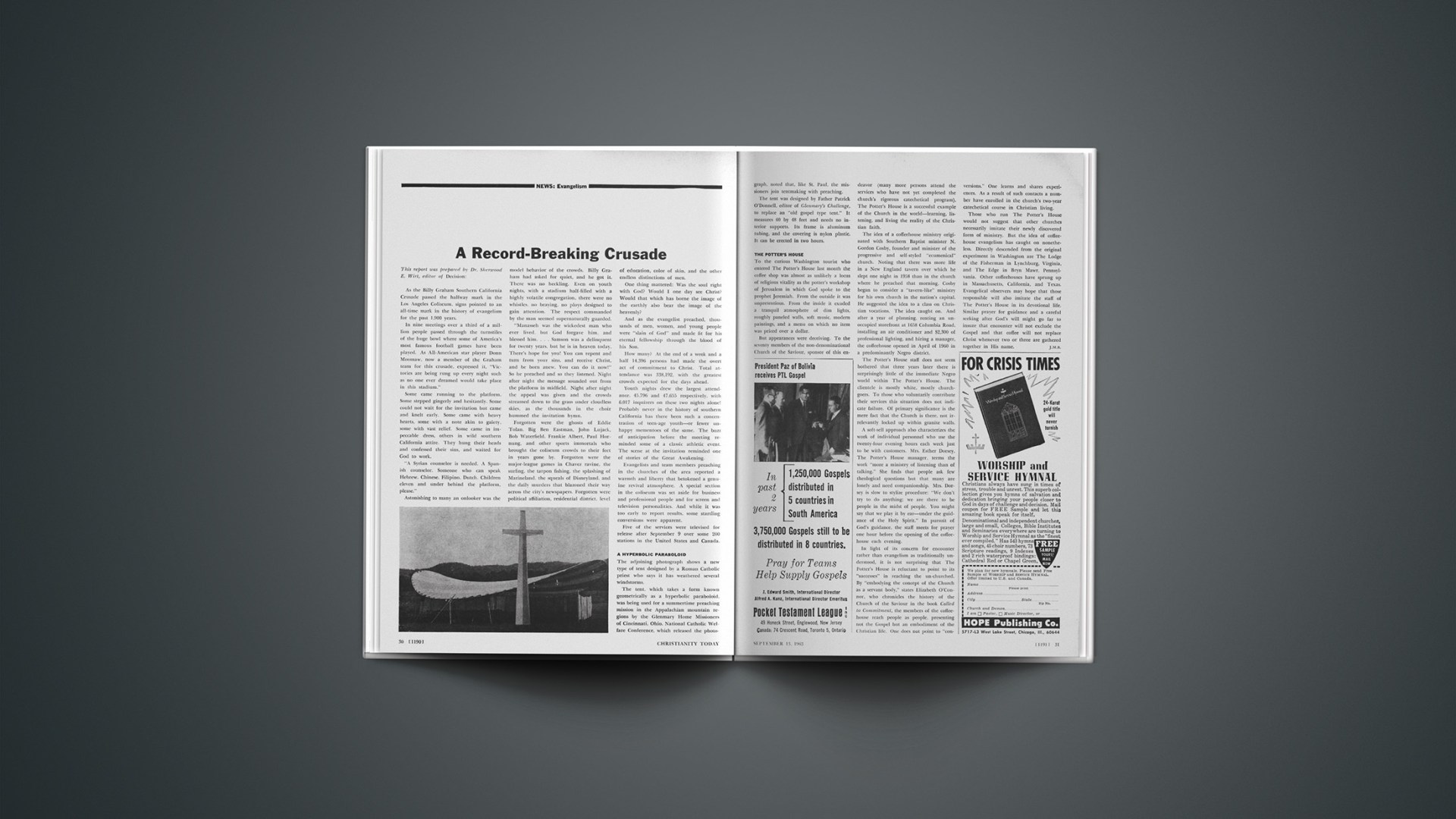
As the Billy Graham Southern California Crusade passed the halfway mark in the Los Angeles Coliseum, signs pointed to an all-time mark in the history of evangelism for the past 1,900 years.

In nine meetings over a third of a million people passed through the turnstiles of the huge bowl where some of America’s most famous football games have been played. As All-American star player Donn Moomaw, now a member of the Graham team for this crusade, expressed it, “Victories are being rung up every night such as no one ever dreamed would take place in this stadium.”

Some came running to the platform. Some stepped gingerly and hesitantly. Some could not wait for the invitation but came and knelt early. Some came with heavy hearts, some with a note akin to gaiety, some with vast relief. Some came in impeccable dress, others in wild southern California attire. They hung their heads and confessed their sins, and waited for God to work.

“A Syrian counselor is needed. A Spanish counselor. Someone who can speak Hebrew. Chinese. Filipino. Dutch. Children eleven and under behind the platform, please.”

Astonishing to many an onlooker was the model behavior of the crowds. Billy Graham had asked for quiet, and he got it. There was no heckling. Even on youth nights, with a stadium half-filled with a highly volatile congregation, there were no whistles, no braying, no ploys designed to gain attention. The respect commanded by the man seemed supernaturally guarded.

“Manasseh was the wickedest man who ever lived, but God forgave him and blessed him.… Samson was a delinquent for twenty years, but he is in heaven today. There’s hope for you! You can repent and turn from your sins, and receive Christ, and be born anew. You can do it now!” So he preached and so they listened. Night after night the message sounded out from the platform in midfield. Night after night the appeal was given and the crowds streamed down to the grass under cloudless skies, as the thousands in the choir hummed the invitation hymn.

Forgotten were the ghosts of Eddie Tolan. Big Ben Eastman, John Lujack, Bob Waterfield, Frankie Albert, Paul Hornung, and other sports immortals who brought the coliseum crowds to their feet in years gone by. Forgotten were the major-league games in Chavez ravine, the surfing, the tarpon fishing, the splashing of Marineland, the squeals of Disneyland, and the daily murders that blazoned their way across the city’s newspapers. Forgotten were political affiliation, residential district, level of education, color of skin, and the other endless distinctions of men.

One thing mattered: Was the soul right with God? Would I one day see Christ? Would that which has borne the image of the earthly also bear the image of the heavenly?

And as the evangelist preached, thousands of men, women, and young people were “slain of God” and made fit for his eternal fellowship through the blood of his Son.

How many? At the end of a week and a half 14,396 persons had made the overt act of commitment to Christ. Total attendance was 338,192, with the greatest crowds expected for the days ahead.

Youth nights drew the largest attendance. 45.796 and 47,655 respectively, with 6,017 inquirers on these two nights alone! Probably never in the history of southern California has there been such a concentration of teen-age youth—or fewer unhappy mementoes of the same. The buzz of anticipation before the meeting reminded some of a classic athletic event. The scene at the invitation reminded one of stories of the Great Awakening.

Evangelists and team members preaching in the churches of the area reported a warmth and liberty that betokened a genuine revival atmosphere. A special section in the coliseum was set aside for business and professional people and for screen and television personalities. And while it was too early to report results, some startling conversions were apparent.

Five of the services were televised for release after September 9 over some 200 stations in the United States and Canada.

A Hyperbolic Paraboloid

The adjoining photograph shows a new type of tent designed by a Roman Catholic priest who says it has weathered several windstorms.

The tent, which takes a form known geometrically as a hyperbolic paraboloid, was being used for a summertime preaching mission in the Appalachian mountain regions by the Glenmary Home Missioners of Cincinnati, Ohio. National Catholic Welfare Conference, which released the photograph, noted that, like St. Paul, the missioned join tentmaking with preaching.

The tent was designed by Father Patrick O’Donnell, editor of Glenmary’s Challenge, to replace an “old gospel type tent.” It measures 60 by 48 feet and needs no interior supports. Its frame is aluminum tubing, and the covering is nylon plastic. It can be erected in two hours.

The Potter’S House

To the curious Washington tourist who entered The Potter’s House last month the coffee shop was almost as unlikely a locus of religious vitality as the potter’s workshop of Jerusalem in which God spoke to the prophet Jeremiah. From the outside it was unpretentious. From the inside it exuded a tranquil atmosphere of dim lights, roughly paneled walls, soft music, modern paintings, and a menu on which no item was priced over a dollar.

But appearances were deceiving. To the seventy members of the non-denominational Church of the Saviour, sponsor of this endeavor (many more persons attend the services who have not yet completed the church’s rigorous catechetical program), The Potter’s House is a successful example of the Church in the world—learning, listening, and living the reality of the Christian faith.

The idea of a coffeehouse ministry originated with Southern Baptist minister N. Gordon Cosby, founder and minister of the progressive and self-styled “ecumenical” church. Noting that there was more life in a New England tavern over which he slept one night in 1958 than in the church where he preached that morning, Cosby began to consider a “tavern-like” ministry for his own church in the nation’s capital. He suggested the idea to a class on Christian vocations. The idea caught on. And after a year of planning, renting an unoccupied storefront at 1658 Columbia Road, installing an air conditioner and $2,300 of professional lighting, and hiring a manager, the coffeehouse opened in April of 1960 in a predominantly Negro district.

The Potter’s House staff does not seem bothered that three years later there is surprisingly little of the immediate Negro world within The Potter’s House. The clientele is mostly white, mostly churchgoers. To those who voluntarily contribute their services this situation does not indicate failure. Of primary significance is the mere fact that the Church is there, not irrelevantly locked up within granite walls.

A soft-sell approach also characterizes the work of individual personnel who use the twenty-four evening hours each week just to be with customers. Mrs. Esther Dorsey, The Potter’s House manager, terms the work “more a ministry of listening than of talking.” She finds that people ask few theological questions but that many are lonely and need companionship. Mrs. Dorsey is slow to stylize procedure: “We don’t try to do anything; we are there to be people in the midst of people. You might say that we play it by ear—under the guidance of the Holy Spirit.” In pursuit of God’s guidance, the staff meets for prayer one hour before the opening of the coffeehouse each evening.

In light of its concern for encounter rather than evangelism as traditionally understood, it is not surprising that The Potter’s House is reluctant to point to its “successes” in reaching the un churched. By “embodying the concept of the Church as a servant body,” states Elizabeth O’Connor, who chronicles the history of the Church of the Saviour in the book Called to Commitment, the members of the coffeehouse reach people as people, presenting not the Gospel but an embodiment of the Christian life. One does not point to “conversions.” One learns and shares experiences. As a result of such contacts a number have enrolled in the church’s two-year catechetical course in Christian living.

Those who run The Potter’s House would not suggest that other churches necessarily imitate their newly discovered form of ministry. But the idea of coffeehouse evangelism has caught on nonetheless. Directly descended from the original experiment in Washington are The Lodge of the Fisherman in Lynchburg, Virginia, and The Edge in Bryn Mawr, Pennsylvania. Other coffeehouses have sprung up in Massachusetts, California, and Texas. Evangelical observers may hope that those responsible will also imitate the staff of The Potter’s House in its devotional life. Similar prayer for guidance and a careful seeking after God’s will might go far to insure that encounter will not exclude the Gospel and that coffee will not replace Christ whenever two or three are gathered together in His name.

J.M.B.

The Schoolyard Becomes a Battleground

The little red schoolhouse seems an unlikely place for a showdown on major national issues. But the American race controversy has had many a classroom climax in recent years. This fall, a new cause for furor in the schoolhouse was to be found in the U. S. Supreme Court’s ruling against compulsory devotions.

It was not termed defiance as such, but as pupils resumed classes there were large pockets of resistance to the court ban.

Seventy per cent of the American public disapproves of the court’s decision, according to a Gallup poll published a few days ago. Only 24 per cent approves. Six per cent gave no opinion.

In Idaho, the practice of daily Bible readings was scheduled to continue as usual, according to D. F. Engleking, state superintendent of public instruction. Engleking said he saw no reason to change, “unless some court tells me otherwise.”

The Delaware State Board of Education, guided by an opinion of State Attorney General David P. Buckson, announced that Bible reading and recital of the Lord’s Prayer would continue in the state’s public schools. Buckson said the Supreme Court’s decision of June 17 banned religious exercises only in Pennsylvania, Maryland, and Florida.

The attorney general of Arkansas, Bruce Bennett, also advised the public schools of his state to continue devotional exercises. He said Arkansas law is permissive and “a far cry from that which was considered in the notorious Abington [Pennsylvania] case.”

Public school officials in Alabama were ordered by the State Board of Education to establish daily readings of the Bible as part of a prescribed course of study.

One of the most detailed analyses of the Supreme Court ruling came from Attorney General Edward Brooke of Massachusetts. Brooke’s twenty-two-page opinion contended that mandatory prayers, Bible reading in the form of a devotional rite, and compulsory religious ceremonies or exercises are unconstitutional. But he held that a voluntary period designated for “silent meditation”—not a “silent prayer”—would be consistent with the court’s stand. He stated that voluntary prayer, meditation, and even Bible reading not under official auspices, could be permitted in the schools.

“Students may gather in the classroom before supervised activities begin for the purpose of discussion, inspiration, or for other orderly purposes,” he said. “If entirely on their own initiative, these [students] decide to utilize that free time in devotion, that is their right.”

In other states, meanwhile, Bible reading and recital of prayers were eliminated without qualification. One such action was in Vermont, where four of the Board of Education’s seven members said they opposed the court ban but saw no alternative.

In Pennsylvania, group Bible reading and prayers were banned in public schools by Attorney General Walter E. Alessandroni. He said the practices would be illegal even if they had the approval of local school boards, teachers, or parents and even if children participated on a voluntary basis.

In the District of Columbia, Superintendent of Schools Carl F. Hansen said the idea that Bible reading is out of line “seems to me to be very clear.” He declared that opening exercises would consist of the Pledge of Allegiance “and suitable inspirational readings from poetry or good prose writings.” He said he would invite teachers “to help us prepare an anthology of suitable writings.”

Among the assortment of adustments was a decision by the board of education of Bloomingdale, New Jersey, to substitute the fourth stanza of “The Star-Spangled Banner” for the reading of the Lord’s Prayer in public schools. That stanza ends with the words, “In God is our trust.”

Earlier in the summer, state governors, gathered in Miami Beach for their annual meeting, voted 38 to 1 in favor of a resolution urging Congress “to make clear” the right of public schools “to have free and voluntary participation in prayer.” The single negative vote was cast by Democratic Governor Karl F. Rolvaag of Minnesota.

There appeared little hope, however, that Congress would pass any enabling legislation for classroom prayers. Some fifty-seven bills asking for constitutional amendment to permit public school devotions are bottled up in the House Judiciary Committee. A discharge petition designed to force discussion on the House floor now has about seventy-five signatures. To override the committee, 218 are needed. Democratic Representative Emanuel Celler, committee chairman, having indicated firm opposition to such an amendment, has refused to call public hearings.

The Supreme Court decision seems to have given atheism in the United States a new lease on life. Mrs. Madalyn J. Murray, avowed atheist and a chief litigant in the Bible reading-prayer case, says she now heads a group called Other Americans, Inc., which will build and operate an atheistic center near Stockton, Kansas. She says the center will include a university, radio station, publishing house, and home for the aged. It is to be built on an eighty-acre tract donated by Carl Brown, described as a nudist, atheist, and former Kansas legislator.

Mrs. Murray has charged that Roman Catholic nuns are teaching in some Kansas public schools. She says she will start litigation to halt the practice.

In Protestant ranks, meanwhile, there is a lingering measure of grass-roots unrest over the attitude of church leaders toward current church-state trends. In Pittsburgh, a group of twenty-one United Presbyterian churchmen, including several prominent ministers, issued a joint statement of concern.

“The recognition of God is a principle that the church should defend rather than oppose,” the statement declared.

The statement charged that the 175th United Presbyterian General Assembly “was in error in urging that Bible reading and public prayers be omitted as religious observances from public school programs.”

Ideas

The Power of the Truth

From a Communist country, where the people’s revolt in search of freedom was brutally crushed, a professional man sent this hopeful greeting: “However small the individual may seem among the factors that make up history, he is a factor nonetheless, and he can affect the very course of history. The great ideas and movements have grown from little beginnings, from improbably tiny beginnings. And these great ideas and movements are always set aflame by the realm of the Spirit, and never by the state.” How gratifying that not even the totalitarian tyrants can destroy man’s confidence in the power of the truth.

Yet we who live in the free world sometimes seem stilled and choked by the Communist climate, by the evolutionary temper, by the sensate spirit of our age, when we ought to be trumpeting truth and tidings to our times with courage and faith to stir new hope where the disgust of life now reigns. Sometimes even those who profess to be vitally interested in evangelical education seem skeptical of the power of the truth. If so, one may hope this sin is not visited upon our children and our children’s children.

We may fail our generation in many ways, but few failures will be as devastating as skepticism over the importance and power of truth.

We dare not underestimate Christianity’s stake in the truth. The Bible tells us that God himself is the Truth. Truth is not something independent of God, but the Logos is himself the ultimate originator and the ultimate definer of all reality. The Holy Spirit uses truth as a means of conviction and persuasion. The Truth has become incarnate and inscripturate. And the Truth, so wonderfufly revealed to us, is not simply to be known, but is also to be done.

At no time in Western history has so much depended upon the effectiveness or ineffectiveness of the Christian college as in our own day.

Why is it that Cuba, ninety miles away from our shores, can become the symbol of a world political crisis, while a Christian college or university a stone’s throw from a state university or secular college can be wholly overlooked? Why, if the Christian campus is really fulfilling its distinctive mission? Why are our distinctive views not mentioned in secular textbooks, not argued in secular classrooms, not even reflected on their reserve reading shelves? In the modern contest for the minds of men, why is it that our positions are ignored and disregarded? Why? Are we concerned simply to eke out our own academic survival as a Christian community? To maintain a mere holding-operation for the last scattered and surviving remnants of the evangelical view in educational circles?

Or do we understand that if Christ is Saviour and Lord we have a mandate to challenge and to claim all the spheres of learning and life? Do we really understand that the whole of culture soon glides into the service of antichrist, and in our century glides swiftly into enslavement by antichrist, when the dominant cultural forces are no longer effectively challenged and confronted by the claims of Christ? Do we really understand that in our time of transition none of the realms of culture—neither literature and the arts nor politics nor science nor education itself—long vacillates in the twilight zone of the worship of inherited ideas, but all render prompt obedience to new gods, and that we aid and abet this process by our withdrawal from the secular debate and dialogue of the day? In Germany after World War I, when students welcomed every attack on Christian supernaturalization in the chapels of the universities with sustained applause, Rudolf Eucken spoke a prophetic warning: that if Christianity were to lose the university mind and the laboring class in Germany, the Christian religion would be done as a force in national life. The generation after Eucken’s in the land of Luther was the generation of Hitler and the Nazis, of Eichmann and the slaughter camps. In American universities it is not the custom to applaud radical ideas: but it is stylish to absorb them. In this land of Roger Williams and Jonathan Edwards, are you asking yourself whose is the next generation if the university mind and labor continue to hold the Christian view of the world and life at a distance? Eucken saw that a nation in this predicament is only a stride from antichrist. We can hardly think that America has greater immunity to spiritual declension than did Germany.

We are all agreed, if we take Christian education seriously, that the Bible must be treated not simply as a memory object for a multitude of details of past history, important as that may be. The Bible must again become a revelation that provides a living resource of moral integrity and spiritual wisdom for all man’s days, and that supplies integration to the whole of life and thought, including the exploding areas of discovery in our own time. For the man or woman whose calling is that of Christian teacher, this awareness implies a heavy burden of responsibilities in respect to one’s discipline and one’s students.

A State Department career man remarked recently that the strategists seem so preoccupied today with the science of weaponry that they forget that persons are the ultimate weapons. What tragedy to have had in class the promise of a Kepler or a Calvin, a Moody or a Machen, and to have dulled that promise, or to have contributed nothing to his personal mission. Yet even the Christian teacher seeking to inspire students with a high sense of calling or vocation often does them an unwitting disservice. For the interest in vocation is translated wholly into present preparation for a future task, while all the while the student neglects his present calling as a Christian student. Unless he inspires young learners to see that while they are on campus they have a present calling, a divine vocation, as Christian students, the Christian teacher fails in his own vocation. Their future calling may be in doubt, but there must be no doubt about this calling, it is sheer calamity when a young person enrolls in a Christian college and is challenged by everything else—challenged to maintain personal piety, challenged to preserve evangelistic fervor, challenged to keep Lip church attendance (that is, challenged to do everything that being a Christian off campus already implies)—without being challenged specifically with what being a Christian on campus demands: the calling of Christian student. A campus that does not make this matter plain to students when they enroll, nor sustain it throughout their college years, not only dilutes its academic stature but evades a Christian duty.

Much of the student skepticism about the power of Christian truth follows upon the fact that too few teachers require them to earn their heritage, and too many are content if they simply parrot the inherited tradition. Our educational institutions are primarily concerned to keep the student clean morally (an ideal that often is mostly diluted to not doing certain things) and to shelter him from the pagan theories of the day. Now, education unconcerned for moral purity is a sham; it sacrifices the comprehensive character of truth, and it can lay no claim to be genuinely Christian. But students ought to know the commandments of God before they get to campus, if local churches and parents have done their job; the special purpose of a college is to sift out truth from error, to set the Christian view alongside its competitors, and to drive students to earn their heritage, not simply to memorize it. First and foremost the academic effort exists for the victory of truth. In the final analysis, neither spiritual nor moral victory is secure apart front the triumph of truth. Meeting this special responsibility of the Christian college lies not in ringing doorbells for Christ (although something is amiss about evangelical education if it dulls that desire, and fails to produce more competent evangelistic conversation); it lies, rather, in mastering the realm of truth and error. No amount of evangelistic zeal can compensate for the evasion or neglect of genuinely academic concerns. An institution that trains parakeets may be a devout bird sanctuary, but academic enterprise requires more than an assembly-line production of orthodox cheeps and chirps.

Here is tomorrow’s task force, charged to learn and to live by the light of God’s Word.

Does this young person in the classroom realize what it implies that God has privileged him with a knowledge of His Word as a student at a time when genuine faith no longer lights the path of most students in the academic world?

Does he realize that his being an evangelical scholar is a strategic divine step in our generation’s comprehension of the unity of truth in Jesus Christ?

Does he understand that a binding commitment to the Scriptures as God’s authoritative revelation—to the Logos as the first principle of all things (the Creator, the Redeemer, the Sanctifier, and the Judge of life) implies not only that Jesus Christ is the Saviour and Lord of one’s life, but that he is the only adequate answer to the persistent problems confronting human civilization and culture?

Does the professor set him an example—vocation for vocation—Christian teacher to Christian student—of a passion for the whole body of modern learning illumined and informed and integrated by the light of God’s Word? On this campus, if the faculty is true to its mission, an array of competent scholars will daily mirror the modern mind and allow the winds of modernity to blow full fury through these windows of learning, so that the student will feel the very pulse and heartbeat of the diverse and divergent credos of contemporary man. But is it sufficient—is it evangelical education—to imply that one can combine the modern faith with the faith once for all delivered to the saints? That is to say—and it is being said on church-related campuses whose Christian moorings are loose—that the apostolic and secular perspectives may be held alongside each other, provided only that the biblical view is not replaced; or that only the matter of personal salvation is important. Students and faculty, administrators and trustees are easily misled into this dangerous disjunction where there is no maturing to a Christian view of the totality of things.

Students trained in this climate appraise one facet of Christianity or another in a developmental or relativistic way, and readily accept an alternative to the Christian view under the pressures of scientism. Turn the classrooms of our evangelical colleges over to this atmosphere of learning, and the winds wafting over our campuses today will become the whirlwinds sweeping tomorrow’s once-evangelical institutions. For then Jesus Christ is no longer the Truth; rather, he is demeaned into some truth alongside other truths. Now there is a diversity of truths; the oneness of truth is gone, and the Logos no longer seen as the unity of meaning. Now truth is compartmentalized into separate, isolated realms. Evangelical education thereby lapses into the inner predicament of the world of secular learning—the university whose uni- is lost in diversity, and whose college is no longer a co-legio. The consequences of such evangelical default would be disastrous for the future of Christianity, as for the academic world generally. For the Word of God is deprived of a directive role in the world of learning. As Christian affirmations are attenuated to the tolerances of scientism, evangelical ambition is no longer seeking to guide the course of events by the sure light of biblical imperatives, but is content to escape demolition through isolation and shelter from the forces of antichrist.

Criticism and correction are a necessary task of Christian learning. But criticism and correction, according to Archbishop William Temple, reflect essentially a negative role in antithesis, and as such lack creative and constructive power. In history any forward movement, any true advance, comes with thesis (cf. Henry P. Van Dusen, God in Education: A Tract for the Times, New York: Charles Scribner’s Sons, 1951, pp. 89 ff.). By choosing between thesis and antithesis evangelical higher education indicates whether its interest lies only in defending its positions, or in realizing as well the triumph of the truth.

In the struggle for the minds of modern men, there are some feasible and practical ways to discharge evangelical dedication to the triumph of truth.

1. By pursuing full regional accreditation, all evangelical liberal arts colleges will assure themselves of at least minimal academic standards and will enable graduates seeking higher degrees to continue their work at outstanding secular universities.

2. Each fully accredited college could distinguish itself by specializing in a given field of undergraduate and graduate studies.

3. Cooperative summer institutes of graduate studies could offer concentrated studies in special areas, such as Christian philosophy, the philosophy of science, the philosophy of education, and so on.

4. Qualified evangelical scholars from both Christian and secular faculties can prepare joint literary symposia that are not only serviceable to evangelical colleges, but also acceptable in secular schools as “viewpoint books.”

5. Qualified evangelical authors in the various departments of learning must prepare textbooks for publication by standard secular publishers.

6. A rotating faculty selected cooperatively from several leading evangelical colleges could provide specialized instruction on several campuses at one and the same time.

7. A particularly strong evangelical college could develop a specialized institute of graduate research and studies.

8. An international, interdenominational Christian university is not only desirable but imperative.

9. Translation of evangelical textbooks into other languages would augment intelligent understanding and communication among evangelicals.

10. University extension campuses manned in part by mobile and in part by resident faculty could be established in countries like Japan, Switzerland, and India.

These are but some of the ways to realize evangelical dedication to the triumph of the truth. Let us be heartened by the fact that evangelical Christianity more than any other movement believes in the triumph of the truth. But let us be sobered by our failure to practice effectively what we believe in this regard. The three main cultural forces of our time are Communism, which believes in the triumph of the proletariat; political democracy, which believes in the triumph of representative government; and scientism, which believes in man’s triumph over nature. Christianity has always affirmed, and even in these turbulent times still affirms, the triumph of the truth. To assert that God’s interest in the triumph of truth is limited only to the life to come is as profoundly unbiblical as to insist that God’s interest in the triumph of virtue is entirely future. The final and complete vindication of truth and righteousness awaits our Lord’s return, of course. But it would be nothing less than tragic, even pathetic, were evangelicals to allow this sure sense of the far future to justify intellectual and social indifference, particularly when secular forces, imbued not with the true but with a false view of triumph, struggle day and night to conquer this world for their cause.

The Sins Of Sodom—1963

The sins of Sodom are the sins of the world today, and like the inhabitants of Sodom, we stand in danger of a far-reaching judgment by a holy God.

Had there been paperbacks in the days of Lot, we can imagine the shelves of newsstands and bookstores filled with books such as are to be found all over America today. Had there been movies, many of the current “realistic” and “adult” films would have been main attractions.

Lest we continue in a smug complacency, we will be wise to remember the words of our Lord; “I tell you … except ye repent, ye shall all likewise perish.”

The Ministry And The Church’S Consent

One anxiety voiced by independent evangelicals over the ecumenical movement is that through sheer size it may acquire coercive power over smaller constituencies. Churchmen making much of the corruptive potential of corporate power in social ethics seldom apply this thesis to the ecclesiastical realm. But the Bible is replete with illustrations of misuse of religious authority.

Evangelical circles are in fact not themselves immune from perils of the kind they sense in ecumenically inclusive agencies.

The World Council’s Faith and Order Conference in Montreal raised the subject of ecclesiastical controls in a variety of contexts. In plenary session the report of Section III on “The Redemptive Work of Christ and the Ministry” was challenged for its statement that “in any case the exercise of the special ministry requires the consent of the Church.” Dr. Hillyer H. Straton, pastor of First Baptist Church of Malden, Massachusetts, put the question: “Consent of what church? Should we understand the word ‘church’ with a small or a capital C?” Then he scored his point: “Roger Williams found himself driven into the wilderness because he would not bow to the ‘consent’ of a local church in Massachusetts. Under such control John Wesley would never have been able to make his witness that has so blessed the church. Nor could Dwight L. Moody have carried his gospel message around the world.” Dr. Straton noted that while the report acknowledged the guidance of the Holy Spirit, such a restriction actually constricts the Spirit’s work. He might have noted also that Jesus’ refusal to bow to the ecclesiastical authorities of his day was one of the factors leading to his crucifixion.

In Section III, devoted to the discussion of “Christ and His Church,” one delegate, emphasizing the answerability to the Church of all who are called to preach, declared that the World Council ought to curtail unaccredited seminary training that feeds into the “store-front churches”; he contended, moreover, that an ecumenical responsibility exists to make impossible the existence of such movements. Since the speaker was a Negro serving on the theological faculty of a Methodist institution, this display of intolerance was quite surprising. Dr. Eugene Carson Blake immediately countered the suggestion, declaring that the ecumenical movement must avoid any impression that by unity it intends a monolithic authoritarian structure that would repress all independent expression. While the wide variety of preaching is one of the prices the Christian church is paying for its divisions, he added, the Christion church must be willing to risk such possibilities.

In the years ahead questions such as church-relatedness and church-consent are sure to come in for increasing ecumenical discussion. It would be well for all Christian bodies, whether in or out of the ecumenical movement, to consider them both constructively and critically. The special ministry doubtless requires the Church’s consent in some sense. But no recourse should be taken against those who act without such consent. For preaching without the Church’s consent is but another aspect of the right of conscience, of the right to protest as well as to preach, and perhaps, in some instances, of the right to be wrong. It would be a worse wrong, however, to undo the right to preach by ecclesiastical force.

Scripture And Tradition: New Horizons

Recent developments indicate that on the questions of the authority of Scripture and tradition the World Council of Churches and the Roman Catholic Church may now be moving toward each other at clearly discernible if not rapidly accelerating rates. Some WCC leaders, enamored of modern theological traditions, had lost the Protestant concern for sola scriptura long before the admission of Orthodox bodies at New Delhi in 1961, with their renewed emphasis upon ancient tradition. At the Montreal Faith and Order Conference, for instance, sole traditione at one stage came near to replacing sola scriptura in the theological reports, and even in the final revision the Gospel was designated as the Tradition.

Within the Roman church, noted historically for its emphasis upon ecclesiastical tradition, a new feeling for Scripture appears to be emerging, involving (according to Karl Barth, who writes for the current issue of The Ecumenical Review) increased interest in the Gospels and renewed emphasis upon the Bible in the Church.

To the Christian who acknowledges the supreme authority of the biblical canon these developments are hardly reassuring. Despite the possibility of a renewed concern for Scripture within the church of Rome, the continuing centering of revelation within the teaching office of the Roman hierarchy restricts the freedom of the Word and discourages its critical application to prevailing doctrines. Within Protestantism, the World Council of Churches’ drift from sola scriptura evidences a progressive abandonment of crucial theological credenda.

Scripture does not tolerate coexistent sources of authority. The earliest mention of tradition in the New Testament—“the traditions of the Elders” (Matt. 15:1–14 and Mark 7:1–13)—soundly condemns all attempts to add the opinions of sinful men to the commandments of God. And Paul, who admonishes his churches to continue in the Gospel tradition, does so on the basis of that tradition itself being set forth in Scripture (1 Cor. 15:3). Traditions must not judge the Scripture. It is Scripture which shall judge traditions. Those who love the faith once delivered unto the saints can rightly deplore any position short of an authoritative New Testament canon and can see abandonment of sola scriptura as possible prelude to an eventual melioration of the Reformation’s other great and unfluctuating standards—sola fides, sola gratia.

The Washington March And The Negro Cause

With conflicting emotions Washingtonians watched from office windows as multitudes of demonstrators swarmed through their streets for the “march on” the nation’s capital. Were these the convulsions of a new age in which all Americans would freely recognize one another’s rights irrespective of color? Were they rather a portent of revolutionary mob pressures that presage the decline of a republic, and possibly a time of bloody violence?

Any sure answer to those questions seemed exasperatingly elusive. The massive demonstration was more orderly than its critics prophesied, less constructive than its champions contended (see news coverage, page 34).

But there were other questions not wholly without an answer.

What does the Negro want? What racial aspirations are legitimate and illegitimate? He wants only “what the white man has”—so the word goes. An easy reply is that nobody has the right to demand automatically what another qualifies to achieve. But there are larger considerations: has not the white American also set the Negro American an example of seeking economic equality and social status above all else? Assessed by such superlative racial aspirations as moral integrity, spiritual power, social justice, and creative contribution, how does the white American measure up? Is he now perhaps paying part of the penalty for setting an example of putting first things second? If the Negro mimics the white man, is the Negro alone to blame? And if the tide of history catches up with an accumulation of discrimination, is it wholly incredible that the Negro even thinks in terms of simply reversing the process of discrimination?

While Negro spokesmen have sought effectively to stir white conscience, the rising momentum of pressures and demands has also adversely affected some who normally would be sympathetic. In the military a new directive indicates that promotion will be based not simply on effectiveness of military command but also on efficiency in breakdown of racial discrimination in one’s sector—so that military officers are required to become agents of community sociological change. Although President Kennedy disavows a racial-quota approach to job appointments, some government departments have circulated a directive that no opportunities exist for the additional employment of whites, but that there are opportunities for Negroes. If jobs are filled on the basis of race proportions within the population, not on the basis of qualification alone, private business will be required to meet the same quotas once government accedes to such pressure. In view of the chronic unemployment problem, such demand for jobs on a racial basis, and the consequent cancellation of universal work opportunities, is likely to prove far more explosive than the integration of schools and communities. The groundswell of sympathy for Negro rights has a furrow of anxiety over what seems also to be a demand for preferential treatment.

From our tenth-story window view it appeared that the marchers were moving much too fast to accomplish their sociological objectives. There were two tragic elements to the Washington spectacle. One was the optimistic reliance of powerful ecclesiastical leaders upon political mechanisms to promote a new social order. The other was the failure of evangelical Christians at the grass roots to anticipate and help to resolve a crisis in the life of the nation along spiritual lines. All is once again quiet on the Washington front. But evangelical churches across the nation must look into the future and ask themselves what they can and must do to create a helpful and constructive interracial climate.

The massive demonstration was void of official evangelical representation. “Our folks are sympathetic with solving the race problem,” one top evangelical leader observed, “but we feel that this wasn’t the way to go about it.”

But what is the way? Have evangelicals offered any constructive, creative guidelines to curtail oppression of Negroes? Does it not bother the evangelical conscience that there are parts of the country where a traveling Negro cannot even find water?

Wcc And Religious Liberty

For five days just prior to the August meeting of the Central Committee of the World Council of Churches in Rochester, New York, a group of some twenty theologians and church leaders met in the same city to ponder the perennially knotty problems of religious liberty. The WCC Committee on Religious Liberty is to be saluted for convoking the consultation. Liberty of no kind is ever to be taken for granted. Moreover, some twenty centuries of Christianity have not arrived at a common solution of certain theological problems involved. And attending this inconclusiveness, all the while, has been a multiplication of historical problems as to application of theological principles to specific instances.

No finality was expected from the Rochester gathering—its discussions and findings were not for publication. For this was but the American version of a series of continent-hopping meetings—Europe last June, Asia and Africa hopefully yet to come—preparatory to a worldwide meeting of the Committee on Religious Liberty in 1964. Forthcoming from the latter is to be a final statement on the nature and basis of religious liberty as understood by Christians, which could be submitted for approval to the next Central Committee meeting in January, 1965.

The 1964 statement will doubtless be of major interest to Christians, and not alone because of the timely importance of the subject. For the World Council embraces within itself a rather staggering number of theological and ecclesiological traditions. Americans are reminded that their zeal for church-state separation is not shared by all. Greeks are reminded similarly with regard to forbidding of proselytism. Then there are the Russians.… And what is to be the stance toward Roman Catholic views in a day of ecumenical gains in relations with that church?

The problems arising from the current trend of Afro-Asian nations to adopt state religions deserve special attention.

The Rochester consultation discussed statements, many of them the fruit of previous WCC meetings, which form the concluding chapter of a newly released book, The Basis of Religions Liberty (Association Press, §3.75), by A. F. Carrillo De Albornoz, head of the WCC Secretariat on Religious Liberty. Points of agreement and points of difference among ecumenists are noted. Syncretism is banished in view of the uniqueness of Christianity.

Primary concern revealed thus far is the relation of Christianity to state and society rather than its internal relations, although one background paper touched on the New Testament view of heresy and its restraint. It is to be hoped that the 1964 statement will distinguish between a true liberty to be extended to all persons in the body politic and a false liberty which would allow error or heresy free entry into the Church. Such free entry results in the exit of true freedom. Such false liberty is the strangulation of true liberty, found only in the Gospel.

Choices

Choices are like the fork of a road. There is a point where there is no discernible difference between one road and the other, but once the decision is made and one is chosen it leads off to a different destination.

There is not a day but what all of us make choices—most of them of no great importance, necessary but not determinative to any great degree.

We all know that in creating man after His own image God gave to him the right of choice. No automaton, man has the privilege of decisions, even to the point of disobeying God’s commands.

But with this right of choice there exists man’s gravest responsibility. On choice human destiny depends. The Holy Spirit woos, the Gospel calls, the circumstances in which we find ourselves all combine in their effect, but man chooses, and from the human standpoint the die is cast.

We are all familiar with Lot’s choice. Confronted with the necessity of separating from Abraham because of a conflict of interest, and offered a choice between the rocky hills of the west or the well-watered and fertile valley of the Jordan, he chose the latter. This was based on personal advantage. Water has always been a problem in Palestine and an abundant supply, even to this day, difficult to come by.

But in the Jordan valley there is water in abundance, and the land brings forth an abundance of anything planted. For a herdsman this was like an oasis in the desert. It offered every material advantage. The one disadvantage was the wickedness of the men of Sodom.

Lot’s choice was obviously the one to make if personal advantage was to be the determining factor. He may have considered the evils of Sodom, but they did not deter him. In fact, he moved his family to the very outskirts of the city, later becoming a resident and apparently one of the “city fathers.”

Thanks to the record in Second Peter we know that Lot was a “righteous” man and became greatly distressed by the licentiousness of those about him.

But Lot’s choice did not affect him alone. The biblical account makes it clear that his children were deeply affected by the evil all about them; and his wife’s backward look was certainly in part an unwillingness to leave her home.

When did this family debacle begin? The day Lot made a decision based on personal advantage despite the moral dangers involved in that decision.

Centuries later the aging Apostle Paul, in a letter to Timothy, spoke of his former companion in labor: “Demas hath forsaken me, having loved this present world, and is departed unto Thessalonica” (2 Tim. 4:10a).

Demas made a choice, a choice between staying with the imprisoned servant of God and sharing in the opprobrium, hardships, and dangers of that situation, or exercising his freedom of choice and movement and going to the safety and attractions of the worldly city of Thessalonica. He chose the latter.

Many of our choices today are made at the point of personal pleasure. There is a way which seems narrow and there are crosses of self-discipline which, when looked at in the context of the immediate, seem so unnecessary. And there are so many attractive things in the world, things which appeal to the appetites and senses and which are indulged in by most of the people around us.

There are advantages which come solely from money, and we are often confronted by a choice which means more money and less of spiritual values; the decision becomes even more difficult if we sense a need for our children to have these advantages.

“This present world” probably dictates most of our choices. Seen from the standpoint of immediate advantage and without consideration of the ultimate effect, so many of our decisions seem natural, even “smart,” to the world; but they are utterly foolish in God’s sight.

Many choices are made on the basis of status—the regard and influence which will accrue to us whereby our place in the world will seem more important in the eyes of others. This can be a deadly choice because self-glory and not the glory of God becomes the dominating influence in our lives.

Choices are as varied and as numerous as the individuals who inhabit the world. While many avenues of choice fall into familiar categories, each person is confronted by the opportunity or necessity of making decisions which are personal. That the ultimate effect involves his relationship to God makes the matter of choice of such vital importance.

The Bible is replete with stories of those who exercised their right of choice, some to their undoing and others to their eternal good.

Basic to the matter of choice is the attitude of the individual. If the attitude is one of obedience to God’s revealed will, the choices will be for His glory and for our good. But if self comes first, choices can have a devastating effect.

The Apostle Paul points out how true Christians can make grievous mistakes of choice. Writing to the believers in Corinth he likens his own ministry to the work of a skilled master builder.

He affirms his own task as preaching Christ, the only foundation.

Then he speaks of the kinds of lives men can and do build on that foundation: “gold, silver, precious stones,” all materials which stand the stress of time and the testing of fire. Or “wood, hay, stubble,” none of which have any permanence in themselves, and all of which are subject to destruction by fire.

Paul then looks forward to the final day of testing and tells how some will be found to have constructed buildings which will endure, while others will have a life’s work wiped out even though they themselves are saved by the grace of God.

The far-reaching effect of choices will never be fully known this side of eternity. But it is our privilege to know the God of eternity and follow his revealed will.

Central to our decisions is the attitude of obedience. The first sin came through disobedience, and we dishonor God and amplify our own problems by the same route.

God has not left us without guidance. He guides through our prayers, his Word, the indwelling Spirit, circumstances—in a multitude of ways we can hear him saying, “This is the way, walk ye in it, when ye turn to the right hand, and when ye turn to the left” (Isa. 30:21).

If we will be honest with ourselves we will admit that the spiritual problems we now face usually stem from wrong choices. We have not listened to God’s revealed will. We have permitted a multitude of secondary considerations to influence our choices. Again and again we have looked back to a time and place in which we disobeyed God and went our own way.

Fortunately the grace of God is so great that even now we can make another choice—to repent, confess, and turn again to Him who can yet make all things new.

Apple PodcastsDown ArrowDown ArrowDown Arrowarrow_left_altLeft ArrowLeft ArrowRight ArrowRight ArrowRight Arrowarrow_up_altUp ArrowUp ArrowAvailable at Amazoncaret-downCloseCloseEmailEmailExpandExpandExternalExternalFacebookfacebook-squareGiftGiftGooglegoogleGoogle KeephamburgerInstagraminstagram-squareLinkLinklinkedin-squareListenListenListenChristianity TodayCT Creative Studio Logologo_orgMegaphoneMenuMenupausePinterestPlayPlayPocketPodcastRSSRSSSaveSaveSaveSearchSearchsearchSpotifyStitcherTelegramTable of ContentsTable of Contentstwitter-squareWhatsAppXYouTubeYouTube