Convention Circuit: Where Were the Giants?

The Montreal Faith and Order Conference, which gathered five hundred participants from fifty countries July 12–26, faced the World Council of Churches with the thorny question of whether to widen or relax the role of theology in its quest for church unity. In the first world theological study conference of its kind on the North American continent, the 270 delegates from 138 Protestant, Eastern Orthodox, and Anglican churches sensed from the outset that doctrinal issues may be cresting toward “a moment of truth” in the ecumenical movement. They hoped before the final days of their dialogue to clarify the ecumenical role of faith and order concerns.

Not a few ecclesiastical leaders saw Montreal as essentially “a holding operation” by delegates trapped between conference fever pressures to “say something manifesting unity” and the theological urge to probe doctrinal debate in depth. Dr. Franklin Clark Fry, chairman of WCC’s Central Committee, characterized the conference as “transitional” and stayed for two days. Anglican Bishop Oliver Tomkins of Bristol, England, later elected conference chairman, reminded the opening press conference that the World Council has been “trying to elucidate the causes of church disunity for twenty years.” The Montreal conference, he added, was “simply an incident in a long continuing process.… Faith and order is not the only nor even the chief effort in the ecumenical field.”

Delegates and sixteen observers from nine churches outside the World Council assessed reports summarizing the ten-year effort of four theological study commissions named at Lund in 1952 to explore Christ and the Church, Tradition and Traditions, Worship, and Institutionalism.

Most theological world giants were notably absent. Now in retirement, Karl Barth and Emil Brunner bequeath ecumenical participation to younger men, content to have given them “a pointer.” The conference sent greetings to Leonard Hodgson, long an active participant. Anders Nygren of Sweden towered above most theologian-delegates. Unconvinced that theology holds adequate scope in the structure of WCC, not a few European theologians point to the mass of theological research still undigested by the ecumenical movement, while program-planners continue to move from theme to theme on the edge of journalistic relevance.

Edmund Schlink of Heidelberg contributed one of the outstanding papers, but sent an alternate, deciding that Rome in September would be more important than Montreal in July. Oscar Cullmann and A. Koeberle were preoccupied, and T. F. Torrance of Edinburgh and Hendrikus Berkhof of Leiden wanted summer respite from the ecumenical circuit. Norman Pittenger and Otto Piper were absent, too. But Roger Mehl of France, N. H. Soe of Denmark, and Albrecht Peters of Heidelberg were among those who came.

Only a small number of American participants are widely respected by Europeans as theologians. Paul Minear, who went from Yale to the WCC Geneva staff for two years, Jaroslav Pelikan, J. A. Sittler, Floyd V. Filson, Walter M. Horton, G. M. Lindbeck, R. Johnson, Bernard Ramm, and C. J. I. Bergendoff were among the American contingent. A group of younger theologians took a competent part in discussions.

When questioned about “theological greats” one American delegate after another would apologize for the lack of “scintillating greatness” in his own denominational circles and point outside his own communion. The pragmatic temper of American ecumenism has been doctrinally debilitating. Ecclesiastical leaders continually ask how theological contributions serve “the cause of unity.” Theological interest is largely confined to such consensus as promotes ecumenism. The fortunes of dogmatic theology are at low ebb (Princeton’s bookstore no longer stocks Hodge’s Systematic Theology). Seldom are achievements in biblical studies worked out in relation to dogmatics and ethics. “What can we say together,” asked French theologian Mehl at Montreal, “to help the Church to manifest on the doctrinal plane, more clearly and more courageously than in the past, that unity in Christ whose mystery is already known to us?”

The Montreal conference got off to a hopeful, if anxious, beginning. Methodist theologian Albert C. Outler of Texas noted that “Faith and Order is a risky business.… We are never further away than two bigots from disruption or three diehards from a deadlock.” And he added: “In this conference and its outcome, Faith and Order is on trial.… On the one hand, our colleagues in the WCC must form a judgment as to our distinctive contributions to the ecumenical movement as a whole. On the other hand, a sizable number of ecclesiastical statesmen have thus far regarded our enterprise as rather more arcane than practical.… This conference is almost certain to tip the balance in the verdict as to what function we have to perform in the WCC and in the larger cause of Christian unity.”

This was the first time in eleven years—since Lund—that Faith and Order was speaking to some of its concerns. Consequently, any statement by the Montreal conference (overall cost: at least $150,000) was sure to be judged, not simply by its easy generalities reaffirming the urgency of the Christian world mission or the desirability of Christian unity, but by the presence or absence of new commitments and specific evidences of increasing theological and ecclesiological unity.

Bishop Tomkins, in his conference address, said he lacked courage to poll the delegates on whether they had read the advance theological reports. “I have long believed,” he added, “that one of the main effects of Faith and Order work lay not so much in its printed results (indeed I am rather skeptical about how far these laboriously produced volumes and reports are in fact very widely read), but in the transformation that it produces in the outlook of those who take part in person.” That turn of things gave theologians eager for theological revival in the local churches little encouragement. But the bishop urged that “within the structure of our organization” WCC make room for “such sustained, intensive, serious theological discussion as to justify us in asking the leading theologians of Christendom to give their time and energy to meet with one another on occasions which will vindicate themselves by their own inherent value.” There was a word also for church politicians aspiring to theological competence: “We may be in danger of developing a sort of stage army of ecumenical activists who, wearing different hats, dash about the world meeting each other in a variety of guises.”

Dr. Minear was hopeful that reflection on the study document “Christ and the Church” would issue in a statement elaborating “what WCC believes.” That document contained two unreconciled reports by American and European sections. Professor Ernest Kaseman, who with Eric Dinkler of Bonn gave ardent support to Bultmannian positions, deplored the fact that the European report was written from the standpoint of Cullmann’s salvation-history rather than of Bultmann’s existentialism. A similar plea for the mirroring of Bultmannian perspectives came from the conference chairman, Bishop Tomkins, in the opening address: “Are we in danger of developing a kind of theological provincialism in our Faith and Order work?… Certain theological voices that are speaking amongst us today have not been sufficiently attended to in our work in recent years. To name only one, the kind of thought associated with Professor Bultmann is not reflected in our studies as effectively as it should be.…”

Mobilization For Integration

O freedom! O freedom!

O freedom over me!

And before I’ll be a slave

I’ll be buried in my grave

And go home to my Lord

And be free!

Hands clapping, voices raised in song, the seven hundred pastors and laymen echoed Negro minister Andrew J. Young as verse after verse of the freedom song surged across the crowded auditorium. Some persons pondered the current racial crisis. Many yearned for measures which would successfully counter the swelling tide of racial and ethnic bigotry. The event might well have been a freedom demonstration in any one of a dozen Southern cities, but it was not. The setting was the Grand Ballroom of the Denver Hilton Hotel. The churchmen were predominantly white. And the occasion was the final evening session of the fourth biennial meeting of the United Church of Christ.

The event itself was not unusually significant, but it was expressive of a deeply felt need which had dominated the eight-day convention of the two-million-member denomination—a need for formative action in the current racial crisis. President Ben Mohr Herbster had taken the floor on opening day to set aside the scheduled program of events and to call for immediate and effective action in the race-relations crisis. “The situation present across America, the way in which … our Negro brethren are treated, economically, politically, and socially, constitute a blight from which we must be saved,” said Dr. Herbster.

“We have had too many words that changed too little. We must act, and we must act now.”

His proposals, approved overwhelmingly by voice vote of the delegates, called for uprooting of intolerance and bigotry in the life of the individual, universal integration of the United Church of Christ, mobilization of the manpower and means of the church for racial justice, establishment of a special fund to cover the cost of such a program, and prayerful dedication on the part of church members to the cause of justice and good will. President Herbster did not mention a specific total for the proposed fund, but a pre-convention document had suggested §1,000,000. By convention’s end $5,530 of this goal had been collected. In implementation of these proposals, President Herbster called for formation of a bi-racial committee which would direct the administration of funds and coordinate specific action in the struggle for racial equality.

The program was not allowed to rest only with the committee or with church officials. On Wednesday night soon after the singing of the freedom song, the newly formed committee for effective racial action, the Committee for Racial Justice Now, challenged the delegates to sign a pledge installing them in “The Fellowship of the Committed.” The pledge, signed by 580 of those present, committed the delegate to work for inclusive membership in his church, to seek for enactment of civil-rights laws, and to engage in non-violent demonstrations for racial justice when necessary.

The same night saw first defeat and then approval of a controversial measure which will require economic sanctions against dependent churches of the denomination if by July 1, 1964, they have not declared “a policy of openness without respect to race, national background or ethnic origin.” Rejected by a vote of 232 to 204 after an hour of heated debate, the proposal was subsequently revived and passed by a vote of 308 to 129. A number of those present declared that they had been swayed by the succession of Negroes who had risen to speak in favor of the economic sanctions and by President Herbster, who concurred, noting, “If we really mean what we say we mean … we must do this though we do it with a heavy heart.”

The General Synod took further steps toward racial integration by presenting citations for distinguished service in the cause of racial equality to Chicago Negro physician Dr. Theodore K. Lawless and to former Brooklyn Dodgers baseball star Jackie Robinson. The General Synod also elected a Negro woman, Mrs. Robert C. Johnson, to the post of assistant moderator for the next biennium. Dr. Gerhard W. Grauer, pastor of St. Paul’s United Church of Christ in Chicago, was elected moderator.

Other business on the agenda was a pronouncement on the Relation of Government to Freedom and Welfare submitted to the General Synod by the Council for Christian Social Action. This document, approved only after acute debate which extended through several sessions on the floor of the synod, declared that the Christian conception of freedom requires law and order but justifies civil disobedience whenever governments become “tyrannical or oppressive.” The document also tended to encourage government welfare, noting that “government must meet the changing needs of the people without being bound by the assumption that the growth of government is inherently a threat to freedom.”

One proposal particularly provoked the opposition of individual delegates and, in its final form, differed significantly from the original statement submitted to the synod. The original statement had declared the right of Christians and citizens “to safeguard the right of freedom of expression as guaranteed in the First Amendment, including the constitutional right to express opposition to our government or to advocate alternative political and economic systems without being intimidated and harassed by legislative or other instrumentalities of government.” The latent apprehension of many was further aroused when a member of the Council for Christian Social Action declared that “alternative political and economic systems” might conceivably include “communism or anarchy.”

In its final form, after this portion of the 147-line pronouncement had been repeatedly challenged and at last returned to committee for rewriting, the sentence read: “to safeguard the right of freedom of expression as guaranteed in the First Amendment of the Constitution of the United States, including the right within constitutional limits to express opposition or commendation to our government or to advocate peaceful change to alternative political and economic systems without being intimidated or harassed.”

On the second day of the convention the United Church of Christ took further steps toward Protestant consolidation by authorizing its delegation to the Consultation on Church Union to join with the Methodist, Protestant Episcopal, Christian Churches (Disciples), United Presbyterian, and Evangelical United Brethren representatives in a comprehensive plan of ecclesiastical union.

In further action by the 700-member General Synod, approval was given to a denominational emphasis for the next biennium on “The Church and Urbanization,” and authorization was accorded the Executive Council to establish the national headquarters of the United Church of Christ in New York City. The instrumentalities of the church, some of which have offices in Philadelphia and Cleveland, were urged to relocate at or near the national headquarters.

J.M.B.

The following report was prepared forCHRISTIANITY TODAYby Dr. George E. Failing, editor of The Wesleyan Methodist:

At its thirty-first Quadrennial General Conference, convened at Fairmount, Indiana, June 26-July 2, the Wesleyan Methodist Church of America reported modest gains in church membership and finances in North American conferences and phenomenal membership increases (10 to 1) in overseas conferences. National conferences were organized during the preceding quadrennium in Haiti, Central India Jamaica, and Puerto Rico.

Major changes made in the administrative structure of the church at the 1959 conference were solidly reaffirmed in the return to office of all general officers of the church and by endorsement of a continuing progressive program in establishing indigenous overseas churches, in implementing an aggressive evangelistic outreach at home, and in making financial provisions to secure a better-trained ministry.

Introduced on the floor of the conference, and received by the conference to be placed in the minutes, was a statement offered by five delegates from the North Carolina and South Carolina conferences: “The current social revolution that is sweeping the country is of grave concern to us. As Christians we cannot condone the strife that is resulting from racial unrest in our beloved Southland. Neither can we condone nor be a willing party to the heinous system of racial segregation that has so long plagued us. It is our firm belief that, as Christians committed to evangelization of the world, we must seek out and win our black brothers to Christ.… Central (S. C.) Wesleyan College has never refused admittance to a bona fide applicant because of race. Recently the Academic Committee unanimously went on record as being opposed to racial discrimination in the admission of students to Central.…”

The General Conference also adopted a resolution calling upon all Wesleyan Methodists to “respectfully petition legislative leaders to recover for us and the great majority of our people some adequate lawful redress from the growing inclination to ban from public life all worship of God and recognition of Him. We presume that such may require a constitutional amendment.…”

In other action, merger negotiations were reopened with the Pilgrim Holiness Church. Delegates ordered formation of a committee charged with preparing a merger plan, to be presented at the 1967 conference.

Vancouver, British Columbia—Delegates to the eighty-fourth annual meeting of the 85,000-member Baptist General Conference adopted a resolution calling for prayer for peace and support of reduction of armaments, “thereby lessening the tensions that lead to war.”

Joplin, Missouri—The Pentecostal Church of God of America went on record at its biennial General Convention as being opposed to the Supreme Court ruling against Bible reading and prayers as devotional acts in public schools. In another resolution, the 500 delegates declared their opposition to “every form of social violence resulting from both race and religious prejudices.”

New York—A resolution condemning the U. N. as a symbol of “idolatrous worship” was approved unanimously by nearly 85,000 Jehovah’s Witnesses at their International Convention. The resolution pledged that Witnesses would never worship an organization which “stands for world sovereignty by political men.”

Convention Chairman Milton G. Henschel cited a membership increase which makes the Witnesses claim to be one of the fastest-growing religious bodies. In 1939, he said, there were 41,000 Witnesses in 2,425 congregations in the United States, compared with a current total of some 308,000 in 4,708 congregations. Witnesses now claim a world membership of about 1,000,000.

MISSIONS STRATEGIST

The war made him a missionary. Beginning September 1, he will man the strategy switchboard for a global network of nearly 8,000 evangelical missionaries.

Edwin L. Frizen, Jr., newly appointed executive secretary of the Interdenominational Foreign Mission Association, got his missionary vision while serving in the Pacific with the Seabees during World War II. He was one of a group of servicemen who founded the Far Eastern Gospel Crusade. Following the war he and his wife served as missionaries to the Philippines.

Frizen, known familiarly as “Jack,” fills a post made vacant last year by the resignation of Dr. J. O. Percy. As administrative chieftain for IFMA, he will coordinate strategies and operations for 46 interdenominational “faith boards,” ranging from Arctic Missions, Inc., to the Soldiers and Gospel Mission of South America.

World conditions tend to be less forgiving of missionary policy blunders and disputes, which makes Frizen’s job even more strategic. One of his biggest challenges will be the possibility of closer cooperation with the Evangelical Foreign Missions Association, which represents the interests of 59 missionary boards with 6,500 missionaries. Some measure of cooperation has already been achieved between IFMA and EFMA, but the opportunities are broad. Discussions between the two groups thus far have been fruitful, as evidenced by the fact that they have scheduled their first joint retreat at Winona Lake, Indiana, this fall.
Great Britain: What Can One Say about Moral Decay?

A cartoon in a July issue of Punch shows a board meeting of the “British Travel Association” with one director asking in all apparent seriousness:

“Have we ruled out the tourist appeal of a decadent and dissolute society?”

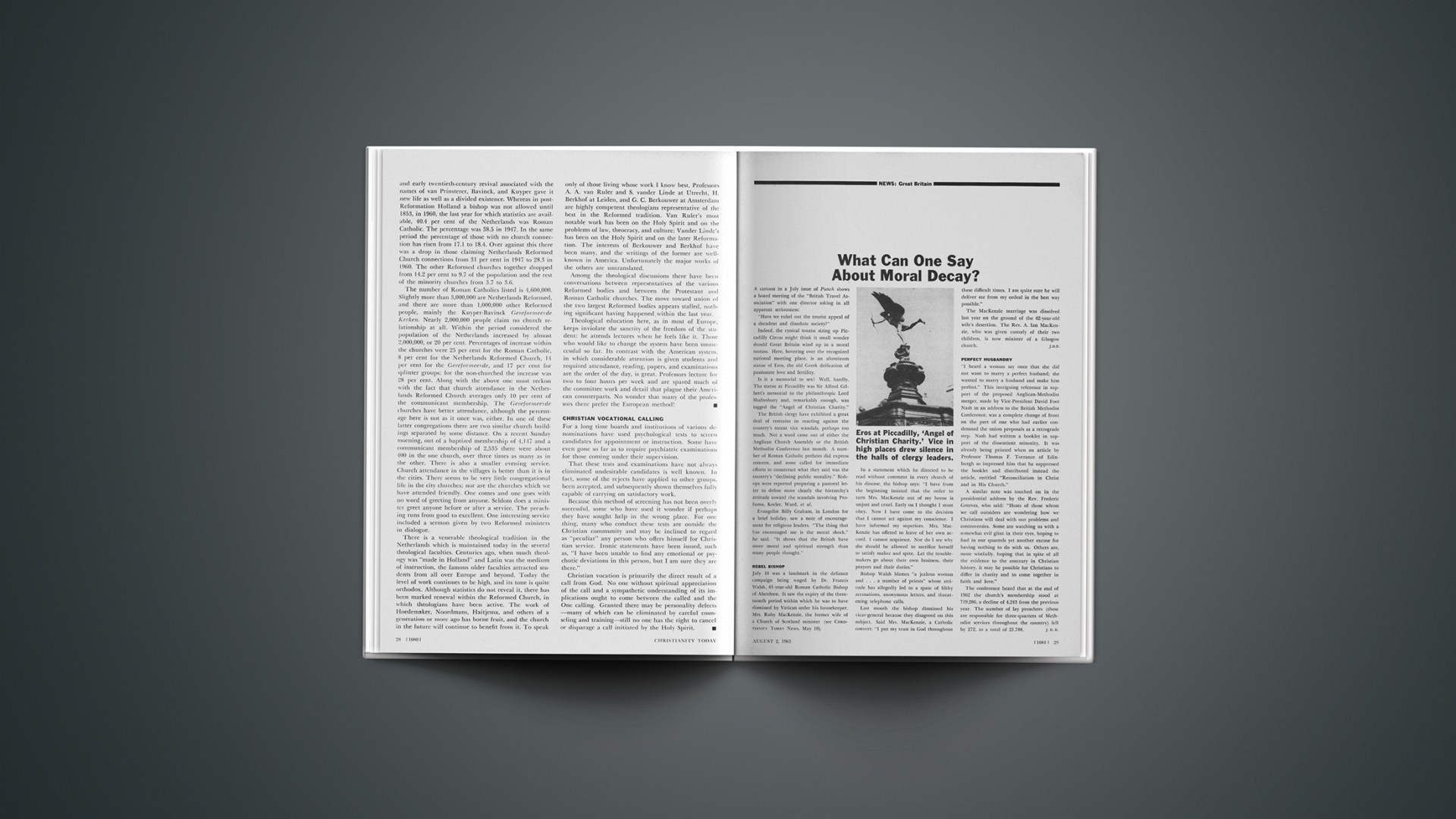
Indeed, the cynical tourist sizing up Piccadilly Circus might think it small wonder should Great Britain wind up in a moral morass. Here, hovering over the recognized national meeting place, is an aluminum statue of Eros, the old Greek deification of passionate love and fertility.

Is it a memorial to sex? Well, hardly. The statue at Piccadilly was Sir Alfred Gilbert’s memorial to the philanthropic Lord Shaftesbury and, remarkably enough, was tagged the “Angel of Christian Charity.”

The British clergy have exhibited a great deal of restraint in reacting against the country’s recent vice scandals, perhaps too much. Not a word came out of either the Anglican Church Assembly or the British Methodist Conference last month. A number of Roman Catholic prelates did express concern, and some called for immediate efforts to counteract what they said was the country’s “declining public morality.” Bishops were reported preparing a pastoral letter to define more clearly the hierarchy’s attitude toward the scandals involving Profumo. Keeler, Ward, et al.

Evangelist Billy Graham, in London for a brief holiday, saw a note of encouragement for religious leaders. “The thing that has encouraged me is the moral shock,” he said. “It shows that the British have more moral and spiritual strength than many people thought.”

Rebel Bishop

July 10 was a landmark in the defiance campaign being waged by Dr. Francis Walsh, 61-year-old Roman Catholic Bishop of Aberdeen. It saw the expiry of the three-month period within which he was to have dismissed by Vatican order his housekeeper, Mrs. Ruby MacKenzie, the former wife of a Church of Scotland minister (see CHRISTIANITY TODAY News, May 10).

In a statement which he directed to be read without comment in every church of his diocese, the bishop says: “I have from the beginning insisted that the order to turn Mrs. MacKenzie out of my house is unjust and cruel. Early on I thought I must obey. Now I have come to the decision that I cannot act against my conscience. I have informed my superiors. Mrs. MacKenzie has offered to leave of her own accord. I cannot acquiesce. Nor do I see why she should be allowed to sacrifice herself to satisfy malice and spite. Let the troublemakers go about their own business, their prayers and their duties.”

Bishop Walsh blames “a jealous woman and … a number of priests” whose attitude has allegedly led to a spate of filthy accusations, anonymous letters, and threatening telephone calls.

Last month the bishop dismissed his vicar-general because they disagreed on this subject. Said Mrs. MacKenzie, a Catholic convert: “I put my trust in God throughout these difficult times. I am quite sure he will deliver me from my ordeal in the best way possible.”

The MacKenzie marriage was dissolved last year on the ground of the 42-year-old wife’s desertion. The Rev. A. Ian MacKenzie, who was given custody of their two children, is now minister of a Glasgow church.

J.D.D.

Perfect Husbandry

“I heard a woman say once that she did not want to marry a perfect husband; she wanted to marry a husband and make him perfect.” This intriguing reference in support of the proposed Anglican-Methodist merger, made by Vice-President David Foot Nash in an address to the British Methodist Conference, was a complete change of front on the part of one who had earlier condemned the union proposals as a retrograde step. Nash had written a booklet in support of the dissentient minority. It was already being printed when an article by Professor Thomas F. Torrance of Edinburgh so impressed him that he suppressed the booklet and distributed instead the article, entitled “Reconciliation in Christ and in His Church.”

A similar note was touched on in the presidential address by the Rev. Frederic Greeves, who said: “Hosts of those whom we call outsiders are wondering how we Christians will deal with our problems and controversies. Some are watching us with a somewhat evil glint in their eyes, hoping to find in our quarrels yet another excuse for having nothing to do with us. Others are, more wistfully, hoping that in spite of all the evidence to the contrary in Christian history, it may be possible for Christians to differ in charity and to come together in faith and love.”

The conference heard that at the end of 1962 the church’s membership stood at 719,286, a decline of 4,243 from the previous year. The number of lay preachers (these are responsible for three-quarters of Methodist services throughout the country) fell by 272, to a total of 21,788.

J.D.D.

Ideas

What of Religious Tax Exemptions?

The problem of religious tax exemption keeps cropping up on the edge of various complaints: ecclesiastical abuses, increased community taxes following extensive exemption of church properties, spiritual concern lest the Church depend more on special privilege than on religious sources, and anxiety that secular resentments may climax in the expropriation of church properties—these are very real factors in the discussion.

The question of religious exemptions needs careful study. To focus attention only on chronic abuses that fire anti-church resentments or to overlook the fact that most church institutions and churches do not accumulate excessive properties would be far from adequate. Nor ought the inquiry to proceed merely on the edge of anti-Catholic criticism, for even denominations not under fire also can profit from asking how fully the Church’s strength depends upon tax benefits or what relationship exists between the Church’s spiritual vitality and its tax privileges. We need to probe what exemption does to the local church and how it affects community attitudes among the unchurched. Does the local church’s relationship to community tax burdens adversely affect the congregation’s position among fellow citizens?

At the same time such a study must also consider the reasons given for religious exemptions. Sometimes these exemptions rest only on an appeal to tradition, like the Model T Ford which was observed to function without a motor, simply on its past reputation. The argument from tradition often exhibits little power when it meets the challenge of uphill cultural opposition.

On the American scene religious exemptions, like those for educational and welfare purposes, are more often justified on the basis of their public benefactions. Deductions are granted to encourage voluntary support of those activities which contribute the ingredients of a virile democracy to the social order. This approach cancels the argument of those who caricature exemption as an indirect form of state support of religion; while churches in Europe get their allotment after taxes are paid, in the United States they are subsidized in the form of advance deductions. But more than this, support of the churches in the United States is not a matter of political decision. When individuals give material support to the church voluntarily, they actually incorporate a great deal of freedom into church-state relationships. On the other hand, the principle of public service could ultimately extend also to religious schools and hospitals, not only in respect to tax exemption of properties but also the deductibility of contributions or payments for tuition or medical bills.

The argument from public service does not really exhaust the rationale for religious exemptions, however. In a real sense tax exemption may be considered the obverse side of church-state separation. If the Church has no access to government resources, then it also merits exemption from the state’s ultimate power—and indeed, the power to tax could well be the power to destroy the Church’s activity in worship, education, and evangelism. It may be, therefore, that as denominations enter into enlarging partnership with government to fulfill objectives of benevolence and education, they unwittingly weaken their future case for tax exemption.

Current discussions on religious exemption stress three aspects of the problem: (1) exemption of properties used for worship and education; (2) exemption of real estate and investments maintained for income purposes; and (3) the bearing of proposed tax revision or reform on church contributions. Of these, the first is most defensible, since the Church’s freedom requires that its members be able to worship and educate in property that provides no occasion for taxing her out of existence.

When a church agency acquires far more land for a college or university than it needs, holds this land for decades on a tax-exempt basis, and later trades a section to city officials for an expensive downtown church site or makes some other lucrative deal, one can understand why citizens consider this an abuse of privilege unless capital gains taxes are collected. Wholly apart from such abuses, some cities are in difficult tax straits simply because of extensive religious property exemptions. Some cities, moreover, become headquarters for national denominational centers, and are thereby called upon in this era of ecumenical giantism to provide municipal services (including police and fire protection) wholly out of proportion to local affiliation. Some churches, thinking that as a matter of justice they ought to share in such a community burden, have ventured token voluntary contributions to the municipal tax budget. But few churches can afford to divert support from their essential purpose to a tax participation over and above that of their members as citizens. Further, it becomes legally difficult for a city to accept such funds unless a similar policy is enforced across-the-board on all other exempt agencies. Moreover, if the community becomes dependent on these anticipated revenues, good will becomes transposed into a permanent obligation.

The most grievous facet of today’s exemption debate really centers in something else, namely, in the Church’s deriving income from unrelated business activities that are tax-exempt. The General Assembly of the United Presbyterian Church in the U.S.A. in May urged repeal of the Internal Revenue Service code allowing “churches and church organizations” exemption from the corporate income tax on profits from “businesses unrelated to the purpose or activity of the church or church organizations.” When a religious institution runs a winery, or hotel, or department store, or parking lot, without the burden of paying real estate and income taxes, it operates at an unfair advantage over competitive enterprises and engages in something unrelated to its real mission, which ought therefore to be subject to the same taxes as its business competitors. The argument that exemption should be applied not in view of the source of these funds but rather in view of the purpose to which they are put can justify the Church’s entrance into any kind of business from soap to spaghetti. The situation of annuity boards is also under study, since they make investments or engage in credit operations to secure future income not for the Church but for their participants.

Revenue agents are disposed to take a long critical look also at independent non-church-related enterprises that are organized as non-profit—from Bible camps to religious presses—particularly where they show surplus funds and pay their founders substantial salaries. There are cases not only of religious racketeering, but also of lucrative private profits in everything from religious artifacts to beads and books. The growing tendency to review the tax-exempt status of independent efforts has produced a number of noteworthy complaints. For one thing, because larger denominations are better equipped to protect their enterprises against unjustifiable pressures, some independent church efforts may feel that ecumenically identified projects will receive favored consideration. Besides, there is harassment at the state level by overzealous or religiously bigoted collectors who lack adequate knowledge of federal laws. Roman Catholics are reported to have infiltrated some agencies and are thereby able to protect special ecclesiastical interests. Moreover, some revenue service personnel share the strange prejudice that unless a non-profit agency operates in the red, or shows but the barest profit, it is subject to suspicion. When this prejudice is pressed, it is well to look at other churches engaged in similar ventures and to ask whether they too are required or expected to show a loss. In any event, revenue officials will increasingly ponder the meaning of “church-related” during these next years; religious institutions that enter into general business operations for investment purposes while they enjoy tax advantages over secular competitors are due for closer scrutiny.

Another aspect of the exemption debate is the 5 per cent floor on religious contributions proposed by the Kennedy administration. While this proposal drew much criticism, won little enthusiasm, and is probably doomed, yet the need for remedial action to correct abuses ought not to be minimized. In some respects the standard unitemized deduction has encouraged abuses. In one town, for example, revenue investigators found that reported contributions to local churches ran five times the actual amount of church receipts. And the available public list of those who give more than $100 has its dangers, too, since it subjects contributors to potential pressures of many kinds.

The matter of religious exemptions has many facets. In fact, its problems are so numerous that the Internal Revenue Service has even considered disallowing all exemptions. Such a step, however, is politically unfeasible. Worse than this, to cancel all exemptions would be to encroach upon the Church’s freedom. The Church does not draw its life from the state, nor does it need or want state subsidy in order to exist. If church-state separation is to mean anything, then government must decide that just administration of its taxing powers requires both the recognition of legitimate exemptions and the correction of ecclesiastical abuses.

THE BROKEN STONE

Hast Thou not said

Thy stones in fairest colors

Shall he laid?

And am I not a pebble

Small and grey

Stone among stones

Upon a busy road?

Till one day, broken,

Thou did’st take me up

To smite the broken parts,

And lo, both fire and heat

Came forth in fair-hued flames,

In warmth none could have known

Was there.

RUTHE T. SPINNANGER

The Right To Do Wrong

Does one American have the right to refuse to do business with another on the basis of color? Although such refusal is legal in some states, before the bar of the nation’s conscience it is judged immoral. Respect for human dignity and belief in the equality of human rights run so deep in the American tradition that most Americans intuitively judge the refusal of a white to do business with a Negro as not merely un-American, but immoral.

The Kennedy administration will be leaning hard on the national conscience as it propels its public-accommodations legislation through Congress this summer. Without strong confidence in the moral conscience of the nation, the Attorney General could hardly hope for adoption of the administration’s civil rights program by an appeal to the Constitution’s declaration that “Congress shall have power to regulate commerce … among the several states.” Since the clause protects the commercial rights of one state against another, and neither was intended, nor has ever before been used, as a basis for protecting the civil rights of a person against another person, he seemingly expects moral even more than legal considerations to put the public-accommodations proposal through Congress.

While this national moral sensitivity is gratifying, and appeal to it politically effective, there is a fundamental question that ought not to be obscured. In the attempt to attain the morally ideal, it ought not to be overlooked that such attainment by legal prescription can itself be immoral. The core of this complex question is whether that form of morality which would legally secure equal public accommodations for both whites and Negroes should be achieved through legislation.

Good laws compel men to deal morally with each other. But there are obviously limits beyond which law cannot properly compel a man to moral behavior. A good case can be made that any business, large or small, licensed by the federal government or by a state, ought to be compelled by law to make its services equally available to all people. But it is a real question whether a private businessman ought to be compelled by law to do business with any citizen. The moral requirement is plain; legal requirement is another matter. The latter is surely sufficiently problematic as to allow for difference of opinion. Should not the law in this area allow a man the right to do what is morally wrong? Does the government have the moral right to legally enforce that moral behavior which will do business with anyone? Or, is this not an area in which practice should await a heightened national moral consciousness?

While no man has the right to be wrong before God, it is of the essence of a free democracy to acknowledge an area of personal relationships where a man has—so far as other men are concerned—the right to do wrong.

This is sometimes ignored by both Protestants and Roman Catholics, by both political liberals and extreme rightists. The attempt of Robert Kennedy to secure equal public accommodations on the ground of the clause governing interstate commerce rather than the Fourteenth Amendment, which deals with specifically human rights, tends to obscure the central moral issue, lending credence to the error that those who oppose the proposed legislation are prompted by malice. After all, human rights are other than state’s rights, and the matter of whites doing business with Negroes is more than a commercial transaction. We should sketch the shape of the basic moral issue, and keep it in full view.

Wcc Calls For Equal Footing

Can genuine ecumenical dialogue emerge between Protestants and Roman Catholics without the acknowledgment by each that the other’s church is an authentic expression of the one, universal church of Christ? It cannot, says Dr. Roger Mehl, of the University of Strasbourg, France. In a keynote address to the World Council of Churches’ Fourth World Conference on Faith and Order, held in Montreal, Mehl declared, “With regard to the ecumenical dialogue, the essential concept is that the churches should regard one another as belonging to the reality of the universal church.” And he added that if dialogue is to occur, “they must be on equal footing.” Such forthright declaration of position inspires confidence that the WCC is not willing to achieve unity with Rome too cheaply. This confidence is immediately undercut, however, by Mehl’s too great eagerness to see evidence that such recognition is already in the making.

As evidence that an “evolution” is occurring in Roman thought about the authenticity of Protestant churches, Mehl cites, first, that most Protestant observers at the Second Vatican Council were invited not as individuals but as representatives of their churches, and second, that Cardinal Bea designated them as “my brothers in Christ” and their baptism as something “stronger” than Protestant-Roman Catholic differences. While these facts represent a change of language and spirit—a change to be acknowledged gratefully—yet none suggests that Rome is even toying with the possibility of recognizing Protestant churches as equally “belonging to the reality of the universal church.” The equal footing said to be requisite for a true dialogue will require not more of such facts, but facts of another kind, particularly since the Vatican has made plain that none of the doctrinal substance of the Council of Trent will be surrendered.

What Mehl hopes to receive from Rome, he generously gave. He assured the five official Roman Catholic observers and the fifteen Roman Catholic guests that the churches of the WCC do regard the Roman church as an authentic church. The Vatican Council, he said, is regarded by “the churches belonging to the World Council … as an event which affects them all, because it really concerns the history of the true universal church.” This remark drew applause, indicating that many in his audience took an equally generous view of the Roman church.

How indeed can Rome provide the equal footing requisite for authentic dialogue—the acknowledgment of Protestant churches as a part of the universal reality of the one Church—without ceasing to be what she claims to be? Mehl saw possibilities of a solution coming from Eastern Orthodoxy. Since Orthodoxy entered the World Council in 1961, “it will no longer be possible to criticize the World Council for being essentially Protestant in its aspirations.” Moreover, the Roman Catholic Church does regard the Orthodox churches as churches in the real sense of the word. In addition, Orthodoxy’s rejection of a papal hierarchy is related to its doctrine of the Holy Spirit, and its conception of tradition also differs from the Roman conception because of its different understanding of the Holy Spirit. Mehl reminded his audience, too, that the doctrine of the Holy Spirit was not the strongest part of Reformation theology, and has indeed since been the occasion for a considerable amount of sectarianism in Protestantism. Given this situation, Mehl saw great potential in a three-way dialogue between Protestants, Orthodox, and Roman Catholics: since none has the whole truth about the Spirit, perhaps each, and especially the Orthodox, could light the way for the others, and thus all together find the truth about the Holy Spirit, and about themselves as churches.

If equal footing is the precondition for dialogue, the ecumenical movement seems pretty well without traction. Success seems to presuppose itself. For while there has happily been a change in the climate, the ground under foot seems as rough as ever. Perhaps at this point we could best say: Let us pray. For God has made “rough places plain” before.

The Feathers Have Long Been Showing

As this issue of CHRISTIANITY TODAY goes to press, the United States once again is facing the possibility of a crippling railroad strike. How ironical that this major home-grown crisis should arise at a time when our national prosperity is high and when our free-enterprise system is under constant critical and ofttimes unfriendly observation by other nations of the world!

This time the problem revolves around something popularly called “featherbedding.” The dictionary defines featherbedding as “… the requiring of an employer … to pay more employees than are needed for a particular operation.…” In whatever way the problem may be characterized, it is a matter of vast social and economic importance, bearing distinct moral overtones.

We have no wish to point a finger at one party to this controversy and say, “You are right,” or at the other and say, “You are wrong.” But the thing we do wish to highlight is that the root of this matter has been with us for a long time, and nothing has been done about it. If the point at issue is wrong now, it was equally wrong twenty, thirty, or more years ago.

If our people are to be forced once more to reap the bitter fruits of a railroad strike, there ought to be some compensation. Such compensation could be in the form of a voluntary review by both management and labor of the moral soundness of their rules of operation.

It is altogether possible that other pockets of inequity and public concern may presently exist in segments of our industrial complex. If so, why not begin to correct them now rather than wait until stark necessity forces one side or the other to take a hard position?

Perhaps featherbedding should have gone out of style with feather beds.

Demands Of Agape And Faltering Response

“If I were denied what our Negro citizens are denied, I would demonstrate.” So said Georgia-born Secretary of State Dean Rusk in a Senate committee hearing on proposed civil rights legislation. Implications of his statement reach to the heart of the race problem: the Adamic malady, which has echoed down the long corridors of time in its enduring resistance to the loving fellowship for which men were created.

True love is empathic. It is bound with those who are bound (Heb. 13:3). Standing in naked defiance of this is the doctrine of racial supremacy, all the more horrendous because biblical sanction is often sought for it. When the doctrine gains national eminence it compounds individual sin into a mass vacuum of empathic love. Involved are a stunning parochialism, an unbelievable provincialism, and an unutterable egotism, all the more terrifying because tolerated within the hearts of Christian people as a dark, blighting grief to the Spirit.

But in a society leavened to a degree by the biblical ethic, the claims of justice do not forever stand by while the claims of love are thus ravaged. The grim irony in it all is that many who are most vocal for individual liberty are, as indicated by proposed civil rights legislation, by their lovelessness pressing hard toward forfeiture of some of their own freedoms. And the freedoms of others.

Reformed Church Losses In Holland

Since pre-Reformation times the Netherlands has had an interesting ecclesiastical and theological history. The home of diverse emphases such as the Brethren of the Common Life and the Mennonites on the one hand, and Erasmus, Coornheert, and Arminius on the other, not to mention the Calvinistic majority in the center, old Holland manifested profound spiritual depth and an amazing theological productivity.

An interesting assessment of current trends in the theological life and outlook of the Netherlands has come to us in correspondence from Professor M. Eugene Osterhaven of Western Theological Seminary, Holland, Michigan, who spent part of the summer in Utrecht. We are glad to relay his observations below.

New Holland, in its complex life, still evidences spiritual depth and theological vigor, but the rapid growth of Roman Catholicism and the “acids of modernity” has in part altered the spirit and the appearance of the country. Eighteenth-century rationalism and nineteenth-century liberalism weakened the once powerful Reformed Church, although the nineteenth-and early twentieth-century revival associated with the names of van Prinsterer, Bavinck, and Kuyper gave it new life as well as a divided existence. Whereas in post-Reformation Holland a bishop was not allowed until 1853, in 1960, the last year for which statistics are available, 40.4 per cent of the Netherlands was Roman Catholic. The percentage was 38.5 in 1947. In the same period the percentage of those with no church connection has risen from 17.1 to 18.4. Over against this there was a drop in those claiming Netherlands Reformed Church connections from 31 per cent in 1947 to 28.3 in 1960. The other Reformed churches together dropped from 14.2 per cent to 9.7 of the population and the rest of the minority churches from 3.7 to 3.6.

The number of Roman Catholics listed is 4,600,000. Slightly more than 3,000,000 are Netherlands Reformed, and there are more than 1,000,000 other Reformed people, mainly the Kuyper-Bavinck Gereformeerde Kerken. Nearly 2,000,000 people claim no church relationship at all. Within the period considered the population of the Netherlands increased by almost 2,000,000, or 20 per cent. Percentages of increase within the churches were 25 per cent for the Roman Catholic, 8 per cent for the Netherlands Reformed Church, 14 per cent for the Gereformeerde, and 17 per cent for splinter groups; for the non-churched the increase was 28 per cent. Along with the above one must reckon with the fact that church attendance in the Netherlands Reformed Church averages only 10 per cent of the communicant membership. The Gereformeerde churches have better attendance, although the percentage here is not as it once was, either. In one of these latter congregations there are two similar church buildings separated by some distance. On a recent Sunday morning, out of a baptized membership of 4,147 and a communicant membership of 2,535 there were about 400 in the one church, over three times as many as in the other. There is also a smaller evening service. Church attendance in the villages is better than it is in the cities. There seems to be very little congregational life in the city churches; nor are the churches which we have attended friendly. One comes and one goes with no word of greeting from anyone. Seldom does a minister greet anyone before or after a service. The preaching runs from good to excellent. One interesting service included a sermon given by two Reformed ministers in dialogue.

There is a venerable theological tradition in the Netherlands which is maintained today in the several theological faculties. Centuries ago, when much theology was “made in Holland” and Latin was the medium of instruction, the famous older faculties attracted students from all over Europe and beyond. Today the level of work continues to be high, and its tone is quite orthodox. Although statistics do not reveal it, there has been marked renewal within the Reformed Church, in which theologians have been active. The work of Hoedemaker, Noordmans, Haitjema, and others of a generation or more ago has borne fruit, and the church in the future will continue to benefit from it. To speak only of those living whose work I know best, Professors A. A. van Ruler and S. vander Linde at Utrecht, H. Berkhof at Leiden, and G. C. Berkouwer at Amsterdam are highly competent theologians representative of the best in the Reformed tradition. Van Ruler’s most notable work has been on the Holy Spirit and on the problems of law, theocracy, and culture; Vander Linde’s has been on the Holy Spirit and on the later Reformation. The interests of Berkouwer and Berkhof have been many, and the writings of the former are well-known in America. Unfortunately the major works of the others are untranslated.

Among the theological discussions there have been conversations between representatives of the various Reformed bodies and between the Protestant and Roman Catholic churches. The move toward union of the two largest Reformed bodies appears stalled, nothing significant having happened within the last year.

Theological education here, as in most of Europe, keeps inviolate the sanctity of the freedom of the student: he attends lectures when he feels like it. Those who would like to change the system have been unsuccessful so far. Its contrast with the American system, in which considerable attention is given students and required attendance, reading, papers, and examinations are the order of the day, is great. Professors lecture for two to four hours per week and are spared much of the committee work and detail that plague their American counterparts. No wonder that many of the professors there prefer the European method!

Christian Vocational Calling

For a long time boards and institutions of various denominations have used psychological tests to screen candidates for appointment or instruction. Some have even gone so far as to require psychiatric examinations for those coming under their supervision.

That these tests and examinations have not always eliminated undesirable candidates is well known. In fact, some of the rejects have applied to other groups, been accepted, and subsequently shown themselves fully capable of carrying on satisfactory work.

Because this method of screening has not been overly successful, some who have used it wonder if perhaps they have sought help in the wrong place. For one thing, many who conduct these tests are outside the Christian community and may be inclined to regard as “peculiar” any person who offers himself for Christian service. Ironic statements have been issued, such as, “I have been unable to find any emotional or psychotic deviations in this person, but I am sure they are there.”

Christian vocation is primarily the direct result of a call from God. No one without spiritual appreciation of the call and a sympathetic understanding of its implications ought to come between the called and the One calling. Granted there may be personality defects—many of which can be eliminated by careful counseling and training—still no one has the right to cancel or disparage a call initiated by the Holy Spirit.

Sons of Unbelief

Unbelief is paralyzing the Church, destroying the effectiveness of Christians, and excluding men from the kingdom of God. It has been characterized as a “capital and fountain of evil,” and probably no generation more than our own has been guilty of this offense against God, an offense which goes to the very heart of man’s relationships with God and God’s revelation to man.

That unbelief is a grievous sin, an offense of the greatest magnitude, we are loathe to admit; but such is the case, and it rests as a pall across our world today.

We are prepared to accept the discoveries of science and to avail ourselves of the advantages proceeding therefrom, but only too often we ignore or reject the God of Creation. In so doing we live in a jeopardy of our own making.

Unbelief is based on man’s rejection of God’s revelation of Himself. It consists of evaluating Him by our own limitations and, yet more serious, sitting in judgment on God and his Word.

“Your God is too small” is an accusation which can be leveled at every human being, and in a very special way at those of us who have limited him by our own unbelief.

Unbelief stems from ignoring the nature of God—his sovereignty, power, omnipotence, omniscience, omnipresence, love, and mercy, to mention but a few of his attributes.

Probably our greatest mistake is a concept of God which, because of this age of science, rejects his supernaturalness and continuing miraculous manifestations.

Unbelief is seen in our treating prayer as a mere “pious exercise” rather than as a God-given privilege whereby the very battlements of heaven are stormed and captured for God’s glory and man’s immediate and eternal benefit.

Unbelief runs rampant as man ignores or rejects the clear promises of God. Not for naught has God filled his Word with specific promises and principles having to do with the contingencies and problems of life. By our neglect of these we make God a liar and lose immeasurable comfort and blessing.

Unbelief is highlighted as we forget that the supernatural God can and does act today in supernatural ways. What man considers “miracle” is merely God acting naturally, either within or beyond the capabilities of our understanding. Nowhere do we fail more than in our refusal to recognize the power of God, even though we cannot comprehend the scope of that power.

We live in a time when “honest doubts” are often considered an end in themselves, rather than a state which must be resolved by surrender to the Living God. “Lord, I believe; help thou mine unbelief” is still a valid prayer. The capitulation of Thomas’ unbelief in the affirmation “My Lord, and my God” is the only God-blessed end of doubt.

The Bible makes it clear that unbelief restricts the work of God. Confronted with Christ and his mighty works the people of his own country rejected him, and we are told that “he did not many mighty works there because of their unbelief” (Matt. 13:58). Unbelief is restricting God’s work today, an unbelief which gives to anything the priority in the place that is rightfully His.

The disciples found themselves powerless because of unbelief; only too often the Church and individual Christians find themselves equally powerless because they trust in man-devised methods and programs without reference to the Holy Spirit, who alone can make them effective.

Unbelief in the face of divine revelation in his day caused our Lord to “marvel.” How much more must he marvel at an age of sophistication and discovery which ignores the fact that creation itself is day by day and night by night declaring the glory of God and offering his handiwork for all to behold.

Our Lord’s resurrection was contrary to every man-accepted law of nature. But it was a glorious reality on which man’s hope of immortality rests. Because of their unbelief in the testimony of those who had seen him, Christ “upbraided them with their unbelief” (Mark 16:14). Does he regard an unbelieving world with any more tolerance today? The fact and presence of the risen Lord is a current reality, and to ignore or reject it insures to the unbelieving the righteous judgment of God.

One truth of desperate importance is that unbelief in no way invalidates the faithfulness of God. It is a grievous fallacy to hold that God’s truth is valid only as man accepts it. Paul meets this squarely in writing to the Roman Christians: “For what if some did not believe? shall their unbelief make the faith [or faithfulness] of God without effect?” (Rom. 3:3). A favorite pastime of some theologians is to argue the pros and cons of some of the key doctrines of the Christian faith as though truth could be converted into error, or the finality of God’s revelation held in abeyance pending man’s decision in the matter.

Abraham stood the test in a marvelous way. He was confronted with a situation and a promise impossible from a human standpoint. Faith in the faithfulness of God made him the “father of the faithful.” When tested about Isaac he acted with faith and obedience, “accounting that God was able.” How puny is our faith today! How far removed from an understanding of the God with whom we have to do!

Paul catalogues some of the acts of the “children of unbelief”—immorality, impurity, covetousness, filthiness, silly talk, and the like: “It is because of these things that the wrath of God comes upon the sons of disobedience” (Eph. 5:3–6).

Our day is characterized by just such a situation. Because of unbelief in the pulpits and in the pews, in the corporate life of the Church and in the individual lives of so many of her members, the world sees too few who exhibit the evidences of the living and indwelling Christ, who bear faithful testimony to his saving and keeping power.

The Bible records the exclusion from God’s presence of those who failed to “enter in” when the Gospel was preached to them, and rejected it by unbelief. That which He required of them and which he requires of us today is faith in who he is and what he can do.

But unbelief is not a binding state from which man cannot escape. Those who have become unshackled are legion and continue to develop as trophies of God’s grace. Faith can develop just as the light of day reveals things hidden by the night.

Faith does not have to be large, nor is it fully developed from the beginning. It is often the unspoken “Yes” to God, feeble but real, searching but honest.

True humility can be the first step from unbelief to belief, the change of attitude which enables God to reveal himself as he yearns to do.

Many of us know by experience that unbelief has faded away to be replaced by a quiet faith as we have yielded our minds and hearts in obedience to God’s revealed truth. Yielding has been the key.

Eutychus and His Kin: August 2, 1963

They Called The Pulpit Vacant

Last year, if my card index serves me well, I preached in fifty different churches; and every place I went they said, “The pulpit is vacant.” This could well be a comment on my preaching, and we can take that up on another day. What I am really worried about is who the take-charge guy is when a pulpit is vacant—especially who the man or woman is who is supposed to take charge of me when I appear on the scene.

Carnegie Simpson once said that you can change anything in the church except the order of service. This is not to say that the people are aware of what is going on in the church service. It simply states that if you change the order, it will be very noticeable and there will be great decibels of resistance. It happens, therefore, that when you show up at a different church every week, the odds are that you will cause flurries of excitement by being different—not because you want to be different, but because no one really knows how the service ought to be run. They only know when you run it the wrong way.

Try sometime to get anyone in the church to tell you whether the prayer comes before or after the offering. Even the deacons and the ushers will not know. And if you have some really interesting variations, such as baptisms or communion, you will probably get the answer I got in a country church once when I asked them to coach me: “Why, Reverend, we just have communion here the way they do in any church”—only they didn’t. In one church they brought the offering forward and put it on top of the organ, and I suppose the symbolism was that the organ was still to be paid for. For complete confusion, have candle lighting and the chiming of the hours. These things are very pretty, but it is hard to find the person in the church who knows exactly how they are done and the order of events.

When you give directions to strangers, they really are strange. And, incidentally, you might save them a parking place.

EUTYCHUS II

War

As a biblical pacifist I found the discussion “Is Nuclear War Justifiable” very ably presented by the two traditions (June 21 issue). Of the four reasons by General Harrison why nations are peaceable rather than aggressive, probably “they may be relatively so well off that they are satisfied with the status quo” fits our country best. But isn’t the present status quo a cause of war? The population of the United States is about one-sixth of the total world population. Yet we have one-half of the good things of life. If we are not aggressive in the war against hunger, we will be labeled by God as the aggressors in the war caused by hunger.

Just how can the “just war” doctrine subscribed to by Professor Stob defend a war fought to maintain an unjust status quo?

Editor

Missionary Bulletin

Blountstown, Fla.

I question the decision that William Harrison reached when he extends the guilt of aggression to an entire populace when that people has no opportunity, as we know it, to choose its leaders and is kept under control by a hardened core of fanatical rulers who will not tolerate interference with their goals. If it be true that “a ‘moderate’ nuclear attack on the territory of the United States would kill half the population, destroy 75 per cent of its buildings and 90 per cent of its intellectual and material possessions,” as Lippman puts it in the June 24, 1963, Newsweek, then as Henry Stob declares, the nations of the world simply must learn to live together. Even a passively approving citizenry in the U. S. S. R. should not be the target in a nuclear war whose outcome will affect all of mankind in one way or another. The next war might indeed be a war to end all wars!

St. Paul, Minn.

The defects in our culture have not been exposed as anti-Christian; rather there seems to have been a rationalistic attempt to use Christianity as a means for defending our culture as it is without trying to change it.

The Methodist Church

Norway, Iowa

General Harrison is a great man, to be sure. But can anyone imagine Jesus Christ taking a gun to defend himself, or his disciples?

Berlin Bible Church

Narrowsburg, N. Y.

Dr. Stob states Jesus’ words, “All who take the sword shall perish by the sword.” You would say that Dr. Stob is a pacifist. But he states he is not. For instance, if Canada would want to take Michigan from us he would be in favor of war. He states that war is not illegal. So the text he quotes does not fit here. But when a thermonuclear war would come, he would favor not to fight.… Why is it, if minor issues are involved we may fight, and when God’s cause, God’s church is to be or not to be, we may not fight?

Oak Lawn. Ill.

I suppose Mr. Stob feels his hands are clean because he has denounced “general thermonuclear war” on the one hand and at the same time insisted that we must not “deliver ourselves into Mr. Khrushchev’s hands.”

Perhaps Mr. Khrushchev will consult Mr. Stob to learn what “premium” he and others are willing to pay for freedom before Mr. K. would even consider waging a nasty, “impermissible” nuclear war. Mr. Stob could then assure Mr. K. that the price of our “self-determination” is too high. This, of course, would not “deliver the whole world into Russian hands.” It would merely be an open invitation to Mr. K. to come and take the free world at little cost to him.

If a “general thermonuclear war” is able to destroy the “spiritual treasures of mankind,” then we Christians can have no part in such a “wicked act.” We need merely to give up our freedom and entrust our “spiritual treasures” into the kind hands of Mr. K.

Second Congregational

South Peabody, Mass.

In effect, this thesis would urge that whenever tyrannical violence is able to arm itself with nuclear weapons, the legitimate use of the sword (the punishment of evildoers, the protection of the upright) must be discontinued. Accordingly, the prospect of life under law is to be abandoned whenever it seems probable that the life of the sword-bearer may be conterminous with that of the predator. It would seem to follow that, should Righteousness persist in joining the battle with Evil beyond this critical point, Righteousness is to be forcibly silenced. Where the choice is to be Humanity or Principle, Principle will be expected to yield in the interest of existence under the best terms which can be arranged with the Tyrant.… Such phrases as, “makes sense,” “serviceable to meaningful social ends,” “a lasting peace settled on the foundation of justice,” and “the technical, cultural, and spiritual treasures of mankind” would seem to indicate that Mr. Stob’s deepest interests are more congenial with the longevity of man than with the glory of God.…

Where the sword is the Lord’s and vengeance is his, and where he seeks that vengeance by the hand of those to whom he has delegated his authority, then even that sword is justifiable whose use leaves God standing alone upon the scene of the holocaust envisioned by Mr. Stob.

Signal Mountain, Tenn.

The Christian, it seems to me, is faced with the possibility of a nuclear war or the certainty of mass murder, an unrelenting attack of manifold prongs on religion, the enslavement of mankind, and the determined effort to enslave the soul of all of our children.…

To me it is unreasonable to say that a nuclear war would destroy mankind. No one has any intention, and there would be no need even in a nuclear war, of seeing that every section of the globe is saturated with nuclear bombs. For example, Khrushchev would not waste any bombs on Central and South America, unless we had nuclear bases there—and in that case he would aim only at those bases.

Harding College

Searcy, Ark.

Spare The Laymen!

The June 7 issue devoted to “Preaching” was thought-provoking and well done, as one has come to expect from CHRISTIANITY TODAY. But Editor Glendon E. Harris of Concise magazine might better have written on the subject “Preacher, Spare Us Laymen.” If a preacher enters the pulpit without having given proper time to the preparation of his message to his congregation, he has no one to blame but himself!

Having been in the pulpit almost as often as I have been in the pew, and at the same time leading an active business life, I have gained some idea what a preacher’s life is like and what the pew should expect from the pulpit. Far too many sermons are hardly more than a group of quotations from several authors orderly or hastily put together, revealing that the preacher either had his secretary dig out of his library or files items she thinks would fit into his sermon or he himself had done so. There was little or no evidence of any real thought and preparation given to the message. How much of our present-day pulpit ministry is biblically rooted and relevant to our times?

For twenty-six years I conducted a half-hour radio Bible-study program, of which eighteen to twenty minutes were devoted to the spoken message. On no occasion did I give less than eight hours of preparation and study for each message. The same holds true for any pulpit preaching I have done. Of course it has meant getting up early in the morning and going to bed late at night. But what preacher is true to his calling if he does not do the same thing?

Our Lord said, “Go ye into all the world, and preach the gospel to every creature.” That is the preacher’s primary task. In so doing, it is imperative to make the preaching of the Gospel relevant to our day. Our Lord and his disciples did; likewise all powerful preachers have done so. No preacher should allow anything to interfere with the time required for preparation and study for his pulpit ministry.

One Saturday evening I wanted to verify a statement I had heard some years previously regarding G. Campbell Morgan, whom all informed ministers acknowledge was “the prince of expositors.” If I could have verified the fact, I intended to include it in my radio message the following morning. I promptly thought of Dr. Bonnell, who at that time was the minister of the Fifth Avenue Presbyterian Church, in which church I had in past years often heard Dr. Morgan preach. I telephoned his home, apologized for disturbing the household at that hour of the night, when Mrs. Bonnell said her husband was in his study at the church. I telephoned the church, reached Dr. Bonnell, expressed surprise that at 10 o’clock at night he was still in his study at the church, on the eve of his Sunday ministry. He answered that he often was in his study at that hour on a Saturday night. He gave me the answer to my question. I was glad I had telephoned him, for I learned the statement I had heard was not correct. But I was even more impressed that a city preacher, occupying an important pulpit, was still in his study at 10 P.M. on a Saturday evening.

While on the subject of preaching, it is a well-known fact that many men in the secular and governmental field use ghost-writers to prepare their talks, but no preacher has a right to be so busy that he must employ ghost-writers for his sermons. Imagine Paul, or John, or Peter doing anything of that sort.

What is more, preachers ought not to “palm off” as their own what actually was the work of someone else. A distinguished Princeton Theological Seminary scholar and theologian told me last summer of two such instances. A research assistant for a well-known preacher called on this gentleman to refresh his memory of something he had heard this professor give in one of his classes. The professor gave it to him. The next Sunday he heard this well-known radio preacher give word for word (as his own) what this theologian gave to his former student.

On another occasion this same gentleman, arriving somewhat late, sat in the rear of a church on a Sunday morning. The preacher occupying the pulpit gave one of the professor’s sermons, word for word. It was not until after the service was over that the preacher discovered the professor was in the audience. With much embarrassment, he acknowledged to him what he had done! So I say, “Preacher, Spare Us Laymen.”

New York, N. Y.

The Sword … And Gideon

In your recent issue you ran a series of articles on “Ministering to the Military” (May 24 issue).… I failed to find any mention of the Word as placed by and through the Gideons International.… Just for the record … according to the last figures I received … 15,885,175 New Testaments have been distributed to members of the armed forces. We could give to you hundreds of testimonies received of men who have found the blessed Saviour or had their spiritual life strengthened through reading them. And even I am an example of this.… The need of the world for His Word is so great, and we do so need the prayers and support of the Church in this work.

Morristown, Tenn.

I have just left my duty as a Destroyer Squadron Chaplain, and I greatly appreciate your sending CHRISTIANITY TODAY aboard my ships. Many of the officers and men expressed to me their enjoyment of the issues. While the magazine is scholarly, and many of the articles technical, it had wide circulation. Needless to say, CHRISTIANITY TODAY stuck out like a sore thumb among the various magazines found in the average ship’s wardroom—and was a testimony by its very title.… All in all, I devour each issue, and my faith is strengthened by your evangelical stand.

Station Chapel

Beaufort, S. C.

The Gracious Days

It was a pleasure to read the review of Spurgeon: The Early Years (May 24 issue). One of the few book investments which I made at William Jewell College was the four-volume edition of the autobiography. That with a set of The Treasury of David given to my father by Mrs. Spurgeon are prized possessions.

Just one tiny correction in the review. Mr. Robinson writes: “In his final illness the attention of the civilized world was contered on him ‘in column after column of almost every newspaper.’ Opinions about him varied. ‘The sauciest dog that ever barked in the pulpit’ was one.”

The opinion quoted is recorded in such a way that the impression is given that it was made during his final illness. Actually it was made many years before, while he was new in London.

To those of us who have made a lifetime study of all that pertained to Spurgeon the present interest in his life and ministry is most gratifying, and it would be still more gratifying if we could see repeated in Britain the gracious days when Spurgeon preached. A few years ago I stood on the now vacant site of the New Park Street Chapel and tried to visualize the scenes when crowds milled around the chapel trying to gain admittance.

This writer is the son of a Welsh Baptist minister who died in my infancy. Later he spent seven and a half years in Spurgeon’s Stockwell Orphanage and was later a member of the Tabernacle.

San Diego, Calif.

Calvin As Cleric?

With the highest regard for your distinguished contributor to “Current Religious Thought,” I must dissent from his statement that “John Calvin was always a layman, never an ordained minister” (June 7 issue). Against this universal negative, there are the following considerations: Calvin began his service in Geneva as professor of sacred letters. Shortly thereafter he was made pastor and, in replying to Sadoleto, declared, “I accepted the charge having the authority of a lawful vocation.” In Strasborg, he was the regular pastor of the congregation of French refugees. He was recalled to be the chief pastor in Geneva, where he exercised all the functions thereof, preaching the Word, administering the sacraments, ordaining officers, presiding over the Venerable Company of Pastors. As the minister of worship, he led the congregation in their common confession of sin and followed the same by a prayer for or a declaration of absolution. Likewise, on occasion he heard private voluntary confession and pronounced absolution, for “the ministers are ordained witnesses and sponsors to our consciences of the forgiveness of sins” (Institutes III, iv. 12). Thomas Cranmer, Archbishop of Canterbury, recognized Calvin as properly fulfilling the ministerial functions with which he was occupied in Geneva by inviting him to share with other evangelicals in composing a Protestant consensus creed.

Moreover, Calvin designates the minister of the Word as the most useful office in the Church (Institutes IV, iii. 3), favors the ordination thereto by the laying on of hands (IV, iii. 16), and with qualification is willing to call this ordination a sacrament (IV, xiv. 20). Then Francis Junius, who came to Geneva before Calvin died, stated in 1608 that those who preceded Calvin ordained him to the ministry.

Decatur, Ga.

Pilgrimage From Rome

The negative is well applied in the title of Mr. John J. Moran’s article, “What I Don’t Understand About the Protestants!” (May 10 issue).…

I was surprised, really, to see the name of John Henry Newman brought forth, once again, in the best tradition of a Roman Catholic college undergraduate, but Mr. Moran might just be interested to know that, according to a study published some thirteen years ago, ten Romans are received into the Episcopal Church in this country, every year, for every one lost to Rome.

Trinity Church

Brooklyn, Conn.

Reflecting On An Option

If all the energy of all the people that is used to try to save the world for the people, instead were used to save the people for the Lord, the world would not be in the fix it is in.…

Phoenix, Ariz.

Albright On Errancy

At the request of my friend, Dr. Dewey M. Beegle, I am writing with reference to his recent book, The Inspiration of Scripture. In general I like it, though sorry to see such a brief Epilogue—otherwise excellent. The author tells me that the publishers deleted most of the positive matter he had included.

I dislike the terms “error” and “inerrancy,” since they now often mean “mistake” and “infallibility.” “Error” formerly meant “losing one’s way, wandering,” and was applied to misguided deviation from sound doctrine; it is now used also for simple mistakes in oral and written transmission, editing, copying, translating, etc.—all inseparable from our human condition, to which God condescends (used in its proper meaning). Actually mistakes resulting from change of meaning are nearly as common as other classes of “error.” For instance, many years ago I heard an address by the pastor of the Moody Church in Chicago, reputed to be a converted prizefighter. He stated with superb dogmatism (using this word in its current meaning) that God had created the world and had then destroyed and recreated it. The evidence? In Genesis 1:28 the King James Version says that God had commanded man to “replenish the earth.” In current English this verb means “fill again.” So it must have been filled once before! RSV agrees with the Hebrew as well as with the Elizabethan sense of “replenish,” rendering simply “fill.”

There are many passages in the New Testament which appear to take opposite sides in doctrinal controversies: e.g., Romans and James on faith. Today there are few theologians who are disturbed by the superficial conflict between faith and works, which belong together in “dialectic tension,” like predestination and free will, and so on. Such tension between opposites (now the basis of Niels Bohr’s famous law of complementarity) is the glory of the Bible, which must be taken as a whole; the Old Testament stands in judgment on the antinomianism resulting from arbitrary choice of proof texts in the New, and the New Testament reminds us constantly to follow the spirit, not the letter (Rom. 2:29; 7:6; 2 Cor. 3:6).

Historical tradition in the Bible presents us with similar cases. Without different, even divergent, accounts of men and events we cannot see personalities and movements in perspective. In other words, we should not have the stereographic effect inherent in the very nature of biblical tradition, which preserves differences, even when they seem to be in direct contradiction. In short, we cannot have a historical revelation of God without transmission through human channels. If we follow the trend today and replace such revelation by existential decisions of individuals, our loss is immeasurable. But we cannot deny the Bible its historical humanity without an equivalent loss in rejecting the humanity of “the Word made flesh.”

Johns Hopkins University

Baltimore, Md.

Ministers Of Tomorrow

Your editorial “The Lag in Christian Experience” (April 26 issue) was greatly appreciated for its emphasis upon the “theological giants” such as Luther, Calvin, Owen, Athanasius, and Wesley whose “luminous gifts to the devotional life of the Church … shine as lights from the past.”

In a recent issue of Time, attention was given to the “ministers of tomorrow” now in their respective seminaries. The article stated that many of these future ministers are deeply skeptical towards the Church and that the contemporary theological giants Barth, Tillich, and the two Niebuhrs are the primary subjects in the classroom. No honest critic of these men can deny the fact that they are serious, dedicated scholars attempting to discover some of the answers to the “human predicament.” However, this is what demands our attention: these seminary students need to be referred back to the “lights from the past” in order to avoid falling prey to the contradiction of relativism. The majority of these students have perhaps read “about” the men of the past and all the contemporary criticisms of their irrelevance to the present age, but they do not go directly to their actual works and evaluate them by what they originally stated. This is certainly contrary to genuine scholarship.…

These future ministers … appear to be completely neglecting the fact that they are going to be ministering to congregations of people deep in “sin” (call it existential conflict if you please). Have these divinity students categorized the experience of St. Paul as irrelevant subjective nonsense, or are Christians still supposed to be able to declare, “For I know whom I have believed, and am persuaded that he is able to keep that which I have committed unto him against that day”?

Bethany, Okla.

For Missionary Societies

Perhaps you can convince various missionary societies to appropriate funds for the provision of TV transmitting and receiving equipment for every tribe and nation in order that the event might be hastened and so that not one single eye shall miss it.

Louisville, Ky.

Assessments

I would like to acknowledge my sincere gratitude for CHRISTIANITY TODAY. With one’s mail box clogged with the jaundiced journals written by men with the “courage of their confusions” and foisted upon pastors and other Christians as “Christian literature,” it is indeed refreshing and rewarding to be able to look forward to CHRISTIANITY TODAY’s fortnightly visit to my study.…

Most religious periodicals are either “boiled watermelon” or caustic soda. Thank you for one that’s both palatable and pungent. Perceptive evangelicals are grateful for and proud of a journal of your calibre and convictions, and its interesting, irenic, and intelligent presentation of the “faith once delivered to the saints”.…

Memorial Baptist Church

San Diego, Calif.

Since we have spent 48 years as a minister and teacher and since a portion of our education was in secular universities, we have learned to be somewhat tolerant, and so we do feel that it is good to know what others think of us, even though we know they are badly mistaken. Therefore, quite largely, in the interest of full religious tolerance, we have decided to spend another five dollars, primarily for the purpose of having a part in your work.…

Avon Park, Fla.

With each issue I have developed an increasing respect for CHRISTIANITY TODAY. I consider it one of the finest, if not the finest, and most helpful of current religious periodicals to reach my desk.

Please accept my renewal subscription for two years and my most heartfelt thanks for your untiring efforts to keep us abreast of the religious thought and challenge of our day.

The Methodist Church

Carrabelle, Fla.

Your magazine is increasingly worthwhile. It deserves my support rather than silent, ungrateful acceptance.

First Methodist Church

Green Bay, Wisc.

I won’t try to tell you how really great I think your magazine is … you’d think I was just trying to soft-soap you into a price reduction.…

The Union of Churches

Almond, N. Y.

In the major denominations the conservatives need rallying standards. CHRISTIANITY TODAY is helping to meet that need.

Ocean Gate Methodist Church

Ocean Gate, N. J.

With neoorthodoxy, liberalism, sectarianism, it is rather precarious sailing for even those who have been born again from above, and let me say here … it is CHRISTIANITY TODAY with its sane, conservative and scholarly approach that helps me steer a straight course.

The Presbyterian Church in Canada

Rose Bay, New Dublin, and Conquerall, Nova Scotia

As long as I have §5, I shall never drop my subscription to your magazine. This sort of publication has been sorely needed for years. With tears in my eyes, I have thanked God for bringing it into being. I have a copy of every issue you have printed.… Because you have intelligently and sanely presented to the world the conservative, evangelical viewpoint, scores of ministers (who have been teetering on the edge of neoorthodoxy and outright liberalism) have been won over to that position.

First Baptist Church

Pine Mountain, Ga.

CHRISTIANITY TODAY means a great deal to me.… Because of a serious eye condition there are many things that I cannot read now. I am so thankful that the magazine that helps me most can still be read.…

Colonial Heights, Va.

I read CHRISTIANITY TODAY regularly, and use your book reviews in helping me select the books I want to purchase for my library.…

Oak Grove Baptist Church

Covington, Tenn.

Your magazine is appreciated and widely read by all who use our library.

Librarian

The Foreign Mission Board of the Southern Baptist Convention

Richmond, Va.

I find the magazine most helpful to me. Also, when the copies are placed in the waiting rooms at the clinic after I have finished with them, the patients seem to enjoy reading them a great deal also.…

Drew Clinic

Drew, Miss.

CHRISTIANITY TODAY is a disappointment. Instead of meeting the need for a realistic confrontation of the dialectic-socialization of the Church by the power-movement centered in the NCC—The World Church, it is going into competing dialectics, in the realm of greater orthodoxy. But doctrine-theology is not the issue: it is the dialectic smoke screen that covers the mundane. Real-Politik; as truly as was the Church-position faced by Luther.…

Evangelical Congregational Church

McKeesport, Pa.

It seems to me that your magazine would be more forthright if it added to its masthead these words: “A magazine for the purpose of discrediting anything or anyone connected with the National and the World Councils of Churches.

Columbia-Union Presbyterian Church

Columbia, Ky.

The chief goal of CHRISTIANITY TODAY is to please everyone including the devil.…

Canoga Park, Calif.

To my mind, CHRISTIANITY TODAY, despite the fact that it has managed to entice a few of the “big name” theologians to write for it, is simply a sophisticated version of American fundamentalism: bibliolatrous, theologically narrow, ethically backward.

Pottstown, Pa.

The attitude of some of your correspondents will keep you from every worry about Luke 6:26. Therefore, let me suggest a saying that is more apropos: “Take heart when you are lambasted by extremists on both sides of the theological barricades.”

First Baptist

Kittaning. Pa.

I have been a subscriber … for years.… I am a retired Lutheran pastor (Augustana). I retired mid-year in 1960 at the age of 79. Even though I do not see quite as well as I would like, I simply cannot shut CHRISTIANITY TODAY out of my life. It has become too much a part of my trying to keep up with theological and other trends of the present times.…

Niagara Falls, N.Y.

Your magazine has been … of tremendous value and encouragement, and not to me only, but to many of my fellow pastors in the former Augustana Lutheran, now Lutheran Church in America.…

Minneapolis, Minn.

I can no longer restrain myself from writing to protest the inane babble that so often fills the pages of your journal. Issue after issue is replete with pseudo-intellectual jibes at “liberalism” or some other mythical enemy of the Christian faith. When will Protestantism cease this adolescent bickering, which in itself is the epitome of sin?

Columbia Baptist Church

Cincinnati, Ohio

CHRISTIANITY TODAY is scholarly, yet it is inbreathed with a heart of Christian charity.

Studio City, Calif.

I do very much appreciate the magazine. You are publishing a very high-grade periodical. I do not always agree with your theological viewpoint, but I do like to read the other side. We should all be open-minded.… I … have ministerial standing in both the Unitarian and the Congregation-Christian denominations.…

Aberdeen, S. Dak.

Though I am not such a strict evangelical as some of your contributors appear to be, I cannot help being challenged and stimulated by the articles.… They are clearly presented and argued with conviction and sustained by biblical evidence. I have gotten fresh angles on a number of points.…

Peradeniya, Ceylon

I consider it probably the best conservative, evangelical religious journal in the field. I am more liberal in my theology and philosophy than is indicated by most of the articles in your journal. However, I like to read a journal which is more conservative, providing it is based on good scholarship and sound reasoning. Your magazine is not as extreme as most conservative journals. Moreover, you give reports of the ecumenical movement and of church life in general which are not found elsewhere.…

Salisbury, Mass.

You win—never thought I’d give in! I was a Christian Century man. “He who perseveres—succeeds.”

Avenal, Calif.

I do not agree with most of your ideas.

Bauxite, Ark.

Please send out my subscription to CHRISTIANITY TODAY so as I can pick you people apart till hell freezes over and the Kingdom of God comes to us.

Philadelphia, Pa.

Of the 100 or so periodicals which come to this house CHRISTIANITY TODAY is easily my favorite.

Penticton, British Columbia

May I say that there is no periodical that I read with greater anticipation than CHRISTIANITY TODAY. I feel you have conferred upon the English-speaking public of the world an outstanding benefit.

St. Paul’s Cathedral

London, England

Christian Responsibility to Contemporary Literature

Briefly put, the argument which I wish to promote is this: (a) that eventually every category of human endeavor, the writing of plays and novels included, must come under the leavening touch of Christianity; (b) that the Christian public can accelerate this leavening if they will participate enthusiastically and with intelligent discrimination in the experiences which the best of modern literature provides; and (c) that some of the confusions which cause the public to turn its back on modern writing can be removed by an understanding of where and how the leaven works.

These confusions, it seems to me, have three sources. First is the suspicion that there exists some fundamental antagonism between Christianity and the creative process. Another is the notion that the vision of life which underlies much recent writing is spiritually barren and therefore unrewarding. Third, there is the vexed question of the relation between literature and morality.

Christianity And Creativity

One thoughtful commentator has this to say about the relationship between Christianity and human creativity:

“For the poets the scandal of Christ is his asceticism. The very element of their experience as men, is the gamut of human living, emotions, drama. ‘Man’s resinous heart’ and the loves, loyalties, the pride, the grief it feeds—these are the stuff of poetry and the sense of life. And the Cross lays its shadow on this; it draws away all the blood from the glowing body of existence and leaves it mutilated and charred in the hope of some thin ethereal felicity. The wine of life is changed to water.… The ‘dramatic caves’ of the human heart and imagination are renounced for some wan empyrean of spiritual revery.… The refusal of religion by the modern poet and by more than moderns and by more than poets, goes back to the apparent denial of human living by religion, to the supposed incompatibility of life with Life and of art with faith” (Amos Wilder, The Spiritual Aspects of the New Poetry, p. 196).

The key phrase is “supposed incompatibility.” Just as the leaven does not destroy the meal but rather alters its chemical essence, so Christianity does not deprive the writer of his subject, man’s “resinous heart” with its “dramatic caves,” but enables the writer to bring to bear upon his work and his life a transcendent ideal which will help him to make sense out of both. And if we accept the idea, as it seems to me we must, that literature, like all the arts, is a technique which creative human beings have evolved down through the centuries as an instrument to aid them in their need to find patterns of order, ultimately of value, in the flux of day-by-day experience, then not only is there no genuine conflict between art and faith: there is an indissoluble connection welding them together. The principle which allows us to interpret experience in a meaningful way is not to be found in experience itself but outside and above it.

The Shaping Vision

The vital relations between Christianity and the shaping vision which underlies any play or novel or poem are outlined by one critic as follows:

“We have said that the work of literary art is a special sort of linguistic structure that traps the attention intransitively; but we have also argued that the intransitivity of the reader’s attention is not absolute. The literary work is a trap, but it is a trap that is oriented toward the world of existence that transcends the work—and the work is oriented by the vision, by the belief, by the ultimate concern of which it is an incarnation: its orientation, that is to say, is essentially religious. And this is why criticism itself must, in the end, be theological” (Nathan A. Scott, Jr., “The Collaboration of Vision in the Poetic Act,” Literature and Belief, p. 133).

Last summer, after reading this passage for the first time, I sat down to fabricate a tool of analysis which would enable me to dissect recent novels and plays in order to discover how much of the leaven may be found at work in the author’s vision of life. What I came up with is this: Each literary work projects a world of people and events much like our “real” world, and just as our world has a distinguishable character because of the nature of the forces which created it, so has each literary world a specific character; by analyzing that character we can infer, though only indirectly, to be sure, the shaping forces, the ultimate concerns of the writer in the act of writing his book or play.

Let me illustrate with Steinbeck’s East of Eden, a modern retelling of one of the oldest of stories—man’s attempt to rediscover and re-enter the Garden of Paradise. Steinbeck erects his plot on five verses in the fourth chapter of Genesis, that very familiar passage in which Cain and Abel bring an offering to Jehovah. The crucial verse is this one: “If thou doest well, shalt thou not be accepted? and if thou doest not well, sin lieth at the door. And unto thee shall be his desire, and thou shalt rule over him.” The word “him” here refers not to Abel but to sin, and the Authorized Version thus promises that man shall someday gain dominion over sin.

The Hebrew verb rendered “thou shalt rule” by the King James translators is timshel, and one of the important characters in Steinbeck’s novel, Lee, the Chinese servant in the Trask family, begins to suspect that buried in that one word is a key to the conquest of human evil. He consults with a group of Chinese scholars about it, and after two years of study they conclude that timshel ought to be translated “thou mayest rule,” not “thou shalt rule.” East of Eden is an attempt to dramatize the difference. One gives the promise of victory; the other gives only the chance of victory, thereby making man totally responsible for his destiny.

Full analysis of the novel will reveal what the above paragraph merely suggests, that the shaping vision behind it is thoroughly humanistic. Thus, since the teachings of Christianity are unalterably theistic, we conclude that there is only a modicum of the leaven at work here.

What We Can Give

But this discovery, it would seem, is not nearly so important as our response to it. Shall we, upon finding only minimal traces of primitive Christianity, turn away from recent fiction and drama because it is materialistic, is spiritually sterile and dry? We probably shall, as many have, if we approach literature primarily in terms of getting something from it—moral inspiration, say. But if we approach it in terms of what we can give, of what we can bring to it in the way of clear thinking and strong, ethical affections so as to enter into a positive, give-and-take transaction with it, keeping in mind that in time every sort of human activity must feel the impact of Christian concepts, then we shall turn not away from contemporary literature but toward it.

This distinction between getting and giving is even more important when we consider the connection between literature and morality, a subject made enormously complex by the number of elements which it comprises. We may speak, for example, of the relationship between the writer and his novel or play and hold up for inspection the idea that only a morally good man can produce a good book. Or we may come at the topic from the other side and examine the relationship between a book and its readers, and here there are a number of things to be distinguished: the words, obscene or not; the behavior of the characters, moral or not; their ideas, evil or not; and the vision of life which forms the entire book, true or not.

Salinger’s Catcher in the Rye may be taken to illustrate these distinctions. Because it contains offensive language, instances of censurable behavior, and a number of reprehensible ideas, many readers would label it an immoral book. But in doing that they may have overlooked the most significant scene in the novel, the one which provided its title, in which Holden explains to Phoebe his vision of standing in a rye field full of small children to guard them from plunging over a cliff. This is his way of making sense out of the terrifyingly chaotic world which envelops him, a world empty of values but full of phonies, and if we accept the idea that literature has some basic part to play in the human search for order, then the worth of this one scene ought to outweigh what we may regard as the worthlessness of the other elements. Catcher in the Rye is thus seen to be a mixed product, one requiring careful thought if it is to be evaluated sensibly.

The Christian Response

Now, the question of whether or not a book is morally contaminating, or potentially so, raises the corollary question, How shall we respond? Politics is also regarded by some to be morally contaminating, but is that justification for insulating ourselves from it? It may be that if the thinking majority in America, including thoughtful Christians, were confronting serious works of literary art—reading them, pondering them, debating them with friends, writing about them—then their enlightened attention would provide a channel through which more of the leaven could reach the meal.

Two qualifications are in order here. Obviously not everyone will have the time to do this; many will be totally absorbed in other duties. Secondly, I am speaking only of books with aesthetic merit. Reading books without it can scarcely be defended. But if a book does show merit, it is worth meeting face to face, just as any human being, because of the potential that is in him, it worth meeting face to face. We meet the book, and then judge it; we may judge harshly, but if this judgment is a genuine act of the intelligence, something worthwhile has occurred.

Let me summarize now with a final assertion. Contemporary literature deserves our concern, and if we will bring to it the best that we possess in the way of wisdom, sensitivity, and Christian conviction, it may well be that in time a literature will emerge that is fully responsive to the leaven of Christian concepts, a literature capable of standing in equality with all else that is good in human experience—capable, as William Faulkner remarked in his Nobel Prize acceptance speech, of helping man to endure and prevail on this planet by “lifting his heart.”

The Question of Christian Certainty

St. Paul was so sure of the divine truth which he taught that he wrote: “… I know whom I have believed, and am persuaded that he is able to keep that which I have committed unto him against that day” (2 Tim. 1:12). The Apostle knew Christ as his Saviour and therefore was not ashamed of suffering for him; but as he knew Christ, so also he knew the doctrine which he spread by word or epistle to be the divine truth. To Timothy he writes: “Take heed unto thyself, and unto the doctrine; continue in them; for in doing this, thou shalt both save thyself, and them that hear thee” (1 Tim. 4:16). Such personal assurance of the divine truth is needed by every pastor to lead his parishioners to Christ and eternal life; by every professor of theology to train able ministers of the New Testament; by every church member to stand firm in the faith and do the work which the Lord assigns to him. Without it a person is a “reed shaken with the wind,” “tossed to and fro and carried about with every wind of doctrine by the sleight of men.” The personal assurance of God’s truth made the apostles martyrs who, with thousands of other persuaded believers after them, suffered death rather than deny what they knew to be the divine truth.

Now, Paul, as we know, was an inspired apostle who could say of his epistles: “… the things that I write unto you are the commandments of the Lord” (1 Cor. 14:37). But he also expected Timothy, who was not inspired, to be sure of the truth which he taught. He was to continue in the things he had learned. Then in the classical sedes doctrinae of divine inspiration he reminds him of the fact that from a child he has known the Holy Scriptures, which are able to make him “wise unto salvation through faith which is in Christ Jesus. [For] all Scripture is given by inspiration of God, and is profitable for doctrine, for reproof, for correction, for instruction in righteousness: that the man of God may be perfect, thoroughly furnished unto all good works” (2 Tim. 3:14–17). “If ye continue in my word, then are ye my disciples indeed” (John 8:31).

On the basis of these and other passages the Christian church has always held that the only way to secure personal assurance of the divine truth is to adhere faithfully to the divine Word as it is set forth in Scripture. Luther, Calvin, Spurgeon, Moody, together with hosts of other Christian teachers, confessed with one accord that their personal assurance of the truth rested upon the divine infallible Scriptures. To them the Bible was not a dead record of salvation facts, but “spirit and life” (John 6:63), that is, a living divine Word by which “the Spirit quickeneth.” Thus their personal assurance of the divine truth was based upon the testimony of the Holy Spirit exerting itself in God’s Word.

The Illusion Of Self-Assurance

When crass rationalism had removed Scripture as the foundation of the Christian faith, Schleiermacher endeavored to restore “religiousness” by substituting for the divine Word as the source and norm of the Christian faith the illusion of self-assurance. This means that the Christian, setting aside the Scriptures, must in some way make himself sure of the divine truth. His suggestion was hailed as a valuable theological discovery. Reinhold Seeberg says that “the entire dogmatic labor of the church of the nineteenth century followed the guidelines laid down by Schleiermacher” (Die Kirche Deutschlands im 19. Jahrhundert, pp. 84, 90). This applies in particular to the so-called Erlangen school of theology represented by von Hofmann, Frank, Harless, Thomasius, Franz Delitzsch, Theodosius Harnack, Kahnis, and others, who combated rationalism in its old form but also introduced a more subtle form of liberalism in a new ecclesiastical guise. The teachings of these men show a wide divergence. Some, like Harless, Luthardt, Ihmels, and others, in some respects came very close to the principles of the Reformation, while others, drifting far from the truth, rejected even the vicarious atonement. But all repudiated the inspiration of Scripture and tried to develop the certainty of the Christian truth along the lines of a “scientific theology.” They substituted for Scripture as the agency of Christian certainty something within the theologian, such as his “believing self,” his “Christian consciousness,” his “Christian experience,” and the like. The wide divergence in the theology of these men demonstrates the futility of trying to derive Christian certainty from anything within man himself. Their attempts led to a disastrous subjectivism, as each succeeding theologian condemned the view of his predecessor and endeavored to put across his own subjective notions.

The Subjectivism Of Frank

Perhaps the most noted Erlangen theologian is Franz Hermann Reinhold von Frank (1827–1894). His view was developed and propounded in his voluminous work, System of Christian Certainty (System der christlichen Gewissheit), which in 1870 appeared in two volumes of 893 pages (the second edition having even more—954). His basis of Christian certainty was not Scripture, but the Christian’s own “converted self.”

Frank’s System of Christian Certainty is extremely hard to understand even for one who is adept in his dialectic, which he adopted from Hegel. He is often represented as a conservative Lutheran theologian, but the articles of faith, as he developed them out of his “converted self,” are garbled and stunted. Frank defended the thesis that nothing from without can make a Christian sure of his faith; such certainty can come only from the theologian’s “regenerated self.” His methodology was an adaptation of Hegel’s: Every thesis begets an antithesis; then a conflict develops between the two, the result of which is a synthesis, from which stems a new thesis; and so on, ad infinitum. In Frank’s adaptation this reads: Certainty stems from positing an object and is the assurance of the object; between the object and subject there takes place an interchangeable operation because of the similarity of the two; the operation consists in the reaction of the object upon the subject, which produces impressions; the result of these impressions is experience. So Frank argues without end, constantly repeating himself and constantly involving himself in endless illogical conclusions. To the average student of theology Frank’s system makes no sense; nor did it make sense to his many contemporaries who ridiculed his system as hopelessly unsystematic.

Frank desired to oppose the negative theology of Ritschl, but his own system was only a new form of rationalism dressed up in ecclesiastical parlance. Ultimately his analysis, division, and synthesis of what remains of the Christian truths rests upon his critical reason, which continuously and emphatically repudiates Scripture as the true source and norm of faith. He contends that if anyone would want to present the Christian doctrine from Scripture he would not know where to begin and end; and yet hosts of Christian teachers who based their teachings upon Scripture knew very well where to begin and end their dogmatics. Frank frequently reminds his readers of the alleged statement of Archimedes: “Give me a place where to stand and I will move the world.” But since he had no place where to stand, he moved no one. After the publication of his “System” a prominent theologian pointed out that this verbose work was really quite unnecessary, for if one had already experienced the truth it was not needed; and if one had not experienced it, Frank’s “System” could not assure him of the truth since, according to his view, nothing from without can make a Christian sure of the truth. To this he replied that he had at least made a valuable contribution to scientific theology, which Ritschl rejected as absurd.

Frank’s “System” did not endure. He was succeeded by theologians who, while suggesting systems at times even more rationalistic than his own, scorned his method of “raising oneself by one’s own bootstraps.” Nevertheless, by a fortunate inconsistency Frank did not reject all the truths of the Christian faith, though for the greater part they were presented in a garbled version. In fact, there are expressions of his which show that in the practical application of his teachings he neither followed his own theory of certainty nor carried through his repudiation of Scripture as the sole authority of truth and the only means by which to secure certainty of faith. Ultimately he had to admit that only God can make us sure of the divine truth, which the Holy Spirit does by the Divine Word. The confession of every believing Christian is: “Thy Word is a lamp unto my feet, and a light unto my path” (Ps. 119:105).

The Subjectivism Of Karl Barth

Frank’s orientation was Lutheran, while that of Barth is Reformed. But between these two men there is a remarkable similarity despite great dissimilarities. Both reject Scripture as the divine infallible source and norm of faith. Both make of Christian theology a sort of human philosophy. Both follow in the wake of Schleiermacher and employ a dialectic which stems from Hegel. Both are basically rationalistic in their theological methodology. Both fail to escape the subjectivism they so well attack in their critique of Schleiermacher. Both set forth their teachings in sprawling volumes that are tediously long and painfully difficult to understand. Both fail miserably as safe guides to a personal assurance of the divine truth. Both make their subjective beliefs norms for others to follow. In their approach to the matter of Christian certainty both are decidedly anthropocentric, which means that to them truth is not what God clearly states in his infallible Word but what they choose to regard as truth. Nevertheless, both assert certain elements of the Christian faith by a fortunate inconsistency.

John Warwick Montgomery (formerly a member of the Divinity School of the University of Chicago, now professor of history at Waterloo Lutheran University, Ontario), after attending Barth’s Chicago lectures in 1961, could not help concluding that ultimately “it is Barth’s personal preferences [italics added] that determine theological truth for him and thus that they [his hearers] had every right to consider ‘his’ theology as but one opinion among numerous conflicting claims of our time—from Alan Watts’ Zen to Sarte’s existentialism” (Dialog, Autumn, 1962, p. 57; quoted in the Confessional Lutheran, February–March, 1963, p. 30).

This is a more just evaluation of Barth’s subjective theology than was the fulsome adulation bestowed upon him by some who attended the Chicago sessions. According to a press report, Barth, when asked about a certain doctrine, remarked: “Scripture says so.” But Barth’s final authority is not Scripture, for he says: “The real obedience of the church is to an authority which has to be distinguished from Holy Scripture to something immediate, absolute, and material, which has to be sought or has already been found side by side or even beyond Holy Scripture” (Church Dogmatics, I/2, p. 541). This means that Barth regards as authoritative what he, with others like him, considers to be the “Word of God.” When asked whether he would make decisive changes in case of a revision of his Dogmatics, he replied that there would be no essential ones.

Inspiring But Not Inspired

Barth also speaks of inspiration, but to him that is no more than a “divine decision continually made in the life of the church and in the life of its members” (Church Dogmatics, I/2, p. 534). This means that Scripture is inspiring but is not itself inspired. Yet this inspiring may take on uncounted forms and decisions. Perhaps this explains his remark that “Biblical dogmatics are fundamentally the suspension of all dogmatics” (The Word of God and the Word of Man, p. 73).

When Barth was asked by Professor Edward John Carnell how he could harmonize his appeal to Scripture as the objective Word of God with the admission that it is sullied by errors, theological as well as historical or factual, he replied that the Bible has proved itself to be a true and fitting instrument to point man to God and his work and words, that God alone is infallible, and that the Bible is a human instrument and document and thus not infallible like God. Nevertheless, he did not want to say that the Bible is not “solid,” though there are in it “tensions,” “contradictions” and “may be, if you prefer, errors” (Criterion, Winter, 1963, pp. 11 f.). But how can such a fallible human book be a safe foundation upon which to rest one’s faith? An erroneous book cannot be authoritative.

According to a press report, Barth suggested that CHRISTIANITY TODAY might be called “Christianity Yesterday.” But his own theology is that of yesterday, namely, the subjective theology that has plagued Christendom ever since Schleiermacher, who rejected Scripture as the sole source and norm of faith. In the meantime scores of believing Christians, while spurning the idiosyncracies and errors of misleading rationalistic theologians, still cling to this divine Word and by the grace of God come to the knowledge of the truth, as they heed the admonition: “Be not carried about with divers and strange doctrines. For it is a good thing that the heart be established with grace …” (Heb. 13:9). With Peter they say: “We have also a more sure word of prophecy,” namely, the divinely inspired Bible; and this is a “more sure word of prophecy,” because “holy men of God spake as they were moved by the Holy Ghost” (2 Pet. 1:19–21).

Hast Thou Not Known?

Several months ago Time magazine reported Arthur Lovejoy’s death at the age of eighty-nine. He had served as professor of philosophy at Johns Hopkins University. Earlier in his career he had been asked to fill out a questionnaire on which one of the questions was: “Do you believe in God?” In reply to this question Lovejoy wrote thirty-three definitions with the implication: Which God? What meaning do you choose?

Those of us who study philosophy as well as theology know something about the quest that makes even questionnaires bristle with more questions. But those of us who also study the Word of God know as well that man can never be satisfied with speculative ideas of God. Pascal, the brilliant mathematician and thinker who came to feel the impact of divine revelation, cried out, “Not the God of the philosophers, but the God of Abraham, Isaac, and Jacob.” The believer who willingly humbles himself before the Word has come to know the personal God in Jesus Christ. This does not mean that he has sold his reason short as Pascal never did. But it does imply that he has found, or rather, has been found by him who is the way, the truth, and the life. He believes in order that he may understand.

Emily Dickinson, perhaps with tongue in cheek, wrote:

Faith is a fine invention

For gentlemen who see,

But microscopes are prudent

In an emergency.

We who by God’s grace are believers do not minimize microscopes, nor telescopes, nor the searching mind of man. But we also refuse to accept the fallacy that faith is an invention. On the contrary, it is for us an experience and an understanding.

A Lost God

In the long history of man one can find at least three negative conceptions of God. They are: a lost God; a God who does not exist; a God who seems indifferent.

Among the children of men there is vast ignorance about God coupled with tragic indifference. He has become more or less a vague memory. Faded impressions of youth fade still more. There are silent reminders: the old family Bible, seldom if ever used; church buildings on many corners; an occasional baptism or wedding; ministers respected as pallbearers of a lost cause. But faith as an active force is rather dim.

How easily bright things can become tarnished, as every housewife knows! How readily near objects can be overlooked, their very proximity dulling the sense of wonder! Even when it comes to persons with whom we associate, we may be satisfied with appearance and never be concerned about the hidden reality. How carelessly precious articles can be broken! A teenager, dusting the parlor on a Saturday morning, shouts upstairs to her mother, “Mom, you remember that vase which has been in the family for generations? Well, this generation just dropped it.”

This generation may also have dropped that binding faith in God which meant so much decades ago. What is left might be a second-hand religion, a cheap imitation, an inherited “faith” with both the peace and the power drained from it. What is left might be even an institutionalized Christianity with little of personal effectiveness.

There comes to mind a sentence written in another connection: “The cutting edge of the pioneers is not always in their descendants.” There is a weakening of the strain, and that holds also in the field of religion. We have all seen Whistler’s painting of “Mother.” It is said of the artist that he was always kind to his mother, always courteous. He always drove her to church, and left her at the door. The meaning is as clear as the painting of the mother, clearer than the Mona Lisa’s smile.

A God Who Does Not Exist

For many God has been supplanted by man; revealed religion has given way to the religion of mankind, whatever that may be. Swinburne expressed it in the nineteenth century: “Glory to Man in the highest, for Man is the Master of things.” In Anya Seton’s novel Dragonwyck, Nicholas is coaching Miranda from Emerson’s essay on “Self-Reliance.” He reads, “As men’s prayers are a disease of the will, so are their creeds a disease of the intellect.” Miranda is shocked and says, “What a dreadful thing to say. Doesn’t the man believe in God?” And Nicholas replies, “My dear child, no intelligent person believes in God. Only the immature and ignorant need a prop from without. There is no god but oneself.”

That sounds very much like John Steinbeck’s words spoken when he accepted the 1962 Nobel Prize for literature:

“Fearful and unprepared we have assumed lordship over the life and death of the whole world of all living things. The danger and the glory and the choice rest finally in man. The test of his perfection is at hand. Having taken God-like powers, we must seek in ourselves for the responsibility and the wisdom we once prayed some deity might have.”

When confronted with divine revelation, a flippant atheist might say, “I don’t believe in all that rubbish, so help me God.” However, all atheists and agnostics are not necessarily flippant. Some of them have fallen heir to the lostness of God. Some, confronted by rampant evil in the world; by the inhumanity of man to man, have given up to despair. In “The Petrified Forest” a character symbolic of those who feel that the world has been shot from under them says he belongs among the dead, stony stumps. In “Nightmare With Angels” Stephen Vincent Benet puts it this way:

You will not be saved by General Motors or the prefabricated house.

You will not be saved by dialectic materialism or the Lambeth Conference.

You will not be saved by Vitamin D or the expanding universe.

In fact, you will not be saved.

And Hemingway says, “There is no remedy for anything in life.” These strong despairers, clinging to the remnant of the will to live, echo and re-echo Bertrand Russell’s gloom.

The gloomy existentialists, enclosed in their own cellophane wrapper, cling to despair and to that self which must still live courageously though Death sits on the bedpost like the Raven and will not be blinked away. They continue to live and to write, finding in anxiety the spring to creativity. Others, still young and impressed by a certain kind of status-seeking, ally themselves with the cult of meaninglessness in the enchanting delirium of immaturity. For them painting, music, drama, poetry, fiction that present the maze with no Ariadne’s thread are The Thing. As the poet George Stefan has said, they want to be safe from “the indignity of being understood.”

It is no wonder that for many God has become a fashionable blur.

An Indifferent God

Isaiah, that impassioned evangelist of the Old Testament, speaks to those for whom God is lost or for whom He does not exist. His strong voice is directed especially at those who consider God as indifferent. In his book he says, “Surely thou art a God who hidest thyself.” However, the reference is not to the Almighty as an absentee landlord, but rather to the burden of the mystery that is in Him. That mystery He constantly reveals—though not all at once, lest our eyes be blinded and our minds give way. His self-disclosure is there in the prophecies and, more fully, in Jesus Christ.

There were those in Isaiah’s day who said (40:27), “My way is hid from the Lord, and my right is disregarded by my God.” The plaintive cry is heard again and again in Job. We hear it today. God has forgotten us. Why? He does not know, or he does not care about, our predicament. He seems to show no interest in justice and mercy. It is human for man to cry, “Why?” It may be enlightening to listen again to that greatest cry of anguish from the Cross: “My God, my God, why hast thou forsaken me?” But beyond that question lies the answer made concrete in him who gave that cry. If God were indifferent, there would have been no Cross. That God is not indifferent Isaiah reveals with strong conviction.

The God Who Reveals Himself

Our God has disclosed himself, and he keeps on doing just that. “Have you not known? Have you not heard? The Lord is the everlasting God, the Creator of the ends of the earth. He does not faint or grow weary, his understanding is unsearchable.”

God has never left himself without witnesses. His revelation has always been there. Daily he is appealing to us. “Have you not heard me? Have you not listened to my Word, my prophets, my Christ?” “Thus saith the Lord” has whispered and thundered through the centuries.

Must we have a Gallup Poll to remind us of Him? Is it necessary that God spell out his name in the stars or in neon lights to impress the unbelieving? Even then some would not accept him, some would turn from him as they do from Echo and the latest moon shot.

Who is this God who cries out to man?

He is the Everlasting, the Lord, Jehovah. He is the Creator of the universe who put all things there where man is still scratching the surfaces. His understanding is infinite. Before it our minds are like feeble candles. He knows all things and is present everywhere. And he is the strong God not tired from all his creating, never wearying of his kind providence, never exhausted from his redemptive efforts.

Man can not fathom him, comprehend him. He can not chop him out of a tree trunk nor capture him in marble. He can not catch him up in a neat definition, nor confine him merely in the realm of ideas. He is not “the Power, not ourselves, which makes for righteousness” of Matthew Arnold, nor the Santa Claus-symbol God of Edward Scribner Ames, nor the ambiguous God of Walter Kaufmann, nor the relativistic God of Hartshorne. He is more than the philosophic Being-itself of Tillich.

The God who reveals himself through Isaiah and in his Word, who has recorded for us his holy history, the greatest story that has ever been told, is an active God. The Bible tells us of the Acts of God. There are many verbs in the Book, as there are in the Apostles’ Creed. Words of Horace Mann come to mind: “I have never heard anything about the resolutions of the Apostles, but I have heard a great deal about the Acts of the Apostles.” One can say that about the Bible itself. In it God is evident in action. Jesus said, according to the Gospel of John, “My Father is working still, and I am working.”

If some people are impressed by ideas, there are perhaps more who are impressed by action.

Listen to what Isaiah says about God’s activity. He gives power to those who faint; he strengthens the weary. Even the young become exhausted. They are subject to old age and decay. But regardless of age those who wait upon the Lord will find their strength renewed. For God will increase our powers. It is communion with him that exercises us. Waiting upon the Lord we are even given wings like those of the eagle. With Sidney Lanier we can sing: “I will fly in the greatness of God as the marsh-hen flies.” That is finding our place in the sun, and it is far more rewarding than groping our way into the caves of the meaningless, or following paths that lead to the wastelands of nihilism.

Our God who alone can save us from the cult of meaninglessness and from the deserts of our own making will also cause us to run and not be weary, to walk, which may not be quite so glamorous, but which nevertheless gives us purpose, direction, the sense of destination and destiny, and the final triumph.

All this our God has done for us, is willing to do for uncounted millions. Ideas have moved the world, and ideas about God can give illumination. But personal encounter with Him who is, who reveals, and who acts will change our pilgrimage and see us through. It is the only way that despair and anxiety can give way to light and life.

For it is revealed that we have a great and good God. And it is faith, which is more than the soul’s invincible surmise, that reaches out to him. He is very much alive. And his Son, whose valley was deeper than man can ever measure, has said, “Lo, I am alive forevermore.”

A traveler in India passing a temple heard drums and asked what the meaning might be. A native answered, “O, they are waking up the god, for it’s almost time for worship.” We do not have a God who needs to be aroused. We worship him so that he can awaken us. We who are Christians or nominally so should expose ourselves to the daily and perennial awakening. May it never be said of us:

They do it every Sunday,

They’ll be all right on Monday;

It’s just a little habit they’ve acquired.

“Have you not known? Have you not heard? The Lord is the everlasting God, the Creator of the ends of the earth.”

His mercy and his faithfulness are great. He will not bruise the broken reed nor quench the smoking flax. But his judgment is also sure. It is because of him and his inescapable revelation that we are responsible creatures always living in decision.

The Non-conformists

The Internal Revenue Department notified a United States citizen that his 1959 charitable contributions of $4,559, rental loss of $1,217, and deduction of $1,200 for two dependents, all totaling $6,976, were disallowed in the absence of supporting evidence of entitlement. In fact, the department made an additional tax claim for $1,917. The rental loss had been claimed because the house involved had had no tenants for the year; yet the demand was made: “State full names of persons who occupy your property … and their relationship to you.”

The ominous overtone of this example is the bland assumption that all people are out to swindle the government whenever and wherever possible, that no one is to be trusted, and until and unless proved otherwise, everyone is to be regarded as an unscrupulous cheat, fraud, and liar.

My purpose here is not to argue that such an attitude is not justified. My purpose, rather, is to deplore the fact that it probably is. In the above case the people involved were able to prove their statements. More than this, they are the kind of people who would no more cheat the government than they would rob a church poor box; they would no more knowingly sign a false statement than they would pick a pocket.

There are many such high-principled people. Yet our society is so used to excusing the weaknesses and peccadilloes of its members that it finds it hard to believe the existence of a large group who will “swear to their own hurt and change not.” Modern literature, moving pictures, television, and radio recognize no such phenomenon. It is generally assumed that everyone today smokes, drinks, flirts, and attends cocktail parties; that almost everyone gambles, cheats, is unfaithful in marriage, and takes every advantage of another’s mistakes. It is assumed that for most people the chief restraints to unsocial behavior are fear of losing reputation or social position, or fear of the law; they are generally held to believe that unswerving moral behavior in all circumstances under present conditions not only is outmoded, but also is an evidence of unrealistic thinking and soft-headedness—at any rate, such behavior is hardly possible in a highly competitive, sophisticated society. I maintain, nevertheless, that such people do exist, and what is more, exist in large numbers. That their presence has not been discovered and noted by current writers is strange indeed.

These unknown non-conformists of our society, besides being scrupulously honest on the financial level—a quality not too uncommon whatever its motivation may be—have other commendable traits as well.

Modern literature, as it mirrors our society, would have us believe that “every man has his price,” that the age of martyrdom for abstract principle or for religious or moral concepts ended with the apostles, or at latest with the sixteenth century. A martyr in the heroic mold of the gods, as in Wagner’s Gotterdammerung, or a more recent Hitler, steeped as he was in Wagner, might be comprehensible to the modern mind. But anyone who without promise of fame or fortune would die an obscure death purely for the sake of conviction is utterly incredible. The motives are suspect even of those who would confront danger for others at the risk of their own health and life. Expiating a crime? Doing penance for a sin? The world shakes its head in bewilderment or incredulity and resumes reading its sports page or the latest titillating scandal.

Vice Gets The Plaudits

Somerset Maugham’s Rain features the moral collapse of a foreign missionary and the triumph of a whore, and makes the cold self-righteous missionary a typical representative of his group. Sinclair Lewis personifies gospel evangelists by his character Elmer Gantry, a religious charlatan who profits from his preaching and fornicates from his profits. Michener’s Tales of the South Pacific draws the depressing conclusion that no principle or conviction is strong enough to hold a man to a course of rectitude in his private behavior. Hemingway, Lawrence, and others sound similar themes.

Such characters and episodes have been so blown up, publicized, dramatized, psychoanalyzed, and otherwise exploited that the public has come to accept them as the complete standard of human behavior. A non-conformist to this pattern is regarded not only as a queer person but also as a rara avis; if as a species he is not already as dead as the passenger pigeon, he is probably as near extinction as the whooping crane. Yet the species is not dead, but is very much alive and actively doing much of the world’s work. Where is it and how may it be identified?

We are often unaware of such a group because it functions quietly and unobtrusively in our midst; its members seldom make the headlines. Like Conan Doyle’s typical Englishman, they smile at breaking their necks but turn pale at breaking the law. They rarely see the divorce courts, maintaining the anachronistic and unconventional view that romantic love and happiness are to be found within the marriage relationship, and that matrimonial vows are a solemn pledge, not a mere ceremony to meet social and legal requirements. While they may be ambitious, they are not overly acquisitive; keeping up with the Joneses is not their idea of success. They are not hermits or recluses, however much their lack of recognition by modern writers and commentators might suggest the contrary. An unsophisticated, idealistic, and patriotic people, they are devoted to duty, dedicated to God, country, and neighbor. They put principle before expediency. They are quick to respond to a call for help and to contribute to worthy causes. With these motivations and viewpoints they find little time or need for the psychiatrist’s couch.

An Impressive Minority

I have not pictured something imaginary that could exist only in Utopia. I have pictured something very real—a minority group, yes, but one whose numbers are nevertheless impressive! They are best characterized, perhaps, as “men of good will.” They are what is right with America and the world. Imperfect though they may be, they nevertheless subscribe to a higher code for themselves and for society than do most of their contemporaries. Though non-conformist in this sense, they are interwoven with the warp and woof of society. They exert a profound and stabilizing influence seldom suspected by the pushing, status-seeking, pleasure-loving, headline-hunting, money-mad majority. Being non-conformist they are generally ignored by publicity media but are there to help when trouble comes. They furnish the missionaries to foreign lands and supply millions of dollars annually to support them. Schools, sanitation, public health measures, hospitals and clinics with physicians and nurses are provided—without government subsidies! Of these sacrifices and benefactions to society the public knows very little.

The people of whom I sing are those who subscribe to the Judeo-Christian ethic and are truly dedicated to its principles. I remember a conversation with a Korean dentist in Seoul shortly before the coup d’etat of 1961. “But, doctor,” I had said, “you must have some dedicated men in our National Assembly.” “Yes, doctor, we have many dedicated men,” he said wryly, “dedicated to themselves.”

In contrast, those of whom I sing observe the injunctions, “When thou doest thine alms, do not sound a trumpet before thee as the hypocrites do in the synagogues and in the streets, that they may have glory of men,” and “Whosoever will be chief among you, let him be your servant.”

While most persons in this group are religiously active, they represent no one particular church, synagogue, or other religious organization. Many who are not committed to any religious body are highly motivated and make notable contributions to the public welfare. Their personal lives may also be impeccable. Even so, they are following a traditional code of morality and conduct which if traced back will invariably be found to stem from the Bible. Such a code is frequently derived from Pilgrim or Puritan ancestors or tradition.

Has anyone today the temerity to commend the Puritan tradition after all the scorn that has been heaped upon it by popular writers of the past forty years? What about the witch hunters, the blue laws, the stern self-righteous moralists, the intolerance of our Puritan ancestors? What about the religious persecutions that caused Roger Williams to say he would rather live among the Christian savages (of Rhode Island) than among the savage Christians (of Massachusetts)?

No defense can be made of these perversions of Christianity. They are not in the teachings of Christianity, but in the practices and traditions of Christendom—and there is a world of difference. Much in Puritanism was wholesome and sound. A “New England conscience” was something to live by, to be relied upon, so that it could be said of a man that “his word is his bond.” Despite all the sneering of the professional debunkers, Puritanism in its best meaning survives today to the strengthening and stabilizing of American society and its institutions.

God’S Standards Are Forever

So the Judeo-Christian code is still with us, however battered and debilitated it may be. To many people the Bible is more than a talisman to bring good luck; it is the Living Word of the Living God, a guidebook for daily conduct. There must be a multitude of these non-conformists, since their Guidebook is still the best seller, with every new version an immediate sell-out. What would our world be like without this unique gyroscope to keep it balanced? Like Communist Russia, perhaps?

The growing sophistication of people as seen in their complacency and cynicism has greatly eroded this code in modern society. The reduction of spiritual values in present-day concepts of life has caused a deterioration in standards with a tendency to materialism as gross as that of Marx and Engel. Marxist philosophy rests upon a dialectic; it is established by examination and argument. But the gross sensuality and materialism of our society has arisen purely by default; it has no underlying or sustaining philosophy. Men have blundered into this slimy quagmire by failing to heed all warning signs. Crime, infidelity in marriage, divorce, delinquency—both adult and juvenile, sexual perversions, political chicanery, forgery, counterfeiting, gangsterism, subversive activities, treason, larceny, religious charlatanism, and all other anti-social behavior are the inevitable result when men have no code to live by, no guide for faith and practice.

There are people in the world today who refuse to sell their conscience, refuse to wink at sin, and refuse to compromise eternal principles of right and wrong. You may not be able to identify or recognize them on the street. They wear no flowing gowns, no peculiar garb. The sharp line of distinction is found in their private lives. They pray; they study the Bible, and teach it to their children. They attend weekly church or synagogue services and inculcate right principles in their meetings.

The Assault On Integrity

Those who hold high principles of personal conduct with or without religious motivation seem to be the special target for bitter attacks by popular writers, particularly in this century. Men of an earlier day like Dickens, Reade, Scott, and Irving were themselves religiously oriented and did not attack people in this regard. It remained for writers of the twentieth century to show their fangs, to tear and slash at common decency. Mencken unleashed his witty, vituperative scorn upon the “Bible Belt,” as he called the South, and made it appear a thing of shame. Shaw, Lewis, Maugham, Mencken, Lawrence, Hemingway, Fitzgerald, and others introduced what a Saturday Evening Post editor so well named the “Era of Sneer.” Other writers of less technical skill, observing their success, have imitated their offerings to the point where bookracks in the stores are groaning under loads of slime and indecency.

Why are lives of integrity, probity, and morality so often vilified? Why is depravity extolled? Could it be that many of these writers know nothing of what they so vehemently castigate? Are their own lives so corrupt that they must disparage anyone whose life witnesses against them? Maugham must have had to look long to find the prototype of his missionary, Davidson, since for every Davidson there are a hundred Livingstones. Lewis could have found a score of Moodys to refute his Gantry in moral sincerity and integrity.

I confess to a long-time yearning to see a novel based upon marital love and felicity, upon a happy home where God is honored, the children well-behaved, the mother proud of her brood, the husband successful in profession or business and social relationships; a novel without the hard and bitter repartee, the sordidness, the vulgarity and obscenity which have become so universally popular. A novel like this might come with such impact as to be a runaway best seller!

Over sixty years ago Charles M. Sheldon wrote a book in which the leading members of a community pledged to ask themselves, “What would Jesus do?” whenever they faced a decision. In His Steps never became a Broadway hit, but it enjoyed a fantastic circulation and was translated into several foreign languages.

I fear, however, that our most popular writers haven’t the background for that kind of writing, and the non-conformist group I have delineated are too busy with their own world-improvement projects to make the attempt.

Must rottenness always prevail?

A Personal Word to the Clergy

Do I hear you say you are growingly disillusioned about the organized Church itself, and it makes you wonder? You’d be abnormal if you didn’t feel this, and I predict you will feel it off and on all the rest of your days. There is plenty in the Church to make us feel that it would be hard even for God to make “these dry bones live.” A few mornings ago I was reading St. Luke 9:1–6, where He sends out the Twelve to work miracles and preach: I could not help feeling how very different from this is an Ecumenical Council in Rome, or a meeting of the House of Bishops in the Episcopal Church, or a Presbyterian General Assembly, or a session of the World Council of Churches. We smile at the disparity, and then go on our old ways; isn’t it about time we cried at the disparity, and began taking a different way? The Church “talks a good fight.” When you know that the entire Episcopal Church, one of the wealthiest of all per capita, sends out only 270 missionaries, you know that as a church we just don’t care very much whether the Gospel gets to “all the world.” The churches are full of people who give a silent, inactive assent to things the clergy have to articulate for them, but there is more plodding and going-along than either sacrifice or the power of the Holy Spirit. I do not so much fear that the Church will go backward into total ineffectiveness, and I can scarcely hope that, at this rate, it will go forward into anything bright and exciting and adequate for these times. I fear that it will just continue on its own self-centered way, keeping up its old institutions, more or less looking after its own people, but having nothing with which to grip the world’s imagination or to stir its heart. I go along with you if these are your misgivings. But instead of stirring discouragement in me, they stir a will to put my shoulder to the wheel all the more enthusiastically—for what the Church has been given to give to the world is what the world needs more than any other thing.

You may already be feeling the conflict between the ecclesiastical harness and a spiritual ministry, or the difficulty of reconciling what you have learned through a free-wheeling movement of the Spirit and what you find in the Church. You need prayer, quiet judgment, and great wisdom about these things. Not long ago I heard that a minister who is being greatly used by God, but who had long faced the conflict of spiritual power with ecclesiastical activity, decided he must make his choice: he threw off the machinery of the institution altogether. I sympathize with his anguish, and I think I understand what made him decide as he did. But I cannot agree with his solution. Whence come any authority whatever, the sacraments, continuity, perspective, corrective from other congregations? I know how hard it is to mix the evangelical fire and the Catholic continuity, but I think we must manage to do it, for each has its own validity. Can this be brought about from the outside? Does it not simply begin another separation?

Facing Up To The Parish

There are some who will be called to a non-parish ministry. They may be evangelists, educators, writers, retreat-house leaders. If such opportunities keep them in constant touch with people, whereas parish work involves all sorts of fruitless administration and some pastoral work that is a spiritual dead end, they had better think twice before they abandon such a ministry for an ordinary parish. Any man who chooses the ordinary parish ministry must do so upon the basis that he will do his best to release “the Spirit in the wheels.”

If you wrinkle your brow and ask me whether one can honestly carry all the administrative and other routines of a parish ministry and at the same time keep it shot through with spiritual power, I can say only that this has been my own aim in two parishes over nearly forty years. There are places where this difficult combination is being happily worked out. Take Robert Raines’s church or Claxton Monro’s church. Raines’s book New Life in the Church is a documentary proof of it. Monro believes that as we develop the witnessing layman, living out in the world the new life he finds in the Church, all the old and customary ways of the Church will come to life—sacraments, preaching, religious education, Bible study, social service, worship, and all. It looks almost as if the Church has built up a good system of wiring through the years: all it needs is to be hooked up with the Dynamo.

Factors In Awakening

I do not believe that any of the Church’s given “means of grace” take effect without (1) continuous awakening in individuals, and (2) continuous awakening in the Church. No one can say much that is convincing about awakening, nothing that compares to seeing it and being part of it at a local level. But there are always four factors, as it seems to me, in any genuine awakening:

1. Conversion: somewhere a decisive beginning to the Christian life.

2. Prayer: the new climate in which converted Christians live and grow.

3. Fellowship: the need to live and work and worship with other Christians.

4. Witness: by life and word making Christ and faith real to others.

These four factors are intimately bound up with one another, none of them standing alone, like the four sides of a box. They are all old and familiar ideas, but they become new and exciting experiences when the Holy Spirit lets us know them at firsthand and in the company of others. If we begin with these four factors, I believe we shall be led into richer and deeper experiences all the time. We ought to preach on these things, getting our people familiar with them, and familiar with them together, not just as separate topics.

Does some of this sound too much to you like some forms of the old evangelism? I hope not, because I think that awakening in our time must supersede old-fashioned evangelism, with its probable emotionalism, intellectual obscurantism, Puritanical rules, and frequent self-righteousness. I think also it must go much deeper than the merely sacerdotal kind of Catholicism, with so much stress on outward forms and often so little on a changed heart. I think it must understand, but not be too much bowled over by, the insights of the intellectuals and the academics who talk mostly to the few of their own kind. One has the feeling that God must have for us an awakening which includes the warm enthusiasm of the evangelicals, the genuine sacramentalism of a true Catholicism with its steady emphasis on forgiveness and grace, and the intellectual honesty and social passion without which many moderns (rightly, I think) will not listen to us, and which would give to the Holy Spirit a wider as well as a deeper channel through which to work through the Church of today.

Yet—I think I hear you saying—all this concerns mostly the outwardness of attitudes and conceptions. What of the true inwardness of awakening, whether personal, parochial, or general? There is only one source of this, and it is the Holy Spirit. For many in the churches, including clergy, the Holy Spirit is very vague. We have not really gotten up through Easter yet, let alone through Pentecost. We must seek and pray and go among Spirit-filled Christians until we find Him, and he becomes a Living Presence, close and powerful. My own deepening conviction is that he is the source of all spiritual power, and this is part of the very nature of God as we know him through Christ. When you feel a sudden surge of power and direction as you are speaking, or are given a fresh insight as you talk with someone, or a piece of truth is given you as you walk or drive your car, or you feel an accession of joy, or repentance, or love for somebody, these are not just chance uprushes of your subconscious: they are the Holy Spirit speaking to your needs. Trust him and welcome him and give him thanks and ask him for more! The gathering momentum at a conference where the leadership is not in the grip of a program but open to Him to act as he will, the unbelievable unity that is sometimes given, the freedom and joy and power, the transformed people who go back from such a conference different forever—these are the Holy Spirit’s own handiwork. Praise him and pray to him and listen always for his voice! When the old human concern and worry, often with physical concomitants in our bodies, gives way to “joy and peace in believing,” and we are truly free, even for a short time, it is not alone our compliance with some kind of impersonal “spiritual laws”: it is the Holy Spirit at work in our own hearts, lifting depression, forgiving sins, raising our spirits, giving us fresh grants of grace. The old mere mouthing of doctrinal truths and the old effort to live up to impossible moral standards give way to a liberty in the Spirit that is unlike anything we have known before. It is His doing, and marvelous in our eyes. This is a real force, different from any we may ever have known. It is the Holy Spirit.

One of his contemporary manifestations certainly seems to be the “speaking in tongues.” I do not believe that is the only way he works, and the experience has never come to me. Let us be careful about expressing doubt or scorn. St. Paul thought prophesying (i.e., witnessing) was more important, but he never forbade speaking in tongues. As I said, this experience has not thus far been mine; I think it may be given to us, or may not.

Give The Spirit Full Range

Let us not get hung up on this one possibly controversial experience of the Holy Spirit. Rather let us seek in our prayers and our experience, especially that in small groups, to move up to and through Pentecost, giving the Holy Spirit full range in our lives, including that of a full and free exposure of ourselves to what he is doing in and through people in our time. Our annual nod to him at Pentecost is almost blasphemous in its brevity and triviality. In him alone is our hope for awakening and new life in the churches everywhere, and thus for peace and brotherhood in the world. If he were allowed to draw together under the bracket of his wide arms all the people who look to God and believe in him for conversion, healing, answered prayer, and guidance, in a kind of free totalitarianism under his dictatorship, we should have the answer to personal disputes, business clashes, disunity among the churches, and war in the world. These sound very distant and unlikely, but they do not sound impossible to anyone who has had a genuine experience of Him. I beg you to search for him through study, and through prayers, and through fellowship (he always seems a little more at home in a company than in private), till he becomes a reality, indeed the Great Reality, he who enables us to believe truly in the Father and the Son, in our life and ministry. Many are praying that we may be entering into the very age of the Holy Spirit. We have not yet even begun to know that power which can be ours if we belong wholly to him.

The deepest question I think you are asking, however, is whether this can all become real to you, and stay real. And I tell you, I believe that it can. You will face days when you feel alone in the ministry, when you are defeated in some area and need a fresh repentance and forgiveness, when you seem to be getting nowhere and accomplishing little. Your sins and limitations will seem to outrun your victories and capacities. Yes, but remember the Gospel is “for sinners only.” The depth of our prayer will be measured in part by the depth of our recognized need, and our ability to help people by our capacity to understand what they are going through. We clergy do not call down from some finally achieved height to folk still wrestling with elementary need and “unfaith” (to use a word of Tillich’s making): we are right beside them in the struggle much of the time. But we know Him, and we believe in him, and we know that he is winning the battle in us and in the world which we ourselves seem often to lose. We are in the ministry, not to prove anything as of ourselves, but by every capacity within us to affirm that He is available and that he is sufficient.

So give to God and to people all that you have. Pour it out lavishly, while remembering Alexander Whyte’s great injunction: “Squander your life, but be careful of your health.” I hope that as you come near the close of your ministry you will be able to say what I often say, that if I had had a thousand lives, I should have spent them all just where I have spent the one life I did have. And I should like to close this book with the words the great Spanish philosopher Miguel de Unamuno used to end his great book, The Tragic Sense of Life: “and may God deny you peace, but give you glory!”

Apple PodcastsDown ArrowDown ArrowDown Arrowarrow_left_altLeft ArrowLeft ArrowRight ArrowRight ArrowRight Arrowarrow_up_altUp ArrowUp ArrowAvailable at Amazoncaret-downCloseCloseEmailEmailExpandExpandExternalExternalFacebookfacebook-squareGiftGiftGooglegoogleGoogle KeephamburgerInstagraminstagram-squareLinkLinklinkedin-squareListenListenListenChristianity TodayCT Creative Studio Logologo_orgMegaphoneMenuMenupausePinterestPlayPlayPocketPodcastRSSRSSSaveSaveSaveSearchSearchsearchSpotifyStitcherTelegramTable of ContentsTable of Contentstwitter-squareWhatsAppXYouTubeYouTube