In a Corridor—Jerusalem, A.D. 30

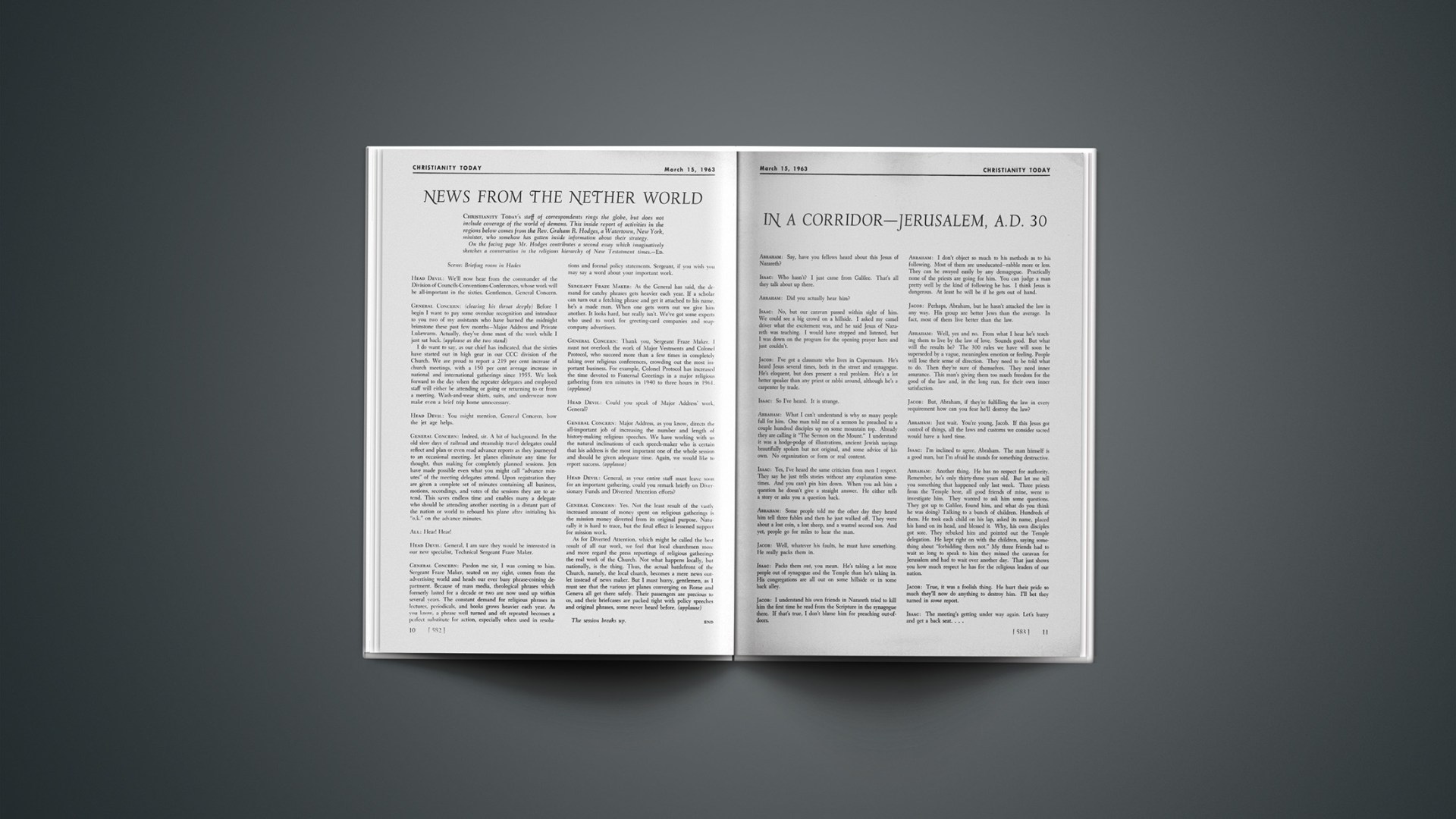
ABRAHAM: Say, have you fellows heard about this Jesus of Nazareth?

ISAAC: Who hasn’t? I just came from Galilee. That’s all they talk about up there.

ABRAHAM: Did you actually hear him?

ISAAC: No, but our caravan passed within sight of him. We could see a big crowd on a hillside. I asked my camel driver what the excitement was, and he said Jesus of Nazareth was teaching. I would have stopped and listened, but I was down on the program for the opening prayer here and just couldn’t.

JACOB: I’ve got a classmate who lives in Capernaum. He’s heard Jesus several times, both in the street and synagogue. He’s eloquent, but does present a real problem. He’s a lot better speaker than any priest or rabbi around, although he’s a carpenter by trade.

ISAAC: So I’ve heard. It is strange.

ABRAHAM: What I can’t understand is why so many people fall for him. One man told me of a sermon he preached to a couple hundred disciples up on some mountain top. Already they are calling it “The Sermon on the Mount.” I understand it was a hodge-podge of illustrations, ancient Jewish sayings beautifully spoken but not original, and some advice of his own. No organization or form or real content.

ISAAC: Yes, I’ve heard the same criticism from men I respect. They say he just tells stories without any explanation sometimes. And you can’t pin him down. When you ask him a question he doesn’t give a straight answer. He either tells a story or asks you a question back.

ABRAHAM: Some people told me the other day they heard him tell three fables and then he just walked off. They were about a lost coin, a lost sheep, and a wastrel second son. And yet, people go for miles to hear the man.

JACOB: Well, whatever his faults, he must have something. He really packs them in.

ISAAC: Packs them out, you mean. He’s taking a lot more people out of synagogue and the Temple than he’s taking in. His congregations are all out on some hillside or in some back alley.

JACOB: I understand his own friends in Nazareth tried to kill him the first time he read from the Scripture in the synagogue there. If that’s true, I don’t blame him for preaching out-of-doors.

ABRAHAM: I don’t object so much to his methods as to his following. Most of them are uneducated—rabble more or less. They can be swayed easily by any demagogue. Practically none of the priests are going for him. You can judge a man pretty well by the kind of following he has. I think Jesus is dangerous. At least he will be if he gets out of hand.

JACOB: Perhaps, Abraham, but he hasn’t attacked the law in any way. His group are better Jews than the average. In fact, most of them live better than the law.

ABRAHAM: Well, yes and no. From what I hear he’s teaching them to live by the law of love. Sounds good. But what will the results be? The 300 rules we have will soon be superseded by a vague, meaningless emotion or feeling. People will lose their sense of direction. They need to be told what to do. Then they’re sure of themselves. They need inner assurance. This man’s giving them too much freedom for the good of the law and, in the long run, for their own inner satisfaction.

JACOB: But, Abraham, if they’re fulfilling the law in every requirement how can you fear he’ll destroy the law?

ABRAHAM: Just wait. You’re young, Jacob. If this Jesus got control of things, all the laws and customs we consider sacred would have a hard time.

ISAAC: I’m inclined to agree, Abraham. The man himself is a good man, but I’m afraid he stands for something destructive.

ABRAHAM: Another thing. He has no respect for authority. Remember, he’s only thirty-three years old. But let me tell you something that happened only last week. Three priests from the Temple here, all good friends of mine, went to investigate him. They wanted to ask him some questions. They got up to Galilee, found him, and what do you think he was doing? Talking to a bunch of children. Hundreds of them. He took each child on his lap, asked its name, placed his hand on its head, and blessed it. Why, his own disciples got sore. They rebuked him and pointed out the Temple delegation. He kept right on with the children, saying something about “forbidding them not.” My three friends had to wait so long to speak to him they missed the caravan for Jerusalem and had to wait over another day. That just shows you how much respect he has for the religious leaders of our nation.

JACOB: True, it was a foolish thing. He hurt their pride so much they’ll now do anything to destroy him. I’ll bet they turned in some report.

ISAAC: The meeting’s getting under way again. Let’s hurry and get a back seat.…
News from the Nether World

CHRISTIANITY TODAY’Sstaff of correspondents rings the globe, but does not include coverage of the world of demons. This inside report of activities in the regions below comes from the Rev. Graham R. Hodges, a Watertown, New York, minister, who somehow has gotten inside information about their strategy.

On the facing page Mr. Hodges contributes a second essay which imaginatively sketches a conversation in the religious hierarchy of New Testatment times.—ED.

Scene: Briefing room in Hades

HEAD DEVIL: We’ll now hear from the commander of the Division of Councils-Conventions-Conferences, whose work will be all-important in the sixties. Gentlemen, General Concern.

GENERAL CONCERN: (clearing his throat deeply) Before I begin I want to pay some overdue recognition and introduce to you two of my assistants who have burned the midnight brimstone these past few months—Major Address and Private Lukewarm. Actually, they’ve done most of the work while I just sat back. (applause as the two stand)

I do want to say, as our chief has indicated, that the sixties have started out in high gear in our CCC division of the Church. We are proud to report a 219 per cent increase of church meetings, with a 150 per cent average increase in national and international gatherings since 1955. We look forward to the day when the repeater delegates and employed staff will either be attending or going or returning to or from a meeting. Wash-and-wear shirts, suits, and underwear now make even a brief trip home unnecessary.

HEAD DEVIL: You might mention, General Concern, how the jet age helps.

GENERAL CONCERN: Indeed, sir. A bit of background. In the old slow days of railroad and steamship travel delegates could reflect and plan or even read advance reports as they journeyed to an occasional meeting. Jet planes eliminate any time for thought, thus making for completely planned sessions. Jets have made possible even what you might call “advance minutes” of the meeting delegates attend. Upon registration they are given a complete set of minutes containing all business, motions, secondings, and votes of the sessions they are to attend. This saves endless time and enables many a delegate who should be attending another meeting in a distant part of the nation or world to reboard his plane after initialing his “o.k.” on the advance minutes.

ALL: Hear! Hear!

HEAD DEVIL: General, I am sure they would be interested in our new specialist, Technical Sergeant Fraze Maker.

GENERAL CONCERN: Pardon me sir, I was coming to him. Sergeant Fraze Maker, seated on my right, comes from the advertising world and heads our ever busy phrase-coining department. Because of mass media, theological phrases which formerly lasted for a decade or two are now used up within several years. The constant demand for religious phrases in lectures, periodicals, and books grows heavier each year. As you know, a phrase well turned and oft repeated becomes a perfect substitute for action, especially when used in resolutions and formal policy statements. Sergeant, if you wish you may say a word about your important work.

SERGEANT FRAZE MAKER: As the General has said, the demand for catchy phrases gets heavier each year. If a scholar can turn out a fetching phrase and get it attached to his name, he’s a made man. When one gets worn out we give him another. It looks hard, but really isn’t. We’ve got some experts who used to work for greeting-card companies and soap-company advertisers.

GENERAL CONCERN: Thank you, Sergeant Fraze Maker. I must not overlook the work of Major Vestments and Colonel Protocol, who succeed more than a few times in completely taking over religious conferences, crowding out the most important business. For example, Colonel Protocol has increased the time devoted to Fraternal Greetings in a major religious gathering from ten minutes in 1940 to three hours in 1961. (applause)

HEAD DEVIL: Could you speak of Major Address’ work, General?

GENERAL CONCERN: Major Address, as you know, directs the all-important job of increasing the number and length of history-making religious speeches. We have working with us the natural inclinations of each speech-maker who is certain that his address is the most important one of the whole session and should be given adequate time. Again, we would like to report success, (applause)

HEAD DEVIL: General, as your entire staff must leave soon for an important gathering, could you remark briefly on Diversionary Funds and Diverted Attention efforts?

GENERAL CONCERN: Yes. Not the least result of the vastly increased amount of money spent on religious gatherings is the mission money diverted from its original purpose. Naturally it is hard to trace, but the final effect is lessened support for mission work.

As for Diverted Attention, which might be called the best result of all our work, we feel that local churchmen more and more regard the press reportings of religious gatherings the real work of the Church. Not what happens locally, but nationally, is the thing. Thus, the actual battlefront of the Church, namely, the local church, becomes a mere news outlet instead of news maker. But I must hurry, gentlemen, as I must see that the various jet planes converging on Rome and Geneva all get there safely. Their passengers are precious to us, and their briefcases are packed tight with policy speeches and original phrases, some never heard before. (applause)

The session breaks up.

END

Paul on the Birth of Jesus

Those of us who read our New Testaments beginning with the four Gospels need to remember that current scholarship finds in the Epistles the earliest writings preserved in the New Testament. Accordingly its consideration of the birth of Jesus starts with Paul’s references thereto: Galatians 4:4; Romans 1:3, 4 and 8:3, and Philippians 2:5–11.

In Galatians four, Paul is talking about our redemption from the bondage of the law and its curse into the freedom of the sons of God. Here he says that God sent forth his Son, born of a woman, born under the law that he might redeem those under the law. Thus he teaches the Divine Fatherhood and the human motherhood. He mentions neither a divine mother nor a human father.

Sonship By The Spirit

He declares, moreover, that our sonship is wrought by “the Spirit of His Son” and uses as an allegory the two sons of Abraham, one born according to the flesh, the other born under the promise “after the Spirit” (vss. 6, 22–31). In this context, the phrase the Spirit of His Son reaches its full implication only on the assumption that the Spirit acted in his most eminent way in God’s sending forth his Son born of a woman, of which action even his mighty works in making us sons of the Father and in Isaac’s being born according to God’s promise are but partial analogies.1Likewise John 1:13 (cf. 3:3–8) seems to be built upon the same analogy of the Virgin Birth of Jesus. Furthermore, several of the fathers, including Irenaeus and Tertullian, whose writings were earlier than any extant manuscript of this part of John, used texts which carry this verse in the singular, thus: “in the Name of Him who was born not of bloods, nor of the will of the flesh, nor of the will of man but of God.” This reading is accepted by such scholars as C. C. Torrey and O. Cullman.

Again in the context, in Galatians 4:6 (cf. Rom. 8:15), Paul states that God’s sending the Spirit of his Son into our hearts enables us to cry “Abba, Father.” Now the fact that this word also occurs in Mark 14:36, which in its definitive written form is dated later than Galatians, does not prove that Mark fabricated this as part of a Gethsemane legend to justify Paul’s theology. So able a scholar as J. Jeremias accepts this as Jesus’ own word which Paul quotes. But if the Apostle cites a word from Jesus, may he not in the same context have in mind that event by which he who already had a divine Father received also a human mother, which same event was later recorded in detail by Matthew and by Luke?

In Romans 8:3 Paul stresses the wonder of the fact that God sent his own Son in the likeness of sinful flesh to deal adequately with the awful reality of sin. In Romans 1:3, 4 the Gospel concerns God’s Son, who is of the seed of David according to the flesh, but the Son of God in power according to the Spirit of Holiness. Ignatius (Smyr. 1:1, Eph. 18), understands Paul’s contrast here between the seed of David according to the flesh and the Son of God according to the Spirit as carrying with it as its necessary presupposition “born of a virgin,” even as Matthew, Luke, and the Creed unite conceived by the Holy Ghost and born of the virgin Mary. It should also be kept in mind that in Romans 1:4 the divine side of Christ is designated in a mighty manner by the Resurrection from the dead, even as on the same miraculous note of the Resurrection Paul begins the Epistle to the Galatians. Both when he is quoting the primitive kerygma (as in Rom. 1:3, 4 and 1 Cor. 15:4, 5) and when he is writing without reference to that tradition (Gal. 1:1), he glories in the supernatural resurrection of Christ.

In Philippians 2:5–11 Paul cites a hymn or a creed from the primitive kerygma. According to this summary, a preexisting Divine Person was born in the likeness of men. He who was fundamentally in the form of God took the form of a servant. He did not like Adam grasp after equality with God but emptied or poured out himself unto death (cf. Isa. 53:12) for others. This presentation of him as an Eternal Person ought to alert us to the realization that Paul and the primitive disciples he is quoting did not think of our Lord’s birth in the same way as they did of the births of temporal persons. The stupendous miracle of the Incarnation here proclaimed implies a presupposition on the part of Paul and his precursors which is only adequately accounted for in that physical miracle of His birth found in Matthew and in Luke. Three years after his conversion, Paul conferred with “James, the brother of the Lord” (Gal. 1:19). Certainly Luke shared with Paul the fruits of his research into the beginnings of Christianity. And his account of the Virgin Birth makes intelligible how the Jesus whom Paul preached had only a Divine Father and only a human mother.

Sinless Life And Sinless Birth

Likewise the permanent dwelling in Christ of all the fullness of the Godhead in a bodily way (Col. 2:9) is highly congruent with his being conceived of the Holy Spirit (cf. Athanasius, contr. Arian, III.26.29–31). The plan of God provided that as Christ Jesus came into the world to save sinners by his sinless life of obedience even unto death (1 Tim. 1:15; Rom. 5:19; Phil. 2:8), so the Holy Spirit averted from the virgin’s conceiving of Him the sin which marks sexual conception (Ps. 51:5). Thus being raised for our justification (Rom. 4:25), when he is made unto us righteousness (1 Cor. 1:30), God imputes unto us or clothes us with the wholly spotless garment of his righteousness.

Of course, if one approaches the subject on a purely naturalistic premise, then the Virgin Birth could not have occurred and the hypothesis of a legend to fit Paul’s Gospel may be the most reasonable assumption. But Paul is not anti-supernaturalistic when it comes to the things of Jesus Christ. He entered the Christian life by a supernatural encounter with the risen Lord Jesus, he glorified in the power of His resurrection, he lived in the blessed hope of His parousia. Accordingly, there is nothing in Paul’s Epistles, Gospel, or life which warrants the assumption that a legend must be constructed by Matthew and Luke to account for his teachings. Rather it is more in accord with Paul’s affirmations, his citations of the primitive kerygma, and his presuppositions to assume that he, like Luke, received from the first disciples and held as a fact the Virgin Birth of Jesus.

Probable Cause For Silence

If one wishes to go into the question as to why Paul and Mark do not explicitly mention the Virgin Birth, we are left to our surmises. And yet believing extrapolation is more likely to be in accord with the primitive community of faith than is naturalistic conjecture. It is probable that the primitive narrative and the passages speaking of the birth of Jesus which Paul cites from the primitive kerygma make no explicit mention of the Virgin Birth in order to protect Mary during her lifetime. The first and third Gospels were presumably written after her death. The inept way in which the opening of Mark refers to Isaiah, according to the critical text ascribing to Isaiah passages which are cited from Malachi and from Isaiah, could mean that he also had other passages from Isaiah in mind, such as 7:14, which is used in Matthew 1:23. When the Resurrection was proclaimed the unbelieving council of priests and elders paid the soldiers to say that the disciples stole the body of Jesus (Matt. 28:11–15). An imperial rescript from the middle of the first century has been discovered at Nazareth decreeing death for anyone who steals a corpse. This could well have been used by Herod in his execution of James and his plan to execute Peter (Acts 12:1–3). The third member of the inner circle was John. As a result of these acts inspired by the animosity of unbelieving Jews, the disciples may well have asked John to leave Jerusalem with Mary, whom Jesus had committed to his care. And in the same connection they could well have determined to keep even more complete silence on the Virgin Birth lest that lead to Mary’s death, as the proclamation of the Resurrection had led to the death of James.

END

The Minoan Bridge: Newest Frontier in Biblical Studies

Three of the Twelve Tribes are described as seafaring people in early biblical times. Judges 5:17 chides Dan for dwelling in ships, and Asher for its maritime habitat. Genesis 49:13 depicts Zebulun as nautical in Sidonian style. To be sure, Israel was destined to become less sea-minded as time went on (with notable exceptions such as Solomon’s reign), but 25 per cent of the Tribes were sea people according to the biblical text itself.

For reasons that we need not delve into now, scholarship tends to be geared to the tacit assumption that Old Testament Palestine (unlike Roman Palestine) was not a Mediterranean country. Yet the Mediterranean factor in the Old Testament is comparable in magnitude with the Mesopotamian and Egyptian factors. Therein lies the most important aspect of Old Testament research in the foreseeable future.

The only way I know to pursue biblical studies is to take the text on its own terms against the background of authentic collateral information from the world of the Bible. I am not in the least concerned with schools of thought or with the theories of influential scholars.

Genesis 10 charts for us the geographic and ethnic horizons of the Hebrews. In addition to the Asiatic and African Near East, it definitely includes the Aegean and the Greek world. The islanders embrace the Caphtorim of Crete and the Kittim of Cyprus.

The Caphtorians of Palestine include the Philistines (e.g., Amos 9:7) who appear in the Bible as linguistically Semitized. In fact the distinct implication of Scripture is that even the earliest waves of Philistines (to say nothing of the last large wave around 1200 B.C.) were already Semitized. The Philistine King of Gerar in the days of Abraham and Isaac bears the pure Hebrew name of Abimelech. Moreover, Hebrews and Philistines never require the service of interpreters for intercommunication. The Bible mentions interpreters for communication with Egyptians or Mesopotamians but never with the Philistines of Caphtor, for the simple reason that a language closely akin to biblical Hebrew had long been the main language of Minoan Crete.

It is no surprise then to find that the Minoan inscriptions are in a Semitic language resembling Hebrew. When it first crossed my mind that this might be the case, I cannot say. But it is a matter of record that in my Ugaritic Handbook (p. 204) published in 1947, I cautiously asked concerning Ugaritic literature, which is quite close to the Hebrew: “And who can at present prove or deny that such an unknown quantity as Caphtor influenced Ugaritic literarily?”

In 1947, Minoan script was a dark mystery. But a young English amateur, Michael Ventris, was brooding over it. He was destined to achieve success in deciphering the later form of the script called “Linear B.” He had been completely wrong in surmising that it was related to Etruscan. But he searched relentlessly for the truth, and realized that his Etruscan hypothesis had led him to a dead end because it was false. Then he assumed that the language of the Linear B texts of Crete and southern Greece was Greek. This guess—so self-evident in retrospect—was right, and from that moment his efforts were crowned with success. Ventris’ phonetic values for the signs of Linear B Greek were in the main applicable to the earlier language of Linear A Minoan, as was evident from proper names appearing in both sets of inscriptions. The fact that such names as “George” or “Maurice” occur in both French and English texts shows that while the two languages are different, the values of the letters are more or less the same in French and English. The same holds for Greek Linear B and Minoan Linear A.

In 1956 when Ventris and Chadwick published their Documents in Mycenaean Greek, I was enabled to make the decisive step toward the decipherment of Minoan. A Linear A Minoan tablet consisting of pictures of pots with their special names spelled out over them captured my attention. Three out of five of the legible pot-names were good Semitic: su-pu, su-pa-la, and ka-ro-pa looked sufficiently like the Semitic pot-names written consonantally as SP, SPL, and KRP to encourage me to pursue the possibility that Minoan was Semitic. The word for “all” was ku-lo, the same as Semitic kull, “all.” Two correctly identified Semitic words (u, “and,” and ku-ni-su, “emmer wheat”) known in East Semitic induced me to stress the East Semitic affinities of Minoan. This turned out to be mistaken because both words are also West Semitic, if one knows where to find them off the beaten path in West Semitic.

Toward the end of 1961, an edition of the Minoan texts appeared with new photographs and hand-drawn copies. A cult object dedicated to the chief god of the Minoans (with the good West Semitic name Yasha-shalam, “he who gives shalom or peace”) contained the typically West Semitic words le, “to,” ki, “so that,” and qiryat, “city.” The text reads “To Yashashalam—so that the city may thrive” in unmistakable West Semitic that any intermediate student of Hebrew should be able to follow without difficulty.

Now that I had pinpointed the character of Minoan—as not merely Semitic as I had maintained from the start, but specifically as Northwest Semitic closely related to Phoenician and Hebrew—things moved swiftly. Early in 1962, I tackled four Eteocretan inscriptions written in Greek letters between the fifth and third centuries B.C. in the pre-Greek language of Crete. Scholars had gotten exactly nowhere with Eteocretan because they never asked the right question: Could it be Semitic? But since everyone was right in assuming that Eteocretan was the descendant of Minoan, and since I knew that Minoan was Northwest Semitic, I had the answer. Three texts from the Cretan town of Praisos turned out to be funerary. Invocations, in the name of the deceased, to the future passerby appeared in these texts; for example nas iro u kl es, “the people of his city or any man” (in slightly Hebraized form nash iro u kol ish) and et me u mar krk o kl es u es, “with whosoever he be—lord of a fortress or any man at all” (in slightly Hebraized form et mi hu mar krak o kol ish u ish). Now it is a fact that most people have difficulty in recognizing familiar words expressed in different symbols. Personally I feel that a normally bright undergraduate at the end of his first semester of Hebrew-l ought to be able to see anything as simple as this. I doubt that any professional Hebraist lacks the knowledge to see this. But I have abundant reason to conclude that many a Hebraist lacks the mental flexibility to grasp these simple facts. It is for this reason that in my first articles on these new developments, I welcomed “particularly young Semitists, into a new and challenging field” (Journal of Near Eastern Studies, 21, 1962, p. 210). This does not mean that none of the veteran scholars will see the light. The elder statesman of German Old Testament scholars—Otto Eissfeldt—was quick to see that I was right in establishing the Northwest Semitic character of Minoan. But anyone who has followed Eissfeldt’s publications, showing his keen awareness of Phoenician influence, will not be surprised. The leading Czech Old Testament authority—Stanislaus Segert—was equally fast in catching on. Moreover, he is fortunate to be among academic colleagues in Prague who are prepared for the new developments by the great Bedrich Hrozny, who deciphered Hittite.

Falsehood is a blind alley, whereas truth opens a thousand doors and is sooner or later confirmed in many ways. In October, 1962, a bilingual from Dreros, Crete, reconfirmed what was already crystal clear. The Dreros bilingual repeats the same text in Eteocretan and Greek. Someone makes a dedication “to his mother,” (tai) matri tai a (wtou) in the dialectal Greek corresponding to lmo in the dialectal Semitic. For those who know only the classical languages, te(i) metri te(i) autou and l-immo should ring the bell. The text of this bilingual—like all of my material—is in press.

There are still more texts—including a bilingual from Cyprus—that bear on the problem, but I have told enough to make matters clear to any open-minded student of Hebrew and Greek who prefers to follow facts rather than some academic party line.

Effect On Biblical Studies

The Minoan and Eteocretan (and in all probability also the Eteo-Cypriote) inscriptions will change the course of Hebrew linguistics. But more than this, the effect of the new development on the study of the Bible will be profound. Let us see what is involved:

The decipherment of Minoan confirms a fact that was recognized long ago by individual scholars such as Victor Bérard and Raymond Weill (to mention only two), but these scholars were shouted down and discredited by the exponents of compartmentalization. The essential truth is stated in Genesis 10: the cradle of our civilization was One World and not a compartmentalized Near East. But run-of-the-mill minds cannot grasp great and simple truths. Everything must be fragmentized for them into pieces small enough for them to comprehend. In 1894 a German savant named K. J. Beloch—with vast knowledge and a small soul—propounded the doctrine that there could be no Semitic influence on early Greece, and that even when the Greek sources tell us of the Phoenician impact on early Greece, the ancient Greek authors were in error.

Beloch won the day. In fact his influence can still be felt, in spite of the mounting evidence to the contrary. Greek tradition tells us quite definitely that Minos, King of Crete, was the son of a Phoenician princess Europa; that Europa’s brother, Cadmos, conquered Thebes and introduced the art of writing; that the Danaoi (as the ancient Greeks are often called) were descendants of the Semite Danaos who conquered southern Greece; that Phoenicians occupied the islands of Thera, Thassos, Cythera, and so on. I could lengthen the testimony of the ancient Greek authors to the effect that the Phoenicians were a major factor in what became the Greek world, but it is unnecessary. Many scholars sensed the real situation. M. P. Nilsson (Homer and Mycenae, 1933, p. 131) stated, “It is, however, a fairly common opinion that the Phoenicians of Homer are in reality the Minoans.” Well, it turns out that the discarded “common opinion” was right. The salient fact to remember is that prior to 1500 B.C. the entire East Mediterranean—islands and mainland shores—was dominated by the same Phoenician-type sea-traders. Throughout the Middle Minoan period and down to the fifteenth century (i.e., from about 2000–1450 B.C.) the hub of that culture was Crete Only later was it forced to center itself on Phoenician cities such as Sidon and Tyre on the Syro-Palestinian coast.

A Common Denominator

What emerges from this panorama of history is the fact that Hebrew and Greek civilizations arose on different segments of the same Semitic-dominated East Mediterranean order. Palestine remained Semitic. The Aegean became Greek. But both had been part of the same cultural sphere before Priam ruled Troy and before Moses led his people to freedom. This means that early Hebrew and Greek literatures have a common denominator and should be used to illuminate each other.

How much the modern West is an outgrowth of the ancient East Mediterranean is reflected at every turn. We have a seven-day week with roots in the East Mediterranean. Where it first started is hard to say, but the Mesopotamians reflect seven-day time spans in their early literature such as the Gilgamesh Epic. Ugaritic literature—written before the Trojan War and the Age of Moses—has seven-day periods built into it. Greece and Israel got the seven-day reckoning from the same East Mediterranean milieu. We of the West have inherited it simultaneously from Israel and from pagan Europe. The Greco-Roman heritage lingers on in the pagan names of Sunday, Monday, and Saturday—named after the Sun, Moon, and Saturn. From Genesis we get the same seven-day system, but with a difference: the institution of the Sabbath.

If we compare Israel of the Age of the Literary Prophets with Periclean Athens, of course they appear poles apart. But not so if we go back to the days when Israel and Greece were closer to their common origins. Achilles and Samson had careers within a century of the year 1100 B.C. in different segments of the same East Mediterranean milieu. Achilles was no more a Greek philosopher than Samson was a Hebrew prophet. Both were fighting leaders in the same general heroic age. Their social climate had much in common. Both of them caused the death of many men by their common pattern of conduct. Achilles’ wrath over a woman taken away from him did not subside until he had sent many brave souls into Hades. When Samson’s wife was taken away from him (Judges 15:1, 2) he went into a rage that was not assuaged until he had smitten many a Philistine hip on thigh (15:6–8). Neither Achilles nor Samson had the middle-class virtue of cooperation. Both were heroes who would stand alone against the world. Even Samson’s long hair followed the same mode as fostered by his contemporaries, the long-haired Achaeans of Achilles.

Ancient Greek tradition saw in the Iliad and Odyssey the two halves of the same great Homeric epic. By the time the critics got through with it, not only did the Iliad and Odyssey represent entirely different stages of civilization, but each was chopped into different sources corresponding more or less to the J, E, D, and P of Pentateuchal criticism. For instance, the marvelously constructed story of the Odyssey was broken into three separate, originally different compositions: the story of Odysseus’ return, the story of Telemachus’ search, and the story of Penelope at home in Ithaca. The combining of three allegedly different documents into the finest narrative poem ever written was explained as the work of a compiler.

The arguments of the critics looked good. After all, the Iliad deals with a fighting aristocracy; the Odyssey is the tale of coming home to a plantation. The society of the Iliad is heroic; the society of the Odyssey was said to belong to a different age with more sedentary pursuits. Actually, however, both epics reflect the same society: the Iliad, during military operations; the Odyssey, between wars. This is precisely what we find in Scripture when we compare the books of Judges and Ruth. In Judges we see the warring aristocracy of Israel during campaigns. In Ruth we see the agricultural pursuits on the warlord’s plantation between campaigns. The story unfolded “in the days when the Judges ruled” Israel (Ruth 1:1). Boaz is rightly called a warlord (gibbor hayil in Ruth 2:1). Between campaigns he administered his large estate. The upper class in heroic Israel as well as in heroic Greece enjoyed large farms in exchange for military service.

New Confidence In The Record

It is possible that our grandparents found the truth in such matters through simple faith. Since Ruth opens with the statement “it came to pass when the Judges were judging,” they asked no questions and had no further problems. Students of my generation, however, studied Scripture in a different atmosphere. For my teachers, the narrative in Ruth had little to do with the period of the Judges, and for them the opening verse was meant only to mislead. But new developments tend to inspire confidence in the traditions.

The scene on the Shield of Achilles described in book 18 of the Iliad is a single artistic composition. Its two main subscenes are a city at peace and a city at war. Life was envisaged as divided between war and peace (though the latter is more accurately defined as the time between wars) corresponding to the Iliad (or Judges) on the one hand, and the Odyssey (or Ruth) on the other. In addition the Shield has still further detail. Its description opens and closes with the cosmos: the sun, the moon and the stars, and the cosmic river, Oceanos. It tells of agriculture, herding, and sacrifice. In the city at peace litigation is going on, as well as a wedding. In other words, a single composition included war and peace, the structure of the universe, social and legal institutions, modes of producing the means of subsistence, sacrifice, and so on.

With this background let us turn to the Pentateuch. Traditional Judaism, from remote antiquity, never doubted that the Five Books of Moses formed one perfect opus. The critics, however, came along and asked how the Pentateuch could be a single work, when it deals with the universe, law, agriculture, herding, hunting, sacrifice, social institutions, war and peace. The Shield of Achilles answers the question: life is made up of just such elements. The Pentateuch, being the perfect book, told the ancient Hebrew all he had to know about the universe, history, human relations, religion—in short, everything essential. I cannot think of a book that has fulfilled its momentous mission so grandly. It teaches us that all men are brothers and created in the image of God. It embraces the Ten Commandments and the Covenant. It gives us not only law but the highest ethical and moral principles, including the precept to love one’s neighbor as oneself. It imposes on us the duty to meditate on God’s words day and night, and to teach them diligently to our children. Of course, parts of the Pentateuch stem from earlier material. The text itself tells us so (see CHRISTIANITY TODAY, Nov. 23, 1959, p. 133). But the kind of mentality that can see only a jumble of parts in a great unity is unworthy of so precious a heritage.

Objections may be raised to what I have just written. Some may say: But Deuteronomy is in a completely different style from the earlier books. The Hebrews called Deuteronomy “The Repetition of the Law” (Deuteronomy 17:18), which might perhaps be rendered more intelligibly as “The Recapitulation of the Law.” Similarly the last book of the Homeric epic (the twenty-fourth book of the Odyssey), before bringing the story to a close, gives a recapitulation including the Iliad in direct discourse, told by famous participants in the Trojan War. This is pretty much what we find in Deuteronomy: as the story of Moses is concluded, we have, in the form of direct discourse spoken by Moses, the recapitulation of the Law. Much that is new is added; much is repeated (e.g., the Ten Commandments). The thing to note is that the style of the Bible world calls for a summation or, to use the Hebrew phrase, a Mishne ha-Torah, “Repetition of the Law.” To put things differently: the recapitulation we find in the Mosaic and Homeric books confirms the antiquity of each other’s style. That these early Greek and Hebrew classics differ in content and spirit is too obvious to require exposition here, but that they reflect the same East Mediterranean common denominator at many a turn should be equally clear by now.

The Law of Moses embraces a sharp reaction against East Mediterranean religion. The Pentateuch repeatedly tells us not to do what the surrounding nations do. While all the nations practiced idolatry, the Pentateuch strictly forbids it. The cult of the bull (including that of the young bull) was widespread throughout the area. It was entrenched in Egypt (note the Apis cult) and Ugarit (where El is called “The Bull”), but nowhere more than in Minoan Crete, where the bull played a tremendous role in the life of the people.

The family of Moses, as well as the Hebrews in general, had been involved in bull-worship. When Israel sinned she tended to lapse back into the paganism from which she was gradually emerging. No sooner did Moses turn his back than Israel fashioned and worshiped the golden calf (actually “young bull”) under Aaron’s personal supervision. When the Northern Kingdom of Israel went astray, the golden calf was worshiped at Bethel and Dan (1 Kings 12:28, 29). The cult at Dan was set up by Jonathan, the son of Gershom, who was in turn the son of Moses (see Judges 18:30, where the scribes have inserted a raised N in the Hebrew text to alter the name of Moses to Manasseh). Gershom the son of Moses is well known from the Pentateuchal narratives (e.g., Exodus 2:22). The fact is that Moses, who gave historical monotheism to the world and taught future generations to shun idolatry, was unable to control his own brother, let alone his own grandson, from worshiping the golden calf. The Mediterranean aspect of Old Testament studies explains why of all idols, Israel repeatedly lapsed into the worship of the young bull. It was deep-seated.

The ancient connections between Israel and Greece were well recognized by the Greeks and Jews down into Greco-Roman times. Arius, King of Sparta, stated that his people possessed written records showing that Spartans and Jews shared a common ancestor (1 Maccabees 12:21). Josephus assures us that the Jews of his day also had documents confirming the statement of Arius. This claim (affirmed by Greek and Jew alike) may be explained because the Greeks as “Danaoi” claimed descent from Danaos, who was equated with Dan in the minds of both peoples. The Semitic identification of Danaos, and the sea-connection of the Danites, prevent us from brushing aside the traditions of I Maccabees and Josephus as foundationless.

Tacitus goes so far as to pass on a tradition current in his day that the Jews came from Crete via Northeast Africa (Histories 5:2) and that some of the Jewish institutions (specifically the Sabbath) were of Idaean (i.e., Cretan) origin (Histories 5:4).

The reader who wants more information about the Mediterranean common denominator underlying Greece and Israel can find it in my book Before the Bible.

On The Dead Sea Scrolls

Another important aspect of biblical study is the field of the Dead Sea Scrolls—especially those from Qumran. They provide new texts giving us first-hand insight to a Jewish sect in Palestine during the ministry of Jesus. They also shed important light on the lower criticism of the Old Testament, illuminating such matters as spelling, grammar, and variant wording. For Old Testament study, I would say that the Scrolls have the limitations imposed by the fact that they all come from after the close of Old Testament times. For the Intertestamental period, they are of direct importance. For New Testament, they are valuable for background, but they do not change our basic understanding of the New Testament books.

The decipherment of Minoan is of a more fundamental order, not because of the character of the texts themselves but because they bridge the worlds of Israel and Hellas from before the emergence of historic Israel (i.e., Israel as reflected in the Pentateuch) and of historic Greece (i.e., as portrayed in Homer). Indeed the Semitic character of Minoan is touching off a drastic reappraisal of Hebrew and Greek origins and, by the same token, a rewriting of the origins of Western culture. I would say that nothing in the Scrolls is as important as the Minoan bridge that brings Homer and Bible to bear on each other.

Homer And The Scriptures

Homeric literature deals with a warring aristocracy belonging to the kingly class. Rules of succession were flexible, but kingship was open only to members of the ruling class. Despite social differences between heroic Israel and Greece, many basic features are shared in common. It thus turns out that in the narratives of heroic Israel (as in Homer), the only people who count are those of the kingly class. The same holds for the two epics of Ugarit: both Kret and Daniel are rulers. In Israel, Abraham and Sarah are not only the progenitors of a people; they are the founders of a royal line. The divine promise to Abraham includes the significant detail that kings shall issue forth from him (Genesis 17:6). Moreover, Sarah is the mother of kings in accordance with God’s promise (Genesis 17:16). The royal aspect of the patriarchal narratives was brought to the fore by collateral information from Homer.

It is current academic doctrine that the Judges were elevated to the position of rulers by inspiration alone. By bringing the character of Homeric society to bear on the problem, it has become quite clear that the Judges always came from the ruling class, at least on their father’s side. Inspiration to rule could elevate those on the lowest rungs of the ladder of the aristocracy, but it never descended on those whose fathers came from lower classes in the heroic age. Jephthah may have been the son of a socially low woman, but through his father, Gilead, he was a gibbor hayil: a member of the warlord class (Judges 11:1).

No one ever questioned the Jewishness of Jesus. His opponents, however, did question his right to be King of the Jews. The first chapter of the New Testament, therefore, deals with the genealogy of Jesus, to establish the legitimacy of his kingly office. It would be interesting for New Testament scholars to probe the possibility that tracing Jesus through David all the way back to Abraham was prompted by the desire to trace him back not so much to the first Jew, but to the first king of the Jews. The Septuagint of Genesis 23:6 designates to Abraham the term basileus, “king,” which is the royal title applied to Jesus in the Greek Gospels.

Arnold Toynbee in reviewing Before the Bible agrees that my “demolition of the previous partition wall between Greek and Hebrew studies will endure” (London Observer, Dec. 16, 1962). He also notes that “these partition walls are built of intellectual rubble, but the rubble is compacted with prejudice, and this is as hard as the best cement ever used by Roman architects.”

A learned Talmudist (Professor Zeitlin) specializing precisely in the period of the Scrolls considers the Scrolls to be a hoax, even as an erudite Hellenist (Professor Beattie) has seen fit to deny the validity of Ventris’ decipherment of Linear B. If Professor Albright (CHRISTIANITY TODAY, Jan. 18, 1963, p. 359) wishes to follow in their footsteps and be an opponent of the decipherment of Minoan and Eteocretan, he may do so at the peril of his reputation for critical judgment in the Old Testament field.

This is not the first time he has been wrong about my work. He did everything he could to prevent my writing the Ugaritic Grammar. In reviewing the book, however, he showed a bigness of spirit that all of us admire. Professor Albright admitted in print that he had been wrong in discouraging me and magnanimously paid my work the following tribute: “Gordon’s Ugaritic Grammar is of greater lasting importance for OT research than any dozen assorted recent commentaries taken together” (Journal of Biblical Literature, 60, 1941, pp. 438 f.).

Review of Current Religious Thought: March 01, 1963

The well-known maxim of G. E. Lessing, that the “accidental truths of history can never be the proof of the necessary truths of reason,” had a clearly negative bearing upon the total question of revelation. The obvious fact that Christianity rests upon events which occurred in time and space served to put it into sharp antithesis to any form of religion which claimed to rest upon, and to confine itself to, truths independent of historical facts. The rationalism of Lessing’s day has, of course, fallen into discredit; but the central fallacy of his argument has been retained by forms of thought which are not directly related to rationalism.

Forms of “Christian” thought which disallow the validity of the Christian revelation-claim are finding themselves involved in fresh ways with the question of the relevance of historical fact for their systems. These forms share with the rationalism of the eighteenth century a quest for integrity, no less than a desire for some form of “universality.” Total creedlessness has proved to be unsatisfactory, while reason itself has been subjected to the most rigid criticism. History itself has been treated with increasing caution, particularly at the point of the alleged possibility of completely objective history.

Movements in biblical criticism have sought, in varying degrees, to reduce the narratives of the biblical record to terms of a purely natural form of historical events. The success of these attempts has proved to be less spectacular than critics of fifty years ago would have dreamed. So long as the narratives were accorded historical integrity at all, they had a remarkable vitality, a remarkable ability to reassert themselves in the midst of critical denials.

It needs to be noted that historicism itself has not been called into question by much of critical scholarship, but only certain types of historicism. In general, the pages of historical narrative which deal with usual and “natural” events have occasioned little concern. It has been the historical documents which purport to tell of supernatural and “saving” events which have compelled many theologians to take a long and jaundiced look. In the light of this, Lessing’s dictum with reference to “accidental” or contingent “truths of history” calls forth the observation that it is not the contingent and the relational in history per se which is held to be irrelevant to religious truth, but rather certain kinds of contingent events.

It was when Christians began to emphasize the historical reality of events which lay so far outside of the commonly accepted pattern of the “natural” as to suggest that they issued from a special and unusual form of divine activity that the several advocates of modern forms of rationalism became concerned. In connection with the method of much of contemporary biblical interpretation, Otto A. Piper suggests that “a great deal of modern interpretation of the Gospels still follows the pattern of eighteenth century rationalism” (Theology Today, XIX, 3, 327).

This is another way of saying that modern scholars have assumed for themselves the ability to know a priori the quality of the necessary (and perhaps absolute) truths of religion, and thus to be able to sit in infallible judgment upon the “accidental” truths of biblical history. Methodologies at this point will vary. Lessing held Jesus to be a human being, but one who possessed the faculty of reason in a superlative measure. Thus his teaching was regarded by this eighteenth-century thinker as marking a new high level in man’s approximation of the truth. Events recorded in Scripture, however, which would seem to support a view of His supernatural origin or divine person were held to be simply irrelevant.

This same motif of irrelevancy is applied to the contingent events recorded in Holy Writ which seem beyond the usual operation of the world of nature by the interpretative school headed by Rudolph Bultmann. To this scholar and his followers. Modern Man becomes the measure for the thinkability of a given historically-recorded event. That which lies beyond the ken of his usual experience is then regarded as without meaning for him, and hence irrelevant for our time.

Yet another application of the principle of reason’s ability to decide the validity or non-validity of the contingent events of history which lie beyond the quality-scope of the usual and the natural is that of the “kerygma-type” of interpretation, by which it is held that it is only a message which can possibly be relevant for Modern Man. This message is held to be derivable from a historical reductionism, by which only existential factors are recognized as meaningful. Applied to the Christian faith, this frequently narrows the range of the possibly-relevant to one pivotal event in the career of the Church—usually the Incarnation or the Resurrection.

Yet another contemporary treatment of the contingent events described in the Four Gospels is that centering in the assertion that they contain, not history as it is usually understood, but Heilsgeschichte, or saving history. This motif is a modern construct, which in its pure form asserts that the application of the usual positive norm of time has no place in the interpretation of “holy history,” whose movement is upon a plane quite different from that of positive history.

A final attempt to deal with the relation of positive history to theology is taking shape in the form of a “commitment theology” which begins with a retreat from all forms of rational footing, including a reliance upon historical facts. It holds, then, that the final and unassailable ground upon which the Protestant must place his feet is that of an irrational commitment, an abdication of rational responsibility for content of religious faith. The only intellectual commitment which is relevant is a commitment to the methodology of criticism, which “hopes against hope” that this will take him beyond reason and beyond history to something ultimate. It is difficult to distinguish between this and historical nihilism.

Beware the Vices of Preaching!

Beware The Vices Of Preaching!

Let’s be difficult, preacher-brothers! Your tart, if paradoxical, rejoinder is, “That’s easy.” But perhaps we are not thinking of the same thing. What is harder than to catch ourselves in those pulpit vices that mar our preaching? “Be willing to ‘unlearn,’ and especially to cure yourself of noticeable faults,” urged Dr. James Black in The Mystery of Preaching.

Easy? One wonders if the man who says it has seriously tried.

Our inventory of these “noticeable faults” will be restricted to those that fall under the head of sermon delivery. Perhaps another time we can tackle those which are linked more particularly with the preacher’s personality or with the organization of the sermon.

Chief among the mischief-makers are, quite obviously, the Speech Culprits.

1. Poor volume control. Speaking too softly is an imposition on the courtesy of the hearers, while speaking too loudly is an affront to their dignity. The aim should be (assuming normal hearing) to make every person present hear every word uttered. Experienced speakers have found it helpful, when speaking to a large congregation in an assembly room to which they are unaccustomed, to fix attention on some person among those farthest away from the pulpit and so address him that he will hear without strain. The opposite of “too soft” is just plain “too loud.” “Scream no more” was John Wesley’s pithy, peremptory counsel to one of his younger preachers. Few preachers worth their salt can proclaim the Gospel without an elevation of voice, but this scarcely justifies a verbal version of assault and battery on the congregation. Noise is not to be equated with anointing. Unction yields to no exact measurement in decibels. One small but important point often overlooked: it is slightly maddening to a congregation when the preacher lets his voice drop low at the end of his sentences. The sentence-ending should be handled with change of pitch, not an extreme change of volume.

2. Slovenly enunciation. We in the United States are notorious for this defect of speech, and far too often our ministers rise little, if at all, above the prevailing cultural level. Let the preacher put himself to this test: “How do I actually pronounce the phrase ‘months and months’?” Most of us, most of the time, will be found saying it “munsenmunse,” all run together in an atrociously unarticulated mumble! My own experience, especially that which has come through conversation with the hard-of hearing, fully confirms James Black’s contention that “it is not loudness so much as good articulation that makes a speaker heard.” Needless to say, no one has any orchids to offer to the pedantic brother who has swung to the opposite extreme, and, like some telephone operators, pronounces “three” as if it were spelled “tha-ree” and “nine” as if it deserved an additional syllable, “nine-a.”

3. Faulty pitch and pace. Wesley, in a fascinating and perceptive passage, warns his younger ministers against getting stuck with a “tone” in their preaching. The several tones against which he inveighs include the “womanish, squeaking tone,” the “singing or canting tone,” the “high, swelling, theatrical tone,” and (who has not heard it?) “an odd, whimsical, whining tone.” The answer to all of this is, of course, the practice of modulation. The trained voice of the speaker, no less than that of the singer, is capable of organ-like control. It is difficult, I believe, to improve on this advice: speak naturally, with a variety of pitch and pace that will alike keep the voice of the preacher and the ears of the listeners from tiring. At all costs, shun a monotone.

Add now to the speech culprits the Gesture Goblins If pulpit gesturing is an art, it yields to no rule of thumb. I heard Billy Sunday and I heard George Truett. Those who have had a like experience will know how complete was the disparity between them at this point. Sunday could be dervish-like—wildly uninhibited. Truett was more often statuesque. The gesture to be avoided is the meaningless one, or the artificial one (borrowed from some other preacher), or the excessively theatrical one (“excessive” meaning that there is neither mood nor situation to justify the exorbitant piece of acting). Obviously, the purely “manneristic” movement of the hands should be guarded against carefully. Here the gowned brethren have an advantage over the ungowned: they are not seen nervously fingering a watch-chain or (more often in the old days of cutaways) sending their roving hands feelingly over their not infrequently ample abdomens. Let preachers remember that visible details have strange power over listeners. The hand can be friend or foe to sermonic effectiveness.

And, finally, a word about the Redundancy Snares. For example, it is pointless to say, “Let me illustrate this.” Proceed with the illustration. If it is worth shucks it will be seen for what it is. Don’t begin preaching with an apology. If you are ill prepared, trust God’s mercy to help you make the best of it. Let God and the people judge in the end how poor or peerless the sermon was. Rarely say, “And now in conclusion,” and never say it twice! It is that sort of guile that has incited some cynic to define an optimist as “a man who reaches for his hat when the preacher says, ‘Now in conclusion.’ ” Be a life-long student of economy with words. Wordiness is usually the sign of shallowness.

Prayer is indispensable to the making of a preacher. But so is the verbal pruning knife!

PAUL S. REES

He that hath sent me is with me; he hath not left me alone; I do always the things that are pleasing to him (John 8:29; read vv. 12–36).

In a brief phrase our Lord sets up the perfect ideal for a man’s life. He makes the stupendous claim that he himself has lived up to this ideal, and that he has done so because of his relation to the Father. So he sets up the loftiest ideal for any believer today: “I do always the things that are pleasing to God.” This ideal has much to do with four notes in the music of Jesus’ life.

I. Spirituality, a term that needs redemption from abuse. To our Lord spirituality means, not asceticism, but the sort of heart purity that ever sees God, and gladly responds to his holy will. If somewhat like him you have like purity of heart, you see God everywhere: in the flower that blooms, in the march of history, in the sorrows of men, above the darkness of the blackest cloud; and you know that he is on the field when he is most invisible.

II. Subjection, a contrasting note in the music of our Lord’s daily life. Many a would-be great man boasts: “I thank God I am my own master.” Because such men have ignored the Kingship of God, we have all the wreckage and ruin that blights our poor earth today. But as a believer when you next face a difficult dispensation of God’s dealing look him in the face and exclaim: “Hallelujah!”

III. Sympathy, when our Lord faces a crowd, or a person in distress. Why? Because he is right with God, right with men, one by one, and right with himself. In Christ-like sympathy lies the way to the settlement of every problem in this world. Ah, believe me, our sorrows are more felt up in heaven than here on earth. In Christ we behold the perfect sympathy of the One who ever did what was pleasing to God.

IV. Strength. We think of his weakness and frailty, but there never was anyone so mighty as our Lord. Hear him say: “I am King for I have faced the enemies of mankind—sin and sorrow, ignorance and death—and my foot is upon the neck of every evil. All authority is given unto me.”

Ah, my brother, here is the pattern for you. Here is the ideal. How can you fulfill it? Let the Apostle answer: “Christ in you, the hope of glory.” If by the power of the Spirit Christ is in you, he will keep you ever aware of God’s nearness. From hour to hour he will take your will, blend it with his own, and then remove all that ever makes it hard to say, “God’s will be done.”—From The World’s Great Sermons, Funk & Wagnalls, 1908, X.

The God of our fathers raised up Jesus, whom ye slew and hanged on a tree. Him hath God exalted with his right hand to be a Prince and a Saviour (Acts 5:30, 31a; read vv. 17–32).

The resurrection of Christ is a miracle, far beyond all the other Gospel miracles. What concerns us now is the meaning of this miracle. From the Bible the answer comes again and again: The resurrection of Christ is the creative act of God, a new revelation of his living power. From this resurrection fact spring three new hopes today.

I. A New Hope for the Believer, the hope of a resurrection to a new quality of life. This is what Paul kept preaching: “Do not hold the Resurrection far off, as a fact for some future hour when God shall call forth the dead. See in it a fact with power for today.” This lesson Paul learned on the Damascus road: the assurance of a risen life here and now. For this new life, Christ-created and Christ-governed, the world is looking today; it is life that comes to the believer through the Resurrection Gospel.

II. A New Hope for the Church. I need not describe what we see today at home and abroad: in Russia and elsewhere, chaos and dread. The hope for the Church still rests in God, and the power he has revealed in the Risen Christ. The faith that makes believers mighty is not an artificial creation of our own fancy; it is the response to the vision of God’s power in the resurrection of his Son.

Is anything too hard for such a Risen Lord? Is it beyond the power of the Church to meet victoriously any evil, however deeply entrenched? Power to engage in any crusade, no matter how stupendous? Is anything God wills beyond the resources of the Church for which he lives in Christ, raised from the dead and now exalted to be a Prince and a Saviour?

III. A New Hope for the World. Who can fitly describe the world as he beholds it today? In Russia and elsewhere moral confusion abounds, with many a cause for alarm. But why do we in the Church not look up to God? What does the Resurrection say to such a world as this? Does it not declare that in God there is power? Now that we seem to have reached the end of our resources, we are only at the beginning of our resources in him whom God raised from the dead and exalted to be a Prince and Saviour.

That is what we need today. He can save us only as we accept His rule. When Jacob Boehm, the Christian mystic, was dying, his ears were attuned to the harmonies of heaven. “Open the windows,” he whispered with his last breath, “and let in more of that music!” What music? That of the Easter hope.—From The Victory of God, London, 1921.

Let not your heart by troubled.I go to prepare a place for you … that where I am, there ye may be also (John 14:1–3; read vv. 1–31).

The Introduction has to do with the most beloved chapter in God’s Book, and with the Saviour’s answers to our perennial question about what lies beyond.

I. The Confidence that Life Follows Death. Not a sunset, but a sunrise! Some day we are going to exchange the frail tents in which we live for the house not made with hands, eternal in the heavens. Heaven is a place, not a state of mind. Somewhere in God’s wonder world there is a place that Jesus calls the Father’s house, into which we are to go and see him, to be with him and with those whom we have loved and lost a while.

II. The Freedom from Earthly Shackles. Heaven is but another name for home. When death comes it is passing out of one room called “life” into a larger abiding place called “eternity,” which is the Father’s house. In it are many abiding places. In this life many of us keep moving from place to place, but yonder there is an abiding place. Our life here is marred by our shortcomings and choked ideals, frustrated ambitions and thwarted plans. There we shall be free from all the handicaps that characterize us here.

Yonder we shall catch up with reality, and be free from earthly shackles. “Blessed are the dead who die in the Lord.” Here we learn that death releases us, and that the joy of creating and serving, of loving and lifting, goes on with us into the land that is fairer than day.

III. The Opportunity for a Wider Ministry. A life awaits us in which there shall be an unfolding of all our best powers and possibilities. Here we struggle for knowledge, purity, and happiness. There we shall know as we are known, be pure as He is pure, with contentment and satisfaction and blessedness, through seeing the King face to face, and being reunited with those we have loved and lost a while.

When the enraged people of France put to death Louis XVII, there was left a little boy who would have become Louis XVIII. Him they put in prison. As the lad grew older, evil companions would suggest some vicious thought or vulgar word. He would stand at full height and say: “No, I will not think that. I cannot say that. I was born to be a king!”

That is the thought I leave with you. You cannot spend your life on trivialities, on collecting material substance. You were born to be a king. If you listen softly Jesus will say: “Let not your heart be troubled.… In my Father’s house are many mansions.… I go to prepare a place for you.… I will come again and receive you unto myself.”—From The Mighty Saviour, Abingdon Press. 1952, pp. 141–54.

Now is Christ risen from the dead, and become the firstfruits of them that slept (1 Cor. 15:20).

Note that word “now”! Every Lord’s Day reminds us anew that the Cross was not the end of the Gospel, but soon led to a glorious beginning, for which we all thank God today, and shall do so evermore.

I. The Resurrection of Christ Vindicates the Cross to All Eternity. After the brutal show of sin on Calvary, holy men rested on their Sabbath Day. What else could they do but wait on their God? In a sense that agelong warfare of sin against God still goes on. But the Resurrection shows us once for all that the final victory rests with God.

II. The Resurrection Reveals the Suffering of the Cross as the Pathway to Glory. Here in this world is something vastly worse than suffering. This is the inability to see above the suffering, the refusal to see that anything glorious lies beyond. Beyond the darkness of Good Friday the dying Redeemer beheld the brightness of Easter Morn, and the remainder of the New Testament throbs with the same Christian hope. So do the church of Christ and the heart of every believer in Christ today.

III. The Resurrection Means that God’s Final Word Is a Word of Life. What we believe about the Cross and the Resurrection depends on what we believe about Christ. On the cross and in his resurrection glory Christ is our perfect, sinless Representative. Because he lives, we too shall live. We may now have a sense of being lost in a wilderness of hatred and fear. But we can follow Christ with confidence, because by faith we have seen beyond the blackness of Good Friday to the brightness of Easter Day.

Christ is risen! Hallelujah! Therefore we have no fear of committing ourselves to the darkness. By faith we can walk the way of the Cross because by faith we have seen beyond the Cross.—From Beneath the Cross of Jesus, Abingdon Press, c. 1961, pp. 82–92.

Book Briefs: March 1, 1963

Lutheranism Is Still Luther

The Structure of Lutheranism, by Werner Elert, tr. by Walter A. Hansen (Concordia, 1962, 547 pp., $10.95), is reviewed by Robert Preus, Professor of Systematic Theology, Concordia Theological Seminary, St. Louis, Missouri.

By the “structure” of Lutheranism Elert means its confessional dynamic as this developed through the epochs of history and influences man’s life. In this volume, therefore, the author seeks to describe Lutheranism not merely according to its confessions, but by its inner dynamic and spirit. This is an immense undertaking even for such a large volume as this: it requires a vast knowledge of all the literature and history of Lutheranism’s first 200 years and a critical sifting of the evidence to discover the true nature of Lutheranism. The author is eminently qualified for the task.

Perhaps it is not an oversimplification to say that for Elert the paradigm for the structure of Lutheranism is Luther. Where the Lutheran confessions and later Lutheran orthodoxy follow his theology, his concerns, his spirit, they are recognized with true appreciation; where they fail to reflect Luther, and even where they address themselves to areas beyond his concern, they are condemned with faint praise or frankly criticized. There is real merit in such a thesis as Elert propounds. Certainly the basic structure of Lutheranism can be traced to Luther’s insight into such crucial matters as sin, freedom of the will, and in particular the impact of the Gospel, and Elert offers magnificent discussions of these fundamental themes. But just as the Lutheran confessions were composed by more men than just Luther, so a description of the structure of Lutheranism is more than just a tracing of Luther’s theology and spirit as it pervades two centuries.

To this reviewer there are two particular merits in this profound study. First, Elert shows that the Gospel motif lies behind all the theology and activity of Lutheranism. Second, he clears up many points at which Lutheranism has been misunderstood or misrepresented. For instance, he demonstrates with copious evidence (against the allegations of G. Warneck and others) that Luther and all who followed were intensely interested in mission work among the heathen, and did everything possible to carry on such activity. This resulted directly from the impact of the Gospel which underlies Lutheranism.

On only one point does Elert disappoint us: he does not come to grips with Luther’s doctrine of the Word, which is fundamental to a full appreciation of the structure of Lutheranism. On the matter of biblical authority he drives a wedge between Luther and the theologians of the later orthodox period, calling the latter biblicists. In this he is simply mistaken. It is true, as Elert points out, that the later dogmaticians argued too much from external criteria for the authority of Scripture and indulged in apologetics which was too extravagant at times. But their doctrine of Scripture’s authority does not differ from Luther’s, and they were perfectly justified (against Elert’s criticism) in deriving the authority of Scripture from its origin as well as pragmatically from its effects (as Elert wishes to do).

The Structure of Lutheranism is a classic, without doubt the finest single treatment of the subject available. One who reads and digests this volume—and this involves real work—will be greatly rewarded: he will know what Lutheranism is.

ROBERT PREUS

Up The Preliminaries

The Word in Worship, by Thomas H. Keir (Oxford, 1962, 150 pp., $3.50), is reviewed by Howard G. Hageman, Minister, North Reformed Church, Newark, New Jersey.

Dr. Keir’s book, based on his Warrack Lectures of 1960, is a welcome addition to the growing library of volumes on preaching. What makes it exceptionally valuable is that the author seeks to discuss preaching in its proper context, as part of the liturgy of the Church, seen from the Reformed point of view. Thus while the Scriptures and preaching are the major interest of the book, Dr. Keir does not forget the Church’s prayer, praise, and sacraments, all of which he properly sees as part of the ministry of the Word. That is a healthy Calvinistic emphasis. Too many soi-disant Calvinists detach preaching from its setting and play the worship of the Church down as a mere incidental preliminary; Dr. Keir restores it to the theological perspective which it must have in any Reformed view that wishes to claim the name of Calvin.

In this reviewer’s opinion the chapter on “The Song” is an especially valuable breaking of new ground, particularly when one considers the almost incredible things (both musically and theologically) that are uncritically accepted in Reformed worship. Dr. Keir attempts to give hymns their true Reformed liturgical function so that they do not become meaningless interludes chosen only because people like to sing them.

While the author’s discussion of the Lord’s Supper is a brief and incidental one, the point at which the subject is discussed is of some significance. The final chapter in the book is entitled “The Mouth-Piece.” It is as a development of a section (“Biblical Concreteness”) in this chapter that Dr. Keir discusses the relation between Word and Supper.

But most of the book is devoted to the question of preaching—and most of what the author says is both sound and stimulating. Dr. Keir has a great gift for memorable phrases, and his book bristles with them. “The real ages of great preaching have always been the ages of great hearing” (p. 5). “Loosening of the dogmatic structure always marks a weakness of the Church at the most vulnerable, because most characteristic, place in her economy” (p. 124). “On the hearer’s side the difference is between hearing a sermon and hearing the Word of God; between seeing forked lightning on a film, and being exposed to the whip and terror of the thing itself; between reading an article about life in the army and being handed your call-up papers …ˮ (p. 133).

The author is so obviously a preacher that it almost impossible for him to mention a scriptural text without pausing to point out its homiletical possibilities. Indeed, one sometimes thinks that the progress of thought is needlessly interrupted by these frequent homiletic excursions. Sometimes, however, the objection is a more serious one. Despite what he has to say about allegorical preaching and the use of an over-wrought typology, Dr. Keir is not always guiltless at this point himself. One is a little surprised, for example, to find him employing the well-worn allegorizing of 2 Samuel 18:8(p. 20) and a rather dubious application of 1 Kings 22:3, to mention but two examples. Surely there is enough to be preached in Dr. Keir’s understanding of the Word without making use of such questionable materials!

But this single blemish should not deter one from reading appreciatively one of the best books on the Reformed concept of preaching and worship to appear in recent years.

HOWARD G. HAGEMAN

The Evaluation Continues

Another Look at Seventh-day Adventism, by Norman F. Douty (Baker, 1962, 224 pp., $3.50), is reviewed by Harold Lindsell, Vice President of Fuller Theological Seminary, Pasadena, California.

The author of this book has rendered a valuable service in that he has brought under scrutiny some of the major views of Seventh-day Adventism which were at the heart of the Barnhouse-Martin explosion several years ago. He deals with such subjects as man, death, inspiration, the Sabbath, the investigative judgment, and everlasting punishment. Douty argues that Martin and Barnhouse were wrong in their analysis and were taken in by the statements given them by the Adventists. His attitude toward Questions on Doctrine is that the book fails to represent the historical views of this group in its early days.

Douty is able to make a strong case against Adventism from its own writings. But there is one important question which remains to be answered. Has Adventism really changed? Is there a new stance which is evangelical? Perhaps the best answer to this question is found in one historical development which Douty does not treat in detail, the so-called “Brinsmead Movement.” This movement strongly argues that historic Adventism has been sold down the river by the present leadership and calls for a return to the old teachings of the group.

Douty does establish that there are Adventist writings which teach the peccability of Jesus, the necessity for keeping the Sabbath in order to be saved, the inerrancy of Mrs. White’s teaching, and the incompleteness of Christ’s work because of the investigative-judgment sequence and Adventist eschatology. Unfortunately he himself falls into at least one serious error: he fails to distinguish Christ as one person in two natures. “Inasmuch as it is the personality that is the responsible agent in sinning, then, seeing that the personality of Christ is Divine, to say that He could have sinned is to say that Deity could have done so.” Douty had better reflect on the Monophysite and Monothelite controversies of the early church centuries.

This work is worth reading. Surely the author has been fair in his analysis and careful in seeking authoritative sources.

HAROLD LINDSELL

Reading for Perspective

CHRISTIANITY TODAY’S REVIEW EDITORS CALL ATTENTION TO THESE NEW TITLES:

Exositosy Preaching Without Notes, by Charles W. Koller (Baker, $2.50). A remedy for that ironical moment in the pulpit when the impassioned preacher must pause to see what comes next.

Triumphant in Trouble, by Paul S. Rees (Revell, $3). A sensitive but ringing proclamation of the promises, the peace, and the encouragement of the Christian Gospel.

He Speaks From the Cross, by John Sutherland Bonnell, J. Wallace Hamilton, Gerald Kennedy, Robert J. McCracken, J. B. Phillips, Paul Scherer, and Chad Walsh (Revell, $3). Seven essays on the seven words of the Cross by a cross section of prominent clergymen.

Cry For Freedom

The Inevitable Encounter, by Edward L. R. Elson (Eerdmans, 1962, 68 pp., $2.25), is reviewed by John R. Richardson, Minister, Westminster Presbyterian Church, Atlanta, Georgia.

Believing that the Church itself is a challenging arena for evangelism and education, Dr. Elson presents nine topical sermons designed to meet this challenge. He maintains that it is not sadism to remind our generation of how our Christian forebears gave their lives that we might have the faith we now sometimes take so lightly. Only a costly discipleship, he insists, is adequate for our day.

In a day when our storehouse of freedom is being robbed, it is encouraging to are a champion of the principles of liberty at our national capital. Dr. Elson affirms that political freedom is the logical result of spiritual emancipation, and that only as men live under the higher sovereignty of God can they be trusted with their own destiny.

Dr. Elson speaks of the Reformed tradition, but his theology is not always “Reformed.” He says that Christ “never comes in until the door is opened on the inside” (p. 66). The experience of the brilliant young rabbi from Tarsus is a standing example of how the Lord in his sovereign grace is able to enter a closed door.

The themes discussed in this volume are of absorbing interest. They should stimulate the twentieth-century Christian to consider seriously the implications of the Gospel of Christ for his own life. Each sermon is graphic and marked by a positive accent.

JOHN R. RICHARDSON

Still Too Much

Karl Barth on God, by Sebastian A. Matczak (St. Paul Publications, 1962, 358 pp., $5.75), is reviewed by Gordon H. Clark, Professor of Philosophy, Butler University, Indianapolis, Indiana.

This Roman Catholic critique of ample title is characterized, not unnaturally, by repeated contrasts between Barth and Aquinas. Though the conclusion that they differ is sometimes superfluous or trivial, the author makes a telling point here and there.

For example, Barth holds that natural theology fails because it arrives at best at a Supreme Being and not at the Trinity. But God is the Trinity, and any other idea of God is idolatrous. Matczak replies: then the Old Testament must be discarded because it has no idea of the Trinity and especially no idea of the Holy Spirit. Furthermore, if in heaven our knowledge of God will be more superior to our present knowledge than our present knowledge is to the idea of a Supreme Being, then our present knowledge of the Trinity is as useless as Barth thinks the idea of a Supreme Being is (pp. 73–77).

The author also attempts to defend the scholastic view of natural theology by the theory of analogy. The point is made that the theory of analogy is established after and not before the existence of God is proved. This is an interesting observation. Still, if existence is univocal in the proofs, as it must be for a valid implication, then the theory of analogy is destroyed in advance; whereas if existence is even later shown to be analogical, the proofs are then discovered to have been invalid (pp. 207, 208).

Throughout the author assumes the validity of the Thomistic proofs and the theory of abstraction and epistemology on which they are based. In addition to repeating scholastic themes of long standing he makes liberal use of the recent arguments of E. L. Mascall. But none of this (especially p. 251) is enough to convince a non-Aristotelian. In fact such a one, if a Reformed thinker, would be inclined to believe that Barth himself, for all his rejection of natural theology, still has too much, rather than too little, abstraction, empiricism, and analogy.

GORDON H. CLARK

In The Mirror Darkly

The Fire Next Time, by James Baldwin (Dial, 1963, 122 pp., $3.50), is reviewed by James Daane, Editorial Associate, CHRISTIANITY TODAY.

Reviewing a book such as this is like dissecting a groan, or unnoting a musical composition. For the book is a bleeding of the heart, a groaning that has found a voice whose timbre comes from 400 years of being a man, yet something less, and the while knowing that one is more.

James Baldwin discovered in becoming a man that in the eyes of the majority he would never be one, that the doors of his future opened on nowhere.

But the book is more than a race’s anguish erupting into articulation. It is reflection, a perceptive and dignified analysis of the Negro’s lot of suffering in a white man’s land. It is a proud assertion against the odds of the centuries of a humanity denied, and still denied. Suppression of the Negro, says Baldwin, is the indispensable support for the white man’s proud myth about his superiority. Without it he could not sustain his otherwise insupportable self-estimate. The Negro is a mirror in which the white could see himself, but if he looked, says Baldwin, he could not tolerate what he saw. Looking in the mirror he would see darkly. White Americans will be saved only when they can accept the Negro as a mirror in which to see themselves, and by accepting themselves, save themselves from themselves. But the way of salvation is the same for both; the American Negro must learn to accept the white American. Without this double acceptance—the Negro’s acceptance of the white, and the white’s acceptance of himself—America is threatened, and chiefly by the white’s spiritual impotency.

Onetime-minister Baldwin’s solution is not Christian—nor yet un-Christian. It is law rather than gospel, a preparation of heathenism for Him who is the way. His analysis can teach the white much (and trouble him much, too) and the Christian even more—unless conscience be dead and all humanity drained off. But if so, then:

“God gave Noah the rainbow sign,

No more water, the fire next time.”

It is a mystery, says Baldwin, that the white should think the Negro wants his daughter. Not only does history suggest that desire ran in the other direction but, except for power, the white has nothing the Negro could want. Baldwin says he has seen nothing in the private or public life of the whites that would make a Negro want to be a white. Indeed, “the American Negro has the great advantage of having never believed the collection of myths to which white Americans cling.”

Unless America faces itself, it will have to face a bill “it is not prepared to pay.” The glorification of race “is precisely what the Nazis attempted. Their only originality lay in the means.…” Hope, for Baldwin, lies elsewhere: “We, the black and white, deeply need each other here if we are really … to achieve our identity.”

JAMES DAANE

About As Good As Can Be

Protestant-Catholic Marriage, by C. Stanley Lowell (Broadman, 1962, 135 pp., $2.75), is reviewed by W. E. Borne, Pastor, Foster Park Baptist Church, Chicago, Illinois.

Writing in straight lines, Dr. Lowell travels the shortest distance between points. For clear, concise information on the involvements of a Protestant-Catholic marriage, this is about as good a book as can be produced.

The author takes his positions with forthright decisiveness, and if marshalling all pertinent facts accurately is an indication of scholarly work, this is a scholarly book. With hard statistics he spells out the religious fate of those who intermarry intending to maintain their previous religious affiliations, those who intermarry with one partner’s signing the antenuptial agreement (the text is included), and those who convert to one side or the other. The figures come from both Protestant and Catholic sources, and are not encouraging. Few people have any idea of the severity of the problems faced in a Protestant-Catholic marriage.

Against a background of fact and case history the author writes what is probably the most helpful chapter, one which delineates the counseling procedures before and after marriage. The available choices and their results are enumerated, together with the full implications of the Catholic attitude on birth control and abortion.

This is an excellent book. I know of nothing comparable in scope, conciseness, and clarity.

W. E. BORNE

A Chinese Square

God Who Redeems, by Eric H. Wahlstrom (Muhlenberg, 1962, 198 pp., $4), is reviewed by Robert P. Roth, Professor of Systematic Theology, Northwestern Lutheran Seminary, Minneapolis, Minnesota.

The subtitle of this book, Perspectives in Biblical Theology, aptly describes the contents. This is not a complete or systematic treatment of biblical theology. Some subjects, such as the sacraments and preaching, are ignored altogether, but the subjects Dr. Wahlstrom has chosen to discuss have been treated with depth and originality. He examines the Bible as the record of the decisive acts of God. In both the Bible itself and the great events of salvation history, God is the dynamic and critical Person in the center of the stage.

Perhaps the book’s most original contribution is the suggestion that salvation history be schematized in the form of a Chinese square. Usually, following Cullmann, we think of biblical history as a linear progression with its beginning in Creation, ending in the Parousia, and midpoint in the event of Christ. Here Wahlstrom criticizes realized eschatology because it fails to recognize the decisive place of the future Parousia. Furthermore, the linear view of time fails to bring the past into redemptive significance with the present and the future. By describing a Chinese square with Adam and the Fall at the center and an outward progression through seven decisive events, Wahlstrom seeks to demonstrate that every successive event carries with it the past by creatively transforming it and projecting it forward by promise into the future. The seven decisive events are Eden, the Flood, Abraham’s covenant, the Exodus, the Exile, Christ, and the Parousia. The great virtue in this scheme is that it portrays the function of the Church to be not an end in itself but a suffering servant for the sake of the salvation of the world.

Seen from God’s side every event has judgment, redemption, and a promise. Seen from man’s side there is always repentance, faith, and hope. One might ask why Wahlstrom chose these seven as the decisive events in salvation history and left out others such as the establishment of the Kingdom and the building of the temple with its cultus. Surely kingship and sacrifice contain judgment, redemption, and promise in the pedagogy of God just as much as the seven chosen by Wahlstrom.

Apart from this minor amendment to his scheme it should be said that this book is one of those rare publications which have both clarity and depth. Its provocative and original thesis makes it rank with Hebert’s Throne of David and Cullmann’s Christ and Time.

ROBERT P. ROTH

A Thing Of Beauty

Our Living Bible, by Michael Avi-Yonah and Emil G. Kraeling (McGraw-Hill, 1962, 384 pp., $15), is reviewed by Frank Farrell, Assistant Editor, CHRISTIANITY TODAY.

The luminous good looks of this tome superbly reflect the brilliance of the five-volume Illustrated World of the Bible Library, from which 400 full-color illustrations have been borrowed. These are accompanied by a simple, explanatory text; the resulting reconstruction of the life and culture of Bible times is a delight to behold, with photographs, drawings, and maps all playing a part in the vivid illumination.

Certain critical views and the inadequacies of some theological statements mar the work, but it seeks to avoid theology in directing its appeal to both Christians and Jews. Emphasis is upon biblical data which lends itself to helpful illustration. Pictured are tablets of primitive writing, and ancient scenes of ritual ceremonies, battles, and activities of daily life. The fruits of archaeology and epigraphy are here seen to splendid effect.

FRANK FARRELL

Book Briefs

The Autobiography of Jesus, edited by Frank C. Laubach (Harper & Row, 1962, 192 pp., $3, paper $1.50). Another modern attempt to rewrite Scripture, this time by relating the life of Jesus in the first person.

1000 Tips and Quips for Speakers and Toastmasters, by Herbert V. Prochnow (W. A. Wilde, 1962, 142 pp., $2.95). Clean, funny humor; a few of these quips and tips may save you in many an unfunny situation.

Man From Cyrene, by Frans Venter (Muhlenberg, 1962, 332 pp., $4.95). A South African novelist relates how Simon, strong man-of-the-soil from African Cyrene, long rejected, then finally accepted as Messiah the One for whom he carried a cross one day.

These are the Sacraments, by Fulton J. S (Hawthorn, 1962, 160 pp., $4.95). Sheen’s words and Yousuf Karsh’s photography dramatically present the meaning of Rome’s seven sacraments. A clear presentation for Protestants who want to know.

John Wilbur Chapman, by John C. Ramsay (Christopher, Boston, 1962, 230 pp., $3.95). His message, his methods, and the man himself, who was one of the outstanding evangelists of the last generation.

The Anatomy of Dirty Words, by Edward Sagarin (Lyle Stuart, 1962, 220 pp., $4.95). Vocabulary of filth under copyright. As scholarly, purposeful, and exciting as the usual public restroom literature.

The Best of the Sanctuary, by Charles M. Crowe (Abingdon, 1962, 112 pp., $2.25). One hundred brief devotional readings selected from the yearly issues of the author’s The Sanctuary.

The Person You Can Be, by Roy A. Burkhart (Harper & Row, 1962, 260 pp., $4.50). Author psychologizes a rather liberal theology to enable the reader to become the person he essentially is.

All the Promises of the Bible, by Herbert Lockyer (Zondervan, 1962, 610 pp., $6.95). Author begins by allowing Samuel Johnson and Webster’s dictionary to define the meaning of “promise” and then presents a prodigious amount of material with little organization and even less discernible purpose.

Living Letters (Tyndale House [Wheaton, Ill.], 1962, 338 pp., $3.50). A paraphrase (of all the New Testament epistles) which the jacket defines as a simple and accurate restatement of the biblical writers’ thoughts resulting in an “easier reading … of the mighty Word of God.”

The Mysterious Presence, by Edwin C. Munson (Fortress, 1963, 112 pp., $2.95). A Lutheran pastor shares his Communion sermonettes.

Islam, by Muhammad Zafrulla Khan, Vol. VII of “Religious Perspectives,” ed. by Ruth Nanda Anshen (Harper & Row, 1962, 216 pp., $4.50). President of the General Assembly of the United Nations presents the religious perspective of Islam for war, peace, and social and political life.

Classics in Logic, ed. by Dagobert D. Runes (Philosophical Library, 1962, 818 pp., $10). Readings presenting various theories of knowledge gathered from the epistemologists of many schools and epochs.

The Royal Way of the Cross, by Ray Cecil Carter (Fortress, 1963, 98 pp., $2). Eight short essays that point out the issue of the Cross for every human being. Authentic Christian writing.

When You Are Asked About Faith and Life, ed. by Heinrich Giesen, tr. by Elmer Foelber (Fortress, 1963, 190 pp., $3.75). Forthright, substantial, clear answers to 168 questions; from the Lutheran perspective.

Mary Bunyan, by Sallie Rochester Ford (Bible Truth Depot, 1963, 488 pp., $3.75). A tale of religious persecution; available for the first time in 100 years.

Paperbacks

The Upper Room Disciplines 1963 (The Upper Room, 1962, 371 pp., $1). Less than rugged biblically, and with no visible support for the claim that these are devotions particularly for ministers, theological students, and church workers.

Rediscovering the Natural in Protestant Theology, by Karl T. Schmidt (Augsburg, 1962, 91 pp., $1.65). An attempt to get theology, which often sticks to the ceiling, down to the floor where life is lived. P. Ramsey, A. Nygren, D. Bonhoeffer, and others are drawn into a good theological conversation.

Alcoholism and the Alcoholic, by Maxie C. Collins (Fairview, Inc., Ridgeway, S.C., 1962, 159 pp., $2). One of the finest brief-yet-thorough discussions of the problem.

To Love Is to Grow, by Patricia and Christine White (Abingdon, 1962, 96 pp., $1.25). A relaxed, forthright discussion of sex, marriage, family living, from the Christian perspective.

Why I Am at the Seminary, edited by Thomas W. Wersell (Augustana, 1962, 160 pp., $2.50). Forty-one seminarians tell why they are in seminary. Could well serve purposes additional to the announced one of wooing more men into the ministry.

My Body Broken, by Melvin A. Hammarberg (Fortress, 1963, 138 pp., $1.75). Messages for Lent by a Lutheran minister; one for each day from Ash Wednesday to Easter.

Creeds of the Churches, edited by John H. Leith (Doubleday, 1963, 590 pp., $1.95). A valuable reference book whose value would be threefold greater if it did in fact contain “all the major theological affirmations of the Christian community.”

The Ship of Fools, by Sebastian Brant (Dover, 1962, 400 pp., $2). The original work of this title, whose author sought to maintain the status quo against the tides moving toward the Reformation. Translation of a 1509 work.

The Church—Local and Universal, by Leslie T. Lyall and Lesslie Newbigin, and Evangelicals and the World Council of Churches, by A. T. Houghton (World Dominion Press, 1962, 28 and 30 pp., 1s. 6d. and 1s.). Second and third of the series, “Things We Face Together”; written by authors of diverse position but of common concern for the Church.

The Sermon on the Mount, by Roger L. Shinn (United Church Press, 1962, 112 pp., $1.45). Short readings, with a long punch, on aspects of the Sermon on the Mount. First published in 1954.

Survey of the Training of the Ministry in the Middle East, by Douglas Webster (Commission on World Mission and Evangelism, 1962, 63 pp., $.75 or 3s. 6d.). A report of a survey of theological education in Iran, the Arabian-Persian Gulf, Jordan, Lebanon, Syria, and Egypt, undertaken by a commission of the World Council of Churches.

I Write to You Fathers, by Melford S. Knutsen (Hayfield Publishing Co. [Hayfield, Minn.], 1962, 103 pp., $1.25). Direct, readable writing that speaks to the practical issues involved in being a father.

The Inspiration of the Scriptures, by A. W. Pink (Bible Truth Depot, 1962, 144 pp., $1.50). A popular defense of the Scriptures. First printed in 1917.

Bible Reading in the Public Schools

The Question of Bible reading in public schools is being argued before the United States Supreme Court this week for the first time in American history. The high court has agreed to hear arguments on two lower court decisions: a United States District Court (E.D. Pa.) decision holding Bible reading unconstitutional and a Maryland Court of Appeals decision declaring the opposite. A third case, in which Florida’s Supreme Court upheld Bible reading, is still on the United States Supreme Court’s docket awaiting action.

Until recently lawfulness of Bible reading in public schools depended solely upon the provisions of the various state constitutions and how state courts interpreted them. But in 1940 the United States Supreme Court decided that the guarantees of the First Amendment—that “Congress shall make no Law respecting an establishment of religion, or prohibiting the free exercise thereof”—apply to the state legislatures as well.

In 1958 the first Bible-reading case came into federal court. Edward and Sidney Schempp, Unitarians, charged that Pennsylvania violated both the establishment clause and the free-exercise clause in passing Section 1516 of the Public School Act, which provided that “at least ten verses from the Holy Bible shall be read, without comment, at the opening of each public school on each school day.” In the Abington Senior High School, which the Schempps’ children attended, the procedure was to read the ten verses over the loudspeaker while the pupils remained seated at attention. Then the children stood, repeated the Lord’s Prayer, and saluted the flag.

Defendants contended that (1) because Bible reading promotes pupils’ morals, the Commonwealth has the right to incorporate Bible reading into the educational program without its becoming an establishment of religion, and that (2) plaintiffs’ freedom of religion does not go so far as to compel others to do without Bible-reading exercises.

The United States District Court found in the Schempps’ favor on both counts (Schempp v. School District of Abington Township, 177 F. Supp. 398). Circuit Judge Biggs, speaking for the three-man court, declared that the Bible’s “essential character” is “religious.” Daily reading of this book, he said, “buttressed with the authority of the State and, more importantly to children, backed with the authority of their teachers, can hardly do less than inculcate or promote the inculcation of various religious doctrines in childish minds.” Because the Bible is a Christian document, he concluded, the statute effects religious instruction and “aids and prefers the Christian religion.”

The fact that each person interprets the Bible for himself and arrives at different conclusions carries no weight, added the court; since the Bible is essentially religious, its religious quality cannot be disregarded by the listener. “Children cannot be expected to sift out the religious from the moral, historical or literary content,” asserted the court, especially if pupils must maintain a respectful mien more appropriate to a religious than to an educational setting.

Judge Biggs then stated why in his opinion the statute prohibited free exercise of religion. Bible reading is bound to indoctrinate children with a “religious sense,” he said, and therefore compulsory attendance interferes with the free exercise of religion by anyone who does not care for such indoctrination. Furthermore, he added, the statute encroaches on the rights of parents: “The right of the parent to teach his own faith to his child, or to teach him no religion at all is one of the foundations of our way of life and enjoys full constitutional protection.”

This decision defendants appealed to the United States Supreme Court. In the meantime, however, the General Assembly of Pennsylvania passed Act No. 700, which removed the direct penalty upon teachers for non-compliance and also added a provision permitting any student to absent himself from the opening exercise upon written request from his parent or guardian. In view of this development the Supreme Court nullified the judgment and remanded the case “for such further proceeding as may be appropriate.”

Shortly thereafter the District Court again declared the statute, as amended, unconstitutional. Establishment of religion was still present. Excusing some pupils, or theoretically all pupils, said the court, “does not mitigate the obligatory nature of the ceremony” because the law still requires the ceremony to be held “every school day in every school.”

While this case was being tried, a similar case arose in Maryland. It involved a rule of the Board of School Commissioners of Baltimore City which stated: “Each school, either collectively or in classes, shall be opened by the reading, without comment, of a chapter in the Holy Bible and/or the use of the Lord’s Prayer. The Douay version may be used by those pupils who prefer it.… Any child shall be excused from participation in the opening exercises or from attending the opening exercises upon written request of his parent or guardian.” This rule, with the exception of the last sentence, had been in operation since 1905; the “excused” provision was added in 1960 after a protest by student William J. Murray III and his mother Madalyn E. Murray, both atheists. Despite this accommodation the Murrays petitioned that the school board be commanded to rescind the rule because it violated the establishment and free-exercise clauses of the First Amendment as well as the equal-protection clause of the Fourteenth Amendment. This petition the Superior Court of Baltimore denied.

Subsequent appeal to the Court of Appeals, Maryland’s highest court, resulted in a 4–3 opinion in favor of the lower court’s judgment (Murray v. Curlett, 228 Maryland 239). In the eyes of the majority, the United States Supreme Court’s handling of the Schempp case appeared significant; its remand, said Court of Appeals Judge Horney, “at least indicated that the use of coercion or the lack of it may be the controlling factor in deciding whether or not a constitutional right has been denied.” Therefore the majority were not persuaded by the District Court’s ensuing opinion against Bible reading; they saw no compulsion under the rule and therefore found the opening exercise not unconstitutional.

As to William Murray’s complaint that absence from these opening exercises had damaged his relationship with other students, Judge Horney replied that equality of treatment guaranteed by the Fourteenth Amendment “cannot and does not provide protection from the embarrassment, the divisiveness or the psychological discontent arising out of non-conformance with the mores of the majority.”

In the opinion of the three dissenting judges, the earlier United States Supreme Court cases of Everson v. Board of Education (1947), McCollum v. Board of Education (1948), and McGowan v. Maryland (1961) spelled out a broad definition of “establishment of religion.” Concluded Chief Justice Brune, who wrote the dissenting opinion: The First Amendment does “not simply bar a congressional enactment establishing a church; it forbade all laws respecting an establishment of religion.” On the other points at issue Justice Brune’s language paralleled the District Court’s in the Pennsylvania case.

Case number three before the United States Supreme Court comes from Florida, where two legal actions challenge the constitutionality of Section 231.09 (2) of the state’s statutes. This section provides: “Bible Reading—Have, once every school day, readings in the presence of the pupils from the Holy Bible, ‘without sectarian comment.’ ” In Dade County, schools opened with reading of a verse from the Old or New Testament, saying of the pledge of allegiance, and recital of the Lord’s Prayer.

Interestingly, in these actions—one by an agnostic and the other by persons of Jewish and Unitarian persuasion—injunction is sought against not only Bible reading but every religious activity taking place on the school premises. Some include displaying religious symbols, holding Baccalaureate programs, and singing such “religious” songs as “White Christmas.” Plaintiffs rely on the freedom-of-religion guarantees of both the Florida and the United States Constitutions.

The trial court found some religious practices unconstitutional, others (including Bible reading and the recitation of the Lord’s Prayer) not. On appeal, this ruling (which invoked the 1952 United States Supreme Court decision in Zorach v. Clauson) the Florida Supreme Court upheld in every particular (Chamberlain v. Dade County Board, 142 So. 2d 21).

Speaking for the unanimous seven-man court, Judge Caldwell favored a narrower definition of “establishment of religion.” This phrase must be defined, he said, in accordance with the purpose and intent of the authors of the Constitution and consistent with “the practical facts of every day life.” By this test not every religious observance in public life need be abandoned. The concept of God, he declared, “has been and is so interwoven into every aspect of American institutions” that to attack it “is to threaten the very fiber of our existence as a nation.”

The judge then listed religious activities of the federal government, among them that it (1) provided Congressional chaplains who daily open legislative sessions with prayer, (2) commissioned Armed Forces chaplains, (3) approved opening exercises—which include Bible reading and Lord’s Prayer recitation—for the public schools of the District of Columbia, (4) required the President, Congressmen, and Supreme Court justices to subscribe to an oath which invokes the aid of Deity, (5) inscribed “In God We Trust” upon the currency, and (6) designed a national anthem which proclaims the Deity. In view of these, concluded Judge Caldwell, the First Amendment cannot favor a separation of the state from Christianity, but only a separation of the church from the state.

Noteworthy at this point are two rules of constitutional interpretation applied by the New Jersey Supreme Court in an important decision upholding Bible reading. It said that in order to arrive at a definition of a phrase such as “establishment of religion,” one must study it “in the light of the evil against which the remedy was enacted.” If this is done it becomes clear that Bible reading is not the evil feared, especially, said the court, in view of another rule applicable here: that a statute long in force without substantial challenge is not unconstitutional “unless its unconstitutionality is obvious” (Doremus v. Board of Education, 5 N.J. 435).

Judge Caldwell of Florida’s Supreme Court mentioned another applicable principle. He said: “The minority and the majority are both denied the privilege of disrupting the lives of others because of some hypersensitivity or fractious temperament.” Continuing in a somewhat bitter vein, he said the court was aware of the extent to which “the sophistries of agnosticism have gained credence,” that there is a trend toward preference of minorities over the majority, and that there is a drift “toward the requiring of the majority, which seem never to suffer psychological trauma, to yield up its cherished customs and rights.”

He made it plain that the Florida Supreme Court was in favor of safeguarding the principle of separation of church and state. Although defining the line would be a difficult task, he was certain that banishing the Bible would not benefit plaintiffs’ children. Rather, “erasing the influence of the best literature, music and art and gentler aspects of American life in general,” he averred, would create “an anti-religious attitude” in the schools and “substantially injure the well being of the majority of the school children.”

Then the judge made another telling point by noting that a Florida statute requires the teaching of the history, doctrines, objectives, and techniques of Communism. The result in the state’s schools is this: atheists are free to hear or not to hear the Bible read while all students must learn the substance of Communism (which, said Judge Caldwell, is “the antithesis of the Bible”). It might be added that Communism is as much a religion to its members as Christianity is to its members. Therefore one may reasonably ask: if Bible reading necessarily imbues a child with principles of Christianity, what are the possibilities of a child’s accepting principles of Communism from exposure thereto?

These three cases before the United States Supreme Court reveal the difficult task facing the nine justices, for they reflect the sharp division of opinion existing in the lower courts. They do not reflect, however, the weight in favor of Bible reading. Courts of 23 states have handed down opinions on this particular issue, of which 17 have upheld Bible reading (Colo., Fla., Ga., Iowa, Kan., Ky., Mass., Md., Me., Mich., Minn., N.J., N.Y., Ohio, Pa., Tenn., Tex.). Nebraska has upheld Bible reading only in part. In five states, decisions went against Bible reading (Ill., La., S.D., Wash., Wis.) on the ground that the state constitution did not permit it.

Furthermore, Bible reading is permitted in most of the other states, the question never having been brought before the courts. One recent survey revealed that some form of Bible-reading exercise exists in 41.74 per cent of the nation’s school systems.

Efforts to eliminate Bible reading and prayer in public schools are waged by a small but militant segment of the population. Their efforts face a formidable challenge. Those who favor such Bible reading and prayer emphasize that our forefathers believed in both the principle of religious liberty and the principle of opening public school with Bible reading and prayer. Is it right to appeal to the former principle as guaranteed in the First Amendment in order to eliminate the latter? Moreover, is not the elimination of Bible reading and prayer in public schools in the name of freedom of religion actually a suppression of religion?—WILLIAM G. REITZER of CHRISTIANITY TODAY’S research staff.

News Worth Noting: March 01, 1963

SUPREME COURT APPEAL—A group of Congregational churches which refused to join a merger with the Evangelical and Reformed Church are appealing to the U.S. Supreme Court. They assert that their legal interests have been denied “without due process of law.” Meanwhile, legal action seeking to prevent the First Congregational Church of Sheridan, Wyoming, from becoming part of the merged United Church of Christ was dismissed by a state court.

PROTESTANT PANORAMA—A Texas pastor is withdrawing his motion asking that Canadian messengers be seated at the annual sessions of the Southern Baptist Convention. The Rev. Nolan M. Kennedy of Amarillo says his withdrawal is based on a desire “to remove every possible hindrance to the Baptist Jubilee Advance.”

A five-member committee of the Disciples of Christ flies to the Congo this month to assess the role of the missionary in the current political climate. The committee’s findings are expected to shape future policies of the Disciples’ United Christian Missionary Society.

A financial crisis in the American Lutheran Church drew 250 of the denomination’s fund-raising leaders to a three-day meeting in Minneapolis. The fund raisers drafted a program aimed at increasing church contributions by more than 25 per cent.

Some 10,000 persons signed “Rule of Life” cards pledging to deepen their spiritual activities during a month-long evangelistic campaign of the Episcopal South Florida Diocese.

A total of 286 of the 327 congregations of the Lutheran Free Church became a part of the American Lutheran Church when the denominations were officially merged on February 1. The other 41 LFC congregations stayed out of the merger and asked not to be certified with congregations joining the ALC.

The American Baptist Convention’s General Council adopted a resolution reaffirming support of church-state separation. A council spokesman said, however, that the resolution was not intended as a reply to an accusation by Dr. Stanley I. Stuber, an American Baptist minister who is executive director of the Missouri Council of Churches. Stuber had charged that some American Baptist institutions are violating church-state separation by accepting federal grants and loans.

MISCELLANY—At least 103 persons were killed when side walls and parts of the roof collapsed at the Roman Catholic Heart of Mary College in Biblian, Ecuador. Some 450 persons were gathered for a service in a second-floor chapel when the disaster occurred.

A resolution pledging efforts toward ultimate creation of a single Orthodox church in the United States was adopted in New York at a convocation of the Russian Orthodox Catholic Church’s Archdiocese of the Aleutian Islands and North America.

Church World Service has set a goal of $16,846,140 this year in its annual “One Great Hour of Sharing” appeal.

Campus Crusade for Christ says it needs 200 new staff members to expand its ministry on international fronts.

A proposed “Charter of Religious Freedom” for all peoples was approved unanimously by the 14-member U. N. Subcommission on Prevention of Discrimination and Protection of Minorities. The charter is being forwarded to the U. N. Commission on Human Rights, and, if approved there, to the General Assembly.

A delegation of 16 church leaders from the Soviet Union arrives this week and will be introduced as guest-observers at the National Council of Churches’ General Board meeting in Denver.

America, national Jesuit weekly, editorially applauded the student newspaper at City College of New York for discontinuing cigarette advertisements. The magazine noted that most college papers are dependent upon “a product which, according to the evidence, contributes so greatly to the death of thousands every year.”

A proposal to make religious instruction a part of the public high school curriculum, first advanced by the Anglican Primate of Australia, Dr. Hugh Gough, was rejected by the New South Wales’ minister for education, T. J. Wetherell.

A dinner marking the 20th anniversary of the death of the immortal four chaplains of the U. S. S. Dorchester was held in Washington, D. C. Dr. Daniel A. Poling, father of one of the chaplains, noted that his son offered the “perfect prayer” before he sailed on what was to be his last mission: “Lord, make me adequate.”

PERSONALIA—Archbishop Josyf Slipyi, secretly released from a Siberian prison last Christmas after 18 years of confinement, arrived in Rome and was received by Pope John XXIII.

The Rev. A. Dudley Ward named general secretary of the Methodist Board of Christian Social Concerns succeeding Dr. Caradine R. Hooton, who will retire July 31.

The Rev. George E. Kempsell, Jr., rector of the Episcopal Church of St. James the Less of Scarsdale, New York, resigned last month because he had failed to secure “the unanimous support of the church wardens and vestry” in parish programs. Kempsell had attracted nationwide attention with attempts to combat racial discrimination.

The Rev. William Montgomery named moderator of the Presbyterian Church in Ireland.

Bishop Iakovos Vavanatsos, who resigned under pressure last year as Archbishop of Athens and Primate of the Orthodox Church in Greece, was reinstated as Metropolitan of Attica and Megaris, the post he had previously held. The charges against him were never disclosed publicly. He was subsequently cleared by a special ecclesiastical court.

The congregation of the First Christian Church of Greensboro, North Carolina, voted 299–98 to keep as its minister the Rev. Charles W. Strong, who was elected to the State Senate as a Republican last November.

Retired Marine Lieutenant General M. H. Silverthorn elected president of International Christian Leadership.

The Rev. Clifford Ray Pritchard, minister of the Highland, Kansas, Christian Church, named “1963 Rural Minister of the Year” by the Disciples of Christ.

The Rev. W. R. Woodell, who recently had both legs amputated, resolves “to continue my ministry as a pastor.” In a radio sermon preached from Arkansas Baptist Hospital, Little Rock, he said that “I never doubted the love and grace of the Lord Jesus.” The amputation was necessary because of a blood vessel and circulation affliction.

Larry Ward, former managing editor of CHRISTIANITY TODAY, resigned as vice president of World Vision to launch a new organization with photographer-artist Roy B. Wolfe. The new venture, to be known as Tell, will issue religious manuscripts and art and will handle public relations in behalf of Christian organizations.

WORTH QUOTING—“Every time you drop a dollar in the church collection you have to pay nine dollars out of another pocket to pay the cost of crime.”—C. D. De-Loach, assistant FBI director.

“It was a victory of sorts for freedom, but a victory for freedom from religion rather than freedom of religion.”—U. S. Senator Strom Thurmond of South Carolina, reflecting on last year’s Supreme Court repudiation of the New York Board of Regents prayer.

Deaths

DR. ADOLPH KELLER, 91, vice president of the World Presbyterian Alliance; in Santa Monica, California.

DR. IVAN M. GOULD, 54, former executive secretary of the Pennsylvania Council of Churches; in Merrick, New York.

REV. DOUGLAS M. BRANCH, 54, general secretary of the Baptist State Convention of North Carolina; in a highway collision near Ahoskie, North Carolina.

J. KELLY SIMMONS, 58, editor of the California Southern Baptist; in Fresno.

DR. GEORGE MCCREADY PRICE, 92, Seventh-day Adventist author; in Loma Linda, California.

Millions Witness Televised Prayer Breakfast

The cream of Washington officialdom turned out February 7 for the 11th annual Presidential Prayer Breakfast. For the first time, the program of the breakfast was carried on a national television network live from the Mayflower Hotel.

President Kennedy and Vice President Johnson led a long list of dignitaries who were on hand. Seated at the head table with Kennedy and Johnson were Chief Justice Earl Warren, Associate Justice Arthur J. Goldberg, Secretary of Defense Robert McNamara, House Speaker John W. McCormack, Health, Education and Welfare Secretary Anthony J. Celebreeze, Secretary of Agriculture Orville Freeman, Secretary of Labor W. Willard Wirtz, and Postmaster General J. Edward Day. The only members of the Kennedy cabinet who have yet to attend a prayer breakfast are Attorney General Robert Kennedy and Secretary of the Interior Stewart L. Udall.

Evangelist Billy Graham, who had risen from a sickbed in Texas to attend the breakfast, compared the plight of the modern world with that of Damocles seated under a sword suspended by a single hair.

“The blade keeps swinging back and forth and the hair grows thinner and more frayed day by day,” he warned. “The nation stands at the crossroads where it must either choose God’s way or face destruction.”

“I challenge you,” Graham said, “to lead this nation back to the God of our our fathers and to look to him for deliverance.”

Graham was stricken with acute bronchitis and a mild case of pneumonia while fulfilling speaking engagements in Dallas. He was hospitalized for several days and doctors ordered him to bed immediately after the breakfast.

Kennedy, Johnson, and Graham crossed the hall to another banquet room and spoke briefly to the third annual Congressional Wives Breakfast. An aide said Graham almost collapsed when he got up to address the group. Principal speaker was Mrs. Colleen Townsend Evans, who gave up a promising movie career to marry a Presbyterian minister, the Rev. Louis E. Evans, Jr.

Kennedy narrowly missed being showered with water when a glass was overturned on a balcony table directly over him. The water dripped down several feet away.

Kennedy himself pulled a faux pas at the ladies’ breakfast. It lent a humorous introduction to the remarks of the ailing Graham:

NEWS / A fortnightly report of developments in religion

GRAHAM PREPARES FOR LONG TOURS

When evangelist Billy Graham returned to his North Carolina home following the Presidential Prayer Breakfast, doctors diagnosed a secondary infection and Graham was forced to cancel all engagements for a month.

The evangelist was ordered to take a complete rest prior to an extensive tour of the Far East. He is due in Manila March 8.

Graham’s schedule calls for a crusade in the Philippines March 8–17, a three-day rally in Hong Kong March 22–24, meetings in Formosa March 17–28, and a campaign with Japanese Baptists March 29-April 10.

A month later the evangelist is to begin a series of rallies in France and West Germany.

Graham and his wife announced in February the engagement of their oldest daughter, Virginia (Gi-Gi), to Stephan Tchividjian, a medical student in Montreaux, Switzerland. Virginia, currently a freshman at Wheaton College, will continue her education in Switzerland following their marriage there this summer.

“Most of you were not aware that we almost had a national tragedy here a moment ago. The President happened to step on one of these modern ladies’ pocketbooks that are heavier than the average man’s suitcase.”

The breakfasts highlighted International Christian Leadership’s 19th annual Washington conference. ICL spokesmen said there were simultaneous prayer breakfasts in all 50 state capitals. Still other breakfasts featured mayors and municipal leaders in more than 100 cities. All were described as having tuned in the telecast from Washington.

Graham was introduced by Johnson, who observed that the evangelist “has carried the message of prayer and salvation to more people than any other living person.”

Kennedy declared that “we cannot depend solely on our material wealth, on our military might, or on our intellectual skill or physical courage to see us safely through the seas that we must sail in the months and years to come.”

“We need the faith,” said the President, “which has sustained and guided this nation for 175 long and short years. We are all builders of the future, and whether we build as public servants or private citizens, whether we build at the national or the local level, whether we build in foreign or domestic affairs, we know the truth of the ancient Psalm, ‘Except the Lord build the house, they labour in vain that build it.’ ”

The ICL conference sessions featured two members of the British Parliament who stressed that material and social betterment do not solve spiritual problems.

Sir Cyril W. Black, K. T., said that “we once generally accepted the propositions that (1) if we abolish poverty, we abolish crime; and (2) if we raise educational standards and opportunities, we shall raise moral and spiritual standards. But they have been disproved by experience, for in Great Britain crime has increased six-fold since 1900, and moral and spiritual standards have declined despite the spread of education and abolition of poverty.”

The Honorable John Cordle traced the development of the welfare state and said that “most of the social benefits are directly traceable to the work of Christian leaders and to the influence of the Christian church as a whole.”

“But the conditions we have produced by the application of Christian principles to our society,” he added, “seem to make it harder to win a hearing for the Gospel of Jesus Christ.”

“Social betterment seems to have produced a materialistic outlook with a sense of wealth and comfort unknown to earlier generations,” said Cordle.

In essence, he added, “The Christian church in our country has done really a magnificent social job without producing a corresponding spiritual result. The social gospel of the last half century has proved inadequate to meet human needs, which go deeper than housing and pensions and education and health. Man’s deepest need is for God’s forgiveness, for God’s power in his life, and for the realization of the abiding presence of a living Saviour.”

The Fuller Presidency

In racing up the ladder of academic respectability, Fuller Theological Seminary knew the danger of losing balance. Last spring, when the University of Chicago tapped Professor (and former president) Edward John Carnell to represent the conservative Protestant view in a panel with theologian Karl Barth, Fuller had apparently reached a vantage point enjoyed by few evangelical seminaries. But some critics insisted it was a precarious perch. The president’s chair at the Pasadena, California, seminary had been without an on-campus occupant for ten out of fifteen years. How long could a seminary hold its stature without the steadying influence of a resident president?

Early in January, Fuller trustees decided they had procrastinated long enough. They had traveled thousands of miles interviewing prospects for the presidency. They had weighed dozens of factors. Their deliberations were climaxed at a grueling 12-hour meeting, an invitation was extended, and a telephone call on February 4 confirmed it: Fuller trustees had plucked a new star out of the evangelical sky in the person of Dr. David Allan Hubbard, 34, Old Testament scholar and one of Fuller’s own graduates.

Behind the buff-tinted walls of Fuller Seminary lies a success story paralleling the post-war resurgence of evangelical Christianity in America. The school had its roots in the mind of Dr. Charles E. Fuller, preacher on the widely heard Gospel radio program “The Old Fashioned Revival Hour.” Fuller’s father had left money for establishment of a Christian training school, and Fuller called on Dr. Harold John Ockenga, scholarly minister of Boston’s Park Street Church, to lay the academic groundwork. Four faculty members and 37 students were on hand for the first classes, held in the fall of 1947 at Lake Avenue Congregational Church, Pasadena, when zoning restrictions barred immediate use of a large estate on South Orange Grove Avenue, the city’s “millionaire row.”

Ockenga was first president, and from the outset Fuller trustees tried to persuade him to give up his Boston parish and move to California. The plea was renewed numerous times in subsequent years. Once he publicly announced, then retracted, a decision to come.

Ockenga served as president in absentia until 1954, when he was appointed chairman of the board of trustees and Professor Carnell, then 35 years old, became Fuller’s first full-time president. Three years later, the seminary won full accreditation from the American Association of Theological Schools. But the studious Carnell never could get enthusiastic about administrative burdens of the presidency. On the advice of doctors he resigned the office in 1959 to devote himself to study and teaching as a faculty member. Ockenga again resumed the responsibility of the presidency in 1961.

The school prospered consistently. Its campus now embraces a healthy parcel of real estate straddling palm-lined North Oakland Avenue. A new library building will be dedicated this year. Total student enrollment now stands at 286.

The latest presidential selection procedure at Fuller had the misfortune of getting somewhat entangled in a trustee debate over the seminary’s evangelically oriented ten-point statement of faith1The first two points: (1) “There is one living and true God, infinite in glory, wisdom, holiness, justice, power, and love, one in His essence but eternally subsistent in three Persons: Father, Son, and Holy Spirit.” (2) “The books which form the canon of the Old and New Testaments as originally given are plenarily inspired and free from all error in the whole and in the part. These books constitute the written Word of God, the only infallible rule of faith and practice.” which every faculty member is required to sign annually. At least one trustee said he wanted to see the statement “strengthened.” Most of the board, however, argued that any tampering might be misconstrued.

The trustees’ lack of theological orientation obviously intensified the debate. Only three of them are clergymen: Ockenga, Fuller, and evangelist Billy Graham. Most are business executives.

Edward L. Johnson, a San Marino financier who served as vice chairman of the 14-member board, resigned in December. Neither Johnson nor the seminary would disclose the nature of his dispute with the other members. He stressed, however, that it was not over the selection of Hubbard, but preceded it.

Hubbard, an ordained Conservative Baptist minister, was elected to the presidency unanimously. A vote of the 17 Fuller faculty members which named him a professor of Old Testament also was unanimous. In a sense, Hubbard’s appointment poses a test of the seminary’s stability, as two graduates assume the reins over their former professors (the other: Faculty Dean Daniel P. Fuller, Basel-educated son of the radio preacher).

Born in the San Francisco Bay area, the son of a minister, Hubbard took his college work at Westmont in Santa Barbara, California, and moved on to Fuller for bachelor and master of theology degrees. He was awarded the Ph.D. at St. Andrews University in Scotland in 1957, having financed his way by representing an electronics firm on the Continent. He returned to Westmont as a faculty member and in 1958 was named chairman of its division of biblical studies and philosophy.

Hubbard’s published work includes contributions to Baker’s Dictionary of Theology, The New Bible Dictionary, The Biblical Expositor, and The Wycliffe Commentary. He has served as guest preacher on “The Old Fashioned Revival Hour” and as visiting professor of Old Testament at Fuller.

Hubbard will take office in September, following a tour to the Holy Land with his wife. The couple has one child, an eight-year-old daughter.

“Our aim,” says Hubbard, “is to train men who will preach with courage, vision, and clarity the Gospel of Christ to a generation so desperately in need of a clear appreciation of its message of judgment and grace.”

The chief ministry of Fuller, as he sees it, is “to make both a positive and an enlightened presentation of the historic Christian faith.”

Hubbard maintains that the seminary ought to be characterized by “competence with consecration,” that it should gain insights from current theological tides but should subject these tides “to a radical judgment in light of the revelation given by God in the Holy Scriptures.”

“I am personally committed,” he says, “to bend every effort to see that the goals originally set by Dr. Ockenga and Dr. Fuller will be implemented.”

Lutheran Consensus

The National Lutheran Council, “cooperative agency of American Lutheranism in matters of common interest and responsibility,” ranged across a wide variety of common interests—as is its custom—in its 45th annual meeting in New York City.

The large number of reports received included a study document which supported “limited and specified use” of public tax funds for non-public colleges and universities but opposed such aid to parochial schools. The council did not formally adopt the report but transmitted it—without expressing judgment on its contents—to the two NLC participating church bodies, the American Lutheran Church and Lutheran Church in America, for whatever use they may wish to make of it.

“Public tax support for church schools, even in limited and specified ways, would create great advantage for some religious groups over others at the elementary and secondary school levels,” the report said, “but would not necessarily have the same effect at the level of college education.”

Other reports included:

• Opposition to those who believe the ministry to military personnel should be completely manned and administered by civilians. (The Wisconsin Evangelical Lutheran Synod, not an NLC member, was named a supporter of this view.) Such a position, said the report, is “unacceptable to churches which take seriously the problems inherent in providing an adequate ministry for people who are called to guard our freedoms.”

• Announcement of the expected merger of the seven Lutheran bodies in Tanganyika into a united denomination to be known as “The Lutheran Church of Tanganyika.”

The council passed a resolution urging Congress to enact legislation to “adjust and correct” U.S. immigration policy. It called for the following revisions: providing for an allocation of immigration quotas from countries outside the Western Hemisphere on a basis which is more equitable and less discriminatory; facilitating the reunion of separated families; opening the way further for the immigration of persons with special skills.

In other action, the NLC reelected as president for a second one-year term Dr. Raymond M. Olson, of Minneapolis, stewardship director of the American Lutheran Church, and approved a budget of $2,313,342 for its work in 1963, consisting of $1,405,450 from the two participating member churches and $907,892 from Lutheran World Action, the council’s annual financial campaign for a worldwide interchurch aid and assistance program.

Several days before the council meeting, representatives of the three major branches of American Lutheranism gathered in Chicago for a two-day session at which subcommittees were appointed to conduct intensive study of specific areas of activity which might be included in a proposed new cooperative agency to succeed the NLC. Negotiations toward possible formation of a new association that would be devoted to common theological study and Christian service were authorized last year by the NLC’s two member churches (reduced from eight churches through mergers over the past two years) and the Lutheran Church—Missouri Synod. Together they comprise 95 per cent of the 8,600,000 Lutherans in the United States and Canada.

The meeting was constituted as the “Inter-Lutheran Consultation,” and a concluding joint statement said that the group reviewed results of earlier theological discussions on Lutheran cooperation, “noting areas of agreement and also points which would need further examination by the proposed Division of Theological Studies, which would be an essential part of the new agency.” In common theological study, the proposed agency “is to seek theological consensus in a systematic and continuing way on the basis of the Scriptures and the witness of the Lutheran Confessions.”

An invitation to participate in the talks had been declined by the president of the Evangelical Lutheran (Norwegian) Synod, the Rev. Theodore A. Aaberg of Scarville, Iowa, thus following similar action by the Wisconsin Evangelical Lutheran Synod. The refusals were based on the position that joint worship and work without doctrinal agreement constitutes religious unionism. Mr. Aaberg said that he had studied the six essays presented at the group’s previous meetings and found “no real agreement between the Missouri and NLC representatives on the question of what constitutes ‘the doctrine of the Gospel.’ ”

Just before the consultation, it was announced that doctrinal discussions aimed at establishing pulpit and altar fellowship between the American Lutheran Church and the Missouri Synod had been temporarily suspended. Fear was expressed that the proposal for doctrinal talks at this time might be “disturbing” to plans for a successor organization to the NLC.

F.F.

Genesis On Tv

The biblical teaching that woman was taken out of man is a “beautiful device of Scripture,” Dr. Hagen Staack told his nationwide Sunday television audience. Staack, professor of religion at Muhlenberg College, Allentown, Pennsylvania, asserted that it would be “very wrong to say God created first the male.” “What good,” he asked, “is the male without the female?” Presumably Staack’s audience would think that the answer depends upon what God had in mind. The purpose of the “device,” according to Staack, is to prevent either the male or the female from claiming priority and superiority over the other, to teach that man’s humanity is constituted equally by both and that both are given the function of being deputies over God’s world. Because man has this function, the Bible calls him “the little god of this world.”

Staack conducts the course on the “Frontiers of Faith” telecast on behalf of Protestant denominations cooperating with the Broadcasting and Film Commission of the National Council of Churches. In the second of the 13-week NBC-TV series on Genesis, he discussed the question “Who Is Man?”

Man’s creation in the image of God was said to mean three things: man is a mirror of God, bears the impress of the divine seal, and is a spark of the divine. As something made out of dust “he is an animal”; he shares in the animal world, and being dust he must therefore die.

The divine creation of man did not at once produce man as we know him. Man through gradual development “because of the divine power that enters him” becomes man. “God’s own spark is in him.” We ought to accept the fact of evolution and not be afraid of it, declared Staack, for it does not exclude the idea of God as creator.

Staack asserted that the Genesis account speaks of God in the plural (Elohim), just as Christians today use trinitarian language to express the rich and incomprehensible majesty of God.

Man’s calling to be a deputy under God over God’s world was said to be illustrated in the Genesis report that Adam gave names to all animals and according to Staack, to plants. Although some Christians foolishly doubt it, man’s invasion of space is also a proper exercise of his calling, he added.

The disturbing thing about man, said Staack, is that he can at any time say “No” to God. “This is the chance God takes with us.”

J.D.

Methodist Concerns

Sectarian instruction and devotions in public schools cannot be “religiously constructive” and are therefore undesirable, according to a resolution adopted at the annual meeting of the Methodist Board of Christian Social Concerns. In this and other resolutions passed at the meeting, the board was said to be speaking only for itself and not for all Methodists.

Other resolutions: asked for destruction of chemical and bacteriological weapons and use of the production facilities for medical research; urged repeal of the Connally Amendment, a ban against military use of outer space, and inclusion of France and Communist China in Geneva disarmament talks. The board turned down a request by civil defense authorities to designate the Methodist Building in Washington as a fallout shelter. It approved construction of a new $4,000,000 National Methodist Center building in Washington.

Ecumenical Challenge

An official Protestant guest of the Second Vatican Council challenged the Roman Catholic hierarchy in America to live up to the ecumenical spirit of the council by declaring a moratorium on its campaign for federal aid to parochial schools.

Dr. Stanley I. Stuber, a Baptist who spent three weeks observing the council at work last fall, issued the challenge at the 15th annual National Conference on Church and State in Denver.

There is a discrepancy between what happened at the Vatican and what is happening in America, said Stuber, who is executive director of the Missouri Council of Churches.

“The Roman Catholic Church,” he declared, “must apply in action what it pleads in principle.”

Stuber was an official guest of the Vatican Secretariat for Promoting Christian Unity. He predicted in his address at the Denver conference, sponsored by Protestants and Other Americans United for Separation of Church and State, that the Second Vatican Council will “deal forthrightly” with Protestant-Catholic differences. He said the first session reflected a “remarkable spirit of … goodwill toward Protestants.”

“I therefore propose in the spirit of the Vatican Council that the American bishops of the Roman Catholic Church declare a moratorium on their campaign for Federal aid to parochial schools … and that they instruct local priests and groups of laity to do likewise.”

Dr. Glenn L. Archer, executive director of POAU, told the conference that “clericalism is on the rise in the United States.” As an example of clericalism, he cited a public school in Antonito, Colorado, where 23 members of a Roman Catholic religious order were said to be serving as salaried teachers.

“The church that cannot survive on the tithe is dying,” Archer said. “A church that lives on the state is no longer a church.”

POAU presented “religious liberty citations” to the Rev. James E. Goff, Presbyterian missionary to Colombia who more than any other person has attracted world attention to persecution of Protestants there, and to Dr. Clyde W. Taylor, secretary of public affairs of National Association of Evangelicals.

Sodom And Gomorrah

Like Lot’s wife, 20th Century Fox should not have looked back toward Sodom. It would have been better had the cities of storied infamy remained interred in their ashes. For in spite of violence, torture, clashing battles, sex, and a latter-day humanistic idealism, the cities never come to life. Although shot through with political and moral intrigue, the film never becomes intriguing. It does little more than bore.

In the early part of the two-and-a-half-hour film much of the speech is so indistinct as to be unintelligible. This loss, however, does not long annoy, for the viewer soon learns that the plot is so obvious and inconsequential that it scarcely needs literary conveyance.

Any resemblance of the movie’s script to the biblical record is wholly incidental to creating box office. The plot is simple, yet sometimes confusing. Lot soon learns that the science of Sodom knows the value of salt for the human body living in a hot climate. From then on salt plays its role, without rendering the movie less insipid. Lot buys land from the queen of the two cities. While he is paying for it and making it habitable, the practice of his Hebrew religion involves him in the life of Sodom and Gomorrah, and he and his family are thoroughly and quite easily corrupted. His religious struggle against the wanton wiles of the cities is as phony as his daughter’s moral struggle for her virtue against the seduction of the queen’s brother. Decrying slavery and proclaiming human rights and dignity to the pagans of Sodom, Lot sounds like a latter-day Abolitionist, and his daughter sounds like the original Oklahoma girl who couldn’t say no: her religion of Jehovah withstands the assaults of a Sodomite lover’s charms for at least 30 seconds. The producers were apparently so eager to entice ticket buyers with human corruption that they didn’t take time to give the corruption, or the religious foil against which it is wrought out, any depth. As a result the film’s wickedness has little excitement, its moral struggles no tension. The movie demonstrates that where there is no profound moral sense, even human wickedness becomes dramatic trivia.

The biblical story’s considerable dramatic possibilities go wasted, and the movie is as phony as a mummy’s headache. One Sodomite speaks with a lovely, husky Italian brogue. Lot’s men, going to battle against armored horsemen with shepherd’s staffs and wooden hay rakes, look like workers going to harvest. Yet Lot’s ingenuity is equal to the battle. He obtains two large reservoirs of oil(!), channels it under a covered ditch, puts the torch to it, and thrusts the enemy against a wall of fire. This, of course, would have been wholly successful had not the ingenious Lot left his reservoirs wholly unguarded. Victory is assured, however, when he opens his dam, looses the water, and flushes the enemy out of his life.

There is a measure of the usual kind of sensuality, and a hint of sodomy when the queen’s brother bites her finger, tastes blood, and says he no longer likes the taste.

Anouk Aimee as the queen gives one of the film’s few credible performances; Stewart Granger as Lot could have done a lot better had some moral and religious dimension been built into his role.

At the movie’s longed-for end, Lot’s wife-turned-salt looks like the product of a second-rate Egyptian embalmer. Divine judgment has entered, of course, to set the moral record straight—and in just the proper proportion. The judgment is not, as Time suggests, an insult to Jehovah. The wrath of God comes in proportions exactly equal to the moral-religious dimensions of the movie’s plot and in the size required to topple its sandbox mud cities.

Trade copy sent out to aid advertisers advises: “Stress the title, which suggests sin and wickedness to all readers of the Bible.” The public might well be advised by Solomon, who knew something about these things: “Whoso is simple let him turn in hither.”

J.D.

The 1963 Mardi Gras

The 1963 edition of the New Orleans Mardi Gras, climaxed this week, was set against the backdrop of a vice cleanup that had far-reaching political effects in the city.

The cleanup campaign was staged by Jim Garrison, a young lawyer who surprised everyone by being elected district attorney last spring. Garrison’s crusade was stopped short when criminal-court judges cut off his expense fund. He was subsequently convicted of criminal libel when he said the action raised “interesting questions about the racketeer influences on our eight vacation-minded judges.” The libel conviction meant a possible jail sentence.

Lust thrives in New Orleans all year long. The Mardi Gras celebration offers a final fling at revelry before Lent, somewhat like the sailor’s proverbial last night on shore. Balls and parades highlight the merriment, and alcoholic consumption rises sharply.

The New Orleans celebration dates back to 1827, when a group of young men who had witnessed pre-Lenten merriment in Paris returned to organize a procession of street maskers. The wearing of masks actually can be traced back much further—to the Roman Lupercalian feasts deplored by early Christian leaders. Present-day observances are privately sponsored by numerous carnival organizations that have sprung up through the years.

To what extent do church people participate? Roman Catholics are deeply involved, as are some Protestants, particularly those from groups less influenced by the Puritan stream of church history. Some church groups play the spectator role and rent a hotel room from which they can watch the pageantry.

City officials, wary of adverse publicity that might hurt the tourist trade, minimize the extent of law violations during Mardi Gras season.

“Many think of Mardi Gras as an outstanding example of sacrilege,” observes Dr. H. Leo Eddleman, president of New Orleans Baptist Theological Seminary. “But it has been so completely divorced from religious implications for most people that this is hardly correct.”

Eddleman adds that “perhaps this is history’s compensatory gesture to even things up: if the church has often borrowed from the world its methods of promotion, statistical criteria for success, materialism, and political methodology, in this case the world is borrowing from the church.”

The Unchanging Times

“Unless you see that paper sometimes, you can have no idea to what a point the Anglican party have arrived in their pilgrimage toward Rome. The gravity with which they discuss vestments, incense, etc., is amazing at this stage of the world.” This reference to the Church Times was made in 1866 by the wife of Bishop Colenso of Natal, when that newspaper was in its third year. This most widely read of Church of England weeklies (circulation 63,926), which has just passed its century, was founded to promote the views of the Tractarians, “who were then fighting a hard battle against fierce opposition (such practices as having two candles on the altar were considered popish).”

It has never believed in ignoring political affairs. Thus the initial issue on February 7, 1863, reports that General Grant had left Memphis for another attack on Vicksburg, and quotes the Emperor Napoleon III of France in these terms: “The oracle is gracious enough in all conscience, but unfathomably reticent.” On which the issue of February 8, 1963, comments: “The words might have been designed for the Emperor’s successor in Paris to-day.” Admitting itself strongly Confederate during the Civil War, the Church Times referred to a speech of Lincoln’s as “the rhapsody of a jester affecting to be devout, addressing the assembled Parliament in the whining accents in which a buffoon might caricature an illiterate Scripture-reader.” When the President was shot in April, 1865, the paper’s chief preoccupation seems to have been to ask “What was he doing in a theatre on Good Friday?”

Still owned by the Palmer family, the paper has had eight editors, the most recent being Roger Lewis Roberts, schoolmaster turned clergyman, appointed in 1960. He makes it clear that the principles of the Church Times remain unchanged from those of a century ago, viz. “those of the Church Catholic, as interpreted by the Church of England, and enunciated in no faint accents in the Book of Common Prayer.”

Still fiercely partisan, the paper is currently under attack by fellow Anglican Prism, a self—consciously iconoclastic stripling whose February issue churlishly suggests that “some of its [i.e. the Church Times’] editorial methods may be called in question amid the festivities.” More particularly, Prism charged its elder brother with stirring up a feud against Dr. Alec Vidler of Cambridge who had featured in a controversial TV discussion (see CHRISTIANITY TODAY News, December 21, 1962), and quoted approvingly a secular weekly which described the Church Times as having shown “a clean pair of heels in the venom stakes.”

In the latter’s centenary issue, greetings were published from a formidable number of ecclesiastical potentates, among whom was the editor of the Church of England Newspaper, whose message concluded: “Long may the Church Times keep steaming!”

J. D. D.

Courtesy Of Mammon

London’s Financial Times and the Primate of All-England formed an unlikely alliance on the occasion of the journal’s 75th birthday on February 11. In a supplement entitled “The Forces That Shape Our Lives,” Dr. Michael Ramsey contributed an article dealing with religious faith in a scientific age. He suggested that the science-religion conflict of the early 20th century had been “largely eased and removed by the recognition that religion does not require Biblical literalism, and that the sciences need not claim to give a total account of the meaning of man.” The result was, however, an uneasy truce, for the scientist often finds religious propositions “not so much untrue as meaningless and irrelevant.”

Referring to Marxism as a materialistic theory which gives God no place, the Archbishop said that in Western countries the rejection “takes the form of apathy without a distinctive non-religious philosophy of life,” leaving room for the survival of religious influences even where religious practices seem to have ceased altogether.

Hendrik Kraemer is cited as one who “has encouraged an emphasis upon the uniqueness of Christ in such a way as to treat other religions with uncompromising exclusiveness,” but despite his guarded language the Primate gives the impression that he does not go along with this view. He suggests that “many partial revelations of God have been known though Christianity is the crown and completion of them all.” He states that in Christian missions the necessity is for “those who combine the conviction of the finality of Christ with a reverent and sympathetic understanding of the spirit of other religions.”

Commenting on this, a member of the Church of England’s House of Laity expressed the view that the Archbishop’s “reverent and sympathetic understanding” did not noticeably extend at present to the evangelicals within his own church.

J. D. D.

Apple PodcastsDown ArrowDown ArrowDown Arrowarrow_left_altLeft ArrowLeft ArrowRight ArrowRight ArrowRight Arrowarrow_up_altUp ArrowUp ArrowAvailable at Amazoncaret-downCloseCloseEmailEmailExpandExpandExternalExternalFacebookfacebook-squareGiftGiftGooglegoogleGoogle KeephamburgerInstagraminstagram-squareLinkLinklinkedin-squareListenListenListenChristianity TodayCT Creative Studio Logologo_orgMegaphoneMenuMenupausePinterestPlayPlayPocketPodcastRSSRSSSaveSaveSaveSearchSearchsearchSpotifyStitcherTelegramTable of ContentsTable of Contentstwitter-squareWhatsAppXYouTubeYouTube