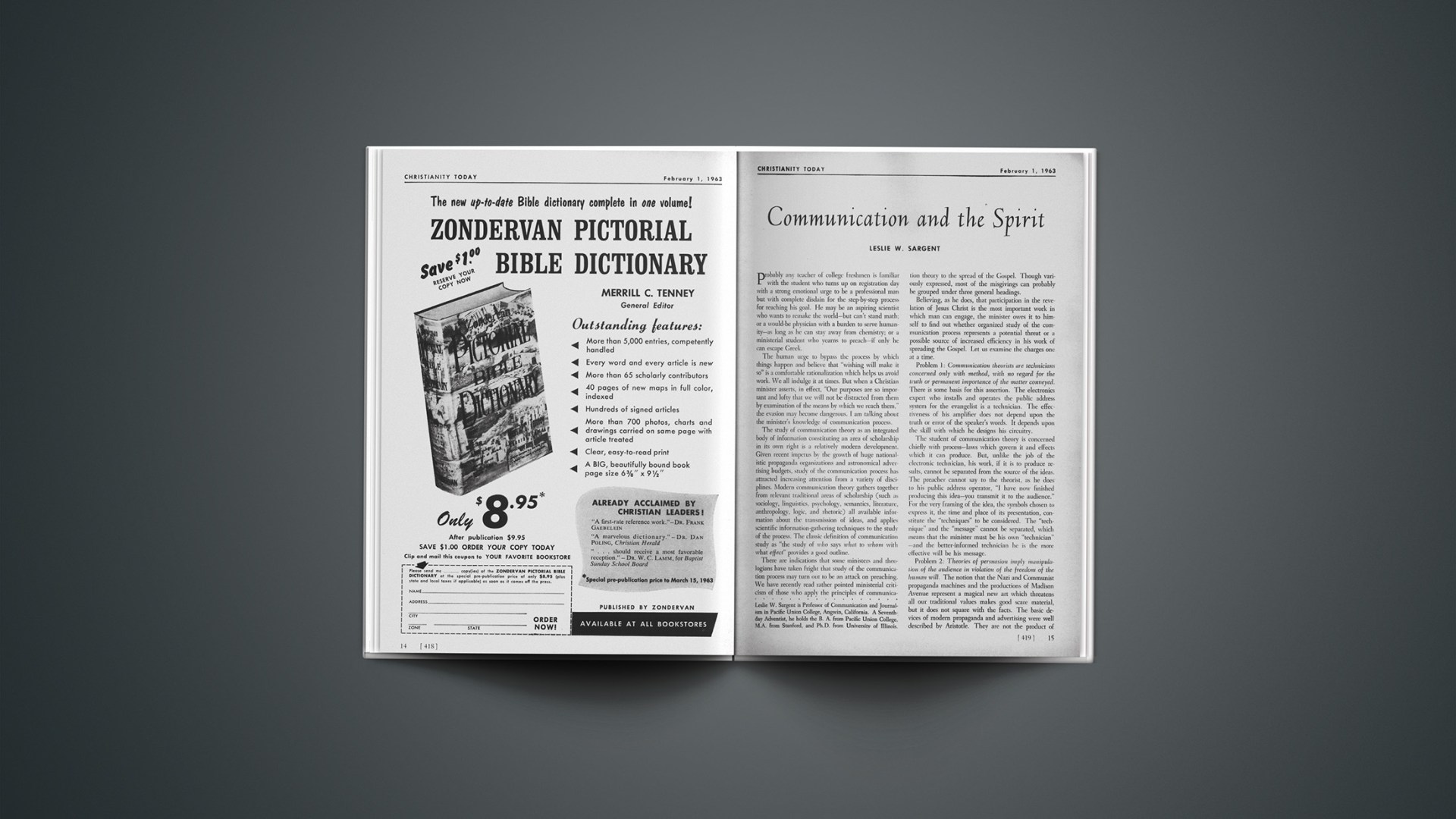
Communication and the Spirit

Probably any teacher of college freshmen is familiar with the student who turns up on registration day with a strong emotional urge to be a professional man but with complete disdain for the step-by-step process for reaching his goal. He may be an aspiring scientist who wants to remake the world—but can’t stand math; or a would-be physician with a burden to serve humanity—as long as he can stay away from chemistry; or a ministerial student who yearns to preach—if only he can escape Greek.

The human urge to bypass the process by which things happen and believe that “wishing will make it so” is a comfortable rationalization which helps us avoid work. We all indulge it at times. But when a Christian minister asserts, in effect, “Our purposes are so important and lofty that we will not be distracted from them by examination of the means by which we reach them,” the evasion may become dangerous. I am talking about the minister’s knowledge of communication process.

The study of communication theory as an integrated body of information constituting an area of scholarship in its own right is a relatively modern development. Given recent impetus by the growth of huge nationalistic propaganda organizations and astronomical advertising budgets, study of the communication process has attracted increasing attention from a variety of disciplines. Modern communication theory gathers together from relevant traditional areas of scholarship (such as sociology, linguistics, psychology, semantics, literature, anthropology, logic, and rhetoric) all available information about the transmission of ideas, and applies scientific information-gathering techniques to the study of the process. The classic definition of communication study as “the study of who says what to whom with what effect” provides a good outline.

There are indications that some ministers and theologians have taken fright that study of the communication process may turn out to be an attack on preaching. We have recently read rather pointed ministerial criticism of those who apply the principles of communication theory to the spread of the Gospel. Though variously expressed, most of the misgivings can probably be grouped under three general headings.

Believing, as he does, that participation in the revelation of Jesus Christ is the most important work in which man can engage, the minister owes it to himself to find out whether organized study of the communication process represents a potential threat or a possible source of increased efficiency in his work of spreading the Gospel. Let us examine the charges one at a time.

Problem 1: Communication theorists are technicians concerned only with method, with no regard for the truth or permanent importance of the matter conveyed. There is some basis for this assertion. The electronics expert who installs and operates the public address system for the evangelist is a technician. The effectiveness of his amplifier does not depend upon the truth or error of the speaker’s words. It depends upon the skill with which he designs his circuitry.

The student of communication theory is concerned chiefly with process—laws which govern it and effects which it can produce. But, unlike the job of the electronic technician, his work, if it is to produce results, cannot be separated from the source of the ideas. The preacher cannot say to the theorist, as he does to his public address operator, “I have now finished producing this idea—you transmit it to the audience.” For the very framing of the idea, the symbols chosen to express it, the time and place of its presentation, constitute the “techniques” to be considered. The “technique” and the “message” cannot be separated, which means that the minister must be his own “technician”—and the better-informed technician he is the more effective will be his message.

Problem 2: Theories of persuasion imply manipulation of the audience in violation of the freedom of the human will. The notion that the Nazi and Communist propaganda machines and the productions of Madison Avenue represent a magical new art which threatens all our traditional values makes good scare material, but it does not square with the facts. The basic devices of modern propaganda and advertising were well described by Aristotle. They are not the product of the black wizardry of electronics and neo-Freudian psychology. To equate the study of communication with some particular set of non-rational appeals used by an advertising agency is inaccurate and unfair.

If there is one observation which more frequently than any other causes dismay among students of communication, it is the passive receptivity of the mass audience. There are parallel areas of apathy and suggestibility in the Christian church. The ruggedly individualistic Christian of apostolic or Reformation times would seem strangely out of place in many spoon-fed twentieth-century congregations. One of the most urgent messages of today’s Church is that the significance of the individual lies in his personal accountability to God. The minister who knows how propaganda techniques short-circuit the human rational processes will most stoutly assert the importance of this personal accountability. He knows the hazards against which to warn his congregation and the non-rational shortcuts against which to guard his own sermons.

Problem 3: Application of communication theory to the work of the minister minimizes the direct work of God’s Spirit upon the human mind and elevates the human instrument. It is not a new charge that scientific examination of a process takes God out of it. Christian physicists and biologists have lived with this objection for years and have successfully contended that orderly description of the forces operating upon a celestial body or of the minute structures of the human brain need not eliminate belief in the upholding power of God. The fact that the physical finger of Deity does not appear as a value in an equation or as a location in the cortex merely teaches us that God operates his universe more efficiently and less primitively than we might have supposed. We learn that the Spirit that moved on the waters of Chaos operates lawfully.

The student of communication gathers together what has been learned about the process by which ideas move from one mind to another. He probes the pressures causing them to be accepted, rejected, or modified. He observes whether they are applied or not applied to conduct.

At what points does the Spirit enter the communication process? Certainly the preacher’s mind must be open to the Spirit’s stimulation through the written Word. Certainly the minister is alert for pertinent lessons in the circumstances God brings to him. Certainly he plans the ritual of his service and the sonorities of his organ and choir to allow the worshiper the peace and leisure for introspection—for the still, small Voice to be heard through the din of the huckster’s shouts echoing in his mind.

As in the process of the germination of a seed or the birth of a child, there is no spot to which we may point and say, “Just there is the finger of God.” Yet as in the planting of the seed or the rearing of the child, the more we know of natural law—the divinely ordained order of the universe—the more effectively we can work within its structure.

It is precisely because he believes that language and the human mind are both products of God’s creation and because he believes that God has deliberately chosen to communicate with men through the medium of human language that the minister is rewarded by study of the communication process. God could employ angels, direct vision, or other media at which man cannot even guess. But, as is obvious from the Gospel commission, the channel of human language as spoken by human beings is his chosen medium for conveying his message to mankind. Scripture records that he chose, in each age, the most effective individual transmitter for his message. Moses, Samuel, and Jeremiah were set apart from childhood; Paul was selected as a “chosen vessel” while still a rebel.

Why were these men chosen? They could scarcely have been selected for an orotund delivery, an impressive vocabulary, or a sincere presence. There must have been divine recognition of their total potential as communicators of a message. It is this total impact that concerns the student of communication.

If there is a single lesson that the study of communication would stress above all others for the minister, it would probably be attention to this “complete impact.” This means recognizing that a worship situation includes many “messages.” There are many of the communication channels which supplement or negate the words of the preacher. Communication research also suggests answers to a wide range of questions such as: How does the listener’s concept of himself affect the way he receives the minister’s message? Should the minister present both sides of a disputed point, or only his own convictions? How does audience perception of the minister affect its willingness to receive his message? Can the minister capitalize on the group identifications of his church members? When is fear not an effective stimulus to action? What happens in the mind of the listener when a new idea conflicts with a previously accepted idea? How do shifts in word meaning warp the minister’s message?

Far from attacking the study of the communication process as a threat to his calling, the minister should find in it a new opportunity to reexamine the worship techniques carried over from a previous generation. He should find incentive for rigorous self-examination. He should look to research findings as incentive to help him present the everlasting Gospel as fresh good news. He should be willing to compare his audience’s reaction to that of the audience of the Teacher of whom it is reported, “the common people heard him gladly.”

END
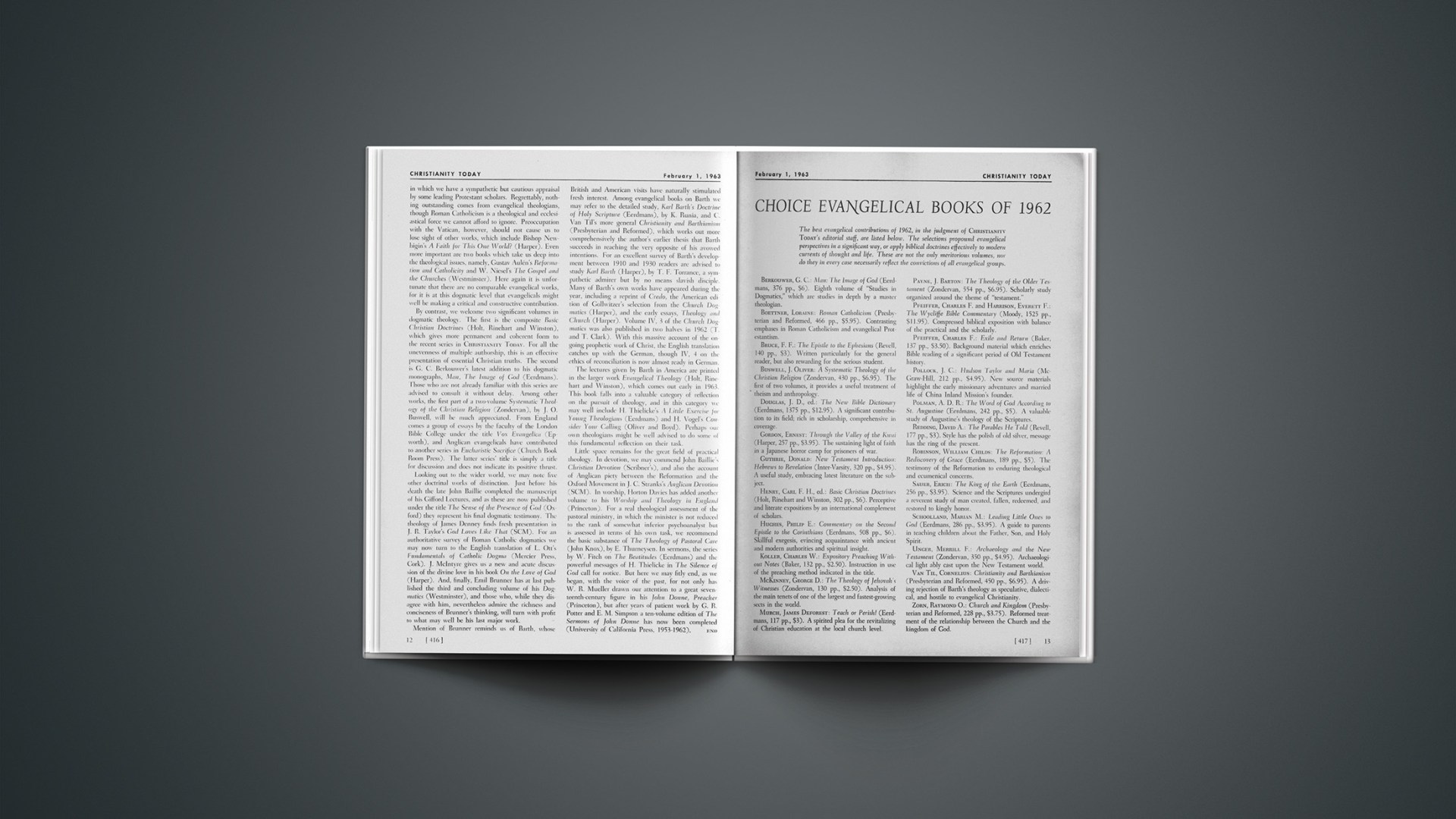
Choice Evangelical Books of 1962

The best evangelical contributions of 1962, in the judgment ofCHRISTIANITY TODAY’Seditorial staff, are listed below. The selections propound evangelical perspectives in a significant way, or apply biblical doctrines effectively to modern currents of thought and life. These are not the only meritorious volumes, nor do they in every case necessarily reflect the convictions of all evangelical groups.

BERKOUWER, G. C.: Man: The Image of God (Eerdmans, 376 pp., $6). Eighth volume of “Studies in Dogmatics,” which are studies in depth by a master theologian.

BOETTNER, LORAINE: Roman Catholicism (Presbyterian and Reformed, 466 pp., $5.95). Contrasting emphases in Roman Catholicism and evangelical Protestantism.

BRUCE, F. F.: The Epistle to the Ephesians (Revell, 140 pp., $3). Written particularly for the general reader, but also rewarding for the serious student.

BUSWELL, J. OLIVER: A Systematic Theology of the Christian Religion (Zondervan, 430 pp., $6.95). The first of two volumes, it provides a useful treatment of theism and anthropology.

DOUGLAS, J. D., ed.: The New Bible Dictionary (Eerdmans, 1375 pp., $12.95). A significant contribution to its field; rich in scholarship, comprehensive in coverage.

GORDON, ERNEST: Through the Valley of the Kwai (Harper, 257 pp., $3.95). The sustaining light of faith in a Japanese horror camp for prisoners of war.

GUTHRIE, DONALD: New Testament Introduction: Hebrews to Revelation (Inter-Varsity, 320 pp., $4.95). A useful study, embracing latest literature on the subject.

HENRY, CARL F. H., ed.: Basic Christian Doctrines (Holt, Rinehart and Winston, 302 pp., $6). Perceptive and literate expositions by an international complement of scholars.

HUGHES, PHILIP E.: Commentary on the Second Epistle to the Corinthians (Eerdmans, 508 pp., $6). Skillful exegesis, evincing acquaintance with ancient and modern authorities and spiritual insight.

KOLLER, CHARLES W.: Expository Preaching Without Notes (Baker, 132 pp., $2.50). Instruction in use of the preaching method indicated in the title.

MCKINNEY, GEORGE D.: The Theology of Jehovah’s Witnesses (Zondervan, 130 pp., $2.50). Analysis of the main tenets of one of the largest and fastest-growing sects in the world.

MURCH, JAMES DEFOREST: Teach or Perish! (Eerdmans, 117 pp., $3). A spirited plea for the revitalizing of Christian education at the local church level.

PAYNE, J. BARTON: The Theology of the Older Testament (Zondervan, 554 pp., $6.95). Scholarly study organized around the theme of “testament.”

PFEIFFER, CHARLES F. and HARRISON, EVERETT F.: The Wycliffe Bible Commentary (Moody, 1525 pp., $11.95). Compressed biblical exposition with balance of the practical and the scholarly.

PFEIFFER, CHARLES F.: Exile and Return (Baker, 137 pp., $3.50). Background material which enriches Bible reading of a significant period of Old Testament history.

POLLOCK, J. C.: Hudson Taylor and Maria (McGraw-Hill, 212 pp., $4.95). New source materials highlight the early missionary adventures and married life of China Inland Mission’s founder.

POLMAN, A. D. R.: The Word of God According to St. Augustine (Eerdmans, 242 pp., $5). A valuable study of Augustine’s theology of the Scriptures.

REDDING, DAVID A.: The Parables He Told (Revell, 177 pp., $3). Style has the polish of old silver, message has the ring of the present.

ROBINSON, WILLIAM CHILDS: The Reformation: A Rediscovery of Grace (Eerdmans, 189 pp., $5). The testimony of the Reformation to enduring theological and ecumenical concerns.

SAUER, ERICH: The King of the Earth (Eerdmans, 256 pp., $3.95). Science and the Scriptures undergird a reverent study of man created, fallen, redeemed, and restored to kingly honor.

SCHOOLLAND, MARIAN M.: Leading Little Ones to God (Eerdmans, 286 pp., $3.95). A guide to parents in teaching children about the Father, Son, and Holy Spirit.

UNGER, MERRILL F.: Archaeology and the New Testament (Zondervan, 350 pp., $4.95). Archaeological light ably cast upon the New Testament world.

VAN TIL, CORNELIUS: Christianity and Barthianism (Presbyterian and Reformed, 450 pp., $6.95). A driving rejection of Barth’s theology as speculative, dialectical, and hostile to evangelical Christianity.

ZORN, RAYMOND O.: Church and Kingdom (Presbyterian and Reformed, 228 pp., $3.75). Reformed treatment of the relationship between the Church and the kingdom of God.

Church History and Doctrine

It is a sign of Christian vitality that religious books continue to come out in large numbers, and that more diversified publishing houses display a strong interest in theological literature. From another standpoint, however, the wealth of titles is an embarrassment, since it makes discernment difficult, threatens to reduce any general review to a mere catalog, and poses a particular problem for those anxious to pick out the main trends. The most that we can do in this appraisal is to select some of the more interesting works, take account of any trends that seem to be emerging, and estimate the thrust of evangelical writing.

A first point is that there is no abatement of interest in the great theology of the past. Among important additions in this area are the new volumes of Luther’s Works (Concordia and Muhlenberg), and the Luther volume, Early Theological Writings, in the “Library of Christian Classics” (Westminster). The Banner of Truth Trust continues its good work with Sermons of the Great Ejection, in commemoration of the expulsion of Puritans in 1662, and The Early Life of Howell Harris, the Welsh evangelist. The year 1662 was also the date of Pascal’s death, and it is thus fitting that there should be a new English edition of the Pensées (Harper). During the year there have also been new editions of some of Kierkegaard’s works, including his Works of Love (Harper) and Philosophical Fragments (Princeton). In the main, the influence of these reprints is wholesome from an evangelical standpoint.

In purely historical studies one of the most encouraging developments is the church historical series jointly produced by Paternoster and Eerdmans. During the year G. S. M. Walker has added The Growing Storm on the medieval period, and the basic volume, F. F. Bruce’s The Spreading Flame, has been reissued. Dr. Latourette’s great series on Christianity in a Revolutionary Age has now been concluded with The Twentieth Century Outside Europe (Harper), and it is hopeful that the author remains optimistic for Christianity in spite of present difficulties.

The area of historical theology has produced some good works, with Reformation theology well to the fore. Those interested in biblical authority in Calvin might do well to consult H. J. Forstmann’s Word and Spirit (Stanford University Press), and much the same question is discussed in respect of the Anglican Jewel, though not without a certain bias, in W. M. Southgate’s John Jewel and the Problem of Doctrinal Authority (Harvard). Indeed, we are in much the same area in the Luther study, Grace and Reason, by B. A. Gerrish (Oxford). A more general work on grace in the Reformation period is by W. Childs Robinson’s The Reformation: A Rediscovery of Grace (Eerdmans). Ranging rather farther afield, Matthew Spinka has given us a fine survey of thinking from the Reformation to our own day in his new volume, Christian Thought from Erasmus to Berdyaev (Prentice-Hall). Another valuable survey is K. Cauthen’s The Impact of American Religious Liberalism (Harper), though we are not to follow the author in his more appreciative sections. From the evangelical standpoint we welcome the first of a four-volume assessment of Augustine by A. D. R. Polman of the Netherlands. The first volume on The Word of God in the Theology of St. Augustine (Eerdmans) is an acute and learned study.

Augustine is also the subject of a more biographical work which also comes from Europe. This is Augustine the Bishop by F. van der Meer (Sheed and Ward), and it deals with the more pastoral and practical aspects of Augustine’s ministry. Another stimulating biography from a very different period is Zinzendorf, the Ecumenical Pioneer (Westminster), by A. J. Lewis. Among other things this book reminds us that whatever we think of the ecumenical movement as it now is, it has in evangelicalism its deepest and its healthiest roots.

In the ecumenical world the Vatican Council tends to dominate the scene. Two works are particularly important here. The first is The Council, Reform and Reunion (Sheed and Ward), by Hans Küng, which represents more progressive opinion in the modern Roman Catholic Church. The second is the symposium, The Papal Council and the Gospel (Augsburg), in which we have a sympathetic but cautious appraisal by some leading Protestant scholars. Regrettably, nothing outstanding comes from evangelical theologians, though Roman Catholicism is a theological and ecclesiastical force we cannot afford to ignore. Preoccupation with the Vatican, however, should not cause us to lose sight of other works, which include Bishop Newbigin’s A Faith for This One World? (Harper). Even more important are two books which take us deep into the theological issues, namely, Gustav Aulén’s Reformation and Catholicity and W. Niesel’s The Gospel and the Churches (Westminster). Here again it is unfortunate that there are no comparable evangelical works, for it is at this dogmatic level that evangelicals might well be making a critical and constructive contribution.

By contrast, we welcome two significant volumes in dogmatic theology. The first is the composite Basic Christian Doctrines (Holt, Rinehart and Winston), which gives more permanent and coherent form to the recent series in CHRISTIANITY TODAY. For all the unevenness of multiple authorship, this is an effective presentation of essential Christian truths. The second is G. C. Berkouwer’s latest addition to his dogmatic monographs, Man, The Image of God (Eerdmans). Those who are not already familiar with this series are advised to consult it without delay. Among other works, the first part of a two-volume Systematic Theology of the Christian Religion (Zondervan), by J. O. Buswell. will be much appreciated. From England comes a group of essays by the faculty of the London Bible College under the title Vox Evangelica (Epworth), and Anglican evangelicals have contributed to another series in Eucharistic Sacrifice (Church Book Room Press). The latter series’ title is simply a title for discussion and does not indicate its positive thrust.

Looking out to the wider world, we may note five other doctrinal works of distinction. Just before his death the late John Baillie completed the manuscript of his Gifford Lectures, and as these are now published under the title The Sense of the Presence of God (Oxford) they represent his final dogmatic testimony. The theology of James Denney finds fresh presentation in J. R. Taylor’s God Loves Like That (SCM). For an authoritative survey of Roman Catholic dogmatics we may now turn to the English translation of L. Ott’s Fundamentals of Catholic Dogma (Mercier Press, Cork). J. McIntyre gives us a new and acute discussion of the divine love in his book On the Love of God (Harper). And, finally, Emil Brunner has at last published the third and concluding volume of his Dogmatics (Westminster), and those who, while they disagree with him, nevertheless admire the richness and conciseness of Brunner’s thinking, will turn with profit to what may well be his last major work.

Mention of Brunner reminds us of Barth, whose British and American visits have naturally stimulated fresh interest. Among evangelical books on Barth we may refer to the detailed study, Karl Barth’s Doctrine of Holy Scripture (Eerdmans), by K. Runia, and C. Van Til’s more general Christianity and Barthianism (Presbyterian and Reformed), which works out more comprehensively the author’s earlier thesis that Barth succeeds in reaching the very opposite of his avowed intentions. For an excellent survey of Barth’s development between 1910 and 1930 readers are advised to study Karl Barth (Harper), by T. F. Torrance, a sympathetic admirer but by no means slavish disciple. Many of Barth’s own works have appeared during the year, including a reprint of Credo, the American edition of Gollwitzer’s selection from the Church Dogmatics (Harper), and the early essays, Theology and Church (Harper). Volume IV, 3 of the Church Dogmatics was also published in two halves in 1962 (T. and T. Clark). With this massive account of the ongoing prophetic work of Christ, the English translation catches up with the German, though IV, 4 on the ethics of reconciliation is now almost ready in German.

The lectures given by Barth in America are printed in the larger work Evangelical Theology (Holt, Rinehart and Winston), which comes out early in 1963. This book falls into a valuable category of reflection on the pursuit of theology, and in this category we may well include H. Thielicke’s A Little Exercise for Young Theologians (Eerdmans) and H. Vogel’s Consider Your Calling (Oliver and Boyd). Perhaps our own theologians might be well advised to do some of this fundamental reflection on their task.

Little space remains for the great field of practical theology. In devotion, we may commend John Baillie’s Christian Devotion (Scribner’s), and also the account of Anglican piety between the Reformation and the Oxford Movement in J. C. Stranks’s Anglican Devotion (SCM). In worship, Horton Davies has added another volume to his Worship and Theology in England (Princeton). For a real theological assessment of the pastoral ministry, in which the minister is not reduced to the rank of somewhat inferior psychoanalyst but is assessed in terms of his own task, we recommend the basic substance of The Theology of Pastoral Care (John Knox), by E. Thurneysen. In sermons, the series by W. Fitch on The Beatitudes (Eerdmans) and the powerful messages of H. Thielicke in The Silence of God call for notice. But here we may fitly end, as we began, with the voice of the past, for not only has W. R. Mueller drawn our attention to a great seventeenth-century figure in his John Donne, Preacher (Princeton), but after years of patient work by G. R. Potter and E. M. Simpson a ten-volume edition of The Sermons of John Donne has now been completed (University of California Press, 1953–1962).

END

Survey of Old Testament Literature 1963

We may begin with a few works which cover both Old and New Testaments, and first and foremost mention must be made of The New Bible Dictionary (IVF and Eerdmans), edited by J. D. Douglas. The praises of this monument of contemporary evangelical scholarship have already been sung in CHRISTIANITY TODAY. It might be invidious to single out special contributions, but a work which includes articles of the quality of those by Herman Ridderbos on the Kingdom of God, J. N. Birdsall on the New Testament Canon and Text, Howard Marshall on John’s Epistles and Gospel, and Earle Ellis on Paul can hold its head high and unashamed. From the United States come two important volumes—the Holman Study Bible (A. J. Holman) and the Wycliffe Bible Commentary (Moody Press)—which also promote the evangelical cause; the former is an edition of the RSV with special introductions, general essays, a concordance, and maps, while the latter, edited by C. F. Pfeiffer (Old Testament) and E. F. Harrison (New Testament), includes contributions from 48 scholars representing a wide cross section of North American Protestantism. It would be a good thing if the writers entrusted with the Synoptic Gospels in a work of this kind engaged in a measure of joint consultation; this not only would prevent unnecessary overlapping, but also might forestall the rather odd position found in this commentary, where Mark is dated several years later than Luke!

The Interpreter’s Dictionary of the Bible (Abingdon) has appeared in four volumes; it bids fair to take the place for many years to come that Hastings’ five-volume work took in the earlier part of this century. Peake’s Commentary on the Bible (Nelson), edited by M. Black and H. H. Rowley, bears a familiar title but is an entirely new work, whose 62 contributors are said to represent “every branch of the Protestant Church in Europe and America”. William Neil has produced single-handedly a One Volume Bible Commentary (Hodder & Stoughton); in 200,000 words he succeeds in providing a remarkable amount of digestible information and comment for the general Bible reader.

D. Guthrie has produced the second volume of his trilogy on New Testament Introduction (Tyndale); it deals with all the books from Hebrews to Revelation, and gives us everything that we expect in an introduction. His conclusions are regularly conservative, but they are based on careful and well-informed examination of all the factors involved; we never get the impression that he has formed his conclusions in advance. T. W. Manson’s posthumous Studies in the Gospels and Epistles (Manchester University Press) has already been noted by the present writer in CHRISTIANITY TODAY. C. F. D. Moule has contributed a fascinating volume on The Birth of the New Testament to the “Harper’s New Testament Commentaries” series; it might be called an essay in form criticism, but that would be a misleading description for those who think of form criticism exclusively in Bultmannian terms. J. McLeman’s The Birth of the Christian Faith (Oliver & Boyd) deploys in defense of an ultra-skeptical interpretation arguments of a kind which would receive short shrift if adduced in defense of conservative opinions. G. Delling’s Worship in the New Testament (Darton, Longman and Todd) deserves a welcome in this English translation by Percy Scott; it is a most important work on its subject. J. A. T. Robinson has brought together Twelve New Testament Studies which have appeared in other places (SCM); those dealing with the Johannine writings of the New Testament deserve special attention. James Barr’s Biblical Words for Time (SCM) applies to one lexical area the principles of his earlier Semantics of Biblical Language; writers and preachers who are about to make sweeping generalizations about terms like aion, chronos, and kairos would be well advised to read Professor Barr’s observations before committing themselves too far.

Current Issues in New Testament Interpretation (Harper), edited by W. Klassen and G. F. Snyder, is a Festschrift for Otto Piper to which 15 scholars have contributed. Two items of special interest are Rudolf Bultmann’s critique of Karl Barth on Romans 5:12–21 in Christ and Adam, and Krister Stendahl’s interpretation of the Muratorian canon, which (he suggests) allows canonical status to Paul’s epistles on the strength of their analogy with John’s epistles to the seven churches in the Apocalypse; the canonicity of the latter was established without argument because John was a prophet addressing the whole Church.

Background Studies

F. C. Grant has completed his study of the cultural background of the New Testament with Roman Hellenism and the New Testament (Oliver & Boyd), a companion to his Ancient Judaism and the New Testament, which was noticed in our survey two years ago. Lucetta Mowry writes on The Dead Sea Scrolls and the Early Church (University of Chicago Press). More important studies of this and related subjects are collected in W. D. Davies’ Christian Origins and Judaism (Darton, Longman and Todd). M. F. Unger has given us in Archaeology and the New Testament (Zondervan) a companion to an earlier volume on Old Testament archaeology; he begins the present study with Alexander the Great and carries it on to the end of the apostolic age. E. M. Blaiklock has once again put his classical learning to good use in a characteristically readable paperback, The Century of the New Testament (IVF), an admirable introduction to New Testament background for the non-specialist Bible student.

F. W. Beare’s The Earliest Records of Jesus (Blackwell) is designed as a companion to the Huck-Lietzmann Synopsis of the First Three Gospels, providing a commentary on the more than 250 pericopae into which that work divides the Synoptic material. Jesus As They Saw Him, by William Barclay (SCM), surveys 42 names and titles given to our Lord in the New Testament. Suzanne de Diétrich contributes a helpful and original volume on Matthew to the “Layman’s Bible Commentaries” (SCM). R. H. Lightfoot’s The Gospel Message of St. Mark, first published in 1950, has appeared as an Oxford Paperback. In The Parables of Conflict in Luke (Westminster), J. S. Glen shows how Jesus exposed the superficiality and complacency of religious attitudes of his day, and draws certain practical conclusions about religious attitudes of our own day. Roland A. Ward’s The Gospel of John is one of the best volumes in the Baker series, “Proclaiming the New Testament”; the series is intended for preachers, but anyone who makes serious use of Dr. Ward’s book will be helped to preach sound expository messages—and if the Christian ministry is truly the ministry of the Word of God, preaching which is not expository is not true preaching.

Paul continues to exert his influence on men’s thinking. If many question whether it is possible to write a life of Jesus, or even to give an outline of his teaching, there is no lack of scholars (and others) prepared to come to grips with Paul. T. W. Manson used to say, “By their ‘Lives of Jesus’ ye shall know them,” but it is surprising how much can be learned about a writer when he sets down his reactions to Paul. A 30-year-old work by M. S. Enslin, The Ethics of Paul, has been reprinted as a paperback (Abingdon). C. K. Barrett’s Hewett Lectures have been published under the title From First Adam to Last (Black). This work, subtitled “A Study in Pauline Theology,” is a first-class contribution to Paulinism; we can only hope that Dr. Barrett will one day develop at greater length a number of the themes touched upon here. He takes up three “typical” Old Testament characters who figure prominently in Paul’s writings—Adam, Abraham, and Moses—and considers the part that they play in the unfolding Heilsgeschichte that finds its culmination in Christ. The final chapter, “The Man to Come,” affords an opportunity for Dr. Barrett to express his mind (in the light of Paul’s teaching) on a number of subjects of urgent interest and importance, and to conclude that “the whole of Church History stands as a witness to the Church’s permanent need of the Jewish Doctor of the Gentiles.” It makes a great difference when a writer on Paul knows—in his bones as well as in his intellect—what the Apostle is really getting at. Another aid to Pauline studies is the latest addition to the series of “Bible Key Words” (Black)—Law, by H. Kleinknecht and W. Gutbrod. The same subject is treated on a more popular level by G. A. F. Knight in Law and Grace (SCM). St. Paul and His Letters (Abingdon), by F. W. Beare, presents an expanded version of radio talks given in 1961 over CBC networks at “University of the Air” level, together with a paper on “St. Paul as Spiritual Director” read at the Oxford Congress on the New Testament the same year. The Dutch scholar W. C. van Unnik in Tarsus or Jerusalem? (Epworth) argues that Jerusalem, not Tarsus, was the city which exercised a formative influence on Paul’s early youth.

Studies In The Epistles

The publication of Wilhelm Pauck’s edition of Luther’s Lectures on Romans in the “Library of Christian Classics” (SCM) is an important event, not least because of what happened to Luther himself while he was engaged in the preparation and delivery of these lectures. But the student of Paul will read them with profit because they come from a man who in a signal degree thought Paul’s thoughts after him. The new translation of Calvin’s New Testament commentaries has been augmented by Ross Mackenzie’s fine translation in one volume of Romans and Thessalonians. A new book by E. K. Lee, A Study in Romans (SPCK), is not a commentary but a study of the principal themes of the epistle, viewed against a broad background. In the “Layman’s Bible Commentaries” (SCM), K. J. Foreman has written the volume on Romans, Corinthians. To write on three such important epistles in less than 150 pages means that many important matters must be dealt with but sketchily; nevertheless, Professor Foreman provides an attractive introduction to them for more elementary readers. A full-scale commentary on I Corinthians is J. Héring’s The First Epistle of Saint Paul to the Corinthians (Epworth), translated from the French. Like everything else by this veteran New Testament scholar, this commentary takes its place in the front rank. The only volume in the “New International Commentary on the New Testament” to appear this year is Philip E. Hughes’s magisterial volume on II Corinthians (Eerdmans). Whereas Professor Héring argues for the dichotomy of an epistle which is usually acknowledged to be a unity, Dr. Hughes argues ably for the unity of an epistle in which many exegetes, even if they are generally conservative in their approach, recognize portions of at least two Pauline letters. In the future Dr. Hughes’s arguments will have to be seriously considered, not only on this point but on many others which affect the interpretation of II Corinthians. At this point it will not be out of place to record our indebtedness to the late General Editor of the “New International Commentary,” Dr. N. B. Stonehouse, and our sense of the loss which New Testament scholarship has suffered by his death.

One short passage in Galatians—the catalog of the works of the flesh and the fruit of the Spirit in 5:19–23—is the subject of William Barclay’s Flesh and Spirit (SCM), a word-study of all the terms used in these verses. Karl Barth’s Philippians, first published in German in 1927, has appeared in an English dress (SCM); it tells us at least as much about the development of Barth’s thought as it does about the teaching of Paul. William Hendriksen’s volume on Philippians has appeared in his New Testament Commentary (Baker); in it, as we expect, we have ample evidence of the painstaking exegete and the Christian Reformed theologian. L. J. Baggott’s New Approach to Colossians (Mowbrays) takes the cosmic significance of Christ seriously and endeavors to show how Christ today provides the only clue to a satisfying interpretation of this mysterious universe. A simpler work on Colossians is H. K. Moulton’s volume on it in the Epworth “Preacher’s Commentaries.” C. K. Barrett has written on the Pastoral Epistles for “The New Clarendon Bible” (Oxford) what is claimed to be the first commentary based on the New English Bible.

The “Torch” commentary on The Epistles of John (SCM) has been written by Neil Alexander. He expresses his indebtedness to C. H. Dodd’s work on these epistles, but dissents from his ascription of them to a different author from the Fourth Gospel’s. Lehmann Strauss has produced a devotional exposition of the same epistles (Loizeaux). D. T. Niles of Ceylon has written a work on the Book of Revelation entitled As Seeing the Invisible (SCM). He makes no independent contribution to the critical questions raised by the book, but helps the reader to read it so as with John to see Him who is invisible. William Hendriksen’s exposition of the same book, More than Conquerors, now over 20 years old, has appeared in a British edition (Tyndale Press).

H. W. Montefiore has published a most interesting series of studies in Josephus and the New Testament (Mowbrays), in which he considers how far certain supernatural events associated with the birth, death, and resurrection of Christ can be correlated with prodigies related by Josephus. The same author collaborates with H. E. W. Turner in the writing of Thomas and the Evangelists (SCM), which studies the relationship between the Gnostic “Gospel according to Thomas” and the canonical Gospels. The two authors reach somewhat different conclusions, so that the reader is faced by the healthy task of exercising his private judgment. Another important work on the recently discovered Gnostic texts is an edition of The Gospel of Philip (Mowbrays), by R. McL. Wilson.

END

Pilate Before Christ

The bench is raised

Where Pilate judging sat,

And Christ in seamless robe

Wrist-bound with sneers

In quiet dignity and strange repose

With unbefitting majesty yet speaks

Where common clay would agitate,

“Against me Thou

Couldst have no power

Save it were given from above.”

O Pilate, in those words

Deliverance lies

From trial more your own

Than Christ’s!

For many choose with you

The empty motions

Of hand-washing indecision,

And many vainly cry

Irresolute:

“What shall I do with Christ?”

RUTHE T. SPINNANGER

Old Testament Studies in 1962

During the course of 1962 two significant study Bibles, representing two divergent approaches to Scripture, made their appearance. One of these, The Oxford Annotated Bible, contains the text of the Revised Standard Version together with brief introductory articles and numerous footnotes, which, as far as the Old Testament is concerned, are written from the standpoint of the modern “critical” view of Scripture. At the conclusion of the volume there are useful articles on geography and archaeology as well as chronological tables and excellent maps. The other work, the Holman Study Bible, also RSV, has introductory notes to the biblical books written by evangelical scholars, some valuable articles which serve as helps to Bible study, and a concise concordance. From the fact that evangelical scholars have contributed these notes it of course does not follow that they would all give unqualified approval to the Revised Standard Version. Indeed, both of these study Bibles would be greatly improved by notes calling attention to the major weaknesses in the Revised Standard Version, for at least in the Old Testament it is in many respects an inferior version (e.g. Ps. 2:12; Isa. 7:14). Attention should also be directed to The Amplified Old Testament, Part Two—Job to Malachi (Zondervan). The format of the book and its clear type make it easy to use, and it should prove to be a genuine aid to readers of the Old Testament.

As a companion to The Oxford Annotated Bible there has appeared the Oxford Bible Atlas, which is compact, reliable, and beautifully printed. The maps are clear and quite useful, and there is a wealth of archaeological and historical material, accompanied by excellent photographs. The standpoint from which the articles are written is the same as that which characterizes the Annotated Bible.

The Bible and its Background. Perhaps it is not out of place to mention a work that should be in the library of all who love Palestine. We refer to the little volume by Bertha Spafford Vester: Flowers Of The Holy Land (Hallmark Cards, Inc.). Here are 17 reproductions of Mrs. Vester’s original watercolors, beautifully done. He who has heard Mrs. Vester’s “story” and has been to Palestine will derive much enjoyment from this book.

John Gray’s Archaeology and the Old Testament World (Nelson) is a serious, scholarly discussion. The volume is well illustrated, and the author is abreast of the latest discoveries. He writes from the standpoint of the dominant “critical” view of the Old Testament.

Equally scholarly, but representing the views of a Bible believer, is the valuable work The Bible and Archaeology (Eerdmans), by J. A. Thompson. The book contains material which had earlier appeared in three smaller volumes, but which is here brought together, rearranged, and enlarged. The many splendid illustrations greatly increase the book’s value, and help to make it a most helpful compendium of reference for the average reader of the Bible.

One of the needs of our day is for a volume dealing with the philosophy of archaeology and its position in a genuine Christian apologetic. To the best of the present writer’s knowledge, this question has not yet been adequately treated.

Aids to Bible Reading. That portions of the Old Testament are difficult for the average reader cannot be denied. Genuine helps, therefore, are truly to be welcomed. One method of studying the Old Testament is to devote attention to its great personalities. In Women Who Made Bible History (Zondervan), Harold J. Ockenga has done just this. He has given us several penetrating yet popular studies of different women of the Bible, the reading of which should bring profit and a deeper understanding of the Scriptures.

As a help in the study of one of the more difficult periods of Old Testament history, Exile and Return (Baker), by Charles F. Pfeiffer, can be heartily recommended. It is written in language for the layman, is well supplied with helps such as illustrations and maps, and is faithful to the Scriptures.

Two further Bible Guides (Abingdon), Historians of Israel (1), by Gordon Robinson, and Historians ofIsrael (2), by Hugh Anderson, dealing with Samuel–Kings and Chronicles, Ezra, Nehemiah respectively, present a popular approach to these biblical books. The works are scholarly, well written, and easily readable, but they present an approach to Scripture which is not that of the Bible itself.

A popular approach to Exodus is found in Holy Ground (Baker), by Douglas M. White. One who is not familiar with the Bible should be helped by reading this book. The expositions are practical and devotional. The Making of a Man of God (Zondervan), by Alan Redpath, consists of popular studies in the life of David. The studies are devotional and should be a help in opening up the portions of Scripture with which they deal.

Dr. Herbert Lockyer has followed his many other volumes with another, All the Promises of the Bible (Zondervan). This is a big book (610 pages), and it keeps the Scripture constantly before the reader’s eyes. Its reading can bring much profit.

A Hebrew Grammar. One aspect of Old Testament study seems to bring forth more groans from theological students than any other, namely, the Hebrew language in which the Old Testament is written. Those who wish to do serious work in the Old Testament, however, must study Hebrew. Modern helps, guides, outlines, and so on, are no substitute for a knowledge of Hebrew. But to obtain a competent knowledge of this language is no easy task. Any help in the study of Hebrew is to be welcomed, and the appearance of a twenty-fifth edition of Davidson’s Hebrew Grammar (T. & T. Clark) shows that many have found the book useful. This edition has been subjected to a thorough revision by John Mauchline, who has performed an extremely difficult task in a most capable manner. This reviewer is unable to accept in its totality the approach to Hebrew found in Davidson, but this is by far the best edition of this work to appear.

It is a sign of encouragement that 1962 should see the appearance of a reprint of The Semantics of Biblical Language (Oxford), by James Barr, a book that exposes the fallacious use of Hebrew and Greek linguistic evidence by some modern scholars. It is time that someone should write a book of this kind. Had the author done nothing more than expose the misuse of the Hebrew word dabar (word-matter) by some modern theologians, he would deserve the gratitude of all biblical scholars. At times, it may be, the argument is carried too far, but this is a valuable book, to be carefully read, pondered, and heeded.

Old Testament Prophecy. At the heart of Old Testament studies are the prophets; in interest and significance, at least, they occupy a predominant place. Abraham J. Heschel has written a large volume, The Prophets (Harper), which, although scholarly, can yet easily be followed by the educated layman; it is written in beautiful English, interspersed with frequent quotations from the prophets. Attention is devoted to each of the prophets and also to the great questions which are involved in the study of prophecy. But one could at times wish for more penetration in the treatment of some of these problems. Thus in a note it is declared that four theories of the Servant of the Lord have been presented (p. 149), but among these the Messianic interpretation is not mentioned. Despite the learning which characterizes this work, its thesis will not be acceptable to the Christian who believes that the prophets spoke of Christ.

Perhaps the most significant and profound work on the prophets to appear in our generation is J. Lindblom’s Prophecy in Ancient Israel (Basil Blackwell). Through the kindness of Professor G. W. Anderson the author’s English has been improved, so that the reading of the work is a pleasure. It is no exaggeration to say that this volume will take its place along with Hölscher’s work as a standard reference book. It is nothing if not thorough. The prophets are not discussed individually, as was the case with Heschel’s book, but due attention is paid to their teaching. Despite its profundity and thoroughness, however, the book does not really come to grips with the basic problem in prophetic study. That basic problem is not whether the prophets believed that God had spoken to them—on that point there seems to be little room for doubt—but whether God actually did speak to them. Were they really the recipients of special, direct, propositional revelation from the one living and true God? That is the question to be faced. If God did not give special revelation to the prophets, then they were fundamentally mistaken about themselves. It is no light issue, for the very truthfulness of Christianity is involved, but it is one which neither of the two books under discussion faces squarely.

Historical Study. Because of its importance there is one monograph deserving particular attention. Professor H. H. Rowley has written on the difficult subject of Hezekiah’s Reform and Rebellion (The John Rylands Library), presenting a strong defense of the view that there was only one campaign of Sennacherib. The significance of this will immediately be apparent to every biblical student. Possibly it is time to suggest that biblical students, whatever be their viewpoint, abandon 715 as the date of Hezekiah’s accession and the whole unfounded view of two campaigns of Sennacherib. No serious student should neglect what Rowley has written.

Special Studies. Many will welcome a reissue of H. Wheeler Robinson’s Inspiration and Revelation in the Old Testament (Oxford Paperbacks). The book will not be satisfactory to a conservative Christian, but it is an excellent presentation of a certain viewpoint. Jack Finegan has written a popular exposition of Genesis with practical application, In the Beginning (Harper). The book is abreast of archaeological studies but represents an approach which this reviewer cannot share.

Under the title Israel’s Prophetic Heritage (Harper), 16 scholars have presented essays in honor of James Muilenburg. None of the articles is written from a conservative standpoint, but all are scholarly, and some are particularly thought-provoking, a worthy tribute to the great scholar whom they honor.

Old Testament Theology. Many of the works which treat of the content and teaching of the Old Testament are based on a particular evaluation of the Old Testament represented by scholars such as Alt, Noth, von Rad, and Mowinckel. The following books more or less agree with this point of view, although each is an independent work. But the underlying position is one which, in this reviewer’s opinion, does not do justice to the supernaturalism of the Old Testament.

George A. F. Knight gives an informing discussion of Law and Grace (Westminster) with many challenging ideas to consider. The Old Testament Roots of Our Faith (Abingdon), by Paul J. and Elizabeth Achtemeier, endeavors to show the importance of the Old Testament for Christianity. Even though one may disagree with much in the book, he will yet profit from its reading. John William Wevers has given an interesting and informative study of the Psalms and Wisdom Books in The Way of the Righteous (Westminster). His work is a useful introduction to a certain modern approach to the Psalms. Whatever Gabriel Hebert writes is thought-provoking. His The Old Testament From Within (Oxford) attempts to show the real issues of faith in the various stages of Old Testament history, but the Bible believer will not find it satisfactory. Of particular importance is Murray Newman’s The People of the Covenant (Abingdon). This work shows thorough acquaintance with the writings of some of the scholars mentioned above, but also exhibits considerable originality. It stands out as a book of unusual moment, and may be studied as one of the best available guides to a particular interpretation of Israel’s history.

Three Translated Works from Germany. At last there has appeared an English translation of von Rad’s monumental theology. Old Testament Theology, Volume I (Harper), is a beautifully printed work, and will make the thought of this great scholar available to English-speaking people. Von Rad’s approach is radical, at least as radical as that of Wellhausen, and the basic standpoint adopted is one that cannot be called biblical. Certainly a theology should face up to the question of special revelation from the triune God, but this work does not do so.

A second commentary in Westminster’s “Old Testament Library,” Exodus, by Martin Noth, will be of interest to students of Old Testament history. It builds upon the untenable documentary hypothesis with the result that the supernatural in Exodus is not adequately dealt with. The treatment of the burning bush, for example, is quite unsatisfactory.

Another commentary in this Westminster series is The Psalms, by Artur Weiser. The work presents the same general approach to Scripture as does that of Noth, but the deficiencies of that approach do not seem to make themselves apparent in a commentary on the Psalms to the extent that they do in the treatment of a book like Exodus, where the shadow of the documentary hypothesis is in the foreground. Weiser’s work is profound and filled with useful material. But how much richer are Calvin and Hengstenberg!

Two Evangelical Works. Dealing with the difficult subject of Christ’s second coming, Dr. J. Barton Payne, The Imminent Appearing of Christ (Eerdmans), has defended a premillennial interpretation which is worthy of serious consideration. A second work, Theology of the Older Testament (Zondervan), is of major proportions, and constitutes a serious, scholarly study of Old Testament biblical theology. The book represents a tremendous amount of reading and researching, and is characterized throughout by faithfulness to the infallible Word of God. In a work of this size there are sure to be some areas of disagreement, but even where one cannot follow the author he can learn from him. And Dr. Payne’s gracious method of dealing with those with whom he disagrees might well be emulated by us all. Above all, the presuppositions which undergird this book are true, for they are scripturally grounded. This is the path in which all scholarship must walk, if it will truly come to an understanding of God’s inscripturated Word.

END

Damned

He that believeth not is condemned already.

Who? Who will pluck the blazing brand away

From this the quivering tablet of my soul?

And who will stop this turning wheel

On which my spirit, stretched with eternal straining, cries?

Or who will cool my burning tongue

With but a drop of mercy’s dew,

And speak a word—one little word

Of comfort in my pain perpetual?

Dark is the day—the never-dying day,

Whose dawn I curse; whose close I now despair.

PAUL T. HOLLIDAY

Living in the Presence of God

Sunday morning, December 9, 1962, was a typical Sunday morning in Greenville, Texas, and Bill Betts, pastor of Wesley Methodist Church, seemed a bit brighter and happier than usual. His morning congregation sensed the Holy Spirit’s power upon the message, “The Touch of the Master’s Hand.” In the afternoon the minister disappeared, seeking rest and prayer at the family’s lakeside cabin a few miles away.

As he led the way into the sanctuary for the evening song service, he confided to a church member: “I’ve got to change my sermon for tonight.” To the congregation he said: “This is going to be an unusual service.” He read Galatians 2:20, I am crucified with Christ: nevertheless I live; yet not I, but Christ liveth in me, in three different translations. “Now,” he remarked, “I would like to give you a free translation that I heard a long time ago.…”

There was a thud and stunned silence. Bill Betts had slumped over, dead. The morning message, unbeknown to him, had been his last message to his people. Somebody had made a tape recording. Here is the third and final point:

“I meet fellows; I ask them to give testimonies of what Jesus means to them.… ‘Well,’ they say, ‘… 35 years ago I met the Lord in a brush arbor meeting.’ I did not say anything about meeting the Lord 35 years ago. I said, what does Jesus mean to you today? What have you given to him over the last 35 years?… What about this week? Is your commitment to Jesus Christ current? Is your experience with Jesus Christ current? I meet people who hang on to prejudices, and hates, and old mistakes, sins and strife, and problems, and a tongue that spreads like fire; I see people hang on to these things as if they were life itself.… Surely, we must meet the Lord. But we must keep our experiences up to date, every day, every minute of every day.”

END

Give Him the Word!

A chaplain in San Quentin Prison wrote a book, an A excerpt of which appeared recently in the Reader’s Digest. In this selection the chaplain tells of visiting a man who had been confined to Death Row for nearly 11 months. This man—a neurotic and alcoholic—had strangled two women during a drunken orgy.

The chaplain talked with the prisoner for at least 40 minutes before the condemned man went into the gas chamber to die. The two conversed about education, about art, about sports. But the prisoner went to his death with no invitation to God. Nonetheless, the chaplain found himself praying that God would receive the condemned man, found himself wondering if he had witnessed not only a case of retribution, but also a crucifixion.

One disturbing sentence in the chaplain’s account gleams with neon sharpness: “I haven’t mentioned religion.” Then he adds: “Perhaps it is not necessary to speak God’s words in order to serve His purpose. Just being there with Richard Cooper in his last moments may be enough to show him that no man is ever completely cast out, or completely alone.”

With but 40 minutes left of a man’s earthly existence, the chaplain discussed education, art, and sports—but no religion! Of what use are education, art, and sports to a doomed man? Only a few more heartbeats and the man will be finished with all earthly things. Only 2,400 seconds more of time—and they talk about baseball!

Perhaps hundreds of clergymen read this article and silently cried, “Why couldn’t I have been there to speak at least one ‘thus saith the Lord’ to this man poised on the brink of eternity?”

Granted, the Word may have come too late, or the man may have been past the point of acceptance, or he may have rejected the message. But who can tell—he might have found salvation! The thief on the cross had but little time, too! What’s more, whether the condemned man would have accepted it or not, was it not the responsibility of this minister of the Gospel to offer redemption in Christ? While we have no guarantee that men will accept salvation, we are commanded to declare it nonetheless.

Perhaps we have misunderstood the chaplain’s position in this case; he may have omitted certain facts that would alter the record presented. But as the article stands, it symbolizes something that happens quite often. Are we withholding the Word? Do we expect to accomplish God’s work without “speaking God’s words”? “Just being there with” people is not enough. If we bear witness only to ourselves, they may think we have little to offer them. Talking about education, art, sports, or about any of a thousand other things will never confront men with their need of eternal life. These things have their place and their value, but they are powerless to redeem the soul.

Let’s face it. Not only was that San Quentin prisoner going to die—all men are going to die! Unlike Richard Cooper, we in our cosmic death row may not know the appointed time of our demise. But our end is no less sure and inevitable. We march just as inexorably toward the last exit as he did. What assurance have we that the young robust man we speak with today has any more time left than Cooper’s 40 minutes? Shall we discuss with him college, books, drama, athletics, but skip religion?

What we are emphasizing applies especially, perhaps, to the minister of the Gospel. If he knew he were to preach the last sermon of his life, what would a man preach. Suppose he knew that 50 of his parishioners—50 unsaved persons—would die before he stood in the pulpit again: what would he preach? What sin bears greater consequences in the long run than that of withholding God’s truth from man?

Every Christian has a divine mission, that of taking the Gospel to every man in all the world. Because acquaintances may not wish him to fulfill this mission is no excuse for exemption from duty. How often the primitive church was disliked for doing its God-given task!

Even if we perform our mission rather poorly we are to fulfill it nevertheless. Not everyone is qualified to present the truth in expert fashion. Think of those suffering but singing people in the Acts of the Apostles. While they often lacked propriety, they did not lack spiritual power. They were often misunderstood. They were cursed and beaten. But they were people of the Word such as history has seldom seen. And that Word so worked abroad in the world that Rome herself could no longer halt the march of the Cross.

“Perhaps it is not necessary to speak God’s words,” the San Quentin chaplain said. But it is necessary. Our own words are never good enough. Only Spirit-charged truth can penetrate the defenses with which lost men surround their souls. “… The words that I speak unto you,” said Jesus, “they are spirit, and they are life” (John 6:63).

The Word of God is a quick, sharp sword piercing the thoughts and intents of the human heart (Heb. 4:12). It is a gentle rain; falling on barren desert, it makes the dust to burst into bloom (Isa. 55:10, 11). It is a seed; dropping on barren ground it brings forth a golden harvest (Luke 8:11). It is a fire that burns into the soul, a hammer that breaks the resistant stone (Jer. 23:29).

Millions throughout the ages have acknowledged this Word to be the power of God unto salvation. This Word has laid hold of men at the brink of hell and snatched them back. It has changed multitudes of derelicts to messengers of hope. Like the disciples we must say of Jesus’ power: “What a Word is this!” (Luke 4:36).

Are we to replace this wonderful, this terrifying Word with words about secular things and fancies? In a 40-minute period of grace before death Jesus is far better than Hemingway, Paul far better than William James, Isaiah than Rembrandt, Luke than Mickey Mantle!

Especially those called to the ministry are responsible for offering the “word of reconciliation” (2 Cor. 5:19). Said Paul, “… Ye shine as lights in the world, holding forth the word of life …” (Phil. 2:15, 16). Faith comes by hearing, says the Apostle, but by hearing what? “So then faith cometh by hearing, and hearing by the word of God” (Rom. 10:17).

Suppose the Apostle Paul were sitting in a death cell with someone who in half an hour would go to a Roman gibbet. Would he speak about his studies under Gamaliel? about the philosophy of Seneca? Or would he discuss the chariot races in Rome and the wrestling matches in Athens? The answer to these questions is obvious. If the Apostle did use such themes, they served only as launching pads for his Gospel rockets!

A famous missionary once said, “When you put forth God’s Word in your witness the Holy Spirit backs you up.” True! When we give the Word of God to men, it speaks with an authority we ourselves do not possess. While some will reject it and others will be angry at it, still some will be saved by it. Is the rescue of these few by the Word not far better than losing all by conversation about literature, art, basketball, or the atomic bomb?

We may not always wield the sword of the Spirit successfully; it alone, however, is the weapon of victory. In this business of redemption other weapons are of no avail. Our assignment, however ridiculous it may seem to the sophisticated, comes from the Bible: “… He that hath my word, let him speak my word faithfully. What is the chaff to the wheat? saith the Lord” (Jer. 23:28). Chaff may have its purpose and its place, but it is nothing compared to wheat.

When a man has but 40 minutes to live, give him the Word of God! Even if he has 40 years, still give him the Word.

END

Review of Current Religious Thought: January 18, 1963

One of the better publications that crosses my desk is the Union Seminary Quarterly Review. Like some of the readers of CHRISTIANITY TODAY I am a “freeloader”; the Review is passed on to me by a friend. I cannot say, however, that this lessens my pleasure or profit in the reading.

An issue which you simply must read is that of May, 1962. If the editors of the Review would care for my advice, I would like to suggest that this particular issue be put out in book or booklet form. The issue carries articles by James Muilenburg, John Knox, Robert T. Handy, Edmund A. Steimle, Wilhelm Pauck, Roger L. Shinn, and Daniel D. Williams. All these names gathered in one issue of any publication would insure its success, and just for good measure there is a book review (“An Assembly of Solemn Noises”) by Robert McAfee Brown which could serve as the last word for anyone who wants to know how to write a book review.

Interest in this issue involves more than just interest in the authorities who have written, however, and this is the reason why the issue of last May is still “current” in religious thought; these men of Union Seminary have been led to write on subjects of perennial interest which are always “current.” Under the aegis of a man named Thomas Laws and the Student Worship Committee of the seminary, these men gave informal lectures, which were taperecorded for publication, on such subjects as “What I Believe It Means to be Saved,” “What I Believe About the Activity of the Holy Spirit,” “What I Believe About the Way God Answers Prayer,” and “What I Believe About Life After Death.”

The discussions and the articles grew out of a sense of need which I think is common to all our seminaries. Allowing that a seminary is called to serve the faith by solid academic achievements, Thomas Laws, in his introduction to the Review, along with his committee of students “would assert that these intellections do not constitute the whole faith.… Many theological students do have an immediate concern for the more ‘confessional’ elements of the Christian faith.” The Student Worship Committee (I am still quoting Laws) “sensing within the Seminary community a need for explicit discussion affecting personal beliefs decided to sponsor a series of informal Lenten discussion meetings.” Four meetings were planned, and two faculty members spoke quite frankly at each meeting. Where there had been an expectation of 30 to 40 students, the issues were taken so seriously that over 200 students regularly crowded the Social Hall for the meetings. President Van Dusen is quoted as having called these meetings “the finest, most meaningful, and most helpful series of talks by faculty in the past 40 years.

Now the question is: Just why in a theological seminary do students feel the need for this kind of material (and the need is felt in every seminary), when the professors spend their days teaching theology, the things of Christ, the Word which we preach, and like matters? A second question is: Do the intellectual pursuits of an academic institution destroy the possibility of communicating the more “confessional” elements of our faith? These outstanding men of Union, recognized for their scholarship the world over, always have this warmth of personal conviction; yet the students feel the need of meetings outside the lecture hall in order that this warmth of conviction can be communicated.

If you think this is a criticism, then you have certainly missed the point. The problem is present in every seminary, and most professors and most students recognize it; at Union they did something about it. Kierkegaard raised the question long ago whether it is possible to “teach” theology. How does one “teach” redemption, or the presence of God, or the divine-human encounter, or communion in prayer, or the forgiveness of sin? The Swiss psychiatrist Tournier in his The Meaning of Persons shows how contact between doctor and patient is impossible until spirit touches spirit or person meets person, uncluttered by the trappings of “personage.” When C. A. Anderson-Scott returned to replace Hoskyns at Cambridge University, I heard him address his opening session, and I remember these words: “I want to keep one eye on the tripos (the English term for a final comprehensive exam) and one eye on the Kingdom of God, but I propose to keep my good eye on the Kingdom of God.” C. S. Lewis warns us about confusing a map with the journey; we can master the map and never take a trip. Robert Clyde Johnson, the great theologian at Pittsburgh Theological Seminary, has a letter published in a recent issue of “The Pittsburgh Perspective” in which he treats at length this hardy perennial: What is the relationship between theological discipline and spiritual experience? A young minister told me one time, “After three years at the seminary it took me three more years to get my religion back.”

Another question that arises somewhat indirectly from these articles in the Review has to do with the backgrounds of the men who wrote them. It is surprising, or maybe it is not, that so many of them refer to early training in home or college which was limited and narrow in what they think of as the “fundamentalist” approach to the Christian faith. One could do an interesting study on the number of men teaching in theological seminaries who have such a “fundamentalist” background; just to make the thesis more exciting, one might analyze also the religious backgrounds of editors and missionaries, not to mention board secretaries and ecumenical leaders. I resist the temptation to name names, but outstanding men in every denomination come to mind readily. Does this not raise the question (it does for me, anyway) whether we can find men coming into the ministry at all unless there is something of this fundamentalist “seriousness” about heaven and hell, the imminence of the Second Coming, sin and salvation, and the like? The desperate need for men in our seminaries may be related to the disappearance of the family altar, the sophistication of our church schools, the lightheartedness of our summer conference programs, and the reluctance of our church colleges to say anything too challenging about Christ for fear it will be intellectually shameful. Maybe it is time again for some old-time religion.

Knowledge Increases; Wisdom …

DEEPER AND DEEPER—The day of the all-around naturalist is over.… Even within a specific discipline, such as genetics, no one person can be conversant with all of the literature in that field. This is an indication of rapid acceleration.… There have been many spectacular breakthroughs.… There has been no such rapid growth of knowledge in any previous period of history.—Dr. IRVING W. KNOBLOCH, “Biology,” Journal of the American Scientific Affiliation, March, 1962, p. 25.

FASTER AND FASTER—A supersonic transport plane that will climb beyond 70,000 feet and cruise at a fantastic 2,000 m.p.h. is being planned by North American Aviation.—Advertisement, The Wall Street Journal, of a joint government-industry project whose development costs are put at $500 million to $1 billion.

DESCENDING INTO THE DEPTHS—A rugged and immobile kind of submarine, the Trieste, has already carried men 6.8 miles down to the bottom of the Pacific. But other men are trying to find ways for the free diver—the Scuba diver—to leave the confines of such machines to swim and work deep down.… Hannes Keller, a young Swiss scientist … has developed a secret mixture of gases which, breathed by the divers, enables them to descend to once-unheard-of depths.—“Death in the Depths, the Price for New Knowledge,” Life, Dec. 21, 1962.

PROBING THE MULTIVERSE—Mariner II has accomplished its mission in a way that constitutes a truly great moment in the history of man’s never-ending quest for more and more knowledge about his own solar system and the multiverse beyond it. In the words of Sir Bernard Lovell, Britain’s renowned astrophysicist, the event certainly deserves to be hailed as “by far the most splendid scientific achievement” recorded to date in the exploration of the boundless reaches of space.… Mariner’s report … will not be thoroughly evaluated for some weeks to come, but there seems to be little doubt at the jubilant National Aeronautics and Space Administration that results will amply justify the fact that this spatial project has involved 2,360 man-years of effort and an estimated outlay of $47 million.—The Sunday Star (Washington, D. C.), Dec. 16, 1962.

INTERNATIONAL EAVESDROPPER—A super-secret American satellite, so sensitive it can eavesdrop on Russian telephone messages, is now orbiting the earth, Newsweek magazine reported.… Newsweek said the satellite, which was developed by Lockheed Aircraft and RCA, can tap Soviet microwave telephone links and pinpoint missile launch sites by their radio guidance signals.—UPI report.

LIFE ON VENUS—Mariner II found no evidence that Venus has a magnetic field. This finding … keeps alive … a theory that Venus is cool enough to support some form of life.… Paul J. Coleman of the University of California … was quick to point out that this did not mean that Venus totally lacks a magnetic field.… There is always the chance that Mariner merely missed detecting a magnetic field.—HOWARD SIMONS, in The Washington Post.

SOUNDING THE ALARM—Education authorities say that cheating in schools is reaching “alarming” proportions. At one New York City high school, estimates were that half of the students cheated in examinations.… Street crime in many cities has reached a stage described as “alarming”.… Juvenile delinquency continues to rise.… Bank embezzlements, too, are at an all-time high.… In Washington, D. C., a recent inquiry into 92 welfare cases showed that more than 50 per cent of the families were wrongfully getting aid for dependent children. An official investigation last year found that at least 14 basketball players at 10 colleges took bribes or failed to report bribe offers to “fix” athletic contests.… Doubts, as seldom before in the nation’s past, are being raised about America’s moral standards.—“Is There a Decline in U. S. Morals?,” U.S. News & World Report, May 21, 1962, pp. 60 f.

FRINGE OR FABRIC?—“We are told that only the ‘fringes’ of our industries engage in dishonest practices,” said [Evan Wright, president of the Association of Food and Drug Officials of the United States].… “If this be so, the fringe is larger than the garment.… Today false advertising and misbranding are more prevalent than ever before. The difference is that the suckers are being born faster, and there are more rapid and sophisticated means of getting them than in Barnum’s time.”—The Washington Post, June 20, 1961, p. 3.

57 VARIETIES—Men’s magazines, specializing exclusively in out-of-focus pictures of nude women, sell at the rate of about $50,000 a year in the District according to conservative estimates.… One newsdealer has 57 varieties of the magazines in his downtown store.—WILLIAM DUKE, “Girlie Magazines Do a Thriving Business Here,” The Sunday Star, May 28, 1961.

‘THE GREAT POX’—Only five years after syphilis had apparently been conquered in the U.S. and was rapidly declining elsewhere, “the great pox” is making an unexpected comeback.… Of 106 nations reporting to the World Health Organization, no fewer than 76 have a rising incidence of syphilis.… A staggering 9,000,000 Americans are estimated to have syphilis, or to have had it.… Teen-agers, either ignorant or overconfident, account for much of syphilis’ increase.—Time, Sept. 21, 1962, p. 74.

CHANGING FASHIONS—It disturbs me much that many women in America let Paris determine what they shall wear. But it disturbs me more that many ministers in America let German theologians determine what they believe. They spend more time with Barth, Brunner and Bultmann than they do with the theologians of the Old Testament and New Testament, and so they end up in confusion and turmoil over what is essential to the biblical message.—Dr. R. B. CULBRETH, Pastor, Metropolitan Baptist Church, Washington, D. C.

Book Briefs: January 18, 1963

Lost But Still There

Loss of the Self: In Literature and Art, by Wylie Sypher (Random House, 1962, 179 pp., $4), is reviewed by Robert M. Davies, Professor of English, Thiel College, Greenville, Pennsylvania.

The Puritans thought themselves wretched sinners in the sight of God, but without serious qualms they cut off the head of Charles I. This was the paradox that so intrigued Macaulay in considering the Puritans: their almost abject self-denial because they were sinful human beings, yet their self-investiture as political regents for Almighty God because they were his sons.

Is man a little lower than the angels, or is he the dust of the earth? In this highly recommended book, Wylie Sypher follows the great change that has occurred in man’s concept of himself since the early nineteenth century. Then the Romantic hero was at the very center of the universe, and, in a measure of speech, he almost became his own universe. His personal emotions, seeking unbounded personal freedom, knew no restrictions.

But in seeking freedom, he modified and attacked the social and political systems so that increasingly he was swallowed up by the statistical mass man his own liberal statism created.

Building upon this historical background, Sypher shows the recent struggle of literature and art to find the authentic self. The existentialists, says Sypher, always assumed that the self has an identity, but the great question has been whether one is being honest in finding it.

Now, however, we are in post-existentialism, and the question arises: What if the self has only an uncertain existence? Suppose the realities of our situation seem to be more actual than the self on which these experiences are imposed? This is the question treated in what has come to be called modern anti-literature.

It is Sypher’s belief that the great creative artists and writers always reveal, without perhaps knowing why or how, the latest scientific discoveries and theories. In this respect, the dissolution of the Romantic hero occurred at the same time science was beginning to question the law of cause and effect in the physical world. For cause and effect is man’s rationalized selection of certain sequences which he thinks he understands. It is now understood that simple chance may actually be more operative in nature than cause and effect. The law of entropy, furthermore, asserts that the universe is constantly drifting toward an unstructured state of equilibrium that is total.

These laws find expression in modern literature to the effect that the destiny of man is obliteration, and our life only a brief rebellion against the randomness into which things are ebbing.

Yet surprisingly, says Sypher, modern anti-literature with its anti-heroes and nihilism and emphasis upon man’s absurd condition cannot really escape an affirmation: even after the self has shriveled, the human remains. “To repeat: we have an existence, however unwillingly, after we have lost an identity; and we do not seem to be able to diminish this existence below a certain point” (p. 154).

It is not likely that readers of CHRISTIANITY TODAY will agree at all with the efforts Sypher then makes to set up some kind of humanism assimilating various strands of Hindu de-personalization, Martin Buber’s I-Thou philosophy, and Camus’ existentialism. But they will find in this book an admirably lucid account from a non-theological point of view of many of the spiritual implications in the crosscurrents of modern literature, art, science, philosophy, and political science.

ROBERT M. DAVIES

Cambridge Shocker

Soundings: Essays Concerning Christian Understanding, edited by A. R. Vidler (Cambridge, 1962, 268 pp., $3.95), is reviewed by J. D. Douglas, British Editorial Director, CHRISTIANITY TODAY.

An intentional shocker. Ten collaborating theologians, “concerned about the dangerous complacency in the religious world,” tackle such topics as the Bible, the function and value of prayer, the malaise of natural theology, and the science-religion issue. H. E. Root refreshingly outlines the dilemma of philosophical theology confronted by the pitfalls of metaphysical speculation, but after a sly dig at “fashionable biblical theology” (undefined further), the shock treatment begins with: “It is by no means clear that anything like Christian faith in the form we know it will ever again be able to come alive for people of our own time …” (page 6). J. S. Habgood observes: “Theologians want to find a position which is secure against any possible advances in scientific knowledge,” and G. W. H. Lampe makes the misleading statement: “… The religious axiom that God ‘will by no means clear the guilty’ has been dramatically disproved.” Yet H. W. Montefiore unquestionably accepts the Virgin Birth (p. 170).

H. A. Williams is the debunker par excellence of old-time morality. After showing that man’s unworthiness before God has been overstressed in the Book of Common Prayer (the Romans do it better), he argues that the individual who refuses to steal under certain circumstances is not moral but just plain chicken. In citing two incidents from recent films, he approves fornication as a healing agency glorifying to God. About lust he writes: “The practice of religion can be a form of lust.… First of all, I make an idol which I call Jesus of Nazareth or the Ascended Lord. Then I try to give myself value by identifying myself with the idol I have made. When the living me at times bursts through, and I become more than my own idol, I consider that I have sinned” (p. 89). Williams goes on to give “Our Lady” a tendentious boost and says he regularly “asks for her prayers.” Prudently he declines to “identify her place in the scheme of salvation.” On page 78, after attributing to Freud a theory formulated earlier and better by Dostoevsky, he strikingly points out we use so much energy keeping in fetters the demon lurking inside us that we experience “the dullness and deadness of many good Christian people.”

The writers have a yen for labyrinthine sentences which leave precise meanings obscure, and even shorter ones baffle, chiefly through ambiguity—e.g. this from G. F. Woods’s essay on “The Transcendent”: “Invincible ignorance of what is not there to be known is not a reasonable ground for depression.”

“Not everyone will agree with the authors’ viewpoints,” says the publishers’ announcement, complacently. Just so. That such self-consciously radical thinking should come from the arid fastnesses of Cambridge University is not surprising-academic freedom is a cherished principle; that it (except for one essay) should have come from Anglican clergymen who have subscribed the Thirty-nine Articles is incredible.

J. D. DOUGLAS

With Notes

The Oxford Annotated Bible, edited by Herbert G. May and Bruce M. Metzger (Oxford, 1962, 1544 pp. plus maps with index, $7.95), is reviewed by Samuel Schultz, Professor of Bible and Theology, Wheaton College, Wheaton, Illinois.

The Oxford Annotated Bible (RSV), with cross references and running commentary in the form of notes placed at the foot of each page, is designed to aid the layman in reading and study to gain a fuller understanding of the Bible. The format is excellent. Special features in this edition include: articles on how to read and understand the Bible, the history of the English Bible, and the geography, history, and archaeology of the Bible lands; chronological tables of rulers and tables of weights and measures; and new full-color Bible maps with a three-dimensional effect. This edition represents the scholastic efforts of an impressive list of prominent biblical scholars.

The documentary theory provides the framework for the interpretative helps offered the layman in his study of the Bible. With biblical criticism in a state of flux, this theory of documents as reflected here has shifted from Wellhausenism and literary criticism to individual units of tradition as projected in current biblical studies in the light of ancient near-eastern documents discovered in recent decades.

On the basis of this theory, the reader is carefully instructed that the opening chapters of Genesis are “not to be read as history” nor to “be dismissed as childish myths”; that the patriarchal narratives “contain genuine historical memories” preserved “not for history but for religion”; that in the story of the Exodus and the settlement in Canaan we come nearer to historical light, though we are still dealing with idealized history “into which the legal sections of the Old Testament have been fitted”; that in the books of Samuel “we have much good history”; and that in the “stories of Elijah and Elisha there are legendary elements.”

This viewpoint of the theory of documents is reflected in the footnotes and introductions as follows:

1. Predictions are dated after the events occurred: Deuteronomy 28:47, 48 reflects the fall of Jerusalem in 586 B.C.2 Samuel 7:1–29 is a late theological commentary inserted into an early historical source; Nathan the prophet is used as a mouthpiece of the author, who may have been dreaming of a literal restoration of the kingdom of David. 1 Kings 13:2 is dated after Josiah’s time. Isaiah 9:2–7, filled with borrowed phrases referring to the Davidic monarchy, is a passage which may originally have celebrated the accession of a Judean king, perhaps Hezekiah. In the present context it describes the coming Messiah as the ideal king (the king [v. 6] representing the best qualities of Israel’s heroes).

2. Miracles are regarded as projections of the writer’s beliefs: Joshua 10:11—“There were more who died because of hailstones” is a characteristic expression of the writer’s belief that Israel’s victories were miracles accomplished by the Lord’s intervention rather than by the people’s skill in warfare. 1 Kings 17:1–24—the element of the miraculous in the stories (of Elijah and Elisha) must be accepted as an integral part of the writer’s method. 1 Kings 4:1–8:6—in ancient times, miracle stories were considered to be one of the best ways of portraying the importance of a religious leader; we are fortunate in having preserved for us this fine collection of prophetic lore.

3. Events and conditions portrayed in a historical setting in the Bible are frequently regarded as the ideas of late writers reflecting their own times: Exodus 25–31; 35–40; Leviticus 1–27; Numbers 1–10—this material, Document P, comes from priestly writers from the time of the Exile, although the “compiler … has relied upon independent source materials, such as the so-called Holiness Code, and upon numerous traditions which reach back to ancient times.” Numbers 1:5–15—this old name list reflects the twelve-tribe organization instituted in Joshua’s time (Josh. 24). Numbers 2:1–34—the priestly writer conceives the congregation as arranged symmetrically around the tent of meeting. 1 Chronicles 13:1–4–in the time of David, the distinction between priests and Levites did not exist. 1 Chronicles 15:1–24—note the emphasis on the Levites who did not exist as a special class in David’s time; the musical arrangements here set forth were largely drawn from the practice in the chronicler’s own day. Daniel 1–12—this book appears under the name Daniel; the author was a pious Jew living under the persecution of Antiochus Epiphanes, 167–164 B.C.; the six stories and four dream-visions, which come from times of national or community tribulation, are not actual history but, rather, symbolic interpretations of current history.

4. Dogmatic interpretations are based on the assumption that the documentary theory is essentially sound: Ezra 3:1—the law of Moses is not our Pentateuch but the body of laws associated with Moses’ name. Joshua 1:8—“this book of the law” means the legal provisions of the book of Deuteronomy. 2 Kings 22:8–10—the scroll almost certainly contained the earliest form of our present book of Deuteronomy, as subsequent references in this and the following chapters will show.

Constructively the reader of this Annotated Bible is advised that “in this book are the living oracles of God, which may speak to and nourish our spirit when we approach them in true devotion and humility.… In both Testaments God is revealed as compassionate and saving.… The saving character of God was revealed in bringing Israel out of Egypt; but it was revealed on a new level at Golgotha” (p. 1515). In these aspects this study Bible represents a marked improvement over the use of Scripture of several decades ago by the Wellhausenist scholars.

SAMUEL SCHULTZ

Reading for Perspective

CHRISTIANITY TODAY’S REVIEW EDITORS CALL ATTENTION TO THESE NEW TITLES:

Preaching for Tethered Man, by Theodore Heimarck (Augsburg, $3.75). Twelve sermons which show the path of freedom to men tethered by fear and darkness.

The Teaching Office in the Reformed Tradition, by Robert W. Henderson (Westminster, $6.50). A historical survey of what happened to “Calvin’s” ecclesiastical teaching office in Scottish and American Presbyterianism.

The Natural and the Supernatural Jew, by Arthur A. Cohen (Pantheon, $6). Author defines the theological Jew as one aware of his divine calling, and searches for him in the writings of such men as Martin Buber, Will Herberg, Abraham Heschel, and Mordecai Kaplan.

A Pioneer Work

World Civilization, 2 volumes, by Albert Hyma (Eerdmans; Volume I, revised, 1962, $5; Volume II, 1961, $5; also in paperback at $2 and $2.50 respectively), is reviewed by Milford F. Henkel, Chairman, Division of Social Science, Malone College, Canton, Ohio.

When a professor of history at a secular university attempts to write a work on world history from a Christian viewpoint, it is indeed news. This is one of the few serious attempts to interrelate a Christian world view with the facts of history produced in this century. In view of this purpose, then, one does not expect Dr. Hyma to write from an objective historical viewpoint. He does not profess to do so and would seriously question whether such a position is possible for anyone, and especially for a Christian.

Dr. Hyma is not a novice in the field of history and world history. He has taught history at the University of Michigan for many years and has produced more than 30 volumes, including the world history books in the “College Outline Series.” He is a co-author of The Growth of Western Civilization by Boak, Hyma, and Slosson, for many years a standard college textbook. These scholarly works lacked what Dr. Hyma felt was a Christian world viewpoint. His first world history book which approached this was World History, A Christian Interpretation (Eerdmans, 1942), which was designed as a textbook for junior and senior Christian high schools. His new work, the two-volume, 1,200-page World Civilization, is intended for the college level and for the serious student.

In his writing Hyma allows his personality and viewpoints to be known to the reader. Because of this his style is never dry, but is vigorous and interesting. He carefully documents what he says. He sharply differs with some historians, and does not always present his opponents in the best possible light. It is this style which makes his writing so readable—causing his friends to chuckle and his enemies to be perturbed. A good example of this is his reference to Professor Jan Huizinga (Vol. I, Part 2, p. 199). Hyma speaks of Huizinga’s “greatest error” and tells the reader that Huizinga “wrote the following nonsense.” This reviewer agrees with Hyma in rejecting Huizinga’s position, but wishes he had selected a different tone in his writing. Yet the statements are typical of Hyma, and those who know him can almost hear him speaking.

Many authors of secular world-history books reflect their bias in ignoring the God of creation, in favoring evolution as the only view, in their treatment of Jesus Christ, and in ignoring the contribution of religion to history. Dr. Hyma avoids all these errors. At the same time, all authors have a personal bias, and Dr. Hyma is no exception.

Hyma is committed to the theory of a 24-hour creation day as seen in his textbook and in his recent article in CHRISTIANITY TODAY (Sept. 14, 1962). Many evangelicals might wish he had been broader and had allowed for the possibility of other theories of creation. Is Hyma correct in considering all other viewpoints as compromises with the “Darwinian school”? (See Volume II, Part 5, page 300.)

Any survey, even one 1,200 pages long, must of necessity be selective, and this selectivity often leads to over-simplification. It is relatively easy to note such over-simplifications in any book, but this certainly does not negate the value of the work.

This book lends itself to a Christian interpretation of history far more easily than do other books, and is without doubt the best textbook on the market for a Christian professor of history.

Hyma’s mysticism or neo-Platonism could raise some question: he speaks of the spiritual creation of plants before the earth (Vol. I, Part 1, p. 2), “the double God Elohim” (Vol. I, Part 1, p. 30), and parapsychology (Vol II, Part 5, pp. 281 ff.).

World Civilization is a vigorously written pioneer work which attempts to set forth a Christian approach to history and is one of the best works in its field. The careful scholar would do well to consider Hyma’s views as expressed in this book.

MILFORD F. HENKEL

Communism Unraveled

A Study of Communism, by J. Edgar Hoover (Holt, Rinehart and Winston, 1962, 212 pp., $3.95), is reviewed by Harold John Ockenga, Pastor, Park Street Church, Boston, Massachusetts.

This study by J. Edgar Hoover is a most welcome analysis of the entire Communist movement—its philosophy, its strategy and goal, and the danger which it poses to the United States. It is far superior to the author’s previous work, Masters of Deceit, and the study of it should alert many Americans to this world conspiracy. Mr. Hoover, whose knowledge of Communist literature is thorough, has written with great factual accuracy, with astuteness as to Communist teaching and principles, and with appreciation of the Communist purposes. The one weakness we would point out in the book is the lack of footnotes to substantiate the statements made.

The author presents the philosophy of Communism as a system of thought which attempts to determine the reason for man’s existence and man’s relationship to his existence. He points out that Communism, in seeking ultimate truth, embraces a materialism which explains man in terms of dynamic matter alone, thus regarding matter as self-sufficient, self-developing, and self-perpetuating. This rules out a Supreme Being as creator, sustainer, and lawgiver of the universe; rejects the spiritual nature of man, the existence of his soul, and the idea of immortality; and derives moral codes from circumstances rather than from spiritual imperatives. Communism teaches historical materialism. This is the Hegelian dialectical method turned upside down, substituting matter for spirit or mind and applying it to the class conflict which, according to Marx, has existed throughout the ages. The dialectic will end when Communism becomes the final and perfect form of society. Peace is conceived as the victory of Communism over all opposites.

Communism teaches economic determinism: that the nature of society at any given time is the direct result of the means of production; that morality, culture, and the state are derived from the means of production and distribution; and that the forms of society change with the economic upheavals. It advocates violent revolution in which the workers seize control of the state, liquidate their so-called former exploiters, and establish a dictatorship of the proletariat. From then on all efforts are to be directed toward the building of internal state socialism and the bringing about of the world revolution to establish Communism. The final utopian state will be a Communist society of “from each according to his ability and to each according to his need” in which there will be no government, no rulers, no classes, and no exploitation.

Mr. Hoover points out the errors in the principles and practices of Communism. Among those errors are: (1) No explanation is given for the origin of matter and the cause of its motion. To call matter eternal is obviously to endow it with the attributes of deity. (2) There is failure to recognize that for centuries millions of people have acted upon moral codes derived from spiritual values. The ideals of truth, justice, love, and honor are not illusions. (3) Nothing is explained by the so-called dialectic; it merely describes a condition. It does not tell why motion is upward, or why there is struggle, negation of forces, and the emergence of new forms. (4) It is an error to believe that all of life can be explained in economic terms. The motivation of idealism plays a very important part. (5) In the theory of surplus value no consideration is given to such factors as ingenuity or management, the application of technical or scientific refinements in production, and the use of capital. Actually surplus value is not the only source of society’s wealth other than natural resources. (6) Ignored is the fact that many workers own stock in great companies and have improved their conditions by unemployment insurance, minimum wage regulations, a short work week, Social Security, and numerous other gains; they are not so exploited as they once were. (7) No regard is given to the nature of man, in which egoism is a motivation for both labor and creativity. Communism will break up ultimately upon its erroneous conception of the nature of man.

Mr. Hoover adequately contrasts the philosophy of a free Western society with the Communist view, showing that Western culture is built upon belief in God and in the unique value of man, an absolute standard of morals, and humanitarian, idealistic goals. In discussing the danger to the United States from the Communist party within, the author tells how Communist propaganda is embraced by many who are not Communists or fellow-travelers but are used for the advancement of the party’s purpose. He sees resurgent Communism as an especially great threat to our college youth. He relates the Communists’ methodology in penetrating all phases of American life and sends forth a ringing call to Americans for dedication to freedom, to what we may call Christian principles, and to our historio American philosophy.

This book should have a wide circulation. We unqualifiedly commend it as a correct and accurate presentation of the philosophy of Communism, the danger we face from it, and the necessity of meeting it.

HAROLD JOHN OCKENGA

What One Looks For

Israel in Prophecy, by John F. Walvoord (Zondervan, 1962, 138 pp., $2.50), is reviewed by Charles De Santo, Assistant Professor of Old Testament, Wheaton College, Illinois.

Dr. Walvoord believes that the Abrahamic Covenant is unconditional and has a definite application to the nation of Israel. Since the Jews have already returned to Palestine and the “powers of the north” (Russia and China) have increased their diabolical influence in the world, Dr. Walvoord looks forward to the consummation of things in the immediate future.

The reviewer, however, found only the first chapter of this book to have any validity. In it the author gives a good summary of the new state of Israel with all its military, economic, educational, and religious gains. The rest of the book gives cause for numerous objections. In the Preface Dr. Walvoord says: “The discussion has centered in Biblical exposition rather than in a comparison of works and ideas of theological and Biblical scholars.” Dr. Walvoord does just this, but he confines himself to the framework of premillennial exegesis and refers only occasionally to amillennial exegetes. He completely ignores the host of modern exegetes who have written on this subject. Many of the so-called “prophecies” which he applies to the Parousia and the Millennial Kingdom, when considered in their historical context, were, in part at least, fulfilled in Old Testament times. Many others, such as Isaiah 35:5, 6, were quoted by our Lord in Matthew 11:5, 6 as having been fulfilled during his earthly ministry.

On several occasions Dr. Walvoord says that he sees no reason why Scripture and prophecy should not be taken in their literal sense. He objects to what he calls “spiritualizing”; yet this is precisely what he does when he “interprets” the Old Testament. He takes Old Testament passages and applies them to Christ. This is what the amillennialist does, also. They differ merely in their “interpretation.” Dr. Walvoord has a convenient hermeneutical system which permits him to interpret Scripture to suit his system. For example, he says that God promised that there would always be a Davidic descendant upon the throne, but he is embarrassed by the absence of Davidic kings during and subsequent to the captivity. Fortunately Hosea prophesied that this would happen (3:4, 5). On pages 91 and 92 he cites a passage in Acts 15:14–18 which is quoted from Amos 9:11, 12. It seems clear to the reviewer that this has direct bearing on the problem of Gentile admission into the Church, and James employs it in this manner. James’s meaning and not Amos’ contextual meaning is the one the passage should retain.

Dr. Walvoord’s thesis will not hold up apart from his “special non-historical hermeneutical” approach. That there are passages in the Old Testament and the New Testament which refer to the restoration of things after the Parousia of our Lord cannot be denied—this he makes clear. Unfortunately, this reviewer cannot agree with Dr. Walvoord’s treatment of “Israel in Prophecy.”

If one is looking for the Dallas premillennial dispensational position on prophecy, this is a good book to read. It states this clearly and concisely.

CHARLES DE SANTO

‘Get Your Program Here’

Religion in American Public Schools, by R. H. Dierenfield (Public Affairs Press, 1962, 115 pp., $3.25), is reviewed by William G. Reitzer, editorial department, CHRISTIANITY TODAY.

The author, associate professor of education at Macalester College (St. Paul, Minnesota), sent questionnaires to a select 4,000 school superintendents throughout the nation asking about Bible reading, prayer, religious courses, lunchtime blessing, holiday observances, released time, distribution of religious literature on school premises, and other religious practices in their school systems. The replies he received from the 54.57 per cent who responded provide the main ingredients for this volume. The remainder of the book consists of brief histories (1) of religion in American schools, (2) of legislation in the states, and (3) of state and federal court decisions.

Clear, concise, and containing 27 full-page charts, the book will be found to be easily digestible by Mr. Average Citizen. He will learn many helpful facts, such as the extent of homeroom devotional periods (in 33.16 per cent of the school systems), the extent of Bible reading (41.74 per cent), and the extent of Bible courses available (4.51 per cent).

It does appear that the case for complete separation of church and state is more fully stated than the case for limited separation. And in the section “State Court Decisions,” the recent important opinion of Maryland’s highest court favoring Bible reading (Murray v. Curlett) goes unmentioned, whereas the important Pennsylvania case taking an opposite view (Schempp v. Abington Township—Schempp is misspelled “Schlempp” in the book) receives a prominent paragraph. Perhaps it is only because the reviewer stands on the “pro” side of the released-time issue that the chapter on this subject appears to give preponderance to the evidence and sentiment for the “con” side (where Dierenfield seems to stand). Nevertheless, Dierenfield’s presentation has a commendable measure of objectivity.

In view of the three “religion in public school” cases currently before the United States Supreme Court, Professor Dierenfield’s little book will serve as an excellent “program” for all who are being drawn to the sidelines of this crucial religio-political contest now in a most decisive stage.

WILLIAM G. REITZER

Book Briefs

The Star over the Kremlin, by William P. Strube, Jr., (Baker, 1962, 108 pp., $1.95). Popular, anti-Communistic inducements; more excited than exciting.

Natural Theology, by J. F. Doncell, S. J. (Sheed & Ward, 1962, 178 pp., $3). A Roman Catholic philosophical textbook in which one Roman Catholic shows how he demonstrates God’s existence by unaided reason.

Men Aflame, by David R. Enlow (Zondervan, 1962, 120 pp., $2.50). A story not so much about the Christian Business Men’s Committee International as about the results of individual businessmen’s witness to Christ.

Trumpets in the Morning, by Reuben K. Youngdahl (Augustana, 1962, 167 pp., $3). Sermons, about as good as sermons without texts can be.

Strangers No Longer, by Peter Day (Morehouse-Barlow, 1962, 174 pp., $3.95). A study of the Church regarded as the dialectical product of the encounter between the Kingdom of God and the world.

The Life of Christ, by Charles L. Allen (Revell, 1962, 157 pp., $2.50). The rearrangement of the four Gospels into one story in the belief that only thus is the story complete.

Recent Studies in Philosophy and Theology, by David Hugh Freeman (Presbyterian and Reformed, 1962, 150 pp., $3.75). A lucid examination of the relationship of theology and philosophy in the Neo-Thomism of Gilson and Maritain, the Neo-Augustinianism of Dooyeweerd, and the Neo-Existentialism of Tillich.

Altar Prayers for the Church Year, by Clemens Henry Zeidler (Augsburg, 1962, 200 pp., $6.50). Altar prayers for the entire liturgical year; suitable for use in the pulpits of less liturgical churches. A fine production.

Ecce Homo, by Joseph Jobé (Harper & Row, 1962, 189 pp., $15). The life of Jesus as seen by artists through the centuries and the world over. The book itself is a thing of fine craftsmanship.

Paperbacks

Mark—Gospel of Action, by Ralph G. Turnbull (Baker, 1962, 86 pp., $1). A bird’s-eye view of Mark. Excellent for study groups.

Our Church Plans for Adults, by Joseph John Hanson (Judson, 1962, 112 pp., $1.25). A manual of valuable suggestions and advice on how to promote adult Christian education in the church.

Current Books and Pamphlets (Missionary Research Library, 1962, 36 pp., $.50). A selected list of books and pamphlets added during the first six months of 1962 to the Missionary Research Library of New York.

No Other Foundation, Commemorative Essays on Menno Simons, by Walter Klaassen and others (Bethel College, North Newton, Kan., 1962, 76 pp., $1.50). A series of lectures which contribute to the rediscovery of the Anabaptist-Mennonite heritage occurring in our time.

If You Marry Outside Your Faith, by James A. Pike (Harper & Row, 1962, 159 pp., $1.25). A provocative discussion of mixed marriages with special reference to Protestant-Roman Catholic combines. Revised edition of 1954 publication.

Understanding Communism, by James D. Bales (Baker, 1962, 88 pp., $1). A quite objective and serviceable study manual for church groups. Marred by unpolished writing.

Communism: Who? What? Why?, by Henlee H. Barnette (Broadman, 1962, 64 pp., $.95). Two hundred questions and answers about the strategy, the tactics, and the historical, factual situation of Communism at home and abroad, by an author who knows his field, spent a month in the U.S.S.R., and interviewed Khrushchev for 2½ hours.

Reprints

What Americans Believe and How They Worship, by J. Paul Williams (Harper & Row, 1962, 530 pp., $6). Covers too much and too little. No mention is made of Reformed churches but Alcoholics Anonymous and Beat Zen are included. The author’s evaluations are cavalier and careless. Revised and enlarged; first printed in 1952.

A Modern Philosophy of Religion, by Samuel M. Thompson (Regnery, 1962, 601 pp., $7.50). A philosophy of religion which is admittedly committed to theism and carries the reader through the development of a positive argument. First published in 1955.

Apple PodcastsDown ArrowDown ArrowDown Arrowarrow_left_altLeft ArrowLeft ArrowRight ArrowRight ArrowRight Arrowarrow_up_altUp ArrowUp ArrowAvailable at Amazoncaret-downCloseCloseEmailEmailExpandExpandExternalExternalFacebookfacebook-squareGiftGiftGooglegoogleGoogle KeephamburgerInstagraminstagram-squareLinkLinklinkedin-squareListenListenListenChristianity TodayCT Creative Studio Logologo_orgMegaphoneMenuMenupausePinterestPlayPlayPocketPodcastRSSRSSSaveSaveSaveSearchSearchsearchSpotifyStitcherTelegramTable of ContentsTable of Contentstwitter-squareWhatsAppXYouTubeYouTube