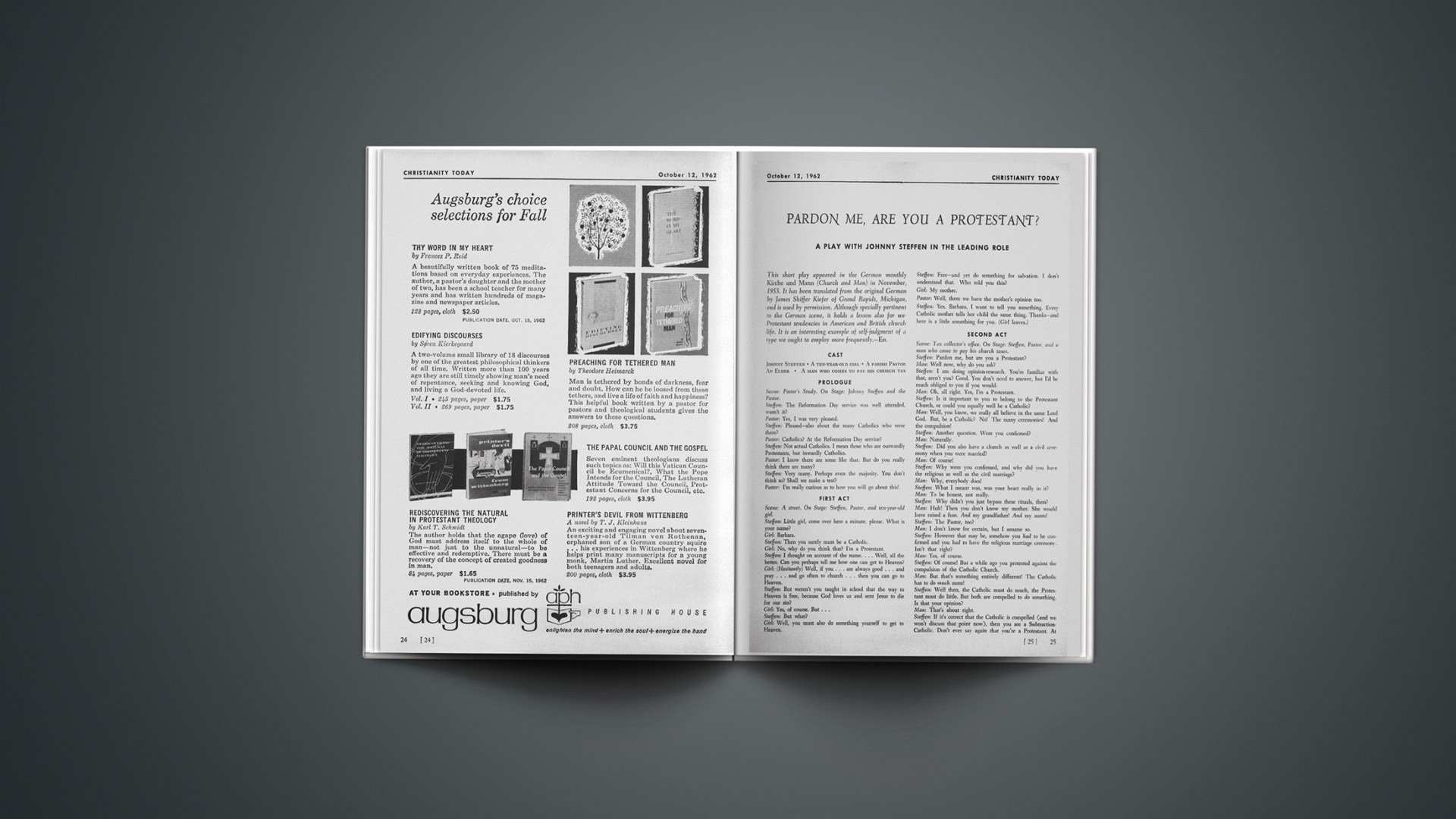
Pardon Me, Are You a Protestant?

A Play With Johnny Steffen In The Leading Role

This short play appeared in the German monthly Kirche und Mann (Church and Man) in November, 1953. It has been translated from the original German by James Shiffer Kiefer of Grand Rapids, Michigan, and is used by permission. Although specially pertinent to the German scene, it holds a lesson also for un-Protestant tendencies in American and British church life. It is an interesting example of self-judgment of a type we ought to employ more frequently.—ED.

Cast

JOHNNY STEFFEN • A TEN-YEAR-OLD GIRL • A PARISH PASTOR AN ELDER • A MAN WHO COMES TO PAY HIS CHURCH TAX

Prologue

Scene: Pastor’s Study. On Stage: Johnny Steffen and the Pastor.

Steffen: The Reformation Day service was well attended, wasn’t it?

Pastor: Yes, I was very pleased.

Steffen: Pleased—also about the many Catholics who were there?

Pastor: Catholics? At the Reformation Day service?

Steffen: Not actual Catholics. I mean those who are outwardly Protestants, but inwardly Catholics.

Pastor: I know there are some like that. But do you really think there are many?

Steffen: Very many. Perhaps even the majority. You don’t think so? Shall we make a test?

Pastor: I’m really curious as to how you will go about this!

First Act

Scene: A street. On Stage: Steffen, Pastor, and ten-year-old girl.

Steffen: Little girl, come over here a minute, please. What is your name?

Girl: Barbara.

Steffen: Then you surely must be a Catholic.

Girl: No, why do you think that? I’m a Protestant.

Steffen: I thought on account of the name.… Well, all the better. Can you perhaps tell me how one can get to Heaven?

Girl: (Hesitantly) Well, if you … are always good … and pray … and go often to church … then you can go to Heaven.

Steffen: But weren’t you taught in school that the way to Heaven is free, because God loves us and sent Jesus to die for our sin?

Girl: Yes, of course. But …

Steffen: But what?

Girl: Well, you must also do something yourself to get to Heaven.

Steffen: Free—and yet do something for salvation. I don’t understand that. Who told you this?

Girl: My mother.

Pastor: Well, there we have the mother’s opinion too.

Steffen: Yes. Barbara, I want to tell you something. Every Catholic mother tells her child the same thing. Thanks—and here is a little something for you. (Girl leaves.)

Second Act

Scene: Tax collector’s office. On Stage: Steffen, Pastor, and a man who came to pay his church taxes.

Steffen: Pardon me, but are you a Protestant?

Man: Well now, why do you ask?

Steffen: I am doing opinion-research. You’re familiar with that, aren’t you? Good. You don’t need to answer, but I’d be much obliged to you if you would.

Man: Oh, all right. Yes, I’m a Protestant.

Steffen: Is it important to you to belong to the Protestant Church, or could you equally well be a Catholic?

Man: Well, you know, we really all believe in the same Lord God. But, be a Catholic? No! The many ceremonies! And the compulsion!

Steffen: Another question. Were you confirmed?

Man: Naturally.

Steffen: Did you also have a church as well as a civil ceremony when you were married?

Man: Of course!

Steffen: Why were you confirmed, and why did you have the religious as well as the civil marriage?

Man: Why, everybody does!

Steffen: What I meant was, was your heart really in it?

Man: To be honest, not really.

Steffen: Why didn’t you just bypass these rituals, then?

Man: Huh! Then you don’t know my mother. She would have raised a fuss. And my grandfather! And my aunts!

Steffen: The Pastor, too?

Man: I don’t know for certain, but I assume so.

Steffen: However that may be, somehow you had to be confirmed and you had to have the religious marriage ceremony. Isn’t that right?

Man: Yes, of course.

Steffen: Of course! But a while ago you protested against the compulsion of the Catholic Church.

Man: But that’s something entirely different! The Catholic has to do much more!

Steffen: Well then, the Catholic must do much, the Protestant must do little. But both are compelled to do something. Is that your opinion?

Man: That’s about right.

Steffen: If it’s correct that the Catholic is compelled (and we won’t discuss that point now), then you are a Subtraction-Catholic. Don’t ever say again that you’re a Protestant. At least not until you really become one! Many thanks to you, and good morning! (Man leaves.)

Pastor: That’s a sad case, too. But wait. There comes one of our elders. Question him. He won’t know you, and I’ll withdraw so that he will answer freely. (Pastor leaves.)

Third Act

Scene: A Street. On Stage: Steffen, the Elder.

Steffen: Pardon me, are you a Protestant?

Elder: I certainly am.

Steffen: Oh—then you are surely a pastor.

Elder: No, only an elder.

Steffen: Only an elder, hmm. May I ask you a question?

Elder: I suppose you are an opinion-researcher?

Steffen: That’s right. The first question: How many Groschen [a coin; one could say “nickles”—ED.] are there in a roll such as one prepares for the bank?

Elder: I don’t really know.

Steffen: You don’t? I thought that as elder you might deposit the collection once in a while.

Elder: No, our pastor does that.

Steffen: Another question: Into how many collection districts is your parish divided for the relief collections?

Elder: I don’t know.

Steffen: But who prepares for the collections? Who sees that there are enough collectors? Who prepares the collection lists and the information sheets? Who places the notices in the local paper? And who receives the collection from the collectors? Who sends the sum realized to the relief agency?

Elder: The Pastor does all that.

Steffen: Another question. Does your church have any building project at the present time?

Elder: Yes, we are building a home for apprentices.

Steffen: Whose idea was this?

Elder: The Pastor’s.

Steffen: Who looked into the financing of it?

Elder: The Pastor.

Steffen: And who discussed the plans with the architect?

Elder: The Pastor.

Steffen: Who appears now and again at the building-site as a representative of the church?

Elder: The Pastor.

Steffen: Haven’t you been there yet yourself?

Elder: Indeed I have! I was at the cornerstone-laying.

Steffen: All right. One final question. As elder do you make an occasional sick call?

Elder: Of course not. That’s one of the Pastor’s duties. And the people don’t really appreciate a visit from me. They want to see the Pastor.

Steffen: How do you explain that?

Elder: Well, because he’s the pastor. I’m only an elder—only a layman.

Steffen: Only a layman. Well, many thanks, sir. May God preserve your parish and your pastor—otherwise neither will live much longer! (Elder leaves.)

Pastor: (Entering again) Well, that wasn’t too good either. But so far as our subject is concerned, our good elder wasn’t really especially “Catholic.”

Steffen: No, up to the “only a layman.”

Pastor: That was unfortunate, to be sure.

Steffen: And this “only a layman” idea seems to be rather widespread in the parish. It seemed that way to me in the matter of visiting the sick.

Pastor: Yes, it’s unfortunate.

Steffen: I’m glad to hear you say, “It’s unfortunate.” However, I have one last test I’d like to make. My dear Paul, would you permit me to address you impersonally for a little while?

Pastor: Well, if it has to be—but why?

Steffen: It doesn’t have to be, but it should simplify matters. Shall we go in again?

Fourth Act

Scene: The Pastor’s Study On Stage: Steffen and the Pastor.

Steffen: Pardon me, are you a Protestant?

Pastor: I hope so, by God’s help.

Steffen: You must be a pastor.

Pastor: That’s right, I am.

Steffen: Then, I have a special question for you. I have noticed that young assistants and students of theology are allowed to preach now and again, but may not baptize or hold a communion service. Is this observation correct?

Pastor: Yes, the authority to administer the sacraments is granted through ordination.

Steffen: And what is “ordination”?

Pastor: According to Luther, the Protestant Church has a universal priesthood of believers. That is to say, in principle every Christian can preach and administer the sacraments. However, so that no disorder or confusion can arise, the Church delegates authority to a special man for this service—the Church ordains pastors.

Steffen: That’s very clear, thank you. Then it is for the sake of order. I find that illuminating. Now, however, in this time of transition, when a student for the ministry has almost completed his training but is not yet ordained, why do you distinguish between authority to preach and authority to administer the sacraments? Are the sacraments greater, worthier or more holy than the Word?

Pastor: No, absolutely not.

Steffen: That’s what I think, too. Luther even said, “Eating and drinking doesn’t accomplish it, but the Word.” Then that can’t be the basis for this distinction.

Pastor: And it isn’t. But there must be regulations.

Steffen: That, too, I don’t understand altogether. Regulation and order! It seems to me to be rather easy and free of danger to read the order of service for baptism. I don’t see how there can arise any “disorder” there. On the other hand, in preaching-how much can go wrong there for a young, inexperienced man! If order is the important thing, it would make more sense to me if you would allow the young, budding pastor to administer the sacraments but forbid him to enter the pulpit to preach.

Pastor: (Keeps silent.)

Steffen: Well, now we have arrived at the question I was aiming at. Is this a sound reason for the greater importance we place on the administration of the sacraments? The Catholics esteem the sacraments above the Word, if my information is correct. And whoever is to administer the sacraments must be a consecrated priest. (But even the Catholic recognizes exceptions in case of emergency, just as we do!) But have we really maintained Luther’s understanding of “ordination”? Or—as our discussion of the young ministers disclosed—has the idea of the “consecration of Priests” slipped into Protestantism?

In short, Pastor, are you a Protestant?

Pastor: Johnny, now it’s high time to call a halt.

Steffen: You’re entirely right. Of course, I didn’t mean you personally.

End

Final word of the editors of Kirche und Mann to the reader: Pardon me—are YOU a Protestant?
Eutychus and His Kin: October 12, 1962

Indian Summer

Turn off the news, sit back, and reflect on your summer vacation. The whole secret of enjoying vacations lies in knowing when to do it. Of course only a tyro would try to enjoy a vacation while he was enduring it. Some unusual friends of ours drove twelve thousand miles in eight weeks with three talented, inquisitive, precocious children, camping as they went. This tour de force of togetherness presumably had the classic quality of Men Against the Sea (though I believe the Bounty’s boat became less crowded as it lost passengers). When these folks can bring themselves to talk about their trip their enjoyment will begin. You know what you had to go through this summer: traffic, heat, expense, gnats, sand, expense, rain, whining children.… You can imagine how unnerved a vacationer could become by expecting to enjoy a day of combat behind the wheel or a night of fatigue on a camp cot designed to give new meaning to the phrase “sacked in.”

No, the time to enjoy vacations is two to three months after they are over. While the sales manager is explaining the new line let your mind glide back to that lake. Your line isn’t snagged in lakeweed, and the one respectable bass that you caught is just nibbling.…

I had anticipated my last vacation with more foreboding than usual: the camp was a thousand miles away and situated in the north woods. You know what civilized man can expect when he flings away centuries of culture and leaves power steering for pre-plumbing primitivism.

But at the end of the impassable road I found a modern camp, a cabin with all the luxuries of civilization, and superlative Christian fellowship.

Now I remember the friends, the fireplace, the northern lights, and the rainbow. Especially the rainbow. It was evening, the rain was over, no skyscrapers cut off the view, no smog dimmed the glory. A vast double bow arched the whole firmament. Mirrored in the lake, it became a perfect orb of light, like the rainbow around the throne. In the stillness I knew a journey to wilderness was wisdom, not mere conformity.

The world of the Wall and the Bomb is still circled by God’s sovereign promise, kept by his longsuffering for his purposes of grace. Turn on the newscast, but don’t forget the rainbow.

Explore Attic And Arctic

Deep gratitude for … the August 31 issue speaking for Christian education.

I want our children to have a vital, constant companionship with Jesus Christ, plus the finest intellectual training available.…

Christians should take up the test tube, the microscope, and each tool available with the confident joy of a child exploring each nook of his own home. Someone may tell the child that a ghost is in the attic, and a foolish child will be denied the joys of attic treasures in spite of his parents’ insistence that no ghost is there.

If we truly fear to learn, we have denied our faith.

Bethesda, Md.

Hardly an issue arrives which does not stimulate and enrich my thought. The Christian education issue did so to an unusual degree, particularly through Traina’s “The Bible in Christian Education,” the lead editorial—“The Crisis in the Church Colleges,” and the excerpted panel discussion, “Christianity in Higher Education”.…

For several years I was dean and instructor in a Bible college. I found there a very fine biblical emphasis and thorough program of Bible study. Most of the students appreciated this and profited by it. But in this group I found very few who had any sense whatever of the value or importance of “secular” learning.… Literature, history, and similar courses were necessary evils, to be avoided as far as possible in favor of the Bible and Bible-related courses.

In Christian liberal arts colleges, on the other hand (at least in those with which I am familiar), there is sometimes a tendency to regard Bible study as a kind of spiritual duty which is nice to do, but which, when necessary, can be dispensed with without too much loss. So, when schedule conflicts arise, the first thing which some students suggest dispensing with is their Bible course (while piously proclaiming their reluctance to do so).

How can Christian young people be brought to realize that it is not a question of biblical or secular knowledge, but of biblical and secular knowledge, both of which are indispensable to a Christian who desires to function effectively and meaningfully in today’s world? This, it seems to me, is a deep-seated problem in motivation.…

Bryan College

Dayton, Tenn. Dean

The timely comments by Dr. John Brobeck (“Christianity in Higher Education”) should be seriously studied by all evangelical Christians. My own experience at three large universities has almost exactly paralleled that of Dr. Brobeck: The evangelical Christian position has virtually no influence in the university community. I think Dr. Brobeck shows exceedingly wise insight into this problem when he so aptly states that if this situation is to be remedied, it must be attempted first by the Christian community.…

It is to be hoped that evangelical Christian leaders in particular will give careful consideration to his suggested solutions and place their shoulders to the wheel.

LERNER B. HINSHAW, M.D.

School of Medicine

University of Oklahoma

Oklahoma City, Okla.

I wish to thank you for the article, “Christ and the Leaderless Legions”.… It is interesting, relevant, biblical, and sound theologically.…

Millington, Md.

Song Of Songs

Thank you very much for the sane and timely article by Robert Laurin on “The Song of Songs and Its Modern Message” (Aug. 3 issue). It seems to me quite timely [in view] … of the recent edition of The Amplified Old Testament. Its translators have taken some lamentable liberty with their personal interpretation of the Song of Solomon. It seems quite incongruous … for the translators to place such an interpretation in the text in such a way as to make it seem the only true and desirable one. As Mr. Laurin has pointed out, the drama of Solomon, the Shulamite maiden, and her country lover is only one of several interpretations held by evangelical scholars.…

Mountain View Baptist Church

Corvallis, Ore.

While I do not take a stand against sex in marriage, I realize that there is another side to the question, which our Lord commanded.

There is a verse in Ecclesiastes which tells man to “err thou always in her [a wife’s] love,” and another which says, “Walk in the ways of thine heart, and in the sight of thine eyes, but know thou that for all these things God will bring thee into judgment.”

Is there a conspiracy among the Christian magazines—Moody Monthly, Eternity, The Sunday School Times, and CHRISTIANITY TODAY—to present an elastic code of morality? All these magazines have recently glorified sex in marriage, and made it honorable and wholesome.…

As lovers of the Book, I believe that we would … agree that if sex is necessary because of the prevalent fornication, that there must be some restraints; and that marriage limits sex from promiscuity to partnership; from “continually” to continence “for seasons”; from concupiscence to child-bearing; “as being heirs together of the grace of life.” If there were no constraints, how could one keep himself when the other partner is absent, or sick, or otherwise unavailable?…

Berlin Bible Church

Narrowsburg, N.Y.

To Tell A Secret

I appreciated Dr. Harold Lindsell’s Christian-hearted book review of Frank Buchman’s Secret (Aug. 3 issue). He says the “secret” is obscure in the book. I disagree.…

Because of this Lutheran pastor’s message to me as a Penn State freshman, I am now at work in the evangelical wing of the United Presbyterian ministry, digging deep in the Word of God he loved.

North Presbyterian

Pittsburgh, Pa.

To Him It Is Sin

The article on “Christian Depression” (News, Aug. 3 issue) was thought-provoking. Dr. Busby therein refuses to see that the depression of certain students at Moody Bible Institute was caused by “something wrong in their spiritual lives.” Contrariwise, his analysis is that “the truth was that they were often going without adequate sleep, or food, or protection in bad weather.”

Are these really two different matters? Is not refusal to obey God’s natural laws an act of disobedience and therefore a spiritual problem? In fact, is it no longer true that “to him that knoweth to do good, and doeth it not, to him it is sin” (James 4:17)?

Christian and Missionary Alliance

Cambridge Springs, Pa.

Karl Barth And The Bible

Regarding the statement of Markus Barth (Eutychus, Aug. 3. issue) that his father “has never said … in his Dogmatics … that the Bible does err”: What about the following, quoted from Vol. I/2, pp. 528f. of the Church Dogmatics (Edinburgh: T. and T. Clark, 1956): “… The prophets and apostles as such, even in their office, … were real, historical men as we are, and … actually guilty of error in their spoken and written word”?

Liverpool, N. Y.

North Of The Border

I must confess that I was a little irked by the statement about the activities of the Baptist General Convention of Oregon-Washington with regard to Baptist Churches in Canada (News, Aug. 3 issue). As a member of the executive board of our convention … let me say that no effort has ever been made … to lead existing churches into our work. Those churches which cooperate with us do so on their own initiative. The churches that have been “planted” are in areas with no Baptist church, and from which a cry for help has come.…

In due time churches from Western Canada will be able to seat messengers to the Southern Baptist Convention as the call of the lost looms higher in importance than relations with other Baptist bodies.…

Northtown Baptist Church

Spokane, Wash.

Knight Of The Faith

Your contributing editor from London, Philip E. Hughes, is to be commended for his rightness and clarity (Current Religious Thought, July 6 issue). He presents the Protestant view of the ecumenical effort currently being made by my Church—the Roman Catholic—as he sees it, without fear or favor.…

In another place (News) you advert to the “new look” of Martin Luther in Roman Catholicism. This to me is one of the most hopeful signs in the current ecumenical movement. Many of us see him now as a veritable “knight of the faith” along with Sören Kierkegaard last century—yes, and with Robert Browning of Hughes’ own London. The difference is, of course, that both the latter rebelled against any and all institutional churches precisely as the Quakers—those truly godly individualists who continue to do great good in their ministry of active good will among us—rebelled in the seventeenth century against the “meeting-houses.” The Church and individual Christianity, however, are alike essential in their differing ways of witness to the fact that the Lord Christ commands all of us.

Athens, Ohio

Concerning Trinity

In reply to the Rev. Frederick Hammond’s letter (Aug. 31 issue) concerning Dr. Hughes’ May 11 “Review of Current Religious Thought,” I wish to state that the “Episcopal clergyman’s” letter was originally printed in the Episcopal Evangel, the official organ of the Episcopal Diocese of Montana, and was reprinted with their permission in Trinity magazine with proper credit afforded the source.

Trinity could hardly be considered as published by a “group of dissidents of St. Mark’s parish” since most of the publishers have never seen St. Mark’s parish.

The staff of the magazine are primarily Episcopalians. All of them are Christians and members in good standing in their particular denominational affiliations. To the best of my knowledge, none of them have any connection with St. Mark’s church, Van Nuys, at this time.

Certainly Trinity has no connection with the Episcopal Diocese of Los Angeles, and would not be officially recognized by that diocese. It is not specifically an Episcopal publication, but a Christian publication, published by an interdenominational society [which is] presided over by the Rev. Robert Harvey, vicar of St. Michael’s Episcopal Church, Ridgecrest, California, and Dean of the Deanery of the Diocese of San Joaquin.…

[This should] correct the confusion concerning CHRISTIANITY TODAY’s supposed error, and also the Rev. Hammond’s misunderstanding of the background of Trinity magazine.

Executive Secretary

Blessed Trinity Society

Van Nuys, Calif.

Protestant-Catholic Tensions

There are at least three major areas in which Protestant-Roman Catholic relations are seriously disturbed today. These are: marriage rules, public aid for Catholic schools, and birth control. Tensions are heightened by the Roman Catholic rule that no member of that communion is validly married if the ceremony has been performed by a Protestant clergyman; by the insistence of Cardinal Spellman and his colleagues that Catholic schools should receive public subsidy; and by the insistence of the Roman hierarchy on a public policy which coincides with its view that “artificial” birth control is a sin.

The matter could, of course, be stated the other way. It could be said that tensions are heightened by the insistence of Protestants that their marriage rites shall have equal validity with the Roman; that it is unconstitutional, and bad social policy as well, to subsidize Roman Catholic institutions with public funds; and that public policy must not be controlled by a concept of divine law or natural law which could lead to social disaster.

Both Protestant and Roman Catholic clergymen discourage inter-faith marriage. There is, nevertheless, a rapidly rising incidence of such marriages. Tensions are gravely increased in such marriages by the inflexibility of the Roman Catholic rules which allow little room for give-and-take in regard to the religious difference. Canon Law 1012 proclaims that for Catholics there can be no valid marriage unless it is performed by a Roman priest. A Catholic who is married by a Protestant minister is described as having “attempted” marriage, and the ceremony is regarded by that church as being invalid.

There would appear to be a ready solution in simply allowing the priest to perform the ceremony. But when the Protestant agrees to this he finds that the price of the ceremony comes high. He is confronted by the priest with a series of inflexible demands which virtually amount to the surrender of his or her own faith. He (or she) faces a four point ultimatum: (1) There can be no other ceremony than the Roman Catholic. (2) He (or she) must not interfere with the Catholic in the exercise of his faith. (3) He (or she) agrees to take a course in Roman Catholic doctrine (with the hope, of course, that he will convert to that faith). (4) All children born of the union will be brought up in the Roman Catholic faith. If these concessions are made and the marriage is contracted on such a basis, and if there is later any departure from the terms as specified, then formidable pressures from the priests and others who cooperate with them will be brought to bear.

Should the couple in rebellion against such an ultimatum go to a Protestant minister for their ceremony, the Catholic partner will then be denied the sacrament in his church, and all kinds of church and family pressures will be exerted to bring him to heel. He (or she) will be informed at every possible juncture that he is “living in sin” and that it is imperative that he “have his marriage validated.”

It is not surprising that one Protestant denomination after another has expressed resentment of the Roman Catholic marriage rules, which appear to them grossly, unfair and productive of dissension. Protestant groups have repeatedly insisted that there should be reciprocity among Christian churches in regard to marriage rites. Here is an area where the ecumenical spirit needs to register. Protestant leaders are not impressed when Roman priests assure them that their marriage rules are “different” and that their church “cannot change” its position. Protestants point to changes in Roman Catholic marriage rules that have already been made. Prior to 1908, for example, all Protestant marriages, including those between two Protestants, were regarded as invalid under Roman Catholic teaching. They were so regarded on the ground that Roman Catholic priests had the sole disposition of Christian marriage. In that year the decree Ne Temere conceded that Protestants could be validly married without recourse to Roman Catholic priests. This was certainly a major concession which has also been written into Canon Law. Protestants argue that if the rules could be adjusted at such a vital point, they can surely be adjusted once more in order to make possible full reciprocity of marriage rites.

On the parochial school aid question, only the ultra-naive fail to understand its acerbity is due to a religious issue. All the talk about aid to “private schools” and “independent schools” cannot obviate this fact. After all, more than 90 per cent of the schools involved are Roman Catholic schools, wholly owned and managed by that hierarchy. The emotional vehemence this issue regularly stirs up is simply due to the fact that millions of Protestants and others resent what they regard as a proposal to tax them for the support of Catholic schools.

The drive to secure tax funds for the support of Catholic schools was launched in New York State by Archbishop Hughes in the 1840’s. He was overwhelmingly defeated, and strictures on public aid to church schools were written into the New York constitution. Then, in the late 1940’s one of Archbishop Hughes’s successors, Francis Cardinal Spellman, took up the drive again. Cardinal Spellman spurned an offer of loans for his denominational schools, an offer by which politicians sought to resolve the controversy. The cardinal wants not loans (to be repaid) but public grants.

Cardinal Spellman’s position has been implemented in the states and in local communities by a group called Citizens for Educational Freedom. While it has a few Protestants in front posts, the effective leadership and more than 90 per cent of the membership of this organization is Roman Catholic. Its purpose is to defeat public school bond elections, to secure commitments from political candidates in regard to public aid to Catholic schools, to change state constitutions and laws so as to permit such aid, and to exert pressure for whatever benefits for Catholic schools may be immediately obtainable. Citizens for Educational Freedom has many of the earmarks of a Roman Catholic political party. It could develop into something analogous to the “Christian Democratic” parties well known in other lands. Its reception is being closely studied by the hierarchy. Meanwhile its aggressive thrust in half a dozen states severely exacerbates inter-creedal tensions.

The Roman Church was doomed to perhaps as much as a century of opposition to birth control programs by the “irrevocable decree” promulgated by Pope Piux XI in his encyclical on Christian Marriage in 1930. This pronouncement, strongly opposed by the French clergy, has placed the Roman Church in a most untenable position. Its leadership has sought an abatement of the position by approval of the so-called “rhythm method” of birth control. Roman theologians have averred that this method has differences from other methods which make it morally acceptable. Other methods are “artificial” but the rhythm method is “natural.” It is unfortunate that the method singled out for approval is notoriously unreliable in contrast with other methods which are virtually 100 per cent sure.

Many leading Protestant churches have now taken a position on birth control which is almost diametrically opposed to that of the Roman Church. They insist that it is essential to the exercise of their faith that their members have access to the very information and the very procedures which the Roman hierarchy denounces as in violation of divine law. What appears to be a simple denominational difference becomes complicated in the realm of public policy. Roman Catholic leadership frequently has recourse to political action in order to keep anti-birth-control laws on the books of such states as Massachusetts and Connecticut. Catholic priests charge that these laws were originally enacted by Protestants and that they are only seeking to preserve them. Protestant leaders acknowledge the truth of this but insist that the population explosion has compelled them to change their mind about such laws, which they now regard as dangerous and obscurant. A change of mind, no matter how clearly indicated and imperative, would seem to be more difficult under the Roman Catholic system.

The American Catholic hierarchy has injected itself strongly into the battle over birth control in relation to foreign aid programs. Its pronouncement declares “[United States Catholics] will not support any public assistance, either at home or abroad, to promote artificial birth prevention … whether through direct aid or by means of international organizations.” Statements like this have frightened politicians away from any direct confrontation of the massive problems of a world population, now three billion, which is due to be six billion in another 40 years. Any intelligent consideration of birth control in the United Nations is likewise thwarted by the prompt objection of nations where Vatican influence is strong. This intransigence frustrates our own foreign aid program, which sees food, medical care, and education assistance nullified by appalling increases in population. Of all the areas of inter-faith tension this one is potentially the most inflammable. Hostile reaction is rapidly building up among persons of other faiths and among Roman Catholics themselves who are beginning to feel that in the interest of human survival such clerical obstruction cannot be permitted to continue.

It is a tribute to the impotence of Protestant-Catholic dialogue that up to this point it has not come to grips with these three issues. On many occasions of dialogue they are not even mentioned. The feeling appears to be that the dialogue might be disturbed and even disrupted if real Protestant-Catholic differences were explored. Some feel, however, that dialogue which is merely sentimental will die of desuetude. Here, in these three areas, lies the real need for a Protestant-Catholic modus vivendi today. Bibulous ecumenism needs concretion.

END

Agreements and Differences

The forthcoming Vatican Council has brought into sharp focus the whole problem of the disagreements between Roman Catholics and Protestants on theological and ecclesiastical issues; the ecumenical fervor which has arisen in both camps has made necessary a fresh look at these long-standing controversies. To the extent that this ecumenical zeal brings all parties to the controversies back to the basic theological issues involved, the results of such conversations as are envisaged by both Roman Catholic and Protestant leaders can be very beneficial to all concerned.

The fact that great differences in theology do exist cannot, and should not, be denied by the most ardent ecumenists on either side, but neither should their existence blind those opposed to the ecumenical movement to the fact that there are broad areas of agreement between the Roman Catholic and evangelical Protestant churches. The very intensity of the controversy between the Reformers and Rome tended to blind partisans on both sides to the fact that there is a body of theological truth derived from the Scriptures on which there was either whole or partial agreement and that this agreement centered in biblical truths which are the very essence of the Gospel message, and not peripheral to it.

Areas Of Agreement

At this point it is necessary to insist that there is a much broader area of theological agreement between evangelical Protestantism and Roman Catholic theology as it emerged from the Council of Trent than there is between evangelical Protestantism and modern liberalism. Acknowledging this does not minimize the deep cleavages which existed between Rome and Wittenberg, or Rome and Geneva, and which continue to divide Rome and the evangelical descendants of Luther and Calvin. These cleavages continue to be very deep and very real, and constitute an impassable gulf between the Roman Church and evangelicals. But, great as they are, they are not as great as those which separate evangelicals from all forms of contemporary liberalism, whether of a neoorthodox or an existentialist mode.

The Council of Trent (1545–1563), in giving to the Roman Catholic Church its first systematic theology in a creedal form, based its work on the great affirmations of faith which were produced by the ecumenical councils of the early Church, particularly those pronouncements of the first four ecumenical councils of Nicaea (A.D. 325), Constantinople (A.D. 381), Ephesus (A.D. 431), and Chalcedon (A.D. 451). It was the task of each one of these councils to pronounce against a definite heresy which was threatening the purity and the life of the Church at that particular time, and to give an evangelical or biblical reply to it. These ecumenical creeds and pronouncements supplied the basis of the decrees of the Council of Trent, and lay at the very heart of the doctrinal formulations of both the Lutheran and the Reformed Churches; they also supplied the doctrinal basis of the Thirty-Nine Articles of the Church of England. Thus, both the Lutheran and the Calvinistic reformations embodied articles of faith which were held in common with the Roman Catholic Church.

The pronouncements of the first four councils were largely concerned with heresies regarding the doctrine of the Trinity, the deity of Jesus Christ, and the relationship of the divine and human in Christ. Thus, the decisions of these councils, and the creeds which they either formulated or accepted as authoritative statements of the Christian faith, were of profound importance in the development of Christian doctrine from that time on. Not only were heresies specifically condemned, but the truths of the Scriptures were proclaimed to keep the faith of the Church biblically pure. At a very early date these creeds were accepted by the Western church and found there a wider reception and a more devoted following than they were often accorded in the East, which had been the home of the councils which sanctioned them.

The Councils of 325 and 381 gave to the Church formulations of the doctrine of the Trinity which have stood the test of time and have ever been regarded as the anchor of orthodoxy for both Rome and Protestantism. This doctrine is not the private possession of either Rome or Protestantism; it belongs to every believer in whatever camp he may be found. These affirmations of 325 and 381 speak today with as much force to evangelical Protestantism as they do to the Vatican. Both parties owe a very great debt to those devoted souls who first worked out and then sanctioned the creed of 381, erroneously ascribed to the Council of Constantinople. This presentation of the doctrine of the Trinity in its biblical grandeur and significance has passed into the mainstream of orthodox theology, and lies at the very heart of both Roman Catholic and Protestant theology. In the same way, the solution of the problem of the two natures in the person of Jesus Christ, offered by the Council of Chalcedon, is as truly Protestant as it is truly Roman Catholic.

It must also be noted that the Roman Catholic and Protestant churches have a common legacy in the writings of the early Fathers. St. Augustine inspired the Reformers just as much as he inspired St. Thomas Aquinas. Calvin, and to a lesser extent, Luther, was as much at home in Jerome, Ambrose, Basil, and Anselm as St. Thomas was; Calvin was also well-versed in St. Thomas himself. It is quite true that Calvin and Luther did not always use, or interpret, these writings of the early scholars in the same manner as did Thomas Aquinas. Disagreements were frequent, but Calvin did not always reject St. Thomas either. Even the Council of Trent, in its fury and eagerness to create an unbridgeable chasm between Roman Catholic orthodoxy and Protestant heresy, could not delete all areas of agreement, and at one point, to a degree at least, it created a bond of union when it asserted the inspiration and authority of the Scriptures.

Areas Of Disagreement

If history and theological accuracy demand that we recognize the biblical elements which these two branches of Christendom hold in common, they also demand that we present those divergencies in theological and ecclesiastical concepts which were at the very center of the controversy which the Reformers had with Rome in their own day and which constitute a barrier to any real spirit of unity with Rome today—and which also make any attempt at organic union with the Roman Church impossible for those who hold the purity of the faith as the dearest of possessions.

It was the aim and purpose of the Council of Trent so to define Roman Catholic orthodoxy that any attempt at a union with Protestantism would be impossible; in this the council was eminently successful. Without denying that legacy which it received from the early Church, this council remolded Roman Catholic doctrine into such a form that it openly denied the evangelical position at every major point. And, in so doing, it subordinated its biblical legacy from the early Church to Scholastic and Aristotelian accretions to such a degree that the strength of the Gospel message was nearly dispelled by the Tridentine philosophical superstructure; no major part of the biblical plan of redemption retained its evangelical purity. The result was a tragic perversion of the whole of Scripture. Rome purchased its distinctive differences from Wittenberg and Geneva at a fearful cost.

The members of the hierarchy assembled at Trent, in the very first decree which they issued, prepared the way for the great doctrinal errors which were to come: they declared that the Bible rests upon the authority of the Church, and that tradition, as it comes down through the ages in the Roman Catholic Church, has an equal validity with the Scriptures themselves. The authority and inspiration of the Scriptures were not denied, but the uniqueness of the Bible as God’s special revelation to man was greatly weakened by this appeal to tradition. The door was thus opened for the entrance of errors of many kinds into the fabric of Roman doctrine. The rejection of the scriptura sola of Luther and Calvin set the tone for the rest of the work of this council. The wedge they introduced between themselves and the Reformers by this initial statement was driven deeper by the decree on original sin which followed. The definition of this doctrine tested the ingenuity of the council as few others did. In essence the problem was this: if the Augustinian view should prevail, there would be no need for the sacramental system as it had developed in the church, and the foundations of the hierarchy would be weakened accordingly. Neither would there be any real differences between Trent and the Reformers at this point. On the other hand, if this doctrine were denied in toto, then there would be no need of salvation, sacramental or otherwise, and the power of the clergy would be shaken to its foundations. Between these two extremes a compromise was needed, and Trent was equal to the task. It adopted a Thomistic conception of original sin, which insisted that it was truly an offense against God by which man fell from that state in which he had been created, and that through Adam the effects of that first transgression were visited upon all his posterity. But there is in the Roman system no admission of total depravity as it is found in the great creeds of the Reformation and the evangelical churches. In the Fall, Adam lost that holiness and justice with which he had been endowed at creation, the super additum, but he did not lose a residual power to seek God and to gain a certain kind of merit by his natural powers whereby he might cooperate in the attainment of salvation. Thus there is in Roman Catholic theology no great affirmation that salvation is by grace alone through faith. There is grace, to be sure, but that grace, to a degree, is merited by a residual righteousness in the very nature of man which survived the Fall. There is certain residual power in both the mind and will of man which, if rightly used and aided by grace, constitutes a kind of merit which prepares the way for the reception of grace.

The growing chasm between Roman and Protestant thought is even more clearly brought out in the decree of Trent in regard to justification. In Roman Catholic theology, justification is not a forensic act on the part of God, not a judicial decision. Rather, it is viewed as a continuing process, and the Roman Church identifies it with sanctification. Thus one error brings many others in its wake: namely, the doctrine that man must continually strive to achieve his redemption rather than look upon it as an accomplished fact in Jesus Christ, the logical result of which is that no believer can have the certainty of redemption in this life, but only a pious hope. The uncertainty of the believer was not only recognized by the council, but in Chapter X of this decree it went so far as to say that “no one can know with a certainty of faith, which cannot be subject to error, that he has obtained the grace of God.” Uncertainty and fear, then, become the logical characteristics of the Roman Catholic. The lack of certainty as the necessary lot of the Christian is further spelled out in the chapters on perseverance of the saints in which it is declared that no one can know with certainty whether he be of the elect.

This uncertainty, although inherent in the Roman view of justification, finds its real source in the attempt of the Council of Trent to deal with the Augustinian and Reformation doctrine of election in a way that will not commit the church to a Pelagian view of human nature and redemption on the one hand, and yet which will leave the necessity of the sacramental system and the sacerdotal clergy untouched. The doctrine of unconditional election held by Calvin, Luther, and the other Reformers was denounced as an anathema, and a position was chosen which was not too different from that which later became known as Arminianism in Protestant circles. It insisted on the necessity of redeeming grace in redemption, but at the same time it allowed human merit an efficacy totally unknown to both the Scriptures and the Reformers.

The Roman Catholic definitions of original sin, election, justification, and sanctification are the necessary foundations for the doctrine of the sacraments which was affirmed by the Council of Trent. Not only did this council decree the sacraments to be seven in number, but it also affirmed that they were necessary for salvation, for it regarded them as the completion of justification. The efficacy of these sacraments in Roman Catholic theology lies in the fact that they are believed actually to confer grace upon all who receive them unless obstacles are placed in the way of their effective operation. Baptism brings actual regeneration and cleansing from the guilt and corruption of original sin for all recipients, although concupiscence remains. Other sacraments (confirmation, the Eucharist, penance and extreme unction) play an equally vital role in freeing the faithful from the effects of post-baptismal sins.

The tremendous importance which Roman Catholic theology attaches to the sacraments finds its explanation in the fact that they, in turn, lie at the very heart of the conception of a sacerdotal clergy. The doctrine of the sacerdotal clergy assigns to the Roman Catholic priesthood a role much like that of the priesthood of all believers on the basis of the finished work of Jesus Christ. There is an intimate relationship between the Roman Catholic denial of this finished work of Christ upon the Cross and the rise of this sacerdotal conception of the clergy, which in turn is the necessary foundation for the papal hierarchy with its vast claims to both spiritual and temporal supremacy.

It is at this point that another and very vital difference between Romanism and Protestantism comes into view. The Papacy is a patent denial of the biblical doctrine of the priesthood of all believers. This hierarchical form of government is an almost inevitable consequence of this denial. The ramifications are many in the life of the church and the spiritual development of the people. The hierarchy replaces the Scriptures as the practical and immediate source of religious knowledge, and as the everyday guide in Christian living. This hierarchy intrudes itself not only between the people and the Bible, but also between them and their Lord.

This difference in government is the logical consequence of the vital differences in doctrine existing between the Roman Church and evangelical Protestantism. It is not an accidental or peripheral disagreement on which concession and compromise are possible and desirable. But rather does it emerge out of the fundamental disagreements in theology which affect every aspect of the life of the Church and of individual believers. Yet it should also be noted that the Papacy is a very necessary part of the whole Roman Church, for without its presence the semi-Pelagian tendencies inherent in the theology of the Council of Trent (and later Jesuit accretions) would be able to run their course without hindrance. Roman Catholic theology then would be able to degenerate even further in the direction of an unadulterated Pelagianism. In a very curious way the Papacy is an almost necessary safeguard against the inherent weaknesses and dangers of a theology to which it looks for support for its own claims to powers.

It is thus evident that at nearly every point contemporary evangelical theology and Rome are at variance, in spite of the fact that they have a common biblical origin and also look to the great ecumenical creeds of the first four centuries for the starting point of their respective theological systems. For evangelical Protestants these creeds became the foundation for a growth in biblical insight which came with the Reformation, a means for developing to their great fullness the very doctrines which they enunciated. On the other hand, for the Roman Church these creeds have served as guides for all later theological development in the sense that their affirmations were not to be denied, but their many silences could be used for developing a theological system which, at many points, would blunt the evangelical keenness of these early affirmations.

One question then remains to be answered: Why do liberals in Protestantism so ardently seek a reunion with Rome? The very liberalism which they profess would, at first glance, seem to raise an insurmountable barrier between themselves and the absolutism of Rome. And yet this is obviously not the case, for it is the liberals who are in the vanguard of the movement seeking reunion with Rome. Is this not a paradox? When considered from the point of view of the outward government of the Church it would seem to be such. But when considered from a theological context, there is much consistency in their position. Liberal Protestant theology suffers from the same weakness which characterizes that of Rome—an inner drive toward Pelagianism and humanism—which if left unchecked would soon deprive liberal Protestantism of the last vestige of any right to be called a theology. Thus it would seem that liberals are willing to come to terms with Rome simply because they either have, or are willing to accept, the same safeguards in their liberal churches which Rome has already erected.

Protestant ecumenical leaders have, in many cases, looked to a revival of high liturgy as a center of worship rather than to the preaching of the Bible. This liturgical renaissance in many Protestant groups is an attempt to retain a religious character and value in worship without a submission to what God has said in the Scriptures. As these leaders have sought to retain a religious character and influence in the life of the congregations by these techniques, so have they acquiesced in the erection of hierarchies in those denominations in which they have significant control. For without a hierarchy the theological deterioration in liberal Protestantism would soon deprive these denominations of the last vestiges of the right to claim to be a Christian church.

END

Should We Return to Rome?

A few months ago I arrived in England from Spain, after having left the Church of Rome, and now enjoy that liberty of the gospel which is the prerogative of the true children of God.

Why did I leave the Church of Rome at all? And why leave on the eve of the Second Vatican Council? The declared aims of the latter are the revitalizing of Christian life, the reorientation of the machinery of administration of the Roman Church to bring it more into line with modern trends, and the encouragement of the unity of all Christendom against the common enemy, Communism. In view of such an apparently meritorious program, it might be thought that I had made a premature decision, and that I should have first awaited the outcome. Shortly after my conversion, I did in fact ask myself whether it might not be advisable to postpone action until I saw the results of these professed endeavors to bring together all confessing Christians, but it was soon brought home to me that this whole prospect of unity is a vain hope.

For 14 years I had been a professor of dogmatic theology in the Roman Church. Familiar as I now am with evangelical truth, and in the light of the Word of God and my knowledge of Romanist thinking, I am utterly convinced of the impossibility of all attempts to bring about the union of the evangelical churches and the Church of Rome, except on terms of utter surrender to the conditions laid down by the Vatican. It is still Rome’s claim that the only basis for approach is the necessary admission on the part of all other denominations that the Church of Rome alone possesses the whole of revealed truth. Other churches have only small particles of this truth, and only the infallible authority and sovereignty of the Roman Church and her visible head have the true control, mediation, and resolution of all matters pertaining to the faith. Further, the Roman Church claims that:

1. The Bible without Romanist notes is unprofitable and even dangerous. Its reading is therefore forbidden.

2. The forgiveness of sins is unattainable save through the complete and full confession of each sin in detail to a priest, who uses authority vested in him known as that of “the keys” to free the penitent from sin.

3. The only valid means of sanctification is that which is derived by a communication of the rites and ceremonies of the church which, after the manner of a magic amulet or charm, confer blessing on the faithful.

All these claims are set out in detail in a book on present-day theology written in German by M. Schmaus, one of the most celebrated Romanist apologists of our time. It has been translated into Spanish, and is remarkable in that it contains the first dialogue of a controversial nature between Romanists and Protestants permitted to be published and circulated in Spain with the sanction of the church. It was against such views that Luther wrote, and it was because of my own inability to accept them that I left the Church of Rome.

How far removed all this is from the glorious simplicity of the truth in the Gospel! Scripture explains salvation as a loving call from a forgiving God who demands only a personal response of faith from man, in humble and joyful surrender, without any need of the mediation of a priest or an ecclesiastical organization. Romanist dogmas stand revealed as accretions to the Word of God over the centuries, piling up into unwieldy, grotesque superstructures, one on top of another, the fruit of pagan logistics and superstitious mystification intermixed infamously with the Word of God by a process known as “dogmatic homogeneous progress.” Thus it is that Rome has been able to define as “dogmas of the faith” such doctrines as the sacrifice of the mass, purgatory, indulgences, the worship of Mary, the infallibility of the pope, auricular confession to a priest, and so on. Such doctrines are not only at variance with clear Bible teaching and the preaching of Paul, but they are often diametrically opposed to fundamental scriptural principles.

It may be of interest to mention the basis of Romanist teaching and of the progressive evolution of her dogmatic theology. Thomas Aquinas establishes in his book In Boethium de Trinitate that to deduce theological conclusions from a revealed premise to another produced by analytical reasoning—these conclusions can be made into dogmas of faith. This, says Aquinas, is not to mix wine (the Word of God) with water (human logic), but to change water into wine. What a blasphemous principle! The philosophical reasonings of a pagan mind (Aquinas takes the principle of his doctrine from Aristotle) are to be put on the same level as revealed truth from Scripture! The Roman Church refers to these sophistries as “analytical reasoning, not philosophical deductions,” and is careful to point out the distinction. This is just not true. They are conclusions arrived at on the basis of well-known philosophical concepts, and as such are very far removed from the body of God-breathed truth which is revealed to us in Scripture.

In addition to these philosophical deductions, there is a whole host of sentimental phantasies of doubtful origin surrounding the Virgin Mary which builds up around her a novel system of attributes investing her with semi-divinity quite contrary to the express teaching of the Word of God. Thus not only does Rome blur true doctrine, but she has reduced spiritual life to the pagan level in the multiplication of her spurious rites and ceremonies. Consequently, Roman Catholics currently attach far more importance to the scrupulous fulfillment of prescribed ceremonial than to the attributes of a truly spiritual life. The act itself of confession to a priest is far more meritorious than the need to repent of the sins confessed. How strange all this is in the light of the Word of God, which so clearly establishes that “God is a Spirit, and they that worship him must worship in spirit and in truth.”

In my reading of Scripture I came across a verse which made a profound impression on my thinking. Galatians 1:8, 9 says: “But though we, or an angel from heaven, preach any other gospel unto you than … we have preached unto you, let him be accursed.… If any man preach any other gospel unto you than that ye have received, let him be accursed.” In the light of this, the only reasonable method of testing any doctrine is to bring it face to face with the Bible and test it on that basis. So the believers in Berea acted, and in Acts 17:11 they are commended as being “more noble than those in Thessalonica, in that they received the word with all readiness of mind, and searched the Scriptures daily, whether these things were so.” It was clear to me that Rome on very many counts teaches a gospel other than that of Paul and the Bible. After much prayer and meditation I made my decision: rather than fall under the displeasure of God and the condemnation of his Word, I was prepared to face the wrath of men and the excommunication of the church. Rome decrees in her Codex Juris Canonici the immediate excommunication ipso facto of all who dare to join a “heretical sect,” meaning, of course, any Christian denomination.

In like manner did Luther on December 10, 1520, dare to burn the bull of his excommunication after nailing his 95 theses to the door of Wittenberg’s Castle Church.

Rome And The Bible

The only possible basis for a mutual approach between the evangelical church and Rome would be that both parties recognized the supreme and indisputable authority of Holy Scripture, accepting the interpretations which Scripture itself places on its teaching—analogia fidei, not analogia entis. But if the Church of Rome agreed to this, setting on one side all her notes and traditions, her dogmas and explanations of the Word of God, she would be placing herself on the same ground as Bible-believing Protestants, and obviously this is a position she will never agree to adopt. It must be remembered that Rome’s basic dogma is that of the infallibility of the pope, and none of the dogmatic definitions of the popes down the ages can be set aside whilst this position is maintained. It is therefore idle to suppose that Rome will ever adopt this attitude; if she did, her whole system would collapse and she would virtually commit suicide.

Let us not be blind to the facts—Rome will never actually take a single step of real consequence towards unity. She ever demands the return of the “prodigal sons” (Protestants) to the “Father’s House” (the Vatican). The sad truth is quite the opposite: it is Rome who has left the Father’s house, and Bible-loving Christians who inhabit it. An approach to Rome will never lead us to the truth; it will lead us inevitably to apostasy. May I conclude with a concise answer to the question posed at the head of this article, which asks, “Should we return to Rome?” My answer is, “No, let Rome return to the Bible.”

END

The Papacy as a Force in History

No political event or circumstance can be evaluated without the knowledge of the Vatican’s part in it,” writes Guy Emery Shipler, “and no significant world political situation exists in which the Vatican does not play an important, explicit or implicit, part.” Here we have the outcome of a long journey down the centuries; this essay can do no more than point to some of the significant landmarks, while avoiding those given individual treatment elsewhere in this issue of CHRISTIANITY TODAY.

By the beginning of the second century, Christianity had adherents among Rome’s elite class. Fifty years later, Rome was established as the metropolis of the whole Church. It gave the lead in struggles with the state, it protected Christians in different parts of the Empire, it vindicated orthodoxy against heretics, many of whom had friends at court. Appeals to Rome were made against the Donatist and Pelagian claims in the fourth and fifth centuries; further, it could boast the tombs of Peter and Paul, which became a center of pilgrimage for the pious. Slowly there grew up the tradition of Rome’s primacy. After twice saving the city of Rome from barbarian invasion, Leo the Great (d. 461) consolidated the image of the papacy as champion of Christendom by resisting the subtle heterodoxy of Eastern theologians, and by wise cooperation with—and equally wise stout resistance to—the secular authority. Thus was set the stage for that moral domination and independence, and for the eventual process of centralization consistently espoused by Hildebrand six centuries later.

With the conversion of the barbarians, new problems and new opportunities confronted the Church. Since generally only churchmen could read and write, much of the civil government remained in their hands, and other secular duties devolved upon them. The Church acquired great possessions and became a potent secular force. Life was suddenly complex, and there emerged the nucleus of that canon law which became in time not only the juridical basis of the Christian west, but also a symbol of the Latin Church’s preeminent status in Christendom (a primacy never fully acknowledged by the Eastern church). Despite wars raging round the Eternal City, despite the intimidation and even the arrest of popes, and the advance of Islam in devastating power, metropolitans by the ninth century were not recognized until papal approval had been obtained, often on payment of a large tribute, ostensibly “to counteract the aspirations of autonomy-seeking metropolitans.”

During the pontificate of Leo III (d. 816), a problem as old as Constantine reappeared when Charlemagne proposed to investigate charges of adultery and perjury made against Leo. The pope could not admit a higher jurisdiction (though he informally volunteered his innocence), and by a masterly stroke reversed the situation by crowning Charlemagne as Roman emperor. The implication was obvious: the pope could sanction and consecrate an emperor.

Danger threatened the unity of Christendom with the division of the Empire after Charlemagne’s death, but the Church was blessed with a line of able popes who, even in the early tenth century when anarchy and violence swirled around Rome, contrived to strengthen the papal influence. But worldliness crept in, lay influence prevailed where it had no right, and ecclesiastical benefices went to the highest bidder.

Just when the Church badly needed a boost, and at a juncture when the papacy was on bad terms with the crowned heads of Europe, the Eastern emperor in 1095 appealed to Urban II for reinforcements to recover Asia Minor from the Seljuks. The enterprising Urban in a great speech launched the first Crusade, calling for a united Christian front against the infidel (complete penance guaranteed). The Crusades lasted for two centuries. Popes preached them, financed them, sent legates to lead them, and through them directed the foreign policy of Europe. But the Crusades also corrupted the papacy, and taught it the expediency of using this magic gimmick of the Holy War for its own secular aggrandizement. Nevertheless the action instigated by Urban had far-reaching consequences on the life of Europe. The steady stream of soldiers and pilgrims to the Holy Land demanded lines of communication, and led to a long chain of municipal development from Venice to Bruges and to the establishment of the great towns of the Middle Ages. It furthered the exploration of the Asian hinterland, and gave a great impetus to the writing of travel and history books.

The Investiture Controversy of the eleventh and twelfth centuries highlighted the deep-rooted problem of imperial claims to invest an abbot or bishop with the ring and staff of his office, and to receive homage before consecration. Usually associated with the memorable scene at Canossa when the excommunicated Henry IV submitted to the autocratic Hildebrand, the issue was fought out in other countries, notably in England where Anselm of Canterbury defended the Church’s spiritual rights against the king. Earlier popes had proclaimed their power to be above that of kings and emperors, but Hildebrand pushed this view more systematically than any of his predecessors.

Later, the Emperor Frederick Barbarossa, ignoring the lesson of Constantine and Charlemagne, dabbled in ecclesiastical business, but in 1177 he submitted to the pope, meanwhile venturing a reservation (“Non tibi sed Petro!” to which Alexander II firmly replied, “Et mihi et Petro!”—surely one of the humorous moments of medieval history). It was this pope also who, after Thomas Becket’s murder at Canterbury, brought Henry II of England to the penance of the scourge.

Trial And Reaction

The controversy between Philip the Fair of France and Boniface VIII at the end of the thirteenth century was the inevitable collision of an internationally privileged clerical order and a national monarchy in an age of growing nationalism. The pope stated in extreme terms his claims to universal authority; the king claimed the right of levying dues on ecclesiastical possessions within his domain. Philip’s victory, achieved with the support of French theologians, was the first practical step toward the secular state in Europe. Philip had no such trouble with Clement V, who took up residence at Avignon in 1309 and who openly served French and English political interests. The popes remained in Avignon until 1377, their court a center of moral decadence (though Petrarch’s celebrated picture of it is almost certainly overdrawn).

The attempt at the Council of Constance (1414–18) to make the papacy responsible to a General Council ended in failure, partly because the reformers had differing ideas and a marked lack of spiritual purpose, but even more because no occupant of the see of Peter could accept the implications of the Conciliar Theory. The council set the clock back 200 years, for in the mind of the new pope, Martin V, and his successors, reform was synonymous with the idea of papal subordination, and so provoked their relentless hostility.

This was not the only sphere in which the Church of Rome’s attitude has been thoroughly reactionary. In 1616 Paul V condemned the teaching of Copernicus as advanced by Galileo; more than two centuries elapsed before this was officially revoked. Moreover, only in comparatively recent times has Rome shown anything like a genuine social policy. In England, for example, Cardinal Manning (d. 1892) admitted that all the great social and philanthropic reforms had originated outside his church, and “the names of Catholics … are to be found as opponents to almost every social movement or reform of the day.” The Church had to wait until Leo XIII’s time (1878–1903) for an official and systematic Christian social ethic (this was along notably anti-socialist lines).

As late as 1864, in dealing with the “errors of the age,” Pius IX declared it erroneous to suppose that the papacy must necessarily come to terms with progress, liberalism, and modern culture.

The resilience and durability of the Church of Rome were never better displayed than in the age of the so-called Enlightenment and of the French Revolution, an age when it was temporarily eclipsed, when the whole spirit of the times was against it, and when man worked out his own destruction with the inevitable disillusioning result. But not the least of the arrows in Rome’s quiver is an infinite patience; gradually the pendulum swung back. People started looking for security—and found it in a rejuvenated Ultramontanism. Submit to the papacy! Back to Rome—and even influential non-Catholics such as Newman and Manning forsook Anglicanism and obeyed the call. Meanwhile the Romantic Movement had portrayed the Middle Ages as the great era of European unity which the Reformation had shattered. Thus was the way paved for the dogma of papal infallibility in 1870, and its acceptance assured in the face of strong opposition from within and despite the assured wrath of Bismarck and others who realized and feared the power of a strong Catholicism.

Last century W. E. Gladstone alleged: “Catholicism is hostile to intellectual liberty and incompatible with the principle and trend of modern civilization; it arouses unwarrantable pretensions to govern, and threatens the rights of the family; it tends to undermine the soul’s love of truth; it alienates cultured minds in whatever country it is professed, and wherever it reigns, saps the morality and strength of the state.” No British Prime Minister would dare say the same today, not because Rome has changed, but because of the growth since then in Rome’s influence and numbers (estimated now at 530 million), even in lands once solidly Calvinist. Yet, paradoxically, it has remained essentially a European-American church, chiefly because of its absolutist claims and its steady resistance to syncretistic infiltrations.

In 1493 Pope Alexander VI divided the world by a line, and granted all lands to west and east to Spain and Portugal respectively. Apart from the fact that this symbolic claim to universal dominion has never been officially retracted (nor has the death penalty for heresy, another medieval accretion), no one would dispute that this “bit of the Middle Ages dumped down in the modern world” is a formidable force in every sphere of life. One of its chief tenets is the primacy of the spiritual power in the human order. Back of all the tendentious apologetic and arid legalism, the commercialized rites and the confusing of loyalty to God with loyalty to Rome, this is a right emphasis. It would be encouraging indeed to be assured that this is simply another way of saying, “What shall it profit a man if he gain the whole world and lose his own soul?”

The Second Vatican Council

October 11, 1962, will be remembered as one of the great days of modern church history. For on this day the “Second Vatican Ecumenical Council,” which, in the terminology of Pope John XXIII (“Discourse on Pentecost,” 1960), has already been at work for years in its “antepreparatory” and “preparatory” phases, enters its third phase, “the celebration of general assembly, the council in its solemnity.” How long this phase, which is to be followed by the fourth stage, “the promulgation of the acts of the council,” may last, no one can predict. Its first period will last until December 8. Since the vast subject matter that has been prepared by the preparatory commissions and handed on to the bishops in a number of volumes cannot be properly dealt with in eight weeks, the council may be called again and again for shorter meetings. Thus it could be that the Second Vatican Council will last as long as those of Basel (1431–49) and Trent (1545–63). All depends on the decisions of future popes—the death of the pope interrupts automatically the ecumenical council—and on the world situation, which may or may not allow the assembling of more than 2,000 bishops in one place.

The council will be an “ecumenical council” in the sense of the Canon Law (CIC can. 222–9) and according to the Roman understanding of the One, Holy, Catholic and Apostolic Church. But will it be really ecumenical? This question is being asked even by theologians who should know that none of the meanings which the word “ecumenical” has accepted in the course of history can claim normative validity. Today “ecumenical” is used in the sense of “interdenominational,” “comprising all or many churches,” “tending towards or promoting the union of all Christians.” This usage seems to be accepted even by Roman Catholic writers today. However, it must not be forgotten that it is quite new. Until recently worldwide denominational organizations regarded themselves as “ecumenical,” as, for example, the “Ecumenical Methodist Conference.” And why not? “Worldwide” is the original meaning of “ecumenical.” And what is an ecumenical council? In what sense was the largest of the ancient synods, Chalcedon in 451, ecumenical? Among the more than 620 participant bishops were two refugees from Africa. Otherwise the West was represented by the two presbyter-legates of Leo of Rome. The second ecumenical council of 381 was a merely Eastern synod. No representative from the West was present, and none had been invited. Yet the council was soon called “ecumenical,” just as the African synod of Carthage of 418—where among the 200 bishops there were some guests from Spain—called itself a “universal council.” Such words are used as titles of honor rather than in verbal meaning, just as the incumbent of the See of Constantinople bears the title of an “Ecumenical Patriarch,” whatever that may mean.

Discussing the nature of ecumenicity in view of the forthcoming council, the Romanian Orthodox theologian G. Racoveanu states on behalf of his church that the ecumenicity of a council does not depend on the number of bishops participating or on the participation of all churches or of bishops from all churches. He comes to the conclusion: “The ecumenicity of a council is determined by the fact that the episcopate of the Church of Christ recognizes its decrees as infallible. Ecumenicity means infallibility” (Lumière et Vie, No. 45, 1959, pp. 124–45). The idea of modern Protestants that an ecumenical council would be a council in which all churches which claim the name Christian would be free to take part with equal rights irrespective of their confessions must seem grotesque to Catholic Christians of all ages. It would have been strongly repudiated also by the churches of the Reformation. A synod is always ecclesia repraesentativa, the solemn representation of the church which is united in the one true faith. Only orthodox Christians or churches can take part, not schismatics or heretics (depending on who in a given case may be regarded as orthodox and who not). At the request of Constantine, the “Novatian” bishop of Byzantium—which was soon to become Constantinople, the first Christian city and capital of the Empire—took part in the synod of Nicaea. He was, of course, not one of “the 318 fathers” but a guest only, an observer as we would say. The emperor envisaged the “reunion” of that thoroughly orthodox church body with the “great church,” at least in his city. But no union negotiations were held. The attempt of Constantine to persuade Acesius to give up the “schism” in view of the full communion of faith that existed between both parties failed. The various parties had been invited and discussed doctrinal differences. But as soon as the opponents to the homoousion were shown to be heretics, they were excommunicated.

At the great Reformed Synod of Dort in 1618/19 the Arminians took part as members of the Reformed Church of the Netherlands. As soon as their heresy was recognized they were excommunicated with the famous words: “Go, go, you are dismissed.” Churches that are divided in faith can and should meet in conference. Their theologians may and should meet for colloquies. If conferences and colloquies lead to unity, then the uniting churches can meet in synod. A synod can express the existing unity, but it cannot negotiate reunion. This is borne out by the failures of the attempts of the synods of Lyons (1274) and Florence (1439) to reunite East and West. Strange as it may seem to modern man, and even to modern Christians, the idea of a synod, and especially an ecumenical synod, is closely bound up with the distinction between truth and error, pure doctrine and false doctrine, Church and heresy. This is so because already in the New Testament the Church cannot be understood without an understanding of heresy as that which claims to be Church, but is not Church.

Significance For Modern Protestantism

The great significance of the Second Vatican Council for Christendom as a whole and especially for the modern Protestant churches must primarily be seen in the fact that this council, as no other event in modern church history has done, calls us to a new understanding of dogma for the Church. This will become very evident when on October 11 more than 2,000 bishops confess the Nicene Creed, not as a beautiful liturgical formula, a venerable document of the past, but as the confession of the truth which they must defend with their lives and for which they are prepared to shed their blood, as probably a number of them will do. They confess it as the great ecumenical creed which does not belong to the Roman Church only, but which is the common possession of East and West (despite the controversy about the filioque), of Rome and the churches of the Reformation. Why is such a confession impossible at a full assembly of the World Council of Churches? It is worthwhile to ponder this question. The two great councils will stand during the coming years side by side, the Ecumenical Council of the Vatican and the World Council of Churches (which in some countries, e.g., Germany, is also called “Ecumenical Council”), both claiming to represent the true ecumenicity of the Church of Christ. Living Christian faith and faithful confession unto death are not the special privilege of Rome. Martyrs will die in all churches. The persecutors make no distinction.

Why, then, is it impossible for the World Council also to confess the great ecumenical creed? The simple, though terribly sad, answer is: These 200 churches and sects have no longer a common creed, because they have no common faith. There are the Eastern Orthodox churches which have preserved the old faith and would never allow one iota to be taken away from that faith which they confess in the Nicene Creed. There are the Lutheran churches within the WCC which claim to maintain not only the ancient creeds, but also the confessions of the Reformation which are based on the old creeds. There are the Anglican churches which do no longer know whether they can confess anything beyond the ancient creeds. There are the Presbyterian and Reformed churches, the majority of which have deprived their old confessions of their binding force and are looking for a new confession. There are the creedless churches of Western Protestantism, and also the liberals in all churches mentioned who claim that “reasonable liberty of interpretation” which robs the creed of its content and the act of confession of its seriousness. There is the fateful heritage of the eighteenth century, pietism, which wipes out the border between Church and heresy, and rationalism, which replaces Christianity by a “religion in which we all agree.” There are the “younger churches” which are told by their missionaries that the Nicene Creed is Western theology (whereas in reality its content is biblical and natives from Asia and Egypt formulated it) and that they must make a better one, perhaps after the pattern of “Barmen.” How out of this chaos of churches, sects, theological schools, and personal opinions can the voice of the Una Sancta be heard—which until the end of the world will confess what the Nicene Creed confesses about the one God the Father, the one Lord Jesus Christ, the Holy Spirit, the one Church, and the one Baptism? This is impossible.

It has been said that the WCC as a council of churches cannot do what the individual church can, namely, confess its creed. This is only partly true. First of all, is not the weakness of the WCC the weakness of its members? How many of these churches, with the exception of the Eastern Orthodox, can today clearly say what they believe, teach, and confess? Secondly, every council of churches must have, and actually has, a doctrinal basis. Even the WCC cannot accept any community that claims to be Church of Christ. It makes practically its own distinction between Church and heresy if it is not prepared to accept the “Church of Jesus Christ of Latter-Day Saints,” the Christadelphians, Jehovah’s Witnesses, and professedly Unitarian churches. It must, therefore, define certain minimum requirements in its basis, which now reads: “The [WCC] is a fellowship of churches which confess the Lord Jesus Christ as God and Savior according to the Scriptures and therefore seek to fulfill their common calling to the glory of the one God, Father, Son and Holy Spirit.” One must compare this clever product of modern ecumenical diplomacy with the clear, unambiguous, and sincere statements of the Church of former times. Lutherans had missed in the earlier basis a reference to the authority of Holy Scripture as the sole source and norm of doctrine. For this reason let us include “according to the Scriptures.” This must be acceptable to the Orthodox churches, for it comes from the Nicene Creed. There, of course, it has a clear specific meaning, being quoted from 1 Corinthians 15. Here it can be understood—and is understood, as the comments published show—either in the sense in which Holy Writ is the authority for Catholics or for adherents of the Reformation, for orthodox Protestants or for modernists. It has been welcomed even by such who reject any creedal statements. Eastern Orthodox critics had missed a statement on the Trinity. So let us put in after “seek to fulfill their common calling” (whatever that may mean according to the social or another gospel): “to the glory of the one God, Father, Son and Holy Spirit.” Either this phrase is a mere doxological formula which even the most modernist American bishop can sing with a good conscience, or the words mean what they say. Then it could as well be stated that these churches confess the Trinitarian faith in the sense of “one substance, three persons.” But this would be unacceptable to many, if not most, of the Protestant member churches.

The whole tragedy of modern Christendom here becomes obvious, the loss of the doctrinal substance and the consequent inability to confess the Christian faith. How clear, indeed, are the doctrinal statements of the ancient Church and of the churches of the Reformation. But the Church at those times confessed its faith “in the presence of God and of the whole Church” of all ages and in view of the coming judgment of God (conclusion of the Formula of Concord). To find such sincerity, one must today go to Rome. The decrees of the new council will not be ambiguous. They will mean what they say. They will not be made by theological dilettantes, but by men who know the Scriptures and the doctrines of the Fathers, by men who know Greek and Latin and understand the terms they use. They will be accepted by men who know that they will have to answer for them in the Last Judgment. Therefore, these decrees will have authority. Who still knows today the solemn declarations made by the ecumenical conferences from Stockholm and Lausanne to Evanston and New Delhi? The decrees of the Vatican Council, whatever their content may be, will belong to the elements of theological education even in the non-Roman churches.

Perhaps nothing less than an ecumenical council summoned by the pope was necessary to wake our sleeping churches from their ecumenical dreams. What neither Luther nor Calvin was able to do when their theology was revived after the First World War, what neither Barth, nor the confessional, nor the neoorthodox nor the biblical theology of the last generation could achieve, this perhaps John XXIII and his ecumenical council will achieve. The dogmatic decrees of the council will compel us to think again in terms of dogma. Our encounter with the living Roman dogma will be of the mightiest sort of challenge to us. We shall again understand that Christianity without firm convictions must degenerate, even morally, because it makes hypocrites of those of us who pretend to convictions which we do not possess, as for example when we sign confessions which we do not even properly know or which we accept with a “reasonable liberty of interpretation.” “Tolle assertiones et tulisti Christianismum,” says Luther against Erasmus. “Take away the firm doctrinal statements, and you have abolished Christianity.” And this council may help us to overcome the worst of all superstitions in the Church, the belief in bigness, in the great numbers, in the stronger battalions of the ecclesia militans, as if our Lord had said: “Where two or three millions are gathered in my name, there I am in the midst of them.” To relieve us from such dreams may be the blessing of the council for us.

Significance For Roman Catholicism

And what will be the significance for the Roman Church? Judging from the work of the preparatory commissions, not one stone will be unturned in the vast structure of the Roman Church. Church law (e.g., renewal of the episcopate as ruling the church with the pope) and liturgy (e.g., the possibilities of the use of the vernacular in the mass), clergy (training, life, discipline, celibacy, the new office of the deacon) and laity (functions and offices), administration of the church on all levels, missions and education, the sacraments (including the marriage law), and numerous other practical subjects will come up for decisions.

The great dogmatic issues that grow out of the heritage from the First Vatican Council are the sources of revelation, the doctrine of the Church, and Mariology. The First Vaticanum finished two doctrinal constitutions, the Constitutio on the Catholic Faith, and the First Constitution on the Church of Christ. The former establishes the doctrine of natural revelation (God the Creator and Lord can with certitude be recognized by the natural light of reason) and reaffirms the doctrine of Trent on the sources of supernatural revelation. In this context the doctrine of the inspiration of Scripture is developed. The present problems to be decided are the reconciliation of the doctrine of the inspiration and inerrancy of the Scriptures with the methods and results of “higher criticism,” which was recognized in the Bible encyclical of 1943, and the relationship between Scripture and tradition (can tradition be a source of doctrine apart from Scripture?). The doctrine of the Church was the second great problem in 1870. The draft of an elaborate constitutio on the Church had to be shelved, partly because the shortage of time allowed the council to finish only the doctrine of the papacy, partly because the time was not ripe to decide the great problems of ecclesiology. This will be the foremost dogmatic task of the new council.

It is the greatest doctrinal decision since the Reformation, a decision that must be made by all churches of Christendom and therefore something which must cause them to consult each other, to learn from each other, and to warn each other. It is a really ecumenical problem, the great problem behind the ecumenical movements of our time. As Christendom in the sixteenth century had to answer the question, what do we mean when we confess in the creed that the Son of God came from heaven and was made man “for us men and for our salvation,” so we all have to say what we mean when we confess our belief in the one holy Catholic and Apostolic Church. As at that time the epistles to the Romans and the Galatians were understood as never before, so today we have to say what the great texts of the New Testament which deal with the Church mean. The Reformers for the first time had to say what the Church is when they found themselves excommunicated by Rome. All confessions since the Augustana of 1530 did that. They all started with the concept of the Church as the assembly of the believers, the people of God. Trent did not take up the subject, but the Catechismus Romanus of 1566 had to expound the Apostles’ Creed and to explain what it says on the Church. It started also with the concept of the Church as assembly, as the people of God. This is the proper way, for this is the meaning of the word ekklesia in the New Testament. From this definition one must go on to what the New Testament says about the Church as body of Christ, as bride of Christ, and so on.

When the fathers of the Vatican Council in 1870 looked into the proposed constitution on the Church, they found that this started with the definition of the Church as the body of Christ and proceeded from there to the Church as the people of God. Soon a great discussion was on, and it became obvious that many bishops could not accept that. At first sight it seems to be an insignificant question. But behind it looms a serious problem. If the Church is the people of God as she speaks of herself in the liturgy, then she can be and is not sinless, but prays for forgiveness, just as God’s people in the Old Testament. If the Church is primarily the body of Christ, Christ living here on earth, the Church as the continuation of the Incarnation, then the Church is sinless. This is not what Paul meant by the profound doctrine of the Church as the body of Christ. But it is the necessary consequence if one makes what to him was the last word on the Church the first. This idea, that the nature of the Church is defined by the term “body of Christ,” has swept through Christendom since the early nineteenth century, in connection with the romantic understanding of human societies as organisms. Until 1943, outstanding Roman theologians rejected this ecclesiology. But the encyclical Mystici Corporis of that year sanctioned it and therefore prejudiced the decision of the council. The Church is sinless, declares Pius XII in that document. If she prays the Fifth Petition, she does so not for herself, but for some of her weak members. Is this the doctrine of the Church which we have to expect from the Second Vatican Council? If the Church is sinless, if she is Christ living on today, then she may be the source of revelation—which actually she has become in the proclamation of the dogmas of the Immaculate Conception and of the Assumption of Mary in 1854 and 1950. Immaculate Mother of God, infallible pope, sinless Church: whither does this lead?

When on October 11 (the feast of the Maternity of Mary) the bishops of the Roman Church enter St. Peter’s for the council which is put under the patronage of St. Joseph, they will pass by the great tablets with the dogma of 1950 and the names of Pius XII and his cardinals. With what resolutions will they enter the council? Some certainly with the firm decision to do all in their power to increase the glory of Mary and Joseph. Others certainly with the resolution to resist anything which might interfere with the honor of Christ as their only redeemer and mediator. Who will prevail we shall know in some years’ time.

We have entered the period of church history which later may be called the time of the Second Vatican Council. What a time of blessing it would be to the whole of Christendom if we all, older and younger churches of West and East, Catholics and Protestants, listened to what the Lord of the Church says to his churches today: “Remember … from whence thou art fallen, and repent, and do the first works; or else I will come unto thee quickly, and will remove thy candlestick out of his place, except thou repent”; and: “Because thou hast kept the word of my patience, I also will keep thee from the hour of temptation, which shall come upon all the world.… He that hath an ear, let him hear what the Spirit saith unto the churches” (Rev. 2:5; 3:10, 13).

END

Shall We Counter the Reformation?

Two dates in October tell the story of a divided Christendom. October 11, 1962, marks the beginning of the Second Vatican Council of the Roman Catholic Church. October 31, 1517, signals the coming of the Protestant Reformation. Today the Protestants, among others, are being beckoned “homeward.” The general thesis of Pope John XXIII concerning the council he has called has often been repeated: The One True Church of which the successor of St. Peter is the Shepherd, must be purified in truth, charity and unity. It must be without spot or blemish and reinforced and made more relevant to the present age. Then one can say to those who bear the name of Christian but are outside the fold, “The way is open, this is our Father’s House, take or retake your place in it.”

A call to return home can conjure up delectable visions which brighten the eye and quicken heart and step. But will this one? Protestants are not readily inclined to identify home and Rome. If home is where the pope is, then where have the Protestants been all these years, and where are they now? Evangelical Protestants confess to be pilgrims pressing toward a city whose builder and maker is God. They have in view not Rome but the New Jerusalem. They trace their pilgrim procession back to a sixteenth-century light which crashed upon a darkly glowering face of Europe. The flashes of light had names: sovereignty of God, supremacy of Scripture, human depravity, God’s grace, justification by faith, sole mediatorship of Christ, priesthood of believers. But the pilgrimage of grace goes back behind the Reformation, for the Reformers sought not innovation but a restoration of the primitive excellence of Apostolic Christianity, and were at home in the writings of the Fathers as well as the Apostles.

Pope John’s invitation to Protestants embodies a certain historic irony inasmuch as the hierarchic structure which is climaxed in his office was among the prime Romanist offences in Protestant eyes. The Reformers prevailed against it in England, Scotland, Scandinavia, and much of Germany, Switzerland, the Low Countries, and elsewhere.

But Spain, strongest military power of the day, became the secular arm of the Counter-Reformation, a movement spearheaded by the newly-founded Jesuit order and aided by the Inquisition, papal nuncios, the Index, skilled manipulation of the constitutional machinery of the Holy Roman Empire, and the conversion of several important princes. While some good moral reforms were achieved through Trent, the council engraved the character of exclusive Romanism upon medieval Catholicism, hardening the anti-evangelical strands of the medieval Church. There were names symbolizing Roman doctrines which to Protestants spelled gloom and frustration: church tradition, concupiscence, works, saints, indulgences.

Between Trent and Pope John, there have been added papal infallibility and the Assumption of Mary. And when Pope John speaks of purification of the “One True Church,” he gives no hint that this involves changing doctrines which are protested by Protestants.

The Reformers prayed for the unity of Christ’s Church, a unity in truth. Calvin wrote to the Reformed Churches of France in 1566 that a “free and universal council” was needed to end the divisions of Christendom. But to one who had returned to the Roman Church, Calvin wrote that he would rather die than approve his action. Luther looked upon the doctrine of justification as a “matter of life and death.” Earlier, when under pressure resulting from his 95 theses, he said, “I will not turn a heretic by revoking the opinion which made me a Christian.” Peter Martyr voiced the Reformers’ conviction that they had not departed from the Church but returned to it: “We go unto the catholic and apostolic church, because the church from which we separate ourselves lacks both. For it is no longer catholic, since it has transformed the universal church into the Roman Church; and apostolic it is not, since it differs so far from the doctrine and ordinances of the apostles.”

We may not deny the fact that Protestantism stands in need of continual reforming and repentance, particularly in regard to its modernist infection. On the other hand, the probing behind Trent on the part of Roman theologians is to be applauded. Devoutly to be desired is an openness to the teaching of Scripture on the part of both Catholic and Protestant toward the end that happily they could walk together in the bonds of apostolic Christianity. But in days of ecumenical passion, it is good to remember that unity in spite of the Scriptures is no homecoming. Those who engage in it run the risk of losing identity as pilgrims to the New Jerusalem to become vagabonds across the face of the earth.

END

Review of Current Religious Thought: September 28, 1962

Are the Old Testament writings Christian, pre-Christian, sub-Christian, or un-Christian? If we may judge from the letters on the subject which recently appeared in the correspondence columns of the London Times, a state of considerable confusion exists within the Church on this issue. The correspondence was sparked off by a letter from the president of St. Catharine’s College, Cambridge, who raised the question of the place of the Old Testament within the context of public worship, in which lessons from both the Testaments are customarily read. Complaining of having to listen to “extracts containing genealogies, fragments of Jewish history, military operations, and anecdotes or exhortations which are not always edifying,” and that as isolated readings they mean little to the average congregation, he asked whether it would not be possible to have a selection of passages for divine reading “chosen from among the great devotional books of English prose” for occasional use at the minister’s discretion—mentioning by way of example the writings of Donne, Browne, Jeremy Taylor, Traherne, and Dr. Johnson.

A dignitary from Bedford suggested that the following passage from Jeremy Taylor, one of the authors recommended by the president of St. Catharine’s, might be a good one to start with: “That the Scripture is a full and sufficient rule to Christians in faith and manners, a full and perfect declaration of the will of God, is therefore certain, because we have no other. For if we consider the grounds upon which all Christians believe the Scriptures to be the Word of God, the same grounds prove that nothing else is.…”

Dr. Leslie Weatherhead, Minister Emeritus of London’s City Temple, spoke up for the extremist opposition to the Old Testament. “Again and again,” he wrote, “one would like to rise in church after the Old Testament lesson and say, ‘My dear friends, do not pay any heed to the irrelevant nonsense which has just been read to you. It has no bearing whatever on the Christian religion.’ ” Referring to Joshua’s conquest of Palestine and destruction of his enemies “as the Lord commanded him,” he unburdened himself of this startling viewpoint: “One wonders whether the Israelites had any better reason for going into Palestine which God allegedly gave them, than Italy had for going into Ethiopia, or Russia into Hungary, yet false religion pervades the rape of Palestine because it is “in the Bible.’ ”

A London rabbi rubbed his eyes in astonishment and pain on reading this effusion, “because such a view is bound to stir up religious feelings and heap fresh coal on the fires of hatred stoked by Nasser and his facade of the U.A.R.” He affirmed that by his bigotry Dr. Weatherhead had “joined the ranks of those who hate the Jew by hating his Bible, the matrix of all that is noble in civilization.” Another rabbi pointed out that “one cannot fairly extract from the Bible, which alone tells of the events, the unpleasant half of death, while ignoring the moral half of Almighty-judgment.” A layman pointedly observed that Dr. Weatherhead hoped to attract people to church “by treating the Scriptures as Dr. Bowdler treated Shakespeare, and for much the same reason, namely, that he finds parts of them embarrassing”; and a dignitary from the North of England inquired whether he had never read in the New Testament what Christ said ought to be done to the man who caused one of His little ones to offend, adding that “it would be very interesting to know how Mr. Weatherhead accommodates his faith in the redemptive power of the slaughter of the Man of Calvary with the beliefs he declares in his letter.” Another Anglican clergyman, however, applied the terms “repellant myth” and “savage saga” to the account of the Exodus from Egypt, which is appointed to be read in church on Easter Day.

The Regius Professor of Hebrew in the University of Cambridge emphasized the unity of the two Testaments and warned that “the fate of the Old Testament, the bible of Jesus, is bound ultimately to affect the fate of the New Testament also”; while the Archdeacon of Oxford offered the mordant comment that “from the earliest days the Church has regarded the Bible as a whole, but there have long been those who, like the heretic Marcion, have wished to choose out certain portions and to reject others.” A layman from London remarked: “These veiled attacks coming from the quarters they do go to show what a decline is taking place in current thought. The Old Testament is history and requires to be accepted as such.… To pick out certain passages for attack is no help to Christians and is perfect food for the pagans all around us.… A sound and regular Bible teaching in the home and school would obviate much of this empty criticism.” Another from Eastbourne noted that cathedrals and churches hold services of thanksgiving to commemorate the Battle of Britain, and that back in the reign of Queen Elizabeth I “both Church and state saw the Hand of God in the storm which carried to completion the defeat of the Spanish Armada”: indeed, the medal struck for the occasion bore the words from the Song of Miriam celebrating the overthrow of the Egyptians in the Red Sea: “Thou didst blow with thy wind and they were scattered.”

The epistolary exchange was brought to a conclusion by a sane leading article which contained the following comment: “It would be interesting to determine when some Christians first began to find much of the Old Testament shocking. The date is comparatively recent, and it is to be noted that this moral sensibility has sprung up in an age which is responsible for acts of inhuman cruelty on a scale as great as anything to be found in all previous recorded history, let alone the restricted annals of ancient Jewry.… Much of the sensitive humanitarianism alive today springs more from the eighteenth-century enlightenment, with its extravagant over-estimate of man’s moral capacities, than from Christianity with its realistic attitude to the world. No man who believed that God is ‘Lord of history,’ as Christians do, should flinch from hearing the chronicles of the past.”

It is at least important to recognize that the unsympathetic attitude of many today towards the Old Testament indicates a radical departure from the undeviating verdict of historic Christianity that, to quote from the seventh of the Church of England’s 39 Articles, “the Old Testament is not contrary to the New,” and from the position uncompromisingly maintained by our Lord—who expounded to his disciples in all the Scriptures the things concerning himself (Luke 24:27)—and the Apostles—who taught that the writings of the Old Testament are divinely inspired (2 Tim. 3:16; 1 Pet. 1:11; 2 Pet. 1:21).

Book Briefs: September 28, 1962

The Christian And The State

Caesar’s or God’s?, The Conflict of Church and State in Modern Society, by Peter Meinhold, translated by Walter G. Tillmanns (Augsburg, 1962, 170 pp., $4), is reviewed by Clifford L. Stanley, Professor of Systematic Theology, The Protestant Episcopal Theological Seminary, Alexandria, Virginia.

The main theme of the book is the relation of church and state, a relation which, as the subtitle suggests, often nowadays takes the form of conflict. A familiar threefold approach is used in presenting the subject—exegetical, historical, systematic.

Besides the major theme there are two closely related minor inquiries, “Revolution in the Name of Christ,” and “The Church and War.” The threefold outline is used in presenting each of these also. A word may be said about them in passing. Though insisting that “the traditional opinion that Luther rejected without qualification any resistance or revolution … must be modified thoroughly” (pp. 107, 108), the author admits that “the whole complex of the right to resist and of revolution … was not probed sufficiently within the Lutheran Church” (p. 111). The author admits candidly that totalitarianism presents a new order of problem for which adequate precedents are not to be found in the tradition.

In presenting “The Church and War,” Meinhold gives a great deal of weight, as does the ecumenical movement, to the “historic peace churches.” Nevertheless he follows the major churches in their acceptance of the Augustinian “just war.” The result is a complicated attitude in which there is little complacency. Meinhold tests the “just war” concept by the new atomic weapons and finds it to be valid still.

In 1959 Bishop Otto Dibelius published a book entitled Higher Authorities. The book aroused a discussion in which Hanns Lilje and others participated and in which the present volume finds its occasion. Dibelius’ book deals with Romans 13, the primary passage concerned with political government.

The following is an interpretation of Meinhold’s exposition of Romans 13. God’s relation to the state is twofold, direct and indirect. God expresses his vengeance through the state. The Christian, on the other hand, is supposed to express only love, never vengeance. The state therefore contemplates the existence of sin. It is an anticipation of the Last Judgment. The existence of the state is consequently provisional and temporary. The state is according to the will of God when it acts lawfully, whether according to the “tables of the law” or “the law written on the heart.” The state stands between God above and man below. It is faithful to God when it is lawful, to man when it protects liberty. These are the two criteria of the state. It is interesting to conjecture how much the emphasis on liberty derives from Meinhold’s stay in America, to which he alludes on page vi.

The state serves the demonic powers as well as God, but God has overcome the demonic powers and so rules the state indirectly in this way.

The role of the state is to protect human life from chaos resulting from human sin. When it does this it has its limited justification and is to be obeyed by the Christian as part of his duty to God. When it denies its limits (between law and liberty) it becomes a rival of God and is to be denied, as in Revelation 19:20.

Meinhold traces the relation of church to state in the centuries between New Testament times and the present. There is the “Caesaro Papism” of the Eastern Church of Constantine, paralleled by the supernational church conception of the West. The rising Germanic tribes preferred national or territorial churches. Charlemagne combined the imperial and national ideas. The struggle between pope and emperor was a contest between Charlemagne’s idea and the old western supernational church conception. The end of the middle ages saw a return to the national territorial conception of the church. With Luther, the ruler, for the period of the emergency, was to be a kind of “emergency bishop.” Calvin both separated church and state more than Luther (as under Bible and natural law respectively) and united them more (the church as the conscience of the state).

In recent times both state and church have altered. The church has increasingly become or let itself be made into “an association of believers” rather than “a spiritual entity.” The state has cut itself off from the Christian revelation and become secular, based on natural law, the consent of the governed, its own inherent powers as an end in itself. The modern totalitarian state represents a difference both in degree and kind from the secular power state which preceded it. For Meinhold the Christian at the best lives in a tension between the “now” and the “not yet,” between church and state. He is bound to both. Government as such belongs to this time. But the totalitarian state is not a “higher authority” (p. 61) and the Pauline words about obedience are no longer valid (pp. 62–67).

Reading for Perspective

CHRISTIANITY TODAY’S REVIEW EDITORS CALL ATTENTION TO THESE NEW TITLES:

* The Word in Worship, by Thomas H. Keir (Oxford, $3.50). A solid exposition of the Reformed liturgical tradition which boldly defines preaching as: Hear the Word of the Lord! and worship as actual response to God.

* Man: The Image of God, by G. C. Berkouwer (Eerdmans, $6). A leading Christian theologian puts the light of Scripture to man, the image of God who has now become a danger to himself and his neighbor.

* The Impact of American Religious Liberalism, by Kenneth Cauthen (Harper & Row, $6). Excellent presentation of American theological liberalism in which author measures its impact on post-liberal theology.

The book is stimulating, informative, and useful. It suggests, as is generally the case, a few questions and problems. Something might have been said about the deepening crisis of secularism which furnishes the larger context of Meinhold’s immediate concern. The secularization of the state is not self-explanatory nor is it the only instance of secularization. Furthermore there are different degrees and applications of secularization. Archbishop Temple remarked that Nazism was apostasy whereas Communism was heresy.

Second, church is defined a lot less adequately than state in the volume. Meinhold suggests rightly that the church is “a spiritual entity” rather than a mere “private association of believers.” But of what sort is the spiritual entity? If church means the holy People of God, the folk called into being by the revelation of God in Christ, is church any closer to ecclesiastical institution than to political? There is to be a “church” over against a “state,” but is the former indiscriminately “God’s” whereas the latter is admittedly “Caesar’s”? We get the same indefiniteness in the case of Augustine’s two “Cities” (see Barber’s introduction to The City of God in the Temple Classics edition).

Finally, is there no more positive evaluation of man’s political life to be derived from Christian revelation than St. Paul gives us in Romans 13 and that Augustine and Luther, for their reasons, give us? I have in mind the state that Christians make or could make. Here the state, while not perfect, is intended for man’s welfare, a positive goal. The Greeks understood it so, as in Aristotle’s political philosophy and Plato’s Republic. Do Christians have to impart such a positive attitude to the state if they are to have it, as in Thomas Aquinas or some form of “natural law”? Of course it is a little awkward to ask the question just now. The ages of faith when Christians might have labored more positively were under the domination of negative conceptions of man’s political life. Now the state, as in New Testament times, is increasingly in unchristian or even antichristian hands.

CLIFFORD L. STANLEY

Superior Fiction

The Eternal Fire, by Poul Hoffmann, translated by David Hohnen (Muhlenberg, 1962, 432 pp., $5.95), is reviewed by Roderick H. Jellema, Instructor of English, University of Maryland, College Park, Maryland.

This book, the second part of Hoffmann’s Moses trilogy, is a sequel to The Burning Bush, which was published last year. The massive, panoramic vision which Hoffmann attempts to create moves on in this volume from the plagues in Egypt through the building of the Tabernacle.

With commendable artistic vigor, Hoffmann weaves his novel with the stuff of biblical history, archaeology, symbolic foreshadowing of Christ, and disciplined artistic creation. We come to feel the Israelites as real people, sometimes shockingly like us—people who doubt and brawl, who suspect their leaders, who lose faith and regain faith and misunderstand, but who somehow prevail. Their prevailing is more gift than achievement. Moses, God’s leader, comes through as his people must have seen him: silent, angry, powerful, mysterious, and yet, in the loneliness of his misunderstood commission, gentle and slightly pathetic.

The novel gains force and perspective by shifting its focus occassionally to the “outsider” non-Israelites. Their reactions to the stench of sacrificial slaughter and clever arguments against the “foolishly” excessive claims for Jahweh are almost our own. Almost. The strength of Hoffmann’s Christian vision wins out.

This is an ambitious novel. One cannot help feeling at times that it tries too hard for the spectacular and the massive—as though Hoffmann were attempting to interest the late Cecil B. De Mille in picking up the motion picture rights.

But it is definitely superior religious fiction. It—and the other volumes in the Moses trilogy—deserve careful attention and wide reading.

RODERICK H. JELLEMA

Good From Aaron To Zuzim

The New Bible Dictionary, edited by J. D. Douglas and others (Eerdmans, 1962, 1375 pp. plus plates and maps, $12.95), is reviewed by Everett F. Harrison, Professor of New Testament, Fuller Theological Seminary, Pasadena, California.

The surface facts about this work can be summarized readily—a single volume of completely new material sponsored by the Inter-Varsity Fellowship and prepared by 139 contributors from various parts of the world, mainly British, but including some American and continental scholars. More important is the quality, and about that there is no question. This is a first-rate production that will have to be reckoned with by students of the Scriptures everywhere.

Here is loyalty to the Word of God without obscurantism. Difficulties are faced courageously and fairly, as biblical data are expounded in the light of the scholarly research of our time. For this reason university students as well as seminarians will find satisfying treatment of the problems they face in the classroom. Some articles may prove a bit heavy for the layman, but in the main he should be able to make his way and find the journey rewarding.

One of the best features of the dictionary is the allocation of adequate space for the handling of subjects which by their nature require extensive treatment. This gives the writer an opportunity to make a contribution rather than merely summarize what has been said elsewhere. To illustrate, the theme of the Messiah, one which is much discussed in our time and which needs careful interpretation, gets superb treatment in this volume. Other subjects, such as archaeology, call mainly for description, and this too is ably done.

It is possible that here and there the driving interest in the historical tends to play down the theological. For instance, in the article on the Church, there is no reference to our Lord’s prediction in Matthew. The Virgin Birth is passed by. Yet on the whole the balance is good.

Some surprises are to be found in the volume, such as an article on Muslim Traditions of Jesus Christ, and a rather elaborate article on Cosmetics and Perfumery.

Let no one recoil at the price; this volume is many books in one. Even the most thrifty will not be disappointed.

EVERETT F. HARRISON

Generally Good

Church and Kingdom, by Raymond O. Zorn (Presbyterian and Reformed, 1962, 228 pp., $3.75), is reviewed by George Eldon Ladd, Professor of Biblical Theology, Fuller Theological Seminary, Pasadena, California.

Standing in the tradition of Reformed theology, Zorn discusses the relationship between the Kingdom of God and the Church. The Kingdom of God is defined as the rule of God which will one day come to eschatological consummation but which has also entered into history in the person and ministry of Jesus Christ. The Church is the people of this Kingdom who have become the successors of the Old Testament people and therefore the embodiment of the true Israel. “The Church … is a present manifestation of the Kingdom of God and in her the Kingdom’s transforming power operates and from her its life and blessedness flows to form an oasis in the desert of this world’s sin and misery, darkness and death, to which the thirsty traveller may come and drink deeply at the wellsprings of salvation” (p. 81). Zorn argues that the Church and Kingdom will become synonymous in the eschatological fulfillment. In the mean-time, the Church has a task in the Kingdom of God. In the third section of the book, the author outlines this task in terms of the Church’s battle against the kingdom of darkness and its influence upon the individual, the family, the state, and society as a whole.

Unfortunately the book is marred by over a score of typographical errors, especially in the reproduction of Greek and Hebrew words. In the reviewer’s judgment, the author errs in his interpretation of Oscar Cullmann’s eschatology and of premillennialism. Furthermore, it is confusing to say that the Kingdom of God and the Church ever become synonymous. The Kingdom of God is the rule of God and the realm in which God’s rule is realized, while the Church remains the redeemed people of God who receive the blessings of the Kingdom but can never be identified with it. On the whole, however, this is a very worthwhile and profitable book.

GEORGE ELDON LADD

Theology That Preaches

God Loves Like That!, The Theology of James Denney, by John Randolph Taylor (John Knox, 1962, 210 pp., $3.50), is reviewed by William Childs Robinson, Professor of Historical Theology, Columbia Theological Seminary, Decatur, Georgia.

In content this book is great preaching of the Gospel; in voluminous research and able presentation it is the work of a competent scholar; in excellent format it is the work of a careful press.

Denney is pre-eminently the preacher of the Cross of Christ. He bids us come to the redeeming Cross and realize, GOD LOVES LIKE THAT! This is the diamond point; here the cup is drained. Denney was loyal to the New Testament presentation that there was a necessity in the nature of God himself for the whole redemptive work of Christ. The grace of God which is free to us was not cheap for God. It cost him the giving of his only Son for us and for our salvation.

Denney brings back, clarifies, and defends such terms as substitute, satisfaction, penal, sacrifice, redemption, and reconciliation as a past act in which God is the doer and yet the One who is reconciled. God as it were takes our part against himself. In the Cross he meets his own righteous demands and averts the wrath that otherwise hangs over sinners. Denney insists that “propitiation” is the only key to Paul’s Gospel; this is a word which we cannot discard (The Christian Doctrine of Reconciliation, pp. 152, 161, 236). Moreover, this term can be defined only in relation to God: “to have an overpowering assurance of the love of God as it is revealed in Christ the propitiation and to be filled with the Holy Spirit are the same thing.”

What would James Denney’s reaction be toward a translation of the New Testament which eliminates the word propitiation and replaces it with such weaker terms as “expiation” and “remedy,” or demotes the term “redeem” to “free” or “release,” or “wrath” to “retribution,” and “God’s wrath” to the “day of his retribution”? On the basis of his Foreword one dares to hope that Professor A. M. Hunter and his Aberdeen students will stand with Denney rather than with the New English Bible in these matters.

Neither Denney nor this able account of him is wholly consistent. On page 140 Denney’s testimony is marshalled against the current demythologizing of the Gospel, but on page 149 Denney is cited as describing the early accounts in the Bible as myth. Another matter of concern is Denney’s depreciation of the historical creeds in the interest of such a brief statement as, “I believe in God through Jesus Christ His only Son, our Lord and Saviour.” The writer of this book admits that “all that has proceeded in our study” serves to make this brief creed intelligible. But if after several years of research and voluminous reading to make it intelligible to himself, it takes Taylor 161 pages to make this intelligible to us, how great are the dangers for those who without this background take such a brief statement of faith as adequate.

In spite of careful work, slips occur. The Greek word for propitiation is misspelled on page 75, and on page 171 gospels should be gospel.

Yet the purpose of this review is to congratulate the author on his fine workmanship, to acknowledge our great indebtedness to him, and to bespeak for his valuable work the largest possible reading. Among the excellencies are the fine pithy sayings collected from Denney’s writings and oral teachings. Of these, perhaps CHRISTIANITY TODAY will appreciate most the one reported by Hunter: “If kings were philosophers or philosophers kings, we should have the ideal state, according to Plato. If evangelists were our theologians or theologians our evangelists, we should be nearer the ideal Church.”

WILLIAM CHILDS ROBINSON

Behind The Bamboo

The Church in Communist China, by Francis Price Jones (Friendship, 1962, 180 pp., $3.50, also in paperback at $1.95), is reviewed by L. Nelson Bell, Executive Editor, CHRISTIANITY TODAY.

The author is probably more competent to write on this subject than any other man in America. For 36 years he was a missionary in China, and since 1951 he has been editor of the China Bulletin. It was in this latter capacity that Dr. Jones amassed the information for this book.

Of necessity much of the blurred picture of the Church in China today must come from current church publications. All of these are published under the watchful eye of a hostile government, and many church leaders have become active and vocal protagonists of Communism. For this reason one must carefully read between the lines to ascertain the true situation. This the author has done.

It is hard for Western Christians to evaluate what is taking place through basic compromise with Christian principles on the one hand, and through the innate ability of the Chinese to “bend with the wind” on the other. That grievous compromises have taken place, we know. That some Christians have stood firm, even unto death, is also known.

The author’s explanation of the collapse of the Nationalist government presents, we believe, a partial and biased viewpoint. Had he lived in the interior of China where the Nationalists were making such marked advances until the outbreak of the war with Japan, his evaluation of their worth might be more favorable.

We believe that all who are interested in how Christianity fares under Communism should read this hook. We also believe that there is a vigorous group of Christians in China, often worshiping and witnessing in secret, and probably growing in numbers.

Boards and individual missionaries can learn lessons from this book. One danger all missionaries and mission boards should guard against: choosing leadership for the Church, rather than waiting for the obvious leading of the Holy Spirit. Many of the most vigorous supporters of the Red regime in China are men whose leadership in the Church was vigorously fostered by missionaries.

The lesson for the future is that the Church has no ultimate hope of anything less than ruthless opposition wherever Communism takes over. Wherever there is “peaceful coexistence” between the two, compromises have been forced on the Church.

Above all else, this book helps one realize the spiritual vigor of Christianity and the folly of opposing that which is of God. It should also lead Christians of the West to a deeper sense of the obligation to pray for our brothers behind the Bamboo Curtain.

L. NELSON BELL

Newman Looked East

Philosophical Readings in Cardinal Newman, edited by James Collins (Regnery, 1962, 446 pp., $7.50), is reviewed by Franklin T. Van Halsema, postgraduate philosophy student at Harvard University, Cambridge, Massachusetts.

Mark Pattison, the Oxford don of a century ago, thought that the importance of his contemporary, John Henry Cardinal Newman, as a philosopher was limited by a failure to support his dialectical and rhetorical skills with sufficient philosophical learning. But at least the influential role played by Newman in the intellectual histories of many who have followed him into the Church of Rome attests a continuing philosophical appeal which, while it does not decide it, establishes the relevance of the question about Newman’s philosophical importance, and invites a more philosophical answer to it than Pattison had either reason or opportunity to offer. Pattison would direct those who are much taken with Newman to consider “on how narrow a basis of philosophical culture his great gifts were expended.” Those who undertake the evaluation of Newman’s thought may find it more instructive to ask not simply about the breadth of the base, but about the nature and the intrinsic validity of the expenditure.

Such an assessment of Newman’s thought has been rendered much less difficult by the anthology of his philosophical writing recently compiled and edited by James Collins of Saint Louis University. The selections which he has collected from the wide range of Newman’s writings—theological, ecclesiastical, literary, and personal—and has introduced with his notes and a substantial opening essay, afford a better chance than the several other anthologies of his work can afford for disengaging Newman the thinker from Newman the tractarian, controversialist, and apologete, and for applying steadily to his thought only those criteria which are germane to him as a philosopher. The material organized around four topics displays the unity of his thinking in epistemology, metaphysics, the philosophy of society and culture, and the philosophy of religion: “the concrete way of knowing,” “human knowledge of the personal God,” “religion and social development,” and “the relation of reason and faith.” Not everything of philosophical significance in Newman is recorded or represented here. Perhaps a section could have been developed, for example, embodying his aesthetic criticism, such as is contained in the extremely suggestive essay on Aristotle’s Poetics. But it is not Collins’ purpose to be exhaustive, and he restricts himself to four areas which, he hopes, “can furnish something new to traditional minds and something relevant to contemporary minds.” His 400-page reader seems certain to advance the understanding of Newman’s thought both within Christianity and without.

The competence and success of editor Collins in planning this book, however, do not alone make it valuable. It has an interest value which derives from the interest intrinsic to its subject. If this volume deserves the close attention of serious students of the current situation in theology and philosophy, it is because of some remarkable features of Newman’s thought itself. Newman’s relevance to contemporary philosophy, particularly linguistic analysis, phenomenology, and existentialism, Professor Collins has pointed out in his opening essay. To spell out his specific relevance for contemporary Protestant theology is not possible here, but it may not be out of place to sketch some reasons why philosopher Newman is worth intensive study by Protestant theologians.

One of the things that emerges from Collins’ anthology is a picture of Newman which destroys any confidence that we might somehow gauge his philosophy by his ecclesiology and churchmanship. It would be difficult to guess, especially from some of the writings elicited by the circumstances of his defection from Anglicanism in 1845, how different from the usual Scholasticism his philosophical thinking really is. The medieval sources of his thought are negligible, and although, as Collins justly remarks, “he did not want to stand in contradiction” to the exponents of Scholastic philosophy and sought to avail himself of their constructions, he had little patience with contemporary Scholastic philosophers, and once complained that their “etiquette” sorely impeded the progress of “the free Church of God.” This implied no rejection of Aristotle, for whom Newman had his own admiration, based on firsthand acquaintance with more than the logical and metaphysical treatises which were the main interest of medieval thinkers and a main influence on Latin theology. If Collins’ picture is true, Newman owes considerably more to the Greek East and the Christian philosophers of Alexandria than to Augustine or Aquinas and the Latin West. Medieval civilization he was not so ignorant as to despise, but neither so mistaken as to romanticize. Since Christianity, he once wrote, “has not compelled the intellect of the world, viewed in the mass, to confess Christ, why insist as a great gain on its having compelled the social framework of the world to confess Him?”

Yet he is not more characteristically a modern than he is a Scholastic philosopher. Indeed, when Pattison spoke of Newman’s deficient philosophical culture he had in mind his imperfect acquaintance with Kant and Hegel and his insularity with respect to the main stream of modern thought. Pattison’s Memoirs records Dean Stanley’s remark: “How different the fortunes of the Church of England might have been if Newman had been able to read German.” A more recent observer than Pattison or Stanley, though perhaps not a more perceptive one, thinks that such criticisms overlook that “one of the charms of Newman is his pure Englishness.” Such interpretations aside, it does appear that Newman underwent no important continental influences; and while his philosophy probably owes something to provocation by it, it was not developed under the pressure of rationalism versus empiricism.

Probably one of the reasons for this is that the deepest ground and occasion for Newman’s philosophical thinking is religious; that is, it issues immediately from concern with the problem of the relation of God and man rather than with a problem about the relation of subject and object such as Descartes bequeathed to other modern philosophers. This does not mean that Newman is insensible of the concerns or insensitive to the anxieties of the modern mind. The most striking clue to his part in it is that his most significant philosophical work is performed in the same area which occupies the greatest attention of and costs the most energy to the more celebrated modern philosophers: the examination of the human understanding. In the spirit of his countrymen Bacon and Locke, Newman claims to examine the mind’s operations “not according to a priori fitness, but according to the facts of human nature, as they are found in the concrete action of life.” The crucial distinction between assent and inference, worked out in running dialogue with Locke’s Essay, and the whole doctrine of the “implicit reason” or “illative sense” are won by forsaking perhaps the empiricist school, but certainly not, as Newman sees it, experience or experiential, empirical method. In his jealous protection of faith’s certitude from dependence on reason’s probabilities he bears comparison with Kierkegaard; but also with Kant, in his passion to avoid irrationalistic fideism and in his seeking in the experience of moral obligation the key to the connection between “national assent” and “real assent.” While the context and eventual conclusion of his inquiry concerning and critique of human understanding do indeed distinguish him, it can be said that his recognition of the crucial importance of such a critical task, as well as the fact and the manner of his executing it, show his involvement in modern philosophy even where he cannot be simply identified with it.

At least part of the explanation why Newman’s thought is not a true specimen either of Scholastic or of modern philosophy lies in its Greek patristic inspiration. Early in his philosophizing as a Christian he took as his prototypes not Aquinas, nor Augustine, but the Alexandrines, Clement and Origen, whose philosophy of a sacramental universe he never ceased to admire. His Apologia records his ecstasy upon first looking into it. “The broad philosophy of Clement and Origen carried me away; the philosophy, not the theological doctrine.… Some portions of their teaching, magnificent in themselves, came like music to my inward ear.” The same work records his debt to Bishop Butler, who along with Locke exerted, according to Collins, the most considerable modern philosophical influence on Newman; yet it is remarkable that half of the debt is for the principle of analogy which Butler fonnulates with the help of his famous quotation from Origen. It is important to note Newman’s stress on “the philosophy, not the theological doctrine,” because it contains a clue to the catholic appeal to Christian thinkers exercised by the Roman Catholic theologian as a philosopher. However regrettable the fact otherwise may be that Augustine played less of a formative role in his development than could have mitigated his incapacity for appreciating the thought of the Reformers, the roots of his thought in the early Greek, Eastern Christian tradition guarantee its relevance to each of the branches of Western Christianity which claim the great Latin doctor as their own. When B. F. Westcott, the renowned Greek scholar, wrote that no sadder fact existed in the history of religious thought than that “Augustine had no real knowledge of Greek,” he was not expressing irreverence for Augustine, disloyalty to the Reformation, or mere pride in his profession. Without pretending that it had no grave defects of its own, he was thinking of that “type of Greek Christian thought which has not yet done its work in the West,” the thought from which are absent many of the typical dichotomies and tensions that, originating in Augustine, characterize Western theology, govern many of the traditional differences between the Roman and Reformation churches, and, among other things, left the Church unprepared for her violent clash with science in the modern age. Newman deserves to be read on his own account. Yet it is not impossible that some students of his philosophy may indirectly be encouraged to take up the writing of the Alexandrians themselves. If so, Westcott would probably encourage us to pardon Newman for not knowing his German.

FRANKLIN T. VAN HALSEMA

Apple PodcastsDown ArrowDown ArrowDown Arrowarrow_left_altLeft ArrowLeft ArrowRight ArrowRight ArrowRight Arrowarrow_up_altUp ArrowUp ArrowAvailable at Amazoncaret-downCloseCloseEmailEmailExpandExpandExternalExternalFacebookfacebook-squareGiftGiftGooglegoogleGoogle KeephamburgerInstagraminstagram-squareLinkLinklinkedin-squareListenListenListenChristianity TodayCT Creative Studio Logologo_orgMegaphoneMenuMenupausePinterestPlayPlayPocketPodcastRSSRSSSaveSaveSaveSearchSearchsearchSpotifyStitcherTelegramTable of ContentsTable of Contentstwitter-squareWhatsAppXYouTubeYouTube