The Critique of Christ

Revelation 2:2, 4

The Preacher:

G. C. Berkouwer is Professor of Dogmatics and the History of Dogma in the Free University, Amsterdam. Born in The Netherlands in 1903, he was ordained in 1927 as a minister of the Reformed Church, in whose parishes he served for some years. He earned his Doctorate of Theology from the Free University in 1932, and became in 1953 a member of the Royal Academy of Sciences. Dr. Berkouwer is the author of many volumes in the field of theology, latest of which is The Image of God.

The Text:

I know thy works … but I have this against thee, that thou didst leave thy first love.

The Series

This is the fifth sermon of a series in which CHRISTIANITY TODAY presents messages by notable preachers of God’s Word from Great Britain and the Continent. Plans for future issues include sermons by President Jean Cadier of the Faculty of Protestant Theology, Montpellier, France; Principal Charles Duthie of the Scottish Congregational College, Edinburgh; Dr. Ermanno Rostan, Moderator of the Waldensian Church of Italy; and Dr. A. Skevington Wood, of Southlands Methodist Church, York, England.

Criticism of the church of Jesus Christ is often badly conceived and conspicuous for lovelessness. Without a love for the Church, one cannot grasp her true nature. The critique without love soon betrays itself, as does the voice of a man standing aloof, declining to enter, yet demanding the prerogative of criticizing those struggling within. Such a critique is loveless; therefore valueless.

In the book of Revelation we read of the churches searchlighted by the Lord’s critique. That it is a holy judgment by One who loves the Church does not make the judgment easier, the critique less sharp. Rather, love makes the judgment more honest and more severe, touching depths unreachable by a critique from without, simply because it cannot know such depths exist. The principle behind God’s judgment on each of these early churches is both consistent and timeless, constraining us to consider whether the dangers exposed in them might not threaten us also. These letters to the seven churches are not in the Bible to satisfy our curiosity about spiritual conditions prevalent in the early Church. They are significant for our time because in them we encounter the nature of Christ’s critiques.

Christ’S Admiration

When Jesus Christ expresses his judgment upon a congregation, we must acknowledge its purity. Man’s judgment is notoriously one-sided, often exaggerating someone else’s faults and playing down his good points, so that bitterness and negativism dispel any kind of fair critique.

Christ’s critique of the churches is never one-sided, much less bitter. He casts his holy and pastoral eye over the congregation and exposes with probing vision its whole life—its length, breadth, height, and depth. Things unnoticed by the world or kept secret by us never escape him. As we stand under Christ’s critique our one hope is in the purity and fairness of his exhaustive, inclusive judgment.

Note, then, the admiration Christ has for the congregation at Ephesus. “I know your works …”; he has seen the activity of this hardworking church. “I recognize your fervor, your practical outreach, your perseverance,” says our Lord. The people have understood something of a church’s struggling life; its labor and courage have been observed. Evil has not been tolerated. Those claiming to be apostles have been put to test, and some exposed as frauds, even though pain was involved in unmasking them.

Moreover, they brought the Nicolaitans before the law of God for their doctrine and sensual behavior.

Much good, then, can be said about the people of the church at Ephesus, and Christ’s praise is devoid of irony and mere flattery. He does know its works. These have been a witness to the world—it is not every congregation that resists temptation, tests the spirits, and truly hates the immoral and the offensive.

The temptation put before these people of Ephesus by the Nicolaitans was no small challenge, directed as it was to the evil inclinations of the human heart. But the Ephesians said no—a forthright rejection of temptation not always found, especially in churches whose “works” are inferior to those of Ephesus. But it is always true that “I know your works,” whatever they may be.

What is left to be said, if this congregation passes the judgment of Christ so favorably? There is more. Christ’s admiration is followed by his judgment, his severe criticism. They had done God’s will, had persevered, had surely earned that reward laid up in heaven for those who have suffered for his name’s sake. What, then, can be said against the church of Ephesus?

Christ’S Critique

The people of Ephesus may not confidently and self-righteously go home believing that everything is in order. They must stay awhile for Christ’s evaluation is not complete. Despite the good works, “I have this against you, that you have left your first love.”

Things were not right; the relationship between Christ and his congregation was strained. Many works there were, but true warmth of love was missing though the people of the congregation were probably unaware of the blighted blossom of their first love. Love cools gradually. It is cold before one realizes the gravity of the change.

Christ has something against this congregation. Loss of love is a serious matter, a radical fall. He who has ears to hear, let him hear what the Spirit is saying to the Church.

To be sure, the affairs of the church were running well; a passing stranger might have been unaware that something was radically wrong. But Christ had administered his test upon the congregation. A shadow had fallen, not over its activity, but over the attractive façade. The church had lost its first love.

In other churches, the defects were obvious, as when Christ rebuked some for allowing in their midst those who held the doctrine of Balaam, and others for tolerating Jezebel.

In Ephesus the case was different. Love was not entirely lacking; only the first love had grown cold, the burning love that had enflamed the people when they first came to know their Saviour, when release from paganism opened new doors, caught new perspectives. But now the fire had turned to embers, enthusiasm had worn thin, vibrant love had wilted to routine activity.

How did it happen? As a summer day gradually turns cool and one notices the change only after it has occurred; as a marriage imperceptibly changes when the rich joy of first love cools. Such was the situation in the church at Ephesus. A chill had penetrated the heart of the congregation.

This critique cannot be applied to every congregation of Jesus Christ. But the possibility of spiritual coldness is present within every congregation, even within every individual. Men may be busily doing good, walking in correct paths, yet they still come under the judgment of Christ. Despite all good qualities, they may have lost decisive things. The fault may lie so deep that no one may notice it. But when Christ sees it, he warns. A conflict between our works and our heart inevitably follows when love has diminished, and we may come to tolerate the works of the Nicolai-tans after all. Will the heart that has lost its first love be able to hold the line against evil? It is no accident that the letter to the church at Ephesus concludes: “To him that overcometh will I give to eat of the tree of life, which is in the midst of the paradise of God.”

An important question for any congregation is this: how is it with the springs from which all your activity flows? You know that good works must rise from faith and that faith works through love. How is it, then, with your prayers and your confidence? How is it with the love of your hearts? What a fall there is when the heart is so frozen that the Holy Spirit no longer works with it!

Christ took this possibility with terrible seriousness. Love is not an expendable thing on the fringes of life. “Remember therefore from whence thou art fallen, and repent, and do the first works; or else I will come unto thee quickly, and will remove thy candlestick out of his place, except thou repent.” The earnest appeal heard here is aimed at the very church of which Christ said, “I know your works.”

Christ is clearly not satisfied with a part of our lives. He is the Saviour of the whole, of body and soul, of the inner and outward life. He accepts no division of territory. “Give me your heart,” he demands. Not that our works are unimportant, but he fastens his attention on the heart, for out of it are the issues of life. The flame has got to burn within. Is not a candle taken away for lack of a flame?

We must not generalize here. If we listen to the Spirit’s words, we know we are being warned because of the care and love of the Saviour, to keep guard over our hearts above all else. We can fall behind in grace if gradually we close our eyes to him who gives us our joy and moves us to good works. We lose our former love if we lose our vision for the love of Christ and so dam the springs of life. Cognizant of love in some sense, we no longer experience “the love of Christ which passes knowledge.” We have snuffed out the flames of love, and the chill of lovelessness changes everything else.

What an acute testing! The judgment of men is sometimes unbalanced and unfair, but he who tests the churches is he who walks through the golden candlesticks. His judgment is true, and he judges the heart from which all works flow. Do we remember that just as there is an irrevocable relationship between faith and good works, so there is a strong link between love and good works? Are we aware that our entire lives face dangers arising from nowhere but our own hearts? Do we wonder how we can possibly lose our first love? May we watch and pray, therefore, that we enter not into temptation—it is easy to let love cool.

We may be happy that we always stand under the touchstone of Christ, and are ever confronted by the preaching of his Gospel. Though our works are crucial, our Lord constantly asks about our motivation. No secret can be kept from him, no idol hidden. Our hearts have no hiding places.

Before men we can put up a pretense, but not before our Lord. As Paul pointed out, if a man were even to give his body to be burned and his goods to the poor (what works these are!), but were without love, that man would still amount to nothing more than a clanging cymbal.

Works without love! No, the situation had not gone so far in Ephesus: only the first love had been forsaken. But the awful retrogression had begun. The question is, how far would the church fall?

Jesus wants to know about the response of the heart worked upon by the Holy Spirit. Our lives depend upon the wellsprings of Living Water. Those springs must stay open.

The churches of the New Testament were always standing amid temptation. Sometimes the struggle was hard; because of this the churches could stand only in the power of love. Is it any different with us? Without love, not even our perseverance, good works, or struggle against false apostles will amount to anything. These good things will inevitably turn sour, for the substance of divine law is still love to God and our neighbor. How can we ever withstand modern Nicolaitans if our heart is not bound by love to the Saviour?

Perhaps the situation facing your congregation and mine more nearly resembles that of Thyatira or Pergamos than of Ephesus. But still Christ’s judgment touches us today. As we recall Ephesus we can surely pray, “Search me, O God, and know my heart: try me, and know my thoughts: and see if there be any wicked way in me, and lead me in the way everlasting” (Ps. 139:23). The poet is here appealing to God’s omniscience of the dangers that lie within the heart, and praying for guidance in the everlasting paths.

Ephesus has failed to do this. So can we. Shadows often fall over the most praiseworthy works of the church, straining our bond with the Saviour. Even the basic traits of love change; our desire for the sacraments and for the Word diminishes. With the first love lost, everything else is on its way out.

One thing is still possible, however, and that is conversion. Christ preaches repentance to Ephesus, adding the warning, “or else.” This is not the final judgment. That one is yet to come. It will be very honest and, above all, fair. No one shall feel himself the victim of accident. Nothing will be overlooked. Christ knows about every cup of cold water given, every act of mercy done in his name. He knows the pure in heart, those who have hungered and thirsted after righteousness. He knows everything, forgets nothing. More than anything, he knows the heart. And the heart is the center of all else.

This need be a fearsome, upsetting thought only to those for whom Psalm 139 is strange. As we too pray for God’s guidance we shall be guided, because it is in prayer that we shall be rooted in love. And, rooted in love, we shall carry on the activities of our everyday lives. Our works will not be a glimmering of light left over in the embers of faded love. They will issue from the full flame of love restored. The light of the flame will make the way clear before us as we follow Christ wherever he leads.

Admiration And Critique

May we not forget that we stand always under the complete judgment of Christ. His touchstone applies to us always. The seven churches of Revelation were measured by it. He uses the same touchstone in forming his judgment of us. Fear of his judgment need possess us only when we stop living out of his love. His sacrifice is the source of our activity. Through it alone does our activity count as genuine. By his love does our love burn with flame. And only at the Cross of his sacrifice is first love rekindled.

Vox Populi

We are the hurrying, worrying souls;

And we are the fleet-footed fakirs on coals;

Yes, we are the fine, finny, swift-swimming shoals;

For we are the people of RUSH.

With light-hearted laughter to level the load;

And riot, and revel, and rum for the road;

And giggling, garrulous girls for a goad;

We give you a people of LUSH.

We mightily magnify sex in the state;

We learn about love, and we lust for it late;

We pander and pimp as we fashion our fate;

Behold us! A people of MUSH.

From morning ‘til midnight we pound out the pace;

Through daylight and darkness—how frantic the race!

Now onward; now downward; no God and no grace;

Forever the people of CRUSH.

We pine and we plead at the entrance of ease;

We linger and lounge on the pathways that please;

We fumble and fall at the door of demise;

Now, we are the people of HUSH.

PAUL T. HOLLIDAY
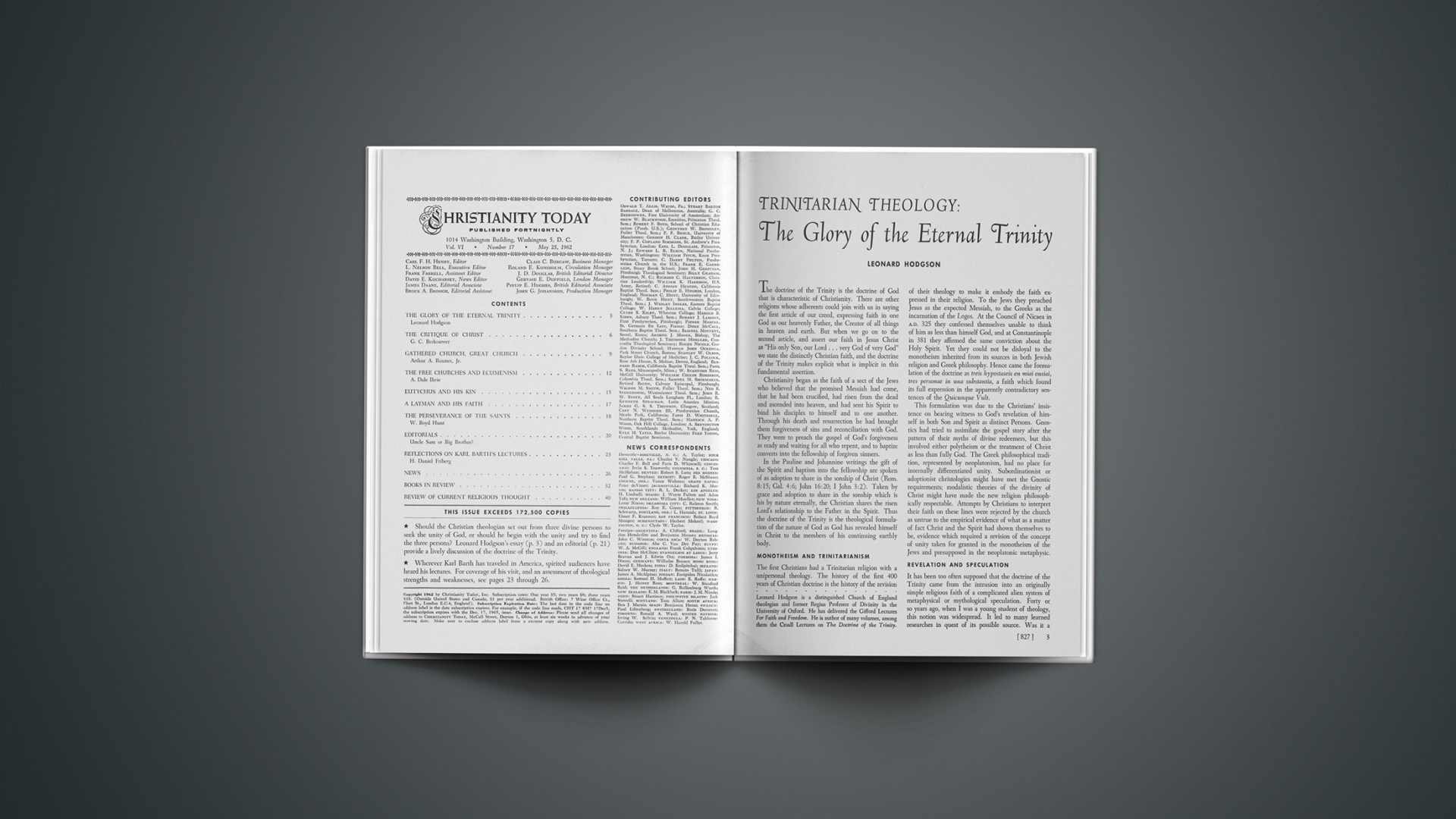
Trinitarian Theology: The Glory of the Eternal Trinity

The doctrine of the Trinity is the doctrine of God that is characteristic of Christianity. There are other religions whose adherents could join with us in saying the first article of our creed, expressing faith in one God as our heavenly Father, the Creator of all things in heaven and earth. But when we go on to the second article, and assert our faith in Jesus Christ as “His only Son, our Lord … very God of very God” we state the distinctly Christian faith, and the doctrine of the Trinity makes explicit what is implicit in this fundamental assertion.

Christianity began as the faith of a sect of the Jews who believed that the promised Messiah had come, that he had been crucified, had risen from the dead and ascended into heaven, and had sent his Spirit to bind his disciples to himself and to one another. Through his death and resurrection he had brought them forgiveness of sins and reconciliation with God. They were to preach the gospel of God’s forgiveness as ready and waiting for all who repent, and to baptize converts into the fellowship of forgiven sinners.

In the Pauline and Johannine writings the gift of the Spirit and baptism into the fellowship are spoken of as adoption to share in the sonship of Christ (Rom. 8:15; Gal. 4:6; John 16:20; 1 John 3:2). Taken by grace and adoption to share in the sonship which is his by nature eternally, the Christian shares the risen Lord’s relationship to the Father in the Spirit. Thus the doctrine of the Trinity is the theological formulation of the nature of God as God has revealed himself in Christ to the members of his continuing earthly body.

Monotheism And Trinitarianism

The first Christians had a Trinitarian religion with a unipersonal theology. The history of the first 400 years of Christian doctrine is the history of the revision of their theology to make it embody the faith expressed in their religion. To the Jews they preached Jesus as the expected Messiah, to the Greeks as the incarnation of the Logos. At the Council of Nicaea in A.D. 325 they confessed themselves unable to think of him as less than himself God, and at Constantinople in 381 they affirmed the same conviction about the Holy Spirit. Yet they could not be disloyal to the monotheism inherited from its sources in both Jewish religion and Greek philosophy. Hence came the formulation of the doctrine as treis hypostaseis en miai ousiai, tres personae in una substantia, a faith which found its full expression in the apparently contradictory sentences of the Quicunque Vult.

This formulation was due to the Christians’ insistence on bearing witness to God’s revelation of himself in both Son and Spirit as distinct Persons. Gnostics had tried to assimilate the gospel story after the pattern of their myths of divine redeemers, but this involved either polytheism or the treatment of Christ as less than fully God. The Greek philosophical tradition, represented by neoplatonism, had no place for internally differentiated unity. Subordinationist or adoptionist christologies might have met the Gnostic requirements; modalistic theories of the divinity of Christ might have made the new religion philosophically respectable. Attempts by Christians to interpret their faith on these lines were rejected by the church as untrue to the empirical evidence of what as a matter of fact Christ and the Spirit had shown themselves to be, evidence which required a revision of the concept of unity taken for granted in the monotheism of the Jews and presupposed in the neoplatonic metaphysic.

Revelation And Speculation

It has been too often supposed that the doctrine of the Trinity came from the intrusion into an originally simple religious faith of a complicated alien system of metaphysical or mythological speculation. Forty or so years ago, when I was a young student of theology, this notion was widespread. It led to many learned researches in quest of its possible source. Was it a Hellenizing of the true Hebraic belief? Or was it an infection from the mythology of the surrounding mystery cults? Or what? To satisfy examiners in theological examinations it was necessary to be able to discuss the latest theories of this kind. But later study led me to see that this was really beside the point. The doctrine grew out of the faith of the Christians themselves. It was so clearly an attempt at a creedal formulation of what in their experience Christ and the Spirit had been, and continued to be to them, that there was no need to look elsewhere for its origin. It came from the Christians’ insistence on remaining true to the full content of their religious faith, their refusal to allow it to be distorted, diminished, or explained away in order to adapt it to the philosophical spirit of the age. It was for the philosophers to consider what revision of their ways of thinking would be required by accepting the evidence which the Christians produced as given by God in his revelation of himself in Christ.

How can human thought assimilate this evidence without distorting, diminishing or explaining it away? When we try to think about the mystery of God’s being, the best we can do is to ask whether from our human experience we can draw any analogies which will help to lighten our darkness. No sooner had the doctrine received its formulation than this process began and produced what may be called the two classical analogies. Some Cappadocian theologians suggested that as three men are each a hypostasis of one ousia, manhood, so we may think of the Persons of the Trinity as each a hypostasis of the one ousia, godhead. This (which has been called the social analogy) was found inadequate as insufficiently guarding against tritheism. To avoid this Augustine, in his De Trinitate, experimented with what has been called the psychological analogy. He suggested that God should be thought of after the analogy of the human self which is a trinity of memory, intellect and will. But in the end he had to admit that this is inadequate: the apparent unity is only achieved at the cost of forgetting that in God each persona is a trinity of all the elements in the human self.

In attempting to expound the doctrine today theologians differ in the emphasis laid on one or other of these two analogies. Those who hold that we should think of each hypostasis or persona as fully personal in the modern sense of the word argue that this need not involve tritheism: by analogy from our experience of imperfectly unifying in one life the elements which should go to the making of one person we are led to see how intense must be the unifying power, how infinitely high the degree of unity in the divine life in which are unified nothing less than three complete persons. Those who, to avoid any danger of tritheism, would translate hypostasis or persona by some such phrase as “mode of existence” rather than person, and hold that it is in his ousia or substance that God should be thought of as personal in the modern sense of the word, argue that this need not involve the modalism rejected by the early Church and is consistent with all that God has revealed to us of himself in the biblical witness to his Trinitarian activity.

However difficult it may be for human thought, the mystery of the divine unity is such as to require the combination of the two analogies. The doctrine of the Trinity is best described as a trinity of Persons united in a closeness of unity characteristic of Modes of Existence. Nothing less than this will take full account of the revelation in Christ. In the Old Testament, and therefore by the first Christians for whom it was their Bible, God was thought of as unipersonal. When they found themselves worshiping Christ and the Spirit, how were they to escape the charge of being either polytheists or idolaters? I am myself convinced that this can only be done by thinking of the divine unity as having a richness of content unified by an intensity of unifying power for which we have nothing analogous on earth. This is what enables me to accept the biblical evidence for Son and Spirit being Persons in the modern sense of the word.

Barth’S View Inadequate

I cannot therefore be satisfied with the Barthian suggestion that we should do better to speak of God as revealing himself in three “modes of existence,” and ascribe personality in the modern sense of the word to his ousia or substance and not to the hypostases or personae. Apart from its distortion of the biblical evidence, there are philosophical difficulties about its consistency with the doctrine of creation. There is a well-known kinship between unitarian theology and the thought of creation as the imposing by God of form on coeternal chaotic matter. A unipersonal God is unthinkable except in relation to something or someone other than himself. To quote from what I have written in review of Dr. Claud Welch’s exposition of Barth:

The essence of the revelation is said to be that God is revealed as Lord. ‘The lordship of God … is to be equated with the essence of God.’ Lordship is a relative term and implies subjects. The revelation therefore is only concerned with God in relation to creation, with an ‘economic’ doctrine of God. Or have we here an indication of the logical connection between unipersonal doctrines of God and the necessity of the created universe to the being of God?

It may at first sight seem simpler to think of God as unipersonal and treat the revealed threefoldness as the mystery. To my mind the evidence requires us to start from his tri-personality and seek for light on the mystery of his unity. When we think it out we find that on this route the difficulties are less, not greater. There are many things in our experience which justify us in holding that, however mysterious may be a unity in which are perfectly unified three distinct persons, it is a mystery which is rationally credible. I find far greater difficulty in attempting to follow Dr. Welch’s exposition of the interrelations of his modes of existence, of which in the end he has to write: “we are ascribing to the personality of God a Threefoldness which is different from anything we know in finite personality.”

In its origin the doctrine was the doctrine of God as implied in the faith and life and worship of our Christian ancestors. If it is to have meaning for us, we must begin where they began. We must approach it from the standpoint of those who are trying to live by a Trinitarian religion, as men and women who are seeking to find and do the Father’s will in the Father’s world with the companionship of the Son in the guidance and strength of the Spirit. In our worship, moved by the Spirit, we come into the presence of our heavenly Father, brought in by the Lord Jesus whom we adore and worship as he takes us by the hand and presents us to the Father. As we rise to return to our work in the world, we look out in our mind’s eye beyond the wall of room or church, we look out into all the world around as those who are being sent forth, united with Christ and enlightened by the Spirit, that we may share in God’s joy in all that is good and true and beautiful, his grief over all that is ugly and base and sinful, his labor in overcoming the evil and building up the good. The more we practise ourselves in the habit of looking out on the world from the stand point of this understanding of God’s threefoldness, the more we find ourselves drawn onwards towards the realization of his essential unity. In the traditional language of the liturgy of the Western church we acknowledge the glory of the eternal Trinity and in the power of the Divine Majesty we worship the Unity.

We Quote

TOGETHERNESS—One of the numbers from the show (looked) at the subject of church unity (and is) called Togetherness.… Four worthies [a Roman Catholic cardinal, an Anglican archbishop, an Orthodox patriarch, and a United Church moderator] sang a song in which they preached Togetherness, though each held firmly to his individual view.

The cardinal thought that

God allows others to go in their way

While we are infallibly going in His;

the archbishop insisted that

God is a gentleman through and through

And in all probability Anglican too;

the patriarch explained that

It would take hours to chronicle all the canonical

Differences between us and the rest.

But we’ll have you recall that though God made us all

He incontrovertibly made us the best;

while the United Church viewpoint was succinct:

Our flocks are enormous, and all nonconformist;

Our virtuous conduct all others’ excels;

We’ve God’s guarantee that our conscience is free,

And we won’t take our orders from anyone else.

—John Gray, “More Laughs to the Square Review” (a feature article on the Toronto show “Spring Thaw”), in Maclean’s, May 5, 1962, issue.

THE WHOLE LINE—You were brought into existence to preserve and to promote and to defend one of the great doctrines of the Methodist Church—entire sanctification, the work of the Holy Spirit and that still needs to be preserved, promoted and defended. But when Asbury was born that was about the only article in our creed that was under severe attack. Now the whole line of evangelical Christianity needs defense and preservation.—Methodist Bishop ARTHUR J. MOORE, in a Ministers’ Conference at Asbury Seminary.

BULLETIN FROM THE DEVIL—So the Convocation of Canterbury … is graciously allowing me to stay for another seven years in the English Catechism.… Universal belief in me, horns and all! What a glorious basis for twentieth century Church unity!—“DIABOLUS,” in The Scotsman.

ORTHODOXY ON PARADE—If all the beards here were shaved off and properly stuffed, what a Holy mattress one would have.—Archbishop A. M. RAMSEY at New Delhi, quoted by the Montreal Star.

TAMPERING WITH THE HYMNS—It’s a well-known truth that you may introduce anything from the confessional to the Koran, from vestments to yogi into a church and have a very good chance of getting away with it. But try and change the hymns and you have a full-scale revolution on your hands.—DAVID WINTER,Church of England Newspaper.

KANT AND HYMNSINGERS—In Königsberg, for example, where he lived near the castle, which also served as a prison, Kant was angered by the loud and persistent hymn-singing of the prisoners, which was particularly irksome to him in the summer, when he liked to philosophize with his window open, and complained to the town-president about the “stentorian devotions of those hypocrites in the gaol,” the salvation of whose souls would certainly not be imperilled even if “they listened to themselves behind shuttered windows and then even without shouting at the tops of their voices.”—Vorlander, Life of Immanuel Kant, p. 138, quoted by Karl Barth, in Protestant Thought: from Rousseau to Ritschl.

Review of Current Religious Thought: May 11, 1962

The adjective pentecostal in our day has been generally associated in the church-going mind with a conception of noisy and unruly assemblies of those who profess an ecstatic form of religion. This conception has not been entirely false; at the same time it has not been universally accurate. After all, an observer of the noisiness and unruliness which the Apostle Paul found it necessary to rebuke in the Corinthian church would have been disposed, understandably, to dismiss these gatherings as something less than Christian. But he would have been mistaken had he concluded that there was no such thing as the spiritual gifts to which the Corinthians laid claim. Does not Paul thank God because the Corinthian believers had been enriched in Jesus Christ in all utterance and in all knowledge and because they came behind in no gift (1 Cor. 1:4 ff.)? It is precisely their misuse of these gifts that causes him to admonish them that all things are to be done decently and in order (14:40).

Today, however, the massive respectability of the old-established denominations is being invaded and in some measure disturbed by the manifestation of a pentecostal experience within the ranks of their membership. Does it not reflect on our settled ecclesiastical ways that for Episcopalians, Presbyterians, Lutherans, Methodists, and Baptists to speak in tongues should seem strange and even bizarre? Would we not have felt somewhat out of place in the church of the New Testament?—that at least is a question that should give us pause! Is it perhaps possible that in this new-old way God is breaking through the lethal formalism and superficiality of the churchanity which is all too prevalent in our Western world?

Let me quote from an article written by an Episcopal clergyman in a diocesan magazine: “Why did I have to live all of those years before someone told me that Jesus is related to life, that He is not dead, or impotent, but alive and able to help His creatures? The Sunday schools and churches never told me. The seminary I went to never told me. In fact, the least Christian environment I have ever known was that seminary. I say this in love, because, you see, they didn’t know Him either.… I thank God that He led me to seek and receive, in accordance with His Word, a pentecostal experience of my own, and that He has baptized me with His Holy Ghost.… I want to give my life to His service, every minute of it, so that other people may not be left in the dark as I was, but may know that God’s promises are true, that Jesus Christ is still alive and effective in human life, that His loving, transforming power is for everyone. I want everyone to know what a wonderful difference my Lord and Saviour Jesus Christ can make in human life.”

Writing in another magazine, a Methodist minister speaks of the hunger which for years he had for the evidence of God’s power and the reality of a living Christ in his ministry, and tells of his experience of being filled with the Holy Spirit through prayer and the laying on of hands. He testifies to the fact that now he has a rest of soul that he never dreamed was possible, that he now preaches with more freedom and power, and the Bible is now real and alive, that witnessing to his faith in Christ is now easy, that his church is now blessed with vital prayer meetings, and that in answer to the prayers of God’s people many persons have been wonderfully healed of illnesses and afflictions.

A laywoman has written to me of her years of nominal Episcopalianism and her search for spiritual satisfaction through form and ritual and daily communions. “I adhered to a strict rule of life,” she says, “and said a multiplicity of prayers, and yet deep within me there was a feeling of dissatisfaction.” The experience of conversion was followed after an interval of time by that of being filled with the Holy Spirit. “I naturally rejoiced in my experience of being indwelt by the Spirit,” she continues, “and attempted to fit the experience into my theology and my devotional practices. To my astonishment, it did not fit. To my horror my theology began to change and it was most terrifying. The Holy Bible, which I had previously considered to be a history of the Jewish people plus an interesting follow-up that my Church had written, suddenly became to me the living, breathing Word of the eternal Godhead. The Body of Christ, which I had formerly believed to consist of the Anglican Church, the Roman Catholic Church, and the Orthodox Church, became to me all those who accepted Jesus as Lord.”

I myself have had the opportunity of meeting with some of these people who claim to have this New Testament experience and of sharing in their fellowship. Those whom I encountered in this way were for the most part Episcopalians. I have heard some of them speaking in an unknown tongue: in each case it was done quietly and briefly, and was followed (as the New Testament requires) by an interpretation, which was given by someone else. The majority of the prayers, however, were offered in English. The meetings were restrained and orderly. The serene joy, love, and devotion which marked these gatherings made a profound impression on me. They adore their Lord and Saviour; they feed eagerly upon his Word; they seek in the power of the Holy Spirit to be his witnesses daily in all their living, and they testify to the most remarkable answers to their prayers in the lives of others, in bodily healing and spiritual blessing.

Dare we deny that this is a movement of God’s sovereign Spirit? Ought we not rather to hope and pray that this may be the beginning of a great spiritual revival within the Church in our time? and to rejoice over the zeal and the joy in Christ of those who testify to this experience? If we are cautious, let us heed the apostle’s admonition to “forbid not” (1 Cor. 14:39), and also the warning of Gamaliel: “if this counsel or this work be of men, it will come to nought; but if it be of God, ye cannot overthrow it, lest haply ye be found even to fight against God” (Acts 5:38 f.).

The Communion of Saints

I bow my knee unto the Father of our Lord Jesus Christ, of whom the whole family in heaven and earth is named (Eph. 3:14, 15).

In the Apostles’ Creed you often say: “I believe … in the communion of saints.” Do you so believe? “Yes, perhaps,” someone replies. “But really I do not know what it means.” For no small part of the answer turn to Ephesians, Paul’s epistle about Christ and the Church. In our text he starts with saints in glory, and we can do no better. Christians believe in communion, or fellowship, with hosts of God’s redeemed children now in glory.

I. Saints in Glory. In a first-class hymnal the 15 songs under the heading “Communion of Saints,” all have to do with the children of God in glory. Here we enter a realm of mystery, of light, also of experience. A recent novel by Agnes Sligh Turnbull, The Day Must Dawn, tells of a pioneer mother who in middle age lies down to die. Listen to the way she comforts her daughter, a comely maiden soon to become an adult.

“I’ll never be far away from you. It’s been that way with my own mother. A dozen times a day, like, it has always come to me: ‘That’s the way mother did,’ or else, ‘I can just hear mother say that!’ You never really lose your mother, my child, not when you love her. So don’t you grieve.”

II. Saints Throughout the World. As redeemed children of the God who loves the world, so do we. Many of the saints whom we know by name we never yet have seen, but as lovers of world missions we have much in common with hosts of believers now witnessing and suffering for him, among them Alan Paton in South Africa. Through current writings and in other ways, you may come to know a certain woman missionary in Pakistan even better than the good neighbor next door.

III. Saints Here at Home. Alas, at times believers in God become so farsighted as not to see the saintliness of a loved one in the family circle, nor in the home church. Not at least until the loved one falls asleep and leaves in home and church an abiding influence like that of heaven. Do you as a Protestant ever think of a saint as a holy person long ago and far away? If so, may the Lord open your eyes to behold, here and now, some of God’s most beloved holy ones.

My friend, as a member of a godly home and of a Christian church, you may here and now enter into loving fellowship with the whole family of God’s redeemed children. In this happy fellowship you will find many of earth’s purest joys, and in the world to come you will enter into eternal bliss that God has prepared for everyone who by faith belongs to God in the redeemed family of Christ Jesus.

Scripture In The Schoolroom?

RECENT U.S. DISTRICT COURT DECISION—A special three-judge Federal district court in Philadelphia … held that the Pennsylvania statute requiring the daily reading of ten verses of the Holy Bible interfered with the free exercise of religion as guaranteed by the First Amendment of the U.S. Constitution.… None of this means that the court is anti-religious. It was simply adhering to the opinion … that “both religion and government can best work to achieve their lofty aims if each is left free from the other within its respective sphere.” Pennsylvania should now be satisfied that this is the safest rule.—Pittsburgh Post-Gazette.

WHAT THE COURT SAID—The reading of the verses, even without comment, possesses a devotional and religious character and constitutes in effect a religious observance.… The fact that some pupils, or theoretically all pupils, might be excused from attendance does not mitigate the obligatory nature of the ceremony.… Since the statute requires the reading of the “Holy Bible,” a Christian document, the practice … prefers the Christian religion.—Circuit Judge Biggs in Schempp v. School District of Abington Township, Pennsylvania (1962).

OBJECTION TO NON-PARTICIPATION—An excusatory provision divides children into religious groups so that instead of being American children, they become Protestant children, Catholic children, Jewish children and non-believing children.—Dr. Leo Pfeffer, associate general counsel of the American Jewish Congress, The Philadelphia Inquirer.

EARLY ILLINOIS CASE—Christianity is a religion. The Catholic church and the various Protestant churches are sects of that religion.… Protestants will not accept the Douay Bible as representing the inspired word of God.… Conversely, Catholics will not accept King James’ version.… The reading of the Bible in school is instruction.… They cannot hear the Scriptures read without being instructed as to the divinity of Jesus Christ, the Trinity, the resurrection, baptism, predestination, a future state of punishments and rewards.… Granting that instruction on any one of the subjects is desirable, yet the sects do not agree on what instruction shall be given. Any instruction on any one of the subjects is necessarily sectarian, because, while it may be consistent with the doctrines of one or many of the sects, it will be inconsistent with the doctrine of one or more of them.—People ex rel. Ring v. Board of Education (1910).

WEIGHT OF PAST OPINIONS—In most of the jurisdictions in which the question has arisen, the courts have given judicial approval to Bible reading, without note or comment, in the public schools.—45 American Law Reports, 2d, p. 748.

EARLY MASSACHUSETTS CASE—The Bible has long been in our common schools.… It was placed there as the book best adapted from which to “teach children and youth the principles of piety, justice, and a sacred regard to truth, love for their country, humanity, and a universal benevolence, sobriety, moderation, and temperance.… To read the Bible in school for these and like purposes, or to require it to be read without sectarian explanations, is no interference with religious liberty.—Commonwealth ex rel. Wall v. Cooke (1859).

RECENT DECISION OF MARYLAND’S HIGHEST COURT—As we see it, neither the First nor the Fourteenth Amendment was intended to stifle all rapport between religion and government.… particularly because the appellant-student in this case was not compelled to participate in or attend the program he claims is offensive to him, we hold that the opening exercises do not violate the religious clauses of the First Amendment.—Judge Horney for the majority in Murray v. Curlett (1962).

A ROMAN CATHOLIC VIEW—… Mere Bible reading, like the mere reading of anything else, is … poor education. Whether it is read as literature or as an exposition of doctrine, it needs comment. That comment should be given by a teacher of the pupil’s choice, in school hours on school grounds. Otherwise, Bible reading in the public schools is purely a sectarian practice.—The Register.

EDUCATOR’S RECOMMENDATION—To exclude from the school experience all references to the Deity with reverence and belief would be to make the schools mechanistic and essentially materialistic in character. To prohibit any expression of a religious nature could ultimately destroy confidence in public education in a national community with deep religious commitments.… To prohibit reference to the Deity in any school exercise would be a restraint upon the rights and privileges of most children and their parents.—Recommendation of Carl F. Hansen, District of Columbia Superintendent of Schools, to Board of Education to retain present non-compulsory opening exercises consisting of the salute to the flag, a reading from the Bible without note or comment, and the Lord’s Prayer (April 18, 1962).

AN EDITORIAL REACTION—We fully agree with the views expressed by School Superintendent Hansen.… The values derived from the program outweigh the objections which can be cited in individual cases.—The Sunday Star (Washington, D.C.).

THE FINAL AUTHORITY—It remains for the Supreme Court to say the last word in a controversy which goes … to the philosophical deeps.—Baltimore Sun.

WHAT JESUS SAID—Blessed are they that hear the word of God, and keep it.—Luke 11:28.

THE EFFICACY OF THE WORD—The holy scriptures … are able to make thee wise unto salvation through faith which is in Christ Jesus. All scripture is given by inspiration of God, and is profitable for doctrine, for reproof, for correction, for instruction in righteousness: That the man of God may be perfect, throughly [thoroughly] furnished unto all good works.—2 Tim. 3:15–17.

A Bible Picture of a Good Mother

A woman that feareth the Lord, she shall be praised (Prov. 31:30b, read 31:10–31).

What a text for Mother’s Day! In the Bible the only book especially for a young person closes with this acrostic poem, easy to commit and remember. Here a growing lad can see what sort of mate he should desire; a teen-age lass, what kind of mother she ought to become. With the main stress on God, this teaching poem suggests three lines of thought:

I. The Charm of a Godly Woman of the Martha type. She excels as a worker and a neighbor, as a friend and a believer. Everyone of us has reason to thank God for some dear “Aunt Martha.” During one of our wars, the lonely young soldier from the nearby camp used to thank God when the hostess for Sunday dinner proved to be a woman like Martha. She showed her faith by her works. Jesus loved Martha and Mary.

II. The influence of a Godly Wife. When married in the Lord she excels as the companion and helper of her husband. Over him she ever has a holy influence, so that he is known when he sits among the church officers. For beautiful words about such a good wife, read John Ruskin’s Sesame and Lilies.

III. The Praises of a Godly Mother. Because of her God this woman believes in having children. As a good homemaker, she loves each little child, growing lad or lass, and grown son or daughter. In the beauty of life’s morning every one of them learns to love her, as well as the father whom she leads them to understand and love. The world has nothing to show more fair than such a home, earth’s nearest approach to heaven.

My friend, have you ever come really to know and love the Book of Proverbs, especially this closing poem? If not, start now! Then you will do all that in you lies to bring up one child after another according to the ideals of this Bible book, as you will find such ideals at their best in the earthly years of the Lord.

How to Be Saved

By grace are ye saved through faith (Eph. 2:8).

This is one of the great texts in the Evangelical Revival. A mighty watchword of Martin Luther, John Wesley, and Spurgeon. In the text note three words, still the marrow of the Gospel for those of us who believe.

I. Grace, “the free, unmerited favor of God.” Through Christ and his Cross the favor of God now comes to us, one by one, cancels the debt of sin, imputes the righteousness of God, and progressively imparts that righteousness. Through grace the Spirit also sanctifies. This grace now is flowing like a river. To this grace any person in need may now turn with eagerness, and never turn in vain.

II. Saved. Salvation has to do with the present as well as with the future. Salvation means to be delivered from the sins of the flesh and of the mind. Salvation from strong drink, and from greed for gain. Salvation also from pride, the subtlest of sins; from jealousy and all the canker it brings from gossip and the evil it entails. Have you this quality of life?

III. Faith. Faith in Christ means to believe him and to trust him. It is the venture of your whole personality in trusting the One who is worthy. Are you conscious of your need, your weakness, the pressure of your sins, and your inability alone to grapple with them? Do you feel the need of the One whom you can trust?

To such felt needs the Gospel speaks of your being saved through faith. The real end of faith is to unite the person who believes with the Person on whom he believes. Only as by faith you are united with Him can you have the quality of life that is the hallmark of heaven.

This is the glad, good news that the evangelists carried everywhere in the first century, and that their true followers have echoed in all the centuries since. In the eighteenth century our Wesleyan fathers sounded it with tremendous power. In an age when people had lost all hope, the spokesman for God came with the burning message that he was there and that he was kind; that by his free grace men could be lifted into the fullness of life, if only they trusted in Christ.

This is still the heart of the Gospel. I sound it again, and with jubilation. Again I offer you this Gospel: “By grace are ye saved through faith.”

Evangelical Sermons of Our Day, ed. by Andrew W. Blackwood, Channel Press, Manhasset, New York, 1959.

Out Where the New Begins

So if anyone is in union with Christ, he is a new being; the old state of things has passed away; there is a new state of things (2 Cor. 5:17, Goodspeed).

In this message, worthy of note for simplicity and charm, a life situation leads up to a practical discussion of what it means today to be “in Christ,” in union with Christ. The object lessons come from life, with one person at a time.

I. A new Relationship to God. Where Christ’s atoning death writes the message of God’s forgiving, healing love in letters of holy blood, the rebel becomes a citizen, the slave is free, and earth’s wanderer sets out for the celestial city, all through reconciliation, “in Christ.”

II. A New Regard for Others. “From henceforth we appraise no man by human standards.” If you look at human beings through the eyes of sinful, selfish men, you get one view. If you look at them through the eyes of Jesus, you get a Christian view. The most important thing about people is that they are people for whom Christ died. That gives them, one and all, a claim to distinction, “in Christ.”

III. A New Reason for Living. “The very spring of our actions is the love of Christ.” Almost anyone can tell you his reason for making a livelihood, but few can tell you their reason for living. The Christian has an answer to that basic question. The greatest Christian of the centuries has expressed it in these priceless words: “The love of Christ controls us.” To be the channel through which the love of Christ flows is the supreme reasons for living, “in Christ.”

IV. A New Restfulness about the Life Beyond. The man who has been spiritually reborn by being united to Christ through faith does not try to prove immortality. He experiences it. He knows that what he has in Christ, this new life that possesses and controls him, gives him the “feel” of eternity. “We know that when he shall appear we shall be like him, for we shall see him as he is.” These are some of the revolutionary novelties that one finds “out where the new begins.” Have you found it so? If not, there is a new life waiting for you now. You will find it, not in a sermon, a church, nor a book, but “in Christ.” Take him. Open your being to him. Trust him. “He that believeth on the Son hath everlasting life.”

Notable Sermons from Protestant Pulpits, ed. by Charles L. Wallis. Copyright 1958 by Abingdon Press.

SERMONS ABRIDGED BY DR. ANDREW W. BLACKWOOD

PAUL S. REES,Out Where the New Begins, W. E. SANGSTER,How To Be Saved, and abridgments of two of Dr. Blackwood’s own sermons, The Communion of Saints, and A Bible Picture of a Good Mother.

The Minister’s Workshop: Begin with a High View

“He was full of bankrupt enthusiasms,” said Carlyle of Thomas De Quincy.

The disparagement of the sermon—what it does or what it can do—has brought the contemporary Protestant pulpit to so low an estate that preaching might almost be called one of its “bankrupt enthusiasms.” Conrad Massa, writing in The Pulpit, says grimly: “In the history of the church preaching has been neglected, ignored, debased, even almost totally forgotten, but never has its place been as seriously questioned by those who are genuinely concerned with the vitality of the church’s witness as has been done repeatedly in this century.”

Not single but multiple are the reasons for this unhappy state. Let us here fix on only one: the quality of preaching always declines when the conception of preaching is removed from primacy to some stage—be it second or twenty-second—of inferiority. If the ordained man places the crown of primacy on any other head in the cabinet of his interests—visitation, group therapy, counseling, liturgy, administration, or whatever—it will be reflected in what he does in his study, with his Bible, on his knees, and in his pulpit.

Strong and effective preachers, though they differ widely in mold and manner, have this in common: they believe greatly in preaching.

Take the late W. E. Sangster, of London, as a case in point. True, the criteria we use for establishing pulpit greatness will vary from person to person. Yet I doubt if there is one knowledgeable judge of the homiletical arena who would be willing to omit Sangster’s name from any list of the twelve most distinguished preachers of the English-speaking world in the 1950’s.

With what sort of eyes, we may ask, did “Sangster of Westminster” look upon the excellence of his calling and the exactions of his craft? Those who have read his Power In Preaching will remember the lean, Anglo-Saxon pithiness with which he lays out the chapter titles: “Believe In It” … “Work At It” … “Make It Plain” … “Glow Over It,” and so on.

Not accidental, we may be sure, is the caption he writes over the first chapter: “Believe In It.” “You believe in preaching?” he asks, and immediately follows with, “How much do you believe in it?”

This query is sharpened and shaped by one chisel-stroke after another:

“No pulpit has power if it lacks deep faith in the message itself and in preaching as God’s supreme method in making his message known” (italics mine).

… “The termites of unbelief may be working at our faith in the gospel or at our faith in preaching. A bit of faith in both may survive in a man who goes on with a certain dutifulness in his work—yet only a bit. Haunted by the memory of the man who put his hand to the plow and looked back, he keeps in the furrow though he plows neither deep nor straight … An awful impoverishment falls upon the whole Church if the preachers … lose faith in preaching.”

These well-muscled Sangsterian sentences came vigorously from the heart of a man whose faith in preaching, as a never effete ordination of God, held him and thrilled him to the day of his lamented death. A “moratorium on preaching,” as seriously proposed by some capitulating clergy of recent times! Sangster would have replied, “You might as well call for a moratorium on the grace of God! For, after all, “it was God’s good pleasure through the foolishness of preaching to save them that believe” (1 Cor. 1:21).

The vices of too many sermons heard today—shallowness, frivolousness, dullness, biblically unanchored topicality and theologically unhinged moralism—will never be overcome, cast aside, except we rise to worthier views of the nature and function of preaching.

Preaching is neither “essaying” nor “rhetoricizing.” While it makes use of the rules and principles of homiletical discourse, and is therefore in a sense a craft, it is incomparably more.

Preaching is more than heralding an action of God, even though the action announced is the Incarnation, the saving Cross, the Resurrection. Preaching is action—God’s action in his called man for the sake of his Son, the Church which he has redeemed, and the world over which he yearns.

Preaching is not a performance. Preaching is an event. It is that event in which the preacher, armed with the authority of Scripture, enabled by the Holy Spirit, upheld by the believing community, brings God and man face to face.

Book Briefs: May 11, 1962

Protestant Theory Of A University

Wilderness and Paradise in Christian Thought. The Biblical Experience of the Desert in the History of Christianity and the Paradise Theme in the Theological Idea of the University, by George H. Williams (Harper, 1962, 245 pp., $4.50), is reviewed by Paul Woolley, Professor of Church History, Westminster Theological Seminary, Philadelphia, Pennsylvania.

A more delightful introduction to the corpus of Western culture could hardly be found than this stimulating and charming volume by George Williams, the erudite yet vivacious occupant of the Winn professorship of ecclesiastical history in the Harvard Divinity School.

The book has two parts. Its larger section pursues the appearance of the wilderness theme in the Scriptures and in the history of the Church. This concept is constantly brought into relationship with the somewhat less frequently used figure of the paradise, the enclosed garden of God’s people. A task of this type can only be successfully accomplished by one who possesses the most comprehensive learning, as George Williams eminently does. He skillfully takes his reader on an entrancing excursion through the Bible and through what Western culture has done with the biblical theme. His knowledge of the early Fathers, of the medieval scholars, of the Reformers, both radical and classical, and of Puritan Protestantism stands out on every page. But this is not a compilation of items from the past. It is a living story of the way in which Christ’s followers have interpreted their status and their path in this world in these particular biblical themes and figures.

The second section of the book is even more exciting, since it is an interpretation of the modern problem of the relation of culture to Christianity in terms of the history of three great institutions, the state, the university, and the church. The work of Protestantism, and of Calvin in particular, in bringing the university out from under the aegis of the church to place it under the care of the state is appreciated. Then Williams proceeds to use Harvard as an example to show how the American university, at least, has happily won its freedom from the state. It would have been desirable at this point to raise the question of the relationship of the university to the divinely established institution, of the family, an institution coordinate in many ways, in the biblical perspective, with the state and the church. Here is the real seed of the “distinctively Protestant theory of the university,” for the family is the ultimate Republic of Letters and the university is its projection. Williams’ necessary emphasis on the importance of secondary education in this age of greater sophistication among youth fits precisely into this pattern.

Even though his view of the Fall and the Atonement is unsatisfactory, there is a basically sound presentation of the community of technique between Christian and non-Christian scholars in the search for truth. When it is realized that the university is an extension of the family, it is clear that in so far as truth is adequately taught by the senior members it will be properly developed by the junior members. Even when it is not, the juniors are not utterly disowned, but rather their redemption is sought.

PAUL WOOLLEY

Knox’S Good Name

The Faith of John Knox, by James S. McEwen (John Knox, 1961, 116 pp., $2.50), is reviewed by Andrew K. Rule, Professor of Church History and Apologetics, Louisville Presbyterian Theological Seminary, Louisville, Kentucky.

This book by the professor of church history at Aberdeen is the latest of a number that have appeared since Percy’s in 1937, the impact of which is to tell the truth about Knox and, by correcting the gross popular misrepresentation of him, restore his good name. It represents the Croall Lectures, delivered in 1960 at the New College, Edinburgh, not far from a very striking statue of Knox. The book retains the lecture style, and a few typical Briticisms such as “batting on a bad wicket” will not detract from the clarity and force of its appeal to American readers. The intimacy of the lecture situation also made possible a certain forthrightness of expression which might otherwise have been avoided, but which the reviewer finds attractive. For example, “some Scottish literary writers whose itch to pontify on theology seems scarcely to be warranted by the apparent sketchiness of their acquaintance with the subject” (p. 66); and a certain misrepresentation of Calvin is “grotesque” (p. 92).

The book begins with a brief review of the life of Knox and of the situation in Scotland in order to show why “in 1559 it was Knox, or nothing.” Then Knox’s teaching is discussed with regard to “The Bible and the Holy Spirit,” “The Sacraments,” “Predestination,” and “Providence,” and a final chapter considers Knox’s “Faith of the Heart.” The author claims that in dealing with these subjects, “I have dug into theological ground just about as far as it is safe for a historian to go.”

The careful reader may judge that occasionally McEwen has gone somewhat further than that. When, for example, he concedes that the Reformers, apparently including Knox, allowed the conception of God’s “arbitrary Will” to influence them (p. 76), and then denies this (p. 78) as far as Knox is concerned, it would seem that he needs to think a little farther or should not have gone so far. Again, if, in confronting the difficulties created for the doctrine of Providence by “that vast mass of suffering that appears to have no human origin,” he sides, against Knox, with the modern theologians who regard “the material universe as a semi-autonomous system, running machine-like under the control of natural laws laid down for it at the hour of its creation,” it might well be suggested that he think again. It seems, too, that he has exaggerated the differences between Calvin and Knox with regard to the Lord’s Supper, not, indeed, by misrepresenting Knox but by failing to do justice to Calvin.

For all that, Dr. McEwen shows himself to be a very good theologian, with a gift for the clear expression of theological issues and doctrines; and this is a very good book.

ANDREW K. RULE

Sanctity In The News

The Christian as a Journalist, by Richard T. Baker (Association, 1961, 119 pp., $2.50), is reviewed by David E. Kucharsky, News Editor, CHRISTIANITY TODAY.

Baker tests the compatibility of contemporary journalism with Christianity, and many will disagree with his strained defense of the profession as a sacred calling in and of itself. They will contend that journalism, like any other profession, is only as sacred as one makes it.

The real value of the book, however, lies in its examination of the ethical problems of the press, radio, and television. These problems are paraded across its pages provocatively enough to demand the attention of clergymen, publishers, editors, and reporters alike. The beginner in journalism, for whom the book was originally intended, may be left somewhat bewildered, but he will be thankful to have been oriented early in the game.

Baker is one of those rare individuals who have formal training in theology as well as in journalism. A former associate editor of World Outlook (Methodist), he is now a professor of journalism at Columbia University. This, his latest book, is one of the Haddam House series on Christian vocation.

Aside from a few theological presuppositions which the evangelical will reject, the content deserves high commendation. It could go a long way toward correcting misconceptions about the press which are quite widespread, even among ministers. Baker’s handling is intelligent and his style highly readable.

My chief disappointment is that Baker virtually ignores religious news per se, the frontier upon which the Church meets the journalistic profession most pointedly.

DAVID E. KUCHARSKY

Liturgical Revision

The Durham Book, edited and introduced by G. J. Cuming (Oxford, 1961, 299 pp., $10.10; 63s.), is reviewed by G. E. Duffield, London Manager. CHRISTIANITY TODAY.

Mr. Cuming, formerly Vice Principal of St. John’s College, Durham, has produced a line edition of a complex but important seventeenth-century liturgical text. The original manuscript was the product of several Laudian hands, chiefly those of bishops Wren and Cosin with the future archbishop, Sancroft, latterly as their scribe. These annotations on the Prayer Book reflect High Church reaction to the Puritan dislike of the national liturgy, and a return to the semi-reformed 1549 English and 1637 Scottish Episcopal liturgies. The most radical were rejected in the definitive 1662 revision, but have been substantially accepted by Episcopalians in America and South Africa. The main changes are in the Communion service, and go some way towards undermining Reformed doctrine. One can only hope that once again in the present Prayer Book revision the Church of England will follow Archbishop Cranmer’s genius, and reject attempts to restore unreformed and unbiblical teaching about the Lord’s Supper.

G. E. DUFFIELD

Sharing Christ’S Concern

The Minister and the Care of Souls, by Daniel Day Williams (Harper, 1961, 157 pp., $3.50), is reviewed by Charles W. Koller, President-emeritus, Northern Baptist Theological Seminary, Chicago, Illinois.

Reading for Perspective

CHRISTIANITY TODAY’S REVIEW EDITORS CALL ATTENTION TO THESE NEW TITLES:

* The New Testament Octapla, ed. by Luther A. Weigle (Thomas Nelson, $20). For the first time, eight English versions of the New Testament in the Tyndale-King James tradition, all on facing pages for easy comparison and study. A major publishing event.

* Communism and Christian Faith, by Lester DeKoster (Eerdmans, $3.50). Communism defined, analyzed, sharply contrasted with Christianity, and accompanied by a clear call to Christian social action.

* The Church and the Older Person, by Robert M. Gray and David O. Moberg (Eerdmans, $3.50). A timely exploration of how the Church can help older people to adjust to the peculiar problems of their later years.

The substance of this book was given in a series of special lectures at the Union Theological Seminary in Richmond, Virginia. The author writes as a theologian and minister, but with considerable insight in the areas of psychology and counseling. While emphasizing the spiritual needs of those to be helped, the author points out that Christ in his salvation was concerned for the sick bodies and minds of men as well as their souls. The minister must share this concern of the Great Physician.

In the Scriptures, the language of salvation and the language of healing are interwoven. Man is incredibly complex. “Every part of his being and his experience is linked actually or potentially with every other part. There is no happening in the history of the body or mind which may not involve the whole person at the spiritual center of his existence.” There is deliverance from disease, demon possession, and estrangement from God. “We encounter our neighbor, as God has encountered us, not in the innocence of development towards perfection, but in the distortion and suffering of estrangement.” To be saved means “to have one’s life in all its good and evil, its hope and its brokenness, restored to participation in the love of God.”

The author recognizes the inadequacies of much well-intentioned pastoral work, which may overlook psychological considerations while dealing with “the deepest mystery of all, the life of the soul before God.” He recognizes also the danger of substituting “a sectarian gospel of psychological healing” for the Christian message of salvation through the grace of God. He exalts Christ and accords due reverence to the Scriptures. His frequent and easy references to some authors who are not generally acceptable to conservatives reflect his familiarity with a field in which unfortunately not enough has been written from a biblically conservative point of view.

It is gratifying to note the author’s emphasis on the scriptural concept of sin as personal estrangement, and the value he places upon the vocabulary of Scripture, for which there is no substitute but which is so often set aside for terms that inadequately convey the biblical meanings. At the same time it is pointed out that the minister must be able to make himself understood in terms that are intelligible to others, whatever vocabulary this may demand.

To the person being counseled, the minister represents an Authority higher than himself, and a world with which the person must come to terms. But the minister’s attitude must not be that of condescension, but of sympathetic identification with the needs and weaknesses of the counselee. The therapy of confession requires an atmosphere which does not threaten the person with rejection, no matter what he may disclose. He must be assured of love and acceptance no matter what happens. Only on this basis can counselor and counselee deal successfully with the distorted self-image which may have been built up.

The minister will find this book stimulating and helpful. The average reader may wish that there were a further chapter giving more detailed help as to counseling procedures in the care of souls.

CHARLES W. KOLLER

Worth Waiting For

The Epistle to the Philippians, by Karl Barth (John Knox, 1962, 128 pp., $2.50), is reviewed by Everett F. Harrison, Professor of New Testament, Fuller Theological Seminary, Pasadena, California.

Though it has awaited translation 35 years, and been overshadowed by Barth’s earlier work on Romans, this modest volume will be cordially received. It proceeds in a different atmosphere than the Romans commentary, since there is an avoidance of philosophical categories of thought. Barth has examined many of the leading German commentaries on the epistle, and occasionally quotes from several, but for the most part has sought to make Paul’s thought his own by patient, sympathetic study of the epistle itself.

There is no discussion of introductory matters. There is some unevenness of treatment for example, 40 pages devoted to chapter one, 11 to chapter four.

Of special interest is the author’s handling of chapter three. In his estimation Paul is talking throughout against the background of Judaizing Christians and the menace which they constitute to the Church.

In this commentary one senses an original mind at work, frequently giving a fresh turn to a familiar phrase or sentence. This feature alone makes the reading profitable.

EVERETT F. HARRISON

A Free Sample

The Parables He Told, by David A. Redding (Revell, 1962, 177 pp., $3), is reviewed by James Daane, Editorial Associate, CHRISTIANITY TODAY.

Sometimes a magazine lavishly praises its authors to enhance its own content. But when Life magazine wrote that Redding is “one of the most eloquent younger voices in the U.S. pulpit today” it was not simply trying to sell magazines.

This reviewer has not come across greater eloquence among ministers “today,” nor during a long time prior. Here is literary expression as modern as today, as current as a jumping toothache.

Here we have eloquence that is not sounding brass or tinkling cymbal, but a conveyor of the old, old story of the Gospel of Jesus Christ by a preacher who does not deny the Gospel’s biblical background: the reality of sin and hell.

The best way to convey an uncommonly eloquent expression of the Gospel is to provide a free sample. The book begins thus: “Lost: One planet with some people still on it. Man overboard in a sea of space and the man is Everyman. Lost: The Faith of Our Fathers—in a bottomless pit of cold suspicion and very scholarly research. Lost: Late last night, I’m afraid, up the tortuous streets of science, in the relativity of the times, … Lost: Last seen somewhere east of Eden, a man whose name is Adam. Lost: His God, His Garden, His Way.” Elegant literary expression of the Gospel is sometimes less than theologically precise, just as theologically precise language is rarely eloquent. Since the parables themselves are cast into the form of literary excellence, they are sometimes hard to interpret with precision.

This difficulty is, however, no real handicap if one understands what a parable really is. And the author does. He asserts “a parable is a story true to this house of earth, but with a window open to heaven. One can get lost in the details, but the aim is to find the ‘big idea’ and as Chrysostom said, ‘Be not overbusy about the rest.’ Jesus recipe: A favorite story on a familiar subject and a flash of heavenly light.”

Here is eloquence biblically compounded: eloquence and the Gospel of Jesus Christ.

JAMES DAANE

Strange Conjunction

Capital Punishment, by James Avery Joyce (Thomas Nelson, 1961, 288 pp., $5), is reviewed by Mariano Di Gangi, Minister, Tenth Presbyterian Church, Philadelphia.

Here is a vigorous protest against capital punishment and national defense. Based on a wide survey, this book abounds in statistics and quotations. But it is also filled with questionable conclusions and emotional expressions.

Reference is made, for example, to the “infamous lynching” of Caryl Chessman, “the hero of death row,” a victim offered up on the altar of “California’s public abbattoir” (pp. 30, 35, 54). The author also draws a contrast between the nations which use both capital punishment and nuclear deterrents, and the Communist regime of Mao—which is supposed by him to advocate persuasion rather than liquidation of the disloyal!

For all his sincerity the author shows insufficient appreciation of the grim reality of militant evil; of the need of retribution no less than reformation; of the State as the divinely appointed instrument of temporal justice against local criminals and international aggressors.

MARIANO DI GANGI

Devotional Theology

The Nature of Faith, by Gerhard Ebeling, tr. by Ronald Gregor Smith (Muhlenberg, 1961, 191 pp., $3), is reviewed by Samuel J. Mikolaski, Professor of Theology, New Orleans Baptist Theological Seminary, New Orleans, Louisiana.

Dr. Ebeling, of the theological faculty at Zürich, gives us 15 lectures on the nature of faith delivered originally to the students of all the faculties in the university during the winter of 1958–59. There is a useful appendix where he probes the relations of the Word of God to language. Ronald Gregor Smith deserves commendation for doing so well the difficult task of translating the German text into English.

It is not easy to state either an appreciation or criticism of the book. As a series of addresses to students it makes the appeal of a Christian man witnessing to his faith in God. Its air of devotion and its values of piety, especially of the Reformed evangelical tradition, reach out to the reader frequently. The theological questions the author raises are, conversely, deeply disturbing and probing. Questions should probe, yet when the analysis has been followed through painstakingly, one wonders whether the simplicity and the unity of faith are preserved and whether finality of what God has both said and done in Jesus Christ shines through. Probably I have difficulty with this book because I see here, what is not uncommon in German theology, an uneasy tension between transcendence and revelation, history and faith; between what is given and known, and what is felt.

Inevitably much of the question turns upon the devotional and theological use to which the Bible is put. Dr. Ebeling makes the usual criticisms of what some call biblicism. In particular he seems to agree to the charge that the Protestant use of the Bible can be turned against orthodoxy because the Reformers and post-Reformation theologians especially failed to see that the witness of Scripture is the witness of tradition and, therefore, that the argument, so far as claims to the final authority of Scripture are concerned, turns full circle in favor of Rome (p. 36). Dr. Ebeling is right in saying that the New Testament canon was not closed by an infallible and irrevocable decision (presumably he means conciliar), nevertheless there is more to the use of that slippery term tradition, than that alongside Scripture it has both an interpretive and complementary character (p. 35). Tradition in the early Fathers meant something other than the late Medieval and post-Reformation Roman Catholicism claimed. The Fathers always put themselves below the apostles so that a significant triad of authority emerges in their writings: the Prophets, the Gospels, and the Apostles. They were biblical theologians even where, as amongst the Alexandrians, forms of philosophy were used in the structuring of theology. The uniqueness of Scripture to, say, Clement and Origen lay in this—that nothing in Scripture can be accidental, irrelevant, unworthy of God, trivial, or absurd.

Tradition meant that the Gospel is public; that in nature it is neither like the secrets of esoteric (e.g., Gnostic) sects, nor like the tradition later claimed by Rome where there occur authoritative accretions to the Gospel on the ground of the privately known and hidden meanings of sacraments, texts, visions, or events. Christians said, “we do not comprise a secret society with hidden knowledge gained by mystic rites. Our minds, hearts, and hands are open. The events of our faith are public. We proclaim the saving acts of God in Christ for all men in all times and places.” Here Scripture and Tradition, the written and the living word join. The early Fathers could as well say about any heretical doctrine “This is not the faith of the church” as “This is not the teaching of Scripture.” The Holy Spirit and the Word inscripturated are inseparable. This is the norm of religious truth and the validation of faith. I admire faith but Christian faith is faith in the Lord Jesus Christ the eternal Son of God and our Saviour known by the Holy Spirit through the Holy Scriptures.

In ingenious ways other points of view are put forward that prompt searching questions. If we are to distinguish the Jesus of history from the Christ of faith, how does faith in the latter arise? It is assumed here that the one Lord Jesus Christ cannot be the object of faith in the sense in which Christians have commonly confessed him. How did Jesus the witness of faith become the basis of faith? (p. 58). By the Resurrection, the author answers. But how are we to understand the Resurrection? “How can we simply swallow all this literally?” he asks of the evidence (p. 61). The Resurrection, he says, occurs only to believers in the event; the point of the post-Resurrection appearances of our Lord is this, “one must say that they occurred only to those who became believers in this event” (p. 68). For this theologian it appears that foul balls, balls, and strikes are foul balls, balls, and strikes only when he calls them. After what is a rather useful survey of the evidence for the Resurrection appearances and the Empty Tomb, the conclusion Dr. Ebeling comes to about them and the historical rising from the dead of Jesus of Nazareth, seems possible only by some sort of remarkable legerdemain.

SAMUEL J. MIKOLASKI

Is Christ The Church?

What is the Church? by André De Bovis (Hawthorn Books, 1961, 160 pp., $3.50), is reviewed by John Murray, Professor of Systematic Theology, Westminster Theological Seminary, Philadelphia, Pa.

This is a Roman Catholic work, endorsed with the official Nihil Obstat and Imprimatur, translated from the French by R. F. Trevett.

No topic concerned with the Church is more in the forefront of interest and discussion at the present time than the meaning of the Church as the body of Christ. De Bovis, rightly in this reviewer’s judgment, rejects the view that it denotes merely a supra-personal collective in the sense “of a group of men forming a ‘corporate body’ ” (p. 77). Neither will he allow that the union of the Church with Christ is hypostatic nor that the expression “body of Christ” is metaphorical. When he propounds an “accurate formula,” he says: “the union between Christ and the Church is a ‘mystical’ union. This term signifies that the identification between Christ and the Church is a unique reality, that it has no equivalent in the rest of our experience” (p. 89). This is a definition that any Protestant can, or at least should, accept, and perhaps, in a few words, we cannot go further.

But De Bovis, interpreting or applying this “formula,” imposes a conception that exceeds all warrant of the biblical sources. “The ‘Body of Christ’,” he affirms, “is Christ himself in person” and he claims that Paul “asserts that the Church, the assembly of the faithful and a visible organism, whose ministers form a hierarchy, is identical with the Christ of history now risen and in glory” (p. 77), “that the Church as a whole is Christ” (p. 88). One wonders by what exegesis this inference is drawn. It must be by the kind of leap, illustrated on page 97, by which Acts 6:7; 12:24; 19:20 are supposed to yield the datum that “the first community of the faithful” is called the Word of God or when Augustine is alleged to support the dictum of the encyclical Mystici Corporis (p. 92).

Protestants will be more than mystified by the equivocations in chapter IV on the subject of infallibility.

JOHN MURRAY

Samaritan From Germany

The Good Samaritan: The Life Story of ‘Father’ Bodelschwingh, by Margaret Bradfield (Marshalls, 1961, 224 pp., 15s), is reviewed by Dr. Arthur H. Casson, physician, Bristol, England.

Here is a nineteenth-century saint from Germany who should be known. He saw where need existed and had faith and energy to meet it out of love for his Saviour and his fellowmen.

He founded the first German hospital for epileptics, where gradually the sufferers became a community of hopeful, repentant, believing, loving and working people. Despite grievous bereavement and hostile attack he saw illness itself to be medicine sent by God as a means of spiritual recovery. Having established foundations where deaconesses and brothers were trained and directed, he started homes for vagrants and workers’ settlements, a home for the cure of drunkards, a training school, and a theological college. He staffed mission work in East Africa and began settlements for liberated slaves and for mental defectives. The proclamation of God’s Word and the bringing of Christ’s deliverance was the prime purpose of all his activity through practical kindness and genuine love.

ARTHUR H. CASSON

Balanced Production

The Gospel According to St. Matthew, by R. V. G. Tasker (Eerdmans, 1961, 285 pp., $3), is reviewed by Wick Broomall, Minister, Westminster Presbyterian Church, Augusta, Georgia.

As in his three other contributions to the Tyndale Bible Commentaries, of which he is general editor, Dr. Tasker, in the present volume, again maintains an adequate balance between the devotional and the critical—sufficient to satisfy the scholar and the general reader. Designedly conservative in approach, this volume does not ignore relevant critical problems.

An appendix enthusiastically affirms that the New English Bible “will prove itself to be an instrument of the greatest value for understanding … the entire New Testament” (p. 285).

WICK BROOMALL

The Majors

Great Religions of Modern Man, ed. by Richard A. Gard: Buddhism, by Richard A. Gard; Catholicism, by George Brantl; Hinduism, by Louis Renou; Islam, by John Alden Williams; Judaism, by Arthur Hertzberg; Protestantism, by J. Leslie Dunstan (George Braziller, Inc., 1961, 255 pp. each, $4 each), is reviewed by Francis R. Steele, Home Secretary, North Africa Mission.

Glimpses into six major religious systems are provided by these attractive books averaging 243 pages of text. There is a remarkably comprehensive treatment for such brief space with two further commendable features: abundant documentation from original sources, and for the most part a thoroughly readable style.

In general, the six volumes represent two main streams of religious development; Hinduism-Buddhism from Central Asia and Judaeo-Christianity with its eccentric offshoot, Islam, from the Near East. Each religion is treated, in a sense, from an academic standpoint. Therefore, understandably, the positive or ideal side is portrayed. No mention is made, for example, of the more unsavory amoral aspects of Hinduism in India or the grosser practices of Romanism in Central and South America. There is something to be said for this method of treatment, but it has one serious drawback. In our dealings with people we meet them as they are not necessarily as their theologians say they ought to be. But for all of that, these volumes will repay a careful reading, since the authors are qualified experts. One wonders, however, why in the case of Islam, Hinduism and Buddhism, a practitioner of the religion was not chosen to speak.

Judaism: With refreshing frankness, Dr. Hertzberg states flatly in his introduction that it is essential to the Jewish faith that God is and that he chose Israel as his peculiar people. Judaism is a God-made religion. The core of it is the Torah and the Covenant. Woven through the whole of Jewish history are the twin themes of suffering and serving. Copious citations from all periods illustrate the author’s thesis that “Jewish faith … by its nature permits variation in belief” (p. 177). By and large, the concepts of revelation and the Covenant have continued through Jewish history but various interpretations have been given by Orthodox, Conservative and Rationalists. Hertzberg’s presentation makes allowance for all schools of thought but presents as central a fairly conservative viewpoint. Shorn of the sacrifices of the past, ritualism today is largely symbolic and man is charged with his own salvation (pp. 178, 195).

The Messianic ideal and return to the Land are interrelated, according to Hertzberg, but in contemporary expression have been blended with other factors which have made of Zionism, more of a Jewish nationalism and escape from persecution than the realization of fulfilled prophecy (p. 172).

Hinduism and Buddhism: These two religions can be considered together. As probably less well known to the audience for whom this set of books was intended than the other four religions—with the possible exception of Islam—the extensive 57-page general introduction to each, helps the reader to approach the subsequent chapters on the religious literature with greater confidence. Yet even here, due to the complexity of the situation, there is a bewildering array of strange terminology, often without readily discoverable definition. For example, there is no definition of “bhakti” until its fifth citation.

Strangely enough, neither volume mentions the historic relation between Hinduism and Buddhism, though this would explain the elements they have in common. Both books, however, do relate the tendencies to adapt ancient Eastern religions to the modern world and the tensions this has created. This is of great interest (and concern) to the Christian missionary. The authors point out that such philosophical metamorphosis is limited to a relatively small portion of the population at the top level and has virtually no effect on the bulk of the people who continue in their old practices and superstitions. This is likewise true of Islam.

Catholicism: Dr. Brand has done a commendable job of stating his case simply and lucidly with the confidence of a man who knows he is right. As a presentation of a major branch of professing Christendom, this book has one distinct advantage over the volume on Protestantism. There is no indication of internal dissent or division. The facts are stated flatly and convincingly with no note of apology and no place for argument. It is assumed that the Roman church is the church and no reference is made to separations or schisms of any kind. No explicit statement regarding the basis of authority is made. Practices and doctrines are supported by quotes from the Bible, the Apocrypha, the Fathers, papal encyclicals, etc., as all of equal weight. A superficial comparison of the two volumes gives the impression that Protestants are confused and divided—as indeed they are—but that there is a perfect coherency and unity in the Roman Catholic Church—which is not so. Closer inspection will reveal specious logic and substantiation of peculiarly Roman ideas from extra biblical authorities. One could wish that for the sake of accuracy, the title had read “Roman Catholicism,” or even “North American Roman Catholicism” for that would have been nearer the mark.

Protestantism: The author of this volume was confronted with a very real problem. Which of the several faces of present-day Protestantism represents the real thing? Inherent in the nature of Protestantism is the spirit which has produced so many divisions.

The basic concept of the author that “God deals directly with (each individual) man,” (p. 9) rather than that the Bible is a common source of authority for all is opposed to the facts as seen in the history of the Reformation. His further assumption that “because of its essential nature,” Protestantism must constantly change “as it adjusts to its world” (p. 10), is only partly true and applies to its approach to the world, not its doctrine. Dunstan rejects both liberalism and fundamentalism as “conservative” in that they cling to old-fashioned ideas (p. 200). He presents as the main stream, the true spirit of Protestantism, a theological position which appears to be largely Barthian neoorthodoxy of ten years or more ago. Nothing is said of the more recent European exodus from Barth to Bultmann. Two-thirds of the citations in chapter VI, “Protestantism and the Twentieth Century” are 20 years old and the latest dates to 1955.

The author apparently builds his case on the assumption that this branch of theology by its flexibility has retained the core of historic Christianity while extricating itself from the shackles of “conservatism” and adapting itself to the modern world.

But evangelicals insist that Protestantism must be understood in a double sense; a protest against degeneracy in the Catholic church, to be sure, but also, and chiefly, a “declaration” of the historic Christian faith going all the way back to its beginnings and founded on the authority of Divine Revelation, first through the prophets, now in Scripture. This is the true main stream. All else is in some degree or other a departure from it. In this perspective alone, can the other religions be examined and judged accurately.

Islam: Here is a generally frank, if somewhat apologetic, statement of the world’s most aggressive, modern, non-Christian religion. Fully two-thirds of the text are quotes from translations of original sources. These selections afford helpful insight into the character and spirit of Islam from several points of view through the words of the companions of the prophets, lawyers and learned men, poets and mystics and, of course, Muhammad himself.

Dr. Williams builds his thesis, chapter by chapter, successively on: the Kur’ān (the recitations of Muhammad), the hadíth (traditions concerning the words and acts of Muhammad not recorded in the Kur’ān), the law, the mystics and the theologians with a closing chapter on “the dissidents of the Community.” It is surprising that no mention is made of the Ahmadiya sect (and its partner Kādiāni). To be sure, they are considered heretics by orthodox Muslims, yet they bear the name Muslim and are the most vocal and active of all today.

Apparently the author deliberately abandoned the standard presentation of Islam on the basis of imān (faith) and din (practice) for his own scheme. It is unfortunate the two were not combined for the sake of balance and clarity. One also misses any reference to the struggle of adjustment to the modern world through which Islam is now passing—especially in a volume in the series “Great Religions of Modern Man.” Again, I would recommend a lengthy, general introduction—even if at the expense of some citations—for the benefit of the non-expert reader.

In conclusion, may I offer a few suggestions. When so many technical terms are included, more extensive indexes are required, especially in the case of lesser known religions. There is also an omission of almost all historic data and popular information, perhaps on the assumption that this data is already well known. To remedy this, dare I suggest that the prospective reader glance first at an encyclopedia before tackling the current volume on the subject? Otherwise he will find rather heavy going in what by its size and style is obviously intended as a “popular” study.

FRANCIS R. STEELE

Book Briefs

Works of Love, by Sören Kierkegaard, tr. by Howard and Edna Hong (Harper, 1962, 383 pp., $6). A major and devotional book of Kierkegaard in which he discusses the nature of love, both in its inward intensity and outward expressions.

Revelation, by Luther Poellot (Concordia, 1962, 314 pp., $5). An evangelical commentary on the last book of the Bible by an author who does not try to say more than he knows.

The Light of the World, by Jaroslav Pelikan (Harper, 1962, 128 pp., $3). “Light” as a biblical symbol of God is scrutinized particularly as it appears in the thought of Athanasius, in order to make it a bearer of God’s Word in our present culture.

Counseling: A Modern Emphasis in Religion, by Leslie E. Moser (Prentice-Hall, 1962, 354 pp., $6.50). A wide range of counseling aid for pastors and church-related clinics by a professor of psychology at Baylor University.

The Pastoral Care of Families, by William E. Hulme (Abingdon, 1962, 208 pp., $3.50). How to render pastoral care at all stages of the life cycle of the family: parent-child, youth, the about-to-marry, midlife, old-age. Useful to both pastors and laymen.

Philosophical Fragments, by Sören Kierkegaard (Princeton, 1962, 260 pp., $6.50). This is one of Kierkegaard’s important and most readable books. A revised translation, with introduction and commentary.

Paperbacks

A Chosen Vessel, by C. F. D. Moule (Association, 1961, 79 pp., $1). A living portrait of Paul constructed from the pages of the New Testament.

Law and Gospel, by W. Andersen (Association, 1961, 80 pp., $1). A discussion of the function of law in a Gospel proclaiming freedom in Christ.

The Pursuit of God, by A. W. Tozer (Christian Publications, Harrisburg, Pa., 1961, 128 pp., $1.50). Here is a perceptive study (first published in 1958) of the heart thirsting after God in which “deep answers to deep.”

Preaching from the Bible, by Andrew W. Blackwood (Abingdon, 1961, 247 pp., $1.25). A rich source of insights and suggestions for the man of the pulpit from rich experience of Princeton’s long-time professor of practical theology. Reprint.

The Incomparable Book, by Wilbur M. Smith (Beacon Publications, Minneapolis, Minn., 1961, 64 pp., $.75). Whatever one may think of the Bible, he cannot escape the fact that it is the most remarkable volume ever written. The author has written a guide to help us as we read through it.

Seasons and Symbols, by Robert Wetzler and Helen Huntington (Augsburg, 1962, 108 pp., $1.95). Rich, descriptive detail of the church year.

The Acts of the Apostles, by Charles Caldwell Ryrie (Moody, 1961, 127 pp., $.39). A story-commentary of the chief source book for the facts concerning Christianity in the first century after Christ.

Reprints

Paul the Man, by Clarence Edward Macartney (Revell, 1962, 221 pp., $2.95). A refreshing interpretation of Paul’s life, his message, and his ministry by one of America’s great preachers.

Casebook in Pastoral Counseling, ed. by Newman S. Cryer, Jr., and John Monroe Vayhinger (Abingdon, 1962, 320 pp., $4.95). Fifty-six cases involving major aspects of counseling.

The Universe: Plan or Accident?, by Robert E. D. Clark (Muhlenberg, 1961, 240 pp., $3.50; Paternoster, 16s.). A revised, enlarged edition, which considers the religious implications of modern science.

Second Thoughts on the Dead Sea Scrolls, by F. F. Bruce (Eerdmans, 1961, 160 pp., $3; Paternoster, 1961, 160 pp., 12s. 6d.). A revision and enlargement of the 1956 edition. The author’s judgment on main issues is unchanged except on some details.

The Abiding Presence, by Hugh Martin (John Knox, Edinburgh, 1962, 256 pp., 13s. 6d.). A rich and glowing presentation of the presence of Christ as actualized in the days of his flesh, and later in the person of the Holy Spirit. First published in 1860 under the title Christ’s Presence in the Gospel History.

Campus Gods on Trial, by Chad Walsh (Macmillan, 1962, 154 pp., $3). Walsh who knows the modern college explodes the myth that it is godless. He helps students to see the host of pseudogods which reign on campus.

Encountering Barth in Chicago

A fortnightly report of developments in religion

The following is a report on the lectures delivered by Professor Karl Barth at the University of Chicago, April 23–27. Barth spoke to overflow audiences of more than 2,000 at each of seven sessions held in Rockefeller Chapel. This report has been prepared expressly forCHRISTIANITY TODAYby Dr. Gordon H. Clark, professor of philosophy at Butler University.

To judge Barth fairly one must ask: What is this distinguished theologian trying to do? During the panel discussion, in answering a question from Professor Schubert M. Ogden of Southern Methodist University, Barth said: “In no sense is theology dependent on philosophy; one of my primary intentions has always been to declare the independence of theology from philosophy, including religion.”

As in his Church Dogmatics Barth reiterated his opposition to a nonhistorical religion of general principles, principles discovered by ordinary human capacity as exemplified in anthropology, sociology, politics, or any other science. Theology is sui generis. The reason is that God is not some Hegelian Absolute to be discovered and manipulated by man. God is the living and free person who has acted and spoken in history. Therefore the place and starting point of theology is the Word of God. “The Word of God spoke, speaks, and will speak again.”

Theology is a response to the Word of God. If it should try to justify itself, if it should try to reserve for itself a place among the sciences, if it should explain or excuse itself, it would destroy its whole significance. Before a man can respond, he must be summoned by the creative Word. Otherwise there is no evangelical theology at all.

These sentiments give content to Barth’s aim to free theology from all science and philosophy. For this reason it seems most just to evaluate Barth’s performance as an attempt to oppose the liberalism and modernism of the last hundred years. He is speaking against Schleiermacher, Ritschl, Harnack, Herrmann, and perhaps also against Bultmann.

Thus can be understood the special place Barth assigns to the history of Israel. It is there, and not in China or elsewhere that God has spoken. When Professor Edward J. Carnell of Fuller Theological Seminary asked if God could be encountered in reading Confucius, as some Chinese might claim, or in Mozart, whom Barth loves, Barth replied in effect that whatever might be encountered in other sacred writings, it is not the God of Abraham, Isaac, and Jacob.

Barth thus stresses the history of Israel as no modernist ever can. Salvation is of the Jews, and the culmination of their history is Jesus Christ and the empty tomb. In opposition to the liberals Barth insists that the apostles did not preach “the historical Jesus” (of Renan or Harnack) nor did they preach “the divine Christ” (Bultmann), but rather the one concrete Jesus Christ our Lord.

In our preaching today we are dependent on the apostles. Theology knows the Word only second hand; it is not on the same level with the apostles. We today may know more science than they knew, but we know less about the Word of God than they knew. The modern theologian must not sit over them and correct their notes as a schoolmaster corrects the essays of his students. No! The apostles must look over our shoulders and correct our essays!

Obviously this is all in opposition to the History-of-Religion school, and it ill accords with proposals to merge all religions into one world-religion. This latter is based on religious experience, on philosophy, on human capacities. Barth wishes to respond to the Word of God.

The next question is whether Barth can press home his attack on modernism. Can he make good in constructive theological detail?

Father Bernard Cooke, S.J., of Marquette University, asked Barth if knowledge of God arrived at in faith could be integrated with knowledge about God attained in natural theology. Barth, of course, allows no place for natural theology; but his answer to this question was given in the form of a dilemma. If these two knowledges are not identical, they cannot be integrated; but, continued Barth, if they are identical, then the Bible is wrong when it says that the God of Abraham, Isaac, and Jacob is not the God of philosophy. “The God of philosophy is always an idol,” and then in the manner of Billy Graham, Barth added, “The Bible says so!”

But difficulties arise, the more specific the questions become. Ogden, Jakob J. Petuchowski, Hebrew Union College, and Carnell agreed essentially on one question. The Jewish rabbi put it in a slightly different form. He wished to know why one might not select and interpret parts of the Old Testament, and even parts of the New Testament, without being forced to a central Christology. From a Christian point of view, and especially from an evangelical point of view, Carnell’s formulation is more familiar. “How does Dr. Barth,” asks Carnell, “harmonize his appeal to Scripture as the objective Word of God with his admission that Scripture is sullied by errors, theological as well as historical or factual.”

Carnell confessed parenthetically that “this is a problem for me, too.”

This seems to be a most important question. Can a theology claim to be a biblical theology and reject parts of the Bible as theological and historical errors? Can Barth insist on the independence of theology and then in some way or other select one verse and reject another? Does not such selection require a principle or criterion different from the Bible? Must not a theologian who denies verbal inspiration and Biblical inerrancy use of necessity some philosophic or scientific test of how much and what part of the Bible he will accept?

Barth’s answer does not seem to meet the question. He asserted that the Bible is a fitting instrument to point men to God, who alone is infallible. The Bible is a human document and not sinless as Christ was. Then a large part of the overflow audience—possibly 500 were standing in the aisles or sitting on the stone floor—applauded Barth’s assertion that there are “contradictions and errors” in the Bible. After and possibly because of this expression of hostility, Carnell professed to be satisfied and did not press the matter of a nonbiblical criterion by which to judge what is a theological error in the Bible.

In answer to Rabbi Petuchowski’s question concerning the state of Israel, Barth said that modern Israel is a new sign of the electing grace and faithfulness of God. Especially after the horrors of Hitler, the reappearance of Zion as a state is a miracle. He further observed that the Jews have always owed their existence to God alone, not to their own power. Now today, wedged among the Arab nations and caught in an East-West struggle, God alone will preserve Israel.

A less pertinent note was introduced into the panel discussion by lawyer Frank W. Stringfellow. He requested Barth to comment on his view that “in the United States the many and divided churches live in a society which constitutionally professes the freedom of public worship … It increasingly appears, however, that the use of that freedom—the only use that is socially approved, at least—is confined to either the mere formalities of religious observance … or to the use of religion to rationalize or serve the national self-interest …”

In explaining his written question, Stringfellow referred to the National Council of Churches’ report on Red China a few years ago. Using the dodge that this was a “study” and not a “official position” of the National Council, Stringfellow seemed to believe that the widespread reaction against this pro-Red document on the part of many individual Christians throughout the nation was an infringement on the church’s liberty. In the United States, he claimed, the church is “stifled.” He went on to say that the large loss of income that resulted from the publicity on the Red China issue has made the National Council very careful in making any statements since that time.

Continuing further with Stringfellow’s concern in politics, Barth remarked that Romans 13 is a “disturbing chapter” and played a great role in the submission of the German church to the political leaders. Mere submission, however, is not enough. The verses tell us to place ourselves in a political order; we are commanded to pray for our rulers; this means we are responsible for them. Therefore the Christian must take part in politics and not retire to the position of a spectator.

Nonetheless, in identifying the evil principalities and powers which bedevil the Christian, Barth put anti-communism in the same class with communism. He also spoke of the evil power of sport, fashion, tradition of all kinds, religion, the unconscious, and reason as well. Sinful man, separated from God, makes these things his rulers; he becomes their servant. Needed is a new heaven and a new earth with a bodily resurrection at Christ’s second coming.

On his last day in Chicago, there was a university convocation where Professor Barth was awarded an honorary degree. Barth again declared in his final lecture, delivered at the convocation, that evangelical theology is without presuppositions. Its statements “could not be derived from any points outside of the sphere of reality and truth which they themselves signify. They had no premises in any results of a general science … and they likewise had no background in any philosophical foundations.”

Most of the last lecture, however, dealt with the Spirit. In various ways Barth insisted that the Spirit blows where he wills; that this is a matter of free grace; and that the Spirit gives himself “undeservedly and incalculably.”

It is somewhat of a milestone in the history of American theology that the University of Chicago, so thoroughly liberal in the early part of the century, should now in the sixties award a degree to a man with this much of a biblical message. Doubtless the impact of Barth’s visit will be evident here for the next decade at least.

Barth’S Itinerary

Following his Chicago lectures, Professor Karl Barth was scheduled to proceed to the campus of Princeton Theological Seminary and render what essentially amounted to a repeat performance.

The Princeton series was slated to be part of the seminary’s sesquicentennial celebration.

San Francisco Theological Seminary at San Anselmo, California, announced that “after being importuned” by President Theodore A. Gill, Barth consented to speak to the theological community there on May 16.

Other scheduled stops on the cross-country circuit included the Gettysburg battlefields (Barth is an amateur expert on the Civil War) and Washington, where a private dinner meeting was being arranged in his honor.

This is the first time that the 75-year-old Barth has ever visited the United States. It comes upon his retirement from a professorship at the University of Basel, Switzerland.

Barth’s 46-year-old son Markus is a New Testament scholar at the University of Chicago. Another son, Christoph, 44, teaches Old Testament at the University of Djakarta.

Rome And Racism

In one of the most celebrated cases of excommunication in modern times, three Roman Catholic segregationists lost rights to participate in their church’s divine offices last month. Monsignor Charles J. Plauche, chancellor of the New Orleans archdiocese, announced the excommunication order at a press conference. The order read:

“Despite the paternal admonition of his excellency, the Most Rev. Joseph Francis Rummel, Archbishop of New Orleans, cautioning certain members of the Church against any further attempt through word or deed to hinder his orders or provoke the devoted people of this venerable archdiocese to disobedience, or rebellion, in the matter of opening our schools to all Catholic children, the following subjects of the Archdiocese, by flagrant disregard of his fatherly counsel have incurred the spiritual penalty of excommunication of which he warned them in his ‘personal and confidential’ letter of March 31, 1962.”

The names of the excommunicates were then listed with the notation that “this spiritual penalty may be remitted only by the ordinary [archbishop] or by his delegates.”

The “personal and confidential” letter had previously been made public by the most vociferous of the excommunicates, Mrs. B. J. Gaillot, Jr., Bible-quoting leader of a small segregationist group, Save Our Nation, which picketed the archbishop’s residence when he ordered parochial schools desegregated by next fall. Mrs. Gaillot released the text after trying in vain to gain a personal audience with the 85-year-old Rummel. He finally consented to see her, then cancelled the scheduled audience because he “became convinced that Mrs. Gaillot obviously intends to use this interview to gain further widespread publicity for her personal interpretation of Holy Scripture.”

The latter reference was to Mrs. Gaillot’s practice of quoting Old Testament passages to support her segregationist views. She contends that Hagar and the son she bore to Abraham were the equivalent of Negroes.

A few days after the excommunication, Mrs. Gaillot appeared at the archbishop’s residence with a group of women who were on a Holy Week pilgrimage. As Rummel stood on the lawn, she rushed up and dropped to her knees before him. There were conflicting reports of what she actually said to the archbishop. Apparently she pleaded that he accept segregation as a divine injunction. Rummel said nothing.

Excommunicated along with Mrs. Gaillot were Leander H. Perez, Sr., Louisiana political boss and White Citizens Council figure, and Jackson G. Ricau, executive secretary of the Citizens Council of South Louisiana.

Meanwhile, a Roman Catholic lay organization was being organized in New Orleans in an effort to muster public support for Rummel’s integration policy.

A public statement issued by the group declared:

“Not one Catholic lay group—Knights of Columbus, Holy Name Society, Catholic Daughters and others—had courage to step forward and denounce publicly the erroneous opinions of [church critics]. Neither did any lay group in numbers let our archbishop know they were proud of his leadership in such a delicate matter.”

Never before has a Roman Catholic excommunication case involving laity been so widely publicized. The situation does recall, however, the 1953 excommunication of the Rev. Leonard J. Feeney, a Boston Jesuit who insists that there is no salvation outside the Roman Catholic Church.

Protestant Panorama

• Ministers’ salaries, victims of inflation, are well below the national average, according to a report released last month by the National Council of Churches. The report, available in booklet form, cities statistics from a two-year study made by NCC and financed by the Rockefeller Brothers Fund. It was prepared on behalf of denominations cooperating in a drive to educate local congregations to their ministers’ financial needs. The drive was said to represent the first concerted, interdenominational effort in Protestant history to raise ministers’ salaries.

• The Methodist Church’s temperance agency released a half-hour color film last month designed as a tool to fight gambling. “Where Fortune Smiles” is the story of a girl whose “fun” at slot machines leads to deeper involvement in gambling.

• The Philadelphia Presbytery voted 152 to 100 last month not to endorse its moderator, Dr. Ellsworth E. Jackson, as a candidate for moderator of the General Assembly of the United Presbyterian Church in the U. S. A. The action was regarded as without precedent in the oldest and one of the largest of the denomination’s 214 presbyteries.

• The American Lutheran Church plans to increase its foreign missionary force with the addition of 53 more pastors and laymen this summer. The increase will give the church a total of 620 active missionaries.

• A new nationwide boys’ organization similar to the Boy Scouts of America will be launched September I by the Assemblies of God Men’s Fellowship Department. The group, to be known as “Royal Rangers,” will supplement the work of the Assemblies’ present youth organization.

• Ground was broken last month for a $450,000 library building on the Philadelphia campus of Westminster Theological Seminary.

• The 50th anniversary of the sinking of the RMS Titantic was observed last month with a memorial service at Seamen’s Church Institute in New York City. Seven survivors were on hand as special guests.

• Members of the Christian Churches (Disciples of Christ) are being urged to contribute funds to the United Nations. The drive is sponsored by the Disciples Peace Fellowship, an organization of 300 ministers and laymen of the Christian Churches.

• Leaders of U. S. Methodism’s Central (Negro) Jurisdiction say they will ask the 1964 General Conference of the church to declare unequivocally that the entire church should be desegregated. A statement which came out of a spring study conference of the jurisdiction reiterated that abolition of the Central Jurisdiction is inevitable, but added that this structure “is only one of a number of unmistakable manifestations of racialism” within Methodism.

The Bureau of Information of the National Catholic Welfare Conference says the excommunicate “is deprived of the right to participate in divine offices: the Mass, exposition of the Blessed Sacrament, funerals and processions. Public recitation of the rosary and the stations of the cross are not considered divine offices.” Excommunicates may not receive the sacraments, except penance in which they will confess and be absolved from the offense for which they incurred excommunication. They are deprived of church burial unless they repent.

The Louisiana excommunicates may pray privately in church, hear sermons, and even attend services provided they take no active part.

Mrs. Gaillot emphasized that she will “appeal to Rome.” Most sources doubted that she had much chance to win a reversal, however. If she has any case at all, it would probably be on the premise that like many others Roman Catholics have always condoned segregation. On the other hand, the Vatican will likely view the excommunication on the basis of disobedience to the hierarchy rather than on segregation per se.

Rummel has been archbishop of New Orleans since 1935. He praised the Supreme Court decision that outlawed segregation in public schools, and he has referred to segregation as “morally wrong and sinful.” His decision to desegregate the parochial schools in his archdiocese came more than a year after New Orleans public schools adopted token integration.

Many Roman Catholic leaders apparently are intent on vigorous implementation of principles of racial equality. Even while the New Orleans hubbub was at its peak, the Vatican announced that on May 6 Pope John XXIII would canonize Blessed Martin dePorres, seventeenth-century Dominican lay brother. Blessed Martin thus becomes the first person of mixed Negro and white blood ever accorded such recognition. He was the illegitimate son of a Spanish nobleman and a Peruvian Negro woman.

Only recently the Pope had this to say to the mother of a newly-ordained Negro priest: “There is no color bar in the Catholic Church. Today we have a Negro cardinal, many Negro bishops, and very many Negro priests.”

Tea And Tarts

Venturing their first evangelistic conference, 170 Baptist ministers of the Atlantic Provinces drew larger attendances than annual denominational conventions and projected simultaneous crusades in the Maritimes for the fall of 1963 and spring of 1964.

Addressing the sessions in United Baptist Bible Training School, Moncton, New Brunswick, were Dr. Donald Thomas of the American Baptist Division of Evangelism, Dr. Leonard Sanderson, former director of the Southern Baptist Division of Evangelism, and Editor Carl F. H. Henry of CHRISTIANITY TODAY.

Despite significant growth (the 300 Baptist clergy are the largest Protestant force), they have not kept pace with the population increase. Speaking of the lack of followup in the Maritimes, Baptist Convention Evangelism Secretary L. R. Atkinson put it this way:

The tumult and the shouting die,

The evangelist in haste departs,

The pastor and the people sigh,

And settle down to tea and tarts.

Dedicating themselves with new vigor, Maritimes ministers took a hard look at their scanty French Protestant witness due to their failure to learn the language. In Moncton alone hundreds of converted French Catholics have united with English-speaking churches.

C.F.H.H.

Violence And Prayer

In San Francisco, an incident of violence prompted a spontaneous outdoor prayer service in Golden Gate Park by members of four denominations.

About 150 persons gathered to pray in the park after a 22-year-old woman was brutally slashed by a purse-snatcher. The prayer session was led by four ministers and attended by eight other clergymen.

The Rev. E. W. J. Schmitt, pastor of Mission Methodist Church, said he and three other ministers who held the service were motivated by concern over increasing violence on city streets.

Clergy Problems

A survey among American Protestant ministers shows that “demands of time” represent the major problem affecting their work.

“The financial problem” or “insufficient salary and/or expense allowance” were the runners-up among concerns listed by clergymen responding to a Ministers Life and Casualty Union poll.

Only a slight improvement in financial matters was noted in comparing the survey with a similar one conducted four years ago.

Also cited as a problem in the 1962 survey was lack of parishioner interest in Bible study and religious fundamentals.

Half the ministers cited lack of time, a third listed financial difficulties, and a fifth noted parishioner apathy toward study.

Other leaders of the service were the Rev. L. Roy Bennet, pastor of A. M. E. Zion Church; the Rev. William R. Grace of Howard Presbyterian Church; and the Rev. Thomas Dietrich, an Episcopal clergyman.

Grace told the group assembled in the park that they were gathered to pray for deliverance from “violence on our streets, our beaches and in our parks.”

Schmitt said the churches wanted to make “a meaningful protest against this terrible thing.”

The young woman, who lost an eye in the knife attack, was a member of the Church of Jesus Christ of Latter-day Saints.

Religious Experience

Would you say that you have ever had a “religious or mystic experience”—that is, a moment of sudden religious insight or awakening?

The Gallup Poll, which put the above question to “a nationwide cross-section of adults,” reported last month that one in five persons answered “yes.”

“It should be pointed out,” said a report on the poll, “that the above question is on religious experiences of a sudden, or dramatic, nature. The figure of 20 per cent would undoubtedly be much larger if the question had been designed to include religious experiences of a general nature as well.”

The Gallup report said that in general the types of religious experience take the form of (1) the “mystic experience”—a hard-to-describe, “other-worldly” feeling of union with a Divine Being, usually unrelated to any specific faith or doctrine; (2) basically this same experience, but carrying with it the conviction of the forgiveness of sins and salvation; (3) answers to prayers—often of a “miraculous” nature; (4) a turning to God—or a reassurance of his power and love—in moments of crisis; and (5) visions, dreams or voices.

“Education—or lack of it—has little to do with such experiences,” the report said.

Mother’S Day Shrine

A drive is under way to make an International Mother’s Day Shrine of the Andrews Methodist Church, in Grafton, West Virginia, where the first Mother’s Day service was held on May 10, 1908.

Led by the Grafton Kiwanis Club, the movement has been endorsed by West Virginia Governor W. W. Barron.

The shrine organization hopes to raise $180,000 to restore the old church and to landscape the surrounding area to create a permanent memorial to “all mothers everywhere.”

Financial cooperation is expected from the city’s Urban Renewal Authority, with federal funds, for the shrine will be at the center of an area to be redeveloped.

The church would be called “The Mother Church of Mother’s Day.”

The first Mother’s Day service was organized by the late Miss Anna Jarvis as a tribute to her own mother, Mrs. Anna Reeves Jarvis.

During the post Civil War period, Mrs. Jarvis, the daughter of a Methodist minister, held a Mother’s Friendship Day to reunite neighbors who had fought on opposite sides in the war.

In 1907, two years after her mother had died, Miss Jarvis invited several friends to her home in Philadelphia on the second Sunday in May to commemorate the anniversary of her death.

She also announced plans for a national observance of Mother’s Day. Miss Jarvis wrote to officials in the Andrews Methodist Church to suggest that they hold a Mother’s Day service, and the next year on May 10 the first formal service took place.

In 1910 Governor William E. Glasscock of West Virginia issued the first Mother’s Day proclamation. This was followed in 1914 by Congressional legislation designating the second Sunday in May as Mother’s Day.

Miss Jarvis lived to see her idea grow into an international institution. She died in 1948 at the age of 84.

Historic Home

Youth for Christ International plans to convert the boyhood home of George Washington into a rehabilitation and training center for wayward juveniles.

A 101-acre tract on the Rappahannock River at Fredericksburg, Virginia, was purchased from a foundation that had begun to restore the plantation’s original buildings and develop an already existing museum of Washington mementos. There are six buildings on the tract, including an authentic restoration of the first president’s surveyor shack and ice house.

It was on this plantation that Washington lived from the age of 6 to 22 and where, according to tradition, he chopped down the cherry tree and threw the dollar across the Rappahannock.

Youth for Christ intends to develop the property for camps, conferences, and leadership schools, in addition to a home for potentially delinquent boys.

New Footing For Biblical Scholarship?

Dr. Cyrus H. Gordon, a leading Orthodox Jewish scholar, reported last month that he has found conclusive linguistic evidence of a culture parent to both Hebrew and Greek civilizations. Gordon told a meeting of the American Oriental Society in Boston that his finds will put study of the Bible on a new footing.

The discoveries, he said, explode the widely-held view that Greek culture developed independently of the Hebrew.

“They run counter to many firmly-entrenched views concerning Scripture, classics, and history,” he declared.

Gordon is chairman of the department of Mediterranean studies at Brandeis University. He is a veteran archeologist who has participated in excavations in Egypt, Sinai, Jordan, Israel, Lebanon, Syria, Iraq, Iran, and Turkey.

Last January, Gordon said, he broke through the language of the people of ancient Crete and found it to be Phoenician—a tongue of the West Semitic family. This accomplishment climaxed a series of effort begun back in the 1940s, when he tentatively advanced the theory of a common Hebrew-Greek heritage. Subsequently Gordon declared that this heritage spanned the entire East Mediterranean from Greece to Palestine in Minoan times—so named after the legendary King Minos of Crete.

In 1957 he announced that he had identified some ancient writings found on Crete. He said the writings, which have become known as Minoan Linear A, were Phoenician.

The latest evidence lies with the decipherment of the pre-Greek Cretan language as Eteocretan (pure Crete). Although it is written with the Greek alphabet, he says that it too is Phoenician.

Linear B, a script used by the Greeks who invaded Crete during the thousand years following 1450 B. C., was deciphered by Michael Ventris, an Englishman, in 1952, who identified it as Greek.

Minoan Linear A was used on Crete from 1750 to 1450 B. C., Eteocretan from 600 to 300 B. C.

Gordon’s efforts were enhanced by a new edition of the Minoan texts, written by W. C. Brice and published in England, which appeared in 1961.

The Brandeis professor maintains that his discovery is “more important to historians than the Dead Sea Scrolls.”

Canadian Gain

Communicant membership in the United Church of Canada showed a net increase of 20,868 in 1961, bringing the total to 1,037,747. Total giving amounted to $60,279,743, up about $2,200,000, according to the Rev. Ernest E. Long, secretary of the United Church General Council.

Ireland To Iona

To mark the 1400th anniversary of St. Columba’s historic landing on the Scottish island of Iona, 13 men will set out from Ireland next year in an attempt to relive the feat authentically.

Their vessel will be a replica of Columba’s sixth-century coracle—a small boat made of a wicker frame covered by hide.

The venture is being sponsored by the Iona Community and underwritten by a Scottish industrialist in Ireland. Said the Rev. T. Ralph Morton, the community’s deputy leader: “Some of the 12 oarsmen may be members of the community. I hope there will be at least one minister or theology student among them.”

Columba and his 12 companions established a monastery on the island which influenced religious thought in the British Isles for centuries.

The Iona Community is a movement whose members live under something like monastic discipline and who have spent summers rebuilding an abbey on the island.

Preview Of Second Vatican Council

The Second Vatican Council probably will be split into three sessions extending over a period of 10 months, according to the Rev. Gustave Weigel, a leading Jesuit theologian.

Weigel, a professor at Woodstock (Maryland) College, offered the forecast at a Northwestern University lecture last month. He is helping to prepare for the council, which is scheduled to open in Rome October 11.

The way plans are shaping up now, Weigel said, the council may follow a schedule according to these approximate dates:

First session—October 11-December 8.

Second session—February 2, 1963 to shortly before Holy Week (Easter falls on April 14 next year).

Third session—Pentecost (June 2) to sometime in July.

He stressed that the Second Vatican Council—so named because it follows the First Vatican Council held in Rome nearly a century ago—will not be a “reunion council.”

Purpose of the forthcoming council, he said, has been widely misinterpreted, especially in the first reaction to Pope John XXIII’s announcement that he intended to call an ecumenical council. Many persons concluded that the work of the council would be to consider reunion of the Roman Catholic Church with other bodies in Christendom. This is not the case, Weigel declared, although Christian unity will be one of the topics considered by the council.

The ecumenical council will be primarily concerned with “internal relationships of the Roman Catholic Church,” he added.

He listed the following as among the probable items on the council agenda:

—Redefinition of the “meaning and power of a bishop.” The First Vatican Council, held in 1870–71, dealt with the papacy (infallibility of the Pope was defined then) but not with the episcopacy (the bishops).

—Position of laymen in the church and relationship of the laity and religious to the bishops.

—Relationship of the “secular and sacral” (church-state).

—Liturgical problems, such as the use of Latin or the vernacular.

—Questions on how much liberty should be granted to the “newer churches” in Africa and Asia.

—One of the most contested issues, and perhaps the most important one facing the church, is that of centralization of power.

Highly conservative Catholics will be striving for strong centralization in the Vatican, Weigel said. This would obviously diminish the power of the bishops elsewhere in the world.

The outcome of the debate depends on the “guts of the bishops,” he observed. “No one can stop them.”

Council decisions will be made by the members of the hierarchy—cardinals, archbishops, bishops, and abbots—attending the council from all over the world. The Pope, through a legate, will preside and hold veto power.

Wall Of Shame

In a northern section of Berlin lies a Protestant church whose front yard now straddles the Communist wall. Its ironic name: the Church of the Reconciliation.

A Presbyterian minister who visited the barricaded churchyard a few weeks ago aptly remarked that it is “symbolic of the nature of sin.”

“Sin is a divider,” said Dr. Cary N. Weisiger III, minister of Menlo Park (California) Presbyterian Church and member of the United Presbyterian General Council. “Sin is opposed to the Gospel. God seeks to reconcile all men to himself through Christ. Sin seeks to thwart and destroy the Christian ministry of reconciliation.”

Weisiger was in Germany to address a dozen spring rallies of Protestant Men of the Chapel, an organization of U. S. servicemen. He quoted Dr. J. W. Winterhager, secretary to Bishop Otto Dibelius, as having referred to the Communist seal-off measure as “a wall of shame.” Winterhager was a guest at a PMOC rally held in Berlin.

Weisiger said the Church of the Reconciliation appears to have been abandoned. The building itself, with a statue of Christ at the entrance, is in East Berlin, while the front sidewalk is in the West. A 10-foot brick wall stands between.

A Messianic U. N.?

“Whether Messiah is a person or an assembly is of minor importance,” said Chief Rabbi Marcus Melchoir of Denmark. “I believe Messianic times would come if the United Nations were made Messiah.”

Melchoir was addressing a student group in Oslo. His remarks were reported by “Church News” of the Northern Ecumenical Institute.

He said that Hebrew theology never speaks about the Messiah as a person as much as about “the very conception” of a messiah. Melchior added that he hoped to experience the Messianic age in his own lifetime.

Ecclesiastical Luxury

The Soviet government has turned over a new and luxurious mansion to the “foreign affairs section” of the Moscow Patriarchate of the Russian Orthodox Church, Religious News Service reported last month. The residence is said to contain some of the most beautiful icons of the seventeenth century as well as many expensive antique pieces among among its furnishings.

Missionary Impact

The impact of Christian missions on African political life was reviewed on the floor of the U. S. Senate last month. Democratic Senator Claiborne Pell of Rhode Island, recently returned from a trip to Africa, said “the Western world owes a great debt to Christian missionaries” there.

“Without them,” he declared, “the nations of Africa would have been much more poorly equipped to join the family of nations, and conditions would be far less stable in Africa than they are.”

Of the 23 heads of independent African nations, 16 received at least part of their education in Christian mission schools, Pell reported.

Of the 16, he said, 12 had training in Catholic mission schools and four in schools operated by Protestant missionary groups. One, President Kwame Nkrumah of Ghana, had training in both Catholic and Protestant institutions.

Three African political leaders were listed as once having begun training to become clergymen.

The Rhode Island senator stated that there are an estimated 23,000 Christian missionaries of all nationalities in Africa, of whom about 10,000 are Americans. The number of Americans working with African church groups exceeds many times the number of personnel who are at work there for the government or in Point Four Programs, he added.

Among mission-educated African leaders listed by Pell were the following:

Protestant

Chad: President Francois Tombalbaye, born to Protestant parents in a Moslem area and received some Protestant mission schooling. Ghana: President Kwame Nkrumah, prepared for the Presbyterian ministry but turned to law instead. Nigeria: Governor-General Nnamdi Azikiwe, Protestant mission schools. Sierra Leone: President Sir Milton Margai, Protestant (Evangelical United Brethren) mission schools followed by medical education in England. Liberia: President William V. S. Tubman, educated in Methodist schools.

Other leaders of emerging African nations who received Protestant mission education include Holden Roberto, leader of one faction of the government-in-exile of Angola; John Kenyatta, who will become president of an independent Kenya and who was educated in a mission school of the Church of Scotland (Presbyterian); and Dr. Hastings Banda, a Presbyterian who is regarded as the strongest African leader in Northern Rhodesia.

Roman Catholic

Central African Republic: President David Dacko, Catholic school in the Congo. Congo Republic (Brazzaville): President Fulbert Youlou, educated for the priesthood although now suspended from Holy Orders. Republic of the Congo (Leopoldville): President Joseph Kasavubu, educated in Catholic mission schools and a one-time seminarian (Prime Minister Cyrille Adoula also was educated by Catholic missionaries). Ethiopia: Emperor Haile Selassie, although head of the Coptic Christian Church, received part of his early training in a Catholic mission school. Dahomey: President Hubert Maga. Gabon: President Leon M’Ba. Ghana: President Kwame Nkrumah. Ivory Coast: President Felix Houphouet-Boigny, elementary Catholic mission school followed by education in France. Malagasy (Madagascar): President Philibert Tsiranana, Catholic elementary training. Senegal: President Leopold Senghor. Togo: President Sylvanus Olympio. Upper Volta: President Maurice Yameogo.

Pell also noted that former Prime Minister Jules Nyerere of Tankanyika, recently resigned but still a potent political leader in that country, was educated in a Catholic mission school. So were Benedicto Kiwanuka, chief minister of the provisional government of Uganda, due soon to receive independence, and Tom Mboya, prominent political leader in Kenya. Mario de Andrade, a leader in the revolt in Angola, also was educated in Catholic mission schools.

Congo Incident

Far up in the Congo bush country last month, a native road crew was hacking away at the jungle with machetes when they inadvertently stirred up a swarm of wasps. One of the crewmen instinctively dropped his machete with a scream and jumped into the road, right into the path of a truck carrying two Americans from the Disciples of Christ Congo mission. The worker was killed.

Dr. Clifford Weare, a medical doctor, jumped from the truck to the aid of the victim. The other workers, running and shouting like a mob, descended on the driver, Ronald E. Anderson. They pulled him from the cab and pounced on him. A quick-thinking crew foreman, however, threw himself on top of Anderson and saved him from further blows.

A few minutes later Weare was hit in the face by the workers and again the foreman came to the rescue. The foreman locked both missionaries in his home for protection.

A subsequent inquest at Boende absolved the missionaries of blame in the accident. The workmen were severely reprimanded. The victim’s family protested so vehemently in the courtroom that the judge had them jailed for contempt.

The two American missionaries involved were sent to the Congo in 1958 in behalf of the Christian Churches (Disciples of Christ) by the United Christian Missionary Society. A report on the incident was released by Dr. Robert G. Nelson, executive secretary of the Africa department of UCMS.

Second Expulsion

An American Methodist missionary was ordered out of Southern Rhodesia last month. The Rev. Wendell Golden of Rockford, Illinois, had been engaged in rural education work since last fall when he and three other American Methodist missionaries were expelled from Angola and held in Portugal on charges that they had cooperated or assisted “terrorist elements” in Angola.

The 39-year-old Golden was denied permanent residency in Southern Rhodesia after charges were made against him by the Portuguese Consul General J. Pereira Bastos, who claimed that Golden had been engaged in activities in Angola that in some countries would have brought the “death penalty.”

Methodist Bishop Ralph E. Dodge of Lourenço Marques, an American, defended Golden against the attack by Bastos. He requested a hearing and more specific charges, adding: “We do not like to have allegations made that cannot be substantiated.”

The three missionaries expelled from Angola with Golden did not request residency in the Rhodesian Federation, but returned to the United States and are now on speaking tours.

Judaism’S Third Force

Israel’s first Reform (Liberal) Jewish synagogue was dedicated last month in Jerusalem.

Up to now Reform congregations have held services in rented halls in Israel, where Jewish religious life is dominated by Orthodox Judaism.

The Reform synagogue, formerly a dwelling, is built of stone and has a sloping red roof. It is located in a walled garden.

During the dedication, a message of greetings was received from Professor Martin Buber, noted Jewish philosopher who resides in Jerusalem. Buber said there was need for a “third force” to restore vigor in Judaism. “Perhaps,” he added, “the future of the people of Israel depends more on the creation of this third force than it does on any external factors.”

Hope For Eichmann?

Adolf Eichmann, who is under sentence of death for his part in the extermination of some six million Jews, was reported last month to be receiving spiritual counsel from a Canadian-born Protestant minister in Jerusalem.

The Rev. William L. Hull of Winnipeg, pastor of the Zion Christian Mission in Jerusalem, said Eichmann had consented to accept visits from him.

“He is a human being,” Hull said. “He has a soul. Jesus Christ died for him as well as for me.”

During his long trial Eichmann, leading executioner for the Nezi regime, refused to see clergymen or swear on the Bible as he gave testimony.

Hull said that “we have not advanced very far yet,” but added that under his instruction, Eichmann was reading a German-language Bible.

Hull has been in Jerusalem since 1935. He described his church as independent and evangelical.

Schools In Ceylon

A government commission in Ceylon is calling for immediate “takeover” or nationalization of all remaining private schools—most of which are church-sponsored.

The schools have been assailed as “pockets of religious separatism” by a subcommittee of the state’s national education commission.

Unless brought under the control of the state, the subcommittee said, these schools “will prove a canker in the life of the nation.”

The recommendation was seen as another move against Christian institutions in a predominantly Buddhist country. Virtually all Roman Catholic, Protestant, and Hindu schools were taken over by the government—without compensation-in December, 1960.

Until the 1960 takeover, some 750,000 children were taught in Catholic schools and about 250,000 in Protestant-sponsored schools.

Of the 750 Roman Catholic schools operating in Ceylon in 1960, only 42 are now being maintained as private parochial schools.

Religious Conclaves

Here are reports from an assortment of religious conferences and conventions around the United States:

Salt Lake City, Utah—Ezra Taft Benson, former U. S. Secretary of Agriculture and member of the Council of the Twelve Apostles, said at the 132nd annual General Conference of the Church of Jesus Christ of Latter-day Saints (Mormon) that America runs the risk of getting soft economically and morally.

“This is the first step toward collapse in the old Greek style,” he warned. Specifically, Benson charged that students are being brainwashed and made easy prey for government tyranny.

He said indoctrination of students “is often perpetuated behind the front of so-called academic freedom.” When the education is finished, he added, what is left are faithless, socialistically oriented students.

“The best authorities are confident that Soviets will not provoke a major war,” Benson declared. “Their economy would not support it.”

He said communism seeks to spread its philosophy throughout the world. “We must never forget that nations usually sow the seeds of their own destruction while enjoying unprecedented prosperity.”

Independence, Missouri—An extensive modernization of a code on marriage and divorce for the Reorganized Church of Jesus Christ of Latter Day Saints was adopted by delegates to the church’s world conference.

The church’s new code replaces one adopted in 1866 and revised in 1884 and again in 1896.

In an introductory statement Maurice L. Draper, one of the counselors to the church’s president, said the old code had become difficult to interpret and almost impossible to administer. The major change involved conditions under which divorced persons may remarry.

The new code says that the “remarriage of an innocent party in a divorce action is permissible when a divorce has been secured for any of the following reasons: adultery, repeated sexual perversion, desertion, such aggravated conditions within the home as render married life unbearable for the party petitioning or for the children.…”

Under the old code, the only justifiable reasons for separation were adultery and “abandonment without cause.”

In another section, the new code says that even though civil courts grant divorce for “lesser indignities,” the church should grant permission for remarriage “only when the conditions complained of were of such an extreme nature as to place the other members of the family in serious and continuing jeopardy.”

“Persons who have been divorced,” the code continues, “even though innocent of wrongdoing, should pay special attention to the admonition not to marry hastily or without due consideration.”

Washington—Dr. Robert E. Van Deusen, Washington secretary of the National Lutheran Council’s Division of Public Relations, advised delegates to the 33rd annual convention of the National Religious Publicity Council against becoming preoccupied with the mechanics of their tasks.

In the concluding session of the convention, which drew 145 delegates (one-fourth of the total membership), Van Deusen commented on the convention theme of milieu, message, and methods. He said that sometimes interpreters of religion get so involved in tinkering with the machinery of immediate jobs that they forget the overriding importance of remaining sensitive to the milieu, relevant in message and effective in method.

“Subtly,” he said, “we lose sight of the fact that the work we are doing is God’s work more than it is our own. We begin to feel without realizing it that society will be redeemed and the message of the church be made relevant only through our efforts, the improvement of our skills, the effectiveness of our communication.” Van Deusen went on to say:

“The big temptation in our profession is to let the potent secularism in the milieu creep into the standards by which we measure our message and methods.”

“The most competent craftsman among us needs to come humbly and sincerely to Him, seeking guidance as to the how, as well as the what, when, where, and why,” he concluded.

Philadelphia—A report submitted to the 282nd Philadelphia Yearly Meeting of Friends charged that American foreign policy is dominated by a “military-industrial complex” which makes a peaceful solution to the cold war seem impossible.

“This complex,” the report said, “has achieved such vast political influence in our entire society that huge appropriations for armaments are approved with hardly any debate, while adequate support is denied to our services for health, education, and welfare.”

The report, prepared by the Social Order Committee, declared that the “sensationalism of much of our press and television, moving from one crisis to another, seeking increased sales and profits, has materially enlarged support for military appropriations.”

“We have become so absorbed with fear and the illusion of military security that we have much too often lost sight of what should be our purpose—to help bring peace, health, freedom, and justice to all mankind.”

The report urged support of the United Nations and “patient negotiation to resolve the issues of the Cold War.…”

People: Words And Events

Deaths:Dr. J. J. Stolz, 83, for 28 years the president general of the United Evangelical Lutheran Church in Australia; in Adelaide … Dr. Henry B. Washburn, 92, dean emeritus of Episcopal Theological School; in Cambridge, Massachusetts … Dr. Henry Kauffman, 70, Presbyterian minister and educator; in Oradell, New Jersey … Elder George O. Morris, 88, a member of the Council of Twelve Apostles of the Church of Jesus Christ of Latter-day Saints; in Salt Lake City.

Elections: As moderator of the General Assembly of the United Church of Northern India, Dr. William Stewart … as president of the National Religious Publicity Council, Miss Ella F. Harllee … as president of the Christian College Teachers Conference, R. Calvin Whorton … as chairman of the Irish Congregational Union, for 1963–64, the Rev. R. J. Pentland.

Appointments: As professor of philosophical theology at the University of Chicago, Dr. Paul J. Tillich. The 75-year-old Tillich, one of the world’s leading Protestant theologians, is expected to be on the campus of Chicago’s Divinity School two quarters a year. He has been ill, however, and no date has been set for his coming. Tillich currently teaches at Harvard Divinity School … as president of Augustana College, Dr. Clarence W. Sorensen.

Apple PodcastsDown ArrowDown ArrowDown Arrowarrow_left_altLeft ArrowLeft ArrowRight ArrowRight ArrowRight Arrowarrow_up_altUp ArrowUp ArrowAvailable at Amazoncaret-downCloseCloseEmailEmailExpandExpandExternalExternalFacebookfacebook-squareGiftGiftGooglegoogleGoogle KeephamburgerInstagraminstagram-squareLinkLinklinkedin-squareListenListenListenChristianity TodayCT Creative Studio Logologo_orgMegaphoneMenuMenupausePinterestPlayPlayPocketPodcastRSSRSSSaveSaveSaveSearchSearchsearchSpotifyStitcherTelegramTable of ContentsTable of Contentstwitter-squareWhatsAppXYouTubeYouTube