Curriculum Crisis in Military Sunday Schools

Next Sunday morning will find seven-year-old Johnny with a new teacher—she is a Methodist. Johnny’s last Sunday School teacher, who has just been transferred, was a Presbyterian. The department head is a Baptist. At a previous base where he lived, Johnny was taught the lesson by a Lutheran lady.

Somehow Johnny just doesn’t understand things like communion and baptism (his parents send him to Sunday School), for his is the lot of a military dependent, the child of a career serviceman. For years the Protestant military chaplains have battled inadequacies in their 180,000-member Sunday School systems. The inadequacies stemmed from these factors: (1) Protestants lumped together; (2) rapid turnover of teachers and scholars; and (3) lack of continuity in the curriculum.

In a bold effort to cope with the peculiarities of military Sunday Schools, ranking chaplains have been quietly promoting a unified curriculum which may raise more problems than it solves. The plan was worked out by the Armed Forces Chaplains Board, which invited the Protestant Church-Owned Publishers Association to administer it.

The program works this way: Each year a team of chaplains and denominational consultants meet and preview Sunday School materials planned by PCPA members. From these materials they select those which they feel are best suited to use in the armed services. The unified curriculum is therefore merely a composite subject to annual change. Only one selection is made in each category of need. The materials are the same as those used within the denominations that produce them. Cover imprints identify the materials as belonging to the “Unified Protestant Sunday School Curriculum for Armed Forces.”

The unified curriculum was first made available in the fall of 1954 as a distinct option for chaplains who at that time were purchasing supplies of their own choosing. Subsequently the PCPA set up an office in Nashville to distribute the unified curriculum.

The first big showdown came in the Air Force. A new regulation issued last summer ordered that “ ‘The Unified Protestant Sunday School Curriculum,’ ‘The Catholic Family Program of Religious Education,’ and the ‘Religious School Curriculum for Jews of the Armed Services,’ will be put into operation in the Air Force.”

Provision was made that “the curricula may be augmented with religious literature, art, symbols, maps, films, and visual aids.”

How Program Is Administered

The “Unified Protestant Sunday School Curriculum for Armed Forces” is sponsored by the Armed Forces Chaplains Board and administered by the Protestant Church-Owned Publishers Association.

The PCPA maintains an office in the Methodist Publishing House in Nashville through which orders for materials are channeled. The office is responsible for stocking and supplying materials prescribed by the Armed Forces Chaplains Board. Order blanks bear the PCPA letterhead and checks are payable to the PCPA, which reimburses member publishing houses according to material supplied.

The PCPA was organized as a trade association about 10 years ago. John C. Ribble, associate general manager of the United Presbyterian publishing house, has been coordinator of the unified curriculum. Ribble, who was elected president of PCPA in February, calls it “the most representative group in Protestantism.”1Denominational groups with member representation in the PCPA include the following: Pentecostal Holiness Church, American Baptist, Assemblies of God, Augustana Lutheran, Southern Presbyterian, Reformed Church in America, Church of the Brethren, Churches of God in North America, Christian Churches (Disciples), Missouri Lutheran, Evangelical Covenant Church of America, Cumberland Presbyterian, Evangelical United Brethren, Free Methodist, The General Baptist Press, Church of God, Reorganized Latter-day Saints, Mennonite, Methodist, United Lutheran, Nazarene, United Church of Christ, Protestant Episcopal, Southern Baptist, United Church of Canada, American Lutheran, Wesleyan Methodist, and United Presbyterian.

A number of religious leaders, including representatives of the PCPA, criticized the mandatory clause. Two months later, at a meeting in Washington between command chaplains and denominational representatives the clause was supposedly revoked by Major General Terence P. Finnegan, a Roman Catholic who is chief of Air Force chaplains.

No further word was issued, however, until November 22, when Brigadier General Robert P. Taylor, deputy chief of Air Force chaplains and a Baptist, sent an official letter to all commands saying, “The status of the Unified Protestant Sunday School Curriculum has not been changed. The Unified Protestant Sunday School Curriculum is the official Air Force curriculum.”

A regulation change dated December 27, 1961, affirmed that the curricula were now “official.”

The clause “will be put into operation in the Air Force” was deleted. A spokesman said, however, that chaplains are expected to use the material unless they give a written reason for refusing.

As for augmenting the curricula, the term “appropriate” was inserted before “religious literature.” Some observers have pointed to this passage as an escape clause for the mandatory order. Others say financial considerations rule it out.

A practical effect of the Air Force curriculum policy has been to eliminate evangelical literature. Chaplains no longer use materials from such independent publishers as Scripture Press, Gospel Light, Standard, David C. Cook, and Union Gospel Press.

A key official of the National Association of Evangelicals has denounced the unified curricula as “doctrinally and theologically unscriptural and pedagogically inferior.” He also questioned the right of the service to impose the material on chaplains. Army and Navy chaplains are not yet required to use it.

Another issue revolves on the fiscal aspect of the cooperative PCPA operation: Is the noncompetitive makeup of the arrangement a form of price-rigging?

Neither the Armed Forces Chaplains Board nor the PCPA office in Nashville have disclosed sales figures. Independent estimates, however, put total annual receipts as high as $500,000.

PCPA spokesmen vigorously deny monopolistic intent and stress that the operation is being carried out at the request of the Air Force. Military spokesmen say it is the most democratic arrangement possible, inasmuch as the PCPA is representative of virtually all denominations which supply chaplains. They point out that no contracts are involved.

Religious Issues

Two books with significant reflections of the American religiopolitical scene made their debut last month:

Richard M. Nixon, in Six Crises, accuses key associates of John F. Kennedy of contributing to and capitalizing on the religious issue in the 1960 presidential campaign.

The Rev. Robert I. Gannon, in The Cardinal Spellman Story, devotes an entire chapter to relations between the United States and the Vatican and discloses that Spellman was the first priest ever to say Mass in the White House.

Says Nixon:

“At every possible juncture and on every possible occasion, Kennedy’s key associates were pushing the religious issue, seeing to it that it stayed squarely in the center of the campaign, and even accusing me of deliberate religious bigotry.”

“They were, in short, contributing all they could to make religion an issue while piously insisting that to do so was evidence of bigotry,” he adds.

“I felt a responsibility to keep the lid on the boiling cauldron of embittered anti-Catholicism,” he says, adding that advisors had urged him to answer the attacks of Kennedy supporters.

Nixon refers to the much-publicized Citizens for Religious Freedom meeting in Washington September 7, 1960, as a “disastrous political development … over which I had no control.” However, he excuses the participation of Peale, whose church he had attended at one time while living in New York: “I know that he was heartbroken over the incident and I felt that while his judgment had been bad, his motives were above question.”

Nixon discloses that evangelist Billy Graham had been asked to write an article for Life magazine endorsing Nixon “largely on grounds of my experience in world affairs and foreign policy. He had mentioned the religious issue in the article only in order to deny explicitly that it either was or ought to be an issue at all.”

“My staff felt that a Billy Graham public statement might be very helpful in the closing days of the campaign,” Nixon says. “But I ended up vetoing the proposal because of my fear that, even though he was basing his support on other than religious grounds, our opponents would seize on his endorsement as evidence of religious bigotry, his own forthright denial notwithstanding.”

But sources close to Graham say that it was the evangelist himself, not Nixon, who made the decision to withhold the article because of the evangelist’s conviction that his is a spiritual and not a political responsibility. Both Nixon and Kennedy are reported to have said following the election that, had Graham’s article appeared, it would have swung the election.

Nixon’s book does not mention the fact that Francis Cardinal Spellman had stated publicly that he planned to vote for Nixon.

The book about Spellman makes no reference to the endorsement of Nixon either. It does contain a lengthy account of Spellman’s relations with the White House during the administrations of Franklin Roosevelt and Harry Truman.

The book by Father Gannon, a Jesuit priest and former president of Fordham University, recalls that in 1937 Spellman was invited for an overnight stay at the White House. A portion of Spellman’s diary is quoted:

“Said Mass in the Monroe Room of the White House. It was the first time Mass was ever said in the White House. Miss LeHand, Miss Tully, Miss Eben and Miss Hackmeister present. Breakfast afterwards with them. The coffee cups were as large as bowls.

“Said good-bye to the President in bed. He said he had intended to get up for Mass.”

Turning The Corner?

A definite evangelical emphasis enlivened six annual area meetings of the National Council of United Presbyterian Men, a denominational laymen’s organization which has experienced rapid growth in recent years.

Paul Moser, executive secretary, cited two reasons for re-emphasis on Christian fundamentals.

“We know as never before that we don’t make a better world,” he said. “Only the Lord does.”

Secondly, he believes that some of the featured speakers were “more able to speak on this emphasis than those in the past.”

“In the past, we’ve discussed everything from automation to the image of the church,” he continued. “Now we’ve turned the corner, and are putting more stress on the important thing—faith.”

Moser stressed, “Strength of men can count through a laymen’s movement-men with a social conscience but solid evangelical emphasis and faith in Christ.”

Area meetings were held between mid-February and early April in New York, Sacramento, Wichita, Pittsburgh, Chicago, and Evanston, each averaging more than 1,500 attendance.

Among the well-known ministers and laymen who addressed the area meetings on the theme “Show Me Your Faith,” were Drs. Charles Malik, Addison H. Leitch, Louis H. Evans, T. Christie Innes, Ralph D. Evans, and Federal District Judge Luther W. Youngdahl.

Dr. Louis H. Evans told the laymen, “Religion used to be what a layman did with his spare time—and he had very little of it,” he said. “But now it is very often what he does with his vocation. This can be a new day. I see thousands of men in all walks of life trying to weave their faith into their jobs.”

B. B.

The Big Problem

A church architecture jury aimed some well-chosen words at religious educators last month at the National Conference of Church Architecture in Cleveland.

The three-man panel said “the big problem, as yet unsolved in an enlightened and economic manner, is the 200 to 400-student educational unit, whose average occupancy is for one hour, one day a week.”

Confusion over the nature and function of the educational units, the jury declared, “might well indicate the necessity of a complete reanalysis of religious education by our churches.”

The comments were made as awards were given eight churches for the “realistic contemporary religious affirmation” of their architecture.

In giving the awards the Church Architectural Guild of America and the National Council of Churches’ Department of Church Building and Architecture said they attempted to “define some of the problems confronting church builders and architects and some of the means by which solutions might be achieved.”

Recipients of the awards, which had no order of rank, were:

University Reformed Church in Ann Arbor, Michigan; Westminster Presbyterian Church, Eugene, Oregon; Scottsdale Congregational Church (United Church of Christ), Scottsdale, Arizona; St. Anselm Roman Catholic Church, Chesterland, Ohio; Bethany Lutheran Church, Columbus, Ohio; Community Church, Chesterland, Ohio; St. Francis Cabrini Roman Catholic Church, New Orleans, Louisiana; and the Immaculate Conception Roman Catholic Church, Marrero, Louisiana.

Of the 152 churches which were entered in the contest, the jury said the majority “suffered from both the indecision of the statement of the problem and the lack of an honest interpretation and use of forms and materials by the architects.”

“The complete disregard for simplicity and obvious quest for the sensational was most apparent,” the report said.

Members of the jury were Robert Inglehart, chairman of the University of Michigan’s Department of Art; the Rev. Hugh T. Kerr, Jr., professor at Princeton Theological Seminary; and Paul Hayden Kirk, Seattle architect.

Philip A. Wills, Jr., president of the American Institute of Architects, told some 1,200 persons attending the conference that “no church, however poor in worldly goods, should settle for less than greatness.”

He said client and architect must share a mutual understanding.

“The client, however, cannot expect us to be theologians as well as architects,” he added.

Wills chided church building committees for ignoring artistic considerations.

No Review

The U. S. Supreme Court refused last month to review a Florida state court decision in a property rights dispute at the First Presbyterian Church of Miami Beach. The action climaxes an eight-year legal battle which began when the majority of the congregation withdrew in 1954 and formed the Miami Beach Independent Presbyterian Church.

The group objected to Southern Presbyterian participation in ecumenical organizations.

The case is thus decided in favor of the minority element which maintained affiliation with the Presbyterian Church in the U. S.

The local presbytery was a partner in the case, but never claimed ownership. Under denominational law, the property of a church belongs to the congregation.

The ‘Acts Of God’

So-called “acts of God” may no longer be a defense in damages arising out of storms, heavy rains, or other natural disasters, according to a decision handed down last month by the Pennsylvania Supreme Court.

Justice Michael A. Musmanno, who sat as a jurist in the post-World War II trials at Nuremberg, wrote the majority opinion of the court. He said:

“There is something shocking in attributing any tragedy or holocaust to God. The ways of the Deity so surpass the understanding of man that it is not in the province of man to pass judgment.

“There are many manifestations of nature which science has not yet been able to analyze, much less cope with.”

The decision was made in favor of a man injured by a falling telephone pole during a heavy snow. The man sued the telephone company, which argued that it was without liability because the pole fell through “an act of God.”

The courts decided otherwise, noting that the company had not inspected the pole for 15 years before it toppled.

Last month’s decision affirmed a county court award of $10,820 damages.

Aid For Religious Tv?

Should religious agencies be eligible for federal aid aimed at developing educational television? Both houses of Congress have passed bills providing for educational television grants. The House version rules out church colleges and other private agencies, but the Senate measure makes church-related agencies eligible for funds to the extent permissible by state constitutions.

If federal aid to educational television is to be forthcoming, the differences will have to be resolved by a conference committee.

The Senate bill authorizes $51,000,000 in grants to the states for distribution to nonprofit organizations concerned with educational television. The House bill authorizes $25,520,000 in matching grants to the states for organizations composed of state-supported school officials or state educational television agencies.

A Time Problem

Religious leaders in Chicago issued severe criticisms last month of the city’s absentee-owned network television stations. They charged in hearings conducted by the Federal Communications Commission that the stations failed to give adequate time to religious programs.

Among those who presented statements at the hearings were representatives of the Roman Catholic Archdiocese of Chicago, the Chicago board of Rabbis, the Protestant Church Federation of Chicago, and the Protestant Episcopal diocese.

They said that the local stations were more cooperative and responsive to the need for live, local programs. Absentee-owned network stations were charged with indifference to religious programs and of giving the smallest and most inadequate facilities at the “worst possible time.”

‘Shared Time’ Views

In Kansas City, Missouri, a Roman Catholic newspaper announced last month the results of a spot survey conducted in behalf of the “shared time” school proposal. Both Catholic and public school educators were said to have reservations about the idea but believe it deserves serious consideration.

Two Catholic educators stressed that a completely Catholic education was the ideal from their point of view. They acknowledged, however, that shared time might be an acceptable compromise if the ideal cannot he achieved.

The shared time plan provides that children may attend public schools for some subjects and religious schools for others (see CHRISTIANITY TODAY, March 30, 1962, page 29).

James A. Hazlett, Kansas City superintendent of schools, said that shared time would help the financial situation of parochial schools, improve the quality of religious education in Protestant churches, and encourage unified community support for public school bond programs or tax increases.

Hazlett said, however, that with the public school curriculum already straining at the seams, the addition of religious instruction might mean that the three-month summer vacation would be shortened.

The Last Lecture

Dr Karl Barth delivered his last lecture at the University of Basel on the subject of love. The famed Swiss theologian, now 76, is retiring after more than 27 years as professor of theology at Basel. He is due to make his first visit to the United States later this month, with lecture series scheduled at the University of Chicago and at Princeton Theological Seminary.

In his concluding lecture at Basel last month, Barth told his class that theological work is certain only where it is carried out in love, but that it is no mere chance that the Apostle Paul used the word agape, not eros.

“In both uses of the word,” he said, “love means seeking someone else with one’s whole heart, but love in the agape sense can also mean being free for that other person, because one has oneself received freedom. This love is sovereign, long-suffering and patient.”

To compare agape and eros, he added, is “like comparing Mozart and Beethoven. In theology eros cannot be the dominating principle; it can only be the servant of theology.”

Barth’s successor at Basel has not yet been named. The university board is known to have favored Dr. Helmut Gollwitzer of Berlin, but his name was withdrawn after the Basel city council of education protested the selection because of Gollwitzer’s alleged pro-Communist leanings.

Chatterley In Canada

By a five-to-four vote, the Supreme Court of Canada ruled last month that the controversial novel Lady Chatterley’s Lover is not obscene.

The decision reversed two lower court rulings which had banned the book as obscene literature because it exploited sex unduly.

The case dates back to June, 1960, when copies of the book were seized by police from three Montreal bookstands. Judge T. A. Fontaine declared the book obscene and ordered all copies in circulation confiscated.

An appeal by the three dealers was rejected by the Quebec appeal court, but Canada’s highest tribunal ordered charges against the dealers dismissed.

Dual Synods

For the first time last month, the Evangelical Church of Berlin-Brandenburg held two synods, one in East Berlin and the other in West Berlin. It was a forced move resulting from the Communist sealing of the Berlin border, a move which contributed to Red determination to split the church. Results of the synods indicated, however, that the church leaders were not about to allow their organizational unity to be destroyed.

The East synod expressed “fraternal solidarity” with Bishop Otto Dibelius of Berlin and Dr. Kurt Scharf, chairman of the Council of the Evangelical Church in Germany (EKID). In reply, the West synod deplored the circumstances which made separate synods necessary. Dibelius declared that the EKID was determined not to permit its unity to be destroyed by the Communist seal-off measures.

He stressed that the political borders “are not those of the church.”

The East synod adopted a resolution deploring the expulsion of Scharf and urging Soviet Zone authorities to permit him to return to East Berlin and maintain his office there.

At the same time, the synod spoke out against appointing a successor for Scharf in his capacity of administrator of the Berlin-Brandenburg church’s bishop’s office for East Berlin and the Soviet Zone portion of the church. As an East Berlin resident, Scharf had been appointed to the post when the Communists barred Dibelius from East Berlin subsequent to the seal-off last August 13.

Another resolution adopted by the East synod stressed the church’s determination to stand up for conscientious objectors and for those refusing to take the soviet Zone army’s conscription oath in its prescribed form.

The resolution said Christians could take the oath demanded of recruits only on the understanding that its wording would not be interpreted as obliging a soldier to fight for the victory of socialism (communism) or any other ideological objectives, because this would be irreconcilable with the Christian faith.

It said the oath should be interpreted only as “a very serious promise” by a soldier to risk his life in defense of the state in the event of military aggression.

Declaring that this understanding of the oath was the “utmost compromise the church was able to make,” the synod said that “if the state contradicts this interpretation, the church might be compelled to make a different decision.”

The conscription oath has been denounced by Roman Catholic and Protestant authorities as exceeding what was morally and ethically permissible. They criticized in particular its insistence on unconditional obedience to superiors and support of the socialist ideology.

In the West synod, a draft statement asserted that Christians have a right to resist the state if it demands anything that violates God’s commandments.

The draft was prepared by a committee set up in 1960 to find a solution to the question of “supreme authority” which had been raised that year because of a controversial booklet published by Bishop Otto Dibelius, head of the church. The draft is being sent to the church management for further consideration.

In his booklet, the bishop declared that neither the East German regime nor any other totalitarian government has a claim to the status of “supreme authority” in the biblical sense of the term.

The draft statement said that, according to the Bible, Christians are authorized willingly to submit themselves to the existing state order, since, in the Christian belief, God also governs men through the secular state power.

The obedience toward the state, the statement declared, is independent of the state’s ideology, or of the ways and means through which a state power came into existence. Christians are co-responsible, however, to see that the state makes proper use of its authority and, if necessary, must witness to the rulers that their government is wrong and warn them against passing laws and decrees seducing or coercing men to act against God’s commandments.

Protestant Panorama

• The Executive Council of the United Church of Christ urges preservation of sufficient military power “to deter Communist governments from further expansion of communism by force” in a letter issued last month to the denomination’s 6,659 churches. The letter also called for continued East-West negotiations to maintain peace. The essence of the plea was that the West maintain a position whereby it could negotiate from strength, a concept now rarely espoused in organized Protestantism.

• Only 14 new congregations were started by the Christian Church (Disciples of Christ) during 1961, according to a report made at a March meeting of the denomination’s Board of Church Extension. In January the denomination reported slight membership declines.

• Some 100 Methodist ministers in Ohio will leave their pulpits this summer to preach at county fairs, at state parks, on street corners, on church and courthouse steps, and in drive-ins and shopping centers.

• “Breakthru,” a new Methodist-produced children’s television series which utilizes a unique drama-discussion format, was unveiled last month. It is a project of the Television, Radio and Film Commission of The Methodist Church in collaboration with the Methodist General Board of Education, and the United Church of Canada. Distribution is being handled by the Broadcasting and Film Commission of the National Council of Churches. The premiere episode stars Broadway actress Patty Duke.

• The Presbyterian Church in the U. S. is curtailing missionary activities in several countries because of financial pressures. Budgetary problems are being felt most keenly in Korea, Japan, Taiwan, Brazil, and the Congo.

• Pacific Christian College is the new name of the undergraduate college previously known as Pacific Bible Seminary. The new name for the school, located in Long Beach, California, was adopted to fulfill requirements of accrediting associations. The school does not offer graduate study, with which the term “seminary” is usually associated.

• “Question Seven,” Lutheran film drama which depicts Communist pressures in East Germany, is now available as a novel in book form. The book, published by Wm. B. Eerdmans Co., includes 25 photographs from the film.

• NBC Television plans a half-hour color presentation of art masterpieces connected with Christ’s last days on earth. The program, “He Is Risen,” is an Easter sequel to a presentation of Christmas art which has been telecast for the last two years. The Easter program will be aired on Sunday, April 15.

• Among nominees for the Nobel Peace Prize are Methodist evangelist E. Stanley Jones and Bishop Rajah B. Maikam of the Tamil Church in India.

• The latest in gimmicks: The First Church of the Nazarene in Long Beach, California, offered free helicopter rides to all who bring a visitor to Sunday School. The Bellflower Community Church of Los Angeles is rewarding each family attending Sunday services with 100 trading stamps.

• The New Jersey Council of Churches voiced strong opposition last month to a proposal to extend the state racing season to help pay for rebuilding storm-devastated coastal areas.

• A confirmation service in the Lutheran Cathedral of Our Lady in Copenhagen was disrupted last month when church officials scuffled with 30 Danish students who invaded the building to stage a demonstration against nuclear testing.

• A new “floating hospital” was launched by Seventh-day Adventists in Brazil last month. The mobile clinic will provide medical care along a 300-mile stretch of the São Francisco River. The Adventists have 10 other such craft plying Brazilian rivers.

400 Years Later

“Our man in the Vatican,” said the headline in a Scottish newspaper.

What occasioned the blurb was the visit with Pope John XXIII of Dr. Archibald C. Craig, moderator of the Church of Scotland.

To a country which rebuffed Anglican overtures in 1958 and celebrated its Reformation Quatercentenary in 1960, the development in the Vatican represented a topic worthy of much discussion.

Craig arrived in Rome after a tour of the Holy Land, where he presented Israel’s national library with a 45-volume set of Calvin’s commentaries.

Referring to the presentation in a letter to The Scotsman, the Rev. Donald Mackay, a Free Church minister, said:

“If Dr. Craig’s … visit to the Pope were for the purpose of making a similar presentation … we might almost view with equanimity the moderator’s visit, instead of the intense apprehension with which we so far have been able to regard it.”

In a sermon on the eve of his audience with the pontiff, Craig declared that “the ecumenical effort must be made at a deeper level than the merely intellectual.”

Preaching at a thanksgiving service in the Scots Kirk in Rome on the occasion of its centenary, the moderator said separated churches “must learn to live in love of each other, laying aside things conflicting with love.”

“It is true,” he said, “that the ecumenical movement bristles with complexities and abounds in problems which tax the most learned thinkers and theologians. On that level, a long, laborious process of discussion must go forward between the churches in order that the issues on which they are divided may be clarified, patiently cleared of misunderstandings and prejudice, and resolved in the light of God’s Word. But meanwhile, there must be a spirit of love and mutual respect.”

A 200-member congregation attending the service included the British, Dutch and South African ambassadors to Italy, the wife of U. S. Ambassador G. Frederick Reinhardt, and leaders of the Waldensian Church and of the Methodist and Baptist churches in Italy.

Craig said the centenary of the Scots Kirk “has a special importance for us Christians, because it teaches us to forget the things which are behind and to reach for the things which are before.”

Recalling what he called the “difficult beginnings” of the church, he stressed that its congregation “adheres to the sixteenth century Reformation and to the theological and ethical tradition deriving from Calvin and Knox.”

At this point an interruption in the form of a stentorian “Amen” came from the Rev. M. A. Perkins, leading member of the National Union of Protestants in Great Britain, which took a strongly critical view of Craig’s plans to visit Pope John. Perkins had come to Rome with the professed aim of persuading Craig not to see the Pope.

Ignoring the interruption, Craig declared that “in the name of the General Assembly (of the Church of Scotland), I voice the prayer that in the future, this congregation will be more than ever illustrious and successful, both evangelcally and ecumenically.”

Following his audience with the Pope, the 73-year-old moderator disclosed that Christian unity was a major topic of discussion.

“The Pope,” said Craig, “talked about unity among the brethren of Christ. This expression recurred frequently and was enlarged at considerable length. What he said corresponded closely to what I had previously said at services in the Scots Kirk in Rome.”

Craig arrived for his audience with the Pope dressed in pulpit robes. The party accompanying him included Dr. R. S. Louden, head of the Church of Scotland’s Department of Overseas Churches, and the Rev. Alexander Maclean, chaplain of Scots Kirk.

The 80-year-old pontiff smilingly welcomed Craig at the door of his private library and escorted him inside. They were closeted together for more than a half hour while Craig’s companions waited outside. Acting as interpreter was Monsignor Igina Cardinale of the Vatican Secretariat of State.

One key layman at the Scots Kirk in Rome was so angered by Craig’s Vatican visit that he resigned his post as treasurer of the church and said he may also withdraw his membership.

John Herbison, a member of the Church of Scotland who is currently employed in Rome, said he had no quarrel with the church or its minister.

“My quarrel is with the General Assembly for permitting this visit,” he said. “I am completely against it.”

The 50-year-old Herbison has been in Rome since 1956 and has been church treasurer for three years.

He emphasized that he had many Roman Catholic friends. “It is not Catholics I dislike,” he said. “It is Catholicism.”

The Muslim View

Christian leaders in India are strongly criticizing the recent Pakistan constitution promulgated by President Ayub Khan because it states that the chief of state must be a Muslim, according to Religious News Service.

The constitution’s provision has been assailed by the New Leader, official organ of the Roman Catholic Archdiocese of Madras, as “a glaring violation of the basic principles of democracy.”

Some 80 per cent of Pakistan’s population of 90 million is Muslim. In a nationwide broadcast on the eve of Pakistan Day (March 23), President Ayub Khan said that the realization of the ideology of Islam was “the first national objective before Pakistan.”

According to Indian sources, the views of Christian leaders in Pakistan have not been published in that country because of government controls imposed on the press.

The New Leader’s editorial stated: “Under this constitution, the President, who will be the head of the executive government, should be a Muslim. A democratic government, which is among other things ‘a government by the people,’ involves the active and equal participation of all in its life and activities. The avenues of a political action should be equally free for use by all. Political equality implies that all the citizens, irrespective of their language or religion, should have an equal right to offer themselves for election to any political office, subject to the necessary minimum qualifications.

“The denial of this right to the non-Muslim citizens is a glaring violation of the basic principles of democracy.”

Netded by the criticism, Pakistan’s Foreign Minister Mazur Quadir stated in Karachi that it would have been “anomalous, even hypocritical” to have allowed a non-Muslim to hold the office of President of Pakistan in the new constitution.

At a press conference, he was asked why a non-Muslim should be barred from holding the office of President when the constitution provided “equal rights to all citizens.” He replied that Pakistan was created on the ideology of Islam and on the express wishes of the Muslims of the Indo-Pakistan subcontinent to “carve out a homeland for themselves and fashion their lives according to the tenets of Islam.”

It would be “anomalous, even hypocritical, to have a head of state who does not subscribe to that ideology,” he concluded.
Ideas

Shall We Scrap the Sermon?

Beginning in this issue and continuing hereafter in the first issue of every month, CHRISTIANITY TODAYwill feature The Minister’s Workshop, dedicated to helping the clergy in sermon preparation. This section will alternate essays by Dr. Andrew W. Blackwood, dean of American homileticians and professor emeritus of Princeton Theological Seminary, and Dr. Paul S. Rees, whose World Vision ministry to Christian workers has reached around the Free World. The feature will include abridgments of expository-topical sermons, outlines of significant sermons preached by leading ministers, and notable quotations (sometimes quotable) from the secular and religious press.—ED.

Sometime ago a writer in the Christian Herald contended that the minister’s 20-minute talk on the Lord’s Day is futile. This isn’t a day when people listen closely to pulpit discourses. The sermon could be scrapped, he suggested wryly, without doing any great damage to the Sunday worship service.

No one would be so foolhardy as to say that sermons are popular in these times, nor that some sermons would find an unhappy ending in File 13. However, the unpopularity of the sermon as such is not confined to our day. “Preaching has become a byword for long and dull conversation of any kind; and whoever wishes to imply, in any piece of writing, the absence of everything agreeable and inviting, calls it a sermon,” said Sidney Smith more than a century ago.

It might be rather distressing for a clergyman to consider that the word “preacher” appears but four times in the New Testament (King James Version); and in some versions and translations it appears less often. The word “sermon” does not occur in Sacred Writ. Yet, the primary business of the minister is preaching. In fact preaching, from a biblical viewpoint, is about as big a subject as prayer; it is probably bigger than teaching. The Gospels and Epistles assign it more stress than divine worship.

Jesus spoke in no uncertain tone: “Go, preach! Over and over the New Testament endorses this order. The theme of preaching is clearly set forth—Christ is to be preached, the Word, the Gospel, the Kingdom, the Cross.

Take from the Scriptures all the preachers, and their sermons whole and fragmentary, and you will thin the Book considerably. Noah and Nehemiah were preachers; so were the prophets. What Jesus said on the mount is a sermon—like it or not. What was Peter doing at Pentecost, Paul on Mars Hills, Phillip in Samaria? Were not the church fathers preachers?

“How shall they hear without a preacher?” demanded Paul. That seems a fair question? Will they hear through opera, the theatre, movies, television, novels? Will ritual alone give them the Gospel? Will science show them Christ, or sports bring in the Kingdom?

Paul puts a further question—“How shall they preach except they be sent?” Perhaps here is the high point of the matter. Perhaps not enough men are sent! Too many went—on their own accord. But the burning that filled the bones of Jeremiah was missing; no “woe” rang in their souls, as it rang in Paul’s. No judgment sat on the preacher’s tongue; no passion cried in his face; the look of the Lord was not in his eyes. He was a “minister,” a sermon-maker, a definer rather than a proclaimer. He was a philosopher, a poet, an orator, a scientist; but not a herald of heaven. The authority was missing, and the bugle of the Eternal.

The sermon is no longer important? Preaching is passé? What could Jesus have possibly meant when he ordered men to preach, and that he would be with them in that task, until the “end of the age”? Think of a world where no sermon had ever been preached? History would need to be altered so much! What if Moses, Amos, Jesus, and Peter had not spoken? Imagine having Paul, Savonarola, Luther, Wesley, Moody and Graham in a convention and saying to them, “Preaching is futile; sermons are outmoded!”

They changed social structures, shattered tyrannies, set the masses free from slavery and superstition, by preaching. Through the proclamation of the Word they saw millions of faces light up like a million neon-signs, faces once without a future in them. They witnessed hearts that had been bound to death rise triumphantly in life as Christ from a tomb. Tell that company that preaching was to be dropped on the refuse heap, to be replaced with only candle-burning, bell-ringing, “indirect” instructions, litanies and vespers? Or with youth centers for recreation, and ban-quests for the elders? With half a hundred committees, and unspirited “action” parleys?

“There was a man sent of God!” says the shining Chronicle. And some modern ministers will say, “What good is my 20-minute sermon on Sunday morning? All are bored. Many sleep!” Try telling that to John who came “to bear witness of the Light.” His was a strange dress, a stranger diet; his was a Judean boulder for a pulpit, a sky for a tabernacle, a muddy river for a baptistry. His messages were doubtless more than 20 minutes long. They were disturbing, and may have even sounded “dogmatic.” But somebody listened; everybody wasn’t bored, and few slept! But John was sent. He wasn’t a definer, he was a proclaimer. He had washed his soul in spiritual tides; through prayer he had confronted God; he had toughened his spirit through discipline. He harbored no thought of surrendering his granite pulpit for an “all-worship” service. Not even if angels lead the processionals and recessionals! He was resigned to the folly of the pulpit. He would deliver the sermon that was his death-knell. He would die in vast indignity, still in the holy office; but one thing he would know, when the final message was flung from his heart, when the deadly iron fell on his neck, that he was “a man sent from God … to bear witness to the Light.” Try telling him that your little 20-minute sermon is wasted on the desert air of spiritual eunni! Try telling him that a proper liturgy is more important than the proclaimed living Word of the living God!

Before we discard the sermon because of unresponsive congregations let’s have another look. We’ve heard a lot of the Judgment, justification by grace, and power of the Spirit wrapped up in some 20-minute talks! The Sermon on the Mount could be delivered in 20 minutes. You could preach Peter’s sermon at Pentecost in ten minutes. You wouldn’t need that long to give Paul’s message before Agrippa. One needs something more than time to proclaim God’s gospel; he needs the Spirit of truth. It wouldn’t take a pulpit giant to put together some of the sermons found in the New Testament. But they had something more than words. They had the Word, the sword of the Spirit. When he came to Corinth, Paul said that he came not with great expressions of human wisdom, but in demonstration of the Spirit’s dynamic, that men’s faith should stand in the power of God rather than in man’s knowledge. What he preached, he said, was Christ, and him crucified. And as for particular gifts and talents, Paul once said that he wasn’t much of a public speaker, at least in the eyes of some of his listeners. They dubbed him “contemptible.” But nearly 2,000 years later Time magazine said that Paul’s messages had in them “the bright ring of trumpets.”

“It pleased God by the foolishness of preaching to save them that believe,” said that preacher whose name is set among the stars. Preaching is not optional for messengers under orders. “Go, preach!”

African Fossil Called ‘Manlike’ And Dated 14 Million Years Old

A recent fossil discovery in Kenya, hailed as filling a “major gap in the story of human evolution,” mirrors afresh the tragic predicament of our scientific age.

First a word about the discovery. Two halves of the palate and a lower tooth of a primate hitherto unknown to science were unearthed in Kenya by British archaeologists Dr. and Mrs. L. S. B. Leakey. By applying the potassium-argon method of radioactivity dating to the encasing volcanic ash, the fossils have been pegged at an age of 14 million years. National Geographic Society, which sponsored the anthropologists and awarded them its coveted Hubbard medal, widely publicized the unearthing of “the fossil teeth of a unique creature with manlike characteristics.” The Society also quoted Dr. Leakey as saying “the fossil primate is emphatically not like man today. It would seem to be heading toward man, but it is not man.” He added that the creature seems to stand “between Proconsul and Zinjanthropus among primates, the order of mammals in which scientists include both man and apes.”

Every time field workers dig up a new batch of antique bones the secular press headlines the scientific assertion of “manlike” features. So the illusion is sustained that the essence of humanity lies primarily in anatomical structures whose similarity to animal forms narrows the distance between man and beasts.

Even a cursory reading of Genesis ought to set the interest in human origins on a sounder track. When man appears on earth, his distinguishing feature is his spiritual and moral likeness to God, not his physical likeness or unlikeness to the animals. The tragic story of human declension and destiny is tied up with the fact of man’s violated moral dignity. That tragedy is compounded in our day by the fact that on the one hand Free World science is struggling to maximize power against Communist agression, while on the other hand it offers little ideological resistance to the naturalistic evolutionary view of origins that undergirds dialectical materialism. This regrettable situation is now being compounded as huge government subsidies for scientific research enable speculative theorists simultaneously to promote their naturalistic evolutionary views.

The Gospel Of Anti-Rightism A New Ecclesiastical Fad

We could hardly believe it, but there it was—in the Methodist News press release for Arizona, Southern California and Hawaii. What surprised us was not its special attack on the national Christian Citizen committee, nor its attack on “right wingers” in general; indicting the political right coupled with silence about the left is, after all, standard headquarters formula in some denominations. The National Council of Churches reportedly employs a full-time staff member for answering right-wingers, but not left-wingers.

Our surprise was prompted by a statement by Dr. Grover Bagby, executive secretary of the Board of Education of the Southern California-Arizona Conference, discounting aspects of biblical Christianity along with radical political conservatism as quite irrelevant. On the edge of his attack on the Christian Citizen movement, Dr. Bagby disparages “ultra-conservative theological groups whose championship of the fundamentals of Christianity has long been confused with religiously irrelevant and dated features of the first century world view.”

It would help, of course, if Dr. Bagby indicated which of the historic Christian features he brushes aside in the name of modernity. One revealing element, we think, seems to characterize those who constantly attack the right wing (theological or political): they never face or meet its demand—on the basis of biblical theology—for transcendent principles and fixed truths.

Giant American Magazine Staggers At A Crossroads

A disquieting shock has come to American journalism. The Saturday Evening Post—which has appeared weekly since its birth in 1728 as Benjamin Franklin’s Pennsylvania Gazette—has cut back from 52 to 45 issues a year as part of Curtis Publishing Company’s multimillion dollar cost reduction program provoked by staggering losses.

Once the Post was America’s richest and most widely read magazine. But television, travel, emergence of the paperbacks, and significant changes in the American home have transformed America’s magazine reading habits. For many readers the Post first started down skid row with its acceptance of alcoholic beverage advertising, a program the publishers are now extending also to the long-reigning Ladies’ Home Journal (established 1883), which has lost pre-eminence to McCall’s.

By concessions to the modern mood—reflected in the growing flux of ideas, the accommodation to pragmatic political philosophies lacking fixed principles, the widening latitude toward sex—many secular magazines now gain a temporary advantage but invite their eventual undoing. They cater to expanding appetites which they can satisfy only in a limited way. Magazines that nourish the interest of the beatniks are simply drumming up readership for Mad and Playboy while they alienate subscribers who still couple an awareness of cultural changes with respect for transcendent values and for truths that endure.

We’d like to see the Post enjoy a great comeback. America has plenty of room for a popular weekly magazine that mirrors and meets grassroots life at its best, that vindicates the highest in our national outlook, that gives heart to men and women in their sacrifices for freedom, and that invigorates each succeeding generation with wholesome purpose and participation.

American Christians Neglect 60,000 Students From Abroad

Is the church stressing a missions program abroad and “fumbling the ball” for outreach at home? J. Benjamin Schmoker of the Committee on Friendly Relations among Foreign Students recently startled missionary leaders with some sobering statistics.

Publicity for Russia’s Friendship University indicates that some 40,000 applications have already been received under the five-year fully financed plan for 16,000 students from underdeveloped nations. Meanwhile the United States has enrolled in her colleges approximately 60,000 students from abroad (as contrasted with only 9,000 in 1935).

Before World War II the program of bringing students to this country was essentially a responsibility assumed by the church. Today the secular trend has all but vitiated the church’s interest. A Stanford University study shows, for example, that 56 per cent of those coming to the U. S. for studies are Christians, but less than four per cent of these Christian students feel that they are finding Christian fellowship in the churches.

Fellowship entails communication. Sunday roast beef dinners are a beginning: but only a beginning. Americans may entertain and give to students from abroad: for understanding, they must also listen to them. To busy Americans, time for such fellowship is often sacrificially given, but no time can be better expended. These students are future leaders in many lands. Genuine interest expressed now can result in understanding communication on a national level at a later date. Even more important are spiritual results for Christ in this life and eternity.

In our complex society, few Christians will seize these opportunities unaided. The local church must give the vision; it must foster the contacts; it must encourage genuine Christian fellowship, vital in meaning. When possible, churches must work together to see that the need is met. International Students with headquarters in Washington, D. C., is one interdenominational agency assisting student nationals from other lands. American Christians and America’s churches are not without responsibility in this matter. “And the King shall … say …, Inasmuch as ye have done it unto one of … these my brethren, ye have done it unto me” (Matt. 25:40).

32: Justification by Faith

The doctrine with which we are concerned is both the divine heart of the Gospel and the Gospel for the human heart. To seek an answer to the question, How can a man be just before God? is to be launched out into the profundities of our faith and to be occupied with the deep things of the Spirit. Virtually every great truth of the Gospel is grounded upon and linked up with this. Justification by faith—the answer of God to the needs of man—is the one unchanging message and method by which God receives sinful men.

But men readily forget, as William Temple has said, that “The only thing of my very own which I can contribute to my redemption is the sin from which I need to be redeemed” (Nature, Man and God, p. 401).

Justification is that judicial act of God’s free mercy whereby he pronounces guiltless those sinners condemned under the law, and constitutes them as actually righteous, once and for all, in the imputed righteousness of Christ—on the grounds of his atoning work, by grace, through faith alone apart from works—and assures them of a full pardon, acceptance in his sight, adoption as sons, and heirs of eternal life, and the present gift of the Holy Spirit; and such as are brought into this new relation and standing are by the power of this same Spirit, enabled to perform good works which God hath before ordained that we should walk therein; yet such works performed, as well as the faith out of which they spring, make no contribution to the soul’s justification, but they are to be regarded as declarative evidences of a man’s acceptance in the sight of God.

A number of very important points present themselves in this comprehensive definition.

The Nature of Justification. The Hebrew term tsadek and its Greek equivalent dikaioō must be understood, in the context of our discussion, in a legal as distinguished from a moral sense. It is of course true that in every instance the forensic connotation cannot be insisted upon; there are passages in which it could with as much assurance be read “to make righteous” as “to declare righteous.” It is on the strength of this that Roman Catholic and some “Protestant” writers seek to establish their view that man is justified by his own righteousness as infused and inherent rather than by a divine righteousness vicarious and imputed.

To remain good Protestants and “Paulinists,” however, it is not necessary to prove that the term in every instance means “to declare righteous” and nothing else. The fact is that “all parties must be held to admit that, when a sinner is justified, he is, in some sense, both made and accounted righteous; and the real difference between them becomes apparent only when they proceed to explain in what way he is made righteous, and adjudged so to be” (J. Buchanan, The Doctrine of Justification, p. 228).

Yet it is important to observe that in those passages of Scripture which deal specifically with the question of man’s acceptance before God the forensic sense of the term is clearly in mind, and for a correct exegesis must be so understood. When, for example, an antithetical expression, such as the word “condemnation,” is used, the forensic meaning is certainly present (see, e.g., Deut. 25:1; Prov. 17:15; Isa. 5:23; Matt. 12:37; and especially in reference to God, Rom. 5:16; 8:33, 34). A forensic idea is essential in those passages where correlative expressions appear (see, e.g., Gen. 18:25; Ps. 32:1; 143:2, Rom. 2:2, 15; 8:33; 14:10; Col. 2:14; 1 John 2:1). There are also passages in which a synonym for justification is used which make it evident that the justified man is brought into a changed judicial relation to God and that the word does not relate to a change in his moral and spiritual character (see, e.g., Rom. 4:3, 6–8; 2 Cor. 5:19, 20).

The doctrine of justification has often been stated in such a way as to leave the impression that it is a “legal fiction.” This idea of a fictio juris arises when it is taught that God merely declares a man righteous when he is not. The truth is that God sees the believing man as constituted righteous in Christ, and accepting him “in the Beloved” he pronounces him to be what he is—in Christ. Here is the paradox of the Gospel—a man is a sinner yet perfect. Yet it is only a “righteous” man who can be declared righteous. The vital question then is: Whose is the righteousness on account of which God gives his verdict, “Not Guilty” and “Acceptable”?

The Grounds of Justification. Two issues may be distinguished here, referred to as the ultimate and immediate grounds of God’s act of justifying the sinner. The ultimate ground lies in the will and the mercy of God (cf. John 1:13; James 1:18; Titus 3:5–7; Rom. 9, especially v. 16, “So it depends not on human will or exertion, but on the mercy of God” [Goodspeed]). Upon these great facts our justification is ultimately based. Here might be considered, in the light of the Scriptures, the disclosures of the eternal covenant between the Persons in the Triune Godhead by whom and through whom the plan and purpose of salvation for sinful men were forever made sure (cf. Eph. 1:3 f.; 3:2; etc.). In that eternal covenant of grace salvation was rendered certain.

More particularly, however, it need only be stated here that our justification is based solely and squarely upon the objective mediatorial work of Christ for us. It is with our Lord’s deed on the Cross that it is connected. This means that our justification is something external to ourselves. It is not something done either by us or in us. It is what was done—once and for all—for us. We are justified, it is declared, “by the blood of Christ” (Rom. 5:9), by his “righteousness” (5:18), by his “obedience” (5:19), “in the name of the Lord Jesus Christ” (1 Cor. 6:11).

The more immediate grounds, however, of the sinner’s justification is the imputed righteousness of Christ. Some have erroneously made the sinner’s justification to be a consequence of a grace infused and a righteousness inherent. It is the fundamental error of the Roman church to substitute the inherent righteousness of the regenerate (in baptism, of course) for the imputed Righteousness of the Redeemer. The result is that the forensic nature of justification is lost and it becomes equated with sanctification.

But there are those, not of Rome, who evade the full implications of the doctrine of justification by making room for the righteousness of man.

Against every attempt to give man a part in his justification, the Epistle to the Romans utters an emphatic denial. It is the righteousness of Christ which is imputed to the believer: the whole righteousness of the whole Christ. Christ is not divided nor can his righteousness be finally distributed. Romans 5:17 speaks of the “gift of righteousness”—the righteousness of “the obedience of one” (5:19). “It is, therefore, the righteousness of Christ, His perfect obedience in doing and suffering the will of God, which is imputed to the believer, and on the ground of which the believer, although in himself ungodly, is pronounced righteous, and therefore free from the curse of the law, and entitled to eternal life” (C. Hodge, Systematic Theology, Vol. III, p. 151).

This doctrine of the imputation of Christ’s righteousness cannot be rejected as being either impossible or artificial. With regard to the first, the passage 2 Corinthians 5:21 is of decisive significance. Most surely Christ was not made sin in any moral sense. Nor in our justification are we made righteous in a moral sense. He was made sin by bearing our sins, so we are made righteous by bearing his righteousness. Our sins are imputed to him and thus become the judicial grounds of his humiliation and suffering, and his righteousness is imputed to us and thus becomes the judicial ground of our justification.

On the other hand, the imputation of Christ’s righteousness can only give the appearance of artificiality if divorced from the complementary doctrine of union with Christ. “Justification is not an arbitrary transfer to us of legal fictions in the divine government” (cf. A. H. Strong, Systematic Theology, p. 479).

The Channel of Justification. Roman Catholicism virtually makes the Church’s sacraments, working ex opero operato, produce and maintain the status by which a man is being made acceptable with God. But the Scriptures declare justification to be “by faith” (see, e.g., Rom. 3:22, 27 f.; 4:16; 5:1; etc.). This faith is “fiduciary.” It is a living and personal trust in a perfect redemption and a present Redeemer.

“Faith is not a human notion or a dream as some take it to be. Faith is a divine work in us, which changes us and causes us to be born anew from God” (John 1:13; M. Luther, Preface to Epistle to the Romans). James Arminius boldly says that the “author of faith is the Holy Spirit” (The Works of James Arminius, trans. by J. Nichols and W. Bagnall, 1853, Vol. II, p. 110). It is “a gracious and gratuitous gift of God” (p. 500).

In this connection two facts must be stressed. First, faith is only the channel of our justification. It is, as Arminius says, the “instrumental” not the “formal” cause. Some have taken the position that our pardon is based sure enough on Christ’s atoning work, but justification rests upon faith which God accepts in place of that perfect obedience due from us to the absolute demands of the law (cf. Rom. 4:3; cf. Gen. 15:6). It would be fatal to the full truth of the Gospel thus to turn faith itself into a “work.” Abraham’s faith was by no means a substitute for obedience (cf. Heb. 11:8). It was, in fact, a faith to (eis) righteousness, not instead of (anti) righteousness. The position is not made any more acceptable by talking of “evangelical obedience.” Faith has no place for any kind of help.

To make faith, then, the only channel of justification means quite literally that all works are excluded (cf. Rom. 3:28; Rom. 4; Gal. 2:16; Gal. 3; Eph. 2:8; etc.). It will stand without emphasizing that the works done by the ungenerate man have no place in his justification. But it should be underlined that if our salvation is to remain a matter of grace alone, by faith alone, this prohibition extends no less to what are called post-regeneration works. The discussion by James about the necessity of works turns not upon their meritorious value, but their evidential value. James is condemning a faith merely intellectual, while Paul is rejecting works as having saving merit. James says an inactive faith cannot justify; Paul says meritorious works do not justify. Paul requires a saving faith, therefore apart from works, and James a living faith, therefore a faith which works. And neither contradicts the other.

From the beginning of its rediscovery at the Reformation the biblical principle of sola fides has been compromised. Some have maintained that repentance and love and the new obedience are all to be included in the faith by which a man is justified. Here again effort is made to share the work between the benefits of Christ and the acts of men, and in this way to give some of the glory to man. Such an idea makes grace no longer grace.

The faith by which a sinner is justified is not, then, itself a work of obedience. “That faith and works concur together in justification, is a thing impossible” (J. Arminius, op. cit., p. 119). But neither is faith an equivalent for obedience; it is rather the germ out of which obedience springs. Faith is the medium or the instrument by which Christ is received and by which we are united to him. In Scripture we are never said to be justified dia pistin—on account of faith, but only dia pisteōs—through faith, or ek pisteōs—by faith.

Today some tend to associate ecumenical love, moral rearmament, and even prayer therapy, with faith as the means of justification. Indeed in some statements one or other of these seems to be made a substitute for that faith by which the sinner is justified in the sight of God.

The Results of Justification. It certainly includes pardon. Justification relates to the sinner’s established and unchanging position coram Deo; once established it remains. But pardon may be renewed. The justified man is certainly accepted “in the Beloved”; not only is he a “child of God” by birth, but he is also a son by adoption. He is huiothesia, brought into the enjoyment of all the rights and privileges of the family (cf. Gal. 5:5; Rom. 8:23; Eph. 1:5). “Adoption is a term involving the dignity of the relationship of the believers as ‘sons’: it is not a putting into the family by spiritual birth, but a putting into the position of sons.” Such believers possess eternal life as a present possession (cf. John 3:15–18; 1 John 5:10–12; etc.). Such, too, have the Holy Spirit, not only as an earnest of our purchased possession (Eph. 1:14), but as the one by whom our sanctification is effected and assured (1 Pet. 1:2; Eph. 3:16).

The Evidences of Justification. Good works have a declarative value with regard to a man’s justification. Since a man has been taken into union with Christ, righteous though still a sinner, he must work out his own salvation as Gods works in him (Phil. 2:12, 13). Luther puts the matter in a nutshell: “Oh, it is a living, creative, active, mighty thing, this faith! So it is impossible for it to fail to produce good works steadily. It does not ask whether there is good to do, but before the question is raised, it has already done it, and goes on doing it. Whoever does not do such works is a faithless man” (op. cit.).

Bibliography: J. Arminius, Works, Vol. II; A. A. Hodge, Outlines of Theology; C. Hodge, Systematic Theology; J. Buchanan, The Doctrine of Justification; A. H. Strong, Systematic Theology; L. Berkhof, Systematic Theology; J. S. Stewart, A Man in Christ.

Vice-Principal

London Bible College

London, England

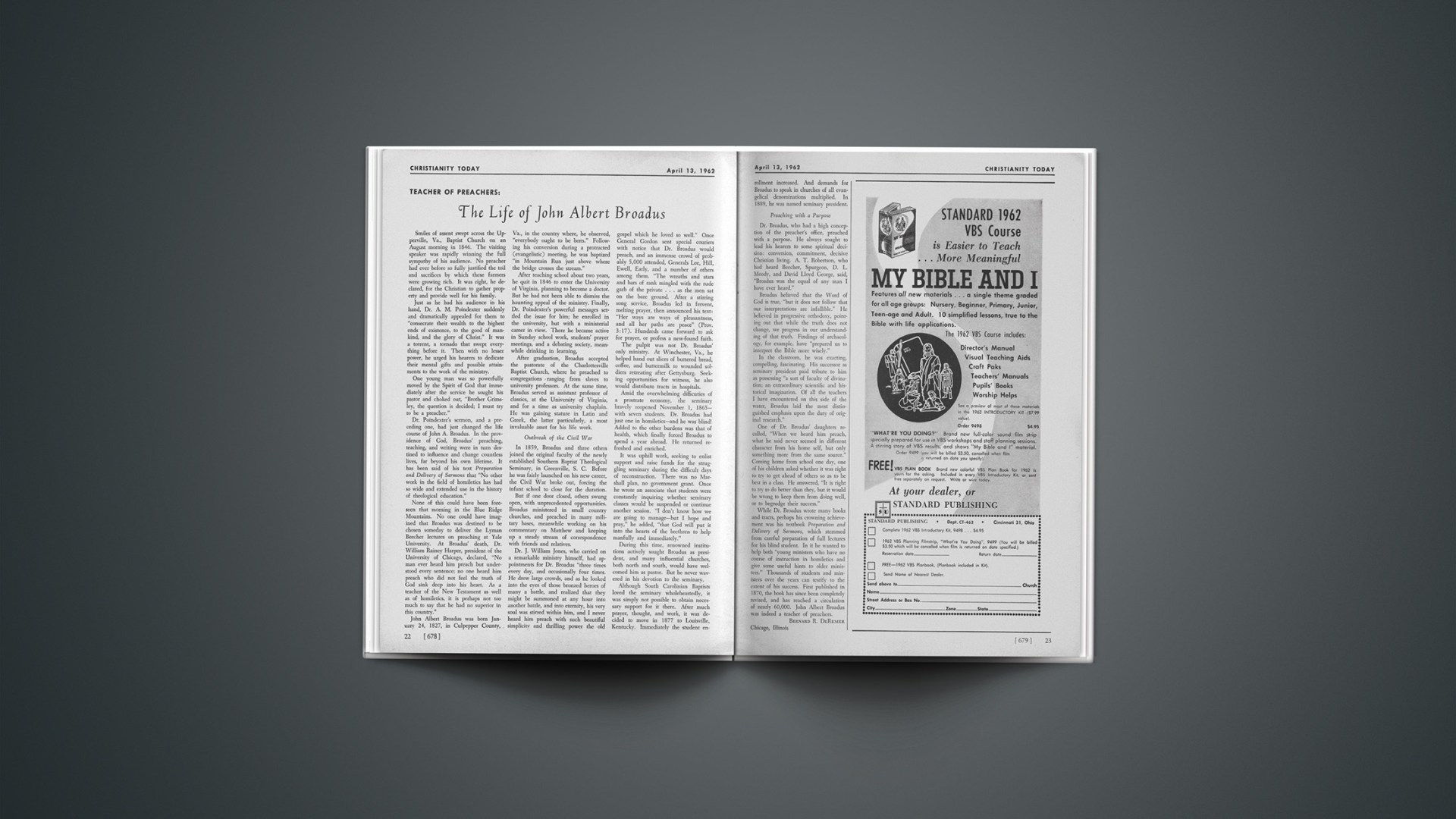
Teacher of Preachers: The Life of John Albert Broadus

Smiles of assent swept across the Upperville, Va., Baptist Church on an August morning in 1846. The visiting speaker was rapidly winning the full sympathy of his audience. No preacher had ever before so fully justified the toil and sacrifices by which these farmers were growing rich. It was right, he declared, for the Christian to gather property and provide well for his family.

Just as he had his audience in his hand, Dr. A. M. Poindexter suddenly and dramatically appealed for them to “consecrate their wealth to the highest ends of existence, to the good of mankind, and the glory of Christ.” It was a torrent, a tornado that swept everything before it. Then with no lesser power, he urged his hearers to dedicate their mental gifts and possible attainments to the work of the ministry.

One young man was so powerfully moved by the Spirit of God that immediately after the service he sought his pastor and choked out, “Brother Grimsley, the question is decided; I must try to be a preacher.”

Dr. Poindexter’s sermon, and a preceding one, had just changed the life course of John A. Broadus. In the providence of God, Broadus’ preaching, teaching, and writing were in turn destined to influence and change countless lives, far beyond his own lifetime. It has been said of his text Preparation and Delivery of Sermons that “No other work in the field of homiletics has had so wide and extended use in the history of theological education.”

None of this could have been foreseen that morning in the Blue Ridge Mountains. No one could have imagined that Broadus was destined to be chosen someday to deliver the Lyman Beecher lectures on preaching at Yale University. At Broadus’ death, Dr. William Rainey Harper, president of the University of Chicago, declared, “No man ever heard him preach but understood every sentence; no one heard him preach who did not feel the truth of God sink deep into his heart. As a teacher of the New Testament as well as of homiletics, it is perhaps not too much to say that he had no superior in this country.”

John Albert Broadus was born January 24, 1827, in Culpepper County, Va., in the country where, he observed, “everybody ought to be born.” Following his conversion during a protracted (evangelistic) meeting, he was baptized “in Mountain Run just above where the bridge crosses the stream.”

After teaching school about two years, he quit in 1846 to enter the University of Virginia, planning to become a doctor. But he had not been able to dismiss the haunting appeal of the ministry. Finally, Dr. Poindexter’s powerful messages settled the issue for him; he enrolled in the university, but with a ministerial career in view. There he became active in Sunday school work, students’ prayer meetings, and a debating society, meanwhile drinking in learning,

After graduation, Broadus accepted the pastorate of the Charlottesville Baptist Church, where he preached to congregations ranging from slaves to university professors. At the same time, Broadus served as assistant professor of classics, at the University of Virginia, and for a time as university chaplain. He was gaining stature in Latin and Greek, the latter particularly, a most invaluable asset for his life work.

Outbreak of the Civil War

In 1859, Broadus and three others joined the original faculty of the newly established Southern Baptist Theological Seminary, in Greenville, S. C. Before he was fairly launched on his new career, the Civil War broke out, forcing the infant school to close for the duration.

But if one door closed, others swung open, with unprecedented opportunities. Broadus ministered in small country churches, and preached in many military bases, meanwhile working on his commentary on Matthew and keeping up a steady stream of correspondence with friends and relatives.

Dr. J. William Jones, who carried on a remarkable ministry himself, had appointments for Dr. Broadus “three times every day, and occasionally four times. He drew large crowds, and as he looked into the eyes of those bronzed heroes of many a battle, and realized that they might be summoned at any hour into another battle, and into eternity, his very soul was stirred within him, and I never heard him preach with such beautiful simplicity and thrilling power the old gospel which he loved so well.” Once General Gordon sent special couriers with notice that Dr. Broadus would preach, and an immense crowd of probably 5,000 attended, Generals Lee, Hill, Ewell, Early, and a number of others among them. “The wreaths and stars and bars of rank mingled with the rude garb of the private … as the men sat on the bare ground. After a stirring song service, Broadus led in fervent, melting prayer, then announced his text: “Her ways are ways of pleasantness, and all her paths are peace” (Prov. 3:17). Hundreds came forward to ask for prayer, or profess a new-found faith.

The pulpit was not Dr. Broadus’ only ministry. At Winchester, Va., he helped hand out slices of buttered bread, coffee, and buttermilk to wounded soldiers retreating after Gettysburg. Seeking opportunities for witness, he also would distribute tracts in hospitals.

Amid the overwhelming difficuties of a prostrate economy, the seminary bravely reopened November 1, 1865—with seven students. Dr. Broadus had just one in homiletics—and he was blind! Added to the other burdens was that of health, which finally forced Broadus to spend a year abroad. He returned refreshed and enriched.

It was uphill work, seeking to enlist support and raise funds for the struggling seminary during the difficult days of reconstruction. There was no Marshall plan, no government grant. Once he wrote an associate that students were constantly inquiring whether seminary classes would be suspended or continue another session. “I don’t know how we are going to manage—but I hope and pray,” he added, “that God will put it into the hearts of the brethren to help manfully and immediately.”

During this time, renowned institutions actively sought Broadus as president, and many influential churches, both north and south, would have welcomed him as pastor. But he never wavered in his devotion to the seminary.

Although South Carolinian Baptists loved the seminary wholeheartedly, it was simply not possible to obtain necessary support for it there. After much prayer, thought, and work, it was decided to move in 1877 to Louisville, Kentucky. Immediately the student enrollment increased. And demands for Broadus to speak in churches of all evangelical denominations multiplied. In 1889, he was named seminary president.

Preaching with a Purpose

Dr. Broadus, who had a high conception of the preacher’s office, preached with a purpose. He always sought to lead his hearers to some spiritual decision: conversion, commitment, decisive Christian living. A. T. Robertson, who had heard Beecher, Spurgeon, D. L. Moody, and David Lloyd George, said, “Broadus was the equal of any man I have ever heard.”

Broadus believed that the Word of God is true, “but it does not follow that our interpretations are infallible.” He believed in progressive orthodoxy, pointing out that while the truth does not change, we progress in our understanding of that truth. Findings of archaeology, for example, have “prepared us to interpret the Bible more wisely.”

In the classroom, he was exacting, compelling, fascinating. His successor as seminary president paid tribute to him as possessing “a sort of faculty of divination; an extraordinary scientific and historical imagination. Of all the teachers I have encountered on this side of the water, Broadus laid the most distinguished emphasis upon the duty of original research.”

One of Dr. Broadus’ daughters recalled, “When we heard him preach, what he said never seemed in different character from his home self, but only something more from the same source.” Coming home from school one day, one of his children asked whether it was right to try to get ahead of others so as to be best in a class. He answered, “It is right to try to do better than they, but it would be wrong to keep them from doing well, or to begrudge their success.”

While Dr. Broadus wrote many books and tracts, perhaps his crowning achievement was his textbook Preparation and Delivery of Sermons, which stemmed from careful preparation of full lectures for his blind student. In it he wanted to help both “young ministers who have no course of instruction in homiletics and give some useful hints to older ministers.” Thousands of students and ministers over the years can testify to the extent of his success. First published in 1870, the book has since been completely revised, and has reached a circulation of nearly 60,000. John Albert Broadus was indeed a teacher of preachers.

BERNARD R. DEREMER

Chicago, Illinois

Bodily

There are Christian truths which are a vital part of our faith, truths which are revealed, affirmed and confirmed and there is neither profit nor blessing in trying to explain them away.

During the past year the wife of one of America’s most prominent men died and he found himself in deep distress, not only because of his bereavement but also because he had no sustaining Christian faith and no assurance or understanding about the future.

In his desperation this individual (and this incident is confirmed by his own testimony) went to one of America’s leading clergymen, a man who has preached and written on Christianity from the extreme liberal position for many decades.

What did he get? For an hour he heard a dissertation on why Christ’s resurrection was not a physical one, only “spiritual.” Needless to say he received neither comfort nor hope.

Through God’s overruling providence this man had a chance (?) contact with another minister, strong in faith, possessing a personality warm with love and the ability to explain Christian truth with deep conviction.

The upshot has been that this bereaved man has turned to the Bible and to the hope to be found there through faith in the risen Christ.

The Resurrection is a cardinal doctrine having to do with the person and work of Christ. It, along with the doctrine of the Cross, is an essential of the Christian faith. The Apostle Paul says in the beginning of 1 Corinthians 15, that great chapter on the Resurrection: “For I delivered to you as of first importance what I also received, that Christ died for our sins in accordance with the scriptures, that he was buried, that he was raised on the third day in accordance with the scriptures” (15:3–4).

In Romans 10:9 Paul gives the basis of salvation in these words: “If you confess with your lips that Jesus is Lord and believe in your heart that God raised him from the dead, you will be saved.”

To “spiritualize” the Resurrection is—and we speak bluntly—to say that it did not occur.

To “spiritualize” the Resurrection is to do violence to all rules of evidence, not only biblically but also historically.

To “spiritualize” the Resurrection is to deny statements of the Bible which are so clear that they cannot possibly lend themselves to any other than a literal interpretation.

In other words, to “spiritualize” the Resurrection is to rob Christ, and his written Word, of truthfulness and meaning.

To his troubled and doubting disciples our Lord said: “See my hands and my feet” (in which there were wounds), “that it is I myself, handle me, and see; for a spirit hath not flesh and bones as you see that I have,” and to give yet further convincing proof that his was a physical body which had arisen he asked for food. Then we are told: “He took it and ate it before them.”

From a historical standpoint the Resurrection is one of the best attested of all events. The course of history was changed, the Gospel was now complete. Belief in the Resurrection, because of “many infallible proofs,” became the cornerstone of the disciples’ preaching. Again and again they bore testimony to the Resurrection in these words, “of which we are witnesses.”

Indirect proof of the actual Resurrection of Christ is found in the changed attitude of the apostles. Once fearful and scattered, these ordinary men, unlearned and lacking in all personal influence, went out to face the Jewish and Roman leaders without fear, bearing testimony to the one they knew to be alive because they had seen, talked with and listened to him. And this knowledge made of these simple fishermen, and their likewise unremarkable associates, flaming evangels who went out to preach Christ crucified, dead and risen, regardless of the cost.

Were these disciples deluded and misguided? Were they preaching about a dream, an apparition, a “spiritual” experience divorced from physical fact or actual observation? The evidence is so overwhelmingly against any spiritualization of their observations and subsequent actions that we must conclude that Christ rose from the dead with an actual body which could speak, walk, talk, eat and be touched.

Some have sought support for rejection of a physical Resurrection by taking Paul’s words in 1 Corinthians 15:37 where he says: “And what you sow is not the body which is to be.” However, the entire thrust of this chapter is to show the actual Resurrection of our Lord and our hope of eventual resurrection to be with him.

That the body of our Lord seems to have possessed qualities not noted during his earthly ministry appears evident. After the Resurrection he passed through locked doors and appeared and vanished at will. Furthermore, his disciples did not at first recognize him. These aspects of his resurrection body, rather than confuse us should make us realize how little we understand of that which God has in store for us. But of this one thing we can be assured, Christ showed himself to his disciples—up to 500 of them at once—with a body which had physical characteristics of identification, and of action, which were incontrovertible.

It is not necessary to argue that the body in which our Lord appeared to his disciples is the glorified body in which he will again appear, but the witness borne at his Ascension is that “that same Jesus, which is taken up from you into heaven, shall so come in like manner as ye have seen him go into heaven.”

The Apostle Paul saw the risen Lord on the Damascus road. It was an overwhelming experience and he claims it as a seal of his apostleship: “Have I not seen the Lord?” he says to the Corinthian Christians. Later he speaks of the fact of the Resurrection and adds, “Whether then it was I or they, so we preach and so you believed.”

The Cross is the determinative point of man’s redemption from sin while the Resurrection is the crowning and visible evidence of the efficacy of that redemption. One cannot “spiritualize” Christ’s death at Calvary in terms merely of a loving example, nor can one “spiritualize” his Resurrection in terms of an ethereal apparition by which credulous and frightened men were led to believe that they had seen the Lord.

Not only is the physical Resurrection of the Lord a glorious fact but in it lies our own hope of glorified bodies with which we shall appear in his presence. “For since we believe that Jesus died and rose again, even so, through Jesus, God will bring with him those who have fallen asleep.… And the dead in Christ will rise first; then we who are alive, who are left, shall be caught up together with them in the clouds to meet the Lord in the air; and so we shall always be with the Lord” (1 Thess. 4:14–17).

How shall we react to this? “Therefore comfort one another with these words” (4:18).

Eutychus and His Kin: April 13, 1962

Thomas

Seeing is believing

Was his motto. Better,

Feeling is believing.

The scientific mind requires

Substantial evidence,

Controlled experiments,

With photographs and measurements.

And Thomas was no poet,

Nor would he credit women—

Or even ten apostles.

He required the touch

Of his ten fingers.

Like that other twin

Who saw the face of God

At break of day, he must

Prevail with his two hands

And not let go.

“I am a twin—there is another like me,

Perhaps another bears His image—

No, I must feel His wounds.”

Seeing is believing—

Can sight bring faith?

Will God appear

For cross-examination,

Show wonders on demand,

And give the Prince’s hand

For critical inspection?

If Thomas will not hear

Moses and the prophets,

Peter, James, and John,

Mary Magdalene,

Will he believe

One risen from the dead?

Seeing is believing—

Thomas saw him

And believed.

Before those wounded feet

Ten fingers clasped themselves

In adoration.

Through blinding tears

The twin saw God.

Seeing is believing,

And before His witness Thomas

Christ stood visibly

That he should see, and we

Be blessed in believing.

Said I not unto thee, that, if thou wouldest believe, thou shouldest see the glory of God?

EUTYCHUS

Disunity Anent Unity

Professor Leitch (“Painting Oneself Into a Corner,” Mar. 2 issue) quite rightly quotes me (The Minister and the Care of Souls, p. 131) as supporting the view that the Holy Spirit may create divisions even within Christendom. But I am concerned lest this use of my statement should suggest that I would support Mr. Leitch’s argument that theological discussion must always lead to disunity.…

The intent of my brief discussion of the Holy Spirit in the book quoted Was to envisage the churches as engaged in creating conflict, taking theology seriously and ever seeking that deeper unity which will illumine and transform all theological outlooks. Not all ecumenical discussion fulfills that purpose, but I believe that the World Council of Churches is the visible manifestation of Christian unity, and therefore, I give it my wholehearted support.

DANIEL D. WILLIAMS

Union Theological Seminary

New York, N.Y.

If it has not yet occurred to Dr. Leitch, there are some Protestants in the Reformed tradition who welcome: (1) the attempt of Christians to transcend Western culture and to maintain the witness of Christ’s Church under the influence of an unsympathetic state.… Perhaps this is the cross the American Church is unable to bear because it disturbs our easy cultural Christianity that is more often American than Christian; (2) the influence of a Church that has been Christ’s witness for centuries in many parts of the world where the Western Church has never been, and perhaps, in its present captivity to its way of life, could never be, a relevant witness; and (3) the “different total character” that may be the result of “this new heavily liturgical thrust.”

Finally, and even more seriously, is the kind of rationalism in the author’s thesis, namely: “Either unity without theology, or serious theology and disunity.” Apart from some kind of logic that is based on an “interrelatedness” of truth which would have difficulty with almost every major Christian doctrine, where is the theological foundation … that even suggests such a premise? Is it in Christ’s prayer “that they all may be one; as thou, Father, art in me, and I in thee, that they may be one in us” (John 17:21)? Is it in St. Paul’s treatise on the Church … (Eph. 4:5, 6)? Is it in the creed set forth at the Council of Nicea? Is it even in Luther who said, “I believe in one holy, common, Christian Church” and, “They are not members of the Church of Christ who, instead of preserving unity of doctrine and oneness of Christian faith, cause divisions and offences” (Luther’s Works, Vol. II, pp. 372–374)? Perhaps this is the author’s problem: In all his talk of theology, he says nothing of the doctrine of the Church, which if Christian must be expressed in essential unity—and which was surely the concern of many at New Delhi.

CHARLES E. TAYLOR

First Presbyterian Church

Waddington, N.Y.

Bravo! Leitch was willing to face up to theology and history, and able to set forth the facts lucidly and irenically. Philadelphia, Pa.

JAMES HAMILTON

A Choice Of Glasses

“Protestantism’s Amazing Vitality” (Mar. 2 issue) by Kenneth S. Latourette … is too comforting.… “United Nations … clearly of Protestant parentage” is a gross example of one’s peering through rose (?)—colored glasses. U. N. statements of purpose, etc., disclose that man and state are the two gods served.… Protestantism is … in a sad state if it can do no better than father a white horse on which we’re all (as good universalists) “to ride off in the sunset” towards a manmade milllennium with its classless, atheistic society.

WESLEY L. BAUM

Fairfield, Conn.

It is refreshing to hear the note of positive optimism from one so notable, among the “gloom and doom” prophets of negative pessimism.

WILLIAM H. OAKLEY

Trinity Baptist

Oak Grove, La.

Perils, Past And Present

“Into the Free World” (Mar. 2 issue) … has a positive and a negative side. The positive significance is the pointing to the fact that the power of God’s mercy is active and can be experienced in the lives of individuals and nations as well.

The negative side … is that it seems to be under the influence of the “After-World War II Spirit” practiced by many … who try to gain attention … by combining everything they say or write with references back to Nazism and stressing how they fought it.… At least we ministers should try not to become victims and disciples of that fashion. We rather should concentrate on the big tasks of the present time.

Another part of the positive significance … is that it reminds of communism, which with its philosophy of atheism is a living danger.…

RUDOLPH FLACHBARTH

Nativity Lutheran Church

Windsor, Ont.

Thank you so much for the soul-stirring message.… I bowed my head and thanked God for my freedom.

AUBREY F. WHITE

Asbury Methodist

Midland, Tex.

Charge Of Eisegesis?

In Mr. Mantey’s article (“Repentance and Conversion,” Mar. 2 issue) he states that eis “is used to denote cause at times in Greek of the first century and in the New Testament.” He makes reference to the discussion in the Journal of Biblical Literature (Vols. LXX, LXXI, 1951–52). However, … Ralph Marcus did not defend the causative use of eis, but instead re-examined the so-called examples put forth by Mr. Mantey and showed that none of the so-called causatives were causative at all. Mr. Marcus did not deal with the … New Testament examples but concluded his study by saying: “If, therefore, Prof. Mantey is right in his interpretation of various NT passages on baptism and repentance and remission of sins, he is right for reasons that are non-linguistic” (JBL, LXXI, p. 44).…

JAMES D. CLAYTON

Northwest Church of Christ

Chicago, Ill.

But A Single Purpose

The American Bible Society has received several letters regarding the paragraph from a letter by Dr. Henry Smith Leiper … published in CHRISTIANITY TODAY (Jan. 19 issue). The statement by Dr. Leiper, our representative for promotion of the Bible cause among members of the United Church of Christ, was not intended to represent—nor in fact does it—the official position of the American Bible Society.

As stated in its Constitution, the single purpose of the … Society is “to encourage a wider circulation of the Holy Scriptures without note or comment.” The Society takes no doctrinal position, but seeks only to serve all churches and denominations through the translation, publication and distribution of Bibles, Testaments and Scripture portions. In this task it has the endorsement of over 55 denominations in the U.S.A.… Its record of impartial service to all churches, without regard to dogma or creed, is well known. As it has for more than 145 years, the … Society today stands ready to co-operate with all those who love the Lord and desire to carry His Word to the ends of the earth.

ROBERT T. TAYLOR

Secretary

American Bible Society

New York, N. Y.

• Dr. Leiper’s letter objected to CHRISTIANITY TODAY’S critique of the National Council and the World Council of Churches. He deplored what he called an “obsession with the supposed dangers of the ecumenical movement.” CHRISTIANITY TODAY will continue to evaluate ecumenical trends, in the future as in the past, on principle rather than bias; it will commend what is good and criticize what is bad, and will alert to its possibilities and perils.—ED.

For Fulfillment, Federation

The press has focused much attention on Dr. Blake’s proposal for a four-church merger [which] … has its good points. But many proponents of church amalgamation are building their case on a half-truth: the organic expression of unity. They would neglect the other half: the obvious need for an organic expression of difference.

The open way: federal union. The U.S. is an example.… The need for an organic expression of national unity is fulfilled: the federal government. The need for an organic expression of difference is fulfilled: local self-government—states’ rights.

Federal union of churches was first proposed years ago … by the eminent missionary E. Stanley Jones in The Christ of the American Road (pp. 190–198).…

ROBERT E. CRENSHAW

Laurens, S.C.

For Famine, Food

Re “Famine on University Campuses” (Feb. 16 issue): Five months ago we started here a new church program for students and townspeople … to meet the contemporary student needs with a biblically-centered presentation. We were told that existing churches were ministering to these needs; also, that our program could not expect much growth because of facilities (we have been meeting in the local “Y,” some blocks from the campus).

Within five months our total attendance at both services … has reached well over 200, with an interdenominational appeal.

A National Council of Churches report on student work stated that the “institutional student-center” approach was no longer effective. Could this be because either the message is not contemporary, or it does not present the Living Word revealed in the Bible?

CALVIN S. MALEFYT

University Reformed Church

Ann Arbor, Mich.

For Federalism, Fecundity

I was glad to read your position as stated in the editorial “Be Wary of Federal Loans and Grants to Church Colleges” (Feb. 16 issue).…

The attempt of the federal government to regulate education in the states, like every other piece of social legislation, … is a usurpation of power, not granted in the Constitution.

It is not only unconstitutional, it is immoral and a direct and intentional violation of the purpose for which the Constitution was adopted.

The purpose … in the minds of its authors and the people of the states which adopted it, was to secure the country against foreign invasion, insure the domestic tranquility … and maintain individual freedom for each citizen. The gargantuan role our federal government is playing is contrary to the purpose of God in government and the purpose of our Constitution.…

P. H. JOHNSON

Dayton, Ohio

For Flu, Felicity

I appreciate CHRISTIANITY TODAY, but not your twice using the word “Asiatic” (Editorials, pp. 25, 27, Mar. 2 issue). It is a word that should be thrown out … as obsolete.… “Asian” or “Asians” is accepted in the U. N. and all through Asia and by many papers and magazines. The word “Asiatic” is almost considered an insult by people in Asia. They don’t want to be tics, but ans as American, European, African, and many other ans. The RSV, Acts 20:4, uses “Asians.”

I had 42 years in Burma in missionary service and found a dislike by the Asians for being called “Asiatic.”

E. CARROLL CONDICT

Ely, Vt.

Old Testament Study in Germany

Through Gunkel’s influence, many scholars came to view the narratives of the Old Testament as folklore, myths, fairy tales, and legends. While they mostly assumed that some historical reality and truth underlay these tales, they generally accepted the premise that these are poetic and imaginative narratives incorporating vague speculation and deliberate fiction. The critical view has as yet not been discarded. This viewpoint still governs a large segment of Old Testament research. Moses, Elijah, and Daniel are considered mythological or legendary. The account of the patriarchal age, of Joshua’s and Samuel’s times, is believed to be full of aetiological tales and cultic legends. Above all, the contents of Genesis 1 to 11, the so-called Urgeschichte, are not assigned any historical value. On the basis of the creation myths and flood sagas of other peoples, most German Old Testament scholars judge the biblical stories to be sagas as well. At the same time, however, they stress that, compared with these foreign myths and legends, the biblical accounts have a distinct peculiarity.

Actually, there are good reasons for giving the biblical texts and tales more credence and for acknowledging their historical dependability also. The Dead Sea Scrolls found at Qumran have made it apparent that the holy texts were preserved and transmitted with special care and diligence. This indeed is generally recognized. But the conclusion is not drawn, as it ought to be, that much greater caution is required by those who swiftly assume that any Old Testament book arose as a composite from various sources and secondary interpolations. The Isaiah Scrolls, for example, have never been found as two separate books.

The excavations in Egypt, Palestine, Assyria, and Babylonia have continually brought to light new cultural products and written documents that corroborate a high standard of living and learning in the ancient Near East. Whether Moses could have learned the art of writing is no longer in debate. Many items of biblical tradition are attested by documents of secular history. The deciphering of Hittite documents threw new light on the business transaction in Genesis 23; it fits remarkably well the Hittite setting in which the Bible locates it. In the light of such facts we may well become more conservative in our attitude toward Mosaic tradition and proclaim its dependability also for historical purposes.

Three Theories

The distinction of different sources or documents in the Pentateuch is still a fundamental supposition, as if there were no alternative. Which of three hypotheses is right, however, is a matter of indecision: the Urkundenhypothese (that is, the different sources are traced back to written documents); the Ergänzungshypothese (the original document was augmented later with complementary material); or the Fragmentenhypothese (scattered accounts of heterogeneous content were combined in an edited collection). One very keen representative of the Urkundenhypothese, who plucks out even parts of verses by such criteria as the name for God, style, repetitions, continuity of narrative, and assigns them to their respective sources, is O. Eiszfeldt (Hexateuch-Synopse, 1922). The Ergänzungshypothese has been taken up by P. Volz and W. Rudolph (Der Elohist als Erzähler. Ein Irrweg der Pentateuchkritik, 1933), who think that Pentateuchal criticism is mistaken in calling the elohist an author. G. von Rad, whose interest is mainly in the origin and transmission of oral and also written tradition, has renewed and revised Fragmentenhypothese. Like so many rivulets uniting into one large stream, the individual small units of local tradition supposedly combine to make up a large quantity of literary material. According to von Rad, the outcome of this transmission process is the “Hexateuch,” which includes the Book of Joshua. But G. Noth (Kommentar, 1938, 2nd ed., 1953) and W. Hertzberg (1953) separate the Book of Joshua from the Pentateuchal documents and so lead the way back to the Masoretic tradition. Actually, the argument of divergency of style and of the names for God is no longer convincing. The old labels J, E, D, and P are still used. Their distinctive characteristics, however, are no longer found in peculiarities of style and diction, but rather in their theological and ideological perspectives. Actually, these lines of demarcation are drawn rather carelessly and with no regard for detail. Further, the documents J, E, D, P are in themselves not considered homogeneous works, but conglomerates of disparate origin.

In the prophetic books, the discrimination between the first person and third person accounts often leads to the conclusion that the “I-passages” are authentic words of the prophet, while the “he-sections” belong to some anonymous writer, even though there are many instances even in secular literature where authors speak of themselves in the third person (Caesar, Napoleon). The introductory headings of the prophetic books are usually considered later additions, not to be ranged on the same level with the genuine prophetic words. Sometimes a psalm assigned to a certain author in the superscription may be dated in a later period together with the superscription. So little importance is attached to the superscriptions of the Psalms that A. Weiser (Kommentar, 1955, 3rd ed.) does not even translate them. Such disregard jeopardizes the interpretation of some psalms. In Psalm 51:1 the prayer for a clean heart and for deliverance from bloodguiltiness agrees with the situation of 2 Samuel 12. Without this context, the commentators face the problem of identifying an unclean heart with bloodguiltiness. In many psalms assigned to David, complaint of being harassed by enemies can be understood from a setting appears along with a collection of Messianic predictions, where words of Daniel are strung together with other passages of the Old Testament.

A new theological perspective is necessary. Formerly Old Testament research consisted for the most part of philological or literary criticism. After 1920, Karl Barth inaugurated a new interest in the theological relevance of the texts, which then expanded to include the exegetic disciplines. In his book Theologie des Alten Testaments (1933; 5th and 4th eds., 1957–60), W. Eichrodt chose the idea of the Covenant for a central topic. A christological perspective was vigorously recommended by W. Vischer. After 1945, the conviction gradually grew that true interpretation of the Old Testament required respect for its own claim as the Word of God. Das Alte Testament Deutsch (ATD), a modern series of commentaries, conscientiously strives to set forth and to appreciate the theological meaning of the books of the Old Testament. The same can be said for the Biblischer Kommentar, a series newly forthcoming.

Certainly it is a hopeful sign when scholars begin to realize that the Old Testament is more than merely a religious document or a book of history, and when they treat it more reverently as part of the Holy Bible. But this new tendency must still establish itself. H. J. Kraus, in his book Geschichte der historisch-kritischen Erforschung des Alten Testaments (1956), proposes of David’s flight before Saul and before Absalom. If we deny David’s authorship, we do not know how to ascribe these complaints to certain times and persons.

To date and interpret prophetic passages like Isaiah 40 ff. or Daniel’s prophecy concerning Antiochus Epiphanes is difficult because of the prejudice which holds that prophecy of the future, and certainly detailed prediction, is impossible. Yet we have examples of specific predictions, even of far-distant events as, for example, the announcement of the fate of Pashur and of Chananja (Jer. 20:6; 28:16 f.), or the prophecy of the 70 years of exile (Jer. 29:10). To call such prophecies declarations after the event, or to explain them as clever contrivances concocted when the coming events were already taking shape, is not quite honest. Some say, for instance, that dating the Book of Daniel earlier than the time of the Maccabees is warranted because among the Qumran manuscripts it turning away from a mere history of religion approach and pursuing a theological approach to the Old Testament. But Kraus himself does not see that this objective fails of realization because of a refusal to surrender the critical approach. Such scholars want to get “beyond” criticism without returning to a “pre-critical” position.

Bultmann’s way of proposing and facing the problem (cf. Walter Künneth, “Dare We Follow Bultmann?” CHRISTIANITY TODAY, 1961, pp. 25 ff.) has been adopted in Old Testament research as well. Things reported in the Old Testament are considered not as facts but as a mere witness to God’s activity past or present. The significance of events is stressed, but their historicity is denied or neglected, whereas interpretation should rest on facts and the significance of events should be stated accordingly. Baumgärtel replaces the facts of redemption with a history of faith and of piety. Noth and von Rad do, in fact, emphasize the divine deeds of redemption and the blessings of Israel; but the outlines of the history of Israel and of the gradual growth of the Pentateuch (or Hexateuch) they delineate in a rather arbitrary manner. The oldest set of traditions von Rad finds in accounts of the conquest of the Promised Land, to which a group of Sinai traditions was added, followed by the account of the patriarchs. Last of all, the Urgeschichte was supposedly constructed, like a porch, to introduce the whole book. There are divergent emphases according to theories of “Kerygma,” “Tradition,” and “Credo.” At the same time, the expressions “fairy tale,” “saga,” “myth” continue in use; to see their spiritual meaning one must “demythologize” them! This mixing of criticism and theology can only turn out rather badly. The critical view will rise up against the theological interpretation; and the theological view in crucial passages will either ignore the critical view or, if hampered by criticism, fail to realize its own intention.

The christological interpretation that has begun to reassert itself accords with one of Christ’s statements in John 5:39 and with a sentence from Luther, namely, that every part of the Holy Scriptures speaks of Christ. V. Herntrich, in his commentary on Isaiah 1:12 (1950), has distinctly marked the Messianic line. But there are many other prophetic passages that allow or even demand Messianic interpretation that as yet wait to be treated as such. The Messianic hope announced in the Psalms has not yet been recognized in its full extent, strength, and meaning.

In the present discussion, the question whether or not a typological interpretation is justified is important. (Essays in various periodicals and publications on this problem have been collected in a book Probleme alttestamentlicher Hermeneutik, 1960.) F. Baumgärtel passionately disapproves of typology; G. von Rad, H. W. Wolff, and W. Eichrodt support it. Typology has its roots and its model in certain ideas of the Old Testament (the tabernacle was made after a pattern proposed to Moses by God) and, more clearly, in the typological quotations of Old Testament passages in the New. Most scholars, it is true, refuse to adopt this method on the ground that its results assertedly come through retrospection only, no systematic relation being affirmed between type and antitype. W. Eichrodt, W. Hertzberg (ZAW 1936, and Kommentar Die Samuelbücher, 1956), and Cramer (Genesis 1–11: Urgeschichte?, 1961) say that the Old Testament has realized a Nachgeschichte, an after-history, in the New; on the other hand, some of the relationships claimed as typological actually belong to the category of outright Messianic predictions.

F. Baumgärtel (Verheiszung, 1952) refuses to state any relationship between the Old and the New Testaments in the way of prophecy and fulfillment. Like him, many scholars believe that the method of the New Testament writers of quoting prophetic passages in order to demonstrate their fulfillment in Jesus Christ is invalid today. But here, too, we should learn from the New Testament. The more carefully we explore how the Old Testament is quoted in the New and taken as a prophecy concerning Christ, the more clearly we see that this approach agrees with the very core of the Old Testament.

Neither are modern notions of how the prophets received their revelations nor modern evaluations of the sacrificial cult of Israel fully satisfactory. The prophetic phrase “Thus saith the Lord” is still too much regarded as a mere stylistic flourish, and the contents of the prophetic message interpreted as derived from their everyday experience. In presenting the accounts of the patriarchs, great importance is attributed to sanctuaries as the place of origin and of transmission. The Psalms are unanimously considered as stemming from the sacrificial ritual. The giving of the Mosaic priestly Torah is still depreciated. Too many German Old Testament scholars still do not adequately emphasize that the sacrificial ritual was a means of reconciliation instituted by God himself (Lev. 17:11).

Judas, One of the Twelve

Judas came,

He that betrayed the Christ,

And with a kiss exposed Him to the throng.

“Hail, Rabbi.”

Jesus stood,

Knowing his purpose well,

And said, “Do that for which thou art come,

Friend.”

Then Judas thought

To right the sinful wrong;

Brought back the bribe of thirty silver coins.

“I have sinned!”

The elders turned

Declining any part.

The chief priests spoke for all: “What is it to us?

See thou to that.”

And Judas went,

Casting the silver from him.

With noose in hand, he found a lonely place

And spoke no more.

DOROTHY D. MEYERINK

Enchanted Dust

When mighty Pharaoh sat on the throne, the whole world bowed before him. He held in his hands the power of life and death over his subjects. Rich and poor paid him homage. But he grew older. And he died. People no longer honored him. People no longer feared him.

Never again will the mighty Pharaoh lead an army in victory. He will never command again. Of his vast kingdom, only the crumbling columns remain and the choking dust. Pharaoh is a mummy. While his facial features are identifiable, he can neither speak nor move. He is dead.

Ashes to ashes and dust to dust!

A man entered a theater just as the play was reaching its climax. The sound from the stage increased in volume and then came the unmistakable report of a revolver. The bullet sped into the body of the man and he fell to the floor. He was carried quickly to a nearby home where those closely associated with him maintained a long vigil. Every medical skill was used in his behalf. But he died. Abraham Lincoln had become a figure of the ages.

The mind that created, the lips that spoke the immortal words, “Fourscore and seven years ago our forefathers …” will never speak again.

Ashes to ashes and dust to dust!

Ships had been bombarding the little island in the Pacific. Planes dropped their payloads of destruction and it was zero hour. Men scrambled down the nets onto the LCVPs and LCMs. Wave after wave of the larger landing craft filled with tanks, and supplies headed for the beach. The enemy fought back. Shells exploded. Boats were upended. Steel decks twisted grotesquely. Supplies crashed crazily into the water. Bodies were broken. Men died. They fell on the wet sand in the shallow surf. There was the monotonous slap, slap, slap of the waves.

These men will never fight again. They will never serve their country again. Throughout the world American flags fly from flagpoles set on the flower-bedecked, carefully clipped acres of grass. Dotting the lawns are hundreds of white crosses.

Ashes to ashes and dust to dust!

The news told of a skating champion, a vivacious teen-ager. In many years no girl has so captivated the audiences with her winsomeness and flashing skates. She would be a champion of champions. One day she boarded a jet plane in New York City. Flying with her to an international meet were other members of the United States skating team. In Europe the plane was about to land. Suddenly it pitched into a steep dive. It crashed with a sickening exploding sound. Dust filled the air. Then all was silent. Time magazine noted that as it hung from a piece of wreckage glittering in the sun a partly melted twisted skate swayed slowly back and forth in the breeze. The young vivacious champion was dead. No more applause. No more flashing skates this winsome girl would weave. No more intricate figures on the ice. She was dead. The whole team was dead.

Ashes to ashes and dust to dust.

Death On A Cross

Christ was born of a woman. He suffered the human lot of pain, thirst, hunger, discouragement. Then on a Friday afternoon about 3 o’clock from his position nailed to a Cross, he slumped forward. His head drooped to his chest. He was dead. There was no doubt about it. He was dead, dead, dead!

Those hands so white would never bless again. Those eyes now closed would never again see fainting multitudes. “Blessed are they that mourn,” those pale lips had said, “for they shall be comforted. Come unto me all ye that labor and are heavy laden and I will give you rest. I am the living water.” But now those lips would never speak again!

Soon he would take his place with the dead in the tombs. Time had ended for him.

Ashes to ashes and dust to dust!

But something wonderful, something amazing, happened—something that had never happened before. It occurred the following Sunday morning. The lifeless body moved and cast off its wrappings. Jesus Christ was visibly alive! The silenced lips now spoke again. Those torn hands were lifted anew in blessing. He taught. He blessed. He comforted. He reassured. He was filled with glory.

The hordes of darkness had done their worst. Not only had they humiliated him and caused him great physical pain. They killed him. Indeed they thought they had destroyed him. But he arose. Christ arose. He would never die again! He would live forever!

The disciples had been distressed and discouraged. Now they were energized. So glorious was the fact of Christ’s resurrection they went radiantly into the whole world to tell the amazing news.

The Destiny Of Man

How morbid is death! Man is dust and he is destined to die. Indeed life means nothing alongside this grim fact. The sands of Iwo Jima, a smashed airliner, a broken body punctuate the sad reality of death for all men. Ashes to ashes and dust to dust. But somehow the Resurrection of Jesus Christ changes all this.

Emerson could truly call man “Enchanted Dust” because one Person did not return to dust. Man is enchanted dust because of the Resurrection. Christ lived on and he lives now. All men can do likewise through him. A strange unique power is available to men through Christ the Lord.

Richard Halliburton, the famed traveler of a generation ago, wrote a charming book called “The Royal Road to Romance.” Properly understood romance is nothing weepy and sentimental. As Halford Luccock suggested, romance is what heightens and colors the commonplace quality of life.

We are in a sense commonplace creations of dust to dust. But the Resurrection heightens and colors this commonplace nature and touches life with eternity. Indeed, life becomes a Royal Road to Romance. Through Christ and the Easter message men may truly become “Enchanted Dust.”

While this is true, death yet remains. Tragedies and frustrations beset men. John Masefield in the “Widow In Bye Street” tells of a brokenhearted mother in prayer for a son about to be executed.

And God who gave his mercies, takes his mercies

And God who gives beginnings, gives the end,

A rest for broken things too broke to mend.

Yes, men have twisted backs, missing legs, blinded eyes—broken things “too broke to mend.”

Injustices and slavery to wrong causes are also too broke to mend. Christian people upset over the decline of morals, over the apparent success of communism often are inclined to say, “Brothers, let us weep.” Too broke to mend.

“Broken things too broke to mend?” Christ comes into life and proclaims that all things are still in the hands of the Mender of broken earthenware. Eternal life brings powers beyond those of earthly resources.

Several men stand before a window in a far eastern city. Suddenly one of them exclaimed, “Shiftuh, I have seen Him!” In the window was a picture made of ink spots. When seen aright the face of Christ would be visible. Above the picture a sign read, “For you to see the face of Christ is our hope.”

The world is a place of dark spots but the hope of the world is Christ. The Hope comes when men can say, “Shiftuh, we have seen Him. We have seen Him!” Christ could not have risen unless first crucified; the Crucifixion made possible the Resurrection. Only once in history was death truly overcome, but only because of the Cross which preceded it.

For every individual then, eternal life becomes a reality only as the Cross is appropriated through faith. No one becomes enchanted dust nor knows the romance of the Resurrection until he first receives Christ and his Crucifixion (Rom. 6).

Otherwise all the grim facts of death are still realities. Life is just ashes to ashes and dust to dust.

A pastor tells this true experience. The parents would not permit their children to attend Sunday School. He visited them one day and a boy answered the door.

“Hi, Mister,” he said with a big smile.

“Hi, Jimmy,” said the pastor. “I came to invite you to attend our Sunday School. I’m the preacher.”

The little boy called toward another room in the house, “Mom, what’s a preacher?”

The parents never came to the church but the boy came every Sunday. One Sunday he was absent. Two days before Christmas the minister received a phone call at 5 in the morning. “I’m Jimmy’s mother. Come quickly to the hospital. He has pneumonia.” The pastor hurried to meet the mother. But when he arrived it was too late. The disease had done its worst. Jimmy was dead. Said the pastor later, “I buried him on a hillside as the snow was falling softly. I went to the home and saw the toys wrapped in a box behind the stove. The calendar said, ‘December 25th.’ Would Christmas ever come again for this family?”

“It was the month of April when the mother and father came before the church to receive Jesus Christ and give themselves to him as the Risen Lord. And I could see outside the new leaves on the trees and blooming flowers. We went to kneel before a small grave now turning green in the spring time. And thanked God for the Resurrection!”

Tomb, thou shalt not hold Him longer;

Death is strong, but life is stronger;

Stronger than the dark, the light;

Stronger than the wrong, the right

Faith and hope triumphant say—

Christ will rise on Easter Day!!

Preaching Christ Crucified

For I determined to know nothing among you save Jesus Christ and him as crucified (1 Cor. 2:2).

The ancients built the tower of Babel to scale the parapets of heaven. Athens erected her altars to gods known and unknown. Modern man acclaims six great religions as roads up the mountain to God. Today as yesterday, men are pinning their hopes on intellectual principles, survival values and ethical ideals.

On the other hand, the Christian faith is founded not on an idea but on a person. Paul presented that Person, Jesus Christ, and proclaimed him to us as crucified for our sins and as risen from the dead.

God came down for us and for our salvation in his only Son. In utter self-abnegation, he came all the way to the Cross of Calvary. He who was in the form of God took the form of a slave. The Most High became the most humble. Yet in that love and lowliness, God is still the Lord. For that man dying athwart the sky beyond the walls of Jerusalem is the Lord of Glory (1 Cor. 2:8). God revealed himself to us in Jesus Christ whose face can be seen only with the eyes of faith. Thus the apostolic procedure is to portray Christ as crucified for our sins, and to pray the Holy Spirit to bring men to faith by this testimony of God. It pleases God by the preaching of the Cross to save those who believe. As this Gospel is preached God puts us into Christ Jesus and makes him to be our wisdom, our righteousness, our sanctification and redemption.

Accordingly, this section of I Corinthians teaches us: first, how God does not reveal himself; secondly, how the Father of mercies opens the fellowship of his family to sinners; and thirdly, the applications thereof.

Not By Worldly Wisdom

First, God does not reveal himself to us sinners for our salvation by the wisdom of our philosophers, by the height of our worldly places, by the eloquence of our orators, nor even by his own majestic work of creation.

The Jew looked for a Messiah who would receive divine blessings without measure. But “he that is hanged is cursed of God.” Stumbling over the fact that Jesus did not present the portentous sign of a messianic warrior delivering Israel from her enemies, the Jews rejected the revelation that God made in him.

As the law was given to convict the Jew of sin, so was philosophy given as a tutor to the Greeks. Only let us be sure that we carry the analogy through.

Was reason given to make us wise? Just as little as the Law was given to the Jews to make them just. Rather, it was given to convince us of the opposite; to show us how irrational our reason is, that our errors may be increased through reason as sin was through the law (J. G. Hamann). Plato has some glimmering of the situation when he urges us to

… lay hold of the best human opinion in order by it to sail the dangerous sea of life as on a raft unless we can find a stronger boat, or some word of God, which will more surely and safely carry us (Phaedo, 85 Jowett, 1.434).

Luther understood that the world owes the Gospel a grudge because the Gospel condemns the wisdom of the world. Even when speaking of Genesis, Calvin begs us not to begin with the elements of this world, but with the Gospel which sets Christ alone before us with his Cross and holds us to this one point.

It is vain for any to reason as philosophers on the workmanship of the world, except those, who having been first humbled by the preaching of the Gospel, have learned to submit the whole of their intellectual wisdom to the foolishness of the Cross.

When the apostle looked at the Christians in Corinth, he found that God had not called into his fellowship many that were wise according to the flesh, not many mighty, not many noble. Likewise Jeremiah (9:23), warns the wise man not to glory in his wisdom, nor the mighty in his power, nor the rich in his wealth; and the Psalmist (49:6–8) testifies that no man can give to God a rich enough ransom to redeem the soul of his brother. According to the Magnificat, God lifts the lowly to confound the mighty. Believers are born not of the nobility of bloods, not of the will of the flesh, not of the will of man, but of God (John 1:13). In Corinth, God chose the foolish things of the world to answer the wise, the weak things to shame the strong, the base-born, the things that are of no account, those that are not in order to put to nought the things that are. Yes, it pleased God that the world by its wisdom should not know God.

Accordingly, the apostle did not set forth to meet the wisdom of the world with a torrent of his own oratory. To have fought the world with its own weapons, would have been to betray the cause committed to him. The Gospel is like a trumpet “more powerful and penetrating when it does not follow the range of the scale but keeps to one penetrating note.” It is not a philosophy proved by the persuasive words of man’s wisdom, but a message from God to be attested and accepted. The good news of God’s great acts for our redemption needs and admits only of plain, straightforward telling, anything else is to empty the Cross of Christ of its power. Luther is sure that one does not need to shout or cry aloud in his preaching; for the power of the Gospel is not in the lungs of a man but in the might of the Spirit. Though the world counts the Gospel folly and weakness, it is the power of God and the wisdom of God to those whom he calls. This foolishness of God is wiser than men, this weakness of God is stronger than men. Though it be Paul, the apostle, who plants, and Apollos, the orator, who waters, it is only God who gives the increase. As the success of the Gospel is wholly of God, we may expect only his message to be honored:

Christ! I am Christ’s and let the name suffice you;

Aye, for me too, he greatly hath sufficed

Lo! with no winning words I would entice you;

Paul has no honor and no friend but Christ.

F. W. H. Myers, St. Paul

The vast diamond-studded milky way is but as dust from the Almighty’s moving chariot wheel. But he who measures the heavens with a span and comprehends the dust of the earth in a balance, the Most High, has revealed himself for our salvation not in his majestic might but in the weakness of the dying Saviour, who is the Mediator between God and men, the One by whom we come to the Father.

The Preaching Of The Cross

It pleases God to honor the preaching of Jesus Christ and him as crucified with the power of the Holy Spirit who brings men into the Father’s fellowship.

According to I Corinthians, preaching Jesus Christ means confessing as Lord this Jesus who has been raised from the dead (12:3; 15:5 f.). It means calling upon him for the grace and the peace which the Church needs (1:2–3). It means looking forward to his revelation in the day of our Lord Jesus Christ (1:7).

In the first and second chapters of this epistle, however, preaching Jesus Christ means preeminently preaching him as crucified. The Church has never found the symbol of her faith anywhere but in his Cross. Since the Cross met Luther everywhere in the Scriptures, the Reformer declared: “When I listen to Christ, there is sketched in my heart a picture of a man hanging on a Cross, just as my countenance is naturally sketched upon the water when I look therein” (W. A. 3.63.1; W. A. 18.83.9). Calvin is certain that only by the preaching of the Cross will any man ever find his way back to God as his Father (Institutes II. vi.l.). In their chorus, we unite:

“Our glory, only in the Cross,

Our only hope, the crucified.”

Paul preached Jesus Christ as crucified because there at the Cross, he consummated his work as the one Mediator between God and men. In his holy majesty God is justly offended with our rebellious race. And “whoever thinks he can smile at God’s wrath, will never praise him eternally for his grace” (H. Vogel, The Iron Ration of a Christian, p. 102). Without Christ, God and man are further apart than heaven and earth. But in Christ, true God and true man, God and man are much more intimate than two brothers. In him, sun and moon do not come so near us as he does, for Emmanuel has come in our flesh and blood. God the Creator of heaven and earth became true natural man, the eternal Father’s Son became the temporal Virgin’s Son (Luther on Is. 9:1). He became our flesh and blood Brother, one of us, standing where we stand, representing us before God, offering for us his perfect obedience. As our fellow, he became our substitute, the Lamb of God who took on himself the sins of the world. He who knew no sin was made sin for us, that we might be made the righteousness of God in him. On that Cross, he was made a curse that we might receive the blessing of God. Thus he satisfied for us the demands of the law, averted from us the wrath of the holy God, delivered all those who trust in him from the thralldom of the devil and from the fear of eternal death.

God was in Christ reconciling the world unto himself. As his ambassadors preach the revealing, reconciling, crucified Christ, the risen Lord Jesus puts forth the hand of the Holy Spirit and draws us unto himself. The Spirit takes of the things of Christ and shows them unto us. He works faith in us and thereby unites us to Christ in our effectual calling. In the covenant of grace, the Father gave unto the Son a great host that no man can number out of every nation and kindred and tribe. The Son became man and in his atoning death suffered and endured enough to avert the wrath of God from this world of sinners. Now God the Holy Spirit comes as the Inward Teacher to open our hearts to the preaching of the Cross, to Christ as our Saviour and our Lord. We halt and hold back, too weakened by sin even to decide … and indecision is the first evidence of frustration. Then the Spirit places our hands in the riven side of the Saviour and calls us into the obedience of faith.

The objective revelation of God in Jesus of Nazareth proclaimed in the Gospel, the subjective work of the Holy Spirit by which we receive Christ in faith, these are the two hands of God by which the gracious Father brings back the prodigal to his own forgiving bosom. Here God acts in his love, his righteousness, his wisdom and his power to save sinners. The Gospel is not the mere proclamation of man’s ideas. It is God’s mighty work by which he snatches the victim of sin and death from the thralldom of Satan and transports him into the Kingdom of the Son of his love. Preaching Jesus Christ and him as Crucified is the Gospel, the power of God unto salvation.

Life In Christ Jesus

Thirdly, the apostle calls upon us to realize the implications of this gracious action of God in our own faith and in our outward activities. By this preaching of the Cross, God has put us into Christ. “I have begotten you in Christ Jesus through the gospel” (1 Cor. 4:15). The Creator, who said, Let there be light, has shined into our hearts to give the light of the knowledge of the glory of God in the face of Jesus Christ (2 Cor. 4:6). It is not our wealth, our wisdom or our might that has made us Christians. It is something greater and more wonderful than all these. It is of God that we are in Christ Jesus (1 Cor. 1:30). Our faith stands not in the wisdom of men, but in the power of God (1 Cor. 2:5).

If we would know that we belong to God, let us find ourselves where God has graciously placed us in Christ Jesus. He is made unto us wisdom from God and righteousness and sanctification and redemption. The Christ of God is our wisdom, our righteousness, our sanctification and our redemption. He won all this for us by his human life of perfect obedience, by his death in our stead. He revealed it to us by his Word. He gives it to us, makes us partake of it by his Spirit. To lay hold of him by faith is to appropriate the wisdom, the righteousness, the sanctification and the redemption that comes from God. To find ourselves by faith in him is to see ourselves filled with wisdom, clothed with his righteousness, liberated from the thralldom of Satan, and transplanted into the Kingdom of Grace. To have him is to have forgiveness, peace, victory, the hope of glory! However manifold our sins, we were washed, sanctified, justified in the name of Jesus Christ and by the Spirit of our God (1 Cor. 6:11).

As we find our salvation in Christ Jesus so the apostle calls us to begin our thinking and acting in him. Begin intellectually where God has graciously placed you. Begin where the light is brightest, that is, the light of the knowledge of the glory of God that shines in the face of Jesus Christ. In the bequest that established our oldest university, John Harvard directed:

Let every student be plainly instructed and earnestly pressed to consider well the main ends of his life and studies: to know God and Jesus Christ which is eternal life and therefore to lay Christ in the bottom as the only foundation of all knowledge and learning and see the Lord only giveth wisdom. Let everyone seriously set himself by prayer in secret to seek Christ as Lord and Master.

For, as the apostle adds, other foundation can no man lay than that which is laid, which is Jesus Christ (1 Cor. 3:10).

For when Christ is presented in his full-orbed grace and glory, the living God touches hearts and lives and saves them from drunkenness, fightings, selfishness, and race hatred. The Christian Church has no commission to reverse the process. Take God’s way and his Spirit blesses it. Try to reverse God’s way and the Church becomes no longer the ambassador of God, her preaching becomes merely the chaff of man and no longer the wheat which brings the bread of God to hungry hearts of men. The ambassador of the living God preaches the Lordship of Jesus Christ, the Crucified.

Trends in Contemporary Preaching

Preaching has a unique place in the world. Other forms of speech entertain, educate, direct. Preaching takes the message of God and Christ to men and in turn brings Christians to greater devotion and sinful men to God. By preaching over the last twenty centuries the Church has grown and spread through the Western world. Peter and Paul, Jerome, Abelard, Thomas Aquinas, Augustine, Ambrose, Paulinus, Ignatius of Loyola and other great Christian preachers first made the Gospel known around the eastern and middle Mediterranean.

Since their time Luther, Calvin, Knox, Zwingli, Melanchthon, John Donne, John and Charles Wesley and other great preachers have continued to build upon the foundation laid by Christ and his early disciples in the Gospels, the Acts, the Epistles and in the wonderful book of Revelation. No century has been without its pulpit masters.

In our own time the ministry is largely divided into two groups as far as preaching is concerned. One large sector bypasses preaching to concentrate upon teaching and other functions of the Church. The other group consists of those who do the preaching. In other words, out of 231,000 clergy in the United States, about one-half carry all the preaching responsibilities of all of the different denominations. A few churches have no preaching at all; others, by contrast, place their emphasis on the sermon and only incidental stress on music and/or ritual.

In connection with my volumes of Best Sermons, I have sent invitations during the last 20 years to more than 120,000 clergymen who do preach. From the 15,000 to 22,500 sermon invitations issued for each volume, the average number of sermon manuscripts received for reading and consideration has increased from 5,000 for the first volume to 6,000, 7,000, 7,500, and now nearly 8,000 per volume. Ministers of 198 different denominations have been invited to submit sermons; men of 165 different denominations have responded with a total to date of more than 55,755 sermons. Sermons have been received in 15 different languages from ministers in 55 foreign countries.

These sermons have revealed several prominent patterns of preaching. First of all, the ministry is vitally concerned with the problems of everyday life. Thousands of messages dealt with matters of personal goodness, of love and marriage, of parents, children and the home, of community and national problems in education, race relations, war and peace. Ministers both discussed the problems and then indicated the relevance of the Gospel for the issues involved.

Some types of sermons have been hard to find—really good sermons on religious education, for example, and even evangelistic sermons that excel both in content and in homiletic quality. Too often evangelistic preaching becomes noisy rather than persuasive. I doubt that God wants us simply to try to frighten men with fiery descriptions of hell. Rather, we are to present the Christ who calls to decision and to discipleship. The best evangelistic preaching today is in churches where the dynamic and dramatic presentation of Christ draws men of intellect and will, as well as of heart, to follow him. Evangelistic preaching can be spiritually and theologically sound, and need not appeal one-sidedly to emotion and fear. Jesus condemned evil and evil doing. But he did not merely threaten those he wished to convert. He reasoned and led men on to belief. When he changed men, they became new men with new lives, new faith, a new outlook and zeal for the kingdom of God and the best things of life.

There are increasing numbers of philosophical sermons; also some biographical studies and book-review sermons. Every conceivable subject has been covered in the sermons of these last 20 years. The amazing thing is that so many men can find truth—for them—in so many different and divergent ideas! Thousands of sermons show a real effort to make the Gospel clear to the listener. Poetry is still used for illustrations in thousands of sermons. The greater the sermon, however, the shorter the quotation from poetry; the poorer the sermon, the longer the quotation. About one minister in each thousand preaches in blank verse; one younger man preaches in blank verse every Sunday of the year!

Today, the better the sermon, the shorter it tends to be—18 to 20, 22, or 25 minutes. Generally speaking, the leading ministers and best preachers use more short illustrations—rather than a few long stories. The best preaching is done in the great city churches of New York, Washington, Boston, Dallas, New Orleans, Miami, Los Angeles, Chicago. A distinct difference marks most northern from southern preaching. In the South long illustrations—perhaps three or four—are customary in a sermon, while northern sermons may have 30 to 40 short, pithy allusions. Strong preachers are not limited to any specific locale, however, but may be found anywhere.

The highest tribute I can pay to contemporary preaching—and this I say after reading thousands of sermons—is that almost every sermon shows careful preparation. Increasing numbers of men write out their sermons in full; most try to deliver them without reading from the manuscript. Sermons today indicate also that the better preachers are well read. I know men who keep 12 to 50 books on hand for ready reading in order to keep up with current ideas on religious and secular matters. Ministers today show a real desire to preach a spiritual message that is relevant to daily living. They try, too, to preach in an oral style that employs excellent form and word choice. Preaching today is a mature art and our great preachers are artists in the pulpit—the pulpit where God is proclaimed.

The Glorious Themes

What glorious themes the Christian Church has to proclaim! What all the other world religions desired and sought for 5,000 years Christ gave to his followers: salvation from sin, life eternal, resurrection to a life with God the Father. If we cannot preach sermons that lift our congregations we need to return to the New Testament and again read its immortal story, be it in the King James, Moffatt, the Revised Version, or the fine new J. B. Phillips’ translation. Preaching is something to be experienced. It is an experience of man with God, an opportunity to bring other men face to face with an eternal God who waits for them. If all our ministers took hold of this great fact they would never again lose time in getting at their desks to prepare their weekly sermons! Thousands of sermons every week, all in this spirit of purpose and responsibility, would bring a revival greater than all the annual revivals ever envisioned.

My search for sermons in conjunction with the Best Sermons volumes is, I believe, the widest that has ever been conducted. It is a great privilege to read the best sermons of thousands of ministers all over our country and all over the free world. In these sermons the men reveal their preparation, their reading, their attempt to bring the Gospel to the people. Several times I have had the thrilling experience of being the first to discover young ministers of ability in the pulpit and to give them their initial sermonic recognition in print. Hundreds of men write me that preparing a sermon for submission to Best Sermons puts them at their best, makes them write with particular care. Many appreciate the discipline involved and others then make a habit of such careful preparation and find they become better preachers thereby.

I am sometimes asked: “How can you tell about a man’s delivery from the written manuscript?” One can’t, completely, of course. Yet it is amazing how much of a man’s style and delivery are revealed in his word choice, sentence structure, his underlining or italics, and even in his punctuation! By his wording and statements you can sense, too, what a minister feels. In a manuscript you can’t see a man’s gestures, of course, nor the flash of his eyes, but you can almost imagine how he would react as you read and absorb what he says. Herein lies the importance of style, of oral style. Men need to practice this oral style, to hunt for words that are primarily for spoken expression rather than for written productions. The ideal, of course, so combines the elements of oral and literary excellence that the sermon both reads and delivers well.

Some Worthwhile Disciplines

Young ministers should work hard at sermonizing. In seminary they ought to read other men’s sermons, perhaps even copy and adapt the style of older ministers. As soon as possible, however, each man should faithfully develop his own style, form, and delivery. To write 1,800 to 2,500 words for his sermon every week of his life is a responsibility worthy of a man’s very best efforts. Some men are overwhelmed and give up. But those who go on, who in time sense the incomparable joy that their weekly sermons are taking hold, who see a response in the congregation, are uniquely rewarded for long hours spent alone in the study. Each man must develop his own study habits, even as he does his own style. He dare not neglect either if he wishes to be what he was called to be, a man of God speaking in the place and house of God.

Any man who knows preaching at all readily admits that the greatest sermons come through divine unction. Hundreds of men during the nearly 2,000 years of the Christian Church, Augustine at Canterbury, the Wesleys, George Whitefield, Dwight L. Moody and Billy Sunday—and men in every generation—have made the pulpit respected by their powerful preaching ministry. Thousands of sermons every week, however, by the patient, hard-working pastor-preachers of churches all over our country, in every city and village, in town and rural community, are the result of sheer hard work, study, meditation, prayer, careful outlining and/or writing. All ministers at times become discouraged. To these I would like to say: preach on, prepare even more diligently. Wait upon God! Men will hear your message if you bring it with fire in your soul and intelligence in your words and never lose touch with your people.

Inspiration is the gift of God, of the Holy Spirit, but “inspiration” in the popular sense, is a fantasy. Hunt and nurture your ideas in quiet study and meditation, in pastoral visiting and counseling, in steady, hard work with your pen or typewriter. This discipline will yield worthy sermons. Develop your distinct style, vocabulary, and pulpit delivery. You can make your own place in the pulpit. When a fine sermon electrifies a congregation with its message and conviction, we are wont to call it “inspired”; actually, it may mainly be the result of full and devoted preparation. What we term “inspiration” may combine many factors whether the sermon be by a Peter the Hermit, a Jonathan Edwards or a man of our own day. By this I do not mean to imply that I do not believe in divine stimulation. Rather, I believe we should do what we can and leave its empowerment to God.

After reading thousands of sermons during the last 20 years, I believe more than ever that effective preaching is the most vital function of our contemporary Protestant churches.

Apple PodcastsDown ArrowDown ArrowDown Arrowarrow_left_altLeft ArrowLeft ArrowRight ArrowRight ArrowRight Arrowarrow_up_altUp ArrowUp ArrowAvailable at Amazoncaret-downCloseCloseEmailEmailExpandExpandExternalExternalFacebookfacebook-squareGiftGiftGooglegoogleGoogle KeephamburgerInstagraminstagram-squareLinkLinklinkedin-squareListenListenListenChristianity TodayCT Creative Studio Logologo_orgMegaphoneMenuMenupausePinterestPlayPlayPocketPodcastRSSRSSSaveSaveSaveSearchSearchsearchSpotifyStitcherTelegramTable of ContentsTable of Contentstwitter-squareWhatsAppXYouTubeYouTube