Painting Oneself into a Corner

A good friend of mine who rather shies away from systematics in theology wrote to me a word of criticism about one of history’s greatest theologians and gave his criticism a nice turn of phrase: the theologian had the ability, my friend said, “To paint himself into a corner.” We all know the picture: a man begins to paint a room, and is doing very nicely, whistling a merry tune, concentrating on the swish of the brush immediately in front of him, only to discover to his chagrin that he has painted himself into a place where his only escape must be messy and embarrassing. You have probably caught yourself in an argument, especially in a theological argument, slowly closing yourself into a spot where you have no longer a neat logical outlet. Preachers have been known to raise more questions in the introduction than they can answer in the next twenty minutes—or the next twenty hours! Sometimes we dig up more snakes than we can kill.

I am wondering in all this about whether the World Council of Churches is not painting itself into a corner, and I mean a theological corner. Concern over the New Delhi sessions has centered primarily on the acceptance of the Orthodox Church of Russia. Will the Russians be able to be churchmen first and communists second or the other way around? Will the orthodox churches generally, simply by virtue of their numbers, carry too much weight in Council policies? Has the Council taken on a different total character by the nature of this new heavily liturgical thrust? Others have raised mild demurrers over the ease of the Russian entrance and the difficulty of the Pentecostal entrance at the time of voting. Does the spirit of ecumenicity really move happily in only one direction? So the questions go. But the real problems are theological.

“All our problems,” said William Temple (and Douglas McArthur said it too) “are theological ones.” The Council has recognized, however, and correctly, from the very beginning, that serious theological issues can be and usually are, divisive. The effort has been, therefore, to keep theological statements as bases for unity at an absolute minimum. But an indivisive movement can’t have it both ways: either you take a sharply delineated theology and have disunity, or you press for unity and loosen up your theology. The “unfortunate” nature of truth is its interrelatedness; no truth stands by itself. Therefore, as soon as an organization, the World Council, for example, makes one statement for sure, that statement is immediately related to many other statements. In other words, to say anything for sure, may lead to saying a great many other things for sure, and to denying other things with equal surety.

No Truth In Isolation

Take the theological starting place of the World Council: “Jesus Christ is Lord.” This simple statement should cause no trouble, but surely the knowing ones in the upper echelons of the Council must have suspected that even this simplicity is heavy with theology and even with orthodoxy. Jesus of Galilee was or was not an historical person—there have been strenuous debates about the historicity of every item in the record of his life—but when “Christ” is added to his name we are already talking about “The Anointed One,” or “The Messiah,” or “the Logos” (the authority of Scripture is now forcing itself into the discussion) and we are facing theological questions on deity and kenosis plus the centuries of debate on how Jesus Christ is fully man and fully God and still one person. And is this person the Jesus Christ of the Gospels, or of Paul, or of the Church, or of the creeds, or the One made known by the Spirit through the Scriptures in the existential situation? And how does the Spirit get into this? We were simply talking about agreeing on Jesus Christ. Furthermore, the “lordship” of Christ raises other creedal constellations far from simple, and, says Paul (1 Cor. 12:3) “no one can say that Jesus is the Lord, but by the Holy Spirit.” The Scriptures and the Spirit seem somehow essentially related to any simple creedal statement—“Jesus Christ is Lord”—around which we can unite.

The World Council began to venture into a systematic theology when “Jesus Christ is Lord” was changed to “Lord Jesus Christ as God and Saviour.” The idea of “Lord” now has its interpretation defined specifically by the word of “God.” There is no wobbling here over the deity of Christ and, if memory serves, this theological tightening was pressed into the Council by the European churches, American churchmen, at least in worldwide junkets, being generally a little more lenient on such points for the sake of unity. But the addition of the word “Saviour” was the real addition. Now we are by necessity in the doctrine of man (and this means eventually a viewpoint on psychology, sociology, and even democracy vs. communism!) which is saying that man is lost, which means something very definite and very desperate, and man is to be saved from something to something. At the same time the word “Saviour” says something about God. Shall we speak of wrath? satisfaction? substitution? love? The many views of the atonement did not arise because men thought the matter unimportant. Our forefathers, who seemed to take undue pains with theological niceties were surely not motivated by the desire to get together for another committee meeting. And they were not naïve: many of them were very learned and all of them were playing for keeps. In all seriousness they made the discovery that one thing leads to another, that no single truth can stand in isolation. There followed, therefore, by necessity, systematic theologies, systems of ways of looking at things, looking at everything. These were not academic matters: a man could get burned at the stake for getting himself involved in the wrong system. There are differences, the differences are real, and one does not evade the problem by dreaming up a simple statement, because there is no such thing as a simple statement.

“The World Council will be forced by the nature of truth itself along a road not of their own devising; the organization men feared, and rightly, what theology could do to unity.… They can’t have it both ways: either unity without theology, or serious theology and disunity.”

One bemusing incident along the way illustrative of all this, was the Council meeting in Evanston where an apparently unifying theme, the hope of the world, was to lead to helpful answers on how Jesus Christ is the answer to war, vice, bad housing, and the like. We were to “take the incarnation seriously” (a fine idea being worn to a frazzle in most contemporary Christian literature) and the Christian hope lay in bringing Christ to bear on the totality of life, and of all this I think we all approve. But the theologians from Europe almost ruined everything by making Christian hope something apocalyptic and eschatological. The findings at Evanston became quite wordy as two ideas of hope, for the sake of unity, were wrapped up together. One way and another the findings didn’t have much of an audience and really didn’t give people much more hope in this world and the next.

Recently I sat in on a group attempting to draw up a theological statement for one of the denominational confessional groups and I heard one of our best theologians, rather plaintively, I thought, suggest that possibly we had been tending recently in theological circles to a kind of Christological unitarianism, by which he explained that constant Christ-centeredness (a thing nevertheless to be greatly emphasized) could lead to the neglect of other great truths like the Fatherhood of God and the Person and Work of the Holy Spirit. Exactly. We cannot speak the truth about Christ without being forced into the truth about God, thus the Trinity, and maybe after that such theological specialties as the procession of the Trinity or even infra-lapsarianism.

So what happened at New Delhi? The so-called “simple” statement “Jesus Christ is Lord” now has trinitarian theology imbedded in it and a fine phrase, “according to Scriptures”—not the “Word,” not “Word and Spirit”; that sort of thing will have to come later. Remember how Luther and Calvin said at first that the “notae” of a church are the word preached and the sacraments administered, but soon had to say the word “rightly” preached and the sacraments “rightly” administered. So now we confess together “the Lord Jesus Christ as God and Saviour according to Scriptures (that is, “rightly”!) and therefore seek to fulfill together their common calling (it’s a long way down that road) to the glory of the one God, Father, Son, and Holy Spirit.”

Truth Separates And Unites

Well, what is my argument with all this? Nothing at all except that they ought to say much more and I believe that they will have to say much more and that when they say the much more they will be creating ground for division and not for unity. All of us have to agree that we see “through a glass darkly,” so we do not see everything and we do not see clearly, but the fact remains that we must be true to what little we do see and we cannot be true to what we do not see. Men and churches get themselves really united around things they see together, and since men and churches do not see everything and do not see clearly, they are not together on all things. The fact of getting together on one thing does not eliminate eventually the built-in divisiveness of truth, at least as men see truth now. The World Council will be forced by the nature of truth itself along a road not of its own devising; the organization men feared, and rightly, what theology and theologians could do to unity. What they feared is beginning to show itself—and inescapably.

One truth leads to another. The simple statement of creed will force a system. The proponents of inclusive ecumenism cannot have it both ways: either unity without theology, or serious theology and disunity.

A word from Donald Day Williams (the italics are mine) seems relevant here:

It is even necessary to see that the work of the Holy Spirit may create new divisions among men. Christ asserted a new perspective upon life against others. So we may understand the saying about his bringing not peace but a sword (Matt. 10:34). Men have some of their profoundest disagreements over what the Lord requires of them. Consider the divisions among the Christian churches. The Spirit does not blot out such divisions, though in the Spirit we are required to search for the misunderstandings and the sin which is in them. The Holy Spirit will be found where we learn to live in creative conflict, respecting one another’s humanity and faith even where we have profound differences over fundamental issues. (The Minister and the Cure of Souls, Harper and Brothers, p. 131.)
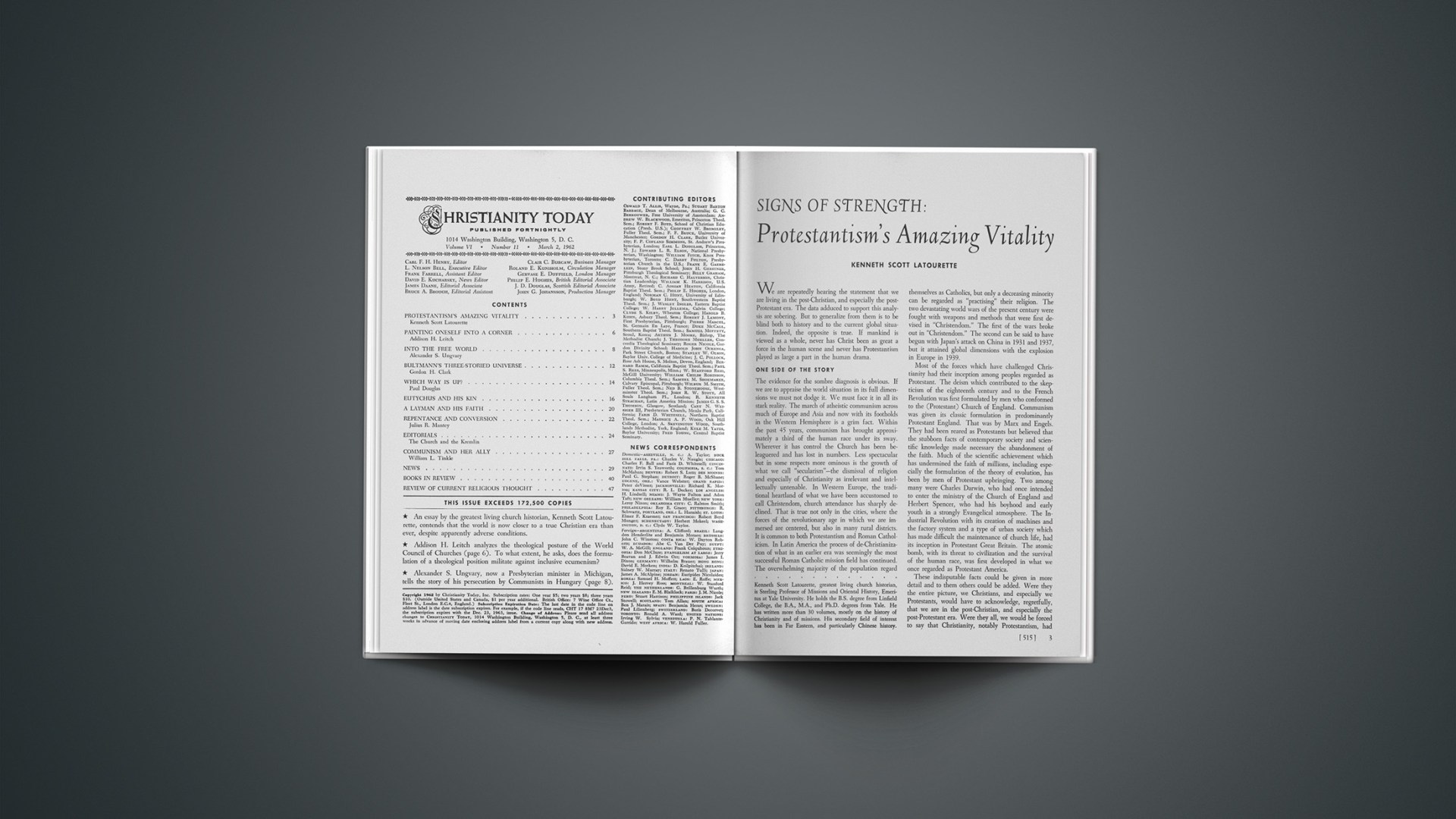
Sighs of Strength: Protestantism’s Amazing Vitality

We are repeatedly hearing the statement that we are living in the post-Christian, and especially the post-Protestant era. The data adduced to support this analysis are sobering. But to generalize from them is to be blind both to history and to the current global situation. Indeed, the opposite is true. If mankind is viewed as a whole, never has Christ been as great a force in the human scene and never has Protestantism played as large a part in the human drama.

One Side Of The Story

The evidence for the sombre diagnosis is obvious. If we are to appraise the world situation in its full dimensions we must not dodge it. We must face it in all its stark reality. The march of atheistic communism across much of Europe and Asia and now with its footholds in the Western Hemisphere is a grim fact. Within the past 45 years, communism has brought approximately a third of the human race under its sway. Wherever it has control the Church has been beleaguered and has lost in numbers. Less spectacular but in some respects more ominous is the growth of what we call “secularism”—the dismissal of religion and especially of Christianity as irrelevant and intellectually untenable. In Western Europe, the traditional heartland of what we have been accustomed to call Christendom, church attendance has sharply declined. That is true not only in the cities, where the forces of the revolutionary age in which we are immersed are centered, but also in many rural districts. It is common to both Protestantism and Roman Catholicism. In Latin America the process of de-Christianization of what in an earlier era was seemingly the most successful Roman Catholic mission field has continued. The overwhelming majority of the population regard themselves as Catholics, but only a decreasing minority can be regarded as “practising” their religion. The two devastating world wars of the present century were fought with weapons and methods that were first devised in “Christendom.” The first of the wars broke out in “Christendom.” The second can be said to have begun with Japan’s attack on China in 1931 and 1937, but it attained global dimensions with the explosion in Europe in 1939.

Most of the forces which have challenged Christianity had their inception among peoples regarded as Protestant. The deism which contributed to the skepticism of the eighteenth century and to the French Revolution was first formulated by men who conformed to the (Protestant) Church of England. Communism was given its classic formulation in predominantly Protestant England. That was by Marx and Engels. They had been reared as Protestants but believed that the stubborn facts of contemporary society and scientific knowledge made necessary the abandonment of the faith. Much of the scientific achievement which has undermined the faith of millions, including especially the formulation of the theory of evolution, has been by men of Protestant upbringing. Two among many were Charles Darwin, who had once intended to enter the ministry of the Church of England and Herbert Spencer, who had his boyhood and early youth in a strongly Evangelical atmosphere. The Industrial Revolution with its creation of machines and the factory system and a type of urban society which has made difficult the maintenance of church life, had its inception in Protestant Great Britain. The atomic bomb, with its threat to civilization and the survival of the human race, was first developed in what we once regarded as Protestant America.

These indisputable facts could be given in more detail and to them others could be added. Were they the entire picture, we Christians, and especially we Protestants, would have to acknowledge, regretfully, that we are in the post-Christian, and especially the post-Protestant era. Were they all, we would be forced to say that Christianity, notably Protestantism, had been giving rise to forces which are destroying it—that Christianity has been digging its own grave.

But those who focus their eyes on these facts ignore both important features of history and significant movements of our day which tell a very different story.

First of all, there has never been a Christian era. To be sure, the first five centuries after Christ witnessed the winning of the nominal allegiance to Him of the large majority of the population of the Roman Empire. We have rightly called it an amazing achievement. But the Roman Empire embraced only a small fraction of the earth’s surface. Most of mankind was outside its borders. It included only a minority of even civilized mankind. To the east of it were Persia, India, and China, together far more populous and certainly as highly civilized. In the first five “Christian” centuries the first two were touched only slightly and the third not at all by the Christian faith. Even the Roman Empire was only superficially Christian. The morals of the majority of its population had been affected very slightly. The rise of monasticism was a protest against the non-Christian lives of the millions who bore the Christian name—the earnest attempt of minorities to lead the full Christian life.

For several hundred years even this superficial Christianity seemed to be on the way to extinction. In the seventh and eighth centuries a new religion, Islam, espoused by the followers of Mohammed, became the dominant religion in about half of the erstwhile “Christendom.” Not far removed from them in time, hordes of “barbarians”—the ancestors of most of those who will read these lines—swept down from the North in successive waves which lasted for about six centuries and threatened to obliterate the portions of “Christendom” which had not come under Moslem rule.

In time these barbarians were “converted.” But for the majority conversion entailed no thorough commitment to Christ. We are often told that the European Middle Ages witnessed the high-water-mark of the Christian tide. But Medieval Western and Southern Europe, nominally Christian, and containing the majority of those who bore the Christian name, embraced even a smaller proportion of civilized mankind than had the domains of the Caesars and only a very small section of the land surface of the globe. Moreover, although Christianity made a deeper impress upon the culture of medieval Western Europe than it had on that of the Roman Empire, Western Europeans were far from fully conforming to the standards of Christ. For example, recall the Crusades. The Papacy stimulated these successive wars of conquest which in the name of the Cross cost the lives of hundreds of thousands and left a legacy of hate which still embitters relations between the West and the Arab world and which deepened the gulf between the Orthodox East and the Roman Catholic West. By a strange irony, Pope Urban II, noted for his efforts to reform the Church, initiated the First Crusade and Bernard of Clairvaux, esteemed one of the outstanding saints of all time, preached the Second Crusade.

The Reformation, both Protestant and Catholic, raised the level of the lives of the Christians of the West and was followed by emigration and missions which planted the faith over a wider area than in any preceding era. But even then, in Asia, the most populous continent, Christians remained small enclaves and until the present century numbered only a few thousand in Africa south of the Sahara.

In the sense of mankind’s conformity to the Christian faith, there has, then, never been a Christian era.

In Pursuit Of A Goal

As a second fact we must recognize that in no previous age has that goal been as nearly attained as it is in the present century. This is seen in at least six ways:

1. Never has the Christian faith been as widely accepted as it is today. Indeed, no other religion has ever had as extensive a geographic spread as has Christianity in the twentieth century. It is true that the world contains more non-Christians than at any previous time, but that is because of the population explosion of the past two or three centuries. In the past 50 years the percentage of those who bear the Christian name has mounted in land after land—notably in India, Indonesia, and Africa south of the Sahara. In the United States the proportion of the population who are church members has grown from about one-twentieth at the time of our independence from Great Britain to nearly two-thirds in 1961.

Significantly, in contradiction to the assertion that this is the post-Protestant era, in the past 150 years the spread of Christianity has been more by Protestantism than by any other branch of the faith. Much of the geographic expansion has been through Roman Catholics, but more has been through Protestants. A century and a half ago Protestantism was confined almost entirely to North-western Europe. Today it is the prevailing form of the faith in the United States, Canada, Australia, New Zealand, and South Africa, and it is increasing by leaps and bounds in Latin America, the Philippines, Africa south of the Sahara, India, and Indonesia. Much of the growth has been by migration from North-western Europe, but it has been chiefly by “home” and “foreign” missions.

2. Christianity is more deeply planted among more peoples than ever before. Until the last half century the churches among non-European peoples were mostly dominated by Westerners. The anti-colonial, anti-imperialist surge of the past four decades might have been expected to have weakened these churches; but because of the inner vitality of the faith in land after land indigenous leadership has been emerging. Among some peoples, the faith continues to spread with little or no help from the churches of Europe and America. We are seeing this, for example, among the Bataks in Indonesia, in the Southeast Asia Christian Conference, and in the Pentecostal movements in Brazil and Chile. The circumstance which we accept as axiomatic that the churches of peoples of European origin in the United States, Canada, Australia, New Zealand, and South Africa produce their own leaders, lay and clerical, and do not depend on Europe for them, is evidence of the manner in which the faith has become rooted in these lands.

Here, too, although the Roman Catholic Church has made striking advances, the gains have been more pronounced among Protestants. For example, the Roman Catholic Church in the United States still depends in part on Ireland’s Catholic South for its clergy, and only a few clergy come from Europe to the Protestant churches of this country.

3. In no country—with the possible exception of North Korea (where we do not have data)—has Christianity been erased by communism. In Russia both the Orthodox and the Baptists persist and attract adherents from the younger generation. On the mainland of China, although diminished in numbers, the churches go on and baptisms of adults as well as children are known to be taking place.

“No other religion has ever had as extensive a geographic spread as has Christianity in the twentieth centzkry.… In the past 50 years the percentage of those who bear the Christian name has mounted in land after land–notably in India, Indofzesia, and Africa.…”

4. New movements are appearing in the churches—proof of continuing vitality. Often they enlist only a few and are what Toynbee has called “creative minorities.” Some are much larger. In the Roman Catholic Church are the liturgical movement, the increase in Bible study, and Catholic Action, all of them engaging growing numbers of the laity. In Protestantism are the Evangelical Academies in Germany, Kerk in Wereld in The Netherlands, Iona in Scotland, “house churches” and “retreat centers” in England, and numberless movements of many kinds in the United States.

5. As never before Christians are approaching an answer to our Lord’s high priestly prayer “that they all may be one.” In a day when our contracting globe with the emergence of a world neighborhood—tragically quarrelsome—challenges them to a united witness, Christians are coming together. That is happening in a variety of ways—partly through the “Ecumenical Movement” and partly through other channels. Christians are still far from attaining to the unity implied in our Lord’s command that his disciples love one another as he loved—and loves—them, but advances are being made. These, too, are primarily among Protestants and on Protestant initiative.

6. Christ is having a wider effect upon mankind than ever before. That, too, is chiefly through Protestantism. Among the many examples are the Red Cross and the United Nations, both clearly of Protestant parentage, and the influence upon Gandhi, and through him on all India, this through Gandhi’s contacts with Protestants.

What is the meaning of this strange and striking contrast—on the one hand between the growth of movements antithetical to the faith and chiefly through a perversion of Protestantism, and, on the other hand, the amazing vitality and growth of the Christian forces, also largely through Protestantism?

Both are foreshadowed in the teaching of our Lord. On the one hand is his breath-taking Great Commission to make disciples of all nations, baptizing them, and teaching them to observe all that he has commanded. On the other hand his parable declares that both wheat and tares are to grow until the harvest. As Christians seek to obey the Great Commission they witness the progressive fulfillment of the prophecy in the parable. “The children of the Kingdom” increase in numbers and in their fruitage in the life of mankind. “The children of the wicked one” also multiply.

Is God to be defeated? We are told that he sent not his Son into the world to condemn the world—the world which crucified his Son—but that through his Son the world might be saved. Clearly, as the Church has long known, we are living between the times. God’s purpose is to sum up all things in Christ, whether in heaven or on earth—a staggering promise of cosmic significance. The “all things” must embrace this vast universe. It was through “the Word” that “all things” were made—through his Son God created the world—and the Son has been appointed “heir of all things.” We are warned against seeking to establish a chronology for the attainment of God’s goal or for a resolution of the contrast. But our faith is in God. He will not allow his Word to fail in the mission to which he has sent it. In his own good time and his own way, not ours, he will accomplish the purpose which he has in Christ.

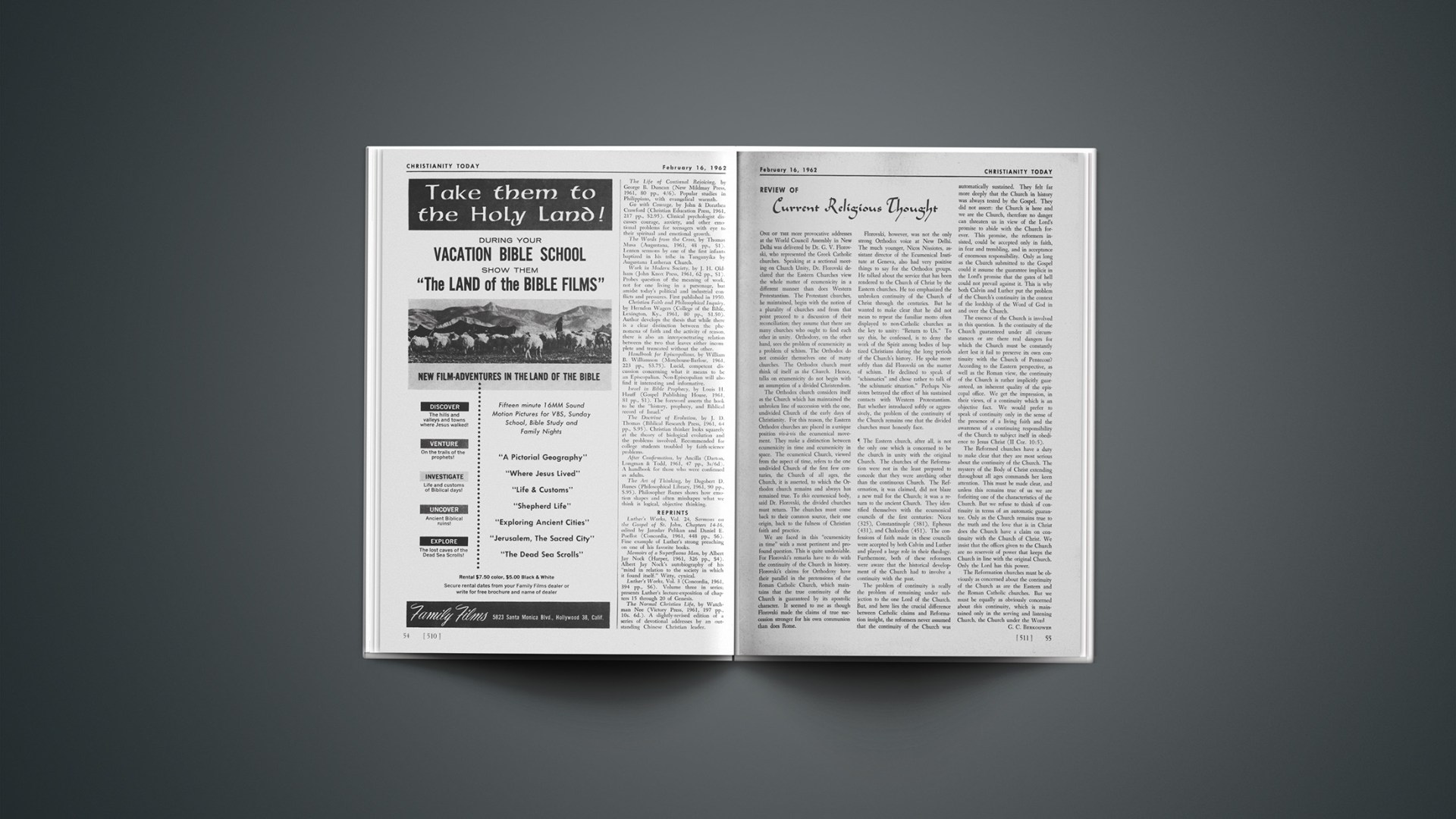
Review of Current Religious Thought: February 16, 1962

One of the more provocative addresses at the World Council Assembly in New Delhi was delivered by Dr. G. V. Florovski, who represented the Greek Catholic churches. Speaking at a sectional meeting on Church Unity, Dr. Florovski declared that the Eastern Churches view the whole matter of ecumenicity in a different manner than does Western Protestantism. The Protestant churches, he maintained, begin with the notion of a plurality of churches and from that point proceed to a discussion of their reconciliation; they assume that there are many churches who ought to find each other in unity. Orthodoxy, on the other hand, sees the problem of ecumenicity as a problem of schism. The Orthodox do not consider themselves one of many churches. The Orthodox church must think of itself as the Church. Hence, talks on ecumenicity do not begin with an assumption of a divided Christendom.

The Orthodox church considers itself as the Church which has maintained the unbroken line of succession with the one, undivided Church of the early days of Christianity. For this reason, the Eastern Orthodox churches are placed in a unique position vis-à-vis the ecumenical movement. They make a distinction between ecumenicity in time and ecumenicity in space. The ecumenical Church, viewed from the aspect of time, refers to the one undivided Church of the first few centuries, the Church of all ages, the Church, it is asserted, to which the Orthodox church remains and always has remained true. To this ecumenical body, said Dr. Florovski, the divided churches must return. The churches must come back to their common source, their one origin, back to the fulness of Christian faith and practice.

We are faced in this “ecumenicity in time” with a most pertinent and profound question. This is quite undeniable. For Florovski’s remarks have to do with the continuity of the Church in history. Florovski’s claims for Orthodoxy have their parallel in the pretensions of the Roman Catholic Church, which maintains that the true continuity of the Church is guaranteed by its apostolic character. It seemed to me as though Florovski made the claims of true succession stronger for his own communion than does Rome.

Florovski, however, was not the only strong Orthodox voice at New Delhi. The much younger, Nicos Nissiotes, assistant director of the Ecumenical Institute at Geneva, also had very positive things to say for the Orthodox groups. He talked about the service that has been rendered to the Church of Christ by the Eastern churches. He too emphasized the unbroken continuity of the Church of Christ through the centuries. But he wanted to make clear that he did not mean to repeat the familiar motto often displayed to non-Catholic churches as the key to unity: “Return to Us.” To say this, he confessed, is to deny the work of the Spirit among bodies of baptized Christians during the long periods of the Church’s history. He spoke more softly than did Florovski on the matter of schism. He declined to speak of “schismatics” and chose rather to talk of “the schismatic situation.” Perhaps Nissiotes betrayed the effect of his sustained contacts with Western Protestantism. But whether introduced softly or aggressively, the problem of the continuity of the Church remains one that the divided churches must honestly face.

The Eastern church, after all, is not the only one which is concerned to be the church in unity with the original Church. The churches of the Reformation were not in the least prepared to concede that they were anything other than the continuous Church. The Reformation, it was claimed, did not blaze a new trail for the Church; it was a return to the ancient Church. They identified themselves with the ecumenical councils of the first centuries: Nicea (325), Constantinople (381), Ephesus (431), and Chalcedon (451). The confessions of faith made in these councils were accepted by both Calvin and Luther and played a large role in their theology. Furthermore, both of these reformers were aware that the historical development of the Church had to involve a continuity with the past.

The problem of continuity is really the problem of remaining under subjection to the one Lord of the Church. But, and here lies the crucial difference between Catholic claims and Reformation insight, the reformers never assumed that the continuity of the Church was automatically sustained. They felt far more deeply that the Church in history was always tested by the Gospel. They did not assert: the Church is here and we are the Church, therefore no danger can threaten us in view of the Lord’s promise to abide with the Church forever. This promise, the reformers insisted, could be accepted only in faith, in fear and trembling, and in acceptance of enormous responsibility. Only as long as the Church submitted to the Gospel could it assume the guarantee implicit in the Lord’s promise that the gates of hell could not prevail against it. This is why both Calvin and Luther put the problem of the Church’s continuity in the context of the lordship of the Word of God in and over the Church.

The essence of the Church is involved in this question. Is the continuity of the Church guaranteed under all circumstances or are there real dangers for which the Church must be constantly alert lest it fail to preserve its own continuity with the Church of Pentecost? According to the Eastern perspective, as well as the Roman Hew, the continuity of the Church is rather implicitly guaranteed, an inherent quality of the episcopal office. We get the impression, in their views, of a continuity which is an objective fact. We would prefer to speak of continuity only in the sense of the presence of a living faith and the awareness of a continuing responsibility of the Church to subject itself in obedience to Jesus Christ (2 Cor. 10:5).

The Reformed churches have a duty to make clear that they are most serious about the continuity of the Church. The mystery of the Body of Christ extending throughout all ages commands her keen attention. This must be made clear, and unless this remains true of us we are forfeiting one of the characteristics of the Church. But we refuse to think of continuity in terms of an automatic guarantee. Only as the Church remains true to the truth and the love that is in Christ does the Church have a claim on continuity with the Church of Christ. We insist that the offices given to the Church are no reservoir of power that keeps the Church in line with the original Church. Only the Lord has this power.

The Reformation churches must be obviously as concerned about the continuity of the Church as are the Eastern and the Roman Catholic churches. But we must be equally as obviously concerned about this continuity, which is maintained only in the serving and listening Church, the Church under the Word

Book Briefs: February 16, 1962

Over Against Words Of Angels And Devils

Luther and the Bible, by Willem Jan Kooiman, translated by John Schmidt (Muhlenberg Press, 1961, 243 pp., $4), is reviewed by John Warwick Montgomery, Chairman, Department of History, Waterloo Lutheran University, Waterloo, Ontario.

The Luther research movement of the last half century, stemming largely from the work of Karl Holl and the editors of the great Weimarer Augabe of the Reformer’s writings, has virtually revolutionized our understanding of Luther’s theology and world view. As with most such movements of European origin, considerable time elapsed before American scholars and, more especially, pastors and laymen, became aware of the new emphasis; and it is safe to say that even now many non-Lutherans are unacquainted with the results of the new Luther research. Roland Bainton’s Here I Stand has provided an excellent biographical introduction to the Reformer on the basis of recent scholarship, and now, with the translation from the Dutch of Kooiman’s Luther and the Bible, we have perhaps the best theological starting point for those who would understand the essence of Luther’s thought in regard to Scripture and Gospel.

The most striking characteristic of Luther’s biblical approach, as revealed in this excellent study by a professor of church history at the University of Amsterdam, is undoubtedly its diametric opposition to the presuppositions of large segments of present-day Protestant biblical scholarship. “Luther sees the whole truth of the Gospel already revealed, even though veiled, in the Old Testament. Just like the New, it is ‘full of Christ’ ” (p. 209). “How completely he means this is made clear by the fact that he placed a ‘Praefatio Jhesu Christi’ (a prefatory word from Christ himself) in the edition of the Psalter to be used by the students. This introduction consists of Bible passages directly or indirectly spoken by Jesus, intended to show that he is the true Author of the Psalms” (p. 32). In his treatment of the Bible, Luther was “not concerned with a mere collection of individual texts, but with the Author who stands behind them and wishes to reveal himself through them” (p. 84).

Not only in regard to the unity of the Bible, but also in the matter of its power and authority, Luther holds a position unacceptable to many moderns. “We see the essential elements of Luther’s theology appearing early. Christ is the content of the scripture and he desires to come to us through them, both in his judgment and grace. Sola scriptura (scripture alone) is the same as solus Christus (Christ alone)” (p. 42). “For Luther the Bible itself is a weapon with which God fights in his great and comprehensive battle against Satan. With it he defeats his enemy and gives victory to those who believe in him. And it is because of this fact that ‘every word of the scriptures is to be weighed, counted, and measured’ ” (p. 54). The following assertions by Luther are as typical of him as they are disturbing in the present theological milieu: “Over against all the statements of the fathers and of all men, yes, over against words of angels and devils, I place the scriptures” (p. 80); “I have learned to ascribe the honor of infallibility only to those books that are accepted as canonical. I am profoundly convinced that none of these writers have erred” (p. 78).

Two negative criticisms of Kooiman’s volume are in order, though one of these will be leveled at publisher and not author, and neither is to be considered sufficient to detract from the general value of the book. First, Professor Kooiman’s very accurate depictions of Luther’s views suffer on occasion from the conclusions that he draws from them. Thus, in spite of the wealth of material indicating that Luther held as “strong” a view of biblical inspiration as possible apart from Romanist mechanical inspirationism, the author insists on claiming that Luther was no “verbal inspirationist” (p. 236). This is true, of course, if we equate verbal inspiration with dictational inspiration, but such an equation muddies the theological water. Granted, the verbal inspiration controversy postdates Luther, but it is difficult to feel, after reading Kooiman, that Luther, if he lived today, would not in fact consider “verbal inspiration” the biblical view most congenial to his own. In line with Kooiman’s negative attitude toward verbalism, one finds in chapter 17 that the author attributes an anti-bookishness to Luther; that this is inconsistent with a proper understanding of the Reformer’s life and thought will be seen in this reviewer’s forthcoming article on “Luther and Libraries” in The Library Quarterly (University of Chicago Press).

A second criticism has to do with the treatment of Kooiman’s book at the hands of its publisher. Copy editing is substandard (bibliographical citations are inconsistent and frequently at variance with accepted practice—e.g., on p. 93 Bornkamm’s Luther’s World of Thought is cited in English translation, but on p. 239 it is cited in the German original with no indication of English translation); the index is abominable (e.g., “Ein Deutsch Theologian” is entered under E; and the strange entry “Random comments by Luther” appears under R!); misprints are evident (e.g., on p. 25, “Erdmans” for “Eerdmans”; on p. 50, “profeticus” for “propheticus”—cf. p. 31); no indication is given as to the date of the original edition from which the translation was made; there is poor registration and typographical smearing throughout the book; and even the spinecloth on my copy is unaligned. Surely a book of the quality and importance of Kooiman’s volume deserves better bibliographical dress than this.

JOHN WARWICK MONTGOMERY

Counsel Abundant

The Minister’s Mission, by C. E. Colton (Zondervan, 1961, 223 pp., $3.50), is reviewed by Homer L. Goddard, Minister, Westside United Protestant Church, Richland, Washington.

This book is what it says it is: A practical handbook for preachers and prospective preachers. It will be of most help to the latter.

In a very simple, direct, and forthright manner, Dr. Colton deals with almost every practical problem a minister is likely to face. His advice is consistently middle-of-the-road, his theology mildly conservative, and his outlook gracious and edifying as a result of his years of successful service.

The book faces with the minister his relationship to God in seeking and doing His will; how to do graciously and effectively his varied tasks in the church; how to prepare for preaching, to which he is primarily called; how to have fruitful relations with his people, the community, and his fellow ministers; and how to order intelligently his own personal and family life in the midst of his unusual pressures. The last two sections are especially wise and helpful.

The author has a tendency to wordiness, is somewhat pedantic, and, especially on the subject of baptism, shows his Baptist perspective. But this book will be especially helpful to any young minister anticipating his “firsts.”

HOMER L. GODDARD

Sacrifice Without End

Pilgrimage to Humanity, by Albert Schweitzer (Philosophical Library, 1961, 107 pp., $3.75), is reviewed by James Daane, Editorial Associate, CHRISTIANITY TODAY.

With short lucid strokes Schweitzer sketches his life and thought and headlines the whole as a pilgrimage toward humanity (Weg zur Humanität). The end of the pilgrimage for Schweitzer is the application of the Ethics of Jesus, who indeed comes to us nameless and unknown, but whom in the way of obedience we come to know as an ineffable mystery, within the service and conflicts of our lives.

Eschatologically Jesus was mistaken, but he left us an Ethic which is simply reverence for life in all its forms. After presenting an impressive critique of inhumane, fragmented modern culture, Schweitzer calls men to the achievement of a self and the creation of a culture which will everywhere manifest reverence for life in all of its multiple manifestations. Only by the practice of the same respect for life as shown by Jesus will we attain a truly integrated and humane civilization. Schweitzer shows how both Goethe and Bach affected his life and thought, for in their inner life they embodied that unity of life and thought toward which all humanity strives.

Since the “pilgrimage to humanity” is the story of Schweitzer’s life, Schweitzer seems to “have already attained,” which suggests that his basic religious view of life was not found at the end of a pilgrimage but was developed along the way being with him from the beginning. Deep and sensitive spirit that he is, Schweitzer all his life wrestled with the awful fact of suffering. But he has found no solution. He insists that life even in its lowest forms must be reverenced and protected, and therefore is grieved that he as a doctor must destroy life. He is pleased “by the new means of treating sleeping sickness.… Even so, every time I have under the microscope the germs which cause this illness, I cannot avoid reflecting that, in order to preserve life, I have to destroy other life” (p. 89). Here he is nigh unto the Kingdom; yet remains outside. He ends with a universe in which what is allegedly the highest and most sacred, namely, life, is sacrificed for its own sake. For Schweitzer who insists on a rational universe, this is a cosmic element of jolting irrationality. While in Christianity the highest, the Son of God, is sacrificed for sinners, and thus with rational purpose, Schweitzer has not gotten beyond a highest which is sacrificed for itself, and thus to no rational purpose.

While the Christian can never fully comprehend why the Son of God would die for a sinner, the thought itself is not irrational; but that life must die for the sake of life itself, is irrational, being ultimately pointless.

In physical strength, intellectual faculty, and spiritual depth and sensitivity, Schweitzer is a man of uncommon dimension. Yet the story of his life and thought as a “road to humanity” will in reading appear to the Christian as a kind of via dolorosa. Schweitzer has sacrifice without Christ, and therefore a pilgrimage without an end.

JAMES DAANE

Reading for Prespective

CHRISTIANITY TODAY’S REVIEW EDITORS CALL ATTENTION TO THESE NEW TITLES:

* Science and Religion, edited by John Clover Monsma (Putnam’s, $3.95). Twenty-three prominent churchmen, several of them contributing editors of CHRISTIANITY TODAY, write on a relationship vital for our day.

* Ancient Israel—Its Life and Institutions, by Roland de Vaux (McGraw-Hill, $10.95). A distinguished Dominican field archaeologist, the director of the Ecole Biblique in Jerusalem (Jordan) recaptures life in the society of ancient Israel.

* Christ and the Meaning of Life, by Helmut Thielicke (Harper, 1962, 186 pp., $3). Vivid preaching to the times by the gifted Hamburg university professor.

Early Christianity

A Theological and Historical Introduction to the Apostolic Fathers, by John Lawson (Macmillan, 1961, 334 pp., $5), is reviewed by William Childs Robinson, Professor of Historical Theology, Columbia Theological Seminary, Decatur, Georgia.

It is a great pleasure to welcome this volume from the learned professor in Emory University with an appropriate dedication to his dean, Dr. William R. Cannon. Professor Lawson has given a judicious and well-thought-out treatment of the writers closest to the apostles. He finds that some of them stumble, on occasion badly, but he rejects the idea based on an evaluation of them by the Reformation standards of sola gratia and sola fide that they fell. If attention be directed rather to the central place these fathers give Christ and the high Christology that shines in Ignatius as at times in the others, this judgment will be sustained. Dr. Lawson shows that duly-appointed officers and duly-celebrated ritual were an original part of Christianity so that this period was not marked by that fluidity often ascribed to it.

We are pleased to note Dr. Lawson’s affirmation of the substantial reliability of the New Testament portrait of Christ due to the authoritative character of the apostolic witness. “The Church is forever bound to the authority of canonical Scripture.” We are unable to concur with him that the doctrinal interpretation recorded in canonical New Testament Scripture is not “more inspired” than that recorded later. We prefer his other statement that “the New Testament doctrinal interpretation of the facts about Christ is of plenary authority.”

WILLIAM C. ROBINSON

The Cross For Us

Sharing His Suffering, by Peter H. Eldersveld (Eerdmans, 1961, 99 pp., $2.50), is reviewed by William D. Livingstone, Pastor, First Presbyterian Church, San Diego, Calif.

It has been the reviewer’s privilege to hear many sermons and to read many collections of sermons. Most of them do not amount to much. But here is a volume of great messages—sermons true to the Word of God, instructive to the mind, and inspiring to the heart. Based on the Back-to-God-Hour broadcasts, the messages are clear and incisive, uncluttered by illustrations which serve only to exhibit the preacher’s erudition. They deal with the central theme of the Christian faith—the Cross—what it means in the plan of redemption and how it applies to your life and mine. Dr. Elders-veld’s manner of expression is simple, direct, and sets forth the gospel truth in a fresh, enlightening, and interesting way. The reviewer is not given to overenthusiasm, but he cannot help but recommend this volume as one of the finest and most helpful expositions he has ever read.

WILLIAM D. LIVINGSTONE

Introduction To Nygren

Essence of Christianity, by Anders Nygren (Muhlenberg Press, 1961, 128 pp., $2), is reviewed by M. Eugene Osterhaven, Professor of Systematic Theology, Western Theological Seminary, Holland, Mich.

In this book the best-known Swedish theologian of our time sets forth his fundamental convictions on two topics central to theology. The first, an essay originally published in 1922, is in the area of the philosophy of religion; the second, a translation of a study published in 1932, concerns the atonement.

In the first essay, on The Permanent Element in Christianity, the author argues that religion is located in the life of the spirit and is concerned with questions of truth, ethics and aesthetics. These create enduring social forms as seen, e.g., in science, law and art. Religion and the life of the spirit must not be minimized, therefore, but must be appreciated for their real worth. Religion is characterized by (1) revelation, (2) the idea of a gulf existing between God and man, (3) reconciliation, and (4) divine-human fellowship. At every point Christianity distinguishes itself from other religions because at its center is Jesus Christ. Christianity is Christ. Christ (1) is the concrete revelation of God; (2) shows us God’s judgment on sin; (3) is the reconciliation; and (4) is our means of fellowship with God. He is the permanent element in Christianity. In the last chapter in the first essay the superiority of evangelical Christianity over Roman Catholicism is argued from the point of view of the former’s unified view of life as against Rome’s dualism, i.e., its division of life into sacred and secular spheres, and evangelicalism’s genuine theocentricism versus Rome’s eudemonism.

The thesis of the essay on atonement is that central to Christian theology is the conviction that atonement is God’s work, motivated by pure love which “takes upon itself the burden which selfishness has caused but refuses to bear.” The work of Christ is “in the most literal sense vicarious sacrifice and vicarious suffering.” This theme is, of course, much enlarged in the author’s great volume Agape and Eros.

The present volume serves as a good introduction to Nygren’s thought. It shows him to be the master that he is, one with clear theological convictions and the ability to state them well. The book would serve, as the jacket states, as a fine introduction to theology in its relation to religion. However, not all theologians nowadays are interested in that problem.

M. EUGENE OSTERHAVEN

How Christians Grow

Our Contagious Faith, 2 vols. by Ada Beth and C. Adrian Heaton (Judson Press, 1961, 192 pp., $1.75) and Leader’s Guide (48 pp., $.75), are reviewed by Milford Sholund, Director of Biblical and Educational Research, Gospel Light Publications, Glendale, California.

These two volumes are designed to show “how persons grow through Christian teaching in church and home.” There is a comprehensive view of human development from infancy through adolescence. This is a specialized publication designed for parents attending churches that use the Judson-graded curriculum materials in the Sunday church school. However, the nature and scope of the information and ideas contained in these two volumes are useful in the hands of Christian parents and church workers in any setting of Christian education.

There are two volumes. The larger one of 192 pages, paper covered, is to be used by the parent in the home or in a group meeting. The smaller volume (a paper cover) of 48 pages is the Leader’s Guide.

The theological basis of these discussions rests upon the evangelical interpretation of the Bible. Woven into this purpose of a “new person in Jesus Christ” is a vast amount of information in a few pages. The authors have drawn from up-to-date studies of human development which they have gained in their academic experiences and their practical observations. Adrian and Ada Heaton have had a wealth of experience as leaders in the American Baptist Convention and the Eastern Baptist Seminary and the California Baptist Seminary. Dr. Heaton is currently president of the latter institution. Mrs. Heaton is a curriculum consultant and contributor to the Judson Press graded curriculum materials.

The centrality of the family in Christian learning is considered in relationship to the experiences of children and youth in the American cultural setting. The home is where the children “catch” the faith. Hence, the title, Our Contagious Faith. The reading of these two volumes is stimulating and provocative. There is not only a “catchy” faith but also “catchy” headings throughout the book to make it easy and significant reading; for example, “Why Is a Biblical Plan Hard to Practice” (p. 12), “It’s a Face-to-Face World” (p. 32), “What’s the Weather Like Inside?” (p. 47), “Big Lives from Little Moments” (p. 168), to mention a few.

The thoughtful parent will find a great deal of guidance for the Christian education of the family. The church worker likewise will find ample information and suggestions on how to understand and use recent findings in psychology and education that are useful in teaching the Bible.

MILFORD SHOLUND

Who Is Catholic?

Reformation and Catholicity, by Gustaf Aulén, translated by Eric H. Wahlstrom (Muhlenberg Press, 1961, 203 pp., $3.75), is reviewed by Jerome L. Ficek, Associate Professor of Theology, Trinity Theological Seminary, Berwyn, Illinois.

The thesis of this book is that the Reformers were interested in maintaining catholicity. Not intending to create “a new church,” they emphasized that the reformed church is a continuation of the Apostolic Church which the Creeds described as “one, holy, and catholic.” They did not understand “justification by faith” in purely individualistic or subjective terms but as “that continuing redemptive activity which the living Christ, present and active in the Word and the Sacraments carries on in and through his church” (p. 60). The author cites contemporary Roman Catholic scholars such as Y. Congar and L. Bouyer who, under the impetus of the revival of biblical studies and the liturgical movement, are stressing the positive, religious motives in Luther’s struggle. They point out, for example, that the Reformation view of the Bible as a means of grace returned it to its central place in the life of the Church.

The author does not define catholicity in geographical terms but in qualitative ones, that is, as being actualized in the universality and continuity of the Church (p. 181 ff.). But would not such limitless inclusiveness destroy the uniqueness and particularity of the Church? Was not this process already at work when the term changed in meaning from una in Ignatius to universalis in Cyprian? Jaroslav Pelikan’s definition of catholicity as “identity plus universality” seems more adequate. Are not Protestantism and Catholicism (each in its own way) in danger of losing that which distinguishes them from the world?

JEROME L. FICEK

Crowded With Fact

The Twentieth Century in Europe, by Kenneth Scott Latourette (Harper, 1961, 568 pp., $8.50) is reviewed by W. Stanford Reid, Associate Professor of History, McGill University, Montreal.

This is the fourth volume of Professor Latourette’s “Christianity in a Revolutionary Age,” a work now reaching its completion. It deals with the European Roman Catholic, Protestant and Eastern churches. After an introduction, eight chapters covering some 200 pages recount the history of Roman Catholicism under various topics: the place of the papacy, worship and devotional life, etc. Then follow eight chapters covering the Protestant churches in various areas; and finally three more chapters deal with the Old Catholic and the Orthodox churches, particularly the latter’s story in Russia and Eastern Europe.

As in all of Professor Latourette’s works the amount of factual material presented leaves one gasping, and as one might expect when a historian deals with the contemporary scene he offers only a minimum of interpretation. Nevertheless, interpretation is there if only by virtue of what is left out. One can only wish, for instance, that the author had seen fit to include more information concerning the evangelical movements and the revival of Calvinism in various parts of the European church. But despite any omissions, as the most extensive and complete work of its kind for many years to come it will be the basic work for everyone who desires to know something of the course of twentieth-century Christianity in Europe.

W. STANFORD REID

O.T. Reduced To Ethics

Moses and the Original Torah, by Abba Hillel Silver (Macmillan, 1961, 188 pp., $3.95), is reviewed by Walter R. Roehrs, Professor of Old Testament, Concordia Seminary, St. Louis, Missouri.

When “the noted scholar, student of religion and distinguished leader of world Jewry” (jacket) completes his proposed quest for the “real character of Moses and the essential message of the Torah” (jacket), the genuine teaching of the Old Testament is reduced to a “nucleus of pure moral teachings and precepts” (p. 108), “ethical guideposts, pointing the way toward a sound and orderly way of life for the individual and society” (p. 137). The “original Torah which Moses set before the children of Israel” is restricted by the author to: (1) the debarim or “Words” of the Decalogue (Exod. 20 and Deut. 5); (2) ten further “Words” embedded in Lev. 19; (3) additional “Words” selected from the Covenant Code (Exod. 21:2; 22:20–24:7; 23:1–3, 7, 8), the Holiness Code (Lev. 25:35–43), and the Deuteronomic Code (Deut. 10:19; 14:1; 15:12, 13; 16:18–20; 18:10, 11; 23:16, 17, 19; 24:14, 15, 17, 18)—(pp. 1370–141).

To rediscover this genuine heritage of Moses, “the founder of the first ethical and spiritual monotheistic religion of mankind” (p. 38), Silver proceeds to remove various strata of spurious and vitiating elements of the Old Testament with which, he believes, the pure religion has in the course of time become overlaid. Among them is the thick layer of Levitical worship, for “the Mosaic YHVH tradition had no place for sacrifice or priesthood” (p. 116). Christianity is regarded as one of the latest and perhaps most serious encrustations, for “many apocalyptic elements were now combined with it [a later Jewish messianic movement], elements which would have been utterly strange to Moses—Messiah, vicarious atonement, the God incarnate, resurrection …” (p. 171). Once the original “Words” of the three law codes have been purged of these foreign and debilitating accretions, Israel “could become, if it wished, a light unto the world,” “the faithful messenger of YHVH’s law to all the nations of the earth” (pp. 166, 168).

This reduction of the Old Testament to an ethical system of legal prescription is achieved by the use and application of the source hypothesis and similar suppositions of the current critical method. The Christian or Jewish scholar who grants the validity of these theories will find it very difficult to remonstrate with Silver regarding his conclusions.

WALTER R. ROEHRS

The City Of God

Charter of Christendom, by John O’Meara (Macmillan, 1961, 120 pp., $2.50), is reviewed by W. T. Radius, Professor of Classics, Calvin College, Grand Rapids, Michigan.

This expanded lecture by the distinguished Lecturer in Classical Studies at University College, Dublin, is recommended by this reviewer for the busy pastor who wants to know something about a Christian classic which he has for years intended to study. Professor O’Meara is a Roman Catholic whose eminence in Augustinian studies is universally recognized.

In Part One of his study Dr. O’Meara considers “The Relevant Historical Situation,” “Anticipations of the Theme in Augustine,” and “Augustine’s Description of the Book”—all this by way of background to the City of God. Part Two gives us a close analysis of the three centers of thought of the book itself: the Bible with its history of time and eternity, Greek philosophy with its Platonism and its Neoplatonism, and Rome with its polytheism.

The book does more than analyze the City of God (Psalm 86:3, “Glorious things are said of thee, O city of God”). It is a window into the mind of the man who through the figure of the City made a bridge between the pagan and the Christian worlds. The structure of this bridge intrigues us who are heirs of this double tradition and who must live out our lives in an equally convulsive period.

W. T. RADIUS

Exegete Par Excellence

The Epistle to the Hebrews, by John Brown (Banner of Truth, 1961, 728 pp., 18s.), is reviewed by William J. Cameron, Professor of New Testament, Free Church of Scotland College, Edinburgh.

It is almost a hundred years since this commentary was posthumously published, but its admirable quality fully justifies the present reprint. The author was at the same time pastor of a large congregation in Edinburgh and professor of exegetical theology in the Secession College of that city. This twofold occupation largely explains the form of the book which embodies the substance of expository preaching to a congregation and lectures given to theological students. It combines exegetical and devotional matter in a plain direct style and provides instructive and rewarding reading.

Descended from a scholarly line, Brown was personally distinguished by intellectual vigor, independent judgment, and devout character. He excelled the British exegetes of his period, being classified by C. H. Spurgeon, among others, as “a great expositor.” While inclining to regard the Epistle as written by Paul, he acknowledges that this is “by no means absolutely certain.” He faces exegetical problems frankly, deals fairly with alternative interpretations, and supports his own preference with careful reasoning. Even when his opinion may not entirely convince, the impression remains that his argument cannot be lightly dismissed. The people who heard such exposition from the pulpit received instruction that would tend to promote a robust faith without overstraining an average intellect; and the students who listened to the lectures represented were supplied with excellent examples of sound exegetical method and helpful application of truth.

WILLIAM J. CAMERON

An Inspiring Colonial

David Brainerd, Beloved Yankee, by David Wynbeek (Eerdmans, 1961, 256 pp., $3.75), is reviewed by Roderick H. Jellema, Department of English, University of Maryland.

David Brainerd, of minor interest today as a Colonial missionary to the American Indians in New York and Pennsylvania, was of major interest to his contemporaries as a man. Mr. Wynbeek’s painstaking book brushes some of the dust off Brainerd and restores to him some of the luster which had caught the eye of men as different as the emotional Wesley and the ambivalently mystical-intellectual Edwards.

Brainerd proves to be a solid subject for study. A candidly introspective diarist, he reflects with sensitivity the spiritual and intellectual ferment of his age—an age battered by the winds of Enlightenment Rationalism, the resurgent Calvinism of Edwards (who was, as S. E. Morrison reminds us, not the last great Calvinist in America, but the first), and the high-pitched emotionalism of the Great Awakening. In the midst of it all stands Brainerd, an inspiring and revealing if paradoxical figure: lonely, at times confused and doubting, intense in feeling, lucid in thought, sickly, courageous, discouraged, devoted, strong. Such a man, seen against the background of such an age, is well worth our attention.

Mr. Wynbeek’s book is a careful piecing together of the facts about Brainerd and his age. It is rich with quotations from scores of sources. Because the narrative is restricted to the chronological and carefully excludes synthesis, Brainerd comes forth as brilliant as a star—but also, necessarily, as bloodless. Still, this is not really a fault. Mr. Wynbeek has limited his intentions and achieved them. He has given to scholar and layman alike an important, interesting, readable book. If that other kind of book is ever written—the kind of book that vividly recreates Brainerd as a fallible hero-saint in the dramatic context of flesh and blood, doubt, and the howling wilderness—it will owe a great deal to Mr. Wynbeek’s valuable study.

RODERICK H. JELLEMA

Theology Alive

Interpreting Basic Theology, by Addison H. Leitch (Channel Press, 1961, 208 pp., $3.50), is reviewed by Robert Boyd Munger, Minister, First Presbyterian Church, Berkeley, California.

When basic theology is communicated with simplicity, clarity and evangelical warmth out of a breadth of scholarship and depth of personal experience, it is noteworthy indeed. With “wide choice of material and the discipline of discard” sharpened through teaching, preaching and living Jesus Christ, the author, who until recently was president of the Pitts-burgh-Xenia Theological Seminary, has given us a most usable book to assist in the understanding of Bible doctrine.

The choice use of analogy and illustration and the lucid development of difficult doctrine will stimulate every pastor-teacher and encourage him to venture out boldly into these themes in his own ministry. The layman will rejoice to open a book which speaks in his own language and makes truths, formerly dim and dull, luminous and alive in Christ. For a long time I have been looking for the kind of help this book provides to use as a text for classes on Christian doctrine and to hand to earnest Christians desiring a fuller understanding of their faith.

One suggestion comes to mind. An outline of scriptural passages at the beginning or end of each chapter would provide the reader with an opportunity to pursue further a study of the subjects presented. The presentation given in such chapters as “The Word of God,” “The Structure of Man,” “The Nature of Sin,” “The Person and Work of Christ,” etc., will awaken, I am sure, a desire to explore personally the scriptural foundation of “basic theology.”

ROBERT BOYD MUNGER

Book Briefs

Synthetist Art Theories, by H. R. Rook-maaker (Swets & Zeitlinger, Amsterdam, 1959, 284 pp., $8.25). A perceptive study of the genesis and nature of the theoretical art conceptions of Gauguin and his associates.

Kiss the Son, by Don J. Kenyon (Christian Publications, 1961, 102 pp., $2.75). Spotlights the missionary as well as messianic teachings of the second psalm.

The prophetic Word in Crisis Days, Symposium (Dunham, 1961, 216 pp., $3.95). J. F. Walvoord, J. D. Pentecost, H. A. Hoyt, J. V. McGee, S. E. Forsberg, P. R. Bauman, and C. J. Woodbridge bring biblical prophecy to bear on our time of crisis.

Hymn Festivals, by Ernest K. Emurian (Wilde, 1961, 126 pp., $2.95). Interesting and informative stories about great hymns and their authors.

The Living World of the Bible, by M. J. Steve (World, 1961, 231 pp., $12.50). Excellent photography and commentary throw light especially on Old Testament world. Fine artistic production.

The New Testament, translation by Kenneth S. Wuest (Eerdmans, 1961, 624 pp., $5.95). Clarification of the text of the Authorized Version by expansion of its tight phraseology.

St. Mark, by R. A. Cole (Tyndale, 1961, 263 pp., 10/6). An evangelical “practical work-a-day commentary” without technicalities by a missionary teacher in Southeast Asia.

This Is the Holy Land, A Pilgrimage in Words and Pictures, conducted by Fulton J. Sheen, photographed by Yousuf Karsh, described by H. V. Morton (Hawthorn, 1961, 143 pp., $4.95). Famed travel-writer Morton provides lucid text; most of the photographs include Bishop Sheen.

The Holy Grail, by Arthur Edward Waite (University Books, 1961, 624 pp., $10). New version of nature of mystery imbedded in the romance literature of the Holy Grail.

Paperbacks

A Calendar of Hymns, compiled by Frederic Fox (Doubleday, 1961, 128 pp., $1.45). Fifty-three hymns for the American-Christian Year with words, music, and their stories.

How far Down the Road, Edward R. Sneed (Edward R. Sneed, Clayton 5, Mo., 1961, 176 pp., $1). A warning of the dangers that threaten American freedoms.

Tests of a Living Church, by Robert W. Spike (Association Press, 1961, 124 pp., $.50). An attempt to lead laymen into the everyday life and task of the Church.

Expounding God’s Word, by Alan M. Stibbs (Eerdmans, 1961, 112 pp., $1.25). Indicates and illustrates principles and methods of biblical exposition. (First published in 1960.)

The Gospel as taught by Calvin, by R. C. Reed (Presbyterian Reformation Society, n.d., 157 pp., $1.50). Author (d. 1925) defines Calvin’s Gospel in terms of Five Points of Calvinism.

History of Dogma, by Adolph Harnack, translated by Neil Buchanan (Dover Publications 1961, 7 volumes bound as 4, $2.50 ea.). An excellent well-bound, easy-to-read, reprint of the classic monumental work of one of the greatest church historians. Their reappearance in paperback is a service to Christian scholarship.

How My Mind Has Changed, edited by Harold E. Fey (World Publishing Co., 1961, 191 pp., $1.25). First appeared in The Christian Century.

The Modern Reader’s Bible Atlas, by H. H. Rowley (Association Press, 1961, 88 pp., $1.50). Compact atlas of the Bible, quiz maps, text, and illustrations.

The Life of Continual Rejoicing, by George B. Duncan (New Mildmay Press, 1961, 80 pp., 4/6). Popular studies in Philippians, with evangelical warmth.

Go with Courage, by John & Dorathea Crawford (Christian Education Press, 1961, 217 pp., $2.95). Clinical psychologist discusses courage, anxiety, and other emotional problems for teenagers with eye to their spiritual and emotional growth.

The Words from the Cross, by Thomas Musa (Augustana, 1961, 48 pp., $1). Lenten sermons by one of the first infants baptized in his tribe in Tanganyika by Augustana Lutheran Church.

Work in Modern Society, by J. H. Oldham (John Knox Press, 1961, 62 pp., $1). Probes question of the meaning of work, not for one living in a parsonage, but amidst today’s political and industrial conflicts and pressures. First published in 1950.

Christian Faith and Philosophical Inquiry, by Herndon Wagers (College of the Bible, Lexington, Ky., 1961, 80 pp., $1.50). Author develops the thesis that while there is a clear distinction between the phenomena of faith and the activity of reason, there is also an interpenetrating relation between the two that leaves either incomplete and truncated without the other.

Handbook for Episcopalians, by William B. Williamson (Morehouse-Barlow, 1961, 223 pp., $3.75). Lucid, competent discussion concerning what it means to be an Episcopalian. Non-Episcopalian will also find it interesting and informative.

Israel in Bible Prophecy, by Louis H. Flauff (Gospel Publishing House, 1961, 81 pp., $1). The foreword asserts the book to be the “history, prophecy, and Biblical record of Israel.”

The Doctrine of Evolution, by J. D. Thomas (Biblical Research Press, 1961, 64 pp., $.95). Christian thinker looks squarely at the theory of biological evolution and the problems involved. Recommended for college students troubled by faith-science problems.

After Confirmation, by Ancilla (Darton, Longman & Todd, 1961, 47 pp., 3s/6d). A handbook for those who were confirmed as adults.

The Art of Thinking, by Dagobert D. Runes (Philosophical Library, 1961, 90 pp., $.95). Philosopher Runes shows how emotion shapes and often misshapes what we think is logical, objective thinking.

Reprints

Luther’s Works, Vol. 24, Sermons on the Gospel of St. John, Chapters 14–16, edited by Jaroslav Pelikan and Daniel E. Poellot (Concordia, 1961, 448 pp., $6). Fine example of Luther’s strong preaching on one of his favorite books.

Memoirs of a Superfluous Man, by Albert Jay Nock (Harper, 1961, 326 pp., $4). Albert Jay Nock’s autobiography of his “mind in relation to the society in which it found itself.” Witty, cynical.

Luther’s Works, Vol. 3 (Concordia, 1961, 394 pp., $6). Volume three in series; presents Luther’s lecture-exposition of chapters 15 through 20 of Genesis.

The Normal Christian Life, by Watchman Nee (Victory Press, 1961, 197 pp., 10s. 6d.). A slightly-revised edition of a series of devotional addresses by an outstanding Chinese Christian leader.

Graham Tour Marks New Day for South America

Billy Graham’s evangelistic tour of South America is the latest and one of the most significant indications that Protestant influence has won official respect there against almost overwhelming Roman Catholic odds.

Despite a few setbacks, Graham was able to conduct public evangelistic rallies in three cities in Colombia, including the capital city of Bogota, where he was warmly welcomed during an unscheduled one-day visit.

Earlier, Graham held meetings in Caracas and Maracaibo, Venezuela.

The evangelist’s biggest disappointment came in Barranquilla, Colombia, where he had hoped to preach in the municipal baseball stadium. A few days before the scheduled meeting, however, permission to use the stadium was withdrawn. Mayor Ricardo Gonzalez of Barranquilla explained that only the Roman Catholic Church is allowed to “propagandize” in Colombia. The mayor’s move followed protests from the Roman Catholic hierarchy who claimed that Protestant preaching outside private church property is illegal in Colombia. Graham’s understanding was that the law applied only to country districts and not to cities the size of Barranquilla.

Supporters of Graham appealed the mayor’s decision to Dr. Alberto Lleras Camargo, president of Colombia, but to no avail. The Barranquilla crusade finally was held on the grounds of an American Presbyterian school there. Some 9,000 persons turned out.

“What is most significant here is the interest shown in the meetings as a result of the difficulties,” said the evangelist. “This is an historic hour in the history of church relations.”

Graham also remarked that his meetings could have been “a demonstration of Christian tolerance in keeping with the new spirit emanating from Pope John.”

In Maracaibo, Venezuela’s second largest city, Graham addressed the Zulia state assembly. During his talk a crowd began pounding on the door of the legislative hall and the evangelist was spirited out the back door to prevent any disturbance. As he left, three young women in the building chanted, “Yankee, No; Castro, Yes.”

Later the same day, Graham preached to some 4,000 persons at a baseball park in Maracaibo. Local officials apologized for the incident at the legislative hall and explained that the demonstrators were motivated by politics and not by personal animosity toward him.

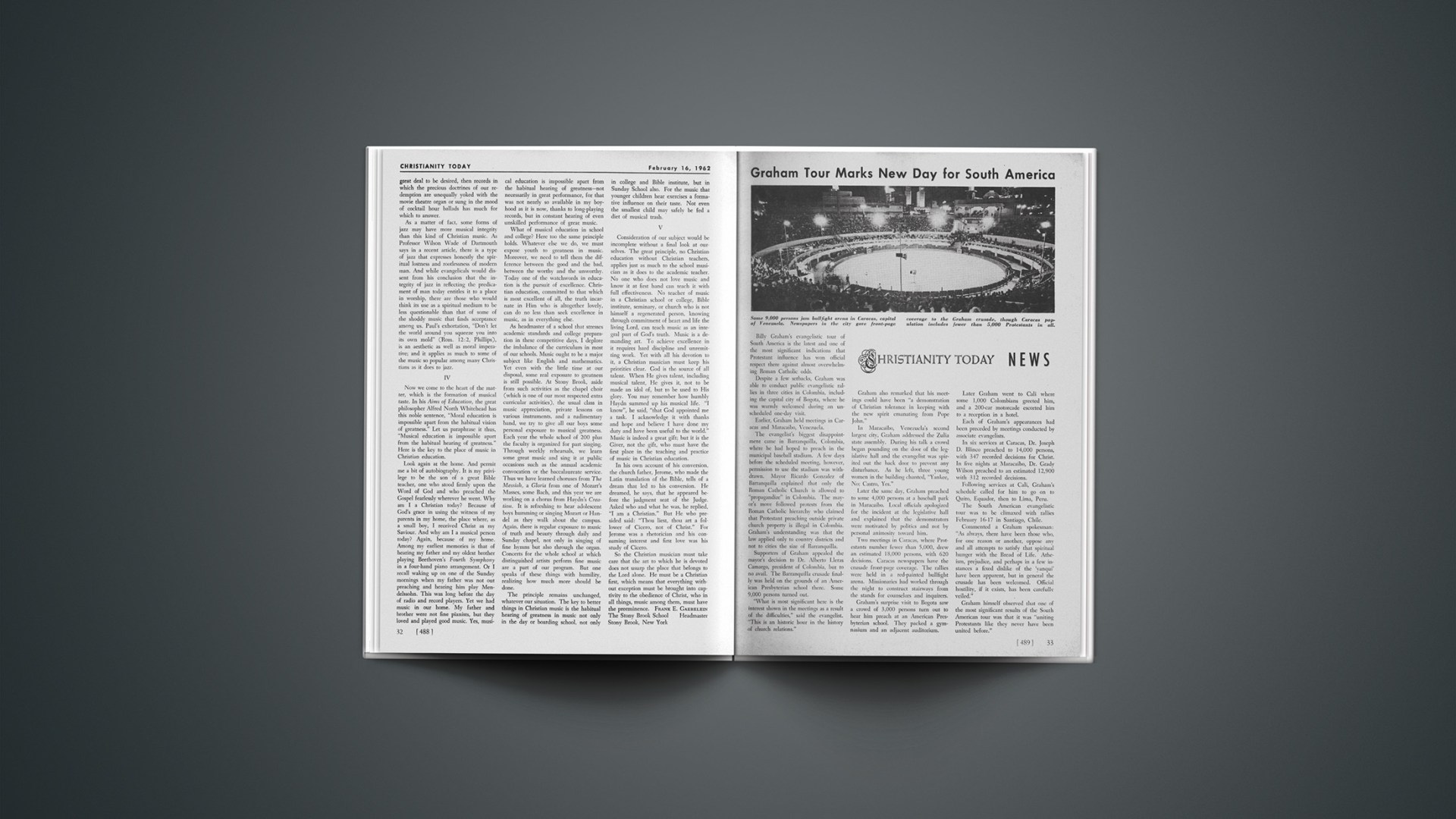
Two meetings in Caracas, where Protestants number fewer than 5,000, drew an estimated 18,000 persons, with 620 decisions. Caracas newspapers have the crusade front-page coverage. The rallies were held in a red-painted bullfight arena. Missionaries had worked through the night to construct stairways from the stands for counselors and inquirers.

Graham’s surprise visit to Bogota saw a crowd of 3,000 persons turn out to hear him preach at an American Presbyterian school. They packed a gymnasium and an adjacent auditorium.

Later Graham went to Cali where some 1,000 Colombians greeted him, and a 200-car motorcade escorted him to a reception in a hotel.

Each of Graham’s appearances had been preceded by meetings conducted by associate evangelists.

In six services at Caracas, Dr. Joseph D. Blinco preached to 14,000 persons, with 347 recorded decisions for Christ. In five nights at Maracaibo, Dr. Grady Wilson preached to an estimated 12,900 with 312 recorded decisions.

Following services at Cali, Graham’s schedule called for him to go on to Quito, Equador, then to Lima, Peru.

The South American evangelistic tour was to be climaxed with rallies February 16–17 in Santiago, Chile.

Commented a Graham spokesman: “As always, there have been those who, for one reason or another, oppose any and all attempts to satisfy that spiritual hunger with the Bread of Life. Atheism, prejudice, and perhaps in a few instances a fixed dislike of the ‘yanqui’ have been apparent, but in general the crusade has been welcomed. Official hostility, if it exists, has been carefully veiled.”

Graham himself observed that one of the most significant results of the South American tour was that it was “uniting Protestants like they never have been united before.

Iakovos Of Greece

In the 12 days he was in office as Primate of the Orthodox Church in Greece, Archbishop Iakovos saw develop about him a historic scandal.

The 66-year-old prelate was elected January 13, five days after the death of the predecessor, Archbishop Theoklitos. He won 33 of the 57 votes cast at a secret conclave of bishops.

A public furor ensued. A parish priest formally lodged a charge of “unmentionable acts” against the new primate, and within three days an ecclesiastical inquiry was ordered into his private life.

Archbishop Iakovos (no kin to the WCC president) resisted initial demands that he resign. Only after the government began drafting special legislation to force an abdication did he agree to step down “to avert state interference in church affairs.” By then he was under a doctor’s care.

Clear It With Wcc

A church design contest sponsored by the government of Denmark captured the fancy of many an architect around the world. Of the 192 entries collated at Copenhagen, more than half had originated in foreign countries. Judges chosen with the cooperation of international organizations of artists, architects, and sculptors gave the nod to a 29-year-old Norwegian, Helge Hjertholm, who has been working with a Danish architect. Hjertholm’s prize amounted to nearly $7,300.

Last month, not long after the winner was announced, a former Geneva employee of the World Council of Churches issued a complaining “news release” that looked for all the world like sour grapes. The sponsors of the competition, said the Rev. Harald P. Madsen, should have worked through the Lutheran World Federation and the World Council of Churches. Moreover, added Madsen, now associated with a cathedral in Copenhagen, “the decision about the submitted projects should have been made in Geneva.”

The Terror Belt

A British officer engaged in rescue work for the United Nations, Major Richard Lawson, reported at the end of January that all European Roman Catholic priests and nuns had been evacuated from the terror belt of northern Katansa.

Lawson is credited with the rescue of the Rev. JuleDarmont, sole survivor of the massacre of Roman Catholic priests at Kongolo (sec CHRISTIANITY TODAY News, February 2, 1962).

The U. N. announced, meanwhile, the capture of two Congolese officers and six privates who are charged with the Kongolo massacre on New Year’s Day.

Anglican Attitudes

“The devil’s advocates are so many and so great that I withdraw the prosecution,” said the Bishop of Birmingham at last month’s Canterbury Convocation.

The words of the Rt. Rev. John Leonard Wilson led to the rejection of a proposal to omit specific mention of the devil in the Church of England catechism. The wording was, however, abbreviated. “I should renounce the Devil and all his works,” said the original version, “the pomps and vanity of this wicked world and all the sinful lusts of the flesh.” Says the less colorful new version: “I would renounce the Devil and fight against evil.”

Both Canterbury Houses of Convocation registered majority votes in favor of communion with the proposed new United Churches of North India and Pakistan. This involves a merger of the Church of India, Burma and Pakistan (Anglican), Methodist Southern Asia Central Conference, British and Australian Methodist Churches, Church of the Brethren, Disciples of Christ, Council of Baptist Churches, and the present United Church of Northern India.

The Bishop of Winchester, the Rt. Rev. Falkner Allison, pointed out the urgency of Christian unity in view of a strong revival movement within Hinduism. At present, he said, the tiny Christian minority was tragically divided and its witness therefore disastrously weakened.

On the same issue the Lower House of Convocation at York voted 58–32 against immediate full communion. The Upper House, approving by a 5–4 vote a somewhat involved amendment, agreed essentially that the proposed United churches “would be true parts of the Church Universal.”

Though similar in many ways to the controversial Lanka plan, one significant difference is that the new merger involves two streams of episcopal succession, inasmuch as the Methodist Church in Southern Asia is also episcopal in polity.

The Canterbury Upper House declared itself unanimously against capital punishment. A resolution called for abolition or at least the complete suspension of capital punishment for five years.

The Rt. Rev. MervynStockwood, Bishop of Southwark, cited 14 countries and eight American states where capital punishment had been abolished or fallen into abeyance, pointed out that the debate had lasted 150 years, and expressed the hope that “we are in sight of the end.” “All we are asking the government to do,” he added, “is to write the final paragraph.”

This resolution will give strong support to a campaign which has been proceeding for some time, but responsible sources suggest that it is still too early to consider amendment in the legislation. A large-scale survey conducted for the London Daily Telegraph in 1948 showed that public opinion was overwhelmingly against any proposed experimental suspension of capital punishment.

J.D.D.

Malta Challenge

“DEATH TO SOCIALISM—VICTORY TO THE ROMAN CATHOLIC CHURCH!”

With this slogan placarded throughout Malta’s 95 square miles, the Roman church’s standard was raised in a holy war, with an eye to elections scheduled February 17–19. For the first time in 150 years of British rule, the Roman Catholic hierarchy faces a serious challenge to its domination of the island (population 325,000).

The Labor Party, implementing expressed aims to improve social conditions and to establish a proper division of power between church and state, has launched an attack on the church, while still professing adherence to Christian beliefs. To all suggestions of compromise the church has turned a face of flint. To read, buy, sell, distribute or advertise in Labor Party newspapers is decreed a mortal sin.

The Archbishop of Malta complained of the “biased picture of the situation … given in leading British newspapers and in a television film on the subject where the most important parts of what he had said in an interview had been omitted.”

The result is more in doubt than might be thought, for five other parties (all loyal to the church) are contesting the elections, the strongest of them being the right-wing Nationalists. Such has been the bitterness of the struggle that the main political issue—the question of Malta’s independence—has been overshadowed.

Victory, or even substantial support for the Labor Party could have far-reaching consequences in other Roman Catholic countries. That the Archbishop of Malta realizes this can be seen not only in the harsh sanctions he has ordered against the dissentients, but also in his insistence that “Malta repudiates and rejects with all force Socialism under whatever form,” purportedly based on a papal encvclical which states in effect that “no Catholic could subscribe even to moderate Socialism.”

J.D.D.

Patriarchs And The Pope

A proposal for placing the six Eastern Rite patriarchs next to the Roman Catholic pope in dignity and rank was made before a January session of the Central Preparatory Commission of the Second Vatican Council by Amleto Giovanni Cardinal Cicognani, Vatican Secretary of State.

This would mean, in effect, demoting the members of the College of Cardinals to third place in the ecclesiastical order of the Roman Catholic Church. However, there was no suggestion that the cardinals would lose their role as electors of new popes.

A Vatican Radio report on the commission’s session, held behind closed doors, said the 35 cardinals and other ecclesiastics present “examined the problem of the Oriental patriarchs, dwelling especially upon recognition, even on an external level, of their powers, their precedence and their dignity.”

“Their prestige,” the station added, “is linked to the historical character of their very ancient sees, many of which are of apostolic origins.”

Two of the Eastern Rite patriarchs are members of the Sacred College—Ignazio Cardinal Tappouni, Patriarch of Antioch in Syria; and Gregory Peter XV Cardinal Agagianian, Patriarch of Cilicia of the Armenians.

The others are: Coptic Patriarch Stephanos I Sidarouss of Alexandria, MeIchite Rite Patriarch Maximos IV Saigh of Antioch, Maronite Rite Patriarch Paul Meouchi of Antioch, and Chaldean Rite Patriarch Paul II Cheikho of Babylon.

There also are seven Latin Rite patriarchs, those of Antioch, Jerusalem, the West Indies, the East Indies, Lisbon, Venice, Constantinople, and Alexandria. Those of Constantinople, Antioch, and Alexandria are vacant.

The Jerusalem patriarchate has metropolitan jurisdiction over Palestine and Cyprus, but all the others are merely titular.

The Vatican stressed that Oriental rites “in no way interfere with the unity of the church, but confer upon its universality that multiplicity of aspects which reflects the universality of peoples.”

Also debated by the commission last month was the question of whether married laymen might be permitted to perform some of the duties now reserved for ordained priests, such as distribution of communion and preaching at mass. A major argument in favor of such an arrangement is that it would relieve overworked priests in areas where there is a shortage of them.

There has also been speculation over the possibility of allowing the priests themselves to marry. However, Vatican authorities are quoted as saying that such a proposal would be rejected by the Vatican council if it were ever to reach the floor.

The Church In Japan

Church membership among Protestants, Roman Catholics, and Orthodox in Japan reached a total of 727,445 last year. The figure represents about eight-tenths of one per cent of the entire Japanese population, now estimated at approximately 93,600,000.

The figures represent a net increase of less than 25,000 over the previous year—the smallest annual gain since the end of World War II. The statistics were reported by the Japanese-language Christian Year Book published by the Christian News.

Of last year’s total, Protestants number 403,846; Roman Catholics, 287,943, and Orthodox, 35,656. In addition, there are thousands of persons who belong to the so-called “non-church Christianity movement.”

According to the Japanese Institute of Statistical Mathematics, about three per cent of the population call themselves Christian.

Pluralistic Washington

Two prominent Japanese Baptist leaders paid an informal call on President Kennedy at the White House last month. The pair were the Rev. Toshio Miyoshi, dean of the Baptist Theological Seminary in Fukuoka, and Dr. Shiro Hirano, Baptist layman and director of the dental research program at the International Christian University.

Both were on a goodwill visit sponsored by the Southern Baptist Convention’s Foreign Mission Board and the Texas Convention. They were escorted to the White House by Vice President Lyndon B. Johnson and two leaders of the Texas Convention.

A few days later, Dr. Herschel H. Hobbs, president of the Southern Baptist Convention and pastor of the First Baptist Church of Oklahoma City, also called on the President at the White House.

Meanwhile, Ambassador H. E. W. Gopellawa of Ceylon announced that an 80-foot Buddhist statue would soon be built in Washington. He said the gold leaf-covered statue would be the focal point of an elaborate four-acre shrine.

Lutherans Explore Wider Unity

Not without considerable provocation is one apt to picture Martin Luther on the Atlantic City Boardwalk. But his descendants managed it very gracefully January 30-February 1, as leadership of roughly two-thirds of U. S. Lutheranism gathered in the New Jersey resort city for the 44th annual meeting of the National Lutheran Council. With most of the shops and concessions closed for the season, the boisterous, wintry ocean had recaptured the initiative, as the air of a ghost town was partially assumed.

But among the councillors hovered the hopeful expectancy they were trudging in the direction of the mother lode itself—ultimate unity of virtually all U. S. Lutheranism. They represented six church bodies numbering some five and a half million members. Merger had in recent months reduced the figure from eight bodies, and by next summer merger was expected to telescope the council components to two: the American Lutheran Church and the forthcoming Lutheran Church in America. But beyond this, the councillors envisaged the possible death of their historic council. There would be no pipes of mourning, for something much bigger was in view. Consultations with the 2,469,000-member Lutheran Church—Missouri Synod (which has cooperated only in certain phases of the council’s program) have vielded sufficient doctrinal consensus “to warrant further exploration regarding the possible establishment of an association of Lutheran churches in America for theological discussion and increased cooperation.” The council indicated its approval of such a move; the question remaining had to do with the theologically-conservative Missouri Synod’s response in its coming June convention. It seemed probable, said a Missourian, that the synod would authorize further exploration—the final decision would then be looked for in its 1965 convention. One of its spokesmen observed that the area of cooperation would be more limited than that of the National Lutheran Council and somewhat different. On the other hand, NLC Executive Director Dr. Paul C. Empie said the suggested principles for such a new agency would “bring a new dimension into previous relationships.” He noted that the NLC has functioned as a joint agency for cooperative work which does not affect the distinctive principles of the participating churches. Much Missouri Synod reluctance to participate, he said, has been based on the fact it regards “efforts for greater doctrinal consensus as primary, meriting high priority in the objectives of a joint agency.” In the proposed new association, “doctrinal study and cooperative activity would proceed simultaneously.”

Dramatizing these developments was the presence for one day of the Missouri Synod President, Dr. John W. Behnken. Behnken, who became the first Missouri president ever to address an NLC gathering, stressed the importance of biblical doctrine as basic to unity. Noting his “fervor and eloquence” Dr. Empie named Behnken “a towering figure of twentieth-century Lutheranism.”

Considerable interest was also displayed in the forthcoming series of conversations between representatives of Lutheran and Reformed churches which was scheduled to begin February 16 in New York. The conversations were described by one councillor as a continuation of the sixteenth-century Marburg Colloquy involving Luther and Zwingli.

While church unity was the dominant interest at the meeting, it was by no means the only one.

Peace Corps. The councillors commended its inauguration and “its announced policy of not approving churches and religious agencies as sponsors” of corps projects. It was recommended that qualified Lutherans be encouraged to participate in the program.

United Nations. Due to increasing pressures on the United Nations from those who have become impatient with its efforts, the council reaffirmed its 1951 “statement of confidence in the usefulness” of the U. N.

Federal aid to parochial schools. Dr. Robert E. Van Deusen, NLC Washington representative, called on Protestants to speak “intelligently and effectively” if they hope to prevent a basic change in the United States educational pattern. He spoke of the increased vigor in 1961 of Roman Catholic claims for federal aid to parochial schools and warned of a “concerted and powerful effort” yet to come. He proposed discussion on the subject between Protestant and Roman Catholic leaders.

The council elected Dr. Raymond M. Olsen of Minneapolis as president for a one-year term succeeding Dr. Norman A. Menter of Berkley, Michigan. The new president is stewardship director of the American Lutheran Church.

The tremendous Lutheran relief effort continued unabated. Apart from great quantities of food, clothing, and medicines, the council’s annual financial appeal to support a global program of emergency activities topped its 1961 goal by raising $4,179,476. The goal? $4,179,000.

F. F.

‘Voice Of The Gospel’

The Lutheran World Federation plans formal inauguration of its new 100,000-watt radio station in Ethiopia in February of 1963. The radio station facility is now under construction. It will cost more than $1,000,000 and will be referred to as the “Voice of the Gospel.”

Using a small one-kilowatt transmitter, the Lutheran station has been on the air since last October 30 with thrice-weekly experimental broadcasts to its major primary target areas in different parts of Africa, the Middle East and southern Asia.

Dr. Sigurd Aske, 47-year-old Norwegian director of the Lutheran World Federation Broadcasting Service, said the studio and administration building will be located in the Ethiopian capital city of Addis Ababa. This facility is expected to be complete by May 1. The antenna and transmitter site are being built some 19 miles outside the city.

Aske said Lutherans in four African countries are preparing to produce a steady flow of taped programs.

The Episcopalian

Should denominational periodicals be mere house organs or should they assert themselves with an element of independency?

The question has long been debated among religious journalists and church leaders. The current trend, according to Editor Henry L. McCorkle of The Episcopalian, runs counter to the tradition of “official denominational journalism.”

The latest development involves the relationship of McCorkle’s magazine to the church it serves. Until recently, it was published as a unit of the National Council of the Protestant Episcopal Church. Last September, however, the church’s governing body, the General Convention, voted to establish a separate corporation for The Episcopalian with the provision that it would be “independently edited.”

On January 30, the magazine’s editorial and business offices were moved from National Council headquarters in New York to new quarters in Philadelphia. McCorkle stresses, however, that content will continue to be “promotional” and that policy will be based on pronouncements and resolutions of the General Convention.

Neb Editions

Two new editions of The New English Bible: New Testament will be issued March 14. One will be a paperback and the other a pocket leather edition, and both will preserve the same text and page numbers as the original cloth copy.

The NEB New Testament, published jointly by Cambridge and Oxford University Presses, is now in its 18th printing in the American edition, with more than 750,000 copies already sold in the United States. Worldwide distribution of the Bible has been placed by the publishers at about 4,500,000. The appearance of the two editions March 14 will mark the first anniversary of publication.

Swamp-Wise Broadcasters

Delegates to the 19th annual convention of National Religious Broadcasters heard U. S. Sen. Karl Mundt, Republican from South Dakota, warn of the danger of this or any nation “wading into the swamps of censorship.”

Approximately 150 religious broadcasters gathered in Washington heard NRB President Eugene R. Bertermann remind them that “one of the basic purposes of the group is to preserve and maintain free … access to the airlanes” for the proclamation of the Gospel of Christ.

Citations were presented to FBI Director J. Edgar Hoover and Chairman Newton N. Minow of the Federal Communications Commission for leadership in their respective fields.

Minow’s citation expressed “sincere appreciation of the constructive contribution he has made toward the improvement and elevation of … programming.” Bertermann praised the FCC for “stating that it would not distinguish in its appraisal between sustaining and paid programs.”

He stressed that this development has been a historic one, establishing a new attitude toward religious programs presenting “unprecedented” opportunities.

“The call for closer attention to program excellence embraces also religious programming,” he said. He called the present period one of “unprecedented possibilities for the religious broadcaster.”

Minow was unable to address the convention as planned due to a conflict with network investigation hearings, but the FCC was represented by Commissioner Rosel H. Hyde, who played Minow’s theme song, saying that he fears “mass communications today are more characterized by abundance than by significance.”

B.B.

Protestant Panorama

• Two Southern presbyteries are calling on their General Assembly to suspend publication of the Layman’s Bible Commentary. Similar overtures adopted by the Central Mississippi Presbytery and the Asheville (North Carolina) Presbytery charge that the commentary published by John Knox Press of the Presbyterian Church in the U. S. is not consistent with the Westminster Confession of Faith.

• Observers from the Wisconsin Evangelical Lutheran Synod will be on hand for the triennial convention of the Lutheran Church—Missouri Synod in June. Word of the observer plan raised hopes that strained relations between the two synods might be relieved.

• North Carolina Baptists turned down an abandoned college campus which had been offered to them by the state’s Presbyterians. The North Carolina Baptist State Convention’s General Board already operates seven colleges. A committee report estimated that between $500,000 and $800,000 would be required to refurbish the old Flora Macdonald College at Red Springs. The Presbyterian Synod of North Carolina had offered to deed the campus plus $40,000 in assets at no cost.

• A resolution urging Congress to legislate the United Nations bond issue was adopted last month by the governing board of the National Council of American Baptist Women. The resolution which apparently purports to speak for all American Baptist women refers to the U. N. as “the world’s best hope for peace.”

• First recipient of the new Walter W. Van Kirk Award for Christian Statesmanship was Andrew W. Cordier, assistant secretary general of the United Nations. Cordier is an ordained minister of the Church of the Brethren, a pacifist denomination. He was honored at a luncheon in New York last month by the Department of International Affairs of the National Council of Churches, which inaugurated the award program.

All-Evangelical Congress?

It was almost an afterthought, casually introduced during a panel discussion at last month’s Evangelical Press Association convention in Springfield, Missouri:

What are the possibilities, asked editor Mel Larson of The Evangelical Beacon, for a world-wide All-Evangelical Congress in 1963 or 1964?

Added editor Larson: “The last 10 years have seen a decided breakthrough in far-reaching evangelical cooperation in literature, broadcasting, and evangelistic crusades.”

“It could well be that the Holy Spirit is moving evangelical believers together for a great unified thrust,” he said.

Larson’s modest suggestion is perhaps the first public proposal, although a number of evangelical leaders are known to be studying just such a possibility.

Some 150 delegates to the EPA convention also saw His, a monthly published by Inter-Varsity Christian Fellowship, honored as “Periodical of the Year.” Others cited in overall ratings were TEAM, Teach, Latin America Evangelist, Counselor, and Moody Monthly. Cited for individual features were the following: Herald of Holiness, best cover; Sunday Digest, best art; Moody Monthly, best photo feature and best fiction; The Free Methodist, best photo; Christian Heritage, best editorial; The King’s Business, best column; Brigade Venture, best article; CHRISTIANITY TODAY, best news story.

Wanted: More Evangelical Extroverts

“The first thing people think is that you’re some kind of nut.”

This is the way a spokesman describes initial reaction to a bold new plan for educating evangelicals to their responsibilities of citizenship. The ultimate hope: to see a dedicated Christian believer with a leadership role in each of the nation’s 166,000 political precincts.

To dispel notions of nuttiness, the organization known as Christian Citizen was officially unveiled this month amidst an abundance of literature neatly prepared, appropriately enough, in red, white, and blue.

Spearheading the drive are a pair of colorful extroverts. Gerri von Frellick, 45, now a wealthy architect and real estate developer in Denver, is Christian Citizen board chairman. His right-hand man has been a 29-year-old Southern Baptist evangelist, the Rev. Gene Edwards, whose Christian testimony got its biggest hearing in 1954 when he and his wife were married on TV’s “Bride and Groom.” Von Frellick, a Southern Baptist layman who was a Seabees officer during World War II, has thus far financed the project out of successful ventures in shopping center construction. Edwards, who at 18 graduated from East Texas State College then went on to study European history in Zurich before picking up a B. D. at Fort Worth, has already written a “Precinct Primer” for home study classes.

Von Frellick says the educational indoctrination will be confined to general principles of American Christian heritage and political mechanics. He insists that the non-profit corporation offices in Denver will espouse no particular political program or party. Belief in biblical infallibility and “a testimony of personal experience with Christ,” however, are prerequisites for affiliation.

Christian Citizen represents an unprecedented measure of evangelical initiative in the political arena. But will it work? Von Frellick says that eight of his pupils have already filed for this year’s Congressional race, but some observers are disappointed over von Frellick’s regional and state appointments, which reflect precious little political know-how and experience. Much will depend upon the caliber of Christian Citizen’s executive secretary, who is still to be chosen.

Foreign Policy Ethics

A survey of factors which shape U. S. foreign policy highlighted the third annual meeting of the American Society of Christian Social Ethics in Louisville, Kentucky, last month.

Dr. Ernest W. Lefever of the Institute for Defense Analyses emphasized that as a relatively young nation the United States is attempting to respond to conditions, many of which are not of her own making, in a manner which will combine political realism and public morality.

Lefever’s address dealt with the possibility of a “just war,” in the understanding of which the twin concepts of responsibility and right are guides.

Truth and the Arts: Music in Christian Education

What kind of music has a place in Christian education? What kind of music belongs in the school program, in the home, in the church, in the recreational life of Christians? The foundation upon which our thinking about the answers to these questions must rest is this: All truth is of God. Therefore, music that has integrity is part of God’s truth and belongs in Christian education. Truth is not confined to the spoken and written word and to such fields as mathematics and science; it relates to the arts also.

So we consider some implications, or variations, of the theme that music is a valid part of God’s all-embracing truth. Chief among them is the need for breaking down the misleading distinction between sacred and secular music. What, after all, is sacred music? Well, according to common practice, it is music linked either to religious words, or music-written for religious use. Thus there are Christians who, while suspicious of all so-called secular music as worldly, attend with clear conscience performances labelled sacred concerts in which a good deal of third-rate, sentimental music has been baptized, as it were, by association with Christian verse; or in which tawdry, tasteless hymn arrangements, false to any real musical integrity, are deemed religious.

But is the principle of sanctification by association a valid criterion for the distinction, so common in evangelicalism, between sacred or Christian and secular or worldly music? Certainly not. Rather the only defensible criterion of the fitness of music for service as a handmaid of the glorious truths of the Gospel is its own, inherent quality, provided that it meets first of all the test of truth.

II

“And what,” some one asks, “is truth in music?” Now it would be presumptuous to attempt anything like a comprehensive answer to this question. But we may at least point in the direction of an answer. Consider it negatively, first of all. Music that is pretentious, music that is vulgar, music that reeks with sentimentality, that shows off by resorting to empty, ear-tickling adornment—witness the so-called evangelistic style of piano playing—lacks integrity. As music it is not true, even though doctrinally it may keep the best of company.

Now what, postively considered, are some of the elements of truth in music? Are they not honesty of expression, sincerity in the sense of avoidance of the cheap and contrived? Surely also they include such elements as simplicity and directness. But on the other hand they do not rule out either complexity or sophistications as opposed to artless simplicity. Bach wrote some enormously complex music, yet there is no higher musical truth than his. Honesty and integrity in music are not confined to the simple and naïve.

In point of fact, there is a vast body of music that has truth and integrity, yet is not fitted for church use, although Christians may enjoy it, because it is part of God’s truth. For example, the Chopin polonaises or mazurkas, beautiful as they are, do not convey religious feeling. They have a place in the Christian’s enjoyment of music but not in church.

Is there, then, music that as music, quite apart from words or religious association, is compatible with spiritual worship? Surely, the answer is a clear “yes.” Music is not spiritual only by association. On the contrary, there is music that is innately uplifting in its appeal. To be sure, it cannot by itself convey doctrine and thus is not specifically sacred or Christian, but in its feeling and in its effect it is spiritually elevating.

Not all of Bach’s religious music was written for church use. Some of the preludes and fugues, such as the great E major Prelude and Fugue in Book II of “The Well-Tempered Clavichord,” are deeply spiritual. Unquestionably many of Beethoven’s slow movements, such as the wonderful Arietta and variations of the last piano sonata (Op. 111), speak with a transcendental, almost heavenly voice. To speak very personally, one of my abiding memories is that of listening after my father’s funeral to the Adagio of Beethoven’s Violin Concerto. The Scriptures had indeed given me their unique comfort, yet music also spoke its lesser and wordless language of comfort. Mendelssohn’s Reformation Symphony has its religious moments and not just because of the use of Ein’ Feste Burg. But the César Franck symphony without any such reference is also religious, even mystical, in spirit. The firm majesty of Handel, so compatible with faith, is not confined to The Messiah. Witness the universally familiar Largo which, though composed for secular use, has found such wide religious acceptance. Or take a piece like the brief Mendelssohn song without words, called Consolation, which we have in our hymnals under the name, Communion; or the Schumann Nachtstück, which we know as the hymn tune, Canonbury. Granted that personal taste enters into comments like these, still the point is clear that there is a wealth of absolute music that in itself is conducive to worship.

My own feeling is that more of this kind of absolute music should be used in our churches, not self-consciously but unobtrusively. The question may sound radical, but is the practice of always printing on our church calendars the names and composers of preludes and postludes and offertories a good thing? Certainly we desire to develop understanding of fine music. But a church service is not a course in music appreciation. We must be careful in reaching out for a higher level of Christian music that we do not foster what Don Hustad calls “spectatorism” in which the people look upon parts of the church musical service as a performance.

Consider an illustration from painting. A distinguished artist had finished a canvas of the Last Supper. All was done with great skill, and the chalice in particular had been portrayed most beautifully. As one after another of the artist’s friends looked at the painting, they said, “What a beautiful cup!” Then the artist realized that he had diverted attention from the Lord. Taking his brush, he painted out the gorgeous chalice and substituted for it a more quietly beautiful but far less obtrusive one. So should it be with music in worship. It should not call attention to itself nor monopolize the center of attraction that belongs to the Lord alone. And it may well be that the use, almost anonymously, of some first-rate music that, while unfamiliar, is in itself spiritual, will help the atmosphere of worship.

III

“But what about Gospel hymns? Must all of our church music be classical?” The questions come out of a chief point of tension in evangelical Protestant worship today. Surely the answer is that, when it comes to Gospel hymns and their more formal companions, it is not a matter of “either-or” but of “both-and.” For the criterion for Gospel music must be the truth just as the truth is the criterion for theology. Christians ought not to tolerate a double standard in worship—namely, zeal for the truth in doctrine and disregard of the truth in art.

God’s truth is wonderfully comprehensive. Some of the truest music ever written, music of greatest integrity, is folk music. Think, for example, of the nobility of some Negro spirituals. It is a mistake to confine truth in music to the classical, to the sophisticated, or to the old. Christians ought not be suspicious of music just because it is new or unfamiliar. Our respect for the classics must not obscure the fact that good music is being written in our time. And there are Gospel hymns—and the number is not inconsiderable—that in sincere, artless expression are honest music. They belong in our worship and education. Included among them are hymns like “What a Friend We have in Jesus,” “Blessed Assurance,” or “Saviour Like a Shepherd Lead Us,” a tune by the way, that Dvorak wove into the last movement of his Violincello Concerto.

One gets a little weary of extremists who say, “Away with Gospel music; it’s all trash”; or of those who say, “Away with all the older hymns; they’re all staid, doleful, and joyless.” The antitheses are false. Not all the old, standard hymns are staid and sombre; and even the best denominational hymnals contain some hymns of negligible value, that are hardly ever sung. As for classifying all Gospel music as trash, this is nothing less than obscurantism. It is more difficult to be thoughtfully discriminating than to fall back upon sweeping generalization. Nevertheless, discrimination according to the truth is the only responsible answer to the tension between Gospel hymns and standard hymns.

In point of fact, there is a far greater threat to the musical integrity of our evangelical worship and education than the Gospel hymn. This threat is the invasion of Christian music by certain techniques of the entertainment world. With the almost universal use of TV, radio, and record players, the primary, God-ordained center of education, the home, has been infiltrated by the musical devices of Hollywood and the night club. What does the habitual use of such music do in a home? The plain answer is that it debases taste and cheapens the Gospel. Whoever wrote the editorial in the September 16, 1961, issue of the Sunday School Times was absolutely right in his slashing attack upon the dressing up of Gospel melodies in the garments of show business. If the state of music among evangelicals leaves a great deal to be desired, then records in which the precious doctrines of our redemption are unequally yoked with the movie theatre organ or sung in the mood of cocktail hour ballads has much for which to answer.

As a matter of fact, some forms of jazz may have more musical integrity than this kind of Christian music. As Professor Wilson Wade of Dartmouth says in a recent article, there is a type of jazz that expresses honestly the spiritual lostness and rootlessness of modern man. And while evangelicals would dissent from his conclusion that the integrity of jazz in reflecting the predicament of man today entitles it to a place in worship, there are those who would think its use as a spiritual medium to be less questionable than that of some of the shoddy music that finds acceptance among us. Paul’s exhortation, “Don’t let the world around you squeeze you into its own mold” (Rom. 12:2, Phillips), is an aesthetic as well as moral imperative; and it applies as much to some of the music so popular among many Christians as it does to jazz.

IV

Now we come to the heart of the matter, which is the formation of musical taste. In his Aims of Education, the great philosopher Alfred North Whitehead has this noble sentence, “Moral education is impossible apart from the habitual vision of greatness.” Let us paraphrase it thus, “Musical education is impossible apart from the habitual hearing of greatness.” Here is the key to the place of music in Christian education.

Look again at the home. And permit me a bit of autobiography. It is my privilege to be the son of a great Bible teacher, one who stood firmly upon the Word of God and who preached the Gospel fearlessly wherever he went. Why am I a Christian today? Because of God’s grace in using the witness of my parents in my home, the place where, as a small boy, I received Christ as my Saviour. And why am I a musical person today? Again, because of my home. Among my earliest memories is that of hearing my father and my oldest brother playing Beethoven’s Fourth Symphony in a four-hand piano arrangement. Or I recall waking up on one of the Sunday mornings when my father was not out preaching and hearing him play Mendelssohn. This was long before the day of radio and record players. Yet we had music in our home. My father and brother were not fine pianists, but they loved and played good music. Yes, musical education is impossible apart from the habitual hearing of greatness—not necessarily in great performance, for that was not nearly so available in my boyhood as it is now, thanks to long-playing records, but in constant hearing of even unskilled performance of great music.

What of musical education in school and college? Here too the same principle holds. Whatever else we do, we must expose youth to greatness in music. Moreover, we need to tell them the difference between the good and the bad, between the worthy and the unworthy. Today one of the watchwords in education is the pursuit of excellence. Christian education, committed to that which is most excellent of all, the truth incarnate in Him who is altogether lovely, can do no less than seek excellence in music, as in everything else.

As headmaster of a school that stresses academic standards and college preparation in these competitive days, I deplore the imbalance of the curriculum in most of our schools. Music ought to be a major subject like English and mathematics. Yet even with the little time at our disposal, some real exposure to greatness is still possible. At Stony Brook, aside from such activities as the chapel choir (which is one of our most respected extra curricular activities), the usual class in music appreciation, private lessons on various instruments, and a rudimentary band, we try to give all our boys some personal exposure to musical greatness. Each year the whole school of 200 plus the faculty is organized for part singing. Through weekly rehearsals, we learn some great music and sing it at public occasions such as the annual academic convocation or the baccalaureate service. Thus we have learned choruses from The Messiah, a Gloria from one of Mozart’s Masses, some Bach, and this year we are working on a chorus from Haydn’s Creation. It is refreshing to hear adolescent boys humming or singing Mozart or Handel as they walk about the campus. Again, there is regular exposure to music of truth and beauty through daily and Sunday chapel, not only in singing of fine hymns but also through the organ. Concerts for the whole school at which distinguished artists perform fine music are a part of our program. But one speaks of these things with humility, realizing how much more should be done.

The principle remains unchanged, whatever our situation. The key to better things in Christian music is the habitual hearing of greatness in music not only in the day or boarding school, not only in college and Bible institute, but in Sunday School also. For the music that younger children hear exercises a formative influence on their taste. Not even the smallest child may safely be fed a diet of musical trash.

V

Consideration of our subject would be incomplete without a final look at ourselves. The great principle, no Christian education without Christian teachers, applies just as much to the school musician as it does to the academic teacher. No one who does not love music and know it at first hand can teach it with full effectiveness. No teacher of music in a Christian school or college, Bible institute, seminary, or church who is not himself a regenerated person, knowing through commitment of heart and life the living Lord, can teach music as an integral part of God’s truth. Music is a demanding art. To achieve excellence in it requires hard discipline and unremitting work. Yet with all his devotion to it, a Christian musician must keep his priorities clear. God is the source of all talent. When He gives talent, including musical talent, He gives it, not to be made an idol of, but to be used to His glory. You may remember how humbly Haydn summed up his musical life. “I know”, he said, “that God appointed me a task. I acknowledge it with thanks and hope and believe I have done my duty and have been useful to the world.” Music is indeed a great gift; but it is the Giver, not the gift, who must have the first place in the teaching and practice of music in Christian education.

In his own account of his conversion, the church father, Jerome, who made the Latin translation of the Bible, tells of a dream that led to his conversion. He dreamed, he says, that he appeared before the judgment seat of the Judge. Asked who and what he was, he replied, “I am a Christian.” But He who presided said: “Thou liest, thou art a follower of Cicero, not of Christ.” For Jerome was a rhetorician and his consuming interest and first love was his study of Cicero.

So the Christian musician must take care that the art to which he is devoted does not usurp the place that belongs to the Lord alone. He must be a Christian first, which means that everything without exception must be brought into captivity to the obedience of Christ, who in all things, music among them, must have the preeminence.

FRANK E. GAEBELEIN

The Stony Brook School Headmaster

Stony Brook, New York

Ideas

A God without a Future

Bible characters evidently produce good box office receipts in New York theaters. A couple of playwrights, MacLeish and Chayefsky, have put ancient Job and Gideon on the stage with marked success. Though at many points these stage impersonations may have small resemblance to the old seers, they have drawn good audiences and have gotten large write-ups from the critics.

Some of the latter have noted that in both Gideon and J. B. it is indicated that man has outgrown God morally and is pushing ahead toward perfection, leaving the Most High to His outmoded ethics. In Gideon we have the Lord saying that man has ambitions to be a “proper god,” and admitting that the time might come when he would arrive at that status.

Playwrights alone may not reflect this view, but it can be discovered in some theological quarters. Man isn’t satisfied with the biblical God. This God, somehow, doesn’t come up to man’s high expectations. He isn’t good enough, or intelligent enough. Man must be off on his eager quest for something better—through self-expression, self-approval, and self-glorification. Man is evolving toward loftier levels; and God is stuck in the old rut.

This fierce quest may lend stuff out of which successful plays are made; but it turns out, in the actual movement of history, to be a grim joke. Man’s freedom from the “old” God has not helped him. Morally he doesn’t seem to be improving too much, nor has he gained freedom. Moreover he’s terribly scared. He’s frantically digging holes in the ground to hide in. He is turning caveman in the midst of all his automation.

Patently this would-be god has intellectuality. But what does it get him? He is still a killer. Once, in his ignorance, he killed with spears and arrows; now, with his mighty wisdom, he slays with nuclear thunderbolts. He is a dustbound god, a creator trapped by creature instincts. He has power. He is mightier than Thor with his hammer. His rockets ride their fire-shafts into the heavens. His atomic gadgets cause proud cities to tremble. But he is like the man in the Hebrew proverb who has taken a town, but cannot rule his own spirit.

His evolution into a “proper” godhood has not made him happy. It has made him rather miserable. Catching the news-reports about him and his goings-on, we are tempted to think that he walks in great despair. He appears to have a genius for producing woe, generating fear, and building doom. With all his creativity he seems incapable of making a heaven; all he can make is a hell. Could it be that he is evolving toward evil rather than toward good? Is he becoming a god—or a devil?

It’s rather interesting to look into the first book of the Bible and find Satan promising man that if he broke off with God he himself could become a god! So man made the break. Ever since it seems be has been trying to see that Satan fulfills his pledge. He is not satisfied to be a creature; he must be a creator. He must rise from humanity to deity. And he does not seem aware that the thing that urges him on in his sacrilegious quest is that out of which all evil springs—human pride.

A Judean seer in a Babylonian concentration camp by the Chebar River once delivered a warning to a Tyrian prince: “You are proud of heart, thinking that you are a god, in a god’s seat … when you are no god but a man.” The prince’s godhood is doomed; his days are numbered. Enemies are stirring the dust in invasion. “A violent death shall you die, there by the deep. Will you still say, before your murderer, ‘I am a god? To your murderer you are no god, but a mortal!… Your brilliance depraved your wisdom … your fate is awful, there is no future for you” (Ezek. 28, Moffat).

Long ago it was written on a Christian document that the chief end of man was to glorify God. Have we outgrown Him sufficiently to cancel that ideal? Somewhere we took a wrong turn; we departed from among “the flashing thunderstones.” Perhaps we need another prophet to tell us what the Tyrian ruler was told. For it is ironical that we who have not made a good earth should try to make a heaven.

Man is no nearer godhood than was the top of the Babel-tower to God’s throne. We are not creators now more than when God asked Job out of the whirlwind: “Where were you when I laid the foundations of the earth?” (Job 39:4, American Translation). We have got too big for our human destiny. It is better that we take Jesus’ advice and become as children again. We have never given a good performance in the role of God. That way lies night. The act is not only blasphemous, it is ridiculous. All our ambitious histrionics does not even produce comedy; it is cheap slapstick that shall end in cosmic tragedy. We had better ring down the curtain on the brave idiotic farce; there is no future for us in it.

Be Wary Of Federal Loans And Grants To Church Colleges

Two proposals that would provide federal loans for higher education facilities involve church-state issues far more deeply than appears on the surface.

A candid word should be said about Senate Bill 1241, the proposed College Academic Facilities and Scholarship Act, and House Bill 8900, the College Academic Facilities Act. It is quite apparent that both in committee hearings and on the floor Congressmen seem reluctant to investigate and to debate church-state implications of this pending legislation. These bills would authorize a five-year loan program (repayable within 50 years at 3½ per cent interest) to public and private four-year colleges. The Senate bill would provide $1.5 billion in federal loans for public community junior colleges. The House bill offers $600 million in loans to finance up to three-fourths the cost of any eligible project including junior colleges and provides an additional $900 million in matching grants to both public and private colleges (old and new) under a five-year program. The Senate bill would apply to the construction of any academic facilities except buildings involving an admissions charge to the public. The House bill applies to all construction except gymnasiums and recreation facilities, buildings that involve an admissions charge, or those used for sectarian teaching, places of worship, or divinity schools.

It is thought unlikely that a bill providing grants to both church-related and public institutions of higher learning can be pushed through Congress unmodified. But sentiment is being rallied for federal loans to both public and private colleges for buildings supposedly devoted to “nonsectarian” purposes. House Speaker John McCormack does not favor federal grants to denominational colleges, but he thinks federal loans should be made available to Roman Catholic institutions and other denominational colleges. Some Protestants have indicated that no pressures exist in their denominational ranks for such loans, and that they do not regard the non-provision of these loans as discriminatory. Unless it provides too little, the loan proposal will have the support of the Roman Catholic hierarchy.

Three comments should be made at once on this mounting propaganda for federal funds to church related institutions. First: when dealing with a sectarian campus, one can find no valid criteria for distinguishing sectarian aspects (ineligible for federal funds) and nonsectarian aspects (supposedly eligible for federal funds). Even the dormitory of a church-related college cannot be viewed as nonsectarian—unless its erection with federal funds gives those of other religious persuasions access on an equal basis to freely propagate their contrary views. Second: some religious bodies will be delighted to build dormitories and other (supposedly nonsectarian) facilities of their church-related colleges with federal funds provided by the taxpayers. They can then deploy ecclesiastical funds to erect additional buildings more directly related to the indoctrination process. In this way federal funds become an indirect subsidy for sectarian purposes. The third observation is this: since the Constitution makes no distinction between higher and lower education, whatever is constitutional for higher education is therefore constitutional for lower education as well. The more American politicians allow the pressures of sectarian groups to influence their voting in respect to the use of federal funds, the more they will find themselves embarrassed by unhappy precedents.

CHRISTIANITY TODAY has previously stated its concern over the growing intrusion of the government complex into education. Those who brush aside the dangers of enlarging federal control tend to represent that segment of political leadership which is gratified by the growth of big government on the American scene. Such leadership presumably would be unperturbed were this process of the past 30 years to continue its direction and momentum for yet another generation. From this perspective the issue is not merely a Protestant-Catholic issue; spokesmen from both traditions have expressed concern about secular government pressures on education. We are convinced that the best way to cancel the political and religious compromises involved in school legislation is to take the Constitution seriously both in the specific matter of church-state relations and, beyond that, in its wider concerns for limited government.

American educators need be wary of the effect of federal loans bringing the church into involvements with the government over a long period of years. Not only is it possible, but recent history shows that it is probable, that controls not presently existing will be set up over such a period. Abuses of one kind or another provide either the context or the pretext for additionally legislated political controls.

The Twist: A Portent For Western Culture

There seems to be a continuing compulsion on otherwise respectable television shows to call for a demonstration of the Twist, latest dance craze. Done amid guffaws, it reminds us that many a sin is tossed off with a laugh. The dance is well named if it refers to twisted moral and aesthetic standards as well as to physical contortions.

Christianity has often banished pagan lewdness from the streets to have it reenter as a night club import from a far-off jungle. But now television often beams the imports into the home. One TV personality found the Twist reminiscent of a fertility dance. Another noted the serious intensity of participants and the apparent lack of enjoyment.

Apart from physicians’ warnings to those over 40, some observers have somberly spoken of soul sickness and see in the Twist a symptom of our culture crisis. Can it possibly be that in the writhing of the dance one can see reflected a convulsion of Western civilization? Is it yet another warning rumble of Vesuvius? a sign of internal crumbling while the Goths batter at the gates?

Absurd fancies? Such dances are always followed by something worse anyway. And yet, is it true there’s always a last time? There was that movie about the last days of Pompeii.…

Wanted: End To Work And Guaranteed Annual Wage?

The 9,000 electrical workers in New York have long enjoyed a 30-hour workweek and a guarantee of overtime even during a building boom demanding extra helpers. For almost 30 years their six-hour day has been union-blessed.

While President Kennedy and AFL-CIO bosses were communicating about labor’s self-restraint on wages to match industry’s self-restraint on prices, the electrical construction workers demanded a four-hour day. They won a new union contract for a five-hour day, twenty-five-hour week, at almost the same pay as before. The Kennedy administration did not intervene.

Simply stated, the objective was less work and improved pay, a program that could lead, as the New York Herald Tribune commented, “to the point of no hours at all and yet a guaranteed wage.”

The President And Rising Pressures For Special Favors To Catholics

Protestant spokesmen rightly commend the President’s refusal to bow to last year’s demand by the Roman Catholic hierarchy for federal aid to parochial schools. His avoidance of a repetition of President Roosevelt’s ill-advised appointment of a personal representative to the Vatican is also commendable. But the Christian Century’s judgment of his presidential record on church-state separation as “better” than that of “any other President … in the past 30 years” on the basis simply of Mr. Kennedy’s first year in office is starry-eyed.

The national Catholic magazine America complains that Mr. Kennedy has avoided public contacts with Catholic dignitaries and has “bent over backwards” to please Protestants. But we recall that Cardinal Cushing’s inauguration prayer got enough television network mileage to cover a full term’s presidential publicity for the hierarchy!

For the moment we don’t think Mr. Kennedy is genuflecting either forwards or backwards. On the parochial school and Vatican issues he is simply following the church-state course expected of an American president. The firmness of his stand here and on other church-state questions is yet to be tested. One significant test will come, should President Kennedy get a Congress-approved bill providing federal funds to church-related schools. His veto of such a bill would decisively answer those skeptics who regard Mr. Kennedy’s emphasis on the unconstitutionally of federal aid to parochial schools as a temporary political stratagem. Even Catholic critics who charge him with political motivation and lack of courage will then have their answer.

28: Regeneration

The New Testament idea of God’s begetting, which has anticipations in the Qumran sect and in the baptismal movements of the Jordan area, incorporates a familiar Jewish term. John 3:3, 7, for example, speaks of begetting “from above” (thus paraphrasing the name of God which the Jews piously avoided). Christians of the Johannine type believed that thereby the living God himself had entered into history, had encountered man in his innermost being, and had recreated him. This concept, which neither orthodox Jews nor Gnostics could understand, is a unique feature of Christianity.

By repeating the initial word Jesus gives special significance to his statement in John 3:3: “Amen, amen, I say to you; unless one is begotten from above, he cannot see the kingdom of God.” Jesus is here demanding from Nicodemus a thoroughgoing change of life, a “turning around,” as the precondition of seeing the kingdom of God—the very thing that Nicodemus, the teacher of Israel, found it difficult to do.

According to John 3:5, a second “amen” word, God’s begetting is effected by water and spirit, that is, by baptism and a true understanding of God. John attaches most weight to the gift of the Spirit which brought enlightenment and understanding.

Mysticism, philosophy and sacramental traditions have always misunderstood the mystery of the Spirit of God, and we should not allow ourselves to be guided by them. Jesus himself shows what is meant, for he is the one who actually possessed the Spirit, was conceived by it, lived in its power, and by it was made perfect. Thus the Johannine proclamation of God’s begetting is exclusively centered in Jesus Christ. John shows how life led by the power of the Spirit is life lived in simple obedience to the word of the Father (John 4:34)—the way of faith, love, righteousness and of turning from evil.

The full implication of the Johannine position is seen when compared with that of the Teacher of Righteousness who had previously established in Qumran a religious community which set itself off sharply against its environment. Here the disciples of Jesus remain in the profane world without being able to protect themselves, but sustained by an invisible reality and by their communion with God. God’s begetting in John is related to the apostolic idea of “re-begetting” which appears in a hellenistic tradition. There is the same emphasis on a new beginning: “Blessed be the God … who … begat us again unto a living hope by the resurrection of Jesus Christ from the dead” (1 Pet. 1:3; cf. 1:23).

Here apparently is a vivid picture which had its setting in Christian baptism and depicts the salvation which, granted to the Church by the Word, can set the individual and the Church in a new existence. The latter is, however, secondary to the Word and to the salvation which determine it. Easter is now presupposed. The Church is sheltered by its steadfast faith in the Resurrection of Jesus Christ.

But the Church must not declare the Word and the salvation otherwise than it occurred within the scope of the apostolic tradition. The language may vary, the course of history may require other forms of expressing the proclamation, but the power of the Spirit remains to preserve the historic ground of revelation from false claims and dangerous reconstructions. The preservation of the new existence is at stake. In New Testament times the Church was still neither old nor worldly.

The Pauline conception of salvation as justification presupposes that the sinner is pardoned. With that promise God created a new cosmic situation for mankind. But Paul accepted also the principle: “Therefore, if any one is in Christ, he is a new creation …” (2 Cor. 5:17)—a sentence with a doxological note.

The concept of God’s begetting in the thought of John, however, is the strongest wav to emphasize the spiritual source, power and objective of the Christian status, and to delimit it from other possibilities, for the two opposites—begetting by God and descent from the devil—are possible, and run right through the middle of the Church. The individual’s attitude toward sin determines his position (1 John 3:4–12). Thus the Church is not closed off from the evil one: it must prove itself in and through struggle to be “children of the light.” Thus Johannine thought presupposes a tremendous power within the Church to detach itself from everything contrary to the Spirit of God, not in order to disengage the Church from the world (Bultmann), but to testify to the Spirit of God in the decisions of earthly life.

While justification tends to stress the solidarity of men under the Cross, and to praise exclusively the grace of God, God’s begetting underscores the contrast between spirit and flesh. That finally only God himself can distinguish the “children of light” from the “children of darkness” is basic to the New Testament.

The Development of the Dogmatic Tradition. For Martin Luther the center of the New Testament was justification; upon it the preaching of the Gospel converged; by it was shaped the life of the Church. Rebirth was nothing other than this very justification. In Jesus’ conversation with Nicodemus, said Luther, He imposed no new law upon men—his concern was that man should become new.

Fundamentally the various Lutheran creeds rest upon these insights of Luther. It is notable, however, that the Formula of Concord admits another view which extends rebirth beyond justification to include the renewal subsequently worked by the Holy Spirit in those justified by faith. Thus rebirth is conceived as a consequence of justification.

That brings with it the danger of subjectivizing the concept of rebirth until it no longer describes the act of God upon man, but rather what happens in man. The question then rises whether one can take seriously the close relation of rebirth and justification in Titus 3:5 f. Some scholars, considering that the grace in baptism must be something other than the grace in justification, seek a way to reinterpret it sacramentally—a dangerous step dictated by practical exigency, but fraught with difficulty. Even those movements which want to help the Church, such as Pietism, shift the main importance from justification to conversion and rebirth—a shift evident also in the theology of Erlangen.

The creeds of the Reformed church are less troubled by these problems. In them the development of faith in man stood from the beginning more In the center of dogmatic consideration. In view of concern, moreover, to make divine election certain, rebirth helps in the understanding of salvation. Further, the justification of Jesus Christ is imparted to an individual. Thus both rebirth and justification are interdependent corollaries. Methodism, with its insistence on an authentic experience of conversion and rebirth, is nearer to the Reformed than to the Lutheran tradition.

However, in nineteenth-century Lutheranism the question of the assurance of faith took on theological urgency. Upon my answer to the question, Have I been born again?, depends the confidence with which I may call myself a Christian. When doubt assails, says Frank, a man can appeal to the experience of his rebirth. His new “ego” finds assurance within his own self.

Again and again voices have registered their misgivings about subjectivizing faith, and have recalled the Church to the objectivity of God’s saving acts in history. But their concept of objectivity often hurried too quickly over unrest arising from re-thought of theological statements, from scientific and philosophical knowledge, and from life’s own problems with faith, and is to be regarded with as much reservation as the struggle of pious people for subjective assurance.

In the apostolic message God’s begetting, rebirth and the new creation were referred hack to a “turning around” and to the gift of the Spirit of God. But these doctrines were largely left out of consideration in the development of dogmatic theology and of church history. Fear of enthusiastic fanaticism was a restraining factor from the outset of the Reformation, and only after revival movements accentuating conversion and the gift of the Holy Spirit let a new sense of reality break forth, were these decisive concepts of the Bible grasped anew.

J. T. Beck of Tubingen renewed interest in such biblical concepts as repentance, conversion, rebirth and justification. He stressed the new creation of man, and spoke of reception of and begetting by the Spirit. A man does not get a new soul in rebirth; his soul is recreated by the Spirit. Philosophical motives dominated for the most part in Beck’s day, but he relied on the Bible and tried to relate its individual themes to the total picture. He knew that a coherent view of biblical grace was represented in every biblical concept.

Emil Brunner, of the dialectical theology school, emphasizes that the picture of the new creation can be understood only in terms of revelation and of faith. Of himself man suffers from “sickness unto death” (Kierkegaard). Sinful nature leads to despair, but sin and despair are in the last analysis the same, for we suffer from an inner contradiction which none but the Creator can overcome.

The different views of Protestant theologians show the confusion of method in which we find ourselves. We see fundamentally that only where biblical statements are acknowledged is rebirth given earnest consideration. Reformation theology has tended to push justification into the foreground and to append rebirth to it, but this distracts from the significance of Johannine theology which speaks deliberately and insistently of God’s begetting. Seldom is the revolutionary power in the contradiction between spirit and flesh, between child of God and child of the devil, even taken seriously.

We should have the courage to separate justification and God’s begetting, as they originally were, and to let each achieve its full significance apart from the other. Their forced and false association has hurt both.

New Reflection of the Present. Rabbinical-Jewish existence is represented by instruction, law and circumcision; primitive-Christian and Johannine existence, on the other hand, was characterized by the action of the Word at the end of time which disclosed itself in “water and spirit.

While justification puts grace and forgiveness in the foreground, the connection of water and spirit expresses the power of God which penetrates into this world of conflicting forces. That occurred primarily in Jesus himself who was declared by the voice of God to be begotten of God (cf. Ps. 2:7; Mark 1:11). Jesus’ begetting by God sustained his life and constituted his messianic mission. The begotten one of God represented the concealed and future Messiah of Israel. For us also, to be called of Jesus assigns us a destiny which we must lay hold of and follow through.

In the process the individual is not left to himself and not merely referred back to the word of the Law of Israel, but is put under the impact of the Word which occurred in the fullness of times.

Of course, God’s begetting makes a historical start. It may pass through the most varied crises and be threatened with death. Yet it is empowered and sustained of God so that it can penetrate through weakness and defeat and everything that would hinder or obstruct its way.

The difficulty within theology lies in the fact that with rebirth one tends to concentrate upon the arrival of life, when the New Testament speaks of the Holy Spirit as the power of God which must make its way. The doctrine of justification cannot, therefore, substitute for the tradition of God’s begetting, but the relation is one of healthy tension rather than of contradiction.

Unfortunately the Christian church has lost the sense of God’s begetting in favor of rebirth as an experience happening arbitrarily and psychologically: that misunderstands the major stress in the biblical concept. Perhaps the idea of sexuality connected with begetting is offensive to many a person, but this is an essential element of the Bible—it takes us back as nothing else can to the ground and process of life.

The concept of God’s begetting stands as a radical rejection of every philosophical devaluation of the idea of God. God creates and effects reality, is not that reality itself, nor is he subordinated to it, as existential theology affirms (Tillich, Fuchs). We should not capitulate to such theology which subordinates the message of the Bible to philosophical theories, but rather examine existential contentions in terms of the Bible.

The Johannine statements concerning God’s begetting are intended to make us as Christians strong over against all that is natural and worldly, and that does not submit itself to the claim of God. They are intended to enlighten us in opposition to those theological streams which no longer live from God, but direct their attention to the existence of pious or impious men. For God is the actual center of theology, upon whom everything depends. He is not a term for that which lies beyond human limitations, or a description of human transcendence (Bultmann).

Here we reach the sorest point in the whole of the present discussion, and one which inevitably confronts us with the question, Do we still believe in a creating and begetting God?

Bibliography: O. Michel, “Von GottGezeugt,” in Festschrift für Joachim Jeremias; K. Barth, Die Lehre von der Versöhnung (Die Kirchliche Dogmatik, IV); J. T. Beck, Vorlesungen über christliche Ethik, I; E. Brunner, Die christliche Lehre von der Kirche vom Glauben und von der Vollendung (Dogmatic, III).

Professor of New Testament

University of Tubingen

Germany

The Christian’s Assets

There is a song, no longer popular, which is titled “Count Your Many Blessings.” It expresses the riches of grace in Jesus Christ, something often forgotten by Christians, who should ponder and give thanks for this blessed gift.

Some time during each year business firms take inventory. Let each Christian begin every day thinking of some of the blessings God has showered upon him, and thanking Him for them, and the entire day can be changed for good.

What are some of the fixed assets of the Christian, real but not always recognized? Constant but often not appropriated? Available but not used?

It is impossible to name these things in a fixed sequence for they are gems of many facets, composite entities consisting of, permeated by, and emanating from Christ, the author and finisher of our faith, the captain of our salvation, the One who is altogether lovely and to be loved.

Certainly we thank God first of all for his Son, the revealer of the Father. We are told that he is the “heir of all things, by whom also he [God] made the worlds; who being the brightness of his glory, and the express image of his person, … upholding all things by the word of his power.”

Through faith this Christ is ours, and by him we have become sons of God, members of the household of faith. Our family status has been changed for we are now heirs of God and joint heirs with his Son. Our destination has been changed for once we were without God and without hope but now we know that we have eternal life.

All of these are a part of the Christian’s assets and they are reason for praise to well up in our hearts for the One who has given us all things freely to enjoy. “All this and Heaven too” is more than a trite saying—it is a fact.

Not only do we know God through the revelation of His Son but we have this knowledge and appropriate its blessings through the presence and help of the Holy Spirit.

Our supreme asset therefore is God the Father; His Son, our Saviour; and the Holy Spirit, the Comforter who dwells in our hearts and interprets the things of Christ to us.

The inventory of God’s blessings is so great that it can never be understood in full, much less exhausted. But two assets, open and free to all, are the open Bible and the privilege and power of prayer.

It is through the Bible that we learn spiritual truths to be found in no other place. Only through the Scriptures do we know those intimate details of Christ, His Person and His work. In this connection we must carefully guard this revelation having to do with our Lord lest we be led to follow a false Christ, not the one revealed in His Word.

The Bible is an inexhaustible mine of knowledge, inspiration and blessing. Let it speak to us through its Author, the Holy Spirit, and it becomes a Living Book, relevant to our every need, a lamp to our feet and a light to our path.

The inexhaustible blessings of the Bible are ours to appropriate. Its truths are like gold to be mined, gems to be polished. True wisdom flows from its pages and only in this book is to be found the true perspective of life and death, this world and the next, sin and righteousness, Satan’s malignant work and God’s redemptive love.

Another asset of the Christian is security for now and for eternity. Many do not realize it but even economic security is promised to those who put the Kingdom of God and his righteousness first. Then there is the glorious security which the children of God enjoy—we have eternal life right now and all the demons of hell cannot take this blessed fact from us. We know whose we are, where we stand, and where we are going.

Too few of us have ever learned the grace of thanksgiving as we should. We leave it to some of our supposedly more emotional brethren to shout, “Hallelujah” or “Praise the Lord,” but such should be the attitude of all of our hearts, whether expressed vocally or not.

Companionship is an asset of the Christian, for the living Christ dwells in his heart and the attitude of constant communication should be practiced and enjoyed.

From this relationship there comes the untold privilege of guidance. It is not for nought that the writer of the Proverbs tells us that if we acknowledge God in all of our ways he will direct our paths. We who are Christians have as our Father the God of the past, the present and the future; the God of human history and the God of eternity. That we can turn with confidence to this One who is omnipotent and omniscient, and have Him take over and guide us, is an asset so precious that the very thought of it should thrill us.

Prayer. God has placed in the hands of his children a privilege and a power none of us fully realizes. The Christian can come into the presence of the Sovereign God in and through the name of His Son, and when praying in accordance with His holy will, move the mountains of difficulty, open up the floodgates of blessing and change the course of events in his own life and in the lives of those for whom he prays.

Prayer is probably the Christian’s most neglected asset, for by it we release the power of God himself. It is also a privilege which we may exercise at any time and under any circumstances. Often it is a request for immediate guidance, or it may be offered on behalf of the problems of others.

Proceeding from these assets are other blessings for which we should render thanks to God. The comfort of knowing we are His; the privilege of asking for the wisdom He is so anxious and willing to impart; these and many other things combine to bring us joy and peace.

Who but the Christian can thank God for trials, difficulties and adversities? These disciplines are filled with blessings for His children.

Let a Christian ponder his divinely provided assets and he stands amazed at the love and grace of God. This very love constrains him to pass on the good news to others. Witnessing becomes the imperative of a heart filled to overflowing with a knowledge of what God has done, and continues to do, for those who believe and love.

Only the Christian has salvation, peace in his heart, God’s presence now and assured hope for the future.

Only the Christian can understand the things of the Spirit, whether he speaks through the written Word or the multiplied circumstances of life.

Only the Christian can say to his neighbor, “Let me help you,” and do so with the love of Christ in his heart and the soul’s welfare in view.

Only the Christian can undertake to live for the glory of God and for the advancement of His Kingdom.

Assets? Yes, assets unlimited!

Front And Center

DANGER ON THE LEFT—The real danger to our country in these days of crisis does not come from the right side of the political spectrum, but from a direction more closely aligned with Communist objectives. It does not come from military commanders … who want to make sure their troops and the American people are informed of the true nature of our enemy, but from forces which would deny such instruction. It does not come from patriotic Americans who wish to remain vigilant to the threat of internal Communism and to socialist trends, but from people who would blunt that vigilance.—Senator BARRY GOLDWATER, in The Saturday Evening Post, Jan. 20, 1962.

THE TRUTH ABOUT COMMUNISM—Telling the stark truth about Communism is the best way to make our own citizenry and other peoples appreciate the blessings of liberty. We should encourage all individuals who are well informed on Communist tactics and strategy to expound freely and often on this subject.… Unless the Nation’s leaders move with wisdom and restraint the fanatics of both the right and left so belabor each other as almost to monopolize the issue, leading the Nation to preoccupy itself with the evils of extremists instead of the evils of communism.… In a half century of national service I have yet to meet the American military officer who viewed himself as a budding Napoleon, or even a Rasputin, and I suggest it is worthy of note that in recent world history the three major dictators, Hitler, Mussolini and Stalin, came from civil life.—Former President DWIGHT D. EISENHOWER.

THE FINAL ARBITER—We are tired of hearing prominent ecclestiastics talking like superannuated members of the French Foreign Legion; we are dismayed to find that in the minds of most Christians the State, and not the Church, has become the final arbiter of public morality.—RICHARD HOLLOWAY, in a letter to The Observer, London.

THE CHURCH AND COMMUNISM-If the Christian Church is not to fight communism, then who on earth is left to resist this evil which is determined to destroy all virtue, decency, thrift, love, friendship and the dignity of the individual?—Senator BARRY GOLDWATER, quoted in The Los Angeles Times.

THE DEEPENING DARKNESS—It would be a travesty of the truth to suggest that the darkness which broods over human life in this country of ours, the darkness which results from rejecting the light, is any less than the darkness of ignorance which broods over India and the other so-called non-Christian lands—The Right Rev. FALKNER ALLISON, after his recent enthronement as Bishop of Winchester, England.

WHAT A RESOLUTION CAN DO—New Delhi added a whole new dimension to the ecumenical movement-mission. This came with the integration of the International Missionary Conference and the World Council.…—President JAMES I. MCCORD of Princeton Seminary, in The Seminarian.

MINISTERS AND PRIME MINISTERS—Ministers, even Prime Ministers, are happily but transient figures, like phantoms they flit across the stage and, with few exceptions, are soon forgotten.—Prime Minister HAROLD MACMILLAN in a talk to Commonwealth Parliamentary delegates.

PROGRESSIVE REVELATION—The Church of England does not claim to be infallible, and it may err. But it does believe in progressive revelation under the guidance of the Holy Spirit.… We are prepared tentatively to express the opinion that there are circumstances in which an operation for sterilization may be legally employed.—Report of Church Assembly committee.

CHRISTIANITY IN GOA-Much has been said about Portugal remaining in Goa to protect Christianity. But Christians in India, Roman Catholics and Protestants alike, indignantly repudiate that claim. The government of India guarantees full religious liberty. The Portuguese regime allowed no liberty to non-Roman Catholic Christians to build churches or undertake missionary work.—Methodist Bishop J. WASKOM PICKETT, veteran missionary to India.

RED SPY PLANES—The crash of a Russian-built Communist Bulgarian spy plane in Italy after taking photographs of a secret North Atlantic Treaty Organization base should surprise no one. But it exposes for what it really is all the phony moralizing that has gone on both east and west of the Iron Curtain since the U-2 incident of May, 1960. Every nation of military substance spies on its real and potential enemies in war and in peace.… The U-2 incident was used by Khrushchev as a pretext for breaking up the 1960 Summit meting and was the focal point of worldwide criticism of the United States. The Red spy-in-the-sky incident is conclusive proof, if such proof is needed, that the only crime of the United States was the ineptitude with which the U-2 matter was handled after Francis Gary Powers was shot down in Russia.—The Telegram, Toronto, in an editorial titled, “You Too, Mr. K!”

RELIGION IN THE SCHOOLS—I don’t think you can separate goodness and badness from teaching and have it make sense. But if it is our intention to keep God out of the schools, then keep those atheist professors from promoting their godless religion too.—PAUL HARVEY, in the St. Petersburg (Florida) Evening Independent.

THE STATE AND GAMBLING—The only wise government attitude toward gambling is one of hostility. Licensed or unlicensed gambling exerts a corrupting influence upon everything it touches. It corrupts those engaged in it commercially. It corrupts those who are supposed to regulate it. It corrupts the public itself by spreading, like an infection, the passion to get something for nothing. Perhaps the State cannot stop it altogether; but at least it does not have to join the gamblers in a conspiracy to subvert citizens and government alike.—The Washington Post, January 16, 1962, in an editorial commenting on New York’s bingo law.

Eutychus and His Kin: February 16, 1962

Conversation

Thank you for the transcript of the air-home conversation of Drs. Henry, Wirt, and Wilson (Jan. 19 issue). I am fascinated at the picture of these busy men settling down with a tape recorder for a good, old-fashioned chat. To be sure, they settled down at a supersonic speed, but that is the minor accommodation to our age. People used to sit and talk around firesides. Now they can sit and talk around the world. You have blazed a contrail for conversation.

As a matter of fact, I belong to a conversational circle too. We haven’t tried a tape recorder yet; I’m afraid of a short circuit. Our group is called the Society of Ageing Killjoys (SOAK) and we meet weekly, after prayer meeting, in the YMCA pool. We have a corner at the shallow end that is most conducive to quiet reflection.

It isn’t the place that is important. In the startosphere or at pool level, what counts is concentration on the lost art of conversation. We must recapture the atmosphere of the ancient Hebrew Sod. Ludwig Kohler described it in his book, Hebrew Man. In the evening, while the women washed the dinner pots, the men would gather in their circle. The Sod was informal, but the elders sat in the center and the teen-age boys listened respectfully on the outskirts. Conversation ranged over the past day and back to the beginnings of creation and redemption. It stretched forward to the plans of tomorrow and beyond to the hope of the ages.

Songs were sung; great events recalled. At times a proverb would be interjected, or a riddle propounded. Someone might begin: “The door turns upon its hinges,” and another respond, “And the sluggard upon his bed.” Humor had its place: “He that blesses his friend in a loud voice, rising early in the morning, it shall be counted a curse to him!”

The key to good Sod conversation is not leisure, or The New York Times, or Dale Carnegie training. There are two requirements: respect and wisdom. The first makes a man a good listener, the second a good speaker. Conversation is a Christian art.

Our poolside Sod lacks the polish of the flying doctors. But we mean to keep talking—and venture toward the deep end.

EUTYCHUS

Distinction Is Pre-Barth

May I express … appreciation for “Barth’s Critique of Modernism” (Jan. 5 issue)?

Then may I add a word to the discussion on Barth’s use of Geschichte and Histone. In my opinion, this distinction is not original with Barth but is part of the German language. For example, in 1892 Prof. Martin Kaehler published his Der sogenannte historische Jesu und der geschichtliche biblische Christus, or the so-called historical Jesus (that is, the Jesus of the positivist historians) and the actual biblical Christ of historical events. The word Historie is of Greek origin and means inquiry, learning by research, narrating what one has learned, and thus brings in the subjective point of view of the historian who institutes the inquiry and narrates his results. Geschichte seems to be of German origin and refers to events, things that have objectively occurred.

In Philip Schalf’s History of the Christian Church, vol. 1, p. 2 f., we seem to have the same distinction.… And this was in 1890 according to my third edition, that is, long before Barth began to stir the theological world.

WILLIAM CHILDS ROBINSON

Professor of Historical Theology

Columbia Theological Seminary

Decatur, Ga.

Room For Pious Opinion

In the article “Evangelicals and Anglo-Catholics” (Jan. 5 issue), Fr. Read makes the statement: “… it is the basic Anglican position that nothing is to be held or taught except what is believed to be ‘concluded and proved by the Scriptures.’ ” Page 542 of the Book of Common Prayer is quoted to support this statement.…

Fr. Read’s unwarranted conclusion is drawn from a question the bishop asks of the person to be ordered priest: “Are you persuaded that the Holy Scriptures contain all Doctrine required as necessary for eternal salvation through faith in Jesus Christ? And are you determined, out of the said Scriptures to instruct the people committed to your charge; and to teach nothing, as necessary to eternal salvation, but that which you shall be persuaded may be concluded and proved by the Scripture?”

I submit that there are serious differences between “… nothing is to be held or taught …” as interpreted by Fr. Read, and “… to teach nothing, as necessary to eternal salvation, but that which you shall be persuaded may be concluded and proved by Scripture?”

In several places the Anglican Communion makes clear its belief that nothing may be taught as necessary to salvation except what can be proved by Scripture. However, there is clearly room left for pious opinion and speculation and for the difficulties and blessings of the personal, since the bishop’s question is “… that which you shall be persuaded.…”

CHARLES I. KRATZ, JR.

St. Margaret’s Episcopal Church

Baltimore, Md.

At Sea Of Reeds: Mystery

I am very glad that Professor Muilenburg insists that Israel was truly chosen by God to be his people (Eutychus, Feb. 2 issue), and I apologize to him if I misrepresented his position in this respect. The conclusions in my review were based upon the following statements in his book, “If one is tempted to raise the legitimate and necessary question, ‘What was it that happened at the Sea of Reeds?’ then there is the equivocal answer that the historian is forced to give because he really does not know. There is also the answer that faith gives: ‘Our God delivered us from bondage.’ ”

To me, this shows the influence of Kant’s distinction between the noumenal and the phenomenal.

EDWARD J. YOUNG

Westminster Theological Seminary

Philadelphia, Pa.

Boston Bookies: Unbanned

One item (“The Bookies of Boston,” News, Dec. 22 issue) reminded me again that there are matters of greater consequence challenging the Christian church today than interfaith relations.…

I firmly believe that if America goes down, it will not be under the impact of megaton missiles, but due to the final collapse of that inner moral structure that makes a nation great.…

There should be no mistaking what is at stake. William Blake (Auguries of Innocence) knew; so should we:

The whore and gambler, by the state

Licensed, build that nation’s fate.

The harlot’s cry from street to street

Shall weave Old England’s winding sheet.

The winner’s shout, the loser’s curse,

Dance before dead England’s hearse.

RAYMOND B. WILBUR

First Congregational Church

Brewer, Me.

Liberal Label Liable To Libel

“Evangelicals and the Right-Wing Renascence” (News, Dec. 22 issue) carried some weak features along with its rather timid critique of the extreme right-wing anti-communist movements. May an otherwise appreciative reader voice his dissent?

The first weakness of the piece was its undiscriminating use of the term “liberal.” … I found it strange that a writer who rebuked “liberal” news reporters for “lumping all (conservatives) under the same umbrella and assigning them a common identification” failed to suggest that there may be responsible as well as irresponsible liberals. Would it not be useful if a responsible journal such as CHRISTIANITY TODAY junked labels once and for all?

A second weakness was the article’s implicit assumption that “responsible evangelicals” are naturally anti-liberal, whatever the term “liberal” may mean. It may be true that evangelical conservatives, for a variety of reasons, do tend toward political conservatism. But I do not believe that an evangelical commitment logically or necessarily involves a given political conviction. In this regard, I am delighted when you speak courageously and clearly on the specific issues confronting our society, but I would prefer that you speak to me rather than pretending to speak for me.…

LEWIS B. SMEDES

Professor of Bible

Calvin College

Grand Rapids, Mich.

• Language has shortcomings, and we note that even reader Smedes is obliged to toss about a few “labels.”—ED.

CHRISTIANITY TODAY must realize that any group (repeat: any group) which effectively and resultfully opposes Marxist infiltration in America is marked for destruction by the left-wingers. The Left recognizes no “moderate”; to them, all opposition represents a danger and must be destroyed. No matter how circumspect your walk, no matter how correct your procedure, or how impeccably documented your accusations, you are a target for Marxist calumniation if they judge that you are jeopardizing their subversive plans.…

G. WEISS

Sea Cliff, N. Y.

Your recent article and comments on the New Delhi meeting (Dec. 22 issue) puzzled me. I must confess myself a liberal, but one who is unalterably an evangelical.…

These names … we apply to one another are often invidious.… How I wish we could all quit carping at one another, and see that we have our shortcomings regardless of our theological positions, and help and pray for one another in Christian brotherhood.

HENRY H. ROWLAND

Berkeley Springs, W. Va.

Prophetic Porter

W. Edwin Collier of Philadelphia (Eutychus, Dec. 22 issue) is correct. A. P. Herbert, the English M.P. did try to disassociate Dr. Buchman’s Oxford Group from Oxford University without success. It seems the English courts didn’t follow Herbert’s (and Collier’s) line of reasoning; so the international legal name today remains The Oxford Group, Moral ReArmament, MRA, Incorporated.

Oxford Group was the name casually scawled by the South African pullman porter to identify the railroad car carrying the “group from Oxford” in 1929.

ROBERT W. YOUNG

North Presbyterian Church

Pittsburgh, Pa.

How High The Wall?

How high should the wall be which separates the “state” from the “church”?… If, as all our leading churchmen admit to be true, our land is blighted with statism, materialism, and nihilism, is it not the result of the novel American “state” system of education of the last thirty-five years? (it being held in mind that we are the only land, apart from Russia, where state education taboos the basic principles of righteousness as espoused by the “church.”) How much longer will our people remain blind?…

I would seek to change at the earliest possible moment every so-called Protestant educational building into a five-day-in-the-week actual school.…

There are enough such buildings in our churches … to care for every child in every Protestant home without spending one cent more for buildings.… This multi-billion dollar investment is not being used more than thirty minutes per week.

G. A. WOODS

Vidor, Texas

No Pharisee He

Judging from the article captioned “Clergy Dispute Value of Religious Statistics” (News, Jan. 5 issue), the customary thing is to belittle the work of faster-growing denominations by claiming their work is superficial while that of the non-growing or slow-growing bodies is more thorough and genuine. I have heard pastors in my own denomination make that claim in comparing our work with that of the Southern Baptists. This sort of thing reminds me of the Pharisee … who thanked God he was not like other men for he thought himself better than they. “Go ahead, Southern Baptists and Lutherans,” I say; “Make up by your success for the failures of the rest of us.”

FREDERIC I. DREXLER

Mill Valley, Calif.

Theology And Worship

Your report on a recent poll of America’s favorite hymns causes me some distress (News, Dec. 22 issue). The top six mentioned include only two or three worthy hymns. Taken as a whole the list presents a picture of sentimentality and overemphasis on human experience.

It is a paradox that gushy, egocentric hymns seem more popular among the theologically conservative than among the liberals, whose theology would be more in keeping with this froth.

The same situation prevails in the visual arts. How many evangelical churches are decorated with sentimental portraits of some effeminate young man who is supposed to look like Jesus?

All this seems to indicate that many Christians, conservative in their creedal affirmations, have let their imaginations and emotions be captured by the equivalent of nineteenth-century liberalism.

HOWARD WALL

Buckingham, Va.

Footnote On Lambarene

I note the review of Bowie’s book (lead review, Jan. 5 issue), in which is mentioned the learned theologian’s treatment of Schweitzer.

One word of caution: … Schweitzer has said, “In the earliest Christian period writings were allowed to appear bearing quite falsely the names of apostles.” … And elsewhere: “His (Christ’s) announcement was shown to be wrong.”

Erroneous Messiahs and unauthentic books should not be too highly recommended, should they?

LEROY V. CLEVELAND

Westminster Congregational Church

Canterbury, Conn.

Apple PodcastsDown ArrowDown ArrowDown Arrowarrow_left_altLeft ArrowLeft ArrowRight ArrowRight ArrowRight Arrowarrow_up_altUp ArrowUp ArrowAvailable at Amazoncaret-downCloseCloseEmailEmailExpandExpandExternalExternalFacebookfacebook-squareGiftGiftGooglegoogleGoogle KeephamburgerInstagraminstagram-squareLinkLinklinkedin-squareListenListenListenChristianity TodayCT Creative Studio Logologo_orgMegaphoneMenuMenupausePinterestPlayPlayPocketPodcastRSSRSSSaveSaveSaveSearchSearchsearchSpotifyStitcherTelegramTable of ContentsTable of Contentstwitter-squareWhatsAppXYouTubeYouTube