The Year in Books: Church History and Doctrine

Reviewing the 1961 books in these fields is no easy task. Apart from the varying tastes and interests of readers, there are so many new volumes that selection is necessary. It should be understood, however, that this is not a personal selection of recommended Evangelical reading. It is a cross section of books which for different reasons seem to be significant, with brief comments where necessary or possible. Fuller reviews will often be found in the fortnightly book columns.

Textual And Historical

For students one of the basic needs is original texts, and we may begin with some useful additions in this area. First, we welcome a reprint of the invaluable Gwatkin’s Selections (Revell)—important extracts from the earliest Christian period in both the original and English. Another important selection is that of Danielou from the mystical writings of Gregory of Nyssa under the title From Glory to Glory (Harper). From the later Middle Ages three contemporary accounts of the Council of Constance (Columbia) are of particular interest. In the Reformation period two new editions of the Works of Sir Thomas More (Yale), a popular and a more scholarly, should also meet a particular need. The continuing additions to current series of texts hardly need specific mention.

Individual historical studies are also of great importance to students, and here again we may refer to some of the more recent volumes. The city and church of Antioch have attracted attention in two works, St. Ignatius and Christianity in Antioch by V. Corwin (Yale), and the more general History of Antioch in Syria by G. Downey (Princeton). The new phase in church-state relations in the Roman Empire is also studied in two works, first, Bainton’s translation of Constantine and Religious Liberty by H. Doerries (Yale), and secondly, N. O. King’s Theodosius and the Establishment of Christianity (Westminster). Augustine’s City of God will always stimulate thought, and for this reason we may note the new appraisal by J. O’Meara under the title Charter of Christendom (Macmillan). Another theme of great interest and significance is discussed in The Medieval University by L. J. Daly (Sheed & Ward). In Roman Catholic books allowance will be made, of course, for the standpoint of the authors, but this does not preclude sound historical scholarship in many respects.

When we turn to the Reformation period, a first book to catch our notice is The English Bible by F. F. Bruce (Oxford). This brief but informative study naturally covers a wider area of English translation, but it finds its center in the work of Tyndale and his 16th and 17th century successors. Another challenging study is Kooiman’s Luther and the Bible, newly translated by J. Schmidt. Also in the field of Luther scholarship the papers at the Congress for Luther Research on Luther and Melanchthon have now been published (Muhlenberg).

In the field of more general historical writing, Professor Latourette pursues his industrious and scholarly way in the monumental Christianity in a Revolutionary Age. The latest addition is Vol. III, The Nineteenth Century outside Europe, and with Vol. IV we are to move into our own century. The story of English church history is to be told again in the new and composite Ecclesiastical History of England, of which The Pre-Conquest Church (Oxford) by M. Deanesly is the firstfruits. It seems likely the general flavor will be Anglo-Catholic; how militantly so will no doubt emerge at the Reformation. Incidentally, O. Chadwick has given us a useful study of Anglo-Catholicism in his essay and anthology, The Mind of the Oxford Movement (A. and C. Black).

Biographical And Missionary

In the field of biography, the quatercentenary of the Scottish Reformation naturally focused attention on the dominant figure of John Knox. In addition to a reprint of the classic biography by Eustace Percy, there is a study of Knox’s teaching in the Croall Lectures by J. McEwen of Aberdeen, The Faith of John Knox. We may also refer to an interesting if not very profound reconstruction of the man himself from his speeches, letters and debates in Plain Mr. Knox (John Knox), by E. Whitley, wife of the present minister of historic St. Giles.

Two other important biographies call for notice. The first is a comprehensive historical account of Thomas Cranmer by J. Ridley (Oxford), in which good use is made of contemporary materials, some for the first time. The second is O. E. Winslow’s John Bunyan (Macmillan), which is particularly noteworthy for its setting of Bunyan’s life, character and work in the 17th century scene. More popular is M. Loane’s depiction of four outstanding 17th century figures in Makers of Religious Liberty (Eerdmans), which adds nothing new but is written with great warmth and sympathy. Another popular re-presentation is R. W. Albright’s Focus on Infinity, A Life of Phillips Brooks (Macmillan). Though not strictly a biography, F. H. Littell’s Tribute to Menno Simons (Herald Press) might be noted here. It consists of four important theological lectures on the great leader of the Dutch Anabaptists. Calvin students will be interested in O. R. Johnston’s translation of The Man God Mastered by J. Cadier (Eerdmans).

Of the many missionary books which might be mentioned, two in particular should be noted. The first is a reprint of William Carey’s famous Enquiry (Carey Kingsgate), which is always worth reading, or re-reading, as the charter of English-speaking Evangelical missions. The second is Evangelism-in-Depth (Moody Press), an account of the Nicaragua evangelistic efforts of 1960 and of the underlying principles and strategy. Whether the pattern is to be followed elsewhere or not, the basic principle of the mobilization of total membership can hardly be disputed, difficult though it may be of practical attainment.

Christ is Born

Let us now go to Bethlehem,

Let us not stop or stay.

Let us now see what God has wrought:

Christ is born today.

Let us not stop at the manger scene,

Let us go all the way.

Let us go up Golgotha’s hill:

Christ has died today.

Let us remove to Joseph’s tomb,

Let us some lilies lay.

Let us rejoice with hearts aflame:

Christ is ris’n today.

Let us now work and hope and serve,

Let us now watch and pray.

Let us toil on ’till the task is done:

Christ returns today.

PAUL T. HOLLIDAY

Pastoralia

While in the area of the actual discharge of the ministry, we might refer to three important volumes on the ministry itself. An important modern study is J. R. W. Stott’s The Preacher’s Portrait in the New Testament (Eerdmans). Consisting of the Fuller Payton Lectures of 1961, this little book examines the work of the ministry in terms of the words used to depict it in the Bible. The other two books are both reprints by the Banner of Truth Trust, tire first being the inimitable Spurgeon’s An All-Round Ministry, and the second Charles Bridges’ solid but rewarding study, The Christian Ministry.

An aspect of ministry which has taken a new turn in the last decade is pastoral consultation, and this has led to a spate of works on relationships with psychology. One of these, O. H. Mowrer’s The Crisis in Psychology and Religion (van Nostrand) sounds a healthy note in spite of the theological fuzziness typical of this whole sphere, especially when it suggests that ministers are being bedazzled by the very systems from which psychologists are painfully emerging. The insistence that issues are finally spiritual is good even if Mowrer’s use of terms like sin, atonement, etc. seems inadequate. Another work which points the need for atonement and regeneration, and which differentiates the special work of the pastor, is P. Olesen’s Pastoral Care and Psychotherapy, translated by H. E. Jorgensen (Augsburg), and G. E. Westberg is to be commended at least for his insistence on these very points in Minister and Doctor Meet (Harper). What is really needed, of course, is a full-scale dogmatic treatment of this whole field by a competent Evangelical theologian who is not obsessed by the supposed need to build apologetic bridges.

Whatever the function of psychology, worship and preaching will always be central in the service of God. Dr. Horton Davies has devoted many years to the study of worship, and he gives us the first part of a larger study in his Worship and Theology in England (Princeton), which is a valuable work in spite of some obvious weaknesses and predilections. So far as sermons are concerned belated reference may be made to the late W. E. Sangster’s fine collection Can I Know God? (Abingdon), as also to the reissue of Brownlow North’s 1859 sermons The Rich Man and Lazarus (Banner of Truth). An important voice from Germany is that of Helmut Thielicke in a new series of sermons on creation under the title How the World Began (Muhlenberg). These sermons are unfortunately weak on the factual aspects of Genesis, but in terms of theological understanding and living relevance they stand apart.

A challenge to national self-examination is contained in the small Letter to American Christians by M. J. Chen (Exposition), in which the author attempts the dangerous task of enabling us to see ourselves as others see us. If his view is not necessarily correct, it is a valuable corrective. Both an instructional and a devotional purpose is served by the anthology Valiant for Truth, ed. D. O. Fuller (McGraw-Hill). This is a selection of great Christian passages from St. Paul down to our own day.

Theological

One of the most interesting books in historical theology is J. Carpenter’s Gore: A Study in Liberal Catholic Thought (Faith Press). With his Oxford Movement-Liberal synthesis, and his incarnational theology, Gore exerted a great influence on modern developments in the Anglican world, and we are greatly indebted to the author for this objective survey. A book which comes even nearer to our own time is J. M. Connoly’s Voices of France (Macmillan). Here we have an analysis of the powerful movement in French Romanism which seems to hold out some hope of new things in Rome, though the author himself is convinced of the “orthodoxy” of the theologians concerned. In this connection we might perhaps refer to the new assessment of Emil Brunner (Inter-Varsity Press) in which P. K. Jewett considers with scholarly discernment the strong and weak points in this great contemporary figure.

In systematic theology this has hardly been an outstanding year. G. Clarke’s Religion, Reason and Revelation (Presbyterian and Reformed) is a valuable study in prolegomena, but more from the standpoint of theologically informed philosophy. In something of the same field B. Ramm has given us a theologian’s discussion of Special Revelation and the Word of God (Eerdmans), and those who appreciate the author’s work will not be disappointed by this latest volume. In relation more specifically to Scripture, the small study by K. Runia Karl Barth’s Doctrine of Holy Scripture (Eerdmans) is an important departure, for it marks a detailed wrestling with Barth from the orthodox standpoint in place of flimsy and often distorted generalizations.

The Word Goes Forth

Bethlehem, Nazareth, Galilee,

Capernaum, Gethsemane,

Calvary with that crushing load

Upon His back—how short a road!

Across the continents and seas,

And up the fleeting centuries,

To us of open hearts today,

And on, and on—how long a way!

CLARENCE EDWIN FLYNN

Barth himself has not yet added to the German Dogmatik, but III, 3 and III, 4 of the English Church Dogmatics (T. & T. Clark) appeared in 1961. The former is devoted to the themes of providence, evil and angels, and the latter to the ethics of creation, with discussions of such debatable matters as the Lord’s Day, marriage problems, suicide, war and euthanasia. A selection from the Dogmatics by H. Gollwitzer, who is to succeed Barth in Basel, has also been published in English, with the German editor’s helpful introduction.

In sacramental theology special mention should be made of F. Clark’s Eucharistic Sacrifice and the Reformation (Longmans). Though it deals with the English Reformation in particular, and is written from a Romanist standpoint, this work pinpoints the essential difference between the Reformed (Anglican) and the Tridentine teaching. Two works on the Ecumenical Movement should also be considered, namely, The Ecumenical Movement by N. Goodall (Oxford), and Is Christ Divided? by L. Newbigin (Eerdmans). Written from the missionary and theological angles, these give a refreshingly different perspective from that of so many NCC utterances. The Christology of Karl Heim is made available in a translation of Jesus the Lord by D. H. van Daalen (Muhlenberg), though this is a work which in some respects has plainly “dated.” A more solidly Evangelical contribution from Europe is the latest addition to the fine series by G. C. Berkouwer. This most recent volume is devoted to anthropology and the question of the imago Dei under the title Man—The Image of God (Eerdmans), and it is well up to the high standards of its predecessors.

We may close our survey with a reference to two important reprints in the dogmatic field. The first is a detailed study of a single doctrine in J. Buchanan’s very thorough Doctrine of Justification (Banner of Truth). The second is a more general treatment of the whole area of dogmatics in that earlier classic, Litton’s Dogmatic Theology (James Clarke). These reprints cannot take the place of modern work. But their republication is justified, partly on historical grounds, partly because of the abiding contribution which they have made, and partly because of the stimulus which they can and should give us to do work of like quality in our generation.
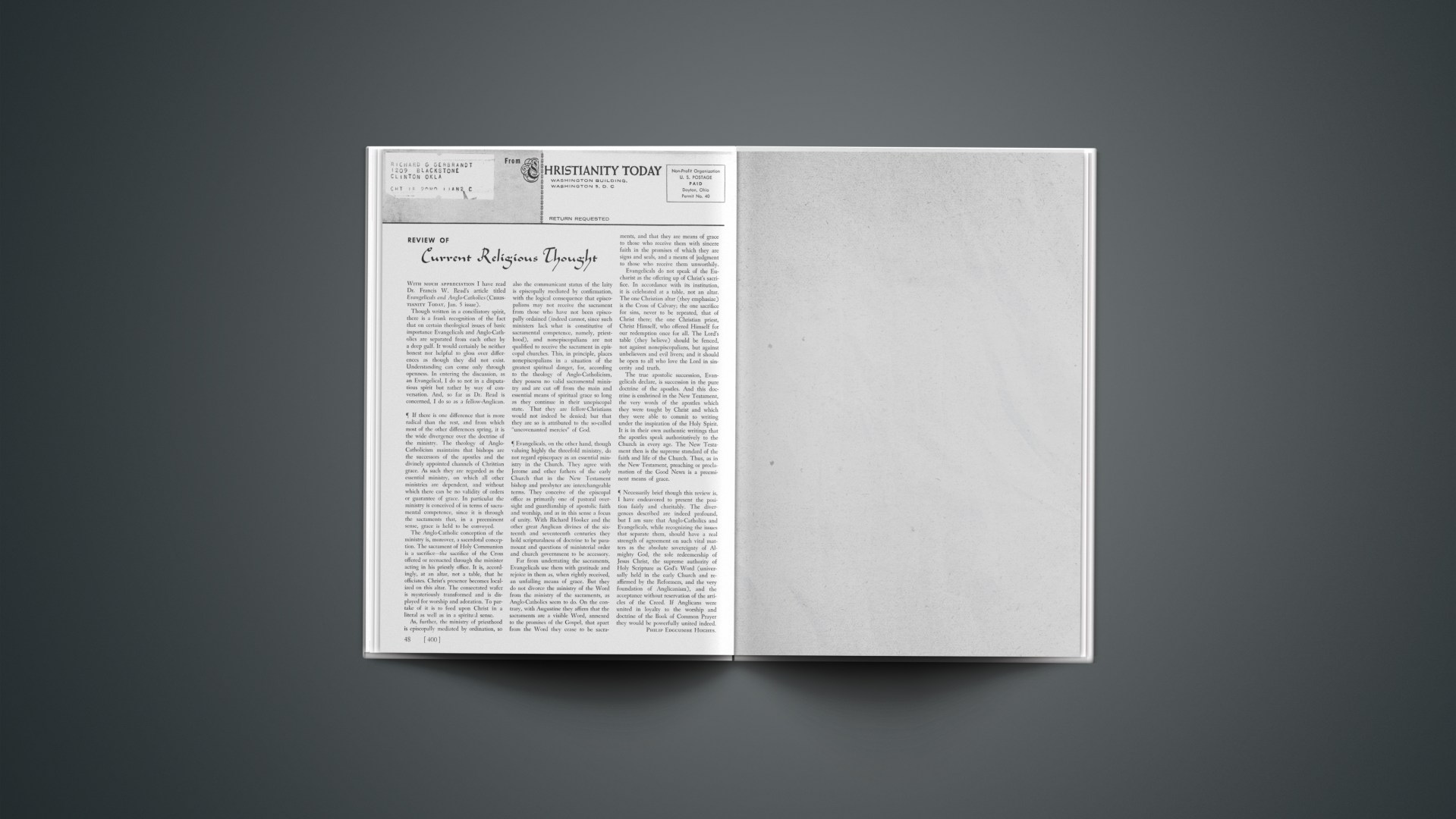
Review of Current Religious Thought: January 19, 1962

With much appreciation I have read Dr. Francis W. Read’s article titled Evangelicals and Anglo-Catholics (Christianity Today, Jan. 5 issue).

Though written in a conciliatory spirit, there is a frank recognition of the fact that on certain theological issues of basic importance Evangelicals and Anglo-Catholics are separated from each other by a deep gulf. It would certainly be neither honest nor helpful to gloss over differences as though they did not exist. Understanding can come only through openness. In entering the discussion, as an Evangelical, I do so not in a disputatious spirit but rather by way of conversation. And, so far as Dr. Read is concerned, I do so as a fellow-Anglican.

If there is one difference that is more radical than the rest, and from which most of the other differences spring, it is the wide divergence over the doctrine of the ministry. The theology of Anglo-Catholicism maintains that bishops are the successors of the apostles and the divinely appointed channels of Christian grace. As such they are regarded as the essential ministry, on which all other ministries are dependent, and without which there can be no validity of orders or guarantee of grace. In particular the ministry is conceived of in terms of sacramental competence, since it is through the sacraments that, in a preeminent sense, grace is held to be conveyed.

The Anglo-Catholic conception of the ministry is, moreover, a sacerdotal conception. The sacrament of Holy Communion is a sacrifice—the sacrifice of the Cross offered or reenacted through the minister acting in his priestly office. It is, accordingly, at an altar, not a table, that he officiates. Christ’s presence becomes localized on this altar. The consecrated wafer is mysteriously transformed and is displayed for worship and adoration. To partake of it is to feed upon Christ in a literal as well as in a spiritual sense.

As, further, the ministry of priesthood is episcopally mediated by ordination, so also the communicant status of the laity is episcopally mediated by confirmation, with the logical consequence that episcopalians may not receive the sacrament from those who have not been episcopally ordained (indeed cannot, since such ministers lack what is constitutive of sacramental competence, namely, priesthood), and nonepiscopalians are not qualified to receive the sacrament in episcopal churches. This, in principle, places nonepiscopalians in a situation of the greatest spiritual danger, for, according to the theology of Anglo-Catholicism, they possess no valid sacramental ministry and are cut off from the main and essential means of spiritual grace so long as they continue in their unepiscopal state. That they are fellow-Christians would not indeed be denied; but that they are so is attributed to the so-called “uncovenanted mercies” of God.

Evangelicals, on the other hand, though valuing highly the threefold ministry, do not regard episcopacy as an essential ministry in the Church. They agree with Jerome and other fathers of the early Church that in the New Testament bishop and presbyter are interchangeable terms. They conceive of the episcopal office as primarily one of pastoral oversight and guardianship of apostolic faith and worship, and as in this sense a focus of unity. With Richard Hooker and the other great Anglican divines of the sixteenth and seventeenth centuries they hold scripturalness of doctrine to be paramount and questions of ministerial order and church government to be accessory.

Far from underrating the sacraments, Evangelicals use them with gratitude and rejoice in them as, when rightly received, an unfailing means of grace. But they do not divorce the ministry of the Word from the ministry of the sacraments, as Anglo-Catholics seem to do. On the contrary, with Augustine they affirm that the sacraments are a visible Word, annexed to the promises of the Gospel, that apart from the Word they cease to be sacraments, and that they are means of grace to those who receive them with sincere faith in the promises of which they are signs and seals, and a means of judgment to those who receive them unworthily.

Evangelicals do not speak of the Eucharist as the offering up of Christ’s sacrifice. In accordance with its institution, it is celebrated at a table, not an altar. The one Christian altar (they emphasize) is the Cross of Calvary; the one sacrifice for sins, never to be repeated, that of Christ there; the one Christian priest, Christ Himself, who offered Himself for our redemption once for all. The Lord’s table (they believe) should be fenced, not against nonepiscopalians, but against unbelievers and evil livers; and it should be open to all who love the Lord in sincerity and truth.

The true apostolic succession, Evangelicals declare, is succession in the pure doctrine of the apostles. And this doctrine is enshrined in the New Testament, the very words of the apostles which they were taught by Christ and which they were able to commit to writing under the inspiration of the Holy Spirit. It is in their own authentic writings that the apostles speak authoritatively to the Church in every age. The New Testament then is the supreme standard of the faith and life of the Church. Thus, as in the New Testament, preaching or proclamation of the Good News is a preeminent means of grace.

Necessarily brief though this review is, I have endeavored to present the position fairly and charitably. The divergences described are indeed profound, but I am sure that Anglo-Catholics and Evangelicals, while recognizing the issues that separate them, should have a real strength of agreement on such vital matters as the absolute sovereignty of Almighty God, the sole redeemership of Jesus Christ, the supreme authority of Holy Scripture as God’s Word (universally held in the early Church and reaffirmed by the Reformers, and the very foundation of Anglicanism), and the acceptance without reservation of the articles of the Creed. If Anglicans were united in loyalty to the worship and doctrine of the Book of Common Prayer they would be powerfully united indeed.

PHILIP EDGCUMBE HUGHES.

Book Briefs: January 19, 1962

Evidence From The Past

The Patriarchal Age, by Charles F. Pfeiffer (Baker Book House, 1961, 128 pp., $2.95), is reviewed by Oswald T. Allis, formerly Professor of Old Testament, Westminster Theological Seminary.

This little volume by the professor of Old Testament in Gordon Divinity School is one of a “projected series of eight books on Old Testament history.” As is indicated by the present volume, the aim of the author is to view the Scriptures in the light of the relevant archaeological evidence. For such a purpose the Patriarchal Age is particularly attractive, partly because of the confident claims, made not so very long ago, that this period was one of myth and legend, and more especially because the archaeological evidence now available makes it so clear that the Hebrew patriarchs lived in the midst of a civilization which was already centuries old. Babylon, Mari, Ugarit, and now Jericho are shown to have been centers of a relatively high civilization long before the days of Abraham.

Dr. Pfeiffer has sketched for his readers the background and setting of the lives of the patriarchs in a very interesting and helpful way. His writing is marked by both sanity and clarity, and he writes as one who is well acquainted with the available archaeological evidence. He assures us that “we can now assert without fear of contradiction that the biblical partriarchs need not be regarded as demigods or characters from the realm of folklore. They appear as real men, living in a real world, which is now well known because of the work of modern archaeology” (p. 14). Yet he also recognizes that a good deal of subjectivity may color the claims and conclusions of scholars because there is so much that is still uncertain regarding the remote past: “In a very real sense theologians interpret the facts of archaeology, as they do the facts of Scripture, in accord with their basic presuppositions” (idem). This is a truism which needs constant emphasis!

A single example will suffice. Soon after the discovery of the Code of Hammurabi (1901), C. H. W. Johns made the statement: “It is customary to say that the father had absolute power over his children, but it is better to state only what is knowm with certainty regarding the extent of his power” (Babylonian and Assyrian Laws, p. 148). Johns then proceeded to point out that limitations were placed on the father’s authority. Thus, a father might not disinherit his son without “legal process and good reason alleged.” Yet Pfeiffer tells us: “The patriarchal records in the Bible presuppose the absolute power of a father over the very lives of his children” (p. 15); and he adds: “The thought that Isaac should have been consulted is foreign to the spirit of the record. Abraham, as the patriarch, had full control over the life of his son.” Yet the narrative in Genesis 22 seems to the reviewer, as it did to Josephus, to indicate rather clearly that Isaac submitted to the will of his father because he accepted it as the will of God.

With this general caution the reviewer wishes Dr. Pfeiffer the best of success in the important work in which he is engaged so profitably. A further suggestion would be that in future more care be given to the bibliography. In the present volume it is rather heavily weighted with “critical” books, and some important works by conservative scholars were overlooked.

OSWALD T. ALLIS

Sifting The Saints

Seven Sins and Seven Virtues, by Karl A. Olsson (Harper, 1962, 126 pp., $2.75), is reviewed by James Daane, Editorial Associate, CHRISTIANITY TODAY.

The author of Seven Sins and Seven Virtues has not produced something half good and half bad, but something uncommonly good.

His concern is for saintliness. Since, however, saintliness can be achieved only where its lack is recognized, Olsson first presents a brilliant and penetrating diagnosis of the seven deadly sins. These are selected not for the loaded traditional connotation they carry, but for convenience only. The analysis of sin is so incisive the reader feels himself brought to bay, yet so delightful that he cannot desist from reading avidly on to the end.

This done, the author presents an equally brilliant and incisive analysis of the seven virtues. Again the treatment is studded with literary allusions, historical illustrations, all in crisp language and sparkling style. And again the reader discovers that he is being talked about. He comes to feel like an eavesdropper uncomfortably discovering that the conversation he overhears is about himself, yet so fascinated he cannot break away.

Theological liberals, says the author, pretty much lost the idea of sin as something serious; hence they could not promote saintliness. The Puritans were serious about sin, but their concern was vitiated by a propensity to legalism which is also unable to foster saintliness. They wrote, for example, a whole Summa on the Sabbath, including “homely advice to global circumnavigators for Sundays in the Fijis.” They suffered the consequences of a legalism which thinks to find virtue in confessing the sins of others rather than their own. “Some of the venom directed against those excellent people might have been spared if the Puritans had been a little more agile in confessing their own sins rather than the sin of the Royalists.”

Thanks to the dialectical theologians, sin in the singular, and with a capital S, recaptured theological and religious concern, but this concern also failed to create a new impulse to virtue and saintliness.

But as the remainder of the book shows, saintliness is hard to come by—so hard that if one tries too hard one does not even broach it.

Olsson’s treatment is unusually effective in getting behind what we as Christians think about ourselves, to what we actually are. Though the reader knows what is going on, he cannot look away from his own self-exposure. If he admits what he sees, he comes to the admission that his sins are great and his virtues small—and this is a mark of saintliness.

Although written in the language of the layman, this book will trigger many a sermon, and much of its content will find its way into the pulpit.

JAMES DAANE

Apocrypha Guide

A Critical Introduction to the Aporypha, by L. H. Brockington (Duckworth, 1961, 170 pp., 12s. 6d.), is reviewed by R. T. Beckwith, Chaplain, Tyndale Hall, Bristol.

The Senior Lecturer in Aramaic and Syriac at the University of Oxford has produced an introduction to the Apocrypha less full than Oesterley’s and less popular than Metzger’s, but up-to-date and informative nonetheless. It is suitable both for those with a knowledge of English only and also useful to students who are more advanced. The work reflects the trend away from the documentary analysis which was formerly applied freely to the Apocrypha as well as to the Old Testament. It is taken for granted that Wisdom is a unity, and also II Esdras (except the first two and the last two chapters, which are separate works even in many manuscripts), but Baruch, apart from the appended Epistle of Jeremiah, is still distributed among three authors. In other ways the work reflects liberal opinion. There is some degree of agnosticism about the bounds of the canon, and on pages 128–129 the author collects passages in which he imagines the writers of the Apocrypha to express their dissent from the Old Testament. Despite the tide of the book, there is something uncritical about it. The author is sometimes arbitrary in his statements, and sometimes ignores contrary views held by reputable writers as, for example, Oesterley’s view on the date of I Esdras. Equally disquieting are the defects of his knowledge. On page 11 he appears unaware that the antiquity of II Enoch has been disproved (see Rowley, Relevance of Apocalyptic, and Vaillant, Le Livre des Secrets d’Henoch). On page 1 his suggestion that the additions to Daniel may date from after a.d.100 seems to indicate that he is unaware that the Song of the Three Holy Children is known to the writer of III Maccabees (see 3 Macc. 6:6). On page 141 his statement about the attitude of the Eastern Orthodox Church to the Apocrypha is utterly misleading. The list of books which he gives as accepted by the Synod of Jerusalem in 1672 is incomplete, and he ignores the fact that other confessional documents and most theologians of the Eastern Orthodox Church exclude the Apocrypha from the canon.

R. T. BECKWITH

A Worthy Achievement

Trinity Hymnal, published by The Orthodox Presbyterian Church (1961, 746 pp., $3.75), is reviewed by Frank E. Gaebelein, Headmaster, The Stony Brook School.

This hymnal, published by the Orthodox Presbyterian Church, deserves high commendation. In a time of doctrinal indifference, it is refreshing to find a hymnal with such a sturdy theological structure. The careful arrangement refleets not only the usual order of the Trinity, the Christian life and walk, and so forth, but particularizes such topics as the attributes of God, the decrees of God, election, the covenant of grace, justification, adoption, sanctification, and the like. Indeed, in structure the book is something of a systematic theology in brief. Familiarity with it should impart to its users a valuable theological orientation. A strong and unusual feature is the integration with Scripture through the well-chosen Bible quotations that head each of the hymns.

This is a big book, containing over seven hundred hymns. It is rich in worthy material that, while not well known, deserves to be sung. More than one hundred of the tunes are of pre-eighteenth century origin, and among them are some of the treasures of Reformation music. The choice of tunes, where there are options, is generally good, although one misses a few favorite settings. However, a hymnal is actually an anthology, and just as no anthologist of poetry can expect to please all his readers, so the makers of hymnals must inevitably face questions based on personal taste. Thus one is puzzled by the omission of “America” and “America the Beautiful” from the comparatively small section of “national” hymns. Among other well-known hymns that do not appear are the following: “In the Cross of Christ I Glory,” “O Master Let Me Walk with Thee,” “Dear Lord and Father of Mankind,” “Nearer my God to Thee,” “O for a Closer Walk with God,” and “Blessed Assurance.” To be sure, some of these were not written by evangelical Christians. But a hymn is great in its own right, and some hymnologists who have held imperfect doctrine have written far better than they knew. The section devoted to the more informal Gospel hymns is excellent.

The nonmusical matter requires comment. It includes a selection of opening sentences, the Ten Commandments, and the Westminster Confession, but some will miss the Lord’s Prayer and the Apostles’ Creed. The Psalter section merits nothing but commendation. The forms for public profession of faith, baptism, services of ordination, and installation of church officers are, as is to be expected, denominational and as such might inhibit use of the book by other than Orthodox Presbyterian churches. Perhaps a nondenominational edition will some time be published. The indexes are thoroughly adequate.

Typographically the book is attractive and the binding serviceable and in good taste. All in all, Trinity Hymnal is a worthy achievement and reflects credit upon the denomination that produced it. It is to be hoped that its outreach will be a wide one. Certainly its use should serve to lift the level of worship in congregations that adopt it.

FRANK E. GAEBELEIN

Reading for Perspective

CHRISTIANITY TODAY’S REVIEW EDITORS CALL ATTENTION TO THESE NEW TITLES:

* Certainties for Uncertain Times, by John Sutherland Bonnell (Harper, $3). After 25 years in New York’s historic Fifth Avenue Presbyterian Church, well-known American preacher points to “the things that cannot be shaken.”

* The Man God Mastered, by Jean Cadier (Eerdmans, $3). Short, very readable biography of John Calvin.

* Christianity Divided, a symposium (Shced & Ward, $6), Eminent Protestant and Roman Catholic thinkers discuss the things which have long divided them and constitute serious obstacles to reunion.

Theology With Relevance

The Epic of Revelation, by Mack B. Stokes (McGraw-Hill, 1961, 240 pp., $4.95), is reviewed by Samuel J. Mikolaski, Associate Professor of Theology, New Orleans Baptist Theological Seminary.

This book is straightforward. Dr. Stokes, who is Associate Dean and Parker Professor of Theology in the Candler School of Theology, Emory University, writes an exposition of, and apologetic for, Christianity, bearing in mind traditional and contemporary viewpoints. Each chapter of the book (devoted to creation, providence, freedom, man, promise of redemption, Jesus Christ, and the Holy Spirit) is approached from three directions: The Biblical Foundation, Theological Elaboration, and Existential Relevance. The last of these is no nod to contemporary jargon. Doubtless this division will be helpful to the person being introduced to the study of Christian doctrine.

The author ranges widely both in the history of philosophy and theology and amongst contemporary writers, yet he steers the reader on a straight course to what is distinctively Christian. The list of authors cited is impressive. Along with the best known of ancient philosophers reference is made to a significant number of contemporary philosophers and theologians. It is heartening to find appreciative references to the work of Martin Luther, John Calvin, John Wesley, James Denney, H. B. Swete, B. B. Warfield, Geerhardus Vos, and of more recent evangelical writers such as Edward J. Carnell, Carl F. H. Henry, G. C. Berkouwer, and Bernard Ramm. Yet the work is not eclectic. With clear-sighted vision Dr. Stokes points out the strengths and weaknesses of deism, pantheism, and several process philosophies and doctrines of being, as against the Christian doctrine of God’s transcendence and immanence, the creation of man and the world by God and their dependence upon divine providential care, and God’s redemptive purpose and acts in history. Always the author has in view the biblical revelation. He is not afraid to say, “The Bible teaches …”, nor unwilling to give due respect to the “Thus saith the Lord.” History is of a piece, the great epic unfolding the sovereignty of God and moving toward the fulfillment of his purpose. The atonement is viewed primarily as at-one-ment (my hyphenation), thus, alienation and reconciliation are the modes of thought that dominate his exposition. If I may venture an observation, less a criticism than a regret, it is that Dr. Stokes has not given us more in some places. For example, while he rejects the notions of idealistic philosophy about evil and sin and shows appreciation for the insights of Augustine, Luther, Calvin, and John Wesley, I think the reader needs help on what Dr. Stokes believes the fall of man is, where it attests not only the truth that man “stands ever in need of God’s redemption” (p. 174), but also about its impingement on traditional questions of the nature of sin as the act of finite will against God, its issue in human life and the world, and the solidarity of the race in its sinfulness. Similarly, when he discusses the atonement in five propositions I could have wished for deeper probing of these as casting light upon the moral relations between God and man. Presumably in the first of these the statement that through Jesus Christ “God performed the atoning work of revelation” (p. 177) means that reconciliation stands firmly on revelation, but do the words “atoning work of revelation” make that kind of sense to the reader? And when, on the second, he writes that “God has performed his atoning work of sacrifice,” it is not clear what “the suffering of one who loves in behalf of the beloved is inherently redemptive” (italics mine) means, and, as “transcending the whole sphere of life which measures out duties and punishments” (p. 178). The latter quotation may well be disputed as a misreading of the role of judgment in some traditional expositions of the atonement.

But this is a thoroughly Christian book and recommended for students of Christian theology and the philosophy of religion. It will prove a boon to those who are on the lookout for a well-written contemporary statement of what Christianity is in order to buttress their witness to friends and business associates.

SAMUEL J. MIKOLASKI

The Noblest Sermon

The Letter to the Romans, by Walter Luthi, translated from the German by Kurt Schoenenberger (John Knox Press, 1961, 221 pp., $4), is reviewed by John Weidenaar, Associate Professor of Bible, Calvin College.

The greatest danger that mankind faces today is God. God has good reason to be against us and it is a fearful thing to fall into the hands of the living God. The Letter to the Romans meets man in his precarious plight. No one has even approached Paul in his devastating description of man’s misery and guilt. Romans is a difficult book but not a scholarly lecture. It is, of all things, a friendly letter for common folk. As Ezekiel put it, Paul sat where they sat, overwhelmed. Romans is therefore the noblest sermon of grace and Paul is the teacher, preacher, and poet of grace. Grace is an event rather than a doctrine; it is the history of the relation between Christ and any particular person. The Protestant minister, the Christian Church, and especially the Reformed pulpit should focus its attention on God’s grace. Luthi’s book of sermons is dedicated to that end. Luthi holds that it was Paul’s mission to tell us that God is for us. God decided to be merciful without relaxing his right by confirming and fulfilling it. That is the mystery of the Cross. In Christ God is both Judge and Saviour at the same time. Man’s perverseness does not baffle God.

Is that, then, the reason that Luthi writes in his sermon on Romans 9: “But this idol of twofold predestination must not be confused with the God of the Bible. The Father of Jesus Christ is not the same as the God of mechanical logic.” Let it be remembered that the fathers of Dordt in 1618–19 declared that: “some, whom such conduct by no means became, have violated all truth, equity, and charity, in wishing to persuade the public … that God, by a mere arbitrary act of his will, without the least respect or view to any sin, has predestinated the greatest part of the world to eternal damnation, and has created them for this very purpose; that in the same manner in which the election is the fountain and cause of faith and good works, reprobation is the cause of unbelief and impiety … which the Reformed Churches not only do not acknowledge, but even detest with their whole soul.”

Upon occasion Luthi does not hesitate to speak of the “unpardonable sin.” The reviewer confesses, however, that he finds it difficult to exempt those depicted in Romans 1:18–32 from the rank of the reprobates. Let it also be recorded that they became reprobates.

JOHN WEIDENAAR

Three Faces Of Calvin

Calvin Theological Seminary Monograph Series, with forewords by J. H. Kromminga (Calvin Theological Seminary, 1961, $.40 ea.): Calvin’s Dying Bequest to the Church, by Marten H. Woudstra (46 pp.); Man Before God’s Face in Calvin’s Preaching, by Carl G. Kromminga (47 pp.); and Calvin’s Doctrine of Predestination, by Fred H. Klooster (77 pp.), are reviewed by William Young, Assistant Professor of Philosophy, University of Rhode Island.

These three monographs discuss in turn aspects of the work of Calvin as an exegete, a preacher, and a systematic theologian. Dr. Woudstra’s monograph, subtitled “A Critical Evaluation of the Commentary on Joshua,” draws the conclusion that “Calvin’s approach to the text of Joshua is such that it excludes the possibility of actual mistakes or contradictions from whatever angle these might be so designated” (pp. 19–20). Calvin’s use of example in Scripture is examined and the bearing of his exegetical method on recent discussions of progressive revelation is investigated.

Professor Kromminga’s study of Calvin’s preaching, based on the sermons readily available in English translation, stresses the idea that Calvin seeks to bring the hearer to an awareness of standing responsibility before God’s face.

Dr. Klooster has provided a careful analysis of Calvin’s doctrine of double predestination, fitted to clarify contemporary debate on “predestination in Christ” and “the equal ultimacy of election and reprobation.” The practical significance and biblical source of the doctrine are considered and the doctrine is represented as setting forth God’s sovereign gratuitous election and sovereign just reprobation. Dr. Klooster observes in conclusion “that one test of one’s loyalty to Scripture may be evident in how Calvin’s doctrine of predestination fares in the crisis of our age” (pp. 59–60).

WILLIAM YOUNG

Couches For Clergymen?

A Christian Therapy for a Neurotic World, by E. N. Ducker (George Allen & Unwin, 1961, 225 pp., 21s.), is reviewed by A. P. Waterson, Lecturer in Pathology, Emmanuel College, Cambridge, England.

This book gives an account of several years of an unusual ministry. Its aim is that such a ministry should before long cease to be so unusual. The author has equipped himself to deal with problems of psychiatric treatment, even fairly major ones, while at the same time he serves as a vicar and rural dean. The time, energy and devotion that he has lavished on his patients (or should we say clients?) is obvious, and his effectiveness equally so. The outstanding impression is of a man who is coping in a realistic way with the Church’s ministry of healing. In view of the current spurious and sensational activity in the name of healing, this is refreshing. Canon Ducker’s thesis is that there should be a number of clergy trained to do the kind of work which he is doing, and that all clergy should be equipped to have an insight into their people’s psychological needs.

Naturally, many clergy have this kind of insight, both into their parishioners and themselves, and many are skilled in using the social resources of their church and their community to help those in trouble. How far there should be a body of specialists in pastoral psychology is debatable. Should the best men be diverted into this kind of work, and, if so, how many? Relations with doctors need some care. Such workers should know when they are out of their depth and need an experienced psychotherapist to help them. There is always the danger of missing a case of organic illness needing treatment, and, allied to this, there is the question of the increasing range, use, and value of drug treatment. Who should prescribe when these are necessary? There is an even more subtle danger, namely, that psychotherapy should oust evangelism. Admittedly, therapy often is necessary in a seriously-disturbed patient before evangelism can be effective. But every new venture has risks as well as opportunities, and doubtless these risks can be avoided. Dr. Frank Lake’s foreword is inspiring, though it is doubtful whether his exegesis of 2 Timothy 1:7 is justified. Surely σωφροσυνη means “self-control,” not “a sound mind”?

A. P. WATERSON

The Heart Of Lutheranism

Theology of the Lutheran Confessions, by Edward Schlink, translated by Paul F. Koehneke and Herbert J. A. Bouman (Muhlenberg Press, 1961, 353 pp., $5), is reviewed by Carl S. Meyer, Professor of Historical Theology and Director of the School for Graduate Studies, Concordia Seminary.

Lutheran Confessionalism has become almost a byword in an age that has floundered in liberalism, the social gospel, and neo-orthodoxy. It was high time, therefore, that someone should make a systematic analysis of that Confessionalism. This “someone” had best be a recognized German theologian and his translator (or translators) at home in German theological language. Such a felicitous combination has brought about a detailed, authoritative, analytical presentation of Lutheran Confessionalism. Its vehicle is a very readable English that avoids the proverbial obscurity of the German theological idiom.

The Lutheran Confessions claim to be the church’s normative exposition of Scripture and aims to be the exposition of the ancient Trinitarian creeds. Difficulties can he found in them, to be sure; for them, nevertheless, the Holy Scripture of the Old and New Testament is the sole norm of teaching. As witness, exposition, and a consensus of agreement, the Confession is an obligatory model for all the doctrine in the church. “Therefore the decisive theme of all theology, not only of certain moments of church history but of all times, day by day, must be: Sin and grace, law and Gospel, judgment and forgiveness, God’s wrath and God’s mercy” (p. 55). The “Law and Gospel” concept plays a large role in Lutheran theology, and perforce also in the Lutheran Confessions. The Law tells of sin and wrath and despair; the Gospel proclaims love and mercy and hope. Christ’s death was a substitutionary death; God pronounces the sinner righteous for Christ’s sake apart from the Law by grace. Faith is the work of the Spirit of God; like justification, so also regeneration and new obedience are gifts of God’s grace. The means of grace are the Word and the Sacraments. Without these means of grace the assembly of believers, the Church, cannot exist. Yet there remains the conflict between the devil’s kingdom and Christ’s kingdom. The distinction between Law and Gospel attests also to the Last Day, as it points to the separate functions of civil and ecclesiastical government.

There is a solid fare in Schlink’s expositions of the Lutheran Confessions. It is an inviting fare. The careful savoring of it will prove it to be wholesome and rewarding food.

CARL S. MEYER

Book Briefs

This Is God’s World, by Reuben K. Youngdahl (Augustana, 1961, 365 pp., $3). Daily devotions for entire year written from perspective of all parts of world by world traveling pastor.

Yon and Your Grief, by Edgar N. Jackin (Channel Press, 1961, 64 pp., $1.50). Very short, very fine words to people in grief brought by death.

Branch of Almond, by Warren B. Blumenthal (Bookman Associates, 1961, 271 pp., $5). Lucid account of Jeremiah and his times by research chemist.

The Mature Christian, by A. Morgan Derham (Marshalls, 1961, 128 pp., 10s/6d). A handbook on Christian living by an evangelical minister with a shrewd insight into everyday problems.

Remembered With Love, by Roscoe Graham (American Press, 1961, 106 pp., $2.50). Scripture readings and religious poetry selected by one who prefers “Memorial” to “Funeral” services.

Bill and Betty Learn About God, by Margaret Anderson (Zondervan, 1961, 48 pp., $1.95). Bible Pictures with Simple Stories, by A1 Bryant (Zondervan, 1961, 60 pp., $2.95). Attractive biblical pictures with simple stories and added questions for boys and girls.

Facing Facts and Finding Faith, by F. P. Wood (Marshalls, 1961, 127 pp., 10s/6d). A simple outline of the basic facts of the Gospel explained by a veteran evangelist.

The Saving Life of Christ, by Major W. Ian Thomas (Zondervan, 1961, 152 pp., $2.50). Founder and Director of Torchbearers reflects on the Christian life and the story of Israel.

Science Returns to God, by James H. Jauncey (Zondervan, 1961, 120 pp., $1.95). A slight, once-over treatment of the Scientific Revolution, Origin of Man, Archaeology, and a half dozen other large themes, which rarely touches the ground.

The Road to Power, by W. Glyn Evans (Moody, 1961, 160 pp., $2.75). Cheaply-bound book seeks to reveal power of eternal life for men of today.

Personality Development in the Christian Life, by John D. Frame (Moody, 1961, 191 pp., $3.25). Medical doctor and onetime missionary strikes out into field of psychology with much sound practical advice.

Dawn of Devotion, by Sarah Anne Jepson (Moody, 1961, 560 pp., $2.95). Warm, radiant, brief devotional for each day of the year by an able pen.

I Live by Faith, by Alvin B. Martin (Moody, 1961, 124 pp., $2.50). Late author tells story of his conversion and of his Christian service especially to teenagers.

Son of Man, by Leslie Paul (Dutton, 1961, 287 pp., $4). BBC broadcaster attempts to fill in background gaps in life of Christ.

The Junior Hymnal, (Augustana, 1961, 327 pp., $2). Excellent (revised) Junior Hymnal of the Augustana Lutheran Church for use in church schools.

They Sang Through the Crisis, by John Malcus Ellison (Judson, 1961, 159 pp., $3). Editor of the Baptist Herald analyzes the social ethical crisis of our times and strives for Christian orderly society.

Kant and Current Philosophical Issues, by Bella K. Milmed (New York University Press, 1961, 239 pp., plus supplemental notes, bibliography, and index, $5). A closely-reasoned exposition of empirical features of Kant’s doctrine of knowledge which remain influential in naturalistic philosophy.

Paperbacks

Mater et Magistra, by His Holiness Pope John XXIII, translated by William J. Gibbons (Paulist Press, 1961, 96 pp., $.25). An English translation by the Paulist Fathers of the Encyclical Letter of Pope John XXIII relative to Christianity and Social Progress.

Knowledge: Its Values and Limits, by Gustave Weigel and Arthur G. Madden (Prentice-Hall, 1961, 120 pp., $1.75). Discussion of phenomenology, certitude, and other problems of human knowledge by prominent Roman Catholics.

Religion and the Knowledge of God, by Gustave Weigel and Arthur G. Madden (Prentice-Hall, 1961, 182 pp., $1.95). An epistemological discussion of proof for existence of God, natural theology, issued under imprimatur of the Archbishop of Baltimore.

Dialogue in Romantic Love, by Prentiss L. Pemberton (Judson, 1961, 64 pp., $1). A frank discussion of sexual expression before and during married life.

Faith’s Unclaimed Inheritance, by Frank Houghton (Inter-Varsity, 1961, 107 pp., $1.25). Fine religious writing, sometimes reminiscent of The Screwtape Letters. First published in 1952 under title We Believe.

The Meaning of the Cross, by Martin J. Heinecken (Muhlenberg Press, 1961, 122 pp., $1.50). Lenten meditations of substance; built on the proposition that we are not, as is so often thought, to have faith in faith, but faith in the objective deeds of God wrought in Christ for all the world.

The Final Destiny of the Heathen, by Richard Wolff (Back to the Bible, 1961, 111 pp., $.39). Raises and answers question whether men dying without hearing the Gospel are eternally lost.

Barabbas, by Par Lagerkvist (Random House, 1961, 180 pp., $1.25). The sensitive, speculative story of the man who lived because Jesus died, by Nobel prize winner for literature in 1951. Movie version of Barabbas (first published in 1951) soon to be released by Columbia Pictures.

The Spirit Bade Me Go, by David J. Du Plessis (David J. Du Plessis, Dallas 16, Tex., 1961, 96 pp., $1). Contains survey of work of the Holy Spirit in the ecumenical movements of 1951–61.

The Purgatorio, by John Ciardi (New American Library, 1961, 350 pp., $.75). John Ciardi’s fine new translation of the soul’s rise from Purgatory, as through suffering it makes its journey to purity and God. This is Dante in readable English.

God in the Hands of Man, by Theodore E. Johnson (Augustana, 1962, 74 pp., $1.65). In a devotional for each week of Lent the author selects an individual man (or group) as a symbol of how God fares at the hand of man. Here is material with substance and point.

Witness of the Spirit, by Gerald Kennedy (Upper Room, 1961, 64 pp., $.35). Well-known Methodist bishop with sparkle and sense shines the witness of biblical characters on modern dilemmas.

Christian Perspectives 1961 (Guardian Publishing Co., 1961, 221 pp., $2). The Association for Reformed Scientific Studies presents three lectures informed by conviction that the Word of God provides the leit motif for the cultural and scientific task.

Man’s New Image of Man, by Oliver Reiser (Boxwood Press, 1961, 174 pp., $3.50). Author interprets the development of American philosophy from Puritanism to World Humanism and spells out his own pantheistic, cosmic humanism.

Reprints

The Gospel According to St. John, Volume II, and The First Epistle of John, by John Calvin, translated by T. H. L. Parker (Eerdmans, 1961, 327 pp., $4.50). This is a volume in the completely new translation of Calvin’s New Testament Commentaries. The reader is brought closer to Calvin’s thought through the clarity and excellency of the translator’s English.

Heaven on Earth, by Thomas Brooks (Banner of Truth, 1961, 320 pp., 5s). A Puritan Treatise on Christian Assurance first published in 1654; a massive examination of the Bible evidence broken down into sections, easy to read and refer to.

Josephus, translated by William Whiston (Kregel, 1960, 770 pp., $6.95 hard cover, $4.50 paperback). Complete works of the eminent Jewish historian, contemporary of the Apostle Paul’s, which cover Israel’s history from creation to the time of Jerusalem’s destruction by Titus.

Eutychus and His Kin: January 19, 1962

Report Of Ten

Report of the Commission on the Reappraisal of the Proposed Occupation and Development of Canaan, Provisional Draft. Submitted by Pastor Peterson.

The Commission reports the result of an exhaustive survey and evaluation of the territory assigned. Our full itinerary was covered in some 40 days of travel over difficult terrain, through fortified areas controlled by hostile populations. Our travel plan may be found in Appendix A. Supplement A1 contains a list of recommendations concerning the preparation, equipment, and training of future exploratory missions of this character. Particular stress should be laid on the necessity of adequate financial subsidy. Apart from an ample distribution of substantial gratuities we found it most difficult to secure proper samplings of the produce, artifacts, and literature of the land, to say nothing of the desired information, some of which was highly confidential in character. The impetuous conduct of a minority of this commission did little to remedy this situation; indeed the random vintage sampling secured by their strong-arm methods was a meagre return for the embarrassment which their uncooperative attitude occasioned us in the conduct of our investigation.

In this connection, Memorandum Alc should be noted. The lack of appropriate psychological testing in the selection of members of this commission resulted in an unhappy lack of unanimity as to commission procedures and recommendations. We appreciate the motives which led to the selection of certain distinguished military personnel for our commission. Unfortunately, however, the virtues, skills, training, and outlook of the experienced soldier are of dubious value in political situations of extreme delicacy. A certain pietistical naïvete on the part of one or two individuals led to an insistence on simplicistic solutions to questions of extraordinary economic, political, ethnic, and even ethical complexity.…

… In conclusion, we recommend the erection of a Permanent Emergency Commission for the Periodic Inspection of Canaan (PECPIC) with an adequate budget and properly screened personnel. Especially in the light of the anthropological data (Appendix 93: the Incidence of Giantism) we believe that the course proposed by the minority would be ruinous. In the scale graph appended our forces are represented by the grasshopper.

(Translation from Scroll 1Qed. The antiquity has not been established.’)

EUTYCHUS

Ecumenics

Is the National Council of Churches seeking Christian unity, or is it attempting to reduce the Protestant denominations into a pliable group so that an alien political philosophy can be forced on the people of this nation?…

Everything that is far left and alien to the form of government our Constitution prescribes is promulgated.…

Our forebears came to this country that they might worship God according to the dictates of their consciences. They came from states with monolithic governments supported by monolithic churches united to subjugate the people. They lived through the bloody wars effected by this union.

They came with individual doctrines for which they were prepared to die rather than surrender.…

RICHARD A. GILMAN

La Mesa, Calif.

My best service to you and your otherwise admirable paper would be rendered if I could get you to see that your obsession with the supposed dangers of the ecumenical movement seems to blind you to the fact that nothing helps the cause of those who hate Christ and would destroy his church more than the sort of suspicion and dissension which you seem to desire to promote by your incessant attacks on the National Council and World Council.…

HENRY SMITH LEIPER

Special Secretary

American Bible Society

New York, N.Y.

I feel that CHRISTIANITY TODAY represents a far too liberal viewpoint of Christianity. I would not be interested in anything a Methodist, Presbyterian, or Anglican has to say. I am an extreme rightist in both politics and religion. I believe in militant Fundamentalism and nothing else, and am opposed to anything that even mildly compromises with the National Council of Churches. Your magazine doesn’t interest me.

BERNARD P. STANTON

Meadow Lawn Baptist Church

St. Petersburg, Fla.

I commend CHRISTIANITY TODAY for its engrossed interest and diligent study of the ecumenical movement. I hope that it shall continue to be a forum in which critical and crucial problems are discussed and solutions proposed.…

Christ’s prayer does not grow out of a background of 260 competing denominations and groups. When he prayed that “they all may be one,” he meant that the total life of all believers must melt together with the heartbeat of divine love.

If I were ever forced to choose between physical unity and spiritual unity, I would constantly choose spiritual unity for the simple reason that it is vital and necessary whereas physical unity is non-vital and secondary. Physical unity is seen in miniature in the local church which has yet to be cleansed of jealousy, backbiting, strife, division, envy, and pride.…

RICHARD H. WESTBY

First Baptist Church

Midale, Saskatchewan

The Reformers were confronted with the same attempt at organizational unity through a legalistic piety which, in effect, replaced grace with the law. Visible unity is of necessity legalistic. It is also a condition which has never existed in this world. Only God is one.…

Some years ago when the Eastern Orthodox representatives began to sit in with the Protestant leaders on ecumenical conversations, they were reported to have been horrified to hear the church spoken of as broken and divided. Since her unity could never be in a worldly organization, it is blasphemous to identify her with a worldly organization and see her sundered. I think the Reformers would have been quite as horrified.…

I do not believe unity can have any meaning apart from one head. If the church can have one head other than the Living Christ, then the Living Christ is not the head of the visible church. Perhaps much of the confusion would be done away with if we could recover the concept of the church as a living temple being built through the ages on a single foundation laid ages ago. In that sense, visible unity going back to the Risen Christ is quite a different thing than the unity of a section taken at any given moment in history. Our visible unity is as real as the spiritual unity. “Other foundation can no man lay than that is laid.” …

T. ROBERT INGRAM

St. Thomas Episcopal Church

Houston, Tex.

Whither The Road?

It is refreshing to see Bultmann demythologized and dethroned, especially by someone from Princeton (“Beyond Bultmann, What?”, Nov. 24 issue). I wonder, however, if the Heilsgeschichte road will lead to any better end than the existential one.

CLINTON L. DENSON

Malone College

Canton, Ohio

Something reminiscent of the “Three R’s” of secular education has arisen in theological education. During the past decade the “Three B’s”—Barth, Brunner and Bultmann have moved to the front. To be able to quote from any of these three, for some, is the very height of theological grandeur. Speaking their name has some sort of “magical” significance. On the other hand, to venture any criticism may be the very depth. It’s not “cricket” to be critical of anything theologically “popular,” even if it is pushed on us by a few Germans (and Swiss).

The prominence of these men can readily be seen in the new vocabulary they have introduced. Such words as “existentialism,” “demythologization,” and “dialecticalism” are now common in some areas of theological thought. Even the familiar words like “modern science” and “myth” have taken new meanings. “Modem science” comes to mean anything that can effectively oppose and contradict theology.

The word “myth” has a twofold meaning. Sometimes it is used in the familiar context of anything that is false or untrue, that is, anything miraculous or supernatural in the gospel accounts. On other occasions the term “myth” is used as a sort of half-true, half-false statement, e.g., the creation account and the “myth” of the first 11 chapters of Genesis. It is explained that these chapters are history, but not history like we think of it today.

The ambiguity of this “new” language has given many theologians the gleeful opportunity of trying to transliterate the meaning of the “Three B’s.” Did Barth mean the same thing here as he did the last time when he used this word? Did Brunner intend for this word to have new meaning here? What is Bultmann’s concept in using this word? Thus, many of the new theological books debate the meaning of words and symbols, so much so, that any man experienced in the fine art of debate would probably make a good “modern-day” theologian.

But more important, and possibly the most important point in the present situation, is that the debate over the “Three B’s” has made some forget the “Fourth B”—the Bible. The Bible has its word to say about this. Paul writing to his young friend in the ministry, Timothy, didn’t just warn him once but four times about foolish questions and debate. He begins his first letter to Timothy by saying, “You were to command certain persons to give up teaching erroneous doctrines and studying those interminable myths and genealogies, which issue in mere speculation and cannot make known God’s plan for us, which works through faith” (1 Tim. 1:3b,4; NEB).

To make certain there was no mistake, Paul concludes his first letter by reminding Timothy, “This is what you are to teach and preach. If anyone is teaching otherwise, and will not give his mind to wholesome precepts—I mean those of our Lord Jesus Christ—and to good religious teaching, I call him a pompous ignoramus. He is morbidly keen on mere verbal questions and quibbles, which give rise to jealousy, quarreling, slander, base suspicions, and endless wrangles” (1 Tim. 6:3, 4; NEB). The language here couldn’t have been clearer if it had been written in a current religious journal.

Paul was against some of the things that some men today pride themselves in doing. It is also clear that Paul was more interested in interpretation than speculation. But how is it possible to attain interpretation without speculation? Only through studying God’s Word with the aid of the Holy Spirit can it be done.

Ministers can do without many things, and possibly should, but they cannot do without study. But what should they study? It seems clear that the Bible should have primary importance. The command to Timothy is also given to every minister: “Study to shew thyself approved unto God, a workman that needeth not to be ashamed, rightly dividing the word of truth.” Some are taking this exhortation and inserting their own thoughts so that we have: “Study to shew thyself approved unto your theological companions, or fellow ministers, workmen that need not be ashamed of ignorance of theological terms, rightly dividing Barth, Brunner, Bultmann and other ‘modern’ theologians.” When this is so, may God help us to seek a return to the “Fourth B,” God’s Word, and “preach the Word,” leaving the “modern” theological jargon to those who don’t know any better.

EDDIE RICKENBACKER

Carlton, Tex.

Passion Of The Times

Much time is spent in your journal examining the … amorphous and protozoan organism that is Protestantism. Does not the real trouble stem from the fact that “Protestantism” has become the ritual side of general culture with no independent center of consciousness? Is collectivism the passion of the times? Then ecumenism must be its religious counterpart.

THOMAS A. BYERS

St. James Lutheran Church

Rudyard, Mich.

The general polemical, partisan, ultra-Protestant glibness of much of the paper’s material has repelled me.…

GEORGE ARMSTRONG

St. Mark’s Vicarage

Green Island, New Zealand

Your publication is appreciated as much as any I have ever purchased. The subject matter, the open-minded yet firmly orthodox manner of treatment, the tone of the magazine which is successfully and refreshingly biblical yet which escapes the—from this point of view—easy snare of spiritual provincialism, the amazing ability to speak with a fair amount of objectivity concerning a large number of denominations, the “freshness” of the news (I learned of my alma mater’s change in name from you before from the school itself), and the wit and satire of Eutychus—all are making your magazine for me the magazine most anticipated.

JAMES W. THOMPSON

Park Boulevard Church

Glen Ellyn, Ill.

I think your magazine is splendid.

JOHN M. JENSEN

Editor

The Ansgar Lutheran

United Evangelical Lutheran Church

Viborg, S. Dak.

My co-worker and I are in a somewhat isolated Indian village studying the Mundurukú Indian language, with Wycliffe Bible Translators, and it’s always interesting to receive Christianity Today and be brought up to date on world news in relationship to Christianity. Of several publications which we receive, we enjoy CHRISTIANITY TODAY the most.

MARJORIE CROFTS

Manaus, Amazonas, Brazil

Not many a week passes that some reference or quotation from your magazine is not in our editorials.

C. M. STANLEY

Editor

The Alabama Journal

Montgomery, Ala.

There are some good thoughts … occasionally, but they are usually well hidden under multitudes of words.

HERMAN S. FALES

Arnold, Neb.

CHRISTIANITY TODAY is checked out every week by our readers.

BERTHA I. ANDERSON

Librarian

First United Presbyterian Church

Santa Ana, Calif.

A line of appreciation and commendation for your provocative and mentally stimulating articles.… They are contemporary, solid, and express the exploratory spirit of “academic freedom” within the historic Christian faith.

CURTIS R. NIMS

First Baptist Church

San Francisco, Calif.

Missionary Drive Paces Inter-Varsity Conclave

Many a U. S. campus became the usual holiday ghost town in the week between Christmas and New Year. But not so the sprawling campus nestled between the twin cities of Champaign and Urbana, where the vacationing student population of the University of Illinois was replaced by a visiting throng of burly lettermen and bouffant-coiffured coeds from scores of colleges from Venezuela to Newfoundland. The occasion was the Inter-Varsity Christian Fellowship’s sixth International Student Missionary Convention, which emerged in 1961 as the foremost missionary recruitment effort of our time among high-caliber U. S. youth.

It was a new strain of Christian young people, the first of the World War II baby crop that braved five days of icy winds on the Illinois campus to attend an IVCF convention. It was, moreover, the first of the student missionary conventions to be held under IVCF’s new leadership, which has already revitalized a traditionally evangelical ministry and which promises a less separatist stance.

Evangelist Billy Graham reminded the 5,300 delegates that “many of the great movements in history have begun among students.” He recalled the slogan of the Student Volunteer Movement “to evangelize the world in one generation.”

“That must now be streamlined,” said Graham. “The world must be evangelized in one decade.”

The evangelist also cited the role of contemporary students in the shaping of political thought and action.

In contrast to the intents of so many recent student assemblies, the young people at Urbana made it abundantly clear that they had come to listen and to learn, rather than demand and demonstrate. They carried no placards and passed no resolutions. They used the time to meditate, to study Scripture, and to seek the advice of their spiritual elders. And they returned to their homes with a keener appreciation of the challenge of foreign missions, many to an extent which entails a personal commitment to the missionary cause.

More than 100 foreign missions boards, both denominational and independent (most notable exception: Southern Baptists), officially cooperated with the convention. Most were represented by one of the dozens of pegboard displays which ringed Huff gymnasium, where plenary sessions were held. In all, some 200 veteran missionaries were on hand to give personal counsel and to outline missionary opportunities within their re spective boards. These missionaries also led forums and workshops in at least 10 specific aspects of missionary work. Several missionary films were screened daily.

The ‘Nonprofessional’ Missionary

An American agronomist in Iran calls in the hired help at sundown. He is a Christian, and they are Muslims. He invites them to relax on the patio, to sip tea and to socialize. Later, as they chat, he may produce a Bible, and if it seems appropriate, read and explain a passage. By the time lights are doused the agronomist will likely have planted a Gospel seed.

Such a witness is being carried out with increasing frequency around the world. The agronomist might instead have been a petroleum engineer, a geologist, or even a physician. His salary is paid, not by a church or mission board, but by a commercial concern. Yet in the New Testament sense he is as much a missionary as the preacher in the bush and in some political climates far more effective. The term which is now most commonly used to describe him is “the nonprofessional missionary.”

The nonprofessional missionary (many observers feel the term to be a somewhat disparaging misnomer) is gaining attention rapidly, although efforts to prepare lay Christians for the responsibility have in the past been feeble and few. Missions leaders are beginning to think seriously of the nonprofessional missionary as a possible key to areas of the world which are now closed to official church representatives. Elementary airings of the concept took place in sectional meetings at both the Urbana student missionary convention and the Wheaton missionary medicine assembly.

The bulk of the student delegates (44 per cent men) came from secular universities.1One student delegate managed to win a subsidy for the trip to Urbana by appealing to the campus council leader, a professed atheist, on grounds that a denial would betray his prejudice. They were a thinking crowd, and inasmuch as their academic training lacked a Christian dimension, many obviously sought to relate practical and ideological tenets to a biblical base. Some students actually found themselves intellectually beyond missionaries who were to be giving advice, the result being that their problems went unsolved. In scattered cases, stage panelists appeared to be ill-chosen, one or two having used their opportunity to address a university assembly to minimize education. This was viewed as excusable, for there have been missionaries in the past who were obliged to pass up formal training, and there have been others whose chances for keeping intellectually alert have been tempered by remote assignments. At least one inexcusable letdown did occur, however, when a student asked a panel of eight recognized missionary leaders to define a “missionary call.” For 10 minutes or so the panel talked around the question; none attempted a clear-cut answer.

The students who came to “Urbana,” as the IVCF convention is commonly designated, were orderly and restrained, assuredly a devout group. By and large their convictions were staunchly evangelical. Yet they represented a new temper, evangelical youth throwing off superficial fundamentalist taboos. Less than 10 per cent of women delegates shunned makeup, yet almost all who wore cosmetics did it in good taste. There was little smoking, however. The delegates united in a communion service on New Year’s Eve led by the Very Rev. S. Barton Babbage, dean of the Anglican cathedral in Melbourne, Australia.

Student missionary conventions have been a joint venture of the Inter-Varsity Christian Fellowships of the United States and Canada since 1948, when the first of the series drew some 800 persons to the University of Toronto. Subsequent conventions were held in Urbana in 1948, 1951, 1954, and 1957, with attendance increasing each time.

The U. S. Inter-Varsity organization itself dates back to 1940, when the first student chapter was organized at the University of Michigan. Lineage is also traceable to the formation in 1877 of the Cambridge Intercollegiate Christian Union, a movement which spread to other universities in Britain and became the Inter-Varsity Fellowship of Evangelical Unions in 1923. The IVCF in Canada was organized five years later. In ethos, Inter-Varsity also is said to have its roots in evangelical student societies which have been active in American college life since the Harvard group under Cotton Mather in 1700.

Strides In Evangelical Literature

Delegates to the 13th annual meeting of the Evangelical Theological Society were appraised of a series of major cooperative projects of conservative theological scholarship now in various stages of preparation.

The projects include four dictionaries: The New Bible Dictionary, sponsored by Tyndale Fellowship of Great Britain, Dr. J. D. Douglas, organizing editor, with contributors from the entire English-speaking world, to be published in America by Eerdmans in May; The New Pictorial Bible Dictionary, Dr. Merrill C. Tenney of the Wheaton College Graduate School of Theology, general editor, Zondervan, now in final editing, The International Standard Bible Encyclopaedia, revised “to strengthen the conservative element, especially by the exclusion of mediating views perceptible in the originals,” Dr. Geoffrey W. Bromiley of Fuller Theological Seminary, general editor, Eerdmans, five volumes, with Volume I due in 1963; Encyclopedia of Christianity, the complete field of religion, with a Calvinistic theological emphasis, Dr. Edwin H. Palmer of Westminster Theological Seminary, general editor, Sovereign Grace Publishers, 10 volumes, Volume I ready for printing.

Also a trilogy from Moody Press: Wycliffe Bible Commentary, Drs. Charles F. Pfeiffer of Gordon Divinity School and Everett F. Harrison of Fuller Theological Seminary, Old Testament and New Testament editors respectively, with contributors representing a cross-section of contemporary evangelical scholarship, phrase-by-phrase notes, due in the fall; Wycliffe Bible Encyclopedia, Pfeiffer, general editor, with maps and illustrations, expected in 1965; An Historical Geography of Bible Lands, Pfeiffer and Dr. Howard Vos of Trinity Theological Seminary, Chicago, Old Testament and New Testament editors, respectively, to be released in 1963.

Four commentaries: The New International Commentary, Dr. Ned B. Stonehouse of Westminster Theological Seminary, New Testament editor, Eerdmans, nine of the eighteen vol umes already released; a new series “to defend the trustworthiness of the Old Testament,” similar in format, Dr. Edward J. Young of Westminster, editor, Eerdmans, 32 volumes, the first due shortly; Evangelical Bible Commentary, Dr. George A. Turner of Asbury Theological Seminary, editor, Zondervan, 40 volumes, Arminian emphasis and reflective of eighteenth-century revival thought, Mark and Acts already out, Hebrews next fall, and four volumes per year thereafter; Wesleyan Bible Commentary, Drs. Charles W. Carter of Taylor University, Wilber T. Dayton of Asbury Theological Seminary, and Ralph Earle of Nazarene Theological Seminary, editors, Eerdmans, six volumes, Volume IV due this year; The Scofield Reference Bible, with revised conservative chronology and notes clarified to stress salvation by grace through faith in all ages and a more modified typology while maintaining theological dispensationalism, Dr. E. Schuyler English, chairman of revision committee, Oxford, by 1965.

Notices also were given Tyndale Commentaries, Eerdmans; Baker’s Dictionary of Biblical Archaeology, summarizing a series of projected monographs; and Encyclopedia of Missions, sponsored by the faculty of Gordon Divinity School for its 75th anniversary, Harpers, 1965.

The latest ETS meeting was held last month in St. Louis on the campuses of Covenant College and Seminary (Evangelical Presbyterian) and Concordia Theological Seminary (Lutheran Church—Missouri Synod). Membership was reported at a record high of 635, double that of five years ago. The total includes more than 100 each in the categories of associates and student associates, established for ministers and students possessing an interest in evangelical theological research and teaching and desiring the quarterly Bulletin of ETS. Members subscribe annually to the affirmation, “The Bible alone, and the Bible in its entirety, is the Word of God written, and therefore inerrant in the autographs.”

Although local IVCF chapters are given a large degree of autonomy, overall theological orientation is readily discernible within the evangelical sphere. Chapter and national leaders accept biblical authority and “the formulations of biblical doctrine represented by the large areas of agreement in such historic declarations as the Apostles’ and Nicene Creeds, the Augsburg, Westminster and New Hampshire confessions and the Thirty-Nine Articles of Religion.”

Ultimate objective of the American IVCF organization is “to recruit and train students for the life and work of the Church.” But it is this very relationship between the organization and the church-at-large which has been a perennial sore spot. IVCF critics say its ministry has been too separatist, too aloof from large denominational structures. IVCF spokesmen will privately acknowledge a hiatus, but some protest that the image is not deserved. In defense they point to such factors as the plurality of Methodists among IVCF student adherents as evidence of denominational interplay.

Still, the image exists to an extent that is a primary concern of the trio of new faces at IVCF’s Chicago headquarters: Charles H. Troutman, 47, who started with Inter-Varsity in Canada upon graduation from Wheaton College in 1936, became one of the first U. S. staff members and moved up to the post of associate general secretary, then headed the Australian organization for six years before returning to the American IVCF as general director last spring; Eric S. Fife, 40-year-old native Briton who has been missionary director since 1958 as well as the 1961 convention chairman; and Paul Fromer, 34, who in 20 months as editor of IVCF’s His magazine has seen its circulation jump from 9,000 to 14,000.

The new IVCF leadership is determined to establish well-defined denominational relationships. Fruits of their initial efforts were already in evidence at the 1961 Urbana convention. Whereas IVCF leaders in the past have been uneasy about representation of denominational mission boards, Fife made an outright bid for their support with a visit to New York’s Interchurch Center last fall.

Remembering that one denomination in the past had sent a missionary representative who was frankly critical of IVCF work, Fife went the extra mile to stipulate that a welcome was waiting but that it would be reserved for sound evangelicals. Fife’s overture was well received. Official display space at the convention was utilized by mission board representatives of The Methodist Church, the United and Southern Presbyterian churches, the American Baptists, the Disciples of Christ, as well as Lutheran groups and others.

Under Troutman’s leadership, IVCF is out to solidify relations with churches not only on the headquarters level but at grass roots. The 50 full-time and 300 part-time staff members will be encouraged to become more active in their own parishes. Better liaison with local ministers also will be sought.

Beyond that, Troutman hopes to see IVCF broaden its ministry to include the entire university community, from the custodian, technician, and office clerk to the faculty and deans.

IVCF campus representation reached a peak in 1953 when some 15,000 students were active in local chapters. Interest tapered off in succeeding years and at one point the number of active IVCF students was down to 9,000. As of last June the total was up to 12,000 and preliminary figures for the current school year indicate that it may have again reached the 15,000 mark.

Inter-Varsity currently operates on a yearly budget of some $470,000. Its scope includes fellowships of nurses in training as well as a special department devoted to a ministry among international students. Negotiations have been proceeding on an off-and-on basis for some two years on a plan to merge with International Students, Inc. Cooperative evangelical thrusts are gaining momentum, and Inter-Varsity has disclosed plans to cosponsor with the Young Life organization a summer training institute in Colorado. Some observers would also like to see an end to the duplication of efforts by Inter-Varsity and a newer organization, Campus Crusade for Christ. Thus far, however, there have been no formal merger overtures; Campus Crusade for Christ is headed by William R. Bright, who was present at Urbana.

Delegates to Urbana had the chance to come to grips with clear-cut challenges and to realize anew the ideological void which exists on the average U. S. campus in spite of years of witness. The Wesley Foundation at the University of Illinois was the first religious foundation in America. Yet the 1961 Christmas holiday found Illinois students reflecting some of the confusion, frustration, and rebellion which plagues their contemporaries. Scrawled decoratively across dormitory windows was a theological counterpart of “Yankee Go Home”: “CHRISTMAS—BAH—HUMBUG.”

Here are additional holiday convention reports:

At Wheaton, Illinois—A host of problems beset world-wide efforts to extend needed medical aid under the aegis of Christian missions, and the Christian Medical Society’s second International Convention on Missionary Medicine represented a significant attempt to work out some solutions. The meeting, held on the picturesque, snow-covered campus of Wheaton College, drew some 500 doctors and medical students, including dozens of missionary surgeons and physicians fresh from the field.

Chief problem is lack of qualified personnel, J. Raymond Knighton, executive director of CMS, said at a press luncheon. But there were a number of other problems brought out during the convention:

—The rate of resignations among medical missionaries is said to be the highest of all among missionary personnel.

—Just as the congregation’s musicians are often described as the “war department” of the local church, so the medical arm of the foreign missions board has the dubious distinction of being a perennial source of tension. Much of the friction doubtless stems from professional medical experts having to be responsible to administrative policy makers. Recognizing the problem, many missionary agencies are now including experienced physicians in the decision-determining echelon.

—The high cost of medical facilities discourages church agencies from allocating enough funds to achieve the maximum benefit of a doctor in the field.

—A welfare state seizes the initiative of Christian medical programs.

“We are in trouble on many fronts,” said Dr. Ralph Blocksma, a plastic surgeon from Grand Rapids, Michigan, who served as convention chairman.

Blocksma, formerly a Presbyterian missionary to Pakistan and a past-president of CMS, called on the organization to use the current crisis to exercise statesmanship. He said that sentimental appeals to help the needy abroad should give way to efforts toward the working out of a high-level, centralized planning agency which could correlate world-wide medical research.

Since 1954, the CMS has offered a measure of guidance for medical missions through a set of recommendations which are revised from time to time by a specially-appointed committee. The committee’s latest move urges removal of class distinction between Christian missionaries and national workers and pleads for recognition of the practice of medicine as a witness in itself and not merely a missionary tool.

Many medical missions problems could be solved, or at least anticipated, through long-range indigenous training programs, according to Dr. V. McKinley Wiles, a New York City urologist. Wiles cited the Congo as an example of what happens when missions neglect the training of nationals. Although Christian missionaries have been working in the Congo for nearly a century, there is still not a single Congolese who qualifies as a doctor. Thus the exodus of doctors during strife left the country in dire straits.

Another convention delegate put it this way: “Every missionary doctor should be thinking of replacing himself with a national.”

Wiles also urges that Christians in the United States and Canada help to groom foreign students who are future professional people for effective Christian witness upon their return.

A veteran American Baptist medical missionary told the convention that an expanded medical aid program for the Congo could help to ward off a Communist takeover.

“We are calling for 100 doctors to serve a five-year term in the Congo,” said Dr. Glen Tuttle, who has served a term as executive director in the Congo for the Congo Protestant Relief Agency. He said the shortage of doctors has resulted in much suffering among the Congolese and that outbreaks of smallpox are now being reported.

While there were some 750 doctors in the Congo prior to independence, the number now is about 250, he added. Of the 250—approximately one doctor to

60,000 Congolese—60 are Protestant medical missionaries. Tuttle declared that many hospitals in the Congo have not even a single doctor, and that near Stanleyville alone there are six such handicapped hospitals.

CMS has worked closely with the Congo Protestant Relief Agency, which was begun in 1960 by a group of missionaries but which was brought under auspices of the Congo Protestant Council last fall. CMS has rendered some of its most significant service during the Congo crisis, but its scope is far greater. Begun informally some 30 years ago and formally in 1946, the organization now has a membership of approximately 2,800, including 530 medical missionaries or an estimated 80 per cent of the total English-speaking medical missionary force. In 1961 CMS distributed abroad drugs with a total wholesale value of $2,100,000, all donated by the industry. CMS is non-denominational, a “professional organization of physicians, dentists, medical and dental students who share the clear recognition of the necessity for satisfying man’s spiritual, as well as, his physical needs.” Theological basis for CMS rests with an evangelically-oriented, 2,500 word statement of faith, its unusual detail characteristic of the medical profession.

At St. Louis—Rabbi Samuel Sandmel, in his presidential address to the 96th annual meeting of the Society of Biblical Literature and Exegesis, asserted that the excitement generated by the Dead Sea Scrolls has not been warranted by the facts.

Sandmel said that the finding of the scrolls in 1947 gave rise to the “greatest exaggeration in the history of biblical scholarship.”

“The stuff that could have made them as exciting as alleged wasn’t and isn’t there,” he declared. Noting the absence from the scrolls of direct mention of known people and events, Sandmel added:

“That is why there has been no limit on the various dates proposed for the scrolls. I regard the Scriptural books and fragments as of much more value than the ‘sectarian documents’ and the ‘hymns.’ Hence, respecting the scrolls and Christian origins, I for one would gladly swap all the sectarian documents and the hymns for one tiny Qumran fragment that would contain the name of Jesus, or Cephas, or James or Paul.

“Until such a fragment is found, I shall persist in regarding the scrolls as adding a few more drops to the bucket that was already half full, a bucket enabling us to know no more than perhaps 50 per cent about Christian origins.” In noting that Edmund Wilson, who wrote a book about the scrolls, had accused New Testament scholars of “shying away” from the scrolls “because they did not want their theological premises shattered,” Sandmel asserted:

“Since I am a rabbi, I assume that no one would suggest that my skepticism about the scrolls and their supposed direct relationship to Christianity rests on any fear that my personal theology will be damaged.

“The trouble for me on going into the scrolls was not that my theology was offended, but only my academic training.”

Sandmel is provost and a professor of Hebrew Union College—Jewish Institute of Religion in Cincinnati, Ohio.

Some 500 persons were on hand for the meeting of the society, which comprises about 2,000 Protestant, Roman Catholic and Jewish scholars, most of whom are professors in seminaries, colleges, and universities in the United States and Canada.

In a paper read at the meeting, Dr. Bruce M. Metzger described a newly discovered Greek papyrus manuscript as the earliest known copy of the Gospel according to St. Luke.

Metzger said the manuscript contains on 27 leaves and several small fragments most of the Gospel of St. Luke (except several verses at the end, notably chapter 22, verses 43–44, regarding the angel sent to strengthen Jesus in the Garden of Gethsemane and his bloody sweat, and chapter 23, verse 34, Jesus’ prayer of forgiveness from the cross). The codex also contains at its close several chapters of the Gospel of St. John.

The find, acquired by the Swiss bibliophile, M. Martin Bodmer of Geneva, is the “most important papyrus manuscript of Luke known to exist,” Metzger declared.

He said it was written in Egypt probably about 200 A. D. and antedates the famous Chester Beatty Papyrus of the Gospels by at least a generation and the earliest known parchment manuscripts of the New Testament by a century and a half.

In describing the nature of the Greek text contained in the papyrus, Metzger said it agrees most frequently with the famous Codex Vaticanus of the fourth century, which, he noted, is often regarded as one of the most important copies of the New Testament in the original greek.

Metzger discussed the significance of several agreements of the Bodmer manuscript with the Sahidic version, one of the early Coptic translations of the Bible used in Egypt. The most noteworthy agreement concerns Jesus’ parable of the Rich Man and Lazarus. The Bodmer codex is the only known Greek copy of St. Luke which, like the Sahidic version, assigns a name to the otherwise anonymous Rich Man. In chapter 16, verse 14, he is called “Neve,” which, according to Metzger, was intended by the scribe to be read as “Nineveh,” the rich and dissolute city of ancient times.

The importance of the manuscript, Metzger added, goes far beyond the new textual evidence which it presents; evidence is now available, that, contrary to current views, the Church of Egypt during the second century had made unsuspected progress among scholarly circles.

Evangelistic Ruts

A plea for churches to break out of “traditional ruts” in evangelism was voiced by speakers at the New England Conference on Evangelism.

Dr. George E. Sweazey, former chairman of the National Council of Churches’ Department of Evangelism, urged a greater participation by the laity in evangelism. He warned that the church “will die when its evangelism efforts become the special work of special people at special times.”

The Rev. Howard Keeley, executive secretary of the Evangelistic Association of England, which sponsored the three-day meeting in Boston, suggested that New England church people should be more aware of “non-traditional” methods of evangelism which are meeting with success in areas all across the country. He also asserted, however, that churches are neglecting some of the older methods that have been successful. He said that 64 per cent of the Methodist, Congregational, and Baptist churches in New England do not conduct vacation Bible schools.

Sweazey, a member of the United Presbyterian Church in the U. S. A. and a pastor in Webster Groves, Missouri, declared that “lay evangelistic visiting is by far the most successful evangelistic method of our day.”

He criticized churches where “the old members love each other so much they have no time for newcomers.”

Sweazey emphasized that the “cozy old notion that ‘heathen darkness’ applies only to faraway places with strange-sounding names is neither tactful nor true.”

“There are no Christian nations in the world today, and there are no completely pagan ones,” he said, “In the so-called heathen lands you find groups of Christians hard pressed by a massive pagan culture, and in America you find groups of Christians hard pressed by the same massive pagan culture.”

“Today in America,” he added, “every church is a mission outpost, thrust out on the frontier.”

Learning From Puritans

There is a great difference, says Dr. James Packer, between John Bunyan’s spiritual autobiography, which was very definitely God-centered and unselfconscious, and that of C. S. Lewis, which was more obviously man-centered and in which the real hero was C. S. Lewis.

At last month’s Puritan and Reformed Studies Conference in London, Packer, noted evangelical lecturer and author, added that he did not mean to be unkind to Lewis, for the contemporary approach seems to call for such a treatment. The modern emphasis, Packer declared, is upon communion with God, whereas in former times it was on communion with God.

In the discussion which followed Packer’s paper, Dr. Martyn Lloyd-Jones, minister of London’s Westminster Chapel, suggested that modern evangelicals who often give the impression that everything will be all right after people accept Christ, seemed to know very little of such things as the Puritans spoke of, like the spiritual desertion of the believer. Packer felt that this “was the result of en evil legacy of two generations of liberal theology which brought God down to man’s level.” Commenting on an assertion that 20 or 30 years ago evangelicals were insufficiently preoccupied with theology and too much with psychological experience, Packer said: “Evangelicals ceased to worry about theology at that time, and rather worshipped a God of their own experience.” He considered this was all very well for the first generation which was still living on its spiritual capital, but that in the second generation it resulted in a pathetically small view of God.

The traditional idea of the Puritans as a group of sour-faced men was derided in a subsequent paper by Dr. John Gwyn-Thomas, who added, however, that they were anxious to distinguish between a true joy, a delight in communion with God, and a false joy which often took the form of frivolity in religious matters. He cited Richard Baxter’s preaching a sermon on Christ’s curing “the diseased joys of the disciples”

who were rejoicing in the actual results of their labors and achievements rather than in the greatness of God and what he had done. “The joy of service,” concluded Dr. Gwyn-Thomas, “should be drowned in the greater joy of our inheritance in Christ.”

J. D. D.

The Seventh Revision

Officials of the Oberammergau Passion Play Committee say that the world-famous production will be revised before its next presentation, which will probably be in 1970. The 1960 production resulted in accusations that it contained some anti-Semitic passages.

The new revision will be the seventh for the play, first presented in 1634 by villagers of Oberammergau, Germany, to fulfill a vow of thanksgiving for deliverance from the Black Plague. Traditionally it has been performed every 10 years.

In announcing the revision, committee officials made no reference to the anti-Jewish allegations.

Parisian Purchase

An old restaurant strategically located in the Latin Quarter of Paris is being turned into a Bible student center.

C. Stacey Woods, general secretary of the International Fellowship of Evangelical Students, says French Christians have already contributed nearly half the money needed for the purchase.

Seminary For Africa

A new Protestant seminary will be opened next fall in Yaounde, Cameroons, to train ministers for the newly-independent states of West Africa.

A major effort of the founders is to disassociate Christianity from its European background and to see that it does not suffer from political reaction to colonialism.

Flying The Jungle

Lutheran missionaries in New Guinea dedicated last month a new seven-passenger plane capable of operating from small jungle airstrips.

The $36,000 craft, a German-made Dornier DO-27, is able to carry a 1,000-pound load with a short takeoff run.

Fully Accredited

Full accreditation was given by the American Association of Theological Schools last month to the Central Baptist Theological Seminary of Kansas City, Kansas, and the Golden Gate Baptist Theological Seminary of Mill Valley, California.

No Church Links

The Peace Corps will not enter into formal contracts with church-related agencies, according to Director R. Sargent Shriver.

At a meeting in Washington last month of representatives of private voluntary agencies, Shriver said:

“We have not signed, nor do we have plans to sign project agreements with the service arms of churches in the United States.”

Some private organization leaders apparently have appealed to the Peace Corps on the grounds that other federal agencies have set the precedent for church-state agreements with contracts to distribute surplus foods and other material overseas.

Shriver said, however, that “the Peace Corps provides people, not food, to voluntary agencies.” He added that because it is a government agency, the Peace Corps cannot restrict assignment to projects on the basis of religion.

“Just because it’s a difficult line to draw,” he observed, “we shouldn’t stop trying to draw it.”

In New York, meanwhile, the National Council of Churches announced it has established a new “Peace Corps Office.”

The office will be headed by the Rev. C. Frederick Stoerker, who will be responsible to a 14-man “Peace Corps Committee” comprised of representatives of NCC denominations.

Dr. R. H. Edwin Espy, associate general secretary of the NCC, said the office will “fulfill a liaison and educational function between the churches and the Peace Corps.”

“It must be clearly understood that the National Council of Churches does not consider itself an organization which should negotiate for Peace Corps grants or contracts,” he added.

Japanese Crusade

Evangelist Billy Graham plans to go to Japan in the spring of 1963 to participate in a Baptist-sponsored crusade. He is scheduled to spend about two weeks there, speaking in four population centers. The climax will be a mass meeting in the 100,000-seat Olympic Stadium in Tokyo.

Graham currently is engaged in an evangelistic tour of Latin America. During the next month he is slated to speak in cities in Venezuela, Colombia, Ecuador, Peru, and Chile.

The first stop was to be Caracas, January 20.

Mid-Winter Move

Personnel employed by the American Baptist Convention are beginning to occupy their new offices at Valley Forge, Pennsylvania. There, for the first time, all denominational agencies will be housed under one roof. The new building, which cost some $8,500,000, will be dedicated during annual convention sessions in May.

The move has posed some personnel problems for the convention. A total of 166 employees are reported to have resigned, many of them preferring to remain in New York, where a number of offices had previously been maintained. The entire staff of the Crusader, official American Baptist periodical, has resigned with the exception of the editor and a photographic laboratory technician. Others who are leaving include Miss Faith Pomponio, secretary of the Department of Press Relations. The convention’s Department of Radio-TV will be dispersed.

Renewed Litigation

Two officials of New Haven’s Planned Parenthood Center were found guilty this month of violating the Connecticut anti-birth control law. Their attorney immediately announced an appeal. The litigation is a test case to determine the law’s constitutionality (see CHRISTIANITY TODAY, January 5, 1962).

Sockman’S Successor

Dr. Harold A. Bosley, minister of the First Methodist Church in Evanston, Illinois, will succeed Dr. Ralph W. Sockman as pastor of Christ Church (Methodist) in New York.

Bosley, 54, has been at the Evanston church since 1950. Prior to that, he was dean of Duke University Divinity School.

Sockman retired December 31, marking the end of the longest single-church pastorate in The Methodist Church. He had served the noted “Cathedral of Methodism” for 44 years.

At a recognition luncheon shortly before his retirement, it was announced that the Methodist Television, Radio, and Film Commission (TRAFCO) has established a Ralph W. Sockman Graduate Fellowship in Communications Study. The grant is designed to “provide over the years a reservoir of leaders who, in addition to their training in religious disciplines, have specialized training in communication theory and practice.”

People: Words And Events

Deaths:Dr. Arlo Ayres Brown, 76, retired president of Drew University and former president of the Methodist Educational Association; in Wilmington, Delaware … Dr. Arthur Langan Haddon, 66, principal of the Associated Churches of Christ Theological College in Dunedin, New Zealand; in Dunedin … Dean Edgar Bergs, 83, deputy archbishop of the Latvian Evangelical Lutheran Church in Exile; in London.

Elections: As president of the American Association of Schools of Religious Education, Dr. Allen Graves … as president of the Evangelical Theological society, Dr. Ralph Earle … as cochairman and presiding officer of the World Association of Schools of Religious Education, Dr. Allen Graves … as president of the Evangelical Theological society, Dr. Ralph Earle … as cochairman and presiding officer of the World Association for Christian Broadcasting, Dr. Harry C. Spencer … as moderator of the Presbytery of Baltimore, the Rev. John Murray Smoot.

Appointments: As dean of Christ Church (Anglican) Cathedral, Dublin, Dr. Norman D. Emerson … as Bishop of Chelmsford, England, the Very Rev. J. G. Tiarks … as executive secretary of the Lutheran Church—Missouri Synod Board for Higher Education, Arthur M. Ahlschwede … as chairman of the division of religion and philosophy at Howard Payne College, Dr. H. B. Ramsour … as interim pastor of Tremont Temple, Boston, the Rev. C. G. Brownville.

Resignations: As pastor of the Second Greek Evangelical Church in Athens, Dr. George A. Hadjiantoniou. Hadjiantoniou has accepted a call to serve as pastor of a Presbyterian church in Calgary, Alberta … as minister of Metropolitan Tabernacle (Spurgeon’s), London, the Rev. Eric W. Hayden.

Citation: Dr. Stanley G. Sturges, 32-year-old medical missionary in Nepal, named “one of America’s Ten Outstanding Young Men of 1961” by U. S. Junior Chamber of Commerce.

Retirement: As pastor of Cazenovia Park Baptist Church, Buffalo, New York, Dr. J. Palmer Muntz, former president of the Conservative Baptist Association of America.

Reinhold Niebuhr’s Concept of Power

For the past four decades Reinhold Niebuhr has significantly involved himself in a broad range of contemporary issues. A cursory glance at his writings will reveal his response to ethical, social, political and theological problems. This diversity of concern Niebuhr has focused around certain elemental factors which offer unity and perspective to his wide variety of writings. One of these factors is power. In what follows, the elemental significance of power in Niebuhr’s thought will be sketched with special attention to its theological implications.

Niebuhr has written, “All life is an expression of power. Human life, as other life, must have power to exist. The relation of life to life is therefore a relation of power to power” (“Politics and the Christian Ethic,” Christianity and Society, Spring, Vol. 15, No. 2, p. 24). This relation of “life to life” being defined as a relation of “power to power” Niebuhr employs as a tool both for analysis and construction.

The analyzing of life into power relationships is most evident in Niebuhr’s response to social problems. Human society is found to consist of various centers of power. For example, a center of power is a class, such as the capitalist or the proletariat class. There is a political center of power in the government. The church as a social organization is a center of power, and lesser centers of power are human families. The human community is a multiplicity of power centers.

These multiple power centers which constitute society are the source of social problems. They live in constant tension one with another. There is among them a degree of harmony which makes social life possible, but this harmony is never permanent. Power centers in society remain competitive and potentially threatening in their mutual relations. They are not only self-centering, but move toward the domination of all rivals. An illustration of this latter social movement is the class struggle. In his early writings Niebuhr quite uncritically accepts the Marxian analysis of history. With Marx he sees the dynamics of society as being primarily a power clash between capitalism and the proletariat.

After subjecting social power to a more detailed investigation Niebuhr moves beyond Marx. Where Marx defines social power as economic, Niebuhr progressively uncovers in social power a whole complex of natural, rational and spiritual factors. In brief, the most important factor that Marx neglected was the spiritual. In so doing Marx oversimplified the whole problem of historical and social power.

The spiritual dimension as a source of power is elaborated in Niebuhr’s analysis of man. He begins with man as an existing individual. Such a beginning diverges radically from the traditional approach to anthropology. Man is basically interpreted not along a historical horizontal continuum from creation forward to the present, but in a vertical continuum of consciousness. Man consists of various vertical levels of consciousness. These levels comprehend existence. They existentially ascend from nature, through reason, to the highest level which is spirit. These vertical levels of consciousness have a focal unity in the “self.” Consciousness in man is unified into self-consciousness.

The self is a given unity of power. Its environment is nature, reason, and spirit. Within this environment the selfdynamically exists. It exists with the inherent power to explore and exploit its total environment of nature, reason, and spirit. With this basic assumption that the self is a unity of power capable of exploring and exploiting its natural, rational, and spiritual environment, Niebuhr analyzes and constructs the nature of man. Anthropology becomes primarily a systematizing of selfhood through self-analysis.

According to Niebuhr a rigorous analysis of the self and its activity reveals an insoluble dilemma. The dilemma is situated particularly in the power aspect of the self. The self has the power to rise above or transcend its natural environment. This is manifest when the self through reason takes certain facts of nature and re-arranges them into a new level of coherence. A new level of coherence may be the rational reconstruction of facts and processes in nature into a technological product, such as a machine, or the rational reconstruction of human life into some new form of community and conceptual order. The latter forms of rational reconstruction may range from a simple communal order, such as a group of families organized into a tribe, to a detailed philosophy attempting to place the totality of life within a conceptual order. In either case a new level of coherence is produced through the power of the self to transcend its natural environment and, through reason, to indefinitely extend life into ever new orders, systems, and arrangements. This dynamic activity of the self through transcendence over its natural and rational surroundings produces scientific development, culture, and historical progress.

The Self and “Anxiety”

The transcending power of the self over nature and reason eventually reaches the level of spirit. The level of spirit is reached when the self raises its achievements, the new coherences and orders that it creates, to a context of ultimate purpose and meaning. On the level of spirit the self projects a final goal for its product to fulfill. For clarification let us trace out an example of how the self will raise a new coherence of natural facts to the level of spirit.

Atomic energy is a product which the self or man has produced by transcending nature. The processes and givens of nature, through a rational reordering and rearrangement, have by man been raised into a new coherence which is a technological product called atomic energy. This technological product is raised still higher or transcends nature to a yet greater degree when man or the self projects for this product purposes and goals. There are immediate goals which remain close to nature. In reference to atomic energy such goals may be electrical power or powerful submarines. Goals, meanings and purposes reach the level of spirit when they become more ultimate and final. When atomic energy is interpreted as meaning human progress and lasting security it is involved in the realm of spirit. When the self projects such terminal goals as human progress and lasting security it is involved on the level of spirit which is the terminal level of life.

As soon as man raises his achievements to the level of spirit ethical dilemmas and contradictions arise. For example, atomic energy is a great technological achievement that readily seems to offer to man the more ultimate goals of progress and security. It has the potential to promote human welfare and to win a position of security. However, this same atomic energy can be given the goal not of progress but of destruction, not of security but of constant insecurity. In fact both goals for atomic energy coexist right now in this world.

This dilemma, as exemplified in atomic energy, of confronting both progress and destruction, security and insecurity is expressive of the basic dilemma in all human power. This self has power to accomplish great achievements, but all its achievements are subject to the ethical ambiguity of progress and destruction, security and insecurity.

Within this dilemma man has proved himself ethically weaker than he is willing to admit. He corrupts his achievements in two ways. On the one hand he ascribes to his achievements an unwarranted progress and security. On the other hand he obscures in his achievements their destructiveness and insecurity. All historical accomplishments, ranging from the simple technological ones to the construction of complex conceptual and philosophical systems, are more or less corrupted by man on the level of spirit. Man inevitably interprets his accomplishments as being more ultimately perfect and secure than they actually are.

Man will not understand his ethical dilemma and his inevitable acts of sin until he understands his nature. In human nature there is a deep spiritual consciousness which Niebuhr terms anxiety. Out of anxiety arises power. This power drives the self into transcendence over nature and reason. It motivates man toward scientific progress and historical achievement. However, anxiety by definition can never rest content with mere historical accomplishments. Anxiety is that deep spiritual drive in search of ultimate perfection and final security which means God. But man, as fallen man and sinner, prematurely attempts to satisfy his anxiety with something human and historical. He takes his achievements or something in history and makes them false gods. He may take anything, a simple stone, a machine or a system of thought, deify it, call it an absolute or claim it to be a source of ultimate perfection and security in order to abate his anxiety.

These false solutions to anxiety result in intolerance and conflict among men. A false god or absolute will not satisfy human anxiety. It will keep man basically insecure. In his insecurity man will resort to pretense and pride in order to maintain his claim that his particular achievement or system of thought is the absolute. In his pretension and pride man is betrayed into using his power of transcendence over nature and reason destructively. Pride tempts man into using his power for dominating others. Pride also provokes opponents into using their power defensively and offensively. This power tension, because of conflicting pretentious claims to false absolutes, accounts for man’s intolerance of man.

Power for Niebuhr, whether rooted in society or the existing individual man, is filled with ethical ambiguity and duplicity. The relation of “life to life” as a relation of “power to power” unavoidably makes history filled with ethical tension and discord. This conception of historical power forms much of the background to Niebuhr’s reconstruction of theology. He makes his theology conform with and answer to the problem of power as uncovered in society and man.

Niebuhr has challengingly traced out the fundamental character of power in the social and individual experiences of man. His diagnosis of power relationships disturbingly corresponds to human experience. Society does manifest various power centers vying for prominence and living in constant ethical tension. Man does experience life as an ambiguous power that offers both opportunities of progress and destruction. Power in life does have a deep motivation of anxiety that deludes man into creating false gods, false absolutes, and pretentious claims. Niebuhr has so convincingly analyzed human experience that no one can read him without engaging in some form of self-indictment. He makes human experience witness to its immoral and unethical use of power.

Divergence from the Christian View

The juncture at which Niebuhr’s argument makes its great impact is also the juncture at which it crucially diverges from historic Christianity. This juncture is experience. Niebuhr with exceptional ability traces out the function of power as it is found in human experience, but a power in history which by origin and nature is free and independent of experience Niebuhr does not adopt as a starting position. Historic Christianity has as one of its fundamental assumptions the existence of a power in history which in origin and nature is to be completely differentiated from the limitations of our present experience. This is the redeeming power of God fully incarnated in Jesus Christ, revealed through Scripture and presently operative through the Holy Spirit. This redeeming power of God unto salvation is unique and self-defining. It enters and radically effects our experience, but its reality cannot be qualified by or more conformable to our experience.

Redemptive power, particularly as it has been incarnated in Jesus Christ, Niebuhr has reconstructed to fit the dimensions and limitations of human experience. Human experience reveals that no form of historical power and achievement is without ethical and moral ambiguity. Analysis discloses that all forms of social and individual power corrupt themselves by prematurely claiming perfection and security at the expense of others. In brief the historical plane cannot embody a power capable of offering perfect and final security. In order to make the doctrine of Christ fit this conclusion about historical power, it is reconstructed into trans-historical categories. According to the conclusion of Niebuhr the perfection of Christ must have a locus on some plane of existence other than the historical. This Niebuhr achieves by introducing the non-biblical category’ of the trans-historical.

The Shadows of Docetism

The trans-historical category, though a modern term, is related to a very old problem in Christology. The problem in the history of doctrine is termed Docetism. In its early and primitive form Docetism rejected the reality of the physical body of Christ. Christ had only the appearance of a body. What is really the issue, though stated at first in an elementary way, is the true and complete historicity of Jesus Christ. In its later and more refined forms Docetism qualifies the historicity of Christ. In one way or another Docetism attempts to define Christ independent of his history as found in the Gospels. This may be done radically by rejecting all historical data or by being selective. In being selective certain data are considered irrelevant or discarded and others theologically normative.

When handling the subject of perfection in Christology Niebuhr selects the cross as the only normative datum. The cross is the locus where the power of Christ is ultimately perfect and secure. “For faith has consistently regarded the Cross as the point in history where the sinful rivalries of ego with ego are transcended; and it has not tried with too much consistency to fit every action of the historical Jesus into the symbol of this perfection” (Human Destiny, p. 73).

In defining the cross as “symbol” it is further abstracted from history. The necessity of further abstraction is that perfect power and history cannot be coextensive. History cannot embody perfection. As “symbol” the cross makes transparent and meaningful to history the perfect power that history cannot embody. This discontinuity between perfect power and the historical cross as “symbol” is theologically comprehended within the category of the trans-historical.

This whole reformulation of Christology raises serious questions similar to the ones that any Docetic approach raises. Is Christ really historical or is he not? To abstract Christ out of his historical setting as given in the New Testament and to select one datum as being normative comes perilously close to making Christ nonhistorical.

Christian Theology and Power

Niebuhr assumes power to be one of the basic elements in life. Life constitutes a multiplicity of powers. In man power is unified into selfhood. In selfhood power functions on three levels, the natural, rational, and spiritual. These are vertical levels in the consciousness and experience of man. The self operates on all these levels. These levels can never be ethically unified. The natural and rational never meet the full demands of the spiritual. The unfulfilled demands of the spirit are disclosed in human anxiety. Anxiety in human consciousness which keeps motivating man towards the true spiritual, the eternal, or God never meets God in the forms and categories of nature, reason or history. In his anxiety man believes that he has the power to grasp the absolute or God in natural and historical categories, but all such attempts are abortive.

The conclusions about power that Niebuhr draws from experience he makes determinative for his interpretation of theology. The implications of such an interpretation reduce perfection in Christology to one significant event, the cross. The cross is further accommodated to the assumed structure of consciousness by being transposed into a “symbol.” In consciousness the spiritual never ethically harmonizes with the natural and rational level. The cross as a revelation of perfect spiritual power and security cannot be continuous with rational and natural categories. Its discontinuity with the rational and natural levels of human consciousness and history is preserved bv Niebuhr by means of the existential category, the trans-historical.

Niebuhr’s concept of power has implications for every branch of theology. Its crucial difference with historic Christianity originates in methodology. Historic Christianity begins not with the complexity of experience, but the Bible. In the Bible the power of God is not in structural conflict with history. The great message of the Bible is that the perfect power of God is in history. It is readily spoken of as entering history in the Old Testament (Deut. 4:37; 8:18; Isa. 40:29). It becomes fully incarnated in Christ (John 1:14), and is communicated to the Christian through the Spirit and faith (Acts 1:8). The impossibility of a perfect power in history is not the conclusion on which to build theology. Christian theology must begin with the simple good news that a perfect power is in history. “It is the power of God unto salvation to every one that believeth …” (Rom. 1:16).

THEODORE MINNEMA

South Olive Christian Reformed Church

Holland, Michigan

Ideas

Why Not a Federated Campus?

Evangelical education is making commendable strides.

Regional accreditation of Gordon College in New England extends the chain of academically-approved evangelical schools that loop America from shore to shore. Concerned with relating the Christian philosophy of education to the whole arena of liberal arts, these campuses fulfill a vital role in education.

Oldest and largest of the interdenominational campuses is Wheaton College (Illinois). Holding firm to evangelical ideas, it has inspired several smaller accredited interdenominational institutions. Other colleges such as Westmont, Santa Barbara, and Barrington, Providence, as well as Gordon, arose independently—one through a campus split, another as a Bible school, Gordon as a school of theology and missions. Similarly accredited programs with a denominational orientation but without denominationally restricted enrollments are maintained by many Southern Baptist institutions; Nazarene colleges like Pasadena, Olivet, Northwest, Bethany, and Eastern; Whitworth and Sterling (Presbyterian); Belhaven (Southern Prtsbyterian); Geneva (Reformed Presbyterian); Eastern Baptist (American Baptist); Bethel (Baptist General Conference); Upland, Tabor, and Goshen (Mennonite); North Park (Mission Covenant); Anderson (Church of God); Seattle Pacific and Greenville (Free Methodist); Hope and Pella (Reformed); Calvin (Christian Reformed); Asbury and Taylor (Methodist); Ashland and McPherson (Brethren); George Fox and Friends University (Friends); and Houghton (Wesleyan Methodist). Other accredited schools might be cited as well.

It would seem, however, that the evangelical movement could overcome much of its present fragmentation and lift its academic achievements by greater cooperation among schools in the matter of accredited education. Should the vision of an interdenominational university perchance be premature, the idea of federated evangelical colleges may not be, however. In fact, Gordon’s 800-acre campus could well suggest an ideal location for coordinating a number of struggling independent efforts of the New England-Eastern New York-New Jersey area. The institution marks its seventy-fifth anniversary in 1964. While numerous schools compete with each other financially, they all share the same almost hopeless struggle for accreditation. Were their sponsoring boards really to grasp the vision of accredited liberal arts learning, and were they to consider a cooperative interdenominational effort, Gordon trustees might look favorably on some shared proposal that could conceivably mean significant progress for evangelical collegiate study in the 1960s. But the idea of a federated campus need not, and ought not, be limited to attracting only struggling unaccredited schools of the interdenominational type. Denominations whose New England-New York-New Jersey constituencies cannot support a first-class regional college might well explore the possibility of establishing a related effort associated with the Gordon campus. If the likelihood of a Christian university seems possible only by establishing it from the top down, a federated campus might emerge more naturally by evangelical cooperation from the bottom up.

Meaning In History Eludes Most American Historians

More than 5,000 professional historians descended upon Washington, D.C., from Dec. 27–30, for the annual meeting of the American Historical Association, The Medieval Academy of America, the American Society of Church History and affiliated organizations. Throughout the sessions the full spectrum of historical and theological opinion came into evidence, the divergence of viewpoint running from what could well be called Marxian determinism on the one hand to a high evangelical conception of history on the other. To be sure, Christian supernaturalism found expression only in a lonely minority, but it was represented. More in evidence was the ecumenical neo-orthodoxy of some of the more prominent seminarians. The main thrust of the sessions, however, was positivistic; that is, most historians seemed to assume in their addresses that history is a stream of self-evident brute facts requiring no superior principle of meaning.

Among the main-stream historians outside the American Society of Church History and The Catholic Historical Society few if any speakers seemed willing to allow any supernaturalistic interpretation of historical events. Historical scholarship in this respect simply reflects the general outlook of American intellectual life today. The sense of ultimate meaning and purpose in history seems to have vanished in a positivistic setting on the one hand and in an existentialist smog on the other. The historians are more willing to debate what previous generations considered the American destiny to be than frankly to face the issue for themselves.

Christian Duty And Hope On The Road Ahead: 1962

Elsewhere in this issue CHRISTIANITY TODAY features a page of choice quotations from the world press, secular and religious, on the moment in history that has propelled us all into the year 1962. The diversity of editorial perspective points to our hydra-headed modern civilization whose conflicting interests imperatively demand a fresh hearing of the Gospel.

This sampling of significant editorial opinion as it bears on the great spiritual and moral issues will continue as an occasional feature of the magazine. We hope it will aid the minister in measuring currents of conviction of which the Christian witness must be abreast. The divergence of editorial evaluation reflects the complexity and chaos of our era. It places new responsibilities on the evangelical press as well as the witness of the Christian pulpit and pew.

Only propagandist politicians can represent themselves in such a time as preservers of the peace, let alone as architects of peace. So long has the modern world been exposed to cold war that it now sighs only for cold peace, that is, for the mere avoidance of nuclear holocaust. On some political frontiers the postponement of hostility seems to be the only surviving image of peace. Seldom was a text more fitted to the times than Jeremiah 6:14, “They have healed the hurt … saying, Peace, peace; when there is no peace.” Today even some men of religious dedication place their hope mainly in pagan tranquilizers. In such an era, according to the apostle Paul, “when they shall say, peace and safety; then sudden destruction cometh upon them” (1 Thess. 5:3). The Christian community may well recall the line in Handel’s Messiah declaring that the Righteous Saviour “shall speak peace unto the heathen.” Warning of the sudden destruction of the wicked, the great Apostle in the same breath exhorted the believers at Thessalonica to fulfill their Christian duty in the world and to keep aglow the hope of the Lord’s sudden return.

Crime Statistics Mount; Fbi Gains On Offenders

The FBI year-end report and a New Year’s Day suicide point up dramatically society’s staggering need of regeneration through Christ. The role of the Church and Sunday School has never been more important than now.

Director J. Edgar Hoover disclosed that 1961 FBI convictions totaled 12,400 compared with 12,021 in 1960. Efficient law enforcement in the face of increasing lawlessness was the sole bright spot in the annual report. Apprehension of fugitives and recovery of stolen goods showed like increases.

Hoover stressed the “critical menace to society” of sex criminals. He noted the recent investigation of attempts by the underworld to control certain areas of professional boxing. Also singled out for special mention was the attempt to hi-jack a jet airliner last August.

The Communist Party, USA, was described as “an inseparable arm of the international conspiracy against God and freedom which is directed from Moscow.” Hoover called the American delegation’s pledge of full support for Khrushchev during the Albanian debate at the party congress in Moscow last year “particularly significant.”

Even as 1962 began, the suicide of Barbara Burns, 22-year-old daughter of the late comedian Bob Bums, was making headlines. She took an overdose of sleeping pills after a sustained but vain battle with the narcotics habit.

Shortly after Christmas, according to newspaper accounts, she had made a New Year’s resolution to a friend to break the habit, repeating a statement she had made many times: “Tell the kids never to try dope. It’s not worth it.”

It looks like another big year for law enforcement, and, unfortunately, for the upward spiral of lawlessness.

Prayer For ‘Presidents, Congressmen And All In Authority’

As the new Congress faces the domestic and international problems which become more complex and confused it should have the continuing support of Christians across our nation, prayers divested of partisan politics and concentrated on knowing and doing the will of God.

With the passing of time statesmanship has only too often been forgotten while opportunism has taken its place. But right and wrong remain factors to be dealt with. Admitting that not every issue is black or white, and that the greys sometimes predominate, our national leadership has only too often confused the world by acting on the basis of expediency, only to enlarge rather than to solve the problems.

Nothing short of divine wisdom and strength can enable us as a nation to exercise the leadership which we have the opportunity to provide. Our Judaeo-Christian heritage must not be frittered away by compromises which will continually rise up to plague us. To that end let us pray.

Fallout Shelters And Their Spiritual Application

The 48-page illustrated booklet issued by the Pentagon on “Fallout Protection—What to Know and Do About Nuclear Attack” is a mute commentary on the situation in which we find ourselves. Those who are interested may secure a free copy at the nearest U. S. post office.

Christians and the Church can well make this the occasion of a spiritual application needed by men everywhere—the universal fact of sin with its fallout of evil and the Divine Shelter to be found in the cleansing, protecting and comforting work of Christ.

Christians should exhibit for all the world to see a serenity and a peace the world does not have—the peace of God in the human heart. They should also exhibit an impelling concern for those who do not possess this peace which “passeth understanding.”

There is deep spiritual significance in poetic expressions to be found in the Bible.… “Keep me as the apple of the eye, hide me under the shadow of thy wings, from the wicked who despoil me, who compass me about,” or, “The eternal God is thy refuge, and underneath are the everlasting arms.”

Citizens should act with prudence but Christian citizens should do more—they should show for all to see that their ultimate trust goes beyond shelters which man may build.

The Role Of The Church In Unrelated Business Activity

Mounting interest in CHRISTIANITY TODAY’S discussion of special tax benefits enjoyed by churches operating unrelated business activities is no surprise. The fact is that no country can long tolerate laws that give churches engaged in commercial ventures special competitive advantages over secular business establishments.

A leading executive recently pinpointed the situation. If he were 30 years younger, he told us, president of a religious foundation, and availed himself of present tax exemptions, he could take over several companies, soon put all competitors out of business, and ultimately control a given industry.

Consider the facts. A good business earns six per cent after taxes. Exempt from such taxes, a church could profit twelve rather than six per cent. Since this higher return offers an attractive loan investment, the sponsoring church can borrow money at lower interest rates. If, for example, it borrows at four per cent to engage in business, the church can realize eight per cent on its investment.

Suppose a church buys a one-million-dollar business that in view of tax exemptions shows an annual profit of $120,000. It can borrow $800,000 to purchase the business at the preferred loan rate of four per cent, or $32,000. Hence, on an investment of $200,000, the church will net $88,000 or 44 per cent.

Suppose, however, the net were only 25 per cent. Even an investment of 25 per cent compounded doubles in less than three years, quadruples in six, in 30 years will multiply itself one thousand times. Starting with a million dollars and encouraged by the present tax exemptions for religious bodies engaging in unrelated business activities, any church by this procedure could own America in 60 years!

26: Common Grace

In a surprising remark our Lord once told a group of his disciples that “the children of this world are in their generation wiser than the children of light” (Luke 16:8). Although the latter might wish to dispute that judgment, it is too often only too true. But how can it be, if we assume the truth of the biblical doctrines of sin and of salvation? The “children of this world,” Scripture teaches, have had their minds blinded by “the god of this world,” whereas the children of light have received “the light of the knowledge of God in the face of Jesus Christ” (2 Cor. 4:4 ff.). How then can worldlings carry on so admirably, sometimes, by canons of common sense and decency, and appear to be superior to those whose God is the Lord? This is the question to which the doctrine of common grace addresses itself. It seeks a rationale for the phenomenon of heathen, afar or in our midst, being such “nice people.” For if sin is the corrupting influence which Scripture portrays it to be, there must be some explanation for the curbing of its devastating effects where the Gospel of salvation is unknown.

Augustine, that intellectual giant whose influence has been so long felt in the Church, saw the problem when his Pelagian adversaries reminded him of the virtues of the heathen. He had struck gold in his exploration of the Scriptures when he wrought out the evangelical doctrines of sin and saving grace. The laudable deeds of the heathen, however, were an enigma to him unless they were understood to be nothing other than splendid vices motivated by love of glory and praise or a desire to avoid difficulty (The City of God, V, 12–20; On Marriage and Concupiscence, I, 4). After Augustine, medieval theology substituted the antithesis of nature and grace for that of sin and grace, with a resulting minimization of the exceeding sinfulness of sin. Man’s nature was considered to be still largely intact. There was then no theological problem in the virtues of the heathen or in the accomplishments of the “natural man.” Such men do good deeds because their nature is not vitiated by sin, as Augustine had believed it to be, and because considerable health remains in them. The recovery of the biblical doctrine of sin brought the problem back to the Reformers of the sixteenth century. John Calvin, in particular, dealt with it frequently in his writings and the answer that he gave has entered the broad stream of Reformed theology to become a permanent part of its corpus of the faith.

Definition. Common grace is understood to be the unmerited favor of God towards all men whereby (1) he restrains sin so that order is maintained, and culture and civil righteousness are promoted; and (2) he gives them rain and fruitful seasons, food and gladness, and other blessings in the measure that seems to him to be good. It is evident from this definition that the doctrine of common grace is closely related to a number of other important matters of theological interest. It is directly related to the doctrine of God, for it is concerned with his attitude towards all men, sinners outside his saving grace as well as those within. It is concerned with the problems of philosophy of history and of culture, for it addresses itself to the progress of history and the personal and social development of mankind. It is a part of the broader problem of revelation, for it has to do with God’s communication of himself to mankind and the relation of special to general revelation. Moreover, it is interested in the knotty problem of the relation of the Christian to the world about him, and of God’s general blessings to mankind in relation to saving grace. Most of these intriguing areas of investigation can only be mentioned here without elaboration.

A prime consideration in the doctrine of common grace is the restraint of sin in the lives of individuals and of society. Augustine had failed to perceive this truth in spite of his usual perceptiveness. “Sins are not really restrained,” he writes, “but some sins are overpowered by other sins” (On Marriage and Concupiscence, I, 4). With clearer insight, Calvin wrote that history demonstrates there have been persons in all ages who have lived laudably by the guidance of nature (natura duce). This, in view of the corruption of humanity through sin, he avers, is a question which must be resolved. The answer, he adds, is to be found in the fact that human nature is not totally corrupt (in totum vitiosam) because in the midst of the corruption of nature “there is some room for Divine grace, not to purify it, but internally to restrain its operations (intus cohibeat). For should the Lord permit the minds of all men to give up the reins to every lawless passion, there certainly would not be an individual in the world, whose actions would not evince all the crimes, for which Paul condemns human nature in general, to be most truly applicable to him.… Some by shame, and some by fear of the laws, are prevented from running into many kinds of pollutions, though they cannot in any great degree dissemble their impurity; others, because they think that a virtuous course of life is advantageous, entertain some languid desires after it; others go further, and display more than common excellence, that by their majesty they may confine the vulgar to their duty. Thus God by his providence restrains the perverseness of our nature from breaking out into external acts, but does not purify it within” (Institutes, II.iii.3). In a variety of ways, internally and externally, God checks human sin (1 Sam. 16:14; 2 Kings 19:27 f.; Acts 7:42; Rom. 13:1–4; 2 Thess. 2:6 f.). In some instances he ceases his restraining activity and gives men over to a reprobate mind in order that their sin may work itself out in its utter godlessness and corruption (Rom. 1:24, 26, 28). Even this, however, shows that previously he had prevented their sin from running its natural course and that he had held it in abeyance.

In their description of fallen man in the state of corruption the Canons of the Synod of Dort read: “There remain, however, in man since the fall, the glimmerings of natural light, whereby he retains some knowledge of God, of natural things, and of the difference between good and evil, and discovers some regard for virtue, good order in society, and for maintaining an orderly deportment” (III–IV, 4). Herein is described a second characteristic of the grace which God gives all men. Although they are “dead in trespasses and sins … by nature the children of wrath … aliens … strangers from the covenants of promise, having no hope, and without God in the world” (Eph. 2:1, 3, 12), they are not utterly forsaken by him. God continues to give them abundant evidence of his compassion and benignity. By his restraint of sin he enables science, government, and human culture to develop and flourish. Moreover, he gives men an appreciation for the good, the true, and the beautiful, and a desire to live meaningfully. He enables them to desire and to perform works of civil righteousness. The Heidelberg Catechism, like other Reformation statements of faith, declares the natural man to be unable to do any good and inclined to all wickedness (questions 8, 91), but in his commentaries on the same its chief author allows for “some traces and remains of moral virtues” and for a “civic” good whose works “promote our temporal welfare” (Z. Ursinus, Commentary on the Heidelberg Catechism, question 6; Schat-Boeck, Lord’s Day III; in the latter, he distinguishes a threefold good the last of which, “spiritual and supernatural good,” he declares is meant in the catechism; “In the other an unconverted man can even far excell a regenerated person although he has these [as a common gift] from God”). The Westminster Confession declares that conversion enables the sinner to will and to do that which is spiritually good with the implication that the unconverted can do good of an inferior quality (chap. IX, 4; cf. The Canons of Dort: “All men are … by nature … incapable of any saving good” [III–IV, 3; italics mine]). This justitia civilis does not spring from faith, is not performed with respect to the law or will of God, and is not done to his glory. Hence it falls short of the scriptural requirement of that which is pleasing to God. Yet it is good of a kind and it is possible because of the general benevolence and blessing of God towards all men. Even sinners can do good, says Jesus (Luke 6:33), and the sin-cursed world yet retains something of the goodness of him whom it should, even though it refuses to, acknowledge as its rightful Lord.

A third evidence of common grace is the natural blessings which God showers on all men (Ps. 145:9; Matt. 5:44 f.; Luke 6:35 f.; Acts 14–16 f.; Rom. 2:4; 1 Tim. 4:10). Every good gift is from the Father above (Jas. 1:17) and is an evident token of his constant faithfulness and goodness towards all creatures. Not only believers but all men receive and benefit from these gifts from day to day. God means them as blessings which men should recognize as such so that the goodness of God will lead them to repentance (Rom. 2:4). That they are not received as such is not due to any lack in gift or giver but because of impenitent and hard-hearted men who are treasuring up for themselves wrath against the day of wrath and revelation of the righteous judgment of God (Rom. 2:5 ff.).

Relation to Special Grace. The relation of common grace to special grace requires treatment inasmuch as there are those who claim for both essential similarity, with difference only in degree. Both, it is said, are a part of the saving intention of God; common grace enables a man to repent and believe if he only will, while special grace, working with the will, constrains him to do so. It appears, however, that common grace and special grace are not to be understood as essentially similar; rather, there is essential difference between them. The one merely restrains sin and promotes outward order and righteousness; the other renews the heart and sets man free from sin to know and to serve the living God. The one retards the destructive power of evil and gives men and society the semblance of moral respectability, goodness and beatitude; the other is profoundly spiritual in nature and is a resurrection from death to life. Common grace, God’s benevolence towards all mankind in spite of sin, does not bring a person to faith in Jesus Christ. As God commanded the light to shine out of darkness, he must sovereignly illumine human hearts if they are to have the light of the knowledge of the glory of God in the face of Jesus Christ. Such illumination is one aspect of what theology knows as special grace.

In spite of their essential difference common grace and special grace are related to each other. Both flow from the bountiful loving kindness of God; both come to men through the only mediator between God and men, the man Christ Jesus. Moreover, there is a sense in which common grace is related to the saving work of Christ, for God’s gift of salvation is of such magnitude that its blessed effects reach far and wide into human society. This is another way of saying that the beneficent effects of special revelation are not limited to the elect. All in the community of men to whom the message is given benefit from it in some measure. An eminent Scottish divine has rightly said that “important benefits have accrued to the whole human race from the death of Christ, and that in these benefits those who are finally impenitent and unbelieving partake.” These benefits, he avers, come from Christ even to unbelieving men “collaterally and incidentally, in consequence of the relation in which men, viewed collectively, stand to each other” (W. Cunningham, Historical Theology, vol. II, pp. 331 f.; cf. L. Berkhof, Reformed Dogmatics, p. 483; A. A. Hodge, The Atonement, p. 358). There is a general reference—to all men—as well as a particular reference—to the elect alone—in the scriptural teachings concerning the benefits of the atonement of Jesus Christ.

The Church and the World. In their attitude towards the world and its culture the early Christians were, in general, pessimistic. They could expect little from it but persecution and scorn. This attitude gradually changed, however, when the thinking of the Church matured. It has been said that this change demonstrates the defection of the early Church from the simplicity and glory of the original Gospel. Rather it should be said that the Church had learned that “the earth is the Lord’s, and the fullness thereof,” and that his children were to try all things and to “hold fast that which is good.”

What the early Church discovered when it adopted what Herman Bavinck calls the “eclectic procedure in its valuation and assimilation of the existing culture” (“Calvin and Common Grace,” Calvin and the Reformation, p. 101; cf. C. N. Cochrane, Christianity and Classical Culture, pp. 213 ff.), the church of today adopts as the legitimate and biblical position. In full recognition of the reality and power of evil it remains confident of Christ’s presence in its midst and of the assurance of final victory over the powers of darkness. The world in which it lives may be no friend to grace but it is heartened by the apostolic assurance: “All things are yours; and ye are Christ’s: and Christ is God’s” (1 Cor. 3:22 f.). God has not left the world, even in its lostness, without witness. He is still in it and with it, and he offers as proof of his benevolence the manifold evidence of his common grace.

Bibliography: H. Bavinck, De Algemeene Genade; “Calvin and Common Grace,” Calvin and the Reformation: Four Studies by Emile Doumergue and Others, W. P. Armstrong, ed.; L. Berkhof, Reformed Dogmatics; J. Calvin, Institutes; C. Hodge, Systematic Theology; H. Kuiper, Calvin on Common Grace; A. Kuyper, De Gemeene Gratie; C. Van Til, Common Grace.

Professor of Systematic Theology

Western Theological Seminary

Holland, Michigan

The Mysteries of Redemption

There are repeated references in the Bible to the mysteries of God’s plan, and to things only revealed after the Author of salvation had come into the world and completed his redemptive work.

Today there is yet much which we must accept by faith, believing the statements of fact, but not knowing how God has worked out his perfect will.

In Deuteronomy we read: “The secret things belong to the Lord our God; but the things that are revealed belong to us and to our children for ever, that we may do all the words of the law.”

God has reserved to himself mysteries which will be explained when the redeemed stand in his eternal presence. But he has revealed to us glimpses of eternal truth which we are to believe and act upon and which lead into his presence forever.

After the resurrection our Lord called his disciples’ attention to Scriptures fulfilled by his death and resurrection and which before were an enigma to them, “for as yet they did not know the scripture, that he must rise from the dead.”

The Prophet Amos exclaimed: “Surely the Lord God does nothing, without revealing his secret to his servants the prophets,” but these same prophets often spoke without knowing the meaning of their words. Peter tells us: “The prophets who prophesied of the grace that was to be yours searched and enquired about this salvation; they inquired what person or time was indicated by the Spirit of Christ within them when predicting the sufferings of Christ and the subsequent glory. It was revealed to them that they were serving not themselves but you, in the things which have now been announced to you by those who preached the good news to you through the Holy Spirit sent from heaven, things into which angels long to look.”

Speaking to his disciples our Lord said: “Unto you it is given to know the mystery of the kingdom of God: but unto them that are without, all these things are done in parables.”

That God’s plan of redemption was determined in the councils of eternity reveals to us something of his love, wisdom, and power. Before the creation he knew man would choose to sin, continue in sin, and that nothing less than the death of his Son could effect atonement.

Paul refers to this repeatedly in his epistles. To the Corinthian Christians he wrote: “But we speak the wisdom of God in a mystery, even the hidden wisdom, which God ordained before the world unto our glory.”

To the Christians in Ephesus he wrote: “How the mystery was made known to me by revelation, as I have written briefly. When you read this you can perceive my insight into the mystery of Christ.… To me, though I am the very least of all the saints, this grace was given, to preach to the Gentiles the unsearchable riches of Christ, and to make all men see what is the plan of the mystery hidden for ages in God who created all things.… This was according to the eternal purposes which he has realized in Christ Jesus our Lord.”

Writing to the church in Colossae he says: “… I became a minister according to the divine office which was given to me for you, to make the word of God fully known, the mystery hidden for ages and generations but now made manifest to his saints.”

There are many mysteries in redemption. The New Birth is a mystery. Men may deny it, rationalize or try to explain it away but it continues an imperative for eternal life. Supernatural? Yes, but so is the work of sanctification.

The Trinity is a mystery no man can explain. The Incarnation is a mystery and wrapped in that mysterious intervention of God into the stream of human life is to be found God’s plan of redemption.

The Gospel is itself a mystery—foolishness to the unregenerate but God’s power of salvation to those who believe. Paul prayed for the ability to preach it boldly: “… that utterance may be given me in opening my mouth boldly to proclaim the mystery of the gospel,” and in another place he speaks of the effect of understanding this mystery: “That their hearts may be encouraged as they are knit together in love, to have all the riches of assured understanding and the knowledge of God’s mystery, of Christ, in whom are hid all the treasures of wisdom and knowledge.”

Speaking of the office of a deacon Paul asserts: “They must hold the mystery of the faith with a clear conscience” and he then affirms: “Great indeed, we confess, is the mystery of our religion:” following this with a vivid sketch of our Lord’s work: “He was manifested in the flesh, vindicated in the spirit, seen by angels, preached among the nations, believed on in the world, taken up in glory.”

Running parallel to the mystery of God’s redemptive work is the mystery of iniquity. Satan is active and lawlessness abounds, but countering this mysterious force of evil is the unending grace of God so that, “where sin increased, grace abounded all the more.”

Many have tried to explain the mysteries of God’s redemption in natural terms and in so doing brought confusion to themselves and to those influenced by them. Redemption is a supernatural act of God’s grace and it cannot be defined in any other than spiritual terms. The Church and Christ’s relationship to her are profound mysteries, explained in human terms as a Bridegroom and his bride.

The Cross is a mystery, for on that instrument of punishment and death there took place the central drama of all history—God, in human form, dying for sinners, and in that supreme act in which are to be found the love, mercy, and grace of God combined with his holiness and justice, there is atonement for sin, forgiveness for the penitent, and access into the presence of God himself.

Can we explain it all? Of course not, nor should we try to do so. When God acts man should respond, not asking the hows and the whys of his love hut rejoicing in the privilege of believing, and the blessings which flow from faith.

But some day the mystery will be clarified by the glorious presence of the Christ for whom we look.

John saw this final denouement and in the Revelation he declares: “And the angel … swore by him who lives for ever and ever, who created heaven and what is in it, the earth and what is in it, and the sea and what is in it, that there should be no more delay, but that in the days of the trumpet call to be sounded by the seventh angel, the mystery of God, as he announced to his servants the prophets, should be fulfilled.”

At the moment we see as in a glass darkly, but some day we shall see him face to face and the mystery will vanish in the revelation of his presence.

When the mysteries of redemption are fully known, our hearts will thrill with praises to the One in whom are centered all the secrets of God’s redeeming love.

Revival for the Evangelical Press?

While flying across the Atlantic, three Protestant editors recently shared their convictions on the current role of the religious press. The informal remarks of Dr. Kenneth L. Wilson, executive editor of Christian Herald; Dr. Sherwood E. Wirt, editor of Decision; and Editor Carl F. H. Henry ofCHRISTIANITY TODAYare reproduced below.

DR. HENRY: No age has been as preoccupied as ours with the importance of communication. We are aware of the great potential of words and ideas for human good or ill. What special responsibility in the closing decades of this century does this fact impose on the evangelical press as a vehicle for God’s Good News?

DR. WILSON: In many different respects the Church and the voices of the Church have been prodded and stimulated by advances elsewhere. We cannot afford to let ourselves be outread, outpublished while there is a mood for reading, and while that mood is being not only catered to but exploited by others who have ideas to sell.

DR. WIRT: I believe our special responsibility is to Truth. This is the golden age of lies. Men use words not as tools for reasoning but as weapons for throwing. The adjective no longer describes; it either fawns or vilifies. Justice Holmes and Joseph Stalin died assuring us truth was whatever men made it. More than at any time since the Canon was closed, evangelical writers need to be men who proclaim and defend the truth; who “paint the truth as they see it for the God of things as they are.”

DR. WILSON: But the truth must be presented with technical skill and, if I may use the word, imagination. Message is bedrock, of course. But communication requires a reader as well as a writer. I think that too often the evangelical press has, in its rightful zeal, neglected reader cultivation.

DR. HENRY: The fact that God’s Spirit is the divine Communicator of truths and life really heightens the necessity for our effective and artful relay of his message in the modern war of ideas. What does this imply for evangelical publishing—of books, magazines, Sunday school literature?

DR. WIRT: I read the Bible every day. Right now I’m in Joshua, Psalms, Ezekiel, and Matthew. I do not find these books dull; the styling is artful, the imagery superb. Then I read what someone says about the Bible and it is as dull as dishwater. Perhaps we should farm out our writers for special training in the use of vital language. Let them study Job one day, Alan Paton the next day, Dickens the next, Graham Greene the next.

DR. WILSON: Let’s take books. There is a tremendous revival in book reading and book buying. The New English Bible was on the best-seller lists. Through Gates of Splendor must have come close. Better or best-sellers are produced by a combination of circumstances, but one essential is that a book tap an interest sensed by a writer. Through Gates of Splendor, for example, caught up the missionary heroism which many people supposed had gone out decades ago. Sensing spiritual hungers and meeting them is our job.

DR. HENRY: Isn’t there somewhat of an awakening interest in serious evangelical theological writing? Fifteen years ago a work like Wilbur M. Smith’s Therefore Stand!, selling 50,000 copies, was a monumental exception. Now a symposium like Revelation and the Bible is in almost that many homes, and is appearing in British and German editions. The whole of Berkouwer’s Studies in Dogmatics is being translated from Dutch to English in 20 volumes. Some major New York houses are almost as open to first-rate conservative works as are evangelical publishing houses. The annual lists of choice evangelical books register noticeable gains in quality.

DR. WIRT: I think you are too sanguine. Through Gates of Splendor and Shadow of the Almighty were not just missionary hero rewrites; they were skillfully told, true, contemporary stories, loaded with talent. They were monumental exceptions, if you please, to the potboilers that fill the Sunday school papers. I agree the publishing houses are receptive. But the material we are offering them is pitiful. A man wrote me the other day, “God has given me a mighty pen!” I only wish he had! Even church publications now are slashing their fiction sections because the supply is so poor. There has not been an evangelical novel worthy of the name in decades.

DR. WILSON: Why not? Contemporary talent is not developed by the reprinting of Pilgrim’s Progress. Talent seldom appears full-blown. It must be nurtured, cultivated by publishers and by the Christian colleges. I think our schools have downgraded anything that might be construed as “popular,” that is to say, readable, in an attempt to promote what is “literary,” that is to say, opaque. The great books have been first of all readable. Where are future great books coming from?

DR. HENRY: Are not the publishers somewhat lax? The era of evangelical reprints seems largely to have outlived its usefulness. The time is now overdue for creative contemporary literature. Our cause would be set ahead by a major strategy meeting of evangelical publishers. A measure of comity need not stifle competition, but would eliminate some unnecessary duplication and chart special areas of interest and responsibility without jeopardizing trade secrets. The general paperback market has not as yet been effectively penetrated, and cooperative planning would be helpful. No systematic approach has been made to the textbook field. Too many publishers remain at the mercy of hit-and-miss inquiries and have not projected a comprehensive publications program. I would not of course minimize the indebtedness of the evangelical cause to our publishing houses, nor deny that some have made sacrificial investments in worthy works.

DR. WILSON: I would wish for a definition of “evangelical literature” broad enough to take in more than commentaries, theological treatises, and the like. Evangelicals have been lax at the point of social awareness and here is a ripe field for writing, especially fiction. Must we—and must publishers—be timid in our evangelicalism?

DR. HENRY: Why haven’t great novels come from evangelical sources in our era? Is it simply that the reading public demands smut? Or is it also that the evangelical remnant is so withdrawn from the mind-set of the day it artificially handles modern life, proposes solutions too hurriedly and therefore does not “speak” to our times?

DR. WILSON: Perhaps we have been too habitually concerned with the “moral” of the story. The story was simply the excuse for what we thought was really important. Then, to make sure everyone recognized the moral when they saw it, characters became caricatures. Not until we are willing to let our novels stand or fall on their own qualities as “story” will we have great novels.

DR. WIRT: This hurts. I am now writing a “Christian” novel and my aim is frankly to describe—principally through dialogue—a conversion. Call it a glorified tract if you will—it is as artistic as I can make it. What should I do—invert the plot to make it “realistic”?

DR. WILSON: Not at all! My point is simply that calling a book a “Christian novel” does not necessarily make it either. I am sure that Dr. Wirt’s will be both. One gets the impression that writers think Christian literature is either (1) a story about a “religious” subject—that is, a clergyman, a church, the chairman of the ladies aid, or (2) a story with a sermon or moral tacked on at the end after a suitable amount of window dressing of plot and interest. In a “Christian novel,” Christianity must be of the essence. Whether the characters are bad or good, wise or stupid, arrogant or gentle, the story must be of itself, by itself, the “message.”

DR. WIRT: The real problem is that in order to appear to be aware of the “changing social situation,” the Christian writer is being pressured to mix filth into his work. It is, in fact, almost mandatory today for a responsible work of art to include some lurid realism if it is to be considered seriously. Thus Alan Paton’s latest volume crosses the line into four-letter words.

DR. WILSON: It seems to me we could hope for at least three possibilities: (1) that we can develop writers so competent that no crutches are “mandatory”; (2) that evangelical readers can find moral strength even in the writings of nonevangelicals and possibly even the nonreligious; and (3) that Christian writers (and the Church itself) cultivate a boldness of faith that gives leadership in the changing social order and does not forever wage Johnny-come-lately, Johnny-come-safely crusades.

DR. WIRT: No doubt all these possibilities exist, but I doubt they will ever be fulfilled until we deliberately cultivate the gifts and talents of younger Christian writers by prizes, awards, scholarships, and fellowships, as well as courses, seminars, and summer workshops. It is one thing to dream about a garden, another to plant and cultivate it.

DR. HENRY: Let’s use a bit of historical imagination. What a remarkable treasure the first apostles would have discovered in the many resources already at our disposal: publishing houses, magazines, Church school literature, and so on. Would they not also have viewed the secular traffic in words—the world’s reading—as an opportune medium of witness. For evangelicals, the word business offers a channel for the ministry of the Word—and we who know the Word ought to be most proficient of all in marshalling words in the service of the true, the good, and the beautiful.

The Road Ahead: 1962

1961 IN RETROSPECT—Well, 1961 was different, anyway. It was the year of The Wall, and The Twist, and The Shelter, and the electric toothbrush.… There were new styles in almost everything: girls, politics, art, houses and hair dos.… Some little country was always telling some big country to go climb a tree. Cuba defied the United States, Albania defied the Soviet Union, Algeria defied France, Formosa threatened to invade China, and Katanga thumbed its nose at the whole United Nations.—JAMES RESTON, Washington correspondent, in The New York Times.

THE TWIST—It’s extraordinary how a thing like that can sweep the world. But rather that than the atom bomb.—HAROLD FIELDING, the theatrical impresario, quoted in the Sunday Telegraph, London.

THE WORLD’S LEGACY—The legacy bequeathed by 1961 still leaves us with problems and challenges, hopes and fears that have been with us … ever since the end of the Second World War.… It consists of an ever-accelerating armaments race; torment and political catastrophe in the Congo; the threat of a Communist take-over in … Laos and south Viet Nam; the weakened condition of the United Nations and the danger that the General Assembly may become a kind of Tower of Babel.… Here is a picture of a world that could suddenly be plunged, either by miscalculation or deliberate intent, into an almost unimaginably destructive atomic-hydrogen war—a war in which there could hardly be any victors, excepting possibly the ants, or the worms, or some other form of insect life.—Editorial, “Text for 1962,” in The Evening Star, Washington, D. C.

LUTHER’S APPLE TREE—Bold would be the prophet, in the midst of the world’s many crises, who would dare to say that 1962 will be a Happy New Year. It takes no grim catalog of catastrophe to make it plain that mankind travels alongside a fearful abyss.… For the leaders of the world, the burden of this danger must be ever present. For millions of others it is less oppressive only for the reason that they can do little about it. The healthiest philosophy they can have is that of Martin Luther who said that though he knew the world were to end tomorrow he would plant his apple tree today. It is a proper attitude to take into a year in which the world as man has known it for centuries indeed may end tomorrow.—Editorial, Washington Post.

ONE STEP TO DOOMSDAY—If one note can be said to have pervaded a meeting as varied as that of the American Association for the Advancement of Science, that note was fear bordering on despair. The optimists among the thousands of scientists here seemed to believe there is one more chance of avoiding doomsday. The pessimists think that chance is already past.—WILLIAM HINES, Staff Writer, Washington Evening Star, reporting on the Denver meeting of A.A.A.S.

DELUSION AND DECLINE—There is one whole set of delusions that has bedevilled American thinking for years.… Unless we can shake it right off, you, and your children, and the whole Western world are in for disappointments and shocks that no great society has ever known.…

Delusion 1 (held by British engineers): British engineers are the best in the world.

Delusion 2 (held by American engineers): American engineers are the best in the world.

Delusion 3 (held by some American non-scientists): The Soviet space flight did not take place.

Delusion 4 (held by non-scientists in the United States and Britain in 1945): The Communist world would be many years in catching up with the atomic-bomb discovery.

Delusion 5 (held by many Britons until the time of the Suez crisis): The sun will never set on the British Empire—Britain is invulnerable; its wealth, power and glory will never fade.

Delusion 6 (held by many who ought to know better): The coloured races are inferior in all ways to the white.

Delusion 7 (held until 1957 by most Americans and many Europeans): The U.S. is invulnerable.

I believe that Britain in the nineteenth century and the U.S. in the twentieth have let technology go to our heads. One after the other, we have become stupefied by a kind of technological conceit. In our case, it made us sleepy, self-indulgent, self-congratulatory for nearly a century—so much so that we have declined faster than we needed to.

So will the U.S. decline, unless you learn from our delusions. You can see where we went wrong—how we congratulated ourselves instead of discovering why, for a short space, we were on top of the world. If we had found the real reasons for our being there, we might have stayed there longer. It would have meant education, discipline, self-criticism. If the United States wants to stay there, it will mean the same for you.—C. P. SNOW, “The Great Delusions,” The Sunday Times magazine section, London.

FOR THE LONG PULL—If the American people refuse to be deceived, they will find plenty of grounds not, indeed, for the old happy confidence, but for a sober belief that, in the long run, the better cause will win. And I have found few if any Americans who doubt that theirs is the better cause. If that doubt creeps in, then the question of national morale will be really serious!—D. W. BROGAN, British historian, in The New York Times Magazine.

TO BE COUNTED—“Better Brave Than Slave!” This is Freedom’s true answer to all those who have been chanting “BETTER RED THAN DEAD”—or vice versa. These words … give us the courage, the manly gift, to stand up and be counted on the side of right, as God gives us to see the right.—WLLIAM I. NICHOLS, editor and publisher of This Week.

CHRIST’S MANDATE—Now is the Armageddon between faith in a Supreme Being and materialistic agnosticism.… Those of us of the Christian faiths will renew our courage and determination that moral victory can yet come to mankind.… The hunger for peace lies deep in the human heart, and we can hope and pray that the mandate of Christ will not be denied to mankind by the forces of evil.—Former President HERBERT HOOVER.

Apple PodcastsDown ArrowDown ArrowDown Arrowarrow_left_altLeft ArrowLeft ArrowRight ArrowRight ArrowRight Arrowarrow_up_altUp ArrowUp ArrowAvailable at Amazoncaret-downCloseCloseEmailEmailExpandExpandExternalExternalFacebookfacebook-squareGiftGiftGooglegoogleGoogle KeephamburgerInstagraminstagram-squareLinkLinklinkedin-squareListenListenListenChristianity TodayCT Creative Studio Logologo_orgMegaphoneMenuMenupausePinterestPlayPlayPocketPodcastRSSRSSSaveSaveSaveSearchSearchsearchSpotifyStitcherTelegramTable of ContentsTable of Contentstwitter-squareWhatsAppXYouTubeYouTube