Crooked Speech’

‘CROOKED SPEECH’

“Crooked speech” is a biblical term found in Proverbs 6:12 and amplified in many ways throughout the Scriptures.

The phrase denotes any deviation in language which is displeasing to God. Included are the “careless” or “useless” words of Matthew 12:36; the blasphemous words against God—Father, Son and Holy Spirit; the impious use of his Name because of which no man shall be found guiltless; the false witnessing of the Ninth Commandment: the lying words of those perverters of truth who have no part in heaven.

Crooked speech is a serious offense against God and so widespread in the world that we all stand guilty before the One from whom nothing can be hid.

Profanity

That profanity is so commonly heard is no reason for anyone to take it as an acceptable manner of speech. It should be opposed by vigorous protest as a sin against God and an affront to man.

It is not strange that for the unregenerate “devil,” “damn,” and “hell” are often a part of their language. They are speaking of their own master, their own condition, and their ultimate destination.

How often is profanity nothing more than the blustering of a bully. It shows to others the limitation of one’s vocabulary. It is conversation’s cesspool and an offense to those who are forced to hear it. Profanity is the crutch of conversational cripples and places those who use it in a category more offensive than those who are physically unclean or afflicted by a loathsome disease.

That profanity is used by so many who are unregenerate is to be expected. That some Christians indulge in it is a reflection on their spiritual judgment.

We live in a time when profanity is so universal that it arouses little comment and even less resentment. That this is, in part, an aftermath of two world wars is no excuse. That many women are also guilty in no way lessens its offensiveness or seriousness. In fact children now hear these “crooked words” from many sources, including their own homes. No wonder that profane language is commonplace!

Blasphemy

Blasphemy is the intrusion of profanity into the realm of sacrilege. It is speaking against that which is holy; being critical of that which no human should; attributing to Satan the works of the Holy Spirit; setting up one’s self as a judge against God.

Blasphemy is taking God’s name in vain. It is assuming prerogatives which belong to him alone. It is cursing where man himself stands in judgment. It is usually a direct attack on God and can place the blasphemer in direct jeopardy.

Gossip

Nowhere are “crooked words” heard more frequently than in the realm of gossip.

Gossip is usually a lie passed on surreptitiously either for the dubious pleasure of creating a sensation, or for the more overt intention of injuring the one who is subject to it.

Gossip is so common that those who do not indulge in it are rare. There is some strange fascination about passing on a juicy bit of scandal. How we love to take the mistake of an acquaintance and magnify and twist it so that we may have a fascinating conversation piece! And, how rarely does the gossip reflect the truth!

It is our observation that nowhere is gossip found to be more of a prevailing sin than in some Christian circles.

By it reputations are ruined, motives judged, friends separated, and Christian witness neutralized.

Criticism

Hand in hand with gossip is the critical spirit. Because someone does not act or react as we think they should we begin to criticize, and the step from this to gossip is so short and the end results so similar that Satan must chortle when he sees Christians fall into his trap.

Why should a Christian adopt for himself a standard of conduct with certain prohibitions (often unrelated to biblical truth) and then set himself up as a judge of those who live in a Christian freedom which their own consciences justify before God? There are good people who teach as doctrines things which are actually the commandments of men and they then become both judge and jury against those who are equally led in other ways by the Holy Spirit. This is not right and it very decidedly injures the witness of the Christian.

The first cousin of criticism is “backbiting,” a favorite game of those who forget that Christian love of the brethren is a definite command of the Lord.

How many ministers have had their usefulness in a certain congregation destroyed by the critical tongues of their parishioners!

How many Christians have suffered at the hands of fellow Christians who have undertaken to judge their actions without knowing the circumstances by which those actions were determined, or the Spirit-directed motivation behind that which they do!

The executive editor of one of our city papers, a friend of the writer, found his paper caught in the crossfire of two warring factions in the churches of his community. One day he asked the writer: “Why do Christians act like this. Dr.… seems to spend his time attacking Christian men doing far more in the kingdom of God than he has ever been able to accomplish.”

Little wonder that the apostle Paul, writing to the Galatian Christians, said: “But if ye bite and devour one another, take heed that ye be not consumed one of another.”

Lying

The word “lie” is an ugly one. It has caused much violence and even hearing it used makes the righteous cringe.

But lying is widespread. It may be the calculated and premeditated perversion of the truth. Or it may be the implication of something we know to be the opposite of that implied.

The Bible tells us that lying lips are an abomination to the Lord and a canvass of the word in its Bible usage shows how seriously lying is regarded and how much under the judgment of God the liar stands.

Listed in the “seven things which God hates” are found, “a lying tongue,” “a false witness,” and “a man who sows discord among brothers.” Any consideration of the subject of “crooked words” brings us face to face with our own sinfulness in this matter.

It is to be expected that such misuse of speech will be found in the unregenerate world. At the moment our problem has to do with Christians. In this area we are woefully at fault and it requires that we confess the sins of our lips and like Isaiah of old ask that they be touched by a coal from the altar of God’s holiness that they may in turn be pleasing to Him.

L. NELSON BELL
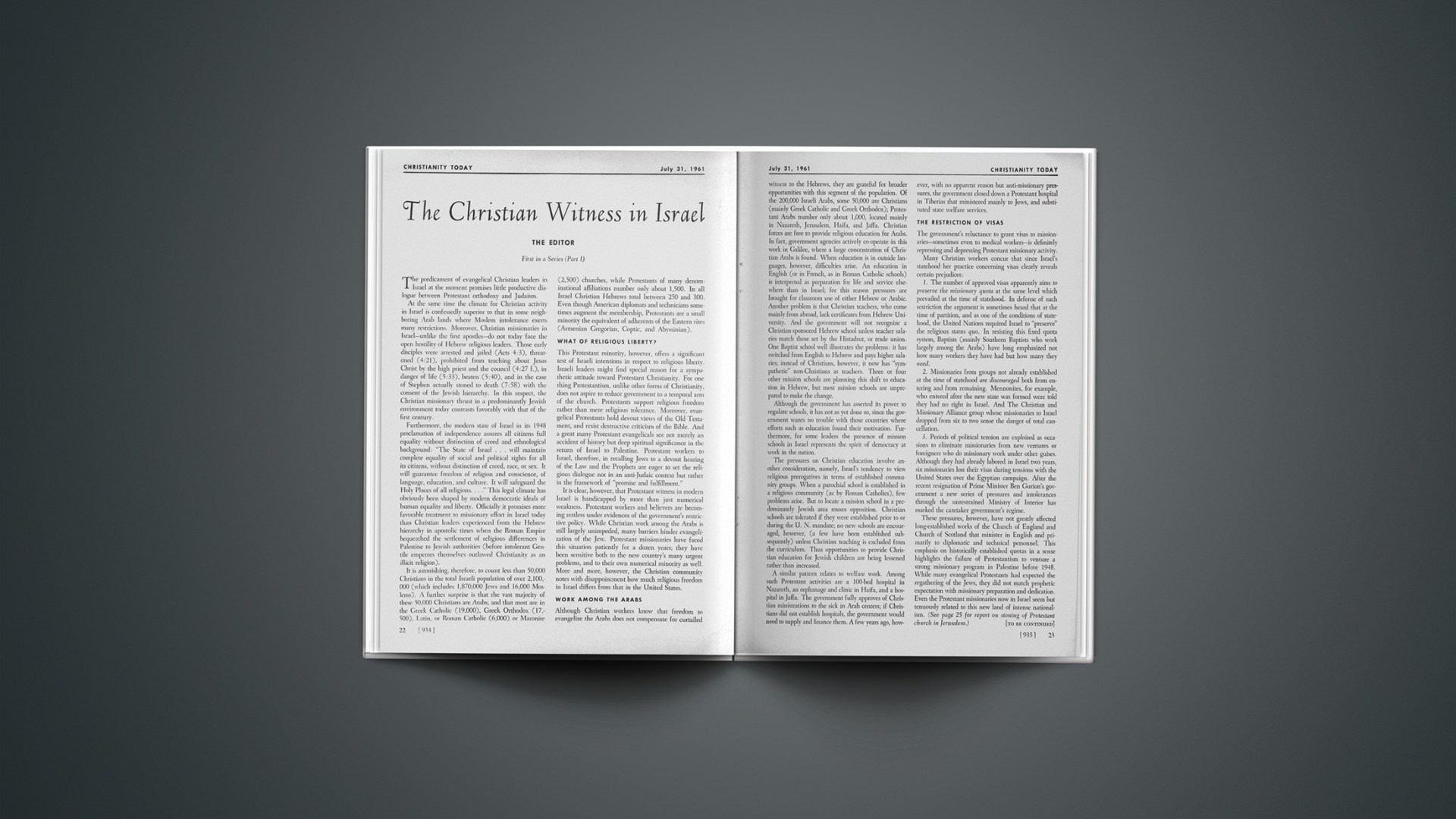
The Christian Witness in Israel

First in a Series (Part I)

The predicament of evangelical Christian leaders in Israel at the moment promises little productive dialogue between Protestant orthodoxy and Judaism.

At the same time the climate for Christian activity in Israel is confessedly superior to that in some neighboring Arab lands where Moslem intolerance exerts many restrictions. Moreover, Christian missionaries in Israel—unlike the first apostles—do not today face the open hostility of Hebrew religious leaders. Those early disciples were arrested and jailed (Acts 4:3), threatened (4:21), prohibited from teaching about Jesus Christ by the high priest and the council (4:27 f.), in danger of life (5:33), beaten (5:40), and in the case of Stephen actually stoned to death (7:58) with the consent of the Jewish hierarchy. In this respect, the Christian missionary thrust in a predominantly Jewish environment today contrasts favorably with that of the first century.

Furthermore, the modern state of Israel in its 1948 proclamation of independence assures all citizens full equality without distinction of creed and ethnological background: “The State of Israel … will maintain complete equality of social and political rights for all its citizens, without distinction of creed, race, or sex. It will guarantee freedom of religion and conscience, of language, education, and culture. It will safeguard the Holy Places of all religions.…” This legal climate has obviously been shaped by modern democratic ideals of human equality and liberty. Officially it promises more favorable treatment to missionary effort in Israel today than Christian leaders experienced from the Hebrew hierarchy in apostolic times when the Roman Empire bequeathed the settlement of religious differences in Palestine to Jewish authorities (before intolerant Gentile emperors themselves outlawed Christianity as an illicit religion).

It is astonishing, therefore, to count less than 50,000 Christians in the total Israeli population of over 2,100,000 (which includes 1,870,000 Jews and 16,000 Moslems). A further surprise is that the vast majority of these 50,000 Christians are Arabs; and that most are in the Greek Catholic (19,000), Greek Orthodox (17,500), Latin, or Roman Catholic (6,000) or Maronite (2,500) churches, while Protestants of many denominational affiliations number only about 1,500. In all Israel Christian Hebrews total between 250 and 300. Even though American diplomats and technicians sometimes augment the membership, Protestants are a small minority the equivalent of adherents of the Eastern rites (Armenian Gregorian, Coptic, and Abyssinian).

WHAT OF RELIGIOUS LIBERTY?

This Protestant minority, however, offers a significant test of Israeli intentions in respect to religious liberty. Israeli leaders might find special reason for a sympathetic attitude toward Protestant Christianity. For one thing Protestantism, unlike other forms of Christianity, does not aspire to reduce government to a temporal arm of the church. Protestants support religious freedom rather than mere religious tolerance. Moreover, evangelical Protestants hold devout views of the Old Testament, and resist destructive criticism of the Bible. And a great many Protestant evangelicals see not merely an accident of history but deep spiritual significance in the return of Israel to Palestine. Protestant workers to Israel, therefore, in recalling Jews to a devout hearing of the Law and the Prophets are eager to set the religious dialogue not in an anti-Judaic context but rather in the framework of “promise and fulfillment.”

It is clear, however, that Protestant witness in modern Israel is handicapped by more than just numerical weakness. Protestant workers and believers are becoming restless under evidences of the government’s restrictive policy. While Christian work among the Arabs is still largely unimpeded, many barriers hinder evangelization of the Jew. Protestant missionaries have faced this situation patiently for a dozen years; they have been sensitive both to the new country’s many urgent problems, and to their own numerical minority as well. More and more, however, the Christian community notes with disappointment how much religious freedom in Israel differs from that in the United States.

WORK AMONG THE ARABS

Although Christian workers know that freedom to evangelize the Arabs does not compensate for curtailed witness to the Hebrews, they are grateful for broader opportunities with this segment of the population. Of the 200,000 Israeli Arabs, some 50,000 are Christians (mainly Greek Catholic and Greek Orthodox); Protestant Arabs number only about 1,000, located mainly in Nazareth, Jerusalem, Haifa, and Jaffa. Christian forces are free to provide religious education for Arabs. In fact, government agencies actively co-operate in this work in Galilee, where a large concentration of Christian Arabs is found. When education is in outside languages, however, difficulties arise. An education in English (or in French, as in Roman Catholic schools) is interpreted as preparation for life and service elsewhere than in Israel; for this reason pressures are brought for classroom use of either Hebrew or Arabic. Another problem is that Christian teachers, who come mainly from abroad, lack certificates from Hebrew University. And the government will not recognize a Christian-sponsored Hebrew school unless teacher salaries match those set by the Histadrut, or trade union. One Baptist school well illustrates the problems: it has switched from English to Hebrew and pays higher salaries; instead of Christians, however, it now has “sympathetic” non-Christians as teachers. Three or four other mission schools are planning this shift to education in Hebrew, but most mission schools are unprepared to make the change.

Although the government has asserted its power to regulate schools, it has not as yet done so, since the government wants no trouble with those countries where efforts such as education found their motivation. Furthermore, for some leaders the presence of mission schools in Israel represents the spirit of democracy at work in the nation.

The pressures on Christian education involve another consideration, namely, Israel’s tendency to view religious prerogatives in terms of established community groups. When a parochial school is established in a religious community (as by Roman Catholics), few problems arise. But to locate a mission school in a predominately Jewish area rouses opposition. Christian schools are tolerated if they were established prior to or during the U. N. mandate; no new schools are encouraged, however, (a few have been established subsequently) unless Christian teaching is excluded from the curriculum. Thus opportunities to provide Christian education for Jewish children are being lessened rather than increased.

A similar pattern relates to welfare work. Among such Protestant activities are a 100-bed hospital in Nazareth, an orphanage and clinic in Haifa, and a hospital in Jaffa. The government fully approves of Christian ministrations to the sick in Arab centers; if Christians did not establish hospitals, the government would need to supply and finance them. A few years ago, however, with no apparent reason but anti-missionary pressures, the government closed down a Protestant hospital in Tiberias that ministered mainly to Jews, and substituted state welfare services.

THE RESTRICTION OF VISAS

The government’s reluctance to grant visas to missionaries—sometimes even to medical workers—is definitely repressing and depressing Protestant missionary activity.

Many Christian workers concur that since Israel’s statehood her practice concerning visas clearly reveals certain prejudices:

1. The number of approved visas apparently aims to preserve the missionary quota at the same level which prevailed at the time of statehood. In defense of such restriction the argument is sometimes heard that at the time of partition, and as one of the conditions of statehood, the United Nations required Israel to “preserve” the religious status quo. In resisting this fixed quota system, Baptists (mainly Southern Baptists who work largely among the Arabs) have long emphasized not how many workers they have had but how many they need.

2. Missionaries from groups not already established at the time of statehood are discouraged both from entering and from remaining. Mennonites, for example, who entered after the new state was formed were told they had no right in Israel. And The Christian and Missionary Alliance group whose missionaries to Israel dropped from six to two sense the danger of total cancellation.

3. Periods of political tension are exploited as occasions to eliminate missionaries from new ventures or foreigners who do missionary work under other guises. Although they had already labored in Israel two years, six missionaries lost their visas during tensions with the United States over the Egyptian campaign. After the recent resignation of Prime Minister Ben Gurion’s government a new series of pressures and intolerances through the unrestrained Ministry of Interior has marked the caretaker government’s regime.

These pressures, however, have not greatly affected long-established works of the Church of England and Church of Scotland that minister in English and primarily to diplomatic and technical personnel. This emphasis on historically established quotas in a sense highlights the failure of Protestantism to venture a strong missionary program in Palestine before 1948. While many evangelical Protestants had expected the regathering of the Jews, they did not match prophetic expectation with missionary preparation and dedication. Even the Protestant missionaries now in Israel seem but tenuously related to this new land of intense nationalism. (See page 25 for report on stoning of Protestant church in Jerusalem.)

Samuel M. Shoemaker is the author of a number of popular books and the gifted Rector of Calvary Episcopal Church in Pittsburgh. He is known for his effective leadership of laymen and his deeply spiritual approach to all vital issues.

Ideas

Bringing a Nation Back to God

The 350th anniversary of the publication of the Authorized or King James Version of the Bible is an opportune moment for taking stock of the spiritual situation in Great Britain. The greatness of Britain has been closely connected with the influence of the English Bible on her national life. Of this the British people and the British Commonwealth of nations is reminded at the coronation of each successive sovereign, when the Bible is presented to the new king (or queen) as “the most valuable thing that this world affords” and “the lively oracles of God.”

In a famous dictum, the historian John Richard Green described the English people as “the people of a book, and that book the Bible.” Referring to this description, Bishop Stephen Neill, in an article on “The Bible in English History” published in The Churchman (London), June, 1961, writes as follows: “It is hardly too much to say that in the sixteenth century the English language became the language of one book, and that book the Bible; and, since the language that men speak penetrates to the very recesses of their being, and influences thought and attitude and judgment in ways that are past reckoning, it is no exaggeration to maintain that the English Bible was, up till the end of the nineteenth century, one of the strongest creative forces that made and moulded the English way of life and the history of the English people.”

But having the Bible is not enough in itself. As a great evangelical bishop of last century, John Charles Ryle, wrote: “Just as man makes a bad use of his other mercies, so he does of the written Word. One sweeping charge may be brought against the whole of Christendom, and that charge is neglect and abuse of the Bible.… I have no doubt that there are more Bibles in great Britain at this moment than there were since the world began. We see Bibles in every bookseller’s shop, there are Bibles in almost every house in the land. But all this time I fear we are in danger of forgetting that to have the Bible is one thing, and to read it quite another.… Surely it is no light thing what you are doing with the Bible.” These words may be said to be even truer of Britain today than they were in Bishop Ryle’s time.

Nonetheless, the immediate availability of the Bible in one’s own language is an advantage not to be underrated. It constitutes, assuredly, a potential for judgment accumulating against those who through unconeern ignore its message. But it also constitutes a potential for salvation, ready through God’s grace to burst into a purifying blaze in the life of a nation. The situation in Britain today calls for purgation by the fire of God. It is a solemn and closely connected fact that, as Bishop Neill observes (in the same article), “for the first time since the Reformation the Bible is an unknown book to the majority of the people of England.”

The lesson of history is plain to see. The great spiritual revival of the sixteenth century, which is known as the Reformation, resulted from the rediscovery of the Bible as the Word of God—a rediscovery which led directly to the translation of the Bible into English and to the British nation becoming the people of the Book. And the Evangelical Revival of the eighteenth century, so far-reaching in its impact on the life of the nation, was a consequence of the nation-wide preaching by men like George Whitefield and John Wesley of the evangelical message of Holy Scripture which had fallen into disastrous neglect. That the present situation, alarming though it is (as the evidence set forth in this issue shows), is not beyond the point of reprieve is suggested by a consideration of the historical records, which lead one to conclude that Britain was in an even worse state of spiritual atrophy before both the Reformation and the Evangelical Revival than she is today.

All revival is, of course, the gracious work of the Holy Spirit; but that in no way absolves man from answerability to him who is his Creator, Redeemer, and Judge. In our Western world nothing is more desperately urgent than that we should learn the old lesson over again, that the recovery of spiritual and moral stature lies in getting back to the Bible as the Word of God, back to the only Saviour of mankind whom that Book proclaims, and back to the faith and worship enjoined by Christ through his Apostles.

But, it may be asked, can we really believe that God has a plan for nations? Again, the response of both Scripture and history is unanimous. The outstanding example is the divine choice of the nation of Israel and God’s integration of it into his redemptive purposes—purposes which were not frustrated by the sad fact that, despite all its privileges, only a fraction, a remnant, of the nation of Israel showed itself to be faithful to the requirements of the covenant which bound them to God. Although there is a certain unique aspect of the calling of Israel, their history nonetheless is a warning to every nation of the dire consequences of the abuse or contempt of blessings and privileges. In modern times Germany, the land of Martin Luther, supplied a dreadful example of this nemesis during the Nazi era, and a warning not least to Britain and the U.S.A. Ungodliness is the next step before inhumanity. “Them that honor me I will honor,” is a promise of God that still holds good. And God pleads not only with Israel but with any people that has departed from the old paths, “Return unto me, and I will return unto you.”

A nation is indeed a real entity, possessing a solidarity which God recognizes. There is such a thing as national life, national honor, national responsibility. But a nation is not a simple conglomerate. It is a complex organism compounded of a multiplicity of spheres and units of life. In the briefest analysis it may be broken down progressively into geographical communities, families, and individuals. Each individual is a member of a family and of a community as well as of the nation, and he cannot contract out of these widening spheres of involvement.

The Christian Church, too, is a nation—the nation of God’s people, redeemed, reborn, made members of the kingdom of Christ. It too comprises geographical communities, families, and individuals. As in the life of the nation, so in the life of the Church, individuals are the units of structure, though at the same time indissolubly linked with the wider solidarities. Individual believers, says the Apostle Peter, are the “living stones” of the edifice of Christ’s Church which, as Paul teaches, is “built upon the foundation of the Apostles and Prophets.” And Christ himself is the chief cornerstone—that is, the measure of the Church’s stature, giving due position and alignment to every single believer built into the Ecclesia.

The redemption procured by Christ is appropriated, it is true, by individuals; but it embraces the widest solidarity of all, namely, the whole creation. The Gospel is addressed to the individual heart and conscience, but its effect is the building of the Church through God’s “adding to the church daily such as are to be saved.” The Christian receives the light of Christ in order that he, in the Church, may be the light of the world. He is placed within the Church, which means that he is no longer of the world. But he is still in the world, and the commission received from his Master is to go into all the world and to preach the Gospel to every creature.

The need for Great Britain today, and for every so-called Christian nation, is for the Church to recapture a sense of the imperative urgency of this dominical commission. There are indeed distinctions between ministry and laity, but there is no distinction where this commission is concerned. The distinction which assigns to the laity a role of passivity is a false distinction and a betrayal. Christ’s command is that every one of his followers should be an evangelist. What impact could we not expect on any nation where that command is obeyed by the members of his Church.

ANOTHER AMERICAN ASTRONAUT RIDES THE RIM OF OUTER SPACE

While millions watched by television, Virgil “Gus” Grissom became America’s second astronaut to probe suborbital space. Next on the agenda is a U.S. astronaut in outer space.

“Everything science does is productive,” remarked an impressed television commentator, without troubling to spell out what it produces. And indeed, nobody was prone to question the spectacular achievements of space science. But what “the space age” will produce is yet to be seen. In the first decades of our century even “progressive” clergymen looked to science to transform the world. But they had overlooked the frustrating detail that fallen man inhabits the earth. Things may go rather well in outer space too unless it becomes populated by sinful men. In that event, science may merely exchange one problem for another.

NO ACADEMIC LICENSE TO PERVERT MORAL STANDARDS

In March, 1960, the University of Illinois relieved Assistant Professor Leo Koch of his duties and terminated his contract at the end of the academic year. The Daily Illini had published his letter stating that for college students “there is no valid reason why sexual intercourse should not be condoned among those sufficiently mature to engage in it without social consequences and without violating their own codes of morality and ethics.”

The case has been carried to the courts by the American Civil Liberties Union and The Committee for Leo Koch. They contend that “no teacher should be dismissed on the ground that his views are ‘repugnant’ to a university administration.” They do not indicate on what grounds a professor is dismissable. Reduced to simple terms, it would seem that any professor, anywhere and anytime, can publicly advocate homosexuality, fornication, adultery, sodomy, and rape (if not mayhem and murder) with impugnity. Academic liberty, assuredly, is a necessary requisite for any campus immune to thought control. But liberty is hardly a license for academic perversion. Too many parents already are paying steep tuition charges for a diploma which depletes moral standards along the way. The administration of the University is to be commended for its courageous commitment to moral principle.

15: The Covenant of Works

Whatever else the statesmen and economists of today may report to us, they cannot say, “We have walked to and fro, through the earth, and, behold, all the earth sitteth still and is at rest.” The earth is not sitting still; it is not at rest. Recent years have been marked by constant change, accompanied by turmoil and confusion. Many foundations have been destroyed; and the question is asked anxiously, What can the righteous do? What of the future?

As we look out on the world, we can hardly fail to see that the great problem which confronts us is that of authority and obedience. It faces us at every level: personal, domestic, social, religious. Is man an autonomous anarch? Or is he a responsible being; and if responsible, to whom?

The Bible has a simple but comprehensive answer to this question. Briefly stated it is this: Man was created by God and in the image of God; and the duty which God requires of man is “obedience to his revealed will.” The authority of God, implied in his Creatorship, has as its correlate the obedience of man; and God’s will is revealed in the Bible.

That this is so is the Bible’s constant claim. It is plainly set forth in the account of the creation of man. Five imperatives are at once laid upon man (Gen. 1:28); and three times the word “commanded” is used of God’s dealings with Adam and Eve. The story is briefly and simply told. God commanded; Adam and Eve disobeyed; the penalty or sanction attached to the command was invoked, and the guilty pair, under sentence of death, were driven forth from the presence of God.

The relationship established in Eden has been properly called the covenant of works. That it promised life as the reward of obedience is not immediately stated. But it is made abundantly clear elsewhere, notably in Deuteronomy (6:5; 10:12 f.; 30:15–20). The First Psalm is a poetical expounding of this covenant; and it has its counterpart in Romans 2:7–9. The penalty of disobedience is shown in the mournful cadence in Genesis 5, “and he died,” and in the terrible judgment of the Flood which destroyed “the old world of unrighteousness.” The consistent teaching of the Bible is that “the wages of sin is death.”

The covenant was made with Adam in a state of innocence; and almost his first recorded act was the breaking of it; and human history from that day to this is a tragic record of man’s failure to keep it. Consequently, in the plan and purpose of God, the covenant of works was immediately followed by the covenant of grace. This covenant is first set forth cryptically in the words of the protevangel (Gen. 3:15) which promised Eve ultimate triumph over the enemy of her race. In this covenant the emphasis is on faith. This is made clear in the wonderful words that are said of Abram: “And he believed in the LORD, and he accounted it to him for righteousness” (15:6), to which Paul appeals to show that Abraham was justified by faith and not by the works of the law. He also appeals to the words of the prophet, “the just shall live by faith” (Hab. 2:4). The New Testament abounds in statements which justify Luther’s challenge to Rome—“justification by faith alone.” John 3:16; Acts 16:31; Romans 2:8 are a few of them.

Since these two covenants are often contrasted rather sharply as works versus faith, it is important to remember that the basic requirement of both is exactly the same. They both require obedience to the revealed will of God. This is made especially clear in the life of Abraham. Abraham is Paul’s great example of salvation by faith. But no mere man was ever more severely tried and tested in the school of obedience (Gen. 22:18; 26:5). In the great faith chapter in Hebrews we read that when Abraham was called to go forth to the unknown country he “obeyed; and he went out, not knowing whither he went.” This whole chapter should not be called “the faith chapter” but the chapter of “the obedience of faith” (Rom. 16:26). For of all its examples of faith it can be said, “They climbed the steep ascent of heaven through peril, toil, and pain.”

By the covenant of grace the Christian is not offered faith as an easy substitute for works of righteousness. It offers him an unmerited and unearned righteousness, the righteousness of Christ received by faith, which challenges him and demands that he walk worthy of his high calling, that he learn to say as Paul did, “the love of Christ constraineth us” (2 Cor. 5:14). The fact that he is not under the law as a basis of works-salvation does not set before the Christian a lower standard than that of the Mosaic law, but a far higher one; and this for at least four reasons: (1) Being made free from the curse and bondage of the law as a covenant of works, he ceases to be a servant (slave) and becomes a son, a member of the household of God. (2) He has set before him the perfect pattern of obedience in the person and work of Christ. (3) He is given the strongest motive for loving and obedient service, gratitude to Him who died that he might live. (4) He has received the indwelling of the Holy Spirit to illumine, sanctify, and energize him for the willing and obedient service of God. When Jesus gave his disciples a new commandment, “As I have loved you that ye also love one another,” he set them a standard of obedience that surpassed the commandment of the Law, “Thou shalt love thy neighbor as thyself.” Little wonder then that Paul answers the question, “Do we then make void the law through faith?” with the emphatic words, “God forbid: yea, we establish the law.” And the great Catechisms of Protestantism—Luther, Heidelberg, Westminster—devote much space to delineation of the meaning of the Decalogue as setting forth what Tyndale called “the obedience of the Christian man.”

Since then it is clear that the Gospel does not abrogate the moral law as a standard of life and conduct but raises it to a higher level both by example and precept, it is not surprising that various efforts have been made from New Testament times until now, by carnally-minded Christians—and none are wholly dead unto sin—to set aside the covenant of works as of obligation to the Christian, or to modify its demands. Space will permit only brief discussion of the most important of them.

Antinomianism. This heresy was met with already by Paul. Stating the antithesis between faith and works in the most absolute fashion, “Shall we continue in sin that grace may abound?” Paul gave it the conclusive answer, “God forbid. How shall we that are dead to sin, live any longer therein?” The whole teaching of the New Testament is that justification has as its objective sanctification, redemption from all iniquity. A faith which does not bring forth fruit unto righteousness is not a living faith. The bandit who comes secretly to the priest for confession and absolution only that he may with a quieted conscience return to his life of thievery and violence is like the Jews of old who made the Temple “a den of robbers,” a refuge against the consequences of their evil deeds.

Perfectionism. This is the opposite extreme. It not merely recognizes the duty of man to do the will of God, but insists that he is able to do it. It has its familiar illustration in the Pharisee who thanked God that he was not as other men and took pride in his good works. And the lesson of the parable is that all self-righteousness is an offence in the sight of God. This teaching must either lower the standard of obedience, or minimize the corruption of man and his consequent inability to obey God perfectly. This is illustrated most clearly in the doctrine of the church of Rome. It teaches that baptism removes the guilt and corruption of man’s nature and that prevenient grace is given him to enable him to do the will of God. The extreme form of this teaching is supererogation, that man can do not merely all that God requires but more, that by special acts of obedience (celibacy, poverty, austerity) he can lay up additional merit, which the Church can administer, for the benefit of sinful members of the body of Christ. This teaching makes the super righteousness of the saints (the few) the means of saving sinners (the many) from the torments of purgatory. It has no warrant in Scripture.

Perfectionism is taught in various forms in Christian churches today. It is biblical and sound when it recognizes and stresses the demands of Scripture for perfect obedience to the will of God. It is mistaken and dangerous when it fails to recognize that “no mere man since the fall is able in this life perfectly to keep the commandments of God, but doth daily break them, in thought, word, and deed.” The Apostle Paul confessed that he had not “already attained.” But he said, “I press to the mark to the prize of the high calling of God in Christ Jesus.” Anyone who thinks he has attained deceives himself. Everyone who does not press toward the mark, fails to realize the obligation of his high calling.

Dispensationalism. This popular teaching is characterized by the dividing of biblical history into a series of distinct and contrasted dispensations. The most important are: promise, law, and grace. It teaches that the dispensation of promise was introduced by the Abrahamic covenant, the sole requirement of which was faith, that obedience was not required until at Sinai Israel “rashly accepted the law” (Scofield). The fallacy of this teaching can be shown in several ways. (1) Abraham’s faith was proved by his obedience when he was called upon to offer up Isaac (Gen. 22:1–18), and the blessings promised him and his seed were given “because thou hast obeyed my voice” (cf. 26:5). (2) Dispensationalists admit that the promise to Abraham was conditional when they tell us that to be or to remain in the land was a condition of blessing. (3) Refusal to accept the law at Sinai with its promise of blessing would have been an act of disobedience, which would have been dealt with as severely as was the refusal to go up to possess the land (Num. 14:26–38).

Barthianism. The primary emphasis in the crisis theology, of which Karl Barth is the most distinguished representative, is placed on the transcendence of God. This was the natural reaction to the immanentism of the old liberalism. It holds the separation between God and man to be utter and absolute. God must break through to man, if man is to know God redemptively. This breakthrough or “crisis” is an act of revelation and it is made in and through the Scriptures. But according to Barth the Bible is not a divine and infallible book but a very human and fallible book. It is not the Word of God: it contains it. It is only as God speaks through it to the human soul that the written word becomes God’s Word to the individual man; only if the word “finds” him is it God’s Word for him. Let us illustrate from the Decalogue. Suppose the command, Honor thy father and thy mother, does not “find” the adolescent of today, what power has Barthianism to require him to obey it? The great peril in Barthianism is its subjectivism. If man’s knowledge of God and His will comes only through the Bible, then only a fully dependable Bible can give man the clear and certain knowledge which he needs. But the Barthian must first decide for himself what the will of God for him is before he is under any obligation to accept it. Thus every man makes for himself his own “covenant of works” and does that which is right in his own eyes.

Existentialism. Like Barthianism, existentialism, despite its great popularity, is a relatively new teaching. It is traced back to Kierkegaard who in revolt against the spiritual coldness and lethargy of the Danish State Church, placed the emphasis on personal decision as against what has been aptly called the “spectator attitude” toward life.

This has developed into a tendency to reject the authority of all external standards and codes. It involves such familiar ideas as that of the sophists that “man is the measure of all things.” It may be atheistic or theistic.

An extreme form of it is found in the attempt of Bultmann to demythologize the Bible. Since the supernatural does not appeal to the “scientific” man of today, does not find him, it is treated as myth and eliminated, which means of course the denial and rejection of any divine authority or sanction in the Bible or elsewhere.

Centuries ago in a time of distress in Israel, a prophet of the Lord promised the people deliverance from Shishak. But he added these impressive words in the name of the Lord: “Nevertheless, they shall be his servants; that they may know my service, and the service of the kingdoms of the countries.” Freedom is a great word today, a word to conjure with. The Bible speaks in terms of service—service to God, servitude to man. It pictures the glory of the one, the misery of the other. Let us hope and pray that the trials through which men are passing today in their struggles for self-expression and for liberty, may lead them to submit themselves in loving obedience to Him of whom alone it can be said that His service is perfect freedom.

Bibliography: The Westminster Confession and Catechisms; H. Witsius, The Economy of the Covenants; general works on systematic theology, such as those of C. Hodge, A. A. Hodge, A. H. Strong. Of recent works: C. F. H. Henry, Christian Personal Ethics; Contemporary Evangelical Thought (ed. by the same); Scofield Reference Bible; O. T. Allis, Prophecy and the Church; A. Reese, The Approaching Advent of Christ; monographs in the Modern Thinkers series: A. D. R. Polman, Barth; S. U. Zuidema, Kierkegaard; Sartre; H. Ridderbos, Bultmann.

Former Professor of Old Testament

History and Exegesis

Westminster Theological Seminary

Philadelphia, Pa.

Crime and Delinquency

Britain is experiencing the greatest crime wave in living memory. Between the wars the yearly average of persons serving terms of imprisonment was 11,000; at the end of 1959 the number was 25,800. So overtaxed has the accommodation of penal establishments become that it has been found necessary to sleep 6,000 men three to a cell. And the position is worsening. Crime has been on the increase since the early 1930s. In 1945 the figures showed a steep rise and the yearly totals thereafter continued upwards until the early 1950s when there was a drop. The upward trend, however, was resumed in 1955. Since then the yearly totals have shown a steady and continuing rise. In 1959 the totals were roughly double the figures for 1938. The provisional figures for 1960 show a further increase of 10 per cent as compared with 1959. Some idea of the volume and rate of increase since 1938 in indictable offences (that is, offences which may be tried by jury) can be obtained from the following figures:

Offences of dishonesty account for some 83 per cent of the total. The figures show that the greatest proportional increase has been in crimes of violence.

A WAVE OF LAWLESSNESS

Thus while crime as a whole has doubled since before the war there were in 1959 six times more cases of violence against the person and nine times more cases of robbery than in 1938. This alarming trend is further accentuated by the provisional figures for 1960 which show an increase over the previous year of 14 per cent in crimes of violence. When further analyzed, the statistics show that 12 times more youths between the ages of 14 and 17 and 14 times more youths between the ages of 17 and 21 were convicted of violence in 1959 than in 1938. Thus the broad picture is of crime steadily increasing over a number of years, the volume of which is now more than double what it was before the war, with the greatest proportional increase in violence and a much higher rate in proportion to the number of crimes among youths and young men.

Concurrent with this wave of lawlessness, the country has embarked on the biggest program of penal reform of this century. In 1948 corporal punishment was abolished; in 1957 capital punishment was restricted to limited categories of murder; and a bill now before Parliament proposes far-reaching restriction on the imprisonment of persons under 21. Old prisons are being modernized, others are to be scrapped, and many new establishments are being provided.

DEEP ROOTS OF CRIME

As the home secretary in the House of Commons recently said, “the roots of crime lie deep in society and the sources from which they are nourished are almost wholly beyond the Government’s reach. Belief in moral obligations, pride in integrity, and respect for the rights of others can and should be instilled by the family.” However diverse may be the immediate causes of crime, the weakening—and in so many instances the breakdown—of family life and discipline are the greatest cause. Family life is threatened by the vast increase since the war of broken marriages and by the growing practice of married women engaging in work outside the home to the neglect of the children.

Moreover life in the home too often is centered round the television set with its portrayal of violence and the gangster, while in so many homes the only reading matter ever seen is the popular press and the “comics” which depend for their appeal on the sordid and the sensational. Bible reading and church attendance are rare. Small wonder that gangs of youths try to emulate the violence they have learned to admire. A governor of a Borstal institution wrote recently: “When we discuss matters of ethics, dishonesty, deceit, lying, and such-like and show that we consider the boys to have wrong standards we are looked upon as not being part of this world. So often these warped ideas have become the accepted standards of whole areas and places from which our population comes.” Nothing but a revival of true religion on a national scale can meet this situation. This is the challenge to the Christian Church.

Samuel M. Shoemaker is the author of a number of popular books and the gifted Rector of Calvary Episcopal Church in Pittsburgh. He is known for his effective leadership of laymen and his deeply spiritual approach to all vital issues.

The Industrial Community

The challenge to evangelism in industrialized society is not primarily how to reach the non-church-going industrial masses, but how to make the Gospel intelligible in a new form of society. The working classes of Great Britain are no better and no worse than any other class. They require our attention, however, because they slip through the network of evangelism more easily than other groups. The children and womenfolk are held at least temporarily by the network of day schools, Sunday schools, local churches, and missions, but to most men the church’s activities are totally irrelevant and “out of date.” This attitude is not limited to the shop floor worker: it was a director of research in a large factory in the Midlands who said, “The Church is at least 500 years behind the times.”

Failure to reach these men at home has forced the church out in the open to meet them on their own ground at work, an action which exposes the church’s weakness both in understanding modern society and also in appreciating the way the truth of the Gospel meets every situation of man.

THE ONE HOPE

The gospel of Jesus Christ remains the one hope for all men today; the Word is just as alive and powerful. What then are the characteristics of our society? How does the church stand in relationship to it? As far as England is concerned, the church was dominant in the formation of so much of its cultural pattern. But the church has failed to keep pace with modern technology and the culture it has brought in its train; hence, it is no longer consulted nor has Christian comment its old weight of authority. This problem is aggravated because the church has tried to “keep up to date” by using the techniques of modern society, travel, publicity, radio, and so on, and yet it appears to criticize the foundations of the society which produces them.

Christians today are reaping the fruits of last century’s controversy where “science” was so often branded as anti-Christian. To counteract the “natural” explanation of things through scientific discovery, the Christian tended to identify the working of God with the supernatural. Now that the ordinary man sees that science has explained more and more of life without reference to the supernatural, man seems to have less need of God, feels that God is out-of-date, and seeks to satisfy the divine hunger on the husks of materialism. The shepherd saw the glory of God in a sunset over distant hills. The Christian must now seek to show the workman the glory of God in the nature of the things with which he works—that God is concerned with the ordinary things of his life.

But so often Christians give the impression that the products of modern society are comparatively useless—even though Christians use them themselves. In our desire to emphasize the Gospel, we stress man’s nature as a sinner and leave the workman with the idea that everything he does is sinful, including his work, and so the greater proportion of his life becomes meaningless. If we meet a man in the context of his work we must be prepared to see the good in him if he is going to see the presence of God in his life.

The form of the Gospel message has for so long been fashioned by intellectuals in order to appeal to the intelligent, that Christians have tended to patronize the nonintellectuals as if they were children. This has led us to equate simplicity with immaturity. We could not have made a bigger mistake about the industrialist. He may not be trained in abstract intellectual forms of thinking, but he is often far more mature than the one who preaches the Gospel. That is why he so often thinks of the Gospel as suitable only “for the kids.”

THE WORKER’S MATURITY

What is the secret of the worker’s maturity? To discover this we must learn to take more seriously the social pattern of the industrial worker in England.

One factor is the solidarity of the working class. A considerable amount of the Gospel is often interpreted by the working class audience as trying to break down this solidarity. This is not due to the Gospel itself but to the outlook of the preacher. He frames his message to make a personal appeal—that is, an individual appeal—which may be interpreted as inculcating disloyalty to his friends. This need not be so, however, as the very group forces can be used in the service of the Gospel. This is the secret of the revival movements in the long houses in Borneo, in Ruanda-Urundi, and even underlies the way England itself was evangelized. If we take the Old Testament idea of solidarity among the tribes of Israel and the way God dealt with them unto the third and fourth generation, then it is possible to see that this “primitive” loyalty is a sign of God’s purpose, and that we should not disrupt its pattern.

Another factor is that, having come to terms with eternal things, the Christian seems too easily to accept the status quo of temporal things. This is certainly not true! England has the great social reformers of the last century to prove it. But in acclaiming Wilberforce and Shaftesbury, we sometimes forget that they had to fight against the dead weight of Christian opinion, and Shaftesbury, while claiming to be an evangelical, was disowned by them in his struggle. The Christian too easily absorbs a respectable outlook, so that his working class hearers are put off by this respectability. They do not see him as the servant of Christ but often as the agent of the Conservative Party.

Large sections of the working class population of England have no tradition of church or chapel going, despite the influence of John Wesley. Certainly Methodist class leaders were amongst the first foremen and the Christian conscience stimulated the formation of Trades Unions, but, as E. H. Wickham shows in his Church and People in an Industrial City, the working class could not afford to go to public worship; it cost too much to rent a pew and free seats were scarce.

CHRISTIAN ACTION

What are we doing as Christians to meet this need? A great deal of accurate diagnosis of the situation is being made. Far more is being done than is generally realized. The Christian bodies in the industrial field include the following. The Industrial Christian Fellowship pioneered the idea of “industrial mission” early in this century, but the larger denominations have now set up their industrial committees and departments. The Church of England has many industrial advisers who consult with industrialist and trade union leaders and run training courses at colleges like the William Temple College. The Sheffield Industrial Mission is well known for its work in the steel industry, while the Luton Industrial Mission is the centre of Methodist activity. The YMCA specializes in work among apprentices. Everywhere local clergy are making more efforts to reach the factories.

The group which is best known to evangelical Christians is the interdenominational Workers’ Christian Fellowship which has over 250 groups in various parts of the country. In recent years, Christian Teamwork has used the expert knowledge of industrialists and trade unionists to meet particular problems thrown up by Christians in industry and so prepare the way for evangelism. The best-known example of their work is that in the Midlands for the Owen Organization.

Evangelistic crusades, even when they are held in the factory (a practice of questionable advantage) make very little real impact. More than the sudden evangelistic campaign it requires the dedicated evangelistic drive of the patient Christian who by his example is able to convince his fellow workmen that Christ is relevant to their work as well as to their souls.

Industrial society will not respond to the Gospel unless the Christians engaged in the work are well equipped in their knowledge both of the Scriptures and of understanding of industrial life. As well as a deep personal faith, they will need a clear understanding of the doctrine of God the Creator, as well as of Christ the Redeemer, together with the doctrine of the Holy Spirit in the Church. They need to have a deep love for man and a real appreciation of his social problems. Such knowledge is gained only by hard thinking and laborious experience. So shattering is this experience that some Christians have lost their incentive to evangelize in their desire to meet the more apparent needs of those among whom they work.

This has caused most evangelicals to be critical of Christians who approach the problem from the social aspect; while in turn, those who approach it from the social aspect are generally highly critical of “pietistic groups” concerned only with evangelical experience.

More and more, management and trades union leaders are ready to co-operate. But they are quick to detect hypocrisy and refuse to be drawn into sectarian struggles. With humility and prayer, we Christians must be ready to learn from each other so that even if we don’t agree we can at least appreciate what each one of us is doing. Only in this way will Christ be honored and his Gospel proclaimed with power.

Preacher In The Red

LORD OF THE LAW

The police officer stopped my car, and told me I was exceeding the speed limit. I explained that I was a minister, and that I was about to be late to an important session of a church conference. After a brief lecture, he released me without a fine, but entered a record of the incident on my driver’s license, and then he signed it—“Officer Lord.”—The Rev. H. DONALD MIZELLE, Minister, Howe Memorial Methodist Church, Crescent City, Florida

Samuel M. Shoemaker is the author of a number of popular books and the gifted Rector of Calvary Episcopal Church in Pittsburgh. He is known for his effective leadership of laymen and his deeply spiritual approach to all vital issues.

The Schools and Universities

Education came to the British Isles along with the message of the Gospel, and for many centuries the church was its patron and sole purveyor. This remained true until long after the Reformation, and early in the nineteenth century the basis of the English elementary system was laid by the rival efforts of the Church of England and of noncomformity in establishing the “National” and the “British” schools for the poor. The first break with tradition came in 1836 with the founding of University College, London (known to contemporary Anglicans as “the Godless institution in Gower Street”). Then in 1870 the first Education Act established a system of local school boards. In the board schools “no catechism or religious formulary distinctive of any denomination” could be taught. But this attempt at neutrality between Church and Non-conformity resulted in neutrality between Christianity and secularism. Henceforth Her Majesty’s Inspectors took no cognizance of the teaching of religion, and the Christian faith—hitherto the integrating factor in the whole curriculum—had to struggle for a place on the timetable.

In Scotland a plan projected by Knox during the Reformation had ultimately come to fruition with the result that every parish had its school long before National and British schools began in England. The fact that most Scots were Presbyterians of one kind or another made it possible to arrange for religious teaching even when the schools became controlled and supported by the government.

THE PRESENT POSITION

In England much of what was lost in 1870 was, however, regained in 1944 when a new Education Act abandoned neutralism regarding religion. Church schools were offered half their capital outlay on agreed improvements, in addition to full running expenses. Even the local authority schools—descendants of the board schools—were required to hold a daily assembly for worship and to teach religion according to an agreed syllabus, and once again the Crown’s Inspectors supervised religious instruction.

How well does the British system of religious education work? The answer is with varying success. The denominational schools, with their own forms of worship and also staffs sympathetic to their outlook, should be able to provide an atmosphere favorable to the nurture of young Christians. But their problem is to find enough convinced Christians as teachers. Britain is suffering from an acute shortage of teachers of all kinds, but the dearth of Christian teachers is a reproach to the churches for their failure to provide enough recruits to the profession. The Church of England cannot fill the places to which it is entitled with convinced and practicing church members in its 26 teacher training colleges. Consequently, its colleges are not providing even the church schools with enough Christian teachers. Without an adequate intake of committed and instructed Christians, church colleges lack the spiritual ethos essential for their task. The consequent shortage of born-again teachers called to be pastors of Christ’s young sheep is the real impediment to a truly Christian education for British children. Therefore, instead of the schools being a nursery for the church, they are themselves a mission field.

CHRISTIAN WORK IN THE SCHOOLS

Within this mission field liberal and conservative Christian organizations operate by means of traveling secretaries. The Student Christian Movement, officially supported by the churches, is more concerned—especially in its Sixth Form conferences—with questions of applied Christianity than with the problem of making converts. The Scripture Union, definitely evangelical, works through its Inter Schools Christian Fellowship which operates in the grammar schools through autonomous Christian Unions, of which there are over 300, and in the secondary modern schools by Scripture Union branches, run by Christian members of the school staff. In Scotland, there are over 200 SU branches. In Northern Ireland, every senior school has an SU branch, as do 30 grammar schools. In addition, the ISCF runs one-day and three-day (residential) conferences, while the year-round work of sowing the good seed of the Gospel finds its fruition in the 111 camps held in various parts of Britain during the summer holidays when the emphasis is on evangelism.

THE CHURCH IN THE UNIVERSITIES

The university scene is remarkably varied. In England and Wales only the religious foundations—Oxford, Cambridge, Durham, and little Lampeter—give official recognition to the Christian faith with college chapels and chaplains, and—at Oxford and Cambridge—university churches. The English provincial universities are avowedly secular, and their atmosphere predominantly materialistic. Although the various denominations appoint chaplains, full or part time, only a small proportion of the students attend any place of worship, and there is little interest in the discussion of religion. Contrast Cambridge, where a recent census indicated a weekly attendance at worship of nearly 50 per cent! Scottish universities are ancient foundations, and their senate and court meetings are opened and closed with prayer. Each university has its own official chaplain who belongs to the Church of Scotland but whose work is interdenominational. The proportion of Christians among the students is probably higher than in the country at large.

STUDENT WITNESS

The most effective Christian witness in all the universities is that undertaken by the students themselves. This is true even of “Oxbridge,” despite the well-attended college chapels.

1. Cambridge: Among the 7,000 students the multiplicity of religious societies is quite remarkable. There are denominational societies, of which the Methodist, with a membership of 230, is the largest. The Congregational is half that size. Then come the Robert Hall (Baptist) Society, the Presbyterian Association, the Young Friends (Quaker), and a small Lutheran Society. All these, operating through fellowship groups, breakfast and tea meetings, provide Christian fellowship and hold some students who might otherwise drift from Christian influence. There is no Anglican Society as such, but the Church Union takes care of Anglo-Catholics, the Church Missionary Society Fellowship fosters missionary interest with emphasis on vocation, and the Cranmer Society aims at providing instruction in the Reformation principles of the Church of England. Two interdenominational societies, the William Temple and the Student Christian Movement, stress the application of Christianity to political, social, and economic spheres, and the SCM also seeks to co-ordinate the work of the denominational societies.

Amid this plethora of religious activity, the task of faithfully presenting Christ as the Saviour of the individual is largely left to the Cambridge Inter-Collegiate Christian Union which, with its 400 full members and equal number of fringe adherents, is the oldest and most vigorous Christian Society. CICCU’s daily prayer meeting, Saturday Bible reading, and Sunday evangelistic sermon are supplemented in each college by small Bible study groups and prayer meetings—some on behalf of student evangelism in the university, and some to support missionary work abroad. The greatest evangelistic effort is concentrated in the annual “Freshers’ Sermon” and the Triennial Mission to the University, and, down the years, thousands have been won for Christ by these.

2. Other Universities. Although in all the universities student witness is carried on in a pattern similar to that at Cambridge, only Oxford and Durham (where OICCU and DICCU have considerable influence) approach the Cambridge model. But they all have their denominational societies, their SCM, their CU, and again only the CUs make the winning of souls for Christ and the nurture of Christians by Bible study and prayer their chief activities. In Scotland the denominational societies flourish less, and the CUs possibly a little more, than in England.

TWO ESSENTIALS

There are two essential requirements if the Christian faith is to regain its rightful place in British education. First, there must be far more Christian teachers in the schools, and especially in the Grammar schools for they produce the undergraduates and the future teachers. Until the Christian Church produces enough teachers, the benefits of the 1944 Act will not be fully reaped. Secondly, the university CU’s must beware of becoming isolated groups, the members of which make few friends outside the union. “Holy huddles” are pleasanter and easier than involvement, but Christians are told to be salt, and salt is no use if it remains in the salt cellar. Fortunately, the Inter-Varsity Fellowship, which acts as a link between the CUs, encourages them to reflect on the image of Christianity their members are giving.

The Shade of Lincoln Walks

The shade of Lincoln walks upon these streets

Looking with longing at the passing men;

He yearns to speak something to those he meets, For here he feels the ancient pain again.

Fear plants a furrow on their countenance,

Dread casts a darkness on their tortured path:

They walk in fetters who were born to dance,

Languish in bondage who were meant to laugh.

—KENDIG BRUBAKER CULLY.

Samuel M. Shoemaker is the author of a number of popular books and the gifted Rector of Calvary Episcopal Church in Pittsburgh. He is known for his effective leadership of laymen and his deeply spiritual approach to all vital issues.

The Country Districts

Despite the ever-increasing urban sprawl, the people of England still live in a land that is predominantly green and pleasant. Those who visit our shores depart with a mental picture of a country of villages. each with its own special character and always the ancient parish church as its centerpiece. Were our visitor to stay and inquire whether those mellow churches are still the focal point of the village life, he might be greatly shocked. The sweet bells still peal out, but there is little enough response, for church life in the rural areas is at very low ebb. Honest investigation into the causes of this decline is long overdue.

NEW FACTORS

It is not enough to put it down as “the new order and changed social conditions.” There is indeed a new spirit of independence in the country; a sense of emancipation from the traditional village community with its deference to parson and squire is manifest. Granted all this, can we discern other reasons in the church itself for the alarming deterioration in public worship? A careful examination of the contemporary ecclesiastical scene certainly suggests new factors. If we refer mainly to the established church, it is because we are more familiar with it. But much of what will be said applies also to the free churches which have for some years been applying a policy of retrenchment in the rural areas.

DILUTION OF FELLOWSHIP

It is significant that the witness of the church is usually least effective where several parishes have been joined under one incumbent. Archdeacon West, in his book The Country Parish Today and Tomorrow, gives us a picture of what happens on Sundays: “The new Rector rushes out of the vestry door with his surplice over his ears while they are still on their knees after the recessional hymn, and is a mile away down the road before they are out in the churchyard.” When this sort of thing happens week by week something is missing that is a very real part of Christian fellowship, and that should be the concomitant of real worship.

DECLINE OF CHURCH LIFE

Under the Pastoral Reorganization Measure, the Church of England has embarked upon a policy of putting three or four parishes under one parson who must serve them as best he may. The result is one service per Sunday in each church at a time which varies every week to the exasperation of the country man. There is an inevitable decline of church life in each parish in the group. Moreover there is an official tendency to insist on a “central” type of churchmanship, which often means the extinction of the one remaining center of evangelical witness in a large area. This matter of churchmanship cannot be ignored in any fair survey of our subject. It is the case that the modern edition of Tractarianism, with its emphasis on Church and Sacrament and the official dislike of strong evangelical ministries, is having a debilitating effect at a time when Protestant nonconformity has largely lost its traditional insistence upon justification by faith and the necessity for a personal experience of salvation.

THE AIR IS STILL FRESH

There is still a definite response in the country to a personal ministry with a Gospel message. The churches should see the danger sign now and determine to make full use of their opportunities and find men of God, ordained or lay, to bring in that revival of spiritual life which could mark the beginning of a new movement of the Spirit throughout the whole land.

Perhaps a return to the old “field preaching” is the first step. “There’s a breath of fresh air up here,” cried Whitefield as he climbed a Radnorshire hillside to preach the Gospel to 2000 countryfolk, “and the Spirit of God is fresh and free and full of power to convict sinners,” and no less than 500 were convicted and converted that day through the simple message of this great evangelist. The air is still fresh in the English countryside, a congregation may still be gathered, and God’s free Spirit still “bloweth where he listeth” in saving power.

Samuel M. Shoemaker is the author of a number of popular books and the gifted Rector of Calvary Episcopal Church in Pittsburgh. He is known for his effective leadership of laymen and his deeply spiritual approach to all vital issues.

The Great Cities

The great cities of Britain present special difficulties to the work of evangelism. But they call for thorough consideration, since almost a third of the population lives either in a city of over a million souls or in one of the vast industrial “conurbations” of these islands.

Because of unplanned development, large urban areas exist without a sense of community. Long journeys to work and to cultural amenities, as well as to the open country, are common to these areas. Much of the housing is old and uneconomic, and playing fields, swimming baths, and community halls are far from adequate. These conditions militate against community life, since they discourage attendance at meetings, whether political, social, literary, or artistic. The work of the churches suffers from the same difficulties. In addition, the incidence of shift-work in many industries prevents regular attendance by those who desire to take their part in activities outside the home. All voluntary youth organizations encounter difficulty in finding sufficient adult leaders.

Another set of factors affecting church attendance is the enormous change in home comforts. Mass-produced furniture, television, washing machines, refrigerators, and now record players and tape-recorders, have combined to produce a comfortable if noisy home life for multitudes of our people. Those of us who have known “working-class” homes for the past half century have seen remarkable changes. There has been considerable increase in “off-license” sales of alcoholic liquors, and people of the great cities have been disposed to stay at home when the day’s work is done.

Without doubt the mechanical and automatic routines of modern factory life encourage a materialistic rather than a personality-centered outlook on life. Prosperity is measured in terms of manufactured goods rather than by the results of the family’s own labors. Thus the family car receives more attention and has a status-value in the community beyond that of the garden which used to be important in areas where gardens could be found. But the garden is now often either laid to grass or paved to lessen the demand for attention, while many cars are religiously washed in the street as a Sunday morning exercise. From some towns the local football team is always accompanied by special train loads and coach parties of “supporters,” but these are mainly week-day activities.

The total effect of such things is to crowd life with earthly interests so that little time remains for God. Home, business, and sport combine to make life too full for God to have a place. The new convert finds that a complete reorganization of his leisure time is involved if he is to take his place in the life of the church.

RELIGIOUS VIEWS OF THE PEOPLE

In the past 15 years several interesting surveys of social conditions have dealt with religious views and activities. Reports from chaplains in the services and in the prisons have disclosed widespread ignorance of Christian truths and faith. Yet beneath all this, several valuable things persist. First, there is a real respect for the Bible, a fact which gave potency to Billy Graham’s assertion, “The Bible says.” By and large, this resounds in the hearts of most people, despite the persistent attacks on the authority of the Bible by some church leaders and lecturers. Although the clergy or ministers as a class are sometimes held in disrespect, almost invariably there is high regard for some preacher who is personally known.

Since much of the social, educational, sick visiting, and nursing work of the church has been progressively taken over by the state, it is now less customary than in former times for the nonchurchgoer to turn to “the parson” for guidance and help.

ATTITUDES OF THE CHURCHES

The various denominations have reacted differently in the face of aging congregations and financial difficulties. Some have been cushioned against losses by substantial endowments; others have amalgamated churches in the same neighborhood and have sold redundant sites at high prices. The shortage of men for the ministry has been widely felt despite the use of laymen wherever possible. A few years ago a prominent Baptist warned the London Association that few of their churches would remain open in 25 years. That was before Billy Graham’s Harringay Crusade in 1954, which gave a great boost to churches of the London area (including the Baptists). Congregationalist and Methodist churches are still being closed, while numbers of bombed Anglican churches have not been rebuilt in situ but on new building estates on the outskirts of the area. Among the clergy there is a widespread feeling that the day of mass evangelism is over.

Many leaders are concentrating on their own private methods—for example, industrial chaplaincy work, men’s societies, youth groups, modernized forms of church services, visual aids, advertising stunts, cells for this or that, healing circles, and so on. In a large center of population it is possible to gather an eclectic congregation around almost any fad or fancy.

But the basic problem remains, how to reach the people with the Gospel message. One method is by door-to-door personal evangelism—this has been the method of the London City Mission for over a cen tury. A London vicar said recently that if he had the available man power he would concentrate on following up the routine contacts of his church in bereavements, marriages, and hospital cases which he finds yielding results whenever he is able to give time to them. Such visitation must be done when the people are at home and available, and therefore will often clash with church meetings. Which shall be given priority?

If visitation, persistent and systematic, is to be an answer, how shall the visitors be secured, trained, and kept at work? This writer believes that the churches need a method which combines the best features of the Navigator system with a training scheme such as that of The Methodist Church in the U.S.A., for the Navigator method trains the individual to use resources available to every Christian and to teach these to others one at a time, while the visitation training scheme inspires purposeful visiting with a view to church attendance and church membership.

In Great Britain the media of radio and television are not available for hire by the churches. Preachers and churches have their opportunities by invitation and not by purchase, and it is still an open question whether Christian people recognize the importance of these means. A single radio or television message may reach more people than a preacher can address in 50 years of ordinary ministry. (Assuming that 400 different people hear him every week of his life for 50 years, he would only then address a million people. British radio and television audiences may total 8 million for a popular program.) Training for this work ought to be a “must” so that acceptance of one invitation may lead to further invitations. Even a “natural” will be more effective when he has learned the techniques of the craft.

MESSAGE FOR THE GREAT CITIES

Assuming the Gospel’s irrelevance to life today, the crowd has simply left God out. This means that city preaching must be related to the basic needs of the people. Their interests in the mysteries of life, birth, and death, their questions about justice and judgment, their interest in the future of the nations, and, above all, the personal problems of sin, temptation, guilt, anguish, and loneliness, all provide opportunities for the wise preacher.

This preaching must be Christ-centered and Christ honoring, for those who quarrel with or neglect the church seldom turn away from the living Christ when they meet him. We need a new humiliation in the face of the vast ineffectiveness of the church, and a new search for wisdom and power so that every creature may hear. We need to confess our failure, neglect, and loss of vision and power.

At present the duty of the church to proclaim the Gospel to every creature seems to be neglected because present methods seem unable to cope with the task. But even in the large cities the matter of meeting the task is not impossible, however, provided the burden is faced honestly by every minister and every Christian. Training must be for service and not merely for the sake of achieving a standard of piety or knowledge. And there must be a new reliance upon the Spirit of God who cares for men beyond any imagining. We need his caring, his love shed abroad in our hearts, so that his Church may live out his concern for the lost outsider as well as for the Christian insider.

Samuel M. Shoemaker is the author of a number of popular books and the gifted Rector of Calvary Episcopal Church in Pittsburgh. He is known for his effective leadership of laymen and his deeply spiritual approach to all vital issues.

Free Churches: England Wales

In his presidential address to the National Free Church Council in 1916, the Reverend J. H. Shakespeare, one of the outstanding free church leaders of those days, spoke these ominous words: “You know that for years there has been a decline in members and Sunday school scholars, and that, unless it can be stayed, the free churches must slowly bleed to death.”

Forty-five years have passed since those words were uttered, and the free churches in England and Wales are still alive. That does not mean that any of us are satisfied with the state of the free churches, for “continuous decline” in the membership of some of our major denominations has gone on to this day. But the result is not quite so catastrophic as some of the pessimists were inclined to prophesy.

At the time Mr. Shakespeare spoke, the free churches were a political force in the land and governments took careful note of the resolutions sent to them by the free church council. But this era has ended and we are not likely to see it again. The cynic used to say that “the Church of England was the Conservative Party at prayer,” and others added that “the free churches were the Liberal Party at prayer.” With the Right Honorable David Lloyd George, the Liberal Prime Minister, as a vice-president of the National Free Church Council, it was inevitable that people should associate the free churches with the Liberal Party and link up the decline of the former with the almost total extinction of the latter.

CAUSES FOR DECLINE

But this would be a superficial and wrong judgment. There are other and more serious causes for the decline of the free churches. The first World War with its complete change of habits of millions of men, women, and children, plus a loss of faith in God which beset many hearts, caused a grievous wound in the Body of Christ in this land from which it has never really recovered. It has been calculated that nine people out of ten hardly ever darken a church door (of any denomination) in England. Who are the nine, and why do they not come to church?

Most of these are decent law-abiding citizens with no antipathy to the church (in fact, they all like to have a church near their own home where their children can be baptized, their daughters married, and their old folks buried), but with an impregnable wall of apathy and indifference surrounding them. If questioned, they would all say they are Christians, but they see no necessary connection between that and attending church regularly. Their usual excuse is that there are so many denominations that they are confused and don’t know which one to attend. “Why don’t the churches get together?” they ask rather petulantly.

But in districts where the churches have come together and have formed a united community church with no denominational label, the attendances are little better and sometimes worse! Now, this does not excuse our slowness in breaking down the barriers between us. Kagawa used to say that he spoke English very badly, and when he tried to say “denomination” it sounded more like “damnation”! Certainly the slowness with which the free churches have debated the matter of union, without getting any further, has bedeviled our witness in the eyes of the ouside world.

FIGURES AND FALLACIES

Because figures can be very deceptive, comparisons of figures between denominations can lead to snares and delusions. Professor Highet of Glasgow University (who has done a great amount of research in church statistics) is constantly pointing out the fallacy of comparing Roman Catholic and Protestant figures. The Roman Catholic church, for example, counts every baptized child as a member, while the Protestant churches only count as members adults who have made a profession of faith and have confirmed their baptismal vows. This strictness tends to depress the numbers on our church rolls and thus give quite a false impression. There are some parts of the Highlands of Scotland in which the free churches (or “Wee Frees”) have a majority. Their membership rolls may show only 50 names, but attendances on Sunday may average 500. Such is the fear in the Highland heart of “eating and drinking unworthily” that many postpone the act of joining the church until they reach the sere and yellow leaf, while most do not join the church at all although they attend faithfully.

With this caveat, let us look at the facts and figures of the free churches in England and Wales. Undoubtedly, the figures are disturbing and show a slow but steady decline over the last 50 years. The idea that all churches were crowded to the doors 50 or 60 years ago when “everybody went to church” is a figment of the imagination. The fact is that 50 years ago the free churches had sittings for 8 million people, while the membership was only just over 2 million. In those days when the motor car was in its infancy, radio and television were unknown, and Sunday cinemas and other counter-attractions were nonexistent, there were some churches in London and throughout the country which were crowded to the doors. Today, when it is no longer fashionable to go to church, and when there are innumerable counter-attractions on Sundays, there are still some great preachers who can draw “capacity” congregations. In London, the City Temple (Congregationalist) and St. Columba’s, Pont Street (Presbyterian) have closed-circuit television built in to cope with their overflow congregations, while churches like Westminster Chapel (Congregationalist) and some of our suburban free churches are crowded Sunday by Sunday.

The four major free churches in England and Wales are the Methodists (with 733,658 members), the Baptists (with 242,000 in England and 93,000 in Wales), the Congregationalists (with 212,017 in England and 111,864 in Wales), and the Presbyterians (with 71,039 in England and 138,655 in Wales).

In round figures, there are 23,000 free churches, 17,000 Anglican churches, and 3,000 Roman Catholic churches in England and Wales.

Each denomination has its quota of problem churches, where the population has changed its character or moved away, so that the closure and sale of downtown church buildings is a common experience. On the other hand, each denomination has its own church extension policy that reaches out into new areas, and new churches are constantly being opened. For some years now there has been an understanding between the major denominations that only one church is opened in each new area to serve all the free church denominations. Unbridled competition in church building has gone. The day of co-operation has dawned.

Fifty years ago there were (in round figures) 2,150,000 members in the free churches and 3,250,000 Sunday school scholars. Today the numbers are 1,550,000 members (a drop of 25 per cent) and 1,225,000 Sunday school scholars (a drop of 60 per cent)—and it must also be remembered that, so far from standing still, the population has increased by some 30 per cent during this period: a fact which aggravates the situation still further. Thus, while the churches in the United States have been growing by leaps and bounds to unprecedented heights, we have been steadily declining in numbers. The landslide in our Sunday school numbers has been catastrophic.

MITIGATING FACTS

Over against these figures there are one or two mitigating facts. One is that there are hundreds of thousands of “adherents” in our free churches who will not allow their names to go on the roll, but who attend one church or another. If asked point-blank what they are, they would say Methodist, Baptist, Congregationalist, or Presbyterian, as the case might be. So there is, up and down the land, a very wide public of free church people, well-disposed towards the churches but who cannot be tabulated or counted.

Then the recent movement of Christian Stewardship, which has affected most of our churches, while not producing more members, has deepened the meaning of membership. We now have a more responsible type of member, ready to worship more faithfully, give more generously, and serve the church and community more readily.

One more mitigating fact is that since the 1944 Education Act became law, every day-school in the land must begin the day with an act of worship and with the teaching of Scripture.

But when every explanation has been given, and every excuse made, the fact remains that the revival, for which so many of us have prayed and worked for decades, shows no sign of coming to our land. When the Spirit tarries, we must wait for Him; but many Christian hearts in Britain today cry out: “How long, O Lord, how long?”

Samuel M. Shoemaker is the author of a number of popular books and the gifted Rector of Calvary Episcopal Church in Pittsburgh. He is known for his effective leadership of laymen and his deeply spiritual approach to all vital issues.

Apple PodcastsDown ArrowDown ArrowDown Arrowarrow_left_altLeft ArrowLeft ArrowRight ArrowRight ArrowRight Arrowarrow_up_altUp ArrowUp ArrowAvailable at Amazoncaret-downCloseCloseEmailEmailExpandExpandExternalExternalFacebookfacebook-squareGiftGiftGooglegoogleGoogle KeephamburgerInstagraminstagram-squareLinkLinklinkedin-squareListenListenListenChristianity TodayCT Creative Studio Logologo_orgMegaphoneMenuMenupausePinterestPlayPlayPocketPodcastRSSRSSSaveSaveSaveSearchSearchsearchSpotifyStitcherTelegramTable of ContentsTable of Contentstwitter-squareWhatsAppXYouTubeYouTube