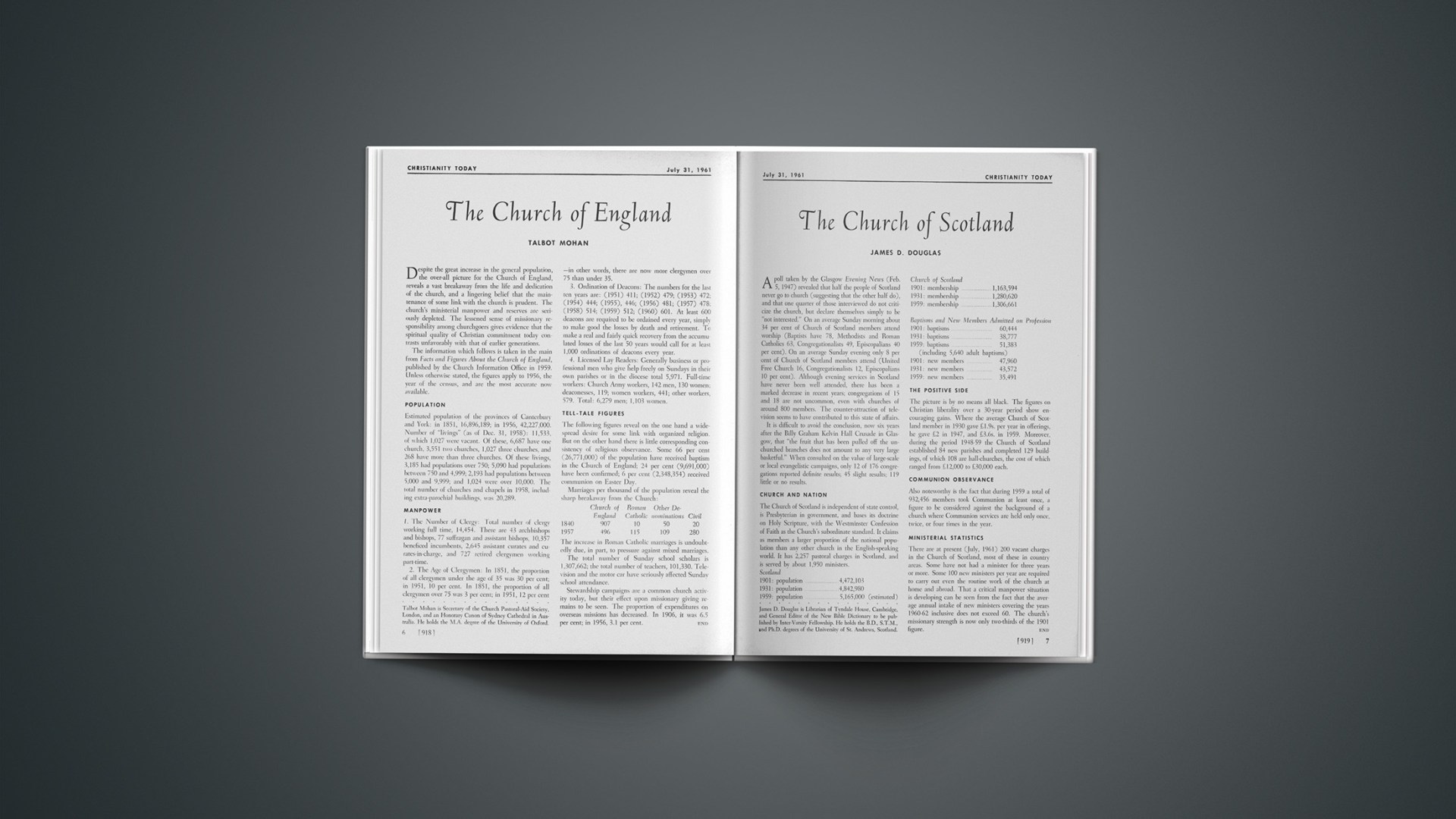
The Church of Scotland

Apoll taken by the Glasgow Evening News (Feb. 5, 1947) revealed that half the people of Scotland never go to church (suggesting that the other half do), and that one quarter of those interviewed do not criticize the church, but declare themselves simply to be “not interested.” On an average Sunday morning about 34 per cent of Church of Scotland members attend worship (Baptists have 78, Methodists and Roman Catholics 63, Congregationalists 49, Episcopalians 40 per cent). On an average Sunday evening only 8 per cent of Church of Scotland members attend (United Free Church 16, Congregationalists 12, Episcopalians 10 per cent). Although evening services in Scotland have never been well attended, there has been a marked decrease in recent years; congregations of 15 and 18 are not uncommon, even with churches of around 800 members. The counter-attraction of television seems to have contributed to this state of affairs.

It is difficult to avoid the conclusion, now six years after the Billy Graham Kelvin Hall Crusade in Glasgow, that “the fruit that has been pulled off the unchurched branches does not amount to any very large basketful.” When consulted on the value of large-scale or local evangelistic campaigns, only 12 of 176 congregations reported definite results; 45 slight results; 119 little or no results.

CHURCH AND NATION

The Church of Scotland is independent of state control, is Presbyterian in government, and bases its doctrine on Holy Scripture, with the Westminster Confession of Faith as the Church’s subordinate standard. It claims as members a larger proportion of the national population than any other church in the English-speaking world. It has 2,257 pastoral charges in Scotland, and is served by about 1,950 ministers.

THE POSITIVE SIDE

The picture is by no means all black. The figures on Christian liberality over a 30-year period show encouraging gains. Where the average Church of Scotland member in 1930 gave £1.9s. per year in offerings, he gave £2 in 1947, and £3.6s. in 1959. Moreover, during the period 1948–59 the Church of Scotland established 84 new parishes and completed 129 buildings, of which 108 are hall-churches, the cost of which ranged from £12,000 to £30,000 each.

COMMUNION OBSERVANCE

Also noteworthy is the fact that during 1959 a total of 932,456 members took Communion at least once, a figure to be considered against the background of a church where Communion services are held only once, twice, or four times in the year.

MINISTERIAL STATISTICS

There are at present (July, 1961) 200 vacant charges in the Church of Scotland, most of these in country areas. Some have not had a minister for three years or more. Some 100 new ministers per year are required to carry out even the routine work of the church at home and abroad. That a critical manpower situation is developing can be seen from the fact that the average annual intake of new ministers covering the years 1960–62 inclusive does not exceed 60. The church’s missionary strength is now only two-thirds of the 1901 figure.

Samuel M. Shoemaker is the author of a number of popular books and the gifted Rector of Calvary Episcopal Church in Pittsburgh. He is known for his effective leadership of laymen and his deeply spiritual approach to all vital issues.

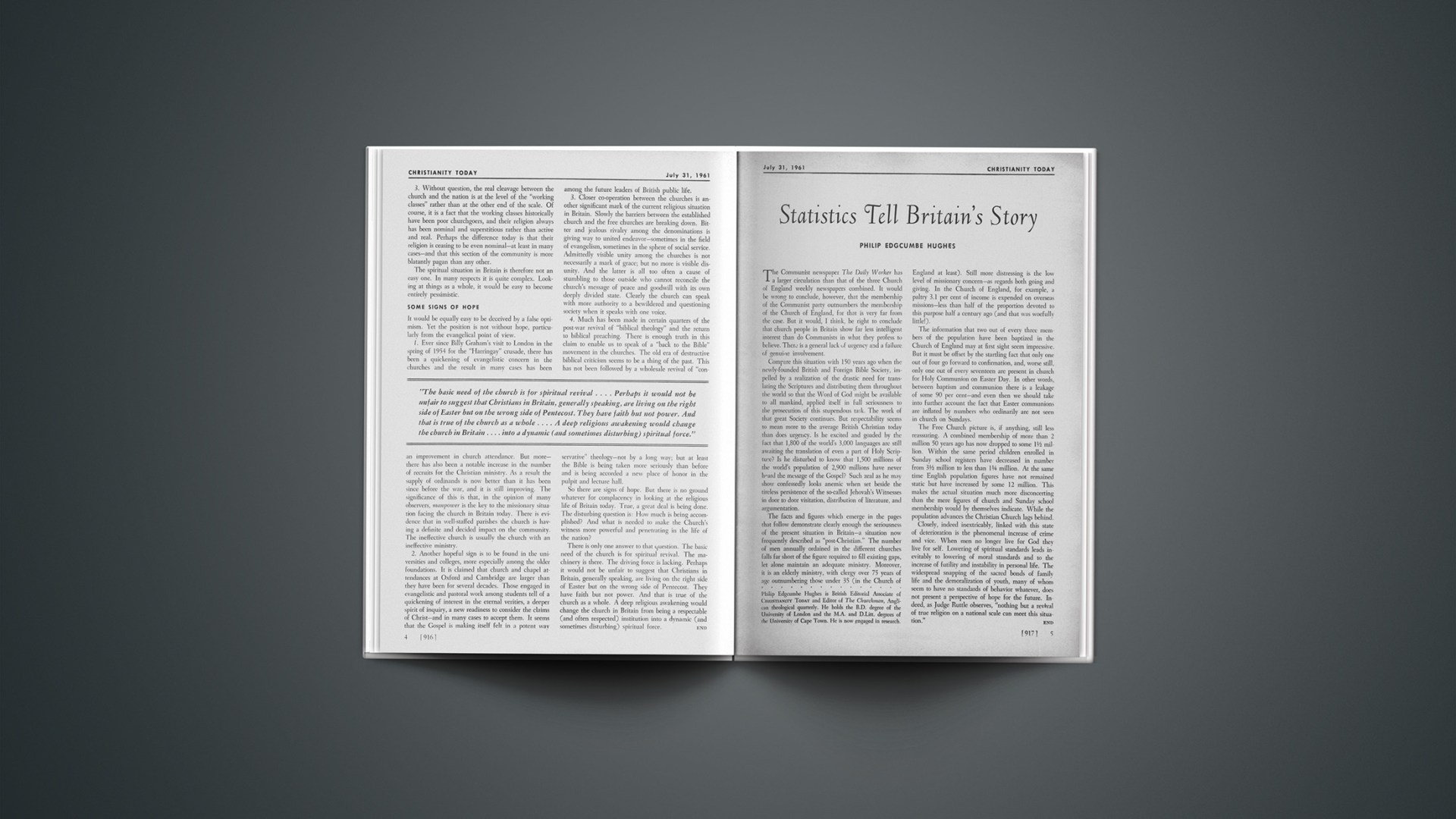
The Church of England

Despite the great increase in the general population, the over-all picture for the Church of England, reveals a vast breakaway from the life and dedication of the church, and a lingering belief that the maintenance of some link with the church is prudent. The church’s ministerial manpower and reserves are seriously depleted. The lessened sense of missionary responsibility among churchgoers gives evidence that the spiritual quality of Christian commitment today contrasts unfavorably with that of earlier generations.

The information which follows is taken in the main from Facts and Figures About the Church of England, published by the Church Information Office in 1959. Unless otherwise stated, the figures apply to 1956, the year of the census, and are the most accurate now available.

POPULATION

Estimated population of the provinces of Canterbury and York: in 1851, 16,896,189; in 1956, 42,227,000. Number of “livings” (as of Dec. 31, 1958): 11,533, of which 1,027 were vacant. Of these, 6,687 have one church, 3,551 two churches, 1,027 three churches, and 268 have more than three churches. Of these livings, 3,185 had populations over 750; 5,090 had populations between 750 and 4,999; 2,193 had populations between 5,000 and 9,999; and 1,024 were over 10,000. The total number of churches and chapels in 1958, including extra-parochial buildings, was 20,289.

MANPOWER

1. The Number of Clergy: Total number of clergy working full time, 14,454. There are 43 archbishops and bishops, 77 suffragan and assistant bishops, 10,357 beneficed incumbents, 2,645 assistant curates and curates-in-charge, and 727 retired clergymen working part-time.

2. The Age of Clergymen: In 1851, the proportion of all clergymen under the age of 35 was 30 per cent; in 1951, 10 per cent. In 1851, the proportion of all clergymen over 75 was 3 per cent; in 1951, 12 per cent—in other words, there are now more clergymen over 75 than under 35.

3. Ordination of Deacons: The numbers for the last ten years are: (1951) 411; (1952) 479; (1953) 472; (1954) 444; (1955), 446; (1956) 481; (1957) 478; (1958) 514; (1959) 512; (1960) 601. At least 600 deacons are required to be ordained every year, simply to make good the losses by death and retirement. To make a real and fairly quick recovery from the accumulated losses of the last 50 years would call for at least 1,000 ordinations of deacons every year.

4. Licensed Lay Readers: Generally business or professional men who give help freely on Sundays in their own parishes or in the diocese total 5,971. Full-time workers: Church Army workers, 142 men, 130 women; deaconesses, 119; women workers, 441; other workers, 579. Total: 6,279 men; 1,103 women.

TELL-TALE FIGURES

The following figures reveal on the one hand a widespread desire for some link with organized religion. But on the other hand there is little corresponding consistency of religious observance. Some 66 per cent (26,771,000) of the population have received baptism in the Church of England; 24 per cent (9,691,000) have been confirmed; 6 per cent (2,348,354) received communion on Easter Day.

Marriages per thousand of the population reveal the sharp breakaway from the Church:

The increase in Roman Catholic marriages is undoubtedly due, in part, to pressure against mixed marriages.

The total number of Sunday school scholars is 1,307,662; the total number of teachers, 101,330. Television and the motor car have seriously affected Sunday school attendance.

Stewardship campaigns are a common church activity today, but their effect upon missionary giving remains to be seen. The proportion of expenditures on overseas missions has decreased. In 1906, it was 6.5 per cent; in 1956, 3.1 per cent.

Samuel M. Shoemaker is the author of a number of popular books and the gifted Rector of Calvary Episcopal Church in Pittsburgh. He is known for his effective leadership of laymen and his deeply spiritual approach to all vital issues.
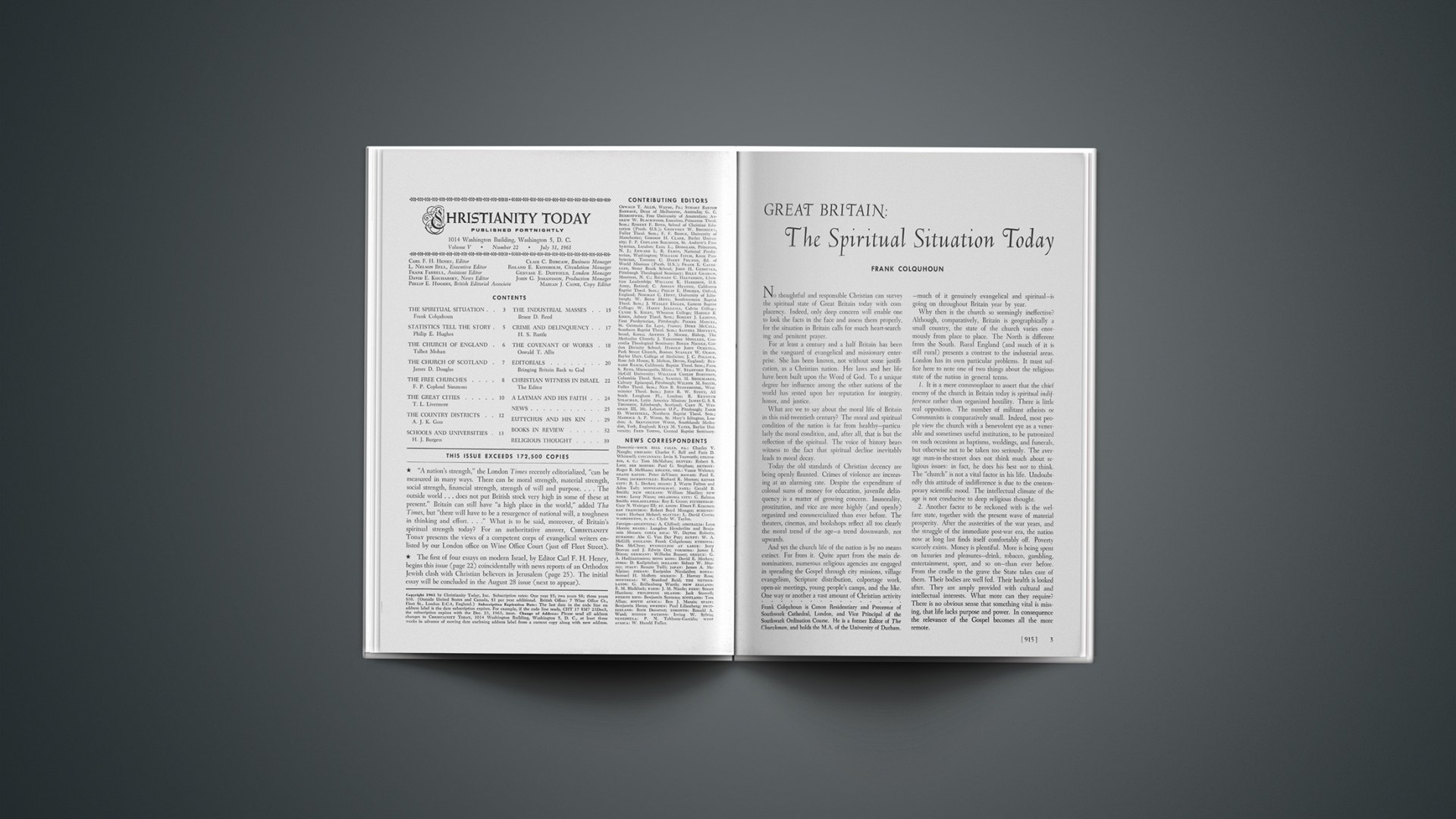
Statistics Tell Britain’s Story

The Communist newspaper The Daily Worker has a larger circulation than that of the three Church of England weekly newspapers combined. It would be wrong to conclude, however, that the membership of the Communist party outnumbers the membership of the Church of England, for that is very far from the case. But it would, I think, be right to conclude that church people in Britain show far less intelligent interest than do Communists in what they profess to believe. There is a general lack of urgency and a failure of genuine involvement.

Compare this situation with 150 years ago when the newly-founded British and Foreign Bible Society, impelled by a realization of the drastic need for translating the Scriptures and distributing them throughout the world so that the Word of God might be available to all mankind, applied itself in full seriousness to the prosecution of this stupendous task. The work of that great Society continues. But respectability seems to mean more to the average British Christian today than does urgency. Is he excited and goaded by the fact that 1,800 of the world’s 3,000 languages are still awaiting the translation of even a part of Holy Scripture? Is he disturbed to know that 1,500 millions of the world’s population of 2,900 millions have never heard the message of the Gospel? Such zeal as he may show confessedly looks anemic when set beside the tireless persistence of the so-called Jehovah’s Witnesses in door to door visitation, distribution of literature, and argumentation.

The facts and figures which emerge in the pages that follow demonstrate clearly enough the seriousness of the present situation in Britain—a situation now frequently described as “post-Christian.” The number of men annually ordained in the different churches falls far short of the figure required to fill existing gaps, let alone maintain an adequate ministry. Moreover, it is an elderly ministry, with clergy over 75 years of age outnumbering those under 35 (in the Church of England at least). Still more distressing is the low level of missionary concern—as regards both going and giving. In the Church of England, for example, a paltry 3.1 per cent of income is expended on overseas missions—less than half of the proportion devoted to this purpose half a century ago (and that was woefully little!).

The information that two out of every three members of the population have been baptized in the Church of England may at first sight seem impressive. But it must be offset by the startling fact that only one out of four go forward to confirmation, and, worse still, only one out of every seventeen are present in church for Holy Communion on Easter Day. In other words, between baptism and communion there is a leakage of some 90 per cent—and even then we should take into further account the fact that Easter communions are inflated by numbers who ordinarily are not seen in church on Sundays.

The Free Church picture is, if anything, still less reassuring. A combined membership of more than 2 million 50 years ago has now dropped to some 1½ million. Within the same period children enrolled in Sunday school registers have decreased in number from 3½ million to less than 1¼ million. At the same time English population figures have not remained static but have increased by some 12 million. This makes the actual situation much more disconcerting than the mere figures of church and Sunday school membership would by themselves indicate. While the population advances the Christian Church lags behind.

Closely, indeed inextricably, linked with this state of deterioration is the phenomenal increase of crime and vice. When men no longer live for God they live for self. Lowering of spiritual standards leads inevitably to lowering of moral standards and to the increase of futility and instability in personal life. The widespread snapping of the sacred bonds of family life and the demoralization of youth, many of whom seem to have no standards of behavior whatever, does not present a perspective of hope for the future. Indeed, as Judge Ruttle observes, “nothing but a revival of true religion on a national scale can meet this situation.”

Samuel M. Shoemaker is the author of a number of popular books and the gifted Rector of Calvary Episcopal Church in Pittsburgh. He is known for his effective leadership of laymen and his deeply spiritual approach to all vital issues.
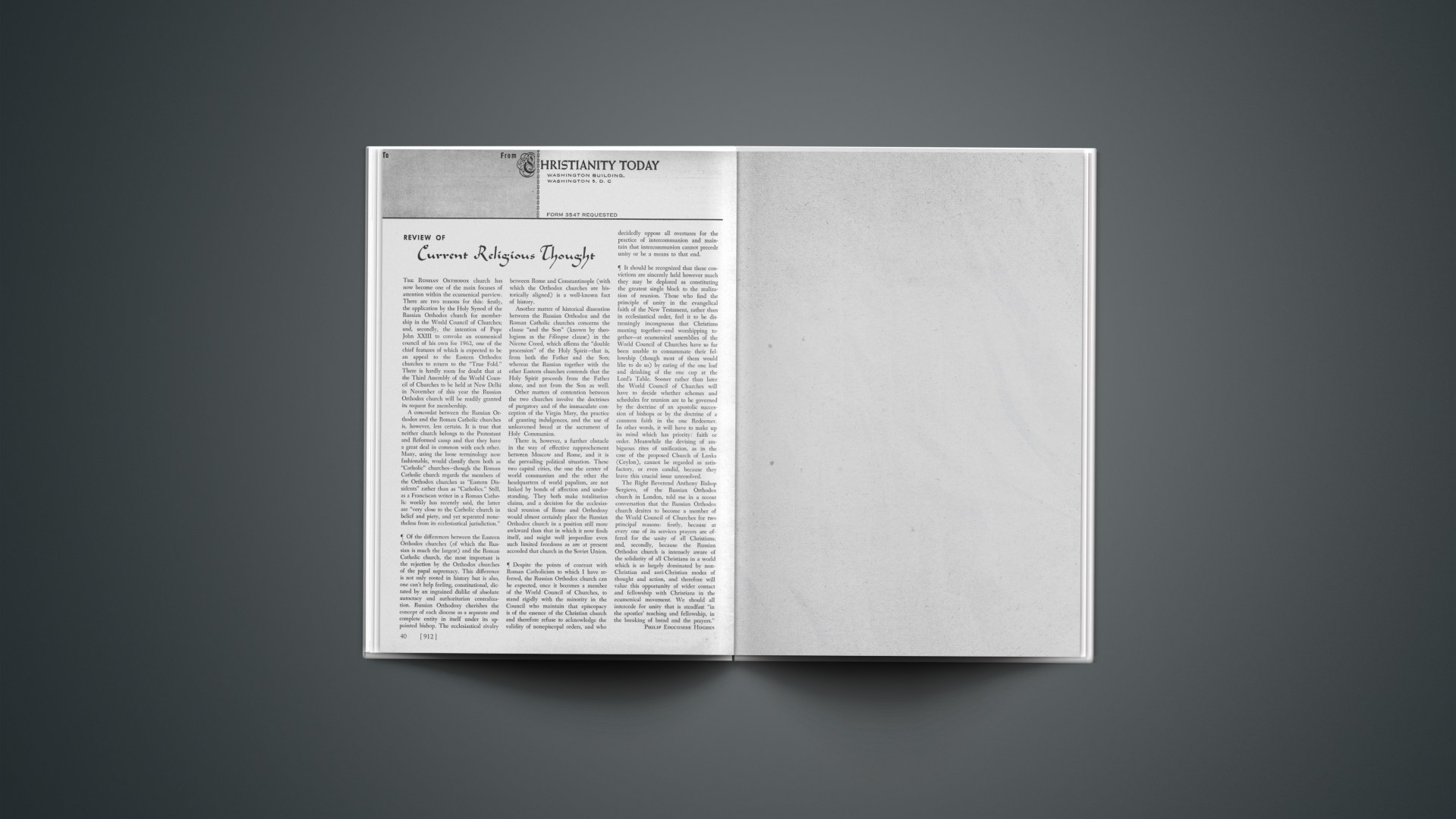
Great Britain: The Spiritual Situation Today

No thoughtful and responsible Christian can survey the spiritual state of Great Britain today with complacency. Indeed, only deep concern will enable one to look the facts in the face and assess them properly, for the situation in Britain calls for much heart-searching and penitent prayer.

For at least a century and a half Britain has been in the vanguard of evangelical and missionary enterprise. She has been known, not without some justification, as a Christian nation. Her laws and her life have been built upon the Word of God. To a unique degree her influence among the other nations of the world has rested upon her reputation for integrity, honor, and justice.

What are we to say about the moral life of Britain in this mid-twentieth century? The moral and spiritual condition of the nation is far from healthy—particularly the moral condition, and, after all, that is but the reflection of the spiritual. The voice of history bears witness to the fact that spiritual decline inevitably leads to moral decay.

Today the old standards of Christian decency are being openly flaunted. Crimes of violence are increasing at an alarming rate. Despite the expenditure of colossal sums of money for education, juvenile delinquency is a matter of growing concern. Immorality, prostitution, and vice are more highly (and openly) organized and commercialized than ever before. The theaters, cinemas, and bookshops reflect all too clearly the moral trend of the age—a trend downwards, not upwards.

And yet the church life of the nation is by no means extinct. Far from it. Quite apart from the main denominations, numerous religious agencies are engaged in spreading the Gospel through city missions, village evangelism, Scripture distribution, colportage work, open-air meetings, young people’s camps, and the like. One way or another a vast amount of Christian activity—much of it genuinely evangelical and spiritual—is going on throughout Britain year by year.

Why then is the church so seemingly ineffective? Although, comparatively, Britain is geographically a small country, the state of the church varies enormously from place to place. The North is different from the South. Rural England (and much of it is still rural) presents a contrast to the industrial areas. London has its own particular problems. It must suffice here to note one of two things about the religious state of the nation in general terms.

1. It is a mere commonplace to assert that the chief enemy of the church in Britain today is spiritual indifference rather than organized hostility. There is little real opposition. The number of militant atheists or Communists is comparatively small. Indeed, most people view the church with a benevolent eye as a venerable and sometimes useful institution, to be patronized on such occasions as baptisms, weddings, and funerals, but otherwise not to be taken too seriously. The average man-in-the-street does not think much about religious issues: in fact, he does his best not to think. The “church” is not a vital factor in his life. Undoubtedly this attitude of indifference is due to the contemporary scientific mood. The intellectual climate of the age is not conducive to deep religious thought.

2. Another factor to be reckoned with is the welfare state, together with the present wave of material prosperity. After the austerities of the war years, and the struggle of the immediate post-war era, the nation now at long last finds itself comfortably off. Poverty scarcely exists. Money is plentiful. More is being spent on luxuries and pleasures—drink, tobacco, gambling, entertainment, sport, and so on—than ever before. From the cradle to the grave the State takes care of them. Their bodies are well fed. Their health is looked after. They are amply provided with cultural and intellectual interests. What more can they require? There is no obvious sense that something vital is missing, that life lacks purpose and power. In consequence the relevance of the Gospel becomes all the more remote.

3. Without question, the real cleavage between the church and the nation is at the level of the “working classes” rather than at the other end of the scale. Of course, it is a fact that the working classes historically have been poor churchgoers, and their religion always has been nominal and superstitious rather than active and real. Perhaps the difference today is that their religion is ceasing to be even nominal—at least in many cases—and that this section of the community is more blatantly pagan than any other.

The spiritual situation in Britain is therefore not an easy one. In many respects it is quite complex. Looking at things as a whole, it would be easy to become entirely pessimistic.

SOME SIGNS OF HOPE

It would be equally easy to be deceived by a false optimism. Yet the position is not without hope, particularly from the evangelical point of view.

1. Ever since Billy Graham’s visit to London in the spring of 1954 for the “Harringay” crusade, there has been a quickening of evangelistic concern in the churches and the result in many cases has been an improvement in church attendance. But more—there has also been a notable increase in the number of recruits for the Christian ministry. As a result the supply of ordinands is now better than it has been since before the war, and it is still improving. The significance of this is that, in the opinion of many observers, manpower is the key to the missionary situation facing the church in Britain today. There is evidence that in well-staffed parishes the church is having a definite and decided impact on the community. The ineffective church is usually the church with an ineffective ministry.

2. Another hopeful sign is to be found in the universities and colleges, more especially among the older foundations. It is claimed that church and chapel attendances at Oxford and Cambridge are larger than they have been for several decades. Those engaged in evangelistic and pastoral work among students tell of a quickening of interest in the eternal verities, a deeper spirit of inquiry, a new readiness to consider the claims of Christ—and in many cases to accept them. It seems that the Gospel is making itself felt in a potent way among the future leaders of British public life.

3. Closer co-operation between the churches is another significant mark of the current religious situation in Britain. Slowly the barriers between the established church and the free churches are breaking down. Bitter and jealous rivalry among the denominations is giving way to united endeavor—sometimes in the field of evangelism, sometimes in the sphere of social service. Admittedly visible unity among the churches is not necessarily a mark of grace; but no more is visible disunity. And the latter is all too often a cause of stumbling to those outside who cannot reconcile the church’s message of peace and goodwill with its own deeply divided state. Clearly the church can speak with more authority to a bewildered and questioning society when it speaks with one voice.

4. Much has been made in certain quarters of the post-war revival of “biblical theology” and the return to biblical preaching. There is enough truth in this claim to enable us to speak of a “back to the Bible” movement in the churches. The old era of destructive biblical criticism seems to be a thing of the past. This has not been followed by a wholesale revival of “conservative” theology—not by a long way; but at least the Bible is being taken more seriously than before and is being accorded a new place of honor in the pulpit and lecture hall.

So there are signs of hope. But there is no ground whatever for complacency in looking at the religious life of Britain today. True, a great deal is being done. The disturbing question is: How much is being accomplished? And what is needed to make the Church’s witness more powerful and penetrating in the life of the nation?

There is only one answer to that question. The basic need of the church is for spiritual revival. The machinery is there. The driving force is lacking. Perhaps it would not be unfair to suggest that Christians in Britain, generally speaking, are living on the right side of Easter but on the wrong side of Pentecost. They have faith but not power. And that is true of the church as a whole. A deep religious awakening would change the church in Britain from being a respectable (and often respected) institution into a dynamic (and sometimes disturbing) spiritual force.

Samuel M. Shoemaker is the author of a number of popular books and the gifted Rector of Calvary Episcopal Church in Pittsburgh. He is known for his effective leadership of laymen and his deeply spiritual approach to all vital issues.

Review of Current Religious Thought: July 17, 1961

The Russian Orthodox church has now become one of the main focuses of attention within the ecumenical purview. There are two reasons for this: firstly, the application by the Holy Synod of the Russian Orthodox church for membership in the World Council of Churches; and, secondly, the intention of Pope John XXIII to convoke an ecumenical council of his own for 1962, one of the chief features of which is expected to be an appeal to the Eastern Orthodox churches to return to the “True Fold.” There is hardly room for doubt that at the Third Assembly of the World Council of Churches to be held at New Delhi in November of this year the Russian Orthodox church will be readily granted its request for membership.

A concordat between the Russian Orthodox and the Roman Catholic churches is, however, less certain. It is true that neither church belongs to the Protestant and Reformed camp and that they have a great deal in common with each other. Many, using the loose terminology now fashionable, would classify them both as “Catholic” churches—though the Roman Catholic church regards the members of the Orthodox churches as “Eastern Dissidents” rather than as “Catholics.” Still, as a Franciscan writer in a Roman Catholic weekly has recently said, the latter are “very close to the Catholic church in belief and piety, and yet separated nonetheless from its ecclesiastical jurisdiction.”

Of the differences between the Eastern Orthodox churches (of which the Russian is much the largest) and the Roman Catholic church, the most important is the rejection by the Orthodox churches of the papal supremacy. This difference is not only rooted in history but is also, one can’t help feeling, constitutional, dictated by an ingrained dislike of absolute autocracy and authoritarian centralization. Russian Orthodoxy cherishes the concept of each diocese as a separate and complete entity in itself under its appointed bishop. The ecclesiastical rivalry between Rome and Constantinople (with which the Orthodox churches are historically aligned) is a well-known fact of history.

Another matter of historical dissention between the Russian Orthodox and the Roman Catholic churches concerns the clause “and the Son” (known by theologians as the Filioque clause) in the Nicene Creed, which affirms the “double procession” of the Holy Spirit—that is, from both the Father and the Son; whereas the Russian together with the other Eastern churches contends that the Holy Spirit proceeds from the Father alone, and not from the Son as well.

Other matters of contention between the two churches involve the doctrines of purgatory and of the immaculate conception of the Virgin Mary, the practice of granting indulgences, and the use of unleavened bread at the sacrament of Holy Communion.

There is, however, a further obstacle in the way of effective rapprochement between Moscow and Rome, and it is the prevailing political situation. These two capital cities, the one the center of world communism and the other the headquarters of world papalism, are not linked by bonds of affection and understanding. They both make totalitarian claims, and a decision for the ecclesiastical reunion of Rome and Orthodoxy would almost certainly place the Russian Orthodox church in a position still more awkward than that in which it now finds itself, and might well jeopardize even such limited freedoms as are at present accorded that church in the Soviet Union.

Despite the points of contrast with Roman Catholicism to which I have referred, the Russian Orthodox church can be expected, once it becomes a member of the World Council of Churches, to stand rigidly with the minority in the Council who maintain that episcopacy is of the essence of the Christian church and therefore refuse to acknowledge the validity of nonepiscopal orders, and who decidedly oppose all overtures for the practice of intercommunion and maintain that intercommunion cannot precede unity or be a means to that end.

It should be recognized that these convictions are sincerely held however much they may be deplored as constituting the greatest single block to the realization of reunion. Those who find the principle of unity in the evangelical faith of the New Testament, rather than in ecclesiastical order, feel it to be distressingly incongruous that Christians meeting together—and worshipping together—at ecumenical assemblies of the World Council of Churches have so far been unable to consummate their fellowship (though most of them would like to do so) by eating of the one loaf and drinking of the one cup at the Lord’s Table. Sooner rather than later the World Council of Churches will have to decide whether schemes and schedules for reunion are to be governed by the doctrine of an apostolic succession of bishops or by the doctrine of a common faith in the one Redeemer. In other words, it will have to make up its mind which has priority: faith or order. Meanwhile the devising of ambiguous rites of unification, as in the case of the proposed Church of Lanka (Ceylon), cannot be regarded as satisfactory, or even candid, because they leave this crucial issue unresolved.

The Right Reverend Anthony Bishop Sergievo, of the Russian Orthodox church in London, told me in a recent conversation that the Russian Orthodox church desires to become a member of the World Council of Churches for two principal reasons: firstly, because at every one of its services prayers are offered for the unity of all Christians; and, secondly, because the Russian Orthodox church is intensely aware of the solidarity of all Christians in a world which is so largely dominated by non-Christian and anti-Christian modes of thought and action, and therefore will value this opportunity of wider contact and fellowship with Christians in the ecumenical movement. We should all intercede for unity that is steadfast “in the apostles’ teaching and fellowship, in the breaking of bread and the prayers.”

Book Briefs: July 17, 1961

Toynbee Reconsiders—But Critics Remain

Reconsiderations, by Arnold Toynbee (Oxford, 1961, 740 pp., $10), is reviewed by C. Gregg Singer, Professor of History, Catawba College.

In this volume Dr. Toynbee is to be highly commended for the serious effort which he has made to meet the objections of his many critics. Few historians have so openly and so fully stated the criticism leveled against their positions as has Professor Toynbee. Of course, many of these criticisms were contradictory and it would have been impossible for him to meet them all.

Just how much, if at all, has Professor Toynbee changed the position which he enumerated in the earlier volumes? In the opinion of this reviewer his basic conception of history remains essentially as it was. This is not to say that it has not been modified, or that he has not made important concessions to some of his critics. This is far from the case and there is much evidence that Dr. Toynbee has taken the criticisms to heart.

If the essential structure of his philosophy of history remains unchanged, then in what areas has he made the concessions? It would seem that he has lessened his insistence on forcing all other civilizations into the Hellenic mold, and hence some deviations at this point would be allowed. He has also recast the structure of previous cultures and regrouped them (see pp. 546, 561).

Furthermore, Toynbee has definitely changed his view concerning the higher religions. In his earliest volumes he tried to account for higher religion in terms of civilizations, seeing such religions as a mechanism by which civilizations provided for their own reproduction. He now sees that this was in error and that no longer are the higher religions the “chrysalises” into which disintegrating civilizations enter in the last stage of their dissolution and from which a new civilization would subsequently emerge.

Of particular interest is Toynbee’s chapter on the history and prospect of the Jews. And it is here that many will continue to take issue with him, particularly his Jewish critics. His characterization of contemporary Judaism as a fossil type of culture does not in itself place Toynbee in the rank of anti-Semitism, but it is susceptible to great misunderstanding in the hands of those who do not understand his basic position. His refusal to see Judaism in perspective lies at the heart of his difficulty at this point.

Actually Toynbee’s weakness in regard to Judaism as a community and culture stems from an even greater weakness in his refusal to recognize that the Jews were God’s chosen people and that they hold a unique place in history. For Toynbee, they represent no more than an ancient culture which has had its day and which gave birth to two other religions, Islam and Christianity.

In the opinion of this reviewer the fundamental weakness in Toynbee’s whole approach is theological. Not only does he take a radical attitude toward the Scriptures and refuse to recognize their inspiration or authority, but he also rejects supernaturalism in regard to Christianity. He even goes so far as to admit that he has a preference for Jewish beliefs as against those of Christianity and openly states his opposition to any claims of deity for Jesus Christ. There is no specific biblical point of view in Reconsiderations. There is no interpretation of human history from the point of view of the Word of God, and for the Christian this latest book by Dr. Toynbee must be a tremendous disappointment. Whether or not he sets forth a philosophy of history, he certainly does not set forth a theological (much less a Christian) conception of history.

Nevertheless this book is rewarding for the Christian scholar, minister, or layman who would understand how modern man would interpret his own past without the aid of the Word of God. We may not agree with Dr. Toynbee, but we must be fully informed of what he is thinking for his position has many adherents.

C. GREGG SINGER

To Chart A Course

Bible Guides, edited by William Barclay and F. F. Bruce: No. 1, William Barclay, The Making of the Bible; No. 7, George Knight, The Prophets of Israel (1) Isaiah; No. 11, John Paterson, The Wisdom of Israel; No. 13, C. L. Mitton, The Good News (London: Lutterworth Press, and New York: Abingdon Press, 1961, 96 pp. ea., $1 ea.), is reviewed by William Sanford LaSor, Professor, Old Testament, Fuller Seminary.

Bible Guides endeavors to present in 22 volumes the “total view” of the Bible, presenting “the purpose, plan and power of the Scriptures” (Vol. 1, p. 6). The work does not aim to be a commentary but a guide for nontheologically-equipped readers to help them understand the component parts of the Bible. The contributing scholars seek to examine, explain, and give expositions of the respective portions of Scripture for which they are responsible.

To judge from the first four volumes to be published, the authors are doing a commendable job. The writing is clear, nontechnical, and set in up-to-date terms. The reader, though he may have been ignorant of the Bible at the beginning, will certainly know something of its form, composition, and message, and he will not find the reading tedious.

In Volume 1, Professor Barclay tells of the making of the Old and New Testaments. The general conclusions of source criticism are accepted, and the Pentateuch is “D+JE+H+P” (p. 21). The description of the emergence of Scripture (or canonization) is well told. In the case of the New Testament, Barclay works his way through oral tradition, a bit of “Form Criticism,” the writing of the books, and the process of canonization, finally to discuss the decision to retain the Old Testament as part of the Christian Scriptures. He closes with a presentation of the authority and Christocentricity of Scripture.

In Volume 7, Professor Knight opens with a discussion of the purpose and the plan of Isaiah, with references to “Second-Isaiah,” “Third-Isaiah,” and the “Little Apocalypse.” The “unity” of Isaiah is “a unity of revelation despite its diversity of origin, period and style” (p. 38). The exposition that follows is filled with fine insights. Concerning the “Servant” passages, and referring specifically to Isaiah 43:22–23, the author says, “That is why we can declare with conviction that the fourth Servant poem, that passage which we call for convenience ‘Isaiah 53,’ coming as it does at the end of Second-Isaiah’s long and intensive argument, is a picture, not so much of Israel, as of God Himself!” (p. 90).

Volume 11, by Professor John Paterson, is an enlightening work on the Wisdom Literature in the Old Testament, specifically Job and Proverbs. The general introduction to this genre is much too short (pp. 11–12), but contains the fine statement that “Wisdom Literature represents the effort of the Hebrew mind to understand and explain all that exists.” Of the expositions, I find that of Proverbs more stimulating. References to “serious dislocation of the text” (p. 21), and to Elihu’s speeches as “an intrusion in the work” (p. 43), will cause some eyebrows to lift, as will the statement that Proverbs 22:17–23:14 is “clearly indebted to” and “seems to have been ‘lifted’ straight from” the Wisdom of Amenemope (p. 61).

Volume 13, by Principal Mitton, is the only one of the New Testament volumes to appear thus far. His approach is interesting and revealing: first he presents Jesus of Nazareth, then the faith of the Church, and then the written records. But what, after all, do we know of Jesus or the faith of the Church except from the written records? The author uses Mark for the outline, and adds details from the other Synoptics. He discusses the message of Jesus, the parables, and the miracles, and concludes with an evaluation of the person of Christ. Concerning the healing miracles he takes a strong position supported by “incontestable evidence” (p. 87), but his position on the nature miracles seems to beg the question (p. 91).

The presence of critical theories with which we may not agree should not lead us to deprive ourselves of the rich values we can find in these works.

WILLIAM SANFORD LASOR

They Live Again

Makers of Religious Freedom in the 17th Century, by Marcus L. Loane (Eerdmans, 1961, 240 pp., $4), is reviewed by W. S. Reid, Professor of History, McGill University, Montreal.

This work recounts the lives of four men who fought for religious liberty against an overbearing episcopacy in the seventeenth century: Alexander Henderson, Samuel Rutherford, John Bunyan, and Richard Baxter. Bishop Loane has already shown his ability to make historical characters live in his writings and these studies reveal the same facility of pen. No Christian can read this work without receiving encouragement and inspiration.

In some places, however, the accounts suffer somewhat from compression, as for instance when the author deals rather cursorily with the Resolutioners and the Remonstrants in Scotland (p. 86). Also the writ of habeas corpus was enacted in 1679, long after Bunyan was imprisoned in 1661 (p. 131).

These, however, are mere details. This book attracts interest not solely because of its story, but because an Anglican bishop is its author. If his attitude to nonepiscopalians had prevailed in 1661 and even prevailed now, a very different story could today be told concerning English-speaking Protestantism the world over.

W. S. REID

Hungary’S Real Church

The Lean Years: A study of Hungarian Calvinism in Crisis, by Gyula Gombos (The Kossuth Foundation, 1960, 131 pp., $3.50), is reviewed by Bela Vassady, Professor of Systematic Theology, Lancaster Theological Seminary.

The life and death issue of the Church of Jesus Christ behind the iron curtain is whether she can remain the Servant Church of the Servant Lord without at the same time being degraded into a servile Church. The book of Gyula Gombos gives a dramatic description of political and religious events in Hungary after World War II. It describes how the East gradually took over political control, how a “new theology” was developed in order to justify the servile attitude of the church leaders, and how the divine warfare of the Church was more and more given up by subjecting it to the interests of a God-defiant and self-reliant totalitarian welfare state. “The brave confessors of 1956” were crushed by Russian tanks, and the Church today is again under political control—in fact, much more than ever before. Yet the real Church, the Servant Church of the Servant Lord is still alive awaiting her political liberation.

Today we cannot have free contacts with that real Church. Her official delegates to international and ecumenical church conferences are men rubber-stamped by the Communist government. The voice of these men, however, is not at all identical with the silenced voice of the real Church. Gombos’ book makes this clear to the reader at many points. Nevertheless the declaration of this silenced Church could be heard at least in 1956! And it is spiritually enriching to be made acquainted with the basic principles of that declaration. Members of the free churches in a free country should avail themselves of it. Such reading will make them more appreciative of their precious heritage and more devoted to the cause of liberating their captive Christian brethren with weapons of a nonworldly warfare.

BELA VASSADY

History Plus A Theology

The Life and Teaching of Jesus, by Edward W. Bauman (Westminster, 1960, 240 pp., $3.95), is reviewed by George Eldon Ladd, Professor of Biblical Theology, Fuller Theological Seminary.

The purpose of this book is “to discover what can be known of the life of Jesus of Nazareth and his message” (p. 11). However, this is not a purely historical study. Bauman frequently raises the question of the theological meanings of the historical events. At points, he is very helpful. He acknowledges the centrality of the Incarnation. “God took on flesh in a particular person who became the center of a particular event that is his supreme revealing act in man’s life. This revealing act is the center of history because it gives meaning to all of history and reveals God’s purpose for history” (p. 223). These words, if they reflect Bauman’s own views, could not be made by a Bultmann. Again, Bauman faces squarely and at points helpfully the question of the Resurrection. Although he does not know what happened to the dead body, he insists upon the necessity of Bodily Resurrection. Any theory of visions does not fit the facts. However, Bauman only creates confusion by saying that Mark’s Gospel belittles the importance of the Empty Tomb (p. 113) without explaining what he means.

Having admitted the reality of these suprahistorical events in history, Bauman nevertheless boggles at other lesser events. Jesus’ miracles of healing are explained not as acts of the incarnate God but as due to Jesus’ insight into the nature of healing which modern medicine has yet to attain (p. 70). Nature miracles are explained either rationalistically or as a result of Jesus’ unsurpassed insight into the ways of nature (p. 71). The question of the manner of Jesus’ birth is not interpreted as a creative act of God but is left unresolved in “Christian agnosticism” (p. 53).

Bauman’s discussion is superficial when, in favor of a moral theory, he dismisses the possibility of a substitutionary view of the Atonement as unworthy of God (p. 105 f.). He confuses the Messianic terminology by leaving the “Son of man” without definable content and substituting “Messiah” for “Son of man.” He creates a false impression in saying that the statement “Jesus is God” “is nowhere made by Jesus or by any writer in the New Testament” (p. 201; cf. O. Cullmann, Christology, chap. 11: “The Designation of Jesus as ‘God’ ”). He leaves the problem of the Fourth Gospel in confusion by stating that it is “a synthesis of traditional Judaism, Hellenism, and sectarian Judaism” coming from the second century (p. 209) which nevertheless records the inner consciousness of Jesus (p. 213). In view of John 12:25, it is difficult to see how one can say, without qualification, that “eternal life is present and not future” (p. 215).

GEORGE ELDON LADD

House Divided

Thy Brother’s Blood, by Larry Ward (Cowman, 1961, 227 pp., $3.75), is reviewed by Henry W. Coray, Author of Son of Tears.

Here is a Civil War saga from the pen of the editor of World Vision Magazine and vice president of Information Services of World Vision, Inc. The plot is intriguing. Out of a Baltimore family one brother representing the North finds himself pitted against another brother marching with the Confederate forces under Stonewall Jackson. You might know that the two would meet on the field of battle—with a surprising result. One could wish that the writer had narrated his story with a smoother flow, fresher expression, and had sheared away the clichés. The vignette of Stonewall Jackson stands out as the book’s best feature.

HENRY W. CORAY

Zen, Symptom Of Crisis

Zen Comes West, by Christmas Humphreys (George Allen and Unwin, 1960, 207 pp., 21s.), is reviewed by Lit-Sen Chang, Lecturer in Oriental Religions, Gordon Divinity School.

The author is not unknown to those in the West who are interested in Buddhism. He is Founder-President of the Buddhist Society in London and author of Zen Buddhism which appeared in 1949. The present book is for the most part a hodgepodge of the author’s letters to the society members and notes of his talks to the Zen class about themes, problems, and aspects of Zen teaching. In addition there are several short articles which first appeared in The Middle Way, the organ of The Buddhist Society. Because the book lacks systematic presentation, the reader may readily note its overlappings and confusions, although the author has “to a small extent graded the sections from simple to more advanced in theme or treatment” (p. 17). The book may well serve as a report about the way in which Humphreys’ Zen class works; it is not, however, relevant to nor deserves wide hearing by the ordinary reader. Moreover, there is nothing original in Zen teaching, either in practice or theory.

The position of the book is so deceptive that it would require a volume to criticize its perverse teaching and slanted thesis. For instance, the author says: “Zen practice has no use of God. Zen finds no use for that concept.… Look to no person or Person or God for help” (p. 74). “In the West it is necessary … to remove the personal God-concept and all that it implies of salvation by faith alone” (p. 203). Obviously, he is entirely blind to the desperate need of a Saviour to break down “the middle wall of partition between us” by his precious blood. Thus we perfectly agree with him when he considers himself as “the incompetent but blindly courageous leader of the blind” (p. 17). But “can the blind lead the blind? Shall they not both fall into the ditch?” (Luke 6:39).

Strange to say, after World War II, Zen found its place in the West as a study of serious interest and has a peculiar fascination for minds weary of conventional religion and philosophy. This is surely the symptom of the spiritual crisis of modern men. The Light is come into the world, and men, being deceived by the plausible teachings of Zen, comprehended it not, loved darkness rather than Light, because their deeds were evil. From this book, one sees a miserable picture of a Zen follower probing in the darkness while alleging attainment of so-called enlightenment (Wu, in Chinese; Satori, in Japanese). (The reviewer is speaking as a convert from Zen to Christianity.) Even Carl G. Jung, Western scholar and psychiatrist who is sympathetic to Zen, wrote these words: “We can never decide definitely whether a person is really enlightened or whether he merely imagines it, we have no criterion of this” (cf. his forward to Dr. Suzuki’s Introduction to Zen, p. 15). Thus as there is no criterion, man can in no way test his inward impulse and determine which is of God and which of evil. To tell him, therefore, to look within, to discipline the Mind itself, to make it its own master through insight into its nature, is to engender not only a spirit of mysticism but a guide which will lead man to destruction. This is why the author declares on the one hand that “Zen is the One creative life in a new form”; but on the other hand that “the difficulties ahead are enormous” (p. 202); “as it becomes more popular and the quantity of literature increases, the quality will steadily deteriorate” (p. 206); “in the U. S. A.… it has already degenerated … into a foolish and rootless cult” (p. 201).

LIT-SEN CHANG

Methodism And Missions

The Christian Mission Today, a symposium (Abingdon, 1960, 288 pp., $3), is reviewed by Harold B. Kuhn, Professor of the Philosophy of Religion, Asbury Theological Seminary.

This volume embodies a series of studies, written by 21 contemporary writers who seek to assess the world mission of the Church of our day, with special reference to the manner in which Methodism is seeking to fulfill that task. It is intended as a guide to ministerial training, as that training is directed toward the goal of acquainting the candidate with the extent and nature of Christian activity.

The opening chapter, “Contemporary Theology and the Christian Mission,” is designed to afford, we suppose, a general orientation for the series of studies which follow. Its author deals at some length with the several theological approaches, particularly of “neo-orthodoxy” (a term lacking in precision) and liberalism. Historic orthodoxy receives little attention, and the reader is left with the feeling that it has little in the way of constructive word to speak to the contemporary missionary situation. The author seemingly is of the persuation that some form of “neo-liberalism” offers the best all-round approach to the non-Christian world.

Chapters two and three deal, respectively, with the relation of Jesus Christ and of the Holy Spirit to the world-mission of the Church. The two writers seek to present a form of “Christian Realism” in their respective areas. One is tempted to wonder whether both chapters are not limited by a lack of preciseness in definition. The 11 ensuing chapters set forth, in area by area, the conditions which confront missionary activity in the world of our time. As such, they are what they were projected to be, quite informative surveys, combining suggestions for challenges which face us in the days ahead.

The reviewer found himself intrigued by a number of paragraphs in the chapters of Part D—that is, in chapters 15 to 20. The authors, particularly of chapter 15, “Materialism and Secularism,” and of chapter 18, “Younger Churches and New Nations,” have made some exceedingly penetrating analyses of the contemporary scene, and have probed into sore areas in Western culture. Equally instructive is Dr. Stephen Neill’s chapter 21, “The Urgency of This Mission Today.”

Read as a survey of what is, this volume has merit for readers beyond the boundaries of the church which has sponsored it. As a critique of much of the world scene, the book has much to offer. If it has any overall weakness, I would say it is in the absence of precision at the point of what should be the essential content of the Christian Evangel.

HAROLD B. KUHN

Bible Book of the Month: Ecclesiastes

Like Proverbs, the Book of Ecclesiastes belongs to the category of wisdom literature, a description of which was given by the present writer in CHRISTIANITY TODAY (Oct. 26, 1959). The interested reader may be referred to that article.

CANONICITY

From the times of the Jewish rabbis, doubt arose as to the canonicity of this book. And even after the ascension of Christ, disputes took place in the circles of Jewish scribes. According to tradition the matter was settled by the synod of Jamnia in A.D. 90 to the effect that Ecclesiastes rightly belonged to the canon of Scripture.

It must frankly be confessed that the book presents serious difficulties to the believer. Viewed superficially it appears to be heterodox, even in direct contrast with the rest of Old Testament and—for Christians—also of the New Testament.

The main theme is stated in 1:3: “What profit hath a man of all his labor which he taketh under the sun?” Evidently the reply seems to be given in the preceding verse: “Vanity of vanities, saith the Preacher, vanity of vanities; all is vanity!” The Hebrew word translated “vanity” (hebel) basically means that which is hollow, has no real essence. And the repetition of the word in “vanity of vanities” is the Hebrew way of expressing the superlative. Therefore, utter vanity (is everything)! If this is the last word the conclusion must needs be—then it is not worth while to live and work; then there is nothing worth while to strive after; then also the sacrificial death of Christ is vanity of vanities.

Some scholars do not hesitate to call the book the pessimistic Song of Songs, or the most heretic book of the third century B.C. (the alleged date of origin). Reformed theologians are convinced, however, that, nothwithstanding all that a rationalistic approach brings to the contrary, the book is an integral part of the written Word of God. In spite of stubborn opposition it maintained its place in the canon, and there must be a special reason for this as many books aspired to canonical status in those times, even books pretending to have dignified men of the past as their authors. The book has a specific message also for the twentieth century and, as Gordis remarks, Koheleth (the Hebrew for Ecclesiastes) speaks to the modern age across an interval of 2,000 years with the immediacy of contact of a contemporary (Koheleth, the Man and his World, New York, 1955, p. vii). Although this writer differs from the general trend of Gordis’ book, he fully agrees in this respect.

Let us try then to find out the relevant message.

TITLE

The name Ecclesiastes derives from the Greek translation called the Septuagint, followed by the Latin Vulgate. This purports to be the Greek and Latin equivalent of the Hebrew qohelet. Qahal in the Old Testament has the same meaning as the Greek ekklesia which may mean a gathering of the (Greek) people and is used in the Old Testament also of the people of Israel as the chosen people of the Lord and thus broadly equivalent to the ekklesia, the church of the New Testament. Thus the translation “preacher” for qohelet which we find in most of our modern versions and “ecclesiastes” in the old versions.

The difficulty is, however, that the contents of the book do not exhibit the characteristics of a sermon (e.g., the words of the prophets) but, as has been stated above, of wisdom literature.

The form qohelet is feminine. This may point to an explanation according to which reference is made to an office, rather than to a person. In this case the reference is made to the office of a speaker in an assembly of people, not necessarily of a religious nature. According to this plausible explanation, the content of the book is to be regarded as the product of the address(es) or lecture(s) of an exponent of wisdom, not a preacher in an ecclesiastical gathering.

UNITY AND INTEGRITY OF THE BOOK

Because there are so many variations of thought and mood within the book, as well as alleged inconsistencies and contradictions, the unity and integrity have often been challenged through the ages.

Bickell devised the theory that the pages of the original book became disarranged and that the proper order has never been restored. Some scholars are of the opinion that the book presents the unsystematic record of debates between men of varying temperaments. Others defend the view that there is a multiplicity of authors, or that because of the heterodoxy many interpolations were made to render the book acceptable to orthodox Jewry (cf. Gordis, op. cit., pp. 6, 69 ff.), or that pagan philosophers introduced the “objectionable” parts.

Scholars find it increasingly difficult, however, to explain how such a complicated process, as envisaged in the above-named theories, could take place in the comparatively short time since the alleged time of composition (third century B.C.) and the time of Ben Sirach (190 B.C.) when the book had attained “at least quasi-canonical authority” according to Gordis.

The general tendency today is, therefore, against the atomization of the book and for a growing recognition of its basic unity. Some scholars still have doubts in regard to the first verse which forms the title, and the epilogue (12:9–14). These parts are generally regarded as the work of the editor. In The Interpreter’s Bible (Vol. V), the possibility is considered, however, that the epilogue “might be the author’s own postscript of self-commendation ‘in the gnomic style.’ Ben Sirach has a similar piece of a self-appreciatory nature (51:13–22) at the end of his work.” Eissfeldt (Einleitung, 1956, p. 608) is of the opinion that the author, following the model of Egyptian wisdom writers, may have provided the superscription in 1:1 himself.

It would seem, therefore, that according to excellent modern scholars the whole is to be regarded as a unity which, at the same time, offers a strong presumption in favor of the integrity of the book. Thus another solution will have to be found for the apparent incoherency and self-contradiction (see below).

MEANING AND COMPOSITION

To grasp the meaning and the way the book is composed to convey that meaning, we have to know what the problem is that awaits solution.

The wisdom of Proverbs promises a long and blessed life to its adherents. The Book of Job (another wisdom book) struggles with the problem of the suffering of the righteous which is apparently in conflict with the promises of Proverbs. Samuel Cox has aptly titled his book on Ecclesiastes, The Quest of the Chief Good. Apparently everything “under the sun” is subjected to change—nothing is of lasting value. How then can there be a chief and lasting good?

The present writer is convinced that the golden key and the Ariadne-thread through this seeming labyrinth is to be found in the assumption that the author is conducting a dialogue—with himself, just as the Book of Job contains dialogues between Job and his friends.

The “heterodox” statements can then be explained as being doubts expressed by the author when he places himself on an intramundane, empirical, philosophical standpoint. The “orthodox” gnomes on the other hand must be regarded as products of the light that breaks through in revelation. Just as in the Book of Job not every word can be taken as normative (e.g., when Job curses the day of his birth), so in Ecclesiastes due regard should be paid to the fact that here too the author struggles with himself. The context of Scripture is to be kept constantly in mind, as well as the ultimate outcome of the struggle.

The author describes honestly his exploits to find the chief good in wealth, in sensual pleasures, in wisdom, and so forth, but nowhere is he able to find lasting satisfaction. The wisdom from “under the sun” is not in a position to solve his difficulties. This implies that he longs for the wisdom from “above the sun.”

It is noteworthy that he firmly believes in God right through the book. There is not the slightest doubt that God will bring everything into judgment. It must strike every reader with what respect Ecclesiastes speaks of the “house of God” (5:1), the place where the wisdom from above the sun is preached. This verse is to be regarded therefore as a pivotal text and one of the highlights.

Just like the author of the Book of Job, the Preacher has his ups and downs, but just as in the case of Job, “all’s well that ends well.” In the epilogue we hear “the conclusion of the whole matter: Fear God, and keep his commandments: for this is the whole duty of man” (12:13).

This is the solution, so far as the stage of revelation in the Old Testament can bring it. The chief good is the fear of God and the keeping of his commandments.

Aptly Professor Schilder has said that Ecclesiastes stands at the extreme end of the wall of wailing in Jerusalem. The author’s own philosophy has failed miserably, and his heart pines for Christ in whom are hid all the treasures of wisdom and knowledge (Col. 2:3).

If we are honest, we must confess that even we who walk in the glorious sunlight of the revelation in Christ sometimes feel inclined to say, “vanity of vanities”—what does man gain by all the toil at which he toils under the sun? Then it is that Ecclesiastes speaks the language of our own soul and we thank God that we may experience what he pined for.

Far from being the song of skepticism and pessimism, this book shows the way to conquer skepticism and paves the way for the Gsopel.

ANALYSIS

In The New Bible Commentary, G. S. Hendry says that this book defies any logical analysis. According to our Western standards there certainly is no logical sequence of ideas. We have a collection of loosely connected maxims, held together by the central idea. It is as if the intense struggle and confusion in the soul of the author are reflected in the book.

If we try to suggest an analysis, let the reader remember that this is only an effort to combine the whole with the central idea. We follow the analysis of Cox:

1. The prologue, where the problem is stated (1:1–11).

2. The first section, the quest in wisdom and pleasure (1:12–2:26).

3. The second section, the quest in devotion to the affairs of business (3:1–5:19).

4. The third section, the quest in wealth and in the golden mean (6:1–8:15).

5. The quest achieved (8:16–12:7).

6. Epilogue, in which the problem of the book is conclusively solved (12:8–14).

AUTHORSHIP AND DATE

In the allotted space it will be impossible to treat this subject exhaustively. For readers of CHRISTIANITY TODAY, such details need not be the main interest in any case. It is presumed that they want to know the meaning of the book. Allow us therefore to state only briefly that the general conviction, also of Reformed theologians, is that Ecclesiastes is one of the youngest books of the Old Testament. Its Hebrew represents the latest stage of development in biblical Hebrew and the closest approximation to Mishnaic Hebrew (Gordis). The whole tenure and background of the book moreover does not suggest the time of Solomon but a time in which mental depression and skepticism prevailed. The mentioning of “the son of David, king in Jerusalem” (1:1) and of “the king over Jerusalem” (1:12) are regarded as a literary device common in the Near East. Usually the third century B.C. is regarded as the time of origin. If this theory is accepted, the real author is unknown.

FURTHER STUDY

The book by Gordis (mentioned in the article) is one of the best and one of the most up-to-date from the viewpoint of liberal Jewish scholarship. The same applies to the article on Ecclesiastes in The Interpreter’s Bible, where we find a liberal exposition from the Christian viewpoint. For those who can read Dutch there is the scholarly commentary of G. C. Aalders of the Free University, Amsterdam. Helpful also is the New Bible Commentary and the relevant volume of Die Botschaft des Alten Testaments. The above-named book by Cox can be recommended as a good exposition, although it may be out of print.

S. DU TOIT

Teologiese Skool

Potchefstroom, South Africa

United Church Declares Constitution in Force

The long-forming United Church of Christ, a merger of the Congregational Christian Churches’ General Council and the Evangelical and Reformed Church, declared its constitution in force at a Fourth of July ceremony that highlighted the new church’s third General Synod in Philadelphia.

Consummation left approximately one-third of all Congregational Christian churches outside the fold.

Additional church convention reports are found in this issue, beginning on p. 28.

“The majority of Congregational Christian churches which have not yet voted are expected to join the union within a year,” said a United Church statement.

By June 1, stipulated deadline for balloting on the new church constitution, 3,889 Congregational Christian churches had voted. Of these, 3,547 were said to have voted for the merger and the constitution, while 342 voted negatively. Among Evangelical and Reformed synods, 32 out of 33 voted approval (lone dissenter: the Magyar Synod). Ratification required approval by not less than two-thirds of the Evangelical and Reformed synods and two-thirds of the Congregational churches voting.

One report said that of the 1448 churches which let the June 1 deadline pass without balloting, many were regarded as “small” or “rural” congregations. Among those who voted against the constitution was the largest of all the Congregational Christian churches, a 3,500-member congregation in California, plus a 2,200-member church in Massachusetts, another in California with 1,900 members, and one in Connecticut with 1,800.

Dissenting churches have banded together in one of two newly-created fellowships, or both: the National Association of Congregational Churches and the Conservative Congregational Christian Conference.

The Congregational Christian churches which have voted negatively or which have abstained (officially or unofficially) have a combined membership of approximately a quarter-million or more. All Evangelical and Reformed congregations became a part of the new church automatically.

A United Church spokesman said that the 3,547 Congregational Christian churches voting affirmatively had a total constituency of 1,107,966.

General Synod Elects First President

Dr. Ben Mohr Herbster, 56, pastor of the Zion Evangelical and Reformed Church of Norwood, Ohio, was elected first president of the United Church of Christ.

Delegates to the new church’s third General Synod chose Herbster for a four-year term. He had been proposed by the synod’s nominating committee and he defeated by a vote of 513 to 165 Dr. James E. Wagner, Evangelical and Reformed president since 1953, whose name was placed in nomination in an unexpected move from the floor. Wagner had served as co-president of the United Church with Dr. Fred Hoskins of the Congregational Christian General Council during the first four years of the United Church.

Herbster has served the Norwood church for the last 30 years. He was a member of the commission which drafted the United Church constitution and he has served as co-chairman of the church’s Executive Council.

Herbster is a graduate of Heidelberg College in Tiffin, Ohio, and Central Seminary in Webster Groves, Missouri. He did graduate work at Ohio State University, McCormick Theological Seminary and Chicago Theological Seminary. He was awarded a doctor of divinity degree by Heidelberg.

That figure, added to the 814,124 members currently credited to the Evangelical and Reformed constituency gives the United Church a membership of nearly 2,000,000 and makes it the seventh largest U. S. denomination.

This month’s five-day united synod was preceded by simultaneous meetings of the 12th General Synod of the Evangelical and Reformed Church and the biennial meeting of the Congregational Christian General Council.

The meetings saw America’s oldest Christian foreign missionary society take on a new name and assume a new responsibility as the world-wide representative of the United Church. The American Board of Commissioners for Foreign Missions, founded in 1810 by New England Congregationalists but always operated as an interdenominational, interracial agency, voted to become the Board for World Ministries of the merged church. It is also assigned the task of carrying on work previously done by the Evangelical and Reformed Board of International Missions. Deletion of “missions” was viewed as significant.

Several other agencies were also merged, but certain corporate functions will continue on a separate basis. Legal technicalities entail perpetuation of the Congregational Christian General Council and the Evangelical and Reformed General Synod.

The last big legal hurdle was cleared only a few days before the constitution was scheduled to be declared in force. Federal Judge Edward J. Dimock of New York dismissed a suit aimed at barring the church merger. Litigation over the proposed merger extended over 12 years. Dimock ruled that the issues had been decided in a 1955 state court ruling.

The Philadelphia Synod, attended by some 750 delegates, elected the first officers of the United Church and adopted its first budget. Although the church was “formed” four years ago, most of its operations were never consolidated.

The United Church constitution purports to preserve the local church autonomy preferred by Congregationalists, but opponents of the merger have protested that excessive hierarchal control is inevitable. The constitution assigns to the General Synod the task of correlating its churches’ work in home and foreign missions, social action, higher education, stewardship, and public relations.

Both the Evangelical and Reformed and the Congregational Christian denominations were the results of earlier unions. The former came into being in 1934 with the uniting of the Evangelical Synod of North America and the Reformed Church in the U. S. The Congregationalists were merged with the Evangelical Protestant churches in 1925 and six years later with the Christian Church.

Protestant Panorama

• Membership in The Methodist Church, largest U. S. denomination, now tops 10,000,000. Dr. Harry Denman, general secretary of the Methodist General Board of Evangelism, said last month that membership reports from 73 of the denomination’s some 100 conferences indicated that the milestone had been passed. Total Methodist membership reported in 1960 was 9,910,741.

• The Lutheran World Federation’s Executive Committee held its annual meeting in Warsaw last month, the first such gathering in Eastern Europe, and the Polish Radio promptly sought to avail itself of a propaganda opportunity. A statement was broadcast by Bishop Zoltan Kaldy, head of the Hungarian Lutheran Church’s southern district, asserting that it was “significant” that the committee’s sessions were held in a Communist country. Kaldy attended the meeting as a guest. His church is represented on the committee by Dr. Lajos Ordass, former presiding bishop and former head of its southern district. Ordass did not attend. He has retired from public life since the Communist government in 1958 withdrew recognition from him as head of his diocese and church.

• Doctrinal discussions looking toward pulpit and altar fellowship between the Lutheran Church-Missouri Synod and the newly-merged American Lutheran Church are planned early next year.

• The World Council of Churches’ next Faith and Order Conference, fourth in a series started in 1927, will be held in a Middle Eastern city in 1963. Exact site and date have not been announced.

The Maryland Baptist, publication of the Baptist Convention of Maryland, will appear weekly beginning January 1. It is now published twice a month. The move runs counter to the current trend toward less frequent publication among religious periodicals. The Maryland Baptist has a current circulation of about 14,500.

• Delegates to last month’s National Conference of the Association of Council Secretaries adopted a statement calling to the attention of the National Council of Churches officials “the growing urgency of and need for the earliest possible publication by the NCC of an attractively composed and simply written brochure setting forth from our Christian standpoint what Communism means, what the positions of the NCC are, on this subject, and some specific things which our state and local councils, and churches can do to meet the issue.” The association is a fellowship for employed secretaries and staff members of interdenominational organizations cooperating with the NCC.

• A ham-and-turkey dinner attended by 3,000 persons in Spokane’s Coliseum highlighted preparations for a 15-day crusade by evangelist Torrey Johnson, to begin September 17.

• U. S. Methodists will dispatch a 35-member evangelistic team to Norway next month for a week of preaching and visiting just prior to the meeting of the World Methodist Conference in Oslo, August 17–25.

• A number of large Protestant churches are reported to have withdrawn from the Louisville Area Council of Churches in protest against its retention of Dr. N. Burnett Magruder as executive director. Some churches have withdrawn financial support and a few ministers have quietly withdrawn from their positions on the council’s committees. The disaffiliations represent a disagreement with Magruder’s so-called ultra-conservative views and his membership in the controversial John Birch Society.

• Two top officials of the National Council of Churches are calling for a “massive surge of concern at the grass roots” to secure federal funds for public schools and to reject assistance to parochial schools. The appeal was made by the Rev. Dean M. Kelley, director of the NCC Department of Religious Liberty, and Dr, Gerald E. Knoff, executive secretary of the NCC’s Division of Christian Education, in a letter to 500 leaders of the 34 Protestant and Orthodox council constituents.

Amish and Mennonites

Leaders of the Old Order Amish paid visits to federal government officials in Washington last month hopeful of finding a way to win exemption from the Social Security program, which they oppose on religious grounds.

They won the sympathy of Secretary Abraham A. Ribicoff of the Department of Health, Education, and Welfare, which includes the Social Security Administration. But the Senate defeated a proposed amendment to the Social Security Act to exempt members of the Old Order Amish.

Ribicoff told the delegation that something should be done to provide for such exemption and he promised to investigate ways in which legislation could be drafted that would be acceptable to his department and still permit the Amish to withdraw from the compulsory government program.

The Senate had already rejected by voice vote an amendment offered by Democratic Senator Joseph S. Clark of Pennsylvania and Republican Senator Barry Goldwater of Arizona. Objections had been raised that such exemption would be difficult to administer. A number of bills are pending in the House, however, and Clark said that since less than 20 members of the Senate were on the floor when the amendment lost, an attempt may be made again next year.

The Amish first came under the compulsory Social Security program when it was extended to self-employed farmers in 1954. Many have carried their opposition to the point of refusal to pay the tax. As a result, the U. S. Internal Revenue Service in several instances seized their horses when tax agents could not find bank accounts or other assets to attach.

Tax agents were criticized for taking the horses, but they contended that until Congress amends the law, they had no alternative but to collect the mandatory tax by whatever means possible.

As proposed by Clark, the amendment would have permitted the filing of a certificate of exemption by “any individual who is a member or adherent of any recognized church or religious sect the tenets or teaching of which forbid its members or adherents from accepting social insurance benefits of the type provided by the insurance system established by Title II of this Act.”

Clark said the amendment would affect only a few hundred members of the Amish sect. He declared that if religious objection to war is recognized in military service legislation, conscientious opposition to the Social Security system should also be recognized.

While in Washington, Bishop David Z. Fisher of Christiana, Pennsylvania, told newspapermen that the Old Order Amish Mennonites prefer to drop “Mennonite” from their name.

“Just call us Amish,” he said, “because the Mennonites have gone so modern nowadays that they are far away from us.”

The Amish (who pronounce it ah-mish) derive their name from Jacob Ammen, a Mennonite preacher of the 1690’s in Switzerland and the Palatinate, who preached a return to the original teachings of Menno Simons, founder of the sect, including the practice of “shunning” those who departed from strict adherence to rules of the church.

Menno Simons was a Roman Catholic priest in the Netherlands who joined the Reformation in 1630 and became a leader of the Anabaptists. The Amish first came to America about 1737. Old Order members still hold to the use of the horse and buggy, have no electricity or other modern conveniences in their homes, and adhere to plain dress, using hooks and eyes rather than buttons. The men wear broad-rimmed hats and beards, the women long, dark-hued dresses.

Although many Mennonites today can scarcely he distinguished in dress or forms of worship from other churchgoers, there are some Old Order Mennonites who still cling to old-fashioned ways, and there are a few—particularly the Stauffer Mennonites—who still hold to the horse and buggy and cannot be distinguished from the Amish.

Accordingly, Mennonites and Amish are often confused, and confusion about the Amish is further increased by the fact that some, who still call themselves Conservative Amish Mennonites, have broken with the Old Order, and have taken to the use of automobiles, although they still wear conservative garb.

There are also the “Beachy Amish,” named for the bishop who led their revolt in 1927, who are Old Order in every respect except for the use of cars.

The group in conflict with Social Security are Old Order Amish who have made no concessions to modern progress and retain seventeenth-century customs of speech and worship. Although three-fourths of the members of this sect now live outside the original area of settlement in Lancaster County, Pennsylvania, they speak Pennsylvania Dutch in their homes and use a very archaic High German in their worship services.

Kirchentag in Berlin

The divided city of Berlin was expected to be a focal point of East-West tensions this week as thousands of Protestants sought to assemble there for the tenth German Evangelical Church Day Congress (Kirchentag).

The five-day assembly, which ordinarily draws church-goers from both East and West Germany, is now being branded a “cold war maneuver” by the Communists. The question of whether to hold the meeting in East or West Germany has been the source of a perennial controversy.

Early this month, it was reported that East German authorities would refuse to allow special trains to bring West Germans into Berlin for the occasion. East Germans have been warned against entering West Berlin for the sessions.

Catholic Praise

The International Catholic Film Office awarded its Berlin Festival Prize this month to an American Lutheran motion picture, “Question Seven,” which depicts present-day pressures against a Protestant minister and his son in Communist East Germany.

The movie, produced in Germany by Louis de Rochemont Associates for Lutheran Film Associates of New York, also received a prize from a special youth film festival held in conjunction with the Berlin event. In the United States it has been given an “A-1” rating and a “special accolade” by the Catholic Legion of Decency.

During a reception for participants in the Berlin festival, Julius Cardinal Doepfner, Roman Catholic Bishop of Berlin, joined Hans Gerber, film commissioner of the Evangelical Church in Germany and Lutheran Bishop Otto Dibelius of Berlin in stressing the churches’ great interest in the moral and religious potentialities of the motion picture.

At the same time, the churchmen criticized American-made “biblical” films as sensationalized, sugar-coated versions unsuited for promoting the message of the Gospel.

Per Capita Rank

The 1961–62 edition of Stewardship Facts, published by the National Council of Churches, ranks U. S. Protestant denominations of 100,000 or more members as follows, according to annual per capita giving:

The Roman Voice

Osservatore Romano, Vatican City daily newspaper, is marking its 100th anniversary of publication.

As part of the observance, Pope John XXIII granted members of the staff a special audience and hailed the paper for having “erected a fine monument or robust faithfulness to the Holy See.”

The precise nature of its link to the Roman Catholic hierarchy has been the subject of long controversy, for although it is generally regarded as the voice of the church, Osservatorre Romano resists being tagged “official.”

Shortly before his resignation as editor last year, Count Giuseppe Dalla Torre declared:

“Osservatore is a Catholic newspaper in which the Holy See publishes its official bulletins. Nothing else.”

The editor-in-chief, now Raimondo Manzini, and his two assistants are said to have “complete freedom save in certain vital issues dealing with church policy which are subject to the rules and regulations of diplomacy.”

Osservatore was started by two political refugees—Nicola Zanchini and Giuseppe Bastia, both lawyers—who came to Rome after King Victor Emmanuel II’s Italian nationalism had brought about the downfall of the papal states. They sought to publish a paper for the papal government which then ruled Rome and the surrounding Lazio province. In 1884, Pope Leo XII purchased the paper from its two founders. It has grown to become one of the world’s most widely-quoted periodicals, marked by austere format and literary quality.

Staffers still write with pens, never typewriters, but the printing equipment is among the most modern in Europe.

Osservatore Romano is one of the very few publications capable of putting out virtually any text in any language. As far back as 1870, its printers were able to publish the Pater Noster in 250 languages, using 180 different alphabets.

Offices are in a modest, two-story, white-brick building just to the right of St. Ann’s gate at the Vatican.

Osservatore Romano is the only daily paper allowed in Roman Catholic seminaries and innumerable other institutions.

Convention Circuit

At Seattle—The 102nd annual synod of the Augustana Lutheran Church ratified merger negotiations for the proposed new Lutheran Church in America.

The proposal was carried by a vote of 495 to 21. All 13 conferences of the church had previously voted in favor of the merger. A two-thirds majority of the delegates at the synod was required for final ratification.

Involved in the impending union with Augustana are the United Lutheran Church in America, the Finnish Evangelical Lutheran Church (Suomi Synod), and the American Evangelical Lutheran Church. The emerging denomination will be the largest Lutheran group in America with a baptized membership of approximately 3,250,000.

Present plans call for final conventions of the four uniting churches in Detroit immediately prior to the constituting convention of the new church, scheduled June 28 to July 1, 1962.

Immediately after the merger vote had been taken, the delegates unanimously approved a plan to unite Augustana Lutheran Seminary, Rock Island, Illinois, with three seminaries of the other bodies involved in the union: Lutheran Theological Seminary, Maywood, Illinois; Suomi Theological Seminary, Hancock, Michigan; and Grand View Theological Seminary, Des Moines, Iowa. The latter two already have merged their faculties with those of the Maywood seminary, but Augustana seminary will continue to function in Rock Island until a permanent site has been secured for the new institution.

Delegates were urged to bring “the greatest possible strength” into the merger.

“This will be done,” declared Dr. Malvin H. Lundeen, president of the 618,000-member Augustana denomination, “only as we seek to maintain every aspect of our work at the highest possible level of continuing and advancing effectiveness during these days of changeover.”

Delegates adopted resolutions defending the National Council of Churches against charges of Communistic infiltration but urging the NCC to re-study its policy of making pronouncements on political, social, and moral issues.

The FBI was commended for a recent statement “indicating its confidence in the policy and personnel” of the NCC. It also was pointed out that the American Heritage Foundation and the Freedoms Foundation have made special awards to the council “as evidence of appreciation of the NCC’s contribution to our national life.”

The study on pronouncements, a resolution said, should include the possibility and advisability of issuing “policy affirmations” or “principles of concern” to member bodies which might, in turn, form the basis of pronouncements by the individual denominations.

It was further recommended that “except in instances of common concern when more prompt action is imperative,” statements by the NCC should be made as “pronouncements” only after approval by the member communions or their allied units, and should then carry the names of the approving groups.

Delegates approved a proposed amendment to the membership basis of the World Council of Churches, to be acted upon at the WCC’s third assembly in New Delhi, November 18-December 6.

The Plush Curtain

A severe indictment of the indifference of the Western world to the poverty and human misery prevailing in underprivileged countries was sounded at a missionary service of the Augustana Lutheran Church during its annual synod in Seattle.

“The billion people living in the West behind the plush curtain of the world’s highest standard of living,” said the Rev. Rudolph C. Burke, “peer out occasionally to gather statistics, organize committees, and send good will ambassadors abroad, but stop short of any action which might endanger our own accent on luxury.”

Burke’s remarks came following his installation as executive director of the denomination’s Board of World Missions.

“We cannot communicate Christ,” he said, “unmindful of the squalor, sickness, and suffering in which men who were created in the image of God live.”

Burke also startled delegates with a graphic illustration of the population explosion:

“By 1980 the Chinese will replace us as the world’s most numerous race. Marching four abreast past a given point at double time, there would never be an end to the march, for the Chinese population growth is more rapid than the procession could ever be.”

Lundeen characterized the amendment as a strengthening of the conservative element in the membership basis.

Another resolution asserted that “there is no theological principle that can be used, in any legalistic manner, to determine whether or not Red China should, at this time, be recognized or admitted to the United Nations Organization.

Still another resolution noted that the Augustana church had supplied only about half of its quota of active duty chaplains to the armed forces and encouraged pastors who qualify to consider volunteering for such service.

At Buck Hill Falls, Pennsylvania—Merger-oriented conversations with the nation’s two largest Presbyterian bodies were authorized by the Reformed Church in America at its 155th annual General Synod.

The church went on record as not being ready “at this time to commit herself” to church union, but instructed its stated clerk and executive committee to carry on conversations with the United Presbyterian Church in the U. S. A. and the Presbyterian Church in the U. S. (Southern).

Delegates voted to continue support of the National Council of Churches, but expressed criticism of the council for having “consistently persisted in making statements of principle regarding purely political matters in which they infer that they are speaking for all Protestants.”

The General Synod’s committee on overtures took “favorable cognizance” of criticisms of the NCC that it speaks for all Protestants, and asserted that the NCC often “fails to represent authoritatively the views of large and overwhelming numbers of members within the constituent denominations.”

The delegates expressed “unalterable opposition” to “communism and all Communist-inspired activities tending to riotous conduct, class antagonism, racial hatred, discrimination, and disloyal and treasonable action.” Full support was declared for “responsible and firm methods for exposing and opposing Communist subversive activities in our government, our free institutions, and our civic life.”

In other action, the General Synod voted to request the Voice of America, now said to be broadcasting the Koran in the Middle East in the Arabic language, also to broadcast the Christian Scriptures in the Arabic language in that part of the world.

A “Covenant for Open Occupancy” was adopted, stressing that housing discrimination is “inconsistent with Christian integrity.” Local churches were called upon to promote the covenant by getting signatures. Those who sign the pledge promise “to support with all means possible” efforts to eliminate race as a determining factor in a person’s right to make a home in any community. Signers also agree “to declare to our neighbors our convictions” and that they “would welcome new residents, provided they are of good character, without regard to race, religion or national origin.”

The General Synod also accepted a report of its Christian action committee by recognizing that “sit-ins in our country for the purpose of social justice are exceptional expressions of suffering love wherein the nonviolence of method and righteousness of purpose demand our support through intercessory prayer, and, when possible, through participation.”

The amended basis of membership proposed for the World Council of Churches was endorsed by the General Synod.

Outgoing church president Henry Bast reported that baptized membership totalled 324,413 last year—a gain of 3,404 over 1959. He said the total included 225,927 communicant members and 98,486 baptized noncommunicant members. The denomination, he added, now has a total of 897 local congregations.

In his report, Bast declared that the church, which up to about 10 years ago administered only to Dutch people or their descendants, “has finally broken out of its shell and is preaching to all people.” The church was founded in 1628 by early Dutch settlers in New York as the Reformed Protestant Dutch Church.

At Long Beach, California—The pacifist Church of the Brethren, at its 175th annual world assembly, adopted a resolution committing itself to a more active peace program in a world “armed to the teeth.”

With this phrase, outgoing conference moderator Charles E. Zunkel had presented a proposal from one of the church’s districts that a study be made of pacifism as a political force.

The 900 delegates did not concur that pacifism could, or should, become such a force, but they did agree that the church should study ways to step up its peace action.

Announcement was made of a three-year survey to discover what the church’s more than 200,000 members feel and think about the purpose of the church. Results of the study will form the basis of the church’s 1965–70 program, said Dr. Calvert N. Ellis, chairman of a goals and program committee. He declared that 10 pilot projects will be launched later this year to determine what the average member visualizes as the denomination’s mission.

Delegates did not favor placement of an official church representative in Washington, but they did express the opinion that the church should be more outspoken on legislative matters.

A statement was adopted warning against the use of public funds for schools operated by religious groups. “We believe,” the statement said, “that all religious persuasions flourish best when their support comes from sources which do not impair their freedom.”

At Anderson, Indiana—In a resolution strongly supporting the public school system, the Church of God with headquarters in Anderson, Indiana, went on record as opposing federal or state aid for the operation of parochial and other private elementary and secondary schools. The resolution was adopted by the church’s policy-making General Ministerial Assembly at the denomination’s annual meeting.

Gospel Satellites

Use of communication satellites to bring religious telecasts to every part of the world is forecast by the dean of Protestant missionary radio broadcasting.

Dr. Clarence W. Jones, director of the third annual World Conference of Christian Communications, said it was “only realistic” for missionary broadcasts to prepare for this revolutionary development within the next 10 years.

The world’s first missionary television station has already been licensed in Quito, Ecuador, to be operated by station HCJB, pioneer missionary radio station. The station has seven transmitters. Jones’ prediction foresees use of rocket-launched, orbiting satellites in place of transmitting towers, thus enabling broadcasters and telecasters to reach more remote areas.

The World Conference on Christian Communications attracted some 250 missionary radio executives, technicians, artists, and lecturers to the campus of Concordia College, Milwaukee, Wisconsin.

Citing public schools as an “indispensable means of providing an educational opportunity for all children,” the resolution declared: “We recognize the great problems now being faced by the public schools and urge provision for increased resources for the operation and improvement of these schools within a framework of proper safeguards.”

“We are further concerned,” it continued, “that the historic principle of church-state separation be maintained and we urge all branches of the government to avoid an infringement of the ideal of religious liberty which would inevitably arise when taxes paid under compulsion by all people are used to aid non-public schools.”

Delegates voted to hold a world convention of the Church of God in 1963 at a European site to be chosen later.

At Minneapolis, Minnesota—Delegates to the 65th annual conference of the Lutheran Free Church voted to hold a congregational referendum which will decide whether to pursue union negotiations with the new American Lutheran Church. The question of the LFC’s union with the three other bodies that joined to form the ALC has been the subject of long debate. Twice before the church has rejected continuance of negotiations.

Dr. John M. Stensvaag, church president, said he would favor the merger. He declared that the “spiritual emphases in the new church, the good experience in working together, the rising threat of hostile world forces, have strengthened my conviction that we … can safeguard our heritage and serve our Lord best by entering the larger fellowship.”

Stensvaag took note of “two elements of opposition” to union—one which “traffics in villification and misrepresentation” and another composed of faithful members “who have honest doubts.” He called on LFC members to “not become involved” with the first group but to “respect … and weigh carefully” the opinions of the second element.

At St. Paul, Minnesota—The Baptist General Conference of America voted relocation and expansion of Bethel College and Seminary on a new suburban St. Paul campus.

The expansion program may cost up to $12,000,000. In adopting the conference board of education recommendation, delegates also accepted the enrollment goal of 1,200 college and 200–300 seminary students by 1971. During the past school year, the college had 695 students and the seminary, 126.

At Toronto—The General Assembly of the Presbyterian Church in Canada registered opposition to the income tax exemption granted by the Canadian government to members of religious orders who have taken vows of poverty.

Following a recommendation from the denomination’s board of evangelism and social action, the assembly urged the government to erase the section of the law which grants such exemptions. The board’s report called the exemptions “inequalities, abuses, and discrimination.”

“There are 2,904 (religious) teachers in Alberta schools alone who benefit by this,” the Rev. William Lawson told the assembly. “This means a subsidy to religious orders by the government of Canada amounting to millions of dollars.”

The assembly voted to accept an American Presbyterian merger-discussion proposal to the extent of naming observers. Three persons are to be appointed by the assembly moderator to join in talks about church union with the United Presbyterian Church in the U. S. A.

Delegates were warned that the church’s accumulated debt had reached $422,756 and that nothing was being done to liquidate it. The warning came from Dr. J. L. King, chairman of the administrative council, who opposed an increase for the board of home missions.

Meanwhile, the assembly voted to raise ministers’ stipends from the present minimum of $3,100 a year plus home and travel allowance to $3,900. Churches were asked to give this goal priority in financial considerations.

Any possible action on whether to ordain women was deferred for another two years. A committee was asked to make a detailed study. Last year’s assembly sent the question to the denomination’s 48 presbyteries for an opinion. A tally showed 26 presbyteries were against the ordination of women, 14 were in favor, and 8 made no reply.

At Green Lake, Wisconsin—In a presidential address at the 77th annual conference of the Evangelical Free Church of America, Dr. Arnold T. Olson cautioned against merger movements based more on administrative efficiency than on the unifying power of a return to the Bible.

“The tragedy of the ecumenical movement,” he declared, “is that it comes at a time when the church senses its inadequacy. It is a movement caused by panic rather than by power. It is being done in the name of administrative efficiency rather than the unifying power of a return to the Bible.”

Conference delegates endorsed transfer of all missions property in Congo to native Christians and relocation of the denominational seminary from Chicago to Deerfield, Illinois.

At Florence, Alabama—Delegates to the 131st annual General Assembly of the Cumberland Presbyterian Church approved a report asserting the denomination’s belief that “a present involvement to consider organic union (with other churches) would be inadvisable.”

The report was in response to an invitation from the United Presbyterian Church in the U. S. A. for Cumberland Presbyterians to enter into merger negotiations.

At Winona Lake, Indiana—The General Association of Regular Baptist Churches accepted 73 new congregations into membership at its 30th annual conference. The association now has 992 churches with about 150,000 constituents.

Nearly 2,000 registered delegates were on hand for the conference, which lauded the House Un-American Activities Committee for its “continuing vigilance over our American freedoms.”

In a resolution, the delegates commended the committee for its work “in the exposure of subversive organizations and their efforts and movements in this country,” and for its “loyalty in the performance of duty.”

The conference program included a showing of the controversial film, “Operation Abolition,” produced with the cooperation of the House committee.

At Glenside, Pennsylvania—The Orthodox Presbyterian Church marked its 25th anniversary with special observances at its annual General Assembly. The Rev. John Murray, professor of systematic theology at Westminster Theological Seminary, was elected moderator. Membership was reported to have increased from 10,670 to 11,175 during the past year. The church was formed in 1936 by a group of ministers and elders who withdrew from the Presbyterian Church in the U. S. A. under the leadership of the late Dr. J. Gresham Machen.

At Bonclarken, North Carolina—Delegates to the 157th annual General Synod of the Associate Reformed Presbyterian Church authorized creation of a department of church extension to co-ordinate and accelerate establishment of new congregations. Delegates also authorized study of a proposal to construct an old people’s home and endorsed a ministers’ retirement plan. Charles R. Younts, a layman, was elected moderator. Attending the synod were about 400 ministers and elders from 11 southern states where the church has most of its members.

At Esko, Minnesota—Some 1,000 persons converged on the town of Esko to attend the national convention of the Finnish Apostolic Lutheran Church of America. Esko has a population of 500 and no hotel. Makeshift sleeping quarters were set up in feed barns, tents, basements, and even saunas (Finnish steam baths). Most of the convention sessions were devoted to evangelistic services, Religious News Service reported. The church has about 8,000 members.

At Washington, D. C.—A move to reorganize the Swedenborgian church by establishing a full-time permanent headquarters office was adopted at the 138th annual meeting of the General Convention of the New Jerusalem in the U. S. A., official name of the denomination. The church, which has existed in the United States since 1792, has until now moved its offices from city to city along with its officers as they were elected. The new central office will be located, for the time being, in Cambridge, Massachusetts. A study will be made to determine a permanent located to serve the small (about 5,000 members) but far-flung denomination whose 58 churches are located in 35 states and three provinces of Canada. The church follows the teachings of Emanuel Swedenborg (1688–1772), Swedish philosopher, writer, and scientist.

At New York City—Nathan H. Knorr, president of the Watchtower Bible and Tract Society, told nearly 93,000 Jehovah’s Witnesses gathered inside and outside Yankee Stadium for the closing rally of a six-day assembly that the United Nations is “united in name only” and must close ranks “under the kingdom of Jehovah God” for survival. A highlight of the closing events of the Witnesses’ United Worshipers District Assembly was the baptism, by total immersion, of 1,732 men and women in Orchard Beach, the Bronx, which automatically makes the converts “ministers” of the sect.

Mountain Music

An estimated 125,000 persons gathered on the lower slopes of North Carolina’s Grandfather Mountain for the 37th annual “Singing on the Mountain” program of Gospel music and message.

The state highway patrol estimated that there were 70,000 persons congregated at one time and that in all some 125,000 persons visited the mountain during the day-long program on Sunday, June 25.

The turnout was an all-time record which probably establishes “Singing on the Mountain” as the world’s largest regularly-scheduled hymn sing. It was begun as a Bible class outing by Joe Lee Hartley, 90-year-old owner of Grandfather Mountain.

Communism and Religion

A study of communism aimed at combatting its spread and influence will be part of the curriculum at all Roman Catholic schools in the Cleveland area, beginning in the fall.

Msgr. Clarence E. Elwell, superintendent of the Catholic Diocesan School Board, ordered that communism be taught in Grade 8 and Grade 12 as part of the regularly-prescribed religion courses.

A textbook which will be used, according to Elwell, recalls the testimony of Dr. Frederick Charles Schwarz, executive director of the Christian Anti-Communist Crusade, before the House Un-American Activities Committee in May, 1957.

Schwarz said he believed communism should be taught in American schools “with a moral directive in the same way that a medical student is taught that cancer is evil, that tuberculosis is evil, and education about them is directed to their elimination and defeat.”

Pilgrimage Awards

Dr. C. Oscar Johnson, past president of the Baptist World Alliance, was honored as “Clergy Churchman of the Year” by the Religious Heritage of America organization during its annual Washington pilgrimage last month.

Perle Mesta, Washington hostess, former ambassador to Luxembourg, and a Christian Scientist for the last 15 years, was given the “Churchwoman of the Year” award.

The “Lay Churchman of the Year” honor went to Robert G. Storey, former law school dean at Southern Methodist University.

Special communications citations were presented reporter John Wicklein of The New York Times, Miss Florence Reif, religious program director for the NBC radio network, and Archer Speers, religion editor of Newsweek magazine.

Barth’s Successor

Religious News Service reported last month that Professor Helmut Gollwitzer, a member of West Berlin’s Free University, may receive a call from the theological faculty of Basel University to succeed Professor Karl Barth, noted Swiss theologian.

Gollwitzer was said to have confirmed that he had been proposed by the university as a successor to the 75-year-old Barth, who is about to retire. Gollwitzer added, however, that he had not yet received an official offer from Swiss state authorities.

A prominent leader of the anti-atomic-armament wing of the Evangelical Church in Germany, the 52-year-old Gollwitzer is one of the chief opponents of Bishop Otto Dibelius and is a strong critic of West German Chancellor Konrad Adenauer.

Showdown Ahead

A paperback edition of the Gospel of John taken from The New English Bible is being issued by Eyre and Spottswoode, Ltd., of London, the Queen’s official publishers. The issuance promises a showdown over publishing rights to the NEB, the copyright for which is held by the presses of the Universities of Oxford and Cambridge.

Eyre and Spottswoode claims that a royal patent granted in 1577 gave it the right to publish the book.

The Verdict

Ex-gangster Mickey Cohen, whose brief brush with Christianity became a part of court testimony, was convicted of income tax evasion last month in Los Angeles.

A witness had testified that Cohen was offered $10,000 by evangelist Billy Graham “to turn Christian.” The witness, Mrs. Eleanor Churchin, later acknowledged she had invented the story as a publicity gimmick for a book she was promoting.

People: Words And Events

Deaths: Dr. Clarence S. Gillett, 66, Congregational Christian missionary educator in Japan for the American Board of Commissioners for Foreign Missions; in Sendai, Japan … the Rev. William Thomas Walsh, 83, retired Protestant Episcopal rector; in Middleton, New York. Walsh, a convert from the Roman Catholic priesthood, was known for his healing meetings.

Appointments: As president of Eden Theological Seminary, Dr. Robert T. Fauth … as president of the International Christian University in Japan, Dr. Nobushige Ukai … as president of Canadian Nazarene College, the Rev. Arnold E. Airhart … as dean of the Southern California School of Theology, Dr. F. Thomas Trotter … as dean of students at Western Theological Seminary, Dr. Henry Ten Clay … as Titus Street Professor of Ecclesiastical History at Yale Divinity School, Dr. Jaroslav Pelikan … as associate professor of history at Calvin College, Dr. Dirk Jellema … as executive vice president of the Unitarian Universalist Association, Raymond C. Hopkins … as executive secretary of the Department of the Laity of the World Council of Churches, Ralph C. Young … as educational director of the National Association of Christian Schools, John F. Blanchard, Jr.… as minister of the Menlo Park (California) Presbyterian Church, Dr. Cary Weisiger III … as minister of the Fifth Avenue Presbyterian Church, New York, Dr. Bryant M. Kirkland … as editor of motive [sic], national magazine of the Methodist Student Movement, the Rev. B. J. Stiles.

Elections: As executive secretary of the Lutheran World Federation, Dr. Kurt Schmidt-Clausen … as moderator of the Church of the Brethren, Dr. Nevin H. Zuck … as president of the Reformed Church in America, the Rev. Norman E. Thomas … as moderator of the Baptist General Conference, the Rev. John A. Wilcox … as moderator of the Presbyterian Church in Canada, Dr. Robert Leishmann Taylor … as president of the Baptist Convention of Ontario and Quebec, Dr. Emlyn Davies … as president of the Associated Gospel Churches of Canada, the Rev. John F. Dempster … as president of the National Conference of the Methodist Student Movement, Wayne Proudfoot.

Savoy, 1661: The Failure of a Conference

Of the anniversaries falling in 1961, that of the Savoy Conference of 1661 deserves some brief consideration. In a very real sense it represented the last chance for a more or less united church in seventeenth-century England. It was held between those who had moved more and more to the high Anglicanism of the Caroline period and the Puritans who had been agitating for more radical reforms over the past generations. The restoration of the monarchy under Charles II provided the opportunity of a new settlement, and it was with a view to possible comprehension that the conference was summoned to the Savoy Palace from which it takes its name.

There were some favorable elements in the situation. Charles’ restoration had been made possible by an alliance of Presbyterians in Scotland and Royalist Episcopalians in England. Charles himself had promised “liberty to tender consciences” in the 1660 Declaration of Breda, and he seems to have meant this in spite of later legislation. Bishoprics were offered to moderate Puritans like Reynolds who accepted, and the famous Richard Baxter who declined. There were Episcopalians who genuinely desired comprehension; Bishop Ussher had a finely conceived plan for integration of Presbyterian and Episcopal polities.

Nevertheless, there were even more powerful unfavorable factors. Years of controversy and mutual suppression, culminating in the bitterness of civil strife, had left a legacy of hostility. If Puritans had suffered, fought, and died on the one side, Episcopalians likewise had endured conflict, eviction, exile, and death in support of the position previously authorized. Convictions had hardened to produce a stubborn will either to prevail or at least not to yield. On neither side was there any true appreciation of the principle of liberty to differ, but only of liberty for the system advocated. In the circumstances, there seemed little hope of any practical result.

In the event, the negative forces triumphed. The Puritans advanced a demand for full-scale revision both in general and in details. Amongst other things they required the discontinuance of all responses, the use of extemporaneous prayer, the abolition of the Calendar, the use of newer versions in the Epistles and Gospels, the alteration of the Articles, the presbyterianizing of ordination, and the rejection of such things as the sign of the cross in baptism, the ring in marriage, the surplice, or kneeling at the sacrament. On the opposite side it was argued either that some of these demands were already met (for example, the part of presbyters in ordination), or that the matters attacked were intrinsically justifiable (for example, the giving of a voice to the people in divine service), or that they lay in the sphere of things indifferent where the ruling of the church should be followed until there is lawful decision to the contrary. The conference ended in an almost inevitable impasse, and the new Act of Uniformity in 1662, while it brought many detailed changes, resulted in the eviction of many Puritans who felt that they could not conscientiously conform.

As we survey the conference after 300 years we see first the generally unhappy consequence of legislating in church matters by civil law. The framework of operation made it inevitable that the failure should result in a curtailment of the liberty of conscience and action of the dissidents and in the condemnation of many of them to the eviction and suppression to which they had in fact supjected Episcopalians a decade before. There is another side to this relationship, and subsequent events have shown that it need not have these unhappy and unjustifiable implications. On the other hand, it certainly did so in the seventeenth century.

The conference also brings into focus the dangerous identification of unity with uniformity which can still play such havoc in our churches today. Naturally, a church has to have consensus on many matters. It cannot become a cacophony of discordant voices. On the other hand, in lesser points of exposition or practice there may surely be a degree of flexibility without denial of unity. A metrical psalm, a prose psalm, or both? a marriage with ring or without? a surplice, Geneva gown or ordinary suit?—surely these are not matters on which to divide the church by conformity or nonconformity. In fact, even a uniform order can and will develop wide varieties in spite of the legislators. But it is better to avoid the confusion at the very outset, and even within the more general framework to deal with sufficient flexibility and not with too little. Otherwise our denominational Savoys can all lead to similar disruptions.

This raises the third point that there are in fact indifferent matters or undecided points on which a church may rightly take order but in relation to which it must always remember the relative nature of its order. At Savoy both sides were led to contend for valid principles, the Anglicans for the lawfulness of accepted decisions, the Puritans for the right to resist or correct such decisions if they have no clear and binding biblical sanction. But unfortunately each party could see only the validity of its own position, where both were needed. Thus a church may prescribe a surplice or a Geneva gown for the sake of decency and due order. Most ministers will find it a lesser duty to abide by the accepted ruling until a majority may later change it. Yet this ruling obviously cannot be advanced as a biblical and therefore an absolute provision which makes it impossible to allow any freedom for tender consciences to which it is rightly or wrongly offensive. In sum, a positive obligation should not be imposed with respect to things indifferent.

A more depressing aspect of the Conference, as we view it in retrospect, was the predominance and consequent mischief of the desire for mastery and basic obstinacy displayed on both sides. Here we note that both Puritans and Anglicans displayed a basically wrong conformity and failed to overcome the problem by the true conformity on both sides which might well have solved it. The wrong conformity manifested was that of conformity to the world and its practices, to the kind of spirit against which the Lord plainly warned his disciples: “It shall not be so among you.” In this respect Savoy would have been a happier and more fruitful conference if there had been a genuine nonconformity on both sides. The conformity which would have solved the problem is that of conformity to the mind and spirit of Christ. If the conviction, learning, zeal, and readiness for sacrifice, which were diverted to the prosecution of ecclesiastical causes, had been harnessed to this fulfillment of discipleship at a deeper level, it is hard to see how even the animosities and very real differences of Savoy could finally have prevailed.

A final historical lesson of Savoy is that of the serious consequences of its failure. Neither party derived any ultimate benefit from the disruption, nor did the cause of the Gospel in the land at large. Deprived of the erudite and earnest Puritans, the settled church entered on a period of lethargy and mediocrity which left it ill-prepared for the Great Awakening in the century which followed. Indeed, it suffered a more permanent theological and ecclesiastical injury which has hardly been made good by the more recent development of a powerful evangelical group within it. On the other hand, Puritanism itself also entered on evil days, and it displayed such strange impotence in the face of the rationalistic deism and Unitarianism of the succeeding generation that, while there were great individuals like Isaac Watts, traditional nonconformity played only a minor part in the great wave of evangelism and missionary endeavor which was to mark the eighteenth century.

In the providence of God we cannot but say, of course, that even the results of this unfortunate conference were overruled for good. Yet, on a human reckoning, we can certainly see little profit compared with the great release of spiritual power that might have come had there been a real humbling before the divine Word and Spirit, and a genuine reconciliation, not a mere ecclesiastical arrangement. In such circumstances, all would have been ready to accept defeat from the human angle; but the Lord would have been the Victor, and therefore all would have been victors in him.

If there is a final lesson, it is that in such situations we should not miss this higher conformity to the Lord and his Word, and therefore that we should be content with no less than this higher and more meaningful triumph.

Professor of Church History

Fuller Theological Seminary

Pasadena, California

Ideas

Is Missionary Motivation Limping?

Every generation must inquire anew of itself and of the Word of God what motivation there is for taking the gospel of Jesus Christ to the ends of the earth. Many reasons for holding the Church true to her obligation to preach the Gospel may be advanced. There is the command of the Great Commission, the love of God, the spiritual need of the heathen, the grip of immortality on sinful men.

Christianity is unique and universal in relevance. Not to recognize this is to downgrade the Christian faith to the plane of the nonredemptive religions. It is to dissolve the basic genius of the Christian faith, sap its vitality, and render it sterile. Christianity’s uniqueness consists not simply in its claim to superiority over pagan religions, but to the supreme singularity in which it pronounces all other religions to be the inventions of men and unmasks them as self-saving schemes. Biblical religion is the only true and saving revelation of God. Measured by this yardstick, all other religions are revealed as wholly inadequate.

Christianity is universally relevant because it springs from the love of a God whose saving concern is as broad and as wide as humanity. Indeed its uniqueness carries universal implications for all men under the dominion of religions which cannot save.

In the great missionary eras of the past, missionaries unreservedly ascribed this uniqueness and universality to the Christian faith. These convictions became the driving force which thrust them into the distant regions of the world hitherto unreached for Christ. They believed that without Christ men are lost in this life and doomed in the life to come. They believed that however high and lofty other religions are, religions without Christ cannot bring salvation. Missionaries therefore devoted themselves to rescuing the perishing.

William (the cobbler) Carey said, “My real business is to preach the Gospel and win lost souls. I cobble shoes to pay expenses.” He would point to the map on his wall and exclaim, “The people living in these areas are pagans! They are lost, hundreds of millions of them, not knowing the blessed Saviour!” Charles Simeon preached a sermon on “The Lost Estate of the Heathen” which moved Henry Martyn to a short but glorious life of missionary endeavor in the Moslem world. Robert Morrison of China fame wrote to his sister, “My dear, dear Hannah, do think of your soul now, set heaven and hell and a dying Saviour before you. I stand in doubt of you, lest you still be in an unconverted state. Forgive me, forgive me; it is not in harshness, but in love to your precious soul that I speak. Come to Jesus, Hannah; come to Jesus.”

Adoniram Judson was America’s first Baptist foreign missionary. When he found India a closed door he went to Burma. Writing home to request aid of others to join him in the missionary task, he spoke of “the sin of turning a deaf ear to the plaintive cry of ten millions of immortal beings who, by their darkness and misery, cry day and night, ‘Come to our rescue, ye bright sons and daughters of America. Come and save us, for we are sinking into hell!’ ” Hudson Taylor once had to pay some Chinese boatmen 14 dollars to save one of their own countrymen who had fallen overboard. When his body was lifted from the waters it was lifeless. Upon reflection, Taylor wrote: “Let us pause before we pronounce judgment against them (the Chinese fishermen who cared not for the life of their comrade), lest a greater than Nathan answer, Thou art the man.’ Is it so wicked a thing to neglect to save the body? Of how much sorer punishment, then, is he worthy who leaves the immortal soul to perish? The Lord Jesus commands me, commands you: ‘Go into all the world and preach the Gospel to every creature.’ ”

J. Ross Stevenson, sometime president of Princeton Theological Seminary, wrote in 1902 for the Toronto World-wide Evangelization Conference:

Fifty years ago the ordinary church member had some excuse for not knowing the condition of the heathen world.… But that is not true today. The information at hand is adequate. Every Christian student who claims to be an educated man ought to be well acquainted with missionary fields and know the helpless, hopeless condition of his brothers across the sea.… Knowing the need and knowing the remedy, the love of Christ should fill up the breach and bring every Christian into sympathetic and helpful touch with the humanity that awaits redemption.

In 1902 Robert E. Speer penned these words:

A thousand millions of men, sinning, suffering, struggling, need a Saviour, helpful, tender, sufficient. He came for them, but they have not heard of Him. It is not a matter of speculation as to eternal destiny. There is a righteous Judge. It is a matter of present want and ignorance and death; and I speak not of the Bible’s teaching as to men’s condition, but of actual fact and experience. When Jesus said, ‘No man cometh unto the Father but by Me,’ He was not setting arbitrary limits. He was simply saying what all history has shown, and is proving today over all the world, that only by Christ do men come to the Father.… In studying the non-Christian religions one wants to think well of them, to see the best that is in them. They force the inevitable conclusion that there is no best. Their elements of truth have been counteracted and distorted by their error.… If Christ is our life, and we have been able to find life, full and abundant, only in Him; if there is no other name given under heaven among men whereby they must be saved; if, as Keith Falconer said, ‘vast continents are shrouded in almost utter darkness, and hundreds of millions suffer the horrors of heathenism or of Islam;’ if the Saviour of the world included these millions in the sweep of His love and sacrifice; if they are the children of the Father who would not that any should perish, but that all should enter into life, and for that end has made us stewards of the missions; and if life is to us not a play and a trifle, but the solemn doing of our Father’s business, then I ask, in the Master’s name, Is there not need that we give ourselves to the mission of the world’s redemption?

Bishop Stephen Neill, high in the echelons of the International Missionary Council and the World Council of Churches, recently acknowledged that earlier missionaries had a sense of urgency because “those who have not believed are lost. Every day thousands of human beings are dying without opportunity to hear and believe the Gospel. From these presuppositions the duty of the Christian follows logically … there is no time to be lost” (“The Urgency of This Mission Today,” in The Christian Mission Today, by the Joint Section of Education and Cultivation of The Methodist Church, Abingdon, 1960, p. 249). Bishop Neill then relates the story of the Chinese boatmen previously mentioned here. He follows: “There are still Christian circles in which exactly such an illustration could be given, and in which exactly the same conclusion would be drawn from it. But the majority of Christians today probably see things rather differently [italics supplied]; and, if the sense of urgency is to be brought home to them, it must be in different categories from these.” And the bishop shares this view: “We do not say, like our ancestors, that all those who have not accepted Christ are going to hell. We do say that it is the birthright of every single human being born into the world today to know that he has been redeemed by Christ, and to have the opportunity freely to accept or to reject that salvation” (p 256). Since Bishop Neill had already curtsied to universalism (in his discussion of Progressivism [sic] Universalism and Relativism) saying, “We must at once recognize that each of these viewpoints has something to teach us” (p. 251), he sheds no light on the condition of the heathen who die without Christ except to exempt them from hell.

Teachers of comparative religions profess to see in the non-Christian faiths pathways which lead to the same celestial city. Others suppose that men can be in Christ without knowing Him. The uniqueness and universality of the Christian Gospel are obscured. Some think that “the best in all religions” can be brought together either in an eclectic array or by synthesis. Gone from these expositions is the dogmatic assertion—the heartbeat of apostolic evangelism—that Christ is the only way. He either becomes simply a “higher” way or “one of many” ways. In the former case He may be acknowledged as the fulfillment of true religion of which other religions are lower expressions, but they still are viewed as sufficient for salvation! In the latter case His good is joined to the supposed efficacy of other religions, and He shares the idol shelves with Buddha, Zoroaster, Mohammed, and Gandhi.

There is a choice to make, but time is running out. It must be loudly and prophetically said what the results of a wrong choice are. To conceal or destroy the uniqueness and universality of the Christian faith—to rob the missionary motive of the conviction that men without Christ are perishing—is to sever the nerve which lies at the heart of missionary effort. It is to produce a paralysis which will leave the Gospel truncated and bereft of its redeeming power, although it may yield incidentally a harvest of humanitarian fruit. The external conditions of men may indeed be improved, but their hearts will not thereby be transformed. Cleansed from outward defilement, they will be left with blackened hearts and guilty consciences.

Strangely enough the problem is not a theological one. A man may subscribe to all the basic doctrines of the Christian faith beginning at the Trinity and ending with the Second Advent. He may dot every i and cross every t. Such a man can still be left without the impelling conviction that men without Christ are lost; the constraining love of Christ to seek and to save the lost may be far from his thoughts. The two centuries of the greatest advance of the Christian faith, the first and the nineteenth centuries, were those in which the lostness of men without Christ, and the desire to save them from a Christless eternity, were strongest. These are the indispensable motivating forces for foreign missions without which the Church’s witness to the saving Gospel becomes enfeebled and impotent.

Lord Macauley wrote history even if he did not make it. He composed the epitaph which stands above the lonely tomb of Henry Martyn who gave his life in the conviction that souls needed to be rescued from certain destruction:

Here Martyn lies! In manhood’s early bloom

The Christian hero found a Pagan tomb.

Religion, sorrowing o’er her favorite son,

Points to the glorious trophies which he won.

Eternal trophies, not with slaughter red,

Not stained with tears by hopeless captives shed;

But trophies of the Cross. For that dear Name

Through every form of danger, death, and shame,

Onward he journeyed to a happier shore,

Where danger, death, and shame are known no more.

SUNSET FOR HEMINGWAY; A MIGHTY PEN RUNS DRY

The bell tolled last week for Ernest Hemingway. At age 61 the literary giant whose pen dipped deep into the disillusionment of a restless post-World War I generation searching for new gods came to life’s end with a staccato shotgun blast. Even critics who found the writer’s naturalistic technique so realistic as to be almost romantic were stunned.

Hemingway’s mastery of the English language and his gifted style fashioned some of the world’s outstanding contemporary literature. An underlying skepticism, a thoroughgoing humanism, an emphasis on courage as life’s primary virtue, hallmarked his work. The short story early became his most comfortable literary medium. His last great novella, the magnificently written The Old Man of the Sea, in 1954 won him a Nobel Prize. Among his other acclaimed writings, For Whom the Bell Tolls continues to win the preference of many critics.

Scholars of a religious bent have searched Hemingway’s works as also those of William Faulkner and other literary naturalists for Christian symbols. The mast of the Old Man’s boat, for example, became a symbol of the Cross, and so on. In some respects indeed Hemingway’s and Faulkner’s writings in recent years seemed actually to move nearer the Christ-image. But there was no trace of true supernaturalism. Although a Roman Catholic priest conducted the funeral service in Idaho, the Vatican newspaper Osservatore Romano described Hemingway as a “great writer but not enlightened by the grace of Christianity.” Meantime the late twentieth century waits still for the enlightened ones to become great writers. Disappointment is the frequent theme of Hemingway’s writings. Now he too like many of his fictional characters has slumped at the end of a lonesome road.

THE LOVE OF FREEDOM AND JUDICIAL DETERMINATION

Deplorable and anti-democratic as segregation may be on public premises, some anti-segregation pressures may be equally deplorable and anti-democratic. Freedom Riders heading South have something in common with Student Rioters in Japan—both rely on mob pressures to force social change.

When the Justice Department requested an Interstate Commerce Commission ruling against bus station segregation, the Riders failed to halt their efforts to break down racial barriers in bus, rail and air terminals. Emphasize though they may the efficiency of a combination of “moral and legal pressures and education,” the Riders’ strategy exhibits a distrust of democratic processes of law. Viewed from this perspective, they may have less in common with the spirit of the Republic than with that of a Strong Man on a steed. Abolition of segregation in all public facilities is inevitable and right. But if it is to be achieved by pressures that violate constitutional procedures the long-term implications may be unfortunate both for the land and for the people.

SAID LORD ACTON: POWER TENDS TO CORRUPT …

The sun shone brightly for Jimmy Hoffa in Miami Beach. The Teamsters union convention gave blanket approval to all his actions of the past four years, along with a salary boost from $50,000 to $75,000—nestled within an unlimited expense account. Rights of rank and file members to hold office were limited by overwhelming vote. Sparse opposition was crushed.

Proceedings smacked of a Soviet congress. Totalitarian tactics in democratic guise somehow seem particularly repugnant. Shades of Khrushchev in a New England Town Meeting! Or Salazar in ancient Athens.

This darkening cloud over America’s horizon multiplies the already common question: “Can nothing be done?”

SERIES OF ESSAYS TO TELL WHAT’S HAPPENING IN ISRAEL

From a secret site on the Mediterranean shore the tiny state of Israel has launched a rocket 50 miles into space. Success of Israel’s atomic program quickly prompted the verdict that the balance of power has shifted in the Near East.

Something more is at stake in the rocket race than the crucial question of the moralization of power. There was a day when the Holy Land reminded the rest of the world that a nation’s only guarantee of survival rests upon trust in God rather than in steeds and stallions. The great contribution of Judaism and Christianity as historical faiths was their proclamation that God makes known his power and his goodness in time and space. Today the world needs daily notice that Divine dominion is the only sure alternative to atomic destruction.

What is happening in modern Israel? CHRISTIANITY TODAY’s Editor Carl F. H. Henry recently returned from a 10-day visit arranged by the Israel Embassy, on which he was accompanied by Executive Editor Kenneth L. Wilson of Christian Herald and Editor Sherwood W. Wirt of Decision. They traveled from one end of Israel to the other, interviewing scores of leaders, attending the Eichmann trial, and seeking answers to many pressing questions. This Fall CHRISTIANITY TODAY will carry four essays on Israel based on these first-hand observations.

MODERN VIEWS OF MAN TAKE A SOMEWHAT BETTER TURN

Is man no more than an automaton whose behaviour is governed by the stimuli that come to him fortuitously from his environment? The noted author Arthur Koestler, following his recent visit to the United States, has contributed an interesting series of articles to The Observer (London) in which he maintains that “the age of the dehumanization of man” in the history of psychology is drawing to its close.

“Words like purpose,’ ‘volition,’ ‘introspection,’ ‘consciousness,’ ‘insight,’ ‘choice,’ ” writes Koestler, “which used to be banned as obscene from the vocabulary of the so-called ‘Behaviourist sciences,’ are triumphantly reasserting themselves—not as abstract philosophical concepts, but as indispensible descriptive tools, without which even a rat’s actions in an experimental maze do not make sense.”

The three pillars on which the currently fashionable theories about the nature of man rest are, he says, “beginning to reveal themselves as three monumental superstitions,” namely, “that biological evolution is the outcome of random mutations preserved by natural selection; that mental evolution is the outcome of random trials preserved by ‘reinforcements’; and that man is a self-regulating but essentially passive mechanism whose life is spent in jerking out adaptive responses to environmental stimuli.”

Of course, modern theories of the nature of man run counter to the plainly defined scriptural view of man and, in consequence, strike at the very roots of the structure both of human dignity and of society. They have served to popularize the sentiment that man, being the victim of heredity and environment, must not he held responsible for his misdeeds: the criminal is sick, not wicked; and this sickness cannot be punished but only treated. The idea of sin and answer-ability is discredited, and, in the ultimate issue, the central message of the Christian faith, that Jesus Christ the Son of God incarnate vicariously endured the punishment of man’s sin on the Cross, is undermined. The Bible, however, knows that man is more than the sum of his genes and his reflexes. It reminds us that man’s fundamentally constitutive environment is God, before whom he stands as a responsible creature. As the Good Book says, it is fools who make a mock at sin—and, we may add, at salvation and at judgment.

ONE WAY TO EVALUATE THE ACADEMIC YEAR

Summertime is often the season for academic evaluations: “How is the school progressing? Did we accomplish what we set out to do last fall? Are we mastering the right areas, and are we accomplishing this at the proper rate of speed?”

We would like to toss in the hopper another subject for discussion by our academic colleagues, particularly those engaged in theological education. It is this: “Did the students enrolled in your institution grow significantly in their own personal relationship to Jesus Christ during the school year just ended?”

A well-known professor of Christian education once explained his duties at a theological seminary to a group of university students. He remarked, “Some of these young fellows come to us pretty pious. We have to knock that piety out of them first, and then replace it with something better.”

Is that what happened during the past year in our theological institutions? We wonder. And we also wonder whether this “something better” really involves a deeper commitment to the Lord Jesus Christ, a warmer love for the heavenly Father, a fresh touch of the Holy Spirit. Or is it just a devil’s brew of sophistication, worldliness, methodology, and ecclesiastical politicking?

Apple PodcastsDown ArrowDown ArrowDown Arrowarrow_left_altLeft ArrowLeft ArrowRight ArrowRight ArrowRight Arrowarrow_up_altUp ArrowUp ArrowAvailable at Amazoncaret-downCloseCloseEmailEmailExpandExpandExternalExternalFacebookfacebook-squareGiftGiftGooglegoogleGoogle KeephamburgerInstagraminstagram-squareLinkLinklinkedin-squareListenListenListenChristianity TodayCT Creative Studio Logologo_orgMegaphoneMenuMenupausePinterestPlayPlayPocketPodcastRSSRSSSaveSaveSaveSearchSearchsearchSpotifyStitcherTelegramTable of ContentsTable of Contentstwitter-squareWhatsAppXYouTubeYouTube