Will ‘Tax Bite’ Threaten Religious Exemptions?

Traditional U. S. policy of full property tax exemption for all churches and religious organizations apparently faces a major review.

Such exemptions now cover property with a total assessment estimated at 10 billion dollars or more.

In New York City alone, the current value of churches, synagogues, monasteries, and convents is nearly 570 million dollars. Projected for the entire nation on the basis of population, the comparable figure easily exceeds 10 billion dollars.

Tax officials in numerous communities are known to be studying the possibility of modification in the church tax exemption pattern. They are particularly concerned in cases where churches appear to engage in outright competition with secular enterprises. So are many churchmen (see “Tax Exemption and the Churches,” August 3, 1959 issue; editorial, “Taxation and the Churches,” January 4, 1960 issue; as well as page 20 in this issue).

Boldest effort thus far is in Nashville, Tennessee, where city assessors have been trying to add to their tax rolls the Methodist and Baptist publishing houses, which are among the largest in the nation.

The assessors’ move ultimately came before the Tennessee Board of Equalization, the state’s tax review agency. The board disallowed the city’s assessment of the Baptist operations, but retained 50 per cent of the assessment on the Methodist publishing house. Board members apparently feel that the Methodists fail to confine publishing activities to the religious sphere.

Tax officials and churchmen alike are becoming more vocal over alleged abuse of property tax exemption by some religious enterprises. In view of rising demands for additional public revenue, crackdowns on abuse are predicted.

Increased attention to church property exemptions also is attributable to a large growth in the total volume and value of these exemptions. As religious groups flourish, they tend to acquire more property and more valuable property.

Many students of public finance are unalterably opposed to church tax exemption. Some regard it as a holdover from the days of the established church. Some even think it inconsistent with the principle of church-state separation. A counter-argument is that tax exemptions provide necessary encouragement to worthy purposes and that strengthening such institutions enhances the value of other nearby property. Many Protestants point out that the state’s right to tax is limited, and that taxing churches would violate church-state separation, although they are concerned over abuses which tend to encourage reactionary solutions.

Concerned church leaders foresee the possibility of a growing resentment against the accumulation by church groups of tax-free properties. Some even fear a wave of anti-religious feeling which could result in a drastic curtailment of exemptions, if not in ultimate expropriation.

Protestant leaders differ sharply on the course to be followed. Some feel that any enterprise sponsored by a religious group should be tax-free. With churches tending toward more elaborate physical plants, the result is often that some very commercial projects elude the assessor, including parking lots which produce revenue on week days, cafeterias and rummage sales. First target of tax assessors will doubtless be property not directly used for worship and education.

Any general trend toward taxing the more commercial aspects of church activity is sure to meet strong opposition from the Roman Catholic hierarchy, whose holdings are by far the most extensive. The Roman Church contends that the payment of any tax levied by a secular agency on any church owned property is contrary to canon law.

Baptist leaders gathered in Washington last fall to discuss church tax exemption voiced contrasting opinions on whether the present policy contributes to or injures the future of the freedom of the churches.

Conferees agreed that the New Testament does not offer any specific precedent for tax exemption of church property (defined as property used for worship and religious education), but the majority felt that no conflict with New Testament principles is involved in the concept of tax exemption. However, a strong minority felt that any form of tax exemption for churches injures the future of the freedom of the churches.

Showdown Faces Denominational Publishers In Nashville

Protestant publishing houses constitute a major industry in Nashville, Tennessee. Out of the city come tons of religious literature every year. Most of the material originates in the Methodist or Southern Baptist publishing houses. The Methodist publishing house (Abingdon Press) claims to be the largest denominational publisher in America. The Baptist publishing operation (Broadman Press) also ranks high in size. In a city of only 170,000, a high concentration of valuable, tax-exempt properties posed a problem for tax officials.

Nashville was therefore a likely place for a controversy over tax exemptions for church-owned property. Like so many other municipalities, the city has had to face increasing demands upon its public revenues.

The city first placed assessment on the Baptist and Methodist publishing properties for the year 1959. Subsequently the issue came before the Tennessee Board of Equalization, tax review agency for the State, which ruled against the assessment of nearly $5,000,000 on Southern Baptist properties. In the case of the Methodists, however, the board said that the publishing house must pay 50 per cent of the city’s assessment (a reported $694,050 for 1959 and $773,150 for 1960) on grounds that its operation is “the same business as that of commercial publishers without regard for the need of such publication by the religious institution.”

The Methodist publishing house differs from the Baptist in that it (1) operates its own printing plant (it even accepts outside business) and (2) reaches into the secular field with its books. The Baptists do no printing of their own and are understood to steer clear of non-religious book markets.

The Methodists are believed to be preparing a court appeal of the assessment against them. The city, meanwhile, is also said to be planning to appeal the state board’s ruling in favor of the Baptists.

Coming: Dead Sea Scrolls

Several of the 2000-year-old Dead Sea Scrolls will be displayed in the United States, Great Britain, and other countries under terms of an agreement now being worked out with the government of Jordan.

In the United States, the exhibit probably will be housed in the National Gallery of Art in Washington, D. C.

The plan, according to a U. S. State Department spokesman, is to supply funds from private sources in the United States, Great Britain, and other nations to purchase scrolls still in the hands of Bedouins and to reimburse the American School of Oriental Research for scrolls already in hand.

The scrolls would remain the property of the Jordanian government, the spokesman added.

The earliest of the documents is estimated to belong to the second century B.C. Many others are assigned to the time of Christ and the Apostles.

Defying Superiors

A Protestant Episcopal clergyman in New York City defied his ecclesiastical superiors last month by refusing to read from the pulpit a pastoral letter issued by the Episcopal House of Bishops.

The 4,000-word letter, released in November at the annual meeting of the bishops in Dallas, reaffirmed the Apostles’ and Nicene Creeds “as the symbols of the rock of our faith,” observing that they were as valid in the twentieth century as they were centuries ago.

In a sermon at St. George’s Church, where he is rector, the Rev. Edward O. Miller described the document as full of “pious religious jargon” couched in “archaic language” and “double talk.”

According to Protestant Episcopal canon law, a pastoral letter must be read in the 7,500 parishes of the church within one month after it is received.

In the present letter, the bishops called the creeds a “proclamation of a faith, a gift whose kind and nature does not in itself change from generation to generation.”

“I love the creeds,” Miller said. “I recite them, and I think I have overcome honestly the intellectual obstacles. But when any one tries to tell an Episcopalian that he is unequivocally—which means without variety of interpretation—committed to a particular creed, I can only remind him of the wisdom of Alfred North Whitehead who said ‘religions commit suicide when they find their inspirations in their dogmas.’ ”

Protestant Panorama

● The Civil War Centennial Commission is distributing a booklet on “The Role of Religion in the Civil War Centennial.” Officials from major Protestant denominations, as well as from the National Council of Churches and the National Association of Evangelicals, are represented on the commission’s Religious Advisory Council and are cooperating in the observance, which gets under way officially on Sunday, January 8.

● The American Lutheran Church will commemorate its founding by establishing a congregation in each of its 19 territorial districts this year. Each of the congregations will be named “Atonement Lutheran Church” or “Lutheran Church of the Atonement.” January I was the official date set for The ALC’s beginning. It comes into being through merger of the Evangelical, American and United Evangelical Lutheran churches.

● German Lutheran churches are opening their first joint theological seminary to serve territorial bodies throughout East and West Germany. The new $240,000 Preachers’ and Study Seminary at Pullach, near Munich, is intended for advanced theological research and teaching and for specialized religious training.

● Dr. Herschel H. Hobbs, pastor of Oklahoma City’s First Baptist Church, will be permanent preacher for “the Baptist Hour,” the first in history for the 20-year-old international radio broadcast.

● A Cuban refugee center is being established in Miami by the United Presbyterian Board of National Missions in cooperation with Presbyterian churches in Florida.

● The United Church of Canada is sponsoring a “Motor League of Moral Responsibility.” Sole qualification for “membership,” says the church’s Board of Evangelism and Social Service, is the simple affirmation, “I care.”

● The Lutheran Church Center in Washington, D. C., is undergoing an expansion program to meet growing needs for office space. Two adjacent buildings have been acquired for joint use by agencies of the National Lutheran Council and the Lutheran Church-Missouri Synod.

● Northern Baptist Theological Seminary’s move to the Chicago suburbs seems assured with receipt of a grant to purchase 10 acres of a proposed 50-acre site near Lombard, Illinois. The site is 10 miles west of the Chicago city limits and adjoins property of the new Bethany Biblical Seminary, graduate theological school of the Church of the Brethren.

● The 19-year-old Christ for America organization, promoter of visitation evangelism, is being disbanded. Assets have been purchased by the Christian Home League.

● Barrington College won accreditation last month from the New England Association of Colleges and Secondary Schools. Only eight colleges in Rhode Island possess such recognition (Brown University, Pembroke, University of Rhode Island, Providence College, Rhode Island School of Design, Rhode Island College, and Salve Regina College).

● Assemblies of God churches in El Salvador are witnessing unprecedented growth, attributable largely to Sunday School evangelism. Now in operation across the tiny Central American republic are more than 738 branch Sunday Schools conducted by Assemblies of God personnel. The total represents a 500 per cent increase in three years.

● The Evangelical Teacher Placement Agency approved some 60 applications during its first year of operation. The agency was established in 1959 as a cooperative effort of Christian college educators to meet the problem of teacher shortages. An abundance of personnel trained to teach theology has become evident, but vacancies tend to arise in languages, natural sciences, and education.

● “Light Time,” a National Lutheran Council television series for children, is said to be gaining in popularity across the country. Some 60 stations now air the weekly quarter-hour programs, which are available as a free public-service feature.
Heritage and Mission: Southern Presbyterians and Evangelism

The Presbyterian Church, U.S., popularly known as the Southern Presbyterian Church, will observe in 1961 the centennial of its organization as a separate denomination. The theme of the celebration is Heritage and Mission. The emphasis on Heritage will not feature the tragic “divorce” in 1861 involving Southern members and the Presbyterian Church, U.S.A. (now the United Presbyterian Church in the U.S.A.) but three centuries of Presbyterianism in the South. Actually the celebration looks to the present and future with stress on Mission. Two goals will be served by a centennial “love offering” (this is no high pressure quota campaign): aid for Presbyterian churches in other lands and participation, with the United Presbyterian Church, U.S.A., in a great Presbyterian Mission to the Nation. Evangelism will be the heart and soul of the celebration because of the place it has held in the history of the church and because of present needs and opportunities.

Evangelistic Concern

Presbyterianism in the South owed its origin to evangelistic concern and endeavor. It was the direct product of the Great Awakening in colonial America. The mother presbytery of the South and the agent for much of the advance in southern states was Hanover Presbytery in Virginia, founded in 1755 by New Side Presbyterian ministers who stressed the new birth, religious experience, and revivalism. The leader was Samuel Davies who shared many views and concerns of William Tennant and George Whitefield. Davies gave a tremendous impulse to Presbyterian outreach, though his ambition was “not to Presbyterianize the colony” but “to propagate the catholic religion of Jesus in its life and power.” The beginnings of Presbyterianism in many southern states owed much to men who were licensed and ordained by Hanover Presbytery and who carried on its evangelistic fervor. Failure to match the needs and opportunities was due in part to a subsequent decline in evangelistic zeal. It was due primarily to an acute shortage of home missionaries who could preach the Gospel to Scotch-Irish and others and gather into churches those who had heard the Gospel from Presbyterian itinerants.

Evangelistic concern was renewed and extended in the great frontier revival about 1800. This awakening had its beginning in Hampden-Sydney College, founded by Hanover Presbytery. It spread to the Carolinas and reached tremendous proportions in Tennessee and Kentucky. Unfortunately the revival resulted in the Cumberland division of 1810. This division was a direct result of the shortage of ministers and of the inflexibility of the Presbyterian church on the frontier. Insistence on college and theological training as a condition for ordination in all times and places, even in the face of thousands of converts who begged for pastors, and an unbending attitude in behalf of doctrine, resulted in the loss of thousands of members and of much evangelistic fervor. This division and the Old School-New School division of 1837–38 came during a period of great evangelistic opportunity. The attitudes manifested in both cases contributed to a situation where Methodists and Baptists left the Presbyterians far behind numerically.

The 1861 Separation

The separation from the Presbyterian Church in the U.S.A. and the formation of the Presbyterian Church in the Confederate States occurred in 1861. The new church shared almost immediately in the great revival which took place among the soldiers. There was rejoicing over continuing evidence of “the extraordinary outpouring of the Holy Spirit upon our army.” It is estimated that over one hundred thousand Confederate soldiers were converted during the war years, thousands of whom became Presbyterians. The ingathering was partly the result of a diligent effort by the church to minister to the troops. Many of the converted soldiers entered seminary and became leading ministers of the church in subsequent years.

With the organization of a separate southern Presbyterian church, no one did more than Dr. John Leighton Wilson to arouse the new church to evangelism at home and abroad. He had served in Africa for almost twenty years and during that time wrote Western Africa, which won high praise from David Livingston. Dr. Wilson was largely responsible for the church’s acceptance of its evangelistic calling. He led the first General Assembly to declare that the Great Commission was “the great end of her organization, and obedience to it as the indispensable condition of her Lord’s promised presence.” Under his leadership the church declared in 1865, “we can scarcely claim to be regarded as a true branch of the Church of Christ, or take an honorable place in the sisterhood of evangelical churches, unless we keep this object [foreign missions] constantly and distinctly before our minds.” Amid the trials of Reconstruction, the church opened small missions in China, Italy, Colombia, Brazil, Mexico, and Greece—all established by 1874. This dedication to evangelism abroad has continued among Southern Presbyterians. The proportion of missionaries to membership is greater today than that in almost all major denominations, and the size of the foreign mission program is surpassed by only a few American churches.

In recent decades three developments may be mentioned. The period 1908–1918 reflected increased evangelistic concern. The beginnings of a special department of evangelism date from 1908. A permanent committee of evangelism for the General Assembly was appointed which thereby promoted an evangelistic committee in each presbytery. In addition to that, an Assembly evangelist was used. J. Wilbur Chapman, R. A. Torrey, and Billy Sunday were heard in many revivals. In 1915, there was “the evangelistic Assembly.” While much emphasis was placed on professional evangelism, and while evangelism appeared to be largely conceived in terms of revival meetings, the ideal was kept before the members and was given a place in the organizational structure of the church.

Second, a new evangelistic concern developed in the 1930s which led to a rededication to evangelism in 1939. This resulted in the greatest period of growth, from 1940–1960, that the church has known. It stressed witness as the business of every church and of every Christian. A great number of outpost Sunday Schools and chapels were established which led to the organization of an average of one new congregation each week. New members, which were added on profession of faith, increased from 16,000 in 1938 to almost 30,000 in 1958. In many states Presbyterian growth was at a much faster rate than population gain. The technique of visitation evangelism found wide acceptance.

Third, there has been in recent years a deepening and broadening of the concept of evangelism. A greatly strengthened Division of Evangelism in the Board of Church Extension is leading the way. There has been serious search, still in process, for a concept of evangelism consistent with Reformed theology. Evangelistic techniques, ancient and modern, have been evaluated in the light of theological understanding. Along with promotion of evangelism by spoken word is an emphasis on evangelism by Christian action. It is interesting to note that about the same time the church’s rededication to evangelism occurred, there took place the establishment of a permanent committee on Christian Relations. The evangelistic program now joins individual outreach with concern for society. Materials issued by the Division of Evangelism encourage community study, Christian social responsibility, and involvement in crucial world issues. At the same time there is increasing stress on the church and on the importance of the life and worship of the local congregation. This emphasis reflects the attention given by the Board of Christian Education to the study of the “Covenant Community.” It is the judgment of the writer that evangelism is gaining in the Southern church a new place of acceptance and standing, especially among those ministers who had disdained an over-emphasis on techniques and results. The Southern church has not known an evangelistic program so extensive or so carefully prepared as the Presbyterian Mission to the Nation.

Some Problems

There are some problems facing the church’s evangelistic concern. One persistent question in any consideration of evangelism among Southern Presbyterians relates to the Negro. Results of evangelistic work among the Negroes have been exceedingly small. Even in 1840, only about 7000 out of 250,000 Negro church members in the South were Presbyterians. The number decreased until in 1892 there were only about 1300 Negro members. The decline was due to many factors, the primary one being perhaps a lack of real concern. But there were those who had concern, as, for example, Dr. John L. Girardeau who was pastor of Zion Church, Charleston, South Carolina, and who led in the construction, for his Negro congregation, of the largest church building in that city. How to win the Negro and what was the best ecclesiastical relationship of Negro churches were discussed in many Assemblies. As early as 1867, the Assembly approved, if possibly only in theory, of ordaining men “of whatever race, color or civil condition.” In 1874 the Colored Evangelistic Fund was set up and in 1877 a school for Negroes, now Stillman College in Tuscaloosa, Alabama, was opened. The church experimented with a separate independent Negro Assembly, then for a quarter of a century it retained an all Negro synod, then it incorporated Negro ministers and churches in predominantly white presbyteries while allowing others, if they chose, to continue in Negro presbyteries. In recent years 2 million dollars was raised to strengthen Stillman College, purchase land and erect Negro churches. Negro ministers are trained in the church’s seminaries, and two of the church’s colleges have accepted a few Negro students. The new attitude in the church may account for the fact that in the last five years the number of Negro members has doubled.

The evangelism of the Negro is crucial. At present the Presbyterian Church, U.S., is surrounded by millions of Negroes but remains almost exclusively white in membership. With many Negroes unreached, and many others searching for a church life and worship more meaningful than what they have previously known, the opportunities are great. But the difficulties are also great. Several local efforts, undertaken with zeal and dedication by white ministers and churches, have seemed almost fruitless. The number of Negro ministers to serve newly gathered congregations is very small. A few white churches have accepted Negro members and other churches are on record that their membership is open to all regardless of race or color. Due to location as well as social and economic factors, it does not appear that the integration of white churches will be a means of greatly increasing Negro membership, at least for a few years. The establishment of new churches which are integrated from the day of their founding and which are located to serve both races offers some hope.

There is another group in the South where Presbyterian evangelistic endeavors and results have been small. These are the Mexicans, concentrated in the Southwest. In Texas a separate Mexican presbytery was abolished. A remarkable educational advance has been made in the new Presbyterian Pan-American School. But the number of Mexican ministers and churches is still very small. Effective evangelism among the Mexicans will demand more than zeal, unless it is zeal that is resourceful in developing new approaches.

A third area of evangelistic challenge is in the great industrial areas and among the lower income people. There have been some notable examples of pastors who have had remarkable ministry in industrial communities, but the number of them is not great. Signs of a growing consciousness in the church of the need to serve all the people of the South is hopeful. Transition from a predominantly upper middle class church to one with a large membership among the less privileged will challenge the evangelistic resourcefulness and zeal of the Presbyterian Church, U.S.

T. WATSON STREET

Professor of Church History

Austin Presbyterian Theological Seminary

Austin, Texas

Ideas

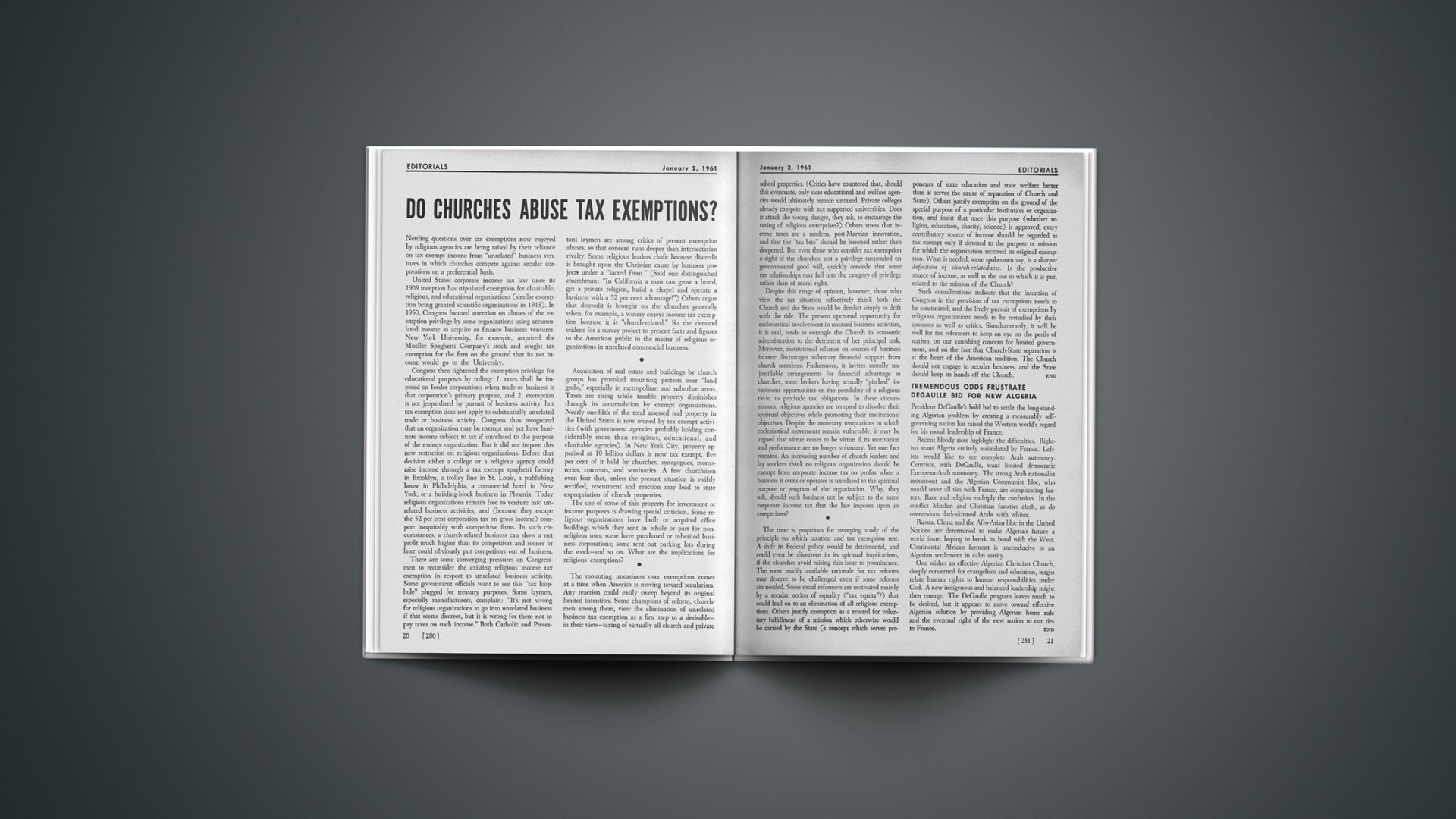
Do Churches Abuse Tax Exemptions?

Nettling questions over tax exemptions now enjoyed by religious agencies are being raised by their reliance on tax exempt income from “unrelated” business ventures in which churches compete against secular corporations on a preferential basis.

United States corporate income tax law since its 1909 inception has stipulated exemption for charitable, religious, and educational organizations (similar exemption being granted scientific organizations in 1913). In 1950, Congress focused attention on abuses of the exemption privilege by some organizations using accumulated income to acquire or finance business ventures. New York University, for example, acquired the Mueller Spaghetti Company’s stock and sought tax exemption for the firm on the ground that its net income would go to the University.

Congress then tightened the exemption privilege for educational purposes by ruling: 1. taxes shall be imposed on feeder corporations when trade or business is that corporation’s primary purpose, and 2. exemption is not jeopardized by pursuit of business activity, but tax exemption does not apply to substantially unrelated trade or business activity. Congress thus recognized that an organization may be exempt and yet have business income subject to tax if unrelated to the purpose of the exempt organization. But it did not impose this new restriction on religious organizations. Before that decision either a college or a religious agency could raise income through a tax exempt spaghetti factory in Brooklyn, a trolley line in St. Louis, a publishing house in Philadelphia, a commercial hotel in New York, or a building-block business in Phoenix. Today religious organizations remain free to venture into unrelated business activities, and (because they escape the 52 per cent corporation tax on gross income) compete inequitably with competitive firms. In such circumstances, a church-related business can show a net profit much higher than its competitors and sooner or later could obviously put competitors out of business.

There are some converging pressures on Congressmen to reconsider the existing religious income tax exemption in respect to unrelated business activity. Some government officials want to see this “tax loophole” plugged for treasury purposes. Some laymen, especially manufacturers, complain: “It’s not wrong for religious organizations to go into unrelated business if that seems discreet, but it is wrong for them not to pay taxes on such income.” Both Catholic and Protestant laymen are among critics of present exemption abuses, so that concern runs deeper than intersectarian rivalry. Some religious leaders chafe because discredit is brought upon the Christian cause by business projects under a “sacred front.” (Said one distinguished churchman: “In California a man can grow a beard, get a private religion, build a chapel and operate a business with a 52 per cent advantage!”) Others argue that discredit is brought on the churches generally when, for example, a winery enjoys income tax exemption because it is “church-related.” So the demand widens for a survey project to present facts and figures to the American public in the matter of religious organizations in unrelated commercial business.

Acquisition of real estate and buildings by church groups has provoked mounting protests over “land grabs,” especially in metropolitan and suburban areas. Taxes are rising while taxable property diminishes through its accumulation by exempt organizations. Nearly one-fifth of the total assessed real property in the United States is now owned by tax exempt activities (with government agencies probably holding considerably more than religious, educational, and charitable agencies). In New York City, property appraised at 10 billion dollars is now tax exempt, five per cent of it held by churches, synagogues, monasteries, convents, and seminaries. A few churchmen even fear that, unless the present situation is swiftly rectified, resentment and reaction may lead to state expropriation of church properties.

The use of some of this property for investment or income purposes is drawing special criticism. Some religious organizations have built or acquired office buildings which they rent in whole or part for non-religious uses; some have purchased or inherited business corporations; some rent out parking lots during the week—and so on. What are the implications for religious exemptions?

The mounting uneasiness over exemptions comes at a time when America is moving toward secularism. Any reaction could easily sweep beyond its original limited intention. Some champions of reform, churchmen among them, view the elimination of unrelated business tax exemption as a first step to a desirable—in their view—taxing of virtually all church and private school properties. (Critics have countered that, should this eventuate, only state educational and welfare agencies would ultimately remain untaxed. Private colleges already compete with tax supported universities. Does it attack the wrong danger, they ask, to encourage the taxing of religious enterprises?) Others stress that income taxes are a modern, post-Marxian innovation, and that the “tax bite” should be lessened rather than deepened. But even those who consider tax exemption a right of the churches, not a privilege suspended on governmental good will, quickly concede that some tax relationships may fall into the category of privilege rather than of moral right.

Despite this range of opinion, however, those who view the tax situation reflectively think both the Church and the State would be derelict simply to drift with the tide. The present open-end opportunity for ecclesiastical involvement in untaxed business activities, it is said, tends to entangle the Church in economic administration to the detriment of her principal task. Moreover, institutional reliance on sources of business income discourages voluntary financial support from church members. Futhermore, it invites morally unjustifiable arrangements for financial advantage to churches, some brokers having actually “pitched” investment opportunities on the possibility of a religious tie-in to preclude tax obligations. In these circumstances, religious agencies are tempted to dissolve their spiritual objectives while promoting their institutional objectives. Despite the monetary temptations to which ecclesiastical movements remain vulnerable, it may be argued that virtue ceases to be virtue if its motivation and performance are no longer voluntary. Yet one fact remains. An increasing number of church leaders and lay workers think no religious organization should be exempt from corporate income tax on profits when a business it owns or operates is unrelated to the spiritual purpose or program of the organization. Why, they ask, should such business not be subject to the same corporate income tax that the law imposes upon its competitors?

The time is propitious for sweeping study of the principle on which taxation and tax exemption rest. A shift in Federal policy would be detrimental, and could even be disastrous in its spiritual implications, if the churches avoid raising this issue to prominence. The most readily available rationale for tax reforms may deserve to be challenged even if some reforms are needed. Some social reformers are motivated mainly by a secular notion of equality (“tax equity”?) that could lead on to an elimination of all religious exemptions. Others justify exemption as a reward for voluntary fulfillment of a mission which otherwise would be carried by the State (a concept which serves proponents of state education and state welfare better than it serves the cause of separation of Church and State). Others justify exemption on the ground of the special purpose of a particular institution or organization, and insist that once this purpose (whether religion, education, charity, science) is approved, every contributory source of income should be regarded as tax exempt only if devoted to the purpose or mission for which the organization received its original exemption. What is needed, some spokesmen say, is a sharper definition of church-relatedness. Is the productive source of income, as well as the use to which it is put, related to the mission of the Church?

Such considerations indicate that the intention of Congress in the provision of tax exemptions needs to be scrutinized, and the lively pursuit of exemptions by religious organizations needs to be restudied by their sponsors as well as critics. Simultaneously, it will be well for tax reformers to keep an eye on the perils of statism, on our vanishing concern for limited government, and on the fact that Church-State separation is at the heart of the American tradition. The Church should not engage in secular business, and the State should keep its hands off the Church.

TREMENDOUS ODDS FRUSTRATE DEGAULLE BID FOR NEW ALGERIA

President DeGaulle’s bold bid to settle the long-standing Algerian problem by creating a measurably self-governing nation has raised the Western world’s regard for his moral leadership of France.

Recent bloody riots highlight the difficulties. Rightists want Algeria entirely assimilated by France. Leftists would like to see complete Arab autonomy. Centrists, with DeGaulle, want limited democratic European-Arab autonomy. The strong Arab nationalist movement and the Algerian Communist bloc, who would sever all ties with France, are complicating factors. Race and religion multiply the confusion. In the conflict Muslim and Christian fanatics clash, as do overzealous dark-skinned Arabs with whites.

Russia, China and the Afro-Asian bloc in the United Nations are determined to make Algeria’s future a world issue, hoping to break its bond with the West. Continental African ferment is unconducive to an Algerian settlement in calm sanity.

One wishes an effective Algerian Christian Church, deeply concerned for evangelism and education, might relate human rights to human responsibilities under God. A new indigenous and balanced leadership might then emerge. The DeGaulle program leaves much to be desired, but it appears to move toward effective Algerian solution by providing Algerian home rule and the eventual right of the new nation to cut ties to France.

I Believe …

Christianity has all the necessary resources to win today’s battle for the minds of men and to overrule the world’s power contest. By its revelation of the mind and will of God, the Gospel challenges human speculation about truth and right. It discloses Jesus Christ as the true Lord of history; as Conqueror of sin, of Satan, and of death itself. He is able to remake the wicked into the image of holiness or to doom them forever. To us are offered both the mass idea for victory and its consummating dynamic.

IT’S TIME RACKETEERS ARE K.O.’D IN THE BOXING RING SCANDALS

Like a lamprey eel attaching itself to its victim, and sucking away its very life, the underworld character attaches himself to many phases of American life, debauching whatever he touches. Disclosures of racketeering in the boxing world supply the latest example.

Does not much of the blame rest squarely on judges, courts, juries, and law enforcement agencies which for too long have merely slapped the wrists of criminals rather than meting out due punishment for crime?

Government “inquiry” into the present scandal concealed the identity of a well-known boxer prior to the hearing, for fear that the witness “might receive bodily harm” from underworld characters. We wonder if the acme of law enforcement futility has not been reached when the federal government admits that its star witnesses may be subject to dangerous reprisals, and for protection relies on anonymity rather than on other measures, such as capture of these shady characters.

Our laws, courts, and procedures were never intended to do more than guarantee a fair trial to criminals. That they now shelter the enemies of society is even more disturbing than evidence of racketeering in a particular sport.

SETTING FOR INAUGURAL: A WORLD IN TROUBLE

Inauguration of a new U.S. president again dramatizes the important roles of power, justice and unity in national life.

These next years may decide the free world’s destiny in post-Christian times. Waning confidence in democratic processes calls for a political morality to inspire wavering nations flirting with bondage. Sound government requires the recognition of the righteous judgments of God. Sooner or later expedience topples great powers to ruin and rubble. Let president and people remember, “there is no power but of God.”

THE FATE OF CHRISTIANITY: IS THE WORLD WINNING?

Is Christianity in retreat? The Rt. Rev. James A. Pike, Bishop of the Episcopal Diocese of California, says that it is—in an article in Look magazine (Dec. 20 issue). Indications of a religious upsurge are superficial, he maintains. Statistics show that church membership increase is not keeping pace with population increase. In Communist countries, “virtually all chance for further development has been cut off.” In other lands, Christianity is overshadowed by the new nationalisms. In so-called Christian countries, the church has become “largely complacent and irrelevant.” Delinquency, vice, neuroticism are on the increase. In business and government the old ethical standards are being dropped. Within the church itself, profession and practice do not tally. “The church, instead of being a goad, is by and large at peace with society.” Segregation and other forms of disunity disrupt its fellowship. Its religion has become man-centered rather than God-centered, offering religion as a nostrum or a shot in the arm to alleviate the tensions of contemporary life. “Today,” the Bishop admonishes us, “unless the Christian looks once again to Christ, the world might well overturn the movement.”

Now, all this is very true. The situation is indeed alarming, and a jeremiad such as Bishop Pike has uttered is by no means out of place. But two further considerations need special emphasis, since they are often overlooked by churchmen who incline to the idea that church mergers and social planning are the royal route to Christian greatness. First of all, the church is always in dire jeopardy, either of liquidation by persecution or of emasculation by indifference. Its enemies, moreover, come from within as well as from without. Its survival is always cause for astonishment. Even the church of the New Testament was crippled and menaced by divisions and disorders and heresies (see, for example, Paul’s First Epistle to the Corinthians), which threatened its survival far more seriously than the hatred or the apathy of the state.

In the second place, it is God’s church. God is sovereign both in his church and over the whole of human history. However invincible the powers of darkness may appear to be, however desperate the prospects of the survival of Christianity, God’s purposes for and through his church can never be frustrated. Those who now wickedly reject Jesus Christ as Saviour will inevitably stand before him as Judge. This age has an appointed end, and Christ when he returns will bring with him the realization of the new heavens and the new earth in which righteousness dwells. Genuine Christianity is never in retreat, but ever marches forward in the triumphal procession of its glorified Master.

But these considerations (with which Bishop Pike may also be in full agreement) do not release the Christian from urgent responsibility. They provide no excuse for unconcern. The Christian cannot but be vexed at the inroads of evil. He may not be of the world, but he is in it—and his involvement implies also his responsibility. We share Bishop Pike’s concern. We catch the sound of Martin Luther’s challenge to the succeeding generations to keep God’s little lantern alight. We turn again with earnest attention to the apostolic injunction: “Take heed unto yourselves, and to all the flock, in the which the Holy Ghost hath made you bishops, to feed the church of God, which he purchased with his own blood. I know that after my departing grievous wolves shall enter in among you, not sparing the flock; and from among your own selves shall men arise, speaking perverse things, to draw away the disciples after them. Wherefore watch … and remember.…”

Eutychus and His Kin: January 2, 1961

SILENTIUM

Retinium has not been added to eyewash as I once proposed, but the added ingredient specialists have just come up with silentium. This remarkable additive is compounded with cough syrup to muzzle the sufferer’s bark. I am engaged in a consumer’s research project to determine whether silentium stops coughing altogether, or enables one to cough silently, after the fashion of a genteel sneeze.

Many other applications suggest themselves. What effect does silentium have on squealing automobile tires? Can silentium be prescribed for infant formulas? Will high-octane silentium make mufflers obsolete? Is there a market for silentium lipstick? What about candy bars with silentium for free distribution to neighborhood children? “Silentium in the Sunday School” is a promising topic for a master’s degree in religious education.

Since silence is golden, its dollar value has soared of late. If the developers of silentium appreciate this, they may revolutionize television with commercials of profound silence, presenting scenes of gentle showers to suggest the quiet of the nasal drip when silentium reigns.

Silence seems so desirable in the din of our lives that it may require an effort to remember that silence in itself is neither good nor bad. Carlyle once wrote, “Speech is human, silence is divine, yet also brutish and dead: therefore we must learn both arts.”

In the Bible, silence appears more often as a judgment than as a blessing. A wasted land has the silence of the grave; the enemies of God are silenced by his wrath. Afflicted saints cry that God should not be silent. The Bible puts too much emphasis on the word of God to make silence the supreme blessing. The climax of worship is not to be dumb with awe but to cry hallelujah. As God awakes to judgment all flesh is silent before him, but Zion sings to the Lord who comes to dwell in her midst (Zech. 2:10–13).

As a recent magazine article put it, clams are not my dish. There are too many silent saints these days. They have clammed up the pearl of great price in a hard shell of silence. The apostles, in a situation where stoical silence was a golden virtue found a more excellent way. They sang praise in the stocks at midnight.

I have suggested to Pastor Peterson that he trade in those SILENCE! signs on the church stairway for new ones: PRAY! SING!

Silentium may quiet coughs during the sermon, but many dour saints need a shot of Amenium.

EUTYCHUS

LETTERSFROMMISSOURI

“A Letter to Missouri” (Nov. 21 issue) does not appear to most of us loyal Missourians to merit the space you gave it.

Actually, “A Letter to Missouri” is what it almost purports to be, a rehash of views recently circulated to the clergy of The Lutheran Church-Missouri Synod by William M. Oesch, dozent of the theological school of Lutheran Free Churches at Oberursel, Germany. Dr. Oesch’s observations are more penetrating than those of your correspondent, frankly representing, as they do, the traditional views of a hitherto extremely static church, which itself is beginning to wonder whether it has not almost totally neglected its mission to the indifferent and unbelieving. This misgiving came to the Missouri Synod three or four decades ago and resulted in a mission outreach for Christ which is somewhat perplexing and puzzling to our orthodox Lutheran brethren across the seas.

Has your correspondent considered the fact that he may have completely misunderstood the theological professors he castigates? I know for a fact that no theological professor of our church has ever denied the resurrection of the body, but one did point out that Platonic ideas regarding immortality of the soul detract from the glory of this New Testament doctrine. I have no knowledge of one of our five thousand pastors who supposedly advocated “modal monarchism” (usually called “modalistic monarchianism” in our histories of dogma). Could he have been misunderstood, too?

The theory, termed smartly in this imposing “letter” the Lex Missouriensis, that numbers are our prime interest or objective, has practically no currency in the Missouri Synod. We publish statistics, of course, and try to keep them as accurately as we can. But we do not put much stock in numbers, and are somewhat embarrassed by the fact that for each of the last fifteen years the Missouri Synod has contributed the largest number of new members to the Lutheran total in America. We still continue to instruct our new members in the Christian faith as we understand it before admitting them to the privilege of membership, and to educate our children in the verities of the Scriptures with a system of Lutheran elementary schools which, I am not ashamed to say, is constantly growing in size and effectiveness.

We are aware of the fact that “error is not static.” We are also aware of the fact that truth is not static when it is God’s truth as revealed in the Scriptures.

The Holy Spirit of God does His work when the Word of God is laid on the hearts of hearers, whether in our congregations or in the listenerships of our extensive radio and television programs. We do not believe that reading a “popular magazine” will necessarily “distract us from the Greek New Testament” or that television will necessarily “beguile us from Pieper’s Dogmatics.” We do believe in bringing the Word of God, as we find it in the Greek New Testament and as it is formulated in Pieper’s Dogmatics, to bear upon the fermenting secularism and frequently fluid Christendom of this age.

We preach Christ, the Savior atoning for sin, the Righteousness of God for a world lost in its own unrighteousness and work-righteousness—Christ the Power of God and the Wisdom of God. We find Christ only in the authoritative Word of God, the Holy Scriptures, which we accept from cover to cover as verbally inspired. If there are serious discussions within our church body regarding the nature of the Word of God, they are a sign that the Word is taken seriously among us rather than indifferently, with the purpose not of discarding it or rendering it ineffective, but of keeping it as the two-edged sword of the Spirit it really is.

Your correspondent drops deep dark hints about “unionism” and “clamor for church union with those who do not hold our historic confessional position.” What is he referring to? The talks now going on between leaders of the Missouri Synod and the National Lutheran Council regarding the theological basis for limited cooperation (without altar and pulpit fellowship) or for refusal of such cooperation? If there is any “clamor” in the Missouri Synod for “church union,” it is muffled to the point where it is inaudible. “Church union,” pray, with whom? As far as I know, no doctrinal talks to that end are going on with anybody. For a Missourian, no matter how “liberal” he can be made out to be, doctrinal agreement is an indispensable sine qua non to “church union.”

Serious discussions are going on regarding the nature and extent of “doctrinal agreement” required for Lutheran cooperation and Lutheran union. Is this bad? Or is it the mark of a church that must continually ask itself, “What does God’s Word have to say to us?”

OSWALD C. J. HOFFMAN

Director

Dept, of Public Relations

The Lutheran Church-Missouri Synod

New York, N. Y.

A real service, not only to the Missouri Synod but to all Christendom, for it brought into the open a subject which has long been overdue for a healthy airing.…

It occurs to me that many of CHRISTIANITY TODAY’S one hundred and seventy-five thousand readers would like to have for themselves a copy of Dr. William Oesch’s profound study of the “Present State of American Lutheranism of the Synodical Conference.” It can be had by sending one dollar to the author’s American address: 1638 Main St., Highland, Ill.

B. W. TEIGEN

President

Bethany Lutheran College

Mankato, Minn.

You paint in broad indistinct strokes. These broad strokes leave you and your denomination all white while you paint all others in opposites in one sweep of the brush.

F. C. ST. JOHN

First Methodist Church

Middlefield, Ohio

Pastor Schulze correctly states that certain individuals (and they are few in number!) have been “accused” of some of these heresies. However, there is a difference between accusation and fact.

K. L. FRERKING

University Lutheran Chapel

Columbus, Ohio

I would think others, as for instance, J. Pelikan or M. Marty, could speak if not “for” Missouri at least “as” Missourians in good standing!

J. T. KEEKLEY

St. Timothy Lutheran Church

Hyde Park, N. Y.

As an answer to Pastor Schulze’s statement on truth and union, I wish to say that Lutherans of all synods did accept and always have accepted the Book of Concord.

J. W. VON SCHMELING

St. Paul’s Evangelical Lutheran Church

Langenburg, Saskatchewan

It is my observation that the leaders of our church are fully aware of these developments and are doing something about them.

H. F. SCHWEIGERT

St. Peter’s Lutheran Church and School

Minneapolis, Minn.

One would hope that those who see “Missouri” as David to Jonathan, or Aaron to Moses in the Lutheran family of America, rather than Samson to the Philistines, may be free to search for clearer ways to speak the Gospel to the ears of listening brethren rather than shout it in the sleep of strangers.

DONALD H. LARSEN

St. Andrew-Redeemer Lutheran Church

Detroit, Mich.

By what stretch of editorial right do you presume to print such opinion?

A. KARL BOEHMKE

Lutheran Church of The Shepherd King Birmingham, Mich.

My deepest appreciation for publishing Brother Schulze’s “A Letter to Missouri.” You have the courage our Lutheran Witness lost some twenty odd years ago.

LUTHER P. J. STEINER

Redeemer Lutheran Church

Perris, Calif.

It is my appraisal that if we continue the practice of following first of all Missourism, Methodism, Presbyterianism, the next generation clergymen will not find time to turn to Pieper’s Dogmatics nor to be branch office managers but will be fighting to find a place in which to gather a few faithful to proclaim to them the word of God—in short, the church will again be faced with a catacomb existence within a hostile world because the ministers of the 60’s were more interested in their own “ism” than being “of Christ.”

ROBERT L. BILL

Wray, Colo.

This so interested me, from the standpoint of a concerned Missouri Synod layman, that I couldn’t help but send you a note a appreciation for publishing it.…

THEODORE SMITHEY

Taylor, Mich.

MISSIONARY ACHIEVEMENT

A few miles from where the United Church of Canada General Council was held in Alberta (Oct. 24 issue) is one of the greatest examples of union to spread the Gospel … “The Prairie Bible Institute.”

The United Church may be great as far as wealth and numbers go, but they are very, very small as far as missionary achievement is concerned.… It is quite possible that a former Methodist Church of Bloor Street, Toronto, whose [Missionary] Pastor is the well-known Oswald J. Smith, is doing more so-called foreign missionary work than the whole United Church of Canada.

MALCOLM PELLY

Smith Sound, Newfoundland

CALL FOR PROTEST

I’ve just seen a film of the San Francisco student riots against the un-American Activities Committee.

… A wave of Red student riots is generating in this country. For opposition, it would be more than all the billies in the world if there were a wave of heaven-anointed Christian Open Air Protest meetings.

SAMUEL WOLFE

Santa Barbara, Calif.

JERUSALEM HEIGHTS

Dr. Hughes’ thought-provoking article (Oct. 24 issue).… says “… excepting in the Temple on Mount Zion.”

When I was in Jerusalem last summer I visited the former site of the Temple and it was on Mount Moriah, about three-fifths of a mile northeast of Mount Zion. Today it contains the Moslem structure, the Dome of the Rock.…

LESTER C. HARLOW

Alexandria, Va.

CHRISTIAN UNIVERSITY

You should put a halt to the emphasis on “high class” and degrees in your magazine and face up to reality.

“For there are certain men crept in unawares, who were before of old ordained to this condemnation, ungodly men, turning the grace of our God into lasciviousness, and denying the only Lord God, and our Lord Jesus Christ” (Jude 4).

These men, who were before of old ordained, have crept in unawares into the churches, National Council of Churches, National Education Association, labor unions, Farmers Union, and other “slightly tinged” organizations and … are causing the trouble in America, in Europe, and in the rest of the world.

There would be no need to establish new Christian universities and colleges. The universities and colleges would once again become Christian, and the public schools would become purified again, if these men were purged from the N.E.A., churches, etc.

“And ye shall know the truth, and the truth shall make you free” (John 8:32). Chinook, Mont.

JACOB H. RITTERBUSH

Let’s take a long hard look at the dangers … of a Christian university … and then plan a strong careful campaign to meet them, rather than retreat.

HELEN R. COATES

San Diego, Calif.

BIBLE TRANSLATION

Dr. Steele’s standards [for translation are] “unduly rigid” (Sept. 26 issue).… A “word for word transfer” of the text would violate every principle of good translation in the secular field; surely such a principle goes far beyond what those of us who accept verbal inspiration would ever demand of a translation of God’s inspired Word.

LESLIE R. KEYLOCK

Dept. of Foreign Languages

Wheaton College

Wheaton, Ill.

MENNONITE DOCTRINE

It is unfortunate and regrettable that Mr. Bonebrake should have brought the Mennonite Church into his false assertion that since the Lord is already here we do not look for His coming again (Eutychus, Sept. 26 issue).

In the official statement of our church appears these words, “We believe in the personal and imminent coming of our Lord Jesus Christ as the blessed hope of the believers.”

ARCHIE KAUFFMAN

The Mennonite Church Lebanon, Ore.

FROM THE SENATE

CHRISTIANITY TODAY is a must in the understanding of our times.

FREDERICK BROWN HARRIS

Chaplain

United States Senate

Washington, D. C.

You may be interested in a comment I rather frequently hear these days, that it is now necessary to read CHRISTIANITY TODAY, even though grudgingly.

WILLIS E. ELLIOTT

Office of Evangelism

The United Church of Christ

Cleveland, Ohio

Shifting Values

SHIFTING VALUES

We are witnessing a growing extra-Christian philosophy which contends that the current explosion of knowledge calls for an accompanying “broadening” of the base of moral values and spiritual concepts.

For many centuries there were two worlds, the pagan and the Christian: pagan beliefs and practices varied with peoples, cultures and the centuries, while Christian beliefs and practices were fixed, having their basis in the biblical revelation.

No such clear delineation is possible today, for while paganism has been consistently inconsistent, the image of Christianity has been blurred by a gradual equating of human opinions and deductions with divine revelation.

This downgrading of the Scriptures has been effected from without by cultured paganistic philosophy, and from within the theological liberalism built on philosophical presuppositions having to do with the supernatural facets of the Christian faith.

In this context startling scientific breakthroughs have confused Christian thinking because of restricted concepts of God on the one hand and magnified views of man on the other. We live in an age of glorification of human achievements, whether it be on the gridiron or in the laboratory, and the result is that the “humanizing of God and deification of man” is no longer a cliché but a sobering fact.

A contributing factor in the change in moral and spiritual values has been the bold assertion of educators and others that “there are no absolutes.” The absurdity of this statement is found in that it is itself an absolute. But where men have undertaken to live by the philosophy that all things are relative—even the basic values of life itself—the result has been disastrous for the individual and for society.

If adultery is a relative matter, the rightness or wrongness of the act depending on the accepted mores of a given time and place in society, it is immediately evident that the Judeo-Christian concept of marital fidelity has given place to paganism.

If honesty is relative, so that it becomes a matter of expediency built on a foundation of anything other than the rights of ownership, then the law of the jungle has prevailed.

It might prove tedious to examine the Ten Commandments and to affirm their relevancy for today, but the world has found nothing better and it ignores these principles to its eternal undoing.

That God’s moral law is the code for human behavior in the Christian era should be a self-evident fact. Recognizing that the basis of salvation rests solely in the redeeming work of Calvary, the Christian knows his responsibility to God and to man is summed up in the demand to put God first in everything and to love his neighbor as himself.

Even within the Christian community moral and spiritual values have deteriorated to a level little separated from those prevalent in the pagan world.

Realism, relativism, and a rational approach have in such measure supplanted Christian restraints that we find growing around us a confused and beat generation, frustrated by an older generation which pitched its tent towards Sodom and settled for a regimented mediocrity. We deplore the antics of the juvenile delinquent, but we need to confess the sins of the men and women who made such delinquency inevitable.

Ours is not the only age when evil has multiplied on every hand. History tells of many times when moral and spiritual values were at a low ebb. The one outstanding difference between the past eras of decay and our own is that no generation has been blessed of God as has ours. The Gospel has been preached. The Church has borne her witness. On every hand we have evidence of God’s work in the midst of his people.

But despite the Christian witness, we find ourselves caught up in a spreading maze of iniquity. This has not happened overnight. Standards have been lowered gradually, step by step—here a concession, there a concession. Sex has been stressed and exploited until we have lost both the impulse and the ability to blush.

That these are days of lowered moral and spiritual ideals does not need documentation. What does need a new affirmation is that the gospel of Jesus Christ has the answer to all of these problems. The unchanging Christ for an ever-changing world is the message which needs to be preached from the housetops. The Church has become so concerned with secondary and peripheral matters that those which are of basic and eternal import find themselves only too often crowded out of their rightful place.

Let us be perfectly candid—in many churches today the message of salvation through the Cross with all of its implications (blood, atonement, substitution, propitiation, and so forth) is never preached. In other churches, the Gospel is so diluted and changed as to have no recognizable connection with the affirmations of Christ or Paul.

Many of the churches are not to blame. They have never known faith in a completely trustworthy and authoritative Bible. They have never had the opportunity to experience the simplicity of God’s offer of forgiveness of sin through repentance, confession, and faith in the redeeming death of his Son.

America’s greatest need today is not in the field of further scientific breakthroughs. What is needed is a revival within the Church—twice-born men teaching in our seminaries and preaching in our pulpits; men with an overwhelming sense of the sinfulness of sin and the righteousness of a holy God; men who, through the Holy Spirit, go out to preach Christ crucified, dead and buried and risen again; men who reject the suppositions of men for the affirmations of God; and men who realize that the Church is in the world, not to reform but to preach the One who came to redeem lost sinners.

We need such a conviction of sin that men will fall on their faces crying out to God for forgiveness and cleansing.

We need a vision of God which comes only to those who are willing to subordinate everything—mind, will, life—to Christ and to experience the joy which proceeds therefrom.

No one can accurately pinpoint God’s timetable. The hour may be very late. Unquestionably we live in a day when iniquity abounds and flourishes on every hand, and when the love of many waxes cold.

On the one hand, Christians must endure by God’s grace and, in these days of the world’s need, use every means at hand to witness to the saving and keeping power of Christ.

A sovereign God may yet pour out his Spirit in a refreshing stream of spiritual awakening. As at Pentecost, the prophecy of Joel may once more be fulfilled.

For this the Church should pray and to this end she should work.

L. NELSON BELL

Fifty Years a Church Tramp

Half a century ago, as a mere stripling out of college, it was my good fortune to become associated with the beginnings of a manufacturing company which now sells its products around the world. Although I have risen through the ranks to major responsibility, the nature of my work has remained essentially the same. For ten months of each year I have traveled among the main cities of the United States from the Atlantic to the Pacific and north of the Mason and Dixon Line. For only two months of each year have I ever had the chance to worship in my home church. On the majority of Sundays (some two thousand across the long span of time), I have attended Protestant public worship somewhere in the northern section of our country, always once, sometimes twice and, on occasion, three times. Out of what may well be a unique experience as a layman, I submit certain observations as I retire from active business.

If there has been a penalty in having spent such limited time in my own local church, there has been much advantage in worshipping with fellow Christians in different parts of our land. Never shall I forget, during the first year of my pilgrimage, the time I was in a suburban church listening to a young preacher who had been highly recommended to me by a friend. It was an electrifying experience. There have been many other inspiring experiences, sometimes in very unlikely areas, in which the power of the Christian fellowship has taken on light and meaning for the worshipper.

Sorting out the notes which I have preserved in my visitation of Protestant churches in the northern states across the years, I find five impressions, the first independent and the remaining four related to each other.

RISE OF THE FRINGE SECTS

The first impression concerns the rise of the fringe sects, those worshiping groups which have broken away or originated apart from the traditional churches in search for a greater simplicity of faith and worship. A half century ago these groups were hardly noticeable in the scene of the small, medium-sized, or large American city. Now they are conspicuous in the cities, and are purchasing and displacing churches of more familiar Christian tradition which have yielded to the suburban appeal. Members gather by the hundreds Sunday mornings, afternoons, and evenings, each frequently carrying a Bible. I was astonished recently to find this condition in a city of less than one hundred thousand and known for its world-famous university. These groups have little sense of formal worship. The leader is apt to wear a light grey suit and a loud tie: there are chatty announcements in the service, dance tune hymns, a crude sermon—all offensive to good taste. Yet in such groups of people, obviously comprising the lower income class, the atmosphere of devotion is very real, the sense of joyous faith highly apparent, and a radiancy of spirit unmistakable—much more so than in many of the historic denominational churches. In proportion to their means, the congregations of the sects provide generous offerings. They are “given to hospitality,” they surround the stranger with friendly greetings and ask him home to Sunday dinner. Furthermore, they faithfully send missionaries to many parts of the world.

It is difficult to measure the significance of the rapid rise of these sects in the last few decades. Does it imply more than a search for security in a century that has known terror and destruction in such a frightful degree? Or are these groups finding and expressing for everyday living a doctrine of our faith which organized Christianity as a whole has allowed to lapse?

LARGE LOCAL CHURCHES

The second significant development in the last half century has been the remarkable multiplication of local churches with large memberships. In 1910 the denomination in which I am enrolled had less than half a dozen churches with a membership of or above two thousand. In 1960 the same denomination contained more than one hundred such churches while the churches with a membership of around fifteen hundred had multiplied even faster. All the chief Protestant denominations have experienced the same speedy development of the large parish, particularly in suburban areas. There are, of course, obvious advantages in the larger units of membership, namely, more plentiful budgets, more widespread programs, and more adequate equipment. But there is one decided disadvantage: how can any preacher act as a pastor to a multitude?

In our Protestant tradition, it has been established as sound principle that the pastoral office and the preaching office are best expressed when blended in one individual. There are exceptions, as in the case of a gifted preacher who seldom calls and a gifted pastor who has obvious pulpit deficiencies; but, in general, the history of the local parish indicates that these exceptions prove the rule. With the swift increase in membership, a preacher becomes engulfed as a pastor. What is the answer? Have a multiple staff? That is doubtful. Just as the staff of a college or bank or business enterprise must have someone at the top to assume chief responsibility, so must the staff of the large parish. The man at the top has to be the preacher and when he cannot be the pastor also the whole parish loses. Indeed a good case can be made out for the relative ineffectiveness of the large church. It is better by far, and it means more active workers, more sacrificial giving, more adequate pastoral care, and no less effective preaching, when a church will found other churches rather than gather members to its own ranks. Four churches of 800 members each can offer a more significant witness than one church of 3,200 members. The fetish of size has damaged Protestantism because it has lessened the possibility of adequate pastoral work.

DEVELOPMENT OF FORMAL WORSHIP

Another noticeable change across the decades has been the extensive development of formal, ritualistic worship. Today the village church has its vested choir, even its lighted candles. So far has this process been carried that here, there, and everywhere in the American scene, at least north of the Mason and Dixon Line, it is often difficult for occasional visitors like myself to tell whether he is worshiping in a Presbyterian, Congregational, Methodist or Episcopalian church. The architecture, chancel, lectern, pulpit, prayers, responses, order of service, robed choirs, stained glass, and all else are very much alike in all four. Whether this represents gain, one cannot be sure. Back of any ritual is the one who conducts it. The sons and daughters of John Calvin, John Robinson, and John Wesley inherited and passed on to us a freedom of thought and form which provide a constant challenge in expression. There are no prayers like the prayers that come out of a deep spiritual experience. In many a church I have received the blessing of such utterance. Ritual, too, is a challenge, when its words are read as though for the first time in mingled awe and gratitude, those wonderful words of the Gospel. But too often, alas, the one who reads the prayers does not invest them with any note of reality and authority. So I am not completely reconciled to the trend which has engulfed us.

ENLARGEMENT OF PARISH PROGRAMS

Parallel with the rise of size and ritual among our Protestant churches is the development of programs. In the early period of my itinerant worship across the country, a church with a seven-day program was so rare that it was almost unknown, and well-equipped church buildings now found by the hundred had scarcely appeared. Morning and evening worship services, the Sunday School, and young peoples’ societies—that was Sunday’s program, and the remaining days of the week seldom included more than Wednesday night prayer meeting and the meeting of the women’s organization. The preacher-pastor was supposed to produce two sermons a week, consecrate his mornings to study and preparation, his afternoons and evenings to calling on parish families in a steady annual round which included all the sick and shut-ins. His occasional committee meetings did not take up much of his time. One never heard of nervous breakdowns among the clergy in 1910. How the picture has changed! Consider the printed program the ushers distribute to those who enter for worship at any well-organized church today! What a list of activities through the week! What an appeal for every age group! The beginnings of this can be traced to the period immediately after World War I which revealed on a convincing scale the power of mass appeal based on psychological principles. Ecclesiastical chieftains swiftly learned from the advertising experts, and blueprints began to flow to the parish minister’s desk in increasing volume. Quotas and pamphlets for membership gain, benevolence budgets, more modern teaching methods in the church school, this approach and that approach in the community, youth work, men’s work, women’s work, work among the sick, the preaching of sermons and the offering of prayers—all present a confusing multitude of directions and suggestions from central headquarters to the preacher-pastor of today. If the large parish prevents a pastor from being a pastor because of the sheer weight of numbers, I submit that this deluge prevents a preacher from being a preacher for the same reason. How can a preacher find time for proper sermon preparation when he must carry so many duties?

DECLINE OF EXPOSITORY PREACHING

The multiplicity of demand upon the minister of the local church, be it small or large, means that there is not sufficient time for preparation of sermons that are fruitful and edifying. In the decades of listening to thousands of sermons, I have detected several strata of influence much like the various civilizations an archaeologist uncovers in his excavating. The first decade was dominated by the denunciations of the so-called social gospel. Having read my Bible daily through a lifetime, I am aware of the messages of the prophets; but through those opening years I rarely heard a pulpit message based upon them which ministered to my own need. I was gaining promotion after promotion until I was supervising the work of several thousand men and women of varied creed and color. But there was little that I heard from any pulpit which helped me in my terrific responsibility. During the last decade I have had to listen to many sermons which assure me that if I think enough about success I will be a success, I will rid myself of my tensions, I will overcome my fears, and I will achieve self-mastery. The source of this frightful travesty of the Christian Gospel can be easily traced.

However, every now and then, and sometimes in inconspicuous pulpits, I have heard messages that meant much to me and my need. Invariably they were of the expository type. The preacher selected a text or passage from the Bible, related it to a fundamental human need in his opening sentences, and enlarged upon it in all its helpful suggestions throughout his sermon. Always I left such a church on Sunday wearing seven-league boots. Is that not the test of effective preaching! Why are such sermons so rarely heard? Sooner or later they cover the whole range of human need. But why are they neglected? I believe the reason lies in the multiplied demands made upon the present-day minister which rob him of time for adequate pastoral visitation and uninterrupted sermon preparation.

From time to time some veteran of the cloth will assert that the average level of preaching today is higher than it was yesterday. I would challenge that verdict. There were few mighty men in the pulpit a half a century ago, and there are few mighty men today. Such preachers are exceptional in any decade. The Christian fellowship is obliged to depend upon preachers of ordinary rather than extraordinary capacity. Were those preachers granted the time to become acquainted with human nature in their parish calling and learn the message of the Bible in their study and apply one to the other, there would be great reward for those who worship and listen. It is good to know that there are preachers who, in spite of the obstacles in their way, have achieved this combination. Across the last 50 years, two of them have never failed me whenever I have heard them. The first preacher served a small church just off one of the main highways of our largest city. There, Sunday after Sunday, he gave marvelously uplifting expositions of the Bible to a tiny congregation. Why was his church never crowded? I could never solve that mystery, for it seemed to me that the whole world should have been seeking him out. Now he has passed away. The other preacher served for almost three decades in a famous suburb in the Middle West. His church was always crowded. Today he lives in retirement in a university town and still carries on his ministry as a supply. It happens that one of my business associates was a member of his congregation for many years, and as we left the church together one Sunday morning he turned to me and said, “I have never needed a psychiatrist when I can hear such messages once a week.” As a Christian layman who has faced many problems in our industrial order, I understood and agreed with my associate’s remark.

SALESMANSHIP LAY AND CLERICAL

Throughout my lengthy career in industry, my work has had to do mainly with salesmen, sales methods, and sales conventions. Week by week and month by month, for over half a century, I have had the responsibility of directing an enterprise which now has vast proportions. In the earlier days when I compared the salesmanship that I listened to on Sundays with the salesmanship I dealt with on weekdays, I was able to mediate many hints and suggestions for the latter from the former. Preachers of an earlier period had learned how to present the claims of the Christian Gospel in simple, effective style, relate that Gospel to the needs and problems of human experience, and strive for a verdict. Indeed I gladly admit that what professional success I have had in directing salesmanship I owe mainly to studying the techniques of the preachers of my youth. Today I would say that the situation is reversed. Most preachers, particularly men younger than 50 years of age, would benefit if they studied the techniques of the speakers at a sales convention.

INFLUENCE ON THE FUTURE

The late John Foster Dulles, addressing a graduating class at a leading theological seminary in 1944, put this question: ‘What can the churches do to influence the pattern of the future?” His reply was, “My judgment is that their influence can be decisive.” These were the words of the most powerful and prominent Christian layman of our time. His judgment will be echoed by anyone who has had the chance, as I have had, to study the local Protestant churches across the areas of our own land. Now, as I cease my rather extensive itineracy and sit Sunday by Sunday in my home church, I give thanks for the countless fellowships of faith across our land and for those who guide and minister unto them. If I have written in criticism I write also in affection. Even in the world of the atom bomb, the message of Christianity abides. The influence of the churches can be decisive.

Samuel M. Shoemaker is the author of a number of popular books and the gifted Rector of Calvary Episcopal Church in Pittsburgh. He is known for his effective leadership of laymen and his deeply spiritual approach to all vital issues.

Wintertime in European Theology

Third in a Series

The broken grip of both Barth and Brunner on the theological mood of many German ministers and divinity students is due only in part to Bultmann’s neoliberal counterthrust. The stress and sting of World War II created a distinctive religious atmosphere, one which indelibly marked the spirit of the younger clergy.

Between the appearance of Barth’s Roemerbrief (1919) and the 1960s stand two generations of Protestant ministers. Those of the first generation, who were steeped and submerged in liberalism, heard Barth’s plea for special divine revelation sounding like a thunderbolt from above. Soon divinity students and young pastors told of their revolt against liberalism. “Barth saved us for the ministry,” they confessed, and they dedicated themselves to proclaim “the theology of the Word of God.”

When the second ministerial generation arose, in an era soon to be differentiated by its own peculiar outlook, the theological complex of the Continent had already largely embraced the “theology of crisis.” The tense struggle with National Socialism and the tragic events of World War II secretly shaped a harsh fate for Gennan Protestantism. Nazi antipathy toward outspokenly critical churchmen soon mounted to persecution and punishment of those who resisted government policy. The long tradition of a German Church enjoying special state privilege and public prestige was shattered. A national Lutheran and Reformed mind-set reaching back to the days of the Protestant Reformation was interrupted. These extraordinary developments distinctly colored the heritage and outlook of this later generation of German Protestant leaders in the twentieth century.

THE SHADOW OF HITLER

The “second generation” vividly recalls the anxious decades of Nazi hostility. When Hitler assumed power in 1933, National Socialist propaganda helped the “German Christians” (a scattering of extremists who were both theologically liberal and anti-Semitic) to control a number of churches in the newly-formed German Evangelical Church. Besides distorting the Gospel, these pro-Nazi leaders sought to make the Church a political instrument. Hitler Youth groups soon alienated young people from the churches. Faithful pastors were suspended from office, being reinstated only after congregational pressures. Martin Niemoeller, who had entered the ministry after a submarine command in World War I, sparked the resistance. Leading the newly-formed Pastors’ Emergency Fellowship, he helped to create and then presided over the Confessing Church. The Confessing Church was not only Lutheran. Many of its great leaders were Reformed (among them Karl Barth, Herman Hesse, Paul Humburg, and Ludwig Steil who later died in concentration camp), while others like Otto Dibelius represented a unionist theology. In the face of threats by National Socialists and the “German Christians,” the Confessing Church’s first Synod met in a Reformed church in Barmen in May, 1934, and in a theological declaration rejected any other source than divine revelation for church proclamation. When the subordination of the territorial churches to the German Evangelical Church was attempted, the protest of territorial bishops against subjection to an imperial bishop led to temporary arrest of Bishop Theophil Wurm of Württemberg and Bishop Hans Meiser of Bavaria for opposition to the “German Christians.” Deposed by an illegally-called Synod, Bishop Wurm was interned in his home by police until Hitler several weeks later was persuaded to restore him to office.

By 1935 the National Socialist State was intervening more directly in church affairs, exercising greater financial control, and bringing ecclesiastical cases under government determination. Anti-ecclesiastical propaganda became sharper in 1936. The Gestapo prevented leading churchmen from preaching, and forbade dispatching of delegates to ecumenical conferences. Niemoeller was arrested in July, 1937, remaining until 1945 a personal prisoner of Hitler in the concentration camps at Sachsenhausen and Dachau. The National Socialist State now was determined to harass and then to destroy the Church. Arrests, deportations, and attacks followed in 1938 and 1939. Training divinity students and collecting offerings became increasingly difficult. When World War II began, about 45 per cent of the clergy were called to military service, leaving parish work only to the old and weak. After 1940, no paper was allotted for Bibles, and after 1941 most religious publications ceased and the work of chaplains in the armed forces was impeded and systematically sabotaged.

A BROKEN STATUS

In West Germany, persecution of the Church is, of course, now a thing of the past. The 1950 census disclosed that 96.3 per cent of the Germany people, despite the methodical Nazi hostility to Christianity, still regard themselves as Christians. But Protestantism at mid-century held remarkably different status than it held earlier in the century. No longer did it exist in the favored form of a State Church. Almost everywhere it was confronted with indifference on the part of the multitudes whose acknowledged membership in the churches now meant astonishingly little. In Hamburg on Pentecost Sunday, 1960, a pastor preached a moving sermon on Acts 2 and the work of the Holy Spirit. Then, turning to the scant 75 worshipers present at one of the church’s high festivals in a city where multitudes have been baptized and confirmed, he remarked: “Ich bin ratlos!” (“I’m at the end of my rope!”).

[Under the Weimar Republic in 1919, Church and State were first separated in Germany, thus bringing the State Church to an end. From 1919–1924 the churches adopted new constitutions providing self-government. But in 1922 the German Evangelical Church Federation was formed by the territorial churches (the indigenous “peoples’ church”) which represented 62.7 per cent of the population. During the Nazi era, the Confessing Church was organized on an emergency basis. After World War II, German religious leaders passed up an opportunity to shape a genuinely free church situation. (Already in the second half of the nineteenth century, there had emerged Lutheran free churches as a protest movement against the “Prussian Union,” and Reformed free churches influenced by trends in the Netherlands in 1834 and later.) The territorial churches were no longer a State Church, under state controls such as still exist in Sweden; yet neither were they wholly free, the state continuing to appoint theological professors along with other faculty members at the state universities, and still collecting taxes to support these churches (even from citizens who are not members). The German Evangelical Church was abandoned in 1945, and a new Evangelical Church in Germany (EKD) replaced the emergency government of the Confessing Church. In its 1948 constitution, EKD declared itself a federation of Lutheran, Reformed, and Union “territorial churches.” In more recent years VELKD (United Evangelical Lutheran Church of Germany) has emerged as a somewhat more tightly knit organization of territorial churches of confessional emphasis.

[In 1950, the Evangelical Churches (EKD) embraced 51 per cent of the population in West Germany, 80 per cent in East Germany. The independent (free) churches in Germany represent less than one per cent of the population. Some 70,000 members of Lutheran Free Churches came into this movement from territorial churches without any confessional change, as did 8,000 members of Reformed Free Churches. But American evangelization was mostly responsible for other related religious bodies: 62,000 Baptists, 60,000 Methodists, 12,000 Evangelical United Brethren. (Seventh-day Adventists, Christian Scientists, and Jehovah’s Witnesses also had made German cities an evangelistic objective.)

[In 1933, Roman Catholics had represented only 32.5 per cent of the German population. But the partitioning of Germany bulked the Catholic population largely in West Germany: in 1950, Catholics represented 45 per cent of the population in West Germany, 17 per cent in East Germany. One third of the total German population is Catholic, and there is doubtless more Protestant-Catholic dialogue and liaison than in America. But Roman Catholic concentration in West Germany forces Protestantism to contend disadvantageously against an aggressive Catholic thrust for power.]

The speculative deformities of liberalism and the modern spirit of secularism had already encouraged much of the public’s disregard and disrespect for the Church as a unique divine organism. Despite enthusiasm at the elite professional level over a “springtime in theology,” the Protestant pulpit seemed to the masses to be mostly engaged in private intellectual dialogue with itself. When pagan rulers openly defied and demeaned, and privately restrained and repressed the Church, attendance sagged to new depths. Subtle Nazi indoctrination of youth additionally widened the chasm between the younger generation and the churches.

Although remaining Germany’s territorial church (or “people’s” church), Lutheranism has seen attendance at services slip (except at Christmas and Easter) to as low as one per cent of the membership in many cities in West Germany. This spiritual decline is all the more conspicuous alongside the nation’s remarkable industrial and economic recovery.

A SPARK OF HOPE

Something more than anxiety and sympathy is involved, however, in the standing West German awareness of the ongoing Communist repression, if not persecution, of believers still in the East Zone (both in Lutheran and in Union churches as the Church of Saxony West [Magdeburg] and the Church of Berlin-Brandenburg and Pommeranis), and of the Christian task force elsewhere behind the Iron Curtain. For the post-war inheritance of the “second generation” of German ministers includes a firm conviction that the Church in the East Zone in some local situations has become spiritually stronger through trial and persecution. Small fellowships of believers meeting in many homes have found a new theological and evangelistic earnestness, and they refuse to be cowed by fear of Communist tyrants. Nor are they discouraged by the defection of nominal church members. In Saxony, the churches lost 600,000 members in a single year, yet this detachment of those of nominal affiliation gave the Christian remnant a dedication and vitality that shames the indifferent church memberships in large West German cities where multitudes of adults, once confirmed, are seldom seen again in church between their wedding and funeral ceremonies. In the East Zone some dedicated Christian leaders are exhorting others: “Don’t just stay with your people, but stay with them to witness. The Communists can be converted!” The temper of this bold witness is described in Johannes Hamel’s A Christian in East Germany.

THEOLOGY AND FIRE

After World War II, the divinity student-mind was gripped by the “living theology” represented in a professor like Peter Brunner of Heidelberg, who lost his position at the university and suffered persecution by the Gestapo; or Helmut Thielicke of Hamburg, who was forbidden to teach theology and deprived of his university post through political pressures; or Hermann Sasse (now of North Adelaide, Australia), who, while on the faculty at Erlangen, was thrown into prison by the Nazis and rescued by American troops. Divinity scholars eagerly read the literary fragments of Dietrich Bonhoeffer (Letters and Papers from Prison), and of Paul Schneider, put to death by political persecutors. Bishop Johannes Lilje, then general secretary of the Lutheran World Convention, was arrested in 1944 for “defeatism” because he anticipated the conquest of Germany, and when rescued by American troops in 1945 he had already penned the manuscript Luther, Anbruch und Krisis der Neuzeit (English translation, Luther Now) in expectation of execution. Writings of churchmen who had endured suffering at the hands of the tyrants now took top place on the study desks of the clergy. Americans are only now being introduced to the sermons of Helmut Gollwitzer (now professor at Bonn) in the Berlin suburbs as Niemoeller’s successor at Dahlem where, until the Gestapo removed him from his pulpit and expelled him, Gollwitzer interpreted the congregation’s conflict with Nazism through powerful messages on the trial, passion, and resurrection of Jesus Christ (English translation, The Dying and Living Lord). Niemoeller’s influence has been compromised in recent years because of disappointment over his doctrinal laxity and a feeling that he tends to underestimate political perils in East Germany. To this day in Hamburg, where church attendance generally dips as low as in other German cities, Thielicke’s presence in the pulpit fills St. Michaelis Church with 2500 worshippers who come early for a seat, many being university students. Some leaders trace this following in part to public discernment that Thielicke, as shown by his resistance of the Nazis, is obviously not also a pulpit “voice for the state.” And some of these church leaders ask privately whether perchance the evasion of a wholly free church in Germany may not have compromised Christian opportunities. The German masses today think more readily of the Beast-State than of the God-State, and they seem more open to the voice of God that obviously lacks a government accent.

While this later generation saw plainly that the old liberalism lacked power to stand against National Socialism and was itself rooted theologically in crisis-theology, it drew inspiration mainly from thinkers who belonged to the era after Barth. The resistance of the German Confessional Church to Hitler’s anti-Semitism was in part a consequence of the renewed interest in biblical theology stirred up by Barth’s teaching, which nourished spiritual resources to oppose totalitarian forces. Barth himself became a symbol of resistance to National Socialism and was a leader in the church struggle against Hitler. He influenced the Confessing Church’s theological formulations expressed in the Barmen Confession. But the loss of his chair at Bonn, through his expulsion by Hitler in 1935, meant his removal to Basel, Switzerland, where the Protestant world followed at greater distance his contributions to dogmatics. Bultmann, too, although drastically redefining the content of the Gospel, nonetheless strenuously resisted the pagan frontal attack against the Gospel as such, and throughout the Third Reich maintained his open identification with the Church alongside his professorship at the state-supported university. Bultmann’s co-worker, Von Sodon, went still further; at the beginning of World War II he confessed the unorthodoxy of his theological beliefs to both colleagues and students and took higher ground.

A CHANGED ROLE

More and more this new generation of ministers measured the fortunes of Christianity in the modern world in apostolic dimensions. They saw a Church without worldly prestige and, worse yet, downgraded by many of her own members. The real Christian task force was a remnant, an ignored if not despised minority. A specially formative influence was this changed role of the German Church—no longer a State Church although the people’s church; no longer a majority influence in national life but supported only by a scant minority of its own members; its plight in a totalitarian age dramatized by imprisoned or exiled theologians and by pastors who suffered at the whim of dictators. The “second generation” has a desire to prepare the laity to meet the Communistic dialectic, a concern for the renewal of the Church, and an eagerness to reflect the Christian witness in a socially hostile age. This special outlook, however, is determined by ecclesiastical reaction to historical factors and by existential awareness of the Church’s actual situation in life, somewhat more than by conscious reorientation in terms of biblical theology. Nor has it broken through the limitations of contemporary theology in a rededication to biblical evangelism.

Samuel M. Shoemaker is the author of a number of popular books and the gifted Rector of Calvary Episcopal Church in Pittsburgh. He is known for his effective leadership of laymen and his deeply spiritual approach to all vital issues.

Power in the Pulpit

“If Protestantism ever dies with a dagger in its back, the dagger will be the Protestant sermon.” So quotes Donald Miller, a New Testament professor, from an unknown critic of preaching in The Way to Biblical Preaching (Abingdon Press, 1957, p. 7).

Why such critical words?

Miller finds in the contempt some preachers hold for the task of preaching one reason for its low fortune today. In his book Fire in Thy Mouth, he excerpts a letter written by a ministerial student: “I consider preaching as a necessary evil. I shall do as much of it as my position demands in order to qualify for the other more important tasks on which my heart is set. But I could well wish to avoid preaching almost entirely” (Fire in Thy Mouth, Abingdon Press, 1954, p. 14). The sad fact is that many otherwise capable preachers hold such convictions about preaching. The world’s disdain for the preaching of the pulpit is evidence of the modern evaluation of preaching.

The “clown complex” found in some ministers also tends to cheapen preaching. Because rhetoricians, statesmen, politicians, salesmen, and preachers have known for centuries that humor is a devastatingly effective weapon, some men have elevated humor to first importance among homiletical devices. Dr. Ellis A. Fuller, the late president of Southern Baptist Seminary, appealed to his students to refrain from playing the fool, the jester, and instead to live the role for which they were divinely commissioned.

The major question to be faced by some ministers, as they rise in the morning, is ‘who am I today?,” as Pierce Harris noted in the Atlanta Constitution:

The modern preacher has to make as many visits as a country doctor, shake as many hands as a politician, prepare as many briefs as a lawyer, see as many people as a specialist. He has to be as good an executive as the president of a University, and as good a financier as a bank president, and in the midst of it all, he has to be so good a diplomat that he could umpire a baseball game between the Knights of Columbus and the Ku Klux Klan [used by permission].

Dr. Samuel W. Blizzard during two years of research and investigation uncovered some interesting facts concerning ministers (see “The Roles of the Rural Parish Minister, the Protestant Seminaries and the Sciences of Social Behavior,” November, December, 1955, pp. 383–92). Dr. Blizzard attempted to find the preacher’s image of himself. He asked 1300 ministers to arrange six roles or functions—preacher, pastor, priest, teacher, organizer, and administrator—in the order of importance according to what they believed to be an ideal pattern. The more than 700 who replied felt the minister is: first, a preacher; second, a pastor; third, a priest; fourth, a teacher; fifth, an organizer; sixth, and last, an administrator.

Blizzard also asked them to arrange the same six roles functionally, according to the amount of time they spent performing these roles. The results were: first, administrator; second, pastor; third, priest; fourth, organizer; fifth, preacher; sixth, teacher.

During an average ten and one-half hour workday, these men spent an average of only thirty-eight and one-half minutes preparing to preach. The time spent on administration was seven times more than that spent on preaching. They declared that preaching ought to be their primary function, but they had reduced it to a very weak fifth-rate role by actual conduct and performance.

The drought in the content of preaching today should surprise nobody once we frankly admit our generation’s aversion to study, to work, and to creative thinking. Whether because of laziness, plagiarism, or lack of understanding, modern preachers show an alarming preoccupation with topical preaching and shallow content. Professor Luccock strongly urged, “If you have anything peculiarly Christian to say at this hour, for God’s sake, say it! But if you can do nothing but mouth over the slogans of the street corner, or the usual banalities of the chamber of commerce, for God’s sake, keep still!” (In the Minister’s Workshop, Abingdon-Cokesbury, 1944, p. 39).

SIGNS OF HOPE

In spite of the obvious decadence of preaching, signs of hope are apparent. It is encouraging to sense a quickening of interest in preaching in the seminaries throughout our land. An investigation on theological education in 1935 reported preaching to be one of five departments common to 25 seminaries. Dr. Richard Niebuhr found that in 1955 preaching was still one of the five departments common to the same 25 seminaries. Niebuhr’s conclusion was that “the ‘classical’ disciplines [of theological education], Bible, Church History, Theology, Pastoral Care, and Preaching, must certainly be included in any theological curriculum.…” (H. Richard Niebuhr, Daniel Day Williams, and James M. Gustafson, The Advancement of Theological Education, Harper, 1957, p. 86.)

A further hopeful sign is the practice of outstanding preachers who dare to lock the doors of their offices in order to pray, to study, and to prepare sermons. They are encouraged to believe that when they find messages from the Lord, people will rejoice to hear those messages. They dare to believe that people will excuse them from many aimless activities which plague the modern preacher provided they are busy finding God’s message.

An additional sign is evident in the heart-hunger of laymen for pastors who preach the Word. Again and again laymen have volunteered their convictions that ministers should pray more, study more, and rightly divide the Word of Truth. Jesse Johnson, an attorney from Richmond, Virginia, has written:

To my mind, the first and greatest work of the man in the pulpit is to preach the Word. If God has called him at all, He has called him to do just that. Nothing else should come before it. Nothing else can take its place. Almost every other work in the church can be accomplished by laymen or laywomen, but preaching is still the preacher’s job” (Messages for Men, ed. H. C. Brown, Jr., Zondervan, 1960, p. 88).

Moreover, we may take hope in some facts often overlooked in analyzing Blizzard’s report. While Blizzard has pointed up the alarming neglect of preaching by preachers, he has also presented documentary proof that all the combined pressures, programs, and problems of these preachers have been unable to convince them that preaching is not their primary task. Ministers still believe that they are first of all preachers, although other duties have usurped the place of preaching.

The most promising hope on the homiletic horizon is that theologians and biblical scholars have introduced three vital insights concerning the preaching ministry.

First, they are saying again, as it has not been said for some time, though often said in days past, that “preaching is vitally important in Kingdom affairs.” One of the first to emphasize the supreme importance of preaching was P. T. Forsyth, whose Positive Preaching and the Modern Mind rises like Mount Everest among the literature of homiletics. He said: “With preaching Christianity stands or falls because it is the declaration of a gospel. Nay more—far more—it is the Gospel prolonging and declaring itself” (Positive Preaching and the Modern Mind, A. C. Armstrong and Son, 1907, p. 5).

The second vital insight of leading scholars pertains to the content of preaching. Those who have attempted to make a sharp distinction between preaching and teaching in the New Testament and in the ministry of Jesus lack valid reasons for doing so. The record of the Synoptics is such that preaching and teaching overlap and complement each other in concept, function, and terminology. There is not so much a sharp distinction between gospel content and teaching content as there is a vital dependent relationship. The Gospel is the missionary evangelistic message, and upon this basic message is built the proper theological interpretation and proper ethical application.

The third significant contribution pertains to the importance of communication. Rules and principles of homiletics are vital. Since preaching is God’s way of telling man that he is lost and needs salvation, since preaching is God’s way of instructing his children, it logically follows that the way the preacher prepares and speaks God’s message is important.

The preacher has many functions. But “the primacy of preaching” means that the most important thing a preacher can do in the course of his week’s work is to preach, to speak for God Almighty. As he prepares and preaches, so will he become qualified to perform his other major functions. Only when a minister is first of all God’s spokesman does he truly become an effective administrator, a loving pastor, a wise teacher, a sympathetic counsellor, and an able denominational leader. The North Star of the ministry is the task of preaching.

Samuel M. Shoemaker is the author of a number of popular books and the gifted Rector of Calvary Episcopal Church in Pittsburgh. He is known for his effective leadership of laymen and his deeply spiritual approach to all vital issues.

The Living Plus Sign

2 Corinthians 5:14–20

The Preacher:

Long one of the American Baptist Convention’s outstanding preachers, Dr. Charles W. Koller became third president of Northern Baptist Theological Seminary, Chicago, in 1938. He is presently on leave. A native of Texas, he served in World War I. Dr. Koller holds the A.B. degree from Baylor University, Th.M. and Th.D. from Southwestern Baptist Theological Seminary, and the honorary D.D. from Eastern Baptist Theological Seminary. During the eleven years (1927–38) he ministered to Clinton Hill Baptist Church in Newark, its membership doubled and led Baptist churches in New Jersey in numerical net growth. Dr. Koller’s sermon is based on his favorite passage of Scripture (2 Cor. 5:14–20) and unfolds his favorite theme, the Cross.

The Text:

For the love of Christ constraineth us; because we thus judge, that if one died for all, then were all dead: And that he died for all that they which live should not henceforth live unto themselves, but unto him which died for them, and rose again. Wherefore henceforth know we no man after the flesh: yea, though we have known Christ after the flesh, yet now henceforth know we him no more. Therefore if any man be in Christ, he is a new creature: old things are passed away; behold, all things are become new. And all things are of God, who hath reconciled us to himself by Jesus Christ, and hath given to us the ministry of reconciliation; to wit, that God was in Christ, reconciling the world unto himself, not imputing their trespasses unto them; and hath committed unto us the word of reconciliation.

Now then we are ambassadors for Christ, as though God did beseech you by us: we pray you in Christ’s stead, be ye reconciled to God.

On a hill far away stood an old rugged cross,

The emblem of suffering and shame.

But I love that old cross, where the dearest and best

For a world of lost sinners was slain.

We have not really seen the cross of Christ until we have seen it as a great plus sign by which God and man are drawn together in holy reconciliation.

Above that cross, a loving Heavenly Father bends down from his throne and offers the hand of reconciliation to an estranged human family. Beneath that cross is the great, confused mass of blundering, sinning, suffering humanity, alienated from God, lost in ways of its own choosing, and divided by those innumerable barriers which sin sets up. Upon that cross, in the form of a Living Plus Sign, is the quivering, bleeding body of the Son of God, the Great Reconciler, who has “broken down the middle wall of partition between us … that he might reconcile both unto God in one body by the cross” (Eph. 2:14, 16).

We have not really seen Christ until we have seen him as the Christ of the cross. Thus we see him through the eyes of Peter who knew him so well and so devotedly, and who emphasizes not his prepossessing personality, superior mind, magnificent character, lofty ethics, or flawless life, but his atoning death (1 Pet. 1:18f.). We see him through the eyes of Paul who emphasizes not the Christ of the wayside, of the seaside, the synagogue, or the market place but the Christ of the cross (1 Cor. 2:2). It is in the cross, primarily, that Christ himself desires to be remembered. How did he spend the last evening with his disciples before his death? Did he devote those brief and precious moments to a review of his life, or to the Sermon on the Mount? On the contrary, he gave a preview of his death, of the Sacrifice on the Mount.

“This is my body which is given for you: this do in remembrance of me … This cup is the new testament in my blood, which is shed for you” (Luke 22:19–20). Thus it is the Christ of the cross, primarily, whom we memorialize in the Lord’s Supper “till he come.”

We have not really seen our earthly mission or our heavenly destiny until we have seen it in the light of the cross, that great plus sign on the sky line of Calvary. There, suspended between heaven and earth, is the Living Plus Sign, the throbbing, outstretched form of the Son of God with hands uplifted in a holy prayer of reconciliation: “Father, forgive them, for they know not what they do” (Luke 23:34). Beyond the cross, we behold the gates of Paradise swung open, and the angels singing their welcome to the returning, crucified, yet resurrected and glorified Son of God! And who are those that follow in his train? Are they not sinners, cleansed, forgiven, reconciled? We as the people of God move toward a high destiny, but all around us are the lost, the unreconciled, in whom we have a great uncompleted mission to fulfill. Nowhere is the earthly mission of God’s people more perfectly expressed than in the words of the apostle, “Now then we are ambassadors for Christ, as though God did beseech you by us; we pray you in Christ’s stead, be ye reconciled to God” (2 Cor. 5:20). To the reconciled and unreconciled alike, the great plus sign speaks.

TO THE UNRECONCILED

1. The atoning work of Christ is finished. The chasm between the sinfulness of man and the holiness of God has been bridged. The way is thrown open for the lowliest of sinners to come to the throne of grace and receive cleansing and forgiveness.

It was a great day in American history when the first transcontinental railway was completed. A memorable occasion was planned for the laying of the last rail and last tie, and the driving of the last spike along the border between Colorado and New Mexico. A laurel wood tie had been provided, and two silver spikes which represented the two adjoining states. At the appointed moment the two governors stepped forward, and each in turn drove one of the silver spikes into the laurel wood tie. When the last spike had been driven, the assembled crowd broke into applause, while reporters who had tapped the telegraph wires flashed the good news to the world. The great feat had been accomplished which spanned the continent from coast to coast! It was indeed a great day. But it was a far greater day when the reconciling Christ, with spikes driven through his hands and feet, cried out from the cross, “It is finished!” Now angels could flash the news to the ends of the earth, and sinners could forever rejoice, “It is finished!”

2. The great plus sign is still adding! It continues to add souls to the household of God. It makes men brothers through the only means by which the brotherhood of man is ever to be achieved, namely, through the fatherhood of God. There is a sense in which all the sons of men are the sons of God; but in the prevailing New Testament sense not all the sons of men are sons of God by any means. Only “as many as received Him, to them gave he power to become the sons of God” (John 1:12). And when, through the new birth, two men have become sons of God, they have by the same token become brothers to one another. To a mixed company of believers, Jesus said, “all ye are brethren … one is your Father, which is in heaven” (Matt. 23:8–9). To a group of unbelievers, Jesus said, “Ye are of your father, the devil” (John 8:44).

The Living Plus Sign unites hostile elements by the only tie that truly binds. After World War I, the Arabs in Palestine and the British soldiers of the army of occupation generally regarded one another as mortal enemies. One of the British soldiers, a devout Christian, visited the reputed tomb of Jesus. As he approached the tomb he was startled to note, just inside the opening, a tall, swarthy Arab warrior with hands folded in deep meditation. The British soldier waited, not wishing to intrude, and not knowing what might happen next. When finally the Arab warrior turned to leave the tomb, their eyes met. The Englishman extended his hand and uttered one word, “Jesus!” The Arab took his hand and responded with the Arabic equivalent of “Jesus.” It was a warm, lingering handshake. Not one further word was spoken, but both men realized that they were brothers, sons of the same Father, servants of the same Master.

3. The reconciling Christ is still at work. The ancient invitation still stands: “Be ye reconciled to God!” He purifies as he reconciles. The sinner could never, in the filthiness of his unforgiven state, be lifted to the holy bosom of the Heavenly Father. Helpless and hopeless, he must look to the reconciling Christ. Dr. Samuel Chadwick of Leeds, England, once announced a service for infidels only. A large crowd came. They would not sing or join in prayer, and the preaching was under constant heckling. After the service, Dr. Chadwick invited any who were interested in further discussion to meet him in the vestry. Nineteen men followed. After long and apparently fruitless discussion, Dr. Chadwick said, “Suppose we grant your philosophy to be sufficient for the man who has moral character, social position, economic sufficiency, and domestic happiness; what will you do for the man who has none of these, whose life has been wrecked by the ravages of wrong living, and from whom all hope has departed?” The lawyer who had become spokesman for the group arose, offered his hand to the minister, and said, “I would bring him to you, Dr. Chadwick, for you have his only hope.” What a tribute to the redeeming, reconciling Christ!

He pays as he reconciles. What the sinner in his bankrupt state could never do for himself, Christ does on his behalf. He gave his life “a ransom for many” (Mark 10:45). A pastor came to a new realization of this fact through an almost fatal illness. When he had recovered to the point where he could walk again, he became concerned about the staggering bills that had accumulated. There had been two nurses and two or three doctors, costly prescriptions, and other extraordinary expenses. But in all those weeks of illness he had of course paid nothing. He walked to the nearby business district of his little town and stopped first at the druggist. When he asked about his account, the druggist opened the old fashioned ledger and showed him a long list of items. “You see, it’s a big bill,” said the druggist. “Yes,” said the preacher, weakly, “I was afraid of that. I can’t pay now, but I will pay just as soon as I can.” Then the druggist removed his hand from the bottom of the page, and the preacher saw in big, red letters the word PAID. His deacons had paid the bill. He went to two other places where huge bills had been accumulating. Every debt had been paid. As he walked home, overwhelmed with gratitude, he began to sing in his heart, “Jesus paid it all, all to Him I owe; sin had left a crimson stain, He washed it white as snow.”

The great plus sign on the sky line of Calvary speaks again.

TO THE RECONCILED

1. “He hath reconciled us,” says the text. We are “redeemed,” says the apostle Peter, not with “corruptible things, as silver and gold … but with the precious blood of Christ, as of a lamb without blemish and without spot” (1 Pet. 1:18–19). We are “cleansed,” says the apostle John, not by the exemplary life of Christ, but by his sacrificial death, not by his lofty teachings, but by “the blood of Jesus Christ” (1 John 1:7).

In speaking of our redemption, the apostle Paul borrows from the vocabulary of the slave market of his day. Some of us have vivid memories of the old market place of horse and buggy days. The first Monday of each month was the traditional “Trade Day,” when every farmer with livestock to sell or trade would bring it to the public square in the county seat. Here, a mule offered for sale would be tied to the hitching rail, where he might stand for hours in the broiling sun. Prospective purchasers might open his mouth to determine his age, prod him in the flanks, drive him around in a gallop to make sure that he was sound of wind, and then perhaps decide that he would not do. This might be done repeatedly before a purchaser was found, and next year the mule might be returned to the same place, and subjected to the same experience. In the slave traffic of Paul’s day, the usual word for such a purchase was “agoradzo” (from “agora,” meaning “market place”). But, in speaking of our redemption, Paul uses the much stronger term “ex-agoradzo,” which suggests the finality of our redemption, our permanent removal out of the market place (Gal. 3:13).

2. He hath committed unto us the word of reconciliation. Our supreme task is to interpret the Living Plus Sign and to introduce our unreconciled, unforgiven friends to the reconciling Christ. Our motivation is that of the first century: “We cannot but speak the things which we have seen and heard” (Acts 4:20). The great divine embarrassment is the prevailing shortage of dedicated men and women to bear witness. How shamefully casual we are! “I don’t want to be tied down.” How familiar that sounds! Our Lord was willing not only to be tied down but to be nailed to a cross for our redemption. “Love so amazing, so divine, demands my soul, my life, my all!” The most rewarding of all human endeavors is that of introducing others to the reconciling Christ. “He that winneth souls is wise” (Prov. 11:30), and “they that be wise shall shine as the brightness of the firmament, and they that turn many to righteousness, as the stars for ever and ever” (Dan. 12:3). Without a doubt, the sweetest music in heaven will be reserved for those who have directed others into the great heavenly chorus of the redeemed. There is something intensely personal about the Cross. From each of us, it calls for a response. To the unreconciled, it says, “Come, be reconciled!” To the reconciled, it says, “Go, tell others!” There are said to be 31,102 verses in the Bible, but not one could be more important than this: “Now then we are ambassadors for Christ, as though God did beseech you by us; we pray you in Christ’s stead, be ye reconciled to God” (2 Cor. 5:20). For the unreconciled, nothing could be more urgent than to heed this invitation. For the reconciled, nothing could be more urgent than to convey the invitation to others. It is the world’s only hope.

Comment On The Sermon

The sermon “The Living Plus Sign” was nominated forCHRISTIANITY TODAY’SSelect Sermon Series by Dr. Faris D. Whitesell, Professor of Homiletics in Northern Baptist Theological Seminary. Dr. Whitesell’s overcomment follows:

A perfectionist in all he does, Dr. Koller’s homiletical work is virtually flawless. Having taught senior preaching in his seminary for some twenty years, he has perfected a plan of untold blessing to hundreds of his students now out in the preaching ministry. His homiletical principles clearly appear in this sermon.

Along with its major virtues of being expository, evangelical, and evangelistic, this message reveals unity, order, proportion and mastery of details in its organization; thoughtfulness, urgency and warmth in its spirit; and clarity, precision, energy and elegance in its style.

The title captures the reader’s interest by painting a unique picture, “The Living Plus Sign.” The introduction holds that interest by three powerful affirmations concerning the centrality of the cross in Christianity and in life. The introduction moves to its climax in a controlling statement or thesis, “To all alike, the reconciled and the unreconciled, the great plus sign speaks.” The rest of the sermon develops the thesis.

Following the two-point sermon pattern of F. W. Robertson, Dr. Koller’s message has two main points each in the form of a question: 1. What does the cross say to the unreconciled? 2. What does it say to the reconciled? To the first question he furnishes three answers which constitute his subpoints: 1). The atoning work of Christ is finished; 2). The great plus sign is still adding; 3). The reconciling Christ is still at work. To his second main question, he suggests two answers: 1). Christ has reconciled us; 2). Christ has committed unto us the word of reconciliation. Thus the outline for this sermon cuts a deep and straight channel for the flow of the preacher’s vigorous thoughts.

This sermon speaks to the average American congregation for it addresses both professing Christians and those who make no profession.

Its five major illustrations do their work of changing the pace of thought, illuminating truth, arousing the emotions, and appealing for response. This message leads the hearer to encounter God and creates the mood for decision, whether he be a Christian who should witness to the good news of reconciliation, or whether he be a lost sinner needing reconciliation with God. This is the supreme test of any sermon.

F. D. W.

Samuel M. Shoemaker is the author of a number of popular books and the gifted Rector of Calvary Episcopal Church in Pittsburgh. He is known for his effective leadership of laymen and his deeply spiritual approach to all vital issues.

The Voice of Many Waters

In a day when everyone’s cause is a “holy crusade,” when a cacophony of voices shrills the latest “ism” continually through the mass media, when no one can finish a sentence without being interrupted, and when false christs appear on five continents at once, there remains a constraining and compelling need for one more voice. It is the voice of God which, Scripture tells us, is as the voice of thunder and of many waters.

“So long as the Church pretends or assumes to preach absolute values, but actually preaches relative and secondary values, it will merely hasten the process of disintegration (of our civilization). We are asked to turn to the Church for our enlightenment, but when we do so we find that the voice of the Church is not inspired. The voice of the Church today we find is the echo of our own voices.… When we consult the Church we hear only what we ourselves have said.… There is only one way out of the spiral and the way out is the sound of a voice, not our voice, but a voice coming from something beyond ourselves, in the existence of which we cannot disbelieve. It is the duty of the pastors to hear this voice, to cause us to hear it, and to tell us what it says.” This comment is from one of the most provocative editorials ever published in Fortune magazine (gauged by reader response), appearing in January, 1940. It dealt with the churches and the tensions of peace and war, and the basic tenet of the editorial is as valid today as it was at the beginning of World War II. When all maxims of Christian education, techniques, of visitation evangelism, skills of linguistics and other forms of outreach have been exhausted, the truth remains that it is by “the foolishness of preaching” that men believe and the Church is built. The hearing of man’s word will not transform but only deform, as our century bears eloquent testimony. If a life-changing Word is to be heard, it must be a supernatural Word, the Word that was in the beginning and that will outlast the universe. Nothing else is powerful enough to shake man loose from sin and self-obsession.

It is not easy to preach the Gospel in America in the year A.D. 1961. Problems of communication are mounting. How, to put it in the idiom of some of the younger set, does a “square” reach a “cat”? How is the Gospel made relevant to the modern issue, then attuned to the modern ear? Many a day has passed since the United States government was concerned about the moral turpitude of the Countess of Cathcart; and Mrs. Grundy’s ghost seems to have been laid forever. So completely have the mores of society been tipped upside down that, as Dean Robert E. Fitch suggests, more sympathy exists for the murdered than for his victim, and more for the adulterer than for the one whose love is betrayed.

Who speaks for God in such a time? Who points the way to Christ and his cross? Confident that the apostolic preaching of the Word of God is the Church’s paramount commission, CHRISTIANITY TODAY presents in this issue the first of a series of sermons, chosen by outstanding homileticians throughout the nation for brilliant effectiveness in proclaiming the message of Jesus Christ, and here published for the first time. Dr. Andrew W. Blackwood, many years professor of homiletics at Princeton Theological Seminary and author of many books on preaching, heads the list of able teachers of homiletics in seminaries and Bible schools engaged in this effort. The others will analyze sermons they themselves have nominated; Dr. Blackwood will comment on the analysts and their analyses.

Faithful preaching is one of the high and holy traditions of the Church. From the apostles Peter and Paul down through John Chrysostom, Ambrose, Savonarola, Knox, Whitefield, Wesley, and on into our own time, God has raised up voices to speak his truth. May the series to follow plant seeds that will reap rich harvests for the Lord of glory in 1961.

Turn the page for the first of the sermons nominated for CHRISTIANITY TODAY’SSelect Sermon Series by a dozen professors of preaching in American seminaries. Each month CHRISTIANITY TODAY will print a sermon representative of evangelical preaching in America, with comments by a leading homiletician.

Turn to the News Section for a feature on “the pursuit of good preaching”—and discover the practical difficulties faced by the divinity professors CHRISTIANITY TODAY assigned to make these nominations.

Next month: A sermon chosen from the preaching tradition of the Reformed Church in America.

Apple PodcastsDown ArrowDown ArrowDown Arrowarrow_left_altLeft ArrowLeft ArrowRight ArrowRight ArrowRight Arrowarrow_up_altUp ArrowUp ArrowAvailable at Amazoncaret-downCloseCloseEmailEmailExpandExpandExternalExternalFacebookfacebook-squareGiftGiftGooglegoogleGoogle KeephamburgerInstagraminstagram-squareLinkLinklinkedin-squareListenListenListenChristianity TodayCT Creative Studio Logologo_orgMegaphoneMenuMenupausePinterestPlayPlayPocketPodcastRSSRSSSaveSaveSaveSearchSearchsearchSpotifyStitcherTelegramTable of ContentsTable of Contentstwitter-squareWhatsAppXYouTubeYouTube