Archbishop of Canterbury to Meet Pope John

A daring gesture of ecumenical initiative came this month in an announcement from Lambeth Palace:

Dr. Geoffrey Francis Fisher, titular head of the world Anglican communion, had succeeded in arranging an early December audience with Pope John XXIII.

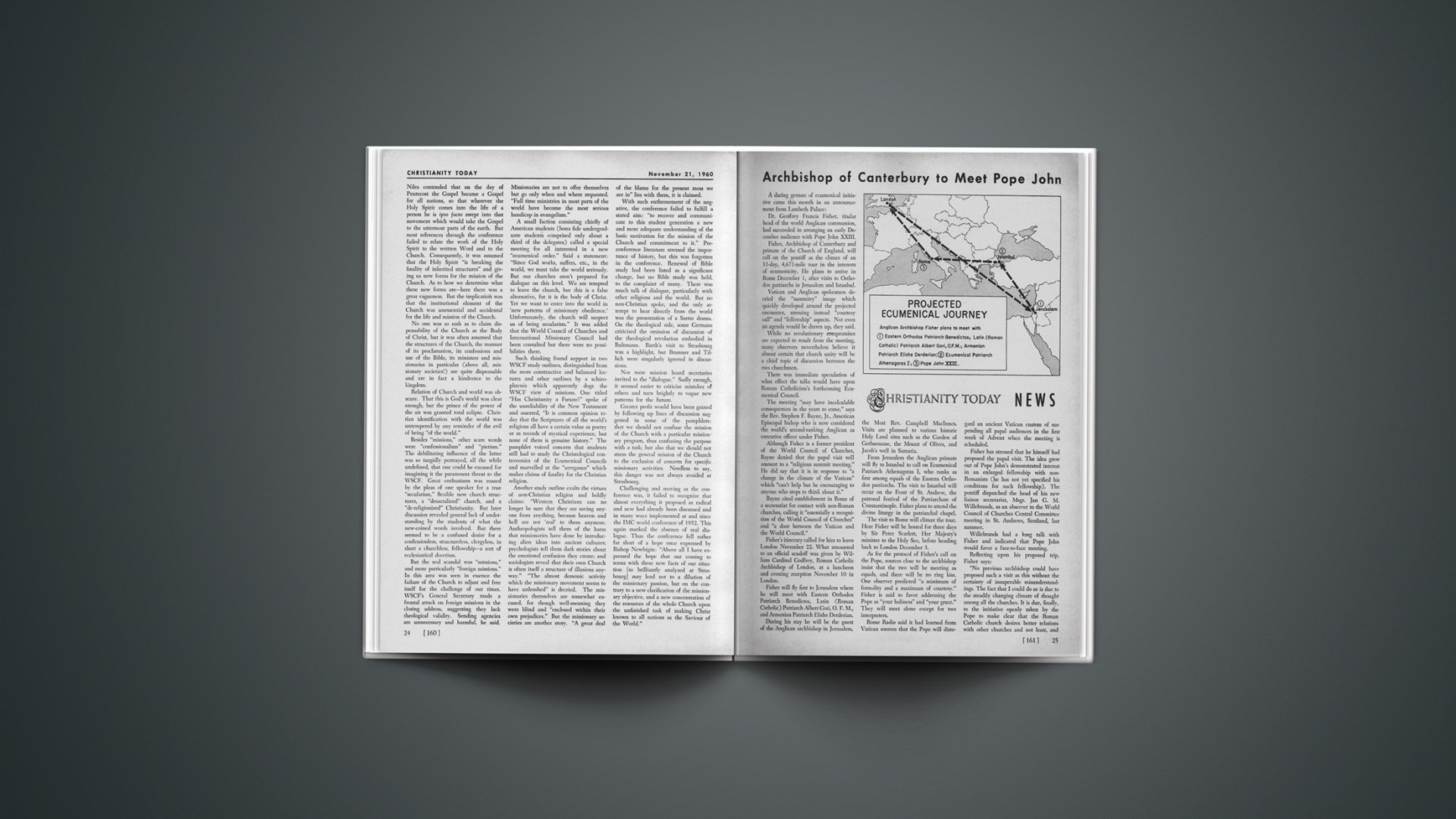
Fisher, Archbishop of Canterbury and primate of the Church of England, will call on the pontiff as the climax of an 11-day, 4,671-mile tour in the interests of ecumenicity. He plans to arrive in Rome December 1, after visits to Orthodox patriarchs in Jerusalem and Istanbul.

Vatican and Anglican spokesmen decried the “summitry” image which quickly developed around the projected encounter, stressing instead “courtesy call” and “fellowship” aspects. Not even an agenda would be drawn up, they said.

While no revolutionary compromises are expected to result from the meeting, many observers nevertheless believe it almost certain that church unity will be a chief topic of discussion between the two churchmen.

There was immediate speculation of what effect the talks would have upon Roman Catholicism’s forthcoming Ecumenical Council.

The meeting “may have incalculable consequences in the years to come,” says the Rev. Stephen F. Bayne, Jr., American Episcopal bishop who is now considered the world’s second-ranking Anglican as executive officer under Fisher.

Although Fisher is a former president of the World Council of Churches, Bayne denied that the papal visit will amount to a “religious summit meeting.” He did say that it is in response to “a change in the climate of the Vatican” which “can’t help but be encouraging to anyone who stops to think about it.”

Bayne cited establishment in Rome of a secretariat for contact with non-Roman churches, calling it “essentially a recognition of the World Council of Churches” and “a door between the Vatican and the World Council.”

Fisher’s itinerary called for him to leave London November 22. What amounted to an official sendoff was given by William Cardinal Godfrey, Roman Catholic Archbishop of London, at a luncheon and evening reception November 10 in London.

Fisher will fly first to Jerusalem where he will meet with Eastern Orthodox Patriarch Benedictos, Latin (Roman Catholic) Patriarch Albert Gori, O. F. M., and Armenian Patriarch Elishe Derderian.

During his stay he will be the guest of the Anglican archbishop in Jerusalem, the Most Rev. Campbell Maclnnes. Visits are planned to various historic Holy Land sites such as the Garden of Gethsemane, the Mount of Olives, and Jacob’s well in Samaria.

From Jerusalem the Anglican primate will fly to Istanbul to call on Ecumenical Patriarch Athenagoras I, who ranks as first among equals of the Eastern Orthodox patriarchs. The visit to Istanbul will occur on the Feast of St. Andrew, the patronal festival of the Patriarchate of Constantinople. Fisher plans to attend the divine liturgy in the patriarchal chapel.

The visit to Rome will climax the tour. Here Fisher will be hosted for three days by Sir Peter Scarlett, Her Majesty’s minister to the Holy See, before heading back to London December 3.

As for the protocol of Fisher’s call on the Pope, sources close to the archbishop insist that the two will be meeting as equals, and there will be no ring kiss. One observer predicted “a minimum of formality and a maximum of courtesy.” Fisher is said to favor addressing the Pope as “your holiness” and “your grace.” They will meet alone except for two interpreters.

Rome Radio said it had learned from Vatican sources that the Pope will disregard an ancient Vatican custom of suspending all papal audiences in the first week of Advent when the meeting is scheduled.

Fisher has stressed that he himself had proposed the papal visit. The idea grew out of Pope John’s demonstrated interest in an enlarged fellowship with non-Romanists (he has not yet specified his conditions for such fellowship). The pontiff dispatched the head of his new liaison secretariat, Msgr. Jan G. M. Willebrands, as an observer to the World Council of Churches Central Committee meeting in St. Andrews, Scotland, last summer.

Willebrands had a long talk with Fisher and indicated that Pope John would favor a face-to-face meeting.

Reflecting upon his proposed trip, Fisher says:

“No previous archbishop could have proposed such a visit as this without the certainty of insuperable misunderstandings. The fact that I could do so is due to the steadily changing climate of thought among all the churches. It is due, finally, to the initiative openly taken by the Pope to make clear that the Roman Catholic church desires better relations with other churches and not least, and expressly, with the Church of England and its sister churches.”

“… What my proposed visit to the Pope has established, I hope, is that in the future Anglicans, Roman Catholics and others can talk together freely and openly in a spirit of Christian friendship and fellowship, not seeking victory over one another but as fellow disciples in the service of one Lord—learning as Christians always must learn, first by talking with one another and speaking the truth as they see it in love.”

The Ecumenist

Dr. Geoffrey Francis Fisher, 73, has been Archbishop of Canterbury since 1945. Prior to his elevation to the highest Anglican office he served as a bishop in London and Chester and, for 18 years, as headmaster of a school. He has never held a parish.

Fisher was the tenth child of the rector of Higham-on-the-Hill, Nuneaton. He attended school at Marlborough, then won a scholarship to Exeter College, Oxford, where he took both academic and athletic honors.

He studied for a short time at Wells Theological College and returned to his old school, Marlborough, as an assistant master. He was only 27 when he succeeded William Temple as headmaster of Repton. Temple later became Archbishop of Canterbury and Fisher succeeded him to that office as well.

Fisher’s first public statement after becoming archbishop was an appeal for ending of color bars throughout the British Commonwealth. He has been regarded as an outspoken churchman ever since.

Early this month he openly reprimanded Dr. John Arthur Thomas Robinson, Anglican Bishop of Woolwich, who had testified at a trial in defense of the publishers of Lady Chatterley’s Lover. Robinson told the court he thought author D. H. Lawrence had tried to portray sex relations as something sacred and in a real sense as an act of holy communion. He said Christians ought to read the book.

Fisher, addressing the Canterbury Diocesan Conference, said Robinson had a full right to appear as a witness on a point of law, but to do so was obviously bound “to cause confusion in many people’s minds between his individual right of judgment and the discharge of his pastoral duties.”

The trial ended with the jury ruling that the novel was not obscene.

A public rebuke of this kind is very rare in the Church of England. In 1927, Dr. Ernest William Barnes, the then Bishop of Birmingham, was rebuked by Dr. Randall T. Davidson, then Archbishop of Canterbury, for views publicly voiced, particularly on sacramental doctrine.

Fisher is the 100th head of an archdiocese that was formerly Roman Catholic, but for 400 years has been the primatial see of the Anglican community.

Canterbury To Rome: The Visit In Perspective

The news that Dr. Geoffrey Fisher, Archbishop of Canterbury, is to visit the Pope in Rome next month has occasioned widespread comment. On the whole the reaction has been one of restrained approval. It is felt that in our world as it is today the opening of doors of communication can only be a good thing, provided there is no compromise on matters of principle. The projected visit seems to be an outcome of the interest which the Roman Catholic church is now beginning to show in the ecumenical movement. This in itself is a new factor and cannot fail to be creative in some measure of a new situation. Thus two Roman Catholic observers were present at the meeting of the Central Committee of the World Council of Churches held in St. Andrews, Scotland, in August, and one of them. Monsignor Willebrands, has been appointed head of the new secretariat for Christian unity which Pope John has set up.

It has been emphasized that this will be no more than a courtesy visit and that there will be no agenda of things to be discussed. To imagine that it can be limited to an act of courtesy is, however, somewhat naive. “The visit cannot be treated merely as an act of courtesy,” comments the London Daily Telegraph. “It marks, in fact, an awareness in both communions, sharpened no doubt by the increased power of the anti-Christian Communist philosophy, that disunity among Christians is too great a scandal to be ignored and too serious a weakness to be left unremedied.”

An editorial in the Church of England Newspaper (published weekly in London) is to the point. “It is not inopportune for members of the Church of England to remind themselves,” it says, “that the position of the Church of England vis-à-vis the Roman Catholic Church is clearly defined in the Thirty-nine Articles.… The Archbishop of Canterbury—and here we speak, we trust, with entire courtesy—will stand before the Pope as representing a Church which says quite clearly: ‘As the Church of Jerusalem, Alexandria, and Antioch have erred; so also the Church of Rome hath erred, not only in their living and manner of ceremonies, but also in matters of Faith.’ ” This will be the first time that an Archbishop of Canterbury has visited the Pope since before the Reformation. Thomas Cranmer, however, did journey to Rome and met the Pope in 1530—two years before he became Archbishop of Canterbury. The occasion was a deputation, led by the Earl of Wiltshire, in connection with the matter of the King of England’s divorce. Foxe describes how, when the Pope preferred his toe to be kissed, members of the delegation maintained an unbending dignity and refused to engage in any such act of obeisance. The Earl of Wiltshire’s spaniel, however, unaffected by inhibitions of this kind, moved forward and seized the sacred toe with his teeth, whereupon his holiness hastily withdrew it under the shelter of his robes. Beyond all doubt the present Archbishop of Canterbury will observe a like gravity and refrain from any act of obeisance to the Roman pontiff—though it is not suggested that he should take a spaniel dog along with him!

P.E.H.

The Last Enemy

Death has taken several well-known religious figures in recent weeks.

Dr. Donald Grey Barnhouse, noted Bible expositor and editor-in-chief of Eternity magazine, died November 4 in Philadelphia. He had been confined to Temple University Hospital for a month following surgery for a malignant brain tumor.

Barnhouse, 65, was minister of the Tenth Presbyterian Church in Philadelphia for the last 33 years. His radio voice was known to millions.

Associates say adjustments will be made to enable the Barnhouse ministries to continue. His “Bible Study Hour,” heard over the National Broadcasting Company network, is recorded through next Easter.

Barnhouse’s death in Philadelphia preceded by a day a private funeral service in the same city for another noted evangelical personality.

Dr. Percy B. Crawford, television-radio evangelist and Christian youth leader, died of a heart ailment October 31 in a Trenton, New Jersey, hospital.

The 58-year-old Crawford was taken to the hospital two days earlier when he collapsed at a roadside restaurant while en route to a church speaking engagement. He had suffered six previous heart attacks in the last two years.

The day following the private funeral service, a public memorial service was conducted by evangelist Billy Graham in Philadelphia’s Town Hall. Crawford is survived by his wife, four sons aged 16 to 24, and a daughter, 11.

He was founder-president of King’s College and originator of the “Young People’s Church of the Air” radio broadcast and the “Youth on the March” telecast. His organization recently began operation of a television channel of its own in Philadelphia. He also operated summer camps in the Pennsylvania Poconos. Attempts will be made to carry on many of these enterprises.

Dr. Halford E. Luccock, 75, died November 5 in New Haven, Connecticut, after a short illness.

Luccock, professor emeritus of preaching at Yale Divinity School, had written, under the pseudonym of Simeon Stylites, a column for The Christian Century since 1948.

The son of a Methodist bishop, Luccock was ordained into the Methodist Episcopal ministry in 1910.

He was the author of some 25 books, mostly about religion and literature. He taught at Yale for 25 years, retiring in 1953. He had lived in Connecticut.

John James Allan, top-ranking Salvation Army leader and a founder of United Service Organizations (better known to U. S. servicemen as the USO), died October 31 in Clearwater, Florida, at the age of 73.

Allan helped found the USO in 1940 while serving as assistant chief of chaplains in the U. S. Army. In 1946 he went to the international headquarters of the Salvation Army in London. He was the highest U. S.-born Salvation Army officer in the organization’s history.

Membership Loss

The Evangelical United Brethren denomination recorded a net loss of 1,522 members during the last year, according to newly-released figures from the church’s international headquarters in Dayton, Ohio.

Current membership in 4,418 organized congregations in the United States was given as 761,858.

Dr. Paul W. Milhouse, church statistician, attributed the loss chiefly to the mass movement of the population toward metropolitan centers. The EUB church has historically stressed a ministry to rural areas and small towns.

The membership loss is the first since 1946 when a union was consummated between the Evangelical Church and the Church of the United Brethren in Christ.

POAU on Kennedy

President-elect Kennedy can count on the “strong support” of Protestants and Other Americans United in his support of Church-State separation.

“Although Kennedy’s position is not that of the bishops of his church,” says Glenn L. Archer, POAU executive director, “we believe that the majority of the Catholic people of the United States agree with him, and we look forward to an administration in which the new president will faithfully adhere to the pledge of Church-State separation which he gave so solemnly. We hope to provide strong support for Mr. Kennedy in his endeavors to support this principle.”

Needed: Higher Incentive

Despite the incentive of a 30 per cent deduction allowable against taxable income, Americans channel relatively little of their ample means toward religious, educational, and social welfare activities.

Only 1.36 per cent of all personal consumption expenditures fell into the “religious and welfare activities” category last year, according to the U. S. Department of Commerce. The department arrives at the “religious and welfare activities” figure by totalling operating expenses, including depreciation, of all religious and social welfare (ex. Red Cross, Community Chest) organizations.

Protestant Panorama

• Witness, service, and unity will be sub-themes of the Third World Council of Churches Assembly in New Delhi, India, next fall. Main theme is “Jesus Christ—the Light of the World.” Some 1,000 church and lay leaders will participate. About two-thirds this number will be official delegates of member churches.

• The Presbytery of Tasmania will ask its General Assembly to endorse state aid to church schools. An article in the presbytery’s journal, Presbyterian Life, stresses that such assistance must take the “form of capital grants, administered by a formula that would preclude disproportionate aid to any denomination and allow no measure of state control.”

• Testimony began in a New York federal court this month in a suit to block merger of the Congregational Christian Churches’ General Council and the Evangelical and Reformed Church. Seeking to nullify the “basis of union” for the new United Church of Christ are four Congregational churches and 10 individuals.

• Dr. J. W. W. Shuler, 100-year-old Methodist minister, marked the start of his second century by preaching a sermon at the First Methodist Church in Hillsboro, Texas. Shuler, who came to Texas from the East almost 50 years ago in search of drier climate for his health, still preaches regularly, does 17 rounds of calisthenics every morning, eats heartily, and works his own garden.

• Southern Presbyterians are redesigning their Christian education program. A new “Covenant Life Curriculum” to be ready for use in the fall of 1964 is aimed at eventually replacing the “Uniform Lessons” and “Graded Materials” series.

• Church of the Nazarene congregations are conducting a “Try Christ’s Way” crusade this month. Evangelism secretary Edward Lawlor says the crusade (“most intensive effort to reach people on a denominational scale in the history of our church”) calls upon each member to establish a witness with seven people and to invite each to attend church.

• Whereas 35 years ago Christian thought was most seriously challenged by the natural sciences, the crucial problem today is philosophy, according to Dr. J. Oliver Buswell, Jr., president of Covenant Seminary, who addressed the seventh annual philosophy conference at Wheaton College this month.

• Anglicans consecrated their first native-born bishop in the Pacific Islands last month. He is the Rev. George Ambo, 37, born in New Guinea and educated in mission schools. At consecration ceremonies in a Brisbane, Australia, cathedral, Ambo was made assistant bishop of New Guinea.

• Fire destroyed a men’s dormitory at Clarke Memorial College, a Baptist school in Newton, Mississippi, this month. About half the students lost all their clothing, but none were seriously injured.

• The Accrediting Association of Bible Colleges admitted three new associate members at an annual meeting in Chicago last month: Atlanta (Georgia) Christian College; Appalachian Bible Institute, Bradley, West Virginia; and Canadian Bible College, Regina, Saskatchewan.

• The Holy Ghost Church of Dalby, Sweden, oldest stone house of worship in Scandinavia, was rededicated last month after a thorough renovation. Although its exact age is not known, the church is mentioned in a document as early as 1060.

• The Hymn Society of America is sponsoring a contest for compositions which have as their theme aspects of Christian marriage and family life. The contest is open to all composers and musicians in the United States and Canada. Deadline for submission is February 15, 1961.

• It took the state court of appeals to settle a dispute over use of instrumental music in the Church of Christ at Virgie, Kentucky. The court ruled that a group in the church which favored the music was the majority group and was entitled to exclusive use of the church property.

Monkey Tricks

From the opening moments, when a contralto voice is heard singing repeatedly “Give me the old-time religion; it’s good enough for me,” the United Artists film “Inherit the Wind,” purporting to reproduce the Scopes “monkey” trial of 1925, is drastically loaded against the Christian religion. A more deplorable caricature of sacred things would be difficult to imagine: an unloving and unlovable cleric savagely and publicly consigning his only daughter to the direst torments of hell because of her unwillingness to renounce her love for the young schoolteacher who has been put on trial for teaching Darwinism in the classroom; the jaunty irreverence of Gene Kelly acting the part of famed reporter H. L. Mencken of the Baltimore Sun; the portrayal by Frederic March of William Jennings Bryan, counsel for the prosecution, as a stupid, gluttonous egotist; and the chunky performance of Spencer Tracy as Clarence Darrow, counsel for the defense, who is made the real hero of the film and steals its thunder—all these (the names of the actual persons involved in 1925 are changed), together with the oppressive blanket of hysterical obscurantism in which it is wrapped up and handed to the public, combine to make this a film which will do more to travesty the Christian faith than a hundred books advocating atheism.

The film is now playing in theaters across the United States.

Stanley Kramer produced and directed the film from the popular stage drama by Jerome Lawrence and Robert E. Lee.

All that remains to be said is that if the moronic mob depicted on the screen is typical of American small town citizenry, and if the Tracy-March duo are supposed to reproduce the rhetorical heights of American advocacy, heaven preserve us. Bathos pervades the whole, not least when, with studied symbolism, Tracy leaves the deserted courtroom with two books—Darwin and the Bible—under his arm, after he has shed gallons of perspiration in an attempt to prove that the one is incompatible with the other. It may be as well to remember that there are scientists as well as Christians who repudiate Darwinism, and that obscurantism, so far from being the preserve of particular religious pockets, is not unknown in scientific circles. Because of its double-thickness bias this film inverts and drapes itself with the obscurantism which it is intent on exposing, and merits an “oscar” for its services in the noble cause of prejudice.

P.E.H.

30-Year Ordeal

Mrs. Katherine Voronaeff, 73-year-old wife of a Russian-born Assemblies of God missionary, is now living in the United States after spending most of the last 30 years in Soviet prisons. Whereabouts of the husband, the Rev. John E. Voronaeff, also a victim of Communist imprisonment, are unknown.

Mrs. Voronaeff was freed from prison in 1953, but it took seven more years of negotiations between the Kremlin and the U. S. State Department to enable her to join her six children in America. She expects to spend the next several months with a son in Los Angeles.

Both Mr. and Mrs. Voronaeff were born in Russia, but emigrated to the United States in their youth and even took out citizenship papers. In the interests of evangelizing their own people, however, the couple went back under sponsorship of the Assemblies of God Foreign Missions Department. Voronaeff became chairman of the denomination’s work in Russia and experienced a fruitful ministry. The work came to a sudden halt when, on a cold winter night in 1930, 800 pastors were rounded up, imprisoned and subsequently shipped to Siberia.

For three years Mrs. Voronaeff tried secretly to carry on her husband’s work. Then she, too, was arrested and placed in prison.

When the couple was released in 1940, the Assemblies of God raised funds for their return to the United States. But when the pastor approached the Soviet government to sign the necessary papers, he was re-arrested and returned to Siberia. He has not been heard from since.

Clergy Strain

Clergymen are more prone to emotional stress and strain than laymen, according to an exhaustive study made at Baptist Hospital in Winston-Salem, North Carolina.

The study shows ministers to have a significantly higher incidence of diseases where emotional factors are known to be important.

In a comparison of case histories of 1,000 ministers who have been patients at the hospital, 20 per cent gave evidence of relationship between vocation and illness. Ministers were found to be more susceptible to illness between the ages of 30 and 40.

The study was compiled by Dr. Albert L. Meiburg, director of research for the hospital’s department of pastoral care, in collaboration with Dr. Richard K. Young, head of the department.

Auca Film

Selected evangelical groups are previewing a 35-minute sound film which traces attempts to bring the Gospel to Ecuador’s savage Auca Indians.

Included are sequences taken during the period when five young missionaries were killed by the Aucas nearly five years ago.

Mrs. Elisabeth Elliot, one of the five widows of the slayings, narrates the film. The film is said to have been produced under her direction. She is now back in South America. No distributor has been named.

Tokyo Crusade

Dr. Oswald J. Smith, founder of Toronto’s People Church, conducted a week-long evangelistic campaign in Tokyo last month.

A spokesman for Smith said the meetings, held under the auspices of nearly 100 evangelical churches and pastors, represented the first united evangelistic campaign ever held in the world’s largest city.

The 2,200-seat Kyoritz Hall proved inadequate for the large crowds. A total of 796 made first-time professions of salvation. They were counselled by some 400 Navigators-trained nationals.

A large choir and a Salvation Anny band provided music for the services.

The Kyoritz Hall meetings were held in the evening. In addition, afternoon services were conducted in a Salvation Army hall.

Yoji Iwashiga was Smith’s interpreter for the crusade. All expenses were met by Japanese churches.

Evangelism in Brussels

By November 6, when the climactic closing service drew an overflow crowd of 2,500 to Brussels’ famed Albert Hall, it was clear that British Evangelist Eric Hutchings’ 23-day crusade had written a new chapter in the history of Belgian Protestantism.

Total impact warmed the hearts of Belgian Protestants, who make up scarcely one per cent of the population.

An aggregate of some 25,000 attended crusade meetings.

Reported Le Soir, Brussels largest daily, “It is the first time in the history of Protestantism in Brussels that meetings have been organized on such a scale.”

Sixteen ministers representing eight Protestant denominations sponsored the visit of Hutchings, who some years ago gave up a law practice to preach.

At each service the evangelist asked members of the audience to step forward to indicate new faith in Christ. A total of about 400 responded.

“Not since Reformation days,” said one observer, “had Brussels seen so many at the altar rail.”

A 175-member choir sang nightly. Hutchings’ sermons were interpreted into Flemish, German, and Russian via earphones.

The Rev. Walter W. Marichal, president of the Brussels Ministerial Association, served as crusade chairman.

Missions Vacancies

The Southern Baptist Home Mission Board says it has an immediate, urgent need for 270 personnel.

“There are mission centers which cannot be opened until missionaries are provided,” stated Glendon McCullough, personnel secretary for the board. “We have vacancies in Spanish work that have not been filled in two years because there are no qualified mission applicants.”

Petition Denial

The U. S. Supreme Court denied without an opinion last month a petition from the Russian Orthodox Greek Catholic Church of America for a rehearing on the question of ownership of St. Nicholas Orthodox Cathedral, New York.

Control of the cathedral, in dispute since 1924, was given to the Patriarchal Russian Orthodox Church in the United States by the Supreme Court last June in an unanimous opinion.

At that time the court held that Archbishop Boris, appointee of the Moscow Patriarchate as head of the Patriarchal Church in this country, and his supporters have the right to possession and control of the cathedral.

The controversy over which faction owned the edifice started 36 years ago when a large majority of clergy and faithful of the Russian Orthodox Church in this country established the autonomous body on the ground that the Moscow Patriarchate had become a tool of an atheist state.

The Supreme Court also refused to review a decision by a Cleveland federal court which rejected a claim by Bishop Andrei Moldovan that he is head of the Romanian Orthodox Episcopate in America.

Once before in 1954 the high tribunal rejected his appeal from a permanent injunction issued by the federal court forbidding him to represent himself as head of the denomination in this country.

Bishop Moldovan flew secretly to Romania in 1950 where he was consecrated Bishop of the Romanian Orthodox Episcopate of America by the Holy Synod in Bucharest. This action was not recognized by most of the Romanian churches in America which charged that Romanian Communists planned to use their new bishop as a tool in this country.

Subsequently the anti-Moldovan forces elected Bishop Valerian D. Trifa as head of the episcopate which has its headquarters in Jackson, Mich. The episcopate has no canonical ties with the Orthodox Church in Romania.

Catholic Newsmen

A school of journalism for the training of Roman Catholic newspapermen was formally inaugurated in Madrid, Spain, last month by Bishop Pedro Cantero Cuadrado of Huelva. Enrolled for the initial courses were 53 men and 13 women, all university graduates.

The bishop said that the function of the Catholic press was not merely to deal with “confessional subjects, religious art, et cetera” but with everyday themes and problems, giving them a “Christian orientation.”

Pacifist Play

A pacifist-motivated play, which deals with “alternatives to war” through modern drama techniques, and has as its “angel” the American Friends Service Committee, is on a 7,000-mile tour of 30 cities.

It is a followup to a more limited tour last spring which brought favorable audience response and reviews, according to Religious News Service.

The play, “Which Way the Wind,” was written by Philip C. Lewis and adapted to a technique he calls Docu-Drama.

Many of the performances will be in church auditoriums.

Congo Appeal

The World Council of Churches is appealing for $1,000,000 for projects to aid the troubled Congo.

Endorsed this month by the administrative committee of the WCC’s Division of Inter-church Aid and Service to Refugees was an appeal to churches for a broad program of aid ranging from immediate relief to the establishment of secondary school training.

The WCC is also issuing an appeal for East Pakistan where some 6,000 persons died in a recent cyclone.

The WCC refugee committee, which met in Buck Hill Falls, Pennsylvania, also heard a report that churches have contributed $340,361 in cash for victims of earthquakes in Chile. Of this amount, $238,000 came from German churches.

People: Words And Events

Deaths: See “The Last Enemy,” page 27.

Appointments: As president of Phillips University, Dr. Hallie Gantz … as professor of homiletics at Union Theological Seminary, New York, Dr. Edmund A. Steimle … as director of Seamen’s Church Institute, New York, the Rev. John M. Mulligan … as executive secretary of the World Council of Churches Youth Department, the Rev. Roderick S. French.

Elections: As president of the Baptist Theological Seminary in Ruschlikon, Switzerland, Dr. J. D. Hughey, Jr. … as chairman of the Methodist Board of Publication, F. Murray Benson … as warden of the College of Preachers of Washington Cathedral, the Rev. Frederick H. Arterton … as moderator of the National Association of Congregational Christian Churches, Dr. Max Strang … as chairman of the Christian Business Men’s Committee, International, Alfred R. Jackson … as president of the Presbyterian Men’s Council, Vernol R. Janson … as president of the Christian Writers Association of Canada, the Rev. B. T. Parkinson.

Nomination: As moderator-designate of the Church of Scotland General Assembly, Dr. A. C. Craig.

Consecration: As Anglican Bishop of Auckland, New Zealand, Dr. Eric A. Gowing.
Students in Strasbourg: In Retrospect: Failure of Mission

Last summer’s World Student Christian Federation conference in Strasbourg, France, on the mission of the Church was the culmination of several years’ discussion. Now, half a year later, it is far from forgotten. Afterthoughts are still provoked, particularly over an “ideology” of missions which seemed to float through the conference and its study materials.

One delegate expressed the matter this way: “The ‘ideology’ or presupposition of some of those responsible for the Strasbourg conference might be stated thus: that the present structures and organizations of the church, particularly those of missionary societies and boards, are no longer adequate to meet the challenge of the modern age and enter into a positive, free encounter with a ‘world come of age.’ Expressed more bluntly, the inference seemed to be this: one of the greatest hindrances and stumbling blocks to the mission of the church to the world is foreign missions. The answer: a new concept of ecumenical mission, unhampered by denominationalism, confessionalism, missionary societies, or boards, which would in the freedom of the Holy Spirit discover new forms and patterns for living in an open, dynamic dialogue on the frontiers of the modern world.”

Those who offered this criticism conceded that this mood was a disturbing undertone rather than an avowed policy of the conferees. In fact, over against the idea of any WSCF conspiracy to undermine missions, stands its originally defined missionary raison d’être: “To enlist students in the work of extending the Kingdom of God throughout the whole world.” Over the past decades, however, observers have noted WSCF’s missionary concern to be considerably less than overwhelming. Thus recent signs of awakening interest have been greeted with gratitude by many church leaders. The Strasbourg conference was hailed as the “key event,” a renascence noteworthy in several respects.

Its 700 delegates, leaders, and speakers constituted one of the most “international” assemblies ever conducted under Christian auspices either in Europe or North America. Anglo-Saxon delegates were for once not in the majority, and the leadership was properly in line with this fact. The conference enjoyed the stimulation of speakers like W. A. Visser’t Hooft, D. T. Niles, and Lesslie Newbigin. Incisive questions and discussion followed outstanding lectures. A heavy theological emphasis was guarded from speculative flights by sensitivity to burning issues of our time, e.g., revolution, communism, and resurgent nationalism. Frank exchange was made possible by an underlying sense of unity in Christ even on such combustible issues as between white and black South Africans, Europeans from both sides of the Iron Curtain, Indian and Pakistani, Japanese and Korean, Cuban and American. Representatives came not only from all these areas but also from Eastern Orthodoxy and Roman Catholicism (specifically from “Pax Romana,” an international Romanist student movement). And for the first time, a leader of Inter-Varsity Fellowship played an active role in a WSCF conference.

With all the good qualities of the conference, the thing that proved disturbing to some delegates was the undertone that “the mission of the Church” is to be enhanced by forsaking “missions.” Several of the better study documents indicated that the two concepts are inseparable—that while missions may be only one aspect of the mission of the Church, it is nonetheless an indispensable one. But the former line of thought, novel as it was, manifested itself in several areas to the ear sensitive to misplaced emphases and half-truths.

Salutary was the emphasis upon the Holy Spirit in several lectures. D. T. Niles contended that on the day of Pentecost the Gospel became a Gospel for all nations, so that wherever the Holy Spirit comes into the life of a person he is ipso facto swept into that movement which would take the Gospel to the uttermost parts of the earth. But most references through the conference failed to relate the work of the Holy Spirit to the written Word and to the Church. Consequently, it was assumed that the Holy Spirit “is breaking the finality of inherited structures” and giving us new forms for the mission of the Church. As to how we determine what these new forms are—here there was a great vagueness. But the implication was that the institutional element of the Church was unessential and accidental for the life and mission of the Church.

No one was so rash as to claim dispensability of the Church as the Body of Christ, but it was often assumed that the structures of the Church, the manner of its proclamation, its confessions and use of the Bible, its ministers and missionaries in particular (above all, missionary societies!) are quite dispensable and are in fact a hindrance to the kingdom.

Relation of Church and world was obscure. That this is God’s world was clear enough, but the prince of the power of the air was granted total eclipse. Christian identification with the world was untempered by any reminder of the evil of being “of the world.”

Besides “missions,” other scare words were “confessionalism” and “pietism.” The debilitating influence of the latter was so turgidly portrayed, all the while undefined, that one could be excused for imagining it the paramount threat to the WSCF. Great enthusiasm was roused by the pleas of one speaker for a true “secularism,” flexible new church structures, a “desacralized” church, and a “de-religionized” Christianity. But later discussion revealed general lack of understanding by the students of what the new-coined words involved. But there seemed to be a confused desire for a confessionless, structureless, clergyless, in short a churchless, fellowship—a sort of ecclesiastical docetism.

But the real scandal was “missions,” and more particularly “foreign missions.” In this area was seen in essence the failure of the Church to adjust and free itself for the challenge of our times. WSCF’s General Secretary made a frontal attack on foreign missions in the closing address, suggesting they lack theological validity. Sending agencies are unnecessary and harmful, he said. Missionaries are not to offer themselves but go only when and where requested. “Full time ministries in most parts of the world have become the most serious handicap in evangelism.”

A small faction consisting chiefly of American students (bona fide undergraduate students comprised only about a third of the delegates) called a special meeting for all interested in a new “ecumenical order.” Said a statement: “Since God works, suffers, etc., in the world, we must take the world seriously. But our churches aren’t prepared for dialogue on this level. We are tempted to leave the church, but this is a false alternative, for it is the body of Christ. Yet we want to enter into the world in ‘new patterns of missionary obedience.’ Unfortunately, the church will suspect us of being secularists.” It was added that the World Council of Churches and International Missionary Council had been consulted but there were no possibilities there.

Such thinking found support in two WSCF study outlines, distinguished from the more constructive and balanced lectures and other outlines by a schizophrenia which apparently dogs the WSCF view of missions. One titled “Has Christianity a Future?” spoke of the unreliability of the New Testament and asserted, “It is common opinion today that the Scriptures of all the world’s religions all have a certain value as poetry or as records of mystical experience, but none of them is genuine history.” The pamphlet voiced concern that students still had to study the Christological controversies of the Ecumenical Councils and marvelled at the “arrogance” which makes claims of finality for the Christian religion.

Another study outline exalts the virtues of non-Christian religion and boldly claims: “Western Christians can no longer be sure that they are saving anyone from anything, because heaven and hell are not ‘real’ to them anymore. Anthropologists tell them of the harm that missionaries have done by introducing alien ideas into ancient cultures; psychologists tell them dark stories about the emotional confusion they create; and sociologists reveal that their own Church is often itself a structure of illusions anyway.” “The almost demonic activity which the missionary movement seems to have unleashed” is decried. The missionaries themselves are somewhat excused, for though well-meaning they were blind and “enclosed within their own prejudices.” But the missionary societies are another story. “A great deal of the blame for the present mess we are in” lies with them, it is claimed.

With such enthronement of the negative, the conference failed to fulfill a stated aim: “to recover and communicate to this student generation a new and more adequate understanding of the basic motivation for the mission of the Church and commitment to it.” Preconference literature stressed the importance of history, but this was forgotten in the conference. Renewal of Bible study had been listed as a significant change, but no Bible study was held, to the complaint of many. There was much talk of dialogue, particularly with other religions and the world. But no non-Christian spoke, and the only attempt to hear directly from the world was the presentation of a Sartre drama. On the theological side, some Germans criticized the omission of discussion of the theological revolution embodied in Bultmann. Barth’s visit to Strasbourg was a highlight, but Brunner and Tillich were singularly ignored in discussions.

Nor were mission board secretaries invited to the “dialogue.” Sadly enough, it seemed easier to criticize mistakes of others and turn brightly to vague new patterns for the future.

Greater profit would have been gained by following up lines of discussion suggested in some of the pamphlets: that we should not confuse the mission of the Church with a particular missionary program, thus confusing the purpose with a task; but also that we should not stress the general mission of the Church to the exclusion of concern for specific missionary activities. Needless to say, this danger was not always avoided at Strasbourg.

Challenging and moving as the conference was, it failed to recognize that almost everything it proposed as radical and new had already been discussed and in many ways implemented at and since the IMC world conference of 1952. This again marked the absence of real dialogue. Thus the conference fell rather far short of a hope once expressed by Bishop Newbigin: “Above all I have expressed the hope that our coming to terms with these new facts of our situation [so brilliantly analyzed at Strasbourg] may lead not to a dilution of the missionary passion, but on the contrary to a new clarification of the missionary objective, and a new concentration of the resources of the whole Church upon the unfinished task of making Christ known to all nations as the Saviour of the World.”

Ideas

The Bible and Modern Man

Our world today seems far removed from the world of the Bible. What have we, with our nuclear weapons, space satellites, television, and mechanized way of life, in common with an age of chariots and horsemen, and herdsmen, nomads, and primitive tillers of the soil? Has not modern man with his modern civilization and his modern science reduced the Bible to a religious curiosity, virtually prehistoric and definitely prescientific, and therefore outmoded and irrelevant? To ask such questions is legitimate and even necessary; but all too frequently the issue is prejudged by the ignorance or antipathy of those who ask them. To criticize and condemn from a position of ignorance or hostility is not to give the Bible a chance.

The Bible, is indeed, an ancient book, or collection of books, written in times outwardly very different from our own. But this consideration is peripheral. What is central to a proper understanding of the Bible and its message is the recognition that inwardly, at the vital core of his being, man has not altered over the centuries. His deepest needs today are the same as they have ever been. And it is precisely to man as man that the message of the Bible is addressed—and modern man is still man. He cannot cease to be what he is by constitution. Whatever the circumstances of its writing, the Bible in its scope is not limited to times and places long past: it embraces the whole sweep of the history of humanity, in its most radical sense, from beginning to end, from creation to judgment. In its pages man is set in the light of eternity. Is that not revelant to us today?

The Bible proclaims the sovereignty of Almighty God over all the affairs of mankind, as Creator, Sustainer, Judge, and Redeemer. Is not that relevant? It reminds man of the fundamental fact that he is a creature, not self-sufficient, as he would like to imagine himself, but dependent on God and owing him his gratitude and worship. It may come as a surprise to its critics to know that the Bible in fact sees man as essentially scientific man, endowed with capacities that make him unique in the created order, and formed to subdue the world and have dominion over it. The modern man of science is, however, no surprise to the Bible.

But at the same time, and with unerring penetration, the Bible sees man as fallen man—frustrated at the very heart of his being because of his alienation from God through the mutiny of sin. The Bible is a veritable mirror of man, the supreme and original textbook of depth-psychology, which reveals man to himself as he really is in his inmost essence.

Yet further—and this is its central message to us—the Bible tells how God has acted in Christ so that men may be reconciled to God and to each other. In penetrating to the root of every man’s deepest and most desperate need, it also points to the remedy, the way out of the dilemma. In Christ he rediscovers his true manhood. If one thing is obvious, it is that, despite all the wonderful advances of knowledge and science, our contemporary world is in need of reintegration and reconciliation.

Instead of scorning the message of the Bible, let the skeptic consider whether the scientific American airman, who had been on a mission of mass destruction, found this Book irrelevant when, beaten, starving, and in solitary confinement in enemy hands (a situation symbolical, one might suggest, of the anguish which is characteristic of the spiritual plight of modern man), the reading of it made him wise to salvation through faith in Christ Jesus, and replaced the hatred and bitterness of his heart with overflowing love, joy, and peace. Is there no relevance to the contemporary problems of our world in the fact that this man has now returned to the Japanese whom he formerly hated with the Bible’s message of reconciliation through Christ?

It may be asked: How does the state of our world today harmonize with the biblical doctrine of the sovereignty of God? Are not the strifes and tensions between nations and the increase of violence and crime a contradiction of the divine sovereignty? If God is sovereign, why does he not intervene and prevent these things from happening? The biblical answer to this is that God has intervened, adequately and effectively, by the sending of his Son into the world to save sinners. Fullness of peace and reconciliation is to be found in Christ by all who will turn to him. The Bible sees the prevalence of hatred and conflict in the world in terms not of God’s impotence but of the folly of man’s rejection of God’s grace in Christ Jesus.

And the biblical answer, further, is that God will intervene yet again, at the end of this age, but this time in final judgment, not mercy, when Christ returns in majesty to overthrow every enemy and to bring in the new heavens and the new earth in which righteousness and peace are established forever. Evil is not invincible. The God of the Bible is not powerless.

A vivid picture of our world condition is in fact given in the Bible, in the words of Christ, who foretold that “nation shall rise against nation, and kingdom against kingdom; and there shall be great earthquakes and famines and pestilences and terrors … and upon earth distress of nations, men’s hearts failing them for fear and for expectation of the things that are coming on the world.” Once again, we see that the Bible is not taken by surprise. The present racial and international hatreds, the savage new nationalisms, the pitiable plight of whole communities, and over all the grim and fearful threat of annihilating nuclear warfare, the evidence is daily before us and affords further proof that the Bible is startlingly relevant to our contemporary situation. And Christ added that when these things begin to come to pass, then his followers are to look up, because their redemption is at hand. Every man will then face Christ, either as Savior or as Judge.

ANOTHER ERA UNDERWAY IN THE AMERICAN VENTURE

The American dream and destiny this week seem hazier than for decades. Whether Senator John F. Kennedy’s election to the United States presidency will signal a further decline, or an upgrading, of democratic processes is the moot question now pondered at home and abroad. During these next years the prime issue may be not mere co-existence, but survival. In assuming the weighty burdens of leadership, the President-elect needs the good will of all citizens, a place in the prayers of God’s people, and firm support for every policy that promotes the best interest of the land.

Concerned with principle rather than party and personality, CHRISTIANITY TODAY focused interest on such pre-campaign issues as gigantic-versus-limited government, the moral issue of inflation and spending, the extension of Federal determination into state affairs, as well as Church-State relationships. In these realms the distinction between major parties has steadily diminished. Both Senator Kennedy and Vice-President Nixon made some hard-to-keep promises (complained one member of CHRISTIANITY TODAY’s Board: “Both candidates are promising almost everything but freedom!”). Mr. Kennedy’s skillful campaign gripped public imagination in the popularity race, alongside Mr. Nixon’s failure to sustain a prophetic voice. Both candidates often contended simply as pragmatic politicians.

Inevitably a religious magazine fixes an eye on spiritual aspects of the political campaign, which this year held special interest through Senator Kennedy’s Roman Catholicism. Senator Kennedy, in fact, did not personally reflect historic Catholic traditions any more consistently than Vice-President Nixon mirrored the Protestant outlook. The real significance of the religious development in American life is found not in a growing emergence of a Catholic bloc or party, nor even in a shift of the American political mood into the post-Protestant era, or into an era of pluralistic religious balances. The deeper fact is the widening public judgment that all religion is irrelevant to political attitudes and acts. The American mentality rapidly is losing any distinction of true versus false religion, and is dismissing this contrast as based on unbrotherliness and intolerance. Religion is demeaned to merely a secondary or supplementary support in American life. Curiously it was American Jesuits, not Protestant leaders, who pressed the Fair Campaign Practices Committee specifically to affirm that religion should inform a man’s conscience in the arena of political decision.

Senator Kennedy’s showing from one point of view marked a Roman Catholic breakthrough, from another a Catholic compromise. On the religious issue he courageously declared himself on the side of American rather than Vatican traditions. There were Kennedy’s statements that Church-State separation is ideal (Roman Catholicism has viewed separation as tolerable until a Catholic majority can implement the state as the temporal arm of the Roman church); his opposition to Federal aid to parochial schools (some Jesuits call such a policy unjust); his opposition to an envoy to the Vatican; his professed obligation to the Constitution rather than to the Pope in political affairs. Those who had “future doubts” (“the first Kennedy might be a very good president,” said a distinguished Protestant theologian in Europe, “but the third or fourth might be Innocent III”) detected a rising Catholic lay disgust over the persecution-mentality of Catholicism in Spain, Colombia, and so on. Whether this election-year idealism will blossom into post-election realism supportive of religious freedom remains to be seen.

Yet the Catholic bloc vote entered as decisively into Kennedy’s election as the labor bloc and the Negro vote. All the more remarkable is Mr. Nixon’s high percentage of the total vote, Mr. Kennedy’s margin of victory apparently averaging down to about two votes a precinct. Such bloc pressures, directive of the American outlook, remain a danger signal. What of future big city candidates where political bosses can “deliver” such a vote?

Evangelical Protestant forces passed one test but failed two. The National Association of Evangelicals, Southern Baptists, and other groups still alert to church history warned consistently against Roman Catholicism’s notorious incursion into political arenas for sectarian benefit. They remembered, moreover, that the Reformation not only promoted biblical faith, but challenged Rome’s theology of the state as well as of sin and salvation. Evangelicals had to contend with a hostile press, unable any longer to reach independent judgments on such issues, and largely following the cue of the National Conference of Christians and Jews and of Catholic propagandists in assailing such discussions as bigotry. The press was lured into a shrewd campaign to label all criticism of Roman Catholicism as bigotry. National attention focused negatively on the Bible belt, while the Roman hierarchy did not discourage bloc voting. Even the Fair Campaign Practices Committee tilted to a bias in a nation-wide telecast; its representative properly deplored bigotry, but quite improperly ignored the Committee’s position that a candidate’s religion is properly discussable where it impinges on politics. Meanwhile, spokesmen eager for an ecumenical tolerance-image helped attach the bigotry-image to N.A.E. Others stressed Protestantism’s need of perpetual Reformation more than the timeless significance of Luther’s break with Rome. Discussion of the political issue on the religious side (sectarian exploitation of state benefits) was repressed by ballooning the religious issue with the ill wind of bigotry. In this propaganda shift, Rome lost its historic persecution-image and assigned evangelical Protestantism a bigotry-image.

Not a few Protestants sided in depth with Kennedy’s program of enlarging Federal welfare benefits but promoted his cause under the public umbrella of tolerance, while others supported Kennedy in view of Catholicism’s official antipathy to communism and sympathy with free enterprise.

Evangelical long range losses were striking in two respects, political responsibility and missionary obligation. Evangelicals still react more to secular initiative than to any evangelical political overview consistent with both separation of Church and State and the believer’s social responsibility. Equally unfortunate for evangelical witness is the shadow over Protestant-Catholic relationships, even if widened first by Rome’s grasp for partisan benefits. Whereas Protestant inclusivists usually hold an open-end view of ecumenical cooperation with Rome, and cultivate the tolerance-image, evangelical purveyors of the Gospel often address Roman Catholics only obliquely. Statistically, evangelical strength almost rivals that of Catholics in the United States. But the Roman church has planted Catholic Information Centers in the main cities of America, while evangelicals shape newspaper ads corrective of Knights of Columbus propaganda. Whether the evangelical movement learns to address Roman Catholics aggressively in the dimension of compassion as well as of criticism remains to be seen.

SUBSCRIBERS TO RECEIVE SPECIAL BOOK BONUS

For a limited time CHRISTIANITY TODAY is offering an unusual bonus to all its readers. Every new, renewal or gift subscription will not only entitle the reader to 24 issues of the magazine but also to an important book of vital current interest.

A choice of titles is offered: 1. The complete New Testament volume of The Biblical Expositor with its scholarly and illuminating insights into both the written Word and the background against which the individual books were written, or 2. Christian Personal Ethics, a text dealing with both the moral revelation of Christianity and the ethical alternatives of speculative philosophy—an invaluable tool for ministers. CHRISTIANITY TODAY’s Dr. Carl F. H. Henry served as consulting editor for the first volume, and is author of the second. Either book with the subscription represents a $11.95 value for $5.

The decision of CHRISTIANITY TODAY’s Board of Directors to offer this book bonus to subscribers is a further step of generosity by dedicated evangelical men who have so signally aided the advance of Christianity in our day. Readers who wish to share their blessings with friends at the Christmas season should find this offer an appropriate opportunity for this purpose as well as for widening the evangelical ministry and witness of the magazine.

LITURGICAL REFORM AND STRONG CHURCHMANSHIP

Liturgical Reform is an expression which means diferent things to different people. To some it means the reintroduction into Christian worship of the ritual and vestments of sacerdotalism. To some it is merely a matter of aesthetics, dictated by a liking for that which is ornate, colorful, and spectacular. In some Roman Catholic circles in Europe it implies a process not of elaboration but rather of simplification whereby, for example, a movable table is substituted for a static altar, the sacrament is administered in the evening when most can attend, and services are conducted in the vernacular, instead of in Latin, with the result that the congregation can understand what is being said and done and can join with some intelligence in the Church’s worship. To others, again, Liturgical Reform is an expression without meaning, for the simple reason that their churches, however admirable in other respects, are in the unfortunate position of having virtually no liturgy to reform. The minister is all (a kind of obverse of the Roman priest), while the people are, except for the singing of a couple of hymns, inactive, though we hope not unintelligent, spectators.

To many Evangelical churches are in this last group. This means that in a most important aspect their worship is impoverished. It is not properly congregational. Nor is it in this respect Reformed, for the Reformers of the sixteenth century were certainly conscious of the necessity for liturgical worship—for worship, that is, in which the people actively participate and which is not monopolized, though it is led, by the minister. For this reason the Church of England has always regarded its Book of Common Prayer (and in particular the services of Morning and Evening Prayer and Holy Communion) as one of the most precious heritages of the Reformation. Strong churchmanship follows from liturgical worship that is controlled by the Scriptures. And that does not mean ritualism! Non-liturgical worship is weak worship. It is passive instead of active. Let us therefore strengthen the things which remain.

THE BLESSINGS OF FAITH INCLUDE ITS POWER IN LIFE

One great thrill of evangelical Christianity is that it works. Centuries come and go; races spring up and disperse; cathedrals are erected and pulled down; governments pass laws and repeal them; liturgies are written and forgotten, but Jesus Christ brings the same results yesterday, today, and forever.

When a nonevangelical minister gets discouraged he is in serious trouble. He must battle his way out of a human situation with human resources. When a truly Christian pastor becomes downhearted, however, he knows at least that there is nothing whatever wrong with his product or his message. He studies Scripture and concludes at last that God is testing him for a purpose. As he looks into his own heart, God shows him the way out.

We who are on the Lord’s side must never forget that however small a minority we sometimes may be in our community, we stand in the true apostolic succession. The scarlet thread comes our way and goes on. Christianity draws its strength and staying-power from the inner citadels of prayer. When workers are needed, it provides them. It looks beyond its borders and reflects the original compassion of Christ. It produces fruit in young lives dedicated to Christ.

When a church membership is made up of truly twice-born Christians, the minister does not have to “enrich the mixture” to get his airship off the ground. His church does not strain and fag to eke out some superimposed quota. She simply radiates the love of the Saviour and lets the Spirit do the work.

Sound easy? It is easy! In fact, wonderful!

Invisible But Real

INVISIBLE BUT REAL

A motion picture camera has been developed which operates at a speed of 5 million frames per second, compared to the 64 frames per second for an average slow-motion camera.

With such equipment, an instantaneous event can be stretched into a film lasting several hours.

A super-fast X-ray camera has been developed with the power and speed to visualize a bullet as it passes through the barrel of a revolver.

Even the “tracks” of cosmic rays passing through the atmosphere at speeds close to the velocity of light can now be photographed and thereby held for the human eye to witness.

On every hand secrets of the hitherto unknown material world are being discovered, and we either marvel at these things or shrug our shoulders and accept the wonders of modern science.

There are invisible forces working in the world, however, spiritual forces as real as the material and embodying a significance that is infinite in implications.

The whole subject is probably one of the most comforting and at the same time fear-inspiring to be found in all of the Bible. That we live in a day when superficial realism rules out things which cannot be gauged by scientific measurement in no way invalidates truth on which divine revelation has much to say.

Any who may be interested in this subject have but to take a Bible concordance and look up the references having to do with angels, spirits, and demons to come face to face with a tremendous volume of truth which otherwise is unnoticed or willfully ignored.

Some years ago Dean Inge spoke for millions of people when he said, “It is, I think, indisputable that the center of gravity in religion is shifting from authority to experience.” With that shift has come the loss of many of the spiritual values and implications of God’s revealed truth in men’s hearts; for when man believes only that which he can prove or see with human instruments, he has lost a sense of the supernatural, and God and Satan become mere names, not personalities of transcending importance.

Even within the Church there is a strange unawareness of the invisible forces working in the world. We admit that God is a spirit but few of us go on to recognize that he is infinite, eternal, unchangeable, in his being, wisdom, power, holiness, justice, goodness, truth, and love.

As for Satan, he is, according to the multitudes, only a name used in profane language, a figure of speech referred to in jest. The fact that he is a personality, a malignant being exercising great power, is even questioned or denied outright in some theological circles.

As Professor Emile Cailliet has so aptly said, “The neatest trick Satan has ever performed is to convince so many people that he does not exist.”

Our ignorance of the invisible forces around us no more eliminates them than does our failure to apprehend the marvels of nature, the surface of which is constantly being scratched by ever-probing scientific investigation.

We know there is but one God, the living and true God, and that there are three persons in the Godhead—the Father, the Son, and the Holy Spirit. But how often do we fail to recognize or ascribe to the Holy Spirit his distinct work and prerogatives?

And when it comes to angels, we are prone to relegate them to pious stories of the past in much the same category as elves, fairies, leprechauns, and folklore personalities.

But angels are God’s ministers, his agents of good. The Psalmist speaks of God “who maketh his angels spirits; his ministers a flaming fire, “while from the Bible as a whole we get a glimpse of this innumerable host who do God’s bidding.

“The angel of the Lord encampeth round about them that fear him, and delivereth them” is far more than a figure of poetic speech; it is a glorious reality for which we should thank a loving God.

When Paul affirms, “And we know that all things work together for good to them that love God, to them who are the called according to his purpose,” the presence and work of angels in God’s economy could well be a part of this comforting truth.

But just as God has his opponent in Satan, so angels have as their active opposites evil spirits who do the bidding of the devil.

That demons had residence in the personalities of men during our Lord’s earthly ministry is a matter of continued reference in the four Gospels. That such evil spirits inhabit people today is known to many who live in areas where spirit worship is practiced. Whether such a phenomenon actually exists in America is probably debatable, but the minions of Satan are certainly not inactive.

Surrounded by a host of the Syrian army, the servant of Elisha cried out in fear: “Alas, my master! how shall we do?” To which the prophet replied: “Fear not: for they that be with us are more than they that be with them.”

The servant lacked spiritual vision; he was aware only of that which he could see with his eyes. “And Elisha prayed, and said, Lord, I pray thee, open his eyes that he may see. And the Lord opened the eyes of the young man; and he saw: and behold the mountain was full of horses and chariots of fire round about Elisha.”

God forbid that we should ever get entangled with the realm of spiritualism; but, on the other hand, we may and ought to take comfort and warning from the truths that are clearly taught in Scripture.

In the Bible we are told that the company of angels is “innumerable”; that they are subject to the commands of God; that they join in the praise of God around his throne; that they are powerful; that they exercise a protecting ministry; that in an inscrutible way they have charge over God’s children; that at God’s behest they have stopped the mouths of lions; that an angel delivered Peter from prison; and that they are “sent forth to minister to them who shall be heirs of salvation.” All of these truths should be a source of comfort to Christians.

But in a consideration of the invisible forces about us, there is also grave warning: Satan is intensely active! Paul reminds us, “For we wrestle not against flesh and blood, but against principalities, against powers, against the rulers of darkness of this world, against spiritual wickedness in high places.

John tells us, “and the whole world is under the power of the evil one.”

What then is the position of the Christian? God has provided us with armor in order to stand against the wiles and power of Satan. He has also provided the Sword of the Spirit by which the evil one is put to flight.

The invisible forces are very real, but for the Christian they hold not terror but comfort and hope.

L. NELSON BELL

Eutychus and His Kin: November 21, 1960

FIST-POUNDING

Please correct an error that slipped into my recent letter about “The Big Debate.” I never engage in “fist-fighting debate” in my neighbor’s recreation room! My original manuscript reads “fist-pounding debate.” I shudder to think of the possible consequences of this apparent advocacy of political fisticuffs in the heat of a tense election. There could be other consequences, too. You can imagine my apprehension at the publication of this bellicose image of a fist-swinging Eutychus just as my anonymity has worn thin.

Indeed, after watching Mr. K. on television, I am ready to rethink fistpounding. Obviously a desk-top may be a substitute for an opponent’s head. Even preachers might reflect on this favorite gesture. When the glass of water dances in reverberation to pulpit-pummeling, what is really being given the beating? One’s own sins? Perhaps the Apostle Paul used a pounding gesture in describing how he kept his body in subordination to the service of Christ. His self-control was no shadowboxing. The figure he uses is that he gave himself a black eye when necessary (1 Cor. 9:27).

Pulpit vigor in the Pauline tradition is commendable. Some pulpit pounding, however, may have more in common with Moses’ angry blow when he struck the rock on the second occasion. Pastoral petulance with perverse parishioners may become more evident in gestures than in words.

It is not only the deaf-mute who talks with his hands. Watch the language of hands: writhing, fidgeting hands; limp, listless hands; hands grasping money, or expertly manipulating machines. Our gestures help to communicate the Gospel or betray it. The hands of a missionary doctor or a Christian mother may witness in every movement.

In the living room of one suburban parsonage hangs a large reproduction of Dürer’s “Praying Hands.” The Christian cannot avoid the clenched fist gesture, but he needs, as America at Thanksgiving needs, praying hands. The lifting up of holy hands in prayer for all men, and particularly for all in authority, is the Christian response to the pounding fist of communism.

EUTYCHUS

KJV VERSUS RSV

It afforded me great pleasure to read your issue of September 26. Particularly I was pleased with the level of criticism which you directed toward the RSV.… Let me suggest to you another critical article of excellent taste. Shortly after the appearance of the RSV, The New Yorker magazine ran a critical review of the RSV, … written from a literary standpoint.…

DOUGLAS JACKSON

Perkins School of Theology

Southern Methodist University

Dallas, Tex.

• Said The New Yorker review: “Whether it [RSV] will be any more successful in replacing K.J.V. than the 1885 version was remains to be seen. If it is, what is now simply a blunder … will become a catastrophe. Bland, flavorless mediocrity will have replaced the pungency of genius” (Nov. 14, 1953, issue, p. 208).

—ED.

Moffatt’s so-called “Presbyterian Bible,” being “a private interpretation,” is not in the same class as the RSV.…

The Preface of the RSV says of it, “It is intended for use in public and private worship.” From what I have experienced and seen in my own churches, it seems to me that those who are not so using the RSV are those whose hearts have reasons their head knows not of.

KYLE SHOWN

Presbyterian Churches—Wabash County Mt. Carmel, Ill.

This “liberal’s” allegiance to the “liberal” cause seems to be of the same nostalgic variety as many “conservatives’ ” allegiance to theirs, viz., that they learned it young and are devoted to the sacred memory of their teachers.…

Let Mr. Gilmour and myself and other literati read the fluent, “earthy,” rhythmic prose of KJV for its sound effect, if they wish. My daughter will read her little RSV and learn how to live in Christ for herself and her playmates, and their children, when Mr. Gilmour and myself are long dead, will satisfy their curiosity over the past by dragging down an ancient black volume off a back shelf in a corridor of the church, next to the box of old, burnt altar candles and centennial programs and read the flyleaf incredulously, “To His most sovereign majesty, King James the First,” and wonder why an American Bible should ever have been dedicated to an English king. And they will ask their mothers and fathers what those funny words mean on the cover of the big, old pulpit Bible, “Revised Standard Version.” And you know what? I don’t think any parent will be able to tell them. And they will have to go to the preacher and he will drown them in a whirl of words, as he always does, and they will wish they had let the matter drop and never mention it again.

CHESTER J. HEWITT

The Loraine Larger Parish

Evangelical United Brethren

Prophetstown, Ill.

At last an article which makes half-sense about the RSV. Now if some conservative will write an article commending the RSV for what it is, complete sense shall appear. It is one of our present day ecclesiastical contradictions which has the liberals who are not excited about the words of scripture supporting a translation whose main strength is its more accurate rendering on the whole of the meaning of the Greek and Hebrew. On the other hand the conservatives support the version whose principle value as compared to the RSV is its beauty of English.

Gilmour makes complete sense in his contention that the worship and liturgical part of the service should be based on the beauty of the King James, while as a conservative, I prefer the RSV for expository preaching. Using the RSV, I do not have to make as many changes in the translation to get something which I can use for preaching. Dr. Leitch in this same issue as his first point of expository preaching sets forth the need for a statement of “what does scripture say?” and this the RSV does. For every clarification or change of translation which must be made using the RSV, there have to be five or six in using the King James (if one is conscientiously doing his exegetical preparation).

WILLIAM H. ANDERSON, JR.

Fourth United Presbyterian Church

Pittsburgh, Pa.

The Controversy Is Not New

From the extensive publicity attending the publication of the Revised Standard Version in 1951, one might easily gain the impression that the controversy which “modern scholarship” has precipitated over the Bible is of recent origin. The very word “modern” seems to suggest it. The sponsors of RSV state it has been designed to “embody the best results of modern scholarship as to the meaning of the Scriptures.”

The recent publication of a large number of books on the subject of biblical criticism gives further support to the presumption that the controversy is something new. J. K. S. Reid’s The Authority of Scripture, Edward J. Young’s Thy Word Is Truth, Wick Broomall’s Biblical Criticism, John W. Walvoord’s Inspiration and Interpretation, Dom Celestin Charlier’s Christian Approach to the Bible (English translation), the second volume of Karl Barth’s Church Dogmatics: the Doctrine of the Word of God (English translation), and Revelation and the Bible (Carl F. H. Henry, ed.), have all appeared in the last five years, most of them between 1957 and 1959. These authors engage in lively discussion of all aspects of the subject, some taking positions for, and some against it.

Conferences are being held in many places, lectures in vast numbers are being given, on the Bible, its nature, its inspiration, its authority—all these, as though important new discoveries, have made “the controversy over the Bible” the subject of the hour.

Enthusiasts for a so-called “new approach” to the Bible disparage the older view of Scripture as “a superstitious veneration of the Bible” and as “bibliolatry”; they denounce verbal inspiration, ridicule the doctrine of inerrancy, and emphasize the human element in the Scriptures at the expense of the divine.

CURRENT CRITICAL ASSERTIONS

There is not on every hand a denial of the Bible as the Word of God, but frequent assertions that it contains the Word of God. This is a statement that no Christian would deny. But the statement that the Bible contains the Word of God is usually intended to displace the age-old assertion that the Bible is the Word of God. And there is precisely where a large part of the controversy lies.

At current conferences on the Bible one hears about “errors in chronology, in history, in quotations,” and of “errors in the original sources” from which the autographs were composed. Questions of canon, composite authorship, and editorial compilation are raised.

Not infrequently one hears that since “revelation” involves a communication between persons, no revelation is valid unless there has been a “response” on the part of the person to whom the Revealer (God) has chosen to reveal himself. This is a facet of the “I-Thou” concept of neo-orthodoxy which we are meeting in ever-increasing frequency in theological literature. It appears in varying degrees of intensity, but whatever its form it always adds up to a stout denial of all objective means of ascertaining the truths of revelation or the Bible, and a firm insistence on their subjective authentication.

In this view, also, the words of the Bible are not themselves the Word of God, but may be the framework through which the Word of God is communicated to man. Whether the words of the Bible are ever the Word of God depends not on the words themselves, or even upon God as Author, but rather on the responsiveness of the hearer. They may be the Word of God to one man, but may not be the Word of God to another, unless he responds by what Professor Emil Brunner calls “the interior word of faith.” This concept has been well stated by Professor Otto A. Piper: “The Bible is the Word of God because and when God uses it as a means of grace to make me (italics mine) believe in his saving purpose” (“How I Study My Bible,” in The Christian Century, Vol. LXIII, No. 10, Mar. 6, 1946, p. 301).

It may seem that many of these ideas are new; that whatever controversies there may have been about the Bible in the past, this present one is different; that the questions and discussions of the present day signify a new controversy, and do not represent merely a renewal or continuation of old issues.

SHADOWS OF THE PAST

But in this connection it may be useful to recall that over a century ago William Lee, in his lectures on The Inspiration of Holy Scripture (designed to establish “the infallible certainty, the indisputable authority, the perfect and entire truthfulness” of each and all the parts of Holy Scripture), found occasion, even then, to discuss the significance of the change in the old formula that “the Bible is the Word of God” to “the Bible contains the Word of God.” And among the objections to the traditional doctrine of inspiration which Lee found it necessary to answer were such “modern” allegations as “the Bible contains errors in matters of science and history, and errors in quotations from and the interpretation of the Old Testament on the part of New Testament writers.”

In 1879 Dr. Benjamin B. Warfield asked whether the doctrine of plenary inspiration of the New Testament was endangered by “the assured results of modern biblical criticism.” The occasion for his question was his induction into the Chair of New Testament Literature and Exegesis at Western Theological Seminary. In his inaugural address on that occasion he stated what he conceived to be the Church doctrine of inspiration, as follows: “Inspiration is that extra, supernatural influence (or, passively, the result of it) exerted by the Holy Ghost on the writers of our sacred books, by which their words were rendered also the words of God, and therefore, perfecty infallible.” In answer to the question about “the assured results of modern biblical criticism,” he said: “Modern biblical criticism has not disproved the authenticity of a single book of our New Testament.”

DEFECTION FROM TRADITIONAL VIEW

The closing years of the last century were full of controversy about the Bible. They were the days of the trials of Professor Charles A. Briggs and Professor Henry P. Smith for heresies in their teachings on these subjects. Dr. Briggs spoke of barriers thrown up by men to the divine authority of the Scriptures. Among these barriers he specified, superstition, verbal inspiration, authenticity, inerrancy, and minute predictions.

Professor William Henry Green and Professor Francis L. Patton, both of Princeton, were prominent leaders in the General Assemblies of the Presbyterian Church which took decisive action in these trials. Their views of Scripture are well known. No doubt they heartily approved the following strong deliverance proclaimed by the Portland General Assembly in 1892:

The General Assembly would remind all under its care that it is a fundamental doctrine that the Old and New Testaments are the inspired and infallible Word of God. Our Church holds that the inspired Word as it came from God is without error. The assertion of the contrary cannot but shake the confidence of the people in the sacred books. All who enter office in our Church solemnly profess to receive them as the only infallible rule of faith and practice. If they change their belief on this point, Christian honor demands that they should withdraw from our ministry.

But in spite of the Assembly a different view of Scripture was widely held. Even though the Assembly forbade it, Dr. Briggs continued to teach in Union Theological Seminary. The Assembly of 1895 warned all the churches in its jurisdiction that it would be unsafe and unwise to call as pastors men who had graduated from that seminary. Nevertheless, the views of the Bible held by Dr. Briggs, views also taught by other teachers in that school which withdrew from the Presbyterian Church in order to keep him on her faculty, have continued to infiltrate the Presbyterian Church. That is perhaps no longer true. The necessity to “infiltrate” such views has ceased. For a long time they have been perfectly “at home” there. In recent years, not even the seminary of Hodge and Warfield and Green and Patton has opposed them!

In other quarters, the view that the Bible contains the Word of God, together with the concurrent denials of plenary inspiration and inerrancy, suffered no temporary setback, as it did in the Presbyterian Church. The last years of the nineteenth century were also marked by the famous Andover Case.

THE ANDOVER CASE

The Andover Case, it may be recalled, involved a lawsuit brought in the civil courts against the trustees of Andover Theological Seminary. The plaintiffs were representatives of the founders and benefactors of the school who had tied their gifts to orthodoxy. They alleged that at the time of their suit several members of the faculty, including Professor Egbert C. Smyth, were no longer orthodox, but were teaching liberal views of the Bible and of the Catechism.

The liberals won the case, even though it cost Andover most of her students. In the years following the Civil War the average student enrollment was nearly one hundred. After the trial, the number of students hardly exceeded the number of professors. Be that as it may, the Andover Case was a triumph for those who held views of the Bible which, though current today, were also current in 1890.

Such views of the Bible, however, were not new even in 1890! In a letter written in 1894 to Mr. Thomas McDougall of Cincinnati in connection with the Briggs trial, the Reverend K. Tietema, a Hollander, then living in Greenleafton, Minnesota, wrote:

My reflection begins about 1848. In that time we had in the Netherlands all the selfsame negations and perversions of the Bible, as now is the case in America. It has taken 40 years to get them across the ocean.… As a boy of twelve (1848) I was for a time attendant of a question school, where the pastor, in all earnest, declared that the Bible was not God’s Word, but that the Word of God was in the Bible.…

The Narrative of creation, the deluge, the passage through the Red Sea, the wandering in the wilderness, Jordan, the prayer of Joshua, and many other biblical communications were legends, myths, or allegories.… But what need, they told us: ‘The Word of God is in the Bible—and easy to find.’ Thus God in company with tale-tellers, legendarists, yea, with liars and impostors!…

I think it very dangerous to introduce such old novelties in our Church … and rake up … (such) … shabby and worn-out critical criticisms, and peddle it out for the ne plus ultra of wisdom.

(Tietema’s letter is printed in the appendix of the published copy of Thomas McDougall’s Address on the Work of the 106th General Assembly of the Presbyterian Church in the United States of America, to the Presbyterian Ministerial Association of Cincinnati, June 11, 1894.)

THE OLD BECOMES NEW

The concept that “response” is necessary to authenticate revelation is an idea at least as old as Thomas Paine, who, in 1794, wrote in his Age of Reason:

Revelation … can only be applied to something which God reveals of His will to man.… The thing so revealed is revelation to the person only to whom it is made.… His account of it to another person is not revelation; and whoever puts faith in that account, puts it in the man from whom the account comes.… There is no possible criterion whereby to judge the truth of what he tells.… When it is revealed to me, I will believe it to be a revelation; but it is not, and cannot be incumbent upon me to believe in revelation before; neither is it proper that I should take the word of man as the Word of God, and put man in the place of God.

Even in that day Paine’s strangely “modern” neo-orthodox view of revelation produced considerable controversy. Perhaps most noteworthy of the rejoinders which it provoked was the Reverend Jeremy Belknap’s Dissertations on the Character, Death, and Resurrection of Jesus Christ. As Conrad Wright says in his Beginnings of Unitarianism in America, Belknap’s treatise was designed especially “to refute Paine’s argument that revelation is valid only for the person who receives it directly; for anyone else it is mere hearsay.”

PAINE VS. BELKNAP

Belknap made a great defense of the foundation on which the Christian faith rests. He pointed out that “we rely all the time on the testimony of others as to the things which we have not ourselves observed.” Wright says: “The crucial questions are these: Is the testimony credible? Is the point to be proved inherently unreasonable? It is surely rational, he said, ‘to admit that degree of moral evidence, which is founded on credible testimony.’ In this case we rely on the testimony of Jesus Christ and his apostles.”

But even more to the point, Wright continues: “Belknap pointed out that Paine himself admitted Jesus Christ to possess an amiable and pure character. The sources of our knowledge of Christ’s character are also the sources of our knowledge of his divine mission. It is vain, therefore, for Paine to accept the virtuous character of the man and reject the truth of his miracles and resurrection. ‘They rest on the same evidence and must stand or fall together.’ A man whom Paine himself described as virtuous and good would not have appealed to his miracles and resurrection as ‘proofs of his divine mission, unless they had been realities.’ In short, we have as good evidence for the miracles and resurrection as for any event in history; they were facts ‘seen and known, witnessed and believed, by persons who could not have mistaken the fact; by numbers, by great numbers of them.’ On this firm foundation rests the whole structure of Christian faith.”

But Thomas Paine was not alone in wanting a personal word from God to certify His revelation. Students of Ralph Waldo Emerson have noted the same subjectivism in his theology. He said, for example: “Men make their religion a historical religion. They see God in Judea, and in Egypt, in Moses, and in Jesus, but not around them … I want a religion not recorded in a book, but flowing from all things” (Emerson’s sermon #158, cited in McGiffert’s Young Emerson Speaks, xxxv).

But the subjectivist best known by name in American theological circles, though less known by fact, because so much of his work is not yet translated into English, is Frederick Schleiermacher, the reputed “father of modern theology.” In his famous Reden über die Religion he declared: “He does not have religion who believes in a Holy Scripture, but rather he who needs no Scripture, or could make one himself” (Translation of 1st German edition, page 122).

BARTH AND SCHLEIERMACHER

Dr. Karl Barth goes to a considerable length in his Church Dogmatics to criticize Schleiermacher and to show wherein his own doctrine differs from that of the great nineteenth century liberal. But knowing Schleiermacher and his views of revelation and inspiration, one cannot fail to see that Barth’s views of the Bible, and those of the neo-orthodox theologians generally, have important precedents in the teachings of Schleiermacher and of Thomas Paine.

The present controversy over the Bible, as to whether it is in very fact the Word of God, or merely contains the Word of God, is not new.

And when one day some young man shall, and if not already surely one day some young man will, take advantage of the thought that the written Word of God is not really the Word of God unless God speaks to him therein (the depravity of his heart and the evil concupiscence of his nature deadening his ears to the voice of God, blotting out of his sight, and making inapplicable to him the written commandments of God regarding purity), and shall embark upon a life of unrepentant and persistent vice and immorality, then may it be known that this consequence of such a view of Scripture as lets the sinner go unspoken to, unchallenged in his iniquity, is also not new. For the practical, moral, and spiritual consequences of these views are not new. St. Paul once said: “Evil communications corrupt good manners” (1 Cor. 15:33).

Samuel M. Shoemaker is the author of a number of popular books and the gifted Rector of Calvary Episcopal Church in Pittsburgh. He is known for his effective leadership of laymen and his deeply spiritual approach to all vital issues.

A Letter to Missouri

CHRISTIANITY TODAYpublishes this assessment from a second-generation Lutheran minister in good standing in his community, because of its spirited call for rededication to the great priorities.

ED.

Dear Brethren of the Missouri Synod:

Thirty-four years have passed since I last wrote to you. That was in July, 1926, when The American Mercury published my highly seasoned article, “The Lutherans,” which made some of you feel very badly, I fear. You have long ago forgiven me, I am sure, or will do so when I tell you that I now think quite differently than I did at 21, and that today I want to touch a sympathetic chord.

In 1926 I did not accuse you of false doctrine, though in my youthful innocence I made the sad mistake—which only one who is not Lutheran is entitled to make—of ascribing to you the doctrine of consubstantiation. On the other hand I doled out grudging praise because of your firm conservative position and your separated stand.

Now, a generation later, I wonder whether I can still laud you for those things. Some of your prominent professors are being accused of heresy: denial of the inerrancy of Scripture, negation of the immortality of the soul and of the resurrection of the body, belief in the annihilation of the wicked; and on the other hand, defense of the “immaculate conception” and the “assumption of Mary” as permissible opinions. Many of your clergy appear confused or indifferent in doctrinal matters. One of your pastors is currently professing the ancient error of modal monarchism. Others clamor for church union with those who do not hold our historic confessional position. My files bulge with reports that all is not well. Pastors are concerned and indignant. Laymen are grieved and disturbed. Low rumblings of discontent are heard at home and abroad.

Not yet blind, albeit in dire need of spectacles, Missouri is, in spite of all, as she has been ever of old, a lusty unshorn Samson in the Dan and Judah of American Lutheranism, harassed and oft invaded by the Philistines of modern misbelief. For generations now she has been a judge in the American Israel. A Nazarite from birth, she has gone from strength to strength.

THE CAUSES OF DECLINE

In our histories we have seen the Lutheran Church on this side of the water threatened by two particular dangers that once nearly erased all but its memory. Those perils were doctrinal indifferentism and rationalism. Some of us who have studied the causes of the decline know that the situation was so bad that in 1792 the confession of the Lutheran symbols was omitted from the new Constitution of the Pennsylvania Ministerium and from that of the New York Ministerium likewise, and that, in both, indiscriminate church fellowship was the order of the day. We know that from 1807 to 1825 the New York Ministerium had for its president the confused but crafty rationalist Fred H. Quitman (D.D., Harvard). Nicum, an historian of the Ministerium, described him in quotations from two other Lutheran church historians as “a Socinian, a Unitarian,” and as “positively and pronouncedly a rationalist.” Under an apparently official imprimatur never repudiated by the Ministerium, he issued in 1814 a catechism in which, as its own historians have been at pains to demonstrate in detail, Lutheran doctrine was shaded, perverted, and thoroughly compromised. By order of the same Ministerium, two years later a hymnal was published which incorporated an agenda containing rationalistic forms. Pastors preached what they pleased, for inadequate doctrinal standards precluded effective prosecution.

Careless convivial draughts of mixed theological brew lulled the Ministeria of New York and Pennsylvania into a Rip-van-Winkle nap that lasted a good half century. The clergy behaved as if mesmerized; they had either forgotten what Lutheranism is or they no longer cared. For years, in this area, the term “Lutheran” was only a convenient label designating a theologically amorphous group of Pennsylvania Dutchmen and their confreres in New York. Theological bonhomie was the very air they breathed and were to continue to inhale for many years after the organization of the extremely tolerant General Synod, whose constitution did not even deign to mention the Lutheran Confessions.

A SOURCE OF STRENGTH

Today we have a very different kind of Lutheranism in America. Why? Under the merciful guidance of God the answer is an intelligent use of printer’s ink. In 1844, Dr. C. F. W. Walther, later to become president of the Missouri Synod, published the initial issue of Der Lutheraner, which became one of the greatest instruments of Christian propaganda ever to appear in America. Walther dreamed of one united Evangelical Lutheran Church in North America, but, unlike most of the ecumenical enthusiasts of today, he envisioned this not as an agglomeration of doctrinally heterogeneous elements but as a truly Lutheran body, based firmly upon the historic Book of Concord as a true exposition of Scripture doctrine. His first task was to demonstrate through the pages of Der Lutheraner what true Lutheranism is. When Lutherans in name became Lutheran in fact, then it would be time enough to unite with them or to receive them into fellowship.

Walther’s method got results. Though his dream of a united Lutheran church was never realized, yet pastor after pastor and congregation after congregation left the General Synod and came over to Missouri. Others, in 1867, organized the conservative General Council, and, in 1913, the General Synod itself officially adopted the Lutheran symbols.

Describing the Missouri Synod as “the greatest and most important of the Lutheran synods of our country,” a General Council writer in the 1880s paid us this heartwarming compliment: “I see before me no more striking instance of the blessing which God bestows on men’s faithfulness than this very Missouri Synod. If it had not with such iron tenacity held to its confession of the pure doctrine; if it had not offered such trenchant testimony and had not opposed each and every deviation from the path it had recognized as the only true way; if it had shown itself more pliant in its practice than in its teaching; if it had adapted itself in ever-so-small a measure to the views of our rather impressionable age—it would not have achieved the results which it may now claim.… If the Lord God had not taken pity on the Lutheran Church in America by placing the Missouri Synod in its midst, we would today be an insignificant band, perhaps still bearing the name ‘Lutheran,’ but for the rest offering ourselves as an open pasture for foxes and other game.”

This is our glorious past.

WHAT OF THE FUTURE?

Now what of the future? Are we forfeiting the Spirit of God by mesalliance with the Timnath of syncretistic, theological latitudinarianism? Are we being shorn of our strength by an encounter with the blandishments of the neo-orthodox Delilah? How shall we avoid destruction in the house of Dagon?

Doctrinally, we must stand as alone as Luther at Worms, for we may clearly perceive the peril of standing otherwise. In terms of people, union is addition, but for the sounder church it is doctrinal subtraction. Assuming that the memberships of both are equal, let 100 per cent represent the doctrine of the one church and 80 per cent the doctrine of the other. Add the totals, and you get 180 per cent. But now you must divide by two, and the result is only 90 per cent. You now have twice as many members, and isn’t that fine? But you have 10 per cent less truth than you started with.

I have stated what may be called the Law of Union or the First Law of Ecumenicity. Or shall we call it the Lex Missouriensis? Whatever you may wish to call it, I am sure that it has various applications, some of which may readily occur to you. For example, you may derive from it the Second Law: “Those who want union are those who have nothing to lose by it.”

Yet in such matters arithmetic is far from adequate; we need a higher form of mathematics. Error is not static. Dr. W. M. Oesch of the Lutheran Seminary at Oberursel, Germany, has recently and well said, “The sinister syncretistic malady means—first in principle, then in practice—that not only one but many and ultimately all heresies are to be tolerated.” And unless the Lord intervenes, toleration is only the beginning. As the late Dr. John H. C. Fritz used to tell us in his seminary classes, error demands first toleration, then equal rights, and finally supremacy. Thus a little leaven, allowed to work unchecked, will at last turn the whole lump into a corrupt clamjamfry.

In spite of the tremendous new translation into English, we are leaving Luther behind. Would that we read him as the fathers did, for he has many things to say to us—some incisive things, too, on the matter of doctrinal loyalty versus the syncretistic spirit. For instance: “They say that one might well yield and surrender a little and keep up fraternal and Christian relations and fellowship with those who err in an unimportant point, so long as one agrees with them otherwise. No, my good man, for me none of that peace and unity that one gains by the loss of God’s Word.”

We must be on our guard, too, against the pride and pleasure of acquaintanceship. In Germany, our fathers’ principles kept them aloof from errorists, and by their persecutions the false teachers, in their turn, kept our fathers humble. Later in America language isolated them, and their foreign ways caused them some embarrassment. True, they were for the most part scholars and gentlemen of culture. Many of them read their Hebrew and Greek Testaments daily, and some could even converse in Latin. When they essayed to speak English, however, they could never be sure that people were not inwardly smiling at them for turning Poughkeepsie into “Bogibsi” or announcing to the congregation that they were going to “make a preachment.”

TO BE ONE OF THE CROWD

Such factors of safety no longer exist. We are now in the main stream of American life. In our desire to be good fellows we may play a round of golf with the priest or have lunch with the rabbi. There is no harm in it, perhaps, and we may even accomplish a great deal of good, but, aside from missionary implications, should we get chummy with a Presbyterian cleric across the street who does not believe in the Virgin Birth or hobnob with a Methodist dominie who has discarded the deity of Christ? Our contacts with specious theological scholarship have multiplied, and there is danger that we shall identify ourselves with it, at least in its subtler, neo-orthodox forms.

Let us beware, too, of the insinuating estrangements from the desk and the study that are so difficult to avoid in a wealthy, hedonistic, and materialistic environment such as ours. Prosperity can be a drug to conscience. The amoral influences of a decadent society daily impinge upon our souls and infiltrate our characters in a thousand insidious ways. We tend to adopt the mores of the crowd and to sin the popular and socially accepted sins, at least by association and silent consent. Disinterest in the cultivation of the theological habitus follows from such things as night follows day. A session with a popular magazine may distract us from the Greek Testament. Television may beguile us from Pieper’s Dogmatics. The concept of the Church as big business and of pastors as branch office managers invades our thinking and determines our conduct, leaving us no time to sit down and review the Book of Concord, whether in Latin, German, or English.

Scholarship? Who wants it more ardently than we? But let it not be a welter of mere dialectics, and, above all, not at the expense of divine truth. “Taking all in all,” says Dr. Oesch, “let American Gnesio-Lutheranism [genuine Lutheranism] not throw away that which God has given—a very great legacy indeed, which charges the churches thus blessed to keep what was bestowed and at the same time reach out for what must be complementary to the past. May God grant genuine progress on the unshakable foundation, adhered to loyally along paths of sound historical continuity. But this requires suppressing treason. It solicits prayer for a very great miracle, for one of those rare, full victories of truth after some serious falling away, which God was importuned to grant now and then.”

LETTERS TO THE CHURCHES

The letters of John to the Seven Churches are as apposite today as they ever were. Some of them apply also to us of Missouri. All of them should be required reading in this, our season of trouble. We dare not add to the words of the Book, but “he that hath an ear, let him hear what the Spirit saith unto the churches.” What if a thorough housecleaning is clearly in order?

“As many as I love, I rebuke and chasten. Be zealous, therefore, and repent.” Thus saith the Lord, and he is speaking not only to Laodicea but also to us.

In 1880, Rudolph Hoffmann wrote: “The simple Christian wants no uncertain, wavering stand in matters of faith; he wants to have a firm foundation.… The Missourians are Lutherans in the full sense of the word. They resist all unionism, and well they may, for this constitutes the strength of this Synod.”

Hoffmann was no friend of ours, but in this instance he was right. In our precious heritage of separated confessional loyalty to Holy Scripture lies the secret of our influence. May it never wane.

E. P. SCHULZE

Your affectionate brother in Christ,

The Lutheran Church of Our Redeemer

Peekskill, N. Y.

Criticism and Faith

The Bible addresses itself from faith to faith. The Old Testament writings, according to the New Testament, were given in order to bear witness to Christ (John 5:39), to unfold the way of salvation, and to provide the man of God with the spiritual equipment he needs for Christian life and service (2 Tim. 3:15 ff.). And if this is true of the Old Testament writings, it is true a fortiori of the New Testament writings. There is considerable point to the often repeated statement that the avowed purpose of the Fourth Gospel is the primary purpose of all the New Testament writings: “these are written that you may believe that Jesus is the Christ, the Son of God, and that believing you may have life in his name” (John 20:31).

It is a basic evangelical tenet that, if the biblical writings do not lead us to faith in Christ, their primary purpose has not been accomplished in us. However much we may study them for other ends, however much we may value them for their religious content, yet without faith in the Christ of whom they speak we are in the position of those to whom the charge of Christ himself came that while they searched the sacred writings to find true life there, they could not attain it because they would not come to him, to whom those writings pointed as the giver of life.

FAITH AND CRITICISM

Evangelical Christians accordingly believe that it is in the way of faith that the Bible’s true purpose is fulfilled and its inmost meaning grasped. But the question then arises about the relation between the appropriation of the Bible message by faith and the study of the Bible and its message by means of the various critical disciplines. No doubt there are many Christian believers who are content to hear the voice of God in the Bible assuring them that in Christ he has brought salvation to them. The witness of the Holy Spirit in their hearts assures them that they have not followed cunningly devised fables in accepting the Gospel as the way of life. Problems raised by the critical study of the Bible do not trouble them, and they find it difficult to understand how any believer can be troubled by such things when the eternal verities stand forth in the Bible with all their self-authenticating power. Again, there are eminent theologians, no mean practitioners in the critical arts, who assure us that criticism and faith are so unrelated that even a critical method which reduces the historical content of the Gospel story almost to the vanishing-point need present no obstacle to belief in the real and abiding essence of the Gospel. Such an assurance makes little appeal to the simpler believers whom we have already mentioned, and from another point of view it makes little appeal to people of more sophisticated mind whose training has been in other fields than the theological.

The following remarks will be confined to the realm of New Testament criticism, partly because of its cruciality, partly because of the writer’s private interests, and partly because readers of CHRISTIANITY TODAY have recently had the opportunity of digesting some thoughts about Old Testament criticism in an article by Cyrus H. Gordon (“Higher Critics and Forbidden Fruit,” Nov. 23, 1959, issue). Fortunately the sense of “commitment” to JEDP, of which Dr. Gordon speaks, is less widely found today—at least in those lands with which I am most familiar. A number of scholars who recognize that Wellhausen’s account of the development of Israel’s religion is untenable continue for practical purposes to make use of the fourfold documentary analysis associated with his name (although the fourfold analysis, as distinct from its chronological arrangement, is much older than Wellhausen). One of these scholars—the most eminent in the Old Testament field in England today—has described the literary aspect of Wellhausen’s view as “only a working hypothesis, which can be abandoned with alacrity when a more satisfying view is found, but which cannot with profit be abandoned until then” (H. H. Rowley, The Growth of the Old Testament, p. 46). That is the right way to treat any critical hypothesis, quite apart from the particular merits or demerits of this particular hypothesis. To be “committed” to any critical method or theory in that “deepest sense” in which Dr. Gordon uses the word is to mistake the means for the end, to think more highly of the scaffolding than of the building, to give the handmaid the honor that belongs to the mistress.

When we turn to the New Testament, two things must be emphasized at the outset. In the first place, the men who originally proclaimed the Christian message were eyewitnesses who maintained that the substance of their message was not only something that they believed and commended to the belief of others, but also something they had seen and heard. In the second place, they invited the closest scrutiny of their claims, because (as Paul said to the younger Agrippa) the events to which they attached saving significance had not been “done in a corner” (Acts 26:26). Nor did they suggest that the faith which they demanded involved a suspension of the critical faculty; on the contrary, they held that it produced a sharpening of the critical faculty; it is the man of faith, the “spiritual man,” who (according to Paul) is best able to pass judgment on all things (1 Cor. 2:15).

The New Testament affords no support to the widely entertained view that there is an essential tension between criticism and faith. We, for our part, are all too acutely aware of such a tension, but the New Testament encourages us to believe that the tension will disappear when our faith is more fully instructed and our criticism more wisely guided. There is something unsatisfactory in the situation of a theological professor (for example) who adopts a basically different attitude to the Bible when he preaches in church on Sunday morning from that which he adopts when he lectures in the classroom on Monday morning. That two quite different techniques are called for in the two places is obvious; but the wholly committed preacher who presents the Jesus of the Gospels to a Sunday congregation as the one and only Saviour cannot lecture on the Gospels to his students on Monday as if Jesus were of no more personal concern to himself or his hearers than Julius Caesar. Those who desire to know Christ “after the flesh,” to regard him “from a human point of view” (as the RSV puts it), objectively and dispassionately, will find disappointingly little material for their purpose in the New Tstament, for the New Testament writers were not concerned to give such a detached portrayal of Christ. And the Christ with whom the New Testament critic and exegete finds himself confronted is the Christ who is presented in these writings from faith to faith, and not until he sees Christ from the standpoint of faith will he begin to understand what the New Testament is about.

But when that happens, he will find that his faith imposes no inhibitions on his critical study of these writings. On the contrary, convinced as he is that all truth is God’s truth, and that “we cannot do anything against the truth, but only for the truth” (2 Cor. 13:8), he can joyfully press the most rigorous critical investigations to their logical conclusion. The very fact of his basic sympathy with the New Testament writers enables him to do this the more effectively.

For example, he examines the four Gospels with their presentation of Christ. They are anonymous documents, although the traditional ascription of authorship in respect of all four will not be dismissed out of hand. One of them makes a direct claim to be based on eyewitness evidence, and a good case can be made out for tracing the testimony of eyewitnesses in some parts at least of the others. Their interdependence at a number of points, and their independence at others, combine to present him with a problem in literary relationships that calls for a solution in accordance with the relevant evidence. Some discussion of this very matter has appeared in recent months in CHRISTIANITY TODAY. Let me say in this regard that there is no a priori reason for holding one Gospel to be earlier and another later, for holding one to be a source of another and the latter to be dependent on the former. Nor can such questions be decided on statistical grounds alone. If Gospel A reproduces x per cent of the substance of Gospel B, it must be equally true that Gospel B reproduces y per cent of Gospel A. And the area of common agreement may result not from direct dependence one way or the other but from their dependence on a common source. Which direction the true solution lies has to be determined by the exercise of critical judgment after all the relevant data have been marshalled. And the wise critic will regard Q, L, M et hoc genus omne as working hypotheses, not as objects of faith; unlike the persons satirized many years ago by Ronald Knox, he will remember that the real documents are the four Gospels and will not be tempted to “trust the watchfulness of Blessed Q.” But in so far as the literary criticism of the Gospels enables him to envisage something of the way in which the story of Jesus was transmitted in the years preceding A.D. 60, it plays a useful part.

CONTEMPORARY FORM CRITICISM

Nowadays, however, it is not literary criticism but form criticism that seems to hold more promise of fruitful results. It must be pointed out that there is nothing necessarily subversive about form criticism in itself; if in some scholars’ hands it has appeared to lead to very skeptical conclusions, it will be found that these conclusions owe much more to the presuppositions of certain form critics than to the essential methods of form criticism. The outstanding service which form criticism has rendered is its demonstration that, no matter how we classify our Gospel material in order to subject it to critical scrutiny, no matter how far back into the oral period we press our research, the Jesus whom we meet is always the Sent One of God.

That the oral gospel preceded the written Gospels calls for no proof. And it is not only by the methods of form criticism that we can discern what that oral gospel was. Sufficient traces of it have been left in the New Testament Epistles and in the speeches of Acts to give us a rather clear impression of its main thrust. From the beginning, the story of Jesus was told as the consummating act in the history of God’s salvation. When Bible history, the history of salvation, is said to be different from other history, that is not to say that the things recorded in the history of salvation did not really happen, but that they cannot be fully verified by the ordinary canons of historical study. That Jesus of Nazareth was crucified under Pontius Pilate is a statement which the historian can verify by his customary methods; that he died for his people’s sins (as the apostolic preaching affirms) in the last resort can be verified only by those who have received forgiveness of sins through faith in him. That the tomb in which his crucified body was placed was empty on the third day thereafter is something which could have been verified at the time by anyone who cared to examine it; that he was raised from the dead by the glory of the Father is something which was verified in the experience of those to whom he manifested himself alive after his passion, and something which is still verified in the experience of those who know the spiritual power which comes through their sharing in his resurrection life. The apostolic preaching, the kerygma, which forms the kernel of the New Testament account of Christ, affirms both the things which the historian can verify and those which, as historian, he cannot verify. It proclaims events and interpretation together, but the event is real event and the interpretation is true interpretation.

While the form in which much of the Gospel material has been preserved may be explained in terms of a life-setting in the primitive Church, the material itself demands a life setting in the Palestinian ministry of Jesus. This is becoming increasingly clear with the widening frontiers of knowledge. The late C. C. Torrey’s exaggerated advocacy of original Aramaic Gospels should not blind us to the Aramaic substratum beneath all four Greek Gospels and their posited sources. The discoveries at Qumran promise background for our Gospels to an extent not dreamed of, with the result that features of the Gospels take on fresh significance.

The believing scholar should lead the quest for fuller understanding of the fundamental documents of our faith; he is the last man to be uneasy lest inconvenient facts should come to light. Where God’s revelation is in view, no facts are inconvenient.

Samuel M. Shoemaker is the author of a number of popular books and the gifted Rector of Calvary Episcopal Church in Pittsburgh. He is known for his effective leadership of laymen and his deeply spiritual approach to all vital issues.

The Limits of Biblical Criticism

Biblical criticism is a comparatively recent development in the history of the Christian Church. Beginning with the rise of rationalism in the seventeenth century under Spinoza and later with the Encyclopedists of the French Revolution, Christian scholars were confronted with the problems of the historical origins and validity of the biblical records. If, as their opponents contended, much of their content was a mass of legend, written at a time later than the traditional dates demanded, composed by men who possessed no first-hand knowledge of the facts, and carelessly copied by ignorant scribes, the genuineness and authority of the Bible would be seriously impaired. How could a jumbled miscellany of myths, shaped by the limited knowledge and concepts of an unenlightened or bigoted era, convey any imperative message that modern scientific thinkers would accept?

In the attempt to meet the attack, biblical criticism was developed as a science. The problem of the accurate transmission of the manuscript text was the province of textual (lower) criticism; the objections to its historicity and literary integrity became the battlefield of historical (higher) criticism. Unfortunately much of the rationalistic attitude of the Encyclopedists was perpetuated in the development of critical study. Many of its advocates rejected the authenticity and integrity of the biblical books, though they attempted to retain Christian faith while destroying its foundations.

Biblical higher criticism is not necessarily an assault on the Scriptures but is an examination of their historical and literary relation to the times and events concerning which they were written. The study is not in itself destructive; it can confirm and illuminate the biblical text just as well as it can cast doubt upon it or devaluate it. Insofar as historical and literary evidence can be used to find out exactly what the Bible means and to remove difficulties in understanding it, the study is beneficial. If it has been harmful, the fault is that of the critic rather than of the method.

In understanding the procedure of biblical criticism, however, we may ask what limits should be set for it? If the Scriptures are the Word of God, as evangelicals believe, are they not above criticism? Would not any challenge to their truthfulness or integrity be blasphemous impudence? Is not any questioning of the Bible a piece of impertinence?

Since the Bible was written by human beings who lived at definite times in definite places, its contents are related to the circumstances and localities in which it was produced. The historical events of which it speaks or from which it springs, the personalities who wrote it or whose deeds it chronicles, and the ideas that it contains are all a part of a setting to which other records and literature belong. A comparison between the facts and concepts in the Bible and those in contemporary literature may be a valuable means of interpreting its meaning for modern readers.

On the other hand, if the Bible is the revelation of God to men, it must be superior to any ordinary book. Not only must its teachings be reliable, but the historical framework in which they are contained must also be accurately set forth. Psychological truth can be conveyed by historical fiction, as many novels demonstrate, but the Bible does not purport to be fiction. The events which it narrates are recounted as actual happenings; its characters are treated as actual men and women; and its ideas are set forth as the Word of God to men. Even the characters in Jesus’ parables, which are obviously illustrative stories, seem to have been drawn from life, and may reproduce actual episodes in His knowledge. If we take the Bible at face value, it demands not only attention but also obedience. We dare not pervert or discredit it by an unwarranted mishandling of its text.

Where, then, shall biblical criticism begin, and where shall it stop? Can we commence the process of historical and literary evaluation, only to halt at a fixed point, because to go beyond it would be sacrilege? Can we curtail our investigations without placing an unwarranted curb on honest scholarship? Are there necessary bounds to criticism which the nature of the Bible requires?

In order to determine the proper sphere of biblical criticism, the following limitations are suggested:

LIMITATION OF INSPIRED CHARACTER

One should begin by recognizing the unique character of the Bible. Its dynamic is different from that of any other piece of writing that has survived from antiquity. The reality of this dynamic is amply attested by its effect on history. Throughout the period in which the Scriptures have been known and circulated, they have produced a moral impact upon men that cannot be duplicated by any other literature. The reading of the Law by Josiah moved the king to repentance and reform (2 Kings 22:10–13; 23:1–25); the public translation by Ezra stimulated a sweeping change in the conduct of the people (Neh. 8:1–6; 9:1–3); and in more recent times the Bible, wherever it has gone, has proved to be a potent force in promoting righteousness. Not all of its characters were morally upright, and not all of its history can serve as a model for behavior, but the standards by which it measures both those characters and that history are far above those of contemporaneous religious belief. Neither Homer, nor Plato, nor any other writer or philosopher has had the influence for moral change or given so lofty a concept of God as has the Bible.

Any criticism that seeks to explain the Bible must take this fact into account. To treat the Bible simply as the Hebrew-Christian contribution to the literary achievements of the race, neither better nor worse than the other surviving documents of antiquity, is to undervalue it and to ignore the most striking characteristic of the book. A criticism that does not allow for this dynamic and does not recognize its existence will necessarily draw partial, if not faulty conclusions. Such criticism will tell as much about the Bible as dissection of a corpse will tell about the living man. It fails to recognize the living quality of the Scriptures.

LIMITATION OF EVIDENCE

To conclude that the Bible is incorrect in its statements because it does not accord with the historical or scientific information that we possess overlooks the fact that not all the necessary evidence may be available. The narratives of the Bible do not pretend to give a complete account of all the events that took place, nor even to deal exhaustively with the phenomena that concern them most. Historical records of past ages have largely perished because of the wars, vandalism, and neglect that they have suffered. Many statements of the Scriptures cannot be corroborated because they have hitherto remained the sole witness to the facts of which they speak, but they need not consequently be regarded with suspicion. As new discoveries enlarge the knowledge of the ancient world, they tend to confirm rather than contradict the Bible. All interpretative hypotheses that are formed from known facts should be regarded as tentative until sufficient evidence is available to afford concrete confirmation.

Sometimes the critic rather than the evidence may be at fault. He may not have seen the evidence in its proper light, and so may have drawn hasty or false conclusions. Biblical language can be misunderstood because it is not in the idiom of our own times. Numerous minor misinterpretations of the New Testament have been cleared by the discovery of papyri which have not changed the readings of the manuscripts, but which have shown that a well-known word had been wrongly translated. Any previous critical judgment on the text, however learned, would have been erroneous in circumstances of this kind because of imperfect understanding on the part of the critic.

The critical student of the Scriptures should learn to discount his own prejudices when dealing with evidence. Complete objectivity is probably impossible, for even unconsciously human beings think in molds; but if the theologians of the past have failed to interpret the Scriptures correctly because of an “unscientific” bias, it is equally true that many critics of the present fail even more lamentably because of an anti-supernaturalistic bias. In cases where positive evidence is lacking, suspended judgment is imperative; and the benefit of the doubt should be given to the Bible’s claim for itself.

In forming any conclusion concerning the historicity and truthfulness of the Scriptures, we should always keep in mind the purpose for which they were written. The writers of the Bible did not include more than their purpose of writing demanded, nor did they explain contemporary phenomena for the benefit of scholars in the twentieth century A.D. To charge them with omission or obscurity is to presuppose an obligation that they would not have recognized. Their readers or hearers would have understood easily allusions that are obscure to us, and would have been able to fill in gaps by commonplace knowledge that is not now available.

Furthermore, one should assume that these writers were normally truthful. Apart from any question of inspiration, the authors of the Old and New Testaments were not impelled by a perverted ambition to victimize a gullible public. They were not making a point of producing religious fiction. Most of them were prophets and preachers who jeopardized their lives to proclaim what these manuscripts contain. They would not have wasted their efforts in trivia, nor would they have propagated untruth. Falsehood is not unknown in religious literature, but there is no reason for beginning biblical research with the assumption that the subject of study is untrustworthy.

LIMITATIONS OF POSITIVE CONTRIBUTION

The unfortunate connotation of biblical criticism which has brought it into disrepute is that it is characterized by destructive denial. Generally those who have employed it have been accused of constantly attempting to find discrepancies in the Bible, and to discredit its truth. To enumerate apparent inconsistencies or disagreements in the text may be a part of the total procedure of investigation, but to conclude on a basis of insufficient evidence that they indicate unreliability is quite another thing. The aim of a healthy criticism should be to seek fuller understanding and confirmation of the purpose of sincere writers and to clarify their obscurities, rather than to make these obscurities a reason for rejecting their testimony.

The above limitations do not circumscribe the scholar in his investigative work. He has the utmost liberty to search for evidence, classify and interpret it, view the Bible in its light, and formulate hypotheses of interpretation that may prove helpful. They do mean that he cannot honestly entertain a hostile bias to the Scriptures and at the same time do them justice, nor should he treat an hypothesis as fact when it has not sufficient material evidence to support it. He should be sure of his premises before speaking with finality.

As an illustration of the application of these limitations, one may cite the work of C. C. Thiele on The Mysterious Numbers of the Hebrew Kings. For years the chronologies of the kings of Israel and Judah had defied reconciliation, and many scholars had concluded either that the biblical text was corrupt, or that it was historically untrustworthy. Thiele, operating on the principle that the record was truthful, though obscure, showed quite satisfactorily that it involved two methods of reckoning that changed without notice in the text. While he did not solve immediately all the problems of chronology, his simple explanation reconciled the conflicting figures and confirmed the existing account. Accepting the presupposition of essential truthfulness led to sounder conclusions.

The recognition of limitations is not a plea for obscurantism, but for more persistent research. Where the Bible seemingly disagrees with history, we need to probe deeper into the available evidence and be ready to rearrange our thinking, if necessary. Hypotheses may come and go; understanding may be imperfect; but truth is eternal, and is available to those who will pay the price for it.

Thy Word is a Mirror

I am that man who built more barns

To hold the grain he could not use.

I am the careless youth who sold

His birthright for a bowl of food.

I am the brother who, by ruse,

Stole blessing in a borrowed hide;

And, passing by on the other side,

The pious man who prayed too loud

To hear the groans beside the road.

I am the young fool who expended

His fortune in a foreign place;

And, staying at home with duty, was offended

To watch the prodigal’s return to grace.

Lost in the brambles of some rocky cleft,

Am I perhaps some one stray scabby sheep

For which the ninety-nine are left?

M. A. PRYOR

Samuel M. Shoemaker is the author of a number of popular books and the gifted Rector of Calvary Episcopal Church in Pittsburgh. He is known for his effective leadership of laymen and his deeply spiritual approach to all vital issues.

Has Winter Come Again? Theological Transition in Europe

First in a Series

Has Europe’s “springtime in theology”—as contemporary dogmaticians sometimes fondly describe the Barth-Brunner era—now lapsed into “theological wintertime”?

A probing of the theological situation on the European mainland will soon reveal that a major shift in theological perspectives once again engulfs the doctrinal outlook of the Continent. It is increasingly evident that, despite their high intention, the “crisis theologians” have failed to rally twentieth century Protestant dogmatics firmly to the central message of apostolic Christianity, the biblical kerygma.

The current theological reaction is already in process. Will it dissolve completely neo-orthodoxy’s hard-won theological gains over speculative liberalism in the first decades of this century? Will a renaissance of liberal dogmatics, shaped mainly by the influence of Rudolf Bultmann, soon sweep European theology into a “Christian end-time”? Is Continental Protestanism to confront the hard-fisted naturalism of Communist ideology with merely a romanticized naturalism overgilded with a pretense of Christian faith?

Or can we yet hope for a sound evangelical revival, once again to plunge the roots of biblical theology, ethics, and evangelism deeply into the life and culture of lands wherein the light of the Protestant Reformation is now dimmed? Does the Continental turmoil in theological discussion supply a fresh opportunity for a strategic soundly biblical theological thrust? Or will Protestant orthodoxy—now seldom championed at the theological level and sparsely defended by influential clergymen—let the present season of realignment stiffen into a new era of liberal rationalism, and fail to plant and reap a contemporary harvest for biblical theology and evangelism?

BULTMANN KING FOR A DAY?

Without a doubt, theological convictions are again shifting in Europe. In recent weeks we spent a stimulating hour with Karl Barth in Basel and with Emil Brunner in Zürich. These “crisis-theologians” more than any others have influenced the neo-orthodox impact upon European theology in our time. Both dogmaticians—Barth at 74, Brunner at 71—are now completing the final volumes of their systematic theology.

There in Switzerland we spoke briefly of Continental theology in the recent past, spoke more fully of the outlook for the decade ahead. Barth and Brunner personally disagree on many points—from general revelation to eschatology. But in their evaluation of the present theological situation in German-speaking Europe, they are in substantial agreement. Today the theological initiative with divinity students lies no longer with the neo-supernaturalism of Barth, nor of Brunner; rather, the initiative has passed to the theological existentialism of Rudolf Bultmann. Today Bultmann is king. The retired Marburg professor of New Testament, now 76, has captured the imagination of many young intellectuals. Bultmann’s call to “demythologize” the Gospel—a call which Bultmann’s critics deplore as virtually destructive of the kerygma and as a battle cry for the renaissance of liberalism—has rallied many divinity students and younger ministers to his side.

“Today Bultmann is king,” Brunner concedes, although he adds the confident comment, “but not for long—because he thins out the Gospel too much.” And Barth, while reluctant to cast himself in the role of an aging prophet, thinks the theology of the immediate future may rest between Bultmann and Lutheran confessionalism.

Meanwhile, New Testament interpreters like Oscar Cullmann, aware of the threat to biblical faith inherent in Bultmann’s position, increasingly orient their theological discussions to the growing influence of the Marburg scholar’s speculations.

BEYOND THE GERMAN BORDERS

In the past, European theology has decisively influenced American and British theology—through graduate students on the Continent, many of whom returned from studies to their homelands to teaching posts, through translations of German works, and through lecture tours by Continental scholars. Even today, if one surveys the Scottish seminaries with an eye on the theologians, he will swiftly sense the lengthened shadows of German thought: Barth’s influence in Edinburgh, Brunner’s in Aberdeen, Bultmann’s in Glasgow, and Neo-Kantianism in St. Andrews. European theology has exerted world influence through its systematic comprehensive structure (contrasted with popular, topical and programmatic discussions that characterize most American scholars, and also ecumenical conferences) and through its determination to speak relevantly and definitively to the moving front of the cultural dilemma.

As early as 1951 Bultmann spent three months in the United States as guest lecturer in different universities and theological schools. English translations of some of his major writings appeared as early as 1934, simultaneously with the works of Barth and Brunner, as Anglo-Saxon interest widened over the struggle between the left and right wings of the neo-orthodox movement in Germany. Any shift of theological moorings from Barth to Bultmann, therefore, promises repercussions far beyond the borders of Germany.

Of the 26 per cent of the Protestant clergy in America who are nonconservative in theology (CHRISTIANITY TODAY’s survey indicates that 74 per cent of the ministers prefer to be classified as conservative or fundamentalist) 14 per cent range themselves as theologically liberal, and 12 per cent as theologically neo-orthodox. Despite the remarkable influence of Barth and Brunner on Continental theology, it is curious that Protestant liberals continue to outnumber neo-orthodox ministers in America by a slight margin. The “theology of crisis,” moreover, has produced no great American systematic exponent of its dogmatics (Reinhold Niebuhr’s literary efforts are concentrated mainly in anthropology and social ethics).

This circumstance has served to enlarge the influence of Paul Tillich, now often designated by the secular press as America’s leading theologian. Tillich’s philosophy of religion (as his Systematic Theology is more aptly described) is significantly identified with the revolt against the manner in which both Barth and Brunner appeal to special revelation, and also with the growing transition to Bultmann’s emphasis on decision and “new being.” Both Bultmann and Tillich analyze the human predicament in terms of modern existentialist philosophy. Both scholars make the modern scientific credo so decisive that the biblical miraculous is dissolved in deference to the closed system of nature. In Bultmann’s exposition whatever is supernatural is “demythologized.” No place remains for God’s supernatural activity in the creation, preservation, and redemption of the world—not even in transforming man into a new creation. The only remnant of the biblical tradition—if one may call it thus—is God’s address, his speaking, to the individual man. Tillich’s God is not a living Creator of man and the world, is not a personal, acting God of righteousness and grace, but simply the dimension of depth in every creature which “becomes personal” when man “rightly” relates himself to it.

If Bultmann still stresses God’s special encounter, God’s “saving” address to man in Jesus Christ (whereas the note of general revelation stands in the forefront of Tillich’s philosophy), Bultmann’s critics, and even some admirers, more and more take him to task precisely at this point. As Herman Ridderbos reminds us, there remains no room in a consistently developed desupernaturalized theology for the confrontation of man by the special action and word of God: “If one would apply radically Bultmann’s proposed de-mythologizing, what basis remains for conceiving the Christian proclamation (kerygma) as a Word of God intervening in this world?… Bultmann at least at this point breaks with his own schema …” (Herman Ridderbos, Bultmann, p. 37. International Library of Philosophy and Theology, “Modern Thinker Series,” 1960). Similarly, Schubert M. Ogden, in his introduction to his selection and translation of shorter writings of Bultmann just issued under the title of Existence and Faith, asks whether, on their own presuppositions, the divine-human encounter postulated by the existentialist and dialectical theologians can be actualized “only through Jesus Christ” (pp. 20 f.; 299, n. 3). Other scholars, like John Macquarrie (himself quite enamoured of Bultmann’s rejection of the bodily resurrection of Christ, but troubled by the exclusion of all supernaturalism from the life of Jesus Christ) ask: If the Redeemer-image is wholy mythical, what compulsion remains for sacrificially espousing his cause, the Cross?

THE CONTROLLING PREMISE

Nonetheless, contemporary European theology is still bound together by its underlying and controlling premise: the infinite qualitative difference between God and the creature. This premise is then delineated to mean much more than the sovereignty of God and the finitude of man, which is part and parcel of the Christian view of God and the world. Rather, it serves to endorse a specific and highly debatable notion of divine revelation. This “infinite qualitive difference” between God and man is said to allow only a dialectical relationship between the eternal and the temporal: 1. God’s revelation is never objectively given in concepts, words, or historical events; he reveals himself (not truths about himself and his purpose) by encountering man subjectively. 2. God cannot be grasped rationally but can be experienced only in obedient response. Before Barth and Brunner popularized the “theology of crisis,” Sören Kierkegaard (1813–1855) had shaped the speculative outlines of this view by his delineation of the infinite, qualitative difference between eternity and time.

Despite the struggle between Barthianism and Bultmannism today, this dialectical restatement of special revelation remains the undisputed premise of contemporary European theology. Not only have many German theologians and ministers “learned to live happily” with this exposition, as one is often reminded by champions of the dialectical view, but the historic evangelical theology which insisted on divinely revealed doctrines and on an inspired Bible is premised—so it is now said—on an assumption about God’s relationship with man that destroys the very actuality of revelation.

The post-Barthian era in German theology, therefore, does not question the legitimacy of the dialectical reconstruction of prophetic-apostolic revelation. The post-modern dialectical premise remains theologically determinative. Bultmann, no less than Barth and Brunner, sets out with this same presupposition.

But it is against this premise that a genuinely evangelical, or Bible-bound, theology directs its criticism. In fact, evangelical orthodoxy raises three important questions:

1. Does the instability of the neo-orthodox theology of Barth and Brunner flow from an unsuccessful attempt to force central elements of the Christian revelation into the speculative dialectical mold?

2. Does not Bultmann develop the dialectical premise more thoroughly than Barth and Brunner, Bultmann’s reaction being provoked in part by the ambiguous manner in which Barth and Brunner themselves relate faith to reason, to science, and to history?

3. Does the dialectical exposition of the character of revelation really conform to the witness of the Bible, or is it rather a speculative conception to which aspects of Christian theology and experience are arbitrarily and unjustifiably appended?

Samuel M. Shoemaker is the author of a number of popular books and the gifted Rector of Calvary Episcopal Church in Pittsburgh. He is known for his effective leadership of laymen and his deeply spiritual approach to all vital issues.

Apple PodcastsDown ArrowDown ArrowDown Arrowarrow_left_altLeft ArrowLeft ArrowRight ArrowRight ArrowRight Arrowarrow_up_altUp ArrowUp ArrowAvailable at Amazoncaret-downCloseCloseEmailEmailExpandExpandExternalExternalFacebookfacebook-squareGiftGiftGooglegoogleGoogle KeephamburgerInstagraminstagram-squareLinkLinklinkedin-squareListenListenListenChristianity TodayCT Creative Studio Logologo_orgMegaphoneMenuMenupausePinterestPlayPlayPocketPodcastRSSRSSSaveSaveSaveSearchSearchsearchSpotifyStitcherTelegramTable of ContentsTable of Contentstwitter-squareWhatsAppXYouTubeYouTube